 filings.tools
Booking Holdings 10-K 2019-12-31
Filed 2020-02-26. 22 sections, 503K characters. Original on sec.gov · Markdown · JSON
Cover and table of contents
UNITED STATES
SECURITIES AND EXCHANGE COMMISSION
Washington, D.C. 20549
FORM 10-K
ANNUAL REPORT PURSUANT TO SECTION 13 OR 15(d) OF THE SECURITIES EXCHANGE ACT OF 1934
For the fiscal year ended: December 31, 2019
Commission File No.: 1-36691
Booking Holdings Inc.
(Exact name of Registrant as specified in its charter)
| Delaware | 06-1528493 |
| (State or other jurisdiction of incorporation or organization) | (I.R.S. Employer Identification Number) |
800 Connecticut Avenue
Norwalk**,** Connecticut 06854
(address of principal executive offices)
Registrant's telephone number, including area code: (203) 299-8000
Securities Registered Pursuant to Section 12(b) of the Act:
| Title of Each Class: | Trading Symbol | Name of Each Exchange on which Registered: | ||
| Common Stock par value $0.008 per share | BKNG | The NASDAQ Global Select Market | ||
| 0.800% Senior Notes Due 2022 | BKNG 22A | The NASDAQ Stock Market LLC | ||
| 2.150% Senior Notes Due 2022 | BKNG 22 | The NASDAQ Stock Market LLC | ||
| 2.375% Senior Notes Due 2024 | BKNG 24 | The NASDAQ Stock Market LLC | ||
| 1.800% Senior Notes Due 2027 | BKNG 27 | The NASDAQ Stock Market LLC |
Securities Registered Pursuant to Section 12(g) of the Act: None.
Indicate by check mark if the registrant is a well-known seasoned issuer, as defined in Rule 405 of the Securities Act. Yes ☒ No ☐
Indicate by check mark if the registrant is not required to file reports pursuant to Section 13 or Section 15(d) of the Act. Yes ☐ No ☒
Indicate by check mark whether the registrant (1) has filed all reports required to be filed by Section 13 or 15(d) of the Securities Exchange Act of 1934 during the preceding 12 months (or for such shorter period that the registrant was required to file such reports), and (2) has been subject to such filing requirements for the past 90 days. Yes ☒ No ☐
Indicate by check mark whether the registrant has submitted electronically every Interactive Data File required to be submitted pursuant to Rule 405 of Regulation S-T (§232.405 of this chapter) during the preceding 12 months (or for such shorter period that the registrant was required to submit such files). Yes ☒ No ☐
Indicate by check mark whether the registrant is a large accelerated filer, an accelerated filer, a non-accelerated filer, a smaller reporting company or an emerging growth company. See the definitions of "large accelerated filer," "accelerated filer," "smaller reporting company," and "emerging growth company" in Rule 12b-2 of the Exchange Act:
| Large accelerated filer | ☒ | Accelerated filer | ☐ | Non-accelerated filer | ☐ |
| Smaller reporting company | ☐ | Emerging growth company | ☐ |
If an emerging growth company, indicate by check mark if the registrant has elected not to use the extended transition period for complying with any new or revised financial accounting standards provided pursuant to Section 13(a) of the Exchange Act. ☐
Indicate by check mark whether the registrant is a shell company (as defined in Rule 12b-2 of the Act). Yes ☐ No ☒
The aggregate market value of common stock held by non-affiliates of Booking Holdings Inc. at June 30, 2019 was approximately $80.0 billion based upon the closing price reported for such date on the NASDAQ Global Select Market. For purposes of this disclosure, shares of common stock held by executive officers and directors of Booking Holdings Inc. on June 30, 2019 have been excluded because such persons may be deemed to be affiliates of Booking Holdings Inc. This determination of affiliate status is not necessarily a conclusive determination for other purposes.
The number of outstanding shares of Booking Holdings Inc.’s common stock was 41,061,814 at February 19, 2020.
DOCUMENTS INCORPORATED BY REFERENCE
The information required by Part III of this Annual Report on Form 10-K, to the extent not set forth in this Form 10-K, is incorporated herein by reference from Booking Holdings Inc.'s definitive proxy statement relating to its annual meeting of stockholders to be held on June 4, 2020, to be filed with the Securities and Exchange Commission within 120 days after the end of Booking Holdings Inc.'s fiscal year ended December 31, 2019.
Booking Holdings Inc. Annual Report on Form 10-K for the Year Ended December 31, 2019 Index
Special Note Regarding Forward-Looking Statements
This Annual Report on Form 10-K and the documents incorporated herein by reference contain forward-looking statements. These forward-looking statements reflect our views regarding current expectations and projections about future events and conditions and are based on currently available information. These forward-looking statements are not guarantees of future performance and are subject to risks, uncertainties and assumptions that are difficult to predict, including the Risk Factors identified in Part I, Item 1A of this Annual Report; therefore, our actual results could differ materially from those expressed, implied or forecast in any such forward-looking statements. Expressions of future goals and expectations and similar expressions, including "may," "will," "should," "could," "aims," "seeks," "expects," "plans," "anticipates," "intends," "believes," "estimates," "predicts," "potential," "targets," and "continue," reflecting something other than historical fact are intended to identify forward-looking statements. Unless required by law, we undertake no obligation to update publicly any forward-looking statements, whether as a result of new information, future events or otherwise. However, readers should carefully review the reports and documents we file or furnish from time to time with the Securities and Exchange Commission (the "SEC" or the "Commission"), particularly our quarterly reports on Form 10-Q and current reports on Form 8-K.
PART I
Item 1. Business
Our mission is to make it easier for everyone to experience the world. We seek to empower people to cut through travel barriers, such as money, time, language and overwhelming options, so they can use our services to easily and confidently get where they want to go, stay where they want to stay, dine where they want to dine, pay how they want to pay and experience what they want to experience. We connect consumers wishing to make travel reservations with providers of travel services around the world through our online platforms. Through one or more of our brands, consumers can: book a broad array of accommodations (including hotels, motels, resorts, homes, apartments, bed and breakfasts, hostels and other properties); make a car rental reservation or arrange for an airport taxi; make a dinner reservation; or book a cruise, flight, vacation package, tour or activity. Consumers can also use our meta-search services to easily compare travel reservation information, such as airline ticket, hotel reservation and rental car reservation information, from hundreds of online travel platforms at once. In addition, we offer various other services to consumers and partners, such as certain travel-related insurance products and restaurant management services to restaurants.
We offer these services through six primary consumer-facing brands: Booking.com, KAYAK, priceline, agoda, Rentalcars.com and OpenTable. While historically our brands operated on a largely independent basis and many of them focused on a particular service (e.g., accommodation reservations) or geography, we are increasing the collaboration, cooperation and interdependency among our brands in our efforts to provide consumers with the best and most comprehensive services. We also seek to maximize the benefits of our scale by sharing resources and technological innovations, co-developing new services and coordinating activities in key markets among our brands. For example, Booking.com, the world’s leading brand for booking online accommodation reservations (based on room nights booked), offers rental car and other ground transportation services, flights, restaurant reservations, tours and activities reservations and other services, many of which are supported by our other brands. Similarly, hotel reservations available through Booking.com are also generally available through agoda and priceline. The following table shows the key services offered to consumers by our primary brands:

Our business is driven primarily by international results, which consist of the results of Booking.com, agoda and Rentalcars.com and the international businesses of KAYAK and OpenTable. This classification is independent of where the consumer resides, where the consumer is physically located while using our services or the location of the travel service provider or restaurant. For example, a reservation made through Booking.com at a hotel in New York by a consumer in the United States is part of our international results. During the year ended December 31, 2019, our international business (the substantial majority of which is generated by Booking.com) represented approximately 90% of our consolidated revenues. A significant majority of our revenues, including a significant majority of our international revenues, is earned in connection with facilitating accommodation reservations. See Note 18 to the Consolidated Financial Statements for more geographic information.
Booking Holdings Inc. was formed as a Delaware limited liability company in 1997 and was converted into a Delaware corporation in July 1998. Our common stock is listed on the NASDAQ Global Select Market under the symbol "BKNG." We refer to our company and all of our subsidiaries and brands collectively as "Booking Holdings," the "Company," "we," "our" or "us."
The Booking Holdings Business Model
We derive substantially all of our revenues from enabling consumers to make travel service reservations. We also earn revenues from credit card processing rebates and customer processing fees, advertising services, restaurant reservations and restaurant management services, and various other services, such as travel-related insurance.
For the year ended December 31, 2019, we had revenues of $15.1 billion, which we classify as "agency" revenues, "merchant" revenues and "advertising and other" revenues.
| • | Agency revenues are derived from travel-related transactions where we do not facilitate payments from travelers for the services provided. We invoice the travel service providers for our commissions after travel is completed. Agency revenues consist almost entirely of travel reservation commissions. |
| • | Merchant revenues are derived from travel-related transactions where we facilitate payments from travelers for the service provided, generally at the time of booking. Merchant revenues include travel reservation commissions and transaction net revenues (i.e., the amount charged to travelers less the amount owed to travel service providers) in connection with our merchant reservation services; credit card processing rebates and customer processing fees; and ancillary fees, including travel-related insurance revenues and certain global distribution system ("GDS") reservation booking fees. Substantially all merchant revenues are derived from transactions where travelers book accommodation reservations or rental car reservations. |
| • | Advertising and other revenues are derived primarily from (a) revenues earned by KAYAK for sending referrals to online travel companies ("OTCs") and travel service providers and for advertising placements on its platforms and (b) revenues earned by OpenTable for its restaurant reservation services and subscription fees for restaurant management services. |
The Booking Holdings Strategy
We aim to achieve our mission to make it easier for everyone to experience the world through global leadership in online travel and restaurant reservation and related services by striving to:
| • | provide consumers with the best choices and prices at any time, in any place, on any device; |
| • | make it easy for people to find, book, pay for and experience their travel desires; and |
| • | provide platforms, tools and insights to our business partners to help them be successful. |
We focus on relentless innovation and execution and a commitment to serve both consumers and our travel service provider and restaurant partners with unmatched service and best-in-class digital technology. The global online travel and dining categories continue to grow as consumer purchasing shifts from traditional offline channels to interactive online channels, including mobile channels. Our strategy is to continue to participate broadly in this online growth by expanding our service offerings and markets. In particular, we seek to (a) leverage technology to provide consumers with the best experience, (b) partner with travel service providers and restaurants to our mutual benefit, (c) operate multiple brands that collaborate with each other, and (d) invest in profitable and sustainable growth.
| • | Providing the best consumer experience. We believe that offering consumers an outstanding online experience is essential for our future success. To accomplish this, we focus on providing consumers with: (a) intuitive, easy-to-use online travel and restaurant reservation and search services; (b) a continually increasing number, location and variety of accommodations, other travel offerings, restaurants and payment options through our services; (c) informative and useful content, such as pictures, accommodation and restaurant details and reviews; and (d) excellent customer service. Our goal is to make travel easy, frictionless and personal and to offer consumers the most trusted brands, the most personalized experience and the most extensive, varied and comprehensive travel service selection in every geography at the best prices. Further, we endeavor to provide excellent customer service in a variety of ways, including through our call centers and online platforms and the use of chatbots and other technologies, so that consumers can be confident that booking reservations through us will be a positive experience. |
We are constantly innovating to grow our business by, among other things, providing a best-in-class user experience with intuitive, easy-to-use online platforms (i.e., websites and mobile apps) to ensure that we are meeting the needs of online consumers while aiming to exceed their expectations. As a result, our long-term strategy is to build a more integrated offering of multiple elements of travel, which we refer to as the "Connected Trip." We believe that through innovation and the utilization of emerging technologies such as artificial intelligence, the Connected Trip will simplify and improve all aspects of the travel experience, including: discovery, planning, booking, coordinating itineraries among travel service providers, automatic rescheduling/rebooking, etc. For example, if a traveler’s flight is delayed, we envision that ultimately the Connected Trip will not only alert the traveler, but also automatically arrange for a late arrival at the hotel, change a dinner reservation and alert other diners, reschedule the airport transfer, find a later connecting flight, etc. We believe that such a system will benefit both the traveler and the travel service provider or restaurant, as well as provide a compelling and differentiated service offering for consumers.
| • | Partnering with travel service providers, restaurants and OTCs. We aim to establish mutually beneficial relationships with travel service providers and restaurants around the world. We believe that travel service providers and restaurants benefit from participating in our services by increasing their distribution channels, demand and inventory utilization in an efficient and cost-effective manner. Travel service providers and restaurants benefit from our well-known brands and online marketing efforts, expertise in offering an excellent consumer experience through our online platforms and ability to offer their inventory in markets and to consumers that the travel service provider or restaurant may otherwise be unable or unlikely to reach. |
In addition, we have entered into commercial relationships with other OTCs, such as Didi (the leading ride hailing service in China) and Grab (the leading ride hailing company in Southeast Asia), whereby the customers of one company will have access to the services of the other. For example, through the Booking.com app, a Booking.com customer traveling in Southeast Asia can book a local ride arranged by Grab.
| • | Operating multiple brands. We employ a strategy of operating multiple brands, which we believe allows us the opportunity to offer our services in ways that appeal to different consumers, pursue different marketing and business strategies, encourage experimentation and innovation, provide different service offerings and focus on different markets. At the same time, we are increasing the collaboration, cooperation and interdependency among our brands in our efforts to provide consumers with the best and most comprehensive services. We intend to invest resources to support organic growth by all our brands, whether through increased marketing, geographic expansion, technological innovation or increased access to accommodations, rental cars, restaurants, airline tickets or other services. |
| • | Investing in profitable and sustainable growth. We seek to offer online services that meet the needs and the expectations of consumers, travel service providers and restaurants and that we believe will result in long-term profitability and growth. We intend to accomplish this through continuous investment and innovation, growing our businesses in new and current markets, expanding our services and ensuring that we provide an appealing, intuitive and easy-to-use consumer experience. We have made significant investments in people, technology, marketing and expanded, new or additional services, such as increasing our extensive collection of accommodations including homes, apartments and other unique places to stay, expanded flight and ground transportation offerings and other offerings. We seek to maximize the benefits of our scale by sharing resources and technological innovations among our brands, co-developing new services and coordinating activities in key markets among our brands. We also regularly evaluate, and may pursue and consummate, potential strategic acquisitions, partnerships, joint ventures or investments, whether to expand our businesses into complementary areas, expand our current businesses, acquire innovative technology or for other reasons. |
Service Offerings
Booking.com and Rentalcars.com. Booking.com is the world's leading brand for booking online accommodation reservations, based on room nights booked, with operations worldwide and headquarters in the Netherlands. At December 31, 2019, Booking.com offered accommodation reservation services for approximately 2,580,000 properties in over 230 countries and territories and in over 40 languages, consisting of approximately 460,000 hotels, motels and resorts and approximately 2,120,000 homes, apartments and other unique places to stay.
Booking.com has expanded its offerings to better help consumers experience the world. For example, Booking.com offers in-destination tours and activities in more than 200 cities around the world, as well as flight, rental car and restaurant reservation services. Rentalcars.com is operated as part of Booking.com and offers online rental car reservation services and allows consumers to make rental car reservations in over 60,000 locations throughout the world, with customer support in over 40 languages. Booking.com and Rentalcars.com also offer pre-booked taxi and black car services at over 850 airports throughout the world.
KAYAK. KAYAK, headquartered in Stamford, Connecticut, provides an online price comparison service (often referred to as "meta-search") that allows consumers to easily search and compare travel itineraries and prices, including airline ticket, accommodation reservation and rental car reservation information, from hundreds of travel websites at once. KAYAK offers its services in over 60 countries, with the United States being its largest market, through various websites, including Momondo, Cheapflights and HotelsCombined.
Priceline. Priceline is a leader in the discount travel reservation business and offers online travel reservation services primarily in North America and is headquartered in Norwalk, Connecticut. Priceline offers consumers hotel, rental car and airline ticket reservation services, as well as vacation packages and cruises.
Agoda. Agoda is a leading online accommodation reservation service catering primarily to consumers in the Asia-Pacific region, with headquarters in Singapore and operations in Bangkok, Thailand and elsewhere. Agoda also offers flight, ground transportation reservation services and activities.
OpenTable. OpenTable is a leading brand for booking online restaurant reservations. With significant operations in San Francisco, California, OpenTable provides online restaurant reservation services to consumers and reservation management services to restaurants. OpenTable does business primarily in the United States, though it continues to invest in expanding its international offerings.
Marketing and Brand Awareness
We have established widely used and recognized e-commerce brands through marketing and promotional campaigns. Both our performance and brand marketing expenses have increased significantly in recent years, and we intend to continue a strategy of promoting brand awareness through both performance and brand marketing efforts, including by expanding brand campaigns into additional markets, which may significantly increase our brand marketing expenses.
Competition
We compete globally with both online and traditional travel and restaurant reservation and related services. The markets for the services we offer are intensely competitive, constantly evolving and subject to rapid change, and current and new competitors can launch new services at a relatively low cost. Some of our current and potential competitors, such as Google, Apple, Alibaba, Tencent, Amazon and Facebook, have significantly more customers or users, consumer data and financial and other resources than we do, and they may be able to leverage other aspects of their businesses (e.g., search or mobile device businesses) to enable them to compete more effectively with us. For example, Google has entered various aspects of the online travel market and has grown rapidly in this area, including by offering a flight meta-search product ("Google Flights"), a hotel meta-search product ("Google Hotel Ads"), a vacation rental meta-search product, its "Book on Google" reservation functionality, Google Travel, a planning tool that aggregates its flight, hotel and packages products in one website and by integrating its hotel meta-search product into its Google Maps app. Google has also integrated restaurant information and reservations into the Google Maps app. In addition, Amazon has previously experimented with online travel, and has recently partnered with Booking.com to provide travel deals to Prime users in certain countries and with an OTC in India to offer domestic flights through Amazon Pay.
We currently, or may in the future, compete with a variety of companies, including:
| • | online travel reservation services; |
| • | large online companies, including search, social networking and marketplace companies; |
| • | traditional travel agencies, travel management companies, wholesalers and tour operators, many of which combine physical locations, telephone services and online services; |
| • | travel service providers such as accommodation providers, rental car or car- or ride-sharing companies and airlines, many of which have their own branded online platforms to which they drive business; |
| • | online travel search and price comparison services (generally referred to as "meta-search" services); |
| • | online restaurant reservation services; and |
| • | companies offering technology services and software solutions to travel service providers. |
For more information regarding current and potential competitors and the competitive nature of the markets in which we operate, please see Part I, Item 1A, Risk Factors - "Intense competition could reduce our market share and harm our financial performance." in this Annual Report on Form 10-K.
Operations and Technology
Our business is supported by multiple systems and platforms, which were designed with an emphasis on scalability, performance, reliability, redundancy and security. These systems and platforms are generally independent among our brands, though some have become increasingly connected or shared. Our software systems, platforms and architecture use a variety of widely-used software tools and database systems.
These internal systems and platforms are designed to include open application protocol interfaces that can provide connectivity to vendors in the industries in which we operate. These include large global systems, such as accommodation, airline ticket and rental car reservation systems and financial service providers, as well as individual accommodation service providers, such as independent hotels. Our applications utilize digital certificates to help us conduct secure communications and transactions, as appropriate. The systems infrastructure and web and database servers of our worldwide operations are primarily hosted in the United Kingdom, Switzerland, the Netherlands, Germany, Singapore, Hong Kong and four locations in the United States, each of which provides network connectivity, networking infrastructure and 24-hour monitoring and engineering support typical of hosted data centers. All data center facilities have a continuous power supply system, generators, redundant servers and multiple back-up systems. Although we take steps to mitigate the effects of any loss or reduction in service at one of our hosting facilities, if a hosting facility were inaccessible or otherwise experienced a disruption in service for any reason, we could experience a disruption to our services, loss of transactions and revenue and consumer complaints.
We provide customer service through a mix of in-house call centers and outsourced third-party services.
Intellectual Property
Over time and through acquisitions, we have assembled a portfolio of patents, trademarks, service marks, copyrights, domain names and trade secrets covering our services. We regard the protection of our intellectual property as important to our success. We protect our intellectual property rights by relying on national, federal, state and common law rights in the United States and internationally, as well as a variety of administrative procedures, regulations, conventions and treaties. We also rely on contractual restrictions to protect our proprietary rights in our services. We enter into confidentiality and invention assignment agreements with employees and contractors and nondisclosure agreements with parties with whom we conduct business in order to limit access to and disclosure of our proprietary information. We also have procured various intellectual property licenses from third parties. See Part I, Item 1A, Risk Factors - "We face risks related to our intellectual property."
Seasonality
The majority of our gross bookings are generated in the first half of the year, as consumers plan and reserve their spring and summer vacations in Europe and North America. However, we generally recognize revenue from these bookings
when the travel begins (at "check-in"), which can be in a quarter other than when the associated reservations are booked. In contrast, we expense the substantial majority of our marketing activities as the expense is incurred, which, in the case of performance marketing in particular, is typically in the quarter in which associated reservations are booked. As a result of this potential timing difference between when we record marketing expense and when we recognize associated revenue, we experience our highest levels of profitability in the third quarter of the year, which is when we experience the highest levels of accommodation check-ins for the year for our European and North American businesses. The first quarter of the year is typically our lowest level of profitability and may experience additional volatility in earnings growth rates due to these seasonal timing factors. For our Asia-Pacific business, we experience the highest level of accommodation check-ins in the fourth quarter. As the relative growth rates for our businesses fluctuate, the quarterly distribution of our operating results may vary. For additional information regarding factors affecting the seasonality of our business, see Part II, Item 7, Management’s Discussion and Analysis of Financial Condition and Results of Operations - Seasonality.
Employees
At December 31, 2019, we employed approximately 26,400 employees, of which approximately 4,300 were based in the United States and approximately 22,100 were based outside the United States. We also retain independent contractors to support our customer service, website content translation and system support functions.
We have never had a work stoppage and we consider our relations with our employees to be good. Although we have works councils or employee representatives in certain countries, our U.S. employees are not represented by a labor union and are not covered by a collective bargaining agreement. Our future success will depend, in part, on our ability to continue to attract, integrate, retain and motivate highly qualified technical and managerial employees, for whom competition is intense. See Part I, Item 1A, Risk Factors - "We rely on the performance of highly skilled employees; and, if we are unable to retain or motivate key employees or hire, retain and motivate qualified employees, our business would be harmed."
Company Websites
We maintain websites with the addresses www.bookingholdings.com, www.booking.com, www.priceline.com, www.kayak.com, www.agoda.com, www.rentalcars.com and www.opentable.com, among others. We are not including the information contained on our websites as a part of, or incorporating it by reference into, this Annual Report on Form 10-K. We make available free of charge through the www.bookingholdings.com website our Annual Reports on Form 10-K, Quarterly Reports on Form 10-Q and Current Reports on Form 8-K, and amendments to these reports filed or furnished pursuant to Section 13(a) or 15(d) of the Securities Exchange Act of 1934, as amended (the "Exchange Act"), as soon as reasonably practicable after we electronically file such material with, or furnish such material to, the SEC. These reports and other information are also available, free of charge, at www.sec.gov. In addition, the Company's Code of Conduct is available through the www.bookingholdings.com website and any amendments to or waivers of the Code of Conduct will be disclosed on that website.
Item 1A. Risk Factors
The following risk factors and other information included in this Annual Report on Form 10-K should be carefully considered. The risks and uncertainties described below are not the only ones we face. Additional risks and uncertainties not presently known to us or that we currently believe are immaterial may also impair our business, results of operations or financial condition. If any of the following risks occur, our business, financial condition, operating results and cash flows could be materially adversely affected.
Declines or disruptions in the travel industry could adversely affect our business and financial performance.
Our financial results and prospects are almost entirely dependent upon the sale of travel services. Travel, including accommodation (including hotels, motels, resorts, homes, apartments and other unique places to stay), rental car and airline ticket reservations, is significantly dependent on discretionary spending levels. As a result, sales of travel services tend to decline during general economic downturns and recessions and times of political or economic uncertainty as consumers engage in less discretionary spending, are concerned about unemployment or inflation, have reduced access to credit or experience other concerns or effects that reduce their ability or willingness to travel.
Perceived or actual adverse economic conditions, including slow, slowing or negative economic growth, high or rising unemployment rates, inflation and weakening currencies, and concerns over government responses such as higher taxes or tariffs, increased interest rates and reduced government spending, could impair consumer spending and adversely affect travel demand.
Political uncertainty, conditions or events, such as the United Kingdom’s transition out of the European Union ("Brexit"), including uncertainty in the implementation of Brexit and other political concerns, can also negatively affect consumer spending and adversely affect travel demand. At times, we experience volatility in transaction growth rates, increased cancellation rates and weaker trends in accommodation average daily rates ("ADRs") across many regions of the world, particularly in those countries that appear to be most affected by economic and political uncertainties, which we believe are due at least in part to these macro-economic conditions and concerns. Economic or political disruptions could cause, contribute to or be indicative of deteriorating macro-economic conditions, which in turn could negatively affect travel to or from such countries or the travel industry in general and therefore have an adverse impact on our results of operations. While lower occupancy rates have historically resulted in accommodation providers increasing their distribution of accommodation reservations through third-party intermediaries such as us, our remuneration for accommodation reservation transactions changes proportionately with price, and therefore, lower ADRs generally have a negative effect on our accommodation reservation business and on our revenues and results of operations.
These and other macro-economic uncertainties, such as oil prices, geopolitical tensions and differing central bank monetary policies, have led to significant volatility in the exchange rates between the U.S. Dollar and the Euro, the British Pound Sterling and other currencies. Significant fluctuations in foreign currency exchange rates, stock markets and oil prices can also impact consumer travel behavior. For example, although lower oil prices may lead to increased travel activity as consumers have more discretionary funds and airline fares decrease, declines in oil prices may be indicative of broader macro-economic weakness, which in turn could negatively affect the travel industry, our business and results of operations. Conversely, higher oil prices may result in higher airfares and decreased travel activity, which can negatively affect our business and results of operations.
Since the United Kingdom's Brexit vote in 2016, global markets and foreign currency exchange rates have experienced increased volatility, including a decline in the value of the British Pound Sterling as compared to the U.S. Dollar. Although the United Kingdom has formally left the European Union, many uncertainties remain in the transition period during which the United Kingdom will negotiate its future relationship with the European Union and other nations. After finalization of the transition period of the United Kingdom's exit from the European Union, among other things, the United Kingdom could lose access to the single European Union market and travel between the United Kingdom and European Union countries could be restricted. We could face new regulatory costs and challenges if U.K. regulations and policies diverge from those of the European Union or if additional business licenses are required. Since the terms of the United Kingdom's exit from the European Union and/or the European Economic Area are uncertain, we are unable to predict the effect Brexit will have on our business and results of operations.
The uncertainty of macro-economic factors and their impact on consumer behavior, which may differ across regions, makes it more difficult to forecast industry and consumer trends and the timing and degree of their impact on our markets and business, which in turn could adversely affect our ability to effectively manage our business and adversely affect our results of operations.
In addition, events beyond our control, such as oil prices, stock market volatility, terrorist attacks, unusual or extreme weather or natural disasters such as earthquakes, hurricanes, tsunamis, floods, fires, droughts and volcanic eruptions, travel-related health concerns including pandemics and epidemics such as coronaviruses, Ebola and Zika, political instability, changes in economic conditions, wars and regional hostilities, imposition of taxes, tariffs or surcharges by regulatory authorities, changes in trade policies or trade disputes, changes in immigration policies, travel-related accidents or increased focus on the environmental impact of travel, have previously and may in the future disrupt travel, limit the ability or willingness of travelers to visit certain locations or otherwise result in declines in travel demand and adversely affect our business and results of operations. Because these events or concerns, and the full impact of their effects, are largely unpredictable, they can dramatically and suddenly affect travel behavior by consumers, and therefore demand for our services and our relationships with travel service providers and other partners, any of which can adversely affect our business and results of operations. Certain jurisdictions, particularly in Europe, are considering regulations intended to address the issue of "overtourism," including by restricting access to city centers or popular tourist destinations or limiting accommodation offerings in surrounding areas, such as by restricting construction of new hotels or the renting of homes or apartments. Such regulations could adversely affect travel to, or our ability to offer accommodations in, such markets, which could negatively impact our business, growth and results of operations. The United States has implemented or proposed, or is considering, various travel restrictions and actions that could affect U.S. trade policy or practices, which could also adversely affect travel to or from the United States.
As a result of the recent coronavirus outbreak originating in China, we began in January 2020 to experience, and continue to experience, a significant decline in travel demand and increase in customer cancellations predominantly related to travel to, from or in China and certain other Asian markets, though concerns about the coronavirus are also negatively impacting travel demand (and therefore our business) generally. Some countries have implemented tr
Showing the first 8K of 139K characters. Open the full section
Item 1B. Unresolved Staff Comments
None.
Item 2. Properties
We lease office space facilities for our corporate headquarters in Norwalk, Connecticut, United States of America. We lease additional space, including office space and data center facilities in various locations around the world, to support our operations, the largest being the headquarters of our Booking.com business in Amsterdam, Netherlands. Other than the office building for the future headquarters of Booking.com that is currently under construction in the Netherlands (see the section "Building Construction" within Note 16 to our Consolidated Financial Statements for more details, which is incorporated into this Item 2 by reference thereto), we did not own any real estate at December 31, 2019.
We believe that our existing facilities are adequate to meet our current requirements, and that suitable additional or substitute space will be available as needed to accommodate any further expansion of corporate operations.
Item 3. Legal Proceedings
A description of any material legal proceedings to which we are a party is included in Note 16 to our Consolidated Financial Statements included in this Annual Report on Form 10-K for the year ended December 31, 2019, and is incorporated into this Item 3 by reference thereto.
Item 4. Mine Safety Disclosures
Not applicable.
PART II
Item 5. Market for Registrant's Common Equity, Related Stockholder Matters and Issuer Purchases of Equity Securities
Common Stock
Our common stock is quoted on the NASDAQ Global Select Market under the symbol "BKNG."
Holders
At February 19, 2020, there were approximately 166 stockholders of record of Booking Holdings Inc.'s common stock.
Dividend Policy
We have not declared or paid any cash dividends on our capital stock since our inception and do not expect to pay any cash dividends for the foreseeable future.
Performance Measurement Comparison
The following graph shows the total stockholder return through December 31, 2019 of an investment of $100 in cash on December 31, 2014 for our common stock and an investment of $100 in cash on December 31, 2014 for (i) the NASDAQ Composite Index, (ii) the Standard and Poor's 500 Index and (iii) the Research Data Group ("RDG") Internet Composite Index. The RDG Internet Composite Index is an index of stocks representing the internet industry, including internet software and service companies and e-commerce companies. Historic stock performance is not necessarily indicative of future stock price performance. All values assume reinvestment of the full amount of all dividends and are calculated as of the last day of each month:
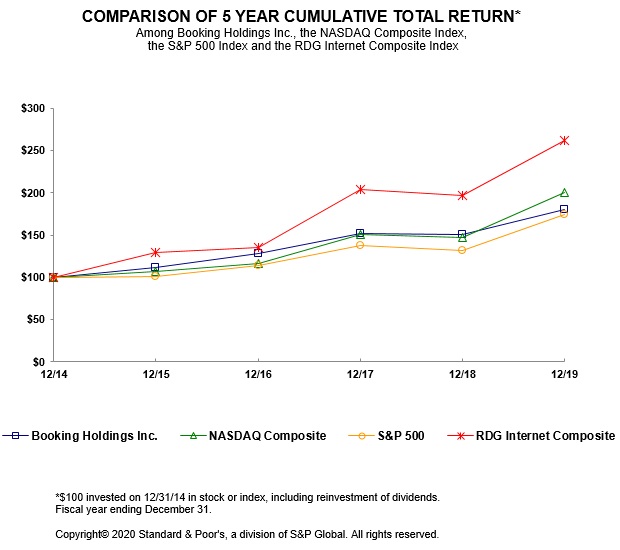
| Measurement Point December 31 | Booking Holdings Inc. | NASDAQ Composite Index | S&P 500 Index | RDG Internet Composite | ||||||||
| 2014 | 100.00 | 100.00 | 100.00 | 100.00 | ||||||||
| 2015 | 111.82 | 106.96 | 101.38 | 128.89 | ||||||||
| 2016 | 128.58 | 116.45 | 113.51 | 135.45 | ||||||||
| 2017 | 152.41 | 150.96 | 138.29 | 203.48 | ||||||||
| 2018 | 151.06 | 146.67 | 132.23 | 197.34 | ||||||||
| 2019 | 180.12 | 200.49 | 173.86 | 262.03 |
Issuer Purchases of Equity Securities
The following table sets forth information relating to repurchases of our equity securities during the three months ended December 31, 2019:
ISSUER PURCHASES OF EQUITY SECURITIES
| Period | Total Number of Shares (or Units) Purchased | Average Price Paid per Share (or Unit) | Total Number of Shares (or Units) Purchased as Part of Publicly Announced Plans or Programs | Maximum Number (or Approximate Dollar Value) of Shares (or Units) that May Yet Be Purchased Under the Plans or Programs | ||||||||||||
| October 1, 2019 — | 229,668 | (1) | $ | 2,002.76 | 229,668 | $ | 12,418,461,506 | (1) | ||||||||
| October 31, 2019 | 210 | (2) | $ | 1,944.25 | N/A | N/A | ||||||||||
| — | ||||||||||||||||
| November 1, 2019 — | 230,653 | (1) | $ | 1,898.41 | 230,653 | $ | 11,980,588,388 | (1) | ||||||||
| November 30, 2019 | 2,160 | (2) | $ | 1,897.45 | N/A | N/A | ||||||||||
| December 1, 2019 — | 222,023 | (1) | $ | 1,972.69 | 222,023 | $ | 11,542,606,620 | (1) | ||||||||
| December 31, 2019 | 241 | (2) | $ | 2,022.91 | N/A | N/A | ||||||||||
| Total | 684,955 | $ | 1,957.53 | 682,344 | $ | 11,542,606,620 |
| (1) | Pursuant to a stock repurchase program announced on May 9, 2019, whereby we are authorized to repurchase up to $15.0 billion of our common stock. |
| (2) | Pursuant to a general authorization, not publicly announced, whereby we are authorized to repurchase shares of our common stock to satisfy employee withholding tax obligations related to stock-based compensation. The table above does not include adjustments in the three months ended December 31, 2019 to previously withheld share amounts (reduction of 13 shares) that reflect changes to the estimates of employee tax withholding obligations. |
Item 6. Selected Financial Data
SELECTED FINANCIAL DATA
The selected consolidated financial data presented below is derived from the Consolidated Financial Statements and related Notes of the Company, and should be read in connection with those statements, some of which are included herein. Selected financial data reflects results of any acquired business from the date of acquisition, including data related to the Momondo Group from its acquisition date of July 24, 2017, FareHarbor from its acquisition date of April 26, 2018 and HotelsCombined from its acquisition date of November 30, 2018. The information set forth below is not necessarily indicative of future results and should be read in conjunction with Part II, Item 7, Management's Discussion and Analysis of Financial Condition and Results of Operations.
| Year Ended December 31, | |||||||||||||||||||
| 2019**(1)** | 2018**(1)** | 2017 | 2016 | 2015 | |||||||||||||||
| (In millions, except per share amounts) | |||||||||||||||||||
| Total revenues | $ | 15,066 | $ | 14,527 | $ | 12,681 | $ | 10,743 | $ | 9,224 | |||||||||
| Cost of revenues | N/A | N/A | 242 | 415 | 646 | ||||||||||||||
| Gross profit | N/A | N/A | 12,439 | 10,328 | 8,578 | ||||||||||||||
| Total operating expenses (2) | 9,721 | 9,186 | 7,901 | 7,422 | 5,319 | ||||||||||||||
| Operating income (2) | 5,345 | 5,341 | 4,538 | 2,906 | 3,259 | ||||||||||||||
| Total other income (expense) (3) | 613 | (506 | ) | (139 | ) | (193 | ) | (131 | ) | ||||||||||
| Income tax expense (4) | 1,093 | 837 | 2,058 | 578 | 577 | ||||||||||||||
| Net income (2) (3) (4) | 4,865 | 3,998 | 2,341 | 2,135 | 2,551 | ||||||||||||||
| Net income applicable to common stockholders per basic common share (2) (3) (4) | 112.93 | 84.26 | 47.78 | 43.14 | 50.09 | ||||||||||||||
| Net income applicable to common stockholders per diluted common share (2) (3) (4) | 111.82 | 83.26 | 46.86 | 42.65 | 49.45 | ||||||||||||||
| Total assets (5) | 21,402 | 22,687 | 25,451 | 19,839 | 17,421 | ||||||||||||||
| Long-term obligations (5) (6) | 11,091 | 10,347 | 11,403 | 8,128 | 7,186 | ||||||||||||||
| Total liabilities (5) | 15,469 | 13,902 | 14,187 | 9,990 | 8,626 | ||||||||||||||
| Total stockholders' equity | 5,933 | 8,785 | 11,261 | 9,820 | 8,795 |
| (1) | The financial statements for the years ended December 31, 2019 and 2018 are presented in accordance with the current revenue recognition accounting standard adopted on January 1, 2018. Financial statements for all periods prior to January 1, 2018 are presented under the previous revenue recognition accounting standard. Under the current revenue recognition standard, we no longer present "Cost of revenues" or "Gross profit" in our Consolidated Statements of Operations. Therefore total revenues reported in 2019 and 2018 are comparable to gross profit reported in previous years. See Note 2 to our Consolidated Financial Statements for further information. |
| (2) | Includes a non-cash charge related to an impairment of OpenTable goodwill of $941 million, which is not tax deductible, for the year ended December 31, 2016. The goodwill impairment charge reduced the 2016 basic and diluted net income per share by $19.01 and $18.79, respectively. |
| (3) | Includes net unrealized gains on marketable equity securities of $745 million for the year ended December 31, 2019 and net unrealized losses on marketable equity securities of $367 million for the year ended December 31, 2018. The unrealized gains (losses) on marketable equity securities, net of tax, increased the 2019 basic and diluted net income per share by $13.52 and $13.39, respectively, and reduced the 2018 basic and diluted net income per share by $6.50 and $6.42, respectively. Pursuant to the adoption of the accounting update on financial instruments in 2018, for periods beginning after December 31, 2017, changes in fair value of marketable equity securities are recognized in net income rather than "Accumulated other comprehensive loss" in the Consolidated Balance Sheets. See Note 2 to our Consolidated Financial Statements for further information. |
| (4) | Includes income tax benefits of $17 million and $46 million for the years ended December 31, 2019 and 2018, respectively, to adjust the 2017 provisional tax expense related to a one-time transitional tax on mandatory deemed repatriation of accumulated unremitted international earnings as a result of the U.S. Tax Cuts and Jobs Act (“Tax Act”) enacted in December 2017 (see Note 15 to the Consolidated Financial Statements). The income tax provision for the |
year ended December 31, 2017 includes a provisional tax expense of $1.6 billion related to the transition tax mentioned above and a provisional net tax benefit of $217 million related to the remeasurement of the Company’s U.S. deferred tax assets and liabilities as a result of the Tax Act, which reduced the 2017 basic and diluted net income per share by $27.47 and $26.94, respectively.
| (5) | Includes, as applicable, operating lease assets of $620 million, current operating lease liabilities of $161 million and non-current operating lease liabilities of $462 million that are reported in the Consolidated Balance Sheet at December 31, 2019. Operating lease assets and liabilities are recognized in the balance sheet as a result of the adoption of the current lease standard on January 1, 2019. See Notes 2 and 10 to our Consolidated Financial Statements for further information. |
| (6) | Includes convertible debt which is classified as a current liability, when applicable. |
Item 7. Management's Discussion and Analysis of Financial Condition and Results of Operations
The following discussion should be read in conjunction with our Consolidated Financial Statements, including the notes to those statements, included elsewhere in this Annual Report on Form 10-K, and the Section entitled "Special Note Regarding Forward-Looking Statements" in this Annual Report on Form 10-K. As discussed in more detail in the Section entitled "Special Note Regarding Forward-Looking Statements," this discussion contains forward-looking statements, which involve risks and uncertainties. Our actual results may differ materially from the results discussed in the forward-looking statements. Factors that might cause those differences include those discussed in "Risk Factors" and elsewhere in this Annual Report on Form 10-K.
We evaluate certain operating and financial measures on both an as-reported and constant-currency basis. We calculate constant currency by converting our current-year period financial results for transactions recorded in currencies other than U.S. Dollars using the corresponding prior-year period monthly average exchange rates rather than the current-year period monthly average exchange rates.
Overview
Our mission is to make it easier for everyone to experience the world. We seek to empower people to cut through travel barriers, such as money, time, language and overwhelming options, so they can use our services to easily and confidently get where they want to go, stay where they want to stay, dine where they want to dine, pay how they want to pay and experience what they want to experience. We connect consumers wishing to make travel reservations with providers of travel services around the world through our online platforms. Through one or more of our brands, consumers can: book a broad array of accommodations (including hotels, motels, resorts, homes, apartments, bed and breakfasts, hostels and other properties); make a car rental reservation or arrange for an airport taxi; make a dinner reservation; or book a cruise, flight, vacation package, tour or activity. Consumers can also use our meta-search services to easily compare travel reservation information, such as airline ticket, hotel reservation and rental car reservation information, from hundreds of online travel platforms at once. In addition, we offer various other services to consumers and partners, such as certain travel-related insurance products and restaurant management services to restaurants.
We offer these services through six primary consumer-facing brands: Booking.com, KAYAK, priceline, agoda, Rentalcars.com and OpenTable. While historically our brands operated on a largely independent basis and many of them focused on a particular service (e.g., accommodation reservations) or geography, we are increasing the collaboration, cooperation and interdependency among our brands in our efforts to provide consumers with the best and most comprehensive services. We also seek to maximize the benefits of our scale by sharing resources and technological innovations, co-developing new services and coordinating activities in key markets among our brands. For example, Booking.com, the world’s leading brand for booking online accommodation reservations (based on room nights booked), offers rental car and other ground transportation services, flights, restaurant reservations, tours and activities reservations and other services, many of which are supported by our other brands. Similarly, hotel reservations available through Booking.com are also generally available through agoda and priceline. See Note 2 to the Consolidated Financial Statements - Segment Reporting for information on our operating segments.
Our results include FareHarbor and HotelsCombined since they were acquired in April 2018 and November 2018, respectively. We refer to our company and all of our subsidiaries and brands collectively as "Booking Holdings," the "Company," "we," "our" or "us."
Our business is driven primarily by international results, which consist of the results of Booking.com, agoda and Rentalcars.com and the international businesses of KAYAK and OpenTable. This classification is independent of where the consumer resides, where the consumer is physically located while using our services or the location of the travel service provider or restaurant. For example, a reservation made through Booking.com at a hotel in New York by a consumer in the United States is part of our international results. In 2019, our international business (the substantial majority of which is generated by Booking.com) represented approximately 90% of our consolidated revenues. A significant majority of our revenues, including a significant majority of our international revenues, is earned in connection with facilitating accommodation reservations. See Note 18 to the Consolidated Financial Statements for more geographic information.
We derive substantially all of our revenues from enabling consumers to make travel service reservations. We also earn revenues from credit card processing rebates and customer processing fees, advertising services, restaurant reservations and restaurant management services, and various other services, such as travel-related insurance revenues.
Trends
The recent coronavirus outbreak has had a significant and negative impact on our business during the first quarter of 2020, in particular in China and certain other Asian markets, though concerns about the coronavirus are also negatively impacting travel demand (and therefore our business) generally. In the more affected markets like China, we have seen a significant increase in cancellations and reduction in new bookings, and ADRs have also been negatively affected. The ultimate impact of the outbreak on our business is impossible to predict with certainty, and therefore the full extent to which the coronavirus will impact our business and results of operations is unknown. However, decreased travel demand resulting from the outbreak has had a negative impact, and is likely to have a negative and material impact, on our business, growth and results of operations. For more information, see Part I, Item 1A, Risk Factors - "Declines or disruptions in the travel industry could adversely affect our business and financial performance."
Over the last several years, we have experienced significant growth in our accommodation reservation services. We believe this growth is the result of, among other things, the broader shift of travel purchases from offline to online, the widespread adoption of mobile devices and the growth of travel overall. We also believe this growth is the result of the continued innovation and execution by our teams around the world to increase the number and the variety of accommodations we offer consumers, increase and improve content, build distribution and improve the consumer experience on our online platforms, as well as consistently and effectively marketing our brands through performance and brand marketing efforts. These year-over-year growth rates have generally decelerated. Given the size of our accommodation reservation business and the general slowing growth rate of the online travel market discussed below, we expect that our year-over-year growth rates will generally continue to decelerate, though the rate of deceleration may fluctuate and there may be periods of acceleration from time to time.
We are a global business, and online travel growth rates vary across the world depending on numerous factors, including local and regional economic conditions, individual disposable income, access to the internet and adoption of e-commerce. Online travel growth rates have generally slowed in markets such as North America and Europe where online activity is high and consumers have been engaging in e-commerce transactions for many years, while online travel growth rates remain relatively high in markets such as Asia-Pacific where incomes are rising more quickly and the increased availability a
Showing the first 8K of 88K characters. Open the full section
Item 7A. Quantitative and Qualitative Disclosures About Market Risk
We have exposure to several types of market risk: changes in interest rates, foreign currency exchange rates and equity prices.
We manage our exposure to interest rate risk and foreign currency risk through internally established policies and procedures and, when deemed appropriate, through the use of derivative financial instruments. We use foreign currency exchange derivative contracts to manage short-term foreign currency risk.
The objective of our policies is to mitigate potential income statement, cash flow and fair value exposures resulting from possible future adverse fluctuations in rates. We evaluate our exposure to market risk by assessing the anticipated near-term and long-term fluctuations in interest rates and foreign currency exchange rates. This evaluation includes the review of leading market indicators, discussions with financial analysts and investment bankers regarding current and future economic conditions and the review of market projections as to expected future rates. We utilize this information to determine our own investment strategies as well as to determine if the use of derivative financial instruments is appropriate to mitigate any potential future market exposure that we may face. Our policy does not allow speculation in derivative instruments for profit or execution of derivative instrument contracts for which there are no underlying exposures. We do not use financial instruments for trading purposes and are not a party to any leveraged derivatives. To the extent that changes in interest rates and foreign currency exchange rates affect general economic conditions, we would also be affected by such changes.
We did not experience any material changes in interest rate exposures during the year ended December 31, 2019. Our investments in marketable debt securities are subject to unrealized gains and losses due to interest rate volatility. We performed a sensitivity analysis to determine the impact a change in interest rates would have on the fair value of our investments in marketable debt securities assuming an adverse change of 100 basis points. A hypothetical 100 basis point (1.0%) increase in interest rates would have resulted in a decrease in the fair values of our investments of approximately $23 million and $126 million at December 31, 2019 and 2018, respectively. These hypothetical losses would only be realized if we sold the investments prior to their maturity. This amount excludes our investments in Trip.com Group convertible senior notes, which are more sensitive to the equity market price volatility of Trip.com Group's American Depositary Shares ("ADSs") than changes in interest rates. The fair value of our Trip.com Group convertible senior notes will likely increase as the market price of Trip.com Group's ADSs increases and will likely decrease as the market price of Trip.com Group's ADSs falls.
At December 31, 2019 and 2018, the outstanding aggregate principal amount of our debt was approximately $8.7 billion and $8.8 billion, respectively. We estimate that the fair value of such debt was approximately $9.8 billion and $9.3 billion at December 31, 2019 and 2018, respectively. A substantial portion of the fair value of our debt in excess of the outstanding principal amount relates to the conversion premium on our outstanding convertible senior notes. Excluding the effect on the fair value of our convertible senior notes, a hypothetical 100 basis point (1.0%) decrease in interest rates would have resulted in an increase in the fair values of our other debt of approximately $325 million and $370 million at December 31, 2019 and 2018, respectively. Our convertible senior notes are more sensitive to the equity market price volatility of our shares than changes in interest rates. The fair value of the convertible senior notes will likely increase as the market price of our shares increases and will likely decrease as the market price of our shares falls.
Our international business represents a substantial majority of our financial results. Therefore, because we report our results in U.S. Dollars, we face exposure to movements in foreign currency exchange rates as the financial results and the financial condition of our international businesses are translated from local currencies (principally Euros and British Pounds Sterling) into U.S. Dollars. If the U.S. Dollar weakens against the local currencies, the translation of these foreign-currency-denominated balances will result in increased net assets, gross bookings, revenues, operating expenses, and net income. Similarly, our net assets, gross bookings, revenues, operating expenses, and net income will decrease if the U.S. Dollar strengthens against the local currencies. Additionally, foreign currency exchange rate fluctuations on transactions, denominated in currencies other than the functional currency, result in gains and losses that are reflected in our Consolidated Statements of Operations.
As a result of foreign currency exchange rate changes, our foreign-currency-denominated gross bookings, revenues and operating expenses as expressed in U.S. Dollars are lower for the year ended December 31, 2019 than they would have been had foreign currency exchange rates remained where they were for the year ended December 31, 2018. Since our expenses are generally denominated in foreign currencies on a basis similar to our revenues, our operating margins have not been significantly impacted by currency fluctuations. Historically, the aggregate principal value of our Euro-denominated debt and accrued interest thereon had provided a hedge against the impact of foreign currency exchange rate fluctuations on the net assets of one of our Euro functional currency subsidiaries. Beginning in the second quarter of 2019, we have only designated certain portions of the aggregate principal value of the Euro-denominated debt as a hedge. The foreign currency transaction gains or losses on the Euro-denominated debt that is not designated as a hedging instrument for accounting purposes are recognized in "Foreign currency transactions and other" in the Consolidated Statement of Operations.
We enter into foreign currency derivative contracts to hedge translation risks from short-term foreign currency exchange rate fluctuations for the Euro, British Pound Sterling and certain other currencies versus the U.S. Dollar. We also enter into foreign currency forward contracts to hedge our exposure to the impact of movements in foreign currency exchange rates on our transactional balances denominated in currencies other than the functional currency. See Note 6 to our Consolidated Financial Statements for further information.
We are exposed to equity price risk as it relates to changes in fair value of our investments in equity securities of publicly-traded companies and private companies. The fair value of our investments in equity securities of publicly-traded companies and private companies, excluding certain investments classified as debt securities for accounting purposes, was $1.8 billion and $501 million, respectively, at December 31, 2019, and $1.0 billion and $501 million, respectively, at December 31, 2018. Our investments in private companies, excluding certain investments classified as debt securities for accounting purposes, are measured at cost less impairment, if any, plus or minus changes resulting from observable price changes in orderly transactions for the identical or a similar investment of the same issuer. See Note 2 and 5 to our Consolidated Financial Statements for further information. A hypothetical 10% decrease in the fair value of these investments at December 31, 2019 and 2018 would have resulted in a total loss, before tax, of approximately $230 million and $150 million, respectively, being recognized in net income.
Item 8. Financial Statements and Supplementary Data
The following Consolidated Financial Statements of the Company and the report of our independent registered public accounting firm are filed as part of this Annual Report on Form 10-K (See Part IV, Item 15, Exhibits and Financial Statement Schedules): Consolidated Balance Sheets at December 31, 2019 and 2018; Consolidated Statements of Operations, Consolidated Statements of Comprehensive Income, Consolidated Statements of Changes in Stockholders' Equity and Consolidated Statements of Cash Flows for the years ended December 31, 2019, 2018 and 2017; Notes to the Consolidated Financial Statements; and Report of Independent Registered Public Accounting Firm.
Item 9. Changes in and Disagreements with Accountants on Accounting and Financial Disclosure
None.
Item 9A. Controls and Procedures
Disclosure Controls and Procedures. Under the supervision and with the participation of our management, including our principal executive officer and our principal financial officer, we conducted an evaluation of our disclosure controls and procedures, as such term is defined under Exchange Act Rule 13a-15(e). Based on this evaluation, our principal executive officer and our principal financial officer concluded that our disclosure controls and procedures were effective as of the end of the period covered by this Annual Report on Form 10-K.
Pursuant to Section 404 of the Sarbanes-Oxley Act of 2002, we include a report of our management's assessment of the design and effectiveness of our internal controls over financial reporting for the year ended December 31, 2019.
Management's Report on Internal Control Over Financial Reporting. Our management is responsible for establishing and maintaining adequate internal control over financial reporting, as such term is defined in Exchange Act Rule 13a-15(f). Under the supervision and with the participation of our management, including our principal executive officer and principal financial officer, we conducted an evaluation of the effectiveness of our internal control over financial reporting based on the
framework in the Internal Control - Integrated Framework (2013) issued by the Committee of Sponsoring Organizations of the Treadway Commission.
Based on our evaluation, our management concluded that our internal control over financial reporting was effective as of December 31, 2019. Our independent registered public accounting firm also attested to, and reported on the effectiveness of internal control over financial reporting.
Because of its inherent limitations, internal control over financial reporting may not prevent or detect misstatements. Projections of any evaluation of effectiveness to future periods are subject to the risk that controls may become inadequate because of changes in conditions, or that the degree of compliance with the policies or procedures may deteriorate.
Changes in Internal Controls. No change in our internal control over financial reporting (as such term is defined in Exchange Act Rule 13a-15(f)) occurred during the three months ended December 31, 2019 that materially affected, or is reasonably likely to materially affect, our internal control over financial reporting.
REPORT OF INDEPENDENT REGISTERED PUBLIC ACCOUNTING FIRM
To the Board of Directors and Stockholders of Booking Holdings Inc.
Opinion on Internal Control over Financial Reporting
We have audited the internal control over financial reporting of Booking Holdings Inc. and subsidiaries (the "Company") as of December 31, 2019, based on criteria established in Internal Control - Integrated Framework (2013) issued by the Committee of Sponsoring Organizations of the Treadway Commission (COSO). In our opinion, the Company maintained, in all material respects, effective internal control over financial reporting as of December 31, 2019, based on criteria established in Internal Control - Integrated Framework (2013) issued by COSO.
We have also audited, in accordance with the standards of the Public Company Accounting Oversight Board (United States) (PCAOB), the financial statements as of and for the year ended December 31, 2019, of the Company and our report dated February 26, 2020, expressed an unqualified opinion on those financial statements and included an explanatory paragraph related to the Company’s change in method of accounting for the recognition and measurement of financial instruments in 2018 due to the adoption of an accounting standards update.
Basis for Opinion
The Company’s management is responsible for maintaining effective internal control over financial reporting and for its assessment of the effectiveness of internal control over financial reporting, included in the accompanying "Management's Report on Internal Control Over Financial Reporting." Our responsibility is to express an opinion on the Company’s internal control over financial reporting based on our audit. We are a public accounting firm registered with the PCAOB and are required to be independent with respect to the Company in accordance with the U.S. federal securities laws and the applicable rules and regulations of the Securities and Exchange Commission and the PCAOB.
We conducted our audit in accordance with the standards of the PCAOB. Those standards require that we plan and perform the audit to obtain reasonable assurance about whether effective internal control over financial reporting was maintained in all material respects. Our audit included obtaining an understanding of internal control over financial reporting, assessing the risk that a material weakness exists, testing and evaluating the design and operating effectiveness of internal control based on the assessed risk, and performing such other procedures as we considered necessary in the circumstances. We believe that our audit provides a reasonable basis for our opinion.
Definition and Limitations of Internal Control over Financial Reporting
A company’s internal control over financial reporting is a process designed to provide reasonable assurance regarding the reliability of financial reporting and the preparation of financial statements for external purposes in accordance with generally accepted accounting principles. A company’s internal control over financial reporting includes those policies and procedures that (1) pertain to the maintenance of records that, in reasonable detail, accurately and fairly reflect the transactions and dispositions of the assets of the company; (2) provide reasonable assurance that transactions are recorded as necessary to permit preparation of financial statements in accordance with generally accepted accounting principles, and that receipts and expenditures of the company are being made only in accordance with authorizations of management and directors of the company; and (3) provide reasonable assurance regarding prevention or timely detection of unauthorized acquisition, use, or disposition of the company’s assets that could have a material effect on the financial statements.
Because of its inherent limitations, internal control over financial reporting may not prevent or detect misstatements. Also, projections of any evaluation of effectiveness to future periods are subject to the risk that controls may become inadequate because of changes in conditions, or that the degree of compliance with the policies or procedures may deteriorate.
/s/ DELOITTE & TOUCHE LLP
Stamford, Connecticut
February 26, 2020
Item 9B. Other Information
None.
PART III
Item 10. Directors, Executive Officers and Corporate Governance
Information required by Part III, Item 10 will be included in our Proxy Statement relating to our 2020 annual meeting of stockholders to be filed with the Securities and Exchange Commission within 120 days after the end of our fiscal year ended December 31, 2019, and is incorporated herein by reference.
Item 11. Executive Compensation
Information required by Part III, Item 11 will be included in our Proxy Statement relating to our 2020 annual meeting of stockholders to be filed with the Securities and Exchange Commission within 120 days after the end of our fiscal year ended December 31, 2019, and is incorporated herein by reference.
Item 12. Security Ownership of Certain Beneficial Owners and Management and Related Stockholder Matters
Information required by Part III, Item 12 will be included in our Proxy Statement relating to our 2020 annual meeting of stockholders to be filed with the Securities and Exchange Commission within 120 days after the end of our fiscal year ended December 31, 2019, and is incorporated herein by reference.
Item 13. Certain Relationships and Related Transactions, and Director Independence
Information required by Part III, Item 13 will be included in our Proxy Statement relating to our 2020 annual meeting of stockholders to be filed with the Securities and Exchange Commission within 120 days after the end of our fiscal year ended December 31, 2019, and is incorporated herein by reference.
Item 14. Principal Accountant Fees and Services
Information required by Part III, Item 14 will be included in our Proxy Statement relating to our 2020 annual meeting of stockholders to be filed with the Securities and Exchange Commission within 120 days after the end of our fiscal year ended December 31, 2019, and is incorporated herein by reference.
PART IV
Item 15. Exhibits and Financial Statement Schedules.
(a) List of Documents Filed as a Part of this Annual Report on Form 10-K:
The following Consolidated Financial Statements of the Company and the report of our independent registered public accounting firm are filed as part of this Annual Report on Form 10-K: Consolidated Balance Sheets at December 31, 2019 and 2018; Consolidated Statements of Operations, Consolidated Statements of Comprehensive Income, Consolidated Statements of Changes in Stockholders' Equity and Consolidated Statements of Cash Flows for the years ended December 31, 2019, 2018 and 2017; Notes to the Consolidated Financial Statements; and Report of Independent Registered Public Accounting Firm.
All financial statement schedules have been omitted because they are not applicable, not material or the required information is shown in the Consolidated Financial Statements or the notes thereto.
(b) Exhibits
In reviewing the agreements included as exhibits to this Annual Report on Form 10-K, please remember they are included to provide you with information regarding their terms and are not intended to provide any other factual or disclosure information about the Company or the other parties to the agreements. Some agreements contain representations and warranties by each of the parties to the applicable agreement. These representations and warranties have been made solely for the benefit of the other parties to the applicable agreement and:
| • | should not be treated as categorical statements of fact, but rather as a way of allocating the risk to one of the parties if those statements prove to be inaccurate; |
| • | may have been qualified by disclosures that were made to the other party in connection with the negotiation of the applicable agreement, which disclosures are not necessarily reflected in the agreement; |
| • | may apply standards of materiality in a way that is different from what may be viewed as material to you or other investors; and |
| • | were made only as of the date of the applicable agreement or such other date or dates as may be specified in the agreement and are subject to more recent developments. |
Accordingly, these representations and warranties may not describe the actual state of affairs as of the date they were made or at any other time. Additional information about the Company may be found elsewhere in this Annual Report on Form 10‑K and the Company's other public filings, which are available without charge through the SEC's website at http://www.sec.gov.
| Exhibit Number | Description |
| 3.1(a) | Restated Certificate of Incorporation of the Registrant. |
| 3.2(b) | Amended and Restated By-Laws of the Registrant. |
| 4.1 | Reference is hereby made to Exhibits 3.1 and 3.2. |
| 4.2(c) | Specimen Certificate for Registrant's Common Stock. |
| 4.3(d) | Indenture, dated as of June 4, 2013, between the Registrant and American Stock Transfer & Trust Company, LLC as Trustee. |
| 4.4(e) | Indenture, dated as of August 20, 2014, between the Registrant and American Stock Transfer & Trust Company, LLC as Trustee. |
| 4.5(f) | Indenture, dated as of September 23, 2014, between the Registrant and Deutsche Bank Trust Company Americas, as Trustee. |
| 4.6(g) | Indenture, dated as of August 8, 2017, between the Company and U.S. Bank National Association, as trustee. |
| 4.7(h) | Form of 2.375% Senior Note due 2024. |
| 4.8(i) | Officers' Certificate, dated September 23, 2014, for the 2.375% Senior Notes due 2024. |
| 4.9(j) | Form of 1.800% Senior Note due 2027. |
| 4.10(k) | Officers' Certificate, dated March 3, 2015, for the 1.800% Senior Notes due 2027. |
| 4.11(l) | Form of 3.650% Senior Note due 2025. |
| 4.12(m) | Officers' Certificate, dated March 13, 2015, for the 3.650% Senior Notes due 2025. |
| 4.13(f) | Form of 2.15% Senior Note due 2022. |
| 4.14(f) | Officers' Certificate, dated November 25, 2015, for the 2.15% Senior Notes due 2022. |
| 4.15(n) | Form of 3.600% Senior Note due 2026. |
| 4.16(n) | Officers' Certificate, dated May 23, 2016, for the 3.600% Senior Notes due 2026. |
| 4.17(o) | Form of 0.800% Senior Note due 2022. |
| 4.18(o) | Officers' Certificate, dated March 10, 2017, for the 0.800% Senior Notes due 2022. |
| 4.19(p) | Form of 2.750% Senior Note due 2023. |
| 4.20(p) | Officers' Certificate, dated August 15, 2017, with respect to the 2.750% Senior Notes due 2023. |
| 4.21(p) | Form of 3.550% Senior Note due 2028. |
| 4.22(p) | Officers' Certificate, dated August 15, 2017, with respect to the 3.550% Senior Notes due 2028. |
| 4.23 | Description of the Company's Common Stock Registered Pursuant to Section 12 of the Securities Exchange Act of 1934. |
| 4.24 | Description of the Company's 0.800% Senior Notes due 2022 Registered Pursuant to Section 12 of the Securities Exchange Act of 1934. |
| 4.25 | Description of the Company's 2.150% Senior Notes due 2022 Registered Pursuant to Section 12 of the Securities Exchange Act of 1934. |
| 4.26 | Description of the Company's 2.375% Senior Notes due 2024 Registered Pursuant to Section 12 of the Securities Exchange Act of 1934. |
| 4.27 | Description of the Company's 1.800% Senior Notes due 2027 Registered Pursuant to Section 12 of the Securities Exchange Act of 1934. |
| 10.1(q)+ | Booking Holdings Inc. 1999 Omnibus Plan (As Amended and Restated Effective June 7, 2018). |
| Exhibit Number | Description |
| 10.2(r)+ | Form of Restricted Stock Unit Award Agreement for Employees in the Netherlands under the 1999 Omnibus Plan. |
| 10.3(s)+ | Form of Restricted Stock Unit Agreement for awards under the 1999 Omnibus Plan to non-employee directors. |
| 10.4(t)+ | Form of Restricted Stock Unit Agreement for awards under the 1999 Omnibus Plan. |
| 10.5(u)+ | 2017 Form of Performance Share Unit Agreement under the 1999 Omnibus Plan. |
| 10.6(t)+ | 2018 Form of Performance Share Unit Agreement under the 1999 Omnibus Plan. |
| 10.7(v)+ | 2019 Form of Performance Share Unit Agreement under the 1999 Omnibus Plan. |
| 10.8(u)+ | Amended and Restated KAYAK Software Corporation 2012 Equity Incentive Plan. |
| 10.9(u)+ | OpenTable, Inc. Amended and Restated 2009 Equity Incentive Award Plan. |
| 10.10(w)+ | Buuteeq, Inc. Amended and Restated 2010 Stock Plan. |
| 10.11(x)+ | Amended and Restated Rocket Travel, Inc. 2012 Stock Incentive Plan. |
| 10.12(x)+ | Amended and Restated Annual Bonus Plan. |
| 10.13(y)+ | Form of Non-Competition and Non-Solicitation Agreement. |
| 10.17(z)+ | Second Amended and Restated Employment Agreement, dated April 21, 2015 by and between the Registrant and Peter J. Millones. |
| 10.18(aa)+ | Amended and Restated Employment contract, dated May 19, 2016 by and between Booking.com Holding B.V. and Gillian Tans. |
| 10.19(bb)+ | Employment Agreement, dated December 15, 2016 by and between the Registrant and Glenn D. Fogel. |
| 10.20(bb)+ | Non-Competition and Non-Solicitation Agreement, dated December 15, 2016 by and between the Registrant and Glenn D. Fogel. |
| 10.21(bb)+ | Employee Confidentiality and Assignment Agreement, dated December 15, 2016 by and between the Registrant and Glenn D. Fogel. |
| 10.25(cc)+ | Employment Agreement, dated January 19, 2018, between the Registrant and David I. Goulden. |
| 10.26(cc)+ | Non-Competition and Non-Solicitation Agreement, dated March 1, 2018, between the Registrant and David I. Goulden. |
| 10.27(cc)+ | Employee Confidentiality and Assignment Agreement, dated January 19, 2018, between the Registrant and David I. Goulden. |
| 10.28(dd)+ | Transition Agreement, dated June 26, 2019, between Booking.com Holding B.V. and Gillian Tans. |
| 10.29(ee) | Credit Agreement, dated as of August 14, 2019, among the Registrant, the lenders from time to time party thereto, and JPMorgan Chase Bank, N.A. as Administrative Agent. |
| 10.30(b)+ | Letter Agreement, dated October 24, 2019 by and between the Registrant and Glenn D. Fogel. |
| 10.31(ff)+ | Form of Employee Confidentiality and Assignment Agreement. |
| 21 | List of Subsidiaries. |
| 23.1 | Consent of Deloitte & Touche LLP. |
| 24.1 | Power of Attorney (included in the Signature Page). |
| 31.1 | Certification of Glenn D. Fogel, pursuant to Section 302 of the Sarbanes-Oxley Act of 2002. |
| 31.2 | Certification of David I. Goulden, pursuant to Section 302 of the Sarbanes-Oxley Act of 2002. |
| 32.1(gg) | Certification of Glenn D. Fogel, pursuant to Section 906 of the Sarbanes-Oxley Act of 2002 (Subsections (a) and (b) of Section 1350, Chapter 63 of Title 18, United States Code). |
| 32.2(gg) | Certification of David I. Goulden, pursuant to Section 906 of the Sarbanes-Oxley Act of 2002 (Subsections (a) and (b) of Section 1350, Chapter 63 of Title 18, United States Code). |
| 101.INS | XBRL Instance Document - the instance document does not appear in the Interactive Data File because its XBRL tags are embedded within the inline XBRL document. |
| 104 | Cover Page Interactive Data File - the cover page from this Annual Report on Form 10-K for the year ended December 31, 2019, formatted in Inline XBRL (included in Exhibit 101). |
| + | Indicates a management contract or compensatory plan or arrangement. |
| (a) | Previously filed as an exhibit to the Current Report on Form 8-K filed on February 21, 2018 (File No. 1-36691). |
| (b) | Previously filed as an exhibit to the Current Report on Form 8-K filed on October 25, 2019 (File No. 1-36691). |
| (c) | Previously filed as an exhibit to Amendment No. 2 to Registration Statement on Form S-1 filed on March 18, 1999 (File No. 333-69657). |
| (d) | Previously filed as an exhibit to the Current Report on Form 8-K filed on June 4, 2013 (File No. 0-25581). |
| (e) | Previously filed as an exhibit to the Current Report on Form 8-K filed on August 20, 2014 (File No. 0-25581). |
| (f) | Previously filed as an exhibit to the Current Report on Form 8-K filed on November 25, 2015 (File No. 1-36691). |
| (g) | Previously filed as an exhibit to the Registration Statement on Form S-3 filed on August 8, 2017 (File No. 333-219800). |
| (h) | Previously filed as an exhibit to the Current Report on Form 8-K filed on September 22, 2014 (File No. 0-25581). |
| (i) | Previously filed as an exhibit to the Current Report on Form 8-K filed on September 26, 2014 (File No. 0-25581). |
| (j) | Previously filed as an exhibit to the Current Report on Form 8-K filed on March 2, 2015 (File No. 1-36691). |
| (k) | Previously filed as an exhibit to the Current Report on Form 8-K filed on March 4, 2015 (File No. 1-36691). |
| (l) | Previously filed as an exhibit to the Current Report on Form 8-K filed on March 12, 2015 (File No. 1-36691). |
| (m) | Previously filed as an exhibit to the Current Report on Form 8-K filed on March 13, 2015 (File No. 1-36691). |
| (n) | Previously filed as an exhibit to the Current Report on Form 8-K filed on May 23, 2016 (File No. 1-36691). |
| (o) | Previously filed as an exhibit to the Current Report on Form 8‑K filed on March 10, 2017 (File No. 1-36691). |
| (p) | Previously filed as an exhibit to our Current Report on Form 8-K filed on August 15, 2017 (File No. 1-36691). |
| (q) | Previously filed as an exhibit to our Current Report on Form 8-K filed on June 8, 2018 (File No. 1-36691). |
| (r) | Previously filed as an exhibit to the Current Report on Form 8‑K filed on November 8, 2005 (File No. 0-25581). |
| (s) | Previously filed as an exhibit to the Current Report on Form 8‑K filed on March 9, 2011 (File No. 0-25581). |
| (t) | Previously filed as an exhibit to the Current Report on Form 8-K filed on March 2, 2018 (File No. 1-36691). |
| (u) | Previously filed as an exhibit to the Current Report on Form 8‑K filed on March 3, 2017 (File No. 1-36691). |
| (v) | Previously filed as an exhibit to the Current Report on Form 8-K filed on March 1, 2019 (File No. 1-36691). |
| (w) | Previously filed as an exhibit to the Registration Statement on Form S-8 filed on June 13, 2014 (File No. 333-196756). |
| (x) | Previously filed as an exhibit to the Annual Report on Form 10-K filed for the year ended December 31, 2015 (File No. 1-36691). |
| (y) | Previously filed as an exhibit to the Current Report on Form 8-K filed on March 4, 2013 (File No. 0-25581). |
| (z) | Previously filed as an exhibit to our Current Report on Form 8-K filed on April 24, 2015 (File No. 1-36691). |
| (aa) | Previously filed as an exhibit to the Current Report on Form 8-K filed on May 20, 2016 (File No. 1-36691). |
| (bb) | Previously filed as an exhibit to the Current Report on Form 8-K filed on December 16, 2016 (File No. 1-36691). |
| (cc) | Previously filed as an exhibit to the Current Report on Form 8-K filed on January 22, 2018 (File No. 1-36691). |
| (dd) | Previously filed as an exhibit to the Current Report on Form 8-K filed on June 28, 2019 (File No. 1-36691) |
| (ee) | Previously filed as an exhibit to the Current Report on Form 8-K filed on August 14, 2019 (File No. 1-36691). |
| (ff) | Previously filed as an exhibit to the Quarterly Report on Form 10-Q filed on May 9, 2019 (File No. 1-36691). |
| (gg) | This document is being furnished in accordance with SEC Release Nos. 33‑8212 and 34‑47551. |
Item 16. Form 10-K Summary.
None.
Signatures
Pursuant to the requirements of Section 13 or 15(d) of the Securities Exchange Act of 1934, the registrant has duly caused this report to be signed on its behalf by the undersigned, thereunto duly authorized.
| BOOKING HOLDINGS INC. | |||
| By: | /s/ Glenn D. Fogel | ||
| Name: | Glenn D. Fogel | ||
| Title: | Chief Executive Officer and President | ||
| Date: | February 26, 2020 |
Power of Attorney
KNOW ALL PERSONS BY THESE PRESENTS, that each person whose signature appears below constitutes and appoints Glenn D. Fogel, David I. Goulden and Peter J. Millones, and each of them severally, his or her true and lawful attorney-in-fact with power of substitution and resubstitution to sign in his or her name, place and stead, in any and all capacities, to do any and all things and execute any and all instruments that such attorney may deem necessary or advisable under the Securities Exchange Act of 1934 and any rules, regulations and requirements of the Securities and Exchange Commission in connection with this Annual Report on Form 10-K and any and all amendments hereto, as fully and for all intents and purposes as he or she might do or could do in person, and hereby ratifies and confirms all said attorneys-in-fact and agents, each acting alone, and his or her substitute or substitutes, may lawfully do or cause to be done by virtue hereof.
Pursuant to the requirements of the Securities Exchange Act of 1934, this report has been signed below by the following persons on behalf of the registrant and in the capacities and on the dates indicated.
| Signature | Title | Date | ||
| /s/ Jeffery H. Boyd | Director, Chairman of the Board | February 26, 2020 | ||
| Jeffery H. Boyd | ||||
| /s/ Glenn D. Fogel | Director, Chief Executive Officer and President | February 26, 2020 | ||
| Glenn D. Fogel | ||||
| /s/ David I. Goulden | Executive Vice President and Chief Financial | February 26, 2020 | ||
| David I. Goulden | Officer (Principal Financial Officer) | |||
| /s/ Susana D'Emic | Chief Accounting Officer and Controller | February 26, 2020 | ||
| Susana D'Emic | (Principal Accounting Officer) | |||
| /s/ Timothy M. Armstrong | Director | February 26, 2020 | ||
| Timothy M. Armstrong | ||||
| /s/ Mirian Graddick-Weir | Director | February 26, 2020 | ||
| Mirian Graddick-Weir | ||||
| /s/ James M. Guyette | Director | February 26, 2020 | ||
| James M. Guyette | ||||
| Signature | Title | Date | ||
| /s/ Wei Hopeman | Director | February 26, 2020 | ||
| Wei Hopeman | ||||
| /s/ Robert J. Mylod Jr. | Director | February 26, 2020 | ||
| Robert J. Mylod Jr. | ||||
| /s/ Charles H. Noski | Director | February 26, 2020 | ||
| Charles H. Noski | ||||
| /s/ Nancy B. Peretsman | Director | February 26, 2020 | ||
| Nancy B. Peretsman | ||||
| /s/ Nicholas J. Read | Director | February 26, 2020 | ||
| Nicholas J. Read | ||||
| /s/ Thomas E. Rothman | Director | February 26, 2020 | ||
| Thomas E. Rothman | ||||
| /s/ Lynn M. Vojvodich | Director | February 26, 2020 | ||
| Lynn M. Vojvodich | ||||
| /s/ Vanessa A. Wittman | Director | February 26, 2020 | ||
| Vanessa A. Wittman |
INDEX TO CONSOLIDATED FINANCIAL STATEMENTS
| Page No. | |
| Report of Independent Registered Public Accounting Firm | 64 |
| Consolidated Balance Sheets at December 31, 2019 and 2018 | 67 |
| Consolidated Statements of Operations for the years ended December 31, 2019, 2018 and 2017 | 68 |
| Consolidated Statements of Comprehensive Income for the years ended December 31, 2019, 2018 and 2017 | 69 |
| Consolidated Statements of Changes in Stockholders' Equity for the years ended December 31, 2019, 2018 and 2017 | 70 |
| Consolidated Statements of Cash Flows for the years ended December 31, 2019, 2018 and 2017 | 71 |
| Notes to Consolidated Financial Statements | 72 |
REPORT OF INDEPENDENT REGISTERED PUBLIC ACCOUNTING FIRM
To the Board of Directors and Stockholders of Booking Holdings Inc.
Opinion on the Financial Statements
We have audited the accompanying consolidated balance sheets of Booking Holdings Inc. and subsidiaries (the "Company") as of December 31, 2019 and 2018, the related consolidated statements of operations, comprehensive income, changes in stockholders' equity, and cash flows for each of the three years in the period ended December 31, 2019, including the related notes (collectively, the "financial statements"). In our opinion, the financial statements present fairly, in all material respects, the financial position of the Company as of December 31, 2019 and 2018, and the results of its operations and its cash flows, for each of the three years in the period ended December 31, 2019, in conformity with accounting principles generally accepted in the United States of America.
We have also audited, in accordance with the standards of the Public Company Accounting Oversight Board (United States) (PCAOB), the Company's internal control over financial reporting as of December 31, 2019, based on criteria established in Internal Control - Integrated Framework (2013) issued by the Committee of Sponsoring Organizations of the Treadway Commission and our report dated February 26, 2020, expressed an unqualified opinion on the Company's internal control over financial reporting.
Change in Accounting Principle
As discussed in Note 2 to the financial statements, the Company has changed its method of accounting for the recognition and measurement of financial instruments in 2018 due to the adoption of an accounting standards update.
Basis for Opinion
These financial statements are the responsibility of the Company's management. Our responsibility is to express an opinion on the Company's financial statements based on our audits. We are a public accounting firm registered with the PCAOB and are required to be independent with respect to the Company in accordance with the U.S. federal securities laws and the applicable rules and regulations of the Securities and Exchange Commission and the PCAOB.
We conducted our audits in accordance with the standards of the PCAOB. Those standards require that we plan and perform the audit to obtain reasonable assurance about whether the financial statements are free of material misstatement, whether due to error or fraud. Our audits included performing procedures to assess the risks of material misstatement of the financial statements, whether due to error or fraud, and performing procedures that respond to those risks. Such procedures included examining, on a test basis, evidence regarding the amounts and disclosures in the financial statements. Our audits also included evaluating the accounting principles used and significant estimates made by management, as well as evaluating the overall presentation of the financial statements. We believe that our audits provide a reasonable basis for our opinion.
Critical Audit Matters
The critical audit matters communicated below a
Showing the first 8K of 191K characters. Open the full section