 filings.tools
Item 1. Business
42K characters. Original on sec.gov · Markdown
Item 1. Business
The COVID-19 pandemic has had a profound impact on our business, employees, partners, communities and stockholders. Although there was a significant decline in our business in 2020 as a result of the COVID-19 pandemic, we remain confident that the travel industry will recover when travelers feel safe to travel once again. In the beginning of the crisis, our priorities included the health and safety of our employees and stabilizing our business from the immediate shock of the pandemic by working with customers and partners to address unprecedented levels of cancellations. We also took numerous actions in response to the pandemic, including steps to increase our financial liquidity, reduce costs, restructure our operations to address our near- to medium-term business expectations and ensure we are well-positioned to capture travel demand when it returns so we can emerge from this crisis on a strong footing and work on extending our leadership position. While the timing of the recovery of the travel industry remains uncertain, we believe that demand for our services will return when government restrictions are lifted and people are confident it is once again safe to travel.
As a result, our mission to make it easier for everyone to experience the world remains unchanged. We seek to empower people to cut through travel barriers, such as money, time, language and overwhelming options, so they can use our services to easily and confidently get where they want to go, stay where they want to stay, dine where they want to dine, pay how they want to pay and experience what they want to experience. We connect consumers wishing to make travel reservations with providers of travel services around the world through our online platforms. Through one or more of our brands, consumers can: book a broad array of accommodations (including hotels, motels, resorts, homes, apartments, bed and breakfasts, hostels and other properties); make a car rental reservation or arrange for an airport taxi; make a dinner reservation; or book a flight, cruise, vacation package, tour or activity. Consumers can also use our meta-search services to easily compare travel reservation information, such as airline ticket, hotel reservation and rental car reservation information, from hundreds of online travel platforms at once. In addition, we offer various other services to consumers and partners, such as certain travel-related insurance products and restaurant management services to restaurants.
We offer these services through six primary consumer-facing brands: Booking.com, Priceline, agoda, Rentalcars.com, KAYAK and OpenTable. While historically our brands operated on a largely independent basis and many of them focused on a particular service (e.g., accommodation reservations) or geography, we continue to increase the collaboration, cooperation and interdependency among our brands in our efforts to provide consumers with the best and most comprehensive services. We also seek to maximize the benefits of our scale by sharing resources and technological innovations, co-developing new services and coordinating activities in key markets among our brands. For example, Booking.com, the world’s leading brand for booking online accommodation reservations (based on room nights booked), offers rental car and other ground transportation services, flights, tours and activities, restaurant reservations and other services, many of which are supported by our other
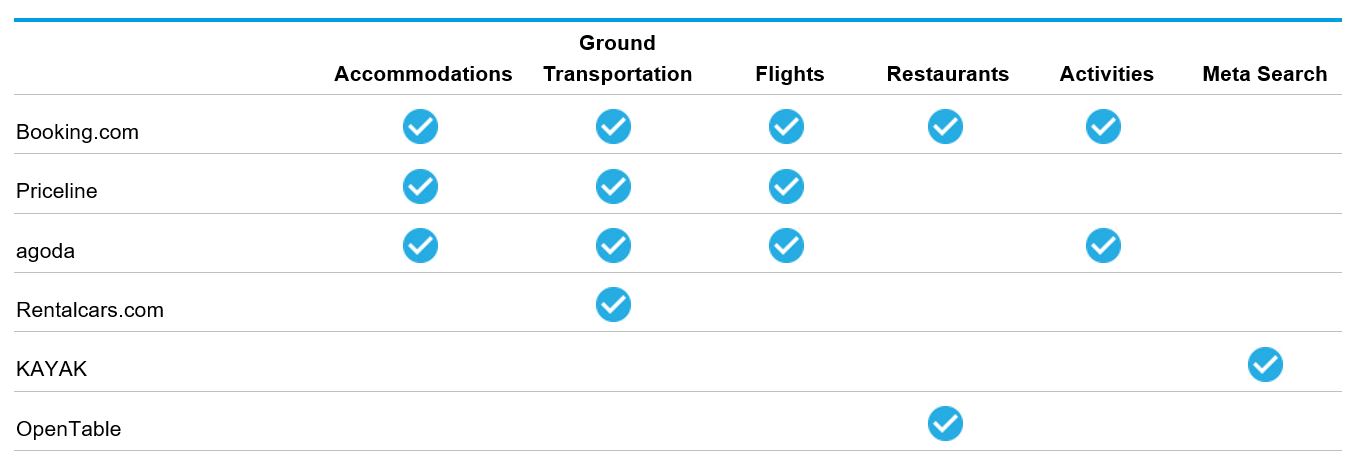
brands. Similarly, hotel reservations available through Booking.com are also generally available through agoda and Priceline. The following table shows the key services offered to consumers by our primary brands:
Our business is driven primarily by international results, which consist of the results of Booking.com, agoda and Rentalcars.com and the international businesses of KAYAK and OpenTable. This classification is independent of where the consumer resides, where the consumer is physically located while using our services or the location of the travel service provider or restaurant. For example, a reservation made through Booking.com at a hotel in New York by a consumer in the United States is part of our international results. During the year ended December 31, 2020, our international business (the substantial majority of which is generated by Booking.com) represented approximately 88% of our consolidated revenues. A significant majority of our revenues, including a significant majority of our international revenues, is earned in connection with facilitating accommodation reservations. See Note 18 to the Consolidated Financial Statements for more geographic information.
Our common stock is listed on the NASDAQ Global Select Market under the symbol "BKNG." We refer to our company and all of our subsidiaries and brands collectively as "Booking Holdings," the "Company," "we," "our" or "us."
The Booking Holdings Business Model
We derive substantially all of our revenues from enabling consumers to make travel service reservations. We also earn revenues from credit card processing rebates and customer processing fees, advertising services, restaurant reservations and restaurant management services, and various other services, such as travel-related insurance.
For the year ended December 31, 2020, we had revenues of $6.8 billion, which we classify as "agency" revenues, "merchant" revenues and "advertising and other" revenues.
-
Agency revenues are derived from travel-related transactions where we do not facilitate payments from travelers for the services provided. We invoice the travel service providers for our commissions after travel is completed. Agency revenues consist almost entirely of travel reservation commissions.
-
Merchant revenues are derived from travel-related transactions where we facilitate payments from travelers for the service provided, generally at the time of booking. Merchant revenues include travel reservation commissions and transaction net revenues (i.e., the amount charged to travelers less the amount owed to travel service providers) in connection with our merchant reservation services; credit card processing rebates and customer processing fees; and ancillary fees, including travel-related insurance revenues. Substantially all merchant revenues are derived from transactions where travelers book accommodation reservations or rental car reservations.
-
Advertising and other revenues are derived primarily from (a) revenues earned by KAYAK for sending referrals to online travel companies ("OTCs") and travel service providers and for advertising placements on its platforms and (b) revenues earned by OpenTable for its restaurant reservation services and subscription fees for restaurant management services.
The Booking Holdings Strategy
We aim to achieve our mission to make it easier for everyone to experience the world through global leadership in online travel and restaurant reservation and related services by striving to:
-
provide consumers with the best choices and prices at any time, in any place, on any device;
-
make it easy for people to find, book, pay for and experience their travel desires; and
-
provide platforms, tools and insights to our business partners to help them be successful.
We focus on relentless innovation and execution and a commitment to serve both consumers and our travel service provider and restaurant partners with unmatched service and best-in-class digital technology. We believe that as the COVID-19 pandemic subsides, people feel confident traveling and dining out and government restrictions are lifted, the global online travel and dining industries will recover and, after some period of higher growth through the recovery, continue to grow as they did before the COVID-19 pandemic as consumer purchasing shifts from traditional offline channels to interactive online channels, including mobile channels. As travel demand returns, we plan to continue to participate broadly in this online growth by expanding our service offerings and markets. In particular, we seek to (a) leverage technology to provide consumers with the best experience, (b) partner with travel service providers and restaurants to our mutual benefit, (c) operate multiple brands that collaborate with each other, and (d) invest in profitable and sustainable growth.
- Providing the best consumer experience**. We believe that offering consumers an outstanding online experience is essential for our future success. To accomplish this, we focus on providing consumers with: (a) intuitive, easy-to-use online travel and restaurant reservation and search services; (b) a continually improving selection of accommodations, other travel offerings, restaurants and payment options through our services; (c) informative and useful content, such as pictures, accommodation and restaurant details and reviews; and (d) excellent customer service. Our goal is to make travel easy, frictionless and personal and to offer consumers the most value, the most trusted brands, the most personalized experience and the most extensive, varied and comprehensive travel service selection in every geography. Further, we endeavor to provide excellent customer service in a variety of ways, including through our call centers and online platforms and the use of chatbots and other technologies, so that consumers can be confident that booking reservations through us will be a positive experience.
Although we spent much of 2020 navigating the challenges of the COVID-19 pandemic, we continue to innovate and invest in our services in order to emerge from the pandemic in a strong position to meet the needs of consumers and our travel service provider and restaurant partners. We continue to seek to grow our business through innovation by, among other things, providing a best-in-class user experience with intuitive, easy-to-use online platforms (i.e., websites and mobile apps) to ensure that we are meeting the needs of online consumers while aiming to exceed their expectations. As a result, our long-term strategy is to build a seamless offering of multiple elements of travel, which we refer to as the "Connected Trip." We believe that through innovation and the utilization of emerging technologies such as artificial intelligence, the Connected Trip will simplify and improve all aspects of the travel experience, including: discovery, planning, booking, coordinating itineraries among travel service providers, automatic rescheduling/rebooking, etc. For example, if a traveler’s flight is delayed, we envision that ultimately the Connected Trip will not only alert the traveler, but also automatically arrange for a late arrival at the hotel, change a dinner reservation and alert companion diners, reschedule the airport transfer, find a later connecting flight, etc. We believe that such a system will benefit both the traveler and the travel service provider or restaurant, as well as provide a compelling and differentiated service offering for consumers that will drive enhanced loyalty and frequency over time.
- Partnering with travel service providers, restaurants and OTCs.** We aim to establish mutually beneficial relationships with travel service providers and restaurants around the world. We believe that travel service providers and restaurants benefit from participating in our services by increasing their distribution channels, demand and inventory utilization in an efficient and cost-effective manner. Travel service providers and restaurants benefit from our well-known brands and marketing efforts, expertise in offering an excellent consumer experience through our platforms and ability to offer their inventory in markets and to consumers that the travel service provider or restaurant may otherwise be unable or unlikely to reach.
In addition, we have commercial relationships with other OTCs, such as Didi Chuxing (the leading ride hailing service in China) and Grab Holdings Inc. ("Grab") (the leading ride hailing company in Southeast Asia), whereby the customers of one company will have access to the services of the other. For example, through the Booking.com app, a Booking.com customer traveling in Southeast Asia can book a local ride arranged by Grab.
-
Operating multiple brands.** We employ a strategy of operating multiple brands, which we believe allows us the opportunity to offer our services in ways that appeal to different consumers, pursue different marketing and business strategies, encourage experimentation and innovation, provide different service offerings and focus on different markets. At the same time, we are continuing to increase the collaboration, cooperation and interdependency among our brands in our efforts to provide consumers with the best and most comprehensive services. As we deem appropriate given the shape and speed of recovery from the COVID-19 pandemic, we intend to invest resources to support organic growth by all our brands, whether through increased marketing, geographic expansion, technological innovation or increased access to accommodations, rental cars, restaurants, airline tickets or other services.
-
Investing in profitable and sustainable growth. We seek to offer online services that meet the needs and the expectations of consumers, travel service providers and restaurants and that we believe will result in long-term profitability and growth. We intend to accomplish this through continuous investment and innovation, growing our businesses in new and current markets, expanding our services and ensuring that we provide an appealing, intuitive and easy-to-use consumer experience. We have made significant investments in people, technology, marketing and expanded, new or additional services, such as improving the selection of our extensive collection of accommodations including homes, apartments and other unique places to stay, expanded flight and ground transportation offerings and other offerings. While we reduced the size of our workforce in response to the COVID-19 pandemic, we are preparing the business to capture more travel demand as it develops during the recovery and over the long term. We continue to seek to maximize the benefits of our scale by sharing resources and technological innovations among our brands, co-developing new services and coordinating activities in key markets among our brands. We also regularly evaluate, and may pursue and consummate, potential strategic acquisitions, partnerships, joint ventures or investments, whether to expand our businesses into complementary areas, expand our current businesses, acquire innovative technology or for other reasons.
Service Offerings
Booking.com and Rentalcars.com. Booking.com is the world's leading brand for booking online accommodation reservations, based on room nights booked, with operations worldwide and headquarters in the Netherlands. At December 31, 2020, Booking.com offered accommodation reservation services for approximately 2,373,000 properties in over 220 countries and territories and in over 40 languages, consisting of approximately 434,000 hotels, motels and resorts and approximately 1,939,000 homes, apartments and other unique places to stay.
Booking.com has expanded its offerings beyond accommodations to better help consumers experience the world. For example, Booking.com offers in-destination tours and activities in more than 140 cities around the world, as well as flight, rental car and restaurant reservation services. Rentalcars.com is operated as part of Booking.com and offers online rental car reservation services and allows consumers to make rental car reservations in over 54,000 locations throughout the world, with customer support in over 40 languages. Booking.com and Rentalcars.com also offer pre-booked taxi and black car services at over 1,100 airports throughout the world.
Priceline. Priceline is a leader in the discount travel reservation business and offers online travel reservation services primarily in North America and is headquartered in Norwalk, Connecticut. Priceline offers consumers hotel, rental car and airline ticket reservation services, as well as vacation packages and cruises.
Agoda. Agoda is a leading online accommodation reservation service catering primarily to consumers in the Asia-Pacific region, with headquarters in Singapore and operations in Bangkok, Thailand and elsewhere. Agoda also offers flight, ground transportation and activities reservation services.
KAYAK. KAYAK, headquartered in Stamford, Connecticut, provides an online price comparison service (often referred to as "meta-search") that allows consumers to easily search and compare travel itineraries and prices, including airline ticket, accommodation reservation and rental car reservation information, from hundreds of online travel platforms at once. KAYAK offers its services in over 60 countries, with the United States being its largest market, through various websites, including Momondo, Cheapflights and HotelsCombined.
OpenTable. OpenTable is a leading brand for booking online restaurant reservations. With significant operations in San Francisco, California, OpenTable provides online restaurant reservation services to consumers and reservation management services to restaurants. OpenTable does business primarily in the United States.
Marketing and Brand Awareness
We have established widely used and recognized e-commerce brands through marketing and promotional campaigns. Historically, our marketing expenses increased significantly, however, we experienced more moderate growth rates in recent years, and since the COVID-19 pandemic, our marketing expenses have declined significantly. We have invested considerable resources in the establishment and maintenance of our brands, and we intend to continue to invest resources in marketing and other brand building efforts to preserve and enhance consumer awareness of our brands when and to the extent we deem appropriate, in particular as the COVID-19 pandemic subsides and consumers begin to travel again.
Competition
We compete globally with both online and traditional travel and restaurant reservation and related services. The markets for the services we offer are intensely competitive, constantly evolving and subject to rapid change, and current and new competitors can launch new services at a relatively low cost. Some of our current and potential competitors, such as Google, Apple, Alibaba, Tencent, Amazon and Facebook, have significantly more customers or users, consumer data and financial and other resources than we do, and they may be able to leverage other aspects of their businesses (e.g., search or mobile device businesses) to enable them to compete more effectively with us. For example, Google has entered various aspects of the online travel market and has grown rapidly in this area, including by offering a flight meta-search product ("Google Flights"), a hotel meta-search product ("Google Hotel Ads"), a vacation rental meta-search product, its "Book on Google" reservation functionality, Google Travel, a planning tool that aggregates its flight, hotel and packages products in one website and by integrating its hotel meta-search products and restaurant information and reservation products into its Google Maps app. In addition, Amazon has experimented with online travel in the past and continues to experiment in this area, such as by partnering with travel companies to offer its customers travel products, including a partnership with Booking.com to provide travel deals to Amazon Prime users in certain countries.
We currently, or may in the future, compete with a variety of companies, including:
-
online travel reservation services;
-
large online companies, including search, social networking and marketplace companies;
-
traditional travel agencies, travel management companies, wholesalers and tour operators, many of which combine physical locations, telephone services and online services;
-
travel service providers such as accommodation providers, rental car or car- or ride-sharing companies and airlines, many of which have their own branded online platforms to which they drive business;
-
online travel search and price comparison services (generally referred to as "meta-search" services);
-
online restaurant reservation services; and
-
companies offering technology services and software solutions to travel service providers.
For more information regarding current and potential competitors and the competitive nature of the markets in which we operate, please see Part I, Item 1A, Risk Factors - "Intense competition could reduce our market share and harm our financial performance." in this Annual Report on Form 10-K.
Government Regulation
As a global online travel company, our ability to provide our services and any future services is affected by legal regulations (including laws, ordinances, rules, licensing requirements and other requirements and regulations) of national and local governments and regulatory authorities around the world, many of which are evolving and subject to the possibility of new or revised interpretations. Examples of these laws and regulations, which vary and sometimes conflict, include the U.S. Foreign Corrupt Practices Act, the U.K. Bribery Act and local laws which also prohibit corrupt payments to governmental officials or third parties, data privacy requirements, labor relations laws, non-discrimination, human rights or anti-human trafficking laws and regulations, such as the U.K. Modern Slavery Act 2015, tax laws, anti-trust or competition laws, U.S., E.U. or U.N. sanctioned country or sanctioned persons mandates and consumer protection laws. Violations of these laws and regulations could result in fines, penalties and/or criminal sanctions against us, our officers or our employees and/or prohibitions on the conduct of our business. Any such violations could also result in prohibitions on our ability to offer our
services in one or more countries, delay or prevent potential acquisitions, and materially damage our reputation, our brands, our global expansion efforts, our ability to attract and retain employees and business partners, our business and our operating results. Even if we comply with these laws and regulations, doing business in certain jurisdictions or violations of these laws and regulations by the accommodations, restaurants, travel service providers or other parties with whom we conduct business runs the risk of harming our reputation and our brands, which could adversely affect our results of operations or stock price. Government regulations that impact our business and/or our industry include:
-
Data Protection and Privacy: Regulatory and legislative activity in the areas of privacy, data protection, and information and cyber security governing parts of our business continues to increase worldwide. We have established, and continue to maintain, policies and a global governance framework to comply with laws that apply to our business, meet evolving stakeholder expectations, and support business innovation and growth. In the European Union, for example, the General Data Protection Regulation (the “GDPR”) imposes significant compliance obligations and costs for us. In the United States, the California Consumer Privacy Act (the “CCPA”) and the recently enacted California Privacy Rights Act (“CPRA”), set to become operative in January 2023, impose new privacy requirements and rights for consumers in California that will result in additional compliance complexity, risks, and costs. Some data protection and privacy laws afford consumers a private right of action against companies like ours for certain statutory violations. Many other jurisdictions continually propose and consider enacting similar or other data protection laws. In many cases, these laws restrict the transfers of information among our subsidiaries, including employee information.
-
Competition, Consumer Protection and Online Commerce: We, the travel industry and the technology industry generally are subject to competition and consumer protection laws and regulations around the world that impact aspects of our business including, among others, contractual parity arrangements with accommodation providers and the manner in which we display information on our platforms. There is significant legislative and public focus on the technology industry, especially as technology companies become larger, including in relation to the regulation of digital platforms. The European Commission’s proposed Digital Markets Act and Digital Services Act legislation is expected to give regulators more instruments to investigate digital businesses and impose new rules on certain digital platforms if they are determined to be "gatekeepers."
-
Regulation of the Travel Industry: Our business could be impacted by travel-related regulations such as those imposed by local jurisdictions to regulate the use of alternative accommodations and address the issue of “overtourism.” As our business evolves, in particular as we offer linked travel arrangements or travel packages as a part of the Connected Trip, we expect to become subject to existing and new regulations. For example, some parts of our business are already subject to certain requirements of the EU Package Travel Directive (the “Package Directive”), and as our offerings continue to diversify and expand, we may become subject to additional requirements of the Package Directive.
-
Payments: As we expand our payments services to consumers and business partners, we will likely become subject to additional regulations, such as financial services regulations and license requirements, which could result in increased compliance costs and complexities, including those associated with the implementation of new or more stringent internal controls. We are also subject to payment card association rules and obligations under our contracts with payment card processors, including the Payment Card Industry Data Security Standard, compliance with which is complex and costly.
For further discussion of these regulations and how other global regulations may impact our business, see Item 1A-Risk Factors - "Legal, Tax, Regulatory, Compliance and Reputational Risks."
Operations and Technology
Our business is supported by multiple systems and platforms, which were designed with an emphasis on scalability, performance, reliability, redundancy and security. These systems and platforms are generally independent among our brands, though some have become increasingly connected or shared. Our software systems, platforms and architecture use a variety of widely-used software tools and database systems.
These internal systems and platforms are designed to include open application protocol interfaces that can provide connectivity to vendors in the industries in which we operate. These include large global systems, such as accommodation, airline ticket and rental car reservation systems and financial service providers, as well as individual accommodation service providers, such as independent hotels. Our applications utilize digital certificates to help us conduct secure communications and transactions, as appropriate. The systems infrastructure and web and database servers of our worldwide operations are primarily hosted in the United Kingdom, Switzerland, the Netherlands, Germany, Singapore, Hong Kong and four locations in the United States, each of which provides network connectivity, networking infrastructure and 24-hour monitoring and engineering support typical of hosted data centers. All data center facilities have a continuous power supply system, generators, redundant servers and multiple back-up systems. Although we take steps to mitigate the effects of any loss or reduction in
service at one of our hosting facilities, if a hosting facility were inaccessible or otherwise experienced a disruption in service for any reason, we could experience a disruption to our services, loss of transactions and revenue and consumer complaints.
We provide customer service through a mix of in-house call centers and outsourced third-party services.
Intellectual Property
Over time and through acquisitions, we have assembled a portfolio of patents, trademarks, service marks, copyrights, domain names and trade secrets covering our services. We regard the protection of our intellectual property as important to our success. We protect our intellectual property rights by relying on national, federal, state and common law rights in the United States and internationally, as well as a variety of administrative procedures, regulations, conventions and treaties. We also rely on contractual restrictions to protect our proprietary rights in our services. We enter into confidentiality and invention assignment agreements with employees and contractors and nondisclosure agreements with parties with whom we conduct business in order to limit access to and disclosure of our proprietary information. We also have procured various intellectual property licenses from third parties. See Part I, Item 1A, Risk Factors - "We face risks related to our intellectual property."
Seasonality and Other Timing Factors
In recent years, and prior to the COVID-19 pandemic, the majority of our gross bookings are generated in the first half of the year, as consumers plan and reserve their spring and summer vacations in Europe and North America. However, we generally recognize revenue from these bookings when the travel begins (at "check-in"), which can be in a quarter other than when the associated reservations are booked. In contrast, we expense the substantial majority of our marketing activities as the expense is incurred, which, in the case of performance marketing in particular, is typically in the quarter in which associated reservations were booked. As a result of this timing difference between when we recorded marketing expense and when we recognized associated revenue, we had our highest levels of profitability in the third quarter of the year, which is when there were the highest levels of accommodation check-ins for the year for our European and North American markets. The first quarter of the year was typically our lowest level of profitability and highest level of volatility in earnings growth rates due to these seasonal timing factors. The COVID-19 pandemic impacted seasonality in 2020; for example, we witnessed a higher share of travel being booked during the second and third quarters as well as a higher share of stays during the third quarter than in prior years. We cannot currently predict travel patterns given the COVID-19 pandemic, and we may not experience typical seasonality effects on our business in 2021. Additionally, in the third and fourth quarters, we saw a significant contraction of the booking window versus the comparable prior-year period as an increased percentage of newly-booked room nights were made for travel that was to occur close to the time of booking. We expect that the length of the booking window will be volatile and difficult to predict throughout the duration of the COVID-19 pandemic. Future changes in the length of the booking window will affect the degree to which our gross bookings and revenues occur in the same period and, as a result, whether our gross bookings growth rates and revenue growth rates converge or diverge. For additional information regarding factors affecting the seasonality of our business, see Part II, Item 7, Management’s Discussion and Analysis of Financial Condition and Results of Operations - Seasonality and Other Timing Matters.
Human Capital Resources
We believe our employees are one of the most important assets we have to further our mission to make it easier for everyone to experience the world. In order to continue to deliver on this mission, our goal is to attract, develop and retain highly-skilled talent with a significant focus on a diverse workforce operating in an inclusive environment. In the past year, the COVID-19 pandemic has had a significant impact on our workforce and our human capital management.
Workforce
Part of our strategy is to operate multiple brands to appeal to different consumers, pursue different marketing and business strategies, encourage experimentation and innovation, provide different service offerings and focus on different markets. While we continue to increase the collaboration, cooperation and interdependency among our brands, this model inherently results in diversity of culture among our brands, which may manifest in different approaches to human capital management in certain areas.
At December 31, 2020, we employed approximately 20,300 employees, of which approximately 3,400 were based in the United States and approximately 16,900 were based outside the United States. Approximately 99% of our employees are full-time employees. We also retain independent contractors, including to support our customer service, website content translation and system support functions.
As a result of the COVID-19 pandemic, we made the difficult decision to restructure our workforce to align our total cost structure with our expectations of reduced near- to medium-term market demand for travel and restaurant reservation services. Although we took various steps to maintain jobs and reduce the need for workforce reductions, including participating in various wage assistance programs, our total workforce decreased by approximately 23% year-over-year as of December 31, 2020 primarily due to a combination of our restructuring actions and attrition. Throughout the restructuring process, we have prioritized treating our colleagues with fairness and respect by, among other things, offering severance packages, an Employee Assistance Program with access to counseling services and job placement support.
Diversity, Inclusion and Belonging
We believe that a diverse workforce operating in an inclusive environment is critical to leveraging our human capital to achieve our long-term strategic goals, particularly in the technology industry where many populations remain underrepresented. We strive for our leadership and workforce to reflect the broad spectrum of customers and partners we work with throughout the world because we believe this is the best way for us to connect with the broad viewpoints, backgrounds and experiences of our customers and partners. In addition, we maintain a workplace that embraces the different cultures and practices of our diverse employees and is consistent with our Code of Conduct. We believe we abide by the laws and regulations that govern our employment practices and we prohibit unlawful discrimination of any type.
As of December 31, 2020, approximately 50% of our employees were women, approximately 22% of our technology positions were filled by women and approximately 30% of our extended leadership team (which includes the Company's senior leadership and extends 1 to 4 levels below the chief executive officer of each brand company (depending on the number of employees within each brand)) were women. We are committed to pay equity, regardless of gender, race or ethnicity. With the help of our independent compensation consultant, Mercer, we conduct pay equity studies every other year, and in the off years, we work on remediation plans to address outliers.
We support equality and inclusiveness across our workforce through various initiatives at all the brand companies. For example, Booking.com has several employee resource groups including: B.Able to support employees with differing physical and mental abilities; B.Bold to support the Black and persons-of-color (POC) community; and B.Equal to support gender equality. Agoda supports employee resource groups aimed at fostering greater workplace inclusion with initiatives such as the Agoda Colors and Women at Agoda. At Priceline, the Women Impacting Priceline resource group is empowering women to champion their professional development and improve gender intelligence. We are proud of the progress we have made in this space and recognize we can always improve. Part of advancing these initiatives involves facilitating a pipeline of candidates for open positions that are representative of the spectrum of communities we serve. KAYAK and OpenTable are diversifying their job board postings and partnering with underrepresented groups such as historically Black colleges and universities in the United States. Priceline is also partnering with organizations to access more diverse candidates and has rewritten job descriptions to be more appealing to a broader audience of candidates. Additionally, we are entering our fifth year of operating our Women in Leadership program, which is a Company-wide initiative designed to support the advancement and development of high-performing women within the Company with the goal of building and enabling gender diversity in our executive pipeline.
Attraction, Development and Retention
We work diligently to attract the best and most innovative talent from a diverse range of sources to grow our business and achieve our long term strategic goals. We believe that we offer a rich culture where employees feel included and empowered to do their best work with opportunities to grow as well as competitive compensation and benefits. For example, while the specifics can vary by brand, in the United States our employee benefit plans generally include: coverage for infertility treatments, gender reassignment surgery, gender-neutral domestic partner benefits and paid parental leave.
Despite the challenges of shifting the vast majority of our workforce to work-from-home due to the COVID-19 pandemic, we continue to prioritize and invest in creating opportunities for employees to grow and build their careers through training and development programs. These include offering tailored learning opportunities to enable employees to upskill while at work and driving deliberate career conversations between employees and their managers, as well as executive talent and succession planning.
We measure organizational culture and engagement to build on the competencies that are important for our future success. The disruptions stemming from the COVID-19 pandemic have presented particularly unique challenges to keeping employees engaged and supported at work. We shifted our approach to employee engagement in response to changing employee needs in a mostly-virtual workplace, by, for example, providing regular video-based CEO updates and virtual mental wellness workshops. We regularly touch base with our employees through formal engagement surveys, work-from-home
surveys and quick pulse surveys to request feedback on the employee experience. The results of these efforts are shared with senior management at each of our brands who analyze areas of progress or prioritize areas for improvement in order to encourage and sustain employee engagement. We are particularly proud that notwithstanding the difficulties faced by our employees due to the effects of COVID-19 on how we live and work, as well as the difficult restructuring actions taken by the Company, the results of our employee engagement surveys demonstrate a committed and engaged workforce.
Response to COVID-19 Pandemic
Throughout the crisis of the COVID-19 pandemic, we have prioritized the health and safety of our employees. We recognize that our employees have been faced with unprecedented challenges both professionally and personally, and as a result, we have increased the frequency of scheduled communication between management and the workforce, offered additional unscheduled holidays, shifted the vast majority of our workforce to work-from-home, offered additional meditation and wellness benefits to support employee mental well-being, encouraged alterations to meeting schedules during the work week to combat “virtual meeting fatigue” and designated specific days or periods in the year as “quiet periods” in recognition of the need for employees to rest and recharge.
Regulatory
Although we have works councils or employee representatives in certain countries, our U.S. employees are not represented by a labor union and are not covered by a collective bargaining agreement. Throughout the restructuring process, we worked in close collaboration with works councils, employee representatives and other organizations in the relevant jurisdictions. We have never had a work stoppage and we consider our relations with our employees to be good.
For more information, see Part I, Item 1A, Risk Factors - "We rely on the performance of highly skilled employees; and, if we are unable to retain or motivate key employees or hire, retain and motivate well-qualified employees, our business would be harmed."
Company Websites
We maintain websites with the addresses www.bookingholdings.com, www.booking.com, www.priceline.com, www.agoda.com, www.rentalcars.com, www.kayak.com and www.opentable.com, among others. We are not including the information contained on our websites as a part of, or incorporating it by reference into, this Annual Report on Form 10-K. We make available free of charge through the www.bookingholdings.com website our Annual Reports on Form 10-K, Quarterly Reports on Form 10-Q and Current Reports on Form 8-K, and amendments to these reports filed or furnished pursuant to Section 13(a) or 15(d) of the Securities Exchange Act of 1934, as amended (the "Exchange Act"), as soon as reasonably practicable after we electronically file such material with, or furnish such material to, the SEC. These reports and other information are also available, free of charge, at www.sec.gov. In addition, the Company's Code of Conduct is available through the www.bookingholdings.com website and any amendments to or waivers of the Code of Conduct will be disclosed on that website.
Previous: Cover and table of contents · Next: Item 1A. Risk Factors