 filings.tools
Baker Hughes 10-K 2023-12-31
Filed 2024-02-05. 24 sections, 446K characters. Original on sec.gov · Markdown · JSON
Cover and table of contents
UNITED STATES
SECURITIES AND EXCHANGE COMMISSION
Washington, D.C. 20549
Form 10-K
| ☑ | ANNUAL REPORT PURSUANT TO SECTION 13 OR 15(d) OF THE SECURITIES EXCHANGE ACT OF 1934 |
FOR THE FISCAL YEAR ENDED DECEMBER 31, 2023
OR
| ☐ | TRANSITION REPORT PURSUANT TO SECTION 13 OR 15(d) OF THE SECURITIES EXCHANGE ACT OF 1934 |
Commission file number 1-38143
| Baker Hughes Company |
(Exact name of registrant as specified in its charter)
| Delaware | 81-4403168 | |||||||
| (State or other jurisdiction of incorporation or organization) | (I.R.S. Employer Identification No.) | |||||||
| 575 N. Dairy Ashford Rd., Suite 100 | ||||||||
| Houston, | Texas | 77079-1121 | ||||||
| (Address of principal executive offices) | (Zip Code) |
Registrant's telephone number, including area code: (713) 439-8600
Securities registered pursuant to Section 12(b) of the Act:
| Title of each class | Trading Symbol | Name of each exchange on which registered | ||||||
| Class A Common Stock, $0.0001 Par Value per Share | BKR | The Nasdaq Stock Market LLC | ||||||
Securities registered pursuant to Section 12(g) of the Act: None
Indicate by check mark if the registrant is a well-known seasoned issuer, as defined in Rule 405 of the Securities Act. Yes ☑ No ☐
Indicate by check mark if the registrant is not required to file reports pursuant to Section 13 or 15(d) of the Act. Yes ☐ No ☑
Indicate by check mark whether the registrant (1) has filed all reports required to be filed by Section 13 or 15(d) of the Securities Exchange Act of 1934 during the preceding 12 months (or for such shorter period that the registrant was required to file such reports), and (2) has been subject to such filing requirements for the past 90 days. Yes ☑ No ☐
Indicate by check mark whether the registrant has submitted electronically every Interactive Data File required to be submitted pursuant to Rule 405 of Regulation S-T (§232.405 of this chapter) during the preceding 12 months (or for such shorter period that the registrant was required to submit such files). Yes ☑ No ☐
Indicate by check mark whether the registrant is a large accelerated filer, an accelerated filer, a non-accelerated filer, a smaller reporting company or an emerging growth company. See the definitions of "large accelerated filer," "accelerated filer" "smaller reporting company" and "emerging growth company" in Rule 12b-2 of the Exchange Act. (Check one):
| Large accelerated filer | ☑ | Accelerated filer | ☐ | Non-accelerated filer | ☐ | Smaller reporting company | ☐ | Emerging growth company | ☐ |
If an emerging growth company, indicate by check mark if the registrant has elected not to use the extended transition period for complying with any new or revised financial accounting standards provided pursuant to Section 13(a) of the Exchange Act. ☐
Indicate by check mark whether the registrant has filed a report on and attestation to its management's assessment of the effectiveness of its internal control over financial reporting under Section 404(b) of the Sarbanes-Oxley Act (15 U.S.C. 7262(b)) by the registered public accounting firm that prepared or issued its audit report. ☑
If securities are registered pursuant to Section 12(b) of the Act, indicate by check mark whether the financial statements of the registrant included in the filing reflect the correction of an error to previously issued financial statements. ☐
Indicate by check mark whether any of those error corrections are restatements that required a recovery analysis of incentive-based compensation received by any of the registrant's executive officers during the relevant recovery period pursuant to §240.10D- 1(b). ☐
Indicate by check mark whether the registrant is a shell company (as defined in Rule 12b-2 of the Act). Yes ☐ No ☑
The aggregate market value of the voting and non-voting common stock held by non-affiliates of the registrant as of the last business day of the registrant’s most recently completed second fiscal quarter (based on the closing price on June 30, 2023 reported by the Nasdaq Stock Market LLC) was $31,860,362,416.
As of January 26, 2024, the registrant had outstanding 1,000,881,406 shares of Class A Common Stock, $0.0001 par value per share.
DOCUMENTS INCORPORATED BY REFERENCE
Portions of Registrant's Definitive Proxy Statement for the 2024 Annual Meeting of Stockholders are incorporated by reference into Part III of this Form 10-K.
Baker Hughes Company
Table of Contents
Baker Hughes Company 2023 Form 10-K | i
PART I
Item 1. BUSINESS
Baker Hughes Company ("Baker Hughes," "the Company," "we," "us," or "our") is an energy technology company with a diversified portfolio of technologies and services that span the energy and industrial value chain. Built on a century of experience and conducting business in over 120 countries, our innovative technologies and services are taking energy forward.
OUR VISION & STRATEGY
With the breadth of our portfolio, leading technology, and unique partnership models, we are positioned to deliver outcome-based solutions across the energy and industrial markets. By integrating health, safety & environment ("HSE") into everything we do, we protect our people, our customers, and the environment.
The oil and gas macroeconomic environment continues to be complex. While we believe that the world's reliance on hydrocarbons will not disappear, and oil and gas will continue to remain relevant in meeting global energy demand, we also acknowledge the need to transition to new energy sources. Over the last several years, this transition has been progressing, with governments and society focused on a long-term goal of net-zero emissions while trying to balance the "energy trilemma" - energy security, sustainability, and affordability. There is a growing consensus that the energy transition will likely take longer than many expected due to the energy trilemma.
We believe the industry is going through a transformation that requires a change in how we work with our existing and new customers expecting new partnerships and commercial models and new technology solutions to deliver sustainable productivity improvements and leverage economies of scale, with a lower carbon footprint. That is why our strategy is focused on improving our core competitiveness and delivering higher-productivity solutions today, while positioning to lead the energy transition and solving the energy trilemma. Our unique portfolio is expected to benefit regardless of how quickly the energy transition develops.
Our strategy is based on three key pillars:
-
Transform the core**: We are transforming our current business to improve margins and cash flow, which we are achieving through portfolio rationalization, cost improvement, and new business models.
-
Invest for growth:** We are driving organic and inorganic growth in high potential markets where we have a strong position, including industrial power and processes, industrial asset management, non-metallics, and chemicals.
-
Position for new energy frontiers:** We are making strategic investments to drive lower carbon emissions in the energy and industrial sectors, including hydrogen; geothermal; carbon capture, utilization and storage ("CCUS"); and clean power solutions.
We expect to benefit from our strategy in the following ways:
-
Scope and scale:** We have a global presence and a broad, diversified portfolio. Our products, services, and expertise serve the upstream, midstream/liquefied natural gas ("LNG") and downstream sectors of the oil and gas industry, as well as broader chemical and industrial segments. We deliver through our two operating segments: Oilfield Services & Equipment ("OFSE") and Industrial & Energy Technology ("IET") as discussed below under "Products and Services," and each are among the top providers for the majority of the product lines in the markets they serve.
-
Technology:** Our culture is built on a heritage of innovation and invention through research and development, with complementary capabilities. Technology remains a differentiator for us, and a key enabler to drive the efficiency and productivity gains our customers need. We also have a range of technologies that support our customers' efforts to reduce their carbon footprint. We remain committed to investing in our products and services to maintain our leadership position across our offerings, including $658 million research and development ("R&D") spend and being granted more than 2,000 patents worldwide in 2023. We have also made strategic acquisitions to strengthen our core technology portfolio, including Altus Intervention which adds significant well intervention capabilities to our OFSE segment.
Baker Hughes Company 2023 Form 10-K | 1
-
Energy transition solutions:** We are positioned to support our customers' efforts to reduce their carbon footprint with a range of emissions-abatement products and services, which we refer to as "new energy." This includes more efficient power generation and compression technology, as well as sensor technology that reduces flaring and overall carbon emissions, technology for CCUS, hydrogen production, transportation, storage and distribution, and geothermal solutions. Over the past several years, we have made progress in strategic investments and acquisitions in emerging energy technologies to advance CCUS, hydrogen, clean power and e-fuels with companies such as Mosaic, Nemesys, HIF Global, and NET Power, among others. We also continue to expand our low to zero-carbon solutions capabilities, helping customers to detect, quantify, and reduce emissions more efficiently and accurately, and complementing our existing solutions available today.
-
Digital capabilities:** We expect to benefit from the emerging demand for intelligent operations and artificial intelligence ("AI") based solutions as part of our customers' digital transformation initiatives. In 2023, we launched several key digital solutions across our portfolio for existing customers, including Cordant™ for industrial and energy customers and the Leucipa™ automated field production solution for oilfield customers. We also continued our investments in digital partners, including Corva. In addition to enhancing our technology portfolio with new AI applications, we are embedding digital elements in our core OFSE product lines, helping them to deliver efficiency, predictability, and a better experience for our customers and ourselves.
PRODUCTS AND SERVICES
Our two operating segments are organized based on the nature of our markets and customers and consist of similar products and services and growth profiles. We sell to our customers through direct and indirect channels. Our primary sales channel is through our direct sales force, which has a strong regional focus with local teams close to the customer, who are able to draw support from centers of excellence in each of our major product lines. Our products and services are sold in highly competitive markets and the competitive environment varies by product line. See discussion below by segment.
Oilfield Services & Equipment
The OFSE segment designs and manufactures products and provides related services for onshore and offshore oilfield operations across the lifecycle of an asset, ranging from exploration, appraisal, and development to production, rejuvenation, and decommissioning.
Beyond its traditional oilfield concentration, OFSE is also expanding its capabilities and technology portfolio to meet the challenges of the energy transition, including focusing on new energy areas, such as geothermal and CCUS, strengthening its digital architecture, and addressing key energy market themes.
The OFSE segment is organized into four product lines.
-
Well Construction** focuses on drilling and includes drilling services (directional drilling, logging-while-drilling, surface logging, and remote operations), drill bits (polycrystalline, roller cone, hybrid, and in-bit sensing), and drilling & completion fluids (emulsion-based, water-based, specialty, drill-in, and completion fluids; and waste management).
-
Completions, Intervention, & Measurements** encompasses completions (wellbore construction, upper and lower completions, unconventional multistage completions, intelligent production systems, workover systems, and fishing and through-tubing services), pressure pumping (cementing, production enhancement, coiled tubing, and tubular running services), and wireline services (openhole logging se
Showing the first 8K of 61K characters. Open the full section
Item 1A. RISK FACTORS
An investment in our common stock involves various risks. When considering an investment in the Company, one should carefully consider all of the risk factors described below, as well as other information included and incorporated by reference in this Annual Report. There may be additional risks, uncertainties and matters not listed below, that we are unaware of, or that we currently consider immaterial. Any of these may adversely affect our business, financial condition, results of operations and cash flows and, thus, the value of an investment in the Company.
OPERATIONAL RISKS
We operate in a highly competitive environment, which may adversely affect our ability to succeed. Our investments in new technologies, equipment, and facilities may not provide competitive returns.
We operate in a highly competitive environment for marketing our products and services and securing equipment across our portfolio. Our ability to continually provide competitive products and services can impact our ability to defend, maintain or increase prices for our products and services, maintain market share, and negotiate acceptable contract terms with our customers. In order to be competitive, we must provide new and differentiating technologies, reliable products and services that perform as expected and that create value for our customers.
We continue to invest in new technologies, equipment, and facilities and to expand our capabilities and technology portfolio to meet the challenges of a net-zero future. These efforts include expanding into new energy areas such as geothermal and carbon capture, utilization and storage, strengthening our digital architecture and addressing key energy market themes. Our ability to defend, maintain or increase prices for our products and services is in part dependent on the industry's capacity relative to customer demand, on our ability to differentiate the value delivered by our products and services from our competitors' products and services and to provide innovative and competitive products and services to meet our client's evolving needs with respect to new energy areas. Managing development of competitive technology and new product introductions on a forecasted schedule and at a forecasted cost can impact our financial results. If we are unable to continue to develop and produce competitive and innovative technology or deliver it to our clients in a timely and cost-competitive manner in response to changes in the market, customer requirements, competitive pressures, or as a result of the energy transition to lower carbon emitting technology, or if competing technology accelerates the obsolescence of any of our products or services, any competitive advantage that we may hold, and in turn, our business, financial condition, results of operations and cash flows could be materially and adversely affected.
We have, and may in the future enter into, agreements with third parties to jointly develop certain technologies which may include financial or other commitments. Under the terms of these agreements, we may agree to share in the associated development and marketing costs for the developed technologies. There can be no assurances that we will be able to successfully develop these technologies in collaboration with these third parties that will adequately meet our customers' needs. Also, there can be no assurances that these joint development agreements will be commercially viable, successful or profitable. As a result, these joint development agreements could have a material adverse effect on our financial condition, results of operations and cash flows.
The potential transition risks posed by moving to a lower carbon economy could have an adverse effect on the demand for our technologies and services.
There is increased focus by governments and our customers, investors and other stakeholders on a climate change, sustainability, and energy transition matters. Transitioning to a low-carbon economy will likely require extensive policy, legal, technology, and market changes.
These changes may result in the enactment of climate change-related regulations, policies and initiatives (at the government, regulator, corporate and/or investor community levels); technological advances with respect to the generation, transmission, storage and consumption of energy; increased availability of, and increased demand from consumers and industry for, energy sources other than oil and natural gas and development of, and increased demand from consumers and industry for, lower-emission products and services as well as more efficient products and services.
Baker Hughes Company 2023 Form 10-K | 14
Our future success may depend on our ability to effectively execute on our energy transition strategy and the pace at which the energy transition unfolds. Our strategy depends on our ability to develop additional innovative technologies and work with our customers and partners to advance new energy solutions such as geothermal, CCUS, hydrogen energy, and other integrated solutions. If the energy transition occurs faster than anticipated or faster than we can transition, or if we are unable to execute our energy transition strategy as planned, demand for our technologies and services or access to capital could be adversely affected. If the energy transition occurs slower than anticipated, we could be developing technologies and services that are not responsive to the commercial needs of our customers.
In addition, negative attitudes toward or perceptions of our industry or fossil fuel products and their relationship to the environment have led governments, non-governmental organizations, and companies to implement initiatives to conserve energy and promote the use of alternative energy sources, which may reduce the demand for and production of oil and gas in areas of the world where our customers operate, and thus reduce future demand for our products and services. In addition, initiatives by investors and financial institutions to limit funding to companies in fossil fuel-related industries may adversely affect our liquidity or access to capital.
Disruptions in our supply chain, the high cost or unavailability of raw materials, equipment, and supplies essential to our business could adversely affect our ability to execute our operations on a timely basis.
Our manufacturing operations are dependent on having sufficient raw materials, component parts and manufacturing capacity, including labor, available to meet our manufacturing plans on a timely basis, at a reasonable cost while minimizing inventories. Additional disruptions within our supply chain resulting from factors including, but not limited to, pandemic, inflation, rising interest rates, and shortages in labor supply, have had and may continue to have an impact on our business and reputation. Many of the raw materials essential to our business require the use of rail, storage, and trucking services to transport the materials to our job sites. These services, particularly during times of high demand, may cause delays in the arrival of or otherwise constrain our supply of raw materials. These constraints could have a material adverse effect on our business and consolidated results of operations. In addition, price increases imposed by our vendors for raw materials and transportation providers used in our business, and the inability to pass these increases through to our customers, could have a material adverse effect on our business and consolidated results of operations. As a result of these or any other factors, our ability to execute our operations on a timely basis, including our ability to meet our manufacturing plans and revenue goals, control costs, and avoid shortages or over-supply of raw materials and component parts, could be adversely affected.
**The partial or complete loss of GE as a supplier, as well as contracts with our aeroderivative joint venture (the "Aero JV"
Showing the first 8K of 64K characters. Open the full section
Item 1B. UNRESOLVED STAFF COMMENTS
None.
Item 1C. CYBERSECURITY
RISK MANAGEMENT & STRATEGY
Overall Process
We protect our digital systems and data through a comprehensive cybersecurity management program, which includes a dedicated cybersecurity function, risk assessments, policies and procedures, and technical measures and related services from third party service providers. We have a dedicated Chief Information Security Officer ("CISO") with overall responsibility for the cybersecurity program, including threat detection and response, vulnerability management, governance, risk and compliance, security strategy and architecture, security engineering and operations, product and operational technology security. As part of our cybersecurity management program, we operate a Cyber Fusion Center ("CFC") to monitor both internal and external cybersecurity threats, conduct initial assessment of severity, coordinate incident response resources, reduce incident response time, and
Baker Hughes Company 2023 Form 10-K | 26
shift toward a proactive cyber-defense model, which includes a dedicated threat intelligence program that leverages custom intelligence platforms as well as industry specific professional associations and ongoing threat hunting. Through our cybersecurity risk management program, we monitor cybersecurity vulnerabilities and potential attack vectors and evaluate the potential operational and financial effects of any threat and countermeasures made to defend against such threats.
We have established policies and procedures, including our Incident Response Plan ("IRP"), for assessing, identifying, managing, and responding to cybersecurity and privacy threats and incidents, including protocols for assessing potential material impact from cybersecurity threats and incidents, escalating to executive leadership and the Board, engaging external stakeholders, and reporting incidents based on applicable legal requirements. Our IRP provides guidance in the event of a cybersecurity incident, including processes with assigned roles and responsibilities to triage, assess severity, escalate, contain, investigate, and remediate incidents, as well as to comply with potentially applicable legal obligations and mitigate brand and reputational damage. We conduct regular cybersecurity tabletop exercises to test established policies and procedures for responding to cybersecurity threats and incidents. In addition, employees and stakeholders can report cybersecurity threats, cybersecurity and data privacy incidents, or other concerns through external and internal reporting channels.
Enterprise Risk Management Process Integration
Cybersecurity risk management processes are an integral part of our enterprise risk management, which is overseen by the Audit Committee of the Board. Our processes include periodic program maturity assessments, ongoing information technology risk assessments, and third-party security risks assessments.
Our cybersecurity risk management efforts have also been integrated into the overall Enterprise Risk Management ("ERM") process, which includes assessment of cybersecurity risks that could result in significant operational disruption to the Company, such as production disruption, business downtime, loss of containment or other operation interruptions, as well as risks that could have significant reputational and compliance/regulatory impact. Cybersecurity risks identified and tracked through our ERM risk register have assigned risk owners at the executive leadership level and risk delegates who are responsible to identify and manage risk mitigation actions. Key risk indicators are updated quarterly by risk delegates and communicated to our executive leadership and the Audit Committee.
We leverage recognized cybersecurity frameworks to drive strategic direction and maturity improvement and engage third party security experts for risk assessments, risk mitigation actions, and program enhancements. We also include cybersecurity training as part of our required annual employee training program. In addition, cybersecurity and privacy training and awareness is integrated and continues throughout the year, utilizing various delivery methods such as phishing campaigns, training sessions, and informational articles.
Third Party Security Experts
We engage third party security experts to supplement our internal CFC team as well as for assessments, penetration tests and program enhancements, including vulnerability assessments, security framework maturity assessments and identification of areas for continued focus and improvement. In addition, our third-party experts work with us to conduct cybersecurity tabletop exercises and internal phishing awareness campaigns. We use the findings of these exercises to improve our practices, procedures, and technologies. We also engage third party security experts to support our cybersecurity threat and incident response management and maintain information security risk insurance coverage.
Identification of Threats Associated with Third Parties
Baker Hughes utilizes a third-party risk management ("TPRM") program to identify, assess, monitor, and mitigate risks associated with third-party relationships, including cybersecurity risks. We conduct initial risk assessments of third-party suppliers and service providers based on various factors to classify each into a risk category. Our TPRM program is designed to apply our most rigorous processes to those suppliers and service providers that are classified into the highest risk category. These processes include due diligence assessments of third-party suppliers and service providers that have access to Baker Hughes networks, confidential information, and information systems in order to assess the risks from cybersecurity threats that could impact our suppliers and third-party service providers. We leverage external partners to assist with the regular assessment of our top priority
Baker Hughes Company 2023 Form 10-K | 27
suppliers and third-party service providers to identify, review and address risks, including deeper reviews of their cybersecurity controls. We track the identified deficiencies and include with other cybersecurity metrics based on their severity. We also require that our suppliers and third-party service providers have in place appropriate technical and organizational security measures and security-control principles based on recognized cybersecurity standards.
Incidents & Risks
We have not experienced a material cybersecurity incident and although we are subject to ongoing and evolving cybersecurity threats, we are not aware of any material risks from cybersecurity threats that have materially affected or are reasonably likely to materially affect the Company, including our business strategy, results of operations or financial condition. For more information on our cybersecurity risks, see "Technology Risks" identified in the "Risk Factors" section of Part 1 of Item 1A herein.
GOVERNANCE
Board of Directors
Oversight responsibilities for our cybersecurity and digital trust compliance programs and risks lie with the Audit Committee of the Board. The Board is actively engaged in the oversight of our cybersecurity program and oversees all operational, financial, strategic, and reputational risks with oversight of specific risks undertaken with the committee structure including risks related to cybersecurity, privacy, and technology.
The Audit Committee receives reports on the Company's cybersecurity program and developments from our Chief Information Officer ("CIO"), who reports to the Chief Executive Officer, and our CISO, who reports to the CIO, at each of our regular meetings, which occur five times a year. These reports typically include analyses of recent cybersecurity threats and incidents at the Company and across the industry, as well as a review of our own security controls, assessments and program maturity, and risk mitigation status, as well as a review of our third-party service providers. Our digital technology, legal, and the corporate audit functions also routinely present to the Audit Committee on key cybersecurity topics and, on at least an annual basis, the Board receives reports on the Company's cybersecurity program and developments from the CIO and CISO.
Management
Our programs are focused on building digital trust through sound oversight of cybersecurity and data privacy protections and the responsible use of data and technology. We operate a CFC, and we have a cross-functional approach to addressing cybersecurity-related risks through the functional compliance structures in our digital technology and legal organizations with oversight from the corporate audit and controllership functions. The cybersecurity and legal functions employ full time cybersecurity and privacy roles with expertise in managing cybersecurity and privacy compliance and risks and responding to incidents.
Our senior executive leadership is actively engaged in the oversight and strategic direction of our cybersecurity and digital trust compliance programs. The senior executive leadership-level Cybersecurity Steering Committee ("CSC") is responsible for assessing cybersecurity risks, providing direction and oversight for risk mitigation action, and assisting the Audit Committee in overseeing the Company’s cybersecurity risks. The CSC also receives monthly reports on the Company's cybersecurity program and developments from our CISO and legal representatives. The CSC is chaired by our CISO. The senior executive leadership members include the CIO, Chief Legal Officer, Chief Financial Officer, Chief Compliance Officer, and Senior Vice President of Operations Excellence.
The CISO has over 25 years of business experience in information technology and cybersecurity and is a long-standing certified information systems security professional ("CISSP") with the International Information System Security Certification Consortium.
We have an Incident Response Team ("IRT") that consists primarily of representatives from the CFC, legal, corporate communications, finance, and other relevant stakeholders. The IRT follows the guidance as outlined in the IRP to respond to cybersecurity incidents and escalate as necessary to the CSC based on a defined severity matrix. Internal legal and finance stakeholders are responsible for assessing materiality of risks in consultation with the IRT, CSC, the CEO, and external advisors.
Baker Hughes Company 2023 Form 10-K | 28
Item 2. PROPERTIES
We own or lease numerous properties throughout the world. We consider our manufacturing plants, equipment assembly, maintenance and overhaul facilities, grinding plants, drilling fluids and chemical processing centers, and primary research and technology centers to be our principal properties. The following sets forth the location of our principal owned or leased facilities for our business segments as of December 31, 2023:
| Oilfield Services & Equipment: | Houston, Pasadena, and The Woodlands, Texas; Claremore, Oklahoma - all located in the United States; Leduc, Canada; Celle, Germany; Tananger, Norway; Aberdeen and Montrose, Scotland; Nailsea and Newcastle, England; Macae and Niteroi, Brazil; Singapore, Singapore; Suzhou, China; Kakinada, India; Abu Dhabi and Dubai, United Arab Emirates; Dammam and Dhahran, Saudi Arabia; Luanda, Angola; Port Harcourt, Nigeria | |||||||
| Industrial & Energy Technology: | Deer Park, Texas; Jacksonville, Florida; Billerica, Massachusetts; Minden, Nevada; Twinsburg, Ohio - all located in the United States; Florence, Massa, Avenza, Bari, and Talamona, Italy; Le Creusot, France; Leicester, England; Shannon, Ireland; Hurth and Wunstorf, Germany; Pilsen, Czech Republic; Shanghai, China; Doha, Qatar; Boufarik, Algeria; Coimbatore, India |
We lease our corporate headquarters in Houston, Texas. We also own or lease numerous other facilities such as service centers, blend plants, workshops and sales and administrative offices throughout the geographic regions in which we operate. We also have a significant investment in service vehicles, tools and manufacturing and other equipment. All of our owned properties are unencumbered. We believe that our facilities are well maintained and suitable for their intended purposes and are operating at a level consistent with the requirements of the industry in which we operate.
Item 3. LEGAL PROCEEDINGS
The information with respect to Item 3. Legal Proceedings is contained in "Note 19. Commitments and Contingencies" of the Notes to Consolidated Financial Statements in Item 8 herein.
Item 4. MINE SAFETY DISCLOSURES
Our barite mining operations, in support of our OFSE segment, are subject to regulation by the Federal Mine Safety and Health Administration under the Federal Mine Safety and Health Act of 1977. Information concerning mine safety violations or other regulatory matters required by Section 1503(a) of the Dodd-Frank Wall Street Reform and Consumer Protection Act and Item 104 of Regulation S-K is included in Exhibit 95 to this Annual Report.
Baker Hughes Company 2023 Form 10-K | 29
PART II
Item 5. MARKET FOR REGISTRANT'S COMMON EQUITY, RELATED STOCKHOLDER MATTERS AND ISSUER PURCHASES OF EQUITY SECURITIES
Our Class A common stock, $0.0001 par value per share, is traded on the Nasdaq Global Select Market under the ticker symbol 'BKR'. As of January 26, 2024, there were approximately 5,663 stockholders of record.
The following table contains information about our purchases of Class A common stock equity securities during the fourth quarter of 2023.
Issuer Purchases of Equity Securities
| Period | Total Number of Shares Purchased (1) | Average Price Paid Per Share (2) | Total Number of Shares Purchased as Part of a Publicly Announced Plan or Programs (3) (4) | Maximum Dollar Value of Shares that May Yet Be Purchased Under the Plan or Programs (3) (4) | |||||||||||||||||||
| October 1-31, 2023 | 1,504,251 | $ | 34.84 | 1,494,491 | $ | 2,461,020,155 | |||||||||||||||||
| November 1-30, 2023 | 6,396,260 | 34.39 | 6,356,047 | $ | 2,242,451,793 | ||||||||||||||||||
| December 1-31, 2023 | 790,967 | 31.77 | 788,251 | $ | 2,217,416,302 | ||||||||||||||||||
| Total | 8,691,478 | $ | 34.23 | 8,638,789 |
(1)Represents Class A common stock purchased from employees to satisfy the tax withholding obligations primarily in connection with the vesting of restricted stock units.
(2)Average price paid for Class A common stock purchased from employees to satisfy the tax withholding obligations in connection with the vesting of restricted stock units and shares purchased in the open market under our publicly announced purchase program.
(3)In July 2021, the Board authorized the Company to repurchase up to $2 billion of its Class A common stock. In October 2022, the Board authorized an increase to our repurchase program of $2 billion of additional Class A common stock, increasing its existing repurchase authorization of $2 billion to $4 billion. The repurchase program may be suspended or discontinued at any time and does not have a specified expiration date. During the three months ended December 31, 2023, our agents repurchased a number of our Class A common stock that complied with Rule 10b-18 of the Exchange Act.
(4)During the three months ended December 31, 2023, we repurchased and subsequently canceled 8.6 million shares of Class A common stock at an average price of $34.23 per share for a total of $296 million.
Baker Hughes Company 2023 Form 10-K | 30
Corporate Performance Graph
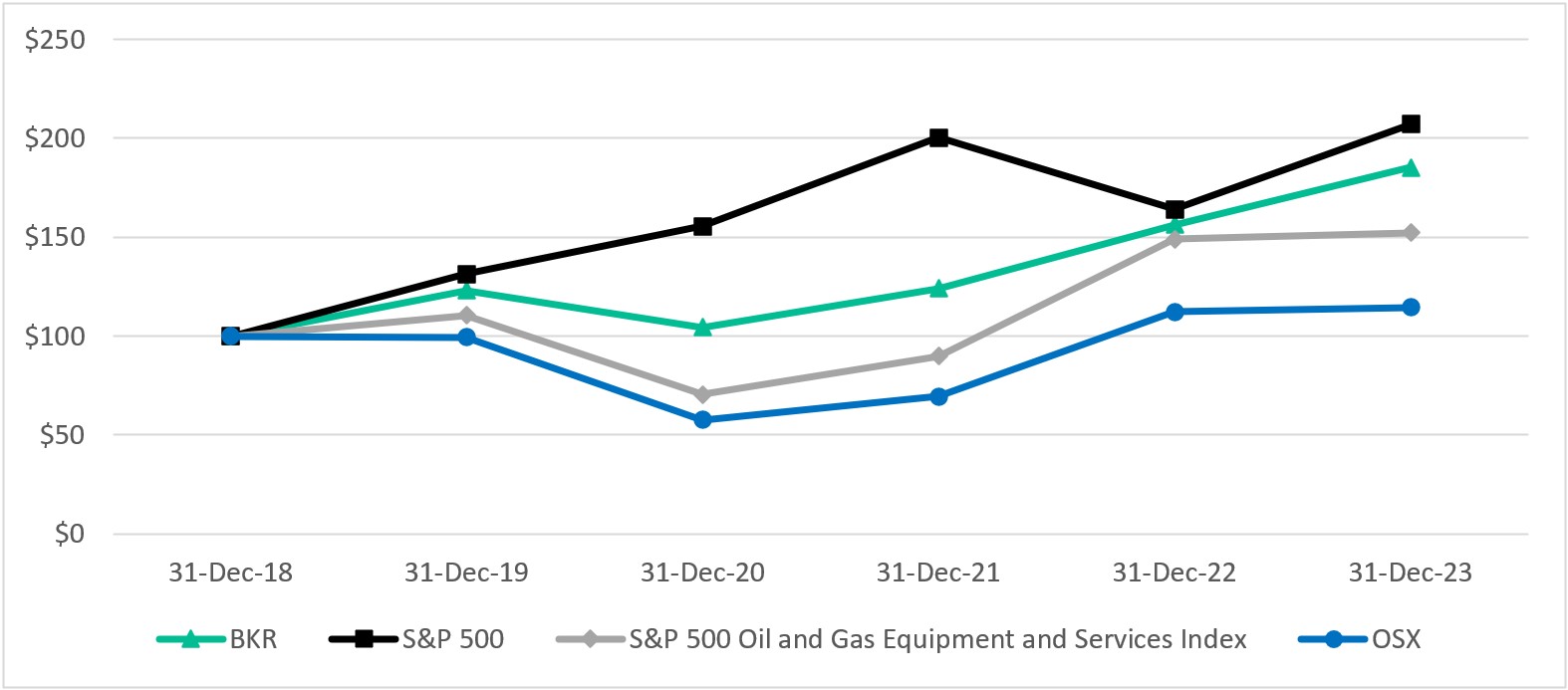
The following graph compares the yearly change in our cumulative total shareholder return on our common stock (assuming reinvestment of dividends into common stock at the date of payment) with the cumulative total return on the published Standard & Poor's ("S&P") 500 Stock Index, the cumulative total return on the S&P 500 Oil and Gas Equipment and Services Index, and the Philadelphia Oil Service Index ("OSX") over the preceding five year period. Although the Company is not a component of the OSX, this index represents a large group of companies with similar industry exposure, many of which provide the same or similar equipment and services as the Company.
Comparison of Five-Year Cumulative Total Return
BKR, S&P 500 Stock Index, S&P 500 Oil and Gas Equipment and Services Index, and OSX
| 2018 | 2019 | 2020 | 2021 | 2022 | 2023 | ||||||||||||||||||||||||||||||
| Baker Hughes Company ("BKR") | $ | 100.00 | $ | 122.94 | $ | 104.35 | $ | 124.14 | $ | 156.30 | $ | 185.32 | |||||||||||||||||||||||
| S&P 500 Stock Index | 100.00 | 131.47 | 155.65 | 200.29 | 163.98 | 207.04 | |||||||||||||||||||||||||||||
| S&P 500 Oil and Gas Equipment and Services Index | 100.00 | 110.54 | 70.49 | 89.93 | 148.98 | 152.38 | |||||||||||||||||||||||||||||
| Philadelphia Oil Service Index ("OSX") | 100.00 | 99.45 | 57.60 | 69.55 | 112.31 | 114.47 |
The comparison of total return on investment (change in year-end stock price plus reinvested dividends) assumes that $100 was invested on December 31, 2018 in Baker Hughes common stock, the S&P 500 Index, the S&P 500 Oil and Gas Equipment and Services Index, and the OSX.
The corporate performance graph and related information shall not be deemed "soliciting material" or to be "filed" with the SEC, nor shall such information be incorporated by reference into any future filing under the Securities Act or the Exchange Act, except to the extent that Baker Hughes specifically incorporates it by reference into such filing.
Item 6. [RESERVED]
Baker Hughes Company 2023 Form 10-K | 31
Item 7. MANAGEMENT'S DISCUSSION AND ANALYSIS OF FINANCIAL CONDITION AND RESULTS OF OPERATIONS
Management's Discussion and Analysis of Financial Condition and Results of Operations ("MD&A") should be read in conjunction with the consolidated financial statements included in Item 8. Financial Statements and Supplementary Data contained herein.
For management's discussion and analysis of our financial condition and results of operations for fiscal year 2022 as compared to fiscal year 2021 please refer to Part II, Item 7. "Management's discussion and analysis of financial condition and results of operations" on Form 10-K for our fiscal year ended December 31, 2022, filed with the Securities and Exchange Commission ("SEC") on February 14, 2023.
EXECUTIVE SUMMARY
We are an energy technology company with a broad and diversified portfolio of technologies and services that span the energy and industrial value chain. We operate through our two business segments: OFSE and IET. We sell products and services primarily in the global oil and gas markets, within the upstream, midstream and downstream segments, as well as broader industrial and new energy markets.
During 2023, Baker Hughes built strong momentum across the Company with significant improvement in our financial results over 2022. In OFSE, we saw key commercial successes and solid margin improvements, and in IET, we benefited from robust growth in LNG orders, driving RPO to levels that provides meaningful revenue visibility. Overall, we capitalized on market tailwinds to deliver strong revenue growth across both segments, began realizing the full benefits of our cost-out initiatives, and continued to transform how we operate. We also achieved significant growth in new energy orders compared to 2022 as we continue to experience growing demand for decarbonization solutions across the Company's IET and OFSE portfolios.
As we look to 2024, we remain balanced on the oil and gas outlook but continue to see areas of strength across our portfolio despite persisting economic uncertainty. We continue to believe in a multiyear upstream spending cycle, which, we believe, will be more durable and less sensitive to commodity price swings relative to prior cycles and led by international and offshore markets. Continued discipline from the world's largest producers and the pace of oil demand growth in the face of economic uncertainty, will remain important factors to monitor as we look into 2024. Oil and gas prices have experienced volatility in the fourth quarter of 2023 and beginning of 2024, and this will likely have some influence on upstream development plans, particularly for shorter-cycle spending budgets.
Additionally, the conflict in the Middle East has added another element of uncertainty across the oil and gas markets. While this conflict has not had a material impact on our operations, a further escalation in geopolitical tensions across the region could impact the Company. We will continue to monitor and assess the impact of the conflict in the Middle East on our business. Furthermore, in IET, the aeroderivative supply chain continues to show signs of tightness, which we will continue to manage operationally.
We also remain optimistic on the LNG outlook, seeing a continued shift towards the development of natural gas and LNG. As a result, the LNG project pipeline remains strong, both in the U.S. and internationally. As the world increasingly recognizes the crucial role natural gas is expected to play in the energy transition, serving as both a transition and destination fuel, we believe it will be fundamental in satisfying the world's energy needs for many decades to come.
Financial Results
In 2023, the Company generated revenue of $25.5 billion, compared to $21.2 billion in 2022, increasing $4.4 billion or 21%. The increase in revenue was primarily driven by higher volume in IET on Gas Technology Equipment project backlog execution and stronger activity in OFSE. Income before tax was $2,655 million in 2023 compared to $22 million in 2022, increasing $2,633 million. The increase in income before tax was driven by higher volume and price in both segments and structural cost-out initiatives, positive effect from the change in fair value on certain equity securities, and lower restructuring and impairment charges.
Baker Hughes Company 2023 Form 10-K | 32
Our journey of transformation continues. The business has undertaken significant structural changes, and we see the cost-out performance coming through our operating results. We have made significant progress; however, there is still more work to do to further identify areas to simplify and create efficiencies and modernize how the business operates, including actions launched in OFSE to remove duplication and further streamline the business.
Baker Hughes remains committed to a flexible capital allocation policy that balances returning cash to shareholders and investing in growth opportunities. We increased our quarterly dividend in the third quarter of 2023 by one cent to $0.20 per share. For the full year of 2023, we returned a total of $1.3 billion to shareholders in the form of dividends and share repurchases. We continue to invest in the Baker Hughes portfolio through strategic acquisitions. In 2023, we completed the acquisition of Altus Intervention, a leading international provider of well intervention services and downhole technology, which significantly enhances OFSE's existing portfolio. We also completed the sale of the Nexus Controls business in April 2023.
Outlook
Our business is exposed to a number of macro factors, which influence our outlook and expectations given the current volatile conditions in the industry. All of our outlook expectations are purely based on the market as we see it today and are subject to changing conditions in the industry.
-
OFSE North America activity: After trending lower most of 2023 due to lower activity from private exploration & production operators and in gas basins, North American activity has recently stabilized. However, we see a slow start to 2024 and anticipate only a modest recovery in activity during the second half of 2024.
-
OFSE International activity: We expect spending outside of North America to experience moderate growth in 2024, as compared to 2023.
-
IET LNG projects: We remain optimistic on the LNG market long-term and view natural gas as a transition and destination fuel. We continue to view the long-term economics of the LNG industry as positive.
We have other businesses in our portfolio that are more correlated with various industrial metrics, including global GDP growth. We also have businesses within our portfolio that are exposed to new energy solutions, specifically focused around reducing carbon emissions of the energy and broader industry, including hydrogen, geothermal, CCUS, energy storage, clean power and emissions abatement solutions. We expect to see continued growth in these businesses as new energy solutions become a more prevalent part of the broader energy mix.
Overall, we believe our portfolio is well positioned to compete across the energy value chain and deliver comprehensive solutions for our customers. We remain optimistic about the long-term economics of the oil and gas industry, but we are continuing to operate with flexibility. Over time, we believe the world's demand for energy will continue to rise, and that hydrocarbons will play a major role in meeting the world's energy needs for the foreseeable future. As such, we remain focused on delivering innovative, low-emission, and cost-effective solutions that deliver step changes in operating and economic performance for our customers.
BUSINESS ENVIRONMENT
The following discussion and analysis summarizes the significant factors affecting our results of operations, financial condition and liquidity position as of and for the years ended December 31, 2023 and 2022, and should be read in conjunction with the consolidated financial statements and related notes of the Company.
Our
Showing the first 8K of 64K characters. Open the full section
Item 7A. QUANTITATIVE AND QUALITATIVE DISCLOSURES ABOUT MARKET RISK
We are exposed to certain market risks that are inherent in our financial instruments and arise from changes in interest rates and foreign currency exchange rates. We may enter into derivative financial instrument transactions to manage or reduce market risk, but do not enter into derivative financial instrument transactions for speculative purposes. A discussion of our primary market risk exposure in financial instruments is presented below.
Baker Hughes Company 2023 Form 10-K | 46
INTEREST RATE RISK
All of our long-term debt is comprised of fixed rate instruments. We are subject to interest rate risk on our debt and investment portfolio. As of December 31, 2023, we had interest rate swaps with a notional amount of $500 million that converted a portion of our $1,350 million aggregate principal amount of 3.337% fixed rate Senior Notes due 2027 into a floating rate instrument with an interest rate based on a LIBOR index as a hedge of its exposure to changes in fair value that are attributable to interest rate risk. As of July 1, 2023, the interest rate changed to be based on a Secured Overnight Financing Rate index. The interest rate swaps are designated and each qualify as a fair value hedging instrument. The interest rate swaps are considered to be effective at achieving offsetting changes in the fair value of the hedged liability, and no ineffectiveness is recognized. The mark-to-market of this fair value hedge was recorded as a gain or loss in interest expense and was equally offset by the gain or loss of the underlying debt instrument, which also was recorded in interest expense.
The following table sets forth our fixed rate long-term debt, excluding finance leases, and the related weighted average interest rates by expected maturity dates.
| (In millions) | 2024 | 2025 | 2026 | 2027 | 2028 | Thereafter | Total (2) | ||||||||||||||||||||||||||||||||||
| As of December 31, 2023 | |||||||||||||||||||||||||||||||||||||||||
| Long-term debt (1) | $ | 107 | $ | — | $ | 600 | $ | 1,350 | $ | — | $ | 3,756 | $ | 5,813 | |||||||||||||||||||||||||||
| Weighted average interest rates | 4.08 | % | — | % | 2.35 | % | 5.29 | % | — | % | 4.06 | % | 4.16 | % | |||||||||||||||||||||||||||
(1)Fair market value of our fixed rate long-term debt, excluding finance leases, was $5.5 billion at December 31, 2023.
(2)Amounts represent the principal value of our long-term debt outstanding and related weighted average interest rates at the end of the respective period.
FOREIGN CURRENCY EXCHANGE RISK
We conduct our operations around the world in a number of different currencies, and we are exposed to market risks resulting from fluctuations in foreign currency exchange rates. Many of our significant foreign subsidiaries have designated the local currency as their functional currency. As such, future earnings are subject to change due to fluctuations in foreign currency exchange rates when transactions are denominated in currencies other than our functional currencies.
Additionally, we buy, manufacture and sell components and products across global markets. These activities expose us to changes in foreign currency exchange rates, commodity prices and interest rates which can adversely affect revenue earned and costs of our operating businesses. When the currency in which equipment is sold differs from the primary currency of the legal entity and the exchange rate fluctuates, it will affect the revenue earned on the sale. These sales and purchase transactions also create receivables and payables denominated in foreign currencies and exposure to foreign currency gains and losses based on changes in exchange rates. Changes in the price of raw materials used in manufacturing can affect the cost of manufacturing. We use derivatives to mitigate or eliminate these exposures, where appropriate.
We use cash flow hedging primarily to reduce or eliminate the effects of foreign currency exchange rate changes on purchase and sale contracts. Accordingly, most derivative activity in this category consists of currency exchange contracts. We had outstanding foreign currency forward contracts with notional amounts aggregating $3.6 billion and $3 billion to hedge exposure to currency fluctuations in various foreign currencies at December 31, 2023 and 2022, respectively. The notional amounts of these derivative instruments do not generally represent cash amounts exchanged by us and the counterparties, but rather the nominal amount upon which changes in the value of the derivatives are measured.
As of December 31, 2023, the Company estimates that a 1% appreciation or depreciation in the U.S. dollar would result in an impact of less than $10 million to our pre-tax earnings; however, the Company is generally able to mitigate its foreign exchange exposure, where there are liquid financial markets, through use of foreign currency derivative transactions. Also, see "Note 15. Financial Instruments" of the Notes to Consolidated Financial Statements in Item 8 herein, which has additional details on our strategy.
Baker Hughes Company 2023 Form 10-K | 47
Item 8. FINANCIAL STATEMENTS AND SUPPLEMENTARY DATA
Management's Report on Internal Control Over Financial Reporting
Our management is responsible for establishing and maintaining adequate internal control over our financial reporting, as such term is defined in Exchange Act Rules 13a-15(f). Our internal control over financial reporting is a process designed to provide reasonable assurance regarding the reliability of financial reporting and the preparation of financial statements for external purposes in accordance with generally accepted accounting principles.
Under the supervision and with the participation of our management, including our principal executive officer and principal financial officer, we assessed the effectiveness of our internal control over financial reporting based on the 2013 framework in Internal Control - Integrated Framework issued by the Committee of Sponsoring Organizations of the Treadway Commission. Based on our assessment, our principal executive officer and principal financial officer concluded that our internal control over financial reporting was effective as of December 31, 2023. This conclusion is based on the recognition that there are inherent limitations in all systems of internal control. Because of the inherent limitations of internal control over financial reporting, including the possibility of collusion or improper management override of controls, material misstatements due to error or fraud may not be prevented or detected on a timely basis. Also, projections of any evaluation of effectiveness to future periods are subject to the risk that controls may become inadequate because of changes in conditions, or that the degree of compliance with the policies or procedures may deteriorate.
KPMG LLP, the Company's independent registered public accounting firm, has issued an attestation report on the effectiveness of the Company's internal control over financial reporting.
| /s/ LORENZO SIMONELLI Lorenzo Simonelli Chairman, President and Chief Executive Officer | /s/ NANCY BUESE Nancy Buese Chief Financial Officer | /s/ REBECCA CHARLTON Rebecca Charlton Senior Vice President, Controller and Chief Accounting Officer |
Houston, Texas
February 5, 2024
Baker Hughes Company 2023 Form 10-K | 48
REPORT OF INDEPENDENT REGISTERED PUBLIC ACCOUNTING FIRM
To the Stockholders and Board of Directors
Baker Hughes Company:
Opinion on the Consolidated Financial Statements
We have audited the accompanying consolidated statements of financial position of Baker Hughes Company and subsidiaries (the Company) as of December 31, 2023 and 2022, the related consolidated statements of income (loss), comprehensive income (loss), changes in equity, and cash flows for each of the years in the three-year period ended December 31, 2023, and the related notes (collectively, the consolidated financial statements). In our opinion, the consolidated financial statements present fairly, in all material respects, the financial position of the Company as of December 31, 2023 and 2022, and the results of its operations and its cash flows for each of the years in the three-year period ended December 31, 2023, in conformity with U.S. generally accepted accounting principles.
We also have audited, in accordance with the standards of the Public Company Accounting Oversight Board (United States) (PCAOB), the Company's internal control over financial reporting as of December 31, 2023, based on criteria established in Internal Control – Integrated Framework (2013) issued by the Committee of Sponsoring Organizations of the Treadway Commission, and our report dated February 5, 2024 expressed an unqualified opinion on the effectiveness of the Company’s internal control over financial reporting.
Basis for Opinion
These consolidated financial statements are the responsibility of the Company's management. Our responsibility is to express an opinion on these consolidated financial statements based on our audits. We are a public accounting firm registered with the PCAOB and are required to be independent with respect to the Company in accordance with the U.S. federal securities laws and the applicable rules and regulations of the Securities and Exchange Commission and the PCAOB.
We conducted our audits in accordance with the standards of the PCAOB. Those standards require that we plan and perform the audit to obtain reasonable assurance about whether the consolidated financial statements are free of material misstatement, whether due to error or fraud. Our audits included performing procedures to assess the risks of material misstatement of the consolidated financial statements, whether due to error or fraud, and performing procedures that respond to those risks. Such procedures included examining, on a test basis, evidence regarding the amounts and disclosures in the consolidated financial statements. Our audits also included evaluating the accounting principles used and significant estimates made by management, as well as evaluating the overall presentation of the consolidated financial statements. We believe that our audits provide a reasonable basis for our opinion.
Critical Audit Matter
The critical audit matter communicated below is a matter arising from the current period audit of the consolidated financial statements that was communicated or required to be communicated to the audit committee and that: (1) relates to accounts or disclosures that are material to the consolidated financial statements and (2) involved our especially challenging, subjective, or complex judgments. The communication of a critical audit matter does not alter in any way our opinion on the consolidated financial statements, taken as a whole, and we are not, by communicating the critical audit matter below, providing a separate opinion on the critical audit matter or on the accounts or disclosures to which it relates.
Revenue recognition on certain agreements for sales of equipment manufactured to unique customer specifications
As discussed in Note 1 to the consolidated financial statements, the Company enters into agreements for sales of equipment manufactured to unique customer specifications on an over time basis. Revenue from these types of contracts is recognized to the extent of progress towards completion measured by actual costs incurred relative to total expected costs. The Company provides for potential losses on these types of contracts when it is probable that a loss will be incurred.
We identified revenue recognition for certain contracts from the sales of equipment manufactured to unique customer specifications as a critical audit matter. Complex auditor judgment was required in evaluating the Company's long-term estimates of the expected costs to be incurred in order to complete these contracts.
Baker Hughes Company 2023 Form 10-K | 49
The following are the primary procedures we performed to address this critical audit matter. We evaluated the design and tested the operating effectiveness of certain internal controls related to the Company's revenue recognition process for sales of equipment manufactured to unique customer specifications. This included controls pertaining to the Company's estimation of costs expected to be incurred to complete contracts for sales of equipment manufactured to unique customer specifications. We evaluated the Company's ability to accurately estimate costs expected to be incurred to complete the contracts for sales of equipment manufactured to unique customer specifications. We evaluated the estimated costs expected to be incurred to complete the equipment manufactured to unique customer specifications for the contracts by:
–questioning the Company's finance and project managers regarding progress to date based on the latest project reports and the costs expected to be incurred u
Showing the first 8K of 169K characters. Open the full section
Item 9. CHANGES IN AND DISAGREEMENTS WITH ACCOUNTANTS ON ACCOUNTING AND FINANCIAL DISCLOSURE
None.
Item 9A. CONTROLS AND PROCEDURES
Evaluation of disclosure controls and procedures
Our management, with the participation of our Chief Executive Officer and Chief Financial Officer, has evaluated the effectiveness of the design and operation of our disclosure controls and procedures (as defined in Rule 15d-15(e) under the Exchange Act) as of the end of the period covered by this report. Based upon that evaluation, the Chief Executive Officer and Chief Financial Officer have concluded that, as of December 31, 2023, our disclosure controls and procedures (as defined in Rule 15d-15(e) of the Exchange Act) were effective at a reasonable assurance level.
There has been no change in our internal controls over financial reporting during the year ended December 31, 2023, that has materially affected, or is reasonably likely to materially affect, our internal controls over financial reporting.
Item 9B. OTHER INFORMATION
Rule 10b5-1 and Non-Rule 10b5-1 Trading Arrangements
During the three months ended December 31, 2023, certain of our officers or directors listed below adopted or terminated trading arrangements for the sale of shares of our Class A common stock in amounts and prices determined in accordance with a formula set forth in each such plan:
| Plans | ||||||||||||||||||||
| Name and Title | Action | Date | Rule 10b5-1 (1) | Non-Rule 10b5-1 (2) | Number of Shares to be Sold | Expiration | ||||||||||||||
| James E. Apostolides, Senior Vice President, Enterprise Operational Excellence | Adoption | November 22, 2023 | X | 15,000 | Earlier of when all shares under plan are sold and April 8, 2024 | |||||||||||||||
(1)Intended to satisfy the affirmative defense conditions of Rule 10b5-1(c)
(2)Not intended to satisfy the affirmative defense conditions of Rule 10b5-1(c)
Sixth Amended and Restated Bylaws
On February 1, 2024, the Board of Directors adopted the sixth amended and restated bylaws of the Company (the “Sixth Amended and Restated Bylaws”), effective February 1, 2024, to remove references to GE and otherwise make conforming changes to reflect GE’s exit from its investment in the Company.
The foregoing description of the amendments made in the Sixth Amended and Restated Bylaws does not purport to be complete and is qualified by reference to the Sixth Amended and Restated Bylaws, a copy of which is attached hereto as Exhibit 3.2 to this Annual Report on Form 10-K and is incorporated herein by reference.
Item 9C. DISCLOSURE REGARDING FOREIGN JURISDICTIONS THAT PREVENT INSPECTIONS
None.
Baker Hughes Company 2023 Form 10-K | 93
PART III
Item 10. DIRECTORS, EXECUTIVE OFFICERS AND CORPORATE GOVERNANCE
Information regarding our Code of Conduct and the Code of Ethical Conduct Certificates for our principal executive officer, principal financial officer and principal accounting officer are described in Item 1. Business of this Annual Report on Form 10-K. Information concerning our directors is set forth in the sections entitled "Proposal No. 1, Election of Directors - Board Nominees for Directors," and "Corporate Governance - Committees of the Board" in our Definitive Proxy Statement for the 2024 Annual Meeting of Shareholders to be filed with the SEC pursuant to the Exchange Act within 120 days of the end of our fiscal year on December 31, 2023 ("Proxy Statement"), which sections are incorporated herein by reference. For information regarding our executive officers, see "Item 1. Business - Executive Officers of Baker Hughes" in this Annual Report on Form 10-K.
Item 11. EXECUTIVE COMPENSATION
Information for this item is set forth in the following section of our Proxy Statement, which section is incorporated herein by reference: "Executive Compensation."
Item 12. SECURITY OWNERSHIP OF CERTAIN BENEFICIAL OWNERS AND MANAGEMENT AND RELATED STOCKHOLDER MATTERS
Information concerning security ownership of certain beneficial owners and our management is set forth in the sections entitled "Stock Ownership of Certain Beneficial Owners" and "Stock Ownership of Section 16(a) Director and Executive Officers" in our Proxy Statement, which sections are incorporated herein by reference.
We permit our employees, officers and directors to enter into written trading plans complying with Rule 10b5-1 under the Exchange Act. Rule 10b5-1 provides criteria under which such an individual may establish a prearranged plan to buy or sell a specified number of shares of a company's stock over a set period of time. Persons using such plan must act in good faith with respect to the contract with the broker executing the trades, trading instructions and the trading plan as a whole. Such plan must be established at a time when the individual is not in possession of material, nonpublic information and will be subject to a cooling off period to the initial trade thereunder. If an individual establishes a plan satisfying the requirements of Rule 10b5-1, such individual's subsequent receipt of material, nonpublic information will not prevent transactions under the plan from being executed. Certain of our officers have advised us that they have and may enter into stock sales plans for the sale of shares of our Class A common stock which are intended to comply with the requirements of Rule 10b5-1 of the Exchange Act. In addition, the Company has and may in the future enter into repurchases of our Class A common stock under a plan that complies with Rule 10b5-1 or Rule 10b-18 of the Exchange Act.
Baker Hughes Company 2023 Form 10-K | 94
Equity Compensation Plan Information
The information in the following table is presented as of December 31, 2023 with respect to shares of our Class A common stock that may be issued under our current and prior LTI Plans (in millions, except per share prices).
| Equity Compensation Plan Category | Number of Securities to be Issued Upon Exercise of Outstanding Options, Warrants and Rights | Weighted Average Exercise Price of Outstanding Options, Warrants and Rights | Number of Securities Remaining Available for Future Issuance Under Equity Compensation Plans (excluding securities reflected in the first column) | ||||||||||||||||||||||||||||||||
| Shareholder-approved plans | 2.2 | $ | 33.92 | 25.1 | |||||||||||||||||||||||||||||||
| Nonshareholder-approved plans | — | — | — | ||||||||||||||||||||||||||||||||
| Subtotal (except for weighted average exercise price) | 2.2 | 33.92 | 25.1 | ||||||||||||||||||||||||||||||||
| Employee stock purchase plan | — | — | 8.7(1) | ||||||||||||||||||||||||||||||||
| Total | 2.2 | $ | 33.92 | 33.8 |
(1)Employee stock purchase plan shares of 0.5 million will be issued in the first quarter of 2024 that relate to the three months ended December 31, 2023 purchase period. The remaining 8.2 million shares are available for future issuance.
Item 13. CERTAIN RELATIONSHIPS AND RELATED TRANSACTIONS, AND DIRECTOR INDEPENDENCE
Information for this item is set forth in the sections entitled "Corporate Governance-Director Independence" and "Certain Relationships and Related Party Transactions" in our Proxy Statement, which sections are incorporated herein by reference.
Item 14. PRINCIPAL ACCOUNTING FEES AND SERVICES
Our independent registered public accounting firm is KPMG LLP, Houston, Texas, Auditor Firm ID: 185. Information concerning principal accountant fees and services is set forth in the section entitled "Fees Paid to KPMG LLP" in our Proxy Statement, which section is incorporated herein by reference.
Baker Hughes Company 2023 Form 10-K | 95
PART IV
Item 15. EXHIBITS AND FINANCIAL STATEMENT SCHEDULES
(a) List of Documents filed as part of this Annual Report.
(1) Financial Statements
All financial statements of the Company as set forth under Item 8 of this Annual Report on Form 10-K.
(2) Financial Statement Schedules
The schedules listed in Reg. 210.5-04 have been omitted because they are not applicable or the required information is shown in the consolidated financial statements or notes thereto.
(3) Exhibits
Each exhibit identified below is filed as a part of this Annual Report. Exhibits designated with an "*" are filed as an exhibit to this Annual Report on Form 10-K and exhibits designated with an "**" are furnished as an exhibit to this Annual Report on Form 10-K. Exhibits designated with a "+" are identified as management contracts or compensatory plans or arrangements. Exhibits previously filed are incorporated by reference.
Baker Hughes Company 2023 Form 10-K | 96
Baker Hughes Company 2023 Form 10-K | 97
Item 16. FORM 10-K SUMMARY
None.
Baker Hughes Company 2023 Form 10-K | 98
SIGNATURES
Pursuant to the requirements of Section 13 or 15(d) of the Securities Exchange Act of 1934, as amended, the registrant has duly caused this report to be signed on its behalf by the undersigned, thereunto duly authorized.
| BAKER HUGHES COMPANY | |||||||||||
| Date: | February 5, 2024 | /s/ LORENZO SIMONELLI | |||||||||
| Lorenzo Simonelli Chairman, President and Chief Executive Officer |
KNOWN ALL PERSONS BY THESE PRESENTS, that each person whose signature appears below constitutes and appoints Lorenzo Simonelli, Nancy Buese and Georgia Magno, each of whom may act without joinder of the other, as their true and lawful attorneys-in-fact and agents, each with full power of substitution and resubstitution, for such person and in his or her name, place and stead, in any and all capacities, to sign any and all amendments to this Annual Report on Form 10-K, and to file the same, with all exhibits thereto and other documents in connection therewith, with the Securities and Exchange Commission, granting unto said attorneys-in-fact and agents full power and authority to do and perform each and every act and thing requisite and necessary to be done in and about the premises, as fully to all intents and purposes as he might or could do in person, hereby ratifying and confirming all that said attorneys-in-fact and agents, or their substitutes, may lawfully do or cause to be done by virtue hereof.
Pursuant to the requirements of the Securities Exchange Act of 1934, as amended, this report has been signed below by the following persons on behalf of the registrant and in the capacities indicated on this 5th day of February 2024.
| Signature | Title | |||||||
| /s/ LORENZO SIMONELLI | Chairman, President and Chief Executive Officer | |||||||
| (Lorenzo Simonelli) | (principal executive officer) | |||||||
| /S/ NANCY BUESE | Chief Financial Officer | |||||||
| (Nancy Buese) | (principal financial officer) | |||||||
| /S/ REBECCA CHARLTON | Senior Vice President, Controller and Chief Accounting Officer | |||||||
| (Rebecca Charlton) | (principal accounting officer) |
Baker Hughes Company 2023 Form 10-K | 99
| Signature | Title | |||||||
| /s/ ABDULAZIZ M. AL GUDAIMI | Director | |||||||
| (Abdulaziz M. Al Gudaimi) | ||||||||
| /s/ W. GEOFFREY BEATTIE | Director | |||||||
| (W. Geoffrey Beattie) | ||||||||
| /s/ GREGORY D. BRENNEMAN | Director | |||||||
| (Gregory D. Brenneman) | ||||||||
| /s/ CYNTHIA B. CARROLL | Director | |||||||
| (Cynthia B. Carroll) | ||||||||
| /s/ NELDA J. CONNORS | Director | |||||||
| (Nelda J. Connors) | ||||||||
| /s/ MICHAEL R. DUMAIS | Director | |||||||
| (Michael R. Dumais) | ||||||||
| /s/ LYNN L. ELSENHANS | Director | |||||||
| (Lynn L. Elsenhans) | ||||||||
| /s/ JOHN G. RICE | Director | |||||||
| (John G. Rice) | ||||||||
| /s/ MOHSEN M. SOHI | Director | |||||||
| (Mohsen M. Sohi) |
Baker Hughes Company 2023 Form 10-K | 100