 filings.tools
Bristol Myers Squibb 10-K 2021-12-31
Filed 2022-02-09. 23 sections, 699K characters. Original on sec.gov · Markdown · JSON
Cover and table of contents
UNITED STATES
SECURITIES AND EXCHANGE COMMISSION
Washington, D.C. 20549
FORM 10-K
☒ ANNUAL REPORT PURSUANT TO SECTION 13 OR 15(d) OF THE
SECURITIES EXCHANGE ACT OF 1934
For the fiscal year ended December 31, 2021
OR
☐ TRANSITION REPORT PURSUANT TO SECTION 13 OR 15(d) OF THE
SECURITIES EXCHANGE ACT OF 1934
For the transition period from ______ to _______
Commission File Number 001-01136
BRISTOL-MYERS SQUIBB COMPANY
(Exact name of registrant as specified in its charter)
| Delaware | 22-0790350 | |||||||
| (State or other jurisdiction of incorporation or organization) | **(**I.R.S Employer Identification No.) |
430 E. 29th Street, 14FL, New York, NY 10016
(Address of principal executive offices)
(212) 546-4000
(Registrant’s telephone number, including area code)
Securities registered pursuant to Section 12(b) of the Act:
| Title of each class | Trading Symbol(s) | Name of each exchange on which registered | ||||||
| Common Stock, $0.10 Par Value | BMY | New York Stock Exchange | ||||||
| 1.000% Notes due 2025 | BMY25 | New York Stock Exchange | ||||||
| 1.750% Notes due 2035 | BMY35 | New York Stock Exchange | ||||||
| Celgene Contingent Value Rights | CELG RT | New York Stock Exchange |
Securities registered pursuant to Section 12(g) of the Act:
| Title of each class | ||
| $2 Convertible Preferred Stock, $1 Par Value |
Indicate by check mark if the registrant is a well-known seasoned issuer, as defined in Rule 405 of the Securities Act. Yes ☒ No ☐
Indicate by check mark if the registrant is not required to file reports pursuant to Section 13 or Section 15(d) of the Act. Yes ☐ No ☒
Indicate by check mark whether the registrant (1) has filed all reports required to be filed by Section 13 or 15(d) of the Securities Exchange Act of 1934 during the preceding 12 months (or for such shorter period that the registrant was required to file such reports), and (2) has been subject to such filing requirements for the past 90 days. Yes ☒ No ☐
Indicate by check mark whether the registrant has submitted electronically every Interactive Data File required to be submitted pursuant to Rule 405 of Regulation S-T (§232.405 of this chapter) during the preceding 12 months (or for such shorter period that the registrant was required to submit such files). Yes ☒ No ☐
Indicate by check mark whether the registrant is a large accelerated filer, an accelerated filer, a non-accelerated filer, a smaller reporting company, or an emerging growth company. See the definitions of “large accelerated filer,” “accelerated filer,” “smaller reporting company,” and “emerging growth company” in Rule 12b-2 of the Exchange Act.
| Large accelerated filer ☒ | Accelerated filer ☐ | Non-accelerated filer ☐ | Smaller reporting company ☐ | Emerging growth company ☐ |
If an emerging growth company, indicate by check mark if the registrant has elected not to use the extended transition period for complying with any new or revised financial accounting standards provided pursuant to Section 13(a) of the Exchange Act. ☐
Indicate by check mark whether the registrant has filed a report on and attestation to its management’s assessment of the effectiveness of its internal control over financial reporting under Section 404(b) of the Sarbanes-Oxley Act (15 U.S.C. 7262(b)) by the registered public accounting firm that prepared or issued its audit report. ☒
Indicate by check mark whether the registrant is a shell company (as defined in Rule 12b-2 of the Exchange Act). Yes ☐ No ☒
The aggregate market value of the 2,220,639,863 shares of voting common equity held by non-affiliates of the registrant, computed by reference to the closing price as reported on the New York Stock Exchange, as of the last business day of the registrant’s most recently completed second fiscal quarter was approximately $148,383,155,646. Bristol-Myers Squibb Company has no non-voting common equity. At February 1, 2022, there were 2,179,712,820 shares of common stock outstanding.
DOCUMENTS INCORPORATED BY REFERENCE: Portions of the definitive proxy statement for the registrant’s Annual Meeting of Shareholders to be filed within 120 days after the conclusion of the registrant's fiscal year ended December 31, 2021 with the U.S. Securities and Exchange Commission pursuant to Regulation 14A of the Securities Exchange Act of 1934, as amended, are incorporated by reference into Part III of this Annual Report on Form 10-K to the extent described therein.
BRISTOL-MYERS SQUIBB COMPANY
INDEX TO FORM 10-K
December 31, 2021
- Indicates brand names of products which are trademarks not owned by BMS. Specific trademark ownership information is included in the Exhibit Index at the end of this 2021 Form 10-K.
PART I
Item 1. BUSINESS.
General
Bristol-Myers Squibb Company was incorporated under the laws of the State of Delaware in August 1933 under the name Bristol-Myers Company, as successor to a New York business started in 1887. In 1989, Bristol-Myers Company changed its name to Bristol-Myers Squibb Company as a result of a merger.
We continue to operate in one segment engaged in the discovery, development, licensing, manufacturing, marketing, distribution and sale of biopharmaceutical products on a global basis. We expect that our acquisitions of Celgene in 2019 and MyoKardia in 2020 will further position us as a leading biopharmaceutical company, expanding our oncology, hematology, immunology and cardiovascular portfolios with several near-term assets and additional external partnerships. Refer to the Summary of Abbreviated Terms at the end of this 2021 Form 10-K for terms used throughout the document. Our principal strategy is to combine the resources, scale and capability of a pharmaceutical company with the speed and focus on innovation of the biotech industry. Our focus as a biopharmaceutical company is on discovering, developing and delivering transformational medicines for patients facing serious diseases in areas where we believe that we have an opportunity to make a meaningful difference: oncology (both solid tumors and hematology), immunology, cardiovascular and neurology. Our priorities are to continue to renew and diversify our portfolio through launching our new product portfolio, advancing our early, mid and late-stage pipeline, and executing disciplined business development. We remain committed to reducing our debt and returning capital to shareholders. For a further discussion of our strategy initiatives, refer to “Item 7. Management's Discussion and Analysis of Financial Condition and Results of Operations—Strategy.”
We compete with other worldwide research-based drug companies, smaller research companies and generic drug manufacturers. Our products are sold worldwide, primarily to wholesalers, distributors, specialty pharmacies, and to a lesser extent, directly to retailers, hospitals, clinics and government agencies. We manufacture products in the U.S. and Puerto Rico and have significant manufacturing operations in two foreign countries. Most of our revenues come from products in the following therapeutic classes: hematology, oncology, cardiovascular and immunology.
The percentage of revenues by significant region/country were as follows:
| Year Ended December 31, | |||||||||||||||||
| Dollars in Millions | 2021 | 2020 | 2019 | ||||||||||||||
| United States | 63 | % | 63 | % | 59 | % | |||||||||||
| Europe | 23 | % | 23 | % | 24 | % | |||||||||||
| Rest of the World | 12 | % | 13 | % | 15 | % | |||||||||||
| Other(a) | 2 | % | 1 | % | 2 | % | |||||||||||
| Total Revenues | $ | 46,385 | $ | 42,518 | $ | 26,145 |
(a) Other revenues include royalties and alliance-related revenues for products not sold by BMS’s regional commercial organizations.
Acquisitions, Divestitures and Licensing Arrangements
Acquisitions, divestitures and other licensing arrangements allow us to focus our resources behind growth opportunities that drive the greatest long-term value. For additional information relating to our acquisitions, divestitures, licensing and other arrangements refer to “Item 7. Management's Discussion and Analysis of Financial Condition and Results of Operations—Acquisitions, Divestitures, Licensing and Other Arrangements” and “Item 8. Financial Statements and Supplementary Data—Note 4. Acquisitions, Divestitures, Licensing and Other Arrangements.”
Products, Intellectual Property and Product Exclusivity
Our pharmaceutical products include chemically-synthesized or small molecule drugs, products produced from biological processes, called “biologics” and chimeric antigen receptor (CAR) T-cell therapies. Small molecule drugs are typically administered orally, e.g., in the form of a pill or tablet, although other drug delivery mechanisms are used as well. Biologics are typically administered to patients through injections or by intravenous infusion. CAR T-cell therapies are administered to patients by intravenous infusion.
Below is a summary of our significant products, including approved indications. For information about our alliance arrangements for certain of the products below, refer to “—Alliances” below and “Item 8. Financial Statements and Supplementary Data—Note 3. Alliances.”
Revlimid*®* Revlimid (lenalidomide) is an oral immunomodulatory drug that in combination with dexamethasone is indicated for the treatment of patients with multiple myeloma. Revlimid as a single agent is also indicated as a maintenance therapy in patients with multiple myeloma following autologous hematopoietic stem cell transplant. Revlimid has received approvals for several indications in the hematological malignancies including lymphoma and MDS.
Eliquis*®* Eliquis (apixaban) is an oral Factor Xa inhibitor indicated for the reduction in risk of stroke/systemic embolism in NVAF and for the treatment of DVT/PE and reduction in risk of recurrence following initial therapy.
Opdivo*®* Opdivo (nivolumab), a biological product, is a fully human monoclonal antibody that binds to the PD-1 on T and NKT cells. Opdivo has received approvals for several anti-cancer indications including bladder, blood, colon, head and neck, kidney, liver, lung, melanoma, mesothelioma and stomach. The Opdivo+Yervoy regimen also is approved in multiple markets for the treatment of NSCLC, melanoma, mesothelioma, RCC, and CRC. There are several ongoing potentially registrational studies for Opdivo across other tumor types and disease areas, in monotherapy and in combination with Yervoy and various anti-cancer agents.
Pomalyst*®/Imnovid®* Pomalyst/Imnovid (pomalidomide) is a small molecule that is administered orally and modulates the immune system and other biologically important targets. Pomalyst/Imnovid is indicated for patients with multiple myeloma who have received at least two prior therapies including lenalidomide and a proteasome inhibitor and have demonstrated disease progression on or within 60 days of completion of the last therapy.
Orencia*®* Orencia (abatacept), a biological product, is a fusion protein indicated for adult patients with moderately to severely active RA and PsA, for reducing signs and symptoms in certain pediatric patients with moderately to severely active polyarticular JIA and for the treatment of aGVHD, in combination with a calcineurin inhibitor and methotrexate.
Sprycel*®* Sprycel (dasatinib) is an oral inhibitor of multiple tyrosine kinase indicated for the first-line treatment of patients with Philadelphia chromosome-positive CML in chronic phase, the treatment of adults with chronic, accelerated, or myeloid or lymphoid blast phase CML with resistance or intolerance to prior therapy, including Gleevec* (imatinib mesylate) and the treatment of children and adolescents aged 1 year to 18 years with chronic phase Philadelphia chromosome-positive CML.
Yervoy*®* Yervoy (ipilimumab), a biological product, is a monoclonal antibody for the treatment of patients with unresectable or metastatic melanoma.
Abraxane*®* Abraxane (paclitaxel albumin-bound particles for injectable suspension) is a solvent-free protein-bound chemotherapy product that combines paclitaxel with albumin using our proprietary Nab® technology platform, and is used to treat breast cancer, NSCLC and pancreatic cancer, among others.
Reblozyl*®* Reblozyl (luspatercept-aamt), a biol
Showing the first 8K of 115K characters. Open the full section
Item 1A. RISK FACTORS.
Any of the risks and uncertainties described below could significantly and negatively affect our business operations, financial condition, operating results (including components of our financial results), cash flows, prospects, reputation or credit ratings now and in the future, which could cause the trading price of our common stock to decline significantly. Additional risks and uncertainties that are not presently known to us, or risks that we currently consider immaterial, could also impair our business operations, financial condition, operating results or cash flows. The following discussion of risk factors contains “forward-looking” statements, as discussed in “Item 7. Management’s Discussion and Analysis of Financial Condition and Results of Operations—Special Note Regarding Forward-Looking Statements.”
Product, Industry and Operational Risks
Increased pricing pressure and other restrictions in the U.S. and abroad continue to negatively affect our revenues and profit margins.
Our products continue to be subject to increasing pressures across the portfolio from pharmaceutical market access and pricing controls and discounting, changes to tax and importation laws and other restrictions in the U.S., the EU and other regions around the world that result in lower prices, lower reimbursement rates and smaller populations for whom payers will reimburse, which negatively impact our revenues and profit margins, including from (i) U.S. federal and state laws and regulations aimed at further regulating the pricing and reimbursement of pharmaceutical products (including potential penalties for increasing prices over the rate of inflation, new discounts to fund a redesign of the Medicare Part D benefit, and government negotiations/price controls that may establish a maximum allowed price/reimbursement rate), as well as other changes in laws and regulations for federal healthcare programs such as Medicare and Medicaid, such as modifying the federal Anti-Kickback statute discount safe harbor, accelerating generic drug approval processes and granting additional authority to governmental agencies to manage drug utilization and negotiate drug prices (including the implementation of the 2020 regulation issued by the U.S. federal government authorizing states and private parties to develop and implement programs to import certain prescription drugs from Canada and sell them in the U.S., and the American Rescue Plan Act of 2021, which eliminates the Medicaid Prescription Drug Rebate cap starting January 1, 2024), (ii) expanded utilization under the 340B Drug Pricing Program (“340B”); (iii) the competition related to placements on applicable commercial and Medicare Part D formularies; (iv) changes in U.S. income tax laws resulting in an increase to our income tax expense, including through increased taxation of our international operations; (v) changes in trade laws around the world, including drug importation laws; (vi) rules and practices of MCOs and institutional and governmental purchasers taking actions to control costs or shift the cost burden to manufacturers, including actions that could result in the exclusion of a product from, or the unfavorable placement of, a product on a MCO formulary; (vii) changes to U.S. federal pharmaceutical coverage and reimbursement policies and practices (including the potential impacts from the Infrastructure Investment and Jobs Act passed by the Senate in August 2021 that, among other things, requires certain manufacturers of drugs payable under Medicare Part B to provide a rebate to the government for any discarded portion of the drug, the December 21, 2020 final rule issued by the Centers for Medicare & Medicaid Services (“CMS”) on the calculation of average manufacturer price, best price, and Medicaid rebates that addresses copay assistance and product line extensions among other topics, and a previously issued rule addressing the inclusion of sales in U.S. Territories in the calculation of average manufacturer price and best price beginning on January 1, 2023); (viii) the increased scrutiny of drug manufacturers (including any additional review of BMS or Celgene by the House Oversight and Reform Committee); (ix) reimbursement delays; (x) government price erosion mechanisms across Europe and in other countries resulting in deflation for pharmaceutical product pricing; (xi) the increased purchasing power of entities that negotiate on behalf of Medicare, Medicaid and private sector beneficiaries; (xii) collection delays or failures to pay in government-funded public hospitals outside the U.S.; (xiii) developments in technology and/or industry practices that could impact the reimbursement policies and practices of third-party payers; and (xiv) inhibited market access due to real or perceived differences in value propositions for our products compared to competing products. We expect that these market access constraints, pharmaceutical pricing controls and discounting and other restrictions will become more acute and will continue to negatively affect our future revenues and profit margins.
Additionally, in early 2016, Health Resources and Services Administration (“HRSA”) finalized a regulation regarding the 340B pricing methodology and providing guidelines for when civil monetary penalties may be issued for “knowing and intentional” manufacturer overcharges of 340B covered entities. The effective date of this regulation was January 1, 2019. Following the effective date, manufacturers who are found to have knowingly and intentionally overcharged 340B covered entities could be subject to significant monetary penalties. Over the course of the past few years, Celgene had received inquiries from HRSA regarding the limited distribution networks for Revlimid, Pomalyst, and Thalomid and compliance with the 340B program. As part of our broader integration strategy and alignment of our distribution model (post our acquisition of Celgene Corporation) we recently announced that beginning March 1, 2022, we will recognize up to two designated 340B contract pharmacy locations per 340B hospital that lacks an entity-owned pharmacy. Although we believe that we have complied with, and continue to comply with, all applicable legal requirements, additional legal or legislative changes with respect to the 340B program may cause us to update our approach. Significant changes to our sales or pricing practices with
regard to the distribution of drugs under the 340B program, or any material changes in our U.S. payer channel mix, could have an adverse effect on our revenues and profitability. In addition, if we are required to pay penalties under the applicable regulations, there would be an adverse effect on our revenues and profitability.
We may experience difficulties or delays in the development and commercialization of new products. Our ability to replace revenue from products that lose patent protection is directly dependent on our ability to successfully commercialize new products in a timely manner.
As is common in the pharmaceutical industry, BMS expects that sales of its key brand products like Revlimid, Pomalyst, Sprycel and Abraxane will decline after the loss of market exclusivity for such products. Consequently, our future success is highly dependent on our pipeline of new products. There is a high rate of failure inherent in the research and development process for new drugs. As a result, there is a high risk that funds we invest in research programs will not generate financial returns. Compounds or products may appear promising in development but fail to reach market within the expected or optimal timeframe, or at all. For example, in November 2021, the FDA extended its review of our NDA for mavacamten and announced a new PDUFA action date of April 28, 2022; the FDA had earlier set a PDUFA action date of January 28, 2022.
*In addition, product extensions or additional indications may not be approved. Furth
Showing the first 8K of 72K characters. Open the full section
Item 1B. UNRESOLVED STAFF COMMENTS.
None.
Item 2. PROPERTIES.
Our principal executive offices are located at 430 East 29th Street, 14th Floor, New York, NY. We own or lease manufacturing, R&D, administration, storage and distribution facilities at approximately 195 sites worldwide. We believe our manufacturing properties, in combination with our third-party manufacturers, are in good operating condition and provide adequate production capacity for our current and projected operations. We also believe that none of our properties is subject to any material encumbrance, easement or other restriction that would detract materially from its value or impair its use in the operation of the business. For further information about our manufacturing properties, refer to “Item 1. Business—Manufacturing and Quality Assurance.”
Our significant manufacturing and R&D locations by geographic area were as follows at December 31, 2021:
| Manufacturing | R&D | ||||||||||
| United States | 6 | 10 | |||||||||
| Europe | 2 | 1 | |||||||||
| Total | 8 | 11 |
Item 4. MINE SAFETY DISCLOSURES.
Not applicable.
PART IA
Information about our Executive Officers
Listed below is information on our executive officers as of February 9, 2022. Executive officers are elected by the Board of Directors for an initial term, which continues until the first Board meeting following the next Annual Meeting of Shareholders, and thereafter, are elected for a one-year term or until their successors have been elected. Executive officers serve at the discretion of the Board of Directors.
| Name and Current Position | Age | Employment History for the Past 5 Years | ||||||
| Giovanni Caforio, M.D. Chairman of the Board and Chief Executive Officer Member of the Leadership Team | 57 | 2015 to 2017 – Chief Executive Officer and Director of the Company 2017 to present – Chairman of the Board and Chief Executive Officer | ||||||
| Christopher Boerner, Ph.D. Executive Vice President, Chief Commercialization Officer Member of the Leadership Team | 51 | 2015 to 2017 – President and Head of U.S. Commercial 2017 to 2018 – President and Head, International Markets 2018 to present – Executive Vice President, Chief Commercialization Officer | ||||||
| David V. Elkins Executive Vice President and Chief Financial Officer Member of the Leadership Team | 53 | 2014 to 2017 – Group Vice President and Chief Financial Officer, Consumer and Consumer Medicines, Johnson & Johnson 2017 to 2018 – Worldwide Vice President and Chief Financial Officer, Consumer Products, Medical Devices and Corporate Functions, Johnson & Johnson 2018 to 2019 – Chief Financial Officer, Celgene 2019 to present – Executive Vice President and Chief Financial Officer | ||||||
| Samit Hirawat, M.D. Executive Vice President, Chief Medical Officer, Global Drug Development Member of the Leadership Team | 53 | 2017 to 2019 – Executive Vice President, Head of Oncology Development, Novartis 2019 to present – Executive Vice President, Chief Medical Officer, Global Drug Development | ||||||
| Sandra Leung Executive Vice President, General Counsel Member of the Leadership Team | 61 | 2015 to present – Executive Vice President, General Counsel | ||||||
| Greg Meyers Executive Vice President, Chief Digital and Technology Officer Member of the Leadership Team | 49 | 2014 to 2018 – Corporate Vice President and Chief Information Officer, Motorola Solutions 2018 to 2022 – Group Chief Information and Digital Officer, Syngenta Group 2022 to present – Executive Vice President, Chief Digital and Technology Officer | ||||||
| Elizabeth A. Mily Executive Vice President, Strategy & Business Development Member of the Leadership Team | 54 | 2010 to 2020 – Managing Director, Barclays Investment Bank 2020 to present – Executive Vice President, Strategy & Business Development | ||||||
| Ann M. Powell Executive Vice President, Chief Human Resources Officer Member of the Leadership Team | 56 | 2016 to 2019 – Senior Vice President, Chief Human Resources Officer 2019 to present – Executive Vice President, Chief Human Resources Officer | ||||||
| Karen Santiago Senior Vice President and Corporate Controller | 51 | 2016 to 2018 – Lead, Enabling Functions and Finance Transformation 2018 to present – Senior Vice President and Corporate Controller | ||||||
| Louis S. Schmukler Executive Vice President and President, Global Product Development and Supply Member of the Leadership Team | 66 | 2011 to 2017 – President, Global Product Development and Supply 2017 to 2019 – Senior Vice President and President, Global Product Development and Supply 2019 to present – Executive Vice President and President, Global Product Development and Supply | ||||||
| Rupert Vessey, M.A., B.M., B.Ch., F.R.C.P., D.Phil. Executive Vice President, Research and Early Development Member of the Leadership Team | 57 | 2015 to 2019 – President of Research and Early Development, Celgene 2019 to present – Executive Vice President, Research and Early Development | ||||||
| Paul von Autenried Executive Vice President, Chief Information Officer Member of the Leadership Team | 60 | 2016 to 2019 – Senior Vice President, Chief Information Officer 2019 to present – Executive Vice President, Chief Information Officer | ||||||
| Michelle Weese Executive Vice President, Corporate Affairs Member of the Leadership Team | 51 | 2009 to 2018 – Founder/Chief Executive Officer, Strat-igence, Inc. 2018 to 2021 – General Secretary, North America, Danone 2021 to present – Executive Vice President, Corporate Affairs |
PART II
Item 3. LEGAL PROCEEDINGS.
Information pertaining to legal proceedings can be found in “Item 8. Financial Statements and Supplementary Data—Note 19. Legal Proceedings and Contingencies” and is incorporated by reference herein.
Item 5. MARKET FOR THE REGISTRANT’S COMMON STOCK AND OTHER STOCKHOLDER MATTERS.
Bristol Myers Squibb common stock is traded on the New York Stock Exchange (Symbol: BMY).
Holders of Common Stock
The number of record holders of our common stock at January 31, 2022 was 34,417.
The number of record holders is based upon the actual number of holders registered on our books at such date based on information provided by EQ Shareowner Services, our transfer agent, and does not include holders of shares in “street names” or persons, partnerships, associations, corporations or other entities identified in security position listings maintained by depository trust companies.
Equity Compensation Plan Information
Information required by this item will be contained in our 2022 Proxy Statement under the heading “Items to be Voted Upon—Item 2—Advisory Vote to Approve the Compensation of our Named Executive Officers-Equity Compensation Plan Information,” which information is incorporated herein by reference.
Performance Graph
The following graph compares the cumulative total stockholders’ returns of our common shares with the cumulative total stockholders’ returns of the companies listed in the Standard & Poor’s 500 Index ("S&P 500 Index") and a composite peer group of major pharmaceutical companies comprised of AbbVie, Amgen, AstraZeneca, Biogen, Gilead, GlaxoSmithKline, Johnson & Johnson, Lilly, Merck, Novartis, Pfizer, Roche and Sanofi. The graph assumes $100 investment on December 31, 2016 in each of our common shares, the S&P 500 Index and the stock of our peer group companies, including reinvestment of dividends, for the years ended December 31, 2017, 2018, 2019, 2020 and 2021. The stock price performance on the following graph is not necessarily indicative of future stock price performance.
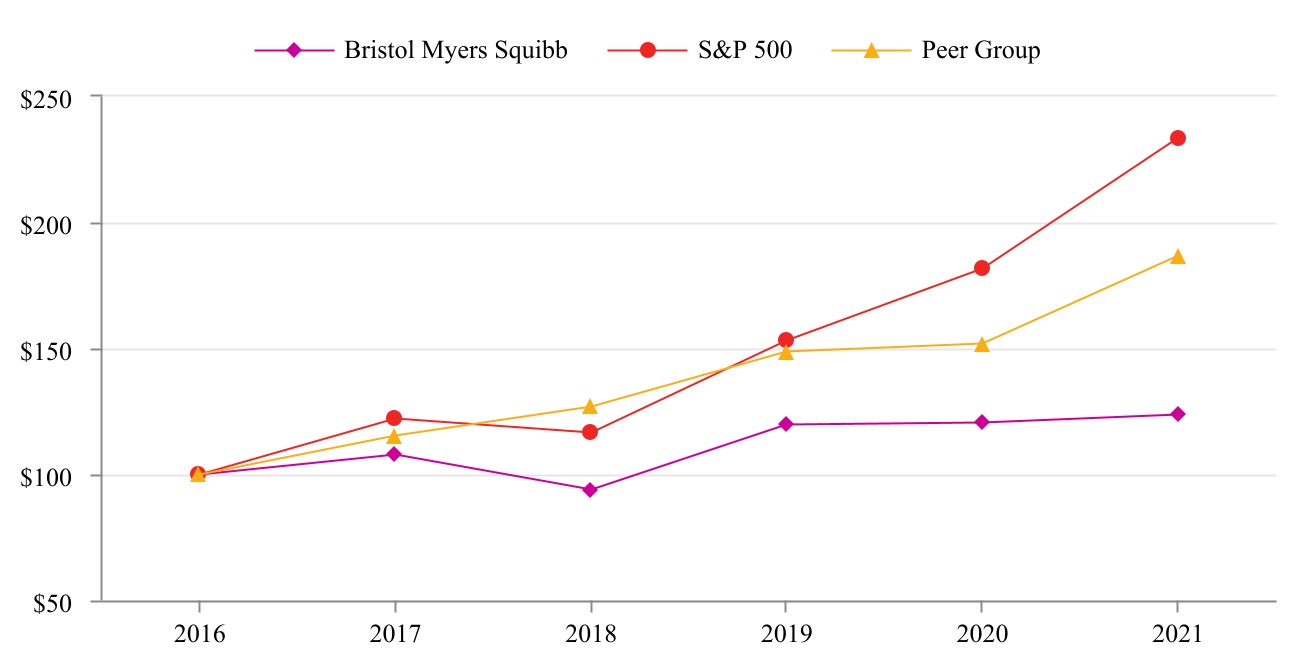
| 2016 | 2017 | 2018 | 2019 | 2020 | 2021 | ||||||||||||||||||||||||||||||
| Bristol Myers Squibb | $ | 100.00 | $ | 107.71 | $ | 93.82 | $ | 119.84 | $ | 120.33 | $ | 123.80 | |||||||||||||||||||||||
| S&P 500 | 100.00 | 121.83 | 116.49 | 153.17 | 181.35 | 233.41 | |||||||||||||||||||||||||||||
| Peer Group | 100.00 | 115.24 | 126.80 | 148.69 | 151.70 | 186.71 |
Issuer Purchases of Equity Securities
The following table summarizes the surrenders of our equity securities during the three months ended December 31, 2021:
| Period | Total Number of Shares Purchased**(a)** | Average Price Paid per Share**(a)** | Total Number of Shares Purchased as Part of Publicly Announced Programs**(b)** | Approximate Dollar Value of Shares that May Yet Be Purchased Under the Programs**(b)** | |||||||||||||||||||
| Dollars in Millions, Except Per Share Data | |||||||||||||||||||||||
| October 1 to 31, 2021 | 820,228 | $ | 58.48 | — | $ | 2,919 | |||||||||||||||||
| November 1 to 30, 2021 | 27,082,219 | 58.35 | 26,993,376 | 1,344 | |||||||||||||||||||
| December 1 to 31, 2021 | 20,925,321 | 56.77 | 20,706,814 | 15,169 | |||||||||||||||||||
| Three months ended December 31, 2021 | 48,827,768 | 47,700,190 |
(a) Includes shares repurchased as part of publicly announced programs and shares of common stock surrendered to the Company to satisfy tax withholding obligations in connection with the vesting of awards under our long-term incentive program.
(b) In May 2010, the Board of Directors authorized the repurchase of up to $3.0 billion of our common stock and in June 2012 increased its authorization for the repurchase of our common stock by an additional $3.0 billion. In October 2016, the Board of Directors approved a new share repurchase program authorizing the repurchase of an additional $3.0 billion of our common stock and in November 2019 further increased its authorization for the repurchase of our common stock by approximately $7.0 billion. In February 2020, the Board of Directors approved an increase of $5.0 billion to the total outstanding share repurchase authorization. In January and December 2021, the Board of Directors approved an increase of $2.0 billion and $15.0 billion, respectively, to the share repurchase authorization. The remaining share repurchase capacity under the program was approximately $15.2 billion as of December 31, 2021. Refer to “Item 1. Financial Statements-Note 16. Equity” for information on the share repurchase program.
Item 6. [RESERVED]
Item 7. MANAGEMENT’S DISCUSSION AND ANALYSIS OF FINANCIAL CONDITION AND RESULTS OF OPERATIONS.
Management’s discussion and analysis of financial condition and results of operations is provided as a supplement to and should be read in conjunction with the consolidated financial statements and related notes included elsewhere in this 2021 Form 10-K to enhance the understanding of our results of operations, financial condition and cash flows.
The comparison of 2020 to 2019 results has been omitted from this Form 10-K and is incorporated by reference from our Form 10-K for the year ended December 31, 2020—“Item 7. Management’s Discussion and Analysis of Financial Condition and Results of Operations” filed on February 10, 2021.
EXECUTIVE SUMMARY
Bristol-Myers Squibb Company is a global biopharmaceutical company whose mission is to discover, develop and deliver innovative medicines that help patients prevail over serious diseases. Refer to the Summary of Abbreviated Terms at the end of this 2021 Form 10-K for terms used throughout the document.
In 2021, we obtained more than 20 approvals for new medicines and additional indications and formulations of currently marketed medicines in major markets (the U.S., EU and Japan), including regulatory approvals of Breyanzi and Abecma in hematology malignancies, the first approvals of our cell therapy portfolio. In support of our continued investment in our cell therapy portfolio, we are expanding our manufacturing capabilities through the construction of new state-of-the-art cell therapy manufacturing facilities in Devens, Massachusetts, and Leiden, Netherlands. We continue to see momentum in our immuno-oncology portfolio with additional approvals for both Opdivo and Opdivo+Yervoy in various indications (e.g. adjuvant bladder, gastric cancer, gastroesophageal junction cancer, esophageal adenocarcinoma and RCC) and the return to growth of Opdivo. Our portfolio in immunology has expanded with the FDA approval of Zeposia for the treatment of adults with moderately to severely active UC and we have an important opportunity for deucravacitinib, our TYK2 inhibitor, for the treatment of psoriasis and other immune-mediated diseases. We bolstered our leading cardiovascular franchise by adding mavacamten with the acquisition of MyoKardia in 2020. In 2021, the FDA accepted the NDA for mavacamten for patients with symptomatic obstructive HCM and assigned a revised PDUFA goal date of April 28, 2022.
In 2021, our revenues increased 9%, due to Eliquis, Opdivo/Yervoy, our recently launched new products, Revlimid and foreign exchange. The GAAP EPS of $3.12 in 2021 as compared to the GAAP loss per share of $3.99 in 2020 was primarily due to (i) IPRD and other charges resulting from the MyoKardia asset acquisition in 2020, (ii) other specified items including lower unwinding of inventory purchase price adjustments and other income related to equity investments and contingent value rights and (iii) internal transfers of certain intangible and other assets to streamline our legal entity structure subsequent to the Celgene acquisition resulting in a tax benefit in 2021 and a tax charge in 2020. After adjusting for specified items, non-GAAP EPS increased $1.07 due to higher revenues, partially offset by higher expenses to support product launches and the overall portfolio.
Highlights
The following table summarizes our financial information:
| Year Ended December 31, | |||||||||||||||||
| Dollars in Millions, except per share data | 2021 | 2020 | |||||||||||||||
| Total Revenues | $ | 46,385 | $ | 42,518 | |||||||||||||
| Diluted Earnings/(Loss) Per Share | |||||||||||||||||
| GAAP | $ | 3.12 | $ | (3.99) | |||||||||||||
| Non-GAAP | 7.51 | 6.44 |
Our non-GAAP financial measures, including non-GAAP earnings and related EPS information, are adjusted to exclude specified items that represent certain costs, expenses, gains and losses and other items impacting the comparability of financial results. For a detailed listing of all specified items and further information and reconciliations of non-GAAP financial measures refer to “—Non-GAAP Financial Measures.”
Economic and Market Factors
COVID-19
In response to the COVID-19 pandemic, international, federal, state and local public health and governmental authorities have taken, and continue to take, a number of actions to limit the spread of COVID-19 and address related disruptions in the U.S. and global economy. While we continue to experience impacts on revenues from COVID-19 primarily due to lower new patient starts and patient visits, the pandemic has not significantly impacted our results of operations. The situation remains dynamic and it is difficult to reasonably assess or predict the full extent of the negative impact that the COVID-19 pandemic may have on our business, financial condition, results of operations and cash flows. The future financial and operational impact of the COVID-19 pandemic on BMS will depend on future developments such as the ultimate duration and the severity of the spread of COVID-19 and any variant strains in the U.S. and globally, the effectiveness and outreach of vaccines, the effectiveness of federal, state, local and international government's mitigation actions, the pandemic's impact on the U.S. and global economies, changes in the behavior of patients and medical professionals and the timing for resumption to our normal operations, as well as developments affecting healthcare and the delivery of medicines to patients. See “Part I—Item 1A. Risk Factors—General Risks—The COVID-19 pandemic is affecting our business and could have a material adverse effect on us.”
As the COVID-19 pandemic affected global healthcare systems as well as major economic and financial markets, we adopted several procedures focused on ensuring the continued supply of our medicines to our patients and protecting the health, wellbeing and safety of our workforce:
Workplace and Community
- We are maintaining our steadfast commitment to protecting our workforce, communities and patients, and ensuring the continued supply of life-saving medicines.
*•*As a science-based company, we have a social responsibility to help reduce the spread of the virus. Vaccinations are required for generally all of our employees in the U.S. and Puerto Rico subject to any local regulations which limit or restrict vaccine mandates, and we are encouraged that as of January 5, 2022 approximately 99% of our employees in these regions are vaccinated against COVID-19. Requests for medical or religious accommodations are also considered on an individual basis. Although local regulations and conditions in other ex-U.S. jurisdictions may limit or restrict vaccine mandates, we are committed to implementing similar requirements in other markets wherever possible.
-
As we return workers to the office, we will continue to assess the need to require weekly asymptomatic testing, mask wearing, and physical distancing of all colleagues onsite at our facilities in the U.S. and Puerto Rico. We also keep our workforce safe by conducting regular deep cleaning of our sites.
-
Our manufacturing sites have remained open throughout the pandemic supported by on site personnel. We have taken a thoughtful and phased approach to bringing the rest of our workforce back to our 195 plus sites around the world, guided by the following principles:
◦Serving the needs of our patients and customers
◦Prioritizing health and safety
◦Following medical advice and government direction
◦Leading with compassion and flexibility
◦Modeling key learnings
- No single appr
Showing the first 8K of 145K characters. Open the full section
Item 7A. QUANTITATIVE AND QUALITATIVE DISCLOSURES ABOUT MARKET RISK.
We are exposed to market risk resulting from changes in currency exchange rates and interest rates. Certain derivative financial instruments are used when available on a cost-effective basis to hedge our underlying economic exposure. All of our financial instruments, including derivatives, are subject to counterparty credit risk considered as part of the overall fair value measurement. Derivative financial instruments are not used for trading purposes.
Foreign Exchange Risk
Significant amounts of our revenues, earnings and cash flow are exposed to changes in foreign currency rates. Our primary net foreign currency translation exposures are the euro and Japanese yen. Foreign currency forward contracts are used to manage risk primarily arising from certain intercompany sales and purchases transactions; we are also exposed to foreign exchange transaction risk arising from non-functional currency denominated assets and liabilities and earnings denominated in non-U.S. dollar currencies. Foreign currency forward contracts are used to offset these exposures but are not designated as hedges.
We estimate that a 10% appreciation in the underlying currencies being hedged from their levels against the U.S. dollar (with all other variables held constant) would decrease the fair value of foreign exchange forward contracts by $678 million and $742 million at December 31, 2021 and December 31, 2020, respectively, reducing earnings over the remaining life of the contracts.
We are also exposed to translation risk on non-U.S. dollar-denominated net assets. Non-U.S. dollar borrowings are used to hedge the foreign currency exposures of our net investment in certain international affiliates and are designated as hedges of net investments. The effective portion of foreign exchange gains or losses on these hedges is included in the foreign currency translation component of Accumulated other comprehensive loss. If our net investment decreases below the equivalent value of the non-U.S. debt borrowings, the change in the remeasurement basis of the debt would be subject to recognition in income as changes occur. For additional information, refer to “Item 8. Financial Statements and Supplementary Data—Note 9. Financial Instruments and Fair Value Measurements.”
Interest Rate Risk
We use fixed-to-floating interest rate swap contracts designated as fair value hedges to provide an appropriate balance of fixed and floating rate debt. We use cross-currency interest rate swap contracts designated to hedge the Company's net investment in its Japan subsidiary. The fair values of these contracts as well as our marketable debt securities are analyzed at year-end to determine their sensitivity to interest rate changes. In this sensitivity analysis, if there were a 100 basis point increase in short-term or long-term interest rates as of December 31, 2021 and December 31, 2020, the expected adverse impact on our earnings would not be material.
We estimate that an increase of 100 basis points in long-term interest rates at December 31, 2021 and December 31, 2020 would decrease the fair value of long-term debt by $3.8 billion and $4.7 billion, respectively.
Credit Risk
We monitor our investments with counterparties with the objective of minimizing concentrations of credit risk. Our investment policy is to invest only in institutions that meet high credit quality standards and establishes limits on the amount and time to maturity of investments with any individual counterparty. The policy also requires that investments are only entered into with corporate and financial institutions that meet high credit quality standards.
The use of derivative instruments exposes us to credit risk if the counterparty fails to perform when the fair value of a derivative instrument contract is positive. If the counterparty fails to perform, collateral is not required by any party whether derivatives are in an asset or liability position. We have a policy of diversifying derivatives with counterparties to mitigate the overall risk of counterparty defaults. For additional information, refer to “Item 8. Financial Statements and Supplementary Data—Note 9. Financial Instruments and Fair Value Measurements.”
Item 8. FINANCIAL STATEMENTS AND SUPPLEMENTARY DATA.
BRISTOL-MYERS SQUIBB COMPANY
CONSOLIDATED STATEMENTS OF EARNINGS
Dollars in Millions, Except Per Share Data
| Year Ended December 31, | |||||||||||||||||
| EARNINGS | 2021 | 2020 | 2019 | ||||||||||||||
| Net product sales | $ | 45,055 | $ | 41,321 | $ | 25,174 | |||||||||||
| Alliance and other revenues | 1,330 | 1,197 | 971 | ||||||||||||||
| Total Revenues | 46,385 | 42,518 | 26,145 | ||||||||||||||
| Cost of products sold(a) | 9,940 | 11,773 | 8,078 | ||||||||||||||
| Marketing, selling and administrative | 7,690 | 7,661 | 4,871 | ||||||||||||||
| Research and development | 11,354 | 11,143 | 6,148 | ||||||||||||||
| IPRD charge - MyoKardia acquisition | — | 11,438 | — | ||||||||||||||
| Amortization of acquired intangible assets | 10,023 | 9,688 | 1,135 | ||||||||||||||
| Other (income)/expense, net | (720) | (2,314) | 938 | ||||||||||||||
| Total Expenses | 38,287 | 49,389 | 21,170 | ||||||||||||||
| Earnings/(Loss) Before Income Taxes | 8,098 | (6,871) | 4,975 | ||||||||||||||
| Provision for Income Taxes | 1,084 | 2,124 | 1,515 | ||||||||||||||
| Net Earnings/(Loss) | 7,014 | (8,995) | 3,460 | ||||||||||||||
| Noncontrolling Interest | 20 | 20 | 21 | ||||||||||||||
| Net Earnings(Loss) Attributable to BMS | $ | 6,994 | $ | (9,015) | $ | 3,439 | |||||||||||
| Earnings/(Loss) per Common Share | |||||||||||||||||
| Basic | $ | 3.15 | $ | (3.99) | $ | 2.02 | |||||||||||
| Diluted | 3.12 | (3.99) | 2.01 |
(a) Excludes amortization of acquired intangible assets.
CONSOLIDATED STATEMENTS OF COMPREHENSIVE INCOME/(LOSS)
Dollars in Millions
| Year Ended December 31, | |||||||||||||||||
| COMPREHENSIVE INCOME/(LOSS) | 2021 | 2020 | 2019 | ||||||||||||||
| Net Earnings/(Loss) | $ | 7,014 | $ | (8,995) | $ | 3,460 | |||||||||||
| Other Comprehensive Income/(Loss), net of taxes and reclassifications to earnings: | |||||||||||||||||
| Derivatives qualifying as cash flow hedges | 415 | (256) | (32) | ||||||||||||||
| Pension and postretirement benefits | 206 | (75) | 1,203 | ||||||||||||||
| Marketable debt securities | (9) | 5 | 36 | ||||||||||||||
| Foreign currency translation | (41) | 7 | 35 | ||||||||||||||
| Total Other Comprehensive Income/(Loss) | 571 | (319) | 1,242 | ||||||||||||||
| Comprehensive Income/(Loss) | 7,585 | (9,314) | 4,702 | ||||||||||||||
| Comprehensive Income Attributable to Noncontrolling Interest | 20 | 20 | 21 | ||||||||||||||
| Comprehensive Income/(Loss) Attributable to BMS | $ | 7,565 | $ | (9,334) | $ | 4,681 |
The accompanying notes are an integral part of these consolidated financial statements.
BRISTOL-MYERS SQUIBB COMPANY
CONSOLIDATED BALANCE SHEETS
Dollars in Millions, Except Share and Per Share Data
| December 31, | |||||||||||
| ASSETS | 2021 | 2020 | |||||||||
| Current Assets: | |||||||||||
| Cash and cash equivalents | $ | 13,979 | $ | 14,546 | |||||||
| Marketable debt securities | 2,987 | 1,285 | |||||||||
| Receivables | 9,369 | 8,501 | |||||||||
| Inventories | 2,095 | 2,074 | |||||||||
| Other current assets | 4,832 | 3,786 | |||||||||
| Total Current Assets | 33,262 | 30,192 | |||||||||
| Property, plant and equipment | 6,049 | 5,886 | |||||||||
| Goodwill | 20,502 | 20,547 | |||||||||
| Other intangible assets | 42,527 | 53,243 | |||||||||
| Deferred income taxes | 1,439 | 1,161 | |||||||||
| Marketable debt securities | — | 433 | |||||||||
| Other non-current assets | 5,535 | 7,019 | |||||||||
| Total Assets | $ | 109,314 | $ | 118,481 | |||||||
| LIABILITIES | |||||||||||
| Current Liabilities: | |||||||||||
| Short-term debt obligations | $ | 4,948 | $ | 2,340 | |||||||
| Accounts payable | 2,949 | 2,713 | |||||||||
| Other current liabilities | 13,971 | 14,027 | |||||||||
| Total Current Liabilities | 21,868 | 19,080 | |||||||||
| Deferred income taxes | 4,501 | 5,407 | |||||||||
| Long-term debt | 39,605 | 48,336 | |||||||||
| Other non-current liabilities | 7,334 | 7,776 | |||||||||
| Total Liabilities | 73,308 | 80,599 | |||||||||
| Commitments and contingencies | |||||||||||
| EQUITY | |||||||||||
| Bristol-Myers Squibb Company Shareholders’ Equity: | |||||||||||
| Preferred stock, $2 convertible series, par value $1 per share: Authorized 10 million shares; issued and outstanding 3,484 in 2021 and 3,484 in 2020, liquidation value of $50 per share | — | — | |||||||||
| Common stock, par value of $0.10 per share: Authorized 4.5 billion shares; 2.9 billion issued in 2021 and 2020 | 292 | 292 | |||||||||
| Capital in excess of par value of stock | 44,361 | 44,325 | |||||||||
| Accumulated other comprehensive loss | (1,268) | (1,839) | |||||||||
| Retained earnings | 23,820 | 21,281 | |||||||||
| Less cost of treasury stock — 747 million common shares in 2021 and 679 million common shares in 2020 | (31,259) | (26,237) | |||||||||
| Total Bristol-Myers Squibb Company Shareholders’ Equity | 35,946 | 37,822 | |||||||||
| Noncontrolling interest | 60 | 60 | |||||||||
| Total Equity | 36,006 | 37,882 | |||||||||
| Total Liabilities and Equity | $ | 109,314 | $ | 118,481 |
The accompanying notes are an integral part of these consolidated financial statements.
BRISTOL-MYERS SQUIBB COMPANY
CONSOLIDATED STATEMENTS OF CASH FLOWS
Dollars in Millions
| Year Ended December 31, | |||||||||||||||||
| 2021 | 2020 | 2019 | |||||||||||||||
| **Cash Flows Fr |
Showing the first 8K of 265K characters. Open the full section
Item 9. CHANGES IN AND DISAGREEMENTS WITH ACCOUNTANTS ON ACCOUNTING AND FINANCIAL DISCLOSURE.
None.
Item 9A. CONTROLS AND PROCEDURES.
Evaluation of Disclosure Controls and Procedures
As of December 31, 2021, management carried out an evaluation, under the supervision and with the participation of its chief executive officer and chief financial officer, of the effectiveness of the design and operation of its disclosure controls and procedures as defined in Exchange Act Rules 13a-15(e) and 15d-15(e), as of the end of the period covered by this 2021 Form 10-K. Based on this evaluation, management has concluded that as of December 31, 2021, such disclosure controls and procedures were effective.
Management’s Report on Internal Control Over Financial Reporting
Management is responsible for establishing and maintaining adequate internal control over financial reporting, as defined in Exchange Act Rule 13a-15(f). Under the supervision and with the participation of management, including the chief executive officer and chief financial officer, management assessed the effectiveness of internal control over financial reporting as of December 31, 2021 based on the framework in “Internal Control—Integrated Framework” (2013) issued by the Committee of Sponsoring Organizations of the Treadway Commission. Based on that assessment, management has concluded that the Company’s internal control over financial reporting was effective at December 31, 2021 to provide reasonable assurance regarding the reliability of its financial reporting and the preparation of its financial statements for external purposes in accordance with United States generally accepted accounting principles. Due to its inherent limitations, internal control over financial reporting may not prevent or detect misstatements. Also, projections of any evaluation of effectiveness to future periods are subject to the risk that controls may become inadequate because of changes in conditions, or that the degree of compliance with the policies or procedures may deteriorate.
Deloitte & Touche LLP, an independent registered public accounting firm, has audited the Company’s financial statements included in this report on this 2021 Form 10-K and issued its report on the effectiveness of the Company’s internal control over financial reporting as of December 31, 2021, which is included herein.
Changes in Internal Control Over Financial Reporting
There were no changes in the Company’s internal control over financial reporting during the quarter ended December 31, 2021 that have materially affected, or is reasonably likely to materially affect, the Company’s internal control over financial reporting.
Item 9B. OTHER INFORMATION.
None.
Item 9C. DISCLOSURE REGARDING FOREIGN JURISDICTIONS THAT PREVENT INSPECTIONS.
Not applicable.
REPORT OF INDEPENDENT REGISTERED PUBLIC ACCOUNTING FIRM
To the shareholders and the Board of Directors of Bristol-Myers Squibb Company
Opinion on Internal Control over Financial Reporting
We have audited the internal control over financial reporting of Bristol-Myers Squibb Company (the “Company”) as of December 31, 2021, based on criteria established in Internal Control — Integrated Framework (2013) issued by the Committee of Sponsoring Organizations of the Treadway Commission (COSO). In our opinion, the Company maintained, in all material respects, effective internal control over financial reporting as of December 31, 2021, based on criteria established in Internal Control — Integrated Framework (2013) issued by COSO.
We have also audited, in accordance with the standards of the Public Company Accounting Oversight Board (United States) (PCAOB), the consolidated financial statements as of and for the year ended December 31, 2021, of the Company and our report dated February 8, 2022, expressed an unqualified opinion on those consolidated financial statements.
Basis for Opinion
The Company’s management is responsible for maintaining effective internal control over financial reporting and for its assessment of the effectiveness of internal control over financial reporting, included in the accompanying Management's Report on Internal Control Over Financial Reporting. Our responsibility is to express an opinion on the Company’s internal control over financial reporting based on our audit. We are a public accounting firm registered with the PCAOB and are required to be independent with respect to the Company in accordance with the U.S. federal securities laws and the applicable rules and regulations of the Securities and Exchange Commission and the PCAOB.
We conducted our audit in accordance with the standards of the PCAOB. Those standards require that we plan and perform the audit to obtain reasonable assurance about whether effective internal control over financial reporting was maintained in all material respects. Our audit included obtaining an understanding of internal control over financial reporting, assessing the risk that a material weakness exists, testing and evaluating the design and operating effectiveness of internal control based on the assessed risk, and performing such other procedures as we considered necessary in the circumstances. We believe that our audit provides a reasonable basis for our opinion.
Definition and Limitations of Internal Control over Financial Reporting
A company’s internal control over financial reporting is a process designed to provide reasonable assurance regarding the reliability of financial reporting and the preparation of financial statements for external purposes in accordance with generally accepted accounting principles. A company’s internal control over financial reporting includes those policies and procedures that (1) pertain to the maintenance of records that, in reasonable detail, accurately and fairly reflect the transactions and dispositions of the assets of the company; (2) provide reasonable assurance that transactions are recorded as necessary to permit preparation of financial statements in accordance with generally accepted accounting principles, and that receipts and expenditures of the company are being made only in accordance with authorizations of management and directors of the company; and (3) provide reasonable assurance regarding prevention or timely detection of unauthorized acquisition, use, or disposition of the company’s assets that could have a material effect on the financial statements.
Because of its inherent limitations, internal control over financial reporting may not prevent or detect misstatements. Also, projections of any evaluation of effectiveness to future periods are subject to the risk that controls may become inadequate because of changes in conditions, or that the degree of compliance with the policies or procedures may deteriorate.
/s/ DELOITTE & TOUCHE LLP
Parsippany, New Jersey
February 8, 2022
PART III
Item 10. DIRECTORS, EXECUTIVE OFFICERS AND CORPORATE GOVERNANCE.
(a)Reference is made to our 2022 Proxy Statement with respect to our Directors, which is incorporated herein by reference and made a part hereof in response to the information required by Item 10.
(b)The information required by Item 10 with respect to our Executive Officers has been included in Part IA of this 2021 Form 10-K in reliance on General Instruction G of Form 10-K and Instruction 3 to Item 401(b) of Regulation S-K, which is incorporated herein by reference and made a part hereof in response to the information required by Item 10.
Item 11. EXECUTIVE COMPENSATION.
Reference is made to our 2022 Proxy Statement with respect to Executive Compensation, which is incorporated herein by reference and made a part hereof in response to the information required by Item 11.
Item 12. SECURITY OWNERSHIP OF CERTAIN BENEFICIAL OWNERS AND MANAGEMENT AND RELATED STOCKHOLDER MATTERS.
Reference is made to our 2022 Proxy Statement with respect to the security ownership of certain beneficial owners and management, which is incorporated herein by reference and made a part hereof in response to the information required by Item 12.
Item 13. CERTAIN RELATIONSHIPS AND RELATED TRANSACTIONS.
Reference is made to our 2022 Proxy Statement with respect to certain relationships and related transactions, which is incorporated herein by reference and made a part hereof in response to the information required by Item 13.
Item 14. PRINCIPAL ACCOUNTANT FEES AND SERVICES.
Reference is made to our 2022 Proxy Statement with respect to the aggregate fees billed to us by our principal accountant, Deloitte & Touche LLP (PCAOB ID No. 34), which is incorporated herein by reference and made a part hereof in response to the information required by Item 14.
PART IV
Item 15. EXHIBITS AND FINANCIAL STATEMENT SCHEDULE.
| (a) | ||||||||
| Page Number | ||||||||
| 1 | Consolidated Financial Statements | |||||||
| Consolidated Statements of Earnings and Comprehensive (Loss)/Income | 73 | |||||||
| Consolidated Balance Sheets | 74 | |||||||
| Consolidated Statements of Cash Flows | 75 | |||||||
| Notes to Consolidated Financial Statements | 76 | |||||||
| Report of Independent Registered Public Accounting Firm | 124 | |||||||
| 2. | Financial Statement Schedules | |||||||
| All other schedules not included with this additional financial data are omitted because they are not applicable or the required information is included in the financial statements or notes thereto. | ||||||||
| 3. | Exhibits |
The information called for by this Item is incorporated herein by reference to the Exhibit Index in this 2021 Form 10-K.
| (b) | Exhibits Required to be filed by Item 601 of Regulation S-K | 134 |
The information called for by this Item is incorporated herein by reference to the Exhibit Index in this 2021 Form 10-K.
Item 16. FORM 10-K SUMMARY.
None.
SIGNATURES
Pursuant to the requirements of Section 13 or 15(d) of the Securities Exchange Act of 1934, the Registrant has duly caused this Report to be signed on its behalf by the undersigned, thereunto duly authorized.
| BRISTOL-MYERS SQUIBB COMPANY (Registrant) | ||||||||
| By | /s/ GIOVANNI CAFORIO, M.D. | |||||||
| Giovanni Caforio, M.D. | ||||||||
| Chairman of the Board and Chief Executive Officer | ||||||||
| Date: February 9, 2022 |
Pursuant to the requirements of the Securities Exchange Act of 1934, this Report has been signed below by the following persons on behalf of the Registrant and in the capacities and on the dates indicated.
| Signature | Title | Date | ||||||||||||
| /s/ GIOVANNI CAFORIO, M.D. | Chairman of the Board and Chief Executive Officer | February 9, 2022 | ||||||||||||
| (Giovanni Caforio, M.D.) | (Principal Executive Officer) | |||||||||||||
| /s/ DAVID V. ELKINS | Chief Financial Officer | February 9, 2022 | ||||||||||||
| (David V. Elkins) | (Principal Financial Officer) | |||||||||||||
| /s/ KAREN SANTIAGO | Senior Vice President and Corporate Controller | February 9, 2022 | ||||||||||||
| (Karen Santiago) | (Principal Accounting Officer) | |||||||||||||
| /s/ PETER J. ARDUINI | Director | February 9, 2022 | ||||||||||||
| (Peter J. Arduini) | ||||||||||||||
| /s/ JULIA A. HALLER, M.D. | Director | February 9, 2022 | ||||||||||||
| (Julia A. Haller, M.D.) | ||||||||||||||
| /s/ MANUEL HIDALGO MEDINA, M.D., Ph.D. | Director | February 9, 2022 | ||||||||||||
| (Manuel Hidalgo Medina, M.D., Ph.D.) | ||||||||||||||
| /s/ PAULA A. PRICE | Director | February 9, 2022 | ||||||||||||
| (Paula A. Price) | ||||||||||||||
| /s/ DERICA W. RICE | Director | February 9, 2022 | ||||||||||||
| (Derica W. Rice) | ||||||||||||||
| /s/ THEODORE R. SAMUELS | Director | February 9, 2022 | ||||||||||||
| (Theodore R. Samuels) | ||||||||||||||
| /s/ GERALD L. STORCH | Director | February 9, 2022 | ||||||||||||
| (Gerald L. Storch) | ||||||||||||||
| /s/ KAREN H. VOUSDEN, PH.D. | Director | February 9, 2022 | ||||||||||||
| (Karen H. Vousden, Ph.D.) | ||||||||||||||
| /s/ PHYLLIS R. YALE | Director | February 9, 2022 | ||||||||||||
| (Phyllis R. Yale) |
SUMMARY OF ABBREVIATED TERMS
Bristol-Myers Squibb Company and its consolidated subsidiaries may be referred to as Bristol Myers Squibb, BMS, the Company, we, our or us in this 2021 Form 10-K, unless the context otherwise indicates. Throughout this 2021 Form 10-K, we have used terms which are defined below:
| 2021 Form 10-K | Annual Report on Form 10-K for the fiscal year ended December 31, 2021 | MCOs | Managed Care Organizations | ||||||||
| AbbVie | AbbVie Inc. | MDL | multi-district litigation | ||||||||
| Agenus | Agenus Inc. | MDS | myelodysplastic syndromes | ||||||||
| ALL | acute lymphoblastic leukemia | Mead Johnson | Mead Johnson Nutrition Company | ||||||||
| Amgen | Amgen Inc. | Merck | Merck & Co., Inc. | ||||||||
| Amylin | Amylin Pharmaceuticals, Inc. | MF | myelofibrosis | ||||||||
| aNDA | abbreviated New Drug Application | MPM | Malignant Pleural Mesothelioma | ||||||||
| AstraZeneca | AstraZeneca PLC | MSI-H | high microsatellite instability | ||||||||
| BCMA | B-cell maturation antigen | MyoKardia | MyoKardia, Inc. | ||||||||
| Biogen | Biogen, Inc. | NASH | Non alcoholic steatohepatitis | ||||||||
| BLA | Biologics License Application | NAV | net asset value | ||||||||
| CERCLA | U.S. Comprehensive Environmental Response, Compensation and Liability Act | Nektar | Nektar Therapeutics | ||||||||
| Celgene | Celgene Corporation | NDA | New Drug Application | ||||||||
| cGMP | current Good Manufacturing Practices | NKT | natural killer T | ||||||||
| CML | chronic myeloid leukemia | NLRP3 | NACHT, LRR and PYD domains-containing protein 3 | ||||||||
| CPPIB | CPPIB Credit Europe S.A.R.L., a Luxembourg private limited liability company | Novartis | Novartis Pharmaceutical Corporation | ||||||||
| CRC | colorectal cancer | NSCLC | non-small cell lung cancer | ||||||||
| DSA | Distribution Services Agreement | NVAF | non-valvular atrial fibrillation | ||||||||
| EC | European Commission | OECD | Organisation for Economic Co-operation and Development | ||||||||
| EGFR | estimated glomerular filtration rate | OIG | Office of Inspector General of the U.S. Department of Health and Human Services | ||||||||
| Eisai | Eisai Co., Ltd. | Ono | Ono Pharmaceutical Co., Ltd. | ||||||||
| EMA | European Medicines Agency | OTC | Over-the-counter | ||||||||
| EPO | European Patent Office | Otsuka | Otsuka Pharmaceutical Co., Ltd. | ||||||||
| EPS | earnings per share | PBMs | Pharmacy Benefit Managers | ||||||||
| ERISA | Employee Retirement Income Security Act of 1974 | PD-1 | programmed death receptor-1 | ||||||||
| ESA | erythoropoiesis-stimulating agent | PDMA | Prescription Drug Marketing Act | ||||||||
| ESCC | esophageal squamous cell carcinoma | PDUFA | Prescription Drug User Fee Act | ||||||||
| EU | European Union | Pfizer | Pfizer, Inc. | ||||||||
| FASB | Financial Accounting Standards Board | PhRMA Code | Pharmaceutical Research and Manufacturers of America’s Professional Practices Code | ||||||||
| FCPA | Foreign Corrupt Practices Act | PRP | potentially responsible party | ||||||||
| FDA | U.S. Food and Drug Administration | PsA | psoriatic arthritis | ||||||||
| FL | follicular lymphoma | R&D | research and development | ||||||||
| GAAP | U.S. generally accepted accounting principles | RA | rheumatoid arthritis | ||||||||
| GBM | glioblastoma multiforme | RCC | renal cell carcinoma | ||||||||
| Gilead | Gilead Sciences, Inc. | REMS | Risk Evaluation and Mitigation Strategy | ||||||||
| GILTI | global intangible low taxed income | Roche | Roche Holding AG |
Showing the first 8K of 61K characters. Open the full section