 filings.tools
Bristol Myers Squibb 10-K 2022-12-31
Filed 2023-02-14. 23 sections, 648K characters. Original on sec.gov · Markdown · JSON
Cover and table of contents
UNITED STATES
SECURITIES AND EXCHANGE COMMISSION
Washington, D.C. 20549
FORM 10-K
☒ ANNUAL REPORT PURSUANT TO SECTION 13 OR 15(d) OF THE
SECURITIES EXCHANGE ACT OF 1934
For the fiscal year ended December 31, 2022
OR
☐ TRANSITION REPORT PURSUANT TO SECTION 13 OR 15(d) OF THE
SECURITIES EXCHANGE ACT OF 1934
For the transition period from ______ to _______
Commission File Number 001-01136
BRISTOL-MYERS SQUIBB COMPANY
(Exact name of registrant as specified in its charter)
| Delaware | 22-0790350 | |||||||
| (State or other jurisdiction of incorporation or organization) | **(**I.R.S Employer Identification No.) |
430 E. 29th Street, 14FL, New York, NY 10016
(Address of principal executive offices)
(212) 546-4200
(Registrant’s telephone number, including area code)
Securities registered pursuant to Section 12(b) of the Act:
| Title of each class | Trading Symbol(s) | Name of each exchange on which registered | ||||||
| Common Stock, $0.10 Par Value | BMY | New York Stock Exchange | ||||||
| 1.000% Notes due 2025 | BMY25 | New York Stock Exchange | ||||||
| 1.750% Notes due 2035 | BMY35 | New York Stock Exchange | ||||||
| Celgene Contingent Value Rights | CELG RT | New York Stock Exchange |
Securities registered pursuant to Section 12(g) of the Act:
| Title of each class | ||
| $2 Convertible Preferred Stock, $1 Par Value |
Indicate by check mark if the registrant is a well-known seasoned issuer, as defined in Rule 405 of the Securities Act. Yes ☒ No ☐
Indicate by check mark if the registrant is not required to file reports pursuant to Section 13 or Section 15(d) of the Act. Yes ☐ No ☒
Indicate by check mark whether the registrant (1) has filed all reports required to be filed by Section 13 or 15(d) of the Securities Exchange Act of 1934 during the preceding 12 months (or for such shorter period that the registrant was required to file such reports), and (2) has been subject to such filing requirements for the past 90 days. Yes ☒ No ☐
Indicate by check mark whether the registrant has submitted electronically every Interactive Data File required to be submitted pursuant to Rule 405 of Regulation S-T (§232.405 of this chapter) during the preceding 12 months (or for such shorter period that the registrant was required to submit such files). Yes ☒ No ☐
Indicate by check mark whether the registrant is a large accelerated filer, an accelerated filer, a non-accelerated filer, a smaller reporting company, or an emerging growth company. See the definitions of “large accelerated filer,” “accelerated filer,” “smaller reporting company,” and “emerging growth company” in Rule 12b-2 of the Exchange Act.
| Large accelerated filer ☒ | Accelerated filer ☐ | Non-accelerated filer ☐ | Smaller reporting company ☐ | Emerging growth company ☐ |
If an emerging growth company, indicate by check mark if the registrant has elected not to use the extended transition period for complying with any new or revised financial accounting standards provided pursuant to Section 13(a) of the Exchange Act. ☐
Indicate by check mark whether the registrant has filed a report on and attestation to its management’s assessment of the effectiveness of its internal control over financial reporting under Section 404(b) of the Sarbanes-Oxley Act (15 U.S.C. 7262(b)) by the registered public accounting firm that prepared or issued its audit report. ☒
Indicate by check mark whether the registrant is a shell company (as defined in Rule 12b-2 of the Exchange Act). Yes ☐ No ☒
The aggregate market value of the 2,133,779,907 shares of voting common equity held by non-affiliates of the registrant, computed by reference to the closing price as reported on the New York Stock Exchange, as of the last business day of the registrant’s most recently completed second fiscal quarter was approximately $164,301,052,839. Bristol-Myers Squibb Company has no non-voting common equity. At February 7, 2023, there were 2,098,775,978 shares of common stock outstanding.
DOCUMENTS INCORPORATED BY REFERENCE: Portions of the definitive proxy statement for the registrant’s Annual Meeting of Shareholders to be filed within 120 days after the conclusion of the registrant's fiscal year ended December 31, 2022 with the U.S. Securities and Exchange Commission pursuant to Regulation 14A of the Securities Exchange Act of 1934, as amended, are incorporated by reference into Part III of this Annual Report on Form 10-K to the extent described therein.
BRISTOL-MYERS SQUIBB COMPANY
INDEX TO FORM 10-K
December 31, 2022
- Indicates brand names of products which are trademarks not owned by BMS. Specific trademark ownership information is included in the Exhibit Index at the end of this 2022 Form 10-K.
PART I
Item 1. BUSINESS.
General
Bristol-Myers Squibb Company ("we", the "Company", or "BMS") was incorporated under the laws of the State of Delaware in August 1933 under the name Bristol-Myers Company, as successor to a New York business started in 1887. In 1989, Bristol-Myers Company changed its name to Bristol-Myers Squibb Company as a result of a merger.
We continue to operate in one segment engaged in the discovery, development, licensing, manufacturing, marketing, distribution and sale of biopharmaceutical products on a global basis. We expect that our acquisitions of MyoKardia in 2020 and Turning Point in 2022 will further position us as a leading biopharmaceutical company, expanding our precision oncology and cardiovascular portfolios with several near-term assets and additional external partnerships. Our principal strategy is to combine the resources, scale and capability of a pharmaceutical company with the speed and focus on innovation of the biotech industry. Our focus as a biopharmaceutical company is on discovering, developing and delivering transformational medicines for patients facing serious diseases in areas where we believe that we have an opportunity to make a meaningful difference: oncology, hematology, immunology, cardiovascular and neuroscience. Our priorities are to continue to renew and diversify our portfolio through launching our new product portfolio, advancing our early, mid and late-stage pipeline, and executing disciplined business development. We remain committed to strengthening our balance sheet and returning capital to shareholders. For a further discussion of our strategy initiatives, refer to “Item 7. Management's Discussion and Analysis of Financial Condition and Results of Operations—Strategy.”
We compete with other worldwide research-based drug companies, smaller research companies and generic drug manufacturers. Our products are sold worldwide, primarily to wholesalers, distributors, specialty pharmacies, and to a lesser extent, directly to retailers, hospitals, clinics and government agencies. We have significant manufacturing operations in the U.S., Puerto Rico, Ireland and Switzerland. Most of our revenues come from products in the following therapeutic classes: hematology, oncology, cardiovascular and immunology.
The percentage of revenues by significant region/country were as follows:
| Year Ended December 31, | |||||||||||||||||
| Dollars in Millions | 2022 | 2021 | 2020 | ||||||||||||||
| United States | 69 | % | 63 | % | 63 | % | |||||||||||
| International | 29 | % | 35 | % | 36 | % | |||||||||||
| Other(a) | 2 | % | 2 | % | 1 | % | |||||||||||
| Total Revenues | $ | 46,159 | $ | 46,385 | $ | 42,518 |
(a) Other revenues include royalties and alliance-related revenues for products not sold by BMS’s regional commercial organizations.
Refer to the Summary of Abbreviated Terms at the end of this 2022 Form 10-K for definitions of capitalized terms used throughout the document.
Acquisitions, Divestitures, Licensing and Other Arrangements
Acquisitions, divestitures and other licensing arrangements allow us to focus our resources behind growth opportunities that drive the greatest long-term value. For additional information relating to our acquisitions, divestitures, licensing and other arrangements refer to “Item 7. Management's Discussion and Analysis of Financial Condition and Results of Operations—Acquisitions, Divestitures, Licensing and Other Arrangements” and “Item 8. Financial Statements and Supplementary Data—Note 4. Acquisitions, Divestitures, Licensing and Other Arrangements.”
Products, Intellectual Property and Product Exclusivity
Our pharmaceutical products include chemically-synthesized or small molecule drugs, products produced from biological processes, called “biologics” and chimeric antigen receptor (CAR) T-cell therapies. Small molecule drugs are typically administered orally in the form of a tablet or capsule, although other drug delivery mechanisms are used as well. Biologics are typically administered to patients through injections or by intravenous infusion. CAR-T therapies are administered to patients by intravenous infusion.
Below is a summary of our significant products, including approved indications. For information about our alliance arrangements for certain of the products below, refer to “—Alliances” below and “Item 8. Financial Statements and Supplementary Data—Note 3. Alliances.”
Eliquis*®* Eliquis (apixaban) is an oral Factor Xa inhibitor indicated for the reduction in risk of stroke/systemic embolism in NVAF and for the treatment of DVT/PE and reduction in risk of recurrence following initial therapy.
Opdivo*®* Opdivo (nivolumab), a biological product, is a fully human monoclonal antibody that binds to the PD-1 on T and NKT cells. Opdivo has received approvals for several anti-cancer indications including bladder, blood, CRC, head and neck, RCC, HCC, lung, melanoma, MPM, stomach and esophageal cancer. The Opdivo+Yervoy regimen also is approved in multiple markets for the treatment of NSCLC, melanoma, MPM, RCC, CRC and various gastric and esophageal cancers. There are several ongoing potentially registrational studies for Opdivo across other tumor types and disease areas, in monotherapy and in combination with Yervoy and various anti-cancer agents.
Pomalyst*®/Imnovid®* Pomalyst/Imnovid (pomalidomide) is a small molecule that is administered orally and modulates the immune system and other biologically important targets. Pomalyst/Imnovid is indicated for patients with multiple myeloma who have received at least two prior therapies including lenalidomide and a proteasome inhibitor and have demonstrated disease progression on or within 60 days of completion of the last therapy.
Orencia*®* Orencia (abatacept), a biological product, is a fusion protein indicated for adult patients with moderately to severely active RA and PsA, for reducing signs and symptoms in certain pediatric patients with moderately to severely active polyarticular JIA and for the treatment of aGVHD, in combination with a calcineurin inhibitor and methotrexate.
Sprycel*®* Sprycel (dasatinib) is an oral inhibitor of multiple tyrosine kinase indicated for the first-line treatment of patients with Philadelphia chromosome-positive CML in chronic phase, the treatment of adults with chronic, accelerated, or myeloid or lymphoid blast phase CML with resistance or intolerance to prior therapy, including Gleevec* (imatinib mesylate) and the treatment of children and adolescents aged 1 year to 18 years with chronic phase Philadelphia chromosome-positive CML.
Yervoy*®* Yervoy (ipilimumab), a biological product that is a CTLA4 immune checkpoint inhibitor. Yervoy is a monoclonal antibody for the treatment of patients with unresectable or metastatic melanoma.
Empliciti*®* Empliciti (elotuzumab), a biological product that targets the SLAMF7 protein expressed on natural killer cells (NKC) and myeloma cells. Empliciti is a humanized monoclonal antibody for the treatment of multiple myeloma.
Reblozyl*®* Reblozyl (luspatercept-aamt), a biological product, is an erythroid maturation agent indicated for the treatment of anemia in adult patients with transfusion dependent and non-transfusion dependent beta thalassemia and for the treatment of anemia failing an erythropoiesis stimulating agent (“ESA”) in adult patients with very low- to intermediate-risk MDS who have ring sideroblasts and require RBC transfusions.
Abecma*®* Abecma (idecabtagene vicleucel) is a B-cell maturation antigen-directed genetically modified autologous CAR-T c
Showing the first 8K of 117K characters. Open the full section
Item 1A. RISK FACTORS.
Any of the risks and uncertainties described below could significantly and negatively affect our business operations, financial condition, operating results (including components of our financial results), cash flows, prospects, reputation or credit ratings now and in the future, which could cause the trading price of our common stock to decline significantly. Additional risks and uncertainties that are not presently known to us, or risks that we currently consider immaterial, could also impair our business operations, financial condition, operating results or cash flows. The following discussion of risk factors contains “forward-looking” statements, as discussed in “Item 7. Management’s Discussion and Analysis of Financial Condition and Results of Operations—Special Note Regarding Forward-Looking Statements.”
Product, Industry and Operational Risks
Increased pricing pressure and other restrictions in the U.S. and abroad continue to negatively affect our revenues and profit margins.
Our products continue to be subject to increasing pressures across the portfolio from pharmaceutical market access and pricing controls, required rebates and other discounts, in the U.S., the EU and other regions around the world that result in lower prices, lower reimbursement rates and smaller populations for whom payers will reimburse. We expect that these market access constraints, pricing controls and discounting and other restrictions will become more acute as public and private payers continue to take aggressive steps to control their expenditures. Our future revenues and profit margins could be negatively affected, including as a result of (i) changes in laws and regulations relating to the pricing and reimbursement of pharmaceutical products (including potential penalties for increasing prices over the rate of inflation, new discounts to fund a redesign of the Medicare Part D benefit, government negotiations/price controls that may establish a maximum allowed price/reimbursement rate), as well as other changes relating to federal healthcare programs, such as modifying the federal Anti-Kickback statute discount safe harbor and the IRA, which includes a number of provisions intended to lower the costs of some drugs covered under Medicare Part D and Medicare Part B and to limit Medicare beneficiaries’ out-of-pocket spending under the Medicare Part D benefit, (ii) cost-cutting measures by federal healthcare programs, such as Medicare and Medicaid, MCOs and other institutional and governmental purchasers, (iii) the grant of additional authority to governmental agencies to manage drug utilization and negotiate drug prices (including the implementation of the 2020 regulation issued by the U.S. federal government authorizing states and private parties to develop and implement programs to import certain prescription drugs from Canada and sell them in the U.S., and the American Rescue Plan Act of 2021, which eliminates the Medicaid Prescription Drug Rebate cap starting January 1, 2024), (iv) expanded utilization under the 340B Drug Pricing Program ("340B program"), (v) competition related to placements on applicable commercial and Medicare Part D formularies; (vi) changes to U.S. federal pharmaceutical coverage and reimbursement policies and practices, (vii) the increased scrutiny of drug manufacturers (including any additional review of BMS or Celgene by the House Oversight and Reform Committee), (viii) reimbursement delays, (ix) government price erosion mechanisms across Europe and in other countries resulting in deflation for pharmaceutical product pricing, (x) the increased purchasing power of entities that negotiate on behalf of Medicare, Medicaid and private sector beneficiaries, (xi) collection delays or failures to pay in government-funded public hospitals outside the U.S., (xii) developments in technology and/or industry practices that could impact the reimbursement policies and practices of third-party payers, and (xiii) inhibited market access due to real or perceived differences in value propositions for our products compared to competing products.
Additionally, manufacturers who are found to have knowingly and intentionally overcharged 340B program covered entities could be subject to significant monetary penalties. Over the course of the past few years, Celgene had received inquiries from Human Resources and Services Administration regarding the limited distribution networks for Revlimid, Pomalyst, and Thalomid and compliance with the 340B program. As part of our broader integration strategy and alignment of our distribution model (post our acquisition of Celgene Corporation) we had announced that beginning March 1, 2022, we would recognize up to two designated 340B program contract pharmacy locations per 340B program hospital that lacks an entity-owned pharmacy. Although we believe that we have complied with, and continue to comply with, all applicable legal requirements, additional legal or legislative changes with respect to the 340B program may cause us to update our approach. Significant changes to our sales or pricing practices with regard to the distribution of drugs under the 340B program, or any material changes in our U.S. payer channel mix, could have an adverse effect on our revenues and profitability. In addition, if we are required to pay penalties under the applicable regulations, there would be an adverse effect on our revenues and profitability. For additional information on pricing pressures and other constraints, refer to “Item 1. Business—Pricing, Price Constraints and Market Access.”
We may experience difficulties or delays in the development and commercialization of new products. Our ability to replace revenue from products that lose patent protection is directly dependent on our ability to successfully commercialize new products in a timely manner.
As is common in the pharmaceutical industry, BMS expects that sales of its key brand products like Revlimid, Pomalyst, Sprycel and Abraxane will decline after the loss of market exclusivity for such products. Consequently, our future success is highly dependent on our pipeline of new products. There is a high rate of failure inherent in the research and development process for new drugs. As a
result, there is a high risk that funds we invest in research programs will not generate financial returns. Compounds or products may appear promising in development but fail to reach market within the expected or optimal timeframe, or at all. We have experienced setbacks and may continue to do so.
In addition, product extensions or additional indications may not be approved. Furthermore, products or indications approved under the U.S. FDA’s Accelerated Approval Program may be contingent upon verification and description of clinical benefit in confirmatory studies and such studies may not be successful.
Developing and commercializing new compounds and products involve inherent risks and uncertainties, including (i) efficacy and safety concerns or findings of superior safety or efficacy of competing products; (ii) delayed or denied regulatory approvals, including as a result of difficulties in enrolling patients and completing clinical trials in a timely manner; (iii) delays or challenges with producing products on a commercial scale or excessive costs to manufacture products; (iv) failure to enter into or implement optimal alliances for the development and/or commercialization of new products; (v) changes in regulatory approval processes and policies which may cause delays or denials of new product approvals; (vi) preclusion from commercialization due to intellectual property issues or disputes with third parties; (vii) failure in certain markets to obtain reimbursement commensurate with the level of innovation and clinical benefit presented by the product; and (viii) changing clinical preferences, changing industry standards, laws and regulations, or competitors’ innovations, each of which may render new products or enhancements to existing products obsolete.
We are also unable to predict if and when any changes to laws or regulatory policies will occur and how they will affect our business and particularly our pipeline of new products.
Regulatory approval delays are especially common when a product is expected to have a Risk Evaluation and Mitigation Strategy ("REMS") program, as required by the U.S. FDA to address significant risk/benefit issues, and we expect that certain of our future key products will be distributed in the U.S. primarily through a REMS program. The inability to bring a product to market or a significant delay in the expected approval and related launch date of a new product could negatively impact our revenues and earnings. In addition, if certain acquired pipeline programs are canceled or we believe their commercial prospects have been reduced, we may recognize material non-cash impairment charges for those programs. Finally, losing key molecules and intermediaries or our compound library through a natural or man-made disaster or act of sabotage could negatively impact the product development cycle.
We can provide no assurance when or whether any of our products under development will be approved or launched or whether any products, once launched, will be commercially successful. The public announcement of data from our clinical studies, or those of our competitors, or news of any developments related to our, or our competitors’, products or late-stage compounds may cause significant volatility in our stock price and depending on the data, may result in an adverse impact on our business, financial condition or results of operations. If the development of any of our key late-stage product candidates is delayed or discontinued or a clinical study does not meet one or more of its primary endpoints, our stock price could decline significantly and there may be an adverse impact on our business, financial condition or results of operations.
We must maintain a continuous flow of successful new products and successful new indications for existing products sufficient both to cover our substantial research and development costs and to replace sales that are lost as profitable products lose market exclusivity or are displaced by competing products or therapies. Failure to do so in the short-term or long-term can have a material adverse effect on our business, results of operations, cash flow, financial condition and prospects. There can be no assurance that our key product candidates would prove to be safe and effective or as safe and effective as other competing products, or that, even if approved, any such products will become commercially successful for all approved indications.
We could lose market exclusivity of a product earlier than expected.
In the pharmaceutical and biotechnology industries, the majority of an innovative product’s commercial value is realized during its market exclusivity period. In the U.S. and in some other countries, when market exclusivity expires and generic versions are approved and marketed or when biosimilars are introduced (even if only for a competing product), there are usually very substantial and rapid declines in a product’s revenues.
Market exclusivity for our products is based upon patent rights and certain regulatory forms of exclusivity. The scope of our patent rights, if any, varies from country to country and may also be dependent on the availability of meaningful legal remedies in a country. The failure to obtain or maintain patent and other intellectual property rights, or limitations on the use or loss of such rights, could result in a rapid loss of sales for any affected products which could be material to us. In some countries, including certain EU member states, basic patent protections for our products may not exist because certain countries did not historically offer the right to obtain specific types of patents and/or we (or our licensors) did not file in those countries. In addition, the patent environment can be unpredictable and the validity and enforceability of patents cannot be predicted with certainty. In addition, manufacturers of innovative drugs as well as generic drug manufacturers may be able to design their products around our owned or licensed patents and compete with us using the resulting alternative technology. Absent relevant patent protection for a product, once the data exclusivity period expires, generic or alternative versions can be approved and marketed.
Generic and biosimilar product manufacturers as well as other groups seeking financial gain are also increasingly seeking to challenge patents before they expire, and we could face earlier-than-expected competition for any products at any time. Patents covering our key products have been, and are likely to continue to be, subject to validity, enforceability and infringement challenges in patent litigations and post-grant review patent office proceedings. Although we are confident in the strength of our intellectual property rights, it may be possible for generic drug companies to successfully challenge our rights and launch their generic versions of our drugs prior to the expiration of our intellectual property rights. For example, following certain adverse judicial decisions in the UK and the Netherlands, generic manufacturers have begun marketing generic versions of Eliquis in the UK and Netherlands, and may seek to market generic versions of Eliquis in additional countries in Europe, prior to the expiration of our patents, which may lead to additional infringement and invalidity actions involving Eliquis patents being filed in various countries in Europe. In addition, in order to avoid the uncertainty and expense of litigation, among other reasons, we may decide to enter into settlements with generic manufacturers that permit generic market entry prior to the expiration of our intellectual property rights. For example, as a result of patent settlements, generic entry for Revlimid in the United Kingdom began on January 18, 2022, and in various other European countries on February 18, 2022. Similarly, in the U.S., following patent settlements, certain companies were granted volume-limited licenses to sell generic lenalidomide in the U.S. commencing in March 2022 or thereafter.
In some cases, manufacturers may seek regulatory approval by submitting their own clinical study data to obtain marketing approval or choose to launch a generic product “at risk” before the expiration of the applicable patent(s) and/or before the final resolution of related patent litigation. In addition, some countries are allowing manufacturers to manufacture and sell generic products, which negatively impacts the protections afforded the Company. Lower-priced generics or biosimilars for BMS biologic products or competing biologics could negatively impact our volumes and prices.
In addition, both the U.S. Congress and the U.S. FDA have taken steps to promote the development and approval of generic drugs and biosimilar biologics, including by providing generic and biosimilar developers a private right of action to obtain sufficient quantities of drug samples from the reference product’s manufacturer in order to conduct testing necessary to obtain approval for generic or biosimilar products.
There is no assurance that a particular product will enjoy market exclusivity for the full time period that appears in the estimates disclosed in this 2022 Form 10-K or that we assume when we provide our financial guidance.
We face intense competition from other manufacturers and expect to see increasing market penetration of lower-priced generic products.
The future growth of BMS is dependent on the market access, uptake and expansion for marketed brands, new product introductions, new indications, product extensions and co-promotional activities with alliance partners. Competition is keen and as we lose exclusivity for some of our marketed brands lower-priced generic products will increasingly penetrate our markets. Generic challenges to our products can also arise at any time, and our patents may not prevent the emergence of generic competition for our products. In some countries, patent protection is significantly weaker than in the United States or in the EU; political and social pressure has also pushed legislation and other measures that promote the use of generic and biosimilar products. For additional information, see “Item 1A. Risk Factors—We could lose market exclusivity of a product earlier than expected.”
In addition, we face competition from new products entering the market, particularly in IO. New products may have (i) lower prices, (ii) superior efficacy (benefit) or safety (risk) profiles (whether actual or perceived), (iii) technological advantages that may make such products more convenient to use, (iv) better insurance coverage or reimbursement levels, (v) more effective marketing programs and/or other differentiating factors that make it harder for our products to compete. We cannot predict with accuracy the timing or impact of the introduction of competitive products that treat diseases and conditions like those treated by our products and product candidates. Business combinations among our competitors and major third-party payers may also increase competition for our products. If we are unable to compete successfully against our competitors’ products in the marketplace, this could have a material negative impact on our revenues and earnings.
We could experience difficulties, delays and disruptions in our supply chain as well as in the manufacturing, distribution and sale of our products.
Our product supply and related patient access has been, and could in the future be, negatively impacted by difficulties, delays and disruptions in the manufacturing, distribution and sale of our products. Some of the difficulties, delays and disruptions include: (i) product seizures or recalls or forced closings of manufacturing plants; (ii) our failure, or the failure of any of our vendors or suppliers, to comply with cGMP and other applicable regulations or quality assurance guidelines that could lead to manufacturing shutdowns, product shortages or delays in product manufacturing; (iii) manufacturing, quality assurance/quality control, supply problems or governmental approval delays; (iv) the failure of a supplier, including sole source or single source suppliers, to provide us with the necessary raw materials, supplies or finished goods within a reasonable timeframe and with required quality; (v) the failure of a third-party manufacturer to supply us with bulk active or finished product on time; (vi) construction or regulatory approval delays for new facilities or the expansion of existing facilities, including those intended to support future demand for our
biologics products, such as Opdivo; (vii) the failure to meet new and emerging regulations requiring products to be tracked throughout the distribution channels using unique identifiers to verify their authenticity in the supply chain; (viii) other manufacturing or distribution issues, including limits to manufacturing capacity and changes in the types of products produced, such as biologics, physical limitations or other business interruptions; and (ix) disruptions in supply chain continuity, including from market forces (such as the recent stress on global logistics), natural disasters, global disease outbreaks or pandemics (including COVID-19), acts of war or terrorism or other unforeseeable or unavoidable events that materially impact one or more of our facilities or a critical supplier.
In addition, manufacturing processes for novel cell-based therapies, such as CAR-T cell therapies, are still evolving, and our processes may be more complicated or more expensive than the approaches taken by our current and future competitors. Our ability to source raw materials and supplies used to manufacture our CAR-T cell therapies and to develop consistent and reliable manufacturing processes and distribution networks with an attractive cost of goods could impact future anticipated revenue and gross profit for our CAR-T cell therapies. Furthermore, we may face challenges with sourcing raw materials and supplies for clinical and, if approved, commercial manufacturing. Logistical and shipment delays and other factors not in our control could prevent or delay the delivery of our product candidates and marketed products to patients. Additionally, we are required to maintain a complex chain of identity and custody with respect to patient material as such material enters into and moves through the manufacturing process. As a result, even slight deviations at any point in the production process for our CAR-T cell therapies or in material used in our CAR-T cell therapies could result in loss of product or regulatory remedial action, which could adversely affect our future anticipated revenues and/or profitability related to our CAR-T cell therapies.
Regulatory, Intellectual Property, Litigation, Tax and Legal Compliance Risks
Litigation claiming infringement of intellectual property may adversely affect our future revenues and operating earnings.
We and certain of our subsidiaries are, and in the future may be, involved in various legal proceedings, including patent litigation, such as claims that our patents are invalid, unenforceable and/or do not cover the product of the generic drug manufacturer or where third parties seek damages and/or injunctive relief to compensate for alleged infringement of their patents by our commercial or other activities. Resolving an intellectual property infringement claim can be costly and time consuming and may require us to enter into license agreements, which may not be available on commercially reasonable terms. A successful claim of patent or other intellectual property infringement could subject us to significant damages and/or an injunction preventing the manufacture, sale, or use of the affected product or products. Any of these events could have a material adverse effect on our profitability and financial condition.
Adverse outcomes in legal matters could negatively affect our business.
Current or future lawsuits, claims, proceedings and government investigations could preclude or delay the commercialization of our products or could adversely affect our operations, profitability, liquidity or financial condition, after any possible insurance recoveries where available. Such legal matters include (i) intellectual property disputes; (ii) adverse decisions in litigation, including product safety and liability, consumer protection and commercial cases; (iii) anti-bribery regulations, such as the U.S. Foreign Corrupt Practices Act or UK Bribery Act, including compliance with ongoing reporting obligations to the government resulting from any settlements; (iv) recalls or withdrawals of pharmaceutical products or forced closings of manufacturing plants; (v) the alleged failure to fulfill obligations under supply contracts with the government and other customers or under other agreements relating to our business; (vi) product pricing and promotional matters; (vii) lawsuits and claims asserting, or investigations into, violations of securities, antitrust, Federal and state pricing, consumer protection, data privacy and other laws and regulations; (viii) environmental, health, safety and sustainability matters, including regulatory actions in response to climate change; and (ix) tax liabilities resulting from assessments from tax authorities.
We are subject to a variety of U.S. and international laws and regulations.
We are currently subject to a number of government laws and regulations and, in the future, could become subject to new government laws and regulations. The costs of compliance with such laws and regulations, or the negative results of non-compliance, could adversely affect our business, our operating results and the financial condition of our Company. These laws and regulations control and regulate key aspects of our business including but not limited to (i) market access, pricing controls and discounting; (ii) tax liabilities, returns and payments; (iii) imports and other trade restrictions; (iv) intellectual property protection and enforcement; (v) good practice guidelines and regulations; (vi) accounting standards; (vii) data storage and privacy, particularly in the EU and the U.S.; (viii) requirements for reporting payments and other value transfers to healthcare professionals (such as those provided under the Federal Anti-Kickback Statute); and (ix) compliance with anti-bribery and anti-corruption practices of the U.S. and other countries.
In addition, the U.S. healthcare industry is highly regulated and subject to frequent and substantial changes, including as a result of new judicial or governmental decisions. For example, the U.S. FDA has indicated it is undertaking an industry-wide review of indications that received accelerated approval and for which the confirmatory studies did not meet their primary endpoints. Also, we anticipate continued U.S. congressional interest in modifying provisions of the Patient Protection and Affordable Care Act (the “ACA”), particularly given its numerous legal challenges (such as the California v. Texas case) and polarized public support. The
revenues that we generate by the health insurance exchanges and Medicaid expansion under the ACA are not material, so the impact of the change in law and similar recent administration actions is expected to be limited. Any future replacement, modification or repeal of the ACA may adversely affect our business and financial results, particularly if the legislation reduces incentives for employer-sponsored insurance coverage. We cannot predict how other future federal or state legislative or administrative changes relating to healthcare reform will affect our business. For additional information, refer to “Item 1. Business—Government Regulation” and “Item 1. Business—Pricing, Price Constraints and Market Access.”
Changes to tax regulations could negatively impact our earnings.
We are subject to income taxes in the U.S. and various other countries globally. Changes in tax laws and regulations can and do occur. For example, the Tax Cuts and Jobs Act of 2017 (the "TCJA") reduced the U.S. tax rate to 21% and introduced broad and complex changes resulting in numerous new regulations and interpretations. Significant judgment is required for determining the Company’s tax liabilities, and the Company’s tax returns are periodically examined by various tax authorities. We have faced, and may continue to face, audit challenges on how we apply a tax law or regulation. The ultimate resolution of any tax matters may result in payments greater or less than amounts accrued, which could have a negative impact on our provision for income taxes. In addition, our future earnings could be negatively impacted by further changes in tax legislation, including changes in tax rates and tax base such as limiting, phasing-out or eliminating deductions or tax credits, increase taxing of certain excess income from intellectual property, revising tax law interpretations in domestic or foreign jurisdictions, changes in rules for earnings repatriations and changes in other tax laws in the U.S. or other countries. Notably, in July and October 2021 OECD/G20 Inclusive Framework agreed on the general rules for redefined jurisdictional taxation rights and a global minimum tax. In December 2022, the EU member states voted unanimously to adopt a Directive implementing the Pillar 2 (global minimum tax) rules giving member states until December 31, 2023 to implement the Directive into national legislation. Further details regarding implementation of these rules are expected and if implemented could have a material impact on our tax provision and results of operations.
The failure of third parties to meet their contractual, regulatory and other obligations could adversely affect our business.
We rely on suppliers, vendors, outsourcing partners, alliance partners and other third parties to research, develop, manufacture, commercialize, co-promote and sell our products, manage certain marketing, human resource, finance, IT, data and other business unit and functional services and meet their contractual, regulatory and other obligations. Using these third parties poses a number of risks, such as: (i) they may not perform to our standards or legal requirements, for example, in relation to the outsourcing of significant clinical development activities for innovative medicines to some contract research organizations; (ii) they may not produce reliable results; (iii) they may not perform in a timely manner; (iv) they may not maintain confidentiality of our proprietary information; (v) they may incur a significant cyberattack or business disruption; (vi) they may be subject to government orders or mandates that require them to give priority to the government and set aside pre-existing commercial orders; (vii) disputes may arise with respect to ownership of rights to technology developed with our partners; and (viii) disagreements could cause delays in, or termination of, the research, development or commercialization of the product or result in litigation or arbitration. Moreover, some third parties are located in markets subject to political and social risks, corruption, infrastructure problems and natural disasters, in addition to country specific privacy and data security risks given current legal and regulatory environments. The failure of any critical third party to satisfactorily meet its obligations, including for future royalty and milestone payments; to adequately deploy business continuity plans in the event of a crisis; and/or to satisfactorily resolve significant disagreements with us or address other factors, could have a material adverse impact on our operations and results. In addition, if these third parties violate, or are alleged to have violated, any laws or regulations, including the local pharmaceutical code, U.S. Foreign Corrupt Practices Act, UK Bribery Act, the EU’s General Data Protection Regulation, and other similar laws and regulations, during the performance of their obligations for us, it is possible that we could suffer financial and reputational harm or other negative outcomes, including possible legal consequences.
Product labeling changes for our marketed products could result in a negative impact on revenues and profit margins.
Pharmaceutical products receive regulatory approval based on data obtained in controlled clinical trials of limited duration. Additional clinical trials, head-to-head studies, adverse events reports following the use of our products over longer periods of time and studies that identify biomarkers (objective characteristics that can indicate a particular response to a product or therapy) that are conducted after obtaining marketing approval for our products, and regulatory changes to standards regarding safety, efficacy or labeling, may result in product label changes or other measures that could reduce the product's market acceptance and result in declining revenues. Sometimes additional information from new studies identifies a portion of the patient population that may be non-responsive to a medicine or would be at higher risk of adverse reactions and labeling changes based on such studies may limit the patient population. The studies providing such additional information may be sponsored by us, but they could also be sponsored by competitors, insurance companies, government institutions, MCOs, scientists, investigators or other interested parties. While additional safety and efficacy information from such studies assist us and healthcare providers in identifying the best patient population for each product, it can also negatively impact our operating results. New information added to a product’s label can affect its risk-benefit profile, leading to potential voluntary or mandatory recalls, withdrawals or declining revenue, as well as product liability claims. Additionally, certain study results, especially from head-to-head studies, could affect a product’s formulary listing, which could also adversely affect revenues.
In addition, if safety or efficacy concerns are raised about a third party's product in the same class as one of our products, those concerns could implicate the entire class and this, in turn, could have an adverse impact on the availability or commercial viability of our product(s) as well as other products in the class.
The illegal distribution and sale by third parties of counterfeit or unregistered versions of our products or stolen products could have a negative impact on our revenues, earnings, reputation and business.
Third parties may illegally distribute and sell counterfeit versions of our products, which do not meet our rigorous manufacturing and testing standards. A patient who receives a counterfeit drug or a product diverted from its authorized market may be at risk for a number of dangerous health consequences. Our reputation and business could suffer harm as a result of counterfeit drugs sold under our brand name or diverted products. The prevalence of counterfeit medicines is an industry-wide issue due to a variety of factors, including the adoption of e-commerce, which increased during the COVID-19 pandemic, greatly enhancing consumers’ ability to obtain prescriptions and other medical treatments via the internet in lieu of traditional brick and mortar pharmacies. The internet exposes patients to greater risk as it is a preferred vehicle for dangerous counterfeit offers and scams because of the anonymity it affords counterfeiters.
Thefts of inventory at warehouses, plants or while in-transit, which are then not properly stored and are later sold through unauthorized channels, could adversely impact patient safety, our reputation and our business. In addition, diversion of products from their authorized market into other channels may result in reduced revenues and negatively affect our profitability.
Increased use of social media platforms presents risks and challenges.
We are increasing our use of social media to communicate Company news and events. The inappropriate and/or unauthorized use of social media could cause brand damage or information leakage and may give rise to liability, including from the improper collection and/or dissemination of personally identifiable information from employees, patients, healthcare professionals or other stakeholders. In addition, negative or inaccurate posts or comments about us on any social networking website could damage our reputation, brand image and goodwill and may cause significant volatility in our stock price. Further, the disclosure of non-public Company-sensitive information by our workforce or others, whether intentional or unintentional, through external media channels could lead to loss of trade secrets or other intellectual property, as well as the Company’s commercially sensitive information.
Information Technology and Cybersecurity Risks
We are dependent on information technology and our systems and infrastructure face certain risks, including from cybersecurity breaches and data leakage.
We rely extensively on information technology systems, networks and services, including internet sites, data hosting and processing facilities and tools, physical security systems and other hardware, software and technical applications and platforms, some of which are managed, hosted, provided and/or used for third-parties or their vendors, to assist in conducting our business. A significant breakdown, invasion, corruption, destruction or interruption of critical information technology systems or infrastructure, by our workforce, others with authorized access to our systems or unauthorized persons could negatively impact operations. The ever-increasing use and evolution of technology, including cloud-based computing, creates opportunities for the unintentional dissemination or intentional destruction or modification of confidential information stored in our, or our third-party providers’ systems, portable media or storage devices. We could also experience a business interruption, theft of confidential information or reputational damage from industrial espionage attacks, malware or other cyber-attacks, which may compromise our system infrastructure or lead to data leakage, either internally or at our third-party providers. As the COVID-19 pandemic progressed, we observed an increase in cybersecurity incidents across the industry, predominantly ransomware and social engineering attacks. Further, government entities have also been the subject of cyberattacks. As the cyber-threat landscape evolves, these attacks are growing in frequency, sophistication and intensity, and due to the nature of some of these attacks, there is also a risk that they may remain undetected for a period of time. Although the aggregate impact of cybersecurity breaches and data leakage on our operations and financial condition have not been material to date, we have been the target of cyber-attacks and expect them to continue as cybersecurity threats have been rapidly evolving in sophistication and becoming more prevalent in the industry. We have invested in industry-appropriate protections and monitoring practices of our data and IT to reduce these risks and continue to monitor our systems on an ongoing basis for any current or potential threats. While we maintain cyber insurance, this insurance may not, however, be sufficient to cover the financial, legal, business or reputational losses that may result from an interruption or breach of our systems. There can be no assurance that our continuing efforts will prevent breakdowns or breaches to our or our third-party providers’ databases or systems that could adversely affect our business.
Strategic, Business Development and Employee Attraction and Retention Risks
We depend on several key products for most of our revenues, cash flows and earnings.
We derive a majority of our revenue and earnings from several key products. We expect that Revlimid, Eliquis, and Opdivo will represent a significant percentage of our revenue, earnings and cash flows during the next few years. A reduction in revenue from any
of these products due to loss of market exclusivity or other factors could adversely impact our earnings and cash flows. For additional information, see “Item 1A. Risk Factors—We could lose market exclusivity of a product earlier than expected.”
Also, if one of our major products were to become subject to issues such as loss of patent protection, significant changes in demand, formulary access changes, material product liability, unexpected side effects, regulatory proceedings, negative publicity, supply disruption from our manufacturing operations or third-party supplier or a significant advancement of competing products, we may incur an adverse impact on our business, financial condition, results of operations or the trading price of our stock.
Third-party royalties represent a significant percentage of our pretax income and operating cash flow.
We have entered into several arrangements which entitle us to potential royalties from third parties for out-licensed intellectual property, commercialization rights and sales-based contingent proceeds related to the divestiture of businesses. In many of these arrangements we have minimal, if any, continuing involvement that contribute to the financial success of those activities. Royalties have continued to represent a significant percentage of our pretax income, including royalties related to the divestiture of our diabetes business (including the transfer of certain future royalty rights pertaining to Amylin, Onglyza and Farxiga* product sales), out-licensed intellectual property and the Merck patent infringement settlement. Pretax income generated from royalties was approximately $2.5 billion in 2022. Our pretax income could be adversely affected if the royalty streams decline in future periods.*
Failure to execute our business strategy or to identify and effectively manage acquisitions, divestitures, alliances, joint ventures and other portfolio actions could adversely impact our growth and profitability and our future results. In addition, any businesses or assets that we acquire in the future may underperform, we may not be able to successfully integrate them into our existing business and the occurrence of a number of unexpected factors could prevent or substantially delay the consummation of an anticipated acquisition, divestiture or merger.
Our strategy is focused on delivering innovative, transformational medicines to patients in a focused set of disease areas. To support future revenue growth and maintain an adequate pipeline, we have acquired, or in-licensed, a number of assets and we expect to continue to support our pipeline with compounds or products obtained through licensing and acquisitions. Competition among pharmaceutical companies for acquisition and product licensing opportunities is intense, and we may not be able to locate suitable acquisition targets or licensing partners at reasonable prices, or successfully execute such transactions. If we are unable to consistently maintain an adequate pipeline, whether through internal R&D programs or transactions with third parties or if we are unable to support and grow our marketed products, successfully execute the launches of newly approved products, advance our late-stage pipeline, manage change from our operating model evolution or manage our costs effectively, our operating results and financial condition could be negatively impacted.
Additionally, future revenues, profits and cash flows of an acquired company’s products, technologies and pipeline candidates may not materialize due to low product uptake, delayed or missed pipeline opportunities, the inability to capture expected synergies resulting from cost savings and avoidance, increased competition, safety concerns, regulatory issues, supply chain problems or other factors beyond our control. Substantial difficulties, costs and delays could result from integrating our acquisitions, including for: (i) R&D, manufacturing, distribution, sales, marketing, promotion and information technology activities; (ii) policies, procedures, processes, controls and compliance; and (iii) tax considerations.
Where we acquire debt or equity securities as all or part of the consideration for business development activities, such as in connection with a joint venture or acquisition, the value of those securities will fluctuate and may depreciate in value. We may not control the company in which we acquire securities, such as in connection with a collaborative arrangement, and as a result, we will have limited ability to determine its management, operational decisions, internal controls and compliance and other policies, which can result in additional financial and reputational risks.
We may not be successful in separating underperforming or non-strategic assets, and gains or losses on the divestiture of, or lost operating income from, such assets may affect our earnings. Our divestitures also may result in continued financial exposure to the divested businesses, such as through guarantees or other financial arrangements, continued supply and services arrangements, or potential litigation, following the transaction. Under these arrangements, nonperformance by us could result in obligations being imposed on us that could have a material adverse effect on our competitive position, cash flows, results of operations, financial condition or reputation.
We might also incur asset impairment charges related to acquisitions or divestitures that reduce our earnings. The value allocated to certain of our assets could be substantially impaired due to a number of factors beyond our control. New or revised accounting standards, rules and interpretations could result in changes to the recognition of income and expense that may materially and adversely affect our financial results.
If the execution or implementation of acquisitions, divestitures, alliances, joint ventures and other portfolio actions is not successful, it could adversely impact our financial condition, cash flows and results of operations. Moreover, due to the substantial amount of debt that we incurred to finance the cash portion of the Celgene and MyoKardia acquisitions, there can be no assurance of when we will be
able to expand our business development capacity. Although we are committed to reducing our debt, pursuing strategic transaction opportunities in future may require us to obtain additional equity or debt financing, and could result in increased leverage and/or a downgrade of our credit ratings.
Failure to attract and retain highly qualified workforce could affect our ability to successfully develop and commercialize products.
Our success is largely dependent on our continued ability to (i) attract and retain highly qualified scientific, technical and management workforce, including people with expertise in clinical R&D, governmental regulation and commercialization, and (ii) in connection with our acquisitions, integrate corporate cultures and maintain employee morale. We are facing increasing competition for a limited pool of qualified individuals from numerous pharmaceutical and biotechnology companies, universities, government entities, research institutions, companies seeking to enter the healthcare space, and companies in other industries. We cannot be sure that we will be able to retain quality talent or that the costs of doing so will not materially increase.
Market, Liquidity and Credit Risks
We have significant indebtedness that could have negative consequences.
Our acquisitions of Celgene and MyoKardia increased the amount of our debt resulting in additional interest expense. This could reduce our financial flexibility to continue capital investments, develop new products and declare future dividends.
Adverse changes in U.S. and global economic and political conditions could adversely affect our operations and profitability.
Global economic and political risks pose significant challenges to a company’s growth and profitability and are difficult to mitigate. We generated approximately 30% of our revenues outside of the U.S. in 2022. As such, a global economic downturn could create or amplify a variety of risks to our business and could negatively affect our growth. In addition, uncertainty in the credit and capital markets could impact our growth strategy. Our revenues, earnings and cash flow are also exposed to risk from a strengthening U.S. dollar and global inflation, including in the U.S. If our operating costs were to significantly increase, whether as a result of rising inflation rates, wage increases or other factors, it could adversely affect our revenues and profitability. We also have exposure to customer credit risks in Europe, South America and other markets including from government-guaranteed hospital receivables in markets where payments are not received on time. We have significant operations in Europe, including for manufacturing and distribution. The results of our operations could be negatively impacted by any member country exiting the eurozone monetary union or EU. In particular, the exit of the UK from the EU, which occurred on January 31, 2020, created uncertainties affecting our business operations in the UK and the EU and may have an impact on our research, commercial and general business operations in the UK and the EU, including the approval and supply of our products and may require changes to our legal entity structure in the UK and the EU.
Additionally, our business and operations may be adversely affected by political volatility, conflicts or crises in individual countries or regions, including terrorist activities or war and pandemics or epidemics. The COVID-19 pandemic affected demand for some of our products driven by lower patient starts and visits, and we would expect any future pandemics to have a similar effect. In addition, while we did not experience any significant manufacturing or supply issues due to COVID-19, it is possible that we could experience these issues in response to future pandemics. For instance, we may experience scarcity of certain raw materials and components as a result of the influx of pandemic related vaccine orders receiving priority treatment from vendors. Furthermore, a future epidemic or pandemic could create material staffing shortages at our manufacturing sites which could disrupt the supply of our products. It is also possible that we may experience supply chain interruptions as a result of quarantines, shelter-in-place and other governmental orders and policies, travel restrictions, airline and cargo capacity and route reductions. We may also experience delays in the initiation and enrollment of patients in our clinical trials as a consequence of any future pandemic. We may not be able to fully mitigate these delays, which could negatively impact the timing of our pipeline development programs and expected future revenues and/or cash flows. A prolonged clinical trial delay could potentially have a significant negative effect on our business, particularly if new competitive products enter the market or clinical trial results for our competitors’ products affect the value proposition for our product. Any such delays or difficulties in clinical development could also potentially lead to a material impairment of our intangible assets, including the $35.9 billion of intangible assets as of December 31, 2022.
We cannot predict or reasonably estimate the impact of any potential long-term changes to the healthcare industry from global economic and political events, including any future pandemics. For example, there is potential for a shift in the U.S. payer channel mix due to changes in patient coverage from the current economic crisis, but we are not able to reliably estimate what the impact would be on our results of operations given the highly variable and uncertain situation. It is also possible that changes in the healthcare system could impose additional burdens on clinical trials, which could increase the costs of sponsoring clinical trials or lead to additional delays or difficulties with completing clinical trials. We may also experience additional pricing pressures and/or increased governmental regulation.
Global economic conditions or events such as wars or pandemics also create additional risks from their impact on our suppliers, vendors, outsourcing partners, alliance partners and other third parties that we rely on to research, develop, manufacture, commercialize, co-promote and sell our products, manage certain marketing, selling, human resource, finance, IT and other business
unit and functional services. For example, if any of our third-party providers suffer from limited solvency because of global economic conditions, it could negatively impact our operating model and our business. Similarly, global events such as the Ukraine-Russia conflict can increase the volatility of the financial markets, foreign currency exchanges and interest rates. We could also face potential other negative consequences stemming from future pandemics or global events, including but not limited to increased cyber threats to us and our partners such as phishing, social engineering and malware attacks. It is possible that global economic and political events, including any future pandemic, could exacerbate any of the other risks described in this 2022 Form 10-K as well.
There can be no guarantee that we will pay dividends or repurchase stock.
The declaration, amount and timing of any dividends fall within the discretion of our Board. The Board’s decision will depend on many factors, including our financial condition, earnings, capital requirements, debt service obligations, industry practice, legal requirements, regulatory constraints and other factors that our Board may deem relevant. A reduction or elimination of our dividend payments or dividend program could adversely affect our stock price. In addition, we could, at any time, decide not to buy back any more shares in the market, or reduce the number of shares repurchased under our share repurchase program, which could also adversely affect our stock price. The IRA imposes a 1% excise tax on our net repurchases of shares after December 31, 2022. The imposition of the excise tax on repurchases of our shares may increase the cost to us of making repurchases and may cause our Board to reduce the number of shares repurchased pursuant to our share repurchase program.
Our amended bylaws designate the Court of Chancery of the State of Delaware as the sole and exclusive forum for certain lawsuits between us and our stockholders, which could limit our stockholders’ ability to obtain a judicial forum that it finds favorable for such lawsuits and make it more costly for our stockholders to bring such lawsuits, which may have the effect of discouraging such lawsuits.
Our amended bylaws provide that, unless we consent in writing to the selection of an alternative forum, the Court of Chancery of the State of Delaware will be, to the fullest extent permitted by law, the sole and exclusive forum for any (i) derivative action or proceeding brought on our behalf, (ii) action asserting a claim of breach of a fiduciary duty owed by any of our directors, officers or other employees to us or our stockholders, creditors or other constituents, (iii) action asserting a claim arising pursuant to any provision of the General Corporation Law of the State of Delaware, our amended and restated certificate of incorporation or our amended bylaws or (iv) action asserting a claim against us or any of our directors, officers or other employees governed by the internal affairs doctrine; provided, however, that, in the event that the Court of Chancery of the State of Delaware lacks jurisdiction over any such action or proceeding, the sole and exclusive forum for such action or proceeding will be another state or federal court of the State of Delaware. Our bylaws also provide that any person or entity purchasing or otherwise acquiring or holding any interest in shares of our capital stock will be deemed to have notice of and consented to this forum selection provision.
The Court of Chancery of the State of Delaware (or if the Court of Chancery does not have jurisdiction, another state or federal court of the State of Delaware) will have the fullest authority allowed by law to issue an anti-suit injunction to enforce this forum selection clause and to preclude suit in any other forum. However, this forum selection provision is not intended to apply to any actions brought under the Securities Act of 1933 (the "Securities Act"), as amended, or the Exchange Act. Section 27 of the Exchange Act creates exclusive federal jurisdiction over all suits brought to enforce any duty or liability created by the Exchange Act or the rules and regulations thereunder and Section 22 of the Securities Act creates concurrent jurisdiction for federal and state courts over all suits brought to enforce any duty or liability created by the Securities Act or the rules and regulations thereunder. Accordingly, the forum selection provision in our amended bylaws will not relieve us of our duties to comply with the federal securities laws and the rules and regulations thereunder, and our stockholders will not be deemed to have waived our compliance with these laws, rules and regulations.
Nevertheless, this forum selection provision in our bylaws may limit a stockholder’s ability to bring a claim in a judicial forum that it finds favorable for disputes with us or any of our directors, officers and other employees, which may discourage lawsuits with respect to such claims, although our stockholders will not be deemed to have waived our compliance with federal securities laws and the rules and regulations thereunder. In addition, stockholders who do bring a claim in the Court of Chancery in the State of Delaware could face additional litigation costs in pursuing any such claim, particularly if they do not reside in or near Delaware. While we believe the risk of a court declining to enforce the forum selection provision contained in our amended bylaws is low, if a court were to find the provision inapplicable to, or unenforceable in respect of, one or more of the specified types of actions or proceedings, we may incur additional costs associated with resolving such action in other jurisdictions, which could harm our business, operating results and financial condition.
Item 1B. UNRESOLVED STAFF COMMENTS.
None.
Item 2. PROPERTIES.
Our principal executive offices are located at 430 East 29th Street, 14th Floor, New York, NY. We own or lease manufacturing, R&D, administration, storage and distribution facilities at approximately 190 sites worldwide. We believe our manufacturing properties, in combination with our third-party manufacturers, are in good operating condition and provide adequate production capacity for our current and projected operations. We also believe that none of our properties is subject to any material encumbrance, easement or other restriction that would detract materially from its value or impair its use in the operation of the business. For further information about our manufacturing properties, refer to “Item 1. Business—Manufacturing and Quality Assurance.”
Our significant manufacturing and R&D locations by geographic area were as follows at December 31, 2022:
| Manufacturing | R&D | ||||||||||
| United States | 7 | 9 | |||||||||
| Europe | 1 | 1 | |||||||||
| Total | 8 | 10 |
Item 3. LEGAL PROCEEDINGS.
Information pertaining to legal proceedings can be found in “Item 8. Financial Statements and Supplementary Data—Note 20. Legal Proceedings and Contingencies” and is incorporated by reference herein.
Item 4. MINE SAFETY DISCLOSURES.
Not applicable.
PART IA
Information about our Executive Officers
Listed below is information on our executive officers as of February 14, 2023. Executive officers are elected by the Board of Directors for an initial term, which continues until the first Board meeting following the next Annual Meeting of Shareholders, and thereafter, are elected for a one-year term or until their successors have been elected. Executive officers serve at the discretion of the Board of Directors.
| Name and Current Position | Age | Employment History for the Past 5 Years | ||||||
| Giovanni Caforio, M.D. Chairman of the Board and Chief Executive Officer Member of the Leadership Team | 58 | 2015 to 2017 – Chief Executive Officer and Director of the Company 2017 to present – Chairman of the Board and Chief Executive Officer | ||||||
| Christopher Boerner, Ph.D. Executive Vice President, Chief Commercialization Officer Member of the Leadership Team | 52 | 2015 to 2017 – President and Head of U.S. Commercial 2017 to 2018 – President and Head, International Markets 2018 to present – Executive Vice President, Chief Commercialization Officer | ||||||
| David V. Elkins Executive Vice President and Chief Financial Officer Member of the Leadership Team | 54 | 2014 to 2017 – Group Vice President and Chief Financial Officer, Consumer and Consumer Medicines, Johnson & Johnson 2017 to 2018 – Worldwide Vice President and Chief Financial Officer, Consumer Products, Medical Development and Corporate Functions, Johnson & Johnson 2018 to 2019 – Chief Financial Officer, Celgene Corporation 2019 to present – Executive Vice President and Chief Financial Officer | ||||||
| Sharon Greenlees Senior Vice President, Corporate Controller | 51 | 2016 to 2018 – Vice President of Investor Relations, AbbVie Inc. 2018 to 2020 – Head of Pricing, U.S. Commercial, AbbVie Inc. 2020 to 2021 – Head of Supply Chain Finance, AbbVie Inc. 2021 to 2022 – Vice President and Controller, R&D Finance and Operations, AbbVie Inc. 2022 to present – Senior Vice President, Corporate Controller | ||||||
| Samit Hirawat, M.D. Executive Vice President, Chief Medical Officer, Global Drug Development Member of the Leadership Team | 54 | 2017 to 2019 – Executive Vice President, Head of Oncology Development, Novartis 2019 to present – Executive Vice President, Chief Medical Officer, Global Drug Development | ||||||
| Sandra Leung Executive Vice President, General Counsel Member of the Leadership Team | 62 | 2015 to present – Executive Vice President, General Counsel | ||||||
| Greg Meyers Executive Vice President, Chief Digital and Technology Officer Member of the Leadership Team | 50 | 2014 to 2018 – Corporate Vice President and Chief Information Officer, Motorola Solutions 2018 to 2022 – Group Chief Information and Digital Officer, Syngenta Group 2022 to present – Executive Vice President, Chief Digital and Technology Officer | ||||||
| Elizabeth A. Mily Executive Vice President, Strategy & Business Development Member of the Leadership Team | 55 | 2010 to 2020 – Managing Director, Barclays Investment Bank 2020 to present – Executive Vice President, Strategy & Business Development | ||||||
| Ann M. Powell Executive Vice President, Chief Human Resources Officer Member of the Leadership Team | 57 | 2016 to 2019 – Senior Vice President, Chief Human Resources Officer 2019 to present – Executive Vice President, Chief Human Resources Officer | ||||||
| Karin Shanahan Executive Vice President, Global Product Development & Supply Member of the Leadership Team | 58 | 2013 to 2018 – Senior Vice President and Chief Operating Officer, Global Operations, Teva Pharmaceuticals 2018 to 2022 – Senior Vice President, Global Biologics & Sterile Operations, Merck 2022 to present – Executive Vice President, Global Product Development & Supply | ||||||
| Rupert Vessey, M.A., B.M., B.Ch., F.R.C.P., D.Phil. Executive Vice President and President, Research Member of the Leadership Team | 58 | 2015 to 2019 – President of Research and Early Development, Celgene Corporation 2019 to 2022 – Executive Vice President and President, Research and Early Development 2022 to present – Executive Vice President and President, Research | ||||||
| Michelle Weese Executive Vice President, Corporate Affairs Member of the Leadership Team | 52 | 2009 to 2018 – Founder/Chief Executive Officer, Strat-igence, Inc. 2018 to 2021 – General Secretary, North America, Danone 2021 to present – Executive Vice President, Corporate Affairs |
PART II
Item 5. MARKET FOR THE REGISTRANT’S COMMON EQUITY, RELATED STOCKHOLDER MATTERS AND ISSUER PURCHASES OF EQUITY SECURITIES.
Bristol Myers Squibb common stock is traded on the New York Stock Exchange (Symbol: BMY).
Holders of Common Stock
The number of record holders of our common stock at January 31, 2023 was 32,895.
The number of record holders is based upon the actual number of holders registered on our books at such date based on information provided by EQ Shareowner Services, our transfer agent, and does not include holders of shares in “street names” or persons, partnerships, associations, corporations or other entities identified in security position listings maintained by depository trust companies.
Equity Compensation Plan Information
Information required by this item will be contained in our 2023 Proxy Statement under the heading “Items to be Voted Upon—Item 2—Advisory Vote to Approve the Compensation of our Named Executive Officers—Equity Compensation Plan Information,” which information is incorporated herein by reference.
Performance Graph
The following graph compares the cumulative total stockholders’ returns of our common shares with the cumulative total stockholders’ returns of the companies listed in the Standard & Poor’s 500 Index ("S&P 500 Index") and a composite peer group of major pharmaceutical companies comprised of AbbVie, Amgen, AstraZeneca, Biogen, Gilead, GlaxoSmithKline, Johnson & Johnson, Lilly, Merck, Novartis, Pfizer, Roche and Sanofi. The graph assumes $100 investment on December 31, 2017 in each of our common shares, the S&P 500 Index and the stock of our peer group companies, including reinvestment of dividends, for the years ended December 31, 2018, 2019, 2020, 2021 and 2022. The stock price performance on the following graph is not necessarily indicative of future stock price performance.
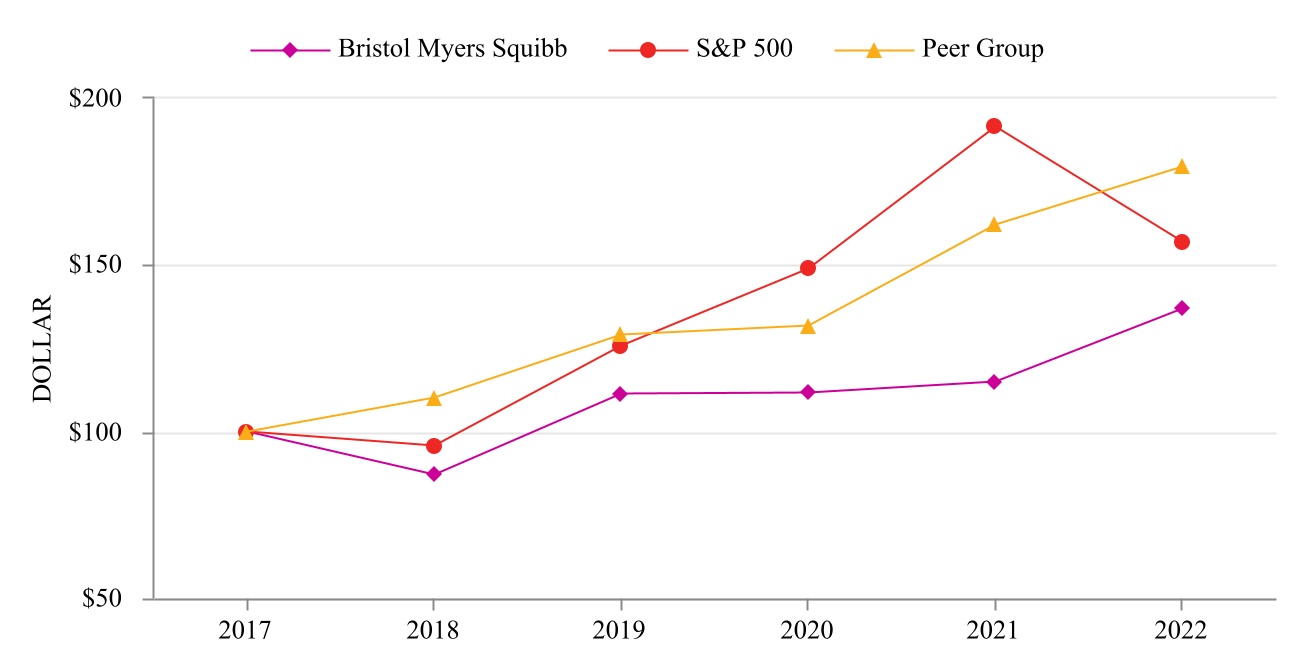
| 2017 | 2018 | 2019 | 2020 | 2021 | 2022 | ||||||||||||||||||||||||||||||
| Bristol Myers Squibb | $ | 100.00 | $ | 87.10 | $ | 111.27 | $ | 111.72 | $ | 114.94 | $ | 136.75 | |||||||||||||||||||||||
| S&P 500 | 100.00 | 95.62 | 125.72 | 148.85 | 191.58 | 156.88 | |||||||||||||||||||||||||||||
| Peer Group | 100.00 | 110.03 | 129.02 | 131.63 | 162.01 | 179.43 |
Issuer Purchases of Equity Securities
The following table summarizes the surrenders of our equity securities during the three months ended December 31, 2022:
| Period | Total Number of Shares Purchased**(a)** | Average Price Paid per Share**(a)** | Total Number of Shares Purchased as Part of Publicly Announced Programs**(b)** | Approximate Dollar Value of Shares that May Yet Be Purchased Under the Programs**(b)** | |||||||||||||||||||
| Dollars in Millions, Except Per Share Data | |||||||||||||||||||||||
| October 1 to 31, 2022 | 11,337,688 | $ | 70.51 | 11,329,164 | $ | 8,669 | |||||||||||||||||
| November 1 to 30, 2022 | 13,988,212 | 78.23 | 13,963,667 | 7,577 | |||||||||||||||||||
| December 1 to 31, 2022 | 5,150,025 | 79.98 | 5,095,948 | 7,169 | |||||||||||||||||||
| Three months ended December 31, 2022 | 30,475,925 | 30,388,779 |
(a) Includes shares repurchased as part of publicly announced programs and shares of common stock surrendered to the Company to satisfy tax withholding obligations in connection with the vesting of awards under our long-term incentive program.
(b) In May 2010, the Board of Directors authorized the repurchase of up to $3.0 billion of our common stock. Following this authorization, the Board subsequently approved additional authorizations, including most recently, in February 2020, January 2021 and December 2021, in the amount $5.0 billion, $2.0 billion and $15.0 billion, respectively, to the share repurchase authorization. The remaining share repurchase capacity under the program was approximately $7.2 billion as of December 31, 2022. Refer to “Item 1. Financial Statements—Note 17. Equity” for information on the share repurchase program.
Item 6. [RESERVED]
Item 7. MANAGEMENT’S DISCUSSION AND ANALYSIS OF FINANCIAL CONDITION AND RESULTS OF OPERATIONS.
Management’s discussion and analysis of financial condition and results of operations is provided as a supplement to and should be read in conjunction with the consolidated financial statements and related notes included elsewhere in this 2022 Form 10-K to enhance the understanding of our results of operations, financial condition and cash flows.
The comparison of 2021 to 2020 results has been omitted from this Form 10-K and is incorporated by reference from our Form 10-K for the year ended December 31, 2021 “Item 7. Management’s Discussion and Analysis of Financial Condition and Results of Operations” filed on February 10, 2021.
EXECUTIVE SUMMARY
Bristol-Myers Squibb Company is a global biopharmaceutical company whose mission is to discover, develop and deliver innovative medicines that help patients prevail over serious diseases. Refer to the Summary of Abbreviated Terms at the end of this 2022 Form 10-K for definitions of capitalized terms used throughout the document.
In 2022, we obtained 18 approvals for new medicines and additional indications and formulations of currently marketed medicines in major markets (the U.S., EU and Japan), including advancement in oncology through FDA and EC approval of Opdualag, the first PD-1 inhibitor and LAG-3 blocking antibody combination. Additionally, in the U.S., EU and Japan, two Opdivo based regimens as first-line treatments for unresectable advanced or metastatic ESCC were approved. We continue to advance and invest in our cell therapy portfolio through the approval of Abecma in Japan for the treatment of multiple myeloma for patients with at least three prior therapies, and approvals of Breyanzi for the relapsed or refractory diffuse large B-cell lymphoma, with second-line treatments in the U.S. and Japan, and third-line treatments in the EU. We continue the expansion of our cell therapy manufacturing capabilities at our existing facilities in Washington and New Jersey, as well as through the construction of new state-of-the-art manufacturing facilities in Massachusetts and in Leiden, Netherlands. The approvals for Sotyktu (deucravacitinib) in the U.S. and Japan for the treatment of moderate to severe plaque psoriasis expanded our portfolio in immunology. Within cardiovascular, we broadened our New Product Portfolio with the FDA approval of Camzyos (mavacamten) for patients with symptomatic obstructive HCM. In addition, in August 2022, we acquired Turning Point, a precision oncology company, with the goal of expanding our solid tumor portfolio with the addition of repotrectinib.
In 2022, our revenues remained consistent with the prior year due to growth in our In-Line Products (primarily Eliquis and Opdivo) and New Product Portfolio (primarily Opdualag, Abecma and Reblozyl), offset by Recent LOE Products (primarily Revlimid) and the impact of foreign exchange. The $0.17 decrease in GAAP EPS in 2022 was primarily due to changes to equity investment and contingent consideration fair value adjustments, partially offset by lower impairment charges and weighted-average common shares outstanding. After adjusting for specified items, non-GAAP EPS increased $0.54 as a result of lower weighted-average common shares outstanding and Acquired IPRD charges and higher royalties and licensing income.
Highlights
The following table summarizes our financial information:
| Year Ended December 31, | |||||||||||||||||
| Dollars in Millions, except per share data | 2022 | 2021 | |||||||||||||||
| Total Revenues | $ | 46,159 | $ | 46,385 | |||||||||||||
| Diluted Earnings Per Share | |||||||||||||||||
| GAAP | $ | 2.95 | $ | 3.12 | |||||||||||||
| Non-GAAP | 7.70 | 7.16 |
Our non-GAAP financial measures, including non-GAAP earnings and related EPS information, are adjusted to exclude specified items that represent certain costs, expenses, gains and losses and other items impacting the comparability of financial results. For a detailed listing of all specified items and further information, reconciliations and changes to our non-GAAP financial measures refer to “—Non-GAAP Financial Measures.”
Economic and Market Factors
Governmental Actions
Our products continue to be subject to increasing pressures across the portfolio from pharmaceutical market access and pricing controls and discounting, changes to tax and importation laws and other restrictions in the U.S., the EU and other regions around the world that result in lower prices, lower reimbursement rates and smaller populations for whom payers will reimburse, which can negatively impact our results of operations (including intangible asset impairment charges), operating cash flow, liquidity and financial flexibility. For example, on August 16, 2022, President Biden signed the IRA which provides for (i) the government to negotiate prices for select high-cost Medicare Part D (beginning in 2026) and Part B drugs (beginning in 2028) that are more than nine years (for small-molecule drugs) or 13 years (for biological products) from their FDA approval, (ii) manufacturers to pay a rebate for Medicare Part B and Part D drugs when prices increase faster than inflation beginning in 2022 for Part D and 2023 for Part B, and (iii) Medicare Part D redesign which replaces the current coverage gap provisions and establishes a $2,000 cap for out-of-pocket limits costs for Medicare beneficiaries beginning in 2025, with manufacturers being responsible for 10% of costs up to the $2,000 cap and 20% after that cap is reached. Implementation of this legislation is expected to be carried out through upcoming actions by regulatory authorities, the outcome of which is uncertain. Additionally, in connection with the IRA the following changes have been made to U.S. tax laws, including (i) a 15% minimum tax that generally applies to U.S. corporations on adjusted financial statement income beginning in 2023 and (ii) a non-deductible 1% excise tax provision on net stock repurchases, to be applied to repurchases beginning in 2023. We continue to evaluate the impact of the IRA legislation on our results of operations and it is possible that these changes may result in a material impact on our business and results of operations. Furthermore, countries are expected to make changes to their tax laws and updates to international tax treaties to implement the agreement by the Organization for Economic Co-operation and Development to establish a global minimum tax. See risk factors on these items included under “Part I—Item 1A. Risk Factors—Product, Industry and Operational Risks—Increased pricing pressure and other restrictions in the U.S. and abroad continue to negatively affect our revenues and profit margins” and “—Changes to tax regulations could negatively impact our earnings.”
COVID-19
In response to the COVID-19 pandemic, international, federal, state and local public health and governmental authorities took a number of actions to limit the spread of COVID-19 and address related disruptions in the U.S. and global economy. As the COVID-19 pandemic affected global healthcare systems as well as major economic and financial markets, we adopted several procedures focused on ensuring the continued supply of our medicines to our patients and protecting the health, wellbeing and safety of our workforce. While the pandemic has not significantly impacted our results of operations, the situation remains dynamic and it is difficult to reasonably assess or predict the full extent of the negative impact that the COVID-19 pandemic may have on our b
Showing the first 8K of 131K characters. Open the full section
Item 7A. QUANTITATIVE AND QUALITATIVE DISCLOSURES ABOUT MARKET RISK.
We are exposed to market risk resulting from changes in currency exchange rates and interest rates. Certain derivative financial instruments are used when available on a cost-effective basis to hedge our underlying economic exposure. All of our financial instruments, including derivatives, are subject to counterparty credit risk considered as part of the overall fair value measurement. Derivative financial instruments are not used for trading purposes.
Foreign Exchange Risk
Significant amounts of our revenues, earnings and cash flow are exposed to changes in foreign currency rates. Our primary net foreign currency translation exposures are the euro and Japanese yen. Foreign currency forward and purchased local currency put option contracts are used to manage risk primarily arising from certain intercompany sales and purchases transactions.
We are also exposed to foreign exchange transaction risk arising from non-functional currency denominated assets and liabilities and earnings denominated in non-U.S. dollar currencies. Foreign currency forward contracts are used to offset these exposures but are not designated as hedges.
We estimate that a 10% appreciation in the underlying currencies being hedged from their levels against the U.S. dollar (with all other variables held constant) would decrease the fair value of foreign exchange contracts by $782 million and $678 million as of December 31, 2022 and December 31, 2021, respectively, reducing earnings over the remaining life of the contracts.
Cross-currency interest rate swap contracts are used to manage risk arising from long-term debt denominated in euros and to hedge the Company's net investment in its foreign subsidiaries. We estimate that a 10% appreciation in the underlying currencies being hedged from their levels against the U.S. dollar (with all other variables held constant) would decrease the fair value of cross-currency interest swap contracts by $73 million and $58 million as of December 31, 2022 and December 31, 2021.
We are also exposed to translation risk on non-U.S. dollar-denominated net assets. Non-U.S. dollar borrowings are used to hedge the foreign currency exposures of our net investment in certain international affiliates and are designated as hedges of net investments. The effective portion of foreign exchange gains or losses on these hedges is included in the foreign currency translation component of Accumulated other comprehensive loss. If our net investment decreases below the equivalent value of the non-U.S. debt borrowings, the change in the remeasurement basis of the debt would be subject to recognition in income as changes occur. For additional information, refer to “Item 8. Financial Statements and Supplementary Data—Note 9. Financial Instruments and Fair Value Measurements.”
Interest Rate Risk
We use fixed-to-floating interest rate swap contracts designated as fair value hedges to provide an appropriate balance of fixed and floating rate debt. We use cross-currency interest rate swap contracts designated to manage risk arising from long-term debt denominated in euros and to hedge the Company's net investment in its foreign subsidiaries. The fair values of these contracts as well as our marketable debt securities are analyzed at year-end to determine their sensitivity to interest rate changes. In this sensitivity analysis, if there was a 1% increase in short-term or long-term interest rates as of December 31, 2022 and December 31, 2021, the expected adverse impact on our earnings would not be material.
We estimate that an increase of 1% in long-term interest rates as of December 31, 2022 and December 31, 2021 would decrease the fair value of long-term debt by $2.6 billion and $3.8 billion, respectively.
Credit Risk
We monitor our investments with counterparties with the objective of minimizing concentrations of credit risk. Our investment policy is to invest only in institutions that meet high credit quality standards and establishes limits on the amount and time to maturity of investments with any individual counterparty. The policy also requires that investments are only entered into with corporate and financial institutions that meet high credit quality standards.
The use of derivative instruments exposes us to credit risk if the counterparty fails to perform when the fair value of a derivative instrument contract is positive. If the counterparty fails to perform, collateral is not required by any party whether derivatives are in an asset or liability position. We have a policy of diversifying derivatives with counterparties to mitigate the overall risk of counterparty defaults. For additional information, refer to “Item 8. Financial Statements and Supplementary Data—Note 9. Financial Instruments and Fair Value Measurements.”
Item 8. FINANCIAL STATEMENTS AND SUPPLEMENTARY DATA.
BRISTOL-MYERS SQUIBB COMPANY
CONSOLIDATED STATEMENTS OF EARNINGS
Dollars in Millions, Except Per Share Data
| Year Ended December 31, | |||||||||||||||||
| EARNINGS | 2022 | 2021 | 2020 | ||||||||||||||
| Net product sales | $ | 44,671 | $ | 45,055 | $ | 41,321 | |||||||||||
| Alliance and other revenues | 1,488 | 1,330 | 1,197 | ||||||||||||||
| Total Revenues | 46,159 | 46,385 | 42,518 | ||||||||||||||
| Cost of products sold(a) | 10,137 | 9,940 | 11,773 | ||||||||||||||
| Marketing, selling and administrative | 7,814 | 7,690 | 7,661 | ||||||||||||||
| Research and development | 9,509 | 10,195 | 10,048 | ||||||||||||||
| Acquired IPRD | 815 | 1,159 | 12,533 | ||||||||||||||
| Amortization of acquired intangible assets | 9,595 | 10,023 | 9,688 | ||||||||||||||
| Other (income)/expense, net | 576 | (720) | (2,314) | ||||||||||||||
| Total Expenses | 38,446 | 38,287 | 49,389 | ||||||||||||||
| Earnings/(Loss) Before Income Taxes | 7,713 | 8,098 | (6,871) | ||||||||||||||
| Provision for Income Taxes | 1,368 | 1,084 | 2,124 | ||||||||||||||
| Net Earnings/(Loss) | 6,345 | 7,014 | (8,995) | ||||||||||||||
| Noncontrolling Interest | 18 | 20 | 20 | ||||||||||||||
| Net Earnings(Loss) Attributable to BMS | $ | 6,327 | $ | 6,994 | $ | (9,015) | |||||||||||
| Earnings/(Loss) per Common Share | |||||||||||||||||
| Basic | $ | 2.97 | $ | 3.15 | $ | (3.99) | |||||||||||
| Diluted | 2.95 | 3.12 | (3.99) |
(a) Excludes amortization of acquired intangible assets.
CONSOLIDATED STATEMENTS OF COMPREHENSIVE INCOME/(LOSS)
Dollars in Millions
| Year Ended December 31, | |||||||||||||||||
| COMPREHENSIVE INCOME/(LOSS) | 2022 | 2021 | 2020 | ||||||||||||||
| Net Earnings/(Loss) | $ | 6,345 | $ | 7,014 | $ | (8,995) | |||||||||||
| Other Comprehensive Income/(Loss), net of taxes and reclassifications to earnings: | |||||||||||||||||
| Derivatives qualifying as cash flow hedges | 54 | 415 | (256) | ||||||||||||||
| Pension and postretirement benefits | 145 | 206 | (75) | ||||||||||||||
| Marketable debt securities | (2) | (9) | 5 | ||||||||||||||
| Foreign currency translation | (210) | (41) | 7 | ||||||||||||||
| Total Other Comprehensive Income/(Loss) | (13) | 571 | (319) | ||||||||||||||
| Comprehensive Income/(Loss) | 6,332 | 7,585 | (9,314) | ||||||||||||||
| Comprehensive Income Attributable to Noncontrolling Interest | 18 | 20 | 20 | ||||||||||||||
| Comprehensive Income/(Loss) Attributable to BMS | $ | 6,314 | $ | 7,565 | $ | (9,334) |
The accompanying notes are an integral part of these consolidated financial statements.
BRISTOL-MYERS SQUIBB COMPANY
CONSOLIDATED BALANCE SHEETS
Dollars in Millions, Except Share and Per Share Data
| December 31, | |||||||||||
| ASSETS | 2022 | 2021 | |||||||||
| Current Assets: | |||||||||||
| Cash and cash equivalents | $ | 9,123 | $ | 13,979 | |||||||
| Marketable debt securities | 130 | 2,987 | |||||||||
| Receivables | 9,886 | 9,369 | |||||||||
| Inventories | 2,339 | 2,095 | |||||||||
| Other current assets | 5,795 | 4,832 | |||||||||
| Total Current Assets | 27,273 | 33,262 | |||||||||
| Property, plant and equipment | 6,255 | 6,049 | |||||||||
| Goodwill | 21,149 | 20,502 | |||||||||
| Other intangible assets | 35,859 | 42,527 | |||||||||
| Deferred income taxes | 1,344 | 1,439 | |||||||||
| Other non-current assets | 4,940 | 5,535 | |||||||||
| Total Assets | $ | 96,820 | $ | 109,314 | |||||||
| LIABILITIES | |||||||||||
| Current Liabilities: | |||||||||||
| Short-term debt obligations | $ | 4,264 | $ | 4,948 | |||||||
| Accounts payable | 3,040 | 2,949 | |||||||||
| Other current liabilities | 14,586 | 13,971 | |||||||||
| Total Current Liabilities | 21,890 | 21,868 | |||||||||
| Deferred income taxes | 2,166 | 4,501 | |||||||||
| Long-term debt | 35,056 | 39,605 | |||||||||
| Other non-current liabilities | 6,590 | 7,334 | |||||||||
| Total Liabilities | 65,702 | 73,308 | |||||||||
| Commitments and contingencies | |||||||||||
| EQUITY | |||||||||||
| Bristol-Myers Squibb Company Shareholders’ Equity: | |||||||||||
| Preferred stock, $2 convertible series, par value $1 per share: Authorized 10 million shares; issued and outstanding 2,991 in 2022 and 3,484 in 2021, liquidation value of $50 per share | — | — | |||||||||
| Common stock, par value of $0.10 per share: Authorized 4.5 billion shares; 2.9 billion issued in 2022 and 2021 | 292 | 292 | |||||||||
| Capital in excess of par value of stock | 45,165 | 44,361 | |||||||||
| Accumulated other comprehensive loss | (1,281) | (1,268) | |||||||||
| Retained earnings | 25,503 | 23,820 | |||||||||
| Less cost of treasury stock — 825 million common shares in 2022 and 747 million common shares in 2021 | (38,618) | (31,259) | |||||||||
| Total Bristol-Myers Squibb Company Shareholders’ Equity | 31,061 | 35,946 | |||||||||
| Noncontrolling interest | 57 | 60 | |||||||||
| Total Equity | 31,118 | 36,006 | |||||||||
| Total Liabilities and Equity | $ | 96,820 | $ | 109,314 |
The accompanying notes are an integral part of these consolidated financial statements.
BRISTOL-MYERS SQUIBB COMPANY
CONSOLIDATED STATEMENTS OF CASH FLOWS
Dollars in Millions
| Year Ended December 31, | |||||||||||||||||
| 2022 | 2021 | 2020 | |||||||||||||||
| Cash Flows From Operating Activities: |
Showing the first 8K of 245K characters. Open the full section
Item 9. CHANGES IN AND DISAGREEMENTS WITH ACCOUNTANTS ON ACCOUNTING AND FINANCIAL DISCLOSURE.
None.
Item 9A. CONTROLS AND PROCEDURES.
Evaluation of Disclosure Controls and Procedures
As of December 31, 2022, management carried out an evaluation, under the supervision and with the participation of its chief executive officer and chief financial officer, of the effectiveness of the design and operation of its disclosure controls and procedures as defined in Exchange Act Rules 13a-15(e) and 15d-15(e), as of the end of the period covered by this 2022 Form 10-K. Based on this evaluation, management has concluded that as of December 31, 2022, such disclosure controls and procedures were effective.
Management’s Report on Internal Control Over Financial Reporting
Management is responsible for establishing and maintaining adequate internal control over financial reporting, as defined in Exchange Act Rule 13a-15(f). Under the supervision and with the participation of management, including the chief executive officer and chief financial officer, management assessed the effectiveness of internal control over financial reporting as of December 31, 2022 based on the framework in “Internal Control—Integrated Framework” (2013) issued by the Committee of Sponsoring Organizations of the Treadway Commission. Based on that assessment, management has concluded that the Company’s internal control over financial reporting was effective at December 31, 2022 to provide reasonable assurance regarding the reliability of its financial reporting and the preparation of its financial statements for external purposes in accordance with United States generally accepted accounting principles. Due to its inherent limitations, internal control over financial reporting may not prevent or detect misstatements. Also, projections of any evaluation of effectiveness to future periods are subject to the risk that controls may become inadequate because of changes in conditions, or that the degree of compliance with the policies or procedures may deteriorate.
Deloitte & Touche LLP, an independent registered public accounting firm, has audited the Company’s financial statements included in this report on this 2022 Form 10-K and issued its report on the effectiveness of the Company’s internal control over financial reporting as of December 31, 2022, which is included herein.
Changes in Internal Control Over Financial Reporting
There were no changes in the Company’s internal control over financial reporting during the quarter ended December 31, 2022 that have materially affected, or is reasonably likely to materially affect, the Company’s internal control over financial reporting.
Item 9B. OTHER INFORMATION.
None.
Item 9C. DISCLOSURE REGARDING FOREIGN JURISDICTIONS THAT PREVENT INSPECTIONS.
Not applicable.
REPORT OF INDEPENDENT REGISTERED PUBLIC ACCOUNTING FIRM
To the shareholders and the Board of Directors of Bristol-Myers Squibb Company
Opinion on Internal Control over Financial Reporting
We have audited the internal control over financial reporting of Bristol-Myers Squibb Company and subsidiaries (the “Company”) as of December 31, 2022, based on criteria established in Internal Control — Integrated Framework (2013) issued by the Committee of Sponsoring Organizations of the Treadway Commission (COSO). In our opinion, the Company maintained, in all material respects, effective internal control over financial reporting as of December 31, 2022, based on criteria established in Internal Control — Integrated Framework (2013) issued by COSO.
We have also audited, in accordance with the standards of the Public Company Accounting Oversight Board (United States) (PCAOB), the consolidated financial statements as of and for the year ended December 31, 2022, of the Company and our report dated February 14, 2023, expressed an unqualified opinion on those financial statements.
Basis for Opinion
The Company’s management is responsible for maintaining effective internal control over financial reporting and for its assessment of the effectiveness of internal control over financial reporting, included in the accompanying Management's Report on Internal Control Over Financial Reporting. Our responsibility is to express an opinion on the Company’s internal control over financial reporting based on our audit. We are a public accounting firm registered with the PCAOB and are required to be independent with respect to the Company in accordance with the U.S. federal securities laws and the applicable rules and regulations of the Securities and Exchange Commission and the PCAOB.
We conducted our audit in accordance with the standards of the PCAOB. Those standards require that we plan and perform the audit to obtain reasonable assurance about whether effective internal control over financial reporting was maintained in all material respects. Our audit included obtaining an understanding of internal control over financial reporting, assessing the risk that a material weakness exists, testing and evaluating the design and operating effectiveness of internal control based on the assessed risk, and performing such other procedures as we considered necessary in the circumstances. We believe that our audit provides a reasonable basis for our opinion.
Definition and Limitations of Internal Control over Financial Reporting
A company’s internal control over financial reporting is a process designed to provide reasonable assurance regarding the reliability of financial reporting and the preparation of financial statements for external purposes in accordance with generally accepted accounting principles. A company’s internal control over financial reporting includes those policies and procedures that (1) pertain to the maintenance of records that, in reasonable detail, accurately and fairly reflect the transactions and dispositions of the assets of the company; (2) provide reasonable assurance that transactions are recorded as necessary to permit preparation of financial statements in accordance with generally accepted accounting principles, and that receipts and expenditures of the company are being made only in accordance with authorizations of management and directors of the company; and (3) provide reasonable assurance regarding prevention or timely detection of unauthorized acquisition, use, or disposition of the company’s assets that could have a material effect on the financial statements.
Because of its inherent limitations, internal control over financial reporting may not prevent or detect misstatements. Also, projections of any evaluation of effectiveness to future periods are subject to the risk that controls may become inadequate because of changes in conditions, or that the degree of compliance with the policies or procedures may deteriorate.
/s/ DELOITTE & TOUCHE LLP
Morristown, New Jersey
February 14, 2023
PART III
Item 10. DIRECTORS, EXECUTIVE OFFICERS AND CORPORATE GOVERNANCE.
(a)Reference is made to our 2023 Proxy Statement with respect to our Directors, which is incorporated herein by reference and made a part hereof in response to the information required by Item 10.
(b)The information required by Item 10 with respect to our Executive Officers has been included in Part IA of this 2022 Form 10-K in reliance on General Instruction G of Form 10-K and Instruction 3 to Item 401(b) of Regulation S-K, which is incorporated herein by reference and made a part hereof in response to the information required by Item 10.
Item 11. EXECUTIVE COMPENSATION.
Reference is made to our 2023 Proxy Statement with respect to Executive Compensation, which is incorporated herein by reference and made a part hereof in response to the information required by Item 11.
Item 12. SECURITY OWNERSHIP OF CERTAIN BENEFICIAL OWNERS AND MANAGEMENT AND RELATED STOCKHOLDER MATTERS.
Reference is made to our 2023 Proxy Statement with respect to the security ownership of certain beneficial owners and management, which is incorporated herein by reference and made a part hereof in response to the information required by Item 12.
Item 13. CERTAIN RELATIONSHIPS AND RELATED TRANSACTIONS.
Reference is made to our 2023 Proxy Statement with respect to certain relationships and related transactions, which is incorporated herein by reference and made a part hereof in response to the information required by Item 13.
Item 14. PRINCIPAL ACCOUNTANT FEES AND SERVICES.
Reference is made to our 2023 Proxy Statement with respect to the aggregate fees billed to us by our principal accountant, Deloitte & Touche LLP (PCAOB ID No. 34), which is incorporated herein by reference and made a part hereof in response to the information required by Item 14.
PART IV
Item 15. EXHIBITS AND FINANCIAL STATEMENT SCHEDULE.
| (a) | ||||||||
| Page Number | ||||||||
| 1 | Consolidated Financial Statements | |||||||
| Consolidated Statements of Earnings and Comprehensive (Loss)/Income | 66 | |||||||
| Consolidated Balance Sheets | 67 | |||||||
| Consolidated Statements of Cash Flows | 68 | |||||||
| Notes to Consolidated Financial Statements | 69 | |||||||
| Report of Independent Registered Public Accounting Firm | 114 | |||||||
| 2. | Financial Statement Schedules | |||||||
| All other schedules not included with this additional financial data are omitted because they are not applicable or the required information is included in the financial statements or notes thereto. | ||||||||
| 3. | Exhibits |
The information called for by this Item is incorporated herein by reference to the Exhibit Index in this 2022 Form 10-K.
| (b) | Exhibits Required to be filed by Item 601 of Regulation S-K | 124 |
The information called for by this Item is incorporated herein by reference to the Exhibit Index in this 2022 Form 10-K.
Item 16. FORM 10-K SUMMARY.
None.
SIGNATURES
Pursuant to the requirements of Section 13 or 15(d) of the Securities Exchange Act of 1934, the Registrant has duly caused this Report to be signed on its behalf by the undersigned, thereunto duly authorized.
| BRISTOL-MYERS SQUIBB COMPANY (Registrant) | ||||||||
| By | /s/ GIOVANNI CAFORIO, M.D. | |||||||
| Giovanni Caforio, M.D. | ||||||||
| Chairman of the Board and Chief Executive Officer | ||||||||
| Date: February 14, 2023 |
Pursuant to the requirements of the Securities Exchange Act of 1934, this Report has been signed below by the following persons on behalf of the Registrant and in the capacities and on the dates indicated.
| Signature | Title | Date | ||||||||||||
| /s/ GIOVANNI CAFORIO, M.D. | Chairman of the Board and Chief Executive Officer | February 14, 2023 | ||||||||||||
| (Giovanni Caforio, M.D.) | (Principal Executive Officer) | |||||||||||||
| /s/ DAVID V. ELKINS | Chief Financial Officer | February 14, 2023 | ||||||||||||
| (David V. Elkins) | (Principal Financial Officer) | |||||||||||||
| /s/ SHARON GREENLEES | Senior Vice President and Corporate Controller | February 14, 2023 | ||||||||||||
| (Sharon Greenlees) | (Principal Accounting Officer) | |||||||||||||
| /s/ PETER J. ARDUINI | Director | February 14, 2023 | ||||||||||||
| (Peter J. Arduini) | ||||||||||||||
| /s/ DEEPAK L. BHATT. M.D. MPH | Director | February 14, 2023 | ||||||||||||
| (Deepak L. Bhatt, M.D. MPH) | ||||||||||||||
| /s/ JULIA A. HALLER, M.D. | Director | February 14, 2023 | ||||||||||||
| (Julia A. Haller, M.D.) | ||||||||||||||
| /s/ MANUEL HIDALGO MEDINA, M.D., Ph.D. | Director | February 14, 2023 | ||||||||||||
| (Manuel Hidalgo Medina, M.D., Ph.D.) | ||||||||||||||
| /s/ PAULA A. PRICE | Director | February 14, 2023 | ||||||||||||
| (Paula A. Price) | ||||||||||||||
| /s/ DERICA W. RICE | Director | February 14, 2023 | ||||||||||||
| (Derica W. Rice) | ||||||||||||||
| /s/ THEODORE R. SAMUELS | Director | February 14, 2023 | ||||||||||||
| (Theodore R. Samuels) | ||||||||||||||
| /s/ GERALD L. STORCH | Director | February 14, 2023 | ||||||||||||
| (Gerald L. Storch) | ||||||||||||||
| /s/ KAREN H. VOUSDEN, Ph.D. | Director | February 14, 2023 | ||||||||||||
| (Karen H. Vousden, Ph.D.) | ||||||||||||||
| /s/ PHYLLIS R. YALE | Director | February 14, 2023 | ||||||||||||
| (Phyllis R. Yale) |
SUMMARY OF ABBREVIATED TERMS
Bristol-Myers Squibb Company and its consolidated subsidiaries may be referred to as Bristol Myers Squibb, BMS, the Company, we, our or us in this 2022 Form 10-K, unless the context otherwise indicates. Throughout this 2022 Form 10-K, we have used terms which are defined below:
| 2022 Form 10-K | Annual Report on Form 10-K for the fiscal year ended December 31, 2022 | LIBOR | London Interbank Offered Rate | ||||||||
| 2021 Plan | 2021 Stock Award and Incentive Plan | Lilly | Eli Lilly and Company | ||||||||
| 2seventy bio | 2seventy bio, Inc. | LOE | loss of exclusivity | ||||||||
| 340B Program | 340B Drug Pricing Program | MAA | Marketing Authorization Application | ||||||||
| AbbVie | AbbVie Inc. | MCOs | Managed Care Organizations | ||||||||
| ACA | Patient Protection and Affordable Care Act | MDL | multi-district litigation | ||||||||
| Agenus | Agenus Inc. | MDS | myelodysplastic syndromes | ||||||||
| aGVHD | acute graft-versus-host disease | Mead Johnson | Mead Johnson Nutrition Company | ||||||||
| ALL | acute lymphoblastic leukemia | Merck | Merck & Co., Inc. | ||||||||
| Amgen | Amgen Inc. | MF | myelofibrosis | ||||||||
| Amylin | Amylin Pharmaceuticals, Inc. | MPM | Malignant Pleural Mesothelioma | ||||||||
| ANDA | abbreviated New Drug Application | MSI-H | high microsatellite instability | ||||||||
| AstraZeneca | AstraZeneca PLC | MyoKardia | MyoKardia, Inc. | ||||||||
| ASC | Accounting Standards Codification | NASH | Non alcoholic steatohepatitis | ||||||||
| BCMA | B-cell maturation antigen | NAV | net asset value | ||||||||
| Biogen | Biogen, Inc. | NDA | New Drug Application | ||||||||
| Biohaven | Biohaven Pharmaceutical Holding Company Ltd. | Nektar | Nektar Therapeutics | ||||||||
| BLA | Biologics License Application | NKT | natural killer T | ||||||||
| bluebird | bluebird bio, inc. | Nimbus | Nimbus Therapeutics, LLC | ||||||||
| BridgeBio | BridgeBio Pharma Inc. | Novartis | Novartis Pharmaceutical Corporation | ||||||||
| CAR-T | Chimeric Antigen Receptor T cells | NSCLC | non-small cell lung cancer | ||||||||
| Celgene | Celgene Corporation acquired by BMS on November 20, 2019 | NVAF | non-valvular atrial fibrillation | ||||||||
| CERCLA | U.S. Comprehensive Environmental Response, Compensation and Liability Act | OCE | Oncology Center of Excellence | ||||||||
| cGMP | current Good Manufacturing Practices | OECD | Organization for Economic Co-operation and Development | ||||||||
| Cheplapharm | Cheplapharm Arzneimittel GmbH | OIG | Office of Inspector General of the U.S. Department of Health and Human Services | ||||||||
| CML | chronic myeloid leukemia | Ono | Ono Pharmaceutical Co., Ltd. | ||||||||
| COSO | Committee of Sponsoring Organizations of the Treadway Commission | OTC | over-the-counter | ||||||||
| CRC | colorectal cancer | Otsuka | Otsuka Pharmaceutical Co., Ltd. | ||||||||
| DMC | Data Monitoring Committee | PBMs | Pharmacy Benefit Managers | ||||||||
| Dragonfly | Dragonfly Therapeutics, Inc. | PBRGs | People and Business Resource Groups | ||||||||
| DSA | Distribution Services Agreement | PCAOB | Public Company Accounting Oversight Board | ||||||||
| EC | European Commission | PD-1 | programmed death receptor-1 | ||||||||
| EGFR | estimated glomerular filtration rate | PDMA | Prescription Drug Marketing Act | ||||||||
| Eisai | Eisai Co., Ltd. | PDUFA | Prescription Drug User Fee Act | ||||||||
| ELA | excess loss account | Pfizer | Pfizer, Inc. | ||||||||
| EMA | European Medicines Agency | Prothena | Prothena Corporation | ||||||||
| EPO | European Patent Office | PhRMA Code | Pharmaceutical Research and Manufacturers of America’s Professional Practices Code | ||||||||
| EPS | earnings per share | PRP | potentially responsible party | ||||||||
| ESA | erythoropoiesis-stimulating agent | PsA | psoriatic arthritis | ||||||||
| ESCC | esophageal squamous cell carcinoma | PTR | patent term restoration | ||||||||
| Evotec | Evotec SE | R&D | research and development | ||||||||
| EU | except as otherwise noted, EU refers to the United Kingdom plus the countries that are members of the European Union | RA | rheumatoid arthritis | ||||||||
| FASB | Financial Accounting Standards Board | RCC | renal cell carcinoma | ||||||||
| FDA | U.S. Food and Drug Administration | RDP | Regulatory Data Protection | ||||||||
| FL | follicular lymphoma | REMS | Risk Evaluation and Mitigation Strategy | ||||||||
| GAAP | U.S. generally accepted accounting principles | Roche | Roche Holding AG | ||||||||
| Gilead | Gilead Sciences, Inc. | RS | ring sideroblast | ||||||||
| GILTI | global intangible low taxed income | Sanofi | Sanofi S.A. | ||||||||
| GlaxoSmithKline | GlaxoSmithKline PLC | sBLA | supplemental Biologics License Application | ||||||||
| GTN | gross-to-net | SEC | U.S. Securities and Exchange Commission | ||||||||
| Halozyme | Halozyme Therapeutics, Inc. | SLE | systemic lupus erythematosus | ||||||||
| HCC | hepatocellular carcinoma | SPC | Supplementary Protection Certificate | ||||||||
| HCM | hypertrophic cardiomyopathy | TCJA | the Tax Cuts and Jobs Act of 2017 | ||||||||
| HIV | human immunodeficiency virus | UC | ulcerative colitis | ||||||||
| Immatics | Immatics N.V. | U.S. | United States | ||||||||
| IO | immuno-oncology | UK | United Kingdom | ||||||||
| IPRD | in-process research and development | VAT | value added tax | ||||||||
| IRS | Internal Revenue Services | VTE | venous thromboembolic | ||||||||
| JIA | Juvenile Idiopathic Arthritis | WTO | World Trade Organization | ||||||||
EXHIBIT INDEX
The Exhibits listed below are identified by numbers corresponding to the Exhibit Table of Item 601 of Regulation S-K. The Exhibits designated by the symbol ‡‡ are management contracts or compensatory plans or arrangements required to be filed pursuant to Item 15. The symbol ‡ in the Page column indicates that the Exhibit has been previously filed with the Commission and is incorporated herein by reference. Unless otherwise indicated, all Exhibits are part of Commission File Number 1-1136.
| ‡‡10mm. | Bristol-Myers Squibb Company Non-Employee Directors’ Stock Option Plan, as amended (as approved by the Stockholders on May 2, 2000, incorporated herein by reference to Exhibit A to the 2000 Proxy Statement dated March 20, 2000). | ‡ | ||||||||||||
| ‡‡10nn. | Squibb Corporation Deferral Plan for Fees of Outside Directors, as amended (as adopted, incorporated herein by reference to Exhibit 10e Squibb Corporation 1991 Form 10-K for the fiscal year ended December 31, 1987, File No. 1-5514; as amended effective December 31, 1991 incorporated herein by reference to Exhibit 10m to the Form 10-K for the fiscal year ended December 31, 1992). | ‡ | ||||||||||||
| ‡‡10oo. | Bristol-Myers Squibb Company 2017 Stock Incentive Plan (incorporated herein by reference to Exhibit 99.1 to the registration statement on Form S-8 filed on November 25, 2019). | ‡ | ||||||||||||
| ‡‡10pp. | Bristol-Myers Squibb Company 2014 Equity Incentive Plan (incorporated herein by reference to Exhibit 99.2 to the registration statement on Form S-8 filed on November 25, 2019). | ‡ | ||||||||||||
| ‡‡10qq. | Bristol-Myers Squibb Company 2021 Stock Award and Incentive Plan (incorporated herein by reference to Exhibit B to Bristol Myers-Squibb Company’s Definitive Proxy Statement filed on March 25, 2021) | ‡ | ||||||||||||
| ‡‡10rr. | Letter Agreement between Bristol-Myers Squibb Company and Mr. David Elkins, dated as of May 30, 2019 (incorporated herein by reference to Exhibit 10iii to the Form 10-K for the fiscal year ended December 31, 2019). | ‡ | ||||||||||||
| 21. | Subsidiaries of the Registrant (filed herewith). | E-21-1 | ||||||||||||
| 23. | Consent of Deloitte & Touche LLP (filed herewith). | E-23-1 | ||||||||||||
| 31a. | Section 302 Certification Letter (filed herewith). | E-31-1 | ||||||||||||
| 31b. | Section 302 Certification Letter (filed herewith). | E-31-2 | ||||||||||||
| 32a. | Section 906 Certification Letter (filed herewith). | E-32-1 | ||||||||||||
| 32b. | Section 906 Certification Letter (filed herewith). | E-32-2 | ||||||||||||
| 101. | The following financial statements from the Bristol-Myers Squibb Company Annual Report on Form 10-K for the years ended December 31, 2022, 2021 and 2020, formatted in Inline Extensible Business Reporting Language (XBRL): (i) consolidated statements of earnings, (ii) consolidated statements of comprehensive (loss)/income, (iii) consolidated balance sheets, (iv) consolidated statements of cash flows, and (v) the notes to the consolidated financial statements. | |||||||||||||
| 104. | The cover page from the Company’s Annual Report on Form 10-K for the year ended December 31, 2022, formatted in Inline XBRL. |
| † | Confidential treatment has been granted for certain portions which are omitted in the copy of the exhibit electronically filed with the Commission. |
| * | Indicates, in this 2022 Form 10-K, brand names of products, which are registered trademarks not solely owned by the Company or its subsidiaries. Abilify is a trademark of Otsuka Pharmaceutical Co., Ltd.; Atripla is a trademark of Gilead Sciences, LLC; Byetta is a trademark of Amylin Pharmaceuticals, LLC; Cabometyx is a trademark of Exelixis, Inc.; Farxiga and Onglyza are trademarks of AstraZeneca AB; Gleevec is a trademark of Novartis AG; Keytruda is a trademark of Merck Sharp & Dohme Corp.; Otezla is a trademark of Amgen Inc.; Plavix is a trademark of Sanofi; Tecentriq is a trademark of Genentech, Inc.; and Yescarta is a trademark of Kite Pharma, Inc. Brand names of products that are in all italicized letters, without an asterisk, are registered trademarks of BMS and/or one of its subsidiaries. |