 filings.tools
Broadridge Financial Solutions 10-K 2020-06-30
Filed 2020-08-11. 21 sections, 547K characters. Original on sec.gov · Markdown · JSON
Cover and table of contents
UNITED STATES
SECURITIES AND EXCHANGE COMMISSION
WASHINGTON, D.C. 20549
FORM 10-K
(Mark One)
☒ ANNUAL REPORT PURSUANT TO SECTION 13 OR 15(d) OF THE SECURITIES EXCHANGE ACT OF 1934
For the Fiscal Year Ended June 30, 2020
OR
☐ TRANSITION REPORT PURSUANT TO SECTION 13 OR 15(d) OF THE SECURITIES EXCHANGE ACT OF 1934
COMMISSION FILE NUMBER 001-33220
BROADRIDGE FINANCIAL SOLUTIONS, INC.
(Exact name of registrant as specified in its charter)
| Delaware | 33-1151291 | |||||||
| (State or other jurisdiction of incorporation or organization) | (I.R.S. Employer Identification No.) | |||||||
| 5 DAKOTA DRIVE | 11042 | |||||||
| LAKE SUCCESS | ||||||||
| New York | ||||||||
| (Address of principal executive offices) | (Zip code) |
(516) 472-5400
(Registrant’s telephone number, including area code)
Securities registered pursuant to Section 12(b) of the Act:
| Title of Each Class: | Trading Symbol | Name of Each Exchange on Which Registered: | ||||||
| Common Stock, par value $0.01 per share | BR | New York Stock Exchange |
Securities registered pursuant to Section 12(g) of the Act: None
Indicate by check mark if the registrant is a well-known seasoned issuer, as defined in Rule 405 of the Securities Act. Yes ý No ¨
Indicate by check mark if the registrant is not required to file reports pursuant to Section 13 or Section 15(d) of the Act. Yes ¨ No ý
Indicate by check mark whether the registrant (1) has filed all reports required to be filed by Section 13 or 15(d) of the Securities Exchange Act of 1934 during the preceding 12 months (or for such shorter period that the registrant was required to file such reports), and (2) has been subject to such filing requirements for the past 90 days. Yes ý No ¨
Indicate by check mark whether the registrant has submitted electronically every Interactive Data File required to be submitted pursuant to Rule 405 of Regulation S-T (Section 232.405 of this chapter) during the preceding 12 months (or for such shorter period that the registrant was required to submit such files). Yes ý No ¨
Indicate by check mark whether the registrant is a large accelerated filer, an accelerated filer, a non-accelerated filer, a smaller reporting company, or emerging growth company. See the definitions of “large accelerated filer,” “accelerated filer,” “smaller reporting company” and “emerging growth company” in Rule 12b-2 of the Exchange Act. (Check one):
Large Accelerated Filer ý Accelerated Filer ¨ Non-Accelerated Filer ¨ Smaller Reporting Company ☐ Emerging Growth Company ☐
If an emerging growth company, indicate by check mark if the registrant has elected not to use the extended transition period for complying with any new or revised financial accounting standards provided pursuant to Section 13(a) of the Exchange Act. ¨
Indicate by check mark whether the registrant has filed a report on and attestation to its management’s assessment of the effectiveness of its internal control over financial reporting under Section 404(b) of the Sarbanes-Oxley Act (15 U.S.C. 7262(b)) by the registered public accounting firm that prepared or issued its audit report. ☒
Indicate by check mark whether the registrant is a shell company (as defined in Rule 12b-2 of the Exchange Act). Yes ☐ No ý
The aggregate market value, as of December 31, 2019, of common stock held by non-affiliates of the registrant was $14,072,861,236.
As of July 31, 2020, there were 115,161,503 shares of the registrant’s common stock outstanding (excluding 39,299,624 shares held in treasury), par value $0.01 per share.
DOCUMENTS INCORPORATED BY REFERENCE
Portions of the registrant’s definitive proxy statement to be filed with the Securities and Exchange Commission within 120 days after the fiscal year end of June 30, 2020 are incorporated by reference into Part III.
TABLE OF CONTENTS
PART I.
Forward-Looking Statements
This Annual Report on Form 10-K of Broadridge Financial Solutions, Inc. (“Broadridge” or the “Company”) may contain “forward-looking statements” within the meaning of the Private Securities Litigation Reform Act of 1995. Statements that are not historical in nature and which may be identified by the use of words such as “expects,” “assumes,” “projects,” “anticipates,” “estimates,” “we believe,” “could be” and other words of similar meaning, are forward-looking statements. In particular, information appearing under “Business,” “Risk Factors,” and “Management’s Discussion and Analysis of Financial Condition and Results of Operations” includes forward-looking statements. These statements are based on management’s expectations and assumptions and are subject to risks and uncertainties that may cause actual results to differ materially from those expressed. Factors that could cause actual results to differ materially from those contemplated by the forward-looking statements include:
-
the potential impact and effects of the Covid-19 pandemic (“Covid-19”) on the business of Broadridge, Broadridge’s results of operations and financial performance, any measures Broadridge has and may take in response to Covid-19 and any expectations Broadridge may have with respect thereto;
-
the success of Broadridge in retaining and selling additional services to its existing clients and in obtaining new clients;
-
Broadridge’s reliance on a relatively small number of clients, the continued financial health of those clients, and the continued use by such clients of Broadridge’s services with favorable pricing terms;
-
a material security breach or cybersecurity attack affecting the information of Broadridge’s clients;
-
changes in laws and regulations affecting Broadridge’s clients or the services provided by Broadridge;
-
declines in participation and activity in the securities markets;
-
the failure of Broadridge’s key service providers to provide the anticipated levels of service;
-
a disaster or other significant slowdown or failure of Broadridge’s systems or error in the performance of Broadridge’s services;
-
overall market and economic conditions and their impact on the securities markets;
-
Broadridge’s failure to keep pace with changes in technology and the demands of its clients;
-
Broadridge’s ability to attract and retain key personnel;
-
the impact of new acquisitions and divestitures; and
-
competitive conditions.
There may be other factors that may cause our actual results to differ materially from the forward-looking statements. Our actual results, performance or achievements could differ materially from those expressed in, or implied by, the forward-looking statements. We can give no assurances that any of the events anticipated by the forward-looking statements will occur or, if any of them do, what impact they will have on our results of operations and financial condition. You should carefully read the factors described in the “Risk Factors” section of this Annual Report on Form 10-K for a description of certain risks that could, among other things, cause our actual results to differ from these forward-looking statements.
All forward-looking statements speak only as of the date of this Annual Report on Form 10-K and are expressly qualified in their entirety by the cautionary statements included in this Annual Report on Form 10-K. We disclaim any obligation to update or revise forward-looking statements that may be made to reflect events or circumstances that arise after the date made or to reflect the occurrence of unanticipated events, other than as required by law.
Item 1. Business
Overview
Broadridge, a Delaware corporation and a part of the S&P 500® Index (“S&P”), is a global financial technology leader providing investor communications and technology-driven solutions to banks, broker-dealers, asset and wealth managers and corporate issuers. With over 50 years of experience, including over 10 years as an independent public company, we provide financial services firms with advanced, dependable, scalable and cost-effective integrated solutions and an important infrastructure that powers the financial services industry. Our solutions enable better financial lives by powering investing, governance and communications and help reduce the need for our clients to make significant capital investments in operations infrastructure, thereby allowing them to increase their focus on core business activities.
Our services include investor communications, securities processing, data and analytics, and customer communications solutions. We serve a large and diverse client base across four client groups: banks/broker-dealers, asset management firms/mutual funds, wealth management firms and corporate issuers. For capital markets firms, we help our clients lower costs and improve the effectiveness of their trade and account processing operations with support for their operational technologies, and their administration, finance, risk and compliance requirements. We serve asset management firms by meeting their critical needs for shareholder communications and by providing investment operations technology to support their investment decisions. For wealth management clients, we provide an integrated platform with tools that optimize advisor productivity, enhance client experience, and digitize enterprise operations. For our corporate issuer clients, we help manage every aspect of their shareholder communications, including registered and beneficial proxy processing, annual meeting support, transfer agency services and financial disclosure document creation, management and SEC filing services.
We operate our business in two reportable segments: Investor Communication Solutions and Global Technology and Operations.
Investor Communication Solutions
We provide governance and communications solutions through our Investor Communication Solutions business segment to the following financial services clients: banks/broker-dealers, asset management firms/mutual funds, wealth management firms and corporate issuers. In addition to financial services firms, our Customer Communications business also serves companies in the healthcare, insurance, consumer finance, telecommunications, utilities and other service industries.
A large portion of our Investor Communication Solutions business involves the processing and distribution of proxy materials to investors in equity securities and mutual funds, as well as the facilitation of related vote processing. ProxyEdge® (“ProxyEdge”) is our innovative electronic proxy delivery and voting solution for institutional investors and financial advisors that helps ensure the voting participation of the largest stockholders of many companies. We also provide the distribution of regulatory reports and corporate action/reorganization event information, as well as tax reporting solutions that help our clients meet their regulatory compliance needs.
For asset managers and retirement service providers, we offer data-driven solutions and an end-to-end platform for content management, composition, and multi-channel distribution of regulatory, marketing, and transactional information. Our data and analytics solutions provide investment product distribution data, analytical tools, insights, and research to enable asset managers to optimize product distribution across retail and institutional channels globally. Through Matrix Financial Solutions, Inc. (“Matrix”), we provide mutual fund trade processing services for retirement service providers, third-party administrators, financial advisors, banks and wealth management professionals.
In addition, we provide public corporations and mutual funds with a full suite of solutions to help manage their annual meeting process, including registered and beneficial proxy distribution and processing services, proxy and annual report document management solutions, virtual shareholder meeting services, and solutions that help them gain insight into their shareholder base through our shareholder data services. We also offer financial reporting document composition and management solutions, SEC disclosure and filing services, and registrar, stock transfer and record-keeping services through Broadridge Corporate Issuer Solutions.
We provide customer communications solutions which include print and digital solutions, content management, postal optimization, and fulfillment services. These services include customer communications management capabilities through the Broadridge Communications CloudSM platform (the “Communications Cloud”). Through one point of integration, the Communications Cloud helps companies create, deliver, and manage multi-channel communications and customer engagement. The platform includes data-driven composition tools, identity and preference management, multi-channel optimization and digital communication experience, archive and information management, digital and print delivery, and analytics and reporting tools.
Global Technology and Operations
We are a leading global provider of securities processing solutions for capital markets, wealth management, and asset management firms. We offer advanced solutions that automate the securities transaction lifecycle, from desktop productivity tools, data aggregation, performance reporting, and portfolio management to order capture and execution, trade confirmation, margin, cash management, clearance and settlement, asset servicing, reference data management, reconciliations, securities financing and collateral optimization, compliance and regulatory reporting, and portfolio accounting and custody-related services.
Our core post-trade services help financial institutions efficiently and cost-effectively consolidate their books and records, gather and service assets under management and manage risk, thereby enabling them to focus on their core business activities. Provided on a software as a service (“SaaS”) basis within large user communities, our technology is a global solution, processing clearance and settlement in over 100 countries. Our multi-asset, multi-market, multi-entity and multi-currency solutions support real-time global trade processing of equity, fixed income, mutual fund, foreign exchange, and exchange traded derivatives. We process on average over $8 trillion in equity and fixed income trades per day of United States of America (“U.S.”) and Canadian securities.
Our comprehensive wealth management platform offers capabilities across the entire wealth management lifecycle and streamlines all aspects of wealth management services, including account management, fee management and client on-boarding. The wealth management platform enables full-service, regional and independent broker-dealers and investment advisors to better engage with customers through digital marketing and customer communications tools. We also integrate data, content and technology to drive new customer acquisition, support holistic advice and cross-sell opportunities through the creation of sales and educational content, including seminars as well as customizable advisor websites, search engine marketing and electronic and print newsletters. Our advisor solutions help advisors optimize their practice management through customer and account data aggregation and reporting. We currently support over 200,000 professionals at more than 300 financial firms with our wealth management solutions.
We offer buy-side technology solutions for the global investment management industry, including portfolio management, compliance and operational wo
Showing the first 8K of 73K characters. Open the full section
Item 1A. Risk Factors
You should carefully consider each of the following risks and all of the other information set forth in this Annual Report on Form 10-K or incorporated by reference herein. Based on the information currently known to us, we believe that the following information identifies the most significant factors affecting our company. However, additional risks and uncertainties not currently known to us or that we currently believe to be immaterial may also adversely affect our business.
If any of the following risks and uncertainties develop into actual events, they could have a material adverse effect on our business, financial condition, or results of operations.
The current Covid-19 pandemic may negatively impact our business, results of operations and financial performance.
The current Covid-19 pandemic is having a significant effect on the world economy, which has created significant uncertainties. These uncertainties include, but are not limited to, the adverse effects of the pandemic on the economy, our employees, our clients and our third-party service providers and the general impact of recession in the U.S. The Covid-19 pandemic has created significant volatility, uncertainty and business and economic disruption. Any of the following factors, or other cascading effects of the Covid-19 pandemic that are not currently foreseeable, could negatively affect our operations and performance of our services, increase our costs, and negatively impact our sales, results of operations and our liquidity position, possibly to a significant degree:
-
The Covid-19 pandemic and the stay-at-home orders and quarantine rules resulting from the pandemic have had an impact on our ability to perform our services and the operations of our facilities. Our ability to provide our services and solutions could continue to be negatively impacted, including as a result of our employees or our clients’ and vendors’ employees working remotely, or due to business slowdown or interruption caused by the illness of our employees or the safety measures implemented to prevent the illness of our employees such as the potential closures of offices and facilities. In addition, a resurgence of the Covid-19 virus in the areas where we operate could result in additional stay-at-home orders being put in place. Our inability or failure to properly perform our services could cause us to incur expenses including service penalties, lose revenues, lose clients or damage our reputation.
-
We have taken several measures in response to Covid-19, including adopting strict social distancing and cleaning measures in our production facilities, taking the temperature of production-related employees in affected areas, and instituting remote work for many of our employees. We may take further actions in our facilities as may be required by government authorities or as we determine are in the best interests of our employees, clients, and vendors. There is no certainty that such measures will be sufficient to mitigate the risks posed by Covid-19 or will be satisfactory to government authorities.
-
We are a global company and our business is highly dependent on the financial services industry and exchanges and market centers, particularly in North America. The current pandemic continues to adversely impact global commercial activity in many countries, including the U.S., and has contributed to significant volatility in financial markets. An extended period of market disruption or closures, or a prolonged economic downturn (including whether there is a resurgence or second wave of infections) could negatively impact our business and financial results. We have experienced a decrease in demand for certain of our services and a delay or reduction in our sales which could continue if the economic downturn is prolonged or it causes financial stress for our clients. We could also experience a delay in onboarding our clients. Further, the decline in market activity has resulted in decreased assets under administration negatively impacting our mutual fund processing business. In addition, lower interest rates have negatively impacted our mutual fund processing and transfer agency businesses.
-
The technological resources and infrastructure used by us, as well as the third-party service providers and vendors who support us, such as internet capacity may be strained due to the increase in the number of remote users. In addition, we may face increased cybersecurity risks due to the number of employees who are working remotely in regions impacted by stay-at-home orders or observing quarantine safety measures. Increased levels of remote access may create additional opportunities for cybercriminals to attempt to exploit vulnerabilities, and employees may be more susceptible to phishing and social engineering attempts due to increased stress caused by the crisis and from balancing family and work responsibilities at home.
-
We rely on third-party service providers and vendors to provide critical systems and services such as data center services and materials needed for the production and delivery of our print services, and the Covid-19 pandemic could present heightened or novel risks with respect to the continuity of our critical vendors’ services or ability to supply materials including the possibility of closure or business interruption.
-
There is a potential risk that members of our senior management team and/or our board of directors could become incapacitated or otherwise unable to perform their duties for an extended period of time due to illness resulting from the Covid-19 pandemic.
There are no comparable recent events which may provide guidance as to the effect of the Covid-19 pandemic, and, as a result, its ultimate impact is highly uncertain and subject to change. We do not yet know the full extent of the impacts on our business, our operations or the global economy and the full impact will depend on numerous evolving factors that are outside our control. However, the effects could have a material adverse effect on our business, results of operations and financial performance.
Consolidation in the financial services industry could adversely affect our revenues by eliminating some of our existing and potential clients and could make us increasingly dependent on a more limited number of clients.
Mergers or consolidations of financial institutions could reduce the number of our clients and potential clients. If our clients merge with or are acquired by other firms that are not our clients, or firms that use fewer of our services, they may discontinue or reduce the use of our services. In addition, it is possible that the larger financial institutions resulting from mergers or consolidations could decide to perform in-house some or all of the services that we currently provide or could provide. Any of these developments could have a material adverse effect on our business and results of operations.
A large percentage of our revenues are derived from a small number of clients in the financial services industry.
In fiscal year 2020, we derived approximately 20% of our consolidated revenues from our five largest clients and approximately 52% of the revenues of our Global Technology and Operations segment from the 15 largest clients in that segment. Our largest single client accounted for approximately 6% of our consolidated revenues in fiscal year 2020. While these clients generally work with multiple business segments, the loss of business from any of these clients due to merger or consolidation, financial difficulties or bankruptcy, or the termination or non-renewal of contracts could have a material adverse effect on our revenues and results of operations. Also, in the event a client experiences financial difficulties or bankruptcy resulting in a reduction in their demand for our services or loss of the client’s business, in addition to losing the revenue from that client, we would be required to write-off any investments made by us in connection with that client, including costs incurred to set up or convert a client’s systems to function with our technology. Such costs for all clients represented approximately 9% of our total assets as of June 30, 2020.
Security breaches or cybersecurity attacks could adversely affect our ability to operate, could result in personal, confidential or proprietary information being misappropriated, and may cause us to be held liable or suffer harm to our reputation.
We process and transfer sensitive data, including personal information, valuable intellectual property and other proprietary or confidential data provided to us by our clients, which include financial institutions, public companies, mutual funds, and healthcare companies. We also handle personal information of our employees in connection with their employment. We maintain systems and procedures including encryption, authentication technology, data loss prevention technology, entitlement management, access control and anti-malware software, and transmission of data over private networks to protect against unauthorized access to physical and electronic information, including by cyber-attacks.
In certain circumstances, our third-party vendors may have access to sensitive data including personal information. It is also possible that a third-party vendor could intentionally or inadvertently disclose sensitive data including personal information. We require our third-party vendors to have appropriate security controls if they have access to the personal information of our clients’ customers. However, despite those safeguards, it is possible that unauthorized individuals could improperly access our systems or those of our vendors, or improperly obtain or disclose the sensitive data including personal information that we or our vendors process or handle.
Many of our services are provided through the Internet which increases our exposure to potential cybersecurity attacks. We have experienced cybersecurity threats to our information technology infrastructure and have experienced non-material cyber-attacks, attempts to breach our systems and other similar incidents. Future threats could cause harm to our business and our reputation and challenge our ability to provide reliable service, as well as negatively impact our results of operations materially. Our insurance coverage may not be adequate to cover all the costs related to cybersecurity attacks or disruptions resulting from such events.
Any security breach resulting in the unauthorized use or disclosure of certain personal information could put individuals at risk of identity theft and financial or other harm and result in costs to us in investigation, remediation, legal defense and in liability to parties who are financially harmed. We may incur significant costs to protect against the threat of information security breaches or to respond to or alleviate problems caused by such breaches. For example, laws may require notification to regulators, clients or employees and enlisting credit monitoring or identity theft protection in the event of a privacy breach. A cybersecurity attack could also be directed at our systems and result in interruptions in our operations or delivery of services to our clients and their customers. Furthermore, a material security breach could cause us to lose revenues, lose clients or cause damage to our reputation.
Our clients are subject to complex laws and regulations, and new laws or regulations and/or changes to existing laws or regulations could impact our clients and, in turn, adversely impact our business or may reduce our profitability.
We provide technology solutions to financial services firms that are generally subject to extensive regulation in the U.S. and in other jurisdictions. As a provider of services to financial institutions and issuers of securities, our services are provided in a manner designed to assist our clients in complying with the laws and regulations to which they are subject. Therefore, our services, such as our proxy and shareholder report distribution and processing and customer communications services, are particularly sensitive to changes in laws and regulations governing the financial services industry and the securities markets.
Our services and the fees we charge our clients for certain services are subject to change if applicable SEC or stock exchange rules or regulations are amended, or new laws or regulations are adopted, which could result in a negative impact on our business and financial results.
In addition, new regulations governing our clients could result in significant expenditures that could cause them to reduce their use of our services, seek to renegotiate existing agreements, or cease or curtail their operations, all of which could adversely impact our business. Further, an adverse regulatory action that changes a client’s business or adversely affects its financial condition, could decrease their ability to purchase, or their demand for, our products and services. The loss of business from our larger clients could have a material adverse effect on our revenues and results of operations.
Our business and results of operations may be adversely affected if we do not comply with legal and regulatory requirements that apply to our services or businesses, and new laws or regulations and/or changes to existing laws or regulations to which we are subject may adversely affect our ability to conduct our business or may reduce our profitability.
The legislative and regulatory environment of the financial services industry is continuously changing. The SEC, FINRA, DOL and various stock exchanges, and other U.S. and foreign governmental or regulatory authorities continuously review legislative and regulatory initiatives and may adopt new or revised laws and regulations. These legislative and regulatory initiatives may adversely affect the way in which we conduct our business and may make our business less
profitable. Also, changes in the interpretation or enforcement of existing laws and regulations by those entities may adversely affect our business. Further, as a provider of technology services to financial institutions, certain aspects of our U.S. operations are subject to regulatory oversight and examination by the FFIEC. A sufficiently unfavorable review from the FFIEC could have a material adverse effect on our business.
Our business process outsourcing, mutual fund processing and transfer agency solutions as well as the entities providing those services are subject to regulatory oversight. Our provision of these services must comply with applicable rules and regulations of the SEC, FINRA, DOL and various stock exchanges, and other regulatory bodies charged with safeguarding the integrity of the securities markets and other financial markets and protecting the interests of investors participating in these markets. If we fail to comply with any applicable regulations in performing those services, we could lose our clients, be subject to suits for breach of contract or to governmental proceedings, censures and fines, our reputation could be harmed, and we could be limited in our ability to obtain new clients.
In addition, in connection with the offering of CITs, Matrix Trust acts as a discretionary trustee and ERISA fiduciary. ERISA and the applicable provisions of the federal tax laws impose a number of duties on persons who are fiduciaries under ERISA. As a result, we may face the risk of lawsuits and regulatory proceedings resulting from a breach of Matrix Trust’s fiduciary responsibilities.
For a description of the aspects of our business that are subject to regulatory compliance or oversight, please refer to Part I, “Item 1. Business - Regulation” of this Annual Report on Form 10-K for a more detailed discussion.
As a provider of data and business processing solutions, our systems contain a significant amount of sensitive data, including personal information, related to our clients, customers of our clients, and our employees. We are, therefore, subject to compliance obligations under federal, state and foreign privacy and information security laws, including in the U.S., the GLBA, HIPAA, the CCPA, and the GDPR in the EU, and we are subject to penalties for failure to comply with such regulations. Such penalties could have a material adverse effect on our financial condition, results of operations, or cash flows. There has been increased public attention regarding the use of personal information, accompanied by legislation and regulations intended to strengthen data protection, information security and consumer and personal privacy. The law in these areas continues to develop, the number of jurisdictions adopting such laws continues to increase and these laws may be inconsistent from jurisdiction to jurisdiction. Furthermore, the changing nature of privacy laws in the U.S., the European Union and elsewhere could impact our processing of personal information of our employees and on behalf of our clients. While we believe that Broadridge is compliant with its regulatory responsibilities, information security threats continue to evolve resulting in increased risk and exposure and increased costs to protect against the threat of information security breaches or to respond to or alleviate problems caused by such breaches.
For a description of privacy and information security regulations affecting us, please refer to Part I, “Item 1. Business - Regulations - Privacy and Information Security Regulations” of this Annual Report on Form 10-K for a more detailed discussion.
Our ability to comply with regulations depends largely upon the maintenance of an effective compliance system which can be time consuming and costly, as well as our ability to attract and retain qualified compliance personnel.
Our revenues may decrease due to declines in the levels of participation and activity in the securities markets.
We generate significant revenues from the transaction processing fees we earn from our services. These revenue sources are substantially dependent on the levels of participation and activity in the securities markets. The number of unique securities positions held by investors through our clients and our clients’ customer trading volumes reflect the levels of participation and activity in the markets, which are impacted by market prices, and the liquidity of the securities markets, among other factors. Volatility in the securities markets and sudden sharp or gradual but sustained declines in market participation and activity can result in reduced investor communications activity, including reduced proxy and event-driven communications processing such as mutual fund proxy, mergers and acquisitions and other special corporate event communications processing, and reduced trading volumes. In addition, our event-driven fee revenues are based on the number of special events and corporate transactions we process. Event-driven activity is impacted by financial market conditions and changes in regulatory compliance requirements, resulting in fluctuations in the timing and levels of event-driven fee revenues. As such, the timing and level of event-driven activity and its potential impact on our revenues and earnings are difficult to forecast. The occurrence of any of these events would likely result in reduced revenues and decreased profitability from our business operations.
We may be adversely impacted by a failure of third-party service providers to perform their functions.
We rely on relationships with third parties, including our service providers and other vendors for certain functions. If we are unable to effectively manage our third-party relationships and the agreements under which our third-party vendors operate, our financial results or reputation could suffer. We rely on these third parties, including our data center and cloud services providers, to provide services in a timely and accurate manner and to adequately address their own cybersecurity risks. Failure by these third parties to adequately perform their services as expected could result in material interruptions in our operations, and negatively impact our services resulting in a material adverse effect on our business and financial results.
Certain of our businesses rely on a single or a limited number of service providers or vendors. Changes in the business condition (financial or otherwise) of these service providers or vendors could impact their provision of services to us or they may no longer be able to provide services to us at all, which could have a material adverse effect on our business and financial results. In such circumstances, we cannot be certain that we will be able to replace our key third-party vendors in a timely manner or on terms commercially reasonable to us given, among other reasons, the scope of responsibilities undertaken by some of our providers, the depth of their experience and their familiarity with our operations generally.
If we change a significant vendor, an existing provider makes significant changes to the way it conducts its operations, or is acquired, or we seek to bring in-house certain services performed today by third parties, we may experience unexpected disruptions in the provision of our solutions, which could have a material adverse effect on our business and financial results.
Furthermore, certain third-party services providers or vendors may have access to sensitive data including personal information, valuable intellectual property and other proprietary or confidential data provided to us by our clients. It is possible that a third-party vendor could intentionally or inadvertently disclose sensitive data including personal information, which could have a material adverse effect on our business and financial results and damage our reputation.
We rely on the United States Postal Service (“USPS”) and other third-party carriers to deliver communications and changes in our relationships with these carriers or an increase in postal rates or shipping costs may adversely impact demand for our products and services and could have an adverse impact on our business and results of operations.
We rely upon the USPS and third-party carriers, including the United Parcel Service, for timely delivery of communications on behalf of our clients. As a result, we are subject to carrier disruptions due to factors that are beyond our control, including employee strikes, inclement weather, increased fuel costs and suspension of delivery of communications to certain countries as a result of the Covid-19 pandemic. Any failure to deliver communications to or on behalf of our clients in a timely and accurate manner may damage our reputation and brand and could cause us to lose clients. In addition, the USPS has incurred significant financial losses in recent years and may, as a result, implement significant changes to the breadth or frequency of its mail delivery causing disruptions in the service. If our relationship with any of these third-party carriers is terminated or impaired, or if any of these third parties are unable to distribute communications, we would be required to use alternative, and possibly more expensive, carriers to complete our distributions on behalf of our clients. We may be unable to engage alternative carriers on a timely basis or on acceptable terms, if at all, which could have an adverse effect on our business. In addition, future increases in postal rates or shipping costs, as well as changes in customer preferences, may result in decreased demand for our traditional printed and mailed communications resulting in an adverse effect on our business, financial condition and results of operations.
In the event of a disaster, our disaster recovery and business continuity plans may fail, which could result in the loss of client data and adversely interrupt operations.
Our operations are dependent on our ability to protect our infrastructure against damage from catastrophe, natural disaster, or severe weather including events resulting from unauthorized security breach, power loss, telecommunications failure, terrorist attack, pandemic, or other events that could have a significant disruptive effect on our operations. We have disaster recovery and business continuity plans in place in the event of system failure due to any of these events and we test our plans regularly. In addition, our data center services provider also has disaster recovery plans and procedures in place. However, we cannot be certain that our plans, or those of our data center services provider, will be successful in the event of a disaster. If our disaster recovery or business continuity plans are unsuccessful in a disaster recovery scenario, we could potentially lose client data or experience material adverse interruptions to our operations or delivery of services to our clients, and we could be liable to parties who are financially harmed by those failures. In addition, such failures could cause us to lose revenues, lose clients or damage our reputation.
Any slowdown or failure of our computer or communications systems could impact our ability to provide services to our clients and support our internal operations and could subject us to liability for losses suffered by our clients or their customers.
Our services depend on our ability to store, retrieve, process, and manage significant databases, and to receive and process transactions and investor communications through a variety of electronic systems. Our systems, those of our data center and cloud services providers, or any other systems with which our systems interact could slow down significantly or fail for a variety of reasons, including:
-
computer viruses or undetected errors in internal software programs or computer systems;
-
direct or indirect hacking or denial of service cybersecurity attacks;
-
inability to rapidly monitor all system activity;
-
inability to effectively resolve any errors in internal software programs or computer systems once they are detected;
-
heavy stress placed on systems during peak times or due to high volumes or volatility; or
-
power or telecommunications failure, fire, flood, pandemic or any other disaster.
While we monitor system loads and performance and implement system upgrades to handle predicted increases in trading volume and volatility, we may not be able to predict future volume increases or volatility accurately or that our systems and those of our data center services and cloud services providers will be able to accommodate these volume increases or volatility without failure or degradation. In addition, we may not be able to prevent cybersecurity attacks on our systems. Moreover, because we have outsourced our data center operations and use third-party cloud services for storage of certain data, the operation, performance and security functions of the data center and the cloud system involve factors beyond our control. Any significant degradation or failure of our computer systems, communications systems or any other systems in the performance of our services could cause our clients or their customers to suffer delays in their receipt of our services. These delays could cause substantial losses for our clients or their customers, and we could be liable to parties who are financially harmed by those failures. In addition, such failures could cause us to lose revenues, lose clients or damage our reputation.
The inability to properly perform our services or operational errors in the performance of our services could lead to liability for claims, client loss and result in reputational damage.
The inability or the failure to properly perform our services could result in our clients and/or certain of our subsidiaries that operate regulated businesses being subjected to losses including censures, fines, or other sanctions by applicable regulatory authorities, and we could be liable to parties who are financially harmed by those errors. In addition, the inability to properly perform our services or errors in the performance of our services could cause us to incur expenses including service penalties, lose revenues, lose clients or damage our reputation.
General economic and political conditions and broad trends in business and finance that are beyond our control may contribute to reduced levels of activity in the securities markets, which could result in lower revenues from our business operations.
Our services are impacted by the number of unique securities positions held by investors through our clients, the level of investor communications activity we process on behalf of our clients, trading volumes, market prices, and liquidity of the securities markets. These factors are in turn affected by general national and international economic and political conditions, and broad trends in business and finance that result in changes in participation and activity in the securities markets. For example, the Covid-19 pandemic continues to adversely impact global commercial activity and has contributed to a general economic recession, adversely impacting our clients and the markets. These factors include:
-
economic, political and market conditions;
-
legislative and regulatory changes;
-
the availability of short-term and long-term funding and capital;
-
the level and volatility of interest rates;
-
currency values and inflation;
-
financial well-being of our clients; and
-
national, state, and local taxation levels affecting securities transactions.
These factors are beyond our control and may contribute to reduced levels of participation and activity in the securities markets. Our revenues have historically been largely driven by transaction processing based on levels of participation and activity in the securities markets. Accordingly, any significant reduction in participation and activity in the securities markets would likely result in lower revenues from our business operations.
If the operational systems and infrastructure that we depend on fail to keep pace with our growth, we may experience operating inefficiencies, client dissatisfaction and lost revenue opportunities.
The growth of our business and expansion of our client base may place a strain on our management and operations. We believe that our current and anticipated future growth will require the implementation of new and enhanced communications and information systems, the training of personnel to operate these systems, and the expansion and upgrade of core technologies. While many of our systems are designed to accommodate additional growth without redesign or replacement, we may nevertheless need to make significant investments in additional hardware and software to accommodate growth. In addition, we cannot assure you that we will be able to predict the timing or rate of this growth accurately or expand and upgrade our systems and infrastructure on a timely basis.
Our growth has required and will continue to require increased investments in management personnel and systems, financial systems and controls, and office facilities. We cannot assure you that we will be able to manage or continue to manage our future growth successfully. If we fail to manage our growth, we may experience operating inefficiencies, dissatisfaction among our client base, and lost revenue opportunities.
If we are unable to respond to the demands of our existing and new clients, or adapt to technological changes or advances, our business and future growth could be impacted.
The global financial services industry is characterized by increasingly complex and integrated infrastructures and products, new and changing business models and rapid technological and regulatory changes. Our clients’ needs and demands for our products and services evolve with these changes. Our future success will depend, in part, on our ability to respond to our clients’ demands for new services, capabilities and technologies on a timely and cost-effective basis. We also need to adapt to technological advancements such as digital and distributed ledger or blockchain technologies and cloud computing and keep pace with changing regulatory standards to address our clients’ increasingly sophisticated requirements. Transitioning to these new technologies may be disruptive to our resources and the services we provide and may increase our reliance on third-party service providers such as our cloud services provider.
In addition, we run the risk of disintermediation due to emerging technologies, including distributed ledger or blockchain technologies. If we fail to adapt or keep pace with new technologies in a timely manner, it could harm our ability to compete, decrease the value of our products and services to our clients, and harm our business and impact our future growth.
Intense competition could negatively affect our ability to maintain or increase our market share and profitability.
The markets for our products and services continue to evolve and are highly competitive. We compete with a number of firms that provide similar products and services. In addition, our securities processing solutions compete with our clients’ in-house capabilities to perform competitive functions. Our competitors may be able to respond more quickly to new or changing opportunities, technologies, and client requirements and may be able to undertake more extensive promotional activities, offer more attractive terms to clients and adopt more aggressive pricing policies than we will be able to offer or adopt. In addition, we expect that the markets in which we compete will continue to attract new competitors and new technologies, including international providers of similar products and services to ours. There can be no assurances that we will be able to compete effectively with current or future competitors. If we fail to compete effectively, our market share could decrease and our business, financial condition, and results of operations could be materially harmed.
Our business, financial position, and results of operations could be harmed by adverse rating actions by credit rating agencies.
If the credit ratings of our outstanding indebtedness are downgraded, or if rating agencies indicate that a downgrade may occur, our business, financial position, and results of operations could be adversely affected and perceptions of our financial strength could be damaged. A downgrade would have the effect of increasing our borrowing costs and could decrease the availability of funds we are able to borrow, adversely affecting our business, financial position, and results of operations. In addition, a downgrade could adversely affect our relationships with our clients. For further information with respect to our borrowing costs, see Note 13, “Borrowings” to our Consolidated Financial Statements under Item 8 of Part II of this Annual Report on Form 10-K.
We may be unable to attract and retain key personnel.
Our continued success depends on our ability to attract and retain key personnel such as our senior management and other qualified personnel including highly skilled technical employees to conduct our business. Skilled and experienced personnel in the areas where we compete are in high demand, and competition for their talents is intense. There can be no assurance that we will be successful in our efforts to recruit and retain the required key personnel. If we are unable to attract and retain qualified individuals or our recruiting and retention costs increase significantly, our operations and financial results could be materially adversely affected.
The inability to identify, obtain and retain important intellectual property rights to technology could harm our business.
Our success depends in part upon the development, licensing, and acquisition of systems and applications to conduct our business. Our success will increasingly depend in part on our ability to identify, obtain and retain intellectual property rights to technology, both for internal use as well as for use in providing services to our clients, through internal development, acquisition, licensing from others, or alliances with others. Our inability to identify, obtain and retain rights to certain technology on favorable terms and conditions would make it difficult to conduct business, or to timely introduce new and innovative products and services, which could harm our business, financial condition, and results of operations.
Our products and services, and the products and services provided to us by third parties, may infringe upon intellectual property rights of third parties, and any infringement claims could require us to incur substantial costs, distract our management, or prevent us from conducting our business.
Although we attempt to avoid infringing upon known proprietary rights of third parties, we are subject to the risk of claims alleging infringement of third-party proprietary rights. If in response to a third-party infringement allegation, we were to determine that we require a license to such third-party’s proprietary rights, then we may be unable to obtain such license on commercially reasonable terms. Additionally, third parties that provide us with products or services that are integral to the conduct of our business may also be subject to similar infringement allegations from others, which could prevent such third parties from continuing to provide these products or services to us. In either of these events, we may need to undertake substantial reengineering of our products or services in order to continue offering them, and we may not succeed in doing so. In addition, any claim of infringement could cause us to incur substantial costs defending such claim, even if the claim is baseless, and could distract our management from our business. Furthermore, a party asserting such an infringement claim could secure a judgment against us that requires us to pay substantial damages, grants such party injunctive relief, or grants other court ordered remedies that could prevent us from conducting our business.
Acquisitions and integrating such acquisitions create certain risks and may affect operating results.
As part of our overall business strategy, we may make acquisitions and strategic investments in companies, technologies or products, or enter joint ventures. These transactions and the integration of acquisitions involve a number of risks. The core risks are in the areas of:
-
valuation: finding suitable businesses to acquire at affordable valuations or on other acceptable terms; competition for acquisitions from other potential acquirors, and negotiating a fair price for the business based on inherently limited due diligence reviews;
-
integration: managing the complex process of integrating the acquired company’s people, products, technology, and other assets, and converting their financial, information security, privacy and other systems and controls to meet our standards, so as to realize the projected value of the acquired company and the synergies projected to be realized in connection with the acquisition; and
-
legacy issues: protecting against actions, claims, regulatory investigations, losses, and other liabilities related to the predecessor business.
Also, the process of integrating these businesses may disrupt our business and divert our resources. These risks may arise for a number of reasons including, for example:
-
finding suitable businesses to acquire at affordable valuations or on other acceptable terms;
-
competition for acquisitions from other potential acquirors;
-
incurring unforeseen obligations or liabilities in connection with such acquisitions;
-
devoting unanticipated financial and management resources to an acquired business;
-
borrowing money from lenders or selling equity or debt securities to the public to finance future acquisitions on terms that may be adverse to us;
-
loss of clients of the acquired business;
-
entering markets where we have minimal prior experience; and
-
experiencing decreases in earnings as a result of non-cash impairment charges.
In addition, international acquisitions often involve additional or increased risks including, for example:
-
geographically separated organizations, systems, and facilities;
-
integrating personnel with diverse business backgrounds and organizational cultures;
-
complying with non-U.S. regulatory requirements;
-
enforcing intellectual property rights in some non-U.S. countries; and
-
general economic and political conditions.
We may incur non-cash goodwill impairment charges in the future.
As a result of past acquisitions, we carry a significant goodwill balance on our balance sheet. Goodwill accounted for approximately 34% of the total assets on our balance sheet as of June 30, 2020. We expect to engage in additional acquisitions, which will likely result in our recognition of additional goodwill. We test goodwill for impairment annually as of March 31st and at other times if events have occurred or circumstances exist that indicate the carrying value of goodwill may no longer be recoverable. Although no indications of a goodwill impairment have been identified, there can be no assurance that we will not incur impairment charges in the future, particularly in the event of a prolonged economic recession. A significant non-cash goodwill impairment could have a material adverse effect on our results of operations.
We operate internationally and our operations could be adversely impacted by local legal, economic, political and other conditions.
A portion of our revenue is generated outside the U.S. and in recent years, we have expanded our operations, entered strategic alliances, and acquired businesses outside the U.S. Also, our business is highly dependent on the global financial services industry and exchanges and market centers around the world. Compliance with foreign and U.S. laws and regulations that are applicable to our international operations could cause us to incur higher than anticipated costs, and inadequate enforcement of laws or policies such as those protecting intellectual property, could affect our business and the Company’s overall results of operations. Our operations also could be affected by economic and political changes in those countries, particularly in those with developing economies, and by macroeconomic changes, including recessions, inflation and currency fluctuations between the U.S. dollar and non-U.S. currencies.
For example, the United Kingdom’s withdrawal from the European Union (“Brexit”) became effective on January 31, 2020. A transition period will apply until the end of 2020 (or later, if extended) during which the pre-Brexit legal regime will continue to apply while the United Kingdom and European Union negotiate rules that will apply to their future relationship. It is unknown how that future relationship will be structured which is likely to lead to differing laws and regulations in the United Kingdom and European Union and further global economic, trade and regulatory uncertainty. This continued uncertainty surrounding the withdrawal, has caused, and may continue to cause, economic uncertainty including volatility in global stock markets and currency exchange rate fluctuations, resulting in a decline in the value of the British pound relative to the U.S. dollar. Brexit may also negatively impact our clients with operations in the United Kingdom, which may cause them to reduce their spending on our solutions and services.
In addition, our operations and our ability to deliver our services to our clients could be adversely impacted if there is instability, disruption or destruction in certain geographic regions including as a result of natural or man-made disasters, wars, terrorist activities, or any widespread outbreak of an illness, pandemic or other local or global health issue.
Certain of our services may be exposed to risk from our counterparties and third parties.
Our mutual fund and exchange traded fund processing services and our transfer agency services involve the settlement of transactions on behalf of our clients and third parties. With these activities, we may be exposed to risk in the event our clients, or broker-dealers, banks, clearing organizations, or depositories are unable to fulfill contractual obligations. Failure to settle a transaction may affect our ability to conduct these services or may reduce their profitability as a result of the reputational risk associated with failure to settle.
Our revenues are subject to seasonal variations because we process and distribute the greatest number of proxy materials and annual reports in our third and fourth fiscal quarters.
Processing and distributing proxy materials and annual reports to investors comprises a large portion of our Investor Communication Solutions business. We process and distribute the greatest number of proxy materials and annual reports during our third and fourth fiscal quarters. The recurring periodic activity of this business is linked to significant filing deadlines imposed by law on public reporting companies. This causes our revenues, operating income, net earnings, and cash flows from operating activities to be higher in our third and fourth fiscal quarters. The seasonality of our revenues makes it difficult to estimate future operating results based on the results of any specific fiscal quarter and could affect an investor’s ability to compare our financial condition, results of operations, and cash flows on a fiscal quarter-by-quarter basis.
Item 1B. Unresolved Staff Comments
None.
Item 2. Properties
We operate our business primarily from 69 facilities. We lease three facilities in Edgewood, New York, and facilities in El Dorado Hills, California; South Windsor, Connecticut; Kansas City, Missouri; Coppell, Texas; and Markham, Canada, with a combined space of 2.2 million square feet which are used in connection with our Investor Communication Solutions business. We also lease a facility in Newark, New Jersey, which houses our principal Global Technology and Operations business operations. We also lease space at 60 additional locations, subject to customary lease arrangements. Our leases expire on a staggered basis. We believe our facilities are currently adequate for their intended purposes and are adequately maintained.
Item 3. Legal Proceedings
In the normal course of business, the Company is subject to claims and litigation. While the outcome of any claim or litigation is inherently unpredictable, the Company believes that the ultimate resolution of these matters will not, individually or in the aggregate, result in a material impact on its financial condition, results of operations, or cash flows.
Item 4. Mine Safety Disclosures
Not applicable.
PART II.
Item 5. Market for Registrant’s Common Equity, Related Stockholder Matters and Issuer Purchases of Equity Securities
Our common stock began trading “regular way” on the NYSE under the symbol “BR” on April 2, 2007. There were 10,172 stockholders of record of the Company’s common stock as of July 31, 2020. This figure excludes the beneficial holders whose shares may be held of record by brokerage firms and clearing agencies.
Dividend Policy
We expect to pay cash dividends on our common stock. On August 10, 2020, our Board of Directors increased our quarterly cash dividend by $0.035 per share to $0.575 per share, an increase in our expected annual dividend amount from $2.16 to $2.30 per share. The declaration and payment of future dividends to holders of our common stock will be at the discretion of our Board of Directors, and will depend upon many factors, including our financial condition, earnings, capital requirements of our businesses, legal requirements, regulatory constraints, industry practice, and other factors that the Board of Directors deems relevant.
As a holding company, substantially all our assets being comprised of the capital stock of our subsidiaries, our ability to pay dividends will be dependent on our receiving dividends from our operating subsidiaries. Our subsidiaries through which we provide our business process outsourcing and mutual fund processing services, are regulated and may be subject to restrictions on their ability to pay dividends to us. We do not believe that these restrictions are significant enough to impact the Company’s ability to pay dividends.
Performance Graph
The following graph compares the cumulative total return on Broadridge common stock from June 30, 2015 to June 30, 2020, with the comparable cumulative return of the: (i) S&P 500 Index and (ii) S&P 500 Information Technology Index. The graph assumes $100 was invested on June 30, 2015 in our common stock and in each of the indices and assumes that all cash dividends are reinvested. The table below the graph shows the dollar value of those investments as of the dates in the graph. The comparisons in the graph are required by the SEC and are not intended to forecast or be indicative of future performance of our common stock.
The following performance graph and related information shall not be deemed “soliciting material” or to be “filed” with the SEC, nor shall such information be incorporated by reference into any future filing under the Securities Act of 1933 or the Exchange Act, each as amended, except to the extent that Broadridge specifically incorporates it by reference into such filing.
Comparison of Five Year Cumulative Total Return Among Broadridge Financial Solutions, Inc., S&P 500 Index, and S&P 500 Information Technology Index (in dollars)
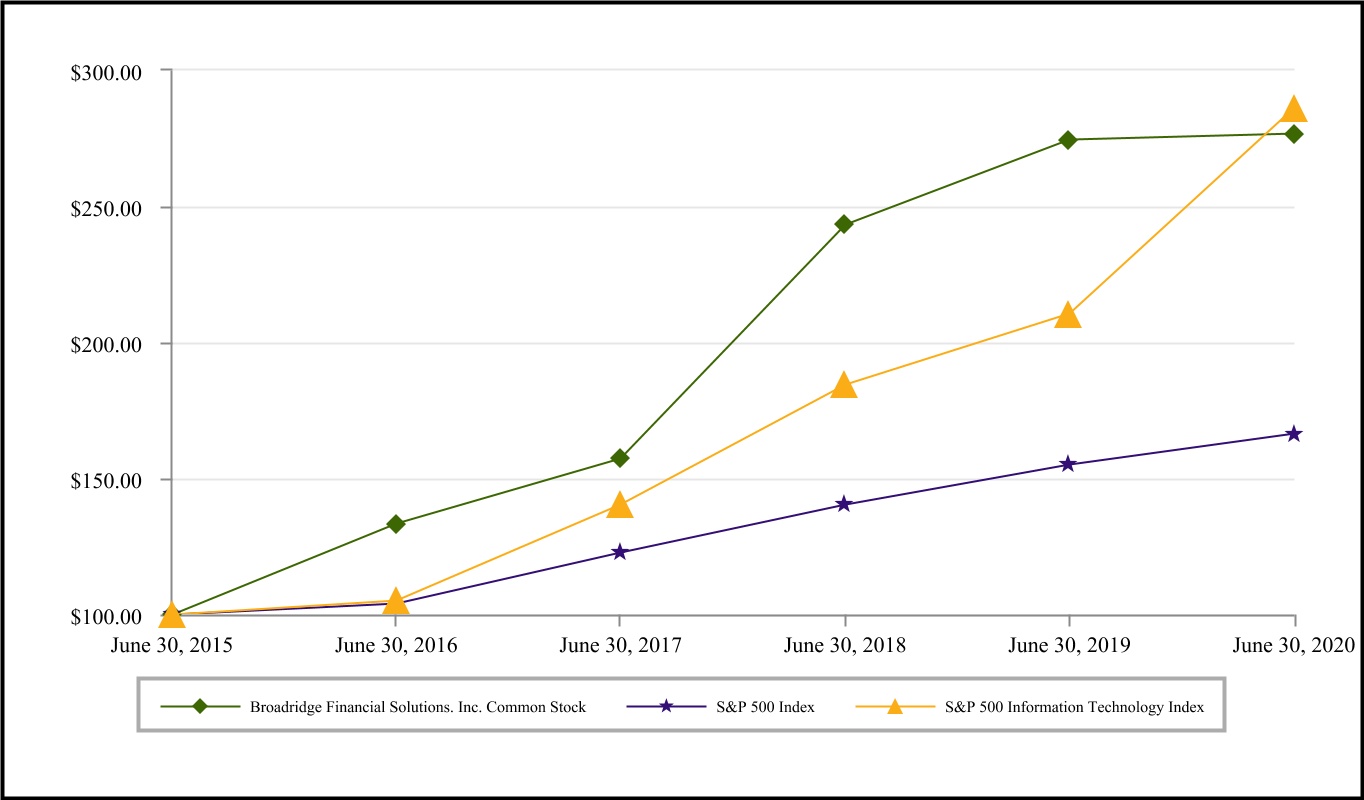
| June 30, 2015 | June 30, 2016 | June 30, 2017 | June 30, 2018 | June 30, 2019 | June 30, 2020 | |||||||||||||||||||||||||||||||||
| Broadridge Financial Solutions. Inc. Common Stock | $ | 100.00 | $ | 133.19 | $ | 157.32 | $ | 243.33 | $ | 274.52 | $ | 276.52 | ||||||||||||||||||||||||||
| S&P 500 Index | $ | 100.00 | $ | 103.98 | $ | 122.58 | $ | 140.19 | $ | 154.79 | $ | 166.38 | ||||||||||||||||||||||||||
| S&P 500 Information Technology Index | $ | 100.00 | $ | 104.79 | $ | 140.30 | $ | 184.22 | $ | 210.63 | $ | 286.23 |
Purchases of Equity Securities by the Issuer and Affiliated Purchasers
The following table contains information about our purchases of our equity securities for each of the three months during our fourth fiscal quarter ended June 30, 2020:
| Period | Total Number of Shares Purchased (1) | Average Price Paid per Share | Total Number of Shares Purchased as Part of Publicly Announced Plans or Programs (2) | Maximum Number of Shares that May Yet Be Purchased Under the Plans or Programs (2) | ||||||||||||||||||||||
| April 1, 2020 – April 30, 2020 | 198,432 | $ | 91.32 | — | 9,586,545 | |||||||||||||||||||||
| May 1, 2020 – May 31, 2020 | 5,479 | 116.02 | — | 9,586,545 | ||||||||||||||||||||||
| June 1, 2020 – June 30, 2020 | 1,015 | 121.63 | — | 9,586,545 | ||||||||||||||||||||||
| Total | 204,926 | $ | 92.13 | — |
(1)Includes 204,926 shares purchased from employees to pay taxes related to the vesting of restricted stock units.
(2)During the fiscal quarter ended June 30, 2020, the Company did not repurchase shares of common stock under its share repurchase program. At June 30, 2020, there were 9,586,545 shares remaining available for repurchase under its share repurchase program. Any share repurchases will be made in the open market or privately negotiated transactions in compliance with applicable legal requirements and other factors.
Item 6. Selected Financial Data
The following selected financial data is derived from our Consolidated Financial Statements and should be read in conjunction with our Consolidated Financial Statements, the accompanying Notes to the Consolidated Financial Statements and Management’s Discussion and Analysis of Financial Condition and Results of Operations included in this Annual Report on Form 10-K.
| Years Ended June 30, | |||||||||||||||||||||||||||||||||||||||||||||||||||||||||||
| 2020 | 2019 | 2018 | 2017 | 2016 | |||||||||||||||||||||||||||||||||||||||||||||||||||||||
| (in millions, except for per share amounts) | |||||||||||||||||||||||||||||||||||||||||||||||||||||||||||
| Statements of Earnings Data | |||||||||||||||||||||||||||||||||||||||||||||||||||||||||||
| Revenues (a) | $ | 4,529.0 | $ | 4,362.2 | $ | 4,329.9 | $ | 4,142.6 | $ | 2,897.0 | |||||||||||||||||||||||||||||||||||||||||||||||||
| Operating income (a) | 624.9 | 652.7 | 598.1 | 534.0 | 502.3 | ||||||||||||||||||||||||||||||||||||||||||||||||||||||
| Earnings before income taxes (a) | 579.5 | 607.3 | 561.0 | 488.1 | 468.9 | ||||||||||||||||||||||||||||||||||||||||||||||||||||||
| Net earnings (a) | 462.5 | 482.1 | 427.9 | 326.8 | 307.5 | ||||||||||||||||||||||||||||||||||||||||||||||||||||||
| Basic earnings per share (a) | $ | 4.03 | $ | 4.16 | $ | 3.66 | $ | 2.77 | $ | 2.60 | |||||||||||||||||||||||||||||||||||||||||||||||||
| Diluted earnings per share (a) | $ | 3.95 | $ | 4.06 | $ | 3.56 | $ | 2.70 | $ | 2.53 | |||||||||||||||||||||||||||||||||||||||||||||||||
| Basic Weighted-average shares outstanding | 114.7 | 115.9 | 116.8 | 118.0 | 118.3 | ||||||||||||||||||||||||||||||||||||||||||||||||||||||
| Diluted Weighted-average shares outstanding | 117.0 | 118.8 | 120.4 | 120.8 | 121.6 | ||||||||||||||||||||||||||||||||||||||||||||||||||||||
| Cash dividends declared per common share | $ | 2.16 | $ | 1.94 | $ | 1.46 | $ | 1.32 | $ | 1.20 |
| June 30, | |||||||||||||||||||||||||||||||||||||||||||||||||||||||||||
| 2020 | 2019 | 2018 | 2017 | 2016 | |||||||||||||||||||||||||||||||||||||||||||||||||||||||
| (in millions) | |||||||||||||||||||||||||||||||||||||||||||||||||||||||||||
| Balance Sheet Data | |||||||||||||||||||||||||||||||||||||||||||||||||||||||||||
| Cash and cash equivalents | $ | 476.6 | $ | 273.2 | $ | 263.9 | $ | 271.1 | $ | 727.7 | |||||||||||||||||||||||||||||||||||||||||||||||||
| Total current assets (a) | 1,328.0 | 1,042.3 | 991.1 | 989.6 | 1,289.1 | ||||||||||||||||||||||||||||||||||||||||||||||||||||||
| Property, plant and equipment, net | 161.6 | 189.0 | 204.1 | 198.1 | 112.2 | ||||||||||||||||||||||||||||||||||||||||||||||||||||||
| Total assets (a)(b) | 4,889.8 | 3,880.7 | 3,304.7 | 3,149.8 | 2,872.7 | ||||||||||||||||||||||||||||||||||||||||||||||||||||||
| Total current liabilities (a)(b) | 1,341.0 | 802.6 | 777.3 | 744.9 | 692.9 | ||||||||||||||||||||||||||||||||||||||||||||||||||||||
| Long-term debt, excluding current portion | 1,387.6 | 1,470.4 | 1,053.4 | 1,102.1 | 890.7 | ||||||||||||||||||||||||||||||||||||||||||||||||||||||
| Total liabilities (a)(b) | 3,543.2 | 2,753.2 | 2,210.4 | 2,146.0 | 1,827.3 | ||||||||||||||||||||||||||||||||||||||||||||||||||||||
| Total stockholders’ equity (a)(b) | 1,346.5 | 1,127.5 | 1,094.3 | 1,003.8 | 1,045.5 |
(a)The Company adopted ASU No. 2014-09 on July 1, 2018, using the modified retrospective transition method with the cumulative effect of initially applying ASU No. 2014-09 recognized at the date of initial application. Accordingly, financial statement periods prior to July 1, 2018 have not been restated for the effects of ASU No. 2014-09. See Note 2, “Summary of Significant Accounting Policies”, and Note 3, “Revenue Recognition” to our Consolidated Financial Statements under Item 8 of Part II of this Annual Report on Form 10-K for details of the Company’s adoption of ASU No. 2014-09.
(b)The Company adopted ASU No. 2016-02 “Leases”, as amended, on July 1, 2019, by recognizing a right-of-use (“ROU”) asset and corresponding lease liability, along with a cumulative-effect adjustment to the opening balance of retained earnings, in the period of adoption. The adoption of ASU No. 2016-02, as amended, did not have a material impact on the Consolidated Statements of Earnings, the Consolidated Statements of Comprehensive Income, the Consolidated Statements of Cash Flows, or the Consolidated Statements of Stockholders’ Equity. Under this method of adoption, the Company has not restated the prior period Consolidated Financial Statements presented to the current period presentation. See Note 2, “Summary of Significant Accounting Policies”, and Note 8, “Leases” in our Consolidated Financial Statements under Item 8 of Part II of this Annual Report on Form 10-K for details of the Company’s adoption of ASU No. 2016-02, as amended.
Item 7. Management’s Discussion and Analysis of Financial Condition and Results of Operations
This discussion summarizes the significant factors affecting the results of operations and financial condition of Broadridge during the fiscal years ended June 30, 2020 and 2019, and should be read in conjunction with our Consolidated Financial Statements and accompanying Notes thereto included elsewhere herein. Certain information contained in “Management’s Discussion and Analysis of Financial Condition and Results of Operations” are “forward-looking statements” within the meaning of the Private Securities Litigation Reform Act of 1995. Statements that are not historical in nature and which may be identified by the use of words such as “expects,” “assumes,” “projects,” “anticipates,” “estimates,” “we believe,” “could be” and other words of similar meaning, are forward-looking statements. These statements are based on management’s expectations and assumptions and are subject to risks and uncertainties that may cause actual results to differ materially from those expressed. Our actual results, performance or achievements may differ materially from the results discussed in this Item 7 because of various factors, including those set forth elsewhere herein. See “Forward-Looking Statements” and “Risk Factors” included in Part 1 of this Annual Report on Form 10-K.
The discussion summarizing the significant factors affecting the results of operations and financial condition of Broadridge during the fiscal year ended June 30, 2018 can be found in Part II, “Item 7. Management’s Discussion and Analysis of Financial Condition and Results of Operations” of our Annual Report on Form 10-K for the fiscal year 2019 (the “2019 Annual Report”), which was filed with the Securities and Exchange Commission on August 6, 2019.
DESCRIPTION OF THE COMPANY AND BUSINESS SEGMENTS
Broadridge, a Delaware corporation and a part of the S&P 500® Index, is a global financial technology leader providing investor communications and technology-driven solutions to banks, broker-dealers, asset and wealth managers and corporate issuers. Our services include investor communications, securities processing, data and analytics, and customer communications solutions. With over 50 years of experience, including over 10 years as an independent public company, we provide financial services firms with advanced, dependable, scalable and cost-effective integrated solutions and an important infrastructure that powers the financial services industry. Our solutions enable better financial lives by powering investing, governance and communications and help reduce the need for our clients to make significant capital investments in operations infrastructure, thereby allowing them to increase their focus on core business activities.
Our businesses operate in two reportable segments: Investor Communication Solutions and Global Technology and Operations.
Investor Communication Solutions
We provide governance and communications solutions through our Investor Communication Solutions business segment to the following financial services clients: banks/broker-dealers, asset management firms/mutual funds, wealth management firms, and corporate issuers. In addition to financial services firms, our Customer Communications business also serves companies in the healthcare, insurance, consumer finance, telecommunications, utilities and other service industries.
A large portion of our Investor Communication Solutions business involves the processing and distribution of proxy materials to investors in equity securities and mutual funds, as well as the facilitation of related vote processing. ProxyEdge® is our innovative electronic proxy delivery and voting solution for institutional investors and financial advisors that helps ensure the voting participation of the largest stockholders of many companies. We also provide the distribution of regulatory reports and corporate action/reorganization event information, as well as tax reporting solutions that help our clients meet their regulatory compliance needs.
For asset managers and retirement service providers, we offer data-driven solutions and an end-to-end platform for content management, composition, and multi-channel distribution of regulatory, marketing, and transactional information. Our data and analytics solutions provide investment product distribution data, analytical tools, insights, and research to enable asset managers to optimize product distribution across retail and institutional channels globally. Through Matrix, we provide mutual fund trade processing services for retirement service providers, third party administrators, financial advisors, banks and wealth management professionals.
In addition, we provide public corporations and mutual funds with a full suite of solutions to help manage their annual meeting process, including registered and beneficial proxy distribution and processing services, proxy and annual report document management solutions, virtual shareholder meeting services, and solutions that help gain insight into their shareholder base through our shareholder data services. We also offer financial reporting document composition and management solutions, SEC disclosure and filing services, and registrar, stock transfer and record-keeping services through Broadridge Corporate Issuer Solutions.
We provide customer communications solutions which include print and digital solutions, content management, postal optimization, and fulfillment services. These services include customer communications management capabilities through the Broadridge Communications Cloud platform. Through one point of integration, the Communications Cloud helps companies create, deliver, and manage multi-channel communications and customer engagement. The platform includes data-driven composition tools, identity and preference management, multi-channel optimization and digital communication experience, archive and information management, digital and print delivery, and analytics and reporting tools.
Global Technology and Operations
We are a leading global provider of securities processing solutions for capital markets, wealth management, and asset management firms. We offer advanced solutions that automate the securities transaction lifecycle, from desktop productivity tools, data aggregation, performance reporting, and portfolio management to order capture and execution, trade confirmation, margin, cash management, clearance and settlement, asset servicing, reference data management, reconciliations, securities financing and collateral optimization, compliance and regulatory reporting, and portfolio accounting and custody-related services.
Our core post-trade services help financial institutions efficiently and cost-effectively consolidate their books and records, gather and service assets under management and manage risk, thereby enabling them to focus on their core business activities. Our multi-asset, multi-market, multi-entity and multi-currency solutions support real-time global trade processing of equity, fixed income, mutual fund, foreign exchange, and exchange traded derivatives.
Our comprehensive wealth management platform offers capabilities across the entire wealth management lifecycle and streamlines all aspects of wealth management services, including account management, fee management and client on-boarding. The wealth management platform enables full-service, regional and independent broker-dealers and investment advisors to better engage with customers through digital marketing and customer communications tools. We also integrate data, content and technology to drive new customer acquisition, support holistic advice and cross-sell opportunities through the creation of sales and educational content, including seminars as well as customizable advisor websites, search engine marketing and electronic and print newsletters. Our advisor solutions help advisors optimize their practice management through customer and account data ag
Showing the first 8K of 121K characters. Open the full section
Item 7A. Quantitative and Qualitative Disclosures About Market Risk
Market Risks
In the ordinary course of business, the financial position of the Company is routinely subject to certain market risks, notably the effects of changes in interest rates and foreign currency exchange rates. We manage our exposure to these market risks through our regular operating and financing activities. As a result, the Company does not anticipate any material losses from these risks. The Company was not a party to any derivative financial instrument as of June 30, 2020 and 2019, respectively.
Interest Rate Risk
As of June 30, 2020, $149.8 million, or 8%, of the Company’s total outstanding debt balance of $1,787.5 million is based on floating interest rates. Our $149.8 million in variable rate debt at June 30, 2020 consists of our revolving credit facility, which bears interest at LIBOR plus 101.5 basis points on borrowed amounts, plus an additional annual facility fee equal to 11.0 basis points on the entire facility. We have assessed our exposure to changes in interest rates by analyzing the sensitivity to our earnings of a change in market interest rates on amounts borrowed from the revolving credit facility during the fiscal year ended June 30, 2020. Assuming a hypothetical increase of one hundred basis points in interest rates on our variable rate debt during the fiscal year ended June 30, 2020, our pre-tax earnings would have decreased by approximately $5.8 million for the fiscal year ended June 30, 2020; however, this would have been offset by interest earned on cash balances.
Foreign Currency Risk
While the substantial majority of our business is conducted within the U.S., approximately 12% of our fiscal year 2020 revenues were earned outside of the U.S. and approximately 23% of our total consolidated assets as of June 30, 2020 resided in our foreign subsidiaries. Our revenue generating operations outside of the U.S. primarily reside in Canada and the United Kingdom. As a result, we have a certain degree of foreign currency exposure to exchange rate fluctuations associated with our non-U.S. revenue generating operations, primarily with respect to the Canadian dollar and the British pound.
We manage our foreign currency risk primarily by incurring, to the extent practicable, operating and financing expenses in the local currency in the countries in which we operate. We do not hedge our operating results against currency movement as they are primarily translational in nature. For the fiscal year ended June 30, 2020, a hypothetical 10% decrease in the value of the Canadian dollar and British pound versus the U.S. dollar would have resulted in a decrease in our total pre-tax earnings of approximately $13.1 million. A hypothetical 10% decrease in the value of the Canadian dollar and British pound versus the U.S. dollar at June 30, 2020 would have resulted in a decrease to our total assets of approximately $84.3 million.
Item 8. Financial Statements and Supplementary Data
INDEX TO FINANCIAL STATEMENTS AND FINANCIAL STATEMENT SCHEDULE
REPORT OF INDEPENDENT REGISTERED PUBLIC ACCOUNTING FIRM
To the Board of Directors and the Stockholders of
Broadridge Financial Solutions, Inc.
5 Dakota Drive
Lake Success, NY 11042
Opinions on the Financial Statements and Internal Control over Financial Reporting
We have audited the accompanying consolidated balance sheets of Broadridge Financial Solutions, Inc. and subsidiaries (the “Company”) as of June 30, 2020 and 2019, the related consolidated statements of earnings, comprehensive income, stockholders’ equity, and cash flows, for each of the three years in the period ended June 30, 2020, and the related notes and the financial statement schedule listed in the Index at Item 15 (collectively referred to as the “financial statements”). We also have audited the Company’s internal control over financial reporting as of June 30, 2020, based on criteria established in Internal Control - Integrated Framework (2013) issued by the Committee of Sponsoring Organizations of the Treadway Commission (COSO).
In our opinion, the financial statements referred to above present fairly, in all material respects, the financial position of the Company as of June 30, 2020 and 2019, and the results of its operations and its cash flows for each of the three years in the period ended June 30, 2020, in conformity with accounting principles generally accepted in the United States of America. Also, in our opinion, the Company maintained, in all material respects, effective internal control over financial reporting as of June 30, 2020, based on criteria established in Internal Control - Integrated Framework (2013) issued by COSO.
Changes in Accounting Principle
As discussed in Note 2 to the financial statements, the Company changed its method of accounting for leases as of July 1, 2019 due to the adoption of Accounting Standards Update 2016-02, Leases (Topic 842).
Basis for Opinions
The Company’s management is responsible for these financial statements, for maintaining effective internal control over financial reporting, and for its assessment of the effectiveness of internal control over financial reporting, included in the accompanying Management’s Report on Internal Control over Financial Reporting. Our responsibility is to express an opinion on these financial statements and an opinion on the Company’s internal control over financial reporting based on our audits. We are a public accounting firm registered with the Public Company Accounting Oversight Board (United States) (PCAOB) and are required to be independent with respect to the Company in accordance with the U.S. federal securities laws and the applicable rules and regulations of the Securities and Exchange Commission and the PCAOB.
We conducted our audits in accordance with the standards of the PCAOB. Those standards require that we plan and perform the audits to obtain reasonable assurance about whether the financial statements are free of material misstatement, whether due to error or fraud, and whether effective internal control over financial reporting was maintained in all material respects.
Our audits of the financial statements included performing procedures to assess the risks of material misstatement of the financial statements, whether due to error or fraud, and performing procedures to respond to those risks. Such procedures included examining, on a test basis, evidence regarding the amounts and disclosures in the financial statements. Our audits also included evaluating the accounting principles used and significant estimates made by management, as well as evaluating the overall presentation of the financial statements. Our audit of internal control over financial reporting included obtaining an understanding of internal control over financial reporting, assessing the risk that a material weakness exists, and testing and evaluating the design and operating effectiveness of internal control based on the assessed risk. Our audits also included performing such other procedures as we considered necessary in the circumstances. We believe that our audits provide a reasonable basis for our opinions.
Definition and Limitations of Internal Control over Financial Reporting
A company’s internal control over financial reporting is a process designed to provide reasonable assurance regarding the reliability of financial reporting and the preparation of financial statements for external purposes in accordance with generally accepted accounting principles. A company’s internal control over financial reporting includes those policies and procedures that (1) pertain to the maintenance of records that, in reasonable detail, accurately and fairly reflect the transactions and dispositions of the assets of the company; (2) provide reasonable assurance that transactions are recorded as necessary to permit preparation of financial statements in accordance with generally accepted accounting principles, and that receipts and expenditures of the company are being made only in accordance with authorizations of management and directors of the company; and (3) provide reasonable assurance regarding prevention or timely detection of unauthorized acquisition, use, or disposition of the company’s assets that could have a material effect on the financial statements.
Because of its inherent limitations, internal control over financial reporting may not prevent or detect misstatements. Also, projections of any evaluation of effectiveness to future periods are subject to the risk that controls may become inadequate because of changes in conditions, or that the degree of compliance with the policies or procedures may deteriorate.
Critical Audit Matter
The critical audit matter communicated below is a mat
Showing the first 8K of 238K characters. Open the full section
Item 9. Changes in and Disagreements with Accountants on Accounting and Financial Disclosure
None.
Item 9A. Controls and Procedures
Management Report
Attached as Exhibits 31.1 and 31.2 to this Form 10-K are certifications of Broadridge’s Chief Executive Officer and Chief Financial Officer, which are required by Rule 13a-14(a) of the Securities Exchange Act of 1934, as amended (the “Exchange Act”). This “Controls and Procedures” section should be read in conjunction with the Deloitte & Touche LLP audit and attestation of the Company’s internal control over financial reporting that appears in Item 8 “Financial Statements and Supplementary Data” in this Annual Report on Form 10-K and is hereby incorporated herein by reference.
Management’s Evaluation of Disclosure Controls and Procedures
Our management, with the participation of our Chief Executive Officer and Chief Financial Officer as of June 30, 2020, evaluated the effectiveness of our disclosure controls as defined in Rule 13a-15(e) under the Exchange Act. The Chief Executive Officer and Chief Financial Officer concluded that our disclosure controls and procedures as of June 30, 2020 were effective to ensure that the information required to be disclosed by us in reports filed under the Exchange Act is (i) recorded, processed, summarized, and reported within the time periods specified in the SEC’s rules and forms and (ii) accumulated and communicated to our management, including our Chief Executive Officer and Chief Financial Officer, as appropriate, to allow timely decisions regarding disclosure.
Management’s Report on Internal Control over Financial Reporting
It is the responsibility of Broadridge’s management to establish and maintain effective internal control over financial reporting (as defined in Rule 13a-15(f) under the Exchange Act). Internal control over financial reporting is designed to provide reasonable assurance to Broadridge’s management and board of directors regarding the preparation of reliable financial statements for external purposes in accordance with generally accepted accounting principles.
Broadridge’s internal control over financial reporting includes those policies and procedures that: (i) pertain to the maintenance of records that, in reasonable detail, accurately and fairly reflect the transactions and dispositions of the assets of Broadridge; (ii) provide reasonable assurance that transactions are recorded as necessary to permit preparation of financial statements in accordance with generally accepted accounting principles, and that receipts and expenditures of Broadridge are being made only in accordance with authorizations of management and directors of Broadridge; and (iii) provide reasonable assurance regarding the prevention or timely detection of unauthorized acquisition, use or disposition of Broadridge’s assets that could have a material effect on the financial statements of Broadridge.
Because of its inherent limitations, internal control over financial reporting may not prevent or detect misstatements. Therefore, even those systems determined to be effective can provide only reasonable assurance with respect to financial statement preparation and presentation.
Management has performed an assessment of the effectiveness of Broadridge’s internal control over financial reporting as of June 30, 2020 based upon criteria set forth in Internal Control—Integrated Framework (2013) issued by the Committee of Sponsoring Organizations of the Treadway Commission. Based on this assessment, management determined that Broadridge’s internal control over financial reporting was effective as of June 30, 2020.
Deloitte & Touche LLP, the Company’s independent registered public accounting firm, has audited the effectiveness of the Company’s internal control over financial reporting and has expressed an unqualified opinion in their report on the effectiveness of the Company’s internal control over financial reporting, which appears in Item 8 “Financial Statements and Supplementary Data” in this Annual Report on Form 10-K.
| /s/ TIMOTHY C. GOKEY | ||||||||
| Timothy C. Gokey | ||||||||
| Chief Executive Officer | ||||||||
| /s/ JAMES M. YOUNG | ||||||||
| James M. Young | ||||||||
| Senior Vice President, Chief Financial Officer |
Lake Success, New York
August 11, 2020
Changes in Internal Control over Financial Reporting
No change in our internal control over financial reporting (as defined in Rules 13a-15(f) and 15d-15(f) under the Exchange Act) occurred during the fiscal quarter ended June 30, 2020 that has materially affected, or is reasonably likely to materially affect, our internal control over financial reporting.
Item 9B. Other Information
None.
PART III.
Item 10. Directors, Executive Officers and Corporate Governance
We incorporate by reference the information responsive to this Item appearing in our definitive proxy statement to be filed within 120 days after the fiscal year ended June 30, 2020 (the “Proxy Statement”).
Item 11. Executive Compensation
We incorporate by reference the information responsive to this Item appearing in our Proxy Statement.
Item 12. Security Ownership of Certain Beneficial Owners and Management and Related Stockholder Matters
We incorporate by reference the information responsive to this Item appearing in our Proxy Statement.
Item 13. Certain Relationships and Related Transactions, and Director Independence
We incorporate by reference the information responsive to this Item appearing in our Proxy Statement.
Item 14. Principal Accounting Fees and Services
We incorporate by reference the information responsive to this Item appearing in our Proxy Statement.
PART IV.
Item 15. Exhibits, Financial Statement Schedules
(a)The following documents are filed as part of this Annual Report on Form 10-K:
1.Financial Statements
The Consolidated Financial Statements are listed under Item 8 of this Annual Report on Form 10-K. See Index to Financial Statements and Financial Statement Schedule.
2.Financial Statement Schedule.
Schedule II—Valuation and Qualifying Accounts is listed under Item 8 of this Annual Report on Form 10-K. See Index to Financial Statements and Financial Statement Schedule.
3.Exhibits.
The Exhibits filed as part of this Annual Report on Form 10-K are listed on the Exhibit Index, which Exhibit Index is incorporated by reference in this Annual Report on Form 10-K.
SIGNATURES
Pursuant to the requirements of Section 13 or 15(d) of the Securities Exchange Act of 1934, as amended, the Registrant has duly caused this Annual Report on Form 10-K to be signed on its behalf by the undersigned hereunto duly authorized.
Date: August 11, 2020
| BROADRIDGE FINANCIAL SOLUTIONS, INC. | |||||||||||||||||
| By: | /s/ TIMOTHY C. GOKEY | ||||||||||||||||
| Name: | Timothy C. Gokey | ||||||||||||||||
| Title: | Chief Executive Officer |
SIGNATURES AND POWERS OF ATTORNEY
KNOW ALL PERSONS BY THESE PRESENTS, that each person whose signature appears below hereby constitutes and appoints Timothy C. Gokey and James M. Young, and each of them, the true and lawful attorneys-in-fact and agents of the undersigned, with full power of substitution and resubstitution, for and in the name, place and stead of the undersigned, to sign in any and all capacities (including, without limitation, the capacities listed below), any and all amendments to the Annual Report on Form 10-K, and to file the same, with all exhibits thereto, and all other documents in connection therewith, with the Securities and Exchange Commission, and hereby grants to such attorneys-in-fact and agents, and each of them, full power and authority to do and perform each and every act and anything necessary to be done to comply with the provisions of the Securities Exchange Act of 1934, as amended, and all the requirements of the Securities and Exchange Commission, as fully to all intents and purposes as the undersigned might or could do in person, hereby ratifying and confirming all that said attorneys-in-fact and agents, or any of them, or their or his or her substitute, or substitutes, may lawfully do or cause to be done by virtue hereof.
Pursuant to the requirements of the Securities Exchange Act of 1934, as amended, this Annual Report on Form 10-K has been signed below by the following persons on behalf of the Registrant and in the capacities and on the dates indicated.
| Signature | Title | Date | |||||||||
| /s/ TIMOTHY C. GOKEY | Chief Executive Officer and Director (Principal Executive Officer) | August 11, 2020 | |||||||||
| Timothy C. Gokey | |||||||||||
| /s/ JAMES M. YOUNG | Senior Vice President, Chief Financial Officer (Principal Financial and Accounting Officer) | August 11, 2020 | |||||||||
| James M. Young | |||||||||||
| /s/ RICHARD J. DALY | Executive Chairman of the Board of Directors | August 11, 2020 | |||||||||
| Richard J. Daly | |||||||||||
| /S/ LESLIE A. BRUN | Lead Independent Director | August 11, 2020 | |||||||||
| Leslie A. Brun | |||||||||||
| /S/ PAMELA L. CARTER | Director | August 11, 2020 | |||||||||
| Pamela L. Carter | |||||||||||
| /S/ ROBERT N. DUELKS | Director | August 11, 2020 | |||||||||
| Robert N. Duelks | |||||||||||
| /S/ BRETT A. KELLER | Director | August 11, 2020 | |||||||||
| Brett A. Keller | |||||||||||
| /S/ MAURA A. MARKUS | Director | August 11, 2020 | |||||||||
| Maura A. Markus | |||||||||||
| /S/ THOMAS J. PERNA | Director | August 11, 2020 | |||||||||
| Thomas J. Perna | |||||||||||
| /S/ ALAN J. WEBER | Director | August 11, 2020 | |||||||||
| Alan J. Weber | |||||||||||
| /S/ AMIT K. ZAVERY | Director | August 11, 2020 | |||||||||
| Amit K. Zavery | |||||||||||
EXHIBIT INDEX
(1)The SEC File No. for the Company’s Form 8-K Reports referenced is 001-33220.
(2)Certain confidential information contained in this Exhibit was omitted by means of redacting a portion of the text and replacing it with an asterisk. This Exhibit has been filed separately with the Secretary of the Securities and Exchange Commission without the redaction pursuant to a Confidential Treatment Request under Rule 24b-2 of the Securities Exchange Act of 1934, as amended.