 filings.tools
Berkshire Hathaway 10-K 2023-12-31
Filed 2024-02-26. 18 sections, 602K characters. Original on sec.gov · Markdown · JSON
Cover and table of contents
UNITED STATES
SECURITIES AND EXCHANGE COMMISSION
Washington, D.C. 20549
FORM 10-K
| ☑ | ANNUAL REPORT PURSUANT TO SECTION 13 OR 15(d) OF THE SECURITIES EXCHANGE ACT OF 1934 |
For the fiscal year ended December 31, 2023
OR
| ☐ | TRANSITION REPORT PURSUANT TO SECTION 13 OR 15(d) OF THE SECURITIES EXCHANGE ACT OF 1934 |
For the transition period from to
Commission file number 001-14905
BERKSHIRE HATHAWAY INC**.**
(Exact name of Registrant as specified in its charter)
| Delaware | 47-0813844 | |
| State or other jurisdiction of incorporation or organization | (I.R.S. Employer Identification No.) | |
| 3555 Farnam Street, Omaha, Nebraska | 68131 | |
| (Address of principal executive office) | (Zip Code) |
Registrant’s telephone number, including area code (402) 346-1400
Securities registered pursuant to Section 12(b) of the Act:
| Title of each class | Trading Symbols | Name of each exchange on which registered | ||
| Class A Common Stock Class B Common Stock 1.300% Senior Notes due 2024 0.000% Senior Notes due 2025 1.125% Senior Notes due 2027 2.150% Senior Notes due 2028 1.500% Senior Notes due 2030 2.000% Senior Notes due 2034 1.625% Senior Notes due 2035 2.375% Senior Notes due 2039 0.500% Senior Notes due 2041 2.625% Senior Notes due 2059 | BRK.A BRK.B BRK24 BRK25 BRK27 BRK28 BRK30 BRK34 BRK35 BRK39 BRK41 BRK59 | New York Stock Exchange New York Stock Exchange New York Stock Exchange New York Stock Exchange New York Stock Exchange New York Stock Exchange New York Stock Exchange New York Stock Exchange New York Stock Exchange New York Stock Exchange New York Stock Exchange New York Stock Exchange |
Securities registered pursuant to Section 12(g) of the Act: NONE
Indicate by check mark if the Registrant is a well-known seasoned issuer, as defined in Rule 405 of the Securities Act. Yes ☑ No ☐
Indicate by check mark if the Registrant is not required to file reports pursuant to Section 13 or Section 15(d) of the Act. Yes ☐ No ☑
Indicate by check mark whether the Registrant (1) has filed all reports required to be filed by Section 13 or 15(d) of the Securities Exchange Act of 1934 during the preceding 12 months (or for such shorter period that the Registrant was required to file such reports), and (2) has been subject to such filing requirements for the past 90 days. Yes ☑ No ☐
Indicate by check mark whether the Registrant has submitted electronically every Interactive Data File required to be submitted pursuant to Rule 405 of Regulation S-T (§232.405 of this chapter) during the preceding 12 months (or for such shorter period that the Registrant was required to submit such files). Yes ☑ No ☐
Indicate by check mark whether the Registrant is a large accelerated filer, an accelerated filer, a non-accelerated filer, a smaller reporting company, or an emerging growth company. See the definitions of “large accelerated filer,” “accelerated filer,” “smaller reporting company,” and “emerging growth company” in Rule 12b-2 of the Exchange Act. Large accelerated filer ☑ Accelerated filer ☐
Non-accelerated filer ☐ Smaller reporting company ☐ Emerging growth company ☐
If an emerging growth company, indicate by check mark if the Registrant has elected not to use the extended transition period for complying with any new or revised financial accounting standards provided pursuant to Section 13(a) of the Exchange Act. ☐
Indicate by check mark whether the Registrant has filed a report on and attestation to its management’s assessment of the effectiveness of its internal control over financial reporting under Section 404(b) of the Sarbanes-Oxley Act (15 U.S.C. 7262(b)) by the registered public accounting firm that prepared or issued its audit report. ☑
If securities are registered pursuant to Section 12(b) of the Act, indicate by check mark whether the financial statements of the Registrant included in the filing reflect the correction of an error to previously issued financial statements. ☐
Indicate by check mark whether any of those error corrections are restatements that required a recovery analysis of incentive-based compensation received by any of the Registrant’s executive officers during the relevant recovery period pursuant to §240.10D-1(b). ☐
Indicate by check mark whether the Registrant is a shell company (as defined in Rule 12b-2 of the Act). Yes ☐ No ☑
State the aggregate market value of the voting stock held by non-affiliates of the Registrant as of June 30, 2023: $625,500,000,000
Indicate the number of shares outstanding of each of the Registrant’s classes of common stock:
| February 12, 2024—Class A common stock, $5 par value | 566,618 shares |
| February 12, 2024—Class B common stock, $0.0033 par value | 1,310,805,008 shares |
DOCUMENTS INCORPORATED BY REFERENCE
Portions of the Proxy Statement for the Registrant’s Annual Meeting to be held May 4, 2024 are incorporated in Part III.
Table of Contents
Par****t I
Item 1. Business Description
Berkshire Hathaway Inc. (“Berkshire,” “Company” or “Registrant”) is a holding company owning subsidiaries engaged in numerous diverse business activities. The most important of these are insurance businesses conducted on both a primary basis and a reinsurance basis, a freight rail transportation business and a group of utility and energy generation and distribution businesses. Berkshire also owns and operates numerous other businesses engaged in a variety of manufacturing, services, retailing and other activities. Berkshire is domiciled in the state of Delaware, and its corporate headquarters is in Omaha, Nebraska.
Berkshire’s operating businesses are managed on an unusually decentralized basis. There are few centralized or integrated business functions. Berkshire’s senior management team participates in and is ultimately responsible for significant capital allocation decisions, investment activities and the selection of the Chief Executive to head each of the operating businesses.
Berkshire’s senior management is also responsible for establishing and monitoring Berkshire’s corporate governance practices, including monitoring governance efforts, including those at the operating businesses, and participating in the resolution of governance-related issues as needed. Berkshire’s Board of Directors is responsible for assuring an appropriate successor to the Chief Executive Officer. The Berkshire Code of Business Conduct and Ethics emphasizes, among other things, the commitment to ethics and compliance with government laws and regulations and provides basic standards for ethical and legal behavior of its employees.
Human capital and resources are an integral and essential component of Berkshire’s businesses. Berkshire and its subsidiary business units employed approximately 396,500 people worldwide at the end of 2023, of which approximately 80% were in the United States (“U.S.”) and 20% were represented by unions. Employees engage in a wide variety of occupations. Consistent with Berkshire’s decentralized management philosophy, Berkshire’s operating businesses individually establish specific policies and practices concerning the attraction and retention of personnel within their organizations. Given the wide variations in the nature and size of business activities, specific policies and practices may vary widely among Berkshire’s operating subsidiaries. Policies and practices commonly address, among other things: maintaining a safe work environment and minimizing or eliminating workplace injuries; offering competitive compensation, which includes various health insurance and retirement benefits, as well as incentives to recognize and reward performance; wellness programs; training, learning and career advancement opportunities; and hiring practices intended to identify qualified candidates and promote diversity and inclusion in the workforce. Berkshire’s combined U.S. workforce demographics, based on U.S. Equal Employment Opportunity Commission guidelines, are available on its website (https://www.berkshirehathaway.com), under sustainability.
Insurance and Reinsurance Businesses
Berkshire’s insurance and reinsurance business activities are conducted through numerous domestic and foreign-based insurance subsidiaries. Berkshire’s insurance subsidiaries provide insurance and reinsurance of property and casualty risks as well as life and health risks worldwide. Berkshire’s insurance businesses employed approximately 43,000 people at the end of 2023. For purposes of this discussion, entities that provide insurance or reinsurance are referred to as insurers.
In direct or primary insurance activities, the insurer assumes the risk of loss from persons or organizations that are directly subject to the risks. Such risks may relate to property, casualty (or liability), life, accident, health, financial or other perils that arise from an insurable event. In reinsurance activities, the insurer assumes defined portions of risks that other direct insurers or reinsurers assumed in their own insuring activities.
Insurance and reinsurance are generally subject to regulatory oversight throughout the world. Except for regulatory considerations, there are virtually no barriers to entry into the insurance and reinsurance industry. Competitors may be domestic or foreign, as well as licensed or unlicensed. The number of competitors within the industry is not known. Insurers compete on the basis of reliability, financial strength and stability, financial ratings, underwriting consistency, service, business ethics, price, performance, capacity, policy terms and coverage conditions.
Insurers based in the U.S. are subject to regulation by their states of domicile and by those states in which they are licensed to write policies on an admitted basis. The primary focus of state regulation is to monitor financial solvency of insurers and otherwise protect policyholder interests. States establish minimum capital levels for insurance companies and establish guidelines for permissible business and investment activities and have the authority to suspend or revoke a company’s authority to do business. States regulate the payment of shareholder dividends by insurance companies and other transactions with affiliates.
K-1
Insurers that market, sell and service insurance policies in the states where they are licensed are referred to as admitted insurers. Admitted insurers are generally required to obtain regulatory approval of their policy forms and premium rates. Non-admitted insurance markets have developed to provide insurance that is otherwise unavailable through admitted insurers. Non-admitted insurance, often referred to as “excess and surplus” lines, is procured by either state-licensed surplus lines brokers who place risks with insurers not licensed in that state or by the insured party’s direct procurement from non-admitted insurers. Non-admitted insurance is subject to considerably less regulation with respect to policy rates and forms. Reinsurers are normally not required to obtain regulatory approval of premium rates or reinsurance contracts.
The insurance regulators of every state participate in the National Association of Insurance Commissioners (“NAIC”). The NAIC adopts forms, instructions and accounting procedures for use by U.S. insurers in preparing and filing annual statutory financial statements. However, an insurer’s state of domicile has ultimate authority over these matters. In addition, the NAIC develops or adopts statutory accounting principles, model laws, regulations and programs for use by its members. Such matters deal with regulatory oversight of solvency, risk management, compliance with financial regulation standards and risk-based capital reporting requirements.
U.S. states, through the NAIC, and international insurance regulators through the International Association of Insurance Supervisors (“IAIS”) have been developing standards and best practices focused on establishing a common set of principles (“Insurance Core Principles”) and framework (“ComFrame”) for the regulation of large multi-national insurance groups. The IAIS is developing capital standards for internationally active insurance groups (“Insurance Capital Standard”) based on a consolidated group approach and is also evaluating a potentially comparable group capital standard based on the aggregation of regulated entities and their underlying local capital requirements (“Aggregation Method”). The IAIS is also developing standards that address supervision, coordination of regulators, risk management and governance.
While the IAIS standards do not have legal effect, U.S. state insurance departments and the NAIC are implementing various group supervision regulatory tools and mandates that are responsive to certain IAIS standards. U.S. state regulators have formed supervisory colleges intended to promote communication and cooperation amongst the various domestic and international insura
Showing the first 8K of 129K characters. Open the full section
Item 1A. Risk Factors
Berkshire and its subsidiaries (referred to herein as “we,” “us,” “our” or similar expressions) are subject to certain risks and uncertainties in its business operations which are described below. The risks and uncertainties described below are not the only risks we face. Additional risks and uncertainties that are presently unknown or are currently deemed immaterial may also impair our business operations.
General Business Risks
Terrorist acts could hurt our operating businesses.
A nuclear, biological or chemical terrorist attack or armed terrorist incursions could produce significant losses to our worldwide operations. Our business operations could be adversely affected from such acts through the loss of human life, destruction of production facilities and information systems or other property damage. We share these risks with all businesses.
Cybersecurity risks.
We rely on technology in virtually all aspects of our business. Like those of many large businesses, certain of our information systems have been subject to computer viruses, malicious codes, unauthorized access, phishing efforts, denial-of-service attacks and other cyber-attacks. We expect to be subject to similar attacks in the future as such attacks become more sophisticated and frequent. A significant disruption or failure of our technology systems could result in service interruptions, safety failures, security events, regulatory compliance failures, an inability to protect information and assets against unauthorized users and other operational difficulties. Attacks perpetrated against our systems could result in loss of assets and critical information and expose us to remediation costs and reputational damage.
Although we have taken steps intended to mitigate these risks, including business continuity planning, disaster recovery planning and business impact analysis, a significant disruption or cyber intrusion at one or more of our significant operations could adversely affect our results of operations, financial condition and/or liquidity. Additionally, if we are unable to acquire, develop, implement, adopt or protect rights around new technology, we may suffer a competitive disadvantage, which could also have an adverse effect on our results of operations, financial condition and/or liquidity.
Cyber-attacks could further adversely affect our ability to operate facilities, information technology and business systems or compromise confidential customer and employee information. Political, economic, social or financial market instability or damage to or interference with our operating assets, customers or suppliers from cyber-attacks may result in business interruptions, lost revenues, higher commodity prices, disruption in fuel supplies, lower energy consumption, unstable markets, increased security, repair or other costs, or may materially adversely affect us in ways that cannot be predicted at this time. Any of these risks could materially affect our consolidated financial results. Furthermore, instability in the financial markets resulting from terrorism, sustained or significant cyber-attacks or war could also have a material adverse effect on our ability to raise capital. We share these risks with all businesses.
Geopolitical events could cause losses to our business and losses in the values of securities we own.
We believe risks of adverse effects from geopolitical events are rising, through armed and diplomatic conflicts involving governments in various parts of the world. Government policies and actions taken, including responses of other governments to such actions, may adversely affect our operating businesses through reduced sales, increased costs, restricted supply chains, physical damage to our properties and loss of life of our employees. We share these risks with all businesses.
We are dependent on a few key people for our major investment and capital allocation decisions.
Major investment decisions and all major capital allocation decisions are made by Warren E. Buffett, Chairman of the Board of Directors and Chief Executive Officer, age 93. In 2018, Berkshire’s Board of Directors appointed Mr. Gregory Abel as Vice Chairman of Berkshire’s non-insurance operations and Mr. Ajit Jain as Vice Chairman of Berkshire’s insurance operations. Mr. Abel and Mr. Jain each report directly to Mr. Buffett. Mr. Buffett continues to be responsible for major capital allocation and investment decisions.
If for any reason the services of our key personnel, particularly Mr. Buffett, were to become unavailable, there could be a material adverse effect on our operations. Should a replacement for Mr. Buffett be needed currently, Berkshire’s Board of Directors has agreed that Mr. Abel should replace Mr. Buffett. The Board continually monitors this risk and could alter its current view regarding a replacement for Mr. Buffett in the future. We believe that the Board’s succession plan, together with the outstanding managers running our numerous and highly diversified operating units, helps to mitigate this risk.
K-25
We need qualified personnel to manage and operate our various businesses.
In our decentralized business model, we need qualified and competent management to direct day-to-day business activities of our operating subsidiaries and to manage changes in future business operations due to changing business or regulatory environments. Our operating subsidiaries also need qualified and competent personnel to execute business plans and serve their customers, suppliers and other stakeholders. Our inability to recruit, train and retain qualified and competent managers and personnel could negatively affect the operating results, financial condition and/or liquidity of our subsidiaries and Berkshire as a whole.
Investments are unusually concentrated in equity securities and fair values are subject to loss in value.
We concentrate a high percentage of the equity security investments of our insurance subsidiaries in a relatively small number of issuers. A significant decline in the fair values of our larger investments in equity securities may produce a material decline in our consolidated shareholders’ equity and our consolidated earnings.
Since a large percentage of our equity securities are held by our insurance subsidiaries, significant decreases in the fair values of these investments will produce significant declines in the statutory surplus of our insurance subsidiaries. Our large statutory surplus is a competitive advantage, and a long-term material decline could have an adverse effect on our claims-paying ability ratings and our ability to write new insurance business thus potentially reducing our future underwriting profits.
Competition and technology may erode our business franchises and result in lower earnings.
Each of our operating businesses face intense competition within markets in which they operate. While we manage our businesses with the objective of achieving long-term sustainable growth by developing and strengthening competitive advantages, many factors, including technological changes, may erode or prevent the strengthening of competitive advantages. Accordingly, our future operating results will depend to some degree on our operating units successfully protecting and enhancing their competitive advantages. If our operating businesses are unsuccessful in these efforts, our periodic operating results in the future may decline.
Unfavorable general economic conditions may significantly reduce our operating earnings and impair our ability to access capital markets at a reasonable cost.
Our operating businesses are subject to normal economic cycles affecting the general economy or the specific industries in which they operate. Significant deteriorations of economic conditions, including significant inflation over a prolonged period could produce a material adverse effect on one or more of our significant operations. In addition, our utilities and energy businesses and our railroad business regularly utilize debt as a component of their capital structures and depend on having access to borrowed funds through the capital markets at reasonable rates. To the extent that access to the capital markets is restricted or the cost of funding increases, these operations could be adversely affected.
Epidemics, pandemics or other similar outbreaks could hurt our operating businesses.
The outbreak of epidemics, pandemics or other similar outbreaks in the future may adversely affect our operations, including the value of our equity securities portfolio. This may be due to closures or restrictions requested or mandated by governmental authorities, disruption to supply chains and workforce, reduction of demand for our products and services, credit losses when customers and other counterparties fail to satisfy their obligations to us, and volatility in global equity securities markets, among other factors. We share most of these risks with all businesses.
Regulatory changes may adversely impact our future operating results.
Over time, in response to financial markets crises, global economic recessions, and social and environmental issues, regulatory initiatives were adopted in the United States and elsewhere. Such initiatives addressed, for example, the regulation of banks and other major financial institutions, the regulation of products and environmental and global-warming matters. These initiatives impact all of our businesses, albeit in varying ways. Increased regulatory compliance costs could have a significant negative impact on our operating businesses, as well as on the businesses in which we have significant, but not controlling, economic interests. We cannot predict whether such initiatives will have a material adverse impact on our consolidated financial position, results of operations and/or cash flows.
Data privacy regulations have recently been enacted in various jurisdictions in the U.S. and throughout the world. These regulations address numerous aspects related to the security of personal information that is stored in our information systems, networks and facilities. Failure to comply with these regulations could result in reputational damage and significant economic penalties.
K-26
Climate change and the regulation of greenhouse gas (“GHG”) emissions may impact our businesses.
The impacts of climate change and the regulation of GHG emissions could impact our businesses to varying degrees. Climate change could cause or intensify hurricanes, floods, wildfires, and other extreme weather events that may increase the physical risks to and impacts on our operations. An increase in the frequency or intensity of extreme weather events and storms could impact the physical assets of our non-insurance operations and could produce losses affecting our businesses. Similarly, extreme weather events may produce losses affecting our insurance operations as their primary business is to monitor, assess and price risk, including climate-related risk, at an expected economic profit to address the risk-transfer needs of their insurance customers.
Additional GHG policies, including legislation, may emerge that accelerate the transition to a lower-GHG emitting economy and could, in turn, increase costs for our businesses to comply with those policies, including BNSF and BHE, which combined represent more than 90% of Berkshire’s direct emissions. The failure to comply with new or existing regulations or reinterpretation of existing regulations relating to climate change could have a significant adverse effect on our financial results.
Risks unique to our regulated businesses
Our tolerance for underwriting risk in our various insurance businesses may result in significant underwriting losses.
When properly paid for the risk assumed, we have been and will continue to be willing to assume more risk from a single event than any other insurer has knowingly assumed. Accordingly, we could incur a significant loss from a single catastrophe event resulting from a natural disaster or man-made catastrophes such as terrorism or cyber-attacks. We employ various disciplined underwriting practices intended to mitigate potential losses, attempt to take into account all possible correlations and avoid writing groups of policies from which pre-tax losses from a single catastrophe event might aggregate in excess of $15 billion. However, despite our efforts, it is possible that losses could manifest in ways that we do not anticipate and that our risk mitigation strategies are not designed to address. Various provisions of our policies, negotiated to limit our risk, such as limitations or exclusions from coverage, may not be enforceable in the manner we intend, as it is possible that a court or regulatory authority could nullify or void an exclusion or limitation, or legislation could be enacted modifying or barring the use of these exclusions and limitations. Our tolerance for significant insurance losses may result in lower reported earnings in a future period.
The principal cost associated with the property and casualty insurance business is claims. In writing property and casualty insurance policies, we receive premiums today and promise to pay covered losses in the future. However, it will take decades before all claims that have occurred as of any given balance sheet date will be reported and settled. Although we believe that recorded liabilities for unpaid losses are adequate, we will not know whether these liabilities or the premiums charged for the coverages provided were sufficient until well after the balance sheet date. Estimating insurance claim costs is inherently imprecise. It is possible that significant claims may emerge or develop in the future from the policies we have written in the past. As industry practices and legal, social and other environmental conditions change, unexpected and unintended issues related to claims and coverage may emerge, including new or expanded theories of liability. These or other changes could impose new financial obligations on us by extending coverage beyond our underwriting intent. In some instances, these changes may not become apparent until sometime after we have issued insurance or reinsurance contracts that are affected by the changes. As a result, the full extent of liability under our insurance or reinsurance contracts may not be known for many years after a contract is issued. Our estimated unpaid losses arising under contracts covering property and casualty insurance risks are large ($146 billion at December 31, 2023), and a small percentage increase to those liabilities can result in materially lower reported earnings.
Changes in regulations and regulatory actions can adversely affect our operating results and our ability to allocate capital.
Our insurance businesses are subject to regulation in the jurisdictions in which we operate. Such regulations may relate to, among other things, the types of business that can be written, the rates that can be charged for coverage, the level of capital that must be maintained and restrictions on the types and size of investments that can be made. Regulations may also restrict the timing and amount of dividend payments to Berkshire by these businesses. U.S. state insurance regulators and international insurance regulators are also actively developing various regulatory mechanisms to address the regulation of large internationally active insurance groups, including regulations concerning group capital, liquidity, governance and risk management. Accordingly, changes in regulations related to these or other matters or regulatory actions imposing restrictions on our insurance businesses may adversely impact our results of operations and restrict our ability to allocate capital.
K-27
Our railroad business conducted through BNSF is also subject to a significant number of laws and regulations with respect to rates and practices, taxes, railroad operations and a variety of health, safety, labor, environmental and other matters. Failure to comply with applicable laws and regulations could have a material adverse effect on BNSF’s business. Governments may change the legislative and/or regulatory framework within which BNSF operates, without providing any recourse for any adverse effects that the change may have on the business. Complying with legislative and regulatory changes may pose significant operating and implementation risks and require significant capital expenditures.
BNSF derives significant amounts of revenue from the transportation of energy-related commodities, particularly coal. To the extent that changes in government policies limit or restrict the usage of coal as a fuel source in generating electricity or alternate fuels, such as natural gas, or otherwise displace coal as an energy source, revenues and earnings could be adversely affected. As a common carrier, BNSF is also required to transport toxic inhalation hazard chemicals and other hazardous materials. A release of hazardous materials could expose BNSF to significant claims, losses, penalties and environmental remediation obligations. Changes in the regulation of the rail industry could negatively impact BNSF’s ability to determine prices for rail services and to make capital improvements to its rail network, resulting in an adverse effect on our results of operations, financial condition and/or liquidity.
Our utilities and energy businesses operated under BHE are highly regulated by numerous federal, state, local and foreign governmental authorities in the jurisdictions in which they operate. These laws and regulations are complex, dynamic and subject to new interpretations or change. Regulations affect almost every aspect of our utilities and energy businesses. Regulations broadly apply and may limit management’s ability to independently make and implement decisions regarding numerous matters including: acquiring businesses; constructing, acquiring, disposing or retiring of operating assets; operating and maintaining generating facilities and transmission and distribution system assets; complying with pipeline safety and integrity and environmental requirements; setting rates charged to customers; establishing capital structures and issuing debt; managing and reporting transactions between our domestic utilities and our other subsidiaries and affiliates; and paying dividends or similar distributions. Failure to comply with or reinterpretations of existing regulations and new legislation or regulations, such as those relating to air quality, climate change, emissions performance standards, water quality, coal ash disposal and other environmental matters, or changes in the nature of the regulatory process may have a significant adverse impact on our financial results.
Our railroad business requires significant ongoing capital investment to improve and maintain its railroad network so that transportation services can be safely and reliably provided to customers on a timely basis. Our utilities and energy businesses also require significant amounts of capital to construct, operate and maintain generation, transmission and distribution systems to meet their customers’ needs and reliability criteria. System assets may need to be operational for long periods of time to justify the financial investment. The operational or financial failure of capital projects may not be recoverable through rates that are charged to customers. Further, a significant portion of costs of capital improvements may be funded through debt issued by BNSF and BHE and their subsidiaries. Disruptions in debt capital markets that restrict access to funding when needed could adversely affect the results of operations, liquidity and/or capital resources of these businesses.
Item 1B. Unresolved Staff Comments
None.
Item 1C. Cybersecurity
Berkshire recognizes that maintaining processes for identifying, assessing, and managing cybersecurity threats is important in dealing with its significant business risks. As such, Berkshire has implemented a framework for cybersecurity and cyber-related information management across Berkshire’s diverse groups of businesses. The framework permits each Berkshire Business Group (“Business Group”) to tailor solutions to identify, manage, and mitigate risks based on their own assessment of their unique cybersecurity risks in conjunction with each Business Group’s overall risk management processes. At the same time, the framework helps enable consistent and appropriate compliance in reporting material cyber events and risks across Berkshire.
Each Business Group’s Chief Information Security Officer (“CISO”) on at least an annual basis is to provide a report to the Business Group’s senior management, regarding the state of their cybersecurity program and its material cyber risks. These reports are also shared with Berkshire’s internal audit group to inform and enhance the overall company’s risk management processes. In addition, each Business Group is required to maintain an incident reporting process to report significant cybersecurity events to Berkshire. Berkshire and its Business Groups engage and partner with a wide range of third parties to assess, audit, educate, implement, operate, protect, and remediate various cybersecurity related elements.
K-28
Berkshire and its Business Groups rely on third-party service providers for a variety of products and services to run their information systems. This dependence exposes us, along with others who use these service providers, to the impact of a cyber-attack on their service providers. On occasion, a cyber-attack at a third party service provider could have a significant financial, operational or reputational impact to Berkshire. Berkshire and its Business Groups continuously monitor the risks associated with its service providers.
The Audit Committee of Berkshire’s Board of Directors has responsibility for oversight of Berkshire’s cybersecurity risk management program. The Audit Committee receives periodic reports regarding the number of and impact from cybersecurity incidents reported through Berkshire’s cybersecurity incident reporting process. Additionally, the Audit Committee is updated on cybersecurity trends and common deficiencies. Furthermore, the Audit Committee approves and receives updates on the workplan performed by Berkshire’s internal audit group that focuses on information technology and cybersecurity risks. This includes audit procedures related to internal and external penetration testing, attack simulations, vulnerability assessments, cybersecurity program reviews and other audits designed to investigate specific risks. The frequency of these updates is determined by the Audit Committee in conjunction with Berkshire’s senior management.
In addition to the Audit Committee’s oversight, the senior management of Berkshire’s Businesses Groups are responsible for the day-to-day operations of protecting their businesses’ information systems. Each Business Group is required to report significant cybersecurity events to Berkshire. Berkshire’s senior management reviews incident reports to determine whether a cyber incident report should be filed with the SEC.
Item 2. Description of Properties
The properties used by Berkshire’s business segments are summarized in this section. Berkshire’s railroad and utilities and energy businesses, in particular, utilize considerable physical assets in their businesses.
Railroad Business—Burlington Northern Santa Fe
Through BNSF Railway, BNSF operates over 32,500 route miles of track (excluding multiple main tracks, yard tracks and sidings) in 28 states, and also operates in three Canadian provinces. BNSF owns over 23,000 route miles, including easements, and operates over 9,000 route miles of trackage rights that permit BNSF to operate its trains with its crews over other railroads’ tracks. As of December 31, 2023, the total BNSF Railway system, including single and multiple main tracks, yard tracks and sidings, consisted of over 50,000 operated miles of track.
BNSF operates various facilities and equipment to support its transportation system, including its infrastructure, locomotives and freight cars. It also owns or leases other equipment to support rail operations, such as vehicles. Support facilities for rail operations include yards and terminals throughout its rail network, system locomotive shops to perform locomotive servicing and maintenance, a centralized network operations center for train dispatching and network operations monitoring and management, computers, telecommunications equipment, signal systems and other support systems. Transfer facilities are maintained for rail-to-rail as well as intermodal transfer of containers, trailers and other freight traffic and include approximately 25 intermodal hubs located across the system. BNSF owns or holds under non-cancelable leases exceeding one year approximately 7,500 locomotives and 72,800 freight cars, in addition to maintenance of way and other equipment.
In the ordinary course of business, BNSF incurs significant costs in repairing and maintaining its properties. In 2023, BNSF recorded approximately $2.5 billion in repairs and maintenance expense.
K-29
Utilities and Energy Businesses
Berkshire Hathaway Energ**y
BHE’s energy properties consist of the physical assets necessary to support its electricity and natural gas businesses. Properties of BHE’s electricity businesses include electric generation, transmission and distribution facilities, as well as coal mining assets that support certain of BHE’s electric generating facilities. Properties of BHE’s natural gas businesses include natural gas distribution facilities, interstate pipelines, storage facilities, liquefied natural gas facilities, compressor stations and meter stations. The transmission and distribution assets are primarily within each of BHE’s utility service territories. In addition to these physical assets, BHE has rights-of-way, mineral rights and water rights that enable BHE to utilize its facilities. Pursuant to separate financing agreements, the majority of these properties are pledged or encumbered to support or otherwise provide the security for the related subsidiary debt. BHE or its affiliates own or have interests in the following types of operating electric generating facilities at December 31, 2023:
| Energy Source | Entity | Location by Significance | Facility Net Capacity (MW) (1) | Net Owned Capacity (MW) (1) | ||||||||
| Wind | PacifiCorp, MEC, BHE Canada, BHE Montana and BHE Renewables | Iowa, Wyoming, Texas, Montana, Nebraska, Washington, California, Illinois, Canada, Oregon and Kansas | 12,524 | 12,524 | ||||||||
| Natural gas | PacifiCorp, MEC, NV Energy, BHE Canada and BHE Renewables | Nevada, Utah, Iowa, Illinois, Washington, Wyoming, Oregon, New York, Texas, Arizona and Canada | 11,250 | 10,971 | ||||||||
| Coal | PacifiCorp, MEC and NV Energy | Iowa, Wyoming, Utah, Nevada, Colorado and Montana | 12,174 | 7,483 | ||||||||
| Solar | MEC, NV Energy, Northern Powergrid and BHE Renewables | California, Australia, Texas, Arizona, Iowa, Minnesota and Nevada | 2,120 | 1,972 | ||||||||
| Hydroelectric | PacifiCorp, MEC and BHE Renewables | Washington, Oregon, Idaho, Utah, Hawaii, Montana, Illinois, California and Wyoming | 985 | 985 | ||||||||
| Nuclear | MEC | Illinois | 1,809 | 452 | ||||||||
| Geothermal | PacifiCorp and BHE Renewables | California and Utah | 377 | 377 | ||||||||
| Total | 41,239 | 34,764 |
(1)
Facility Net Capacity in megawatts (MW) represents the lesser of nominal ratings or any limitations under applicable interconnection, power purchase, or other agreements for intermittent resources and the total net dependable capability available during summer conditions for all other units. An intermittent resource’s nominal rating is the manufacturer’s contractually specified capability (in MW) under specified conditions. Net Owned Capacity indicates BHE’s ownership of Facility Net Capacity.
As of December 31, 2023, BHE’s subsidiaries also have electric generating facilities that are under construction in Nevada, Wyoming and California having total Facility Net Capacity and Net Owned Capacity of 1,284 MW. BHE’s subsidiaries also have battery energy storage systems in Nevada having total Facility Net Capacity and Net Owned Capacity in operation of 220 MW and under construction of 100 MW.
PacifiCorp, MEC and NV Energy own electric transmission and distribution systems, including approximately 27,900 miles of transmission lines and approximately 1,670 substations, and gas distribution facilities, including approximately 28,500 miles of gas mains and service lines.
Northern Powergrid (Northeast) and Northern Powergrid (Yorkshire) operate an electricity distribution network that includes approximately 17,100 miles of overhead lines, approximately 44,000 miles of underground cables and approximately 790 major substations. AltaLink’s electricity transmission system includes approximately 8,300 miles of transmission lines and approximately 310 substations.
K-30
The BHE GT&S pipeline system consists of approximately 5,400 miles of natural gas transmission, gathering and storage pipelines located in portions of Maryland, New York, Ohio, Pennsylvania, Virginia, West Virginia, South Carolina and Georgia. Storage services are provided through the operation of 17 underground natural gas storage fields located in Pennsylvania, West Virginia and New York. BHE GT&S also operates, as the general partner, and owns a 75% limited partnership interest in one liquefied natural gas export, import and storage facility in Maryland and operates and has ownership interests in three smaller liquefied natural gas facilities in Alabama, Florida and Pennsylvania.
Northern Natural’s pipeline system consists of approximately 14,200 miles of natural gas pipelines, including approximately 5,800 miles of mainline transmission pipelines and approximately 8,400 miles of branch and lateral pipelines. Northern Natural’s end-use and distribution market area includes points in Iowa, Nebraska, Minnesota, Wisconsin, South Dakota, Michigan and Illinois and its natural gas supply and delivery service area includes points in Kansas, Texas, Oklahoma and New Mexico. Storage services are provided through the operation of one underground natural gas storage field in Iowa, two underground natural gas storage facilities in Kansas and two liquefied natural gas storage peaking units, one in Iowa and one in Minnesota.
Kern River’s system consists of approximately 1,400 miles of natural gas pipelines, which extends from the system’s point of origination in Wyoming through the Central Rocky Mountains into California.
Pilot Travel Centers
PTC owns and operates approximately 600 travel center locations across the U.S., primarily under the names Pilot or Flying J, owning approximately 90% and leasing 10% of the properties. Additionally, PTC operates 12 wholesale and retail fuel distribution facilities, 37 fuel mixing and processing facilities, 47 cardlock locations, an ethanol plant and a water disposal business in the oil fields sector.
Other Segments
Significant physical properties used by Berkshire’s other business segments are summarized below:
| Number of Properties | ||||||||||||||
| Business | Country | Locations | Property/Facility type | Owned | Leased | |||||||||
| Insurance: | ||||||||||||||
| GEICO | U.S. | Offices and claims centers | 9 | 91 | ||||||||||
| BHRG | U.S. | Offices | 1 | 34 | ||||||||||
| Non-U.S. | Locations in 25 countries | Offices | 1 | 52 | ||||||||||
| BH Primary | U.S. | Offices | 5 | 55 | ||||||||||
| Non-U.S. | Locations in 8 countries | Offices | — | 15 | ||||||||||
| Manufacturing | U.S. | Manufacturing facility | 536 | 178 | ||||||||||
| Offices/Warehouses | 224 | 461 | ||||||||||||
| Retail/Showroom | 232 | 208 | ||||||||||||
| Housing subdivisions | 296 | — | ||||||||||||
| Non-U.S. | Locations in 61 countries | Manufacturing facility | 172 | 102 | ||||||||||
| Offices/Warehouses | 111 | 437 | ||||||||||||
| Service | U.S. | Training facilities/Hangars | 11 | 86 | ||||||||||
| Offices/Distribution | 13 | 140 | ||||||||||||
| Production facilities | 3 | 3 | ||||||||||||
| Leasing/Showroom/Retail | 35 | 38 | ||||||||||||
| Non-U.S. | Locations in 18 countries | Training facilities/Hangars | 1 | 14 | ||||||||||
| Offices/Distribution | — | 49 | ||||||||||||
| McLane | U.S. | Distribution centers/Offices | 64 | 28 | ||||||||||
| Retailing | U.S. | Offices/Warehouses | 23 | 25 | ||||||||||
| Retail/Showroom | 145 | 467 | ||||||||||||
| Non-U.S. | Locations in 7 countries | Retail/Offices/Warehouses | — | 94 |
K-31
Item 3. Legal Proceedings
Berkshire and its subsidiaries are parties in a variety of legal actions that routinely arise out of the normal course of business, including legal actions seeking to establish liability directly through insurance contracts or indirectly through reinsurance contracts issued by Berkshire subsidiaries. Plaintiffs occasionally seek punitive or exemplary damages. We do not believe that such normal and routine litigation will have a material effect on our financial condition or results of operations.
Reference is made to Note 27 to the accompanying Consolidated Financial Statements for information concerning certain litigation involving Berkshire subsidiaries. Berkshire and certain of its subsidiaries are also involved in other kinds of legal actions, some of which assert or may assert claims or seek to impose fines and penalties. We currently believe that any liability that may arise as a result of other pending legal actions will not have a material effect on our consolidated financial condition or results of operations.
Item 4. Mine Safety Disclosures
Information regarding the Company’s mine safety violations and other legal matters disclosed in accordance with Section 1503(a) of the Dodd-Frank Reform Act is included in Exhibit 95 to this Form 10-K.
Executive Officers of the Registrant
Following is a list of the Registrant’s named executive officers:
| Name | Age | Position with Registrant | Since | |||
| Warren E. Buffett | 93 | Chairman and Chief Executive Officer | 1970 | |||
| Gregory E. Abel | 61 | Vice Chairman – Non-Insurance Operations | 2018 | |||
| Ajit Jain | 72 | Vice Chairman – Insurance Operations | 2018 | |||
| Marc D. Hamburg | 74 | Senior Vice-President – Chief Financial Officer | 1992 |
Each executive officer serves, in accordance with the by-laws of the Registrant, until the first meeting of the Board of Directors following the next annual meeting of shareholders and until a successor is chosen and qualified or until such executive officer sooner dies, resigns, is removed or becomes disqualified.
FORWARD-LOOKING STATEMENTS
Investors are cautioned that certain statements contained in this document as well as some statements in periodic press releases and some oral statements of Berkshire officials during presentations about Berkshire or its subsidiaries are “forward-looking” statements within the meaning of the Private Securities Litigation Reform Act of 1995 (the “Act”). Forward-looking statements include statements which are predictive in nature, which depend upon or refer to future events or conditions, or which include words such as “expects,” “anticipates,” “intends,” “plans,” “believes,” “estimates” or similar expressions. In addition, any statements concerning future financial performance (including future revenues, earnings or growth rates), ongoing business strategies or prospects and possible future Berkshire actions, which may be provided by management, are also forward-looking statements as defined by the Act. Forward-looking statements are based on current expectations and projections about future events and are subject to risks, uncertainties and assumptions about Berkshire and its subsidiaries, economic and market factors and the industries in which we do business, among other things. These statements are not guarantees of future performance and we have no specific intention to update these statements.
Actual events and results may differ materially from those expressed or forecasted in forward-looking statements due to a number of factors. The principal risk factors that could cause our actual performance and future events and actions to differ materially from such forward-looking statements include, but are not limited to, changes in market prices of our investments in fixed maturity and equity securities; losses realized from derivative contracts; the occurrence of one or more catastrophic events, such as an earthquake, hurricane, geopolitical conflict, act of terrorism or cyber-attack that causes losses insured by our insurance subsidiaries and/or losses to our business operations; the frequency and severity of epidemics, pandemics or other outbreaks, that negatively affect our operating results and restrict our access to borrowed funds through the capital markets at reasonable rates; changes in laws or regulations affecting our insurance, railroad, utilities and energy and finance subsidiaries; changes in federal income tax laws; and changes in general economic and market factors that affect the prices of securities or the industries in which we do business.
Part II
Item 5. Market for Registrant’s Common Equity, Related Security Holder Matters and Issuer Purchases of Equity Securities
Market Information
Berkshire’s Class A and Class B common stock are listed for trading on the New York Stock Exchange, trading symbols: BRK.A and BRK.B, respectively.
K-32
Shareholders
Berkshire had approximately 1,200 record holders of its Class A common stock and 18,000 record holders of its Class B common stock at February 12, 2024. Record owners included nominees holding at least 323,000 shares of Class A common stock and 1,307,000,000 shares of Class B common stock on behalf of beneficial-but-not-of-record owners.
Dividends
Berkshire has not declared a cash dividend since 1967.
Common Stock Repurchase Program
Berkshire’s common stock repurchase program permits Berkshire to repurchase its Class A and Class B shares at any time that Warren Buffett, Berkshire’s Chairman of the Board and Chief Executive Officer, believes that the repurchase price is below Berkshire’s intrinsic value, conservatively determined. Repurchases may be in the open market or through privately negotiated transactions. Information with respect to Berkshire’s Class A and Class B common stock repurchased during the fourth quarter of 2023 follows.
| Period | Total number of shares purchased | Average price paid per share | Total number of shares purchased as part of publicly announced program | Maximum number or value of shares that yet may be repurchased under the program | ||||||||||
| October | ||||||||||||||
| Class A common stock | 1,815 | $ | 522,756.10 | 1,815 | * | |||||||||
| Class B common stock | — | $ | — | — | * | |||||||||
| November | ||||||||||||||
| Class A common stock | 1,705 | $ | 536,048.49 | 1,705 | * | |||||||||
| Class B common stock | 660,585 | $ | 347.16 | 660,585 | * | |||||||||
| December | ||||||||||||||
| Class A common stock | 103 | $ | 541,062.03 | 103 | * | |||||||||
| Class B common stock | — | $ | — | — | * |
** The program does not specify a maximum number of shares to be repurchased or obligate Berkshire to repurchase any specific dollar amount or number of Class A or Class B shares and there is no expiration date to the repurchase program. Berkshire will not repurchase its common stock if the repurchases reduce the total value of Berkshire’s consolidated cash, cash equivalents and U.S. Treasury Bills holdings to less than $30 billion.*
K-33
Stock Performance Graph
The following chart compares the subsequent value of $100 invested in Berkshire common stock on December 31, 2018 with a similar investment in the Standard & Poor’s 500 Stock Index and in the Standard & Poor’s Property & Casualty Insurance Index.**
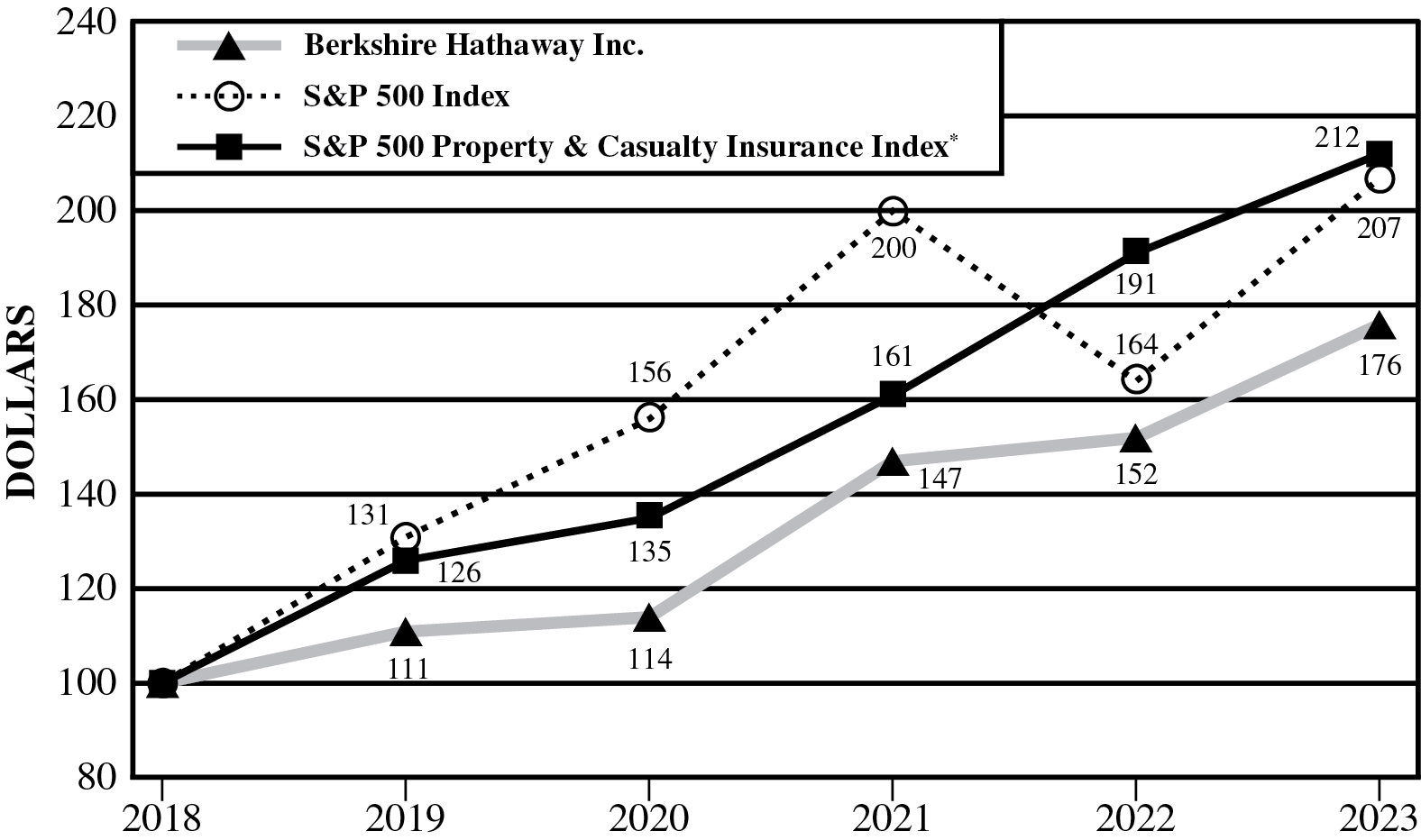
** Cumulative return for the Standard & Poor’s indices based on reinvestment of dividends.*
*** It is difficult to develop a peer group of companies similar to Berkshire. Berkshire owns subsidiaries engaged in a number of diverse business activities of which an important component is the property and casualty insurance business. Accordingly, Berkshire uses the Standard & Poor’s Property & Casualty Insurance Index for comparative purposes.*
Item 6. [Reserved]
K-34
Item 7. Management’s Discussion and Analysis of Financial Condition and Results of Operations
Results of Operations
Net earnings (loss) attributable to Berkshire Hathaway shareholders for each of the past three years are disaggregated in the table that follows. Amounts are after deducting income taxes and exclude earnings attributable to noncontrolling interests (in millions).
| 2023 | 2022 | 2021 | |||||||||
| Insurance – underwriting | $ | 5,428 | $ | (30 | ) | $ | 870 | ||||
| Insurance – investment income | 9,567 | 6,484 | 4,807 | ||||||||
| BNSF | 5,087 | 5,946 | 5,990 | ||||||||
| Berkshire Hathaway Energy (“BHE”) | 2,331 | 3,904 | 3,572 | ||||||||
| Pilot Travel Centers (“PTC”) | 603 | — | — | ||||||||
| Manufacturing, service and retailing | 12,759 | 12,512 | 11,120 | ||||||||
| Non-controlled businesses* | 1,750 | 1,528 | 804 | ||||||||
| Investment and derivative contract gains (losses) | 58,873 | (53,612 | ) | 62,340 | |||||||
| Other | (175 | ) | 509 | 434 | |||||||
| Net earnings (loss) attributable to Berkshire Hathaway shareholders | $ | 96,223 | $ | (22,759 | ) | $ | 89,937 |
——————
** Includes certain businesses in which Berkshire had between a 20% and 50% ownership interest.*
Through our subsidiaries, we engage in numerous diverse business activities. We manage our operating businesses on an unusually decentralized basis. There are few centralized or integrated business functions. Our senior corporate management team participates in and is ultimately responsible for significant capital allocation decisions, investment activities and the selection of the Chief Executive to head each of the operating businesses. The business segment data (Note 26 to the accompanying Consolidated Financial Statements) should be read in conjunction with this discussion.
To varying degrees, our operating businesses have been impacted by government and private sector actions taken to mitigate the adverse economic effects of the COVID-19 virus and its variants, as well as by the development of global geopolitical conflicts, supply chain disruptions and government actions to slow inflation. We cannot reliably predict the future economic effects of these events on our businesses.
Insurance underwriting generated after-tax earnings of $5.4 billion in 2023, losses of $30 million in 2022 and earnings of $870 million in 2021. Earnings in 2023 benefited from relatively low losses from significant catastrophe events during the year and improved underwriting results at GEICO compared to 2022, reflecting the impacts of premium rate increases and lower claims frequencies. Underwriting results in 2022 and 2021 included after-tax losses from significant catastrophe events of approximately $2.4 billion and $2.3 billion, respectively. Underwriting losses in 2022 also reflected accelerating claims costs at GEICO. Earnings from insurance underwriting increased $60 million in 2022 and $142 million in 2021 from amounts previously reported due to the retrospective adoption of ASU 2018-12.
After-tax earnings from insurance investment income increased $3.1 billion (47.5%) in 2023 and $1.7 billion in 2022 (34.9%) compared to corresponding prior years. These increases were primarily attributable to higher short-term interest rates, which resulted in significant increases in earnings from our short-term investments.
After-tax earnings of BNSF declined 14.4% in 2023 compared to 2022 and were relatively unchanged in 2022 compared to 2021. The decrease in 2023 was primarily attributable to lower overall freight volumes and higher non-fuel operating costs, partially offset by lower fuel costs. Results in 2022 reflected higher revenue per car/unit, substantially offset by lower overall freight volumes and higher fuel and other operating costs compared to 2021.
After-tax earnings of our utilities and energy business declined 40.3% in 2023 compared to 2022 and increased 9.3% in 2022 compared to 2021. The earnings decline in 2023 reflected lower earnings from the U.S. regulated utilities, reflecting increased wildfire loss estimates, as well as lower earnings from other energy businesses and real estate brokerage businesses. The increase in 2022 reflected higher earnings from other energy businesses, including tax equity investments and the Northern Powergrid businesses, as well as from the natural gas pipeline businesses, partly offset by lower earnings from the real estate brokerage business.
As disclosed in Note 2 to the accompanying Consolidated Financial Statements, we increased our ownership in PTC from 38.6% to 80% on January 31, 2023 and we began consolidating PTC’s results of operations on February 1, 2023. In 2021 and 2022 and through January 31, 2023, earnings from PTC on our 38.6% interest were determined under the equity method and are included in earnings from non-controlled businesses in the preceding table.
K-35
Management’s Discussion and Analysis
Results of Operations
Earnings from our manufacturing, service and retailing businesses increased 2.0% in 2023 compared to 2022 and 12.5% in 2022 compared to 2021. Earnings in 2023 reflected increases at certain industrial products manufacturers and services businesses and the impact of Alleghany’s non-insurance businesses acquired in 2022, partially offset by lower earnings from several of our other manufacturing businesses, and from certain of our service and retailing businesses. Operating results in 2022 were mixed among our various businesses. While customer demand for products and services was relatively good in 2022, we experienced weakening demand in the second half of the year at certain of our businesses, which continued through 2023.
Investment and derivative contract gains (losses) in each of the three years predominantly derived from our investments in equity securities and included significant net unrealized gains and losses from market price changes. We believe that investment gains and losses on investments in equity securities, whether realized from dispositions or unrealized from changes in market prices, are generally meaningless in understanding our reported periodic results or evaluating the economic performance of our operating businesses. These gains and losses have caused and will continue to cause significant volatility in our periodic earnings. Investment and derivative contract gains (losses) also included an after-tax non-cash remeasurement gain of approximately $2.4 billion in the first quarter of 2023 related to our previously held 38.6% interest in PTC through the application of the acquisition accounting method.
Other earnings included after-tax foreign exchange rate gains of approximately $200 million in 2023, $1.3 billion in 2022 and $1.0 billion in 2021 related to the non-U.S. Dollar denominated debt issued by Berkshire and its U.S.-based finance subsidiary, Berkshire Hathaway Finance Corporation (“BHFC”).
Insurance—Underwriting
Our management views our insurance businesses as possessing two distinct activities – underwriting and investing. Underwriting decisions are the responsibility of the unit managers, while investing decisions are the responsibility of Berkshire’s Chairman and CEO, Warren E. Buffett and Berkshire’s corporate investment managers. Accordingly, we evaluate performance of underwriting operations without any allocation of investment income or investment gains and losses. We consider investment income as an integral component of our aggregate insurance operating results. However, we consider investment gains and losses, whether realized or unrealized, as non-operating. We believe that such gains and losses are not meaningful in understanding the periodic operating results of our insurance businesses.
The timing and magnitude of catastrophe losses can produce sig
Showing the first 8K of 148K characters. Open the full section
Item 7A. Quantitative and Qualitative Disclosures About Market Risk
See “Market Risk Disclosures” contained in Item 7 “Management’s Discussion and Analysis of Financial Condition and Results of Operations.”
Management’s Report on Internal Control Over Financial Reporting
Management of Berkshire Hathaway Inc. is responsible for establishing and maintaining adequate internal control over financial reporting, as such term is defined in the Securities Exchange Act of 1934 Rule 13a-15(f). Under the supervision and with the participation of our management, including our principal executive officer and principal financial officer, we conducted an evaluation of the effectiveness of the Company’s internal control over financial reporting as of December 31, 2023, as required by the Securities Exchange Act of 1934 Rule 13a-15(c). In making this assessment, we used the criteria set forth in the framework in Internal Control—Integrated Framework (2013) issued by the Committee of Sponsoring Organizations of the Treadway Commission. Based on our evaluation under the framework in Internal Control—Integrated Framework (2013), our management concluded that our internal control over financial reporting was effective as of December 31, 2023.
The effectiveness of our internal control over financial reporting as of December 31, 2023 has been audited by Deloitte & Touche LLP, an independent registered public accounting firm, as stated in their report which appears on page K-67.
Berkshire Hathaway Inc.
February 24, 2024
K-66
Item 8. Financial Statements and Supplementary Data
REPORT OF INDEPENDENT REGIST****ERED PUBLIC ACCOUNTING FIRM
To the Shareholders and the Board of Directors of
Berkshire Hathaway Inc.
Opinions on the Financial Statements and Internal Control over Financial Reporting
We have audited the accompanying consolidated balance sheets of Berkshire Hathaway Inc. and subsidiaries (the “Company”) as of December 31, 2023 and 2022, the related consolidated statements of earnings, comprehensive income, changes in shareholders’ equity, and cash flows, for each of the three years in the period ended December 31, 2023, and the related notes (collectively referred to as the “financial statements”). We also have audited the Company’s internal control over financial reporting as of December 31, 2023, based on criteria established in Internal Control — Integrated Framework (2013) issued by the Committee of Sponsoring Organizations of the Treadway Commission (COSO).
In our opinion, the financial statements referred to above present fairly, in all material respects, the financial position of the Company as of December 31, 2023 and 2022, and the results of its operations and its cash flows for each of the three years in the period ended December 31, 2023, in conformity with accounting principles generally accepted in the United States of America. Also, in our opinion, the Company maintained, in all material respects, effective internal control over financial reporting as of December 31, 2023, based on criteria established in Internal Control — Integrated Framework (2013) issued by COSO.
Change in Accounting Principle
As discussed in Note 1 to the financial statements, effective January 1, 2023, the Company adopted Accounting Standards Update 2018-12 Targeted Improvements to the Accounting for Long-Duration Contracts, using the modified retrospective approach.
Basis for Opinions
The Company’s management is responsible for these financial statements, for maintaining effective internal control over financial reporting, and for its assessment of the effectiveness of internal control over financial reporting, included in the accompanying Management’s Report on Internal Control Over Financial Reporting. Our responsibility is to express an opinion on these financial statements and an opinion on the Company’s internal control over financial reporting based on our audits. We are a public accounting firm registered with the Public Company Accounting Oversight Board (United States) (PCAOB) and are required to be independent with respect to the Company in accordance with the U.S. federal securities laws and the applicable rules and regulations of the Securities and Exchange Commission and the PCAOB.
We conducted our audits in accordance with the standards of the PCAOB. Those standards require that we plan and perform the audits to obtain reasonable assurance about whether the financial statements are free of material misstatement, whether due to error or fraud, and whether effective internal control over financial reporting was maintained in all material respects.
Our audits of the financial statements included performing procedures to assess the risks of material misstatement of the financial statements, whether due to error or fraud, and performing procedures to respond to those risks. Such procedures included examining, on a test basis, evidence regarding the amounts and disclosures in the financial statements. Our audits also included evaluating the accounting principles used and significant estimates made by management, as well as evaluating the overall presentation of the financial statements. Our audit of internal control over financial reporting included obtaining an understanding of internal control over financial reporting, assessing the risk that a material weakness exists, and testing and evaluating the design and operating effectiveness of internal control based on the assessed risk. Our audits also included performing such other procedures as we considered necessary in the circumstances. We believe that our audits provide a reasonable basis for our opinions.
Definition and Limitations of Internal Control over Financial Reporting
A company’s internal control over financial reporting is a process designed to provide reasonable assurance regarding the reliability of financial reporting and the preparation of financial statements for external purposes in accordance with generally accepted accounting principles. A company’s internal control over financial reporting includes those policies and procedures that (1) pertain to the maintenance of records that, in reasonable detail, accurately and fairly reflect the transactions and dispositions of the assets of the company; (2) provide reasonable assurance that transactions are recorded as necessary to permit preparation of financial statements in accordance with generally accepted accounting principles, and that receipts and expenditures of the company are being made only in accordance with authorizations of management and directors of the company; and (3) provide reasonable assurance regarding prevention or timely detection of unauthorized acquisition, use, or disposition of the company’s assets that could have a material effect on the financial statements.
K-67
REPORT OF INDEPENDENT REGISTERED PUBLIC ACCOUNTING FIRM (Continued)
Because of its inherent limitations, internal control over financial reporting may not prevent or detect misstatements. Also, projections of any evaluation of effectiveness to future periods are subject to the risk that controls may become inadequate because of changes in conditions, or that the degree of compliance with the policies or procedures may deteriorate.
Critical Audit Matters
The critical audit matters communicated below are matters arising from the current-period audit of the financial statements that were communicated or required to be communicated to the audit committee and that (1) relate to accounts or disclosures that are material to the financial statements and (2) involved our especially challenging, subjective, or complex judgments. The communication of critical audit matters does not alter in any way our opinion on the financial statements, taken as a whole, and we are not, by communicating the critical audit matters below, providing separate opinions on the critical audit matters or on the accounts or disclosures to which they relate.
Unpaid Losses and Loss Adjustment Expenses — Refer to Notes 1 and 16 to the financial statements
Critical Audit Matter Description
The Company’s unpaid losses and loss adjustment expenses (“claim liabilities”) include short duration property and casualty insurance and reinsurance contracts. Key assumptions affecting certain of these claim liabilities include anticipated claims and their severity, expected loss ratios, and expected patterns of paid and incurred losses.
Given the subjectivity of estimating these key assumptions, performing audit procedures to evaluate whether certain of these claim liabilities were appropriately recorded as of December 31, 2023 required a high degree of auditor judgment and an increased extent of effort, including the need to involve our actuarial specialists.
How the Critical Audit Matter Was Addressed in the Audit
Our audit procedures related to the key assumptions affecting certain of these claim liabilities included the following, among others:
We tested the operating effectiveness of controls over claim liabilities, including those over the key assumptions.
We tested the underlying data that served as the basis for the actuarial analysis to evaluate that the inputs to the actuarial estimate were accurate and complete.
With the assistance of our actuarial specialists:
We developed independent estimates of the claim liabilities, including loss data and industry claim development factors as needed, and compared our estimates to management’s estimates.
We compared prior year estimates
Showing the first 8K of 249K characters. Open the full section
Item 9. Changes in and Disagreements with Accountants on Accounting and Financial Disclosure
None
Item 9A. Controls and Procedures
At the end of the period covered by this Annual Report on Form 10-K, the Corporation carried out an evaluation, under the supervision and with the participation of the Corporation’s management, including the Chairman (Chief Executive Officer) and the Senior Vice President (Chief Financial Officer), of the effectiveness of the design and operation of the Corporation’s disclosure controls and procedures pursuant to Exchange Act Rule 13a-15. Based upon that evaluation, the Chairman (Chief Executive Officer) and the Senior Vice President (Chief Financial Officer) concluded that the Corporation’s disclosure controls and procedures are effective in timely alerting them to material information relating to the Corporation (including its consolidated subsidiaries) required to be included in the Corporation’s periodic SEC filings. The report called for by Item 308(a) of Regulation S-K is incorporated herein by reference to Management’s Report on Internal Control Over Financial Reporting, included on page K-66 of this report. The attestation report called for by Item 308(b) of Regulation S-K is incorporated herein by reference to the Report of Independent Registered Public Accounting Firm, included on page K-67 of this report. There has been no change in the Corporation’s internal control over financial reporting during the quarter ended December 31, 2023 that has materially affected, or is reasonably likely to materially affect, the Corporation’s internal control over financial reporting.
Item 9B. Other Information
Berkshire has not adopted a Rule 10b5-1 trading arrangement (as defined in Item 408(a)(1)(i) of Regulation S-K) and no directors or executive officers adopted or terminated a Rule 10b5-1 trading arrangement or a non-Rule 10b5-1 trading arrangement (as defined in Item 408(c) of Regulation S-K) during the fourth quarter of 2023.
Item 9C. Disclosure Regarding Foreign Jurisdictions that Prevent Inspection
Not applicable.
Part III
Except for the information set forth under the caption “Executive Officers of the Registrant” in Part I hereof, information required by this Part (Items 10, 11, 12, 13 and 14) is incorporated by reference from the Registrant’s definitive proxy statement, filed pursuant to Regulation 14A, for the Annual Meeting of Shareholders of the Registrant to be held on May 4, 2024, which will involve the election of directors.
Part IV
Item 15. Exhibits and Financial Statement Schedules
(a) 1. Financial Statements
The following Consolidated Financial Statements, as well as the Report of Independent Registered Public Accounting Firm, are included in Part II Item 8 of this report:
(b) Exhibits
See the “Exhibit Index” at page K-122.
K-118
REPORT OF INDEPENDENT REGIS****TERED PUBLIC ACCOUNTING FIRM
To the Shareholders and the Board of Directors of
Berkshire Hathaway Inc.
Opinion on the Financial Statement Schedule
We have audited the consolidated financial statements of Berkshire Hathaway Inc. and subsidiaries (the “Company”) as of December 31, 2023 and 2022, and for each of the three years in the period ended December 31, 2023, and the Company’s internal control over financial reporting as of December 31, 2023, and have issued our report thereon dated February 24, 2024; such consolidated financial statements and report are included elsewhere in this Form 10-K. Our audits also included the financial statement schedule of the Company listed in the Index at Item 15. This financial statement schedule is the responsibility of the Company’s management. Our responsibility is to express an opinion on the Company’s financial statement schedule based on our audits. In our opinion, such financial statement schedule, when considered in relation to the financial statements taken as a whole, presents fairly, in all material respects, the information set forth therein.
/s/ Deloitte & Touche LLP
Omaha, Nebraska
February 24, 2024
K-119
BERKSHIRE HATHAWAY INC. (Parent Company)
Condensed Financ****ial Information
(Dollars in millions)
Sched****ule I
Balance Sheets
| December 31, | ||||||||
| 2023 | 2022 | |||||||
| Assets: | ||||||||
| Cash and cash equivalents | $ | 5,566 | $ | 2,777 | ||||
| Short-term investments in U.S. Treasury Bills | 16,140 | 17,628 | ||||||
| Investments in and advances to consolidated subsidiaries | 546,566 | 463,094 | ||||||
| Investment in The Kraft Heinz Company | 13,230 | 12,937 | ||||||
| Other assets | 16 | 12 | ||||||
| $ | 581,518 | $ | 496,448 | |||||
| Liabilities and Shareholders’ Equity: | ||||||||
| Accounts payable, accrued interest and other liabilities | $ | 235 | $ | 355 | ||||
| Income taxes, principally deferred | 1,229 | 1,276 | ||||||
| Notes payable and other borrowings | 18,781 | 21,393 | ||||||
| 20,245 | 23,024 | |||||||
| Berkshire Hathaway shareholders’ equity | 561,273 | 473,424 | ||||||
| $ | 581,518 | $ | 496,448 |
Statements of Earnings and Comprehensive Income
| Year ended December 31, | ||||||||||||
| 2023 | 2022 | 2021 | ||||||||||
| Income items: | ||||||||||||
| From consolidated subsidiaries: | ||||||||||||
| Dividends and distributions | $ | 9,717 | $ | 15,724 | $ | 13,462 | ||||||
| Undistributed earnings (losses) | 85,550 | (39,579 | ) | 74,961 | ||||||||
| 95,267 | (23,855 | ) | 88,423 | |||||||||
| Investment gains (losses) | (7 | ) | (34 | ) | 35 | |||||||
| Equity in earnings of The Kraft Heinz Company | 758 | 628 | 269 | |||||||||
| Other income | 906 | 413 | 73 | |||||||||
| 96,924 | (22,848 | ) | 88,800 | |||||||||
| Cost and expense items: | ||||||||||||
| General and administrative | 244 | 131 | 136 | |||||||||
| Interest expense | 636 | 513 | 444 | |||||||||
| Foreign exchange gains on non-U.S. Dollar denominated debt | (371 | ) | (1,401 | ) | (1,281 | ) | ||||||
| Income tax expense (benefit) | 192 | 668 | (436 | ) | ||||||||
| 701 | (89 | ) | (1,137 | ) | ||||||||
| Net earnings (loss) attributable to Berkshire Hathaway shareholders | 96,223 | (22,759 | ) | 89,937 | ||||||||
| Other comprehensive income attributable to Berkshire Hathaway shareholders | 1,289 | 3,071 | 1,871 | |||||||||
| Comprehensive income attributable to Berkshire Hathaway shareholders | $ | 97,512 | $ | (19,688 | ) | $ | 91,808 |
See Note to Condensed Financial Information
K-120
BERKSHIRE HATHAWAY INC. (Parent Company)
Condensed Financial Information
(Dollars in millions)
Schedule I (continued)
Statements of Cash Flows
| Year ended December 31, | ||||||||||||
| 2023 | 2022 | 2021 | ||||||||||
| Cash flows from operating activities: | ||||||||||||
| Net earnings (loss) attributable to Berkshire Hathaway shareholders | $ | 96,223 | $ | (22,759 | ) | $ | 89,937 | |||||
| Adjustments to reconcile net earnings (loss) to operating cash flows: | ||||||||||||
| Investment (gains) losses | 7 | 34 | (35 | ) | ||||||||
| Undistributed (earnings) losses of consolidated subsidiaries | (85,550 | ) | 39,579 | (74,961 | ) | |||||||
| Non-cash dividends from subsidiaries | (1,811 | ) | (7,220 | ) | (2,126 | ) | ||||||
| Income taxes payable | (44 | ) | 661 | (389 | ) | |||||||
| Other | (1,214 | ) | (1,833 | ) | (1,038 | ) | ||||||
| Net cash flows from operating activities | 7,611 | 8,462 | 11,388 | |||||||||
| Cash flows from investing activities: | ||||||||||||
| Investments in and advances to consolidated subsidiaries, net | 2,649 | (11,852 | ) | (174 | ) | |||||||
| Purchases of U.S. Treasury Bills | (27,278 | ) | (44,187 | ) | (34,988 | ) | ||||||
| Sales and maturities of U.S. Treasury Bills | 31,234 | 37,915 | 57,296 | |||||||||
| Other | — | 128 | — | |||||||||
| Net cash flows from investing activities | 6,605 | (17,996 | ) | 22,134 | ||||||||
| Cash flows from financing activities: | ||||||||||||
| Proceeds from borrowings | 2,054 | 1,970 | 2,174 | |||||||||
| Repayments of borrowings | (4,310 | ) | (602 | ) | (2,167 | ) | ||||||
| Acquisition of treasury stock | (9,171 | ) | (7,854 | ) | (27,061 | ) | ||||||
| Net cash flows from financing activities | (11,427 | ) | (6,486 | ) | (27,054 | ) | ||||||
| Increase (decrease) in cash and cash equivalents | 2,789 | (16,020 | ) | 6,468 | ||||||||
| Cash and cash equivalents at the beginning of the year | 2,777 | 18,797 | 12,329 | |||||||||
| Cash and cash equivalents at the end of the year | $ | 5,566 | $ | 2,777 | $ | 18,797 | ||||||
| Other cash flow information: | ||||||||||||
| Income taxes paid | $ | 5,630 | $ | 2,259 | $ | 3,403 | ||||||
| Interest paid | 297 | 332 | 377 |
Note to Condensed Financial Information
Certain 2022 and 2021 amounts were revised for the adoption of Accounting Standards Update 2018-12 “Targeted Improvements to the Accounting for Long-Duration Contracts.” See Note 1(w) to the Consolidated Financial Statements.
As of December 31, 2023, Berkshire owned 26.7% of the outstanding shares of The Kraft Heinz Company (“Kraft Heinz”) common stock, which is accounted for pursuant to the equity method. See Note 5 to the Consolidated Financial Statements. On October 19, 2022, Berkshire acquired all of the outstanding common stock of Alleghany Corporation for $11.5 billion. See Note 2 to the Consolidated Financial Statements.
During 2023, the Parent Company repaid approximately $4.3 billion of maturing senior notes and issued ¥286.4 billion (approximately $2.05 billion) of senior notes with a weighted average interest rate of 1.15% and maturities ranging from 2026 to 2058. As of December 31, 2023, the Parent Company’s non-U.S. Dollar denominated borrowings included €5.6 billion and ¥1,259 billion par value senior notes. The gains and losses from the periodic remeasurement of these non-U.S. Dollar denominated notes due to changes in foreign currency exchange rates are included in earnings.
Parent Company debt maturities over the next five years are as follows: 2024—$1.9 billion; 2025—$2.0 billion; 2026—$4.4 billion; 2027—$2.0 billion and 2028—$1.4 billion. The Parent Company guarantees certain debt of subsidiaries, which aggregated approximately $20.9 billion at December 31, 2023 and primarily consisted of debt issued by Berkshire Hathaway Finance Corporation. Such guarantees are an absolute, unconditional and irrevocable guarantee for the full and prompt payment when due of all present and future payment obligations. The Parent Company has also provided guarantees in connection with certain retroactive reinsurance contracts issued by subsidiaries. The amounts of subsidiary payments under these contracts, if any, are contingent upon the outcome of future events.
K-121
EXHIBIT INDEX
K-122
| Exhibit No. | ||
| 31.1 | Rule 13a—14(a)/15d-14(a) Certification | |
| 31.2 | Rule 13a—14(a)/15d-14(a) Certification | |
| 32.1 | Section 1350 Certification | |
| 32.2 | Section 1350 Certification | |
| 95 | Mine Safety Disclosures | |
| 97 | Policy Relating to Recovery of Erroneously Awarded Compensation | |
| 101 | The following financial information from Berkshire Hathaway Inc.’s Annual Report on Form 10-K for the year ended December 31, 2023, formatted in iXBRL (Inline Extensible Business Reporting Language) includes: (i) the Cover Page (ii) the Consolidated Balance Sheets, (iii) the Consolidated Statements of Earnings, (iv) the Consolidated Statements of Comprehensive Income, (v) the Consolidated Statements of Changes in Shareholders’ Equity, (vi) the Consolidated Statements of Cash Flows, and (vii) the Notes to Consolidated Financial Statements and Schedule I, tagged in summary and detail. | |
| 104 | Cover Page Interactive Data File (formatted as iXBRL and contained in Exhibit 101) |
K-123
SIGNAT****URES
Pursuant to the requirements of Section 13 or 15(d) of the Securities Exchange Act of 1934, the Registrant has duly caused this report to be signed on its behalf by the undersigned thereunto duly authorized.
| BERKSHIRE HATHAWAY INC. | |
| Date: February 24, 2024 | /S/ MARC D. HAMBURG |
| Marc D. Hamburg Senior Vice President and Principal Financial Officer |
Pursuant to the requirements of the Securities Exchange Act of 1934, this report has been signed below by the following persons on behalf of the Registrant and in the capacities and on the dates indicated.
| /S/ WARREN E. BUFFETT Warren E. Buffett | Chairman of the Board of Directors—Chief Executive Officer | February 24, 2024 Date |
| /S/ GREGORY E. ABEL Gregory E. Abel | Director—Vice Chairman—Non-Insurance Operations | February 24, 2024 Date |
| /S/ HOWARD G. BUFFETT Howard G. Buffett | Director | February 24, 2024 Date |
| /S/ SUSAN A. BUFFETT Susan A. Buffett | Director | February 24, 2024 Date |
| /S/ STEPHEN B. BURKE Stephen B. Burke | Director | February 24, 2024 Date |
| /S/ KENNETH I. CHENAULT Kenneth I. Chenault | Director | February 24, 2024 Date |
| /S/ CHRISTOPHER C. DAVIS Christopher C. Davis | Director | February 24, 2024 Date |
| /S/ SUSAN L. DECKER Susan L. Decker | Director | February 24, 2024 Date |
| /S/ CHARLOTTE GUYMAN Charlotte Guyman | Director | February 24, 2024 Date |
| /S/ AJIT JAIN Ajit Jain | Director—Vice Chairman—Insurance Operations | February 24, 2024 Date |
| /S/ THOMAS S. MURPHY, JR. Thomas S. Murphy, Jr. | Director | February 24, 2024 Date |
| /S/ RONALD L. OLSON Ronald L. Olson | Director | February 24, 2024 Date |
| /S/ WALLACE R. WEITZ Wallace R. Weitz | Director | February 24, 2024 Date |
| /S/ MERYL B. WITMER Meryl B. Witmer | Director | February 24, 2024 Date |
| /S/ MARC D. HAMBURG Marc D. Hamburg | Senior Vice President—Principal Financial Officer | February 24, 2024 Date |
| /S/ DANIEL J. JAKSICH Daniel J. Jaksich | Vice President—Principal Accounting Officer | February 24, 2024 Date |
K-124