 filings.tools
Item 1. . Business
88K characters. Original on sec.gov · Markdown
Item 1. . Business
General
BXP, a Delaware corporation organized in 1997, is a fully integrated, self-administered and self-managed real estate investment trust, or “REIT,” and the largest publicly-traded office REIT (based on total market capitalization) as of December 31, 2019 in the United States that develops, owns and manages primarily Class A office properties.
Our properties are concentrated in five markets—Boston, Los Angeles, New York, San Francisco and Washington, DC. At December 31, 2019, we owned or had interests in 196 commercial real estate properties, aggregating approximately 52.0 million net rentable square feet of primarily Class A office properties, including 11 properties under construction/redevelopment totaling approximately 5.5 million net rentable square feet. As of December 31, 2019 our properties consisted of:
| • | 177 office properties (including nine properties under construction/redevelopment); |
| • | twelve retail properties; |
| • | six residential properties (including two properties under construction); and |
| • | one hotel. |
We consider Class A office properties to be well-located buildings that are professionally managed and maintained, attract high-quality tenants and command upper-tier rental rates, and that are modern structures or have been modernized to compete with newer buildings. Our definition of Class A office properties may be different than those used by other companies.
We are a full-service real estate company, with substantial in-house expertise and resources in acquisitions, development, financing, capital markets, construction management, property management, marketing, leasing, accounting, risk management, tax and legal services. BXP manages BPLP as its sole general partner. As of December 31, 2019, we had approximately 760 employees. Our 35 senior officers have an average of 32 years of experience in the real estate industry, including an average of 21 years of experience with us. Our principal executive office and Boston regional office are located at The Prudential Center, 800 Boylston Street, Suite 1900, Boston, Massachusetts 02199 and our telephone number is (617) 236-3300. In addition, we have regional offices at 2400 Broadway, Suite 510, Santa Monica, California 90404, 599 Lexington Avenue, New York, New York 10022, Four Embarcadero Center, San Francisco, California 94111 and 2200 Pennsylvania Avenue NW, Washington, DC 20037.
Our internet address is http://www.bxp.com. On our website, you can obtain free copies of our annual reports on Form 10-K, quarterly reports on Form 10-Q, current reports on Form 8-K, and amendments to those reports filed or furnished pursuant to Section 13(a) or 15(d) of the Securities Exchange Act of 1934, as amended, as soon as reasonably practicable after we electronically file such material with, or furnish it to, the Securities and Exchange Commission, or the SEC. You may also obtain BXP’s and BPLP’s reports by accessing the EDGAR database at the SEC’s website at http://www.sec.gov, or we will furnish an electronic or paper copy of these reports free of charge upon written request to: Investor Relations, Boston Properties, Inc., Prudential Center, 800 Boylston Street, Suite 1900, Boston, Massachusetts 02199. “Boston Properties” is a registered trademark and the “bxp” logo is a trademark, in both cases, of BPLP.
Boston Properties Limited Partnership
BPLP is a Delaware limited partnership organized in 1997, and the entity through which BXP conducts substantially all of its business and owns, either directly or through subsidiaries, substantially all of its assets. BXP is the sole general partner of BPLP and, as of February 21, 2020, the owner of approximately 89.6% of the economic interests in BPLP. Economic interest was calculated as the number of common partnership units of BPLP owned by BXP as a percentage of the sum of (1) the actual aggregate number of outstanding common partnership units of BPLP, (2) the number of common units issuable upon conversion of all outstanding long term incentive plan units of BPLP, or LTIP Units, other than LTIP Units issued in the form of Multi-Year Long-Term Incentive Plan Awards (“MYLTIP Awards”) that remain subject to performance conditions, assuming all conditions have been met for the conversion of the LTIP Units, (3) the 2012 Outperformance Awards that were issued in the form of LTIP Units and earned as of February 6, 2015 (the “2012 OPP Units”), (4) the 2013 MYLTIP Units that were issued in the form of LTIP Units and earned as of February 4, 2016 (the “2013 MYLTIP Units”), (5) the 2014 MYLTIP Units that were issued in the form of LTIP Units and earned as of February 3, 2017 (the “2014 MYLTIP Units”), (6)
the 2015 MYLTIP Units that were issued in the form of LTIP Units and earned as of February 4, 2018 (the “2015 MYLTIP Units”), (7) the 2016 MYLTIP Units that were issued in the form of LTIP Units and earned as of February 9, 2019 (the “2016 MYLTIP Units”) and (8) the 2017 MYLTIP Units that were issued in the form of LTIP Units and earned as of February 6, 2020 (the “2017 MYLTIP Units”). An LTIP Unit is generally the economic equivalent of a share of BXP’s restricted common stock, although LTIP Units issued in the form of MYLTIP Awards are only entitled to receive one-tenth (1/10th) of the regular quarterly distributions (and no special distributions) prior to being earned. BXP’s general and limited partnership interests in BPLP entitles BXP to share in cash distributions from, and in the profits and losses of, BPLP in proportion to BXP’s percentage interest and entitles BXP to vote on all matters requiring a vote of the limited partners.
Preferred units of BPLP have the rights, preferences and other privileges set forth in an amendment to the limited partnership agreement of BPLP. As of December 31, 2019 and February 21, 2020, BPLP had one series of Preferred Units outstanding consisting of 80,000 Series B Preferred Units. The Series B Preferred Units have a liquidation preference of $2,500 per share (or an aggregate of approximately $193.6 million at December 31, 2019 and February 21, 2020, after deducting the underwriting discount and transaction expenses). The Series B Preferred Units were issued by BPLP on March 27, 2013 in connection with BXP’s issuance of 80,000 shares (8,000,000 depositary shares each representing 1/100th of a share) of 5.25% Series B Cumulative Redeemable Preferred Stock (the “Series B Preferred Stock”). BXP contributed the net proceeds from the offering to BPLP in exchange for Series B Preferred Units having rights, performance and privileges generally mirroring those of the Series B Preferred Stock. BXP will pay cumulative cash dividends on the Series B Preferred Stock at a rate of 5.25% per annum of the $2,500 liquidation preference per share. On and after March 27, 2018, BXP, at its option, may redeem the Series B Preferred Stock for a cash redemption price of $2,500 per share, plus all accrued and unpaid dividends. The Series B Preferred Stock is not redeemable by the holders, has no maturity date and is not convertible into any other security of the Company or its affiliates.
Transactions During 2019
Dispositions/Impairments
For information explaining why BXP and BPLP may report different gains on sales of real estate or impairment losses, see the Explanatory Note that follows the cover page of this Annual Report on Form 10-K.
On January 24, 2019, we completed the sale of our 2600 Tower Oaks Boulevard property located in Rockville, Maryland for a gross sale price of approximately $22.7 million. Net cash proceeds totaled approximately $21.4 million, resulting in a loss on sale of real estate totaling approximately $0.6 million. We recognized an impairment loss totaling approximately $3.1 million for BXP and approximately $1.5 million for BPLP during the year ended December 31, 2018. 2600 Tower Oaks Boulevard is an approximately 179,000 net rentable square foot Class A office property.
At March 31, 2019, we evaluated the expected hold period of our One Tower Center property located in East Brunswick, New Jersey and, based on a shorter-than-expected hold period, we reduced the carrying value of the property to its estimated fair value at March 31, 2019 and recognized an impairment loss totaling approximately $24.0 million for BXP and approximately $22.3 million for BPLP. Our estimated fair value was based on a pending offer from a third party to acquire the property and the subsequent execution of a purchase and sale agreement on April 18, 2019 for a gross sale price of $38.0 million. On June 3, 2019, we completed the sale of the property. Net cash proceeds totaled approximately $36.6 million, resulting in a loss on sale of real estate totaling approximately $0.8 million. One Tower Center is an approximately 410,000 net rentable square foot Class A office property.
On June 28, 2019, we completed the sale of our 164 Lexington Road property located in Billerica, Massachusetts for a gross sale price of $4.0 million. Net cash proceeds totaled approximately $3.8 million, resulting in a gain on sale of real estate totaling approximately $2.5 million for BXP and approximately $2.6 million for BPLP. 164 Lexington Road is an approximately 64,000 net rentable square foot Class A office property.
On September 20, 2019, we entered into a joint venture with Canada Pension Plan Investment Board (“CPPIB”) to develop Platform 16 located in San Jose, California. Platform 16 consists of a 65-year ground lease for land totaling approximately 5.6 acres that will support the development of approximately 1.1 million square feet of commercial office space. During 2018, we entered into the ground lease, which provides for the right to purchase all of the land during a 12-month period commencing February 1, 2020 at a purchase price of approximately $134.8 million. We contributed the ground lease interest and improvements totaling approximately $28.2 million for our initial 55% interest in the joint venture. CPPIB contributed cash totaling approximately $23.1
million for its initial 45% interest in the joint venture. Upon the CPPIB contribution, we ceased accounting for the joint venture entity on a consolidated basis and are accounting for the joint venture entity on an unconsolidated basis using the equity method of accounting, as we have reduced our ownership interest and no longer have a controlling financial or operating interest in the joint venture entity. We did not recognize a gain on the retained or sold interest in the real estate contributed to the joint venture, as the fair value of the real estate approximated its carrying value (See “Ground Leases” and “Investments in Unconsolidated Joint Ventures” below as well as Note 19 to the Consolidated Financial Statements).
On December 20, 2019, we completed the sale of the remaining parcel of land at our Washingtonian North property located in Gaithersburg, Maryland for a gross sale price of approximately $7.8 million. Net cash proceeds totaled approximately $7.3 million, resulting in a loss on sale of real estate totaling approximately $0.1 million. We recognized an impairment loss totaling approximately $1.8 million during the year ended December 31, 2016.
Developments/Redevelopments
As of December 31, 2019, we had 11 properties under construction/redevelopment comprised of nine office properties and two residential properties, which we expect will total approximately 5.5 million net rentable square feet. We estimate the total investment to complete these projects, in the aggregate, is approximately $3.1 billion, of which approximately $1.4 billion remains to be invested as of December 31, 2019. Approximately 76% of the commercial space in these development projects was pre-leased as of February 21, 2020. For a detailed list of the properties under construction/redevelopment see “Liquidity and Capital Resources” within “Item 7—Management’s Discussion and Analysis of Financial Condition and Results of Operations.”
On May 9, 2019, we entered into a 15-year lease with Google, LLC for approximately 379,000 net rentable square feet of Class A office space in a build-to-suit development project located at our 325 Main Street property at Kendall Center in Cambridge, Massachusetts. 325 Main Street consisted of an approximately 115,000 net rentable square foot Class A office property that was demolished and is being developed into an approximately 420,000 net rentable square foot Class A office property, including approximately 41,000 net rentable square feet of retail space. On May 9, 2019, we commenced development of the project. BXP and BPLP recognized approximately $9.9 million and $9.5 million, respectively, of depreciation expense associated with the acceleration of depreciation on the assets being removed from service and demolished as part of the redevelopment of the property.
On June 1, 2019, we partially placed in-service 20 CityPoint, a Class A office project with approximately 211,000 net rentable square feet located in Waltham, Massachusetts.
On September 30, 2019, we commenced the redevelopment of 200 West Street, a Class A office project with approximately 261,000 net rentable square feet located in Waltham, Massachusetts. The redevelopment is a conversion of a 126,000 square foot portion of the property to laboratory space.
On October 24, 2019, we completed and placed in-service 145 Broadway, a build-to-suit Class A office project with approximately 483,000 net rentable square feet located in Cambridge, Massachusetts.
Ground Leases
On January 24, 2019, the ground lessor under our 65-year ground lease for land totaling approximately 5.6 acres at Platform 16 located in San Jose, California made available for lease to us the remaining land parcels. As a result, we recognized the remaining portion of the right of use finance lease asset and finance lease liability. We entered into the ground lease in 2018, however, at the inception of the ground lease only a portion of the land was available for lease from the lessor, resulting in us recognizing only a portion of the ground lease. In the aggregate, the land will support the development of approximately 1.1 million square feet of commercial office space. The ground lease provides us with the right to purchase all of the land during a 12-month period commencing February 1, 2020 at a purchase price of approximately $134.8 million. We were reasonably certain we would exercise the option to purchase the land and as a result, we have concluded that the lease should be accounted for as a finance lease. As a result, we recorded an approximately $122.6 million right of use asset - finance lease and a lease liability - finance lease on our Consolidated Balance Sheets reflecting the remaining land parcels made available for lease to us (See “Dispositions/Impairments” above and “Investments in Unconsolidated Joint Ventures” below, as well as Note 19 to the Consolidated Financial Statements).
On July 16, 2019, we executed a 75-year ground lease with The George Washington University for land parcels at 2100 Pennsylvania Avenue located in Washington, DC and commenced development of an approximately 470,000 net rentable square foot Class A office property pursuant to a development agreement that we entered into with The George Washington University in 2016. The development agreement provided for the execution of the ground lease upon completion of the entitlement process and relocation of existing tenants. Also in 2016, we made a deposit of $15.0 million that, upon execution of the ground lease, is credited against ground rent payable under the ground lease. The present value of the lease payments exceeds substantially all of the fair value of the underlying asset and as a result, we have concluded that the ground lease should be accounted for as a finance lease. As a result, we recorded an approximately $185.1 million right of use asset - finance lease and an approximately $165.0 million lease liability - finance lease on our Consolidated Balance Sheets.
Acquisitions
On January 10, 2019, we acquired land parcels at our Carnegie Center property located in Princeton, New Jersey for a gross purchase price of approximately $51.5 million, which includes an aggregate of approximately $8.6 million of additional amounts that are payable in the future to the seller upon the development or sale of each of the parcels. The land parcels could support approximately 1.7 million square feet of development.
On August 27, 2019, we acquired 880 and 890 Winter Street located in Waltham, Massachusetts for a gross purchase price of approximately $106.0 million in cash. 880 and 890 Winter Street consists of two Class A office properties aggregating approximately 392,000 net rentable square feet.
Mortgage Notes Payable
On December 19, 2019, we used available cash to repay the bond financing collateralized by our New Dominion Technology Park, Building One property totaling approximately $26.5 million. The bond financing bore interest at a weighted-average fixed rate of approximately 7.69% per annum and was scheduled to mature on January 15, 2021. We recognized a loss from early extinguishment of debt totaling approximately $1.5 million, which amount included the payment of a prepayment penalty totaling approximately $1.4 million. New Dominion Technology Park, Building One is an approximately 235,000 net rentable square foot Class A office property located in Herndon, Virginia (See Note 19 to the Consolidated Financial Statements).
Unsecured Debt Transactions
On June 21, 2019, BPLP completed a public offering of $850.0 million in aggregate principal amount of its 3.400% unsecured senior notes due 2029. The notes were priced at 99.815% of the principal amount to yield an effective rate (including financing fees) of approximately 3.505% per annum to maturity. The notes will mature on June 21, 2029, unless earlier redeemed. The aggregate net proceeds from the offering were approximately $841.4 million after deducting underwriting discounts and transaction expenses.
On September 3, 2019, BPLP completed a public offering of $700.0 million in aggregate principal amount of its 2.900% unsecured senior notes due 2030. The notes were priced at 99.954% of the principal amount to yield an effective rate (including financing fees) of approximately 2.984% per annum to maturity. The notes will mature on March 15, 2030, unless earlier redeemed. The aggregate net proceeds from the offering were approximately $693.8 million after deducting underwriting discounts and transaction expenses.
On September 18, 2019, BPLP completed the redemption of $700.0 million in aggregate principal amount of its 5.625% senior notes due November 15, 2020. The redemption price was approximately $740.7 million. The redemption price included approximately $13.5 million of accrued and unpaid interest to, but not including, the redemption date. Excluding the accrued and unpaid interest, the redemption price was approximately 103.90% of the principal amount being redeemed. We recognized a loss from early extinguishment of debt totaling approximately $28.0 million, which amount included the payment of the redemption premium totaling approximately $27.3 million.
Equity Transactions
During the year ended December 31, 2019, BXP acquired an aggregate of 144,481 common units of limited partnership interest, including 92,678 common units issued upon the conversion of LTIP Units, 2012 OPP Units, 2013 MYLTIP Units, 2014 MYLTIP Units and 2016 MYLTIP Units presented by the holders for redemption, in exchange for an equal number of shares of BXP common stock.
During the year ended December 31, 2019, BXP issued 145,088 shares of common stock upon the exercise of options to purchase common stock.
Investments in Unconsolidated Joint Ventures
On January 24, 2019, a joint venture in which we have a 50% interest extended the loan collateralized by its Annapolis Junction Building Six property. At the time of the extension, the outstanding balance of the loan totaled approximately $13.0 million and was scheduled to mature on November 17, 2019, with a one-year extension option, subject to certain conditions. The extended loan has a total commitment amount of approximately $14.3 million, bears interest at a variable rate equal to LIBOR plus 2.00% per annum and matures on November 17, 2020. Annapolis Junction Building Six is a Class A office property with approximately 119,000 net rentable square feet located in Annapolis, Maryland.
On April 26, 2019, a joint venture in which we have a 50% interest obtained construction financing with a total commitment of $255.0 million collateralized by its 7750 Wisconsin Avenue development project located in Bethesda, Maryland. The construction financing bears interest at a variable rate equal to LIBOR plus 1.25% per annum and matures on April 26, 2023, with two, one-year extension options, subject to certain conditions. As of December 31, 2019, approximately $64.5 million has been drawn under the loan. 7750 Wisconsin Avenue is a 734,000 net rentable square foot build-to-suit Class A office project and below-grade parking garage.
On May 28, 2019, joint ventures in which we have a 50% interest and that own The Hub on Causeway - Podium and 100 Causeway Street development projects entered into an infrastructure development assistance agreement (the “IDAA”) with the Commonwealth of Massachusetts and the City of Boston. Per the IDAA, The Hub on Causeway - Podium development project would be reimbursed for certain costs of public infrastructure improvements using the proceeds of up to $30.0 million in aggregate principal amount of municipal bonds issued by the Commonwealth of Massachusetts. On September 16, 2019, the joint venture received the full reimbursement of costs for the public infrastructure improvements totaling approximately $28.8 million, which has been reflected as a reduction to the carrying value of the real estate of The Hub on Causeway - Podium property. The construction loan agreement for The Hub on Causeway - Podium was modified to require the joint venture to pay down the construction loan principal balance using the proceeds received from the reimbursement of costs of the public infrastructure improvements and on September 16, 2019, the joint venture that owns The Hub on Causeway - Podium development project paid down the construction loan principal balance in the amount of approximately $28.8 million. On November 22, 2019, the joint venture that owns The Hub on Causeway - Podium development project completed and fully placed in-service The Hub on Causeway - Podium development project, an approximately 382,000 net rentable square foot project containing retail and office space located in Boston, Massachusetts.
On June 27, 2019, a joint venture in which we have a 60% interest completed the sale of 540 Madison Avenue in New York City for a gross sale price of approximately $310.3 million, including the assumption by the buyer of the mortgage loan collateralized by the property totaling $120.0 million. The mortgage loan bore interest at a variable rate equal to LIBOR plus 1.10% per annum and was scheduled to mature on June 5, 2023. Net cash proceeds totaled approximately $178.7 million, of which our share was approximately $107.1 million, after the payment of transaction costs. During 2008, we recognized an other-than-temporary impairment loss on our investment in the unconsolidated joint venture. As a result, we recognized a gain on sale of real estate totaling approximately $47.2 million, which is included in Income from Unconsolidated Joint Ventures in the accompanying Consolidated Statements of Operations. 540 Madison Avenue is an approximately 284,000 net rentable square foot Class A office property.
On September 5, 2019, a joint venture in which we have a 50% interest obtained construction financing with a total commitment of $400.0 million collateralized by its 100 Causeway Street development project located in Boston, Massachusetts. The construction financing bears interest at a variable rate equal to LIBOR plus 1.50% per annum (LIBOR plus 1.375% per annum upon stabilization, as defined in the loan agreement) and matures on September 5, 2023, with two, one-year extension options, subject to certain conditions. As of December 31, 2019, approximately $81.1 million has been drawn under the loan. 100 Causeway Street is an approximately 632,000 net rentable square foot Class A office project.
On September 20, 2019, we entered into a joint venture with CPPIB to develop Platform 16 located in San Jose, California. Platform 16 consists of a 65-year ground lease for land totaling approximately 5.6 acres that will support the development of approximately 1.1 million square feet of commercial office space. We contributed the ground lease interest and improvements totaling approximately $28.2 million for our initial 55% interest in the joint
venture. CPPIB contributed cash totaling approximately $23.1 million for its initial 45% interest in the joint venture. We will provide customary development, property management and leasing services to the joint venture (See “Dispositions/Impairments” and “Ground Leases” above as well as Note 19 to the Consolidated Financial Statements).
On October 1, 2019, a joint venture in which we have a 50% interest partially placed in-service Dock 72, a Class A office project with approximately 670,000 net rentable square feet located in Brooklyn, New York.
On October 1, 2019, a joint venture in which we have a 50% interest partially placed in-service Hub50House, an approximately 320,000 square foot project comprised of 440 residential units located in Boston, Massachusetts.
On December 6, 2019, a joint venture in which we have a 50% interest extended the mortgage loan collateralized by Annapolis Junction Building Seven and Building Eight. At the time of the extension, the outstanding balance of the loan totaled approximately $34.8 million, bore interest at a variable rate equal to LIBOR plus 2.35% per annum and was scheduled to mature on December 7, 2019, with three, one-year extension options, subject to certain conditions. The extended loan matures on March 6, 2020. Annapolis Junction Building Seven and Building Eight are Class A office properties with approximately 127,000 and 126,000 net rentable square feet, respectively, located in Annapolis, Maryland.
Noncontrolling Interest
On April 1, 2019, we completed the acquisition of our partner’s 5% ownership interest and promoted profits interest in the consolidated entity that owns Salesforce Tower for cash totaling approximately $210.9 million, which amount was reduced by approximately $24.1 million to $186.8 million to reflect the repayment of our preferred equity and preferred return in the venture (See Note 10 to the Consolidated Financial Statements). Salesforce Tower is located in San Francisco, California. We now own 100% of Salesforce Tower. We have accounted for the transaction as an equity transaction for financial reporting purposes and have reflected the difference between the fair value of the total consideration paid and the related carrying value of the noncontrolling interest - property partnership totaling approximately $162.5 million as a decrease to Additional Paid-in Capital and Partners’ Capital in the Consolidated Balance Sheets of BXP and BPLP, respectively.
Stock Option and Incentive Plan
On February 5, 2019, BXP’s Compensation Committee approved a new equity-based, multi-year, long-term incentive program (the “2019 MYLTIP”) as a performance-based component of our overall compensation program. Under the Financial Accounting Standards Board’s Accounting Standards Codification (“ASC”) 718 “Compensation - Stock Compensation,” the 2019 MYLTIP has an aggregate value of approximately $13.5 million, which amount will generally be amortized into earnings over the four-year plan period under the graded vesting method (See Note 16 to the Consolidated Financial Statements).
On February 9, 2019, the measurement period for our 2016 MYLTIP awards ended and, based on BXP’s relative TSR performance, the final awards were determined to be 69.5% of target or an aggregate of approximately $13.6 million (after giving effect to employee separations). As a result, an aggregate of 364,980 2016 MYLTIP Units that had been previously granted were automatically forfeited.
Business and Growth Strategies
Business Strategies
Our primary business objective is to maximize return on investment to provide our investors with the greatest possible total return in all points of the economic cycle. Our strategies to achieve this objective are:
| • | to target a few carefully selected geographic markets—Boston, Los Angeles, New York, San Francisco and Washington, DC—and to be one of the leading, if not the leading, developers, owners and managers in each of those markets with a full-service office in each market providing property management, leasing, development, construction and legal expertise. We select markets and submarkets with a diverse economic base and a deep pool of prospective tenants in various industries and where tenants have demonstrated a preference for high-quality office buildings and other facilities. Additionally, our markets have historically been able to recruit new talent to them and as such created job growth that results in growth in rental rates and occupancy over time. We have explored, and may continue to explore for future investment, select domestic and international markets that exhibit these same traits; |
| • | to emphasize markets and submarkets within those markets where the difficulty of receiving the necessary approvals for development and the necessary financing constitute high barriers to the creation of new supply, and where skill, financial strength and diligence are required to successfully develop, finance and manage high-quality office, research and development space, as well as selected retail and residential space; |
| • | to take on complex, technically challenging development projects, leveraging the skills of our management team to successfully develop, acquire or reposition properties that other organizations may not have the capacity or resources to pursue; |
| • | to own and develop high-quality real estate designed to meet the demands of today’s tenants who require sophisticated telecommunications and related infrastructure, support services, sustainable features and amenities, and to manage those facilities so as to become the landlord of choice for both existing and prospective clients; |
| • | to opportunistically acquire assets that increase our market share in the markets in which we have chosen to concentrate, as well as potential new markets, which exhibit an opportunity to improve returns through repositioning (through a combination of capital improvements and shift in marketing strategy), changes in management focus and leasing; |
| • | to explore joint venture opportunities with existing property owners located in desirable locations, who seek to benefit from the depth of development and management expertise we are able to provide and our access to capital, and/or to explore joint venture opportunities with strategic institutional partners, leveraging our skills as developers, owners and managers of Class A office space and mixed-use complexes; |
| • | to pursue on a selective basis the sale of properties or interests therein, including core properties, to either (1) take advantage of the demand for our premier properties and realize the value we have created or (2) pare from our portfolio properties that we believe have slower future growth potential; |
| • | to seek third-party development contracts to enable us to retain and utilize our existing development and construction management staff, especially when our internal development is less active or when new development is less-warranted due to market conditions; and |
| • | to enhance our capital structure through our access to a variety of sources of capital and proactively manage our debt expirations. In the current economic climate with relatively low interest rates we have and will continue to attempt to lower the cost of our debt capital and seek opportunities to lock in such low rates through early debt repayment, refinancings and interest rate hedges. |
Growth Strategies
External Growth Strategies
We believe that our development experience, our organizational depth and our balance sheet position us to continue to selectively develop a range of property types, including high-rise urban developments, mixed-use developments (including office, residential and retail), low-rise suburban office properties and research and laboratory space, within budget and on schedule. We believe we are also well positioned to achieve external growth through acquisitions. Other factors that contribute to our competitive position include:
| • | our control of sites (including sites under contract or option to acquire) in our markets that could support approximately 15.5 million additional square feet of new office, retail and residential development; |
| • | our reputation gained through 50 years of successful operations and the stability and strength of our existing portfolio of properties; |
| • | our relationships with leading national corporations, universities and public institutions, including government agencies, seeking new facilities and development services; |
| • | our relationships with nationally recognized financial institutions that provide capital to the real estate industry; |
| • | our track record and reputation for executing acquisitions efficiently provide comfort to domestic and foreign institutions, private investors and corporations who seek to sell commercial real estate in our market areas; |
| • | our ability to act quickly on due diligence and financing; |
| • | our relationships with institutional buyers and sellers of high-quality real estate assets; |
| • | our ability to procure entitlements from multiple municipalities to develop sites and attract land owners to sell or partner with us; and |
| • | our relationship with domestic and foreign investors who seek to partner with companies like ours. |
Opportunities to execute our external growth strategy fall into three categories:
| • | Development in selected submarkets. We believe the selected development of well-positioned office buildings, residential buildings and mixed-use complexes may be justified in our markets. We believe in acquiring land after taking into consideration timing factors relating to economic cycles and in response to market conditions that allow for its development at the appropriate time. While we purposely concentrate in markets with high barriers-to-entry, we have demonstrated throughout our 50-year history, an ability to make carefully timed land acquisitions in submarkets where we can become one of the market leaders in establishing rent and other business terms. We believe that there are opportunities at key locations in our existing and other markets for a well-capitalized developer to acquire land with development potential. |
In the past, we have been particularly successful at acquiring sites or options to purchase sites that need governmental approvals for development. Because of our development expertise, knowledge of the governmental approval process and reputation for quality development with local government regulatory bodies, we generally have been able to secure the permits necessary to allow development and to profit from the resulting increase in land value. We seek complex projects where we can add value through the efforts of our experienced and skilled management team leading to attractive returns on investment.
Our strong regional relationships and recognized development expertise have enabled us to capitalize on unique build-to-suit opportunities. We intend to seek and expect to continue to be presented with such opportunities in the near term allowing us to earn relatively significant returns on these development opportunities through multiple business cycles.
| • | Acquisition of assets and portfolios of assets from institutions or individuals. We believe that due to our size, management strength and reputation, we are well positioned to acquire portfolios of assets or individual properties from institutions or individuals if valuations meet our criteria. In addition, we believe that our market knowledge and our liquidity and access to capital may provide us with a competitive advantage when pursuing acquisitions. Opportunities to acquire properties may also come through the purchase of first mortgage or mezzanine debt. We are also able to appeal to sellers wishing to contribute on a tax-deferred basis their ownership of property for equity in a diversified real estate operating company that offers liquidity through access to the public equity markets in addition to a quarterly distribution. Our ability to offer common and preferred units of limited partnership in BPLP to sellers who would otherwise recognize a taxable gain upon a sale of assets for cash or BXP’s common stock may facilitate this type of transaction on a tax-efficient basis. Recent Treasury regulations may limit certain of the tax benefits previously available to sellers in these transactions. |
| • | Acquisition of underperforming assets and portfolios of assets. We believe that because of our in-depth market knowledge and development experience in each of our markets, our national reputation with brokers, financial institutions, owners of real estate and others involved in the real estate market and our access to competitively-priced capital, we are well-positioned to identify and acquire existing, underperforming properties for competitive prices and to add significant additional value to such properties through our effective marketing strategies, repositioning/redevelopment expertise and a responsive property management program. |
Internal Growth Strategies
We believe that opportunities will exist to increase cash flow from our existing properties through an increase in occupancy and rental rates because they are of high quality and in desirable locations. Additionally, our markets have diversified economies that have historically experienced job growth and increased use of office space, resulting in growth in rental rates and occupancy over time. Our strategy for maximizing the benefits from these opportunities is three-fold: (1) to provide high-quality property management services using our employees in order to encourage tenants to renew, expand and relocate in our properties, (2) to achieve speed and transaction cost efficiency in replacing departing tenants through the use of in-house services for marketing, lease negotiation and construction of tenant and capital improvements and (3) to work with new or existing tenants with space expansion or contraction needs, leveraging our expertise and clustering of assets to maximize the cash flow from our assets. We expect to continue our internal growth as a result of our ability to:
| • | Cultivate existing submarkets and long-term relationships with credit tenants. In choosing locations for our properties, we have paid particular attention to transportation and commuting patterns, physical environment, adjacency to established business centers and amenities, proximity to sources of business growth and other local factors. |
The weighted-average lease term of our in-place leases, including leases signed by our unconsolidated joint ventures, was approximately 8.4 years at December 31, 2019, and we continue to cultivate long-term leasing relationships with a diverse base of high-quality, financially stable tenants. Based on leases in place at December 31, 2019, leases with respect to approximately 7.0% of the total square feet in our portfolio, including unconsolidated joint ventures, will expire in calendar year 2020.
| • | Directly manage our office properties to maximize the potential for tenant retention. We provide property management services ourselves, rather than contracting for this service, to maintain awareness of and responsiveness to tenant needs. We and our properties also benefit from cost efficiencies produced by an experienced work force attentive to preventive maintenance and energy management and from our continuing programs to assure that our property management personnel at all levels remain aware of their important role in tenant relations. In addition, we reinvest in our properties by adding new services and amenities that are desirable to our tenants. |
| • | Replace tenants quickly at best available market terms and lowest possible transaction costs. We believe that we are well-positioned to attract new tenants and achieve relatively high rental and occupancy rates as a result of our well-located, well-designed and well-maintained properties, our reputation for high-quality building services and responsiveness to tenants, and our ability to offer expansion and relocation alternatives within our submarkets. |
| • | Extend terms of existing leases to existing tenants prior to expiration. We have also successfully structured early tenant renewals, which have reduced the cost associated with lease downtime while securing the tenancy of our highest quality credit-worthy tenants on a long-term basis and enhancing relationships. |
| • | Re-development of existing assets. We believe the select re-development of assets within our portfolio, where through the ability to increase the building size and/or to increase cash flow and generate appropriate returns on incremental investment after consideration of the asset’s current and future cash flows, may be desirable. This generally occurs in situations in which we are able to increase the building’s size, improve building systems and sustainability features, and/or add tenant amenities, thereby increasing tenant demand, generating acceptable returns on incremental investment and enhancing the long-term value of the property and the company. In the past, we have been particularly successful at gaining local government approval for increased density at several of our assets, providing the opportunity to enhance value at a particular location. Our strong regional relationships and recognized re-development expertise have enabled us to capitalize on unique build-to-suit opportunities. We intend to seek and expect to continue to be presented with such opportunities in the near term allowing us to earn attractive returns on these development opportunities through multiple business cycles. |
Policies with Respect to Certain Activities
The discussion below sets forth certain additional information regarding our investment, financing and other policies. These policies have been determined by BXP’s Board of Directors and, in general, may be amended or revised from time to time by the Board of Directors.
Investment Policies
Investments in Real Estate or Interests in Real Estate
Our investment objectives are to provide quarterly cash dividends/distributions to our securityholders and to achieve long-term capital appreciation through increases in our value. We have not established a specific policy regarding the relative priority of these investment objectives.
We expect to continue to pursue our investment objectives primarily through the ownership of our current properties, development projects and other acquired properties. We currently intend to continue to invest primarily in developments of properties and acquisitions of existing improved properties or properties in need of redevelopment, and acquisitions of land that we believe have development potential, primarily in our existing markets of Boston, Los Angeles, New York, San Francisco and Washington, DC. We have explored and may continue to explore for future investment select domestic and international markets that exhibit these same traits. Future investment or development activities will not be limited to a specified percentage of our assets. We intend to engage in such future investment or development activities in a manner that is consistent with the maintenance of BXP’s status as a REIT for federal income tax purposes. In addition, we may purchase or lease income-producing commercial and other types of properties for long-term investment, expand and improve the real estate presently owned or other properties purchased, or sell such real estate properties, in whole or in part, when circumstances warrant. We do not have a policy that restricts the amount or percentage of assets that will be invested in any specific property, however, our investments may be restricted by our debt covenants.
We may also continue to participate with third parties in property ownership, through joint ventures or other types of co-ownership. These investments may permit us to own interests in larger assets without unduly restricting diversification and, therefore, add flexibility in structuring our portfolio.
Equity investments may be subject to existing mortgage financing and other indebtedness or such financing or indebtedness as may be incurred in connection with acquiring or refinancing these investments. Debt service on such financing or indebtedness will have a priority over any distributions with respect to BXP’s common stock. Investments are also subject to our policy not to be treated as an investment company under the Investment Company Act of 1940, as amended (the “1940 Act”).
Investments in Real Estate Mortgages
While our current portfolio consists primarily of, and our business objectives emphasize, equity investments in commercial real estate, we may, at the discretion of the Board of Directors of BXP, invest in mortgages and other types of real estate interests consistent with BXP’s qualification as a REIT. Investments in real estate mortgages run the risk that one or more borrowers may default under such mortgages and that the collateral securing such mortgages may not be sufficient to enable us to recoup our full investment. We may invest in participating, convertible or traditional mortgages if we conclude that we may benefit from the cash flow, or any appreciation in value of the property or as an entrance to the fee ownership. As of December 31, 2019, we had two note receivables outstanding, which aggregated approximately $95.9 million.
Securities of or Interests in Entities Primarily Engaged in Real Estate Activities
Subject to the percentage of ownership limitations and gross income and asset tests necessary for BXP’s REIT qualification, we also may invest in securities of other REITs, other entities engaged in real estate activities or securities of other issuers, including for the purpose of exercising control over such entities.
Dispositions
Our decision to dispose or partially dispose of properties is based upon the periodic review of our portfolio and the determination by the Board of Directors of BXP that such action would be in our best interests. Any decision to dispose of a property will be authorized by the Board of Directors of BXP or a committee thereof. Some holders of limited partnership interests in BPLP could incur adverse tax consequences upon the sale of certain of our properties that differ from the tax consequences to BXP. Consequently, holders of limited partnership interests in BPLP may have different objectives regarding the appropriate pricing and timing of any such sale. Such different tax treatment derives in most cases from the fact that we acquired these properties in exchange for partnership interests in contribution transactions structured to allow the prior owners to defer taxable gain. Generally, this deferral continues so long as we do not dispose of the properties in a taxable transaction. Unless a sale by us of these properties is structured as a like-kind exchange under Section 1031 of the Internal Revenue of 1986, as amended (the “Code”) or in a manner that otherwise allows deferral to continue, recognition of the deferred tax gain
allocable to these prior owners is generally triggered by a sale. As of December 31, 2019, we have no properties that are subject to a tax protection agreement.
Financing Policies
The agreement of limited partnership of BPLP and BXP’s certificate of incorporation and bylaws do not limit the amount or percentage of indebtedness that we may incur. Further, we do not have a policy limiting the amount of indebtedness that we may incur, nor have we established any limit on the number or amount of mortgages that may be placed on any single property or on our portfolio as a whole. However, our mortgages, credit facilities, joint venture agreements and unsecured debt securities contain customary restrictions, requirements and other limitations on our ability to incur indebtedness. In addition, we evaluate the impact of incremental leverage on our debt metrics and the credit ratings of BPLP’s publicly traded debt. A reduction in BPLP’s credit ratings could result in us borrowing money at higher interest rates.
The Board of Directors of BXP will consider a number of factors when evaluating our level of indebtedness and when making decisions regarding the incurrence of indebtedness, including the purchase price of properties to be acquired with debt financing, the estimated market value of our properties upon refinancing, the entering into agreements such as interest rate swaps, caps, floors and other interest rate hedging contracts and the ability of particular properties and us as a whole to generate cash flow to cover expected debt service.
Policies with Respect to Other Activities
As the sole general partner of BPLP, BXP has the authority to issue additional common and preferred units of limited partnership interest of BPLP. BXP has issued, and may in the future issue, common or preferred units of limited partnership interest to persons who contribute their direct or indirect interests in properties to us in exchange for such common or preferred units. We have not engaged in trading, underwriting or agency distribution or sale of securities of issuers other than BXP and BPLP does not intend to do so. At all times, we intend to make investments in such a manner as to enable BXP to maintain its qualification as a REIT, unless, due to changes in circumstances or to the tax code, the Board of Directors of BXP determines that it is no longer in the best interest of BXP to qualify as a REIT. We may make loans to third parties, including, without limitation, to joint ventures in which we participate or in connection with the disposition of a property. We intend to make investments in such a way that we will not be treated as an investment company under the 1940 Act. Our policies with respect to these and other activities may be reviewed and modified or amended from time to time by the Board of Directors of BXP.
Sustainability
Our Sustainability Strategy
As the largest publicly-traded office REIT (based on total market capitalization) as of December 31, 2019 in the United States that develops, owns and manages primarily Class A office properties, we actively work to promote our growth and operations in a sustainable and responsible manner across our five regions. The BXP sustainability strategy is to conduct our business, the development and operation of new and existing buildings, in a manner that contributes to positive economic, social and environmental outcomes for our customers, shareholders, employees and the communities we serve. Our investment philosophy is shaped by our core strategy of long-term ownership and our commitment to our communities and the centers of commerce and civic life that make them thrive. We are focused on developing and maintaining healthy, high-performance buildings, while simultaneously mitigating operational costs and the potential external impacts of energy, water, waste, greenhouse gas emissions and climate change. To that end, we have publicly adopted long-term energy, emissions, water and waste goals that establish aggressive reduction targets and have been aligned with the United Nations Sustainable Development Goals. BXP is a corporate member of the U.S. Green Building Council® (“USGBC”) and has a long history of owning, developing and operating properties that are certified under USGBC’s Leadership in Energy and Environmental Design™ (LEED®) rating system. In addition, we have been an active participant in the green bond market since 2018, which provides access to sustainability-focused investors interested in the positive environmental externalities of our business activities. BXP and its employees also make a social impact through charitable giving, volunteerism, public realm investments and diversity and inclusion. Through these efforts, we demonstrate that operating and developing commercial real estate can be conducted with a conscious regard for the environment and wider society while mutually benefiting our stakeholders.
Industry Leadership in Sustainability
We have been recognized as an industry leader in sustainability. In 2019, BXP ranked among the top 4% of all real estate companies in the Global Real Estate Sustainability Benchmark (“GRESB”) assessment. 2019 was the eighth consecutive year that BXP has ranked in the top quartile of GRESB assessment participants, earning another “Green Star” recognition and the highest GRESB 5-star Rating. We have widely adopted green building practices and have LEED certified over 26 million square feet of our portfolio, of which 93% is certified at the highest Gold and Platinum levels. In 2014, 2015, 2017, 2018 and 2019, BXP was selected by the National Association of Real Estate Investment Trusts (“Nareit”) as a Leader in the Light Award winner. In 2019, BXP earned the “Most Innovative” Leader in the Light Award. This award is given to only one company and is the highest achievement in sustainability innovation for all REITs and real estate companies.
BXP was also named one of America’s Most Responsible Companies by Newsweek magazine in 2019. BXP ranked 122nd on Newsweek’s 2020 list of America’s 300 Most Responsible Companies, the second highest ranking given to a public REIT and the highest ranking of any office company. We recognize and have taken steps to address the role of our tenants in supporting the execution of our sustainability strategy through our leasing activity. BXP has been named a Green Lease Leader by the Institute for Market Transformation and the U.S. Department of Energy for exhibiting a strong commitment to high performance and sustainability in buildings and best practices in leasing. BXP’s master lease form includes green lease clauses that support a more sustainable tenant-landlord relationship.
Sustainability Accounting Standards Board (“SASB”)
The Real Estate Sustainability Accounting Standard issued by SASB in 2018 proposes sustainability accounting metrics designed for disclosure in mandatory filings, such as the Annual Report on Form 10-K, and serves as the framework against which we have aligned our disclosures for sustainability information. The recommended energy and water management activity metrics for the real estate industry include energy consumption data coverage as a percentage of floor area (“Energy Intensity”); percentage of eligible portfolio that is certified ENERGY STAR® (“ENERGY STAR certified”); total energy consumed by portfolio area (“Total Energy Consumption”); water withdrawal as a percentage of total floor area (“Water Intensity”); and total water withdrawn by portfolio area (“Total Water Consumption”). Energy and water data is collected from utility bills and submeters and is assured by a third-party, including all SASB 2018 energy and water metrics, which have been assured. During the 2018 calendar year, 68 buildings representing 71% of our eligible portfolio were ENERGY STAR certified. A licensed professional has verified all ENERGY STAR applications.
The charts below detail our Energy Intensity, Total Energy Consumption, Water Intensity and Total Water Consumption for 2015 through 2018 for which data on occupied and actively-managed properties was available.1,2,3,4,5
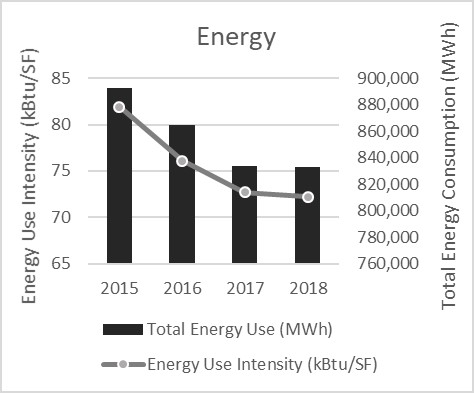

| (1) | Full 2019 calendar year energy and water data will not be available to be assured by a third party until March 31, 2020. 2018 is the most recent year for which complete energy and water data is available and assured by a third party. |
| (2) | The charts reflect the performance of our occupied and actively-managed office building portfolio in Boston, Los Angeles, New York, San Francisco and Washington, DC. Occupied office buildings are buildings with no more than 50% vacancy. Actively-managed buildings are buildings where we have operational control of building system performance and investment decisions. At the end of the 2018 calendar year, this included 97 buildings totaling 39.2 million gross square feet. |
| (3) | Floor area is considered to have complete energy consumption data coverage when energy consumption data (i.e., energy types and amounts consumed) is obtained by us for all types of energy consumed in the relevant floor area during the calendar year, regardless of when such data was obtained. |
| (4) | The scope of energy includes energy purchased from sources external to us and our tenants or produced by us or our tenants and energy from all sources, including fuel, gas, electricity and steam. Energy use intensity (kBtu/SF) has been weather normalized. |
| (5) | Water sources include surface water (including water from wetlands, rivers, lakes and oceans), groundwater, rainwater collected directly and stored by the registrant, wastewater obtained from other entities, municipal water supplies or supply from other water utilities. |
Climate Resilience
We are focused on climate preparedness and resiliency in advancement of our sustainability strategy. As a long-term owner and active manager of real estate assets in operation and under development, we strive to obtain adaptive capacity by continuing to proactively implement measures and planning and decision-making processes to protect our investments by improving resilience. We are preparing for long-term climate risk by considering climate change scenarios and will continue to assess climate change vulnerabilities resulting from potential future climate scenarios and sea level rise. Event-driven (acute) and longer-term (chronic) physical risks that may result from climate change could have a material adverse effect on our properties, operations and business. Management’s role in assessing and managing these climate-related risks and initiatives is spread across multiple teams across our organization, including our executive leadership and our Sustainability, Risk Management, Development, Construction and Property Management departments. Climate resilience measures include training and implementation of emergency response plans and the engagement of our executives and BXP’s Board of Directors on climate change and other environmental, social and governance (“ESG”) aspects.
Reporting
A notable part of our commitment to sustainable development and operations is our commitment to transparent reporting of ESG performance indicators, as we recognize the importance of this information to investors, lenders and others in understanding how BXP assesses sustainability information and evaluates risks and opportunities. We publish an annual sustainability report that is aligned with the Global Reporting Initiative reporting framework, United Nations Sustainable Development Goals and the SASB framework and includes our strategy, key performance indicators, annual like-for-like comparisons, achievements and historical sustainability reports, which is available on our website at http://www.bxp.com under the heading “Sustainability.” In addition, we continue to work to further align our reporting with the recommendations of the Financial Stability Board’s Task Force on Climate-related Financial Disclosures (“TCFD”) to disclose climate-related financial risks and opportunities.
In 2018 and 2019, BPLP issued an aggregate of $1.85 billion of green bonds. The terms of the green bonds have use of proceeds restrictions limiting its allocation to “eligible green projects.” We published our first Green Bond Allocation Report in June 2019 disclosing the full allocation of approximately $988 million in net proceeds from BPLP’s inaugural green bond offering to the eligible green project at our Salesforce Tower property in San Francisco, California. The Green Bond Allocation Report is available on our website at http://www.bxp.com under the heading “Sustainability.”
Except for the documents specifically incorporated by reference into this Annual Report on Form 10-K, information contained on our website or that can be accessed through our website is not incorporated by reference into this Annual Report on Form 10-K.
Environmental Matters
It is our policy to retain independent environmental consultants to conduct or update Phase I environmental assessments (which generally do not involve invasive techniques such as soil or ground water sampling) and asbestos surveys in connection with our acquisition of properties. These pre-purchase environmental assessments have not revealed environmental conditions that we believe will have a material adverse effect on our business, assets, financial condition, results of operations or liquidity, and we are not otherwise aware of environmental conditions with respect to our properties that we believe would have such a material adverse effect. However, from
time to time environmental conditions at our properties have required and may in the future require environmental testing and/or regulatory filings, as well as remedial action.
In February 1999, we (through a joint venture) acquired from Exxon Corporation a property in Massachusetts that was formerly used as a petroleum bulk storage and distribution facility and was known by the state regulatory authority to contain soil and groundwater contamination. We developed an office park on the property. We engaged a specially licensed environmental consultant to oversee the management of contaminated soil and groundwater that was disturbed in the course of construction. Under the property acquisition agreement, Exxon agreed to (1) bear the liability arising from releases or discharges of oil and hazardous substances which occurred at the site prior to our ownership, (2) continue monitoring and/or remediating such releases and discharges as necessary and appropriate to comply with applicable requirements, and (3) indemnify us for certain losses arising from preexisting site conditions. Any indemnity claim may be subject to various defenses, and there can be no assurance that the amounts paid under the indemnity, if any, would be sufficient to cover the liabilities arising from any such releases and discharges.
Environmental investigations at some of our properties and certain properties owned by our affiliates have identified groundwater contamination migrating from off-site source properties. In each case we engaged a licensed environmental consultant to perform the necessary investigations and assessments, and to prepare any required submittals to the regulatory authorities. In each case the environmental consultant concluded that the properties qualify under the regulatory program or the regulatory practice for a status which eliminates certain deadlines for conducting response actions at a site. We also believe that these properties qualify for liability relief under certain statutory provisions or regulatory practices regarding upgradient releases. Although we believe that the current or former owners of the upgradient source properties may bear responsibility for some or all of the costs of addressing the identified groundwater contamination, we will take such further response actions (if any) that we deem necessary or advisable. Other than periodic testing at some of these properties, no such additional response actions are anticipated at this time.
Some of our properties and certain properties owned by our affiliates are located in urban, industrial and other previously developed areas where fill or current or historical use of the areas have caused site contamination. Accordingly, it is sometimes necessary to institute special soil and/or groundwater handling procedures and/or include particular building design features in connection with development, construction and other property operations in order to achieve regulatory closure and/or ensure that contaminated materials are addressed in an appropriate manner. In these situations, it is our practice to investigate the nature and extent of detected contamination, including potential issues associated with contaminant migration, assess potential liability risks and estimate the costs of required response actions and special handling procedures. We then use this information as part of our decision-making process with respect to the acquisition, deal structure and/or development of the property. For example, we own a parcel in Massachusetts which was formerly used as a quarry/asphalt batching facility. Pre-purchase testing indicated that the site contained relatively low levels of certain contaminants. We have developed an office park on this property. Prior to and during redevelopment activities, we engaged a specially licensed environmental consultant to monitor environmental conditions at the site and prepare necessary regulatory submittals based on the results of an environmental risk characterization. A submittal has been made to the regulatory authorities in order to achieve regulatory closure at this site. The submittal included an environmental deed restriction that mandates compliance with certain protective measures in a portion of the site where low levels of residual soil contamination have been left in place in accordance with applicable laws.
We expect that resolution of the environmental matters described above will not have a material impact on our business, assets, financial condition, results of operations or liquidity. However, we cannot assure you that we have identified all environmental liabilities at our properties, that all necessary remediation actions have been or will be undertaken at our properties, that we will be indemnified, in full or at all, or that we will have insurance coverage in the event that such environmental liabilities arise.
Corporate Governance
BXP is currently governed by an eleven-member Board of Directors. The current members of the Board of Directors of BXP are Kelly A. Ayotte, Bruce W. Duncan, Karen E. Dykstra, Carol B. Einiger, Diane J. Hoskins, Joel I. Klein, Douglas T. Linde, Matthew J. Lustig, Owen D. Thomas, David A. Twardock and William H. Walton III. All directors of BXP stand for election for one-year terms expiring at the next succeeding annual meeting of stockholders.
Joel I. Klein currently serves as the Chairman of BXP’s Board of Directors. The Board of Directors of BXP also has Audit, Compensation and Nominating and Corporate Governance Committees. The membership of each of these committees is described below.
| Independent Director | Audit | Compensation | Nominating and Corporate Governance | |||||||||
| Kelly A. Ayotte | X | X | ||||||||||
| Bruce W. Duncan | X | (1) | X | |||||||||
| Karen E. Dykstra | X | |||||||||||
| Carol B. Einiger | X | |||||||||||
| Diane J. Hoskins | X | |||||||||||
| Joel I. Klein (2) | ||||||||||||
| Matthew J. Lustig | X | (1) | ||||||||||
| David A. Twardock | X | (1) | X | |||||||||
| William H. Walton III | X |
X=Committee member, (1)=Committee Chair, (2)=Chairman of BXP’s Board of Directors
BXP has the following corporate governance documents and procedures in place:
| • | The Board of Directors has adopted charters for each of its Audit, Compensation and Nominating and Corporate Governance Committees. A copy of each of these charters is available on our website at http://www.bxp.com under the heading “Corporate Governance” and subheading “Committees and Charters.” |
| • | The Board of Directors has adopted Corporate Governance Guidelines, a copy of which is available on our website at http://www.bxp.com under the heading “Corporate Governance” and subheading “Governance Guidelines.” |
| • | The Board of Directors has adopted a Code of Business Conduct and Ethics, which governs business decisions made and actions taken by BXP’s directors, officers and employees. A copy of this code is available on our website at http://www.bxp.com under the heading “Corporate Governance” and subheading “Code of Conduct and Ethics.” BXP intends to disclose on this website any amendment to, or waiver of, any provisions of this Code applicable to the directors and executive officers of BXP that would otherwise be required to be disclosed under the rules of the SEC or the New York Stock Exchange. |
| • | The Board of Directors has established an ethics reporting system that employees may use to anonymously report possible violations of the Code of Business Conduct and Ethics, including concerns regarding questionable accounting, internal accounting controls or auditing matters, by telephone or over the internet. |
| • | The Board of Directors has adopted a Policy on our Political Spending, a copy of which is available on our website at http://www.bxp.com under the heading “Corporate Governance” and subheading “Policy on Political Spending.” |
Competition
We compete in the leasing of office, retail and residential space with a considerable number of other real estate companies, some of which may have greater marketing and financial resources than are available to us. In addition, our hotel property competes for guests with other hotels, some of which may have greater marketing and financial resources than are available to us and to the manager of our one hotel, Marriott International, Inc.
Principal factors of competition in our primary business of owning, acquiring and developing office properties are the quality of properties, leasing terms (including rent and other charges and allowances for tenant improvements), attractiveness and convenience of location, the quality and breadth of tenant services and amenities provided, and reputation as an owner and operator of quality office properties in the relevant market. Additionally, our ability to compete depends upon, among other factors, trends in the national and local economies, investment alternatives, financial condition and operating results of current and prospective tenants, availability and cost of capital, construction and renovation costs, taxes, utilities, governmental regulations, legislation and population trends.
In addition, we currently have six residential properties (including two properties under construction) and may in the future decide to acquire or develop additional residential properties. As an owner, we will also face competition for prospective residents from other operators/owners whose properties may be perceived to offer a better location or better amenities or whose rent may be perceived as a better value given the quality, location and amenities that the resident seeks. We will also compete against condominiums and single-family homes that are for sale or rent. Because the scale of our residential portfolio is relatively small, we expect to continue to retain third parties to manage our residential properties.
Our Hotel Property
We operate our hotel property through a taxable REIT subsidiary. The taxable REIT subsidiary, a wholly-owned subsidiary of BPLP, is the lessee pursuant to a lease for the hotel property. As lessor, BPLP is entitled to a percentage of gross receipts from the hotel property. The hotel lease is intended to provide the economic benefits of ownership of the underlying real estate to flow to us as rental income, while our taxable REIT subsidiary earns the profit from operating the property as a hotel. Marriott International, Inc. continues to manage the hotel property under the Marriott name and under terms of the existing management agreements. Marriott has been engaged under a separate long-term incentive management agreement to operate and manage the hotel on behalf of the taxable REIT subsidiary.
Recent Tax Legislation Affecting BXP and BPLP
The following discussion supplements and updates the disclosures under “United States Federal Income Tax Considerations” in the prospectus dated June 2, 2017 contained in our Registration Statement on Form S-3 filed with the SEC on June 2, 2017, as well as the disclosures under “United States Federal Income Tax Considerations” in the prospectus supplement dated June 2, 2017.
Qualified Group Legal Services
Section 501(c)(20) of the Internal Revenue Code of 1986, as amended (the “Code”), has been repealed. Therefore the reference to qualified group legal services plans under “United States Federal Income Tax Considerations—Taxation of Tax-Exempt Stockholders” is no longer applicable.
Backup Withholding
The rate for backup withholding has recently been reduced. It is now 24%, not 28% as stated in “United States Federal Income Tax Considerations—Taxation of Holders of Certain Fixed Rate Debt Securities—Taxation of Taxable U.S. Holders.”
Certain Foreign Income Inclusions
The Internal Revenue Service has advised that, if a REIT is a shareholder of a controlled foreign corporation or a passive foreign investment company, the income it must recognize on account of such ownership under sections 951(a)(1), 951A, 1291(a), § 1293(a)(1), or § 1296(a) will generally be treated as qualifying income for purposes of the 95% gross income test. In addition, foreign currency gain with respect to distributions of previously taxed earnings and profits will generally be excluded from income for purposes of the 95% gross income test.
Tax Cuts and Jobs Act of 2017
The Tax Cuts and Jobs Act of 2017 (the “TCJA”), generally applicable for tax years beginning after December 31, 2017, made significant changes to the Code, including a number of provisions of the Code that affect the taxation of businesses and their owners, including REITs and their stockholders. Among other changes, these include the following:
| • | For tax years beginning before January 1, 2026, non-corporate taxpayers are permitted to take a 20% deduction for certain pass-through business income, including dividends received from REITs that are not designated as capital gain dividends or qualified dividend income, subject to certain limitations. The maximum U.S. federal income tax rate for individuals has been reduced from 39.6% to 37%. |
| • | The maximum U.S. federal income tax rate for corporations has been reduced from 35% to 21%, and the alternative minimum tax has been eliminated for corporations, which would generally reduce the amount of U.S. federal income tax payable by our taxable REIT subsidiaries and by us to the extent we were subject corporate U.S. federal income tax (for example, if we distributed less than 100% of our taxable income or recognized built-in gains in assets acquired from C corporations). In addition, the maximum withholding rate on distributions by us to non-U.S. stockholders that are treated as attributable to gain from the sale or exchange of a U.S. real property interest was reduced from 35% to 21%. |
| • | Certain new limitations on the deductibility of interest expense now apply, which limitations may affect the deductibility of interest paid or accrued by us or our taxable REIT subsidiaries. Alternatively, we may be able to avoid the new limitations on interest expense by irrevocably electing to treat an investment as an “electing real property trade or business.” As a consequence of making such election, we would be required to use an alternative depreciation system with generally longer recovery periods. We have made this election for our own leasing business and will determine whether to make such election for any investment held through an entity we control. |
| • | Certain new limitations on net operating losses now apply, which limitations may affect net operating losses generated by us or our taxable REIT subsidiaries. |
| • | New accounting rules generally require us to recognize certain income items for federal income tax purposes no later than when we take the item into account for financial statement purposes, which may accelerate our recognition of certain income items. |
This summary does not purport to be a detailed discussion of the changes to U.S. federal income tax laws as a result of the enactment of the TCJA. Technical corrections or other amendments to the TCJA or administrative guidance interpreting the TCJA may be forthcoming at any time. We cannot predict the long-term effect of the TCJA or any future law changes on REITs or their stockholders. Investors are urged to consult their own tax advisors regarding the effect of the TCJA based on their particular circumstances.
Consolidated Appropriations Act
On March 23, 2018, President Donald J. Trump signed into law the Consolidated Appropriations Act, 2018 (the “CAA”), which amended various provisions of the Internal Revenue Code of 1986, as amended, and implicate certain tax-related disclosures contained in the prospectus. As a result, the discussion under “United States Federal Income Tax Considerations—Taxation of Stockholders and Potential Tax Consequences of Their Investment in Shares of Common Stock or Preferred Stock—Taxation of Non-U.S. Stockholders” in the second full paragraph on page 65 and in the first full paragraph on page 66 of each of the two documents listed above, respectively, is replaced with the following paragraphs:
Qualified Shareholders. For periods on or after December 18, 2015, to the extent our stock is held directly (or indirectly through one or more partnerships) by a “qualified shareholder,” it will not be treated as a USRPI. Further, to the extent such treatment applies, any distribution to such shareholder will not be treated as gain recognized from the sale or exchange of a USRPI. For these purposes, a qualified shareholder is generally a non-U.S. stockholder that (i)(A) is eligible for treaty benefits under an income tax treaty with the United States that includes an exchange of information program, and the principal class of interests of which is listed and regularly traded on one or more stock exchanges as defined by the treaty, or (B) is a foreign limited partnership organized in a jurisdiction with an exchange of information agreement with the United States and that has a class of regularly traded limited partnership units (having a value greater than 50% of the value of all partnership units) on the New York Stock Exchange or Nasdaq, (ii) is a “qualified collective investment vehicle” (within the meaning of Section 897(k)(3)(B) of the Code) and (iii) maintains records of persons holding 5% or more of the class of interests described in clauses (i)(A) or (i)(B) above. However, in the case of a qualified shareholder having one or more “applicable investors,” the exception described in the first sentence of this paragraph will not apply to the applicable percentage of the qualified shareholder’s stock (with “applicable percentage” generally meaning the percentage of the value of the interests in the qualified shareholder held by applicable investors after applying certain constructive ownership rules). The applicable percentage of the amount realized by a qualified shareholder on the disposition of our stock or with respect to a distribution from us attributable to gain from the sale or exchange of a USRPI will be treated as amounts realized from the disposition of USRPIs. Such treatment shall also apply to applicable investors in respect of distributions treated as a sale or exchange of stock with respect to a qualified shareholder. For these purposes, an “applicable investor” is a person who generally holds an interest in the qualified shareholder and holds
more than 10% of our stock applying certain constructive ownership rules. Subject to the exception described above for qualified shareholders having one or more applicable investors, distributions received by qualified shareholders will be taxed as described above at -Dividends as if the distribution is not attributable to the sale of a USRPI. Gain treated as gain from the sale or exchange of our stock (including capital gain dividends and distributions treated as gain from the sale or exchange of our stock under the rules described above at - Dividends) will not be subject to tax unless such gain is treated as effectively connected with the qualified shareholder’s conduct of a U.S. trade or business, in which case the qualified shareholder generally will be subject to a tax at the graduated rates applicable to ordinary income, in the same manner as U.S. stockholders.
Qualified Foreign Pension Funds. For periods on or after December 18, 2015, for FIRPTA purposes neither a “qualified foreign pension fund” nor any “qualified controlled entity” is treated as a Non-U.S. Stockholder. A “qualified foreign pension fund” is an organization or arrangement (i) created or organized in a foreign country, (ii) established by a foreign country (or one or more political subdivisions thereof) or one or more employers to provide retirement or pension benefits to current or former employees (including self-employed individuals) or their designees as a result of, or in consideration for, services rendered, (iii) which does not have a single participant or beneficiary that has a right to more than 5% of its assets or income, (iv) which is subject to government regulation and with respect to which annual information about its beneficiaries is provided, or is otherwise available, to relevant local tax authorities and (v) with respect to which, under its local laws, (A) contributions that would otherwise be subject to tax are deductible or excluded from its gross income or taxed at a reduced rate, or (B) taxation of its investment income is deferred, or such income is excluded from its gross income or taxed at a reduced rate. A “qualified controlled entity” is an entity all the interests of which are held by a qualified foreign pension fund. Alternatively, under proposed Treasury Regulations that taxpayers generally may rely on, but which are subject to change, a “qualified controlled entity” is a trust or corporation organized under the laws of a foreign country all of the interests of which are held by one or more qualified foreign pension funds either directly or indirectly through one or more qualified controlled entities or partnerships. Gain of a qualified foreign pension fund or qualified controlled entity treated as gain from the sale or exchange of our stock, distributions treated as gain from the sale or exchange of our stock under the rules described above at - Dividends, and distributions attributable to gains from sales of USRPIs will not be subject to U.S. federal income or withholding tax unless such gain is treated as effectively connected with the qualified foreign pension fund's (or the qualified controlled entity's, as applicable) conduct of a U.S. trade or business, in which case the qualified foreign pension fund (or qualified controlled entity) generally will be subject to a tax at the same graduated rates applicable to U.S. Stockholders, unless an applicable income tax treaty provides otherwise, and may be subject to the 30% branch profits tax on its effectively connected earnings and profits, subject to adjustments, in the case of a foreign corporation.
FATCA Proposed Regulations
On December 18, 2018, the Internal Revenue Service promulgated proposed regulations under Sections 1471-1474 of the Code (commonly referred to as FATCA), which proposed regulations eliminate FATCA withholding on gross proceeds and thus implicate certain tax-related disclosures contained in the prospectus and the prospectus supplement. While these regulations have not yet been finalized, taxpayers are generally entitled to rely on the proposed regulations (subject to certain limited exceptions). As a result, the discussion under “United States Federal Income Tax Considerations—Taxation of Stockholders and Potential Tax Consequences of Their Investment in Shares of Common Stock or Preferred Stock—Taxation of Non-U.S. Stockholders—Withholding on Certain Foreign Accounts and Entities” the prospectus and the prospectus supplement (found on page 66 of each) is replaced with the following:
Withholding on Certain Foreign Accounts and Entities. The Foreign Account Tax Compliance Act, or FATCA, imposes withholding taxes on “withholdable payments” (as defined below) made to “foreign financial institutions” and certain other non-U.S. entities unless (1) the foreign financial institution undertakes certain diligence and reporting obligations or (2) the foreign non-financial entity either certifies it does not have any substantial United States owners or furnishes identifying information regarding each substantial United States owner. “Withholdable payment” generally means any payment of interest, dividends, and certain other types of generally passive income if such payment is from sources within the United States. If the payee is a foreign financial institution, it must enter into an agreement with the United States Treasury requiring, among other things, that it undertakes to identify accounts held by certain United States persons or United States-owned foreign entities, annually report certain information about such accounts, and withhold 30% on payments to account holders whose actions prevent them from complying with these reporting and other requirements. Investors in jurisdictions that have entered into “intergovernmental agreements” may, in lieu of the foregoing requirements, be required to report such information to their home jurisdictions. Prospective investors should consult their tax advisors regarding this legislation.
Previous: Cover and table of contents · Next: Item 1A. Risk Factors.