 filings.tools
Item 2. Management's Discussion and Analysis of Financial Condition and Results of Operations
61K characters. Original on sec.gov ·
Item 2. Management's Discussion and Analysis of Financial Condition and Results of Operations
| MD&A | Overview |
Management's Discussion and Analysis of Financial Condition and Results of Operations
The discussion and analysis presented below is concerned with material changes in financial condition and results of operations, including amounts and certainty of cash flows from operations and from outside sources, between the periods specified in our condensed consolidated balance sheets at September 30, 2022 and June 30, 2022, and in our condensed consolidated statements of earnings and our condensed consolidated statements of cash flows for the three months ended September 30, 2022 and 2021. All comparisons presented are with respect to the prior-year period, unless stated otherwise. This discussion and analysis should be read in conjunction with the MD&A included in our 2022 Form 10-K.
| 2 | Cardinal Health | Q1 Fiscal 2023 Form 10-Q |
| MD&A | Overview |
Overview of Consolidated Results
Revenue
Revenue for the three months ended September 30, 2022 increased 13 percent to $49.6 billion due to sales growth from pharmaceutical distribution and specialty pharmaceutical customers, which primarily consisted of branded pharmaceutical sales to existing and net new customers.
GAAP and Non-GAAP Operating Earnings
| Three Months Ended September 30, | |||||||||||||||||
| (in millions) | 2022 | 2021 | Change | ||||||||||||||
| GAAP operating earnings | $ | 137 | $ | 415 | (67) | % | |||||||||||
| Shareholder cooperation agreement costs | 6 | — | |||||||||||||||
| Restructuring and employee severance | 29 | 18 | |||||||||||||||
| Amortization and other acquisition-related costs | 71 | 79 | |||||||||||||||
| Impairments and (gain)/loss on disposal of assets, net | 153 | (2) | |||||||||||||||
| Litigation (recoveries)/charges, net | 27 | 18 | |||||||||||||||
| Non-GAAP operating earnings | $ | 423 | $ | 527 | (20) | % |
The sum of the components and certain computations may reflect rounding adjustments.
GAAP operating earnings decreased 67 percent to $137 million during the three months ended September 30, 2022 primarily due to a $154 million pre-tax non-cash goodwill impairment charge related to the Medical Segment and a decline in Medical segment profit. See "Critical Accounting Policies and Sensitive Accounting Estimates" section of this MD&A and Note 4 of the "Notes to Condensed Consolidated Financial Statements" for additional information on the goodwill impairment charge. The decline in Medical segment profit was due to net inflationary impacts and an adverse impact from personal protective equipment, which included inventory charges as a result of our simplification strategy.
Non-GAAP operating earnings decreased 20 percent to $423 million, primarily due to the decline in Medical segment profit discussed above.
| Cardinal Health | Q1 Fiscal 2023 Form 10-Q | 3 |
| MD&A | Overview |
GAAP and Non-GAAP Diluted EPS
| Three Months Ended September 30, | |||||||||||||||||
| ($ per share) | 2022 (2) | 2021 (2) | Change | ||||||||||||||
| GAAP diluted EPS (1) | $ | 0.40 | $ | 0.94 | (57) | % | |||||||||||
| Shareholder cooperation agreement costs | 0.01 | — | |||||||||||||||
| Restructuring and employee severance | 0.08 | 0.04 | |||||||||||||||
| Amortization and other acquisition-related costs | 0.20 | 0.20 | |||||||||||||||
| Impairments and (gain)/loss on disposal of assets, net (3) | 0.44 | 0.03 | |||||||||||||||
| Litigation (recoveries)/charges, net | 0.07 | 0.05 | |||||||||||||||
| Loss on early extinguishment of debt | — | 0.03 | |||||||||||||||
| Non-GAAP diluted EPS (1) | $ | 1.20 | $ | 1.29 | (7) | % |
The sum of the components and certain computations may reflect rounding adjustments.
(1) Diluted earnings per share attributable to Cardinal Health, Inc. ("diluted EPS").
(2) The reconciling items are presented within this table net of tax. See quantification of tax effect of each reconciling item in our GAAP to Non-GAAP Reconciliations in the "Explanation and Reconciliation of Non-GAAP Financial Measures."
(3) Impairments and (gain)/loss on disposals of assets, net includes a pre-tax goodwill impairment charge of $154 million related to the Medical segment recorded during the three months ended September 30, 2022. For fiscal 2023, the net tax benefit related to this impairment charge is $12 million and is included in the annual effective tax rate. As a result, the amount of tax benefit for three months ended September 30, 2022 increased approximately by an incremental $22 million and is expected to increase the provision for income taxes during the remainder of the fiscal year.
During the three months ended September 30, 2022, GAAP diluted EPS decreased 57 percent to $0.40 and non-GAAP diluted EPS decreased 7 percent to $1.20 due to the factors impacting GAAP and non-GAAP operating earnings discussed above, partially offset by favorable changes in discrete tax items and a lower share count as a result of share repurchases. In addition, the goodwill impairment charge related to the Medical segment had a $(0.44) per share after-tax impact on GAAP diluted EPS. See "Critical Accounting Policies and Sensitive Accounting Estimates" section of this MD&A and Note 4 and Note 7 of the "Notes to Condensed Consolidated Financial Statements" for additional detail.
Cash and Equivalents
Our cash and equivalents balance was $3.5 billion at September 30, 2022 compared to $4.7 billion at June 30, 2022. During the three months ended September 30, 2022, net cash provided by operating activities was $23 million, which includes the impact of our second annual payment of $372 million related to the agreement to settle the vast majority of the opioid lawsuits filed by states and local governmental entities (the "Settlement Agreement"). See the Significant Developments in Fiscal 2023 and Trends section in this MD&A and Note 6 of the "Notes to Condensed Consolidated Financial Statements" for additional detail related to the Settlement Agreement. In addition, we deployed cash of $1.0 billion for share repurchases.
| 4 | Cardinal Health | Q1 Fiscal 2023 Form 10-Q |
| MD&A | Overview |
Significant Developments in Fiscal 2023 and Trends
Inflationary Impacts
Medical segment profit was negatively affected by inflationary impacts, primarily related to transportation (including ocean and domestic freight), commodities and labor during the three months ended September 30, 2022 and on a year-over-year basis.
We expect these inflationary impacts to continue to adversely impact Medical segment profit in fiscal 2023 and beyond. In order to partially mitigate this impact, we have implemented certain price increases and we intend to implement additional price increases. We are also evolving our commercial contracting processes to provide us with greater pricing flexibility. These increased costs are difficult to predict and may be greater than we expect or continue longer than our current expectations. In the event these costs decrease, the benefit to Medical segment profit will be delayed until the higher-cost inventory has moved through our supply chain. Our plans to continue to increase prices and evolve our contracting strategies are subject to contingencies and uncertainties and it is possible that our results of operations will be adversely impacted to a greater extent than we currently anticipate or that we may not be able to mitigate the negative impact to the extent we anticipate.
To a lesser extent, inflationary impacts, primarily related to increased transportation and labor costs, also adversely affected Pharmaceutical segment profit during the three months ended September 30, 2022. We expect these inflationary supply chain costs to continue to adversely impact Pharmaceutical segment profit in fiscal 2023.
PPE Demand and Pricing
Personal protective equipment ("PPE") refers to protective clothing, medical and non-medical grade gloves, face shields, face masks and other equipment designed to protect the wearer from injury or the spread of infection or illness. Demand for PPE fluctuated during fiscal 2022 resulting in variability in sales volumes, inventory levels and costs to manufacture and source these products. We expect demand for PPE to continue to fluctuate during the remainder of fiscal 2023.
PPE adversely impacted Medical segment revenue during the three months ended September 30, 2022 and on a year-over-year basis, primarily due to declines in pricing and volumes.
Medical segment profit was adversely impacted during the three months ended September 30, 2022 and on a year-over-year basis due to $18 million of inventory charges related to our simplification strategy, which includes the impact from the sale of certain disposable gloves that are primarily utilized in non-healthcare industries.
The demand and pricing for PPE is subject to risks and uncertainties, which may continue to impact Medical segment revenue, Medical segment profit and consolidated operating earnings during the remainder of fiscal 2023.
Medical Goodwill
Due to the adverse impact on our financial results from and the risks and uncertainties related to inflationary impacts and PPE demand and pricing, as well as increases in the risk-free interest rate, we performed interim goodwill impairment testing for the Medical operating segment (excluding our Cardinal Health at-Home Solutions division) (the “Medical Unit”) during the three months ended September 30, 2022. This testing resulted in a pre-tax charge of $154 million, which is included in impairments and (gain)/loss on disposal of assets, net in our condensed consolidated statements of earnings. This charge was driven by an increase in the discount rate primarily due to an increase in the risk-free interest rate. See "Critical Accounting Policies and Sensitive Accounting Estimates" section of this MD&A and Note 4 of the "Notes to Condensed Consolidated Financial Statements" for additional detail.
Adverse changes in key assumptions or a significant change in industry or economic trends during the remainder of fiscal 2023 could result in additional goodwill impairment.
| Cardinal Health | Q1 Fiscal 2023 Form 10-Q | 5 |
| MD&A | Overview |
Shareholder Cooperation Agreement
In September 2022, we entered into a Cooperation Agreement (the "Cooperation Agreement") with Elliott Associates, L.P. and Elliott International, L.P. (together, "Elliott") under which our Board of Directors (the "Board"), among other things, (1) appointed four new independent directors, including a representative from Elliott, and (2) formed an advisory Business Review Committee of the Board, which is tasked with undertaking a comprehensive review of our strategy, portfolio, capital-allocation framework and operations.
The evaluation and implementation of any actions recommended by the Business Review Committee and the Board may impact our financial position and results of operations during the remainder of fiscal 2023. In addition, during the three months ended September 30, 2022, we incurred $6 million of expenses related to the negotiation and finalization of the Cooperation Agreement. We expect to incur additional legal, consulting and other expenses related to the Cooperation Agreement and the activities of the Business Review Committee during the remainder of fiscal 2023. See "Risk Factors" section for additional detail related to risks associated with the Cooperation Agreement.
| 6 | Cardinal Health | Q1 Fiscal 2023 Form 10-Q |
| MD&A | Results of Operations |
Results of Operations
Revenue
| Three Months Ended September 30, | |||||||||||||||||
| (in millions) | 2022 | 2021 | Change | ||||||||||||||
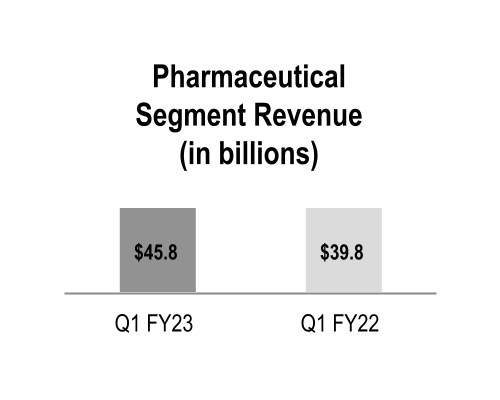
| Pharmaceutical | $ | 45,828 | $ | 39,822 | 15 | % | |||||||||||
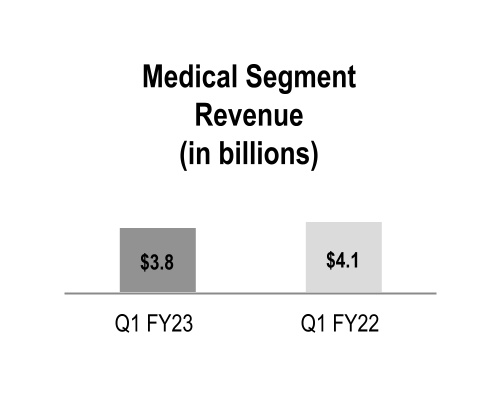
| Medical | 3,778 | 4,149 | (9) | % | |||||||||||||
| Total segment revenue | 49,606 | 43,971 | 13 | % | |||||||||||||
| Corporate | (3) | (3) | N.M. | ||||||||||||||
| Total revenue | $ | 49,603 | $ | 43,968 | 13 | % |
Pharmaceutical Segment
Pharmaceutical segment revenue increased during the three months ended September 30, 2022 due to sales growth from pharmaceutical distribution and specialty pharmaceutical customers, which together increased revenue by $5.9 billion and primarily consisted of branded pharmaceutical sales to existing and net new customers.
Medical Segment
Medical segment revenue decreased during the three months ended September 30, 2022 primarily due to lower sales within products and distribution, largely due to the impact of PPE pricing and volumes. The adverse impact of the prior-year divestiture of the Cordis business was mostly offset by sales growth in at-Home Solutions.
Cost of Products Sold
Cost of products sold increased 13 percent to $48.0 billion due to the factors affecting the changes in revenue and gross margin.
| Cardinal Health | Q1 Fiscal 2023 Form 10-Q | 7 |
| MD&A | Results of Operations |
Gross Margin

| Three Months Ended September 30, | |||||||||||||||||
| (in millions) | 2022 | 2021 | Change | ||||||||||||||
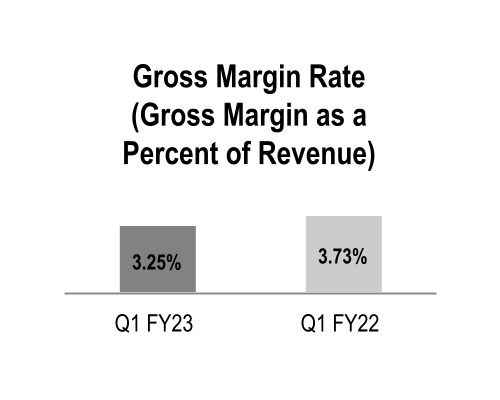
| Gross margin | $ | 1,614 | $ | 1,642 | (2) | % |
Gross margin during the three months ended September 30, 2022 decreased primarily due to net inflationary impacts in the Medical segment and the divestiture of the Cordis business, partially offset by the performance of our generics program in the Pharmaceutical segment.
Gross margin rate declined 48 basis points during the three months ended September 30, 2022 mainly due to changes in overall product mix, primarily driven by increased pharmaceutical distribution branded sales, which have a dilutive impact on our overall gross margin rate. The performance of Medical segment products and distribution, which reflects increased costs due to net inflationary impacts, also had an adverse impact on gross margin rate.
Distribution, Selling, General, and Administrative ("SG&A") Expenses
| Three Months Ended September 30, | |||||||||||||||||
| (in millions) | 2022 | 2021 | Change | ||||||||||||||
| SG&A expenses | $ | 1,197 | $ | 1,114 | 7 | % |
During the three months ended September 30, 2022, SG&A expenses increased largely due to inflationary impacts, primarily related to increased transportation and labor costs, as well as other operating expenses.
During the three months ended September 30, 2022, we incurred $6 million of expenses related to the finalization of the Cooperation Agreement. See the Significant Developments in Fiscal 2023 and Trends section in this MD&A for additional detail related to the Cooperation Agreement.
| 8 | Cardinal Health | Q1 Fiscal 2023 Form 10-Q |
| MD&A | Results of Operations |
Segment Profit
We evaluate segment performance based on segment profit, among other measures. See Note 12 of the "Notes to Condensed Consolidated Financial Statements" for additional information on segment profit.
| Three Months Ended September 30, | |||||||||||||||||
| (in millions) | 2022 | 2021 | Change | ||||||||||||||
| Pharmaceutical | $ | 431 | $ | 406 | 6 | % | |||||||||||
| Medical | (8) | 123 | N.M. | ||||||||||||||
| Total segment profit | 423 | 529 | (20) | % | |||||||||||||
| Corporate | (286) | (114) | N.M. | ||||||||||||||
| Total consolidated operating earnings | $ | 137 | $ | 415 | (67) | % |
Pharmaceutical Segment Profit
Pharmaceutical segment profit increased during the three months ended September 30, 2022, primarily due to the performance of our generics program and increased contribution from branded pharmaceutical and specialty pharmaceutical products. These factors were partially offset by inflationary impacts, primarily related to increased transportation and labor costs.
Medical Segment Profit
Medical segment profit decreased during the three months ended September 30, 2022, largely due to net inflationary impacts, which primarily related to increased transportation and commodities costs, partially offset by price increases. Medical segment profit was also adversely affected by the impact of PPE, which included inventory charges related to the sale of certain disposable gloves in connection with our simplification strategy.
Corporate
The changes in Corporate during the three months ended September 30, 2022 are due to the factors discussed in the Other Components of Consolidated Operating Earnings section that follows.
| Cardinal Health | Q1 Fiscal 2023 Form 10-Q | 9 |
| MD&A | Results of Operations |
Other Components of Consolidated Operating Earnings
In addition to revenue, gross margin, and SG&A expenses discussed previously, consolidated operating earnings were impacted by the following:
| Three Months Ended September 30, | |||||||||||
| (in millions) | 2022 | 2021 | |||||||||
| Restructuring and employee severance | $ | 29 | $ | 18 | |||||||
| Amortization and other acquisition-related costs | 71 | 79 | |||||||||
| Impairments and (gain)/loss on disposal of assets, net | 153 | (2) | |||||||||
| Litigation (recoveries)/charges, net | 27 | 18 |
Restructuring and Employee Severance
During the three months ended September 30, 2022 and 2021, restructuring costs primarily related to the implementation of certain enterprise-wide cost-savings measures. During the three months ended September 30, 2021, restructuring also included costs related to the divestiture of the Cordis business.
Amortization and Other Acquisition-Related Costs
Amortization of acquisition-related intangible assets was $71 million and $78 million for the three months ended September 30, 2022 and 2021, respectively.
Impairments and (Gain)/Loss on Disposal of Assets, Net
During the three months ended September 30, 2022, we recognized a $154 million pre-tax non-cash goodwill impairment related to the Medical segment, as discussed further in the "Critical Accounting Policies and Sensitive Accounting Estimates" section of this MD&A and Note 4 of the "Notes to Condensed Consolidated Financial Statements."
Litigation (Recoveries)/Charges, Net
During the three months ended September 30, 2022 and 2021, we recognized $21 million and $26 million, respectively, of estimated losses and legal defense costs associated with the inferior vena cava ("IVC") filter product liability claims. See Note 6 of the "Notes to Condensed Consolidated Financial Statements" for additional information.
During the three months ended September 30, 2021, we recognized income of $17 million for recoveries in class action antitrust lawsuits in which we were a class member.
Earnings Before Income Taxes
In addition to the items discussed above, earnings before income taxes was impacted by the following:
| Three Months Ended September 30, | |||||||||||||||||
| (in millions) | 2022 | 2021 | Change | ||||||||||||||
| Other (income)/expense, net | $ | 2 | $ | (4) | N.M. | ||||||||||||
| Interest expense, net | 25 | 40 | (38) | % | |||||||||||||
| Loss on early extinguishment of debt | — | 10 | N.M. |
Interest Expense, Net
During the three months ended September 30, 2022, interest expense decreased by 38 percent primarily due to increased interest income from cash and equivalents.
Loss on Early Extinguishment of Debt
During three months ended September 30, 2021, we recognized a $10 million loss in connection with the debt redemption as described further in Note 5 of the “Notes to Condensed Consolidated Financial Statements.”
| 10 | Cardinal Health | Q1 Fiscal 2023 Form 10-Q |
| MD&A | Results of Operations |
Provision for/(Benefit from) Income Taxes
During the three months ended September 30, 2022 and 2021, the effective tax rate was (0.7) percent and 26.3 percent, respectively. The decrease in the effective tax rate for the three months ended September 30, 2022 compared to the prior-year period was primarily due to tax benefits from decreases in valuation allowances on net operating loss carryforwards and certain other discrete items. The effective tax rate for the three months ended September 30, 2022 also includes the tax effect of the goodwill impairment charge described below. See Note 7 of the “Notes to Condensed Consolidated Financial Statements” for additional information.
Tax Effects of Goodwill Impairment Charge
During the three months ended September 30, 2022, we recognized a $154 million pre-tax charge for goodwill impairment related to the Medical Unit. The net tax benefit related to this charge is $12 million for fiscal 2023.
Unless an item is considered discrete because it is unusual or infrequent, the tax impact of the item is included in our estimated annual effective tax rate. When items are recognized through our estimated annual effective tax rate, we apply our estimated annual effective tax rate to the earnings before income taxes for the year-to-date period to compute our benefit from income taxes for the current quarter and year-to-date period. The tax impacts of discrete items are recognized in their entirety in the period in which they occur.
The tax effect of the goodwill impairment charge during the three months ended September 30, 2022 was included in our estimated annual effective tax rate because it was not considered unusual or infrequent, given that we recorded goodwill impairment in prior fiscal years. The impact of the non-deductible goodwill increased the estimated annual effective tax rate for fiscal 2023. Applying the higher tax rate to pre-tax earnings for three months ended September 30, 2022 resulted in recognizing an incremental interim tax benefit of approximately $22 million, which impacted the benefit from income taxes in the condensed consolidated statements of earnings during the three months ended September 30, 2022 and prepaid expenses and other assets in the condensed consolidated balance sheets at September 30, 2022. This interim tax benefit will reverse in future quarters of fiscal 2023.
| Cardinal Health | Q1 Fiscal 2023 Form 10-Q | 11 |
| MD&A | Liquidity and Capital Resources |
Liquidity and Capital Resources
We currently believe that, based on available capital resources (cash on hand and committed credit facilities) and projected operating cash flow, we have adequate capital resources to fund working capital needs; currently anticipated capital expenditures; currently anticipated business growth and expansion; contractual obligations and cash requirements; tax payments; current and projected debt service requirements, dividends and share repurchases; and known opioid litigation settlement payments. If we decide to engage in one or more acquisitions, depending on the size and timing of such transactions, we may need to access capital markets for additional financing.
Cash and Equivalents
Our cash and equivalents balance was $3.5 billion at September 30, 2022 compared to $4.7 billion at June 30, 2022. During the three months ended September 30, 2022, net cash provided by operating activities was $23 million, which includes the impact of our second annual payment of $372 million related to the Settlement Agreement. For additional information, see Opioid Litigation Settlement Agreement section below. In addition, we deployed cash of $1.0 billion for share repurchases.
At September 30, 2022, our cash and equivalents were held in cash depository accounts with major banks or invested in high quality, short-term liquid investments.
Changes in working capital, which impact operating cash flow, can vary significantly depending on factors such as the timing of customer payments, inventory purchases, payments to vendors and tax payments in the regular course of business, as well as fluctuating working capital needs driven by customer and product mix.
The cash and equivalents balance at September 30, 2022 included $561 million of cash held by subsidiaries outside of the United States.
Other Financing Arrangements and Financial Instruments
Credit Facilities and Commercial Paper
In addition to cash and equivalents and operating cash flow, other sources of liquidity at September 30, 2022 include a $2.0 billion commercial paper program, backed by a $2.0 billion revolving credit facility. We also have a $1.0 billion committed receivables sales facility. At September 30, 2022, we had no amounts outstanding under our commercial paper program, revolving credit facility or our committed receivables sales facility.
In September 2022, we renewed our committed receivables sales facility program through Cardinal Health Funding, LLC (“CHF”) through September 30, 2025. Our revolving credit and committed receivables sales facilities require us to maintain a consolidated net leverage ratio of no more than 3.75-to-1. At September 30, 2022, we were in compliance with this financial covenant.
Long-Term Debt
We had total long-term obligations, including the current portion and other short-term borrowings, of $5.3 billion at both September 30, 2022 and June 30, 2022.
| 12 | Cardinal Health | Q1 Fiscal 2023 Form 10-Q |
| MD&A | Liquidity and Capital Resources |
Capital Deployment
Opioid Litigation Settlement Agreement
We had $6.03 billion accrued at September 30, 2022 related to certain opioid litigation, as further described within Note 6 of the "Notes to Condensed Consolidated Financial Statements." We expect the majority of the payment amounts to be spread over 18 years. The effective date of the Settlement Agreement was April 2, 2022. During the three months ended September 30, 2022, we made our second annual payment of $372 million under the Settlement Agreement. We expect to make subsequent annual payments under the Settlement Agreement every July for the term of the Settlement Agreement. The amounts of these future payments may differ from the payments that we have already made.
Capital Expenditures
Capital expenditures during the three months ended September 30, 2022 and 2021 were $70 million and $67 million, respectively.
Dividends
On each of May 10, 2022 and August 10, 2022, our Board of Directors approved a quarterly dividend of $0.4957 per share, or $1.98 per share on an annualized basis, which were paid on July 15, 2022 and October 17, 2022 to shareholders of record on July 1, 2022 and October 3, 2022, respectively.
Share Repurchases
During the three months ended September 30, 2022, we repurchased $1.0 billion of our common shares under an accelerated share repurchase ("ASR") program. We funded the ASR program with available cash. The ASR program is expected to conclude in the second quarter of fiscal 2023, which is expected to reduce the amount remaining under our existing share repurchase authorization to approximately $1.7 billion. See Note 10 of the "Notes to Condensed Consolidated Financial Statements" for additional information.
| Cardinal Health | Q1 Fiscal 2023 Form 10-Q | 13 |
| MD&A | Other Items |
Other Items
The MD&A in our 2022 Form 10-K addresses our contractual obligations and cash requirements, as of and for the fiscal year ended June 30, 2022. There have been no subsequent material changes outside the ordinary course of business to those items.
Critical Accounting Policies and Sensitive Accounting Estimates
The discussion and analysis presented below are supplemental disclosures to the critical accounting policies and sensitive accounting estimates specified in our consolidated balance sheet at June 30, 2022. This discussion and analysis should be read in conjunction with the Critical Accounting Policies and Sensitive Accounting Estimates included in our 2022 Form 10-K.
Critical accounting policies are those accounting policies that (i) can have a significant impact on our financial condition and results of operations and (ii) require the use of complex and subjective estimates based upon past experience and management’s judgment. Other people applying reasonable judgment to the same facts and circumstances could develop different estimates. Because estimates are inherently uncertain, actual results may differ, including due to the risk factors discussed in "Risk Factors" and other risks discussed in our 2022 Form 10-K and our other filings with the SEC since June 30, 2022.
Goodwill
Purchased goodwill is tested for impairment annually or when indicators of impairment exist. Goodwill impairment testing involves a comparison of the estimated fair value of reporting units to the respective carrying amount, which may be performed utilizing either a qualitative or quantitative assessment. Qualitative factors are first assessed to determine if it is more likely than not that the fair value of a reporting unit is less than its carrying amount. If it is determined that it is more likely than not that the fair value does not exceed the carrying amount, then a quantitative test is performed. The quantitative goodwill impairment test involves a comparison of the estimated fair value of the reporting unit to the respective carrying amount. A reporting unit is defined as an operating segment or one level below an operating segment (also known as a component).
Our reporting units are: Pharmaceutical operating segment (excluding our Nuclear and Precision Health Solutions division); Nuclear and Precision Health Solutions division; Medical operating segment (excluding our Cardinal Health at-Home Solutions division) (“Medical Unit”); and Cardinal Health at-Home Solutions division.
Goodwill impairment testing involves judgment, including the identification of reporting units, qualitative evaluation of events and circumstances to determine if it is more likely than not that an impairment exists, and, if necessary, the estimation of the fair value of the applicable reporting unit. Our qualitative evaluation considers the weight of evidence and significance of all identified events and circumstances and most relevant drivers of fair value, both positive and negative, in determining whether it is more likely than not that the fair value of a reporting unit is less than its carrying amount.
Medical Unit Goodwill
During the three months ended September 30, 2022, the Medical Unit continued to experience adverse financial results related to inflationary impacts and PPE demand and pricing. Due to the risks and uncertainties related to these impacts and an increase in the
risk-free interest rate used in the discount rate, we elected to bypass the qualitative assessment and perform quantitative goodwill impairment testing for the Medical Unit.
Our determination of the estimated fair value of the Medical Unit is based on a combination of the income-based approach (using a discount rate of 10.5 percent and a terminal growth rate of 2 percent), and market-based approaches. Additionally, we assigned a weighting of 80 percent to the discounted cash flow method, 10 percent to the guideline public company method, and 10 percent to the guideline transaction method. The carrying amount exceeded the fair value, which resulted in a pre-tax impairment charge of $154 million for the Medical Unit, which was recognized during the three months ended September 30, 2022 and is included in impairments and (gain)/loss on disposal of assets, net in our condensed consolidated statements of earnings. This impairment charge was driven by an increase in the discount rate primarily due to an increase in the risk-free interest rate. The carrying value of the Medical Unit at September 30, 2022 after recognizing the impairment charge was $6.7 billion, of which $1.8 billion was goodwill. See Note 4 of the "Notes to Condensed Consolidated Financial Statements" for further discussion.
While we consider these assumptions to be reasonable and appropriate, they are complex and subjective, and additional adverse changes in one key assumption or a combination of key assumptions during fiscal 2023 may significantly affect future estimates. These assumptions include, among other things, a failure to meet expected earnings or other financial plans, including the execution of key initiatives related to optimizing and growing sales of Cardinal Health branded medical products, increasing growth in certain strategic divisions within our Medical segment, and driving simplification efforts and cost optimization projects, or unanticipated events and circumstances, such as changes in assumptions about the duration and magnitude of increased supply chain and commodities costs and our planned efforts to mitigate such impact, including price increases or surcharges; further disruptions in the supply chain; the impact of the Cordis
| Cardinal Health | Q1 Fiscal 2023 Form 10-Q | 14 |
| MD&A | Other Items |
divestiture; estimated demand and selling prices for PPE; an increase in the discount rate; a decrease in the terminal growth rate; increases in tax rates (including potential tax reform); or a significant change in industry or economic trends. Adverse changes in key assumptions may result in a decline in fair value below the carrying value in the future and therefore, an impairment of our Medical Unit goodwill in future periods, which could
adversely affect our results of operations. For example, if we were to increase the discount rate by a hypothetical 0.5 percent or decrease the terminal growth rate by a hypothetical 1.75 percent, the fair value for the Medical Unit would have further decreased by approximately $300 million.
| Cardinal Health | Q1 Fiscal 2023 Form 10-Q | 15 |
| Explanation and Reconciliation of Non-GAAP Financial Measures |
Explanation and Reconciliation of Non-GAAP Financial Measures
The "Overview of Consolidated Results" section within MD&A in this Form 10-Q contains financial measures that are not calculated in accordance with GAAP.
In addition to analyzing our business based on financial information prepared in accordance with GAAP, we use these non-GAAP financial measures internally to evaluate our performance, engage in financial and operational planning, and determine incentive compensation because we believe that these measures provide additional perspective on and, in some circumstances are more closely correlated to, the performance of our underlying, ongoing business. We provide these non-GAAP financial measures to investors as supplemental metrics to assist readers in assessing the effects of items and events on our financial and operating results on a year-over-year basis and in comparing our performance to that of our competitors. However, the non-GAAP financial measures that we use may be calculated differently from, and therefore may not be comparable to, similarly titled measures used by other companies. The non-GAAP financial measures disclosed by us should not be considered a substitute for, or superior to, financial measures calculated in accordance with GAAP, and the financial results calculated in accordance with GAAP and reconciliations to those financial statements set forth below should be carefully evaluated.
Exclusions from Non-GAAP Financial Measures
Management believes it is useful to exclude the following items from the non-GAAP measures presented in this report for its own and for investors’ assessment of the business for the reasons identified below:
-
LIFO charges and credits are excluded because the factors that drive last-in first-out ("LIFO") inventory charges or credits, such as pharmaceutical manufacturer price appreciation or deflation and year-end inventory levels (which can be meaningfully influenced by customer buying behavior immediately preceding our fiscal year-end), are largely out of our control and cannot be accurately predicted. The exclusion of LIFO charges and credits from non-GAAP metrics facilitates comparison of our current financial results to our historical financial results and to our peer group companies’ financial results. We did not recognize any LIFO charges or credits during the periods presented.
-
Surgical gown recall costs or income includes inventory write-offs and certain remediation and supply disruption costs, net of related insurance recoveries, arising from the January 2020 recall of select Association for the Advancement of Medical Instrumentation ("AAMI") Level 3 surgical gowns and voluntary field actions (a recall of some packs and a corrective action allowing overlabeling of other packs) for Presource Procedure Packs containing affected gowns. Income from surgical gown recall costs represents insurance recoveries of these certain costs. We have excluded these costs from our non-GAAP metrics to allow investors to better understand the underlying operating results of the business and to facilitate comparison of our current financial results to our historical financial results and to our peer group companies’ financial results.
-
Shareholder cooperation agreement costs includes costs such as legal, consulting and other expenses incurred in relation to the agreement (the "Cooperation Agreement") entered into among Elliott Associates, L.P., Elliott International, L.P. (together, "Elliott") and Cardinal Health, including costs incurred to negotiate and finalize the Cooperation Agreement and costs incurred by the new Business Review Committee of the Board of Directors, which was formed under this Cooperation Agreement. We have excluded these costs from our non-GAAP metrics because they do not occur in or reflect the ordinary course of our ongoing business operations and may obscure analysis of trends and financial performance.
-
State opioid assessments related to prior fiscal years is the portion of state assessments for prescription opioid medications that were sold or distributed in periods prior to the period in which the expense is incurred. This portion is excluded from non-GAAP financial measures because it is retrospectively applied to sales in prior fiscal years and inclusion would obscure analysis of the current fiscal year results of our underlying, ongoing business. Additionally, while states' laws may require us to make payments on an ongoing basis, the portion of the assessment related to sales in prior periods are contemplated to be one-time, nonrecurring items. Income from state opioid assessments related to prior fiscal years represents reversals of accruals when the underlying assessments were invalidated by a Court or reimbursed by manufacturers.
-
Restructuring and employee severance costs are excluded because they are not part of the ongoing operations of our underlying business.
-
Amortization and other acquisition-related costs, which include transaction costs, integration costs, and changes in the fair value of contingent consideration obligations, are excluded because they are not part of the ongoing operations of our underlying business and to facilitate comparison of our current financial results to our historical financial results and to our peer group companies' financial results. Additionally, costs for amortization of acquisition-related intangible assets are non-cash amounts,
| 16 | Cardinal Health | Q1 Fiscal 2023 Form 10-Q |
| Explanation and Reconciliation of Non-GAAP Financial Measures |
which are variable in amount and frequency and are significantly impacted by the timing and size of acquisitions, so their exclusion facilitates comparison of historical, current and forecasted financial results. We also exclude other acquisition-related costs, which are directly related to an acquisition but do not meet the criteria to be recognized on the acquired entity’s initial balance sheet as part of the purchase price allocation. These costs are also significantly impacted by the timing, complexity and size of acquisitions.
-
Impairments and gain or loss on disposal of assets, net are excluded because they do not occur in or reflect the ordinary course of our ongoing business operations and are inherently unpredictable in timing and amount, and in the case of impairments, are non-cash amounts, so their exclusion facilitates comparison of historical, current and forecasted financial results.
-
Litigation recoveries or charges, net are excluded because they often relate to events that may have occurred in prior or multiple periods, do not occur in or reflect the ordinary course of our business and are inherently unpredictable in timing and amount. During fiscal 2022, we incurred a one-time contingent attorneys' fee of $18 million related to the finalization of the settlement agreement (the “Settlement Agreement”) resulting in the settlement of the vast majority of opioid lawsuits filed by state and local governmental entities. Due to the unique nature and significance of the Settlement Agreement, and the one-time, contingent nature of the fee, this fee was included in litigation recoveries or charges, net. Additionally, during fiscal 2022 our Pharmaceutical segment profit was positively impacted by a $16 million judgment for lost profits. This judgment was the result of an ordinary course intellectual property rights claim and, therefore, is not adjusted in calculating the litigation recoveries or charges, net adjustment. During fiscal 2021, we incurred a tax benefit related to a carryback of a net operating loss. Some pre-tax amounts, which contributed to this loss, relate to litigation charges. As a result, we allocated substantially all of the tax benefit to litigation charges.
-
Loss on early extinguishment of debt is excluded because it does not typically occur in the normal course of business and may obscure analysis of trends and financial performance. Additionally, the amount and frequency of this type of charge is not consistent and is significantly impacted by the timing and size of debt extinguishment transactions.
-
(Gain)/Loss on sale of equity interest in naviHealth was incurred in connection with the sale of our remaining equity interest in naviHealth in fiscal 2020. The equity interest was retained in connection with the initial sale of our majority interest in naviHealth during fiscal 2019. We exclude this significant gain because gains or losses on investments of this magnitude do not typically occur in the normal course of business and are similar in nature to a gain or loss from a divestiture of a majority interest, which we exclude from non-GAAP results. The gain on the initial sale of our majority interest in naviHealth in fiscal 2019 was also excluded from our non-GAAP measures.
The tax effect for each of the items listed above is determined using the tax rate and other tax attributes applicable to the item and the jurisdiction(s) in which the item is recorded. The gross, tax and net impact of each item are presented with our GAAP to non-GAAP reconciliations.
Definitions
Growth rate calculation: growth rates in this report are determined by dividing the difference between current-period results and prior-period results by prior-period results.
Non-GAAP operating earnings: operating earnings excluding (1) LIFO charges/(credits), (2) surgical gown recall costs/(income), (3) shareholder cooperation agreement costs, (4) state opioid assessment related to prior fiscal years, (5) restructuring and employee severance, (6) amortization and other acquisition-related costs, (7) impairments and (gain)/loss on disposal of assets, net, and (8) litigation (recoveries)/charges, net.
Non-GAAP earnings before income taxes: earnings before income taxes excluding (1) LIFO charges/(credits), (2) surgical gown recall costs/(income), (3) shareholder cooperation agreement costs, (4) state opioid assessment related to prior fiscal years, (5) restructuring and employee severance, (6) amortization and other acquisition-related costs, (7) impairments and (gain)/loss on disposal of assets, net, (8) litigation (recoveries)/charges, net, (9) loss on early extinguishment of debt and (10) (gain)/loss on sale of equity interest in naviHealth.
Non-GAAP net earnings attributable to Cardinal Health, Inc.: net earnings attributable to Cardinal Health, Inc. excluding (1) LIFO charges/(credits), (2) surgical gown recall costs/(income), (3) shareholder cooperation agreement costs, (4) state opioid assessment related to prior fiscal years, (5) restructuring and employee severance, (6) amortization and other acquisition-related costs, (7) impairments and (gain)/loss on disposal of assets, net, (8) litigation (recoveries)/charges, net, (9) loss on early extinguishment of debt and (10) (gain)/loss on sale of equity interest in naviHealth, each net of tax.
| Cardinal Health | Q1 Fiscal 2023 Form 10-Q | 17 |
| Explanation and Reconciliation of Non-GAAP Financial Measures |
Non-GAAP effective tax rate: provision for/(benefit from) income taxes adjusted for the tax impacts of (1) LIFO charges/(credits), (2) surgical gown recall costs/(income), (3) shareholder cooperation agreement costs, (4) state opioid assessment related to prior fiscal years, (5) restructuring and employee severance, (6) amortization and other acquisition-related costs, (7) impairments and (gain)/loss on disposal of assets, net, (8) litigation (recoveries)/charges, net, (9) loss on early extinguishment of debt and (10) (gain)/loss on sale of equity interest in naviHealth divided by (earnings before income taxes adjusted for the ten items above).
Non-GAAP diluted earnings per share attributable to Cardinal Health, Inc.: non-GAAP net earnings attributable to Cardinal Health, Inc. divided by diluted weighted-average shares outstanding.
| 18 | Cardinal Health | Q1 Fiscal 2023 Form 10-Q |
| Explanation and Reconciliation of Non-GAAP Financial Measures |
GAAP to Non-GAAP Reconciliations
| (in millions, except per common share amounts) | Operating Earnings | Operating Earnings Growth Rate | Earnings Before Income Taxes | Provision for/ (Benefit from) Income Taxes | Net Earnings****1 | Net Earnings****1 Growth Rate | Diluted EPS****1 | Diluted EPS****1 Growth Rate | ||||||||||||||||||||||||||||||
| Three Months Ended September 30, 2022 | ||||||||||||||||||||||||||||||||||||||
| GAAP | $ | 137 | (67) | % | $ | 110 | $ | (1) | $ | 110 | (59) | % | $ | 0.40 | (57) | % | ||||||||||||||||||||||
| Shareholder cooperation agreement costs | 6 | 6 | 2 | 4 | 0.01 | |||||||||||||||||||||||||||||||||
| Restructuring and employee severance | 29 | 29 | 7 | 22 | 0.08 | |||||||||||||||||||||||||||||||||
| Amortization and other acquisition-related costs | 71 | 71 | 18 | 53 | 0.20 | |||||||||||||||||||||||||||||||||
| Impairments and (gain)/loss on disposal of assets, net2 | 153 | 153 | 34 | 119 | 0.44 | |||||||||||||||||||||||||||||||||
| Litigation (recoveries)/charges, net | 27 | 27 | 7 | 20 | 0.07 | |||||||||||||||||||||||||||||||||
| Non-GAAP | $ | 423 | (20) | % | $ | 396 | $ | 67 | $ | 328 | (12) | % | $ | 1.20 | (7) | % | ||||||||||||||||||||||
| Three Months Ended September 30, 2021 | ||||||||||||||||||||||||||||||||||||||
| GAAP | $ | 415 | N.M. | $ | 369 | $ | 97 | $ | 271 | N.M. | $ | 0.94 | N.M. | |||||||||||||||||||||||||
| Restructuring and employee severance | 18 | 18 | 4 | 14 | 0.04 | |||||||||||||||||||||||||||||||||
| Amortization and other acquisition-related costs | 79 | 79 | 21 | 58 | 0.20 | |||||||||||||||||||||||||||||||||
| Impairments and (gain)/loss on disposal of assets, net | (2) | (2) | (10) | 8 | 0.03 | |||||||||||||||||||||||||||||||||
| Litigation (recoveries)/charges, net | 18 | 18 | 4 | 14 | 0.05 | |||||||||||||||||||||||||||||||||
| Loss on early extinguishment of debt | — | 10 | 3 | 7 | 0.03 | |||||||||||||||||||||||||||||||||
| Non-GAAP | $ | 527 | (15) | % | $ | 491 | $ | 119 | $ | 372 | (17) | % | $ | 1.29 | (15) | % |
1 Attributable to Cardinal Health, Inc.
2 For the three months ended September 30, 2022, impairments and (gain)/loss on disposals of assets, net includes a pre-tax goodwill impairment charge of $154 million related to the Medical segment. For fiscal 2023, the net tax benefit related to this impairment charge is $12 million and is included in the annual effective tax rate. As a result, the amount of tax benefit for the three months ended September 30, 2022 increased approximately by an incremental $22 million and is expected to increase the provision for income taxes during the remainder of the fiscal year.
The sum of the components and certain computations may reflect rounding adjustments.
We apply varying tax rates depending on the item's nature and tax jurisdiction where it is incurred.
| Cardinal Health | Q1 Fiscal 2023 Form 10-Q | 19 |
| Other |
Previous: Cover and table of contents · Next: Item 3. Quantitative and Qualitative Disclosures about Market Risk