 filings.tools
Carrier Global 10-K 2023-12-31
Filed 2024-02-06. 23 sections, 489K characters. Original on sec.gov · Markdown · JSON
Cover and table of contents
UNITED STATES
SECURITIES AND EXCHANGE COMMISSION
WASHINGTON, D.C. 20549
FORM 10-K
| ☒ | ANNUAL REPORT PURSUANT TO SECTION 13 OR 15(d) OF THE SECURITIES EXCHANGE ACT OF 1934 |
For the fiscal year ended December 31, 2023
OR
| ☐ | TRANSITION REPORT PURSUANT TO SECTION 13 OR 15(d) OF THE SECURITIES EXCHANGE ACT OF 1934 |
Commission file number 001-39220
CARRIER GLOBAL CORPORATION
(Exact name of registrant as specified in its charter)
| Delaware | 83-4051582 | |||||||
| (State or Other Jurisdiction of Incorporation or Organization) | (I.R.S. Employer Identification No.) |
13995 Pasteur Boulevard, Palm Beach Gardens, Florida 33418
(Address of principal executive offices, including zip code)
(561) 365-2000
(Registrant's telephone number, including area code)
Securities registered pursuant to Section 12(b) of the Act:
| Title of each class | Trading Symbol(s) | Name of each exchange on which registered | ||||||||||||
| Common Stock ($0.01 par value) | CARR | New York Stock Exchange |
Indicate by check mark if the registrant is a well-known seasoned issuer, as defined in Rule 405 of the Securities Act. Yes ☒ No ☐
Indicate by check mark if the registrant is not required to file reports pursuant to Section 13 or Section 15(d) of the Act. Yes ☐ No ☒
Indicate by check mark whether the registrant (1) has filed all reports required to be filed by Section 13 or 15(d) of the Securities Exchange Act of 1934 during the preceding 12 months (or for such shorter period that the registrant was required to file such reports), and (2) has been subject to such filing requirements for the past 90 days. Yes ☒ No ☐
Indicate by check mark whether the registrant has submitted electronically every Interactive Data File required to be submitted pursuant to Rule 405 of Regulation S-T during the preceding 12 months (or for such shorter period that the registrant was required to submit such files). Yes ☒. No ☐.
Indicate by check mark whether the registrant is a large accelerated filer, an accelerated filer, a non-accelerated filer, a smaller reporting company, or an emerging growth company. See the definitions of "large accelerated filer," "accelerated filer," "smaller reporting company," and "emerging growth company" in Rule 12b-2 of the Exchange Act.
| Large accelerated filer | ☒ | Accelerated filer | ☐ | Emerging growth company | ☐ | ||||||||||||
| Non-accelerated filer | ☐ | Smaller reporting company | ☐ |
If an emerging growth company, indicate by check mark if the registrant has elected not to use the extended transition period for complying with any new or revised financial accounting standards provided pursuant to Section 13(a) of the Exchange Act. ☐
Indicate by check mark whether the registrant has filed a report on and attestation to its management's assessment of the effectiveness of its internal control over financial reporting under Section 404(b) of the Sarbanes-Oxley Act (15 U.S.C. 7262(b)) by the registered public accounting firm that prepared or issued its audit report. ☒
If securities are registered pursuant to Section 12(b) of the Act, indicate by check mark whether the financial statements of the registrant included in the filing reflect the correction of an error to previously issued financial statements. ☐.
Indicate by check mark whether any of those error corrections are restatements that required a recovery analysis of incentive-based compensation received by any of the registrant’s executive officers during the relevant recovery period pursuant to §240.10D-1(b). ☐.
Indicate by check mark whether the registrant is a shell company (as defined in Rule 12b-2 of the Exchange Act). Yes ☐ No ☒
The aggregate market value of the voting Common Stock held by non-affiliates of the Registrant as of June 30, 2023, the last business day of the Registrant's most recently completed second fiscal quarter, was approximately $41.6 billion, based on the New York Stock Exchange closing price for such shares on that date. Solely for purposes of this disclosure, shares of Common Stock held by executive officers and directors of the Registrant as of such date have been excluded because such persons may be deemed to be affiliates. This determination of executive officers and directors as affiliates is not necessarily a conclusive determination for any other purpose.
As of January 31, 2024, there were 898,364,047 shares of Common Stock outstanding.
DOCUMENTS INCORPORATED BY REFERENCE
Part III hereof incorporates by reference portions of the Registrant's definitive proxy statement related to its 2024 annual meeting of shareowners.
Index
Carrier Global Corporation and its subsidiaries' names, abbreviations thereof, logos and product and service designators are all either the registered or unregistered trademarks or trade names of Carrier Global Corporation and its subsidiaries. Names, abbreviations of names, logos and products and service designators of other companies are either the registered or unregistered trademarks or trade names of their respective owners. As used herein, the terms "we," "us," "our," "the Company" or "Carrier," unless the context otherwise requires, mean Carrier Global Corporation and its subsidiaries. References to internet websites in this Annual Report on Form 10-K (the "Annual Report") are provided for convenience only. Information available through these websites is not incorporated by reference into this Annual Report.
CAUTIONARY NOTE CONCERNING FACTORS THAT MAY AFFECT FUTURE RESULTS
This Annual Report contains statements which, to the extent they are not statements of historical or present fact, constitute "forward-looking statements" under the securities laws. From time to time, oral or written forward-looking statements may also be included in other information released to the public. These forward-looking statements are intended to provide management’s current expectations or plans for our future operating and financial performance, based on assumptions currently believed to be valid. Forward-looking statements can be identified by the use of words such as "believe," "expect," "expectations," "plans," "strategy," "prospects," "estimate," "project," "target," "anticipate," "will," "should," "see," "guidance," "outlook," "confident," "scenario" and other words of similar meaning in connection with a discussion of future operating or financial performance. Forward-looking statements may include, among other things, statements relating to future sales, earnings, cash flow, results of operations, uses of cash, share repurchases, tax rates and other measures of financial performance or potential future plans, strategies or transactions of Carrier, Carrier's plans with respect to our indebtedness and other statements that are not historical facts. All forward-looking statements involve risks, uncertainties and other factors that may cause actual results to differ materially from those expressed or implied in the forward-looking statements. For those statements, we claim the protection of the safe harbor for forward-looking statements contained in the U.S. Private Securities Litigation Reform Act of 1995. Such risks, uncertainties and other factors include, without limitation:
-
the effect of economic conditions in the industries and markets in which Carrier and our businesses operate in the U.S. and globally and any changes therein, including financial market conditions, inflationary cost pressures, fluctuations in commodity prices, interest rates and foreign currency exchange rates, levels of end market demand in construction, the impact of weather conditions, pandemic health issues, natural disasters and the financial condition of our customers and suppliers;
-
challenges in the development, production, delivery, support, performance and realization of the anticipated benefits of advanced technologies and new products and services;
-
future levels of capital spending and research and development spending;
-
future availability of credit and factors that may affect such availability, including credit market conditions and Carrier's capital structure and credit ratings;
-
the timing and scope of future repurchases of Carrier's common stock, including market conditions and the level of other investing activities and uses of cash;
-
delays and disruption in the delivery of materials and services from suppliers;
-
cost reduction efforts and restructuring costs and savings and other consequences thereof;
-
new business and investment opportunities;
-
the outcome of legal proceedings, investigations and other contingencies;
-
the impact of pension plan assumptions on future cash contributions and earnings;
-
the impact of the negotiation of collective bargaining agreements and labor disputes;
-
the effect of changes in political conditions in the U.S. and other countries in which Carrier and our businesses operate, including the effect of changes in U.S. trade policies, on general market conditions, global trade policies and currency exchange rates in the near term and beyond;
-
the effect of changes in tax, environmental, regulatory (including among other things import/export) and other laws and regulations in the U.S. and other countries in which we and our businesses operate;
-
the ability of Carrier to retain and hire key personnel;
-
the scope, nature, impact or timing of acquisition and divestiture activity, including among other things integration of acquired businesses into existing businesses and realization of synergies and opportunities for growth and innovation and incurrence of related costs;
-
a determination by the U.S. Internal Revenue Service ("IRS") and other tax authorities that the Distribution or certain related transactions should be treated as taxable transactions; and
-
risks associated with current and future indebtedness, as well as our ability to reduce indebtedness and the timing
thereof.
This Annual Report includes important information as to risks, uncertainties and other factors that may cause actual results to differ materially from those expressed or implied in the forward-looking statements. See the Notes to the Consolidated Financial Statements in this Annual Report under the heading "Note 23 – Commitments and Contingent Liabilities," the sections entitled "Management's Discussion and Analysis of Financial Condition and Results of Operations" under the headings "Business Overview," "Results of Operations," "Liquidity and Financial Condition," and "Critical Accounting Estimates," and the section entitled "Risk Factors." This Annual Report also includes important information as to these factors in the "Business" section under the headings "General," "Other Matters Relating to Our Business as a Whole," and in the "Legal Proceedings" section. The forward-looking statements speak only as of the date of this report or, in the case of any document incorporated by reference, the date of that document. We undertake no obligation to publicly update or revise any forward-looking statements, whether as a result of new information, future events or otherwise, except as required by applicable law. Additional information as to factors that may cause actual results to differ materially from those expressed or implied in the forward-looking statements is disclosed from time to time in our other filings with the United States Securities and Exchange Commission ("SEC").
This Annual Report and our Quarterly Reports on Form 10-Q, Current Reports on Form 8-K and amendments to those reports are available free of charge through the Investors section of our Internet website (http://www.corporate.carrier.com) under the heading "SEC Filings" as soon as reasonably practicable after these reports are electronically filed with, or furnished to, the SEC. In addition, the SEC maintains an Internet website (http://www.sec.gov) containing reports, proxy and information statements, and other information regarding issuers that file electronically with the SEC.
PART I
Item 1. BUSINESS
General
Carrier Global Corporation ("we" or "our" or the "Company") is a global leader in intelligent climate and energy solutions with a focus on providing differentiated, digitally-enabled lifecycle solutions to our customers. Our portfolio includes industry-leading brands such as Carrier, Toshiba, Automated Logic, Carrier Transicold, Kidde, Edwards and LenelS2 that offer innovative heating, ventilating and air conditioning ("HVAC"), refrigeration, fire, security and building automation technologies to help make the world safer and more comfortable. We also provide a broad array of related building services, including audit, design, installation, system integration, repair, maintenance and monitoring.
Our worldwide operations are affected by global and regional industrial, economic and political factors and trends. These include the mega-trends of urbanization, climate change and increasing requirements for food safety driven by the food needs of a growing global population and the rising standards of living in emerging markets. We believe that our business segments are well positioned to benefit from favorable secular trends, including these mega-trends and from the strength of our industry-leading brands and track record of innovation. In addition, we regularly review our end markets to proactively identify trends and adapt our strategies accordingly.
For the year ended December 31, 2023, our net sales were $22.1 billion and our operating profit was $2.3 billion. Our net sales for 2023 were derived from the Americas (58%), Europe, Middle East and Africa ("EMEA") (22%) and Asia-Pacific (20%). Our international operations, including U.S. export sales, represented approximately 48% of our net sales for 2023. During the same period, new equipment comprised 76% and parts and service comprised 24% of our net sales.
| **Sales by Segment *** | Net Sales by Region | Sales by Type |
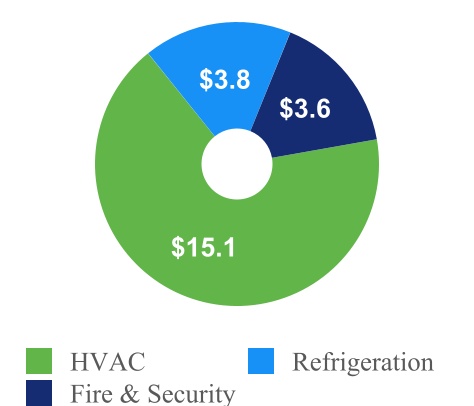
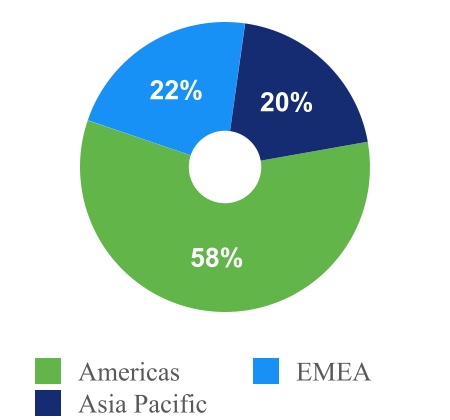
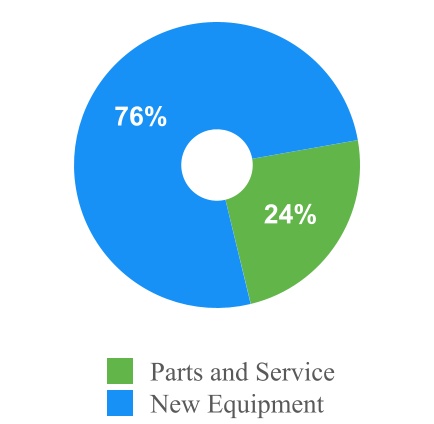
- Segment sales include inter-company sales.
Separation from United Technologies Corporation
On April 3, 2020 (the "Distribution Date"), United Technologies Corporation, ("UTC"), since renamed RTX Corporation ("Raytheon Technologies Corporation" or "RTX") completed the spin-off of Carrier into an independent publicly traded company (the "Separation") through a pro rata distribution (the "Distribution") on a one-for-one basis of all of the outstanding shares of common stock of Carrier to UTC shareowners who held shares of UTC common stock as of the close of business on March 19, 2020, the record date of the Distribution. In connection with the Separation, we issued an aggregate principal balance of $11.0 billion of debt and transferred approximately $10.9 billion of cash to UTC on February 27, 2020 and March 27, 2020. In addition, we entered into several agreements with UTC and Otis Worldwide Corporation ("Otis") that govern various aspects of the relationship among us, UTC and Otis following the Separation and Distribution. As of December 31, 2023, only certain portions of the Tax Matters Agreement ("TMA") remain in effect. On April 1, 2020 and April 2, 2020, we received cash contributions totaling $590 million from UTC related to the Separation.
Business Segments
We globally manage our business operations through three segments: HVAC, Refrigeration and Fire & Security. Each respective segment's major products, services and distribution methods are as follows:
The HVAC segment provides products, controls, services and solutions to meet the heating, cooling and ventilation needs of residential and commercial customers while enhancing building performance, health, energy efficiency and sustainability. Our established brands include Carrier, Toshiba, Automated Logic, Bryant, CIAT, Day & Night, Heil, NORESCO and Riello which offer an innovative and complete portfolio of products that provide numerous solutions for our customers. Products include air conditioners, heating systems, heat pumps, controls and aftermarket components as well as aftermarket repair and maintenance services and building automation systems. Some of these products are part of our Healthy Buildings Program, which offers a suite of targeted solutions that are focused on improving and optimizing indoor air quality in buildings and homes to enhance human health, safety and productivity. Products and solutions are sold directly to building contractors and owners and indirectly through joint ventures, independent sales representatives, distributors, wholesalers, dealers and retail outlets.
The Refrigeration segment provides a healthier, safer, more sustainable and more intelligent cold chain through the reliable transport and preservation of food, medicine and other perishable cargo. Products and services are sold under established brand names, including Carrier Commercial Refrigeration, Carrier Transicold and Sensitech. Our refrigeration and monitoring products, services and digital solutions, which form our Connected Cold Chain offering, strengthen the connected cold chain and are designed for trucks, trailers, shipping containers, intermodal applications, food retail and warehouse cooling. Commercial refrigeration solutions include refrigerated cabinets, freezers, systems and controls which incorporate next-generation technologies to preserve freshness, ensure safety and enhance the appearance of food and beverages sold by retailers. Products and services are sold directly to transportation companies and retail stores and indirectly through joint ventures, independent sales representatives, distributors, wholesalers and dealers.
The Fire & Security segment provides a wide range of residential, commercial and industrial technologies designed to help protect people and property. Our established brands include Kidde, Edwards, GST, LenelS2, Marioff, Autronica, Aritech, Det-Tronics, Onity, Supra and Fireye which provide product and technology innovations that are supported by installation, maintenance and monitoring through a network of channel partners and our own field service business, along with web-based and mobile applications and cloud-based services. Products include fire, flame, gas, smoke and carbon monoxide detection, portable fire extinguishers, fire suppression systems, intruder alarms, access control systems and video management systems and electronic controls. Other fire and security service offerings include audit, design, installation and system integration as well as aftermarket maintenance and repair and monitoring services. Our fire and security products and solutions, also part of our Healthy Homes and Healthy Buildings Programs, are sold directly to end customers as well as through manufacturers’ representatives, distributors, dealers, value-added resellers and retail distribution.
Planned Portfolio Transformation
On April 25, 2023, we announced that we entered into a Share Purchase Agreement (the “Agreement”) to acquire the climate solutions business (the "VCS Business") of Viessmann Group GmbH & Co. KG (“Viessmann”), a privately-held company. The VCS Business develops intelligent, integrated and sustainable technologies, including heat pumps, boilers, photovoltaic systems, home battery storage and digital solutions, primarily for residential customers in Europe. The acquisition was completed on January 2, 2024 for total consideration of $14.2 billion.
On April 25, 2023, we announced plans to exit our Fire & Security and Commercial Refrigeration businesses over the course of 2024. On December 7, 2023, we entered into a stock purchase agreement to sell our Fire & Security Access Solutions business to Honeywell International Inc. for an enterprise value of approximately $4.95 billion. On December 12, 2023, we entered into a stock purchase agreement to sell our Commercial Refrigeration business ("CCR") to Haier Group Corporation for an enterprise value of approximately $775 million. Both transactions are expected to close in 2024 and are subject to customary closing conditions.
Business Strategy
Our business strategy is to be a global leader in intelligent climate and energy solutions with a focus on providing differentiated, digitally-enabled lifecycle solutions to our customers. We believe our strategy is supported by a variety of
favorable secular trends, including health and wellness, sustainability, digitalization, decarbonization, energy transition and a growing middle class. In order to execute our business strategy, we are focused on three pillars of growth:
Strengthen and Grow our Core
Our strategy involves driving organic growth in part by maintaining our proven track record of innovation, which is focused on designing smarter, more connected and more sustainable systems and solutions. Our strategy also relies on our iconic, industry-leading brands and on strengthening our long-term relationships with channel partners and customers by offering solutions that anticipate customer needs with a focus on technologies related to environmentally-friendly refrigerants, energy efficiency, low emissions, air quality, electrification, noise reduction and safety. In addition, we continue to actively manage and strengthen our business and product portfolio to meet the current and future needs of our customers. This is driven by sustaining activities with a focus on improving existing products and reducing production costs. We also pursue potential acquisitions to complement existing products and services to enhance our product portfolio.
Increase Product Extensions and Geographic Coverage
Our strategy involves leveraging our global operations, the strength of our iconic, industry-leading brands and our success in creating valuable partnerships to focus on targeted expansion into new locations and channels where we believe that we can drive profitable growth. These drivers are supported by research and development activities with a focus on new product development and new technology innovation. We also pursue potential acquisitions to enter new locations and channels as well as expand and enhance our current product portfolio. In addition, Carrier Ventures, our global venture capital wholly-owned subsidiary, focuses on investments to accelerate the development of sustainable innovations and disruptive technologies to transform future building and cold chain management. It engages in strategic partnerships with high growth organizations as they invest in the development of technologies to innovate and commercialize the next generation of integrated renewable offerings.
Grow Aftermarket, Digital and Customer-Back Solutions
Our strategy is focused on offering a comprehensive and differentiated suite of sustainable technologies and services. We expect that these solutions will increase our total available market opportunity, enhance our predictive service and maintenance capabilities, strengthen our customer intimacy and fuel aftermarket growth. For example, Abound is a cloud-based building platform that unlocks and unites building data to create healthy, sustainable and intelligent solutions for indoor spaces. It gathers data from disparate systems, sensors and sources; identifies opportunities to optimize performance; and works with healthy building solutions to improve occupant experiences. Our Lynx digital platform, developed in collaboration with Amazon Web Services (“AWS”), allows customers to leverage data to enhance visibility, resiliency, agility and efficiency in the cold chain to reduce losses and support real-time decisions. In addition, our product teams are deriving insights from data by employing AWS for connectivity, artificial intelligence and machine learning. Most recently, we signed a multi-year, strategic collaboration agreement with AWS to offer additional Software-as-a-Service ("SaaS") solutions in the areas of HVAC performance, sustainability and safety and security. The collaboration is part of our growing investment in digitally-enabled lifecycle solutions designed to inspire confidence in the health and safety of indoor environments.
As power grids and transport infrastructure shift from fossil fuels to renewables, we will continue to position ourselves as a leader in innovative electrified solutions that reduce emissions and energy consumption and promote grid stability. Our solutions range from residential home energy management to sustainable solutions for commercial and industrial buildings to optimized low noise and low greenhouse gas emission transport solutions. With the addition of the VCS Business on January 2, 2024, we are strongly positioned to provide renewable and complete energy solutions globally, with a portfolio that includes low global warming potential high temperature heat pumps for use in industrial and commercial applications, natural refrigerant heat pumps for residential buildings and a connected ecosystem of offerings for an electric home, such as solar PV, batteries, and a differentiated digital platform, all supported by extensive service and aftermarket offerings.
Our industry-leading global brands and track record of innovation form the foundation of our business strategy. This strategy is fueled by our position at the epicenter of important secular trends, including an emphasis on health and wellness, a growing focus on sustainability, increasing digitalization and energy transition. Coupled with our focus on growth, innovation and operational efficiency, we expect to drive long-term growth and increased value.
Other Matters Relating to Our Business as a Whole
Competitive Conditions
Each of our businesses is subject to significant competition from a number of companies throughout the world. Due to the nature of our products and services and the markets we serve, our competition can vary from regional or specialized companies to larger public or private companies.
The most significant competitive factors we face are technology differentiation, product performance, service, delivery schedule and price. Brand reputation, service to customers and quality are also important competitive factors for our products and services. While our competitive position varies among our products and services, we are a significant competitor with respect to each of our major product and service offerings. We believe that the loss of any individual contract or customer would not have a material adverse effect on our results.
Raw Materials and Supplies
We rely on suppliers and commodity markets to secure components and raw materials such as copper, aluminum and steel. In addition, we also use semi-conductors and other electronic components in the manufacture of our products. To maximize our buying effectiveness and leverage our scale, we have a central strategic sourcing group that consolidates purchases of certain materials and components across our business segments. We work closely with our suppliers to ensure availability of products and implement other cost savings initiatives. In addition, we continue to invest in our supply chain to improve its resilience with a focus on automation, dual sourcing of critical components and localized manufacturing when feasible.
Intellectual Property
We maintain a broad portfolio of patents, trademarks, copyrights, trade secrets, licenses and franchises related to our business to protect our research and development investments and to maintain our competitive advantages. We hold approximately 14,000 active patents and pending patent applications worldwide. From time to time, we take actions to protect our business by asserting our intellectual property rights against third-party infringement. We believe that we have taken reasonable measures to build and protect this portfolio of intellectual property rights, but we cannot be assured that these rights will not be challenged, found invalid or unenforceable.
Operating System
We plan to continue to foster operational, financial and commercial excellence to drive sales and earnings growth. With roots in our legacy manufacturing and business processes, the Carrier operating system — Carrier Excellence — is our continuous improvement framework that is expected to drive operational excellence across our businesses. Our Supplier Excellence program is intended to apply these same operating principles to our supply base and we continue to focus on strategic cost reductions through operational efficiency, digitalization, automation and supply chain productivity.
Joint Ventures and Strategic Relationships
Our joint ventures and strategic relationships are an important part of our business. We hold direct ownership interests in approximately 47 joint ventures, the financial results of which are accounted for by the equity method of accounting or the cost basis of accounting, of which 97% of such investments are in our HVAC segment. These relationships engage in distribution, manufacturing and product development activities and are integral to our business operations and growth strategy.
Seasonality
Demand for certain of our products and services is seasonal and can be impacted by weather conditions. For instance, sales and services of our HVAC products to residential customers have historically been higher in the second and third quarters of the calendar year, which represent the peak seasons for air conditioning-related sales in North America markets. A change in building and remodeling activity also can affect our financial performance. In addition, our financial performance may be influenced by the production and utilization of transport equipment, including truck production cycles in North America and Europe.
Compliance with the Regulation of our Business and Operations
We operate our businesses and sell our products all over the world. As a result, rapid changes in legislation, regulations and government policies, including with respect to regulations intended to combat climate change, affect our operations and business in the countries, regions and localities in which we operate and sell our products. International accords such as the Paris Agreement and the subsequent U.S. climate policies to meet its nationally determined contributions as well as local regulations in the U.S. reducing the use of fossil fuels in buildings all have the potential to impact our products and service offerings. Such changes, which can render our products and technologies non-compliant, involve refrigerants, noise levels, product and fire safety, hydrofluorocarbon emissions, fluorinated gases, hazardous substances and electric and electronic equipment waste. Increased fragmentation of regulatory requirements changes the manner in which we conduct our business and increases our costs because it necessitates the development of country or regional specific variants, monitoring of and compliance with those regulations and additional testing and certifications. In addition, our operations are subject to and affected by environmental regulations promulgated by federal, state and local authorities in the U.S. and by authorities with jurisdiction over our foreign operations. We have made, and will be required to continue to make, capital expenditures to design and upgrade our products to comply with or exceed environmental and other regulations and energy efficiency standards. However, it is our opinion that the costs related to compliance requirements for environmental or other government regulations will not have a material adverse effect on our capital expenditures, financial results or competitive position.
Environmental Goals
As a global leader in intelligent climate and energy solutions, we are committed to making the world safer, sustainable and more comfortable. We have set ambitious environmental, social and governance goals to be reached by 2030, which include the following:
-
Invest over $2 billion to develop healthy, safe, sustainable and intelligent buildings and cold chain solutions that incorporate sustainable design principles and reduce lifecycle impacts,
-
Reduce our customers' carbon footprint by more than 1 gigaton,
-
Achieve carbon neutral operations,
-
Reduce energy intensity by 10% across our operations,
-
Achieve water neutrality in our operations, prioritizing water-scarce locations, and
-
Promote sustainability through education, partnerships and climate resiliency programs.
Human Capital Management
As of December 31, 2023, we had approximately 53,000 employees worldwide, of which 39% are located in the Americas, 23% are located in EMEA and 38% are located in Asia. As of December 31, 2023, in the U.S., 75% of our approximately 4,300 production and maintenance employees were covered under six collective bargaining agreements with expiration dates ranging from 2024 to 2027. In Europe, approximately 11,000 employees are represented by two European Works Councils and, at national and local levels, we inform and consult with 46 local works councils and with unions representing employees at approximately 40 sites. We believe that our relations with our labor unions and works councils are generally good.
We believe that our employees are our most important asset and that, in turn, our success and growth depend in large part on our ability to attract, retain and develop a diverse population of talented and high-performing employees at all levels of our organization. We continuously evaluate, modify and enhance our recruitment and retention strategies as part of the overall management of our business. These strategies form the pillars of our human capital management framework and are advanced through the following programs, policies and initiatives.
Health & Safety. Our Environmental, Health and Safety program is focused on eliminating the risk of serious injuries, illness and fatalities to employees, contractors and customers during manufacturing, installation, servicing and other business activities. We apply rigorous standards, controls, inspections and audits to help ensure that our operations and premises comply with national and local regulations and our incident reporting requirements. For 2023, our total recordable incident rate ("TRIR"), based upon the number of employee injuries per 200,000 hours worked, was 0.30 and our lost time incident rate ("LTIR") was 0.10, both of which improved compared with 2022.
Competitive Pay, Benefits and Total Rewards and Practices. Our total rewards philosophy is designed to align the compensation of our employees with individual and company performance, and to provide the appropriate market-competitive incentives to attract, retain and motivate employees to achieve superior results. In addition, we offer a company-paid employee assistance program to help employees and their families with mental health and other life challenges. In coordination with each country’s social welfare system, and in addition to any required local health care participation, we may provide additional health and welfare benefits depending on, among other things, the market competitiveness in that country. We also offer a tuition assistance program, the Employee Scholar Program, that is discussed in more detail below (see Talent Development and Employee Engagement*).*
Inclusion & Diversity. As of December 31, 2023, approximately 30% of our employees and 32% of our executives globally were women. As of December 31, 2023, people of color represented approximately 33% of our U.S. executive and 27% of our professional employees in the U.S.
Our greatest strength is the global diversity of our people and inclusion is one of our core company values. We believe both are critical to employee engagement and ultimately, an important source of innovation. To this end, we continue to promote _belong as our inclusion and diversity philosophy which includes a focus on attracting, developing and mentoring the best talent. We also sponsor multiple Employee Resource Groups ("ERGs"), such as Pride, Carrier Black Alliance, WE (Women's Empowerment at Carrier), CHEER (Carrier Hispanic & Latino Employee Engagement Resource group), UCAN (United Carrier Asian Network) and Military and Veterans. These ERGs have an open membership to all employees, operate with a formal leadership structure, a steering committee, senior leadership sponsorship and a defined mission statement that is aligned with supporting our business strategy. We have established relationships with colleges and universities in the United States, including two historically black colleges and universities, to create programs to help students develop skills for the future and provide career and recruitment initiatives.
Our Chairman and Chief Executive Officer ("CEO") signed the CEO Action for Diversity & Inclusion TM pledge joining more than 2,000 CEOs to underscore our commitment to ensure inclusion is core to our business culture. Our senior management has also signed the Hispanic Promise, joining other Fortune 500 companies in the pledge to hire, retain and develop Hispanics in the workplace. Additionally, we offer our global workforce the opportunity to participate in annual inclusion and diversity training.
We are proud of the strides we have made and the recognition we have received in furthering our inclusion and diversity strategy. For example, in 2023, we participated in the Human Rights Campaign Foundation's Corporate Equality Index and achieved a perfect score for the third time, being recognized as a Best Place to Work for LGBTQ Equality. We also participated in the Human Rights Campaign Foundation’s Corporate Equality Index in Mexico and achieved a perfect score being recognized as Best Place to Work for LGBTQ Equality in Mexico for the second year in a row.
Talent Development and Employee Engagement. We are committed to the continued development and engagement of our people. We promote continuous learning by offering a company-sponsored Employee Scholar Program, which covers the cost of an employee's tuition, academic fees and books at approved universities. We conduct annual leadership development reviews, a process through which senior leaders identify future leaders and discuss strengths and development opportunities, fostering succession planning for key leadership positions. We also offer various talent development programs including internships, early career rotational programs and a suite of development programs for current and future leaders during the three critical stages of their careers – early career, mid-career and senior leadership.
Three-times per year we conduct a confidential online survey in local languages to solicit feedback from our employees. The results are reviewed by senior leadership and shared with our managers and other employees who collaborate to act on identified areas of improvement.
Corporate Information
Carrier was incorporated in Delaware in connection with the Separation on March 15, 2019. Our principal executive offices are located at 13995 Pasteur Boulevard, Palm Beach Gardens, Florida 33418, and our telephone number is (561) 365-2000. We maintain an Internet website at www.corporate.carrier.com.
Item 1A. RISK FACTORS
RISK FACTOR SUMMARY
Risks Related to Our Business
-
Risks associated with our international operations could adversely affect our competitive position, results of operations, cash flows or financial condition.
-
We are party to joint ventures and other strategic relationships, which may not be successful and may expose us to unique risks and restrictions.
-
Risks associated with climate change, government, regulations and incentives associated with climate change and mitigation efforts could adversely affect our business.
-
Demand for our HVAC products and services is influenced by weather conditions and seasonality.
-
Our business and financial performance depend on continued and substantial investments in our information technology infrastructure, which may not yield anticipated benefits and which may be vulnerable to cyber-attacks.
-
Cybersecurity incidents could disrupt business operations, result in the loss of critical and confidential information, and adversely impact our reputation and results of operations.
-
We engage in acquisitions and divestitures and may encounter difficulties integrating acquired businesses with, or disposing of businesses from, our current operations; therefore, we may not realize the anticipated benefits of these acquisitions and divestitures.
-
We have significant indebtedness, as well as unused borrowing capacity, and we may incur additional debt in the future. Servicing our indebtedness requires a significant amount of cash, and the terms of our current indebtedness, and the terms of any future indebtedness may restrict the activities of the company.
-
We depend on our intellectual property and have access to certain intellectual property and information of our customers and suppliers. Infringement of or the failure to protect that intellectual property could adversely affect our future growth and success.
-
We use a variety of raw materials, supplier-provided parts and third-party service providers in our business. The ability of suppliers to deliver parts, components and manufacturing equipment to our manufacturing facilities, and our ability to manufacture without disruption, could affect our business performance. Significant shortages, supplier capacity constraints or production disruptions, price increases or tariffs could increase our operating costs and adversely impact the competitive positions of our products.
-
We design, manufacture and service products that incorporate advanced technologies. The introduction of new products and technologies involves risks, and we may not realize the degree or timing of benefits initially anticipated.
-
We operate in a competitive environment and our profitability and competitive position depend on our ability to accurately estimate the costs and timing of providing our products and services.
-
Customers and others may take disruptive actions.
-
Labor matters may impact our business.
-
Our defined benefit pension plans are subject to financial market risks that could adversely affect our results.
-
We may not realize expected benefits from our cost reduction and restructuring efforts, and our profitability or our business otherwise might be adversely affected.
-
Failure to achieve and maintain a high level of product and service quality could damage our reputation with customers and negatively impact our results.
-
We are subject to litigation, environmental and other legal and compliance risks.
-
We are subject to risks arising from doing business with the U.S. government.
-
We may recognize impairment charges for our goodwill and intangible assets.
-
Failure to maintain a satisfactory credit rating could adversely affect our liquidity, capital position, borrowing costs and access to the capital markets.
Risks Related to the Separation from UTC
-
After the Separation and the Distribution, certain members of management, directors and shareowners own stock in UTC, Carrier and Otis and as a result may face actual or potential conflicts of interest.
-
In connection with the Separation into three independent public companies, each of UTC, Carrier and Otis has agreed to indemnify the other parties for certain liabilities. If we are required to pay UTC and/or Otis under these indemnities, our financial results could be negatively impacted. Also, the UTC or Otis indemnities may not be sufficient to hold us harmless from the full amount of liabilities for which UTC and Otis have been allocated responsibility, and UTC and/or Otis may not be able to satisfy their respective indemnification obligations in the future.
-
In certain circumstances, we could be required to indemnify UTC for material taxes and other related amounts pursuant to indemnification obligations under the TMA.
-
Potential liabilities may arise due to fraudulent transfer considerations, which would adversely affect our financial condition and results of operations.
Risks Related to Our Common Stock
-
The market price and trading volume of our common stock may fluctuate significantly.
-
Shareowner's percentage of ownership in our common stock may be diluted in the future.
-
Quarterly cash dividends may be discontinued or modified, are subject to a number of uncertainties and may affect the price of our common stock.
-
Our amended and restated bylaws designate the courts within the State of Delaware as the sole and exclusive forum for certain types of actions and proceedings that may be initiated by our shareowners, which could discourage lawsuits against Carrier and our directors and officers.
-
Anti-takeover provisions could enable our Board of Directors to resist a takeover attempt by a third party and limit the power of our shareowners.
General Risks
-
Natural disasters, epidemics or other unexpected events (including those related to COVID-19) may disrupt our operations, adversely affect our results of operations, cash flows or financial condition, and may not be fully covered by insurance.
-
We may be affected by global economic, capital market and political conditions, and conditions in the construction, transportation and infrastructure industries in particular.
-
Our business success depends on attracting and retaining qualified personnel.
-
Additional tax expense or additional tax exposures could affect our future profitability.
-
Failure to maintain effective internal controls over financial reporting in accordance with Section 404 of the Sarbanes-Oxley Act could materially and adversely affect us.
RISK FACTORS
Our business, financial condition, operating results and cash flows can be impacted by the factors set forth subsequently, any one of which could cause our actual results to vary materially from recent results or from our anticipated future results.
Risks Related to Our Business
Risks associated with our international operations could adversely affect our competitive position, results of operations, cash flows or financial condition.
Approximately 48% of our net sales for the year ended December 31, 2023 are derived from international operations, including U.S. export sales. As a result, changes in local and regional economic conditions, including fluctuating exchange rates, may adversely affect demand for our products and the profits generated by our non-U.S. operations because a significant portion of our sales and expenses are denominated in currencies other than U.S. dollars. While we attempt to manage our exchange rate risks, we are not completely insulated from that exposure. Exchange rates can be volatile and a substantial weakening of foreign currencies against the U.S. dollar could reduce our operating margins in various locations outside of the U.S., which would adversely impact the comparability of our results from period to period.
Our international sales and operations are also subject to the risks associated with changes in local government regulations and policies regarding investments, employment, taxat
Showing the first 8K of 88K characters. Open the full section
Item 1B. UNRESOLVED STAFF COMMENTS
None.
Item 1C. CYBERSECURITY
Impact of cybersecurity risks on business strategy, results of operations or financial condition.
As discussed under the “Risk Factors” heading in this Annual Report, our business has been and may again in the future be impacted by disruptions to our IT infrastructure or our third-party providers’ IT infrastructures from (among other causes) cybersecurity-based risks, including attacks (i) on our IT infrastructure (ii) targeting the security, integrity and/or availability of hardware and software; (iii) exploiting weaknesses or vulnerabilities in products, or capturing information installed, stored or transmitted in our products (including after the purchase of those products and when they are installed into third-party products); and (iv) on facilities or similar infrastructure.
Risk Management and strategy.
We mitigate cybersecurity risks (and other material risks) through our enterprise risk management (“ERM”) program, which is a company-wide effort, managed by senior executives and overseen by our Audit Committee and Board of Directors to identify, assess, manage, report and monitor material risks that may affect our ability to achieve our business objectives.
In connection with the ERM process, cybersecurity risks, including those relating to risks posed by our use of third-party service providers, are assigned to cross-functional management committees responsible for identifying and classifying the cybersecurity risks in accordance with our ERM risk rating methodology, and developing and administering risk mitigation and incident response plans. These cross-functional management committees regularly meet to review current and emerging cybersecurity risks and maintain policies and procedures governing the evaluation and classification of such risks.
Cybersecurity risks deemed to be critical are reviewed by a Critical Threat Committee, which is comprised of members of our senior leadership team including our Chief Financial Officer, Chief Legal Officer, Chief Digital Officer, Chief Operating Officer, Chief Technology Officer, and Controller. The Critical Threat Committee reviews the risk and mitigation plan with the applicable cross-functional management team and facilitates notification to the Audit Committee of emerging critical cybersecurity risks. The Audit Committee and the Board of Directors receive regular briefings on cybersecurity risks. See “—Governance” below for further discussion of governance of our cybersecurity program.
In the event of a cybersecurity incident, we maintain incident response plans to investigate, classify, respond to, and manage cybersecurity incidents that may compromise the availability or integrity of our information systems, network resources, or data. In accordance with the incident response plans, cross-functional management teams assess and assign a threat level to each cybersecurity incident. A cybersecurity incident (or incidents, if aggregated together) assigned a critical threat level is escalated to the Critical Threat Committee for review.
To ensure that our employees are equipped to identify and mitigate material cybersecurity incidents and to empower them to help us maintain a secure environment for our operations and data assets, we utilize a multifaceted training approach aimed at fostering a culture of security awareness and responsibility among all employees. These tailored programs are designed and updated to address evolving threats and industry best practices. In addition to annual cybersecurity training for employees and contractors and simulated phishing email campaigns, our cybersecurity teams conduct tabletop exercises with our senior management team. Our cybersecurity teams also oversee a security assessment process that is used to screen our third-party service providers for cybersecurity vulnerabilities based on the level of inherent risk they pose to the company or our customers, based on factors including but not limited to the products or services they provide and their ability to access our information systems, network resources, or data.
We engage and retain outside consultants and legal advisors and we are members of several cybersecurity industry groups to keep us apprised of emerging cybersecurity risks, defense and mitigation strategies and governance best practices. Many of our processes and procedures have been independently audited and assessed against some of the leading international cybersecurity standards and programs.
Cybersecurity threats are constantly evolving, are becoming more frequent and more sophisticated and are made by groups of individuals with a wide range of expertise and motives which increases the difficulty of detecting and successfully defending against them. However, to date, cybersecurity threats have not materially affected us, including our business, strategy, results of operations or financial condition.
Governance
Our cybersecurity programs, including the cross-functional management committees responsible for identifying, assessing, and mitigating cybersecurity risks and incidents, are owned by our Chief Information Officer. Day-to-day administration of the cybersecurity programs are led by our Chief Information Security Officer and Chief Product Security Officer who collectively possess over 30 years of experience related to cybersecurity issues in both the private and government sectors, and possess certifications including but not limited to Certified Information Systems Security Professional ("CISSP") and Certified Information Security Manager ("CISM").
Cybersecurity risk oversight continues to remain a top priority for the Board of Directors. Although the Audit Committee maintains primary responsibility for oversight of cybersecurity risks through the ERM program, responsibility related to oversight of cybersecurity risks is also delegated to other committees in alignment with their focus charter responsibilities. For example, the Technology and Innovation and Governance Committees assist with the cybersecurity programs through their oversight of our technology, digital, and innovation strategies and product integrity program, respectively.
The Critical Threat Committee is also responsible for evaluating the materiality of a cybersecurity incident based on criteria that has been reviewed with the Board of Directors, and for determining whether there are disclosure obligations under applicable securities laws. In the event that the Critical Threat Committee determines that a critical cybersecurity incident (or incidents, if aggregated together) is deemed to be material, the Critical Threat Committee will brief the Board of Directors and oversee the disclosure process. For all critical cybersecurity incidents that are not deemed to be material, the Critical Threat Committee will notify the Chairman of the Board to determine whether the Board of Directors will be notified of the critical incident during the next regularly-scheduled cybersecurity update to the Audit Committee, or sooner as circumstances warrant.
Item 2. PROPERTIES
We operate approximately 1,100 sites, which comprise approximately 40 million square feet of productive space. Of these, our facilities and key manufacturing sites greater than 100,000 square feet comprise approximately 31 million square feet of productive space. Approximately 70%, 15% and 13% of these significant properties are associated with our HVAC, Refrigeration and Fire & Security segments, respectively, with approximately 2% not associated with a particular segment. Approximately 31% of these significant properties are leased and the remainder are owned. Approximately 27% of these significant properties are located in the U.S.
Our fixed assets as of December 31, 2023 include manufacturing facilities and non-manufacturing facilities, such as warehouses and machinery and equipment, most of which is general purpose machinery and equipment that use special jigs, tools and fixtures and that, in many instances, have automatic control features and special adaptations. The facilities, warehouses, machinery and equipment in use as of December 31, 2023 are in good operating condition, are well-maintained and substantially all are in regular use.
Item 3. LEGAL PROCEEDINGS
Asbestos Matters
The Company has been named as a defendant in lawsuits alleging personal injury as a result of exposure to asbestos allegedly integrated into certain Carrier products or business premises. While the Company has never manufactured asbestos and no longer incorporates it into any currently-manufactured products, certain products that the Company no longer manufactures contained components incorporating asbestos. A substantial majority of these asbestos-related claims have been dismissed without payment or have been covered in full or in part by insurance or other forms of indemnity. Additional cases were litigated and settled without any insurance reimbursement. The amounts involved in asbestos-related claims were not material individually or in the aggregate in any period. The amounts recorded for asbestos-related liabilities are based on currently available information and assumptions that the Company believes are reasonable and are made with input from outside actuarial experts. These amounts are undiscounted and exclude the Company’s legal fees to defend the asbestos claims, which are expensed as incurred. In addition, the Company has recorded insurance recovery receivables for probable asbestos-related recoveries.
UTC Equity Awards Conversion Litigation
On August 12, 2020, several former employees of UTC or its subsidiaries filed a putative class action complaint (the "Complaint") in the United States District Court for the District of Connecticut against RTX, Carrier, Otis, the former members of the UTC Board of Directors and the members of the Carrier and Otis Boards of Directors (Geraud Darnis, et al. v. Raytheon Technologies Corporation, et al.). The Complaint challenged the method by which UTC equity awards were converted to UTC, Carrier and Otis equity awards following the Separation and the Distribution. Defendants moved to dismiss the Complaint. Plaintiffs amended their Complaint on September 13, 2021 (the "Amended Complaint"). The Amended Complaint, with RTX, Carrier and Otis as the only defendants, asserted that the defendants are liable for breach of certain equity compensation plans and for breach of the implied covenant of good faith and fair dealing. The Amended Complaint also sought specific performance. The Company believes all plaintiffs' claims against it are without merit. Defendants moved to dismiss the Amended Complaint. On September 30, 2022, the court dismissed the case against all defendants, with prejudice. Plaintiffs appealed the dismissal to the United States Court of Appeals for the Second Circuit. On August 3, 2023, the Second Circuit Court of Appeals affirmed the district court's ruling. The Second Circuit’s judgment is final and non-appealable.
Aqueous Film Forming Foam Litigation
As of December 31, 2023, the Company, Kidde-Fenwal, Inc. ("KFI") and others have been named as defendants in more than 6,000 lawsuits filed by individuals in or removed to the federal courts of the United States alleging that the historic use of Aqueous Film Forming Foam ("AFFF") caused personal injuries and/or property damage. The Company, KFI and others have also been named as defendants in more than 700 lawsuits filed by several U.S. states, municipalities and water utilities in or removed to U.S. federal courts alleging that the historic use of AFFF caused contamination of property and water supplies. In December 2018, the U.S. Judicial Panel on Multidistrict Litigation transferred and consolidated all AFFF cases pending in the U.S. federal courts against the Company, KFI and others to the U.S. District Court for the District of South Carolina (the "MDL Proceedings"). The individual plaintiffs in the MDL Proceedings generally seek damages for alleged personal injuries, medical monitoring, diminution in property value and injunctive relief to remediate alleged contamination of water supplies. The U.S.
state, municipal and water utility plaintiffs in the MDL Proceedings generally seek damages and costs related to the remediation of public property and water supplies.
AFFF is a firefighting foam, developed beginning in the late 1960s pursuant to U.S. military specification, used to extinguish certain types of hydrocarbon-fueled fires. The lawsuits identified above relate to Kidde Fire Fighting, Inc., which owned the National Foam business. Kidde Fire Fighting, Inc. was acquired by a UTC subsidiary in 2005 and merged into KFI in 2007. The National Foam business manufactured AFFF for sale to government (including the U.S. federal government) and non-government customers in the U.S. at a single facility located in West Chester, Pennsylvania (the "Pennsylvania Site"). In 2013, KFI divested the AFFF businesses to an unrelated third party. The Company acquired KFI as part of the Separation in April 2020.
The key components that contribute to AFFF's fire-extinguishing capabilities are known as fluorosurfactants. Neither the Company, nor KFI, nor any of the Company's subsidiaries involved in the AFFF litigation manufactured fluorosurfactants. Instead, the National Foam business purchased these substances from unrelated third parties for use in manufacturing AFFF. Plaintiffs in the MDL Proceedings allege that the fluorosurfactants used by various manufacturers in producing AFFF contained, or over time degraded into, compounds known as per- and polyfluoroalkyl substances (referred to collectively as "PFAS"), including perflourooctanesulfonic acid ("PFOS") and perflourooctanoic acid ("PFOA"). Plaintiffs further allege that, as a result of the use of AFFF, PFOS and PFOA were released into the environment and, in some instances, ultimately reached drinking water supplies.
Plaintiffs in the MDL Proceedings allege that PFOS and PFOA contamination has resulted from the use of AFFF manufactured using a process known as ECF, and that this process was used exclusively by 3M. They also allege that PFOA contamination has resulted from the use of AFFF manufactured using a different process, known as telomerization, and that this process was used exclusively by the other AFFF manufacturers (including the National Foam business). Compounds containing PFOS and PFOA (as well as many other PFAS) have also been used for decades by many third parties in a number of different industries to manufacture firefighters’ protective outerwear, carpets, clothing, fabrics, cookware, food packaging, personal care products, cleaning products, paints, varnishes and other consumer and industrial products.
Plaintiffs in the MDL Proceedings have named multiple defendants, including suppliers of chemicals and raw materials used to manufacture fluorosurfactants, fluorosurfactant manufacturers and AFFF manufacturers. The defendants in the MDL Proceedings moved for summary judgment on the government contractor defense, which potentially applies to AFFF sold to or used by the U.S. government. After full briefing and oral argument, on September 16, 2022, the MDL court declined to enter summary judgment for the defendants. The defense, however, remains available at any trial to which it applies.
On September 23, 2022, after completion of discovery, the MDL court selected one water provider case, the City of Stuart, FL v. 3M, et al., for a bellwether trial. That trial was scheduled to begin in early June 2023 but was postponed indefinitely. The MDL court ordered the bellwether process for personal injury cases to begin in 2023. However, the court has not yet outlined details on that process or its timing.
Outside of the MDL Proceedings, the Company and other defendants are also party to six lawsuits in U.S. state courts brought by oil refining companies alleging product liability claims related to legacy sales of AFFF and seeking damages for the costs to replace the product and for property damage. In addition, the Company and other defendants are party to two actions related to the Pennsylvania Site in which the plaintiff water utility company seeks remediation costs related to the alleged contamination of the local water supply.The Company, KFI and other defendants are also party to one action in Arizona state court brought by a firefighter claiming that occupational exposure to AFFF has caused him certain personal injuries.
The Company and KFI believe that they have meritorious defenses to the claims in the MDL Proceedings and the other AFFF lawsuits. Given the numerous factual, scientific and legal issues to be resolved relating to these claims, the Company is unable to assess the probability of liability or to reasonably estimate a range of possible loss at this time. There can be no assurance that any such future exposure will not be material in any period.
On May 14, 2023, KFI filed a voluntary petition with the United States Bankruptcy Court for the District of Delaware seeking relief under Chapter 11 of the Bankruptcy Code after the Company determined that it would not provide financial support to KFI going forward, other than ensuring KFI has access to services necessary for the effective operation of its business. As a result, all litigation against KFI is automatically stayed. KFI filed an adversary complaint and motion in the Chapter 11 case seeking an order staying or enjoining all AFFF-related litigation against the Company, its other subsidiaries and RTX. That motion was resolved through an agreement that effectively stays the AFFF litigation against these parties. KFI has also
indicated to the bankruptcy court that it intends to pursue insurance coverage for AFFF-related liabilities and contractual indemnification for AFFF-related liabilities from the third party to which KFI sold National Foam. On November 21, 2023, the bankruptcy court ordered certain parties, including the Company, to participate in a mediation with respect to claims that might be asserted by and against it in the bankruptcy proceedings. The parties have engaged in several mediation sessions and anticipate further sessions in the future.
Deconsolidation Due to Bankruptcy
As of May 14, 2023, the Company no longer controlled KFI as their activities are subject to review and oversight by the bankruptcy court. Therefore, KFI was deconsolidated and their respective assets and liabilities were derecognized from the Company’s Consolidated Financial Statements. Upon deconsolidation, the Company determined the fair value of its retained interest in KFI to be zero and accounted for it prospectively using the cost method. As a result of these actions, the Company recognized a loss of $297 million in its Consolidated Statements of Operations within Other income/(expense), net. In addition, the deconsolidation resulted in an investing cash outflow of $134 million in the Company's Consolidated Statements of Cash Flows.
In connection with the bankruptcy filing, KFI entered into several agreements with subsidiaries of the Company to ensure they have access to services necessary for the effective operation of their business. All post-deconsolidation activity between the Company and KFI are reported as third-party transactions recorded within the Company's Consolidated Statements of Operations. Since the petition date, there were no material transactions between the Company and KFI.
Other
We have commitments and contingent liabilities related to legal proceedings, self-insurance programs and matters arising out of the ordinary course of business. Additionally, we are routinely a defendant in, party to or otherwise subject to many pending and threatened legal actions, claims, disputes and proceedings. These matters are often based on alleged violations of contract, product liability, warranty, regulatory, environmental, health and safety, employment, intellectual property, tax and other laws. In some of these proceedings, claims for substantial monetary damages are asserted against us and could result in fines, penalties, compensatory or treble damages or non-monetary relief. We do not believe that these matters will have a material adverse effect upon our competitive position, results of operations, cash flows or financial condition.
A further discussion of our potential regulatory liabilities can be found under the headings "Business" and "Risk Factors" in this Annual Report.
Item 4. MINE SAFETY DISCLOSURE
Not Applicable.
PART II
Item 5. MARKET FOR REGISTRANT'S COMMON EQUITY, RELATED SHAREOWNER MATTERS AND ISSUER PURCHASES OF EQUITY SECURITIES
The Company's common stock is listed on the NYSE under the ticker symbol "CARR." As of December 31, 2023, the approximate number of common stock shareowners of record was 21,605.
The declaration and payment of dividends is at the discretion of our Board of Directors, and will depend upon our financial results, cash requirements and other factors deemed relevant by our Board of Directors.
PERFORMANCE GRAPH
The following information is not deemed to be “soliciting material” or to be “filed” with the SEC or subject to Regulation 14A or 14C under the Exchange Act or to the liabilities of Section 18 of the Exchange Act, and will not be deemed to be incorporated by reference into any filing of the Company under the Securities Act or the Exchange Act, except to the extent the Company specifically incorporates it by reference into such a filing.
On April 3, 2020, UTC completed the Separation of Carrier into a stand-alone company. As a result of the Separation and the Distribution, Carrier became an independent public company. The following graph presents the cumulative total shareowner return from the Distribution Date through December 31, 2023 for our common stock, as compared with the S&P 500 Index and the Dow Jones Industrial Index.
Our common stock is a component of the S&P 500 Index. These figures assume that all dividends paid over the period were reinvested and that the starting value of each index and the investment in our common stock was $100 on April 3, 2020.
Comparison of Cumulative Total Return

The cumulative total returns on our common stock and each index as of each April 3, 2020 through December 31, 2023 plotted in the above graph are as follows:
| Company / Index | April 3, 2020 | December 31, 2020 | December 31, 2021 | December 31, 2022 | December 31, 2023 | |||||||||||||||||||||||||||||||||
| Carrier Global Corporation | $ | 100.00 | $ | 286.66 | $ | 416.55 | $ | 316.82 | $ | 441.24 | ||||||||||||||||||||||||||||
| S&P 500 Index | $ | 100.00 | $ | 150.59 | $ | 193.82 | $ | 154.28 | $ | 191.66 | ||||||||||||||||||||||||||||
| Dow Jones Industrial Index | $ | 100.00 | $ | 145.31 | $ | 175.75 | $ | 157.45 | $ | 179.03 |
Issuer Purchases of Equity Securities
The following table provides information about our purchases during the three months ended December 31, 2023 of equity securities that are registered by us pursuant to Section 12 of the Exchange Act.
| Total Number of Shares Purchased (in 000's) | Average Price Paid per Share (1) | Total Number of Shares Purchased as Part of a Publicly Announced Program (in 000's) | Approximate Dollar Value of Shares that May Yet Be Purchased Under the Program (in millions) | |||||||||||||||||||||||
| 2023 | ||||||||||||||||||||||||||
| October 1 - October 31 | — | $— | — | $ | 2,129 | |||||||||||||||||||||
| November 1 - November 30 | — | $— | — | $ | 2,129 | |||||||||||||||||||||
| December 1 - December 31 | — | $— | — | $ | 2,129 | |||||||||||||||||||||
| Total | — | $— | — | |||||||||||||||||||||||
(1) Excludes broker commissions.
We may purchase our outstanding common stock from time to time subject to market conditions and at our discretion. Repurchases occur in the open market or through one or more other public or private transactions pursuant to plans complying with Rules 10b5-1 and 10b-18 under the Exchange Act. Since the initial authorization in February 2021, the Company's Board of Directors authorized the repurchase of up $4.1 billion of the Company's outstanding common stock.
Equity Compensation Plan Information
See Item 12, Security Ownership of Certain Beneficial Owners and Management and Related Shareowner Matters, of this Annual Report.
Item 7. MANAGEMENT'S DISCUSSION AND ANALYSIS OF FINANCIAL CONDITION AND RESULTS OF OPERATIONS
BUSINESS OVERVIEW
Business Summary
Carrier Global Corporation ("we" or "our") is a global leader in intelligent climate and energy solutions with a focus on providing differentiated, digitally-enabled lifecycle solutions to our customers. Our portfolio includes industry-leading brands such as Carrier, Toshiba, Automated Logic, Carrier Transicold, Kidde, Edwards and LenelS2 that offer innovative heating, ventilating and air conditioning ("HVAC"), refrigeration, fire, security and building automation technologies to help make the world safer and more comfortable. We also provide a broad array of related building services, including audit, design, installation, system integration, repair, maintenance and monitoring. Our operations are classified into three segments: HVAC, Refrigeration and Fire & Security.
Our worldwide operations are affected by global and regional industrial, economic and political factors and trends. These include the mega-trends of urbanization, climate change and increasing requirements for food safety driven by the food needs of our growing global population and the rising standards of living in emerging markets. We believe that our business segments are well positioned to benefit from favorable secular trends, including these mega-trends and from the strength of our industry-leading brands and track record of innovation. In addition, we regularly review our end markets to proactively identify trends and adapt our strategies accordingly.
Our business is also affected by changes in the general level of economic activity, such as changes in business and consumer spending, construction and shipping activity as well as short-term economic factors such as currency fluctuations, commodity price volatility and supply disruptions. We continue to invest in our business, take pricing actions to mitigate supply chain and inflationary pressures, develop new products and services in order to remain competitive in our markets and use risk management strategies to mitigate various exposures. We believe that we have industry-leading global brands, which form the foundation of our business strategy. Coupled with our focus on growth, innovation and operational efficiency, we expect to drive long-term future growth and increased value for our shareowners.
Significant Events
Planned Portfolio Transformation
On April 25, 2023, we announced that we entered into a Share Purchase Agreement (the “Agreement”) to acquire the climate solutions business (the "VCS Business") of Viessmann Group GmbH & Co. KG (“Viessmann”), a privately-held company. The VCS Business develops intelligent, integrated and sustainable technologies, including heat pumps, boilers, photovoltaic systems, home battery storage and digital solutions, primarily for residential customers in Europe. The acquisition was completed on January 2, 2024 for total consideration of $14.2 billion.
On April 25, 2023, we announced plans to exit our Fire & Security and Commercial Refrigeration businesses over the course of 2024. On December 7, 2023, we entered into a stock purchase agreement to sell our Fire and Security Access Solutions business to Honeywell International Inc. for an enterprise value of approximately $4.95 billion. On December 12, 2023, we entered into a stock purchase agreement to sell our Commercial Refrigeration business ("CCR") to Haier Group Corporation for an enterprise value of approximately $775 million. Both transactions are expected to close 2024.
Deconsolidation of Kidde-Fenwal, Inc.
On May 14, 2023, Kidde-Fenwal, Inc. ("KFI"), an indirect wholly-owned subsidiary of ours, filed a petition for voluntary reorganization under Chapter 11 of the United States Bankruptcy Code ("Chapter 11") in the United States Bankruptcy Court for the District of Delaware. KFI, an industrial fire detection and suppression business historically reported in our Fire & Security segment, has indicated that it intends to use the bankruptcy process to explore strategic alternatives, including the sale of KFI as a going concern. KFI has further stated that, during the Chapter 11 process, KFI expects that there will be no significant interruptions to its business operations. As of the petition date, KFI was deconsolidated and its respective assets and liabilities were derecognized from our Consolidated Financial Statements.
Acquisition of Toshiba Carrier Corporation
On February 6, 2022, we entered into a binding agreement to acquire a majority ownership interest in Toshiba Carrier Corporation ("TCC"), a variable refrigerant flow ("VRF") and light commercial HVAC joint venture between Carrier and Toshiba Corporation. TCC designs and manufactures flexible, energy-efficient and high-performance VRF and light commercial HVAC systems as well as commercial products, compressors and heat pumps. The acquisition included all of TCC's advanced research and development centers and global manufacturing operations, product pipeline and the long-term use of Toshiba's iconic brand. The acquisition was completed on August 1, 2022. As a result, the assets, liabilities and results of operations of TCC are consolidated in the accompanying Consolidated Financial Statements as of the date of acquisition and reported within our HVAC segment. Upon closing, Toshiba Corporation retained a 5% ownership interest in TCC.
Sale of Chubb Fire & Security Business
On July 26, 2021, we entered into a stock purchase agreement to sell our Chubb Fire & Security business ("Chubb") to APi Group Corporation ("APi"). Chubb, which was reported within our Fire & Security segment, delivered essential fire safety and security solutions from design and installation to monitoring, service and maintenance across more than 17 countries around the globe. On January 3, 2022, we completed the sale of Chubb (the "Chubb Sale") for net proceeds of $2.9 billion and recognized a gain on the sale of $1.1 billion during the year ended December 31, 2022.
RESULTS OF OPERATIONS
This discussion summarizes the significant factors affecting our consolidated results of operations, financial condition and liquidity for the year ended December 31, 2023 compared with December 31, 2022. This discussion should be read in conjunction with Item 8, the Consolidated Financial Statements and the accompanying Notes to the Consolidated Financial Statements in this Annual Report. A detailed discussion of the year ended December 31, 2022 compared with December 31, 2021 is not included herein and can be found in the Management's Discussion and Analysis of Financial Condition and Results of Operations section in the Company's 2022 Annual Report, filed with the SEC on February 7, 2023, under the heading "Results of Operations," which is incorporated herein by reference.
Year Ended December 31, 2023 Compared with Year Ended December 31, 2022
The results of TCC's operations are included in our consolidated results since the acquisition date of August 1, 2022. Prior to the acquisition, we previously accounted for our minority ownership in TCC under the equity method of accounting and recognized our portion of earnings within Equity method investment in net earnings as part of operating expenses. As a result, prior period results may not be comparable to the current period.
The following represents our consolidated net sales and operating results:
| (In millions) | 2023 | 2022 | Period Change | % Change | |||||||||||||||||||||||||
Showing the first 8K of 65K characters. Open the full section
Item 7A. QUANTITATIVE AND QUALITATIVE DISCLOSURES ABOUT MARKET RISK
Market Risk and Risk Management
We are exposed to fluctuations in foreign currency exchange rates, interest rates and commodity prices which could impact our results of operations and financial condition. There has been no significant change in our exposure to market risk for the year ended December 31, 2023.
Foreign Currency Exposures. We have operations throughout the world that manufacture and sell products in various international markets. As a result, we are exposed to exchange rate movements in relation to our reporting currency, the U.S. dollar. Many of our non-U.S. operations have a functional currency other than the U.S. dollar. Therefore, our reported results will be higher or lower depending on the weakening or strengthening of the U.S. dollar against the respective foreign currency. We actively manage material currency exposures that are associated with purchases and sales and other assets and liabilities at the legal entity level; however, we do not hedge currency translation risk.
In connection with the acquisition of the VCS Business, 80% of the Euro-denominated purchase price was paid in cash to Viessmann on January 2, 2024. As a result, the purchase price was exposed to exchange rate movements in relation to our reporting currency, the U.S. dollar. To mitigate the foreign currency risk of the cash outflow, we entered into window forward contracts. Changes in the fair value of the window forward contracts are reported in Other income (expense), net in the accompanying Consolidated Statement of Operations.
In connection with the TCC acquisition, we entered into cross currency swaps and the Japanese Term Loan Facility to fund the Yen-denominated purchase price. We designated the cross currency swaps and the Japanese Term Loan Facility as a hedge of our investment in certain subsidiaries whose functional currency is the Japanese Yen in order to manage foreign currency translation risk. As a result, changes in the fair value of the cross currency swaps and the carrying value of the Japanese Term Loan Facility associated with foreign exchange rate movements are recorded in Equity in the Consolidated Balance Sheet. To the extent that any hedge is not fully effective at offsetting changes in the underlying hedged item, there could be a net earnings impact.
Commodity Price Exposures. We are exposed to volatility in the prices of commodities used in some of our products and when appropriate, we use fixed price contracts to manage this exposure. In addition, we are exposed to fuel costs to ship our products and materials. We do not have commodity hedge contracts in place at December 31, 2023.
Interest Rate Exposures. Substantially all of our long-term debt has fixed interest rates. As a result, any fluctuation in market interest rates is not expected to have a material effect on our results of operations.
Item 8. FINANCIAL STATEMENTS AND SUPPLEMENTARY DATA
Report of Independent Registered Public Accounting Firm
To the Board of Directors and Shareowners of Carrier Global Corporation
Opinions on the Financial Statements and Internal Control over Financial Reporting
We have audited the accompanying consolidated balance sheet of Carrier Global Corporation and its subsidiaries (the “Company”) as of December 31, 2023 and 2022, and the related consolidated statements of operations, of comprehensive income (loss), of changes in equity and of cash flows for each of the three years in the period ended December 31, 2023, including the related notes (collectively referred to as the “consolidated financial statements”). We also have audited the Company's internal control over financial reporting as of December 31, 2023, based on criteria established in Internal Control - Integrated Framework (2013) issued by the Committee of Sponsoring Organizations of the Treadway Commission (COSO).
In our opinion, the consolidated financial statements referred to above present fairly, in all material respects, the financial position of the Company as of December 31, 2023 and 2022, and the results of its operations and its cash flows for each of the three years in the period ended December 31, 2023 in conformity with accounting principles generally accepted in the United States of America. Also in our opinion, the Company maintained, in all material respects, effective internal control over financial reporting as of December 31, 2023, based on criteria established in Internal Control - Integrated Framework (2013) issued by the COSO.
Basis for Opinions
The Company's management is responsible for these consolidated financial statements, for maintaining effective internal control over financial reporting, and for its assessment of the effectiveness of internal control over financial reporting, included in Management’s Report on Internal Control Over Financial Reporting appearing under Item 9A. Our responsibility is to express opinions on the Company’s consolidated financial statements and on the Company's internal control over financial reporting based on our audits. We are a public accounting firm registered with the Public Company Accounting Oversight Board (United States) (PCAOB) and are required to be independent with respect to the Company in accordance with the U.S. federal securities laws and the applicable rules and regulations of the Securities and Exchange Commission and the PCAOB.
We conducted our audits in accordance with the standards of the PCAOB. Those standards require that we plan and perform the audits to obtain reasonable assurance about whether the consolidated financial statements are free of material misstatement, whether due to error or fraud, and whether effective internal control over financial reporting was maintained in all material respects.
Our audits of the consolidated financial statements included performing procedures to assess the risks of material misstatement of the consolidated financial statements, whether due to error or fraud, and performing procedures that respond to those risks. Such procedures included examining, on a test basis, evidence regarding the amounts and disclosures in the consolidated financial statements. Our audits also included evaluating the accounting principles used and significant estimates made by management, as well as evaluating the overall presentation of the consolidated financial statements. Our audit of internal control over financial reporting included obtaining an understanding of internal control over financial reporting, assessing the risk that a material weakness exists, and testing and evaluating the design and operating effectiveness of internal control based on the assessed risk. Our audits also included performing such other procedures as we considered necessary in the circumstances. We believe that our audits provide a reasonable basis for our opinions.
Definition and Limitations of Internal Control over Financial Reporting
A company’s internal control over financial reporting is a process designed to provide reasonable assurance regarding the reliability of financial reporting and the preparation of financial statements for external purposes in accordance with generally accepted accounting principles. A company’s internal control over financial reporting includes those policies and procedures that (i) pertain to the maintenance of records that, in reasonable detail, accurately and fairly reflect the transactions and dispositions of the assets of the company; (ii) provide reasonable assurance that transactions are recorded as necessary to permit preparation of financial statements in accordance with generally accepted accounting principles, and that receipts and expenditures of the company are being made only in accordance with authorizations of management and directors of the company; and (iii) provide reasonable assurance regarding prevention or timely detection of unauthorized acquisition, use, or disposition of the company’s assets that could have a material effect on the financial statements.
Because of its inherent limitations, internal control over financial reporting may not prevent or detect misstatements. Also, projections of any evaluation of effectiveness to future periods are subject to the risk that controls may become inadequate because of changes in conditions, or that the degree of compliance with the policies or procedures may deteriorate.
Critical Audit Matters
The critical audit matter communicated below is a matter arising from the current period audit of the consolidated financial statements that was communicated or required to be communicated to the audit committee and that (i) relates to accounts or disclosures that are material to the consolidated financial statements and (ii) involved our especially challenging, subjective, or complex judgments. The communication of critical audit matters does not alter in any way our opinion on the consolidated financial statements, taken as a whole, and we are not, by communicating the critical audit matter below, providing a separate opinion on the critical audit matter or on the accounts or disclosures to which it relates.
Revenue Recognition from Contracts with Customers
As described in Note 13 to the consolidated financial statements, the Company recognized $22,098 million of consolidated revenue for the year ended December 31, 2023. Some of the Company’s contracts with customers contain a single performance obligation, while others contain multiple performance obligations most commonly when a contract spans multiple phases of a product life-cycle such as production, installation, maintenance and support. The Company recognizes revenue when control of a good or service promised in a contract (i.e., performance obligation) is transferred to a customer. Control is obtained when a customer has the ability to direct the use of and obtain substantially all of the remaining benefits from that good or service. A significant portion of the Company's performance obligations are recognized at a point-in-time when control of the product transfers to the customer, which is generally the time of shipment. The remaining portion of the Company's performance obligations are recognized over time as the customer simultaneously obtains control as the Company performs work under a contract, or if the product being produced for the customer has no alternative use and the Company has a contractual right to payment. For over-time performance obligations requiring the installation of equipment, revenue is recognized using costs incurred to date relative to total estimated costs at completion to measure progress. The Company includes variable consideration in the estimated transaction price when there is a basis to reasonably estimate the amount and when it is probable that a significant reversal of revenue recognized would not occur when the uncertainty associated with variable
Showing the first 8K of 212K characters. Open the full section
Item 9. CHANGES IN AND DISAGREEMENTS WITH ACCOUNTANTS ON ACCOUNTING AND FINANCIAL DISCLOSURE
None.
Item 9A. CONTROLS AND PROCEDURES
Evaluation of Disclosure Controls and Procedures — Our management, with the participation of our CEO and Senior Vice President and Chief Financial Officer ("CFO"), has evaluated the effectiveness of the Company's disclosure controls and procedures (as such term is defined in Rules 13a-15(e) and 15d-15(e) under the Exchange Act) as of December 31, 2023. Based on that evaluation, the Company's CEO and CFO have concluded that, as of December 31, 2023, the Company's disclosure controls and procedures were effective in recording, processing, summarizing and reporting, within the time periods specified in the SEC's rules and forms, information required to be disclosed by the Company in the reports that it files or submits under the Exchange Act, and that information is accumulated and communicated to the Company's management, including our CEO and CFO, as appropriate, to allow timely decisions regarding required disclosures.
Management’s Report on Internal Control Over Financial Reporting — The Company’s management is responsible for establishing and maintaining adequate internal control over financial reporting, as such term is defined in Exchange Act Rules 13a-15(f) and 15d-15(f). The Company’s management, with the participation of the Company’s CEO and CFO, has evaluated the effectiveness of the Company’s internal control over financial reporting based on the criteria described in Internal Control-Integrated Framework (2013) issued by the Committee of Sponsoring Organizations of the Treadway Commission. Based on this evaluation, the Company’s management has concluded that, as of December 31, 2023, the Company’s internal control over financial reporting was effective.
Because of its inherent limitations, internal control over financial reporting may not prevent or detect misstatements. Also, projections of any evaluation of effectiveness to future periods are subject to risk that controls may become inadequate because of changes in conditions, or that the degree of compliance with the policies or procedures may deteriorate.
PricewaterhouseCoopers LLP, an independent registered public accounting firm, has audited the effectiveness of the Company's internal control over financial reporting as of December 31, 2023 as stated in their report which appears herein.
Changes in Internal Control Over Financial Reporting — There were no changes in our internal control over financial reporting during the three months ended December 31, 2023 that have materially affected, or are reasonably likely to materially affect, our internal control over financial reporting.
Item 9B. OTHER INFORMATION
During the three months ended December 31, 2023 , no director or Section 16 officer of the Company adopted or terminated a "Rule 10b5-1 trading arrangement" or "non-Rule 10b5-1 trading arrangement," as each term is defined in Item 408(a) of Regulation S-K.
Item 9C. DISCLOSURE REGARDING FOREIGN JURISDICTIONS THAT PREVENT INSPECTIONS
Not applicable.
PART III.
Item 10. DIRECTORS, EXECUTIVE OFFICERS AND CORPORATE GOVERNANCE
The information required by Item 10 with respect to directors, the Audit Committee of the Board of Directors and audit committee financial experts is incorporated herein by reference to the sections of our Proxy Statement for the 2024 Annual Meeting of Shareowners entitled "Proposal 1: Election of Directors" (under the subheadings "Criteria for Board Membership", "Nominees for the 2024 Annual Meeting" and "Corporate Governance").
Information about our Executive Officers
The following persons are executive officers of Carrier Global Corporation:
| Name | Position | Age as of February 6, 2024 | ||||||||||||
| David Gitlin | Chairman and Chief Executive Officer | 54 | ||||||||||||
| Ajay Agrawal | Senior Vice President, Global Services and Healthy Buildings | 60 | ||||||||||||
| Kyle Crockett | Vice President, Controller | 50 | ||||||||||||
| Patrick Goris | Senior Vice President and Chief Financial Officer | 52 | ||||||||||||
| Kevin J. O'Connor | Senior Vice President, Chief Legal Officer | 56 | ||||||||||||
| Jurgen Timperman | President, Fire & Security | 51 | ||||||||||||
| Nadia Villeneuve | Senior Vice President, Chief Human Resources Officer | 51 | ||||||||||||
| Timothy White | President, Refrigeration | 50 |
David Gitlin. Mr. Gitlin was elected Chairman of the Board in April 2021 and was appointed President and Chief Executive Officer of Carrier in June 2019. Mr. Gitlin also held the position of President, HVAC from December 2019 to March 2020. He most recently served as President and Chief Operating Officer of Collins Aerospace Systems from 2018 to 2019 and President of UTC Aerospace Systems from 2015 to 2018. He has served as a member of the Board of Directors of The Boeing Company since 2022.
Ajay Agrawal. Mr. Agrawal was appointed Chief Strategy Officer and Senior Vice President, Global Services & Healthy Buildings in March 2021 and served as Senior Vice President, Strategy & Services for Carrier from October 2019 to March 2021. Previously he served as President, Aftermarket Services, and Vice President responsible for Rockwell Collins integration for Collins Aerospace, a UTC company, from August 2015 to September 2019.
Kyle Crockett. Mr. Crockett was appointed Vice President, Controller of Carrier in January 2020. He joined Carrier from General Motors where he held several positions, including Director, Global Business Solutions – Finance from 2017 to 2020.
Patrick Goris. Mr. Goris was appointed Senior Vice President and Chief Financial Officer of Carrier in November 2020. Prior to joining Carrier, Mr. Goris served as Senior Vice President and Chief Financial Officer of Rockwell Automation, Inc., from 2017 to 2020.
Kevin J. O’Connor. Mr. O’Connor was appointed Senior Vice President, Chief Legal Officer in 2020. He joined Carrier from Point72 Asset Management where he served as Chief Legal Officer from 2015 through 2019.
Jurgen Timperman. Mr. Timperman was appointed President, Fire & Security of Carrier in February 2019. Prior to that, he served as President, Global Fire & Security Products from 2017 to 2019 and President, Global Security Products from 2015 to 2017.
Nadia Villeneuve. Ms. Villeneuve was appointed Senior Vice President, Chief Human Resources Officer of Carrier in 2015. Prior to that, she served as Vice President and Chief Human Resources Officer for the Pratt & Whitney division of UTC from 2012 to 2015.
Timothy White. Mr. White was appointed President, Refrigeration of Carrier in August 2021. Prior to joining Carrier, Mr. White served as CEO, Onshore Wind Americas for General Electric from 2020 to 2021. He was previously with UTC, renamed Raytheon Technologies Corporation, for 24 years where he held a number of senior leadership roles, including President, Power & Controls and President, Electric Systems, for Raytheon's Collins Aerospace division.
Information concerning Section 16(a) compliance is incorporated herein by reference to the section of our Proxy Statement for the 2024 Annual Meeting of Shareowners entitled "Other Important Information" under the heading "Delinquent Section 16(a) Reports." We have adopted a code of ethics that applies to all of our directors, officers, employees and representatives. This code is publicly available on our website at https://www.corporate.carrier.com/corporate-responsibility/governance. Amendments to the code of ethics and any grant of a waiver from a provision of the code requiring disclosure under applicable SEC rules will be disclosed on our website. Our Corporate Governance Guidelines and the charters of our Board of Directors’
Audit Committee, Compensation Committee, and Governance Committee are available on our website at https://www.corporate.carrier.com. These materials may also be requested in print free of charge by writing to our Investor Relations Department at Carrier Global Corporation, 13995 Pasteur Boulevard, Palm Beach Gardens, Florida 33418.
Item 11. EXECUTIVE COMPENSATION
The information required by Item 11 is incorporated herein by reference to the sections of our Proxy Statement for the 2024 Annual Meeting of Shareowners entitled "Proposal 2: Advisory Vote to Approve Named Executive Officer Compensation."
Item 12. SECURITY OWNERSHIP OF CERTAIN BENEFICIAL OWNERS AND MANAGEMENT AND RELATED SHAREOWNER MATTERS
The information relating to security ownership of certain beneficial owners and management is incorporated herein by reference to the section of our Proxy Statement for the 2024 Annual Meeting of Shareowners titled "Share Ownership."
Equity Compensation Plan Information
The following table provides information as of December 31, 2023 concerning Common Stock issuable under Carrier’s equity compensation plans.
| Plan Category | Number of securities to be issued upon exercise of outstanding options, warrants and rights (a) | Weighted-average exercise price of outstanding options, warrants and rights (b) | Number of securities remaining available for future issuance under equity compensation plans (excluding securities reflected in column (a)) (c) | |||||||||||||||||||||||
| Equity compensation plans approved by shareowners | 16,403,000 | (1) | $ | 28.34 | 19,600,000 | (2) | ||||||||||||||||||||
(1) Consists of the following issuable shares of Common Stock awarded under the Carrier Global Corporation 2020 Long-Term Incentive Plan (the “2020 LTIP”): (i) shares of Common Stock issuable upon the exercise of outstanding non-qualified stock options; (ii) shares of Common Stock issuable upon the exercise of outstanding Stock Appreciation Rights (SARs); (iii) shares of Common Stock issuable pursuant to outstanding restricted stock unit and performance share unit awards, assuming performance at the target level (up to an additional 3,138,000 shares of Common Stock could be issued if performance goals are achieved above target) ; and (iv) shares of Common Stock issuable upon the settlement of outstanding deferred stock units awarded under the 2020 LTIP. Under the 2020 LTIP, each SAR referred to in clause (ii) is exercisable for a number of shares of Common Stock having a value equal to the increase in the market price of a share of such stock from the date the SAR was granted. For purposes of determining the total number of shares to be issued in respect of outstanding SARs as reflected in column (a) above, we have used the NYSE closing price for a share of Common Stock on December 29, 2023 of $57.45. The weighted-average exercise price of outstanding options, warrants and rights shown in column (b) takes into account only the shares identified in clauses (i) and (ii).
(2) Represents the maximum number of shares of Common Stock available to be awarded under the 2020 LTIP as of December 31, 2023. Performance share units and restricted stock units (Full Share Awards) will result in a reduction in the number of shares of Common Stock available for delivery under the 2020 LTIP in an amount equal to 2 times the number of shares to which the award corresponds. Stock options and stock appreciation rights do not constitute Full Share Awards and will result in a reduction in the number of shares of Common Stock available for delivery under the 2020 LTIP on a one-for-one basis.
Item 13. CERTAIN RELATIONSHIPS AND RELATED TRANSACTIONS, AND DIRECTOR INDEPENDENCE
The information required by Item 13 is incorporated herein by reference to the sections of our Proxy Statement for the 2024 Annual Meeting of Shareowners entitled "Nominees for the 2024 Annual Meeting" (under the subheading "Director Independence") and "Other Important Information" (under the subheading "Transactions with Related Persons").
Item 14. PRINCIPAL ACCOUNTANT FEES AND SERVICES
The information required by Item 14 is incorporated by reference to the sections of our Proxy Statement for the 2024 Annual Meeting of Shareowners entitled "Proposal 3: Ratify Appointment of Independent Auditor for 2024," including the information provided in that section with regard to "Audit Fees," "Audit-Related Fees," "Tax Fees" and "All Other Fees."
PART IV
Item 15. EXHIBIT AND FINANCIAL STATEMENT SCHEDULES
(a) Financial Statements, Financial Statement Schedules and Exhibits
**1.**Financial Statements
See Index appearing on page 1.
**2.**Financial Statement Schedules
Schedules not filed herewith called for under Regulation S‑X are omitted because of the absence of conditions under which they are required, they are included in the Consolidated Financial Statements, Notes to the Consolidated Financial Statements, elsewhere in this Annual Report on Form 10‑K or are not material.
**3.**Exhibits
The exhibits listed on the accompanying Exhibit Index are filed or incorporated by reference as part of this report.
Exhibit Index
| 101.PRE | XBRL Taxonomy Extension Presentation Linkbase Document.* (File name: carr-20211231_pre.xml) | |||||||
| 104 | The cover page from the Company's Annual Report on Form 10-K for the year ended December 31, 2023, formatted in Inline XBRL and contained in Exhibit 101. |
Notes to Exhibits List:
- Filed herewith.
‡ Furnished herewith.
+ Exhibit is a management contract or compensatory plan or arrangement.
Attached as Exhibit 101 to this report are the following formatted in extensible Business Reporting Language ("XBRL"): (i) Consolidated Statement of Operations for the years ended December 31, 2023, 2022 and 2021, (ii) Consolidated Statement of Comprehensive Income (Loss) for the years ended December 31, 2023, 2022 and 2021, (iii) Consolidated Balance Sheet as of December 31, 2023 and 2022, (iv) Consolidated Statement of Cash Flows for the years ended December 31, 2023, 2022 and 2021, (v) Consolidated Statement of Changes in Equity for the years ended December 31, 2023, 2022 and 2021 and (vi) Notes to the Consolidated Financial Statements.
Item 16. FORM 10-K SUMMARY
Not applicable.
SIGNATURES
Pursuant to the requirements of Section 13 or 15(d) of the Securities Exchange Act of 1934, the Registrant has duly caused this report to be signed on its behalf by the undersigned, thereunto duly authorized.
| CARRIER GLOBAL CORPORATION (Registrant) | |||||||||||
| Dated: | February 6, 2024 | by: | /s/PATRICK GORIS | ||||||||
| Patrick Goris | |||||||||||
| Senior Vice President and Chief Financial Officer | |||||||||||
| (on behalf of the Registrant and as the Registrant's Principal Financial Officer) | |||||||||||
| Dated: | February 6, 2024 | by: | /s/KYLE CROCKETT | ||||||||
| Kyle Crockett | |||||||||||
| Vice President, Controller | |||||||||||
| (on behalf of the Registrant and as the Registrant's Principal Accounting Officer) |
Pursuant to the requirements of the Securities Exchange Act of 1934, this report has been signed below by the following persons on behalf of the Registrant and in the capacities and on the dates indicated.
| Signature | Title | Date | ||||||||||||
| /s/David Gitlin | Director, Chairman and Chief Executive Officer | February 6, 2024 | ||||||||||||
| David Gitlin | (Principal Executive Officer) | |||||||||||||
| /s/Patrick Goris | Senior Vice President and Chief Financial Officer | February 6, 2024 | ||||||||||||
| Patrick Goris | (Principal Financial Officer) | |||||||||||||
| /s/Kyle Crockett | Vice President, Controller | February 6, 2024 | ||||||||||||
| Kyle Crockett | (Principal Accounting Officer) | |||||||||||||
| /s/Jean-Pierre Garnier | Director | February 6, 2024 | ||||||||||||
| Jean-Pierre Garnier | ||||||||||||||
| /s/John J. Greisch | Director | February 6, 2024 | ||||||||||||
| John J. Greisch | ||||||||||||||
| /s/Charles M. Holley, Jr. | Director | February 6, 2024 | ||||||||||||
| Charles M. Holley, Jr. | ||||||||||||||
| /s/Michael M. McNamara | Director | February 6, 2024 | ||||||||||||
| Michael M. McNamara | ||||||||||||||
| /s/Susan N. Story | Director | February 6, 2024 | ||||||||||||
| Susan N. Story | ||||||||||||||
| /s/Michael A. Todman | Director | February 6, 2024 | ||||||||||||
| Michael A. Todman | ||||||||||||||
| /s/Maximilian Viessmann | Director | February 6, 2024 | ||||||||||||
| Maximilian Viessmann | ||||||||||||||
| /s/Virginia M. Wilson | Director | February 6, 2024 | ||||||||||||
| Virginia M. Wilson | ||||||||||||||
| /s/Beth A. Wozniak | Director | February 6, 2024 | ||||||||||||
| Beth A. Wozniak |