 filings.tools
Caterpillar 10-K 2020-12-31
Filed 2021-02-17. 23 sections, 755K characters. Original on sec.gov · Markdown · JSON
Cover and table of contents
UNITED STATES
SECURITIES AND EXCHANGE COMMISSION
Washington, D.C. 20549

FORM 10-K
(Mark One)
| ☒ | ANNUAL REPORT PURSUANT TO SECTION 13 OR 15(d) OF THE SECURITIES EXCHANGE ACT OF 1934 |
For the fiscal year ended December 31, 2020
OR
| ☐ | TRANSITION REPORT PURSUANT TO SECTION 13 OR 15(d) OF THE SECURITIES EXCHANGE ACT OF 1934 |
For the transition period from to .
Commission File No. 1-768
CATERPILLAR INC.
(Exact name of Registrant as specified in its charter)
| Delaware | 37-0602744 | |||||||||||||
| (State or other jurisdiction of incorporation) | (IRS Employer I.D. No.) | |||||||||||||
| 510 Lake Cook Road, | Suite 100, | Deerfield, | Illinois | 60015 | ||||||||||
| (Address of principal executive offices) | (Zip Code) |
Registrant’s telephone number, including area code: (224) 551-4000
Securities registered pursuant to Section 12(b) of the Act:
| Title of each class | Trading Symbol (s) | Name of each exchange on which registered | |||||||||
| Common Stock ($1.00 par value) | CAT | New York Stock Exchange | (1) | ||||||||
| 9 3/8% Debentures due March 15, 2021 | CAT21 | New York Stock Exchange | |||||||||
| 8% Debentures due February 15, 2023 | CAT23 | New York Stock Exchange | |||||||||
| 5.3% Debentures due September 15, 2035 | CAT35 | New York Stock Exchange |
(1) In addition to the New York Stock Exchange, Caterpillar common stock is also listed on stock exchanges in France and Switzerland.
Securities registered pursuant to Section 12(g) of the Act: None
Indicate by check mark if the Registrant is a well-known seasoned issuer, as defined in Rule 405 of the Securities Act. Yes ý No o
Indicate by check mark if the Registrant is not required to file reports pursuant to Section 13 or Section 15(d) of the Act. Yes o No ý
Indicate by check mark whether the Registrant (1) has filed all reports required to be filed by Section 13 or 15(d) of the Securities Exchange Act of 1934 during the preceding 12 months (or for such shorter period that the Registrant was required to file such reports), and (2) has been subject to such filing requirements for the past 90 days. Yes ý No o
Indicate by check mark whether the Registrant has submitted electronically every Interactive Data File required to be submitted pursuant to Rule 405 of Regulation S-T (§232.405 of this chapter) during the preceding 12 months (or for such shorter period that the registrant was required to submit such files). Yes ý No o
Indicate by check mark whether the Registrant is a large accelerated filer, an accelerated filer, a non-accelerated filer, a smaller reporting company or emerging growth company. See the definitions of “large accelerated filer,” “accelerated filer”, “smaller reporting company” and "emerging growth company" in Rule 12b-2 of the Exchange Act. (Check one):
| Large accelerated filer | x | Accelerated filer | o | ||||||||
| Non-accelerated filer | o | Smaller reporting company | ☐ | ||||||||
| Emerging growth company | ☐ |
If an emerging growth company, indicate by check mark if the registrant has elected not to use the extended transition period for complying with any new or revised financial accounting standards provided pursuant to Section 13(a) of the Exchange Act. o
Indicate by check mark whether the registrant has filed a report on and attestation to its management's assessment of the effectiveness of its internal control over financial reporting under Section 404(b) of the Sarbanes-Oxley Act (15 U.s.C. 7262(b)) by the registered public accounting firm that prepared or issued its audit report.ý
Indicate by check mark whether the Registrant is a shell company (as defined in Rule 12b-2 of the Exchange Act). Yes ☐ No ý
As of June 30, 2020, there were 541,506,575 shares of common stock of the Registrant outstanding, and the aggregate market value of the voting stock held by non-affiliates of the Registrant (assuming only for purposes of this computation that directors and executive officers may be affiliates) was approximately $67.9 billion.
As of December 31, 2020, there were 545,303,847 shares of common stock of the Registrant outstanding.
Documents Incorporated by Reference
Portions of the documents listed below have been incorporated by reference into the indicated parts of this Form 10-K, as specified in the responses to the item numbers involved.
| Part III | 2021 Annual Meeting Proxy Statement (Proxy Statement) to be filed with the Securities and Exchange Commission (SEC) within 120 days after the end of the fiscal year. |
TABLE OF CONTENTS
i
PART I
Item 1. Business.
General
Originally organized as Caterpillar Tractor Co. in 1925 in the State of California, our company was reorganized as Caterpillar Inc. in 1986 in the State of Delaware. As used herein, the term “Caterpillar,” “we,” “us,” “our” or “the company” refers to Caterpillar Inc. and its subsidiaries unless designated or identified otherwise.
Overview
With 2020 sales and revenues of $41.748 billion, Caterpillar is the world’s leading manufacturer of construction and mining equipment, diesel and natural gas engines, industrial gas turbines and diesel-electric locomotives. The company principally operates through its three primary segments - Construction Industries, Resource Industries and Energy & Transportation - and also provides financing and related services through its Financial Products segment. Caterpillar is also a leading U.S. exporter. Through a global network of independent dealers and direct sales of certain products, Caterpillar builds long-term relationships with customers around the world.
Currently, we have five operating segments, of which four are reportable segments and are described below.
Categories of Business Organization
-
Machinery, Energy & Transportation — Caterpillar Inc. and its subsidiaries, excluding Financial Products. Machinery, Energy & Transportation information relates to the design, manufacturing and marketing of our products.
-
Financial Products — Our finance and insurance subsidiaries, primarily Caterpillar Financial Services Corporation (Cat Financial) and Caterpillar Insurance Holdings Inc. (Insurance Services). Financial Products information relates to the financing to customers and dealers for the purchase and lease of Caterpillar and other equipment.
Other information about our operations in 2020, including certain risks associated with our operations, is included in Part II, Item 7 “Management’s Discussion and Analysis of Financial Condition and Results of Operations.”
Construction Industries
Our Construction Industries segment is primarily responsible for supporting customers using machinery in infrastructure, forestry and building construction. The majority of machine sales in this segment are made in the heavy and general construction, rental, quarry and aggregates markets and mining.
The nature of customer demand for construction machinery varies around the world. Customers in developing economies often prioritize purchase price in making their investment decisions, while customers in developed economies generally weigh productivity and other performance criteria that contribute to lower owning and operating costs over the lifetime of the machine. To meet customer expectations in developing economies, Caterpillar developed differentiated product offerings that target customers in those markets, including our SEM brand machines. We believe that these customer-driven product innovations enable us to compete more effectively in developing economies. The majority of Construction Industries' research and development spending in 2020 focused on the next generation of construction machines.
The competitive environment for construction machinery is characterized by some global competitors and many regional and specialized local competitors. Examples of global competitors include CASE (part of CNH Industrial N.V.), Deere Construction & Forestry (part of Deere & Company), Doosan Infracore Co., Ltd., Hitachi Construction Machinery Co., Ltd., Hyundai Construction Equipment Co., Ltd., J.C. Bamford Excavators Ltd., Kobelco Construction Machinery (part of Kobe Steel, Ltd), Komatsu Ltd., Kubota Farm & Industrial Machinery (part of Kubota Corporation), and Volvo Construction Equipment (part of the Volvo Group). As an example of regional and local competitors, our competitors in China also include Guangxi LiuGong Machinery Co., Ltd., Longking Holdings Ltd., Sany Heavy Industry Co., Ltd., XCMG Construction Machinery Co., Ltd., Shandong Lingong Construction Machinery Co., Ltd. (SDLG, part of the Volvo Group) and Shantui Construction Machinery Co., Ltd., (part of Shandong Heavy Industry Group Co.). Each of these companies has varying product lines that compete with Caterpillar products, and each has varying degrees of regional focus.
The Construction Industries product portfolio includes the following machines and related parts and work tools:
| · asphalt pavers | · forestry excavators | · small and medium | ||||||||||||
| · backhoe loaders | · motorgraders | track-type tractors | ||||||||||||
| · compactors | · pipelayers | · track-type loaders | ||||||||||||
| · cold planers | · road reclaimers | · wheel excavators | ||||||||||||
| · compact track and | · site prep tractors | · compact, small and | ||||||||||||
| multi-terrain loaders | · skid steer loaders | medium wheel loaders | ||||||||||||
| · mini, small, medium | · telehandlers | · utility vehicles | ||||||||||||
| and large excavators | ||||||||||||||
Resource Industries
The Resource Industries segment is primarily responsible for supporting customers using machinery in mining, heavy construction, and quarry and aggregates. Caterpillar offers a broad product range and services to deliver comprehensive solutions for our customers. We develop and manufacture high productivity equipment for both surface and underground mining operations around the world, as well as provide drivetrains, hydraulic systems, electronics and software for Cat machines and engines. Our equipment is used to extract and haul copper, iron ore, coal, oil sands, aggregates, gold and other minerals and ores. In addition to equipment, Resource Industries also develops and sells technology products and services to provide customers fleet management systems, equipment management analytics and autonomous machine capabilities.
Customers in most markets place an emphasis on equipment that is highly productive, reliable and provides the lowest total cost of ownership over the life of the equipment. In some developing markets, customers often prioritize purchase price in making their investment decisions. We believe our ability to control the integration and design of key machine components represents a competitive advantage. Our research and development efforts remain focused on providing customers the lowest total cost of ownership enabled through the highest quality, most productive products and services in the industry.
The competitive environment for Resource Industries consists of a few larger global competitors that compete in several of the markets that we serve and a substantial number of smaller companies that compete in a more limited range of products, applications, and regional markets. Our global surface competitors include Deere Construction & Forestry (part of Deere & Company), Epiroc AB, Hitachi Construction Machinery Co., Ltd., Komatsu Ltd., Liebherr-International AG, Sandvik AB, and Volvo Construction Equipment. Our global underground competitors include Epiroc AB, Komatsu Ltd., and Sandvik AB.
The Resource Industries product portfolio includes the following machines and related parts:
| · electric rope shovels | · large mining trucks | · wheel dozers | ||||||||||||
| · draglines | · longwall miners | · landfill compactors | ||||||||||||
| · hydraulic shovels | · large wheel loaders | · soil compactors | ||||||||||||
| · rotary drills | · off-highway trucks | · machinery components | ||||||||||||
| · hard rock vehicles | · articulated trucks | · autonomous ready vehicles and solutions | ||||||||||||
| · large track-type tractors | · wheel tractor scrapers | · select work tools | ||||||||||||
Energy & Transportation
Our Energy & Transportation segment supports customers in oil and gas, power generation, marine, rail and industrial applications, including Cat® machines. The product and services portfolio includes reciprocating engines, generator sets, gas turbines and turbine-related services, the remanufacturing of Caterpillar engines and components and remanufacturing services for other companies, diesel-electric locomotives and other rail-related products and services and product support of on-highway vocational trucks for North America.
Regulatory emissions standards require us to continue to make investments as new products and new regulations are introduced. Ongoing compliance with these regulations remains a focus. Emissions compliance in developing markets is complex due to rapidly evolving and unique requirements where enforcement processes can often vary. We employ robust product development and manufacturing processes to help us comply with these regulations.
The competitive environment for reciprocating engines in marine, oil and gas, industrial and electric power generation systems along with turbines in oil and gas and electric power generation consists of a few larger global competitors that compete in a variety of markets that Caterpillar serves, and a substantial number of smaller companies that compete in a limited-size product range, geographic region and/or application. Principal global competitors include Cummins Inc., Deutz AG, INNIO, Rolls-Royce Power Systems and Wärtsilä Corp. Other competitors, such as Fiat Industrial SpA (CNHI), GE Power, Kawasaki Heavy Industries Energy System & Plant Engineering, MAN Energy Solutions (VW), Mitsubishi Heavy Industries Ltd., Siemens Power and Gas,Volvo Penta AB, Weichai Power Co., Ltd., and other emerging market competitors compete in certain markets in which Caterpillar competes. An additional set of competitors, including Aggreko plc, Baker Hughes Co., Generac Holdings, Kohler Power Systems, and others, are primarily packagers who source engines and/or other components from domestic and international suppliers and market products regionally and internationally through a variety of distribution channels. In rail-related businesses, our global competitors include Alstom SA, CRRC Corp., LTD., The Greenbrier Companies, Siemens Mobility, Voestalpine AG, Vossloh AG and Wabtec Freight. We also compete with other companies on a more limited range of products, services and/or geographic regions.
The Energy & Transportation portfolio includes the following products and related parts:
-
Reciprocating engine powered generator sets
-
Reciprocating engines supplied to the industrial industry as well as Caterpillar machinery
-
Integrated systems used in the electric power generation industry
-
Turbines, centrifugal gas compressors and related services
-
Reciprocating engines and integrated systems and solutions for the marine and oil and gas industries
-
Remanufactured reciprocating engines and components
-
Diesel-electric locomotives and components and other rail-related products and services
Financial Products Segment
The business of our Financial Products Segment is primarily conducted by Cat Financial, Insurance Services and their respective subsidiaries and affiliates. Cat Financial is a wholly owned finance subsidiary of Caterpillar Inc. and it provides retail and wholesale financing to customers and dealers around the world for Caterpillar products, as well as financing for vehicles, power generation facilities and marine vessels that, in most cases, incorporate Caterpillar products. Retail financing is primarily comprised of installment sale contracts and other equipment-related loans, working capital loans, finance leases and operating leases. Wholesale financing to Caterpillar dealers consists primarily of inventory and rental fleet financing. In addition, we purchase short-term wholesale trade receivables from Caterpillar. The various financing plans offered by Cat Financial are designed to support sales of Caterpillar products and generate financing income for Cat Financial. A significant portion of Cat Financial’s activity is conducted in North America, with additional offices and subsidiaries in Latin America, Asia/Pacific, Europe, Africa and the Middle East.
For almost 40 years, Cat Financial has been providing financing in the various markets in which it participates, contributing to its knowledge of asset values, industry trends, product structuring and customer needs.
In certain instances, Cat Financial’s operations are subject to supervision and regulation by state, federal and various foreign governmental authorities, and may be subject to various laws and judicial and administrative decisions imposing various requirements and restrictions which, among other things, (i) regulate credit granting activities and the administration of loans, (ii) establish maximum interest rates, finance charges and other charges, (iii) require disclosures to customers and investors, (iv) govern secured transactions, (v) set collection, foreclosure, repossession and other trade practices and (vi) regulate the use and reporting of information related to a borrower’s credit experience. Cat Financial’s ability to comply with these and other governmental and legal requirements and restrictions affects its operations.
Cat Financial’s retail loans (totaling 49 percent*) include:
-
Loans that allow customers and dealers to use their Caterpillar equipment or other assets as collateral to obtain financing.
-
Installment sale contracts, which are equipment loans that enable customers to purchase equipment with a down payment or trade-in and structure payments over time.
Cat Financial's retail leases (totaling 37 percent*) include:
-
Finance (non-tax) leases, where the lessee for tax purposes is considered to be the owner of the equipment during the term of the lease, that either require or allow the customer to purchase the equipment for a fixed price at the end of the term.
-
Tax leases that are classified as either operating or finance leases for financial accounting purposes, depending on the characteristics of the lease. For tax purposes, Cat Financial is considered the owner of the equipment.
-
Governmental lease-purchase plans in the U.S. that offer low interest rates and flexible terms to qualified non-federal government agencies.
Cat Financial also purchases short-term receivables from Caterpillar (12 percent*).
Cat Financial’s wholesale loans and leases (2 percent*) include inventory/rental programs, which provide assistance to dealers by financing their new Caterpillar inventory and rental fleets.
*Indicates the percentage of Cat Financial’s total portfolio at December 31, 2020. We define total portfolio as total finance receivables (net of unearned income and allowance for credit losses) plus equipment on operating leases, less accumulated depreciation. For more information on the above and Cat Financial’s concentration of credit risk, please refer to Note 7 — “Cat Financial Financing Activities” of Part II, Item 8 "Financial Statements and Supplementary Data."
Cat Financial operates in a highly competitive environment, with financing for users of Caterpillar equipment available through a variety of sources, principally commercial banks and finance and leasing companies. Cat Financial’s competitors include, Australia and New Zealand Banking Group Limited, Banc of America Leasing & Capital LLC, BNP Paribas Leasing Solutions Limited, Wells Fargo Equipment Finance Inc., Societe General and various other banks and finance companies. In addition, many of our manufacturing competitors own financial subsidiaries, such as John Deere Capital Corporation, Komatsu Financial L.P., Kubota Credit Corporation and Volvo Financial Services, which utilize many below-market interest rate programs (funded by the manufacturer) to assist machine sales. Caterpillar and Cat Financial work together to provide a broad array of financial merchandising programs around the world to meet these competitive offers.
Cat Financial’s financial results are largely dependent upon the ability of Caterpillar dealers to sell equipment and customers’ willingness to enter into financing or leasing agreements. Cat Financial is also affected by, among other things, the availability of funds from its financing sources, its cost of funds relative to its competitors and general economic conditions such as inflation and market interest rates.
Cat Financial has a match-funding policy that addresses interest rate risk by aligning the interest rate profile (fixed or floating rate) of its debt portfolio with the interest rate profile of its receivables portfolio within predetermined ranges on an ongoing basis. In connection with that policy, Cat Financial uses interest rate derivative instruments to modify the debt structure to match assets within the receivables portfolio. This matched funding reduces the volatility of margins between interest-bearing assets and interest-bearing liabilities, regardless of which direction interest rates move. For more information regarding match funding, please see Note 4 — “Derivative financial instruments and risk management” of Part II, Item 8 "Financial Statements and Supplementary Data." See also the risk factors associated with our financial products business included in Item 1 A. of this Form 10-K.
In managing foreign currency risk for Cat Financial’s operations, the objective is to minimize earnings volatility resulting from conversion and the remeasurement of net foreign currency balance sheet positions, and future transactions denominated in foreign currencies. This policy allows the use of foreign currency forward, option and cross currency contracts to offset the risk of currency mismatch between the assets and liabilities, and exchange rate risk associated with future transactions denominated in foreign currencies.
Cat Financial provides financing only when certain criteria are met. Credit decisions are based on a variety of credit quality factors including prior payment experience, customer financial information, credit ratings, loan-to-value ratios and other internal metrics. Cat Financial typically maintains a security interest in retail-financed equipment and requires physical damage insurance coverage on financed equipment. Cat Financial finances a significant portion of Caterpillar dealers’ sales and inventory of Caterpillar equipment throughout the world. Cat Financial’s competitive position is improved by marketing programs offered in conjunction with Caterpillar and/or Caterpillar dealers. Under these programs, Caterpillar, or the dealer, funds an amount at the outset of the transaction, which Cat Financial then recognizes as revenue over the term of the financing. We believe that these marketing programs provide Cat Financial a significant competitive advantage in financing Caterpillar products.
Caterpillar Insurance Company, a wholly owned subsidiary of Caterpillar Insurance Holdings Inc., is a U.S. insurance company domiciled in Missouri and primarily regulated by the Missouri Department of Insurance. Caterpillar Insurance Company is licensed to conduct property and casualty insurance business in 50 states, the District of Columbia and Guam, and as such, is also regulated in those jurisdictions. The State of Missouri acts as the lead regulatory authority and monitors Caterpillar Insurance Company’s financial status to ensure that it is in compliance with minimum solvency requirements, as well as other financial ratios prescribed by the National Association of Insurance Commissioners. Caterpillar Insurance Company is also licensed to conduct insurance business through a branch in Zurich, Switzerland and, as such, is regulated by the Swiss Financial Market Supervisory Authority.
Caterpillar Life Insurance Company, a wholly owned subsidiary of Caterpillar, is a U.S. insurance company domiciled in Missouri and primarily regulated by the Missouri Department of Insurance. Caterpillar Life Insurance Company is licensed to conduct life and accident and health insurance business in 26 states and the District of Columbia and, as such, is also regulated in those jurisdictions. The State of Missouri acts as the lead regulatory authority and it monitors the financial status to ensure that it is in compliance with minimum solvency requirements, as well as other financial ratios prescribed by the National Association of Insurance Commissioners. Caterpillar Life Insurance Company provides reinsurance coverage to Caterpillar Insurance Company. Specifically, Caterpillar Life Insurance Company has entered into a reinsurance agreement with Caterpillar Insurance Company, assuming 100% of the risk of an Accident and Health Stop Loss Insurance Policy to cover a Caterpillar Voluntary Employees' Benefits Association (VEBA) Trust for medical losses sustained by a select group of Caterpillar retirees and dependents.
Caterpillar Insurance Co. Ltd., a wholly owned subsidiary of Caterpillar Insurance Holdings Inc., is a captive insurance company domiciled in Bermuda and regulated by the Bermuda Monetary Authority. Caterpillar Insurance Co. Ltd. holds a Class 2 license (as defined by the Bermuda Insurance Amendment Act of 1995), which primarily insures its parent and affiliates. Caterpillar Insurance Co.Ltd. also provides reinsurance to Caterpillar Insurance Company under quota share reinsurance agreements for contractual liability and contractors' equipment programs in the United States. Finally, Caterpillar Insurance Co. Ltd. holds a Class B license to provide life and disability reinsurance covering Caterpillar Inc.'s International employee benefits program. The Bermuda Monetary Authority is responsible for monitoring Caterpillar Insurance Co. Ltd.'s compliance with solvency requirements, and requires an Annual Financial Filing for this purpose.
Caterpillar Product Services Corporation (CPSC), a wholly owned subsidiary of Caterpillar, is a warranty company domiciled in Missouri. CPSC previously conducted a machine extended service contract program in Germany and France by providing machine extended warranty reimbursement protection to dealers in Germany and France. The program was discontinued effective January 1, 2013, though CPSC continues to provide extended warranty reimbursement protection under existing contracts.
Caterpillar Insurance Services Corporation, a wholly owned subsidiary of Caterpillar Insurance Holdings Inc., is a Tennessee insurance agency licensed in all 50 states, the District of Columbia and Guam. It provides insurance services for all property and casualty and life and health lines of business.
Caterpillar’s insurance group provides protection and service for claims under the following programs:
-
Contractual Liability Insurance to insure certain service contract obligations of Caterpillar and its affiliates, Caterpillar dealers and original equipment manufacturers (OEMs).
-
Cargo reinsurance for the worldwide cargo risks of Caterpillar products.
-
Contractors’ Equipment Physical Damage Insurance for equipment manufactured by Caterpillar or OEMs, which is leased, rented or sold by third party dealers to customers.
-
General liability, employer’s liability, auto liability and property insurance for Caterpillar.
-
Life, health and disability reinsurance for Caterpillar's international employee benefits program (non-U.S.).
-
Reinsurance to cover VEBA Trust for medical claims of certain Caterpillar retirees and dependents.
-
Brokerage and insurance services for property and casualty and life and health business.
Competitive Environment
Caterpillar products and product support services are sold worldwide into a variety of highly competitive markets. In all markets, we compete on the basis of product performance, customer service, quality and price. From time to time, the intensity of competition results in price discounting in a particular industry or region. Such price discounting puts pressure on margins and can negatively impact operating profit. Outside the United States, certain competitors enjoy competitive advantages inherent to operating in their home countries or regions.
Raw Materials and Component Products
We source our raw materials and manufactured components from suppliers both domestically and internationally. These purchases include unformed materials and rough and finished parts. Unformed materials include a variety of steel products, which are then cut or formed to shape and machined in our facilities. Rough parts include various sized steel and iron castings and forgings, which are machined to final specification levels inside our facilities. Finished parts are ready to assemble components, which are made either to Caterpillar specifications or to supplier developed specifications. We machine and assemble some of the components used in our machines, engines and power generation units and to support our after-market dealer parts sales. We also purchase various goods and services used in production, logistics, offices and product development processes. We maintain global strategic sourcing models to meet our global facilities’ production needs while building long-term supplier relationships and leveraging enterprise spend. We expect our suppliers to maintain, at all times, industry-leading levels of quality and the ability to timely deliver raw materials and component products for our machine and engine products. However, in some cases, increases in demand or supply chain disruptions have led to parts and components constraints across some products. We use a variety of agreements with suppliers to protect our intellectual property and processes to monitor and mitigate risks of the supply base causing a business disruption. The risks monitored include supplier financial viability, the ability to increase or decrease production levels, business continuity, quality and delivery.
Patents and Trademarks
We own a number of patents and trademarks, which have been obtained over a period of years and relate to the products we manufacture and the services we provide. These patents and trademarks are generally considered beneficial to our business. We do not regard our business as being dependent upon any single patent or group of patents.
Order Backlog
The dollar amount of backlog believed to be firm was approximately $14.2 billion at December 31, 2020 and $13.7 billion at December 31, 2019. Compared with year-end 2019, the order backlog increased in Construction Industries, partially offset by decreases in Energy & Transportation and Resource Industries. Of the total backlog at December 31, 2020, approximately $3.6 billion was not expected to be filled in 2021.
Dealers and Distributors
We distribute our machines principally through a worldwide organization of dealers (dealer network), 45 located in the United States and 116 located outside the United States, serving 192 countries. We sell reciprocating engines principally through the dealer network and to other manufacturers for use in products. We also sell some of the reciprocating engines manufactured by our subsidiary Perkins Engines Company Limited through its worldwide network of 92 distributors covering 183 countries. We sell the FG Wilson branded electric power generation systems primarily manufactured by our subsidiary Caterpillar Northern Ireland Limited through its worldwide network of 150 distributors covering 109 countries. We also sell some of the large, medium speed reciprocating engines under the MaK brand through a worldwide network of 20 distributors covering 130 countries.
Our dealers do not deal exclusively with our products; however, in most cases sales and servicing of our products are the dealers’ principal business. We sell some products, primarily turbines and locomotives, directly to end customers through sales forces employed by the company. At times, these employees are assisted by independent sales representatives.
While the large majority of our worldwide dealers are independently owned and operated, we own and operate a dealership in Japan that covers approximately 80% of the Japanese market: Nippon Caterpillar Division. We are currently operating this Japanese dealer directly and we report its results in the All Other operating segment. There are also three independent dealers in the Southern Region of Japan.
For Caterpillar branded products, the company’s relationship with each of its independent dealers is memorialized in standard sales and service agreements. Pursuant to these agreements, the company grants the dealer the right to purchase and sell its products and to service the products in a specified geographic service territory. The company establishes prices to dealers after receiving input from dealers on transactional pricing in the marketplace. The company also agrees to defend its intellectual property and to provide warranty and technical support to the dealer. The agreement further grants the dealer a non-exclusive license to use the company’s trademarks, service marks and brand names. In some instances, a separate trademark agreement exists between the company and a dealer.
In exchange for these rights, the agreement obligates the dealer to develop and promote the sale of the company’s products to current and prospective customers in the dealer’s service territory. Each dealer agrees to employ adequate sales and support personnel to market, sell and promote the company’s products, demonstrate and exhibit the products, perform the company’s product improvement programs, inform the company concerning any features that might affect the safe operation of any of the company’s products and maintain detailed books and records of the dealer’s financial condition, sales and inventories and make these books and records available at the company’s reasonable request.
These sales and service agreements are terminable at will by either party primarily upon 90 days written notice.
Human Capital
Core Values
Caterpillar’s global workforce is united by Our Values In Action, Caterpillar’s Code of Conduct. Integrity, Excellence, Teamwork, Commitment and Sustainability provide the foundation for our values-based culture. Our diversity and inclusion principles are embedded in our values. Our values unite us, and reflect our diverse cultures, languages, geographies, and businesses, as one Caterpillar team.
Health and Safety
The health and safety of our employees is an important focus at Caterpillar, and we strive to continually reduce our recordable injuries. As part of this focus on health and safety, Caterpillar has established a peer to peer safety mentorship and education program for manufacturing new hires to accelerate acclimation to our safety culture in many global locations. In 2020, the Company achieved a recordable injury frequency rate of 0.42, compared to the 2019 recordable injury frequency rate of 0.43.
The COVID-19 pandemic has further reinforced the importance of a safe and healthy workforce. In response to the pandemic, the Company implemented safeguards to protect our essential employees, including increased frequency of cleaning and disinfecting, social distancing practices, face coverings, temperature screening and other measures consistent with specific regulatory requirements and guidance from health authorities. We also instituted travel restrictions and remote work, for employees who were able to work from home.
Talent Development and Training
In addition to our focus on values and safety, we strive to continually attract, develop, engage, and retain a high-performing diverse global team that executes our enterprise strategy of long-term profitable growth.
We are committed to employee development and helping them reach their full potential, by making on-going investments in our team. Our global internships, engineering co-ops, and career programs for engineering, marketing, and manufacturing provide development opportunities for early career employees. We also have a continual focus on strengthening technical, professional and leadership capabilities at every level. Strategic talent reviews and succession planning occur at a minimum, annually, across our businesses.
Our leadership development programs and focus on encouraging a variety of experiences help employees broaden understanding and increase perspective. For example, in Africa and the Middle East, we have established a program designed to upskill our existing talent pipeline and prepare them for future leadership in the region. A diverse team of professionals representing 26 different nationalities participated in the inaugural program.
Additionally, skill-based programs to upskill our manufacturing employees are developed locally and tailored to the specific needs of the business. In China, we continue to invest in programs that encourage women to pursue engineering management and leadership roles. In India, we tailored recruiting campaigns and on-site benefits to attract female employees. In 2020, Caterpillar, along with other companies across industries formed the OneTen coalition. The coalition is committed to upskill, hire and advance Black Americans over the next 10 years into family-sustaining careers.
Diversity and Inclusion
We are committed to fostering a diverse workforce and an inclusive environment. Our 14 Employee Resource Groups (ERGs), sponsored and supported by leadership, are integral to ensuring different voices and perspectives contribute to our strategy for long term profitable growth. Our ERGs partner with recruiters to help build relationships and recruit diverse talent through National Society of Black Engineers, Society of Hispanic Professional Engineers, Society of Women Engineers and Thurgood Marshall College Fund.
Our ERGs further engage our employees, helping contribute to development and retention. For example, Caterpillar’s Latino Connection sponsors a mentoring program that connects diverse employees with senior leaders who can support their career goals through on-the-job project experience and leadership development. Additionally, WE Lead, Women Enabling Leadership, sponsored by our Women’s Initiative Network engages female employees in early to mid-level management to help strengthen our female leader pipeline.
Compensation, Benefits and Employee Insights
Providing competitive benefits and compensation underpins our commitment to our engaged and productive employees. Our pay-for-performance philosophy aligns employee’s individual contributions, behaviors and business results with individual rewards. Our comprehensive Total Health programs focus on purpose, as well as physical, emotional, financial, and social health. The annual Employee Insights Survey provides all employees the opportunity to confidentially share their perspectives and engages leaders to listen, learn and respond to employee feedback.
Employment
Management aligns employment levels with the needs of the business. We believe we have the appropriate human capital resources to successfully operate and deliver our enterprise strategy. As of December 31, 2020, we employed about 97,300 full-time persons of whom approximately 57,000 were located outside the United States. In the United States, we employed approximately 40,300 full-time persons, most of whom are at-will employees and, therefore, not subject to any type of employment contract or agreement. At select business units, we have hired certain highly specialized employees under employment contracts that specify a term of employment, pay and other benefits.
| Full-Time Employees at Year-End | ||||||||||||||
| 2020 | 2019 | |||||||||||||
| Inside U.S. | 40,300 | 43,600 | ||||||||||||
| Outside U.S. | 57,000 | 58,700 | ||||||||||||
| Total | 97,300 | 102,300 | ||||||||||||
| By Region: | ||||||||||||||
| North America | 40,500 | 43,900 | ||||||||||||
| EAME | 17,700 | 18,400 | ||||||||||||
| Latin America | 15,900 | 16,400 | ||||||||||||
| Asia/Pacific | 23,200 | 23,600 | ||||||||||||
| Total | 97,300 | 102,300 | ||||||||||||
As of December 31, 2020, there were approximately 6,900 U.S. hourly production employees who were covered by collective bargaining agreements with various labor unions, including The United Automobile, Aerospace and Agricultural Implement Workers of America (UAW), The International Association of Machinists and The United Steelworkers. Outside the United States, the company enters into employment contracts and agreements in those countries in which such relationships are mandatory or customary. The provisions of these agreements generally correspond in each case with the required or customary terms in the subject jurisdiction.
Environmental Matters
The company is regulated by federal, state and international environmental laws governing our use, transport and disposal of substances and control of emissions. In addition to governing our manufacturing and other operations, these laws often impact the development of our products, including, but not limited to, required compliance with air emissions standards applicable to internal combustion engines. We have made, and will continue to make, significant research and development and capital expenditures to comply with these emissions standards.
We are engaged in remedial activities at a number of locations, often with other companies, pursuant to federal and state laws. When it is probable we will pay remedial costs at a site, and those costs can be reasonably estimated, the investigation, remediation, and operating and maintenance costs of the remedial action are accrued against our earnings. Costs are accrued based on consideration of currently available data and information with respect to each individual site, including available technologies, current applicable laws and regulations, and prior remediation experience. Where no amount within a range of estimates is more likely, we accrue the minimum. Where multiple potentially responsible parties are involved, we consider our proportionate share of the probable costs. In formulating the estimate of probable costs, we do not consider amounts expected to be recovered from insurance companies or others. We reassess these accrued amounts on a quarterly basis. The amount recorded for environmental remediation is not material and is included in the line item "Accrued expenses" in Statement 3 — "Consolidated Financial Position at December 31" of Part II, Item 8 "Financial Statements and Supplementary Data." There is no more than a remote chance that a material amount for remedial activities at any individual site, or at all the sites in the aggregate, will be required.
Available Information
The company files electronically with the Securities and Exchange Commission (SEC) required reports on Form 8-K, Form 10-Q, Form 10-K and Form 11-K; proxy materials; ownership reports for insiders as required by Section 16 of the Securities Exchange Act of 1934 (Exchange Act); registration statements on Forms S-3 and S-8, as necessary; and other forms or reports as required. The SEC maintains a website (www.sec.gov) that contains reports, proxy and information statements, and other information regarding issuers that file electronically with the SEC. The company maintains a website (www.Caterpillar.com) and copies of our annual report on Form 10-K, quarterly reports on Form 10-Q, current reports on Form 8-K and any amendments to these reports filed or furnished with the SEC are available free of charge through our website (www.Caterpillar.com/secfilings) as soon as reasonably practicable after filing with the SEC. Copies of our board committee charters, our board’s Guidelines on Corporate Governance Issues, Worldwide Code of Conduct and other corporate governance information are available on our website (www.Caterpillar.com/governance). The information contained on the company’s website is not included in, or incorporated by reference into, this annual report on Form 10-K.
Additional company information may be obtained as follows:
Current information -
-
view additional financial information on-line at www.Caterpillar.com/en/investors/financial-information.html
-
request, view or download materials on-line or register for email alerts at www.Caterpillar.com/materialsrequest
Historical information -
- view/download on-line at www.Caterpillar.com/historical
Item 1A. Risk Factors.
The statements in this section describe the most significant risks to our business and should be considered carefully in conjunction with Part II, Item 7 “Management’s Discussion and Analysis of Financial Condition and Results of Operations” and the “Notes to Consolidated Financial Statements” of Part II, Item 8 “Financial Statements and Supplementary Data” to this Form 10-K. In addition, the statements in this section and other sections of this Form 10-K, including in Part II, Item 7 “Management's Discussion and Analysis of Financial Condition and Results of Operations,” include “forward-looking statements” as that term is defined in the Private Securities Litigation Reform Act of 1995 and involve uncertainties that could significantly impact results. Forward-looking statements give current expectations or forecasts of future events about the company or our outlook. You can identify forward-looking statements by the fact they do not relate to historical or current facts and by the use of words such as “believe,” “expect,” “estimate,” “anticipate,” “will be,” “should,” “plan,” “forecast,” “target,” “guide,” “project,” “intend,” “could” and similar words or expressions.
Forward-looking statements are based on assumptions and on known risks and uncertainties. Although we believe we have been prudent in our assumptions, any or all of our forward-looking statements may prove to be inaccurate, and we can make no guarantees about our future performance. Should known or unknown risks or uncertainties materialize or underlying assumptions prove inaccurate, actual results could materially differ from past results and/or those anticipated, estimated or projected.
We undertake no obligation to publicly update forward-looking statements, whether as a result of new information, future events or otherwise. You should, however, consult any subsequent disclosures we make in our filings with the SEC on Form 10-Q or Form 8-K.
The following is a cautionary discussion of risks, uncertainties and assumptions that we believe are material to our business. In addition to the factors discussed elsewhere in this report, the following are some of the important factors that, individually or in the aggregate, we believe could make our actual results differ materially from those described in any forward-looking statements. It is impossible to predict or identify all such factors and, as a result, you should not consider the following factors to be a complete discussion of risks, uncertainties and assumptions.
RISKS RELATED TO THE COVID-19 PANDEMIC
The COVID-19 pandemic could materially adversely affect our business, results of operations and/or financial condition.
COVID-19 was identified in late 2019 and has spread globally. The rapid spread has resulted in weaker demand and constrained supply and the implementation of numerous measures to try to contain the virus, such as travel bans and restrictions, quarantines, shelter in place orders and shutdowns. These factors have impacted and may continue to impact all or portions of our workforce and operations.
The COVID-19 pandemic caused a global recession and it is uncertain when a sustained economic recovery may occur. The COVID-19 pandemic has also significantly increased economic and demand uncertainty and has led to a decrease in demand for the Company’s products and services and caused supply chain disruptions. Economic uncertainties could continue to affect demand for the Company’s products and services, the value of the equipment financed or leased, the demand for financing and the financial condition and credit risk of our dealers and customers.
Uncertainties related to the magnitude and duration of the COVID-19 pandemic, including new strains, may significantly adversely affect our business. These uncertainties include: the duration and impact of the resurgence in COVID-19 cases in any country, state, or region; prolonged reduction or closure of the Company’s operations, or a delayed recovery in our operations; disruptions in the supply chain; increased logistics costs; the impact of the pandemic on the Company’s customers and dealers; the impact of disruptions in the global capital markets and/or declines in our financial performance or credit ratings, which could impact the Company’s ability to obtain funding in the future; and the impact of the pandemic on demand for our products and services as discussed above. It is unclear when a sustained economic recovery could occur and what a recovery may look like. All of these factors could materially and adversely affect our business, results of operations and/or financial condition.
The ultimate impact of the COVID-19 pandemic on the Company’s financial and operational results will be determined by the length of time that the pandemic continues, its effect on the demand for the Company’s products and services and the supply chain, as well as the effect of governmental regulations imposed in response to the pandemic. The overall magnitude of the COVID-19 pandemic and the continued fluidity of the situation could materially and adversely impact our business, results of operations and/or financial condition.
MACROECONOMIC RISKS
Our business and the industries we serve are highly sensitive to global and regional economic conditions.
Our results of operations are materially affected by economic conditions globally and regionally and in the particular industries we serve. The demand for our products and services tends to be cyclical and can be significantly reduced in periods of economic weakness characterized by lower levels of government and business investment, lower levels of business confidence, lower corporate earnings, high real interest rates, lower credit activity or tighter credit conditions, perceived or actual industry overcapacity, higher unemployment and lower consumer spending. A prolonged period of economic weakness may also result in increased expenses due to higher allowances for doubtful accounts and potential goodwill and asset impairment charges. Economic conditions vary across regions and countries, and demand for our products and services generally increases in those regions and countries experiencing economic growth and investment. Slower economic growth or a change in the global mix of regions and countries experiencing economic growth and investment could have an adverse effect on our business, results of operations and financial condition.
The energy, transportation and mining industries are major users of our products, including the coal, iron ore, gold, copper, oil and natural gas industries. Customers in these industries frequently base their decisions to purchase our products and services on the expected future performance of these industries, which in turn are dependent in part on commodity prices. Prices of commodities in these industries are frequently volatile and can change abruptly and unpredictably in response to general economic conditions and trends, government actions, regulatory actions, commodity inventories, production and consumption levels, technological innovations, commodity substitutions, market expectations and any disruptions in production or distribution or changes in consumption. Economic conditions affecting the industries we serve may in the future also lead to reduced capital expenditures by our customers. Reduced capital expenditures by our customers are likely to lead to a decrease in the demand for our products and services and may also result in a decrease in demand for aftermarket parts as customers are likely to extend preventative maintenance schedules and delay major overhauls when possible.
The rates of infrastructure spending, commercial construction and housing starts also play a significant role in our results. Our products are an integral component of these activities, and as these activities decrease, demand for our products may be significantly impacted, which could negatively impact our results.
Commodity price changes, material price increases, fluctuations in demand for our products, significant disruptions to our supply chains or significant shortages of material may adversely impact our financial results or our ability to meet commitments to customers.
We are a significant user of steel and many other commodities required for the manufacture of our products. Increases in the prices of such commodities would increase our costs, negatively impacting our business, results of operations and financial condition if we are unable to fully offset the effect of these increased costs through price increases, productivity improvements or cost reduction programs.
We rely on suppliers to produce or secure material required for the manufacture of our products. Production challenges at suppliers (including suppliers of semiconductors), a disruption in deliveries to or from suppliers or decreased availability of raw materials or commodities could have an adverse effect on our ability to meet our commitments to customers or increase our operating costs. On the other hand, in circumstances where demand for our products is less than we expect, we may experience excess inventories and be forced to incur additional costs and our profitability may suffer. Additionally, we have experienced and expect to continue to experience transportation delays for parts, components and finished machines due to significant demands in global transportation and congestion at ports throughout the globe. Our business, competitive position, results of operations or financial condition could be negatively impacted if supply is insufficient for our operations, if significant transportation delays interfere with deliveries, if we experience excess inventories or if we are unable to adjust our production schedules or our purchases from suppliers to reflect changes in customer demand and market fluctuations on a timely basis.
Changes in government monetary or fiscal policies may negatively impact our results.
Most countries where our products and services are sold have established central banks to regulate monetary systems and influence economic activities, generally by adjusting interest rates. Interest rate changes affect overall economic growth, which affects demand for residential and nonresidential structures, as well as energy and mined products, which in turn affects sales of our products and services that support these activities. Interest rate changes may also affect our customers’ ability to finance machine purchases, can change the optimal time to keep machines in a fleet and can impact the ability of our suppliers to finance the production of parts and components necessary to manufacture and support our products. Increases in interest rates could negatively impact sales and create supply chain inefficiencies.
Central banks and other policy arms of many countries may take actions to vary the amount of liquidity and credit available in an economy. The impact from a change in liquidity and credit policies could negatively affect the customers and markets we serve or our suppliers, create supply chain inefficiencies and could adversely impact our business, results of operations and financial condition.
Changes in monetary and fiscal policies, along with other factors, may cause currency exchange rates to fluctuate. Actions that lead the currency exchange rate of a country where we manufacture products to increase relative to other currencies could reduce the competitiveness of products made in that country, which could adversely affect our competitive position, results of operations and financial condition.
Government policies on taxes and spending also affect our business. Throughout the world, government spending finances a significant portion of infrastructure development, such as highways, rail systems, airports, sewer and water systems, waterways and dams. Tax regulations determine asset depreciation lives and impact the after-tax returns on business activity and investment, both of which influence investment decisions. Unfavorable developments, such as decisions to reduce public spending or to increase taxes, could negatively impact our results.
Our global operations are exposed to political and economic risks, commercial instability and events beyond our control in the countries in which we operate.
Our global operations are dependent upon products manufactured, purchased and sold in the U.S. and internationally, including in countries with political and economic instability or uncertainty. Some countries have greater political and economic volatility and greater vulnerability to infrastructure and labor disruptions than others. Our business could be negatively impacted by adverse fluctuations in freight costs, limitations on shipping and receiving capacity, and other disruptions in the transportation and shipping infrastructure at important geographic points of exit and entry for our products. Operating in different regions and countries exposes us to a number of risks, including:
-
multiple and potentially conflicting laws, regulations and policies that are subject to change;
-
imposition of currency restrictions, restrictions on repatriation of earnings or other restraints;
-
imposition of new or additional tariffs or quotas;
-
withdrawal from or modification of trade agreements or the negotiation of new trade agreements;
-
imposition of new or additional trade and economic sanctions laws imposed by the U.S. or foreign governments;
-
war or acts of terrorism; and
-
political and economic instability or civil unrest that may severely disrupt economic activity in affected countries.
The occurrence of one or more of these events may negatively impact our business, results of operations and financial condition.
OPERATIONAL RISKS
The success of our business depends on our ability to develop, produce and market quality products that meet our customers’ needs.
Our business relies on continued global demand for our brands and products. To achieve business goals, we must develop and sell products that appeal to our dealers, OEMs and end-user customers. This is dependent on a number of factors, including our ability to maintain key dealer relationships, our ability to produce products that meet the quality, performance and price expectations of our customers and our ability to develop effective sales, advertising and marketing programs. In addition, our continued success in selling products that appeal to our customers is dependent on leading-edge innovation, with respect to both products and operations, and on the availability and effectiveness of legal protection for our innovations. Failure to continue to deliver high quality, innovative, competitive products to the marketplace, to adequately protect our intellectual property rights, to supply products that meet applicable regulatory requirements, including engine exhaust emission requirements or to predict market demands for, or gain market acceptance of, our products, could have a negative impact on our business, results of operations and financial condition.
We operate in a highly competitive environment, which could adversely affect our sales and pricing.
We operate in a highly competitive environment. We compete on the basis of a variety of factors, including product performance, customer service, quality and price. There can be no assurance that our products will be able to compete successfully with other companies’ products. Thus, our share of industry sales could be reduced due to aggressive pricing or product strategies pursued by competitors, unanticipated product or manufacturing difficulties, our failure to price our products competitively, our failure to produce our products at a competitive cost or an unexpected buildup in competitors’ new machine or dealer-owned rental fleets, which could lead to downward pressure on machine rental rates and/or used equipment prices.
Lack of customer acceptance of price increases we announce from time to time, changes in customer requirements for price discounts, changes in our customers’ behavior or a weak pricing environment could have an adverse impact on our business, results of operations and financial condition.
In addition, our results and ability to compete may be impacted negatively by changes in our geographic and product mix of sales.
Increased information technology security threats and more sophisticated computer crime pose a risk to our systems, networks, products and services.
We rely upon information technology systems and networks, some of which are managed by third parties, in connection with a variety of business activities. Additionally, we collect and store sensitive information relating to our business, customers, dealers, suppliers and employees. Operating these information technology systems and networks and processing and maintaining this data in a secure manner, is critical to our business operations and strategy. Information technology security threats -- from user error to cybersecurity attacks designed to gain unauthorized access to our systems, networks and data -- are increasing in frequency and sophistication. Cybersecurity attacks may range from random attempts to coordinated and targeted attacks, including sophisticated computer crime and advanced persistent threats. These threats pose a risk to the security of our systems and networks and the confidentiality, availability and integrity of our data. Cybersecurity attacks could also include attacks targeting customer data or the security, integrity and/or reliability of the hardware and software installed in our products. It is possible that our information technology systems and networks, or those managed or provided by third parties, could have vulnerabilities, which could go unnoticed for a period of time. While various procedures and controls have been and are being utilized to mitigate such risks, there can be no guarantee that the actions and controls we have implemented and are implementing, or which we cause or have caused third party service providers to implement, will be sufficient to protect our systems, information or other property.
We have experienced cyber security threats and vulnerabilities in our systems and those of our third party providers, and we have experienced viruses and attacks targeting our information technology systems and networks. Such prior events, to date, have not had a material impact on our financial condition, results of operations or liquidity. However, the potential consequences of a future material cybersecurity attack include reputational damage, litigation with third parties, government enforcement actions, penalties, disruption to systems, unauthorized release of confidential or otherwise protected information, corruption of data, diminution in the value of our investment in research, development and engineering, and increased cybersecurity protection and remediation costs, which in turn could adversely affect our competitiveness, results of operations and financial condition. Due to the evolving nature of such security threats, the potential impact of any future incident cannot be predicted. Further, the amount of insurance coverage we maintain may be inadequate to cover claims or liabilities relating to a cybersecurity attack.
In addition, data we collect, store and process is subject to a variety of U.S. and international laws and regulations, such as the European Union's General Data Protection Regulation that became effective in May 2018, which may carry significant potential penalties for noncompliance.
Our business is subject to the inventory management decisions and sourcing practices of our dealers and our OEM customers.
We sell finished products primarily through an independent dealer network and directly to OEMs and are subject to risks relating to their inventory management decisions and operational and sourcing practices. Both carry inventories of finished products as part of ongoing operations and adjust those inventories based on their assessments of future needs and market conditions, including levels of used equipment inventory and machine rental usage rates. Such adjustments may impact our results positively or negatively. If the inventory levels of our dealers and OEM customers are higher than they desire, they may postpone product purchases from us, which could cause our sales to be lower than the end-user demand for our products and negatively impact our results. Similarly, our results could be negatively impacted through the loss of time-sensitive sales if our dealers and OEM customers do not maintain inventory levels sufficient to meet customer demand.
We may not realize all of the anticipated benefits of our acquisitions, joint ventures or divestitures, or these benefits may take longer to realize than expected.
In pursuing our business strategy, we routinely evaluate targets and enter into agreements regarding possible acquisitions, divestitures and joint ventures. We often compete with others for the same opportunities. To be successful, we conduct due diligence to identify valuation issues and potential loss contingencies, negotiate transaction terms, complete complex transactions and manage post-closing matters such as the integration of acquired businesses. Further, while we seek to mitigate risks and liabilities of such transactions through due diligence, among other things, there may be risks and liabilities that our due diligence efforts fail to discover, that are not accurately or completely disclosed to us or that we inadequately assess. We may incur unanticipated costs or expenses following a completed acquisition, including post-closing asset impairment charges, expenses associated with eliminating duplicate facilities, litigation, and other liabilities. Risks associated with our past or future acquisitions also include the following:
-
the failure to achieve the acquisition's revenue or profit forecast;
-
the business culture of the acquired business may not match well with our culture;
-
technological and product synergies, economies of scale and cost reductions may not occur as expected;
-
unforeseen expenses, delays or conditions may be imposed upon the acquisition, including due to required regulatory approvals or consents;
-
we may acquire or assume unexpected liabilities or be subject to unexpected penalties or other enforcement actions;
-
faulty assumptions may be made regarding the macroeconomic environment or the integration process;
-
unforeseen difficulties may arise in integrating operations, processes and systems;
-
higher than expected investments may be required to implement necessary compliance processes and related systems, including information technology systems, accounting systems and internal controls over financial reporting;
-
we may fail to retain, motivate and integrate key management and other employees of the acquired business;
-
higher than expected costs may arise due to unforeseen changes in tax, trade, environmental, labor, safety, payroll or pension policies in any jurisdiction in which the acquired business conducts its operations; and
-
we may experience problems in retaining customers and integrating customer bases.
Many of these factors will be outside of our control and any one of them could result in increased costs, decreases in the amount of expected revenues and diversion of management’s time and attention. They may also delay the realization of the benefits we anticipate when we enter into a transaction.
In order to conserve cash for operations, we may undertake acquisitions financed in part through public offerings or private placements of debt or equity securities, or other arrangements. Such acquisition financing could result in a decrease in our earnings and adversely affect other leverage measures. If we issue equity securities or equity-linked securities, the issued securities may have a dilutive effect on the interests of the holders of our common shares.
Failure to implement our acquisition strategy, including successfully integrating acquired businesses, could have an adverse effect on our business, financial condition and results of operations. Furthermore, we make strategic divestitures from time to time. In the case of divestitures, we may agree to indemnify acquiring parties for certain liabilities arising from our former businesses. These divestitures may also result in continued financial involvement in the divested businesses following the transaction, including through guarantees or other financial arrangements. Lower performance by those divested businesses could affect our future financial results.
Union disputes or other labor matters could adversely affect our operations and financial results.
Some of our employees are represented by labor unions in a number of countries under various collective bargaining agreements with varying durations and expiration dates. There can be no assurance that any current or future issues with our employees will be resolved or that we will not encounter future strikes, work stoppages or other disputes with labor unions or our employees. We may not be able to satisfactorily renegotiate collective bargaining agreements in the United States and other countries when they expire. If we fail to renegotiate our existing collective bargaining agreements, we could encounter strikes or work stoppages or other disputes with labor unions. In addition, existing collective bargaining agreements may not prevent a strike or work stoppage at our facilities in the future. We may also be subject to general country strikes or work stoppages unrelated to our business or collective bargaining agreements. A work stoppage or other limitations on production at our facilities for any reason could have an adverse effect on our business, results of operations and financial condition. In addition, many of our customers and suppliers have unionized work forces. Strikes or work stoppages experienced by our customers or suppliers could have an adverse effect on our business, results of operations and financial condition.
Unexpected events may increase our cost of doing business or disrupt our operations.
The occurrence of one or more unexpected events, including war, acts of terrorism or violence, civil unrest, fires, tornadoes, tsunamis, hurricanes, earthquakes, floods and other forms of severe weather in the United States or in other countries in which we operate or in which our suppliers are located could adversely affect our operations and financial performance. Natural disasters, pandemic illness, including the current COVID-19 outbreak, equipment failures, power outages or other unexpected events could result in physical damage to and complete or partial closure of one or more of our manufacturing facilities or distribution centers, temporary or long-term disruption in the supply of component products from some local and international suppliers, and disruption and delay in the transport of our products to dealers, end-users and distribution centers. Existing insurance coverage may not provide protection for all of the costs that may arise from such events.
FINANCIAL RISKS
Disruptions or volatility in global financial markets could limit our sources of liquidity, or the liquidity of our customers, dealers and suppliers.
Continuing to meet our cash requirements over the long-term requires substantial liquidity and access to varied sources of funds, including capital and credit markets. Global economic conditions may cause volatility and disruptions in the capital and credit markets. Market volatility, changes in counterparty credit risk, the impact of government intervention in financial markets and general economic conditions may also adversely impact our ability to access capital and credit markets to fund operating needs. Global or regional economic downturns could cause financial markets to decrease the availability of liquidity, credit and credit capacity for certain issuers, including certain customers, dealers and suppliers. An inability to access capital and credit markets may have an adverse effect on our business, results of operations, financial condition and competitive position. Furthermore, changes in global economic conditions, including material cost increases and decreases in economic activity in key markets we serve, and the success of plans to manage cost increases, inventory and other important elements of our business may significantly impact our ability to generate funds from operations.
In addition, demand for our products generally depends on customers’ ability to pay for our products, which, in turn, depends on their access to funds. Changes in global economic conditions may result in customers experiencing increased difficulty in generating funds from operations. Capital and credit market volatility and uncertainty may cause financial institutions to revise their lending standards, resulting in customers’ decreased access to capital. If capital and credit market volatility occurs, customers’ liquidity may decline which, in turn, would reduce their ability to purchase our products.
Failure to maintain our credit ratings would increase our cost of borrowing and could adversely affect our cost of funds, liquidity, competitive position and access to capital markets.
Each of Caterpillar’s and Cat Financial’s costs of borrowing and their respective ability to access the capital markets are affected not only by market conditions but also by the short- and long-term credit ratings assigned to their respective debt by the major credit rating agencies. These ratings are based, in significant part, on each of Caterpillar’s and Cat Financial’s performance as measured by financial metrics such as net worth, interest coverage and leverage ratios, as well as transparency with rating agencies and timeliness of financial reporting. There can be no assurance that Caterpillar and Cat Financial will be able to maintain their credit ratings. We receive debt ratings from the major credit rating agencies. Moody’s
long- and short-term ratings of Caterpillar and Cat Financial are A3 and Prime-2 (“low-A”), while other major credit rating agencies maintain a “mid-A” debt rating. A downgrade of our credit rating by any of the major credit rating agencies would result in increased borrowing costs and could adversely affect Caterpillar’s and Cat Financial’s liquidity, competitive position and access to the capital markets, including restricting, in whole or in part, access to the commercial paper market. There can be no assurance that the commercial paper market will continue to be a reliable source of short-term financing for Cat Financial or an available source of short-term financing for Caterpillar. An inability to access the capital markets could have an adverse effect on our cash flow, results of operations and financial condition.
Our Financial Products segment is subject to risks associated with the financial services industry.
Cat Financial is significant to our operations and provides financing support for a significant share of our global sales. The inability of Cat Financial to access funds to support its financing activities to our customers could have an adverse effect on our business, results of operations and financial condition.
Continuing to meet Cat Financial's cash requirements over the long-term could require substantial liquidity and access to sources of funds, including capital and credit markets. Cat Financial has continued to maintain access to key global medium term note and commercial paper markets, but there can be no assurance that such markets will continue to represent a reliable source of financing. If global economic conditions were to deteriorate, Cat Financial could face materially higher financing costs, become unable to access adequate funding to operate and grow its business and/or meet its debt service obligations as they mature, and be required to draw upon contractually committed lending agreements and/or seek other funding sources. However, there can be no assurance that such agreements and other funding sources would be available or sufficient under extreme market conditions. Any of these events could negatively impact Cat Financial’s business, as well as our and Cat Financial's results of operations and financial condition.
Market disruption and volatility may also lead to a number of other risks in connection with these events, including but not limited to:
-
Market developments that may affect customer confidence levels and cause declines in the demand for financing and adverse changes in payment patterns, causing increases in delinquencies and default rates, which could impact Cat Financial’s write-offs and provision for credit losses.
-
The process Cat Financial uses to estimate losses inherent in its credit exposure requires a high degree of management’s judgment regarding numerous subjective qualitative factors, including forecasts of economic conditions and how economic predictors might impair the ability of its borrowers to repay their loans. Financial market disruption and volatility may impact the accuracy of these judgments.
-
Cat Financial’s ability to engage in routine funding transactions or borrow from other financial institutions on acceptable terms or at all could be adversely affected by disruptions in the capital markets or other events, including actions by rating agencies and deteriorating investor expectations.
-
As Cat Financial’s lending agreements are primarily with financial institutions, their ability to perform in accordance with any of its underlying agreements could be adversely affected by market volatility and/or disruptions in financial markets.
Changes in interest rates or market liquidity conditions could adversely affect Cat Financial's and our earnings and/or cash flow.
Changes in interest rates and market liquidity conditions could have an adverse impact on Cat Financial's and our earnings and cash flows. Because a significant number of the loans made by Cat Financial are made at fixed interest rates, its business results are subject to fluctuations in interest rates. Certain loans made by Cat Financial and various financing extended to Cat Financial are made at variable rates that use LIBOR as a benchmark for establishing the interest rate. LIBOR is the subject of recent proposals for reform. On July 27, 2017, the United Kingdom’s Financial Conduct Authority ("FCA") announced that it intends to stop persuading or compelling banks to submit LIBOR rates after 2021. On November 18, 2020, ICE Benchmark Administration ("IBA"), the administrator of USD LIBOR, announced plans to consult on its intention to cease the publication of all GBP, EUR, CHF and JPY LIBOR settings immediately following the LIBOR publication on December 31, 2021. On November 30, 2020, IBA, with the support of the United States Federal Reserve and the FCA, announced plans to consult on ceasing publication of USD LIBOR on December 31, 2021 for only the one week and two month USD LIBOR tenors, and on June 30, 2023 for all other USD LIBOR tenors. While the November 30th announcement extends the transition period to June 2023, the United States Federal Reserve concurrently issued a statement advising banks to stop new USD LIBOR issuances by the end of 2021. These reforms may cause LIBOR to cease to exist, new methods of calculating LIBOR to be established such that LIBOR continues to exist after 2021 or the establishment of an alternative reference rate(s). Several offerings of securities that include such an alternative reference rate have now been completed by other companies. The consequences of these developments cannot be entirely predicted and could have an adverse impact on the market value for or value of LIBOR-linked securities, loans, derivatives, and other financial obligations or extensions of credit held by or due to Cat Financial, as well as the revenue and expenses associated with those securities, loans and financial instruments. Cat Financial has created a cross-functional team that will assess risk across multiple categories as it relates to the use of LIBOR in securities, loans, derivatives, and other financial obligations or extensions of credit held by or due to us. Other changes in market interest rates may influence Cat Financial’s borrowing costs and could reduce its and our earnings and cash flows, returns on financial investments and the valuation of derivative contracts. Cat Financial manages interest rate and market liquidity risks through a variety of techniques that include a match funding strategy, the selective use of derivatives and a broadly diversified funding program. There can be no assurance, however, that fluctuations in interest rates and market liquidity conditions will not have an adverse impact on its and our earnings and cash flows. If any of the variety of instruments and strategies Cat Financial uses to hedge its exposure to these types of risk is ineffective, this may have an adverse impact on our earnings and cash flows. With respect to Insurance Services' investment activities, changes in the equity and bond markets could result in a decline in value of its investment portfolio, resulting in an unfavorable impact to earnings.
An increase in delinquencies, repossessions or net losses of Cat Financial customers could adversely affect its results.
Inherent in the operation of Cat Financial is the credit risk associated with its customers. The creditworthiness of each customer and the rate of delinquencies, repossessions and net losses on customer obligations are directly impacted by several factors, including relevant industry and economic conditions, the availability of capital, the experience and expertise of the customer's management team, commodity prices, political events and the sustained value of the underlying collateral. Any increase in delinquencies, repossessions and net losses on customer obligations could have a material adverse effect on Cat Financial's and our earnings and cash flows. In addition, although Cat Financial evaluates and adjusts its allowance for credit losses related to past due and non-performing receivables on a regular basis, adverse economic conditions or other factors that might cause deterioration of the financial health of its customers could change the timing and level of payments received and necessitate an increase in Cat Financial's estimated losses, which could also have a material adverse effect on Cat Financial's and our earnings and cash flows.
Currency exchange rate fluctuations affect our results of operations.
We conduct operations in many countries involving transactions denominated in a variety of currencies. We are subject to currency exchange rate risk to the extent that our costs are denominated in currencies other than those in which we earn revenues. Fluctuations in currency exchange rates have had, and will continue to have, an impact on our results as expressed in U.S. dollars. There can be no assurance that currency exchange rate fluctuations will not adversely affect our results of operations, financial condition and cash flows. While the use of currency hedging instruments may provide us with protection from adverse fluctuations in currency exchange rates, by utilizing these instruments we potentially forego the benefits that might result from favorable fluctuations in currency exchange rates. In addition, our outlooks do not assume fluctuations in currency exchange rates. Adverse fluctuations in currency exchange rates from the date of our outlooks could cause our actual results to differ materially from those anticipated in our outlooks and adversely impact our business, results of operations and financial condition.
We also face risks arising from the imposition of exchange controls and currency devaluations. Exchange controls may limit our ability to convert foreign currencies into U.S. dollars or to remit dividends and other payments by our foreign subsidiaries or businesses located in or conducted within a country imposing controls. Currency devaluations result in a diminished value of funds denominated in the currency of the country instituting the devaluation.
Restrictive covenants in our debt agreements could limit our financial and operating flexibility.
We maintain a number of credit facilities to support general corporate purposes (facilities) and have issued debt securities to manage liquidity and fund operations (debt securities). The agreements relating to a number of the facilities and the debt securities contain certain restrictive covenants applicable to us and certain subsidiaries, including Cat Financial. These covenants include maintaining a minimum consolidated net worth (defined as the consolidated shareholder’s equity including preferred stock but excluding the pension and other post-retirement benefits balance within accumulated other comprehensive income (loss)), limitations on the incurrence of liens and certain restrictions on consolidation and merger. Cat Financial has also agreed under certain of these agreements not to exceed a certain leverage ratio (consolidated debt to consolidated net worth, calculated (1) on a monthly basis as the average of the leverage ratios determined on the last day of each of the six preceding calendar months and (2) at each December 31), to maintain a minimum interest coverage ratio (profit excluding income taxes, interest expense and net gain/(loss) from interest rate derivatives to interest expense, calculated at the end of each calendar quarter for the rolling four quarter period then most recently ended) and not to terminate, amend or modify its support agreement with us.
A breach of one or more of the covenants could result in adverse consequences that could negatively impact our business, results of operations and financial condition. These consequences may include the acceleration of amounts outstanding under certain of the facilities, triggering of an obligation to redeem certain debt securities, termination of existing unused commitments by our lenders, refusal by our lenders to extend further credit under one or more of the facilities or to enter into new facilities or the lowering or modification of our credit ratings or those of one or more of our subsidiaries.
Sustained increases in funding obligations under our pension plans may impair our liquidity or financial condition.
We maintain certain defined benefit pension plans for our employees, which impose on us certain funding obligations. In determining our future payment obligations under the plans, we assume certain rates of return on the plan assets and a certain level of future benefit payments. Significant adverse changes in credit or capital markets could result in actual rates of return being materially lower than projected and result in increased contribution requirements. Our assumptions for future benefit payments may also change over time and could be materially higher than originally projected. We expect to make contributions to our pension plans in the future, and may be required to make contributions that could be material. We may fund contributions through the use of cash on hand, the proceeds of borrowings, shares of our common stock or a combination of the foregoing, as permitted by applicable law. Our assumptions for future benefit payments may change over time and could be materially higher than projected. These factors could significantly increase our payment obligations under the plans, and as a result, adversely affect our business and overall financial condition.
LEGAL & REGULATORY RISKS
Our global operations are subject to a wide-range of trade and anti-corruption laws and regulations.
Due to the international scope of our operations, we are subject to a complex system of import- and export-related laws and regulations, including U.S. regulations issued by Customs and Border Protection, the Bureau of Industry and Security, the Office of Antiboycott Compliance, the Directorate of Defense Trade Controls and the Office of Foreign Assets Control, as well as the counterparts of these agencies in other countries. Any alleged or actual violations may subject us to increased government scrutiny, investigation and civil and criminal penalties, and may limit our ability to import or export our products or to provide services outside the United States. Furthermore, embargoes and sanctions imposed by the U.S. and other governments restricting or prohibiting sales to specific persons or countries or based on product classification may expose us to potential criminal and civil sanctions. We cannot predict the nature, scope or effect of future regulatory requirements to which our operations might be subject or in certain locations the manner in which existing laws might be administered or interpreted.
In addition, the U.S. Foreign Corrupt Practices Act and similar foreign anti-corruption laws generally prohibit companies and their intermediaries from making improper payments or providing anything of value to improperly influence foreign government officials for the purpose of obtaining or retaining business, or obtaining an unfair advantage. Recent years have seen a substantial increase in the global enforcement of anti-corruption laws. Our operations outside the United States, including in developing countries, expose us to the risk of such violations. Violations of anti-corruption laws or regulations by our employees, intermediaries acting on our behalf, or our joint venture partners may result in severe criminal or civil sanctions, could disrupt our business, and result in an adverse effect on our reputation, business and results of operations or financial condition.
International trade policies may impact demand for our products and our competitive position.
Government policies on international trade and investment such as import quotas, capital controls or tariffs, whether adopted by individual governments or addressed by regional trade blocs, can affect the demand for our products and services, impact the competitive position of our products or prevent us from being able to sell products in certain countries. The implementation of more restrictive trade policies, such as more detailed inspections, higher tariffs or new barriers to entry, in countries where we sell large quantities of products and services could negatively impact our business, results of operations and financial condition. For example, a government’s adoption of “buy national” policies or retaliation by another government against such policies could have a negative impact on our results of operations.
We may incur additional tax expense or become subject to additional tax exposure.
We are subject to income taxes in the United States and numerous other jurisdictions. Our future results of operations could be adversely affected by changes in the effective tax rate as a result of a change in the mix of earnings between U.S. and non-U.S. jurisdictions or among jurisdictions with differing statutory tax rates, changes in our overall profitability, changes in tax laws or treaties or in their application or interpretation, changes in tax rates, changes in generally accepted accounting principles, changes in the valuation of deferred tax assets and liabilities, changes in the amount of earnings indefinitely reinvested in certain non-U.S. jurisdictions, the results of audits and examinations of previously filed tax returns and continuing assessments of our tax exposures. We are also subject to the continuous examination of our income tax returns by the U.S. Internal Revenue Service and other tax authorities. We regularly assess the likelihood of an adverse outcome resulting from these examinations. If our effective tax rates were to increase, or if the ultimate determination of our taxes owed is for an amount in excess of amounts previously accrued, our operating results, cash flows and financial condition could be adversely affected. For information regarding additional legal matters related to our taxes, please see Note 6 — “Income taxes” and Note 22 — “Environmental and legal matters” of Part II, Item 8 “Financial Statements and Supplementary Data” to this Annual Report on Form 10-K.
Costs associated with lawsuits or investigations or adverse rulings in enforcement or other legal proceedings may have an adverse effect on our results of operations.
We are subject to a variety of legal proceedings and legal compliance risks in virtually every part of the world. We face risk of exposure to various types of claims, lawsuits and government investigations. We are involved in various claims and lawsuits related to product design, manufacture and performance liability (including claimed asbestos exposure), contracts, employment issues, environmental matters, intellectual property rights, tax, securities and other legal proceedings that arise in and outside of the ordinary course of our business. The industries in which we operate are also periodically reviewed or investigated by regulators, which could lead to enforcement actions, fines and penalties or the assertion of private litigation claims. It is not possible to predict with certainty the outcome of claims, investigations and lawsuits, and we could in the future incur judgments, fines or penalties or enter into settlements of lawsuits and claims that could have an adverse effect on our reputation, business, results of operations or financial condition in any particular period.
The global and diverse nature of our operations means that legal and compliance risks will continue to exist and additional legal proceedings and other contingencies, the outcome of which cannot be predicted with certainty, may arise from time to time. In addition, subsequent developments in legal proceedings may affect our assessment and estimates of loss contingencies recorded as a reserve and require us to make payments in excess of our reserves, which could have an adverse effect on our reputation, business and results of operations or financial condition.
New regulations or changes in financial services regulation could adversely impact Caterpillar and Cat Financial.
Cat Financial’s operations are highly regulated by governmental authorities in the locations where it operates, which can impose significant additional costs and/or restrictions on its business. In the United States, for example, certain Cat Financial activities are subject to the U.S. Dodd-Frank Wall Street Reform and Consumer Protection Act (Dodd-Frank), which includes extensive provisions regulating the financial services industry. As a result, Cat Financial has become and could continue to become subject to additional regulatory costs that could be significant and have an adverse effect on Cat Financial’s and our results of operations and financial condition. Changes in regulations or additional regulations in the United States or internationally impacting the financial services industry could also add significant cost or operational constraints that might have an adverse effect on Cat Financial’s and our results of operations and financial condition.
We are subject to stringent environmental laws and regulations that impose significant compliance costs.
Our facilities, operations and products are subject to increasingly stringent environmental laws and regulations globally, including laws and regulations governing emissions to noise, air, releases to soil and discharges to water and the generation, handling, storage, transportation, treatment and disposal of non-hazardous and hazardous waste materials. Some environmental laws impose strict, retroactive and joint and several liability for the remediation of the release of hazardous substances, even for conduct that was lawful at the time it occurred, or for the conduct of, or conditions caused by, prior operators, predecessors or other third parties. Failure to comply with environmental laws could expose us to penalties or clean-up costs, civil or criminal liability and sanctions on certain of our activities, as well as damage to property or natural resources. The potential liabilities, sanctions, damages and remediation efforts related to any non-compliance with such laws and regulations could negatively impact our ability to conduct our operations and our financial condition and results of operations. In addition, there can be no assurances that we will not be adversely affected by costs, liabilities or claims with respect to existing or subsequently acquired operations or under present laws and regulations or those that may be adopted or imposed in the future.
Environmental laws and regulations may change from time to time, as may related interpretations and other guidance. Changes in environmental laws or regulations could result in higher expenses and payments, and uncertainty relating to environmental laws or regulations may also affect how we conduct our operations and structure our investments and could limit our ability to enforce our rights. Changes in environmental and climate change laws or regulations, including laws relating to greenhouse gas emissions, could lead to new or additional investment in product designs and could increase environmental compliance expenditures. Changes in climate change concerns, or in the regulation of such concerns, including greenhouse gas emissions, could subject us to additional costs and restrictions, including increased energy and raw materials costs. If environmental laws or regulations are either changed or adopted and impose significant operational restrictions and compliance requirements upon us or our products, they could negatively impact our reputation, business, capital expenditures, results of operations, financial condition and competitive position.
Item 1B. Unresolved Staff Comments.
None.
Item 1C. Executive Officers of the Registrant.
| Name and age | Present Caterpillar Inc. position and date of initial election | Principal positions held during the past five years if other than Caterpillar Inc. position currently held | ||||||||||||
| D. James Umpleby III (62) | Chairman of the Board (2018) and Chief Executive Officer (2017) | Group President (2013-2016) | ||||||||||||
| Andrew R.J. Bonfield (58) | Chief Financial Officer (2018) | Group Chief Financial Officer for a multinational electricity and gas utility company (2010-2018) | ||||||||||||
| Bob De Lange (51) | Group President (2017) | Vice President (2015-2016), Worldwide Product Manager, Medium Wheel Loaders, (2013-2014) | ||||||||||||
| Denise C. Johnson (54) | Group President (2016) | Vice President (2012-2016) | ||||||||||||
| Joseph E. Creed (45) | Group President (2021) | Vice President, Oil & Gas and Marine Division (2019-2020), Interim Chief Financial Officer (2018), Vice President, Finance Services Division (2017), Group Chief Financial Officer, Energy and Transportation (2013-2016) | ||||||||||||
| Anthony D. Fassino (50) | Group President (2021) | Vice President, Building Construction Products (2018-2020), Director of Worldwide Forestry Products (2016-2018) | ||||||||||||
| Suzette M. Long (55) | Chief Legal Officer and General Counsel (2017) | Interim Executive Vice President, Law and Public Policy (2017), Deputy General Counsel (2013-2017) | ||||||||||||
| Cheryl C. Johnson (60) | Chief Human Resources Officer (2017) | Executive Vice President of Human Resources for a global multi-industry aerospace, defense and industrial manufacturing company (2012-2017) | ||||||||||||
| G. Michael Marvel (59) | Chief Accounting Officer (2019) | Director of Corporate Financial Reporting (2018-2019), Chief Financial Officer for Solar Turbines Incorporated (2013-2018) |
Item 2. Properties.
General Information
Caterpillar’s operations are highly integrated. Although the majority of our plants are involved primarily in production relating to our Construction Industries, Resource Industries or Energy & Transportation segments, several plants are involved in manufacturing relating to more than one business segment. In addition, several plants reported in our financial statements under the All Other segment are involved in the manufacturing of components that are used in the assembly of products for more than one business segment. Caterpillar’s parts distribution centers are involved in the storage and distribution of parts for Construction Industries, Resource Industries and Energy & Transportation. The research and development activities carried on at our Technical Centers in Aurora and Mossville, Illinois involve products for Construction Industries, Resource Industries and Energy & Transportation.
We believe the properties we own to be generally well maintained and adequate for present use. Through planned capital expenditures, we expect these properties to remain adequate for future needs. Properties we lease are covered by leases expiring over terms of generally one to ten years. We do not anticipate any difficulty in retaining occupancy of any leased facilities, either by renewing leases prior to expiration or by replacing them with equivalent leased facilities.
Headquarters and Other Key Offices
Our corporate headquarters is in a leased office located in Deerfield, Illinois. Our Financial Products business is headquartered in offices in Nashville, Tennessee. Additional key offices are located inside and outside the United States.
Technical Center, Training Centers, Demonstration Areas and Proving Grounds
We operate Technical Centers located in Aurora and Mossville, Illinois; Wuxi, China; and Chennai, India. Our demonstration centers are located in Tinaja Hills, Arizona; Edwards, Illinois; Chichibu, Japan and Malaga, Spain. We have various other technical and training centers, demonstration areas and proving grounds located both inside and outside the United States.
Parts Distribution Centers
Distribution of our parts is conducted from parts distribution centers inside and outside the United States. We operate parts distribution centers in the following locations: Arvin, California; Denver, Colorado; Miami, Florida; Atlanta, Georgia; Morton, Illinois; St. Paul, Minnesota; Clayton, Ohio; York, Pennsylvania; Waco, Texas; Spokane, Washington; Melbourne, Australia; Queensland, Australia; Grimbergen, Belgium; Piracicaba, Brazil; Shanghai, China; Sagami, Japan; San Luis Potosi, Mexico; Singapore, Republic of Singapore; Moscow, Russia; Johannesburg, South Africa; and Dubai, United Arab Emirates. We also own or lease other facilities that support our distribution activities.
Remanufacturing and Components
Remanufacturing of our products is reported in our Energy & Transportation segment and is conducted primarily at the facilities in the following locations: Franklin, Indiana; Bogor, Indonesia; Corinth, Mississippi; Prentiss County, Mississippi; West Fargo, North Dakota; Piracicaba, Brazil; Shanghai, China; and Nuevo Laredo, Mexico.
Component manufacturing is reported in the All Other segment and is conducted primarily at facilities in the following locations: East Peoria, Illinois; Mapleton, Illinois; Peoria, Illinois; Bogor, Indonesia; Menominee, Michigan; Boonville, Missouri; West Plains, Missouri; Goldsboro, North Carolina; Sumter, South Carolina; Tianjin, China; Xuzhou, China; Atessa, Italy; Bazzano, Italy; Frosinone, Italy; San Eusebio, Italy; Ramos Arizpe, Mexico; Pyeongtaek, South Korea; and Skinningrove, United Kingdom.
We also lease or own other facilities that support our remanufacturing and component manufacturing activities.
Manufacturing
Manufacturing of products for our Construction Industries, Resource Industries and Energy & Transportation segments is conducted primarily at the locations listed below. These facilities are believed to be suitable for their intended purposes, with adequate capacities for current and projected needs for existing products.
Our principal manufacturing facilities include those used by the following segments in the following locations:
| Segment | U.S. Facilities | Facilities Outside the U.S. | ||||||||||||
| Construction Industries | Arkansas: North Little Rock | Brazil: Campo Largo, Piracicaba | ||||||||||||
| Georgia: Athens | China: Suzhou, Wujiang, Xuzhou, Qingzhou | |||||||||||||
| Illinois: Decatur, East Peoria | France: Grenoble, Echirolles | |||||||||||||
| Kansas: Wamego | Hungary: Godollo | |||||||||||||
| Minnesota: Brooklyn Park | India: Thiruvallur | |||||||||||||
| North Carolina: Clayton, Sanford | Indonesia: Jakarta | |||||||||||||
| Texas: Victoria | Italy: Minerbio | |||||||||||||
| Japan: Akashi | ||||||||||||||
| Mexico: Torreon | ||||||||||||||
| Netherlands: Den Bosch | ||||||||||||||
| Poland: Janow, Sosnowiec | ||||||||||||||
| Thailand: Rayong | ||||||||||||||
| United Kingdom: Desford, Stockton | ||||||||||||||
| Resource Industries | Illinois: Decatur, East Peoria | China: Wuxi | ||||||||||||
| South Carolina: Sumter | Germany: Dortmund, Lunen | |||||||||||||
| Texas: Denison | India: Thiruvallur | |||||||||||||
| Wisconsin: South Milwaukee | Indonesia: Batam | |||||||||||||
| Italy: Jesi | ||||||||||||||
| Mexico: Acuna, Monterrey, Reynosa | ||||||||||||||
| Russia: Tosno | ||||||||||||||
| Thailand: Rayong | ||||||||||||||
| United Kingdom: Peterlee, Springvale | ||||||||||||||
| Energy & Transportation | Alabama: Albertville, Montgomery | Australia: Cardiff, Perth, Redbank, Revesby | ||||||||||||
| California: San Diego | Brazil: Curitiba, Hortolandia, Piracicaba, Sete Lagoas | |||||||||||||
| Georgia: Griffin, Patterson | China: Tianjin, Wuxi | |||||||||||||
| Illinois: Island Lake, LaGrange, Mossville, Mapleton, Pontiac | Czech Republic: Zatec, Zebrak | |||||||||||||
| Indiana: Lafayette, Muncie | Germany: Kiel, Mannheim, Rostock | |||||||||||||
| Kentucky: Decoursey, Mayfield | India: Aurangabad, Hosur | |||||||||||||
| Oklahoma: Broken Arrow | Italy: Pistoria | |||||||||||||
| North Carolina: Winston-Salem | Mexico: San Luis Potosi, Tijuana | |||||||||||||
| Texas: Channelview, DeSoto, Mabank, San Antonio, Schertz, Seguin, Sherman, Houston | United Kingdom: Larne, Peterborough, Sandiacre, South Queensferry, Stafford, Wimborne | |||||||||||||
Item 3. Legal Proceedings.
Certain legal proceedings in which we are involved are discussed in Note 22 — "Environmental and legal matters" of Part II, Item 8 "Financial Statements and Supplementary Data" and should be considered an integral part of Part I, Item 3 "Legal Proceedings", which is hereby incorporated by reference.
Item 4. Mine Safety Disclosures.
Not applicable.
PART II
Item 5. Market for Registrant’s Common Equity, Related Stockholder Matters and Issuer Purchases of Equity
Securities.
Common Stock (NYSE: CAT)
Listing Information: Caterpillar common stock is listed on the New York Stock Exchange in the United States, and on stock exchanges in France and Switzerland.
Number of Shareholders: Shareholders of record at the end of 2020 totaled 23,299, compared with 25,985 at the end of 2019.
Performance Graph: Total Cumulative Shareholder Return for Five-Year Period Ending December 31, 2020
The graph below shows the cumulative shareholder return assuming an investment of $100 on December 31, 2015, and reinvestment of dividends issued thereafter.

| 2015 | 2016 | 2017 | 2018 | 2019 | 2020 | |||||||||||||||||||||||||||||||||
| Caterpillar Inc. | $ | 100.00 | $ | 142.11 | $ | 248.73 | $ | 205.06 | $ | 245.08 | $ | 311.16 | ||||||||||||||||||||||||||
| S&P 500 | $ | 100.00 | $ | 111.96 | $ | 136.40 | $ | 130.42 | $ | 171.49 | $ | 203.04 | ||||||||||||||||||||||||||
| S&P 500 Machinery | $ | 100.00 | $ | 133.94 | $ | 190.59 | $ | 162.68 | $ | 211.97 | $ | 261.61 |
Non-U.S. Employee Stock Purchase Plans
As of December 31, 2020, we had 28 employee stock purchase plans (the “EIP Plans”) administered outside the United States for our non-U.S. employees, which had approximately 13,000 active participants in the aggregate. During the fourth quarter of 2020, approximately 91,000 shares of Caterpillar common stock were purchased by the EIP Plans pursuant to the terms of such plans.
Issuer Purchases of Equity Securities
In July 2018, the Board approved a share repurchase authorization of up to $10.0 billion of Caterpillar common stock effective January 1, 2019, with no expiration (the “2018 Authorization”). As of December 31, 2020, approximately $4.8 billion remained available under the 2018 Authorization. Due to current economic uncertainty, we temporarily suspended our share repurchase program during the second half of 2020. The existing share repurchase program remains authorized by the Board, and we may resume share repurchases in the future at any time depending upon market conditions, our capital needs and other factors.
Item 6. Selected Financial Data.
| Five-year Financial Summary | |||||||||||||||||||||||||||||||||||
| (Dollars in millions except per share data) | |||||||||||||||||||||||||||||||||||
| 2020 | 2019 | 2018 | 2017 | 2016 | |||||||||||||||||||||||||||||||
| Years ended December 31, | |||||||||||||||||||||||||||||||||||
| Sales and revenues | $ | 41,748 | $ | 53,800 | $ | 54,722 | $ | 45,462 | $ | 38,537 | |||||||||||||||||||||||||
| Percent inside the United States | 39 | % | 42 | % | 41 | % | 41 | % | 41 | % | |||||||||||||||||||||||||
| Percent outside the United States | 61 | % | 58 | % | 59 | % | 59 | % | 59 | % | |||||||||||||||||||||||||
| Sales | $ | 39,022 | $ | 50,755 | $ | 51,822 | $ | 42,676 | $ | 35,773 | |||||||||||||||||||||||||
| Revenues | $ | 2,726 | $ | 3,045 | $ | 2,900 | $ | 2,786 | $ | 2,764 | |||||||||||||||||||||||||
| Profit (loss) 1 | $ | 2,998 | $ | 6,093 | $ | 6,147 | $ | 754 | $ | (67) | |||||||||||||||||||||||||
| Profit (loss) per common share 2 | $ | 5.51 | $ | 10.85 | $ | 10.39 | $ | 1.27 | $ | (0.11) | |||||||||||||||||||||||||
| Profit (loss) per common share–diluted 3 | $ | 5.46 | $ | 10.74 | $ | 10.26 | $ | 1.26 | $ | (0.11) | |||||||||||||||||||||||||
| Dividends declared per share of common stock | $ | 4.12 | $ | 3.95 | $ | 3.36 | $ | 3.11 | $ | 3.08 | |||||||||||||||||||||||||
| Return on average common shareholders’ equity 4 | 20.0 | % | 42.4 | % | 44.1 | % | 5.6 | % | (0.5) | % | |||||||||||||||||||||||||
| Capital expenditures: | |||||||||||||||||||||||||||||||||||
| Property, plant and equipment | $ | 978 | $ | 1,056 | $ | 1,276 | $ | 898 | $ | 1,109 | |||||||||||||||||||||||||
| Equipment leased to others | $ | 1,137 | $ | 1,613 | $ | 1,640 | $ | 1,438 | $ | 1,819 | |||||||||||||||||||||||||
| Depreciation and amortization | $ | 2,432 | $ | 2,577 | $ | 2,766 | $ | 2,877 | $ | 3,034 | |||||||||||||||||||||||||
| Research and development expenses | $ | 1,415 | $ | 1,693 | $ | 1,850 | $ | 1,842 | $ | 1,853 | |||||||||||||||||||||||||
| As a percent of sales and revenues | 3.4 | % | 3.1 | % | 3.4 | % | 4.1 | % | 4.8 | % | |||||||||||||||||||||||||
| Average number of employees | 99,100 | 103,400 | 101,500 | 96,000 | 99,500 | ||||||||||||||||||||||||||||||
| December 31, | |||||||||||||||||||||||||||||||||||
| Total assets | $ | 78,324 | $ | 78,453 | $ | 78,509 | $ | 76,962 | $ | 74,704 | |||||||||||||||||||||||||
| Long-term debt due after one year: | |||||||||||||||||||||||||||||||||||
| Consolidated | $ | 25,999 | $ | 26,281 | $ | 25,000 | $ | 23,847 | $ | 22,818 | |||||||||||||||||||||||||
| Machinery, Energy & Transportation | $ | 9,749 | $ | 9,141 | $ | 8,005 | $ | 7,929 | $ | 8,436 | |||||||||||||||||||||||||
| Financial Products | $ | 16,250 | $ | 17,140 | $ | 16,995 | $ | 15,918 | $ | 14,382 | |||||||||||||||||||||||||
| Total debt: | |||||||||||||||||||||||||||||||||||
| Consolidated | $ | 37,163 | $ | 37,657 | $ | 36,553 | $ | 34,878 | $ | 36,783 | |||||||||||||||||||||||||
| Machinery, Energy & Transportation | $ | 11,179 | $ | 9,162 | $ | 8,015 | $ | 7,936 | $ | 9,152 | |||||||||||||||||||||||||
| Financial Products | $ | 25,984 | $ | 28,495 | $ | 28,538 | $ | 26,942 | $ | 27,631 |
1Profit (loss) attributable to common shareholders.
2Computed on weighted-average number of shares outstanding.
3Computed on weighted-average number of shares outstanding diluted by assumed exercise of stock-based compensation awards, using the treasury stock method. In 2016, the assumed exercise of stock-based compensation awards was not considered because the impact would be antidilutive.
4Represents profit (loss) divided by average shareholders' equity (beginning of year shareholders' equity plus end of year shareholders' equity divided by two).
Additional information required by Item 6 is included in Part II, Item 7 “Management’s Discussion and Analysis of Financial Condition and Results of Operations.”
Item 7. Management’s Discussion and Analysis of Financial Condition and Results of Operations.
This Management’s Discussion and Analysis of Financial Condition and Results of Operations should be read in conjunction with our discussion of cautionary statements and significant risks to the company’s business under Item 1A. Risk Factors of the 2020 Form 10-K.
OVERVIEW
Our sales and revenues for 2020 were $41.748 billion, a decrease of $12.052 billion, or 22 percent, compared with $53.800 billion in 2019. The decline was due to lower sales volume driven by lower end-user demand for equipment and services and the impact from changes in dealer inventories across the three primary segments. Sales were lower across all regions and in the three primary segments. Profit per share was $5.46 in 2020, compared with profit per share of $10.74 in 2019. Profit was $2.998 billion in 2020, compared with $6.093 billion in 2019. The decrease was primarily due to lower sales volume, unfavorable price realization, lower profit from Financial Products and higher restructuring costs, partially offset by lower selling, general and administrative (SG&A) and research and development (R&D) expenses and favorable manufacturing costs.
Fourth-quarter 2020 sales and revenues were $11.235 billion, down $1.909 billion, or 15 percent, from $13.144 billion in the fourth quarter of 2019. Fourth-quarter 2020 profit was $1.42 per share, compared with $1.97 per share in the fourth quarter of 2019. Fourth-quarter 2020 profit was $780 million, compared with $1.098 billion in 2019.
Highlights for 2020 include:
-
Sales and revenues for 2020 were $41.748 billion, a decrease of 22 percent from 2019. Sales were lower across all regions and in the three primary segments.
-
Operating profit as a percent of sales and revenues was 10.9 percent in 2020, compared with 15.4 percent in 2019.
-
Profit was $5.46 per share for 2020, and excluding the items in the table below, adjusted profit per share was $6.56. For 2019 profit was $10.74 per share, and excluding the items in the table below, adjusted profit per share was $11.40.
-
In order for our results to be more meaningful to our readers, we have separately quantified the impact of several significant items. A detailed reconciliation of GAAP to non-GAAP financial measures is included on page 56.
| Full Year 2020 | Full Year 2019 | |||||||||||||||||||
| (Dollars in millions except per share data) | Profit Before Taxes | Profit Per Share | Profit Before Taxes | Profit Per Share | ||||||||||||||||
| Profit............................................................. | $ | 3,995 | $ | 5.46 | $ | 7,812 | $ | 10.74 | ||||||||||||
| Mark-to-market losses1 ............................... | 383 | 0.55 | 468 | 0.64 | ||||||||||||||||
| Restructuring costs1...................................... | 354 | 0.55 | 236 | 0.34 | ||||||||||||||||
| U.S. tax reform impact................................. | — | — | — | (0.31) | ||||||||||||||||
| Adjusted profit.............................................. | $ | 4,732 | $ | 6.56 | $ | 8,516 | $ | 11.40 | ||||||||||||
| 1At statutory tax rates. | ||||||||||||||||||||
| Certain amounts may not add due to rounding. | ||||||||||||||||||||
- Enterprise operating cash flow was $6.3 billion in 2020. Caterpillar ended 2020 with $9.4 billion of enterprise cash and more than $14 billion of available liquidity sources.
Response to COVID-19 and Global Business Conditions
We continue to implement safeguards in our facilities to protect team members, including increased frequency of cleaning and disinfecting, social distancing practices and other measures consistent with specific governmental requirements and guidance from health authorities. At the end of 2020, globally and across our three primary segments, nearly all of our primary production facilities continued to operate. This continues to fluctuate as conditions warrant, including the pace of economic recovery and the potential for additional COVID-related temporary shutdowns. We have continued to take actions to reduce costs and prioritize our spending to provide for investment in services and expanded offerings, key elements of our strategy for profitable growth, which was introduced in 2017.
Notes:
-
Glossary of terms included on pages 41-43; first occurrence of terms shown in bold italics.
-
Information on non-GAAP financial measures is included on page 56.
-
Some amounts within this report are rounded to the millions or billions and may not add. In addition, the sum of the components reported across periods may not equal the total amount reported year-to-date due to rounding.
2020 COMPARED WITH 2019
CONSOLIDATED SALES AND REVENUES
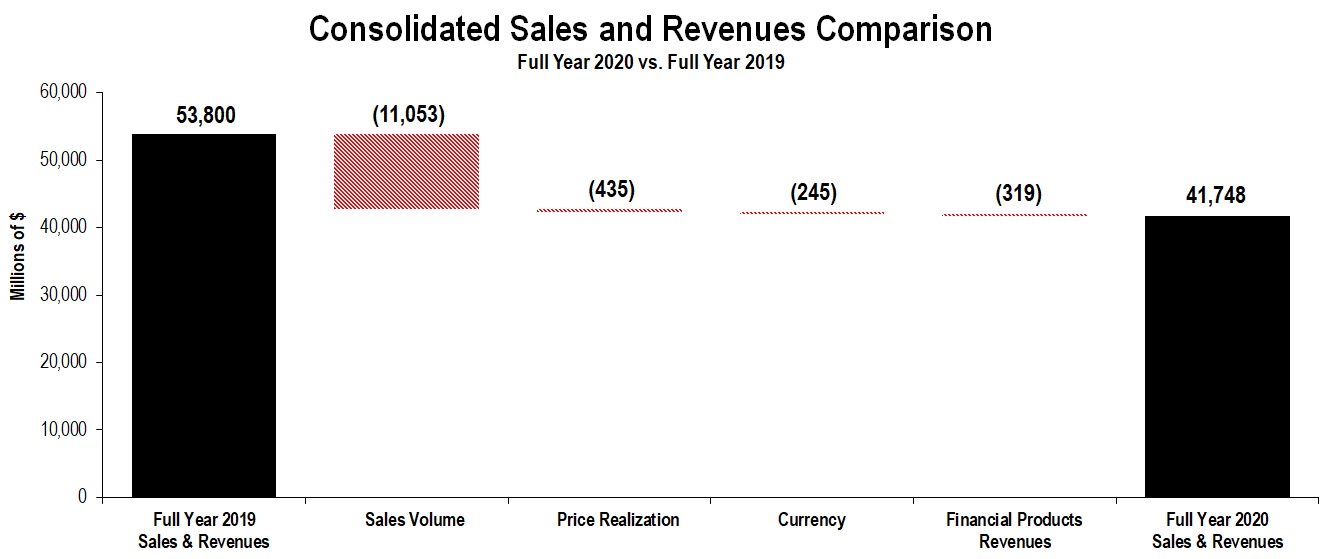
The chart above graphically illustrates reasons for the change in consolidated sales and revenues between 2019 (at left) and 2020 (at right). Caterpillar management utilizes these charts internally to visually communicate with the company’s Board of Directors and employees.
Total sales and revenues for 2020 were $41.748 billion, a decrease of $12.052 billion, or 22 percent, compared with $53.800 billion in 2019. The decline was due to lower sales volume driven by lower end-user demand for equipment and services and the impact from changes in dealer inventories across the three primary segments. Dealers decreased machine and engine inventories about $2.9 billion during 2020, compared with an increase of about $800 million during 2019.
Sales were lower across all regions and in the three primary segments.
North America sales declined 31 percent driven by lower end-user demand and the impact from changes in dealer inventories. Dealers decreased inventories during 2020, compared with an increase during 2019.
Sales decreased 28 percent in Latin America due to lower sales volume across the region, driven by lower end-user demand and the impact from changes in dealer inventories. In addition, sales were lower due to unfavorable currency impacts from a weaker Brazilian real. Dealers decreased inventories during 2020 and increased inventories during 2019.
EAME sales decreased 12 percent due to lower sales volume in most countries across the region, driven by lower end-user demand and the impact from changes in dealer inventories. Dealers decreased inventories more during 2020 than 2019.
Asia/Pacific sales decreased 16 percent due to lower demand across the region. Lower demand was driven by the impact from changes in dealer inventories and lower end-user demand. Dealers decreased inventories during 2020 and increased inventories during 2019.
Dealers decreased machine and engine inventories about $2.9 billion during 2020, compared with an increase of about $800 million during 2019. Dealers are independent, and the reasons for changes in their inventory levels vary, including their expectations of future demand and product delivery times. Dealers’ demand expectations take into account seasonal changes, macroeconomic conditions, machine rental rates and other factors. Delivery times can vary based on availability of product from Caterpillar factories and product distribution centers. We do not expect a significant dealer inventory reduction in 2021.
| | | | |
Showing the first 8K of 213K characters. Open the full section
Item 7A. Quantitative and Qualitative Disclosures About Market Risk.
Information required by Item 7A appears in Note 1 — “Operations and summary of significant accounting policies,” Note 4 — “Derivative financial instruments and risk management,” Note 18 — “Fair value disclosures” and Note 19 — “Concentration of credit risk” of Part II, Item 8 “Financial Statements and Supplementary Data.” Other information required by Item 7A is included in Part II, Item 7 “Management’s Discussion and Analysis of Financial Condition and Results of Operations.”
Item 8. Financial Statements and Supplementary Data.
MANAGEMENT’S REPORT ON
INTERNAL CONTROL OVER FINANCIAL REPORTING
The management of Caterpillar Inc. (company) is responsible for establishing and maintaining adequate internal control over financial reporting as such term is defined in Rule 13a-15(f) under the Exchange Act. Our internal control over financial reporting is a process designed to provide reasonable assurance regarding the reliability of our financial reporting and the preparation of financial statements for external purposes in accordance with generally accepted accounting principles. Our internal control over financial reporting includes those policies and procedures that (i) pertain to the maintenance of records that, in reasonable detail, accurately and fairly reflect the transactions and dispositions of the assets of the company; (ii) provide reasonable assurance that transactions are recorded as necessary to permit preparation of financial statements in accordance with generally accepted accounting principles, and that receipts and expenditures of the company are being made only in accordance with authorizations of management and directors of the company; and (iii) provide reasonable assurance regarding prevention or timely detection of unauthorized acquisition, use, or disposition of the company’s assets that could have a material effect on the financial statements.
Because of its inherent limitations, internal control over financial reporting may not prevent or detect misstatements. Also, projections of any evaluation of effectiveness to future periods are subject to the risk that controls may become inadequate because of changes in conditions, or that the degree of compliance with the policies or procedures may deteriorate.
Management assessed the effectiveness of the company’s internal control over financial reporting as of December 31, 2020. In making this assessment, we used the criteria set forth by the Committee of Sponsoring Organizations of the Treadway Commission (COSO) in Internal Control—Integrated Framework (2013). Based on our assessment we concluded that, as of December 31, 2020, the company’s internal control over financial reporting was effective based on those criteria.
The effectiveness of the company’s internal control over financial reporting as of December 31, 2020 has been audited by PricewaterhouseCoopers LLP, an independent registered public accounting firm. Their report appears on pages 68-69.
| /s/ D. James Umpleby III | ||||||||
| D. James Umpleby III | ||||||||
| Chief Executive Officer | ||||||||
| /s/ Andrew R.J. Bonfield | ||||||||
| Andrew R.J. Bonfield | ||||||||
| Chief Financial Officer | ||||||||
| February 17, 2021 |
REPORT OF INDEPENDENT REGISTERED PUBLIC ACCOUNTING FIRM
To the Board of Directors and Shareholders of Caterpillar Inc.
Opinions on the Financial Statements and Internal Control over Financial Reporting
We have audited the accompanying consolidated statement of financial position of Caterpillar Inc. and its subsidiaries (the “Company”) as of December 31, 2020 and 2019, and the related consolidated statements of results of operations, comprehensive income (loss), changes in shareholders’ equity, and cash flow for each of the three years in the period ended December 31, 2020, including the related notes (collectively referred to as the “consolidated financial statements”). We also have audited the Company’s internal control over financial reporting as of December 31, 2020, based on criteria established in Internal Control - Integrated Framework (2013) issued by the Committee of Sponsoring Organizations of the Treadway Commission (COSO).
In our opinion, the consolidated financial statements referred to above present fairly, in all material respects, the financial position of the Company as of December 31, 2020 and 2019, and the results of its operations and its cash flows for each of the three years in the period ended December 31, 2020 in conformity with accounting principles generally accepted in the United States of America. Also in our opinion, the Company maintained, in all material respects, effective internal control over financial reporting as of December 31, 2020, based on criteria established in Internal Control - Integrated Framework (2013) issued by the COSO.
Basis for Opinions
The Company’s management is responsible for these consolidated financial statements, for maintaining effective internal control over financial reporting, and for its assessment of the effectiveness of internal control over financial reporting, included in the accompanying Management’s Report on Internal Control over Financial Reporting. Our responsibility is to express opinions on the Company’s consolidated financial statements and on the Company’s internal control over financial reporting based on our audits. We are a public accounting firm registered with the Public Company Accounting Oversight Board (United States) (PCAOB) and are required to be independent with respect to the Company in accordance with the U.S. federal securities laws and the applicable rules and regulations of the Securities and Exchange Commission and the PCAOB.
We conducted our audits in accordance with the standards of the PCAOB. Those standards require that we plan and perform the audits to obtain reasonable assurance about whether the consolidated financial statements are free of material misstatement, whether due to error or fraud, and whether effective internal control over financial reporting was maintained in all material respects.
Our audits of the consolidated financial statements included performing procedures to assess the risks of material misstatement of the consolidated financial statements, whether due to error or fraud, and performing procedures that respond to those risks. Such procedures included examining, on a test basis, evidence regarding the amounts and disclosures in the consolidated financial statements. Our audits also included evaluating the accounting principles used and significant estimates made by management, as well as evaluating the overall presentation of the consolidated financial statements. Our audit of internal control over financial reporting included obtaining an understanding of internal control over financial reporting, assessing the risk that a material weakness exists, and testing and evaluating the design and operating effectiveness of internal control based on the assessed risk. Our audits also included performing such other procedures as we considered necessary in the circumstances. We believe that our audits provide a reasonable basis for our opinions.
Definition and Limitations of Internal Control over Financial Reporting
A company’s internal control over financial reporting is a process designed to provide reasonable assurance regarding the reliability of financial reporting and the preparation of financial statements for external purposes in accordance with generally accepted accounting principles. A company’s internal control over financial reporting includes those policies and procedures that (i) pertain to the maintenance of records that, in reasonable detail, accurately and fairly reflect the transactions and dispositions of the assets of the company; (ii) provide reasonable assurance that transactions are recorded as necessary to permit preparation of financial statements in accordance with generally accepted accounting principles, and that receipts and expenditures of the company are being made only in accordance with authorizations of management and directors of the company; and (iii) provide reasonable a
Showing the first 8K of 371K characters. Open the full section
Item 9. Changes in and Disagreements with Accountants on Accounting and Financial Disclosure.
Not Applicable.
Item 9A. Controls and Procedures.
Disclosure Controls and Procedures
An evaluation was performed under the supervision and with the participation of the company’s management, including the Chief Executive Officer (CEO) and Chief Financial Officer (CFO), of the effectiveness of the design and operation of the company's disclosure controls and procedures, as that term is defined in Rule 13a-15(e) under the Exchange Act, as of the end of the period covered by this annual report. Based on that evaluation, the CEO and CFO concluded that the company’s disclosure controls and procedures were effective as of the end of the period covered by this annual report.
Management’s Report on Internal Control Over Financial Reporting
Management’s report on the company’s internal control over financial reporting as of December 31, 2020 is included on page 67 of Part II, Item 8 “Financial Statements and Supplementary Data.” The effectiveness of the company’s internal control over financial reporting as of December 31, 2020 has been audited by PricewaterhouseCoopers LLP, an independent registered public accounting firm. Their report appears on pages 68-69 of Part II, Item 8 “Financial Statements and Supplementary Data.”
Changes in Internal Control over Financial Reporting
During the last fiscal quarter, there has been no significant change in the company’s internal control over financial reporting that has materially affected, or is reasonably likely to materially affect, the company’s internal control over financial reporting.
Item 9B. Other Information.
Not Applicable.
PART III
Item 10. Directors, Executive Officers and Corporate Governance.
Identification of Directors and Business Experience
Information required by this Item is incorporated by reference from the 2021 Proxy Statement.
Identification of Executive Officers and Business Experience
Information required by this Item appears in Item 1C of this Form 10-K.
Family Relationships
There are no family relationships between the officers and directors of the company.
Legal Proceedings Involving Officers and Directors
If applicable, information required by this Item is incorporated by reference from the 2021 Proxy Statement.
Audit Committee Financial Expert
Information required by this Item is incorporated by reference from the 2021 Proxy Statement.
Identification of Audit Committee
Information required by this Item is incorporated by reference from the 2021 Proxy Statement.
Shareholder Recommendation of Board Nominees
Information required by this Item is incorporated by reference from the 2021 Proxy Statement.
Compliance with Section 16(a) of the Exchange Act
If applicable, information required by this Item relating to compliance with Section 16(a) of the Exchange Act is incorporated by reference from the 2021 Proxy Statement.
Code of Ethics
Our Worldwide Code of Conduct (Code), first published in 1974 and most recently updated in 2019, sets a high standard for honesty and ethical behavior by every director and employee, including the principal executive officer, principal financial officer and principal accounting officer. The Code is posted on our website at www.Caterpillar.com/code. To obtain a copy of the Code at no charge, submit a written request to the Corporate Secretary at 510 Lake Cook Road, Suite 100, Deerfield, IL 60015-4971. We post on our website at www.Caterpillar.com/code any required amendments to or waivers granted under our Code pursuant to SEC or New York Stock Exchange disclosure rules.
Item 11. Executive Compensation.
Information required by this Item is incorporated by reference from the 2021 Proxy Statement.
Item 12. Security Ownership of Certain Beneficial Owners and Management and Related Stockholder Matters.
Information required by this Item relating to security ownership of certain beneficial owners and management is incorporated by reference from the 2021 Proxy Statement.
Information required by this Item relating to securities authorized for issuance under equity compensation plans is included in the following table:
Equity Compensation Plan Information
(as of December 31, 2020)
| Plan category | (a) Number of securities to be issued upon exercise of outstanding options, warrants and rights | (b) Weighted- average exercise price of outstanding options, warrants and rights | (c) Number of securities remaining available for future issuance under equity compensation plans (excluding securities reflected in column (a)) | |||||||||||||||||
| Equity compensation plans approved by security holders | 13,006,391 | $ | 109.60 | 36,488,284 | ||||||||||||||||
| Equity compensation plans not approved by security holders | N/A | N/A | N/A | |||||||||||||||||
| Total | 13,006,391 | $ | 109.60 | 36,488,284 |
Item 13. Certain Relationships and Related Transactions, and Director Independence.
Information required by this Item is incorporated by reference from the 2021 Proxy Statement.
Item 14. Principal Accountant Fees and Services.
Information required by this Item is incorporated by reference from the 2021 Proxy Statement.
PART IV
Item 15. Exhibits and Financial Statement Schedules.
*Management contracts and compensatory plans and arrangements required to be filed as exhibits pursuant to Item 15(b) of this report.
The agreements and other documents filed as exhibits to this report are not intended to provide factual information or other disclosure other than with respect to the terms of the agreements or other documents themselves, and you should not rely on them for that purpose. In particular, any representations and warranties made by us in these agreements or other documents
were made solely within the specific context of the relevant agreement or document and may not describe the actual state of affairs as of the date they were made or at any other time.
Item 16. Form 10-K Summary.
None.
Form 10-K
SIGNATURES
Pursuant to the requirements of Section 13 or 15(d) of the Securities Exchange Act of 1934, the registrant has duly caused this report to be signed on its behalf by the undersigned, thereunto duly authorized.
| CATERPILLAR INC. | ||||||||
| Registrant | ||||||||
| February 17, 2021 | By: | /s/ Suzette M. Long | ||||||
| Suzette M. Long | ||||||||
| Chief Legal Officer and General Counsel |
Pursuant to the requirements of the Securities Exchange Act of 1934, this report has been signed below by the following persons on behalf of the Registrant and in the capacities and on the dates indicated.
| Chairman of the Board and Chief Executive Officer | ||||||||
| February 17, 2021 | /s/ D. James Umpleby III | |||||||
| D. James Umpleby III | ||||||||
| February 17, 2021 | /s/ Andrew R.J.Bonfield | Chief Financial Officer | ||||||
| Andrew R.J. Bonfield | ||||||||
| February 17, 2021 | /s/ G. Michael Marvel | Chief Accounting Officer | ||||||
| G. Michael Marvel | ||||||||
| February 17, 2021 | /s/ Kelly A. Ayotte | Director | ||||||
| Kelly A. Ayotte | ||||||||
| February 17, 2021 | /s/ David L. Calhoun | Presiding Director | ||||||
| David L. Calhoun | ||||||||
| February 17, 2021 | /s/ Daniel M. Dickinson | Director | ||||||
| Daniel M. Dickinson | ||||||||
| February 17, 2021 | /s/ Juan Gallardo | Director | ||||||
| Juan Gallardo | ||||||||
| February 17, 2021 | /s/ William A. Osborn | Director | ||||||
| William A. Osborn | ||||||||
| February 17, 2021 | /s/ Debra L. Reed-Klages | Director | ||||||
| Debra L. Reed-Klages | ||||||||
| February 17, 2021 | /s/ Edward B. Rust, Jr. | Director | ||||||
| Edward B. Rust, Jr. | ||||||||
| February 17, 2021 | /s/ Susan C. Schwab | Director | ||||||
| Susan C. Schwab | ||||||||
| February 17, 2021 | /s/ Miles D. White | Director | ||||||
| Miles D. White | ||||||||
| February 17, 2021 | /s/ Rayford Wilkins, Jr. | Director | ||||||
| Rayford Wilkins, Jr. |