 filings.tools
Cboe Global Markets 10-K 2015-12-31
Filed 2016-02-19. 21 sections, 356K characters. Original on sec.gov · Markdown · JSON
Cover and table of contents
10-K 1 cboe-1231201510k.htm 10-K
UNITED STATES
SECURITIES AND EXCHANGE COMMISSION
Washington, DC 20549
Form 10-K
| ý | ANNUAL REPORT PURSUANT TO SECTION 13 OR 15(d) OF THE SECURITIES EXCHANGE ACT OF 1934 | |
| For the fiscal year ended December 31, 2015 | ||
| or | ||
| o | TRANSITION REPORT PURSUANT TO SECTION 13 OR 15(d) OF THE SECURITIES EXCHANGE ACT OF 1934 | |
| For the transition period from to |
Commission File No. 001-34774
CBOE HOLDINGS, INC.
(Exact name of registrant as specified in its charter)
| Delaware (State or other jurisdiction of incorporation or organization) | 20-5446972 (I.R.S. Employer Identification Number) | |
| 400 South LaSalle Street Chicago, Illinois (Address of principal executive offices) | 60605 (Zip Code) |
Registrant's telephone number, including area code
(312) 786-5600
Securities registered pursuant to Section 12(b) of the Act:
| Title of Each Class | Name of Exchange on Which Registered | |
| Common Stock, par value $0.01 per share | NASDAQ Global Select Market |
Securities registered pursuant to Section 12(g) of the Act:
None
Indicate by check mark if the registrant is a well-known seasoned issuer, as defined in Rule 405 of the Securities Act. Yes ý No o
Indicate by check mark if the registrant is not required to file reports pursuant to Section 13 or Section 15(d) of the Act. Yes o No ý
Indicate by check mark whether the registrant (1) has filed all reports required to be filed by Section 13 or 15(d) of the Securities Exchange Act of 1934 during the preceding 12 months and (2) has been subject to such filing requirements for the past 90 days. Yes ý No o
Indicate by check mark whether the registrant has submitted electronically and posted on its corporate website, if any, every Interactive Data File required to be submitted and posted pursuant to Rule 405 of Regulation S-T (§232.405 of this chapter) during the preceding 12 months (of for such shorter period that the registrant was required to submit and post such files). Yes ý No o
Indicate by check mark if disclosure of delinquent filers pursuant to Item 405 of Regulation S-K is not contained herein, and will not be contained, to the best of registrant's knowledge, in definitive proxy or information statements incorporated by reference in Part III of this Form 10-K or any amendment to this Form 10-K. ý
Indicate by check mark whether the registrant is a large accelerated filer, an accelerated filer, a non-accelerated filer, or a smaller reporting company. See the definitions of "large accelerated filer," "accelerated filer" and "smaller reporting company" in Rule 12b-2 of the Exchange Act. (Check One):
| Large accelerated filer ý | Accelerated filer o | Non-accelerated filer ¨ (Do not check if a smaller reporting company) | Smaller reporting company o |
Indicate by check mark whether the registrant is a shell company (as defined in Rule 12b-2 of the Act). Yes o No ý
As of June 30, 2015, the aggregate market value of the Registrant's outstanding voting common equity held by non-affiliates was approximately $4.7 billion based on the closing price of $57.22 per share of common stock.
The number of outstanding shares of the registrant's common stock as of February 17, 2016 was 81,795,365 shares of common stock.
DOCUMENTS INCORPORATED BY REFERENCE
| Documents | Form 10-K Reference | |
| Portions of the Company's Proxy Statement for the 2016 Annual Meeting of Stockholders | Part III |
TABLE OF CONTENTS
CBOE HOLDINGS, INC.
2015 FORM 10-K
CERTAIN DEFINED TERMS
Throughout this document, unless otherwise specified or the context so requires:
| • | "CBOE Holdings," "we," "us," "our" or "the Company" refers to CBOE Holdings, Inc. and its subsidiaries. |
| • | "CBOE" refers to (1) prior to the completion of the restructuring transaction, Chicago Board Options Exchange, Incorporated, a Delaware non-stock corporation, and (2) after the completion of the restructuring transaction, Chicago Board Options Exchange, Incorporated, a Delaware stock corporation. CBOE became a wholly-owned subsidiary of CBOE Holdings, Inc. on June 18, 2010. |
| • | "C2" refers to C2 Options Exchange, Incorporated, a wholly-owned subsidiary of CBOE Holdings, Inc. |
| • | "CFE" refers to CBOE Futures Exchange, LLC, a wholly-owned subsidiary of CBOE Holdings, Inc. |
| • | "CBSX" refers to CBOE Stock Exchange, LLC, which is 49.96% owned by CBOE. CBSX wholly owned National Stock Exchange, Inc. ("NSX"), a stock exchange and self-regulatory organization, until it sold NSX to a third party on February 18, 2015. CBSX ceased operations on April 30, 2014 and during the time that CBSX owned NSX, NSX ceased operations on May 30, 2014. CBSX is not a consolidated subsidiary of the Company. |
| • | "CFTC" refers to the U.S. Commodity Futures Trading Commission. |
| • | "Consent Order" refers to the consent order that CBOE and C2 entered into with the SEC on June 11, 2013. |
| • | "Delaware Action" refers to the lawsuit, which was entitled CME Group Inc. et al. v. Chicago Board Options Exchange, Incorporated et al. (Civil Action No. 2369-VCN) and filed in the Delaware Court on August 23, 2006, in which the CBOE and its directors were sued in the Delaware Court by the Board of Trade of the City of Chicago, Inc. ("CBOT"), CBOT Holdings, Inc. and two members of the CBOT who purported to represent a class of individuals who claimed that they were, or had the right to become, members of the CBOE. |
| • | "FASB" refers to the Financial Accounting Standards Board. |
| • | "GAAP" refers to Generally Accepted Accounting Principles in the U.S. |
| • | "Member" or "Members" refers to, prior to the completion of the restructuring transaction, any person or organization (or any designee of any organization) that held a membership in the CBOE. |
| • | "Our exchanges" refers to CBOE, C2 and CFE. |
| • | The "restructuring transaction" refers to the transaction on June 18, 2010, in which CBOE converted from a Delaware non-stock corporation owned by its Members to a Delaware stock corporation and a wholly-owned subsidiary of CBOE Holdings. |
| • | "SEC" refers to the U.S. Securities and Exchange Commission. |
| • | "Settlement Agreement" means the Stipulation of Settlement, as amended, approved by the Court of Chancery of the State of Delaware in the Delaware Action. |
| • | "SPX" refers to our S&P 500 Index exchange-traded options products. |
| • | "TPH" refers to either a Trading Permit Holder or Trading Privilege Holder. |
| • | "VIX" refers to the CBOE Volatility Index methodology. |
TRADEMARK INFORMATION
CBOE®, Chicago Board Options Exchange®, CBOE Volatility Index®, CFE®, Livevol®, FLEX®, FLexible EXchange®, Hybrid®, LEAPS®, and VIX® are registered trademarks and BuyWriteSM, CBOE Futures ExchangeSM, CBOE Russell 2000 Volatility IndexSM, CBOE/CBOT 10-year U.S. Treasury Note Volatility IndexSM, and WeeklysSM are service marks of CBOE. C2SM and C2 Options ExchangeSM are service marks of C2. VestSM is a service mark of Vest Financial Group, Inc. Standard & Poor's®, S&P® and S&P 500® are registered trademarks of Standard & Poor's Financial Services LLC and have been licensed for use by CBOE, C2 and CFE. Russell®, Russell 1000® and Russell 2000® are registered trademarks of Frank Russell Company, used under license. Dow Jones®, Dow Jones Industrial Average®, DJIA® and Dow Jones Indexes are registered trademarks or service marks of Dow Jones Trademark Holdings, LLC, used under license. The Nasdaq-100 Index®, Nasdaq-100®, The Nasdaq National Market®, Nasdaq®, Nasdaq-100 Shares and Nasdaq-100 Trust are registered trademarks or service marks of The Nasdaq Stock Market, Inc., used under license. MSCI, and the MSCI index names are service marks of MSCI Inc., used under license. All other trademarks and service marks are the property of their respective owners.
FORWARD-LOOKING STATEMENTS
This Annual Report on Form 10-K contains forward-looking statements within the meaning of the Private Securities Litigation Reform Act of 1995 that involve a number of risks and uncertainties. You can identify these statements by forward-looking words such as "may," "might," "should," "expect," "plan," "anticipate," "believe," "estimate," "predict," "potential" or "continue," and the negative of these terms and other comparable terminology. All statements that reflect our expectations, assumptions or projections about the future other than statements of historical fact are forward-looking statements, including statements in "Business" and "Management's Discussion and Analysis of Financial Condition and Results of Operations." These forward-looking statements, which are subject to known and unknown risks, uncertainties and assumptions about us, may include projections of our future financial performance based on our growth strategies and anticipated trends in our business. These statements are only predictions based on our current expectations and projections about future events. There are important factors that could cause our actual results, level of activity, performance or achievements to differ materially from that expressed or implied by the forward-looking statements. In particular, you should consider the risks and uncertainties described under "Risk Factors" in this Annual Report.
While we believe we have identified material risks, these risks and uncertainties are not exhaustive. Moreover, we operate in a very competitive and rapidly changing environment. New risks and uncertainties emerge from time to time, and it is not possible to predict all risks and uncertainties, nor can we assess the impact of all factors on our business or the extent to which any factor, or combination of factors, may cause actual results to differ materially from those contained in any forward-looking statements.
Some factors that could cause actual results to differ include:
| • | the loss of our right to exclusively list and trade certain index options and futures products; |
| • | economic, political and market conditions; |
| • | compliance with legal and regulatory obligations, including our obligations under the Consent Order; |
| • | increasing price competition in our industry; |
| • | decreases in trading volumes or a shift in the mix of products traded on our exchanges; |
| • | legislative or regulatory changes; |
| • | increasing competition by foreign and domestic entities; |
| • | our dependence on third party service providers; |
| • | our index providers' ability to perform under our agreements; |
| • | our ability to operate our business without violating the intellectual property rights of others and the costs associated with protecting our intellectual property rights; |
| • | our ability to accommodate trading volume and transaction traffic, including significant increases, without failure or degradation of performance of our systems; |
| • | our ability to protect our systems and communication networks from security risks, including cyber-attacks; |
| • | the accuracy of our estimates and expectations; |
| • | our ability to maintain access fee revenues; |
| • | our ability to meet our compliance obligations, including managing potential conflicts between our regulatory responsibilities and our for-profit status; |
| • | the ability of our compliance and risk management methods to effectively monitor and manage our risks; |
| • | our ability to attract and retain skilled management and other personnel; and |
| • | our ability to manage our growth and strategic acquisitions or alliances effectively. |
For a detailed discussion of these and other factors that might affect our performance, see Part I, Item 1A. of this Report. We caution you not to place undue reliance on the forward-looking statements, which speak only as of the date of this filing.
PART I
Item 1. Business
Overview
CBOE Holdings, Inc. is the holding company for Chicago Board Options Exchange, Incorporated, CBOE Futures Exchange, LLC, C2 Options Exchange, Incorporated and other subsidiaries.
The Company's principal business is operating markets that offer for trading options on various market indexes (index options), mostly on an exclusive basis, and futures contracts, as well as on non-exclusive "multiply-listed" options, such as options on the stocks of individual corporations (equity options) and options on other exchange-traded products (ETP options), such as exchange-traded funds (ETF options) and exchange-traded notes (ETN options). The Company operates three stand-alone exchanges, but reports the results of its operations in one reporting segment.
CBOE is our primary options market and offers trading in listed options through a single system that integrates electronic trading and traditional open outcry trading on our trading floor in Chicago. This integration of electronic trading and traditional open outcry trading into a single exchange is known as our Hybrid trading model. CFE, our all-electronic futures exchange, offers trading in futures on the VIX Index and other products. C2 is our all-electronic exchange that also offers trading in listed options, and may operate with a different market model and fee structure than CBOE. All of our exchanges operate on our proprietary technology platform known as CBOE Command.
Since 1974, the first full year of trading on CBOE, we have grown from 5.6 million contracts on one exchange to 1.2 billion contracts on three exchanges in 2015, our most recent fiscal year.
The following chart illustrates annual contract volume across the different categories of products traded at the Company for the periods indicated:
| Annual Contract Volume | ||||||||||||||
| 2015 | 2014 | 2013 | 2012 | 2011 | ||||||||||
| Equities | 392,982,051 | 488,580,906 | 433,777,204 | 494,289,301 | 516,136,937 | |||||||||
| Indexes | 408,281,695 | 406,454,861 | 372,647,443 | 304,339,908 | 320,389,993 | |||||||||
| Exchange-traded products | 320,997,251 | 379,742,163 | 341,023,209 | 311,792,122 | 368,364,057 | |||||||||
| Total Options Volume | 1,122,260,997 | 1,274,777,930 | 1,147,447,856 | 1,110,421,331 | 1,204,890,987 | |||||||||
| Futures | 51,671,188 | 50,615,435 | 40,193,447 | 23,892,931 | 12,041,102 | |||||||||
| Total Contract Volume | 1,173,932,185 | 1,325,393,365 | 1,187,641,303 | 1,134,314,262 | 1,216,932,089 |
Our operating revenues are primarily driven by transaction fee revenues, which are generated on the contracts traded on our exchanges. In 2015, approximately 71.9% of our operating revenues were generated by transaction fee revenues.
Our principal executive offices are located at 400 South LaSalle Street, Chicago, Illinois 60605, and our telephone number is (312) 786-5600.
Our web site is www.cboe.com. Information contained on or linked through our web site is not incorporated by reference into this Annual Report on Form 10-K.
History
CBOE was founded in 1973 as a non-stock corporation owned by its Members. CBOE was the first organized marketplace for the trading of standardized, exchange-traded options on equity securities. In 2004, CFE began operations as a futures exchange. CBOE Holdings was incorporated in the State of Delaware on August 15, 2006. In June 2010, CBOE demutualized (see "Restructuring Transaction") and CBOE, CFE and C2 became wholly-owned subsidiaries of CBOE Holdings. In October 2010, C2, the Company's all-electronic options exchange, initiated operations.
Restructuring Transaction
On June 18, 2010, CBOE converted from a non-stock corporation owned by its Members into a stock corporation that is a wholly-owned subsidiary of CBOE Holdings. In the restructuring transaction, each CBOE regular membership (an "Exchange Seat") owned by a CBOE Member on June 18, 2010 converted into 80,000 shares of Class A common stock of CBOE Holdings. Seat owners received a total of 74,400,000 shares of Class A common stock of CBOE Holdings in the restructuring transaction. In addition, certain persons who satisfied the qualification requirements set forth in the Settlement Agreement in the Delaware Action received a total of 16,333,380 shares of Class B common stock of CBOE Holdings on June 18, 2010. Pursuant to the Settlement Agreement, qualifying members of the plaintiff class received a cash payment of $300.0 million.
The initial public offering of 13,455,000 shares of unrestricted common stock, including 2,085,774 shares of unrestricted common stock sold by selling stockholders, for a price of $29.00 per share, was completed on June 18, 2010. Net proceeds to the Company after deducting underwriter's fees and commissions and other related expenses were $301.2 million. Costs directly associated with the Company's initial public offering were recorded as a reduction of the gross proceeds received in arriving at the amount recorded in additional paid-in capital.
Upon consummation of the initial public offering, the shares of Class A and Class B common stock not converted into unrestricted common stock and sold in the initial public offering automatically converted into 44,323,803 shares of Class A-1 common stock and 44,323,803 shares of Class A-2 common stock. The Company conducted tender offers in November 2010 and purchased 12,017,895 shares of Class A-1 and Class A-2 common stock. On December 15, 2010 and June 13, 2011, respectively, each remaining share of Class A-1 and Class A-2 common stock issued and outstanding converted into one share of unrestricted common stock. As a result, as of December 31, 2011, no shares of Class A-1 or Class A-2 common stock were outstanding.
As of December 16, 2015, we amended and restated our Amended and Restated Certificate of Incorporation to, among other items, change the name of our unrestricted common stock to common stock and remove obsolete provisions related to the designations, rights and preferences of Class A-1 and Class A-2 common stock.
Industry
Our primary business of offering exchange-traded options and futures contracts on financial instruments is part of the large global derivatives industry. Derivatives are financial contracts whose value is derived from an underlying asset or reference value. While derivatives exist on a wide range of underlying assets and references, we currently focus on offering derivatives products on individual stocks, stock indexes, exchange-traded funds, exchange-traded notes, interest rates, and various benchmarks related to trading and investment strategies. The global derivatives industry includes both exchanges and a large over-the-counter market. The most common types of derivatives are options, futures and swap contracts. These products allow for various types of risk to be isolated and transferred.
Options and Futures
Options represent a contract giving the buyer the right, but not the obligation, to buy or sell a specified quantity of an underlying security or index at a specific price for a specific period of time. Options provide investors a means for hedging, speculation and income generation, while at the same time providing leverage with respect to the underlying asset. Most options traded on U.S. securities exchanges and over-the-counter are on individual equities, market indexes and ETPs.
Futures are standardized, transferable, exchange-traded contracts that are settled by the delivery of the underlying asset or in cash by reference to the underlying asset or reference at a specified price and on a specified future date. Futures on CFE are settled in cash. Options on fut
Showing the first 8K of 78K characters. Open the full section
Item 1A. Risk Factors
The risks and uncertainties described below are those that we believe are material at this time. These risks and uncertainties, however, are not the only risks and uncertainties that we face. Additional risks and uncertainties not currently known to us or that we currently deem to be immaterial may also significantly impact us. Any of these risks and uncertainties may materially and adversely affect our business, financial condition or results of operations, liquidity and cash flows.
Loss of our right to exclusively list and trade certain index options and futures could have a material adverse effect on our financial performance.
We hold exclusive licenses to list securities index options on the S&P 500 Index, the S&P 100 Index, the Russell 2000 Index, as well as others, granted to us by the owners of such indexes and have developed our proprietary VIX methodology. In 2015, approximately 82.9% of our transaction fees were generated by our futures and index options, the overwhelming majority of which were generated by our exclusively-licensed products and products based on the VIX methodology. The bulk of this revenue is attributable to our S&P 500 Index options and VIX Index options and futures. As a result, our operating revenues are dependent in part on the exclusive licenses we hold for these products and our ability to maintain our exclusive VIX methodology.
There is a risk, with respect to each of our current exclusive licenses, that the owner of the index may not renew the license with us on an exclusive basis or at all. In the first event, we would be subject to multiple listing in the trading of what is now an exclusive index product, which could result in a loss of market share and negatively impact our profitability. In the second event, we could lose the right to list the index product entirely. The loss or limited use of any of our exclusive index licenses, especially for the S&P 500 Index, for any reason could have a material adverse effect on our business and profitability. See "Business—Products—Strategic Relationships" for a discussion of these licenses and their expiration dates.
In addition to the risks related to our exclusive licenses, if we are unable to retain exclusive proprietary rights in the VIX methodology, our volatility products could be subject to multiple listing, which could have a material adverse effect on us.
In addition, the European Parliament has adopted legislation that will require European exchanges to provide non-discriminatory access to benchmarks, like index options, and is considering other legislation that may impact the ability of European banks to trade our products. While similar legislation has not been proposed in the U.S., if it were passed, it could cause us to lose exclusivity in our internally developed and licensed index products. The adopted and proposed European legislation may impact our expansion activities in Europe, and may reduce the volume on our exchanges from international customers.
Furthermore, our competitors may succeed in providing a market for the trading of index-based or volatility products that are economically similar to those that we offer. It is also possible that a third party may offer trading in index-based products that are the same as those that are the subject of one of our exclusive licenses, but in a jurisdiction in which the index owner cannot require a license or in a manner otherwise not covered by our exclusive license.
The value of our exclusive licenses to list securities index options also depends on the continued ability of index owners to require licenses for the trading of options based on their indexes. Although we and the index owners have prevailed in legal actions challenging our rights to exclusively license indexes, we may be subject to legal or other action taken in the future that might impede our ability to exclusively license indexes. In addition, indexes underlying certain of our proprietary products may be licensed for use in OTC options. Options on ETFs and ETNs that have such licenses on these indexes are available for trading. As a result, trading in our proprietary products could decrease due to competitive pressures from these products.
We agreed with S&P that it may license one or more clearing agencies to clear OTC options based on the S&P 500 Index that meet certain criteria, and that S&P will compensate us for any transaction cleared under such a license based on the notional value of the transaction. Although we expect these transactions to generate incremental revenue, the clearing of options on the S&P 500 Index that are traded OTC could lead to the migration to the OTC market of some trades that today would be entered into on our exchanges, and there can be no assurance that the revenue gained will replace the revenue lost due to any migration.
General economic conditions and other factors beyond our control could significantly reduce demand for our products and services and harm our business.
The volume of options and futures transactions and the demand for our products and services are directly affected by economic, political and market conditions in the U.S. and elsewhere in the world that are beyond our control, including:
| • | broad trends in business and finance; |
| • | concerns over inflation and wavering institutional or retail confidence levels; |
| • | changes in government fiscal and monetary policy and foreign currency exchange rates; |
| • | the availability of short-term and long-term funding and capital; |
| • | the availability of alternative investment opportunities; |
| • | changes in the level of trading activity in underlying instruments; |
| • | changes and volatility in the prices of securities; |
| • | the level and volatility of interest rates; |
| • | unforeseen market closures or other disruptions in trading; and |
| • | concerns about terrorism and war. |
General economic conditions affect options and futures trading in a variety of ways, from the availability of capital to investor confidence. The economic climate in recent years has been characterized by challenging business, economic and political conditions throughout the world. Adverse changes in the economy may have a negative impact on our revenues by causing a decline in trading volume. Significant declines in trading volumes or demand for market data may have a material adverse effect on our business, financial condition and operating results.
We operate in a highly regulated industry and may be subject to censures, fines and other legal proceedings if we fail to comply with legal and regulatory obligations.
CBOE and C2 are registered national securities exchanges and SROs, and, as such, are subject to comprehensive regulation by the SEC. CFE is a DCM registered with the CFTC and is subject to comprehensive regulation by the CFTC. See "Business—Regulatory Environment and Compliance—Compliance—Securities Industry-CBOE and C2" for information regarding our regulatory responsibilities for CBSX.
In addition to the requirements related to operating our markets imposed by the SEC and the CFTC, we also have certain responsibilities for regulating the TPHs that trade on our exchanges. While we have entered into agreements under which FINRA and other SROs with respect to our options exchanges, and NFA with respect to our futures exchange, provide certain regulatory services, we retain responsibility for the regulation of our TPHs. See "Business—Regulatory Responsibilities."
Our ability to comply with applicable laws and rules is largely dependent on the establishment and maintenance of appropriate systems and procedures, our ability to attract and retain qualified personnel, the ability of FINRA and NFA to perform under the regulatory services agreements and our oversight of the work done by FINRA and NFA. The SEC and CFTC have broad powers to audit, investigate and enforce compliance and to punish noncompliance by SROs and DCMs, respectively, pursuant to applicable laws, rules and regulations.
If the SEC were to find one of our programs of enforcement or compliance to be deficient, CBOE, C2 or CFE could be the subject of SEC or CFTC investigations and enforcement proceedings that may result in substantial sanctions, including revocation of an exchange's registration as a national securities exchange or DCM. Any such investigations or proceedings, whether successful or unsuccessful, could result in substantial costs, the diversion of resources, including management time, and potential harm to our reputation, which could have a material adverse effect on our business, results of operations or financial condition. In addition, CBOE, C2 or CFE may be required to modify or restructure their regulatory functions in response to any changes in the regulatory environment, or they may be required to rely on third parties to perform regulatory and oversight functions, each of which may require us to incur substantial expenses and may harm our reputation if our regulatory services are deemed inadequate.
Although CBOE Holdings itself is not an SRO, CBOE Holdings is subject to regulation by the SEC of activities that involve the options exchanges. Specifically, the SEC will exercise oversight over the governance of CBOE Holdings and its relationship with CBOE and C2. See "Business—Regulatory Responsibilities."
Our business may be adversely affected by price competition.
The business of operating options exchanges is characterized by intense price competition, especially with respect to transaction fees. The pricing model for trade execution for options has changed in response to competitive market conditions and our competitors have adjusted transaction fees and fee structures accordingly, including by opening new exchanges, which allow them to offer multiple pricing models that can appeal to different segments of market participants. These changes have resulted in significant pricing pressures on us, especially on transaction fees and incentives for multiply-listed products. As a result of these pricing pressures, our average rate per multiply-listed options contract may decrease. It is likely that this pressure will continue and even intensify as our competitors continue to seek to increase their share of trading by further reducing their transaction fees or by offering other financial incentives to order providers and liquidity providers to induce them to direct orders to their markets.
In addition, one or more competitors may engage in aggressive pricing strategies and significantly decrease or completely eliminate their profit margin for a period of time in order to capture a greater share of trading volume. Some order-providing firms on our exchanges have taken ownership positions in options exchanges that compete with us and such exchanges have given those firms added economic incentives to direct orders to them.
Like nearly all of the other options exchanges, our options exchanges charge an options regulatory fee ("ORF") to TPHs based on the total number of customer contracts cleared by that TPH, regardless of the exchange on which the trade is executed. Along with fines and other regulatory fees, the ORF revenues may only be used to support our regulatory functions. We may face competitive pressures to further reduce or not increase the ORFs on our exchanges, and if we are unable to maintain or, if necessary, increase the ORFs, our results of operation may be adversely affected.
With respect to our proprietary products, we compete on price against futures exchanges and swap execution facilities that offer similar products and other financial institutions that write over-the-counter derivatives. We also compete on price against certain multiply-listed options products, including SPY, that offer some of the features of our proprietary products.
We could lose a substantial percentage of our share of trading if we are unable to price transactions in a competitive manner. Also, our profits could decline if competitive pressures force us to reduce fees. If any of these events occur, our operating results and profitability could be adversely affected.
A significant portion of our operating revenues is generated by our transaction-based business. If the amount of trading volume on our exchanges decreases, or the product mix shifts to lower revenue products, our revenues from transaction fees will decrease.
In 2015, 2014 and 2013, approximately 71.9%, 70.9% and 69.4% of our operating revenues, respectively, were generated by our transaction-based business. This business is dependent on our ability to attract and maintain order flow, both in absolute terms and relative to other market centers. Our total trading volumes could decline if our market participants reduce their trading activity for any reason, such as:
| • | heightened capital requirements; |
| • | regulatory or legislative actions; |
| • | reduced access to capital required to fund trading activities; or |
| • | significant market disruptions. |
Over the past few years, a number of legislative actions have been taken, both domestically and internationally, that may cause market participants to be subject to increased capital requirements and additional compliance burdens. These actions, including Basel III, Dodd-Frank and the Collins Amendment to Dodd-Frank, may cause market participants to reduce the number of trades they make on our exchanges.
In addition, the transaction fees generated are different based on type of product and other factors, including the type of customer and certain volume discounts. See "Management's Discussion and Analysis—Operating Revenues—Average revenue per contract." If the amount of our trading volume decreases, or the mix traded shifts to our lower revenue per contract products, our revenues from transaction fees will decrease. We can offer no assurance that we would be able to reduce our costs to match the amount of any such decrease.
Legislative or regulatory changes affecting the listed options or futures markets could have a material adverse effect on our business.
Changes in regulation by the SEC, CFTC, foreign regulators or other government action, including SEC approval of rule filings by other SROs or entities, including OCC, could materially affect our markets. In recent years, the securities and futures industries have been subject to significant regulatory changes as a result of increasing government and public scrutiny in response to the global economic crisis.
In 2010, Congress passed the Dodd-Frank Act and other legislation. While many of its requirements have been implemented or are in the process of being implemented, some of the provisions in Dodd-Frank that impact our markets require additional action by the SEC or the CFTC. Depending on how the SEC and CFTC interpret and implement these laws, exchanges like ours could be subject to increased competition and additional costs. We could also see reduced trading by our customers due to margin or other requirements placed on them.
Under the Collins Amendment to the Dodd-Frank Act, starting in 2015, U.S. banks are required to use a new approach in order to compute their risk weighted assets, which include exchange-traded options and futures. This, and other rulemaking, may lead to further increases in capital requirements for U.S. bank holding companies, and bank subsidiaries involved in the trading and clearing of derivatives. These increased capital requirements may reduce trading in options and futures due to bank-affiliated broker-dealers reducing their own trading, charging their customers more to trade or reducing the type or number of customers.
In 2012, the SEC directed the SROs to submit a plan to create, implement and maintain a consolidated audit trail, which would serve as a comprehensive audit trail of orders that will allow regulators to efficiently and accurately track all activity in Regulation NMS securities in the U.S. market. In addition to increased regulatory obligations, implementation of a consolidated audit trail could result in significant additional expenditures, including to implement any new technology to meet any plan's requirements. The SEC has also adopted Reg SCI and established working groups of exchanges to focus on improving market resiliency. Meeting the requirements of Reg SCI or other regulations or mandates generated by these working groups could result in significant additional expenses, including for technology and compliance.
Under European Union (“EU”) regulations, European banks must take punitive capital charges if they transact options or futures through a non-qualifying clearinghouse. OCC, our clearinghouse for options and futures, and other U.S. clearinghouses are not currently recognized as qualified clearinghouses by the EU. The current deadline for the EU to grant equivalence to foreign clearinghouses is June 15, 2016. If OCC is not recognized as a qualified clearinghouse by the EU by June 15, 2016 or a subsequent deadline in the event that the current deadline is extended, we could experience the loss of a significant number of European market participants or a reduction in trading activity on our markets, either of which could have a material adverse effect on our business.
It is also possible that there will be additional legislative and regulatory changes or efforts in the environment in which we operate our businesses, although we cannot predict the nature of these changes or their impact on our business at this time. Actions on any of the specific regulatory issues currently under review in the U.S. and other proposals could have a material impact on our business. For a discussion of the regulatory environment in which we operate and proposed regulatory changes, see "Business—Regulatory Environment and Compliance."
In addition, Congress, the SEC, foreign regulators and other regulatory authorities could impose legislative or regulatory changes that could adversely impact the ability of our market participants to use our markets, or participate in the options or futures industry at all. Any such changes could result in the loss of a significant number of market participants or a reduction in trading activity on our markets, either of which could have a material adverse effect on our business. Changes or proposed changes in regulation may also result in additional costs of compliance and modification of market participants' trading activity on our exchanges.
Intense competition could materially adversely affect our market share and financial performance.
We compete with a number of entities on several different fronts, including the cost, quality and speed of our trade execution, functionality and ease of use of our trading platform, range of our products and services, our technological innovation and adaptation and our reputation. We compete with futures exchanges and swap execution facilities that offer comparable products and with the over-the-counter market with respect to our proprietary products. With respect to our multiply-listed products, our principal competitors are the twelve other U.S. options exchanges. See the risk factor entitled "Our business may be adversely affected by price competition."
Most of the equity options and options on ETPs listed and traded on our exchanges are also listed and traded on other U.S. options exchanges. Changes we have implemented in response to competitive pressures may not be successful in
maintaining or expanding our market share in those products in the future. Likewise, our future responses to these or other competitive developments may not be successful in maintaining or expanding our market share.
Some of our competitors and potential competitors have greater financial, marketing, technological, personnel and other resources than we do. These factors may enable them to develop similar or more innovative products, to offer lower transaction fees or better execution to their customers or to execute their business strategies more quickly or efficiently than we can.
Furthermore, our competitors may:
| • | respond more quickly to competitive pressures; |
| • | develop products that compete with our products or are preferred by our customers; |
| • | develop and expand their technology and service offerings more efficiently; |
| • | provide better, more user-friendly and more reliable technology; |
| • | take greater advantage of acquisitions, alliances and other opportunities; |
| • | market, promote, bundle and sell their products and services more effectively; |
| • | leverage existing relationships with customers and alliance partners more effectively or exploit brand names to market and sell their services; and |
| • | exploit regulatory disparities between traditional, regulated exchanges and alternative markets, including over-the-counter markets, that benefit from a reduced regulatory burden and lower-cost business model. |
The derivatives industry has witnessed both the consolidation of exchange holding companies and the growth in the number of exchanges, with a doubling of the number of options exchanges over the past decade. Consolidation or alliances among our competitors may achieve cost reductions or other increases in efficiency, which may allow them to offer better prices or services than we do. The increase to the number of competitors that we face may result in fragmentation of the market and a reduced market share for our exchanges.
If our products, markets, services and technology are not competitive, our financial condition and operating results would be materially harmed. A decline in our transaction fees or any loss of customers would lower our revenues, which would adversely affect our profitability. For a discussion of the competitive environment in which we operate, see "Business—Competition."
We depend on third party service providers for certain services that are important to our business. An interruption or cessation of such service by any third party could have a material adverse effect on our business.
We depend on a number of service providers, including clearing organizations such as OCC and its member clearing firms; securities information processors such as the CTA and OPRA; regulatory service providers such as FINRA and NFA; the host of our data center; and various vendors of communications and networking products and services. More specifically:
| • | OCC is the sole provider of clearing on all of our exchanges. If it were unable to perform clearing services, or its clearing members were unable or unwilling to clear through OCC, transactions could likely not occur on our markets. |
| • | OPRA, UTP Securities Information Processor and the CTA consolidate market information such as last sale reports and quotations. If any of them were unable to provide this information for a sustained period of time, we may be unable to offer trading on our options markets. |
| • | We are heavily dependent on technology for our markets, including our data center, which is housed by a third party, and certain communications and networking products and services. If this technology is unavailable, and cannot be replaced in a short time period, we may be unable to operate our markets. |
| • | FINRA and NFA provide regulatory services for our options and futures exchanges, respectively, while we retain regulatory responsibilities for such services. If FINRA or NFA stopped providing services, or provided inadequate services, we may be subject to action by the SEC or CFTC, or may have limitations placed upon our markets. |
We cannot provide assurance that any of these providers will be able to continue to provide these services in an efficient manner or that they will be able to adequately expand their services to meet our needs. An interruption or malfunction in or the cessation of an important service by a third party could cause us to halt trading in some or all of our products or our services, or make us unable to conduct other aspects of our business. In addition, our inability to make alternative arrangements in a timely manner, or at all, could have a material adverse impact on our business, financial condition and operating results.
If one or more of the index providers from which we have licenses or service providers with respect to proprietary products fails to maintain the quality and integrity of their indexes or fails to perform under our agreements with them or if customer preferences change, revenues we generate from trading in these proprietary products may suffer.
We are a party to an increasing number of license agreements pursuant to which we may list for trading securities options on various indexes including license agreements that we have with S&P, for the S&P 500 Index and S&P 100 Index, S&P Dow Jones Indices, LLC, for the Dow Jones Industrial Average, LSEG, for more than two dozen FTSE Russell indexes, including the Russell 2000 Index, and MSCI Inc., for six MSCI indexes, including the MSCI EAFE Index and MSCI Emerging Markets Index. These license agreements provide, among other things, that we are authorized to list options on their indexes, and some of the resulting index options are among the most actively traded products at CBOE. The quality and integrity of each of these indexes are dependent on the ability of the index providers to maintain the index, including by means of the calculation and rebalancing of the index, and we are dependent on the index providers for a number of things, including the provision of index data to us. We also rely on index providers to enforce intellectual property rights against unlicensed uses of the indexes and uses of the indexes that infringe on our licenses, as further discussed in risk factor "We may not be able to protect our intellectual property rights." Furthermore, some of our agreements concerning our proprietary products provide for the parties to those agreements to provide important services to us. If any of our index providers are unable to maintain the quality and integrity of their indexes, or if any of the index providers or service providers fail to perform their obligations under the agreements, trading in these products, and therefore transaction fees we receive, may be adversely affected or we may not receive the financial benefits of the agreements that we negotiated.
If we are unable to fulfill our obligations under the Consent Order, it may have a significant adverse impact on our business.
In addition to entering into the Consent Order and agreeing to complete certain undertakings, we may be subject to additional investigations or proceedings by the SEC if the SEC were to find that we did not fulfill our obligations under the Consent Order. See "Business—Regulatory Environment and Compliance—Compliance—Consent Order." Any investigations or proceedings, whether successful or unsuccessful, could result in substantial costs, the diversion of resources, including management time, and potential harm to our reputation, which could have a material adverse effect on our business results of operations or financial condition.
We may not be able to protect our intellectual property rights.
We rely on patent, trade secret, copyright and trademark laws, the law of the doctrine of misappropriation and contractual protections to protect our proprietary technology, proprietary index and futures products, index methodologies and other proprietary rights. In addition, we rely on the intellectual property rights of our licensors in connection with our listing of exclusively-licensed index and futures products. We and our licensors may not be able to prevent third parties from copying, or otherwise obtaining and using, our intellectual property without authorization, listing our proprietary or exclusively-licensed index products without licenses or otherwise infringing on our rights. We and our licensors may have to rely on litigation to enforce our intellectual property rights, determine the validity and scope of the proprietary rights of others or defend against claims of infringement or invalidity. We and our licensors may not be successful in this regard. Such litigation, whether successful or unsuccessful, could result in substantial costs to us, diversion of our resources or a reduction in our revenues, any of which could materially adversely affect our business.
Any infringement by us on patent rights of others could result in litigation and could have a material adverse effect on our operations.
Our competitors, as well as others, have obtained, or may obtain, patents that are related to our technology or the types of products and services we offer or plan to offer. We may not be aware of all patents containing claims that may pose a risk of infringement by our products, services or technologies. In addition, some patent applications in the U.S. are confidential until a patent is issued, and therefore we cannot evaluate the extent to which our products and services may be covered or asserted to be covered in pending patent applications. Thus, we cannot be sure that our products and services do not infringe on the rights of others or that others will not make claims of infringement against us. Claims of infringement are not uncommon in our industry. If one or more of our products, services or technologies were determined to infringe a patent held by another party, we may be required to pay damages, stop using, developing or marketing those products, services or technologies, obtain a license from the holders of the patents or redesign those products, services or technologies to avoid infringing the patent. If we were required to stop using, developing or marketing certain products, our business, results of operations and financial condition could be materially harmed. Moreover, if we were unable to obtain required licenses, we may not be able to redesign our products, services or technologies to avoid infringement, which could materially adversely affect our business, results of operations or financial condition.
Computer and communications systems failures and capacity constraints could harm our reputation and our business.
We operate, monitor and maintain our computer systems and networks, including the systems that comprise CBOE Command, the platform for trading on our exchanges and CBOE Vector, the platform that we are developing that is expected to replace CBOE Command. If we are unable to operate, monitor or maintain these systems and networks, program them so that they operate correctly and maintain the integrity of their data, or successfully transition from the CBOE Command platform to the new CBOE Vector platform, it could have a material adverse effect on our ability to conduct our business. Although we have a back-up of trading and key corporate systems, the back-up systems or disaster recovery plans may prove to be inadequate in the event of a systems failure or cyber-security breach. Despite the enhancements made to our disaster recovery facilities, there can be no guarantees that we will be able to open an efficient, transparent and liquid marketplace, if we can open at all.
With extended trading hours, we have to operate our systems longer and have fewer non-trading hours to address any potential concerns with the systems on which we rely.
Our systems may fail, in whole or in part, or may operate slowly, causing one or more of the following:
| • | unanticipated disruption in service to our participants; |
| • | failures or delays during peak trading times or times of unusual market volatility; |
| • | slower response times and delays in trade execution and processing; |
| • | incomplete or inaccurate accounting, recording or processing of trades; and |
| • | distribution of inaccurate or untimely market data to participants who rely on this data in their trading activity. |
Any of these events may cause:
| • | a loss in transaction or other fees due to the inability to provide services for a time; |
| • | requests by market participants or others that we reimburse them for financial loss, either within the constraints of the limited liability provisions of our exchanges' rules or in excess of those amounts; |
| • | trading to diminish on our exchanges due to dissatisfaction with the platform; and |
| • | one or more of our regulators to investigate or take enforcement action against us. |
As a consequence of any of these events, our business, financial condition and results of operations could suffer materially.
In addition to other measures, we test our systems to confirm whether they will be able to handle anticipated present and future peak trading volume or times of unusual market volatility. However, we cannot assure you that our estimates of future trading volume will be accurate or that our systems will always be able to accommodate actual trading volume without failure or degradation of performance.
We anticipate that we will need to continue to make significant investments in hardware, software and telecommunications infrastructure to accommodate the increases in traffic. If we cannot increase the capacity and capabilities of our systems to accommodate an increasing volume of transactions and to execute our business strategy, our ability to maintain or expand our businesses would be adversely affected.
The computer systems and communication networks upon which we rely may be vulnerable to security risks and other disruptions.
The secure and reliable operation of our computer systems, our communications networks and the systems of our service providers and market participants, is a critical element of our operations. These systems and communications networks may be vulnerable to unauthorized access, including the improper access or disclosure of personally identifiable information, malware and other security problems, as well as to acts of terrorism, natural disasters and other events that are beyond our control. If our security measures are inadequate or if there are interruptions or malfunctions in our systems or communications networks, our business, financial condition and operating results could be materially impacted. We may be required to expend significant resources in the event of any real or threatened breaches in security or system failures, including to protect against threatened breaches and to alleviate harm caused by an actual breach, and may suffer harm to our reputation and litigation. Measures we implement for security and otherwise to provide for the confidentiality, integrity and reliability of our systems may prove to be inadequate in preventing system failures or delays in our systems or communications networks, which could lower trading volume and have an adverse effect on our business, financial condition and operating results.
We may not be able to maintain operating revenues generated by making trading permits available in exchange for a fee.
The right to trade on our exchanges is made available through trading permits for which the user pays a fee. These fees accounted for 8.4% of our operating revenues in 2015. CBOE charges the highest relative trading permit rates in the options industry. We may face pressure from our customers to lower these rates or may see larger firms electing to use fewer permits to access our exchanges. If the demand for trading permits to our exchanges is less than historic levels or if we are unable to maintain permit rates, our ability to generate operating revenues through the granting of permits for trading access would be negatively impacted, which could adversely affect our profitability.
Potential conflicts of interest between our for-profit status and our regulatory responsibilities may adversely affect our business.
As a for-profit business with regulatory responsibilities, we are responsible for disciplining TPHs for violating our rules, including by imposing fines and sanctions. This may create a conflict of interest between our business interests and our regulatory responsibilities. Any failure by us to fulfill our regulatory obligations could significantly harm our reputation, increase regulatory scrutiny or cause the SEC or CFTC to take action against us, all of which could adversely affect our business, results of operations or financial condition.
Our compliance methods might not be effective and may result in outcomes that could adversely affect our financial condition and operating results.
As the parent company for SROs, we are responsible for maintaining exchanges that comply with securities and futures laws, SEC and CFTC regulations and the rules of the respective exchanges. Our ability to comply with applicable laws and rules is largely dependent on our policies and procedures designed to meet those compliance responsibilities, as well as our ability to attract and retain qualified personnel throughout the company. Our policies and procedures to identify, monitor and manage compliance risks may not be fully effective. Management of legal and regulatory risk requires policies and procedures to properly monitor, record and verify a large number of transactions and events. We cannot provide assurance that our policies and procedures will always be effective or that we will always be successful in monitoring or evaluating the compliance risks to which we are or may be exposed, or that our compliance and internal audit functions would be able to identify any such ineffectiveness. If these policies and procedures are not effective, we may be subject to monetary or other penalties by our regulators.
If our risk management methods are not effective, our business, reputation and financial results may be adversely affected.
We have methods to identify, monitor and manage our risks. If our methods are not effective or we are not successful in monitoring or evaluating the risks to which we are or may be exposed, our business, reputation, financial condition and operating results could be materially adversely affected. In addition, our insurance policies may not provide adequate coverage.
Misconduct by our TPHs or others could harm us.
We run the risk that our TPHs, other persons who use our markets or our employees may engage in fraud, market manipulation or other misconduct, which could result in regulatory sanctions and serious harm to our reputation, especially because we are the parent company of SROs. It is not always possible to deter misconduct or market manipulation, and the precautions we take to prevent and detect this activity may not be effective in all cases. In addition, misconduct or market manipulation by, or failures of, participants on our exchanges may discourage trading on our exchanges, which could reduce revenues.
If we fail to attract or retain highly skilled management and other employees, our business may be harmed.
Our future success depends in large part on our management team, which possesses extensive knowledge and managerial skill with respect to the critical aspects of our business. The failure to retain members of our management team could adversely affect our ability to manage our business effectively and execute our business strategy. Additionally, effective succession planning is also important to our long-term success. Failure to ensure effective transfer of knowledge and smooth transitions involving our management team and key employees could hinder our strategic planning and execution.
Our business is also dependent on highly skilled employees, especially those who provide specialized services to our clients and oversee our technology functions. Many of these employees have extensive knowledge and experience in highly technical and complex areas of the options trading industry. Because of the complexity and risks associated with our business and the specialized knowledge required to conduct this business effectively, and because the growth in our industry has increased demand for qualified personnel, many of our employees could find employment at other firms if they chose to do so, particularly if we fail to continue to provide competitive levels of compensation. If we fail to retain our current employees, it would be difficult and costly to identify, recruit and train replacements needed to continue to conduct and expand our business.
In particular, failure to retain and attract qualified systems personnel could result in systems errors. Consequently, our reputation may be harmed, we may incur additional costs and our profitability could decline.
We may not effectively manage our growth, which could materially harm our business.
Over the past five years, we have experienced significantly increased volume on our futures exchange, extended trading hours on our futures exchange and in SPX and VIX options and developed several proprietary products. We expect that our business will continue to grow, which may place a significant strain on our management, personnel, systems and resources. We must continually improve our operational, financial and regulatory systems and managerial controls and procedures, and may need to continue to expand, train and manage our workforce. We must also maintain close coordination among our technology, legal, accounting, finance, marketing, sales, regulatory and compliance functions. We cannot assure you that we will manage our growth effectively. If we fail to do so, our business could be materially harmed.
Our continued growth will require increased investment by us in technology, facilities, personnel, and financial and management systems and controls. It also will require expansion of our procedures for monitoring and assuring our compliance with applicable regulations, and we will need to integrate, train and manage a growing employee base. The expansion of our existing businesses, any expansion into new businesses and the resulting growth of our employee base will increase our need for internal audit and monitoring processes, which may be more extensive and broader in scope than those we have historically required. We may not be successful in identifying or implementing all of the processes that are necessary. Further, unless our growth results in an increase in our revenues that is proportionally greater than or equal to the increase in our costs associated with this growth, our operating margins will be adversely affected.
Our ability to implement or amend rules could be limited or delayed because of regulation, which could negatively affect our ability to implement needed changes.
Our options exchanges registered with the SEC must submit proposed rule changes to the SEC for its review and, in many cases, its approval. Even where a proposed rule change may be effective upon filing with the SEC, the SEC retains the right to suspend and disapprove such rule changes. Also, the CFTC may stay or disapprove rules that we file with it for CFE, our futures exchange. The rule review process can be lengthy and can significantly delay the implementation of proposed rule changes that we believe are necessary to the operation of our markets. If the SEC or CFTC delays or does not allow one of our exchanges to implement a rule change, this could negatively affect our ability to make needed changes or implement business activities.
Similarly, the SEC must approve amendments to our options exchange subsidiaries' certificates of incorporation and bylaws as well as certain amendments to the certificate of incorporation and bylaws of CBOE Holdings. The SEC may decide not to approve a proposed amendment or may delay such approval in a manner that could negatively affect our ability to make a desired change, which could prevent or delay us from improving the operations of our markets or recognize income from new products.
As one of the largest options exchanges in the world and the largest options exchange in the U.S., we may be at a greater risk for a cyber attack and other cyber security risks.
The frequency of cyber attacks is increasing in general, and a variety of threat actors have specifically targeted the financial services industry. At the date of this filing, we have no evidence of any material cases of data theft, corruption or destruction of data or compromised customer data. Security breaches may, among other consequences, lead to increased scrutiny by our regulators and have significant costs in terms of cash outlays, business disruption, revenue losses, internal labor, overhead and other expenses. Measures we implement to monitor the environment and protect our infrastructure against security breaches and misappropriation of our intellectual property assets may prove insufficient, which could cause us to lose market participants, experience lower trading volume, incur significant liabilities or have a negative impact on our competitive advantage.
Changes in the tax laws and regulations affecting us and our market participants could have a material adverse effect on our business.
Legislation may be proposed, both domestically and internationally, that could change the way that our market participants are taxed on the products they trade on our markets. Legislation has been proposed for the implementation of a transaction tax. Further, proposals may include modifications to the taxation of financial products, including repealing the "60/40 Rule," which allows market-makers to pay a blend of capital gains and ordinary tax rates on their income, requiring all derivatives to be marked-to-market, and eliminating the exemption for "qualified covered calls." If such proposals, a transaction tax or other tax change that detrimentally impacts options or futures trading were to become law, they could have a negative impact on the options and futures industry and us by making transactions more costly to market participants, which may reduce trading.
In 2015, the Internal Revenue Service issued and proposed new regulations under Section 871(m) that require dividend tax withholding for certain transactions completed by foreign persons. Unless substantive changes are made to the regulations, there may be a significant reduction in trading by foreign persons, either by their choice or due to brokers refusing to trade options for such persons.
In addition to proposed tax changes that could affect our market participants, there has been a trend toward states changing the income tax laws to increase the apportionment factors on which state income taxes are based and becoming more aggressive asserting nexus over corporations that are not domiciled in the state. If state income tax laws change, or if states are successful asserting nexus against us, we may become subject to income taxes in additional states or at a higher rate in the states where income tax filing requirements exists. If this occurs, we may experience a higher effective state tax rate.
We selectively explore acquisition opportunities or strategic alliances relating to other businesses, products or technologies. We may not be successful in integrating other businesses, products or technologies with our business. Any such transaction also may not produce the results we anticipate, which could adversely affect us.
We selectively explore and pursue acquisition and other opportunities to strengthen our business and grow our company. We may enter into business combination transactions, make acquisitions or enter into strategic partnerships, joint ventures or alliances, any of which may be material. The market for acquisition targets and strategic alliances is highly competitive, which could make it more difficult to find appropriate merger or acquisition opportunities. If we are required to raise capital by incurring debt or issuing additional equity for any reason in connection with a strategic acquisition or investment, financing may not be available or the terms of such financing may not be favorable to us and our stockholders, whose interests may be diluted by the issuance of additional stock.
In 2015, we acquired the market data services and trading analytics platforms of Livevol, Inc., we and Environmental Financial Products, LLC launched the American Financial Exchange, an electronic marketplace for small and mid-sized banks to lend and borrow short-term funds, and, in early 2016, we made a majority equity investment in Vest Financial Group Inc., an investment advisor that provides options-centric products.
The process of integration may produce unforeseen regulatory issues and operating difficulties and expenditures and may divert the attention of management from the ongoing operation of our business and harm the reputation of the companies. We may not successfully achieve the integration objectives, and we may not realize the anticipated cost savings, revenue growth and synergies in full or at all, or it may take longer to realize them than expected, any of which could negatively impact our results of operations, financial condition or the market price of our common stock.
Any decision to pay dividends on our common stock is at the discretion of our board of directors and depends upon the earnings of our operating subsidiaries. Accordingly, there can be no guarantee that we will pay dividends to our stockholders.
We have paid quarterly dividends since the restructuring transaction and initial public offering and intend to continue paying regular quarterly dividends to our stockholders. However, any decision to pay dividends on our common stock will be at the discretion of the board of directors, which may determine not to declare dividends at all or at a reduced amount. The board's determination to declare dividends will depend upon our profitability and financial condition, contractual restrictions, restrictions imposed by applicable law and the SEC and other factors that the board deems relevant. As a holding company with no significant business operations of its own, CBOE Holdings depends entirely on distributions, if any, it may receive from its subsidiaries to meet its obligations and pay dividends to its stockholders. If these subsidiaries are not profitable, or even if they are and they determine to retain their profits for use in their businesses, we will be unable to pay dividends to our stockholders.
Certain provisions in our organizational documents could enable the board of directors to prevent or delay a change of control.
Our organizational documents contain provisions that could block actions that stockholders might find favorable, including discouraging, delaying or preventing a change of control or and unsolicited acquisition proposals for us. These include provisions:
| • | prohibiting stockholders from acting by written consent; |
| • | requiring advance notice of director nominations and of business to be brought before a meeting of stockholders; and |
| • | limiting the persons who may call special stockholders' meetings. |
In addition, our organizational documents include provisions that:
| • | restrict any person from voting or causing the voting of shares of stock representing more than 20% of our outstanding voting capital stock; and |
| • | restrict any person from beneficially owning shares of stock representing more than 20% of the outstanding shares of our capital stock. |
Furthermore, our board of directors has the authority to issue shares of preferred stock in one or more series and to fix the rights and preferences of these shares without stockholder approval. Any series of our preferred stock is likely to be senior to our common stock with respect to dividends, liquidation rights and, possibly, voting rights. The ability of the board of directors to issue preferred stock also could have the effect of discouraging unsolicited acquisition proposals, thus adversely affecting the market price of our common stock.
Delaware law makes it difficult for stockholders that have recently acquired a large interest in a corporation to cause the merger or acquisition of the corporation against the directors' wishes. Under Section 203 of the Delaware General Corporation Law, a Delaware corporation may not engage in any merger or other business combination with an interested stockholder for a period of three years following the date that the stockholder became an interested stockholder except in limited circumstances, including by approval of the corporation's board of directors.
Item 1B. Unresolved Staff Comments
Not applicable.
Item 2. Properties
Our principal offices are located at 400 South LaSalle Street, Chicago, Illinois 60605. Through our wholly-owned subsidiary, Chicago Options Exchange Building Corporation, we own the building in which our principal offices are located and occupy approximately 300,000 square feet of this building. In addition to our principal offices, we lease approximately 13,000 square feet, which includes office space, our data center and remote network operations.
We believe the space we occupy is sufficient to meet our current and expected future needs.
Item 3. Legal Proceedings
As of December 31, 2015, the end of the period covered by this report, the Company was subject to the various legal proceedings and claims discussed below, as well as certain other legal proceedings and claims that have not been fully resolved and that have arisen in the ordinary course of business.
The Company reviews its legal proceedings and claims, regulatory reviews and inspections and other legal proceedings on an ongoing basis and follows appropriate accounting guidance when making accrual and disclosure decisions. The Company establishes accruals for those contingencies where the incurrence of a loss is probable and can be reasonably estimated, and we disclose the amount accrued and the amount of a reasonably possible loss in excess of the amount accrued, if such disclosure is necessary for our financial statements to not be misleading. The Company does not record liabilities when the likelihood that the liability has been incurred is probable, but the amount cannot be reasonably estimated, or when the liability is believed to be only reasonably possible or remote. The Company's assessment of whether a loss is reasonably possible or probable is based on its assessment of the ultimate outcome of the matter following all appeals.
As of December 31, 2015, the Company does not believe that there is a reasonable possibility that any material loss exceeding the amounts already recognized for these reviews, inspections or other legal proceedings, if any, has been incurred. While the consequences of certain unresolved proceedings are not presently determinable, the outcome of any litigation is inherently uncertain and an adverse outcome from certain matters could have a material effect on our earnings in any given reporting period. However, in the opinion of management, the ultimate liability is not expected to have a material effect on our financial position, liquidity or capital resources.
Patent Litigation
ISE -- QRM
On November 12, 2012, CBOE brought suit against International Securities Exchange, LLC ("ISE") in the United States District Court for the Northern District of Illinois alleging that ISE infringes three of its patents (United States Patent Nos. 7,356,498; 7,980,457; and 8,266,044 (the “QRM patents”)) related to quote risk monitor ("QRM") technology. CBOE has requested injunctive relief and monetary damages. On February 20, 2013, the court ruled that the case be transferred to the
United States District Court for the Southern District of New York. On October 31, 2013, the court stayed the litigation pending resolution of Covered Business Method ("CBM") Patent Reviews at the United States Patent and Trademark Office ("USPTO") that ISE had petitioned for. On March 4, 2014, the USPTO instituted CBM Patent Reviews on CBOE’s three QRM patents. On May 22, 2014, the USPTO instituted Inter Parties Review (“IPR”) Proceedings, which ISE had petitioned for, on some but not all claims of two of CBOE’s QRM patents (United States Patent Nos. 7,356,498 and 7,980,457). On March 2, 2015, the USPTO ruled in the CBM proceedings, finding that the subject matter of the patents is not eligible for patent protection, and in the IPR proceedings, finding for CBOE that the claims were not invalidated by the asserted prior art. On April 30, 2015, ISE filed notice of its appeal of the IPR decisions, and on May 1, 2015, CBOE filed notice of its appeal of the CBM decisions. The appeals are being handled by the United States Court of Appeals for the Federal Circuit. Opening, response and reply briefs were filed September 18, 2015, November 2, 2015 and November 25, 2015, respectively, and briefing on the appeals has concluded. The United States Court of Appeals has set oral argument on the appeals for March 10, 2016.
Lanier Litigation
On May 23, 2014, Harold R. Lanier sued 14 securities exchanges, including CBOE, in the United States District Court for the Southern District of New York on behalf of himself and a putative class consisting of all persons in the United States who entered into contracts to receive market data through certain data plans at any time since May 19, 2008 to the present. The complaint alleged that the market data provided under the CQ Plan and CTA Plans was inferior to the data that the exchanges provided to those that directly receive other data from the exchanges, which the plaintiffs alleged is a breach of their “subscriber contracts” and a violation of the exchanges’ obligations under the CQ and CTA Plans. The plaintiffs sought monetary and injunctive relief. On May 30, 2014, Mr. Lanier filed two additional suits in the same Court, alleging substantially the same claims and requesting the same types of relief against the exchanges who participate in the UTP and the OPRA data plans. CBOE was a defendant in each of these suits, while C2 was only a defendant in the suit regarding the OPRA Plan. On April 28, 2015, the Court dismissed Lanier’s complaint with prejudice because it was preempted by the federal regulatory scheme and because the claims were precluded by the terms of the applicable subscriber agreements. Mr. Lanier appealed the orders dismissing each of his three cases and, on September 2, 2015, he filed his opening appellate briefs in those cases. The defendants’ response briefs were filed November 24, 2015 and briefing on the appeals has concluded. The appeals have been set for oral argument on March 3, 2016.
Other
As a self-regulatory organization under the jurisdiction of the SEC, with respect to CBOE and C2, and as a designated contract market under the jurisdiction of the CFTC, with respect to CFE, we are subject to routine reviews and inspections by the SEC and the CFTC.
We are also currently a party to various other legal proceedings in addition to those already mentioned. Management does not believe that the outcome of any of these other reviews, inspections or other legal proceedings will have a material impact on our consolidated financial position, results of operations or cash flows.
Item 4. Mine Safety Disclosures
Not applicable.
PART II
Item 5. Market for Registrant's Common Equity, Related Stockholder Matters and Issuer Purchases of Equity Securities
Common Stock
The Company's common stock is listed on the NASDAQ Global Select Market under the trading symbol CBOE. As of January 30, 2016, there were approximately 161 holders of record of our common stock.
The following table sets forth the high and low sales prices by quarter for shares of our common stock as reported on NASDAQ and cash dividends declared per quarter:
| Price Range | Cash Dividends Declared per Share | ||||||||||
| Calendar Period | High | Low | |||||||||
| 2014 | |||||||||||
| First Quarter | $ | 59.28 | $ | 48.22 | $ | 0.18 | |||||
| Second Quarter | 56.98 | 46.84 | 0.18 | ||||||||
| Third Quarter | 56.36 | 46.52 | 0.21 | ||||||||
| Fourth Quarter | 65.39 | 52.90 | 0.21 | ||||||||
| 2015 | |||||||||||
| First Quarter | 68.00 | 56.57 | 0.21 | ||||||||
| Second Quarter | 59.64 | 55.04 | 0.21 | ||||||||
| Third Quarter | 67.22 | 57.41 | 0.23 | ||||||||
| Fourth Quarter | 72.53 | 63.65 | 0.23 | ||||||||
| 2016 | |||||||||||
| Through February 17, 2016 (1) | 66.86 | 58.43 | 0.23 |
(1) On February 17, 2016, the Company's board of directors declared a quarterly cash dividend of $0.23 per share. The dividend is payable on March 18, 2016 to stockholders of record at the close of business on March 4, 2016.
Dividends
Each share of common stock, including restricted stock awards and restricted stock units, is entitled to receive dividend and dividend equivalents, respectively, if, as and when declared by the board of directors of the Company.
The Company’s expectation is to continue to pay dividends. The decision to pay a dividend, however, remains within the discretion of our board of directors and may be affected by various factors, including our earnings, financial condition, capital requirements, level of indebtedness and other considerations our board of directors deems relevant. Future debt obligations and statutory provisions, among other things, may limit, or in some cases prohibit, our ability to pay dividends.
As a holding company, the Company's ability to declare and continue to pay dividends in the future with respect to its common stock will also be dependent upon the ability of its subsidiaries to pay dividends to it under applicable corporate law.
Recent Sales of Unregistered Securities
Not applicable.
Use of Proceeds
Not applicable.
Purchases of Equity Securities by the Issuer and Affiliated Purchasers
The table below shows the purchases of equity securities by the Company in the three months ended December 31, 2015, reflecting the purchase of common stock under the Company's share repurchase program:
| Period | Total Number of Shares Purchased | Average Price Paid per Share | Total Number of Shares Purchased as Part of Publicly Announced Plans or Programs | Approximate Dollar Value of Shares that May Yet Be Purchased Under the Plans or Programs (1) | ||||||||||
| October 1, 2015 – October 31, 2015 | 186,810 | $ | 66.25 | 186,810 | $ | 79,868,623 | ||||||||
| November 1, 2015 – November 30, 2015 | 138,000 | 70.16 | 138,000 | 70,186,605 | ||||||||||
| December 1, 2015 – December 31, 2015 | 191,834 | 66.24 | 191,834 | 57,480,107 | ||||||||||
| Totals | 516,644 | $ | 67.29 | 516,644 | ||||||||||
| (1) | In 2011, the board of directors approved an initial authorization for the Company to repurchase shares of its outstanding common stock of $100 million and approved additional authorizations of $100 million in each of 2012, 2013, 2014 and 2015 for a total authorization of $500 million. The program permits the Company to purchase shares through a variety of methods, including in the open market or through privately negotiated transactions, in accordance with applicable securities laws. It does not obligate the Company to make any repurchases at any specific time or situation. |
Stockholder Return Performance Graph
The following graph compares the cumulative total return provided to stockholders on our common stock since our initial public offering against the return of the S&P Midcap 400 Index and a customized peer group that includes CME Group Inc., Intercontinental Exchange Inc., NASDAQ, Inc. and CBOE Holdings.
An investment of $100, with reinvestment of all dividends, is assumed to have been made in our common stock, the index and the peer groups on December 31, 2010, and its performance is tracked on a annual basis through December 31, 2015.
Comparison of Cumulative Total Return of the
Company, Peer Groups, Industry Indexes and/or Broad Markets
COMPARISON OF 5 YEAR CUMULATIVE TOTAL RETURN*
Among CBOE Holdings, Inc., the S&P Midcap 400 Index
and a Peer Group
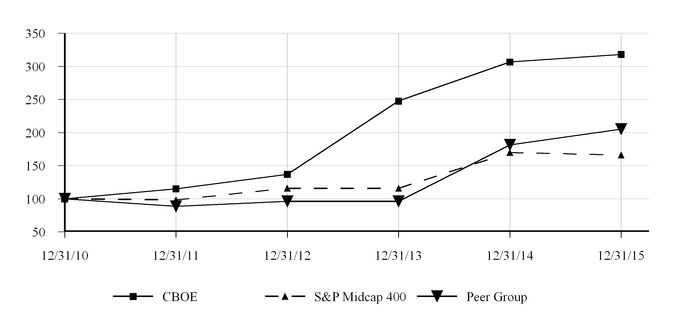
- $100 invested on 12/31/10 in stock or index, including reinvestment of dividends.
Fiscal year ending December 31.
Copyright© 2016 S&P, a division of The McGraw-Hill Companies Inc. All rights reserved.
| 12/2010 | 12/2011 | 12/2012 | 12/2013 | 12/2014 | 12/2015 | |||||||
| CBOE Holdings, Inc. | 100 | 115.04 | 137.01 | 247.68 | 306.68 | 318.22 | ||||||
| S&P Midcap 400 | 100 | 98.27 | 115.84 | 154.64 | 169.75 | 166.05 | ||||||
| Peer Group | 100 | 88.52 | 96.01 | 163.29 | 181.48 | 205.24 |
Item 6. Selected Financial Data
The following table shows selected financial data of the Company that should be read together with "Management's Discussion and Analysis of Financial Condition and Results of Operations" and the Consolidated Financial Statements and corresponding notes included in Items 7 and 8, respectively, of this Form 10-K:
| Year Ended December 31, | |||||||||||||||||||
| 2015 | 2014 | 2013 | 2012 | 2011 | |||||||||||||||
| (In thousands, except per share amounts) | |||||||||||||||||||
| Income Statement Data: | |||||||||||||||||||
| Total operating revenues | $ | 634,545 | $ | 617,225 | $ | 572,050 | $ | 512,338 | $ | 508,144 | |||||||||
| Total operating expenses | 314,617 | 303,424 | 286,236 | 268,241 | 266,512 | ||||||||||||||
| Operating income | 319,928 | 313,801 | 285,814 | 244,097 | 241,632 | ||||||||||||||
| Total other income/(expense) | 4,096 | (4,104 | ) | (2,158 | ) | (1,546 | ) | (1,548 | ) | ||||||||||
| Income before income taxes | 324,024 | 309,697 | 283,656 | 242,551 | 240,084 | ||||||||||||||
| Income tax provision | 119,001 | 119,983 | 107,657 | 85,156 | 100,678 | ||||||||||||||
| Net income | $ | 205,023 | $ | 189,714 | $ | 175,999 | $ | 157,395 | $ | 139,406 | |||||||||
| Net income allocated to common stockholders | $ | 204,125 | $ | 188,392 | $ | 173,863 | $ | 155,254 | $ | 136,582 | |||||||||
| Net income per share allocated to common stockholders | |||||||||||||||||||
| Basic | $ | 2.46 | $ | 2.21 | $ | 1.99 | $ | 1.78 | $ | 1.52 | |||||||||
| Diluted | 2.46 | 2.21 | 1.99 | 1.78 | 1.52 | ||||||||||||||
| Cash dividends declared per share (1) (2) | 0.88 | 0.78 | 1.16 | 1.29 | 0.44 | ||||||||||||||
| Balance Sheet Data: | |||||||||||||||||||
| Total assets | $ | 384,788 | $ | 383,901 | $ | 441,589 | $ | 338,858 | $ | 327,868 | |||||||||
| Total liabilities | 125,143 | 133,834 | 157,072 | 99,736 | 91,598 | ||||||||||||||
| Total stockholders' equity | 259,645 | 250,067 | 284,517 | 239,122 | 236,270 | ||||||||||||||
| Average daily volume by product (3) | |||||||||||||||||||
| Equities | 1,559 | 1,939 | 1,721 | 1,977 | 2,048 | ||||||||||||||
| Indexes | 1,620 | 1,613 | 1,479 | 1,217 | 1,271 | ||||||||||||||
| Exchange-traded products | 1,274 | 1,507 | 1,353 | 1,247 | 1,462 | ||||||||||||||
| Total options average daily volume | 4,453 | 5,059 | 4,553 | 4,441 | 4,781 | ||||||||||||||
| Futures | 205 | 201 | 159 | 96 | 48 | ||||||||||||||
| Total average daily volume | 4,658 | 5,260 | 4,712 | 4,537 | 4.829 |
| (1) | On December 11, 2012, the Company's board of directors declared a special cash dividend of $0.75 per share. This was in addition to the quarterly cash dividends which aggregated $0.54 per share for the year ended December 31, 2012. |
| (2) | On December 10, 2013, the Company's board of directors declared a special cash dividend of $0.50 per share. This was in addition to the quarterly cash dividends which aggregated $0.66 per share for the year ended December 31, 2013. |
| (3) | Average daily volume equals the total contracts traded during the period divided by the number of trading days in the period. |
Item 7. Management's Discussion and Analysis of Financial Condition and Results of Operations
General
Management's Discussion and Analysis of Financial Condition and Results of Operations ("MD&A") should be read in conjunction with the consolidated financial statements of the Company and the notes thereto included in Item 8 of this Annual Report on Form 10-K. The following discussion contains forward-looking statements. Actual results could differ materially from the results discussed in the forward-looking statements. See "Risk Factors" and "Forward-Looking Statements" above.
Overview
CBOE Holdings, Inc. is the holding company for Chicago Board Options Exchange, Incorporated, CBOE Futures Exchange, LLC, C2 Options Exchange, Incorporated and other subsidiaries.
The Company's principal business is operating markets that offer for trading options on various market indexes (index options), mostly on an exclusive basis, and futures contracts, as well as on non-exclusive "multiply-listed" options, such as options on the stocks of individual corporations (equity options) and options on other exchange-traded products (ETP options), such as exchange-traded funds (ETF options) and exchange-traded notes (ETN options). The Company operates three stand-alone exchanges, but reports the results of its operations in one reporting segment.
CBOE is our primary options market and offers trading in listed options through a single system that integrates electronic trading and traditional open outcry trading on our trading floor in Chicago. This integration of electronic trading and traditional open outcry trading into a single exchange is known as our Hybrid trading model. CFE, our all-electronic futures exchange, offers trading of futures on the VIX Index and other products. C2 is our all-electronic exchange that also offers trading for listed options, and may operate with a different market model and fee structure than CBOE. All of our exchanges operate on our proprietary technology platform known as CBOE Command.
Business Highlights
| • | Transaction fees accounted for 71.9%, 70.9% and 69.4% of total operating revenues for the years ended December 31, 2015, 2014 and 2013, respectively. |
| • | Index options and futures contracts accounted for 82.9%, 81.8% and 78.8% of our transaction fees for the years ended December 31, 2015, 2014 and 2013, respectively. |
| • | Our share of total U.S. exchange-traded options contracts for the year ended December 31, 2015 was 27.1%, down from 29.9% and 27.9% in 2014 and 2013, respectively. |
| • | Operating expenses were 49.6%, 49.2% and 50.0%, of total operating revenues for the years ended December 31, 2015, 2014 and 2013, respectively. |
| • | Compensation and benefits, representing our largest expense category, were 16.7%, 19.7% and 20.6%, of total operating revenues for the years ended December 31, 2015, 2014 and 2013, respectively. |
| • | In December 2014, we entered into an agreement with the Financial Industry Regulatory Authority ("FINRA") to provide a majority of regulatory services to the CBOE and C2 options markets. As a result of this agreement, we experienced a shift in expenses from compensation and benefits to professional fees and outside services. |
| • | On August 7, 2015, we acquired the market data services and trading analytics platform of Livevol, Inc. ("Livevol"), which included Livevol Core, Livevol Pro and Livevol X trading analytics platforms, as well as Livevol Enterprise and other market data solutions products. |
Business Strategy
We believe that the derivatives industry, especially the listed options and futures industry, has significant growth potential, including through new participants and products. We expect to further expand our business and increase our revenues and profitability by pursuing the following growth strategies:
| • | We intend to continue our efforts to expand the use of our products domestically and internationally. At the core of that effort is extended trading hours in our exclusive index options and futures products and investor education. |
| • | We intend to continue developing innovative proprietary products that meet the needs of the derivatives industry and complement our core products, both through strategic relationships and internal development. |
| • | We have designed our fee schedule to provide economic benefits to market participants that concentrate their overall trading activity at our exchanges. |
| • | We intend to continue to enhance our trading platform by continuing to invest in hardening and augmenting the functionality and capacity of our trading systems and by developing the next generation of trading technology, CBOE Vector. |
| • | We evaluate strategic opportunities that leverage and complement our core business and that we believe will enhance stockholder value. |
Components of Operating Revenues
Transaction Fees
The primary and largest source of operating revenues is transaction fees. Transaction fees are a function of many variables with the main three being: (1) exchange fee rates; (2) trading volume mix (products traded); and (3) transaction mix between order type. Because transaction fees are assessed on a per contract basis, transaction fee revenue is highly correlated to the volume of contracts traded on the Company's exchanges. While exchange fee rates are established by the Company, trading volume and transaction mix are influenced by a number of factors, including price competition, price volatility in the underlying securities and national and international economic and political conditions.
Revenue is recorded as transactions occur on a trade-date basis. The main products we trade are equity, index and ETP options and futures contracts.
| • | Equity options reflect trading in options contracts on the stocks of individual companies. |
| • | Index options reflect trading in index options contracts on market indexes. |
| • | ETP options include ETF options that are options on baskets of stocks designed to generally track an index, but which trade like individual stocks, and ETN options that are options on senior, unsecured, unsubordinated debt securities issued by an underwriting bank. |
| • | Futures contracts are standardized, transferable, exchange-traded contracts that require delivery of a commodity, bond, currency, stock index or other benchmark interests at a specified price and on a specified future date, which are settled in cash. |
Access Fees
Access fees represent fees assessed to Trading Permit and Privilege Holders for the opportunity to trade, including fees for trading-related functionality, on CBOE, C2 and CFE. The CBOE program contains a tier-based market-maker appointment system with different trading permits based on trading function and, in the case of market-makers, the assessment of a surcharge for certain CBOE proprietary products. Beginning in mid-2013, CBOE implemented sliding scales for all Market-Maker and Floor Broker Trading Permits held by affiliated Trading Permit Holders and TPH Organizations that are used in any options classes other than certain proprietary indexes. The number of trading permits made available is limited.
Exchange Services and Other Fees
To facilitate trading, the Company offers technology services, terminal and other equipment rentals, maintenance services, trading floor space and telecommunications services. Trading floor and equipment rentals are generally on a month-to-month basis. Facilities, systems services and other fees are generally monthly fee-based, although certain services are influenced by trading volume or other defined metrics, while others are based solely on demand. Also included in this
Showing the first 8K of 76K characters. Open the full section
Item 7A. Quantitative and Qualitative Disclosure About Market Risk
We are exposed to market risk in the ordinary course of business. This market risk consists primarily of interest rate risk associated with our cash and cash equivalents. We have no long-term or short-term debt. The Company does not trade options for its own account.
Interest Rate Risk
We have exposure to market risk for changes in interest rates relating to our cash and cash equivalents. As of December 31, 2015 and 2014, our cash and cash equivalents were $102.3 million and $147.9 million, respectively. We invest available cash in highly liquid, short-term investments, such as money market funds and U.S. Treasury securities. Our investment policy is to preserve capital and liquidity. A hypothetical three basis point decrease in short-term interest rates would decrease annual earnings by less than $75,000, assuming no change in the amount or composition of our cash and cash equivalents.
Impact of Inflation
We have not been adversely affected by inflation as technological advances and competition have generally caused prices for hardware and software that we use for our electronic platforms to remain constant or decline. Since transactions on our exchanges are not governed by long-term contracts, we believe that any increases in inflation are unlikely to have a material adverse effect on us.
Item 8. Financial Statements and Supplementary Data
INDEX TO CONSOLIDATED FINANCIAL STATEMENTS
REPORT OF INDEPENDENT REGISTERED PUBLIC ACCOUNTING FIRM
To the Board of Directors and Stockholders of
CBOE Holdings, Inc. and Subsidiaries
Chicago, Illinois
We have audited the accompanying consolidated balance sheets of CBOE Holdings, Inc. and subsidiaries (the "Company") as of December 31, 2015 and 2014, and the related consolidated statements of income, comprehensive income, stockholders' equity, and cash flows for each of the three years in the period ended December 31, 2015. These financial statements are the responsibility of the Company's management. Our responsibility is to express an opinion on these financial statements based on our audits.
We conducted our audits in accordance with the standards of the Public Company Accounting Oversight Board (United States). Those standards require that we plan and perform the audit to obtain reasonable assurance about whether the financial statements are free of material misstatement. An audit includes examining, on a test basis, evidence supporting the amounts and disclosures in the financial statements. An audit also includes assessing the accounting principles used and significant estimates made by management, as well as evaluating the overall financial statement presentation. We believe that our audits provide a reasonable basis for our opinion.
In our opinion, such consolidated financial statements present fairly, in all material respects, the financial position of CBOE Holdings, Inc. and subsidiaries as of December 31, 2015 and 2014, and the results of their operations and their cash flows for each of the three years in the period ended December 31, 2015, in conformity with accounting principles generally accepted in the United States of America.
We have also audited, in accordance with the standards of the Public Company Accounting Oversight Board (United States), the Company's internal control over financial reporting as of December 31, 2015, based on the criteria established in Internal Control - Integrated Framework (2013) issued by the Committee of Sponsoring Organizations of the Treadway Commission and our report dated February 19, 2016 expressed an unqualified opinion on the Company's internal control over financial reporting.
/s/ DELOITTE & TOUCHE LLP
Chicago, Illinois
February 19, 2016
REPORT OF INDEPENDENT REGISTERED PUBLIC ACCOUNTING FIRM
To the Board of Directors and Stockholders of
CBOE Holdings, Inc. and Subsidiaries
Chicago, Illinois
We have audited the internal control over financial reporting of CBOE Holdings, Inc. and subsidiaries (the "Company") as of December 31, 2015, based on criteria established in Internal Control - Integrated Framework (2013) issued by the Committee of Sponsoring Organizations of the Treadway Commission. The Company's management is responsible for maintaining effective internal control over financial reporting and for its assessment of the effectiveness of internal control over financial reporting, included in the accompanying Management’s Annual Report on Internal Control Over Financial Reporting. Our responsibility is to express an opinion on the Company's internal control over financial reporting based on our audit.
We conducted our audit in accordance with the standards of the Public Company Accounting Oversight Board (United States). Those standards require that we plan and perform the audit to obtain reasonable assurance about whether effective internal control over financial reporting was maintained in all material respects. Our audit included obtaining an understanding of internal control over financial reporting, assessing the risk that a material weakness exists, testing and evaluating the design and operating effectiveness of internal control based on the assessed risk, and performing such other procedures as we considered necessary in the circumstances. We believe that our audit provides a reasonable basis for our opinion.
A company's internal control over financial reporting is a process designed by, or under the supervision of, the company's principal executive and principal financial officers, or persons performing similar functions, and effected by the company's board of directors, management, and other personnel to provide reasonable assurance regarding the reliability of financial reporting and the preparation of financial statements for external purposes in accordance with generally accepted accounting principles. A company's internal control over financial reporting includes those policies and procedures that (1) pertain to the maintenance of records that, in reasonable detail, accurately and fairly reflect the transactions and dispositions of the assets of the company; (2) provide reasonable assurance that transactions are recorded as necessary to permit preparation of financial statements in accordance with generally accepted accounting principles, and that receipts and expenditures of the company are being made only in accordance with authorizations of management and directors of the company; and (3) provide reasonable assurance regarding prevention or timely detection of unauthorized acquisition, use, or disposition of the company's assets that could have a material effect on the financial statements.
Because of the inherent limitations of internal control over financial reporting, including the possibility of collusion or improper management override of controls, material misstatements due to error or fraud may not be prevented or detected on a timely basis. Also, projections of any evaluation of the effectiveness of the internal control over financial reporting to future periods are subject to the risk that the controls may become inadequate because of changes in conditions, or that the degree of compliance with the policies or procedures may deteriorate.
In our opinion, the Company maintained, in all material respects, effective internal control over financial reporting as of December 31, 2015, based on the criteria established in Internal Control - Integrated Framework (2013) issued by the Committee of Sponsoring Organizations of the Treadway Commission.
We have also audited, in accordance with the standards of the Public Company Accounting Oversight Board (United States), the consolidated financial statements as of and for the year ended December 31, 2015 of the Company and our report dated February 19, 2016 expressed an unqualified opinion on those financial statements.
/s/ DELOITTE & TOUCHE LLP
Chicago, Illinois
February 19, 2016
CBOE Holdings, Inc. and Subsidiaries
Consolidated Balance Sheets
December 31, 2015 and December 31, 2014
| (in thousands, exce |
Showing the first 8K of 94K characters. Open the full section
Item 9. Changes in and Disagreements with Accountants on Accounting and Financial Disclosure
Not applicable.
Item 9A. Controls and Procedures
(a) Evaluation of Disclosure Controls and Procedures
The Company's management, with the participation of its Chief Executive Officer and Chief Financial Officer, has evaluated the effectiveness of the Company's disclosure controls and procedures (as defined in Rule 13a-15(e) and Rule 15d-15(e) under the Securities Exchange Act of 1934 (the “Exchange Act”)) as of the end of the period covered by this report. Based upon that evaluation, the Company's Chief Executive Officer and Chief Financial Officer have concluded that, as of the end of such period, the Company's disclosure controls and procedures are effective.
b) Management's Annual Report on Internal Control over Financial Reporting
Management is responsible for establishing and maintaining adequate internal control over financial reporting. Our internal control system has been designed to provide reasonable assurance to management and the board of directors regarding the preparation and fair presentation of published financial statements.
Management assessed the effectiveness of the Company's internal control over financial reporting as of December 31, 2015. Management based its assessment on criteria for effective internal control over financial reporting described in Internal Control-Integrated Framework (2013) issued by the Committee of Sponsoring Organizations of the Treadway Commission. Management's assessment included evaluating the design of our internal control over financial reporting and testing the operational effectiveness of our internal control over financial reporting. The results of its assessment were reviewed with the audit committee of the board of directors.
Based on this assessment, management believes that, as of December 31, 2015, our internal control over financial reporting is effective.
The effectiveness of our internal control over financial reporting as of December 31, 2015 has been audited by Deloitte & Touche LLP, an independent registered public accounting firm, as stated in their report on page 56.
There were no changes in the Company's internal control over financial reporting that occurred during the three months ended December 31, 2015 that have materially affected, or are reasonably likely to materially affect, our internal control over financial reporting.
Item 9B. Other Information
Not applicable
PART III
Item 10. Directors, Executive Officers and Corporate Governance
Information relating to our executive officers is included on pages 18 of this Annual Report on Form 10-K. Information relating to our directors, including our audit committee and audit committee financial experts and the procedures by which stockholders can recommend director nominees, and our executive officers will be in our definitive Proxy Statement for our 2016 Annual Meeting of Stockholders planned to be held on May 19, 2016, which will be filed within 120 days of the end of our fiscal year ended December 31, 2015 ("2016 Proxy Statement") and is incorporated herein by reference.
Code of Ethics
We have adopted a Code of Business Conduct and Ethics that applies to our Chief Executive Officer, Chief Financial Officer and Chief Accounting Officer, as well as all other employees and directors. Our Code of Business Conduct and Ethics is available on our website at http://ir.cboe.com/governance.cfm. We will also provide a copy of the Code of Business Conduct and Ethics to stockholders at no charge upon written request.
Item 11. Executive Compensation
Information relating to our executive officer and director compensation and the compensation committee of our board of directors will be in the 2016 Proxy Statement and is incorporated herein by reference.
Item 12. Security Ownership of Certain Beneficial Owners and Management and Related Stockholder Matters
Information relating to security ownership of certain beneficial owners of our common stock and information relating to the security ownership of our management will be in the 2016 Proxy Statement and is incorporated herein by reference.
Item 13. Certain Relationships and Related Transactions, and Director Independence
Information regarding certain relationships and related transactions and director independence will be in the 2016 Proxy Statement and is incorporated herein by reference.
Item 14. Principal Accountant Fees and Services
Information regarding principal accountant fees and services will be in the 2016 Proxy Statement and is incorporated herein by reference.
PART IV
Item 15. Exhibits, Financial Statement Schedules
| (a) | Documents filed as part of this report |
(1) Financial Statements
Our consolidated financial statements and the related reports of management and our independent registered public accounting firm which are required to be filed as part of this report are included in this Annual Report on Form 10-K beginning at page 54. These consolidated financial statements are as follows:
| • | Consolidated Balance Sheets as of December 31, 2015 and 2014 |
| • | Consolidated Statements of Income for the years ended December 31, 2015, 2014 and 2013 |
| • | Consolidated Statements of Comprehensive Income for the years ended December 31, 2015, 2014 and 2013 |
| • | Consolidated Statements of Cash Flows for the years ended December 31, 2015, 2014 and 2013 |
| • | Consolidated Statements of Stockholders' Equity for the years ended December 31, 2015, 2014 and 2013 |
| • | Notes to Consolidated Financial Statements |
(2) Financial Statement Schedules
The Company has not included any financial statement schedules because they are not applicable or the required information is included in the consolidated financial statements or notes thereto.
(3) List of Exhibits
See (b) Exhibits below
| (b) | Exhibits |
| Exhibit No. | Description of Exhibit | ||
| 3.1 | Second Amended and Restated Certificate of Incorporation of CBOE Holdings, Inc. (filed herewith). | ||
| 3.2 | Third Amended and Restated Bylaws of CBOE Holdings, Inc., incorporated by reference to Exhibit 3.1 to the Company's Current Report on Form 8-K (File No. 001-34774) filed on November 25, 2015. | ||
| 10.1 | Restated License Agreement, dated November 1, 1994, by and between Standard & Poor's Financial Services LLC (as successor-in-interest to Standard & Poor's, a division of McGraw-Hill, Inc.) and the Chicago Board Options Exchange, Incorporated (the "S&P License Agreement"), incorporated by reference to Exhibit 10.1 to Amendment No. 6 to the Company's Registration Statement on Form S-4 (File No. 333-140574) filed on April 12, 2010.+ | ||
| 10.2 | Amendment No. 1 to the S&P License Agreement, dated January 15, 1995, incorporated by reference to Exhibit 10.2 to Amendment No. 6 to the Company's Registration Statement on Form S-4 (File No. 333-140574) filed on April 12, 2010.+ | ||
| 10.3 | Amendment No. 2 to the S&P License Agreement, dated April 1, 1998, incorporated by reference to Exhibit 10.3 to Amendment No. 6 to the Company's Registration Statement on Form S-4 (File No. 333-140574) filed on April 12, 2010.+ | ||
| 10.4 | Amendment No. 3 to the S&P License Agreement, dated July 28, 2000, incorporated by reference to Exhibit 10.4 to Amendment No. 6 to the Company's Registration Statement on Form S-4 (File No. 333-140574) filed on April 12, 2010.+ | ||
| 10.5 | Amendment No. 4 to the S&P License Agreement, dated October 27, 2000, incorporated by reference to Exhibit 10.5 to Amendment No. 6 to the Company's Registration Statement on Form S-4 (File No. 333-140574) filed on April 12, 2010.+ |
| Exhibit No. | Description of Exhibit | ||
| 10.6 | Amendment No. 5 to the S&P License Agreement, dated March 1, 2003, incorporated by reference to Exhibit 10.6 to Amendment No. 6 to the Company's Registration Statement on Form S-4 (File No. 333-140574) filed on April 12, 2010.+ | ||
| 10.7 | Amended and Restated Amendment No. 6 to the S&P License Agreement, dated February 24, 2009, incorporated by reference to Exhibit 10.7 to Amendment No. 6 to the Company's Registration Statement on Form S-4 (File No. 333-140574) filed on April 12, 2010.+ | ||
| 10.8 | Amended and Restated Amendment No. 7 to the S&P License Agreement, dated February 24, 2009, incorporated by reference to Exhibit 10.8 to Amendment No. 6 to the Company's Registration Statement on Form S-4 (File No. 333-140574) filed on April 12, 2010.+ | ||
| 10.9 | Amendment No. 8 to the S&P License Agreement, dated January 9, 2005, incorporated by reference to Exhibit 10.9 to Amendment No. 6 to the Company's Registration Statement on Form S-4 (File No. 333-140574) filed on April 12, 2010.+ | ||
| 10.10 | Amendment No. 10 to the S&P License Agreement, dated June 19, 2009, incorporated by reference to Exhibit 10.10 to Amendment No. 6 to the Company's Registration Statement on Form S-4 (File No. 333-140574) filed on April 12, 2010.+ | ||
| 10.11 | Amendment No. 11 to the S&P License Agreement, dated as of April 29, 2010, incorporated by reference to Exhibit 10 to the Company's Current Report on Form 8-K (File No. 001-34774) filed on May 11, 2010.+ | ||
| 10.12 | Chicago Board Options Exchange, Incorporated Executive Retirement Plan, incorporated by reference to Exhibit 10.13 to Amendment No. 4 to the Company's Registration Statement on Form S-4 (File No. 333-140574) filed on August 14, 2009.* | ||
| 10.13 | Chicago Board Options Exchange, Incorporated Supplemental Retirement Plan, incorporated by reference to Exhibit 10.14 to Amendment No. 4 to the Company's Registration Statement on Form S-4 (File No. 333-140574) filed on August 14, 2009.* | ||
| 10.14 | Chicago Board Options Exchange, Incorporated Deferred Compensation Plan for Officers, incorporated by reference to Exhibit 10.15 to Amendment No. 4 to the Company's Registration Statement on Form S-4 (File No. 333-140574) filed on August 14, 2009.* | ||
| 10.15 | Amendment No. 1 to the Chicago Board Options Exchange, Incorporated Supplemental Retirement Plan, incorporated by reference to Exhibit 10.3 to the Company's Quarterly Report on Form 10-Q for the quarter ended September 30, 2010 (File No. 001-34774) filed on November 12, 2010.* | ||
| 10.16 | Amended and Restated Employment Agreement, effective December 31, 2009, by and between the Chicago Board Options Exchange, Incorporated and William J. Brodsky, incorporated by reference to Exhibit 10.16 to Amendment No. 5 to the Company's Registration Statement on Form S-4 (File No. 333-140574) filed on March 11, 2010.* | ||
| 10.17 | Amended and Restated CBOE Holdings, Inc. Long-Term Incentive Plan, incorporated by reference to Exhibit 10.20 to Amendment No. 4 to the Company's Registration Statement on Form S-1 (File No. 333-165393) filed on June 11, 2010.* | ||
| 10.18 | Form of Restricted Stock Award Agreement (for Executive Officers), incorporated by reference to Exhibit 10.1 to the Company's Quarterly Report on Form 10-Q for the quarter ended March 31, 2010 (File No. 001-34774) filed on June 11, 2010.* | ||
| 10.19 | Form of Restricted Stock Award Agreement (for Non-employee Directors), incorporated by reference to Exhibit 10.2 to the Company's Quarterly Report on Form 10-Q for the quarter ended March 31, 2010 (File No. 001-34774) filed on June 11, 2010.* | ||
| 10.20 | Amended and Restated CBOE Holdings, Inc. Executive Severance Plan, incorporated by reference to Exhibit 10.1 to the Company's Quarterly Report on Form 10-Q for the quarter ended March 31, 2015 (File No. 001-34774) filed on May 6, 2015.* | ||
| 10.21 | Form of Director Indemnification Agreement, incorporated by reference to Exhibit 10.1 to the Company's Current Report on Form 8-K (File No. 001-34774) filed on December 20, 2010. | ||
| 10.22 | Amended and Restated CBOE Holdings, Inc. Long-Term Incentive Plan, incorporated by reference to Exhibit 10.1 to the Company’s Current Report on Form 8-K (File No. 001-34774), filed on May 18, 2011. * | ||
| 10.23 | Amendment No. 1, dated August 22, 2011, to the Amended and Restated License Agreement, dated September 29, 2006, by and between CME Group Index Services LLC (as successor-in-interest to Dow Jones & Company, Inc.) and the Chicago Board Options Exchange, Incorporated, incorporated by reference to Exhibit 10.1 to the Company's Quarterly Report on Form 10-Q for the quarter ended September 30, 2011 (File No. 001-34774) filed on November 9, 2011.+ |
| Exhibit No. | Description of Exhibit | ||
| 10.24 | Transition Agreement, by and among CBOE Holdings, Inc., Chicago Board Options Exchange, Incorporated and William J. Brodsky, dated December 11, 2012, incorporated by reference to Exhibit 10.1 to the Company's Current Report on Form 8-K (File No. 001-34774) filed on December 12, 2012.* | ||
| 10.25 | Amended and Restated Employment Agreement, by and among CBOE Holdings, Inc., Chicago Board Options Exchange, Incorporated and Edward T. Tilly, dated December 11, 2012, incorporated by reference to Exhibit 10.2 to the Company's Current Report on Form 8-K (File No. 001-34774) filed on December 12, 2012.* | ||
| 10.26 | Amendment No. 12, to the S&P License Agreement, dated March 9, 2013, incorporated by reference to Exhibit 10.1 to the Company's Quarterly Report on Form 10-Q (File no. 001-34774) filed on May 7, 2013. + | ||
| 10.27 | Form of Restricted Stock Unit Award Agreement (for Executive Officers) under the Amended and Restated CBOE Holdings, Inc. Long-term Incentive Plan, incorporated by reference to Exhibit 10.27 to the Company's Annual Report on Form 10-K for the year ended December 31, 2013 (File No. 001-34774) filed on February 21, 2014.* | ||
| 10.28 | Form of Restricted Stock Unit Award Agreement (relative total shareholder return) under the Amended and Restated CBOE Holdings, Inc. Long-term Incentive Plan, incorporated by reference to Exhibit 10.28 to the Company's Annual Report on Form 10-K for the year ended December 31, 2013 (File No. 001-34774) filed on February 21, 2014.* | ||
| 10.29 | Form of Restricted Stock Unit Award Agreement (earnings per share) under the Amended and Restated CBOE Holdings, Inc. Long-term Incentive Plan, incorporated by reference to Exhibit 10.29 to the Company's Annual Report on Form 10-K for the year ended December 31, 2013 (File No. 001-34774) filed on February 21, 2014.* | ||
| 10.30 | Form of 2016 Restricted Stock Unit Award Agreement (for Executive Officers) under the Amended and Restated CBOE Holdings, Inc. Long-term Incentive Plan (filed herewith).* | ||
| 10.31 | Form of 2016 Restricted Stock Unit Award Agreement (relative total shareholder return) under the Amended and Restated CBOE Holdings, Inc. Long-term Incentive Plan (filed herewith).* | ||
| 10.32 | Form of 2016 Restricted Stock Unit Award Agreement (earnings per share) under the Amended and Restated CBOE Holdings, Inc. Long-term Incentive Plan (filed herewith).* | ||
| 21.1 | Subsidiaries of CBOE Holdings, Inc. (filed herewith). | ||
| 23.1 | Consent of Independent Registered Public Accounting Firm (filed herewith). | ||
| 24.1 | Powers of Attorney (incorporated by reference to the signature page of this Annual Report on Form 10-K). | ||
| 31.1 | Certification of Chief Executive Officer pursuant to Rule 13a-14 (filed herewith). | ||
| 31.2 | Certification of Chief Financial Officer pursuant to Rule 13a-14 (filed herewith). | ||
| 32.1 | Certificate of Chief Executive Officer pursuant to Rule 13a-14(b) and Section 1350 of Chapter 63 of Title 18 of the United States Code (filed herewith). | ||
| 32.2 | Certificate of Chief Financial Officer pursuant to Rule 13a-14(b) and Section 1350 of Chapter 63 of Title 18 of the United States Code (filed herewith). | ||
| 101.INS | XBRL Instance Document (filed herewith). | ||
| 101.SCH | XBRL Taxonomy Extension Schema Document (filed herewith). | ||
| 101.CAL | XBRL Taxonomy Extension Calculation Linkbase Document (filed herewith). | ||
| 101.DEF | XBRL Taxonomy Extension Definition Linkbase (filed herewith). | ||
| 101.LAB | XBRL Taxonomy Extension Label Linkbase Document (filed herewith). | ||
| 101.PRE | XBRL Taxonomy Extension Presentation Linkbase Document (filed herewith). | ||
*Indicates Management Compensatory Plan, Contract or Arrangement.
+Confidential treatment has been previously requested or granted to portions of these exhibits by the SEC.
SIGNATURES
Pursuant to the requirements of Section 13 or 15(d) of the Securities Exchange Act of 1934, the registrant has duly caused this Annual Report on Form 10-K to be signed on its behalf by the undersigned, thereunto duly authorized.
| CBOE HOLDINGS, INC. (Registrant) | ||
| By: | /s/ EDWARD T. TILLY | |
| Edward T. Tilly Chief Executive Officer |
Date: February 19, 2016
POWERS OF ATTORNEY
KNOW ALL PERSONS BY THESE PRESENTS, that each person whose signature appears below constitutes and appoints Edward T. Tilly, as attorney-in-fact and agent, with full power of substitution and re-substitution, to sign on his or her behalf, individually and in any and all capacities, including the capacities stated below, any and all amendments to this Annual Report on Form 10-K for the year ended December 31, 2015 and to file the same, with all exhibits thereto, and other documents in connection therewith, with the Securities and Exchange Commission, granting to said attorney-in-fact and agent, full power and authority to do and perform each and every act and thing requisite and necessary to be done in and about the premises, as fully to all intents and purposes as he or she might or could do in person, hereby ratifying and confirming all that said attorney-in-fact and agent, or his substitute, may lawfully do or cause to be done by virtue hereof.
Pursuant to the requirements of the Securities Exchange Act of 1934, this report has been signed below by the following persons on behalf of the registrant and in the capacities on the dates indicated.
| SIGNATURE | TITLE | DATE | ||
| /s/ EDWARD T. TILLY | Chief Executive Officer and Director | February 19, 2016 | ||
| Edward T. Tilly | (Principal Executive Officer) | |||
| /s/ ALAN J. DEAN | Executive Vice President, Chief Financial Officer and Treasurer | February 19, 2016 | ||
| Alan J. Dean | (Principal Financial Officer) | |||
| /s/ DAVID S. REYNOLDS | Vice President and Chief Accounting Officer | February 19, 2016 | ||
| David S. Reynolds | (Principal Accounting Officer) | |||
| /s/ WILLIAM J. BRODSKY | Chairman | February 19, 2016 | ||
| William J. Brodsky | ||||
| /s/ JAMES R. BORIS | Director | February 19, 2016 | ||
| James R. Boris | ||||
| /s/ FRANK E. ENGLISH, JR. | Director | February 19, 2016 | ||
| Frank E. English, Jr. | ||||
| /s/ EDWARD J. FITZPATRICK | Director | February 19, 2016 | ||
| Edward J. Fitzpatrick |
| SIGNATURE | TITLE | DATE | ||
| /s/ JANET P. FROETSCHER | Director | February 19, 2016 | ||
| Janet P. Froetscher | ||||
| /s/ JILL R. GOODMAN | Director | February 19, 2016 | ||
| Jill R. Goodman | ||||
| /s/ R. EDEN MARTIN | Director | February 19, 2016 | ||
| R. Eden Martin | ||||
| /s/ RODERICK A. PALMORE | Director | February 19, 2016 | ||
| Roderick A. Palmore | ||||
| /s/ SUSAN M. PHILLIPS | Director | February 19, 2016 | ||
| Susan M. Phillips | ||||
| /s/ SAMUEL K. SKINNER | Director | February 19, 2016 | ||
| Samuel K. Skinner | ||||
| /s/ CAROLE E. STONE | Director | February 19, 2016 | ||
| Carole E. Stone | ||||
| /s/ EUGENE S. SUNSHINE | Director | February 19, 2016 | ||
| Eugene S. Sunshine |