 filings.tools
Crown Castle 10-K 2018-12-31
Filed 2019-02-25. 21 sections, 439K characters. Original on sec.gov · Markdown · JSON
Cover and table of contents
10-K 1 cci10-k123118.htm 10-K
UNITED STATES
SECURITIES AND EXCHANGE COMMISSION
Washington, D.C. 20549
FORM 10-K
| x | ANNUAL REPORT PURSUANT TO SECTION 13 OR 15(d) OF THE SECURITIES EXCHANGE ACT OF 1934 |
For the fiscal year ended December 31, 2018
or
| o | TRANSITION REPORT PURSUANT TO SECTION 13 OR 15(d) OF THE SECURITIES EXCHANGE ACT OF 1934 |
For the transition period from to
Commission File Number 001-16441

CROWN CASTLE INTERNATIONAL CORP.
(Exact name of registrant as specified in its charter)
| Delaware | 76-0470458 | |
| (State or other jurisdiction of incorporation or organization) | (I.R.S. Employer Identification No.) | |
| 1220 Augusta Drive, Suite 600, Houston Texas 77057-2261 | ||
| (Address of principal executive offices) (Zip Code) |
(713) 570-3000
(Registrant's telephone number, including area code)
| Securities Registered Pursuant to Section 12(b) of the Act | Name of Each Exchange on Which Registered | |
| Common Stock, $0.01 par value | New York Stock Exchange | |
| 6.875% Mandatory Convertible Preferred Stock, Series A, $0.01 par value | New York Stock Exchange |
Securities Registered Pursuant to Section 12(g) of the Act: NONE.
Indicate by check mark if the registrant is a well-known seasoned issuer, as defined in Rule 405 of the Securities Act. Yes x No o
Indicated by check mark if the registrant is not required to file reports pursuant to Section 13 or Section 15(d) of the Act. Yes o No x
Indicate by check mark whether the registrant (1) has filed all reports required to be filed by Section 13 or 15(d) of the Securities Exchange Act of 1934 during the preceding 12 months (or for such shorter period that the registrant was required to file such reports), and (2) has been subject to such filing requirements for the past 90 days. Yes x No o
Indicate by check mark whether the registrant has submitted electronically every Interactive Data File required to be submitted pursuant to Rule 405 of Regulation S-T (§232.405 of this chapter) during the preceding 12 months (or for such shorter period that the registrant was required to submit such files). Yes x No o
Indicate by check mark if disclosure of delinquent filers pursuant to Item 405 of Regulation S-K (§229.405 of this chapter) is not contained herein, and will not be contained, to the best of registrant's knowledge, in definitive proxy or information statements incorporated by reference in Part III of this Form 10-K or any amendment to this Form 10-K. o
Indicate by check mark whether the registrant is a large accelerated filer, an accelerated filer, a non-accelerated filer, a smaller reporting company or an emerging growth company. See definitions of a "large accelerated filer," "accelerated filer," "smaller reporting company," and "emerging growth company" in rule 12b-2 of the Exchange Act.
Large accelerated filer x Accelerated filer o Non-accelerated filer o Smaller reporting company o Emerging growth company o
If an emerging growth company, indicate by check mark if the registrant has elected not to use the extended transition period for complying with any new or revised financial accounting standards provided pursuant to Section 13(a) of the Exchange Act o
Indicate by check mark whether the registrant is a shell company (as defined in Rule 12b-2 of the Act). Yes o No x
The aggregate market value of the voting and non-voting common equity held by non-affiliates of the registrant was approximately $44.6 billion as of June 30, 2018, the last business day of the registrant's most recently completed second fiscal quarter, based on the New York Stock Exchange closing price on that day of $107.82 per share.
Applicable Only to Corporate Registrants
As of February 22, 2019, there were 415,568,382 shares of common stock outstanding.
Documents Incorporated by Reference
The information required to be furnished pursuant to Part III of this Form 10-K will be set forth in, and incorporated by reference from, the registrant's definitive proxy statement for the annual meeting of stockholders ("2019 Proxy Statement"), which will be filed with the Securities and Exchange Commission not later than 120 days after the end of the fiscal year ended December 31, 2018.
CROWN CASTLE INTERNATIONAL CORP.
TABLE OF CONTENTS
Cautionary Language Regarding Forward-Looking Statements
This Annual Report on Form 10-K contains forward-looking statements that are based on our management's expectations as of the filing date of this report with the Securities and Exchange Commission ("SEC"). Statements that are not historical facts are hereby identified as forward-looking statements. In addition, words such as "estimate," "anticipate," "project," "plan," "intend," "believe," "expect," "likely," "predicted," "positioned," "continue," "target," and any variations of these words and similar expressions are intended to identify forward-looking statements. Such statements include plans, projections and estimates contained in "Item 1. Business," "Item 3. Legal Proceedings," "Item 7. Management's Discussion and Analysis of Financial Condition and Results of Operations" ("MD&A"), and "Item 7A. Quantitative and Qualitative Disclosures About Market Risk" herein. Such forward-looking statements include (1) expectations regarding anticipated growth in the wireless industry, carriers' investments in their networks, tenant additions, and demand for data and our communications infrastructure (as defined below), (2) expectations regarding non-renewals of tenant contracts, (3) expectations regarding our communications infrastructure and the potential benefits that may be derived therefrom, (4) the strength of the U.S. market for shared communications infrastructure, (5) availability and adequacy of cash flows and liquidity for, or plans regarding, future discretionary investments, including capital expenditures, (6) potential benefits of our discretionary investments, including acquisitions, (7) our full year 2019 outlook and the anticipated growth in our financial results, including future revenues and operating cash flows, (8) expectations regarding construction of small cells and fiber, (9) expectations regarding our capital structure and the credit markets, our availability and cost of capital, our leverage ratio and interest coverage targets, and our ability to service our debt and comply with debt covenants and the plans for and the benefits of any future refinancings, (10) expectations related to remaining qualified as a real estate investment trust ("REIT"), and the advantages, benefits or impact of, or opportunities created by, our REIT status, (11) the utilization of our net operating loss
carryforwards ("NOLs"), (12) expectations related to the impact of tenant consolidation or ownership changes, including the potential combination of T-Mobile and Sprint and (13) our dividend policy, and the timing, amount, growth or tax characterization of any dividends. All future dividends are subject to declaration by our board of directors.
Such forward-looking statements should, therefore, be considered in light of various risks, uncertainties and assumptions, including prevailing market conditions, risk factors described under "Item 1A. Risk Factors" herein and other factors. Should one or more of these risks or uncertainties materialize, or should underlying assumptions prove incorrect, actual results may vary materially from those expected.
Interpretation
As used herein, the term "including," and any variation thereof, means "including without limitation." The use of the word "or" herein is not exclusive. Unless this Form 10-K indicates otherwise or the context otherwise requires, the terms, "we," "our," "our company," "the company" or "us" as used in this Form 10-K refer to Crown Castle International Corp. and its predecessor (organized in 1995), as applicable, each a Delaware corporation (together, "CCIC"), and their subsidiaries. Additionally, unless the context suggests otherwise, references to "U.S." are to the United States of America and Puerto Rico, collectively.
We have changed our presentation from thousands to millions and, as a result, any necessary rounding adjustments have been made to prior year disclosed amounts.
PART I
Item 1. Business
Overview
We own, operate and lease shared communications infrastructure that is geographically dispersed throughout the U.S., including (1) approximately 40,000 towers and other structures, such as rooftops (collectively, "towers"), and (2) approximately 65,000 route miles of fiber primarily supporting small cell networks ("small cells") and fiber solutions. Our towers, fiber and small cells assets are collectively referred to herein as "communications infrastructure," and our customers on our communications infrastructure are referred to herein as "tenants." Our core business is providing access, including space or capacity, to our shared communications infrastructure via long-term contracts in various forms, including lease, license, sublease and service agreements (collectively, "contracts"). We seek to increase our site rental revenues by adding more tenants on our shared communications infrastructure, which we expect to result in significant incremental cash flows due to our low incremental operating costs.
Below is certain information concerning our business:
| • | Over the last two decades, we have assembled a leading portfolio of towers predominately through acquisitions from large wireless carriers or their predecessors. More recently, through both acquisitions (see note 3 to our consolidated financial statements) and new construction of small cells and fiber, we have extended our communications infrastructure presence by investing significantly in our Fiber segment. Through our product offerings of towers and small cells, we seek to provide a comprehensive solution to enable our wireless tenants to expand coverage and capacity for wireless networks. Furthermore, within our Fiber segment, we are able to generate cash flow growth and stockholder return by deploying our fiber for both small cells' and fiber solutions' tenants. |
| • | Below is certain information regarding our Towers segment: |
| ◦ | Approximately 56% and 71% of our towers are located in the 50 and 100 largest U.S. basic trading areas ("BTAs"), respectively. Our towers have a significant presence in each of the top 100 BTAs. |
| ◦ | We derive approximately 40% of our Towers site rental gross margin from towers residing on land and other property interests (collectively, "land") that we own, including fee interests and perpetual easements, and we derive approximately 60% of our Towers site rental gross margin from towers residing on land that we lease, sublease, manage or license. |
| ◦ | The contracts for the land under our towers have an average total remaining life of approximately 35 years (including all renewal terms at our option), weighted based on Towers site rental gross margin. |
| • | Below is certain information regarding our Fiber segment: |
| ◦ | The majority of our small cells and fiber are located in major metropolitan areas, including a presence within every major U.S. market. |
| ◦ | The vast majority of our fiber assets are located on public rights-of-way. |
| ◦ | We operate as a REIT for U.S. federal income tax purposes. See "Item 1. Business—2018 Industry Highlights and Company Developments—REIT Status" and note 10 to our consolidated financial statements. |
Certain information concerning our tenant and site rental contracts is as follows:
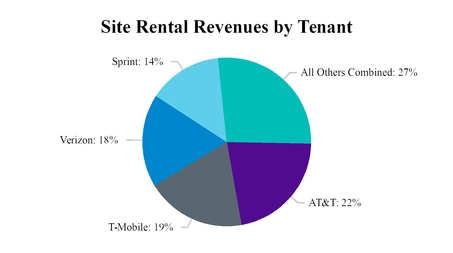
| • | Our largest tenants include AT&T, T-Mobile, Verizon Wireless and Sprint, which collectively accounted for 73% of our 2018 site rental revenues. |
| • | Site rental revenues represented 87% of our 2018 consolidated net revenues, of which approximately 66% and 34% were from our Towers segment and our Fiber segment, respectively. |
| • | The vast majority of our site rental revenues are of a recurring nature and are subject to long-term contracts with our tenants. |
| • | Our site rental revenues derived from wireless tenants typically result from long-term contracts with (1) initial terms of five to 15 years, (2) multiple renewal periods at the option of the tenant of five to 10 years each, (3) limited termination rights for our tenants, and (4) contractual escalations of the rental price and, in some cases, an additional upfront payment. |
| • | Our site rental revenues derived from our fiber solutions tenants (including from organizations with high-bandwidth and multi-location demands), typically result from contracts with (1) initial terms that generally vary between three to 20 years and (2) a fixed monthly recurring fee and, in some cases, an additional upfront payment. |
| • | Exclusive of renewals at the tenants' option, our tenant contracts have a weighted-average remaining life of approximately five years and represent $23 billion of expected future cash inflows. |
As part of our effort to provide comprehensive communications infrastructure solutions, we also offer certain services primarily relating to our towers and small cells, predominately consisting of (1) site development services relating to existing or new tenant equipment installations, including: site acquisition, architectural and engineering, or zoning and permitting (collectively,
"site development services") and (2) tenant equipment installation or subsequent augmentations (collectively, "installation services"). The large majority of our services revenues relate to our Towers segment.
Strategy
As a leading provider of shared communications infrastructure in the U.S., our strategy is to create long-term stockholder value via a combination of (1) growing cash flows generated from our existing portfolio of communications infrastructure, (2) returning a meaningful portion of our cash provided by operating activities to our common stockholders in the form of dividends and (3) investing capital efficiently to grow cash flows and long-term dividends per share. Our U.S. focused strategy is based, in part, on our belief that the U.S. is the most attractive market for shared communications infrastructure investment with the greatest long-term growth potential. We measure our efforts to create "long-term stockholder value" by the combined payment of dividends to stockholders and growth in our per share results. The key elements of our strategy are to:
| • | Grow cash flows from our existing communications infrastructure. We seek to maximize our site rental cash flows by working with our tenants to provide them quick access to our existing communications infrastructure and entering into long-term contracts. Tenant additions or modifications of existing tenant equipment (collectively, "tenant additions") enable our tenants to expand coverage and capacity in order to meet increasing demand for data, while generating high incremental returns for our business. We believe our product offerings of towers and small cells provide a comprehensive solution to our wireless tenants' growing network needs through our shared communications infrastructure model, which is an efficient and cost-effective way to serve our tenants. Additionally, we believe our ability to share our fiber assets across multiple tenants to deploy both small cells and offer fiber solutions allows us to generate cash flows and increase stockholder return. We also believe that there will be considerable future demand for our communications infrastructure based on the location of our assets and the rapid growth in demand for data. |
| • | Return cash provided by operating activities to common stockholders in the form of dividends. We believe that distributing a meaningful portion of our cash provided by operating activities appropriately provides common stockholders with increased certainty for a portion of expected long-term stockholder value while still retaining sufficient flexibility to invest in our business and deliver growth. We believe this decision reflects the translation of the high-quality, long-term contractual cash flows of our business into stable capital returns to common stockholders. |
| • | Invest capital efficiently to grow cash flows and long-term dividends per share. In addition to adding tenants to existing communications infrastructure, we seek to invest our available capital, including the net cash provided by our operating activities and external financing sources, in a manner that will increase long-term stockholder value on a risk-adjusted basis. These investments include constructing and acquiring new communications infrastructure that we expect will generate future cash flow growth and attractive long-term returns by adding tenants to those assets over time. Our historical investments have included the following (in no particular order): |
| ◦ | construction of towers, fiber and small cells; |
| ◦ | acquisitions of towers, fiber and small cells; |
| ◦ | acquisitions of land interests (which primarily relate to land assets under towers); |
| ◦ | improvements and structural enhancements to our existing communications infrastructure; |
| ◦ | purchases of shares of our common stock from time to time; and |
| ◦ | purchases, repayments or redemptions of our debt. |
Our strategy to create long-term stockholder value is based on our belief that additional demand for our communications infrastructure will be created by the expected continued growth in the demand for data. We believe that such demand for our communications infrastructure will continue, will result in growth of our cash flows due to tenant additions on our existing communications infrastructure, and will create other growth opportunities for us, such as demand for newly-constructed or acquired communications infrastructure, as described above.
Company Developments, REIT Status and Industry Updates
Company Developments. See "Item 1. Business—Overview," "Item 1. Business—The Company," "Item 7. MD&A" and our consolidated financial statements for a discussion of certain recent developments, activities, and results, including the increase in our quarterly common stock dividend and our recent debt and equity financing activities.
REIT Status. We commenced operating as a REIT for U.S. federal income tax purposes effective January 1, 2014. As a REIT, we are generally entitled to a deduction for dividends that we pay and therefore are not subject to U.S. federal corporate income tax on our net taxable income that is currently distributed to our stockholders. We may also be subject to certain federal, state, local, and foreign taxes on our income or assets, including (1) taxes on any undistributed income, (2) taxes related to our taxable REIT subsidiaries ("TRSs"), (3) franchise taxes, (4) property taxes and (5) transfer taxes. In addition, we could, in certain
circumstances, be required to pay an excise or penalty tax, which could be significant in amount, in order to utilize one or more relief provisions under the Internal Revenue Code of 1986, as amended ("Code"), to maintain qualification for taxation as a REIT.
The Tax Cuts and Jobs Act, enacted in 2018 ("Tax Reform Act"), made substantial changes to the Code. Among the many changes impacting corporations are a significant reduction in the corporate income tax rate, the repeal of the corporate alternative minimum tax for years beginning in 2018 and limitations on the deductibility of interest expense. In addition, under the Tax Reform Act, qualified REIT dividends (within the meaning of Section 199A(e)(3) of the Code) constitute a part of a non-corporate taxpayer's "qualified business income amount" and thus our non-corporate U.S. stockholders may be eligible to take a qualified business income deduction in an amount equal to 20% of such dividends received from us. Without further legislative action, the 20% deduction applicable to qualified REIT dividends will expire on January 1, 2026. The Tax Reform Act has not had a material impact on the Company.
The vast majority of our assets and revenues are in the REIT. See note 10 to our consolidated financial statements. Additionally, we have included in TRSs certain other assets and operations. Those TRS assets and operations will continue to be subject, as applicable, to federal and state corporate income taxes or to foreign taxes in the jurisdictions in which such assets and operations are located.
Our foreign assets and operations (including our tower operations in Puerto Rico) most likely will be subject to foreign income taxes in the jurisdictions in which such assets and operations are located, regardless of whether they are included in a TRS.
To remain qualified and be taxed as a REIT, we will generally be required to annually distribute to our stockholders at least 90% of our REIT taxable income, after the utilization of our NOLs (determined without regard to the dividends paid deduction and excluding net capital gain) (see notes 2 and 10 to our consolidated financial statements). Our quarterly common stock dividend will delay the utilization of our NOLs and may cause certain of the NOLs to expire without utilization.
Industry Update. Consumer demand for data continues to grow due to increases in data consumption and increased penetration of bandwidth-intensive devices. This increase in data consumption is driven by growth in factors such as (1) mobile entertainment (such as mobile video, mobile applications, and social networking), (2) mobile internet usage (such as email and web browsing), (3) machine-to-machine applications or the "Internet of Things" (such as smart city technologies), and (4) the adoption of other bandwidth-intensive applications (such as cloud services and video communications). As a result, consumer wireless devices are trending toward bandwidth-intensive devices, including smartphones, laptops, tablets and other emerging devices, and, during the next several years, U.S. wireless carriers are expected to be among the first carriers in the world to offer commercial 5th Generation ("5G") mobile cellular communications services to further support such growth.
We expect the following anticipated factors to contribute to potential demand for our communications infrastructure:
| • | Consumers' growing wireless data consumption likely resulting in major wireless carriers continuing to upgrade and enhance their networks, including through the use of both towers and small cells, in an effort to improve network quality and capacity and tenant retention or satisfaction; |
| • | Prior and future potential spectrum auctioned, licensed or made available by the Federal Communications Commission ("FCC") enabling additional wireless carrier network development; |
| • | Next generation technologies and new uses for wireless communications may potentially result in new entrants or increased demand in the wireless industry, which may include companies involved in the continued evolution and deployment of the Internet of Things (such as connected cars, smart cities and virtual reality); and |
| • | The continued adoption of bandwidth-intensive applications could result in demand for high-capacity, multi-location, fiber-based network solutions. |
The Company
Virtually all of our operations are located in the U.S. Our operating segments consists of Towers and Fiber. For more information about our operating segments, see "Item 7. MD&A—General Overview" and note 15 to our consolidated financial statements. Our core business is providing access, including space or capacity, to our shared communications infrastructure in the U.S. We believe our communications infrastructure is integral to our tenants' networks and organizations. See "Item 1. Business—Strategy."
Towers Segment. We believe towers are the most efficient and cost-effective solution for providing coverage and capacity for wireless carrier network deployments. We acquired ownership interests or exclusive rights to the majority of our towers directly or indirectly from the four largest wireless carriers (or their predecessors) through transactions consummated since 1999, including transactions with (1) AT&T in 2013 ("AT&T Acquisition"), (2) T-Mobile in 2012 ("T-Mobile Acquisition"), (3) Global Signal Inc. in 2007 ("Global Signal Acquisition"), which had originally acquired the majority of its towers from Sprint, (4) companies now part of Verizon Wireless during 1999 and 2000 and (5) companies now part of AT&T during 1999 and 2000.
We generally receive monthly rental payments from our Towers tenants, payable under long-term contracts. We generally negotiate initial contract terms of five to 15 years, with multiple renewal periods of five to 10 years each at the option of the tenant, and our contracts typically include fixed escalations (which generally exceed expected non-renewals, as discussed below) and, in some cases, an additional upfront payment. We continue to endeavor to negotiate with our existing tenant base for longer contractual terms, which often contain fixed escalation rates.
Our Towers tenant contracts have historically had a high renewal rate. With limited exceptions, our Towers tenant contracts may not be terminated prior to the end of their current term, and non-renewals have averaged approximately 2.5% of site rental revenues over the last five years (inclusive of non-renewals as a result of the decommissioning of the former Leap Wireless, MetroPCS and Clearwire networks ("Acquired Networks")). In general, each tenant contract which is renewable will automatically renew at the end of its term unless the tenant provides prior notice of its intent not to renew. See note 4 to our consolidated financial statements for a tabular presentation of the minimum rental cash payments due to us by tenants pursuant to lease agreements without consideration of tenant renewal options.
The average monthly rental payment from a new tenant added to towers can vary based on (1) aggregate tenant volume, (2) the different regions in the U.S., or (3) the physical size, weight and shape of the antenna installation or related equipment. When possible, we seek to receive rental payment increases in connection with contract amendments, pursuant to which our tenants add additional antennas or other equipment to our towers on which they already have equipment pursuant to preexisting contracts.
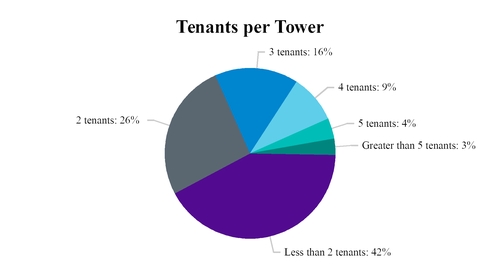
As of December 31, 2018, the average number of tenants (calculated as a unique license together with any related amendments thereto) per tower is approximately 2.2. The following chart sets forth the number of existing tenants per tower as of December 31, 2018 (see "Item 7. MD&A—Accounting and Reporting Matters—Critical Accounting Policies and Estimates" for a discussion of our impairment evaluation and our towers with no tenants).
Fiber Segment. Our Fiber segment includes both small cells and fiber solutions.
| • | We offer certain fiber solutions to organizations with high-bandwidth and multi-location demands, such as enterprise, government, education, healthcare, wholesale, financial, legal, media and entertainment, content distribution, and energy and utilities tenants. Our fiber solutions provide essential connectivity resources needed to create integrated networks and support organizations. |
| • | Our small cells offload data traffic from towers and bolster capacity in the areas of wireless networks where data demand is the greatest. Our small cells are typically attached to public right-of-way infrastructure, including utility poles and street lights. |
Our fiber assets include those acquired from: (1) NextG Networks, Inc. in 2012 ("NextG Acquisition"), (2) Quanta Fiber Networks, Inc. in 2015 ("Sunesys Acquisition"), (3) FPL FiberNet Holdings, LLC and certain other subsidiaries of NextEra Energy, Inc. in 2017 ("FiberNet Acquisition"), (4) Wilcon Holdings LLC in 2017 ("Wilcon Acquisition") and (5) LTS Group Holdings LLC in 2017 ("Lightower Acquisition"). The FiberNet Acquisition, Wilcon Acquisition, and Lightower Acquisition are collectively referred to herein as the "2017 Acquisitions."
We generally receive monthly recurring payments from our Fiber tenants and, in some cases, receive upfront payments, payable pursuant to contracts. The amount of the monthly payments can also be influenced by the amount or cost of (1) construction for initial and subsequent tenants, (2) fiber strand requirements and supply, (3) equipment at the site and (4) any upfront payment received.
Additional site rental information. For both of our Towers and Fiber segments, we have existing master agreements with our largest tenants, including AT&T, T-Mobile, Verizon Wireless and Sprint; such agreements provide certain terms (including economic terms) that govern our tenants' right to utilize our communications infrastructure entered into by such carriers during the term of their master agreements.
Approximately half of our site rental cost of operations consists of Towers ground lease expenses, and the remainder includes fiber access expenses (primarily leases of fiber assets and other access agreements to facilitate our communications infrastructure), property taxes, repairs and maintenance, employee compensation or related benefit costs, and utilities. Assuming current leasing activity levels, our cash operating expenses generally tend to escalate at approximately the rate of inflation. The addition of new tenants to existing communications infrastructure assets is achieved at a low incremental operating cost, delivering high incremental returns to our business. Once constructed, our communications infrastructure portfolio requires minimal sustaining capital expenditures, including maintenance or other non-discretionary capital expenditures, which are typically approximately 2% of net revenues. See note 14 to our consolidated financial statements for a tabular presentation of the rental cash payments owed by us to landlords pursuant to our contractual agreements.
Services. As part of our effort to provide comprehensive communications infrastructure solutions, we also offer certain services primarily relating to our towers and small cells, predominately consisting of (1) site development services and (2) installation services. The large majority of our service revenues relate to our Towers segment. For 2018, approximately 60% of our services and other revenues related to installation services, and the remainder predominately related to site development services. We seek to grow our service revenues by capitalizing on increased volumes that may result from carrier network upgrades, promoting site development services, expanding the scope of our services, and focusing on tenant service and deployment speed. We have the capability and expertise to install, with the assistance of our network of subcontractors, equipment or antenna systems for our tenants. We do not always provide the installation services or site development services for our tenants on our communications infrastructure as third parties also provide these services (see also "—Competition" below). These activities are typically non-recurring and highly competitive, with a number of local competitors in most markets. Typically, our installation services are billed on a cost-plus profit basis and site development services are billed on a fixed fee basis.
Customers. Our Towers customers are primarily comprised of large wireless carriers that operate national networks.
Our Fiber customers are generally large wireless carriers and organizations with high-bandwidth and multi-location demands, such as enterprise, government, education, healthcare, wholesale, financial, legal, media and entertainment, content distribution, and energy and utilities customers.
Our four largest tenants are AT&T, T-Mobile, Verizon Wireless and Sprint. Collectively, these four tenants accounted for 73% of our 2018 site rental revenues. Also see "Item 1A. Risk Factors" and note 15 to our consolidated financial statements. For 2018, our site rental revenues by tenant were as follows:
Sales and Marketing. Our sales organization markets our communications infrastructure with the objective of contracting access with tenants to existing communications infrastructure or to new communications infrastructure prior to construction. We seek to become the critical partner and preferred independent communications infrastructure provider for our tenants and increase tenant satisfaction relative to our peers by leveraging our (1) existing unique communications infrastructure footprint, (2) tenant relationships, (3) process-centric approach, (4) technological tools and (5) construction capabilities and expertise.
Our sales team is organized based on a variety of factors, including tenant type (such as wireless carriers and organizations) and geography. A team of national account directors maintains our relationships with our largest tenants. These directors work to develop communications infrastructure contracts, as well as to ensure that tenants' communications infrastructure needs are efficiently translated into new contracts on our communications infrastructure. Sales personnel in our local offices develop and maintain relationships with our tenants that are expanding their networks, entering new markets, seeking new or additional communication infrastructure offerings, bringing new technologies to market or requiring maintenance or add-on business. In addition to our full-time sales or marketing staff, a number of senior-level employees spend a significant portion of their time on sales and marketing activities and call on existing or prospective tenants.
Competition. We face competition for site rental tenants from various sources, including (1) other independent communications infrastructure owners or operators, including competitors that own, operate, or manage towers, rooftops, broadcast towers, utility poles, fiber (including non-traditional competitors such as cable providers) or small cells, (2) tenants who elect to self-perform or (3) new alternative deployment methods for communications infrastructure.
Some of the larger companies with which we compete for Towers segment business opportunities include American Tower Corporation and SBA Communications Corporation. Our Fiber segment business competitors can vary significantly based on geography. Some of the larger companies with which we compete for Fiber segment business opportunities include other owners of fiber, as well as recent and potential entrants into small cells and fiber solutions. We believe that location, existing communications infrastructure footprint, deployment speed, quality of service, expertise, reputation, capacity and price have been and will continue to be the most significant competitive factors affecting our businesses. See "Item 1A. Risk Factors."
Competitors to our services offering include site acquisition consultants, zoning consultants, real estate firms, right-of-way consulting firms, construction companies, tower owners or managers, radio frequency engineering consultants, telecommunications equipment vendors who can provide turnkey site development services through multiple subcontractors or our tenants' internal staff. We believe that our tenants base their decisions on the outsourcing of services on criteria such as a company's experience, record of accomplishment, reputation, price and time for completion of a project.
Employees
At January 31, 2019, we employed approximately 5,000 people. We are not a party to any collective bargaining agreements. We have not experienced any strikes or work stoppages, and management believes that our employee relations are satisfactory.
Regulatory and Environmental Matters
We are required to comply with a variety of federal, state, and local regulations and laws in the U.S., including FCC and Federal Aviation Administration ("FAA") regulations and those discussed under "—Environmental" below. To date, we have not incurred any material fines or penalties or experienced any material adverse effects to our business as a result of any domestic or international regulations. The summary below is based on regulations currently in effect, and such regulations are subject to review or modification by the applicable governmental authority from time to time. If we fail to comply with applicable laws and regulations, we may be fined or even lose our rights to conduct some of our business.
Federal Regulations. Both the FCC and the FAA regulate towers used for wireless communications, radio, or television broadcasting. Such regulations control the siting, lighting, or marking of towers and may, depending on the characteristics of particular towers, require the registration of tower facilities with the FCC and the issuance of determinations confirming no hazard to air traffic. Wireless communications devices operating on towers are separately regulated and independently licensed based upon the particular frequency used. In addition, the FCC and the FAA have developed standards to consider proposals for new or modified tower or antenna structures based upon the height or location, including proximity to airports. Proposals to construct or to modify existing tower or antenna structures above certain heights are reviewed by the FAA to ensure the structure will not present a hazard to aviation, which determination may be conditioned upon compliance with lighting or marking requirements. The FCC requires its licensees to operate communications devices only on towers that comply with FAA rules and are registered with the FCC, if required by its regulations. Where tower lighting is required by FAA regulation, tower owners bear the responsibility of notifying the FAA of any tower lighting outage and ensuring the timely restoration of such outages. Failure to comply with the applicable requirements may lead to civil penalties.
Local Regulations. The U.S. Telecommunications Act of 1996 amended the Communications Act of 1934 to preserve state and local zoning authorities' jurisdiction over the siting of communications towers and small cells. The law, however, limits local zoning authority by prohibiting actions by local authorities that discriminate between different service providers of wireless communications or ban altogether the provision of wireless communications. Additionally, the law prohibits state and local restrictions based on the environmental effects of radio frequency emissions to the extent the facilities comply with FCC regulations.
Local regulations include city and other local ordinances (including subdivision and zoning ordinances), approvals for construction, modification and removal of towers and small cells, and restrictive covenants imposed by community developers. These regulations vary greatly, but typically require us to obtain approval from local officials prior to tower construction. Local zoning authorities may render decisions that prevent the construction or modification of towers or place conditions on such construction or modifications that are responsive to community residents' concerns regarding the height, visibility, or other characteristics of the towers. Over the last several years, there have been several developments related to FCC regulations and legislation that assist in expediting and streamlining the deployment of wireless networks, including establishing timeframes for reviews by local and state governments. Notwithstanding such legislative and FCC actions, decisions of local zoning authorities may also adversely affect the timing or cost of communications infrastructure construction or modification.
Certain of our Fiber related subsidiaries hold authorizations to provide intrastate telecommunication services as competitive local exchange carriers ("CLEC") in numerous states and to provide domestic interstate telecommunication services as authorized by the FCC. These Fiber subsidiaries are primarily regulated by state public service commissions. CLEC status, in certain cases, helps promote access to public rights-of-way, which is beneficial to the deployment of our small cells on a timely basis. Status as a CLEC often allows us to deploy our small cells in locations where zoning restrictions might otherwise delay, restrict, or prevent building or expanding traditional wireless tower sites or traditional wireless rooftop sites. See "Item 1A. Risk Factors."
Environmental. We are required to comply with a variety of federal, state, and local environmental laws and regulations protecting environmental quality, including air and water quality and wildlife protection. To date, we have not incurred any material fines or penalties or experienced any material adverse effects to our business as a result of any domestic or international environmental regulations or matters. See "Item 1A. Risk Factors."
The construction of new towers and small cells or, in some cases, the modification of existing towers in the U.S. may be subject to environmental review under the National Environmental Policy Act of 1969, as amended ("NEPA"), which requires federal agencies to evaluate the environmental impact of major federal actions. The FCC has promulgated regulations implementing NEPA, which require applicants to investigate the potential environmental impact of the proposed tower or small cells construction. Should the proposed tower or small cells construction present a significant environmental impact, the FCC must prepare an environmental impact statement, subject to public comment. If the proposed construction or modification of a tower poses a significant impact on the environment, the FCC's approval of the construction or modification could be significantly delayed.
Our operations are subject to federal, state, and local laws and regulations relating to the management, use, storage, disposal, emission, or remediation of, or exposure to, hazardous or non-hazardous substances, materials, or wastes. As an owner, lessee, or operator of real property, we are subject to certain environmental laws that impose strict, joint-and-several liability for the
cleanup of on-site or off-site contamination relating to existing or historical operations; or we could also be subject to personal injury or property damage claims relating to such contamination. In general, our tenant contracts prohibit our tenants from using or storing any hazardous substances on our communications infrastructure sites in violation of applicable environmental laws and require our tenants to provide notice of certain environmental conditions caused by them.
As licensees and communications infrastructure owners, we are also subject to regulations and guidelines that impose a variety of operational requirements relating to radio frequency emissions. As employers, we are subject to Occupational Safety and Health Administration and similar guidelines regarding employee protection from radio frequency exposure. The potential connection between radio frequency emissions and certain negative health effects, including some forms of cancer, has been the subject of substantial study by the scientific community in recent years.
We have compliance programs and monitoring projects to help assure that we are in substantial compliance with applicable environmental laws and regulations. Nevertheless, there can be no assurance that the costs of compliance with existing or future environmental laws will not have a material adverse effect on us.
Other Regulations. We hold, through certain of our subsidiaries, spectrum licenses, which are subject to additional regulation by the FCC. We also hold a nationwide FCC license relating to the 1670-1675 MHz spectrum ("1670-1675 Spectrum"), which we have leased to a third party through 2023, subject to the lessee's option to purchase the 1670-1675 Spectrum.
Available Information
We maintain a website at www.crowncastle.com. Our annual reports on Form 10-K, quarterly reports on Form 10-Q, current reports on Form 8-K (and any amendments to those reports filed or furnished pursuant to Section 13(a) or 15(d) of the Securities Exchange Act of 1934, as amended ("Exchange Act")), proxy statements and other information about us are made available, free of charge, through the investor relations section of our website at http://investor.crowncastle.com and at the SEC's website at http://sec.gov as soon as reasonably practicable after we electronically file such material with, or furnish it to, the SEC.
In addition, our corporate governance guidelines, business practices, ethics policy and financial code of ethics and the charters of our Audit Committee, Compensation Committee and Nominating & Corporate Governance Committee are available through the investor relations section of our website at http://www.crowncastle.com/investor/corporateGovernance.aspx, and such information is also available in print to any stockholder who requests it. We intend to post to our website any amendments to or waivers from each of the ethics policy and financial code of ethics applicable to our Chief Executive Officer, Chief Financial Officer and Controller that are required to be disclosed.
Item 1A. Risk Factors
You should carefully consider all of the risks described below, as well as the other information contained in this document, when evaluating your investment in our securities.
Risks Relating to Our Business
Our business depends on the demand for our communications infrastructure, driven primarily by demand for data, and we may be adversely affected by any slowdown in such demand. Additionally, a reduction in the amount or change in the mix of network investment by our tenants may materially and adversely affect our business (including reducing demand for our communications infrastructure or services).
Tenant demand for our communications infrastructure depends on the demand for data. The willingness of our tenants to utilize our communications infrastructure, or renew or extend existing contracts on our communications infrastructure, is affected by numerous factors, including:
| • | consumers' and organizations' demand for data; |
| • | availability or capacity of our communications infrastructure or associated land interests; |
| • | location of our communications infrastructure; |
| • | financial condition of our tenants, including their profitability and availability or cost of capital; |
| • | willingness of our tenants to maintain or increase their network investment or changes in their capital allocation strategy; |
| • | need for integrated networks and organizations; |
| • | availability and cost of spectrum for commercial use; |
| • | increased use of network sharing, roaming, joint development, or resale agreements by our tenants; |
| • | mergers or consolidations by and among our tenants; |
| • | changes in, or success of, our tenants' business models; |
| • | governmental regulations and initiatives, including local or state restrictions on the proliferation of communications infrastructure; |
| • | cost of constructing communications infrastructure; |
| • | our market competition, including tenants that may elect to self-perform; |
| • | technological changes, including those (1) affecting the number or type of communications infrastructure needed to provide data to a given geographic area or which may otherwise serve as substitute or alternative to our communications infrastructure or (2) resulting in the obsolescence or decommissioning of certain existing wireless networks; and |
| • | our ability to efficiently satisfy our tenants' service requirements. |
A slowdown in demand for data or our communications infrastructure may negatively impact our growth or otherwise have a material adverse effect on us. If our tenants or potential tenants are unable to raise adequate capital to fund their business plans, as a result of disruptions in the financial and credit markets or otherwise, they may reduce their spending, which could adversely affect our anticipated growth or the demand for our communications infrastructure or services.
The amount, timing, and mix of our tenants' network investment is variable and can be significantly impacted by the various matters described in these risk factors. Changes in tenant network investment typically impact the demand for our communications infrastructure. As a result, changes in tenant plans such as delays in the implementation of new systems, new and emerging technologies (including small cells and fiber solutions), or plans to expand coverage or capacity may reduce demand for our communications infrastructure. Furthermore, the industries in which our tenants operate (particularly those in the wireless industry) could experience a slowdown or slowing growth rates as a result of numerous factors, including a reduction in consumer demand (including demand for wireless connectivity) or general economic conditions. There can be no assurances that weakness or uncertainty in the economic environment will not adversely impact our tenants or their industries, which may materially and adversely affect our business, including by reducing demand for our communications infrastructure or services. In addition, a slowdown may increase competition for site rental tenants or services. Such an industry slowdown or a reduction in tenant network investment may materially and adversely affect our business.
A substantial portion of our revenues is derived from a small number of tenants, and the loss, consolidation or financial instability of any of such tenants may materially decrease revenues or reduce demand for our communications infrastructure and services.
Our four largest tenants are AT&T, T-Mobile, Verizon Wireless and Sprint. Collectively, these four tenants accounted for 73% of our 2018 site rental revenues. The loss of any one of our large tenants as a result of consolidation, merger, bankruptcy, insolvency, network sharing, roaming, joint development, resale agreements by our tenants or otherwise may result in (1) a material decrease in our revenues, (2) uncollectible account receivables, (3) an impairment of our deferred site rental receivables, communications infrastructure assets, intangible assets, or (4) other adverse effects to our business. We cannot guarantee that contracts with our major tenants will not be terminated or that these tenants will renew their contracts with us. In addition to our four largest tenants, we also derive a portion of our revenues and anticipated future growth from (1) fiber solutions tenants and (2) new entrants offering or contemplating offering wireless services. Such tenants (including those dependent on government funding) may be smaller or have less financial resources than our four largest tenants, may have business models which may not be successful, or may require additional capital.
Consolidation among our tenants will likely result in duplicate or overlapping parts of networks, for example, where they are co-residents on a tower, which may result in the termination, non-renewal or re-negotiation of tenant contracts and negatively impact revenues from our communications infrastructure. Due to the long-term nature of tenant contracts, we expect that any termination of tenant contracts as a result of this potential consolidation would be spread over multiple years. Such consolidation may result in a reduction in such tenants' future network investment in the aggregate because their expansion plans may be similar. Tenant consolidation could decrease the demand for our communications infrastructure, which in turn may result in a reduction in our revenues or cash flows.
In April 2018, T-Mobile and Sprint entered into a definitive agreement to merge, subject to regulatory approval and other closing conditions. This potential transaction may result in a decrease or delay in demand for our communications infrastructure and services, as a result of the anticipated integration of the T-Mobile and Sprint networks and related duplicate or overlapping parts of their networks, which may lead to a reduction in our revenues or cash flows and may trigger a review for impairment of certain long-lived assets. For the year ended December 31, 2018, T-Mobile and Sprint represented approximately 19% and 14%, respectively, of the Company's consolidated site rental revenues. Further, the Company derived approximately 6% of its consolidated site rental revenues from each of T-Mobile and Sprint on communications infrastructure where both carriers currently reside, inclusive of approximately 1% impact from previously disclosed expected non-renewals from the anticipated decommissioning of portions of T-Mobile's MetroPCS and Sprint's Clearwire networks. In addition, there is an average of approximately five years and six years of current term remaining on all lease agreements with T-Mobile and Sprint, respectively. See also "Item 1. Business—The Company" and note 15 to our consolidated financial statements.
The expansion or development of our business, including through acquisitions, increased product offerings or other strategic growth opportunities, may cause disruptions in our business, which may have an adverse effect on our business, operations or financial results.
We seek to expand and develop our business, including through acquisitions, increased product offerings (such as small cells and fiber solutions), or other strategic growth opportunities. In the ordinary course of our business, we review, analyze and evaluate various potential transactions or other activities in which we may engage. Such transactions or activities could be a complex, costly, time-consuming process, or cause disruptions in, increase risk or otherwise negatively impact our business. Among other things, such transactions and activities may:
| • | disrupt our business relationships with our tenants, depending on the nature of or counterparty to such transactions and activities; |
| • | divert the time or attention of management away from other business operations, including as a result of post-transaction integration activities; |
| • | fail to achieve revenue or margin targets, operational synergies or other benefits contemplated; |
| • | increase operational risk or volatility in our business; |
| • | not result in the benefits management had expected to realize from such expansion and development activities, or those benefits may take longer to realize than expected (including the 2017 Acquisitions); |
| • | impact our cost structure and result in the need to hire additional employees; |
| • | increase demands on current employees or result in current or prospective employees experiencing uncertainty about their future roles with us, which might adversely affect our ability to retain or attract key employees; or |
| • | result in the need for additional TRSs or contributions of certain assets to TRSs, which are subject to federal and state corporate income taxes. |
Our Fiber segment has expanded rapidly, and the Fiber business model contains certain differences from our Towers business model, resulting in different operational risks. If we do not successfully operate our Fiber business model or identify or manage the related operational risks, such operations may produce results that are less than anticipated.
In recent years, we have allocated a significant amount of capital to our Fiber business, which is a much less mature business for us than our Towers business (which we have operated since 1994). Our Fiber segment represented 34% and 21% of our site rental revenues for the years ended December 31, 2018 and 2017, respectively. The business model for our Fiber operations contains certain differences from our business model for our Towers operations, including certain differences relating to tenant base, competition, contract terms (including requirements for service level agreements regarding network performance and maintenance), upfront capital requirements, landlord demographics, ownership of certain network assets, operational oversight requirements, government regulations, growth rates and applicable laws.
While our Fiber operations have certain risks that are similar to our Towers operations, they also have certain operational risks (including the scalability of processes) that are different from our Towers business, including:
| • | the use of public rights-of-way and franchise agreements; |
| • | use of poles and conduits owned solely by, or jointly with, third parties; |
| • | risks relating to overbuilding; |
| • | risks relating to the specific markets that we choose to operate in or plan to operate in; |
| • | risks relating to construction management and construction-related billings to tenants; |
| • | risks relating to wireless carriers building their own small cell networks, or tenants utilizing their own or alternative fiber assets; |
| • | risk of failing to optimize the use of our finite supply of fiber strands; |
| • | damage to our assets and the need to maintain, repair, upgrade and periodically replace our assets; |
| • | the risk of failing to properly maintain or operate highly specialized hardware and software; |
| • | network data security risks; |
| • | the risk of new technologies that could enable tenants to realize the same benefits with less utilization of our fiber; |
| • | potential damage to our overall reputation as a communications infrastructure provider; and |
| • | the use of competitive local exchange carrier status, which we refer to as "CLEC" status. |
In addition, the rate at which tenants adopt or prioritize small cells and fiber solutions may be lower or slower than we anticipate or may cease to exist altogether. Our Fiber operations will also expose us to different safety or liability risks or hazards than our Towers business as a result of numerous factors, including the location or nature of the assets involved. There may be risks and challenges associated with small cells and fiber solutions being comparatively new and emerging technologies that are continuing to evolve, and there may be other risks related to small cells and fiber solutions of which we are not yet aware.
Failure to timely and efficiently execute on our construction projects could adversely affect our business.
Our construction projects and related contracts, particularly in our Fiber business, can be long-term, complex in nature, and challenging to execute. The quality of our performance on such construction projects depends in large part upon our ability to manage (1) the associated tenant relationship and (2) the project itself by timely deploying and properly managing appropriate internal and external project resources. In connection with our construction projects, we generally bear the risk of cost over-runs, labor availability and productivity, and contractor pricing and performance. Additionally, contracts with our tenants for these projects typically specify delivery dates, performance criteria and penalties for our failure to perform. Further, investments in newly-constructed communications infrastructure may result in lower initial returns compared to returns on our existing communications infrastructure or us not being able to to realize future tenant additions at anticipated levels. Our failure to manage such tenant relationships, project resources, and project milestones in a timely and efficient manner could have a material adverse effect on our business.
Our substantial level of indebtedness could adversely affect our ability to react to changes in our business, and the terms of our debt instruments and our 6.875% Convertible Preferred Stock limit our ability to take a number of actions that our management might otherwise believe to be in our best interests. In addition, if we fail to comply with our covenants, our debt could be accelerated.
We have a substantial amount of indebtedness (approximately $16.7 billion as of February 22, 2019). See "Item 7. MD&A—Liquidity and Capital Resources" for a tabular presentation of our contractual debt maturities. As a result of our substantial indebtedness:
| • | we may be more vulnerable to general adverse economic or industry conditions; |
| • | we may find it more difficult to obtain additional financing to fund discretionary investments or other general corporate requirements or to refinance our existing indebtedness; |
| • | we are or will be required to dedicate a substantial portion of our cash flows from operations to the payment of principal or interest on our debt, thereby reducing the available cash flows to fund other projects, including the discretionary investments discussed in "Item 1. Business" and "Item 7. MD&A—Liquidity and Capital Resources"; |
| • | we may have limited flexibility in planning for, or reacting to, changes in our business or in the industry; |
| • | we may have a competitive disadvantage relative to other companies in our industry with less debt; |
| • | we may be adversely impacted by changes in interest rates; |
| • | we may be adversely impacted by changes to credit ratings related to our debt instruments; |
| • | we may be required to issue equity securities or securities convertible into equity or sell some of our assets, possibly on unfavorable terms, in order to meet payment obligations; |
| • | we may be limited in our ability to take advantage of strategic business opportunities, including communications infrastructure development or mergers and acquisitions; and |
| • | we could fail to remain qualified for taxation as a REIT as a result of limitations on our ability to declare and pay dividends to stockholders as a result of restrictive covenants in our debt instruments or the terms of our 6.875% Mandatory Convertible Preferred Stock, Series A, par value $0.01 per share ("6.875% Convertible Preferred Stock"). |
Currently we have debt instruments in place that limit in certain circumstances our ability to incur additional indebtedness, pay dividends, create liens, sell assets, or engage in certain mergers and acquisitions, among other things. In addition, the credit agreement governing our senior unsecured credit facility ("2016 Credit Facility") contains financial maintenance covenants. Our ability to comply with these covenants or to satisfy our debt obligations will depend on our future operating performance. If we violate the restrictions in our debt instruments or fail to comply with our financial maintenance covenants, we will be in default under those instruments, which in some cases would cause the maturity of a substantial portion of our long-term indebtedness to be accelerated. Furthermore, if the limits on our ability to pay dividends prevent us from satisfying our REIT distribution requirements, we could fail to remain qualified for taxation as a REIT. If these limits do not jeopardize our qualification for taxation as a REIT but nevertheless prevent us from distributing 100% of our REIT taxable income, we will be subject to federal and state corporate income taxes, and potentially a nondeductible excise tax, on our undistributed taxable income. If our operating subsidiaries were to default on their debt, the trustee could seek to foreclose the collateral securing such debt, in which case we could lose the communications infrastructure and the revenues associated with such communications infrastructure. See "Item 7. MD&A—Liquidity and Capital Resources—Debt Covenants" for a further discussion of our debt covenants.
CCIC is a holding company that conducts all of its operations through its subsidiaries. Accordingly, CCIC's sources of cash to pay interest or principal on its outstanding indebtedness are distributions relating to its respective ownership interests in its subsidiaries from the net earnings and cash flows generated by such subsidiaries or from proceeds of debt or equity offerings. Earnings and cash flows generated by CCIC's subsidiaries are first applied by such subsidiaries to conduct their operations, including servicing their respective debt obligations, after which any excess cash flows generally may be paid to such holding company, in the absence of any special conditions such as a continuing event of default. However, CCIC's subsidiaries are legally distinct from the holding company and, unless they guarantee such debt, have no obligation to pay amounts due on their debt or to make funds available to us for such payment.
If we fail to pay scheduled dividends on our 6.875% Convertible Preferred Stock, in cash, common stock, or any combination of cash and common stock, we will be prohibited from paying dividends on our common stock, which may jeopardize our status as a REIT.
We have a substantial amount of indebtedness. In the event we do not repay or refinance such indebtedness, we could face substantial liquidity issues and might be required to issue equity securities or securities convertible into equity securities, or sell some of our assets to meet our debt payment obligations.
We have a substantial amount of indebtedness, which, upon final maturity, we will need to refinance or repay. See "Item 7. MD&A—Liquidity and Capital Resources" for a tabular presentation of our contractual debt maturities. There can be no assurances we will be able to refinance our indebtedness (1) on commercially reasonable terms, (2) on terms, including with respect to interest rates, as favorable as our current debt, or (3) at all.
Economic conditions and the credit markets have historically experienced, and may continue to experience, periods of volatility, uncertainty, or weakness that could impact the availability or cost of debt financing, including any refinancing of the obligations described above or on our ability to draw the full amount of our $4.25 billion senior unsecured revolving credit facility under our 2016 Credit Facility ("2016 Revolver"), that, as of February 22, 2019, has $4.1 billion of undrawn availability.
Borrowings under our 2016 Credit Facility generally bear an interest rate based on the London interbank offered rate ("LIBOR") per annum plus a credit spread based on our senior unsecured credit rating. In July 2017, the United Kingdom's Financial Conduct Authority, which regulates LIBOR, announced that it will stop compelling banks to submit rates for the calculation of LIBOR after 2021. It is not possible to predict the effect of these changes, other reforms or the establishment of
alternative reference rates. The discontinuation or modification of LIBOR could result in interest rate increases on our debt, which could adversely affect our cash flow and operating results.
If we are unable to repay or refinance our debt, we cannot guarantee that we will be able to generate enough cash flows from operations or that we will be able to obtain enough capital to service our debt, fund our planned capital expenditures or pay future dividends. In such an event, we could face substantial liquidity issues and might be required to issue equity securities or securities convertible into equity securities, or sell some of our assets to meet our debt payment obligations. Failure to repay or refinance indebtedness when required could result in a default under such indebtedness. If we incur additional indebtedness, any such indebtedness could exacerbate the risks described above.
Sales or issuances of a substantial number of shares of our common stock or securities convertible into shares of our common stock may adversely affect the market price of our common stock.
Future sales or issuances of common stock or other equity related securities may adversely affect the market price of our common stock, including any shares of our common stock issued to finance capital expenditures, finance acquisitions or repay debt. Our business strategy contemplates access to external financing to fund certain discretionary investments, which may include issuances of common stock or other equity related securities. We maintain an "at-the-market" stock offering program ("2018 ATM Program") through which we may, from time to time, issue and sell shares of our common stock having an aggregate gross sales price of up to $750 million to or through sales agents. As of February 22, 2019, we had approximately $750 million of gross sales of common stock remaining under our 2018 ATM Program. From time to time, we may refresh or implement a new "at-the-market" stock offering program. See note 11 to our consolidated financial statements. As of February 22, 2019, we had approximately 416 million shares of common stock outstanding.
We have reserved 10 million and 17 million shares of common stock, respectively, for issuance in connection with awards granted under our various stock compensation plans and our 6.875% Convertible Preferred Stock, which will automatically convert into common stock on August 1, 2020. See "Item 7. MD&A—Liquidity and Capital Resources—Mandatory Convertible Preferred Stock." The dividends on our 6.875% Convertible Preferred Stock may also be paid in cash or, subject to certain limitations, shares of common stock or any combination of cash and shares of common stock.
Further, a small number of common stockholders own a significant percentage of our outstanding common stock. If any one of these common stockholders, or any group of our common stockholders, sells a large quantity of shares of our common stock, or the public market perceives that existing common stockholders might sell a large quantity of shares of our common stock, the market price of our common stock may significantly decline.
As a result of competition in our industry, we may find it more difficult to negotiate favorable rates on our new or renewing tenant contracts.
Our growth is dependent on our entering into new tenant contracts (including amendments to contracts upon modification of an existing tower, fiber, or small cell installation), as well as renewing or renegotiating tenant contracts when existing tenant contracts terminate. Competition in our industry may make it more difficult for us to attract new tenants, maintain or increase our gross margins, or maintain or increase our market share. In addition, competition (primarily in our fiber solutions business) may, in certain circumstances, cause us to renegotiate certain existing tenant contracts to avoid early contract terminations. We face competition for site rental tenants and associated contractual rates from various sources, including (1) other independent communications infrastructure owners or operators, including those that own, operate, or manage towers, rooftops, broadcast towers, utility poles, fiber (including non-traditional competitors such as cable providers) or small cells, or (2) new alternative deployment methods for communications infrastructure.
Our Fiber operations may have different competitors than our Towers business, including other owners of fiber, as well as new entrants into small cells and fiber solutions, some of which may have larger networks or greater financial resources than we have.
New technologies may reduce demand for our communications infrastructure or negatively impact our revenues.
Improvements in the efficiency, architecture, and design of communication networks may reduce the demand for our communications infrastructure. For example, new technologies that may promote network sharing, joint development, wireless backhaul, or resale agreements by our tenants, such as signal combining technologies or network functions virtualization, may reduce the need for our communications infrastructure. In addition, other technologies, such as WiFi, Distributed Antenna Systems ("DAS"), femtocells, other small cells, or satellite (such as low earth orbiting) and mesh transmission systems may, in the future, serve as substitutes for, or alternatives to, leasing on communications infrastructure that might otherwise be anticipated or expected had such technologies not existed. In addition, new technologies that enhance the range, efficiency, and capacity of communication equipment could reduce demand for our communications infrastructure. Any significant reduction in demand for our
communications infrastructure resulting from the new technologies may negatively impact our revenues or otherwise have a material adverse effect on us.
If we fail to retain rights to our communications infrastructure, including the land interests under our towers and the right-of-way and other agreements related to our small cells and fiber solutions, our business may be adversely affected.
The property interests, on which our communications infrastructure resides, including the land interests under our towers, consist of leasehold and sub-leasehold interests, fee interests, easements, licenses, and rights-of-way. A loss of these interests may interfere with our ability to conduct our business or generate revenues. For various reasons, we may not always have the ability to access, analyze, or verify all information regarding titles or other issues prior to acquiring communications infrastructure. Further, we may not be able to renew ground leases or other agreements on commercially viable terms.
Our ability to retain rights to the land interests on which our towers reside depends on our ability to purchase such land, including fee interests and perpetual easements, or renegotiate or extend the terms of the leases relating to such land. Approximately 10% of our Towers site rental gross margin for the year ended December 31, 2018 was derived from towers where the leases for the interests under such towers had final expiration dates of less than 10 years. If we are unable to retain rights to the property interests on which our communications infrastructure resides, our business may be adversely affected.
As of December 31, 2018, approximately 53% of our towers were leased or subleased or operated and managed under master leases, subleases, or other agreements with AT&T, Sprint, and T-Mobile. We have the option to purchase these towers at the end of their respective lease terms. We have no obligation to exercise such purchase options. We may not have the required available capital to exercise our right to purchase some or all of these towers at the time these options are exercisable. Even if we do have available capital, we may choose not to exercise our right to purchase these towers or some or all of the T-Mobile or AT&T towers for business or other reasons. In the event that we do not exercise these purchase rights, or are otherwise unable to acquire an interest that would allow us to continue to operate these towers after the applicable period, we will lose the cash flows derived from such towers, which may have a material adverse effect on our business. In the event that we decide to exercise these purchase rights, the benefits of the acquisition of these towers may not exceed the costs, which could adversely affect our business. Additional information concerning these towers and the applicable purchase options as of December 31, 2018 is as follows:
| • | 22% of our towers are leased or subleased or operated and managed under a master prepaid lease or other related agreements with AT&T for a weighted-average initial term of approximately 28 years, weighted on Towers site rental gross margin. We have the option to purchase the leased and subleased towers from AT&T at the end of the respective lease or sublease terms for aggregate option payments of approximately $4.2 billion, which payments, if exercised, would be due between 2032 and 2048. |
| • | 16% of our towers are leased or subleased or operated and managed for an initial period of 32 years (through May 2037) under master leases, subleases or other agreements with Sprint. We have the option to purchase in 2037 all (but not less than all) of the leased and subleased Sprint towers from Sprint for approximately $2.3 billion. |
| • | 15% of our towers are leased or subleased or operated and managed under a master prepaid lease or other related agreements with T-Mobile for a weighted-average initial term of approximately 28 years, weighted on Towers site rental gross margin. We have the option to purchase the leased and subleased towers from T-Mobile at the end of the respective lease or sublease terms for aggregate option payments of approximately $2.0 billion, which payments, if exercised, would be due between 2035 and 2049. In addition, through the T-Mobile Acquisition, there are another 1% of our towers subject to a lease and sublease or other related arrangements with AT&T. We have the option to purchase these towers that we do not otherwise already own at the end of their respective lease terms for aggregate option payments of up to approximately $405 million, which payments, if exercised, would be due prior to 2032 (less than $10 million would be due before 2025). |
Under master lease or master prepaid lease arrangements we have with AT&T, Sprint and T-Mobile, certain of our subsidiaries lease or sublease, or are otherwise granted the right to manage and operate, towers from bankruptcy remote subsidiaries of such carriers. If one of these bankruptcy remote subsidiaries should become a debtor in a bankruptcy proceeding and is permitted to reject the underlying ground lease, our subsidiaries could lose their interest in the applicable sites. If our subsidiaries were to lose their interest in the applicable sites or if the applicable ground leases were to be terminated, we would lose the cash flow derived from the towers on those sites, which may have a material adverse effect on our business. We have similar bankruptcy risks with respect to sites that we operate under management agreements.
For our small cells and fiber solutions, we must maintain rights-of-way, franchise, pole attachment, conduit use and other agreements to operate our assets. For various reasons, we may not always have the ability to maintain these agreements or obtain future agreements to construct, maintain and operate our fiber assets. Access to rights-of-way may depend on our CLEC status, and we cannot be certain that jurisdictions will (1) recognize such CLEC status or (2) not change their laws concerning CLEC
access to rights-of-way. If a material portion of these agreements are terminated or are not renewed, we might be forced to abandon our assets, which may adversely impact our business. In order to operate our assets, we must also maintain fiber agreements that we have with public and private entities. There is no assurance that we will be able to renew those agreements on favorable terms, or at all. If we are unable to renew those agreements on favorable terms, we may face increased costs or reduced revenues.
Additionally, in order to expand our communications infrastructure footprint to new locations, we often need to obtain new or additional rights-of-way and other agreements. Our failure to obtain these agreements in a prompt and cost-effective manner may prevent us from expanding our footprint, which may be necessary to meet our contractual obligations to our tenants and could adversely impact our business.
Our services business has historically experienced significant volatility in demand, which reduces the predictability of our results.
The operating results of our services business for any particular period may vary significantly and should not necessarily be considered indicative of longer-term results for this activity. Our services business is generally driven by demand for our communications infrastructure and may be adversely impacted by various factors, including:
| • | competition; |
| • | the timing, mix and amount of tenant network investments; |
| • | the rate and volume of tenant deployment plans; |
| • | unforeseen delays or challenges relating to work performed; |
| • | economic weakness or uncertainty; |
| • | our market share; or |
| • | changes in the size, scope, or volume of work performed. |
New wireless technologies may not deploy or be adopted by tenants as rapidly or in the manner projected.
There can be no assurances that new wireless services or technologies will be introduced or deployed as rapidly or in the manner projected by the wireless carriers. In addition, demand or tenant adoption rates for such new technologies may be lower or slower than anticipated for numerous reasons. As a result, growth opportunities or demand for our communications infrastructure arising from such technologies may not be realized at the times or to the extent anticipated.
If we fail to comply with laws or regulations which regulate our business and which may change at any time, we may be fined or even lose our right to conduct some of our business.
A variety of federal, state, local, and foreign laws and regulations apply to our business, including those discussed in "Item 1. Business." Failure to comply with applicable requirements may lead to civil or criminal penalties, require us to assume indemnification obligations or breach contractual provisions. We cannot guarantee that existing or future laws or regulations, including federal, state, local, or foreign tax laws, will not adversely affect our business (including our REIT status), increase delays or result in additional costs. We also may incur additional costs as a result of liabilities under applicable laws and regulations, such as those governing environmental and safety matters. These factors may have a material adverse effect on us.
If radio frequency emissions from wireless handsets or equipment on our communications infrastructure are demonstrated to cause negative health effects, potential future claims could adversely affect our operations, costs or revenues.
The potential connection between radio frequency emissions and certain negative health effects, including some forms of cancer, has been the subject of substantial study by the scientific community in recent years. We cannot guarantee that claims relating to radio frequency emissions will not arise in the future or that the results of such studies will not be adverse to us.
Public perception of possible health risks associated with cellular or other wireless connectivity services may slow or diminish the growth of wireless companies, which may in turn slow or diminish our growth. In particular, negative public perception of, and regulations regarding, these perceived health risks may slow or diminish the market acceptance of wireless services. If a connection between radio frequency emissions and possible negative health effects were established, our operations, costs, or revenues may be materially and adversely affected. We currently do not maintain any significant insurance with respect to these matters.
Certain provisions of our restated certificate of incorporation ("Charter"), amended and restated by-laws ("by-laws") and operative agreements, and domestic and international competition laws may make it more difficult for a third party to acquire control of us or for us to acquire control of a third party, even if such a change in control would be beneficial to our stockholders.
We have a number of anti-takeover devices in place that will hinder takeover attempts or may reduce the market value of our common stock. Our anti-takeover provisions include:
| • | the authority of the board of directors to issue preferred stock without approval of the holders of our common stock; |
| • | advance notice requirements for director nominations or actions to be taken at annual meetings; and |
| • | a provision that the state courts or, in certain circumstances, the federal courts, in Delaware shall be the sole and exclusive forum for certain actions involving us, our directors, officers, employees and stockholders. |
Our by-laws permit special meetings of the stockholders to be called only upon the request of our Chief Executive Officer or a majority of the board of directors, and deny stockholders the ability to call such meetings. Such provisions, as well as the provisions of Section 203 of the Delaware General Corporation Law, may impede a merger, consolidation, takeover, or other business combination or discourage a potential acquirer from making a tender offer or otherwise attempting to obtain control of us.
In addition, domestic or international competition laws may prevent or discourage us from acquiring communications infrastructure in certain geographical areas or impede a merger, consolidation, takeover, or other business combination or discourage a potential acquirer from making a tender offer or otherwise attempting to obtain control of us.
We may be vulnerable to security breaches or other unforeseen events that could adversely affect our operations, business, and reputation.
Despite existing security measures, certain of our communications infrastructure may be vulnerable to damage, disruptions, or shutdowns due to unauthorized access, computer viruses, cyber-attacks, and other security breaches. An attack attempt or security breach, such as a distributed denial of service attack, could potentially result in (1) interruption or cessation of certain of our services to our tenants, (2) our inability to meet expected levels of service to our tenants, or (3) data transmitted over our tenants' networks being compromised. We cannot guarantee that our security measures will not be circumvented, resulting in tenant network failures or interruptions that could impact our tenants' network availability and have a material adverse effect on our business, financial condition, or operational results. Additionally, security incidents impacting our tenants, vendors and business partners could result in a material adverse effect on our business. We may be required to expend significant resources to protect against or recover from such threats. We maintain an insurance policy that includes coverage over cyber-attacks and other security breaches; however, there can be no assurances that such coverage will be adequate to cover exposure for such incidents. If an actual or perceived breach of our security occurs, the market perception of the effectiveness of our security measures could be harmed, and we could lose tenants. Further, the perpetrators of cyber-attacks are not restricted to particular groups or persons. These attacks may be committed by our employees or external actors operating in any geography. In addition, our acquisitions, both past and future, may alter our potential exposure to the risks described above.Additionally, we could be negatively impacted by other unforeseen events, such as natural disasters, which could, among other things, damage our communication infrastructure assets or interrupt service to our tenants. Any such events could result in legal claims or penalties, disruption in operations, misappropriation of sensitive data, damage to our reputation, negative market perception, or costly response measures, which could adversely affect our business.
Risks Relating to Our REIT Status
Future dividend payments to our stockholders will reduce the availability of our cash on hand available to fund future discretionary investments, and may result in a need to incur indebtedness or issue equity securities to fund growth opportunities. In such event, the then current economic, credit market or equity market conditions will impact the availability or cost of such financing, which may hinder our ability to grow our per share results of operations.
During each of the first three quarters of 2018, we paid a common stock dividend of $1.05 per share, totaling approximately $1.3 billion. In October 2018, our board of directors declared a quarterly common stock dividend of $1.125 per share, which represents an increase of 7% from an annualized amount of $4.20 per share to an annualized amount of $4.50 per share from the quarterly common stock dividend declared during each of the first three quarters of 2018. We currently expect our anticipated common stock cash dividends over the next 12 months to be a cumulative amount of at least $4.50 per share, or an aggregate amount of approximately $1.9 billion. Over time, we expect to increase our dividend per share generally commensurate with our realized growth in cash flows. Any future dividends are subject to declaration by our board of directors. See notes 11 and 18 to our consolidated financial statements.
We operate as a REIT for U.S. federal income tax purposes. To remain qualified and be taxed as a REIT, we will generally be required to annually distribute at least 90% of our REIT taxable income (determined without regard to the dividends paid deduction, excluding net capital gain and after the utilization of any available NOLs), to our stockholders. Our quarterly cash common stock dividend will delay the utilization of our NOLs and may cause certain of the NOLs to expire without utilization. See also "Item 7. MD&A—General Overview—Common Stock Dividend" and "Item 1. Business—Company Developments, REIT Status and Industry Update—REIT Status."
As discussed in "Item 1. MD&A—Business—Strategy," we seek to invest our available capital, including the net cash provided by our operating activities and external financing sources, in a manner that we believe will increase long-term stockholder value on a risk-adjusted basis. Our historical discretionary investments have included the following (in no particular order): construction of communications infrastructure; acquisitions of communications infrastructure; acquisitions of land interests (which primarily relate to land assets under towers); improvements and structural enhancements to our existing communications infrastructure; purchases of shares of our common stock from time to time; and purchases, repayments or redemptions of our debt. External financing, including debt, equity, and equity-related issuances to fund future discretionary investments either (1) may not be available to us or (2) may not be accessible by us at terms that would result in the investment of the net proceeds raised yielding incremental growth in our per share operating results. As a result, future dividend payments may hinder our ability to grow our per share results of operations or otherwise adversely affect our ability to execute our business plan.
Remaining qualified to be taxed as a REIT involves highly technical and complex provisions of the Code. Failure to remain qualified as a REIT would result in our inability to deduct dividends to stockholders when computing our taxable income, which would reduce our available cash.
We operate as a REIT for U.S. federal tax purposes. As a REIT, we are generally entitled to a deduction for dividends that we pay and therefore are not subject to U.S. federal corporate income tax on our net taxable income that is currently distributed to our common stockholders.
While we intend to operate so that we remain qualified as a REIT, given the highly complex nature of the rules governing REITs, the importance of ongoing factual determinations, the possibility of future changes in our circumstances, and the potential impact of future changes to laws and regulations impacting REITs, no assurance can be given that we will qualify as a REIT for any particular year.
We do not expect the Tax Reform Act to significantly affect us, although we cannot predict with certainty how such legislation will affect us in the future. In addition, the present U.S. federal tax treatment of REITs is subject to change, possibly with retroactive effect, by legislative, judicial or administrative action at any time, and any such change might adversely affect our REIT status or benefits. We cannot predict the impact, if any, that such changes, if enacted, might have on our business. However, it is possible that such changes could adversely affect our business, including our REIT status.
If, in any taxable year, we fail to qualify for taxation as a REIT and are not entitled to relief under certain provisions of the the Code, then:
| • | we will not be allowed a deduction for dividends paid to stockholders in computing our taxable income; |
| • | we will be subject to federal and state income tax, including, for applicable years beginning before January 1, 2018, any applicable alternative minimum tax, on our taxable income at regular corporate rates; and |
| • | we would be disqualified from re-electing REIT status for the four taxable years following the year during which we were so disqualified. |
Although we may have federal NOLs available to reduce any taxable income, to the extent our federal NOLs have been utilized or are otherwise unavailable, any such corporate tax liability could be substantial, would reduce the amount of cash available for other purposes and might necessitate the borrowing of additional funds or the liquidation of some investments to pay any additional tax liability. Accordingly, funds available for investment would be reduced.
Under the Code, for taxable years beginning in or after 2018, no more than 20% of the value of the assets of a REIT may be represented by securities of one or more TRSs. These limitations may affect our ability to make additional investments in non-REIT qualifying operations or assets, or in any operations held through TRSs. The net income of our TRSs is not required to be distributed to us, and income that is not distributed to us generally will not be subject to the REIT income distribution requirement. However, there may be limitations on our ability to accumulate earnings in our TRSs and the accumulation or reinvestment of significant earnings in our TRSs could result in adverse tax treatment. In particular, if the accumulation of cash in our TRSs causes the fair market value of our securities in our TRSs to exceed current or future limitations of the fair market value of our assets at the end of any quarter, then we may fail to remain qualified as a REIT.
If we fail to pay scheduled dividends on our 6.875% Convertible Preferred Stock, in cash, common stock, or any combination of cash and common stock, we will be prohibited from paying dividends on our common stock, which may jeopardize our status as a REIT.
The terms of the 6.875% Convertible Preferred Stock provide that, unless accumulated dividends have been paid or set aside for payment on all outstanding 6.875% Convertible Preferred Stock for all past dividend periods, no dividends may be declared or paid on our common stock. If that were to occur, the inability to pay dividends on our common stock might jeopardize our status as a REIT for U.S. federal income tax purposes. See note 11 to our consolidated financial statements.
Complying with REIT requirements, including the 90% distribution requirement, may limit our flexibility or cause us to forgo otherwise attractive opportunities, including certain discretionary investments and potential financing alternatives.
To remain qualified and be taxed as a REIT, we are required to satisfy the 90% distribution requirement as described above. We commenced declaring regular quarterly dividends to our common stockholders beginning with the first quarter of 2014. See notes 11 and 18 to our consolidated financial statements. Any such dividends, however, are subject to the determination of and declaration by our board of directors based on then-current and anticipated future conditions, including our earnings, net cash provided by operating activities, capital requirements, financial condition, our relative market capitalization, our existing federal NOLs of approximately $1.5 billion or other factors deemed relevant by our board of directors.
To the extent that we satisfy the 90% distribution requirement, but distribute less than 100% of our REIT taxable income (determined without regard to the dividends paid deduction, excluding net capital gain and after the utilization of any available NOLs), we will be subject to federal corporate income tax on our undistributed taxable income. In addition, we will be subject to a 4% nondeductible excise tax if the actual amount that we pay out to our stockholders for a calendar year is less than a minimum amount specified under the Code.
From time to time, we may generate REIT taxable income greater than our cash flow as a result of differences in timing between the recognition of taxable income and the actual receipt of cash or the effect of nondeductible capital expenditures, the creation of reserves or required debt or amortization payments. If we do not have other funds available in these situations, we could be required to borrow funds on unfavorable terms, sell assets at disadvantageous prices, or distribute amounts that would otherwise be invested in future acquisitions to make distributions sufficient to enable us to pay out enough of our taxable income to satisfy the REIT dividend requirement and to avoid corporate income tax and the 4% excise tax in a particular year. These alternatives could increase our costs or reduce our equity. Thus, compliance with the REIT requirements may hinder our ability to grow, which could adversely affect the value of our common stock. Furthermore, the REIT dividend requirements may increase the financing we need to fund capital expenditures, future growth, or expansion initiatives, which would increase our total leverage.
In addition to satisfying the 90% distribution requirement, to remain qualified as a REIT for tax purposes, we will need to continually satisfy tests concerning, among other things, the sources of our income, the nature and diversification of our assets and the ownership of our capital stock. Compliance with these tests will require us to refrain from certain activities and may hinder our ability to make certain attractive investments, including the purchase of non-qualifying assets, the expansion of non-real estate activities, or investments in the businesses to be conducted by our TRSs, and to that extent, limit our opportunities and our flexibility to change our business strategy. Furthermore, acquisition opportunities in domestic or international markets may be adversely affected if we need or require the target company to comply with some REIT requirements prior to completing any such acquisition. In addition, our conversion to a REIT may result in investor pressures not to pursue growth opportunities that are not immediately accretive.
Moreover, if we fail to comply with certain asset ownership tests, at the end of any calendar quarter, we must correct the failure within 30 days after the end of the calendar quarter or qualify for certain statutory relief provisions to avoid losing our REIT qualification. As a result, we may be required to liquidate assets in adverse market conditions or forgo otherwise attractive investments. These actions may reduce our income and amounts available for distribution to our stockholders.
REIT related ownership limitations and transfer restrictions may prevent or restrict certain transfers of our capital stock.
In order for us to continue to satisfy the requirements for REIT qualification, our capital stock must be beneficially owned by 100 or more persons during at least 335 days of a taxable year of 12 months or during a proportionate part of a shorter taxable year. Also, not more than 50% of the value of the outstanding shares of our capital stock may be owned, directly or indirectly, by five or fewer "individuals" (as defined in the Code to include certain entities such as private foundations) during the last half of a taxable year. In order to facilitate compliance with the REIT rules, our Charter includes provisions that implement REIT-related ownership limitations and transfer restrictions that generally prohibit any "person" (as defined in our Charter) from beneficially or constructively owning, or being deemed to beneficially or constructively own by virtue of the attribution provisions of the Code, more than 9.8%, by value or number of shares, whichever is more restrictive, of the outstanding shares of our common stock, or 9.8% in aggregate value of the outstanding shares of all classes and series of our capital stock, including our common stock and
any shares of our 6.875% Convertible Preferred Stock. In addition, our Charter provides for certain other ownership limitations and transfer restrictions. Under applicable constructive ownership rules, any shares of capital stock owned by certain affiliated owners generally would be added together for purposes of the ownership limitations. These ownership limitations and transfer restrictions could have the effect of delaying, deferring or preventing a transaction or a change in control of our company that might involve a premium price for our capital stock or otherwise might be in the best interest of our stockholders.
Certifications
We submitted the Chief Executive Officer certification required by Section 303A.12(a) of the New York Stock Exchange ("NYSE") Listed Company Manual, relating to compliance with the NYSE's corporate governance listing standards, to the NYSE on June 13, 2018 with no qualifications. We have included the certifications of our Chief Executive Officer and Chief Financial Officer required by Section 302 of the Sarbanes-Oxley Act of 2002 and related rules as Exhibits 31.1 and 31.2 to this Annual Report on Form 10-K.
Item 1B. Unresolved Staff Comments
None.
Item 2. Properties
Communications Infrastructure
We own, lease or manage approximately 40,000 towers geographically dispersed throughout the U.S. Towers are vertical metal structures generally ranging in height from 50 to 300 feet. Our tenants' wireless equipment may be placed on towers, building rooftops and other structures. Our towers are located on tracts of land that support the towers, equipment shelters, and where applicable, guy-wires to stabilize the tower.
Additionally, we own or lease approximately 65,000 route miles of fiber primarily supporting our small cells and fiber solutions. The majority of our fiber assets are located in major metropolitan areas. Our small cells and fiber are typically located outdoors and are often attached to public right-of-way infrastructure, including utility poles or street lights.
See the following for further information regarding our communications infrastructure:
- "Item 1. Business—Overview" for information regarding our tower and fiber portfolios
| • | "Item 7. MD&A—Liquidity and Capital Resources—Contractual Cash Obligations" for a tabular presentation of the remaining contractual obligations related to our business as of December 31, 2018, including our lease and access agreement obligations. |
| • | "Schedule III - Schedule of Real Estate and Accumulated Depreciation" for further information on our productive properties. |
Approximately 53% of our towers are leased or subleased or operated and managed under master leases, subleases, or other agreements with AT&T, Sprint, and T-Mobile. We have the option to purchase these towers at the end of their respective lease terms. We have no obligation to exercise such purchase options. See note 1 to our consolidated financial statements and "Item 1A. Risk Factors" for a further discussion.
Substantially all of our communications infrastructure can accommodate additional tenancy, either as currently constructed or with appropriate modifications. Additionally, if so inclined as a result of a request for a tenant addition, we could generally replace an existing tower with another tower, replace a small cell network antenna with another antenna or overlay additional fiber in order to provide additional coverage or capacity, subject to certain restrictions.
Offices
Our principal corporate headquarters is owned and located in Houston, Texas. In addition, we have offices throughout the U.S. in locations convenient for the management and operation of our communications infrastructure, with significant consideration being given to the amount of our communications infrastructure located in a particular area. We believe that our facilities are suitable and adequate to meet our anticipated needs.
Item 3. Legal Proceedings
We are periodically involved in legal proceedings that arise in the ordinary course of business. Most of these proceedings arising in the ordinary course of business involve disputes with landlords, vendors, collection matters involving bankrupt tenants, zoning or siting matters, condemnation, tax, employment, or wrongful termination matters. While the outcome of these matters cannot be predicted with certainty, management does not expect any pending matters to have a material adverse effect on us.
Item 4. Mine Safety Disclosures
N/A
PART II
| Item 5. | Market for Registrant's Common Equity, Related Stockholder Matters and Issuer Purchases of Equity Securities |
Market Information and Holders
Our common stock is listed and traded on the New York Stock Exchange ("NYSE") under the symbol "CCI."
As of February 22, 2019, there were approximately 180 holders of record of our common stock.
Dividend Policy
We operate as a REIT for U.S. federal income tax purposes. To remain qualified and be taxed as a REIT, we will generally be required to annually distribute to our stockholders at least 90% of our REIT taxable income after the utilization of any available NOLs (determined without regard to the dividends paid deduction and excluding net capital gain). See also "Item 1. Business—Company Developments, REIT Status and Industry Update—REIT Status," "Item 1A. Risk Factors," "Item 7. MD&A—General Overview—Common Stock Dividend," "Item 7. MD&A—Liquidity and Capital Resources—Financing Activities—Common Stock" and notes 10 and 11 to our consolidated financial statements.
Over time, we expect to increase our dividend per share generally commensurate with our realized growth in cash flows. The declaration amount and payment of any future dividends, however, are subject to the determination and approval of our board of directors based on then-current or anticipated future conditions, including our earnings, net cash provided by operating activities, capital requirements, financial condition, our relative market capitalization, our existing NOLs, or other factors deemed relevant by our board of directors. In addition, our ability to pay dividends is limited by the terms of our debt instruments and our 6.875% Convertible Preferred Stock under certain circumstances.
Issuer Purchases of Equity Securities
The following table summarizes information with respect to purchase of our equity securities during the fourth quarter of 2018:
| Period | Total Number of Shares Purchased | Average Price Paid per Share | Total Number of Shares Purchased as Part of Publicly Announced Plans or Programs | Maximum Number (or Approximate Dollar Value) of Shares that May Yet Be Purchased Under the Plans or Programs | |||||||||
| (In thousands) | |||||||||||||
| October 1 - October 31, 2018 | — | $ | — | — | — | ||||||||
| November 1 - November 30, 2018 | 3 | 111.37 | — | — | |||||||||
| December 1 - December 31, 2018 | — | — | — | — | |||||||||
| Total | 3 | $ | 111.37 | — | — |
We paid $0.3 million in cash to effect these purchases. The shares purchased relate to shares withheld in connection with the payment of withholding taxes upon vesting of restricted stock.
Equity Compensation Plans
Certain information with respect to our equity compensation plans is set forth in "Item 12. Security Ownership of Certain Beneficial Owners and Management" herein.
Performance Graph
The following performance graph is a comparison of the five year cumulative total stockholder return on our common stock against the cumulative total return of the S&P 500 Market Index, the Dow Jones U.S. Telecommunications Equipment Index and the FTSE NAREIT All Equity REITs Index for the period commencing December 31, 2013 and ending December 31, 2018. The performance graph assumes an initial investment of $100.0 and the reinvestment of all dividends in our common stock and in each of the indices. The performance graph and related text are based on historical data and are not necessarily indicative of future performance.
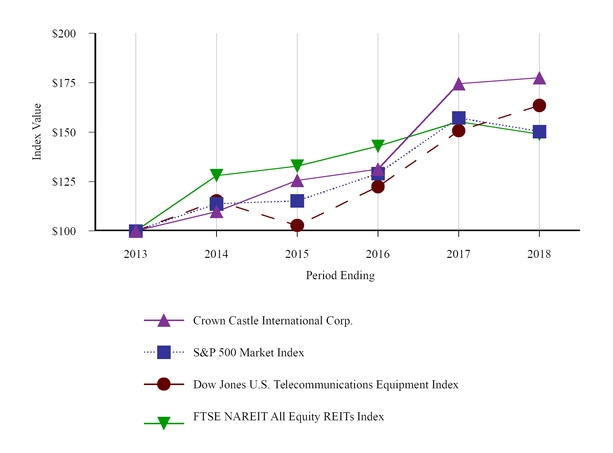
| Years Ended December 31, | ||||||||||||||||||||||||
| Company/Index/Market | 2013 | 2014 | 2015 | 2016 | 2017 | 2018 | ||||||||||||||||||
| Crown Castle International Corp. | $ | 100.00 | $ | 109.85 | $ | 125.60 | $ | 131.27 | $ | 174.49 | $ | 177.52 | ||||||||||||
| S&P 500 Market Index | 100.00 | 113.69 | 115.26 | 129.05 | 157.22 | 150.33 | ||||||||||||||||||
| DJ US Telecommunications Equipment Index | 100.00 | 115.21 | 102.76 | 122.43 | 150.65 | 163.51 | ||||||||||||||||||
| FTSE NAREIT All Equity REITs Index | 100.00 | 128.03 | 132.79 | 142.86 | 155.25 | 148.98 |
The performance graph above and related text are being furnished solely to accompany this Annual Report on Form 10-K pursuant to Item 201(e) of Regulation S-K, and are not being filed for purposes of Section 18 of the Exchange Act, and are not to be incorporated by reference into any filing of ours, whether made before or after the date hereof, regardless of any general incorporation language in such filing.
Item 6. Selected Financial Data
Our selected historical consolidated financial and other data set forth below have been derived from our consolidated financial statements. The information set forth below should be read in conjunction with "Item 1. Business," "Item 7. MD&A" and our consolidated financial statements. Our formerly 77.6% owned subsidiary that operated towers in Australia ("CCAL") was sold in 2015 and is presented on a discontinued operations basis for all periods presented.
| Years Ended December 31, | ||||||||||||||||||||
| 2018 | (a) | 2017 | (a) | 2016 | (a) | 2015 | (a) | 2014 | (a) | |||||||||||
| (In millions of dollars, except per share amounts) | ||||||||||||||||||||
| Statement of Operations Data: | ||||||||||||||||||||
| Net revenues: | ||||||||||||||||||||
| Site rental | $ | 4,716 | $ | 3,669 | $ | 3,233 | $ | 3,018 | $ | 2,867 | ||||||||||
| Services and other | 707 | 687 | 688 | 645 | 672 | |||||||||||||||
| Net revenues | 5,423 | 4,356 | 3,921 | 3,663 | 3,539 | |||||||||||||||
| Operating expenses: | ||||||||||||||||||||
| Costs of operations(b): | ||||||||||||||||||||
| Site rental | 1,410 | 1,144 | 1,024 | 964 | 906 | |||||||||||||||
| Services and other | 437 | 420 | 417 | 358 | 400 | |||||||||||||||
| Total costs of operations | 1,847 | 1,564 | 1,441 | 1,322 | 1,306 | |||||||||||||||
| Selling, general and administrative | 563 | 426 | 371 | 310 | 257 | |||||||||||||||
| Asset write-down charges | 26 | 17 | 34 | 33 | 14 | |||||||||||||||
| Acquisition and integration costs | 27 | 61 | 17 | 16 | 34 | |||||||||||||||
| Depreciation, amortization and accretion | 1,528 | 1,242 | 1,109 | 1,036 | 986 | |||||||||||||||
| Operating income (loss) | 1,432 | 1,046 | 949 | 946 | 942 | |||||||||||||||
| Interest expense and amortization of deferred financing costs | (642 | ) | (591 | ) | (515 | ) | (527 | ) | (573 | ) | ||||||||||
| Gains (losses) on retirement of long-term obligations | (106 | ) | (4 | ) | (52 | ) | (4 | ) | (45 | ) | ||||||||||
| Interest income | 5 | 19 | 1 | 2 | — | |||||||||||||||
| Other income (expense) | 1 | 1 | (9 | ) | 57 | 12 | ||||||||||||||
| Income (loss) from continuing operations before income taxes | 690 | 471 | 374 | 474 | 336 | |||||||||||||||
| Benefit (provision) for income taxes(c) | (19 | ) | (26 | ) | (17 | ) | 51 | 11 | ||||||||||||
| Income (loss) from continuing operations | 671 | 445 | 357 | 525 | 347 | |||||||||||||||
| Discontinued operations: | ||||||||||||||||||||
| Income (loss) from discontinued operations, net of tax | — | — | — | 20 | 52 | |||||||||||||||
| Net gain (loss) from disposal of discontinued operations, net of tax | — | — | — | 979 | — | |||||||||||||||
| Income (loss) from discontinued operations, net of tax | — | — | — | 999 | 52 | |||||||||||||||
| Net income (loss) | 671 | 445 | 357 | 1,524 | 399 | |||||||||||||||
| Less: Net income (loss) attributable to the noncontrolling interest | — | — | — | 3 | 8 | |||||||||||||||
| Net income (loss) attributable to CCIC stockholders | 671 | 445 | 357 | 1,521 | 391 | |||||||||||||||
| Dividends on preferred stock and losses on purchases of preferred stock | (113 | ) | (58 | ) | (33 | ) | (44 | ) | (44 | ) | ||||||||||
| Net income (loss) attributable to CCIC common stockholders | $ | 558 | $ | 387 | $ | 324 | $ | 1,477 | $ | 347 | ||||||||||
| Income (loss) from continuing operations attributable to CCIC common stockholders, per common share - basic(d) | $ | 1.35 | $ | 1.01 | $ | 0.95 | $ | 1.45 | $ | 0.91 | ||||||||||
| Income (loss) from continuing operations attributable to CCIC common stockholders, per common share - diluted(d) | $ | 1.34 | $ | 1.01 | $ | 0.95 | $ | 1.44 | $ | 0.91 | ||||||||||
| Weighted-average common shares outstanding (in millions): | ||||||||||||||||||||
| Basic(d)(f) | 413 | 382 | 340 | 333 | 332 | |||||||||||||||
| Diluted(d)(f) | 415 | 383 | 341 | 334 | 333 | |||||||||||||||
| Dividends/distributions declared per share of common stock | $ | 4.28 | $ | 3.90 | $ | 3.61 | $ | 3.35 | $ | 1.87 |
| Years Ended December 31, | ||||||||||||||||||||
| 2018 | (a)(e) | 2017 | (a) (e) | 2016 | (a) (e) | 2015 | (a) (e) | 2014 | (a) (e) | |||||||||||
| (In millions of dollars, except per share amounts) | ||||||||||||||||||||
| Other Data: | ||||||||||||||||||||
| Summary cash flow information: | ||||||||||||||||||||
| Net cash provided by (used for) operating activities | $ | 2,502 | $ | 2,043 | $ | 1,787 | $ | 1,790 | $ | 1,594 | ||||||||||
| Net cash provided by (used for) investing activities | (1,795 | ) | (10,493 | ) | (1,429 | ) | (1,956 | ) | (1,217 | ) | ||||||||||
| Net cash provided by (used for) financing activities | (733 | ) | 8,192 | (89 | ) | (952 | ) | (493 | ) | |||||||||||
| Balance Sheet Data (at period end): | ||||||||||||||||||||
| Cash and cash equivalents | $ | 277 | $ | 314 | $ | 568 | $ | 179 | $ | 151 | ||||||||||
| Property and equipment, net | 13,676 | 12,933 | 9,805 | 9,580 | 8,983 | |||||||||||||||
| Total assets | 32,785 | 32,229 | 22,675 | 21,937 | 21,027 | |||||||||||||||
| Total debt and other long-term obligations | 16,682 | 16,159 | 12,171 | 12,150 | 11,804 | |||||||||||||||
| Total CCIC stockholders' equity(f) | 12,034 | 12,339 | 7,557 | 7,089 | 6,716 |
| (a) | Inclusive of the impact of acquisitions. See note 3 to our consolidated financial statements for a discussion of our acquisitions during 2016 and 2017. In 2015, we acquired rights to approximately 10,000 miles of fiber route miles through the Sunesys Acquisition. In addition, during 2014, we acquired several portfolios of land interests under towers. |
| (b) | Exclusive of depreciation, amortization and accretion, which are shown separately. |
| (c) | See note 10 to our consolidated financial statements regarding our income taxes, including our REIT status. |
| (d) | Basic net income (loss) attributable to CCIC common stockholders, per common share, excludes dilution and is computed by dividing net income (loss) attributable to CCIC common stockholders by the weighted-average number of common shares outstanding during the period. Diluted net income (loss) attributable to CCIC common stockholders, per common share is computed by dividing net income (loss) attributable to CCIC common stockholders by the weighted-average number of common shares outstanding during the period, plus any potential dilutive common share equivalents, including shares issuable (1) upon the vesting of restricted stock awards and restricted stock units as determined under the treasury stock method and (2) upon conversion of convertible preferred stock securities (including, as applicable, the currently outstanding 6.875% Convertible Preferred Stock, which was issued in 2017, and the formerly outstanding 4.50% Mandatory Convertible Preferred Stock, Series A, par value $0.01 per share ("4.50% Convertible Preferred Stock") which was issued in 2013 and converted to common stock in 2016), as determined under the if-converted method. See note 2 to our consolidated financial statements. |
| (e) | Amounts reflect the impact of all applicable adopted accounting pronouncements during the periods presented. See note 2 to our consolidated financial statements. |
| (f) | See note 11 to our consolidated financial statements for a discussion of our equity offerings during 2018 and 2017. During 2016, we issued shares of our common stock in connection with (1) our 2015 ATM Program (as defined below), the proceeds of which we utilized to partially fund our acquisition of Tower Development Corporation ("TDC Acquisition") in April 2016, (2) the conversion of our then outstanding 4.50% Convertible Preferred Stock to common stock and (3) our November 2016 issuance of 11.4 million shares of common stock, which generated net proceeds of $1.0 billion ("November 2016 Common Stock Offering") to partially fund the FiberNet Acquisition. |
Item 7. Management's Discussion and Analysis of Financial Condition and Results of Operations
General Overview
Overview
We own, operate, and lease shared communications infrastructure. See "Item 1. Business" for a further discussion of our business, including our long-term strategy, our REIT status, certain key terms of our contracts and growth trends in the demand for data. Site rental revenues represented 87% of our 2018 consolidated net revenues. The vast majority of our site rental revenues is of a recurring nature and has been contracted for in a prior year.
Business Fundamentals and Results
The following are certain highlights of our business fundamentals and results:
| • | We operate as a REIT for U.S. federal income tax purposes (see "Item 1. Business—Company Developments, REIT Status and Industry Updates—REIT Status" and note 10 to our consolidated financial statements). |
| • | Potential growth resulting from the increasing demand for data |
| ◦ | We expect existing and potential new tenant demand for our communications infrastructure will result from (1) new technologies, (2) increased usage of mobile entertainment, mobile internet usage, and machine-to-machine applications, (3) adoption of other emerging and embedded wireless devices (including smartphones, laptops, tablets, and other devices), (4) increasing smartphone penetration, (5) wireless carrier focus on expanding both network quality and capacity, including the use of both towers and small cells, (6) the adoption of other bandwidth-intensive applications (such as cloud services and video communications) and (7) the availability of additional spectrum. |
| ◦ | We expect U.S. wireless carriers will continue their focus on improving network quality and expanding capacity (including through 5G initiatives) by utilizing a combination of towers and small cells. We believe our product offerings of towers and small cells provide a comprehensive solution to our wireless tenants' growing communications infrastructure needs. |
| ◦ | We expect organizations will continue to increase the usage of high-bandwidth applications that will require the utilization of more fiber infrastructure and solutions such as those we provide. |
| ◦ | Within our Fiber segment, we are able to generate growth and returns for our stockholders by deploying our fiber for both small cells and fiber solutions tenants. |
| ◦ | Tenant additions on our existing communications infrastructure are achieved at a low incremental operating cost, delivering high incremental returns. |
| • | Substantially all of our communications infrastructure can accommodate additional tenancy, either as currently constructed or with appropriate modifications. |
| • | Returning cash flows provided by operations to stockholders in the form of dividends (see also "Item 1. Business—Strategy") |
◦During 2018, we paid common stock dividends totaling approximately $1.8 billion. See "Item 7. MD&A—General Overview—Common Stock Dividend" for a discussion of the increase to our quarterly dividend in the fourth quarter of 2018.
| ◦ | Investing capital efficiently to grow long-term dividends per share (see also "Item 1. Business") |
| • | Discretionary capital expenditures of $1.6 billion, predominately resulting from the construction of communications infrastructure and communications infrastructure improvements in order to support additional site rental revenues. |
| • | We expect to continue to construct and acquire new communications infrastructure based on our tenants' needs and generate attractive long-term returns by adding additional tenants over time. |
| • | Site rental revenues under long-term tenant contracts |
| ◦ | Initial terms of five to 15 years for site rental revenues derived from wireless tenants, with contractual escalations and multiple renewal periods at the option of the tenant of five to 10 years each. |
| ◦ | Initial terms that generally vary between three to 20 years for site rental revenues derived from our fiber solutions tenants (including from organizations with high-bandwidth and multi-location demands). |
| ◦ | Weighted-average remaining term of approximately five years, exclusive of renewals at the tenants' option, currently representing approximately $23 billion of expected future cash inflows. |
| • | Majority of our revenues from large wireless carriers |
| ◦ | Approximately 73% of our site rental revenues were derived from AT&T, T-Mobile, Verizon Wireless and Sprint. See also "Item 1A. Risk Factors" and note 15 to our consolidated financial statements. |
| • | Majority of land interests under our towers are under long-term control. |
| ◦ | Approximately 90% of our Towers site rental gross margin and more than 75% of our Towers site rental gross margin is derived from towers that reside on land that we own or control for greater than 10 and 20 years, respectively. The aforementioned percentages include towers that reside on land interests that are owned, including fee interests and perpetual easements, which represent approximately 40% of our Towers site rental gross margin. |
| • | Majority of our fiber assets are located in major metropolitan areas and are on public rights-of-way. |
| • | Minimal sustaining capital expenditure requirements |
| ◦ | Sustaining capital expenditures represented approximately 2% of net revenues. |
| • | Debt portfolio with long-dated maturities extended over multiple years, with the majority of such debt having a fixed rate (see "Item 7A. Quantitative and Qualitative Disclosures About Market Risk" for a further discussion of our debt) |
| • | During 2018, we completed several debt transactions to refinance and extend the maturities of certain of our debt. See "Item 7. MD&A—Liquidity and Capital Resources—Financing Activities" for further discussion of our debt transactions. |
| ◦ | As of December 31, 2018, after giving effect to our February 2019 Senior Notes offering and the application of the net proceeds therefrom, our outstanding debt has a weighted average interest rate of 4.0% and weighted average maturity of approximately seven years (assuming anticipated repayment dates where applicable). |
| ◦ | After giving effect to our February 2019 issuance of $600 million aggregate principal amount of 4.300% senior unsecured notes due February 2029 and $400 million aggregate principal amount of 5.200% senior unsecured notes due 2049 (collectively, "February 2019 Senior Notes") and the application of the net proceeds therefrom, 85% of our debt has fixed rate coupons. |
| ◦ | Our debt service coverage and leverage ratios are comfortably within their respective financial maintenance covenants. See "Item 7. MD&A—Liquidity and Capital Resources—Debt Covenants" for a further discussion of our debt covenants. |
| • | In March 2018, we issued 8 million shares of our common stock ("March 2018 Equity Financing"), and we utilized the proceeds for general corporate purposes as well as repayment of outstanding indebtedness. |
| • | Significant cash flows from operations |
| ◦ | Net cash provided by operating activities was $2.5 billion. |
| ◦ | In addition to the positive impact of contractual escalators, we expect to grow our core business of providing access to our communications infrastructure as a result of future anticipated additional demand for our communicati |
Showing the first 8K of 80K characters. Open the full section
Item 7A. Quantitative and Qualitative Disclosures About Market Risk
Our primary exposures to market risks are related to changes in interest rates, which may adversely affect our results of operations and financial position. We seek to manage exposure to changes in interest rates where economically prudent to do so by utilizing fixed rate debt.
Our interest rate risk relates primarily to the impact of interest rate movements on the following, after giving effect to our February 2019 Senior Notes offering and the application of the net proceeds therefrom:
| • | the potential refinancing of our $16.7 billion in existing debt, compared to $16.2 billion in the prior year; |
| • | our $2.4 billion of floating rate debt representing approximately 15% of total debt, compared to 21% in the prior year; and |
| • | potential future borrowings of incremental debt, including borrowings under our 2016 Credit Facility. |
Potential Refinancing of Existing Debt
We have no debt maturities, other than principal payments on amortizing debt, or anticipated repayment dates over the next 12 months. As of December 31, 2018 and December 31, 2017, we had no interest rate swaps hedging any refinancings. See below for a tabular presentation of our scheduled contractual debt maturities as of December 31, 2018 and a discussion of anticipated repayment dates.
Floating Rate Debt
We manage our exposure to market interest rates on our existing debt by controlling the mix of fixed and floating rate debt. As of December 31, 2018, after giving effect to our February 2019 Senior Notes offering and the application of the net proceeds therefrom, we had $2.4 billion of floating rate debt, none of which had LIBOR floors. As a result, a hypothetical unfavorable fluctuation in market interest rates on our existing debt of 1/8 of a percent point over a 12-month period would increase our interest expense by approximately $3 million. As of December 31, 2017, we had approximately $3.0 billion of floating rate debt, none of which had LIBOR floors.
Potential Future Borrowings of Incremental Debt
We typically do not hedge our exposure to interest rates on potential future borrowings of incremental debt for a substantial period prior to issuance. See "Item 7. MD&A—Liquidity and Capital Resources" regarding our liquidity strategy.
The following table provides information about our market risk related to changes in interest rates, after giving effect to our February 2019 Senior Notes Offering and the application of the net proceeds therefrom. The future principal payments and weighted-average interest rates are presented as of December 31, 2018. These debt maturities reflect contractual maturity dates, and do not consider the impact of the principal payments that will commence following the anticipated repayment dates of certain debt (see footnotes (b) and (d)). See notes 8 and 18 to our consolidated financial statements for additional information regarding our debt.
| Future Principal Payments and Interest Rates by the Debt Instruments' Contractual Year of Maturity | |||||||||||||||||||||||||||||||
| 2019 | 2020 | 2021 | 2022 | 2023 | Thereafter | Total | Fair Value(a) | ||||||||||||||||||||||||
| (Dollars in millions) | |||||||||||||||||||||||||||||||
| Fixed rate debt(b) | $ | 48 | $ | 38 | $ | 1,583 | $ | 878 | $ | 3,424 | $ | 8,390 | $ | 14,361 | $ | 14,131 | |||||||||||||||
| Average interest rate(b)(c)(d) | 4.4 | % | 4.5 | % | 2.9 | % | 5.2 | % | 4.2 | % | 5.2 | % | 4.7 | % | |||||||||||||||||
| Variable rate debt(e) | $ | 59 | $ | 104 | $ | 119 | $ | 209 | $ | 1,954 | $ | — | $ | 2,445 | $ | 2,446 | |||||||||||||||
| Average interest rate(e) | 3.8 | % | 3.8 | % | 3.8 | % | 3.8 | % | 3.8 | % | — | % | 3.8 | % |
| (a) | The fair value of our debt is based on indicative quotes (that is, non-binding quotes) from brokers that require judgment to interpret market information, including implied credit spreads for similar borrowings on recent trades or bid/ask offers. These fair values are not necessarily indicative of the amount, which could be realized in a current market exchange. |
| (b) | The impact of principal payments that will commence following the anticipated repayment dates is not considered. The tower revenue notes have principal amounts of $300 million, $250 million, $700 million and $750 million, with anticipated repayment dates in 2022, 2023, 2025 and 2028, respectively. |
| (c) | The average interest rate represents the weighted-average stated coupon rate (see also footnote (d)). |
| (d) | If the tower revenue notes are not repaid in full by the applicable anticipated repayment dates, the applicable interest rate increases by approximately 5% per annum and monthly principal payments commence using the Excess Cash Flow (as defined in the indenture governing the applicable tower revenue notes) of the issuers of the tower revenue notes. The tower revenue notes are presented based on their contractual maturity dates ranging from 2042 to 2048 and include the impact of an assumed 5% increase in interest rate that would occur following the anticipated repayment dates but exclude the impact of monthly principal payments that would commence using Excess Cash Flow of the issuers of the tower revenue notes. The full year 2018 Excess Cash Flow of the issuers of the tower revenue notes was approximately $720 million. We currently expect to refinance these notes on or prior to the respective anticipated repayment dates. |
| (e) | Predominantly consists of our 2016 Term Loan A and 2016 Revolver borrowings, each of which matures in 2023. |
Item 8. Financial Statements and Supplementary Data
Crown Castle International Corp. and Subsidiaries
Index to Consolidated Financial Statements and Financial Statement Schedules
| Page | |
| Report of Independent Registered Public Accounting Firm | 45 |
| Consolidated Balance Sheet as of December 31, 2018 and 2017 | 47 |
| Consolidated Statement of Operations and Comprehensive Income (Loss) for each of the three years in the period ended December 31, 2018 | 48 |
| Consolidated Statement of Cash Flows for each of the three years in the period ended December 31, 2018 | 49 |
| Consolidated Statement of Equity for each of the three years in the period ended December 31, 2018 | 50 |
| Notes to Consolidated Financial Statements | 53 |
| Schedule II - Valuation and Qualifying Accounts for the years ended December 31, 2018, 2017 and 2016 | 93 |
| Schedule III - Schedule of Real Estate and Accumulated Depreciation for the years ended December 31, 2018 and 2017 | 94 |
Report of Independent Registered Public Accounting Firm
To the Board of Directors and Stockholders of
Crown Castle International Corp.
Opinions on the Financial Statements and Internal Control over Financial Reporting
We have audited the accompanying consolidated balance sheets of Crown Castle International Corp. and its subsidiaries (the “Company”) as of December 31, 2018 and 2017, and the related consolidated statements of operations and comprehensive income (loss), of cash flows, and of equity for each of the three years in the period ended December 31, 2018, including the related notes and financial statement schedules listed in the accompanying index (collectively referred to as the “consolidated financial statements”). We also have audited the Company's internal control over financial reporting as of December 31, 2018, based on criteria established in Internal Control - Integrated Framework (2013) issued by the Committee of Sponsoring Organizations of the Treadway Commission (COSO).
In our opinion, the consolidated financial statements referred to above present fairly, in all material respects, the financial position of the Company as of December 31, 2018 and 2017, and the results of its operations and its cash flows for each of the three years in the period ended December 31, 2018 in conformity with accounting principles generally accepted in the United States of America. Also in our opinion, the Company maintained, in all material respects, effective internal control over financial reporting as of December 31, 2018, based on criteria established in Internal Control - Integrated Framework (2013) issued by the COSO.
Basis for Opinions
The Company's management is responsible for these consolidated financial statements, for maintaining effective internal control over financial reporting, and for its assessment of the effectiveness of internal control over financial reporting, included in Management’s Report on Internal Control over Financial Reporting appearing under Item 9A. Our responsibility is to express opinions on the Company’s consolidated financial statements and on the Company's internal control over financial reporting based on our audits. We are a public accounting firm registered with the Public Company Accounting Oversight Board (United States) (PCAOB) and are required to be independent with respect to the Company in accordance with the U.S. federal securities laws and the applicable rules and regulations of the Securities and Exchange Commission and the PCAOB.
We conducted our audits in accordance with the standards of the PCAOB. Those standards require that we plan and perform the audits to obtain reasonable assurance about whether the consolidated financial statements are free of material misstatement, whether due to error or fraud, and whether effective internal control over financial reporting was maintained in all material respects.
Our audits of the consolidated financial statements included performing procedures to assess the risks of material misstatement of the consolidated financial statements, whether due to error or fraud, and performing procedures that respond to those risks. Such procedures included examining, on a test basis, evidence regarding the amounts and disclosures in the consolidated financial statements. Our audits also included evaluating the accounting principles used and significant estimates made by management, as well as evaluating the overall presentation of the consolidated financial statements. Our audit of internal control over financial reporting included obtaining an understanding of internal control over financial reporting, assessing the risk that a material weakness exists, and testing and evaluating the design and operating effectiveness of internal control based on the assessed risk. Our audits also included performing such other procedures as we considered necessary in the circumstances. We believe that our audits provide a reasonable basis for our opinions.
Definition and Limitations of Internal Control over Financial Reporting
A company’s internal control over financial reporting is a process designed to provide reasonable assurance regarding the reliability of financial reporting and the preparation of financial statements for external purposes in accordance with generally accepted accounting principles. A company’s internal control over financial reporting includes those policies and procedures that (i) pertain to the maintenance of records that, in reasonable detail, accurately and fairly reflect the transactions and dispositions of the assets of the company; (ii) provide reasonable assurance that transactions are recorded as necessary to permit preparation of financial statements in accordance with generally accepted accounting principles, and that receipts and expenditures of the company are being made only in accordance with authorizations of management and directors of the company; and (iii) provide reasonable assurance regarding prevention or timely detection of unauthorized acquisition, use, or disposition of the company’s assets that could have a material effect on the financial statements.
Because of its inherent limitations, internal control over financial reporting may not prevent or detect misstatements. Also, projections of any evaluation of effectiveness to future periods are subject to the risk that controls may become inadequate because of changes in conditions, or that the degree of compliance with the policies or procedures may deteriorate.
/s/ PricewaterhouseCoopers LLP
Pittsburgh, Pennsylvania
February 25, 2019
We have served as the Company’s auditor since 2011.
CROWN CASTLE INTERNATIONAL CORP. AND SUBSIDIARIES
CONSOLIDATED BALANCE SHEET
(In millions of dollars, except par values)
| December 31, | |||||||
| 2018 | 2017 | ||||||
| ASSETS | |||||||
| Current assets: | |||||||
| Cash and cash equivalents | $ | 277 | $ | 314 | |||
| Restricted cash | 131 | 121 | |||||
| Receivables, net of allowance of $14 and $14, respectively | 501 | 398 | |||||
| Prepaid expenses | 172 | 162 | |||||
| Other current assets | 148 | 139 | |||||
| Total current assets | 1,229 | 1,134 | |||||
| Deferred site rental receivables | 1,366 | 1,300 | |||||
| Property and equipment, net | 13,676 | 12,933 | |||||
| Goodwill | 10,078 | 10,021 | |||||
| Site rent |
Showing the first 8K of 165K characters. Open the full section
Item 9. Changes in and Disagreements With Accountants on Accounting and Financial Disclosure
None.
Item 9A. Controls and Procedures
(a) Conclusion Regarding the Effectiveness of Disclosure Controls and Procedures
In connection with the preparation of this Annual Report on Form 10-K, as of December 31, 2018, the Company's management conducted an evaluation, under the supervision and with the participation of the Company's Chief Executive Officer ("CEO") and Chief Financial Officer ("CFO"), of the effectiveness of the Company's disclosure controls and procedures (as defined in Rules 13a-15(e) and 15d-15(e) under the Securities Exchange Act of 1934 ("Exchange Act")). Based upon their evaluation, the CEO and CFO concluded that the Company's disclosure controls and procedures, as of December 31, 2018, were effective to provide reasonable assurance that information required to be disclosed by the Company in the reports filed or submitted by it under the Exchange Act is recorded, processed, summarized, and reported within the time periods specified in the SEC's rules and forms, and to provide reasonable assurance that information required to be disclosed by the Company in such reports is accumulated and communicated to the Company's management, including its CEO and CFO, as appropriate to allow timely decisions regarding required disclosure.
(b) Management's Report on Internal Control Over Financial Reporting
Management is responsible for establishing and maintaining adequate internal control over financial reporting (as defined in Rules 13a-15(f) and 15d-15(f) under the Exchange Act) for the Company. Under the supervision and with the participation of the Company's CEO and CFO, management assessed the effectiveness of the Company's internal control over financial reporting based on the framework described in "Internal Control – Integrated Framework (2013)," issued by the Committee of Sponsoring Organizations of the Treadway Commission. The Company's internal control over financial reporting is a process designed to provide reasonable assurance regarding the reliability of financial reporting and the preparation of financial statements for external purposes in accordance with U.S. generally accepted accounting principles. The Company's internal control over financial reporting includes those policies and procedures that:
| • | pertain to the maintenance of records that, in reasonable detail, accurately and fairly reflect the transactions and dispositions of the assets of the Company; |
| • | provide reasonable assurance that transactions are recorded as necessary to permit preparation of financial statements in accordance with U.S. generally accepted accounting principles, and that receipts and expenditures of the Company are being made only in accordance with authorization of management and directors of the Company; and |
| • | provide reasonable assurance regarding prevention or timely detection of unauthorized acquisitions, use or disposition of the Company's assets that could have a material effect on the financial statements. |
Management has assessed the effectiveness of the Company's internal control over financial reporting as of December 31, 2018. Based on the Company's assessment, management has concluded that the Company's internal control over financial reporting was effective as of December 31, 2018 to provide reasonable assurance regarding the reliability of financial reporting and the preparation of financial statements for external reporting purposes in accordance with U.S. generally accepted accounting principles.
The effectiveness of the Company's internal control over financial reporting as of December 31, 2018 has been audited by PricewaterhouseCoopers LLP, an independent registered public accounting firm, as stated in their report which appears herein.
(c) Changes in Internal Control Over Financial Reporting
There have not been any changes in the Company's internal control over financial reporting (as such term is defined in Rules 13a-15(f) and 15d-15(f) of the Exchange Act) during the most recent fiscal quarter that have materially affected or are reasonably likely to materially affect the Company's internal control over financial reporting.
(d) Limitations on the Effectiveness of Controls
Because of its inherent limitations, the Company's internal control over financial reporting may not prevent or detect misstatements. Also, projections of any evaluation of effectiveness to future periods are subject to the risk that controls may become inadequate because of changes in conditions, or that the degree of compliance with the policies and procedures may deteriorate.
Item 9B. Other Information
On February 21, 2019, the Company’s board of directors adopted amended and restated by-laws for the Company, which amend the proxy access provision in Article II, Section 2.10 to provide that any group of two or more funds that are (i) under common management or investment control, (ii) under common management and funded primarily by the same employer or (iii) a “group of investment companies,” as defined in the Investment Company Act of 1940, will be treated as one stockholder for purposes of complying with the 20-stockholder limit on the number of stockholders who may aggregate their stock ownership to satisfy the 3% ownership requirement to include director nominees in the Company’s proxy materials for annual meetings of its stockholders. The by-laws also include related clarifications.
The foregoing summary of the by-laws does not purport to be complete and is qualified in its entirety by reference to the full text of the by-laws, which are filed herewith as Exhibit 3.3 and incorporated herein by reference.
PART III
Item 10. Directors and Executive Officers of the Registrant
The information required to be furnished pursuant to this item will be set forth in the 2019 Proxy Statement and is incorporated herein by reference.
Item 11. Executive Compensation
The information required to be furnished pursuant to this item will be set forth in the 2019 Proxy Statement and is incorporated herein by reference.
Item 12. Security Ownership of Certain Beneficial Owners and Management
The information required to be furnished pursuant to this item will be set forth in the 2019 Proxy Statement and is incorporated herein by reference.
The following table summarizes information with respect to equity compensation plans under which equity securities of the registrant are authorized for issuance as of December 31, 2018:
| Plan category(a) | Number of securities to be issued upon exercise of outstanding options, warrants and rights | Weighted-average exercise price of outstanding options, warrants and rights | Number of securities remaining available for future issuance | |||||||
| (In shares) | (In dollars per share) | (In shares) | ||||||||
| Equity compensation plans approved by security holders | — | $ | — | 10,239,481 | (b) | |||||
| Equity compensation plans not approved by security holders | — | — | — | |||||||
| Total | — | $ | — | 10,239,481 |
| (a) | See note 12 to the consolidated financial statements for more detailed information regarding the registrant's equity compensation plan. |
| (b) | Of these shares remaining available for future issuance, 3 million may be issued pursuant to outstanding RSUs granted under the LTI Plan. |
Item 13. Certain Relationships and Related Transactions
The information required to be furnished pursuant to this item will be set forth in the 2019 Proxy Statement and is incorporated herein by reference.
Item 14. Principal Accounting Fees and Services
The information required to be furnished pursuant to this item will be set forth in the 2019 Proxy Statement and is incorporated herein by reference.
PART IV
Item 15. Exhibits, Financial Statement Schedules
(a)(1) Financial Statements:
| The list of financial statements filed as part of this report is submitted as a separate section, the index to which is located on page 44. |
(a)(2) Financial Statement Schedules:
Schedule II—Valuation and Qualifying Accounts.
Schedule III—Schedule of Real Estate and Accumulated Depreciation.
All other schedules are omitted because they are not applicable or because the required information is contained in the financial statements or notes thereto included in this Form 10-K.
(a)(3) Exhibits:
Exhibit Index
- Filed herewith.
** Furnished herewith.
† Indicates management contract or compensatory plan or arrangement.
Item 16. Form 10-K Summary
N/A
CROWN CASTLE INTERNATIONAL CORP. AND SUBSIDIARIES
SCHEDULE II—VALUATION AND QUALIFYING ACCOUNTS
YEARS ENDED DECEMBER 31, 2018, 2017 AND 2016
(In millions of dollars)
| Additions | Deductions | ||||||||||||||||||||||||||
| Balance at Beginning of Year | Charged to Operations | Credited to Operations | Written Off | Effect of Exchange Rate Changes | Other Adjustments | Balance at End of Year | |||||||||||||||||||||
| Allowance for Doubtful Accounts Receivable: | |||||||||||||||||||||||||||
| 2018 | $ | 14 | $ | 4 | $ | — | $ | (4 | ) | $ | — | $ | — | $ | 14 | ||||||||||||
| 2017 | $ | 11 | $ | 4 | $ | — | $ | (5 | ) | $ | — | $ | 4 | (a) | $ | 14 | |||||||||||
| 2016 | $ | 10 | $ | 5 | $ | — | $ | (4 | ) | $ | — | $ | — | $ | 11 |
| (a) | Represents the allowance for doubtful accounts reflected in the preliminary purchase price allocations for the 2017 Acquisitions. See note 3. |
| Additions | Deductions | ||||||||||||||||||||||||||
| Balance at Beginning of Year | Charged to Operations | Charged to Additional Paid-in Capital and Other Comprehensive Income | Credited to Operations | Credited to Additional Paid-in Capital and Other Comprehensive Income | Other Adjustments(a) | Balance at End of Year | |||||||||||||||||||||
| Deferred Tax Valuation Allowance: | |||||||||||||||||||||||||||
| 2018 | $ | 1 | $ | — | $ | — | $ | — | $ | — | $ | — | $ | 1 | |||||||||||||
| 2017 | $ | 7 | $ | — | $ | — | $ | (6 | ) | $ | — | $ | — | $ | 1 | ||||||||||||
| 2016 | $ | 2 | $ | 1 | $ | — | $ | (2 | ) | $ | — | $ | 6 | $ | 7 |
| (a) | Inclusive of (1) the effects of acquisitions and (2) the inclusion of small cells in the REIT in January 2016. |
CROWN CASTLE INTERNATIONAL CORP. AND SUBSIDIARIES
SCHEDULE III—SCHEDULE OF REAL ESTATE AND ACCUMULATED DEPRECIATION
YEARS ENDED DECEMBER 31, 2018 AND 2017
(In millions of dollars)
| Description | Encumbrances | Initial Cost to Company | Cost Capitalized Subsequent to Acquisition | Gross Amount Carried at Close of Current Period | Accumulated Depreciation at Close of Current Period | Date of Construction | Date Acquired | Life on Which Depreciation in Latest Income Statement is Computed | ||||||||
| Communications infrastructure(1) | $ | 3,311 | (2) | (3) | (3) | $ | 21,866 | $ | (8,341 | ) | Various | Various | Up to 20 years |
| (1) | Includes approximately 40,000 towers and 65,000 route miles of fiber. No single asset exceeds 5% of the aggregate gross amounts at which the assets were carried at the close of the period set forth in the table above. |
| (2) | Encumbrances are reported at face value, without contemplating the effect of deferred financing costs, discounts or premiums. Certain of the Company's debt is secured by (1) a security interest in substantially all of the applicable issuers' assignable personal property, (2) a pledge of the equity interests in each applicable issuer and (3) a security interest in the applicable issuers' leases with tenants to lease tower space (space licenses). |
| (3) | The Company has omitted this information, as it would be impracticable to compile such information on an asset-by-asset basis. |
| 2018 | 2017 | ||||||
| Gross amount at beginning | $ | 20,110 | $ | 16,121 | |||
| Additions during period: | |||||||
| Acquisitions through foreclosure | — | — | |||||
| Other acquisitions(1)(2) | 5 | 2,788 | |||||
| Communications infrastructure construction and improvements | 1,567 | 1,063 | |||||
| Purchase of land interests | 56 | 81 | |||||
| Sustaining capital expenditures | 85 | 56 | |||||
| Other(3) | 64 | 46 | |||||
| Total additions | 1,777 | 4,034 | |||||
| Deductions during period: | |||||||
| Cost of real estate sold or disposed | (21 | ) | (45 | ) | |||
| Other | — | — | |||||
| Total deductions: | (21 | ) | (45 | ) | |||
| Balance at end | $ | 21,866 | $ | 20,110 |
| (1) | Inclusive of changes between the final purchase price allocation and the preliminary purchase price allocations. |
| (2) | Includes acquisitions of communications infrastructure. |
| (3) | Predominately relates to the purchase of property and equipment under capital leases and installment land purchases. |
| 2018 | 2017 | ||||||
| Gross amount of accumulated depreciation at beginning | $ | (7,303 | ) | $ | (6,446 | ) | |
| Additions during period: | |||||||
| Depreciation | (1,057 | ) | (890 | ) | |||
| Total additions | (1,057 | ) | (890 | ) | |||
| Deductions during period: | |||||||
| Amount for assets sold or disposed | 18 | 26 | |||||
| Other | 1 | 7 | |||||
| Total deductions | 19 | 33 | |||||
| Balance at end | $ | (8,341 | ) | $ | (7,303 | ) |
SIGNATURES
Pursuant to the requirements of Section 13 or 15(d) of the Securities Exchange Act of 1934, as amended, the Registrant has duly caused this Annual Report on Form 10-K to be signed on its behalf by the undersigned, thereunto duly authorized, on this 25th day of February, 2019.
| CROWN CASTLE INTERNATIONAL CORP. | ||
| By: | /s/ DANIEL K. SCHLANGER | |
| Daniel K. Schlanger Senior Vice President and Chief Financial Officer |
POWER OF ATTORNEY
KNOW ALL MEN BY THESE PRESENTS, that each person whose signature appears below constitutes and appoints Jay A. Brown and Kenneth J. Simon and each of them, as his or her true and lawful attorneys-in-fact and agents with full power of substitution and re-substitution for him or her and in his or her name, place and stead, in any and all capacities, to sign any and all documents relating to the Annual Report on Form 10-K, including any and all amendments and supplements thereto, for the year ended December 31, 2018 and to file the same with all exhibits thereto and other documents in connection therewith with the Securities and Exchange Commission granting unto said attorneys-in-fact and agents full power and authority to do and perform each and every act and thing requisite and necessary to be done in and about the premises, as fully as to all intents and purposes as he or she might or could do in person, hereby ratifying and confirming all that said attorneys-in-fact and agents or their substitute or substitutes may lawfully do or cause to be done by virtue hereof.
Pursuant to the requirements of Section 13 or 15(d) of the Securities Exchange Act of 1934, as amended, this Annual Report on Form 10-K has been signed below by the following persons on behalf of the Registrant and in the capacities indicated below on this 25th day of February, 2019.
| Name | Title | |
| /s/ JAY A. BROWN | President, Chief Executive Officer and Director | |
| Jay A. Brown | (Principal Executive Officer) | |
| /s/ DANIEL K. SCHLANGER | Senior Vice President and Chief Financial Officer | |
| Daniel K. Schlanger | (Principal Financial Officer) | |
| /s/ ROBERT S. COLLINS | Vice President and Controller | |
| Robert S. Collins | (Principal Accounting Officer) | |
| /s/ J. LANDIS MARTIN | Chairman of the Board of Directors | |
| J. Landis Martin | ||
| /s/ P. ROBERT BARTOLO | Director | |
| P. Robert Bartolo | ||
| /s/ CINDY CHRISTY | Director | |
| Cindy Christy | ||
| /s/ ARI Q. FITZGERALD | Director | |
| Ari Q. Fitzgerald | ||
| /s/ ROBERT E. GARRISON II | Director | |
| Robert E. Garrison II | ||
| /s/ ANDREA J. GOLDSMITH | Director | |
| Andrea J. Goldsmith | ||
| /s/ LEE W. HOGAN | Director | |
| Lee W. Hogan | ||
| /s/ EDWARD C. HUTCHESON, JR. | Director | |
| Edward C. Hutcheson, Jr. | ||
| /s/ ROBERT F. MCKENZIE | Director | |
| Robert F. McKenzie | ||
| /s/ ANTHONY J. MELONE | Director | |
| Anthony J. Melone | ||
| /s/ W. BENJAMIN MORELAND | Director | |
| W. Benjamin Moreland |