 filings.tools
Carnival 10-K 2023-11-30
Filed 2024-01-26. 21 sections, 475K characters. Original on sec.gov · Markdown · JSON
Cover and table of contents
UNITED STATES
SECURITIES AND EXCHANGE COMMISSION
Washington, D.C. 20549
FORM 10-K
(Mark One)
| ☑ | ANNUAL REPORT PURSUANT TO SECTION 13 OR 15(d) OF THE SECURITIES EXCHANGE ACT OF 1934 |
For the fiscal year ended November 30, 2023 or
| ☐ | TRANSITION REPORT PURSUANT TO SECTION 13 OR 15(d) OF THE SECURITIES EXCHANGE ACT OF 1934 |
For the transition period from ______________ to ________________
| Commission file number: 001-9610 | Commission file number: 001-15136 | |||||||||||||||||||
| Carnival Corporation |  | Carnival plc | ||||||||||||||||||
| (Exact name of registrant as specified in its charter) | (Exact name of registrant as specified in its charter) | |||||||||||||||||||
| Republic of Panama | England and Wales | |||||||||||||||||||
| (State or other jurisdiction of incorporation or organization) | (State or other jurisdiction of incorporation or organization) | |||||||||||||||||||
| 59-1562976 | 98-0357772 | |||||||||||||||||||
| (I.R.S. Employer Identification No.) | (I.R.S. Employer Identification No.) | |||||||||||||||||||
| 3655 N.W. 87th Avenue | Carnival House, 100 Harbour Parade, | |||||||||||||||||||
| Miami, | Florida | 33178-2428 | Southampton | SO15 1ST, | United Kingdom | |||||||||||||||
| (Address of principal executive offices and zip code) | (Address of principal executive offices and zip code) |
| (305) | 599-2600 | 011 | 44 23 8065 5000 | |||||||||||
| (Registrant’s telephone number, including area code) | (Registrant’s telephone number, including area code) |
Securities registered pursuant to Section 12(b) of the Act:
| Title of each class | Trading Symbol(s) | Name of each exchange on which registered | ||||||
| Common Stock ($0.01 par value) | CCL | New York Stock Exchange, Inc. | ||||||
| Ordinary Shares each represented by American Depositary Shares ($1.66 par value), Special Voting Share, GBP 1.00 par value and Trust Shares of beneficial interest in the P&O Princess Special Voting Trust | CUK | New York Stock Exchange, Inc. | ||||||
| 1.000% Senior Notes due 2029 | CUK29 | New York Stock Exchange LLC |
Securities registered pursuant to Section 12(g) of the Act: None
Indicate by check mark if the registrants are well-known seasoned issuers, as defined in Rule 405 of the Securities Act.
Yes ☑ No ☐
Indicate by check mark if the registrants are not required to file reports pursuant to Section 13 or Section 15(d) of the Act.
Yes ☐ No ☑
Indicate by check mark whether the registrants (1) have filed all reports required to be filed by Section 13 or 15(d) of the Securities Exchange Act of 1934 during the preceding 12 months (or for such shorter period that the registrants were required to file such reports), and (2) have been subject to such filing requirements for the past 90 days. Yes ☑ No ☐
Indicate by check mark whether the registrants have submitted electronically every Interactive Data File required to be submitted pursuant to Rule 405 of Regulation S-T (§ 232.405 of this chapter) during the preceding 12 months (or for such shorter period that the registrants were required to submit such files).
Yes ☑ No ☐
Indicate by check mark whether the registrants are large accelerated filers, accelerated filers, non-accelerated filers, smaller reporting companies, or emerging growth companies. See the definitions of “large accelerated filer,” “accelerated filer,” “smaller reporting company” and “emerging growth company” in Rule 12b-2 of the Exchange Act.
| Large accelerated filers | ☑ | Accelerated filers | ☐ | Non-accelerated filers | ☐ | Smaller reporting companies | ☐ | Emerging growth companies | ☐ |
If emerging growth companies, indicate by check mark if the registrants have elected not to use the extended transition period for complying with any new or revised financial accounting standards provided pursuant to Section 13(a) of the Exchange Act. ☐
Indicate by check mark whether the registrant has filed a report on and attestation to its management’s assessment of the effectiveness of its internal control over financial reporting under Section 404(b) of the Sarbanes-Oxley Act (15 U.S.C 7262(b)) by the registered public accounting firm that prepared or issued its audit report. Yes ☑ No ☐
If securities are registered pursuant to Section 12(b) of the Act, indicate by check mark whether the financial statements of the registrants included in the filing reflect the correction of an error to previously issued financial statements. ☐
Indicate by check mark whether any of those error corrections are restatements that required a recovery analysis of incentive-based compensation received by any of the registrant’s executive officers during the relevant recovery period pursuant to §240.10D-1(b). ☐
Indicate by check mark whether the registrants are shell companies (as defined in Rule 12b-2 of the Act). Yes ☐ No ☑
The aggregate market value of the voting and non-voting common equity held by non-affiliates computed by reference to the price at which the common equity was last sold was $11.2 billion as of the last business day of the registrant’s most recently completed second fiscal quarter.
At January 11, 2024, Carnival Corporation had outstanding 1,119,445,529 shares of its Common Stock, $0.01 par value.
The aggregate market value of the voting and non-voting common equity held by non-affiliates computed by reference to the price at which the common equity was last sold was $1.8 billion as of the last business day of the registrant’s most recently completed second fiscal quarter.
At January 11, 2024, Carnival plc had outstanding 186,829,504 Ordinary Shares $1.66 par value, one Special Voting Share GBP 1.00 par value and 1,119,445,529 Trust Shares of beneficial interest in the P&O Princess Special Voting Trust.
DOCUMENTS INCORPORATED BY REFERENCE
Portions of the 2024 joint definitive Proxy Statement are incorporated by reference into Part III of this report.
CARNIVAL CORPORATION & PLC
FORM 10-K
FOR THE FISCAL YEAR ENDED NOVEMBER 30, 2023
TABLE OF CONTENTS
Cautionary Note Concerning Factors That May Affect Future Results
Some of the statements, estimates or projections contained in this document are “forward-looking statements” that involve risks, uncertainties and assumptions with respect to us, including some statements concerning future results, operations, outlooks, plans, goals, reputation, cash flows, liquidity and other events which have not yet occurred. These statements are intended to qualify for the safe harbors from liability provided by Section 27A of the Securities Act of 1933 and Section 21E of the Securities Exchange Act of 1934, as amended. All statements other than statements of historical facts are statements that could be deemed forward-looking. These statements are based on current expectations, estimates, forecasts and projections about our business and the industry in which we operate and the beliefs and assumptions of our management. We have tried, whenever possible, to identify these statements by using words like “will,” “may,” “could,” “should,” “would,” “believe,” “depends,” “expect,” “goal,” “aspiration,” “anticipate,” “forecast,” “project,” “future,” “intend,” “plan,” “estimate,” “target,” “indicate,” “outlook,” and similar expressions of future intent or the negative of such terms.
Forward-looking statements include those statements that relate to our outlook and financial position including, but not limited to, statements regarding:
| •Pricing | •Adjusted net income (loss) | ||||
| •Booking levels | •Adjusted EBITDA | ||||
| •Occupancy | •Adjusted earnings per share | ||||
| •Interest, tax and fuel expenses | •Adjusted free cash flow | ||||
| •Currency exchange rates | •Net per diems | ||||
| •Goodwill, ship and trademark fair values | •Net yields | ||||
| •Liquidity and credit ratings | •Adjusted cruise costs per ALBD | ||||
| •Investment grade leverage metrics | •Adjusted cruise costs excluding fuel per ALBD | ||||
| •Estimates of ship depreciable lives and residual values | •Adjusted return on invested capital |
Because forward-looking statements involve risks and uncertainties, there are many factors that could cause our actual results, performance or achievements to differ materially from those expressed or implied by our forward-looking statements. This note contains important cautionary statements of the known factors that we consider could materially affect the accuracy of our forward-looking statements and adversely affect our business, results of operations and financial position. Additionally, many of these risks and uncertainties are currently, and in the future may continue to be, amplified by our substantial debt balance incurred during the pause of our guest cruise operations. There may be additional risks that we consider immaterial or which are unknown. These factors include, but are not limited to, the following:
• Events and conditions around the world, including geopolitical uncertainty, war and other military actions, inflation, higher fuel prices, higher interest rates and other general concerns impacting the ability or desire of people to travel have led, and may in the future lead, to a decline in demand for cruises as well as negative impacts to our operating costs and profitability.
-
Pandemics have in the past and may in the future have a significant negative impact on our financial condition and operations.
-
Incidents concerning our ships, guests or the cruise industry have in the past and may, in the future, negatively impact the satisfaction of our guests and crew and lead to reputational damage.
-
Changes in and non-compliance with laws and regulations under which we operate, such as those relating to health, environment, safety and security, data privacy and protection, anti-money laundering, anti-corruption, economic sanctions, trade protection, labor and employment, and tax may be costly and have in the past and may, in the future, lead to litigation, enforcement actions, fines, penalties and reputational damage.
-
Factors associated with climate change, including evolving and increasing regulations, increasing global concern about climate change and the shift in climate conscious consumerism and stakeholder scrutiny, and increasing frequency and/or severity of adverse weather conditions could adversely affect our business.
-
Inability to meet or achieve our targets, goals, aspirations, initiatives, and our public statements and disclosures regarding them, including those that are related to sustainability matters, may expose us to risks that may adversely impact our business.
-
Breaches in data security and lapses in data privacy as well as disruptions and other damages to our principal offices, information technology operations and system networks and failure to keep pace with developments in technology may adversely impact our business operations, the satisfaction of our guests and crew and may lead to reputational damage.
-
The loss of key team members, our inability to recruit or retain qualified shoreside and shipboard team members and
increased labor costs could have an adverse effect on our business and results of operations.
-
Increases in fuel prices, changes in the types of fuel consumed and availability of fuel supply may adversely impact our scheduled itineraries and costs.
-
We rely on supply chain vendors who are integral to the operations of our businesses. These vendors and service providers may be unable to deliver on their commitments, which could negatively impact our business.
-
Fluctuations in foreign currency exchange rates may adversely impact our financial results.
-
Overcapacity and competition in the cruise and land-based vacation industry may negatively impact our cruise sales, pricing and destination options.
-
Inability to implement our shipbuilding programs and ship repairs, maintenance and refurbishments may adversely impact our business operations and the satisfaction of our guests.
-
We require a significant amount of cash to service our debt and sustain our operations. Our ability to generate cash depends on many factors, including those beyond our control, and we may not be able to generate cash required to service our debt and sustain our operations.
-
Our substantial debt could adversely affect our financial health and operating flexibility.
The ordering of the risk factors set forth above is not intended to reflect our indication of priority or likelihood.
Forward-looking statements should not be relied upon as a prediction of actual results. Subject to any continuing obligations under applicable law or any relevant stock exchange rules, we expressly disclaim any obligation to disseminate, after the date of this document, any updates or revisions to any such forward-looking statements to reflect any change in expectations or events, conditions or circumstances on which any such statements are based.
Forward-looking and other statements in this document may also address our sustainability progress, plans, and goals (including climate change- and environmental-related matters). In addition, historical, current, and forward-looking sustainability- and climate-related statements may be based on standards and tools for measuring progress that are still developing, internal controls and processes that continue to evolve, and assumptions and predictions that are subject to change in the future and may not be generally shared.
PART I
Item 1. Business.
A. Overview
**I.**Summary
Carnival Corporation was incorporated in Panama in 1974 and Carnival plc was incorporated in England and Wales in 2000. Carnival Corporation and Carnival plc operate a dual listed company (“DLC”), whereby the businesses of Carnival Corporation and Carnival plc are combined through a number of contracts and through provisions in Carnival Corporation’s Articles of Incorporation and By-Laws and Carnival plc’s Articles of Association. The two companies operate as if they are a single economic enterprise with a single executive management team and identical Boards of Directors, but each has retained its separate legal identity. Carnival Corporation and Carnival plc are both public companies with separate stock exchange listings and their own shareholders. Together with their consolidated subsidiaries, Carnival Corporation and Carnival plc are referred to collectively in this Form 10-K as “Carnival Corporation & plc,” “company,” “our,” “us” and “we.” We are the largest global cruise company, and among the largest leisure travel companies, with a portfolio of world-class cruise lines - AIDA Cruises, Carnival Cruise Line, Costa Cruises, Cunard, Holland America Line, P&O Cruises (Australia), P&O Cruises (UK), Princess Cruises and Seabourn.
**II.**Purpose & Mission, Vision, Values and Priorities
Purpose & Mission
To deliver unforgettable happiness to our guests by providing extraordinary cruise vacations, while honoring the integrity of every ocean we sail, place we visit and life we touch.
Vision
As the global leader in the cruise industry, we will lead the way in innovative and sustainable cruising to deliver memorable vacations and build borderless connections.
Culture Essentials (our Core Values)
-
Speak Up** - Our voice is our strength. Every one of us, regardless of level or role, speaks up when we have questions, comments, concerns, or new ideas. If we see something wrong or that doesn’t seem right, we say something and trust our voices will be heard without fear of retaliation.
-
Respect & Protect** - The health, safety and well-being of our people and the planet are vital. We choose to take decisive actions to respect and protect every life we touch, the places we sail and the laws that govern us.
-
Empower** - We and our team members have the time, tools and support we need to do our best work. We’re empowered to take personal ownership and accountability to succeed, and we take pride in our work.
-
Improve** - Our business is built on forward motion. We have the courage to dream big, driving innovation and continuous improvement in guest and team member experiences, operations, compliance, sustainability and beyond.
-
Listen & Learn** - We listen actively and seek to understand before responding, because the more perspectives we have, the better decisions we make. We value and respect the words and ideas of others, keeping an open mind, and learning from our successes and failures.
-
Communicate** - We openly share our knowledge, skills and information across brands, functions and the entire company to further our collective success. Together we champion our purpose & mission, vision, values and company priorities.
Priorities
Ensure each of our world-class brands owns its space in the vacation market by delivering extraordinary experiences tailored to its guests.
We understand vacation expectations and preferences vary widely among our diverse audience of potential guests. To fulfill our purpose & mission, and in the process achieve outstanding guest satisfaction levels, industry-leading demand and improved pricing, each of our brands must carve out a distinct identity for delivering cruise experiences. Our brands must effectively market their uniqueness to existing and potential guests and deliver on their promise across the entire guest journey.
Become travel and leisure’s employer of choice.
We celebrate our diverse team of over 160,000 team members representing approximately 150 countries and are committed to providing a welcoming and inclusive environment where people from different backgrounds, experiences and walks of life can succeed. We care deeply for our team members and must always cultivate an atmosphere of openness, respect and trust. We know our team members are at the heart of inspiring unforgettable happiness, so we strive to be the world’s number-one choice for hospitality, travel and leisure careers.
Maintain our commitment to seek excellence in compliance, environmental protection and in looking after the safety, health and well-being of every life we touch.
Achieving our purpose & mission depends on being good corporate citizens and stewards of the environment. Safeguarding the planet we call home, our guests, the communities we serve, and our Carnival family, and complying with the laws and regulations that govern our business, is vital to our success.
Set the pace with the industry’s smartest solutions that deliver on our sustainability roadmap to 2030.
Our earth, ecosystem and environment mean everything to us. Without the incredible communities and scenic spaces we operate in, our purpose & mission of inspiring unforgettable happiness would be impossible. We’re determined to lead the way in sustainable cruising by promoting positive climate action, contributing to a circular economy, partnering with the communities we sail to and from and reducing our environmental footprint. To do this, we are investing in technology upgrades and fleet improvements, piloting alternative fuel types, optimizing itineraries and cultivating a workforce that mirrors the diversity of the communities we encounter along the way.
Strengthen our balance sheet and deliver long-term shareholder value.
In recent years, travel and leisure has endured volatility unlike anything seen in modern history, including unique obstacles that disproportionately affected the cruise industry. With our operations now at full strength and the continued support of our guests, team members, investors and other stakeholders, we are focused on our financial fitness. We’re determined to drive revenue, operate effectively and efficiently at scale, generate record levels of cash from operations and invest our capital wisely. We believe this will allow us to responsibly reduce our debt over time and return to strong profitability, improve our return on invested capital as well as approach investment-grade leverage metrics.
B. Global Cruise Industry
I. Overview
In the face of the global impact of COVID-19, we paused our guest cruise operations in March 2020 and began resuming guest cruise operations in 2021. In 2023, we completed our return to guest cruise operations.
Cruising offers a broad range of products and services to suit vacationing guests of many ages, backgrounds and interests. Each brand in our portfolio meets the needs of a unique set of consumer psychographics and vacation needs which allows us to penetrate large addressable customer segments. The mobility of cruise ships enables us to move our vessels between regions in order to meet changing demand across different geographic areas.
Cruise brands can be broadly classified as offering contemporary, premium and luxury cruise experiences. The contemporary experience appeals to a broad segment of the cruise vacation industry, including families with children of all ages, features a variety of activities and entertainment venues and historically includes cruises that last seven days or less. The premium experience emphasizes quality, comfort, style and more destination-focused itineraries. The premium experience generally includes cruises that last from seven to 14 days. The luxury experience is generally characterized by very high standards of accommodation and service, smaller vessel size and exotic itineraries to ports that are inaccessible by larger ships. We have product and service offer
Showing the first 8K of 127K characters. Open the full section
Item 1A. Risk Factors.
You should carefully consider the following discussion of material factors, events and uncertainties that make an investment in the company’s securities risky and provide important information for the understanding of the “forward-looking” statements discussed in this Form 10-K and elsewhere. These risk factors should be read in conjunction with other information in this Form 10-K.
The events and consequences discussed in these risk factors could have a material adverse effect on the company’s business, financial condition, operating results and stock price. These risk factors do not identify all risks that the company faces; operations could also be affected by factors, events, or uncertainties that are not presently known to the company or that the company currently does not consider to present material risks to its operations. In addition to the risk factors below, additional or unforeseen effects from our substantial debt balance incurred during the pause of our guest cruise operations could give rise to or amplify many of the risks discussed below. Some of the statements in this item and elsewhere in this document are “forward-looking statements.” For a discussion of those statements and of other factors to consider see the “Cautionary Note Concerning Factors That May Affect Future Results” section.
The ordering and lettering of the risk factors set forth below is not intended to reflect any company indication of priority or likelihood.
Operational Risk Factors
a. Events and conditions around the world, including geopolitical uncertainty, war and other military actions, inflation, higher fuel prices, higher interest rates and other general concerns impacting the ability or desire of people to travel have led, and may in the future lead, to a decline in demand for cruises as well as negative impacts to our operating costs and profitability.
We have been, and may continue to be, impacted by the public’s concerns regarding the health, safety and security of travel, including government travel advisories and travel restrictions, political instability and civil unrest, terrorist attacks, war and military action and other general concerns. The resulting impacts of these events, including supply chain disruptions, increased fuel prices, impact on demand for cruises to neighboring regions and international sanctions and other measures that have been imposed, have adversely affected, and may continue to adversely affect, our business. These factors may also have the effect of heightening many other risks to our business, any of which could materially and adversely affect our business and results of operations. Additionally, we have been, and may continue to be, impacted by heightened regulations around customs and border control, travel bans to and from certain geographical areas, voluntary changes to our itineraries in light of geopolitical events, government policies increasing the difficulty of travel and limitations on issuing international travel visas. We may be impacted by adverse changes in the perceived or actual economic climate, such as inflation, global or regional recessions, higher unemployment and underemployment rates and declines in income levels.
b. Pandemics have in the past and may in the future have a significant negative impact on our financial condition and operations.
Pandemics have in the past and may in the future have a significant negative impact on our financial condition and operations. We could:
-
be forced to re-implement a pause of our guest cruise operations
-
be negatively impacted by travel advisories, restrictions, recommendations and regulations set by various governmental authorities, which could impact our occupancy levels
-
be subject to enhanced health and hygiene requirements in attempts to counteract future outbreaks, and these requirements may be costly, take a significant amount of time to implement across our global cruise operations and may result in disruptions in guest cruise operations, incremental costs and loss of revenue
-
be subject to negative publicity, along with the cruise industry, which could have a long-term impact on the appeal of our cruises
-
be subject to lawsuits, other governmental investigations and other actions
-
be required to reassess our ship deployment options and our fleet, which could lead to the removal of additional ships from our fleet and may result in incremental ship impairment charges and losses on ship sales
-
be negatively impacted as a result of the adverse impact on our partners, counterparties and joint ventures
-
be negatively impacted by the inability to attract and retain the loyalty of our guests and hire and retain our crew
c. Incidents concerning our ships, guests or the cruise industry have in the past and may, in the future, negatively impact the satisfaction of our guests and crew and lead to reputational damage.
Our operations involve the risk of incidents and media coverage thereof. Such incidents include, but are not limited to, the improper operation or maintenance of ships, motorcoaches and trains; guest and crew illnesses; mechanical failures, fires and
collisions; repair delays, groundings and navigational errors; oil spills and other maritime and environmental issues as well as other incidents at sea, while in port or on land which may generate negative publicity or cause guest and crew discomfort, injury, or death. Although our commitment to the safety and comfort of our guests and crew is paramount to the success of our business, our ships have been involved in outbreaks, accidents and other incidents in the past and we may experience similar or other incidents in the future. Our ability to attract and retain the loyalty of our guests, our ability to hire and the amounts we must pay our crew depend, in part, upon the perception and reputation of our company and our brands and the public’s concerns regarding the health and safety of travel generally, as well as the cruising industry and our ships specifically. In addition, these and any other events which impact the travel industry more generally may negatively impact our guests’ and/or crew’s ability or desire to travel to or from our ships and/or interrupt the supply of critical goods and services.
d. Changes in and non-compliance with laws and regulations under which we operate, such as those relating to health, environment, safety and security, data privacy and protection, anti-money laundering, anti-corruption, economic sanctions, trade protection, labor and employment, and tax may be costly and have in the past and may, in the future, lead to litigation, enforcement actions, fines, penalties and reputational damage.
We are subject to numerous international, national, state and local laws, regulations, treaties and other legal requirements that govern health, environmental, safety and security matters in relation to our guests, crew and ships. These requirements change regularly, depending on the itineraries of our ships and the ports and countries visited. Implementing these and any subsequent requirements may be costly and take time to implement across our global cruise operations. In addition, the accelerating pace of regulatory changes may affect our ability to comply in the future. If we violate or fail to comply with any of these laws, regulations, treaties and other requirements we could be, and have previously been, fined, placed on probation or otherwise sanctioned by regulators. In addition, there is increased global focus on climate change, which may lead to additional regulatory requirements. Refer to Operational Risk Factor “e.” below for additional discussion on climate change regulation risks.
We are subject to laws and requirements related to the treatment and protection of personal, sensitive and/or other regulated data in the jurisdictions where we operate. Various governments, agencies and regulatory organizations have enacted or are considering new rules and regulations and we expect to continue to incur costs to comply with these rules and regulations. In the course of doing business, we collect guest, team member, company and other third-party data, including personal and other sensitive data.
Our operations subject us to potential liability under anti-money laundering and anti-corruption laws and regulations. We may also be affected by economic sanctions, trade protection laws, policies and other regulatory requirements affecting trade and investment.
We are subject to compliance with tax laws, regulations and treaties in the jurisdictions in which we are incorporated or operate. These tax laws, regulations and treaties are subject to change at any time, which may result in substantially higher tax expense. For example, the OECD’s multi-jurisdictional inclusive framework is intended to address the tax challenges arising from globalization, which includes the establishment of a minimum 15% tax rate for multinational enterprises. A number of countries, including the UK and EU member states, have agreed to adopt the OECD’s minimum tax rules and several countries, including the UK, have already implemented these rules. The phased implementation of these rules is expected to begin for our fiscal year 2025, with limited impact for us before 2026. The application of these rules continues to evolve, and its outcome may alter our tax obligations in certain countries in which we operate. Other changes in domestic and international tax rules and regulations and their application could also alter our tax obligations.
e. Factors associated with climate change, including evolving and increasing regulations, increasing global concern about climate change and the shift in climate conscious consumerism and stakeholder scrutiny, and increasing frequency and/or severity of adverse weather conditions could adversely affect our business.
Growing concerns regarding climate change have resulted in increased global regulatory focus on GHG and other emissions which may have material impacts on our business. Refer to XIX. Governmental Regulations for additional discussion of recent developments related to Maritime Regulations, Greenhouse Gas Emissions and EU Regulations. Fossil fuels are currently the only viable option for our industry and it is not clear when alternative fuels or other technologies will be commercially viable. To provide a path to net zero emissions, alternative low GHG emission fuels will be necessary for the maritime industry; however, there are significant supply challenges that must be resolved before viability is reached. Climate change-related regulatory activity and developments that require us to reduce our emissions, which includes both the EU regulations and IMO Strategy (refer to XIX. Governmental Regulations), may individually or collectively have a material impact on our business and financial results by requiring us to make capital investments in new equipment or technologies, pay for emissions, purchase carbon offset credits, or otherwise incur additional costs or take additional actions related to our emissions. Such activity may also impact us indirectly by increasing our operating costs, including fuel costs. Regulatory developments may also result in the
inability to operate ships that do not meet certain standards, the acceleration of the removal of less fuel-efficient ships from our fleet and impact the resale value of our ships in the future. In addition, regulatory developments may restrict or limit our access to certain destinations and/or countries or impact our freedom to operate. Regulatory efforts, both internationally and in the U.S., are evolving, including the international alignment of such efforts, and we cannot determine what final regulations will be enacted or their ultimate impact on our business.
Growing recognition among consumers globally of the negative effects of climate change and the impact of GHG and other emissions may lead to material changes in consumer preferences. For instance, our guests may choose a vacation option that they perceive as operating in a manner that is more sustainable for the climate, seek alternative methods of travel, or reduce the amount and frequency of their travel. In addition, some environmental focused groups have and may continue to generate negative publicity regarding the environmental impact of the cruise industry and are advocating for more stringent oversight and regulation of our industry, including of ship emissions while the ship is docked and at sea. Environmental scrutiny of our operations and the industry from the investment community, other stakeholders, and the media have impacted and may continue to impact how we are perceived, which may have a material impact on our operations and financial results. Certain climate-related actions and investments we make today may not lead us to our intended future emissions related goals or may not be favorably perceived in future years based on continuing evolving regulations and perceptions around effective emissions mitigation strategies and technologies.
Our cruise ships, hotels, land tours, port and related commercial facilities and shore excursions have been and may continue to be impacted by adverse weather patterns or other natural disasters, such as hurricanes, earthquakes, floods, fires, tornadoes, tsunamis, typhoons and volcanic eruptions. Climate change is expected to increase the frequency and intensity of certain adverse weather patterns, possibly making certain destinations less desirable or impacting our business in other ways. We have been forced to, and in the future may be forced to, alter itineraries or cancel a cruise or a series of cruises or tours due to these or other types of disruptions. The physical climate-related risks to our business include increased hurricane/typhoon intensity and frequency, increases in global temperatures and rising sea levels which may adversely impact our shoreside facilities, our investments in ports or the availability or desirability of ports and destinations in which we operate. These effects may also disrupt the supply of critical goods and services to our facilities and ships. Any of these events could have a material impact on our business and profitability.
f. Inability to meet or achieve our targets, goals, aspirations, initiatives, and our public statements and disclosures regarding them, including those that are related to sustainability matters, may expose us to risks that may adversely impact our business.
We have developed and will continue to establish targets, goals, aspirations, and other objectives, including those related to sustainability matters (“sustainability objectives”). These statements reflect our current plans and do not constitute a guarantee that they will be achieved. With respect to our sustainability objectives, our efforts to research, establish, accomplish, and accurately report on these objectives expose us to numerous operational, reputational, financial, legal, and other risks, any of which could have a negative impact on our business. Our ability to achieve any of our stated sustainability objectives, particularly with respect to our environmental emissions aspirations, is subject to numerous factors and conditions, many of which are outside of our control. Examples of such factors include the availability and costs of low- or non-GHG emission energy sources and technology, evolving regulatory requirements affecting sustainability standards or disclosures, the availability of future financing and the availability of suppliers that can meet our sustainability standards.
Our business may face increased scrutiny from our guests, our team members, the investment community, governments, regulators, destinations and other stakeholders that we serve related to our sustainability activities, including the sustainability objectives that we adopt, our methodologies and timelines for pursuing them and our ability to document and support the achievement of those objectives. If our sustainability practices do not meet, or are perceived to fall short of, the expectations of our guests, team members, investors or other stakeholders, demand for cruising, our reputation, our ability to attract or retain team members, and our attractiveness as an investment could be negatively impacted. In addition, governments may restrict or limit our access to ports and destinations for which there is high guest demand. Similarly, our failure or perceived failure to pursue, meet or fulfill our targets, goals, aspirations, and other objectives (including sustainability objectives) within the timelines we announce, or at all, could have the same negative impacts as well as expose us to government enforcement actions and private litigation.
g. Breaches in data security and lapses in data privacy as well as disruptions and other damages to our principal offices, information technology operations and system networks and failure to keep pace with developments in technology may adversely impact our business operations, the satisfaction of our guests and crew and may lead to reputational damage.
We have been and may continue to be impacted by breaches in data security and lapses in data privacy, which occur from time to time. These can vary in scope and intent from motivated driven attacks to malicious attacks intended to disrupt or compromise our shoreside and shipboard operations by targeting our key operating systems. Breach or circumvention of our
systems or the systems of third parties, including by ransomware or malware, through vulnerabilities in licensed software or hardware, or as a result of other attacks, has led to and may continue to lead to disruptions in our business operations; unauthorized access to (or the loss of company access to) competitively sensitive, confidential or other critical data (including sensitive financial, medical or other personal or business information) or systems; loss of customers; financial losses; regulatory investigations, enforcement actions and fines; litigation; reputational damage; and misuse or corruption of critical data and proprietary information, any of which could be material. Additionally, we may rely on third parties in helping us to implement and manage our cyber security risk management processes. Any measures that we take and such third parties take to avoid, detect, mitigate or recover from material cyber security threats or incidents can be expensive, and may be insufficient, circumvented, or may become ineffective.
Our offices, information technology operations, system networks and various remote work locations may be impacted by actual or threatened natural disasters (for example, hurricanes, earthquakes, floods, fires, tornadoes, tsunamis and typhoons) or other disruptive events. Our maritime and/or shoreside operations, including our ability to manage our inventory of cabins held for sale and set pricing, control costs and serve our guests, depends on the reliability of our information technology operations and system networks, as well as our ability to refine and update to more advanced systems and technologies. In addition, we may be unable to obtain appropriate technology in a timely manner or at all or we may incur significant costs in doing so. A failure to adopt the appropriate technology, or a failure, disruption or obsolescence in the technology that we do adopt, could have adverse effects on our business.
h. The loss of key team members, our inability to recruit or retain qualified shoreside and shipboard team members and increased labor costs could have an adverse effect on our business and results of operations.
Our success depends, in large part, on the skills and contributions of our team members, and on our ability to recruit, develop and retain high quality, diverse team members. We may not be successful in recruiting, developing or retaining key or other highly qualified team members. In addition, high-GHG emission industries may become a less attractive employment opportunity. At times we have and may in the future experience difficulty in hiring sufficient qualified team members, due to general macroeconomic factors and/or increasingly competitive labor markets.
In addition, we hire a significant number of qualified shipboard team members each year and, thus, our ability to adequately recruit, develop and retain these individuals is critical to our success. Incidents involving cruise ships, including disease outbreaks on our ships and increasing demand as a result of the industry’s projected growth could negatively impact our ability to recruit, develop and retain sufficient qualified shipboard team members.
i. Increases in fuel prices, changes in the types of fuel consumed and availability of fuel supply may adversely impact our scheduled itineraries and costs.
We have been and may continue to be impacted, by economic, market and political conditions around the world, regulatory requirements including climate-induced regulations, supply disruptions and related infrastructure needs, which make it difficult to predict the future price and availability of fuel. The supply and availability of different fuel types in various markets in which we operate have experienced increased volatility and have led to increased fuel prices and reduced profitability. Future increases in the global price of fuel would increase the cost of our cruise ship operations as well as some of our other expenses, such as crew travel, freight and commodity prices. Increases in airfares, such as those resulting from increases in the price of fuel, would increase our guests’ overall vacation costs and could reduce demand for cruises, as many of our guests depend on airlines to transport them to or from the airports near the ports where our cruises embark and disembark. Refer to Operational Risk Factor “e.” for additional discussion on the impact of climate change and regulation changes on fuel costs.
j. We rely on supply chain vendors who are integral to the operations of our businesses. These vendors and service providers may be unable to deliver on their commitments, which could negatively impact our business.
We rely on supply chain vendors to deliver key products to the operations of our businesses around the world. Any event impacting a vendor’s ability to deliver quality goods at the location and time needed could negatively impact our ability to operate our business. Events impacting our supply chain could be caused by factors beyond the control of our suppliers or us, including labor actions, increased demand, problems in production or distribution and/or disruptions in third-party logistics, information technology or transportation systems. In addition, global events in recent years have resulted in widespread global supply chain disruptions to vendors including critical supply chain shortages, labor shortages, significant material cost inflation and extended lead times for items that are required for our operations. Any such interruptions to our supply chain could increase our costs and could limit the availability of products critical to our operations.
k. Fluctuations in foreign currency exchange rates may adversely impact our financial results.
We earn revenues, pay expenses, purchase and own assets and incur liabilities in currencies other than the U.S. dollar. Additionally, our shipbuilding contracts are typically denominated in euros. Movements in foreign currency exchange rates, which have recently been more volatile, will affect our financial results.
l. Overcapacity and competition in the cruise and land-based vacation industry may negatively impact our cruise sales, pricing and destination options.
We may be impacted by increases in capacity in the cruise and land-based vacation industry, which may result in capacity growth beyond demand, either globally or for a region, or for a particular itinerary. We face competition from other cruise brands on the basis of overall experience, destinations, types and sizes of ships and cabins, travel agent partner preferences and value. We also compete with land-based vacation alternatives throughout the world on the basis of overall experience, destinations and value. In addition, certain ports and destinations have faced a surge of both cruise and non-cruise tourism and in certain destinations, countermeasures to limit the number of tourists have been contemplated and/or put into effect, including proposed limits on cruise ships and cruise guests. Potential restrictions in ports and destinations could limit the itinerary and destination options we can offer our guests going forward.
m. Inability to implement our shipbuilding programs and ship repairs, maintenance and refurbishments may adversely impact our business operations and the satisfaction of our guests.
There are a limited number of shipyards with the capability and capacity to build, repair, maintain and/or upgrade our ships, which may limit our ability to meet our capacity growth objectives. In addition, we may be impacted by unforeseen events, such as work stoppages, supply chain issues, insolvencies, “force majeure” events or other financial difficulties experienced by shipyards, their subcontractors and our suppliers. This may result in less shipyard availability resulting in delays or preventing the delivery of our ships under construction and/or the completion of the repair, maintenance or refurbishment of our existing ships. This may lead to potential delays or cancellations of cruises. Additionally, the prices of various commodities that are used in the construction of ships and for repair, maintenance and refurbishment of existing ships, such as steel, are subject to volatility which may increase our costs.
Financial Risk Factors
a. We require a significant amount of cash to service our debt and sustain our operations. Our ability to generate cash depends on many factors, including those beyond our control, and we may not be able to generate cash required to service our debt and sustain our operations.
Our ability to meet our debt service obligations, refinance our debt or sustain our business needs and operations depends on our future operating and financial performance and our ability to generate cash. This will be affected by our ability to successfully continue to execute on our business strategy, which if unsuccessful, would negatively impact the occupancy levels and pricing of our cruises. Our future performance is also impacted by general macroeconomic, financial, geopolitical, competitive, regulatory and other factors beyond our control such as inflation, higher fuel prices, higher taxes and higher interest rates. If we cannot generate sufficient cash to meet our debt service obligations or fund our other business needs, we may, among other things, need to refinance our debt, obtain additional financing, delay planned capital expenditures or sell assets. We cannot make assurances that we will be able to generate sufficient cash through any of the foregoing. If we are not able to refinance our debt, obtain additional financing or sell assets on commercially reasonable terms or at all, we may not be able to satisfy our obligations with respect to our debt. Refer to Liquidity, Financial Condition and Capital Resources.
b. Our substantial debt could adversely affect our financial health and operating flexibility.
We have a substantial amount of debt, significant debt service obligations and related covenant restrictions. Despite our leverage, we may incur more debt, subject to certain restrictions, in the future. Our substantial debt has had and could continue to have important negative consequences for us. Our substantial debt could, among other things:
-
require us to dedicate a large portion of our cash flow from operations to service debt and fund repayments on our debt, thereby reducing the availability of our cash flow to fund working capital, capital expenditures and other general corporate purposes;
-
increase our vulnerability to adverse general economic or industry conditions;
-
limit our flexibility in planning for, or reacting to, changes in our business or the industry in which we operate;
-
limit our ability to pay dividends or distributions on or redeem or repurchase capital stock and make other restricted payments;
-
place us at a disadvantage compared to others that have less debt;
-
make us more vulnerable to downturns in our business, the economy or the industry in which we operate;
-
limit our ability to raise additional debt or equity capital in the future to satisfy our requirements relating to working capital, capital expenditures, development projects, strategic initiatives or other purposes;
-
restrict us from introducing new technologies or exploiting business opportunities;
-
make it difficult for us to satisfy our obligations with respect to our debt; and
-
expose us to the risk of increased interest rates as certain of our borrowings are (and may be in the future) at a variable rate of interest.
Certain of our indebtedness accrues interest at variable rates, which subjects us to interest rate volatility with respect to such instruments and could cause our debt service obligations to increase significantly. If we breach the covenants or restrictions in our debt instruments, we could be in default under the terms of certain of our debt instruments and may be required to seek covenant amendments or the relevant creditors could elect to declare the debt, together with accrued and unpaid interest and other fees, if any, immediately due and payable (or cancel any unfunded commitments, if applicable) and proceed against the collateral, if any, securing that debt. Borrowings under our other debt instruments that contain cross-default provisions may also be accelerated or become payable on demand, and our assets may not be sufficient to repay such indebtedness in full.
Item 1B. Unresolved Staff Comments.
None.
Item 2. Properties.
As of November 30, 2023, the Carnival Corporation and Carnival plc headquarters and our larger shoreside locations are as follows:
| Location | Square Footage (in thousands) | Own/Lease | Principal Operations | |||||||||||||||||
| Miami, FL, U.S.A. | 463/18 | Own/Lease | Carnival Corporation & plc and Carnival Cruise Line | |||||||||||||||||
| Almere, Netherlands | 253 | Own | Arison Maritime Center | |||||||||||||||||
| Rostock, Germany | 224 | Own | AIDA | |||||||||||||||||
| Genoa, Italy | 204/46 | Own/Lease | Costa | |||||||||||||||||
| Seattle, WA, U.S.A. | 175 | Lease | Holland America Line and Seabourn | |||||||||||||||||
| Southampton, England | 150 | Lease | Carnival plc, Cunard and P&O Cruises (UK) | |||||||||||||||||
| Santa Clarita, CA, U.S.A. | 113 | Lease | Princess Cruises | |||||||||||||||||
| Hamburg, Germany | 70 | Lease | AIDA | |||||||||||||||||
| Fort Lauderdale, FL, U.S.A. | 61 | Lease | Princess Cruises | |||||||||||||||||
| Sydney, NSW, Australia | 26 | Lease | P&O Cruises (Australia) |
Information about our cruise ships, including the number each of our cruise brands operate, as well as information regarding our cruise ships under construction may be found under Part I, Item 1. Business. C. “Our Global Cruise Business.” In addition, we own, lease or have controlling interests in port destinations, exclusive islands, hotels, and lodges.
Item 3. Legal Proceedings.
The legal proceedings described in Note 6 – “Contingencies”, including those described under “COVID-19 Actions,” are shown in Part II, Item 8. Financial Statements and Supplementary Data, in this Form 10-K. Additionally, SEC rules require disclosure of certain environmental matters when a governmental authority is a party to the proceedings and such proceedings involve potential monetary sanctions that we believe will exceed $1 million for such proceedings.
On June 20, 2022, Princess Cruises notified the Australian Maritime Safety Authorization (“AMSA”) and the flag state, Bermuda, regarding approximately six cubic meters of comminuted food waste (liquid biodigester effluent) inadvertently released by Coral Princess inside the Great Barrier Reef Marine Park. On June 23, 2022, the UK P&I Club N.V. provided a letter of undertaking for approximately $1.9 million (being the estimated maximum combined penalty). On May 31, 2023, we received a summons from the Australia Federal Prosecution Service indicating that formal charges are being pursued against Princess Cruises and the Captain of the vessel. We believe the ultimate outcome will not have a material impact on our consolidated financial statements.
Item 4. Mine Safety Disclosures.
None.
PART II
Item 5. Market for Registrants’ Common Equity, Related Stockholder Matters and Issuer Purchases of Equity Securities.
A. Market Information
Carnival Corporation common stock, together with paired trust shares of beneficial interest in the P&O Princess Special Voting Trust, which holds a Special Voting Share of Carnival plc, is traded on the NYSE under the symbol “CCL.” Carnival plc ordinary shares trade on the London Stock Exchange under the symbol “CCL.” Carnival plc American Depositary Shares (“ADSs”), each one of which represents one Carnival plc ordinary share, are traded on the NYSE under the symbol “CUK.” The depositary for the ADSs is JPMorgan Chase Bank, N.A.
B. Holders
As of January 11, 2024, there were 2,699 holders of record of Carnival Corporation common stock and 28,977 holders of record of Carnival plc ordinary shares and 414 holders of record of Carnival plc ADSs.
C. Dividends
We do not expect to pay dividends on Carnival Corporation common stock and Carnival plc ordinary shares for at least the next few years.
D. Securities Authorized for Issuance under Equity Compensation Plans
The information required by Item 201(d) of Regulation S-K is shown in Part III, Item 12. Security Ownership of Certain Beneficial Owners and Management and Related Stockholder Matters, in this Form 10-K.
E. Performance Graph
Carnival Corporation
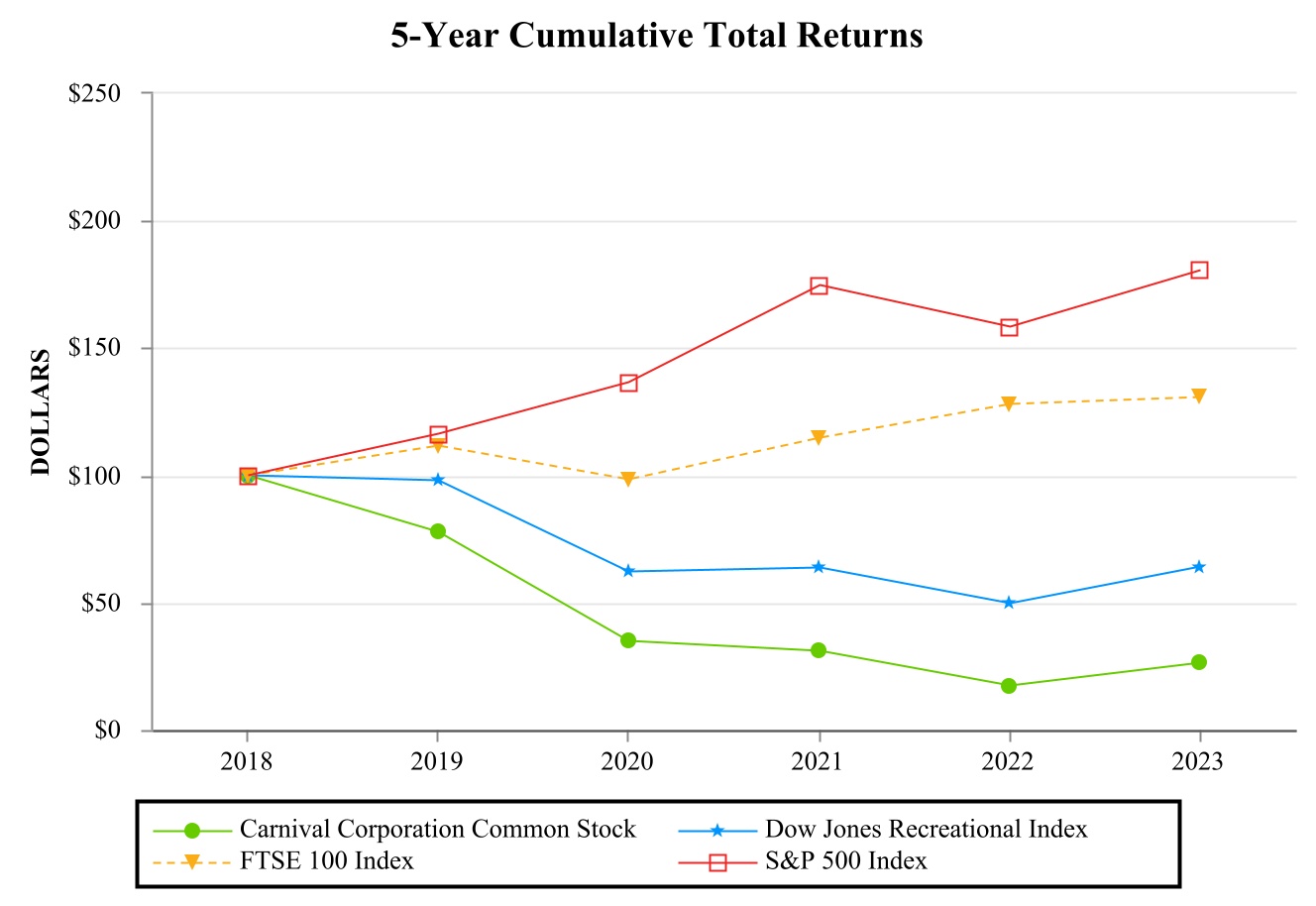
The following graph compares the Price Performance of $100 if invested in Carnival Corporation common stock with the Price Performance of $100 if invested in each of the Dow Jones U.S. Recreational Services Index (the “Dow Jones Recreational Index”), the FTSE 100 Index and the S&P 500 Index. The Price Performance, as used in the Performance Graph, is calculated by assuming $100 is invested at the beginning of the period in Carnival Corporation common stock at a price equal to the market value. At the end of each year, the total value of the investment is computed by taking the number of shares owned, assuming Carnival Corporation dividends are reinvested, multiplied by the market price of the shares.
| Assumes $100 Invested on November 30, 2018 Assumes Dividends Reinvested Years Ended November 30, | ||||||||||||||||||||||||||||||||||||||
| 2018 | 2019 | 2020 | 2021 | 2022 | 2023 | |||||||||||||||||||||||||||||||||
| Carnival Corporation Common Stock | $ | 100 | $ | 78 | $ | 35 | $ | 31 | $ | 17 | $ | 26 | ||||||||||||||||||||||||||
| Dow Jones Recreational Index | $ | 100 | $ | 98 | $ | 62 | $ | 64 | $ | 50 | $ | 64 | ||||||||||||||||||||||||||
| FTSE 100 Index | $ | 100 | $ | 112 | $ | 98 | $ | 115 | $ | 128 | $ | 131 | ||||||||||||||||||||||||||
| S&P 500 Index | $ | 100 | $ | 116 | $ | 136 | $ | 174 | $ | 158 | $ | 180 |
Carnival plc
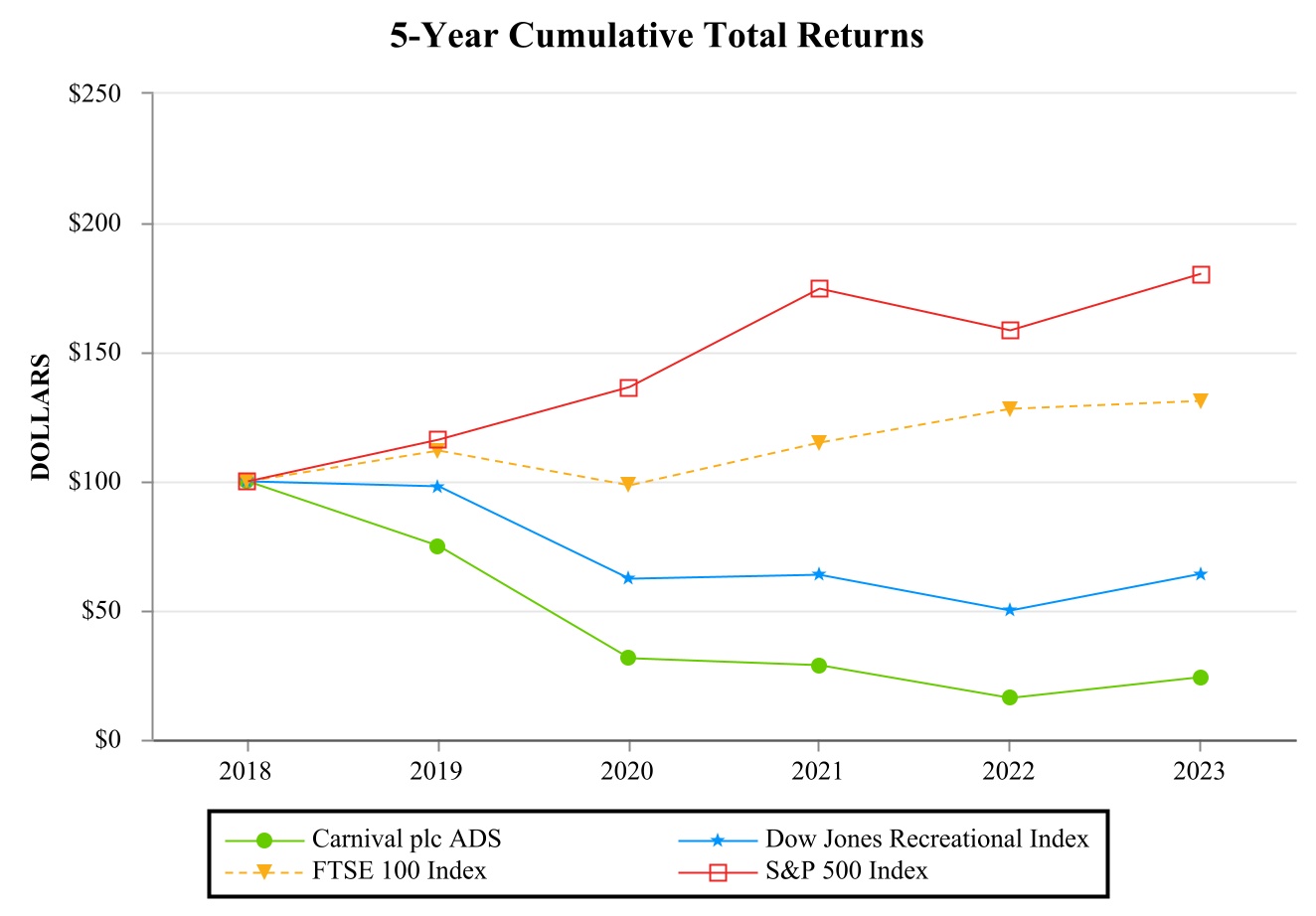
The following graph compares the Price Performance of $100 invested in Carnival plc ADSs, each representing one ordinary share of Carnival plc, with the Price Performance of $100 invested in each of the indexes noted below. The Price Performance is calculated in the same manner as previously discussed.
| Assumes $100 Invested on November 30, 2018 Assumes Dividends Reinvested Years Ended November 30, | |||||||||||||||||||||||||||||||||||
| 2018 | 2019 | 2020 | 2021 | 2022 | 2023 | ||||||||||||||||||||||||||||||
| Carnival plc ADS | $ | 100 | $ | 75 | $ | 31 | $ | 29 | $ | 16 | $ | 24 | |||||||||||||||||||||||
| Dow Jones Recreational Index | $ | 100 | $ | 98 | $ | 62 | $ | 64 | $ | 50 | $ | 64 | |||||||||||||||||||||||
| FTSE 100 Index | $ | 100 | $ | 112 | $ | 98 | $ | 115 | $ | 128 | $ | 131 | |||||||||||||||||||||||
| S&P 500 Index | $ | 100 | $ | 116 | $ | 136 | $ | 174 | $ | 158 | $ | 180 |
F. Issuer Purchases of Equity Securities; Use of Proceeds from Registered Securities
I. Stock Swap Program
Our Stock Swap Program allows us to realize a net cash benefit when Carnival Corporation common stock is trading at a premium to the price of Carnival plc ordinary shares. Under the Stock Swap Program, we may elect to offer and sell shares of Carnival Corporation common stock at prevailing market prices in ordinary brokers’ transactions and repurchase an equivalent number of Carnival plc ordinary shares in the UK market.
Under the Stock Swap Program effective June 2021, the Boards of Directors authorized the sale of up to $500 million of shares of Carnival Corporation common stock in the U.S. market and the repurchase of an equivalent number of Carnival plc ordinary shares.
We may in the future implement a program to allow us to realize a net cash benefit when Carnival plc ordinary shares are trading at a premium to the price of Carnival Corporation common stock.
Any sales of Carnival Corporation common stock and Carnival plc ordinary shares have been or will be registered under the Securities Act of 1933, as amended. Since the beginning of the Stock Swap Program, first authorized in June 2021, we have sold 17.2 million shares of Carnival Corporation common stock and repurchased the same amount of Carnival plc ordinary shares, resulting in net proceeds of $29 million. During the three months ended November 30, 2023, there were no sales or repurchases under the Stock Swap Program. During the three months ended November 30, 2023, no shares of Carnival Corporation common stock or Carnival plc ordinary shares were repurchased.
II. Carnival plc Shareholder Approvals
Annual shareholder approval is required for Carnival plc to buy back its ordinary shares. The existing shareholder approval is limited to a maximum of 18.6 million ordinary shares of Carnival plc and expires at the conclusion of the Carnival plc 2024 Annual General Meeting or July 20, 2024, whichever is earlier. We also treat purchases of Carnival plc ordinary shares by Carnival Corporation or Carnival Investments Limited under the Stock Swap Program as if they were made by Carnival plc under the Carnival plc share buyback authority.
Item 6. Reserved.
Item 7. Management’s Discussion and Analysis of Financial Condition and Results of Operations.
2023 Executive Overview
We consistently set records and achieved other significant milestones during this past year, including:
-
Full year revenues hit an all-time high of $21.6 billion.
-
For the first time since the resumption of guest cruise operations, net income was positive during the third quarter, generating $1.07 billion.
-
We entered 2024 with our best booked position on record, for both price and occupancy.
-
Total customer deposits for each quarter throughout 2023 consistently surpassed the previous quarterly records.
-
We reduced our debt balance by $4.6 billion from its peak in the first quarter of 2023 and ended the year with $5.4 billion of liquidity.
The strengthening demand environment across all our brands contributed to our revenue growth as we drove improvements in ticket prices while closing the double-digit occupancy gap from the start of the year and reaching historical occupancy levels for the second half of 2023.
We believe our advertising investments and other demand generation efforts during the past 18 months have successfully elevated awareness and consideration for our brands, leading to record booking levels and revenue results. In addition, these efforts enabled us to attract more new-to cruise and more new-to brand guests compared to 2019. We are building momentum in closing the value gap to land-based alternatives, capturing over 3.5 million new-to cruise guests in 2023 and remain well-positioned to take share from land-based alternatives.
We continue to take actions to further stimulate demand and maintain our momentum through 2024 and beyond. We are focused on ongoing improvements across the commercial space as we further rollout advancements to our yield management tools and lead generation techniques, continue to invest in sales and sales support, and build on already strong relationships with our trade partners. This is complemented by our strategy to pull forward the sale of onboard items through bundled product offerings and pre-cruise sales.
We are also not losing sight of our expense base, as we have worked to mitigate the impacts of a high inflation environment by leveraging our scale through cost optimization initiatives. We have made investments that we expect to increase our cost efficiencies in the future, including successfully installing SpaceX's Starlink, next generation internet across our fleet, which is expected to drive more than a 20% reduction in cost per megabit in 2024. In addition, we expect it will increase our bandwidth pipeline, resulting in both improved guest experience and higher onboard revenues. We also launched Maritime Asset Strategy Transformation (“MAST”), a centralized system developed to optimize equipment and machinery management across our brands and our fleet.
During 2023, we continued to work aggressively to reduce our environmental footprint and fuel consumption. Our deep commitment resulted in industry-leading fuel efficiency and a more than 10% reduction in absolute GHG emissions compared to our peak year of 2011, despite capacity growth of 30% over the same period. We also exceeded our shore power capability goal and our fleet now has twice as many ships ready to plug into shore power as there are ports currently able to provide it.
As a result of our fleet optimization efforts, our fleet is now one year younger than prior to pausing our guest cruise operations four years ago. During 2023 alone we benefited from the introduction of three fantastic new ships including Carnival Celebration and Arvia, leveraging the scale of our popular and exceptionally efficient series of excel-class ships, and Seabourn Pursuit, our second luxury expedition ship. In addition, Carnival Cruise Line welcomed Carnival Venezia, which was transferred from Costa, becoming the first ship as part of Carnival’s Fun Italian Style™ platform. We will continue to optimize our brand portfolio by transferring Costa Firenze to Carnival Cruise Line in 2024.
We also made meaningful progress in other strategic asset projects. We began construction on Celebration Key in Grand Bahama, which will be the largest and closest exclusive destination in our portfolio. While not expected to open until summer 2025, we have begun generating consumer awareness and excitement around this fantastic upcoming destination. We also started the process for a significant upsize in guest traffic at Half Moon Cay, our exclusive and beautiful pristine island destination in The Bahamas, with the creation of a pier-side berth that can accommodate our largest vessels. In addition, we commenced work with our Grand Bahama Shipyard partners on the construction of two floating docks, one of which will have the largest lifting capacity in the world. Together, these strategic investments are expected to significantly benefit us by helping to reduce travel time, further reducing our fuel consumption and preserving ship revenue days.
Our significantly improved 2023 cash from operations enabled us to notably reduce the substantial debt balance incurred during the pause of guest cruise operations. In 2023, we made sizeable debt prepayments and ended the year with over $5 billion of liquidity. Looking forward, we expect to continue to strategically refinance and prepay debt, leveraging our improving operating cash flow and the return of substantially all of the remaining credit card reserves during the first quarter of 2024.
In addition, with nearly two-thirds of 2024 on the books already, we are well positioned to achieve another year of record revenues. This, combined with excess liquidity, is expected to enable us to continue actively managing down debt and reducing interest expense, leaving us on our path back to achieving investment grade credit ratings and higher return on invested capital.
This has been a truly remarkable year, and we have come a long way in an incredibly short amount of time. We delivered unforgettable happiness to over 12 million guests this year and look forward to continuing to provide our guests with extraordinary cruise vacations in 2024, while honoring the integrity of every ocean we sail, place we visit and life we touch.
New Accounting Pronouncements
Refer to our consolidated financial statements for further information on Accounting Pronouncements.
Critical Accounting Estimates
Our critical accounting estimates are those we believe require our most significant judgments about the effect of matters that are inherently uncertain. A discussion of our critical accounting estimates, the underlying judgments and uncertainties used to make them and the likelihood that materially different estimates would be reported under different conditions or using different assumptions is as follows:
Liquidity and Other Uncertainties
We make several critical accounting estimates with respect to our liquidity.
As part of our liquidity management, we rely on estimates of our future liquidity, which includes numerous assumptions that are subject to various risks and uncertainties. The principal assumptions used to estimate our future liquidity consist of:
-
Expected increases in revenue in 2024 as compared to 2023
-
Expected prepayment of debt
-
Continued stabilization of inflationary pressures on costs compared to 2023
-
Fuel prices at or around November 2023 year-end prices
In addition, we make certain assumptions about new ship deliveries, improvements on existing ships as well as other capital expenditures, removals of existing ships, and consider the future export credit financings that are associated with the new ship deliveries.
We have a substantial debt balance incurred during the pause in guest cruise operations and require a significant amount of liquidity or cash provided by operating activities to service our debt. We will continue to pursue various opportunities to refinance future debt maturities to extend maturity dates and reduce interest expense by repaying some of our existing indebtedness.
Ship Accounting
We make several critical accounting estimates with respect to our ship accounting including ship improvement costs, estimated useful lives and residual values.
We account for ship improvement costs, including replacements of certain significant components and parts, by capitalizing those costs that we believe add value to our ships and have a useful life greater than one year and depreciating those improvements over their estimated remaining useful life. The costs of repairs and maintenance, including those incurred when a ship is taken out-of-service for scheduled maintenance, and minor improvement costs and expenses, are charged to expense as incurred. If we change our assumptions in making our determinations as to whether improvements to a ship add value, the amounts we expense each year as repair and maintenance expense could increase, which would be partially offset by a decrease in depreciation expense, resulting from a reduction in capitalized costs.
In addition, the specifically identified or estimated cost and accumulated depreciation of previously capitalized ship components are written-off upon retirement, which may result in a loss on disposal that is also included in other operating expenses. We do not have cost segregation studies performed to specifically componentize our ships. In addition, since we do not separately componentize our ships, we do not identify and track depreciation of original ship components. Therefore, we typically have to estimate the net book value of components that are retired, based primarily upon their replacement cost, their age and their original estimated useful lives. Given the large size and complexity of our ships, ship accounting estimates require considerable judgment and are inherently uncertain.
In order to compute our ships’ depreciation expense, we apply judgment to determine their useful lives as well as their residual values. We have estimated our ships’ useful lives at 30 years and residual values at 15% of our original ship cost. Our ships’ useful life and residual value estimates take into consideration the estimated weighted-average useful lives of the ships’ major component systems, such as hull, superstructure, main electric, engines and cabins. We also take into consideration the impact of technological changes, historical useful lives of similarly-built ships, long-term cruise and vacation market conditions and regulatory changes, including those related to the environment and climate change. We determine the residual value of our ships based on our long-term estimates of their resale value at the end of their useful lives to us but before the end of their physical and economic lives to others, historical resale values of our and other cruise ships as well as our expectations of the long-term viability of the secondary cruise ship market. We review estimated useful lives and residual values for reasonableness whenever events or circumstances significantly change. Since the pause of our guest cruise operations, we have disposed of ships for amounts significantly below their book values. Management has estimated that this trend will normalize in the coming years.
The IMO recently adopted its 2023 Strategy on Reduction of GHG Emissions from Ships that would require international shipping to reduce total GHG emissions on a well-to-wake basis to net zero by or around 2050. In addition, the framework introduces checkpoints in 2030 and 2040 that seek reductions in the total GHG emissions from international shipping by at least 20% and 70%, respectively, compared to 2008. The EU has also proposed several regulations that will likely impact the cost of fossil fuels and has recently adopted the inclusion of maritime shipping in the EU’s Emission Trading System. We have established Climate Action Goals, which include a GHG intensity reduction goal of 20% by 2030 from the 2019 baseline and pursuing net zero emissions by 2050. Given a 30-year estimated useful life for our ships, our most recently delivered vessels’ lives will extend beyond this 2050 date. Fossil fuels are currently the only viable option for our industry and it is not clear when alternative fuels or other technologies will be commercially viable. To provide a path to net zero emissions, alternative low GHG emission fuels will be necessary for the maritime industry; however, there are significant supply challenges that must be resolved before viability is reached. We are closely monitoring technology developments and partnering with key organizations on research and development to support our sustainability goals and aspirations. Our fleet’s engines are capable of being modified for use with certain alternative fuels and we have completed tests on the use of marine biofuel blends on certain ships in our fleet. In addition, and in support of our Climate Action Goals, we invest in technologies, including the use of LNG powered cruise ships, the installation of Advanced Air Quality Systems on board our ships to aid in the reduction of sulfur emissions, the use of shore power, enabling ships to use shoreside electric power where available while in port and various other efficiency related upgrades intended to reduce our emissions. It is uncertain how recently adopted, proposed and possible future regulatory changes related to the environment and climate change and our pursuit of net zero emissions by 2050, may impact our ships’ useful lives and residual values and the impact is dependent on future regulatory actions and technological advances. As of November 30, 2023, management concluded that there were no changes in our ship useful lives and residual value estimates.
If materially different conditions existed, or if we materially changed our assumptions of ship useful lives and residual values, then our depreciation expense, loss on retirement of ship components and net book value of our ships would be materially different. Our 2023 ship depreciation expense would have increased by approximately:
-
$49 million assuming we had reduced our estimated 30-year ship useful life estimate by one year at the time we took delivery or acquired each of our ships
-
$245 million assuming we had estimated our ships to have no residual value
We believe that the estimates we made for ship accounting purposes are reasonable and our methods are consistently applied in all material respects and result in depreciation expense that is based on a rational and systematic method to equitably allocate the costs of our ships to the periods during which we use them.
Valuation of Ships
Impairment reviews of our ships require us to make significant estimates. We evaluate ship asset impairments at the individual ship level which is the lowest level for which identifiable cash flows are largely independent of the cash flows of other assets and liabilities. We review our ships for impairment whenever events or circumstances indicate that the carrying value of a ship may not be recoverable. If estimated future cash flows are less than the carrying value of a ship, an impairment charge is recognized to the extent its carrying value exceeds its estimated fair value. Where estimated future cash flows are used to estimate the recoverable value of a ship, the cash flows include estimated regulatory costs, including those related to proposed regulations, which are likely to impact costs and capital expenditures, including those expected to meet our 2030 Climate Action Goals.
The estimation of a ship’s fair value includes numerous assumptions that are subject to various risks and uncertainties. The principal assumption used in determining the fair value of these ships was the estimated sales proceeds.
We determined the fair value of these ships based on their respective estimated selling values, for those ships expected to be disposed of, or estimated discounted future cash flows and comparable market transactions. Refer to our consolidated financial statements for additional discussion of our property and equipment policy and ship impairment reviews.
We believe that we have made reasonable estimates.
Contingencies
We periodically assess the potential liabilities related to any lawsuits or claims brought against us, as well as for other known unasserted claims, including environmental, legal, regulatory and guest and crew matters. While it is typically very difficult to determine the timing and ultimate outcome of these matters, we use our best judgment to determine the appropriate amounts to record in our consolidated financial statements.
We accrue a liability and establish a reserve when we believe a loss is probable and the amount of the loss can be reasonably estimated. In assessing probable losses, we make estimates of the amount of probable insurance recoveries, if any, which are recorded as assets where appropriate. Such accruals and reserves are typically based on developments to date, management’s estimates of the outcomes of these matters, our experience in contesting, litigating and settling other similar matters, historical claims experience, actuarially determined estimates of liabilities and any related insurance coverage.
Given the inherent uncertainty related to the eventual outcome of these matters and potential insurance recoveries, it is possible that all or some of these matters may be resolved for amounts materially different from any provisions or disclosures that we may have made. In addition, as new information becomes available, we may need to reassess the amount of asset or liability that needs to be accrued related to our contingencies. All such changes in our estimates could materially impact our results of operations and financial position.
Refer to our consolidated financial statements for additional discussion of contingencies.
Known Trends and Uncertainties
-
We believe the volatility in the cost of fuel and increases in other related costs are reasonably likely to continue to impact our profitability in both the short and long-term.
-
We believe inflation and interest rates are reasonably likely to continue to impact our profitability.
-
We believe a global minimum tax could affect us in 2026, with the potential for a one-year deferral. Prior to any mitigating actions, we believe the annual impact could be approximately $200 million. We continue to evaluate the impact of these rules and are currently evaluating a variety of mitigating actions to minimize the impact. The application of the rules continues to evolve, and its outcome may alter our tax obligations in certain countries in which we operate.
-
We believe the increasing global focus on climate change, including the reduction of GHG emissions and new and evolving regulatory requirements, is reasonably likely to have a material negative impact on our future financial results. We became subject to the EU Emission Trading Scheme (“ETS”) on January 1, 2024, which includes a three-year phase-in period. We estimate the impact in 2024 to be approximately $51 million based on a European Union Allowance cost of $75 per metric ton of emissions. Refer to XIX. Governmental Regulations.
-
We believe that the instability in the Red Sea region currently impacting shipping could have an impact on our results of operations.
Results of Operations
We have historically earned substantially all of our cruise revenues from the following:
-
Sales of passenger cruise tickets and, in some cases, the sale of air and other transportation to and from airports near our ships’ home ports and cancellation fees. We also collect fees, taxes and other charges from our guests. The cruise ticket price typically includes the following:
-
Accommodations
-
Most meals, including snacks at numerous venues
-
Access to amenities such as swimming pools, water slides, water parks, whirlpools, a health club and sun decks
-
Child care and supervised youth programs
-
Entertainment, such as theatrical and comedy shows, live music and nightclubs
-
Visits to multiple destinations
-
Sales of onboard goods and services not included in the cruise ticket price. This generally includes the following:
| • Beverage sales | • Internet and communication services | ||||
| • Casino gaming | • Full service spas | ||||
| • Shore excursions | • Specialty restaurants | ||||
| • Retail sales | • Art sales | ||||
| • Photo sales | • Laundry and dry cleaning services |
These goods and services are provided either directly by us or by independent concessionaires, from which we receive either a percentage of their revenues or a fee. Concession revenues do not have direct expenses because the costs and services incurred for concession revenues are borne by our concessionaires. In 2023, we earned 34% of our cruise revenues from onboard and other revenue goods and services.
We earn our tour and other revenues from our hotel and transportation operations and other revenues.
We incur cruise operating expenses for the following:
-
The costs of passenger cruise bookings, which include travel agent commissions, cost of air and other transportation, port fees, taxes, and charges that directly vary with guest head counts and credit and debit card fees
-
Onboard and other cruise costs, which include the costs of beverage sales, costs of shore excursions, costs of retail sales, internet and communication costs, credit and debit card fees, other onboard costs, costs of cruise vacation protection programs and pre- and post-cruise land packages
-
Payroll and related costs, which include the costs of officers and crew in bridge, engineering and hotel operations. Substantially all costs associated with our shoreside personnel are included in selling and administrative expenses
-
Fuel costs, which include fuel delivery costs
-
Food costs, which include both our guest and crew food costs
-
Other ship operating expenses, which include port costs that do not vary with guest head counts; repairs and maintenance, including minor improvements and dry-dock expenses; hotel costs; entertainment; gains and losses on ship sales; ship impairments; freight and logistics; insurance premiums and all other ship operating expenses
We incur tour and other costs and expenses for our hotel and transportation operations and other expenses.
Statistical Information
| Years Ended November 30, | |||||||||||||||||
| 2023 | 2022 | 2021 | |||||||||||||||
| Passenger Cruise Days (“PCDs”) (in millions) (a) | 91.4 | 54.6 | 8.2 | ||||||||||||||
| Available Lower Berth Days (“ALBDs”) (in millions) (b) | 91.3 | 72.5 | 14.6 | ||||||||||||||
| Occupancy percentage (c) | 100 | % | 75 | % | 56 | % | |||||||||||
| Passengers carried (in millions) | 12.5 | 7.7 | 1.2 | ||||||||||||||
| Fuel consumption in metric tons (in millions) | 2.9 | 2.6 | 1.3 | ||||||||||||||
| Fuel consumption in metric tons per thousand ALBDs | 32.1 | 36.1 | (d) | ||||||||||||||
| Fuel cost per metric ton consumed | $ | 701 | $ | 830 | $ | 515 | |||||||||||
| Currencies (USD to 1) | |||||||||||||||||
| AUD | $ | 0.66 | $ | 0.70 | $ | 0.75 | |||||||||||
| CAD | $ | 0.74 | $ | 0.77 | $ | 0.80 | |||||||||||
| EUR | $ | 1.08 | $ | 1.06 | $ | 1.19 | |||||||||||
| GBP | $ | 1.24 | $ | 1.25 | $ | 1.38 |
Notes to Statistical Information
(a)PCD represents the number of cruise passengers on a voyage multiplied by the number of revenue-producing ship operating days for that voyage.
(b)ALBD is a standard measure of passenger capacity for the period that we use to approximate rate and capacity variances, based on consistently applied formulas that we use to perform analyses to determine the main non-capacity driven factors that cause our cruise revenues and expenses to vary. ALBDs assume that each cabin we offer for sale accommodates two passengers and is computed by multiplying passenger capacity by revenue-producing ship operating days in the period.
(c)Occupancy, in accordance with cruise industry practice, is calculated using a numerator of PCDs and a denominator of ALBDs, which assumes two passengers per cabin even though some cabins can accommodate three or more passengers. Percentages in excess of 100% indicate that on average more than two passengers occupied some cabins.
(d)Fuel consumption in metric tons per thousand ALBDs for 2021 is not meaningful.
2023 Compared to 2022
The discussion below compares the results of operations for the year ended November 30, 2023 to the year ended November 30, 2022. You should read this discussion in conjunction with the consolidated financial statements and the notes thereto included elsewhere in this annual report. For a comparison of the Company’s results of operations for the year ended November 30, 2022 to the year ended November 30, 2021, see “Item 7, Management’s Discussion and Analysis of Financial Condition and Results of Operations” in the Company’s Annual Report on Form 10-K for the year ended November 30, 2022, which was filed with the U.S. Securities and Exchange Commission on January 27, 2023.
Results of Operations
| Consolidated | |||||||||||||||||||||||
| Years Ended November 30, | |||||||||||||||||||||||
| (in millions) | 2023 | 2022 | Change | ||||||||||||||||||||
| Revenues | |||||||||||||||||||||||
| Passenger ticket | $ | 14,067 | $ | 7,022 | $ | 7,045 | |||||||||||||||||
| Onboard and other | 7,526 | 5,147 | 2,380 | ||||||||||||||||||||
| 21,593 | 12,168 | 9,425 | |||||||||||||||||||||
| Operating Expenses | |||||||||||||||||||||||
| Commissions, transportation and other | 2,761 | 1,630 | 1,131 | ||||||||||||||||||||
| Onboard and other | 2,375 | 1,528 | 847 | ||||||||||||||||||||
| Payroll and related | 2,373 | 2,181 | 192 | ||||||||||||||||||||
| Fuel | 2,047 | 2,157 | (110) | ||||||||||||||||||||
| Food | 1,335 | 863 | 472 | ||||||||||||||||||||
| Ship and other impairments | — | 440 | (440) | ||||||||||||||||||||
| Other operating | 3,426 | 2,958 | 467 | ||||||||||||||||||||
| Cruise and tour operating expenses | 14,317 | 11,757 | 2,560 | ||||||||||||||||||||
| Selling and administrative | 2,950 | 2,515 | 435 | ||||||||||||||||||||
| Depreciation and amortization | 2,370 | 2,275 | 95 | ||||||||||||||||||||
| 19,637 | 16,547 | 3,090 | |||||||||||||||||||||
| Operating Income (Loss) | 1,956 | (4,379) | 6,335 | ||||||||||||||||||||
| Nonoperating Income (Expense) | |||||||||||||||||||||||
| Interest income | 233 | 74 | 159 | ||||||||||||||||||||
| Interest expense, net of capitalized interest | (2,066) | (1,609) | (457) | ||||||||||||||||||||
| Gains (losses) on debt extinguishment, net | (111) | (1) | (110) | ||||||||||||||||||||
| Other income (expense), net | (75) | (165) | 90 | ||||||||||||||||||||
| (2,018) | (1,701) | (317) | |||||||||||||||||||||
| Income (Loss) Before Income Taxes | $ | (62) | $ | (6,080) | $ | 6,018 |
| NAA | |||||||||||||||||||||||
| Years Ended November 30, | |||||||||||||||||||||||
| (in millions) | 2023 | 2022 | Change | ||||||||||||||||||||
| Revenues | |||||||||||||||||||||||
| Passenger ticket | $ | 9,122 | $ | 4,692 | $ | 4,430 | |||||||||||||||||
| Onboard and other | 5,466 | 3,589 | 1,877 | ||||||||||||||||||||
| 14,588 | 8,281 | 6,307 | |||||||||||||||||||||
| Operating Expenses | 9,587 | 7,526 | 2,061 | ||||||||||||||||||||
| Selling and administrative | 1,753 | 1,517 | 236 | ||||||||||||||||||||
| Depreciation and amortization | 1,495 | 1,408 | 88 | ||||||||||||||||||||
| 12,836 | 10,451 | 2,385 | |||||||||||||||||||||
| Operating Income (Loss) | $ | 1,752 | $ | (2,170) | $ | 3,922 |
| Europe | |||||||||||||||||||||||
| Years Ended November 30, | |||||||||||||||||||||||
| (in millions) | 2023 | 2022 | Change | ||||||||||||||||||||
| Revenues | |||||||||||||||||||||||
| Passenger ticket | $ | 5,004 | $ | 2,660 | $ | 2,344 | |||||||||||||||||
| Onboard and other | 1,531 | 872 | 659 | ||||||||||||||||||||
| 6,535 | 3,531 | 3,003 | |||||||||||||||||||||
| Operating Expenses | 4,398 | 3,925 | 474 | ||||||||||||||||||||
| Selling and administrative | 876 | 745 | 131 | ||||||||||||||||||||
| Depreciation and amortization | 668 | 692 | (24) | ||||||||||||||||||||
| 5,942 | 5,361 | 581 | |||||||||||||||||||||
| Operating Income (Loss) | $ | 593 | $ | (1,830) | $ | 2,423 |
During the pause in our guest cruise operations, we incurred substantial debt and require a significant amount of cash to service our debt. Our ability to generate cash will be affected by general macroeconomic, financial, geopolitical, competitive, regulatory and other factors beyond our control. The full extent of these impacts is uncertain and may be amplified by our substantial debt balance.
Revenues
Consolidated
Cruise passenger ticket revenues made up 65% of our total revenues in 2023 while onboard and other revenues made up 35%. Revenues for the year ended November 30, 2023 increased by $9.4 billion to $21.6 billion from $12.2 billion in 2022 due to the significant increase of ships in service and considerably higher occupancy levels in 2023 as compared to 2022. ALBDs increased to 91.3 million in 2023 as compared to 72.5 million in 2022. Occupancy for 2023 was 100%, compared to 75% in 2022.
NAA Segment
Cruise passenger ticket revenues made up 63% of our NAA segment’s total revenues in 2023 while onboard and other cruise revenues made up 37%. NAA segment revenues for 2023 increased by $6.3 billion to $14.6 billion from $8.3 billion in 2022 due to the significant increase of ships in service and considerably higher occupancy levels in 2023 as compared to 2022. ALBDs increased to 56.4 million in 2023 as compared to 44.3 million in 2022. Occupancy for 2023 was 103% compared to 82% in 2022.
Europe Segment
Cruise passenger ticket revenues made up 77% of our Europe segment’s total revenues in 2023 while onboard and other cruise revenues made up 23%. Europe segment revenues for 2023 increased by $3.0 billion to $6.5 billion from $3.5 billion in 2022 due to the significant increase of ships in service and considerably higher occupancy levels in 2023 as compared to 2022. ALBDs increased to 34.9 million in 2023 as compared to 28.2 million in 2022. Occupancy for 2023 was 95% compared to 65% in 2022.
Operating Expenses
Consolidated
Operating expenses increased by $2.6 billion to $14.3 billion in 2023 from $11.8 billion in 2022. These increases were driven by our resumption of guest cruise operations, an increase of ships in service and considerably higher occupancy levels.
Fuel costs decreased by $0.1 billion to $2.0 billion in 2023 from $2.2 billion in 2022. $0.4 billion of this decrease was caused by lower fuel prices and changes in fuel mix of $129 per metric ton consumed in 2023 compared to 2022, partially offset by higher fuel consumption due to the resumption of guest cruise operations.
We did not recognize ship and other impairment charges in 2023 compared to $440 million recognized in 2022.
Selling and administrative expenses increased by $0.4 billion to $2.9 billion in 2023 from $2.5 billion in 2022. This increase was
caused by increases in advertising costs and administrative expenses incurred as part of our resumption of guest cruise operations, which includes an increase in incentive compensation reflecting expected improvements in the company’s current and long-term performance.
The drivers in changes in costs and expenses for our NAA and Europe segments are the same as those described for our consolidated results.
Nonoperating Income (Expense)
Interest expense, net of capitalized interest, increased by $0.5 billion to $2.1 billion in 2023 from $1.6 billion in 2022. The increase was caused by a higher average interest rate in 2023 compared to 2022, partially offset by a decrease in total debt.
Debt extinguishment and modification costs were $111 million in 2023 as a result of debt transactions during the year compared to $1 million in 2022.
Liquidity, Financial Condition and Capital Resources
As of November 30, 2023, we had $5.4 billion of liquidity including $2.4 billion of cash and cash equivalents and $3.0 billion of borrowings available under our Revolving Facility, which matures in August 2024. In February 2023, Carnival Holdings II entered into the $2.1 billion New Revolving Facility, which may be utilized beginning in August 2024, at which date it will replace our Revolving Facility. We will continue to pursue various opportunities to refinance future debt maturities to extend maturity dates and reduce interest expense by repaying some of our existing indebtedness. Refer to Note 5 - “Debt” of the consolidated financial statements and Funding Sources below for additional details.
We had a working capital deficit of $6.2 billion as of November 30, 2023 compared to a working capital deficit of $3.1 billion as of November 30, 2022. The increase in working capital deficit was caused by a decrease in cash and cash equivalents and restricted cash and an increase in customer deposits, partially offset by an increase in prepaid expenses and a decrease in short-term borrowings and the current portion of long-term debt. We operate with a substantial working capital deficit. This deficit is mainly attributable to the fact that, under our business model, substantially all of our passenger ticket receipts are collected in advance of the applicable sailing date. These advance passenger receipts generally remain a current liability on our balance sheet until the sailing date. The cash generated from these advance receipts is used interchangeably with cash on hand from other sources, such as our borrowings and other cash from operations. The cash received as advanced receipts can be used to fund operating expenses, pay down our debt, make long-term investments or any other use of cash. Included within our working capital are $6.1 billion and $4.9 billion of customer deposits as of November 30, 2023 and 2022, respectively. We have agreements with a number of credit card processors that transact customer deposits related to our cruise vacations. Certain of these agreements allow the credit card processors to request, under certain circumstances, that we provide a reserve fund in cash. In addition, we have a relatively low level of accounts receivable and limited investment in inventories.
Sources and Uses of Cash
Operating Activities
Our business provided $4.3 billion of net cash flows from operating activities during 2023, an increase of $6.0 billion, compared to $1.7 billion used in 2022. This was caused by a decrease in the net loss compared to the same period in 2022 and other working capital changes.
Investing Activities
During 2023, net cash used in investing activities was $2.8 billion. This was driven by:
-
Capital expenditures of $1.9 billion for our ongoing new shipbuilding program
-
Capital expenditures of $1.4 billion for ship improvements and replacements, information technology and buildings and improvements
-
Proceeds from sales of ships and other of $340 million
During 2022, net cash used in investing activities was $4.8 billion. This was driven by:
-
Capital expenditures of $3.9 billion for our ongoing new shipbuilding program
-
Capital expenditures of $1.1 billion for ship improvements and replacements, information technology and buildings and improvements
-
Proceeds from sales of ships and other of $70 million
-
Purchases of short-term investments of $315 million
-
Proceeds from maturity of short-term investments of $515 million
Financing Activities
During 2023, net cash used in financing activities of $5.1 billion was driven by:
-
Repayments of $200 million of short-term borrowings
-
Repayments of $5.9 billion of long-term debt and refinancing of $1.8 billion of long-term debt to extend maturities
-
Issuances of $3.0 billion of long-term debt
-
Debt issuance costs of $131 million
-
Debt extinguishment costs of $79 million
-
Proceeds from issuance of $22 million of Carnival Corporation common stock and purchases of $20 million of Carnival plc ordinary shares under our Stock Swap Program
During 2022, net cash provided by financing activities of $3.6 billion was caused by:
-
Net repayments of short-term borrowings of $2.6 billion
-
Repayments of $2.1 billion of long-term debt
-
Debt issuance costs of $153 million
-
Issuances of $7.2 billion of long-term debt
-
Net proceeds of $1.2 billion from the public offering of Carnival Corporation common stock
-
Proceeds from issuance of $95 million of Carnival Corporation common stock and purchases of $87 million of Carnival plc ordinary shares under our Stock Swap Program
For the Company’s cash flow activities for the fiscal year ended November 30, 2021, see “Item 7, Management’s Discussion and Analysis of Financial Condition and Results of Operations” in the Company’s Annual Report on Form 10-K for the year ended November 30, 2022, which was filed with the U.S. Securities and Exchange Commission on January 27, 2023.
Material Cash Requirements
| Payments Due by | |||||||||||||||||||||||||||||||||||
| (in millions) | 2024 | 2025 | 2026 | 2027 | 2028 | Total | |||||||||||||||||||||||||||||
| Debt (a) | $ | 3,883 | $ | 3,844 | $ | 4,628 | $ | 7,487 | $ | 9,755 | $ | 29,597 | |||||||||||||||||||||||
| Newbuild capital expenditures (b) | 2,437 | 958 | — | — | — | 3,395 | |||||||||||||||||||||||||||||
| Total | $ | 6,320 | $ | 4,802 | $ | 4,628 | $ | 7,487 | $ | 9,755 | $ | 32,992 |
(a)Includes principal as well as estimated interest payments and does not include the impact of any future possible refinancings. Excludes undrawn export credits.
(b)As of November 30, 2023, we have committed undrawn export credit facilities of $3.0 billion which fund a portion of our newbuild contractual commitments.
Funding Sources
As of November 30, 2023, we had $5.4 billion of liquidity including $2.4 billion of cash and cash equivalents and $3.0 billion of borrowings available under our Revolving Facility, which matures in August 2024. In February 2023, Carnival Holdings II entered into the $2.1 billion New Revolving Facility, which may be utilized beginning in August 2024, at which date it will replace our Revolving Facility. Refer to Note 5 - “Debt” of the consolidated financial statements for additional discussion. In addition, we had $3.0 billion of undrawn export credit facilities to fund ship deliveries planned through 2025. We plan to use existing liquidity and future cash flows from operations to fund our cash requirements including capital expenditures not funded by our export credit facilities. We seek to manage our credit risk exposures, including counterparty nonperformance associated with our cash and cash equivalents, and future financing facilities by conducting business with well-established financial institutions, and export credit agencies and diversifying our counterparties.
| (in billions) | 2024 | 2025 | ||||||||||||||||||||||||||||||||||||||||||
| Future export credit facilities at November 30, 2023 | $ | 2.3 | $ | 0.7 |
Our export credit facilities contain various financial covenants as described in Note 5 - “Debt.” At November 30, 2023, we were in compliance with the applicable covenants under our debt agreements.
Stock Swap Program
Our Stock Swap Program allows us to realize a net cash benefit when Carnival Corporation common stock is trading at a premium to the price of Carnival plc ordinary shares. Under the Stock Swap Program, we may elect to offer and sell shares of Carnival Corporation common stock at prevailing market prices in ordinary brokers’ transactions and repurchase an equivalent number of Carnival plc ordinary shares in the UK market.
Any sales of Carnival Corporation common stock and Carnival plc ordinary shares have been or will be registered under the Securities Act of 1933, as amended. During 2023, under the Stock Swap Program, we sold 2.3 million shares of Carnival Corporation common stock and repurchased the same amount of Carnival plc ordinary shares, resulting in net proceeds of $2 million which were used for general corporate purposes. In addition, during 2023 we sold 0.5 million shares of Carnival Corporation common stock at an average price per share of $9.83, resulting in net proceeds of $5 million. During 2022, we sold 6.0 million shares of Carnival Corporation’s common stock and repurchased the same amount of Carnival plc ordinary shares, resulting in net proceeds of $8 million which were used for general corporate purposes. In addition, during 2022 we sold 1.6 million shares of Carnival Corporation common stock at an average price per share of $19.27, resulting in net proceeds of $30 million. During 2021, we sold $8.9 million shares of Carnival Corporation’s common stock and repurchased the same
amount of Carnival plc ordinary shares, resulting in net proceeds of $19 million. In addition, during 2021 we sold 0.6 million shares of Carnival Corporation common stock at an average price per share of $21.32, resulting in net proceeds of $13 million.
Item 7A. Quantitative and Qualitative Disclosures About Market Risk.
For a discussion of our hedging strategies and market risks, see the discussion below and the consolidated financial statements.
Fuel Price Risks
Substantially all our exposure to market risk for changes in fuel prices relates to the consumption of fuel on our ships.
Foreign Currency Exchange Rate Risks
Operational Currency Risks
Our operations primarily utilize the U.S. dollar, Euro, Sterling or the Australian dollar as their functional currencies. Our operations also have revenue and expenses denominated in non-functional currencies. Movements in foreign currency exchange rates will affect our financial statements.
Investment Currency Risks
The foreign currency exchange rates were as follows:
| November 30, | |||||||||||
| USD to 1: | 2023 | 2022 | |||||||||
| AUD | $ | 0.66 | $ | 0.66 | |||||||
| CAD | $ | 0.74 | $ | 0.74 | |||||||
| EUR | $ | 1.10 | $ | 1.03 | |||||||
| GBP | $ | 1.27 | $ | 1.20 |
If the November 30, 2022 currency exchange rates had been used to translate our November 30, 2023 non-U.S. dollar functional currency operations’ assets and liabilities (instead of the November 30, 2023 U.S. dollar exchange rates), our total assets would have been lower by $1.0 billion and our total liabilities would have been lower by $0.5 billion.
As of November 30, 2023, we have a cross currency swap totaling $670 million which settles through 2024. This cross-currency swap is designated as a hedge of our net investments in foreign operations, which has a euro-denominated functional currency, thus partially offsetting the foreign currency exchange rate risk. Based on a 10% change in the U.S. dollar to euro exchange rate as of November 30, 2023, we estimate that the fair value of this cross-currency swap and offsetting change in U.S. dollar value of our net investments would change by $66 million.
Newbuild Currency Risks
At November 30, 2023, our remaining newbuild currency exchange rate risk primarily relates to euro-denominated newbuild contract payments, which represent a total unhedged commitment of $3.0 billion and relate to newbuilds scheduled to be delivered through 2025 to non-euro functional currency brands. The functional currency cost of each of these ships will increase or decrease based on changes in the exchange rates until the unhedged payments are made under the shipbuilding contract. We may enter into additional foreign currency derivatives to mitigate some of this foreign currency exchange rate risk. Based on a 1% change in euro to U.S. dollar exchange rates as of November 30, 2023, the remaining unhedged cost of these ships would have a corresponding change of $30 million.
Interest Rate Risks
The composition of our debt, interest rate swaps and cross currency swaps was as follows:
| November 30, 2023 | |||||
| Fixed rate | 62 | % | |||
| EUR fixed rate | 18 | % | |||
| Floating rate | 5 | % | |||
| EUR floating rate | 15 | % | |||
At November 30, 2023, we had interest rate swaps that have effectively changed $46 million of EURIBOR-based floating rate euro debt to fixed rate euro debt. We also had interest rate swap agreements which effectively changed $2.5 billion at November 30, 2023 of SOFR-based floating rate USD debt to fixed rate USD debt. Based on a 100 basis point change in the market interest rates, our annual interest expense on floating rate debt, including the effect of our interest rate swaps, will change by approximately $60 million.
Item 8. Financial Statements and Supplementary Data.
CARNIVAL CORPORATION & PLC
CONSOLIDATED FINANCIAL STATEMENTS
FOR THE YEAR ENDED NOVEMBER 30, 2023
TABLE OF CONTENTS
CARNIVAL CORPORATION & PLC
CONSOLIDATED STATEMENTS OF INCOME (LOSS)
(in millions, except per share data)
| Years Ended November 30, | |||||||||||||||||
| 2023 | 2022 | 2021 | |||||||||||||||
| Revenues | |||||||||||||||||
| Passenger ticket | $ | 14,067 | $ | 7,022 | $ | 1,000 | |||||||||||
| Onboard and other | 7,526 | 5,147 | 908 | ||||||||||||||
| 21,593 | 12,168 | 1,908 | |||||||||||||||
| Operating Expenses | |||||||||||||||||
| Commissions, transportation and other | 2,761 | 1,630 | 269 | ||||||||||||||
| Onboard and other | 2,375 | 1,528 | 272 | ||||||||||||||
| Payroll and related | 2,373 | 2,181 | 1,309 | ||||||||||||||
| Fuel | 2,047 | 2,157 | 680 | ||||||||||||||
| Food | 1,335 | 863 | 187 | ||||||||||||||
| Ship and other impairments | — | 440 | 591 | ||||||||||||||
| Other operating | 3,426 | 2,958 | 1,346 | ||||||||||||||
| Cruise and tour operating expenses | 14,317 | 11,757 | 4,655 | ||||||||||||||
| Selling and administrative | 2,950 | 2,515 | 1,885 | ||||||||||||||
| Depreciation and amortization | 2,370 | 2,275 | 2,233 | ||||||||||||||
| Goodwill impairments | — | — | 226 | ||||||||||||||
| 19,637 | 16,547 | 8,997 | |||||||||||||||
| Operating Income (Loss) | 1,956 | (4,379) | (7,089) | ||||||||||||||
| Nonoperating Income (Expense) | |||||||||||||||||
| Interest income | 233 | 74 | 12 | ||||||||||||||
| Interest expense, net of capitalized interest | (2,066) | (1,609) | (1,601) | ||||||||||||||
| Debt extinguishment and modification costs | (111) | (1) | (670) | ||||||||||||||
| Other income (expense), net | (75) | (165) | (173) | ||||||||||||||
| (2,018) | (1,701) | (2,433) | |||||||||||||||
| Income (Loss) Before Income Taxes | (62) | (6,080) | (9,522) | ||||||||||||||
| Income Tax Benefit (Expense), Net | (13) | (14) | 21 | ||||||||||||||
| Net Income (Loss) | $ | (74) | $ | (6,093) | $ | (9,501) | |||||||||||
| Earnings Per Share | |||||||||||||||||
| Basic | $ | (0.06) | $ | (5.16) | $ | (8.46) | |||||||||||
| Diluted | $ | (0.06) | $ | (5.16) | $ | (8.46) |
The accompanying notes are an integral part of these consolidated financial statements.
CARNIVAL CORPORATION & PLC
CONSOLIDATED STATEMENTS OF COMPREHENSIVE INCOME (LOSS)
(in millions)
| Years Ended November 30, | |||||||||||||||||
| 2023 | 2022 | 2021 | |||||||||||||||
| Net Income (Loss) | $ | (74) | $ | (6,093) | $ | (9,501) | |||||||||||
| Items Included in Other Comprehensive Income (Loss) | |||||||||||||||||
| Change in foreign currency translation adjustment | 52 | (503) | (118) | ||||||||||||||
| Other | (8) | 22 | 53 | ||||||||||||||
| Other Comprehensive Income (Loss) | 44 | (481) | (65) | ||||||||||||||
| Total Comprehensive Income (Loss) | $ | (30) | $ | (6,574) | $ | (9,567) |
The accompanying notes are an integral part of these consolidated financial statements.
CARNIVAL CORPORATION & PLC
CONSOLIDATED BALANCE SHEETS
(in millions, except par values)
| November 30, | |||||||||||
| 2023 | 2022 | ||||||||||
| ASSETS | |||||||||||
| Current Assets | |||||||||||
| Cash and cash equivalents | $ | 2,415 | $ | 4,029 | |||||||
| Restricted cash | 11 | 1,988 | |||||||||
| Trade and other receivables, net | 556 | 395 | |||||||||
| Inventories | 528 | 428 | |||||||||
| Prepaid expenses and other | 1,757 | 652 | |||||||||
| Total current assets | 5,266 | 7,492 | |||||||||
| Property and Equipment, Net | 40,116 | 38,687 | |||||||||
| Operating Lease Right-of-Use Assets, Net | 1,265 | 1,274 | |||||||||
| Goodwill | 579 | 579 | |||||||||
| Other Intangibles | 1,169 | 1,156 | |||||||||
| Other Assets | 725 | 2,515 | |||||||||
| $ | 49,120 | $ | 51,703 | ||||||||
| LIABILITIES AND SHAREHOLDERS’ EQUITY | |||||||||||
| Current Liabilities | |||||||||||
| Short-term borrowings | $ | — | $ | 200 | |||||||
| Current portion of long-term debt | 2,089 | 2,393 | |||||||||
| Current portion of operating lease liabilities | 149 | 146 | |||||||||
| Accounts payable | 1,168 | 1,050 | |||||||||
| Accrued liabilities and other | 2,003 | 1,942 | |||||||||
| Customer deposits | 6,072 | 4,874 | |||||||||
| Total current liabilities | 11,481 | 10,605 | |||||||||
| Long-Term Debt | 28,483 | 31,953 |
Showing the first 8K of 165K characters. Open the full section
Item 9. Changes in and Disagreements with Accountants on Accounting and Financial Disclosure.
None.
Item 9A. Controls and Procedures.
A. Evaluation of Disclosure Controls and Procedures
Disclosure controls and procedures are designed to provide reasonable assurance that information required to be disclosed by us in the reports that we file or submit under the Securities Exchange Act of 1934, is recorded, processed, summarized and reported within the time periods specified in the U.S. Securities and Exchange Commission’s rules and forms. Disclosure controls and procedures include, without limitation, controls and procedures designed to ensure that information required to be disclosed by us in our reports that we file or submit under the Securities Exchange Act of 1934 is accumulated and communicated to our management, including our principal executive and principal financial officers, or persons performing similar functions, as appropriate, to allow timely decisions regarding required disclosure.
Our President, Chief Executive Officer and Chief Climate Officer and our Chief Financial Officer and Chief Accounting Officer have evaluated our disclosure controls and procedures and have concluded, as of November 30, 2023, that they are effective as described above.
B. Management’s Annual Report on Internal Control over Financial Reporting
Our management is responsible for establishing and maintaining adequate internal control over financial reporting, as such term is defined in the Securities Exchange Act of 1934 Rule 13a-15(f). Our management, with the participation of our President, Chief Executive Officer and Chief Climate Officer and our Chief Financial Officer and Chief Accounting Officer, conducted an evaluation of the effectiveness of our internal control over financial reporting based on the 2013 Internal Control – Integrated Framework (the “COSO Framework”). Based on this evaluation under the COSO Framework, our management concluded that our internal control over financial reporting was effective as of November 30, 2023.
PricewaterhouseCoopers LLP, the independent registered public accounting firm that audited our consolidated financial statements incorporated in this Form 10-K, has also audited the effectiveness of our internal control over financial reporting as of November 30, 2023 as stated in their report, which is shown in Part II, Item 8. Financial Statements and Supplementary Data, in this Form 10-K.
C. Changes in Internal Control over Financial Reporting
There have been no changes in our internal control over financial reporting during the quarter ended November 30, 2023 that have materially affected or are reasonably likely to materially affect our internal control over financial reporting.
Item 9B. Other Information.
Trading Plans
During the quarter ended November 30, 2023, no director or Section 16 officer adopted or terminated any Rule 10b5-1 trading arrangements or non-Rule 10b5-1 trading arrangements (in each case, as defined in Item 408(a) of Regulation S-K).
Item 9C. Disclosure Regarding Foreign Jurisdictions that Prevent Inspections.
None.
PART III
Item 10. Directors, Executive Officers and Corporate Governance.
Directors
Information regarding our directors, as required by Item 10, is incorporated herein by reference from the Carnival Corporation and Carnival plc joint definitive Proxy Statement to be filed with the U.S. Securities and Exchange Commission not later than 120 days after the close of the 2023 fiscal year.
Information About Our Executive Officers
The table below sets forth the name, age, years of service and title of each of our executive officers as of January 26, 2024. Titles listed relate to positions within Carnival Corporation and Carnival plc unless otherwise noted.
| Age | Years of Service (a) | Title | |||||||||||||||
| Micky Arison | 74 | 52 | Chair of the Boards of Directors | ||||||||||||||
| David Bernstein | 66 | 25 | Chief Financial Officer and Chief Accounting Officer | ||||||||||||||
| Vice Admiral William R. Burke (Ret.) | 67 | 10 | Chief Maritime Officer | ||||||||||||||
| Bettina Deynes | 51 | 5 | Global Chief Human Resources Officer | ||||||||||||||
| Enrique Miguez | 59 | 26 | General Counsel | ||||||||||||||
| Josh Weinstein | 49 | 21 | President, Chief Executive Officer and Chief Climate Officer |
(a)Years of service with us or Carnival plc predecessor companies.
Business Experience of Executive Officers
Micky Arison has been Chair of the Boards of Directors since 1990 and a Director since 1987. He was Chief Executive Officer from 1979 to 2013.
David Bernstein has been Chief Financial Officer since 2007 and Chief Accounting Officer since 2016.
Bettina Deynes has been Global Chief Human Resources Officer since 2022 and she was Chief Human Resources Officer at Carnival Cruise Line from 2019 to 2022. She was Managing Director at The Surrogate CEO, a temporary executive placement and consulting company, where she served as a C-suite level consultant from 2018 to 2019, and Chief Human Resources Officer and Strategy Officer at the Society for Human Resource Management, a professional human resources membership association, where she led the human resources organization including talent management, strategy and development from 2014 to 2018.
William R. Burke, retired Vice Admiral, has been Chief Maritime Officer since 2013.
Enrique Miguez has been General Counsel since 2021. He was Vice President and Deputy General Counsel from 2003 to 2021.
Josh Weinstein has been President, Chief Executive Officer and Chief Climate Officer since 2022. He was Chief Operations Officer from 2020 to 2022, President of Carnival UK from 2017 to 2022 and Treasurer from 2007 to 2017.
Corporate Governance
Our Code of Business Conduct and Ethics applies to all our team members and our Boards of Directors and states our commitment to conduct business ethically, without the influence of bribes or acts of corruption. We are committed to complying with the laws prohibiting bribery and other corrupt practices that apply everywhere we operate. Additionally, we provide trainings on anti-corruption laws and regulations and how to identify bribery to our team members. This Code of Business Conduct and Ethics is posted on our website, which is located at www.carnivalcorp.com and www.carnivalplc.com. We intend to satisfy the disclosure requirement under Item 5.05 of the Form 8-K regarding any amendments to, or waivers from, provisions of this Code of Business Conduct and Ethics by posting such information on our website, at the addresses specified above.
The additional information required by Item 10 is incorporated herein by reference from the Carnival Corporation and Carnival plc joint definitive Proxy Statement to be filed with the U.S. Securities and Exchange Commission not later than 120 days after the close of the 2023 fiscal year.
Item 11. Executive Compensation.
The information required by Item 11 is incorporated herein by reference from the Carnival Corporation and Carnival plc joint definitive Proxy Statement to be filed with the U.S. Securities and Exchange Commission not later than 120 days after the close of the 2023 fiscal year.
Item 12. Security Ownership of Certain Beneficial Owners and Management and Related Stockholder Matters.
A. Securities Authorized for Issuance under Equity Compensation Plans
I. Carnival Corporation
Set forth below is a table that summarizes compensation plans (including individual compensation arrangements) under which Carnival Corporation equity securities are authorized for issuance as of November 30, 2023.
| Plan category | Number of securities to be issued upon exercise of warrants and rights (in millions) | Weighted-average exercise price of outstanding warrants and rights | Number of securities remaining available for future issuance under equity compensation plans (excluding securities reflected in column (1)) (in millions) | ||||||||||||||||||||
| (1) | |||||||||||||||||||||||
| Equity compensation plans approved by security holders | 8.0 | (a) | — | 29.2 | (b) | ||||||||||||||||||
| Equity compensation plans not approved by security holders | — | — | — | ||||||||||||||||||||
| 8.0 | — | 29.2 |
(a)Represents 8.0 million of restricted share units outstanding under the Carnival Corporation 2020 Stock Plan.
(b)Includes Carnival Corporation common stock available for issuance as of November 30, 2023 as follows: 0.9 million under the Carnival Corporation Employee Stock Purchase Plan, which includes 118,928 subject to purchase during the current purchase period and 28.3 million under the Carnival Corporation 2020 Stock Plan.
II. Carnival plc
Set forth below is a table that summarizes compensation plans (including individual compensation arrangements) under which Carnival plc equity securities are authorized for issuance as of November 30, 2023.
| Plan category | Number of securities to be issued upon exercise of warrants and rights (in millions) | Weighted-average exercise price of outstanding warrants and rights | Number of securities remaining available for future issuance under equity compensation plans (excluding securities reflected in column (1)) (in millions) | |||||||||||||||||
| (1) | ||||||||||||||||||||
| Equity compensation plans approved by security holders | 2.0 | (a) | — | 3.4 | ||||||||||||||||
| Equity compensation plans not approved by security holders | — | — | — | |||||||||||||||||
| 2.0 | — | 3.4 |
(a)Represents 2.0 million restricted share units outstanding under the Carnival plc 2014 Employee Share Plan.
The additional information required by Item 12 is incorporated herein by reference to the Carnival Corporation and Carnival plc joint definitive Proxy Statement to be filed with the U.S. Securities and Exchange Commission not later than 120 days after the close of the 2023 fiscal year.
Items 13 and 14. Certain Relationships and Related Transactions, and Director Independence and Principal Accountant Fees and Services**.**
The information required by Items 13 and 14 is incorporated herein by reference from the Carnival Corporation and Carnival plc joint definitive Proxy Statement to be filed with the U.S. Securities and Exchange Commission not later than 120 days after the close of the 2023 fiscal year.
PART IV
Item 15. Exhibits and Financial Statement Schedules.
(a) (1) Financial Statements
Our Consolidated Financial Statements have been prepared in accordance with Item 8. Financial Statements and Supplementary Data and are included beginning on page 62 of this report.
(2) Financial Statement Schedules
None.
(3) Exhibits
The exhibits listed below on the Index to Exhibits are filed or incorporated by reference as part of this Form 10-K.
| INDEX TO EXHIBITS | ||||||||||||||||||||||||||
| Incorporated by Reference | ||||||||||||||||||||||||||
| Exhibit Number | Exhibit Description | Form | Exhibit | Filing Date | Filed Herewith | |||||||||||||||||||||
| (v) the Consolidated Statements of Shareholders’ Equity for the years ended November 30, 2023, 2022 and 2021 and | X | |||||||||||||||||||||||||
| (vi) the notes to the consolidated financial statements, tagged in summary and detail. | X | |||||||||||||||||||||||||
| 104 | The cover page from Carnival Corporation & plc’s Form 10-K for the year ended November 30, 2023, as filed with the Securities and Exchange Commission on January 26, 2024, formatted in Inline XBRL (included as Exhibit 101) |
- Indicates a management contract or compensation plan or arrangement.
** These items are furnished and not filed.
Certain portions of this exhibit have been omitted pursuant to Item 601(b)(10) of Regulation S-K.
Item 16. Form 10-K Summary.
None.
SIGNATURES
Pursuant to the requirements of Section 13 or 15(d) of the Securities Exchange Act of 1934, each of the registrants has duly caused this report to be signed on its behalf by the undersigned thereunto duly authorized.
| CARNIVAL CORPORATION | CARNIVAL PLC | ||||
| /s/ Josh Weinstein | /s/ Josh Weinstein | ||||
| Josh Weinstein | Josh Weinstein | ||||
| President, Chief Executive Officer and | President, Chief Executive Officer and | ||||
| Chief Climate Officer and Director | Chief Climate Officer and Director | ||||
| January 26, 2024 | January 26, 2024 |
Pursuant to the requirements of the Securities Exchange Act of 1934, this report has been signed below by the following persons on behalf of each of the registrants and in the capacities and on the dates indicated.
| CARNIVAL CORPORATION | CARNIVAL PLC | ||||
| /s/ Josh Weinstein | /s/ Josh Weinstein | ||||
| Josh Weinstein | Josh Weinstein | ||||
| President, Chief Executive Officer and | President, Chief Executive Officer and | ||||
| Chief Climate Officer and Director | Chief Climate Officer and Director | ||||
| January 26, 2024 | January 26, 2024 | ||||
| /s/ David Bernstein | /s/ David Bernstein | ||||
| David Bernstein | David Bernstein | ||||
| Chief Financial Officer and Chief Accounting Officer | Chief Financial Officer and Chief Accounting Officer | ||||
| January 26, 2024 | January 26, 2024 | ||||
| /s/*Micky Arison | /s/*Micky Arison | ||||
| Micky Arison | Micky Arison | ||||
| Chair of the Board of | Chair of the Board of | ||||
| Directors | Directors | ||||
| January 26, 2024 | January 26, 2024 | ||||
| /s/*Sir Jonathon Band | /s/*Sir Jonathon Band | ||||
| Sir Jonathon Band | Sir Jonathon Band | ||||
| Director | Director | ||||
| January 26, 2024 | January 26, 2024 | ||||
| /s/*Jason Glen Cahilly | /s/*Jason Glen Cahilly | ||||
| Jason Glen Cahilly | Jason Glen Cahilly | ||||
| Director | Director | ||||
| January 26, 2024 | January 26, 2024 | ||||
| /s/*Helen Deeble | /s/*Helen Deeble | ||||
| Helen Deeble | Helen Deeble | ||||
| Director | Director | ||||
| January 26, 2024 | January 26, 2024 | ||||
| /s/*Jeffrey J. Gearhart | /s/*Jeffrey J. Gearhart | ||||
| Jeffrey J. Gearhart | Jeffrey J. Gearhart | ||||
| Director | Director | ||||
| January 26, 2024 | January 26, 2024 | ||||
| /s/*Katie Lahey | /s/*Katie Lahey | ||||
| Katie Lahey | Katie Lahey | ||||
| Director | Director | ||||
| January 26, 2024 | January 26, 2024 | ||||
| /s/*Sara Mathew | /s/*Sara Mathew | ||||
| Sara Mathew | Sara Mathew | ||||
| Director | Director | ||||
| January 26, 2024 | January 26, 2024 | ||||
| /s/*Stuart Subotnick | /s/*Stuart Subotnick | ||||
| Stuart Subotnick | Stuart Subotnick | ||||
| Director | Director | ||||
| January 26, 2024 | January 26, 2024 | ||||
| /s/*Laura Weil | /s/*Laura Weil | ||||
| Laura Weil | Laura Weil | ||||
| Director | Director | ||||
| January 26, 2024 | January 26, 2024 | ||||
| /s/*Randall Weisenburger | /s/*Randall Weisenburger | ||||
| Randall Weisenburger | Randall Weisenburger | ||||
| Director | Director | ||||
| January 26, 2024 | January 26, 2024 | ||||
| *By: /s/ Enrique Miguez | *By: /s/ Enrique Miguez | ||||
| Enrique Miguez | Enrique Miguez | ||||
| (Attorney-in-fact) | (Attorney-in-fact) | ||||
| January 26, 2024 | January 26, 2024 |