 filings.tools
Cadence Design Systems 10-K 2022-12-31
Filed 2023-02-13. 23 sections, 457K characters. Original on sec.gov · Markdown · JSON
Cover and table of contents
UNITED STATES SECURITIES AND EXCHANGE COMMISSION
Washington, D.C. 20549
FORM 10-K
(Mark One)
| ☒ | ANNUAL REPORT PURSUANT TO SECTION 13 OR 15(d) OF THE SECURITIES EXCHANGE ACT OF 1934 |
For the fiscal year ended December 31, 2022
OR
| ☐ | TRANSITION REPORT PURSUANT TO SECTION 13 OR 15(d) OF THE SECURITIES EXCHANGE ACT OF 1934 |
For the transition period from _________ to_________.
Commission file number 000-15867

CADENCE DESIGN SYSTEMS, INC.
(Exact name of registrant as specified in its charter)
| Delaware | 00-0000000 | |||||||||||||
| (State or Other Jurisdiction of Incorporation or Organization) | (I.R.S. Employer Identification No.) | |||||||||||||
| 2655 Seely Avenue, Building 5, | San Jose, | California | 95134 | |||||||||||
| (Address of Principal Executive Offices) | (Zip Code) |
(408) 943-1234
(Registrant’s Telephone Number, including Area Code)
Securities registered pursuant to Section 12(b) of the Act:
| Title of Each Class | Trading Symbol(s) | Names of Each Exchange on which Registered | ||||||
| Common Stock, $0.01 par value per share | CDNS | Nasdaq Global Select Market |
Securities registered pursuant to Section 12(g) of the Act:
None
Indicate by check mark if the registrant is a well-known seasoned issuer, as defined in Rule 405 of the Securities Act. Yes ☒ No ☐
Indicate by check mark if the registrant is not required to file reports pursuant to Section 13 or Section 15(d) of the Act. Yes ☐ No ☒
Indicate by check mark whether the registrant (1) has filed all reports required to be filed by Section 13 or 15(d) of the Securities Exchange Act of 1934 during the preceding 12 months (or for such shorter period that the registrant was required to file such reports), and (2) has been subject to such filing requirements for the past 90 days. Yes ☒ No ☐
Indicate by check mark whether the registrant has submitted electronically every Interactive Data File required to be submitted pursuant to Rule 405 of Regulation S-T (§ 232.405 of this chapter) during the preceding 12 months (or for such shorter period that the registrant was required to submit such files). Yes ☒ No ☐
Indicate by check mark whether the registrant is a large accelerated filer, an accelerated filer, a non-accelerated filer, a smaller reporting company, or an emerging growth company. See the definitions of “large accelerated filer,” “accelerated filer,” “smaller reporting company,” and “emerging growth company” in Rule 12b-2 of the Exchange Act.
| Large Accelerated Filer | ☒ | Accelerated Filer | ☐ | |||||||||||||||||
| Non-accelerated Filer | ☐ | Smaller Reporting Company | ☐ | |||||||||||||||||
| Emerging Growth Company | ☐ |
If an emerging growth company, indicate by check mark if the registrant has elected not to use the extended transition period for complying with any new or revised financial accounting standards provided pursuant to Section 13(a) of the Exchange Act. ☐
Indicate by check mark whether the registrant has filed a report on and attestation to its management’s assessment of the effectiveness of its internal control over financial reporting under Section 404(b) of the Sarbanes-Oxley Act (15 U.S.C. 7262(b)) by the registered public accounting firm that prepared or issued its audit report. ☒
If securities are registered pursuant to Section 12(b) of the Act, indicate by check mark whether the financial statements of the registrant included in the filing reflect the correction of an error to previously issued financial statements. ☐
Indicate by check mark whether any of those error corrections are restatements that required a recovery analysis of incentive-based compensation received by any of the registrant’s executive officers during the relevant recovery period pursuant to §240.10D-1(b). ☐
Indicate by check mark whether the registrant is a shell company (as defined in Rule 12b-2 of the Act). Yes ☐ No ☒
The aggregate market value of the voting and non-voting common equity held by non-affiliates computed by reference to the price at which the common equity was last sold as of the last business day of the registrant’s most recently completed second fiscal quarter ended July 2, 2022 was approximately $40,982,000,000.
On January 31, 2023, approximately 272,940,000 shares of the Registrant’s Common Stock, $0.01 par value, were outstanding.
DOCUMENTS INCORPORATED BY REFERENCE
Portions of the definitive proxy statement for Cadence Design Systems, Inc.’s 2023 Annual Meeting of Stockholders are incorporated by reference into Part III hereof.
CADENCE DESIGN SYSTEMS, INC.
ANNUAL REPORT ON FORM 10-K
FOR THE FISCAL YEAR ENDED DECEMBER 31, 2022
Table of Contents
PART I.
Item 1. Business
This Annual Report on Form 10-K and the documents incorporated by reference in this Annual Report on Form 10-K contain statements that are not historical in nature, are predictive, or that depend upon or refer to future events or conditions or contain other forward-looking statements. Statements including, but not limited to, statements regarding the extent and timing of future revenues and expenses and customer demand, statements regarding the deployment of our products and services, statements regarding our reliance on third parties, statements regarding the impact on our business of the macroeconomic environment, including but not limited to, the expanded trade restrictions, the ongoing geopolitical conflict in Ukraine and other areas of the world, the COVID-19 pandemic, volatility in foreign currency exchange rates, global inflation and the rise in interest rates, statements regarding the impact of government actions and other statements using words such as “anticipates,” “believes,” “could,” “estimates,” “expects,” “forecasts,” “intends,” “may,” “plans,” “projects,” “should,” “targets,” “will” and “would,” and words of similar import and the negatives thereof, constitute forward-looking statements. These statements are predictions based upon our current expectations about future events. Actual results could vary materially as a result of certain factors, including but not limited to those expressed in these statements. Important risks and uncertainties that could cause actual results to differ materially from those contained in the forward-looking statements include, but are not limited to, those identified in “Proprietary Technology,” “Competition,” “Risk Factors,” “Critical Accounting Estimates,” “Results of Operations,” “Quantitative and Qualitative Disclosures About Market Risk” and “Liquidity and Capital Resources” sections contained in this Annual Report on Form 10-K and the risks discussed in our other Securities and Exchange Commission (“SEC”) filings.
We urge you to consider these factors carefully in evaluating the forward-looking statements contained in this Annual Report on Form 10-K. All subsequent written or oral forward-looking statements attributable to our company or persons acting on our behalf are expressly qualified in their entirety by these cautionary statements. The forward-looking statements included in this Annual Report on Form 10-K are made only as of the date of this Annual Report on Form 10-K. We do not intend, and undertake no obligation, to update these forward-looking statements.
Overview
Cadence is a leader in electronic system design, building upon more than 30 years of computational software expertise. We apply our underlying Intelligent System Design™ strategy to deliver computational software, hardware and IP that turn design concepts into reality. Our customers include some of the world’s most innovative companies that deliver extraordinary electronic products from chips to boards to systems for dynamic market applications.
We enable our customers to develop electronic products. Our products and services are designed to give our customers a competitive edge in their development of integrated circuits (“ICs”), systems-on-chip (“SoCs”), and increasingly sophisticated electronic devices and systems. Our products and services do this by optimizing performance, minimizing power consumption, shortening the time to bring our customers’ products to market, improving engineering productivity and reducing their design, development and manufacturing costs.
Our electronic systems customers deliver entire devices, such as smartphones, laptop computers, gaming systems, automobiles and autonomous driving systems, servers, cloud data center infrastructure, artificial intelligence (“AI”) systems, aerospace and defense, medical equipment and networking products. These systems companies internally develop, or externally purchase, the sub-components for their products, including printed circuit boards (“PCBs”), which interconnect all the hardware components, ICs, which are often referred to as computer chips, and software at various levels which runs on the hardware. Our semiconductor customers deliver ICs, which include subcategories such as processors, SoCs, AI, memory, analog and other types of chips.
We offer software, hardware, services and reusable IC design blocks, which are commonly referred to as intellectual property (“IP”). Our semiconductor customers use our offerings to design, configure, analyze and verify ICs. Additionally, customers license our IP, which accelerates their product development processes by providing pre-designed and verified circuit blocks for their ICs. Systems customers use our offerings to design, simulate, and verify the electro-thermal and physical functionality of their ICs, PCBs, and systems products.
Business Strategy
Our Intelligent System Design strategy is to provide the computational software technologies necessary for our electronic system and semiconductor customers to develop products across a variety of vertical markets including consumer, hyperscale computing, mobile, 5G communications, automotive, aerospace and defense, industrial, healthcare and life sciences. We address the challenges posed by the needs and trends of electronic systems companies as well as semiconductor companies delivering greater portions of these systems.
The development of electronic products, or their sub-components, is complex and requires many engineers using our solutions with specialized knowledge and skill. The rate of technical innovation in electronics is swift, long driven by a concept known as Moore’s Law, which more than 50 years ago predicted that the complexity of ICs would double approximately every 24 months. In order to make our customers successful, our products must handle this exponential growth rate in complexity, without requiring a corresponding increase in our customers’ costs. Historically, the industry that provided the tools used by IC engineers was referred to as Electronic Design Automation (“EDA”). Today, our offerings include and extend beyond EDA to enable computational software for Intelligent System Design across three layers as illustrated below—starting with IC and SoC design excellence, followed by system innovation, and then pervasive intelligence.
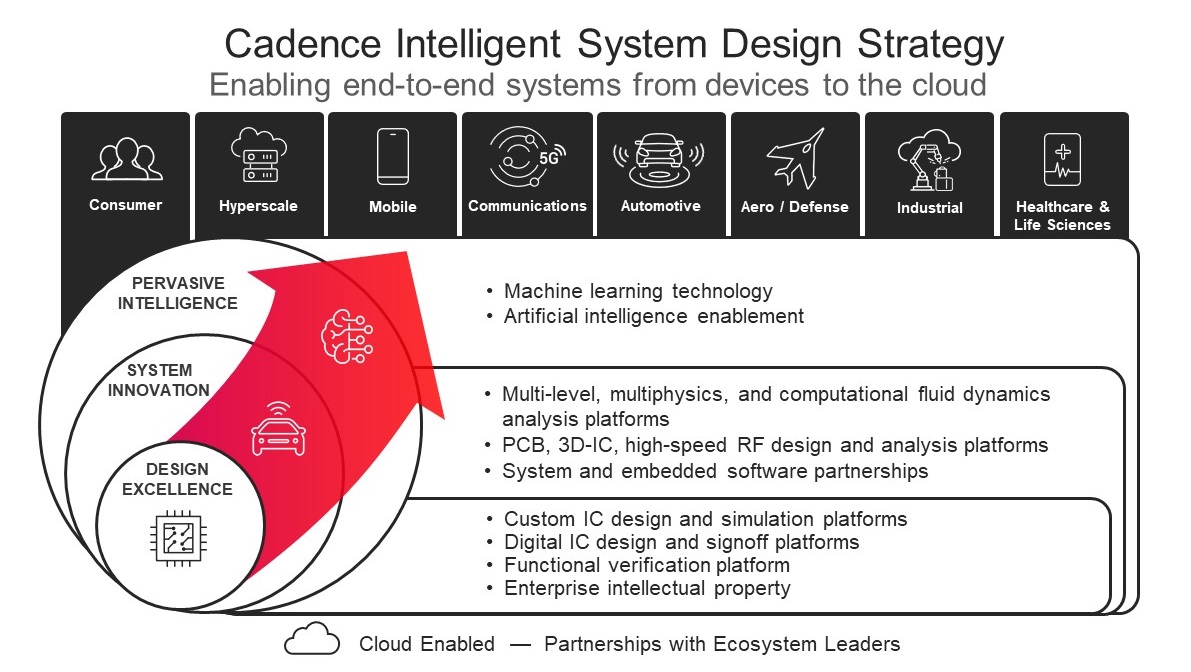
The IC and SoC design excellence requires technologies for custom IC, digital IC design and signoff, and functional verification, and leverages pre-built semiconductor IP. These tools, IP and associated services are specifically designed to meet the growing requirements of engineers designing increasingly complex chips across analog, digital and mixed-signal domains, and perform the associated verification tasks, including validation of low-level software running on the silicon model, thereby enabling design teams to manage complexity and verification throughput without commensurately increasing the team size or extending the project schedule, while reducing technical risks.
The second layer of our strategy centers around system innovation. It includes tools and services used for system design of the packages that encapsulate the ICs and the PCBs, system simulation which includes electromagnetic, electro-thermal and other multiphysics analysis necessary as part of optimizing the full system’s performance, radio frequency (“RF”) and microwave systems, and embedded software.
The third layer of our strategy addresses pervasive intelligence in new electronics. It starts with providing solutions and services to develop AI-enhanced systems and includes machine learning and deep learning capabilities being added to the Cadence® technology portfolio to make IP and tools more automated and to produce optimized results faster.
Our software and emulation products also support cloud access to address the growing computational needs of our customers.
Recent Acquisitions
Consistent with our Intelligent System Design strategy, we completed several acquisitions during fiscal 2022 that we believe enhances our talent, our System Design and Analysis technology portfolio and our ability to pursue attractive opportunities in the markets we serve. This includes our acquisition of OpenEye Scientific Software, Inc. (“OpenEye”), a leading provider of computational molecular modeling and simulation software used by pharmaceutical and biotechnology companies for drug discovery. The addition of OpenEye’s technologies and experienced team, with its deep scientific expertise, broadens our System Design and Analysis technology portfolio and expands our total addressable market, bringing our computational software expertise to apply proven algorithmic, simulation and solver advances to life sciences.
We also acquired FFG Holdings Limited (“Future Facilities”), a provider of electronics cooling analysis and energy performance optimization solutions for data center design and operations using physics-based 3D digital twins. The addition of Future Facilities broadens our multiphysics system analysis and computational fluid dynamics (“CFD”) product offerings to serve a wide breadth of hyperscale, enterprise data center, managed service and colocation providers.
Business Drivers
Our products and services enable our customers to design complex and innovative electronic products that are accelerated by the growing digital transformation. Demand for our technology and expertise is driven by increasing complexity and our customers’ investment in new designs and products. The most promising new opportunities for us involve enabling the design of electronic systems for consumers, including augmented reality (“AR”), virtual reality (“VR”), and industrial internet of things (“IIoT”), hyperscale computing (including data center infrastructure), AI, edge computing, mobile, communications (including 5G networks), automotive, aerospace and defense, and industrial and healthcare subsystems. Large and existing electronics categories, such as data center infrastructure, mobile, smartphones and networking products continue to provide business opportunities for us as customers initiate new design projects.
Underlying the requirements within any particular vertical market sector is the availability of rapidly improving IC manufacturing technology. In order for our customers to take advantage of such advancements, some of our products need to first incorporate new capabilities such that they can exploit new manufacturing capabilities. This dependency means that we must invest significantly in product research and development (“R&D”) to keep pace with the latest manufacturing technology. The demand for new IC manufacturing technology directly impacts the demand for our newest products.
Another driver for our business is the differentiation, capabilities and benefits provided to our customers by our products. With the rapid pace of innovation comes the opportunity for our products to address growing key challenges associated with electronic product creation, such as power consumption, performance, chip area and cost. Our products and services have unique attributes that our customers value. In general, these attributes can be grouped into broader categories such as quality of results (“QoR”) (in terms of power consumption, performance and chip area), engineering productivity, tool performance, manufacturing, reliability, and faster time to market. Many of these attributes contribute to the sustainability of our planet by enabling our customers to create innovative products that optimize power, space and energy needs. We are applying machine learning or computational software techniques within our products to enhance QoR, productivity, performance, manufacturing, reliability and methodology.
Products and Product Categories
Our Intelligent System Design strategy enables our customers to address a broad range of challenges that arise as they develop electronic products. Our solutions are categorized according to the role they play in the electronic product design process. We group our products into categories related to major design activities, including Custom IC Design and Simulation, Digital IC Design and Signoff, Functional Verification, IP, and System Design and Analysis.
Custom IC Design and Simulation
Our custom IC design and simulation offerings are used by our customers to create schematic and physical representations of circuits down to the transistor level for analog, mixed-signal, custom digital, memory and RF designs. These representations are verified using simulation tools optimized for each type of design, including the design capture environment, simulation and IC layout within the Virtuoso® custom IC design platform. Other tools in the custom IC portfolio are used to prepare the designs for manufacturing.
The Virtuoso Advanced-Node Platform adds functionality to the base Virtuoso package to enable the use of three-dimensional transistors (“FinFETs”), multi-patterning and other technologies required for advanced designs. The Virtuoso RF Solution addresses the challenges of RF design across chip, package and board. The Spectre® Simulation Platform provides large-scale verification simulation. The Virtuoso System Design Platform enables engineers to design and verify concurrently across the chip, package and board.
Digital IC Design and Signoff
Our digital IC design and signoff solutions are used to create logical representations of a digital circuit or an IC that can be verified for correctness prior to implementation (please refer to the discussion under “Functional Verification” below). Once the logic is verified, the design representation is implemented, or converted to a format ready for silicon manufacturing, using additional software tools within this category. The manufacturing representation is also analyzed and verified. Our digital IC design and signoff technology suite provides a full flow to achieve power, performance and area (“PPA”) design targets, and includes three major categories: logic design, physical implementation and signoff.
Our logic design offering is comprised of logic synthesis, test and equivalence checking capabilities and is typically used by customers to create and verify designs in conjunction with our functional verification capabilities. The offering includes the Genus™ Synthesis Solution, a logic synthesis offering that provides fast throughput while also offering high quality results, and the Joules™ RTL Power Solution, which delivers fast power analysis while preserving near-signoff accuracy. We also offer the Modus software solution, which reduces SoC design-for-test time.
Our physical implementation offering comprises tools used near the end of the design process, including place and route, optimization and multi-patterning preparation. The Innovus™ Implementation System is a physical implementation offering that delivers fast design turnaround time while also delivering improved PPA characteristics. This offering enables customers to address the technology challenges of the latest semiconductor advanced-process nodes, create a physical representation of logic models and prepare a design for signoff.
Our signoff offering is comprised of tools used to sign off the design as ready for manufacture by a semiconductor foundry, which provides certification for this step. This offering includes the Tempus™ Timing Signoff Solution, Voltus™ Power Integrity Solution, Quantus™ Extraction Solution and Pegasus™ Physical Verification System. Our design-for-manufacturing products are also included in our signoff offering and are used by customers to address manufacturing and yield issues as early in the product development process as possible.
Functional Verification
Functional verification products are used by our customers to effectively and efficiently verify that the circuitry or the software they have designed is consistent with the functional specification. Verification is largely done throughout the design process, with the objective of identifying as many potential functional problems as possible before manufacturing the circuitry, thereby significantly reducing the risk of discovering a costly error in the completed product.
Our Verification Suite includes four primary verification engines, starting with the JasperGold® Formal Verification Platform and Xcelium™ Parallel Logic Simulation Platform, which are used in the early stages of design verification, often at the IP and subsystem level. Once the design is more mature, with early formal and simulation verification tasks performed, verification engineers deploy our Palladium® Enterprise Emulation Platform and Protium™ FPGA-Based Prototyping Platforms for more comprehensive chip verification, often running low-level embedded software on top of a model of the chip, to provide for proper functionality before silicon manufacturing.
These engines are used for early bug detection, verification of block-level functionality, verification acceleration and emulation of system-level functionality, system-level power exploration, analysis and optimization, and system-level prototyping for hardware/software co-verification. Our Palladium platform provides high throughput, capacity, data center reliability and workgroup productivity to enable global design teams to develop advanced hardware-software systems. The Protium platform leverages a common front end with the Palladium environment to move designs rapidly from emulation to the prototyping stage, allowing for software development to start weeks to months earlier than otherwise possible.
These engines are also supported by other verification tools that provide an environment that allows for effective verification throughput and management, including verification planning and metric tracking, testbench automation, debugging and software-driven tests, enabling our customers to coordinate verification activities across multiple verification engines, teams and locations for effective verification closure.
IP
Our IP offerings consist of pre-verified, customizable functional blocks, which customers integrate into their ICs to accelerate the development process and to reduce the risk of errors in the design process. We offer many types of IP, including Tensilica® configurable digital signal processors (“DSPs”), vertically targeted subsystems for AI, audio/voice, baseband and vision/imaging applications, controllers and physical interfaces for standard protocols and analog IP. Our design IP portfolio also includes solutions for high speed SerDes, PCI, USB and many other standards.
We also offer a broad range of Verification IP (“VIP”) with memory models, which model the expected behavior of many industry standard protocols when used with verification solutions and are complementary to our design IP offerings. Our VIP and accelerated VIP are used with our full suite of functional verification engines to emulate and model the expected behavior and interaction of standard industry system interface protocols including DDR, USB, and PCI Express® in silicon. Our customers also use our System VIP offerings to perform full system-level chip verification.
System Design and Analysis
Our system design and analysis offerings are used by our customers to develop PCBs and advanced IC packages and to analyze electromagnetic, electro-thermal and other multiphysics effects.
The capabilities in the Allegro® System Design Platform include PCB authoring and implementation, IC package and system-in-package design, signal and power integrity analysis, and PCB library design management and collaboration. The need for compact, high-performance mobile, consumer and automotive design with advanced serial interconnect is driving the technology evolution for our PCB offerings. For mainstream PCB customers, where individual or small team productivity is a focus, we provide the OrCAD® family of offerings that is primarily marketed worldwide through a network of resellers.
The speed and close proximity of signals on silicon, through packages to boards, and through connectors and cables, exposes these communications to various kinds of interference, generates heat and emits electromagnetic radiation. Careful analysis is required for these systems to work as designed under a wide range of operating conditions and within compliance of standards and laws. The complexity of these devices and signal transmissions requires analysis and simulation throughout the product lifecycle to meet these objectives. Our Clarity™ 3D Solver for electromagnetic and power electronics analysis and simulation, as well as our Celsius™ Thermal Solver, provide the foundation for multiphysics analysis technology, with complete electrical-thermal co-simulation for electronic systems from ICs to physical enclosures.
Our Fidelity™ CFD Software solution expands our ability to meet the growing design challenges of electronic and systems companies. Our comprehensive suite of CFD solutions enable our customers to extend their multiphysics analysis workflows to address simulation and analysis challenges for applications such as aerodynamics, hydrodynamics, propulsion, turbomachinery, heat transfer, and combustion.
The addition of our computational molecular modeling and simulation solution with our acquisition of OpenEye leverages our computational software expertise and expands our ability to address various challenges of drug discovery faced by pharmaceutical and biotechnology companies.
Product Arrangements
We primarily license our software using time-based licenses. Our time-based license arrangements offer customers the right to access and use all of the products delivered at the outset of an arrangement and updates throughout the entire term of the arrangement, which is generally two to three years, with no rights to return. Our updates provide for continued access to our evolving technology as our customers’ designs migrate to more advanced nodes. In addition, certain time-based license arrangements include the right for the customer to remix among the products delivered at the outset of the arrangement and use unspecified additional products that become commercially available during the term of the arrangement.
A small portion of our software is licensed under perpetual licenses, which does not include the right to use new technology. Payment terms for time-based licenses generally provide for payments to be made over the license period, and payment terms for perpetual licenses generally are net 30 days.
Our emulation and prototyping hardware products are either sold or leased to our customers. Our emulation hardware can also be accessed remotely via a Cadence-managed cloud arrangement.
We generally license our design IP under nonexclusive license agreements that provide usage rights for specific designs. Some customers enter into non-cancelable commitments, whereby the customer commits to a fixed dollar amount over a specified period of time that can be used to purchase from a list of products or services. In addition, for certain IP license agreements, we collect royalties as our customers ship their product that includes our IP to their customers.
For a further description of our license agreements, our emulation and prototyping hardware sale or lease agreements, revenue recognition policies and results of operations, please refer to the discussion under “Critical Accounting Estimates” under Part II, Item 7, “Management’s Discussion and Analysis of Financial Condition and Results of Operations.”
Technical Support and Maintenance
Customer service and support is critical to the adoption and successful use of our products. We provide our customers with technical support and maintenance to facilitate their use of our software, hardware and IP solutions.
Our education services offerings can be customized and include training programs that are delivered online, app-based, or in a classroom setting. The content of these offerings ranges from the latest design techniques to methodologies for using the most recent features of our products. The primary focus of education services is to accelerate our customers’ path to productivity in the use of our products.
Services
We offer a number of services, including services related to methodology, education and hosted design solutions. These services may be sold separately or sold and performed in conjunction with the license, sale or lease of our products. As necessary, specialized design services engineers are assigned to internal R&D projects associated with our design IP business.
As part of our services offerings, we design advanced ICs, develop custom IP and help customers address design challenges. This enables us to target and accelerate the development of new software technology and products to satisfy current and future design requirements.
We offer engineering services to collaborate with our customers in the design of complex ICs and the implementation of key design capabilities, including low power design, IC packaging and board design, functional verification, digital implementation, analog/mixed-signal design and system-level design. The customers for these services primarily consist of semiconductor and systems companies developing products for the consumer, hyperscale computing, 5G communications, mobile automotive, aerospace and defense, industrial and healthcare verticals. These ICs range from digital SoCs and analog and RF designs to complex mixed-signal ICs.
The Cadence Cloud portfolio, consisting of Cadence-managed and customer-managed environments for electronic product developers using the scalability of the cloud, continues to expand, with additional cloud-ready products added or under development in fiscal 2022, including cloud-based platforms for e-commerce and for molecular sciences. Contractual arrangements with customers for both environments are time-based, similar to the on-premises software license arrangements described above, and may also include usage-based terms.
In delivering methodology services, we leverage our experience and knowledge of design techniques, our products, leading practices and different design environments to improve the productivity of our customers’ engineering teams. Depending on the customers’ projects and needs, we work with customers using outsourced, consultative and collaborative offerings.
Third-Party Programs and Initiatives
In addition to our products, many customers use design tools that are provided by other companies, as well as design IP available from alternative suppliers. We support the use of third-party design products and design IP through our Cadence Connections® program and through our participation in industry groups such as the Silicon Integration Initiative and Accellera System Initiative. We actively contribute to the development and deployment of industry standards.
Product and Maintenance and Services Revenue
Revenue, and revenue as a percentage of total revenue, from our product and maintenance and services offerings for the last three fiscal years were as follows:
| 2022 | 2021 | 2020 | |||||||||||||||||||||||||||||||||
| (In millions, except percentages) | |||||||||||||||||||||||||||||||||||
| Product and maintenance | $ | 3,340 | 94 | % | $ | 2,813 | 94 | % | $ | 2,537 | 95 | % | |||||||||||||||||||||||
| Services | 222 | 6 | % | 175 | 6 | % | 146 | 5 | % | ||||||||||||||||||||||||||
| Total revenue | $ | 3,562 | $ | 2,988 | $ | 2,683 |
Generally, between 85% and 90% of our annual revenue is characterized as recurring revenue. Recurring revenue includes revenue recognized over time from our software arrangements, services, royalties, maintenance on IP licenses and hardware, and operating leases of hardware. Recurring revenue also includes revenue recognized at varying points in time over the term of other arrangements with non-cancelable commitments, whereby the customer commits to a fixed dollar amount over a specified period of time that can be used to purchase from a list of products or services. These arrangements do not meet the definition of a revenue contract until the customer executes a separate selection form to identify the products and services that they are purchasing. Each separate selection form under the arrangement is treated as an individual contract and accounted for based on the respective performance obligations.
The remainder of our revenue is recognized at a point in time and is characterized as up-front revenue. Up-front revenue is primarily generated by sales of emulation and prototyping hardware and individual IP licenses. The percentage of our recurring and up-front revenue may be impacted by delivery of hardware and IP products to its customers in any single fiscal period.
For additional information and analysis on our revenue, including revenue by geography, see the discussion under “Results of Operations” under Part II, Item 7, “Management’s Discussion and Analysis of Financial Condition and Results of Operations.” For our fiscal 2022 results of operations and our financial position as of December 31, 2022, see Part IV, Item 15, “Exhibits and Financial Statement Schedules.”
Remaining Performance Obligations
Revenue allocated to remaining performance obligations represents the transaction price allocated to the performance obligations that are unsatisfied, or partially unsatisfied, which includes unearned revenue and amounts that will be invoiced and recognized as revenue in future periods. We have elected to exclude the potential future royalty receipts from the remaining performance obligations. Contracted but unsatisfied performance obligations were approximately $5.8 billion as of December 31, 2022, which included $0.4 billion of non-cancelable commitments from customers where actual product selection and quantities of specific products or services are to be determined by customers at a later date. Contracted but unsatisfied performance obligations will fluctuate from period to period depending on the timing of contract renewals and duration of the contracts.
As of December 31, 2022, we expected to recognize approximately 55% of the contracted but unsatisfied performance obligations, excluding non-cancelable commitments, as revenue over the next 12 months. The contracted, but unsatisfied performance obligations expected to generate revenue in the next 12 months include hardware orders that were previously undelivered due to production constraints. Due to increasing hardware production capacity, these performance obligations are expected to be satisfied in fiscal 2023.
Marketing and Sales
We generally market our products and provide services to existing and prospective customers through a direct sales force consisting of sales people and applications engineers. Applications engineers provide technical pre-sales and post-sales support for our products. Due to the complexity of many of our products and the system design process, the sales cycle is generally long, requiring three to six months or more. During the sales cycle, our direct sales force generally provides technical presentations, product demonstrations and support for on-site customer evaluation of our solutions. We also promote our products and services through advertising, marketing automation, trade shows, public relations and the internet. We selectively utilize value-added resellers to broaden our reach and reduce cost of sales. Our OrCAD products and certain Allegro products are primarily marketed through these channels. With respect to international sales, we generally market and support our products and services through our subsidiaries. We also use a third-party distributor to license our products and services to certain customers in Japan.
Research and Development
Our future performance depends on our ability to innovate, commercialize newly developed solutions and enhance and maintain our current products. The primary areas of our R&D align with our product categories discussed above. We must continuously adapt our products to solve new or increased physics challenges that arise with each successive process node and address the increase in complexity that is introduced by the resulting much larger designs. We must also keep pace with our customers’ technical developments, satisfy industry standards and meet our customers’ increasingly demanding performance, productivity, quality and predictability requirements. Therefore, we expect to continue to invest in R&D.
Hardware Manufacturing and Software Distribution
Our emulation and prototyping hardware, including all individual PCBs, custom ICs and FPGA-based prototyping components, is manufactured, assembled and tested by subcontractors before delivery to our customers. Software and documentation are primarily distributed to customers by secure electronic delivery.
Proprietary Technology
Our success depends, in part, upon our proprietary technology. We generally rely on patents, copyrights, trademarks and trade secret laws, licenses and restrictive agreements to establish and protect our proprietary rights in technology and products. Many of our products include software or other IP licensed from third parties. We may have to seek new licenses or renew existing licenses for third-party software and other IP in the future. As part of performing engineering services for customers, our engineering services business uses certain software and other IP licensed from third parties, including that of our competitors.
Governmental Regulations
We are subject to a variety of federal, state, local and foreign laws and regulations relating to our business and operations. These include, but are not limited to, laws and regulations related to trade controls, anti-corruption and anti-bribery, and data privacy and data protection, as well as antitrust, competition, and employment.
-
Trade controls. We are subject to laws and regulations in the United States and other jurisdictions concerning the sale and shipment of our products and technology outside the United States and to foreign nationals, including tariffs, trade protection measures, import or export licensing requirements, sanctions and other trade regulations. U.S. Export Administration Regulations include “Entity List” and “Unverified List” restrictions imposed by the Bureau of Industry and Security (“BIS”) of the U.S. Department of Commerce (“DOC”). BIS frequently adds entities to the Entity List and the Unverified List, some of which have been Cadence customers. BIS also issues new rules and regulations from time to time. In 2022, BIS issued new restrictions concerning advanced node IC production in China and extended controls to additional technologies, including electronic computer-aided design software specially designed for the development of ICs with Gate-All-Around Field-Effect Transistor structure. Trade regulations limiting or banning sales into certain countries or to certain companies have impacted our ability to transact business in certain countries and with certain customers. Future trade regulations may also impact our ability to transact business with certain customers and in certain countries and may restrict certain non-U.S. person employees from performing their duties at Cadence without first obtaining appropriate authorization if their duties involve an export, reexport, or transfer of export-controlled technology.
-
Anti-corruption and anti-bribery. We are subject to laws and regulations in the United States and other jurisdictions concerning anti-corruption and anti-bribery, including the U.S. Foreign Corrupt Practices Act and the U.K. Bribery Act, which prohibit corrupt payments to governmental officials and bribes to other persons.
-
Data privacy and data protection. We are subject to laws and regulations in the United States and other jurisdictions governing data privacy and data protection, including the General Data Protection Regulation in the European Union, which regulate our collection, handling and use of personal information.
The laws and regulations to which we are subject are complex and may change or develop over time, sometimes with limited or no advance notice. Developments or other changes in laws or regulations or how they are interpreted or enforced have had, and may continue to have, a negative impact on our business and increase our compliance-related expenditures. For additional information regarding risks related to laws and regulations, including existing restrictions imposed by BIS, as well as international relations, see Item 1A, “Risk Factors.”
Competition
We compete most frequently with Synopsys, Inc., Siemens EDA, and ANSYS, Inc., and also with numerous other tools providers, electronics device manufacturers with their own EDA capabilities, technical or computational software companies, electronics design and consulting companies, and other IP companies. These include U.S. based companies such as Keysight Technologies, Inc., Schrödinger, Inc., and CEVA, Inc., and foreign companies such as Altium Limited (Australia), Zuken Ltd. (Japan), and emerging competitors in China like Huada Empyrean, Avatar, Xpeedic, X-EPIC, Primarius Technologies, Univista, and Giga-DA.
Certain competitive factors in the engineering services business differ from those of the products businesses. While we compete with other computational software companies in the engineering services business, our principal competitors include independent engineering service businesses. Many of these companies are also customers, and therefore use our product offerings in the delivery of their services or products.
For more information on risks related to competitive factors affecting our business, see the relevant discussions throughout Item 1A, “Risk Factors.”
Human Capital Resource Management
Our future success is inextricably linked to our ability to attract, retain and develop exceptional talent globally. To facilitate talent attraction and retention, we invest in key initiatives including, but not limited to, furthering diversity, equity and inclusion, physical and mental health, and talent development. To measure engagement and collect feedback from our employees, we administer regular employee engagement surveys. Our cultural tenet is “One Team – One Cadence.” This culture-first message underpins our belief that a diverse, highly supported and engaged workforce is critical to the foundation of our business success.
Employees
Our employees represent the best and brightest in our industry, and the talent we select to be a part of our team defines our culture and success. As of December 31, 2022, we had approximately 10,200 employees. Our global workforce is highly educated, technical and specialized, with a substantial majority of employees working in technical roles.
Diversity, Equity and Inclusion
We believe that workforce diversity, equity and inclusion advance high performance and innovation. We recognize that gender and racial disparities remain a challenge in the technology field, and with a high proportion of technical employees, we are deeply committed to addressing this issue and have appointed executive sponsors to drive this commitment throughout our company. Some of our key programs and initiatives aimed at addressing this issue include:
-
Regular monitoring of the diversity of our current workforce and candidate pool, with an aim to identify and address areas where we can improve.
-
Partnerships with organizations such as National Society of Black Engineers, Society of Hispanic Professional Engineers, Out in Tech, National GEM Consortium, and Society of Women Engineers to advance our inclusion efforts. These partnerships allow us to conduct recruiting, outreach and engagement with diverse communities.
-
An Advanced Leadership Program for top women, Black and Latinx talent, which provides specialized coaching, workshops and career opportunities.
-
An IMPACT mentorship program which gives women, U.S. Black and Latinx employees an opportunity to choose a meaningful mentor.
-
Unconscious bias and inclusive leadership training and resources for managers.
-
Inclusion groups for Black, Latinx, Asian American and Pacific Islanders, Indian and South Asian, LGBTQ+, Veterans, women employees and allies which host networking events to foster dialogue and promote awareness.
-
University programs to increase diversity that actively engages Historically Black Colleges and Universities and Hispanic Serving Institutions including grants for diversity based scholarships.
Health, Safety and Wellness
We strive to create a safe and rewarding environment to enable our employees to develop the innovations necessary for our sustained success.
To provide for both the physical and mental health of our employees, we offer a variety of benefits that go beyond traditional health insurance. Our U.S. health and well-being benefits include fertility benefits, coverage for transgender employees undergoing medical treatment, expanded new parent leave, adoption and surrogacy benefits, financial planning and coaching services, and legal services. We also provide training and tools for stress management, time management, conflict resolution and emotional well-being.
To promote employee health and well-being throughout the course of the COVID-19 pandemic, we have provided employees with a flexible, hybrid work model, additional time off to focus on themselves and their families, wellness initiatives (including physical, emotional and mental health), and global employee assistance programs to connect employees and their families with resources, information and counseling to address the challenges caused by the pandemic, such as increased anxiety or stress.
Compensation and Benefits
To inspire and recognize our employees, we offer competitive compensation and benefits programs. Our compensation programs link employee compensation to our business and individual performance. We also offer a semi-annual bonus program, 401(k) match, Employee Stock Purchase Plan and equity compensation. In addition, our employees are eligible to receive monetary awards from their colleagues through our peer-to-peer recognition program.
Talent Development
To help employees succeed in their current roles, pursue their passions and develop the skills necessary for advancement, we provide formal training programs and curriculums in addition to on-the-job training. Our High Performance Culture portal provides our employees with valuable resources such as a comprehensive online Learning Management program with training and development tools on a broad range of topics and skills. We also offer tuition reimbursement opportunities to employees continuing in fields relevant to their job.
Community Outreach
We believe it is important that we create meaningful opportunities for employees to connect and contribute to their community. We provide opportunities for paid volunteer time off annually, charitable contribution matching, company-wide volunteer campaigns and international service immersion projects.
During fiscal 2021, we formed the Cadence Giving Foundation with the goal of giving back to the communities where we live and work. This stand-alone, non-profit foundation partners with other charitable initiatives to support critical needs in areas such as diversity, equity and inclusion, environmental sustainability and science, technology, engineering, and mathematics (“STEM”) education.
Corporate Responsibility
We believe that, in general, the best and brightest talent is inclined to build a career with a responsible organization that positively impacts society. Among our efforts to be that type of organization, we recognize that climate change is one of the greatest challenges of our time, and we are committed to doing our part to contribute to the health of the planet by actively investing in initiatives to reduce our environmental footprint. We encourage you to review our 2021 Sustainability Report (located at www.cadence.com), and our 2022 Sustainability Report when released, for more information on our Environmental, Social and Governance (“ESG”) initiatives. The contents of our Sustainability Reports and website are not part of or incorporated by reference into this Annual Report on Form 10-K.
Corporate Information
Our headquarters is located at 2655 Seely Avenue, San Jose, California 95134. Our telephone number is (408) 943-1234. We use our website at www.cadence.com to communicate important information about our company, including news releases and financial information. Our website permits investors to subscribe to email notification alerts when we post new material information on our website. We also make available on our investor relations webpage, free of charge, copies of our SEC filings and submissions, which can be found at the SEC’s website, www.sec.gov, as soon as reasonably practicable after electronically filing or furnishing such documents with the SEC. Stockholders may also request copies of these documents by writing to our Corporate Secretary at the address above. Website references are provided throughout this document for convenience only. The contents of these websites do not constitute a part of this Annual Report and shall not be deemed incorporated by reference into this Annual Report unless expressly noted.
Fiscal Year End
Historically our fiscal years have been 52- or 53-week periods ending on the Saturday closest to December 31. Fiscal 2022 and fiscal 2021, were both 52-week fiscal years, compared to 2020, which was a 53-week fiscal year.
On September 7, 2022, our Board of Directors approved a change in our fiscal year end from the Saturday closest to December 31 of each year to December 31 of each year. The fiscal year change is effective beginning with our 2023 fiscal year, which began on January 1, 2023. Our fiscal quarters will end on March 31, June 30, and September 30. No transition report is required in connection with this change.
INFORMATION ABOUT OUR EXECUTIVE OFFICERS
The following table provides information regarding our executive officers as of February 13, 2023:
| Name | Age | Positions and Offices | ||||||||||||
| Anirudh Devgan | 53 | President and Chief Executive Officer | ||||||||||||
| John M. Wall | 52 | Senior Vice President and Chief Financial Officer | ||||||||||||
| Thomas P. Beckley | 65 | Senior Vice President and General Manager of the Custom IC and PCB Group | ||||||||||||
| Paul Cunningham | 45 | Senior Vice President and General Manager of the System Verification Group | ||||||||||||
| Karna Nisewaner | 48 | Corporate Vice President, General Counsel and Corporate Secretary | ||||||||||||
| Chin-Chi Teng | 57 | Senior Vice President and General Manager of the Digital and Signoff Group | ||||||||||||
| Neil Zaman | 54 | Senior Vice President and Chief Revenue Officer |
Our executive officers are appointed by our Board of Directors and serve at the discretion of our Board of Directors.
ANIRUDH DEVGAN has served as Chief Executive Officer of Cadence since December 2021 and President of Cadence since November 2017. From May 2012 to November 2017, Dr. Devgan held several positions at Cadence, most recently as Executive Vice President, Research and Development from March 2017 to November 2017 and Senior Vice President, Research and Development from November 2013 to March 2017. Prior to joining Cadence, from May 2005 to March 2012, Dr. Devgan served as Corporate Vice President and General Manager of the Custom Design Business Unit at Magma Design Automation, Inc., an EDA company. Dr. Devgan has a B.Tech. in electrical engineering from the Indian Institute of Technology, Delhi, and an M.S. and Ph.D. in electrical and computer engineering from Carnegie Mellon University.
JOHN M. WALL has served as Senior Vice President and Chief Financial Officer of Cadence since October 2017. From October 2000 to September 2017, Mr. Wall held several positions at Cadence, most recently as Corporate Vice President and Corporate Controller from April 2016 to October 2017, Vice President, Finance and Operations, Worldwide Revenue Accounting and Sales Finance from 2015 to 2016 and Vice President, Finance and Operations, EMEA and Worldwide Revenue Accounting from 2005 to 2015. Mr. Wall has an NCBS from the Institute of Technology, Tralee and is a Fellow of the Association of Chartered Certified Accountants.
THOMAS P. BECKLEY has served as Senior Vice President and General Manager of the Custom IC and PCB Group of Cadence since 2018. From September 2012 to September 2018, Mr. Beckley served as Senior Vice President, Research and Development of Cadence. From April 2004 to September 2012, Mr. Beckley served as Corporate Vice President, Research and Development of Cadence. Prior to joining Cadence, Mr. Beckley served as President and Chief Executive Officer of Neolinear, Inc., a developer of auto-interactive and automated analog/RF tools and solutions for mixed-signal design that was acquired by Cadence in April 2004. Mr. Beckley has a B.S. in mathematics and physics from Kalamazoo College and an M.B.A. from Vanderbilt University.
PAUL CUNNINGHAM has served as Senior Vice President and General Manager of the System Verification Group since March 2021. From August 2011 to March 2021, Mr. Cunningham held several positions at Cadence, most recently as Corporate Vice President of the System Verification Group beginning January 2018. Prior to joining Cadence, Mr. Cunningham was co-founder and Chief Executive Officer of Azuro, Inc., a clock concurrent optimization company, that Cadence acquired in July 2011. Mr. Cunningham has an M.A. and Ph.D. in computer science from the University of Cambridge in the United Kingdom.
KARNA NISEWANER has served as Corporate Vice President, General Counsel and Corporate Secretary of Cadence since September 2022. From May 2011 to September 2022, Ms. Nisewaner held several positions at Cadence, most recently as Corporate Vice President and Deputy General Counsel beginning in May 2019. Prior to joining Cadence, Ms. Nisewaner held in-house counsel roles at Intuit from 2007 to 2011 and IBM from 2003 to 2007. Ms. Nisewaner was in private practice focused on intellectual property at Finnegan, Henderson, Farbow, Garrett, and Dunner, LLP from 2001 to 2003. Ms. Nisewaner has a B.S.E. in civil engineering and operations research from Princeton University and her J.D. from UCLA School of Law.
CHIN-CHI TENG has served as Senior Vice President and General Manager of the Digital and Signoff Group of Cadence since September 2018. From January 2002 to September 2018, Dr. Teng held several positions at Cadence, most recently as Corporate Vice President, Research and Development from June 2015 to September 2018, and Vice President, Research and Development from March 2009 to June 2015. Dr. Teng has a B.S. in electrical engineering from the National Taiwan University and a Ph.D. in electrical and computer engineering from the University of Illinois, Urbana-Champaign.
NEIL ZAMAN has served as Chief Revenue Officer since October 2020 and as Senior Vice President, Worldwide Field Operations since September 2015. From October 1999 to September 2015, Mr. Zaman held several positions at Cadence, most recently as Corporate Vice President, North America Field Operations. Prior to joining Cadence, Mr. Zaman held positions at Phoenix Technologies Ltd., a developer of core system software, and IBM Corporation, a technology and consulting company. Mr. Zaman has a B.S. in finance from California State University, Hayward.
Item 1A. Risk Factors
Our operations and financial results are subject to various risks and uncertainties, including those described in the sections below, that could adversely affect our business, financial condition, results of operations, cash flows, liquidity, revenue, growth, prospects, demand, reputation, and the trading price of our common stock, and make an investment in us speculative or risky. The following does not summarize all of the risks that we face, and there may be additional risks or uncertainties that are currently unknown or not believed to be material that occur or become material.
Business and Operational Risks
We have experienced varied operating results, and our operating results for any particular fiscal period are affected by the timing of revenue recognition, particularly for our emulation and prototyping hardware and IP products.
Historical results of operations should not be viewed as reliable indicators of our future performance. Various factors affect our operating results, and some of them are not within our control. Our operating results for any period are affected by the mix of products and services sold in a given period and the timing of revenue recognition, particularly for our emulation and prototyping hardware and IP products. In addition, we have recorded net losses in the past and may record net losses in the future. Also, our cash flows from operating activities have and will continue to fluctuate due to a number of factors, including the timing of our billings, collections, disbursements and tax payments.
A substantial portion of the product revenue related to our hardware business and our IP offerings is recognized upon delivery, and our forecasted revenue results are based, in part, on our expectations of hardware and IP to be delivered in a particular quarter. Therefore, changes in hardware and IP bookings or deliveries relative to expectations will have a more immediate impact on our revenue than changes in software or services bookings, for which revenue is generally recognized over time.
As we continue to expand our IP offerings, a portion of the revenue related to our IP bookings will be deferred until we complete and deliver the licensed IP to our customers. As a result, costs related to the research and development of the IP may be incurred prior to the recognition of the related revenue.
Revenue related to our hardware and IP products is inherently difficult to predict because sales of our hardware and IP products depend on the commencement of new projects for the design and development of complex ICs and systems by our customers, our customers’ willingness to expend capital to deploy our new and existing hardware or IP products in those projects and the availability of our new and existing hardware or IP products for delivery. Therefore, our hardware or IP sales may be delayed or may decrease if our customers delay or cancel projects because their spending is constrained or if there are problems or delays with the supply, delivery or installation of our hardware or IP products or our hardware suppliers. Moreover, the hardware and IP markets are highly competitive, and our customers may choose to purchase a competitor’s hardware or IP product based on cost, performance or other factors. These factors may result in lower revenue, which would have an adverse effect on our business, results of operations or cash flows.
A substantial proportion of our software licenses yield revenue recognized over time, which may make it difficult for us to rapidly increase our revenue in future fiscal periods, and means that a decrease in orders in a given period would negatively affect our revenue in future periods.
We plan our operating expenses based on forecasted revenue, expected business needs and other factors such as inflation. These expenses and the effect of long-term commitments are relatively fixed in the short term. Bookings and the related revenue are harder to forecast in a difficult economic environment. If we experience a shortfall in bookings, our operating results could differ from our expectations because we may not be able to quickly reduce our expenses in response to short-term business changes. Our operating expenses are also impacted by economic conditions, such as inflation. Unexpected increases in inflation could cause our expenses to increase at a rate faster than our product pricing to recover such increases.
The methods, estimates and judgments that we use in applying our accounting policies have a significant impact on our results of operations (see “Critical Accounting Estimates” under Part II, Item 7, “Management’s Discussion and Analysis of Financial Condition and Results of Operations”). Such methods, estimates and judgments are subject to substantial risks, uncertainties and assumptions, and factors may arise over time that may lead us to change our methods, estimates and judgments. Changes in those methods, estimates and judgments could significantly affect our results of operations.
Any periods of uncertainty in the global economy and international trade relations, changes in governmental policies relating to technology, and any potential downturn in the semiconductor and electronics industries, may negatively impact our business and reduce our bookings levels and revenue.
Purchases of our products and services are dependent upon the commencement of new design projects by IC manufacturers and electronics systems companies. The IC and electronics systems industries are cyclical and are characterized by constant and rapid technological change, rapid product obsolescence and price erosion, evolving standards, short product life cycles and wide fluctuations in product supply and demand.
The IC and electronics systems industries have also experienced significant downturns in connection with, or in anticipation of, maturing product cycles of both these industries’ and their customers’ products. The current outlook for the global economy is uncertain and may result in a decrease in spending on our products and services despite recent growth.
Uncertainty caused by the recent challenging global political and economic conditions, including the effects of the recent rise in inflation and interest rates, the Russian invasion of Ukraine and the continuing COVID-19 pandemic, adverse changes to international trade relationships between countries in which we do business, protectionist measures or future decline in corporate or consumer spending could negatively impact our customers’ businesses, reducing the number of new chip designs and their overall research and development spending, including their spending on our products and services, and as a result decrease demand for our products and services. Decreased bookings for our products and services, customer bankruptcies, consolidation among our customers, or problems or delays with our hardware suppliers or with the supply or delivery of our hardware products could also adversely affect our ability to grow our business or adversely affect our future revenue and financial results. Our business could also be impacted by political, economic and legal actions and conditions in regions in which our suppliers or customers operate, including Taiwan, which serves as a central hub for the technology industry supply chain. Our future business and financial results, including demand for our products and services, are subject to considerable uncertainties that could impact our stock price. If economic conditions or international trade relationships between countries in which we do business deteriorate in the future, or, in particular, if semiconductor or electronics systems industry revenues do not grow, including as a result of the current global semiconductor shortage extending or intensifying, the ability to export or import products or services by
Showing the first 8K of 90K characters. Open the full section
Item 1B. Unresolved Staff Comments
None.
Item 2. Properties
We own land and buildings at our corporate headquarters located in San Jose, California. We also own properties in New Mexico and India. As of December 31, 2022, the total square footage of our owned buildings was approximately 1,227,000.
We lease additional facilities in the United States and various other countries. We may sublease certain of these facilities where space is not fully utilized.
We believe that these facilities are adequate for our current needs and that suitable additional or substitute space will be available as needed to accommodate any expansion of our operations.
Item 3. Legal Proceedings
From time to time, we are involved in various disputes and legal proceedings that arise in the ordinary course of business. These include disputes and legal proceedings related to intellectual property, indemnification obligations, mergers and acquisitions, licensing, contracts, customers, products, distribution and other commercial arrangements and employee relations matters. At least quarterly, we review the status of each significant matter and assess its potential financial exposure. If the potential loss from any claim or legal proceeding is considered probable and the amount or the range of loss can be estimated, we accrue a liability for the estimated loss. Legal proceedings are subject to uncertainties, and the outcomes are difficult to predict. Because of such uncertainties, accruals are based on our judgments using the best information available at the time. As additional information becomes available, we reassess the potential liability related to pending claims and legal proceedings and may revise estimates.
On April 27, 2022, Bell Semiconductor LLC (“Bell Semi“), a patent monetization entity, began filing a series of patent infringement lawsuits against certain technology companies alleging that certain semiconductor devices designed using certain design tools offered by EDA vendors, including Cadence, infringe upon one or more patents held by Bell Semi. Bell Semi seeks monetary damages, attorneys’ fees and costs, and a permanent injunction prohibiting the defendants from using allegedly infringing EDA design tools.
On April 29, 2022, Bell Semi also began filing a series of complaints with the U.S. International Trade Commission (“ITC“) alleging violations of Section 337 of the Tariff Act of 1930 and seeking limited exclusion orders preventing the respondents from importing into the United States semiconductor devices designed using certain design tools offered by EDA vendors, including Cadence, and cease-and-desist orders prohibiting respondents from importing, selling, offering for sale, marketing, advertising, distributing, or transferring products (except for exportation) made using certain design tools offered by EDA vendors, including Cadence. The ITC instituted three investigations but Bell Semi subsequently terminated one of the investigations.
Cadence is not named as a respondent or defendant in any of the aforementioned actions; however, certain respondents and defendants are Cadence customers and have sought defense and indemnity from Cadence regarding Bell Semi’s allegations. Cadence has offered to defend some of its customers consistent with the terms of the applicable license agreements.
On November 18, 2022, Cadence and another EDA vendor jointly filed an action in the U.S. District Court for the District of Delaware for declaratory judgment of invalidity and non-infringement as to each of the six patents asserted by Bell Semi in the aforementioned actions. On November 28, 2022, Cadence and another EDA vendor also filed a motion for preliminary injunction in the U.S. District Court for the District of Delaware seeking to enjoin Bell Semi from proceeding with its litigation campaign.
Item 4. Mine Safety Disclosures
Item 5. Market for Registrant’s Common Equity, Related Stockholder Matters and Issuer Purchases of Equity Securities
Our common stock is traded on the Nasdaq Global Select Market under the symbol CDNS. As of January 31, 2023, we had 357 registered stockholders and approximately 490,000 beneficial owners of our common stock.
Stockholder Return Performance Graph
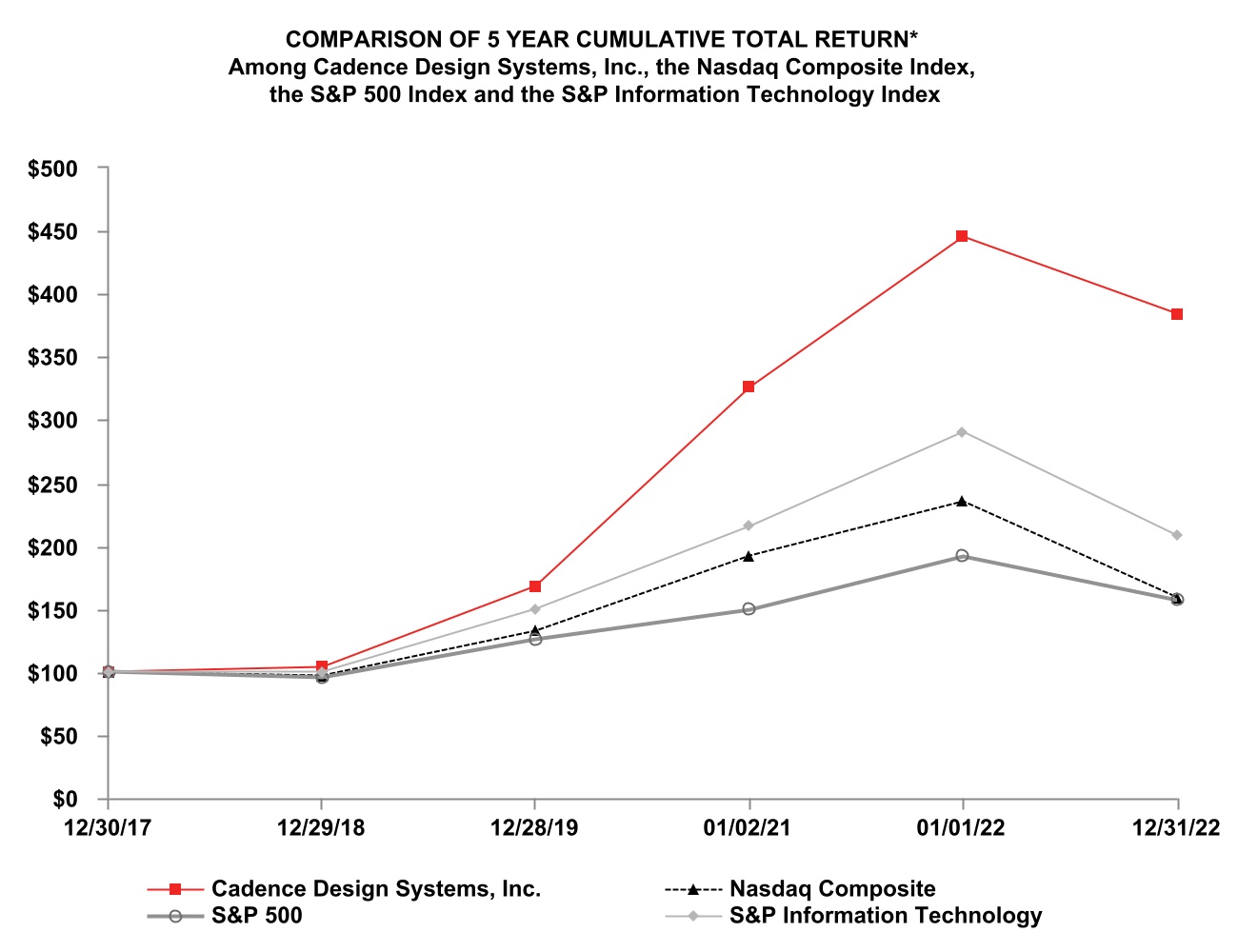
The following graph compares the cumulative 5-year total stockholder return on our common stock relative to the cumulative total return of the Nasdaq Composite Index, the S&P 500 Index and the S&P 500 Information Technology Index. The graph assumes that the value of the investment in our common stock and in each index on December 30, 2017 (including reinvestment of dividends) was $100 and tracks it each year thereafter on the last day of our fiscal year through December 31, 2022 and, for each index, on the last day of the calendar year.
*$100 invested on 12/30/17 in stock or index, including reinvestment of dividends.
Indexes calculated on a month-end basis.
Copyright© 2023 Standard & Poor's, a division of S&P Global. All rights reserved.
| 12/30/2017 | 12/29/2018 | 12/28/2019 | 1/2/2021 | 1/1/2022 | 12/31/2022 | |||||||||||||||||||||||||||||||||
| Cadence Design Systems, Inc. | $ | 100.00 | $ | 103.63 | $ | 168.08 | $ | 326.23 | $ | 445.60 | $ | 384.12 | ||||||||||||||||||||||||||
| Nasdaq Composite | 100.00 | 97.16 | 132.81 | 192.47 | 235.15 | 158.65 | ||||||||||||||||||||||||||||||||
| S&P 500 | 100.00 | 95.62 | 125.72 | 148.85 | 191.58 | 156.89 | ||||||||||||||||||||||||||||||||
| S&P 500 Information Technology | 100.00 | 99.71 | 149.86 | 215.63 | 290.08 | 208.30 |
The stock price performance included in this graph is not necessarily indicative of future stock price performance.
Issuer Purchases of Equity Securities
We are authorized to repurchase shares of our common stock under a publicly announced program most recently increased by our Board of Directors on August 11, 2022. Pursuant to this authorization, we may repurchase shares from time to time through open market repurchases, in privately negotiated transactions or by other means, including accelerated share repurchase transactions or other structured repurchase transactions, block trades or pursuant to trading plans intended to comply with Rule 10b5-1 of the Exchange Act. The actual timing and amount of repurchases are subject to business and market conditions, corporate and regulatory requirements, stock price, acquisition opportunities and other factors. As of December 31, 2022, approximately $1.1 billion of the share repurchase authorization remained available to repurchase shares of our common stock. The share repurchase authorization does not obligate us to acquire a minimum amount of shares, does not have an expiration date and may be modified, suspended or terminated without prior notice.
The following table presents repurchases made under our current authorization and shares surrendered by employees to satisfy income tax withholding obligations during the three months ended December 31, 2022:
| Period | Total Number of Shares Purchased (1) | Average Price Paid Per Share (2) | Total Number of Shares Purchased as Part of Publicly Announced Plans or Programs (3) | Maximum Dollar Value of Shares Authorized for Repurchase Under Publicly Announced Plan or Program (1) (In millions) | |||||||||||||||||||
| October 2, 2022 - November 5, 2022 | 1,379,968 | $ | 151.75 | 1,361,665 | $ | 1,170 | |||||||||||||||||
| November 6, 2022 - December 3, 2022 | 304,525 | $ | 160.06 | 292,586 | $ | 1,123 | |||||||||||||||||
| December 4, 2022 - December 31, 2022 | 298,895 | $ | 164.25 | 284,350 | $ | 1,077 | |||||||||||||||||
| Total | 1,983,388 | $ | 154.91 | 1,938,601 |
(1)Shares purchased that were not part of our publicly announced repurchase programs represent employee surrender of shares of restricted stock to satisfy employee income tax withholding obligations due upon vesting, and do not reduce the dollar value that may yet be purchased under our publicly announced repurchase programs.
(2)The weighted average price paid per share of common stock does not include the cost of commissions.
(3)Our publicly announced share repurchase program was originally announced on February 1, 2017 and most recently increased by an additional $1.0 billion on August 11, 2022.
Item 6. [Reserved]
Item 7. Management’s Discussion and Analysis of Financial Condition and Results of Operations
The following discussion should be read in conjunction with the consolidated financial statements and notes thereto included elsewhere in this Annual Report on Form 10-K and with Part I, Item 1A, “Risk Factors.” Please refer to the cautionary language at the beginning of Part I of this Annual Report on Form 10-K regarding forward-looking statements.
Business Overview
Cadence is a leader in electronic system design, building upon more than 30 years of computational software expertise. We apply our underlying Intelligent System Design strategy to deliver computational software, hardware and IP that turn design concepts into reality. We enable our customers to develop electronic products. Our products and services are designed to give our customers a competitive edge in their development of integrated ICs, SoCs, and increasingly sophisticated electronic devices and systems. Our products and services do this by optimizing performance, minimizing power consumption, shortening the time to bring our customers’ products to market, improving engineering productivity and reducing their design, development and manufacturing costs.
Our strategy is to provide the technology necessary for our customers to develop products across a variety of vertical markets including consumer, hyperscale computing, mobile, 5G communications, automotive, aerospace and defense, industrial, healthcare and life sciences. Our products and services enable our customers to develop complex and innovative electronic products, so demand for our technology is driven by our customers’ investment in new designs and products. Historically, the industry that provided the tools used by IC engineers was referred to as Electronic Design Automation (“EDA”). Today, our offerings include and extend beyond EDA.
We group our products into categories related to major design activities:
-
Custom IC Design and Simulation;
-
Digital IC Design and Signoff;
-
Functional Verification;
-
IP; and
-
System Design and Analysis.
Consistent with our Intelligent System Design strategy, we completed our acquisitions of OpenEye and Future Facilities during fiscal 2022. Both of these acquisitions are expected to add important new technologies and capabilities to our System Design and Analysis technology portfolio that we believe will enhance our ability to pursue attractive opportunities in the markets we serve. During fiscal 2022, these acquisitions increased expenses, including amortization of acquired intangible assets more than revenue.
For additional information about our products, see the discussion in Item 1, “Business,” under the heading “Products and Product Categories.”
Management uses certain performance indicators to manage our business, including revenue, certain elements of operating expenses and cash flow from operations, and we describe these items further below under the headings “Results of Operations” and “Liquidity and Capital Resources.”
Fiscal Year End
On September 7, 2022, our Board of Directors approved a change in our fiscal year end from the Saturday closest to December 31 of each year to December 31 of each year. Our fiscal quarters will end on March 31, June 30, and September 30. The fiscal year change is effective beginning with our 2023 fiscal year, which began on January 1, 2023.
Macroeconomic Environment
Our business is subject to the effects of expanded trade restrictions, the ongoing geopolitical conflict in Ukraine and other areas of the world, the COVID-19 pandemic, volatility in foreign currency exchange rates, global inflation and the rise in interest rates.
We have been impacted by expanded trade restrictions, including restrictions concerning advanced node IC production in China, the inclusion of additional Chinese technology companies on the BIS’s “Unverified List” and regulations governing the sale of certain technologies. Based on our current assessments, we expect the impact of these expanded trade restrictions on our business to be limited.
We also continuously monitor geopolitical conflicts around the world and their effects on our business. During the first half of fiscal 2022, due to the ongoing conflict between Russia and Ukraine and the corresponding sanctions imposed by the United States and other countries, we terminated our operations in Russia. The termination of our operations in Russia has not limited our ability to develop or support our products and has not had a material impact on our results of operations, financial condition, liquidity or cash flows. We do not have operations or employees in Ukraine.
Since its inception, the COVID-19 pandemic has posed a variety of challenges to our day-to-day operations. Despite these challenges, the pandemic has not had a material, adverse impact on our results of operations, financial condition, liquidity or cash flows. While we are unable to accurately predict the full impact that COVID-19 and its continuing repercussions will have on our results of operations, financial condition, liquidity and cash flows, we have implemented policies and practices that have enabled us to support critical operations and execute our strategy.
While our business model provides some resilience against these factors, we will continue to monitor the direct and indirect impacts of these or similar circumstances on our business and financial results. For additional information on the potential impact of macroeconomic conditions on our business, see Part I, Item 1A, “Risk Factors.”
Results of Operations
The discussion of our fiscal 2022 consolidated results of operations include year-over-year comparisons to fiscal 2021 for revenue, cost of revenue, operating expenses, operating margin, other non-operating expenses, income taxes and cash flows. For a discussion of the fiscal 2021 changes compared to fiscal 2020, see the discussion in Item 7, “Management’s Discussion and Analysis of Financial Condition and Results of Operations” in our Annual Report on Form 10-K for the fiscal year ended January 1, 2022, filed on February 22, 2022.
Results of operations for fiscal 2022, as compared to fiscal 2021, reflect the following:
-
revenue growth that exceeded the growth of our costs and expenses;
-
increased revenue from software, IP and other arrangements where revenue is recognized over time;
-
growth in revenue from emulation and prototyping hardware and IP where revenue is recognized up-front;
-
continued investment in research and development activities and technical sales support; and
-
increased provision for income taxes primarily due to changes to tax laws in the United States.
Revenue
We primarily generate revenue from licensing our software and IP, selling or leasing our emulation and prototyping hardware technology, providing maintenance for our software, hardware and IP, providing engineering services and earning royalties generated from the use of our IP. The timing of our revenue is significantly affected by the mix of software, hardware and IP products generating revenue in any given period and whether the revenue is recognized over time or at a point in time, upon completion of delivery.
Generally, between 85% and 90% of our annual revenue is characterized as recurring revenue. Recurring revenue includes revenue recognized over time from our software arrangements, services, royalties, maintenance on IP licenses and hardware, and operating leases of hardware. Recurring revenue also includes revenue recognized at varying points in time over the term of other arrangements with non-cancelable commitments, whereby the customer commits to a fixed dollar amount over a specified period of time that can be used to purchase from a list of products or services.
The remainder of our revenue is recogni
Showing the first 8K of 68K characters. Open the full section
Item 7A. Quantitative and Qualitative Disclosures About Market Risk
Foreign Currency Risk
A material portion of our revenue, expenses and business activities are transacted in the U.S. dollar. In certain foreign countries where we price our products and services in U.S. dollars, a decrease in value of the local currency relative to the U.S. dollar results in an increase in the prices for our products and services compared to those products of our competitors that are priced in local currency. This could result in our prices being uncompetitive in certain markets.
In certain countries where we may invoice customers in the local currency, our revenue benefits from a weaker dollar and are adversely affected by a stronger dollar. The opposite impact occurs in countries where we record expenses in local currencies. In those cases, our costs and expenses benefit from a stronger dollar and are adversely affected by a weaker dollar. The fluctuations in our operating expenses outside the United States resulting from volatility in foreign exchange rates are not generally moderated by corresponding fluctuations in revenue from existing contracts.
We enter into foreign currency forward exchange contracts to protect against currency exchange risks associated with existing assets and liabilities. A foreign currency forward exchange contract acts as a hedge by increasing in value when underlying assets decrease in value or underlying liabilities increase in value due to changes in foreign exchange rates. Conversely, a foreign currency forward exchange contract decreases in value when underlying assets increase in value or underlying liabilities decrease in value due to changes in foreign exchange rates. These forward contracts are not designated as accounting hedges, so the unrealized gains and losses are recognized in other income (expense), net, in advance of the actual foreign currency cash flows with the fair value of these forward contracts being recorded as accrued liabilities or other current assets.
We do not use forward contracts for trading purposes. Our forward contracts generally have maturities of 90 days or less. We enter into foreign currency forward exchange contracts based on estimated future asset and liability exposures, and the effectiveness of our hedging program depends on our ability to estimate these future asset and liability exposures. Recognized gains and losses with respect to our current hedging activities will ultimately depend on how accurately we are able to match the amount of foreign currency forward exchange contracts with actual underlying asset and liability exposures.
The following table provides information about our foreign currency forward exchange contracts as of December 31, 2022. The information is provided in United States dollar equivalent amounts. The table presents the notional amounts, at contract exchange rates, and the weighted average contractual foreign currency exchange rates expressed as units of the foreign currency per United States dollar, which in some cases may not be the market convention for quoting a particular currency. All of these forward contracts matured during February 2023.
| Notional Principal | Weighted Average Contract Rate | ||||||||||
| (In millions) | |||||||||||
| Forward Contracts: | |||||||||||
| European union euro | $ | 139.5 | 0.95 | ||||||||
| British pound | 105.7 | 0.83 | |||||||||
| Japanese yen | 68.3 | 135.15 | |||||||||
| Israeli shekel | 58.5 | 3.42 | |||||||||
| Indian rupee | 35.9 | 81.84 | |||||||||
| Swedish krona | 26.4 | 10.35 | |||||||||
| Chinese renminbi | 18.2 | 6.99 | |||||||||
| Canadian dollar | 15.5 | 1.33 | |||||||||
| South Korean Won | 9.9 | 1,303.03 | |||||||||
| Taiwan dollar | 7.1 | 30.47 | |||||||||
| Singapore dollar | 4.0 | 1.37 | |||||||||
| Total | $ | 489.0 | |||||||||
| Estimated fair value | $ | 5.3 |
As of January 1, 2022, our foreign currency exchange contracts had an aggregate principal amount of $469.4 million, and an estimated fair value of negative $0.3 million.
We have performed sensitivity analyses as of December 31, 2022 and January 1, 2022, using a modeling technique that measures the change in the fair values arising from a hypothetical 10% change in the value of the U.S. dollar relative to applicable foreign currency exchange rates, with all other variables held constant. The foreign currency exchange rates we used in performing the sensitivity analysis were based on market rates in effect at each respective date. The sensitivity analyses indicated that a hypothetical 10% decrease in the value of the U.S. dollar would result in a decrease to the fair value of our foreign currency forward exchange contracts of $4.2 million and $5.7 million as of December 31, 2022 and January 1, 2022, respectively, while a hypothetical 10% increase in the value of the U.S. dollar would result in an increase to the fair value of our foreign currency forward exchange contracts of $7.2 million and $8.5 million as of December 31, 2022 and January 1, 2022, respectively.
We actively monitor our foreign currency risks, but our foreign currency hedging activities may not substantially offset the impact of fluctuations in currency exchange rates on our results of operations, cash flows and financial position.
Interest Rate Risk
Our exposure to market risk for changes in interest rates relates primarily to our portfolio of cash and cash equivalents and any balances outstanding on our 2021 Credit Facility and 2025 Term Loan. We are exposed to interest rate fluctuations in many of the world’s leading industrialized countries, but our interest income and expense is most sensitive to fluctuations in the general level of United States interest rates. In this regard, changes in United States interest rates affect the interest earned on our cash and cash equivalents and the costs associated with foreign currency hedges.
All highly liquid securities with a maturity of three months or less at the date of purchase are considered to be cash equivalents. The carrying value of our interest-bearing instruments approximated fair value as of December 31, 2022.
Interest rates under our 2021 Credit Facility and 2025 Term Loan are variable, so interest expense could be adversely affected by changes in interest rates, particularly for periods when we maintain a balance outstanding under the revolving credit facility. As of December 31, 2022, there were $100.0 million of borrowings outstanding under our 2021 Credit Facility and $300.0 million of borrowings outstanding under our 2025 Term Loan.
Interest rates for our 2021 Credit Facility and 2025 Term Loan can fluctuate based on changes in market interest rates and in interest rate margins that vary based on the credit ratings of our unsecured debt. Assuming all loans were fully drawn and we were to fully exercise our right to increase borrowing capacity under our 2021 Credit Facility and made no prepayments on our 2025 Term Loan, each quarter point change in interest rates would result in a $3.4 million change in annual interest expense on our indebtedness under our 2021 Credit Facility and 2025 Term Loan. For an additional description of the 2021 Credit Facility and 2025 Term Loan, see Note 5 in the notes to consolidated financial statements.
Equity Price Risk
Equity Investments
We have a portfolio of equity investments that includes marketable equity securities and non-marketable investments. Our equity investments are made primarily in connection with our strategic investment program. Under our strategic investment program, from time to time, we make cash investments in companies with technologies that are potentially strategically important to us. See Note 14 in the notes to consolidated financial statements for an additional description of these investments.
Item 8. Financial Statements and Supplementary Data
The financial statements required by Item 8 are submitted as a separate section of this Annual Report on Form 10-K. See Part IV, Item 15, “Exhibits and Financial Statement Schedules.”
Item 9. Changes in and Disagreements With Accountants on Accounting and Financial Disclosure
None.
Item 9A. Controls and Procedures
Evaluation of Disclosure Controls and Procedures
As required by Rule 13a-15 of the Securities Exchange Act of 1934, as amended (the “Exchange Act”) under the supervision and with the participation of our management, including our Chief Executive Officer (“CEO”) and our Chief Financial Officer (“CFO”), we evaluated the effectiveness of the design and operation of our disclosure controls and procedures (as defined in Rules 13a-15(e) and 15d-15(e) under the Exchange Act) as of December 31, 2022.
The evaluation of our disclosure controls and procedures included a review of our processes and the effect on the information generated for use in this Annual Report on Form 10-K. In the course of this evaluation, we sought to identify any material weaknesses in our disclosure controls and procedures, to determine whether we had identified any acts of fraud involving personnel who have a significant role in our disclosure controls and procedures, and to confirm that any necessary corrective action, including process improvements, was taken. This type of evaluation is done every fiscal quarter so that our conclusions concerning the effectiveness of these controls can be reported in our periodic reports filed with the SEC. The overall goals of these evaluation activities are to monitor our disclosure controls and procedures and to make modifications as necessary. We intend to maintain these disclosure controls and procedures, modifying them as circumstances warrant.
Based on their evaluation our CEO and CFO have concluded that, as of December 31, 2022, our disclosure controls and procedures were effective to provide reasonable assurance that the information required to be disclosed by us in our reports filed or submitted under the Exchange Act is recorded, processed, summarized and reported within the time periods specified in the SEC’s rules and forms and is accumulated and communicated to our management, including the CEO and CFO, as appropriate to allow timely decisions regarding required disclosure.
Changes in Internal Control Over Financial Reporting
There were no changes in our internal control over financial reporting during the fiscal quarter ended December 31, 2022 that materially affected, or are reasonably likely to materially affect, our internal control over financial reporting.
Inherent Limitations on Effectiveness of Controls
Our management, including our CEO and CFO, does not expect that our disclosure controls and procedures or our internal control over financial reporting will prevent or detect all errors and all fraud. Internal control over financial reporting, no matter how well conceived and operated, can provide only reasonable, not absolute, assurance that the objectives of internal control are met. Further, the design of internal control must reflect the fact that there are resource constraints, and the benefits of the control must be considered relative to their costs. While our disclosure controls and procedures and internal control over financial reporting are designed to provide reasonable assurance of their effectiveness, because of the inherent limitations in all control systems, no evaluation of controls can provide absolute assurance that all control issues and instances of fraud, if any, within Cadence, have been detected.
Management’s Report on Internal Control Over Financial Reporting
Our management is responsible for establishing and maintaining adequate internal control over financial reporting (as defined in Rule 13a-15(f) under the Exchange Act). Our management assessed the effectiveness of our internal control over financial reporting as of December 31, 2022. In making this assessment, our management used the criteria established in Internal Control-Integrated Framework (2013) issued by the Committee of Sponsoring Organizations of the Treadway Commission (“COSO”). Our management has concluded that, as of December 31, 2022, our internal control over financial reporting is effective based on these criteria. Our independent registered public accounting firm, PricewaterhouseCoopers LLP, has issued an attestation report on our internal control over financial reporting, which is included in Part IV, Item 15, “Exhibits and Financial Statement Schedules.”
Item 9B. Other Information
None.
Item 9C. Disclosure Regarding Foreign Jurisdictions that Prevent Inspections
Item 10. Directors, Executive Officers and Corporate Governance
The information required by Item 10 as to directors is incorporated herein by reference from the sections entitled “Proposal 1 - Election of Directors” and, as applicable, “Security Ownership of Certain Beneficial Owners and Management - Delinquent Section 16(a) Reports” in Cadence’s definitive proxy statement for its 2023 Annual Meeting of Stockholders. The executive officers of Cadence are listed at the end of Item 1 of Part I of this Annual Report on Form 10-K.
The information required by Item 10 as to Cadence’s code of ethics is incorporated herein by reference from the section entitled “Corporate Governance - Code of Business Conduct” in Cadence’s definitive proxy statement for its 2023 Annual Meeting of Stockholders.
The information required by Item 10 as to the director nomination process and Cadence’s Audit Committee is incorporated by reference from the section entitled “Board of Directors - Committees of the Board” in Cadence’s definitive proxy statement for its 2023 Annual Meeting of Stockholders.
Item 11. Executive Compensation
The information required by Item 11 is incorporated herein by reference from the sections entitled “Board of Directors - Components of Director Compensation,” “Board of Directors - Director Compensation for Fiscal 2022,” “Compensation Discussion and Analysis,” “Compensation Committee Report,” “Compensation Committee Interlocks and Insider Participation,” “Compensation of Executive Officers,” “Potential Payments Upon Termination or Change In Control,” and “Pay Ratio Disclosure” in Cadence’s definitive proxy statement for its 2023 Annual Meeting of Stockholders.
Item 12. Security Ownership of Certain Beneficial Owners and Management and Related Stockholder Matters
The information required by Item 12 is incorporated herein by reference from the sections entitled “Security Ownership of Certain Beneficial Owners and Management” and “Equity Compensation Plan Information” in Cadence’s definitive proxy statement for its 2023 Annual Meeting of Stockholders.
Item 13. Certain Relationships and Related Transactions and Director Independence
The information required by Item 13 is incorporated herein by reference from the sections entitled “Certain Transactions” and “Board of Directors - Director Independence” in Cadence’s definitive proxy statement for its 2023 Annual Meeting of Stockholders.
Item 14. Principal Accountant Fees and Services
The information required by Item 14 is incorporated herein by reference from the section entitled “Fees Billed to Cadence by the Independent Registered Public Accounting Firm During Fiscal 2022 and 2021” in Cadence’s definitive proxy statement for its 2023 Annual Meeting of Stockholders.
PART IV.
Item 15. Exhibits and Financial Statement Schedules
| Page | ||||||||
| (a) 1. Financial Statements | ||||||||
| Report of Independent Registered Public Accounting Firm (Auditor Firm ID 238) | 47 | |||||||
| Consolidated Balance Sheets as of December 31, 2022 and January 1, 2022 | 49 | |||||||
| Consolidated Income Statements for the three fiscal years ended December 31, 2022 | 50 | |||||||
| Consolidated Statements of Comprehensive Income for the three fiscal years ended December 31, 2022 | 51 | |||||||
| Consolidated Statements of Stockholders’ Equity for the three fiscal years ended December 31, 2022 | 52 | |||||||
| Consolidated Statements of Cash Flows for the three fiscal years ended December 31, 2022 | 53 | |||||||
| Notes to Consolidated Financial Statements | 54 | |||||||
| (a) 2. Financial Statement Schedules | ||||||||
| All financial statement schedules are omitted because they are not applicable, not required or the required information is shown in the consolidated financial statements or notes thereto. | ||||||||
| (a) 3. Exhibits | 86 | |||||||
The exhibits listed in the accompanying Exhibit Index are filed or incorporated by reference as part of this Annual Report on Form 10-K.
The exhibits filed or incorporated by reference as part of this Annual Report on Form 10-K contain agreements to which Cadence is a party. These agreements are included to provide information regarding their terms and are not intended to provide any other factual or disclosure information about Cadence or the other parties to the agreements. Certain of the agreements contain representations and warranties by each of the parties to the applicable agreement, and any such representations and warranties have been made solely for the benefit of the other parties to the applicable agreement as of specified dates, may apply materiality standards that are different than those applied by investors, and may be subject to important qualifications and limitations that are not necessarily reflected in the agreement. Accordingly, these representations and warranties may not describe the actual state of affairs as of the date they were made or at any other time, and should not be relied upon as statements of factual information.
_____________
© 2023 Cadence Design Systems, Inc. All rights reserved worldwide. Cadence, the Cadence logo, and the other Cadence marks found at www.cadence.com/go/trademarks are trademarks or registered trademarks of Cadence Design Systems, Inc. All other trademarks are the property of their respective holders.
Report of Independent Registered Public Accounting Firm
To the Board of Directors and Stockholders of Cadence Design Systems, Inc.
Opinions on the Financial Statements and Internal Control over Financial Reporting
We have audited the accompanying consolidated balance sheets of Cadence Design Systems, Inc. and its subsidiaries (the “Company”) as of December 31, 2022 and January 1, 2022, and the related consolidated statements of income, of comprehensive income, of stockholders’ equity and of cash flows for each of the three years in the period ended December 31, 2022, including the related notes (collectively referred to as the “consolidated financial statements”). We also have audited the Company’s internal control over financial reporting as of December 31, 2022, based on criteria established in Internal Control - Integrated Framework (2013) issued by the Committee of Sponsoring Organizations of the Treadway Commission (COSO).
In our opinion, the consolidated financial statements referred to above present fairly, in all material respects, the financial position of the Company as of December 31, 2022 and January 1, 2022, and the results of its operations and its cash flows for each of the three years in the period ended December 31, 2022 in conformity with accounting principles generally accepted in the United States of America. Also in our opinion, the Company maintained, in all material respects, effective internal control over financial reporting as of December 31, 2022, based on criteria established in Internal Control - Integrated Framework (2013) issued by the COSO.
Basis for Opinions
The Company’s management is responsible for these consolidated financial statements, for maintaining effective internal control over financial reporting, and for its assessment of the effectiveness of internal control over financial reporting, included in Management’s Report on Internal Control Over Financial Reporting appearing under Item 9A. Our responsibility is to express opinions on the Company’s consolidated financial statements and on the Company’s internal control over financial reporting based on our audits. We are a public accounting firm registered with the Public Company Accounting Oversight Board (United States) (PCAOB) and are required to be independent with respect to the Company in accordance with the U.S. federal securities laws and the applicable rules and regulations of the Securities and Exchange Commission and the PCAOB.
We conducted our audits in accordance with the standards of the PCAOB. Those standards require that we plan and perform the audits to obtain reasonable assurance about whether the consolidated financial statements are free of material misstatement, whether due to error or fraud, and whether effective internal control over financial reporting was maintained in all material respects.
Our audits of the consolidated financial statements included performing procedures to assess the risks of material misstatement of the consolidated financial statements, whether due to error or fraud, and performing procedures that respond to those risks. Such procedures included examining, on a test basis, evidence regarding the amounts and disclosures in the consolidated financial statements. Our audits also included evaluating the accounting principles used and significant estimates made by management, as well as evaluating the overall presentation of the consolidated financial statements. Our audit of internal control over financial reporting included obtaining an understanding of internal control over financial reporting, assessing the risk that a material weakness exists, and testing and evaluating the design and operating effectiveness of internal control based on the assessed risk. Our audits also included performing such other procedures as we considered necessary in the circumstances. We believe that our audits provide a reasonable basis for our opinions.
Definition and Limitations of Internal Control over Financial Reporting
A company’s internal control over financial reportin
Showing the first 8K of 203K characters. Open the full section
Item 16. Form 10-K Summary
None.
SIGNATURES
Pursuant to the requirements of Section 13 or 15(d) of the Securities Exchange Act of 1934, the registrant has duly caused this report to be signed on its behalf by the undersigned, thereunto duly authorized.
| CADENCE DESIGN SYSTEMS, INC. | |||||
| /s/ Anirudh Devgan | |||||
| Anirudh Devgan | |||||
| President and Chief Executive Officer | |||||
| Dated: | February 13, 2023 |
Pursuant to the requirements of the Securities Exchange Act of 1934, this report has been signed below by the following persons on behalf of the registrant and in the capacities and on the dates indicated.
| /s/ Anirudh Devgan | DATE: | February 13, 2023 | ||||||
| Anirudh Devgan | ||||||||
| President and Chief Executive Officer | ||||||||
| /s/ John M. Wall | DATE: | February 13, 2023 | ||||||
| John M. Wall | ||||||||
| Senior Vice President and Chief Financial Officer |
POWER OF ATTORNEY
KNOW ALL PERSONS BY THESE PRESENTS, that each person whose signature appears below constitutes and appoints Anirudh Devgan, John M. Wall and Karna Nisewaner, and each of them, as his or her true and lawful attorneys-in-fact and agents, with full power of substitution and resubstitution, for him or her and in his or her name, place and stead, in any and all capacities, to sign any and all amendments (including post-effective amendments) to this Report on Form 10-K, and to file the same, with all exhibits thereto, and other documents in connection therewith, with the Securities and Exchange Commission, granting unto said attorneys-in-fact and agents, and each of them, full power and authority to do and perform each and every act and thing requisite and necessary to be done in connection therewith, as fully to all intents and purposes as he or she might or could do in person, hereby ratifying and confirming all that said attorneys-in-fact and agents, or any of them, or their, his or her substitute or substitutes, may lawfully do or cause to be done by virtue hereof.
Pursuant to the requirements of the Securities Exchange Act of 1934, this report has been signed below by the following persons on behalf of the registrant and in the capacities and on the dates indicated:
| /s/ | Lip-Bu Tan | February 13, 2023 | ||||||||||||
| Lip-Bu Tan, Executive Chair | ||||||||||||||
| /s/ | Dr. John B. Shoven | February 13, 2023 | ||||||||||||
| Dr. John B. Shoven, Lead Independent Director | ||||||||||||||
| /s/ | Mark W. Adams | February 13, 2023 | ||||||||||||
| Mark W. Adams, Director | ||||||||||||||
| /s/ | Ita Brennan | February 13, 2023 | ||||||||||||
| Ita Brennan, Director | ||||||||||||||
| /s/ | Lewis Chew | February 13, 2023 | ||||||||||||
| Lewis Chew, Director | ||||||||||||||
| /s/ | Mary Louise Krakauer | February 13, 2023 | ||||||||||||
| Mary Louise Krakauer, Director | ||||||||||||||
| /s/ | Julia Liuson | February 13, 2023 | ||||||||||||
| Julia Liuson, Director | ||||||||||||||
| /s/ | Dr. James D. Plummer | February 13, 2023 | ||||||||||||
| Dr. James D. Plummer, Director | ||||||||||||||
| /s/ | Dr. Alberto Sangiovanni-Vincentelli | February 13, 2023 | ||||||||||||
| Dr. Alberto Sangiovanni-Vincentelli, Director | ||||||||||||||
| /s/ | Young K. Sohn | February 13, 2023 | ||||||||||||
| Young K. Sohn, Director |