 filings.tools
Cadence Design Systems (CDNS) 10-K risk factor changes: FY2023 vs FY2022
The 2023-12-31 10-K against the 2022-12-31 one, compared heading by heading and sentence by sentence.
Item 1A138 rewritten72 added54 removed253 unchanged
All filing items995 rewritten536 added303 removed1,887 unchanged
Summary
counted, not written
- Item 1A lists 38 risk factor headings: 3 new, 8 reworded and 27 unchanged since FY2022. 4 headings from FY2022 no longer appear.
- Sentence by sentence, 536 added, 303 removed, 995 rewritten and 1,887 unchanged across 21 items that differ.
- New this year: Item 1C. Cybersecurity.
New Item 1A headings (3)
- We could suffer serious harm to our business because of the infringement or misappropriation of our IP rights by third parties.
- We may not realize opportunities presented by AI and may incur reputational and financial harm and liability as a result of issues in the development and use of AI.AI
- Cyberattacks that compromise the confidentiality, integrity or availability of our or our third-party providers' information technology systems or confidential information could materially harm our business, reputation and financial condition.Cybersecurity
Removed Item 1A headings (4)
- We could suffer serious harm to our business because of the infringement of our intellectual property rights by third parties or because of our infringement of the intellectual property rights of third parties, as well as any associated efforts to enforce such rights, including through intellectual property litigation.
- If our security measures are breached or vulnerabilities are discovered in our products and services, and an unauthorized party obtains access to customer data, financial data or assets or our proprietary business information, our information systems and products and services may be perceived as being unsecure, we could experience business or financial harm, and our business and reputation could be harmed.
- The ongoing COVID-19 pandemic could continue to adversely affect our business, results of operations and financial condition.
- Despite our current level of indebtedness, we and our subsidiaries may incur substantially more debt. This could further exacerbate the risks to our financial condition described above.
Reworded Item 1A headings (8)
[removed: Any periods of uncertainty][added: Uncertainty] in the global economy and [added: instability within] international[removed: trade]relations, [added: including] changes in governmental policies relating to technology, and any potential downturn in the semiconductor and electronics industries, may negatively impact our business and reduce our bookings levels and revenue.- As we [added: continue to] acquire and invest in companies or technologies, we may not realize the expected business or financial benefits and these acquisitions could prove difficult to integrate, disrupt our business, dilute stockholder value and adversely affect our operating results and the market value of our common stock.
- We rely on our proprietary technology, as well as software and other
[removed: intellectual property][added: IP] rights licensed to us by third parties, and we cannot assure that the precautions taken to protect our rights will be adequate or that we will continue to be able to adequately secure such[removed: intellectual property][added: IP] rights from third parties. [removed: We have substantial cash requirements in the United States, but a][added: A] significant portion of our cash is held and generated outside of the United States, and if our cash available in the United States is insufficient to meet our[removed: operating expenses and debt repayment obligations][added: requirements] in the United States,[removed: then]we may be required to raise cash in ways that could negatively affect our financial condition, results of operations and the market price of our common stock.- We
[removed: have invested][added: invest] and expect to continue to invest in research and development efforts for new and existing products and technologies and technical sales support. Such investments may affect our operating results, and, if the return on these investments is lower or develops more slowly than we expect, our revenue and operating results may suffer. - The competition in our industries is substantial, and we may not be able to continue to compete
[removed: successfully in our industries.][added: successfully.] - Litigation, government investigations or regulatory proceedings could adversely affect our financial condition
[removed: or][added: and] operations. - We are subject to evolving corporate
[removed: governance][added: governance, environmental] and [added: social practices and] public disclosure expectations and regulations that impact compliance costs and risks of noncompliance.
A heading is new when no FY2022 heading matches it after ignoring case and punctuation, and reworded when it shares at least 60 percent of its words with one that went away. All current risk factor headings.
Sentences by item
24 items, with every count and a link to each item that changed
Underlined words on a shaded ground are new in FY2023; struck-through words were in FY2022. Sentences that are wholly new or wholly gone are labelled rather than marked.
Item 1A. Risk Factors
138 rewritten, 72 added, 54 removed, 253 unchanged
*Our operations and financial results are subject to various risks and uncertainties, including those described in the sections below, that could adversely affect our business, financial condition, results of operations, cash flows, liquidity, revenue, growth, prospects, [removed: demand, reputation,] [added: demand for our products] and [added: services, reputation and] the trading price of our common stock, and make an investment in us speculative or risky.
As a result, costs related to the research and development of [removed: the] IP may be incurred prior to the recognition of the related revenue.
Moreover, the [added: market environment for] hardware and IP [removed: markets are] [added: is] highly competitive, and our customers may choose to purchase a competitor’s hardware or IP product based on cost, performance or other factors.
These factors may result in lower revenue, which would have an adverse effect on our business, results of operations [removed: or] [added: and] cash flows.
A substantial proportion of our software licenses yield revenue recognized over time, which may make it difficult for us to rapidly increase our revenue in future fiscal [removed: periods,] [added: periods] and means that a decrease in orders in a given period would negatively affect our revenue in future periods.
[removed: Any periods of uncertainty] [added: Uncertainty] in the global economy and [added: instability within] international [removed: trade] relations, [added: including] changes in governmental policies relating to technology, and any potential downturn in the semiconductor and electronics industries, may negatively impact our business and reduce our bookings levels and revenue.
Uncertainty caused by the recent challenging global political and economic conditions, including the effects of the [removed: recent] rise in inflation and interest rates, [added: bank failures, U.S. deficit concerns,] the Russian invasion of Ukraine and the [removed: continuing COVID-19 pandemic,] [added: conflict in the Middle East,] adverse changes to international [removed: trade] relationships [removed: between] [added: among] countries in which we [added: or our customers operate or] do business, protectionist measures or [removed: future] decline in corporate or consumer spending could negatively impact our customers’ businesses, reducing the number of new chip designs and their overall research and development spending, including their spending on our products and services, and as a result decrease demand for our products and services.
If economic conditions or international [removed: trade] relationships [removed: between] [added: among] countries in which we do business [removed: deteriorate in the future,] [added: deteriorate,] or, in particular, if semiconductor or electronics systems industry revenues do not grow, including as a result of [removed: the current] [added: a] global semiconductor [removed: shortage extending or intensifying,] [added: shortage,] the ability to export or import products or services by the semiconductor or electronics systems industry is adversely restricted, or our supplies of hardware components and products are subject to problems or delays, we may be adversely affected.
Further, [removed: while our ability to do business has not been materially affected,] political or economic conflicts between various global actors, and responsive measures that have been or could be taken, have created and can further create significant global economic uncertainty that could prolong or expand such conflicts, which could have a lasting impact on regional and global economies and harm our business and operating results.
We must comply with regulations of the United States and of certain other countries in selling or shipping our products and transferring our technology outside the United States, to foreign nationals [added: (including foreign nationals within the United States)] or across borders.
Changes in these regulations or restrictions due to changes in trade relationships with the United States, including new tariffs, trade protection measures, import or export licensing requirements, sanctions, trade embargoes and other trade barriers, could harm our business, operating results [removed: or] [added: and] financial condition.
When customers are on the Entity List or are subject to new or expanded trade restrictions, [added: such as the recent implementation of controls on advanced computing ICs, computer commodities that contain such ICs, and certain semiconductor manufacturing items, as well as controls on transactions involving items for supercomputer and semiconductor manufacturing end-users,] it has a negative effect on our ability to sell products and provide services to these customers.
In addition, the issuance of new or expanded trade restrictions, such as the continued expansion of the military end-user and military end-use rule, the foreign-produced direct product rules, or any other rule that prevents a class of [added: commodities, software or] technology from export to any specific country or countries without a license, could increase our costs or expenses.
In addition, although customers [added: on the Entity List] are not prohibited from paying (and we are not restricted from collecting) for products we previously delivered to [removed: them,] [added: them (in compliance with applicable law),] the credit risks associated with outstanding receivables from customers on the Entity List – including receivables from anti-piracy enforcement efforts and litigation settlements – and other trade restrictions could increase.
[removed: In addition, there may be indirect impacts to our] business which we cannot reasonably quantify, including that a country-specific export control may limit or prevent our employees who are nationals of the restricted country from performing their duties unless a license can be obtained.
[removed: Additionally] [added: Additionally,] our business may also be impacted by other trade restrictions that may be imposed by the [removed: U.S.,] [added: United States,] China, or other countries.
Failure to obtain export licenses [added: when required] or restrictions on trade imposed by the United States or other countries could harm our business by rendering us unable to sell or ship products and transfer our technology outside of the United States or across borders.
Although we have implemented [added: risk-based] policies and procedures [added: that are reasonably designed] to [removed: help us] comply with all applicable trade restrictions, we and governmental authorities have had and may in the future have reason to inquire into particular sales.
[removed: For example,] [added: Specifically,] in February 2021, we received an administrative subpoena from BIS requesting the production of records in connection with certain sales to [added: our customers in] China.
We have been [added: and will continue] cooperating with BIS and [added: DOJ in] responding to the [removed: subpoena.][added: subpoenas and their ongoing reviews.]
[removed: Such inquiries] [added: These matters] are subject to uncertainties and the outcomes of [removed: this] [added: these] and other proceedings that may occur are difficult to predict.
As we [added: continue to] acquire and invest in companies or technologies, we may not realize the expected business or financial benefits and these acquisitions could prove difficult to integrate, disrupt our business, dilute stockholder value and adversely affect our operating results and the market value of our common stock.
As part of our business strategy, we invest in, and acquire complementary businesses, joint [removed: venture,] [added: ventures,] services and technologies and [removed: intellectual property rights.][added: IP rights, some of which may be material to our financial condition and operating results.]
We continue to [added: engage in investments and acquisitions and] evaluate such opportunities and expect to continue to make such investments and acquisitions in the future.
Acquisitions and other transactions, arrangements and investments involve numerous risks and [removed: could create unforeseen] [added: potential] operating difficulties and expenditures, including:
- the failure to complete transactions on a timely basis or at all, including [removed: as] [added: due to] a [removed: result of regulatory approval dynamics;][added: failure to obtain required approvals on a timely basis, or at all, from governmental authorities;]
- the failure to integrate, combine or manage acquired products, infrastructure, technologies and businesses effectively [removed: and] [added: or to obtain] customer acceptance of multiple platforms on a temporary or permanent basis;
- contingent payments in connection with acquisitions in the future where we may be required to make certain contingent payments without deriving the value we expect to derive from an acquisition in excess of such [removed: payments;][added: payments or at all;]
In addition, to facilitate [removed: future] acquisitions or investments, we may seek additional equity or debt financing, which may not be available on terms favorable to us or at all, which may affect our ability to complete subsequent acquisitions or investments, and which may affect the risks of owning our common stock.
[removed: Future acquisitions] [added: Acquisitions] or investments may also require the expenditure of substantial cash resources.
These arrangements may impact our liquidity, financial position and results of operations or increase dilution of our stockholders’ equity interests in the [removed: company.][added: company, all of which could adversely affect the market price of our common stock.]
[removed: For example, the U.S.] [added: The United States] and several other countries have adopted, or are considering [removed: adopting] [added: adopting,] restrictions on transactions involving foreign investments.
Antitrust authorities in [added: the United States and] a number of countries have also reviewed acquisitions and investments in the technology industry with increased scrutiny.
We have [added: substantial cash requirements in the United States and] significant operations outside the United States.
Fluctuations in the exchange rate between the U.S. dollar and other currencies could seriously affect our business, operating results [removed: or] [added: and] financial condition, including due to inflation, devaluations and currency controls.
[removed: For example, if] [added: If] we price our products and services in a non-U.S. market in the local currency, we receive fewer U.S. dollars when the local currency declines in value relative to the U.S. dollar.
On the other hand, when a foreign currency increases in value relative to the U.S. dollar, it takes more U.S. dollars to purchase the same amount of the foreign [removed: currency.][added: currency, which increases our payroll costs and other operating expenses in that region.]
We could suffer serious harm to our business because of the infringement [removed: of our intellectual property rights by third parties] or [removed: because] [added: misappropriation] of our [removed: infringement of the intellectual property] [added: IP] rights [removed: of] [added: by] third [removed: parties, as well as any associated efforts to enforce such rights, including through intellectual property litigation.][added: parties.]
As a result, from time to time, we [added: have been and] may [added: continue to] be compelled to respond to [removed: or assert intellectual property] [added: IP] infringement claims to protect our rights or defend a customer’s [removed: rights.][added: rights consistent with the terms of our license agreements.]
[removed: Intellectual property] [added: IP] infringement [added: and misappropriation] claims, including contractual defense reimbursement obligations related to third-party claims against our customers, regardless of merit, could consume valuable management time, result in costly litigation or cause product shipment delays, all of which could seriously harm our business, operating results [removed: or] [added: and] financial condition.
Adverse developments that affect financial institutions, transactional counterparties or other third parties, such as bank failures and protracted U.S. federal debt ceiling negotiations, or concerns or speculation about any similar events or risks, have led and could lead to further credit downgrades and market-wide liquidity problems, which in turn may cause customers and other third parties to become unable to meet their obligations under various types of financial arrangements as well as general disruptions or instability in the financial markets.
Public health emergencies, like the COVID-19 pandemic, and reactionary measures by governments and businesses have also had, and could in the future have, the effect of curtailing economic activity and causing substantial volatility and disruption in global markets.
There is inherent risk, based on the complex relationships between certain countries and within regions, that political, diplomatic or military events could result in trade disruptions and other disruptions in the markets and industries we serve and our supply chain.
A significant disruption in any area where we or our customers operate or do business could reduce customer demand, make our products and services more expensive or unavailable for customers, increase the cost of our products and services, have a negative impact on customer spending, make our products less competitive, or otherwise have a materially adverse impact on our future revenue and profits, our customers’ and suppliers’ businesses, and our results of operations.
For example, the ongoing geopolitical and economic uncertainty between the United States and China, where we have derived an increased percentage of our revenue, the unknown impact of current and future U.S. and Chinese trade regulations, and geopolitical risks with respect to Taiwan, which serves as a central hub for the technology industry supply chain, could, directly or indirectly, materially harm our business, financial condition and results of operations.
In addition, there may be indirect impacts to our
In November 2023, we received a related subpoena from the U.S. Department of Justice (“DOJ”) that also requested information regarding our business activity in China.
There can be no guarantee that we will be able to find and identify desirable investment or acquisition targets, and we may not be successful in entering into an agreement with any particular target.
- the failure to realize, or a delay in realizing, anticipated benefits or synergies, including as a result of any conditions placed upon approvals from governmental authorities;
- in the case of acquisitions with large greenhouse gas emissions, the failure or perceived failure to achieve our publicly disclosed greenhouse gas emissions reduction target;
- the need to integrate operations across different cultures and languages and to address the particular economic, currency, political and regulatory risks associated with specific countries;
- unanticipated costs or assumed liabilities, including those related to an acquired company's disclosure controls and procedures, internal control over financial reporting, cybersecurity and other compliance programs, whether discovered during due diligence or thereafter;
- unwillingness of customers, suppliers or other business partners of an acquired business to continue licensing or do business with us, or delays in such activities;
For example, if we finance acquisitions or investments by issuing equity or convertible securities, or use such securities as consideration, our existing stockholders may be diluted.
If we finance acquisitions or investments through debt financing, we could face constraints related to the terms (including restrictive covenants) of, and repayment obligation related to, the incurrence of indebtedness.
Acquisitions are also often dilutive to margins and earnings, at least initially.
In addition, in certain cases we may be required to consolidate one or more of our strategic investee's financial results into ours.
Fluctuations in any such investee's financial results, due to general market conditions, bank failures or otherwise, could negatively affect our consolidated financial condition, results of operations, cash flows or the price of our common stock.
We generally rely on a combination of patent, copyright and trademark law, trade secret protection and confidentiality or licenses agreements with our employers, contractors, customers, business partners and others to establish and protect our proprietary rights in technology and products.
In addition, we believe that the protection of our trademark rights is an important factor in product recognition, protecting our brand and maintaining goodwill, and if we do not adequately protect our rights in our trademarks from infringement, any goodwill that we have developed in those trademarks could be lost or impaired, which could harm our brand and our business.
Litigation brought to protect and enforce our IP rights could be costly, time consuming and distracting to management.
Furthermore, our efforts to enforce our IP rights may be met with defenses, counterclaims and countersuits attacking the validity and enforceability of our IP rights, which could result in the impairment or loss of portions of our IP rights.
In addition, we use open source software in our products, and due to uncertainties regarding the interpretation of open source software licenses, there is a risk that our use of open source software is inconsistent with what the copyright owners had intended, which could lead to disputes and enforcement actions, including demands that we release applicable source code, and we may be forced to re-engineer our products or incur additional costs to replace the affected open source software.
In the case of infringement or misappropriation caused by technology that we obtain from third parties, any indemnification or other contractual protections we obtain from such third parties, if any, may be insufficient to cover the liabilities we incur as a result of such infringement or misappropriation.
We may not realize opportunities presented by AI and may incur reputational and financial harm and liability as a result of issues in the development and use of AI.
We are making significant investments in AI initiatives, including building out our generative AI platform and applications, to enable our customers to optimize their products’ performance, increase the productivity of their design teams and workflows and develop AI solutions themselves.
AI technologies are complex and rapidly evolving, and we face significant competition from other companies.
Moreover, the long-term trajectory of this technological trend is unknown.
If we fail to develop and timely offer such products or keep pace with the product offerings of our competitors, or if demand for such products does not grow as anticipated, our business could be adversely affected.
We may incur significant costs, resources, investments, delays and not achieve a return on investment or capitalize on opportunities presented by AI.
The introduction of AI technologies into new or existing products may result in new or enhanced governmental or regulatory scrutiny, litigation, confidentiality or security risks, ethical concerns, or other complications that could adversely affect our business, reputation or financial results.
Existing laws and regulations may apply to us or our customers in new ways, and new laws and regulations may be instituted, the effects of which are difficult to predict.
The IP ownership and license rights, including copyright, surrounding AI technologies has not been fully addressed by U.S. courts or other federal or state laws or regulations, and the use or adoption of AI technologies into our products and services may result in exposure to claims of copyright infringement or other IP misappropriation.
In addition, the rapid evolution of AI technologies requires the application of resources to help ensure that AI is implemented responsibly in order to minimize unintended, harmful impact.
If the development or use of AI technologies by us or our customers draws controversy due to perceived or actual impact on human rights, IP, privacy, security, employment, the environment or in other social contexts, we may experience brand or reputational harm, competitive harm or legal liability.
Cyberattacks that compromise the confidentiality, integrity or availability of our or our third-party providers' information technology systems or confidential information could materially harm our business, reputation and financial condition.
We rely on hardware, software, digital infrastructure and computing networks for both internal and customer-facing operations that are critical to our business (collectively, "IT Systems").
We own and manage certain IT Systems but also rely on third parties for IT Systems and related products and services, including cloud computing.
In addition, we and certain third-party providers collect, maintain and process data about our customers, employees, business partners and others, including personally identifiable information, as well as proprietary data such as trade secrets (collectively, "Confidential Information").
We face numerous, evolving cybersecurity risks that threaten the confidentiality, integrity and availability of our IT Systems, Confidential Information, products and services, including from diverse threat actors, such as state-sponsored organizations, opportunistic hackers and malicious insiders, as well as through diverse attack vectors, such as social engineering (including phishing), malware (including ransomware) and denial-of-service attacks, and due to human or technological error, such as misconfigurations, “bugs” or other vulnerabilities in software or hardware.
[Table of](#i97343246becb48fa926dba3a366e932a_7) [Contents](#i97343246becb48fa926dba3a366e932a_7)
Our business could also be impacted by political, economic and legal actions and conditions in regions in which our suppliers or customers operate, including Taiwan, which serves as a central hub for the technology industry supply chain.
- the failure to realize, or a delay in realizing, anticipated benefits;
- unanticipated costs or assumed liabilities, including those incurred to remediate issues of an acquired company discovered during due diligence or thereafter, such that we cannot realize the anticipated value of the acquisition;
- unwillingness of customers of an acquired business to continue licensing or buying products from us or delays in customer purchases;
For example, if we finance acquisitions or investments by issuing equity or convertible or other debt securities or loans, our existing stockholders may be diluted, or we could face constraints related to the terms of, and repayment obligation related to, the incurrence of indebtedness that could affect the market price of our common stock.
As we use the foreign currency to fund payroll costs and other operating expenses in our international operations, this results in an increase in operating expenses.
For example, some customers have requested we defend and indemnify them against claims asserted in various legal proceedings by Bell Semiconductor LLC (“Bell Semi”), a patent monetization entity, based on Bell Semi’s allegation that the customers’ use of one or more features of certain Cadence products infringe one or more of six patents held by Bell Semi.
We have offered to defend some of our customers consistent with the terms of our license agreements.
We have been subject to intellectual property infringement claims and actions alleging that Cadence products and technologies infringe others' intellectual property rights.
If our security measures are breached or vulnerabilities are discovered in our products and services, and an unauthorized party obtains access to customer data, financial data or assets or our proprietary business information, our information systems and products and services may be perceived as being unsecure, we could experience business or financial harm, and our business and reputation could be harmed.
Our products and services involve storage, including cloud-based storage, and transmission of our proprietary information and that of our customers.
Despite our security measures, our information technology and infrastructure, as well as our products and services, may be vulnerable to cyber attacks by unauthorized third parties (which may include nation-states and individuals sponsored by them) or breaches due to employee error, malfeasance or other vulnerabilities or disruptions, which could result in unauthorized disclosure of sensitive information and could significantly interfere with our business operations or those of our customers.
Third parties attempt to gain unauthorized access through a variety of methods (such as the use of viruses, malware, ransomware, phishing, denial of service attacks and other cyber attacks) and corrupt the processes of the products and services that we provide.
Furthermore, the risk of state-supported and geopolitical-related cybersecurity incidents may increase due to geopolitical incidents, such as the Russian invasion of Ukraine.
Because techniques used to obtain unauthorized access or to sabotage information systems change frequently and generally are not recognized until launched against a target, we may be unable to anticipate these techniques or to implement adequate preventive measures.
In recent years, we have observed, and expect to continue to see, far reaching vulnerabilities, including zero-day software vulnerabilities impacting many systems globally.
In addition, if we select a vendor that uses cloud storage of information as part of their service or product offerings or are selected as a vendor for our Cadence Cloud portfolio, despite our attempts to validate the security of such services, our proprietary information may be misappropriated by third parties.
We are unable to accurately predict the full impact that the COVID-19 pandemic will have on our results of operations, financial condition, liquidity and cash flows due to numerous uncertainties, including the duration and severity of the pandemic, the impact of COVID-19 variants and the effects of containment measures.
Our business and operations, as well as that of our customers, suppliers, contract manufacturers and other counterparties, could continue to be disrupted for an indefinite period of time.
As a result of the pandemic, we have experienced, and may continue to experience, inefficiencies, delays and additional costs in our product development, business operations and hardware product deliveries, as well as volatility in the demand for our products and services and the availability of supplies.
The pandemic has also caused volatility in the financial markets and may increase the possibility of an extended global economic downturn and extended periods of high inflation, which could continue to affect demand for our products and services, our ability to collect payments from our customers and impact our results and financial condition.
In addition, the pandemic has had, and may have, the effect of heightening many of the other risks described in this “Risk Factors” section.
We generally rely on patents, copyrights, trademarks, trade secrets, licenses and restrictive agreements to establish and protect our proprietary rights in technology and products.
While we believe that the combination of our current U.S. cash and cash equivalents, future U.S. operating cash flows, cash available under our revolving credit facility and other cash that may be accessible to us through financing arrangements on attractive terms are sufficient to meet our ongoing U.S. operating expenses and debt repayment obligations, we cannot accurately predict the full impact that evolving macroeconomic and geopolitical conditions may have on our cash flows.
If significant seismic activity or wildfires were to occur or reoccur, our operations may be interrupted, which could adversely impact our business and results of operations.
Currently, the industries we serve are experiencing the following trends:
- the ability to design SoCs increases the complexity of managing a design that, at the lowest level, is represented by billions of shapes on fabrication masks.
In addition, SoCs typically incorporate microprocessors and DSPs that are programmed with software, requiring simultaneous design of the IC and the related software embedded on the IC;
- a growing number of low-cost engineering service businesses could reduce the need for some IC companies to invest in EDA products;
- integration and optimization of solutions for system design with core EDA technologies could result in reduced demand for our broad portfolio;
In October 2021, the Organisation for Economic Co-operation and Development (“OECD”) announced an agreement among 137 countries to adopt new rules to provide greater taxing rights to jurisdictions where customers or users are located and the introduction of a corporate global minimum tax rate of 15% in the near future.
In December 2022, the European Union and the Korean legislature announced the introduction of the global minimum tax in fiscal 2024.
Errors or defects could result in:
- reputational damage;
- failure to attract new or retain existing customers or market share and acceptance;
- diversion of development resources to resolve the problem;
- loss of or delay in revenue or payments and increased service costs; and
- liability for damages.
- incur liens or additional indebtedness and guarantee indebtedness;
An excerpt. Shown here: 40 of 138 rewritten, 40 of 72 added and 40 of 54 removed. The counts are complete. For every sentence, read Item 1A. Risk Factors in the FY2023 filing and the FY2022 filing.
Item 7. Management’s Discussion and Analysis of Financial Condition and Results of Operations
171 rewritten, 72 added, 66 removed, 246 unchanged
*The following discussion should be read in conjunction with the consolidated financial statements and notes thereto included elsewhere in this Annual Report [removed: on Form 10-K] and with Part I, Item 1A, “Risk Factors.” Please refer to the cautionary language at the beginning of Part I of this Annual Report [removed: on Form 10-K] regarding forward-looking statements.*
Cadence is a [removed: leader] [added: leading pioneer] in electronic system [removed: design,] [added: design software and IP,] building upon more than [removed: 30] [added: 35] years of computational software expertise.
[removed: We apply our underlying Intelligent System Design] [added: Our] strategy [added: allows us] to deliver [added: essential] computational software, hardware and IP that [added: our customers use to] turn [added: their] design concepts into reality.
Our products and services enable our customers to develop complex and innovative [added: semiconductor and] electronic [removed: products,] [added: systems,] so demand for our technology [added: and expertise] is driven by [added: increasing complexity and] our customers’ [removed: investment] [added: need to invest] in new designs and [removed: products.][added: products that are highly differentiated.]
[removed: Both of these acquisitions are expected to add important new technologies and capabilities to] [added: Consistent with] our [added: Intelligent] System Design [removed: and Analysis technology portfolio] [added: strategy, we completed several acquisitions since the beginning of fiscal 2023] that we believe [removed: will] enhance our [added: talent, our technology portfolio and our] ability to pursue attractive opportunities in the markets we serve.
During fiscal [removed: 2022,] [added: 2023,] these acquisitions increased expenses, including amortization of acquired intangible [removed: assets] [added: assets,] more than revenue.
[removed: On September 7,] [added: During fiscal] 2022, our Board of Directors approved a change in our fiscal year end from the Saturday closest to December 31 of each year to December 31 of each year.
Our [added: first three] fiscal quarters [removed: will] end on March 31, June 30, and September 30.
The fiscal year change [removed: is] [added: became] effective beginning with our [removed: 2023] fiscal [removed: year,] [added: year 2023,] which began on January 1, 2023.
Macroeconomic [added: and Geopolitical] Environment
[removed: Our] [added: Because we operate globally, our] business is subject to the effects of expanded trade [removed: restrictions, the ongoing] [added: control laws and regulations,] geopolitical conflict in [removed: Ukraine] and [added: around Ukraine, the Middle East, and] other areas of the world, [removed: the COVID-19 pandemic,] volatility in foreign currency exchange [removed: rates, global inflation] [added: rates relative to the U.S. dollar] and the rise in interest rates.
We have been impacted by [removed: expanded] [added: the continued expansion of] trade [removed: restrictions,] [added: control laws and regulations,] including [added: certain export control] restrictions concerning advanced node IC production in China, the inclusion of additional Chinese technology companies on the [removed: BIS’s “Unverified] [added: Bureau of Industry and Security (“BIS”) “Entity] List” and regulations governing the sale of certain technologies.
Based on our current assessments, we expect the impact of these expanded trade [removed: restrictions] [added: control laws and regulations] on our business to be limited.
The termination of our operations in Russia has not [added: materially] limited our ability to develop or support our products and has not had a material impact on our results of operations, financial condition, liquidity or cash flows.
The discussion of our fiscal [removed: 2022] [added: 2023] consolidated results of operations [removed: include] [added: includes] year-over-year comparisons to fiscal [removed: 2021] [added: 2022] for revenue, cost of revenue, operating expenses, operating margin, other non-operating expenses, income taxes and cash flows.
For a discussion of the fiscal [removed: 2021] [added: 2022] changes compared to fiscal [removed: 2020,] [added: 2021,] see the discussion in Item 7, “Management’s Discussion and Analysis of Financial Condition and Results of Operations” in our Annual Report on Form 10-K for the fiscal year ended [removed: January 1,] [added: December 31,] 2022, filed [added: with the SEC] on February [removed: 22, 2022.][added: 13, 2023.]
Results of operations for fiscal [removed: 2022,] [added: 2023,] as compared to fiscal [removed: 2021,] [added: 2022,] reflect the following:
- [removed: continued] [added: Continued] investment in research and development activities and technical sales support; [removed: and]
We primarily generate revenue from licensing our software and IP, selling or leasing our emulation and prototyping hardware technology, providing maintenance for our software, hardware and IP, providing engineering [added: and cloud] services and earning royalties generated from the use of our IP.
The timing of our revenue is significantly affected by the mix of software, hardware and IP products generating revenue in any given [removed: period and] [added: period,] whether the revenue is recognized over [removed: time] [added: time,] or [added: recognized] at a point in [removed: time,] [added: time] upon completion of delivery.
The following table shows the percentage of our revenue that is classified as recurring or up-front for fiscal [removed: 2022] [added: 2023] and [removed: 2021:][added: 2022:]
| Revenue recognized over time | | | [removed: 83] [added: 81] | | % | | | | [removed: 85] [added: 83] | | % | [removed: | | | | | |]
| Revenue from arrangements with non-cancelable commitments | | | [removed: 2 | | % | | | |] 3 | | % | | | | [added: 2] | | [added: %] |
| Recurring revenue | | | [removed: 85] [added: 84] | | % | | | | [removed: 88] [added: 85] | | % | [removed: | | | | | |]
| Up-front revenue | | | [removed: 15] [added: 16] | | % | | | | [removed: 12] [added: 15] | | % | [removed: | | | | | |]
| Total | | | 100 | | % | | | | 100 | | % | [removed: | | | | | |]
While the percentage of revenue characterized as recurring compared to revenue characterized as up-front may vary between fiscal quarters, the overall mix of revenue [removed: is] [added: was] relatively consistent [removed: on an annual basis or] over the course of twelve consecutive [removed: months.][added: months during both fiscal 2023 and fiscal 2022.]
The following table shows the percentage of recurring revenue for the twelve-month periods [removed: ending] [added: ended] concurrently with our five most recent fiscal quarters:
| Recurring revenue | | | [removed: 85] [added: 84] | | % | | | | [removed: 86] [added: 84] | | % | | | | [removed: 87] [added: 84] | | % | | | | [removed: 87] [added: 84] | | % | | | | [removed: 88] [added: 85] | | % |
| Up-front revenue | | | [removed: 15] [added: 16] | | % | | | | [removed: 14] [added: 16] | | % | | | | [removed: 13] [added: 16] | | % | | | | [removed: 13] [added: 16] | | % | | | | [removed: 12] [added: 15] | | % |
The following table shows our revenue for fiscal [removed: 2022] [added: 2023] and [removed: 2021] [added: 2022] and the change in revenue between years:
| | | | [removed: 2022] [added: 2023] | | | | | | [removed: 2021] [added: 2022] | | | | | | | | | | | | [removed: 2022] [added: 2023] vs. [removed: 2021] [added: 2022] | | | | | | | | | | | | | | | | | | | | |
| Product and maintenance | | | $ | [removed: 3,340.2] [added: 3,834.4] | | | | | $ | [removed: 2,812.9] [added: 3,340.2] | | | | | | | | | | | $ | [removed: 527.3] [added: 494.2] | | | | | [removed: 19] [added: 15] | | % | | | | | | | | | | | | |
| Total revenue | | | $ | [removed: 3,561.7] [added: 4,090.0] | | | | | $ | [removed: 2,988.2] [added: 3,561.7] | | | | | | | | | | | $ | [removed: 573.5] [added: 528.3] | | | | | [removed: 19] [added: 15] | | % | | | | | | | | | | | | |
Product and maintenance revenue increased during fiscal [removed: 2022,] [added: 2023,] as compared to fiscal [removed: 2021,] [added: 2022,] primarily due to increased [removed: revenue in each of] [added: demand across] our five product categories.
This growth was driven by our customers investing in new, complex designs for their products that [removed: include] [added: included] the design of electronic systems for consumer, hyperscale computing, mobile, 5G communications, automotive, aerospace and defense, industrial and healthcare.
[removed: Services] [added: Up-front] revenue [added: as a percentage of total revenue] increased during fiscal [removed: 2022,] [added: 2023,] as compared to fiscal [removed: 2021,] [added: 2022,] primarily due to [removed: increased revenue from] [added: growth in] our [removed: custom IP] [added: emulation and prototyping hardware] offerings.
No one customer accounted for 10% or more of total revenue during fiscal [removed: 2022] [added: 2023] or [removed: 2021.][added: 2022.]
The following table shows the percentage of product and related maintenance revenue contributed by each of our five product categories and services during fiscal [removed: 2022] [added: 2023] and [removed: 2021:][added: 2022:]
| Custom IC Design and Simulation | | | 22 | | % | | | | [removed: 23] [added: 22] | | % | | | | | | |
Since our inception, we have been at the forefront of technology innovation, solving highly complex challenges in the semiconductor and electronic systems industries.
We are a global company that provides computational software, special-purpose computational hardware, IP and services to multiple vertical sectors including automotive, AI, aerospace and defense, high-performance and mobile computing, hyperscalers, wireless communications, IIoT and medical equipment.
Our customers include many of the world's most innovative companies that design and build highly sophisticated semiconductor and electronic systems found in products used in everyday life.
Our Intelligent System Design strategy allows us to quickly adapt to our customers' dynamic design requirements.
Historically, our fiscal years were 52- or 53-week periods ending on the Saturday closest to December 31.
Fiscal year 2022, which is included in “Management’s Discussion and Analysis of Financial Condition and Results of Operations” for comparative purposes, represents a 52-week period.
No transition report was required in connection with this change.
More recently, the conflict in the Middle East has had an impact on our employees and our customers in that region of the world.
Our assessment of the potential impact that this conflict could have on our business and our operations is ongoing.
- Increased revenue in each of our five product categories, primarily driven by growth in revenue from our software and emulation and prototyping hardware offerings;
- Incremental costs resulting from integration of acquired businesses; and
- Gains from our investments in equity securities.
| | | | 2023 | | | | | | 2022 | | |
This growth was driven by increased production capacity during fiscal 2023 to address demand for our emulation and prototyping hardware offerings.
| | | | December 31, 2023 | | | | | | September 30, 2023 | | | | | | June 30, 2023 | | | | | | March 31, 2023 | | | | | | December 31, 2022 | | |
| Services | | | 255.6 | | | | | | 221.5 | | | | | | | | | | | | 34.1 | | | | | | 15 | | % | | | | | | | | | | | | |
Services revenue increased during fiscal 2023, as compared to fiscal 2022, primarily due to increased revenue from our Cadence-managed cloud-based offerings, including our computational molecular modeling and simulation solution associated with our acquisition of OpenEye.
| | | | 2023 | | | | | | 2022 | | | | | | | | |
| IP | | | 12 | | % | | | | 12 | | % | | | | | | |
| China | | | 679.5 | | | | | | 521.5 | | | | | | | | | | | | 158.0 | | | | | | 30 | | % | | | | | | | | | | | | |
| Japan | | | 229.2 | | | | | | 197.3 | | | | | | | | | | | | 31.9 | | | | | | 16 | | % | | | | | | | | | | | | |
| Total revenue | | | $ | 4,090.0 | | | | | $ | 3,561.7 | | | | | | | | | | | $ | 528.3 | | | | | 15 | | % | | | | | | | | | | | | |
Also, during fiscal 2023, as compared to fiscal 2022, revenue growth from our emulation and prototyping hardware offerings contributed to the growth experienced in each geography, except the United States.
This growth was driven by increased production capacity during fiscal 2023 to address continued demand from our customers.
| | | | 2023 | | | | | | 2022 | | | | | | | | |
| | | | 2023 | | | | | | 2022 | | | | | | | | |
| | | | 2023 | | | | | | 2022 | | | | | | | | | | | | 2023 vs. 2022 | | | | | | | | | | | | | | | | | | | | |
| | | | 2023 vs. 2022 | | | | | | | | |
Amortization of acquired intangibles included in cost of product and maintenance may fluctuate from period to period depending on the timing of newly acquired assets relative to assets becoming fully amortized in any given period.
| | | | 2023 | | | | | | 2022 | | | | | | | | | | | | 2023 vs. 2022 | | | | | | | | | | | | | | | | | | | | |
| | | | 2023 | | | | | | 2022 | | | | | | | | |
| | | | 2023 vs. 2022 | | | | | | | | |
| Various individually insignificant items | | | 1.3 | | | | | | | | |
Facilities and other infrastructure costs included in marketing and sales expense increased during fiscal 2023, as compared to fiscal 2022, primarily due to our growing workforce.
We expect to continue attracting and retaining talent dedicated to technical sales support through hiring and acquisitions.
| | | | 2023 vs. 2022 | | | | | | | | |
| Materials and other pre-production costs | | | 6.6 | | | | | | | | |
| Various individually insignificant items | | | 2.3 | | | | | | | | |
We expect to continue attracting and retaining talent dedicated to research and development activities through hiring and acquisitions.
| | | | 2023 vs. 2022 | | | | | | | | |
We enable our customers to develop electronic products.
Our products and services are designed to give our customers a competitive edge in their development of integrated ICs, SoCs, and increasingly sophisticated electronic devices and systems.
Our products and services do this by optimizing performance, minimizing power consumption, shortening the time to bring our customers’ products to market, improving engineering productivity and reducing their design, development and manufacturing costs.
Our strategy is to provide the technology necessary for our customers to develop products across a variety of vertical markets including consumer, hyperscale computing, mobile, 5G communications, automotive, aerospace and defense, industrial, healthcare and life sciences.
[Table of](#i97343246becb48fa926dba3a366e932a_7) [Contents](#i97343246becb48fa926dba3a366e932a_7)
Consistent with our Intelligent System Design strategy, we completed our acquisitions of OpenEye and Future Facilities during fiscal 2022.
Since its inception, the COVID-19 pandemic has posed a variety of challenges to our day-to-day operations.
Despite these challenges, the pandemic has not had a material, adverse impact on our results of operations, financial condition, liquidity or cash flows.
While we are unable to accurately predict the full impact that COVID-19 and its continuing repercussions will have on our results of operations, financial condition, liquidity and cash flows, we have implemented policies and practices that have enabled us to support critical operations and execute our strategy.
- revenue growth that exceeded the growth of our costs and expenses;
- increased revenue from software, IP and other arrangements where revenue is recognized over time;
- growth in revenue from emulation and prototyping hardware and IP where revenue is recognized up-front;
- increased provision for income taxes primarily due to changes to tax laws in the United States.
Generally, between 85% and 90% of our annual revenue is characterized as recurring revenue.
| | | | | | | | | | | | | | | | | | |
| --- | --- | --- | --- | --- | --- | --- | --- | --- | --- | --- | --- | --- | --- | --- | --- | --- | --- |
| | | | 2022 | | | | | | 2021 | | | | | | | | |
| | | | December 31, 2022 | | | | | | October 1, 2022 | | | | | | July 2, 2022 | | | | | | April 2, 2022 | | | | | | January 1, 2022 | | |
| Services | | | 221.5 | | | | | | 175.3 | | | | | | | | | | | | 46.2 | | | | | | 26 | | % | | | | | | | | | | | | |
| IP | | | 12 | | % | | | | 13 | | % | | | | | | |
| China | | | 521.5 | | | | | | 378.1 | | | | | | | | | | | | 143.4 | | | | | | 38 | | % | | | | | | | | | | | | |
| Japan | | | 197.3 | | | | | | 184.8 | | | | | | | | | | | | 12.5 | | | | | | 7 | | % | | | | | | | | | | | | |
The increase in emulation and prototyping hardware costs during fiscal 2022, as compared to fiscal 2021, was primarily due to increased revenue from emulation and prototyping hardware products.
During fiscal 2021, we offered a voluntary retirement program to eligible employees in the United States.
This program resulted in a one-time charge for voluntary termination and post-employment benefits of $26.8 million.
As of December 31, 2022, liabilities related to the voluntary retirement program were $0.4 million and were included in accounts payable and accrued liabilities on our consolidated balance sheet.
We expect to make cash payments to settle these liabilities during fiscal 2023.
| Voluntary retirement program | | | (6.7) | | | | | | | | |
| Other items | | | 1.2 | | | | | | | | |
| Professional services | | | 9.3 | | | | | | | | |
| Travel | | | 5.2 | | | | | | | | |
| Voluntary retirement program | | | (14.7) | | | | | | | | |
| Other items | | | 1.7 | | | | | | | | |
| Professional services | | | 15.2 | | | | | | | | |
| Voluntary retirement program | | | (2.6) | | | | | | | | |
| Other items | | | 4.3 | | | | | | | | |
As a result of the transition of our Chief Executive Officer and creation of the Executive Chair role in December of 2021, general and administrative expense for fiscal 2022 includes incremental compensation costs, as compared to fiscal 2021.
Professional services and legal fees included in general and administrative expense increased during fiscal 2022, as compared to fiscal 2021, primarily due to an increase in acquisition-related professional services, legal fees and costs for other matters.
The increase in contributions to non-profit organizations during fiscal 2022, as compared to fiscal 2021, is primarily related to increased contributions to the Cadence Giving Foundation in an effort to give back to the communities where our employees live and work.
During fiscal 2022, as compared to fiscal 2021, we benefited from a non-recurring foreign service tax refund, offsetting the increase in other categories of general and administrative expense.
An excerpt. Shown here: 40 of 171 rewritten, 40 of 72 added and 40 of 66 removed. The counts are complete. For every sentence, read Item 7. Management’s Discussion and Analysis of Financial Condition and Results of Operations in the FY2023 filing and the FY2022 filing.
Item 7A. Quantitative and Qualitative Disclosures About Market Risk
13 rewritten, 14 added, 13 removed, 35 unchanged
In certain countries where we may invoice customers in the local currency, our revenue benefits from a weaker dollar and [removed: are] [added: is] adversely affected by a stronger dollar.
The following table provides information about our foreign currency forward exchange contracts as of December 31, [removed: 2022.][added: 2023.]
The information is provided in [removed: United States] [added: U.S.] dollar equivalent amounts.
The table presents the notional amounts, at contract exchange rates, and the weighted average contractual foreign currency exchange rates expressed as units of the foreign currency per [removed: United States] [added: U.S.] dollar, which in some cases may not be the market convention for quoting a particular currency.
All of these forward contracts [removed: matured] [added: mature] during February [removed: 2023.][added: 2024.]
| European [removed: union] [added: Union] euro | | | $ | [removed: 139.5] [added: 162.1] | | | | | [removed: 0.95] [added: 0.92] | | |
| South Korean [removed: Won] [added: won] | | | [removed: 9.9] [added: 40.6] | | | | | | [removed: 1,303.03] [added: 1,304.45] | | |
| Estimated fair value | | | $ | [removed: 5.3] [added: 9.3] | | | | | | | |
As of [removed: January 1,] [added: December 31,] 2022, our foreign currency exchange contracts had an aggregate principal amount of [removed: $469.4] [added: $489.0] million, and an estimated fair value of [removed: negative $0.3] [added: $5.3] million.
We have performed sensitivity analyses as of December 31, [removed: 2022] [added: 2023,] and [removed: January 1,] [added: December 31,] 2022, using a modeling technique that measures the change in the fair values arising from a hypothetical 10% change in the value of the U.S. dollar relative to applicable foreign currency exchange rates, with all other variables held constant.
The sensitivity analyses indicated that a hypothetical 10% decrease in the value of the U.S. dollar would result in a decrease to the fair value of our foreign currency forward exchange contracts of [removed: $4.2] [added: $18.4] million and [removed: $5.7] [added: $4.2] million as of December 31, [removed: 2022] [added: 2023] and [removed: January 1,] [added: December 31,] 2022, respectively, while a hypothetical 10% increase in the value of the U.S. dollar would result in an increase to the fair value of our foreign currency forward exchange contracts of [removed: $7.2] [added: $20.4] million and [removed: $8.5] [added: $7.2] million as of December 31, [removed: 2022] [added: 2023] and [removed: January 1,] [added: December 31,] 2022, respectively.
Our exposure to market risk for changes in interest rates relates primarily to our portfolio of [removed: cash and] [added: cash,] cash [removed: equivalents] [added: equivalents, investments in debt securities] and any balances outstanding on our 2021 Credit Facility and 2025 Term Loan.
As of December 31, [removed: 2022,] [added: 2023,] there were [removed: $100.0 million of] [added: no] borrowings outstanding under our 2021 Credit Facility and $300.0 million of borrowings outstanding under our 2025 Term Loan.
| British pound | | | 158.2 | | | | | | 0.80 | | |
| Japanese yen | | | 111.2 | | | | | | 146.46 | | |
| Swedish krona | | | 69.9 | | | | | | 10.72 | | |
| Israeli shekel | | | 57.6 | | | | | | 3.73 | | |
| Indian rupee | | | 34.4 | | | | | | 83.47 | | |
| Canadian dollar | | | 34.1 | | | | | | 1.37 | | |
| Chinese renminbi | | | 16.3 | | | | | | 7.12 | | |
| Taiwan dollar | | | 11.8 | | | | | | 30.95 | | |
| Singapore dollar | | | 1.7 | | | | | | 1.33 | | |
| Total | | | $ | 697.9 | | | | | | | |
Our investments in debt securities had a fair value of approximately $49.8 million as of December 31, 2023, which may decline in value if market interest rates rise.
Such variability in market interest rates may result in a negative impact on the results of our investment activities.
As of December 31, 2023, an increase in the market rates of interest of 1% would result in a decrease in the fair values of our marketable debt securities by approximately $2.6 million.
As of December 31, 2022, we did not hold investments in debt securities.
| British pound | | | 105.7 | | | | | | 0.83 | | |
| Japanese yen | | | 68.3 | | | | | | 135.15 | | |
| Israeli shekel | | | 58.5 | | | | | | 3.42 | | |
| Indian rupee | | | 35.9 | | | | | | 81.84 | | |
| Swedish krona | | | 26.4 | | | | | | 10.35 | | |
| Chinese renminbi | | | 18.2 | | | | | | 6.99 | | |
| Canadian dollar | | | 15.5 | | | | | | 1.33 | | |
| Taiwan dollar | | | 7.1 | | | | | | 30.47 | | |
| Singapore dollar | | | 4.0 | | | | | | 1.37 | | |
| Total | | | $ | 489.0 | | | | | | | |
[Table of](#i97343246becb48fa926dba3a366e932a_7) [Contents](#i97343246becb48fa926dba3a366e932a_7)
All highly liquid securities with a maturity of three months or less at the date of purchase are considered to be cash equivalents.
The carrying value of our interest-bearing instruments approximated fair value as of December 31, 2022.
Item 1. Business
104 rewritten, 49 added, 31 removed, 195 unchanged
*This Annual Report [removed: on Form 10-K] and the documents incorporated by reference in this Annual Report [removed: on Form 10-K] contain statements that are not historical in nature, are predictive, or that depend upon or refer to future events or conditions or contain other forward-looking statements.
Statements including, but not limited to, statements regarding the [removed: extent and] [added: extent,] timing [added: and mix] of future revenues and [removed: expenses and] customer [removed: demand, statements regarding] [added: demand;] the deployment of our products and [removed: services, statements regarding our reliance on third parties, statements regarding] [added: services;] the impact [removed: on our business] of the macroeconomic [added: and geopolitical] environment, including but not limited to, [removed: the] expanded trade [removed: restrictions, the ongoing geopolitical conflict] [added: control laws and regulations, conflicts] in [removed: Ukraine] and [added: around Ukraine, the Middle East and] other areas of the world, [removed: the COVID-19 pandemic,] volatility in foreign currency exchange rates, [removed: global] inflation and the rise in interest [removed: rates, statements regarding] [added: rates;] the impact of government [added: actions; future costs, expenses, tax rates and uses of cash; pending legal, administrative and tax proceedings; restructuring] actions and [added: associated charges and benefits; pending acquisitions, accounting for acquisitions and integration of acquired businesses; and] other statements using words such as “anticipates,” “believes,” “could,” “estimates,” “expects,” “forecasts,” “intends,” “may,” “plans,” “projects,” “should,” “targets,” “will” and “would,” and words of similar import and the negatives thereof, constitute forward-looking statements.
Important risks and uncertainties that could cause actual results to differ materially from those contained in the forward-looking statements include, but are not limited to, those identified in [added: the] “Proprietary Technology,” “Competition,” “Risk Factors,” “Critical Accounting Estimates,” “Results of Operations,” “Quantitative and Qualitative Disclosures About Market Risk” and “Liquidity and Capital Resources” sections contained in this Annual Report [removed: on Form 10-K] and the risks discussed in our other Securities and Exchange Commission (“SEC”) filings.*
*We urge you to consider these factors carefully in evaluating the forward-looking statements contained in this Annual [removed: Report on Form 10-K.][added: Report.]
The forward-looking statements included in this Annual Report [removed: on Form 10-K] are made only as of the date of this Annual [removed: Report on Form 10-K.][added: Report.]
[removed: Cadence] [added: Cadence®] is a [removed: leader in] [added: leading pioneer of] electronic system [removed: design,] [added: design software and intellectual property (“IP”),] building upon more than [removed: 30] [added: 35] years of computational software expertise.
[removed: We apply our underlying] [added: Our] Intelligent System Design™ strategy [added: allows us] to deliver [added: essential] computational software, hardware and IP that [added: our customers use to] turn [added: their] design concepts into reality.
[removed: We offer] [added: Our offerings include] software, hardware, [removed: services] [added: services,] and reusable IC design blocks, which are commonly referred to as [removed: intellectual property (“IP”).][added: IP.]
Our semiconductor customers use our offerings to design, configure, [removed: analyze] [added: analyze,] and verify [removed: ICs.][added: integrated circuits (“ICs”).]
The [removed: rate] [added: pace] of technical innovation in [removed: electronics is swift, long] [added: EDA has been] driven by a concept known as Moore’s Law, which more than 50 years ago predicted that the complexity of ICs would double approximately every [removed: 24] [added: 18-24] months.
Today, our offerings include and extend beyond EDA to enable computational software for Intelligent System Design across three layers as illustrated below—starting with [removed: IC] [added: semiconductor] and [removed: SoC] [added: silicon] design excellence, followed by system innovation, and then pervasive intelligence.
[removed: 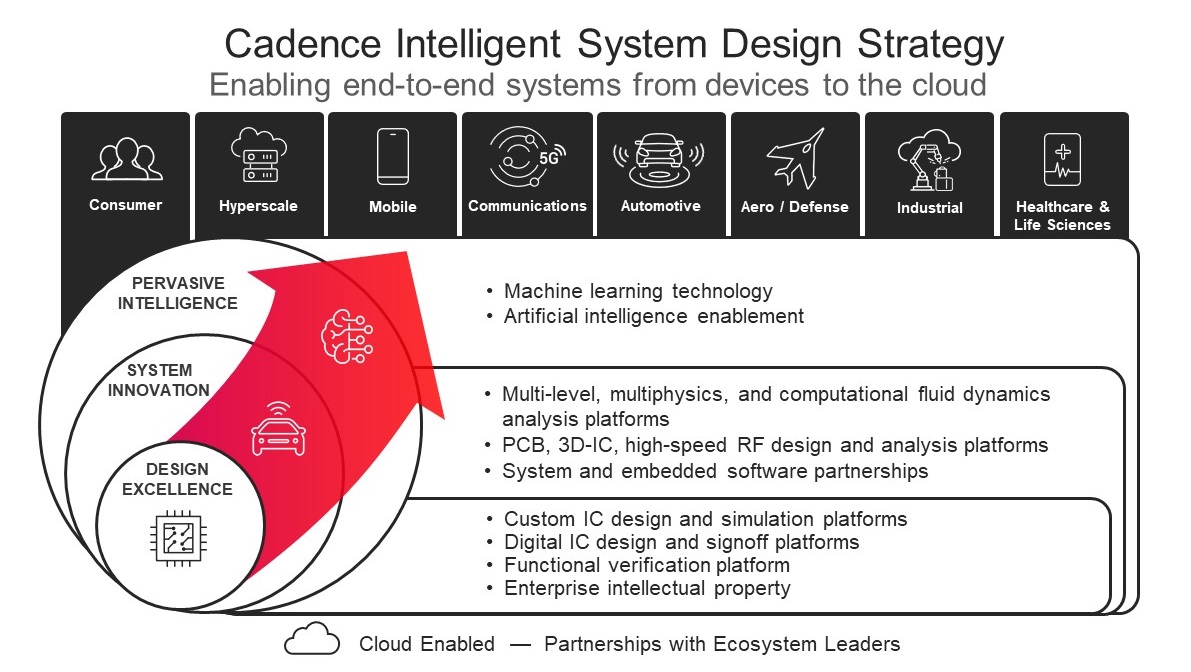][added: ]
The [removed: IC and SoC] [added: foundation of] design excellence [removed: requires technologies] for [added: semiconductors is essential for our customers to produce best-in-class technology for] custom IC, digital IC design and signoff, [added: simulation] and functional verification, and leverages pre-built semiconductor IP.
These tools, IP and associated services are specifically designed to meet the growing requirements of engineers designing increasingly complex chips across analog, digital and mixed-signal domains, and perform the associated verification tasks, including validation of low-level software running on [added: a digital twin of] the silicon [removed: model, thereby enabling design teams to manage complexity and verification throughput without commensurately increasing the team size or extending the project schedule, while reducing technical risks.][added: model.]
The second layer of our strategy [removed: centers around] [added: leverages our computational expertise, expanding our solutions into the physical analysis in] system innovation.
[removed: It includes tools and services used for system design of the packages that encapsulate the ICs and the PCBs,] [added: Our technology covers] system simulation [removed: which includes] [added: analysis, including] electromagnetic, [removed: electro-thermal] [added: electro-thermal, electromechanics,] and other multiphysics analysis necessary as part of optimizing the full system’s performance, radio frequency (“RF”) and microwave systems, and embedded software.
It starts with providing solutions and services to develop AI-enhanced systems and includes machine [removed: learning and] [added: learning,] deep learning [added: and digital twin] capabilities being added to the [removed: Cadence® technology] [added: Cadence computational software and computational hardware] portfolio to make IP and tools more automated and to produce optimized results faster.
Our software and [removed: emulation] [added: special-purpose hardware] products also support cloud access to address the growing computational needs of our customers.
Consistent with our Intelligent System Design strategy, we completed several acquisitions [removed: during] [added: since the beginning of] fiscal [removed: 2022] [added: 2023] that we believe [removed: enhances] [added: enhance] our talent, our [removed: System Design and Analysis] technology portfolio and our ability to pursue attractive opportunities in the markets we serve.
Our products and services enable our customers to design complex and innovative [added: semiconductor and] electronic [removed: products] [added: systems] that are accelerated by the [removed: growing digital transformation.][added: trends of semiconductor companies designing electrical systems, systems companies designing semiconductors, the hyper-convergence between electrical and mechanical systems and generative AI.]
Demand for our technology and expertise is driven by increasing complexity and our customers’ [removed: investment] [added: need to invest] in new designs and [removed: products.][added: products that are highly differentiated.]
[removed: The] [added: We believe the] most promising new opportunities for us involve enabling the design of electronic systems for consumers, including [added: digital twin, generative AI,] augmented reality (“AR”), virtual reality (“VR”), [removed: and industrial internet of things (“IIoT”),] [added: IIoT, edge computing,] hyperscale computing (including data center infrastructure), [removed: AI, edge computing,] mobile, communications (including 5G networks), automotive, aerospace and defense, [removed: and] industrial [removed: and healthcare subsystems.][added: subsystems, as well as the emerging opportunities in life sciences.]
Large and existing electronics categories, such as data center infrastructure, [added: networking,] mobile, smartphones and [removed: networking products] [added: AI products,] continue to provide business opportunities for us as customers initiate new design projects.
Underlying the requirements within any particular vertical [removed: market] sector is the availability of rapidly improving IC manufacturing technology.
With the rapid pace of innovation comes the opportunity for our products to address growing key challenges associated with [added: the design of] electronic [removed: product creation,] [added: products,] such as power consumption, performance, chip area and cost.
Our products and services have [removed: unique] [added: differentiated] attributes that our customers value.
In general, these attributes can be grouped into broader categories such as quality of results (“QoR”) (in terms of power consumption, performance and chip area), engineering productivity, tool performance, manufacturing, [removed: reliability,] [added: reliability] and faster time to market.
Many of these attributes contribute to [removed: the] sustainability [removed: of our planet] [added: initiatives] by enabling our customers to create innovative products that optimize power, space and [removed: energy needs.][added: energy.]
These representations are verified using simulation tools optimized for each type of design, including the design capture environment, simulation and IC layout within the [removed: Virtuoso®] [added: Virtuoso] custom IC design platform.
The Virtuoso Advanced-Node Platform adds functionality to the base Virtuoso package to enable the use of [removed: three-dimensional] [added: 3D] transistors (“FinFETs”), multi-patterning and other technologies required for advanced designs.
We also offer the [added: Cadence] Modus [removed: software solution,] [added: DFT Software Solution,] which reduces SoC design-for-test time.
Once the design is more mature, with early formal and simulation verification tasks performed, verification engineers deploy our Palladium® Enterprise Emulation Platform and Protium™ [removed: FPGA-Based] [added: field programmable gate arrays (“FPGA”)-Based] Prototyping Platforms for more comprehensive chip verification, often running low-level embedded software on top of a model of the chip, to [removed: provide for] [added: ensure] proper functionality before silicon manufacturing.
The Protium platform leverages a common front end with the Palladium environment to move designs rapidly from emulation to the prototyping stage, allowing for software development to [removed: start] [added: begin] weeks to months earlier than otherwise possible.
Our design IP portfolio [removed: also] includes solutions for high speed SerDes, [removed: PCI,] [added: peripheral component interconnect (“PCI”),] USB and many other standards.
We also offer a broad range of Verification IP (“VIP”) with memory models, which model the expected behavior of many [removed: industry standard] [added: industry-standard] protocols when used with verification solutions and are complementary to our design IP offerings.
Our VIP and accelerated VIP are used with our full suite of functional verification engines to emulate and model the expected behavior and interaction of standard industry system interface protocols including DDR, [removed: USB,] [added: USB] and PCI Express® in silicon.
The need for compact, high-performance mobile, consumer and automotive design with advanced serial interconnect is driving the [removed: technology] [added: technological] evolution for our PCB offerings.
For mainstream PCB customers, where individual or small team productivity is a focus, we provide the OrCAD® family of [removed: offerings that is] [added: offerings, which are] primarily marketed worldwide through a network of resellers.
Our Fidelity™ CFD Software [removed: solution] expands our ability to meet the growing design challenges of electronic and systems companies.
Our comprehensive suite of [removed: CFD] [added: computational fluid dynamics (“CFD”)] solutions [removed: enable] [added: enables] our customers to extend their multiphysics analysis workflows to address simulation and analysis challenges for applications such as aerodynamics, hydrodynamics, propulsion, turbomachinery, heat [removed: transfer,] [added: transfer] and combustion.
Since our inception, we have been at the forefront of technology innovation, solving highly complex challenges in the semiconductor and electronic systems industries.
We are a global company that provides computational software, special-purpose computational hardware, IP and services to multiple vertical sectors including automotive, artificial intelligence (“AI”), aerospace and defense, high-performance and mobile computing, hyperscalers, wireless communication, industrial internet of things (“IIoT”) and life sciences.
Our solutions are integrated and used in every stage of design creation, implementation, verification, analysis and signoff from chips to printed circuit boards (“PCBs”) to complete electromechanical systems.
Companies that design semiconductors and other electronic devices use our solutions to design, simulate, verify, signoff and manufacture every major type of semiconductor electronics including analog, mixed-signal, radio frequency (“RF”) and microwave devices, photonics, memory devices and digital chips for high-performance computing and AI, including central processing units (“CPUs”), graphics processing units (“GPUs”), neural processing units (“NPUs”), three-dimensional (“3D”) integrated circuit (“3D-IC”) and advanced package devices.
These devices are used in multiple vertical sectors.
Companies that design system-level products cover a broad range of vertical sectors including automotive, aerospace and defense systems, networking and communication systems, high-performance computing, cloud infrastructure and data centers, medical systems and health and life sciences.
These companies use our solutions to design, simulate, verify and manufacture complete system products with the electronics included.
Some of our software offerings are used by pharmaceutical and biotech companies to help accelerate their drug discovery process.
Our customers include many of the world’s most innovative companies that design and build highly sophisticated semiconductor and electronic systems found in products used in everyday life.
Our Intelligent System Design strategy allows us to quickly adapt to our customers' dynamic design requirements.
We develop industry-leading computational software and hardware, generative AI, and digital twin algorithms to help solve their toughest challenges.
Our software and services enable our customers to produce products that meet their critical business goals including time-to-market, costs and productivity while meeting growing global environmental concerns including sustainability and carbon emissions.
The creation of even the most seemingly simple electronic systems and products that people use every day is a complex process and requires many highly-trained engineers with various areas of specialized knowledge and skill sets.
Our ability to deliver products that keep up with increasing complexity allows our customers to be successful in meeting their business goals and objectives.
This enables design teams to manage complexity and verification throughput without increasing their team size or extending the project schedule, while reducing technical risks.
It includes tools and services used for system design of the packages that encapsulate the ICs, 3D-ICs and PCBs.
We also leverage our computational software expertise to life sciences by offering biosimulation solutions.
It also includes deploying generative AI techniques and LLMs to provide a rich set of co-pilots or design assistants to accelerate the design process.
During the second quarter of fiscal 2023, we acquired Pulsic, Ltd., a provider of floorplanning, placement and routing of custom IC software.
This acquisition enhances our existing generative AI capabilities in Virtuoso® Studio to solve advanced node challenges using intelligent AI-based physical design and virtual prototyping techniques.
During the third quarter of fiscal 2023, we acquired the Rambus SerDes and memory interface PHY IP assets from Rambus Inc. This acquisition broadens our enterprise IP portfolio in the design of AI, data center and hyperscale applications, as well as extends our expertise across multiple vertical sectors including automotive, aerospace and defense and consumer electronics, with the objective of providing broad subsystem solutions that meet the demands of our worldwide customers.
During the fourth quarter of fiscal 2023, we acquired Intrinsix Corporation, a wholly owned subsidiary of CEVA, Inc., and a provider of design engineering solutions focused on the U.S. aerospace and defense industry.
This acquisition adds a highly skilled engineering team that has expertise in advanced nodes, radio frequency, mixed signal and security algorithms.
In January 2024, we acquired Invecas, Inc., a leading provider of design engineering, embedded software and system-level solutions.
This acquisition adds a skilled system design engineering team with expertise in providing custom solutions across chip design, product engineering, advanced packaging and embedded software.
All of our product categories have generative AI solutions that augment the core product offering.
The Virtuoso Studio platform is our generative AI solution for custom IC and mixed-signal design and simulation that enables additional productivity, automation and quality of results throughout the entire design flow.
Cadence Cerebrus™ is our generative AI solution that combines all elements of the full-flow IC through signoff that enables additional productivity, automation and improved quality of results throughout the entire design flow.
Additionally, Verisium™ is our generative AI solution for multi-run verification that enables additional productivity, automation and quality of results throughout the entire verification flow.
Fidelity CFD is a physics-based analysis solution for mechanical design and complements the electronic system analysis portfolio.
Our Millennium™ Multiphysics Enterprise Platform is an industry-first turnkey AI-enabled digital twin.
Millennium M1 is the first release and overcomes traditional CFD speed/accuracy and compute resource limitations with a combination of GPU resident CFD solvers such as Fidelity LES for large eddy simulations (“LES”) and scalable high-performance hardware.
Augmenting all our multiphysics analysis solutions is Optimality™ Intelligent System Explorer, an industry-first generative AI-driven multiphysics optimization solution that enables additional productivity, automation and quality of results throughout the entire analysis flow.
Optimality Explorer breaks through the limitations of the conventional human-intensive optimization process and is designed to produce the optimal system design solution expeditiously and without compromising accuracy.
An additional AI digital twin solution of our Data Center Design and Insight Platform brings physics-based design and analysis to the data center sector for performance-aware design and operational planning.
Data center professionals can future-proof designs and assess operational decisions with this digital twin and empower designers, owners and operators to address the need for reliability, capacity and energy efficiency.
We also offer molecular modeling and simulation solutions obtained through our acquisition of OpenEye Scientific Software in fiscal 2022.
These solutions and services are used by a wide range of organizations in the pharmaceutical and biotechnology sectors to accelerate the drug discovery process and make more informed decisions in the development of new therapeutics.
We estimate our remaining performance obligations at a point in time.
Actual amounts and timing of revenue recognition may differ from these estimates largely due to changes in actual installation and delivery dates, as well as contract renewals, modifications and terminations.
Our customers include some of the world’s most innovative companies that deliver extraordinary electronic products from chips to boards to systems for dynamic market applications.
We enable our customers to develop electronic products.
Our products and services are designed to give our customers a competitive edge in their development of integrated circuits (“ICs”), systems-on-chip (“SoCs”), and increasingly sophisticated electronic devices and systems.
Our products and services do this by optimizing performance, minimizing power consumption, shortening the time to bring our customers’ products to market, improving engineering productivity and reducing their design, development and manufacturing costs.
Our electronic systems customers deliver entire devices, such as smartphones, laptop computers, gaming systems, automobiles and autonomous driving systems, servers, cloud data center infrastructure, artificial intelligence (“AI”) systems, aerospace and defense, medical equipment and networking products.
These systems companies internally develop, or externally purchase, the sub-components for their products, including printed circuit boards (“PCBs”), which interconnect all the hardware components, ICs, which are often referred to as computer chips, and software at various levels which runs on the hardware.
Our semiconductor customers deliver ICs, which include subcategories such as processors, SoCs, AI, memory, analog and other types of chips.
Our Intelligent System Design strategy is to provide the computational software technologies necessary for our electronic system and semiconductor customers to develop products across a variety of vertical markets including consumer, hyperscale computing, mobile, 5G communications, automotive, aerospace and defense, industrial, healthcare and life sciences.
We address the challenges posed by the needs and trends of electronic systems companies as well as semiconductor companies delivering greater portions of these systems.
[Table of](#i97343246becb48fa926dba3a366e932a_7) [Contents](#i97343246becb48fa926dba3a366e932a_7)
The development of electronic products, or their sub-components, is complex and requires many engineers using our solutions with specialized knowledge and skill.
In order to make our customers successful, our products must handle this exponential growth rate in complexity, without requiring a corresponding increase in our customers’ costs.
This includes our acquisition of OpenEye Scientific Software, Inc. (“OpenEye”), a leading provider of computational molecular modeling and simulation software used by pharmaceutical and biotechnology companies for drug discovery.
The addition of OpenEye’s technologies and experienced team, with its deep scientific expertise, broadens our System Design and Analysis technology portfolio and expands our total addressable market, bringing our computational software expertise to apply proven algorithmic, simulation and solver advances to life sciences.
We also acquired FFG Holdings Limited (“Future Facilities”), a provider of electronics cooling analysis and energy performance optimization solutions for data center design and operations using physics-based 3D digital twins.
The addition of Future Facilities broadens our multiphysics system analysis and computational fluid dynamics (“CFD”) product offerings to serve a wide breadth of hyperscale, enterprise data center, managed service and colocation providers.
We are applying machine learning or computational software techniques within our products to enhance QoR, productivity, performance, manufacturing, reliability and methodology.
The addition of our computational molecular modeling and simulation solution with our acquisition of OpenEye leverages our computational software expertise and expands our ability to address various challenges of drug discovery faced by pharmaceutical and biotechnology companies.
Generally, between 85% and 90% of our annual revenue is characterized as recurring revenue.
Contracted but unsatisfied performance obligations will fluctuate from period to period depending on the timing of contract renewals and duration of the contracts.
The contracted, but unsatisfied performance obligations expected to generate revenue in the next 12 months include hardware orders that were previously undelivered due to production constraints.
Due to increasing hardware production capacity, these performance obligations are expected to be satisfied in fiscal 2023.
Our cultural tenet is “One Team – One Cadence.” This culture-first message underpins our belief that a diverse, highly supported and engaged workforce is critical to the foundation of our business success.
These partnerships allow us to conduct recruiting, outreach and engagement with diverse communities.
- An Advanced Leadership Program for top women, Black and Latinx talent, which provides specialized coaching, workshops and career opportunities.
- University programs to increase diversity that actively engages Historically Black Colleges and Universities and Hispanic Serving Institutions including grants for diversity based scholarships.
To promote employee health and well-being throughout the course of the COVID-19 pandemic, we have provided employees with a flexible, hybrid work model, additional time off to focus on themselves and their families, wellness initiatives (including physical, emotional and mental health), and global employee assistance programs to connect employees and their families with resources, information and counseling to address the challenges caused by the pandemic, such as increased anxiety or stress.
During fiscal 2021, we formed the Cadence Giving Foundation with the goal of giving back to the communities where we live and work.
This stand-alone, non-profit foundation partners with other charitable initiatives to support critical needs in areas such as diversity, equity and inclusion, environmental sustainability and science, technology, engineering, and mathematics (“STEM”) education.
Fiscal 2022 and fiscal 2021, were both 52-week fiscal years, compared to 2020, which was a 53-week fiscal year.
No transition report is required in connection with this change.
An excerpt. Shown here: 40 of 104 rewritten, 40 of 49 added and all 31 removed. The counts are complete. For every sentence, read Item 1. Business in the FY2023 filing and the FY2022 filing.
Item 3. Legal Proceedings
0 rewritten, 1 added, 16 removed, 0 unchanged
For information regarding pending legal proceedings, related matters and associated risks, see Note 18 in the notes to consolidated financial statements under Item 15 of Part IV and the “Risk Factors” section under Item 1A of Part I of this Annual Report.
From time to time, we are involved in various disputes and legal proceedings that arise in the ordinary course of business.
These include disputes and legal proceedings related to intellectual property, indemnification obligations, mergers and acquisitions, licensing, contracts, customers, products, distribution and other commercial arrangements and employee relations matters.
At least quarterly, we review the status of each significant matter and assess its potential financial exposure.
If the potential loss from any claim or legal proceeding is considered probable and the amount or the range of loss can be estimated, we accrue a liability for the estimated loss.
Legal proceedings are subject to uncertainties, and the outcomes are difficult to predict.
Because of such uncertainties, accruals are based on our judgments using the best information available at the time.
As additional information becomes available, we reassess the potential liability related to pending claims and legal proceedings and may revise estimates.
[Table of](#i97343246becb48fa926dba3a366e932a_7) [Contents](#i97343246becb48fa926dba3a366e932a_7)
On April 27, 2022, Bell Semiconductor LLC (“Bell Semi“), a patent monetization entity, began filing a series of patent infringement lawsuits against certain technology companies alleging that certain semiconductor devices designed using certain design tools offered by EDA vendors, including Cadence, infringe upon one or more patents held by Bell Semi.
Bell Semi seeks monetary damages, attorneys’ fees and costs, and a permanent injunction prohibiting the defendants from using allegedly infringing EDA design tools.
On April 29, 2022, Bell Semi also began filing a series of complaints with the U.S. International Trade Commission (“ITC“) alleging violations of Section 337 of the Tariff Act of 1930 and seeking limited exclusion orders preventing the respondents from importing into the United States semiconductor devices designed using certain design tools offered by EDA vendors, including Cadence, and cease-and-desist orders prohibiting respondents from importing, selling, offering for sale, marketing, advertising, distributing, or transferring products (except for exportation) made using certain design tools offered by EDA vendors, including Cadence.
The ITC instituted three investigations but Bell Semi subsequently terminated one of the investigations.
Cadence is not named as a respondent or defendant in any of the aforementioned actions; however, certain respondents and defendants are Cadence customers and have sought defense and indemnity from Cadence regarding Bell Semi’s allegations.
Cadence has offered to defend some of its customers consistent with the terms of the applicable license agreements.
On November 18, 2022, Cadence and another EDA vendor jointly filed an action in the U.S. District Court for the District of Delaware for declaratory judgment of invalidity and non-infringement as to each of the six patents asserted by Bell Semi in the aforementioned actions.
On November 28, 2022, Cadence and another EDA vendor also filed a motion for preliminary injunction in the U.S. District Court for the District of Delaware seeking to enjoin Bell Semi from proceeding with its litigation campaign.
Cover and table of contents
29 rewritten, 5 added, 2 removed, 91 unchanged
For the fiscal year ended December 31, [removed: 2022][added: 2023]
[removed: ][added: ]
[removed: (408) 943-1234][added: (408) 943-1234]
| Title of Each Class | | | Trading Symbol(s) | | | [removed: Names] [added: Name] of Each Exchange on which Registered | | |
The aggregate market value of the voting and non-voting common equity held by non-affiliates computed by reference to the price at which the common equity was last sold as of the last business day of the registrant’s most recently completed second fiscal quarter ended [removed: July 2, 2022] [added: June 30, 2023] was approximately [removed: $40,982,000,000.][added: $63,740,000,000.]
On January 31, [removed: 2023,] [added: 2024,] approximately [removed: 272,940,000] [added: 272,239,000] shares of the [removed: Registrant’s Common Stock,] [added: registrant’s common stock,] $0.01 par value, were outstanding.
Portions of the definitive proxy statement for Cadence Design Systems, Inc.’s [removed: 2023] [added: 2024] Annual Meeting of Stockholders are incorporated by reference into [removed: Part] [added: Parts II and] III hereof.
| Item 1. | | | [removed: [Business](#i97343246becb48fa926dba3a366e932a_13)] [added: [Business](#ic24734912743496c96f78452640091cf_13)] | | | [removed: [1](#i97343246becb48fa926dba3a366e932a_13)] [added: [1](#ic24734912743496c96f78452640091cf_13)] | | |
| Item 1A. | | | [Risk [removed: Factors](#i97343246becb48fa926dba3a366e932a_22)] [added: Factors](#ic24734912743496c96f78452640091cf_22)] | | | [removed: [11](#i97343246becb48fa926dba3a366e932a_22)] [added: [12](#ic24734912743496c96f78452640091cf_22)] | | |
| Item 1B. | | | [Unresolved Staff [removed: Comments](#i97343246becb48fa926dba3a366e932a_25)] [added: Comments](#ic24734912743496c96f78452640091cf_25)] | | | [removed: [25](#i97343246becb48fa926dba3a366e932a_25)] [added: [26](#ic24734912743496c96f78452640091cf_25)] | | |
| Item 2. | | | [removed: [Properties](#i97343246becb48fa926dba3a366e932a_28)] [added: [Properties](#ic24734912743496c96f78452640091cf_28)] | | | [removed: [25](#i97343246becb48fa926dba3a366e932a_28)] [added: [28](#ic24734912743496c96f78452640091cf_28)] | | |
| Item 3. | | | [Legal [removed: Proceedings](#i97343246becb48fa926dba3a366e932a_31)] [added: Proceedings](#ic24734912743496c96f78452640091cf_31)] | | | [removed: [25](#i97343246becb48fa926dba3a366e932a_31)] [added: [28](#ic24734912743496c96f78452640091cf_31)] | | |
| Item 4. | | | [Mine Safety [removed: Disclosures](#i97343246becb48fa926dba3a366e932a_34)] [added: Disclosures](#ic24734912743496c96f78452640091cf_34)] | | | [removed: [26](#i97343246becb48fa926dba3a366e932a_34)] [added: [28](#ic24734912743496c96f78452640091cf_34)] | | |
| Item 5. | | | [Market for Registrant’s Common Equity, Related Stockholder Matters and Issuer Purchases of Equity [removed: Securities](#i97343246becb48fa926dba3a366e932a_40)] [added: Securities](#ic24734912743496c96f78452640091cf_40)] | | | [removed: [27](#i97343246becb48fa926dba3a366e932a_40)] [added: [29](#ic24734912743496c96f78452640091cf_40)] | | |
| Item 6. | | | [removed: [\[Reserved\]](#i97343246becb48fa926dba3a366e932a_52)] [added: [\[Reserved\]](#ic24734912743496c96f78452640091cf_52)] | | | [removed: [28](#i97343246becb48fa926dba3a366e932a_52)] [added: [30](#ic24734912743496c96f78452640091cf_52)] | | |
| Item 7. | | | [Management’s Discussion and Analysis of Financial Condition and Results of [removed: Operations](#i97343246becb48fa926dba3a366e932a_55)] [added: Operations](#ic24734912743496c96f78452640091cf_55)] | | | [removed: [28](#i97343246becb48fa926dba3a366e932a_55)] [added: [31](#ic24734912743496c96f78452640091cf_55)] | | |
| Item 7A. | | | [Quantitative and Qualitative Disclosures About Market [removed: Risk](#i97343246becb48fa926dba3a366e932a_82)] [added: Risk](#ic24734912743496c96f78452640091cf_79)] | | | [removed: [42](#i97343246becb48fa926dba3a366e932a_82)] [added: [44](#ic24734912743496c96f78452640091cf_79)] | | |
| Item 8. | | | [Financial Statements and Supplementary [removed: Data](#i97343246becb48fa926dba3a366e932a_85)] [added: Data](#ic24734912743496c96f78452640091cf_82)] | | | [removed: [43](#i97343246becb48fa926dba3a366e932a_85)] [added: [45](#ic24734912743496c96f78452640091cf_82)] | | |
| Item 9. | | | [Changes in and Disagreements with Accountants on Accounting and Financial [removed: Disclosure](#i97343246becb48fa926dba3a366e932a_88)] [added: Disclosure](#ic24734912743496c96f78452640091cf_85)] | | | [removed: [43](#i97343246becb48fa926dba3a366e932a_88)] [added: [45](#ic24734912743496c96f78452640091cf_85)] | | |
| Item 9A. | | | [Controls and [removed: Procedures](#i97343246becb48fa926dba3a366e932a_91)] [added: Procedures](#ic24734912743496c96f78452640091cf_88)] | | | [removed: [43](#i97343246becb48fa926dba3a366e932a_91)] [added: [45](#ic24734912743496c96f78452640091cf_88)] | | |
| Item 9B. | | | [Other [removed: Information](#i97343246becb48fa926dba3a366e932a_94)] [added: Information](#ic24734912743496c96f78452640091cf_91)] | | | [removed: [44](#i97343246becb48fa926dba3a366e932a_94)] [added: [46](#ic24734912743496c96f78452640091cf_91)] | | |
| Item 9C. | | | [Disclosure Regarding Foreign Jurisdictions that Prevent [removed: Inspections](#i97343246becb48fa926dba3a366e932a_97)] [added: Inspections](#ic24734912743496c96f78452640091cf_94)] | | | [removed: [44](#i97343246becb48fa926dba3a366e932a_97)] [added: [46](#ic24734912743496c96f78452640091cf_94)] | | |
| Item 10. | | | [Directors, Executive Officers and Corporate [removed: Governance](#i97343246becb48fa926dba3a366e932a_103)] [added: Governance](#ic24734912743496c96f78452640091cf_100)] | | | [removed: [45](#i97343246becb48fa926dba3a366e932a_103)] [added: [47](#ic24734912743496c96f78452640091cf_100)] | | |
| Item 11. | | | [Executive [removed: Compensation](#i97343246becb48fa926dba3a366e932a_106)] [added: Compensation](#ic24734912743496c96f78452640091cf_103)] | | | [removed: [45](#i97343246becb48fa926dba3a366e932a_106)] [added: [47](#ic24734912743496c96f78452640091cf_103)] | | |
| Item 12. | | | [Security Ownership of Certain Beneficial Owners and Management and Related Stockholder [removed: Matters](#i97343246becb48fa926dba3a366e932a_109)] [added: Matters](#ic24734912743496c96f78452640091cf_106)] | | | [removed: [45](#i97343246becb48fa926dba3a366e932a_109)] [added: [47](#ic24734912743496c96f78452640091cf_106)] | | |
| Item 13. | | | [Certain Relationships and Related Transactions and Director [removed: Independence](#i97343246becb48fa926dba3a366e932a_112)] [added: Independence](#ic24734912743496c96f78452640091cf_109)] | | | [removed: [45](#i97343246becb48fa926dba3a366e932a_112)] [added: [47](#ic24734912743496c96f78452640091cf_109)] | | |
| Item 14. | | | [Principal Accountant Fees and [removed: Services](#i97343246becb48fa926dba3a366e932a_115)] [added: Services](#ic24734912743496c96f78452640091cf_112)] | | | [removed: [45](#i97343246becb48fa926dba3a366e932a_115)] [added: [47](#ic24734912743496c96f78452640091cf_112)] | | |
| Item 15. | | | [Exhibits and Financial Statement [removed: Schedules](#i97343246becb48fa926dba3a366e932a_121)] [added: Schedules](#ic24734912743496c96f78452640091cf_118)] | | | [removed: [46](#i97343246becb48fa926dba3a366e932a_121)] [added: [48](#ic24734912743496c96f78452640091cf_118)] | | |
| Item 16. | | | [Form 10-K [removed: Summary](#i97343246becb48fa926dba3a366e932a_211)] [added: Summary](#ic24734912743496c96f78452640091cf_208)] | | | [removed: [88](#i97343246becb48fa926dba3a366e932a_211)] [added: [93](#ic24734912743496c96f78452640091cf_208)] | | |
Such definitive proxy statement will be filed with the Securities and Exchange Commission within 120 days of the registrant's fiscal year ended December 31, 2023.
FOR THE FISCAL YEAR ENDED DECEMBER 31, 2023
| Item 1C. | | | [Cybersecurity](#ic24734912743496c96f78452640091cf_1739) | | | [27](#ic24734912743496c96f78452640091cf_1739) | | |
| | | | | | | | | |
| | | | [Signatures](#ic24734912743496c96f78452640091cf_211) | | | [94](#ic24734912743496c96f78452640091cf_211) | | |
[Table of](#i97343246becb48fa926dba3a366e932a_7) [Contents](#i97343246becb48fa926dba3a366e932a_7)
| | | | [Signatures](#i97343246becb48fa926dba3a366e932a_214) | | | [89](#i97343246becb48fa926dba3a366e932a_214) | | |
Item 1C. Cybersecurity
0 rewritten, 31 added, 0 removed, 0 unchanged
New section this year
Cybersecurity Risk Management and Strategy
We have developed and implemented a cybersecurity risk management program intended to protect the confidentiality, integrity, and availability of our critical systems and information, including our customers’, vendors’, partners’ and employees’ data, including personal information.
Our cybersecurity risk management program is guided by frameworks and standards promulgated by the EU, National Institute of Standards and Technology, Cloud Security Alliance (“CSA”) and International Organization for Standardization/International Electrotechnical Commission (“ISO/IEC”).
While we seek to maintain ISO/IEC 27001:2013, ISO/IEC 27017 and the SOC 2 Type 1 certifications, this does not imply that we specifically or comprehensively comply with technical specification or requirements, only that we use all the above-mentioned standards and regulations as a guide to help us identify, assess and manage cybersecurity risks relevant to our business.
Our cybersecurity risk management program is integrated into our overall risk oversight strategy and utilizes common reporting channels and governance processes that apply across other risk areas.
We have a dedicated Chief Information Security Officer (“CISO”), who leads our Information Security team responsible for managing our cybersecurity processes, strategy and controls.
Certain members of our Information Security team hold cybersecurity certifications, including the Certified Information Systems Security Professional (“CISSP”) and the Certified Information Systems Auditor (“CISA”) designations.
Our cybersecurity risk management program includes:
- a security incident response plan that includes procedures for responding to cybersecurity incidents;
- risk assessment processes designed to help identify cybersecurity risks to our critical systems, information, products, services, and our broader enterprise IT environment;
- our Information Security team, principally responsible for identifying and mitigating cybersecurity risks, and managing our security controls and our response to cybersecurity incidents;
- the use of external service providers, where appropriate, to assess, test or otherwise assist with certain aspects of our security controls and processes;
- implementation of new hire and annual data privacy and cybersecurity training of employees, including senior management, and cybersecurity governance training for our Board of Directors;
- a cybersecurity insurance policy to cover certain types of costs and losses from cybersecurity incidents; and
- a third-party risk management process, including risk assessment and risk rating, for certain service providers, suppliers, and vendors.
We have not identified risks from known cybersecurity threats, including as a result of any prior cybersecurity incidents, that have materially affected or are reasonably likely to materially affect us, including our business strategy, results of operations, or financial condition.
*Cybersecurity Governance*
Our Board of Directors is responsible for overseeing our enterprise risk management activities in general, and our Board committees assist with certain aspects of risk oversight.
With respect to cybersecurity risk, our Board of Directors shares certain of the oversight responsibility and processes with the Audit Committee of the Board of Directors (“Audit Committee”).
The Audit Committee, comprised entirely of independent directors, reviews and discusses with management our guidelines, policies and practices regarding risk assessment and risk management as they relate to our financial condition, and oversees our financial risk exposures, including planning regarding business continuity and cybersecurity.
In addition, the Audit Committee oversees our annual enterprise business risk assessment, which includes the review of cybersecurity risks we face and our associated risk mitigation measures, and receives semi-annual reports from management on cybersecurity matters, including areas such as threat intelligence, major cybersecurity risk areas, regulations and cybersecurity incidents.
In addition, management updates the Audit Committee, as necessary, regarding significant cybersecurity incidents, as well as any incidents with lesser impact potential.
The Audit Committee reports to the Board of Directors regarding its activities related to cybersecurity.
In addition, the Board of Directors also directly receives reports from management on our cybersecurity risk profile and on the performance of our data privacy and cybersecurity risk management program, semi-annually in alternating quarters with the Audit Committee.
Our management team, including our Chief Information Officer (“CIO”), CISO and the General Counsel, is responsible for assessing and managing material risks from cybersecurity threats, including supervision of our internal security incident response team and our Disclosure Committee comprised of certain of our employees (including any applicable subcommittees thereof).
Our management team has relevant expertise in the following:(i) understanding of cybersecurity risks in enterprise operations, (ii) experience in overseeing risk management and understanding risks faced by enterprise operations and (iii) significant operating experience allowing them to provide insight into developing, implementing and assessing our operating plan.
In addition, our CISO has over 25 years of broad cybersecurity and information technology risk management experience, is a Certified Information Security Manager (“CISM”) and holds a Master's Degree in computer science and information systems.
Our management team supervises efforts to prevent, detect, mitigate, and remediate cybersecurity risks and incidents, and is responsible for oversight and management of our cybersecurity risk management program.
Our management team receives briefings from our internal Information Security team and the Disclosure Committee whenever applicable.
Such briefings include information regarding threat intelligence and other information obtained from governmental, public or private sources, including external consultants engaged by us, and alerts and reports produced by security tools deployed in our information technology environment.
Our management team also provides quarterly cybersecurity risk management program updates, to the Board of Directors or to the Audit Committee, in alternating quarters.
Item 2. Properties
1 rewritten, 0 added, 0 removed, 5 unchanged
As of December 31, [removed: 2022,] [added: 2023,] the total square footage of our owned buildings was approximately 1,227,000.
Item 4. Mine Safety Disclosures
0 rewritten, 0 added, 1 removed, 2 unchanged
[Table of](#i97343246becb48fa926dba3a366e932a_7) [Contents](#i97343246becb48fa926dba3a366e932a_7)
Item 5. Market for Registrant’s Common Equity, Related Stockholder Matters and Issuer Purchases of Equity Securities
10 rewritten, 15 added, 10 removed, 19 unchanged
The graph assumes that the value of the investment in our common stock and in each index on December [removed: 30, 2017] [added: 29, 2018,] (including reinvestment of dividends) was $100 and tracks it each year thereafter on the last day of our fiscal year through December 31, [removed: 2022 and,] [added: 2023, and] for each [removed: index,] [added: index] on the last day of the calendar year.
[removed: 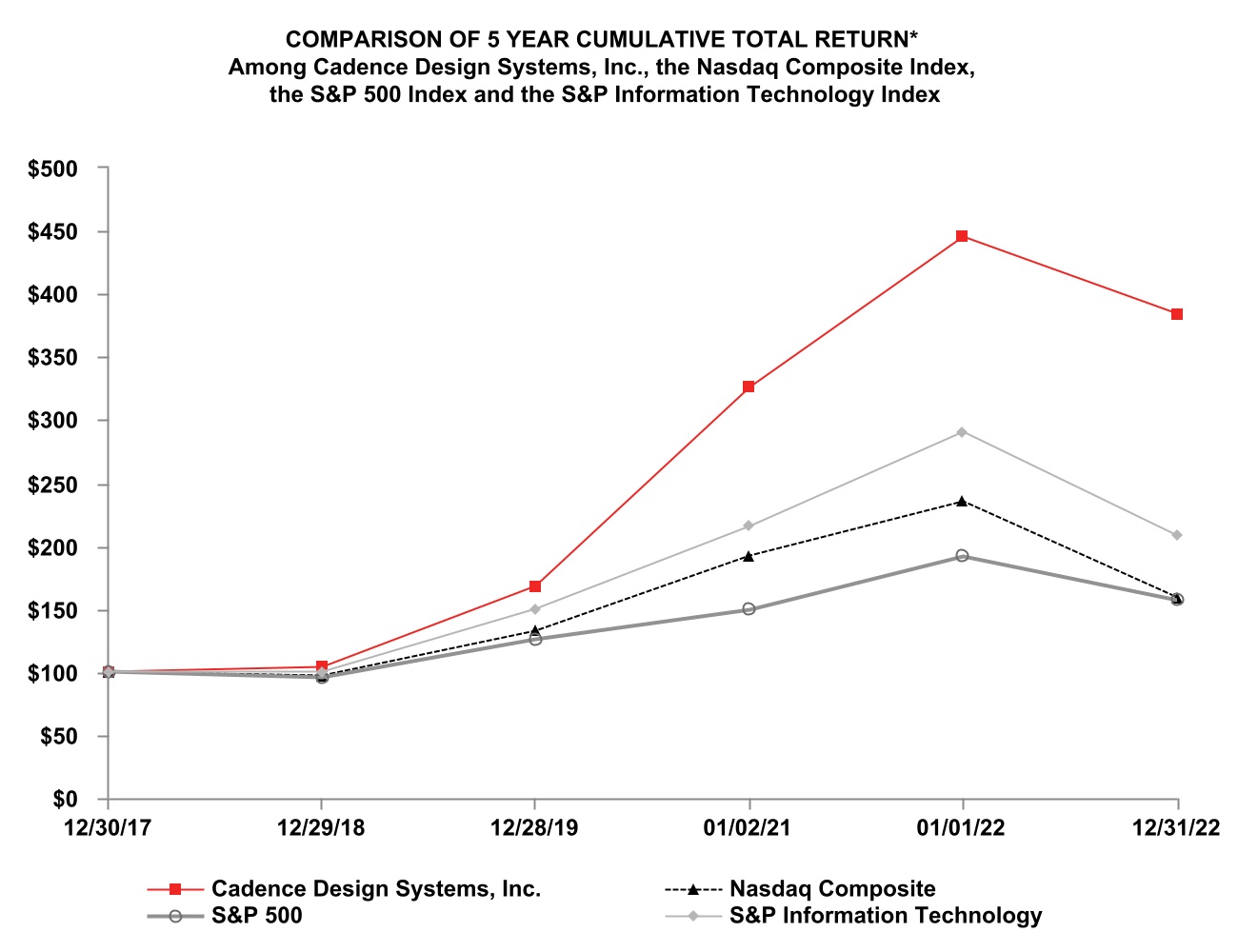][added: ]
*$100 invested on [removed: 12/30/17] [added: 12/29/18] in stock or [added: 12/31/18] index, including reinvestment of dividends.
Copyright© [removed: 2023] [added: 2024] Standard & Poor's, a division of S&P Global.
| | | | | | | [removed: 12/30/2017] [added: 12/29/2018] | | | | | | [removed: 12/29/2018] [added: 12/28/2019] | | | | | | [removed: 12/28/2019] [added: 1/2/2021] | | | | | | [removed: 1/2/2021] [added: 1/1/2022] | | | | | | [removed: 1/1/2022] [added: 12/31/2022] | | | | | | [removed: 12/31/2022] [added: 12/31/2023] | | |
We are authorized to repurchase shares of our common stock under a publicly announced program most recently increased by our Board of Directors on August [removed: 11, 2022.][added: 2, 2023.]
As of December 31, [removed: 2022,] [added: 2023,] approximately [removed: $1.1] [added: $1.4] billion of the share repurchase authorization remained available to repurchase shares of our common stock.
The following table presents repurchases made under our current authorization and shares surrendered by employees to satisfy income tax withholding obligations during the three months ended December 31, [removed: 2022:][added: 2023:]
(2)The weighted average price paid per share of common stock does not include the cost of [removed: commissions.][added: commissions or excise taxes.]
(3)Our publicly announced share repurchase program was originally announced on February 1, [removed: 2017] [added: 2017,] and most recently increased by an additional $1.0 billion on August [removed: 11, 2022.][added: 2, 2023.]
As of January 31, 2024, we had 344 registered stockholders.
Because many shares of our common stock are held by brokers and other institutions on behalf of stockholders, we are unable to estimate the total number of stockholders that are represented by these record holders.
Dividends
We have never declared or paid, and do not anticipate declaring or paying in the foreseeable future, any cash dividends on our common stock.
Any future determination as to the declaration and payment of dividends, if any, will be at the discretion of our Board of Directors, subject to applicable laws and will depend on then existing conditions, including our financial condition, operating results, contractual restrictions, capital requirements, business prospects and other factors our Board of Directors may deem relevant.
| Cadence Design Systems, Inc. | | | | | | $ | 100.00 | | | | | $ | 162.18 | | | | | $ | 314.79 | | | | | $ | 429.97 | | | | | $ | 370.65 | | | | | $ | 628.45 | |
| Nasdaq Composite | | | | | | 100.00 | | | | | | 136.69 | | | | | | 198.10 | | | | | | 242.03 | | | | | | 163.28 | | | | | | 236.17 | | |
| S&P 500 | | | | | | 100.00 | | | | | | 131.49 | | | | | | 155.68 | | | | | | 200.37 | | | | | | 164.08 | | | | | | 207.21 | | |
| S&P 500 Information Technology | | | | | | 100.00 | | | | | | 150.29 | | | | | | 216.25 | | | | | | 290.92 | | | | | | 208.90 | | | | | | 329.73 | | |
| October 1, 2023 - October 31, 2023 | | | 191,736 | | | | | | $ | 243.07 | | | | | 169,407 | | | | | | $ | 1,461 | |
| November 1, 2023 - November 30, 2023 | | | 179,388 | | | | | | $ | 259.37 | | | | | 166,508 | | | | | | $ | 1,418 | |
| December 1, 2023 - December 31, 2023 | | | 160,654 | | | | | | $ | 270.08 | | | | | 151,959 | | | | | | $ | 1,377 | |
| Total | | | 531,778 | | | | | | $ | 256.73 | | | | | 487,874 | | | | | | | | |
Shares Authorized for Issuance under Equity Compensation Plans
The information required by Item 201(d) of Regulation S-K under Item 5 is incorporated herein by reference from the section entitled “Equity Compensation Plan Information” in our definitive proxy statement for our 2024 Annual Meeting of Stockholders.
As of January 31, 2023, we had 357 registered stockholders and approximately 490,000 beneficial owners of our common stock.
| Cadence Design Systems, Inc. | | | | | | $ | 100.00 | | | | | $ | 103.63 | | | | | $ | 168.08 | | | | | $ | 326.23 | | | | | $ | 445.60 | | | | | $ | 384.12 | |
| Nasdaq Composite | | | | | | 100.00 | | | | | | 97.16 | | | | | | 132.81 | | | | | | 192.47 | | | | | | 235.15 | | | | | | 158.65 | | |
| S&P 500 | | | | | | 100.00 | | | | | | 95.62 | | | | | | 125.72 | | | | | | 148.85 | | | | | | 191.58 | | | | | | 156.89 | | |
| S&P 500 Information Technology | | | | | | 100.00 | | | | | | 99.71 | | | | | | 149.86 | | | | | | 215.63 | | | | | | 290.08 | | | | | | 208.30 | | |
[Table of](#i97343246becb48fa926dba3a366e932a_7) [Contents](#i97343246becb48fa926dba3a366e932a_7)
| October 2, 2022 - November 5, 2022 | | | 1,379,968 | | | | | | $ | 151.75 | | | | | 1,361,665 | | | | | | $ | 1,170 | |
| November 6, 2022 - December 3, 2022 | | | 304,525 | | | | | | $ | 160.06 | | | | | 292,586 | | | | | | $ | 1,123 | |
| December 4, 2022 - December 31, 2022 | | | 298,895 | | | | | | $ | 164.25 | | | | | 284,350 | | | | | | $ | 1,077 | |
| Total | | | 1,983,388 | | | | | | $ | 154.91 | | | | | 1,938,601 | | | | | | | | |
Item 8. Financial Statements and Supplementary Data
1 rewritten, 0 added, 0 removed, 1 unchanged
The financial statements required by Item 8 are submitted as a separate section of this Annual [removed: Report on Form 10-K.][added: Report.]
Item 9A. Controls and Procedures
5 rewritten, 0 added, 6 removed, 11 unchanged
As required by Rule 13a-15 of the Securities Exchange Act of 1934, as amended (the “Exchange Act”) under the supervision and with the participation of our management, including our Chief Executive Officer (“CEO”) and our Chief Financial Officer (“CFO”), we evaluated the effectiveness of the design and operation of our disclosure controls and procedures (as defined in Rules 13a-15(e) and 15d-15(e) under the Exchange Act) as of December 31, [removed: 2022.][added: 2023.]
Based on their evaluation our CEO and CFO have concluded that, as of December 31, [removed: 2022,] [added: 2023,] our disclosure controls and procedures were effective to provide reasonable assurance that the information required to be disclosed by us in our reports filed or submitted under the Exchange Act is recorded, processed, summarized and reported within the time periods specified in the SEC’s rules and forms and is accumulated and communicated to our management, including the CEO and CFO, as appropriate to allow timely decisions regarding required disclosure.
There were no changes in our internal control over financial reporting during the fiscal quarter ended December 31, [removed: 2022] [added: 2023,] that materially affected, or are reasonably likely to materially affect, our internal control over financial reporting.
Our management assessed the effectiveness of our internal control over financial reporting as of December 31, [removed: 2022.][added: 2023.]
Our management has concluded that, as of December 31, [removed: 2022,] [added: 2023,] our internal control over financial reporting is effective based on these criteria.
[Table of](#i97343246becb48fa926dba3a366e932a_7) [Contents](#i97343246becb48fa926dba3a366e932a_7)
The evaluation of our disclosure controls and procedures included a review of our processes and the effect on the information generated for use in this Annual Report on Form 10-K.
In the course of this evaluation, we sought to identify any material weaknesses in our disclosure controls and procedures, to determine whether we had identified any acts of fraud involving personnel who have a significant role in our disclosure controls and procedures, and to confirm that any necessary corrective action, including process improvements, was taken.
This type of evaluation is done every fiscal quarter so that our conclusions concerning the effectiveness of these controls can be reported in our periodic reports filed with the SEC.
The overall goals of these evaluation activities are to monitor our disclosure controls and procedures and to make modifications as necessary.
We intend to maintain these disclosure controls and procedures, modifying them as circumstances warrant.
Item 9B. Other Information
0 rewritten, 8 added, 1 removed, 0 unchanged
Insider Trading Arrangements
During the fiscal quarter ended December 31, 2023, our directors and officers (as defined in Rule 16a-1(f) under the Exchange Act) adopted or terminated the contracts, instructions or written plans for the purchase or sale of our securities set forth in the table below.
| | | | | | | | | | | | | | | | | | | | | | | | | | | | | | | | | |
| --- | --- | --- | --- | --- | --- | --- | --- | --- | --- | --- | --- | --- | --- | --- | --- | --- | --- | --- | --- | --- | --- | --- | --- | --- | --- | --- | --- | --- | --- | --- | --- | --- |
| | | | | | | | | | | | | | | | | | | Type of Trading Arrangement | | | | | | | | | | | | | | |
| Name and Position | | | | | | Action | | | | | | Adoption/ Termination Date | | | | | | Rule 10b5-1* | | | | | | Total Shares of Common Stock to be Sold | | | | | | Expiration Date | | |
| Thomas P. Beckley, Senior Vice President and General Manager of the Custom IC and PCB Group | | | | | | Adoption | | | | | | 10/26/2023 | | | | | | X | | | | | | Up to 65,615 | | | | | | 2/14/2025 | | |
| * Contract, instruction or written plan intended to satisfy the affirmative defense conditions of Rule 10b5-1(c) under the Exchange Act. | | | | | | | | | | | | | | | | | | | | | | | | | | | | | | | | |
None.
Item 9C. Disclosure Regarding Foreign Jurisdictions that Prevent Inspections
0 rewritten, 0 added, 1 removed, 2 unchanged
[Table of](#i97343246becb48fa926dba3a366e932a_7) [Contents](#i97343246becb48fa926dba3a366e932a_7)
Item 10. Directors, Executive Officers and Corporate Governance
4 rewritten, 0 added, 0 removed, 0 unchanged
The information required by Item 10 as to directors is incorporated herein by reference from the sections entitled “Proposal 1 - Election of Directors” and, as applicable, “Security Ownership of Certain Beneficial Owners and Management - Delinquent Section 16(a) Reports” in Cadence’s definitive proxy statement for its [removed: 2023] [added: 2024] Annual Meeting of Stockholders.
The executive officers of Cadence are listed at the end of Item 1 of Part I of this Annual [removed: Report on Form 10-K.][added: Report.]
The information required by Item 10 as to Cadence’s code of ethics is incorporated herein by reference from the section entitled “Corporate Governance - Code of Business Conduct” in Cadence’s definitive proxy statement for its [removed: 2023] [added: 2024] Annual Meeting of Stockholders.
The information required by Item 10 as to the director nomination process and Cadence’s Audit Committee is incorporated by reference from the section entitled “Board of Directors - Committees of the Board” in Cadence’s definitive proxy statement for its [removed: 2023] [added: 2024] Annual Meeting of Stockholders.
Item 11. Executive Compensation
1 rewritten, 0 added, 0 removed, 0 unchanged
The information required by Item 11 is incorporated herein by reference from the sections entitled “Board of Directors - Components of Director Compensation,” “Board of Directors - Director Compensation for Fiscal [removed: 2022,”] [added: 2023,”] “Compensation Discussion and Analysis,” “Compensation Committee Report,” “Compensation Committee Interlocks and Insider Participation,” “Compensation of Executive Officers,” “Potential Payments Upon Termination or Change In [removed: Control,”] [added: Control”] and “Pay Ratio Disclosure” in Cadence’s definitive proxy statement for its [removed: 2023] [added: 2024] Annual Meeting of Stockholders.
Item 12. Security Ownership of Certain Beneficial Owners and Management and Related Stockholder Matters
1 rewritten, 0 added, 0 removed, 0 unchanged
The information required by Item 12 is incorporated herein by reference from the sections entitled “Security Ownership of Certain Beneficial Owners and Management” and “Equity Compensation Plan Information” in Cadence’s definitive proxy statement for its [removed: 2023] [added: 2024] Annual Meeting of Stockholders.
Item 13. Certain Relationships and Related Transactions and Director Independence
1 rewritten, 0 added, 0 removed, 0 unchanged
The information required by Item 13 is incorporated herein by reference from the sections entitled “Certain Transactions” and “Board of Directors - Director Independence” in Cadence’s definitive proxy statement for its [removed: 2023] [added: 2024] Annual Meeting of Stockholders.
Item 14. Principal Accountant Fees and Services
1 rewritten, 0 added, 1 removed, 1 unchanged
The information required by Item 14 is incorporated herein by reference from the section entitled “Fees Billed to Cadence by the Independent Registered Public Accounting Firm During Fiscal [removed: 2022] [added: 2023] and [removed: 2021”] [added: 2022”] in Cadence’s definitive proxy statement for its [removed: 2023] [added: 2024] Annual Meeting of Stockholders.
[Table of](#i97343246becb48fa926dba3a366e932a_7) [Contents](#i97343246becb48fa926dba3a366e932a_7)
Item 15. Exhibits and Financial Statement Schedules
501 rewritten, 269 added, 97 removed, 981 unchanged
| | | | [Report of Independent Registered Public Accounting [removed: Firm](#i97343246becb48fa926dba3a366e932a_124)] [added: Firm](#ic24734912743496c96f78452640091cf_121)] (Auditor Firm ID 238) | | | [removed: [47](#i97343246becb48fa926dba3a366e932a_124)] [added: [49](#ic24734912743496c96f78452640091cf_121)] | | |
| | | | [Consolidated Balance Sheets as of December 31, [removed: 2022] [added: 2023,] and [removed: January 1, 2022](#i97343246becb48fa926dba3a366e932a_127)] [added: December 31, 2022](#ic24734912743496c96f78452640091cf_124)] | | | [removed: [49](#i97343246becb48fa926dba3a366e932a_127)] [added: [51](#ic24734912743496c96f78452640091cf_124)] | | |
| | | | [Consolidated [removed: Income] Statements [added: of Comprehensive Income] for the three fiscal years ended December 31, [removed: 2022](#i97343246becb48fa926dba3a366e932a_130)] [added: 2023](#ic24734912743496c96f78452640091cf_130)] | | | [removed: [50](#i97343246becb48fa926dba3a366e932a_130)] [added: [53](#ic24734912743496c96f78452640091cf_130)] | | |
| | | | [Consolidated [removed: Statements of Comprehensive] Income [added: Statements] for the three fiscal years ended December 31, [removed: 2022](#i97343246becb48fa926dba3a366e932a_133)] [added: 2023](#ic24734912743496c96f78452640091cf_127)] | | | [removed: [51](#i97343246becb48fa926dba3a366e932a_133)] [added: [52](#ic24734912743496c96f78452640091cf_127)] | | |
| | | | [Consolidated Statements of Stockholders’ Equity for the three fiscal years ended December 31, [removed: 2022](#i97343246becb48fa926dba3a366e932a_136)] [added: 2023](#ic24734912743496c96f78452640091cf_133)] | | | [removed: [52](#i97343246becb48fa926dba3a366e932a_136)] [added: [54](#ic24734912743496c96f78452640091cf_133)] | | |
| | | | [Consolidated Statements of Cash Flows for the three fiscal years ended December 31, [removed: 2022](#i97343246becb48fa926dba3a366e932a_139)] [added: 2023](#ic24734912743496c96f78452640091cf_136)] | | | [removed: [53](#i97343246becb48fa926dba3a366e932a_139)] [added: [55](#ic24734912743496c96f78452640091cf_136)] | | |
| | | | [Notes to Consolidated Financial [removed: Statements](#i97343246becb48fa926dba3a366e932a_142)] [added: Statements](#ic24734912743496c96f78452640091cf_139)] | | | [removed: [54](#i97343246becb48fa926dba3a366e932a_142)] [added: [56](#ic24734912743496c96f78452640091cf_139)] | | |
The exhibits listed in the accompanying Exhibit Index are filed or incorporated by reference as part of this Annual [removed: Report on Form 10-K.][added: Report.]
The exhibits filed or incorporated by reference as part of this Annual Report [removed: on Form 10-K] contain agreements to which Cadence is a party.
Accordingly, these representations and warranties may not describe the actual state of affairs as of the date they were made or at any other [removed: time,] [added: time] and should not be relied upon as statements of factual information.
© [removed: 2023] [added: 2024] Cadence Design Systems, Inc. All rights reserved worldwide.
We have audited the accompanying consolidated balance sheets of Cadence Design Systems, Inc. and its subsidiaries (the “Company”) as of December 31, [removed: 2022] [added: 2023] and [removed: January 1,] 2022, and the related consolidated statements of income, of comprehensive income, of stockholders’ equity and of cash flows for each of the three years in the period ended December 31, [removed: 2022,] [added: 2023,] including the related notes (collectively referred to as the “consolidated financial statements”).
We also have audited the Company’s internal control over financial reporting as of December 31, [removed: 2022,] [added: 2023,] based on criteria established in [removed: Internal] [added: *Internal] Control - Integrated [removed: Framework] [added: Framework*] (2013) issued by the Committee of Sponsoring Organizations of the Treadway Commission (COSO).
In our opinion, the consolidated financial statements referred to above present fairly, in all material respects, the financial position of the Company as of December 31, [removed: 2022] [added: 2023] and [removed: January 1,] 2022, and the results of its operations and its cash flows for each of the three years in the period ended December 31, [removed: 2022] [added: 2023] in conformity with accounting principles generally accepted in the United States of America.
Also in our opinion, the Company maintained, in all material respects, effective internal control over financial reporting as of December 31, [removed: 2022,] [added: 2023,] based on criteria established in [removed: Internal] [added: *Internal] Control - Integrated [removed: Framework] [added: Framework*] (2013) issued by the COSO.
For the year ended December 31, [removed: 2022,] [added: 2023,] the Company’s total revenue was [removed: $3.562] [added: $4.090] billion.
December 31, [removed: 2022] [added: 2023] and [removed: January 1,] [added: December 31,] 2022
| | | | December 31, [added: 2023 | | | | | | December 31,] 2022 | | | | | | January 1, 2022 | | |
| Cash and cash equivalents [added: at beginning of year] | | | $ | 882,325 | | | | | $ | 1,088,940 | | [added: | | | $ | 928,432 | |]
| Receivables, net | | | [removed: 486,710] [added: 489,224] | | | | | | [removed: 337,596] [added: 486,710] | | |
| Inventories | | | [removed: 128,005] [added: 181,661] | | | | | | [removed: 115,721] [added: 128,005] | | |
| Prepaid expenses and other | | | [removed: 209,727] [added: 297,180] | | | | | | [removed: 173,512] [added: 209,727] | | |
| Total current assets | | | [removed: 1,706,767] [added: 1,976,217] | | | | | | [removed: 1,715,769] [added: 1,706,767] | | |
| Property, plant and equipment, net | | | [removed: 371,451] [added: 403,213] | | | | | | [removed: 305,911] [added: 371,451] | | |
| Goodwill | | | [removed: 1,374,268] [added: 1,535,845] | | | | | | [removed: 928,358] [added: 1,374,268] | | |
| Acquired intangibles, net | | | [removed: 354,617] [added: 336,843] | | | | | | [removed: 233,265] [added: 354,617] | | |
| Deferred taxes | | | [removed: 853,691] [added: 880,001] | | | | | | [removed: 763,770] [added: 853,691] | | |
| Other assets | | | [removed: 476,277] [added: 537,372] | | | | | | [removed: 439,226] [added: 476,277] | | |
| Total assets | | | $ | [removed: 5,137,071] [added: 5,669,491] | | | | | $ | [removed: 4,386,299] [added: 5,137,071] | |
| Revolving credit facility | | | $ | [removed: 100,000] [added: —] | | | | | $ | [removed: —] [added: 100,000] | |
| Accounts payable and accrued liabilities | | | [removed: 557,158] [added: 576,558] | | | | | | [removed: 417,283] [added: 557,158] | | |
| Current portion of deferred revenue | | | [removed: 690,538] [added: 665,024] | | | | | | [removed: 553,942] [added: 690,538] | | |
| Total current liabilities | | | [removed: 1,347,696] [added: 1,590,867] | | | | | | [removed: 971,225] [added: 1,347,696] | | |
| Long-term portion of deferred revenue | | | [removed: 91,524] [added: 98,931] | | | | | | [removed: 101,148] [added: 91,524] | | |
| Long-term debt | | | [removed: 648,078] [added: 299,771] | | | | | | [removed: 347,588] [added: 648,078] | | |
| Other long-term liabilities | | | [removed: 304,660] [added: 275,651] | | | | | | [removed: 225,663] [added: 304,660] | | |
| Total long-term liabilities | | | [removed: 1,044,262] [added: 674,353] | | | | | | [removed: 674,399] [added: 1,044,262] | | |
| Commitments and contingencies (Notes 8, [removed: 12] [added: 17] and 18) | | | | | | | | | | | |
| Common stock – $0.01 par value; authorized 600,000 shares; issued and outstanding shares: [removed: 272,675] [added: 271,706] and [removed: 276,796,] [added: 272,675,] respectively | | | [removed: 2,765,673] [added: 3,166,964] | | | | | | [removed: 2,467,701] [added: 2,765,673] | | |
| Treasury stock, at cost; [removed: 56,485] [added: 57,453] shares and [removed: 52,363] [added: 56,485] shares, respectively | | | [removed: (3,824,163)] [added: (4,604,323)] | | | | | | [removed: (2,740,003)] [added: (3,824,163)] | | |
| [(a) 3. Exhibits](#ic24734912743496c96f78452640091cf_205) | | | | | | [91](#ic24734912743496c96f78452640091cf_205) | | |
February 13, 2024
| Cash and cash equivalents | | | $ | 1,008,152 | | | | | $ | 882,325 | |
| Current portion of long-term debt | | | 349,285 | | | | | | — | | |
For the three fiscal years ended December 31, 2023
| Unrealized gains on investments | | | 132 | | | | | | — | | | | | | — | | |
For the three fiscal years ended December 31, 2023
| Net income | | | — | | | | | | — | | | | | | — | | | | | | 1,041,144 | | | | | | — | | | | | | $ | 1,041,144 | |
| Purchase of treasury stock, including excise tax | | | (3,145) | | | | | | — | | | | | | (641,041) | | | | | | — | | | | | | — | | | | | | $ | (641,041) | |
| Equity forward contract | | | — | | | | | | 1,688 | | | | | | (61,688) | | | | | | — | | | | | | — | | | | | | $ | (60,000) | |
| Balance, December 31, 2023 | | | 271,706 | | | | | | $ | 3,166,964 | | | | | $ | (4,604,323) | | | | | $ | 4,936,384 | | | | | $ | (94,754) | | | | | $ | 3,404,271 | |
For the three fiscal years ended December 31, 2023
| | | | 2023 | | | | | | 2022 | | | | | | 2021 | | |
| Net income | | | 1,041,144 | | | | | | 848,952 | | | | | | 695,955 | | |
For the three fiscal years ended December 31, 2023
Cadence Design Systems, Inc. (“Cadence”) is an innovation leader in electronic system design that delivers essential computational software, hardware, and IP that its customers use to turn their design concepts into reality.
Many of Cadence’s customers design semiconductors and electronic systems.
Semiconductor companies focus on the design of all types of semiconductor devices including integrated circuits (“ICs”), analog, mixed-signal, memory, 3D-IC, processor chips for computing (“CPUs”), graphics (“GPUs”), and AI.
These customers will then use the semiconductor devices in the design of printed circuit boards (“PCBs”).
Cadence’s electronic systems customers design and create products for consumer and business needs, such as smartphones, laptop computers, gaming and entertainment systems, automobiles and autonomous driving systems, aerospace and defense systems, communication systems, networking products, compute servers, cloud data center infrastructure, artificial intelligence (“AI”) systems, medical equipment, and a much longer list of consumer products used in everyday life.
These systems companies internally develop, or externally purchase, the sub-components for their products, including ICs and PCBs, which connect all the hardware components, and software at various levels that run on the hardware.
Both fiscal year 2022 and 2021, which are included in this report for comparative purposes, represent 52-week periods.
No transition report was required in connection with this change.
Cadence has not recently adopted any accounting standard updates that are material or potentially material to its consolidated financial statements.
*Segment Reporting*
In November 2023.
the Financial Accounting Standards Board (“FASB”), issued Accounting Standards Update (“ASU”) No. 2023-07, “Segment Reporting (Topic 280): Improvements to Reportable Segment Disclosures,” intended to improve reportable segment disclosure requirements, primarily through enhanced annual and interim disclosures about significant segment expenses.
Early adoption is permitted.
Cadence is currently evaluating the impact of this standard on its financial statement disclosures.
*Income Taxes*
In December 2023, the FASB issued ASU No. 2023-09, “Income Taxes (Topic 740): Improvements to Income Tax Disclosures,” which requires disclosure of disaggregated income taxes paid, prescribes standard categories for the components of the effective tax rate reconciliation, and modifies other income tax-related disclosures.
This standard is effective for fiscal years beginning after December 15, 2024, and may be applied on a retrospective or prospective basis.
Cadence reviews its non-marketable investments for impairment on a regular basis by considering investee financial performance and other information received from the investee companies that indicates a decline in value has occurred.
For non-marketable equity investments accounted for using the measurement alternative, the carrying amount may also be adjusted based on observable price changes from orderly transactions for identical or similar investments of the same issuer.
Adjustments to the carrying amounts of non-marketable investments are recorded in other income (expense), net in the consolidated income statements.
There were no material events or circumstances impacting the carrying amount of our non-marketable investments during the periods presented.
Investments in Debt Securities
Cadence’s investments in debt securities are comprised of investments in mortgage-backed and asset backed-securities and are carried at fair value as a component of prepaid expenses and other in the consolidated balance sheets.
Cadence classifies its investment in debt securities as available-for-sale, and gross unrealized gains and losses are recorded as a component of accumulated other comprehensive loss on its consolidated balance sheets.
Cadence assesses its portfolio of debt securities for impairment at least quarterly.
| [(a) 3. Exhibits](#i97343246becb48fa926dba3a366e932a_208) | | | | | | [86](#i97343246becb48fa926dba3a366e932a_208) | | |
[Table of](#i97343246becb48fa926dba3a366e932a_7) [Contents](#i97343246becb48fa926dba3a366e932a_7)
February 13, 2023
| | | | As of | | | | | | | | |
| Balance, December 28, 2019 | | | 279,855 | | | | | | $ | 2,046,237 | | | | | $ | (1,668,105) | | | | | $ | 1,761,688 | | | | | $ | (36,926) | | | | | $ | 2,102,894 | |
| Cumulative effect adjustment | | | | | | | | | | | | | | | | | | | | | (1,999) | | | | | | | | | | | | $ | (1,999) | |
| Net income | | | — | | | | | | — | | | | | | — | | | | | | 590,644 | | | | | | — | | | | | | $ | 590,644 | |
| Purchase of treasury stock | | | (4,247) | | | | | | — | | | | | | (380,064) | | | | | | — | | | | | | — | | | | | | $ | (380,064) | |
| Cash and cash equivalents at beginning of year | | | $ | 1,088,940 | | | | | $ | 928,432 | | | | | $ | 705,210 | |
Cadence Design Systems, Inc. (“Cadence”) provides solutions that enable its customers to design complex and innovative products.
Cadence’s solutions are designed to give its customers a competitive edge in their development of integrated circuits (“ICs”), systems-on-chip (“SoCs”) and increasingly sophisticated electronic devices and systems by optimizing performance, minimizing power consumption, shortening the time required for customers to bring their products to market, improving engineering productivity and reducing their design, development and manufacturing costs.
Cadence’s product offerings include software, hardware, services and reusable IC design blocks, which are commonly referred to as intellectual property (“IP”).
Cadence also provides maintenance for its software, hardware, and IP product offerings.
Fiscal 2022 and fiscal 2021, were both 52-week fiscal years, compared to 2020, which was a 53-week fiscal year.
*Lessors - Certain Leases with Variable Lease Payments*
In July 2021, the Financial Accounting Standards Board (“FASB”), issued Accounting Standards Update (“ASU”) 2021-05, “Lessors - Certain Leases with Variable Lease Payments,” which allows lessors to classify and account for a lease with variable payments that do not depend on a reference index or a rate as an operating lease if both of the following criteria are met: (1) the lease would have been classified as a sales-type lease or a direct financing lease in accordance with the classification criteria as defined in ASC Topic 842 and (2) the lessor would have otherwise recognized a day-one loss on the lease arrangement.
This standard better aligns the accounting with the underlying economics of these arrangements as lessors are not permitted to include most variable payments which do not depend on a reference index or a rate in the lease receivable while assets are derecognized at lease commencement.
Cadence adopted this standard on January 2, 2022, the first day of fiscal 2022, on a prospective basis.
*Business Combinations*
In October 2021, the FASB issued ASU 2021-08, “Accounting for Contract Assets and Contract Liabilities from Contracts with Customers,” which requires contract assets and contract liabilities acquired in a business combination to be recognized and measured by the acquirer on the acquisition date in accordance with “Revenue from Contracts with Customers (Topic 606)” as if the acquiring entity had originated the contracts.
This approach differs from the previous requirement to measure contract assets and contract liabilities acquired in a business combination at fair value.
Cadence adopted this standard on January 2, 2022, the first day of fiscal 2022.
The adoption of this standard did not impact acquired contract assets or liabilities from business combinations that occurred prior to the date of adoption, and the impact in current and future periods will depend on the contract assets and contract liabilities acquired.
For business combinations completed during fiscal 2022, Cadence recognized deferred revenue of $11.8 million from the acquired businesses as if Cadence had originated the contracts in accordance with Topic 606 rather than at fair value.
For additional information relating to Cadence’s acquisitions, see Note 6 in the notes to consolidated financial statements.
There have been no recent accounting standard updates that are material or potentially material to Cadence.
| Equipment | | | 3-5 years | | |
Cadence reviews its non-marketable investments on a regular basis to determine whether its investments in these companies are impaired.
Cadence considers investee financial performance and other information received from the investee companies, as well as any other available estimates of the fair value of the investee companies in its review.
If Cadence determines the carrying value of an investment exceeds its fair value, the book value of the investment is adjusted to its fair value.
| IP | | | 12 | | % | | | | 13 | | % | | | | 14 | | % |
Generally, between 85% and 90% of Cadence’s annual revenue is characterized as recurring revenue.
| Year ended January 2, 2021 | | | | | | $ | 2,868 | | | | | $ | 1,628 | | | | | $ | 225 | | | | | $ | (1,854) | | | | | $ | 2,867 | |
As of December 31, 2022, the interest rate on the 2021 Credit Facility was 5.30%.
2020 Acquisitions
In fiscal 2020, Cadence acquired all of the outstanding equity of AWR Corporation (“AWR”) and Integrand Software, Inc. (“Integrand”).
These acquisitions enhanced Cadence’s technology portfolio to address growing radio frequency design activity, driven by expanding use of 5G communications.
The aggregate cash consideration for these acquisitions was $195.6 million, after taking into account cash acquired of $1.5 million.
Cadence will also make payments to certain employees, subject to continued employment and other performance-based conditions, through the first quarter of fiscal 2023.
With its acquisitions of AWR and Integrand, Cadence recorded $101.3 million of definite-lived intangible assets with a weighted average amortization period of approximately 9.0 years.
An excerpt. Shown here: 40 of 501 rewritten, 40 of 269 added and 40 of 97 removed. The counts are complete. For every sentence, read Item 15. Exhibits and Financial Statement Schedules in the FY2023 filing and the FY2022 filing.
Item 16. Form 10-K Summary
14 rewritten, 0 added, 4 removed, 43 unchanged
| Dated: | | | February 13, [removed: 2023] [added: 2024] | | |
| /s/ Anirudh Devgan | | | DATE: | | | February 13, [removed: 2023] [added: 2024] | | |
| /s/ John M. Wall | | | DATE: | | | February 13, [removed: 2023] [added: 2024] | | |
| /s/ | | | Dr. John B. Shoven | | | | | | February 13, [removed: 2023] [added: 2024] | | | | | |
| Dr. John B. Shoven, [removed: Lead Independent] Director | | | | | | | | | | | | | | |
| /s/ | | | Mark W. Adams | | | | | | February 13, [removed: 2023] [added: 2024] | | | | | |
| /s/ | | | Ita Brennan | | | | | | February 13, [removed: 2023] [added: 2024] | | | | | |
| /s/ | | | Lewis Chew | | | | | | February 13, [removed: 2023] [added: 2024] | | | | | |
| /s/ | | | Mary Louise Krakauer | | | | | | February 13, [removed: 2023] [added: 2024] | | | | | |
| Mary Louise Krakauer, [removed: Director] [added: Chair] | | | | | | | | | | | | | | |
| /s/ | | | Julia Liuson | | | | | | February 13, [removed: 2023] [added: 2024] | | | | | |
| /s/ | | | Dr. James D. Plummer | | | | | | February 13, [removed: 2023] [added: 2024] | | | | | |
| /s/ | | | Dr. Alberto Sangiovanni-Vincentelli | | | | | | February 13, [removed: 2023] [added: 2024] | | | | | |
| /s/ | | | Young K. Sohn | | | | | | February 13, [removed: 2023] [added: 2024] | | | | | |
[Table of](#i97343246becb48fa926dba3a366e932a_7) [Contents](#i97343246becb48fa926dba3a366e932a_7)
| | | | | | | | | | | | | | | |
| /s/ | | | Lip-Bu Tan | | | | | | February 13, 2023 | | | | | |
| Lip-Bu Tan, Executive Chair | | | | | | | | | | | | | | |