 filings.tools
C. H. Robinson Worldwide 10-K 2021-12-31
Filed 2022-02-23. 23 sections, 332K characters. Original on sec.gov · Markdown · JSON
Cover and table of contents
UNITED STATES SECURITIES AND EXCHANGE COMMISSION
Washington, D.C. 20549
FORM 10-K
☒ ANNUAL REPORT PURSUANT TO SECTION 13 OR 15(d) OF THE SECURITIES EXCHANGE ACT OF 1934
For the fiscal year ended December 31, 2021
or
☐ TRANSITION REPORT PURSUANT TO SECTION 13 OR 15(d) OF THE SECURITIES EXCHANGE ACT OF 1934
For the transition period from ____ to _____
Commission File Number: 000-23189

C.H. ROBINSON WORLDWIDE, INC.
(Exact name of registrant as specified in its charter)
| Delaware | 41-1883630 | |||||||
| (State or other jurisdiction of incorporation or organization) | (I.R.S. Employer Identification No.) |
14701 Charlson Road
Eden Prairie, Minnesota 55347
(Address of principal executive offices, including zip code)
Registrant’s telephone number, including area code: 952-937-8500
Securities registered pursuant to Section 12(b) of the Act:
| Title of each class | Trading Symbol(s) | Name of each exchange on which registered | ||||||
| Common Stock, par value $0.10 per share | CHRW | The Nasdaq Global Select Market |
Securities registered pursuant to Section 12(g) of the Act: None
Indicate by check mark if the registrant is a well-known seasoned issuer, as defined in Rule 405 of the Securities Act. Yes ☒ No ☐
Indicate by check mark if the registrant is not required to file reports pursuant to Section 13 or Section 15(d) of the Act. Yes ☐ No ☒
Indicate by check mark whether the registrant (1) has filed all reports required to be filed by Section 13 or 15(d) of the Securities Exchange Act of 1934 during the preceding 12 months (or for such shorter period that the registrant was required to file such reports) and (2) has been subject to such filing requirements for the past 90 days. Yes ☒ No ☐
Indicate by check mark whether the registrant has submitted electronically every Interactive Date File required to be submitted pursuant to Rule 405 of Regulation S-T (§232.405 of this chapter) during the preceding 12 months (or for such shorter period that the registrant was required to submit such files). Yes ☒ No ☐
Indicate by check mark whether the registrant is a large accelerated filer, an accelerated filer, a non-accelerated filer, a smaller reporting company, or emerging growth company. See definitions of “large accelerated filer,” “accelerated filer,” “smaller reporting company,” “emerging growth company” in Rule 12b-2 of the Exchange Act.
| Large accelerated filer | ☒ | Accelerated filer | ☐ | Non-accelerated filer | ☐ | Smaller reporting company | ☐ | Emerging growth company | ☐ |
If an emerging growth company, indicate by check mark if the registrant has elected not to use the extended transition period for complying with any new or revised financial accounting standards provided pursuant to Section 13(a) of the Exchange Act. ☐
Indicate by check mark whether the registrant has filed a report on and attestation to its management’s assessment of the effectiveness of its internal control over financial reporting under Section 404(b) of the Sarbanes-Oxley Act (15 U.S.C. 7262(b)) by the registered public accounting firm that prepared or issued its audit report. ☒
Indicate by check mark whether the registrant is a shell company (as defined in Rule 12b-2 of the Exchange Act). Yes ☐ No ☒
The aggregate market value of voting stock held by non-affiliates of the registrant as of June 30, 2021, was $12,367,912,086 (based upon the closing price of $93.67 per common share on that date as quoted on The Nasdaq Global Select Market).
As of February 16, 2022, the number of shares outstanding of the registrant’s common stock, par value $0.10 per share, was 128,798,559.
DOCUMENTS INCORPORATED BY REFERENCE
Portions of the Registrant’s Proxy Statement relating to its 2022 Annual Meeting of Stockholders (the “Proxy Statement”) are incorporated by reference in Part III.
C.H. ROBINSON WORLDWIDE, INC.
ANNUAL REPORT ON FORM 10-K
For the Year Ended December 31, 2021
TABLE OF CONTENTS
PART I
Item 1. BUSINESS
Overview
C.H. Robinson Worldwide, Inc. (“C.H. Robinson,” “the company,” “we,” “us,” or “our”) is one of the largest global logistics companies in the world with consolidated total revenues of $23.1 billion in 2021. We transform the way the world moves, improving the global supply chain through our people, processes, and technology. We are driven to provide exceptional experience to our customers and suppliers by providing freight transportation services and logistics solutions to companies of all sizes in a wide variety of industries. In 2021, we handled approximately 20 million shipments and worked with approximately 100,000 customers. Operating throughout North America, Europe, Asia, Oceania, and South America we offer a global suite of services using tailored, market-leading differentiated technology built by and for our global network of supply chain experts working with our customers to drive better outcomes by leveraging our experience, data, technology, and scale. Our EDGE values are the core of our strategy and drive us to Evolve constantly, Deliver excellence, Grow together, and Embrace integrity.
As a global logistics platform, we connect across continents by partnering with a wide variety of transportation companies and utilizing those relationships to efficiently and cost-effectively arrange the transport of our customers’ freight. In 2021, our customers turned to us to find solutions to problems they had never experienced before in the supply chain industry. We utilized approximately 85,000 contracted transportation companies around the world, including contracted motor carriers, railroads (primarily intermodal service providers), and ocean and air carriers in 2021. Our employees, technology, and product portfolio enable us to provide a differentiated experience, remaining flexible and providing solutions that optimize service for our customers. As an integral part of our transportation services, we also provide a wide range of value-added logistics services, such as freight consolidation, customs brokerage, supply chain consulting and analysis, emission analytics, optimization, and reporting.
In addition to transportation and logistics services, we also provide sourcing services under the trade name Robinson Fresh® (“Robinson Fresh”). Our sourcing services consist primarily of the buying, selling, and/or marketing of fresh fruits, vegetables, and other value-added perishable items. The foundation for much of our logistics expertise can be traced to this original business, founded in 1905, which gives us significant experience in handling produce and temperature controlled commodities. We supply fresh produce through a network of independent produce growers and suppliers. Our customers include grocery retailers, restaurants, foodservice distributors, and produce wholesalers. In many cases, we also arrange the logistics and transportation of the products we sell and provide related supply chain services, such as replenishment, category management, and managed procurement services. We have developed proprietary brands of produce and have exclusive licensing agreements to distribute fresh and value-added produce under recognized consumer brand names. The produce for these brands is sourced through a preferred grower network and packed to order through contract packing agreements. We have instituted quality assurance and monitoring procedures with each of these preferred growers.
Segment information. We have two reportable segments: North American Surface Transportation (“NAST”) and Global Forwarding with our remaining operating segments reported as All Other and Corporate. The All Other and Corporate segment includes Robinson Fresh, Managed Services, Other Surface Transportation outside of North America, and other miscellaneous revenues and unallocated corporate expenses. See additional disclosure in Note 9, Segment Reporting, to our consolidated financial statements.
NAST provides transportation and logistics services across North America through a network of offices in the United States, Canada, and Mexico. The primary services provided by NAST are truckload and less than truckload (“LTL”) transportation brokerage services.
Global Forwarding provides transportation and logistics services through an international network of offices in North America, Europe, Asia, Oceania, and South America; and also contracts with independent agents worldwide. The primary services provided by Global Forwarding include ocean freight services, air freight services, and customs brokerage.
Robinson Fresh provides sourcing services that primarily include the buying, selling, and/or marketing of fresh fruits, vegetables, and other value-added perishable items. Robinson Fresh sources products from around the world.
Managed Services is primarily comprised of our TMC division, which offers Managed TMS® (“Managed TMS”). Managed TMS combines the use of our global technology platform Navisphere® (“Navisphere”), logistics process expertise, and consulting services in relation to the use of motor carriers and other transportation providers chosen by our customers. Customers can access Navisphere, logistics experts, and supply chain engineers to manage their day-to-day operations and optimize supply chain performance.
Other Surface Transportation revenues are primarily earned by our Europe Surface Transportation operating segment. Europe Surface Transportation provides transportation and logistics services including truckload and groupage services across Europe.
Sales
Transportation and Logistics Services
C.H. Robinson provides freight transportation and related logistics and supply chain services. Our services range from commitments on a specific shipment to much more comprehensive and integrated relationships. We execute these service commitments by investing in and retaining talented employees, developing innovative proprietary systems and processes, and utilizing a network of contracted transportation providers, including, but not limited to, contracted motor carriers, railroads, and ocean and air carriers. We make a profit driven by the value we provide our customers and the resulting difference between what we charge to our customers for the totality of services provided to them and what we pay to the transportation providers to handle or transport the freight.
We provide the following transportation and logistics services:
-
Truckload: Through our contracts with motor carriers, we have access to dry vans, temperature controlled vans, flatbeds, and bulk capacity. Through the use of Navisphere, we connect our customers with contracted motor carriers that specialize in their transportation lanes and product types, and we help contracted motor carriers optimize the usage of their equipment.
-
LTL: LTL transportation involves the shipment of single or multiple pallets of freight. We primarily focus on shipments of a single pallet or larger, although we handle any size shipment. Through our contracts with motor carriers and use of Navisphere, we consolidate freight and freight information to provide our customers with a single source of information on their freight. In many instances, we consolidate partial shipments for several customers into full truckloads.
-
Ocean: As a licensed Non-Vessel Ocean Common Carrier (“NVOCC”) and freight forwarder, we consolidate shipments, determine routing, select ocean carriers, contract for ocean shipments, and/or provide for local pickup and delivery of shipments.
-
Air: As a certified Indirect Air Carrier (“IAC”) and freight forwarder, we organize air shipments and provide door-to-door service.
-
Customs: Our customs brokers are licensed and regulated by U.S. Customs and Border Protection and other authoritative governmental agencies to assist importers and exporters in meeting regulatory and operation
Showing the first 8K of 65K characters. Open the full section
Item 1A. RISK FACTORS
The following are material factors that could affect our financial performance and could cause actual results for future periods to differ materially from our anticipated results or other expectations, including those expressed in any forward-looking statements made in this Form 10-K. We may also refer to this disclosure to identify factors that may cause actual results to differ from those expressed in other forward-looking statements, including those made in oral presentations such as telephone conferences and webcasts open to the public.
Business environment and competition risk factors
Economic recessions could have a significant, adverse impact on our business. The transportation industry historically has experienced cyclical fluctuations in financial results due to economic recession, downturns in business cycles of our customers, interest rate fluctuations, currency fluctuations, and other economic factors beyond our control. Deterioration in the economic environment subjects our business to various risks, which may have a material and adverse impact on our operating results and cause us to not reach our long-term growth goals:
-
Decrease in volumes: A reduction in overall freight volumes in the marketplace may reduce our opportunities for growth. A significant portion of our freight are transactional or spot market opportunities. The transactional market may be more impacted than the contractual freight market by supply chain disruptions or overall economic conditions. In addition, if a downturn in our customers’ business cycles causes a reduction in the volume of freight shipped by those customers, particularly among certain national retailers or in the food, beverage, retail, manufacturing, paper, ecommerce, or printing industries, our operating results could be adversely affected.
-
Credit risk and working capital: Some of our customers may face economic difficulties and may not be able to pay us, and some may go out of business. In addition, some customers may not pay us as quickly as they have in the past, which may cause our working capital needs to increase.
-
Transportation provider failures: A significant number of our contracted transportation providers may go out of business and we may be unable to secure sufficient equipment or other transportation services to meet our commitments to our customers.
-
Expense management: We may not be able to appropriately adjust our expenses to changing market demands. In order to maintain high variability in our business model, it is necessary to adjust staffing levels to changing market demands. In periods of rapid change, it may be more difficult to match our staffing levels to our business needs. In addition, we have other expenses that are fixed for a period of time, and we may not be able to adequately adjust them in a period of rapid change in market demand.
Higher carrier prices may result in decreased adjusted gross profit margin and increases in working capital. Carriers can be expected to charge higher prices if market conditions warrant or to cover higher operating expenses. Our adjusted gross profit and income from operations may decrease if we are unable to increase our pricing to our customers. Increased demand for over the road transportation services and changes in regulations may reduce available capacity and increase motor carrier pricing. In some instances where we have entered into contract freight rates with customers, in the event market conditions change and those contracted rates are below market rates, we may be required to provide transportation services at a loss. As our volumes increase or we increase freight rates charged to our customers, the resulting increase in revenues may increase our working capital needs due to our business model which generally has a higher length of days sales outstanding than days payables outstanding.
Changing fuel costs and interruptions of fuel supplies may have an impact on our adjusted gross profit margins. In our truckload transportation business, fluctuating fuel prices may result in decreased adjusted gross profit margin. While our different pricing arrangements with customers and contracted motor carriers make it very difficult to measure the precise impact, we believe that fuel costs essentially act as a pass-through cost to our truckload business. In times of fluctuating fuel prices, our adjusted gross profit margin may also fluctuate. Adjusted gross profit margin is a non-GAAP financial measure calculated as adjusted gross profit divided by total revenues. For additional information, see Item 7 of Part II, Management’s Discussion and Analysis of Financial Condition and Results of Operations.
Our dependence on third parties to provide equipment and services may impact the delivery and quality of our transportation and logistics services. We do not employ the people directly involved in delivering our customers’ freight. We depend on independent third parties to provide truck, rail, ocean, and air services and to report certain events to us, including but not limited to, shipment status information and freight claims. These independent third parties may not fulfill their obligations to us, which may prevent us from meeting our commitments to our customers. This reliance also could cause delays in reporting certain events, including recognizing claims. In addition, if we are unable to secure sufficient equipment or other transportation services from third parties to meet our commitments to our customers, our operating results could be materially and adversely affected, and our customers could switch to our competitors temporarily or permanently. Many of these risks are beyond our control, including:
-
equipment and driver shortages in the transportation industry, particularly among contracted motor carriers;
-
changes in regulations impacting transportation;
-
disruption in the supply or cost of fuel;
-
reduction or deterioration in rail service; and
-
unanticipated changes in freight markets.
We face substantial industry competition. Competition in the transportation services industry is intense and broad-based. We compete against traditional and non-traditional logistics companies, including transportation providers that own equipment, third-party freight brokers, technology matching services, internet freight brokers, carriers offering logistics services, and on-demand transportation service providers. We also compete against carriers’ internal sales forces. In addition, customers can bring in-house some of the services we provide to them. We often buy and sell transportation services from and to many of our competitors. Increased competition could reduce our market opportunity and create downward pressure on freight rates, and continued rate pressure may adversely affect our adjusted gross profit and income from operations. In some instances where we have entered into contract freight rates with customers, in the event market conditions change and those contracted rates are below market rates, we may be required to provide transportation services at a loss.
Our sourcing business is dependent upon the supply and price of fresh produce. The supply and price of fresh produce is affected by weather and growing conditions including but not limited to flood, drought, freeze, insects, disease, and other conditions over which we have no control. Commodity prices can be affected by shortages or overproduction and are often highly volatile. If we are unable to secure fresh produce to meet our commitments to our customers, our operating results could be materially and adversely affected, and our customers could switch to our competitors temporarily or permanently. To assure access to certain commodities, we occasionally make monetary advances to growers to finance their operations. Repayment of these advances is dependent upon the growers’ ability to grow and harvest marketable crops.
Our earnings may be affected by seasonal changes or significant disruptions in the transportation industry. Results of operations for our industry generally show a seasonal pattern as customers reduce shipments during and after the winter holiday season. We believe this historical pattern has been the result of, or influenced by, numerous factors, including national holidays, weather patterns, consumer demand, economic conditions, and other similar and subtle forces. Although seasonal changes in the transportation industry have not had a significant impact on our cash flow or results of operations, we expect this trend to continue and we cannot guarantee that it will not adversely impact us in the future. The transportation industry may also be significantly impacted by disruptions such as port congestion, the availability of transportation equipment, and labor shortages. These disruptions may impact our ability to provide transportation services for our customers and may adversely impact our results of operations and operating cash flows.
We may be unable to identify or complete suitable acquisitions and investments. We may acquire or make investments in complementary businesses, products, services, or technologies. We cannot guarantee that we will be able to identify suitable acquisitions or investment candidates. Even if we identify suitable candidates, we cannot guarantee that we will make acquisitions or investments on commercially acceptable terms, if at all. The timing and number of acquisitions we pursue may also cause volatility in our financial results. In addition, we may incur debt or be required to issue equity securities to pay for future acquisitions or investments. The issuance of any equity securities could be dilutive to our stockholders.
Company risk factors
We rely on technology to operate our business. We have internally developed the majority of our operating systems and also rely on technology provided by third parties. Our continued success is dependent on our systems continuing to operate and to meet the changing needs of our customers and users. The continued automation of existing processes and usage of third-party technology and cloud network capacity will require adaptation and adjustments that may increase our exposure to cybersecurity risks and system availability reliance. We rely on our technology staff and third-party vendors to successfully implement changes to and maintain our operating systems in an efficient manner. If we fail to maintain, protect, and enhance our operating systems, we may be at a competitive disadvantage and lose customers.
As demonstrated by recent material and high-profile data security breaches, computer malware, viruses, computer hacking, and phishing attacks have become more prevalent, have occurred on our operating systems in the past, and may occur on our operating systems in the future. Previous attacks on our operating systems have not had a material financial impact on our operations, but we cannot guarantee that future attacks will have little to no impact on our business. Furthermore, given the interconnected nature of the supply chain and our significant presence in the industry, we believe that we may be an attractive target for such attacks. A loss for which we are not adequately insured could materially affect our financial results. The coverage we currently have in place may not apply to a particular loss or it may not be sufficient to cover all liabilities to which we may be subject.
Though it is difficult to determine what, if any, harm may directly result from any specific interruption or attack, a significant impact on the performance, reliability, security, and availability of our operating systems and technical infrastructure to the satisfaction of our users may harm our reputation, impair our ability to retain existing customers or attract new customers, and expose us to legal claims and government action, each of which could have a material adverse impact on our financial condition, results of operations, and growth prospects.
Our international operations subject us to operational and financial risks. We provide services within and between foreign countries on an increasing basis. Our business outside of the United States is subject to various risks, including:
-
changes in tariffs, trade restrictions, trade agreements, and taxations;
-
difficulties in managing, or overseeing foreign operations and agents;
-
limitations on the repatriation of funds because of foreign exchange controls;
-
different liability standards; and
-
intellectual property laws of countries that do not protect our rights in our intellectual property, including but not limited to, our proprietary information systems, to the same extent as the laws of the United States.
The occurrence or consequences of any of these factors may restrict our ability to operate in the affected region and/or decrease the profitability of our operations in that region.
As we continue to expand our business internationally, we expose the company to increased risk of loss from foreign currency fluctuations, as well as longer accounts receivable payment cycles. Foreign currency fluctuations could result in currency exchange gains or losses or could affect the book value of our assets and liabilities. Furthermore, we may experience unanticipated changes to our income tax liabilities resulting from changes in geographical income mix and changing international tax legislation. We have limited control over these risks, and if we do not correctly anticipate changes in international economic and political conditions, we may not alter our business practices in time to avoid adverse effects.
Our ability to appropriately staff and retain employees is important to our variable cost model. Our continued success depends upon our ability to attract and retain a large group of motivated salespeople and other logistics professionals. In order to maintain high variability in our business model, it is necessary to adjust staffing levels to changing market demands. In periods of rapid change, it may be more difficult to match our staffing level to our business needs. We cannot guarantee that we will be able to continue to hire and retain a sufficient number of qualified personnel. Because of our comprehensive employee training program, our employees are attractive targets for new and existing competitors. Continued success depends in large part on our ability to develop successful employees into managers.
We derive a significant portion of our total revenue and adjusted gross profit from our largest customers. Our top 100 customers comprise approximately 33 percent of our consolidated total revenue and 26 percent of consolidated adjusted gross profit. Our largest customer comprises approximately two percent of our consolidated total revenue. The sudden loss of major customers could materially and adversely affect our operating results.
We may have difficulties integrating acquired companies. For acquisitions, success depends upon efficiently integrating the acquired business into our existing operations. If we complete a large acquisition or multiple acquisitions within a short period of time, we may experience heightened difficulties in integrating the acquired companies. We are required to integrate these businesses into our internal control environment, which may present challenges that are different than those presented by organic growth and that may be difficult to manage. If we are unable to successfully integrate and grow these acquisitions and to realize contemplated revenue synergies and cost savings, our business, prospects, results of operations, financial position, and cash flows could be materially and adversely affected.
Our growth and profitability may not continue, which may result in a decrease in our stock price. There can be no assurance that our long-term growth targets will be achieved or that we will be able to effectively adapt our management, administrative, and operational systems to respond to any future growth. Future changes in and expansion of our business, or changes in economic or political conditions, could adversely affect our operating margins. Slower or less profitable growth or losses could adversely affect our stock price.
Governmental, regulatory, and legal risk factors
Changes to income tax regulations in the U.S. and other jurisdictions where we operate may increase our tax liability. We are subject to income taxes in the U.S. and other jurisdictions where we operate. Changes to income tax laws and regulations in any of the jurisdictions where we operate could significantly increase our effective tax rate and reduce our operating cash flows.
We are subject to claims arising from our transportation operations. We use the services of thousands of transportation companies in connection with our transportation operations. From time to time, the drivers employed and engaged by the motor carriers we contract with are involved in accidents, which may result in serious personal injuries. The resulting types and/or amounts of damages may be excluded by or exceed the amount of insurance coverage maintained by the contracted motor carrier. We contractually require all motor carriers we work with to carry at least $750,000 in automobile liability insurance. We also require all contracted motor carriers to maintain workers compensation and other insurance coverage as required by law. Most contracted motor carriers have insurance exceeding these minimum requirements, as well as cargo insurance in varying policy amounts. Railroads, which are generally self-insured, provide limited common carrier cargo loss or damage liability protection, generally up to $250,000 per shipment. Although these drivers are not our employees and all of these drivers are employees, owner-operators, or independent contractors working for the contracted motor carriers, from time to time, claims may be asserted against us for their actions or for our actions in retaining them. Claims against us may exceed the amount of our insurance coverage or may not be covered by insurance at all. In addition, our automobile liability policy has a primary retention of $5 million per incident. A material increase in the frequency or severity of accidents, liability claims or workers’ compensation claims, or unfavorable resolutions of claims could materially and adversely affect our operating results. In addition, significant increases in insurance costs or the inability to purchase insurance as a result of these claims could reduce our profitability. Our involvement in the transportation of certain goods, including but not limited to, hazardous materials, could also increase our exposure in the event one of our contracted motor carriers is involved in an accident resulting in injuries or contamination.
In North America, as a property freight broker, we are not legally liable for loss or damage to our customers' cargo. In our customer contracts, we may agree to assume cargo liability up to a stated maximum. We typically do not assume cargo liability to our customers above minimum industry standards in our international freight forwarding, ocean transportation, or air freight businesses on international or domestic air shipments. Although we are not legally liable for loss or damage to our customers' cargo, from time to time, claims may be asserted against us for cargo losses. We maintain a broad cargo liability insurance policy to help protect us against catastrophic losses that may not be recovered from the responsible contracted carrier. We also carry various liability insurance policies, including automobile and general liability, with a $155 million umbrella where we carry retentions between $0.5 million and $5 million.
Buying and reselling fresh produce exposes us to possible product liability. Agricultural chemicals used on fresh produce are subject to various approvals, and the commodities themselves are subject to regulations on cleanliness and contamination. Product recalls in the produce industry have been caused by concern about particular chemicals and alleged contamination, often leading to lawsuits brought by consumers of allegedly affected produce. We may face claims for a variety of damages arising from the sale of produce, which may include potentially uninsured consequential damages. While we are insured for up to $155 million for product liability claims subject to a $500,000 per incident deductible, settlement of class action claims is often costly, and we cannot guarantee that our coverage will be adequate and will continue to be available. If we have to recall produce, we may be required to bear the cost of repurchasing, transporting, and destroying any allegedly contaminated product, as well as associated consequential damages. We carry product recall and contamination insurance coverage of $30 million. A loss for which we are not adequately insured could materially affect our financial results. The coverage we currently have in place may not apply to a particular loss, or it may not be sufficient to cover all liabilities to which we may be subject. This policy has a retention of $3.5 million per incident. Any recall or allegation of contamination could affect our reputation, particularly of our proprietary and/or licensed branded produce programs, which could materially and adversely affect our operating results. Loss due to spoilage (including the need for disposal) is also a routine part of the sourcing business.
Our business depends upon compliance with numerous government regulations. Our operations may be regulated and licensed by various federal, state, and local transportation agencies in the United States and similar governmental agencies in foreign countries in which we operate.
We are subject to licensing and regulation as a property freight broker and are licensed by the DOT to arrange for the transportation of property by motor vehicle. The DOT prescribes qualifications for acting in this capacity, including certain surety bonding requirements. We are also subject to regulation by the FMC as an ocean freight forwarder and NVOCC, and we maintain separate bonds and licenses for each. We operate as a Department of Homeland Security certified IAC, providing air freight services, subject to commercial standards set forth by the IATA and federal regulations issued by the TSA. We provide customs brokerage services as a customs broker under a license issued by the U.S. Customs and Border Protection and other authoritative governmental agencies. We also have and maintain other licenses as required by law.
We source fresh produce under a license issued by the USDA as required by PACA. We are also subject to various regulations and requirements promulgated by other international, domestic, state, and local agencies and port authorities. Our failure to comply with the laws and regulations applicable to entities holding these licenses could materially and adversely affect our results of operations or financial condition.
Legislative or regulatory changes can affect the economics of the transportation industry by requiring changes in operating practices or influencing the demand for, and the cost of providing, transportation services. As part of our logistics services, we operate owned or leased warehouse facilities. Our operations at these facilities include both warehousing and distribution services, and we are subject to various federal, state, and international environmental, work safety, and hazardous materials regulations. We may experience an increase in operating costs, such as security costs, as a result of governmental regulations that have been or will be adopted in response to terrorist activities and potential terrorist activities. No assurances can be given that we will be able to pass these increased costs on to our customers in the form of rate increases or surcharges, and our operations and profitability may be materially and adversely affected as a result.
Department of Homeland Security regulations applicable to our customers who import goods into the U.S. and our contracted ocean carriers can impact our ability to provide and/or receive services with and from these parties. Enforcement measures related to violations of these regulations can slow and/or prevent the delivery of shipments, which may negatively impact our operations.
We cannot predict what impact future regulations may have on our business. Our failure to maintain required permits or licenses, or to comply with applicable regulations, could result in substantial fines or revocation of our operating permits and licenses.
Our contracted motor carriers are subject to increasingly stringent laws protecting the environment, including transitional risks relating to climate change, which could directly or indirectly have a material adverse effect on our business. Future and existing environmental regulatory requirements, including evolving transportation technology, in the U.S. and abroad could adversely affect operations and increase operating expenses, which in turn could increase our purchased transportation costs. If we are unable to pass such costs along to our customers, our business could be materially and adversely affected. Even without any new legislation or regulation, increased public concern regarding greenhouse gases emitted by transportation carriers could harm the reputations of companies operating in the transportation logistics industries and shift consumer demand toward more locally sourced products and away from our services.
General risk factors
We are subject to negative impacts of changes in political and governmental conditions. Our operations are subject to the influences of significant political, governmental, and similar changes and our ability to respond to them, including:
-
changes in political conditions and in governmental policies;
-
changes in and compliance with international and domestic laws and regulations; and
-
wars, civil unrest, acts of terrorism, and other conflicts.
We may be subject to negative impacts of catastrophic events, including the physical impacts of climate change. A disruption or failure of our systems or operations in the event of a major earthquake, weather event, cyber-attack, heightened security measures, actual or threatened terrorist attack, strike, civil unrest, pandemic, or other catastrophic event could cause delays in providing services or performing other critical functions. A catastrophic event that results in the destruction or disruption of any of our critical business or information systems could harm our ability to conduct normal business operations and adversely impact our operating results.
In addition, the company is continuously monitoring the ongoing impact of the COVID-19 pandemic, which has already caused a significant disruption to global financial markets and supply chains and has resulted in numerous travel restrictions and the shutdown of certain businesses across the globe. We have experienced changes and volatility in demand, including declines in certain industries and regions, along with volatile pricing. In response to the COVID-19 pandemic, we have adopted work-from-home arrangements, and many of our employees are working remotely while executing their duties and responsibilities. The extent to which the ongoing COVID-19 pandemic impacts our operating results will depend on future developments, which remain highly uncertain and cannot be predicted, including new information that may emerge concerning the severity of outbreaks, the emergence of COVID-19 variants, and the effectiveness of local, state, federal, and international actions that are being taken to contain and treat it. There continues to be uncertainty around the duration of the COVID-19 pandemic and its broader impact on the economy, and therefore, the effects it will have on our operations and financial results remain uncertain. If economic or market conditions in key global markets deteriorate, it may have a material adverse impact on our business and results of operations, and we may experience material adverse effects on our financial positions.
Item 1B. UNRESOLVED STAFF COMMENTS
None.
Item 2. PROPERTIES
Our corporate headquarters is in Eden Prairie, Minnesota. The total square footage of our five buildings, three of which we own, in Eden Prairie is 400,000. This total includes a data center of approximately 18,000 square feet.
We also own an office in Kansas City, Missouri, of approximately 201,000 square feet. We lease approximately 250 locations used for office space in 215 cities around the world, most notably a fifteen year lease that commenced in August 2018, of approximately 207,000 square feet in Chicago, Illinois. In addition, we lease warehouse space totaling approximately 4.5 million square feet in 29 locations primarily within the United States and a data center in Oronoco, Minnesota, of approximately 32,000 square feet.
Most of our offices and warehouses are leased from third parties under leases with initial terms ranging from one to fifteen years. Our office locations range in space from 1,000 to 207,000 square feet. Because we are a global enterprise characterized by substantial intersegment cooperation, properties are often used by multiple business segments.
We continue to optimize our real estate footprint across the network, as we expect flexible work arrangements to become more prominent. We consider our current office spaces and warehouse facilities adequate for our current level of operations. We have not had difficulty in obtaining sufficient office space and believe we can renew existing leases or relocate to new offices as leases expire if necessary.
Item 3. LEGAL PROCEEDINGS
We are not subject to any pending or threatened litigation other than routine litigation arising in the ordinary course of our business operations. For some legal proceedings, we have accrued an amount that reflects the aggregate liability deemed probable and estimable, but this amount is not material to our consolidated financial position, results of operations, or cash flows. Because of the preliminary nature of many of these proceedings, the difficulty in ascertaining the applicable facts relating to many of these proceedings, the inconsistent treatment of claims made in many of these proceedings, and the difficulty of predicting the settlement value of many of these proceedings, we are not able to estimate an amount or range of any reasonably possible losses. However, based upon our historical experience, the resolution of these proceedings is not expected to have a material adverse effect on our consolidated financial position, results of operations, or cash flows.
Item 4. MINE SAFETY DISCLOSURES
Item 5. MARKET FOR REGISTRANT’S COMMON EQUITY, RELATED STOCKHOLDER MATTERS, AND ISSUER PURCHASES OF EQUITY SECURITIES
Our common stock began trading on The Nasdaq National Market on October 15, 1997, and currently trades on the Nasdaq Global Select Market under the symbol “CHRW”.
On February 16, 2022, the closing sales price per share of our common stock as quoted on the Nasdaq Global Select Market was $90.41 per share. On February 16, 2022, there were approximately 133 holders of record. On February 11, 2022, there were approximately 165,784 beneficial owners of our common stock.
Our declaration of dividends is subject to the discretion of the Board of Directors. Any determination as to the payment of dividends will depend upon our results of operations, capital requirements and financial condition, and such other factors as the Board of Directors may deem relevant. Accordingly, there can be no assurance that the Board of Directors will declare or continue to pay dividends on the shares of common stock in the future.
The following table provides information about company purchases of common stock during the quarter ended December 31, 2021:
| Total Number of Shares Purchased (1) | Average Price Paid Per Share | Total Number of Shares Purchased as Part of Publicly Announced Plans or Programs | Maximum Number of Shares That May Yet Be Purchased Under the Plans or Programs (2) | ||||||||||||||||||||
| October 2021 | 530,521 | $ | 94.66 | 527,120 | 2,668,385 | ||||||||||||||||||
| November 2021 | 319,867 | 94.56 | 311,005 | 2,357,380 | |||||||||||||||||||
| December 2021 | 725,257 | 101.77 | 721,992 | 21,635,388 | |||||||||||||||||||
| Fourth quarter 2021 | 1,575,645 | $ | 97.91 | 1,560,117 | 21,635,388 |
(1) The total number of shares purchased includes: (i) 1,560,117 shares of common stock purchased under the authorization described below; and (ii) 15,528 shares of common stock surrendered to satisfy statutory tax withholding obligations under our stock incentive plans.
(2)On December 9, 2021, the Board of Directors increased the company’s share repurchase authorization by an additional 20,000,000 shares of common stock. As of December 31, 2021, there were 21,635,388 shares remaining for future repurchases. Repurchases may be made from time to time at prevailing prices in the open market or in privately negotiated transactions, subject to market conditions and other factors.
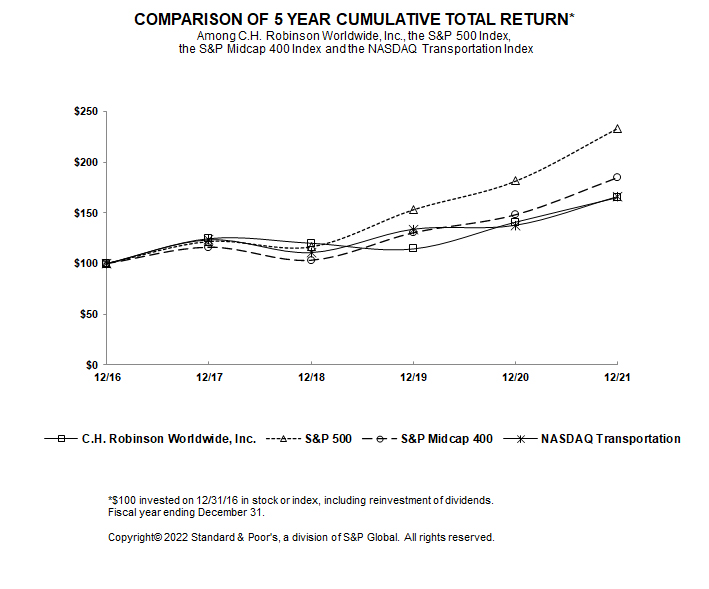
The graph below compares the cumulative 5-year total return of holders of C.H. Robinson Worldwide, Inc.’s common stock with the cumulative total returns of the S&P 500 index, the Nasdaq Transportation index, and the S&P Midcap 400 index. The graph tracks the performance of a $100 investment in our common stock and in each index (with the reinvestment of all dividends) from December 31, 2016 to December 31, 2021.
| December 31, | |||||||||||||||||||||||||||||||||||
| 2016 | 2017 | 2018 | 2019 | 2020 | 2021 | ||||||||||||||||||||||||||||||
| C.H. Robinson Worldwide, Inc. | $ | 100.00 | $ | 124.53 | $ | 120.03 | $ | 114.38 | $ | 140.70 | $ | 164.87 | |||||||||||||||||||||||
| S&P 500 | 100.00 | 121.83 | 116.49 | 153.17 | 181.35 | 233.41 | |||||||||||||||||||||||||||||
| S&P Midcap 400 | 100.00 | 116.24 | 103.36 | 130.44 | 148.26 | 184.96 | |||||||||||||||||||||||||||||
| Nasdaq Transportation | 100.00 | 123.35 | 110.84 | 133.75 | 137.58 | 165.72 |
The stock price performance included in this graph is not necessarily indicative of future stock price performance.
Item 6. RESERVED
Item 7. MANAGEMENT’S DISCUSSION AND ANALYSIS OF FINANCIAL CONDITION AND RESULTS OF OPERATIONS
OVERVIEW
C.H. Robinson Worldwide, Inc. (“C.H. Robinson,” “the company,” “we,” “us,” or “our”) is one of the world's largest logistics platforms. Our mission is to improve the world's supply chains through our people, processes, and technology by delivering exceptional value to our customers and suppliers. We provide freight transportation services and logistics solutions to companies of all sizes in a wide variety of industries. We operate through a network of offices in North America, Europe, Asia, Oceania, and South America. We offer a global suite of services using tailored, market-leading differentiated technology built by and for our global network of supply chain experts working with our customers to drive better outcomes by leveraging our experience, data, technology, and scale. Our global network of supply chain experts works with our customers to drive better supply chain outcomes by leveraging our experience, data, technology, and scale.
Our adjusted gross profit and adjusted gross profit margin are non-GAAP financial measures. Adjusted gross profit is calculated as gross profit excluding amortization of internally developed software utilized to directly serve our customers and contracted carriers. Adjusted gross profit margin is calculated as adjusted gross profit divided by total revenues. We believe adjusted gross profit and adjusted gross profit margin are useful measures of our ability to source, add value, and sell services and products that are provided by third parties, and we consider adjusted gross profit to be a primary performance measurement. Accordingly, the discussion of our results of operations often focuses on the changes in our adjusted gross profit and adjusted gross profit margin. The reconciliation of gross profit to adjusted gross profit and gross profit margin to adjusted gross profit margin is presented below (dollars in thousands):
| Twelve Months Ended December 31, | |||||||||||||||||||||||||||||||||||
| 2021 | 2020 | 2019 | |||||||||||||||||||||||||||||||||
| Revenues: | |||||||||||||||||||||||||||||||||||
| Transportation | $ | 22,046,574 | $ | 15,147,562 | $ | 14,322,295 | |||||||||||||||||||||||||||||
| Sourcing | 1,055,564 | 1,059,544 | 987,213 | ||||||||||||||||||||||||||||||||
| Total revenues | 23,102,138 | 16,207,106 | 15,309,508 | ||||||||||||||||||||||||||||||||
| Costs and expenses: | |||||||||||||||||||||||||||||||||||
| Purchased transportation and related services | 18,994,574 | 12,834,608 | 11,839,433 | ||||||||||||||||||||||||||||||||
| Purchased products sourced for resale | 955,475 | 960,241 | 883,765 | ||||||||||||||||||||||||||||||||
| Direct internally developed software amortization | 20,208 | 16,634 | 11,492 | ||||||||||||||||||||||||||||||||
| Total direct costs | 19,970,257 | 13,811,483 | 12,734,690 | ||||||||||||||||||||||||||||||||
| Gross profit / Gross profit margin | 3,131,881 | 13.6 | % | 2,395,623 | 14.8 | % | 2,574,818 | 16.8 | % | ||||||||||||||||||||||||||
| Plus: Direct internally developed software amortization | 20,208 | 16,634 | 11,492 | ||||||||||||||||||||||||||||||||
| Adjusted gross profit / Adjusted gross profit margin | $ | 3,152,089 | 13.6 | % | $ | 2,412,257 | 14.9 | % | $ | 2,586,310 | 16.9 | % |
Our adjusted operating margin is a non-GAAP financial measure calculated as operating income divided by adjusted gross profit. We believe adjusted operating margin is a useful measure of our profitability in comparison to our adjusted gross profit, which we consider a primary performance metric as discussed above. The reconciliation of operating margin to adjusted operating margin is presented below (dollars in thousands):
| Twelve Months Ended December 31, | ||||||||||||||||||||
| 2021 | 2020 | 2019 | ||||||||||||||||||
| Total revenues | $ | 23,102,138 | $ | 16,207,106 | $ | 15,309,508 | ||||||||||||||
| Operating income | 1,082,108 | 673,268 | 789,976 | |||||||||||||||||
| Operating margin | 4.7 | % | 4.2 | % | 5.2 | % | ||||||||||||||
| Adjusted gross profit | $ | 3,152,089 | $ | 2,412,257 | $ | 2,586,310 | ||||||||||||||
| Operating income | 1,082,108 | 673,268 | 789,976 | |||||||||||||||||
| Adjusted operating margin | 34.3 | % | 27.9 | % | 30.5 | % |
MARKET TRENDS
The North American surface transportation market experienced extremely tight carrier capacity in 2021 as strong demand combined with ongoing driver availability and supply chain disruptions caused by port congestion and weather events drove purchased transportation to historic levels. This compared to an extremely volatile market in 2020 resulting from the early stages of the COVID-19 pandemic and restrictions implemented to control the outbreak, which drove significant volatility in customer demand and carrier capacity. Industry freight volumes, as measured by the Cass Freight Index, increased approximately 13 percent in 2021 compared to 2020 and experienced growth in each quarter of 2021 compared to 2020. This compared to a decline of approximately eight percent in 2020 compared to 2019 with significant volatility over the course of 2020. One of the metrics we use to measure market conditions is the truckload routing guide depth from our Managed Services business. Routing guide depth is calculated as a simple average of all accepted shipments over all tender instances for any shipment facilitated by our Managed Services business. The average routing guide depth was 1.7 in 2021 compared to 1.4 in 2020. The average routing guide depth increased steadily during the second half of 2020 and finished in line with those seen over the duration of 2021.
The global forwarding market has also been significantly impacted by supply chain disruptions caused by ongoing port congestion along with equipment and labor shortages in 2021. These disruptions combined with strong demand have continued to drive purchased transportation costs for both ocean and air freight to historic levels. As with the North American surface transportation market, this compared to the significant volatility seen in 2020 resulting
Showing the first 8K of 63K characters. Open the full section
Item 7A. QUANTITATIVE AND QUALITATIVE DISCLOSURES ABOUT MARKET RISK
We had $257.4 million of cash and cash equivalents on December 31, 2021. Substantially all of the cash equivalents are in demand accounts with financial institutions. The primary market risks associated with these investments are liquidity risks.
We are a party to a credit agreement with various lenders consisting of a $1 billion revolving loan facility. Interest accrues on the revolving loan at a variable rate determined by a pricing schedule or the base rate (which is the highest of (a) the administrative agent's prime rate, (b) the federal funds rate plus 0.50 percent, or (c) the sum of one-month LIBOR plus a specified margin). At December 31, 2021, there was $525.0 million outstanding on the revolving loan.
We are a party to the Note Purchase Agreement, as amended, with various institutional investors with fixed rates consisting of: (i) $175 million of the company’s 3.97 percent Senior Notes, Series A, due August 27, 2023, (ii) $150 million of the company’s 4.26 percent Senior Notes, Series B, due August 27, 2028, and (iii) $175 million of the company’s 4.6 percent Senior Notes, Series C, due August 27, 2033. At December 31, 2021, there was $500 million outstanding on the notes.
We issued Senior Notes through a public offering on April 9, 2018. The Senior Notes bear an annual interest rate of 4.2 percent payable semi-annually on April 15 and October 15, until maturity on April 15, 2028. Taking into effect the amortization of the original issue discount and all underwriting and issuance expenses, the Senior Notes have an effective yield to maturity of approximately 4.39 percent per annum. The fair value of the Senior Notes, excluding debt discounts and issuance costs, approximated $677.1 million as of December 31, 2021, based primarily on the market prices quoted from external sources. The carrying value of the Senior Notes was $594.2 million at December 31, 2021.
We are a party to a Receivables Securitization Facility, with various lenders, that provides a total availability of up to $300 million and funded at $300 million as of December 31, 2021. Interest accrues on the facility at variable rates based on Bloomberg Short Term Bank Yield Index (“BSBY”) plus a margin. At December 31, 2021, there was $299.5 million outstanding, net of unamortized issuance costs, on the Receivables Securitization Facility. On February 1, 2022, we amended the Receivables Securitization Facility primarily to increase the total availability from $300 million to $500 million pursuant to the provisions of the existing agreement.
A hypothetical 100-basis-point change in the interest rate would not have a material effect on our earnings. We do not use derivative financial instruments to manage interest rate risk or to speculate on future changes in interest rates. A rise in interest rates could negatively affect the fair value of our debt facilities.
Foreign Exchange
We operate through a network of offices in North America, Europe, Asia, Oceania, and South America. As a result, we frequently transact using currencies other than the U.S. Dollar, primarily the Chinese Yuan, Euro, Canadian Dollar, and Mexican Peso. This often results in assets and liabilities, including intercompany balances, denominated in a currency other than the functional currency. In these instances, most commonly, we have balances denominated in U.S. Dollars in regions where the U.S. Dollar is not the functional currency. This results in foreign exchange risk.
Foreign exchange risk can be quantified by performing a sensitivity analysis assuming a hypothetical change in the value of the U.S. Dollar compared to other currencies in which we transact. Our primary foreign exchange risk is associated with balances denominated in U.S. Dollars held in China where the functional currency is the Chinese Yuan. All other things being equal, a hypothetical 10 percent weakening of the U.S. Dollar against the Chinese Yuan on December 31, 2021, would have decreased our net income by approximately $16.1 million and a hypothetical 10 percent strengthening of the U.S. Dollar against the Chinese Yuan on December 31, 2021, would have increased our net income by approximately $13.2 million.
Item 8. FINANCIAL STATEMENTS AND SUPPLEMENTARY DATA
REPORT OF INDEPENDENT REGISTERED PUBLIC ACCOUNTING FIRM
To the Stockholders and the Board of Directors of C.H. Robinson Worldwide, Inc.
Opinion on the Financial Statements
We have audited the accompanying consolidated balance sheets of C.H. Robinson Worldwide, Inc. and subsidiaries (the “Company”) as of December 31, 2021 and 2020, the related consolidated statements of operations and comprehensive income, stockholders’ investment, and cash flows, for each of the three years in the period ended December 31, 2021, and the related notes (collectively referred to as the “financial statements”). In our opinion, the financial statements present fairly, in all material respects, the financial position of the Company as of December 31, 2021 and 2020, and the results of its operations and its cash flows for each of the three years in the period ended December 31, 2021, in conformity with accounting principles generally accepted in the United States of America.
We have also audited, in accordance with the standards of the Public Company Accounting Oversight Board (United States) (PCAOB), the Company's internal control over financial reporting as of December 31, 2021 , based on criteria established in Internal Control — Integrated Framework (2013) issued by the Committee of Sponsoring Organizations of the Treadway Commission and our report dated February 23, 2022, expressed an unqualified opinion on the Company's internal control over financial reporting.
Basis for Opinion
These financial statements are the responsibility of the Company's management. Our responsibility is to express an opinion on the Company's financial statements based on our audits. We are a public accounting firm registered with the PCAOB and are required to be independent with respect to the Company in accordance with the U.S. federal securities laws and the applicable rules and regulations of the Securities and Exchange Commission and the PCAOB.
We conducted our audits in accordance with the standards of the PCAOB. Those standards require that we plan and perform the audit to obtain reasonable assurance about whether the financial statements are free of material misstatement, whether due to error or fraud. Our audits included performing procedures to assess the risks of material misstatement of the financial statements, whether due to error or fraud, and performing procedures that respond to those risks. Such procedures included examining, on a test basis, evidence regarding the amounts and disclosures in the financial statements. Our audits also included evaluating the accounting principles used and significant estimates made by management, as well as evaluating the overall presentation of the financial statements. We believe that our audits provide a reasonable basis for our opinion.
Critical Audit Matter
The critical audit matter communicated below is a matter arising from the current-period audit of the financial statements that was communicated or required to be communicated to the audit committee and that (1) relates to accounts or disclosures that are material to the financial statements and (2) involved our especially challenging, subjective, or complex judgments. The communication of critical audit matters does not alter in any way our opinion on the financial statements, taken as a whole, and we are not, by communicating the critical audit matter below, providing a separate opinion on the critical audit matter or on the accounts or disclosures to which it relates.
Revenue Recognition — Refer to Notes 1 and 10 to the financial statements
Critical Audit Matter Description
Transportation and logistics revenue is recognized for performance obligations identified in the customer contract as they are satisfied over the contract term, which generally represents the transit period. Recognizing revenue at period end for contracts where the transit period is partially complete at period end or completed and not yet invoiced, requires management to make judgments that affect the amounts and timing of revenue recognized. At December 31, 2021 the Company recorded revenue of $453.7 million for services it provided while a shipment was still in-transit but for which it had not yet completed its performance obligation or had not yet invoiced the customer.
Auditing the estimate of the Company’s revenue recorded for contracts where the transit period is partially complete or completed and not yet invoiced as of the reporting date required a high degree of auditor judgment when performing audit procedures and evaluating the results of those procedures.
How the Critical Audit Matter Was Addressed in the Audit
Our audit procedures related to management’s estimate of the revenue recorded for contracts where the transit period is partially complete or completed and not yet invoiced as of the reporting date included the following, among others:
-
We tested the effectiveness of controls over revenue recognized over time, including management’s controls over the identification of shipments in transit, the portion of the transit period completed, and the estimate of contracts completed but not yet invoiced.
-
We evaluated management’s ability to identify the shipments in transit and to estimate the revenue to be recorded for contracts where the transit period is partially complete or completed and not yet invoiced at the reporting date by:
–Performing a retrospective review of management’s estimate for prior reporting periods.
–Testing the accuracy and completeness of the data in the system-generated report utilized in management’s revenue cutoff estimate with the assistance of our information technology specialists.
–Assessing the estimate methodology for reasonableness, in light of recent market events or changes within the Company’s operating environment.
–Testing the mathematical accuracy of management’s estimate.
/s/ DELOITTE & TOUCHE LLP
Minneapolis, Minnesota
February 23, 2022
We have served as the Company's auditor since 2002.
REPORT OF INDEPENDENT REGISTERED PUBLIC ACCOUNTING FIRM
To the Stockholders and the Board of Directors of C.H. Robinson Worldwide, Inc.
Opinion on Internal Control over Financial Reporting
We have audited the internal control over financial reporting of C.H. Robinson Worldwide, Inc. and subsidiaries (the “Company”) as of December 31, 2021, based on criteria established in Internal Control — Integrated Framework (2013) issued by the Committee of Sponsoring Organizations of the Treadway Commission (COSO). In our opinion, the Company maintained, in all material respects, effective internal control over financial reporting as of December 31, 2021, based on criteria established in Internal Control — Integrated Framework (2013) issued by COSO.
We have also audited, in accordance with the standards of the Public Company Accounting Oversight Board (United States) (PCAOB), the consolidated financial statements as of and for the fiscal year ended December 31, 2021, of the Company and our report dated February 23, 2022, expressed an unqualified opinion on those consolidated financial statements.
Basis for Opinion
The Company’s management is responsible for maintaining effective internal control over financial reporting and for its assessment of the effectiveness of internal control over financial reporting, included in the accompanying Management’s Report on Internal Control Over Financial Reporting. Our responsibility is to express an opinion on the Company’s internal control over financial reporting based on our audit. We are a public accounting firm registered with the PCAOB and are required to be independent with respect to the Company in accordance with the U.S. federal securities laws and the applicable rules and
Showing the first 8K of 128K characters. Open the full section
Item 9. CHANGES IN AND DISAGREEMENTS WITH ACCOUNTANTS ON ACCOUNTING AND FINANCIAL DISCLOSURE
None.
Item 9A. CONTROLS AND PROCEDURES
Evaluation of Disclosure Controls and Procedures
We maintain disclosure controls and procedures as defined in Rules 13a-15(e) and 15d-15(e) under the Securities Exchange Act of 1934 (“Exchange Act”) that are designed to provide reasonable assurance that information required to be disclosed by us in reports that we file or submit under the Exchange Act is (i) recorded, processed, summarized, and reported within the time periods specified in SEC rules and forms; and (ii) accumulated and communicated to our management, including our principal executive officer and principal financial officer, as appropriate to allow timely decisions regarding disclosure.
Our management, including our Chief Executive Officer and Chief Financial Officer, assessed the effectiveness of the design and operation of our disclosure controls and procedures (as defined in Rules 13a-15(e) and 15d-15(e) under the Exchange Act) as of December 31, 2021. Based upon that assessment, our Chief Executive Officer and Chief Financial Officer concluded that our disclosure controls and procedures were effective at the reasonable assurance level as of December 31, 2021.
Changes in Internal Control Over Financial Reporting
There were no changes in our internal control over financial reporting (as defined in Rules 13a-15(f) and 15d-15(f) under the Exchange Act) that occurred during the three months ended December 31, 2021, that have materially affected, or are reasonably likely to materially affect, our internal control over financial reporting.
Management’s Report on Internal Control Over Financial Reporting
Our management is responsible for establishing and maintaining adequate internal control over financial reporting as defined in Rules 13a-15(f) and 15d-15(f) under the Exchange Act.
The Company’s internal control over financial reporting is a process designed under the supervision of our Chief Executive Officer and Chief Financial Officer to provide reasonable assurance regarding the reliability of financial reporting and the preparation of our financial statements for external purposes in accordance with generally accepted accounting principles. The Company’s internal control over financial reporting includes those policies and procedures that (i) pertain to the maintenance of records that, in reasonable detail, accurately and fairly reflect the transactions and dispositions of the assets of the Company; (ii) provide reasonable assurance that transactions are recorded as necessary to permit preparation of consolidated financial statements in accordance with generally accepted accounting principles, and that receipts and expenditures of the Company are being made only in accordance with authorizations of management and directors of the Company; and (iii) provide reasonable assurance regarding the prevention or timely detection of unauthorized acquisition, use or disposition of the Company’s assets that could have a material effect on the consolidated financial statements.
Because of its inherent limitations, internal control over financial reporting may not prevent or detect misstatements. Also, projections of any evaluation of effectiveness to future periods are subject to the risk that controls may become inadequate because of changes in conditions, or that the degree of compliance with the policies or procedures may deteriorate.
Management assessed the effectiveness of the Company’s internal control over financial reporting as of December 31, 2021, using the criteria set forth by the Committee of Sponsoring Organizations of the Treadway Commission (COSO) in Internal Control-Integrated Framework (2013). Based on that assessment and the COSO criteria, we concluded that, as of December 31, 2021, the Company maintained effective internal control over financial reporting.
The Company acquired Combinex in May 2021, which was accounted for as a business combination. Management excluded Combinex from its assessment of the effectiveness of our internal control over financial reporting as of and for the year ended December 31, 2021. Combinex represented $19.3 million of the Company's total assets and contributed $37.0 million of total revenues in the consolidated financial statements of the Company as of and for the year ended December 31, 2021. This exclusion is in accordance with the SEC’s guidance, which permits companies to omit an acquired business’s internal control over financial reporting from management’s assessment for up to one year after the date of acquisition.
The Company’s independent registered public accounting firm, Deloitte & Touche LLP, has audited the Company’s internal control over financial reporting as of December 31, 2021, and has issued a report that is included in Item 8 of this Annual Report on Form 10-K.
Item 9B. OTHER INFORMATION
None
Item 9C. DISCLOSURE REGARDING FOREIGN JURISDICTIONS THAT PREVENT INSPECTIONS
None.
PART III
Item 10. DIRECTORS, EXECUTIVE OFFICERS, AND CORPORATE GOVERNANCE
Information with respect to our Board of Directors contained under the heading “Proposal One: Election of Directors,” in the Proxy Statement, is incorporated in this Form 10-K by reference. Information with respect to our executive officers is provided in Part I, Item 1 of this Form 10-K.
We have adopted a code of ethics that applies to our principal executive officer, principal financial officer, principal accounting officer, directors, and all other company employees performing similar functions. This code of ethics, which is part of our corporate compliance program, is posted on the Investors page of our website at www.chrobinson.com in the Governance Documents section under the caption “Code of Ethics.”
We intend to satisfy the disclosure requirement under Item 10 of Form 8-K regarding an amendment to, or waiver from, a provision of this code of ethics by posting such information on our website, at the web address specified above.
Item 11. EXECUTIVE COMPENSATION
The information contained under the headings or subheadings “Compensation of Directors,” “Talent and Compensation Committee Interlocks and Insider Participation,” “2021 Executive Compensation,” and “Talent and Compensation Committee Report” in the Proxy Statement is incorporated in this Form 10-K by reference.
Item 12. SECURITY OWNERSHIP OF CERTAIN BENEFICIAL OWNERS AND MANAGEMENT AND RELATED STOCKHOLDER MATTERS
(a) Equity Compensation Plans
Information with respect to our equity incentive compensation plan contained under the heading “Proposal Four: Approval of the C.H. Robinson Worldwide, Inc. 2022 Equity Incentive Plan,” in the Proxy Statement, is incorporated in this Form 10-K by reference.
(b) Security Ownership
The information contained under the heading “Security Ownership of Certain Beneficial Owners and Management” in the Proxy Statement is incorporated in this Form 10-K by reference.
Item 13. CERTAIN RELATIONSHIPS AND RELATED TRANSACTIONS, AND DIRECTOR INDEPENDENCE
The information contained under the heading “Related Party Transactions” in the Proxy Statement is incorporated in this Form 10-K by reference.
Item 14. PRINCIPAL ACCOUNTING FEES AND SERVICES
The information contained under the heading “Proposal Three: Ratification of the Selection of Independent Auditors” in the Proxy Statement is incorporated in this Form 10-K by reference.
PART IV
Item 15. EXHIBITS, AND FINANCIAL STATEMENT SCHEDULES
(a)The following documents are filed as part of this report:
(1)The Company’s 2021 Consolidated Financial Statements and the Report of Independent Registered Public Accounting Firm are included in Part II, Item 8. Financial Statements and Supplementary Data.
a.Deloitte & Touche LLP (PCAOB ID No. 34)
b.Location: Minneapolis, Minnesota
(2)All financial statement schedules are omitted as the required information is inapplicable or the information is presented in the consolidated financial statements or related notes.
(b)Index to Exhibits-Any document incorporated by reference is identified by a parenthetical referencing the SEC filing, which included the document. We will furnish a copy of any Exhibit at no cost to a security holder upon request.
INDEX TO EXHIBITS
| * | Filed herewith | ||||
| † | Management contract or compensatory plan or arrangement required to be filed as an exhibit to Form 10-K pursuant to Item 15(c) of the Form 10-K Report |
Item 16. FORM 10-K SUMMARY
None.
SIGNATURES
Pursuant to the requirements of the Section 13 or 15(d) of the Securities Exchange Act of 1934, the registrant has duly caused this Report to be signed on its behalf by the undersigned, thereunto duly authorized, in the City of Eden Prairie, State of Minnesota, on February 23, 2022.
| C.H. ROBINSON WORLDWIDE, INC. | ||||||||
| By: | /s/ BEN G. CAMPBELL | |||||||
| Ben G. Campbell | ||||||||
| Chief Legal Officer and Secretary |
Pursuant to the requirements of the Securities Exchange Act of 1934, this Report has been signed below by the following persons on behalf of the registrant and in the capacities indicated on February 23, 2022.
| Signature | Title | |||||||
| /s/ ROBERT C. BIESTERFELD, JR. | Chief Executive Officer (Principal Executive Officer) | |||||||
| Robert C. Biesterfeld, Jr. | ||||||||
| /s/ MICHAEL P. ZECHMEISTER | Chief Financial Officer (Principal Financial Officer and Principal Accounting Officer) | |||||||
| Michael P. Zechmeister | ||||||||
| * | Chairman of the Board | |||||||
| Scott P. Anderson | ||||||||
| * | Director | |||||||
| Kermit Crawford | ||||||||
| * | Director | |||||||
| Wayne M. Fortun | ||||||||
| * | Director | |||||||
| Timothy C. Gokey | ||||||||
| * | Director | |||||||
| Mary J. Steele Guilfoile | ||||||||
| * | Director | |||||||
| Jodee Kozlak | ||||||||
| * | Director | |||||||
| Brian P. Short | ||||||||
| * | Director | |||||||
| James B. Stake | ||||||||
| * | Director | |||||||
| Paula Tolliver | ||||||||
| *By: | /s/ BEN G. CAMPBELL | |||||||
| Ben G. Campbell | ||||||||
| Attorney-in-Fact |