 filings.tools
Cover and table of contents
149K characters. Original on sec.gov · Markdown
Cover and table of contents
10-K 1 a2237767z10-k.htm 10-K
Use these links to rapidly review the document
TABLE OF CONTENTS 2 TABLE OF CONTENTS 3 TABLE OF CONTENTS 4 TABLE OF CONTENTS 5
UNITED STATES SECURITIES AND EXCHANGE COMMISSION
Washington, D.C. 20549
FORM 10-K
(Mark One)
þ ANNUAL REPORT PURSUANT TO SECTION 13 OR 15(d) OF THE SECURITIES EXCHANGE ACT OF 1934 For the fiscal year ended December 31, 2018 OR****o TRANSITION REPORT PURSUANT TO SECTION 13 OR 15(d) OF THE SECURITIES EXCHANGE ACT OF 1934 For the transition period from to
Commission file number 001-38769

CIGNA CORPORATION
(Exact name of registrant as specified in its charter)
| Delaware | 82-4991898 | |
| (State or other jurisdiction of incorporation or organization) | (I.R.S. Employer Identification No.) | |
| 900 Cottage Grove Road, Bloomfield, Connecticut | 06002 | |
| (Address of principal executive offices) | (Zip Code) | |
| (860) 226-6000 | ||
| Registrant's telephone number, including area code | ||
| (860) 226-6741 or 215-761-5511 | ||
| Registrant's facsimile number, including area code |
| | | | | | | | | |
| | SECURITIES REGISTERED PURSUANT TO SECTION 12(B) OF THE ACT: | | ||||||
| | | | | | | | | |
| Title of each class | Name of each exchange on which registered | |||||||
| | | | | | | | | |
| Common Stock, Par Value $0.01 | New York Stock Exchange, Inc. | |||||||
| | | | | | | | | |
| | | | | | | | | |
| | SECURITIES REGISTERED PURSUANT TO SECTION 12(G) OF THE ACT: | | ||||||
| | | | | | | | | |
| NONE | ||||||||
| | | | | | | | | |
| | | | | | | | | | | | | |
| | Indicate by check mark | | Yes | | No | | ||||||
| | | | | | | | | | | | | |
| • if the registrant is a well-known seasoned issuer, as defined in Rule 405 of the Securities Act. | þ | o | ||||||||||
| | | | | | | | | | | | | |
| • if the registrant is not required to file reports pursuant to Section 13 or Section 15(d) of the Act | o | þ | ||||||||||
| | | | | | | | | | | | | |
| • whether the registrant (1) has filed all reports required to be filed by Section 13 or 15(d) of the Securities Exchange Act of 1934 during the preceding 12 months (or for such shorter period that the registrant was required to file such reports), and (2) has been subject to such filing requirements for the past 90 days | þ | o | ||||||||||
| | | | | | | | | | | | | |
| • whether the registrant has submitted electronically every Interactive Data File required to be submitted pursuant to Rule 405 of Regulation S-T during the preceding 12 months (or for such shorter period that the registrant was required to submit such files) | þ | o | ||||||||||
| | | | | | | | | | | | | |
| • if disclosure of delinquent filers pursuant to Item 405 of Regulation S-K is not contained herein, and will not be contained, to the best of registrant's knowledge, in definitive proxy or information statements incorporated by reference in Part III of this Form 10-K or any amendment to this Form 10-K | o | |||||||||||
| | | | | | | | | | | | | |
| • whether the registrant is a large accelerated filer, an accelerated filer, a non-accelerated filer, a smaller reporting company or an emerging growth company. See definitions of "large accelerated filer," "accelerated filer, " "smaller reporting company" and "emerging growth company" in Rule 12b-2 of the Exchange Act. | ||||||||||||
| | | | | | | | | | | | | |
| Large accelerated filer þ | Accelerated filer o | Non-accelerated filer o | Smaller reporting company o | |||||||||||||
| | | | | | | | | | | | | | | | | |
| Emerging growth company o | ||||||||||||||||
| | | | | | | | | | | | | | | | | |
| • If an emerging growth company, indicate by check mark if the registrant has elected not to use the extended transition period for complying with any new or revised financial accounting standards provided pursuant to Section 13(a) of the Exchange Act. | o | |||||||||||
| | | | | | | | | | | | | |
| • whether the registrant is a shell company (as defined in Rule 12b-2 of the Exchange Act). | o | þ | ||||||||||
| | | | | | | | | | | | | |
The aggregate market value of the voting stock held by non-affiliates of the registrant as of June 30, 2018 was approximately $41.2 billion. As of January 31, 2019, 380,058,967 shares of the registrant's Common Stock were outstanding.
DOCUMENTS INCORPORATED BY REFERENCE
Part III of this Form 10-K incorporates by reference information from the registrant's definitive proxy statement related to the 2019 annual meeting of shareholders.
Table of Contents
FREQUENTLY REQUESTED 10-K INFORMATION
| Page | ||
| Risk Factors | 26 | |
| Executive Overview | 42 | |
| Health Care Industry Developments | 47 | |
| Liquidity and Capital Resources | 48 | |
| Critical Accounting Estimates | 52 | |
| Segment Information | 126 | |
| Revenues by Product Type | 128 |
| CAUTIONARY NOTE REGARDING FORWARD-LOOKING STATEMENTS |
|---|
This Annual Report on Form 10-K contains forward-looking statements within the meaning of the Private Securities Litigation Reform Act of 1995. Forward-looking statements are based on Cigna's current expectations and projections about future trends, events and uncertainties. These statements are not historical facts. Forward-looking statements may include, among others, statements concerning future financial or operating performance, including our ability to deliver affordable, personalized and innovative solutions for our customers and clients; future growth, business strategy, strategic or operational initiatives; economic, regulatory or competitive environments, particularly with respect to the pace and extent of change in these areas; financing or capital deployment plans and amounts available for future deployment; our prospects for growth in the coming years; the merger ("Merger") with Express Scripts Holding Company; and other statements regarding Cigna's future beliefs, expectations, plans, intentions, financial condition or performance. You may identify forward-looking statements by the use of words such as "believe," "expect," "plan," "intend," "anticipate," "estimate," "predict," "potential," "may," "should," "will" or other words or expressions of similar meaning, although not all forward-looking statements contain such terms.
Forward-looking statements are subject to risks and uncertainties, both known and unknown, that could cause actual results to differ materially from those expressed or implied in forward-looking statements. Such risks and uncertainties include, but are not limited to: our ability to achieve our financial, strategic and operational plans or initiatives; our ability to predict and manage medical and pharmacy costs and price effectively; our ability to adapt to changes or trends in an evolving and rapidly changing industry; our ability to effectively differentiate our products and services from those of our competitors and maintain or increase market share; our ability to develop and maintain good relationships with physicians, hospitals, other health care providers and pharmaceutical manufacturers; changes in drug pricing; the impact of modifications to our operations and processes; our ability to identify potential strategic acquisitions or transactions and realize the expected benefits (including anticipated synergies) of such transactions in full or within the anticipated time frame, including with respect to the Merger, as well as our ability to integrate operations, resources and systems; the substantial level of government regulation over our business and the potential effects of new laws or regulations or changes in existing laws or regulations; the outcome of litigation, regulatory audits, investigations, actions and/or guaranty fund assessments; uncertainties surrounding participation in government-sponsored programs such as Medicare; the effectiveness and security of our information technology and other business systems; the impact of our debt service obligations on the availability to funds for other business purposes; unfavorable industry, economic or political conditions, including foreign currency movements; acts of war, terrorism, natural disasters or pandemics; as well as more specific risks and uncertainties discussed in Part I, Item 1A—Risk Factors and Part II, Item 7—Management's Discussion and Analysis of Financial Condition and Results of Operations of this Form 10-K and as described from time to time in our future reports filed with the Securities and Exchange Commission (the "SEC").
You should not place undue reliance on forward-looking statements that speak only as of the date they are made, are not guarantees of future performance or results, and are subject to risks, uncertainties and assumptions that are difficult to predict or quantify. Cigna undertakes no obligation to update or revise any forward-looking statement, whether as a result of new information, future events or otherwise, except as may be required by law.
**PART I **ITEM 1. Business
| PART I |
|---|
| ITEM 1. Business |
|---|
| Overview |
|---|
Cigna Corporation, together with its subsidiaries (either individually or collectively referred to as "Cigna," the "Company," "we," "our" or "us") is a global health service organization.
Our revenues are derived principally from premiums on insured products, fees for products and services provided to self-insured plans, pharmacy sales, and investment income. In 2018, our revenues were $48.7 billion and shareholders' net income was $2.6 billion. As described more fully in Note 3 to the Consolidated Financial Statements on page 80 of this Annual Report on Form 10-K ("Form 10-K"), on March 8, 2018, we entered into a merger agreement with Express Scripts Holding Company ("Express Scripts"). The results of Express Scripts have been included in the Company's Consolidated Financial Statements from the date of acquisition. As of December 31, 2018, total assets were $153.2 billion and shareholders' equity was $41.0 billion.
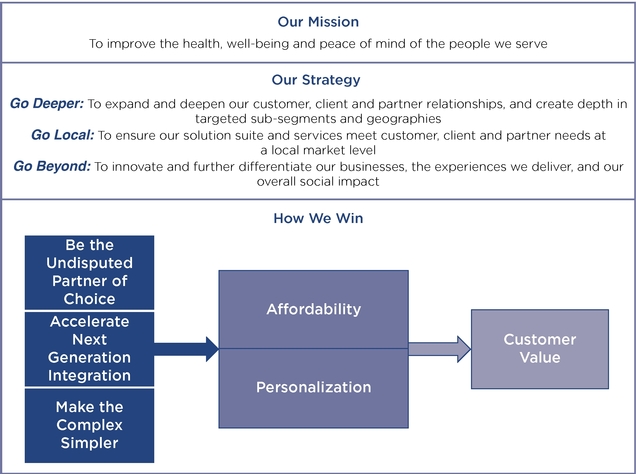
Our combination with Express Scripts creates an enterprise uniquely capable of transforming health care. We now have broader and deeper capabilities, along with meaningful synergies, that accelerate our "Go" strategy to achieve our mission of improving the health, well-being and peace of mind of those we serve. Cigna's employees are champions of the people we serve and over the past decade, our focus has shifted to helping people thrive by offering solutions to prevent and better manage health challenges. When sickness or disability do occur, we support our customers' ability to have broad choices in how they best access high quality, affordable care. We maximize use of evidence-based care,
| | | CIGNA CORPORATION - 2018 Form 10-K 1 |
|---|
**PART I **ITEM 1. Business
while delivering best-in-class quality of care for our customers with acute and chronic conditions through enhanced real time data across an expanded platform with industry-leading solutions to support care decisions.
Cigna offers a differentiated set of medical, pharmacy, behavioral, dental, disability, life and accident insurance and related products and services. By combining with Express Scripts, Cigna's expanded capabilities now include: 1) a broader portfolio of specialty services, some of which can be offered on a stand-alone basis; 2) integrated behavioral, medical and pharmacy management services; 3) leading specialty pharmacy expertise; and 4) advanced analytics that help us engage more meaningfully with individuals, plan sponsors we serve, and our provider partners. These capabilities accelerate Cigna's ability to drive improved cost affordability, quality of care and predictability.
Following entry into the merger agreement and throughout the pendency of the transaction, Cigna and Express Scripts designed integration plans to implement a new management and business reporting structure for the combined company upon closing. On December 20, 2018, Cigna completed the acquisition of Express Scripts. As a result, effective in the fourth quarter of 2018 our segments have changed to the following: 1) Integrated Medical, consisting of both a Commercial operating segment that includes our employer-sponsored medical coverage and a Government operating segment that includes Medicare offerings for seniors and individual insurance offerings to non-seniors both on and off the public health insurance exchanges; 2) Health Services, consisting primarily of Cigna's legacy home delivery pharmacy business and Express Scripts' pharmacy benefit management ("PBM") business beginning December 21, 2018; and 3) International Markets, that offers global supplemental benefits and global medical solutions. The remainder of our business is reported in Group Disability and Other, consisting of our group disability and life business together with our corporate owned life insurance ("COLI") business and run-off operations. See Note 1 to the Consolidated Financial Statements on page 72 of this Form 10-K for additional description of our segments. Among our segments, Cigna has four core growth platforms: Commercial, Government, Health Services and International Markets.
As individuals become increasingly involved in their health care purchasing decisions, Cigna continues to focus on delivering affordable and personalized products and services to customers through employer-based, government-sponsored, health plan client and individual coverage arrangements. In our Integrated Medical business, we collaborate with health care providers to accelerate the transition from volume-based, fee-for-service reimbursement arrangements to a value-based reimbursement model that delivers higher quality of care, lower costs and better health outcomes. We have worked toward achieving better health, affordability, localization and an improved patient experience through increased collaborative care and delivery arrangements with health care providers across the care delivery spectrum, including physician groups of all sizes, specialist groups and hospitals. We have also developed innovative tools and flexible provider arrangements that provide a truly personalized customer experience. These arrangements and tools are discussed in more detail in the "Integrated Medical" section of this Form 10-K that begins on page 3.
Our Health Services business puts medicine within reach for patients, and helps providers improve access to prescription drugs by making them more affordable. We improve patient outcomes and better manage the cost of the pharmacy benefit by:
Delivering the best care available for those taking prescription medicines;
Assessing drugs based on efficacy, value and price to assist clients in selecting the most cost-effective formulary;
Offering cost-effective home delivery pharmacy and specialty services that result in cost savings for plan sponsors and better care for customers;
Leveraging purchasing volume to deliver discounts to employers and other groups, resulting in leading prescription drug cost trend; and
Promoting the use of generic and lower-cost brands.
We also work with key stakeholders across the health care system to improve health outcomes and patient satisfaction, increase efficiency in drug distribution and manage costs of the pharmacy benefit. We believe plan sponsors and participants can achieve the best health and financial outcomes when they use our comprehensive set of solutions to manage drug spend.
| The ACA and Health Care Reform |
|---|
The Patient Protection and Affordable Care Act and the Health Care and Education Reconciliation Act (collectively referred to throughout this Form 10-K as the "ACA" or "PPACA") continues to have a significant impact on our business operations. The future of the ACA is uncertain due to recent court decisions, congressional efforts to repeal and replace the ACA, various executive actions of the current administration, and repeal of the individual mandate as part of H.R.1, An Act to Provide for Reconciliation Pursuant to Titles II and V of the Concurrent Resolution on the Budget for Fiscal Year 2018 (referred to throughout this Form 10-K as the "Tax Cuts and Jobs Act" or "U.S. tax reform legislation"). The effects of the ACA, and efforts to repeal and replace it, are discussed throughout this Form 10-K where appropriate, including in the Integrated Medical business description, Regulation, Risk Factors, Management's Discussion and Analysis of Financial Condition and Results of Operations ("MD&A"), and the Notes to the Consolidated Financial Statements.
| Other Information |
|---|
The financial information included in this Form 10-K for the fiscal year ended December 31, 2018 is in conformity with accounting principles generally accepted in the United States of America ("GAAP") unless otherwise indicated. In the segment discussions that follow, we use the terms "adjusted revenues" and "pre-tax adjusted income from operations" to describe segment results. See the introduction to the MD&A on page 42 of this Form 10-K for definitions of those terms. Industry rankings and percentages set forth herein are for the year ended December 31, 2018 unless otherwise indicated. In addition, statements set forth in this document concerning our rank or position in an industry or particular line of business have been developed internally based on publicly available information unless otherwise noted.
Cigna Holding Company (formerly Cigna Corporation) was incorporated in Delaware in 1981. Halfmoon Parent, Inc. was incorporated in Delaware in March 2018. Halfmoon Parent, Inc. was renamed Cigna Corporation concurrently with the consummation of the combination with Express Scripts. Our annual, quarterly and current reports, proxy statements and other filings, and any amendments to these filings, are made available free of charge on our website (http://www.cigna.com, under the "Investors – Quarterly Reports and SEC Filings" captions) as soon as
| 2 CIGNA CORPORATION - 2018 Form 10-K | | |
|---|
**PART I **ITEM 1. Business
reasonably practicable after we electronically file these materials with, or furnish them to, the Securities and Exchange Commission (the "SEC"). We use our website as a channel of distribution for material company information. Important information, including news releases, analyst presentations and financial information regarding Cigna is routinely posted on and accessible at http://www.cigna.com. See "Code of Ethics and Other Corporate Governance Disclosures" in Part III, Item 10 beginning on page 131 of this Form 10-K for additional information available on our website.
| Integrated Medical |
|---|
Integrated Medical consists of a Commercial operating segment that includes our employer-sponsored medical coverage and a Government operating segment that includes Medicare offerings for seniors and individual insurance offerings to non-seniors both on and off the public health insurance exchanges. In 2018, Integrated Medical reported adjusted revenues of $32.8 billion and pre-tax adjusted income from operations of $3.5 billion.
| | | | | | |
| | How We Win | | |||
| | | | | | |
| • Broad and deep portfolio of solutions across Commercial and Government operating segments | |||||
| • Commitment to highest quality health outcomes and customer experiences | |||||
| • Collaborative physician engagement models emphasizing value over volume of services | |||||
| • Integrated benefit solutions that deliver value for our customers, clients and partners | |||||
| • Technology and data analytics powering actionable insights and affordable, personalized solutions | |||||
| • Talented and caring people embracing change and putting customers at the center of all we do | |||||
| | | | | | |
We differentiate ourselves by providing innovative, personalized, and affordable health care benefit solutions based on the unique needs of the individuals and clients we serve. We increase value through our integrated approach and use of technology and data analytics to enhance patient engagement and health care outcomes, underscoring our strategic focus on delivering an industry-leading customer experience. We continue to strengthen our partnerships with providers as we accelerate our transition to a value-based reimbursement system.
We offer a mix of core health insurance products and services to employers, other groups and individuals along with specialty products and services designed to improve the quality of care, lower cost and help customers achieve better health outcomes. Many of these products are available on a standalone basis, but we believe they are most valuable when integrated with a Cigna-administered health plan. Our products are available through several distribution channels including brokers, direct sales, and public and private exchanges. Our three funding solutions (i.e., insured – experience-rated, insured – guaranteed cost, and administrative services only ("ASO") arrangements) enable us to customize the amount of risk taken by, and lower costs for, our customers and clients.
| | | CIGNA CORPORATION - 2018 Form 10-K 3 |
|---|
**PART I **ITEM 1. Business
The following chart depicts a high level summary of our principal products and services in this segment as of year-end, with definitions on subsequent pages.
| | | | | | | | | | | | | | | | | | | | | | | | | | | | | |
| | Principal Products & Services | | | Major Brand(s) | | | Geography | | | Funding Solution(s) | | | Market Segment(s) | | | Primary Distribution Channel(s) | | | Primary Competitors | | ||||||||
| | | | | | | | | | | | | | | | | | | | | | | | | | | | | |
| Commercial Medical | ||||||||||||||||||||||||||||
| | | | | | | | | | | | | | | | | | | | | | | | | | | | | |
| | Managed Care | | | Cigna HealthCare | | | Nationwide | | | Insured | | | | | | | National Insurers, Local Healthplans, Third-Party Administrators ("TPAs") | | ||||||||||
| | | | | | | | | | | | | | | | | | | | | | | | | | | | | |
| | Preferred Provider ("PPO") | | | Cigna | | | Nationwide | | | (experience-rated ("ER"), guaranteed cost ("GC")) and | | | Commercial | | | Brokers, Private Exchanges, Direct | | | National Insurers, TPAs | | ||||||||
| | | | | | | | | | | | | | | | | | | | | | | | | | | | | |
| | Consumer-Driven | | | Cigna | | | Nationwide | | | ASO | | | | | | | National Insurers, Local Health Maintenance Organizations ("HMOs") | | ||||||||||
| | | | | | | | | | | | | | | | | | | | | | | | | | | | | |
| | Government Medical | | ||||||||||||||||||||||||||
| | | | | | | | | | | | | | | | | | | | | | | | | | | | | |
| | Individual and Family Plans | | | Cigna Connect | | | 10 states | | | GC | | | Individual | | | Public and Private Exchanges | | | Local Healthplans, Start-ups, National Insurers | | ||||||||
| | | | | | | | | | | | | | | | | | | | | | | | | | | | | |
| | Medicare Advantage | | | Cigna-HealthSpring | | | 17 states | | | GC | | | Government | | | Direct, Brokers | | | National Insurers, Local Healthplans | | ||||||||
| | | | | | | | | | | | | | | | | | | | | | | | | | | | | |
| | Medicare Part D | | | Cigna-HealthSpring, Express Scripts | | | Nationwide | | | GC | | | Government | | | Direct, Brokers | | | National Insurers | | ||||||||
| | | | | | | | | | | | | | | | | | | | | | | | | | | | | |
| | Medicaid | | | Cigna-HealthSpring | | | Texas | | | GC | | | Government | | | Direct, Brokers | | | National Insurers | | ||||||||
| | | | | | | | | | | | | | | | | | | | | | | | | | | | | |
| | Medicare Supplement | | | Cigna | | | 48 states & District of Columbia | | | GC | | | Government | | | Brokers, Direct, Private Exchanges | | | National Insurers | | ||||||||
| | | | | | | | | | | | | | | | | | | | | | | | | | | | | |
| | Specialty Products and Services | | ||||||||||||||||||||||||||
| | | | | | | | | | | | | | | | | | | | | | | | | | | | | |
| | Stop-Loss | | | Cigna | | | Nationwide | | | GC | | | Commercial | | | Brokers, Direct | | | National Insurers, Specialty Companies | | ||||||||
| | | | | | | | | | | | | | | | | | | | | | | | | | | | | |
| | Cost-Containment | | | Cigna | | | Nationwide | | | GC, ER, ASO | | | Commercial | | | Direct | | | National Insurers, Specialty Companies | | ||||||||
| | | | | | | | | | | | | | | | | | | | | | | | | | | | | |
| | Consumer Health Engagement | | | Cigna | | | Nationwide | | | GC, ER, ASO | | | Commercial, Government | | | Brokers, Direct | | | National Insurers, Specialty Companies | | ||||||||
| | | | | | | | | | | | | | | | | | | | | | | | | | | | | |
| | Pharmacy Management | | | Cigna | | | Nationwide | | | GC, ER, ASO | | | Commercial, Government | | | Brokers, Direct | | | National PBMs | | ||||||||
| | | | | | | | | | | | | | | | | | | | | | | | | | | | | |
| | Behavioral Health | | | Cigna Behavioral Health | | | Nationwide | | | GC, ER, ASO | | | Commercial | | | Brokers, Direct | | | National Insurers, Specialty Companies | | ||||||||
| | | | | | | | | | | | | | | | | | | | | | | | | | | | | |
| | Dental | | | Cigna Dental HealthCare | | | Nationwide | | | GC, ER, ASO | | | Commercial, Individual | | | Brokers, Direct | | | Dental Insurers, National Insurers | | ||||||||
| | | | | | | | | | | | | | | | | | | | | | | | | | | | | |
| | Vision | | | Cigna Vision | | | Nationwide | | | GC, ER, ASO | | | Commercial, Individual | | | Brokers, Direct | | | National Insurers, Specialty Companies | | ||||||||
| | | | | | | | | | | | | | | | | | | | | | | | | | | | | |
| 4 CIGNA CORPORATION - 2018 Form 10-K | | |
|---|
**PART I **ITEM 1. Business
| Principal Products & Services |
|---|
Commercial Medical
Managed Care Plans These plans are offered through our insurance companies, HMOs and TPA companies. HMO, Network Open Access and Open Access Plus plans use meaningful cost-sharing incentives to encourage the use of "in-network" versus "out-of-network" health care providers. The national provider network for Managed Care Plans is somewhat smaller than the national network used with the preferred provider ("PPO") plan product line.
PPO Plans feature a network with broader provider access than the Managed Care Plans.
Consumer-Driven Products are typically paired with a high-deductible medical plan and offer customers a tax-advantaged way to pay for eligible health care expenses. These products, consisting of health savings accounts ("HSAs"), health reimbursement accounts ("HRAs") and flexible spending accounts ("FSAs"), encourage customers to play an active role in managing their health and health care costs. When integrated with a Cigna medical plan, we can deliver a seamless experience for our customers and clients. More than three million customers have one of these integrated product solutions.
Government Medical
Individual and Family Plans feature an insurance policy coupled with a network of health care providers in a geographic area who have been selected with cost and quality in mind.
Medicare Advantage Plans allow Medicare-eligible beneficiaries to receive health care benefits, including prescription drugs, through a managed care health plan such as our coordinated care plans. Our Medicare Advantage Plans are primarily HMO plans marketed to individuals. A significant portion of our Medicare Advantage customers receive medical care from our value-based models that focus on developing highly engaged physician networks, aligning payment incentives to improved health outcomes and using timely and transparent data sharing.
Medicare Part D Plans provide a number of plan options, as well as service and information support, to Medicare and Medicaid eligible customers. Our plans offer the savings of Medicare combined with the flexibility to provide enhanced benefits and a drug list tailored to individuals' specific needs. Eligible beneficiaries benefit from broad network access and value-added services intended to promote wellness and affordability for our eligible beneficiaries.
Medicaid Plans provide our low-income customers with the benefit of many of the coordinated care aspects of our Medicare Advantage programs. For customers eligible for both Medicare and Medicaid ("dual eligible") we receive revenue from both the state and the Center for Medicare and Medicaid Services ("CMS").
Medicare Supplement Plans provide Medicare-eligible beneficiaries with federally standardized Medigap-style plans. Beneficiaries may select among the various plans with specific plan options to meet their unique needs and may visit, without the need for a referral, any health care professional or facility that accepts Medicare throughout the United States.
Specialty Solutions
Stop-Loss insurance coverage is offered to self-insured clients whose group health plans are administered by Cigna. Stop-loss insurance provides reimbursement for claims in excess of a predetermined amount for individuals, the entire group, or both.
Cost-Containment Programs are designed to contain the cost of covered health care services and supplies. These programs reduce out-of-network utilization and costs, protect members from balance billing, and educate customers regarding the availability of lower cost in-network services. In addition, under these programs, we negotiate discounts with out-of-network providers, review provider bills and recover overpayments. We charge fees for providing or arranging for these services. These programs may be administered by third-party vendors that have contracted with Cigna.
Consumer Health Engagement services are offered to customers covered under plans administered by Cigna or by third-party administrators. These services consist of an array of medical management, disease management and wellness services. Our Medical Management programs include case, specialty and utilization management and a 24-hour nurse information line. Our Health Advocacy program services include early intervention in the treatment of chronic conditions and an array of health and wellness coaching. Additionally, we administer incentives programs designed to encourage customers to engage in health improvement activities.
Pharmacy Management services and benefits can be combined with our medical offerings. The comprehensive suite of pharmacy management services available to clients and customers includes benefits management, specialty pharmacy services, clinical solutions, home delivery, and certain medical management services. Cigna's home delivery pharmacy operation along with the Express Scripts PBM, are reported in the Health Services segment and described further there.
Behavioral Health services are offered to employers, government entities and other groups sponsoring health benefit plans. These services consist of behavioral health care case management, employee assistance programs ("EAP"), and work/life programs. We focus on integrating our programs and services with medical, pharmacy and disability programs to facilitate customized, holistic care.
Dental solutions include dental health maintenance organization plans ("Dental HMO"), dental preferred provider organization ("Dental PPO") plans, exclusive dental provider organization plans, traditional dental indemnity plans and a dental discount program. Employers and other groups can purchase our products on either an insured or self-insured basis as standalone products or in conjunction with medical products. Additionally, individual customers can purchase insured Dental PPO plans as standalone products or in conjunction with individual medical policies.
| | | CIGNA CORPORATION - 2018 Form 10-K 5 |
|---|
**PART I **ITEM 1. Business
Vision offerings include flexible, cost-effective PPO coverage that includes a range of both in and out-of-network benefits for routine vision services offered in conjunction with our medical and dental product offerings. Our national vision care network includes private practice ophthalmologist and optometrist offices, as well as retail eye care centers.
Funding Solutions
ASO. Plan sponsors (i.e., employers, unions and other groups) self-fund all claims, but may purchase stop-loss insurance to limit exposure. We collect fees from plan sponsors for providing access to our participating provider network and for other services and programs including: claims administration; behavioral health services; disease management; utilization management; cost containment; dental; and pharmacy benefit management. Approximately 86% of our commercial medical customers are in ASO arrangements.
Experience-Rated Insurance. Premium rates are established at the beginning of a policy period and are typically based on prior claim experience of the policyholder. When claims and expenses are less than the premium charged (an "experience surplus" or "margin"), the policyholder may be credited for a portion of this experience surplus or margin. If claims and expenses exceed the premium charged (an "experience deficit"), we bear these costs. In certain cases, experience deficits incurred while the policy is in effect are accumulated and may be recovered through future policy year experience surpluses or margins. Approximately 6% of commercial medical customers are in experience-rated arrangements.
Guaranteed Cost Insurance. Premium rates are established at the beginning of a policy period and, depending on group size, may be based in whole or in part on prior experience of the policyholder or on a pool of similar policyholders. We generally cannot subsequently adjust premiums to reflect actual claim experience until the next annual renewal. The policyholder does not participate, or share in, actual claim experience. We keep any experience surplus or margin if costs are less than the premium charged (subject to minimum medical loss ratio rebate requirements discussed below) and bear the risk for actual costs in excess of the premium charged. Approximately 8% of commercial medical customers are in guaranteed cost arrangements.
In most states, individual and group insurance premium rates must be approved by the applicable state regulatory agency (typically department of insurance) and state or federal laws may restrict or limit the use of rating methods. Premium rates for groups and individuals are subject to state review to determine whether they are adequate, not excessive and not unfairly discriminatory. In addition, the ACA subjects individual and small group policy rate increases above an identified threshold to review by the United States Department of Health and Human Services ("HHS") and requires payment of premium refunds on individual and group medical insurance products if minimum medical loss ratio ("MLR") requirements are not met. The MLR represents the percentage of premiums used to pay medical claims and expenses for activities that improve the quality of care. In our individual business, premiums may also be adjusted as a result of the government risk adjustment program that accounts for the relative health status of our customers. See the "Regulation" section of this Form 10-K for additional information about commercial MLR requirements and risk mitigation programs of the ACA.
Market Segments
Commercial comprises employers from the National, Middle Market and Select market segments.
National. Multi-state employers with 5,000 or more U.S.-based, full-time employees. We offer primarily ASO funding solutions in this market segment.
Middle Market. Employers generally with 500 to 4,999 U.S.-based, full-time employees. This segment also includes single-site employers with more than 5,000 employees and Taft-Hartley plans and other groups. We offer ASO, experience-rated and guaranteed cost insured funding solutions in this market segment.
Select. Employers generally with 51-499 eligible employees. We usually offer ASO with stop loss insurance coverage and guaranteed cost insured funding solutions in this market segment.
Individual. Consistent with the regulations for Individual ACA compliant plans, we offer these plans only on a guaranteed cost basis in this market segment.
Government includes individuals who are Medicare-eligible beneficiaries, as well as employer group sponsored pre- and post-65 retirees. We also have dual-eligible members who receive both Medicare and Medicaid benefits.
Primary Distribution Channels
Brokers. Sales representatives distribute our products and services to a broad group of insurance brokers and consultants across the United States.
Direct. Cigna sales representatives distribute our products and services directly to employers, unions and other groups or individuals across the United States. Various products may also be sold directly to insurance companies, HMOs and third-party administrators. This may take the form of in-person contact, telephonic or group selling venues.
Private Exchanges. We partner with select companies that have created private exchanges where individuals and organizations can acquire health insurance. We actively evaluate private exchange participation opportunities as they emerge in the market, and target our participation to those models that best align with our mission and value proposition.
Public Exchanges. Many states have set up public health insurance exchanges for ACA compliant plans on which Cigna may offer individual policies.
| 6 CIGNA CORPORATION - 2018 Form 10-K | | |
|---|
**PART I **ITEM 1. Business
Competition
The primary competitive factors affecting our business are quality and cost-effectiveness of service and provider networks; effectiveness of medical care management; products that meet the needs of employers and their employees; total cost management; technology; and effectiveness of marketing and sales. Financial strength, as indicated by ratings issued by nationally recognized rating agencies, is also a competitive factor. Our health advocacy capabilities, holistic approach to consumer engagement, breadth of product offerings, clinical care and medical management capabilities and array of product funding options are competitive advantages. We believe our focus on improving the health, well-being and peace of mind of the customers we serve will allow us to further differentiate ourselves from our competitors.
National Insurers. UnitedHealth Group, Aetna (owned by CVS Health), Anthem and Humana compete with us in a variety of products and regions throughout the United States.
Local Healthplans. Blue Cross Blue Shield plans, local affiliates of major insurance companies and hospitals, and regional stand-alone managed care and specialty companies compete with us in the states in which we offer managed care products. Additionally, plan sponsors may contract directly with providers.
TPAs. Third-party administrators compete with us for ASO business.
Start-ups. Recent market entrants Oscar, Bright Health and other health plans seek to disrupt competition primarily in the individual market, in part through technology. Alternative health service models, including consortiums, search for a new approach to obtaining health services.
Dental Insurers. Various companies offering primarily dental insurance compete with us on these products.
Specialty Companies. Specialty insurance or service companies that offer niche products and services compete with us.
Delivering the Health Care Promise
Cigna's Connected Care strategy engages customers in their health, collaborates with providers to help them improve their performance, and connects customers and providers through aligned health goals, incentives and actionable information to enable better decisions and outcomes. Cigna is committed to developing innovative solutions that span the health care delivery system and can be applied to different types of providers. Currently we have numerous collaborative arrangements with our participating health care providers that reach over 3.6 million customers and are actively developing new arrangements to support our Connected Care strategy.
Accountable Care Program. We have over 240 collaborative care arrangements with primary care groups built on the patient-centered medical home and accountable care organization ("ACO") models. Our arrangements span more than 32 states and reach over 2.7 million customers. We are committed to increasing the number of groups over the next several years, with a goal of reaching 280 programs by the end of 2020.
Hospital Quality Program. We have contracts with over 500 hospitals with reimbursements tied to quality metrics. We expect to grow this number to over 600 hospitals by the end of 2020.
Specialist Programs. We have approximately 250 arrangements with specialist groups in value-based reimbursement arrangements. Our goal is to reach approximately 380 arrangements by the end of 2020. Programs include arrangements with several types of specialist groups around the country including orthopedics, obstetrics and gynecology, cardiology, gastroenterology, oncology, nephrology and neurology. Arrangements include care coordination and episodes of care reimbursements for meeting cost and quality goals.
Independent Practice Associations. We have value-based physician engagement models in our Cigna-HealthSpring business that allow physician groups to share financial outcomes with us. The Cigna-HealthSpring clinical model also includes outreach to new and at-risk patients to ensure they are accessing their primary care physician.
Participating Provider Network. We provide our customers with an extensive network of participating health care professionals, hospitals and other facilities, pharmacies and providers of health care services and supplies. In most instances, we contract with them directly; however, in some instances, we contract with third parties for access to their provider networks and care management services. In addition, we have entered into strategic alliances with several regional managed care organizations (e.g., Tufts Health Plan, HealthPartners, Inc., Health Alliance Plan and MVP Health Plan) to gain access to their provider networks and discounts.
Technology
Cigna Information Technology supports our Go Deeper, Go Local, Go Beyond strategy by focusing first and foremost on strong foundational technology services, delivery of a business aligned technology project portfolio and prioritized strategic innovation that creates solutions that differentiate us in the market. Our technology innovation continues to focus on three strategic areas: insights and analytics; digital health; and care delivery and management. Our technology strategy ultimately improves the customer experience, increases engagement and advances population health using data driven insights, utilizing artificial intelligence and machine learning to provide key areas of competitive advantage. Innovation is core to the way we do business and will be a critical factor to our success in the highly dynamic health care industry. Cigna's innovative technology solutions continue to improve affordability and increase personalization: for example the Cigna One Guide® program combines a state-of-the-art digital experience with a human concierge service, and the Cigna SureFit® network allows individual family members to choose their personal care networks consistent with their health needs and provider preferences.
| | | CIGNA CORPORATION - 2018 Form 10-K 7 |
|---|
**PART I **ITEM 1. Business
Our business strategy is based upon providing customers with differentiated, easy-to-use, seamless and secure products and solutions that utilize insights from advanced analytics to meet their expectations. We anticipate needs and meet customers where they are, from predicting and preventing chronic diseases, to mining data to reduce payment and claims fraud, to using the data from wearable devices to optimize population health status. In 2018, Cigna advanced its strategic technology leadership position by expanding our digital portfolio with the integration of the Brighter acquisition. Brighter's digital platform for connecting patients with a dental provider, allowing them to review their experience, gain insights to costs and see a dentist's history demonstrates the leadership in the digital engagement of health care customers. We also began the roadmap of leveraging Express Scripts technology value creators. Each of these companies contributes to our business model and strengthens the Cigna portfolio. Further, Cigna will apply the Express Scripts technology toolkit to advance the 360 degree view of the patient through flexible, open and connected solutions. With the combined strengths and capabilities of Cigna and Express Scripts, we see greater opportunities to create novel, highly-tailored customer insights as we mine data and use sophisticated artificial intelligence and machine learning techniques to build better models that help us find solutions to complex questions and improve health care outcomes. We will continue to develop leading data driven solutions such as applying propriety algorithms and machine learning to predict customers that could overdose on prescription opioids.
Data Analytics
Cigna has transformed substantial investments in analytics talent, data infrastructure and machine learning capabilities over the past several years into a closed-loop, self-learning insights system that guides our decision-making and allows us to execute on our strategy. Our "Insights That Matter" analytics process helps our business leaders identify the questions that matter most to our customers and partners while our data science experts focus on answering those questions with innovative methodologies and transform our insights into targeted business actions. We apply advanced analytics across our business and will continue to invest in expanding and strengthening our capabilities to better anticipate, meet and exceed our customers' and partners' expectations.
| Health Services |
|---|
This segment consists of the Express Scripts PBM business beginning December 21, 2018 as well as Cigna's legacy home delivery operations that offer high quality, efficient, and cost-effective mail order, telephone, and on-line pharmaceutical fulfillment services. In 2018, Health Services reported adjusted revenues of $6.6 billion and pre-tax adjusted income from operations of $380 million, including 11 days of Express Scripts results.
| | | | | |
| | How We Win | | ||
| | | | | |
| • Identifying products and offering solutions that focus on improving patient outcomes and assist in controlling costs | ||||
| • Evaluating medicines for efficacy, value and price to assist clients in selecting a cost-effective formulary | ||||
| • Offering home delivery and specialty services that save clients money and provide better care | ||||
| • Leveraging purchasing volume to deliver discounts | ||||
| • Promoting the use of generics and lower cost brands | ||||
| | | | | |
| 8 CIGNA CORPORATION - 2018 Form 10-K | | |
|---|
**PART I **ITEM 1. Business
The following chart depicts a high level summary of our principal products and services in this segment with definitions on subsequent pages.
| | | | | | | | | | | | | | | | | |
| Principal Products & Services | | Brands/ Subsidiaries | | Key Customer(s) | | Primary Competitors | | |||||||||
| | | | | | | | | | | | | | | | | |
| Clinical Solutions | RationalMed, ScreenRx, ExpressAlliance, Advanced Opioid Management | Clients, Customers | Independent PBMs, Managed Care PBMs | |||||||||||||
| | | | | | | | | | | | | | | | | |
| Value Programs | SafeGuardRx | Clients, Customers, Pharmacies | Independent PBMs, Managed Care PBMs | |||||||||||||
| | | | | | | | | | | | | | | | | |
| Specialized Pharmacy Care | Therapeutic Resource Center | Customers | Independent PBMs, Managed Care PBMs, Retail Pharmacies | |||||||||||||
| | | | | | | | | | | | | | | | | |
| Home Delivery Pharmacy Services | Tel-Drug, Express Scripts, Therapeutic Resource Centers | Customers | Independent PBMs, Managed Care PBMs, Retail Pharmacies | |||||||||||||
| | | | | | | | | | | | | | | | | |
| Specialty Pharmacy Services | Accredo, Freedom Fertility, Tel-Drug | Clients, Customers, Pharmacies | Independent PBMs, Managed Care PBMs, Retail Pharmacies | |||||||||||||
| | | | | | | | | | | | | | | | | |
| Retail Network Pharmacy Administration | Express Scripts | Clients, Customers | Independent PBMs, Managed Care PBMs | |||||||||||||
| | | | | | | | | | | | | | | | | |
| Benefit Design Consultation | Express Scripts | Clients | Independent PBMs, Managed Care PBMs, Third-Party Benefit Administrators | |||||||||||||
| | | | | | | | | | | | | | | | | |
| Drug Utilization Review | Express Scripts | Clients, Customers | Independent PBMs, Managed Care PBMs, Third-Party Benefit Administrators | |||||||||||||
| | | | | | | | | | | | | | | | | |
| Drug Formulary Management | Express Scripts | Clients | Independent PBMs, Managed Care PBMs | |||||||||||||
| | | | | | | | | | | | | | | | | |
| Drug Claim Adjudication | Express Scripts | Clients | Independent PBMs, Managed Care PBMs, Third-Party Benefit Administrators | |||||||||||||
| | | | | | | | | | | | | | | | | |
| Administration of Group Purchasing Organizations ("GPO") | Econdisc, ValoremRx | Clients, Pharmacies | Group Purchasing Organizations | |||||||||||||
| | | | | | | | | | | | | | | | | |
| Prescription Card | Inside Rx | Customers | Retail Pharmacies, Discount Programs | |||||||||||||
| | | | | | | | | | | | | | | | | |
| | | | | | | | | | | | | | | | | |
| Principal Products & Services | | Brands/ Subsidiaries | | Key Customer(s) | | Primary Competitors | | |||||||||
| | | | | | | | | | | | | | | | | |
| Digital Consumer Health and Drug Information | Express Scripts | Customers | Independent PBMs, Managed Care PBMs, Retail Pharmacies | |||||||||||||
| | | | | | | | | | | | | | | | | |
| Provider Services | CuraScript Specialty Distribution | Healthcare Providers, Clinics, Hospitals | Specialty drug distributors | |||||||||||||
| | | | | | | | | | | | | | | | | |
| Medical Benefit Management Services | eviCore, CareContinuum | Health Plans, Commercial and Government Payors | Health Plans, Third-Party Benefits Administrators, Clinical Solutions and Health Care Data Analytics Companies | |||||||||||||
| | | | | | | | | | | | | | | | | |
| Principal Products & Services |
|---|
Pharmacy Benefit Management Services. Our PBM services drive high quality, cost-effective pharmaceutical care through prescription drug utilization and cost management. We consult with clients to assist in selecting plan design features that balance their requirements for cost control with customer choice and convenience. We focus our solutions to enable better decisions in four important, interrelated areas: benefit choices, drug choices, pharmacy choices and health choices. As a result, we believe we deliver better outcomes, higher customer satisfaction and a more affordable prescription drug benefit. As of December 31, 2018, we operated four high-volume automated dispensing home delivery pharmacies, five non-dispensing prescription processing centers, five customer contact centers, seven specialty home delivery pharmacies, 20 specialty branch pharmacies and eight specialty nursing offices.
Clinical Solutions. We offer innovative clinical programs to drive better health outcomes at a lower cost by identifying and addressing unsafe, ineffective and wasteful prescribing; dispensing and utilization of prescription drugs; and intervening with, or supporting interventions with, physicians, pharmacies and customers.
RationalMed® evaluates medical, pharmacy and laboratory data to detect critical customer health and safety risks that are addressed through timely notice to physicians, pharmacies, customers and case managers.
ScreenRx® uses proprietary predictive models to detect customers at risk for nonadherence and proactively address the problem through customized interventions for each individual customer.
| | | CIGNA CORPORATION - 2018 Form 10-K 9 |
|---|
**PART I **ITEM 1. Business
Express_Alliance_® offers customer care coordination services that enable customer-authorized health care professionals to share a common view of a customer's health record and coordinate customer outreach and counseling.
Advanced Opioid ManagementSM works comprehensively with customers, prescribers and pharmacies to minimize early exposure to opioids while helping prevent progression to overuse and abuse.
Other solutions include Total Performance Management, Concurrent Drug Utilization Review, Advanced Utilization Management, Medication Therapy Management, Digital Report Monitoring and Fraud, Waste and Abuse.
Express Scripts SafeGuardRx®. We are the industry leader in offering a suite of solutions aimed at therapy classes that pose significant budgetary threats and clinical challenges to patients. Our solutions are designed to keep our clients ahead of the cost curve while providing customers the personalized care and access they need. These solutions are offered throughout our PBM services and include, but are not limited to: Pulmonary Care Value ProgramSM; Multiple Sclerosis Care Value ProgramSM; Inflammatory Conditions Care Value ProgramSM; Diabetes Care Value ProgramSM; Hepatitis Cure Value Program®; Cholesterol Care Value Program®; Oncology Care Value Program®; Market Events Protection Program®; and Inflation Protection ProgramSM. Innovative programs, such as Express Scripts SafeGuardRx, combine utilization management controls with formulary management, the specialized care model of our Therapeutic Resource Center® program (described below) and comprehensive guarantees, and help us to change the market in key specialty categories. Notably, our programs covering oncology and inflammatory conditions have introduced a value-based contracting approach, with payments now tied to a product's effectiveness.
Specialized Pharmacy Care. At the center of Express Scripts' condition-specific approach to care are Therapeutic Resource Center services, which are pharmacy practices specializing in caring for customers with the most complex and costly chronic conditions including cardiovascular disease, diabetes, cancer, HIV, asthma, depression and other rare and specialty conditions. Our Therapeutic Resource Center services are designed to optimize the safe and appropriate dispensing of therapeutic agents, minimize waste, and improve clinical and financial outcomes. Through our Therapeutic Resource Center services, specialist pharmacists provide the expert, personalized care that customers increasingly demand.
Home Delivery Pharmacy Services. In addition to the order processing that occurs at these home delivery pharmacies, we operate several non-dispensing prescription processing facilities and customer contact centers. Our pharmacies provide greater safety and accuracy than retail pharmacies, convenient access to maintenance medications, and better management of our clients' drug costs through operating efficiencies. We are directly involved with the prescriber and customer through our home delivery pharmacies, and our research shows that we achieve a higher level of generic substitutions, therapeutic interventions and better adherence than is achieved through retail pharmacy networks.
Specialty Pharmacy Services. Specialty medications are used primarily for the treatment of complex diseases. These medications are broadly characterized to include those with frequent dosing adjustments, intensive clinical monitoring, the need for customer training, specialized product administration requirements and/or medications limited to certain specialty pharmacy networks by manufacturers. Through a combination of assets and capabilities, we provide an enhanced level of personalized care and therapy management for customers taking specialty medications, increased visibility and improved outcomes for payors, as well as custom programs for biopharmaceutical manufacturers.
Accredo Health Group ("Accredo") is focused on dispensing injectable, infused, oral or inhaled drugs that require a higher level of clinical service and support than traditional pharmacies typically offer.
Accredo achieves better outcomes for customers and reduces waste for clients through specialty trained clinicians, a nationwide footprint, a network of in-home nursing services, reimbursement and customer assistance programs, and biopharmaceutical services.
Our subsidiary Freedom Fertility is a leading specialty pharmacy focused on the needs of fertility customers and providers. Through Freedom Fertility, we provide insurance assistance, customer education, and support.
Our subsidiary Care Continuum provides medical benefit drug management services that enable greater oversight of our clients' specialty spend billed through the medical benefit designed to ultimately make specialty drugs more affordable and accessible.
Retail Network Pharmacy Administration. We contract with retail pharmacies to provide prescription drugs to customers of the pharmacy benefit plans we manage. In the United States, Puerto Rico and the Virgin Islands, we negotiate with pharmacies to discount drug prices provided to customers and manage national and regional networks responsive to client preferences related to cost containment, convenience of access for customers and network performance. We also manage networks of pharmacies customized for or under direct contract with specific clients and have contracted with pharmacy provider networks to comply with CMS access requirements for the federal Medicare Part D Prescription Drug Program ("Medicare Part D"). All retail pharmacies in our network communicate with us online and in real-time to process prescription drug claims. When a plan member presents their identification card at a network pharmacy, the network pharmacist sends specific member, prescriber and prescription information in an industry-standard format through our systems, which process the claim and respond to the pharmacy with relevant information to process the prescription.
Benefit Design Consultation. We consult with our clients on how best to structure and leverage the pharmacy benefit to meet plan objectives for affordable access to the prescription medications people need to stay healthy, and ensure the safe and effective use of those medications.
Drug Utilization Review. When prescriptions are presented to our pharmacies or submitted for coverage, we review them electronically and systematically in real-time for safety and effectiveness. We then alert the dispensing pharmacy to detected issues. Issues not adequately addressed at the time of dispensing may also be communicated to the prescriber retrospectively.
Drug Formulary Management. Formularies are lists of drugs with designations that may be used to determine drug coverage, customer out-of-pocket costs, and communicate plan preferences in competitive drug categories. Our formulary management services support clients
| 10 CIGNA CORPORATION - 2018 Form 10-K | | |
|---|
**PART I **ITEM 1. Business
in establishing formularies that assist customers and physicians in choosing clinically appropriate, cost-effective drugs and prioritize access, safety and affordability. We administer specific formularies on behalf of our clients, including standard formularies developed and offered by Express Scripts and custom formularies in which we play a more limited role. Most of our clients select standard formularies, governed by our National Pharmacy & Therapeutics Committee (the "P&T Committee") that comprises a panel of independent physicians and pharmacists in active clinical practice representing a variety of specialties and practice settings, typically with major academic affiliations. In making formulary recommendations, the P&T Committee considers only the drug's safety and efficacy and not the cost of the drug, including any negotiated manufacturer discount or rebate arrangement. This process is designed to ensure the clinical recommendation is not affected by our financial arrangements. We fully comply with the P&T Committee's clinical recommendations regarding drugs that must be included or excluded from the formulary based on their assessment of safety and efficacy.
Drug Claim Adjudication. We process drug claims for home delivery or retail networks through integration of retail network pharmacy administration, benefit design consultation, drug utilization review, drug formulary management and pharmacy fulfillment services. We administer payments to retail networks and bill benefits costs to our clients through our end-to-end adjudication services.
Inside Rx. The Inside Rx program delivers broad and affordable access to medication for the uninsured and those navigating the changing health care landscape. Inside Rx partners with participating retail pharmacies and major pharmaceutical companies to provide discounts, via a discount card for customers who would otherwise pay full list price for prescription medications. This program works collaboratively across the pharmacy supply chain with a shared focus to ensure customers have affordable access to medication they need. Inside Rx also provides access to pet prescriptions via our home delivery pharmacy services.
Administration of a Group Purchasing Organization. We operate a group purchasing organization ("GPO") that negotiates pricing for the purchase of pharmaceuticals from pharmaceutical manufacturers and suppliers. We also provide various administrative services to GPO participants including negotiation and management of the GPO purchasing contracts. Express Scripts' GPO is a member of the GPO of Walgreens Boots Alliance Development GmbH.
Digital Consumer Health and Drug Information. We empower customer decision-making through online and mobile tools that help customers make informed drug, pharmacy and health choices. Information included on our website and mobile application are not part of this annual report.
Provider Services. CuraScript Specialty Distribution ("CSD") is a specialty distributor of pharmaceuticals and medical supplies (including injectable and infusible pharmaceuticals and medications to treat specialty and rare or orphan diseases) directly to health care providers, clinics and hospitals in the United States for office or clinic administration. Through our CSD business, we provide distribution services primarily to office and clinic-based physicians who treat customers with chronic diseases and regularly order costly specialty pharmaceuticals. CSD provides competitive pricing on pharmaceuticals and medical supplies, operates three distribution centers, and ships most products overnight within the United States; CSD also provides distribution capabilities to Puerto Rico and Guam. CSD is a contracted supplier with most major group purchasing organizations and leverages our distribution platform to operate as a third-party logistics provider for several pharmaceutical companies.
Medical Benefit Management Services. eviCore is a leading provider of integrated medical benefit management solutions that focus on driving adherence to evidence-based guidelines, improving the quality of customer outcomes and reducing the cost of care for our clients. eviCore manages medical benefits in categories including radiology, cardiology, musculoskeletal disorders, sleep disorders, post-acute care, genetic lab, specialty pharmacy and medical oncology. eviCore contracts with health plans and other commercial and governmental payors to promote the appropriate use of health care services and contracts. In certain instances, this occurs through capitated risk arrangements, where we assume the financial obligation for the cost of health care services provided to eligible customers covered by eviCore's health care management programs.
Customers
Clients. We provide services to managed care organizations, health insurers, third-party administrators, employers, union-sponsored benefit plans, workers' compensation plans, government health programs, providers, clinics, hospitals and others.
Customers. Prescription drugs are dispensed to customers of the clients we serve primarily through networks of retail pharmacies under non-exclusive contracts with us and through our home delivery fulfillment pharmacies, specialty drug fulfillment pharmacies and fertility fulfillment pharmacies.
Our key customers include the United States Department of Defense ("DoD") and Anthem. The DoD's TRICARE Pharmacy Program is the military health care program serving active-duty service customers, National Guard and Reserve customers, and retirees, as well as their dependents. Under our DoD contract, we provide online claims adjudication, home delivery services, specialty pharmacy clinical services, claims processing and contact center support and other services critical to managing pharmacy trend.
On January 30, 2019, Anthem exercised its right to early terminate their pharmacy benefit management services agreement with us, effective March 1, 2019. There is a twelve-month transition period ending March 1, 2020. It is expected that the transition of Anthem's customers will occur at various dates, as informed by Anthem's technology platform migration schedule. Over the next twelve months, we will focus on an effective transition of this relationship and related services over Anthem's accelerated timeline. For further discussion of our Anthem relationship, see the "Executive Summary — Key Transactions and Developments" section of our MD&A located in Part II, Item 7 of the Form 10-K.
| | | CIGNA CORPORATION - 2018 Form 10-K 11 |
|---|
**PART I **ITEM 1. Business
Competition
The health care industry has undergone periods of substantial consolidation and may continue to consolidate in the future. We believe the primary competitive factors in the industry include the ability to: negotiate with retail pharmacies to ensure our home delivery pharmacy and retail pharmacy networks meet the needs of our clients and customers; negotiate discounts and rebates on prescription drugs with drug manufacturers; navigate the complexities of government-reimbursed business including Medicare, Medicaid and the Public Exchanges; manage cost and quality of specialty drugs; use the information we obtain about drug utilization patterns and consumer behavior to reduce costs for our clients and customers; and the level of service we provide.
Independent PBMs. MedImpact and Navitus Health Solutions compete with us on a variety of products and in various regions throughout the United States.
Managed Care PBMs. Aetna Inc. (owned by CVS Health Corporation), Humana, OptumRx (owned by UnitedHealth Group) and Prime Therapeutics (owned by a collection of Blue Cross / Blue Shield Plans) compete with us on a variety of products and in various regions throughout the United States.
Retail Pharmacies. CVS Caremark (owned by CVS Health) and Envision Rx (owned by Rite Aid). Wal-Mart Stores, Inc. engages in certain activities competitive with PBMs.
Third-Party Benefits Administrators. Third parties that specialize in claim adjudication and benefit administration, such as Argus, are direct competitors. With the emergence of alternative benefit models through Private Exchanges, the competitive landscape also includes brokers, health plans and consultants. Some of these competitors may have greater financial, marketing and technological resources than we do and new market entrants, including strategic alliances aimed at modifying the current health care delivery models or entering the prescription drug sector from another sector of the health care industry, may increase competitiveness as barriers to entry are relatively low.
Clinical Solutions and Health Care Data Analytics Companies. Optum (owned by UnitedHealth Group), Anthem, Inc., Magellan Health, HealthHelp, Cotiviti, and Inovalon are among the companies that compete with us in this market.
Quality
Sales and Account Management. Our sales and account management teams market and sell PBM solutions and are supported by client service representatives, clinical pharmacy managers and benefit analysis consultants. These teams work with clients to develop innovative strategies that put medicine within reach of customers while helping health benefit providers improve access to and affordability of prescription drugs.
Supply Chain. Our supply chain contracting and strategy teams negotiate and manage pharmacy network contracts, pharmaceutical and wholesaler purchasing contracts, and manufacturer rebate contracts. As our clients continue to experience increased cost trends, our supply chain teams develop innovative solutions such as Express Scripts SafeGuardRx and narrow networks to combat these price increases. In addition, our Formulary Consulting team, consisting of pharmacists and financial analysts, provides services to our clients to support formulary decisions, benefit design consultation and utilization management programs.
Clinical Support. Our staff of highly trained health care professionals provides clinical support for our PBM and medical benefit management services, including more specialized care for customers with select chronic and complex conditions. We operate condition-specific Therapeutic Resource Center facilities staffed with specialist pharmacists, nurses and other clinicians who provide personal and specialized customer care. Our clinical solutions staff of pharmacists and physicians provides clinical development and operational support for our PBM services. These health care professionals conduct a wide range of activities including identifying emerging medication-related safety issues and alerting physicians, clients, and customers (as appropriate); providing drug information services; managing formulary; and developing utilization management, safety (drug utilization review) and other clinical interventions.
Research and Analytics. Our research and analytics team conducts timely, rigorous and objective research that supports evidence-based pharmacy benefit management and evaluates the clinical, economic and individual impact of pharmacy benefits. They also use predictive modeling, machine learning and other analytical tools to develop and improve our products and services. The team also produces the Express Scripts Drug Trend Report, which examines trends in pharmaceutical utilization and cost, the factors triggering those trends and new solutions our clients can implement to control their pharmacy spend while improving the health of their customers.
Technology
Our technology team supports the various management information systems essential to our operations including the pharmacy and medical benefit claims processing systems and specialty pharmacy systems, while seeking opportunities to optimize our technology solutions by consolidating and upgrading our technology platforms.
Uninterrupted point-of-sale electronic retail pharmacy claims processing is a significant operational requirement for our business. Claims in the United States are processed through systems managed and operated domestically by internal resources and an outsourced vendor. We believe we have substantial capacity for growth in our United States claims processing facilities.
We leverage outsourced vendor services to provide certain disaster recovery services for systems located at our data centers. For systems not covered by a third-party vendor arrangement, such as our specialty pharmacy data centers, our corporate disaster recovery organization manages internal recovery services.
Express Scripts is proud of its commitment to innovation in the field of health care. Express Scripts innovations improve patient outcomes while eliminating waste in the health care system. Express Scripts Holding Company and its affiliated companies (individually and/or collectively "Express Scripts") hold more than 170 United States patents. We use these patents to protect our proprietary technological advances.
| 12 CIGNA CORPORATION - 2018 Form 10-K | | |
|---|
**PART I **ITEM 1. Business
Our technology platform allows us to safely, rapidly, and accurately adjudicate 1.4 billion adjusted prescriptions annually. Our technology helps retail pharmacies focus on patient care, and our real-time safety checks help avoid hundreds of thousands of medication errors annually. Technology is the backbone to all of our solutions – from our provider-focused advances that improve e-prescribing and electronic prior authorization – to our patient-friendly app and website interfaces, and our continued investments provide an easier, more efficient experience with all of our partners.
Our formulary strategy and our SafeGuardRx program are also rooted in technology that applies our deep pharmacy expertise and data insights more rapidly and comprehensively to drive better clinical and financial outcomes for clients and patients.
Our Health Services business owns and has registered certain trade and service marks with the United States Patent and Trademark Office, including but not limited to the following marks: EXPRESS SCRIPTS®, MEDCO®, ACCREDO®, CURASCRIPTSD®, EVICORE HEALTHCARE®, FREEDOM FERTILITY PHARMACY®, RATIONALMED®, SCREENRX®, EXPRESSALLIANCE®, THERAPEUTIC RESOURCE CENTER®, ADVANCED OPIOID MANAGEMENTSM, SAFEGUARDRX®, CHOLESTEROL CARE VALUESM, HEPATITIS CURE VALUESM, MARKET EVENTS PROTECTIONSM, ONCOLOGY CARE VALUESSM, DIABETES CARE VALUESM, INFLAMMATORY CONDITIONS CARE VALUESM, INFLATION PROTECTIONSM, PULMONARY CARE VALUESM, MULTIPLE SCLEROSIS CARE VALUESM, and INSIDE RX®.
We also hold a portfolio of patents and pending patent applications. We are not substantially dependent on any single patent or group of related patents.
Suppliers
We maintain an inventory of brand name and generic pharmaceuticals in our home delivery and specialty pharmacies. Our specialty pharmacies also carry biopharmaceutical products to meet the needs of our customers, including pharmaceuticals for the treatment of rare or chronic diseases; if a drug is not in our inventory, we can generally obtain it from a supplier within one business day.
We purchase pharmaceuticals either directly from manufacturers or through authorized wholesalers. Express Scripts uses one wholesaler more than others in the industry, but holds contracts with other wholesalers if needs for an alternate source arise and believes alternative supply is readily available should it be needed. Generic pharmaceuticals are generally purchased directly from manufacturers.
Industry Developments
See the "Industry Developments" section of the MD&A in this Form 10-K beginning on page 47 for discussion of key industry developments impacting this segment.
| International Markets |
|---|
Cigna's International Markets segment has operations in over 30 countries or jurisdictions providing a full range of comprehensive medical and supplemental health, life, and accident benefits to individuals and employers. Products and services include comprehensive health coverage, hospitalization, dental, critical illness, personal accident, term life, and variable universal life. In 2018, International Markets reported adjusted revenues of $5.4 billion and pre-tax adjusted income from operations of $735 million.
| | | | | |
| | How We Win | | ||
| | | | | |
| • Broad range of health and protection related solutions to meet the needs of the growing middle class and globally mobile | ||||
| • Leveraging deep consumer insights to drive product and service innovation | ||||
| • Leading innovative, direct to consumer distribution capabilities | ||||
| • Access to quality, affordable care through one of the largest global provider networks | ||||
| • Locally licensed and compliant solutions managed by strong, locally developed talent | ||||
| | | | | |
Demand for our products and services is underpinned by the growing global middle class, aging populations, increasing prevalence of chronic conditions, and rising global health care costs. Our focus on product and service innovation means we continue to deliver solutions that meet the evolving needs of individual and group customers. Our distribution channels and funding sources range by product, customer, and geography.
International Markets is well-positioned to address the growing demand for access to quality, affordable care and supplemental health and life protection that fill gaps in public and private care. We distinguish ourselves through differentiated direct-to-consumer distribution, customer insights, product innovation, a leading provider network, and compliant solutions. We identify and pursue attractive market opportunities to bring health and protection solutions and tailor those solutions to the market and customer needs. Over the past several years, we have
| | | CIGNA CORPORATION - 2018 Form 10-K 13 |
|---|
**PART I **ITEM 1. Business
extended our product offerings and geographic reach. The chart below provides a high-level summary of our Principal Products and Services in this segment as of year-end, with definitions on subsequent pages.
| | | | | | | | | | | | | | | | | | | | | | | | | | | | | |
| Principal Products & Services | | Major Brand(s) | | Geography | | Funding Solution(s) | | Key Customer(s) | | Primary Distribution Channel(s) | | Primary Competitors | | |||||||||||||||
| | | | | | | | | | | | | | | | | | | | | | | | | | | | | |
| Global Health Care | Cigna Global Health Benefits Cigna Global IPMI | Worldwide | Experience-rated, Guaranteed Cost, ASO | Multinational Companies, Inter-governmental and Non-governmental Organizations Globally mobile individuals | Brokers, Agents, Direct-to-Consumer | Global insurers | ||||||||||||||||||||||
| | | | | | | | | | | | | | | | | | | | | | | | | | | | | |
| Local Health Care | Cigna CignaTTK CignaCMB | United Kingdom, Spain, Hong Kong, India, China | Experience-rated, Guaranteed Cost, ASO | Employer Groups Individuals | Brokers, Agents, Direct-to-Consumer | Global insurers | ||||||||||||||||||||||
| | | | | | | | | | | | | | | | | | | | | | | | | | | | | |
| Supplemental Health, Life, & Accident | Cigna LINA Korea CignaCMB CignaTTK CignaFinans | Asia Pacific, India, Turkey | Guaranteed Cost | Individuals | Affinity, Bancassurance, Brokers, Agents, Direct-to-Consumer | Global and local foreign insurers | ||||||||||||||||||||||
| | | | | | | | | | | | | | | | | | | | | | | | | | | | | |
| Principal Products & Services |
|---|
Global Health Care products and services include insurance and administrative services for medical, dental, pharmacy, vision, and life, accidental death and dismemberment, and disability risks. We are leading providers of products and services that meet the needs of multi-national employers, intergovernmental and non-governmental organizations and globally mobile individuals with a focus on keeping employees healthy and productive. The employer benefits products and services are offered through guaranteed cost, experience-rated, and administrative services only funding solutions, while individuals purchase guaranteed cost (insured) coverage. For definitions of funding solutions, see "Funding Solutions" in the "Integrated Medical" description of business section on page 6 of this Form 10-K.
Local Health Care products and services include medical, dental, pharmacy, and vision as well as life coverage. The customers of local health care businesses are employers and individuals located in specific countries where the products and services are purchased. These employer services can similarly be funded through a range of options and individuals purchase on a guaranteed cost basis.
Supplemental Health, Life and Accident Insurance products and services generally provide simple, affordable coverage of risks for the health and financial security of individuals. Supplemental health products provide specified payments for a variety of health risks and include personal accident, accidental death, critical illness, hospitalization, travel, dental, cancer and other dread disease coverages. We also offer customers term and variable universal life insurance and certain savings products in select markets.
Competition
We anticipate that the competitive environment will intensify as insurance and financial services providers more aggressively pursue expansion opportunities across geographies, particularly Asia. We believe competitive factors will include speed-to-market, customer insights, branding, product, distribution and service innovation, underwriting and pricing, efficient management of marketing and operating processes, commission levels paid to distribution partners, the quality of claims, network coverage and medical cost management, and talent acquisition and retention. Additionally, in most overseas markets, perception of commitment to the market and financial strength will likely be an important competitive factor.
Pricing and Reinsurance
Premium rates and fees for our global and local health care products reflect assumptions about future claims, expenses, customer demographics, investment returns, and profit margins. For products using networks of contracted health care professionals and facilities, premiums reflect assumptions about the impact of these contracts and utilization management on future claims. Most contracts permit rate changes at least annually.
The profitability of health care products is dependent upon the accuracy of projections for health care inflation (unit cost, location of delivery of care, currency of incurral and utilization), customer demographics, the adequacy of fees charged for administration and effective medical cost management.
Premium rates for our supplemental benefits products are based on assumptions about mortality, morbidity, customer acquisition and retention, customer demographics, expenses and capital requirements, as well as interest rates. Variable universal life insurance products fees consist of mortality, administrative, asset management and surrender charges assessed against the contract holder's fund balance. Mortality charges on variable universal life may be adjusted prospectively to reflect expected mortality experience. Most contracts permit premium rate changes at least annually.
A global approach to underwriting risk management allows each local business to underwrite and accept risk within specified limits. Retentions are centrally managed through cost effective use of external reinsurance to limit our liability on per life, per risk and per event (catastrophe) bases.
| 14 CIGNA CORPORATION - 2018 Form 10-K | | |
|---|
**PART I **ITEM 1. Business
Industry Developments and Other Items Affecting International Markets
South Korea represents our single largest geographic market for International Markets. For information on this concentration of risk for the International Markets segment's business in South Korea. see "Other Items Affecting Results of International Markets" in the International Markets section of the MD&A beginning on page 59 of this Form 10-K.
Pressure on social health care systems, a rapidly aging population and increased wealth and education in developing insurance markets are leading to higher demand for health insurance and financial security products. In the supplemental health, life and accident business, direct marketing channels continue to grow and attract new competitors with industry consolidation among financial institutions and other affinity partners.
Data privacy regulation has tightened in all markets in the wake of data privacy news scandals, impacting affinity partner and customer attitudes toward direct marketing of insurance and other financial services.
| Group Disability and Other |
|---|
As explained further in the introduction to this Form 10-K, Group Disability and Other consists of our Group Disability and Life operating segment, along with COLI and certain run-off businesses reported together in Other Operations. In 2018, Group Disability and Other reported adjusted revenues of $5.1 billion and pre-tax adjusted income from operations of $529 million.
| | | | | |
| How We Win | | |||
| | | | | |
| • Disability absence management model that reduces overall costs to employers | ||||
| • Integration of disability products with medical and specialty offerings, promoting health and wellness and optimizing employee productivity | ||||
| • Complementary portfolio of group disability, life and accident offerings | ||||
| • Disciplined underwriting, pricing and investment strategies supporting profitable long-term growth | ||||
| | | | | |
| Group Disability and Life |
|---|
Our Group Disability and Life operating segment includes our commercial long- and short-term disability products, and our term life and universal life group insurance products. We also offer personal accident insurance and voluntary products and services. These products and services are distributed through brokers and direct sales and are available in fully-insured, experience-rated and ASO arrangements. The following chart depicts a high-level summary of our Principal Products and Services in this segment as of year-end, with definitions on subsequent pages.
| | | | | | | | | | | | | | | | | | | | | | | | | | | | | |
| Principal Products & Services | | Payee | | Premium Rates | | Funding Solution(s) | | Market Segment(s) | | Primary Distribution Channel(s) | | Primary Competitors | | |||||||||||||||
| | | | | | | | | | | | | | | | | | | | | | | | | | | | | |
| Group Disability | ||||||||||||||||||||||||||||
| | | | | | | | | | | | | | | | | | | | | | | | | | | | | |
| Long-term Disability | Employer, Employee | Preset, guaranteed | Experience-rated Insured, Guaranteed Cost Insured, ASO | Commercial | Brokers, Direct | National Insurers, Regional Insurers | ||||||||||||||||||||||
| | | | | | | | | | | | | | | | | | | | | | | | | | | | | |
| Short-term Disability | Employer, Employee | Preset, guaranteed | Experience-rated Insured, Guaranteed Cost Insured, ASO | Commercial | Brokers, Direct | National Insurers, Regional Insurers | ||||||||||||||||||||||
| | | | | | | | | | | | | | | | | | | | | | | | | | | | | |
| Group Life | | |||||||||||||||||||||||||||
| | | | | | | | | | | | | | | | | | | | | | | | | | | | | |
| Term Life | Employer, Employee | Preset, guaranteed | Experience-rated Insured, Guaranteed Cost Insured | Commercial | Brokers, Direct | National Insurers, Regional Insurers | ||||||||||||||||||||||
| | | | | | | | | | | | | | | | | | | | | | | | | | | | | |
| Universal Life | Employee | Preset, guaranteed | Experience-rated Insured, Guaranteed Cost Insured | Commercial | Brokers, Direct | National Insurers, Regional Insurers | ||||||||||||||||||||||
| | | | | | | | | | | | | | | | | | | | | | | | | | | | | |
| Group Accident and Voluntary | | |||||||||||||||||||||||||||
| | | | | | | | | | | | | | | | | | | | | | | | | | | | | |
| Personal Accident Insurance | Employer, Employee | Preset, guaranteed | Experience-rated Insured, Guaranteed Cost Insured | Commercial | Brokers, Direct | National Insurers, Regional Insurers | ||||||||||||||||||||||
| | | | | | | | | | | | | | | | | | | | | | | | | | | | | |
| Voluntary Products and Services | Employee | Preset, guaranteed | Guaranteed Cost Insured | Commercial | Brokers, Direct | National Insurers, Regional Insurers | ||||||||||||||||||||||
| | | | | | | | | | | | | | | | | | | | | | | | | | | | | |
| Principal Products & Services |
|---|
Group Disability
Group Long-term and Short-term Disability insurance products generally provide a fixed level of income to replace a portion of wages lost due to disability. As part of our group disability insurance products, we also assist employees in returning to work and employers with
| | | CIGNA CORPORATION - 2018 Form 10-K 15 |
|---|
**PART I **ITEM 1. Business
resources to manage the cost of employee disability. We are an industry leader in helping employees return to work quickly, enabling higher productivity and lower cost for employers and a better quality of life for employees. While we offer this coverage in all three funding arrangements, most of our coverages are guaranteed cost.
Leave Administration solutions help customers effectively manage workforce absence and provide coverage for paid leave. We integrate the administration of our disability insurance products with other disability benefit programs, behavioral programs, medical programs, social security advocacy and administration of the federal Family and Medical Leave Act ("FMLA"), State Leave laws and other leave-of-absence programs. We believe this integration supports greater efficiency and effectiveness in disability claims management, enhances productivity and reduces overall costs to employers. Integration also provides early insight into employees at risk for future disability claims. Coordinating the administration of these disability programs with programs offered by our medical business provides enhanced opportunities to influence outcomes, reduce the cost of both medical and disability events and improve the return-to-work rate.
Group Life Insurance
Group Term Life insurance may be employer-paid basic life insurance, employee-paid supplemental life insurance or a combination thereof.
Group Universal Life insurance is a voluntary life insurance product in which the owner may accumulate a cash value. The cash value earns interest at rates declared from time to time, subject to a minimum guaranteed contracted rate, and may be borrowed, withdrawn, or, within certain limits, used to fund future life insurance coverage.
Other Products and Services
Personal Accident Insurance coverage consists primarily of accidental death and dismemberment and travel accident insurance to employers.
Specialty Insurance Services consist of disability and life, accident and hospital indemnity products to professional or trade associations and financial institutions.
Voluntary Products and Services include plans that provide employers with administrative solutions designed to provide a complete and simple way to manage their benefits program. These voluntary offerings include accidental injury insurance, critical illness coverage and hospital care coverage, and provide additional dollar payouts to employees for unexpected accidents, hospitalization or more serious illnesses.
| Pricing and Reinsurance |
|---|
Premiums charged for disability and term life insurance products are usually established in advance of the policy period, are generally guaranteed for one to three years, but selectively guaranteed for up to five years. Policies are generally subject to termination by the policyholder or by the insurance company annually. Premium rates reflect assumptions about future claims, expenses, credit risk, investment returns and profit margins. These assumptions may be based in whole or in part on prior experience of the account or on a pool of accounts, depending on the group size and the statistical credibility of the experience that varies by product.
Premiums for group universal life insurance products consist of mortality and administrative charges assessed against the policyholder's fund balance. Interest credited and mortality charges for group universal life may be adjusted prospectively to reflect expected interest and mortality experience. Mortality charges are subject to maximum guaranteed rates and interest credited on cash values is subject to minimum guaranteed rates as stated in the policy.
The premiums for these products are typically collected within the coverage year and then invested in assets that match the duration of the expected benefit payments that occur over many future years (primarily for disability benefits). With significant investments in longer-duration securities, net investment income is a critical element of profitability for this segment.
The effectiveness of return-to-work programs and morbidity levels will impact the profitability of disability insurance products. Our claim experience and industry data indicate a correlation between disability claim incidence levels and economic conditions, with submitted claims rising under adverse economic conditions, although the extent of this impact is unclear. For life insurance products, the degree to which future experience deviates from mortality and expense assumptions also affects profitability.
To reduce our exposure to large individual and catastrophic losses under group life, disability and accidental death policies, as well as our more recent accidental injury and critical illness policies, we purchase reinsurance from a diverse group of unaffiliated reinsurers. Our comprehensive reinsurance program consists of excess of loss treaties and catastrophe coverage designed to mitigate earnings volatility and provide surplus protection.
| Market Segments |
|---|
Commercial. Commercial Market Segments are comprised of National, Middle Market and Select.
National. Multi-state employers with 5,000 or more U.S.-based, full-time employees.
Middle Market. Employers generally with 250 to 4,999 U.S.-based, full-time employees.
Select. Employers generally with up to 249 eligible employees.
| Primary Distribution Channels |
|---|
Insurance Broker and Consultants. Sales representatives distribute our products and services to a broad group of insurance brokers and consultants across the United States.
| 16 CIGNA CORPORATION - 2018 Form 10-K | | |
|---|
**PART I **ITEM 1. Business
Direct. Sales representatives distribute our products and services directly to employers, unions and other groups or individuals across the United States. This may take the form of in-person contact, telephonic or group selling venues.
| Competition |
|---|
The principal competitive factors that affect the Group Disability and Life segment are underwriting and pricing, the quality and effectiveness of claims management, relative operating efficiency, investment and risk management, distribution methodologies and producer relations, the breadth and variety of products and services offered, the quality of customer service and, more importantly, the state of the tools and technology available for customers, clients, consultants and producers. For certain products with longer-term liabilities, such as group long-term disability insurance, the financial strength of the insurer, as indicated by ratings issued by nationally recognized rating agencies, is also a competitive factor.
National Insurers. Unum, The Hartford, Prudential, Lincoln and MetLife compete with us on a variety of products and regions throughout the United States.
| Industry Developments |
|---|
Employers have expressed a growing interest in employee wellness, absence management and productivity, and recognize a strong link between employee health productivity and profitability. As this interest grows, we believe our healthy lifestyle and return-to-work programs and integrated family medical leave, disability and health care programs position us to deliver integrated solutions for employers and employees. Our strong disability management portfolio and fully integrated programs also provide tools for employers and employees to improve health status. Our focus on managing employees' total absence enables us to increase the number and effectiveness of interventions and minimize disabling events.
The group insurance market remains highly competitive as the rising cost of medical coverage has forced companies to re-evaluate their overall employee benefit spending, resulting in lower volumes of group disability and life insurance business and more competitive pricing. Demographic shifts have further driven demand for products and services that are sufficiently flexible to meet the evolving needs of employers and employees who want innovative, cost-effective insurance solutions, and employers continue to move towards greater employee participatory coverage and voluntary purchases. As the market becomes more retail-focused, our broad suite of voluntary offerings and continued focus on developing additional voluntary products and service capabilities positions us well to meet the needs of both employers and employees.
Over the past few years, there has been heightened review by state regulators of the claims handling practices within the disability and life insurance industry. This has resulted in an increase in coordinated, multi-state examinations that target specific market practices in addition to regularly recurring examinations of an insurer's overall operations conducted by an individual state's regulators. We have been subject to such an examination over the past several years. See Note 19D. to our Consolidated Financial Statements for additional information.
The lower level of interest rates in the United States over the last several years has constrained earnings growth in this segment due to lower yields on our fixed-income investments and higher benefit expenses resulting from the discounting of future claim payments at lower interest rates.
| Other Operations |
|---|
Other Operations includes the following:
| Corporate-owned Life Insurance |
|---|
The principal products of the COLI business are permanent insurance contracts sold to corporations to provide coverage on the lives of certain employees for the purpose of financing employer-paid future benefit obligations. Permanent life insurance provides coverage that, when adequately funded, does not expire after a term of years. The contracts are primarily non-participating universal life policies. Fees for universal life insurance products consist primarily of mortality and administrative charges assessed against the policyholder's fund balance. Interest credited and mortality charges for universal life and mortality charges on variable universal life may be adjusted prospectively to reflect expected interest and mortality experience. To reduce our exposure to large individual and catastrophe losses, we purchase reinsurance from unaffiliated reinsurers.
| Run-off Settlement Annuity Business |
|---|
Our settlement annuity business is a closed, run-off block of single premium annuity contracts. These contracts are primarily liability settlements with approximately 20% of the liabilities associated with guaranteed payments not contingent on survivorship. Non-guaranteed payments are contingent on the survival of one or more parties involved in the settlement.
| Run-off Reinsurance |
|---|
Our reinsurance operations are an inactive business in run-off.
In February 2013, we effectively exited the guaranteed minimum death benefit ("GMDB") and guaranteed minimum income benefit ("GMIB") business by reinsuring 100% of our future exposures, net of retrocessional arrangements in place at that time, up to a specified limit. For additional information regarding this reinsurance transaction and the arrangements that secure our reinsurance recoverables, see Note 8 to our Consolidated Financial Statements.
| | | CIGNA CORPORATION - 2018 Form 10-K 17 |
|---|
**PART I **ITEM 1. Business
| Individual Life Insurance and Annuity and Retirement Benefits Businesses |
|---|
This business includes deferred gains recognized from the 1998 sale of the individual life insurance and annuity business and the 2004 sale of the retirement benefits business. For more information regarding the arrangements that secure our reinsurance recoverables for the retirement benefits business, see Note 8 to our Consolidated Financial Statements.
| Certain International Run-off Businesses |
|---|
Certain European, Middle Eastern and Canadian operations are in run-off and included in Other Operations.
| Investment Management |
|---|
| General Accounts |
|---|
Our investment operations provide investment management and related services for our corporate invested assets and the insurance-related invested assets in our General Account ("General Account Invested Assets"). We acquire or originate, directly or through intermediaries, a broad range of investments including private placement and public securities, commercial mortgage loans, real estate, mezzanine, private equity partnerships and short-term investments. Invested assets also include policy loans that are fully collateralized by insurance policy cash values. Invested assets are managed primarily by our subsidiaries and, to a lesser extent, external managers with whom our subsidiaries contract. Net investment income is included as a component of adjusted income from operations for each of our segments and Corporate. Realized investment gains (losses) are reported by segment but excluded from adjusted income from operations. For additional information about invested assets, see the "Investment Assets" section of the MD&A beginning on page 61 and Notes 9 and 10 of our Consolidated Financial Statements.
We manage our investment portfolios to reflect the underlying characteristics of related insurance and contractholder liabilities and capital requirements, as well as regulatory and tax considerations pertaining to those liabilities and state investment laws. Insurance and contractholder liabilities range from short duration health care products to longer term obligations associated with disability and life insurance products and the run-off settlement annuity business. Assets supporting these liabilities are managed in segregated investment portfolios to facilitate matching of asset durations and cash flows to those of corresponding liabilities. Investment strategy and results are affected by the amount and timing of cash available for investment, competition for investments, economic conditions, interest rates and asset allocation decisions. We routinely monitor and evaluate the status of our investments, obtaining and analyzing relevant investment-specific information and assessing current economic conditions, trends in capital markets and other factors such as industry sector, geographic and property-specific information.
| Separate Accounts |
|---|
Our subsidiaries or external advisors manage invested assets of Separate Accounts on behalf of contractholders, including the Cigna Pension Plan, variable universal life products sold through our corporate-owned life insurance business, and other disability and life products. These assets are legally segregated from our other businesses and are not included in General Account Invested Assets. Income, gains and losses generally accrue directly to the contractholders.
| Investing in Innovation |
|---|
In addition to the portfolio investments in our general and separate accounts discussed above that support our insurance operations, in 2018, we began targeted investing within the health care industry specifically. Our recently-formed Cigna Ventures unit has been allotted $250 million to invest in promising startups and growth-stage companies that create new growth possibilities in health care. These targeted investments bring improved care quality, affordability, choice and greater simplicity to customers, patients and clients by harnessing transformative ideas in: 1) insights and analytics; 2) digital health and retail; and 3) care delivery and management.
| Regulation |
|---|
The laws and regulations governing our business continue to increase each year and are subject to frequent change. We are regulated by federal, state and international regulatory agencies that generally have discretion to issue regulations and interpret and enforce laws and rules. These regulations can vary significantly from jurisdiction to jurisdiction, and the interpretation of existing laws and rules also may change periodically. Domestic and international governments continue to enact and consider various legislative and regulatory proposals that could materially impact the health care system.
Many aspects of our business are directly regulated by federal and state laws and administrative agencies, such as HHS, CMS, the Internal Revenue Service ("IRS"), the Departments of Labor ("DOL"), Treasury and Justice ("DOJ"), the Securities and Exchange Commission ("SEC"), state departments of insurance and state boards of pharmacy. Our business practices may also be shaped by judicial decisions.
In addition, aspects of our business are subject to indirect regulation. The self-funded benefit plans sponsored by our employer clients are regulated under federal law. These self-funded clients expect us to assure that our administration of their plans complies with the regulatory requirements applicable to them.
| 18 CIGNA CORPORATION - 2018 Form 10-K | | |
|---|
**PART I **ITEM 1. Business
Our business operations and the books and records of our regulated businesses are routinely subject to examination at regular intervals by state insurance and HMO regulatory agencies, state boards of pharmacy, CMS, DOL, IRS and comparable international regulators to assess compliance with applicable laws and regulations. Our operations are also subject to non-routine examinations and investigations by various state and federal regulatory agencies, generally as the result of a complaint. In addition, we may be implicated in investigations of our clients whose group benefit plans we administer on their behalf. As a result, we routinely receive subpoenas and other demands or requests for information from various state insurance and HMO regulatory agencies, state attorneys general, the Office of Inspector General ("OIG"), the DOJ, the DOL and other state, federal and international authorities. We may also be called upon to provide information by members of the U.S. Congress, including testifying before congressional committees and subcommittees regarding certain of our business practices. If Cigna is determined to have failed to comply with applicable laws or regulations, these examinations, investigations, reviews, subpoenas and demands may:
result in fines, penalties, injunctions, consent orders or loss of licensure;
require changes in business practices;
damage relationships with the agencies that regulate us and affect our ability to secure regulatory approvals necessary for the operation of our business; or
damage our brand and reputation.
Our international subsidiaries are subject to regulations in international jurisdictions where foreign insurers may face more rigorous regulations than their domestic competitors.
The laws and regulations governing our business, as well as the related interpretations, are subject to frequent change and can be inconsistent or in conflict with each other. For a discussion of the risks related to our compliance with these laws and regulations see the Risk Factors section located in Part 1, Item 1A of the Form 10-K. Management continues to be actively engaged with regulators and policymakers with respect to legislation and rule-making. See the "Executive Overview – Health Care Industry Developments and Other Matters Affecting our Integrated Medical and Health Services Segments" section of our MD&A located in Part II, Item 7 of the Form 10-K for a discussion of the anticipated impact of certain recent industry developments.
Patient Protection and the Affordable Care Act (ACA)
The Patient Protection and Affordable Care Act (ACA) mandated broad changes affecting many aspects of the health care system. The ACA affects many aspects of health care, including insured and self-insured health benefit plans and pharmacy benefit managers. Our business model is impacted by the ACA, including our relationships with current and future producers and health care providers, products, service providers and technologies. Key provisions of the ACA include the imposition of a non-tax deductible health insurance industry fee and other assessments on health insurers, the creation of health insurance exchanges for individuals and small group employers to purchase insurance coverage and minimum loss ratios for our commercial and Medicare Part D business. Other provisions of the ACA in effect include reduced Medicare Advantage premium rates, the requirement to cover preventive services with no enrollee cost-sharing, banning the use of lifetime and annual limits on the dollar amount of essential health benefits, increasing restrictions on rescinding coverage, extending coverage of dependents up to age 26, enforcement mechanisms and rules related to healthcare fraud and abuse enforcement activities and certain pharmacy benefit transparency requirements. The employer mandate requires employers with 50 or more full-time employees to offer affordable health insurance that provides minimum value (each as defined under the ACA) to full-time employees and their dependents, including children up to age 26, or be subject to penalties based on employer size. The ACA also changed certain tax laws to effectively limit tax deductions for certain employee compensation paid by health insurers.
Since its adoption, there have been several attempts to repeal or limit the utility of the ACA. The current administration has issued several executive orders and approved legislative changes that affect the ACA, the impacts of which are not yet fully known. Among other things, these actions restricted agencies from taking certain actions that would impose a fiscal burden on any state, individual, provider, insurer, recipient of health care services, purchaser of health insurance or maker of medical devices, products or medications; and stopped payment of cost-sharing reduction subsidies to insurers. In December 2017, U.S. tax reform legislation was signed into law that, among other things, reduced the "individual mandate" penalty for individuals without health insurance to zero dollars, effective January 1, 2019. As a result of this change, a federal district court has ruled that the "individual mandate" is unconstitutional thereby leaving in doubt whether the entire ACA is unconstitutional until there is a final judicial determination on appeal.
Additionally, in 2017, the current administration issued an executive order asking the DOL to revise the Employee Retirement Income Security Act of 1974, as amended ("ERISA") regulations to make it easier for employers, particularly small employers, to associate for the purpose of sponsoring large group health plans and thereby avoid the ACA's small group market reform (e.g., community-rating and mandated coverage of essential health benefits) that impaired the affordability of providing health coverage to their employees. In the spring of 2018, the DOL issued final rules that revised the definition of "employer" in the ERISA rules to make it easier for employers, including self-employed individuals, to form bona fide employer groups, all of whose employees would be counted in determining whether they were small or large groups for purposes of the ACA. While the regulation of these groupings by state insurance departments is not affected by the DOL's final association health plan rules, the final rules have resulted in an increase in interest among employers, associations, producers and benefit consultants in forming new groupings for purposes of offering insured or self-funded group health plans.
Medicare and Medicaid Regulations
Through our subsidiaries, we offer individual and group Medicare Advantage, Medicare Pharmacy (Part D) and Medicare Supplement products. We also provide Medicare Part D-related products and services to other Medicare Part D sponsors, Medicare Advantage Prescription Drug Plans and other employers and clients offering Medicare Part D benefits to Medicare Part D eligible beneficiaries. As part of our Medicare Advantage and Medicare Part D business, we contract with CMS to provide services to Medicare beneficiaries. As a result, our ability to obtain payment (and the determination of the amount of such payments), market to, enroll and retain members and expand into new service areas is subject to compliance with CMS' numerous and complex regulations and requirements that are frequently modified and subject to
| | | CIGNA CORPORATION - 2018 Form 10-K 19 |
|---|
**PART I **ITEM 1. Business
administrative discretion. Our Medicaid and dual-eligible products are regulated by CMS. State Medicaid agencies audit our performance to determine compliance with contracts and regulations.
CMS evaluates Medicare Advantage plans and Part D plans under its "Star Rating" system. The Star Rating system considers various measures adopted by CMS, including, for example, quality of care, preventative services, chronic illness management, coverage determinations and appeals and customer satisfaction. A plan's Star Rating affects its image in the market and plans that perform very well are able to market more effectively and for longer periods of time than other plans. Medicare Advantage plans' quality-bonus payments are determined by the Star Rating, with plans receiving a rating of four or more stars eligible for such payments. The Star Rating system is subject to change annually by CMS, which may make it more difficult to achieve four stars or greater.
CMS uses a risk-adjustment model which adjusts premiums paid to Medicare Advantage plans according to customers' health status. The risk-adjustment model generally pays more where a plan's membership has higher expected costs. Under this model, rates paid to Medicare Advantage plans are based on actuarially determined bids, which include a process whereby our prospective payments are based on our estimated cost of providing standard Medicare-covered benefits to an enrollee with a "national average risk profile." That baseline payment amount is adjusted to reflect the health status of our enrolled membership. Under the risk-adjustment methodology, Medicare Advantage plans must collect and submit the necessary diagnosis code information from hospital inpatient, hospital outpatient, and physician providers to CMS within prescribed deadlines. The CMS risk-adjustment model uses the diagnosis data to calculate the risk-adjusted premium payment to the plans, which CMS adjusts for coding pattern differences between the health plans and the government fee-for-service program.
On November 1, 2018, CMS released a proposed rule titled "Proposed Rule on Changes to MA and Part D Programs for CY 2020 and 2021" (the "MAPD Proposed Rule") that would revise its Risk Adjustment Data Validation ("RADV") methodology by, among other things, excluding an adjustment for underlying fee-for-service data errors (FFS Adjuster) and extrapolating RADV results at the contract level. On November 30, 2018, CMS released proposed rules titled "Modernizing Part D and Medicare Advantage to Lower Drug Prices and Reduce Out-of-Pocket Expenses" (the "Proposed Part D Rule") that focused on drug pricing, including a proposal to amend the definition of "negotiated price" in Part D to require Part D plans to apply pharmacy price concessions at the point of sale when calculating a Part D beneficiary's copayment. The Proposed MAPD Rule and the Proposed Part D Rule are subject to revision through the comment process.
In February 2019, CMS proposed rules to support the seamless and secure access, exchange and use of electronic health information. In the proposed rules, CMS proposes requirements that Medicaid, the Children's Health Insurance Program, Medicare Advantage plans and qualified health plans in the federally-facilitated exchanges provide enrollees with immediate electronic access to medical claims and other health information electronically by 2020. This proposed rule is subject to revision through a comment process.
Non-compliance with these laws and regulations may result in significant consequences, including fines and penalties, enrollment sanctions, exclusion from the Medicare and Medicaid programs, limitations on expansion, and criminal penalties.
False Claims Act and Anti-Kickback Laws
Our products and services are subject to numerous laws and regulations, including the federal False Claims Act (the "False Claims Act") and federal and state anti-kickback laws. Additionally, the federal government has made investigating and prosecuting health care fraud, waste and abuse a priority. Fraud, waste and abuse prohibitions encompass a wide range of activities, including kickbacks in return for customer referrals, billing for unnecessary medical services, upcoding and improper marketing. The regulations and contractual requirements in this area are complex, are frequently modified, and are subject to administrative discretion and judicial interpretation.
False Claims Act and Related Criminal Provisions. The False Claims Act imposes civil penalties for knowingly making or causing to be made false claims or false records or statements with respect to governmental programs, such as Medicare and Medicaid, to obtain reimbursement or for failure to return overpayments. Private individuals may bring qui tam or "whistleblower" suits against providers under the False Claims Act, which authorizes the payment of a portion of any recovery to the individual bringing suit. The ACA amended the federal anti-kickback laws to state any claim submitted to a federal or state healthcare program which violates the anti-kickback laws is also a false claim under the False Claims Act. The False Claims Act generally provides for the imposition of civil penalties and for treble damages, resulting in the possibility of substantial financial liabilities. Criminal statutes similar to the False Claims Act provide that if a corporation is convicted of presenting a claim or making a statement it knows to be false, fictitious or fraudulent to any federal agency, the corporation may be fined. Conviction under these statutes may also result in exclusion from participation in federal and state healthcare programs. Many states have also enacted laws similar to the False Claims Act, some of which may include criminal penalties, substantial fines and treble damages.
Anti-Kickback and Referral Laws. Subject to certain exceptions and "safe harbors," the federal anti-kickback statute generally prohibits, among other things, knowingly and willfully paying, receiving or offering any payment or other remuneration to induce a person to purchase, lease, order or arrange for items (including prescription drugs) or services reimbursable in whole or in part under Medicare, Medicaid or another federal healthcare program. Many states have similar laws, some of which apply similar anti-kickback prohibitions to items or services reimbursable by non-governmental payors. Sanctions for violating these federal and state anti-kickback laws may include criminal and civil fines and exclusion from participation in the federal and state healthcare programs.
Anti-kickback laws have been cited as a partial basis, along with state consumer protection laws described below, for investigations and multi-state settlements relating to financial incentives provided by drug manufacturers to pharmacies and/or payors in connection with "product conversion" or promotion programs. Other anti-kickback laws may be applicable to arrangements with pharmaceutical manufacturers, such as the Public Contracts Anti-Kickback Act, the ERISA Health Plan Anti-Kickback Statute, the federal "Stark Law" and various state anti-kickback restrictions.
In February 2019, HHS proposed changes to the federal anti-kickback safe harbor to exclude regulatory protection for rebates between drug manufacturers and Medicare Part D plans, Medicaid managed care organizations and pharmacy benefit managers in the context of these government programs. The proposed regulations in their current form apply solely to Medicare Part D and Medicaid programs, which include our Government business in the Integrated Medical segment. The proposed regulations also seek to create new safe harbor protections for fixed fee services arrangements between drug manufacturers and pharmacy benefit managers, as well as protections for discounts offered at
| 20 CIGNA CORPORATION - 2018 Form 10-K | | |
|---|
**PART I **ITEM 1. Business
the point of sale. HHS has stated that it does not intend for the proposal to have an effect on existing protections for value-based arrangements between manufacturers and plan sponsors under Medicare Part D and Medicaid MCOs. While legislative and regulatory discussions on the other issues raised in the blueprint continue to be the subject of legislative and regulatory activity, they have yet to be implemented in any form.
Federal Civil Monetary Penalties Law. The federal civil monetary penalty statute provides for civil monetary penalties against any person who gives something of value to a Medicare or Medicaid program beneficiary which the person knows or should know is likely to influence the beneficiary's selection of a particular provider for Medicare or Medicaid items or services. Under this law, our wholly-owned home delivery pharmacies, specialty pharmacies and home health providers are restricted from offering certain items of value to influence a Medicare or Medicaid patient's use of services. The ACA also includes several civil monetary provisions, such as penalties for the failure to report and return a known overpayment and failure to grant timely access to the OIG under certain circumstances.
Federal and State Oversight of Government-Sponsored Health Care Programs
Participation in government-sponsored health care programs subjects us to a variety of federal and state laws and regulations and risks associated with audits conducted under these programs. These audits may occur years after the provision of services. Risks include potential fines and penalties, restrictions on our ability to participate or expand our presence in certain programs and restrictions on marketing our plans. For example, with respect to our Medicare Advantage business, CMS and the OIG perform audits to determine a health plan's compliance with federal regulations and contractual obligations, including program audits and compliance with proper coding practices (sometimes referred to as "Risk Adjustment Data Validation Audits" or "RADV audits").
Separately, the DOJ is currently conducting an industry review of the risk adjustment data submission practices and business processes, including review of medical charts, of Cigna and a number of other Medicare Advantage organizations under Medicare Parts C and D.
For our Medicare Part D business, compliance with fraud and abuse enforcement practices is monitored through Recovery Audit Contractor audits in which third-party contractors conduct post-payment reviews on a contingency fee basis to detect and correct improper payments.
Government Procurement Regulations
We have a contract with the DoD, which subjects us to all of the applicable Federal Acquisition Regulations ("FAR") and the DoD FAR Supplement, which govern federal government contracts. Further, there are other federal and state laws applicable to our DoD arrangement and our arrangements with other clients that may be subject to government procurement regulations. In addition, certain of our clients participate as contracting carriers in the Federal Employees Health Benefits Program administered by the Office of Personnel Management, which includes various pharmacy benefit management standards.
Employee Retirement Income Security Act
Our domestic subsidiaries sell most of their products and services to sponsors of employee benefit plans that are governed by ERISA. ERISA is a complex set of federal laws and regulations enforced by the IRS and the DOL, as well as the courts. ERISA regulates certain aspects of the relationship between us, the employers that maintain employee welfare benefit plans subject to ERISA and participants in such plans. Certain of our domestic subsidiaries are also subject to requirements imposed by ERISA affecting claim payment and appeals procedures for individual health insurance and insured and self-insured group health plans and for the insured dental, disability, life and accident plans we administer. Certain of our domestic subsidiaries also may contractually agree to comply with these requirements on behalf of the self-insured dental, disability, life and accident plans they administer. We believe the conduct of our pharmacy benefit management business is not generally subject to the fiduciary obligations of ERISA. However, there can be no assurances that the DOL may not assert that pharmacy benefit managers are fiduciaries. From time to time, states have considered legislation to declare a pharmacy benefit manager or medical benefit manager a fiduciary with respect to its clients.
Plans subject to ERISA can also be subject to state laws and the legal question of whether and to what extent ERISA preempts a state law will continue to be subject to court interpretation.
Privacy, Security and Data Standards Regulations
Many of our activities involve the receipt or use of confidential health and other personal information. In addition, we use aggregated and de-identified data for our own research and analysis purposes and, in some cases, provide access to such data to pharmaceutical manufacturers and third-party data aggregators.
The federal Health Insurance Portability and Accountability Act of 1996 and its implementing regulations ("HIPAA") impose minimum standards on health insurers, pharmacy benefit managers, HMOs, health plans, health care providers and clearinghouses for the privacy and security of protected health information. HIPAA also established rules that standardize the format and content of certain electronic transactions, including, but not limited to, eligibility and claims.
The Health Information Technology for Economic and Clinical Health Act ("HITECH") imposes additional contracting requirements for covered entities, the extension of privacy and security provisions to business associates, the requirement to provide notification to various parties in the event of a data breach of protected health information, and enhanced financial penalties for HIPAA violations, including potential criminal penalties for individuals. In the conduct of our business, depending on the circumstances, we may act as either a covered entity or a business associate.
The federal Gramm-Leach-Bliley Act generally places restrictions on the disclosure of non-public information to non-affiliated third parties, and requires financial institutions, including insurers, to provide customers with notice regarding how their non-public personal information is used, including an opportunity to "opt out" of certain disclosures. State departments of insurance and certain federal agencies adopted implementing regulations as required by federal law.
| | | CIGNA CORPORATION - 2018 Form 10-K 21 |
|---|
**PART I **ITEM 1. Business
A number of states have adopted data security laws and regulations regulating data security and requiring security breach notification that may apply to us in certain circumstances and are increasingly focused on protecting individuals from identity theft. Neither HIPAA nor the Gramm-Leach-Bliley privacy regulations preempt more stringent state laws and regulations. In addition, international laws, rules and regulations governing the use and disclosure of personal information are generally more stringent than in the United States, and they vary from jurisdiction to jurisdiction.
The Cybersecurity Information Sharing Act of 2015 ("CISA") encourages organizations to share cyber threat indicators with the federal government and, among other things, directs HHS to develop a set of voluntary cybersecurity best practices for organizations in the health care industry. States have also begun to issue regulations specifically related to cybersecurity. In October 2017, the National Association of Insurance Commissioners ("NAIC"), an organization of state insurance regulators, adopted the Insurance Data Security Model Law that creates rules for insurers and other covered entities addressing data security, investigation and notification of breaches. This includes maintaining an information security program based on ongoing risk assessment, overseeing third-party service providers, investigating data breaches and notifying regulators of a cybersecurity event. As the model law is intended to serve as model legislation only, states will need to enact legislation for the model law to become mandatory and enforceable. We will continue to monitor states' activity regarding cybersecurity regulation.
The European Union's General Data Protection Regulation ("GDPR"), which became enforceable in May 2018, introduced a number of new obligations regarding the handling of personal data of European customers. GDPR provides certain individual privacy rights to certain persons whose data we may store and provides for greater penalties for non-compliance than previous European data protection laws. In addition, many countries outside of Europe where we conduct business are considering data protection laws and regulations that include requirements modeled after those in the GDPR.
Consumer Protection Laws
We engage in direct-to-consumer activities and are increasingly offering mobile and web-based solutions to our customers. We are therefore subject to federal and state regulations applicable to electronic communications and other consumer protection laws and regulations, such as the Telephone Consumer Protection Act and the CAN-SPAM Act. In particular, the Federal Trade Commission is increasingly exercising its enforcement authority in the areas of consumer privacy and data security, with a focus on web-based, mobile data and "big data." Federal consumer protection laws may also apply in some instances to privacy and security practices related to personally identifiable information.
Most states have consumer protection laws that have been the basis for investigations and multi-state settlements relating to financial incentives provided by drug manufacturers to retail pharmacies in connection with product conversion programs. Such statutes have also been cited as the basis for claims or investigations by state attorneys general relative to privacy and data security.
Office of Foreign Assets Control Sanctions and Anti-Money Laundering
We are also subject to regulation by the Office of Foreign Assets Control of the Department of the Treasury that administers and enforces economic and trade sanctions against targeted foreign countries and regimes based on U.S. foreign policy and national security goals.
Certain of our products are subject to the Department of the Treasury anti-money laundering regulations under the Bank Secrecy Act.
In addition, we may be subject to similar regulations in non-U.S. jurisdictions in which we operate.
Corporate Practice of Medicine and Other Laws
Many states in which our subsidiaries operate limit the practice of medicine to licensed individuals or professional organizations comprised of licensed individuals, and business corporations generally may not exercise control over the medical decisions of physicians. Statutes and regulations relating to the practice of medicine, fee-splitting between physicians and referral sources, and similar issues vary widely from state to state. Under management agreements between certain of our subsidiaries and affiliated physician-owned professional groups, these groups retain sole responsibility for all medical decisions, as well as for hiring and managing physicians and other licensed health care providers, developing operating policies and procedures, implementing professional standards and controls, and maintaining malpractice insurance. We believe that our health services operations comply with applicable state statutes regarding corporate practice of medicine, fee-splitting, and similar issues. However, any enforcement actions by governmental officials alleging non-compliance with these statutes could subject us to penalties or restructuring or reorganization of our business.
Network Access Legislation
A majority of states now have some form of legislation affecting our ability, or our clients' ability, to limit access to a pharmacy provider network or remove a provider from a network. Such legislation may require us or our clients to admit any retail pharmacy or provider willing to meet the plan's terms and conditions for network participation ("any willing provider" legislation) or may direct that a provider may not be removed from a network except in compliance with certain procedures ("due process" legislation).
Certain states have enacted legislation prohibiting certain pharmacy benefit management clients from imposing additional co-payments, deductibles, limitations on benefits, or other conditions ("Conditions") on covered individuals utilizing a retail pharmacy when the same Conditions are not otherwise imposed on covered individuals utilizing home delivery pharmacies. However, the legislation requires the retail pharmacy to agree to the same reimbursement amounts and terms and conditions as are imposed on the home delivery pharmacies. An increase in the number of prescriptions filled at retail pharmacies may have a negative impact on the number of prescriptions filled through home delivery. We anticipate additional states will consider similar legislation.
Legislation Affecting Plan Design
Some states have enacted legislation that prohibits managed care plan sponsors from implementing certain restrictive benefit plan design features, and many states have introduced legislation to regulate various aspects of managed care plans, including provisions relating to the
| 22 CIGNA CORPORATION - 2018 Form 10-K | | |
|---|
**PART I