 filings.tools
Comcast 10-K 2021-12-31
Filed 2022-02-02. 23 sections, 515K characters. Original on sec.gov · Markdown · JSON
Cover and table of contents
UNITED STATES
SECURITIES AND EXCHANGE COMMISSION
Washington, D.C. 20549
FORM 10-K
| (Mark One) | |||||
| ☒ | ANNUAL REPORT PURSUANT TO SECTION 13 OR 15(d) OF THE SECURITIES EXCHANGE ACT OF 1934 |
FOR THE FISCAL YEAR ENDED December 31, 2021
OR
| ☐ | TRANSITION REPORT PURSUANT TO SECTION 13 OR 15(d) OF THE SECURITIES EXCHANGE ACT OF 1934 |
FOR THE TRANSITION PERIOD FROM to
 | ||||||||||||||
| Commission File Number | Registrant; State of Incorporation; Address and Telephone Number | I.R.S. Employer Identification No. | ||||||||||||
| 001-32871 | COMCAST CORPORATION | 27-0000798 |
Pennsylvania
One Comcast Center
Philadelphia, PA 19103-2838
(215) 286-1700
| SECURITIES REGISTERED PURSUANT TO SECTION 12(b) OF THE ACT: | ||||||||||||||
| Title of Each Class | Trading symbol(s) | Name of Each Exchange on Which Registered | ||||||||||||
| Class A Common Stock, $0.01 par value | CMCSA | The Nasdaq Stock Market LLC | ||||||||||||
| 0.000% Notes due 2026 | CMCS26 | The Nasdaq Stock Market LLC | ||||||||||||
| 0.250% Notes due 2027 | CMCS27 | The Nasdaq Stock Market LLC | ||||||||||||
| 1.500% Notes due 2029 | CMCS29 | The Nasdaq Stock Market LLC | ||||||||||||
| 0.250% Notes due 2029 | CMCS29A | The Nasdaq Stock Market LLC | ||||||||||||
| 0.750% Notes due 2032 | CMCS32 | The Nasdaq Stock Market LLC | ||||||||||||
| 1.875% Notes due 2036 | CMCS36 | The Nasdaq Stock Market LLC | ||||||||||||
| 1.250% Notes due 2040 | CMCS40 | The Nasdaq Stock Market LLC | ||||||||||||
| 9.455% Guaranteed Notes due 2022 | CMCSA/22 | New York Stock Exchange | ||||||||||||
| 5.50% Notes due 2029 | CCGBP29 | New York Stock Exchange | ||||||||||||
| 2.0% Exchangeable Subordinated Debentures due 2029 | CCZ | New York Stock Exchange | ||||||||||||
| SECURITIES REGISTERED PURSUANT TO SECTION 12(g) OF THE ACT: NONE |
Indicate by check mark if the registrant is a well-known seasoned issuer, as defined in Rule 405 of the Securities Act. Yes ☒ No ☐
Indicate by check mark if the registrant is not required to file reports pursuant to Section 13 or Section 15(d) of the Act. Yes ☐ No ☒
Indicate by check mark whether the registrant (1) has filed all reports required to be filed by Section 13 or 15(d) of the Securities Exchange Act of 1934 during the preceding 12 months (or for such shorter period that the registrant was required to file such reports) and (2) has been subject to such filing requirements for the past 90 days. Yes ☒ No ☐
Indicate by check mark whether the registrant has submitted electronically every Interactive Data File required to be submitted pursuant to Rule 405 of Regulation S-T (§232.405 of this chapter) during the preceding 12 months (or for such shorter period that the registrant was required to submit such files). Yes ☒ No ☐
Indicate by check mark whether the registrant is a large accelerated filer, an accelerated filer, a non-accelerated filer, a smaller reporting company, or an emerging growth company. See definition of “large accelerated filer,” “accelerated filer,” “smaller reporting company” and “emerging growth company” in Rule 12b-2 of the Exchange Act:
| Large accelerated filer | ☒ | Accelerated filer | ☐ | Non-accelerated filer | ☐ | Smaller reporting company | ☐ | Emerging growth company | ☐ |
If an emerging growth company, indicate by check mark if the registrant has elected not to use the extended transition period for complying with any new or revised financial accounting standards provided pursuant to Section 13(a) of the Exchange Act. ☐
Indicate by check mark whether the registrant has filed a report on and attestation to its management’s assessment of the effectiveness of its internal control over financial reporting under Section 404(b) of the Sarbanes-Oxley Act (15 U.S.C. 7262(b)) by the registered public accounting firm that prepared or issued its audit report. Yes ☒ No ☐
Indicate by check mark whether the registrant is a shell company (as defined in Rule 12b-2 of the Exchange Act). Yes ☐ No ☒
As of June 30, 2021, the aggregate market value of the Comcast Corporation common stock held by non-affiliates of the registrant was $259.633 billion.
Indicate the number of shares outstanding of each of the registrant’s classes of common stock, as of the latest practicable date:
As of December 31, 2021, there were 4,523,785,950 shares of Comcast Corporation Class A common stock and 9,444,375 shares of Class B common stock outstanding.
DOCUMENTS INCORPORATED BY REFERENCE
Comcast Corporation – Part III – The registrant’s definitive Proxy Statement for its annual meeting of shareholders.
Comcast Corporation
2021 Annual Report on Form 10-K
Table of Contents
Explanatory Note
Unless indicated otherwise, throughout this Annual Report on Form 10-K, we refer to Comcast and its consolidated subsidiaries, as “Comcast,” “we,” “us” and “our;” Comcast Cable Communications, LLC and its consolidated subsidiaries as “Comcast Cable;” Comcast Holdings Corporation as “Comcast Holdings;” NBCUniversal Enterprise, Inc. as “NBCUniversal Enterprise;” NBCUniversal Media, LLC and its consolidated subsidiaries as “NBCUniversal;” and Sky Limited and its consolidated subsidiaries as “Sky.”
This Annual Report on Form 10-K is for the year ended December 31, 2021. This Annual Report on Form 10-K modifies and supersedes documents filed before it. The SEC allows us to “incorporate by reference” information that we file with it, which means that we can disclose important information to you by referring you directly to those documents. Information incorporated by reference is considered to be part of this Annual Report on Form 10-K. In addition, information that we file with the SEC in the future will automatically update and supersede information contained in this Annual Report on Form 10-K.
Our registered trademarks include Comcast, NBCUniversal and the Comcast and NBCUniversal logos. This Annual Report on Form 10-K also contains other trademarks, service marks and trade names owned by us, as well as those owned by others.
Numerical information in this report is presented on a rounded basis using actual amounts. Minor differences in totals and percentage calculations may exist due to rounding.
Part I
Item 1. Business
We are a global media and technology company with three primary businesses: Comcast Cable, NBCUniversal and Sky. We were incorporated under the laws of Pennsylvania in December 2001. Through our predecessors, we have developed, managed and operated cable systems since 1963. Through transactions in 2011 and 2013, we acquired NBCUniversal, and in 2018, we acquired Sky.
We present our operations in five reportable business segments: (1) Comcast Cable in one reportable business segment, referred to as Cable Communications; (2) NBCUniversal in three reportable business segments: Media, Studios and Theme Parks (collectively, the “NBCUniversal segments”); and (3) Sky in one reportable business segment. Beginning in the first quarter of 2021, we changed our presentation of the NBCUniversal segments to reflect a reorganized operating structure in our television and streaming businesses to a more centralized structure to optimize its content creation, distribution and monetization model. We also now include Peacock, our direct-to-consumer streaming service (“DTC streaming service”), within the NBCUniversal segments. NBCUniversal previously reported its operations in four reportable business segments: Broadcast Television, Cable Networks, Filmed Entertainment and Theme Parks and Peacock was previously reported in Corporate and Other.
| 2021 Consolidated Operating Results(a) |
| Revenue | Adjusted EBITDA |
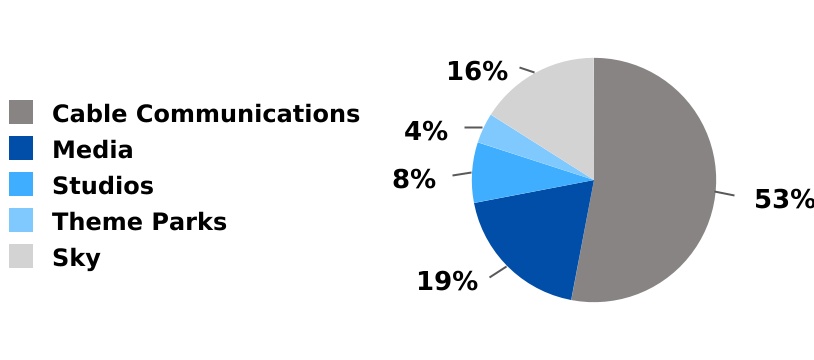
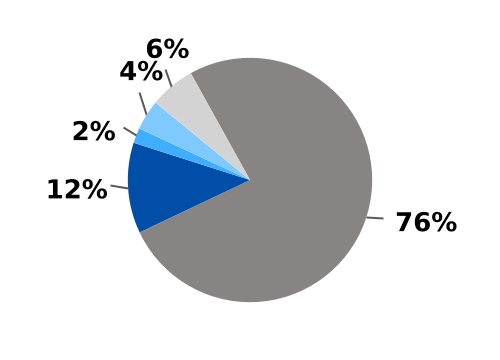
(a)Charts exclude the results of NBCUniversal Headquarters and Other, Corporate and Other, and eliminations. 2021 consolidated operating results were impacted by COVID-19. Refer to our Management’s Discussion and Analysis of Financial Condition and Results of Operations for additional information.
-
Cable Communications:** Consists of the operations of Comcast Cable, which is a leading provider of broadband, video, voice, wireless, and other services to residential customers in the United States under the Xfinity brand; we also provide these and other services to business customers and sell advertising.
-
Media:** Consists primarily of NBCUniversal’s television and streaming platforms, including national, regional and international cable networks; the NBC and Telemundo broadcast networks, NBC and Telemundo owned local broadcast television stations; and Peacock
-
Studios:** Consists primarily of NBCUniversal’s film and television studio production and distribution operations.
-
Theme Parks:** Consists primarily of our Universal theme parks in Orlando, Florida; Hollywood, California; Osaka, Japan; and Beijing, China.
-
Sky:** Consists of the operations of Sky, one of Europe’s leading entertainment companies, which primarily includes a direct-to-consumer business, providing video, broadband, voice and wireless phone services, and a content business, operating entertainment networks, the Sky News broadcast network and Sky Sports networks.
Our other business interests consist primarily of the operations of Comcast Spectacor, which owns the Philadelphia Flyers and the Wells Fargo Center arena in Philadelphia, Pennsylvania, and other business initiatives.
For developments in our business and financial and other information about our reportable business segments, refer to Item 7: Management’s Discussion and Analysis of Financial Condition and Results of Operations and Note 2 to the consolidated financial statements included in this Annual Report on Form 10-K.
| 1 | Comcast 2021 Annual Report on Form 10-K |
Description of Our Businesses
| Cable Communications Segment |
Cable Communications offers broadband, video, voice, wireless, and other services in the United States individually and as bundled services at a discounted rate over our cable distribution system to residential and business customers. Revenue is generated primarily from residential and business customers that subscribe to our services and from the sale of advertising. We aim to meet the needs of various segments of our residential customer base by offering multiple levels within each of our stand-alone and bundled services. Our business services offerings are tailored to meet the needs of various segments of our business customer base, ranging from broadband services for small business locations to bundled services and solutions designed to meet the needs of medium-sized customers and larger enterprises.
Customer Relationships and the Areas We Serve
All customer metrics included in this section are as of December 31, 2021.
| (in millions) | December 31, 2021 | ||||
| Customer relationships | |||||
| Residential customer relationships | 31.7 | ||||
| Business services customer relationships | 2.5 | ||||
| Total customer relationships | 34.2 | ||||
| Homes and businesses passed | 61 | ||||
| Total customer relationships penetration of homes and businesses passed | 57 | % |
Homes and businesses are considered passed if we can connect them to our cable distribution system without further extending the transmission lines and are estimated based on the best available information.
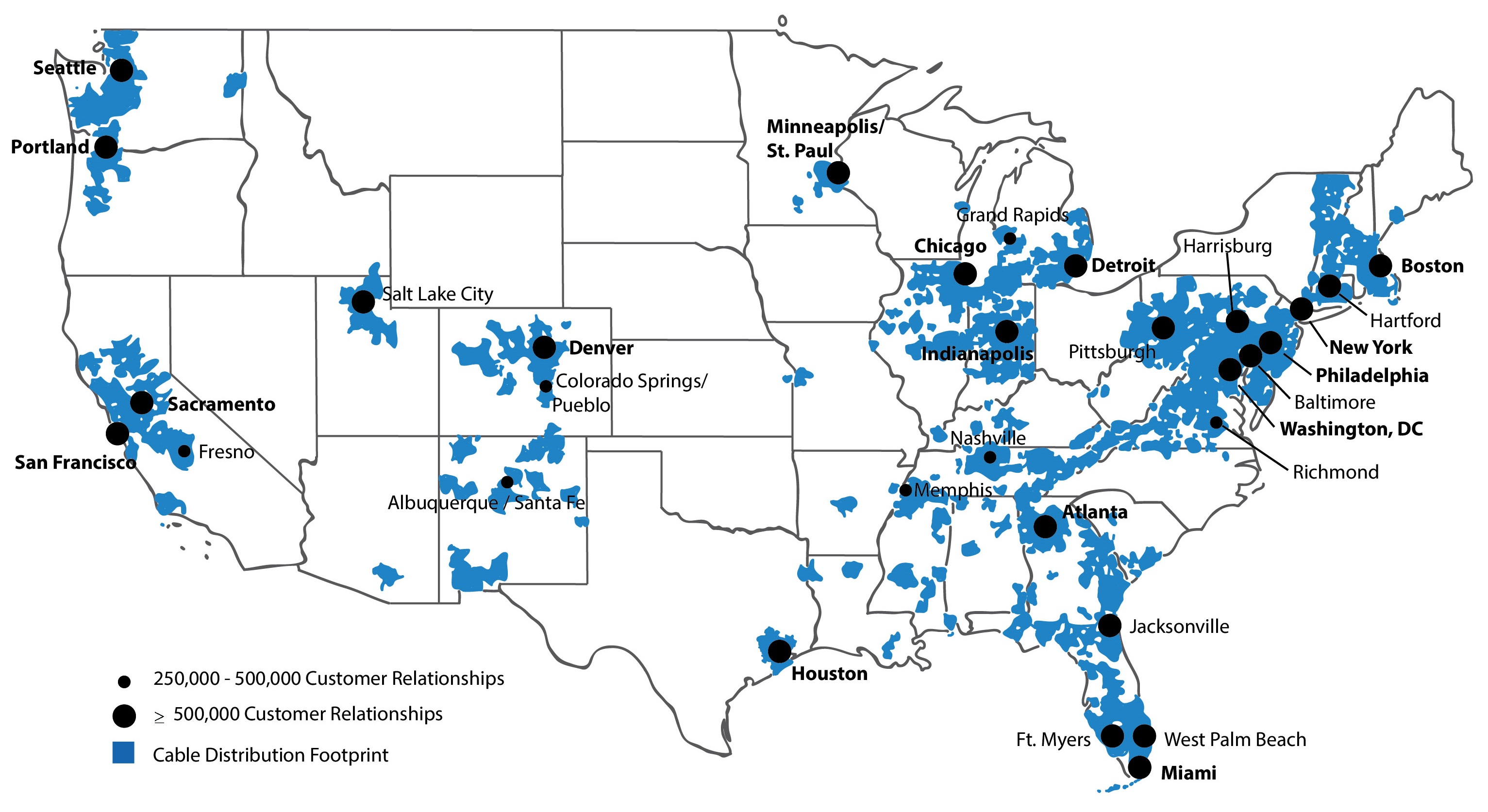
The map below highlights Cable Communications’ cable distribution footprint and the designated market areas (“DMAs”) where we have 250,000 or more customer relationships, with bolded locations representing one of the top 25 U.S. television DMAs as of December 31, 2021.
| Comcast 2021 Annual Report on Form 10-K | 2 |
Residential
Broad**band - 29.6 million customers
We offer broadband services over our hybrid fiber-optic and coaxial cable network with downstream speeds up to over a gigabit per second across nearly our entire footprint and fiber-based speeds that range up to 3 gigabits per second, and we continue to evolve and enhance our network and plan to leverage DOCSIS 4.0 technology to begin deploying multigigabit symmetrical speeds in the future.
We also offer wireless gateways to customers that combine an internet modem with a Wi-Fi router to deliver reliable internet speeds and enhanced coverage through an in-and-out-of-home Wi-Fi network as well as xFi Pod plug-in devices that extend a customer’s in-home Wi-Fi coverage. Customers with wireless gateways may also personalize and manage their Wi-Fi network and connected home, and access advanced security technology and other features, with our xFi whole-home application and online portal. Broadband customers have access to our expanding network of secure residential, outdoor and business Wi-Fi hotspots nationwide. As part of our low-income broadband adoption program, we also offer qualifying customers our Internet Essentials service, and beginning at the end of 2021 Internet Essential Plus, which have downstream speeds of up to 50 megabits per second and 100 megabits per second, respectively.
Broadband customers that prefer consuming content over the internet rather than linear cable television are eligible to receive our Flex streaming device for no additional charge, which i
Showing the first 8K of 107K characters. Open the full section
Item 1A. Risk Factors
Risks Related to Our Business, Industry and Operations
The COVID-19 pandemic has had, and may continue to have, a material adverse effect on our businesses and results of operations.
The impacts of COVID-19 and measures to prevent its spread across the globe have impacted our businesses in a number of ways. In particular, COVID-19 has had material negative impacts on NBCUniversal and Sky results of operations. For example, as a result of COVID-19, we have at times temporarily closed our theme parks or operated them with capacity restrictions. The creation and availability of our film and television programming globally also have been disrupted as a result of COVID-19, such as postponements or cancellations of sporting events, theatrical closures and suspensions of entertainment content production.
The impact of COVID-19 on our businesses also generally depends on the extent of restrictive governmental measures taken that affect day-to-day life, travel protocols and the length of time that such measures remain in place, global economic conditions, current and new variants and vaccination rates and efficacy. It is difficult to predict the extent and duration and the degree to which our results of operations will continue to be affected.
COVID-19 may also have the effect of heightening many of the other risks set forth below.
Our businesses operate in highly competitive and dynamic industries, and our businesses and results of operations could be adversely affected if we do not compete effectively.
All of our businesses operate in intensely competitive, consumer-driven, rapidly changing environments and compete with a growing number of companies that provide a broad range of communications products and services as well as entertainment, sports, news and information content to consumers. There can be no assurance that we will be able to compete effectively against our competitors or that competition will not have an adverse effect on our businesses.
| Comcast 2021 Annual Report on Form 10-K | 22 |
Below is a summary of the most significant sources of competition; for a more detailed description of the competition facing our businesses, see Item 1: Business and refer to the “Competition” discussion within that section.
-
Cable Communications’ and Sky’s broadband services compete primarily against wireline telecommunications companies, including many that are increasing deployment of fiber-based networks, wireless telecommunications companies offering internet services (such as 4G and 5G wireless broadband services), certain electric cooperatives and municipalities in the United States that own and operate their own broadband networks and DBS and newer satellite broadband providers. Broadband-deployment funding initiatives at the federal and state level, including as part of COVID-19 relief efforts as well as federal infrastructure legislation enacted in 2021, may result in other service providers deploying new subsidized internet access networks within our footprint. Competition for Cable Communications’ video services consists primarily of DTC streaming and other OTT service providers, DBS providers and telecommunications companies with fiber-based networks. Sky faces competition for its video services from cable and telecommunications providers in its European markets. Our voice and wireless services primarily compete with wireless and wireline telecommunications providers. Many of our competitors offer customers bundled products and services with favorable pricing, which has increased competition.
-
NBCUniversal and Sky face substantial and increasing competition from providers of similar types of entertainment, sports, news and information content, as well as from other forms of entertainment and recreational activities. NBCUniversal and Sky must compete to obtain talent, popular content (including sports programming) and other resources required to successfully operate their businesses. This competition has intensified as DTC streaming and other OTT service providers seek to develop high-quality programming and acquire live sports programming to attract viewers.
Consolidation of, or cooperation between, our competitors, including suppliers and distributors of content, may increase competition in all of these areas, as may the emergence of additional competitors with significant resources, greater efficiencies of scale, fewer regulatory burdens and more competitive pricing and packaging, who are competing with our businesses in all forms of content distribution and production. For example, such consolidation or cooperation may allow competitors to offer free or lower cost streaming services, potentially on an exclusive basis, through unlimited data-usage plans for internet or wireless phone services.
The ability of our businesses to compete effectively also depends on our perceived image and reputation among our various constituencies, including our customers, consumers, advertisers, business partners, employees, investors and government authorities. In addition, our ability to compete will be negatively affected if we do not provide our customers with a satisfactory customer experience.
Changes in consumer behavior continue to adversely affect our businesses and challenge existing business models.
Distribution platforms for viewing and purchasing content over the internet have been, and will likely continue to be, developed that further increase the number of competitors that all our businesses face and challenge existing business models. As consumers increasingly turn to DTC streaming and other OTT services, the number of Cable Communications’ video customers and amount of subscriber fees paid to NBCUniversal’s television networks decrease, even as Cable Communications’ broadband services have become more important to consumers. DTC streaming and other OTT services have driven, and will continue to drive, changes in consumer behavior as consumers seek more control over when, where and how they consume content and access communications services, and how much they pay for such content.
For example, Cable Communications continues to experience net video customer losses. In Europe, more of Sky’s new video customers have recently subscribed, and may continue to subscribe, to NOW, Sky’s DTC streaming service, instead of its traditional DTH video service. Although we have attempted to adapt our video service offerings and enhance our broadband services for changing consumer behaviors, for example, by deploying the X1 and Sky Q platforms, Flex, developing new smart televisions using our global technology platform at Sky and Cable Communications, and by offering Peacock, the continuing trend of content owners delivering their content directly to consumers rather than through, or in addition to, traditional video distribution channels continues to disrupt traditional distribution business models.
The increase in DTC streaming and other OTT service providers also has significantly increased the number of entertainment choices available to consumers, which has intensified audience fragmentation and disaggregated the way that content traditionally has been distributed and viewed by consumers. The use of DTC streaming and other OTT services reduce traditional television viewership, and coupled with time-shifting technologies, such as DVR and on demand services, have caused and likely will continue to cause audience ratings declines for our television programming channels. In addition, as more programming providers offer their content directly to consumers through their own apps or platforms, they may reduce the quantity and quality of the programming they license to NBCUniversal or Sky’s television channels or to Peacock.
| 23 | Comcast 2021 Annual Report on Form 10-K |
Our failure to effectively anticipate or adapt to emerging competitors or changes in consumer behavior, including among younger consumers, and shifting business models could have an adverse effect on our competitive position, businesses and results of operations.
A decline in advertisers’ expenditures or changes in advertising markets could negatively impact our businesses.
Cable Communications, NBCUniversal and Sky compete for the sale of advertising time with digital media distributors, websites and search engines, other television networks and stations, as well as with all other advertising platforms, such as radio and print. We derive substantial revenue from the sale of advertising, and a decline in expenditures by advertisers, including through traditional linear television distribution models, could negatively impact our results of operations. Declines can be caused by the economic prospects of specific advertisers or industries, increased competition for the leisure time of viewers, such as from social media and video games, audience fragmentation, increased viewing of content through DTC streaming and other OTT service providers, regulatory intervention regarding where and when advertising may be placed, or economic conditions generally. In addition, advertisers have shifted a portion of their total expenditures to digital media, which can deliver targeted advertising. Their willingness to purchase advertising from us may be adversely affected by lower audience ratings and reduced viewership, which many of NBCUniversal’s networks and some of Sky’s television channels have experienced and likely will continue to experience, or from the level of popularity or perceived acceptance of Peacock. Advertising sales and rates also are dependent on the methodology used for audience measurement and could be negatively affected if methodologies do not accurately reflect actual viewership levels.
Programming expenses for our video services are increasing, which could adversely affect Cable Communications’ video businesses.
We expect programming expenses for our video services to continue to be the largest single expense item for our Cable Communications segment and to continue to increase on a per subscriber basis. Part of Cable Communications’ programming expenses include payments to certain local broadcast television stations in exchange for their required consent for the retransmission of broadcast network programming to video services customers; we expect to continue to be subject to increasing demands for payment and other concessions from local broadcast television stations. These market factors may be exacerbated by increased consolidation in the media industry, which may further increase our programming expenses. If we are unable to raise our customers’ rates or otherwise offset programming cost increases through the sale of additional services, cost management or other initiatives, the increasing cost of programming could have an adverse effect on our Cable Communications segment’s results of operations.
Moreover, as our contracts with content providers expire, there can be no assurance that they will be renewed on acceptable terms, or at all, in which case we may be unable to provide such content as part of Cable Communications’ video services, and our businesses and results of operations could be adversely affected.
NBCUniversal’s and Sky’s success depends on consumer acceptance of their content, and their businesses may be adversely affected if their content fails to achieve sufficient consumer acceptance or the costs to create or acquire content increase.
NBCUniversal and Sky create and acquire media and entertainment content, the success of which depends substantially on consumer tastes and preferences that often change in unpredictable ways. The success of these businesses depends on our ability to consistently create, acquire, market and distribute television programming, filmed entertainment, theme park attractions and other content that meet the changing preferences of the broad domestic and international consumer markets. We have invested, and will continue to invest, substantial amounts in our content, including in the production of original content for NBCUniversal, including Peacock, and Sky, in our films and for new theme parks and theme park attractions, before learning the extent to which they will earn consumer acceptance. In addition, there can be no assurance that Peacock will continue to grow or sustain its revenue or user base or successfully compete as a standalone DTC streaming service.
NBCUniversal and Sky also obtain a significant portion of their content from third parties, such as movie studios, television production companies, sports organizations and other suppliers, sometimes on an exclusive basis. Competition for popular content, particularly for sports programming, is intense, and at times, we may increase the price we are willing to pay or be outbid by our competitors for popular content. We also may be unable to license popular third-party content for NBCUniversal’s and Sky’s television programming channels if media companies determine that licensing the content to us is not in their strategic best interests. For example, content creators have launched and may continue to launch their own DTC streaming or other OTT services, forgoing license fees from us to provide their content directly to consumers, or they may license their content to our competitors on an exclusive basis.
Entering into or renewing contracts for such programming rights or acquiring additional rights has in the past and in the future may result in significantly increased costs. Particularly with respect to long-term contracts for sports programming rights for NBCUniversal and Sky, our results of operations and cash flows over the term of a contract depend on a number of factors,
| Comcast 2021 Annual Report on Form 10-K | 24 |
including the strength of the advertising market, audience size, the timing and amount of rights payments, and the ability to secure distribution from, impose surcharges on, or obtain carriage on multichannel video providers. There can be no assurance that revenue from these contracts will exceed our costs for the rights, as well as the other costs of producing and distributing the programming. If our content does not achieve sufficient consumer acceptance, or if we cannot obtain or retain rights to popular content on acceptable terms, or at all, NBCUniversal’s and Sky’s businesses may be adversely affected.
The loss of programming distribution and licensing agreements, or the renewal of these agreements on less favorable terms, could adversely affect our businesses.
NBCUniversal’s cable television networks depend on their ability to secure and maintain distribution agreements with traditional and virtual multichannel video providers. The number of subscribers to NBCUniversal’s cable television networks has been, and likely will continue to be, reduced as a result of fewer subscribers to multichannel video providers. In addition, NBCUniversal’s broadcast television networks depend on their ability to secure and maintain network affiliation agreements with third-party local broadcast television stations in the markets where we do not own the affiliated local broadcast television station. Our owned local broadcast television stations must elect, with respect to retransmission by certain multichannel video providers, either “must-carry” status, in which we require the provider to carry the station without generating any compensation to us, or “retransmission consent,” in which we give up our right to mandatory carriage and instead seek to negotiate the terms and conditions of carriage, including the amount of compensation, if any, paid to us by such provider. Sky also depends on its ability to secure and maintain wholesale distribution agreements for its television channels with multichannel video providers.
Increasingly, NBCUniversal and Sky license their prior season and library content on third-party distribution platforms, including to DTC streaming and other OTT service providers. If this programming does not attract sufficient viewers, these providers may not distribute NBCUniversal’s or Sky’s programming. In addition, at times we have opted to, and expect that we may in the future, not license certain popular owned content to third parties so we may offer it exclusively through Peacock, which would result in foregone licensing revenue.
For all of these types of arrangements, NBCUniversal’s and Sky’s ability to renew agreements on favorable terms may be affected by industry consolidation and new participants entering the market for distribution of content on digital platforms. There can be no assurance that any of these agreements will be entered into or renewed in the future on acceptable terms. The inability to enter into or renew these agreements could reduce our revenues and the reach of our programming, which could adversely affect NBCUniversal’s and Sky’s businesses.
Less favorable European telecommunications access regulations, the loss of Sky’s transmission access agreements with satellite or telecommunications providers or the renewal of these agreements on less favorable terms could adversely affect Sky’s businesses.
Sky relies on various third-party telecommunications providers to deliver its video, broadband, voice and wireless phone services to its customers. For example, Sky relies on satellite transponder capacity leased from third parties to provide most of its video services. In addition, under the current regulatory regimes in the United Kingdom, Ireland and Italy, Sky accesses networks owned by third-party telecommunications providers to offer its broadband and phone services, in many cases, on regulated terms, including price. If there is a change in regulation in these markets, the regulated terms could become less favorable. Moreover, while Sky receives wholesale fiber access on fair, reasonable and non-discriminatory terms, specific pricing terms are not regulated. As a result, if Sky is only able to enter into or renew its transmission agreements with satellite or telecommunications operators on less favorable terms, it would adversely affect Sky’s ability to compete, and if it is ultimately unable to do so on commercially viable terms or if these operators were to terminate their agreements, Sky may be unable to deliver certain of its services to customers in one or more of the markets in which it operates, which would adversely affect Sky’s businesses and results of operations.
| 25 | Comcast 2021 Annual Report on Form 10-K |
Our businesses depend on using and protecting certain intellectual property rights and on not infringing the intellectual property rights of others.
We rely on our intellectual property, such as patents, copyrights, trademarks and trade secrets, as well as licenses and other agreements with our vendors and other third parties, to use various technologies, conduct our business operations and sell our products and services. Legal challenges to our intellectual property rights and claims of intellectual property infringement by third parties could require that we enter into royalty or licensing agreements on unfavorable terms, incur substantial monetary liability, or be enjoined preliminarily or permanently from further use of the intellectual property in question, from importing into the United States or other jurisdictions in which we operate hardware or software that uses such intellectual property or from the continuation of our businesses as currently conducted. We may need to change our business practices if any of these events occur, which may limit our ability to compete effectively and could have an adverse effect on our results of operations. Even if we believe any such challenges or claims are without merit, they can be time-consuming, costly to defend and may divert management’s attention and resources away from our businesses. Moreover, if we are unable to obtain or continue to obtain licenses from our vendors and other third parties on reasonable terms, our businesses could be adversely affected.
In addition, intellectual property constitutes a significant part of the value of NBCUniversal’s and Sky’s businesses, and their success is highly dependent on protecting the intellectual property rights of the content they create or acquire against third-party misappropriation, reproduction or infringement. The unauthorized reproduction, distribution or display of copyrighted material negatively affects our ability to generate revenue from the legitimate sale of our content, as well as from the sale of advertising in connection with our content, and increases our costs due to our active enforcement of our intellectual property rights.
Piracy and other unauthorized uses of content are made easier, and the enforcement of intellectual property rights more challenging, by technological advances that allow the conversion of programming, films and other content into digital formats, which facilitates the creation, transmission and sharing of high-quality unauthorized copies. In particular, piracy of programming and films through unauthorized distribution platforms continues to present challenges for NBCUniversal’s businesses, and certain entities may stream our broadcast television content illegally online without our consent and without paying us any compensation. It also presents similar challenges for Sky’s businesses, including as a result of illegal retransmission of sports events. While piracy is a challenge in the United States, it is particularly prevalent in many parts of the world that lack developed copyright laws, effective enforcement of copyright laws and technical protective measures like those in effect in the United States. If any U.S. or international laws intended to combat piracy and protect intellectual property rights are repealed or weakened or are not adequately enforced, or if the legal system fails to adapt to new technologies that facilitate piracy, we may be unable to effectively protect our rights, the value of our intellectual property may be negatively impacted and our costs of enforcing our rights may increase.
We may be unable to obtain necessary hardware, software and operational support.
We depend on third-party vendors to supply us with a significant amount of the hardware, software and operational support necessary to provide certain of our products and services. Some of these vendors represent our primary source of supply or grant us the right to incorporate their intellectual property into some of our hardware and software products. While we monitor the operations and financial condition of key vendors in an attempt to detect any potential difficulties, there can be no assurance that we would timely identify any operating or financial difficulties associated with these vendors or that we could effectively mitigate our risks with respect to any such difficulties. For example, global supply chains in general have been, and may continue to be, disrupted as a result of COVID-19. If any of these vendors experience operating or financial difficulties or any other supply chain compliance-related issues, if our demand exceeds their capacity or if they breach or terminate their agreements with us or are otherwise unable to meet our specifications or provide the equipment, products or services we need in a timely manner (or at all), or at reasonable prices, our ability to provide some products or services may be adversely affected and we may incur additional costs.
Our businesses depend on keeping pace with technological developments.
Our success is, to a large extent, dependent on our ability to acquire, develop, adopt and leverage new and existing technologies, and our competitors’ use of certain types of technology and equipment may provide them with a competitive advantage. New technologies can materially impact our businesses in a number of ways, including affecting the demand for our products, the distribution methods of our products and content to our customers, the ways in which our customers can purchase and view our content and the growth of distribution platforms available to advertisers. For example, current and new wireless internet technologies such as 4G and 5G wireless broadband services continue to evolve rapidly and may allow for greater speed and reliability for those services as compared with prior technologies. In addition, some companies and U.S. municipalities are building advanced fiber-based networks that provide very fast internet access speeds. We expect advances in communications technology to continue to occur in the future. If we choose technology or equipment that is not as effective or attractive to consumers as that employed by our competitors, if we fail to employ technologies desired by consumers before our competitors do so, or if we fail to execute effectively on our technology initiatives, our businesses and results of operations
| Comcast 2021 Annual Report on Form 10-K | 26 |
could be adversely affected. We also will continue to incur additional costs as we execute our technology initiatives, such as the deployment of Flex and Sky Q set-top boxes, wireless gateways, developing smart televisions using our technology platform, and the operation of Peacock. There can be no assurance that we can execute on these and other initiatives in a manner sufficient to grow or maintain our revenue or to successfully compete in the future. We also may generate less revenue or incur increased costs if changes in our competitors’ product offerings require that we offer certain services or enhancements at a lower or no cost to our customers or that we increase our research and development expenditures.
A cyber attack, information or security breach, or technology disruption or failure may negatively impact our ability to conduct our business or result in the misuse of confidential information, all of which could adversely affect our business, reputation and results of operations.
Network and information systems and other technologies, including those that are related to our network management, customer service operations and programming delivery and are embedded in our products and services, are critical to our business activities. In the ordinary course of our business, there are constant attempts by third parties to cause systems-related events and security incidents and to identify and exploit vulnerabilities in security architecture and system design. These incidents include computer hackings, cyber attacks, computer viruses, worms or other destructive or disruptive software, denial of service attacks, phishing attacks, malicious social engineering, and other malicious activities. Incidents also may be caused inadvertently by us or our third-party vendors, such as process breakdowns and vulnerabilities in security architecture or system design.
Cyber threats and attacks are constantly evolving and are growing in sophistication and frequency, which increases the difficulty of detecting and successfully defending against them. Some cyber attacks have had, and in the future can have, cascading impacts that unfold with increasing speed across networks, information systems and other technologies across the world and create latent vulnerabilities in our and third-party vendors’ systems and other technologies. Moreover, as we also obtain certain confidential, proprietary and personal information about our customers, personnel and vendors, and in some cases provide this information to third party vendors who agree to protect it, we face the risk that this information may become compromised through a cyber attack or data breach, misappropriation, misuse, leakage, falsification or accidental release or loss of information. Due to the nature of our businesses, we may be at a disproportionately heightened risk of these types of incidents occurring because we maintain certain information necessary to conduct our business in digital form. We also incorporate third-party software (including extensive open-source software), applications, and data hosting and cloud-based services into many aspects of our products, services and operations, all of which expose us to cyber attacks on such third-party suppliers and service providers.
While we develop and maintain systems, and operate extensive programs that seek to prevent security incidents from occurring, these efforts are costly and must be constantly monitored and updated in the face of sophisticated and rapidly evolving attempts to overcome our security measures and protections. The occurrence of both intentional and unintentional incidents have in the past, and could in the future, cause a variety of potential adverse business impacts. These include degradation or disruption of our network, products and services, excessive call volume to call centers, theft or misuse of our intellectual property or other assets, disruption of the security of our internal systems, products, services or satellite transmission signals, power outages, and the compromise of confidential or technical business information or damage to our or our customers’ or vendors’ data, equipment and reputation. Moreover, the amount and scope of insurance we maintain against losses resulting from any of the foregoing events likely would not be sufficient to fully cover our losses or otherwise adequately compensate us for disruptions to our business that may result. In addition, any such events could lead to litigation or cause regulators in the United States and internationally to impose significant fines or other remedial measures, including with respect to relevant customer privacy rules, or otherwise have an adverse effect on our company. Despite our efforts, we expect that we will continue to experience such incidents in the future, and there can be no assurance that any such incident will not have an adverse effect on our business, reputation or results of operations.
Weak economic conditions may have a negative impact on our businesses.
A substantial portion of our revenue comes from customers whose spending patterns may be affected by prevailing economic conditions. Weak economic conditions in the United States or globally could adversely affect demand for any of our products and services and have a negative impact on our results of operations. For example, weak economic conditions will likely impact our customers’ discretionary spending and as a result, they may reduce the level of services to which they subscribe or may discontinue subscribing to one or more of Cable Communications’ or Sky’s services altogether. This risk may be increased by the expanded availability of free or lower cost competitive services, such as certain DTC streaming and other OTT services, or substitute services for broadband and voice services, such as wireless and public Wi-Fi networks. Weak economic conditions also negatively impact our advertising revenue, the performance of our films and home entertainment releases, and attendance and spending in our theme parks. In particular, the success of our theme parks and theatrical releases largely depends on consumer demand for out-of-home entertainment experiences, which may be limited by weakened economic conditions (as well as natural disasters, infectious disease outbreaks (such as COVID-19), terrorist attacks or other similar events).
| 27 | Comcast 2021 Annual Report on Form 10-K |
Weak economic conditions and disruptions in the global financial markets may impact our ability to obtain financing or to refinance existing debt on acceptable terms, if at all, could increase the cost of our borrowings and may increase our exposure to currency fluctuations in countries where we operate. Further, inflationary pressures in the United States and globally may also have negative impacts on our cost structure and pricing models and may impact the ability of third parties (including advertisers, customers, suppliers, wholesale distributors, retailers and content creators, among others) to satisfy their obligations to us.
Acquisitions and other strategic initiatives present many risks, and we may not realize the financial and strategic goals that we had contemplated.
From time to time, we make acquisitions and investments and may pursue other strategic initiatives, such as Peacock. In connection with such acquisitions and strategic initiatives, we may incur significant or unanticipated expenses, fail to realize anticipated benefits and synergies, have difficulty incorporating an acquired or new line of business, disrupt relationships with current and new employees, customers and vendors, incur significant debt, divert the attention of management from our current operations, or have to delay or not proceed with announced transactions or initiatives. Additionally, federal regulatory agencies such as the FCC or DOJ or international regulators may impose restrictions on the operation of our businesses as a result of our seeking regulatory approvals for any significant acquisitions and strategic initiatives or may dissuade us from pursuing certain transactions. The occurrence of any of these events could have an adverse effect on our business and results of operations.
We face risks relating to doing business internationally that could adversely affect our businesses.
We operate our businesses worldwide. There are risks inherent in doing business internationally, including global financial market turmoil; economic volatility and global economic slowdown; currency exchange rate fluctuations and inflationary pressures; political risks; the requirements of local laws and customs relating to the publication and distribution of content and the display and sale of advertising; import or export restrictions, tariffs, sanctions and trade regulations; difficulties in developing, staffing and managing foreign operations; issues related to occupational safety and adherence to diverse local labor laws and regulations; and potentially adverse tax developments. Additionally, although we employ foreign currency derivative instruments to hedge certain exposure to foreign currency exchange rate risks, including the British pound, Euro and Japanese yen, the use of such derivative instruments may not be sufficient to mitigate exchange rate fluctuations. Sky’s businesses in particular are also subject to risks relating to uncertainties and effects of the United Kingdom’s recent withdrawal from the European Union (referred to as “Brexit”), including financial, legal, tax and trade implications. In addition, doing business internationally subjects us to risks relating to political or social unrest, as well as corruption and government regulation, including U.S. laws such as the Foreign Corrupt Practices Act and the U.K. Bribery Act, that impose stringent requirements on how we conduct our foreign operations. Moreover, foreign enforcement of laws and contractual rights in certain countries where we do business can be inconsistent and unpredictable, which may affect our ability to enforce our rights or make investments that we believe otherwise make strategic sense. If any of these events occur or our conduct does not comply with such laws and regulations, our businesses may be adversely affected.
Natural disasters, severe weather and other uncontrollable events could adversely affect our business, reputation and results of operations.
Our services, products and properties are vulnerable to damage from the occurrence of certain events, including natural disasters, severe weather events such as hurricanes and wild fires, and a range of other unforeseeable events such as infectious disease outbreaks, terrorist attacks or other similar events. Such events have in the past caused, and could in the future cause, a variety of adverse business impacts including degradation or disruption of our network, products and services, excessive call volume to call centers, a reduction in demand for our products, services and theme parks, disruption of our internal systems, products, services or satellite transmission signals, power outages, and damage to our or our customers’ or vendors’ equipment and properties. These events also may result in lost revenue and large expenditures to repair or replace damaged properties, products and services and could lead to litigation and fines, including if we inadvertently contributed to damages suffered by others. The amount and scope of insurance we maintain against losses resulting from these types of events likely would not be sufficient to fully cover our losses or otherwise adequately compensate us for disruptions to our business that may result. We expect that we will continue to experience some or all of these events in the future, and there can be no assurance that any such event will not have an adverse effect on our business, reputation or results of operations.
The loss of key management personnel or popular on-air and creative talent could have an adverse effect on our businesses.
We rely on certain key management personnel in the operation of our businesses. While we maintain long-term and emergency transition plans for key management personnel and believe we could either identify internal candidates or attract outside
| Comcast 2021 Annual Report on Form 10-K | 28 |
candidates to fill any vacancy created by the loss of any key management personnel, the loss of one or more of our key management personnel could have a negative impact on our businesses.
In addition, NBCUniversal and Sky depend on the abilities and expertise of on-air and creative talent. If we fail to attract or retain on-air or creative talent, if the costs to attract or retain such talent increase materially, or if these individuals cause negative publicity or lose their current appeal, our businesses could be adversely affected.
Risks Related to Legal, Regulatory and Governance Matters
We are subject to regulation by federal, state, local and foreign authorities, which impose additional costs and restrictions on our businesses.
While all of our businesses are subject to various federal, state and local laws and regulations, compliance with certain laws and regulations is most material with respect to our Cable Communications and broadcast television businesses in the United States. In addition, our international businesses are subject to various laws and regulations in the jurisdiction of the foreign regulatory authorities where they operate.
Legislators and regulators at all levels of government frequently consider changing, and sometimes do change, existing statutes, rules or regulations, or interpretations of existing statutes, rules or regulations, or prescribe new ones, any of which may significantly affect our businesses and ability to effectively compete. These legislators and regulators have been active in considering legislation and rulemakings, at times looking to adopt regulatory approaches from different countries that may be more burdensome, and they, along with some state attorneys general and foreign governmental authorities, have also been active in conducting inquiries and reviews regarding our services. State legislative and regulatory initiatives can create a patchwork of different and/or conflicting state requirements, such as with respect to privacy and Open Internet/net neutrality regulations, that can affect our business operations and further constrain our ability to compete.
Legislative and regulatory activity is increasing under the Biden Administration, particularly with respect to broadband networks. For example, Congress has approved tens of billions of dollars in new funding for broadband deployment and adoption initiatives, and may consider other proposals that address communications issues, including whether it should rewrite the entire Communications Act to account for changes in the communications marketplace and whether it should enact new, permanent Open Internet/net neutrality requirements. Federal agencies likewise may consider adopting new regulations for communications services, including broadband. States and localities are also increasingly proposing new regulations impacting communications services, including broader regulation of broadband networks. Any of these regulations could significantly affect our business and compliance costs. In addition, United States and foreign regulators and courts could adopt new interpretations of existing competition laws or enact new competition laws or regulatory tools that could negatively impact our businesses. Any future legislative, judicial, regulatory or administrative actions may increase our costs or impose additional restrictions on our businesses, some of which may be significant. We are unable to predict the outcome or effects of any of these potential actions or any other legislative or regulatory proposals on our businesses.
Failure to comply with the laws and regulations applicable to our businesses could result in administrative enforcement actions, fines, and civil and criminal liability. Any changes to the legal and regulatory framework applicable to any of our services or businesses could have an adverse impact on our businesses and results of operations. For a more extensive discussion of the significant risks associated with the regulation of our businesses, see Item 1: Business and refer to the “Legislation and Regulation” discussion within that section.
Unfavorable litigation or governmental investigation results could require us to pay significant amounts or lead to onerous operating procedures.
We are subject from time to time to a number of lawsuits both in the United States and in foreign countries, including claims relating to competition, intellectual property rights (including patents), employment and labor matters, personal injury and property damage, free speech, customer privacy, regulatory requirements, advertising, marketing and selling practices, and credit and collection issues. Greater constraints on the use of arbitration to resolve certain of these disputes could adversely affect our business. We also spend substantial resources complying with various regulatory and government standards, including any related investigations and litigation. We may incur significant expenses defending any such suit or government charge and may be required to pay amounts or otherwise change our operations in ways that could adversely impact our businesses, results of operations or financial condition.
Labor disputes, whether involving employees or sports organizations, may disrupt our operations and adversely affect our businesses.
Many of NBCUniversal’s writers, directors, actors, technical and production personnel, as well as some of our on-air and creative talent employees, are covered by collective bargaining agreements or works councils. Most of NBCUniversal’s
| 29 | Comcast 2021 Annual Report on Form 10-K |
collective bargaining agreements are industry-wide agreements, and we may lack practical control over the negotiations and terms of the agreements. If we are unable to reach agreement with a labor union before the expiration of a collective bargaining agreement, our employees who were covered by that agreement may have a right to strike or take other actions that could adversely affect us, which could disrupt our operations and reduce our revenue, and the resolution of any disputes may increase our costs. There can be no assurance that we will renew our collective bargaining agreements as they expire or that we can renew them on favorable terms or without any work stoppages.
In addition, NBCUniversal’s Media segment and Sky have programming rights agreements of varying scope and duration with various sports organizations to broadcast and produce sporting events. Labor disputes in these and other sports organizations could have an adverse effect on our businesses.
Our Class B common stock has substantial voting rights and separate approval rights over several potentially material transactions, and our Chairman and CEO has considerable influence over our company through his beneficial ownership of our Class B common stock.
Our Class B common stock has a non-dilutable 33 1/3% of the combined voting power of our Class A and Class B common stock. This non-dilutable voting power is subject to proportional decrease to the extent the number of shares of Class B common stock is reduced below 9,444,375, which was the number of shares of Class B common stock outstanding on the date of our 2002 acquisition of AT&T Corp.’s cable business, subject to adjustment in specified situations. Stock dividends payable on the Class B common stock in the form of Class B or Class A common stock do not decrease the non-dilutable voting power of the Class B common stock. The Class B common stock also has separate approval rights over several potentially material transactions, even if they are approved by our Board of Directors or by our other shareholders and even if they might be in the best interests of our other shareholders. These potentially material transactions include mergers or consolidations involving us, transactions (such as a sale of all or substantially all of our assets) or issuances of securities that require shareholder approval, transactions that result in any person or group owning shares representing more than 10% of the combined voting power of the resulting or surviving corporation, issuances of Class B common stock or securities exercisable or convertible into Class B common stock, and amendments to our articles of incorporation or by-laws that would limit the rights of holders of our Class B common stock. Brian L. Roberts, our chairman and CEO, beneficially owns all of the outstanding shares of our Class B common stock and, accordingly, has considerable influence over our company and the potential ability to transfer effective control by selling the Class B common stock, which could be at a premium.
Item 1B. Unresolved Staff Comments
None.
Item 2. Properties
We believe that substantially all of our physical assets were in good operating condition as of December 31, 2021. Our corporate headquarters and Cable Communications segment headquarters are located in Philadelphia, Pennsylvania at One Comcast Center. Additionally, the Comcast Technology Center, which is adjacent to the Comcast Center, is a center for Cable Communications’ technology and engineering workforce, as well as the home of our NBCUniversal and Telemundo owned local broadcast stations in Philadelphia, Pennsylvania. We also have leases for numerous business offices, warehouses and properties throughout the United States that house divisional information technology operations.
| Cable Communications Segment |
Our principal physical assets consist of operating plant and equipment, including cable system signal receiving, encoding and decoding devices, headends and distribution networks. Our distribution network consists primarily of headends, content distribution servers, coaxial and fiber-optic cables, lasers, routers, switches and related electronic equipment. Our cable plant and related equipment generally are connected to utility poles under pole rental agreements with local public utilities, although in some areas the distribution cable is buried in underground ducts or trenches. The physical components of cable systems require periodic maintenance and replacement.
Our cable system signal reception sites, which consist primarily of antenna towers and headends, and our microwave facilities are located on owned and leased parcels of land, and we own or lease space on the towers on which certain of our equipment is located. We own most of our service vehicles.
Our broadband network consists of fiber-optic cables owned or leased by us and related equipment. We also operate national and regional data centers with equipment that is used to provide services, such as email and web services, to our broadband and
| Comcast 2021 Annual Report on Form 10-K | 30 |
voice customers, as well as cloud services to our video customers. In addition, we maintain network operations centers with equipment necessary to monitor and manage the status of our services and network.
We own or lease buildings throughout the United States that contain customer service call centers, retail stores and customer service centers, warehouses and administrative space. We also own a building that houses our digital media center. The digital media center contains equipment that we own or lease, including equipment related to network origination, video transmission via satellite and terrestrial fiber-optics, broadcast studios, post-production services and interactive television services.
| NBCUniversal Segments |
NBCUniversal’s corporate headquarters are located in New York, New York at 30 Rockefeller Plaza and surrounding campus and include offices and studios, which are used by Headquarters and Other and the Media segment. NBCUniversal owns substantially all of the space it occupies at 30 Rockefeller Plaza. NBCUniversal also leases space in 10 Rockefeller Plaza that includes The Today Show studio, production facilities and offices used by the Media segment. Telemundo’s leased headquarters and production facilities are located in Miami, Florida and are used by the Media segment and Headquarters and Other. The Universal City location in California includes offices, studios, and theme park and retail operations that are owned by NBCUniversal and used by all NBCUniversal segments. Our owned CNBC headquarters and production facilities and disaster recovery center are located in Englewood Cliffs, New Jersey and are used by the Media segment and Headquarters and Other. We also own or lease offices, studios, production facilities, screening rooms, retail operations, warehouse space, satellite transmission receiving facilities and data centers in numerous locations in the United States and around the world, including property for our owned local broadcast television stations. In addition, we own theme parks and own or lease related facilities in Orlando, Florida; Hollywood, California; Osaka, Japan; and Beijing, China, that are used in the Theme Parks segment, and we are developing a new theme park in Orlando, Florida.
| Sky Segment |
Sky’s principal physical assets consist of operating plant and equipment, including leased satellite system signal receiving, encoding and decoding devices, and owned and leased headends and distribution networks, including coaxial, fiber-optic cables and other related equipment. In the United Kingdom, Sky uses a combination of its own core fiber network and wholesaling arrangements over third-party telecommunication providers’ networks as the core network and also accesses the “last mile” network from third-party network operators for a fee to provide its services to customers. The physical components of cable systems require periodic maintenance and replacement.
Sky’s corporate headquarters are located in Middlesex, U.K. Sky owns the space it occupies in Middlesex. Sky leases the Sky Deutschland headquarters located in Unterföhring, Germany and the Sky Italia headquarters located in Milan, Italy.
Additionally, Sky owns and leases offices, production facilities and studios, broadcasting facilities, and customer support centers throughout Europe, including in the United Kingdom, Ireland, Germany, Italy and Austria. We are currently constructing a new studio production facility in Elstree, U.K., that Sky will lease upon completion.
| Other |
The Wells Fargo Center, a large, multipurpose arena in Philadelphia, Pennsylvania that we own was the principal physical operating asset used by our other businesses as of December 31, 2021.
Item 3. Legal Proceedings
See Note 15 included in this Annual Report on Form 10-K for a discussion of legal proceedings.
Item 4. Mine Safety Disclosures
Item 5. Market for Registrant’s Common Equity, Related Stockholder Matters and Issuer Purchases of Equity Securities
Comcast’s Class A common stock is listed on the NASDAQ Global Select Market under the symbol CMCSA. There is no established public trading market for Comcast’s Class B common stock. The Class B common stock can be converted, on a share for share basis, into Class A common stock.
| Dividends Declared | ||||||||||||||
| 2021 | 2020 | |||||||||||||
| Month Declared: | Dividend Per Share | Month Declared: | Dividend Per Share | |||||||||||
| January | $ | 0.25 | January | $ | 0.23 | |||||||||
| May | $ | 0.25 | May | $ | 0.23 | |||||||||
| July | $ | 0.25 | July | $ | 0.23 | |||||||||
| October (paid in January 2022) | $ | 0.25 | October (paid in January 2021) | $ | 0.23 | |||||||||
| Total | $ | 1.00 | Total | $ | 0.92 |
We expect to continue to pay quarterly dividends, although each dividend is subject to approval by our Board of Directors. In January 2022, our Board of Directors approved an 8% increase in our dividend to $1.08 per share on an annualized basis.
Holders of Class A common stock in the aggregate hold 662/3% of the combined voting power of our common stock. The number of votes that each share of Class A common stock has at any given time depends on the number of shares of Class A common stock and Class B common stock then outstanding, with each share of Class B common stock having 15 votes per share. The Class B common stock represents 331/3% of the combined voting power of our common stock, which percentage is generally non-dilutable under the terms of our articles of incorporation. Mr. Brian L. Roberts beneficially owns all outstanding shares of Class B common stock. Generally, including as to the election of directors, holders of Class A common stock and Class B common stock vote as one class except where class voting is required by law.
Record holders as of December 31, 2021 are presented in the table below.
| Stock Class | Record Holders | ||||
| Class A Common Stock | 352,581 | ||||
| Class B Common Stock | 3 |
The table below summarizes Comcast’s common stock repurchases during 2021.
| Period | Total Number of Shares Purchased | Average Price Per Share | Total Number of Shares Purchased as Part of Publicly Announced Authorization | Total Dollar Amount Purchased Under the Publicly Announced Authorization | Maximum Dollar Value of Shares That May Yet Be Purchased Under the Publicly Announced Authorization(a) | ||||||||||||
| First Quarter 2021 | — | $ | — | — | $ | — | $ | — | |||||||||
| Second Quarter 2021 | 8,785,149 | $ | 56.91 | 8,785,149 | $ | 499,999,935 | $ | 9,500,000,065 | |||||||||
| Third Quarter 2021 | 25,881,698 | $ | 57.96 | 25,881,698 | $ | 1,500,000,038 | $ | 8,000,000,027 | |||||||||
| October 1-31, 2021 | 12,911,147 | $ | 53.48 | 12,911,147 | $ | 690,452,411 | $ | 7,309,547,616 | |||||||||
| November 1-30, 2021 | 15,334,579 | $ | 52.79 | 15,334,579 | $ | 809,547,566 | $ | 6,500,000,050 | |||||||||
| December 1-31, 2021 | 10,297,809 | $ | 48.55 | 10,297,809 | $ | 500,000,046 | $ | 6,000,000,004 | |||||||||
| Total | 73,210,382 | $ | 54.64 | 73,210,382 | $ | 3,999,999,996 | $ | 6,000,000,004 |
(a)Effective May 25, 2021, our Board of Directors increased our share repurchase program authorization to $10 billion. In January 2022, our Board of Directors increased our share repurchase program authorization from the $6 billion remaining as of December 31, 2021 to $10 billion. Under the authorization, which does not have an expiration date, we expect to repurchase additional shares, which may be in the open market or in private transactions.
The total number of shares purchased during 2021 does not include any shares received in the administration of employee share-based compensation plans as there were none received in 2021.
| Comcast 2021 Annual Report on Form 10-K | 32 |
| Stock Performance Graph |
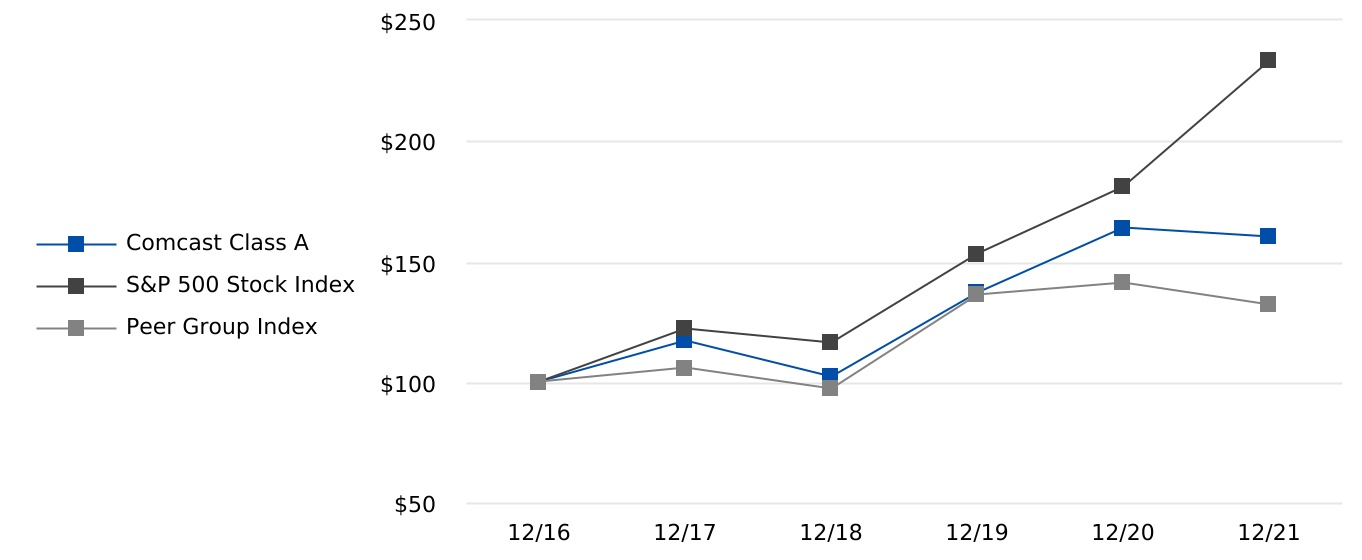
The following graph compares the annual percentage change in the cumulative total shareholder return on Comcast’s Class A common stock during the five years ended December 31, 2021 with the cumulative total returns on the Standard & Poor’s 500 Stock Index and a select peer group consisting of us and other companies engaged in the cable, communications and media industries. This peer group consists of our Class A common stock and the common stock of AT&T Inc., Charter Communications, Inc., DISH Network Corporation (Class A), Lumen Technologies, Inc., T-Mobile US, Inc. and Verizon Communications Inc. (the “transmission and distribution subgroup”); and Discovery, Inc. (Class A), ViacomCBS Inc. (Class B) and The Walt Disney Company (the “media subgroup”).
The peer group is constructed as a composite peer group in which the transmission and distribution subgroup is weighted 75% and the media subgroup is weighted 25% based on the respective revenue of our transmission and distribution and media businesses. The comparison assumes $100 was invested on December 31, 2016 in our Class A common stock and in each of the following indices and assumes the reinvestment of dividends.
| Comparison of 5 Year Cumulative Total Return |
| 2017 | 2018 | 2019 | 2020 | 2021 | |||||||||||||
| Comcast Class A | $ | 117 | $ | 102 | $ | 137 | $ | 164 | $ | 160 | |||||||
| S&P 500 Stock Index | $ | 122 | $ | 116 | $ | 153 | $ | 181 | $ | 233 | |||||||
| Peer Group Index | $ | 106 | $ | 97 | $ | 136 | $ | 141 | $ | 132 |
Item 6. [Reserved]
Item 7. Management’s Discussion and Analysis of Financial Condition and Results of Operations
Management’s discussion and analysis of financial condition and results of operations is provided as a supplement to, and should be read in conjunction with, the consolidated financial statements and related notes to enhance the understanding of our operations and our present business environment. For more information about our company’s operations and the risks facing our businesses, see Item 1: Business and Item 1A: Risk Factors, respectively. As discussed in Note 2, we changed the presentation of our segment operating results in 2021, and all amounts are presented on a consistent basis under the new segment structure. Refer to Item 7: Management’s Discussion and Analysis of Financial Condition and Results of Operations in our 2020 Annual Report on Form 10-K for management’s discussion and analysis of financial condition and results of operations for the fiscal year 2020 compared to fiscal year 2019, with the exception of the discussion and analysis related to our NBCUniversal segments, which is included below for all periods based on the updated segment structure.
| Overview |
We are a global media and technology company with three primary businesses: Comcast Cable, NBCUniversal and Sky. We present our operations in five reportable business segments (1) Comcast Cable in one reportable business segment, referred to as Cable Communications; (2) NBCUniversal in three reportable business segments: Media, Studios and Theme Parks (collectively, the “NBCUniversal segments”); and (3) Sky in one reportable business segment.
| Consolidated Revenue, Net Income Attributable to Comcast Corporation and Adjusted EBITDA(a) | ||
| (in billions) |
| Revenue | Net Income Attributable to Comcast Corporation | Adjusted EBITDA |
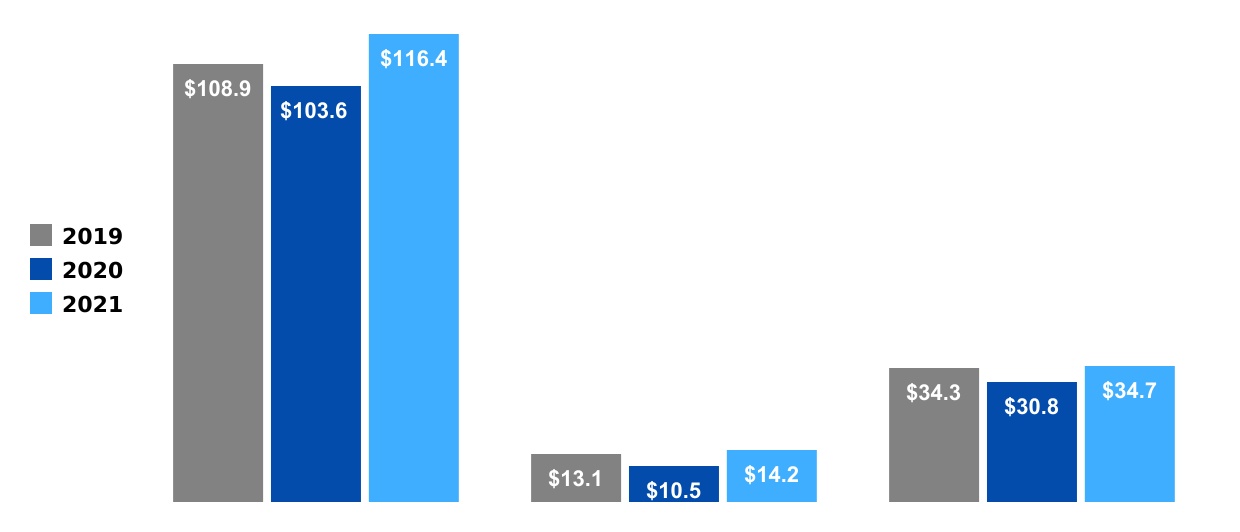
(a)Adjusted EBITDA is a financial measure that is not defined by generally accepted accounting principles in the United States (“GAAP”). Refer to the “Non-GAAP Financial Measure” section on page 52 for additional information, including our definition and our use of Adjusted EBITDA, and for a reconciliation from net income attributable to Comcast Corporation to Adjusted EBITDA.
2021 Developments
The following are the more significant developments in our businesses during 2021:
Cable Communications
-
Revenue increased 7.1% to $64.3 billion, reflecting increases in broadband, wireless, business services, advertising, video and other revenue, partially offset by a decline in voice revenue.
-
Adjusted EBITDA increased 11.2% to $28.1 billion primarily due to increases in revenue, partially offset by increases in programming and technical and product support expenses.
-
Operating margin increased from 42.1% to 43.7%.
| Comcast 2021 Annual Report on Form 10-K | 34 |
-
Total customer relationships increased by 1.1 million, total broadband customers increased by 1.3 million, total wireless lines increased by 1.2 million and total video customers decreased by 1.7 million.
-
Capital expenditures increased 4.9% to $6.9 billion, reflecting increased spending on scalable infrastructure and line extensions, partially offset by decreased spending on customer premise equipment and support capital.
NBCUniversal
-
Total NBCUniversal revenue increased 26.1% to $34.3 billion and total NBCUniversal Adjusted EBITDA increased 6.0% to $5.7 billion.
-
Media segment revenue increased 20.3% to $22.8 billion and Adjusted EBITDA decreased 18.0% to $4.6 billion, including the impact of our broadcast of the Tokyo Olympics in 2021. Excluding $1.8 billion of revenue associated with our broadcast of the Tokyo Olympics in 2021, revenue in the Media segment increased 11.0%, primarily due to increases in distribution revenue, advertising revenue and other revenue, including the effects of COVID-19 in the prior year period.
-
Media segment results include the operations of Peacock, which in 2021 generated revenue of $778 million and operating costs and expenses of $2.5 billion, compared to revenue of $118 million and operating costs and expenses of $781 million in 2020. We continued to invest in content and grow our customer base during 2021, and in the fourth quarter of 2021, we introduced certain ad-supported Peacock programming into Sky video services, launching first in the United Kingdom and Ireland.
-
Studios segment revenue increased 16.2% to $9.4 billion, due to increases in content licensing revenue, theatrical revenue and home entertainment and other revenue as our film and television production operations returned to full capacity. Studios revenue included licenses of content to our Media and other segments, including the impact of a new licensing agreement for content that became exclusively available for streaming on Peacock in 2021, and the impacts of initial content licenses associated with the launch of Peacock in 2020, which are eliminated in consolidation.
-
Theme Parks segment revenue increased 141.2% to $5.1 billion and Adjusted EBITDA increased from $(0.5) billion to $1.3 billion, reflecting the operation of our theme parks in the current year period compared to temporary closures and capacity restrictions as a result of COVID-19 in the prior year period and the opening of our theme park in Beijing, China in September 2021.
Sky
-
Revenue increased 9.1% to $20.3 billion. Excluding the impact of foreign currency, Sky revenue increased 3.1% due to increases in advertising and direct-to-consumer revenue, partially offset by a decrease in content revenue, which were affected by COVID-19 in the prior year period and reduced broadcast rights for Serie A in the current year period.
-
Adjusted EBITDA increased 20.8% to $2.4 billion. Excluding the impact of foreign currency, Sky Adjusted EBITDA increased 10.2% primarily due to increases in revenue and decreases in programming and production expenses, partially offset by increases in direct network costs and other expenses.
Other
-
Corporate and Other Adjusted EBITDA losses decreased from $1.8 billion to $1.4 billion primarily due to costs incurred in the prior year period in response to COVID-19, including severance charges related to our businesses.
-
Resumed our share repurchase program in the second quarter of 2021. We repurchased a total of 73.2 million shares of our Class A common stock for $4.0 billion in 2021. Raised our dividend by $0.08 to $1.00 per share on an annualized basis in January 2021 and paid $4.5 billion of dividends in 2021.
-
Reduced debt by $8.9 billion in 2021 and ended the year with $94.8 billion of total short-term and long-term debt and $8.7 billion of cash and cash equivalents.
Impacts of COVID-19
COVID-19 and measures taken to prevent its spread across the globe have impacted our businesses in a number of ways, with the most significant effects in 2020, affecting the comparability of periods included in this report. COVID-19 has had material negative impacts on NBCUniversal and Sky results of operations primarily due to the temporary restrictions and closures at our theme parks and the impacts of professional sports, respectively. We expect the effects of the COVID-19 pandemic will continue to adversely impact our consolidated results of operations over the near to medium term, although the extent of such
| | | | | | | | | | | --- | --
Showing the first 8K of 125K characters. Open the full section
Item 7A. Quantitative and Qualitative Disclosures About Market Risk
| Interest Rate Risk Management |
We maintain a mix of fixed-rate and variable-rate debt and we are exposed to the market risk of adverse changes in interest rates. In order to manage the cost and volatility relating to the interest cost of our outstanding debt, we enter into various interest rate risk management derivative transactions in accordance with our policy.
We monitor our exposure to the risk of adverse changes in interest rates through the use of techniques that include market valuation and sensitivity analyses. We do not engage in any speculative or leveraged derivative transactions.
Our interest rate derivative financial instruments, which primarily include cross-currency swaps and interest rate swaps, represent an integral part of our interest rate risk management program.
The effect of our interest rate derivative financial instruments to our consolidated interest expense was a decrease of $2 million in 2021, a decrease of $9 million in 2020, and a decrease of $49 million in 2019. Interest rate derivative financial instruments may have a significant effect on consolidated interest expense in the future.
The table below summarizes by contractual year of maturity the principal amount of our debt, notional amount of our interest rate instruments, effective rates, and fair values subject to interest rate risk maintained by us as of December 31, 2021. We estimate interest rates on variable rate debt and swaps using the relevant average implied forward rates through the year of maturity based on the yield curve in effect on December 31, 2021, plus the applicable borrowing margin.
| (in millions) | 2022 | 2023 | 2024 | 2025 | 2026 | Thereafter | Total | Estimated Fair Value as of December 31, 2021 | ||||||||||||||||||
| Debt | ||||||||||||||||||||||||||
| Fixed-rate debt | $ | 2,135 | $ | 1,056 | $ | 3,824 | $ | 6,136 | $ | 5,232 | $ | 78,771 | $ | 97,155 | $ | 105,613 | ||||||||||
| Average interest rate(a) | 6.3 | % | 2.0 | % | 3.0 | % | 3.4 | % | 2.4 | % | 3.5 | % | 3.5 | % | ||||||||||||
| Variable-rate debt | $ | — | $ | — | $ | 500 | $ | — | $ | — | $ | 3,148 | $ | 3,648 | $ | 3,654 | ||||||||||
| Average interest rate | — | % | — | % | 1.7 | % | — | % | — | % | 4.4 | % | 4.0 | % | ||||||||||||
| Fixed-to-Variable Swaps | ||||||||||||||||||||||||||
| Notional amount(b) | $ | — | $ | — | $ | — | $ | — | $ | 1,250 | $ | 1,250 | $ | 2,500 | $ | (24) | ||||||||||
| Average pay rate | — | % | — | % | — | % | — | % | 3.5 | % | 4.1 | % | 3.8 | % | ||||||||||||
| Average receive rate | — | % | — | % | — | % | — | % | 3.3 | % | 4.0 | % | 3.7 | % | ||||||||||||
| Comcast 2021 Annual Report on Form 10-K | 60 |
(a)Includes the effects of our fixed-to-fixed cross-currency swaps, which are discussed further below under the heading “Foreign Exchange Risk Management.”
(b)Notional amounts are used to calculate the interest to be paid or received and do not represent our exposure to credit loss. The estimated fair value approximates the amount of payments to be made or proceeds to be received to settle the outstanding contracts, excluding accrued interest.
Additionally, we have a $5.2 billion variable rate term loan presented separately as a collateralized obligation that will mature in March 2024. We entered into a series of variable-to-fixed interest rate swaps on $5.2 billion of this term loan with an average pay rate of 1.1% and an average receive rate of 0.9% estimated using December 31, 2021 implied forward rates through the year of maturity. As of December 31, 2021 and 2020, the estimated fair value of the term loan was $5.2 billion for each period, and the estimated fair value of the related interest rate swaps was a net liability of $29 million and a net liability of $155 million, respectively.
See Notes 1, 6 and 8 for additional information.
| Foreign Exchange Risk Management |
We have significant operations in a number of countries outside the United States through Sky and NBCUniversal, and certain of our operations are conducted in foreign currencies. The value of these currencies fluctuates relative to the U.S. dollar. These changes could adversely affect the U.S. dollar equivalent value of our non-U.S. dollar operations, which could negatively affect our business, financial condition and results of operations in a given period or in specific territories.
As part of our overall strategy to manage the level of exposure to the risk of foreign exchange rate fluctuations, we enter into derivative financial instruments related to a significant portion of our foreign currency exposure for transactions denominated in currencies other than the functional currency of the transacting entity. We enter into foreign currency forward contracts that change in value as currency exchange rates fluctuate to protect the functional currency equivalent value of non-functional currency denominated assets, liabilities, commitments, and forecasted non-functional currency revenue and expenses. In accordance with our policy, we hedge forecasted foreign currency transactions for periods generally not to exceed 30 months. As of December 31, 2021 and 2020, we had foreign exchange contracts on transactions other than debt with a total notional value of $8.0 billion and $8.1 billion, respectively. As of December 31, 2021 and 2020, the aggregate estimated fair value of these foreign exchange contracts was not material.
We use cross-currency swaps as cash flow hedges for certain foreign currency denominated debt obligations with obligations denominated in a currency other than the functional currency of the issuer. Cross-currency swaps effectively convert foreign currency denominated debt to debt denominated in the functional currency, which hedge currency exchange risks associated with foreign currency denominated cash flows such as interest and principal debt repayments. As of December 31, 2021 and 2020, we had cross-currency swaps designated as cash flow hedges on $1.6 billion and $1.7 billion of our foreign currency denominated debt, respectively. As of December 31, 2021 and 2020, the aggregate estimated fair value of cross-currency swaps designated as cash flow hedges was a net liability of $53 million and a net liability of $45 million, respectively.
We are also exposed to foreign exchange risk on the consolidation of our foreign operations. We have foreign currency denominated debt and cross-currency swaps designated as hedges of our net investments in certain of these subsidiaries. Transaction gains and losses resulting from currency movements on debt and changes in the fair value of cross-currency swaps designated as net investment hedges are recorded within the currency translation adjustments component of accumulated other comprehensive income (loss). As of December 31, 2021 and 2020, the amount of our net investment in foreign subsidiaries hedged using foreign currency denominated debt was $8.2 billion and $10.3 billion, respectively, and the amount of our net investment in foreign subsidiaries hedged using cross-currency swaps was $3.6 billion and $4.0 billion, respectively. As of December 31, 2021 and 2020, the aggregate estimated fair value of these cross-currency swaps was a net liability of $104 million and $376 million, respectively. The amount of pre-tax gains (losses) related to net investment hedges recognized in the cumulative translation adjustments component of other comprehensive income (loss) were gains of $760 million in 2021, losses of $686 million in 2020 and gains of $343 million in 2019.
We have analyzed our foreign currency exposure related to our foreign operations as of December 31, 2021, including our hedging contracts, to identify assets and liabilities denominated in a currency other than their functional currency. For those assets and liabilities, we then evaluated the effect of a hypothetical 10% shift in currency exchange rates, inclusive of the effects of derivatives. The results of our analysis indicate that such a shift in exchange rates would not have a material impact on our 2021 net income attributable to Comcast Corporation.
| 61 | Comcast 2021 Annual Report on Form 10-K |
| Counterparty Credit Risk Management |
We manage the credit risks associated with our derivative financial instruments through diversification and the evaluation and monitoring of the creditworthiness of counterparties. Although we may be exposed to losses in the event of nonperformance by counterparties, we do not expect such losses, if any, to be significant. We have agreements with certain counterparties that include collateral provisions. These provisions require a party with an aggregate unrealized loss position in excess of certain thresholds to post cash collateral for the amount in excess of the threshold. The threshold levels in our collateral agreements are based on our and the counterparty’s credit ratings. As of December 31, 2021 and 2020, we were not required to post collateral under the terms of these agreements, nor did we hold any collateral under the terms of these agreements.
| Comcast 2021 Annual Report on Form 10-K | 62 |
Item 8. Comcast Corporation Financial Statements and Supplementary Data
| 63 | Comcast 2021 Annual Report on Form 10-K |
Report of Management
Management’s Report on Financial Statements
Our management is responsible for the preparation, integrity and fair presentation of information in the consolidated financial statements, including estimates and judgments. The consolidated financial statements presented in this report have been prepared in accordance with accounting principles generally accepted in the United States. Our management believes the consolidated financial statements and other financial information included in this report fairly present, in all material respects, the financial condition, results of operations and cash flows as of and for the periods presented in this report. The consolidated financial statements have been audited by Deloitte & Touche LLP, an independent registered public accounting firm, as stated in their report, which is included herein.
Management’s Report on Internal Control Over Financial Reporting
Our management is responsible for establishing and maintaining an adequate system of internal control over financial reporting. Our system of internal control over financial reporting is designed to provide reasonable assurance regarding the reliability of financial reporting and the preparation of financial statements for external purposes in accordance with accounting principles generally accepted in the United States.
Our internal control over financial reporting includes those policies and procedures that:
-
Pertain to the maintenance of records that, in reasonable detail, accurately and fairly reflect our transactions and dispositions of our assets.
-
Provide reasonable assurance that our transactions are recorded as necessary to permit preparation of our financial statements in accordance with accounting principles generally accepted in the United States, and that our receipts and expenditures are being made only in accordance with authorizations of our management and our directors.
-
Provide reasonable assurance regarding prevention or timely detection of unauthorized acquisition, use or disposition of our assets that could have a material effect on the financial statements.
Because of its inherent limitations, a system of internal control over financial reporting can provide only reasonable assurance and may not prevent or detect misstatements. Further, because of changes in conditions, effectiveness of internal control over financial reporting may vary over time. Our system contains self-monitoring mechanisms, and actions are taken to correct deficiencies as they are identified.
Our management conducted an evaluation of the effectiveness of the system of internal control over financial reporting based on the framework in Internal Control — Integrated Framework (2013) issued by the Committee of Sponsoring Organizations of the Treadway Commission. Based on this evaluation, our management concluded that the system of internal control over financial reporting was effective as of December 31, 2021. The effectiveness of internal control over financial reporting has been audited by Deloitte & Touche LLP, an independent registered public accounting firm, as stated in their report, which is included herein.
Audit Committee Oversight
The Audit Committee of the Board of Directors, which is comprised solely of independent directors, has oversight responsibility for our financial reporting process and the audits of the consolidated financial statements and internal control over financial reporting. The Audit Committee meets regularly with management and with our internal auditors and independent registered public accounting firm (collectively, the “auditors”) to review matters related to the quality and integrity of our financial reporting, internal control over financial reporting (including compliance matters related to our Code of Conduct), and the nature, extent, and results of internal and external audits. Our auditors have full and free access and report directly to the Audit Committee. The Audit Committee recommended, and the Board of Directors approved, that the audited consolidated financial statements be included in this Form 10-K.
| /s/ BRIAN L. ROBERTS | /s/ MICHAEL J. CAVANAGH | /s/ DANIEL C. MURDOCK | ||||||||||||
| Brian L. Roberts | Michael J. Cavanagh | Daniel C. Murdock | ||||||||||||
| Chairman and Chief Executive Officer | Chief Financial Officer | Executive Vice President, Chief Accounting Officer and Controller |
| Comcast 2021 Annual Report on Form 10-K | 64 |
Report of Independent Registered Public Accounting Firm
To the Board of Directors and Shareholders of
Comcast Corporation
Opinions on the Financial Statements and Internal Control over Financial Reporting
We have audited the accompanying consolidated balance sheets of Comcast Corporation and subsidiaries (the “Company”) as of December 31, 2021 and 2020, the related consolidated statements of income, comprehensive income, cash flows, and changes in equity for each of the three years in the period ended December 31, 2021, and the related notes (collectively referred to as the “financial statements”). We also have audited the Company’s internal control over financial reporting as of December 31, 2021, based on criteria established in Internal Control — Integrated Framework (2013) issued by the Committee of Sponsoring Organizations of the Treadway Commission (COSO).
In our opinion, the financial statements referred to above present fairly, in all material respects, the financial position of the Company as of December 31, 2021 and 2020, and the results of its operations and its cash flows for each of the three years in the period ended December 31, 2021, in conformity with accounting principles generally accepted in the United States of America. Also, in our opinion, the Company maintained, in all material respects, effective internal control over financial reporting as of December 31, 2021, based on criteria established in *Internal Control — Integrated F
Showing the first 8K of 163K characters. Open the full section
Item 9. Changes in and Disagreements with Accountants on Accounting and Financial Disclosure
None.
Item 9A. Controls and Procedures
Conclusions regarding disclosure controls and procedures
Our principal executive and principal financial officers, after evaluating the effectiveness of our disclosure controls and procedures (as defined in Exchange Act Rules 13a-15(e) and 15d-15(e)) as of the end of the period covered by this report, have concluded that, based on the evaluation of these controls and procedures required by paragraph (b) of Exchange Act Rules 13a-15 or 15d-15, such disclosure controls and procedures were effective.
Management’s annual report on internal control over financial reporting
Refer to Management’s Report on Internal Control Over Financial Reporting on page 64.
Attestation report of the registered public accounting firm
Refer to Report of Independent Registered Public Accounting Firm on page 65.
Changes in internal control over financial reporting
There were no changes in internal control over financial reporting identified in connection with the evaluation required by paragraph (d) of Exchange Act Rules 13a-15 or 15d-15 that occurred during the last fiscal quarter that have materially affected, or are reasonably likely to materially affect, our internal control over financial reporting.
Item 9B. Other Information
None.
Item 9C. Disclosure Regarding Foreign Jurisdictions that Prevent Inspections
Item 10. Directors, Executive Officers and Corporate Governance
Except for the information regarding executive officers required by Item 401 of Regulation S-K, we incorporate the information required by this item by reference to our definitive proxy statement for our annual meeting of shareholders. We refer to this proxy statement as the 2022 Proxy Statement.
The term of office of each of our executive officers continues until his successor is selected and qualified or until his earlier death, resignation or removal. The following table sets forth information concerning our executive officers, including their ages, positions and tenure, as of December 31, 2021.
| Name | Age | Officer Since | Position with Comcast | ||||||||
| Brian L. Roberts | 62 | 1986 | Chairman and Chief Executive Officer; President | ||||||||
| Michael J. Cavanagh | 55 | 2015 | Chief Financial Officer | ||||||||
| Adam L. Miller | 51 | 2020 | Chief Administration Officer; Executive Vice President, NBCUniversal | ||||||||
| Daniel C. Murdock | 48 | 2017 | Executive Vice President; Chief Accounting Officer and Controller | ||||||||
| Thomas J. Reid | 57 | 2019 | Chief Legal Officer and Secretary | ||||||||
| Jeffrey S. Shell | 56 | 2020 | Chief Executive Officer, NBCUniversal | ||||||||
| Dana Strong | 51 | 2021 | Group Chief Executive Officer, Sky | ||||||||
| David N. Watson | 63 | 2017 | President and Chief Executive Officer, Comcast Cable |
Brian L. Roberts has served as a director and as our President, Chairman of the Board and Chief Executive Officer for more than five years. As of December 31, 2021, Mr. Roberts had sole voting power over approximately 331/3% of the combined voting power of our two classes of common stock. He is a son of our late founder, Mr. Ralph J. Roberts.
Michael J. Cavanagh has served as the Chief Financial Officer of Comcast Corporation since July 2015. Prior to joining our company, Mr. Cavanagh had been Co-President and Co-Chief Operating Officer for The Carlyle Group, a global investment firm, since 2014. Prior to that, Mr. Cavanagh was the Co-Chief Executive Officer of the Corporate & Investment Bank of JPMorgan Chase & Co. from 2012 until 2014; the Chief Executive Officer of JPMorgan Chase & Co.’s Treasury & Securities Services business from 2010 to 2012; and the Chief Financial Officer of JPMorgan Chase & Co. from 2004 to 2010.
Adam L. Miller has served as Chief Administration Officer of Comcast since February 2020 and Executive Vice President of NBCUniversal since 2012. Prior to joining our company, Mr. Miller was President of The Abernathy MacGregor Group, a leading strategic communications firm headquartered in New York.
Daniel C. Murdock has served as an Executive Vice President since March 2020, our Chief Accounting Officer since March 2017 and our Controller since July 2015. Prior to joining our company, Mr. Murdock had been with the U.S. Securities and Exchange Commission where he served as the Deputy Chief Accountant in the agency’s Office of the Chief Accountant since 2013. Prior to that, he was Deloitte & Touche’s Audit/Industry Professional Practice Director for media and entertainment.
Thomas J. Reid has served as our Chief Legal Officer and Secretary since April 2019. Prior to joining our company, Mr. Reid had served as the Chairman and Managing Partner of Davis Polk & Wardwell LLP, a global law firm, since 2011. Prior to that, Mr. Reid was a partner at Davis Polk & Wardwell LLP from 2003 to 2011 and a Managing Director in the Investment Banking Division of Morgan Stanley from 2000 to 2003.
Jeffrey S. Shell has served as the Chief Executive Officer of NBCUniversal since January 2020. Previously, Mr. Shell was the Chairman of NBCUniversal Film and Entertainment since January 2019. Prior to that, Mr. Shell served as the Chairman of Universal Filmed Entertainment Group (UFEG) since 2013 and Chairman of NBCUniversal International prior to joining UFEG. Prior to joining NBCUniversal, Mr. Shell served as President of Comcast Programming Group for six years. Prior to joining our company, Mr. Shell was the CEO of Gemstar TV Guide International and President of FOX Cable Networks Group.
Dana Strong has served as the Group Chief Executive Officer of Sky since January 2021. Previously, Ms. Strong was the President of Consumer Services at Comcast Cable since January 2018. Prior to joining our company, Ms. Strong served as President and Chief Operating Officer of Virgin Media and Chief Transformation Officer of Liberty Global, a European cable company. In addition, Ms. Strong held numerous leadership roles in Europe and Australia, including Chief Executive Officer of UPC Ireland (now Virgin Media Ireland) and Chief Operating Officer of Austar United Communications in Australia.
David N. Watson has served as Chief Executive Officer, Comcast Cable since April 2017 and previously had served as Chief Operating Officer, Comcast Cable for more than five years. Mr. Watson is also a director of Amkor Technology, Inc.
| Comcast 2021 Annual Report on Form 10-K | 98 |
Item 11. Executive Compensation
We incorporate the information required by this item by reference to our 2022 Proxy Statement.
Item 12. Security Ownership of Certain Beneficial Owners and Management and Related Stockholder Matters
We incorporate the information required by this item by reference to our 2022 Proxy Statement.
Item 13. Certain Relationships and Related Transactions, and Director Independence
We incorporate the information required by this item by reference to our 2022 Proxy Statement.
Item 14. Principal Accountant Fees and Services
We incorporate the information required by this item relating to our principal accountant, Deloitte & Touche LLP (PCAOB ID No. 34), by reference to our 2022 Proxy Statement.
| 99 | Comcast 2021 Annual Report on Form 10-K |
Part IV
Item 15. Exhibits and Financial Statement Schedules
(a) Our consolidated financial statements are filed as a part of this report on Form 10-K in Item 8, Financial Statements and Supplementary Data, and a list of Comcast’s consolidated financial statements are found on page 63 of this report. Financial statement schedules are omitted because the required information is not applicable, or because the information required is included in the consolidated financial statements and notes thereto.
(b) Exhibits required to be filed by Item 601 of Regulation S-K (all of which are under Commission File No. 001-32871, except as otherwise noted):
| 3.1 | Amended and Restated Articles of Incorporation of Comcast Corporation (incorporated by reference to Exhibit 3.1 to Comcast’s Current Report on Form 8-K filed on December 15, 2015). | |||||||
| 3.2 | Amended and Restated By-Laws of Comcast Corporation (incorporated by reference to Exhibit 3.2 to Comcast’s Annual Report on Form 10-K for the year ended December 31, 2018). | |||||||
| 4.1 | Specimen Class A Common Stock Certificate (incorporated by reference to Exhibit 4.1 to Comcast’s Annual Report on Form 10-K for the year ended December 31, 2002). | |||||||
| 4.2 | Indenture, dated January 7, 2003, between Comcast Corporation, the subsidiary guarantor party thereto, and The Bank of New York Mellon (f/k/a The Bank of New York), as trustee (incorporated by reference to Exhibit 4.4 to Comcast’s Annual Report on Form 10-K for the year ended December 31, 2008). | |||||||
| 4.3 | First Supplemental Indenture, dated March 25, 2003, to the Indenture between Comcast Corporation, the subsidiary guarantors party thereto, and The Bank of New York Mellon (f/k/a The Bank of New York), as trustee, dated January 7, 2003 (incorporated by reference to Exhibit 4.5 to Comcast’s Annual Report on Form 10-K for the year ended December 31, 2008). | |||||||
| 4.4 | Second Supplemental Indenture, dated August 31, 2009, to the Indenture between Comcast Corporation, the subsidiary guarantors party thereto, and The Bank of New York Mellon, as Trustee, dated January 7, 2003, as supplemented by a First Supplemental Indenture dated March 25, 2003 (incorporated by reference to Exhibit 4.1 to Comcast’s Current Report on Form 8-K filed on September 2, 2009). | |||||||
| 4.5 | Third Supplemental Indenture, dated March 27, 2013, to the Indenture between Comcast Corporation, the subsidiary guarantors party thereto, and The Bank of New York Mellon (f/k/a The Bank of New York), as trustee, dated January 7, 2003, as supplemented by a First Supplemental Indenture dated March 25, 2003 and a second Supplemental Indenture dated August 31, 2009 (incorporated by reference to Exhibit 4.4 to Comcast’s Quarterly Report on Form 10-Q for the quarter ended March 31, 2013). | |||||||
| 4.6 | Fourth Supplemental Indenture, dated October 1, 2015, to the Indenture dated January 7, 2003 between Comcast Corporation, the subsidiary guarantors party thereto, and The Bank of New York Mellon (f/k/a The Bank of New York), as trustee, as supplemented by a First Supplemental Indenture dated March 25, 2003, a second Supplemental Indenture dated August 31, 2009 and a Third Supplemental Indenture dated March 27, 2013 (incorporated by reference to Exhibit 4.1 to Comcast’s Quarterly Report on Form 10-Q for the quarter ended September 30, 2015). | |||||||
| 4.7 | Senior Indenture dated September 18, 2013, among Comcast Corporation, the guarantors party thereto and The Bank of New York Mellon, as trustee (incorporated by reference to Exhibit 4.3 to Comcast’s Registration Statement on Form S-3 filed September 18, 2013). | |||||||
| 4.8 | First Supplemental Indenture dated as of November 17, 2015, to the Senior Indenture dated September 18, 2013, among Comcast Corporation, the guarantors party thereto, and The Bank of New York Mellon, as trustee (incorporated by reference to Exhibit 4.4 to Post Effective Amendment No. 2 to Comcast’s Registration Statement on Form S-3 filed November 23, 2015). | |||||||
| 4.9 | Indenture, dated as of April 30, 2010, between NBC Universal, Inc. (n/k/a NBCUniversal Media, LLC) and The Bank of New York Mellon, as trustee (incorporated by reference to Exhibit 4 to the Registration Statement on Form S-4 of NBCUniversal Media, LLC (Commission File No. 333-174175) filed on May 13, 2011). | |||||||
| 4.10 | First Supplemental Indenture, dated March 27, 2013, to the Indenture between NBCUniversal Media, LLC (f/k/a NBC Universal, Inc.) and The Bank of New York Mellon, as trustee, dated April 30, 2010 (incorporated by reference to Exhibit 4.3 to Comcast’s Quarterly Report on Form 10-Q for the quarter ended March 31, 2013). | |||||||
| Comcast 2021 Annual Report on Form 10-K | 100 |
| 4.11 | Second Supplemental Indenture, dated October 1, 2015, to the Indenture dated April 30, 2010 between NBC Universal, Inc. (n/k/a NBCUniversal Media, LLC) and The Bank of New York Mellon, as trustee, as supplemented by a First Supplemental Indenture dated March 27, 2013 (incorporated by reference to Exhibit 4.2 to Comcast’s Quarterly Report on Form 10-Q for the quarter ended September 30, 2015). | |||||||
| 4.12 | Trust Deed dated September 5, 2014 among BSKYB Finance UK plc, British Sky Broadcasting Group plc, the initial guarantors party thereto and BNY Mellon Corporate Trustee Services Limited, as trustee (incorporated by reference to Exhibit 4.13 to Comcast’s Annual Report on Form 10-K for the year ended December 31, 2018). | |||||||
| 4.13 | Supplemental Trust Deed dated March 18, 2015 among Sky Group Finance plc (f/k/a BSKYB Finance UK plc), Sky plc (f/k/a British Sky Broadcasting Group plc), the initial guarantors party thereto and BNY Mellon Corporate Trustee Services Limited, as trustee (incorporated by reference to Exhibit 4.14 to Comcast’s Annual Report on Form 10-K for the year ended December 31, 2018). | |||||||
| 4.14 | Registration Rights Agreement, dated as of August 19, 2021 (incorporated by reference to Exhibit 4.2 to Comcast’s Current Report on Form 8-K filed on August 19, 2021). | |||||||
| 4.15 | Description of Comcast Corporation’s securities registered pursuant to Section 12 of the Securities Exchange Act. | |||||||
| Certain instruments defining the rights of holders of long-term obligation of the registrant and certain of its subsidiaries (the total amount of securities authorized under each of which does not exceed ten percent of the total assets of the registrant and its subsidiaries on a consolidated basis), are omitted pursuant to Item 601(b)(4)(iii)(A) of Regulation S-K. We agree to furnish copies of any such instruments to the SEC upon request. | ||||||||
| 10.1 | Credit Agreement dated as of March 30, 2021, among Comcast Corporation, the financial institutions party thereto, JPMorgan Chase Bank, N.A., as administrative agent, Citibank, N.A., as syndication agent, Bank of America, N.A., Mizuho Bank, Ltd., Morgan Stanley MUFG Partners, LLC and Wells Fargo Bank, National Association, as co-documentation agents (incorporated by reference to Exhibit 10.1 to Comcast’s Current Report on Form 8-K filed on March 31, 2021). | |||||||
| 10.2 | Amendment No. 1 dated December 31, 2021, to Credit Agreement dated as of March 30, 2021, among Comcast Corporation, the financial institutions party thereto, JPMorgan Chase Bank, N.A., as administrative agent, Citibank, N.A., as syndication agent, Bank of America, N.A., Mizuho Bank, Ltd., Morgan Stanley MUFG Partners, LLC and Wells Fargo Bank, National Association, as co-documentation agents. | |||||||
| 10.3 | Comcast Select Deferred Compensation Plan, as amended and restated effective October 12, 2021. | |||||||
| 10.4* | Comcast Corporation 2003 Stock Option Plan, as amended and restated April 10, 2020 (incorporated by reference to Exhibit 10.4 to Comcast’s Quarterly Report on Form 10-Q for the quarter ended March 31, 2020). | |||||||
| 10.5* | Comcast Corporation 2002 Deferred Compensation Plan, as amended and restated effective March 1, 2021 (incorporated by reference to Exhibit 10.2 to Comcast’s Quarterly Report on Form 10-Q for the quarter ended March 31, 2021). | |||||||
| 10.6* | Comcast Corporation 2005 Deferred Compensation Plan, as amended and restated effective July 13, 2021. | |||||||
| 10.7* | Comcast Corporation 2002 Restricted Stock Plan, as amended and restated effective March 1, 2021 (incorporated by reference to Exhibit 10.1 to Comcast’s Quarterly Report on Form 10-Q for the quarter ended March 31, 2021). | |||||||
| 10.8* | Comcast Corporation 2006 Cash Bonus Plan, as amended and restated effective February 18, 2015 (incorporated by reference to Exhibit 10.11 to Comcast’s Annual Report on Form 10-K for the year ended December 31, 2015). | |||||||
| 10.9* | Comcast Corporation 2002 Non-Employee Director Compensation Plan, as amended and restated effective July 31, 2020 (incorporated by reference to Exhibit 10.2 to Comcast’s Quarterly Report on Form 10-Q for the quarter ended September 30, 2020). | |||||||
| 10.10* | Comcast Corporation 2002 Employee Stock Purchase Plan, as amended and restated effective February 22, 2016 (incorporated by reference to Appendix C to our Definitive Proxy Statement on Schedule 14A filed on April 8, 2016). | |||||||
| 10.11* | Comcast-NBCUniversal 2011 Employee Stock Purchase Plan, as amended and restated effective February 22, 2016 (incorporated by reference to Appendix D to our Definitive Proxy Statement on Schedule 14A filed on April 8, 2016). | |||||||
| 10.12* | Employment Agreement with Brian L. Roberts, dated as of July 26, 2017 (incorporated by reference to Exhibit 10.2 to Comcast’s Quarterly Report on Form 10-Q for the quarter ended June 30, 2017). | |||||||
| 10.13* | Amendment No. 1 to Employment Agreement with Brian L. Roberts, dated as of December 16, 2019 (incorporated by reference to Exhibit 10.20 to Comcast’s Annual Report on Form 10-K for the year ended December 31, 2019). |
| 101 | Comcast 2021 Annual Report on Form 10-K |
| 10.14* | Employment Agreement dated as of December 21, 2018 between Comcast Corporation and Michael J. Cavanagh (incorporated by reference to Exhibit 99.1 to Comcast’s Current Report on Form 8-K filed on December 21, 2018). | |||||||
| 10.15* | Amendment No. 1 to Employment Agreement with Michael J. Cavanagh, dated as of December 16, 2019 (incorporated by reference to Exhibit 10.29 to Comcast’s Annual Report on Form 10-K for the year ended December 31, 2019). | |||||||
| 10.16* | Employment Agreement dated as of April 2, 2018 between Comcast Corporation and David N. Watson (incorporated by reference to Exhibit 10.4 to Comcast’s Quarterly Report on Form 10-Q for the quarter ended June 30, 2018). | |||||||
| 10.17* | Amendment No. 1 to Employment Agreement with David N. Watson, dated as of December 16, 2019 (incorporated by reference to Exhibit 10.31 to Comcast’s Annual Report on Form 10-K for the year ended December 31, 2019). | |||||||
| 10.18* | Amendment No. 2 to Employment Agreement with David N. Watson, dated as of April 29, 2020 (incorporated by reference to Exhibit 10.5 to Comcast’s Quarterly Report on Form 10-Q for the quarter ended March 31, 2020). | |||||||
| 10.19* | Employment Agreement dated as of February 19, 2020 between Comcast Corporation and Jeffrey Shell (incorporated by reference to Exhibit 10.2 to Comcast’s Quarterly Report on Form 10-Q for the quarter ended June 30, 2021). | |||||||
| 10.20* | Employment Agreement dated as of April 15, 2019 between Comcast Corporation and Thomas J. Reid (incorporated by reference to Exhibit 10.1 to Comcast’s Quarterly Report on Form 10-Q for the quarter ended June 30, 2021). | |||||||
| 10.21* | Form of Non-Qualified Stock Option and Long-Term Incentive Awards Summary Schedule under the Comcast Corporation 2003 Stock Option Plan (incorporated by reference to Exhibit 10.35 to Comcast’s Annual Report on Form 10-K for the year ended December 31, 2020). | |||||||
| 10.22* | Form of Restricted Stock Unit Award and Long-Term Incentive Awards Summary Schedule under the Comcast Corporation 2002 Restricted Stock Plan (incorporated by reference to Exhibit 10.36 to Comcast’s Annual Report on Form 10-K for the year ended December 31, 2020). | |||||||
| 10.23* | Form of Restricted Stock Unit Award and Long-Term Incentive Awards Summary Schedule under the Comcast Corporation 2002 Restricted Stock Plan (incorporated by reference to Exhibit 10.37 to Comcast’s Annual Report on Form 10-K for the year ended December 31, 2020). | |||||||
| 10.24* | Form of Restricted Stock Unit Award and Long-Term Incentive Awards Summary Schedule under the Comcast Corporation 2002 Restricted Stock Plan (incorporated by reference to Exhibit 10.38 to Comcast’s Annual Report on Form 10-K for the year ended December 31, 2020). | |||||||
| 10.25* | Form of Airplane Time Sharing Agreement (incorporated by reference to Exhibit 10.60 to Comcast’s Annual Report on Form 10-K for the year ended December 31, 2014). | |||||||
| 10.26* | Form of Director Indemnification Agreement (incorporated by reference to Exhibit 10.3 to Comcast’s Quarterly Report on Form 10-Q for the quarter ended June 30, 2009). | |||||||
| 10.27 | Third Amended and Restated Shareholders Agreement, dated as of November 26, 2020, among Atairos Group, Inc., Comcast AG Holdings, LLC, Comcast Spectacor Ventures, LLC, Atairos Partners, L.P., Atairos Management, L.P. and Comcast Corporation (incorporated by reference to Exhibit 10.41 to Comcast’s Annual Report on Form 10-K for the year ended December 31, 2020). | |||||||
| 10.28 | Consultant Agreement, dated as of January 20, 1987, between Steven Spielberg and Universal City Florida Partners (incorporated by reference to Exhibit 10.49 to the Registration Statement on Form S-4 of Universal City Development Partners, Ltd. and UCDP Finance, Inc. filed on January 20, 2010 (File No. 333-164431)). | |||||||
| 10.29 | Amendment dated February 5, 2001 to the Consultant Agreement dated as of January 20, 1987, between the Consultant and Universal City Florida Partners (incorporated by reference to Exhibit 10.50 to the Registration Statement on Form S-4 of Universal City Development Partners, Ltd. and UCDP Finance, Inc. filed on January 20, 2010 (File No. 333-164431)). | |||||||
| 10.30 | Amendment to the Consultant Agreement, dated as of October 18, 2009, between Steven Spielberg, Diamond Lane Productions, Inc. and Universal City Development Partners, Ltd. (incorporated by reference to Exhibit 10.52 to the Registration Statement on Form S-4 of Universal City Development Partners, Ltd. and UCDP Finance, Inc. filed on January 20, 2010 (File No. 333-164431)). | |||||||
| Comcast 2021 Annual Report on Form 10-K | 102 |
| 10.31 | Letter Agreement dated July 15, 2003, among Diamond Lane Productions, Vivendi Universal Entertainment LLLP and Universal City Development Partners, Ltd. (incorporated by reference to Exhibit 10.51 to the Registration Statement on Form S-4 of Universal City Development Partners, Ltd. and UCDP Finance, Inc. filed on January 20, 2010 (File No. 333-164431)). | |||||||
| 21 | List of subsidiaries. | |||||||
| 22 | Subsidiary guarantors and issuers of guaranteed securities and affiliates whose securities collateralize securities of the registrant (incorporated by reference to Exhibit 22 to Comcast’s Quarterly Report on Form 10-Q for the quarter ended September 30, 2021). | |||||||
| 23 | Consent of Deloitte & Touche LLP. | |||||||
| 31 | Certification of Chief Executive Officer and Chief Financial Officer pursuant to Section 302 of the Sarbanes-Oxley Act of 2002. | |||||||
| 32 | Certification of Chief Executive Officer and Chief Financial Officer pursuant to Section 906 of the Sarbanes-Oxley Act of 2002. | |||||||
| 101 | The following financial statements from Comcast Corporation’s Annual Report on Form 10-K for the year ended December 31, 2021, filed with the Securities and Exchange Commission on February 2, 2022, formatted in Inline Extensible Business Reporting Language (iXBRL): (1) the Consolidated Statement of Income; (2) the Consolidated Statement of Comprehensive Income; (3) the Consolidated Statement of Cash Flows; (4) the Consolidated Balance Sheet; (5) the Consolidated Statement of Changes in Equity; and (6) the Notes to Consolidated Financial Statements. | |||||||
| 104 | Cover Page Interactive Data File (embedded within the iXBRL document) | |||||||
| * | Constitutes a management contract or compensatory plan or arrangement. |
Item 16. Form 10-K Summary
None.
| 103 | Comcast 2021 Annual Report on Form 10-K |
Signatures
Pursuant to the requirements of Section 13 or 15(d) of the Securities Exchange Act of 1934, the Registrant has duly caused this report to be signed on its behalf by the undersigned, thereunto duly authorized in Philadelphia, Pennsylvania on February 2, 2022.
| By: | /s/ BRIAN L. ROBERTS | ||||||||||
| Brian L. Roberts | |||||||||||
| Chairman and Chief Executive Officer |
Pursuant to the requirements of the Securities Exchange Act of 1934, this report has been signed below by the following persons on behalf of the Registrant and in the capacities and on the dates indicated.
| Signature | Title | Date | ||||||||||||
| /s/ BRIAN L. ROBERTS | Chairman and Chief Executive Officer; Director (Principal Executive Officer) | February 2, 2022 | ||||||||||||
| Brian L. Roberts | ||||||||||||||
| /s/ MICHAEL J. CAVANAGH | Chief Financial Officer (Principal Financial Officer) | February 2, 2022 | ||||||||||||
| Michael J. Cavanagh | ||||||||||||||
| /s/ DANIEL C. MURDOCK | Executive Vice President, Chief Accounting Officer and Controller (Principal Accounting Officer) | February 2, 2022 | ||||||||||||
| Daniel C. Murdock | ||||||||||||||
| /s/ KENNETH J. BACON | Director | February 2, 2022 | ||||||||||||
| Kenneth J. Bacon | ||||||||||||||
| /s/ MADELINE S. BELL | Director | February 2, 2022 | ||||||||||||
| Madeline S. Bell | ||||||||||||||
| /s/ NAOMI M. BERGMAN | Director | February 2, 2022 | ||||||||||||
| Naomi M. Bergman | ||||||||||||||
| /s/ EDWARD D. BREEN | Director | February 2, 2022 | ||||||||||||
| Edward D. Breen | ||||||||||||||
| /s/ GERALD L. HASSELL | Director | February 2, 2022 | ||||||||||||
| Gerald L. Hassell | ||||||||||||||
| /s/ JEFFREY A. HONICKMAN | Director | February 2, 2022 | ||||||||||||
| Jeffrey A. Honickman | ||||||||||||||
| /s/ MARITZA G. MONTIEL | Director | February 2, 2022 | ||||||||||||
| Maritza G. Montiel | ||||||||||||||
| /s/ ASUKA NAKAHARA | Director | February 2, 2022 | ||||||||||||
| Asuka Nakahara | ||||||||||||||
| /s/ DAVID C. NOVAK | Director | February 2, 2022 | ||||||||||||
| David C. Novak | ||||||||||||||
| Comcast 2021 Annual Report on Form 10-K | 104 |