 filings.tools
Item 1. Business
108K characters. Original on sec.gov · Markdown
Item 1. Business
We are a global media and technology company with three primary businesses: Comcast Cable, NBCUniversal and Sky. We were incorporated under the laws of Pennsylvania in December 2001. Through our predecessors, we have developed, managed and operated cable systems since 1963. Through transactions in 2011 and 2013, we acquired NBCUniversal, and in 2018, we acquired Sky.
We present our operations in five reportable business segments: (1) Comcast Cable in one reportable business segment, referred to as Cable Communications; (2) NBCUniversal in three reportable business segments: Media, Studios and Theme Parks (collectively, the “NBCUniversal segments”); and (3) Sky in one reportable business segment.
| 2022 Consolidated Operating Results(a) |
| Revenue | Adjusted EBITDA |
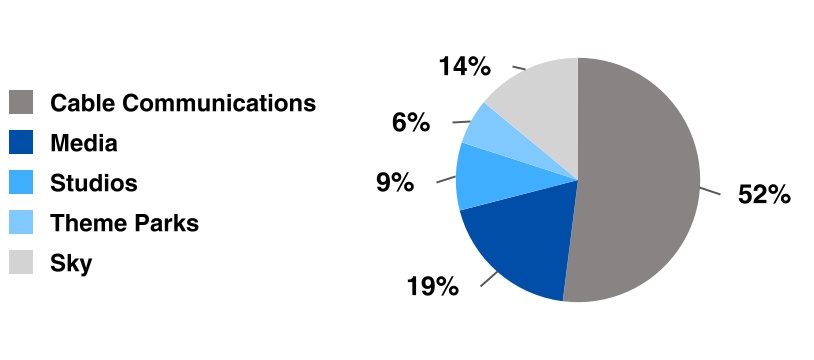
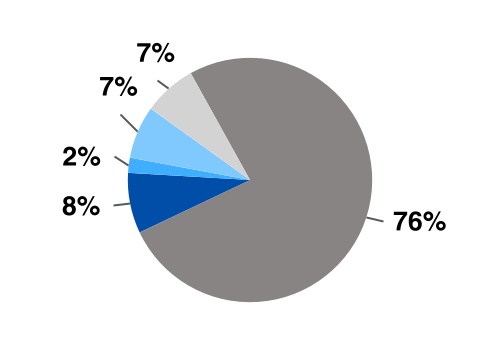
(a)Charts exclude the results of NBCUniversal Headquarters and Other, Corporate and Other, and eliminations. Refer to our Management’s Discussion and Analysis of Financial Condition and Results of Operations for additional information.
-
Cable Communications:** Consists of the operations of Comcast Cable, which is a leading provider of broadband, video, voice, wireless, and other services to residential customers in the United States under the Xfinity brand; we also provide these and other services to business customers and sell advertising.
-
Media:** Consists primarily of NBCUniversal’s television and streaming platforms, including national, regional and international cable networks; the NBC and Telemundo broadcast networks, NBC and Telemundo owned local broadcast television stations; and Peacock, our direct-to-consumer streaming service (“DTC streaming service”).
-
Studios:** Consists primarily of NBCUniversal’s film and television studio production and distribution operations.
-
Theme Parks:** Consists primarily of our Universal theme parks in Orlando, Florida; Hollywood, California; Osaka, Japan; and Beijing, China.
-
Sky:** Consists of the operations of Sky, one of Europe’s leading entertainment companies, which primarily includes a direct-to-consumer business, providing video, broadband, voice and wireless phone services, and a content business, operating entertainment networks, the Sky News broadcast network and Sky Sports networks.
Our other business interests consist primarily of the operations of Comcast Spectacor, which owns the Philadelphia Flyers and the Wells Fargo Center arena in Philadelphia, Pennsylvania, and other business initiatives.
For developments in our business and for financial and other information about our reportable business segments, refer to Item 7: Management’s Discussion and Analysis of Financial Condition and Results of Operations and Note 2 to the consolidated financial statements included in this Annual Report on Form 10-K.
| 1 | Comcast 2022 Annual Report on Form 10-K |
Description of Our Businesses
| Cable Communications Segment |
Cable Communications offers broadband, video, voice, wireless, and other services in the United States individually and as bundled services at a discounted rate to residential and business customers. Revenue is generated primarily from residential and business customers that subscribe to our services and from the sale of advertising. We aim to meet the needs of various segments of our residential customer base by offering multiple levels of service within each of our stand-alone and bundled services. Our business services offerings are tailored to meet the needs of various segments of our business customer base, ranging from broadband services for small business locations to bundled services and solutions designed to meet the needs of medium-sized customers and larger enterprises.
Customer Relationships and the Areas We Serve
All customer metrics included in this section are as of December 31, 2022.
| (in millions) | December 31, 2022 | ||||
| Customer relationships | |||||
| Residential customer relationships | 31.8 | ||||
| Business services customer relationships | 2.5 | ||||
| Total customer relationships | 34.3 | ||||
| Homes and businesses passed | 61.4 | ||||
| Total customer relationships penetration of homes and businesses passed | 56 | % |
Homes and businesses are considered passed if we can connect them to our cable distribution system without further extending the transmission lines and are estimated based on the best available information.
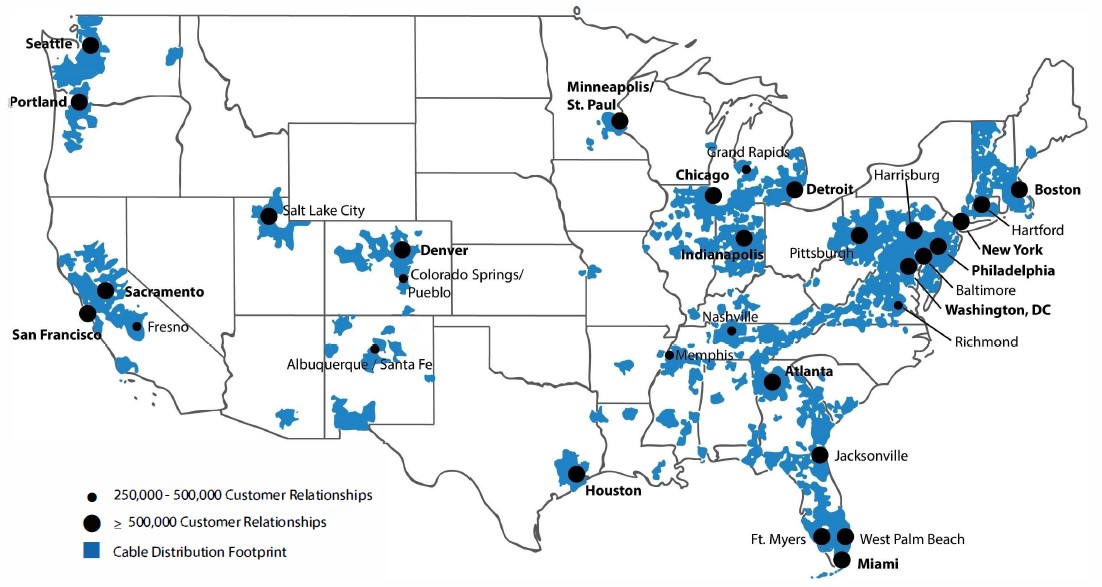
The map below highlights Cable Communications’ cable distribution footprint and the designated market areas (“DMAs”) where we have 250,000 or more customer relationships, with bolded locations representing one of the top 25 U.S. television DMAs as of December 31, 2022.
| Comcast 2022 Annual Report on Form 10-K | 2 |
Residential
Broad**band - 29.8 million customers
We offer broadband services over our hybrid fiber-optic and coaxial (“HFC”) cable network, featuring gigabit downstream speeds across nearly our entire footprint, as well as other advanced features and functionality. We continue to evolve and enhance the capabilities of our network. During 2022, we began rolling out multigigabit downstream speeds and increasing our upstream speeds by up to 5 to 10 times. We plan to make these speed increases available in the vast majority of our footprint by the end of 2025. We also plan to begin deploying DOCSIS 4.0 in the second half of 2023, which will enable us to deliver to our customers multigigabit symmetrical speeds (i.e. comparable upstream and downstream speeds). We will also continue to deploy fiber-to-the-premises in limited locations.
As part of our broadband service, we also offer our advanced, proprietary wireless gateways to customers that combine an internet modem with a Wi-Fi router to deliver reliable internet speeds and enhanced coverage through an in-and-out-of-home Wi-Fi network and xFi Pod plug-in devices that extend a customer’s in-home Wi-Fi coverage. Customers with wireless gateways may also personalize and manage their Wi-Fi network and connected home, and access advanced security technology and other features, with our xFi whole-home application and online portal. Broadband customers have access to our expanding network of secure residential, outdoor and business Wi-Fi hotspots nationwide. As part of our low-income broadband adoption program, we also offer qualifying customers Internet Essentials and Internet Essentials Plus, high-speed broadband services provided at discounted rates.
Broadband customers that prefer consuming content over the internet rather than via linear cable television are eligible to receive our Flex streaming device for no additional charge, which includes integrated search functionality and a voice-activated remote control. Flex also provides access to and the integration of streaming content from Peacock’s premium tier; certain third-party internet-based apps providing content and music such as DTC streaming services Disney+ and Netflix; and certain pay-per-view and video on demand content available over the internet. We earn commission revenue from the sale of certain third-party DTC streaming services.
Video - 15.6 million customers
We offer a broad variety of video services, primarily through our X1 platform, which provides integrated search functionality and a voice-activated remote control. The integrated features provided by X1 operate across content in customers’ cable video services packages and content from internet-based streaming services that customers may access in a manner similar to our Flex streaming device. Our video packages typically range from a basic cable service with access to between 20 and 65 channels to a full service with access to more than 300 channels. Customers may view programming live, record live programming through our digital video recorder (“DVR”) service or access our video on demand services with extensive programming choices such as television series, movies and special-events programming that are available for free or to rent or own digitally. These viewing options are also available through our mobile app and online portal.
We tailor our video packages based on particular programming preferences, demographics and geographic areas in accordance with applicable local and federal regulatory requirements, with programming generally inclusive of national broadcast networks, local broadcast stations, national and regional cable networks, government and public access programming, and premium channel subscriptions such as HBO and Showtime. We also offer packages with extensive amounts of foreign-language programming and other specialty tiers of programming.
Voice - 7.9 million customers
We offer voice services using interconnected Voice over Internet Protocol (“VoIP”) technology that provide either unlimited or usage-based local and domestic long-distance calling, as well as options for international calling plans, voicemail, readable voicemail, nuisance call blocking tools and various other features.
Wireless - 5.3 million lines
We offer wireless services for handsets, tablets and smart watches using mobile virtual network operator (“MVNO”) rights over Verizon’s wireless network, including its 5G technology and our existing network of secure residential, outdoor and business Wi-Fi hotspots. Wireless services are only offered as part of our bundled service offerings to residential customers that subscribe to our broadband services and to eligible small business customers on similar terms. Customers may activate multiple lines per account and choose to pay for services on an unlimited data plan, on shared data plans or per gigabyte of data used. Customers may either bring their own device or purchase devices from us with the option to pay upfront or finance the purchase interest-free over 24 months.
| 3 | Comcast 2022 Annual Report on Form 10-K |
Business Services
Business services customers may subscribe to a variety of products and services, including broadband services over our HFC cable network featuring gigabit downstream speeds, as well as fiber-to-the-premises that is capable of delivering speeds that range up to 100 gigabits per second. Our service offerings for small business locations primarily include broadband services, as well as voice and video services, that are similar to those provided to our residential customers; cloud-based cybersecurity services; wireless backup connectivity; advanced Wi-Fi solutions; video monitoring services; and cloud-based services for file sharing, online backup and web conferencing, among other uses. We also offer Ethernet network services, which connect multiple locations and provide higher downstream and upstream speed options to medium-sized customers and larger enterprises, advanced voice services, and video solutions for hotels and other large venues. In addition, we provide cellular backhaul services to mobile network operators to help manage their network bandwidth.
Our business services offerings for medium-sized and enterprise customers also include a software-defined networking product, and larger enterprises may also receive support services related to Wi-Fi networks, router management, network security, business continuity risks and other services. These services are primarily provided to Fortune 1000 companies and other large enterprises with multiple locations both within and outside of our cable distribution footprint, where we provide coverage outside of our service areas through agreements with other companies to use their networks.
Advertising
We generally receive an allocation of scheduled advertising time that our advertising business sells to local, regional and national advertisers as part of our distribution agreements with cable networks, and we also generate revenue from selling advertising on our digital platforms. Our advertising business also represents the advertising sales efforts of other multichannel video providers in some markets and offers additional technology, tools, data-driven services and marketplace solutions to customers in the media industry to facilitate the more effective engagement of advertisers with their target audiences.
Other
Our security and automation services provide home monitoring services and the ability to manage other functions within the home, such as lighting and room temperature, through our online portal, mobile apps and the X1 platform. We also license our technology platforms to other multichannel video providers.
Network and Technology
Our Cable Communications cable distribution system uses a HFC cable network that we believe is sufficiently flexible and scalable to support our future technology requirements and enables us to continue to grow capacity and capabilities over time. This network provides the two-way transmissions that are essential to providing broadband and connectivity services, interactive video and entertainment services, and other interactive services to our residential and business customers. Cable Communications currently deploys broadband services, primarily leveraging DOCSIS 3.1, to offer gigabit downstream speeds to residential and business services customers across nearly our entire footprint. Our network also includes fiber-to-the-premises in limited locations to offer multigigabit symmetrical speeds to certain residential and business services customers.
We continue to evolve and enhance the capabilities of our network. During 2022, leveraging DOCSIS 3.1, we began rolling out multigigabit downstream speeds and increasing our upstream speeds by up to 5 to 10 times. We plan to make these speed increases available in the vast majority of our footprint by the end of 2025. We also plan to begin deploying DOCSIS 4.0 in the second half of 2023, which will enable us to deliver to our customers multigigabit symmetrical speeds over their existing connections. Additionally, as part of our network evolution, we have been virtualizing and automating many core network functions in order to expand capacity and increase operating efficiency and to identify and fix network issues proactively before they affect our customers. We continue to extend our network’s reach to new homes and businesses within our existing service areas and into new service areas to expand the number of homes and businesses passed. We also have begun to partner with local, state and federal agencies when possible to provide services to unserved communities leveraging governmental subsidies where available.
Cable Communications continues to focus on technology initiatives to design, develop and deploy next-generation media, content delivery, content aggregation and streaming platforms that support X1 and Flex and our cloud DVR technology. These platforms are based on our global technology platform, which integrates linear television networks, owned and third-party DTC streaming services and other internet-based apps, and on demand content in one unified experience with voice-activated remote control search and interactive features. We also continue to focus on leveraging our own cloud network services to deliver video and advanced search capabilities.
Cable Communications also pursues technology initiatives related to broadband and wireless services that also leverage our global technology platform, providing customers with in-and-out-of-home Wi-Fi, the ability to manage their Wi-Fi network and connected home with our xFi whole-home application and online portal, advanced security technology and other features.
| Comcast 2022 Annual Report on Form 10-K | 4 |
Sources of Supply and Other Operations
To offer video services, Cable Communications licenses substantial amounts of programming from cable and broadcast networks, as well as from local broadcast television stations. The fees associated with these programming distribution agreements are generally based on the number of subscribers who are able to watch the programming and the platforms on which the content is provided. We seek to include in distribution agreements the rights to offer such programming through multiple delivery platforms, such as through our On Demand service, online portal, mobile apps and Flex.
For wireless services, we have an MVNO agreement that allows us to offer services using Verizon’s wireless network and we purchase from a limited number of suppliers a significant number of wireless handsets, tablets and smart watches (“wireless devices”) that we sell to wireless customers.
Cable Communications purchases from a limited number of suppliers a significant amount of customer premise equipment, including wireless gateways and set-top boxes, network equipment and services to provide services to residential and business customers.
Cable Communications uses two primary vendors to provide customer billing for our residential and business customers.
Cable Communications offers services directly to residential and business customers through customer service teams, retail stores, customer service centers, websites, door-to-door selling, telemarketing and third-party outlets, as well as through advertising via direct mail, television and the internet. Our customer service teams also provide 24/7 call-answering capability and other services. Our technical services group performs various tasks, including installations, plant maintenance and upgrades to our cable distribution system. Customers can use self-service options and can perform self-installations for certain services.
Competition
Competition for Cable Communications’ services consists primarily of telecommunications companies with fiber-based wireline networks and/or fixed wireless networks, DTC streaming and other over-the-top (“OTT”) service providers, and direct broadcast satellite (“DBS”) providers.
Residential
Broadband
Cable Communications competes with a number of companies offering internet services, including:
-
wireline telecommunications companies
-
wireless telecommunications companies
-
municipal broadband networks and power companies
-
satellite broadband providers
Certain wireline telecommunications companies such as AT&T, Frontier, Lumen and Verizon have built and are continuing to build fiber-based network infrastructure farther into their networks, which enables them to provide data transmission speeds that exceed those that can be provided with traditional copper digital subscriber line (“DSL”) technology, and are offering services with these higher speeds in many of our service areas. Certain companies that offer DSL service have increased data transmission speeds, lowered prices or created bundled services to compete with our broadband services.
Various wireless companies are offering internet services using a variety of technologies, including 4G and 5G wireless broadband services and 5G fixed wireless networks. These networks work with devices such as smartphones, laptops, tablets, and mobile and fixed wireless routers, as well as wireless data cards.
Certain companies have launched fiber-to-the-premises networks that provide broadband services in certain areas in which we operate, and certain municipalities in our service areas are also building fiber-based networks.
Broadband-deployment funding initiatives at the federal and state level may result in other service providers deploying new subsidized internet access networks within our footprint. The availability of these and other offerings could negatively impact the demand for our broadband services.
| 5 | Comcast 2022 Annual Report on Form 10-K |
Video
Cable Communications competes with a number of different sources in the United States that provide news, sports, information and entertainment programming to consumers, including:
- DTC streaming and other OTT service providers including:
◦subscription-based services, such as Disney+ and Netflix, that offer online services that enable internet streaming and downloading of movies, television shows and other video programming
◦virtual multichannel video providers, such as Hulu + Live TV and YouTube TV, that offer streamed linear programming networks
-
DBS providers, including DIRECTV and DISH Network, that transmit satellite signals to substantially all U.S. households to provide video programming and other information similar to our video services
-
companies that have built and continue to build fiber-based networks that provide video services similar to ours and provide bundled offerings that include wireless phone services
-
other providers that build and operate communications systems and services in the same areas that we serve, including those operating as franchised cable operators
-
other companies, such as local broadcast television stations, that provide multiple channels of free over-the-air programming
Many of these competitors also have significant financial resources.
Voice
Cable Communications competes with wireless and wireline telecommunications providers, as well as other internet-based and VoIP service providers. Certain wireless and wireline telecommunications providers, such as AT&T and Verizon, have longstanding customer relationships, and extensive existing facilities and network rights-of-way. Others also have existing local networks and significant financial resources. In addition, we are increasingly competing with other telecommunications service providers as customers replace traditional wireline phone services with wireless and internet-based phone services.
Wireless
Cable Communications competes with national wireless service providers in the United States, including AT&T, T-Mobile and Verizon, which offer wireless service on both a stand-alone basis or along with other services as bundled offerings, as well as regional wireless service providers.
Business Services
Cable Communications primarily competes with a variety of wireline telecommunications companies and wide area network managed service providers. These companies either operate their own network infrastructure or use all or part of another carrier’s network. We also compete with satellite operators that offer video services to businesses and VoIP companies that target businesses of all sizes.
Advertising
Cable Communications competes for the sale of advertising with other television networks and stations, as well as with all other advertising platforms, such as digital, radio and print media. Similar to the competitive environment in our Media segment, the willingness of advertisers to purchase advertising from us may be adversely affected by declines in audience ratings and television viewership and difficulty in measuring fragmented audiences. Cable Communications advertising is sold to local, regional and national advertisers, and competition is affected by the market conditions in the specific geographies in which we operate.
| Comcast 2022 Annual Report on Form 10-K | 6 |
| NBCUniversal Segments |
NBCUniversal is one of the world’s leading media and entertainment companies that develops, produces and distributes entertainment, news and information, sports, and other content for global audiences, and owns and operates theme parks in the United States and Asia.
Media Segment
NBCUniversal’s television and streaming platforms primarily comprise our Media segment, including:
-
National, regional and international cable networks
-
NBC and Telemundo broadcast networks and owned local broadcast television stations
-
Peacock, our DTC streaming service
NBCUniversal distributes a wide variety of content to appeal to consumers with varying preferences across demographics and geographic areas through our portfolio of television networks and streaming platforms. This content includes programming owned by NBCUniversal and by third parties who license it to us for distribution.
Media segment revenue is primarily generated from the sale of advertising on our television networks, Peacock and other digital properties, and from the distribution of our television and streaming platform programming. Media also generates revenue from content licensing and from various digital properties.
Our advertising sales are affected by the prices we charge for each advertising unit, which are generally based on the size and demographics of our viewing audiences, audience ratings on our television networks, the number of advertising units we can place in our programming and on our digital properties, and our ability to sell our advertising across our platforms.
We market and distribute cable network programming in the United States and internationally to multichannel video providers, including both traditional providers of linear programming and virtual providers who provide streaming services for linear programming. We also receive fees from multichannel video providers under NBC and Telemundo retransmission consent agreements and associated fees from NBC-affiliated and Telemundo-affiliated local broadcast television stations. Our programming distribution agreements are generally multiyear agreements with revenue based on the number of subscribers receiving the programming and the fees charged per subscriber. Certain Peacock subscribers are also charged a monthly subscription fee.
| 7 | Comcast 2022 Annual Report on Form 10-K |
Cable Networks
We operate a diversified portfolio of cable networks that provide a variety of entertainment, news and information, and sports content.
The table below presents a summary of NBCUniversal’s national cable networks and their advertising reach to U.S. households.
| Cable Network | Approximate U.S. Households as of December 31, 2022 (in millions)(a) | Description of Programming | ||||||||||||
| USA Network | 75 | General entertainment and sports | ||||||||||||
| E! | 75 | Entertainment and pop culture | ||||||||||||
| Syfy | 75 | Imagination-based entertainment | ||||||||||||
| Bravo | 74 | Entertainment, culture and arts | ||||||||||||
| MSNBC | 74 | News, political commentary and information | ||||||||||||
| CNBC | 73 | Business and financial news | ||||||||||||
| Oxygen | 64 | Crime, mystery and suspense for women | ||||||||||||
| Golf Channel | 63 | Golf competition and golf entertainment | ||||||||||||
| Universal Kids | 49 | Children’s entertainment | ||||||||||||
| Universo | 28 | Spanish language entertainment | ||||||||||||
| CNBC World | 19 | Global financial news | ||||||||||||
(a)Household data is based on information from The Nielsen Company as of December 31, 2022 using its Cable Coverage Universe Estimates report and dynamic ad insertion estimates. The Nielsen estimates include subscribers to both traditional and certain virtual multichannel video providers. The Nielsen estimates are not based on information provided by us and are included solely to enable comparisons between our cable networks and those operated by our peers.
Our regional sports and news networks together serve more than 15 million households across the United States, including in markets such as Boston, Chicago, Philadelphia, Sacramento and San Francisco.
Broadcast
NBC
The NBC network features original entertainment, news and sports programming that reaches viewers in virtually all U.S. television households through more than 200 affiliated stations across the United States, including our 11 owned NBC local broadcast television stations. The NBC owned local broadcast stations include stations in 8 of the top 10 general markets and collectively reached approximately 35 million U.S. television households as of December 31, 2022, representing approximately 28% of U.S. television households. In addition to broadcasting the NBC network’s national programming, local broadcast stations deliver local news, weather, and investigative and consumer reporting across multiple platforms.
Telemundo
The Telemundo network, a Spanish-language broadcast network, features original entertainment, news, live specials and sports programming that reaches viewers in over 95% of all U.S. Hispanic television households through 111 affiliated stations, including our 30 owned Telemundo local broadcast television stations, and our national feed. The Telemundo owned local broadcast stations include stations in all of the top 20 U.S. Hispanic markets and collectively reached approximately 72% of U.S. Hispanic television households as of December 31, 2022. In addition to broadcasting the Telemundo network’s national programming, local broadcast stations deliver local news, weather, and investigative and consumer reporting across multiple platforms. We also own an independent Telemundo station serving the Puerto Rico television market.
Peacock
Peacock is a premium DTC streaming service, featuring NBCUniversal and third-party content. Content choices include exclusive Peacock originals, current NBC, Bravo and Telemundo shows, news, late-night comedy, live sports and a library of television shows and movies, as well as several live channels. The service is primarily offered through two subscription-based tiers: an ad-supported tier providing customers with access to tens of thousands of hours of programming and a tier featuring the same content ad-free, with certain limited exceptions. This ad-free tier also allows customers to download and watch select content offline and provides customers with a live stream of their local NBC affiliate stations. The Peacock app is available to consumers over the internet directly and included as part of certain cable and other platforms in the United States, including through Cable Communications’ X1 and Flex. Certain Peacock programming is also integrated into Sky video services.
| Comcast 2022 Annual Report on Form 10-K | 8 |
Programming
Our television and streaming platforms include content licensed from our Studios segment and from third parties, as well as content produced by Media segment businesses, such as live news and sports programming and certain original programming, including late-night comedy for NBC and original telenovelas for Telemundo.
We have various multiyear contractual commitments for the licensing of programming, including contracts related to broadcast and/or streaming rights for sporting events. We generally seek to include in our sports rights agreements the rights to distribute content on one or more of our television networks and on digital platforms, including Peacock. Our most significant sports rights commitments include the following:
-
NFL: Agreements to produce and broadcast a specified number of regular season and playoff games, including Sunday Night Football and three remaining Super Bowl games on the NBC network, the next of which is in February 2026, through the 2033-34 season, with a termination right available to the NFL after the 2029-30 season. These agreements also include certain other rights, including streaming rights, additional exclusive games on Peacock and the Spanish-language U.S. broadcast rights for certain NFL games, which are aired on Telemundo
-
Olympics: U.S. broadcast and streaming rights for the summer and winter Olympic Games through 2032 with programming to be aired on the NBC network, multiple cable networks and Peacock
We also have varying U.S. broadcast and/or streaming rights to the PGA TOUR and other golf events through 2031, Big Ten football and basketball starting with the 2023-24 season through the 2029-30 season, English Premier League soccer through the 2027-28 season, Worldwide Wrestling Entertainment (“WWE”) events on television through 2024 and on Peacock through 2026, certain NASCAR events through 2024, and the Spanish-language U.S. broadcast rights to FIFA World Cup soccer games through 2026, as well as local broadcast rights for certain professional sports teams through our regional sports networks with terms ending between 2024 and 2040.
Studios Segment
NBCUniversal’s film and television studio production and distribution operations primarily comprise our Studios segment.
Revenue is generated primarily from licensing our owned film and television content in the United States and internationally to cable, broadcast and premium networks and DTC streaming service providers, as well as through video on demand and pay-per-view services provided by multichannel video providers and OTT service providers; from the worldwide distribution of our produced and acquired films for exhibition in movie theaters; and from the sale of owned and acquired content on DVDs/Blu-ray discs and through digital distribution services. We also generate revenue from the production and licensing of live stage plays.
Film Studios
Our film studios develop, produce, acquire, market and distribute filmed entertainment worldwide. Our films are produced primarily under the following names:
-
Universal Pictures
-
Illumination
-
DreamWorks Animation
-
Focus Features
-
Working Title
The majority of our films are initially distributed for exhibition in movie theaters, while other titles are produced and distributed direct-to-video. After their initial release, we sell and license films globally through various methods. We license films, including recent titles and selections from our film library, which is comprised of more than 6,000 movies in a variety of genres, to television networks and DTC streaming service providers, including our Media segment, and to video on demand and pay-per-view services provided by multichannel video providers, including the Cable Communications and Sky segments. Certain titles are also licensed to our Media segment and made available for viewing on Peacock on the same date as the theatrical release. We also distribute films globally by selling them on DVDs/Blu-ray discs and through digital distribution services.
| 9 | Comcast 2022 Annual Report on Form 10-K |
Theatrical revenue is significantly affected by the timing of each release and the number of films we distribute, their acceptance by audiences, the number of exhibition screens, ticket prices, the percentage of ticket sales retention by the exhibitors and the popularity of competing films at the time our films are released. The success of a film in movie theaters is generally a significant factor in determining the revenue a film is likely to generate in succeeding licensing windows. Revenue from the sale of content on DVDs/Blu-ray discs and through digital distribution services is significantly affected by the timing and number of our theatrical releases and the popularity of our content, as well as the timing of release dates.
We develop and produce films both alone and jointly with other studios or production companies, as well as with other entities. Films are marketed and distributed worldwide primarily through NBCUniversal’s marketing and distribution operations. We also acquire distribution rights to films produced by third parties, which may be limited to particular geographic regions, specific forms of media or certain periods of time.
Our film studios have entered into, and may continue to enter into, film cofinancing arrangements with third parties, including both studio and nonstudio entities, to jointly finance or distribute certain of our film productions. These arrangements can take various forms, but in most cases involve the grant of an economic interest in a film to an investor. Investors generally assume the full risks and rewards of ownership proportionate to their ownership in the film.
In connection with studio productions, we typically owe “residuals” payments to individuals hired under collective bargaining agreements to work on productions, which are generally calculated based on post-theatrical or content licensing revenue. We also owe “participations” payments to creative talent, to third parties under cofinancing agreements and to other parties involved in content production, which are generally based on the financial performance of the content.
Television Studios
Our television studios develop and produce original content, including scripted and unscripted television series. NBCUniversal’s television studios, branded as the Universal Studio Group, produces content under the following names:
-
Universal Television
-
Universal Content Productions
-
Universal Television Alternative Studio
-
Universal International Studios
Our original content is primarily licensed initially to cable, broadcast and premium networks, as well as to DTC streaming service providers, including our Media segment. We also license content after its initial airing and license older television programs from our programming library, as well as sell owned and acquired content globally on DVDs/Blu-ray discs and through digital distribution services. The production and distribution costs related to original television content generally exceed the revenue generated from the initial license, which means that obtaining additional licenses following the initial license is critical to the content’s financial success. Similar to our film studios, we typically owe residuals and participations payments in connection with television studio productions.
Theme Parks Segment
The following Universal theme parks primarily comprise the Theme Parks segment:
-
Universal Orlando Resort: Includes two theme parks, Universal Studios Florida and Islands of Adventure, and our water park, Volcano Bay, all of which are located in Orlando Florida. Universal Orlando also includes Universal CityWalk Orlando, a dining, retail and entertainment complex, and features on-site themed hotels in which we own a noncontrolling interest. We are developing an additional theme park at Universal Orlando named Universal’s Epic Universe.
-
Universal Studios Hollywood: Includes a theme park located in Hollywood, California and Universal CityWalk Hollywood.
-
Universal Studios Japan: Includes a theme park located in Osaka, Japan.
-
Universal Beijing Resort: Includes the Universal Studios Beijing theme park, as well as Universal CityWalk Beijing and on-site themed hotels, all of which are located in Beijing, China. Universal Beijing Resort is owned by us and a consortium of Chinese state-owned companies (see Note 8).
| Comcast 2022 Annual Report on Form 10-K | 10 |
Revenue is generated primarily from guest spending at our theme parks, including ticket sales and in-park spending on food, beverages and merchandise, and from our consumer products business. Revenue for our theme parks generally depends on the overall environment for travel and tourism, including consumer spending on travel and other recreational activities. We also license the right to use the Universal Studios brand name and other intellectual property and provide other services to third parties, including the party that owns and operates the Universal Studios Singapore theme park on Sentosa Island, Singapore. The themed elements in our rides, attractions, and merchandising are based on intellectual property in our Studios and Media segments and intellectual property licensed from third parties under long-term agreements.
Competition
Media
Our Media segment competes for viewers’ attention and audience share with all forms of programming provided to viewers, including cable, broadcast and premium networks; DTC streaming and other OTT service providers; local broadcast television stations; home entertainment products; video on demand and pay-per-view services; online activities, such as social networking and viewing user-generated content; gaming products; and other forms of entertainment, news and information.
Media competes for the sale of advertising with other television networks and stations, digital platforms, including an increasing number of ad-supported DTC streaming services, and all other advertising platforms. The willingness of advertisers to purchase advertising from us may be adversely affected by lower audience ratings and viewership at the related networks, stations, channels, or digital platforms. Declines in audience ratings can be caused by increased competition for the leisure time of viewers and by audience fragmentation resulting from the increasing number of entertainment choices available, including content from DTC streaming and other OTT service providers, online media and other digital sources. Additionally, it is increasingly challenging to accurately measure fragmented audiences.
Our cable networks compete primarily with other cable networks and programming providers for carriage of their programming by multichannel video providers and DTC streaming and other OTT service providers. Our broadcast networks compete with the other broadcast networks in markets across the United States to secure affiliations with independently owned television stations, which are necessary to ensure the effective distribution of broadcast network programming to a nationwide audience. Peacock competes for paid subscribers and other users of the platform, primarily with other DTC streaming and OTT service providers, as well as with traditional providers of linear programming.
Our television and streaming platforms compete for the acquisition of content and for on-air and creative talent primarily with other cable, broadcast and premium networks, DTC streaming and other OTT service providers, and local broadcast television stations. The market for content is very competitive, particularly for sports rights, where the cost is significant.
Studios
Our film and television studios compete for audiences for our film and television content with other major film and television studios, independent film producers and creators of content, as well as with alternative forms of entertainment. The competitive position of our film and television studios primarily depends on the number of films and shows and episodes produced, their distribution and marketing success, and consumer response. Our film and television studios also compete to obtain creative, performing and technical talent, including writers, actors, directors, and producers, as well as scripts for films and television shows, and for the distribution of, and consumer interest in, their content. We also compete with other major film and television studios and other producers of entertainment content for the exhibition of content in theaters, on demand, on premium networks and with DTC streaming and other OTT service providers.
Theme Parks
Theme Parks competes with other multi-park entertainment companies as well as other providers of entertainment, lodging, tourism and recreational activities. To help maintain the competitiveness of our theme parks, we have invested and continue to invest significantly in existing and new theme park attractions, hotels and infrastructure, including Epic Universe in Orlando.
| 11 | Comcast 2022 Annual Report on Form 10-K |
| Sky Segment |
Sky is one of Europe’s leading entertainment companies operating in six territories, including three of the largest pay television markets in Western Europe: the United Kingdom, Italy and Germany. The substantial majority of our revenue is derived from our direct-to-consumer business, which has 23.1 million customer relationships, and primarily involves the distribution of a wide array of video channels to both residential and business customers. We also offer broadband, voice and wireless services individually and as bundled services in select countries. We own a diverse portfolio of pay television channels that feature entertainment, news, sports and movies, which are included in our subscription video services and are also licensed through various distribution partnerships to third-party video providers to reach an additional 3 million households. We also generate revenue from the licensing of owned and licensed programming to third-party video providers and from the sale of advertising.
Direct-to-Consumer
Video
Our direct-to-home (“DTH”) video services are delivered primarily through a combination of both satellite transmission and broadband connections that are marketed under the Sky brand in the United Kingdom, Italy, Germany, Ireland and Austria. We also offer a DTC streaming service providing video content over the internet that is marketed as NOW or WOW (formerly Sky Ticket) (“NOW”) in these countries, as well as in Switzerland.
We offer a variety of DTH video services, primarily through our Sky Q platform, where customers have access to a diverse selection of our owned channels, channels owned by third parties and local free-to-air public broadcasting channels, as well as certain ad-supported Peacock programming. The Sky Q platform includes integrated search functionality and a voice-activated remote control and offers integrated access to certain third-party internet-based apps providing content and music, such as DTC streaming services Disney+ and Netflix. Our service offerings are tailored by country, with separate packages offered in each market. Basic packages include between 80 and 100 pay television channels in the United Kingdom and Ireland, over 40 channels in Italy, and over 30 channels in Germany and Austria. Specialty tiers for children’s, sports, movie and high-definition (“HD”) programming are available for additional fees. DTH customers may view programming live, record live programming through our DVR services or access our video on demand services with programming choices such as television series, movies and special-events programming that are available for free or to rent or own digitally. These viewing options are also available through our mobile app and online portal. We also offer video services to customers who purchase Sky Glass smart televisions, which have an operating system that provides a video service similar to Sky Q over a broadband connection, eliminating the need for a satellite dish or set-top box. Refer to Corporate and Other for additional information on Sky Glass.
Our NOW streaming service offers packages ranging from daily to monthly access to entertainment, sports and movies programming. The entertainment package includes our owned entertainment channels and a broad range of on demand programming series, including child-friendly programming, as well as certain Peacock programming. The sports package provides access to our owned sports channels and the movie package includes access to a library of films.
Television Channels
We operate a diversified portfolio of Sky-branded channels. Our owned channels include:
-
Entertainment channels featuring premium content, including Sky Atlantic, Sky Max and Sky Showcase
-
Premium sports channels under the Sky Sports brand, with a majority of channels dedicated to a specific sport, including European football
-
Premium movie channels under the Sky Cinema brand, including family and children’s movie channels
-
Sky-branded free-to-air channels, including Sky News
Other Services
We offer broadband and voice services in the United Kingdom, Ireland and Italy. We offer fiber-to-the-cabinet (“FTTC”), DSL broadband and fiber-to-the-home (“FTTH”) services, with downstream speeds up to 500 megabits per second in the United Kingdom and up to one gigabit per second in Ireland and we offer FTTH and FTTC services in Italy, with downstream speeds up to one gigabit per second. We deploy wireless hubs to customers that combine an internet and voice modem with a Wi-Fi router to deliver reliable internet speeds and enhanced coverage through an in-home Wi-Fi network.
| Comcast 2022 Annual Report on Form 10-K | 12 |
We offer wireless services for handsets and tablets in the United Kingdom using a combination of an arrangement to access network assets from Telefónica and our own mobile core network. Customers may activate multiple lines per account, choose to pay for services on various gigabyte plans, roll data over three years and stream with unlimited data on Sky mobile apps. Customers may either bring their own device or purchase devices from us with the option to pay upfront or finance the purchase interest-free over periods ranging from 24 to 48 months.
Content
In addition to including owned channels as part of our video services, we distribute some of our owned channels on third-party platforms through both wholesale arrangements and arrangements with partners who distribute our owned channels as agents to their respective customer bases. We also license owned and licensed content to other platforms.
Advertising
We sell advertising across our platforms, including our owned television channels, and also represent the sales efforts of third-party channels. We also offer various technology, tools and solutions relating to our advertising business.
Network and Technology
We rely on various telecommunications providers to deliver video, broadband, voice and wireless services to our customers.
For a majority of customers, our DTH video platform is delivered via one-way digital satellite transmission that uses satellites leased from third parties for the distribution of television channels and is augmented by a set-top box with local DVR storage and high-speed, two-way broadband connectivity enabling interactive video services such as integrated search functionality, on demand, DVR and voice services. Our platform incorporates Wi-Fi connectivity for in-home distribution that allows wireless, multiroom consumption. We have also developed a range of back-end and client software applications that provide customers with access to our content across multiple third-party devices.
Under the current regulatory regime in the United Kingdom, Ireland and Italy, we are able to access networks owned by third-party telecommunications providers for a fee to provide our broadband, voice, and wireless services in many cases, on regulated terms. We offer broadband and voice services in the United Kingdom using a combination of our own core fiber network and BT Openreach’s core and “last mile” network under a wholesale and fee-based arrangement and in Italy primarily using Open Fiber’s network. We offer wireless services to customers in the United Kingdom using a combination of an arrangement to access network assets from Telefónica and our own mobile core network.
We continue to focus on technology initiatives to design, develop and deploy next-generation media and content delivery platforms, including Sky Q, NOW and Sky Glass, that deliver video content, provide advanced search capabilities, including through a voice-activated remote control, and provide access to and integration of certain other DTC streaming services. These platforms leverage our global technology platform.
Sources of Supply and Other Operations
Programming
Our owned television channels and NOW streaming service include content both owned by us and licensed from third parties and NBCUniversal. In some cases, licenses are on an exclusive basis. We have various multiyear contractual commitments for the licensing of programming, primarily sports rights and exclusive entertainment content. Our most significant sports rights commitments include European football broadcast rights for Premier League games through the 2024-25 season in the United Kingdom and Formula One through 2029 in the United Kingdom and through 2027 in Germany and Italy. We also have broadcast rights to Bundesliga games through the 2024-25 season in Germany, to England and Wales Cricket Board cricket games through 2028 in the United Kingdom, and to Union of European Football Associations Champions League (“UCL”) through the 2023-24 season in Italy, as well as non-exclusive broadcast rights to certain Serie A games through the 2023-24 season in Italy.
Our most significant commitments for the licensing of film and television entertainment content include exclusive rights with HBO, Paramount, Warner Bros. and NBCUniversal. We also produce and air live news and sports programming and produce original programming through Sky Studios. We are increasingly creating and investing in original drama, comedy and factual content that is broadcast across our territories and sold to other markets. We also opened the first stages of our new film and television studio facility in the United Kingdom in 2022.
| 13 | Comcast 2022 Annual Report on Form 10-K |
To offer video services, in addition to our owned channels, we license substantial amounts of programming from third parties. The fees associated with these programming distribution agreements are generally based on the number of customers that are able to watch the programming and the platforms on which the content is provided. We seek to include in distribution agreements the rights to offer such programming through multiple delivery platforms, such as through our on demand services, mobile apps and our NOW streaming service.
Other
We purchase from a limited number of suppliers a significant amount of customer premise equipment, including set-top boxes, wireless hubs and network equipment to provide our video and broadband services to residential and business customers. We also purchase from a limited number of suppliers a significant number of wireless handsets and tablets that are sold to customers that receive our wireless services.
We offer direct-to-consumer services to residential and business customers through our customer service teams, customer service centers, websites, telemarketing, and a limited number of retail stores, as well as through advertising via direct mail, television and the internet. Our home service group performs various tasks, including installations, servicing and upgrades of customer premise equipment. Customers can use self-service options and perform self-installations for certain services.
Competition
We compete with a broad range of companies engaged in media, entertainment and communications services in Europe. For video services, we compete with cable operators, providers of both paid-for and free-to-air programming, other satellite television providers, digital terrestrial television providers, content aggregators, home entertainment products companies, and other suppliers and providers of sports, entertainment, news and information that deliver DTC and other OTT streaming services. For broadband and wireless services, we compete with service providers making use of new fiber-optic networks, telecommunications providers, other internet service providers and companies developing new technologies and devices. Our competitive position may be negatively impacted by an increase in the capacity of, or developments in, the means of delivery competitors use to provide their services as well as lowered prices, product innovations, new technologies or different value creation approaches. We also compete with organizations that are publicly funded, in whole or in part, to fulfill a public service broadcasting mandate.
Our owned channels compete for the acquisition of content and for on-air and creative talent with other television networks and with DTC streaming and other OTT service providers. The market for content is very competitive, particularly for sports rights, where the cost for such content is significant.
We compete for the sale of advertising with other television networks and stations, digital platforms, and all other advertising platforms. Similar to the competitive environment in our Media segment, the willingness of advertisers to purchase advertising from us may be adversely affected by declines in television viewership and the increasing number of entertainment choices available.
| Corporate and Other |
Our other business interests consist primarily of the operations of Comcast Spectacor, which owns the Philadelphia Flyers and the Wells Fargo Center arena in Philadelphia, Pennsylvania, and other business initiatives. Other business initiatives primarily include costs associated with Sky Glass smart televisions and the related hardware sales and, following its formation in June 2022, the operations of Xumo, our consolidated streaming platform joint venture with Charter Communications. Xumo is focused on developing and offering a streaming platform on a variety of devices, including XClass TV smart televisions, and also operates the Xumo Play streaming service (previously branded as the Xumo streaming service). Sky Glass and XClass TV are smart televisions with operating systems that leverage our global technology platforms similar to Sky Q, X1 and Flex. We sell Sky Glass televisions in Europe to consumers that also subscribe to Sky’s video services. XClass TVs are manufactured and sold by third parties and operate on the XClass TV operating system.
Additionally, we formed the SkyShowtime joint venture with Paramount Global in 2022, which operates a DTC streaming service available in select European markets and is accounted for as an equity method investment. NBCUniversal and Sky license programming to SkyShowtime.
| Comcast 2022 Annual Report on Form 10-K | 14 |
Seasonality and Cyclicality
Each of our businesses is typically subject to seasonal and cyclical variations. Cable Communications’ results are impacted by the seasonal nature of residential customers receiving our services in college and vacation markets. This generally results in fewer net customer relationship additions in the second quarter of each year.
Revenue and costs and expenses in our Media segment are cyclical as a result of our periodic broadcasts of major sporting events, such as the Olympic Games and the Super Bowl. In particular, advertising revenue increases due to increased demand for advertising time for these events and distribution revenue increases in the period of broadcasts of the Olympic Games. Costs and expenses also increase as a result of our production costs for these broadcasts and the amortization of the related rights fees.
Revenue in Cable Communications, Media and Sky is also subject to cyclical advertising patterns and changes in viewership levels. Advertising revenue in the United States is generally higher in the second and fourth quarters of each year and in even-numbered years due to increases in advertising in the spring and in the period leading up to and including the holiday season, and advertising related to candidates running for political office and issue-oriented advertising, respectively. Revenue in Media also fluctuates depending on the timing of when our programming is aired, which typically results in additional advertising revenue in the second and fourth quarters of each year. Advertising revenue in Sky typically has seasonally higher audience levels in winter months, with lower levels in summer months due to the timing of European football seasons and summer vacations. There is also increased competition for advertising at Sky during major sporting events aired by public service broadcasters, such as the FIFA World CupTM.
Revenue in Studios fluctuates due to the timing, nature and number of films released in movie theaters, on DVDs/Blu-ray discs, and through various other distribution platforms, including viewing on demand, DTC platforms or OTT service providers. Release dates are determined by several factors, including competition and the timing of vacation and holiday periods. As a result, revenue tends to be seasonal, with increases experienced each year during the summer months and around the holiday season. We incur significant marketing expenses before and throughout the release of a film in movie theaters and as a result, we typically incur losses on a film prior to and during the film’s exhibition in movie theaters. Content licensing revenue also fluctuates due to the timing of when our film and television content is made available to licensees.
Revenue in Theme Parks fluctuates with changes in theme park attendance that typically result from the seasonal nature of vacation travel and weather variations, local entertainment offerings and the opening of new attractions, as well as with changes in currency exchange rates. Theme Parks generally experiences peak attendance during the spring holiday period, the summer months when schools are closed and the Christmas holiday season.
Sky’s results are also impacted by the seasonal nature of residential customers receiving our DTH and NOW streaming services, including the start of the new European football seasons and the Christmas holiday. This generally results in higher net customer relationship additions and higher marketing expenses in the second half of each year to attract new customers.
Exclusive sports rights, such as European football, play a key role within Sky’s wider content strategy. In Europe, broadcasting rights for major sports are usually tendered through a competitive auction process, with the winning bidder or bidders acquiring rights over a 3 to 5 year period. This creates some level of cyclicality, although the staggered timing of major sports rights auctions usually gives Sky time to react to any material changes in the competitive dynamics of the prevailing market.
Legislation and Regulation
Our businesses are subject to various federal, state and local laws and regulations, with some also subject to international laws and regulations. In particular, the Communications Act of 1934, as amended (the “Communications Act”), and Federal Communications Commission (“FCC”) regulations and policies affect significant aspects of our cable communications and broadcast businesses in the United States.
Beyond the more significant regulations summarized below, legislators and regulators at all levels of government frequently consider changing, and sometimes do change, existing statutes, rules or regulations, or interpretations of existing statutes, rules or regulations, or prescribe new ones, any of which may significantly affect our businesses and ability to effectively compete. These legislators and regulators, along with some state attorneys general and foreign governmental authorities, have been active in conducting inquiries and reviews regarding our services. State legislative and regulatory initiatives can create a patchwork of different and/or conflicting state requirements, such as with respect to privacy and Open Internet/net neutrality regulations, that can affect our businesses and ability to effectively compete.
| 15 | Comcast 2022 Annual Report on Form 10-K |
Legislative and regulatory activity has increased under the Biden Administration, particularly with respect to broadband networks. For example, Congress has approved tens of billions of dollars in new funding for broadband deployment and adoption initiatives, and may consider other proposals that address communications issues, including whether it should rewrite the entire Communications Act to account for changes in the communications marketplace and whether it should enact new, permanent Open Internet/net neutrality requirements. Federal agencies likewise may consider adopting new regulations for communications services, including broadband. States and localities are also increasingly proposing new regulations impacting communications services, including broader regulation of broadband networks. Any of these regulations could significantly affect our business and compliance costs. In addition, United States and foreign regulators and courts could adopt new interpretations of existing competition or antitrust laws or enact new competition or antitrust laws or regulatory tools that could negatively impact our businesses. Any future legislative, judicial, regulatory or administrative actions may increase our costs or impose additional restrictions on our businesses, some of which may be significant. We are unable to predict the outcome or effects of any of these potential actions or any other legislative or regulatory proposals on our businesses.
The following paragraphs summarize the more significant legal and regulatory requirements and risks affecting our businesses.
| Communications-Related Regulations in the United States |
Broadband
Our broadband services are subject to a number of regulations and commitments. The FCC frequently considers imposing new broadband-related regulations such as those relating to an Open Internet, and from time to time, imposing new regulatory obligations on internet service providers (“ISPs”) such as us. States and localities also consider new broadband-related regulations from time to time, including those regarding government-owned broadband networks, net neutrality and broadband affordability. New broadband regulations, if adopted, may have adverse effects on our businesses. We may also be subject to additional broadband-related commitments as a condition of receiving federal or state broadband funding.
Broadband Deployment and Adoption Initiatives
There have been, and may continue to be, substantial broadband-deployment funding initiatives at the federal and state level that could subsidize (i) other service providers building networks within our footprint and (ii) potential expansion of our network to new areas. Federal agencies are adopting rules for recently-enacted federal broadband funding programs. In many cases, states will disburse these federal broadband funds and may adopt additional requirements on providers that are awarded funding, which may impose additional costs, constraints and burdens on our businesses. We cannot predict what requirements will ultimately be adopted, how such funds will be awarded or the impact of these initiatives on our businesses.
In 2021, Congress created the Affordable Connectivity Program (“ACP”) to provide a monthly discount toward broadband service for eligible low-income households starting in 2022. This new longer-term program replaced the Emergency Broadband Benefit (“EBB”) program established during the COVID-19 pandemic. We participated in EBB and are participating in ACP. We cannot predict the extent to which eligible households will opt to use their ACP benefit towards our broadband services.
Open Internet Regulations
Various forms of Open Internet regulations can significantly affect our broadband services. In 2017, the FCC reversed its prior classification of broadband internet access service as a “telecommunications service” under Title II of the Communications Act and classified it as an “information service” under Title I. In addition, it eliminated its prior “net neutrality” rules prohibiting ISPs from blocking access to lawful content on the internet; impairing or degrading lawful internet traffic on the basis of content, applications or services (“throttling”); prioritizing certain internet traffic in exchange for consideration or in favor of an affiliate (“paid or affiliated prioritization”); and generally prohibiting ISPs from unreasonably interfering with or unreasonably disadvantaging consumers’ ability to access and use the lawful internet content, applications, services or devices of their choosing or unreasonably interfering with or disadvantaging edge providers’ ability to make lawful content, applications, services, or devices available to consumers (“general conduct standard”). The FCC stated that jurisdiction to regulate ISP conduct would rest at the Federal Trade Commission (“FTC”), and it expressly preempted all state Open Internet laws. In addition, the FCC revised the transparency rule to add a requirement that ISPs disclose any blocking and throttling practices, and any paid or affiliated prioritization practices associated with their broadband offerings. We have disclosed that we do not block, throttle, or engage in paid or affiliated prioritization, and have committed not to block, throttle, or discriminate against lawful content. The FTC has authority to enforce these public commitments, and the FCC has authority to enforce compliance with its transparency rule.
| Comcast 2022 Annual Report on Form 10-K | 16 |
The FCC’s 2017 decision was challenged and, in 2019, the U.S. Court of Appeals for the District of Columbia largely upheld the FCC’s decision, including the classification of broadband as an “information service” and repeal of its prior rules. However, it vacated the FCC’s express preemption of all state Open Internet laws, but noted that state laws may nevertheless conflict with federal law or policy and be preempted on a case-by-case basis.
Several states have passed or introduced legislation, or have adopted executive orders, that impose Open Internet requirements in a variety of ways, and new state legislation may be introduced and adopted in the future. Such attempts by the states to regulate have the potential to create differing and/or conflicting state regulations.
The FCC under the Biden Administration likely will revisit the regulatory classification of broadband internet access service and reclassify it as a “telecommunications service,” which would authorize the FCC to subject it to traditional common carriage regulation under Title II of the Communications Act. Under a Title II framework, the FCC could potentially regulate our customer rates, speeds, data usage thresholds or other terms for internet services and could prohibit or seriously restrict arrangements between us and internet content, applications and service providers, including backbone interconnection arrangements. Any FCC action could impact state Open Internet initiatives, and also could prompt further litigation. Congress may also consider legislation addressing these regulations and the regulatory framework for broadband internet access services. We cannot predict whether or how the rules might be changed, the impact of potential new legislation, or the outcome of any litigation.
Municipally Owned Broadband Networks
A number of local municipalities operate municipally owned broadband networks, and there may be further efforts by local governments to expand or create government-owned networks, particularly in light of federal funding for broadband deployment. Certain states have enacted laws that restrict or prohibit local municipalities from operating municipally owned broadband networks, and there may be efforts in other state legislatures to restrict the development of government-owned networks, although others may choose to ease or facilitate such networks. Much of the federal funding authorized for broadband deployment is conditioned on states agreeing to make it available for potential use by government-owned networks, although the funding prioritizes deployment to unserved areas and locations. We cannot predict how successful any of those efforts will be and how they might affect our businesses.
Video
The video marketplace continues to become even more competitive, particularly with DTC streaming and other OTT service providers. There are a number of laws and regulations that apply solely to multichannel video programming distributors (“MVPDs”) or cable operators such as our Cable Communications business, and to cable networks and local broadcast television stations operated by NBCUniversal. These laws and regulations can constrain our ability to compete, particularly against DTC streaming and other OTT service providers, which are not subject to these same requirements.
Cable Pricing and Packaging
While our video services are not subject to rate regulation, certain state entities monitor and challenge in court the marketing and advertising of our services, and some have attempted to regulate the service packages we offer and our billing practices. We cannot predict the outcome of any current litigation with state entities or whether other states may pursue similar actions.
Cable Franchising
Cable operators generally operate their cable systems under nonexclusive franchises granted by local or state franchising authorities. While the terms and conditions of franchises vary materially from jurisdiction to jurisdiction, franchises typically last for a fixed term, obligate the franchisee to pay franchise fees and meet service quality, customer service and other requirements, and are terminable if the franchisee fails to comply with material provisions. Franchising authorities also may require adequate channel capacity, facilities and financial support for public, educational and governmental access programming, and other in-kind contributions.
The Communications Act also contains provisions governing the franchising process, including renewal procedures designed to protect incumbent franchisees against arbitrary denials of renewal and unreasonable renewal conditions. We believe that our franchise renewal prospects are generally favorable but cannot guarantee the future renewal of any individual franchise. The FCC adopted an order in 2019 that prohibits state and local authorities from imposing duplicative franchise and/or fee requirements on the provision of broadband and other non-cable services, affirming that franchise fees were subject to a federal statutory cap of 5% of cable service revenue and could not include other revenue. The order further required that in-kind contributions (such as courtesy services) generally should be treated as franchise fees subject to that cap. The order was substantially upheld by the U.S. Court of Appeals for the Sixth Circuit. Several localities have attempted, generally unsuccessfully to date, to impose franchise fees on DTC streaming and other OTT service providers.
| 17 | Comcast 2022 Annual Report on Form 10-K |
Program Carriage
FCC regulations prohibit us from unreasonably restraining the ability of an unaffiliated video programming network to compete fairly by discriminating against the network on the basis of its non-affiliation in the selection, terms or conditions for its carriage. In addition, cable operators and other MVPDs in the United States are prohibited from requiring as a condition of carriage a financial interest in, or exclusive distribution rights for, a video programming network. We have been involved in program carriage disputes at the FCC, as well as in the courts, and may be subject to new complaints in the future.
Program Access
The Communications Act and FCC regulations generally prevent cable networks affiliated with cable operators from favoring affiliated cable operators over competing MVPDs. The FCC and Congress have considered proposals that would require companies that own multiple cable networks to make each of their networks available individually when negotiating distribution agreements with MVPDs and potentially with DTC streaming and other OTT service providers. We currently offer our cable networks on a packaged basis (in “tiers”) and, in various cases, individually. We have been involved in program access disputes at the FCC and may be subject to new complaints in the future.
Must-Carry/Retransmission Consent
Cable operators are required to carry, without compensation, programming transmitted by most local commercial and noncommercial broadcast television stations. As an alternative to this “must-carry” requirement, local broadcast television stations may choose to negotiate with the cable operator for “retransmission consent,” under which the station gives up its must-carry rights and instead seeks to negotiate a carriage agreement with the cable operator, which frequently will involve payments to the station. We currently pay certain local broadcast television stations in exchange for their required consent for the retransmission of the stations’ broadcast programming to our video services customers and expect to continue to be subject to demands for increased payments and other concessions from local broadcast television stations. Failure to reach a retransmission consent agreement with a broadcaster could result in the loss of popular programming on our video services.
Every three years, each local commercial broadcast television station must elect for each cable system either must-carry or retransmission consent. A similar regulatory scheme applies to satellite providers. For the three-year period from January 1, 2021 to December 31, 2023, all of our owned NBC and Telemundo local broadcast television stations elected retransmission consent. Although we have reached retransmission consent agreements with almost all MVPDs in the past, there can be no assurance that we will always be able to renew those agreements under favorable terms or at all.
Broadcast Licensing
Local broadcast television stations may be operated only in accordance with a license issued by the FCC upon a finding that the grant of the license will serve the public interest, convenience and necessity. The FCC grants broadcast television station licenses for 8-year cycles, which may be renewed with or without conditions. The FCC renewed all of our broadcast television station licenses without conditions during the last license renewal cycle; the current television license renewal cycle began in 2020 and some of our licenses have been renewed. Although our licenses have been renewed in prior cycles, there can be no assurance that we will always obtain renewal grants.
Broadcast Ownership Restrictions
The Communications Act and FCC regulations impose certain limitations on local and national television ownership, as well as limits on foreign ownership in a broadcast television station. Some of these limitations currently are under review at the FCC, including the national television ownership limit, the local television ownership limit, and the prohibition on each of the four major broadcast television networks, ABC, CBS, Fox and NBC, from being under common ownership or control with another of the four.
Children’s Programming
Under federal regulations, the amount of commercial content that may be shown on cable networks, broadcast networks and local broadcast television stations during programming originally produced and broadcast primarily for an audience of children 12 years of age and under is limited, and certain television station programming must serve the educational and informational needs of children 16 years of age and under.
| Comcast 2022 Annual Report on Form 10-K | 18 |
FCC 5G Spectrum Proceedings
The FCC also has established and is in the process of evaluating and potentially modifying its rules to make available additional spectrum that will likely be used for licensed and unlicensed commercial services, including new 5G services. Because Cable Communications and NBCUniversal use some of this spectrum to provide services, they are transitioning their operations to different frequencies in order to accommodate the reallocation of spectrum for 5G, and they may be required to transition other operations in the future if the FCC reallocates other spectrum bands that Cable Communications and NBCUniversal use, which could disrupt our services and impose additional costs.
Voice
We provide voice services using VoIP technology. The FCC has adopted a number of regulations for providers of nontraditional voice services such as ours, including regulations relating to privacy of customer proprietary network information, local number portability duties and benefits, disability access, E911, law enforcement assistance, outage reporting, Universal Service Fund contribution obligations, rural call completion, customer equipment back-up power, robocall mitigation, service discontinuance and certain regulatory filing requirements. The FCC has not yet ruled on whether VoIP services such as ours should be classified as an “information service” or a “telecommunications service” under the Communications Act. The classification determination is important because telecommunications services are regulated more extensively than information services. The U.S. Court of Appeals for the Eighth Circuit has held that VoIP is an information service and preempted state regulation of VoIP, and the U.S. Supreme Court has declined to review that determination, but that ruling remains limited to the seven states located in that circuit. State regulatory commissions and legislatures in other jurisdictions may continue to consider imposing regulatory requirements on our voice services as long as the regulatory classification of VoIP remains unsettled at the federal level.
Wireless
We offer a wireless voice and data service primarily using our MVNO rights to provide the service over Verizon’s wireless network. MVNOs are subject to many of the same FCC regulations as facilities-based wireless carriers (e.g., E911 services, local number portability, etc.), as well as certain state or local regulations. The FCC or other regulatory authorities may adopt new or different regulations for MVNOs and/or mobile broadband providers in the future, which could adversely affect our wireless phone service offering or our business generally.
| International Communications-Related Regulations |
Sky and certain NBCUniversal international businesses are subject to telecommunications and media-specific regulation described below in Europe, Latin America and other international jurisdictions, and all of our international businesses are subject to regulation under generally applicable laws, such as competition, consumer protection, data protection and taxation in the jurisdictions where they operate. Our international businesses are currently, and may be in the future, subject to proceedings or investigations from regulatory and antitrust authorities in the jurisdictions in which those businesses operate. In addition, in connection with our acquisition of Sky, we have made certain legally binding commitments with respect to Sky’s operations, including for example, to maintain annual funding for Sky News in an amount no lower than Sky News’ 2017 fiscal year expenditures, as adjusted by inflation, until 2029.
Platform Services
In the United Kingdom, Sky has agreed to provide its electronic program guide (“EPG”) and conditional access (“CA”) services to other programming providers on fair, reasonable and non-discriminatory terms, among other things, so that those providers’ content is available on Sky’s satellite platform via the EPG on set-top boxes. Sky also has voluntarily committed to the United Kingdom’s communications regulator, the Office of Communications (“Ofcom”) to provide access control services to third parties that enable them to provide interactive services. Sky is subject to similar EPG and CA obligations in Germany.
Television Channels and On-Demand Services
Sky and NBCUniversal hold a number of licenses and authorizations for their portfolios of television channels and on-demand services. For example, in the United Kingdom, Sky’s channels are licensed and subject to various codes issued by Ofcom affecting the content and delivery of these channels. Sky and NBCUniversal also hold various broadcast licenses in certain E.U. and other countries. These content-related rules and regulations cover issues such as the acquisition and exploitation of sports rights, media concentration and plurality, television advertising, the protection of children, accessibility, airtime for commercials and teleshopping, sponsorship and ensuring clear distinctions between program content and advertising.
| 19 | Comcast 2022 Annual Report on Form 10-K |
Broadband and Voice
Sky provides broadband and voice services in the United Kingdom, Ireland and Italy pursuant to wholesale distribution agreements that third-party broadband and telecommunications companies either make available commercially or are required to make available under applicable laws in those jurisdictions. Material changes to these regulations could affect Sky’s business. As a provider of broadband services, Sky is subject to applicable laws and regulations relating to telecommunications security, including a U.K. law that requires providers to take certain measures with respect to potential security compromises. Sky is also subject to E.U. and other Open Internet/net neutrality regulations, which prohibit the blocking, throttling or discrimination of online content, applications and services and require ISPs to disclose their traffic management, throughput limitations and other practices impacting quality of service in customer contracts.
| Other Areas of Regulation |
Intellectual Property
Copyright, trademark, unfair competition, patent, trade secret and other proprietary-rights laws of the United States and other countries help protect our intellectual property rights. In particular, unauthorized copying, distribution and piracy of programming and films over the internet, through devices, software and websites, counterfeit DVDs/Blu-rays and through other platforms interfere with the market for copyrighted works and present challenges for our content businesses. We have actively engaged in the enforcement of our intellectual property rights and likely will continue to expend substantial resources to protect our content. Although many legal protections exist to combat such practices, the extent of copyright protection is sometimes ambiguous and the use of technological protections can be controversial. Modifications to existing laws, a weakening of these protections or their enforcement or a failure of existing laws, in the United States or internationally, to adapt to new technologies could have an adverse effect on our ability to license and sell our programming.
U.S. copyright laws establish a cable compulsory copyright license that requires our video distribution business to contribute a specified percentage of revenue to a federal copyright royalty pool in exchange for retransmitting copyrighted material included in broadcast signals. We also pay standard industry licensing fees for the public performance of music in the programs we create or distribute. The cable compulsory copyright license and the royalties we pay are subject to audits and possible regulatory and legislative changes that could impact the royalty fees we pay and our ability to retransmit broadcast signals over cable systems. In addition, the landscape for music licensing is constantly changing, and music fees we pay are subject to new fee demands and negotiations. We cannot predict how changes to the compulsory copyright license and music licensing will impact the fees that we pay.
Privacy and Data Security Regulation
Our businesses are subject to federal, state and foreign laws and regulations that impose various restrictions and obligations related to privacy and the handling of consumers’ personal information. In the United States, the Communications Act generally restricts cable operators’ nonconsensual collection and disclosure to third parties of cable customers’ personally identifiable information, except for rendering service, conducting legitimate business activities related to the service and responding to legal requests. We are also subject to various state and federal regulations that provide privacy protections for customer proprietary network information related to our voice services and other consumer information.
The FTC generally exercises oversight of consumer privacy protections using its enforcement authority over unfair and deceptive acts or practices. For example, the FTC often partners with state attorneys general to enforce transparency requirements regarding the collection and use of consumer information. These enforcement efforts may require ongoing review on our part of new and rapidly evolving technologies and methods for delivering content and advertising to ensure that appropriate notice is given to consumers and consent is obtained where required in connection with the collection, use or sharing of personal information. The FTC has recently initiated a rulemaking proceeding to consider rules relating to the collection, use, sharing, and securing of consumer personal information. We cannot predict whether the FTC ultimately will adopt any rules or, if it does, what requirements, obligations, or restrictions such rules may impose and how such rules would affect our businesses. We are also subject to stringent data security and data minimization requirements, including some requirements that apply to website operators and online services directed to children 12 years of age and under, or that knowingly collect or post personal information from children 12 years of age and under.
| Comcast 2022 Annual Report on Form 10-K | 20 |
In addition, certain states have enacted detailed laws establishing explicit consumer privacy protections and data security requirements in their respective states. For example, the California Consumer Privacy Act, as amended by the California Privacy Rights Act, gives California residents rights to receive certain disclosures regarding the collection, use and sharing of “Personal Information,” as well as rights to access, delete, correct and restrict certain uses, sales, and sharing of certain personal information collected about them. California privacy laws also include new business requirements, including data minimization requirements. Other states with similar laws in effect or coming into effect include Colorado, Connecticut, Utah, and Virginia. Additionally, California has established an entirely new agency, the California Privacy Protection Agency, to implement and enforce its privacy laws. We cannot predict how these new laws or changes to existing laws will affect our businesses, or whether any legislation or proposed rules currently under consideration will be enacted or adopted or what the impact of any such laws or regulations may be on our businesses. Moreover, all 50 states have security breach notification laws that generally require a business to give notice to consumers and government agencies when certain information has been disclosed to an unauthorized party due to a security breach.
Certain of our businesses are subject to the European Union’s General Data Protection Regulation (“GDPR”) and the United Kingdom’s Data Protection Act 2018 (“DPA”), which broadly regulate the processing of personal data collected from individuals in the European Union and United Kingdom, respectively. DPA, GDPR and the E.U. member states’ legislation implementing the GDPR, related rules regulating the privacy of electronic communications services and networks (including “cookie” rules), and various initiatives by regulatory authorities pursuant to these laws affect how we are able to process certain personal data for particular purposes, what we must tell our customers about this processing, and what controls our customers have over such processing.
State and Local Taxes
Some U.S. states and localities have imposed or are considering imposing, through both legislative and administrative channels, new or additional taxes or fees on, or limiting or eliminating incentives or credits earned or monetized by, the businesses operated by our Cable Communications and NBCUniversal segments, or imposing adverse methodologies by which taxes, fees, incentives or credits are computed, earned or monetized. These include combined reporting or other changes to general business taxes, central assessments for property tax and taxes and fees on the businesses operated or services provided by our Cable Communications and NBCUniversal segments. In some situations, DBS providers and other competitors that deliver their services over a broadband connection do not face the same state tax and fee burdens. Congress has also considered, and may consider again, proposals to bar or limit states from imposing taxes on these DBS providers or other competitors that are equivalent to the taxes or fees that we pay. The Internet Tax Freedom Act (“ITFA”) prohibits most states and localities from imposing sales and other taxes on our internet access charges; however, some jurisdictions may challenge the ITFA or the application of the ITFA to our business, or may assert that certain taxes akin to right-of-way fees are not preempted by the ITFA.
U.K. Exit from the European Union
The telecommunications and media regulatory framework applicable to our business in the United Kingdom is subject to greater uncertainty as a result of the United Kingdom’s withdrawal from the European Union. In 2021, the U.K. government signaled its intention of moving away from the European Union’s approach in a number of policy areas, increasing the possibility of greater divergence between the regulation of our U.K. business and our other European businesses over time. We are not able to predict the extent of any such divergence at this point in time.
Other Regulations
U.S. states and localities, and various regulatory authorities, actively regulate other aspects of our businesses, including our Studios and Theme Parks businesses, accessibility to our video and voice services and broadcast television programming for people with disabilities, customer service standards, inside wiring, cable equipment, pole attachments, universal service fees, regulatory fees, public safety, telemarketing, leased access, indecency, loudness of commercial advertisements, advertising, political broadcasting, sponsorship identification, Emergency Alert System, equal employment opportunity and other employment-related laws, environmental-related matters, our equipment supply chain, and technical standards relating to the operation of cable systems and television stations. In addition, our international businesses are subject to various similar regulations, including those that cover television broadcasting, programming and advertising. We are occasionally subject to enforcement actions and investigations at the FCC and other federal, state and local agencies, as well as foreign governments and regulatory authorities, which can result in fines or being subject to sanctions.
| 21 | Comcast 2022 Annual Report on Form 10-K |
Human Capital Resources
As of December 31, 2022, we had approximately 186,000 full-time and part-time employees calculated on a full-time equivalent basis. Of these employees, approximately 73,000, 77,000 and 34,000 were associated with Cable Communications, NBCUniversal and Sky, respectively. Approximately 30% of our employees were located in over 30 countries outside the United States, with larger workforce concentrations in the United Kingdom, Japan, China, Italy, Germany and India. We also use freelance and temporary employees in the normal course of our business. A small overall portion of our full-time U.S. employees are unionized, although many of NBCUniversal’s freelance and temporary writers, directors, actors, technical and production personnel, as well as some on-air and creative talent employees, are covered by industry-wide collective bargaining agreements or work councils. Outside the United States, employees in certain countries, particularly in Europe, are represented by an employee representative organization, such as a union, works council or employee association.
Our company has been built on a foundation of respect, integrity and trust, and we are committed to creating and fostering a work environment that promotes those values. As a global media and technology company, we have a wide range of employees, including management professionals, technicians, engineers, call center employees, theme park employees, and media talent and production employees. Some of our key workforce-related programs and initiatives include the following.
Diversity, Equity and Inclusion
-
Our commitment to diversity, equity and inclusion is longstanding. We believe that a diverse, equitable and inclusive company helps to foster creativity, innovation and success. We embrace diversity of background, perspective, culture and experience throughout our business.
-
We offer a variety of training programs and initiatives focused on creating a more inclusive workplace culture. These efforts include company-wide forums like our diversity, equity and inclusion speaker series which is designed to educate, inspire dialogue and foster employee engagement through a curated experience anchored by scholars, authors, thought leaders and expert speakers focusing on a variety of diversity, equity and inclusion topics.
-
We support nine employee resource groups, with 35,000 members in over 240 chapters, including a variety of uniquely tailored mentorship programs across our business.
Employee Engagement
-
We seek to create an engaged workforce through proactive listening and constructive dialogue, including through employee engagement surveys, as well as through the employee resource groups described above.
-
We have an open door policy and culture so employees can report any questions or concerns, whether involving a workplace issue, a concern about suspected illegal or unethical conduct or any other matter, trusting that we will take their concerns seriously and without fear of retaliation.
Talent Development
-
We provide a wide variety of opportunities for professional growth for all employees with in-classroom and online trainings and on-the-job experience.
-
We offer education tuition assistance to full-time employees in the United States.
-
Our Board of Directors discusses succession planning for our CEO and the remainder of our senior executive management team at least once a year. Throughout the year, our senior executive management team, as well as a broader array of executives throughout our businesses, make presentations to the Board and its committees and interact with our directors informally outside of regularly scheduled Board meetings, which provides directors with meaningful insight into our current pool of talent, what attracts and retains our executives, and our company culture.
Health and Welfare Benefits
-
We offer a portfolio of services and tools to support our employees’ health and wellbeing, including dedicated health assistants, expert medical opinion services, virtual and telehealth options, diabetes treatment programs, tobacco cessation, and others. We also have a robust Employee Assistance Program and generous portfolio of mental and behavioral health resources.
-
In 2022, we expanded our family planning options, including for adoption and surrogacy, and provide specialized support teams to help manage first months of parenthood and all stages in the family planning journey.
| Comcast 2022 Annual Report on Form 10-K | 22 |
Financial Benefits
-
We focus on attracting and retaining employees by providing compensation and benefits packages that are competitive within the applicable market, taking into account the job position’s location and responsibilities.
-
We provide competitive financial benefits such as a 401(k) retirement plan in the United States with a company match and other retirement arrangements internationally.
-
We have employee stock purchase plans in the United States, United Kingdom, Ireland and several other European countries where most of our full-time and part-time employees can purchase our stock at a discount.
-
We generally grant awards of restricted stock units and stock options on an annual basis to a meaningful portion of our employees, with over 20,000 employees receiving such awards in 2022.
-
We offer financial literacy training and counseling to support employees in making their own financial decisions.
Available Information and Websites
Our phone number is (215) 286-1700, and our principal executive offices are located at One Comcast Center, Philadelphia, PA 19103-2838. Our Annual Reports on Form 10-K, Quarterly Reports on Form 10-Q, Current Reports on Form 8-K and any amendments to such reports filed with or furnished to the SEC under Sections 13(a) or 15(d) of the Securities Exchange Act of 1934, as amended (the “Exchange Act”), are available free of charge on the SEC’s website at www.sec.gov and on our website at www.comcastcorporation.com as soon as reasonably practicable after such reports are electronically filed with the SEC. The information posted on our websites is not incorporated into our SEC filings.
Caution Concerning Forward-Looking Statements
This Annual Report on Form 10-K includes statements that may constitute “forward-looking statements” within the meaning of the Private Securities Litigation Reform Act of 1995, Section 27A of the Securities Act of 1933, and Section 21E of the Securities Exchange Act of 1934. Forward-looking statements are not historical facts or statements of current conditions, but instead represent only our beliefs regarding future events, many of which, by their nature, are inherently uncertain and outside of our control. These may include estimates, projections and statements relating to our business plans, objectives and expected operating results, which are based on current expectations and assumptions that are subject to risks and uncertainties that may cause actual results to differ materially. These forward-looking statements are generally identified by the words “believe,” “project,” “expect,” “anticipate,” “estimate,” “intend,” “potential,” “strategy,” “future,” “opportunity,” “commit,” “plan,” “goal,” “may,” “should,” “could,” “will,” “would,” “will be,” “will continue,” “will likely result” and similar expressions. In evaluating these statements, you should consider various factors, including the risks and uncertainties we describe in “Risk Factors” and in other reports we file with the SEC.
Any of these factors could cause our actual results to differ materially from those expressed or implied by our forward-looking statements, which could adversely affect our businesses, results of operations or financial condition. Readers are cautioned not to place undue reliance on forward-looking statements, which speak only as of the date they are made. We undertake no obligation to update or revise publicly any forward-looking statements, whether because of new information, future events or otherwise.
| 23 | Comcast 2022 Annual Report on Form 10-K |
Previous: Cover and table of contents · Next: Item 1A. Risk Factors