 filings.tools
CME Group 10-K 2020-12-31
Filed 2021-02-26. 22 sections, 450K characters. Original on sec.gov · Markdown · JSON
Cover and table of contents
UNITED STATES
SECURITIES AND EXCHANGE COMMISSION
WASHINGTON, D.C. 20549
FORM 10-K
(Mark One)
| ☒ | ANNUAL REPORT PURSUANT TO SECTION 13 OR 15(d) OF THE SECURITIES EXCHANGE ACT OF 1934 |
For the Fiscal Year Ended December 31, 2020
OR
| ☐ | TRANSITION REPORT PURSUANT TO SECTION 13 OR 15(d) OF THE SECURITIES EXCHANGE ACT OF 1934 |
Commission File Number 001-31553
CME GROUP INC.
(Exact name of registrant as specified in its charter)
| Delaware | 36-4459170 | |||||||||||||
| (State or Other Jurisdiction of Incorporation or Organization) | (IRS Employer Identification No.) | |||||||||||||
| 20 South Wacker Drive | Chicago | Illinois | 60606 | |||||||||||
| (Address of Principal Executive Offices) | (Zip Code) |
Registrant’s telephone number, including area code: (312) 930-1000
Securities registered pursuant to Section 12(b) of the Act:
| Title Of Each Class | Trading symbol | Name Of Each Exchange On Which Registered | ||||||
| Class A Common Stock $0.01 par value | CME | Nasdaq |
Securities registered pursuant to Section 12(g) of the Act: Class B common stock, Class B-1, $0.01 par value; Class B common stock, Class B-2, $0.01 par value; Class B common stock, Class B-3, $0.01 par value; and Class B common stock, Class B-4, $0.01 par value.
Indicate by check mark if the registrant is a well-known seasoned issuer, as defined in Rule 405 of the Securities Act. Yes ☒ No ☐
Indicate by check mark if the registrant is not required to file reports pursuant to Section 13 or Section 15(d) of the Act. Yes ☐ No ☒
Indicate by check mark whether the registrant (1) has filed all reports required to be filed by Section 13 or 15(d) of the Securities Exchange Act of 1934 during the preceding 12 months (or for such shorter period that the registrant was required to file such reports), and (2) has been subject to such filing requirements for the past 90 days. Yes ☒ No ☐
Indicate by check mark whether the registrant has submitted electronically every Interactive Data File required to be submitted pursuant to Rule 405 of Regulation S-T (§232.405 of this chapter) during the preceding 12 months (or for such shorter period that the registrant was required to submit such files). Yes ☒ No ☐
Indicate by check mark whether the registrant is a large accelerated filer, an accelerated filer, a non-accelerated filer, a smaller reporting company, or an emerging growth company. See the definitions of "large accelerated filer," "accelerated filer," "smaller reporting company" and "emerging growth company" in Rule 12b-2 of the Exchange
Act.
| Large Accelerated Filer | ☒ | Accelerated filer | ☐ | |||||||||||
| Non-accelerated filer | ☐ | Smaller reporting company | ☐ | |||||||||||
| Emerging growth company | ☐ |
If an emerging growth company, indicate by check mark if the registrant has elected not to use the extended transition period for complying with any new or revised financial accounting standards provided pursuant to Section 13(a) of the Exchange Act. ☐
Indicate by check mark whether the registrant has filed a report on and attestation to its management's assessment of the effectiveness of its internal control over financial reporting under Section 404(b) of the Sarbanes-Oxley Act (15 U.S.C. 7262(b)) by the registered public accounting firm that prepared or issued its audit report. Yes ☒ No ☐
Indicate by check mark whether the registrant is a shell company (as defined in Rule 12b-2 of the Exchange Act). Yes ☐ No ☒
The aggregate market value of the voting stock held by non-affiliates of the registrant as of June 30, 2020, was approximately $57.9 billion (based on the closing price per share of CME Group Inc. Class A common stock on the Nasdaq Global Select Market (Nasdaq) on such date). The number of shares outstanding of each of the registrant’s classes of common stock as of February 10, 2021 was as follows: 359,003,437 shares of Class A common stock, $0.01 par value; 625 shares of Class B common stock, Class B-1, $0.01 par value; 813 shares of Class B common stock, Class B-2, $0.01 par value; 1,287 shares of Class B common stock, Class B-3, $0.01 par value; and 413 shares of Class B common stock, Class B-4, $0.01 par value.
DOCUMENTS INCORPORATED BY REFERENCE:
| Documents | Form 10-K Reference | |||||||
| Portions of CME Group Inc.’s Proxy Statement for the 2021 Annual Meeting of Shareholders | Part III |
CME GROUP INC.
ANNUAL REPORT ON FORM 10-K
INDEX
PART I
Certain Terms
All references to "options" or "options contracts" in the text of this document refer to options on futures contracts.
Further information about CME Group and its products can be found at http://www.cmegroup.com. Information made available on our website does not constitute a part of this Annual Report on Form 10-K.
Information about Contract Volume and Average Rate per Contract
All amounts regarding contract volume and average rate per contract are for CME Group's listed futures and options on futures contracts unless otherwise noted.
Trademark Information
CME Group, the Globe logo, CME, Chicago Mercantile Exchange, Globex, and E-mini are trademarks of Chicago Mercantile Exchange Inc. CBOT and Chicago Board of Trade are trademarks of Board of Trade of the City of Chicago, Inc. NYMEX, New York Mercantile Exchange and ClearPort are trademarks of New York Mercantile Exchange, Inc. COMEX is a trademark of Commodity Exchange, Inc. NEX, BrokerTec, EBS, TriOptima, and Traiana are trademarks of various entities of NEX Group Limited (NEX). Dow Jones, Dow Jones Industrial Average, S&P 500 and S&P are service and/or trademarks of Dow Jones Trademark Holdings LLC, Standard & Poor's Financial Services LLC and S&P/Dow Jones Indices LLC, as the case may be, and have been licensed for use by Chicago Mercantile Exchange Inc. ("CME"). All other trademarks are the property of their respective owners.
FORWARD-LOOKING STATEMENTS
From time to time, in this Annual Report on Form 10-K as well as in other written reports and verbal statements, we discuss our expectations regarding future performance. These forward-looking statements are identified by their use of terms and phrases such as "believe," "anticipate," "could," "estimate," "intend," "may," "plan," "expect" and similar expressions, including references to assumptions. These forward-looking statements are based on currently available competitive, financial and economic data, current expectations, estimates, forecasts and projections about the industries in which we operate and management's beliefs and assumptions. These statements are not guarantees of future performance and involve risks, uncertainties and assumptions that are difficult to predict. Therefore, actual outcomes and results may differ materially from what is expressed or implied in any forward-looking statements. We want to caution you not to place undue reliance on any forward-looking statements. We undertake no obligation to publicly update any forward-looking statements, whether as a result of new information, future events or otherwise. Among the factors that might affect our performance are:
-
increasing competition by foreign and domestic entities, including increased competition from new entrants into our markets and consolidation of existing entities;
-
our ability to keep pace with rapid technological developments, including our ability to complete the development, implementation and maintenance of the enhanced functionality required by our customers while maintaining reliability and ensuring that such technology is not vulnerable to security risks;
-
our ability to continue introducing competitive new products and services on a timely, cost-effective basis, including through our electronic trading capabilities, and our ability to maintain the competitiveness of our existing products and services, including our ability to provide effective services to the swaps market;
-
our ability to adjust our fixed costs and expenses if our revenues decline;
-
our ability to maintain existing customers at substantially similar trading levels, develop strategic relationships and attract new customers;
-
our ability to expand and globally offer our products and services;
-
changes in regulations, including the impact of any changes in laws or government policies with respect to our products or services or our industry, such as any changes to regulations and policies that require increased financial and operational resources from us or our customers;
-
the costs associated with protecting our intellectual property rights and our ability to operate our business without violating the intellectual property rights of others;
-
decreases in revenue from our market data as a result of decreased demand or changes to regulations in various jurisdictions;
-
changes in our rate per contract due to shifts in the mix of the products traded, the trading venue and the mix of customers (whether the customer receives member or non-member fees or participates in one of our various incentive programs) and the impact of our tiered pricing structure;
-
the ability of our credit and liquidity risk management practices to adequately protect us from the credit risks of clearing members and other counterparties, and to satisfy the margin and liquidity requirements associated with the BrokerTec matched principal business;
-
the ability of our compliance and risk management methods to effectively monitor and manage our risks, including our ability to prevent errors and misconduct and protect our infrastructure against security breaches and misappropriation of our intellectual property assets;
-
our dependence on third-party providers and exposure to risk through third parties, including risks related to the performance, reliability and security of technology used by our third-party providers;
-
volatility in commodity, equity and fixed income prices, and price volatility of financial benchmarks and instruments such as interest rates, credit spreads, equity indices, fixed income instruments and foreign exchange rates;
-
economic, social, political and market conditions, including the volatility of the capital and credit markets and the impact of economic conditions on the trading activity of our current and potential customers;
-
the impact of the COVID-19 pandemic and response by governments and other third parties;
-
our ability to accommodate increases in contract volume and order transaction traffic and to implement enhancements without failure or degradation of the performance of our trading and clearing systems;
-
our ability to execute our growth strategy and maintain our growth effectively;
-
our ability to manage the risks, control the costs and achieve the synergies associated with our strategy for acquisitions, investments and alliances, including those associated with NEX;
-
our ability to continue to generate funds and/or manage our indebtedness to allow us to continue to invest in our business;
-
industry and customer consolidation;
-
decreases in trading and clearing activity;
-
the imposition of a transaction tax or user fee on futures and options transactions and/or repeal of the 60/40 tax treatment of such transactions;
-
our ability to maintain our brand and reputation; and
-
the unfavorable resolution of material legal proceedings.
For a detailed discussion of these and other factors that might affect our performance, see Item 1A. of this Report beginning on page 15.
Item 1. BUSINESS
CME Group provides market participants worldwide the ability to efficiently manage risk across multiple asset classes, by trading futures, options, cash and over-the-counter (OTC) products. CME Group also offers a suite of products and services to optimize portfolios, achieve capital efficiencies and manage pre-trade and post-trade processes. Our customers can receive and analyze market data through multiple service offerings in real-time, historical and derived data formats. CME Group also offers industry-leading research and analytics tools to provide customers with market education resources.
GENERAL DEVELOPMENT OF BUSINESS
CME was founded in 1898 as a not-for-profit corporation. It established CME Clearing in 1919, which is operated by CME. CME demutualized in 2000, and in 2002 its parent company, CME Group, completed an initial public offering of its Class A common stock (Nasdaq: CME). CME Group subsequently acquired CBOT Holdings, Inc. in 2007, NYMEX Holdings, Inc. (NYMEX and COMEX) in 2008, the Kansas City Board of Trade in 2012 and NEX Group plc (NEX) in 2018. The combination with NEX expanded our global customer base and product offerings through the complementary combination of CME Group’s exchange-traded derivative products and NEX’s cash and OTC products. It also created a leading, client-centric, global markets company, generating capital efficiencies across futures, cash and OTC products for market participants seeking to lower their cost of trading and better manage risk. Our principal executive offices are located at 20 South Wacker Drive, Chicago, Illinois 60606, our telephone number is 312-930-1000 and our website is cmegroup.com.
DESCRIPTION OF BUSINESS
CME Group exchanges offer the widest range of global benchmark products across interest rates, equity indexes, foreign exchange (FX), agricultural commodities, energy and metals. We also offer cash and repo fixed income trading via BrokerTec, and cash and OTC FX trading via EBS.
In addition, we operate one of the world’s leading central counterparty clearing providers, CME Clearing, operated by CME. With a range of pre- and post-trade products and services underpinning the entire lifecycle of a trade, CME Group offers optimization, reconciliation and processing services through Traiana, TriOptima and Reset.
Derivatives Exchange Business: Through our derivatives exchanges and clearing house, we believe our customers prefer CME Group's diversity of products, liquidity, price transparency and technological capabilities. Market liquidity - or the ability of a market to absorb the execution of large purchases or sales quickly and efficiently - is key to attracting and retaining customers and contributing to a market's success. Our products provide a means for hedging, speculation and asset allocation related to the risks associated with, among other things, interest rate sensitive instruments, equity ownership, changes in the value of foreign currency and changes in the prices of agricultural, energy and metal commodities.
-
CME's** product slate includes agricultural, equities, FX and interest rate products, including Eurodollar futures and options, Secured Overnight Financing Rate (SOFR) futures and options, livestock and cash-settled contracts based on the S&P 500, including the E-mini S&P 500 Environmental, Social and Governance (ESG) contract, Micro E-mini Equity Index contracts, Nasdaq-100, FTSE Russell and Bitcoin Reference Rate.
-
CBOT's** product slate consists of agricultural, equities and interest rate products, including contracts for United States (U.S.) Treasury futures, soybean, corn, wheat and contracts based on the Dow Jones Industrial Index.
-
NYMEX's** product slate consists of energy and metals products, including contracts for crude oil, natural gas, heating oil and gasoline.
-
COMEX's** product slate consists of metals products, including contracts for gold, silver, copper and other base metals.
We believe the breadth and diversity of our products and services lines are beneficial to our customers and CME Group's overall performance. Our asset classes contain products designed to address differing risk management needs, and customers are able to manage risks and achieve operational and capital efficiencies by accessing our diverse products through our platforms and our clearing house.
CME Group products are traded primarily through CME Globex, as well as by open outcry auction markets in Chicago and through privately negotiated transactions. Due to the COVID-19 pandemic, in March 2020 we closed our open outcry trading floor and reopened it in August 2020 for Eurodollar options. Currently, the remainder of the trading floor is closed.
We strive to provide the most flexible and scalable platforms to support the operational and capacity needs of the business along with the delivery of innovative technology solutions to the marketplace. Our CME Globex electronic platform is the trading engine for our central limit order book markets and is available on a global basis nearly 24 hours a day throughout the trading week. The CME Globex platform is accessible through a wide variety of vendor-provided and custom-built trading systems that benefit from our open application programming interface approach. For privately negotiated markets, we offer brokers and customers the CME Direct platform for arranging, executing, recording and risk-managing trades. CME Direct
includes CME One for mobile access and CME Straight-Through Processing, which enables direct connectivity for trade information directly with customer order management and risk management systems and is designed to reduce errors and improve efficiency.
Together, our platforms offer:
-
certainty of execution;
-
extensive capabilities to facilitate complex and demanding trading;
-
direct market access;
-
fairness, price transparency and anonymity;
-
convenience and efficiency;
-
connectivity through highly secure, resilient and low-latency network options;
-
access to market data; and
-
global distribution, including connectivity through high-speed international telecommunications hubs in key financial centers or order routing to our global partner exchanges.
We maintain comprehensive business continuity and disaster recovery plans and facilities designed to provide nearly continuous availability of our markets in the event of a business disruption or disaster. We also maintain incident and crisis management plans that address responses to disruptive events.
The customer base of our derivatives exchanges includes professional traders, financial institutions, institutional and individual investors, major corporations, manufacturers, producers, governments and central banks. Customers may be members of one or more of our exchanges. Rights to directly access our derivatives markets will depend upon the nature of the customer, such as whether the entity or individual is a member of one of our exchanges or has executed an agreement with us for direct access.
U.S. trading rights and privileges are exchange-specific. Open outcry trading is conducted exclusively by our members. Membership on one of our derivatives exchanges also enables a customer to trade specific products at lower fees. Under the terms of the organizational documents of our exchanges, our members have certain rights that relate primarily to trading right protections, certain trading fee protections and certain membership benefit protections. In 2020, 83% of our contract volume was from trades by our members.
CME Clearing Business: Through our clearing house, CME Clearing, which is operated by CME, we provide clearing and settlement services for a broad range of exchange-traded futures and options on futures contracts and over-the-counter derivatives. Our integrated clearing function is designed to ensure the safety and the soundness of our markets by serving as the counterparty to every trade, becoming the buyer to each seller and the seller to each buyer, and limiting counterparty credit risk. CME Clearing marks open positions to market at least twice a trading day, requiring payments from clearing firms whose positions have lost value and making payments to clearing firms whose positions have gained value. For select cleared-only markets, positions are marked-to-market daily, with the capacity to mark-to-market more frequently as market conditions warrant. The CME ClearPort front-end system provides access to our flexible clearing services for block transactions, bi-lateral trades and swaps.
The majority of clearing and transaction fees received from clearing firms represents charges for trades executed and cleared on behalf of their customers. One firm represented at least 10% of our clearing and transaction fees revenue for 2020. In the event a clearing firm were to withdraw, our experience indicates that the customer portion of the firm's trading activity would likely transfer to one or more other clearing firms of the exchange.
Cash Markets Business: Our cash markets business is comprised of BrokerTec and EBS. Certain BrokerTec and EBS contracts are cleared at third-party clearing houses. BrokerTec and EBS offer anonymous and disclosed trading venues, offering clients multiple execution and distribution options and the benefit of an established and far-reaching distribution network of liquidity providers and consumers. Our BrokerTec markets were migrated from a third-party platform to our CME Globex electronic platform in the first quarter of 2021 and our EBS market is expected to migrate to the CME Globex platform in the fourth quarter of 2021.
-
BrokerTec** operates global electronic trading for fixed income products on the CME Globex platform, with a leading position in cash U.S. Treasuries, E.U. and U.S. repo fixed income instruments and European Government Bonds. It facilitates trading principally for banks and non-bank professional trading firms.
-
EBS** is a global electronic platform for the trading of FX products across major and emerging market currencies.EBS also offers execution of non-deliverable forwards through a Commodity Futures Trading Commission (CFTC) registered Swap Execution Facility (SEF).
Optimization Business: Our optimization services, which include Traiana, TriOptima and Reset, deliver transaction lifecycle management services to help our clients simplify their workflow, optimize their capital and resources, mitigate their risk, increase efficiency, reduce their operational costs and streamline complex processes.
-
Trade and portfolio management** comprises portfolio and margin reconciliation, monitoring pre-trade risk and automating post-trade processing of financial transactions.
-
Financial resource optimization** comprises portfolio compression, basis risk mitigation, portfolio balancing and derivative pricing and risk analytics.
-
Regulatory reporting** comprises trade and position reporting (including licensed MiFID agent reporting to national regulators and the public), end-to-end multi-regime regulatory reporting, data normalization, enrichment, reconciliation, validation and cross-jurisdictional matching. In 2020, we substantially completed the wind-down of our commercial regulatory reporting operations. We have transitioned to self-reporting for our EMEA BrokerTec and EBS businesses and will also continue to serve customer reporting needs in the U.S. (CFTC reporting) and Canada.
-
Trade Processing** comprises end-to-end automation, from trade execution notification to trade confirmation of post-trade processing, in real-time to reduce operational risks and costs.
In January 2021, we announced an agreement with IHS Markit to combine our post-trade services into a new joint venture. The new company will be structured as a 50/50 joint venture and will include trade processing and risk mitigation operations through incorporation of our optimization businesses – Traiana, TriOptima and Reset – and IHS Markit’s MarkitSERV. We expect the transaction to close in mid-2021, subject to customary antitrust and regulatory approvals and other customary closing conditions.
Market Data Business: We offer a variety of market data services through industry-leading market data platforms and third-party distribution partners, which are designed to meet the risk-management, trading, investment and business needs of our global client base. As such, we provide proprietary real-time and historical market data related to CME Group’s vibrant and deeply liquid exchanges and cash markets businesses. We further offer derived cash markets pricing, third-party and alternative data sets, as well as a wide range of analytic tools. As customers continue to leverage cloud technology to improve and evolve their businesses, CME Group has taken a leading role by becoming the first derivatives marketplace to provide live market data natively in the cloud with the launch of our Smart Stream on Google Cloud Platform capabilities. CME Group is also the distributor of leading benchmark equity and commodity indices on behalf of third parties as well as our own proprietary indices, which include CME Group Volatility Indices (CVOL).
Our Strategic Initiatives
The following is a description of our strategic initiatives:
Maximize Futures and Options Growth Globally - We continue to focus on driving growth and new customer acquisition by expanding, innovating and scaling our core offerings, and increasing participation from non-U.S. customers. We do this by expanding our global sales team, cross-selling our products, expanding the strength of our existing benchmark products, launching new products and services and deepening open interest in our core futures and options offerings. We have further focused on building upon cloud-based data distribution capabilities as a more flexible and potentially cost-effective means of providing data to our clients.
In 2020, CME Group futures and options had an average daily volume of 19.1 million contracts, with volume records in two of our asset classes - equities and metals for the fifth consecutive year. It was also a year of volume records for multiple products, including: Ultra 10 Year futures, SOFR futures, E-mini Nasdaq-100 futures, Russell 2000 futures, Micro E-Mini Equity Index futures and a record number of contracts executed via Basis Trade at Index Close. We set records in the volume traded for our Micro E-Mini Equity Index futures in total, as well as for each of the Micro E-Mini S&P 500, Nasdaq-100, Russell 2000 and Dow 30 contracts. We also set an overall volume record for the Natural Gas franchise, as well as an individual product record in Silver futures.
We continue to expand and deepen our customer base worldwide and offer customers around the world the most broad and diversified portfolio of benchmark products. Some of our products introduced over the past two years include:
-
3-Year Treasury Note Futures (2020)
-
Adjusted Interest Rate (AIR) Total Return Futures (2020)
-
Trade at Cash Open (TACO) (2019)
-
Cash-settled Bitcoin Options (2020)
-
SOFR Options (2020) and SOFR OTC Swaps (2019)
-
Shanghai Gold Futures (2019)
-
Physical Liquefied Natural Gas (LNG) Futures (2019)
-
Micro E-mini Equity Index Futures (2019) and Options (2020)
-
E-mini S&P 500 ESG Index Futures (2019)
-
Brazilian Soybean Futures (2020)
-
Pork Cutout Futures and Options (2020)
-
European Renewable Fuel Futures (2020)
-
Nasdaq-100 Volatility Index (VOLQ) Futures (2020)
-
Nasdaq Veles California Water Index Futures (2020)
-
Adjusted Interest Rate Total Return Futures (2020)
In addition to the individual product launches noted above, we have completed many product extensions across our asset classes, including short-dated options products, monthly FX futures, additional grades in our crude oil complex and expansion of our metals complex with additional base metals products.
We continue to expand and deepen our customer base worldwide and offer customers around the world with the most broad and diversified portfolio of benchmark products. We believe we have a significant opportunity to expand the participation of our non-U.S. customer base in our markets. Our penetration of these markets lags our development in the U.S., and we believe that there is room for significant growth and development of these financial markets. In 2020, approximately 28% of our electronic futures and options volume was from transactions reported as outside the U.S. and approximately 55% of our market data revenue was derived from outside the U.S. We also achieved 20% growth in trading volume during Asian trading hours and 6% growth during European trading hours in 2020 compared to 2019.
In 2020, we launched four proprietary tools to enable customers to link and compare opportunities across OTC, cash and futures markets: FX Swap Rate Monitor, FX Options Vol Converter, TreasuryWatch Tool and FX Market Profile Tool.
Our CME Liquidity Tool enables market participants to analyze liquidity across CME Group products during U.S., London or Singapore trading hours. To further our commitment to our international customers, in 2020 we introduced a TreasuryWatch Tool and additional tools to help customers and prospective customers identify key marketplace developments and potential risk management and trading opportunities (e.g., SOFR-LIBOR spread). Also in 2020, we began daily publication of a suite of new implied volatility benchmark indexes based on our innovative and proprietary CME Group Volatility Index (CVOL) methodology, starting with 10-Year Treasuries and FX currency pairs. We have increased our customer base and continue to target cross-asset sales across client segments, driving international sales and generating new client participation across all regions. We have a long history of providing customer value and responsiveness and believe our products and services position us to help our customers adapt and comply with new regulations, while enabling them to efficiently manage their risks. We have a broad distribution network comprised of a combination of internal and external channels and proprietary front-end capabilities.
Diversify our Business and Revenue - Our acquisition of NEX strengthened our role in global financial markets infrastructure and information services, adding complementary cash and OTC businesses and scale to our listed interest rate and FX products, while enabling new efficiencies for the derivatives marketplace. We are positioned to take direct advantage of growth in treasury issuance, liquid treasury holdings and the trading of treasury instruments, as well as growing repo activity in the U.S. and Europe. The transaction expanded CME Group’s position in the large, highly competitive and highly fragmented global FX marketplace, offering both order book trading and relationship-based trading solutions for customers. The acquisition added strength in underlying customer marketplaces, especially around regional bank customers and other market participants outside of North America and expanded our post-trade and trade-processing services and market data solutions beyond futures and options into cash and OTC offerings.
Our joint venture with S&P Global, Inc., S&P/DJI Indices LLC, combines the world class capabilities of the S&P and Dow Jones Indices, and is a significant player in passive investing, including the exchange-traded fund (ETF) industry value chain. As part of the joint venture, we acquired a long-term, ownership-linked, exclusive license to list futures and options based on the S&P 500 Index and certain other S&P indices. We also act as the joint ventures' licensing agent and distribution services provider.
Deliver Unparalleled Customer Efficiencies and Operational Excellence - With changing regulatory capital requirements for many of our customers, including additional margin requirements on uncleared trades, and the need for greater efficiencies, we have added tools to enable customers to manage trading and clearing positions in our markets in an efficient manner. With the ongoing implementation of regulatory reform in the U.S. and in Europe, along with global implementation of Basel III capital requirements on financial institutions, we expect capital efficiencies and centralized clearing to continue to be important for our global client base.
We provide a comprehensive multi-asset class clearing solution to market participants for maximum operational ease and the capital efficiency that comes with connecting to our clearing house. Our clearing services offer the ability to optimize collateral and capital efficiencies across portfolios within the clearing house while meeting the heightened regulatory requirements on derivatives. The majority of our clearing volumes and activities are related to our listed futures and options, which represents the majority of our open interest and collateral held against these positions. We also offer clearing services for OTC interest rate swaps, FX forwards and commodity swaps. The addition of our enhanced Standard Portfolio Analysis of Risk (SPAN) margin framework – CME SPAN 2, will provide enhanced risk management capabilities in a single, unified interface by maintaining
SPAN's current calculations and functions while incorporating several new modeling, reporting and margin replication enhancements. CME SPAN 2 will be launched in a phased multi-year approach, starting in 2021 with certain futures and options on energy products. Over the next few years, as SPAN 2 is expanded to other asset classes, margins for diversified portfolios will consist of products using the enhanced CME SPAN 2 framework in addition to the existing SPAN framework, ensuring appropriate levels of offsets will continue to be provided across products subject to the SPAN and SPAN 2 frameworks.
CME Group provides various tools and services to assist customers with capital and operational efficiencies, including:
-
CME Clearing provides compression via coupon blending as well as CME CORE, an interactive margin calculator that enables clients to optimize their capital by providing insights on margin requirements prior to trading.
-
triReduce provides multilateral portfolio compression, which reduces notional outstanding exposure and line items in order to reduce operational resources and risks, minimize regulatory capital costs, and manage counterparty exposures.
-
triResolve provides the global trading community with tools for portfolio reconciliation and collateral management, including compliance with initial margin and uncleared margin rules (UMR).
-
Traiana provides various operational efficiencies and risk mitigation solutions to clients through bilateral and tri-party pre- and post-trade processing and credit risk management.
-
Reset provides risk mitigation services to clients looking to hedge short-term interest rate and options expiry exposure.
-
Under our newly announced agreement with IHS Markit, the joint venture will incorporate our optimization businesses – Traiana, TriOptima and Reset – and IHS Markit’s MarkitSERV. We expect the transaction to close in mid-2021, subject to customary antitrust and regulatory approvals and other customary closing conditions.
Patents, Trademarks and Licenses
We own the rights to a large number of trademarks, service marks, domain names and trade names in the U.S., Europe and other parts of the world. We have registered many of our most important trademarks in the U.S. and other countries. We hold the rights to a number of patents and have a number of patent applications pending. Our patents cover match engine, trader user interface, trading floor support, market data, general technology and clearing house functionalities. We also own copyrights to a variety of materials. Those copyrights, some of which are registered, include printed and on-line publications, websites, advertisements, educational materials, graphic presentations and other literature, both textual and electronic. We protect our intellectual property rights by relying on trademarks, patents, copyrights, database rights, trade secrets, restrictions on disclosure and other methods.
We offer equity index futures and options on key benchmarks, including S&P, Nasdaq, Dow Jones and the FTSE Russell indexes. These products are listed by us subject to license agreements with the applicable owners of the indexes, some of which are exclusive. In connection with our joint venture with S&P Global, Inc., we have a license agreement (S&P License Agreement), which superseded our prior licensing arrangements and was assigned to the joint venture. CME’s license for the S&P 500 Index will be exclusive for futures and options until one year prior to the termination of the S&P License Agreement, and non-exclusive for the last year. The license for the other S&P stock indexes is generally exclusive for futures and options. The term of the S&P License Agreement will continue until the date that is one year after the date that CME Group ceases to own at least five percent (accounting for dilution) of the outstanding joint venture interests. Upon the occurrence of certain events, including certain terminations of the joint venture, the term may be extended up to an additional ten years. CBOT has an exclusive license agreement (Dow Jones License Agreement) with CME Group Index Services LLC (CME Indexes) for certain Dow Jones indexes, which has also been assigned to the joint venture. The initial term of the agreement is through June 30, 2026. Following the initial term, the Dow Jones License Agreement shall automatically renew for renewal terms of five years thereafter so long as there is open interest in any of CBOT’s or its affiliates’ products based on one or more of the Dow Jones licensed indexes. In the event there is no open interest in any such products, then CME Indexes may terminate the agreement. We also have an exclusive license agreement for certain Nasdaq indexes through 2029. In 2015, we entered into an exclusive license agreement with FTSE Russell and launched the E-mini Russell 2000 futures in 2017. We pay the applicable third-party, per-trade fees based on contract volume under the terms of these licensing agreements. A copy of the S&P License Agreement has been filed as a material contract. We also have a multi-year non-exclusive licensing arrangement with ICE Benchmark Administration for the use of LIBOR to settle several of our interest rate products, including our Eurodollar contracts.
We cannot guarantee that we will be able to maintain the exclusivity of our licensing agreements with S&P, Dow Jones, Nasdaq and FTSE Russell or be able to maintain existing exclusive and non-exclusive licensing arrangements beyond the term of the current agreements or that any renewal will be on terms as favorable to us. In addition, we cannot guarantee that others will not succeed in creating stock index futures based on information similar to that which we have obtained by license, or that market participants will not increasingly use other instruments, including securities and options based on the S&P, Dow Jones, Nasdaq or FTSE Russell indexes, to manage or speculate on U.S. stock risks. Parties also may succeed in offering indexed products that
are similar to our licensed products without being required to obtain a license, or in countries that are beyond our and/or our licensors' jurisdictional reach.
Competition
The industry in which we operate is highly competitive, has seen multiple new entrants over time, and we expect competition to continue to intensify and become more global, especially in light of changes in the financial services industry driven by regulatory reforms such as the Dodd-Frank Wall Street Reform and Consumer Protection Act (Dodd-Frank), European Market Infrastructure Regulation (EMIR), EMIR 2.2, Markets in Financial Instruments Directive II (MiFID II), Capital Requirements Directive IV, Market Abuse Regulation, Benchmarks Regulation, Basel III, and various other laws and regulations.
Please also refer to the discussion below and in the “Risk Factors” section beginning on page 15 for a description of competitive risks and uncertainties.
Competition in our Derivatives Exchange Business
We believe competition in the derivatives business is based on a number of factors, including, among others:
-
brand and reputation;
-
efficient and secure settlement, clearing and support services;
-
depth and liquidity of markets;
-
diversity of product offerings and frequency and quality of new product development and innovative services;
-
ability to position and expand upon existing products to address changing market needs;
-
efficient and seamless customer experience;
-
transparency, reliability, anonymity and security in transaction processing;
-
regulatory environment;
-
connectivity, accessibility, flexibility in execution methods, and distribution;
-
technological capability and innovation; and
-
overall transaction costs.
We believe that we compete favorably with respect to these factors. Our deep, liquid markets; diverse and complementary product offerings; frequency and quality of new product development, and efficient, secure settlement, clearing and support services, distinguish us from others in the industry. We believe that in order to maintain our competitive position, we must continue to expand globally; develop and offer new and innovative products; enhance our technology infrastructure, including its reliability, functionality and security; maintain liquidity and low transaction costs; continue to strengthen our risk management capabilities and solutions, and implement customer protections designed to ensure the integrity of our market and the confidence of our customers.
We compete in a large and expanding financial services trading, clearing and settlement marketplace globally. Our competitors include, among other entities, exchanges such as Intercontinental Exchange, Inc. (ICE), the Hong Kong Exchanges and Clearing Limited, and Deutsche Börse AG. Competition also includes alternative means of developing exposures through alternative instruments (depending on market factors) such as cash, OTC, ETFs, options, warrants, contracts for differences, structured products, and other offerings and incorporates large customer and channel internalization of trade flows and data. New emerging competitors have targeted different segments of our industry, with multiple execution models and products, and emerging technologies will continue to offer additional alternative products in the future. Competition in our industry continues to be dynamic and recent developments and alliances may result in a growing number of well-capitalized trading service providers that compete with all or a portion of our business.
Competition in our CME Clearing Business
In the past few years, there has been increased competition in the provision of clearing services and we expect competition to continue to increase in connection with compliance with Dodd-Frank, EMIR 2.2, Basel III, MiFID II and other various laws and regulations.
Our competitors in the clearing services space include, among others, companies such as ICE, LCH Group, the Options Clearing Corporation, Depository Trust & Clearing Corporation, Hong Kong Exchanges and Clearing, Japan Securities Clearing Corporation, LME Clearing and Deutsche Börse AG. In light of the implementation of new regulatory requirements and other reforms of the financial services industry, we believe that other exchanges and infrastructure providers also may
undertake to provide clearing and other related post-trade services, such as Nodel and ERIS in the U.S., as CFTC regulated designated clearing organizations.
We believe competition in clearing services is based on, among other things, the value of providing customers with capital and margin efficiencies; quality and reliability of the services; creditworthiness of the clearing house; regulatory costs, timely delivery of the services; reputation; diversity of the service offerings; confidentiality of positions and information security protective measures; and the fees charged for the services provided.
Competition in our Cash Markets Business
The cash markets businesses face substantial competition across a wide array of venues. In the FX space, the marketplace is highly fragmented, and there is competition from other electronic communication networks, single dealer platforms, bank-owned multi-participant platforms, streaming and request for quote services, trading venues tied to data platforms, voice brokers, other broker enabled platforms and other venues. There is a growing array of platforms and technologies, and they are often owned by many well-capitalized financial institutions and intermediaries that are also driving internalization of client FX trade flows. In the fixed income space, there are also multiple providers of treasury, European and U.S. repo, and European bond trading, as well as other products such as corporate bonds, municipal bonds, mortgage-backed bonds and agencies, and a multitude of competitors and new entrants offering single-dealer liquidity, bank-owned multi-participant platforms, streaming and request for quote services, and other broker and exchange-enabled platforms.
Competition in our Optimization Services Business
The optimization services business faces substantial competition across each of the segments in which CME Group operates. There are multiple providers of compression services, reconciliation services, trade processing, analytics, and regulatory reporting services. In addition, there is considerable innovation occurring in this business, with new entrants and new technologies being developed to serve customers and differentiate offerings. Competition also comes from other clearing houses and exchange groups, who are today internalizing or have plans to internalize various services, as well as existing back office service providers, who may embed these services in their offerings.
Competition in our Market Data Business
Technology companies, market data and information vendors and front-end software vendors also represent actual and potential competitors because they have their own substantial market data distribution capabilities that could serve as alternative means for receiving open market data feeds instead of connecting directly to our exchange. Distributors and consumers of our market data may also use our market data as an input into a product that competes against one of our traded or cleared products. Although we may receive license fees for such products, such fees may not offset the impact of any loss in revenue from our comparable product.
Regulatory Matters
Our businesses are regulated and serve a customer-base that includes regulated institutions or individuals. Developments in the regulatory environment have the potential to significantly affect our businesses. As such, we are subject to extensive regulation primarily in the U.S. and Europe.
On January 31, 2020, the United Kingdom (U.K.) formally withdrew from the European Union (E.U.) after a majority of voters in the U.K. approved an exit from the E.U., commonly referred to as Brexit. As a result of Brexit, we have established certain businesses in Amsterdam, an E.U. jurisdiction, which will allow us to continue to provide services to E.U. clients. We have also entered into agreements to work with E.U.-based clearing venues to clear E.U. based repo traded products. Additionally, amendments to EMIR 2.2 became effective during 2020, which resulted in changes to the E.U. equivalence and recognition regime for non-E.U. clearing houses, including CME Clearing. The European Commission adopted several implementing and delegated acts relating to central counterparties established in third countries under the EMIR 2.2 revisions to the European Market Infrastructure Regulation.
Please also refer to the discussion below and in the “Risk Factors” section beginning on page 15 for a description of regulatory and legislative risks and uncertainties.
Regulation of our Derivatives Business, CME Clearing and our SEF
Our operation of U.S. futures exchanges, CME Clearing and our SEF is subject to extensive regulation by the CFTC that requires our regulated subsidiaries to satisfy the requirements of certain core principles relating to the operation and oversight of our markets and our clearing house. The CFTC carries out the regulation of the futures and swaps markets and clearing houses in accordance with the provisions of the Commodity Exchange Act as amended by, among others, the Commodity Futures Modernization Act and Dodd-Frank.
Regulations implementing Dodd-Frank include rules relating to the implementation of mandatory clearing of certain OTC derivatives, swap reporting, operation of a clearing house, anti-manipulation, large trader reporting, product definitions, the
definition of an agricultural commodity and certain provisions of the rules applicable to designated contract markets, swap execution facilities and swap data repositories.
CME has been designated as a systemically important financial market utility and a systemically important derivatives clearing organization. These designations carry with them additional regulatory oversight of certain of our risk-management standards, clearing and settlement activities by the CFTC and the Federal Reserve Board.
In connection with the global offering of our products and clearing services, this business is also subject to the rules and regulations of the local jurisdictions in which we conduct business, including the European Securities and Markets Authority (ESMA), the U.K. Financial Conduct Authority (FCA) and Bank of England and the Netherlands Authority for the Financial Markets (AFM).
Regulation of our Cash Markets Business
The operation of our BrokerTec platform subjects us to regulation by the Financial Industry Regulatory Authority (FINRA) and the U.S. Securities and Exchange Commission (SEC) as a broker-dealer and alternative trading system operator. It also subjects us to regulation by authorities in the E.U. as a multilateral trading facility and regulated market and by the applicable regulators in Singapore and Canada. Our EBS business holds various permissions, approvals and exemptions globally, including those that subject certain of its activities to CFTC, FCA, AFM and Hong Kong Monetary Authority (HKMA) oversight.
The settlement of matched principal and exchange-traded businesses requires access to clearing houses either directly or through third-party providers of clearing and settlement services. BrokerTec Americas is a member of the Fixed Income Clearing Corp. (FICC) through which it clears U.S. Treasury and repo products.
Regulation of our Optimization Services Business
Certain areas of our optimization services, which enable clients to mitigate their risk, reduce operational costs, optimize their capital, and fulfill trade reporting obligations, are subject to regulatory oversight in those jurisdictions in which we conduct business, including the Swedish Financial Supervisory Authority, the FCA, CFTC, the National Futures Association, ESMA, the Australian Securities and Investments Commission and HKMA.
Regulation of our Market Data Business
A portion of our market data business, offered by CME Group Benchmark Administration, is subject to regulation by the E.U. Benchmarks Regulation, which regulates our RepoFunds Rate suite of daily Euro repo indices.
Key Areas of Focus
We actively monitor and participate in the domestic and international rulemaking processes for our industry, including providing government testimony, commenting on proposed rulemaking and educating our regulators on potential impacts to the marketplace. We are also focused on the new U.S. Presidential administration and any anticipated changes that may result.
Our key areas of focus in the regulatory environment are:
-
The potential impact of the adoption of EMIR 2.2 allowing for the direct regulation by the E.U. of non-E.U. clearing houses, like ours, and resulting changes to the E.U. equivalence and recognition regime on non-E.U. clearing houses and exchanges with customers based in Europe. EMIR 2.2 became effective on January 1, 2020, and as of December 31, 2020, we do not anticipate a significant impact to our business.
-
Rules respecting capital charges under Basel III with respect to clearing members of central counterparties may have negative implications for the cleared derivatives markets. Additional risks could arise through inconsistent adoption of the Basel III capital charges globally, potentially leading to disparate impacts on our customers.
-
The potential for further regulation stemming from industry performance disruptions and residual concerns around electronic trading activity and, in particular, "high frequency trading."
-
The potential elimination of the 60/40 tax treatment of certain of our futures and options contracts, which would result in 60% of the gains being taxed at the short-term capital gain rate instead of the long-term capital gain rate. This would impose a significant increase in tax rates applicable to certain market participants and could result in a decrease in their trading activity.
-
The implementation of a transaction tax or user fee in the U.S., U.K. or E.U., or in the States of Illinois or New Jersey, which could discourage institutions and individuals from using our markets or products or encourage them to trade in another less costly jurisdiction. Legislation to impose a financial transaction tax has been proposed in the U.S. Congress, Illinois General Assembly and State of New Jersey Legislature in the last legislative sessions and could be proposed again in the current legislative sessions. Additionally, from time to time, the proposed U.S. Presidential budget request has included a proposal to impose a user fee to fund all or a portion of the budget of the CFTC.
-
Certain provisions in relation to the E.U. Regulations on Benchmarks came into effect on January 1, 2018, and prices and data provided by CME Group for use by E.U. supervised entities and use of those benchmarks may be impacted. On November 30, 2020, the European Commission, European Parliament and the Council agreed to postpone application of the rules on third country benchmarks until December 31, 2023. As a result, all prices and data provided by CME Group are available for use by E.U. supervised entities throughout the transition period until January 1, 2023, subject to entering into appropriate licensing arrangements where relevant. The implementation of legislation in the E.U. impacting how benchmark index prices are formed, including new requirements for price submitters, price aggregators and markets that list contracts that reference index prices.
-
Concerns that European legislators will prohibit or restrict exclusive licenses for benchmark indexes, which might impact the profitability of several of our most popular contracts.
-
The FCA has indicated that it will no longer require banks to participate in the LIBOR panel after December 31, 2021. The possibility exists that the FCA may find LIBOR to not be representative of the underlying short-term interest rate pricing or unfit for such purpose, and thus may unfavorably impact our ability to list our existing suite of Eurodollar futures and options products.
-
The implementation of rules resulting in negative treatment of the liquidity profile of U.S. Treasury securities, including as qualifying liquidity resources, or any potential limitation on the use of U.S. Treasury securities as collateral could result in increased costs to us and our clearing firms.
-
The implementation of the final phases of uncleared margin rules (UMR Phase 5 & 6) across jurisdictions and implications for customers' management of exposures.
Please also see "Item 1A - "Risk Factors" beginning on page 15 for additional information on our areas of regulatory risks.
Human Capital Management
At CME Group, we rely on our highly skilled and experienced global workforce to meet our business objectives. As of December 31, 2020, our global employee population consisted of approximately 4,370 staff, with 58% (approximately 2,550) of these employees working in the U.S. and the remaining 42% (approximately 1,820) working in our various non U.S. locations (Australia, Brazil, Canada, China, France, Germany, Hong Kong, India, Israel, Japan, Netherlands, Philippines, Singapore, South Korea, Sweden, Switzerland and the U.K.).
We recognize that fostering a diverse and inclusive global culture is critical to our business success. We provide our workforce with a compelling employee experience that allows us to attract, retain and develop industry-leading talent. We are continually seeking new ways to challenge, develop and support our employees. Select highlights of our employee experience include the following:
-
We offer a wide range of benefits designed to support our employees’ health and well-being, retirement needs, and work/life balance.
-
We provide a variety of avenues for employees to grow their expertise, including tuition assistance for continuing education, onsite professional development training courses, access to external seminars and technical skills training, as well as an integrated series of leadership development programs to prepare employees for each stage of their careers.
-
Our competitive compensation programs align employee rewards with shareholder interests and emphasize our pay-for-performance philosophy.
-
Our Employee Network Groups (ENGs) are essential to fostering an inclusive culture grounded in mutual respect. All employees are eligible to join our ENGs and employees are encouraged to form new ENGs that align with our shared mission and values, creating communities around professional and personal interests.
We conduct regular employee engagement surveys and we monitor our performance against specific voluntary turnover, open role placement and internal promotion metrics to understand where further workforce investments may be necessary. During fiscal year 2020, our performance against these metrics was:
-
5.2% voluntary turnover
-
34% of open roles filled with internal candidates
-
8.9% of employees promoted
Diversity and Inclusion
At CME Group, we embrace an exchange of ideas driven by the rich diversity of our people, cultures and experiences. We know that when our employees bring their authentic selves to work each day, it makes our business and our culture that much stronger. Leveraging the collective mix of perspectives and insights that our individual backgrounds bring, we can continually provide our global clients with innovative products and solutions, strengthen our competitive advantage and best serve the communities in which we live and work.
We have anchored our commitment to diversity and inclusion by incorporating it into our corporate goals and our Chief Human Resources Officer provides our senior management and Board with regular updates. Our Diversity and Inclusion (D&I) Council is responsible for driving our corporate D&I strategy. Members of our management team and employees from across our global workforce serve on the council, representing a wide variety of backgrounds and perspectives.
For more information, please refer to our current Corporate Citizenship & Sustainability Report, which is available on our website at www.cmegroup.com under the "Corporate Citizenship" link.
Information about our Executive Officers
The following are CME Group's executive officers. Ages are as of February 10, 2021.
Terrence A. Duffy, 62. Mr. Duffy has served as our Chairman and Chief Executive Officer since 2016. Mr. Duffy previously served as our Executive Chairman and President since 2012 and as Executive Chairman from 2006. Mr. Duffy has been a member of our board of directors since 1995. He also served as President of TDA Trading, Inc. from 1981 to 2002 and has been a member of our CME exchange since 1981.
Kathleen M. Cronin, 57. Ms. Cronin has served as our Senior Managing Director, General Counsel and Corporate Secretary since 2003. Prior to joining us, Ms. Cronin was a corporate attorney at Skadden, Arps, Slate, Meagher & Flom LLP from 1989 through 1995 and from 1997 through 2002. Ms. Cronin also serves as a director of Kemper Corporation.
Sunil Cutinho**,** 49. Mr. Cutinho has served as President of CME Clearing since 2014. He joined CME Group in 2002 and since then has held various positions of increasing responsibility within the organization and, most recently served as Managing Director, Deputy Head of CME Clearing from April 2014 through September 2014.
Julie Holzrichter, 52. Ms. Holzrichter has served as our Senior Managing Director, Chief Operating Officer since 2014. She previously served as our Senior Managing Director, Global Operations from 2007. Ms. Holzrichter rejoined us in 2006 as our Managing Director, CME Globex Services and Technology Integration. Ms. Holzrichter previously held positions of increasing responsibility in our organization from 1986 to 2003 in trading operations.
Kevin Kometer, 56. Mr. Kometer has served as Senior Managing Director and Chief Information Officer since 2008. He previously served as Managing Director and Deputy Chief Information Officer from 2007 to 2008. Since joining the company most recently in 1998, he has held senior leadership positions in the Technology Division, including Managing Director, Trading Execution Systems and Director, Advanced Technology. Mr. Kometer was also with the company from 1994 to 1996.
Hilda Harris Piell, 53. Ms. Piell has served as Senior Managing Director and Chief Human Resources Officer since 2007. Previously she served as Managing Director and Senior Associate General Counsel, as Director and Associate General Counsel and as Associate Director and Assistant General Counsel since joining us in 2000.
John W. Pietrowicz, 56. Mr. Pietrowicz has served as our Chief Financial Officer since 2014. Previously, Mr. Pietrowicz served as our Senior Managing Director, Business Development and Corporate Finance since 2010. Mr. Pietrowicz joined us in 2003 and since then has held various positions of increasing responsibility, including Managing Director and Deputy Chief Financial Officer from 2009 to 2010 and Managing Director, Corporate Finance and Treasury from 2006 to 2009. Mr. Pietrowicz also serves as a director of S&P/Dow Jones Indices LLC.
Derek Sammann, 52. Mr. Sammann has served as our Senior Managing Director, Commodities and Options Products since 2014. He previously served as our Senior Managing Director, Financial Products and Services since 2009 and Global Head of Foreign Exchange Products since joining us in 2006. Prior to joining us, Mr. Sammann served as Managing Director, Global Head of FX Options and Structured Products at Calyon Corporate and Investment Bank in London from 1997 to 2006.
Jack Tobin, 57. Mr. Tobin has served as our Chief Accounting Officer since 2015. Mr. Tobin most recently served as our Managing Director, Corporate Finance since 2007. Prior to our merger with CBOT Holdings, Mr. Tobin served as the Director, Corporate Finance for CBOT Holdings and CBOT from 2002 to 2007. Prior to joining CBOT, Mr. Tobin served as a principal consultant with PricewaterhouseCoopers from 1997 to 2002. Mr. Tobin is a registered certified public accountant.
Sean Tully, 57. Mr. Tully has served as Senior Managing Director, Financial and OTC Products of CME Group since 2014. He previously served as Senior Managing Director, Interest Rates and OTC Products during 2014. Previously, he served as Managing Director, Interest Rate and OTC Products since 2013 and as our Managing Director, Interest Rate Products since
joining us in 2011. Before joining the company, Mr. Tully most recently served as Managing Director, Global Head of Fixed Income Trading at WestLB in London.
Kendal Vroman, 49. Mr. Vroman has served as our Senior Managing Director, International and Optimization Services since February 2020. He previously served as our Senior Managing Director, Cash Markets and Optimization Services. Since joining the company in 2001, he has held a variety of senior leadership roles including Managing Director, Planning and Execution, Global Head, Commodity Products and OTC Solutions and Managing Director and Chief Corporate Development Officer. Prior to joining us, Mr. Vroman most recently served as Vice President, Corporate Operations/Chief of Staff to the Chief Executive Officer for marchFirst Inc.
Julie Winkler, 46. Ms. Winkler has served as our Senior Managing Director, Chief Commercial Officer since 2016. She previously served as Senior Managing Director, Research and Product Development and Index Services of CME Group since 2014 and as Managing Director, Research and Product Development since 2007. Prior to our merger with CBOT Holdings, Ms. Winkler held positions of increasing responsibility for CBOT Holdings since 1996. Ms. Winkler also serves as a director of S&P/Dow Jones Indices LLC.
AVAILABLE INFORMATION
Our website is www.cmegroup.com. Information made available on our website does not constitute part of this document. We make available on our website our Annual Reports on Form 10-K, Quarterly Reports on Form 10-Q, Current Reports on Form 8-K and amendments to those reports as soon as reasonably practicable after we electronically file or furnish such materials to the SEC. Our corporate governance materials, including our Corporate Governance Principles, Director Conflict of Interest Policy, Board of Directors Code of Ethics, Categorical Independence Standards, Employee Code of Conduct and the charters for all the committees of our board, also may be found on our website. Copies of these materials also are available to shareholders free of charge upon written request to Shareholder Relations, Attention Ms. Beth Hausoul, CME Group Inc., 20 South Wacker Drive, Chicago, Illinois 60606.
Item 1A. RISK FACTORS
In addition to the other information contained in this Annual Report on Form 10-K, you should carefully consider the factors discussed below, which are the risks we believe are material at this time. These risks could materially and adversely affect our business, financial condition and results of operations. These risks and uncertainties are not the only ones facing us. Additional risks and uncertainties not presently known to us or that we currently believe to be immaterial may also adversely affect our business.
RISKS RELATING TO OUR INDUSTRY
Our business is subject to the impact of global market, economic and political conditions that are beyond our control and that could significantly impact our business and make our financial results more volatile.
Our revenue is substantially derived from fees for transactions executed and cleared in our markets. The trading volumes in our markets are directly affected by domestic and international factors that are beyond our control, including:
-
economic, political and geopolitical market conditions;
-
legislative and regulatory changes, including any direct or indirect restrictions on or increased costs associated with trading in our markets or our clearing services;
-
broad trends in the industry and financial markets;
-
changes in price levels, trading volumes and volatility in the derivatives, cash and OTC markets and in their underlying markets;
-
shifts in demand or supply in commodities underlying our products;
-
competition;
-
changes in government monetary policies, including central bank decisions related to quantitative easing and the U.S. Federal Reserve and other international banks' forecasted commitment to zero or near-zero interest rates;
-
availability of capital to our market participants and their appetite for risk-taking;
-
levels of assets under our customers' management;
-
volatile weather patterns, droughts, natural disasters and other catastrophes;
-
pandemics affecting our customer base or our ability to operate our markets; and
-
consolidation or expansion in our customer base and within our industry.
Any one or more of these factors may contribute to reduced activity in our markets. Historically, periods of heightened uncertainty have tended to increase our trading volume due to increased hedging activity and the increased need to manage the risks associated with, or speculate on, volatility. However, as evidenced by our past performance, in the period after a material market disturbance, there may persist extreme uncertainties, which may lead to decreased volume due to factors such as reduced risk exposure, lower interest rates, central bank asset purchase programs and lack of available capital. The shifts in market trading patterns we experienced as a result of the financial crisis of 2008 may or may not recur in the future, and our business will be affected by future economic uncertainties, which may result in decreased trading volume and a more challenging business environment for us. We believe that our interest rate product line will continue to be negatively impacted by the current state of the economy and a zero-interest rate policy. A reduction in overall trading volume or in certain products could render our markets less attractive to market participants as a source of liquidity, which could result in further loss of trading volume and associated transaction-based revenue. Material decreases in trading volume would have a material adverse effect on our financial condition and operating results.
Please see "Item 1A - Risk Factors - Risks Relating To Our Business" beginning on page 19 for additional information.
We operate in a heavily regulated environment that imposes significant costs and competitive burdens on our business and our failure to maintain compliance with regulations, our status as a regulated entity, or BrokerTec Americas' status as a member in good standing at FICC, could result in the loss of customers.
We are primarily subject to the jurisdiction of the regulatory agencies in the U.S., U.K. and Europe. As a result of our global operations, we are also subject to the rules and regulations of other local jurisdictions in which we conduct business and offer our products and services, as appropriate.
Due to the global financial crisis that began in 2008, the U.S. and numerous other jurisdictions have undertaken reviews of the legal framework governing financial markets and have either enacted new laws, rules and regulations, or are in the process of enacting new laws, rules and regulations that could impact our business. We have incurred and expect to continue to incur significant costs to comply with the extensive regulations that apply to our business.
Additional new laws or regulations or changes in enforcement practices applicable to our businesses or those of our clients could be imposed in the U.S. or other jurisdictions, which could change, or require us to change, our business practices or the structure of our business, including its current governance structure, or impose significant costs on us by, for example, requiring more of our funds to be set aside for the guaranty fund. This could adversely affect our ability to compete effectively with other institutions that are not affected in the same way or impact our clients' overall trading volume and demand for our market data and other services. Additionally, regulations imposed on financial institutions or market participants generally may adversely impact their trading activity in our markets. To the extent the legislative and regulatory environment is less beneficial for us or our customers, our business, financial condition and operating results could be negatively affected.
Legislation may be proposed, both domestically and internationally, that could add a transaction tax on our products or change the way our market participants are taxed on the products they trade on our markets. If such proposals were to become law, they could have a negative impact on our industry and on us by making transactions more costly to market participants, which may reduce trading and could make our markets less competitive.
If we fail to comply with applicable laws, rules or regulations, we may be subject to censure, fines, cease-and-desist orders, suspension of our business, removal of personnel or other sanctions, including revocation of our designations as a contract market, derivatives clearing organization, swap execution facility, swap data repository or broker-dealer or other regulatory penalties.
Our broker-dealer and multilateral trading facility businesses, BrokerTec and EBS, are also extensively regulated in various jurisdictions. These regulatory obligations generally include proper licensing and qualification of the firms and individuals, substantive conduct standards, communication and disclosure rules, monitoring and surveillance, training, capital requirements, supervisory obligations, maintenance of anti-money laundering programs, suspicious activity reporting, risk management standards, trade reporting, and ongoing examinations and reviews. The risks from failing to comply with these regulatory obligations include potential liability, disciplinary action against the firm and individuals, monetary penalties, and restrictions on future activities.
BrokerTec Americas' matched principal platform facilitates anonymous trading in significant volumes from wholesale market participants, many of which are FICC members and understand that BrokerTec Americas is also a FICC member, such that their trades are expected to be novated promptly to FICC, which will be their ultimate counterparty. A failure of BrokerTec Americas to maintain its membership could adversely impact the willingness of such participants to continue trading on our platform. As part of maintaining its FICC membership, BrokerTec Americas is required to timely and fully meet all margin calls and other ob
Showing the first 8K of 66K characters. Open the full section
Item 1B. UNRESOLVED STAFF COMMENTS
Not applicable.
Item 2. PROPERTIES
Our corporate headquarters are located at 20 South Wacker Drive, Chicago, IL, where we lease approximately 540,000 square feet of general office space. This lease expires in 2032. Our European headquarters are located at the London Fruit & Wool Exchange at 1 Duval Square, London, where we lease approximately 125,000 square feet of general office space. This lease expires in 2038.
Our trading floor is located at 333 S. LaSalle Street, Chicago, IL, which we own. The building is approximately 300,000 square feet, of which the trading floor occupies a portion of such space.
We also lease our largest data center from CyrusOne in Aurora, IL. This lease expires in 2031.
In addition to the above properties, we have other offices and data centers in various locations around the globe. The company’s management believes that its properties are suitable for the purposes for which they are used and our current needs. Please see note 6. Property and note 12. Leases and Other Commitments to the Consolidated Financial Statements for more information.
Item 3. LEGAL PROCEEDINGS
See "Legal and Regulatory Matters" in note 13. Contingencies to the Consolidated Financial Statements beginning on page 78 for CME Group’s legal proceedings disclosure, which is incorporated herein by reference.
Item 4. MINE SAFETY DISCLOSURES
Not applicable.
PART II
Item 5. MARKET FOR REGISTRANT’S COMMON EQUITY, RELATED SHAREHOLDER MATTERS AND ISSUER PURCHASES OF EQUITY SECURITIES
Class A Common Stock
Our Class A common stock is currently listed on Nasdaq under the ticker symbol "CME." As of February 10, 2021, there were approximately 6,170 holders of record of our Class A common stock.
Class B Common Stock
Our Class B common stock is not listed on a national securities exchange or traded in an organized over-the-counter market. Each class of our Class B common stock is associated with a membership in a specific division of our CME exchange. CME's rules provide exchange members with trading rights and the ability to use or lease these trading rights. Each share of our Class B common stock can be transferred only in connection with the transfer of the associated trading rights.
Class B shares and the associated trading rights are bought and sold or leased through our membership department. Although our Class B shareholders have special voting rights, because our Class B shares have the same equitable interest in our earnings and the same dividend payments as our Class A shares, we expect that the market price of our Class B common stock, if reported separately from the associated trading rights, would be primarily determined by the value of our Class A common stock. As of February 10, 2021, there were approximately 1,565 holders of record of our Class B common stock.
PERFORMANCE GRAPH
The graph below compares the cumulative five-year total return on CME Group Inc.'s Class A common stock relative to the cumulative total returns of the S&P 500 index and a customized peer group of five companies that include: Cboe Global Markets Inc, Deutsche Boerse Ag, Intercontinental Exchange Inc, London Stock Exchange Group Plc and Nasdaq Inc. An investment of $100 (with reinvestment of all dividends) is assumed to have been made in our Class A common stock, in the peer group and the S&P 500 index on December 31, 2015 and its relative performance is tracked through December 31, 2020.
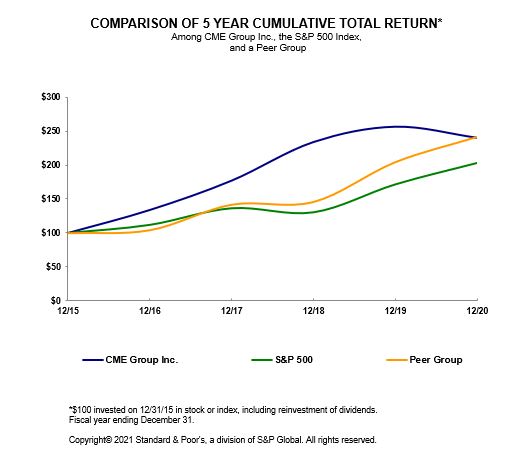
The stock price performance included in this graph is not necessarily indicative of future stock price performance.
| 2016 | 2017 | 2018 | 2019 | 2020 | |||||||||||||||||||||||||
| CME Group Inc. | $ | 133.93 | $ | 177.23 | $ | 234.16 | $ | 256.81 | $ | 240.54 | |||||||||||||||||||
| S&P 500 | 111.96 | 136.40 | 130.42 | 171.49 | 203.04 | ||||||||||||||||||||||||
| Peer Group | 104.28 | 141.75 | 145.74 | 204.15 | 241.29 | ||||||||||||||||||||||||
Unregistered Sales of Equity Securities
None.
Issuer Purchases of Equity Securities
| Period in 2020 | Total Number of Shares (or Units) Purchased**(1)** | Average Price Paid Per Share (or Unit) | Total Number of Shares (or Units) Purchased as Part of Publicly Announced Plans or Programs | Maximum Number (or Approximate Dollar Value) of Shares (or Units) that May Yet Be Purchased Under the Plans or Programs (in millions) | ||||||||||||||||||||||
| October 1 to October 31 | 114 | $ | 159.47 | — | $ | — | ||||||||||||||||||||
| November 1 to November 30 | — | — | — | — | ||||||||||||||||||||||
| December 1 to December 31 | 24,810 | 182.02 | — | — | ||||||||||||||||||||||
| Total | 24,924 | — |
(1)Shares purchased consist of an aggregate of 24,924 shares of Class A common stock surrendered to satisfy employee tax obligations upon the vesting of restricted stock.
Item 6. SELECTED FINANCIAL DATA
On November 2, 2018, CME Group completed its acquisition of NEX. The following data includes the financial results of NEX beginning November 3, 2018.
| Year Ended or At December 31 | ||||||||||||||||||||||||||||||||
| (in millions, except per share data) | 2020 | 2019 | 2018 | 2017 | 2016 | |||||||||||||||||||||||||||
| Income Statement Data: | ||||||||||||||||||||||||||||||||
| Total revenues | $ | 4,883.6 | $ | 4,868.0 | $ | 4,309.4 | $ | 3,644.7 | $ | 3,595.2 | ||||||||||||||||||||||
| Operating income | 2,637.4 | 2,587.8 | 2,607.6 | 2,310.6 | 2,200.5 | |||||||||||||||||||||||||||
| Non-operating income (expense) | 84.7 | 101.8 | 170.2 | 215.7 | 87.1 | |||||||||||||||||||||||||||
| Income before income taxes | 2,722.1 | 2,689.6 | 2,777.8 | 2,526.3 | 2,287.6 | |||||||||||||||||||||||||||
| Net income attributable to CME Group | 2,105.2 | 2,116.5 | 1,962.2 | 4,063.4 | 1,534.1 | |||||||||||||||||||||||||||
| Earnings per common share attributable to CME Group: | ||||||||||||||||||||||||||||||||
| Basic | $ | 5.88 | $ | 5.93 | $ | 5.73 | $ | 12.00 | $ | 4.55 | ||||||||||||||||||||||
| Diluted | 5.87 | 5.91 | 5.71 | 11.94 | 4.53 | |||||||||||||||||||||||||||
| Cash dividends per share | 5.90 | 5.50 | 4.55 | 6.14 | 5.65 | |||||||||||||||||||||||||||
| Balance Sheet Data: | ||||||||||||||||||||||||||||||||
| Total assets | $ | 124,659.6 | $ | 75,215.3 | $ | 77,475.7 | $ | 75,791.2 | $ | 69,369.4 | ||||||||||||||||||||||
| Short-term debt | — | — | 574.2 | — | — | |||||||||||||||||||||||||||
| Long-term debt | 3,443.8 | 3,743.2 | 3,826.8 | 2,233.1 | 2,231.2 | |||||||||||||||||||||||||||
| CME Group shareholders’ equity | 26,319.9 | 26,128.9 | 25,918.5 | 22,411.8 | 20,340.7 |
The following table presents key statistical information on the volume of contracts traded, expressed in round turn trades. All amounts exclude our interest rate swaps and credit default swaps contracts as well as volume data for our cash markets business.
| Year Ended or At December 31 | ||||||||||||||||||||||||||||||||
| (in thousands) | 2020 | 2019 | 2018 | 2017 | 2016 | |||||||||||||||||||||||||||
| Average Daily Volume: | ||||||||||||||||||||||||||||||||
| Product Lines: | ||||||||||||||||||||||||||||||||
| Interest rates | 8,032 | 10,349 | 9,951 | 8,189 | 7,517 | |||||||||||||||||||||||||||
| Equity indexes | 5,650 | 3,459 | 3,589 | 2,682 | 3,061 | |||||||||||||||||||||||||||
| Foreign exchange | 862 | 862 | 1,004 | 922 | 858 | |||||||||||||||||||||||||||
| Agricultural commodities | 1,417 | 1,454 | 1,480 | 1,353 | 1,321 | |||||||||||||||||||||||||||
| Energy | 2,394 | 2,375 | 2,561 | 2,578 | 2,432 | |||||||||||||||||||||||||||
| Metals | 699 | 668 | 639 | 568 | 460 | |||||||||||||||||||||||||||
| Total Average Daily Volume | 19,054 | 19,167 | 19,224 | 16,292 | 15,649 | |||||||||||||||||||||||||||
| Method of Trade: | ||||||||||||||||||||||||||||||||
| CME Globex | 17,977 | 17,182 | 17,371 | 14,513 | 13,766 | |||||||||||||||||||||||||||
| Open outcry | 410 | 1,205 | 1,168 | 1,107 | 1,149 | |||||||||||||||||||||||||||
| Privately negotiated | 667 | 780 | 685 | 672 | 734 | |||||||||||||||||||||||||||
| Total Average Daily Volume | 19,054 | 19,167 | 19,224 | 16,292 | 15,649 | |||||||||||||||||||||||||||
| Other Data: | ||||||||||||||||||||||||||||||||
| Total Contract Volume (round turn trades) | 4,820,590 | 4,830,043 | 4,844,406 | 4,089,175 | 3,943,670 | |||||||||||||||||||||||||||
| Open Interest at Year End (contracts) | 81,922 | 113,330 | 115,669 | 108,043 | 102,930 |
Item 7. MANAGEMENT’S DISCUSSION AND ANALYSIS OF FINANCIAL CONDITION AND RESULTS OF OPERATIONS
INTRODUCTION
Management’s Discussion and Analysis of Financial Condition and Results of Operations is organized as follows:
-
Executive Summary**: Includes an overview of our business; current economic, competitive and regulatory trends relevant to our business; our current business strategy; and our primary sources of operating and non-operating revenues and expenses.
-
Critical Accounting Policies**: Provides an explanation of accounting policies which may have a significant impact on our financial results and the estimates, assumptions and risks associated with those policies.
-
Recent Accounting Pronouncements**: Includes an evaluation of recent accounting pronouncements and the potential impact of their future adoption on our financial results.
-
Results of Operations**: Includes an analysis of our 2020 financial results and a discussion of any known events or trends which are likely to impact future results.
-
Liquidity and Capital Resources**: Includes a discussion of our future cash requirements, capital resources, significant planned expenditures and financing arrangements.
References in this discussion and analysis to “we” and “our” are to CME Group Inc. (CME Group) and its consolidated subsidiaries, collectively. References to “exchange” are to Chicago Mercantile Exchange Inc. (CME), the Board of Trade of the City of Chicago, Inc. (CBOT), New York Mercantile Exchange, Inc. (NYMEX) and Commodity Exchange, Inc. (COMEX), collectively, unless otherwise noted.
EXECUTIVE SUMMARY
Business Overview
CME Group, a Delaware stock corporation, is the holding company for CME, CBOT, NYMEX, COMEX, NEX and their respective subsidiaries. The holding company structure is designed to provide strategic and operational flexibility. CME Group's Class A common stock is listed on the Nasdaq Global Select Market (Nasdaq) under the ticker symbol "CME."
Our exchange consists of designated contract markets for the trading of futures and options contracts. We also clear futures, options and swaps contracts through our clearing house. Futures contracts, options contracts and swaps contracts provide investors with vehicles for protecting against, and potentially profiting from, price changes in financial instruments and physical commodities.
We are a global company with customer access available virtually all over the world. Our customers consist of professional traders, financial institutions, individual and institutional investors, major corporations, manufacturers, producers, governments and central banks. Customers include both members of the exchange and non-members.
We offer our customers the opportunity to trade futures contracts and options contracts on a range of products including those based on interest rates, equity indexes, foreign exchange, agricultural commodities, energy and metals. Through our cash markets business, we offer fixed income trading through BrokerTec and foreign currency trading through EBS. Our products provide a means for hedging, speculating and allocating assets. We identify new products by monitoring economic trends and their impact on the risk management and speculative needs of our existing and prospective customers.
Most of our products are available for trading through our electronic trading platforms. These execution facilities offer our customers immediate trade execution and price transparency. In addition, trades can be executed through privately negotiated transactions that are cleared and settled through our clearing house.
We also provide optimization services that deliver transaction lifecycle management and information services to help our customers optimize their capital, mitigate their risk and reduce operational costs. Optimization services includes Traiana, TriOptima and Reset.
Our clearing house clears, settles and guarantees futures and options contracts traded through our exchanges, in addition to cleared swaps products. Our clearing house's performance guarantee is an important function of our business. Because of this guarantee, our customers do not need to evaluate the credit of each potential counterparty or limit themselves to a selected set of counterparties. This flexibility increases the potential liquidity available for each trade. Additionally, the substitution of our clearing house as the counterparty to every transaction allows our customers to establish a position with one party and offset the position with another party. This contract offsetting process provides our customers with flexibility in establishing and adjusting positions and provides for collateral and margining efficiencies. Certain BrokerTec and EBS contracts are cleared at third-party clearing houses.
Business Trends
Economic Environment. Our customers continue to use our markets as an effective and transparent means to manage risk and meet their investment needs. Trading activity in our centralized markets has fluctuated due to the ongoing uncertainty in the financial markets, fluctuations in the availability of credit, variations in the amount of assets under management as well as the Federal Reserve Bank’s interest rate policy and quantitative easing. We continue to maintain high quality and diverse products as well as various clearing and market data services which support our customers in any economic environment.
Competitive Environment. Our industry is competitive and we continue to encounter competition in all aspects of our business. We expect competition to continue to intensify, especially in light of ongoing regulatory reform in the financial services industry. Competition is influenced by our brand and reputation; the efficiency and security of our settlement, clearing and support services; depth and liquidity of our markets; diversity of product offerings including frequency and quality of new product development and innovative services; our ability to position and expand upon existing products to address changing market needs; efficient and seamless customer experience; transparency, reliability, anonymity and security of transaction processing; the regulatory environment; connectivity, accessibility, flexibility in execution methods and distribution; technology capability and innovation, as well as overall transaction costs. We believe we are very well positioned with respect to these factors. Our asset classes contain products designed to address differing risk management needs, and customers are able to achieve operational and capital efficiencies by accessing our diverse products through our platforms and our clearing house. We face competition from other futures, securities and securities option exchanges; clearing organizations; swap execution facilities; alternative trade execution facilities; technology firms, including market data distributors and electronic trading system developers; and others. As markets continue to evolve, we will continue to adapt our trading technology and clearing services to meet the needs of our customers. The competitive environment to which we are subject is discussed in "Item 1. Business" on page 10.
Regulatory Environment. Exchange-traded derivatives have historically been subject to extensive regulation. Developments in the regulatory environment have the potential to significantly impact our business. Compliance with regulations may require us and our customers to dedicate significant financial and operational resources which could adversely affect our profitability. The regulatory environment to which we are subject is discussed in "Item 1. Business" on page 11.
Business Strategy
Our strategy focuses on maximizing futures and options growth globally, diversifying our business and revenues, and delivering unparalleled customer efficiencies and operational excellence. This strategy allows us to continue to develop into a more broadly diversified financial exchange that provides trading and clearing solutions across a wide range of
Showing the first 8K of 81K characters. Open the full section
Item 7A. QUANTITATIVE AND QUALITATIVE DISCLOSURES ABOUT MARKET RISK
We are subject to various market risks, including those caused by changes in interest rates, credit and foreign currency exchange rates.
Interest Rate Risk
Debt outstanding at December 31, 2020 consisted of fixed-rate borrowings of $3.4 billion (in U.S. dollar equivalent). Changes in interest rates impact the fair values of fixed-rate debt, but do not impact earnings or cash flows. We did not have any variable-rate borrowings at December 31, 2020.
Credit Risk
CME Clearing House
Our clearing house acts as the counterparty to all trades consummated on our exchanges as well as through third-party exchanges and swaps markets for which we provide clearing services. As a result, we are exposed to significant credit risk of third parties, including clearing firms. We are also exposed, indirectly, to the credit risk of customers of our clearing firms. These parties may default on their obligations due to bankruptcy, lack of liquidity, operational failure or other reasons.
In order to ensure performance, we establish and monitor financial requirements for our clearing firms. We set minimum performance bond requirements for exchange-traded and interest rate swaps products. For clearing firms, we establish performance bond requirements to cover at least 99% of expected price changes for a given product within a given historical period with further quantitative and qualitative considerations based on market risk. We establish haircuts applied to collateral deposited to meet performance bond requirements to cover at least 99% of expected price changes and foreign currency changes for a given asset within a given historical period with further quantitative and qualitative considerations. Haircuts vary depending on the type of collateral and maturity. We mark-to-market open positions of clearing firms at least once a day (twice a day for futures and options contracts) and require payment from clearing firms whose positions have lost value and make payments to clearing firms whose positions have gained value. We have the capability to mark-to-market more frequently as market conditions warrant. These practices allow our clearing house to quickly identify any clearing firms that may not be able to satisfy the financial obligations resulting from changes in the prices of their open positions before those financial obligations become exceptionally large and jeopardize the ability of our clearing house to ensure performance of their open positions.
Although we have policies and procedures to help ensure that our clearing firms can satisfy their obligations, these policies and procedures may not succeed in detecting problems or preventing defaults. We also have in place various measures intended to enable us to cover any default and maintain liquidity.
Despite our safeguards, we cannot guarantee that these measures will be sufficient to protect us from a default or that we will not be materially and adversely affected in the event of a significant default.
We maintain two separate financial safeguard packages:
-
a financial safeguard package for all futures, options and over-the-counter swap contracts other than cleared interest rate swap contracts (base package); and
-
a financial safeguard package for cleared interest rate swap contracts.
In the unlikely event of a payment default by a clearing firm, we would first apply assets of the defaulting clearing firm to satisfy its payment obligation. These assets include the defaulting firm's guaranty fund contributions, performance bonds and any other available assets, such as assets required for clearing membership and any associated trading rights. In addition, we would make a demand for payment pursuant to any applicable guarantee provided to us by the parent company of the clearing firm. Thereafter, if the payment default remains unsatisfied, we would use our corporate contributions designated for the respective financial safeguard package. We would then use guaranty fund contributions of other clearing firms within the respective financial safeguard package and funds collected through an assessment against solvent clearing firms within the respective financial safeguard package to satisfy the deficit.
We maintain a $7.0 billion 364-day multi-currency line of credit with a consortium of domestic and international banks to be used in certain situations by our clearing house. We have the option to request an increase in the line from $7.0 billion to $10.0 billion. We may use the proceeds to provide temporary liquidity in the unlikely event of a clearing firm default, in the event of a liquidity constraint or default by a depositary (custodian of the collateral) or in the event of a temporary disruption with the payments systems that would delay payment of settlement variation between us and our clearing firms. The credit agreement requires us to pledge certain assets to the line of credit custodian prior to drawing on the line of credit. Pledged assets may include clearing firm guaranty fund deposits held by us in the form of cash or U.S. Treasury securities. Performance bond collateral of a defaulting clearing firm may also be used to secure a draw on the line. In addition to the 364-day multi-currency line of credit, we also have the option to use our $2.4 billion multi-currency revolving senior credit facility to provide liquidity for our clearing house in the unlikely event of default.
At December 31, 2020, aggregate performance bond deposits for clearing firms for both financial safeguard packages was $211.9 billion including cash performance bond deposits, non-cash deposits, Interest Earnings Facility funds and letters of credit. A defaulting firm's performance bond deposits can be used in the event of default of that clearing firm.
The following shows the available assets at December 31, 2020 in the event of a payment default by a clearing firm for the base financial safeguard package after first utilizing the defaulting firm's available assets:
| (in millions) | Clearing House Available Assets | |||||||
| Designated corporate contributions for futures and options(1) | $ | 100.0 | ||||||
| Guaranty fund contributions(2) | 4,654.1 | |||||||
| Assessment powers(3) | 12,798.9 | |||||||
(1)Our clearing house designates $100.0 million of corporate contributions to satisfy a clearing firm default in the event that the defaulting clearing firm's guaranty contributions and performance bonds do not satisfy the deficit.
(2)Guaranty fund contributions of clearing firms include guaranty fund contributions required of clearing firms, but do not include any excess deposits held by us at the direction of clearing firms.
(3)In the event of a clearing firm default, if a loss continues to exist after the utilization of the assets of the defaulted firm, our corporate contribution and the non-defaulting clearing firms' guaranty fund contributions, we would assess all non-defaulting clearing members as provided in the rules governing the guaranty fund. We could assess non-defaulting clearing members 275% of their existing guaranty fund requirements up to a maximum of 550% of their existing guaranty fund requirements as provided in the rules. Assessment powers are calculated to reflect the potential obligation that each clearing member could be called for in the event clearing member defaults exhaust the guaranty fund; however, the total amount available would be reduced by the defaulted clearing members' assessment obligations since they would no longer be able to satisfy their obligations.
The following shows the available assets for the interest rate swap financial safeguard package at December 31, 2020 in the event of a payment default by a clearing firm that clears interest rate swap contracts, after first utilizing the defaulting firm's available assets:
| (in millions) | Clearing House Available Assets | |||||||
| Designated corporate contributions for interest rate swap contracts(1) | $ | 150.0 | ||||||
| Guaranty fund contributions(2) | 3,392.1 | |||||||
| Assessment powers(3) | 1,089.5 | |||||||
(1)Our clearing house designates $150.0 million of corporate contributions to satisfy a clearing firm default in the event that the defaulting clearing firm's guaranty contributions and performance bonds do not satisfy the deficit.
(2)Guaranty fund contributions of clearing firms for interest rate swap contracts include guaranty fund contributions required of those clearing firms.
(3)In the event of a clearing firm default, if a loss continues to exist after the utilization of the assets of the defaulted firm, our corporate contribution and the non-defaulting firms' guaranty fund contributions, we would assess non-defaulting clearing members as provided in the rules governing the interest rate swap guaranty fund. Assessment powers are calculated to reflected the potential obligation that each clearing member could be called for based on potential failure of the third and fourth largest clearing.
BrokerTec Americas Matched Principal Business
BrokerTec Americas maintains a matched principal business, where it serves as a fully matched counterparty to offsetting positions entered into by clients on its electronic trading platform to facilitate anonymity and access to clearing and settlement. BrokerTec Americas uses Fixed Income Clearing Corporation (FICC), a third-party central clearing house as well as a third-party clearing bank for the settlement of transactions and is required to post short-term margin requirements twice a day that can vary based on the size of unsettled transactions and any adverse market changes. At December 31, 2020, the balance of the collateral at FICC was $100.1 million, which was included in other current assets on the consolidated balance sheet.
Without sufficient funds to meet its obligations, BrokerTec Americas could be exposed to risk of breach of contract with the counterparties and the inability to continue as a member of the third-party central clearing house. Transactions with clearing house members are typically confirmed and novated shortly after execution, at which point the clearing house assumes the risk of settlement. For transactions with counterparties that are not members of the third-party clearing house, settlement typically occurs on the day following execution and, prior to settlement, BrokerTec Americas is exposed to the risk of loss in the event a counterparty fails to meet its obligations. If that were to occur, BrokerTec Americas would have the right to cover or liquidate the open position but could incur a loss as a result of market movements.
Foreign Currency Exchange Rate Risk
Foreign Currency Transaction Risk
We have foreign currency transaction risk related to changes in exchange rates on monetary assets, liabilities, revenues and expenses held at subsidiaries where those balances and activity are denominated in a currency other than the subsidiary's functional currency. Gains and losses on foreign currency transactions result primarily from cash, debt and other monetary assets, liabilities, revenues and expenses denominated in British pounds, euros and Japanese yen.
Aggregate transaction losses for 2020, 2019 and 2018 were $9.3 million, $7.2 million and $73.6 million, respectively. We expect the foreign currency gain/loss to continue to fluctuate as long as we continue to hold monetary assets and liabilities at those subsidiaries. Brexit continues to generate economic and political uncertainty throughout the world, particularly throughout the U.K. and the E.U. This uncertainty could potentially lead to significant volatility with foreign currency exchange rates, which could result in additional foreign currency gain/loss.
Foreign Currency Translation Risk
We have foreign currency translation risk related to the translation of our foreign subsidiaries' assets, liabilities, revenues and expenses from their respective functional currencies to the U.S. dollar at each reporting date. Fluctuations in exchange rates may impact the amount of assets, liabilities, revenues and expenses we report on our consolidated balance sheets and consolidated statements of income. The financial statements of those foreign subsidiaries with functional currencies other than the U.S. dollar are translated into U.S. dollars using a current exchange rate. Gains and losses resulting from this translation are recognized as a foreign currency translation adjustment within accumulated other comprehensive income, which is a component of shareholders' equity and comprehensive income. Aggregate translation gains (losses), net of tax, for 2020, 2019 and 2018 were $134.3 million, $(0.6) million and $(2.5) million, respectively.
Foreign Currency Exchange Risk Related to Customer Collateral
A portion of performance bond deposits is denominated in various foreign currencies. We mark-to-market all deposits daily and require payment from clearing firms whose collateral has lost value due to changes in foreign currency rates and price. Therefore, our exposure to foreign currency risk related to performance bond deposits is considered minimal and is not expected to be material to our financial condition or operating results.
Item 8. FINANCIAL STATEMENTS AND SUPPLEMENTARY DATA
CME GROUP INC. AND SUBSIDIARIES
CONSOLIDATED BALANCE SHEETS
(dollars in millions, except per share data; shares in thousands)
| December 31, | |||||||||||
| 2020 | 2019 | ||||||||||
| Assets | |||||||||||
| Current Assets: | |||||||||||
| Cash and cash equivalents | $ | 1,633.2 | $ | 1,551.4 | |||||||
| Marketable securities | 100.9 | 83.2 | |||||||||
| Accounts receivable, net of allowance of $5.4 and $3.4 | 461.3 | 491.8 | |||||||||
| Other current assets (includes $4.7 and $4.3 in restricted cash) | 306.7 | 364.4 | |||||||||
| Performance bonds and guaranty fund contributions | 86,781.8 | 37,077.0 | |||||||||
| Total current assets | 89,283.9 | 39,567.8 | |||||||||
| Property, net | 579.2 | 544.0 | |||||||||
| Intangible assets—trading products | 17,175.3 | 17,175.3 | |||||||||
| Intangible assets—other, net | 4,865.3 | 5,117.7 | |||||||||
| Goodwill | 10,798.8 | 10,742.5 | |||||||||
| Other assets (includes $0.6 and $0.9 in restricted cash) | 1,957.1 | 2,068.0 | |||||||||
| Total Assets | $ | 124,659.6 | $ | 75,215.3 | |||||||
| Liabilities and Equity | |||||||||||
| Current Liabilities: | |||||||||||
| Accounts payable | $ | 69.3 | $ | 61.9 | |||||||
| Other current liabilities | 1,346.8 | 1,384.8 | |||||||||
| Performance bonds and guaranty fund contributions | 86,781.8 | 37,075.8 | |||||||||
| Total current liabilities | 88,197.9 | 38,522.5 | |||||||||
| Long-term debt | 3,443.8 | 3,743.2 | |||||||||
| Deferred income tax liabilities, net | 5,607.0 | 5,635.2 | |||||||||
| Other liabilities | 1,059.4 | 1,155.1 | |||||||||
| Total Liabilities | 98,308.1 | 49,056.0 | |||||||||
| Shareholders’ Equity: | |||||||||||
| Preferred stock, $0.01 par value, 10,000 shares authorized as of December 31, 2020 and 2019; none issued | — | — | |||||||||
| Class A common stock, $0.01 par value, 1,000,000 shares authorized as of December 31, 2020 and 2019, 358,110 and 357,469 shares issued and outstanding as of December 31, 2020 and 2019, respectively | 3.6 | 3.6 | |||||||||
| Class B common stock, $0.01 par value, 3 shares authorized, issued and outstanding as of December 31, 2020 and 2019 | — | — | |||||||||
| Additional paid-in capital | 21,185.5 | 21,113.2 | |||||||||
| Retained earnings | 4,995.9 | 5,008.7 | |||||||||
| Accumulated other comprehensive income (loss) | 134.9 | 3.4 | |||||||||
| Total CME Group shareholders’ equity | 26,319.9 | 26,128.9 | |||||||||
| Non-controlling interests | 31.6 | 30.4 | |||||||||
| Total Equity | 26,351.5 | 26,159.3 | |||||||||
| Total Liabilities and Equity | $ | 124,659.6 | $ | 75,215.3 |
See accompanying notes to consolidated financial statements.
CME GROUP INC. AND SUBSIDIARIES
CONSOLIDATED STATEMENTS OF INCOME
(dollars in millions, except per share data; shares in thousands)
| Year Ended December 31, | |||||||||||||||||
| 2020 | 2019 | 2018 | |||||||||||||||
| Revenues | |||||||||||||||||
| Clearing and transaction fees | $ | 3,897.4 | $ | 3,946.1 | $ | 3,667.0 | |||||||||||
| Market data and information services | 545.4 | 518.5 | 449.6 | ||||||||||||||
| Other | 440.8 | 403.4 | 192.8 | ||||||||||||||
| Total Revenues | 4,883.6 | 4,868.0 | 4,309.4 | ||||||||||||||
| Expenses | |||||||||||||||||
| Compensation and benefits | 856.5 | 898.7 | 672.2 | ||||||||||||||
| Technology | 198.5 | 201.5 | 117.2 | ||||||||||||||
| Professional fees and outside services | 191.3 | 174.1 | 166.1 | ||||||||||||||
| Amortization of purchased intangibles | 311.2 | 314.7 | 130.0 | ||||||||||||||
| Depreciation and amortization | 153.2 | 158.6 | 118.7 | ||||||||||||||
| Licensing and other fee agreements | 244.9 | 172.2 | 170.6 | ||||||||||||||
| Other | 290.6 | 360.4 | 327.0 | ||||||||||||||
| Total Expenses | 2,246.2 | 2,280.2 | 1,701.8 | ||||||||||||||
| Operating Income | 2,637.4 | 2,587.8 | 2,607.6 | ||||||||||||||
| Non-Operating Income (Expense) | |||||||||||||||||
| Investment income | 182.7 | 637.9 | 745.1 | ||||||||||||||
| Interest and other borrowing costs | (166.2) | (178.0) | (157.7) | ||||||||||||||
| Equity in net earnings (losses) of unconsolidated subsidiaries | 190.6 | 176.8 | 152.8 | ||||||||||||||
| Other non-operating income (expense) | (122.4) | (534.9) | (570.0) | ||||||||||||||
| Total Non-Operating Income (Expense) | 84.7 | 101.8 | 170.2 | ||||||||||||||
| Income before Income Taxes | 2,722.1 | 2,689.6 | 2,777.8 | ||||||||||||||
| Income tax provision | 615.7 | 573.8 | 814.1 | ||||||||||||||
| Net Income | 2,106.4 | 2,115.8 | 1,963.7 | ||||||||||||||
| Less: net (income) loss attributable to non-controlling interests | (1.2) | 0.7 | (1.5) | ||||||||||||||
| Net Income Attributable to CME Group | $ | 2,105.2 | $ | 2,116.5 | $ | 1,962.2 | |||||||||||
| Earnings per Common Share Attributable to CME Group: | |||||||||||||||||
| Basic | $ | 5.88 | $ | 5.93 | $ | 5.73 | |||||||||||
| Diluted | 5.87 | 5.91 | 5.71 | ||||||||||||||
| Weighted Average Number of Common Shares: | |||||||||||||||||
| Basic | 357,764 | 357,155 | 342,344 | ||||||||||||||
| Diluted | 358,524 | 358,239 | 343,737 |
See accompanying notes to consolidated financial statements.
CME GROUP INC. AND SUBSIDIARIES
CONSOLIDATED STATEMENTS OF COMPREHENSIVE INCOME
(in millions)
| Year Ended December 31, | |||||||||||||||||||||||
| 2020 | 2019 | 2018 | |||||||||||||||||||||
| Net income | $ | 2,106.4 | $ | 2,115.8 | $ | 1,963.7 | |||||||||||||||||
| Other comprehensive income, net of tax: |
Showing the first 8K of 160K characters. Open the full section
Item 9. CHANGES IN AND DISAGREEMENTS WITH ACCOUNTANTS ON ACCOUNTING AND FINANCIAL DISCLOSURE
Not applicable.
Item 9A. CONTROLS AND PROCEDURES
Evaluation of Disclosure Controls and Procedures
Our management, with the participation of our Chief Executive Officer and Chief Financial Officer, has evaluated the effectiveness of our disclosure controls and procedures (as such term is defined in Rules 13a-15(e) and 15d-15(e) under the Securities Exchange Act of 1934, as amended (Exchange Act)) as of the end of the period covered by this Annual Report on Form 10-K. Based on such evaluation, our Chief Executive Officer and Chief Financial Officer have concluded that, as of the end of such period, our disclosure controls and procedures are effective.
Changes in Internal Control over Financial Reporting
As required by Rule 13a-15(d) under the Exchange Act, the company's management, including the company's Chief Executive Officer and Chief Financial Officer, have evaluated the company's internal control over financial reporting (as such term is defined in Rules 13a-15(f) and 15d-15(f) under the Exchange Act) to determine whether any changes occurred during the period covered by this report that have materially affected, or are reasonably likely to materially affect, the company's internal control over financial reporting. There were no changes in the company’s internal control over financial reporting which occurred during 2020, that have materially affected, or are reasonably likely to materially affect, the company’s internal control over financial reporting.
Management’s Annual Report on Internal Control over Financial Reporting
Management is responsible for establishing and maintaining adequate internal control over financial reporting. Our internal control system has been designed to provide reasonable assurance to management and the board of directors regarding the preparation and fair presentation of published financial statements.
Management assessed the effectiveness of the company’s internal control over financial reporting as of December 31, 2020. Management based its assessment on criteria for effective internal control over financial reporting described in Internal Control-Integrated Framework issued by the Committee of Sponsoring Organizations of the Treadway Commission (2013 framework). Management’s assessment included evaluating the design of our internal control over financial reporting and testing the operational effectiveness of our internal control over financial reporting. The results of its assessment were reviewed with the audit committee of the board of directors.
Based on this assessment, management believes that, as of December 31, 2020, our internal control over financial reporting is effective. The effectiveness of our internal control over financial reporting as of December 31, 2020 has been audited by Ernst & Young LLP, an independent registered public accounting firm, as stated in the report on page 88.
Report of Independent Registered Public Accounting Firm
To the Shareholders and the Board of Directors of CME Group Inc. and Subsidiaries
Opinion on the Financial Statements
We have audited the accompanying consolidated balance sheets of CME Group Inc. and subsidiaries (the Company) as of December 31, 2020 and 2019, the related consolidated statements of income, comprehensive income, equity, and cash flows for each of the three years in the period ended December 31, 2020, and the related notes and financial statement schedule listed in the Index at Item 15(a) (collectively referred to as the “consolidated financial statements”). In our opinion, the consolidated financial statements present fairly, in all material respects, the financial position of the Company at December 31, 2020 and 2019, and the results of its operations and its cash flows for each of the three years in the period ended December 31, 2020, in conformity with U.S. generally accepted accounting principles.
We also have audited, in accordance with the standards of the Public Company Accounting Oversight Board (United States) (PCAOB), the Company’s internal control over financial reporting as of December 31, 2020, based on criteria established in Internal Control-Integrated Framework issued by the Committee of Sponsoring Organizations of the Treadway Commission (2013 framework) and our report dated February 26, 2021 expressed an unqualified opinion thereon.
Basis for Opinion
These financial statements are the responsibility of the Company’s management. Our responsibility is to express an opinion on the Company’s financial statements based on our audits. We are a public accounting firm registered with the PCAOB and are required to be independent with respect to the Company in accordance with the U.S. federal securities laws and the applicable rules and regulations of the Securities and Exchange Commission and the PCAOB.
We conducted our audits in accordance with the standards of the PCAOB. Those standards require that we plan and perform the audit to obtain reasonable assurance about whether the financial statements are free of material misstatement, whether due to error or fraud. Our audits included performing procedures to assess the risks of material misstatement of the financial statements, whether due to error or fraud, and performing procedures that respond to those risks. Such procedures included examining, on a test basis, evidence regarding the amounts and disclosures in the financial statements. Our audits also included evaluating the accounting principles used and significant estimates made by management, as well as evaluating the overall presentation of the financial statements. We believe that our audits provide a reasonable basis for our opinion.
Critical Audit Matter
The critical audit matter communicated below is a matter arising from the current period audit of the financial statements that was communicated or required to be communicated to the audit committee and that: (1) relates to accounts or disclosures that are material to the financial statements and (2) involved our especially challenging, subjective, or complex judgments. The communication of the critical audit matter does not alter in any way our opinion on the consolidated financial statements, taken as a whole, and we are not, by communicating the critical audit matter below, providing a separate opinion on the critical audit matter or on the account or disclosure to which it relates.
| Uncertain Tax Positions | |||||
| Description of the Matter | As discussed in Note 10 to the consolidated financial statements, the Company had unrecognized income tax benefits of $328.2 million related to uncertain tax positions as of December 31, 2020. Uncertainty in a tax position may arise due to the application of complex tax regulations. The Company uses significant judgment to (1) determine whether, based on the technical merits, the tax position is more likely than not to be sustained upon examination and (2) measure the amount of the tax benefit that qualifies for recognition. Auditing management’s estimate of the Company’s uncertain tax positions that qualified for recognition and the related unrecognized income tax benefits was especially challenging because management’s estimate involved significant judgment in evaluating the technical merits of the positions, including interpretations of applicable tax laws and regulations. | ||||
| How we Addressed the Matter in Our Audit | We tested the Company’s controls that address the risk of material misstatement relating to the recognition and measurement of uncertain tax positions. For example, we tested controls over the Company’s assessment of the technical merits of tax positions and management’s process to measure the benefit of those tax positions that qualified for recognition, including management’s review of the inputs used in the calculations. We involved our tax professionals to evaluate the technical merits of the Company's tax positions. Our audit procedures included, among others, evaluating the assumptions the Company used to develop its uncertain tax positions and related unrecognized income tax benefit amount by jurisdiction. We also tested the completeness and accuracy of the underlying data used by the Company to calculate its uncertain tax positions, inspected correspondence with relevant tax authorities, and evaluated third-party advice obtained and used by the Company in assessing the technical merits of its tax positions. |
/s/ Ernst & Young LLP
We have served as the Company’s auditor since 2002.
Chicago, Illinois
February 26, 2021
Report of Independent Registered Public Accounting Firm
To the Shareholders and the Board of Directors of CME Group Inc. and Subsidiaries
Opinion on Internal Control over Financial Reporting
We have audited CME Group Inc. and subsidiaries’ internal control over financial reporting as of December 31, 2020, based on criteria established in Internal Control—Integrated Framework issued by the Committee of Sponsoring Organizations of the Treadway Commission (2013 framework) (the COSO criteria). In our opinion, CME Group Inc. and subsidiaries (the Company) maintained, in all material respects, effective internal control over financial reporting as of December 31, 2020, based on the COSO criteria.
We also have audited, in accordance with the standards of the Public Company Accounting Oversight Board (United States) (PCAOB), the consolidated balance sheets of CME Group Inc. and subsidiaries as of December 31, 2020 and 2019, the related consolidated statements of income, comprehensive income, equity and cash flows for each of the three years in the period ended December 31, 2020, and the related notes and financial statement schedule listed in the Index at Item 15(a) and our report dated February 26, 2021 expressed an unqualified opinion thereon.
Basis for Opinion
The Company’s management is responsible for maintaining effective internal control over financial reporting and for its assessment of the effectiveness of internal control over financial reporting included in the accompanying Management’s Annual Report on Internal Control over Financial Reporting. Our responsibility is to express an opinion on the Company’s internal control over financial reporting based on our audit. We are a public accounting firm registered with the PCAOB and are required to be independent with respect to the Company in accordance with the U.S. federal securities laws and the applicable rules and regulations of the Securities and Exchange Commission and the PCAOB.
We conducted our audit in accordance with the standards of the PCAOB. Those standards require that we plan and perform the audit to obtain reasonable assurance about whether effective internal control over financial reporting was maintained in all material respects.
Our audit included obtaining an understanding of internal control over financial reporting, assessing the risk that a material weakness exists, testing and evaluating the design and operating effectiveness of internal control based on the assessed risk, and performing such other procedures as we considered necessary in the circumstances. We believe that our audit provides a reasonable basis for our opinion.
Definition and Limitations of Internal Control Over Financial Reporting
A company’s internal control over financial reporting is a process designed to provide reasonable assurance regarding the reliability of financial reporting and the preparation of financial statements for external purposes in accordance with generally accepted accounting principles. A company’s internal control over financial reporting includes those policies and procedures that (1) pertain to the maintenance of records that, in reasonable detail, accurately and fairly reflect the transactions and dispositions of the assets of the company; (2) provide reasonable assurance that transactions are recorded as necessary to permit preparation of financial statements in accordance with generally accepted accounting principles, and that receipts and expenditures of the company are being made only in accordance with authorizations of management and directors of the company; and (3) provide reasonable assurance regarding prevention or timely detection of unauthorized acquisition, use, or disposition of the company’s assets that could have a material effect on the financial statements.
Because of its inherent limitations, internal control over financial reporting may not prevent or detect misstatements. Also, projections of any evaluation of effectiveness to future periods are subject to the risk that controls may become inadequate because of changes in conditions, or that the degree of compliance with the policies or procedures may deteriorate.
/s/ Ernst & Young LLP
Chicago, Illinois
February 26, 2021
Item 9B. OTHER INFORMATION
Not applicable.
PART III
Item 10. DIRECTORS, EXECUTIVE OFFICERS AND CORPORATE GOVERNANCE
We have adopted written codes of conduct applicable to all of our employees, including our Chairman and Chief Executive Officer, Chief Financial Officer, Chief Accounting Officer and other senior financial officers. In accordance with SEC rules and regulations, copies of these codes of conduct are available on our website at www.cmegroup.com under the "Investor Relations — Corporate Governance" link. In accordance with SEC rules and regulations and the listing requirements of Nasdaq, we intend to disclose promptly on the website and location specified above any substantive amendments to these codes of conduct and any waivers granted to our executive officers or Board members. In addition, we have adopted Corporate Governance Principles which govern the practices of our board of directors. You may also obtain a copy of our codes of conduct and our Corporate Governance Principles by following the instructions in the section of this Annual Report on Form 10-K entitled "Item 1. Business — Available Information."
Certain of the information called for by this item is hereby incorporated herein by reference to the relevant portions of CME Group’s definitive proxy statement for the Annual Meeting of Shareholders to be held on May 5, 2021, to be filed by CME Group with the SEC pursuant to Regulation 14A within 120 days after December 31, 2020 (Proxy Statement). Additional information called for by this item is contained in Item 1 of this Annual Report on Form 10-K under the caption "Information about our Executive Officers."
Item 11. EXECUTIVE COMPENSATION
Certain of the information called for by this item is hereby incorporated herein by reference to the relevant portions of the Proxy Statement.
Item 12. SECURITY OWNERSHIP OF CERTAIN BENEFICIAL OWNERS AND MANAGEMENT AND RELATED SHAREHOLDER MATTERS
Certain of the information called for by this item relating to the security ownership of certain beneficial owners and management is hereby incorporated herein by reference to the relevant portions of the Proxy Statement.
EQUITY COMPENSATION PLAN INFORMATION
We currently maintain the following equity compensation plans: CME Group Inc. Amended and Restated Omnibus Stock Plan, CME Group Inc. Director Stock Plan and CME Group Inc. Amended and Restated Employee Stock Purchase Plan. We do not maintain any equity compensation plans not approved by shareholders. A description of each of these plans and the number of shares authorized and available for future awards is included in note 16 of the notes to consolidated financial statements. The numbers in the following table are as of December 31, 2020.
| Plan Category | Number of Securities to be Issued Upon Exercise of Outstanding Options (a) | Weighted-Average Exercise Price of Outstanding Options | Number of Securities Remaining Available for Future Issuance Under Equity Compensation Plans (excluding securities reflected in column (a)) | ||||||||
| Equity compensation plans approved by security holders | 102,823 | $ | 54.41 | 15,627,263 | |||||||
| Equity compensation plans not approved by security holders | — | — | |||||||||
| Total | 102,823 | 15,627,263 |
Item 13. CERTAIN RELATIONSHIPS, RELATED TRANSACTIONS AND DIRECTOR INDEPENDENCE
Certain of the information called for by this item is hereby incorporated herein by reference to the relevant portions of the Proxy Statement.
Item 14. PRINCIPAL ACCOUNTANT FEES AND SERVICES
Certain of the information called for by this item is hereby incorporated herein by reference to the relevant portions of the Proxy Statement.
PART IV
Item 15. EXHIBITS AND FINANCIAL STATEMENT SCHEDULES
(a) Financial Statements, Financial Statement Schedules and Exhibits
(1) Financial Statements
The following Consolidated Financial Statements and related Notes included within Item 8, together with the Reports of Independent Registered Public Accounting Firm with respect thereto and included within Item 9A, are hereby incorporated by reference:
Reports of Independent Registered Public Accounting Firm
Consolidated Balance Sheets at December 31, 2020 and 2019
Consolidated Statements of Income for the Years Ended December 31, 2020, 2019 and 2018
Consolidated Statements of Comprehensive Income for the Years Ended December 31, 2020, 2019 and 2018
Consolidated Statements of Equity for the Years Ended December 31, 2020, 2019 and 2018
Consolidated Statements of Cash Flows for the Years Ended December 31, 2020, 2019 and 2018
Notes to Consolidated Financial Statements
(2) Financial Statement Schedules
The following Financial Statement Schedule is filed as part of this Annual Report on Form 10-K:
CME Group Inc. and Subsidiaries
Schedule II—Valuation and Qualifying Accounts
For the Years Ended December 31, 2020, 2019 and 2018
(dollars in millions)
| Balance at beginning of year | Charged (credited) to costs and expenses | Other**(1)** | Balance at end of year | ||||||||||||||||||||||||||
| Year Ended December 31, 2020 | |||||||||||||||||||||||||||||
| Allowance for doubtful accounts | $ | 3.4 | $ | 1.7 | $ | 0.3 | $ | 5.4 | |||||||||||||||||||||
| Allowance for deferred tax assets | 10.0 | 1.3 | — | 11.3 | |||||||||||||||||||||||||
| Year Ended December 31, 2019 | |||||||||||||||||||||||||||||
| Allowance for doubtful accounts | $ | 2.7 | $ | 2.1 | $ | (1.4) | $ | 3.4 | |||||||||||||||||||||
| Allowance for deferred tax assets | 10.7 | (0.7) | — | 10.0 | |||||||||||||||||||||||||
| Year Ended December 31, 2018 | |||||||||||||||||||||||||||||
| Allowance for doubtful accounts | $ | 2.2 | $ | 0.6 | $ | (0.1) | $ | 2.7 | |||||||||||||||||||||
| Allowance for deferred tax assets | 11.2 | (0.5) | — | 10.7 |
(1)Includes write-offs of doubtful accounts, foreign currency and additions to allowance for deferred tax assets through accumulated other comprehensive income (loss). Other activity for the allowance for doubtful accounts also includes the impact of the adoption of new guidance on credit losses in 2020.
All other schedules have been omitted because the information required to be set forth in those schedules is not applicable or is shown on the consolidated financial statements or notes thereto.
(3)Exhibits
See (b) Exhibits below
(b) Exhibits
| * | Filed herewith. |
(1)Management contract or compensatory plan or arrangement.
(2)Confidential treatment pursuant to Rule 406 of the Securities Act of 1933, as amended, has been previously granted by the SEC for portions of this exhibit.
Item 16. FORM 10-K SUMMARY
None.
SIGNATURES
Pursuant to the requirements of Section 13 or 15(d) of the Securities Exchange Act of 1934, the registrant has duly caused this report to be signed on its behalf by the undersigned, thereunto duly authorized, in the City of Chicago and State of Illinois on the 26th day of February, 2021.
| CME Group Inc. | |||||||||||
| By: | /S/ JOHN W. PIETROWICZ | ||||||||||
| John W. Pietrowicz Senior Managing Director and Chief Financial Officer |
| Signature | Title | |||||||
| /S/ TERRENCE A. DUFFY | Chairman of the Board, Director and Chief Executive Officer | |||||||
| Terrence A. Duffy | ||||||||
| /S/ JOHN W. PIETROWICZ | Senior Managing Director and Chief Financial Officer | |||||||
| John W. Pietrowicz | ||||||||
| /S/ JACK TOBIN | Managing Director and Chief Accounting Officer | |||||||
| Jack Tobin | ||||||||
| /S/ TIMOTHY S. BITSBERGER | Director | |||||||
| Timothy S. Bitsberger | ||||||||
| /S/ CHARLES P. CAREY | Director | |||||||
| Charles P. Carey | ||||||||
| /S/ DENNIS H. CHOOKASZIAN | Director | |||||||
| Dennis H. Chookaszian | ||||||||
| /S/ ELIZABETH A. COOK | Director | |||||||
| Elizabeth A. Cook | ||||||||
| /S/ MICHAEL G. DENNIS | Director | |||||||
| Michael G. Dennis | ||||||||
| /S/ BRYAN T. DURKIN | Director | |||||||
| Bryan T. Durkin | ||||||||
| /S/ ANA DUTRA | Director | |||||||
| Ana Dutra | ||||||||
| /S/ MARTIN J. GEPSMAN | Director | |||||||
| Martin J. Gepsman | ||||||||
| /S/ LARRY G. GERDES | Director | |||||||
| Larry G. Gerdes | ||||||||
| /S/ DANIEL R. GLICKMAN | Lead Director | |||||||
| Daniel R. Glickman | ||||||||
| /S/ WILLIAM W. HOBERT | Director | |||||||
| William W. Hobert | ||||||||
| /S/ DANIEL G. KAYE | Director | |||||||
| Daniel G. Kaye | ||||||||
| /S/ PHYLLIS M. LOCKETT | Director | |||||||
| Phyllis M. Lockett | ||||||||
| /S/ DEBORAH J. LUCAS | Director | |||||||
| Deborah J. Lucas | ||||||||
| /S/ PATRICK W. MALONEY | Director | |||||||
| Patrick W. Maloney | ||||||||
| /S/ PATRICK J. MULCHRONE | Director | |||||||
| Patrick J. Mulchrone | ||||||||
| /S/ TERRY L. SAVAGE | Director | |||||||
| Terry L. Savage | ||||||||
| /S/ RAHAEL SEIFU | Director | |||||||
| Rahael Seifu | ||||||||
| /S/ WILLIAM R. SHEPARD | Director | |||||||
| William R. Shepard | ||||||||
| /S/ HOWARD J. SIEGEL | Director | |||||||
| Howard J. Siegel | ||||||||
| /S/ DENNIS A. SUSKIND | Director | |||||||
| Dennis A. Suskind | ||||||||
| /S/ ROBERT J. TIERNEY JR. | Director | |||||||
| Robert J. Tierney Jr. | ||||||||