 filings.tools
Chipotle Mexican Grill 10-K 2024-12-31
Filed 2025-02-05. 24 sections, 301K characters. Original on sec.gov · Markdown · JSON
Cover and table of contents
UNITED STATES
SECURITIES AND EXCHANGE COMMISSION
WASHINGTON, D.C. 20549
______________________
FORM 10-K
______________________
x ANNUAL REPORT PURSUANT TO SECTION 13 OR 15(d) OF THE SECURITIES EXCHANGE ACT OF 1934
For the fiscal year ended December 31, 2024
or
o TRANSITION REPORT PURSUANT TO SECTION 13 OR 15(d) OF THE SECURITIES EXCHANGE ACT OF 1934
For the transition period from to
Commission File Number: 1-32731
______________________
CHIPOTLE MEXICAN GRILL, INC.
(Exact name of registrant as specified in its charter)
______________________
| Delaware | 84-1219301 | ||||
| (State or other jurisdiction of incorporation or organization) | (IRS Employer Identification No.) | ||||
| 610 Newport Center Drive, Suite 1100 Newport Beach, CA | 92660 | ||||
| (Address of Principal Executive Offices) | (Zip Code) |
Registrant’s telephone number, including area code: (949) 524-4000
Securities registered pursuant to Section 12(b) of the Act:
| Title of each class | Trading Symbol(s) | Name of each exchange on which registered | ||||||
| Common stock, par value $0.01 per share | CMG | New York Stock Exchange |
Securities registered pursuant to Section 12(g) of the Act: None
______________________
Indicate by check mark if the registrant is a well-known seasoned issuer, as defined in Rule 405 of the Securities Act. Yes x No o
Indicate by check mark if the registrant is not required to file reports pursuant to Section 13 or Section 15(d) of the Act. Yes o No x
Indicate by check mark whether the registrant: (1) has filed all reports required to be filed by Section 13 or 15(d) of the Securities Exchange Act of 1934 during the preceding 12 months (or for such shorter period that the registrant was required to file such reports), and (2) has been subject to such filing requirements for the past 90 days. Yes x No o
Indicate by check mark whether the registrant has submitted electronically every Interactive Data File required to be submitted pursuant to Rule 405 of Regulation S-T (§232.405 of this chapter) during the preceding 12 months (or for such shorter period that the registrant was required to submit such files). Yes x No o.
Indicate by check mark whether the registrant is a large accelerated filer, an accelerated filer, a non-accelerated filer, a smaller reporting company, or an emerging growth company. See the definitions of “large accelerated filer,” “accelerated filer,” “smaller reporting company,” and “emerging growth company” in Rule 12b-2 of the Exchange Act (check one):
| x Large accelerated filer | o Accelerated filer | o Non-accelerated filer | o Smaller reporting company | o Emerging growth company |
If an emerging growth company, indicate by check mark if the registrant has elected not to use the extended transition period for complying with accounting standards provided pursuant to Section 13(a) of the Exchange Act. o
Indicate by check mark whether the registrant has filed a report on and attestation to its management’s assessment of the effectiveness of its internal control over financial reporting under Section 404(b) of the Sarbanes-Oxley Act (15 U.S.C. 7262(b)) by the registered public accounting firm that prepared or issued its audit report. x
If securities are registered pursuant to Section 12(b) of the Act, indicate by check mark whether the financial statements of the registrant included in the filing reflect the correction of an error to previously issued financial statements. o
Indicate by check mark whether any of those error corrections are restatements that required a recovery analysis of incentive-based compensation received by any of the registrant’s executive officers during the relevant recovery period pursuant to §240.10D-1(b). o
Indicate by check mark whether the registrant is a shell company (as defined in Rule 12b-2 of the Exchange Act). Yes o No x
As of June 30, 2024, the aggregate market value of the registrant’s outstanding common equity held by non-affiliates was $72.256 billion, based on the closing price of the registrant’s common stock on June 28, 2024, the last trading day of the registrant’s most recently completed second fiscal quarter. For purposes of this calculation, shares of common stock held by each executive officer and director and by holders of 5% or more of the outstanding common stock have been excluded since those persons may under certain circumstances be deemed to be affiliates. This determination of affiliate status is not necessarily a conclusive determination for other purposes.
As of January 31, 2025, there were 1,355,337 shares of the registrant’s common stock, par value of $0.01 per share outstanding.
DOCUMENTS INCORPORATED BY REFERENCE
Part III incorporates certain information by reference from the registrant’s definitive proxy statement for the 2025 annual meeting of shareholders, which will be filed no later than 120 days after the close of the registrant’s fiscal year ended December 31, 2024.
TABLE OF CONTENTS
PART I
Cautionary Note Regarding Forward-Looking Statements
This report includes “forward-looking” statements within the meaning of the Private Securities Litigation Reform Act of 1995, including statements about the number of new restaurants we expect to open in 2025 and the number that will include a Chipotlane; our expectation to generate positive cash flow and that our cash from operations will be sufficient to meet ongoing capital expenditures, working capital requirements and other cash needs for the foreseeable future; our expected capital expenditures in 2025 for the construction of new restaurants, remodeling existing restaurants, new equipment and hardware, and technology; our ability to manage risks and pricing volatility in our supply chain; our expectations regarding the outcomes of pending legal matters; the effectiveness of our food safety and cybersecurity programs; our plans for continuing stock buybacks; and all other statements that are not historical facts. We use words such as “may,” “will,” “should,” “expect,” “intend,” “plan,” “anticipate,” “believe,”“estimate,” “seek,” “expect,” “predict,” “could,” “project,” “potential”, “goal” and other similar terms and phrases, including references to assumptions, to identify forward-looking statements. These forward-looking statements are based on currently available operating, financial and competitive information and our actual future results and trends may differ materially depending on a variety of factors, including, but not limited to, the risks and uncertainties described in this report under the heading “Risk Factors” and “Management’s Discussion and Analysis of Financial Condition and Results of Operations,” so you should not place undue reliance on forward-looking statements. These forward-looking statements are subject to risks and uncertainties, including: increasing wage inflation including as a result of state or local regulations mandating higher minimum wages, and the competitive labor market, which impacts our ability to attract and retain qualified employees and has resulted in occasional staffing shortages; the impact of any union organizing efforts and our responses to such efforts; increases in ingredient and other operating costs and the inability of our third-party suppliers and business partners to fulfill their commitments due to inflation, global conflicts, climate change, our Food with Integrity philosophy, tariffs or trade restrictions and supply shortages; risks of food safety incidents and food-borne illnesses; risks associated with our reliance on certain information technology systems operated by us or by third parties and potential failures, outages or interruptions; privacy and cybersecurity risks, including risk of breaches, unauthorized access, theft, modification, destruction or ransom of guest or employee personal or confidential information stored on our network or the network of third-party providers; the impact of competition, including from sources outside the restaurant industry; the impact of government regulations relating to our employees, employment practices, restaurant design and construction, and the sale of food or alcoholic beverages; our ability to achieve our planned growth, such as the costs and availability of suitable new restaurant sites and the equipment and technology needed to fully outfit new restaurants, construction materials and contractors and the expected costs to accelerate our international expansion through licensed restaurants in the Middle East; the uncertainty of our ability to achieve expected levels of comparable restaurant sales due to factors such as changes in guests' perceptions of our brand, including as a result of actual or rumored food safety concerns or other negative publicity, decreased overall consumer spending, including as a result of high inflation, mass layoffs, fears of possible recession and higher energy costs, or the inability to increase menu prices or realize the benefits of menu price increases; risks arising from our reliance on third party delivery services; and risks relating to litigation, including possible governmental actions and potential class action litigation related to food safety incidents, cybersecurity incidents, employment or privacy laws, advertising claims, contract disputes or other matters. We are including this Cautionary Note to make applicable and take advantage of the safe harbor provisions of the Private Securities Litigation Reform Act of 1995 for forward-looking statements. We expressly disclaim any obligation to update or revise any forward-looking statements after the date of this report as a result of new information, future events or other developments, except as required by applicable laws and regulations.
Item 1. BUSINESS
General
Chipotle Mexican Grill, Inc., a Delaware corporation, together with its subsidiaries (“Chipotle,” “we,” “us,” or “our”) owns and operates Chipotle Mexican Grill restaurants, which feature a relevant menu of burritos, burrito bowls (a burrito without the tortilla), quesadillas, tacos, and salads. We strive to cultivate a better world by serving responsibly sourced, classically cooked, real food with wholesome ingredients and without artificial colors, flavors or preservatives. We are passionate about providing a great guest experience and making our food more accessible to everyone while continuing to be a brand with a demonstrated purpose. Our first Chipotle restaurant opened in Denver, Colorado in 1993. Over 30 years later, our devotion to seeking out high-quality ingredients, raised with respect for animals, farmers, and the environment, remains at the core of our commitment to Food with Integrity.
As of December 31, 2024, we owned and operated 3,644 Chipotle restaurants throughout the United States (“U.S.”) and 82 international Chipotle restaurants. Additionally, we had three international licensed restaurants. We manage our U.S. operations based on ten regions and aggregate our operations to one reportable segment. Our revenue is derived from sales by our restaurants.
Business Strategy
We are a brand with a demonstrated purpose of Cultivating a Better World. Our mission is to win today while we grow our future by focusing on five key fundamental strategies:
-
Running successful restaurants with a people accountable culture that provides great Food with Integrity while delivering exceptional in-restaurant and digital experiences;
-
Amplifying technology and innovation to drive growth and productivity at our restaurants, support centers and in our supply chain;
-
Making the brand visible, relevant, and loved to acquire new guests and improve overall guest engagement;
-
Sustaining world class people leadership by developing and retaining top talent at every level; and
-
Expanding access and convenience by accelerating new restaurant openings in North America and internationally.
Food with Integrity
Serving high-quality food at reasonable prices is critical to ensuring guests enjoy wholesome food at a great value. In Chipotle-owned and operated restaurants, we strive to serve only animal products that are raised in accordance with criteria we have established in an effort to improve sustainability and promote animal welfare, and without the use of non-therapeutic antibiotics or added growth hormones. We brand our meats as “Responsibly Raised®.” We also seek to use responsibly grown produce, by which we mean produce grown by suppliers whose practices conform to our Food with Integrity standards and our priorities with respect to environmental considerations and employee welfare. For more information about our sustainability and animal welfare initiatives, see our biennial Sustainability Report and interim Update Report on our website www.chipotle.com/sustainability.
Purchasing
Maintaining the high levels of quality and safety we demand in our restaurants depends in part on our ability to acquire high-quality, fresh ingredients and other necessary supplies that meet our specifications from reliable suppliers. We work with 26 independently owned and operated regional distribution centers that purchase from various suppliers we carefully select based on the suppliers' understanding of and adherence to our mission and Food with Integrity standards, quality and price availability. We have also sought to increase the number of suppliers for our ingredients to help mitigate pricing volatility and reduce our reliance on one or several suppliers, which could create supply shortages. In addition, we closely monitor industry news, trade tariffs, weather, exchange rates, foreign demand, geopolitical crises and other world events that may affect our ingredient prices or available supply. Certain key ingredients are purchased from a small number of suppliers.
Quality Assurance and Food Safety
We are committed to serving only safe, high-quality food. Our food safety and quality assurance teams work to ensure compliance with our food safety programs and practices, components of which include:
-
naturally derived inhibitors to prevent microbial growth in ingredients;
-
advanced technologies and tools that reduce or eliminate pathogens while maintaining food quality;
-
enhanced restaurant procedures and protocols for handling ingredients and sanitizing surfaces in our restaurants;
-
food safety certifications;
-
internal and third-party restaurant inspections;
-
small grower support during on-site audits;
-
supplier interventions steps to mitigate food safety risks before ingredients reach Chipotle; and
-
ingredient traceability.
These and other food safety practices underscore our commitment to be a leader in food safety while continuing to serve high-quality food that our guests love. Our food safety and quality assurance teams establish and monitor our quality and food safety programs and work closely with suppliers to ensure our high standards are met throughout the supply chain. We maintain a limited list of approved suppliers, many of whom are among the top suppliers in the industry. In addition, we have a team approach where our training, operations, culinary, legal and restaurant food safety and quality assurance departments develop and implement operating standards for food quality, food preparation, restaurant cleanliness, employee health protocols, and safety in the restaurants. Our food safety programs are also intended to ensure we not only continue to comply with applicable food safety regulations, but also establish Chipotle as an industry leader in food safety. To help achieve this goal, we have a Food Safety Advisory Council comprised of some of the nation’s foremost food safety authorities. The Food Safety Advisory Council is charged with evaluating our programs and advising us on ways to maintain and elevate our food safety program. Our food safety and quality assurance team members hold board seats and participate in technical working groups with several associations. This gives us the opportunity to learn and share our knowledge and expertise with other food safety professionals and regulatory agencies.
Digital Business and Innovation
Our digital platform continues to be a strategic driver of our growth. Digital sales represent food and beverage revenue for company-owned restaurants generated through the Chipotle website, Chipotle app or third-party delivery aggregators and include revenue deferrals associated with Chipotle Rewards. Digital sales represented 35.1% of food and beverage revenue in 2024, compared to 37.4% in 2023. We have made digital ordering convenient with continued enhancements to our app and by building more Chipotlanes, which is our drive through format for guest pick-up of digital orders. We are also investing in technology and tools to modernize the back of house of our restaurants and to improve the team member experience.
Human Capital
At Chipotle, our vision is to cultivate an environment where our employees can thrive and grow into great leaders. We believe in investing and supporting our people because they are our most important asset. As of December 31, 2024, Chipotle employed 130,504 people worldwide and 1,328 contract workers. Of our employees, 127,820 worked in the United States, and 2,684 worked internationally across Canada, France, Germany, and the United Kingdom. Within the U.S., 126,233 employees worked in our restaurants, and 1,587 in our Restaurant Support Centers and Field Leadership. There were no union petitions or campaigns in 2024, and we continue to bargain in good faith with the one restaurant that voted in 2022 to form a union. We also continue to focus on building a positive people culture where employees feel supported, heard, and are able to grow with Chipotle.
Talent Acquisition
We remain committed to the growth, development, and advancement of our people. In 2024, over 85% of our in-restaurant leadership roles were filled through internal promotions, which remains a critical component to our staffing strategy. To continually attract and hire external talent, we remain focused on creating a best-in-class job seeker and General Manager hiring experience that prioritizes speed, but that also aims to create a transparent process; an experience that identifies shift-specific needs and elevates our talent bar for quality-of-hire. We have seen early success with our new virtual hiring assistant "Ava Cado", almost doubling our application flow. With Ava Cado, approximately 90% of applications are completed, and restaurants are leveraging automated interview rescheduling, freeing up managers to run great restaurants and serve our guests.
To expand our recruitment marketing efforts we continue developing both new and existing partnerships, such as Transition Overwatch and Recruit Military, which assist transitioning Veterans and their spouses. We also prioritize understanding the hiring needs of our international operations in Canada, the United Kingdom, France, and Germany.
Culture and Inclusivity ("C&I")
Our purpose extends beyond serving nutritious food using real ingredients. We are on a journey to create a global culture where everyone is welcome and feels a genuine sense of belonging, and we believe this is achieved through our daily interactions and commitment to model inclusive leadership.
In 2024, Chipotle continued to invest in employee development and training. Our learning programs include inclusive topics and skill-building to provide our leaders with the resources they need to succeed in their current roles and prepare for the future. Our training programs will continue to evolve to respond to a constantly changing world.
Devotion to our culture of inclusivity emanates from our values and the belief that our people make us what we are. We do not see inclusion as a moment, but a movement towards a future where all people can experience success as their best authentic selves. That is why our efforts are not confined to certain roles, departments, identities, or geographies. Driven by a strategy spanning across culture, community, candidate, career, and commerce, we are making meaningful strides towards a future where diversity is understood, embraced, and is a source of our strength.
Maintaining a work environment where all people can succeed as their full authentic self is critical to our success as a business. To deliver meaningful programs that meet the needs of our employees, it is important we understand the dynamic composition of our workforce. As of December 31, 2024, 48.9% of our workforce was male and 49.8% of our workforce was female.
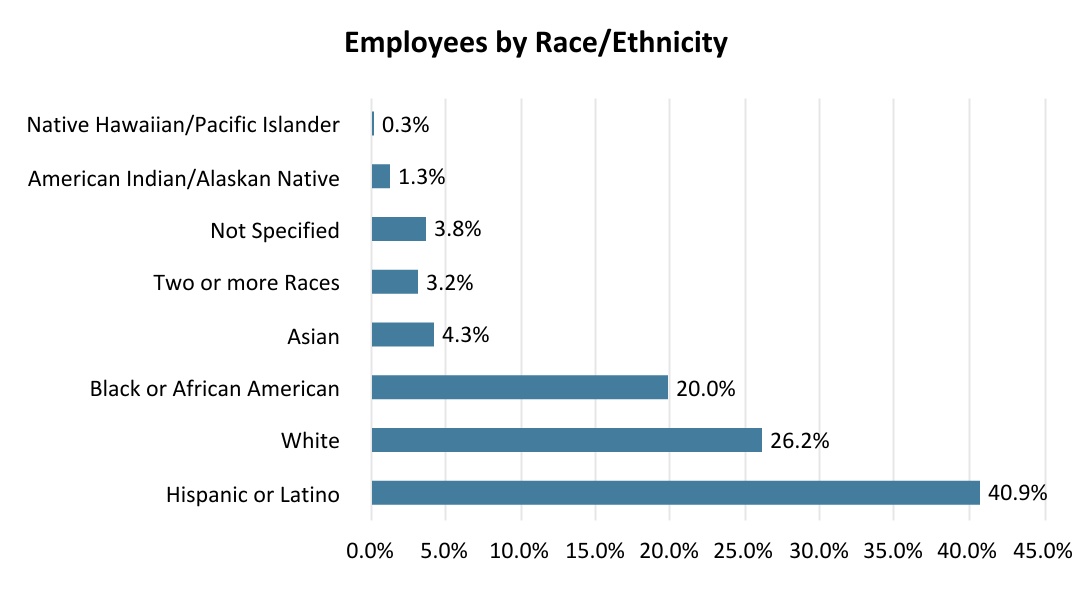
Our most recent Equal Employment Opportunity consolidated report is posted on the Investors page of our website at www.ir.chipotle.com under Corporate Governance – Human Capital Information and additional details about the demographics of our employee population is included in our biennial Sustainability Report and interim Update Report on our website www.chipotle.com/sustainability*.*
We have undertaken a range of activity to promote a culture of inclusion:
-
We continue to drive a consistent and structured candidate interview process with interview guides. This ensures top candidates are identified through equitable hiring practices in both internal and external candidate interviews. We also launched an internal job board across multiple communication channels to provide increased visibility and access to internal opportunities.
-
In 2024, Chipotle hired a Director of C&I to create and execute a strategy for inclusion, advise across Centers of Excellence, and enhance existing programs with C&I training. This specialized role is also responsible for the continued maturation of our Employee Resource Groups through a new strategy that improves the leader and member experience.
-
We have a holistic approach to pay equity to ensure consistent and equitable compensation among our employees. We retain an independent third-party compensation consultant each year to conduct a pay equity analysis of our U.S. and Canadian workforce, including factors of pay (e.g., grade level, tenure in role, most recent promotion) and external market conditions (e.g., geographic location), to ensure equitable treatment among our employees. In 2024, our review included 99% of our U.S. and Canadian employee population, excluding only approximately 50 of our most senior management employees. The analysis identified small, isolated pay gaps for certain segments of the population, and we subsequently made pay adjustments to close those gaps. Since there are not many common roles among our 50 most senior executives, we consider both internal equity by level, as well as individualized market data, to help ensure we maintain pay equity among this group.
Talent Management
We are committed to cultivating a high-performing workforce through a talent development strategy that prioritizes attracting, developing, and retaining exceptional talent at every level of the organization. In 2024, we promoted over 23,000 employees. Importantly, amongst our Field Leadership roles (Field Leaders, Team Directors, Regional Directors of Operations, and Regional Vice Presidents), the internal promotion rate was above 80%.
Our robust hiring, onboarding, and training programs ensure our newly hired and recently promoted employees are set up for success and are aligned with Chipotle's values and goals. We deployed a variety of critical programming ensuring leadership development where most needed. Some notable highlights include:
-
Cultivate University is our leadership training program for new Field Leaders and Team Directors navigating multi-unit management for the first time. Leaders are brought together for a four-day immersive leadership experience designed to bolster leadership skills, while validating and grounding attendees in the operational skills necessary to succeed. In 2024, we had 129 leaders complete the program.
-
We introduced additional required restaurant leader training at all levels in 2024, building skills around accountability, coaching, feedback, delegation, and resolving conflict. The courses are designed to align with the leadership skills necessary to excel at each level of restaurant management.
-
We formalized our Field Leader in Training materials and have seen cohorts launch throughout the business, ensuring that Managers interested in promotion are getting the development they need to take on the next role.
-
Leadership Evolution and Development, our leadership development program, is designed to prepare a cross-functional cohort of mid-level managers for the future of work and leadership. During the 6-month program, participants focus on the capabilities of leading oneself, others, and the business with topics designed to stretch capabilities and improve decision-making skills.
In addition, to ensure leadership continuity, we maintain a robust succession planning process, focusing on critical roles across the company. In 2024, we identified successors for 72% of key positions and continued to develop individualized development plans tailored to prepare successors for readiness. Due to Chipotle's growth, we are excited about two newly created regions and three promotions into Regional Director of Operations and Regional Vice President roles, highlighting additional growth and development for our field teams.
Total Rewards
The financial, physical, and mental well being of our employees remains our top priority. We believe we have compelling compensation packages and incentive programs, and a robust suite of benefit offerings that enable us to engage current team members and attract new team members. In 2024, we conducted an Employee Value Proposition survey which was intended to help us understand what employees appreciate in Chipotle as an employer, what needs improvement and what drives value for our employees. We have gathered valuable insights that will help us continue to improve the employee experience and attract and retain the best talent in the industry. Other areas of Total Rewards that help support our employees include:
-
We have made substantial investments in our compensation packages, including competitive wages and industry leading incentive programs, such as our annual and quarterly bonus programs.
-
We offer a Debt-Free Degree program that provides Chipotle employees' access to nearly 100 degrees at 10 universities, completely tuition free.
-
We support Career Certificates, which further enhances our Tuition Assistance benefits by providing on-demand certificate programs to help Chipotle team members advance their careers in as little as eight weeks.
-
We offer a student loan payment matching programs via our 401(k) retirement program. This, in addition to a credit optimization service, has helped to bolster our employees' financial well-being.
-
We also offer personalized mental health assistance to all Chipotle employees and their family members with support available 24/7 via in-person, phone, or virtual visits with a licensed counselor.
-
Starting in 2025, we are expanding our mental health benefits by offering free access to a mental health app to all U.S. employees.
Employee Listening
We value feedback; both positive sentiments and constructive comments help us improve our organization and culture. Many of our best ideas come from Chipotle employees and we use various communication channels to maintain awareness and responsiveness to questions, concerns, and ideas across our workforce. This includes direct daily engagement through meetings with General Managers, lunch and learns, and other one-on-one interactions.
Employees are encouraged to ask questions, voice concerns directly or anonymously report potential violations of Chipotle's Code of Ethics through our Respectful Workplace hotline. Employees also can raise concerns using other mechanisms, including communication with their managers or human resources business partners. We actively encourage our employees to report any issues or concerns without fear of reprisal, intimidation, or harassment.
We also respond to employee issues quickly via our Employee Service Center which is available seven days a week to resolve employee questions about things like restaurant health and safety, compliance, benefits, payroll, etc.
We are eager to improve our employee engagement efforts and build even stronger feedback mechanisms to ensure our employees feel valued, heard and respected.
Government Regulation and Environmental Matters
We are subject to various federal, state and local laws and regulations that govern aspects of our business operations. While costs associated with compliance with laws and regulations have increased as the number and scope of regulations have increased, the total costs incurred have not had, and are not expected to have, a material effect on our capital expenditures, results of operations or competitive position. See “Risk Factors” in Item 1A for discussion of risks relating to federal, state, local and international laws and regulations applicable to our business.
Seasonality
Seasonal factors influencing our business are described under the heading “Quarterly Financial Data/Seasonality” in Item 7. “Management’s Discussion and Analysis of Financial Condition and Results of Operations.”
Competition
The fast-casual, quick-service, and casual dining segments of the restaurant industry are highly competitive with respect to, among other things, taste, price, food quality and presentation, service, location, convenience, brand reputation, and cleanliness and ambience of each restaurant. Our competition includes a variety of restaurants in each of these segments, including locally-owned restaurants, as well as national and regional chains. Competition from food delivery services, which offer meals from a wide variety of restaurants, also has increased in recent years and is expected to continue to increase. Many of our competitors also offer dine-in, carry-out, online, catering, and delivery services. Among our main competitors are restaurant formats that claim to serve higher quality ingredients without artificial flavors, colors and preservatives, and that serve food quickly and at a reasonable price.
Our Intellectual Property and Trademarks
“Chipotle,” “Chipotle Mexican Grill,” “Food with Integrity,” “Responsibly Raised,” “Chipotle Rewards,” and a number of other marks and related designs and logos are U.S. registered trademarks of Chipotle. We have filed trademark applications for a number of additional marks in the U.S. as well. In addition to our U.S. registrations, we have registered trademarks for “Chipotle” and a number of other marks in Canada, the European Union, the Middle East and various other countries, and have filed trademark applications for “Chipotle Mexican Grill,” “Chipotle” and a number of other marks in additional countries. We also believe that the design of our restaurants is our proprietary trade dress and have registered elements of our restaurant design for trade dress protection in the U.S. as well.
From time to time, we have taken action against other restaurants that we believe are misappropriating our trademarks, restaurant designs or advertising. Although our policy is to protect and defend vigorously our rights to our intellectual property, we may not be able to adequately protect our intellectual property, which could harm the value of our brand and adversely affect our business.
Available Information
We maintain a website at www.chipotle.com, including an investor relations section at ir.chipotle.com, on which we routinely post important information, such as webcasts of quarterly earnings calls and other investor events in which we participate or host, and any related materials. Our Code of Ethics and our Supplier Code of Conduct also are available in this section of our website. You may access our annual reports on Form 10-K, quarterly reports on Form 10-Q, current reports on Form 8-K and amendments to those reports, as well as other reports relating to us that are filed with or furnished to the SEC, free of charge in the investor relations section of our website as soon as reasonably practicable after such material is electronically filed with or furnished to the SEC. The SEC also maintains a website that contains reports, proxy and information statements and other information regarding issuers that file electronically with the SEC at www.sec.gov.
The contents of the websites mentioned above and elsewhere in this report are not incorporated into and should not be considered a part of this report. The references to the URLs for these websites are intended to be inactive textual references only.
Item 1A. RISK FACTORS
You should carefully consider the risks described below in addition to the other information set forth in this Annual Report on Form 10-K, including the “Management’s Discussion and Analysis of Financial Conditions and Results of Operations” section and the consolidated financial statements and related notes. If any of the risks and uncertainties described below occur or continue to occur, our business, financial condition and results of operations, and the trading price of our common stock could be materially and adversely affected. The risks and uncertainties described below are those that we have identified as material but are not the only risks and uncertainties we face. Our business is also subject to general risks and uncertainties that affect many other companies, including, but not limited to, overall economic and industry conditions. Additional risks not currently known to us or that we presently deem immaterial may arise or become material and may negatively impact our business, reputation, financial condition, results of operations or the trading price of our common stock.
Risks Related to our Brand Reputation and Restaurant Operations
Food safety and food-borne illness concerns may have an adverse effect on our business by negatively impacting our brand, decreasing sales and increasing costs.
Food safety is our top priority, and we dedicate significant resources to ensuring that our guests enjoy safe, high-quality food products. However, even with strong preventative controls and interventions from farm to restaurant, food safety risks cannot be completely eliminated. Incidents of food-borne illnesses continue to occur in the restaurant and retail food industries and incidents may result from the failure of restaurant employees to properly cook or maintain our ingredients, employees or guests entering our restaurant while infected with communicable diseases, or contaminated ingredients resulting from the failure of one of our suppliers to execute food safety preventive controls. Although we monitor and audit compliance with our program, we cannot guarantee that every food item is safely and properly maintained from the start of the supply chain through guest consumption. Any report, legitimate or rumored, of food-borne illness caused by pathogens such as E. coli, hepatitis A, norovirus, listeria, Campylobacter, Clostridium perfringens or salmonella, or other food safety issues, such as food tampering or contamination, at one of our restaurants could adversely affect our reputation and have a negative impact on our sales. In addition, instances of food-borne illness or food safety issues that occur solely at competitors’ restaurants, suppliers or distributors (even if we do not work with them) could result in negative publicity about the restaurant industry and adversely impact our sales. The occurrence of food-borne illnesses or food safety issues could also adversely affect the price and availability of affected ingredients, resulting in higher costs and lower margins.
We may be at a higher risk for food safety incidents than some competitors due to our greater use of fresh, unprocessed produce, handling of raw chicken in our restaurants, our reliance on employees cooking with traditional methods and the lack of artificial preservatives and frozen ingredients in our menu items. The risk of illnesses associated with our food also may increase due to our delivery or catering businesses, in which our food is transported, stored and/or served in conditions that are not under our control. All of these factors could have an adverse impact on our ability to attract and retain guests, which could in turn have a material adverse effect on our growth and profitability. In addition, real or perceived concerns about emerging food safety issues, such as phthalates, per- and polyfluoroalkyl substances ("PFAS"), microplastics or heavy metals in the U.S. food supply chain, could impact consumers’ confidence in the restaurant industry and reduce restaurant sales.
Failure to maintain the reputation and relevance of the Chipotle brand could negatively impact our financial results*.*
We built strong value in the Chipotle brand by serving delicious, high quality food, made fresh every day using responsibly sourced ingredients served in generous portions. Our continued success depends on maintaining this compelling brand value, which may be eroded by numerous factors, some of which are outside of our control. Incidents that could erode trust in our brand include actual or perceived food safety or food-borne illnesses; allegations of unethical, racially-biased, inequitable, or socially irresponsible behavior by employees and/or guests; privacy breaches or violations of privacy laws; safety-related incidents occurring in or around our restaurants; guest perceptions regarding smaller entrée portion sizes; or other events or incidents described in this risk factors section. The adverse impact of such incidents may be compounded by negative publicity, including through social or digital media, or if they result in litigation. Social media, video-sharing, networking, and gaming and messaging platforms dramatically increase the speed with which negative publicity is disseminated, often before we have a meaningful opportunity to investigate, respond to and address an issue. Negative online postings or comments about us, including as a result of inaccurate, fictitious or malicious postings or media content, have in the past and could in the future magnify and prolong the adverse impact of any one incident and increase the damage to the value of our brand.
Additionally, consumer demand for our products and our brand value could diminish significantly if we, our employees or business partners fail to comply with applicable laws and regulations, take controversial positions or actions, fail to deliver a consistently positive guest experience or fail to foster an inclusive and welcoming environment. In addition, we cannot ensure that our restaurant crew or business partners will not take actions that adversely affect our brand reputation and relevance.
The restaurant industry is highly competitive. If we are not able to compete successfully, our business, financial condition and results of operations would be adversely affected.
The restaurant industry is highly competitive with respect to taste preferences, price, food quality and selection, customer service, brand reputation, digital engagement, advertising and promotional initiatives, and the location, attractiveness and maintenance of restaurants. We also compete with non-traditional market participants, such as “convenience meals” in the form of entrées, side dishes or meal preparation kits from grocery stores, meal kit delivery services, and “ghost” or “dark” kitchens, where meals are prepared at separate takeaway premises rather than a restaurant, and with delivery aggregators and food delivery services, which provide consumers with convenient access to a broad range of competing restaurant chains and food retailers, particularly in urbanized areas, and may form a closer relationship with our guests. Increased competition could have an adverse effect on our sales, profitability and development plans. If guest tastes or dietary preferences change, if our marketing efforts are unsuccessful, or if our restaurants are unable to compete successfully with other restaurant outlets, our business could be adversely affected.
We continue to believe our commitment to higher-quality and responsibly sourced ingredients resonates with guests and gives us a competitive advantage; however, many of our competitors also make claims related to the quality of their ingredients and lack of artificial flavors, colors and preservatives. The increasing use of these claims by competitors, regardless of the accuracy of such claims, may lessen our differentiation and make it more difficult for us to compete. If we are unable to continue to maintain our distinctiveness and compete effectively, our business, financial condition and results of operations could be adversely affected.
Our investments in technology and automation to transform and enhance the experience of our employees and guests may not generate the expected results.
We have launched several initiatives to make our food preparation and cooking processes more efficient and drive a better experience for our employees and consumers, most of which are still moving through our “stage gate” development and evaluation process. These initiatives include a dual sided plancha, which is our cooking grill; an automated produce slicer; an automated make line by Hyphen, which would automatically assemble guest ordered bowls and salads; and Autocado, an automated avocado processing device that cuts, cores and scoops avocados. We have invested significant time and resources into developing and testing these technologies, but there can be no guarantee that all or any of them will be widely deployed throughout our restaurant network or, if deployed, will materially improve employee or guest experience or our financial performance. We also continue to build upon our investments in digital ordering and guest engagement to enhance guest experience and strengthen our ties with our guests. If these initiatives are not ultimately deployed or if we do not fully realize the intended benefits of these significant investments, our business results may suffer.
Our use of third-party delivery services may not be profitable and substandard service may negatively impact our reputation.
Over 15% of our 2024 food and beverage revenue consisted of delivery orders for which we are reliant on third-party delivery companies. Depending on which ordering platform a guest uses – our platform or the third-party delivery service platform – the delivery fee we collect from the guest may be less than the actual delivery cost. As the delivery industry consolidates, delivery companies gain greater leverage in negotiating the terms of contracts and increasing pricing, which in turn could negatively impact our profits from this channel. If the third-party delivery companies we utilize increase the fees they charge users or give greater priority or promotions on their platforms to other restaurants, our delivery business and our sales may be negatively impacted. In addition, if a third-party delivery driver fails to deliver an order on time, fails to deliver the complete order or otherwise provides a bad guest experience, our guest may attribute that negative experience to Chipotle and our reputation and sales could be adversely impacted. The ordering and payment platforms used by these third parties, our mobile app or our online ordering site have been and could again be interrupted by technological failures, user errors, cyber-attacks or other factors, which could adversely impact sales through these channels and negatively impact our overall sales and reputation.
Risks Related to Human Capital
If we are not able to hire, develop and retain qualified restaurant employees and/or appropriately plan our workforce, our growth plan and profitability could be adversely affected.
The aggressive pace at which we open new restaurants can make it increasingly difficult to recruit and hire sufficient numbers of qualified employees to manage and work in our restaurants, to train employees to deliver a consistently high-quality product and guest experience and to maintain an effective system of internal controls for a dispersed workforce, which could materially harm our business and results of operations. Maintaining appropriate staffing in our restaurants requires precise workforce planning, which has become more complex due to predictive scheduling laws (also called “fair workweek” or “secure scheduling”) and “just cause” termination legislation in certain geographic areas where we operate. The market for qualified talent continues to be competitive and we must continue to offer competitive wages, benefits and workplace conditions to retain qualified employees. We have experienced and may continue to experience challenges in hiring and retaining restaurant employees and in maintaining full restaurant staffing in various locations, which has resulted in longer wait times for guest orders, temporary closures of the digital make line and decreased employee and guest satisfaction. A shortage of qualified candidates who meet legal work authorization requirements, failure to hire, train and retain new restaurant employees in a timely manner or higher than expected turnover levels could affect our ability to open new restaurants, grow sales at existing restaurants or meet our labor cost objectives. Anticipated changes in immigration laws and regulations could decrease the pool of candidates with legal work authorization, cause disruption in the workforce for all companies that rely on hourly workers and increase the costs, time and requirements to hire new employees. In addition, failure to adequately monitor and proactively respond to employee dissatisfaction could lead to poor guest satisfaction, higher turnover, litigation and unionization efforts, which could negatively impact our financial results. We have experienced labor union efforts to organize groups of our employees from time to time and, if successful, those organizational efforts may decrease our operational flexibility and disrupt our normal operations, which could adversely affect our business.
If we fail to comply with applicable employment and labor laws and regulations, it could have a material, adverse impact on our business.
Various employment and labor laws and regulations govern our relationships with our employees, both within and outside the U.S. These laws and regulations relate to matters such as employment discrimination, wage and hour laws, requirements to provide and document meal and rest periods or other benefits, family leave mandates, requirements regarding working conditions and accommodations to certain employees, requirements relating to setting and changing work schedules, citizenship or work authorization and related requirements, insurance and workers’ compensation rules, healthcare laws, anti-discrimination laws, including pay transparency requirements, and anti-harassment laws. We incur substantial costs to comply with these laws and regulations and non-compliance could expose us to significant liabilities. For example, we have had lawsuits filed against us alleging violations of federal and state laws regarding employee wages and payment of overtime, meal and rest breaks, pay transparency to applicants and related practices. We incur legal costs to defend these types of cases, and we could incur losses from these and similar cases, and the amount of such costs and losses could be material.
In addition, some jurisdictions in which we operate have implemented fair workweek or “secure scheduling” legislation, which impose complex requirements related to scheduling for certain restaurant employees; sick pay and paid time off legislation, which requires employers to provide paid time off to employees; and/or “just cause” termination legislation, which restricts companies’ ability to terminate employees or reduce employees’ hours unless they can prove “just cause” or a “bona fide economic reason” for the termination or reduction in hours. Additional jurisdictions are considering similar types of legislation. All of these regulations impose additional obligations on us, which could increase our operating costs, and our failure to comply with any of these regulations could subject us to penalties and other legal liabilities, which could adversely affect our ability to attract and retain employees and our results of operations, and potentially cause us to close or reduce operating hours of some restaurants in these jurisdictions. For example, in 2022 we settled a complaint alleging that we violated New York City’s Fair Workweek law and Earned Safe and Sick Time Act, and we have undergone several audits of our compliance with employment law requirements, which could result in additional liabilities. Our liability exposure for these employment laws and regulations may be higher than our restaurant peers because we have more employees, since we are one of the largest restaurant companies that owns and operates all our restaurants, while most of our restaurant peers franchise some or a significant portion of their operations.
Increases in the cost of labor, including mandated minimum wage increases and increases in the cost of health benefits, could adversely impact our business and profitability.
Our profitability has been and could continue to be adversely impacted by increases in labor costs, including wages and health benefits, which are some of our most significant costs, including increases triggered by federal, state and local laws governing matters such as minimum wages, meal and rest breaks and changes to eligibility for overtime pay; regulations regarding scheduling and benefits; increased health care and workers’ compensation insurance costs; and higher wages and benefit costs necessary to attract, hire and retain high-quality employees with the right skill sets in a highly competitive job market. In addition, state and local laws may require wage increases and standards on working hours and other factors that would restrict our flexibility to respond to market conditions and increase our costs without corresponding benefits. For example, in 2024 California required national restaurant chains, including Chipotle, to pay a minimum $20 per hour wage to California restaurant workers, which minimum wage may be increased annually by a state-appointed council. Other states, counties and cities are considering similar regulations. Our ability to offset higher labor costs by increasing menu prices depends on the willingness of our guests to pay the higher prices and the perceived value of our meals relative to competitors. If competitive or inflationary pressures or other factors prevent us from offsetting higher labor costs by increased menu prices, our profitability may decline.
A failure to recruit, develop and retain effective leaders or the loss or shortage of management personnel with key capacities and skills could impact our strategic growth plans and jeopardize our ability to meet our business performance expectations and growth targets.
Our ability to continue to grow our business depends substantially on the contributions and abilities of our executive leadership team and other key management personnel. Changes in senior management could result in significant changes in strategic direction and initiatives. A failure to maintain appropriate organizational capability to support our strategic initiatives, a failure to implement appropriate development programs and build adequate bench strength with key skillsets, or a failure to effectively manage our leadership succession, could jeopardize our ability to meet our business performance expectations and growth targets. If we are unable to attract, develop, retain and incentivize sufficiently experienced and capable management personnel, our business and financial results may suffer.
Risks Related to Cybersecurity, Data Privacy and IT Systems
Breaches or other unauthorized access, theft, modification or destruction of guest and/or employee personal, confidential or other material information that is stored in our systems or by third parties on our behalf could damage our reputation and expose us to potential liabilities.
As our reliance on technology has grown, the scope and severity of potential risks from cyber threats has increased. Many of our information technology systems (whether cloud-based or hosted in proprietary servers), including those used for our point-of-sale, web and mobile platforms, online and mobile payment systems, delivery services and rewards programs and administrative functions, contain personal, financial or other information that is entrusted to us by our guests, business partners and employees. Many of our information technology systems also contain confidential information about our business, such as business strategies, development initiatives and designs, and confidential information about third parties, such as suppliers. Similar to many other restaurant companies, we have in the past experienced, and we expect to continue to experience, cyber-attacks, including phishing, and other attempts to breach, or gain unauthorized access to, our systems and databases. To date, these attacks have not had a material impact on our operations, but we cannot provide assurance that they will not have an impact in the future.
Our third-party providers’ and business partners’ information technology systems and databases are subject to similar risks. The number and frequency of these attempts varies from year to year and increases as the scope and scale of our technology footprint and digital operations increases. In addition, we provide guest and employee data, as well as confidential information important to our business to third parties. Individuals performing work for us and these third parties also may access some of this data, including on personally owned digital devices. To the extent we, a third party or such an individual were to experience a breach of our or their information technology systems that results in the unauthorized access, theft, use, destruction or other compromises of guests’ or employees’ data or confidential information of Chipotle stored in or transmitted through such systems, including through cyber-attacks or other external or internal methods, it could result in a material loss of revenues from the potential adverse impact to our reputation and brand, a decrease in our ability to retain guests or attract new ones, the imposition of potentially significant costs (including loss of data or payment for recovery of data) and liabilities, loss of business, loss of business partners and licensees and the disruption to our supply chain, business and plans. Unauthorized access, theft, use, destruction or other compromises are becoming increasingly sophisticated and may occur through a variety of methods, including attacks using malicious code, vulnerabilities in software, hardware or other infrastructure (including systems used by our supply chain), system misconfigurations, phishing, deepfakes, ransomware, malware or social engineering. The rapid evolution and increased adoption of artificial intelligence technologies may intensify our cybersecurity risks. Our logging capabilities, or the logging capabilities of third parties, are not always complete or sufficiently granular, affecting our ability to fully understand the scope of security breaches.
Given the increasing complexity and sophistication of techniques used by bad actors to obtain unauthorized access to or disable information technology systems, and the fact that cyberattacks are being made by groups and individuals with a wide range of expertise and motives, it is increasingly difficult to anticipate and defend against cyberattacks, and a cyberattack could occur and persist for an extended period of time before being detected. Moreover, the extent of a particular cyber incident and the steps that we may need to take to investigate the incident may not be immediately clear, and it may take a significant amount of time before such investigation can be finalized and completed and reliable information about the incident is known. During the pendency of any such investigation, we may not know the extent of the harm or how best to remediate it, and we may be required to disclose incidents before their full extent is known.
Such security breaches also could result in a violation of applicable U.S. and international privacy, cyber and other laws or trigger data breach notification laws, including new disclosure rules promulgated by the SEC, and subject us to private third party or securities litigation and governmental investigations and proceedings, any of which could result in our exposure to material civil or criminal liability. These risks also exist in companies that license our brand, that we partner with or invest in that use separate information systems.
We may be required to make significant capital investments and other expenditures to investigate security incidents, remedy cybersecurity problems, recuperate lost data, prevent future compromises and adapt systems and practices to react to the changing threat environment. These include costs associated with notifying affected individuals and other agencies, additional security technologies and training, hiring additional employees, retention of experts and providing credit monitoring services for individuals whose data has been breached. These costs could be material and could adversely impact our results of operations in the period in which they are incurred, including by causing us to delay the pursuit of other important business strategies and initiatives, and may not meaningfully limit the success of future attempts to breach our information technology systems.
Media or other reports of existing or perceived security vulnerabilities in our systems or those of our third-party business partners or service providers can also adversely impact our brand and reputation and negatively impact our business. Additionally, the techniques and sophistication used to conduct cyber-attacks and compromise information technology systems, as well as the sources and targets of these attacks, change frequently and are often not recognized until such attacks are launched or have been in place for a period of time. The rapid evolution and increased adoption of artificial intelligence technologies amplifies these concerns. We continue to make significant investments in technology, third-party services and employees to develop and implement systems and processes that are designed to anticipate cyber-attacks and to prevent or minimize breaches of our information technology systems or data loss, but these security measures cannot provide assurance that we will be successful in preventing such breaches or data loss.
If we fail to fully comply with privacy and data protection laws and regulations, we could incur significant civil and criminal penalties and liabilities, suffer reputational damage, and adverse publicity.
Complex local, state, federal and international laws and regulations apply to the collection, use, retention, protection, disclosure, transfer and other processing of personal data. These privacy and data protection laws and regulations are quickly evolving, with new or modified laws and regulations proposed and implemented frequently and existing laws and regulations subject to new or different interpretations and enforcement. Complying with these laws and regulations can be costly and can delay or impede the development of new services.
For example, Europe’s General Data Protection Regulation (“GDPR”) and the U.K. General Data Protection Regulation (which implements the GDPR into U.K. law), impose stringent data protection requirements and provide for significant penalties for noncompliance. Additionally, the California Consumer Privacy Act (“CCPA”) requires, among other things, covered companies to provide specified disclosures to California consumers and allows them to exercise certain rights in connection with their personal information, such as the right to opt-out of certain sales of personal information and to request deletion of personal information (subject to certain exceptions). The CCPA also provides for civil penalties for violations as well as a private right of action for data breaches that may increase data breach litigation. Further, the California Privacy Rights Act, which became effective in January 2023, significantly modified the CCPA to include additional compliance obligations. Since the CCPA was first passed, 19 other states have enacted similar data privacy legislation, eight of which are in effect as of the end of 2024. In addition, a number of other states have passed or are considering additional privacy laws, including laws on health data and biometric data that are in effect, or are expected to take effect in the near future. These state privacy laws will require us to incur additional costs and expenses in our efforts to comply.
If we fail or are perceived to have failed to comply with applicable privacy and data protection laws, or fail to properly respond to or honor consumer requests under any of the foregoing privacy laws, we could be subject to enforcement actions and regulatory investigations, or claims for damages by guests and other affected individuals or parties, or incur fines and damage to our brand reputation, any of which could have a material adverse effect on our operations, financial performance, and business. The amount and scope of insurance we maintain may not cover all types of claims that may arise.
We rely heavily on information technology systems and failures or interruptions in our IT systems could harm our ability to effectively operate our business and/or result in the loss of guests or employees.
We are heavily dependent on information technology systems, including for administrative functions, point-of-sale and payment processing in our restaurants, digital ordering and delivery business, tracing ingredients back to suppliers and growers, digital Hazard Analysis and Critical Control Points monitoring, monitoring and managing our supply chain, our guest rewards program, marketing initiatives, employee engagement and payroll processing, and various other processes and transactions. Our ability to effectively manage our business and coordinate the procurement, production, distribution, safety and sale of our products depends significantly on the consistent availability, reliability and security of these systems. Many of these critical systems are provided and managed by third parties, and we are reliant on these third-party providers to implement protective measures that ensure the security and availability of their systems. Although we have operational safeguards in place and we take efforts to ensure that our third-party providers have implemented proper standards and controls, we cannot guarantee that breaches or failures caused by these third-party systems or platforms will not occur. Failures may be caused by various factors, including power outages, natural disasters and other catastrophic events, physical theft, computer and network failures, inadequate or ineffective redundancy, problems with transitioning to upgraded or replacement systems or platforms, flaws in third-party software or services, errors or improper use by our employees or the third-party service providers. If any of our critical IT systems were to become unreliable, unavailable, compromised or otherwise fail, and we were unable to recover in a timely manner, we could experience an interruption in our operations that could have a material adverse impact on our profitability.
Risks Related to Our Supply Chain
Increases in the costs of ingredients, restaurant equipment and other materials could adversely affect our financial results.
The prices for some of our ingredients, such as beef, avocados and other produce fluctuate due to factors beyond our control, such as limited sources, seasonal shifts, climate conditions, inclement weather, natural disasters, inflation, military and geopolitical conflicts and industry demand, including as a result of animal disease outbreaks, international commodity markets, food safety concerns, product recalls and government regulation. In addition, we source some ingredients (including avocados, tomatoes, beef, pork, limes and peppers) restaurant equipment, packaging and paper products outside the U.S. (including from Mexico, Canada and China), which could subject them to increased tariffs, trade sanctions or taxes. We try to mitigate future price risk through forward contracts, strong partnerships with key suppliers, directly managing key raw material procurement and diversifying our supply base and countries of origin; however, these activities may not fully insulate us from increases in costs, which could have an adverse impact on our profitability.
We also could be adversely impacted by price increases specific to meats raised in accordance with our Responsibly Raised animal welfare criteria, and ingredients grown in accordance with our Food with Integrity specifications, the markets for which are generally smaller and more concentrated than the markets for conventionally raised or grown ingredients. Any increase in the prices of the ingredients most critical to our menu, such as chicken, beef, dairy (for cheese, sour cream and queso), avocados, tomatoes and pork, would have a particularly adverse effect on our operating results. If the cost of one or more ingredients significantly increases, we may choose to temporarily suspend serving menu items that use those ingredients, such as guacamole or one of our proteins, rather than pay the increased cost. Any such changes to our available menu may negatively impact our restaurant traffic and could adversely impact our sales and brand.
Shortages or interruptions in the supply of ingredients could adversely affect our operating results.
Our business is dependent on frequent and consistent deliveries of ingredients that comply with our Food with Integrity specifications, such as dairy (for cheese, sour cream and queso) and chicken that meets our Responsibly Raised requirements. We may experience shortages, delays or interruptions in the supply of ingredients and other supplies to our restaurants due to higher or more lucrative demand from other sources; inclement weather or natural disasters; animal disease outbreaks (such as avian flu); social or labor unrest; shortages of agricultural workers (including due to changes in immigration laws); operational disruptions at our suppliers, distributors or transportation providers (including due to cyberattacks, malware or ransomware); financial distress or insolvency of suppliers or distributors, or the inability of suppliers or distributors to manage adverse business conditions; or other conditions beyond our control. Ongoing global conflicts have disrupted and could continue to disrupt some shipping routes, which could result in shortages or delays of certain ingredients and packaging. In addition, we have a single or a limited number of suppliers for some of our ingredients, including lemon and lime juice, tomatoes and adobo. Although we believe we have potential alternative suppliers and sufficient reserves of ingredients, shortages or interruptions in our supply of ingredients could adversely affect our financial results.
If our supply chain capacity does not expand to match our new restaurant growth, our long-term growth goals could be impaired or delayed.
We have set aggressive goals for the number of new restaurants we plan to open over the next few years. Even in the absence of extraordinary disruptions, we may not be able to increase the capacity of our supply chain to keep pace with our growth and fully meet our future business needs. We have experienced and may in the future experience limited available supplies of Responsibly Raised proteins and ingredients that meet our Food with Integrity specifications. In addition, we rely on independent third-party distributors to maintain an inventory of our ingredients and supplies, and deliver them to our restaurants on a timely, as needed basis. There can be no assurance that our suppliers or distributors will be able to accommodate our planned growth or continue to supply required ingredients at preferential prices or at all. An inability of our suppliers to accommodate our growth in a timely or cost-effective manner could impair our growth and have an adverse effect on our business, financial condition, results of operations, and prospects.
Legal and Regulatory Risks
We could be party to litigation or other legal proceedings that could adversely affect our business, results of operations and reputation.
We have been and will continue to be subject to litigation and other legal proceedings that may adversely affect our business, including claims brought by employees, guests, government agencies, suppliers, distributors, shareholders, job applicants or others. These proceedings may be in the form of private actions, administrative proceedings, government enforcement or regulatory actions and litigation on a class or collective basis on behalf of what can be a large group of potential claimants. These legal proceedings have involved, and in the future may involve, allegations of illegal, unfair or inconsistent employment practices, including those governing wage and hour, employment of minors, discrimination, harassment, wrongful termination, and vacation and family leave laws; food safety issues including food-borne illness, food contamination and adverse health effects from consumption of our food products; data security or privacy breaches; discrimination against guests or job applicants; personal injury in our restaurants; marketing and advertising claims, including claims that our Food with Integrity, marketing or sustainability claims are misleading or inaccurate; infringement of patent, copyright or other intellectual property rights; violation of the federal securities laws; workers’ compensation; or other concerns. We are party to a number of pending lawsuits and governmental audits alleging violations of federal and state employment laws, including wage and hour claims, and we could be involved in similar or even more significant litigation and legal proceedings in the future. Even if the allegations against us are unfounded or we ultimately are held not liable, the costs to defend ourselves may be significant and the proceedings may divert management's attention away from operating our business, all of which could negatively impact our financial condition and results of operations. A judgment significantly in excess of any applicable insurance coverage or third-party indemnity could materially adversely affect our financial condition or results of operations. In addition, adverse publicity resulting from claims may damage our reputation.
We are subject to extensive laws, government regulation, and other legal requirements and our failure to comply with existing or new laws and regulations could adversely affect our operational efficiencies, ability to attract and retain talent and results of operations.
Our business is subject to extensive federal, state, local and international laws and regulations, including those relating to:
-
preparation, sale and labeling of food, including regulations of the Food and Drug Administration, which oversees the safety of the entire food system and covers inspections and mandatory food recalls, menu labeling and nutritional content;
-
employment practices and working conditions, including minimum wage rates, wage and hour practices, meal and rest breaks, fair workweek/secure scheduling and “just cause” legislation, employment of minors, discrimination, harassment, classification of employees, paid and family leave, workplace safety, immigration and overtime among others;
-
privacy and data security (including regulations governing the protection of personal information, advertising and marketing, access by children, biometrics, surveillance, artificial intelligence, health-related information and financial information), such as California Privacy Rights Act and CCPA in California and privacy-related legislation in a growing number of other states, and international laws such as GDPR in the European Union and Personal Information Protection and Electronic Documents Act in Canada;
-
health, sanitation, safety and fire standards and the sale of alcoholic beverages;
-
building and zoning requirements, including state and local licensing and regulation governing the design and operation of facilities and land use;
-
claims made in marketing and advertising, including regarding nutritional information and sustainability impacts;
-
public accommodations and safety conditions, including the Americans with Disabilities Act and similar state laws that give civil rights protections to individuals with disabilities in the context of employment, public accommodations, online resources and other areas;
-
environmental matters, such as emissions and air quality; water consumption; the discharge, storage, handling, release and disposal of hazardous or toxic substances; local ordinances restricting the types of packaging we can use in our restaurants; and claims we make about our sustainability practices and achievements;
-
new or increased tariffs, trade sanctions or taxes; and
-
public company compliance, disclosure and governance matters, including accounting and tax regulations, SEC and NYSE disclosure requirements.
Compliance with these laws and regulations, and future new laws or changes in these laws or regulations that impose additional requirements, can be costly. If the Food and Drug Administration or other government agency adopts new laws and regulations in response to real or perceived emerging food safety, such as concerns over phthalates, PFAS, microplastics or heavy metals in the U.S. food supply, it could impose new processes that disrupt our suppliers’ operations, increase costs or both. Any failure or perceived failure to comply with applicable laws or regulations could result in, among other things, revocation of required licenses, administrative enforcement actions, fines and civil and criminal liability.
Risks Related to Our Growth and Business Strategy
If we are unable to meet our new restaurant opening goals, or maintain the attractiveness of our existing restaurants, our profitability could suffer.
Our growth depends on our ability to open new restaurants at an aggressive rate and operate them profitably as soon as possible. The cost of opening new restaurants has continued to increase due to construction labor inflation and increased costs of materials and equipment. In addition, we incur substantial startup expenses each time we open a new restaurant, and it can take up to 36 months to ramp up the sales and profitability of a new restaurant, during which time costs may be higher as we train new employees and build up a guest base. If we are unable to build the guest base that we expect or fail to overcome the higher startup expenses associated with new restaurants, our new restaurants may not be as profitable as our existing restaurants. In addition, the opening of new stores may negatively impact the profitability of existing stores that are located nearby.
Our ability to open and profitably operate new restaurants also is subject to various risks, such as the identification and availability of desirable locations; the negotiation of acceptable lease terms; the need to obtain all required governmental permits (including zoning approvals and liquor licenses) and comply with other regulatory requirements; the availability of capable contractors and subcontractors; increases in the cost and decreases in the availability of labor and building material; changes in weather, natural disasters, pandemics or other acts of God that could delay construction and adversely affect guest traffic; our ability to hire and train qualified management and restaurant employees; and general economic and business conditions. At each potential location, we compete with other restaurants and retail businesses for desirable development sites, construction contractors, management personnel, hourly employees and other resources. If we are unable to successfully manage these risks, we could face increased costs and lower than anticipated sales and earnings in future periods. Our timeline for completing construction also has gotten longer, due to landlord reluctance to commit to building in light of fluctuating interest rates, tight money supply and general economic conditions, and due to backlogs and long wait times for us to obtain required permits and utility hookups.
In addition, we need to maintain the attractiveness of our existing restaurants through remodels, upgrades and regular upkeep. If the costs associated with remodels, upgrades or regular upkeep are higher than anticipated, restaurants are closed for remodeling for longer periods than planned or remodeled restaurants do not perform as expected, which could have a negative effect on our operating results, and we may not realize our projected desired return on investment.
Our failure to effectively manage and support our growth could have a negative adverse effect on our business and financial results.
As of December 31, 2024, we owned and operated over 3,700 Chipotle restaurants and we plan to open a significant number of new restaurants in the next several years, working towards our long-term goal of 7,000 restaurants in North America. Our existing restaurant management systems, back-office technology systems and processes, financial and management controls, information systems and staffing may not be adequate to support our growing business. To effectively manage a larger number of restaurants, we may need to upgrade and expand our infrastructure and information systems, automate more processes that currently are manual or require manual intervention and hire, train and retrain restaurant employees and corporate support staff, all of which may result in increased costs and at least temporary inefficiencies. We also believe our culture is an important contributor to our success, and as we continue to grow it may be increasingly difficult to imbed and maintain our culture across the company. Our failure to sufficiently invest in our infrastructure and information systems and maintain our strong staffing and culture could harm our brand and operating results.
If we partner with third parties or acquire new businesses that do not align with our core values or that do not fulfill their contractual responsibilities and commitments, our brand reputation and international growth plans could suffer.
Our global growth strategy includes expanding our existing restaurant footprint and introducing Chipotle in new international jurisdictions in which we currently do not operate. The success of our strategy will depend on our identifying and partnering with new business partners, including licensees, joint venture partners, suppliers and distributors, and may include identifying suitable acquisition targets in these new jurisdictions that align with our core values. In 2024, the first licensed Chipotle restaurants opened in Kuwait and Dubai in partnership with international franchise retail operator Alshaya Group, and there are plans to open more licensed restaurants in other areas in the Middle East. We believe guests expect the same high quality food and excellent customer service at restaurants operated by licensees and joint venture partners as they receive in Chipotle-owned and operated restaurants. We provide extensive training to our business partners and we require compliance with specific food quality and safety standards and guest service levels in our agreements with business partners; however, we do not have direct control over the restaurants operated by third-party partners, and the quality and service in those restaurants may be less than the quality and service of Chipotle-operated restaurants. Failure of our business partners to adhere to our high food quality and operating standards, comply with applicable law, adhere to high ethical standards, and create a culture of respect in their restaurants could damage our brand reputation, domestically and internationally, and impair our international expansion plans. New partnerships and/or acquisitions also may divert management’s attention from other initiatives and/or day-to-day operations, which could adversely affect our business and results of operations.
The market price of our common stock may be more volatile than the market price of our peers.
We believe the market price of our common stock generally has traded at a higher price-earnings ratio than stocks of most of our peer companies as well as the overall market, which typically has reflected market expectations for higher future operating results. At any given point in time, our price-earnings ratio may trade at more than twice the price-earnings ratio of the S&P 500. Also, the trading market for our common stock has been volatile at times, including because of adverse publicity events. As a result, if we fail to meet market expectations for our operating results in the future, any resulting decline in the price of our common stock could be significant.
Risks Related to Sustainability Factors
We are subject to evolving public disclosure requirements and expectations, including with respect to sustainability matters, that could expose us to numerous risks and could adversely affect our reputation and results of operations.
We are subject to evolving disclosure obligations promulgated by governmental and regulatory organizations relating to sustainability factors that impact our business. These disclosure obligations are complex and not always consistent, making compliance difficult and uncertain. In addition, investors, guests and other stakeholders increasingly are focusing on sustainability matters and related disclosures. We have incurred and expect to continue to incur increased expenses and management time and attention to comply with these disclosure obligations and stakeholder expectations. For example, measuring Scope 1, 2 and 3 greenhouse gas emissions relating to our business, developing reduction plans and initiatives, and creating and disclosing achievable reduction goals can be costly, difficult and time consuming and is subject to evolving reporting standards, including California’s Climate Corporate Data Accountability Act, California’s Greenhouse Gases: Climate-Related Financial Risk Bill and similar proposals by other national, local and international regulatory agencies. We may also communicate certain initiatives, goals and strategies regarding environmental sustainability and human capital management related matters, such as workforce metrics, responsible sourcing and social investments in our SEC filings or in other public disclosures. We previously announced that we had set science-based targets validated by the Science Based Targets Initiative to reduce absolute Scope 1, 2 and 3 greenhouse gas emissions 50% by 2030 from a 2019 base year, and achievement of this goal is subject to risks and uncertainties, many of which are outside of our control. Achievement of this goal may prove to be more difficult and costly than we anticipate.
In addition, statements about our sustainability-related initiatives and goals, and progress toward those goals, may be based on standards for measuring progress that are still developing, internal controls and processes that continue to evolve, and assumptions that are subject to change in the future. If we are unable to meet our sustainability-related goals or evolving stakeholder or industry expectations and standards, or if we are perceived to have not responded appropriately to the growing concern for sustainability issues, investors, guests and other stakeholders may choose to patronize a competitor that they perceive to be more responsive, and our reputation, business or financial condition may be adversely affected. If our sustainability-related data, processes and reporting are incomplete or inaccurate, or if we fail to achieve progress with respect to our sustainability goals on a timely basis, or at all, our reputation, business, financial performance and growth could be adversely affected.
In addition, we could be criticized by anti-ESG stakeholders for the scope or nature of our sustainability initiatives or goals or for any revisions to these goals. We could also be subjected to negative responses by governmental actors (such as anti-ESG legislation or retaliatory legislative treatment) or consumers (such as boycotts or negative publicity campaigns) that could adversely affect our reputation, business, financial performance and growth.
Climate change and volatile adverse weather conditions could adversely affect our restaurant sales or results of operations.
There is growing concern that climate change and global warming has caused and may continue to cause more severe, volatile weather or extended droughts, which could increase the frequency and duration of weather impacts on our operations. Adverse weather conditions have in the past and may again impact guest traffic at our restaurants and, in more severe cases such as hurricanes, tornadoes, wildfires or other natural disasters, cause temporary restaurant closures, all of which negatively impact our restaurant sales. In addition, our supply chain is subject to increased costs caused by the effects of climate change and diminished energy and water resources. Increasing weather volatility and changes in global weather patterns could reduce crop size and crop quality, or destroy crops altogether, which could result in decreased availability or higher pricing for our produce and other ingredients. We may be forced to source ingredients from new geographic regions, which could impact quality and taste, and increase our costs. These factors are beyond our control and may be unpredictable. Climate change and government regulation relating to climate change mitigation also could result in construction delays for new restaurants and interruptions to the availability or increases in the cost of utilities. The ongoing and long-term costs of these impacts related to climate change and other sustainability-related issues could have a material adverse effect on our business and financial condition if we are not able to mitigate them.
General Risk Factors
Economic and business factors that are largely beyond our control may adversely affect consumer behavior and our financial results.
Restaurant dining generally is dependent upon consumer discretionary spending, which may be affected by general economic conditions that are beyond our control. Increasing or prolonged high inflation, international, domestic and regional economic conditions, consumer income levels, financial market volatility, a slow or stagnant pace of economic growth, mass layoffs, rising energy costs, rising interest rates, social unrest, military conflicts and governmental, political and budget concerns or divisions may have a negative effect on consumer confidence and discretionary spending. Persistent inflation and concern about a prolonged economic downturn may lead consumers to decrease their discretionary spending. A significant decrease in guest traffic or average transaction size would negatively impact our financial performance. The actual or perceived threat of a pandemic or communicable disease, terrorist attack, mass shooting, heightened security requirements, including cybersecurity, or a failure to protect information systems for critical infrastructure, such as the electrical grid and telecommunications systems, could harm our operations, the economy or consumer confidence generally. Any of the above factors or other unfavorable changes in business and economic conditions affecting our guests could increase our costs, reduce traffic in our restaurants or limit our ability to increase pricing, any of which could lower our profit margins and have a material adverse effect on our sales, financial condition and results of operations. These factors also could cause us to, among other things, reduce the number and frequency of new restaurant openings, close restaurants or delay remodeling of our existing restaurant locations. Further, poor economic conditions may force nearby businesses to shut down, which could reduce traffic to our restaurants or cause our restaurant locations to be less attractive.
In addition, we purchase ingredients, packaging and equipment from both U.S. and international suppliers and we may need to increase our menu prices in response to increased inflation, higher taxes, new tariffs on imported goods, wage increases due to a tighter job market and other macro-economic factors. Higher menu prices or the perceived value of our meals relative to competitors may lead consumers to reduce their spending in our restaurants or switch to competitors’ value or lower-priced meals. If competitive or other factors prevent us from offsetting these higher costs through menu price increases, our profitability may decline.
Our quarterly financial results may fluctuate significantly, including due to factors that are not in our control.
Our quarterly financial results may fluctuate significantly and could fail to meet investors’ expectations for various reasons, including:
-
negative publicity about the safety of our food, employment-related issues, guest safety, litigation or other issues involving our restaurants;
-
fluctuations in supply costs, particularly for our most significant ingredients, and our inability to offset the higher cost with price increases, without adversely impacting guest traffic;
-
our inability to purchase sufficient quantities of our key ingredients and equipment as our restaurant count grows;
-
labor availability and wages of restaurant management and employees;
-
increases in marketing or promotional expenses;
-
the timing of new restaurant openings and related revenues and expenses, and the operating costs at newly opened restaurants;
-
the impact of inclement weather and natural disasters, such as freezes and droughts, which could decrease guest traffic and increase the costs of ingredients;
-
the amount and timing of stock-based compensation;
-
litigation, settlement costs and related legal expenses;
-
taxes, new or increased tariffs or trade sanctions, asset impairment charges and non-operating costs; and
-
variations in general economic conditions, including the impact of rising inflation and the impact of rising interest rates on consumer demand trends.
As a result of any of these factors, results for any one quarter are not necessarily indicative of results to be expected for any other quarter or for any year. Average restaurant sales or comparable restaurant sales in any future period may decrease.
Item 1B. UNRESOLVED STAFF COMMENTS
None.
Item 1C. CYBERSECURITY
Cybersecurity Risk Management and Strategy
As a global company, we are regularly subject to cyberattacks and other cybersecurity incidents. In response, we have implemented cybersecurity processes, technologies, and controls to aid in our efforts to assess, identify, and manage cybersecurity risks. Our enterprise risk management framework considers cybersecurity risk alongside other company risks as part of our overall risk assessment process. Our enterprise risk management team collaborates with our Information Security function, led by our Chief Information Security Officer (“CISO”) and our Chief Customer and Technology Officer (“CCTO”), to gather insights for assessing, identifying and managing cybersecurity threat risks, their severity, and potential mitigations. We also are a member of an industry cybersecurity intelligence and risk sharing organization to stay abreast of changes in the cybersecurity environment.
We assess Chipotle’s Information Security program using an industry cybersecurity framework from the National Institute of Standards and Technology. This program includes policies, processes and procedures that help assess and identify our cybersecurity risks and inform how security measures and controls are developed, implemented and maintained. The risk assessment along with risk-based analysis and judgment are used to select security controls to address risks. During this process, the following factors, among others, are considered: likelihood and severity of risk, impact on the Company and others if a risk materializes, feasibility and cost of controls and impact of controls on operations.
We maintain internal resources to perform penetration testing designed to simulate evolving tactics and techniques of real-world threat actors, engage with industry partners and law enforcement and intelligence communities and conduct tabletop exercises and periodic risk interviews across our business. We also engage an independent third party to periodically perform internal and external penetration testing of Chipotle's information security environment and engage other third parties to periodically conduct assessments of our cybersecurity capabilities. In addition, we continue to expand training and awareness practices to mitigate risk from human error, including mandatory computer-based training and internal communications for employees. Our employees undergo cybersecurity awareness training and regular phishing awareness campaigns that are based upon and designed to emulate real-world contemporary threats. We provide prompt feedback (and, if necessary, additional training or remedial action) based on the results of such exercises.
Our processes also address cybersecurity risks associated with our use of third-party service providers including suppliers, software and cloud-based service providers, as well as third-party security firms used in different capacities to provide or operate some of our cybersecurity controls and technology systems. We proactively evaluate the cybersecurity risk of a third party by utilizing a repository of risk assessments, external monitoring sources, threat intelligence and predictive analytics to better inform Chipotle during contracting and vendor selection processes. Additionally, when third party risks are identified, we require those third parties to agree by contract to implement appropriate security controls. Security issues are documented and tracked, and periodic monitoring of third parties is conducted in an effort to mitigate risk.
In addition to the processes, technologies, and controls that we have in place to reduce the likelihood of a material cybersecurity incident (or series of related cybersecurity incidents), Chipotle has a written incident response plan outlining how to address cybersecurity events that occur. The plan sets forth the steps for coordination among various corporate functions and governance groups and serves as a framework for the execution of responsibilities across businesses and operational roles. Our incident response plan is designed to help us coordinate actions to prepare for, detect, respond to and recover from cybersecurity incidents, and includes processes to triage, assess severity, escalate, contain, investigate, and remediate the incident, as well as to assess the need for disclosure, comply with applicable legal obligations and mitigate the impact to our brand and reputation and on impacted parties. We also maintain insurance coverage that, subject to its terms and conditions, is intended to help us cover certain costs associated with cybersecurity incidents and information system failures.
In addition to our cybersecurity incident response plan, we conduct tabletop exercises to enhance our incident response preparedness. We maintain business continuity and disaster recovery plans to prepare for and respond to the potential for a disruption in the technology we rely on.
Chipotle (or the third parties it relies on) may not be able to fully, continuously, or effectively implement security controls as intended. As described above, we utilize a risk-based approach and judgment to determine whether and how to implement certain security controls and it is possible that we may not implement the necessary controls if we are unable to recognize or underestimate a particular risk. In addition, security controls, no matter how well designed or implemented, may only mitigate and not fully eliminate cybersecurity risks. Cybersecurity events, when detected by security tools or third parties, may not always be identified immediately or addressed in the manner intended by our cybersecurity incident response plan.
Impact of cybersecurity risks on business strategy, results of operations or financial condition
Based on the information available as of the date of this Annual Report, we have no reason to believe any risks from cybersecurity threats, including as a result of any previous cybersecurity incidents, have materially affected or are reasonably likely to materially affect us, including our business strategy, results of operations or financial condition. For additional information, see “Risks Related to Cybersecurity, Data Privacy and IT Systems,” in Item 1A, “Risk Factors” in this Annual Report.
Cybersecurity Governance
Our cybersecurity risk management and strategy processes are led by our CISO and our CCTO. These individuals have collectively over 50 years of professional experience in various roles across multiple industries involving managing information security, developing cybersecurity strategy, implementing effective information and cybersecurity programs and managing multiple industry and regulatory compliance environments. Both individuals previously held positions similar to their current roles at other large publicly traded organizations.
Cybersecurity is an important part of our risk management processes and an area of focus for our Board of Directors (the “Board”) and management. Although cybersecurity risk oversight continues to remain a top priority for the Board, the Audit and Risk Committee of our Board has primary oversight responsibility for the Company’s cybersecurity and other technology risks. The Committee regularly reviews with and discusses cybersecurity, privacy and data security programs, the status of projects to strengthen internal cybersecurity, results from third-party assessments, and any significant cybersecurity incidents, including recent incidents at other companies and the emerging threat landscape with our CISO and CCTO. The Committee also reviews with management the implementation and effectiveness of the Company’s controls to monitor and mitigate cybersecurity risks. In addition, our Board receives an annual report and quarterly written updates regarding our cybersecurity program.
Item 2. PROPERTIES
As of December 31, 2024, Chipotle and our consolidated subsidiaries owned and operated 3,726 restaurants. Our main office is located at 610 Newport Center Drive, Suite 1100, Newport Beach, CA 92660 and our telephone number is (949) 524-4000. We lease our main office and substantially all of the properties on which we operate restaurants. We own 17 properties and operate restaurants on all of them. For additional information regarding the lease terms and provisions, see Note 1. “Description of Business and Summary of Significant Accounting Policies” and Note 9. “Leases” in our consolidated financial statements included in Item 8. “Financial Statements and Supplementary Data.”
Item 3. LEGAL PROCEEDINGS
For information regarding legal proceedings, see Note 11. “Commitments and Contingencies” in our consolidated financial statements included in Item 8. “Financial Statements and Supplementary Data.”
Item 4. MINE SAFETY DISCLOSURES
Not applicable.
PART II
Item 5. MARKET FOR REGISTRANT’S COMMON EQUITY, RELATED SHAREHOLDER MATTERS AND ISSUER PURCHASES OF EQUITY SECURITIES
Our common stock trades on the New York Stock Exchange under the symbol “CMG.”
As of January 31, 2025, there were approximately 2,394 shareholders of record. This does not include persons whose stock is in nominee or “street name” accounts through brokers.
Purchases of Equity Securities by the Issuer
The table below reflects shares of common stock we repurchased during the fourth quarter of 2024.
| Period | Total Number of Shares Purchased | Average Price Paid Per Share | Total Number of Shares Purchased as Part of Publicly Announced Plans or Programs**(1)** | Approximate Dollar Value of Shares that May Yet Be Purchased Under the Plans or Programs**(2)** | ||||||||||||||||||||||
| Purchased 10/1 through 10/31 | 1,474,582 | $ | 58.05 | 1,474,582 | $ | 973,992,478 | ||||||||||||||||||||
| Purchased 11/1 through 11/30 | 2,348,512 | $ | 59.14 | 2,348,512 | $ | 835,097,636 | ||||||||||||||||||||
| Purchased 12/1 through 12/31 | 1,713,277 | $ | 62.31 | 1,713,277 | $ | 1,028,341,738 | ||||||||||||||||||||
| Total | 5,536,371 | $ | 59.83 | 5,536,371 |
(1)Shares were repurchased pursuant to repurchase programs announced on July 24, 2024 and October 29, 2024.
(2)The December total includes an additional $300 million in authorized repurchases approved on December 17, 2024 and announced February 4, 2025. There is no expiration date for this program. The authorization to repurchase shares will end when we have repurchased the maximum amount of shares authorized, or we have determined to discontinue such repurchases.
Dividend Policy
We are not required to pay any dividends and have not declared or paid any cash dividends on our common stock. We intend to continue to retain earnings for use in the operation and expansion of our business and to repurchase shares of common stock (subject to market conditions), and therefore do not anticipate paying any cash dividends on our common stock in the foreseeable future.
COMPARISON OF CUMULATIVE TOTAL RETURN
The following graph compares the cumulative annual stockholders return on our common stock from December 31, 2019, through December 31, 2024, to that of the total return index for the S&P 500 and the S&P 500 Restaurants Index assuming an investment of $100 on December 31, 2019. In calculating total annual stockholder return, reinvestment of dividends, if any, is assumed. The indices are included for comparative purposes only. They do not necessarily reflect management’s opinion that such indices are an appropriate measure of the relative performance of our common stock. The values shown are neither indicative nor determinative of future performance. This graph is not “soliciting material,” is not deemed filed with the Securities and Exchange Commission and is not to be incorporated by reference in any of our filings under the Securities Act or the Exchange Act, whether made before or after the date hereof and irrespective of any general incorporation language in any such filing.
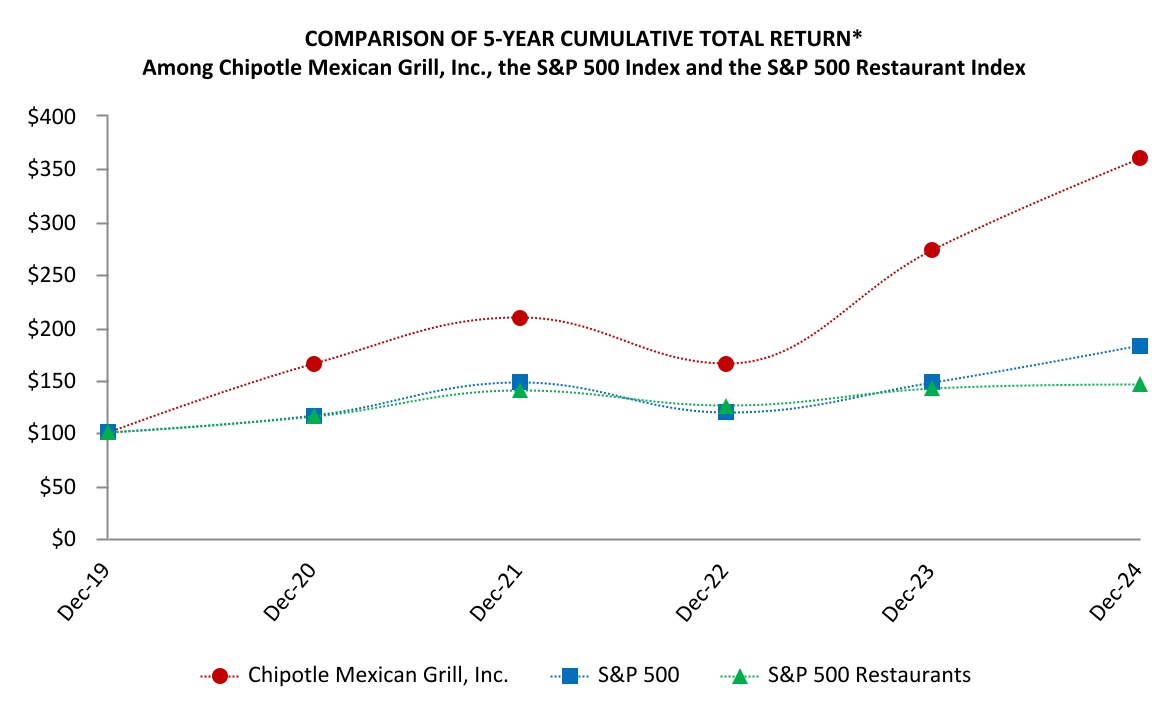
| Company/Index | 2019 | 2020 | 2021 | 2022 | 2023 | 2024 | |||||||||||||||||||||||||||||
| Chipotle Mexican Grill, Inc. | $ | 100 | $ | 166 | $ | 209 | $ | 166 | $ | 273 | $ | 360 | |||||||||||||||||||||||
| S&P 500 | 100 | 116 | 148 | 119 | 148 | 182 | |||||||||||||||||||||||||||||
| S&P 500 Restaurants | 100 | 116 | 140 | 126 | 142 | 146 |
*$100 invested on December 31, 2019, in stock or index, including reinvestment of dividends.
Fiscal year ending December 31, 2024.
Source data: Bloomberg
Item 6. RESERVED
Item 7. MANAGEMENT’S DISCUSSION AND ANALYSIS OF FINANCIAL CONDITION AND RESULTS OF OPERATIONS
You should read the following discussion together with our consolidated financial statements and related notes included in Item 8. “Financial Statements and Supplementary Data.” This section of the Form 10-K generally discusses 2024 items and year-to-year comparisons of 2024 to 2023. Discussions of 2022 items and year-to-year comparisons of 2023 and 2022 that are not included in this Form 10-K can be found in “Management’s Discussion and Analysis of Financial Condition and Results of Operations” in Part II, Item 7 on our Annual Report on Form 10-K for the year ended December 31, 2023. The discussion contains forward-looking statements involving risks, uncertainties and assumptions that could cause our results to differ materially from expectations. See “Cautionary Note Regarding Forward-Looking Statements.” Factors that might cause such differences include those described in Item 1A. “Risk Factors”, 7A. "Quantitative and Qualitative Disclosure About Market Risk", and elsewhere in this report.
Overview
As of December 31, 2024, we owned 3,644 Chipotle restaurants throughout the United States, and 82 international Chipotle restaurants. Additionally, we had three international licensed restaurants. We manage our U.S. operations based on ten regions and aggregate our operations to one reportable segment.
Throughout “Management’s Discussion and Analysis of Financial Condition and Results of Operations” we commonly discuss the following key operating metrics which we believe will drive our financial results and long-term growth model. We believe these metrics are useful to investors because management uses these metrics to assess the growth of our business and the effectiveness of our marketing and operational strategies:
-
Comparable restaurant sales
-
Food, beverage, and packaging as a percentage of total revenue
-
Labor as a percentage of total revenue
-
Occupancy as a percentage of total revenue
-
Other operating costs as a percentage of total revenue
-
New restaurant openings
2024 Financial Highlights, year-over-year:
-
Total revenue increased 14.6% to $11.3 billion
-
Comparable restaurant sales increased 7.4%
-
Diluted earnings per share was $1.11, a 24.7% increase from $0.89
Sales Trends. Comparable restaurant sales increased 7.4% for the year ended December 31, 2024. The increase is attributable to higher transactions of 5.3% and a 2.1% increase in average check. Comparable restaurant sales represent the change in period-over-period total revenue for restaurants in operation for at least 13 full calendar months. Digital sales represented 35.1% of total food and beverage revenue. For 2025, management is anticipating comparable restaurant sales growth in the low to mid-single digit range.
Restaurant Development. During the year ended December 31, 2024, we opened 304 restaurants, which included 257 restaurants with a Chipotlane. We expect to open approximately 315 to 345 company-owned restaurants in 2025. We expect that at least 80% of our new company-owned restaurants will include a Chipotlane.
Licensing. During the year ended December 31, 2024, three licensed restaurants were opened in the Middle East.
Cultivate Next Fund. Our Cultivate Next Fund is a venture formed to make early-stage investments into strategically aligned companies that further our purpose to Cultivate a Better World. The Fund is authorized to invest up to $100.0 million, which is financed almost entirely by Chipotle. As of December 31, 2024, we have made $63.0 million in investments through this Fund.
Restaurant Activity
The following table details company-owned restaurant unit data for the years indicated.
| Year ended December 31, | |||||||||||
| 2024 | 2023 | ||||||||||
| Beginning of period | 3,437 | 3,187 | |||||||||
| Chipotle openings | 304 | 270 | |||||||||
| Non-Chipotle openings | - | 1 | |||||||||
| Chipotle permanent closures | (7) | (3) | |||||||||
| Chipotle relocations | (8) | (12) | |||||||||
| Non-Chipotle permanent closures | - | (6) | |||||||||
| Total at end of period | 3,726 | 3,437 |
The following table details licensed restaurant unit data for the years indicated.
| Year ended December 31, | |||||||||||||||||||||||
| 2024 | 2023 | ||||||||||||||||||||||
| Beginning of period | - | - | |||||||||||||||||||||
| Licensed restaurant openings | 3 | - | |||||||||||||||||||||
| Total at end of period | 3 | - |
Results of Operations
Our results of operations as a percentage of total revenue and period-over-period change are discussed in the following section.
Revenue
| Year ended December 31, | Percentage | ||||||||||||||||
| 2024 | 2023 | change | |||||||||||||||
| (dollars in millions) | |||||||||||||||||
| Food and beverage revenue | $ | 11,247.4 | $ | 9,804.1 | 14.7% | ||||||||||||
| Delivery service revenue | 66.5 | 67.5 | (1.6 | %) | |||||||||||||
| Total revenue | $ | 11,313.9 | $ | 9,871.6 | 14.6% | ||||||||||||
| Average restaurant sales (1) | $ | 3.213 | $ | 3.018 | 6.5% | ||||||||||||
| Comparable restaurant sales increase | 7.4% | 7.9% | |||||||||||||||
| Transactions | 5.3% | 5.0% | |||||||||||||||
| Average check | 2.1% | 2.9% | |||||||||||||||
| Menu price increase | 2.9% | 5.2% | |||||||||||||||
| Check mix | (0.8 | %) | (2.3 | %) |
(1)Average restaurant sales refers to the average trailing 12-month food and beverage revenue for restaurants in operation for at least 12 full calendar months.
The following is a summary of the change in restaurant sales for the period indicated:
| Year ended | |||||||||||
| (dollars in millions) | |||||||||||
| For the period ended December 31, 2023 | $ | 9,871.6 | |||||||||
| Change from: | |||||||||||
| Comparable restaurant sales | 695.4 | ||||||||||
| Restaurants not yet in comparable base opened in 2024 | 290.4 | ||||||||||
| Restaurants not yet in comparable base opened in 2023 | 453.7 | ||||||||||
| Other | 2.8 | ||||||||||
| For the period ended December 31, 2024 | $ | 11,313.9 |
Food, Beverage and Packaging Costs
| Year ended December 31, | Percentage | ||||||||||||||||
| 2024 | 2023 | change | |||||||||||||||
| (dollars in millions) | |||||||||||||||||
| Food, beverage and packaging | $ | 3,374.5 | $ | 2,912.6 | 15.9% | ||||||||||||
| As a percentage of total revenue | 29.8% | 29.5% | 0.3 | % |
Food, beverage and packaging costs increased 0.3% as a percentage of total revenue for the year ended December 31, 2024 compared to the year ended December 31, 2023. The increase was due to higher usage of ingredients as we focused on ensuring consistent and generous portions, inflation across several ingredient costs, primarily avocados, and a protein mix shift from the Smoked Brisket limited time offering and a Braised Beef Barbacoa marketing initiative. This increase was partially offset by a 1.0% benefit from menu price increases.
Labor Costs
| Year ended December 31, | Percentage | ||||||||||||||||
| 2024 | 2023 | change | |||||||||||||||
| (dollars in millions) | |||||||||||||||||
| Labor costs | $ | 2,789.8 | $ | 2,441.0 | 14.3% | ||||||||||||
| As a percentage of total revenue | 24.7% | 24.7% | - | % |
Labor costs remained flat as a percentage of total revenue for the year ended December 31, 2024 compared to the year ended December 31, 2023. The 1.1% benefit from sales leverage was mostly offset by 0.9% due to restaurant wage inflation, of which 0.4% was due to minimum wage increases for our restaurants in California.
Occupancy Costs
| Year ended December 31, | Percentage | ||||||||||||||||
| 2024 | 2023 | change | |||||||||||||||
| (dollars in millions) | |||||||||||||||||
| Occupancy costs | $ | 563.4 | $ | 503.3 | 11.9% | ||||||||||||
| As a percentage of total revenue | 5.0% | 5.1% | (0.1 | %) |
Occupancy costs decreased 0.1% as a percentage of total revenue for the year ended December 31, 2024 compared to the year ended December 31, 2023, primarily due to 0.3% of sales leverage partially offset by 0.2% of increased occupancy expense, of which 0.1% was associated with existing restaurants and 0.1% was associated with new restaurants.
Other Operating Costs
| Year ended December 31, | Percentage | ||||||||||||||||
| 2024 | 2023 | change | |||||||||||||||
| (dollars in millions) | |||||||||||||||||
| Other operating costs | $ | 1,568.5 | $ | 1,428.7 | 9.8% | ||||||||||||
| As a percentage of total revenue | 13.9% | 14.5% | (0.6 | %) |
Other operating costs decreased 0.6% as a percentage of total revenue for the year ended December 31, 2024 compared to the year ended December 31, 2023, primarily due to 0.5% of sales leverage and 0.2% of lower delivery expenses.
General and Administrative Expenses
| Year ended December 31, | Percentage | ||||||||||||||||
| 2024 | 2023 | change | |||||||||||||||
| (dollars in millions) | |||||||||||||||||
| General and administrative expenses | $ | 697.5 | $ | 633.6 | 10.1% | ||||||||||||
| As a percentage of total revenue | 6.2% | 6.4% | (0.2 | %) |
The following is a summary of the change in general and administrative expenses for the period indicated:
| Year ended | |||||||||||
| (dollars in millions) | |||||||||||
| For the period ended December 31, 2023 | $ | 633.6 | |||||||||
| Change from: | |||||||||||
| Wages | 20.5 | ||||||||||
| Conferences, primarily the biennial All Managers’ Conference | 17.7 | ||||||||||
| Legal contingencies | 16.6 | ||||||||||
| Outside services related to corporate initiatives | 8.1 | ||||||||||
| Stock-based compensation | 5.3 | ||||||||||
| Restructuring costs | (6.5) | ||||||||||
| Other | 2.2 | ||||||||||
| For the period ended December 31, 2024 | $ | 697.5 |
Impairment, Closure Costs, and Asset Disposals
| Year ended December 31, | Percentage | ||||||||||||||||
| 2024 | 2023 | change | |||||||||||||||
| (dollars in millions) | |||||||||||||||||
| Impairment, closure costs, and asset disposals | $ | 26.9 | $ | 38.4 | (29.8%) | ||||||||||||
| As a percentage of total revenue | 0.2% | 0.4% | (0.2%) |
Impairment, closure costs, and asset disposals decreased in dollar terms for the year ended December 31, 2024 compared to the year ended December 31, 2023, primarily due to a gain on the sale of corporate equipment and higher charges related to the replacement of certain leasehold improvements in the comparable period.
Interest and Other Income, Net
| Year ended December 31, | Percentage | ||||||||||||||||
| 2024 | 2023 | change | |||||||||||||||
| (dollars in millions) | |||||||||||||||||
| Interest and other income, net | $ | 93.9 | $ | 62.7 | 49.8% | ||||||||||||
| As a percentage of total revenue | 0.8% | 0.6% | 0.2% |
Interest and other income, net increased in dollar terms for the year ended December 31, 2024 compared to the year ended December 31, 2023, primarily due to increased interest income from higher investment balances in U.S. Treasury securities, money market funds and time deposits.
Provision for Income Taxes
| Year ended December 31, | Percentage | ||||||||||||||||
| 2024 | 2023 | change | |||||||||||||||
| (dollars in millions) | |||||||||||||||||
| Provision for income taxes | $ | 476.1 | $ | 391.8 | 21.5% | ||||||||||||
| Effective income tax rate | 23.7% | 24.2% | (0.5%) |
The effective income tax rate decreased 0.5% for the year ended December 31, 2024 compared to the year ended December 31, 2023, primarily due to lower nondeductible expenses of 0.6% and income tax reserves of 0.4%. These decreases were partially offset by a 0.6% reduction in tax benefits related to option exercise and equity vesting.
Quarterly Financial Data/Seasonality
Seasonal factors cause our profitability to fluctuate from quarter to quarter. Historically, our average daily restaurant sales and net income are lower in the first and fourth quarters due, in part, to the holiday season and because fewer people eat out during periods of inclement weather (the winter months) than during periods of mild or warm weather (the spring, summer and fall months). Other factors also have a seasonal effect on our results. For example, restaurants located near colleges and universities generally do more business during the academic year. Seasonal factors, however, might be moderated or outweighed by other factors that may influence our quarterly results, such as unexpected publicity impacting our business in a positive or negative way, disease outbreak, epidemic or endemic, the impact of inflation on consumer spending, fluctuations in food or packaging costs, or the timing of menu price increases or promotional activities and other marketing initiatives. The number of trading days in a quarter can also affect our results, although, on an overall annual basis, changes in trading days do not have a significant impact.
Our quarterly results are also affected by other factors such as the amount and timing of non-cash stock-based compensation expense and related tax rate impacts, litigation, settlement costs and related legal expenses, impairment charges and non-operating costs, timing of marketing or promotional expenses, the number and timing of new restaurants opened in a quarter, and closure of restaurants. New restaurants typically have higher operating costs following opening because of the expenses associated with their opening and operating inefficiencies in the months immediately following opening. Accordingly, results for a particular quarter are not necessarily indicative of results to be expected for any other quarter or for any year.
Liquidity and Capital Resources
Cash and Investments
As of December 31, 2024, we had a cash and marketable investments balance of $2.2 billion, non-marketable investments of $85.2 million, and $29.8 million of restricted cash. After funding the current operations in our restaurants and support centers, the first planned use of our cash flow from operations is to provide capital for the continued investment in new restaurant construction. In addition to continuing to invest in our restaurant expansion, we expect to utilize cash flow from operations to: repurchase additional shares of our common stock subject to market conditions; invest in, maintain, and refurbish our existing restaurants; and for general corporate purposes. As of December 31, 2024, $1.0 billion remained available for repurchases of shares of our common stock, which includes the $300.0 million additional authorization approved by our Board of Directors on December 17, 2024. Under the remaining repurchase authorizations, shares may be purchased from time to time in open market transactions, subject to market conditions.
Borrowing Capacity
As of December 31, 2024, we had $500.0 million of undrawn borrowing capacity under a line of credit facility.
Use of Cash
We believe that cash from operations, together with our cash and investment balances, will be sufficient to meet ongoing capital expenditures, working capital requirements and other cash needs for the foreseeable future. Assuming no significant declines in comparable restaurant sales, we expect we will generate positive cash flow for the foreseeable future.
We have not required significant working capital because guests generally pay using cash or credit and debit cards and because our operations do not require significant receivables, nor do they require significant inventories due, in part, to our use of various fresh ingredients. In addition, we generally have the right to pay for the purchase of food, beverages and supplies sometime after the receipt of those items, generally within ten days, thereby reducing the need for incremental working capital to support our growth.
Our total capital expenditures for 2024 were $593.6 million. In 2024, we spent on average about $1.5 million in development and construction costs per new restaurant, or about $1.3 million net of landlord reimbursements of $0.2 million. In 2025, we expect to incur about $683.7 million in total capital expenditures. We expect approximately $502.7 million in capital expenditures related to our construction of new restaurants, before any reductions for landlord reimbursements. We expect the average investment cost for new restaurants opening in 2025 will be slightly higher than the average investment costs for those opened in 2024. We expect approximately $149.0 million in capital expenditures related to investments in existing restaurants including remodeling and similar improvements, new equipment and hardware, and technology to optimize efficiencies. Finally, we expect a portion of our incurred capital expenditures to be for additional corporate initiatives including investments in technology to boost innovation, enhance the guest experience, and improve operations.
The following table summarizes current and long-term material cash requirements as of December 31, 2024, which we expect to fund primarily with operating cash flows:
| Payments Due by Fiscal Year | |||||||||||||||||||||||||||||
| Total | 2025 | 2026-2027 | 2028-2029 | Thereafter | |||||||||||||||||||||||||
| (dollars in millions) | |||||||||||||||||||||||||||||
| Operating leases(1) | $ | 7,204 | $ | 502 | $ | 1,089 | $ | 1,036 | $ | 4,577 | |||||||||||||||||||
| Purchase obligations(2) | 2,289 | 1,161 | 766 | 362 | - | ||||||||||||||||||||||||
| Total | $ | 9,493 | $ | 1,663 | $ | 1,855 | $ | 1,398 | $ | 4,577 |
(1)See Note 9. “Leases” of our consolidated financial statements included in Item 8. “Financial Statements and Supplementary Data.” This includes commitments related to reasonably certain renewal periods for leases that have commenced and includes legally binding lease payments for leases signed but not yet commenced.
(2)Purchase obligations include agreements to purchase goods or services that are enforceable and legally binding on us and that specify all significant terms. We have excluded agreements that are cancellable without penalty. The majority of our purchase obligations relate to food, beverage and packaging, capital projects, information technology, marketing initiatives and corporate sponsorships, and other miscellaneous items.
The above table does not include income tax liabilities for uncertain tax positions for which we are not able to make a reasonably reliable estimate of the amount and period of related future payments. Additionally, we have excluded our estimated loss contingencies, due to uncertainty regarding the timing and amount of payment. See Note 11. “Commitments and Contingencies” of our consolidated financial statements included in Item 8. “Financial Statements and Supplementary Data.”
Cash Flows
Cash provided by operating activities was $2.1 billion for the year ended December 31, 2024, compared to $1.8 billion for the year ended December 31, 2023. The increase was primarily due to higher net earnings and, to a lesser extent, net cash changes in operating assets and liabilities.
Cash used in investing activities was $837.5 million for the year ended December 31, 2024, compared to $946.0 million for the year ended December 31, 2023. The change was primarily associated with a $121.2 million decrease in investment purchases net of investment maturities. This was partially offset by increased capital expenditures of $32.9 million primarily related to costs associated with new restaurant development.
Cash used in financing activities was $1.1 billion for the year ended December 31, 2024, compared to $660.7 million for the year ended December 31, 2023. The change was primarily due to increased repurchases of common stock of $409.2 million.
Critical Accounting Estimates
We describe our significant accounting policies in Note 1. “Description of Business and Summary of Significant Accounting Policies” of our consolidated financial statements included in Item 8. “Financial Statements and Supplementary Data.” Critical accounting estimates are those that we believe are both significant and that require us to make difficult, subjective or complex judgments, often because we need to estimate the effect of inherently uncertain matters. We base our estimates and judgments on historical experiences and various other factors that we believe to be appropriate under the circumstances. Actual results may differ from these estimates, and we might obtain different estimates if we used different assumptions or factors.
Leases
The majority of our operating leases consist of restaurant locations and office space. We determine if a contract contains a lease at inception. Our leases generally have remaining terms of 1-20 years and most include options to extend the leases for additional 5-year periods. Generally, the lease term is the minimum of the noncancelable period of the lease or the lease term inclusive of reasonably certain renewal periods up to a term of 20 years. If the estimate of our reasonably certain lease term was changed, our depreciation and rent expense could differ materially.
Operating lease assets and liabilities are recognized at the lease commencement date, which is the date we control the use of the property. Operating lease liabilities represent the present value of lease payments not yet paid. We made the policy election to combine lease and non-lease components. We consider fixed common area maintenance (“CAM”) part of our fixed future lease payments; therefore, fixed CAM is also included in our operating lease liability. Operating lease assets represent our right to use an underlying asset and are based upon the operating lease liabilities adjusted for prepayments, initial direct costs, lease incentives, and impairment of operating lease assets. To determine the present value of lease payments not yet paid, we estimate incremental borrowing rates corresponding to the reasonably certain lease term. As we have no outstanding debt nor committed credit facilities, secured or otherwise, we estimate this rate based on prevailing financial market conditions, comparable company and credit analysis, and management judgment. If the estimate of our incremental borrowing rate was changed, our operating lease assets and liabilities could differ materially.
Impairment of Long-Lived Assets
Long-lived assets are reviewed for impairment whenever events or changes in circumstances indicate that the carrying amount of an asset may not be recoverable. Long-lived assets are grouped at the lowest level for which identifiable cash flows are largely independent of the cash flows of other assets and liabilities. For restaurant assets, we test impairment at the individual restaurant asset group level, which includes leasehold improvements, property and equipment and operating lease assets.
The fair value measurement for asset impairment is generally based on Level 3 inputs. We first compare the carrying value of the asset (or asset group, referred interchangeably throughout as asset) to the asset’s estimated future undiscounted cash flows. If the estimated undiscounted future cash flows are less than the carrying value of the asset, we determine if we have an impairment loss by comparing the carrying value of the asset to the asset's estimated fair value. The estimated fair value of the asset is generally determined using the income approach to measure the fair value, which is based on the present value of estimated future cash flows. Key inputs to the income approach for restaurant assets include the discount rate, projected revenue and expenses, and sublease income if we are closing the restaurant. In certain cases, management uses other market information, when available, to estimate the fair value of an asset. The impairment charges represent the excess of each asset’s carrying amount over its estimated fair value and are allocated among the long-lived asset or assets of the group.
Our estimates of future revenues and expenses are highly subjective judgments based on internal projections and knowledge of our operations, historical performance, and trends in sales and restaurant operating costs, and can be significantly impacted by changes in our business or economic conditions. The determination of asset fair value is also subject to significant judgment and utilizes valuation techniques including discounting estimated future cash flows and market-based analyses to determine fair value. If our estimates or underlying assumptions, including discount rate and sublease income change in the future, our operating results may be materially impacted.
Stock-based Compensation
We recognize compensation expense for equity awards over the requisite service period based on the award’s fair value. Under our stock incentive plans, we issue stock-only stock appreciation rights ("SOSARs"), restricted stock units ("RSUs"), and performance stock units ("PSUs"). We use the Black-Scholes valuation model to determine the fair value of our SOSARs, and we use the Monte Carlo simulation model to determine the fair value of PSUs that contain market conditions. Both of these models require assumptions to be made regarding our stock price volatility, the expected life of the award and expected dividend rates. The volatility and the expected life assumptions are based on our historical data. Similarly, the compensation expense of performance share awards is based in part on the estimated probability of achieving levels of performance associated with particular levels of payout for performance shares. We determine the probability of achievement of future levels of performance by comparing the relevant performance level with our internal estimates of future performance. Those estimates are based on a number of assumptions, including but not limited to growth in restaurant cash flow dollars, average restaurant level operating margin, and growth in new restaurant openings, and different assumptions may have resulted in different conclusions regarding the probability of achieving future levels of performance relevant to the payout levels for the awards. If we change our estimates of stock price volatility or expected lives of our SOSARs, or if we change our assumptions regarding the probability of achieving future levels of performance with respect to performance share awards, our stock-based compensation expense and results of operations may be materially impacted.
Income Taxes
Our provision for income taxes, deferred tax assets and liabilities and any related valuation allowance requires the use of estimates based on our management’s interpretation and application of complex tax laws and accounting guidance. The majority of our income tax liability is incurred in the U.S. We establish reserves for uncertain tax positions for material, known tax exposures relating to deductions, transactions and other matters involving some uncertainty as to the measurement and recognition of the item. We may adjust these reserves when our judgment changes as a result of the evaluation of new information not previously available and will be reflected in the period in which the new information is available, or due to the expiration of any applicable statute of limitations. While we believe that our reserves are adequate, issues raised by a tax authority may be resolved at an amount different than the related reserve and could materially increase or decrease our income tax provision in future periods.
Item 7A. QUANTITATIVE AND QUALITATIVE DISCLOSURE ABOUT MARKET RISK
Commodity Price Risks
We are exposed to commodity price risks. Many of the ingredients we use to prepare our food, as well as our packaging materials and utilities to run our restaurants, are ingredients or commodities that are affected by the price of other commodities, exchange rates, foreign demand, weather, seasonality, production, availability and other factors outside our control. We work closely with our suppliers and use a mix of forward pricing protocols under which we agree with our supplier on fixed prices for deliveries at some time in the future, fixed pricing protocols under which we agree on a fixed price with our supplier for the duration of that protocol, formula pricing protocols under which the prices we pay are based on a specified formula related to the prices of the goods, such as spot prices or based on changes in industry indices, and range forward protocols under which we agree on a price range for the duration of that protocol. Generally, our pricing protocols with suppliers can remain in effect for periods ranging from one to 24 months, depending on the outlook for prices of the particular ingredient. In some cases, we have minimum purchase obligations. We have tried to increase the number of suppliers for our ingredients, which we believe can help mitigate pricing volatility and supply continuity risks, and we follow industry news, trade tariffs, exchange rates, foreign demand, weather, geopolitical crises and other world events that may affect our ingredient prices. Increases in ingredient prices could adversely affect our results if we choose for competitive or other reasons not to increase menu prices at the same rate at which ingredient costs increase, or if menu price increases result in guest resistance. We also could experience shortages of key ingredients for many unforeseen reasons, such as crop damage due to inclement weather, if our suppliers need to close or restrict operations, or due to industry-wide shipping and freight delays.
Changing Interest Rates
We are exposed to interest rate risk through fluctuations of interest rates on our investments. As of December 31, 2024, we had $2.3 billion in cash and cash equivalents, current and long-term investments, and restricted cash, of which the substantial majority are interest bearing. Changes in interest rates affect the interest income we earn, and therefore impact our cash flows and results of operations.
Foreign Currency Exchange Risk
A portion of our operations consist of activities outside of the U.S. and we have currency risk on the transactions in other currencies and translation adjustments resulting from the conversion of our international financial results into the U.S. dollar. However, a substantial majority of our operations and investment activities are transacted in the U.S., and therefore our foreign currency risk is not material at this date.
Item 8. FINANCIAL STATEMENTS AND SUPPLEMENTARY DATA
Report of Independent Registered Public Accounting Firm
To the Shareholders and the Board of Directors of Chipotle Mexican Grill, Inc.
Opinion on the Financial Statements
We have audited the accompanying consolidated balance sheets of Chipotle Mexican Grill, Inc. (the Company) as of December 31, 2024 and 2023, the related consolidated statements of income and comprehensive income, shareholders' equity and cash flows for each of the three years in the period ended December 31, 2024, and the related notes (collectively referred to as the “consolidated financial statements”). In our opinion, the consolidated financial statements present fairly, in all material respects, the financial position of the Company at December 31, 2024 and 2023, and the results of its operations and its cash flows for each of the three years in the period ended December 31, 2024, in conformity with U.S. generally accepted accounting principles.
We also have audited, in accordance with the standards of the Public Company Accounting Oversight Board (United States) (PCAOB), the Company's internal control over financial reporting as of December 31, 2024, based on criteria established in Internal Control-Integrated Framework issued by the Committee of Sponsoring Organizations of the Treadway Commission (2013 framework) and our report dated February 5, 2025 expressed an unqualified opinion thereon.
Basis for Opinion
These financial statements are the responsibility of the Company's management. Our responsibility is to express an opinion on the Company’s financial statements based on our audits. We are a public accounting firm registered with the PCAOB and are required to be independent with respect to the Company in accordance with the U.S. federal securities laws and the applicable rules and regulations of the Securities and Exchange Commission and the PCAOB.
We conducted our audits in accordance with the standards of the PCAOB. Those standards require that we plan and perform the audit to obtain reasonable assurance about whether the financial statements are free of material misstatement, whether due to error or fraud. Our audits included performing procedures to assess the risks of material misstatement of the financial statements, whether due to error or fraud, and performing procedures that respond to those risks. Such procedures included examining, on a test basis, evidence regarding the amounts and disclosures in the financial statements. Our audits also included evaluating the accounting principles used and significant estimates made by management, as well as evaluating the overall presentation of the financial statements. We believe that our audits provide a reasonable basis for our opinion.
Critical Audit Matter
The critical audit matter communicated below is a matter arising from the current period audit of the financial statements that was communicated or required to be communicated to the audit committee and that: (1) relates to accounts or disclosures that are material to the financial statements and (2) involved our especially challenging, subjective or complex judgments. The communication of the critical audit matter does not alter in any way our opinion on the consolidated financial statements, taken as a whole, and we are not, by communicating the critical audit matter below, providing a separate opinion on the critical audit matter or on the account or disclosure to which it relates.
| Evaluation of stock-based compensation performance condition assumptions | ||||||||
| Description of the Matter | The Company incurred $134.6 million in stock-based compensation expense during the year ended December 31, 2024. Approximately 3,649,000 of the Company’s vested and non-vested stock awards were subject to performance conditions during the year ended December 31, 2024. As described in Notes 1 and 8 of the consolidated financial statements, the Company records the grant date fair value of the performance stock awards and expenses the fair value of the performance stock awards subject to service conditions over the respective vesting period. Stock-based compensation expense of stock awards subject to performance conditions is based on the estimated probability of achieving levels of performance associated with particular levels of payout. Additionally, at each reporting period, the Company evaluates the probable outcome of the performance conditions including consideration of significant assumptions and as applicable, recognizes the cumulative effect of the change in estimate in the period of the change. Auditing the estimated quantity of awards the Company determined are probable of vesting for the Company’s stock awards subject to performance conditions was complex and judgmental. In particular, the stock compensation expense is sensitive to significant assumptions including management’s internal estimates of the Company’s future performance. Those estimates are based on certain targets relating to growth in cumulative base restaurant cash flow dollars. | |||||||
| How We Addressed the Matter in Our Audit | We obtained an understanding, evaluated the design, and tested the operating effectiveness of management’s controls over stock-based compensation. We tested controls over management’s review of the assumptions used with regards to the performance conditions. We also tested management's controls to validate that data used in management’s internal estimates of the Company’s future performance was complete and accurate. Our substantive audit procedures included, among others, testing the significant assumptions underlying the performance conditions (e.g., certain targets related to growth in cumulative base restaurant cash flow dollars) and testing the completeness and accuracy of the underlying data. We evaluated management’s significant assumptions by comparing the assumptions to current market and economic trends, historical results of the Company's business, and to other relevant factors. We additionally performed a sensitivity analysis of the significant assumptions to evaluate the change in the expense to be recognized for the stock awards subject to performance conditions. We also evaluated the adequacy of the Company’s stock-based compensation disclosures included in Notes 1 and 8 of the consolidated financial statements in relation to these matters. |
/s/ Ernst & Young LLP
We have served as the Company’s auditor since 1997.
Irvine, California
February 5, 2025
CHIPOTLE MEXICAN GRILL, INC.
CONSOLIDATED BALANCE SHEETS
(in thousands, except per share data)
| December 31, | |||||||||||
| 2024 | 2023 | ||||||||||
| Assets | |||||||||||
| Current assets: | |||||||||||
| Cash and cash equivalents | $ | 748,537 | $ | 560,609 | |||||||
| Accounts receivable, net | 143,963 | 115,535 | |||||||||
| Inventory | 48,942 | 39,309 | |||||||||
| Prepaid expenses and other current assets | 97,538 | 117,462 | |||||||||
| Income tax receivable | 67,229 | 52,960 | |||||||||
| Investments | 674,378 | 734,838 | |||||||||
| Total current assets | 1,780,587 | 1,620,713 | |||||||||
| Leasehold improvements, property and equipment, net | 2,390,126 | 2,170,038 | |||||||||
| Long-term investments | 868,025 | 564,488 | |||||||||
| Restricted cash | 29,842 | 25,554 | |||||||||
| Operating lease assets | 4,000,127 | 3,578,548 | |||||||||
| Other assets | 113,728 |
Showing the first 8K of 114K characters. Open the full section
Item 9. CHANGES IN AND DISAGREEMENTS WITH ACCOUNTANTS ON ACCOUNTING AND FINANCIAL DISCLOSURE
None.
Item 9A. CONTROLS AND PROCEDURES
We maintain disclosure controls and procedures (as defined in Rule 13a-15(e) promulgated under the Securities Exchange Act of 1934, as amended (the “Exchange Act”)) that are designed to ensure that information required to be disclosed in Exchange Act reports is recorded, processed, summarized and reported within the time periods specified in the Securities and Exchange Commission’s rules and forms, and that such information is accumulated and communicated to our management, including our Chief Executive Officer and Chief Financial Officer, as appropriate, to allow timely decisions regarding required disclosure.
Evaluation of Disclosure Controls and Procedures
As of December 31, 2024, we carried out an evaluation, under the supervision and with the participation of our management, including our Chief Executive Officer and Chief Financial Officer, of the effectiveness of the design and operation of our disclosure controls and procedures. Based on the foregoing, our Chief Executive Officer and Chief Financial Officer concluded that our disclosure controls and procedures were effective as of the end of the period covered by this annual report.
Changes in Internal Control over Financial Reporting
There were no changes during the fiscal quarter ended December 31, 2024 in our internal control over financial reporting (as defined in Rule 13a-15(f) under the Exchange Act) that have materially affected or are reasonably likely to materially affect our internal control over financial reporting**.**
Management’s Annual Report on Internal Control over Financial Reporting
The management of Chipotle Mexican Grill, Inc. is responsible for establishing and maintaining adequate internal control over financial reporting. Our internal control over financial reporting is a process designed to provide reasonable assurance regarding the reliability of financial reporting and the preparation of financial statements for external purposes in accordance with accounting principles generally accepted in the United States of America. Our internal control over financial reporting includes those policies and procedures that (i) pertain to the maintenance of records that, in reasonable detail, accurately and fairly reflect the transactions and dispositions of our assets; (ii) provide reasonable assurance that transactions are recorded as necessary to permit preparation of financial statements in accordance with accounting principles generally accepted in the United States of America, and that our receipts and expenditures are being made only in accordance with authorizations of our management and directors; and (iii) provide reasonable assurance regarding prevention or timely detection of unauthorized acquisition, use, or disposition of assets that could have a material effect on our financial statements.
Because of its inherent limitations, internal control over financial reporting may not prevent or detect misstatements. Also, projections of any evaluation of effectiveness to future periods are subject to the risk that controls may become inadequate because of changes in conditions, or that the degree of compliance with the policies or procedures may deteriorate.
Management assessed the effectiveness of our internal control over financial reporting as of December 31, 2024, based on the framework set forth by the Committee of Sponsoring Organizations of the Treadway Commission in Internal Control—Integrated Framework (the “2013 framework”). Based on that assessment, management concluded that, as of December 31, 2024, our internal control over financial reporting was effective based on the criteria established in the 2013 framework.
Our independent registered public accounting firm, Ernst & Young LLP, has issued an attestation report on the effectiveness of our internal control over financial reporting as of December 31, 2024. This report follows.
Report of Independent Registered Public Accounting Firm
To the Shareholders and the Board of Directors of Chipotle Mexican Grill, Inc.
Opinion on Internal Control Over Financial Reporting
We have audited Chipotle Mexican Grill, Inc.’s internal control over financial reporting as of December 31, 2024, based on criteria established in Internal Control—Integrated Framework issued by the Committee of Sponsoring Organizations of the Treadway Commission (2013 framework) (the COSO criteria). In our opinion, Chipotle Mexican Grill, Inc. (the Company) maintained, in all material respects, effective internal control over financial reporting as of December 31, 2024, based on the COSO criteria.
We also have audited, in accordance with the standards of the Public Company Accounting Oversight Board (United States) (PCAOB), the consolidated balance sheets of the Company as of December 31, 2024 and 2023, the related consolidated statements of income and comprehensive income, shareholders’ equity and cash flows for each of the three years in the period ended December 31, 2024, and the related notes and our report dated February 5, 2025 expressed an unqualified opinion thereon.
Basis for Opinion
The Company’s management is responsible for maintaining effective internal control over financial reporting and for its assessment of the effectiveness of internal control over financial reporting included in the accompanying Management’s Annual Report on Internal Control over Financial Reporting. Our responsibility is to express an opinion on the Company’s internal control over financial reporting based on our audit. We are a public accounting firm registered with the PCAOB and are required to be independent with respect to the Company in accordance with the U.S. federal securities laws and the applicable rules and regulations of the Securities and Exchange Commission and the PCAOB.
We conducted our audit in accordance with the standards of the PCAOB. Those standards require that we plan and perform the audit to obtain reasonable assurance about whether effective internal control over financial reporting was maintained in all material respects.
Our audit included obtaining an understanding of internal control over financial reporting, assessing the risk that a material weakness exists, testing and evaluating the design and operating effectiveness of internal control based on the assessed risk, and performing such other procedures as we considered necessary in the circumstances. We believe that our audit provides a reasonable basis for our opinion.
Definition and Limitations of Internal Control Over Financial Reporting
A company’s internal control over financial reporting is a process designed to provide reasonable assurance regarding the reliability of financial reporting and the preparation of financial statements for external purposes in accordance with generally accepted accounting principles. A company’s internal control over financial reporting includes those policies and procedures that (1) pertain to the maintenance of records that, in reasonable detail, accurately and fairly reflect the transactions and dispositions of the assets of the company; (2) provide reasonable assurance that transactions are recorded as necessary to permit preparation of financial statements in accordance with generally accepted accounting principles, and that receipts and expenditures of the company are being made only in accordance with authorizations of management and directors of the company; and (3) provide reasonable assurance regarding prevention or timely detection of unauthorized acquisition, use, or disposition of the company’s assets that could have a material effect on the financial statements.
Because of its inherent limitations, internal control over financial reporting may not prevent or detect misstatements. Also, projections of any evaluation of effectiveness to future periods are subject to the risk that controls may become inadequate because of changes in conditions, or that the degree of compliance with the policies or procedures may deteriorate.
/s/ Ernst & Young LLP
Irvine, California
February 5, 2025
Item 9B. OTHER INFORMATION
Adoption or Termination of 10b5-1 Trading Plans
Except as disclosed below, no Section 16 officer or director, as defined in Rule 16a-1(f) of the Securities Exchange Act of 1934 adopted modified or terminated a written trading plan for the purchase or sale of the Company’s securities intended to satisfy the affirmative defense conditions of Rule 10b5-1(c) or a non-Rule 10b5-1 trading arrangement (as defined in Item 408 of Regulation S-K of the Exchange Act).
Scott Boatwright, our Chief Executive Officer, adopted a new written trading plan on December 6, 2024 for the sale of up to 247,050 shares of the Company’s common stock, subject to certain conditions, from March 5, 2025, at the earliest, until December 31, 2025, at the latest. This trading plan was adopted during an open trading window and complies with the Company’s Insider Trading Policy. Actual transactions will be disclosed in Section 16 filings made with the SEC in accordance with applicable securities laws, rules and regulations.
Item 9C. DISCLOSURE REGARDING FOREIGN JURISDICTIONS THAT PREVENT INSPECTIONS
Not applicable.
PART III
Item 10. DIRECTORS, EXECUTIVE OFFICERS AND CORPORATE GOVERNANCE
Incorporated by reference from the definitive proxy statement for our 2025 annual meeting of shareholders, which will be filed no later than 120 days after December 31, 2024.
Insider Trading Policy
Chipotle maintains an Insider Trading Policy that applies to members of our Board of Directors, our executive officers and all other employees who have access to material, nonpublic information regarding Chipotle. The Insider Trading Policy is filed as an exhibit to this Annual Report.
Item 11. EXECUTIVE COMPENSATION
Incorporated by reference from the definitive proxy statement for our 2025 annual meeting of shareholders, which will be filed no later than 120 days after December 31, 2024.
Our current and historical practice is to grant equity awards only during periods when our trading window for insiders is open pursuant to our Insider Trading Policy. The annual equity grant, including to our executive officers, usually occurs within one week after we publicly announce our financial results for the fourth quarter and full fiscal year and our interim equity grants during the year (for example, to newly hired or promoted employees) usually occurs within one week after we publicly announce our financial results for a financial quarter. In 2024, the Compensation, People and Culture Committee of our Board approved the annual grant of equity awards on February 9, 2024, which was the day the trading window for insiders opened after we announced our 2023 fourth quarter and full year financial results. We filed our 2023 Annual Report on Form 10-K with the SEC on February 7, 2024; however, our filing occurred after the SEC’s filing cutoff time and our 2023 Annual Report on Form 10-K received a filing date of February 8, 2024. As a result, the annual grant of equity awards to our named executive officers, including the grant of the SOSARs listed in the table below, occurred one business day after the filing of our 2023 Annual Report on Form 10-K with the SEC.
| Name | Grant Date | Number of securities underly the award | Exercise price of the award ($/SH) | Grant date fair value of the award | Percentage change in the closing market price of the securities underlying the award between the trading day ending immediately prior to the disclosure of material nonpublic information and the trading day beginning immediately following the disclosure of material nonpublic information | ||||||||||||||||||||||||
| Brian Niccol | 2/9/2024 | 476,800 | $ | 52.77 | $ | 8,048,384 | (1.08)% | ||||||||||||||||||||||
| Jack Hartung | 2/9/2024 | 154,000 | $ | 52.77 | $ | 2,599,520 | (1.08)% | ||||||||||||||||||||||
| Curt Garner | 2/9/2024 | 148,100 | $ | 52.77 | $ | 2,499,928 | (1.08)% | ||||||||||||||||||||||
| Scott Boatwright | 2/9/2024 | 118,500 | $ | 52.77 | $ | 2,002,800 | (1.08)% | ||||||||||||||||||||||
| Chris Brandt | 2/9/2024 | 56,300 | $ | 52.77 | $ | 950,592 | (1.08)% |
Item 12. SECURITY OWNERSHIP OF CERTAIN BENEFICIAL OWNERS AND MANAGEMENT AND RELATED STOCKHOLDER MATTERS
Incorporated by reference from the definitive proxy statement for our 2025 annual meeting of shareholders, which will be filed no later than 120 days after December 31, 2024.
| (a) Number of Securities to be Issued Upon Exercise of Outstanding Options and Rights**(1)** | (b) Weighted-Average Exercise Price of Outstanding Options and Rights**(1)** | (c) Number of Securities Remaining Available for Future Issuance Under Equity Compensation Plans (excluding securities reflected in column (a))****(2) | |||||||||||||||
| Equity Compensation Plans Approved by Security Holders | 16,805,202 | $ | 32.53 | 117,879,513 | |||||||||||||
| Equity Compensation Plans Not Approved by Security Holders | None | N/A | None | ||||||||||||||
| Total | 16,805,202 | $ | 32.53 | 117,879,513 |
(1)Includes shares issuable in connection with awards with performance and market conditions, which will be issued based on achievement of performance criteria associated with the awards, with the number of shares issuable dependent on our level of performance. The weighted-average exercise price in column (b) includes the weighted-average exercise price of SOSARs only.
(2)Includes 105,568,859 shares remaining available under the Chipotle Mexican Grill, Inc. 2022 Stock Incentive Plan, and 12,310,654 shares remaining available under the Chipotle Mexican Grill, Inc. Employee Stock Purchase Plan. In addition to being available for future issuance upon exercise of SOSARs or stock options that may be granted after December 31, 2024, all of the shares available for grant under the Chipotle Mexican Grill, Inc. 2022 Stock Incentive Plan, may instead be issued in the form of restricted stock, restricted stock units, performance shares or other equity-based awards. Each share underlying a full value award such as restricted stock, restricted stock units or performance shares counts as two shares used against the total number of securities authorized under the plan.
Additional information for this item is incorporated by reference from the definitive proxy statement for our 2025 annual meeting of shareholders, which will be filed no later than 120 days after December 31, 2024.
Item 13. CERTAIN RELATIONSHIPS AND RELATED TRANSACTIONS, AND DIRECTOR INDEPENDENCE
Incorporated by reference from the definitive proxy statement for our 2025 annual meeting of shareholders, which will be filed no later than 120 days after December 31, 2024.
Item 14. PRINCIPAL ACCOUNTING FEES AND SERVICES
Incorporated by reference from the definitive proxy statement for our 2025 annual meeting of shareholders, which will be filed no later than 120 days after December 31, 2024.
PART IV
Item 15. EXHIBITS, FINANCIAL STATEMENT SCHEDULES
1. All Financial statements
The following consolidated financial statements filed as part of this report are included in Part II, Item 8. “Financial Statements and Supplementary Data” of this 10-K:
-
Consolidated Statements of Income and Comprehensive Income for the years ended December 31, 2024, 2023 and 2022;
-
Consolidated Balance Sheets as of December 31, 2024 and 2023;
-
Consolidated Statements of Cash Flows for the years ended December 31, 2024, 2023 and 2022;
-
Consolidated Statements of Equity for the years ended December 31, 2024, 2023 and 2022;
-
Notes to Consolidated Financial Statements; and
-
Reports of Independent Registered Public Accounting Firm
2. Financial statement schedules
No schedules are required because either the required information is not present or is not present in amounts sufficient to require submission of the schedule, or because the information required is included in the consolidated financial statements or the notes thereto.
3. Exhibits
| 31.2 | Certification of Chief Financial and Administrative Officer of Chipotle Mexican Grill, Inc. pursuant to Section 302 of the Sarbanes-Oxley Act of 2002 | - | - | - | - | X | ||||||||||||||||||||||||||||||||
| 32.1 | Certification of Chief Executive Officer and Chief Financial and Administrative Officer of Chipotle Mexican Grill, Inc. pursuant to Section 906 of the Sarbanes-Oxley Act of 2002 | - | - | - | - | X | ||||||||||||||||||||||||||||||||
| 97.1† | Executive Compensation Recovery Policy | 10-K | 001-32731 | February 7, 2024 | 97.1 | |||||||||||||||||||||||||||||||||
| 101.INS | Inline XBRL Instance Document (the instance document does not appear in the Interactive Data File because its XBRL tags are embedded within the Inline XBRL document) | - | - | - | - | X | ||||||||||||||||||||||||||||||||
| 101.SCH | Inline XBRL Taxonomy Extension Schema Document | - | - | - | - | X | ||||||||||||||||||||||||||||||||
| 101.CAL | Inline XBRL Taxonomy Extension Calculation Linkbase Document | - | - | - | - | X | ||||||||||||||||||||||||||||||||
| 101.DEF | Inline XBRL Taxonomy Extension Definition Linkbase Document | - | - | - | - | X | ||||||||||||||||||||||||||||||||
| 101.LAB | Inline XBRL Taxonomy Extension Label Linkbase Document | - | - | - | - | X | ||||||||||||||||||||||||||||||||
| 101.PRE | Inline XBRL Taxonomy Extension Presentation Linkbase Document | - | - | - | - | X | ||||||||||||||||||||||||||||||||
| 104 | Cover Page Interactive Data File (formatted as inline XBRL and contained in Exhibit 101) | - | - | - | - | X | ||||||||||||||||||||||||||||||||
| †- Management contracts and compensatory plans or arrangements required to be filed as exhibits. |
Item 16. FORM 10-K SUMMARY
None.
SIGNATURES
Pursuant to the requirements of Section 13 or 15(d) of the Securities Exchange Act of 1934, the registrant has duly caused this report to be signed on its behalf by the undersigned, thereunto duly authorized.
| CHIPOTLE MEXICAN GRILL, INC. | ||||||||
| By: | /s/ Jamie McConnell | |||||||
| Name: | Jamie McConnell | |||||||
| Title: | Chief Accounting and Administrative Officer |
Date: February 5, 2025
Pursuant to the requirements of the Securities Exchange Act of 1934, this report has been signed below by the following persons on behalf of the registrant and in the capacities and on the dates indicated.
| Signature | Date | Title | ||||||||||||
| /s/ SCOTT BOATWRIGHT | February 5, 2025 | Chief Executive Officer (principal executive officer) | ||||||||||||
| Scott Boatwright | ||||||||||||||
| /s/ ADAM RYMER | February 5, 2025 | Chief Financial Officer (principal financial officer) | ||||||||||||
| Adam Rymer | ||||||||||||||
| /s/ JAMIE MCCONNELL | February 5, 2025 | Chief Accounting and Administrative Officer (principal accounting officer) | ||||||||||||
| Jamie McConnell | ||||||||||||||
| /s/ SCOTT MAW | February 5, 2025 | Chairman of the Board and Director | ||||||||||||
| Scott Maw | ||||||||||||||
| /s/ ALBERT BALDOCCHI | February 5, 2025 | Director | ||||||||||||
| Albert S. Baldocchi | ||||||||||||||
| /s/ MATTHEW CAREY | February 5, 2025 | Director | ||||||||||||
| Matthew Carey | ||||||||||||||
| /s/ GREGG ENGLES | February 5, 2025 | Director | ||||||||||||
| Gregg Engles | ||||||||||||||
| /s/ PATRICIA FILI-KRUSHEL | February 5, 2025 | Director | ||||||||||||
| Patricia Fili-Krushel | ||||||||||||||
| /s/ LAURA FUENTES | February 5, 2025 | Director | ||||||||||||
| Laura Fuentes | ||||||||||||||
| /s/ MAURICIO GUTIERREZ | February 5, 2025 | Director | ||||||||||||
| Mauricio Gutierrez | ||||||||||||||
| /s/ ROBIN HICKENLOOPER | February 5, 2025 | Director | ||||||||||||
| Robin Hickenlooper | ||||||||||||||
| /s/ MARY WINSTON | February 5, 2025 | Director | ||||||||||||
| Mary Winston |