 filings.tools
Cummins 10-K 2021-12-31
Filed 2022-02-08. 23 sections, 620K characters. Original on sec.gov · Markdown · JSON
Cover and table of contents
UNITED STATES SECURITIES AND EXCHANGE COMMISSION
Washington, D.C. 20549

FORM 10-K
ANNUAL REPORT PURSUANT TO SECTION 13 OR 15(d) OF THE SECURITIES EXCHANGE ACT OF 1934
For the Fiscal Year Ended December 31, 2021
Commission File Number 1-4949
CUMMINS INC.
| Indiana | 35-0257090 | |||||||
| (State of Incorporation) | (IRS Employer Identification No.) |
500 Jackson Street
Box 3005
Columbus, Indiana 47202-3005
(Address of principal executive offices)
Telephone (812) 377-5000
Securities registered pursuant to Section 12(b) of the Act:
| Title of each class | Trading Symbol(s) | Name of each exchange on which registered | ||||||||||||
| Common stock, $2.50 par value | CMI | New York Stock Exchange |
Securities registered pursuant to Section 12(g) of the Act: None.
Indicate by check mark if the registrant is a well-known seasoned issuer, as defined in Rule 405 of the Securities Act. Yes x No o
Indicate by check mark if the registrant is not required to file reports pursuant to Section 13 or Section 15(d) of the Act. Yes o No x
Indicate by check mark whether the registrant: (1) has filed all reports required to be filed by Section 13 or 15(d) of the Securities Exchange Act of 1934 during the preceding 12 months (or for such shorter period that the registrant was required to file such reports) and (2) has been subject to such filing requirements for the past 90 days. Yes x No o
Indicate by check mark whether the registrant has submitted electronically every Interactive Data File required to be submitted pursuant to Rule 405 of Regulation S-T (§ 232.405 of this chapter) during the preceding 12 months (or for such shorter period that the registrant was required to submit such files). Yes x No o
Indicate by check mark whether the registrant is a large accelerated filer, an accelerated filer, a non-accelerated filer, a smaller reporting company, or an emerging growth company. See the definitions of "large accelerated filer," "accelerated filer," "smaller reporting company," and "emerging growth company" in Rule 12b-2 of the Exchange Act. (Check one):
| Large accelerated filer | x | Accelerated filer | ☐ | Non-accelerated filer | ☐ | ||||||||||||||||||
| Smaller reporting company | ☐ | Emerging growth company | ☐ |
If an emerging growth company, indicate by check mark if the registrant has elected not to use the extended transition period for complying with any new or revised financial accounting standards provided pursuant to Section 13(a) of the Exchange Act. o
Indicate by check mark whether the registrant has filed a report on and attestation to its management's assessment of the effectiveness of its internal control over financial reporting under Section 404(b) of the Sarbanes-Oxley Act (15 U.S.C. 7262(b)) by the registered public accounting firm that prepared or issued its audit report. Yes ☒ No ☐
Indicate by check mark whether the registrant is a shell company (as defined in Rule 12b-2 of the Exchange Act). Yes ☐ No ☒
The aggregate market value of the voting stock held by non-affiliates was approximately $34.7 billion at July 2, 2021. This value includes all shares of the registrant's common stock, except for treasury shares.
As of January 31, 2022, there were 142,426,735 shares outstanding of $2.50 par value common stock.
Documents Incorporated by Reference
Portions of the registrant's definitive Proxy Statement for its 2022 annual meeting of shareholders, which will be filed with the Securities and Exchange Commission on Schedule 14A within 120 days after the end of 2021, will be incorporated by reference in Part III of this Form 10-K to the extent indicated therein upon such filing.
CUMMINS INC. AND SUBSIDIARIES
TABLE OF CONTENTS
Cummins Inc. and its consolidated subsidiaries are hereinafter sometimes referred to as "Cummins," "we," "our," or "us."
CAUTIONARY STATEMENTS REGARDING FORWARD-LOOKING INFORMATION
Certain parts of this annual report contain forward-looking statements intended to qualify for the safe harbors from liability established by the Private Securities Litigation Reform Act of 1995. Forward-looking statements include those that are based on current expectations, estimates and projections about the industries in which we operate and management’s beliefs and assumptions. Forward-looking statements are generally accompanied by words such as "anticipates," "expects," "forecasts," "intends," "plans," "believes," "seeks," "estimates," "could," "should," "may" or words of similar meaning. These statements are not guarantees of future performance and involve certain risks, uncertainties and assumptions, which we refer to as "future factors," which are difficult to predict. Therefore, actual outcomes and results may differ materially from what is expressed or forecasted in such forward-looking statements. Some future factors that could cause our results to differ materially from the results discussed in such forward-looking statements are discussed below and shareholders, potential investors and other readers are urged to consider these future factors carefully in evaluating forward-looking statements. Readers are cautioned not to place undue reliance on forward-looking statements, which speak only as of the date hereof. Future factors that could affect the outcome of forward-looking statements include the following:
GOVERNMENT REGULATION
-
any adverse results of our internal review into our emissions certification process and compliance with emission standards;
-
increased scrutiny from regulatory agencies, as well as unpredictability in the adoption, implementation and enforcement of emission standards around the world;
-
changes in international, national and regional trade laws, regulations and policies;
-
any adverse effects of the U.S. government's COVID-19 vaccine mandates;
-
changes in taxation;
-
global legal and ethical compliance costs and risks;
-
increasingly stringent environmental laws and regulations;
-
future bans or limitations on the use of diesel-powered products;
BUSINESS CONDITIONS / DISRUPTIONS
-
raw material, transportation and labor price fluctuations and supply shortages;
-
aligning our capacity and production with our demand;
-
the actions of, and income from, joint ventures and other investees that we do not directly control;
-
large truck manufacturers' and original equipment manufacturers' customers discontinuing outsourcing their engine supply needs or experiencing financial distress, bankruptcy or change in control;
PRODUCTS AND TECHNOLOGY
-
product recalls;
-
variability in material and commodity costs;
-
the development of new technologies that reduce demand for our current products and services;
-
lower than expected acceptance of new or existing products or services;
-
product liability claims;
-
our sales mix of products;
GENERAL
-
failure to complete, adverse results from or failure to realize the expected benefits of the separation of our filtration business;
-
our plan to reposition our portfolio of product offerings through exploration of strategic acquisitions and divestitures and related uncertainties of entering such transactions;
-
challenging markets for talent and ability to attract, develop and retain key personnel;
-
climate change and global warming;
-
exposure to potential security breaches or other disruptions to our information technology environment and data security;
-
political, economic and other risks from operations in numerous countries including political, economic and social uncertainty and the evolving globalization of our business;
-
competitor activity;
-
increasing competition, including increased global competition among our customers in emerging markets;
-
labor relations or work stoppages;
-
foreign currency exchange rate changes;
-
the performance of our pension plan assets and volatility of discount rates;
-
the price and availability of energy;
-
continued availability of financing, financial instruments and financial resources in the amounts, at the times and on the terms required to support our future business; and
-
other risk factors described in Item 1A. under the caption "Risk Factors."
Shareholders, potential investors and other readers are urged to consider these factors carefully in evaluating the forward-looking statements and are cautioned not to place undue reliance on such forward-looking statements. The forward-looking statements made herein are made only as of the date of this annual report and we undertake no obligation to publicly update any forward-looking statements, whether as a result of new information, future events or otherwise.
PART I
Item 1. Business
OVERVIEW
We were founded in 1919 as Cummins Engine Company, a corporation in Columbus, Indiana and one of the first diesel engine manufacturers. In 2001, we changed our name to Cummins Inc. We are a global power leader that designs, manufactures, distributes and services diesel, natural gas, electric and hybrid powertrains and powertrain-related components including filtration, aftertreatment, turbochargers, fuel systems, controls systems, air handling systems, automated transmissions, electric power generation systems, batteries, electrified power systems, hydrogen production and fuel cell products. We sell our products to original equipment manufacturers (OEMs), distributors, dealers and other customers worldwide. We serve our customers through a service network of approximately 500 wholly-owned, joint venture and independent distributor locations and more than 10,000 Cummins certified dealer locations in approximately 190 countries and territories.
COVID-19
The outbreak of COVID-19 in early 2020 became a global pandemic with the resultant economic impacts evolving into a worldwide recession. The pandemic triggered a significant downturn in our markets globally, which negatively impacted our sales and results of operations during 2020. While the majority of the negative impacts to demand largely subsided in 2021, we are still experiencing supply chain disruptions and related financial impacts reflected as increased cost of sales. Our industry continues to be unfavorably impacted by supply chain constraints leading to shortages across multiple components categories and limiting our collective ability to meet end-user demand. Our customers are also experiencing other supply chain issues and slowing production.
OPERATING SEGMENTS
We have five complementary operating segments: Engine, Distribution, Components, Power Systems and New Power. These segments share technology, customers, strategic partners, brand recognition and our distribution network in order to compete more efficiently and effectively in their respective markets. In each of our operating segments, we compete worldwide with a number of other manufacturers and distributors that produce and sell similar products. Our products primarily compete on the basis of performance, price, total cost of ownership, fuel economy, emissions compliance, speed of delivery, quality and customer support.
We use segment earnings or losses before interest expense, income taxes, depreciation and amortization and noncontrolling interests (EBITDA) as the primary basis for the Chief Operating Decision Maker to evaluate the performance of each of our reportable operating segments. We believe EBITDA is a useful measure of our operating performance as it assists investors and debt holders in comparing our performance on a consistent basis without regard to financing methods, capital structure, income taxes or depreciation and amortization methods, which can vary significantly depending upon many factors. See Note 22, "OPERATING SEGMENTS," to the Consolidated Financial Statements for additional information and a reconciliation of our segment information to the corresponding amounts in our Consolidated Statements of Net Income.
Engine Segment
Engine segment sales and EBITDA as a percentage of consolidated results were:
| Years ended December 31, | ||||||||||||||||||||
| 2021 | 2020 | 2019 | ||||||||||||||||||
| Percent of consolidated net sales(1) | 33 | % | 32 | % | 34 | % | ||||||||||||||
| Percent of consolidated EBITDA(1) | 39 | % | 41 | % | 41 | % | ||||||||||||||
| (1) Measured before intersegment eliminations | ||||||||||||||||||||
The Engine segment manufactures and markets a broad range of diesel and natural gas-powered engines under the Cummins brand name, as well as certain customer brand names, for the heavy and medium-duty truck, bus, recreational vehicle (RV), light-duty automotive, construction, mining, marine, rail, oil and gas, defense and agricultural markets. We manufacture a wide variety of engine products including:
-
Engines with a displacement range of 2.8 to 15 liters and horsepower ranging from 48 to 715 and
-
New parts and service, as well as remanufactured parts and engines, primarily through our extensive distribution network.
The Engine segment is organized by engine displacement size and serves these end-user markets:
-
Heavy-duty truck -** We manufacture diesel and natural gas engines that range from 310 to 615 horsepower serving global heavy-duty truck customers worldwide, primarily in North America, China and Australia.
-
Medium-duty truck and bus -** We manufacture diesel and natural gas engines ranging from 130 to 450 horsepower serving medium-duty truck and bus customers worldwide, with key markets including North America, Europe, Latin America, China, Australia and India. Applications include pick-up, delivery, emergency vehicles, regional haul and vocational trucks and school, transit and shuttle buses. We also provide diesel engines for Class A motor homes (RVs), primarily in North America.
-
Light-duty automotive (Pick-up and Light Commercial Vehicle (LCV)) -** We manufacture 105 to 400 horsepower diesel engines, including engines for the pick-up truck market for Stellantis N.V. (Stellantis) in North America and LCV markets in Russia, Latin America and China.
-
Off-highway - We manufacture diesel engines that range from 48 to 715 horsepower serving key global markets including construction, mining, marine, rail, oil and gas, defense and agriculture and also the power generation business for standby, mobile and distributed power generation solutions throughout the world.
The principal customers of our heavy-duty truck engines include truck manufacturers such as PACCAR Inc. (PACCAR), Navistar International Corporation (Navistar) and Daimler Trucks North America (Daimler). The principal customers of our medium-duty truck engines include truck manufacturers such as Daimler, Navistar and PACCAR. The principal customers of our light-duty on-highway engines are Gorkovsky Avtomobilny Zavod, Anhui Jianghuai Automobile Group Co., Ltd., Volkswagen Caminhões e Ônibus and China National Heavy Duty Truck Group. The principal customer of our pick-up on-highway engines is Stellantis. We sell our industrial engines to manufacturers of construction and agricultural equipment including Hyundai Heavy Industries, Xuzhou Construction Machinery Group, Komatsu, John Deere, JLG Industries, Inc. and Guangxi LiuGong Machinery Co., Ltd.
In the Engine segment, our competitors vary from country to country, with local manufacturers generally predominant in each geography. Other independent engine manufacturers include Weichai Power Co. Ltd., Caterpillar Inc. (CAT) and Deutz AG. Truck OEMs may also elect to produce their own engines, and we must provide competitive products to win and keep their business. Truck OEMs that currently produce some or all of their own engines include Daimler, PACCAR, TRATON AG, Volvo Powertrain, Ford Motor Company, Navistar, China First Auto Works, Dongfeng Motor Corporation, CNH Industrial and Isuzu.
Distribution Segment
Distribution segment sales and EBITDA as a percentage of consolidated results were:
| **Year |
Showing the first 8K of 66K characters. Open the full section
Item 1A. Risk Factors
Set forth below and elsewhere in this Annual Report on Form 10-K are some of the principal risks and uncertainties that could cause our actual business results to differ materially from any forward-looking statements contained in this Report and could individually, or in combination, have a material adverse effect on our results of operations, financial position and cash flows. These risk factors should be considered in addition to our cautionary comments concerning forward-looking statements in this Report, including statements related to markets for our products and trends in our business that involve a number of risks and uncertainties. Our separate section above, "CAUTIONARY STATEMENTS REGARDING FORWARD-LOOKING INFORMATION," should be considered in addition to the following statements.
GOVERNMENT REGULATION
We are conducting a formal internal review of our emission certification process and compliance with emission standards with respect to our pick-up truck applications and are working with the EPA and CARB to address their questions about these applications. Due to the continuing nature of our formal internal review and on-going discussions with the EPA and CARB, we cannot predict the final results of this formal review and these regulatory processes, nor whether, or the extent to which, they could have a material adverse impact on our results of operations and cash flows.
We previously announced that we are conducting a formal internal review of our emissions certification process and compliance with emission standards with respect to all of our pick-up truck applications, following conversations with the EPA and CARB regarding certification of our engines for model year 2019 RAM 2500 and 3500 trucks. During conversations with the EPA and CARB about the effectiveness of our pick-up truck applications, the regulators raised concerns that certain aspects of our emissions systems may reduce the effectiveness of our emissions control systems and thereby act as defeat devices. As a result, our internal review focuses, in part, on the regulators’ concerns. We are working closely with the regulators to enhance our emissions systems to improve the effectiveness of all of our pick-up truck applications and to fully address the regulators’ requirements. Based on discussions with the regulators, we have developed a new calibration for the engines in model year 2019 RAM 2500 and 3500 trucks that has been included in all engines shipped since September 2019. During our discussions, the regulators turned their attention to other model years and other engines, most notably our pick-up truck applications for RAM 2500 and 3500 trucks for model years 2013 through 2018. We will continue to work together closely with the relevant regulators to develop and implement recommendations for improvement as part of our ongoing commitment to compliance.
Due to the continuing nature of the formal review, our ongoing cooperation with the regulators and the presence of many unknown facts and circumstances, we are not yet able to estimate the financial impact of these matters. It is possible that the consequences of any remediation plans resulting from our formal review and these regulatory processes could have a material adverse impact on our results of operations and cash flows.
Our products are subject to extensive statutory and regulatory requirements that can significantly increase our costs and, along with increased scrutiny from regulatory agencies and unpredictability in the adoption, implementation and enforcement of increasingly stringent and fragmented emission standards by multiple jurisdictions around the world, could have a material adverse impact on our results of operations, financial condition and cash flows.
Our engines are subject to extensive statutory and regulatory requirements governing emissions and noise, including standards imposed by the EPA, the EU, state regulatory agencies (such as the CARB) and other regulatory agencies around the world. Regulatory agencies are making certification and compliance with emissions and noise standards more stringent and subjecting diesel engine products to an increasing level of scrutiny. The discovery of noncompliance issues could have a material adverse impact on our results of operations, financial condition and cash flows.
Developing engines and components to meet more stringent and changing regulatory requirements, with different implementation timelines and emission requirements, makes developing engines efficiently for multiple markets complicated and could result in substantial additional costs that may be difficult to recover in certain markets. While we have met previous deadlines, our ability to comply with existing and future regulatory standards will be essential for us to maintain our competitive position in the engine applications and industries we serve. The successful development and introduction of new and enhanced products in order to comply with new regulatory requirements are subject to other risks, such as delays in product development, cost over-runs and unanticipated technical and manufacturing difficulties.
In addition to these risks, the nature and timing of government implementation and enforcement of increasingly stringent emission standards in our worldwide markets are unpredictable and subject to change. Any delays in implementation or enforcement could result in a loss of our competitive advantage and could have a material adverse impact on our results of operations, financial condition and cash flows.
We operate our business on a global basis and changes in international, national and regional trade laws, regulations and policies affecting and/or restricting international trade could adversely impact the demand for our products and our competitive position.
We manufacture, sell and service products globally and rely upon a global supply chain to deliver the raw materials, components, systems and parts that we need to manufacture and service our products. Changes in laws, regulations and government policies on foreign trade and investment can affect the demand for our products and services, cause non-U.S. customers to shift preferences toward domestically manufactured or branded products and impact the competitive position of our products or prevent us from being able to sell products in certain countries. Our business benefits from free trade agreements, such as the United States-Mexico-Canada Agreement and the U.S. trade relationship with China, Brazil and France and efforts to withdraw from, or substantially modify such agreements or arrangements, in addition to the implementation of more restrictive trade policies, such as more detailed inspections, higher tariffs (including, but not limited to, additional tariffs on the import of steel or aluminum and imposition of new or retaliatory tariffs against certain countries, including based on developments in U.S., China and Russia relations), import or export licensing requirements and exchange controls or new barriers to entry, could limit our ability to capitalize on current and future growth opportunities in international markets, impair our ability to expand the business by offering new technologies, products and services, and could adversely impact our production costs, customer demand and our relationships with customers and suppliers. Any of these consequences could have a material adverse effect on our results of operations, financial condition and cash flows.
Embargoes, sanctions and export controls imposed by the U.S. and other governments restricting or prohibiting transactions with certain persons or entities, including financial institutions, to certain countries or regions, or involving certain products, limit the sales of our products. Embargoes, sanctions and export control laws are changing rapidly for certain geographies, including with respect to China and Russia. In particular, changing U.S. export controls and sanctions on China, as well as other restrictions affecting transactions involving China and Chinese parties and Russian and Russian parties, could affect our ability to collect receivables, provide aftermarket and warranty support for our products, sell products and otherwise impact our reputation and business, any of which could have a material adverse effect on our results of operations, financial condition and cash flows.
The U.S. government’s pending rules and regulations concerning mandatory COVID-19 vaccination of U.S.-based employees of companies that work on or in support of federal contracts could materially and adversely affect our results of operations, financial condition and cash flows.
On September 9, 2021, President Biden issued an executive order requiring all employers with U.S. government contracts to ensure that their U.S.-based employees, contractors and subcontractors, that work on or in support of U.S. government contracts, are fully vaccinated against COVID-19 as required by the executive order. The executive order includes on-site and remote U.S.-based employees, contractors and subcontractors and provides for limited medical and religious exceptions. As of December 2021, the executive order has been put on hold by numerous federal courts, pending a final outcome by one or more federal appellate courts and possibly the U.S. Supreme Court. In the meantime, we continue to track the status of our federal contracts and otherwise prepare for the possible implementation of the order.
It is currently not possible to predict with certainty the impact the executive order will have on our workforce if it survives the legal challenges. Additional vaccine mandates may be announced in jurisdictions in which our businesses operate. Our implementation of these requirements may result in attrition, including attrition of critically skilled labor, and difficulty securing future labor needs, which could materially and adversely affect our results of operations, financial condition and cash flows.
Unanticipated changes in our effective tax rate, the adoption of new tax legislation or exposure to additional income tax liabilities could adversely affect our profitability.
We are subject to income taxes in the U.S. and numerous international jurisdictions. Our income tax provision and cash tax liability in the future could be adversely affected by the adoption of new tax legislation, changes in earnings in countries with differing statutory tax rates, changes in the valuation of deferred tax assets and liabilities and the discovery of new information in the course of our tax return preparation process. The carrying value of deferred tax assets, which are predominantly in the U.S., is dependent on our ability to generate future taxable income in the U.S. We are also subject to ongoing tax audits. These audits can involve complex issues, which may require an extended period of time to resolve and can be highly judgmental. Tax authorities may disagree with certain tax reporting positions taken by us and, as a result, assess additional taxes against us. We regularly assess the likely outcomes of these audits in order to determine the appropriateness of our tax provision. The amounts ultimately paid upon resolution of these or subsequent tax audits could be materially different from the amounts previously included in our income tax provision and, therefore, could have a material impact on our tax provision.
Our global operations are subject to laws and regulations that impose significant compliance costs and create reputational and legal risk.
Due to the international scope of our operations, we are subject to a complex system of commercial and trade regulations around the world. Recent years have seen an increase in the development and enforcement of laws regarding trade compliance and anti-
corruption, such as the U.S. Foreign Corrupt Practices Act and similar laws from other countries, as well as new regulatory requirements regarding data privacy, such as the European Union General Data Protection Regulation. Our numerous foreign subsidiaries, affiliates and joint venture partners are governed by laws, rules and business practices that differ from those of the U.S. The activities of these entities may not comply with U.S. laws or business practices or our Code of Business Conduct. Violations of these laws may result in severe criminal or civil sanctions, could disrupt our business and result in an adverse effect on our reputation, business and results of operations, financial condition and cash flows. We cannot predict the nature, scope or effect of future regulatory requirements to which our operations might be subject or the manner in which existing laws might be administered or interpreted.
Our operations are subject to increasingly stringent environmental laws and regulations.
Our plants and operations are subject to increasingly stringent environmental laws and regulations in all of the countries in which we operate, including laws and regulations governing air emission, discharges to water and the generation, handling, storage, transportation, treatment and disposal of waste materials. While we believe that we are in compliance in all material respects with these environmental laws and regulations, there can be no assurance that we will not be adversely impacted by costs, liabilities or claims with respect to existing or subsequently acquired operations, under either present laws and regulations or those that may be adopted or imposed in the future. We are also subject to laws requiring the cleanup of contaminated property. If a release of hazardous substances occurs at or from any of our current or former properties or at a landfill or another location where we have disposed of hazardous materials, we may be held liable for the contamination and the amount of such liability could be material.
Future bans or limitations on the use of diesel-powered vehicles or other applications could have a material adverse impact on our business over the long term.
In an effort to limit greenhouse gas emissions and combat climate change, multiple countries and cities have announced that they plan to implement a ban on the use in their countries or cities of diesel-powered products in the near or distant future. These countries include China, India and Germany. In addition, California government officials have called for the state to phase out sales of certain diesel-powered vehicles by 2035. To the extent that these types of bans are actually implemented in the future on a broad basis, or in one or more of our key markets, our diesel business over the long-term could experience material adverse impacts.
BUSINESS CONDITIONS / DISRUPTIONS
We are vulnerable to raw material, transportation and labor price fluctuations and supply shortages, which impacted and could continue to impact our results of operations, financial condition and cash flows.
We are experiencing supply chain disruptions and related challenges throughout the supply chain. We single source a significant number of parts and raw materials critical to our business operations. Any delay in our suppliers' deliveries may adversely affect our operations at multiple manufacturing locations, forcing us to seek alternative supply sources to avoid serious disruptions. Delays may be caused by factors affecting our suppliers (including the COVID-19 pandemic, capacity constraints, port congestion, labor disputes, economic downturns, availability of credit or impaired financial condition), suppliers' allocations to other purchasers, weather emergencies, natural disasters, acts of government or acts of war or terrorism. In particular, if the COVID-19 pandemic continues and results in extended periods of travel, commercial and other restrictions, we could continue to incur global supply disruptions. Any extended delay in receiving critical supplies could impair our ability to deliver products to our customers and have a material adverse effect on our results of operations, financial condition and cash flows.
In addition, the current economic environment has resulted, and may continue to result, in price volatility and inflation of many of our raw material, transportation and other costs. Further, the labor market for skilled manufacturing remains tight as the U.S. economy recovers after the COVID-19 pandemic shutdowns, and our labor costs have increased as a result. Material, transportation, labor and other cost inflation has impacted and could continue to impact our results of operations, financial condition and cash flows.
We face the challenge of accurately aligning our capacity with our demand.
Our markets are cyclical in nature and we face periods when demand fluctuates significantly higher or lower than our normal operating levels, including variability driven by supply chain inconsistency. Accurately forecasting our expected volumes and appropriately adjusting our capacity are important factors in determining our results of operations and cash flows. We manage our capacity by adjusting our manufacturing workforce, capital expenditures and purchases from suppliers. In periods of weak demand we may face under-utilized capacity and un-recovered overhead costs, while in periods of strong demand we may experience unplanned costs and could fail to meet customer demand. We cannot guarantee that we will be able to adequately adjust our manufacturing capacity in response to significant changes in customer demand, which could harm our business. If we do not accurately align our manufacturing capabilities with demand it could have a material adverse effect on our results of operations, financial condition and cash flows.
We derive significant earnings from investees that we do not directly control, with more than 50 percent of these earnings from our China-based investees.
For 2021, we recognized $506 million of equity, royalty and interest income from investees, compared to $452 million in 2020. Approximately half of our equity, royalty and interest income from investees is from three of our 50 percent owned joint ventures in China - Beijing Foton Cummins Engine Co., Ltd., Dongfeng Cummins Engine Company, Ltd. and Chongqing Cummins Engine Company, Ltd. Although a significant percentage of our net income is derived from these unconsolidated entities, we do not unilaterally control their management or their operations, which puts a substantial portion of our net income at risk from the actions or inactions of these entities. A significant reduction in the level of contribution by these entities to our net income would likely have a material adverse effect on our results of operations and cash flows.
Our truck manufacturers and OEM customers discontinuing outsourcing their engine supply needs, financial distress, particularly related to bankruptcy or a change-in-control of one of our large truck OEM customers, could have a material adverse impact on our results of operations, financial condition and cash flows.
We recognize significant sales of engines and components to a few large on-highway truck OEM customers which have been an integral part of our positive business results for several years. Many are truck manufacturers or OEMs that manufacture engines for some of their own vehicles. Despite their own engine manufacturing abilities, these customers have historically chosen to outsource certain types of engine production to us due to the quality of our engine products, our emission compliance capabilities, our systems integration, their customers' preferences, their desire for cost reductions, their desire for eliminating production risks and their desire to maintain company focus. However, there can be no assurance that these customers will continue to outsource, or outsource as much of, their engine production in the future. In addition, increased levels of OEM vertical integration could result from a number of factors, such as shifts in our customers' business strategies, acquisition by a customer of another engine manufacturer, the inability of third-party suppliers to meet product specifications and the emergence of low-cost production opportunities in foreign countries. Any significant reduction in the level of engine production outsourcing from our truck manufacturer or OEM customers, financial distress of one of our large truck OEM customers due to bankruptcy or a change-in-control, could likely lead to significant reductions in our sales volumes, commercial disputes, receivable collection issues, and other negative consequences that could have a material adverse impact on our results of operations, financial condition and cash flows.
PRODUCTS AND TECHNOLOGY
Our products are subject to recall for performance or safety-related issues.
Our products are subject to recall for performance or safety-related issues. Product recalls subject us to reputational risk, loss of current and future customers, reduced revenue and product recall costs. Product recall costs are incurred when we decide, either voluntarily or involuntarily, to recall a product through a formal campaign to solicit the return of specific products due to known or suspected performance or safety issues. Any significant product recalls could have material adverse effects on our results of operations, financial condition and cash flows. See Note 13, "PRODUCT WARRANTY LIABILITY" to the Consolidated Financial Statements for additional information.
Our products are exposed to variability in material and commodity costs.
Our businesses establish prices with our customers in accordance with contractual time frames; however, the timing of material and commodity market price increases may prevent us from passing these additional costs on to our customers through timely pricing actions. Additionally, higher material and commodity costs around the world may offset our efforts to reduce our cost structure. While we customarily enter into financial transactions and contractual pricing adjustment provisions with our customers that attempt to address some of these risks (notably with respect to copper, platinum and palladium), there can be no assurance that commodity price fluctuations will not adversely affect our results of operations and cash flows. In addition, while the use of commodity price hedging instruments and contractual pricing adjustments may provide us with some protection from adverse fluctuations in commodity prices, by utilizing these instruments, we potentially forego the benefits that might result from favorable fluctuations in price. As a result, higher material and commodity costs, as well as hedging these commodity costs during periods of decreasing prices, could result in declining margins.
The development of new technologies may materially reduce the demand for our current products and services.
We are investing in new products and technologies, including electrified powertrains, hydrogen production and fuel cells, for planned introduction into certain new and existing markets. Given the early stages of development of some of these new products and technologies, there can be no guarantee of the future market acceptance and investment returns with respect to our planned products, which will face competition from an array of other technologies and manufacturers. The increased adoption of electrified powertrains in some market segments could result in lower demand for current diesel or natural gas engines and components and, over time, reduce the demand for related parts and service revenues from diesel or natural gas powertrains. Furthermore, it is possible that we may not be successful in developing segment-leading electrified or alternate fuel powertrains and some of our existing customers
could choose to develop their own, or source from other manufacturers, and any of these factors could have a material adverse impact on our results of operations, financial condition and cash flows.
Lower-than-anticipated market acceptance of our new or existing products or services could have a material adverse impact on our results of operations, financial condition and cash flows.
Although we conduct market research before launching new or refreshed engines and introducing new services, many factors both within and outside our control affect the success of new or existing products and services in the marketplace. Offering engines and services that customers desire and value can mitigate the risks of increasing competition and declining demand, but products and services that are perceived to be less than desirable (whether in terms of price, quality, overall value, fuel efficiency or other attributes) can exacerbate these risks. With increased consumer interconnectedness through the internet, social media and other media, mere allegations relating to poor quality, safety, fuel efficiency, corporate responsibility or other key attributes can negatively impact our reputation or market acceptance of our products or services, even if such allegations prove to be inaccurate or unfounded.
Our business is exposed to potential product liability claims.
We face an inherent business risk of exposure to product liability claims in the event that our products' failure to perform to specification results, or is alleged to result, in property damage, bodily injury and/or death. At any given time, we are subject to various and multiple product liability claims, any one of which, if decided adversely to us, may have a material adverse effect on our reported results of operation in the period in which our liability with respect to any such claim is recognized. While we maintain insurance coverage with respect to certain product liability claims, we may not be able to obtain such insurance on acceptable terms in the future, if at all, and any such insurance may not provide adequate coverage against product liability claims. In addition, product liability claims can be expensive to defend and can divert the attention of management and other personnel for significant periods of time, regardless of the ultimate outcome. Furthermore, even if we are successful in defending against a claim relating to our products, claims of this nature could cause our customers to lose confidence in our products and us.
GENERAL
We may not complete the separation of our filtration business within the time frame we anticipate or at all. The separation may present difficulties that could have an adverse effect on us and/or the independent business resulting from the separation and/or costs associated with the separation may be higher than anticipated. Additionally, if we complete the separation, we may not realize some or all of the expected benefits of the separation.
In August 2021, we announced our exploration of strategic alternatives for our filtration business unit, including the potential separation of the business into a stand-alone company (the “separation”). Any separation would be complex in nature, and unanticipated developments or changes, including changes in law, the macroeconomic environment and market conditions or regulatory or political conditions may affect our ability to complete the separation, within the anticipated time frame or at all.
Whether or not the separation is completed, our businesses may face material challenges in connection with this transaction, including, without limitation:
-
the diversion of management’s attention from ongoing business concerns and impact on our businesses as a result of the devotion of management’s attention to strategic alternatives for the filtration business, including the separation;
-
maintaining employee morale and retaining key management and other employees;
-
retaining existing business and operational relationships, including with customers, suppliers, employees and other counterparties, and attracting new business and operational relationships;
-
execution and related risks in connection with financing transactions undertaken in connection with the separation;
-
foreseen and unforeseen dis-synergy costs, costs of restructuring transactions (including taxes) and other significant costs and expenses; and
-
any potential negative reactions from the financial markets resulting from the separation.
Any of these factors could have a material adverse effect on our business, financial condition, results of operations and cash flows. In addition, if the separation is completed, the new independent company will incur ongoing costs, including costs of operating as an independent company, that the separated business will no longer be able to share. Those costs may exceed our estimates or could diminish the benefits we expect to realize from the separation.
Our plan to reposition our portfolio of product offerings through exploration of strategic acquisitions and divestitures may expose us to additional costs and risks.
Part of our strategic plan is to improve our revenue growth, gross margins and earnings by exploring the repositioning of our portfolio of product line offerings through the pursuit of potential strategic acquisitions and/or divestitures to provide future strategic, financial and operational benefits and improve shareholder value. There can be no assurance that we will be able to identify suitable candidates or consummate these transactions on favorable terms. The successful identification and completion of any strategic transaction depends on a number of factors that are not entirely within our control, including the availability of suitable candidates and our ability to negotiate terms acceptable to all parties involved, conclude satisfactory agreements and obtain all necessary regulatory approvals. Accordingly, we may not be able to successfully negotiate and complete specific transactions. The exploration, negotiation and consummation of strategic transactions may involve significant expenditures by us, which may adversely affect our results of operations at the time such expenses are incurred, and may divert management’s attention from our existing business. Strategic transactions also may have adverse effects on our existing business relationships with suppliers and customers.
If required, the financing for strategic acquisitions could result in an increase in our indebtedness, dilute the interests of our shareholders or both. Any acquisition may not be accretive to us for a significant period of time following the completion of such acquisition. Also, our ability to effectively integrate any potential acquisition into our existing business and culture may not be successful, which could jeopardize future financial and operational performance for the combined businesses. In addition, if an acquisition results in any additional goodwill or increase in other intangible assets on our balance sheet and subsequently becomes impaired, we would be required to record a non-cash impairment charge, which could result in a material adverse effect on our financial condition.
Similarly, any strategic divestiture of a product line or business may reduce our revenue and earnings, reduce the diversity of our business, result in substantial costs and expenses and cause disruption to our employees, customers, vendors and communities in which we operate.
We operate in challenging markets for talent and may fail to attract, develop and retain key personnel.
We depend on the skills, institutional knowledge, working relationships, and continued services and contributions of key personnel, including our leadership team and others at all levels of the company, as a critical part of our human capital resources. In addition, our ability to achieve our operating and strategic goals depends on our ability to identify, hire, train and retain qualified individuals. We compete with other companies both within and outside of our industry for talented personnel and we may lose key personnel or fail to attract other talented personnel. Any such loss or failure could have material adverse effects on our results of operations, financial condition and cash flows.
We may be adversely impacted by the effects of climate change and may incur increased costs and experience other impacts due to new or more stringent greenhouse gas regulations designed to address climate change.
The scientific consensus indicates that emissions of greenhouse gases (GHG) continue to alter the composition of Earth’s atmosphere in ways that are affecting, and are expected to continue to affect, the global climate. The potential impacts of climate change on our customers, product offerings, operations, facilities and suppliers are accelerating and uncertain, as they will be particular to local and customer-specific circumstances. These potential impacts may include, among other items, physical long-term changes in freshwater availability and the frequency and severity of weather events as well as customer product changes either through preference or regulation.
Concerns regarding climate change may lead to additional international, national, regional and local legislative and regulatory responses. Various stakeholders, including legislators and regulators, shareholders and non-governmental organizations, are continuing to look for ways to reduce GHG emissions. We could face risks to our brand reputation, investor confidence and market share due to an inability to innovate and develop new products that decrease GHG emissions. Increased input costs, such as fuel, utility, transportation and compliance-related costs could increase our operating costs and negatively impact customer operations and demand for our products. As the impact of any future GHG legislative or regulatory requirements on our global businesses and products is dependent on the timing, scope and design of the mandates or standards, we are currently unable to predict its potential impact which could have a material adverse effect on our results of operations, financial condition and cash flows.
Our information technology environment and our products are exposed to potential security breaches or other disruptions which may adversely impact our competitive position, reputation, results of operations, financial condition and cash flows.
We rely on the capacity, reliability and security of our information technology environment and data security infrastructure in connection with various aspects of our business activities. We also rely on our ability to expand and continually update these technologies and related infrastructure in response to the changing needs of our business. As we implement new technologies, they may not perform as expected. We face the challenge of supporting our older technologies and implementing necessary upgrades. In
addition, some of these technologies are managed by third-party service providers and are not under our direct control. If we experience a problem with an important technology, including during upgrades and/or new implementations of technologies, the resulting disruptions could have an adverse effect on our business and reputation. As customers adopt and rely on cloud-based digital technologies and services we offer, any disruption of the confidentiality, integrity or availability of those services could have an adverse effect on our business and reputation.
The data handled by our technologies is vulnerable to security threats. Our operations routinely involve receiving, storing, processing and transmitting sensitive information pertaining to our business, customers, dealers, suppliers, employees and other sensitive matters. While we continually work to safeguard our information technology environment and mitigate potential risks, there is no assurance that these actions will be sufficient to prevent information technology security threats, such as security breaches, computer malware, ransomware attacks and other "cyber attacks," which are increasing in both frequency and sophistication, along with power outages or hardware failures. These threats could result in unauthorized public disclosures of information, create financial liability, subject us to legal or regulatory sanctions, disrupt our ability to conduct our business, result in the loss of intellectual property or damage our reputation with customers, dealers, suppliers and other stakeholders. As a result of the COVID-19 pandemic a large percentage of our salaried employees continue to work remotely full or part-time. This remote working environment may pose a heightened risk for security breaches or other disruptions of our information technology environment.
In addition, our products, including our engines, contain interconnected and increasingly complex technologies that control various processes and these technologies are potentially subject to "cyber attacks" and disruption. The impact of a significant information technology event on either our information technology environment or our products could have a material adverse effect on our competitive position, reputation, results of operations, financial condition and cash flows.
We are exposed to political, economic and other risks that arise from operating a multinational business. Greater political, economic and social uncertainty and the evolving globalization of businesses could significantly change the dynamics of our competition, customer base and product offerings and impact our growth globally.
Our business is subject to the political, economic and other risks that are inherent in operating in numerous countries. These risks include:
-
public health crises, including the spread of a contagious disease, such as COVID-19, and other catastrophic events;
-
the difficulty of enforcing agreements and collecting receivables through foreign legal systems;
-
trade protection measures and import or export licensing requirements;
-
the imposition of taxes on foreign income and tax rates in certain foreign countries that exceed those in the U.S.;
-
the imposition of tariffs, exchange controls or other restrictions;
-
difficulty in staffing and managing widespread operations and the application of foreign labor regulations;
-
required compliance with a variety of foreign laws and regulations; and
-
changes in general economic and political conditions, including changes in relationship with the U.S., in countries where we operate, particularly in China, Russia and emerging markets.
As we continue to operate and grow our business globally, our success will depend, in part, on our ability to anticipate and effectively manage these and other related risks. There can be no assurance that the consequences of these and other factors relating to our multinational operations will not have a material adverse effect upon us.
In addition, there continues to be significant uncertainty about the future relationships between the U.S. and China and the U.S. and Russia, including with respect to trade policies, treaties, government regulations and tariffs. Any increased trade barriers or restrictions on global trade, especially trade with China or Russia, could adversely impact our competitive position, results of operations, financial condition and cash flows.
We face significant competition in the regions we serve.
The markets in which we operate are highly competitive. We compete worldwide with a number of other manufacturers and distributors that produce and sell similar products. We primarily compete with diesel engines and related diesel products; however, new technologies continue to be developed for gasoline, natural gas, hydrogen, electrification and other technologies, and we will continue to face new competition from these expanding technologies. Our products primarily compete on the basis of performance, price, total cost of ownership, fuel economy, emissions compliance, speed of delivery, quality and customer support. We also face competitors in some emerging regions who have established local practices and long standing relationships with participants in these
markets. There can be no assurance that our products will be able to compete successfully with the products of other companies and in other markets.
Increasing global competition among our customers may affect our existing customer relationships and restrict our ability to benefit from some of our customers' growth.
As our customers in emerging markets continue to grow in size and scope, they are increasingly seeking to export their products to other countries. This has meant greater demand for our advanced engine technologies to help these customers meet the more stringent emissions requirements of developed markets, as well as greater demand for access to our distribution systems for purposes of equipment servicing. As these emerging market customers enter into, and begin to compete in more developed markets, they may increasingly begin to compete with our existing customers in these markets. Our further aid to emerging market customers could adversely affect our relationships with developed market customers. In addition, to the extent the competition does not correspond to overall growth in demand, we may see little or no benefit from this type of expansion by our emerging market customers.
We may be adversely impacted by work stoppages and other labor matters.
At December 31, 2021, we employed approximately 59,900 persons worldwide. Approximately 21,200 of our employees worldwide were represented by various unions under collective bargaining agreements that expire between 2022 and 2026. While we have no reason to believe that we will be materially impacted by work stoppages or other labor matters, there can be no assurance that future issues with our labor unions will be resolved favorably or that we will not encounter future strikes, work stoppages, or other types of conflicts with labor unions or our employees. Any of these consequences may have an adverse effect on us or may limit our flexibility in dealing with our workforce. In addition, many of our customers and suppliers have unionized work forces. Work stoppages or slowdowns experienced by us, our customers or suppliers could result in slowdowns or closures that would have a material adverse effect on our results of operations, financial condition and cash flow.
We are subject to foreign currency exchange rate and other related risks.
We conduct operations in many areas of the world involving transactions denominated in a variety of currencies. We are subject to foreign currency exchange rate risk to the extent that our costs are denominated in currencies other than those in which we earn revenues. In addition, since our financial statements are denominated in U.S. dollars, changes in foreign currency exchange rates between the U.S. dollar and other currencies have had, and will continue to have, an impact on our results of operations, financial condition and cash flows.
We also face risks arising from the imposition of foreign exchange controls and currency devaluations. Foreign exchange controls may limit our ability to convert foreign currencies into U.S. dollars or to remit dividends and other payments by our foreign subsidiaries or businesses located in or conducted within a country imposing controls. Currency devaluations result in a diminished value of funds denominated in the currency of the country instituting the devaluation. See Management's Discussion and Analysis for additional information.
Significant declines in future financial and stock market conditions could diminish our pension plan asset performance and adversely impact our results of operations, financial condition and cash flow.
We sponsor both funded and unfunded domestic and foreign defined benefit pension and other retirement plans. Our pension cost and the required contributions to our pension plans are directly affected by the value of plan assets, the projected and actual rates of return on plan assets and the actuarial assumptions we use to measure our defined benefit pension plan obligations, including the discount rate at which future projected and accumulated pension obligations are discounted to a present value. We could experience increased pension cost due to a combination of factors, including the decreased investment performance of pension plan assets, decreases in the discount rate and changes in our assumptions relating to the expected return on plan assets.
Significant declines in current and future financial and stock market conditions could cause material losses in our pension plan assets, which could result in increased pension cost in future years and adversely impact our results of operations, financial condition and cash flow. Depending upon the severity and length of market declines and government regulatory changes, we may be legally obligated to make pension payments in the U.S. and perhaps other countries and these contributions could be material.
We are exposed to risks arising from the price and availability of energy.
The level of demand for our products and services is influenced in multiple ways by the price and availability of energy. High energy costs generally drive greater demand for better fuel economy in almost all countries in which we operate. Some of our engine products have been developed with a primary purpose of offering fuel economy improvements, and if energy costs decrease or increase less than expected, demand for these products may likewise decrease. The relative unavailability of electricity in some emerging market countries also influences demand for our electricity generating products, such as our diesel generators. If these countries add energy
capacity by expanding their power grids at a rate equal to or faster than the growth in demand for energy, the demand for our generating products could also decrease or increase less than would otherwise be the case.
Item 1B. Unresolved Staff Comments
None.
Item 2. Properties
Manufacturing Facilities
Our principal manufacturing facilities by segment are as follows:
| Segment | U.S. Facilities | Facilities Outside the U.S. | ||||||||||||
| Engine | Indiana: Columbus | Brazil: Sao Paulo | ||||||||||||
| New York: Lakewood | India: Phaltan | |||||||||||||
| North Carolina: Whitakers | U.K.: Darlington | |||||||||||||
| Components | Indiana: Columbus | Australia: Kilsyth | ||||||||||||
| South Carolina: Charleston | Brazil: Sao Paulo | |||||||||||||
| Tennessee: Cookeville | China: Shanghai, Wuxi, Wuhan | |||||||||||||
| Wisconsin: Mineral Point, Neillsville | France: Quimper | |||||||||||||
| Germany: Marktheidenfeld | ||||||||||||||
| India: Pune, Dewas, Pithampur, Phaltan, Rudrapur | ||||||||||||||
| Mexico: Ciudad Juarez, San Luis Potosi | ||||||||||||||
| South Korea: Suwon | ||||||||||||||
| U.K.: Darlington, Huddersfield | ||||||||||||||
| Power Systems | Indiana: Elkhart, Seymour | Brazil: Sao Paulo | ||||||||||||
| Minnesota: Fridley | China: Wuxi, Wuhan | |||||||||||||
| New Mexico: Clovis | India: Pune, Ahmednagar, Ranjangaon, Phaltan | |||||||||||||
| Mexico: San Luis Potosi | ||||||||||||||
| Romania: Craiova | ||||||||||||||
| U.K.: Daventry | ||||||||||||||
| Nigeria: Lagos | ||||||||||||||
| New Power | Indiana: Columbus | Belgium: Oevel | ||||||||||||
| Canada: Mississauga | ||||||||||||||
| Germany: Herten | ||||||||||||||
In addition, engines and engine components are manufactured by joint ventures or independent licensees at manufacturing plants in the U.S., China, India, Japan, Sweden, U.K. and Mexico.
Distribution Facilities
The principal distribution facilities that serve all of our segments are as follows:
| U.S. Facilities | Facilities Outside the U.S. | |||||||||||||
| Arizona: Avondale | Australia: Mackay, Perth | |||||||||||||
| Colorado: Henderson | China: Beijing | |||||||||||||
| Minnesota: White Bear Lake | South Africa: Johannesburg | |||||||||||||
| Texas: Dallas | U.K.: Wellingborough | |||||||||||||
| Utah: West Valley City | ||||||||||||||
Supply Chain Facilities
The principal supply chain facilities that serve all of our segments are as follows:
| U.S. Facilities | Facilities Outside the U.S. | |||||||||||||
| Georgia: Atlanta | Belgium: Rumst | |||||||||||||
| Indiana: Columbus, Indianapolis | China: Beijing, Shanghai, Wuhan | |||||||||||||
| Kentucky: Walton | India: Phaltan, Pithampur, Pune | |||||||||||||
| Pennsylvania: Harrisburg | Mexico: San Luis Potosi | |||||||||||||
| South Carolina: Charleston | U.K.: Daventry | |||||||||||||
| Tennessee: Memphis | ||||||||||||||
| Texas: Arlington | ||||||||||||||
Other Facilities
We operate numerous management, research and development, marketing and administrative facilities globally.
Item 3. Legal Proceedings
The matters described under "Legal Proceedings" in Note 14, "COMMITMENTS AND CONTINGENCIES," to the Consolidated Financial Statements are incorporated herein by reference.
Item 4. Mine Safety Disclosures
Not Applicable.
PART II
Item 5. Market for Registrant's Common Equity, Related Stockholder Matters and Issuer Purchases of Equity Securities
Our common stock is listed on the NYSE under the symbol "CMI." For other matters related to our common stock and shareholders' equity, see Note 15, "CUMMINS INC. SHAREHOLDERS' EQUITY," to the Consolidated Financial Statements.
At December 31, 2021, there were approximately 2,525 holders of record of Cummins Inc.'s $2.50 par value common stock.
The following information is provided pursuant to Item 703 of Regulation S-K:
| Issuer Purchases of Equity Securities | ||||||||||||||||||||||||||
| Period | Total Number of Shares Purchased**(1)** | Average Price Paid per Share | Total Number of Shares Purchased as Part of Publicly Announced Plans or Programs | Approximate Dollar Value of Shares that May Yet Be Purchased Under the Plans or Programs (in millions) (2) | ||||||||||||||||||||||
| October 4 - November 7 | 263,999 | $ | 232.40 | 263,999 | $ | 704 | ||||||||||||||||||||
| November 8 - December 5 | 91,173 | 221.23 | 91,173 | 684 | ||||||||||||||||||||||
| December 6 - December 31 | 426,672 | 215.99 | 426,672 | 2,592 | ||||||||||||||||||||||
| Total | 781,844 | 222.14 | 781,844 | |||||||||||||||||||||||
| (1) Shares purchased represent shares under the Board authorized share repurchase program. | ||||||||||||||||||||||||||
| (2) Shares repurchased under our Key Employee Stock Investment Plan only occur in the event of a participant default, which cannot be predicted, and were excluded from this column. | ||||||||||||||||||||||||||
In December 2021, the Board of Directors (the Board) authorized the acquisition of up to $2.0 billion of additional common stock upon completion of the 2019 repurchase plan. In December 2019, the Board authorized the acquisition of up to $2.0 billion of additional common stock upon completion of the 2018 repurchase plan. During the three months ended December 31, 2021, we repurchased $174 million of common stock under the 2019 authorization. The dollar value remaining available for future purchases under the 2019 program at December 31, 2021, was $592 million.
Our Key Employee Stock Investment Plan allows certain employees, other than officers, to purchase shares of common stock on an installment basis up to an established credit limit. We hold participants’ shares as security for the loans and would, in effect, repurchase shares only if the participant defaulted in repayment of the loan. Shares associated with participants' sales are sold as open-market transactions via a third-party broker.
Performance Graph (Unaudited)
The following Performance Graph and related information shall not be deemed "soliciting material" or to be "filed" with the SEC, nor shall such information be incorporated by reference into any of our future filings under the Securities Act of 1933 or Securities Exchange Act of 1934, each as amended, except to the extent that we specifically incorporate it by reference into such filing.
The following graph compares the cumulative total shareholder return on our common stock for the last five years with the cumulative total return on the S&P 500 Index and an index of peer companies selected by us. Our peer group includes BorgWarner Inc., Caterpillar, Inc., Daimler AG, Deere & Company, Donaldson Company Inc., Eaton Corporation, Emerson Electric Co., Fortive Corporation, W.W. Grainger Inc., Honeywell International, Illinois Tool Works Inc., PACCAR, Parker-Hannifin Corporation, Textron Inc. and Volvo AB. Each of the measures of cumulative total return assumes reinvestment of dividends. The comparisons in this table are required by the SEC and are not intended to forecast or be indicative of possible future performance of our stock.
COMPARISON OF 5 YEAR CUMULATIVE TOTAL RETURN
AMONG CUMMINS INC., S&P 500 INDEX AND CUSTOM PEER GROUP
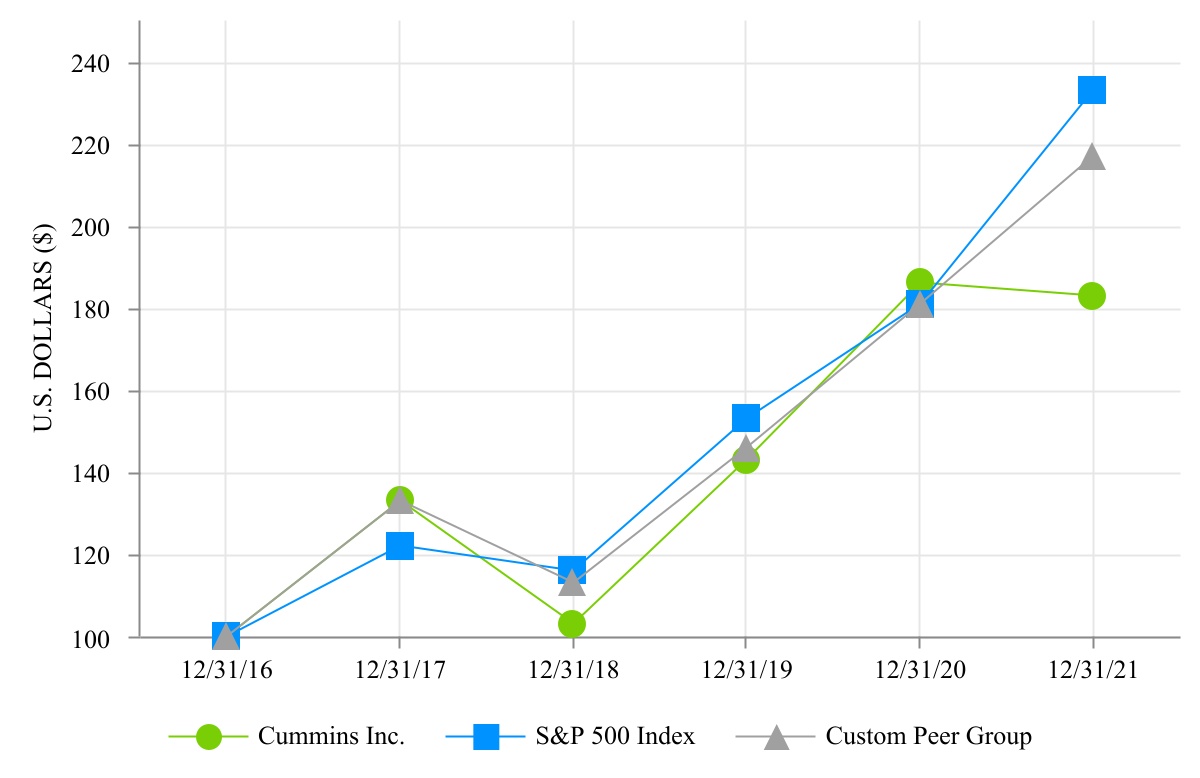
ASSUMES $100 INVESTED ON DECEMBER 31, 2016
ASSUMES DIVIDENDS REINVESTED
FISCAL YEAR ENDING DECEMBER 31, 2021
Item 6. [Reserved]
Item 7. Management's Discussion and Analysis of Financial Condition and Results of Operations
ORGANIZATION OF INFORMATION
The following Management's Discussion and Analysis of Financial Condition and Results of Operations (MD&A) was prepared to provide the reader with a view and perspective of our business through the eyes of management and should be read in conjunction with our Consolidated Financial Statements and the accompanying notes to those financial statements. Our MD&A is presented in the following sections:
-
EXECUTIVE SUMMARY AND FINANCIAL HIGHLIGHTS
-
RESULTS OF OPERATIONS
-
OPERATING SEGMENT RESULTS
-
2022 OUTLOOK
-
LIQUIDITY AND CAPITAL RESOURCES
-
APPLICATION OF CRITICAL ACCOUNTING ESTIMATES
The following is the discussion and analysis of changes in the financial condition and results of operations for fiscal year 2021 compared to fiscal year 2020. The discussion and analysis of fiscal year 2019 and changes in the financial condition and results of operations for fiscal year 2020 compared to fiscal year 2019 that are not included in this Form 10-K may be found in Part II, ITEM 7 of our Annual Report on Form 10-K for the fiscal year ended December 31, 2020, filed with the Securities and Exchange Commission (SEC) on February 10, 2021.
EXECUTIVE SUMMARY AND FINANCIAL HIGHLIGHTS
Overview
We are a global power leader that designs, manufactures, distributes and services diesel, natural gas, electric and hybrid powertrains and powertrain-related components including filtration, aftertreatment, turbochargers, fuel systems, controls systems, air handling systems, automated transmissions, electric power generation systems, batteries, electrified power systems, hydrogen production and fuel cell products. We sell our products to original equipment manufacturers (OEMs), distributors, dealers and other customers worldwide. We have long-standing relationships with many of the leading manufacturers in the markets we serve, including PACCAR Inc, Navistar International Corporation, Daimler Trucks North America and Stellantis N.V. We serve our customers through a service network of approximately 500 wholly-owned, joint venture and independent distributor locations and more than 10,000 Cummins certified dealer locations in approximately 190 countries and territories.
Our reportable operating segments consist of Engine, Distribution, Components, Power Systems and New Power. This reporting structure is organized according to the products and markets each segment serves. The Engine segment produces engines (15 liters and smaller) and associated parts for sale to customers in on-highway and various off-highway markets. Our engines are used in trucks of all sizes, buses and recreational vehicles, as well as in various industrial applications, including construction, agriculture, power generation systems and other off-highway applications. The Distribution segment includes wholly-owned and partially-owned distributorships engaged in wholesaling engines, generator sets and service parts, as well as performing service and repair activities on our products and maintaining relationships with various OEMs throughout the world. The Components segment sells filtration products, aftertreatment systems, turbochargers, electronics, fuel systems and automated transmissions. The Power Systems segment is an integrated power provider, which designs, manufactures and sells engines (16 liters and larger) for industrial applications (including mining, oil and gas, marine and rail), standby and prime power generator sets, alternators and other power components. The New Power segment designs, manufactures, sells and supports hydrogen production solutions as well as electrified power systems ranging from fully electric to hybrid along with innovative components and subsystems, including battery and fuel cell technologies. The New Power segment is currently in the development phase with a primary focus on research and development activities for our power systems, components and subsystems. We continue to serve all our markets as they adopt electrification and alternative power technologies, meeting the needs of our OEM partners and end customers.
Our financial performance depends, in large part, on varying conditions in the markets we serve, particularly the on-highway, construction and general industrial markets. Demand in these markets tends to fluctuate in response to overall economic conditions. Our sales may also be impacted by OEM inventory levels, production schedules, stoppages and supply chain challenges. Economic downturns in markets we serve generally result in reduced sales of our products and can result in price reductions in certain products and/or markets. As a worldwide business, our operations are also affected by currency, political, economic, public health crises, epidemics or pandemics and regulatory matters, including adoption and enforcement of environmental and emission standards, in the countries we serve. As part of our growth strategy, we invest in businesses in certain countries that carry high levels of these risks such as China, Brazil, India, Mexico, Russia and countries in the Middle East and Africa. At the same time, our geographic diversity and broad product and service offerings have helped limit the impact from a drop in demand in any one industry or customer or the economy of any single country on our consolidated results.
COVID-19 Update
The outbreak of COVID-19 in early 2020 became a global pandemic with the resultant economic impacts evolving into a worldwide recession. The pandemic triggered a significant downturn in our markets globally, which negatively impacted our sales and results of operations during 2020. While the majority of the negative impacts to demand largely subsided in 2021, we are still experiencing supply chain disruptions and related financial impacts reflected as increased cost of sales. Our industry continues to be unfavorably impacted by supply chain constraints leading to shortages across multiple components categories and limiting our collective ability to meet end-user demand. Our customers are also experiencing other supply chain issues and slowing production. Should the supply chain issues continue for an extended period of time or worsen, the impact on our production and supply chain could have a material adverse effect on our results of operations, financial condition and cash flows. Our Board of Directors (the Board) continues to monitor and evaluate all of these factors and the related impacts on our business and operations, and we are diligently working to minimize the supply chain impacts to our business and to our customers.
2021 Results
A summary of our results is as follows:
| Years ended December 31, | ||||||||||||||||||||||||||||||||
| In millions, except per share amounts | 2021 | 2020 | 2019 | |||||||||||||||||||||||||||||
| Net sales | $ | 24,021 | $ | 19,811 | $ | 23,571 | ||||||||||||||||||||||||||
Showing the first 8K of 139K characters. Open the full section
Item 7A. Quantitative and Qualitative Disclosures About Market Risk
We are exposed to financial risk resulting from volatility in foreign exchange rates, interest rates and commodity prices. This risk is closely monitored and managed through the use of physical forward contracts (which are not considered derivatives), and financial derivative instruments including foreign currency forward contracts, commodity swap contracts and interest rate swaps. Financial derivatives are used expressly for hedging purposes and under no circumstances are they used for speculative purposes. When material, we adjust the estimated fair value of our derivative contracts for counterparty or our credit risk. None of our derivative instruments are subject to collateral requirements. Substantially all of our derivative contracts are subject to master netting arrangements, which provide us with the option to settle certain contracts on a net basis when they settle on the same day with the same currency. In addition, these arrangements provide for a net settlement of all contracts with a given counterparty in the event that the arrangement is terminated due to the occurrence of default or a termination event.
We also enter into physical forward contracts with certain suppliers to purchase minimum volumes of commodities at contractually stated prices for various periods. These arrangements, as further described below, enable us to fix the prices of portions of our normal purchases of these commodities, which otherwise are subject to market volatility.
The following describes our risk exposures and provides the results of a sensitivity analysis performed at December 31, 2021. The sensitivity analysis assumes instantaneous, parallel shifts in foreign currency exchange rates and commodity prices.
Foreign Currency Exchange Rate Risk
As a result of our international business presence, we are exposed to foreign currency exchange rate risks. We transact business in foreign currencies and, as a result, our income experiences some volatility related to movements in foreign currency exchange rates. To help manage our exposure to exchange rate volatility, we use foreign currency forward contracts on a regular basis to hedge forecasted intercompany and third-party sales and purchases denominated in non-functional currencies. Our foreign currency cash flow hedges generally mature within two years. These foreign currency forward contracts are designated and qualify as foreign currency cash flow hedges. For the years ended December 31, 2021 and 2020, there were no circumstances that resulted in the discontinuance of a foreign currency cash flow hedge.
To minimize the income volatility resulting from the remeasurement of net monetary assets and payables denominated in a currency other than the functional currency, we enter into foreign currency forward contracts, which are considered economic hedges. The
objective is to offset the gain or loss from remeasurement with the gain or loss from the fair market valuation of the forward contract. These derivative instruments are not designated as hedges.
At December 31, 2021, the potential gain or loss in the fair value of our outstanding foreign currency contracts, assuming a hypothetical 10 percent fluctuation in the currencies of such contracts, would be approximately $103 million. The sensitivity analysis of the effects of changes in foreign currency exchange rates assumes the notional value to remain constant for the next 12 months. The analysis ignores the impact of foreign exchange movements on our competitive position and potential changes in sales levels. Any change in the value of the contracts, real or hypothetical, would be significantly offset by an inverse change in the value of the underlying hedged items.
Interest Rate Risk
We are exposed to market risk from fluctuations in interest rates. We manage our exposure to interest rate fluctuations through the use of interest rate swaps and interest rate locks. The objective of the swaps is to more effectively balance our borrowing costs and interest rate risk. See "Interest Rate Risk" section in Note 12, "DEBT," to our Consolidated Financial Statements for additional information.
At any time, a change in interest rates could have an adverse impact on the fair value of our portfolios. Assuming a hypothetical adverse movement in interest rates of one percentage point, the combined value of our interest rate derivatives portfolios would be reduced by $64 million, as calculated as of December 31, 2021. However, this does not take into consideration an offset in the underlying hedged items. While these are our best estimates of the impact of the specified interest rate scenario, actual results could differ from those projected. The sensitivity analysis presented assumes interest rate changes are instantaneous, parallel shifts in the yield curve.
Commodity Price Risk
We are exposed to fluctuations in commodity prices due to contractual agreements with component suppliers. In order to protect ourselves against future price volatility and, consequently, fluctuations in gross margins, we periodically enter into commodity swap and forward contracts with designated banks and other counterparties to fix the cost of certain raw material purchases with the objective of minimizing changes in inventory cost due to market price fluctuations. These commodity swaps are designated and qualify as cash flow hedges. At December 31, 2021, realized and unrealized gains and losses related to these hedges were not material to our financial statements. We also enter into physical forward contracts, which qualify for the normal purchases scope exceptions and are treated as purchase commitments.
We also limit our exposure to commodity price risk by entering into purchasing arrangements to fix the price of certain volumes of platinum and palladium expected to be used in our products. We enter into physical forward contracts with suppliers of platinum and palladium to purchase some volumes of the commodities at contractually stated prices for various periods, generally less than two years. These arrangements enable us to fix the prices of a portion of our purchases of these commodities, which otherwise are subject to market volatility.
Item 8. Financial Statements and Supplementary Data
Index to Financial Statements
-
Management's Report to Shareholders**
-
Report of Independent Registered Public Accounting Firm (PCAOB ID 238)**
-
Consolidated Statements of Net Income** for the years ended December 31, 2021, 2020 and 2019
-
Consolidated Statements of Comprehensive Income** for the years ended December 31, 2021, 2020 and 2019
-
Consolidated Balance Sheets** at December 31, 2021 and 2020
-
Consolidated Statements of Cash Flows** for the years ended December 31, 2021, 2020 and 2019
-
Consolidated Statements of Changes in Equity** for the years ended December 31, 2021, 2020 and 2019
-
Notes to the Consolidated Financial Statements**
| NOTE | 1 | SUMMARY OF SIGNIFICANT ACCOUNTING POLICIES | ||||||||||||
| NOTE | 2 | REVENUE FROM CONTRACTS WITH CUSTOMERS | ||||||||||||
| NOTE | 3 | INVESTMENTS IN EQUITY INVESTEES | ||||||||||||
| NOTE | 4 | INCOME TAXES | ||||||||||||
| NOTE | 5 | MARKETABLE SECURITIES | ||||||||||||
| NOTE | 6 | INVENTORIES | ||||||||||||
| NOTE | 7 | PROPERTY, PLANT AND EQUIPMENT | ||||||||||||
| NOTE | 8 | LEASES | ||||||||||||
| NOTE | 9 | GOODWILL AND OTHER INTANGIBLE ASSETS | ||||||||||||
| NOTE | 10 | PENSIONS AND OTHER POSTRETIREMENT BENEFITS | ||||||||||||
| NOTE | 11 | SUPPLEMENTAL BALANCE SHEET DATA | ||||||||||||
| NOTE | 12 | DEBT | ||||||||||||
| NOTE | 13 | PRODUCT WARRANTY LIABILITY | ||||||||||||
| NOTE | 14 | COMMITMENTS AND CONTINGENCIES | ||||||||||||
| NOTE | 15 | CUMMINS INC. SHAREHOLDERS' EQUITY | ||||||||||||
| NOTE | 16 | ACCUMULATED OTHER COMPREHENSIVE LOSS | ||||||||||||
| NOTE | 17 | NONCONTROLLING INTERESTS | ||||||||||||
| NOTE | 18 | STOCK INCENTIVE AND STOCK OPTION PLANS | ||||||||||||
| NOTE | 19 | EARNINGS PER COMMON SHARE ATTRIBUTABLE TO CUMMINS INC. | ||||||||||||
| NOTE | 20 | ACQUISITION | ||||||||||||
| NOTE | 21 | RESTRUCTURING ACTIONS | ||||||||||||
| NOTE | 22 | OPERATING SEGMENTS | ||||||||||||
MANAGEMENT'S REPORT TO SHAREHOLDERS
Management's Report on Financial Statements and Practices
The accompanying Consolidated Financial Statements of Cummins Inc. were prepared by management, which is responsible for their integrity and objectivity. The statements were prepared in accordance with generally accepted accounting principles and include amounts that are based on management's best judgments and estimates. The other financial information included in the annual report is consistent with that in the financial statements.
Management also recognizes its responsibility for conducting our affairs according to the highest standards of personal and corporate conduct. This responsibility is characterized and reflected in key policy statements issued from time to time regarding, among other things, conduct of its business activities within the laws of the host countries in which we operate, within the Foreign Corrupt Practices Act and potentially conflicting interests of its employees. We maintain a systematic program to assess compliance with these policies.
To comply with the requirements of Section 404 of the Sarbanes-Oxley Act of 2002, we designed and implemented a structured and comprehensive compliance process to evaluate our internal control over financial reporting across the enterprise.
Management's Report on Internal Control Over Financial Reporting
The management of Cummins Inc. is responsible for establishing and maintaining adequate internal control over financial reporting. Internal control over financial reporting is a process designed to provide reasonable assurance regarding the reliability of financial reporting and preparation of our Consolidated Financial Statements for external purposes in accordance with accounting principles generally accepted in the United States of America.
Management assessed the effectiveness of our internal control over financial reporting and concluded it was effective as of December 31, 2021. In making its assessment, management utilized the criteria set forth by the Committee of Sponsoring Organizations of the Treadway Commission in Internal Control—Integrated Framework (2013).
The effectiveness of our internal control over financial reporting as of December 31, 2021, has been audited by PricewaterhouseCoopers LLP, an independent registered public accounting firm, as stated in their report which appears herein.
Officer Certifications
Please refer to Exhibits 31(a) and 31(b) attached to this report for certifications required under Section 302 of the Sarbanes-Oxley Act of 2002.
| /s/ N. THOMAS LINEBARGER | /s/ MARK A. SMITH | |||||||
| Chairman and Chief Executive Officer | Vice President and Chief Financial Officer |
Report of Independent Registered Public Accounting Firm
To the Board of Directors and Shareholders of Cummins Inc.
Opinions on the Financial Statements and Internal Control over Financial Reporting
We have audited the accompanying consolidated balance sheets of Cummins Inc. and its subsidiaries (the “Company”) as of December 31, 2021 and 2020, and the related consolidated statements of net income, comprehensive income, changes in equity, and cash flows for each of the three years in the period ended December 31, 2021, including the related notes (collectively referred to as the “consolidated financial statements”). We also have audited the Company's internal control over financial reporting as of December 31, 2021, based on criteria established in Internal Control - Integrated Framework (2013) issued by the Committee of Sponsoring Organizations of the Treadway Commission (COSO).
In our opinion, the consolidated financial statements referred to above present fairly, in all material respects, the financial position of the Company as of December 31, 2021 and 2020, and the results of its operations and its cash flows for each of the three years in the period ended December 31, 2021 in conformity with accounting principles generally accepted in the United States of America. Also in our opinion, the Company maintained, in all material respects, effective internal control over financial reporting as of December 31, 2021, based on criteria established in Internal Control - Integrated Framework (2013) issued by the COSO.
Basis for Opinions
The Company's management is responsible for these consolidated financial statements, for maintaining effective internal control over financial reporting, and for its assessment of the effectiveness of internal control over financial reporting, included in the accompanying Management’s Report on Internal Control Over Financial Reporting. Our responsibility is to express opinions on the Company’s consolidated financial statements and on the Company's internal control over financial reporting based on our audits. We are a public accounting firm registered with the Public Company Accounting Oversight Board (United States) (PCAOB) and are required to be independent with respect to the Company in accordance with the U.S. federal securities
Showing the first 8K of 299K characters. Open the full section
Item 9. Changes in and Disagreements with Accountants on Accounting and Financial Disclosure
None.
Item 9A. Controls and Procedures
Evaluation of Disclosure Controls and Procedures
As of the end of the period covered by this Annual Report on Form 10-K, our management evaluated, with the participation of our Chief Executive Officer and Chief Financial Officer, the effectiveness of the design and operation of our disclosure controls and procedures as defined in Exchange Act Rules 13a-15(e) and 15d-15(e). Based upon that evaluation, our Chief Executive Officer and our Chief Financial Officer concluded that our disclosure controls and procedures were effective as of the end of the period covered by this Annual Report on Form 10-K.
Changes in Internal Control over Financial Reporting
There has been no change in our internal control over financial reporting during the quarter ended December 31, 2021, that materially affected, or is reasonably likely to materially affect, our internal control over financial reporting.
Management's Report on Internal Control Over Financial Reporting
The information required by Item 9A relating to Management's Annual Report on Internal Control Over Financial Reporting and Attestation Report of the Registered Public Accounting Firm is incorporated herein by reference to the information set forth under the captions "Management's Report on Internal Control Over Financial Reporting" and "Report of Independent Registered Public Accounting Firm," respectively, under Item 8.
Item 9B. Other Information
None.
Item 9C. Disclosure Regarding Foreign Jurisdictions that Prevent Inspections
Not Applicable.
PART III
Item 10. Directors, Executive Officers and Corporate Governance
The information required by Item 10 is incorporated by reference to the relevant information under the captions "Corporate Governance," "Election of Directors" in our 2022 Proxy Statement, which will be filed within 120 days after the end of 2021. Information regarding our executive officers may be found in Part 1 of this annual report under the caption "Information About Our Executive Officers." Except as otherwise specifically incorporated by reference, our Proxy Statement is not deemed to be filed as part of this annual report.
Item 11. Executive Compensation
The information required by Item 11 is incorporated by reference to the relevant information under the caption "Executive Compensation" in our 2022 Proxy Statement, which will be filed within 120 days after the end of 2021.
Item 12. Security Ownership of Certain Beneficial Owners and Management and Related Stockholder Matters
Information concerning our equity compensation plans at December 31, 2021, was as follows:
| Plan Category | Number of securities to be issued upon exercise of outstanding options, warrants and rights**(1)** | Weighted-average exercise price of outstanding options, warrants and rights**(2)** | Number of securities remaining available for future issuance under equity compensation plans (excluding securities reflected in the first column) | |||||||||||||||||
| Equity compensation plans approved by security holders | 3,213,175 | $ | 143.51 | 5,309,472 | ||||||||||||||||
| (1) The number is comprised of 2,743,098 stock options, 440,149 performance shares and 29,928 restricted shares. See Note 18, "STOCK INCENTIVE AND STOCK OPTION PLANS," to the Consolidated Financial Statements for a description of how options and shares are awarded. | ||||||||||||||||||||
| (2) The weighted-average exercise price relates only to the 2,743,098 stock options. Performance and restricted shares do not have an exercise price and, therefore, are not included in this calculation. | ||||||||||||||||||||
We have no equity compensation plans not approved by security holders.
The remaining information required by Item 12 is incorporated by reference to the relevant information under the caption "Stock Ownership of Directors, Management and Others" in our 2022 Proxy Statement, which will be filed within 120 days after the end of 2021.
Item 13. Certain Relationships, Related Transactions and Director Independence
The information required by Item 13 is incorporated by reference to the relevant information under the captions "Corporate Governance" and "Other Information-Related Party Transactions" in our 2022 Proxy Statement, which will be filed within 120 days after the end of 2021.
Item 14. Principal Accounting Fees and Services
The information required by Item 14 is incorporated by reference to the relevant information under the caption "Selection of Independent Public Accountants" in our 2022 Proxy Statement, which will be filed within 120 days after the end of 2021.
PART IV
Item 15. Exhibits, Financial Statement Schedules
(a)The following Consolidated Financial Statements and schedules filed as part of this report can be found in Item 8 "Financial Statements and Supplementary Data":
-
Management's Report to Shareholders**
-
Report of Independent Registered Public Accounting Firm**
-
Consolidated Statements of Net Income** for the years ended December 31, 2021, 2020 and 2019
-
Consolidated Statements of Comprehensive Income** for the years ended December 31, 2021, 2020 and 2019
-
Consolidated Balance Sheets** at December 31, 2021 and 2020
-
Consolidated Statements of Cash Flows** for the years ended December 31, 2021, 2020 and 2019
-
Consolidated Statements of Changes in Equity** for the years ended December 31, 2021, 2020 and 2019
-
Notes to the Consolidated Financial Statements**
(b)Financial Statement Schedules
Separate financial statement schedules were omitted because such information was inapplicable or was included in the financial statements or notes described above.
(c)The exhibits listed in the following Exhibit Index are filed as part of this Annual Report on Form 10-K.
CUMMINS INC.
A management contract or compensatory plan or arrangement.
- Filed with this annual report on Form 10-K are the following documents formatted in iXBRL (Inline Extensible Business Reporting Language): (i) the Consolidated Statements of Net Income for the years ended December 31, 2021, 2020 and 2019, (ii) the Consolidated Statements of Comprehensive Income for the years ended December 31, 2021, 2020 and 2019, (iii) the Consolidated Balance Sheets for the years ended December 31, 2021 and 2020, (iv) the Consolidated Statements of Cash Flows for the years ended December 31, 2021, 2020 and 2019, (v) the Consolidated Statements of Changes in Equity for the years ended December 31, 2021, 2020 and 2019 and (vi) Notes to the Consolidated Financial Statements.
Item 16. Form 10-K Summary (optional)
Not Applicable.
SIGNATURES
Pursuant to the requirements of Section 13 or 15(d) of the Securities Exchange Act of 1934, the registrant has duly caused this report to be signed on its behalf by the undersigned, thereunto duly authorized.
| CUMMINS INC. | ||||||||||||||||||||
| By: | /s/ MARK A. SMITH | By: | /s/ CHRISTOPHER C. CLULOW | |||||||||||||||||
| Mark A. Smith Vice President and Chief Financial Officer (Principal Financial Officer) | Christopher C. Clulow Vice President—Corporate Controller (Principal Accounting Officer) | |||||||||||||||||||
| Date: | February 8, 2022 |
Pursuant to the requirements of the Securities Exchange Act of 1934, this report has been signed below by the following persons on behalf of the registrant and in the capacities and on the dates indicated.
| Signatures | Title | Date | ||||||||||||
| /s/ N. THOMAS LINEBARGER | Chairman of the Board of Directors and Chief Executive Officer (Principal Executive Officer) | February 8, 2022 | ||||||||||||
| N. Thomas Linebarger | ||||||||||||||
| /s/ MARK A. SMITH | Vice President and Chief Financial Officer (Principal Financial Officer) | February 8, 2022 | ||||||||||||
| Mark A. Smith | ||||||||||||||
| /s/ CHRISTOPHER C. CLULOW | Vice President—Corporate Controller (Principal Accounting Officer) | February 8, 2022 | ||||||||||||
| Christopher C. Clulow | ||||||||||||||
| * | February 8, 2022 | |||||||||||||
| Robert J. Bernhard | Director | |||||||||||||
| * | February 8, 2022 | |||||||||||||
| Franklin R. ChangDiaz | Director | |||||||||||||
| * | February 8, 2022 | |||||||||||||
| Bruno V. Di Leo Allen | Director | |||||||||||||
| * | February 8, 2022 | |||||||||||||
| Stephen B. Dobbs | Director | |||||||||||||
| * | February 8, 2022 | |||||||||||||
| Carla A. Harris | Director | |||||||||||||
| * | February 8, 2022 | |||||||||||||
| Robert K. Herdman | Director | |||||||||||||
| * | February 8, 2022 | |||||||||||||
| Alexis M. Herman | Director | |||||||||||||
| * | February 8, 2022 | |||||||||||||
| Thomas J. Lynch | Director | |||||||||||||
| * | February 8, 2022 | |||||||||||||
| William I. Miller | Director | |||||||||||||
| * | February 8, 2022 | |||||||||||||
| Georgia R. Nelson | Director | |||||||||||||
| * | February 8, 2022 | |||||||||||||
| Kimberly A. Nelson | Director | |||||||||||||
| * | February 8, 2022 | |||||||||||||
| Karen H. Quintos | Director |
| *By: | /s/ MARK A. SMITH | ||||
| Mark A. Smith Attorney-in-fact |