 filings.tools
CMS Energy 10-K 2020-12-31
Filed 2021-02-11. 22 sections, 703K characters. Original on sec.gov · Markdown · JSON
Cover and table of contents
UNITED STATES SECURITIES AND EXCHANGE COMMISSION
Washington, D.C. 20549
FORM 10-K
☒ ANNUAL REPORT PURSUANT TO SECTION 13 OR 15(d) OF THE SECURITIES EXCHANGE ACT OF 1934
For the fiscal year ended December 31, 2020
OR
☐ TRANSITION REPORT PURSUANT TO SECTION 13 OR 15(d) OF THE SECURITIES EXCHANGE ACT OF 1934
For the transition period from to
| Commission File Number | Registrant; State of Incorporation; Address; and Telephone Number | IRS Employer Identification No. | ||||||
| 1-9513 | CMS ENERGY CORPORATION | 38-2726431 |
(A Michigan Corporation)
One Energy Plaza, Jackson, Michigan 49201
(517) 788‑0550
| 1-5611 | CONSUMERS ENERGY COMPANY | 38-0442310 |
(A Michigan Corporation)
One Energy Plaza, Jackson, Michigan 49201
(517) 788‑0550
| Securities registered pursuant to Section 12(b) of the Act: | ||||||||||||||
| Title of each class | Trading Symbol(s) | Name of each exchange on which registered | ||||||||||||
| CMS Energy Corporation Common Stock, $0.01 par value | CMS | New York Stock Exchange | ||||||||||||
| CMS Energy Corporation 5.625% Junior Subordinated Notes due 2078 | CMSA | New York Stock Exchange | ||||||||||||
| CMS Energy Corporation 5.875% Junior Subordinated Notes due 2078 | CMSC | New York Stock Exchange | ||||||||||||
| CMS Energy Corporation 5.875% Junior Subordinated Notes due 2079 | CMSD | New York Stock Exchange | ||||||||||||
| Consumers Energy Company Cumulative Preferred Stock, $100 par value: $4.50 Series | CMS-PB | New York Stock Exchange |
| Securities registered pursuant to Section 12(g) of the Act: | None |
| Indicate by check mark if the registrant is a well-known seasoned issuer, as defined in Rule 405 of the Securities Act. | |||||||||||||||||||||||||||||||||||
| CMS Energy Corporation: | Yes | ☒ | No | ☐ | Consumers Energy Company: | Yes | ☒ | No | ☐ |
| Indicate by check mark if the registrant is not required to file reports pursuant to Section 13 or Section 15(d) of the Act. | |||||||||||||||||||||||||||||||||||
| CMS Energy Corporation: | Yes | ☐ | No | ☒ | Consumers Energy Company: | Yes | ☐ | No | ☒ |
| Indicate by check mark whether the registrant (1) has filed all reports required to be filed by Section 13 or 15(d) of the Securities Exchange Act of 1934 during the preceding 12 months (or for such shorter period that the Registrant was required to file such reports), and (2) has been subject to such filing requirements for the past 90 days. | |||||||||||||||||||||||||||||||||||
| CMS Energy Corporation: | Yes | ☒ | No | ☐ | Consumers Energy Company: | Yes | ☒ | No | ☐ |
| Indicate by check mark whether the registrant has submitted electronically every Interactive Data File required to be submitted pursuant to Rule 405 of Regulation S‑T (§232.405 of this chapter) during the preceding 12 months (or for such shorter period that the registrant was required to submit such files). | |||||||||||||||||||||||||||||||||||
| CMS Energy Corporation: | Yes | ☒ | No | ☐ | Consumers Energy Company: | Yes | ☒ | No | ☐ |
| Indicate by check mark whether the registrant is a large accelerated filer, an accelerated filer, a non‑accelerated filer, a smaller reporting company, or an emerging growth company. See the definitions of “large accelerated filer,” “accelerated filer,” “smaller reporting company,” and “emerging growth company” in Rule 12b‑2 of the Exchange Act. | |||||||||||||||||||||||||||||||||||
| CMS Energy Corporation: | Consumers Energy Company: | ||||||||||||||||||||||||||||||||||
| Large accelerated filer | ☒ | Large accelerated filer | ☐ | ||||||||||||||||||||||||||||||||
| Non‑accelerated filer | ☐ | Non‑accelerated filer | ☒ | ||||||||||||||||||||||||||||||||
| Accelerated filer | ☐ | Accelerated filer | ☐ | ||||||||||||||||||||||||||||||||
| Smaller reporting company | ☐ | Smaller reporting company | ☐ | ||||||||||||||||||||||||||||||||
| Emerging growth company | ☐ | Emerging growth company | ☐ |
| If an emerging growth company, indicate by check mark if the registrant has elected not to use the extended transition period for complying with any new or revised financial accounting standards provided pursuant to Section 13(a) of the Exchange Act. | |||||||||||||||||||||||||||||||||||
| CMS Energy Corporation: | ☐ | Consumers Energy Company: | ☐ |
| Indicate by check mark whether the registrant has filed a report on and attestation to its management’s assessment of the effectiveness of its internal control over financial reporting under Section 404(b) of the Sarbanes-Oxley Act (15 U.S.C. 7262(b)) by the registered public accounting firm that prepared or issued its audit report. | |||||||||||||||||||||||||||||||||||
| CMS Energy Corporation: | ☒ | Consumers Energy Company: | ☒ |
| Indicate by check mark whether the registrant is a shell company (as defined in Rule 12b‑2 of the Exchange Act). | |||||||||||||||||||||||||||||||||||
| CMS Energy Corporation: | Yes | ☐ | No | ☒ | Consumers Energy Company: | Yes | ☐ | No | ☒ |
The aggregate market value of CMS Energy voting and non‑voting common equity held by non‑affiliates was $16.647 billion for the 284,957,910 CMS Energy Corporation Common Stock shares outstanding on June 30, 2020 based on the closing sale price of $58.42 for CMS Energy Corporation Common Stock, as reported by the New York Stock Exchange on such date. There were no shares of Consumers common equity held by non‑affiliates as of June 30, 2020.
There were 288,943,354 shares of CMS Energy Corporation Common Stock outstanding on January 15, 2021. On January 15, 2021, CMS Energy held all 84,108,789 outstanding shares of common stock of Consumers.
Documents incorporated by reference in Part III: CMS Energy’s and Consumers’ proxy statement relating to their 2021 Annual Meetings of Shareholders to be held May 7, 2021.
CMS Energy Corporation
Consumers Energy Company
Annual Reports on Form 10-K to the Securities and Exchange Commission for the Year Ended December 31, 2020
Table of Contents
Glossary
Certain terms used in the text and financial statements are defined below.
2016 Energy Law
Michigan’s Public Acts 341 and 342 of 2016
ABATE
The Association of Businesses Advocating Tariff Equity
ABO
Accumulated benefit obligation; the liabilities of a pension plan based on service and pay to date, which differs from the PBO in that it does not reflect expected future salary increases
AFUDC
Allowance for borrowed and equity funds used during construction
AOCI
Accumulated other comprehensive income (loss)
ARO
Asset retirement obligation
ASC 715
Financial Accounting Standards Board Accounting Standards Codification Topic 715, Retirement Benefits
ASU
Financial Accounting Standards Board Accounting Standards Update
Aviator Wind
Aviator Wind, LLC, a VIE in which Aviator Wind Equity Holdings holds a Class B membership interest
Aviator Wind Equity Holdings
Aviator Wind Equity Holdings, LLC, a VIE in which Grand River Wind, LLC, a wholly owned subsidiary of CMS Enterprises, has a 51‑percent interest
Bay Harbor
A residential/commercial real estate area located near Petoskey, Michigan, in which CMS Energy sold its interest in 2002
bcf
Billion cubic feet
Cantera Gas Company
Cantera Gas Company LLC, a non‑affiliated company, formerly known as CMS Field Services
Cantera Natural Gas, Inc.
Cantera Natural Gas, Inc., a non‑affiliated company that purchased CMS Field Services
CAO
Chief Accounting Officer
CARES Act
Coronavirus Aid, Relief, and Economic Security Act of 2020
CCR
Coal combustion residual
CDC
U.S. Centers for Disease Control and Prevention
CEO
Chief Executive Officer
CERCLA
The Comprehensive Environmental Response, Compensation, and Liability Act of 1980, as amended
CFO
Chief Financial Officer
city-gate contract
An arrangement made for the point at which a local distribution company physically receives gas from a supplier or pipeline
Clean Air Act
Federal Clean Air Act of 1963, as amended
Clean Energy Plan
Consumers’ long-term strategy for delivering clean, reliable, and affordable energy to its customers through the increased use of energy efficiency and customer demand management programs, additional renewable energy generation, and conservation voltage reduction
Clean Water Act
Federal Water Pollution Control Act of 1972, as amended
CMS Capital
CMS Capital, L.L.C., a wholly owned subsidiary of CMS Energy
CMS Energy
CMS Energy Corporation and its consolidated subsidiaries, unless otherwise noted; the parent of Consumers, CMS Enterprises, and EnerBank
CMS Enterprises
CMS Enterprises Company, a wholly owned subsidiary of CMS Energy
CMS ERM
CMS Energy Resource Management Company, formerly known as CMS MST, a wholly owned subsidiary of CMS Enterprises
CMS Field Services
CMS Field Services, Inc., a former wholly owned subsidiary of CMS Gas Transmission
CMS Gas Transmission
CMS Gas Transmission Company, a wholly owned subsidiary of CMS Enterprises
CMS Land
CMS Land Company, a wholly owned subsidiary of CMS Capital
CMS MST
CMS Marketing, Services and Trading Company, a wholly owned subsidiary of CMS Enterprises, whose name was changed to CMS ERM in 2004
Consumers
Consumers Energy Company and its consolidated subsidiaries, unless otherwise noted; a wholly owned subsidiary of CMS Energy
Consumers 2014 Securitization Funding
Consumers 2014 Securitization Funding LLC, a wholly owned consolidated bankruptcy-remote subsidiary of Consumers and special-purpose entity organized for the sole purpose of purchasing and owning securitization property, issuing securitization bonds, and pledging its interest in securitization property to a trustee to collateralize the securitization bonds
Craven
Craven County Wood Energy Limited Partnership, a VIE in which HYDRA‑CO Enterprises, Inc., a wholly owned subsidiary of CMS Enterprises, has a 50-percent interest
COVID‑19
Coronavirus disease 2019, a respiratory illness that was declared a pandemic in March 2020 and to which public and private agencies have responded by instituting social-distancing and other measures designed to slow the spread of the disease
CSAPR
The Cross-State Air Pollution Rule of 2011, as amended
DB Pension Plan A
Defined benefit pension plan of CMS Energy and Consumers, including certain present and former affiliates and subsidiaries, created as of December 31, 2017 for active employees who were covered under the defined benefit pension plan that closed in 2005
DB Pension Plan B
Defined benefit pension plan of CMS Energy and Consumers, including certain present and former affiliates and subsidiaries, amended as of December 31, 2017 to include only retired and former employees who were covered under the defined benefit pension plan that closed in 2005
DB Pension Plans
Defined benefit pension plans of CMS Energy and Consumers, comprising DB Pension Plan A and DB Pension Plan B
DB SERP
Defined Benefit Supplemental Executive Retirement Plan
DCCP
Defined Company Contribution Plan
DC SERP
Defined Contribution Supplemental Executive Retirement Plan
DIG
Dearborn Industrial Generation, L.L.C., a wholly owned subsidiary of Dearborn Industrial Energy, L.L.C., a wholly owned subsidiary of CMS Energy
Discount Window
Federal Reserve lending program to depository institutions
Dodd-Frank Act
Dodd-Frank Wall Street Reform and Consumer Protection Act of 2010
DTE Electric
DTE Electric Company, a non‑affiliated company
EEI
Edison Electric Institute, an association representing all U.S. investor-owned electric companies
EGLE
The Michigan Department of Environment, Great Lakes, and Energy, formerly known as the Michigan Department of Environmental Quality
EnerBank
EnerBank USA, a wholly owned subsidiary of CMS Capital
energy waste reduction
The reduction of energy consumption through energy efficiency and demand-side energy conservation, as established under the 2016 Energy Law
Entergy
Entergy Corporation, a non‑affiliated company
EPA
U.S. Environmental Protection Agency
EPS
Earnings per share
Exchange Act
Securities Exchange Act of 1934
FDIC
Federal Deposit Insurance Corporation
Federal Reserve
Federal Reserve System, the central bank of the U.S.
FERC
The Federal Energy Regulatory Commission
FICO
Fair Isaac Corporation, a non-affiliated company providing data analytic services, with a focus on credit scoring services
First Mortgage Bond Indenture
The indenture dated as of September 1, 1945 between Consumers and The Bank of New York Mellon, as Trustee, as amended and supplemented
FTR
Financial transmission right
GAAP
U.S. Generally Accepted Accounting Principles
GCC
Gas Customer Choice, which allows gas customers to purchase gas from alternative suppliers
GCR
Gas cost recovery
Genesee
Genesee Power Station Limited Partnership, a VIE in which HYDRA‑CO Enterprises, Inc., a wholly owned subsidiary of CMS Enterprises, has a 50-percent interest
Grayling
Grayling Generating Station Limited Partnership, a VIE in which HYDRA‑CO Enterprises, Inc., a wholly owned subsidiary of CMS Enterprises, has a 50-percent interest
GWh
Gigawatt-hour, a unit of energy equal to one billion watt-hours
Internal Revenue Code
Internal Revenue Code of 1986, as amended
IRP
Integrated resource plan
IRS
Internal Revenue Service
IT
Information Technology
kV
Thousand volts, a unit used to measure the difference in electrical pressure along a current
kVA
Thousand volt-amperes, a unit used to reflect the electrical power capacity rating of equipment or a system
kWh
Kilowatt-hour, a unit of energy equal to one thousand watt-hours
LIBOR
The London Interbank Offered Rate
Ludington
Ludington pumped-storage plant, jointly owned by Consumers and DTE Electric
MATS
Mercury and Air Toxics Standards, which limit mercury, acid gases, and other toxic pollution from coal‑fueled and oil‑fueled power plants
mcf
Thousand cubic feet
MCV Facility
A 1,647 MW natural gas-fueled, combined-cycle cogeneration facility operated by the MCV Partnership
MCV Partnership
Midland Cogeneration Venture Limited Partnership
MCV PPA
PPA between Consumers and the MCV Partnership
METC
Michigan Electric Transmission Company, LLC, a non‑affiliated company
MGP
Manufactured gas plant
Michigan Mercury Rule
Michigan Air Pollution Control Rules of 2009, as amended: Part 15, Emission Limitations and Prohibitions—Mercury
MISO
Midcontinent Independent System Operator, Inc.
mothball
To place a generating unit into a state of extended reserve shutdown in which the unit is inactive and unavailable for service for a specified period, during which the unit can be brought back into service after receiving appropriate notification and completing any necessary maintenance or other work; generation owners in MISO must request approval to mothball a unit, and MISO then evaluates the request for reliability impacts
MPSC
Michigan Public Service Commission
MRV
Market-related value of plan assets
MW
Megawatt, a unit of power equal to one million watts
MWh
Megawatt-hour, a unit of energy equal to one million watt-hours
NAAQS
National Ambient Air Quality Standards
NERC
The North American Electric Reliability Corporation, a non‑affiliated company responsible for developing and enforcing reliability standards, monitoring the bulk power system, and educating and certifying industry personnel
NPDES
National Pollutant Discharge Elimination System, a permit system for regulating point sources of pollution under the Clean Water Act
NREPA
Part 201 of Michigan’s Natural Resources and Environmental Protection Act of 1994, as amended
NSR
New Source Review, a construction-permitting program under the Clean Air Act
OPEB
Other Post-Employment Benefits
OPEB Plan
Postretirement health care and life insurance plans of CMS Energy and Consumers, including certain present and former affiliates and subsidiaries
OSHA
Occupational Safety and Health Administration
Palisades
Palisades nuclear power plant, sold by Consumers to Entergy in 2007
PBO
Projected benefit obligation
PCB
Polychlorinated biphenyl
PFAS
Per- and polyfluoroalkyl substances
PHMSA
The U.S. Department of Transportation’s Pipeline and Hazardous Materials Safety Administration
PISP
Performance Incentive Stock Plan
PPA
Power purchase agreement
PSCR
Power supply cost recovery
PURPA
The Public Utility Regulatory Policies Act of 1978
RCRA
The Federal Resource Conservation and Recovery Act of 1976
REC
Renewable energy credit
ROA
Retail Open Access, which allows electric generation customers to choose alternative electric suppliers pursuant to Michigan’s Public Acts 141 and 142 of 2000, as amended
S&P
Standard & Poor’s Financial Services LLC
SEC
U.S. Securities and Exchange Commission
securitization
A financing method authorized by statute and approved by the MPSC which allows a utility to sell its right to receive a portion of the rate payments received from its customers for the repayment of securitization bonds issued by a special-purpose entity affiliated with such utility
Smart Energy
Consumers’ Smart Energy grid modernization project, which includes the installation of smart meters that transmit and receive data, a two-way communications network, and modifications to Consumers’ existing IT system to manage the data and enable changes to key business processes
TCJA
Tax Cuts and Jobs Act of 2017
T.E.S. Filer City
T.E.S. Filer City Station Limited Partnership, a VIE in which HYDRA‑CO Enterprises, Inc., a wholly owned subsidiary of CMS Enterprises, has a 50-percent interest
USW
United Steel, Paper and Forestry, Rubber, Manufacturing, Energy, Allied Industrial and Service Workers International Union, AFL-CIO-CLC
UWUA
Utility Workers Union of America, AFL-CIO
VEBA trust
Voluntary employees’ beneficiary association trusts accounts established specifically to set aside employer-contributed assets to pay for future expenses of the OPEB Plan
VIE
Variable interest entity
Filing Format
This combined Form 10‑K is separately filed by CMS Energy and Consumers. Information in this combined Form 10‑K relating to each individual registrant is filed by such registrant on its own behalf. Consumers makes no representation regarding information relating to any other companies affiliated with CMS Energy other than its own subsidiaries. None of CMS Energy, CMS Enterprises, EnerBank, nor any of CMS Energy’s other subsidiaries (other than Consumers) has any obligation in respect of Consumers’ debt securities or preferred stock and holders of such securities should not consider the financial resources or results of operations of CMS Energy, CMS Enterprises, EnerBank, nor any of CMS Energy’s other subsidiaries (other than Consumers and its own subsidiaries (in relevant circumstances)) in making a decision with respect to Consumers’ debt securities or preferred stock. Similarly, neither Consumers nor any other subsidiary of CMS Energy has any obligation in respect of securities of CMS Energy.
Forward-Looking Statements and Information
This Form 10‑K and other CMS Energy and Consumers disclosures may contain forward-looking statements as defined by the Private Securities Litigation Reform Act of 1995. The use of “might,” “may,” “could,” “should,” “anticipates,” “believes,” “estimates,” “expects,” “intends,” “plans,” “projects,” “forecasts,” “predicts,” “assumes,” and other similar words is intended to identify forward-looking statements that involve risk and uncertainty. This discussion of potential risks and uncertainties is designed to highlight important factors that may impact CMS Energy’s and Consumers’ businesses and financial outlook. CMS Energy and Consumers have no obligation to update or revise forward-looking statements regardless of whether new information, future events, or any other factors affect the information contained in the statements. These forward-looking statements are subject to various factors that could cause CMS Energy’s and Consumers’ actual results to differ materially from the results anticipated in these statements. These factors include, but are not limited to, the following, all of which are potentially significant:
-
the impact of the COVID-19 pandemic and the related economic disruption on CMS Energy’s and Consumers’ revenues, expenses, uncollectible accounts, energy efficiency programs, pension funding, PSCR and GCR costs, capital investment programs, cash flows, liquidity, maintenance of existing assets, and other operating expenses
-
the impact of new regulation by the MPSC, FERC, and other applicable governmental proceedings and regulations, including any associated impact on electric or gas rates or rate structures
-
potentially adverse regulatory treatment or failure to receive timely regulatory orders affecting Consumers that are or could come before the MPSC, FERC, or other governmental authorities
-
changes in the performance of or regulations applicable to MISO, METC, pipelines, railroads, vessels, or other service providers that CMS Energy, Consumers, or any of their affiliates rely on to serve their customers
-
the adoption of or challenges to federal or state laws or regulations or changes in applicable laws, rules, regulations, principles, or practices, or in their interpretation, such as those related to energy policy, ROA, PURPA, infrastructure integrity or security, gas pipeline safety, gas pipeline capacity, energy waste reduction, the environment, regulation or deregulation, reliability, health care reforms (including comprehensive health care reform enacted in 2010), taxes, accounting matters, climate change, air emissions, renewable energy, the Dodd-Frank Act, and other business
issues that could have an impact on CMS Energy’s, Consumers’, or any of their affiliates’ businesses or financial results
-
factors affecting operations, such as costs and availability of personnel, equipment, and materials; weather conditions; natural disasters; catastrophic weather-related damage; scheduled or unscheduled equipment outages; maintenance or repairs; environmental incidents; failures of equipment or materials; electric transmission and distribution or gas pipeline system constraints; interconnection requirements; political and social unrest; general strikes; the government and/or paramilitary response to political or social events; and changes in trade policies or regulations
-
the ability of Consumers to execute its cost-reduction strategies
-
potentially adverse regulatory or legal interpretations or decisions regarding environmental matters, or delayed regulatory treatment or permitting decisions that are or could come before EGLE, the EPA, and/or the U.S. Army Corps of Engineers, and potential environmental remediation costs associated with these interpretations or decisions, including those that may affect Consumers’ routine maintenance, repair, and replacement classification under NSR regulations
-
changes in energy markets, including availability and price of electric capacity and the timing and extent of changes in commodity prices and availability and deliverability of coal, natural gas, natural gas liquids, electricity, oil, and certain related products
-
the price of CMS Energy common stock, the credit ratings of CMS Energy and Consumers, capital and financial market conditions, and the effect of these market conditions on CMS Energy’s and Consumers’ interest costs and access to the capital markets, including availability of financing to CMS Energy, Consumers, or any of their affiliates
-
the potential effects of a future transition from LIBOR to an alternative reference interest rate in the credit and capital markets
-
the investment performance of the assets of CMS Energy’s and Consumers’ pension and benefit plans, the discount rates, mortality assumptions, and future medical costs used in calculating the plans’ obligations, and the resulting impact on future funding requirements
-
the impact of the economy, particularly in Michigan, and potential future volatility in the financial and credit markets on CMS Energy’s, Consumers’, or any of their affiliates’ revenues, ability to collect accounts receivable from customers, or cost and availability of capital
-
changes in the economic and financial viability of CMS Energy’s and Consumers’ suppliers, customers, and other counterparties and the continued ability of these third parties, including those in bankruptcy, to meet their obligations to CMS Energy and Consumers
-
population changes in the geographic areas where CMS Energy and Consumers conduct business
-
national, regional, and local economic, competitive, and regulatory policies, conditions, and developments
-
loss of customer demand for electric generation supply to alternative electric suppliers, increased use of self-generation including distributed generation, or energy waste reduction and storage
-
increased renewable energy demand due to customers seeking to meet their own sustainability goals
-
adverse consequences of employee, director, or third-party fraud or non‑compliance with codes of conduct or with laws or regulations
-
federal regulation of electric sales, including periodic re‑examination by federal regulators of CMS Energy’s and Consumers’ market-based sales authorizations
-
the impact of credit markets, economic conditions, increased competition, and any new banking and consumer protection regulations on EnerBank
-
the availability, cost, coverage, and terms of insurance, the stability of insurance providers, and the ability of Consumers to recover the costs of any insurance from customers
-
the effectiveness of CMS Energy’s and Consumers’ risk management policies, procedures, and strategies, including strategies to hedge risk related to interest rates and future prices of electricity, natural gas, and other energy-related commodities
-
factors affecting development of electric generation projects, gas transmission, gas and electric distribution infrastructure replacement, conversion, and expansion projects, including factors related to project site identification, construction material pricing, schedule delays, availability of qualified construction personnel, permitting, acquisition of property rights, and government approvals
-
potential disruption to, interruption of, or other impacts on facilities, utility infrastructure, operations, or backup systems due to accidents, explosions, physical disasters, global pandemics, cyber incidents, civil unrest, vandalism, war, or terrorism, and the ability to obtain or maintain insurance coverage for these events
-
changes or disruption in fuel supply, including but not limited to supplier bankruptcy and delivery disruptions
-
potential costs, lost revenues, reputational harm, or other consequences resulting from misappropriation of assets or sensitive information, corruption of data, or operational disruption in connection with a cyber attack or other cyber incident
-
potential disruption to, interruption or failure of, or other impacts on IT backup or disaster recovery systems
-
technological developments in energy production, storage, delivery, usage, and metering
-
the ability to implement technology successfully
-
the impact of CMS Energy’s and Consumers’ integrated business software system and its effects on their operations, including utility customer billing and collections
-
adverse consequences resulting from any past, present, or future assertion of indemnity or warranty claims associated with assets and businesses previously owned by CMS Energy or Consumers, including claims resulting from attempts by foreign or domestic governments to assess taxes on or to impose environmental liability associated with past operations or transactions
-
the outcome, cost, and other effects of any legal or administrative claims, proceedings, investigations, or settlements
-
the reputational impact on CMS Energy and Consumers of operational incidents, violations of corporate policies, regulatory violations, inappropriate use of social media, and other events
-
restrictions imposed by various financing arrangements and regulatory requirements on the ability of Consumers and other subsidiaries of CMS Energy to transfer funds to CMS Energy in the form of cash dividends, loans, or advances
-
earnings volatility resulting from the application of fair value accounting to certain energy commodity contracts or interest rate contracts
-
changes in financial or regulatory accounting principles or policies (e.g., the adoption of the hypothetical liquidation at book value method of accounting for certain non-regulated renewable energy projects)
-
other matters that may be disclosed from time to time in CMS Energy’s and Consumers’ SEC filings, or in other public documents
All forward-looking statements should be considered in the context of the risk and other factors described above and as detailed from time to time in CMS Energy’s and Consumers’ SEC filings. For additional details regarding these and other uncertainties, see Item 1A. Risk Factors; Item 7. Management’s Discussion and Analysis of Financial Condition and Results of Operations—Outlook; and Item 8. Financial Statements and Supplementary Data—Notes to the Consolidated Financial Statements—Note 3, Regulatory Matters and Note 4, Contingencies and Commitments.
Part I
Item 1. Business
General
CMS Energy
CMS Energy was formed as a corporation in Michigan in 1987 and is an energy company operating primarily in Michigan. It is the parent holding company of several subsidiaries, including Consumers, an electric and gas utility; CMS Enterprises, primarily a domestic independent power producer and marketer; and EnerBank, an industrial bank located in Utah. Consumers serves individuals and businesses operating in the alternative energy, automotive, chemical, food, and metal products industries, as well as a diversified group of other industries. CMS Enterprises, through its subsidiaries and equity investments, is engaged in domestic independent power production, including the development and operation of renewable generation, and the marketing of independent power production. EnerBank provides primarily unsecured, fixed-rate installment loans throughout the U.S. to finance home improvements.
CMS Energy manages its businesses by the nature of services each provides, and operates principally in four business segments: electric utility; gas utility; enterprises, its non‑utility operations and investments; and EnerBank. Consumers’ consolidated operations account for the substantial majority of CMS Energy’s total assets, income, and operating revenue. CMS Energy’s consolidated operating revenue was $6.7 billion in 2020, $6.8 billion in 2019, and $6.9 billion in 2018.
For further information about operating revenue, income, and assets and liabilities attributable to all of CMS Energy’s business segments and operations, see Item 6. Selected Financial Data and Item 8. Financial Statements and Supplementary Data—CMS Energy Consolidated Financial Statements and Notes to the Consolidated Financial Statements.
Consumers
Consumers has served Michigan customers since 1886. Consumers was incorporated in Maine in 1910 and became a Michigan corporation in 1968. Consumers owns and operates electric generation and distribution facilities and gas transmission, storage, and distribution facilities. It provides electricity and/or natural gas to 6.8 million of Michigan’s 10 million residents. Consumers’ rates and certain other aspects of its business are subject to the jurisdiction of the MPSC and FERC, as well as to NERC reliability standards, as described in Item 1. Business—CMS Energy and Consumers Regulation.
Consumers’ consolidated operating revenue was $6.2 billion in 2020, $6.4 billion in 2019, and $6.5 billion in 2018. For further information about operating revenue, income, and assets and liabilities attributable to Consumers’ electric and gas utility operations, see Item 6. Selected Financial Data and Item 8. Financial Statements and Supplementary Data—Consumers Consolidated Financial Statements and Notes to the Consolidated Financial Statements.
Consumers owns its principal properties in fee, except that most electric lines and gas mains are located below or adjacent to public roads or on land owned by others and are accessed by Consumers through easements and other rights. Almost all of Consumers’ properties are subject to the lien of its First Mortgage Bond Indenture. For additional information on Consumers’ properties, see Item 1. Business—Business Segments—Consumers Electric Utility—Electric Utility Properties and Business Segments—Consumers Gas Utility—Gas Utility Properties.
In 2020, Consumers served 1.9 million electric customers and 1.8 million gas customers in Michigan’s Lower Peninsula. Presented in the following map are Consumers’ service territories:
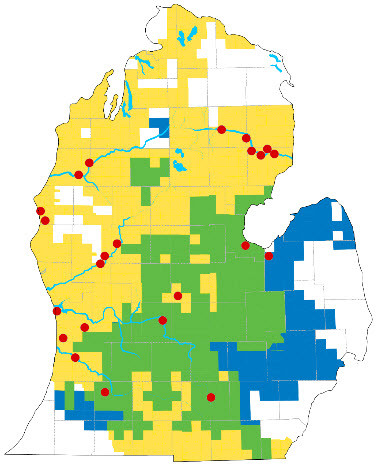 | |||||||||||
| Electric Service Territory | |||||||||||
| Gas Service Territory | |||||||||||
| Combination Electric and Gas Service Territory | |||||||||||
| • | Electric Generation Facilities | ||||||||||
CMS Energy and Consumers – The Triple Bottom Line
For information regarding CMS Energy’s and Consumers’ purpose and impact on the “triple bottom line” of people, planet, and profit, see Item 7. Management’s Discussion and Analysis of Financial Condition and Results of Operations—Executive Overview.
Business Segments
Consumers Electric Utility
Electric Utility Operations: Consumers’ electric utility operations, which include the generation, purchase, distribution, and sale of electricity, generated operating revenue of $4.4 billion in 2020 and 2019, and $4.6 billion in 2018. Consumers’ electric utility customer base consists of a mix of primarily residential, commercial, and diversified industrial customers in Michigan’s Lower Peninsula.
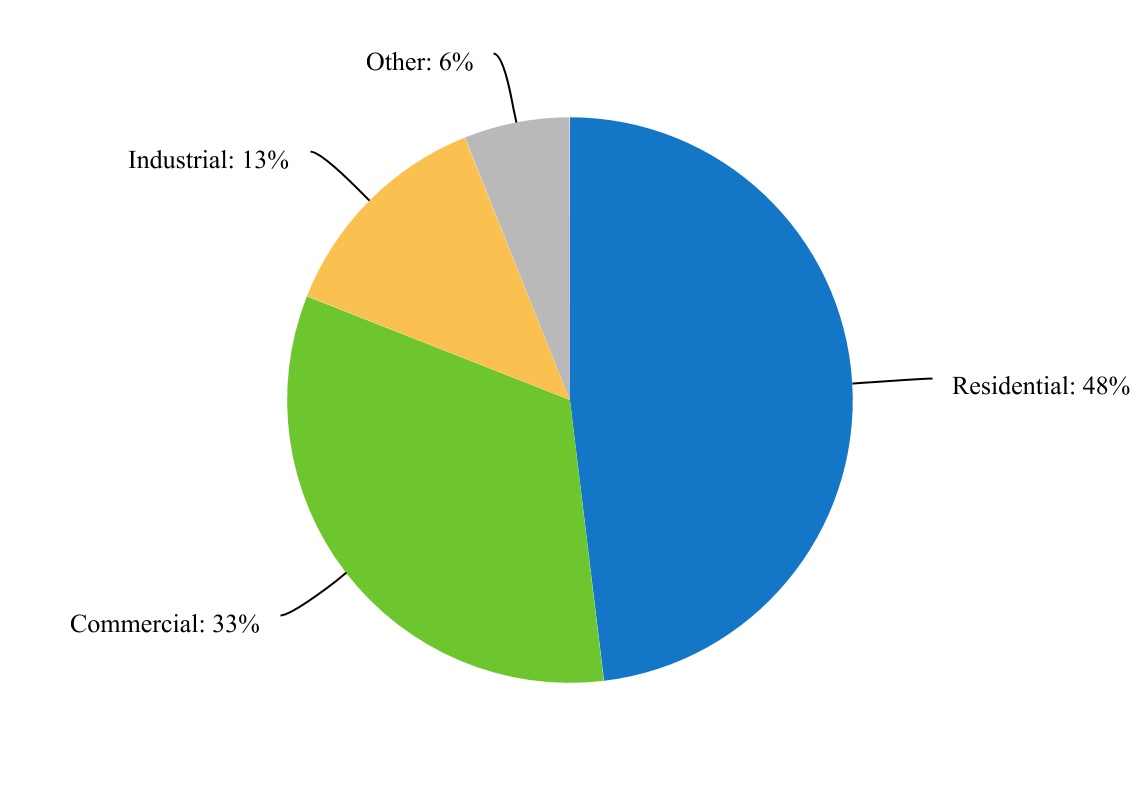
Presented in the following illustration is Consumers’ 2020 electric utility operating revenue of $4.4 billion by customer class:
Consumers’ electric utility operations are not dependent on a single customer, or even a few customers, and the loss of any one or even a few of Consumers’ largest customers is not reasonably likely to have a material adverse effect on Consumers’ financial condition.
In 2020, Consumers’ electric deliveries were 35 billion kWh, which included ROA deliveries of three billion kWh, resulting in net bundled sales of 32 billion kWh. In 2019, Consumers’ electric deliveries were 37 billion kWh, which included ROA deliveries of four billion kWh, resulting in net bundled sales of 33 billion kWh.
Consumers’ electric utility operations are seasonal. The consumption of electric energy typically increases in the summer months, due primarily to the use of air conditioners and other cooling equipment.
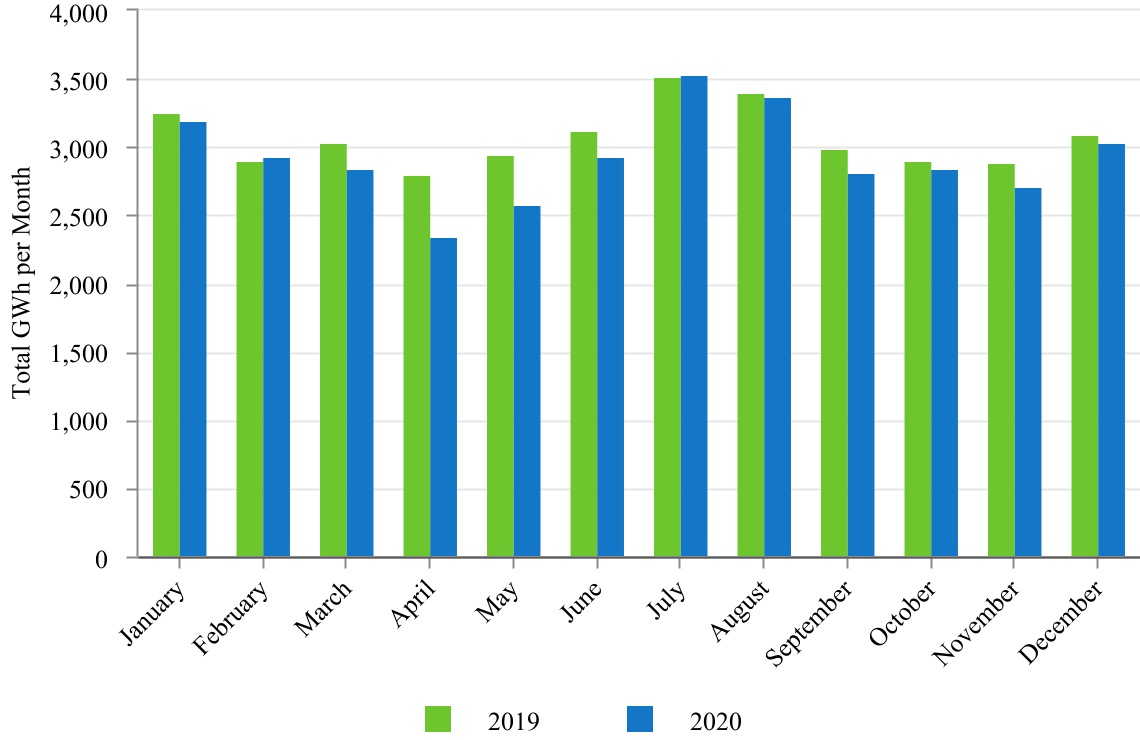
Presented in the following illustration are Consumers’ monthly weather-normalized electric deliveries (deliveries adjusted to reflect normal weather conditions) to its customers, including ROA deliveries, during 2020 and 2019:
Consumers’ 2020 summer peak demand was 8,215 MW, which included ROA demand of 540 MW. For the 2019-2020 winter season, Consumers’ peak demand was 5,602 MW, which included ROA demand of 464 MW. As required by MISO reserve margin requirements, Consumers owns or controls, through long-term PPAs and short-term capacity purchases, all of the capacity required to supply its projected firm peak load and necessary reserve margin for summer 2021.
Electric Utility Properties: Consumers owns and operates electric generation and distribution facilities. For details about Consumers’ electric generation facilities, see the Electric Utility Generation and Supply Mix section that follows this Electric Utility Properties section. Consumers’ distribution system consists of:
-
205 miles of high-voltage distribution overhead lines operating at 138 kV
-
4 miles of high-voltage distribution underground lines operating at 138 kV
-
4,428 miles of high-voltage distribution overhead lines operating at 46 kV and 69 kV
-
19 miles of high-voltage distribution underground lines operating at 46 kV
-
77,833 miles of electric distribution overhead lines
-
9,264 miles of underground distribution lines
-
1,096 substations with an aggregate transformer capacity of 26 million kVA
-
two battery facilities with storage capacity of 2 MW
Consumers is interconnected to the interstate high-voltage electric transmission system owned by METC and operated by MISO. Consumers is also interconnected to neighboring utilities and to other transmission systems.
Electric Utility Generation and Supply Mix: During 2020, Consumers announced a goal of achieving net-zero carbon emissions from its electric business by 2040. This goal includes not only emissions from Consumers’ owned generation, but also emissions from the generation of power purchased through long-term PPAs and from the MISO energy market.
Consumers expects to reduce carbon emissions of its owned generation by more than 90 percent from its 2005 levels by 2040 through execution of its Clean Energy Plan, which calls for replacing its coal-fueled generation predominantly with investment in renewable energy. The remaining emissions will be offset through alternative measures including, but not limited to, carbon sequestration, landfill methane emission capture, and large-scale tree planting. Specifically, the Clean Energy Plan provides for the retirement of the D.E. Karn 1 & 2 coal-fueled generating units in 2023 and the potential retirement of the J.H. Campbell 1 & 2 coal-fueled generating units in 2031 or earlier.
Presented in the following table are details about Consumers’ 2020 electric generation and supply mix:
| Name and Location (Michigan) | Number of Units and Year Entered Service | 2020 Generation Capacity (MW) | 1 | 2020 Electric Supply (GWh) | |||||||||||||
| Coal steam generation | |||||||||||||||||
| J.H. Campbell 1 & 2 – West Olive | 2 Units, 1962-1967 | 540 | 1,538 | ||||||||||||||
| J.H. Campbell 3 – West Olive2 | 1 Unit, 1980 | 785 | 4,804 | ||||||||||||||
| D.E. Karn 1 & 2 – Essexville3 | 2 Units, 1959-1961 | 460 | 1,618 | ||||||||||||||
| 1,785 | 7,960 | ||||||||||||||||
| Oil/Gas steam generation | |||||||||||||||||
| D.E. Karn 3 & 4 – Essexville | 2 Units, 1975-1977 | 1,058 | 37 | ||||||||||||||
| Hydroelectric | |||||||||||||||||
| Ludington – Ludington | 6 Units, 1973 | 975 | 4 | (371) | 5 | ||||||||||||
| Conventional hydro generation – various locations | 35 Units, 1906-1949 | 76 | 482 | ||||||||||||||
| 1,051 | 111 | ||||||||||||||||
| Gas combined cycle | |||||||||||||||||
| Jackson – Jackson | 1 Unit, 2002 | 547 | 1,786 | ||||||||||||||
| Zeeland – Zeeland | 3 Units, 2002 | 534 | 3,465 | ||||||||||||||
| 1,081 | 5,251 | ||||||||||||||||
| Gas combustion turbines | |||||||||||||||||
| Zeeland (simple cycle) – Zeeland | 2 Units, 2001 | 318 | 601 | ||||||||||||||
| Wind generation | |||||||||||||||||
| Cross Winds® Energy Park – Tuscola County | 114 Turbines, 2014, 2018, and 2019 | 39 | 722 | ||||||||||||||
| Lake Winds® Energy Park – Mason County | 56 Turbines, 2012 | 16 | 273 | ||||||||||||||
| Gratiot Farms Wind Project – Gratiot County | 60 Turbines, 2020 | — | 22 | ||||||||||||||
| 55 | 1,017 | ||||||||||||||||
| Solar generation | |||||||||||||||||
| Solar Gardens – Allendale and Kalamazoo | 15,100 Panels, 2016 | 2 | 6 | ||||||||||||||
| Total owned generation | 5,350 | 14,983 | |||||||||||||||
| Purchased power6 | |||||||||||||||||
| Coal generation – T.E.S. Filer City | 60 | 513 | |||||||||||||||
| Gas generation – MCV Facility7 | 1,240 | 6,110 | |||||||||||||||
| Other gas generation – various locations | 152 | 1,236 | |||||||||||||||
| Nuclear generation – Palisades7 | 813 | 6,898 | |||||||||||||||
| Wind generation – various locations | 64 | 1,160 | |||||||||||||||
| Solar generation – various locations | 4 | 8 | |||||||||||||||
| Other renewable generation – various locations | 244 | 1,057 | |||||||||||||||
| 2,577 | 16,982 | ||||||||||||||||
| Net interchange power8 | — | 2,655 | |||||||||||||||
| Total purchased and interchange power | 2,577 | 19,637 | |||||||||||||||
| Total supply | 7,927 | 34,620 | |||||||||||||||
| Less distribution and transmission loss | 2,810 | ||||||||||||||||
| Total net bundled sales | 31,810 |
1Represents generation capacity during the summer months (planning year 2020 capacity as reported to MISO and limited by interconnection service limits), except for the Gratiot Farms Wind Project, which
began operation in December 2020. For wind and solar generation, the amount represents the effective load-carrying capability.
2Represents Consumers’ share of the capacity of the J.H. Campbell 3 unit, net of the 6.69-percent ownership interest of the Michigan Public Power Agency and Wolverine Power Supply Cooperative, Inc.
3Consumers plans to retire these coal-fueled generating units in 2023.
4Represents Consumers’ 51-percent share of the capacity of Ludington. DTE Electric holds the remaining 49-percent ownership interest.
5Represents Consumers’ share of net pumped-storage generation. The pumped-storage facility consumes electricity to pump water during off-peak hours for storage in order to generate electricity later during peak‑demand hours.
6Represents purchases under long-term PPAs.
7For information about Consumers’ long-term PPAs related to the MCV Facility and Palisades, see Item 8. Financial Statements and Supplementary Data—Notes to the Consolidated Financial Statements—Note 4, Contingencies and Commitments—Contractual Commitments.
8Represents purchases from the MISO energy market.
Presented in the following table are the sources of Consumers’ electric supply for the last three years:
| GWh | |||||||||||
| Years Ended December 31 | 2020 | 2019 | 2018 | ||||||||
| Owned generation | |||||||||||
| Coal | 7,960 | 9,776 | 9,804 | ||||||||
| Gas | 5,883 | 6,289 | 5,272 | ||||||||
| Renewable energy | 1,505 | 1,258 | 1,187 | ||||||||
| Oil | 6 | 5 | 5 | ||||||||
| Net pumped storage1 | (371) | (308) | (325) | ||||||||
| Total owned generation | 14,983 | 17,020 | 15,943 | ||||||||
| Purchased power2 | |||||||||||
| Gas generation | 7,346 | 6,812 | 6,712 | ||||||||
| Nuclear generation | 6,898 | 6,946 | 6,749 | ||||||||
| Renewable energy generation | 2,225 | 2,387 | 2,379 | ||||||||
| Coal generation | 513 | 462 | 511 | ||||||||
| Net interchange power3 | 2,655 | 2,059 | 4,953 | ||||||||
| Total purchased and interchange power | 19,637 | 18,666 | 21,304 | ||||||||
| Total supply | 34,620 | 35,686 | 37,247 |
1Represents Consumers’ share of net pumped-storage generation. During 2020, the pumped-storage facility consumed 1,369 GWh of electricity to pump water during off-peak hours for storage in order to generate 998 GWh of electricity later during peak-demand hours.
2Represents purchases under long-term PPAs.
3Represents purchases from the MISO energy market.
During 2020, Consumers acquired 57 percent of the electricity it provided to customers through long-term PPAs and the MISO energy market. Consumers offers its generation into the MISO energy market on a day-ahead and real-time basis and bids for power in the market to serve the demand of its customers. Consumers is a net purchaser of power and supplements its generation capability with purchases from the MISO energy market to meet its customers’ needs during peak-demand periods.
At December 31, 2020, Consumers had future commitments to purchase capacity and energy under long-term PPAs with various generating plants. These contracts require monthly capacity payments based on the plants’ availability or deliverability. The payments for 2021 through 2040 are estimated to total $9.0 billion and, for each of the next five years, range from $0.7 billion to $1.1 billion annually. These amounts may vary depending on plant availability and fuel costs. For further information about Consumers’ future capacity and energy purchase obligations, see Item 7. Management’s Discussion and Analysis of Financial Condition and Results of Operations—Capital Resources and Liquidity—Contractual Obligations and Item 8. Financial Statements and Supplementary Data—Notes to the Consolidated Financial Statements—Note 4, Contingencies and Commitments—Contractual Commitments.
During 2020, 23 percent of the energy Consumers provided to customers was generated by its coal-fueled generating units, which burned five million tons of coal and produced a combined total of 7,960 GWh of electricity. In order to obtain the coal it needs, Consumers enters into physical coal supply contracts.
At December 31, 2020, Consumers had future commitments to purchase coal through 2022; payment obligations under these contracts totaled $88 million. Most of Consumers’ rail-supplied coal contracts have fixed prices, although some contain market-based pricing. Consumers’ vessel-supplied coal contracts have fixed base prices that are adjusted monthly to reflect changes to the fuel cost of vessel transportation. At December 31, 2020, Consumers had 76 percent of its 2021 expected coal requirements under contract, as well as a 54-day supply of coal on hand.
In conjunction with its coal supply contracts, Consumers leases a fleet of railcars and has transportation contracts with various companies to provide rail and vessel services for delivery of purchased coal to Consumers’ generating facilities. Consumers’ coal transportation contracts are future commitments and expire on various dates through 2025; payment obligations under these contracts totaled $718 million at December 31, 2020.
During 2020, 17 percent of the energy Consumers provided to customers was generated by its natural gas‑fueled generating units, which burned 43 bcf of natural gas and produced a combined total of 5,883 GWh of electricity.
In order to obtain the gas it needs for electric generation fuel, Consumers’ electric utility purchases gas from the market near the time of consumption, at prices that allow it to compete in the electric wholesale market. For units 3 & 4 of D.E. Karn and for the Jackson and Zeeland plants, Consumers utilizes an agent that owns firm transportation rights to each plant to purchase gas from the market and transport the gas to the facilities.
Electric Utility Competition: Consumers’ electric utility business is subject to actual and potential competition from many sources, in both the wholesale and retail markets, as well as in electric generation, electric delivery, and retail services.
Michigan law allows electric customers in Consumers’ service territory to buy electric generation service from alternative electric suppliers in an aggregate amount capped at ten percent of Consumers’ sales, with certain exceptions. At December 31, 2020, electric deliveries under the ROA program were at the ten‑percent limit. Of Consumers’ 1.9 million electric customers, fewer than 300, or 0.02 percent, purchased electric generation service under the ROA program. For additional information, see Item 7. Management’s Discussion and Analysis of Financial Condition and Results of Operations—Outlook—Consumers Electric Utility Outlook and Uncertainties.
Consumers also faces competition or potential competition associated with industrial customers relocating all or a portion of their production capacity outside of Consumers’ service territory for economic reasons; municipalities owning or operating competing electric delivery systems; and customer self-generation. Consumers addresses this competition in various ways, including:
-
aggressively controlling operating, maintenance, and fuel costs and passing savings on to customers
-
providing renewable energy options and energy waste reduction programs
-
providing competitive rate-design options, particularly for large energy-intensive customers
-
offering tariff-based incentives that support economic development
-
monitoring activity in adjacent geographical areas
Consumers Gas Utility
Gas Utility Operations: Consumers’ gas utility operations, which include the purchase, transmission, storage, distribution, and sale of natural gas, generated operating revenue of $1.8 billion in 2020, and $1.9 billion in 2019 and 2018. Consumers’ gas utility customer base consists of a mix of primarily residential, commercial, and diversified industrial customers in Michigan’s Lower Peninsula.
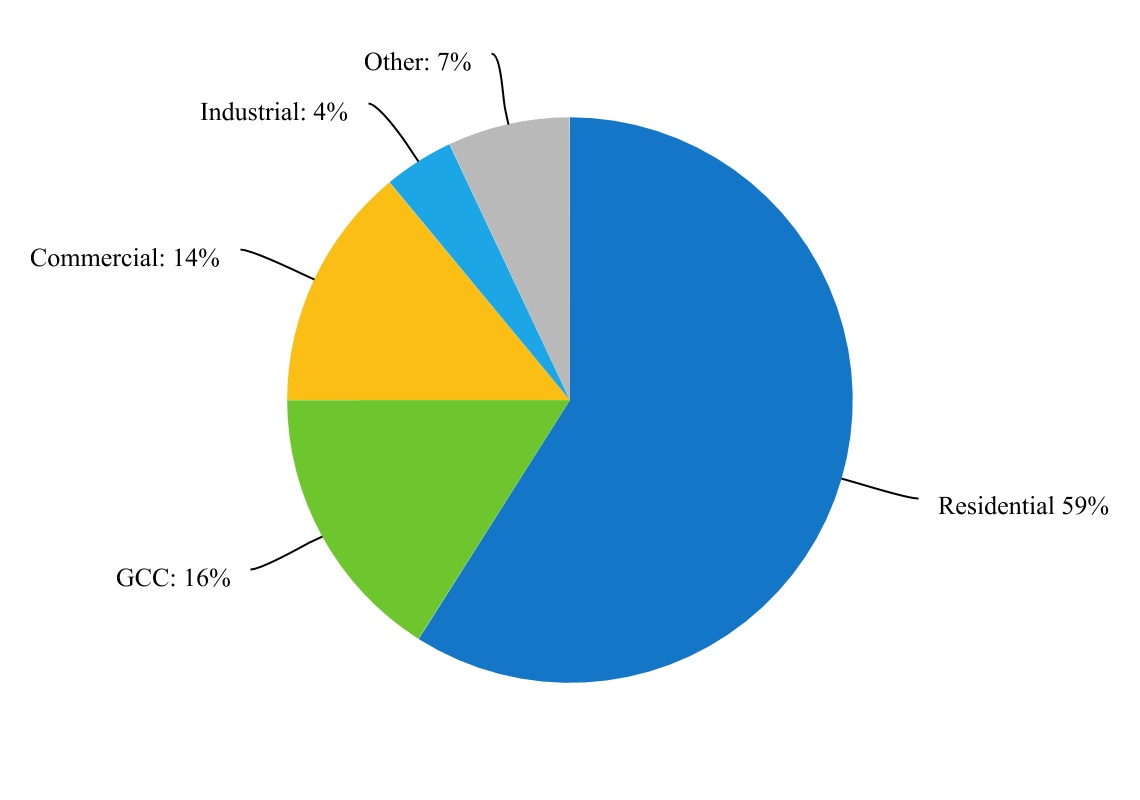
Presented in the following illustration is Consumers’ 2020 gas utility operating revenue of $1.8 billion by customer class:
Consumers’ gas utility operations are not dependent on a single customer, or even a few customers, and the loss of any one or even a few of Consumers’ largest customers is not reasonably likely to have a material adverse effect on Consumers’ financial condition.
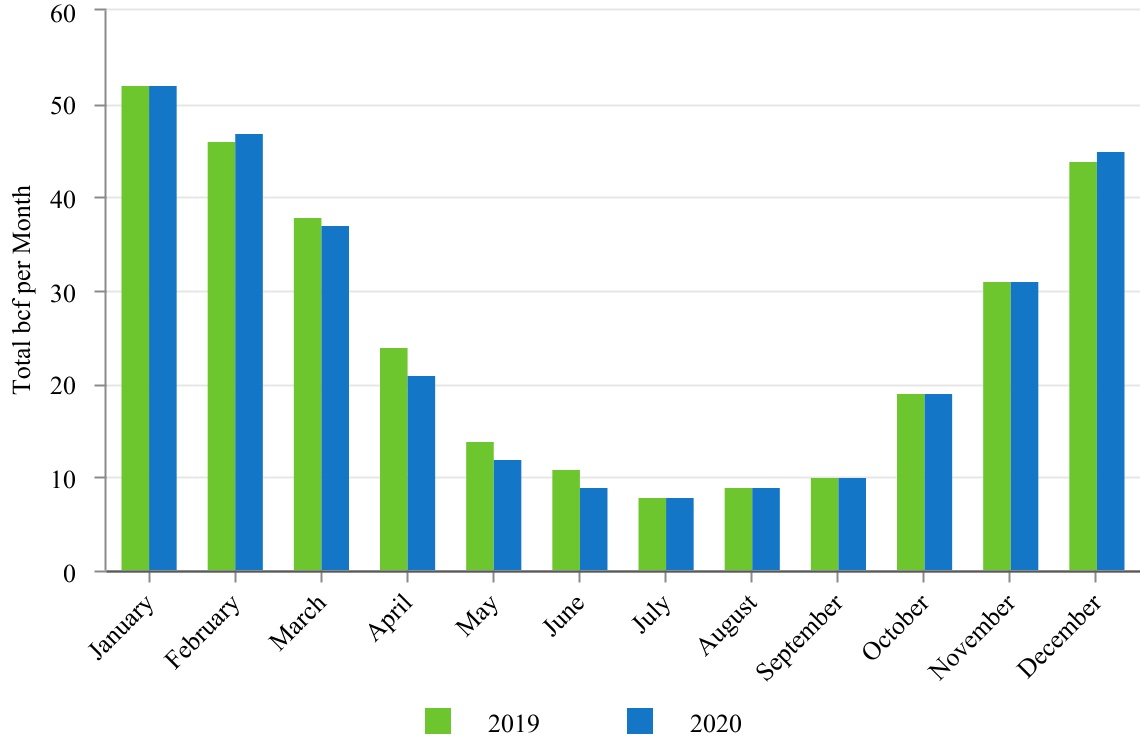
In 2020, deliveries of natural gas through Consumers’ pipeline and distribution network, including off-system transportation deliveries, totaled 360 bcf, which included GCC deliveries of 36 bcf. In 2019, deliveries of natural gas through Consumers’ pipeline and distribution network, including off-system transportation deliveries, totaled 391 bcf, which included GCC deliveries of 41 bcf. Consumers’ gas utility operations are seasonal. The consumption of natural gas typically increases in the winter, due primarily to colder temperatures and the resulting use of natural gas as heating fuel. Consumers injects natural gas into storage during the summer months for use during the winter months. During 2020, 43 percent of the natural gas supplied to all customers during the winter months was supplied from storage.
Presented in the following illustration are Consumers’ monthly weather-normalized natural gas deliveries (deliveries adjusted to reflect normal weather conditions) to its customers, including GCC deliveries, during 2020 and 2019:
Gas Utility Properties: Consumers’ gas transmission, storage, and distribution system consists of:
-
2,410 miles of transmission lines
-
15 gas storage fields with a total storage capacity of 309 bcf and a working gas volume of 151 bcf
-
27,958 miles of distribution mains
-
eight compressor stations with a total of 167,017 installed and available horsepower
In 2019, Consumers released its Methane Reduction Plan, which set a goal of net-zero methane emissions from its natural gas delivery system by 2030. Consumers plans to reduce methane emissions from its system by about 80 percent by accelerating the replacement of aging pipe, rehabilitating or retiring outdated infrastructure, and adopting new technologies and practices. The remaining emissions will be offset by purchasing and/or producing renewable natural gas.
Gas Utility Supply: In 2020, Consumers purchased 84 percent of the gas it delivered from U.S. suppliers. The remaining 16 percent was purchased from authorized GCC suppliers and delivered by Consumers to customers in the GCC program. Presented in the following illustration are the supply arrangements for the gas Consumers delivered to GCC and GCR customers during 2020:
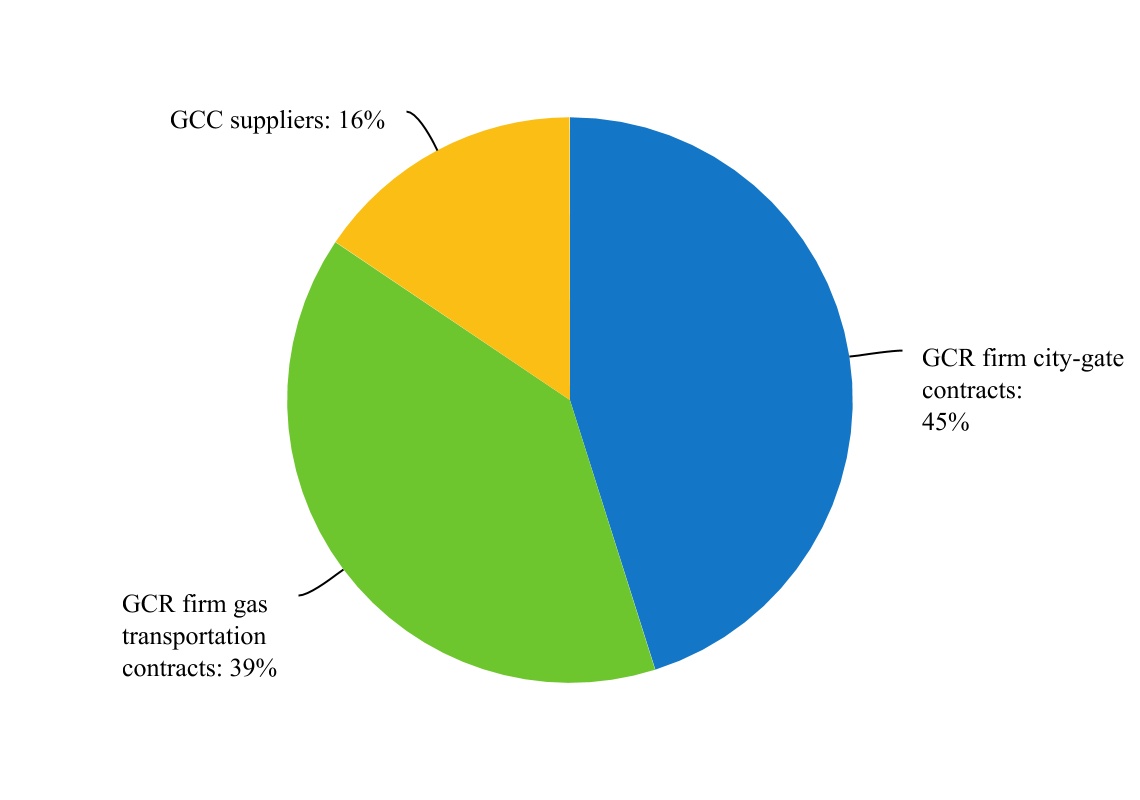
Firm gas transportation or firm city-gate contracts are those that define a fixed amount, price, and delivery time frame. Consumers’ firm gas transportation contracts are with Panhandle Eastern Pipe Line Company and Trunkline Gas Company, LLC, each a non‑affiliated company. Under these contracts, Consumers purchases and transports gas to Michigan for ultimate delivery to its customers. Consumers’ firm gas transportation contracts expire on various dates through 2023 and provide for the delivery of 31 percent of Consumers’ total gas supply requirements in 2021. Consumers purchases the balance of its required gas supply under firm city-gate contracts and through authorized suppliers under the GCC program.
Gas Utility Competition: Competition exists in various aspects of Consumers’ gas utility business. Competition comes from GCC and from alternative fuels and energy sources, such as propane, oil, and electricity.
Enterprises Segment—Non-Utility Operations and Investments
CMS Energy’s enterprises segment, through various subsidiaries and certain equity investments, is engaged in domestic independent power production, including the development and operation of renewable generation, and the marketing of independent power production. The enterprises segment’s operating revenue was $229 million in 2020, $248 million in 2019, and $252 million in 2018.
Independent Power Production: Presented in the following table is information about the independent power plants in which CMS Energy had an ownership interest at December 31, 2020:
| Location | Ownership Interest (%) | Primary Fuel Type | Gross Capacity (MW) | 1 | 2020 Net Generation (GWh) | ||||||||||||
| Dearborn, Michigan | 100 | Natural gas | 770 | 5,029 | |||||||||||||
| Gaylord, Michigan | 100 | Natural gas | 134 | 4 | |||||||||||||
| Paulding County, Ohio | 100 | Wind | 105 | 286 | |||||||||||||
| Comstock, Michigan | 100 | Natural gas | 76 | 78 | |||||||||||||
| Delta Township, Michigan | 100 | Solar | 24 | 42 | |||||||||||||
| Phillips, Wisconsin | 100 | Solar | 3 | 5 | |||||||||||||
| Coke County, Texas2 | 51 | Wind | 525 | 537 | |||||||||||||
| Filer City, Michigan | 50 | Coal | 73 | 510 | |||||||||||||
| New Bern, North Carolina | 50 | Wood waste | 50 | 229 | |||||||||||||
| Flint, Michigan | 50 | Wood waste | 40 | 91 | |||||||||||||
| Grayling, Michigan | 50 | Wood waste | 38 | 66 | |||||||||||||
| Total | 1,838 | 6,877 |
1Represents the intended full-load sustained output of each plant. The amount of capacity relating to CMS Energy’s ownership interest was 1,480 MW at December 31, 2020.
2Began operation in September 2020.
The operating revenue from independent power production was $32 million in 2020 and 2019, and $19 million in 2018.
Energy Resource Management: CMS ERM purchases and sells energy commodities in support of CMS Energy’s generating facilities with a focus on optimizing CMS Energy’s independent power production portfolio. In 2020, CMS ERM marketed five bcf of natural gas and 7,080 GWh of electricity. Electricity marketed by CMS ERM was generated by independent power production of the enterprises segment and by unrelated third parties. CMS ERM’s operating revenue was $197 million in 2020, $216 million in 2019, and $233 million in 2018.
Enterprises Segment Competition: The enterprises segment competes with other independent power producers. The needs of this market are driven by electric demand and the generation available.
EnerBank
EnerBank Operations: EnerBank is a Utah state-chartered, FDIC-insured industrial bank providing primarily unsecured, fixed-rate installment loans throughout the U.S. to finance home improvements. EnerBank works with strategic business partners and contractors throughout the U.S. to provide homeowners with payment options for home improvements. Strategic business partners include manufacturers, distributors, franchisors, member or trade associations, and major retailers of home improvement, remodeling, and energy-saving products and services.
EnerBank’s operating revenue was $262 million in 2020, $221 million in 2019, and $157 million in 2018. EnerBank’s average loan size is $10,000 and all of the loans originated by EnerBank in 2020 were fixed-rate installment loans. The distribution of borrowers throughout the U.S. is generally consistent with the population distribution by state.
EnerBank Competition: EnerBank competes with FDIC-insured banks, credit unions, consumer finance companies, and financial technology companies. EnerBank addresses this competition by:
-
offering competitive loan features and pricing
-
maintaining a stable funding model
-
providing convenient loan processes for contractors and homeowners
-
providing strong marketing support for strategic business partners and authorized contractors
-
focusing on customer service
CMS Energy and Consumers Regulation
CMS Energy, Consumers, and their subsidiaries are subject to regulation by various federal, state, and local governmental agencies, including those described in the following sections. If CMS Energy or Consumers failed to comply with applicable laws and regulations, they could become subject to fines, penalties, or disallowed costs, or be required to implement additional compliance, cleanup, or remediation programs, the cost of which could be material. For more information on the potential impacts of government regulation affecting CMS Energy and Consumers, see Item 1A. Risk Factors, Item 7. Management’s Discussion and Analysis of Financial Condition and Results of Operations—Outlook, and Item 8. Financial Statements and Supplementary Data—Notes to the Consolidated Financial Statements—Note 3, Regulatory Matters.
FERC and NERC
FERC has exercised limited jurisdiction over several independent power plants and exempt wholesale generators in which CMS Enterprises has ownership interests, as well as over CMS ERM, CMS Gas Transmission, and DIG. FERC’s jurisdiction includes, among other things, acquisitions, operations, disposals of certain assets and facilities, services provided and rates charged, and conduct among affiliates. FERC also has limited jurisdiction over holding company matters with respect to CMS Energy. FERC, in connection with NERC and with regional reliability organizations, also regulates generation and transmission owners and operators, load serving entities, purchase and sale entities, and others with regard to reliability of the bulk power system.
FERC regulates limited aspects of Consumers’ gas business, principally compliance with FERC capacity release rules, shipping rules, the prohibition against certain buy/sell transactions, and the price-reporting rule.
FERC also regulates certain aspects of Consumers’ electric operations, including compliance with FERC accounting rules, wholesale and transmission rates, operation of licensed hydroelectric generating plants, transfers of certain facilities, corporate mergers, and issuances of securities.
MPSC
Consumers is subject to the jurisdiction of the MPSC, which regulates public utilities in Michigan with respect to retail utility rates, accounting, utility services, certain facilities, certain asset transfers, corporate mergers, and other matters.
The Michigan Attorney General, ABATE, the MPSC Staff, and certain other parties typically participate in MPSC proceedings concerning Consumers. These parties often challenge various aspects of those proceedings, including the prudence of Consumers’ policies and practices, and seek cost disallowances and other relief. The parties also have appealed significant MPSC orders.
Rate Proceedings: For information regarding open rate proceedings, see Item 7. Management’s Discussion and Analysis of Financial Condition and Results of Operations—Outlook and Item 8. Financial Statements and Supplementary Data—Notes to the Consolidated Financial Statements—Note 3, Regulatory Matters.
Other Regulation
The U.S. Secretary of Energy regulates imports and exports of natural gas and has delegated various aspects of this jurisdiction to FERC and the U.S. Department of Energy’s Office of Fossil Fuels.
The U.S. Department of Transportation’s Office of Pipeline Safety regulates the safety and security of gas pipelines through the Natural Gas Pipeline Safety Act of 1968 and subsequent laws.
EnerBank is regulated by the Utah Department of Financial Institutions and the FDIC.
CMS Energy and Consumers Environmental Strategy and Compliance
CMS Energy and Consumers are committed to protecting the environment; this commitment extends beyond compliance with applicable laws and regulations. In February 2020, Consumers announced a goal of achieving net-zero carbon emissions from its electric business by 2040. This goal includes not only emissions from Consumers’ owned generation, but also emissions from the generation of power purchased through long-term PPAs and from the MISO energy market.
Consumers expects to reduce carbon emissions of its owned generation by more than 90 percent from its 2005 levels by 2040 through execution of its Clean Energy Plan, which calls for replacing its coal-fueled generation predominantly with investment in renewable energy. The remaining emissions will be offset through alternative measures including, but not limited to, carbon sequestration, landfill methane emission capture, and large-scale tree planting. During 2020, Consumers provided 11 percent of its electricity (self-generated and purchased) from renewable sources. Additionally, Consumers began operation of Gratiot Farms Wind Project, a 150-MW wind generation project, in December 2020 and expects to take full ownership and begin commercial operation of another with capacity of up to 166 MW in early 2021. Furthermore, Consumers has executed agreements to purchase another wind generation project under development, with capacity of up to 201 MW, and a solar generating facility under development, with capacity of up to 150 MW. For each of these projects, Consumers expects to take full ownership and begin commercial operation of the project in 2022.
In addition to Consumers’ efforts to reduce the electric utility’s carbon footprint, it is also making efforts to reduce the gas utility’s methane footprint. In 2019, Consumers released its Methane Reduction Plan, which set a goal of net-zero methane emissions from its natural gas delivery system by 2030. Consumers plans to reduce methane emissions from its system by about 80 percent by accelerating the replacement of aging pipe, rehabilitating or retiring outdated infrastructure, and adopting new technologies and practices. The remaining emissions will be offset by purchasing and/or producing renewable natural gas.
CMS Energy, Consumers, and their subsidiaries are subject to various federal, state, and local environmental regulations for air and water quality, solid waste management, and other matters. Consumers expects to recover costs to comply with environmental regulations in customer rates, but cannot guarantee this result. For additional information concerning environmental matters, see Item 1A. Risk Factors, Item 7. Management’s Discussion and Analysis of Financial Condition and Results of Operations—Outlook, and Item 8. Financial Statements and Supplementary Data—Notes to the Consolidated Financial Statements—Note 4, Contingencies and Commitments.
CMS Energy has recorded a $45 million liability for its subsidiaries’ obligations associated with Bay Harbor and Consumers has recorded a $56 million liability for its obligations at a number of former MGP sites. For additional information, see Item 1A. Risk Factors and Item 8. Financial Statements and Supplementary Data—Notes to the Consolidated Financial Statements—Note 4, Contingencies and Commitments.
Solid Waste Disposal: Costs related to the construction, operation, corrective action, and closure of solid waste disposal facilities for coal ash are significant. Consumers’ coal ash disposal areas are regulated under Michigan’s solid waste rules and by the EPA’s rules regulating CCRs. To address some of the requirements of these rules, Consumers has converted all of its fly ash handling systems to dry systems. In addition, Consumers’ ash facilities have programs designed to protect the environment and are subject to quarterly EGLE inspections. Consumers’ estimate of capital and cost of removal expenditures to comply with regulations relating to ash disposal is $156 million from 2021 through 2025.
Water: Consumers uses substantial amounts of water to operate and cool its electric generating plants and gas compression stations. Water discharge quality is regulated and administered by EGLE under the federal NPDES program. To comply with such regulation, Consumers’ facilities have discharge monitoring programs. The EPA issued final regulations for wastewater discharges from electric generating plants in 2015 and amended them in 2017 and 2020. Consumers’ estimate of capital expenditures to comply with these regulations as presently promulgated is $23 million from 2021 through 2025.
In 2014, the EPA finalized its cooling water intake rule for electric generating units, which requires Consumers to evaluate the biological impact of its cooling water intake systems and ensure that it is using the best technology available to minimize adverse environmental impacts. Consumers’ estimate of capital expenditures to comply with these regulations is $38 million from 2021 through 2025.
Air: Consumers is subject to federal and state environmental regulations that require extensive reductions in nitrogen oxides, sulfur dioxides, particulate matter, and mercury emissions. To comply with these regulations, Consumers has invested in emissions control equipment at its electric generating plants. Consumers’ estimate of ongoing capital expenditures to comply with these regulations is $43 million from 2021 through 2025.
Consumers’ future costs to comply with solid waste disposal, water, and air environmental regulations may vary depending on future legislation, litigation, executive orders, treaties, or rulemaking.
For further information concerning estimated capital expenditures related to solid waste disposal, water, and air, see Item 7. Management’s Discussion and Analysis of Financial Condition and Results of Operations—Outlook—Consumers Electric Utility Outlook and Uncertainties—Electric Environmental Outlook.
Insurance
CMS Energy and its subsidiaries, including Consumers, maintain insurance coverage generally similar to comparable companies in the same lines of business. The insurance policies are subject to terms, conditions, limitations, and exclusions that might not fully compensate CMS Energy or Consumers for all losses. A portion of each loss is generally assumed by CMS Energy or Consumers in the form of deductibles and self-insured retentions that, in some cases, are substantial. As CMS Energy or Consumers renews its policies, it is possible that some of the present insurance coverage may not be renewed or obtainable on commercially reasonable terms due to restrictive insurance markets.
Human Capital
CMS Energy and Consumers employ a highly trained and skilled workforce comprised of union, non‑union, and seasonal employees, and also uses contractors. Presented in the following table are the number of employees and contractors of CMS Energy and Consumers:
| December 31 | 2020 | 2019 | 2018 | ||||||||
| CMS Energy, including Consumers | |||||||||||
| Full-time employees | 8,148 | 8,128 | 7,957 | ||||||||
| Seasonal employees1 | 603 | 594 | 603 | ||||||||
| Part-time employees | 86 | 67 | 65 | ||||||||
| Contractors | 508 | 509 | 656 | ||||||||
| Total workforce | 9,345 | 9,298 | 9,281 | ||||||||
| Consumers | |||||||||||
| Full-time employees | 7,617 | 7,642 | 7,504 | ||||||||
| Seasonal employees1 | 603 | 594 | 603 | ||||||||
| Part-time employees | 10 | 17 | 14 | ||||||||
| Contractors | 508 | 509 | 656 | ||||||||
| Total workforce | 8,738 | 8,762 | 8,777 |
1Consumers’ seasonal workforce peaked at 603 employees during 2020, and 614 employees during 2019 and 2018. Seasonal employees work primarily during the construction season.
At December 31, 2020, unions represented 41 percent of CMS Energy’s employees and 44 percent of Consumers’ employees. The UWUA represents Consumers’ operating, maintenance, construction, and customer contact center employees. The USW represents Zeeland plant employees. For information about CMS Energy’s and Consumers’ collective bargaining agreements, see Item 7. Management’s Discussion and Analysis of Financial Condition and Results of Operations—Outlook—Other Outlook and Uncertainties and Item 8. Financial Statements and Supplementary Data—Notes to the Consolidated Financial Statements—Note 12, Retirement Benefits.
The safety of employees, customers, and the general public is a priority of CMS Energy and Consumers. Accordingly, CMS Energy and Consumers have worked to integrate a set of safety principles into their business operations and culture. These principles include complying with applicable safety, health, and security regulations and implementing programs and processes aimed at continually improving safety and security conditions. On an annual basis, CMS Energy and Consumers set various safety goals, with their primary measure being the number of recordable incidents. There were 101 recordable incidents in 2020 and 105 recordable incidents in 2019. The target for 2021 is no more than 81 recordable incidents. Over the last ten years, Consumers’ OSHA recordable incident rate has decreased by over 53 percent and ranks in the first quartile of its EEI peer group.
In response to the COVID-19 pandemic, CMS Energy and Consumers have issued a response plan that is focused on the health, safety, and well-being of their co-workers, customers, and communities. CMS Energy and Consumers have aligned with safety and health guidelines from the CDC, OSHA, and the Michigan Department of Health and Human Services in order to protect their employees, customers, and contractors to ensure the continued delivery of critical energy services. For more information about CMS Energy’s and Consumers’ response to the COVID-19 pandemic, see Item 7. Management’s Discussion and Analysis of Financial Condition and Results of Operations—Executive Overview.
Within the utility industry, there is strong competition for rare, high-demand talent, including those related to renewable energy generation, technology, and data analytics. In order to address this competition and to be able to meet its human capital needs, CMS Energy and Consumers provide compensation and benefits that are competitive with industry peers. Furthermore, the companies have developed a comprehensive talent strategy, the Talent Roadmap, to attract, develop, and retain highly skilled employees. The strategy focuses on three areas, which are summarized below.
-
Cultivating a Purpose-Driven Culture:** This goal is aimed at ensuring all co-workers understand how their work drives the companies’ key strategic goals. The companies’ progress toward a purpose-driven culture is measured through an engagement index and an empowerment index developed from data obtained through an annual employee engagement survey of union and non-union co-workers administered by a third party. For the year ended December 31, 2020, the employee engagement index score was 83 percent, which ranked in the first quartile of U.S. utilities. The employee empowerment index score, which measures the percentage of employees that feel the workplace promotes empowerment, was 63 percent. Each employee empowerment question was individually benchmarked and ranked in the second quartile of high-performing companies. The high-performing benchmark was created by the third party who administered the survey through a targeted sampling of working adults within the U.S. who work for firms with widely respected reputations. CMS Energy and Consumers have a goal to achieve a first-quartile score by 2024.
-
Creating a Breakthrough Employee Experience:** A breakthrough employee experience is one that instills pride and ownership in one’s work. To measure progress toward a breakthrough employee experience, the companies measure employees’ satisfaction with people processes, such as performance management and hiring and onboarding new employees. For the year ended December 31, 2020, the employee experience index was 52 percent; the companies have a goal to achieve a score of 80 percent within the next ten years.
-
Building Skill Sets at Scale:** With an overarching goal of ensuring employees have the right skills to succeed, the companies measure progress in this area through achievement of workforce planning and hiring milestones and through a first-time skill attainment index to evaluate the effectiveness of training. The companies develop skill sets in co-workers through a variety of means, including union apprenticeship programs and yearly trainings for newly required skills. In 2021, the companies will launch a full-scale development program for leaders to enable robust succession planning and improve employee engagement and empowerment.
This talent strategy allows CMS Energy and Consumers to shape employees’ experience and enable leaders to coach and develop co-workers, source talent, and anticipate and adjust to changing skill sets in the business environment.
Diversity, Equity, and Inclusion
As a part of the companies’ Talent Roadmap, CMS Energy and Consumers also employ a comprehensive diversity, equity, and inclusion strategy designed to embed diversity, equity, and inclusion into all aspects of their business. This is done through embedding standards for diversity, equity, and inclusion into all company processes and ensuring these standards are incorporated into all employee experiences. To measure their success, the companies utilize select questions in the annual engagement survey to create a diversity, equity, and inclusion index. For the year ended December 31, 2020, the diversity, equity, and inclusion index score was 76 percent; the companies have a goal to achieve a score of 78 percent in 2021.
Co-workers are also empowered to engage in employee resource groups and events that encourage candid conversations around diversity, equity, and inclusion. There are seven employee resource groups available to all co-workers; these groups are, by date of origin:
-
the Women’s Advisory Panel, contributing to the achievement of the corporate strategy by supporting the retention, development, and success of women
-
the Minority Advisory Panel, promoting a culture of diversity and inclusion among all racial and ethnic minorities through education, leadership, development, and networking
-
the Women’s Engineering Network, connecting and empowering women in the science, technology, engineering, and mathematics fields, while building capabilities to support company objectives
-
the Veteran’s Advisory Panel, supporting former and active military personnel and assisting in recruiting and retaining veterans through career development
-
GEN-ERGY, a multigenerational group designed to bridge the gap of learning, networking, and mentoring across the generations of the companies’ workforce
-
the Pride Alliance of Consumers Energy, promoting an inclusive environment that is safe, supportive, and respectful for lesbian, gay, bi-sexual, and transgender persons and allies
-
capABLE, aimed at removing barriers and creating pathways to meaningful work for employees of all abilities
Information About CMS Energy’s and Consumers’ Executive Officers
Presented in the following table are the company positions held during the last five years for each of CMS Energy’s and Consumers’ executive officers as of February 1, 2021:
| Name, Age, Position(s) | Period | ||||
| Garrick J. Rochow (age 46) | |||||
| CMS Energy | |||||
| President, CEO, and Director | 12/2020 – Present | ||||
| Executive Vice President | 1/2020 – 12/2020 | ||||
| Senior Vice President | 7/2016 – 1/2020 | ||||
| Vice President | 3/2015 – 7/2016 | ||||
| Consumers | |||||
| President, CEO, and Director | 12/2020 – Present | ||||
| Executive Vice President | 1/2020 – 12/2020 | ||||
| Senior Vice President | 7/2016 – 1/2020 | ||||
| Vice President | 10/2010 – 7/2016 | ||||
| CMS Enterprises | |||||
| Chairman of the Board, CEO, and Director | 12/2020 – Present | ||||
| **Rejji P. Hayes (age 46)**1 | |||||
| CMS Energy | |||||
| Executive Vice President and CFO | 5/2017 – Present | ||||
| Consumers | |||||
| Executive Vice President and CFO | 5/2017 – Present | ||||
| CMS Enterprises | |||||
| Executive Vice President, CFO, and Director | 5/2017 – Present | ||||
| EnerBank | |||||
| Chairman of the Board and Director | 10/2018 – Present | ||||
| **Jean-Francois Brossoit (age 53)**2 | |||||
| CMS Energy | |||||
| Senior Vice President | 4/2017 – Present | ||||
| Vice President | 11/2016 – 4/2017 | ||||
| Consumers | |||||
| Senior Vice President | 4/2017 – Present | ||||
| Vice President | 11/2016 – 4/2017 |
| Name, Age, Position(s) | Period | ||||
| Catherine A. Hendrian (age 52) | |||||
| CMS Energy | |||||
| Senior Vice President | 4/2017 – Present | ||||
| Vice President | 3/2015 – 4/2017 | ||||
| Director of Human Resources | 10/2012 – 3/2015 | ||||
| Consumers | |||||
| Senior Vice President | 4/2017 – Present | ||||
| Vice President | 3/2015 – 4/2017 | ||||
| Director of Human Resources | 10/2012 – 3/2015 | ||||
| Brandon J. Hofmeister (age 44) | |||||
| CMS Energy | |||||
| Senior Vice President | 7/2017 – Present | ||||
| Consumers | |||||
| Senior Vice President | 7/2017 – Present | ||||
| Vice President | 7/2016 – 7/2017 | ||||
| Executive Director, Policy Research, Analysis, and Public Affairs | 6/2015 – 7/2016 | ||||
| Executive Director, Policy Research and Analysis | 9/2013 – 6/2015 | ||||
| CMS Enterprises | |||||
| Senior Vice President | 9/2017 – Present | ||||
| **Shaun M. Johnson (age 42)**3 | |||||
| CMS Energy | |||||
| Senior Vice President and General Counsel | 5/2019 – Present | ||||
| Vice President and Deputy General Counsel | 4/2016 – 5/2019 | ||||
| Consumers | |||||
| Senior Vice President and General Counsel | 5/2019 – Present | ||||
| Vice President and Deputy General Counsel | 4/2016 – 5/2019 | ||||
| CMS Enterprises | |||||
| Senior Vice President, General Counsel, and Director | 4/2019 – Present | ||||
| Vice President and General Counsel | 10/2018 – 4/2019 | ||||
| EnerBank | |||||
| Senior Vice President and General Counsel | 8/2018 – 6/2020 | ||||
| Venkat Dhenuvakonda Rao (age 50) | |||||
| CMS Energy | |||||
| Senior Vice President | 9/2016 – Present | ||||
| Vice President and Treasurer | 7/2012 – 9/2016 | ||||
| Consumers | |||||
| Senior Vice President | 9/2016 – Present | ||||
| Vice President and Treasurer | 7/2012 – 9/2016 | ||||
| CMS Enterprises | |||||
| Director | 11/2017 – Present | ||||
| Senior Vice President | 9/2016 – Present | ||||
| Vice President and Treasurer | 7/2012 – 9/2016 | ||||
| EnerBank | |||||
| Chairman of the Board | 9/2016 – 5/2017 |
| Name, Age, Position(s) | Period | ||||
| Brian F. Rich (age 46) | |||||
| CMS Energy | |||||
| Senior Vice President and Chief Customer Officer | 8/2019 – Present | ||||
| Senior Vice President and Chief Information Officer | 7/2016 – 8/2019 | ||||
| Vice President and Chief Information Officer | 7/2014 – 7/2016 | ||||
| Consumers | |||||
| Senior Vice President and Chief Customer Officer | 8/2019 – Present | ||||
| Senior Vice President and Chief Information Officer | 7/2016 – 8/2019 | ||||
| Vice President and Chief Information Officer | 7/2014 – 7/2016 | ||||
| LeeRoy Wells, Jr. (age 42) | |||||
| CMS Energy | |||||
| Senior Vice President | 12/2020 – Present | ||||
| Consumers | |||||
| Senior Vice President | 12/2020 – Present | ||||
| Vice President | 8/2017 – 12/2020 | ||||
| Executive Director, Electric Systems Operations and Maintenance | 12/2015 – 8/2017 | ||||
| Glenn P. Barba (age 55) | |||||
| CMS Energy | |||||
| Vice President, Controller, and CAO | 2/2003 – Present | ||||
| Consumers | |||||
| Vice President, Controller, and CAO | 1/2003 – Present | ||||
| CMS Enterprises | |||||
| Vice President, Controller, and CAO | 11/2007 – Present |
1Prior to joining CMS Energy and Consumers, Mr. Hayes was executive vice president and CFO for ITC Holdings Corp., a non‑affiliated company, from May 2014 through November 2016. Mr. Hayes started with ITC Holdings Corp. in 2012 as vice president of finance and treasurer.
2Prior to joining CMS Energy and Consumers, Mr. Brossoit was vice president of manufacturing operations for United Technologies Corp., a non‑affiliated company. Mr. Brossoit started with United Technologies Corp. in 2006.
3Prior to joining CMS Energy and Consumers, Mr. Johnson was a partner with Dykema Gossett PLLC, a non*‑*affiliated company, from 2012 to 2016. Mr. Johnson started with Dykema Gossett PLLC in 2005.
There are no family relationships among executive officers and directors of CMS Energy or Consumers. The list of directors and their biographies will be included in CMS Energy’s and Consumers’ definitive proxy statement for their 2021 Annual Meetings of Shareholders to be held May 7, 2021. The term of office of each of the executive officers extends to the first meeting of each of the Boards of Directors of CMS Energy and Consumers after the next annual election of Directors of CMS Energy and Consumers (to be held on May 7, 2021).
Available Information
CMS Energy’s internet address is www.cmsenergy.com. CMS Energy routinely posts important information on its website and considers the Investor Relations section, www.cmsenergy.com/investor-relations, a channel of distribution. Information contained on CMS Energy’s website is not incorporated
herein. CMS Energy’s and Consumers’ annual reports on Form 10‑K, quarterly reports on Form 10‑Q, current reports on Form 8-K, and any amendments to those reports filed pursuant to Section 13(a) or 15(d) of the Exchange Act are accessible free of charge on CMS Energy’s website. These reports are available soon after they are electronically filed with the SEC. Also on CMS Energy’s website are CMS Energy’s and Consumers’:
-
Corporate Governance Principles
-
Articles of Incorporation
-
Bylaws
-
Charters and Codes of Conduct (including the Charters of the Audit Committee, Compensation and Human Resources Committee, Finance Committee, and Governance, Sustainability and Public Responsibility Committee, as well as the Employee, Board of Directors, EnerBank, and Third Party Codes of Conduct)
CMS Energy will provide this information in print to any stockholder who requests it.
The SEC maintains an internet site that contains reports, proxy and information statements, and other information regarding issuers that file electronically with the SEC. The address is www.sec.gov.
Item 1A. Risk Factors
CMS Energy and Consumers are exposed to a variety of factors, often beyond their control, that are difficult to predict and that involve uncertainties that may materially adversely affect CMS Energy’s or Consumers’ business, liquidity, financial condition, or results of operations. Additional risks and uncertainties not presently known or that management believes to be immaterial may also adversely affect CMS Energy or Consumers. The risk factors described in the following sections, as well as the other information included in this report and in other documents filed with the SEC, should be considered carefully before making an investment in securities of CMS Energy or Consumers. Risk factors of Consumers are also risk factors of CMS Energy.
Investment/Financial Risks
CMS Energy depends on dividends from its subsidiaries to meet its debt service obligations.
Due to its holding company structure, CMS Energy depends on dividends from its subsidiaries to meet its debt service and other payment obligations. If sufficient dividends were not paid to CMS Energy by its subsidiaries, CMS Energy might not be able to generate the funds necessary to fulfill its payment obligations.
Consumers’ ability to pay dividends or acquire its own stock from CMS Energy is limited by restrictions contained in Consumers’ preferred stock provisions and potentially by other legal restrictions, such as certain terms in its articles of incorporation and FERC requirements.
CMS Energy has indebtedness that could limit its financial flexibility and its ability to meet its debt service obligations.
The level of CMS Energy’s present and future indebtedness could have several important effects on its future operations, including, among others, that:
-
a significant portion of CMS Energy’s cash flow from operations could be dedicated to the payment of principal and interest on its indebtedness and would not be available for other purposes
-
covenants contained in CMS Energy’s existing debt arrangements, which require it to meet certain financial tests, could affect its flexibility in planning for, and reacting to, changes in its business
-
CMS Energy’s ability to obtain additional financing for working capital, capital expenditures, acquisitions, and general corporate and other purposes could become limited
-
CMS Energy could be placed at a competitive disadvantage to its competitors that are less leveraged
-
CMS Energy’s vulnerability to adverse economic and industry conditions could increase
-
CMS Energy’s future credit ratings could fluctuate
CMS Energy’s ability to meet its debt service obligations and to reduce its total indebtedness will depend on its future performance, which will be subject to general economic conditions, industry cycles, changes in laws or regulatory decisions, and financial, business, and other factors affecting its operations, many of which are beyond its control. CMS Energy cannot make assurances that its businesses will continue to generate sufficient cash flow from operations to service its indebtedness, which could require CMS Energy to sell assets or obtain additional financing.
CMS Energy and Consumers have financing needs and could be unable to obtain bank financing or access the capital markets.
CMS Energy and Consumers rely on the capital markets, as well as on bank syndications, to meet their financial commitments and short-term liquidity needs not otherwise funded internally.
Disruptions in the capital and credit markets, or the inability to obtain required FERC authorization for issuances of securities including debt, could adversely affect CMS Energy’s and Consumers’ access to liquidity needed for their businesses. Any liquidity disruption could require CMS Energy and Consumers to take measures to conserve cash including, but not limited to, deferring capital expenditures, changing commodity purchasing strategies to avoid collateral-posting requirements, and reducing or eliminating future share repurchases, dividend payments, or other discretionary uses of cash.
Entering into new financings is subject in part to capital market receptivity to utility industry securities in general and to CMS Energy’s and Consumers’ securities in particular. CMS Energy and Consumers continue to explore financing opportunities to supplement their respective financial strategies. These potential opportunities include refinancing and/or issuing new debt, issuing CMS Energy preferred stock and/or common equity, or entering into commercial paper, bank financing, and leasing arrangements. CMS Energy and Consumers cannot guarantee the capital markets’ acceptance of their securities. CMS Energy may also, from time to time, repurchase (either in open market transactions or through privately negotiated transactions), redeem, or otherwise retire its outstanding debt. Such activities, if any, will depend on prevailing market conditions, contractual restrictions, and other factors. The amounts involved may or may not be material.
Certain of CMS Energy’s and Consumers’ securities and those of their affiliates are rated by various credit rating agencies. A reduction or withdrawal of one or more of its credit ratings could have a material adverse impact on CMS Energy’s or Consumers’ ability to access capital on acceptable terms and maintain commodity lines of credit, could increase their cost of borrowing, and could cause CMS Energy or Consumers to reduce capital expenditures. If either or both were unable to maintain commodity lines of credit, CMS Energy or Consumers might have to post collateral or make prepayments to certain suppliers under existing contracts. Further, since Consumers provides dividends to CMS Energy, any adverse developments affecting Consumers that result in a lowering of its credit ratings could have an adverse effect on CMS Energy’s credit ratings.
Market performance and other changes could decrease the value of employee benefit plan assets, which then could require substantial funding.
The performance of various markets affects the value of assets that are held in trust to satisfy future obligations under CMS Energy’s and Consumers’ pension and postretirement benefit plans. CMS Energy and Consumers have significant obligations under these plans and hold significant assets in these trusts. These assets are subject to market fluctuations and will yield uncertain returns, which could fall below CMS Energy’s and Consumers’ forecasted return rates. A decline in the market value of the assets or a change in the level of interest rates used to measure the required minimum funding levels could significantly increase the funding requirements of these obligations. Also, changes in demographics, including an increased number of retirements or changes in life expectancy assumptions, could significantly increase the funding requirements of the obligations related to the pension and postretirement benefit plans.
Industry/Regulatory Risks
Changes to ROA could have a material adverse effect on CMS Energy’s and Consumers’ businesses.
Michigan law allows electric customers in Consumers’ service territory to buy electric generation service from alternative electric suppliers in an aggregate amount capped at ten percent of Consumers’ sales, with certain exceptions. The proportion of Consumers’ electric deliveries under the ROA program and on the ROA waiting list is over ten percent. Consumers’ rates are regulated by the MPSC, while alternative electric suppliers charge market-based rates, putting competitive pressure on Consumers’ electric supply. If the ROA limit were increased or if electric generation service in Michigan were deregulated, it could have a material adverse effect on CMS Energy and Consumers.
CMS Energy and Consumers are subject to rate regulation, which could have an adverse effect on financial results.
CMS Energy and Consumers are subject to rate regulation. Consumers’ electric and gas retail rates are set by the MPSC and cannot be changed without regulatory authorization. If rate regulators fail to provide adequate rate relief, it could have a material adverse effect on Consumers or Consumers’ plans for making significant capital investments.
Orders of the MPSC could limit recovery of costs of providing service. These orders could also result in adverse regulatory treatment of other matters. For example, MPSC orders could prevent or curtail Consumers from shutting off non‑paying customers or could prevent or limit the implementation of a gas revenue mechanism.
FERC authorizes certain subsidiaries of CMS Energy to sell electricity at market-based rates. Failure of these subsidiaries to maintain this FERC authority could have a material adverse effect on CMS Energy’s and Consumers’ liquidity, financial condition, and results of operations. Transmission rates are also set by FERC.
The various risks associated with the MPSC and FERC regulation of CMS Energy’s and Consumers’ businesses, which include the risk of adverse decisions in any number of rate or regulatory proceedings before either agency, as well as judicial proceedings challenging any agency decisions, could have a material adverse effect on CMS Energy and Consumers.
Utility regulation, state or federal legislation, and compliance could have a material adverse effect on CMS Energy’s and Consumers’ businesses.
CMS Energy and Consumers are subject to, or affected by, extensive utility regulation and state and federal legislation. If it were determined that CMS Energy or Consumers failed to comply with applicable laws and regulations, they could become subject to fines, penalties, or disallowed costs, or be required to implement additional compliance, cleanup, or remediation programs, the cost of which could be material. CMS Energy and Consumers cannot predict the impact of new laws, rules, regulations, principles, or practices by federal or state agencies, or challenges or changes to present laws, rules, regulations, principles, or practices and the interpretation of any adoption or change. Furthermore, any state or federal legislation concerning CMS Energy’s or Consumers’ operations could also have a material adverse effect.
FERC, through NERC, oversees reliability of certain portions of the electric grid. CMS Energy and Consumers cannot predict the impact of FERC orders regarding electric system reliability.
Changes in taxation as well as the inherent difficulty in quantifying potential tax effects of business decisions could negatively impact CMS Energy and Consumers.
CMS Energy and Consumers are required to make judgments regarding the potential tax effects of various financial transactions and results of operations in order to estimate their obligations to taxing authorities. The tax obligations include income taxes, real estate taxes, sales and use taxes, employment-related taxes, and ongoing issues related to these tax matters. The judgments include determining reserves for potential adverse outcomes regarding tax positions that have been taken and may be subject to challenge by the IRS and/or other taxing authorities. Unfavorable settlements of any of the issues related to these reserves or other tax matters at CMS Energy or Consumers could have a material adverse effect. Additionally, changes in federal, state, or local tax rates or other changes in tax laws could have adverse impacts.
CMS Energy and its subsidiaries, including Consumers and EnerBank, must comply with the Dodd-Frank Act and its related regulations, which are subject to change and could involve material costs or affect operations.
Regulations that are intended to implement the Dodd-Frank Act have been and are still being adopted and modified by the appropriate agencies. The Dodd-Frank Act added a new Section 13 to the Bank Holding Company Act. Known, together with its implementing regulations, as the Volcker Rule, it generally restricts certain banking entities (such as EnerBank) and their subsidiaries or affiliates from engaging in proprietary trading activities and from owning equity in or sponsoring any private equity funds or hedge funds (or certain other private issuing entities). The activities of CMS Energy and its subsidiaries (including EnerBank) have not been and are not expected to be materially affected by the Volcker Rule; however, they are restricted from engaging in proprietary trading, investing in third‑party hedge or private equity funds (and certain other private issuing entities), and sponsoring these funds (and entities) in the future unless CMS Energy qualifies for an exemption from the rule. CMS Energy and its subsidiaries are also subject to certain ongoing compliance requirements pursuant to the regulations. CMS Energy cannot predict the full impact of the Volcker Rule, including any impact resulting from changes to implementing regulations, on CMS Energy’s or EnerBank’s operations or financial condition.
All companies that directly or indirectly control an FDIC-insured bank are required to serve as a source of financial strength for that institution. As a result, CMS Energy could be called upon by the FDIC to infuse additional capital into EnerBank to the extent that EnerBank fails to satisfy its capital requirements. In addition, CMS Energy is contractually required (i) to make cash capital contributions to EnerBank in the event that EnerBank does not maintain required minimum capital ratios and (ii) to provide EnerBank
financial support, in an amount and duration as may be necessary for EnerBank to meet the cash needs of its depositors and other operations.
In addition, the Dodd-Frank Act provides for regulation by the Commodity Futures Trading Commission of certain commodity-related contracts. Although CMS Energy, Consumers, EnerBank, and certain subsidiaries of CMS Enterprises qualify for an end-user exception from mandatory clearing of commodity-related swaps, these regulations could affect the ability of these entities to participate in these markets and could add additional regulatory oversight over their contracting activities.
CMS Energy and Consumers could incur substantial costs to comply with environmental requirements.
CMS Energy and Consumers are subject to costly and stringent environmental regulations that will likely require additional significant capital expenditures for CCR disposal and storage, cooling water intake equipment, effluent treatment, and PCB remediation. In addition, regulatory action on PFAS at the state and/or federal level could cause CMS Energy and Consumers to further test and remediate some sites if PFAS is present at certain levels. Present and reasonably anticipated state and federal environmental statutes and regulations will continue to have a material effect on CMS Energy and Consumers.
CMS Energy and Consumers have interests in fossil-fuel-fired power plants and other types of power plants that produce greenhouse gases. Federal and state environmental laws and rules, as well as international accords and treaties, could require CMS Energy and Consumers to install additional equipment for emission controls, undertake heat-rate improvement projects, purchase carbon emissions allowances, curtail operations, invest in generating capacity with fewer carbon dioxide emissions, or take other significant steps to manage or lower the emission of greenhouse gases.
The following risks related to climate change, emissions, and environmental regulations could also have a material adverse impact on CMS Energy and Consumers:
-
litigation originated by third parties against CMS Energy or Consumers due to CMS Energy’s or Consumers’ greenhouse gas or other emissions or CCR disposal and storage
-
impairment of CMS Energy’s or Consumers’ reputation due to their greenhouse gas or other emissions and public perception of their response to potential environmental regulations, rules, and legislation
-
extreme weather conditions, such as severe storms or flooding, that may affect customer demand, company operations, or assets
Consumers retired seven smaller coal-fueled electric generating units in 2016. Consumers may encounter environmental conditions that will need to be addressed in a timely fashion with state and federal environmental regulators as facilities and equipment on these sites are taken out of service.
Consumers expects to collect fully from its customers, through the ratemaking process, expenditures incurred to comply with environmental regulations, but cannot guarantee this outcome. If Consumers were unable to recover these expenditures from customers in rates, CMS Energy or Consumers could be required to seek significant additional financing to fund these expenditures.
For additional information regarding compliance with environmental regulations, see Item 1. Business—CMS Energy and Consumers Environmental Strategy and Compliance and Item 7. Management’s Discussion and Analysis of Financial Condition and Results of Operations—Outlook—Consumers Electric Utility Outlook and Uncertainties and Consumers Gas Utility Outlook and Uncertainties.
CMS Energy’s and Consumers’ businesses could be affected adversely by any delay in meeting environmental requirements.
A delay or failure by CMS Energy or Consumers to obtain or maintain any necessary environmental permits or approvals to satisfy any applicable environmental regulatory requirements or install emission or pollution control equipment could:
-
prevent the construction of new facilities
-
prevent the continued operation and sale of energy from existing facilities
-
prevent the suspension of operations at existing facilities
-
prevent the modification of existing facilities
-
result in significant additional costs
CMS Energy and Consumers expect to incur additional substantial costs related to remediation of legacy environmental sites.
Consumers expects to incur additional substantial costs related to the remediation of its former MGP sites and other response activity costs at a number of other sites under NREPA and CERCLA. Consumers believes these costs should be recoverable in rates, but cannot guarantee that outcome.
Business/Operations Risks
There are risks associated with Consumers’ substantial capital investment program planned for the next ten years.
Consumers’ planned investments include the construction or acquisition of electric generation, electric and gas infrastructure, conversions and expansions, environmental controls, electric grid modernization technology, and other electric and gas investments to upgrade delivery systems, as well as decommissioning of older facilities. The success of these capital investments depends on or could be affected by a variety of factors that include, but are not limited to:
-
effective pre-acquisition evaluation of asset values, future operating costs, potential environmental and other liabilities, and other factors beyond Consumers’ control
-
effective cost and schedule management of new capital projects
-
availability of qualified construction personnel
-
changes in commodity and other prices
-
governmental approvals and permitting
-
operational performance
-
changes in environmental, legislative, and regulatory requirements
-
regulatory cost recovery
It is possible that adverse events associated with these factors could have a material adverse effect on Consumers.
CMS Energy and Consumers could be affected adversely by legacy litigation and retained liabilities.
The agreements that CMS Energy and Consumers enter into for the sale of assets customarily include provisions whereby they are required to:
-
retain specified preexisting liabilities, such as for taxes, pensions, or environmental conditions
-
indemnify the buyers against specified risks, including the inaccuracy of representations and warranties that CMS Energy and Consumers make
-
make payments to the buyers depending on the outcome of post-closing adjustments, litigation, audits, or other reviews, including claims resulting from attempts by foreign or domestic governments to assess taxes on past operations or transactions
Many of these contingent liabilities can remain open for extended periods of time after the sales are closed. Depending on the extent to which the buyers might ultimately seek to enforce their rights under these contractual provisions, and the resolution of any disputes concerning them, there could be a material adverse effect on CMS Energy’s or Consumers’ liquidity, financial condition, and results of operations.
In 2002, CMS Energy sold its oil, gas, and methanol investments in Equatorial Guinea. The government of Equatorial Guinea claims that, in connection with the sale, CMS Energy owes $152 million in taxes, plus substantial penalties and interest that could be up to or exceed the amount of the taxes claimed. In 2015, the matter was proceeding to formal arbitration; however, since then, the government of Equatorial Guinea has stopped communicating. CMS Energy has concluded that the government’s tax claim is without merit and will continue to contest the claim, but cannot predict the financial impact or outcome of the matter.
Consumers is exposed to risks related to general economic conditions in its service territories.
Consumers’ electric and gas utility businesses are affected by the economic conditions impacting the customers they serve. If the Michigan economy becomes sluggish or declines, Consumers could experience reduced demand for electricity or natural gas that could result in decreased earnings and cash flow. In addition, economic conditions in Consumers’ service territory affect its collections of accounts receivable and levels of lost or stolen gas.
Consumers is exposed to changes in customer usage that could impact financial results.
Technology advances, government incentives and subsidies, and recent regulatory decisions could increase the cost effectiveness of customer-owned methods of producing electricity and managing energy use resulting in reduced load, cross subsidization, and increased costs.
Customers could also reduce their consumption through demand-side energy conservation and energy waste reduction programs.
CMS Energy’s and Consumers’ energy sales and operations are affected by seasonal factors and varying weather conditions from year to year.
CMS Energy’s and Consumers’ utility operations are seasonal. The consumption of electric energy typically increases in the summer months, due primarily to the use of air conditioners and other cooling equipment, while peak demand for natural gas typically occurs in the winter due to colder temperatures and the resulting use of natural gas as heating fuel. Accordingly, CMS Energy’s and Consumers’ overall results may fluctuate substantially on a seasonal basis. Mild temperatures during the summer cooling season and winter heating season as well as the impact of extreme weather events on Consumers’ system could have a material adverse effect.
CMS Energy and Consumers are subject to information security risks, risks of unauthorized access to their systems, and technology failures.
In the regular course of business, CMS Energy and Consumers handle a range of sensitive confidential security and customer information. In addition, CMS Energy and Consumers operate in a highly regulated industry that requires the continued operation of sophisticated information and control technology systems and network infrastructure. Despite implementation of security measures, technology systems, including disaster recovery and backup systems, are vulnerable to failure, cyber crime, unauthorized access, and being disabled. These events could impact the reliability of electric generation and electric and gas delivery and also subject CMS Energy and Consumers to financial harm. Cyber crime, which includes the use of malware, computer viruses, and other means for disruption or unauthorized access against companies, including CMS Energy and Consumers, is increasing in frequency, scope, and potential impact. While CMS Energy and Consumers have not been subject to cyber crime incidents that have had a material impact on their operations to date, their security measures in place may be insufficient to prevent a major cyber incident in the future. If technology systems, including disaster recovery and backup systems, were to fail or be breached, CMS Energy and Consumers might not be able to fulfill critical business functions, and sensitive confidential and proprietary data could be compromised. In addition, because CMS Energy’s and Consumers’ generation, transmission, and distribution systems are part of an interconnected system, a disruption caused by a cyber incident at another utility, electric generator, system operator, or commodity supplier could also adversely affect CMS Energy or Consumers.
A variety of technological tools and systems, including both company-owned IT and technological services provided by outside parties, support critical functions. The failure of these technologies, including backup systems, or the inability of CMS Energy and Consumers to have these technologies supported, updated, expanded, or integrated into other technologies, could hinder their business operations. A breach or failure of technology, including disaster recovery or backup systems, could also have a negative impact on CMS Energy’s banking subsidiary, EnerBank.
CMS Energy’s and Consumers’ businesses have liability risks.
Consumers’ electric and gas delivery systems, power plants, gas infrastructure including storage facilities, wind energy or solar equipment, and energy products, and the independent power plants owned in whole or in part by CMS Energy could be involved in incidents, failures, or accidents that result in injury, loss of life, or property loss to customers, employees, or the public. Although CMS Energy and Consumers have insurance coverage for many potential incidents (subject to deductibles, limitations, and self-insurance amounts that could be material), depending upon the nature or severity of any incident, failure, or accident, CMS Energy or Consumers could suffer financial loss, reputational damage, and negative repercussions from regulatory agencies or other public authorities.
CMS Energy and Consumers are subject to risks that are beyond their control, including but not limited to natural disasters, civil unrest, terrorist attacks and related acts of war, cyber incidents, vandalism, and other catastrophic events.
Natural disasters, severe weather, wars, terrorist acts, civil unrest, vandalism, theft, cyber incidents, pandemics, and other catastrophic events could result in severe damage to CMS Energy’s and Consumers’ assets beyond what could be recovered through insurance policies (which are subject to deductibles and limits), could require CMS Energy and Consumers to incur significant upfront costs, and could severely disrupt operations, resulting in loss of service to customers. There is also a risk that regulators could, after the fact, conclude that Consumers’ preparedness or response to such an event was inadequate and take adverse actions as a result.
Energy risk management strategies might not be effective in managing fuel and electricity pricing risks, which could result in unanticipated liabilities to CMS Energy and Consumers or increased volatility in their earnings.
CMS Energy and Consumers are exposed to changes in market prices for natural gas, coal, electric capacity, electric energy, emission allowances, gasoline, diesel fuel, and RECs. CMS Energy and Consumers manage commodity price risk using established policies and procedures, and they may use various contracts to manage this risk, including swaps, options, futures, and forward contracts. No assurance can be made that these strategies will be successful in managing CMS Energy’s and Consumers’ risk or that they will not result in net liabilities to CMS Energy or Consumers as a result of future volatility.
A substantial portion of Consumers’ operating expenses for its electric generating plants and vehicle fleet consists of the costs of obtaining these commodities. The contracts associated with Consumers’ fuel for electric generation and purchased power are executed in conjunction with the PSCR mechanism, which is designed to allow Consumers to recover prudently incurred costs associated with its positions in these commodities. If the MPSC determined that any of these contracts or related contracting policies were imprudent, recovery of these costs could be disallowed.
Natural gas prices in particular have been historically volatile. Consumers routinely enters into contracts for natural gas to mitigate exposure to the risks of demand, market effects of weather, and changes in commodity prices associated with the gas distribution business. These contracts are executed in conjunction with the GCR mechanism, which is designed to allow Consumers to recover prudently incurred costs associated with its natural gas positions. If the MPSC determined that any of these contracts or related contracting policies were imprudent, recovery of these costs could be disallowed.
CMS Energy and Consumers do not always hedge any or all of the exposure of their operations from commodity price volatility. Furthermore, the ability to hedge exposure to commodity price volatility depends on liquid commodity markets. As a result, to the extent the commodity markets are illiquid, CMS Energy and Consumers might not be able to execute their risk management strategies, which could result in larger unhedged positions than preferred at a given time. To the extent that unhedged positions exist, fluctuating commodity prices could have a negative effect on CMS Energy and Consumers. Changes in laws that limit CMS Energy’s and Consumers’ ability to hedge could also have a negative effect on CMS Energy and Consumers.
Consumers might not be able to obtain an adequate supply of natural gas or coal, which could limit its ability to operate its electric generation facilities or serve its natural gas customers.
Consumers has natural gas and coal supply and transportation contracts in place for the natural gas and coal it requires for its electric generating capacity. Consumers also has interstate transportation and supply agreements in place to facilitate delivery of natural gas to its customers. Apart from the contractual and monetary remedies available to Consumers in the event of a counterparty’s failure to perform under any of these contracts, there can be no assurances that the counterparties to these contracts will fulfill their obligations to provide natural gas or coal to Consumers. The counterparties under the agreements could experience financial or operational problems that inhibit their ability to fulfill their obligations to Consumers. In addition, counterparties under these contracts might not be required to supply natural gas or coal to Consumers under certain circumstances, such as in the event of a natural disaster or severe weather.
If Consumers were unable to obtain its supply requirements, it could be required to purchase natural gas or coal at higher prices or implement its natural gas curtailment program filed with the MPSC.
Unplanned outages or maintenance could be costly for CMS Energy or Consumers.
Unforeseen outages or maintenance of the electric and gas delivery systems, power plants, gas infrastructure including storage facilities and compression stations, wind energy or solar equipment, and energy products owned in whole or in part by CMS Energy or Consumers may be required for many reasons. When unplanned outages occur, CMS Energy and Consumers will not only incur unexpected maintenance expenses, but may also have to make spot market purchases of electric and gas commodities that may exceed CMS Energy’s or Consumers’ expected cost of generation or gas supply, be forced to curtail services, or retire a given asset if the cost or timing of the maintenance is not reasonable and prudent. Unplanned generator outages could reduce the capacity credit CMS Energy or Consumers receives from MISO and could cause CMS Energy or Consumers to incur additional capacity costs in future years.
The COVID-19 pandemic could materially and adversely affect each of CMS Energy’s and Consumers’ business, results of operations, financial condition, capital investment program, liquidity, and cash flows.
The COVID‑19 pandemic has had widespread impacts on people, businesses, economies, and financial markets globally, in the U.S., and in markets where CMS Energy and Consumers conduct business. Future impacts of the pandemic could include a prolonged reduction in economic activity, extended disruption to supply chains and operations, and reduced availability of labor and productivity. CMS Energy and Consumers provide essential services, which means that CMS Energy and Consumers must keep employees, who operate facilities or interact with customers, safe and minimize unnecessary risk of exposure to COVID‑19. CMS Energy and Consumers have taken extra precautions in an effort to protect the health of employees working in the field and in CMS Energy’s and Consumers’ facilities. CMS Energy and Consumers have also implemented work-from-home policies where possible. This is an evolving situation; CMS Energy and Consumers will continue to monitor developments and will take additional necessary precautions in order to keep employees, customers, contractors, and communities safe.
The ultimate impact of the COVID‑19 pandemic depends on factors beyond CMS Energy’s and Consumers’ knowledge or control. Consumers has experienced a decline in electric deliveries to commercial and industrial customers and increased uncollectible accounts. Over the long term, the pandemic could have numerous and significant adverse effects on CMS Energy and Consumers. Additionally, EnerBank could experience slower lending growth, higher loan write-offs, and increased loan modifications.
CMS Energy and Consumers cannot predict how the COVID‑19 pandemic will impact CMS Energy and Consumers. The degree to which COVID‑19 will impact CMS Energy and Consumers will depend in part on future developments, including the severity and duration of the outbreak, actions or inactions that may be taken by governmental authorities, and to what extent and when normal economic and operational conditions can resume.
General Risk Factors
CMS Energy and Consumers are exposed to counterparty risk.
Adverse economic conditions or financial difficulties experienced by counterparties with whom CMS Energy and Consumers do business could impair the ability of these counterparties to pay for CMS Energy’s and Consumers’ services and/or fulfill their contractual obligations, including performance and payment of damages. CMS Energy and Consumers depend on these counterparties to remit payments and perform contracted services in a timely fashion. Any delay or default in payment or
performance of contractual obligations could have a material adverse effect on CMS Energy and Consumers.
Volatility and disruptions in capital and credit markets could have a negative impact on CMS Energy’s and Consumers’ lenders, vendors, contractors, suppliers, customers, and other counterparties, causing them to fail to meet their obligations. Adverse economic conditions could also have a negative impact on the loan portfolio of CMS Energy’s banking subsidiary, EnerBank.
CMS Energy and Consumers are exposed to significant reputational risks.
CMS Energy and Consumers could suffer negative impacts to their reputations as a result of operational incidents, violations of corporate policies, regulatory violations, inappropriate use of social media, or other events. Reputational damage could have a material adverse effect and could result in negative customer perception and increased regulatory oversight.
A work interruption or other union actions could adversely affect Consumers.
Unions represent 44 percent of Consumers’ employees. Consumers’ union agreements expire in 2025. If these employees were to engage in a strike, work stoppage, or other slowdown, Consumers could experience a significant disruption in its operations and higher ongoing labor costs.
Failure to attract and retain an appropriately qualified workforce could adversely impact CMS Energy’s and Consumers’ results of operations.
In some areas, competition for skilled employees is high and if CMS Energy and Consumers were unable to match skill sets to future needs, they could encounter operating challenges and increased costs. These challenges could include a lack of resources, loss of knowledge, and delays in skill development. Additionally, higher costs could result from the use of contractors to replace employees, loss of productivity, and safety incidents. Failing to train replacement employees adequately and to transfer internal knowledge and expertise could adversely affect CMS Energy’s and Consumers’ ability to manage and operate their businesses.
Item 1B. Unresolved Staff Comments
None.
Item 2. Properties
Descriptions of CMS Energy’s and Consumers’ properties are found in the following sections of Item 1. Business, all of which are incorporated by reference in this Item 2:
-
General—CMS Energy
-
General—Consumers
-
Business Segments—Consumers Electric Utility—Electric Utility Properties
-
Business Segments—Consumers Gas Utility—Gas Utility Properties
-
Business Segments—Enterprises Segment—Non-Utility Operations and Investments—Independent Power Production
Item 3. Legal Proceedings
For information regarding CMS Energy’s and Consumers’ significant pending administrative and judicial proceedings involving regulatory, operating, transactional, environmental, and other matters, see Item 8. Financial Statements and Supplementary Data—Notes to the Consolidated Financial Statements—Note 3, Regulatory Matters and Note 4, Contingencies and Commitments.
CMS Energy, Consumers, and certain of their affiliates are also parties to routine lawsuits and administrative proceedings incidental to their businesses involving, for example, claims for personal injury and property damage, contractual matters, various taxes, and rates and licensing.
Item 4. Mine Safety Disclosures
Not applicable.
Part II
Item 5. Market For Registrant’s Common Equity, Related Stockholder Matters and Issuer Purchases of Equity Securities
CMS Energy
CMS Energy’s common stock is traded on the New York Stock Exchange under the symbol CMS. Market prices for CMS Energy’s common stock and related security holder matters are contained in Item 6. Selected Financial Data, which is incorporated by reference herein. At January 15, 2021, the number of registered holders of CMS Energy’s common stock totaled 28,083, based on the number of record holders.
For additional information regarding securities authorized for issuance under equity compensation plans, see Item 8. Financial Statements and Supplementary Data—Notes to the Consolidated Financial Statements—Note 13, Stock-Based Compensation and Item 12. Security Ownership of Certain Beneficial Owners and Management and Related Stockholder Matters. For additional information regarding dividends and dividend restrictions, see Item 8. Financial Statements and Supplementary Data—Notes to the Consolidated Financial Statements—Note 5, Financings and Capitalization.
Comparison of Five-year Cumulative Total Return
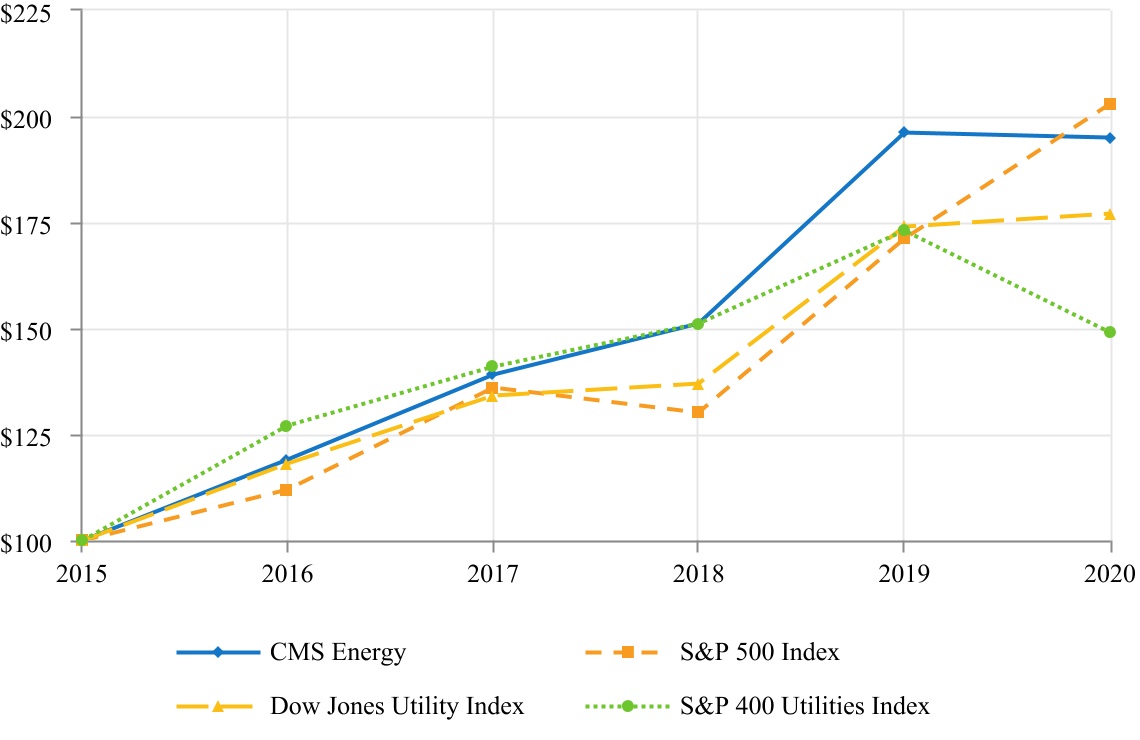
| Five-Year Cumulative Total Return | ||||||||||||||||||||||||||||||||||||||
| Company/Index | 2015 | 2016 | 2017 | 2018 | 2019 | 2020 | ||||||||||||||||||||||||||||||||
| CMS Energy | $ | 100 | $ | 119 | $ | 139 | $ | 151 | $ | 196 | $ | 195 | ||||||||||||||||||||||||||
| S&P 500 Index | 100 | 112 | 136 | 130 | 171 | 203 | ||||||||||||||||||||||||||||||||
| Dow Jones Utility Index | 100 | 118 | 134 | 137 | 174 | 177 | ||||||||||||||||||||||||||||||||
| S&P 400 Utilities Index | 100 | 127 | 141 | 151 | 173 | 149 |
These cumulative total returns assume reinvestments of dividends.
Consumers
Consumers’ common stock is privately held by its parent, CMS Energy, and does not trade in the public market.
Issuer Repurchases of Equity Securities
Presented in the following table are CMS Energy’s repurchases of equity securities for the three months ended December 31, 2020:
| Period | Total Number of Shares Purchased1 | Average Price Paid per Share | Total Number of Shares Purchased as Part of Publicly Announced Plans or Programs | Maximum Number of Shares That May Yet Be Purchased Under Publicly Announced Plans or Programs | ||||||||||||||||||||||
| October 1, 2020 to October 31, 2020 | 406 | $ | 63.78 | — | — | |||||||||||||||||||||
| November 1, 2020 to November 30, 2020 | 235 | 63.92 | — | — | ||||||||||||||||||||||
| December 1, 2020 to December 31, 2020 | 623 | 59.48 | — | — | ||||||||||||||||||||||
| Total | 1,264 | $ | 61.69 | — | — |
1All of the common shares were repurchased to satisfy the minimum statutory income tax withholding obligation for common shares that have vested under the PISP. The value of shares repurchased is based on the market price on the vesting date.
Unregistered Sales of Equity Securities
None.
Item 6. Selected Financial Data
CMS Energy Corporation
| 2020 | 2019 | 2018 | 2017 | 2016 | ||||||||||||||||
| Operating revenue (in millions) | ($) | 6,680 | 6,845 | 6,873 | 6,583 | 6,399 | ||||||||||||||
| Income from equity method investees (in millions) | ($) | 5 | 10 | 9 | 15 | 13 | ||||||||||||||
| Net income (in millions) | ($) | 752 | 682 | 659 | 462 | 553 | ||||||||||||||
| Income (loss) attributable to noncontrolling interests (in millions) | ($) | (3) | 2 | 2 | 2 | 2 | ||||||||||||||
| Net income available to common stockholders (in millions) | ($) | 755 | 680 | 657 | 460 | 551 | ||||||||||||||
| Average common shares outstanding (in millions) | 285.0 | 283.0 | 282.2 | 280.0 | 277.9 | |||||||||||||||
| Earnings per average common share | ||||||||||||||||||||
| – Basic | ($) | 2.65 | 2.40 | 2.33 | 1.64 | 1.99 | ||||||||||||||
| – Diluted | ($) | 2.64 | 2.39 | 2.32 | 1.64 | 1.98 | ||||||||||||||
| Cash provided by operations (in millions) | ($) | 1,276 | 1,790 | 1,703 | 1,705 | 1,629 | ||||||||||||||
| Capital expenditures, excluding assets placed under finance lease (in millions) | ($) | 2,317 | 2,104 | 2,074 | 1,665 | 1,672 | ||||||||||||||
| Total assets (in millions) | ($) | 29,666 | 26,837 | 24,529 | 23,050 | 21,622 | ||||||||||||||
| Long-term debt, excluding current portion (in millions) | ($) | 13,634 | 11,951 | 10,615 | 9,123 | 8,640 | ||||||||||||||
| Non‑current portion of finance leases and other financing (in millions) | ($) | 56 | 76 | 69 | 91 | 110 | ||||||||||||||
| Cash dividends declared per common share | ($) | 1.63 | 1.53 | 1.43 | 1.33 | 1.24 | ||||||||||||||
| Market price of common stock at year-end | ($) | 61.01 | 62.84 | 49.65 | 47.30 | 41.62 | ||||||||||||||
| Book value per common share at year-end | ($) | 19.02 | 17.67 | 16.78 | 15.77 | 15.23 | ||||||||||||||
| Total employees at year-end | 8,837 | 8,789 | 8,625 | 7,952 | 7,800 | |||||||||||||||
| Electric Utility Statistics | ||||||||||||||||||||
| Sales (billions of kWh) | 35 | 37 | 38 | 37 | 38 | |||||||||||||||
| Customers (in thousands) | 1,866 | 1,848 | 1,831 | 1,826 | 1,805 | |||||||||||||||
| Average sales rate per kWh | (¢) | 11.74 | 11.64 | 11.78 | 11.98 | 11.63 | ||||||||||||||
| Gas Utility Statistics | ||||||||||||||||||||
| Sales and transportation deliveries (bcf) | 360 | 391 | 386 | 352 | 358 | |||||||||||||||
| Customers (in thousands)1 | 1,804 | 1,793 | 1,784 | 1,776 | 1,772 | |||||||||||||||
| Average sales rate per mcf | ($) | 7.60 | 7.44 | 7.44 | 7.51 | 7.31 |
1Excludes off-system transportation customers.
Consumers Energy Company
| 2020 | 2019 | 2018 | 2017 | 2016 | ||||||||||||||||
| Operating revenue (in millions) | ($) | 6,189 | 6,376 | 6,464 | 6,222 | 6,064 | ||||||||||||||
| Net income (in millions) | ($) | 816 | 743 | 705 | 632 | 616 | ||||||||||||||
| Net income available to common stockholder (in millions) | ($) | 814 | 741 | 703 | 630 | 614 | ||||||||||||||
| Cash provided by operations (in millions) | ($) | 1,218 | 1,601 | 1,449 | 1,715 | 1,681 | ||||||||||||||
| Capital expenditures, excluding assets placed under finance lease (in millions) | ($) | 2,170 | 2,085 | 1,822 | 1,632 | 1,656 | ||||||||||||||
| Total assets (in millions) | ($) | 25,399 | 23,699 | 22,025 | 21,099 | 19,946 | ||||||||||||||
| Long-term debt, excluding current portion (in millions) | ($) | 7,742 | 7,048 | 6,779 | 5,561 | 5,253 | ||||||||||||||
| Non‑current portion of finance leases and other financing (in millions) | ($) | 56 | 76 | 69 | 91 | 110 | ||||||||||||||
| Total preferred stock (in millions) | ($) | 37 | 37 | 37 | 37 | 37 | ||||||||||||||
| Number of preferred stockholders at year-end | 922 | 968 | 1,017 | 1,056 | 1,095 | |||||||||||||||
| Total employees at year-end | 8,230 | 8,253 | 8,121 | 7,496 | 7,366 | |||||||||||||||
| Electric Utility Statistics | ||||||||||||||||||||
| Sales (billions of kWh) | 35 | 37 | 38 | 37 | 38 | |||||||||||||||
| Customers (in thousands) | 1,866 | 1,848 | 1,831 | 1,826 | 1,805 | |||||||||||||||
| Average sales rate per kWh | (¢) | 11.74 | 11.64 | 11.78 | 11.98 | 11.63 | ||||||||||||||
| Gas Utility Statistics | ||||||||||||||||||||
| Sales and transportation deliveries (bcf) | 360 | 391 | 386 | 352 | 358 | |||||||||||||||
| Customers (in thousands)1 | 1,804 | 1,793 | 1,784 | 1,776 | 1,772 | |||||||||||||||
| Average sales rate per mcf | ($) | 7.60 | 7.44 | 7.44 | 7.51 | 7.31 |
1Excludes off-system transportation customers.
Item 7. Management’s Discussion and Analysis of Financial Condition and Results of Operations
This Management’s Discussion and Analysis of Financial Condition and Results of Operations is a combined report of CMS Energy and Consumers.
Executive Overview
CMS Energy is an energy company operating primarily in Michigan. It is the parent holding company of several subsidiaries, including Consumers, an electric and gas utility; CMS Enterprises, primarily a domestic independent power producer and marketer; and EnerBank, an industrial bank located in Utah. Consumers’ electric utility operations include the generation, purchase, distribution, and sale of electricity, and Consumers’ gas utility operations include the purchase, transmission, storage, distribution, and sale of natural gas. Consumers’ customer base consists of a mix of primarily residential, commercial, and diversified industrial customers. CMS Enterprises, through its subsidiaries and equity investments, is engaged in domestic independent power production, including the development and operation of renewable generation, and the marketing of independent power production. EnerBank provides primarily unsecured, fixed-rate installment loans throughout the U.S. to finance home improvements.
CMS Energy and Consumers manage their businesses by the nature of services each provides. CMS Energy operates principally in four business segments: electric utility; gas utility; enterprises, its non‑utility operations and investments; and EnerBank. Consumers operates principally in two business segments: electric utility and gas utility. CMS Energy’s and Consumers’ businesses are affected primarily by:
-
regulation and regulatory matters
-
state and federal legislation
-
economic conditions
-
weather
-
energy commodity prices
-
interest rates
-
their securities’ credit ratings
COVID-19 Pandemic
CMS Energy and Consumers continue to respond to the public health emergency caused by the COVID‑19 pandemic by instituting and maintaining measures consistent with guidance provided by local, state, and federal agencies. CMS Energy and Consumers maintain over 60 departmental business continuity plans; these plans were reviewed and enhanced in early 2020 to ensure readiness for the COVID-19 pandemic. CMS Energy and Consumers continue to take steps to protect the safety of employees, customers, and contractors, and have executed their business continuity plans to ensure the continued delivery of critical energy services. Additionally, CMS Energy and Consumers have mitigated the potential impact of the pandemic on their liquidity by completing financing transactions and reducing the need for additional external funding.
The COVID‑19 pandemic is a continually evolving situation. As a result of the pandemic, Consumers has experienced a decline in electric deliveries to commercial and industrial customers, offset partially by an increase in deliveries to residential customers. It has also experienced increased uncollectible accounts and workforce-related expenses, among other cost increases directly attributable to the pandemic. Consumers anticipates that these trends will continue in the near term. In April 2020, the MPSC issued an
order authorizing Consumers to defer incremental uncollectible accounts expense associated with the pandemic.
Additionally, EnerBank anticipates it could experience slower lending growth, higher loan write-offs, and increased loan modifications in the future as a result of the pandemic. The companies cannot predict the long-term impact of the pandemic on their business, results of operations, financial condition, capital investment program, liquidity, and cash flows. More detailed discussion of the near-term impacts of and future uncertainties related to the COVID‑19 pandemic can be found in Item 1A. Risk Factors and throughout this Item 7. Management’s Discussion and Analysis of Financial Condition and Results of Operations.
The Triple Bottom Line
CMS Energy’s and Consumers’ purpose is to achieve world class performance while delivering hometown service. In support of this purpose, the companies employ the “Consumers Energy Way,” a lean operating model designed to improve safety, quality, cost, delivery, and employee morale.
CMS Energy and Consumers measure their progress toward the purpose by considering their impact on the “triple bottom line” of people, planet, and profit, which is underpinned by performance; this consideration takes into account not only the economic value that the companies create for customers and investors, but also their responsibility to social and environmental goals. The triple bottom line balances the interests of the companies’ employees, customers, suppliers, regulators, creditors, Michigan’s residents, the investment community, and other stakeholders, and it reflects the broader societal impacts of the companies’ activities.

Consumers’ Sustainability Report, which is available to the public, describes the company’s progress toward world class performance measured in the areas of people, planet, and profit.
People: The people element of the triple bottom line represents CMS Energy’s and Consumers’ commitment to their employees, their customers, the residents of local communities in which the companies do business, and other stakeholders.
The safety of employees, customers, and the general public is a priority of CMS Energy and Consumers. Accordingly, CMS Energy and Consumers have worked to integrate a set of safety principles into their business operations and culture. These principles include complying with applicable safety, health, and security regulations and implementing programs and processes aimed at continually improving safety and security conditions. Over the last ten years, Consumers’ OSHA recordable incident rate has decreased by over 53 percent.
In response to the COVID-19 pandemic, CMS Energy and Consumers have issued a response plan that is focused on the health, safety, and well-being of their co-workers, customers, and communities. CMS Energy and Consumers have aligned with safety and health guidelines from the CDC, OSHA, and the Michigan Department of Health and Human Services in order to protect their employees, customers,
and contractors to ensure the continued delivery of critical energy services. To align with, and in addition to, these guidelines, CMS Energy and Consumers have:
-
secured the supply chain necessary to provide front-line workers with appropriate personal protective equipment and cleaning supplies
-
worked with local health departments and hospital systems to begin administering vaccinations to essential front-line employees
-
when necessary, sequestered employees with critical roles at generating plants, gas compression facilities, and electric control rooms
-
implemented a paid self-quarantine requirement for employees who are exhibiting symptoms of COVID-19 or who have come into contact with a person suspected to have COVID-19
-
prohibited business-related international travel and instituted a mandatory ten-day work remote period for employees who return from personal travel to heavily impacted areas
-
required employees to work remotely when possible
-
when necessary, reduced service at 13 direct payment offices to drop box and drive-through services only
-
initially adjusted work to focus on emergent and critical activities such as electric outages, gas leaks, and other public safety and reliability work; as work restrictions have gradually lifted in Michigan, the companies have resumed normal work with safety measures in place
-
contracted a chief medical officer to guide the companies’ response and provide rapid support and supplies for the workforce
-
limited access to company facilities, enhanced cleaning protocols, and established a mask-wearing policy
-
offered additional paid leave to employees to alleviate child care-related burdens and implemented other int
Showing the first 8K of 123K characters. Open the full section
Item 7A. Quantitative and Qualitative Disclosures About Market Risk
CMS Energy and Consumers are exposed to market risks including, but not limited to, changes in interest rates, commodity prices, and investment security prices. They may enter into various risk management contracts to mitigate exposure to these risks, including swaps, options, futures, and forward contracts. CMS Energy and Consumers enter into these contracts using established policies and procedures, under
the direction of an executive oversight committee consisting of certain officers and a risk committee consisting of those and other officers and business managers.
The following risk sensitivities illustrate the potential loss in fair value, cash flows, or future earnings from financial instruments, assuming a hypothetical adverse change in market rates or prices of ten percent. Potential losses could exceed the amounts shown in the sensitivity analyses if changes in market rates or prices were to exceed ten percent.
Long-Term Debt: CMS Energy and Consumers are exposed to interest-rate risk resulting from issuing fixed-rate and variable-rate debt instruments. CMS Energy and Consumers use a combination of these instruments, and may also enter into interest-rate swap agreements, in order to manage this risk and to achieve a reasonable cost of capital.
Presented in the following table is a sensitivity analysis of interest-rate risk on CMS Energy’s and Consumers’ debt instruments, which includes the effects of interest-rate swaps (assuming an adverse change in market interest rates of ten percent):
| In Millions | ||||||||||||||
| December 31 | 2020 | 2019 | ||||||||||||
| Fixed-rate financing—potential loss in fair value | ||||||||||||||
| CMS Energy, including Consumers | $ | 634 | $ | 558 | ||||||||||
| Consumers | 372 | 355 |
The fair value losses in the above table could be realized only if CMS Energy and Consumers transferred all of their fixed-rate financing to other creditors. The annual earnings exposure related to variable-rate financing was immaterial for both CMS Energy and Consumers at December 31, 2020 and 2019, assuming an adverse change in market interest rates of ten percent.
Notes Receivable: CMS Energy is exposed to interest-rate risk resulting from EnerBank’s fixed-rate installment loans. EnerBank provides primarily unsecured, fixed-rate installment loans throughout the U.S. to finance home improvements.
Presented in the following table is a sensitivity analysis of interest-rate risk on EnerBank’s notes receivable, which includes the effects of interest-rate swaps (assuming an adverse change in market interest rates of ten percent):
| In Millions | ||||||||||||||
| December 31 | 2020 | 2019 | ||||||||||||
| Notes receivable—potential loss in fair value | $ | 77 | $ | 61 |
The fair value losses for CMS Energy in the above table could be realized only if EnerBank’s loans were sold to other parties. The annual earnings exposure related to variable-rate interest receipts at EnerBank was immaterial at December 31, 2020 and 2019. For additional details on financial instruments, see Item 8. Financial Statements and Supplementary Data—Notes to the Consolidated Financial Statements—Note 7, Financial Instruments.
Item 8. Financial Statements and Supplementary Data
Index to Financial Statements
CMS Energy Corporation
Consolidated Statements of Income
| In Millions, Except Per Share Amounts | ||||||||||||||||||||
| Years Ended December 31 | 2020 | 2019 | 2018 | |||||||||||||||||
| Operating Revenue | $ | 6,680 | $ | 6,845 | $ | 6,873 | ||||||||||||||
| Operating Expenses | ||||||||||||||||||||
| Fuel for electric generation | 375 | 493 | 528 | |||||||||||||||||
| Purchased and interchange power | 1,492 | 1,496 | 1,613 | |||||||||||||||||
| Purchased power – related parties | 64 | 75 | 81 | |||||||||||||||||
| Cost of gas sold | 577 | 769 | 836 | |||||||||||||||||
| Maintenance and other operating expenses |
Showing the first 8K of 367K characters. Open the full section
Item 9. Changes in and Disagreements with Accountants on Accounting and Financial Disclosure
None.
Item 9A. Controls and Procedures
CMS Energy
Conclusion Regarding the Effectiveness of Disclosure Controls and Procedures: Under the supervision and with the participation of management, including its CEO and CFO, CMS Energy conducted an evaluation of its disclosure controls and procedures (as such term is defined in Rules 13a-15(e) and 15d-15(e) under the Exchange Act). Based on such evaluation, CMS Energy’s CEO and CFO have concluded that its disclosure controls and procedures were effective as of December 31, 2020.
Management’s Annual Report on Internal Control Over Financial Reporting: CMS Energy’s management is responsible for establishing and maintaining adequate internal control over financial reporting, as defined in Exchange Act Rules 13a-15(f) and 15d-15(f). CMS Energy’s internal control over financial reporting is a process designed to provide reasonable assurance regarding the reliability of financial reporting and the preparation of financial statements for external purposes in accordance with GAAP and includes policies and procedures that:
-
pertain to the maintenance of records that, in reasonable detail, accurately and fairly reflect the transactions and dispositions of the assets of CMS Energy
-
provide reasonable assurance that transactions are recorded as necessary to permit preparation of financial statements in accordance with GAAP, and that receipts and expenditures of CMS Energy are being made only in accordance with authorizations of management and directors of CMS Energy
-
provide reasonable assurance regarding prevention or timely detection of unauthorized acquisition, use, or disposition of CMS Energy’s assets that could have a material effect on its financial statements
Management, including its CEO and CFO, does not expect that its internal controls will prevent or detect all errors and all fraud. A control system, no matter how well designed and operated, can provide only reasonable, not absolute, assurance that the objectives of the control system are met. Further, the design of a control system must reflect the fact that there are resource constraints, and the benefits of controls must be considered relative to their costs. In addition, any evaluation of the effectiveness of controls is subject to risks that those internal controls may become inadequate in future periods because of changes in business conditions, or that the degree of compliance with the policies or procedures deteriorates.
Under the supervision and with the participation of management, including its CEO and CFO, CMS Energy conducted an evaluation of the effectiveness of its internal control over financial reporting as of December 31, 2020. In making this evaluation, management used the criteria set forth in the framework in Internal Control—Integrated Framework (2013) issued by the Committee of Sponsoring Organizations of the Treadway Commission. Based on such evaluation, CMS Energy’s management concluded that its internal control over financial reporting was effective as of December 31, 2020. The effectiveness of CMS Energy’s internal control over financial reporting as of December 31, 2020 has
been audited by PricewaterhouseCoopers LLP, an independent registered public accounting firm, as stated in their report which appears under Item 8. Financial Statements and Supplementary Data.
Changes in Internal Control over Financial Reporting: There have been no changes in CMS Energy’s internal control over financial reporting during the most recently completed fiscal quarter that have materially affected, or are reasonably likely to affect materially, its internal control over financial reporting.
Consumers
Conclusion Regarding the Effectiveness of Disclosure Controls and Procedures: Under the supervision and with the participation of management, including its CEO and CFO, Consumers conducted an evaluation of its disclosure controls and procedures (as such term is defined in Rules 13a-15(e) and 15d-15(e) under the Exchange Act). Based on such evaluation, Consumers’ CEO and CFO have concluded that its disclosure controls and procedures were effective as of December 31, 2020.
Management’s Annual Report on Internal Control Over Financial Reporting: Consumers’ management is responsible for establishing and maintaining adequate internal control over financial reporting, as defined in Exchange Act Rules 13a-15(f) and 15d-15(f). Consumers’ internal control over financial reporting is a process designed to provide reasonable assurance regarding the reliability of financial reporting and the preparation of financial statements for external purposes in accordance with GAAP and includes policies and procedures that:
-
pertain to the maintenance of records that, in reasonable detail, accurately and fairly reflect the transactions and dispositions of the assets of Consumers
-
provide reasonable assurance that transactions are recorded as necessary to permit preparation of financial statements in accordance with GAAP, and that receipts and expenditures of Consumers are being made only in accordance with authorizations of management and directors of Consumers
-
provide reasonable assurance regarding prevention or timely detection of unauthorized acquisition, use, or disposition of Consumers’ assets that could have a material effect on its financial statements
Management, including its CEO and CFO, does not expect that its internal controls will prevent or detect all errors and all fraud. A control system, no matter how well designed and operated, can provide only reasonable, not absolute, assurance that the objectives of the control system are met. Further, the design of a control system must reflect the fact that there are resource constraints, and the benefits of controls must be considered relative to their costs. In addition, any evaluation of the effectiveness of controls is subject to risks that those internal controls may become inadequate in future periods because of changes in business conditions, or that the degree of compliance with the policies or procedures deteriorates.
Under the supervision and with the participation of management, including its CEO and CFO, Consumers conducted an evaluation of the effectiveness of its internal control over financial reporting as of December 31, 2020. In making this evaluation, management used the criteria set forth in the framework in Internal Control—Integrated Framework (2013) issued by the Committee of Sponsoring Organizations of the Treadway Commission. Based on such evaluation, Consumers’ management concluded that its internal control over financial reporting was effective as of December 31, 2020. The effectiveness of Consumers’ internal control over financial reporting as of December 31, 2020 has been audited by PricewaterhouseCoopers LLP, an independent registered public accounting firm, as stated in their report which appears under Item 8. Financial Statements and Supplementary Data.
Changes in Internal Control over Financial Reporting: There have been no changes in Consumers’ internal control over financial reporting during the most recently completed fiscal quarter that have materially affected, or are reasonably likely to affect materially, its internal control over financial reporting.
Item 9B. Other Information
None.
Part III
Item 10. Directors, Executive Officers and Corporate Governance
CMS Energy
Information that is required in Item 10 of this Form 10‑K regarding executive officers is included in the Item 1. Business—Information About CMS Energy’s and Consumers’ Executive Officers section, which is incorporated by reference herein.
Information that is required in Item 10 of this Form 10‑K regarding directors, executive officers, and corporate governance is incorporated by reference from CMS Energy’s and Consumers’ definitive proxy statement for their 2021 Annual Meetings of Shareholders to be held May 7, 2021. The proxy statement will be filed with the SEC, pursuant to Regulation 14A under the Exchange Act, within 120 days after the end of the fiscal year covered by this Form 10‑K, all of which information is hereby incorporated by reference in, and made part of, this Form 10‑K.
Code of Ethics
CMS Energy has adopted an employee code of ethics, entitled “CMS Energy 2021 Code of Conduct” (“Employee Code”) that applies to its CEO, CFO, and CAO, as well as all other officers and employees of CMS Energy and its affiliates, except for EnerBank, which has its own code of conduct. The Employee Code is administered by the Chief Compliance Officer of CMS Energy, who reports directly to the Audit Committee of the Board of Directors of CMS Energy. CMS Energy has also adopted a director code of ethics entitled “2021 Board of Directors Code of Conduct” (“Director Code”) that applies to its directors. The Director Code is administered by the Audit Committee of the Board of Directors of CMS Energy. Any alleged violation of the Director Code by a director will be investigated by disinterested members of the Audit Committee of the Board of Directors of CMS Energy, or if none, by disinterested members of the entire Board of Directors of CMS Energy. The Employee Code and Director Code and any waivers of, or amendments or exceptions to, a provision of the Employee Code that applies to CMS Energy’s CEO, CFO, CAO or persons performing similar functions and any waivers of, or amendments or exceptions to, a provision of CMS Energy’s Director Code will be disclosed on CMS Energy’s website at www.cmsenergy.com/corporate-governance/compliance-and-ethics.
Consumers
Information that is required in Item 10 of this Form 10‑K regarding executive officers is included in the Item 1. Business—Information About CMS Energy’s and Consumers’ Executive Officers section, which is incorporated by reference herein.
Information that is required in Item 10 of this Form 10‑K regarding directors, executive officers, and corporate governance is incorporated by reference from CMS Energy’s and Consumers’ definitive proxy statement for their 2021 Annual Meetings of Shareholders to be held May 7, 2021. The proxy statement will be filed with the SEC, pursuant to Regulation 14A under the Exchange Act, within 120 days after the end of the fiscal year covered by this Form 10‑K, all of which information is hereby incorporated by reference in, and made part of, this Form 10‑K.
Code of Ethics
Consumers has adopted an employee code of ethics, entitled “CMS Energy 2021 Code of Conduct” (“Employee Code”) that applies to its CEO, CFO, and CAO, as well as all other officers and employees of Consumers and its affiliates, except for EnerBank, which has its own code of conduct. The Employee Code is administered by the Chief Compliance Officer of Consumers, who reports directly to the Audit Committee of the Board of Directors of Consumers. Consumers has also adopted a director code of ethics entitled “2021 Board of Directors Code of Conduct” (“Director Code”) that applies to its directors. The Director Code is administered by the Audit Committee of the Board of Directors of Consumers. Any alleged violation of the Director Code by a director will be investigated by disinterested members of the Audit Committee of the Board of Directors of Consumers, or if none, by disinterested members of the entire Board of Directors of Consumers. The Employee Code and Director Code and any waivers of, or amendments or exceptions to, a provision of the Employee Code that applies to Consumers’ CEO, CFO, CAO or persons performing similar functions and any waivers of, or amendments or exceptions to, a provision of Consumers’ Director Code will be disclosed on Consumers’ website at www.cmsenergy.com/corporate-governance/compliance-and-ethics.
Item 11. Executive Compensation
See the note below.
Item 12. Security Ownership of Certain Beneficial Owners and Management and Related Stockholder Matters
Securities Authorized for Issuance Under Equity Compensation Plans
Presented in the following table is information regarding CMS Energy’s equity compensation plans as of December 31, 2020:
| (a) | (b) | (c) | ||||||||||||
| Plan Category | Number of securities to be issued upon exercise of outstanding options, warrants, and rights | Weighted-average exercise price of outstanding options, warrants, and rights | Number of securities remaining available for future issuance under equity compensation plans (excluding securities reflected in column (a)) | |||||||||||
| Equity compensation plan approved by shareholders | — | $ | — | 6,477,579 |
Also see the note below.
Item 13. Certain Relationships and Related Transactions, and Director Independence
See the note below.
Item 14. Principal Accountant Fees and Services
See the note below.
NOTE: Information that is required by Part III—Items 11, 12, 13, and 14 of this Form 10‑K is incorporated by reference from CMS Energy’s and Consumers’ definitive proxy statement for their 2021 Annual Meetings of Shareholders to be held May 7, 2021. The proxy statement will be filed with the SEC, pursuant to Regulation 14A under the Exchange Act, within 120 days after the end of the fiscal year covered by this Form 10‑K, all of which information is hereby incorporated by reference in, and made part of, this Form 10‑K.
(This page was intentionally left blank)
Part IV
Item 15. Exhibits and Financial Statement Schedules
The following financial statements are filed as part of this report under Item 8. Financial Statements and Supplementary Data:
-
Consolidated Statements of Income of CMS Energy for the years ended December 31, 2020, 2019, and 2018
-
Consolidated Statements of Comprehensive Income of CMS Energy for the years ended December 31, 2020, 2019, and 2018
-
Consolidated Statements of Cash Flows of CMS Energy for the years ended December 31, 2020, 2019, and 2018
-
Consolidated Balance Sheets of CMS Energy at December 31, 2020 and 2019
-
Consolidated Statements of Changes in Equity of CMS Energy for the years ended December 31, 2020, 2019, and 2018
-
Consolidated Statements of Income of Consumers for the years ended December 31, 2020, 2019, and 2018
-
Consolidated Statements of Comprehensive Income of Consumers for the years ended December 31, 2020, 2019, and 2018
-
Consolidated Statements of Cash Flows of Consumers for the years ended December 31, 2020, 2019, and 2018
-
Consolidated Balance Sheets of Consumers at December 31, 2020 and 2019
-
Consolidated Statements of Changes in Equity of Consumers for the years ended December 31, 2020, 2019, and 2018
-
Notes to the Consolidated Financial Statements
-
Report of Independent Registered Public Accounting Firm for CMS Energy
-
Report of Independent Registered Public Accounting Firm for Consumers
The following financial statement schedules are included below:
-
Schedule I — Condensed Financial Information of Registrant, CMS Energy—Parent Company at December 31, 2020 and 2019 and for the years ended December 31, 2020, 2019, and 2018
-
Schedule II — Valuation and Qualifying Accounts and Reserves of CMS Energy for the years ended December 31, 2020, 2019, and 2018
-
Schedule II — Valuation and Qualifying Accounts and Reserves of Consumers for the years ended December 31, 2020, 2019, and 2018
Schedule I — Condensed Financial Information of Registrant
CMS Energy—Parent Company
Condensed Statements of Income
| In Millions | ||||||||||||||||||||
| Years Ended December 31 | 2020 | 2019 | 2018 | |||||||||||||||||
| Operating Expenses | ||||||||||||||||||||
| Other operating expenses | $ | (6) | $ | (38) | $ | (7) | ||||||||||||||
| Total operating expenses | (6) | (38) | (7) | |||||||||||||||||
| Operating Loss | (6) | (38) | (7) | |||||||||||||||||
| Other Income (Expense) | ||||||||||||||||||||
| Equity earnings of subsidiaries | 909 | 826 | 780 | |||||||||||||||||
| Nonoperating retirement benefits, net | (1) | (1) | (1) | |||||||||||||||||
| Interest income | 1 | 1 | 2 | |||||||||||||||||
| Other income | 1 | 1 | — | |||||||||||||||||
| Other expense | (19) | — | (17) | |||||||||||||||||
| Total other income | 891 | 827 | 764 | |||||||||||||||||
| Interest Charges | ||||||||||||||||||||
| Interest on long-term debt | 178 | 156 | 135 | |||||||||||||||||
| Intercompany interest expense and other | 7 | 10 | 7 | |||||||||||||||||
| Total interest charges | 185 | 166 | 142 | |||||||||||||||||
| Income Before Income Taxes | 700 | 623 | 615 | |||||||||||||||||
| Income Tax Benefit | (55) | (57) | (42) | |||||||||||||||||
| Net Income Available to Common Stockholders | $ | 755 | $ | 680 | $ | 657 |
The accompanying notes are an integral part of these statements.
Schedule I — Condensed Financial Information of Registrant (Continued)
CMS Energy—Parent Company
Condensed Statements of Cash Flows
| In Millions | ||||||||||||||||||||
| Years Ended December 31 | 2020 | 2019 | 2018 | |||||||||||||||||
| Cash Flows from Operating Activities | ||||||||||||||||||||
| Net cash provided by operating activities | $ | 507 | $ | 697 | $ | 702 | ||||||||||||||
| Cash Flows from Investing Activities | ||||||||||||||||||||
| Investment in subsidiaries | (657) | (683) | (363) | |||||||||||||||||
| Increase in notes receivable – intercompany | (307) | — | — | |||||||||||||||||
| Proceeds from DB SERP investments | — | — | 22 | |||||||||||||||||
| Net cash used in investing activities | (964) | (683) | (341) | |||||||||||||||||
| Cash Flows from Financing Activities | ||||||||||||||||||||
| Proceeds from issuance of debt | 1,225 | 1,158 | 560 | |||||||||||||||||
| Issuance of common stock | 253 | 12 | 41 | |||||||||||||||||
| Retirement of long-term debt | (425) | (738) | (675) | |||||||||||||||||
| Debt prepayment costs | (16) | — | (16) | |||||||||||||||||
| Payment of dividends on common stock | (465) | (434) | (405) | |||||||||||||||||
| Debt issuance costs and financing fees | (10) | (18) | (8) | |||||||||||||||||
| Change in notes payable – intercompany | (105) | 6 | 142 | |||||||||||||||||
| Net cash provided by (used in) financing activities | 457 | (14) | (361) | |||||||||||||||||
| Net Increase in Cash and Cash Equivalents, Including Restricted Amounts | — | — | — | |||||||||||||||||
| Cash and Cash Equivalents, Including Restricted Amounts, Beginning of Period | — | — | — | |||||||||||||||||
| Cash and Cash Equivalents, Including Restricted Amounts, End of Period | $ | — | $ | — | $ | — |
The accompanying notes are an integral part of these statements.
Schedule I — Condensed Financial Information of Registrant (Continued)
CMS Energy—Parent Company
Condensed Balance Sheets
| ASSETS | ||||||||||||||
| In Millions | ||||||||||||||
| December 31 | 2020 | 2019 | ||||||||||||
| Current Assets | ||||||||||||||
| Notes and accrued interest receivable – intercompany | $ | 358 | $ | 2 | ||||||||||
| Accounts receivable – intercompany and related parties | 3 | 9 | ||||||||||||
| Federal income tax receivable | — | 18 | ||||||||||||
| Accrued taxes | 48 | — | ||||||||||||
| Prepayments and other current assets | 1 | 1 | ||||||||||||
| Total current assets | 410 | 30 | ||||||||||||
| Other Non‑current Assets | ||||||||||||||
| Deferred income taxes | 91 | 126 | ||||||||||||
| Investments in subsidiaries | 9,372 | 8,526 | ||||||||||||
| Other investments | 5 | 4 | ||||||||||||
| Other | 5 | 16 | ||||||||||||
| Total other non‑current assets | 9,473 | 8,672 | ||||||||||||
| Total Assets | $ | 9,883 | $ | 8,702 |
| LIABILITIES AND EQUITY | ||||||||||||||
| In Millions | ||||||||||||||
| December 31 | 2020 | 2019 | ||||||||||||
| Current Liabilities | ||||||||||||||
| Current portion of long-term debt | $ | 200 | $ | — | ||||||||||
| Accounts and notes payable – intercompany | 69 | 123 | ||||||||||||
| Accrued interest, including intercompany | 33 | 34 | ||||||||||||
| Accrued taxes | — | 5 | ||||||||||||
| Other current liabilities | 9 | 38 | ||||||||||||
| Total current liabilities | 311 | 200 | ||||||||||||
| Non‑current Liabilities | ||||||||||||||
| Long-term debt | 3,926 | 3,334 | ||||||||||||
| Notes payable – intercompany | 116 | 112 | ||||||||||||
| Postretirement benefits | 21 | 21 | ||||||||||||
| Other non‑current liabilities | 13 | 17 | ||||||||||||
| Total non‑current liabilities | 4,076 | 3,484 | ||||||||||||
| Equity | ||||||||||||||
| Common stockholders’ equity | 5,496 | 5,018 | ||||||||||||
| Total Liabilities and Equity | $ | 9,883 | $ | 8,702 |
The accompanying notes are an integral part of these statements.
Schedule I — Condensed Financial Information of Registrant (Continued)
CMS Energy—Parent Company
Notes to the Condensed Financial Statements
1: Basis of Presentation
CMS Energy’s condensed financial statements have been prepared on a parent-only basis. In accordance with Rule 12-04 of Regulation S-X, these parent-only financial statements do not include all of the information and notes required by GAAP for annual financial statements, and therefore these parent-only financial statements and other information included should be read in conjunction with CMS Energy’s audited consolidated financial statements contained within Item 8. Financial Statements and Supplementary Data.
2: Contingencies
Gas Index Price Reporting Litigation: CMS Energy, along with CMS MST, CMS Field Services, Cantera Natural Gas, Inc., and Cantera Gas Company, were named as defendants in four class action lawsuits filed in Kansas, Missouri, and Wisconsin and one individual lawsuit filed in Kansas; these lawsuits arose as a result of alleged inaccurate natural gas price reporting to publications that report trade information. Allegations included price-fixing conspiracies, restraint of trade, and artificial inflation of natural gas retail prices. In 2016, CMS Energy entities reached a settlement with the plaintiffs in the Kansas and Missouri class action cases for an amount that was not material to CMS Energy. In 2017, the federal district court approved the settlement.
In 2019, CMS Energy and the plaintiffs in the remaining Kansas individual lawsuit and the Wisconsin class action lawsuit engaged in settlement discussions and CMS Energy recorded a $30 million liability at December 31, 2019 as the probable estimate to settle the two cases. The parties executed a settlement agreement in the Kansas case in February 2020, and that case is now complete. In the Wisconsin case, a settlement agreement was approved in August 2020 and that case is now complete.
3: Guarantees
CMS Energy has issued guarantees with a maximum potential obligation of $596 million on behalf of some of its wholly owned subsidiaries and related parties. CMS Energy’s maximum potential obligation consists primarily of potential payments:
-
to third parties under certain commodity purchase and swap agreements entered into with CMS ERM
-
to third parties under certain agreements entered into with Grand River Wind, LLC, a wholly owned subsidiary of CMS Enterprises
-
to EGLE on behalf of CMS Land and CMS Capital, for environmental remediation obligations at Bay Harbor
-
to the U.S. Department of Energy on behalf of Consumers, in connection with Consumers’ 2011 settlement agreement with the U.S. Department of Energy regarding damages resulting from the department’s failure to accept spent nuclear fuel from nuclear power plants formerly owned by Consumers
-
to a tax equity investor under certain agreements in connection with the purchase of a VIE
The expiry dates of these guarantees vary, depending upon contractual provisions or upon the statute of limitations under the relevant governing law.
4: Note Payable—Intercompany
In 2018, CMS Energy issued a demand note payable to the DB SERP rabbi trust, of which $124 million was attributable to CMS Energy’s subsidiaries. The demand note bears interest at an annual rate of 4.10 percent and has a maturity date of 2028. This note payable is not recorded at fair value; however, its carrying value approximates fair value at December 31, 2020. This fair value measurement is classified in Level 3 within the fair value hierarchy.
Schedule II — Valuation and Qualifying Accounts and Reserves
CMS Energy Corporation
Years Ended December 31, 2020, 2019, and 2018
| In Millions | ||||||||||||||||||||||||||||||||
| Description | Balance at Beginning of Period | Charged to Expense | Charged to Other Accounts2 | Deductions | Balance at End of Period | |||||||||||||||||||||||||||
| Allowance for uncollectible accounts1 | ||||||||||||||||||||||||||||||||
| 2020 | $ | 20 | $ | 33 | $ | — | $ | 24 | $ | 29 | ||||||||||||||||||||||
| 2019 | 20 | 29 | — | 29 | 20 | |||||||||||||||||||||||||||
| 2018 | 20 | 29 | — | 29 | 20 | |||||||||||||||||||||||||||
| Deferred tax valuation allowance | ||||||||||||||||||||||||||||||||
| 2020 | $ | 2 | $ | — | $ | — | $ | 1 | $ | 1 | ||||||||||||||||||||||
| 2019 | 8 | — | — | 6 | 2 | |||||||||||||||||||||||||||
| 2018 | 15 | 2 | — | 9 | 8 | |||||||||||||||||||||||||||
| Allowance for notes receivable1 | ||||||||||||||||||||||||||||||||
| 2020 | $ | 33 | $ | 60 | $ | 62 | $ | 32 | $ | 123 | ||||||||||||||||||||||
| 2019 | 24 | 38 | — | 29 | 33 | |||||||||||||||||||||||||||
| 2018 | 20 | 25 | — | 21 | 24 |
1Deductions represent write-offs of uncollectible accounts, net of recoveries.
2On January 1, 2020, in accordance with ASU 2016‑13*, Measurement of Credit Losses on Financial Instruments*, CMS Energy adjusted the allowance for loan losses associated with its notes receivable, recording an offsetting adjustment to retained earnings. For further details, see Item 8. Financial Statements and Supplementary Data—Notes to the Consolidated Financial Statements—Note 2, New Accounting Standards and Note 8, Notes Receivable.
Consumers Energy Company
Years Ended December 31, 2020, 2019, and 2018
| In Millions | ||||||||||||||||||||||||||||||||
| Description | Balance at Beginning of Period | Charged to Expense | Charged to Other Accounts | Deductions | Balance at End of Period | |||||||||||||||||||||||||||
| Allowance for uncollectible accounts1 | ||||||||||||||||||||||||||||||||
| 2020 | $ | 20 | $ | 33 | $ | — | $ | 24 | $ | 29 | ||||||||||||||||||||||
| 2019 | 20 | 29 | — | 29 | 20 | |||||||||||||||||||||||||||
| 2018 | 20 | 29 | — | 29 | 20 | |||||||||||||||||||||||||||
1Deductions represent write-offs of uncollectible accounts, net of recoveries.
Exhibit Index
The agreements included as exhibits to this Form 10-K filing are included solely to provide information regarding the terms of the agreements and are not intended to provide any other factual or disclosure information about CMS Energy, Consumers, or other parties to the agreements. The agreements may contain representations and warranties made by each of the parties to each of the agreements that were made exclusively for the benefit of the parties involved in each of the agreements and should not be treated as statements of fact. The representations and warranties were made as a way to allocate risk if one or more of those statements prove to be incorrect. The statements were qualified by disclosures of the parties to each of the agreements that may not be reflected in each of the agreements. The agreements may apply standards of materiality that are different than standards applied to other investors. Additionally, the statements were made as of the date of the agreements or as specified in the agreements and have not been updated.
The representations and warranties may not describe the actual state of affairs of the parties to each agreement. Additional information about CMS Energy and Consumers may be found in this filing, at www.cmsenergy.com, at www.consumersenergy.com, and through the SEC’s website at www.sec.gov.
1Obligations of CMS Energy or its subsidiaries, but not of Consumers.
2Management contract or compensatory plan or arrangement.
Exhibits that have been previously filed with the SEC, designated above, are incorporated herein by reference and made a part hereof.
Item 16. Form 10-K Summary
None.
Signatures
Pursuant to the requirements of Section 13 or 15(d) of the Securities Exchange Act of 1934, CMS Energy Corporation has duly caused this Annual Report to be signed on its behalf by the undersigned, thereunto duly authorized.
| /s/ Garrick J. Rochow | |||||||||||
| Name: | Garrick J. Rochow | ||||||||||
| Title: | President and Chief Executive Officer | ||||||||||
| Date: | February 11, 2021 |
Pursuant to the requirements of the Securities Exchange Act of 1934, this Annual Report has been signed below by the following persons on behalf of CMS Energy Corporation and in the capacities indicated and on February 11, 2021.
| /s/ Garrick J. Rochow | /s/ Kurt L. Darrow | |||||||
| Garrick J. Rochow | Kurt L. Darrow, Director | |||||||
| President, Chief Executive Officer, and Director | ||||||||
| (Principal Executive Officer) | /s/ William D. Harvey | |||||||
| William D. Harvey, Director | ||||||||
| /s/ Rejji P. Hayes | /s/ John G. Russell | |||||||
| Rejji P. Hayes | John G. Russell, Director | |||||||
| Executive Vice President and Chief Financial Officer | ||||||||
| /s/ Suzanne F. Shank | ||||||||
| (Principal Financial Officer) | Suzanne F. Shank, Director | |||||||
| /s/ Myrna M. Soto | ||||||||
| /s/ Glenn P. Barba | Myrna M. Soto, Director | |||||||
| Glenn P. Barba | ||||||||
| Vice President, Controller, and Chief Accounting Officer | /s/ John G. Sznewajs | |||||||
| John G. Sznewajs, Director | ||||||||
| (Controller) | ||||||||
| /s/ Ronald J. Tanski | ||||||||
| Ronald J. Tanski, Director | ||||||||
| /s/ Jon E. Barfield | /s/ Laura H. Wright | |||||||
| Jon E. Barfield, Director | Laura H. Wright, Director | |||||||
| /s/ Deborah H. Butler | ||||||||
| Deborah H. Butler, Director | ||||||||
Signatures
Pursuant to the requirements of Section 13 or 15(d) of the Securities Exchange Act of 1934, Consumers Energy Company has duly caused this Annual Report to be signed on its behalf by the undersigned, thereunto duly authorized.
| /s/ Garrick J. Rochow | |||||||||||
| Name: | Garrick J. Rochow | ||||||||||
| Title: | President and Chief Executive Officer | ||||||||||
| Date: | February 11, 2021 |
Pursuant to the requirements of the Securities Exchange Act of 1934, this Annual Report has been signed below by the following persons on behalf of Consumers Energy Company and in the capacities indicated and on February 11, 2021.
| /s/ Garrick J. Rochow | /s/ Kurt L. Darrow | |||||||
| Garrick J. Rochow | Kurt L. Darrow, Director | |||||||
| President, Chief Executive Officer, and Director | ||||||||
| (Principal Executive Officer) | /s/ William D. Harvey | |||||||
| William D. Harvey, Director | ||||||||
| /s/ Rejji P. Hayes | /s/ John G. Russell | |||||||
| Rejji P. Hayes | John G. Russell, Director | |||||||
| Executive Vice President and Chief Financial Officer | ||||||||
| /s/ Suzanne F. Shank | ||||||||
| (Principal Financial Officer) | Suzanne F. Shank, Director | |||||||
| /s/ Myrna M. Soto | ||||||||
| /s/ Glenn P. Barba | Myrna M. Soto, Director | |||||||
| Glenn P. Barba | ||||||||
| Vice President, Controller, and Chief Accounting Officer | /s/ John G. Sznewajs | |||||||
| John G. Sznewajs, Director | ||||||||
| (Controller) | ||||||||
| /s/ Ronald J. Tanski | ||||||||
| Ronald J. Tanski, Director | ||||||||
| /s/ Jon E. Barfield | /s/ Laura H. Wright | |||||||
| Jon E. Barfield, Director | Laura H. Wright, Director | |||||||
| /s/ Deborah H. Butler | ||||||||
| Deborah H. Butler, Director | ||||||||