 filings.tools
Centene 10-K 2022-12-31
Filed 2023-02-21. 23 sections, 503K characters. Original on sec.gov · Markdown · JSON
Cover and table of contents
UNITED STATES
SECURITIES AND EXCHANGE COMMISSION
Washington, D.C. 20549
Form 10-K
(Mark One)
☒ ANNUAL REPORT PURSUANT TO SECTION 13 OR 15(d) OF THE SECURITIES EXCHANGE ACT OF 1934
For the fiscal year ended December 31, 2022
or
☐ TRANSITION REPORT PURSUANT TO SECTION 13 OR 15(d) OF THE SECURITIES EXCHANGE ACT OF 1934
For the transition period from to
Commission file number: 001-31826
Centene Corporation
(Exact name of registrant as specified in its charter)
| Delaware | 42-1406317 | |||||||
| (State or other jurisdiction of incorporation or organization) | (I.R.S. Employer Identification Number) | |||||||
| 7700 Forsyth Boulevard | ||||||||
| St. Louis, | Missouri | 63105 | ||||||
| (Address of principal executive offices) | (Zip Code) |
Registrant's telephone number, including area code: (314) 725-4477
Securities registered pursuant to Section 12(b) of the Act:
| Title of Each Class | Trading Symbol(s) | Name of Each Exchange on Which Registered | ||||||
| Common Stock, $0.001 Par Value | CNC | New York Stock Exchange |
Securities registered pursuant to Section 12(g) of the Act:
None
(Title of Class)
Indicate by check mark if the registrant is a well-known seasoned issuer, as defined in Rule 405 of the Securities Act. Yes ☒ No ☐
Indicate by check mark if the registrant is not required to file reports pursuant to Section 13 or Section 15(d) of the Act. Yes ☐ No ☒
Indicate by check mark whether the registrant (1) has filed all reports required to be filed by Section 13 or 15(d) of the Securities Exchange Act of 1934 during the preceding 12 months (or for such shorter period that the registrant was required to file such reports), and (2) has been subject to such filing requirements for the past 90 days. Yes ☒ No ☐
Indicate by check mark whether the registrant has submitted electronically every Interactive Data File required to be submitted pursuant to Rule 405 of Regulation S-T during the preceding 12 months (or for such shorter period that the registrant was required to submit such files). Yes ☒ No ☐
Indicate by check mark whether the registrant is a large accelerated filer, an accelerated filer, a non-accelerated filer, a smaller reporting company, or an emerging growth company. See the definitions of "large accelerated filer," "accelerated filer," "smaller reporting company," and "emerging growth company" in Rule 12b-2 of the Exchange Act.
| Large accelerated filer | ☒ | Accelerated filer | ☐ | ||||||||
| Non-accelerated filer | ☐ | Smaller reporting company | ☐ | ||||||||
| Emerging growth company | ☐ |
If an emerging growth company, indicate by check mark if the registrant has elected not to use the extended transition period for complying with any new or revised financial accounting standards provided pursuant to Section 13(a) of the Exchange Act. ☐
Indicate by check mark whether the registrant has filed a report on and attestation to its management's assessment of the effectiveness of its internal control over financial reporting under Section 404(b) of the Sarbanes-Oxley Act (15 U.S.C. 7262(b)) by the registered public accounting firm that prepared or issued its audit report. ☒
If securities are registered pursuant to Section 12(b) of the Act, indicate by check mark whether the financial statement of the registrant included in the filing reflect the correction of an error to the previously issued financial statements. ☐
Indicate by check mark whether any of those error corrections are restatements that required a recovery analysis of incentive-based compensation received by any of the registrant’s executive officers during the relevant recovery period pursuant to §240.10D-1(b) ☐
Indicate by check mark whether the registrant is a shell company (as defined in Rule 12b-2 of the Act). Yes ☐ No ☒
The aggregate market value of the voting and non-voting common equity held by non-affiliates of the registrant, based upon the last reported sale price of the common stock on the New York Stock Exchange on June 30, 2022, was $49.2 billion.
As of February 17, 2023, the registrant had 551,264,559 shares of common stock issued and outstanding.
DOCUMENTS INCORPORATED BY REFERENCE
Portions of the Proxy Statement for the registrant's 2023 annual meeting of stockholders are incorporated by reference in Part III, Items 10, 11, 12, 13 and 14.
CENTENE CORPORATION
ANNUAL REPORT ON FORM 10-K
TABLE OF CONTENTS
CAUTIONARY STATEMENT ON FORWARD-LOOKING STATEMENTS
All statements, other than statements of current or historical fact, contained in this filing are forward-looking statements. Without limiting the foregoing, forward-looking statements often use words such as "believe," "anticipate," "plan," "expect," "estimate," "intend," "seek," "target," "goal," "may," "will," "would," "could," "should," "can," "continue," and other similar words or expressions (and the negative thereof). Centene Corporation and its subsidiaries (Centene, the Company, our or we) intends such forward-looking statements to be covered by the safe-harbor provisions for forward-looking statements contained in the Private Securities Litigation Reform Act of 1995, and we are including this statement for purposes of complying with these safe-harbor provisions. In particular, these statements include, without limitation, statements about our future operating or financial performance, market opportunity, value creation strategy, competition, expected activities in connection with completed and future acquisitions and dispositions, our investments, and the adequacy of our available cash resources. These statements may be found in the various sections of this filing, such as Part I, Item 1. "Business," Part I, Item IA "Risk Factors," Part I, Item 3. "Legal Proceedings," and Part II, Item 7. "Management's Discussion and Analysis of Financial Condition and Results of Operations."
These forward-looking statements reflect our current views with respect to future events and are based on numerous assumptions and assessments made by us in light of our experience and perception of historical trends, current conditions, business strategies, operating environments, future developments, and other factors we believe appropriate. By their nature, forward-looking statements involve known and unknown risks and uncertainties and are subject to change because they relate to events and depend on circumstances that will occur in the future, including economic, regulatory, competitive, and other factors that may cause our or our industry's actual results, levels of activity, performance, or achievements to be materially different from any future results, levels of activity, performance, or achievements expressed or implied by these forward-looking statements. These statements are not guarantees of future performance and are subject to risks, uncertainties, and assumptions.
All forward-looking statements included in this filing are based on information available to us on the date of this filing. Except as may be otherwise required by law, we undertake no obligation to update or revise the forward-looking statements included in this filing, whether as a result of new information, future events, or otherwise, after the date of this filing. You should not place undue reliance on any forward-looking statements, as actual results may differ materially from projections, estimates, or other forward-looking statements due to a variety of important factors, variables, and events including, but not limited to:
-
our ability to design and price products that are competitive and/or actuarially sound including but not limited to any impacts resulting from Medicaid redeterminations;
-
our ability to maintain or achieve improvement in the Centers for Medicare and Medicaid Services (CMS) Star ratings and maintain or achieve improvement in other quality scores in each case that can impact revenue and future growth;
-
our ability to accurately predict and effectively manage health benefits and other operating expenses and reserves, including fluctuations in medical utilization rates;
-
competition, including our ability to reprocure our contracts and grow organically;
-
the timing and extent of benefits from our value creation strategy, including the possibility that the benefits received may be lower than expected, may not occur, or will not be realized within the expected time periods;
-
disruption, unexpected costs, or similar risks from business transactions, including acquisitions, divestitures, and changes in our relationships with third parties;
-
impairments to real estate, investments, goodwill, and intangible assets;
-
the risk that the election of new directors, changes in senior management, and any inability to retain key personnel may create uncertainty or negatively impact our ability to execute quickly and effectively;
-
membership and revenue declines or unexpected trends;
-
rate cuts or other payment reductions or delays by governmental payors and other risks and uncertainties affecting our government businesses;
-
changes in healthcare practices, new technologies, and advances in medicine;
-
increased healthcare costs;
-
inflation;
-
changes in economic, political, or market conditions;
-
changes in federal or state laws or regulations, including changes with respect to income tax reform or government healthcare programs as well as changes with respect to the Patient Protection and Affordable Care Act and the Health Care and Education Affordability Reconciliation Act (collectively referred to as the ACA) and any regulations enacted thereunder;
-
tax matters;
-
disasters or major epidemics;
-
changes in expected contract start dates;
-
provider, state, federal, foreign, and other contract changes and timing of regulatory approval of contracts;
-
the expiration, suspension, or termination of our contracts with federal or state governments (including, but not limited to, Medicaid, Medicare, TRICARE, or other customers);
-
the difficulty of predicting the timing or outcome of legal or regulatory proceedings or matters, including, but not limited to, our ability to resolve claims and/or allegations made by states with regard to past practices, including at Centene Pharmacy Services (formerly Envolve Pharmacy Solutions, Inc. (Envolve)), as our pharmacy benefits manager (PBM) subsidiary, within the reserve estimate we previously recorded and on other acceptable terms, or at all, or whether additional claims, reviews or investigations will be brought by states, the federal government or shareholder litigants, or government investigations;
-
challenges to our contract awards;
-
cyber-attacks or other privacy or data security incidents;
-
the exertion of management's time and our resources, and other expenses incurred and business changes required in connection with complying with the undertakings in connection with any regulatory, governmental, or third party consents or approvals for acquisitions or dispositions;
-
any changes in expected closing dates, estimated purchase price, and accretion for acquisitions or dispositions;
-
restrictions and limitations in connection with our indebtedness;
-
a downgrade of the credit rating of our indebtedness;
-
the availability of debt and equity financing on terms that are favorable to us; and
-
foreign currency fluctuations.
This list of important factors is not intended to be exhaustive. We discuss certain of these matters more fully, as well as certain other factors that may affect our business operations, financial condition, and results of operations, in our filings with the Securities and Exchange Commission (SEC), including our annual report on Form 10-K, quarterly reports on Form 10-Q and current reports on Form 8-K. Due to these important factors and risks, we cannot give assurances with respect to our future performance, including without limitation our ability to maintain adequate premium levels or our ability to control our future medical and selling, general and administrative costs.
SUMMARY OF RISK FACTORS
Our business is subject to numerous risks and uncertainties that you should be aware of in evaluating our business, including risks that may prevent us from achieving our business objectives or may adversely affect our business, financial condition, results of operations, cash flows, and prospects. These risks include, but are not limited to, the following, all of which are more fully described in Part 1, Item 1A "Risk Factors". This summary should be read in conjunction with the Risk Factors section and should not be relied upon as an exhaustive summary of the material risks facing our business.
-
Failure to accurately estimate and price our medical expenses or effectively manage our medical costs or related administrative costs could have a material adverse effect on our business;
-
Our Medicare programs are subject to a variety of unique risks that could adversely impact our financial results;
-
Risk-adjustment payment systems make our revenue and results of operations more difficult to estimate and could result in retroactive adjustments that have a material adverse effect on our business;
-
Any failure to adequately price products offered or any reduction in products offered for Medicare Advantage and in the Health Insurance Marketplace may have a material adverse effect on our business;
-
We derive a portion of our cash flow and gross margin from our prescription drug plan (PDP) operations, for which we submit annual bids for participation. The results of our bids could have a material adverse effect on our business;
-
Our encounter data may be inaccurate or incomplete, which could have a material adverse effect on our business and ability to bid for, and continue to participate in, certain programs;
-
If we are not successful in procuring new government contracts or renewing existing government contracts, or if we receive an adverse finding or review resulting from an audit or investigation, our business may be adversely affected;
-
Our business could be materially adversely affected by the effects of widespread public health pandemics, such as COVID-19;
-
Ineffectiveness of state-operated systems and subcontractors could adversely affect our business;
-
Execution of our value creation strategy may create disruptions in our business;
-
If state regulators do not approve payments of dividends and distributions by our subsidiaries to us, we may not have sufficient funds to implement our business strategy;
-
We derive a significant portion of our premium revenues from operations in a number of states, and our business could be materially affected by a decrease in premium revenues or profitability in any one of those states;
-
Competition may limit our ability to increase penetration of the markets that we serve;
-
If we are unable to maintain relationships with our provider networks, our profitability may be harmed;
-
If we or our third-party vendors are unable to integrate and manage information systems effectively, our operations could be disrupted;
-
A failure in or breach of our operational or security systems or infrastructure, or those of third parties with which we do business, including as a result of cyber-attacks, could have a material adverse effect on our business;
-
We may be unable to attract, retain or effectively manage the succession of key personnel;
-
An impairment charge with respect to our real estate portfolio, recorded goodwill, and intangible assets could have a material impact on our results of operations;
-
Reductions in funding, changes to eligibility requirements for government-sponsored healthcare programs in which we participate, and any inability on our part to effectively adapt to changes to these programs could have a material adverse effect on our business;
-
Significant changes or judicial challenges to the ACA could materially and adversely affect our business;
-
Our business activities are highly regulated and new laws or regulations or changes in existing laws or regulations or their enforcement or application could force us to change how we operate and could harm our business;
-
Our pharmacy services face regulatory and other risks and uncertainties which could materially and adversely affect our business;
-
We have been and may from time to time become involved in costly and time-consuming litigation and other regulatory proceedings, which require significant attention from our management and could adversely affect our business;
-
If we fail to comply with applicable privacy, security, and data laws, regulations, and standards, including with respect to third-party service providers that utilize sensitive personal information on our behalf, our business could be materially and adversely affected;
-
If we fail to comply with the extensive federal and state fraud, waste and abuse laws, our business could be materially and adversely affected;
-
We might be adversely impacted by tax legislation or challenges to our tax positions;
-
Our investment portfolio may suffer losses which could materially and adversely affect our results of operations or liquidity;
-
Adverse credit market conditions may have a material adverse effect on our liquidity or our ability to obtain credit on acceptable terms;
-
We have substantial indebtedness outstanding and may incur additional indebtedness in the future. Such indebtedness could reduce our agility and may adversely affect our financial condition;
-
Phasing out of London Interbank Offered Rate (LIBOR) may increase our interest expense or affect the value of the financial obligations to be held or issued by us that are linked to LIBOR, which may adversely affect our financial condition;
-
Mergers and acquisitions may not perform as expected and we may not realize the savings expected from divestitures, which may cause the market price of our common stock to decline;
-
We may be unable to successfully integrate our existing business with acquired businesses and realize the anticipated benefits of such acquisitions; and
-
Our business and results of operations may be materially adversely affected if we fail to manage and complete divestitures.
Non-GAAP Financial Presentation
The Company is providing certain non-GAAP financial measures in this report as the Company believes that these figures are helpful in allowing investors to more accurately assess the ongoing nature of the Company's operations and measure the Company's performance more consistently across periods. The Company uses the presented non-GAAP financial measures internally in evaluating the Company's performance and for planning purposes, by allowing management to focus on period-to-period changes in the Company's core business operations, and in determining employee incentive compensation. Therefore, the Company believes that this information is meaningful in addition to the information contained in the GAAP presentation of financial information. The presentation of this additional non-GAAP financial information is not intended to be considered in isolation or as a substitute for the financial information prepared and presented in accordance with GAAP.
Specifically, the Company believes the presentation of non-GAAP financial information that excludes amortization of acquired intangible assets and acquisition and divestiture related expenses, as well as other items, allows investors to develop a more meaningful understanding of the Company's core performance over time.
The tables below provide reconciliations of non-GAAP items ($ in millions, except per share data):
| Year Ended December 31, | ||||||||||||||||||||
| 2022 | 2021 | 2020 | ||||||||||||||||||
| GAAP net earnings attributable to Centene | $ | 1,202 | $ | 1,347 | $ | 1,808 | ||||||||||||||
| Amortization of acquired intangible assets | 817 | 770 | 719 | |||||||||||||||||
| Acquisition and divestiture related expenses | 213 | 185 | 602 | |||||||||||||||||
| Other adjustments (1) | 1,540 | 1,275 | 29 | |||||||||||||||||
| Income tax effects of adjustments (2) | (410) | (537) | (262) | |||||||||||||||||
| Adjusted net earnings | $ | 3,362 | $ | 3,040 | $ | 2,896 | ||||||||||||||
| GAAP diluted earnings per share (EPS) attributable to Centene | $ | 2.07 | $ | 2.28 | $ | 3.12 | ||||||||||||||
| Amortization of acquired intangible assets | 1.40 | 1.31 | 1.24 | |||||||||||||||||
| Acquisition and divestiture related expenses | 0.36 | 0.31 | 1.04 | |||||||||||||||||
| Other adjustments (1) | 2.65 | 2.16 | 0.05 | |||||||||||||||||
| Income tax effects of adjustments (2) | (0.70) | (0.91) | (0.45) | |||||||||||||||||
| Adjusted Diluted EPS | $ | 5.78 | $ | 5.15 | $ | 5.00 |
(1) Other adjustments include the following pre-tax items:
2022:
(a) real estate impairments of $1,642 million, or $2.82 per share ($2.08 after-tax); PANTHERx Rare (PANTHERx) divestiture gain of $490 million, or $0.84 per share ($0.65 after-tax); impairments of assets associated with the divestitures of our Spanish and Central European, Centurion, and HealthSmart businesses of $458 million, or $0.78 per share ($0.60 after-tax); Magellan Rx divestiture gain of $269 million, or $0.46 per share ($0.17 after-tax); Health Net Federal Services asset impairment of $233 million, or $0.40 per share ($0.39 after-tax); gain on debt extinguishment of $27 million, or $0.04 per share ($0.03 after-tax); increase to the previously reported gain on the divestiture of U.S. Medical Management (USMM) due to the finalization of working capital adjustments of $13 million, or $0.02 per share ($0.02 after-tax); and costs related to the PBM legal settlement of $6 million, or $0.01 per share ($0.00 after-tax).
2021:
(b) PBM legal settlement expense of $1,264 million, or $2.14 per share ($1.76 after-tax); gain related to the acquisition of the remaining 60% interest of Circle Health of $309 million, or $0.52 per share ($0.52 after-tax); impairment of our equity method investment in RxAdvance of $229 million, or $0.39 per share ($0.32 after-tax); gain related to the divestiture of USMM of $150 million, or $0.25 per share ($0.23 after-tax); debt extinguishment costs of $125 million, or $0.21 per share ($0.16 after-tax); reduction to the previously reported gain on divestiture of certain products of our Illinois health plan of $62 million, or $0.10 per share ($0.08 after-tax); and severance costs due to a restructuring of $54 million, or $0.09 per share ($0.06 after-tax).
i
2020:
(c) gain related to the divestiture of certain products of our Illinois health plan of $104 million, or $0.18 per share ($0.10 after-tax); impairment of $72 million, or $0.12 per share ($0.10 after-tax); and debt extinguishment costs of $61 million, or $0.11 per share ($0.07 after-tax).
(2) The income tax effects of adjustments are based on the effective income tax rates applicable to each adjustment. In addition, the year ended December 31, 2022, includes tax expense of $107 million, or $0.18 per share, related to the Magellan Specialty Health divestiture and a $15 million, or $0.03 per share, tax benefit related to the RxAdvance impairment.
| Year Ended December 31, | |||||||||||||||||
| 2022 | 2021 | 2020 | |||||||||||||||
| GAAP selling, general and administrative expenses | $ | 11,589 | $ | 9,601 | $ | 9,380 | |||||||||||
| Less: | |||||||||||||||||
| Acquisition and divestiture related expenses | 202 | 157 | 580 | ||||||||||||||
| Restructuring costs | — | 54 | — | ||||||||||||||
| Costs related to the PBM legal settlement | 6 | 14 | — | ||||||||||||||
| Real estate optimization | 15 | — | — | ||||||||||||||
| Adjusted selling, general and administrative expenses | $ | 11,366 | $ | 9,376 | $ | 8,800 | |||||||||||
| Note: Beginning in 2022, we have included a separate line item for depreciation expense on the Consolidated Statements of Operations, which was previously included in selling, general and administrative (SG&A) expenses. Prior period SG&A expenses have been conformed to the current presentation. |
ii
PART I
Item 1. Business
OVERVIEW
Our Purpose
Transforming the health of the community, one person at a time.
 |  |  | ||||||||||||
| Focus on the Individual | Whole Health | Active Local Involvement | ||||||||||||
| Empowering people to create and maintain lifelong healthy habits | Delivering a full spectrum of care from physical health to emotional wellness | Helping our neighbors create stronger, healthier communities |
Who We Are
Our mission as a leading healthcare enterprise is to help people live healthier lives, with an established expertise in lower-income and medically complex populations. We provide access to high-quality healthcare, innovative programs, and a wide range of health solutions that help families and individuals get well, stay well, and be well. We believe that our local approach enables us to provide accessible, quality, culturally sensitive healthcare coverage to our communities.
We have a competitive advantage being on the ground, enabling us to establish strong relationships with our partners and providing us with first-hand knowledge, which enables us to provide the best possible care to our members. We have a commitment to the communities and people we serve to transform their health at the local level.
Our value creation efforts, initiated in mid-2021, are the foundation of our long-term strategy, focused on making strategic decisions and investments to create additional value in the short-term and to seek opportunities that position the organization for long-term strength, profitability, growth, and innovation. In addition to creating shareholder value, this plan is an ongoing effort to modernize and improve how we work in order to propel our organization to new levels of success and elevate the member and provider experiences.
During 2022, we operated in two segments: Managed Care and Specialty Services. Our Managed Care segment provided health plan coverage to individuals through government subsidized and commercial programs. Our Specialty Services segment included companies offering diversified healthcare services and products to our Managed Care segment and other external customers. For the year ended December 31, 2022, our Managed Care and Specialty Services segments accounted for 93% and 7%, respectively, of our total external revenues. Our membership totaled 27.1 million as of December 31, 2022. For the year ended December 31, 2022, our total revenues and net earnings attributable to Centene were $144.5 billion and $1.2 billion, respectively, and our total cash flow from operations was $6.3 billion.
In early 2023, and in conjunction with our updated strategic plan, executive leadership realignment, and corresponding 2023 divestitures, we have revised the way we manage the business, evaluate performance, and allocate resources, resulting in an updated segment structure comprised of (1) a Medicaid segment, (2) a Medicare segment, (3) a Commercial segment and (4) an Other segment. We will begin reporting under this new segment structure in 2023.
Our initial health plan commenced operations in Wisconsin in 1984. We were organized in Wisconsin in 1993 as a holding company for our initial health plan and reincorporated in Delaware in 2001. Our stock is publicly traded on the New York Stock Exchange under the ticker symbol "CNC."
INDUSTRY
We provide a full spectrum of managed healthcare products and services, primarily through Medicaid, Medicare, and commercial products.
Medicaid
Medicaid is the largest publicly funded program in the United States and provides health insurance to low-income families and individuals with disabilities. Medicaid is funded jointly by federal and state governments, with the majority of funding provided by the federal government and administered by the states. Each state establishes its own eligibility standards, benefit packages, payment rates, and program administration within federal standards. As a result, there are 56 Medicaid programs - one for each U.S. state, each U.S. territory, and the District of Columbia. Eligibility is based on a combination of household income and assets, often determined by an income level relative to the federal poverty level. Many states have selected Medicaid managed care as a means of delivering quality healthcare and controlling costs.
Medicaid helps meet the needs of various populations through the following products and programs:
-
The Temporary Assistance for Needy Families (TANF) program covers low-income families with children.
-
Medicaid Expansion covers all individuals under age 65 with incomes up to 138% of the federal poverty level, subject to each states' election. The federal government pays 90% of the costs for Medicaid Expansion coverage for these beneficiaries.
-
The Aged, Blind, or Disabled (ABD) program covers low-income individuals with chronic physical disabilities or behavioral health impairments. ABD beneficiaries represent a growing portion of all Medicaid recipients and typically utilize more services as a result of their more complicated health status.
-
The Children's Health Insurance Program (CHIP) helps to expand coverage primarily to children whose families earn too much to qualify for Medicaid, yet not enough to afford private health insurance. Historically, children have represented the largest eligibility group. Costs are primarily composed of pediatrics and family care, which tend to be more predictable than those associated with other healthcare issues predominantly affecting the adult population.
-
Long-Term Services and Supports (LTSS) is a Medicaid product that covers Institutional/Residential Care (Nursing and Intermediate Care Facilities) and Home and Community Based Services (HCBS) for beneficiaries requiring assistance with their activities of daily living. The largest groups receiving LTSS, by spending, are older individuals and individuals with physical disabilities, followed by individuals with intellectual and developmental disabilities, those with serious mental illness and/or serious emotional disturbance, and other populations. States are increasingly turning to managed care as a solution to provide coordinated, holistic care to their LTSS beneficiaries.
-
The majority of children in foster care qualify for Medicaid. The federal government has enacted legislation establishing requirements for state child welfare agencies related to the health and well-being of children in foster care, including the provision of grants and technical assistance to enable states to meet these needs and make explicit connections with Medicaid. In addition, under the ACA, former foster care children are eligible for Medicaid until the age of 26, provided that they turned 18 while in foster care and were enrolled in Medicaid at that time.
-
A portion of Medicaid beneficiaries are dual-eligible, low-income seniors and people with disabilities who are enrolled in both Medicaid and Medicare. According to the CMS, there were approximately 11.6 million dual-eligible enrollees in 2021. These members may receive assistance from Medicaid for benefits, such as nursing home care, HCBS, and/or assistance with Medicare premiums and cost-sharing depending on their income level. Dual-eligibles use more services due to their tendency to have more chronic health issues. We serve dual-eligibles primarily through our ABD, LTSS, Medicare-Medicaid Plan (MMP), and Medicare Ad
Showing the first 8K of 77K characters. Open the full section
Item 1A. Risk Factors.
You should carefully consider the risks described below before making an investment decision. The trading price of our common stock could decline due to any of these risks, in which case you could lose all or part of your investment. You should also refer to the other information in this filing, including our consolidated financial statements and related notes. The risks and uncertainties described below are those that we currently believe may materially affect our Company. Additional risks and uncertainties that we are unaware of or that we currently deem immaterial also may become important factors that affect our Company.
Risks Relating to Our Business
Failure to accurately estimate and price our medical expenses or effectively manage our medical costs or related administrative costs could have a material adverse effect on our results of operations, financial condition, and cash flows.
Our profitability depends to a significant degree on our ability to estimate and effectively manage expenses related to health benefits through, among other things, our ability to contract favorably with hospitals, physicians, and other healthcare providers. For example, our government-sponsored health programs revenue is often based on bids submitted before the start of the initial contract year. If our actual medical expenses exceed our estimates, our health benefits ratio (HBR), or our expenses related to medical services as a percentage of premium revenues, would increase and our profits would decline. Because of the narrow margins of our health plan business, relatively small changes in our HBR can create significant changes in our financial results. Changes in healthcare regulations and practices, the level of utilization of healthcare services, out-of-network utilization and pricing, hospital and pharmaceutical costs, unexpected events, such as disasters, the effects of climate change, major epidemics, pandemics, or newly emergent diseases (such as COVID-19), new medical technologies, new pharmaceutical compounds, increases in provider fraud, and other external factors, including general economic conditions such as inflation and unemployment levels, are generally beyond our control and could reduce our ability to accurately predict and effectively control the costs of providing health benefits. Also, member behavior could continue to be influenced by the uncertainty surrounding the ACA, including potential further legal challenges to the ACA or potential changes in premium subsidies.
Our medical expenses include claims reported but not paid, estimates for claims incurred but not reported (IBNR), and estimates for the costs necessary to process unpaid claims at the end of each period. Our development of the medical claims liability estimate is a continuous process which we monitor and refine on a monthly basis as claims receipts and payment information as well as inpatient acuity information becomes available. As more complete information becomes available, we adjust the amount of the estimate, and include the changes in estimates in medical expenses in the period in which the changes are identified. Given the uncertainties inherent in such estimates, there can be no assurance that our medical claims liability estimate will be adequate, and any adjustments to the estimate may unfavorably impact our results of operations and may be material.
Additionally, when we commence operations in a new state or region or launch a new product, we have limited information with which to estimate our medical claims liability. For a period of time after the inception of the new business, we base our estimates on government-provided historical actuarial data and limited actual incurred and received claims and inpatient acuity information. The addition of new categories of eligible individuals, as well as evolving Health Insurance Marketplace plans, may pose difficulty in estimating our medical claims liability.
From time to time in the past, our actual results have varied from our estimates, particularly in times of significant changes in the number of our members. If it is determined that our estimates are significantly different than actual results, our results of operations and financial condition could be adversely affected. In addition, if there is a significant delay in our receipt of premiums, our business operations, cash flows, or earnings could be negatively impacted.
Our Medicare programs are subject to a variety of unique risks that could adversely impact our financial results.
If we fail to design and maintain programs that are attractive to Medicare participants; if our Medicare operations are subject to negative outcomes from program audits, sanctions, penalties or other actions; if we do not submit adequate bids in our existing markets or any expansion markets; if our existing contracts are modified or terminated; or if we fail to maintain or improve our quality Star ratings, our current Medicare business and our ability to expand our Medicare operations could be materially and adversely affected, negatively impacting our financial performance. For example, the achievement of Star ratings of 4-star or higher qualifies Medicare Advantage plans for premium bonuses. For rating year 2023, only 3% of our total December 31, 2022 Medicare Advantage membership is in a plan that received an overall rating of 4.0 stars or higher.
Despite our operational efforts to improve our Star ratings, there can be no assurances that we will be successful in improving our Star ratings in future years. Our quality bonus and rebates may continue to be negatively impacted and the attractiveness of our Medicare Advantage plans may be reduced if we are unable to improve these ratings.
There are also specific additional risks under Title XVIII, Part D of the Social Security Act associated with our provision of Medicare Part D prescription drug benefits as part of our Medicare Advantage plan offerings. These risks include potential uncollectibility of receivables, inadequacy of pricing assumptions, inability to receive and process information and increased pharmaceutical costs, as well as the underlying seasonality of this business, and extended settlement periods for claims submissions. Our failure to comply with Part D program requirements can result in financial and/or operational sanctions on our Part D products, as well as on our Medicare Advantage products that offer no prescription drug coverage.
Risk-adjustment payment systems make our revenue and results of operations more difficult to estimate and could result in retroactive adjustments that have a material adverse effect on our results of operations, financial condition, and cash flows.
Most of our government customers employ risk-adjustment models to determine the premium amount they pay for each member. This model pays more for members with predictably higher costs according to the health status of each beneficiary enrolled. Premium payments are generally established at fixed intervals according to the contract terms and then adjusted on a retroactive basis. We reassess the estimates of the risk adjustment settlements each reporting period and any resulting adjustments are made to premium revenue. In addition, revisions by our government customers to the risk-adjustment models have reduced and may continue to reduce our premium revenue.
As a result of the variability of certain factors that determine estimates for risk-adjusted premiums, including plan risk scores, the actual amount of retroactive payments could be materially more or less than our estimates. Consequently, our estimate of our plans' risk scores for any period, and any resulting change in our accrual of premium revenues related thereto, could have a material adverse effect on our results of operations, financial condition, and cash flows. The data provided to our government customers to determine the risk score are subject to audit b
Showing the first 8K of 81K characters. Open the full section
Item 1B. Unresolved Staff Comments
None.
Item 2. Properties
We own our corporate office headquarters buildings and land located in St. Louis, Missouri, which is used by each of our reportable segments. We generally lease space in the states where our health plans, specialty companies, and claims processing facilities operate. We are required by various insurance and regulatory authorities to have offices in the service areas where we provide benefits.
In connection with the adoption of a more modern, flexible work environment, we undertook a real estate optimization initiative to evaluate future real estate needs and downsize our real estate footprint for owned and leased properties. As a result of this evaluation, we substantially changed the use or abandoned various properties and recognized an impairment charge for the year ended December 31, 2022.
We believe our current facilities are adequate to meet our operational needs for the foreseeable future.
Item 3. Legal Proceedings
A description of the legal proceedings to which we and our subsidiaries are a party is contained in Note 18. Contingencies to the consolidated financial statements included in Part II of this Annual Report on Form 10-K, and is incorporated herein by reference.
Item 4. Mine Safety Disclosures
Not applicable.
PART II
Item 5. Market for Registrant's Common Equity, Related Stockholder Matters and Issuer Purchases of Equity Securities
Market for Common Stock
Our common stock has been traded and quoted on the New York Stock Exchange (NYSE) under the symbol "CNC" since October 16, 2003.
Stockholders
As of February 17, 2023, there were 1,036 holders of record of our common stock.
Issuer Purchases of Equity Securities
In 2022, our Board of Directors authorized increases to the Company's existing stock repurchase program, including $3.0 billion in June 2022 and an additional $2.0 billion in December 2022. With these increases, the Company is authorized to repurchase up to $6.0 billion.
The stock repurchase program is effected primarily through regular open-market purchases (which may include repurchase plans designed to comply with Rule 10b5-1 and accelerated share repurchases), the amounts and timing of which are subject to our discretion as part of our capital allocation strategy, and may be based upon general market conditions and the prevailing price and trading volumes of our common stock. No duration has been placed on the repurchase program. We reserve the right to discontinue the repurchase program at any time.
| Issuer Purchases of Equity Securities Fourth Quarter 2022 (Shares in thousands) | ||||||||||||||||||||||||||
| Period | Total Number of Shares Purchased (1) | Average Price Paid per Share | Total Number of Shares Purchased as Part of Publicly Announced Plans or Programs | Approximate Dollar Value of Shares that May Yet Be Purchased Under the Plans or Programs ($ in millions) (2) | ||||||||||||||||||||||
| October 1, 2022 - October 31, 2022 (3) | 3,842 | $ | 69.25 | 3,840 | $ | 2,150 | ||||||||||||||||||||
| November 1, 2022 - November 30, 2022 | 12,105 | 83.05 | 12,095 | 1,146 | ||||||||||||||||||||||
| December 1, 2022 - December 31, 2022 | 4,306 | 84.04 | 4,046 | 2,806 | ||||||||||||||||||||||
| Total | 20,253 | $ | 80.64 | 19,981 | $ | 2,806 | ||||||||||||||||||||
| (1) Shares purchased through a publicly announced plan or program and shares relinquished to the Company by certain employees for payment of taxes or option cost upon vesting of restricted stock units or option exercise. (2) In December 2022, the Company's Board of Directors authorized an additional $2.0 billion increase to the stock repurchase program. A remaining amount of approximately $2.8 billion is available under the program as of December 31, 2022. (3) Includes 3.0 million shares delivered through an accelerated share repurchase (ASR) initiated in July 2022, which was settled based on the volume-weighted average price (VWAP) over the term of the agreement, less a discount, of $86.21. See Note 12. Stockholders' Equity for additional information. |
Stock Performance Graph
The graph below compares the cumulative total stockholder return on our common stock for the period from December 31, 2017 to December 31, 2022, with the cumulative total return of the New York Stock Exchange Composite Index, the Standard & Poor's Supercomposite Managed Healthcare Index and the Standard & Poor's 500 over the same period. Standard & Poor's 500 is included because our common stock is within the index. The graph assumes an investment of $100 on December 31, 2017 in our common stock (at the last reported sale price on such day), the New York Stock Exchange Composite Index, the Standard & Poor's Supercomposite Managed Healthcare Index, and the Standard & Poor's 500 and assumes the reinvestment of any dividends.
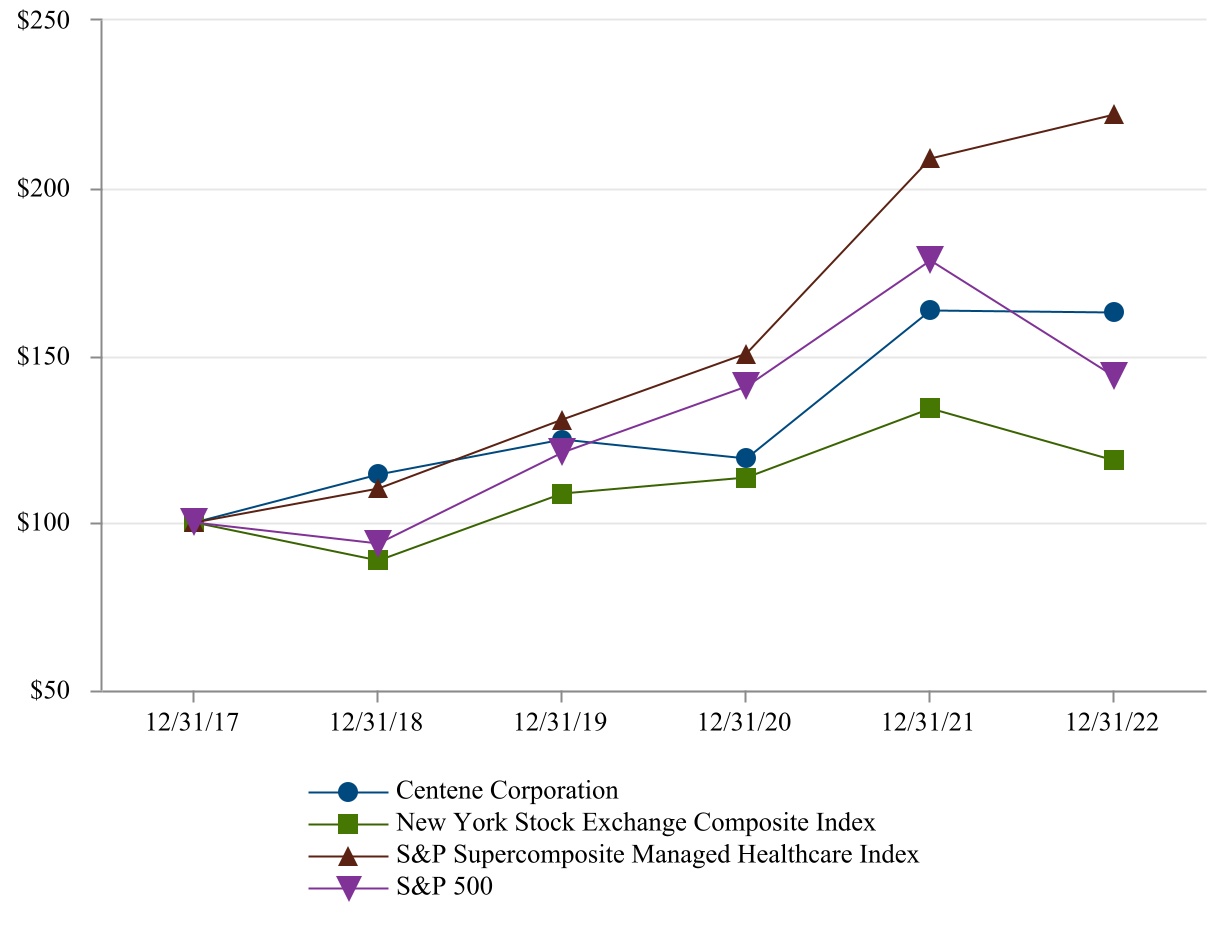
| December 31, | |||||||||||||||||||||||||||||||||||
| 2017 | 2018 | 2019 | 2020 | 2021 | 2022 | ||||||||||||||||||||||||||||||
| Centene Corporation | $ | 100.00 | $ | 114.29 | $ | 124.64 | $ | 119.01 | $ | 163.36 | $ | 162.59 | |||||||||||||||||||||||
| New York Stock Exchange Composite Index | 100.00 | 88.80 | 108.62 | 113.40 | 134.00 | 118.55 | |||||||||||||||||||||||||||||
| S&P Supercomposite Managed Healthcare Index | 100.00 | 110.28 | 130.84 | 150.30 | 208.61 | 221.73 | |||||||||||||||||||||||||||||
| S&P 500 | 100.00 | 93.76 | 120.84 | 140.49 | 178.27 | 143.61 | |||||||||||||||||||||||||||||
| Centene Corporation closing stock price | $ | 50.44 | $ | 57.65 | $ | 62.87 | $ | 60.03 | $ | 82.40 | $ | 82.01 | |||||||||||||||||||||||
| Centene Corporation annual stockholder return | 78.5 | % | 14.3 | % | 9.1 | % | (4.5) | % | 37.3 | % | (0.5) | % |
In accordance with the rules of the SEC, the information contained in the Stock Performance Graph on this page shall not be deemed to be "soliciting material," or to be "filed" with the SEC or subject to the SEC's Regulation 14A, or to the liabilities of Section 18 of the Exchange Act, except to the extent that Centene specifically requests that the information be treated as soliciting material or specifically incorporates it by reference into a document filed under the Securities Act, or the Exchange Act.
Item 6. Reserved.
Item 7. Management's Discussion and Analysis of Financial Condition and Results of Operations
The following discussion of our financial condition and results of operations should be read in conjunction with our consolidated financial statements and the related notes included elsewhere in this filing. The discussion contains forward-looking statements that involve known and unknown risks and uncertainties, including those set forth under Part I, Item 1A."Risk Factors" of this Form 10-K. The following discussion and analysis does not include certain items related to the year ended December 31, 2020, including year-to-year comparisons between the year ended December 31, 2021 and the year ended December 31, 2020. For a comparison of our results of operations for the fiscal years ended December 31, 2021 and December 31, 2020, see Item 7. Management's Discussion and Analysis of Financial Condition and Results of Operations of our Annual Report on Form 10-K for the year ended December 31, 2021, filed with the SEC on February 22, 2022.
EXECUTIVE OVERVIEW
Mission
We are a leading healthcare enterprise, committed to helping people live healthier lives, with an established expertise in lower-income and medically complex populations. We provide access to high-quality healthcare, innovative programs, and a wide range of health solutions that help families and individuals get well, stay well, and be well. We believe that our local approach enables us to provide accessible, quality, culturally sensitive healthcare coverage to our communities.
We feel we have a competitive advantage being on the ground, enabling us to establish strong relationships with our partners and providing us with first-hand knowledge, which allows us to provide the best possible care to our members. We have a commitment to the communities and people we serve to transform their health at the local level. In 2022, when members of the Uvalde, Texas community faced unbelievable tragedy, we showed up to help serve their short-term needs and have since made an investment in a multipurpose community center in the city through our charitable foundation, just one example of our mission in action.
Our record of organic growth and strategic acquisitions has given us the size, scale, and privilege of providing local high-quality and affordable health care to more than 27 million Americans. As of December 31, 2022, we were the largest Medicaid health insurer in the country, serving 16 million Medicaid recipients in 29 states. We were the largest Marketplace carrier, serving 2.1 million members across 27 states, and served 1.5 million Medicare members across 36 states, with the highest concentration of lower-income, medically complex members.
While we are transforming our operating model to take advantage of our national scale, our commitment to remain local in the communities we serve will not change.
General
Our results of operations depend on our ability to manage expenses associated with health benefits (including estimated costs incurred) and selling, general and administrative (SG&A) costs. We measure operating performance based upon two key ratios. The health benefits ratio (HBR) represents medical costs as a percentage of premium revenues, excluding premium tax revenues that are separately billed, and reflects the direct relationship between the premiums received and the medical services provided. The SG&A expense ratio represents SG&A costs as a percentage of premium and service revenues, excluding premium taxes separately billed.
Value Creation Plan
We established our Value Creation Plan to drive margin expansion by leveraging our scale and generating sustainable, profitable growth. In addition to creating shareholder value, this plan is an ongoing effort to modernize and improve how we work in order to propel our organization to new levels of success and elevate the member and provider experiences. The three major pillars of the Value Creation Plan are: SG&A expense savings, gross margin expansion, and strategic capital management.
As part of our Value Creation Plan, we are assessing our portfolio and are focused on making strategic decisions and investments to create additional value in the short-term and to seek opportunities that position the organization for long-term strength, profitability, growth, and innovation. We continue to move forward with our value creation initiatives including the streamlining of certain operations, such as key call centers and utilization management, and have begun early-stage platform consolidations. Building on that foundation, we intend to drive sustainable, profitable growth and long-term value to our members and shareholders.
During 2022, we completed the following key milestones in our Value Creation Plan:
-
Initiated a reduction of our real estate footprint following a strategic review of our real estate portfolio resulting in a $1.6 billion impairment related to leased and owned real estate and related fixed assets. This represents an approximate 70% decrease in domestic leased space and is expected to result in annualized lease expense savings of more than $200 million.
-
Signed a multi-year contract with Express Scripts, Inc. to provide our pharmacy benefit services, commencing in 2024. The new pharmacy benefits management (PBM) contract is expected to drive significant value in 2024 and beyond.
-
Completed the divestitures of PANTHERx Rare (PANTHERx), our Spanish and Central European businesses, and Magellan Rx.
-
Completed $3.0 billion of common stock repurchases, $318 million of senior note repurchases, repaid our $180 million construction loan, and repaid over $100 million in revolver and term loan borrowings. Common stock and debt repurchases were funded primarily through proceeds from divestitures and free cash flow generated from operations.
In addition, in January 2023, we completed the divestitures of Magellan Specialty Health, Centurion, and HealthSmart.
Segments Update
In early 2023, and in conjunction with our updated strategic plan, executive leadership realignment, and corresponding 2023 divestitures, we have revised the way we manage the business, evaluate performance, and allocate resources, resulting in an updated segment structure comprised of (1) a Medicaid segment, (2) a Medicare segment, (3) a Commercial segment and (4) an Other segment. We will begin reporting under this new segment structure in 2023.
Acquisitions and Divestitures
In January 2022, we acquired all of the issued and outstanding shares of Magellan Health, Inc. (Magellan). Total consideration for the acquisition was $2.5 billion, consisting of $2.4 billion in cash and $60 million related to the fair value of replacement equity awards associated with pre-combination service.
In connection with our portfolio review and strategic plan to exit the PBM business, during 2022 we divested PANTHERx and Magellan Rx. We completed the divestiture of PANTHERx in July 2022 for $1.4 billion and recognized a gain of $490 million, or $382 million after-tax. In December 2022, we completed the divestiture of Magellan Rx for $1.3 billion and recognized a gain of $269 million, or $99 million after-tax.
Additionally, as part of our review of strategic alternatives for our international portfolio, in November 2022 we divested our ownership stakes in our Spanish and Central European businesses and as a result recorded an impairment charge of $163 million, or $140 million after-tax.
The above-noted acquisitions and divestitures are significant drivers of the year-over-year variances discussed throughout this section.
In January 2023, we completed the divestitures of Magellan Specialty Health, Centurion, our prison healthcare business, and HealthSmart, our third party health plan administration business.
Regulatory Trends and Uncertainties
The United States government, policymakers, and healthcare experts continue to discuss and debate various elements of the United States healthcare model. We remain focused on the promise of
Showing the first 8K of 78K characters. Open the full section
Item 7A. Quantitative and Qualitative Disclosures About Market Risk
Market risk represents the risk of loss that may impact our financial condition due to adverse changes in financial market prices and rates. Our market risk exposure is primarily the result of fluctuations in interest rates.
INVESTMENTS AND DEBT
As of December 31, 2022, we had short-term investments of $2.3 billion and long-term investments of $15.9 billion, including restricted deposits of $1.2 billion. The short-term investments generally consist of highly liquid securities with maturities between three and 12 months. The long-term investments consist of municipal, corporate and U.S. Treasury securities, government-sponsored obligations, life insurance contracts, asset backed securities, equity securities, and private equity investments and have maturities greater than one year. Restricted deposits consist of investments required by various state statutes to be deposited or pledged to state agencies. Due to the nature of the states' requirements, these investments are classified as long-term regardless of the contractual maturity date. Substantially all of our investments are subject to interest rate risk and will decrease in value if market rates increase. Assuming a hypothetical and immediate 1% increase in market interest rates at December 31, 2022, the fair value of our fixed income investments would decrease by approximately $583 million. Declines in interest rates over time will reduce our investment income. The Company does not hold or issue any derivative instruments for trading or speculative purposes.
For a discussion of the interest rate risk that our investments are subject to, see "Risk Factors - Our investment portfolio may suffer losses which could materially and adversely affect our results of operations or liquidity."
Item 8. Financial Statements and Supplementary Data
Report of Independent Registered Public Accounting Firm
To the Stockholders and Board of Directors
Centene Corporation:
Opinion on the Consolidated Financial Statements
We have audited the accompanying consolidated balance sheets of Centene Corporation and subsidiaries (the Company) as of December 31, 2022 and 2021, the related consolidated statements of operations, comprehensive earnings (loss), stockholders' equity, and cash flows for each of the years in the three‑year period ended December 31, 2022, and the related notes (collectively, the consolidated financial statements). In our opinion, the consolidated financial statements present fairly, in all material respects, the financial position of the Company as of December 31, 2022 and 2021, and the results of its operations and its cash flows for each of the years in the three‑year period ended December 31, 2022, in conformity with U.S. generally accepted accounting principles.
We also have audited, in accordance with the standards of the Public Company Accounting Oversight Board (United States) (PCAOB), the Company's internal control over financial reporting as of December 31, 2022, based on criteria established in Internal Control - Integrated Framework (2013) issued by the Committee of Sponsoring Organizations of the Treadway Commission, and our report dated February 21, 2023 expressed an unqualified opinion on the effectiveness of the Company's internal control over financial reporting.
Basis for Opinion
These consolidated financial statements are the responsibility of the Company's management. Our responsibility is to express an opinion on these consolidated financial statements based on our audits. We are a public accounting firm registered with the PCAOB and are required to be independent with respect to the Company in accordance with the U.S. federal securities laws and the applicable rules and regulations of the Securities and Exchange Commission and the PCAOB.
We conducted our audits in accordance with the standards of the PCAOB. Those standards require that we plan and perform the audit to obtain reasonable assurance about whether the consolidated financial statements are free of material misstatement, whether due to error or fraud. Our audits included performing procedures to assess the risks of material misstatement of the consolidated financial statements, whether due to error or fraud, and performing procedures that respond to those risks. Such procedures included examining, on a test basis, evidence regarding the amounts and disclosures in the consolidated financial statements. Our audits also included evaluating the accounting principles used and significant estimates made by management, as well as evaluating the overall presentation of the consolidated financial statements. We believe that our audits provide a reasonable basis for our opinion.
Critical Audit Matters
The critical audit matters communicated below are matters arising from the current period audit of the consolidated financial statements that were communicated or required to be communicated to the audit and compliance committee and that: (1) relate to accounts or disclosures that are material to the consolidated financial statements and (2) involved our especially challenging, subjective, or complex judgments. The communication of critical audit matters does not alter in any way our opinion on the consolidated financial statements, taken as a whole, and we are not, by communicating the critical audit matters below, providing separate opinions on the critical audit matters or on the accounts or disclosures to which they relate.
Evaluation of the estimated medical claims liability
As discussed in Note 2 to the consolidated financial statements, the Company's medical claims liability includes claims reported but not yet paid, estimates for claims incurred but not reported, and estimates for the costs necessary to process unpaid claims. As discussed in Note 8 to the consolidated financial statements, the balance at December 31, 2022 was $16,745 million.
We identified the evaluation of the estimated medical claims liability as a critical audit matter. The Company estimates its medical claims liability using actuarial methods. Specialized skills were required to evaluate these actuarial methods, which include analyzing historical claims data in order to estimate the medical claims liability. The medical claims liability included an estimate for medical claims developing under moderately adverse conditions, which represents the risk of adverse deviation in the Company's actuarial methods of reserving, which required auditor judgment to evaluate.
The following are the primary procedures we performed to address this critical audit matter. We evaluated the design and tested the operating effectiveness of certain internal controls related to the critical audit matter. This included controls over the Company's process to evaluate the estimate of the medical claims liability. We involved actuarial professionals with specialized skills and knowledge who evaluated the actuarial methods used by the Company to estimate the medical claims liability. With the assistance of the actuarial professionals, we challenged the Company's estimate of the medical claims liability, including the effects of moderately adverse conditions, by developing an independent estimate for certain health plans using the Company's medical claims data, and relative range. We assessed the potential for management bias by evaluating the Company's position and movement within the actuarial professionals' relative range.
Evaluation of the estimated Affordable Care Act risk adjustment accruals
As discussed in Note 2 to the consolidated financial statements, the Affordable Care Act (ACA) established a permanent risk adjustment program. This program transfers funds from qualified individual and small group insurance plans with below average risk scores to those insurance plans with above average risk scores within each state. The final settlement of the December 31, 2022 ACA risk adjustment accruals is scheduled to be determined by the Centers for Medicare and Medicaid Services (CMS) in June 2023, based on data submitted by insurance companies through April 2023. As discussed in Note 9, the Company recorded an estimated asset and liability (the ACA risk adjustment accruals) of $838 million, and $780 million, respectively at December 31, 2022.
We identified the evaluation of the estimated ACA risk adjustment accruals as a critical audit matter. Specialized skills and a higher degree of auditor judgment were required to evaluate the Company's estimates. The Company's estimates are based on its analysis of member data, claims data, and projections of claims data expected to be submitted by the Company, and other insurance plans, to CMS for settlement.
The following are the primary procedures we performed to address this critical audit matter. We evaluated the design and tested the operating effectiveness of certain internal controls over the Company's process to develop the estimated ACA risk adjustment accruals. We involved actuarial professionals with specialized skills and knowledge who assisted in evaluating the Company's methodology used in estimating the ACA risk adjustment accruals for consistency with the federally developed risk adjustment methodology. Additionally, the actuarial professionals assisted in evaluating the projections of claims data utilized to estimate the ACA risk adjustment accruals, and assessed the methodologies utilized by the Company for consistency with industry practice. We assessed the Company's process to estimate the ACA risk adjustment accruals, in order to consider the potential for management bias, by performing a retrospective review of the prior period ACA risk adjustment accruals and assessing the consistency of those estimated balances with the subsequent settlement.
/s/ KPMG LLP
We have se
Showing the first 8K of 182K characters. Open the full section
Item 9. Changes in and Disagreements With Accountants on Accounting and Financial Disclosure
None.
Item 9A. Controls and Procedures
Evaluation of Disclosure Controls and Procedures - Our management, with the participation of our Chief Executive Officer and Chief Financial Officer, evaluated the effectiveness of our disclosure controls and procedures as of December 31, 2022. The term "disclosure controls and procedures," as defined in Rules 13a-15(e) and 15d-15(e) under the Exchange Act, means controls and other procedures of a company that are designed to ensure that information required to be disclosed by a company in the reports that it files or submits under the Exchange Act is recorded, processed, summarized and reported, within the time periods specified in the SEC's rules and forms. Disclosure controls and procedures include, without limitation, controls, and procedures designed to ensure that information required to be disclosed by a company in the reports that it files or submits under the Exchange Act is accumulated and communicated to the company's management, including its principal executive and principal financial officers, as appropriate to allow timely decisions regarding required disclosure. Management recognizes that any controls and procedures, no matter how well designed and operated, can provide only reasonable assurance of achieving their objectives and management necessarily applies its judgment in evaluating the cost-benefit relationship of possible controls and procedures. Based on the evaluation of our disclosure controls and procedures as of December 31, 2022, our Chief Executive Officer and Chief Financial Officer concluded that, as of such date, our disclosure controls and procedures were effective.
Management's Report on Internal Control Over Financial Reporting - Our management is responsible for establishing and maintaining adequate internal control over financial reporting, as such term is defined in Exchange Act Rules 13a-15(f) and 15d-15(f). Under the supervision and with the participation of our management, including our principal executive officer and principal financial officer, we conducted an evaluation of the effectiveness of our internal control over financial reporting based on the framework in Internal Control - Integrated Framework (2013) issued by the Committee of Sponsoring Organizations of the Treadway Commission. Based on our evaluation under the framework in Internal Control - Integrated Framework (2013), our management concluded that our internal control over financial reporting was effective at the reasonable assurance level as of December 31, 2022. Our management's assessment of the effectiveness of our internal control over financial reporting as of December 31, 2022, has been audited by KPMG LLP, an independent registered public accounting firm, as stated in their report which is included herein.
Changes in Internal Control Over Financial Reporting - No change in our internal control over financial reporting (as defined in Rules 13a-15(f) and 15d-15(f) under the Exchange Act) occurred during the year ended December 31, 2022, that has materially affected, or is reasonably likely to materially affect, our internal control over financial reporting.
Report of Independent Registered Public Accounting Firm
To the Stockholders and Board of Directors
Centene Corporation:
Opinion on Internal Control Over Financial Reporting
We have audited Centene Corporation and subsidiaries' (the Company) internal control over financial reporting as of December 31, 2022, based on criteria established in Internal Control - Integrated Framework (2013) issued by the Committee of Sponsoring Organizations of the Treadway Commission. In our opinion, the Company maintained, in all material respects, effective internal control over financial reporting as of December 31, 2022, based on criteria established in Internal Control - Integrated Framework (2013) issued by the Committee of Sponsoring Organizations of the Treadway Commission.
We also have audited, in accordance with the standards of the Public Company Accounting Oversight Board (United States) (PCAOB), the consolidated balance sheets of the Company as of December 31, 2022 and 2021, the related consolidated statements of operations, comprehensive earnings (loss), stockholders' equity, and cash flows for each of the years in the three-year period ended December 31, 2022, and the related notes (collectively, the consolidated financial statements), and our report dated February 21, 2023, expressed an unqualified opinion on those consolidated financial statements.
Basis for Opinion
The Company's management is responsible for maintaining effective internal control over financial reporting and for its assessment of the effectiveness of internal control over financial reporting, included in the accompanying Management's Report on Internal Control Over Financial Reporting. Our responsibility is to express an opinion on the Company's internal control over financial reporting based on our audit. We are a public accounting firm registered with the PCAOB and are required to be independent with respect to the Company in accordance with the U.S. federal securities laws and the applicable rules and regulations of the Securities and Exchange Commission and the PCAOB.
We conducted our audit in accordance with the standards of the PCAOB. Those standards require that we plan and perform the audit to obtain reasonable assurance about whether effective internal control over financial reporting was maintained in all material respects. Our audit of internal control over financial reporting included obtaining an understanding of internal control over financial reporting, assessing the risk that a material weakness exists, and testing and evaluating the design and operating effectiveness of internal control based on the assessed risk. Our audit also included performing such other procedures as we considered necessary in the circumstances. We believe that our audit provides a reasonable basis for our opinion.
Definition and Limitations of Internal Control Over Financial Reporting
A company's internal control over financial reporting is a process designed to provide reasonable assurance regarding the reliability of financial reporting and the preparation of financial statements for external purposes in accordance with generally accepted accounting principles. A company's internal control over financial reporting includes those policies and procedures that (1) pertain to the maintenance of records that, in reasonable detail, accurately and fairly reflect the transactions and dispositions of the assets of the company; (2) provide reasonable assurance that transactions are recorded as necessary to permit preparation of financial statements in accordance with generally accepted accounting principles, and that receipts and expenditures of the company are being made only in accordance with authorizations of management and directors of the company; and (3) provide reasonable assurance regarding prevention or timely detection of unauthorized acquisition, use, or disposition of the company's assets that could have a material effect on the financial statements.
Because of its inherent limitations, internal control over financial reporting may not prevent or detect misstatements. Also, projections of any evaluation of effectiveness to future periods are subject to the risk that controls may become inadequate because of changes in conditions, or that the degree of compliance with the policies or procedures may deteriorate.
/s/ KPMG LLP
St. Louis, Missouri
February 21, 2023
Item 9B. Other Information
On February 20, 2023, in connection with the appointment of Kenneth Fasola as President of the Company and James E. Murray as Chief Operating Officer of the Company in December 2022, the Company entered into employment agreements with Messrs. Fasola and Murray.
Pursuant to the terms of Mr. Fasola's employment agreement, Mr. Fasola will receive (i) an annual base salary of $1,100,000, (ii) an annual cash incentive bonus target under the Centene Corporation Short-Term Executive Compensation Plan of 125% of base salary, (iii) long-term equity incentive awards under the Centene Corporation 2012 Stock Incentive Plan, as amended (the "2012 Plan") with amounts and terms determined by the Compensation Committee (with an aggregate grant date value of $6,025,000 for 2023), (iv) a one-time $1,000,000 cash award, and (v) cash severance upon a qualifying termination equal to annual base salary, a prorated annual bonus, and continued medical benefits at active employee rates for 12 months.
Pursuant to the terms of Mr. Murray's employment agreement, Mr. Murray will receive (i) an annual base salary of $750,000, (ii) an annual cash incentive bonus target under the Centene Corporation Short-Term Executive Compensation Plan of 100% of base salary, (iii) long-term equity incentive awards under the 2012 Plan with amounts and terms determined by the Compensation Committee (with an aggregate grant date value of $4,250,000 for 2023), and (iv) cash severance upon a qualifying termination equal to annual base salary, a prorated annual bonus, and continued medical benefits at active employee rates for 12 months.
Item 9C. Disclosure Regarding Foreign Jurisdictions that Prevent Inspections
Not applicable
PART III
Item 10. Directors, Executive Officers and Corporate Governance
(a) Directors of the Registrant
Information concerning our directors will appear in our Proxy Statement for our 2023 annual meeting of stockholders under "Proposal One: Election of Directors." This portion of the Proxy Statement is incorporated herein by reference.
(b) Information about our Executive Officers
Pursuant to General Instruction G(3) to Form 10-K and the Instruction to Item 401 of Regulation S-K, information regarding our executive officers is provided in Item 1 of Part I of this Annual Report on Form 10-K under the caption "Information about our Executive Officers."
Information concerning our executive officers' compliance with Section 16(a) of the Exchange Act will appear in our Proxy Statement for our 2023 annual meeting of stockholders under "Delinquent Section 16(a) Reports," if applicable.
(c) Corporate Governance
Information concerning certain corporate governance matters, including information concerning our audit committee financial expert and identification of our Audit and Compliance Committee, and our code of ethics will appear in our Proxy Statement for our 2023 annual meeting of stockholders under "Corporate Governance." These portions of our Proxy Statement are incorporated herein by reference.
Item 11. Executive Compensation
Information concerning executive compensation will appear in our Proxy Statement for our 2023 Annual Meeting of Stockholders under "Executive Compensation." Information concerning Compensation and Talent Committee interlocks and insider participation will appear in the Proxy Statement for our 2023 Annual Meeting of Stockholders under "Compensation Committee Interlocks and Insider Participation." These portions of the Proxy Statement are incorporated herein by reference.
Item 12. Security Ownership of Certain Beneficial Owners and Management and Related Stockholder Matters
Information concerning the security ownership of certain beneficial owners and management and our equity compensation plans will appear in our Proxy Statement for our 2023 annual meeting of stockholders under "Beneficial Stock Ownership" and "Equity Compensation Plan Information." These portions of the Proxy Statement are incorporated herein by reference.
Item 13. Certain Relationships and Related Transactions, and Director Independence
Information concerning director independence, certain relationships, and related transactions will appear in our Proxy Statement for our 2023 annual meeting of stockholders under "Corporate Governance," "Independence of Directors," and "Related Party Transactions." These portions of our Proxy Statement are incorporated herein by reference.
Item 14. Principal Accountant Fees and Services
Our independent registered public accounting firm is KPMG LLP, St. Louis, MO. The Auditor Firm ID is 185.
Information concerning principal accountant fees and services will appear in our Proxy Statement for our 2023 annual meeting of stockholders under "Proposal Four: Ratification of Appointment of Independent Registered Public Accounting Firm." This portion of our Proxy Statement is incorporated herein by reference.
PART IV
Item 15. Exhibits and Financial Statement Schedules
(a)Financial Statements and Schedules
The following documents are filed under Item 8 of this report:
- Financial Statements:
Report of Independent Registered Public Accounting Firm
Consolidated Balance Sheets as of December 31, 2022 and 2021
Consolidated Statements of Operations for the years ended December 31, 2022, 2021 and 2020
Consolidated Statements of Comprehensive Earnings (Loss) for the years ended December 31, 2022, 2021 and 2020
Consolidated Statements of Stockholders' Equity for the years ended December 31, 2022, 2021 and 2020
Consolidated Statements of Cash Flows for the years ended December 31, 2022, 2021 and 2020
Notes to Consolidated Financial Statements
- Financial Statement Schedules:
None.
- The exhibits listed in the accompanying Exhibit Index are filed or incorporated by reference as part of this filing.
EXHIBIT INDEX
| 32.2 | Certification Pursuant to 18 U.S.C. Section 1350 (Chief Financial Officer) | X | ||||||||||||||||||||||||||||||
| 101 | The following materials from the Centene Corporation Annual Report on Form 10-K for the fiscal year ended December 31, 2022, formatted in Inline Extensible Business Reporting Language (iXBRL): (i) the Consolidated Balance Sheets, (ii) the Consolidated Statements of Operations, (iii) the Consolidated Statements of Comprehensive Earnings (Loss), (iv) the Consolidated Statements of Stockholders' Equity, (v) the Consolidated Statements of Cash Flows and (vi) related notes. | X | ||||||||||||||||||||||||||||||
| 104 | Cover Page Interactive Data File (embedded within the Inline XBRL document) | X | ||||||||||||||||||||||||||||||
| 1 SEC File No. 001-06639 + Schedules (as similar attachments) have been omitted from this filing pursuant to Item 601(a)(5) of Regulation S-K. * Indicates a management contract or compensatory plan or arrangement. |
Item 16. Form 10-K Summary
None.
SIGNATURES
Pursuant to the requirements of Section 13 or 15(d) of the Securities Exchange Act of 1934, the registrant has duly caused this report to be signed on its behalf by the undersigned, thereunto duly authorized, as of February 21, 2023.
| CENTENE CORPORATION | ||||||||
| By: | /s/ SARAH M. LONDON | |||||||
| Sarah M. London Chief Executive Officer |
Pursuant to the requirements of the Securities Exchange Act of 1934, this report has been signed below by the following persons on behalf of the registrant and in the capacities as indicated, as of February 21, 2023.
| Signature | Title | |||||||
| /s/ Sarah M. London | Chief Executive Officer (principal executive officer) | |||||||
| Sarah M. London | ||||||||
| /s/ Andrew L. Asher | Executive Vice President, Chief Financial Officer (principal financial officer) | |||||||
| Andrew L. Asher | ||||||||
| /s/ Katie N. Casso | Senior Vice President, Corporate Controller and Chief Accounting Officer (principal accounting officer) | |||||||
| Katie N. Casso | ||||||||
| /s/ Orlando Ayala | Director | |||||||
| Orlando Ayala | ||||||||
| /s/ Jessica L. Blume | Director | |||||||
| Jessica L. Blume | ||||||||
| /s/ Kenneth A. Burdick | Director | |||||||
| Kenneth A. Burdick | ||||||||
| /s/ Christopher J. Coughlin | Director | |||||||
| Christopher J. Coughlin | ||||||||
| /s/ H. James Dallas | Director | |||||||
| H. James Dallas | ||||||||
| /s/ Wayne S. DeVeydt | Director | |||||||
| Wayne S. DeVeydt | ||||||||
| /s/ Fred H. Eppinger | Director | |||||||
| Fred H. Eppinger | ||||||||
| /s/ Monte E. Ford | Director | |||||||
| Monte E. Ford | ||||||||
| /s/ Richard A. Gephardt | Director | |||||||
| Richard A. Gephardt | ||||||||
| /s/ Lori J. Robinson | Director | |||||||
| Lori J. Robinson | ||||||||
| /s/ Theodore R. Samuels | Director | |||||||
| Theodore R. Samuels | ||||||||
| /s/ William L. Trubeck | Director | |||||||
| William L. Trubeck |