 filings.tools
Coherent 10-K 2018-06-30
Filed 2018-08-28. 22 sections, 382K characters. Original on sec.gov · Markdown · JSON
Cover and table of contents
10-K 1 iivi-10k_20180630.htm 10-K
ityP!@
United States
SECURITIES AND EXCHANGE COMMISSION
Washington, D.C. 20549
FORM 10-K
| ☒ | Annual Report pursuant to Section 13 or 15(d) of the Securities Exchange Act of 1934 |
|---|
for the fiscal year ended June 30, 2018
| ☐ | Transition report pursuant to Section 13 or 15(d) of the Securities Exchange Act of 1934 |
|---|
for the transition period from to .
Commission File Number: 0-16195
II-VI INCORPORATED
(Exact name of registrant as specified in its charter)
| PENNSYLVANIA | 25-1214948 | |
|---|---|---|
| (State or other jurisdiction of incorporation or organization) | (I.R.S. Employer Identification No.) | |
| 375 Saxonburg Boulevard Saxonburg, PA | 16056 | |
| (Address of principal executive offices) | (Zip code) |
Registrant’s telephone number, including area code: 724-352-4455
Securities registered pursuant to Section 12(b) of the Act:
| Title of Each Class | Name of Each Exchange on Which Registered | |
|---|---|---|
| Common Stock, no par value | Nasdaq Global Select Market |
Securities registered pursuant to Section 12(g) of the Act: None
Indicate by check mark if the registrant is a well-known seasoned issuer, as defined in Rule 405 of the Securities Act. Yes ☒ No ☐
Indicate by check mark if the registrant is not required to file reports pursuant to Section 13 or Section 15(d) of the Exchange Act. Yes ☐ No ☒
Indicate by check mark whether the registrant: (1) has filed all reports required to be filed by Section 13 or 15(d) of the Securities Exchange Act of 1934 during the preceding 12 months (or for such shorter period that the registrant was required to file such reports), and (2) has been subject to such filing requirements for the past 90 days. Yes ☒ No ☐
Indicate by check mark whether the registrant has submitted electronically and posted on its corporate Web site, if any, every Interactive Data File required to be submitted and posted pursuant to Rule 405 of Regulation S-T during the preceding 12 months (or for such shorter period that the registrant was required to submit and post such files). Yes ☒ No ☐
Indicate by check mark if disclosure of delinquent filers pursuant to Item 405 of Regulation S-K is not contained herein, and will not be contained, to the best of registrant’s knowledge, in definitive proxy or information statements incorporated by reference in Part III of this Form 10-K or any amendment to this Form 10-K. ☐
Indicate by check mark whether the registrant is a large accelerated filer, an accelerated filer, a non-accelerated filer, smaller reporting company, or an emerging growth company. See definitions of “large accelerated filer,” “accelerated filer,” “smaller reporting company,” and “emerging growth company” in Rule 12b-2 of the Exchange Act. (Check one):
| Large accelerated filer | ☒ | Accelerated filer | ☐ | |||
|---|---|---|---|---|---|---|
| Non-accelerated filer | ☐ | (Do not check if a smaller reporting company) | Smaller reporting company | ☐ | ||
| Emerging growth company | ☐ |
If an emerging growth company, indicate by check mark if the registrant has elected not to use the extended transition period for complying with any new or revised financial accounting standards provided pursuant to Section 13(a) of the Exchange Act ☐
Indicate by check mark whether the registrant is a shell company (as defined in Rule 12b-2 of the Exchange Act). Yes ☐ No ☒
Aggregate market value of outstanding Common Stock, no par value, held by non-affiliates of the Registrant at December 29, 2017, was approximately $2,867,219,000 based on the closing sale price reported on the Nasdaq Global Select Market. For purposes of this calculation only, directors and executive officers of the Registrant and their spouses are deemed to be affiliates of the Registrant.
Number of outstanding shares of Common Stock, no par value, at August 22, 2018, was 63,595,874.
DOCUMENTS INCORPORATED BY REFERENCE
Portions of the registrant’s definitive proxy statement, which will be issued in connection with the 2018 Annual Meeting of Shareholders of II-VI Incorporated, are incorporated by reference into Part III of this Annual Report on Form 10-K.
Forward-Looking Statements
This Annual Report on Form 10-K (including certain information incorporated herein by reference) contains forward-looking statements made pursuant to Section 21E of the Securities Exchange Act of 1934, as amended (the “Exchange Act”), and the safe harbor provisions of the Private Securities Litigation Reform Act of 1995 (the “PSLRA”). The statements in this Annual Report on Form 10-K that are not purely historical, but are forward-looking statements, including, without limitation, statements regarding our expectations, assumptions, beliefs, intentions or strategies regarding the future. In some cases, these forward-looking statements can be identified by terminology such as, “may,” “will,” “should,” “expects,” “plans,” “anticipates,” “believes,” “intends,” “estimates,” “predicts,” “projects,” “potential,” or “continue” or the negative of these terms or other comparable terminology. Forward-looking statements address, among other things, our assumptions, our expectations, our assessments of the size and growth rates of our markets, our growth strategies, our efforts to increase bookings, sales and revenues, projections of our future profitability, cash generation, success of our research, development and engineering investments, results of operations, capital expenditures, our financial condition, our ability to integrate acquired businesses or other “forward-looking” information and include statements about revenues, costs, investments, earnings, margins, or our projections, actions, plans or strategies.
The forward-looking statements in this Annual Report on Form 10-K involve risks and uncertainties, which could cause actual results, performance or trends to differ materially from those expressed in the forward-looking statements herein or in previous disclosures. We believe that all forward-looking statements made by us have a reasonable basis, but there can be no assurance that these expectations, beliefs or projections will actually occur or prove to be correct, at least on the timetable of our expectations. Actual results could differ materially. We claim the protection of the safe harbor for forward-looking statements contained in the PSLRA for our forward-looking statements.
The following factors, among others, in some cases have affected and in the future could affect our financial performance and actual results, and could cause actual results for fiscal 2019 and beyond to differ materially from those expressed or implied in any forward-looking statements included in this Annual Report on Form 10-K or otherwise made by our management:
| • | Investments in future markets of potential significant growth may not result in expected returns. |
|---|
| • | Our competitive position depends on our ability to develop new products and processes. |
|---|
| • | Our competitive position may still require significant investments. |
|---|
| • | Our future success depends on continued international sales, and our global operations are complex to manage, and present multiple challenges to manage. |
|---|
| • | Foreign currency risk may negatively affect our revenues, cost of sales and operating margins and could result in foreign exchange losses. |
|---|
| • | Any inability to access financial markets from time to time to raise required capital, finance our working capital requirements or our acquisition strategies, or otherwise to support our liquidity needs could negatively impact our ability to finance our operations, meet certain obligations or implement our growth strategy. |
|---|
| • | We may incur substantially more indebtedness. |
|---|
| • | We may not be able to settle conversions of our convertible senior notes in cash or to repurchase the notes in accordance with their terms. |
|---|
| • | The conditional conversion feature of our outstanding convertible senior notes, if triggered, may adversely affect our financial condition and operating results. |
|---|
| • | We may fail to accurately estimate the size and growth of our markets and our customers’ demands. |
|---|
| • | We may encounter increased competition. |
|---|
| • | There are limitations on the protection of our intellectual property and we may from time to time be involved in costly intellectual property litigation or indemnification. |
|---|
| • | A significant portion of our business depends on cyclical industries. |
|---|
| • | Changes in laws and regulations governing data privacy and data protection could have a material adverse impact on our business. |
|---|
| • | Data breach incidents and breakdown of information and communication technologies could disrupt our operations and impact our financial results. |
|---|
| • | Global economic downturns may adversely affect our business, operating results and financial condition. |
|---|
| • | We are subject to complex and rapidly changing governmental import and export regulations. |
|---|
| • | Changes in U.S. trade policies could impact the Company’s international operations and the cost of imported goods into the U.S., which may narrow the size of our markets, materially impact our revenues or increase our operating costs and expose us to contract litigation. |
|---|
| • | We have entered into supply agreements which commit us to supply products on specified terms. |
|---|
| • | We depend on highly complex manufacturing processes that require feeder materials, components and products from limited sources of supply. |
|---|
| • | Our global operations are subject to complex legal and regulatory requirements. |
|---|
| • | We use and generate potentially hazardous substances that are subject to stringent environmental regulations. |
|---|
| • | We may be adversely affected by climate change regulations. |
|---|
| • | Some systems that use our products are complex in design, and our products may contain defects that are not known or detected until deployed which could increase our costs, reduce our revenues, cause us to lose key customers and may expose us to litigation arising from derivative lawsuits related to consumer products. |
|---|
| • | Unfavorable changes in tax rates, tax liabilities or tax accounting rules could negatively affect future results. |
|---|
| • | Increases in commodity prices may adversely affect our results of operations and financial condition. |
|---|
| • | Natural disasters or other global or regional catastrophic events could disrupt our operations, give rise to substantial environmental hazards and adversely affect our results. |
|---|
| • | Our success depends on our ability to attract, retain, and develop key personnel and requires continued good relations with our employees. |
|---|
| • | Our stock price has been volatile in the past and may be volatile in the future. |
|---|
| • | Some anti-takeover provisions contained in our articles of incorporation and by-laws, as well as provisions of Pennsylvania law, could impair a takeover attempt, which could also reduce the market price of our common stock. |
|---|
| • | Because we do not currently intend to pay dividends, holders of our common stock will benefit from an investment in our common stock only if it appreciates in value, and by the intended anti-dilution actions of our share-buyback program. |
|---|
The foregoing and additional risk factors are described in more detail herein under Item 1A. “Risk Factors”. All such factors, as well as factors described or referred to in other filings we make with the Securities and Exchange Commission (the “SEC”) from time to time, should be considered in evaluating our business and prospects. Many of these factors are beyond our reasonable control. In addition, we operate in a highly competitive and rapidly changing environment, and, therefore, new risk factors can arise and be present without market players like us knowing until a substantial amount of time has passed. It is not possible for management to predict all such risk factors, assess the impact of all such risk factors on our business nor estimate the extent to which any individual risk factor, or combination of risk factors, nor to mitigate them all and therefore they may cause results to differ materially from those contained in any forward-looking statement. The forward-looking statements included in this Annual Report on Form 10-K speak only as of the date of this Annual Report on Form 10-K. We do not assume any obligation to update or revise any forward-looking statements, whether as a result of new information, future events or developments, or otherwise, except as may be required by the securities laws. We caution you not to rely on them unduly.
II-VI Incorporated does communicate with securities analysts from time to time and those communications are conducted in accordance with applicable securities laws. Investors should not assume that II-VI Incorporated agrees with any statement or report issued by any analyst, irrespective of the content of the statement or report.
PART I
Item 1. BUSINESS
| --- | --- |
Definitions
II-VI Incorporated (“II-VI,” the “Company,” “we,” “us,” or “our”) was incorporated in Pennsylvania in 1971. Our headquarters are located at 375 Saxonburg Boulevard, Saxonburg, Pennsylvania 16056. Our telephone number is 724-352-4455. Reference to “II-VI,” the “Company,” “we,” “us,” or “our” in this Annual Report on Form 10-K, unless the context requires otherwise, refers to II-VI Incorporated and its wholly-owned subsidiaries. The Company’s name is pronounced “Two Six Incorporated.” The name II-VI refers to Groups II and VI on the Periodic Table of Elements from which II-VI originally designed and produced infrared optics for high-power CO2 lasers used in materials processing. We address 7 major markets. The majority of our revenues are attributable to the sale of engineered materials and optoelectronic components, devices and subsystems for the industrial materials processing, optical communications and military markets. Reference to “fiscal” or “fiscal year” means our fiscal year ended June 30 for the year referenced.
The following acronyms are defined for reference: 3 dimensional (“3D”); 4th generation (“4G”) wireless; 5th generation (“5G”) wireless; bismuth telluride (“Bi2Te3”); cadmium telluride (“CdTe”); carbon monoxide (“CO”); carbon dioxide (“CO2”); chemical vapor deposited (“CVD”) materials including diamond; wavelength division multiplexing (“WDM”); dense wavelength division multiplexing (“DWDM”); extreme ultraviolet (“EUV”) lithography; gallium arsenide (“GaAs”); gallium nitride (“GaN”); gigabit Ethernet (“GbE”); gigabit per second (“Gb/s”); indium phosphide (“InP”); infrared (“IR”); light detection and ranging (“LiDAR”); near infrared (“NIR”); nanometers (“nm”); original equipment manufacturer (“OEM”); organic light-emitting diode (“OLED”); optical time domain reflectometer (“OTDR”); research, development and engineering (“RD&E”); radio frequency (“RF”); reconfigurable optical add/drop multiplexer (“ROADM”); silicon carbide (“SiC”); ultraviolet (“UV”); vertical cavity surface emitting laser (“VCSEL”); zinc selenide (“ZnSe”); and zinc sulfide (“ZnS”).
General Description of Business
We develop, manufacture and market engineered materials, optoelectronic components and devices for precision use in industrial materials processing, optical communications, military, consumer electronics, semiconductor equipment, life sciences and automotive applications and markets. We use advanced engineered materials growth technologies coupled with proprietary high-precision fabrication, micro-assembly, optical thin-film coating and electronic integration to manufacture complex optoelectronic devices and modules. Our products are deployed in a variety of applications, including (i) laser cutting, welding and marking operations; (ii) 3D sensing consumer applications; (iii) optical, data and wireless communication products; (iv) strategic military applications including intelligence, surveillance and reconnaissance; (v) semiconductor processing and tooling; and (vi) thermoelectric cooling and power generation solutions.
Through RD&E and acquisitions, II-VI has expanded its portfolio of materials. We believe that the materials that we grow and fabricate are differentiated by one or a combination of unique optical, electrical, thermal and mechanical properties. II-VI’s optics are shaped by precision surfacing techniques to meet the most stringent requirements for flat or curved geometries, functionalized with smooth or structured surfaces, or with patterned metallization. Proprietary processes developed at our global optical coating centers differentiate our products’ durability against high energy lasers and extreme operating environments. Optical coatings also provide the desired spectral characteristics ranging from the ultraviolet to the far-infrared. II-VI leverages these capabilities to deliver miniature- to large-scale precision optical assemblies, including in combination with thermal management components, integrated electronics, and/or software.
II-VI also offers a broad portfolio of compound semiconductor lasers that are used in a variety of applications in most of our end markets. These compound semiconductor lasers enable high-power lasers for materials processing, optical signal amplification in terrestrial and submarine communications networks, high bit rate server connectivity between and within datacenters, fast and accurate measurements in biomedical instruments, consumer electronics and optical communications network monitoring.
II-VI continues to work to perfect its operational capabilities, develop next generation products, and invest in new technology platforms. With a strategic focus on fast growing and sustainable markets, II-VI pursues its vision of enabling the world to be safer, healthier, closer and more efficient.
Information Regarding Market Segments and Foreign Operations
Financial data regarding our revenues, results of operations, industry segments and international sales for the three years ended June 30, 2018 are set forth in the Consolidated Statements of Earnings and in Note 12 to the Company’s Consolidated Financial Statements included in Item 8 of this Annual Report on Form 10-K and are incorporated herein by reference. We also discuss certain Risk Factors set forth in Item 1A of this Annual Report on Form 10-K related to our foreign operations, which are incorporated herein by reference.
Bookings and Backlog
We define our bookings as customer orders received that are expected to be converted to revenues over the next 12 months. For long-term customer orders, to address the inherent uncertainty of orders that extend far into the future, the Company records only those orders which are expected to be converted into revenues within 12 months from the end of the reporting period. Bookings are adjusted if changes in customer demands or production schedules cause the expected time of a delivery to extend beyond 12 months. For the year ended June 30, 2018, our bookings were approximately $1.2 billion compared to bookings of approximately $1.1 billion for the year ended June 30, 2017.
We define our backlog as bookings that have not been converted to revenues by the end of the reporting period. As of June 30, 2018, our backlog was approximately $450 million, compared to approximately $400 million as of June 30, 2017.
Global Operations
II-VI is headquartered in Saxonburg, PA, with RD&E, manufacturing and sales facilities worldwide. Our U.S. production and research and development operations are located in Pennsylvania, California, New Jersey, Texas, Mississippi, Massachusetts, Connecticut, Delaware, New York, Florida and Illinois and our non-U.S. production operations are based in China, Singapore, Vietnam, the Philippines, Germany, Switzerland and the United Kingdom. We also utilize contract manufacturers and strategic suppliers. In addition to sales offices at most of our manufacturing sites, we have sales and marketing subsidiaries in Hong Kong, Japan, Germany, China, Switzerland, Belgium, the United Kingdom, Italy, South Korea, and Taiwan. Approximately 68% of our revenues for the fiscal year ended June 30, 2018, were generated from sales to customers outside of the United States.
Employees
The table below summarizes the number of our employees as of June 30, 2018 in the main functions. We have a long-standing practice of encouraging active employee participation in areas of operations and quality management. We believe our relations with our employees are good. We reward substantially all our employees with some form of variable compensation based on achievement of performance goals. There are approximately 265 employees located in the United States and the Philippines who are covered under collective bargaining agreements. The Company’s collective bargaining agreement in the Philippines expires in June 2019. The collective bargaining agreement covering certain U.S. based employees expires in January 2021. There are 730 employees of Photop in China who work under contract manufacturing arrangements for customers of the Company.
| Number of employees | Percent of total | |
| Direct production | 8,977 | 79% |
| Research, development & engineering | 1,513 | 13% |
| Sales, marketing, administration, finance and supporting services | 953 | 8% |
| Total: | 11,443 | 100% |
Manufacturing Processes
Our success in developing and manufacturing many of our products depends on our ability to manufacture and to tailor the optical and physical properties of technically-challenging materials and components. The ability to produce, process and refine these complex materials and to control their quality and in-process yields is an expertise of the Company that is critical to the performance of our customers’ instruments and systems. In the markets we serve, there are a limited number of high-quality suppliers of many of the components we manufacture and there are very few industry-standard products.
Our network of worldwide manufacturing sites allows us to manufacture our products in regions that provide cost-effective advantages. We employ numerous advanced manufacturing technologies and systems at our manufacturing facilities. These include metal organic chemical vapor deposition and molecular beam epitaxy reactors, automated Computer Numeric Control optical fabrication, high throughput thin-film coaters, nano-precision metrology and custom-engineered automated furnace controls for crystal growth processes. Manufacturing products for use across the electro-magnetic spectrum requires the capability to repeatedly produce products with high yields to atomic tolerances. II-VI continuously updates its comprehensive quality management systems that feature manufacturing quality best practices. II-VI is committed to delivering products within specification, on time and with high quality, with a goal of fully satisfying customers and continually improving.
Sources of Supply
Among the major feed stock and raw materials we use include zinc, selenium, ZnSe, ZnS, hydrogen selenide, hydrogen sulfide, tellurium, yttrium oxide, aluminum oxide, iridium, platinum, bismuth, silicon, thorium fluoride, antimony, carbon, graphite, GaAs, InP, copper, germanium, molybdenum, quartz, optical glass, diamond, and other materials.
The continued high-quality of and access to these materials is critical to the stability and predictability of our manufacturing yields. We test materials at the onset and throughout the production process. Additional research and capital investment may be needed to better define future material specifications. We have not experienced significant production delays due to shortages of materials. However, we do occasionally experience problems associated with vendor-supplied materials not meeting contract specifications for quality or purity. As discussed in greater detail in Item 1A – Risk Factors, of this Annual Report on Form 10-K, significant failure of our suppliers to deliver sufficient quantities of necessary high-quality materials to our specifications on a timely basis could have a materially adverse effect on our results of our operations.
Business Units
The Company’s organizational structure is divided into three reporting segments for the purpose of making operational decisions and assessing financial performance: (i) II-VI Laser Solutions, (ii) II-VI Photonics, and (iii) II-VI Performance Products. These segments, and the units within the segments, are reflected in the organization chart below:
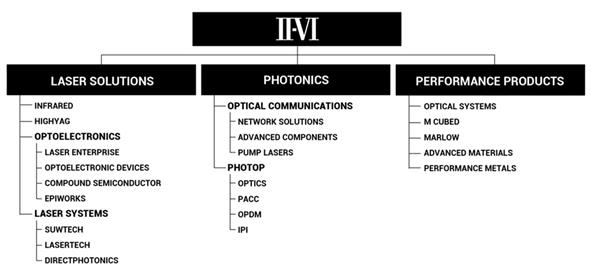
II-VI Laser Solutions designs, manufactures and markets optical and electro-optical components and materials sold under the II-VI Infrared brand name that are used primarily in high-power CO2 lasers, fiber-delivered beam delivery systems and processing tools and direct diode lasers for industrial lasers sold under the II-VI HIGHYAG, direct diode laser modules, sub-systems and systems sold under the II-VI SUWTECH and II-VI DIRECTPHOTONICS brand names and super-hard materials processing laser systems sold under the II-VI LASERTECH brand names. II-VI Laser Solutions also manufactures compound semiconductor epitaxial wafers under the II-VI EPIWORKS brand name for applications in optical components, wireless devices, and high-speed communication systems and manufactures 6-inch gallium arsenide wafers allowing for the production of high-performance lasers optoelectronics and integrated circuits in high volume sold under the II-VI Laser Enterprise, II-VI EpiWorks, II-VI Compound Semiconductor Ltd. and II-VI OptoElectronic Devices Division brand names.
II-VI Photonics manufactures crystal materials, optics, microchip lasers and optoelectronic modules for use in optical communication networks and other diverse consumer, life sciences and commercial applications. In addition, the segment also manufactures pump lasers, optical isolators, and optical amplifiers and micro-optics for optical amplifiers for both terrestrial and submarine applications within the optical communications market.
II-VI Performance Products designs, manufactures and markets infrared optical components and high-precision optical assemblies for military, medical and commercial laser imaging applications. In addition, the segment designs, manufactures and markets unique silicon carbide engineered materials for thermoelectric devices and subsystems for silicon carbide applications servicing the semiconductor equipment, military, communications, automotive and life science markets.
II-VI’s segments are organized by business unit at the group or division level. Each of these business units develops and markets products as described below.
| Segment: | Group/Division: | Our Products: |
|---|---|---|
| II-VI Laser Solutions | II-VI Infrared | • Laser optics and accessories for CO2 lasers used in materials processing semiconductor and life sciences • High power fiber and direct diode laser optics • Infrared thermal imaging optics and assemblies • II-VI compound crystalline material production including ZnSe, ZnS, ZnS multispectral and CVD diamond |
| II-VI HIGHYAG | • Laser processing heads and beam delivery systems for laser materials processing with fiber lasers, disk lasers, and diode lasers | |
| II-VI Laser Enterprise | • High-power semiconductor lasers and laser bars enabling fiber and direct diode lasers for materials processing, medical, defense, consumer and printing applications • VCSELs for optical interconnects and sensing | |
| II-VI OEG | • VCSELs for 3D sensing in consumer electronics and automotive • RF devices for communications | |
| II-VI Compound Semiconductor | • RF electronic devices for military applications | |
| II-VI EpiWorks | • III-V epitaxial wafers to enable higher performance photonic and RF components for consumer, communications, network and mobile applications, including wireless handsets, tablets and the Internet of things | |
| II-VI SUWTECH | • Diode pumped solid state lasers, green lasers and Q-switched lasers • Laser diode modules for multiple markets and applications, including aiming, leveling, range finding, machine vision, bio-medical instrumentation, Raman spectroscopy, and fluorescence spectroscopy • Fiber coupled high power diode lasers in the 8xx and 9xx nm wavelength ranges for fiber laser and solid state laser pumping, as well as for medical and other applications | |
| II-VI LASERTECH | • Laser cutting and drilling machines for processing a wide variety of super hard materials such as CVD diamond, polycrystalline diamond, polycrystalline cubic boron nitride, and ceramics among others as well as for high efficiency laser cutting of non-conductive materials | |
| II-VI DIRECTPHOTONICS | • High brightness, high power direct diode laser engines for cutting, welding, and thermal processing applications, including optimized solutions for aluminum and aluminum-copper processing applications |
| Segment: | Group/Division: | Our Products: |
|---|---|---|
| II-VI Photonics | II-VI Optical Communications | • Products and solutions that enable high bit rate interconnects for datacenters and communication service providers, datacenter inter-connects, ROADM systems and submarine transmission |
| II-VI Photop | • Fiber optics and precision optics used in projection and displays, crystal materials and components for optical communications, high power UV, visible and NIR optics for industrial lasers, filters and assemblies for life sciences, as well as for sensors, instrumentation and semiconductor equipment | |
| II-VI Performance Products | II-VI Optical Systems | • Precision optical assemblies, objectives, infrared optics, thin film coatings and optical materials • Optical solutions to critical and complex designs, engineering and production challenges in defense, aerospace and commercial industries |
| II-VI M Cubed | • Advanced ceramic and metal matrix composite products for semiconductor equipment, flat panel display equipment, industrial and optical equipment, as well as for defense applications | |
| II-VI Marlow | • Thermoelectric components, sub-assemblies and systems for heating, cooling, temperature tuning, thermal cycling and power generation in aerospace, defense, medical, industrial, automotive, consumer, telecommunications and power generation markets | |
| II-VI Advanced Materials | • SiC and advanced semiconductor materials for high frequency and high power electronic device applications in defense, telecommunications, automotive and industrial markets | |
| II-VI Performance Metals | • Specialty refining, recycling and materials recovery services for high purity rare metals such as Selenium and Tellurium, as well as related chemical products such as Tellurium Dioxide, for optics, photovoltaics, semiconductors, thermoelectric coolers, metallurgy, agriculture and industrial applications |
Our Markets
Our market-focused businesses are organized by technology and products. Our businesses are composed of the following primary markets: Communications, Materials Processing, Military, Semiconductor Equipment, Life Sciences, Consumer Electronics and Automotive.
Communications Market
II-VI’s optical communications products and technologies enable the next generation of high-speed optical transmission systems, networks, and datacenter solutions necessary to meet the accelerating global bandwidth demand. At the core of both terrestrial and undersea optical networks, our market-leading 980 nm pump lasers boost the power of the optical signal in the fiber optic cable at intervals along the way to enable a larger number of high speed signals to be transmitted over longer distances. Our latest generation of 980 nm pump lasers along with miniature tunable filters and hybrid passives are part of our ultra-compact family of components critical to a new generation of small size, long reach DWDM transmission modules operating at 100, 200 and 400 Gb/s.
Customers continue to rely on us for our industry-leading optical amplification and embedded monitoring solutions for their next generation ROADM systems to compensate for the inherent signal loss and to monitor the signal integrity. Our proprietary OTDR modules allow systems to automatically detect and pinpoint issues along the transmission path in real time. The accelerating adoption of applications such as cloud computing are driving the rapid growth of datacenter buildouts. Our high-speed 25 Gb/s VCSELs enable intra-datacenter transceivers to transmit and receive signals. Our miniature WDM thin film filter assemblies are used to increase the bandwidth within 100 GbE transceivers by combining wavelengths at the transmitter end and separating them out at the receiver end.
In mobile wireless applications, II-VI supplies base SiC substrates to customers who manufacture RF power amplifier devices that are embedded in remote radio heads in 4G wireless bases stations to boost the power of RF signal before it reaches the antenna. These devices are also widely expected to be embedded in next generation active antennas for 5G wireless, where multiple devices per antenna will be required to enable higher bandwidth. SiC has a high number of intrinsic physical and electronic advantages, such as high thermal conductivity, that enable them to operate at high-power levels and still dissipate the excess heat generated.
Materials Processing Market
Our industrial laser optics and solutions for the materials processing market remain in strong demand. There continues to be a steady global demand to support existing installations and new deployments of CO2 and fiber laser systems. Our vertically integrated and market leading ZnSe optics and components, due to their inherent low loss at around 10 micron wavelength, have enabled high-power CO2 laser systems for many decades and remain critical to the steady stream of new deployments as well as to continued operation, serving as replacement optics, of the installed base of CO2 lasers. II-VI continues to introduce products that address new and growing applications for low-power CO2 lasers, such as cutting textiles, leather, wood and other organic materials, for which the CO2 laser’s 10 micron wavelength is ideally suited. CO2 lasers are also at the core of EUV lithography systems, which are now emerging on the market to enable a new generation of smaller and more powerful personal integrated circuits for the internet of things computing devices.
Over the past several years, fiber laser-based systems operating at one micron wavelength in pulsed or continuous mode have taken a central role in nearly all materials processing segments, and especially for precision machining such as marking and micro drilling. From the laser chips that generate the input optical power to the beam delivery systems that direct the output optical power to the target, II-VI supplies a broad set of laser optics and fused fiber products that enable many functions within these systems. The same set of II-VI products is also at the core of existing and emerging direct diode laser systems. II-VI is also driving innovation with a direct-diode laser engine small enough to be mounted on a robotic arm so that the end user can apply square beams directly to the work piece at wavelengths optimized for aluminum processing.
Another emerging and fast growing application is the processing of displays for consumer electronics, including those based on the OLED technology that are scribed with CO lasers and sealed with UV lasers. II-VI’s broad portfolio of coated optics and crystal materials serve all of these growing laser markets.
Military Market
Our focus in the military market is enabling lasers for targeting, night vision, navigation, as well as intelligence, surveillance and reconnaissance systems. Multiple fighter jets are equipped with our large area sapphire windows that surround advanced electro-optical targeting and imaging systems. Infrared domes are used on missiles with infrared guidance systems ranging from small, human-portable designs to larger designs mounted on helicopters, fixed-wing aircraft and ground vehicles. High-precision domes are an integral component of a missile’s targeting system, providing efficient tactical capability, while serving as a protective cover to its internal components.
Rotary and fixed-wing aircraft also use missile warning systems to protect against shoulder fired human-portable missiles. Our competencies in material growth for UV crystals and our optical assembly capabilities provide significant support to these missile warning systems. A key attribute of several of these systems is the ability to filter electro-magnetic interference using micro-fine conductive mesh patterns. This technology is also applied to non-optical applications for absorbing and transmitting energy from the surfaces of aircraft and missiles.
Many military systems employ laser designation and range-finding capabilities supported by our semiconductor lasers bars and solid state laser host crystals and laser optics, all manufactured in-house, as well as our competency in short wave infrared and visible optics. Our thermoelectric coolers are used to increase thermal imaging sensitivity, or to maintain a constant window temperature in various visible and infrared applications.
We provide a range of battlefield-ready technologies for soldier equipment and specifically designed variants for law enforcement. Our precision patterned reticles are embedded in rifle scopes. Our reaction bonded boron carbide materials are shaped into torso plates and employed as in-aircraft cabin and protective body armor. Our thermo-electric coolers are used to regulate the soldier’s body heat. They are also used to convert heat produced by battlefield fuel burners into electrical power, for example to extend battery life on the battlefield.
We maintain engineering and manufacturing facilities in the United States with strictly controlled access that are dedicated to our U.S. government supported contracts.
Semiconductor Capital Equipment Market
Semiconductor equipment requires advanced materials to meet the need for tighter tolerances, enhanced thermal stability, faster wafer transfer speeds and reduced stage settling times. Our metal matrix composites and reaction bonded ceramics enable these applications thanks to their optimum combination of light weight, strength, hardness and coefficient of thermal expansion. Our reaction bonded SiC materials are used to manufacture wafer chucks, light weight scanning stages and high temperature, corrosion resistant wafer support systems. Our cooled SiC mirrors and precision patterned reticles are used in the illumination systems of lithography tools.
In the emerging market of EUV lithography systems, CO2 lasers are used to generate extreme ultraviolet light. These CO2 lasers and beam delivery systems leverage our broad portfolio of CO2 laser optics, CdTe Modulators, high power damage resistant polycrystalline CVD diamond windows to route the powerful laser beam to a tin droplet from which EUV light will emanate. Due to their very high mechanical and thermal performance characteristics, our reaction bonded SiC are used in structural support systems that are integral to EUV lithography optics to meet critical requirements for optical system stability.
Life Sciences Market
The majority of our business in the life sciences end market is in analytical tools. Many analytical tools found in modern biotech laboratories are based on some form of interaction with light. This applies to flow cytometry, cell sorting, confocal microscopy, DNA genome sequencing, Raman spectroscopy, fluorescence spectroscopy and particle sizing to name a few. Our multi-colored laser engines along with our broad portfolio of application-specific optics, filters and gratings are embedded in these analytical tools. We also supply objective lenses, precision patterned reticles and assemblies for microscopes.
Genome sequencing involves temperature cycling DNA in flow cells with a high degree of temperature uniformity and precision. We believe that our thermal engines are the state of the art in chiller technology, and they achieve what we believe to be industry-leading temperature control and uniformity across large areas. Our green lasers are used to excite the fluorescence of DNA to reveal its structure. Our flow cells are micro-machined with a high degree of precision to insure the smooth flow of sample fluids undergoing analysis. Our thermal engines are also used in a multitude of other biomedical applications, for example to measure substance concentration in complex mixtures, to protect blood supplies and to perform heating- and cooling-based physical therapy.
Clinical procedures are increasingly performed with tools that embed our lasers and optics. For example, our semiconductor laser bars are used in hair and wrinkle removal procedures and our custom designed lens assemblies are used for laser eye surgery. We continue to leverage our core lasers, optics and temperature control expertise into new applications to grow our business in life sciences.
Consumer Electronics Market
II-VI manufactures low cost VCSELs, VCSEL arrays and low angle shift filters for the consumer electronics market. Our VCSEL products leverage our world-class 6-inch GaAs platform, combining our epitaxial wafer growth and wafer fabrication capabilities.
Our VCSELs, unlike many on the market, have already been designed into consumer products such as the computer mouse as well as for menu navigation in smart phones and in car steering wheels. Our VCSELs are also widely deployed in datacenters and in the emerging market for HDMI optical cables. This expertise in VCSEL technology is being leveraged for the emerging 3D sensing market. With our acquisitions of 6-inch epitaxy and wafer capabilities, we have invested significantly to round out our capacity expansion.
Automotive Market
Power conversion electronics for high-efficiency electric vehicles need a combination of high-power density, high-efficiency and high-temperature operation that are only afforded by advanced material systems based on SiC substrates. Our SiC substrates are available in large diameters and have what we believe to be best-in-class quality and low defect levels.
Our thermoelectric modules are used to cool batteries to extend their operating life. They are also more efficient than resistive heaters when used in heated car seats and extend an electric vehicle’s range of travel in cold environments.
To operate safely, self-driving cars will rely on control systems that are informed by a comprehensive number of sensors. One such sensor is based on LiDAR, which employs semiconductor lasers to properly identify and measure the distance to obstacles ahead. Our GaAs-based semiconductor laser platform, which already enables a broad portfolio of products in communications and materials processing, is now being scaled further for consumer electronics, and will be leveraged to deliver a highly reliable and cost-effective laser product for this emerging market.
Marketing and Sales
We market our products through direct sales forces and through representatives and distributors around the world. Our market strategy is focused on understanding our customers’ requirements and building market awareness and acceptance of our products. New products are continually being produced and introduced to our new and established customers in all markets.
The Company is centralizing its worldwide marketing and sales functions across the Company’s business units. Sales offices have been strategically established to best serve and distribute products to our worldwide customer base. There are significant cooperation, coordination and synergies among our business units, which capitalize on the most efficient and appropriate marketing channels to address diverse applications within our markets.
Our sales forces develop effective communications with our OEM and end-user customers worldwide. Products are actively marketed through targeted mailings, telemarketing, select advertising, attendance at trade shows and customer partnerships. Our sales force includes a highly-trained team of applications engineers to assist customers in designing, testing and qualifying our parts as key components of our customers’ systems. As of June 30, 2018, we employed approximately 263 individuals in sales, marketing and support.
We do business with a number of customers in the defense industry, who in turn generally contract with a governmental entity, typically a U.S. governmental agency. Most governmental programs are subject to funding approval and can be modified or terminated without warning by a legislative or administrative body.
Customers
The representative groups of customers by segments are as follows:
| Segment: | Group/Division: | Our Customers Are: | Representative Customers: |
| II-VI Laser Solutions | II-VI Infrared | OEM and system integrators of industrial, medical and military laser systems. Laser end-users who require replacement optics for their existing laser systems. | • TRUMPF GmbH + Co. KG • Bystronic Laser AG • Coherent, Inc. |
| II-VI HIGHYAG | Automotive manufacturers, laser manufacturers and system integrators. | • Ford Motor Company • Laserline GmbH | |
| II-VI Laser Systems | OEM and subsystem integrators of aiming, machine vision, bio-medical instruments, and fiber lasers. Laser cutting machines for super-hard materials. | • BGI Complete Genomics, Shenzhen Co., Ltd. • SPI Lasers Limited | |
| II-VI OEG | Manufacturers of industrial laser components, optical communication equipment and consumer technology applications. | • Laserline GmbH • Wuhan Raycus Fiber Laser Technologies Co., Ltd | |
| II-VI Photonics | II-VI Optical Communications & II-VI Photop | Worldwide network system and sub-system providers of telecommunications, data communications and CATV. | • Cisco Systems, Inc. • Fujitsu Network Communications • Corning Incorporated • Coherent, Inc. • Acacia Communications, Inc. • Han’s Laser Technology Industry Group Co. Ltd. |
| Global manufacturers of industrial and medical laser optics and crystals including commercial and consumer products used in a wide array of instruments, sensors, fiber lasers, displays and projection devices. | |||
| II-VI Performance Products | II-VI Optical Systems | Manufacturers of equipment and devices for aerospace, defense and commercial markets. | • Lockheed Martin Corporation |
| II-VI M Cubed | Manufacturers and developers of integrated circuit capital equipment for the semiconductor industry. | • ASML Holding NV • Carl Zeiss AG • Nikon Corporation • KLA-Tencor Corporation | |
| Manufacturers and developers of products and components for various defense and industrial markets. | • Corning Incorporated | ||
| II-VI Marlow | Manufacturers and developers of equipment and devices for defense, space, telecommunications, medical, industrial, automotive, personal comfort and commercial markets. | • Lumentum Operations LLC | |
| II-VI Advanced Materials | Manufacturers and developers of equipment and devices for high-power RF electronics and high-power and voltage switching and power conversion systems for both commercial and military applications. | • Sumitomo Electric Device Innovations, Inc. • Showa Denko K. K. • STMicroelectronics • IQE PLC • Infineon Technologies AG | |
| II-VI Performance Metals | Primary mineral processors, refineries and providers of specialized materials that are used in laser optics, photovoltaics, semiconductors, thermoelectric coolers, metallurgy and industrial products. | • Aurubis AG |
Competition
We believe we are a global leader in many of our product families. We compete partly on the basis of our reputation for offering highly engineered products, product and technology roadmaps, intellectual property, ability to scale, quality, delivery time, technical support and pricing. We believe that we compete favorably with respect to these factors and that our vertical integration, manufacturing facilities and equipment, experienced technical and manufacturing employees and worldwide marketing and distribution channels provide us with competitive advantages. The representative groups of our competitors by segment are as follows:
| Segment: | Areas of Competition: | Competitors: |
| II-VI Laser Solutions | Infrared laser optics | • Sumitomo Electric Industries, Ltd. • MKS Instruments • Wavelength OptoElectronic Pte Ltd. • SIGMAKOKI Co., LTD. |
| Automated equipment and laser material processing tools to deliver high-power one-micron laser systems | • Optoskand AB • Precitec GmbH & Co. KG • MITSUBISHI CABLE INDUSTRIES, LTD | |
| Bio-medical instruments for flow cytometry, DNA sequencing, fluorescence microscopy | • Coherent, Inc. • Pavilion Integration Corporation • SHIMADZU CORPORATION | |
| Semiconductor laser diodes for the industrial and consumer markets | • Lumentum Operations LLC • Finisar Corporation • Broadcom Ltd. • Koninklijke Philips N.V • Jenoptik AG • Osram Licht AG • Sony Corporation • Hamamatsu Photonics K.K. | |
| II-VI Photonics | Optics, optical components, modules & subsystems for optical communications | • Oplink Communications, Inc. • Lumentum Operations LLC |
| Optical and crystal components, thin film coatings and sub-assemblies for lasers and metrology instruments | • Casix, Inc. • CASTECH Inc. • Research Electro-Optics, Inc. • IDEX Corporation | |
| II-VI Performance Products | Infrared optics for military applications | • In-house fabrication and thin-film coating capabilities of major military customers |
| Thermoelectric components, sub-assemblies and systems | • Komatsu, Ltd. • Laird PLC • Ferrotec Corporation | |
| Metal Matrix Composites and reaction bonded ceramics products | • Berliner Glas KGaA Herbert Kubatz GmbH & Co. • CoorsTek, Inc. • Japan Fine Ceramics Co. Ltd. | |
| Single crystal SiC substrates | • Cree, Inc. • Dow Corning Corporation • SICC Co., Ltd • TankeBlue CO., LTD. • SiCrystal AG | |
| Refining and materials recovery services for high purity rare metals | • Vital Materials Co., Limited • 5N Plus Inc. • RETORTE GmbH Selenium Chemicals & Metals |
In addition to competitors who manufacture products similar to those we produce, there are other technologies and products available that may compete with our technologies and products.
Our Strategy
Our strategy is to grow businesses with world-class engineered material capabilities to advance our current customers’ strategies, penetrate new markets through innovative technologies and platforms, and enable new applications in large and growing markets. A key strategy of ours is to develop and manufacture high-performance materials and in certain cases components from those materials that are differentiated from those produced by our competitors. We focus on providing components that are critical to the heart of our customers’ assembly lines, for products serving the applications mentioned above.
We have grown substantially the number and size of our key accounts. Now, a substantial portion of our business is based on sales orders with market leaders, which enable our forward planning and production efficiencies. We intend to continue capitalizing and executing on this proven model, participating effectively in the growth of the markets discussed above, and continuing our focus on operational excellence as we execute our primary business strategies:
| Key Business Strategies: | Our Plan to Execute: |
| Identify New Products and Markets | Identify new technologies, products and markets to meet evolving customer requirements for high-performance engineered materials through our dedicated RD&E programs to increase new product revenue and maximize return on investment. |
| Balanced Approach to Research and Development | Internally and externally funded RD&E expenditures, targeting an overall investment of between 10% - 15% of revenues, depending on the nature of the investment in terms of technology platforms or products. |
| Leverage Vertical Integration | Combine RD&E and manufacturing expertise, operating with a bias to components and production machines, reducing cost and lead time to enhance competitiveness, time to market, profitability and quality and enabling our customers to offer competitive products. |
| Investment in Scalable Manufacturing | Strategically invest in, evaluate and identify opportunities to consolidate manufacturing operations worldwide to increase production capacity, capabilities and cost effectiveness. |
| Enhance Our Performance and Reputation as a Quality and Customer Service Leader | Continue to improve upon our established reputation as a consistent, high-quality supplier of engineered materials and optoelectrical components that are built into our customers’ products. |
| Execute our global quality transformation process, eliminating costs of non-conforming materials and processes. | |
| Identify and Complete Strategic Acquisitions and Alliances | Identify acquisition opportunities that accelerate our access to emerging, high-growth segments of the markets we serve and further leverage our competencies and economies of scale. |
Research, Development and Engineering
During the fiscal year ended June 30, 2018, the Company continued to identify, invest in and focus our research and development on, new products in an effort to accelerate our organic growth. This approach is managed under a disciplined innovation program that we refer to as the “II-VI Phase Gate Process.”
From time to time, the ratio of externally funded contract activity to internally funded contract activity varies due to the unevenness of government funded research programs and changes in the focus of our internally funded research programs. We are committed to having the right mix of internally and externally funded research that ties closely to our long-term strategic objectives.
We devote significant resources to RD&E programs directed at the continuous improvement of our existing products and processes and to the timely development of new technologies, materials and products. We believe that our RD&E activities are essential to establish and maintain a leadership position in each of the markets we serve. As of June 30, 2018, we employed 1,513 people in RD&E functions, 1,439 of whom are engineers or scientists. In addition, certain manufacturing personnel support or participate in our research and development efforts on an ongoing basis. We believe this interaction between the development and manufacturing functions enhances the direction of our projects, reducing costs and accelerating technology transfers.
During the fiscal year ended June 30, 2018, we focused our RD&E investments in the following areas:
| Segment: | Area of Development: | Our Research and Development Investments: |
| II-VI Laser Solutions | High Power Laser Diodes and High Volume Manufacturing | Focusing on increasing fiber coupled optical output power of multi-emitter modules. |
| Developing high power VCSELs for consumer devices and next generation high speed VCSELs for 3D sensing and datacom applications. | ||
| CVD Diamond Technology | Developing CVD diamond for EUV applications. | |
| Broadening our portfolio beyond infrared windows applications. | ||
| II-VI Photonics | Photonics Design | Continuing to improve photonic crystal materials, precision optical parts, and laser device components. |
| Pump Lasers | Continuing to invest in next generation GaAs pump portfolio to address evolving terrestrial and undersea markets. | |
| Developing InP growth and processing capability. | ||
| Optical Amplifiers and Subsystems | Investing and broadening the range of amplifiers and integrated subsystems including ROADMs. | |
| Optical Monitoring | Continuing optical channel monitor investment. | |
| Developing compact OTDRs embedded in optical system equipment to monitor the health of the fiber plant. | ||
| Micro-Optics Manufacturing | Shifting toward smaller, more compact platforms and packages. | |
| Investing in manufacturing equipment for computerized processes. | ||
| II-VI Performance Products | SiC Technology | Developing advanced SiC substrate growth technologies to support emerging markets in GaN RF and SiC power electronics. |
| Continuous improvements to maintain world-class, high quality, large diameter substrates and epitaxial wafers. | ||
| Thermoelectric Materials and Devices | Continuing to develop leading Bi2Te3 for thermoelectric cooling/heating. | |
| Focusing on thermoelectric power generation capability in order to introduce new products to the market. | ||
| Metal Matrix Composites and Reaction Bonded Ceramics | Support Industrial customers in developing application-specific wear and thermal management solutions. |
The development of our products and manufacturing processes is largely based on proprietary technical know-how and expertise. We rely on a combination of contract provisions, trade secret laws, invention disclosures and patents to protect our proprietary rights. We have entered into selective intellectual property licensing agreements. We have asserted in the past, and expect that we will continue to assert and vigorously protect our intellectual property rights. We have a total of approximately 800 patents globally.
Internally funded research and development expenditures were $117.2 million, $96.8 million and $60.4 million for the fiscal years ended June 30, 2018, 2017 and 2016, respectively. For these same periods, externally funded research and development expenditures were $12.7 million, $8.7 million and $9.5 million, respectively and were included in Cost of goods sold in the Consolidated Statements of Earnings.
Export and Import Compliance
We are required to comply with various export/import control and economic sanction laws, including:
| • | The International Traffic in Arms Regulations administered by the U.S. Department of State, Directorate of Defense Trade Controls, which, among other things, impose licensing requirements on the export from the United States of certain defense articles and defense services, which generally include items that are specially designed or adapted for a military application and/or listed on the U.S. Munitions List; |
|---|
| • | The Export Administration Regulations administered by the U.S. Department of Commerce, Bureau of Industry and Security, which, among other things, impose licensing requirements on certain dual-use goods, technology and software, which are items that potentially have both commercial and military applications; |
|---|
| • | The regulations administered by the U.S. Department of Treasury, Office of Foreign Assets Control, which implement economic sanctions imposed against designated countries, governments and persons based on U.S. foreign policy and national security considerations; and |
|---|
| • | The import regulations administered by the U.S. Customs and Border Protection. |
|---|
Foreign governments have also implemented similar export and import control regulations, which may affect our operations or transactions subject to their jurisdiction. For additional discussions regarding our import and export compliance, see the discussion set forth in Item 1A – Risk Factors of this Annual Report Form on Form 10-K.
Trade Secrets, Patents and Trademarks
Our use of trade secrets, proprietary know-how, trademarks, copyrights, patents and contractual confidentiality and IP ownership provisions help us develop and maintain our competitive position with respect to our products and manufacturing processes. We aggressively pursue process and product patents in certain areas of our businesses. We have entered into selective intellectual property licensing agreements. We have confidentiality and non-competition agreements with certain personnel. We require that our U.S. employees sign a confidentiality and non-competition agreement upon their commencement of employment with us.
The design, processes and specialized equipment utilized in our engineered materials, advanced components and subsystems are innovative, complex and difficult to duplicate. However, there can be no assurance that others will not develop or patent similar technology, or that all aspects of our proprietary technology will be protected. Others have obtained patents covering a variety of materials, devices, equipment, configurations and processes, and others could obtain patents covering technology similar to ours. We may be required to obtain licenses under such patents, and there can be no assurance that we would be able to obtain such licenses, if required, on commercially reasonable terms, or that claims regarding rights to technology will not be asserted that may adversely affect our results of operations. In addition, our research and development contracts with agencies of the U.S. Government present a risk that project-specific technology could be disclosed to competitors as contract reporting requirements are fulfilled.
Executive Officers of the Registrant
The executive officers of the Company and their respective ages and positions as of June 30, 2018 are set forth below. Each executive officer listed has been appointed by the Board of Directors to serve until removed or until such person’s successor is appointed and qualified.
| Name | Age | Position | ||
|---|---|---|---|---|
| Vincent D. Mattera, Jr. | 62 | President and Chief Executive Officer; Director | ||
| Mary Jane Raymond | 57 | Chief Financial Officer and Treasurer and Assistant Secretary | ||
| Giovanni Barbarossa | 56 | Chief Technology Officer and President II-VI Laser Solutions | ||
| Gary A. Kapusta | 58 | Chief Operating Officer | ||
| Jo Anne Schwendinger | 62 | Chief Legal and Compliance Officer and Secretary | ||
| David G. Wagner | 55 | Vice President, Human Resources |
Vincent D. Mattera, Jr. Dr. Mattera initially served as a member of the II-VI Board of Directors from 2000-2002. Dr. Mattera joined the company as a Vice President in 2004 and served as Executive Vice President from January of 2010 to November of 2013, when he became the Chief Operating Officer. In November of 2014, Dr. Mattera became the President and Chief Operating Officer, and was reappointed to the Board of Directors. In November of 2015, he became the President of II-VI. In September of 2016, Dr. Mattera became the Company’s third President and Chief Executive Officer in 45 years. During his career at II-VI he has assumed
successively broader management roles, including as a lead architect of the Company’s diversification strategy. He has provided vision, energy and dispatch to the Company’s growth initiatives including overseeing the acquisition-related integration activities in the US, Europe, and Asia-especially in China-thereby establishing additional platforms. These have contributed to a new positioning of the Company into large and transformative global growth markets while increasing considerably the global reach of the Company, deepening the technology and IP portfolio, broadening the product roadmap and customer base, and increasing potential of II-VI.
Prior to joining II-VI as an executive, Dr. Mattera had a continuous 20 year career in the Optoelectronic Device Division of AT&T Bell Laboratories, Lucent Technologies and Agere Systems during which he led the development and manufacturing of semiconductor laser based materials and devices for optical and data communications networks. Dr. Mattera has 34 years of leadership experience in the compound semiconductor materials and device technology, operations and markets that are core to II-VI’s business and strategy. Dr. Mattera holds a B.S. in chemistry from the University of Rhode Island (1979), and a Ph.D. degree in chemistry from Brown University (1984). He completed the Stanford University Executive Program (1996).
Mary Jane Raymond has been Chief Financial Officer and Treasurer of the Company since March 2014. Previously, Ms. Raymond was Executive Vice President and Chief Financial Officer of Hudson Global, Inc. (NASDAQ: HSON) from 2005 to 2013. Ms. Raymond was the Chief Risk Officer and Vice President and Corporate Controller at Dun and Bradstreet, Inc., from 2002 to 2005. Additionally, she was the Vice President, Merger Integration, at Lucent Technologies, Inc., from 1997 to 2002 and held several management positions at Cummins Engine Company from 1988 to 1997. Ms. Raymond holds a B.A. degree in Public Management from St. Joseph’s University, and an MBA from Stanford University.
Giovanni Barbarossa joined II-VI in 2012 and has been the President, Laser Solutions Segment, since 2014, and the Chief Technology Officer since 2012. Dr. Barbarossa was employed at Avanex Corporation from 2000 through 2009, serving in various executive positions in product development and general management, ultimately serving as President and Chief Executive Officer. When Avanex merged with Bookham Technology, forming Oclaro, Dr. Barbarossa became a member of the Board of Directors of Oclaro and served as such from 2009 to 2011. Previously, he had management responsibilities at British Telecom, AT&T Bell Labs, Lucent Technologies, and Hewlett-Packard. Dr. Barbarossa graduated from the University of Bari, Italy, with a B.S. degree in Electrical Engineering, and holds a Ph.D. in Photonics from the University of Glasgow, U.K.
Gary A. Kapusta joined II-VI in February 2016 and has served since then as the Company’s Chief Operating Officer. Prior to his employment with the Company, Mr. Kapusta served in various roles at Coca-Cola, including as President & Chief Executive Officer, Coca-Cola Bottlers’ Sales & Services L.L.C.; President, Customer Business Solutions; and Vice President, Procurement Transformation, Coca-Cola Refreshments. He joined Coca-Cola following a 19 year career at Agere Systems, Lucent Technologies, and AT&T. Mr. Kapusta graduated from The University of Pittsburgh with B.S. and M.S. degrees in Industrial Engineering, and holds an MBA from Lehigh University. Jo Anne Schwendinger has served as the Company’s Chief Legal and Compliance Officer and Secretary since March 2017. Ms. Schwendinger also served as the Company’s General Counsel and Secretary from when she joined the Company in March 2017 until November 2017. Prior to her employment with the Company, Ms. Schwendinger practiced law with the law firm Blank Rome, LLP from August 2016 until February 2017. Previously, Ms. Schwendinger served in various legal roles at Deere & Company from February 2000 until August 2016, including Regional General Counsel-Asia-Pacific and Sub-Saharan Africa and Assistant General Counsel. Ms. Schwendinger holds a Bachelor’s degree from the Université d'Avignon et des Pays de Vaucluse, a Master’s degree from the Université de Strasbourg, and a Juris Doctor degree from the University of Pittsburgh Law School.
David G. Wagner has been employed by the Company since 2008, and has been the Vice President, Human Resources since 2011. Prior to his employment with the Company, Mr. Wagner was employed with Owens Corning (NYSE:OC) from 1985 through 2008, serving in various human resource management positions, ultimately becoming the Vice President, Human Resources, for Owen Corning’s global sales force. Mr. Wagner graduated with a B.S. degree in Human Resources Management from Juniata College in 1985. Mr. Wagner has announced his intention to retire from the Company, effective in 2019, as of a date to be determined.
Availability of Information
Our Internet address is www.ii-vi.com. Information contained on our website is not part of, and should not be construed as being incorporated by reference into, this Annual Report on Form 10-K. We post the following reports on our website as soon as reasonably practical after they are electronically filed with or furnished to the Securities and Exchange Commission (the “SEC”): our Annual Reports on Form 10-K, our Quarterly Reports on Form 10-Q, our Current Reports on Form 8-K, and any amendments to those reports or statements filed or furnished pursuant to Section 13(a) or 15(d) of the Exchange Act. In addition, we post our proxy statements on Schedule 14A related to our annual shareholders’ meetings as well as reports filed by our directors, officers and 10% beneficial owners pursuant to Section 16 of the Exchange Act. In addition, all filings are available via the SEC’s website (www.sec.gov). We also make our corporate governance documents available on our website, including the Company’s Code of Business Conduct and Ethics, governance guidelines and the charters for our board committees. All such documents are located on the Investors page of our website and are available free of charge.
Item 1A. RISK FACTORS
| --- | --- |
We caution our investors that our performance is subject to risks and uncertainties. The following material risk factors may cause our future results to differ materially from those projected in any forward-looking statement. You should carefully consider these factors, as well as the other information contained in this Annual Report on Form 10-K when evaluating an investment in our securities.
Investments in Future Markets of Potential Significant Growth May Not Result in Expected Returns
We have initiated investment programs with the goal of gaining a greater share of end markets using semiconductor lasers and other components including those used for 3D sensing. We cannot guarantee that our investments in capital and capabilities will be sufficient. The potential end markets, as well as our ability to gain market share in such markets, may not materialize on the timeline anticipated or at all. We cannot be sure of the end market price, specification or yield for products incorporating our technologies. Our technologies could fail to fulfill, partially or completely our target customers’ finalized specifications. We cannot guarantee the end market customers’ acceptance of our technologies. Further, we may be unable to fulfill the terms of our contracts with our target customers, which could result in penalties of a material nature, including consequential damages, loss of market share and loss of reputation.
Our Competitive Position Depends on Our Ability to Develop New Products and Processes
To meet our strategic objectives, we must develop, manufacture and market new products and continue to update our existing products and processes to keep pace with market developments to address increasingly sophisticated customer requirements. Our success in developing and selling new and enhanced products and processes depends upon a variety of factors including strategic product selection, efficient completion of product design and development, timely implementation of manufacturing and assembly processes, effective sales and marketing, high-quality and successful product performance in the market.
The introduction by our competitors of products or processes using new developments better or faster than ours could render our products or processes obsolete or unmarketable. We intend to continue to make significant investments in RD&E to achieve our goals. There can be no assurance that we will be able to develop and introduce new products or enhancements to our existing products and processes in a manner which satisfies customer needs or achieves market acceptance. The failure to do so could have a material adverse effect on our ability to grow our business and maintain our competitive position and on our results of operations and/or financial condition.
Our Competitive Position May Still Require Significant Investments
We continuously monitor the marketplace for strategic opportunities, and our business strategy includes expanding our product lines and markets through both internal product development and acquisitions. Consequently, we expect to continue to consider strategic acquisition of businesses, products or technologies complementary to our business. This may require significant investments of management time and financial resources. If market demand is outside our organic capabilities, if a strategic acquisition is required and we cannot identify one or execute on it, and/or if financial investments that we undertake distract management, do not result in the expected return on investment, expose us to unforeseen liabilities or jeopardize our ability to comply with our credit facility covenants due to any inability to integrate the business, adjust to operating a larger and more complex organization, adapt to additional political and other requirements associated with the acquired business, retain staff, or work with the customers or otherwise we could suffer a material adverse effect on our business, results of operations or financial condition.
Our Future Success Depends on Continued International Sales, and Our Global Operations are Complex, and Present Multiple Challenges to Manage
Sales to customers in countries other than the United States accounted for approximately 68%, 69% and 63% of revenues during the years ended June 30, 2018, 2017 and 2016, respectively. We anticipate that international sales will continue to account for a significant portion of our revenues for the foreseeable future. If we do not maintain our current volume of international sales, we could suffer a material adverse effect on our business, results of operations and/or financial condition.
We manufacture products in the United States, China, Singapore, Vietnam, the Philippines, Germany, Switzerland, and the United Kingdom and through a contract manufacturer in Thailand. We also maintain direct sales offices in Hong Kong, Japan, Germany, China, Switzerland, Belgium, the United Kingdom, China, Italy, South Korea, and Taiwan. Our operations vary by location and are influenced on a location-by-location basis by local customs, languages and work practices, as well as different local weather conditions, management styles and education systems. In addition, multiple complex issues may arise concurrently in different countries, potentially hampering our management’s ability to respond in an effective and timely manner. Any inability to respond in an effective and timely manner to issues in our global operations could have a material adverse effect on our business, results of operations or financial condition.
Foreign Currency Risk May Negatively Affect our Revenues, Cost of Sales and Operating Margins and Could Result in Foreign Exchange Losses
We conduct our business and incur costs in the local currency of most countries in which we operate. Our net sales outside the United States represented a majority of our total sales in each of the last three fiscal years. We incur currency transaction risk whenever one of our operating subsidiaries enters into either a purchase or a sales transaction using a different currency from the currency in which it operates or holds assets or liabilities in a currency different than its functional currency. Changes in exchange rates can also affect our results of operations when the value of sales and expenses of foreign subsidiaries are translated to U.S. dollars. We cannot accurately predict the impact of future exchange rate fluctuations on our results of operations. Further, given the volatility of exchange rates, we may not be able to effectively manage our currency risks, and any volatility in currency exchange rates may increase the price of our products in local currency to our foreign customers or increase the manufacturing cost of our products, either of which may have an adverse effect on our financial condition, cash flows and profitability.
Any Inability to Access Financial Markets from Time to Time to Raise Required Capital, Finance Our Working Capital Requirements or Our Acquisition Strategies, or Otherwise to Support our Liquidity Needs Could Negatively Impact our Ability to Finance our Operations, Meet Certain Obligations or Implement our Growth Strategy
We occasionally borrow under our existing credit facilities to fund operations, including working capital investments, and to finance our acquisition strategies. In the past, market disruptions experienced in the United States and abroad have materially impacted liquidity in the credit and debt markets, making financing terms for borrowers less attractive, and, in certain cases, have resulted in the unavailability of certain types of financing. Uncertainty in the financial markets may negatively impact our ability to access additional financing or to refinance our existing credit facilities or existing debt arrangements on favorable terms or at all, which could negatively affect our ability to fund current and future expansion as well as future acquisitions and development. These disruptions may include turmoil in the financial services industry, volatility in the markets where our outstanding securities trade, and general economic downturns in the areas where we do business. If we are unable to access funds at competitive rates, or if our short-term or long-term borrowing costs increase, our ability to finance our operations, meet our short-term obligations and implement our operating strategies could be adversely affected.
In the future we may be required to raise additional capital through public or private financing or other arrangements. Such financing may not be available on acceptable terms, or at all, and our failure to raise capital when needed could harm our business and prospects. Additional equity financing may be dilutive to the holders of our common stock, and debt financing, if available, may involve restrictive covenants that may limit our ability to undertake certain operational activities that we otherwise would find to be desirable. Further, debt service obligations associated with any such debt financing could reduce our profitability. If we cannot raise funds on acceptable terms, we may not be able to grow our business or respond to competitive pressures.
We May Incur Substantially More Indebtedness
We and our subsidiaries may be able to incur substantial additional indebtedness in the future, including secured indebtedness, subject to the restrictions contained in our debt instruments. We are not restricted under the terms of the indenture governing our outstanding convertible senior notes from incurring additional indebtedness, securing existing or future indebtedness, recapitalizing our debt obligations or taking a number of other actions that are not limited by the terms of the indenture. Our credit facility currently restricts our ability to incur additional indebtedness, including secured indebtedness, but if our credit facility matures or is repaid, we may not be subject to such restrictions under the terms of any subsequent indebtedness.
We May Not Be Able to Settle Conversions of Our Convertible Senior Notes in Cash or to Repurchase the Notes in Accordance with Their Terms
Holders of our outstanding convertible senior notes have the right to require us to repurchase all or a portion of their notes upon the occurrence of a fundamental change (as defined in the indenture governing the notes) at a repurchase price equal to 100% of the principal amount of the notes to be repurchased, plus accrued and unpaid interest, if any. In addition, upon conversion of the notes, unless we elect to deliver solely shares of our common stock to settle such conversions (other than paying cash in lieu of delivering any fractional share), we will be required to make cash payments in respect of the notes being converted. However, we may not have enough available cash or be able to obtain financing at the time we are required to make repurchases of notes surrendered therefor or pay cash with respect to notes being converted.
In addition, our ability to repurchase or to pay cash upon conversion of the notes may be limited by law, regulatory authority or agreements governing our future indebtedness. Our failure to repurchase notes at a time when the repurchase is required by the governing indenture or to pay any cash upon conversion of the notes as required would constitute a default under the indenture. A default under the indenture or the fundamental change itself also could lead to a default under agreements governing our credit facility and any of our future indebtedness. If the payment of the related indebtedness were to be accelerated after any applicable notice or grace periods, we may not have sufficient funds to repay the indebtedness and repurchase the notes or to pay cash upon conversion of the notes.
The Conditional Conversion Feature of Our Outstanding Convertible Senior Notes, if Triggered, May Adversely Affect Our Financial Condition and Operating Results
In the event the conditional conversion feature of the notes is triggered, holders of notes will be entitled to convert the notes at any time during specified periods at their option. If one or more holders elect to convert their notes, unless we elect to satisfy our conversion obligation by delivering solely shares of our common stock (other than paying cash in lieu of delivering any fractional share), we would be required to settle a portion or all of our conversion obligation through the payment of cash, which could adversely affect our liquidity.
We May Fail to Accurately Estimate the Size and Growth of Our Markets and Our Customers’ Demands
We make significant decisions based on our estimates of customer requirements. We use our estimates to determine the levels of business we seek and accept, production schedules, personnel needs and other resource requirements.
Customers may require rapid increases in production on short notice. We may not be able to purchase sufficient supplies or allocate sufficient manufacturing capacity to meet such increases in demand. Rapid customer ramp-up and significant increases in demand may strain our resources or negatively affect our margins. Inability to satisfy customer demand in a timely manner may harm our reputation, reduce our other opportunities, damage our relationships with customers, reduce revenue growth, and/or incur contractual penalties.
Alternatively, downturns in the industries in which we compete may cause our customers to significantly reduce their demand. With respect to orders we initiate with our suppliers to address anticipated demand from our customers, certain suppliers may have required non-cancelable purchase commitments or advance payments from us, and those obligations and commitments could reduce our ability to adjust our inventory or expense levels to declining market demands. Unexpected decline in customer demands can result in excess or obsolete inventory and result in additional charges. Because certain of our sales, research and development and internal manufacturing overhead expenses are relatively fixed, a reduction in customer demand likely would decrease our gross margins and operating income.
We May Encounter Increased Competition
We may encounter substantial competition from other companies in the same market, including established companies with significant resources. Some of our competitors may have financial, technical, marketing or other capabilities that are more extensive than ours. They may be able to respond more quickly than we can to new or emerging technologies and other competitive pressures. We may not be able to compete successfully against our present or future competitors. Our failure to effectively compete could have a material adverse effect on our business, results of operations or financial condition.
There Are Limitations on the Protection of Our Intellectual Property and We May From Time to Time be Involved in Costly Intellectual Property Litigation or Indemnification
We rely on a combination of trade secret, patent, copyright and trademark laws combined with employee confidentiality, noncompetition and nondisclosure agreements to protect our intellectual property rights. There can be no assurance that the steps taken by us will be adequate to prevent misappropriation of our technology or intellectual property. Furthermore, there can be no assurance that third-parties will not assert infringement claims against us in the future.
Asserting our intellectual property rights or defending against third-party claims could involve substantial expense. In the event a third-party were successful in a claim that one of our processes infringed its proprietary rights, we could be required to pay substantial damages or royalties, or spend substantial amounts in order to obtain a license or modify processes so that they no longer infringe such proprietary rights. Any such events could have a material adverse effect on our business, results of operations or financial condition.
A Significant Portion of Our Business is Dependent on Cyclical Industries
Our business is dependent on the demand for products produced by end-users of industrial lasers, optical communication products and components for 3D sensing. Many of these end-users are in industries that have historically experienced a highly cyclical demand for their products. As a result, demand for our products is subject to these cyclical fluctuations. Fluctuations in demand could have a material adverse effect on our business, results of operations or financial condition.
Changes in Laws and Regulations Governing Data Privacy and Data Protection Could Have a Material Adverse Impact on our Business
We are subject to many data privacy, data protection, and data breach notification laws, including the European Union General Data Protection Regulation (“GDPR”), which became effective in May of 2018. While we have taken measures to assess the requirements of, and to comply with, the GDPR, as well as new and existing data-related laws and regulations of other jurisdictions, these measures may be challenged, including by authorities that regulate data-related compliance. We could incur significant expense in facilitating and responding to investigations, and if the measures we have taken prove to be inadequate, we could face fines, penalties or damages, and incur reputational harm, which could have a material adverse impact on our business.
Data Breach Incidents and Breakdown of Information and Communication Technologies Could Disrupt our Operations and Impact Our Financial Results
In the course of our business, we collect and store sensitive data, including intellectual property (both our own and that of our customers), as well as proprietary business information. We could be subject to service outages or breaches of security systems which may result in disruption, unauthorized access, misappropriation, or corruption of this information. Security breaches of our network or data, including physical or electronic break-ins, vendor service outages, computer viruses, attacks by hackers or similar breaches can create system disruptions, shutdowns, or unauthorized disclosure of confidential information. Although we have not experienced an incident, if we are unable to prevent such security or privacy breaches, our operations would be disrupted or we could suffer legal claims, loss of reputation, financial loss, property damage, or regulatory penalties because of lost or misappropriated information.
Global Economic Downturns May Adversely Affect Our Business, Operating Results and Financial Condition
Current and future conditions in the global economy have an inherent degree of uncertainty. As a result, it is difficult to estimate the level of growth or contraction for the global economy as a whole. It is even more difficult to estimate growth or contraction in various parts, sectors and regions of the economy, including industrial, military, optical communications, telecommunications, semiconductor, and medical and life science markets in which we participate. All aspects of our company forecast depend on estimates of growth or contraction in the markets we serve. Thus, prevailing global economic uncertainties render estimates of future income and expenditures very difficult to make.
Global economic downturns may affect industries in which our customers operate. These changes could include decreases in the rate of consumption or use of our customers’ products. Such conditions could have a material adverse effect on demand for our customers’ products, and in turn, on demand for our products.
Adverse changes may occur in the future as a result of declining or flat global or regional economic conditions, fluctuations in currency and commodity prices, wavering confidence, capital expenditure reductions, unemployment, decline in stock markets, contraction of credit availability or other factors affecting economic conditions. For example, factors that may affect our operating results include disruption in the credit and financial markets in the United States, Europe and elsewhere, adverse effects of slowdowns in the European and Chines economies, slowdown in the Chinese economy, reductions or limited growth in consumer spending or consumer credit, global trade tariffs and other adverse economic conditions that may be specific to the Internet, e-commerce and payments industries.
These changes may negatively affect sales of products and increase exposure to losses from bad debt and commodity prices, the cost and availability of financing, and costs associated with manufacturing and distributing products. Any economic downturn could have a material adverse effect on our business, results of operations or financial condition.
We Are Subject to Complex and Rapidly Changing Governmental Import and Export Regulations
We are subject to the passage of and changes in the interpretation of regulation by U.S. government entities at the federal, state and local levels and non-U.S. agencies, including, but not limited to, the following:
| • | We are required to comply with import laws and export control and economic sanctions laws, which may affect our transactions with certain customers, business partners and other persons, including dealings with or between our employees and subsidiaries. In certain circumstances, export control and economic sanctions regulations may prohibit the export of certain products, services and technologies. We may be required to obtain an export license before exporting a controlled item. Compliance with the import laws that apply to our businesses may restrict our access to, and may increase the cost of obtaining, certain products and could interrupt our supply of imported inventory. |
|---|
| • | Exported technologies necessary to develop and manufacture certain products are subject to U.S. export control laws and similar laws of other jurisdictions. We may be subject to adverse regulatory consequences, including government oversight of facilities and export transactions, monetary penalties and other sanctions for violations of these laws. In certain instances, these regulations may prohibit the Company from developing or manufacturing certain of its products for specific end applications outside the United States. |
|---|
Failure to comply with any of these laws and regulations could result in civil and criminal, monetary and non-monetary penalties, disruptions to our business, limitations on our ability to import and export products and services and damage to our reputation.
Changes in U.S. Trade Policies Could Impact the Company’s International Operations and the Cost of Imported Goods into the U.S., Which May Narrow the Size of Our Markets, Materially Impact Our Revenues or Increase Our Operating Costs and Expose Us to Contract Litigation
On March 23, 2018, President Trump announced new steel and aluminum tariffs, and on April 15, 2018, the U.S. Department of Commerce issued a denial order against two companies in the telecommunications market. Other international trade actions and initiatives also have been announced, notably the imposition by the U.S. of additional tariffs on products of Chinese origin, and China’s imposition of additional tariffs on U.S.-origin goods. If we cannot obtain relief from, or if we cannot take other action to mitigate the impact of, these additional duties, our business and profits may be materially and adversely affected. Further changes in U.S. trade policy, or additional sanctions, could result in retaliatory actions by other countries that could materially and negatively impact the volume of economic activity in the U.S., which, in turn, may decrease our access to customers and markets, reduce our revenues, and increase our operating costs.
We Have Entered into Supply Agreements which Commit Us to Supply Products on Specified Terms
We have supply agreements with some customers which require us to supply products and to allocate sufficient capacity to make these products. We have also agreed to pricing schedules and methodologies which could result in penalties if we fail to meet development, supply, capacity and quality commitments. Failure to do so may cause us to be unable to generate the amount of revenue or the level of profitability we expect from these arrangements. Our ability to realize a profit under some of these agreements will be subject to the level of customer demand, the cost of maintaining facilities and manufacturing capacity, and supply chain capability.
If we fail to fulfill our commitments under these supply agreements, our business, after using all remedies available, financial conditions and results of operations may suffer a material adverse effect.
We Depend on Highly Complex Manufacturing Processes That Require Feeder Materials, Components and Products from Limited Sources of Supply
Our operations are dependent upon a supply chain of difficult-to-make or difficult-to-refine products and materials. Some of our product inflow is subject to yield reductions from growth or fabrication losses, and thus the quantities we may receive are not consistently predictable. Customers may also change the specification for a product that our suppliers cannot meet.
We also make products for which the Company is one of the world’s largest suppliers. We use high-quality, optical grade ZnSe in the production of many of our IR optical products. We are a leading producer of ZnSe for our internal use and for external sale. The production of ZnSe is a complex process requiring a highly controlled environment. A number of factors, including defective or contaminated materials, could adversely affect our ability to achieve acceptable manufacturing yields of high quality ZnSe. Lack of adequate availability of high quality ZnSe could have a material adverse effect upon our business. There can be no assurance that we will not experience manufacturing yield inefficiencies which could have a material adverse effect on our business, results of operations or financial condition.
We produce hydrogen selenide gas which is used in our production of ZnSe. There are risks inherent in the production and handling of such material. Our lack of proper handling of hydrogen selenide could require us to curtail our production of hydrogen selenide. Our potential inability to internally produce hydrogen selenide could have a material adverse effect on our business, results of operations or financial condition.
In addition, we produce and use other high purity and relatively uncommon materials and compounds to manufacture our products including, but not limited to, ZnS, GaAs, Yttrium Aluminum Garnet, Yttrium Lithium Fluoride, Calcium Fluoride, Germanium, Selenium, Telluride, Bismuth Telluride and SiC. A significant failure of our internal production processes or our suppliers to deliver sufficient quantities of these necessary materials on a timely basis could have a material adverse effect on our business, results of operations or financial condition.
Our Global Operations Are Subject to Complex Legal and Regulatory Requirements
We manufacture products in the United States, China, Singapore, Vietnam, the Philippines, Germany, Switzerland, and the United Kingdom and through a contract manufacturer in Thailand. We also maintain direct sales offices in Hong Kong, Japan, Germany, China, Switzerland, Belgium, the United Kingdom, Italy, South Korea and Taiwan. Operations outside of the United States are subject to many legal and regulatory requirements, some of which are not aligned with others. These include tariffs, quotas, taxes and other market barriers, restrictions on the export or import of technology, potentially limited intellectual property protection, customs
import and export requirements, anti-corruption and anti-bribery laws, foreign exchange controls and cash repatriation restrictions, foreign investment rules and regulations, data privacy requirements, anti-competition laws, employment and labor laws, pensions and social insurance, and environmental health, and safety laws and regulations.
Compliance with these laws and regulations can be onerous and expensive, and requirements differ among jurisdictions. New laws, changes in existing laws and abrogation of local regulations by national laws result in significant uncertainties in how they will be interpreted and enforced. Failure to comply with any of these foreign laws and regulations could have a material adverse effect on our business, results of operations or financial condition.
We Use and Generate Potentially Hazardous Substances that Are Subject to Stringent Environmental Regulations
Hazardous substances used or generated in some of our research and manufacturing facilities are subject to stringent environmental regulation. We believe that our handling of such substances is in material compliance with applicable local, state and federal environmental, safety and health regulations at each operating location. We invest substantially in proper personal protective equipment, process controls including monitoring and specialized training to minimize risks to employees, surrounding communities and the environment that could result from the presence and handling of such hazardous substances. When exposure problems or potential exposure problems have been uncovered, corrective actions have been implemented and re-occurrence has been minimal or non-existent.
We have in place an emergency response plan with respect to our generation and use of the hazardous substances Hydrogen Selenide, Hydrogen Sulfide, Arsine and Phosphine. Special attention has been given to all procedures pertaining to this gaseous material to minimize the chances of its accidental release into the atmosphere.
With respect to the manufacturing, use, storage and disposal of the low-level radioactive material Thorium Fluoride, our facilities and procedures have been inspected and licensed by the Nuclear Regulatory Commission. Thorium-bearing by-products are collected and shipped as solid waste to a government-approved low-level radioactive waste disposal site in Clive, Utah.
The generation, use, collection, storage and disposal of all other hazardous by-products, such as suspended solids containing heavy metals or airborne particulates, are believed by us to be in material compliance with regulations. We believe that we have obtained all of the permits and licenses required for operation of our business.
We do not carry environmental impairment insurance. Although we do not know of any material environmental, safety or health problems in our properties or processes or products, there can be no assurance that problems will not develop in the future which could have a material adverse effect on our business, results of operations or financial condition.
We May Be Adversely Affected by Climate Change Regulations
In many of the countries in which we operate, government bodies are increasingly enacting legislation and regulations in response to potential impacts of climate change. These laws and regulations may be mandatory. They have the potential to impact our operations directly or indirectly as a result of required compliance by our customers or our supply chain. Inconsistency of regulations may also affect the costs of compliance with such laws and regulations. Assessments of the potential impact of future climate change legislation, regulation and international treaties and accords are uncertain, given the wide scope of potential regulatory change in countries in which we operate.
We may incur increased capital expenditures resulting from required compliance with revised or new legislation or regulations, added costs to purchase or lower profits from sales of our products, allowances or credits under a “cap and trade” system, increased insurance premiums and deductibles as new actuarial tables are developed to reshape coverage, a change in competitive position relative to industry peers, and changes to profit or loss arising from increased or decreased demand for goods produced by us and indirectly, from changes in costs of goods sold.
Some Systems That Use our Products Are Complex in Design, and Our Products May Contain Defects that Are Not Detected Until Deployed Which Could Increase Our Costs, Reduce Our Revenues, Cause Us to Lose Key Customers and May Expose Us to Litigation Arising From Derivative Lawsuits Related to Consumer Products
Some systems that use our products are inherently complex in design and require ongoing maintenance. Our customers may discover defects in our products after the products have been fully deployed and operated under peak stress conditions. In addition, some of our products are combined with products from other vendors which may contain defects. Should problems occur, it may be difficult to identify the source of the problem. If we are unable to correct defects or other problems, we could experience, among other things loss of customers, increased costs of product returns and warranty expenses, damage to our brand reputation, failure to attract new customers or achieve market acceptance, diversion of development and engineering resources, or legal action by our customers.
The occurrence of any one or more of the foregoing factors could have a material adverse effect on our business, results of operations or financial condition.
Unfavorable Changes in Tax Rates, Tax Liabilities or Tax Accounting Rules Could Negatively Affect Future Results
As a global company, we are subject to taxation in the United States and various other countries and jurisdictions. As such, we must exercise a level of judgment in determining our worldwide tax liabilities. Our future tax rates could be affected by changes in the composition of earnings in countries with differing tax rates or changes in tax laws. Changes in tax laws or tax rulings may have a significantly adverse impact on our effective tax rate. For example, proposals for fundamental U.S. international tax reform, if enacted, could have a significant adverse impact on our effective tax rate.
The enactment of the Tax Cuts and Jobs Act (the “Act”) in December 2017 significantly affected U.S. tax law by changing how the U.S. imposes tax on multinational corporations. The U.S. Department of Treasury has broad authority under the Act to issue regulations and interpretive guidance. We have applied available guidance to estimate our tax obligations, but new guidance issued by the U.S. Treasury Department may cause us to make adjustments to our tax estimates in future periods. The Securities and Exchange Commission has issued Staff Accounting Bulletin No. 118 (“SAB 118”) acknowledging that companies will potentially encounter situations for which the analysis of certain income tax effects of the Act will be incomplete by the time financial statements are required to be issued for reporting periods that include the enactment date. In these situations, SAB 118 provides that reasonable estimates may be made for certain effects of the Act. We have recorded provisional amounts using reasonable estimates based on the guidance in SAB 118 and we anticipate adjustments to such estimates as additional analysis is completed and new regulations and guidance are issued.
In addition, we are subject to regular examination of our income tax returns by the Internal Revenue Service and other tax authorities. We regularly assess the likelihood of favorable or unfavorable outcomes resulting from these examinations to determine the adequacy of our provision for income taxes. Although we believe our tax estimates are reasonable, there can be no assurance that any final determination will not be materially different than the treatment reflected in our historical income tax provision and accruals, which could materially and adversely affect our business, results of operation or financial condition.
Increases in Commodity Prices May Adversely Affect Our Results of Operations and Financial Condition
We are exposed to a variety of market risks, including the effects of increases in commodity prices. Our businesses purchase, produce and sell high-purity selenium and other raw materials based upon quoted market prices from minor metal exchanges. The negative impact from increases in commodity prices may not be recovered through our product sales which could have a material adverse effect on our net earnings and financial condition.
Natural Disasters or Other Global or Regional Catastrophic Events Could Disrupt Our Operations, Give Rise to Substantial Environmental Hazards and Adversely Affect Our Results
We may be exposed to business interruptions due to catastrophe, natural disaster, pandemic, terrorism or acts of war that are beyond our control. Disruptions to our facilities or systems, or to those of our key suppliers, could also interrupt operational processes and adversely impact our ability to manufacture our products and provide services and support to our customers. As a result, our business, results of operations or financial condition could be materially adversely affected.
Our Success Depends on Our Ability to Attract, Retain and Develop Key Personnel and Requires Continued Good Relations With Our Employees
We are highly dependent upon the experience and continuing services of certain scientists, engineers, production and management personnel. Competition for the services of these personnel is intense. There can be no assurance that we will be able to retain or attract the personnel necessary for our success. The loss of the services of our key personnel could have a material adverse effect on our business, results of operations or financial condition.
Our Stock Price Has Been Volatile in the Past and May Be Volatile in the Future
The market price for our common stock on The Nasdaq Global Select Market varied between a high of $53.08 and a low of $34.00 in the fiscal year ended June 30, 2018. We expect that this volatility will continue. Factors that could cause fluctuation in our stock price include, among other things, general economic and market conditions, actual or anticipated variations in operating results, changes in financial estimates by securities analysts, our inability to meet or exceed securities analysts’ estimates or expectations, conditions or trends in the industries in which our products are purchased, announcements by us or our competitors of significant acquisitions, strategic partnerships, divestitures, joint ventures or other strategic initiatives, capital commitments, additions or departures of key personnel, sales of our common stock or equity-linked securities and issuance of shares of our common stock in connection with conversions of our outstanding convertible senior notes.
Many of these factors are beyond our control. However, these factors could cause the market price of our common stock to decline, regardless of our actual operating performance. In addition, in recent years, the stock market in general, and The Nasdaq Stock Market and the securities of technology companies in particular, have experienced extreme price and volume fluctuations. These fluctuations have often been unrelated or disproportionate to the operating performance of individual companies. These broad market fluctuations have in the past, and may in the future, materially and adversely affect our stock price, regardless of our operating results. This volatility may affect the price at which our shareholders can sell our common stock.
Some Anti-takeover Provisions Contained in Our Articles of Incorporation and By-laws, as Well as Provisions of Pennsylvania Law, Could Impair a Takeover Attempt, Which Could Also Reduce the Market Price of Our Common Stock
Our articles of incorporation and by-laws contain provisions that could make us a less attractive target for a hostile takeover and could make more difficult or discourage a merger proposal, a tender offer or a proxy contest. Such provisions include:
| • | A requirement that shareholder-nominated director nominees be nominated in advance of the meeting at which directors are elected and that specific information be provided in connection with such nomination; |
|---|
| • | The ability of our board of directors to issue additional shares of common stock or preferred stock without shareholder approval; and |
|---|
| • | Certain provisions requiring supermajority approval (at least two-thirds of the votes cast by all shareholders entitled to vote thereon, voting together as a single class). |
|---|
In addition, the Pennsylvania Business Corporation Law (the “BCL”) contains provisions that may have the effect of delaying or preventing a change in control of us or changes in our management. Many of these provisions are triggered if any person or group acquires, or discloses intent to acquire, 20% or more of a corporation’s voting power, subject to certain exceptions. These provisions:
| • | provide the other shareholders of the corporation with certain rights against the acquiring group or person; |
|---|
| • | prohibit the corporation from engaging in a broad range of business combinations with the acquiring group or person; |
|---|
| • | restrict the voting and other rights of the acquiring group or person; and |
|---|
| • | provide that certain profits realized by the acquiring group or person from the sale of our equity securities belong to and are recoverable by us. |
|---|
Regardless of the amount of a person’s holdings, if a shareholder or shareholder group (including affiliated persons) would be a party to certain proposed transactions with us or would be treated differently from other shareholders of ours in certain proposed transactions, the BCL requires approval by a majority of votes entitled to be cast by all shareholders other than the interested shareholder or affiliate group, unless the transaction is approved by independent directors or other criteria are satisfied. Furthermore, under the BCL, a “short-form” merger of II-VI cannot be implemented without the consent of our board of directors.
In addition, as permitted by Pennsylvania law, an amendment to our articles of incorporation or other corporate action that is approved by shareholders may provide mandatory special treatment for specified groups of non-consenting shareholders of the same class. For example, an amendment to our articles of incorporation or other corporate action may provide that shares of common stock held by designated shareholders of record must be cashed out at a price determined by the corporation, subject to applicable dissenters’ rights.
Furthermore, the BCL provides that directors may, in discharging their duties, consider, to the extent they deem appropriate, the effects of any action upon shareholders, employees, suppliers, customers and the communities in which its offices are located. Directors are not required to consider the interests of shareholders to a greater degree than other constituencies’ interests. The BCL expressly provides that directors do not violate their fiduciary duties solely by relying on “poison pills” or the anti-takeover provisions of the BCL. We do not currently have a “poison pill.”
All of these provisions may limit the price that investors may be willing to pay for shares of our common stock.
Because We Do Not Currently Intend to Pay Dividends, Holders of Our Common Stock Will Benefit from an Investment in Our Common Stock Only If It Appreciates in Value, and by the Intended Anti-Dilution Actions of Our Share-Buyback Program
We have never declared or paid any dividends on our common stock, and do not expect to pay cash dividends in the foreseeable future. We currently anticipate that we will retain any future earnings to support operations and to finance the development of our business. As a result, the success of an investment in our common stock will depend entirely upon future appreciation in its value. There is no guarantee that our common stock will maintain its value or appreciate in value.
Item 1B. UNRESOLVED STAFF COMMENTS
| --- | --- |
None.
Item 2. PROPERTIES
| --- | --- |
Information regarding our principal U.S. properties at June 30, 2018 is set forth below:
| Location | Primary Use(s) | Primary Business Segment(s) | Approximate Square Footage | Ownership | ||||
|---|---|---|---|---|---|---|---|---|
| Saxonburg, PA | Manufacturing and Research and Development | II-VI Laser Solutions and II-VI Performance Products | 230,000 | Owned and Leased | ||||
| Warren, NJ | Manufacturing and Research and Development | II-VI Laser Solutions | 159,000 | Leased | ||||
| Murrieta, CA | Manufacturing and Research and Development | II-VI Performance Products | 111,000 | Leased | ||||
| Newark, DE | Manufacturing and Research and Development | II-VI Performance Products | 163,000 | Leased | ||||
| Champaign, IL | Manufacturing and Research and Development | II-VI Laser Solutions | 69,000 | Leased | ||||
| Dallas, TX | Manufacturing and Research and Development | II-VI Performance Products | 68,000 | Owned and Leased | ||||
| Warrendale, PA | Corporate Administrative Offices | N/A | 63,000 | Leased | ||||
| Pine Brook, NJ | Manufacturing and Research and Development | II-VI Performance Products | 54,000 | Leased | ||||
| Monroe, CT | Manufacturing and Research and Development | II-VI Performance Products | 48,000 | Leased | ||||
| Easton, PA | Manufacturing and Research and Development | II-VI Laser Solutions and II-VI Performance Products | 48,000 | Leased | ||||
| Santa Rosa, CA | Manufacturing and Research and Development | II-VI Photonics | 39,000 | Leased | ||||
| Starkville, MS | Manufacturing | II-VI Performance Products | 32,000 | Leased | ||||
| Tustin, CA | Manufacturing and Research and Development | II-VI Performance Products | 31,000 | Leased | ||||
| Philadelphia, PA | Manufacturing and Research and Development | II-VI Performance Products | 30,000 | Leased | ||||
| Hillsborough, NJ | Manufacturing and Research and Development | II-VI Photonics | 23,000 | Leased |
We also maintain some additional small research and development, distribution, and administrative facilities in leased space in the United States.
Information regarding our principal foreign properties at June 30, 2018 is set forth below:
| Location | Primary Use(s) | Primary Business Segment(s) | Approximate Square Footage | Ownership | ||||
|---|---|---|---|---|---|---|---|---|
| China | Manufacturing, Research and Development, and Distribution | II-VI Laser Solutions, II-VI Photonics and II-VI Performance Products | 1,556,000 | Leased | ||||
| United Kingdom | Manufacturing, Research and Development | II-VI Laser Solutions and II-VI Photonics | 319,000 | Owned and Leased | ||||
| Philippines | Manufacturing | II-VI Laser Solutions and II-VI Performance Products | 314,000 | Leased | ||||
| Vietnam | Manufacturing | II-VI Photonics and II-VI Performance Products | 176,000 | Owned and Leased | ||||
| Switzerland | Manufacturing, Research and Development, and Distribution | II-VI Laser Solutions | 117,000 | Leased | ||||
| Germany | Manufacturing and Distribution | II-VI Laser Solutions, II-VI Photonics and II-VI Performance Products | 81,000 | Owned and Leased | ||||
| Singapore | Manufacturing | II-VI Laser Solutions and II-VI Performance Products | 38,000 | Leased |
We also maintain some additional small distribution facilities in leased space in Belgium, Italy, Japan, South Korea, Taiwan, and the United Kingdom.
The square footage listed for each of the above properties represents facility square footage, except in the case of the Philippines location, which includes land.
Item 3. LEGAL PROCEEDINGS
| --- | --- |
The Company and its subsidiaries are involved in various claims and lawsuits incidental to its business. The resolution of each of these matters is subject to various uncertainties, and it is possible that these matters may be resolved unfavorably to the Company. Management believes, after consulting with legal counsel, that the ultimate liabilities, if any, resulting from such legal proceedings will not materially affect the Company’s financial condition, liquidity or results of operations.
Item 4. MINE SAFETY DISCLOSURES
| --- | --- |
Not applicable.
PART II
Item 5. MARKET FOR REGISTRANT’S COMMON EQUITY, RELATED STOCKHOLDER MATTERS AND ISSUER PURCHASES OF EQUITY SECURITIES
| --- | --- |
The Company’s common stock is traded on the Nasdaq Global Select Market (“Nasdaq”) under the symbol “IIVI.” The following table sets forth the range of high and low trading prices per share of the Company’s common stock for the fiscal periods indicated, as reported by Nasdaq.
| High | Low | |||||||
|---|---|---|---|---|---|---|---|---|
| Fiscal 2018 | ||||||||
| First Quarter | $ | 41.43 | $ | 34.00 | ||||
| Second Quarter | $ | 52.55 | $ | 39.60 | ||||
| Third Quarter | $ | 53.08 | $ | 36.60 | ||||
| Fourth Quarter | $ | 49.30 | $ | 38.05 | ||||
| High | Low | |||||||
| Fiscal 2017 | ||||||||
| First Quarter | $ | 24.46 | $ | 17.76 | ||||
| Second Quarter | $ | 32.45 | $ | 23.80 | ||||
| Third Quarter | $ | 41.10 | $ | 29.10 | ||||
| Fourth Quarter | $ | 36.35 | $ | 27.25 |
On August 22, 2018, the last reported sale price for the Company’s common stock was $47.15 per share. As of such date, there were approximately 806 holders of record of our common stock. The Company historically has not paid cash dividends and does not presently anticipate paying cash dividends in the future.
ISSUER PURCHASES OF EQUITY SECURITIES
In August 2017, in conjunction with the Company’s offering and sale of our outstanding convertible notes, the Company’s Board of Directors authorized the Company to purchase up to $50 million of its common stock with a portion of the net proceeds received from the offering and sale of the Notes. The shares that were purchased by the Company pursuant to this authorization were retained as treasury stock and are available for general corporate purposes. The Company purchased 1,414,900 shares of its common stock for approximately $49.9 million pursuant to this authorization.
In August 2014, the Company’s Board of Directors authorized the Company to purchase up to $50 million of its common stock through a share repurchase program (the “Program”) that calls for shares to be purchased in the open market or in private transactions from time to time. The Program has no expiration and may be suspended or discontinued at any time. Shares purchased by the Company are retained as treasury stock and are available for general corporate purposes. As of June 30, 2018, the Company has cumulatively purchased 1,316,587 shares of its common stock pursuant to the Program for approximately $19.0 million. The dollar value of shares as of June 30, 2018 that may yet be purchased under the Program is approximately $31.0 million.
The following table provides information with respect to purchases of the Company’s equity securities during the quarter ended June 30, 2018.
| Total Number of | Dollar Value of | |||||||||||||||
|---|---|---|---|---|---|---|---|---|---|---|---|---|---|---|---|---|
| Shares Purchased | Shares That May | |||||||||||||||
| as Part of Publicly | Yet be Purchased | |||||||||||||||
| Total Number of | Average Price Paid | Announced | Under the | |||||||||||||
| Period | Shares Purchased | Per Share | Programs (a) | Program | ||||||||||||
| April 1, 2018 to April 30, 2018 | 516 | (1) | $ | 40.40 | - | $ | 30,906,904 | |||||||||
| May 1, 2018 to May 31, 2018 | 860 | (2) | $ | 44.61 | - | $ | 30,906,904 | |||||||||
| June 1, 2018 to June 30, 2018 | 52,947 | (3) | $ | 46.55 | - | $ | 30,906,904 |
| (1) | Includes 516 shares of our common stock transferred to the Company from employees in satisfaction of minimum tax withholding obligations associated with the vesting of restricted share awards. |
|---|
| (2) | Includes 860 shares of our common stock transferred to the Company from employees in satisfaction of minimum tax withholding obligations associated with the vesting of restricted share awards. |
|---|
| (3) | Includes 52,947 shares of our common stock transferred to the Company from employees in satisfaction of minimum tax withholding obligations associated with the vesting of restricted share awards. |
|---|
The information incorporated by reference in Item 12 of this Annual Report on Form 10-K, from our 2018 Proxy Statement under the heading “Equity Compensation Plan Information,” is hereby also incorporated by reference into this Item 5.
PERFORMANCE GRAPH
The following graph compares cumulative total shareholder return on the Company’s common stock with the cumulative total shareholder return of the Nasdaq Composite Index and with a peer group of companies constructed by the Company for the period from June 30, 2013, through June 30, 2018. The Company’s current fiscal year peer group includes Cabot Microelectronics Corporation, Franklin Electric Co., Inc., MKS Instruments, Inc., Silicon Laboratories, Lumentum Holdings Inc., Finisar Corp, Coherent, Inc. and Corning Inc.
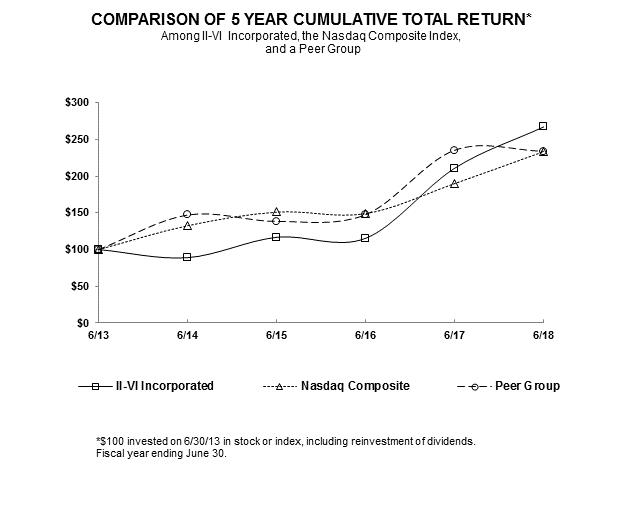
Item 6. SELECTED FINANCIAL DATA
| --- | --- |
Five-Year Financial Summary
The following selected financial data for the five fiscal years presented are derived from the Company’s audited Consolidated Financial Statements. The data should be read in conjunction with the Consolidated Financial Statements and the related notes thereto included elsewhere in this Annual Report on Form 10-K.
| Year Ended June 30, | 2018 | 2017 | 2016 | 2015 | 2014 | ||||||||||||||||||||
|---|---|---|---|---|---|---|---|---|---|---|---|---|---|---|---|---|---|---|---|---|---|---|---|---|---|
| ($000 except per share data) | |||||||||||||||||||||||||
| Statement of Earnings | |||||||||||||||||||||||||
| Net revenues from continuing operations | $ | 1,158,794 | $ | 972,046 | $ | 827,216 | $ | 741,961 | $ | 683,261 | |||||||||||||||
| Earnings from continuing operations | 88,002 | 95,274 | 65,486 | 65,975 | 38,316 | ||||||||||||||||||||
| Earnings from discontinued operation | - | - | - | - | 133 | ||||||||||||||||||||
| Net earnings | 88,002 | 95,274 | 65,486 | 65,975 | 38,449 | ||||||||||||||||||||
| Basic earnings per shares: | |||||||||||||||||||||||||
| Continuing operations | 1.41 | 1.52 | 1.07 | 1.08 | 0.62 | ||||||||||||||||||||
| Discontinued operation | - | - | - | - | - | ||||||||||||||||||||
| Consolidated | 1.41 | 1.52 | 1.07 | 1.08 | 0.62 | ||||||||||||||||||||
| Diluted earnings per shares: | |||||||||||||||||||||||||
| Continuing operations | 1.35 | 1.48 | 1.04 | 1.05 | 0.60 | ||||||||||||||||||||
| Discontinued operation | - | - | - | - | - | ||||||||||||||||||||
| Consolidated | 1.35 | 1.48 | 1.04 | 1.05 | 0.60 | ||||||||||||||||||||
| Diluted weighted average shares outstanding | 65,133 | 64,507 | 62,909 | 62,586 | 63,686 |
| June 30, | 2018 | 2017 | 2016 | 2015 | 2014 | ||||||||||||||||||||
|---|---|---|---|---|---|---|---|---|---|---|---|---|---|---|---|---|---|---|---|---|---|---|---|---|---|
| ($000) | |||||||||||||||||||||||||
| Balance Sheet | |||||||||||||||||||||||||
| Working capital | $ | 525,370 | $ | 517,344 | $ | 411,721 | $ | 373,812 | $ | 370,666 | |||||||||||||||
| Total assets | 1,761,661 | 1,477,297 | 1,211,981 | 1,057,273 | 1,070,753 | ||||||||||||||||||||
| Long-term debt | 419,013 | 322,022 | 215,307 | 155,066 | 220,787 | ||||||||||||||||||||
| Total debt | 439,013 | 342,022 | 235,307 | 175,066 | 240,787 | ||||||||||||||||||||
| Retained earnings | 836,064 | 748,062 | 652,788 | 587,302 | 521,327 | ||||||||||||||||||||
| Shareholders' equity | 1,024,311 | 900,563 | 782,338 | 729,081 | 675,043 |
Item 7. MANAGEMENT’S DISCUSSION AND ANALYSIS OF FINANCIAL CONDITION AND RESULTS OF OPERATIONS
| --- | --- |
Forward-Looking Statements
Certain statements contained in this Management’s Discussion and Analysis of Financial Condition and Results of Operations are forward-looking statements. Forward-looking statements are also identified by words such as “expects,” “anticipates,” “believes,” “intends,” “plans,” “projects” or similar expressions. Actual results could differ materially from those anticipated in these forward-looking statements for many reasons, including those potential risks set forth in Item 1A, of this Annual Report on Form 10-K, which are incorporated herein by reference.
Overview
II-VI Incorporated (“II-VI,” the “Company,” “we,” “us” or “our”), a worldwide leader in engineered materials and optoelectronic components, is a vertically integrated manufacturing company that develops innovative products for diversified applications in the industrial materials processing, optical communications, military, consumer electronics, semiconductor equipment, life science and automotive applications . The Company produces a wide variety of application-specific photonic and electronic materials and components, and deploys them in various forms, including integration with advanced software.
The Company generates revenues, earnings and cash flows from developing, manufacturing and marketing engineered materials and optoelectronic components and devices for precision use in industrial materials processing, optical communications, consumer electronics, semiconductor equipment, life sciences and automotive applications. We also generate revenue, earnings and cash flows from government funded research and development contracts relating to the development and manufacture of new technologies, materials and products.
Our customer base includes OEMs, laser end-users, system integrators of high-power lasers, manufacturers of equipment and devices for the industrial, optical communications, military, semiconductor, medical and life science markets, consumer, U.S. government prime contractors, various U.S. Government agencies and thermoelectric integrators.
As we grow, we are focused on scaling our Company and deriving the benefits of vertical integration as we strive to be a best in class competitor in all of our highly competitive markets. The Company may elect to change the way in which the Company operates or is organized in the future to enable the most efficient implementation of its strategy.
Critical Accounting Estimates
The preparation of financial statements and related disclosures in conformity with accounting principles generally accepted in the United States (“U.S. GAAP”) and the Company’s discussion and analysis of its financial condition and results of operations requires the Company’s management to make judgments, assumptions and estimates that affect the amounts reported in its Consolidated Financial Statements and accompanying notes. Note 1 of the Notes to our Consolidated Financial Statements contained in Item 8 of this Annual Report on Form 10-K describes the significant accounting policies and accounting methods used in the preparation of the Company’s Consolidated Financial Statements. Management bases its estimates on historical experience and on various other assumptions that it believes to be reasonable under the circumstances, the results of which form the basis for making judgments about the carrying values of assets and liabilities. Actual results may differ from these estimates.
Management believes the Company’s critical accounting estimates are those related to revenue recognition, inventory valuation, business combinations, impairment of goodwill and indefinite-lived intangible assets, accrual of income taxes and accounting for share-based compensation. Management believes these estimates to be critical because they are both important to the portrayal of the Company’s financial condition and results of operations, and they require management to make judgments and estimates about matters that are inherently uncertain.
Management has discussed the development and selection of these critical accounting estimates with the Audit Committee of the Board of Directors and the Audit Committee has reviewed the related disclosure. In addition, there are other items within our consolidated financial statements that require estimation, but are not deemed critical as described above. Changes in estimates used in these and other items could have a material impact on the consolidated financial statements.
Revenue Recognition
Revenues for product shipments are realizable when we have persuasive evidence of a sales arrangement, the product has been shipped or delivered, the sales price is fixed or determinable and collectability is reasonably assured. Title and risk of loss passes from the Company to its customer at the time of shipment in most cases, with the exception of certain customers for whom customer’s title does not pass and revenue is not recognized until the customer has received the product at its physical location.
The Company’s revenue recognition policy is consistently applied across the Company’s segments, product lines and geographical locations. Further, for the periods covered herein, we did not have post shipment obligations such as training or installation, customer acceptance provisions, credits and discounts, rebates and price protection or other similar privileges. Our distributors and agents are not granted price protection. Our distributors and agents, who generate less than 10% of consolidated revenue, have no additional product return rights beyond the right to return defective products covered by our warranty policy. We believe that our revenue recognition practices are consistent with Staff Accounting Bulletin 104 and that we have adequately considered the requirements of Accounting Standards Codification 605 Revenue Recognition. Revenues generated from transactions other than product shipments are contract-related and have historically accounted for approximately 1% of the Company’s consolidated revenues.
Inventory
The Company generally records an inventory adjustment as a charge against earnings for all products on hand for more than 12 to 24 months, depending on the products that have not been sold to customers or cannot be further manufactured for sale to alternative customers. An additional charge may be recorded for products on hand that are in excess of product sold to customers over the same periods noted above. If actual market conditions are less favorable than projected, additional inventory adjustments may be required. The Company’s inventory adjustments have historically been proven to be materially correct based upon actual write-offs incurred.
Business Acquisitions
The Company accounts for business acquisitions by establishing the acquisition-date fair value as the measurement for all assets acquired and liabilities assumed. Certain provisions of U.S. GAAP prescribe, among other things, the determination of acquisition-date fair value of consideration paid in a business combination (including contingent consideration) and the exclusion of transaction and acquisition-related restructuring costs from acquisition accounting.
Goodwill and Indefinite-Lived Intangibles
The Company tests goodwill and indefinite-lived intangible assets for impairment annually, and when events or changes in circumstances indicate that goodwill or indefinite-lived intangible assets might be impaired. Other intangible assets are amortized over their estimated useful lives. The determination of the estimated useful lives of other intangible assets and whether goodwill or indefinite-lived intangibles are impaired requires us to make judgments based on long-term projections of future performance. Estimates of fair value are based on our projection of revenues, operating costs and cash flows of each reporting unit, considering historical and anticipated results and general economic and market conditions and
Showing the first 8K of 63K characters. Open the full section
Item 7A. QUANTITATIVE AND QUALITATIVE DISCLOSURES ABOUT MARKET RISK
| --- | --- |
MARKET RISKS
The Company is exposed to market risks arising from adverse changes in foreign currency exchange rates and interest rates. In the normal course of business, the Company uses certain techniques and derivative financial instruments as part of its overall risk management strategy, primarily focused on its exposure to the Japanese Yen, Chinese Renminbi and the Euro. The Company also has transactions denominated in Euros, British Pounds Sterling, Chinese Renminbi and Swiss Francs. No significant changes have occurred in the techniques and instruments used other than those described below.
Foreign Exchange Risks
In the normal course of business, the Company enters into foreign currency forward exchange contracts with its financial institutions. The purpose of these contracts is to hedge ordinary business risks regarding foreign currencies on product sales and other transactions denominated in currencies other than the U.S. dollar. Foreign currency exchange contracts are used to limit transactional exposure to changes in currency rates.
Japanese Yen
The Company enters into foreign currency forward contracts that permit it to sell specified amounts of Japanese Yen expected to be received from its export sales for pre-established U.S. dollar amounts at specified dates. The forward contracts are denominated in the same foreign currencies in which export sales are denominated. These contracts provide the Company with an economic hedge in which settlement will occur in future periods, thereby limiting the Company’s exposure. These contracts had a total notional amount of $12.0 million and $12.7 million at June 30, 2018 and 2017, respectively.
A 10% change in the yen to U.S. dollar exchange rate would have changed revenues in the range from a decrease of approximately $8.1 million to an increase of approximately $9.9 million for the year ended June 30, 2018.
During June 2018, the Company entered into a $7.0 million month-to-month forward contract that matured on June 29, 2018, to limit exposure to the Yen. Upon expiration of this contract, the Company recorded a loss of $0.2 million in the Consolidated Statement of Earnings.
Chinese Renminbi
During June 2018, the Company entered into a $43.5 million month-to-month forward contract that matured on June 29, 2018, to limit exposure to the Chinese Renminbi. Upon expiration of this contract, the Company recorded a loss of $1.2 million in the Consolidated Statement of Earnings.
Euro
The Company has short-term intercompany notes that are denominated in U.S. dollars with certain European subsidiaries. A 10% change in the Euro to dollar exchange rate would have changed net earnings in the range from a decrease of $0.5 million to an increase of $0.6 million for the year ended June 30, 2018.
The Company monitors its positions and the credit ratings of the parties to these contracts. While the Company may be exposed to potential losses due to risk in the event of non-performance by the counterparties to these financial instruments, it does not currently anticipate such losses.
Assets and liabilities of foreign operations are translated into U.S. dollars using the period-end exchange rates, while income and expenses are translated using the average exchange rates for the reporting period. Translation adjustments are recorded as accumulated other comprehensive income within shareholders’ equity.
Interest Rate Risks
As of June 30, 2018, the Company’s total borrowings of $496.5 million consisted of $147.7 million variable rate debt borrowings from a line of credit of $80.0 million denominated in U.S. dollars, a term loan denominated in U.S. dollars of $65.0 million, a line of credit borrowing of $2.7 million denominated in Japanese yen. As such, the Company is exposed to changes in interest rates. A change in the interest rate of 100 basis points on these variable rate borrowings would have resulted in additional interest expense of $1.5 million for the fiscal year ended June 30, 2018.
Discount Rate Risks
As of June 30, 2018, a 10% change in the Company’s discount rate used to determine the pension benefit obligation of the Switzerland Defined Benefit Plan would have had an immaterial impact on the Consolidated Financial Statements.
Item 8. FINANCIAL STATEMENTS AND SUPPLEMENTARY DATA
| --- | --- |
MANAGEMENT’S REPORT ON INTERNAL CONTROL OVER FINANCIAL REPORTING
Management’s Responsibility for Preparation of the Financial Statements
Management is responsible for the preparation of the consolidated financial statements included in this Annual Report on Form 10-K. The consolidated financial statements were prepared in accordance with the accounting principles generally accepted in the United States of America and include amounts that are based on the best estimates and judgments of management. The other financial information contained in this Annual Report on Form 10-K is consistent with the consolidated financial statements.
Management’s Report on Internal Control Over Financial Reporting
Management is responsible for establishing and maintaining adequate internal control over financial reporting. The Company’s internal control system is designed to provide reasonable assurance concerning the reliability of the financial data used in the preparation of the Company’s consolidated financial statements, as well as reasonable assurance with respect to safeguarding the Company’s assets from unauthorized use or disposition.
All internal control systems, no matter how well designed, have inherent limitations. Therefore, even those systems determined to be effective can provide only reasonable assurance with respect to financial statement presentation and other results of such systems.
Management conducted an evaluation of the effectiveness of the Company’s internal control over financial reporting as of June 30, 2018. In making this evaluation, management used the criteria set forth by the Committee of Sponsoring Organizations of the Treadway Commission (COSO) in Internal Control – Integrated Framework (2013). Management’s evaluation included reviewing the documentation of its controls, evaluating the design effectiveness of controls and testing their operating effectiveness. Management excluded from the scope of its assessment of internal control over financial reporting the operations and related assets of Kaiam Laser Limited, Inc., which was acquired in August 2017. The recent acquisition excluded from management’s assessment of internal controls over financial reporting represented approximately $107.2 million and $98.1million of total assets and net assets, respectively, as of June 30, 2018 and approximately $3.4 million and $12.5 million of total revenues and net loss, respectively, for the fiscal year then ended. Based on the evaluation, management concluded that as of June 30, 2018, the Company’s internal controls over financial reporting were effective.
Ernst & Young LLP, an independent registered public accounting firm, has issued its report on the effectiveness of our internal control over financial reporting as of June 30, 2018. Its report is included herein.
Report of Independent Registered Public Accounting Firm
To the Board of Directors and Shareholders of II-VI Incorporated and Subsidiaries
Opinion on Internal Control over Financial Reporting
We have audited II-VI Incorporated and Subsidiaries’ internal control over financial reporting as of June 30, 2018, based on criteria established in Internal Control-Integrated Framework issued by the Committee of Sponsoring Organizations of the Treadway Commission (2013 framework) (the COSO criteria). In our opinion, II-VI Incorporated and Subsidiaries (the Company) maintained, in all material respects, effective internal control over financial reporting as of June 30, 2018, based on the COSO criteria.
As indicated in the accompanying Management’s Report on Internal Control Over Financial Reporting, management’s assessment of and conclusion on the effectiveness of internal control over financial reporting did not include the internal controls of Kaiam Laser Limited, Inc., which is included in the June 30, 2018 consolidated financial statements of the Company and constituted $107.2 million and $98.1 million of total and net assets, respectively, as of June 30, 2018 and $3.4 million and $12.5 million of revenues and net loss, respectively, for the fiscal year then ended. Our audit of internal control over financial reporting of the Company also did not include an evaluation of the internal control over financial reporting of Kaiam Laser Limited, Inc.
We also have audited, in accordance with the standards of the Public Company Accounting Oversight Board (United States) (PCAOB), the consolidated balance sheets of the Company as of June 30, 2018 and 2017, the related consolidated statements of earnings, comprehensive income, shareholders’ equity and cash flows for each of the three years in the period ended June 30, 2018, and the related notes and the financial statement schedule listed in the Index at Item 15(a)(2) and our report dated August 28, 2018 expressed an unqualified opinion thereon.
Basis for Opinion
The Company’s management is responsible for maintaining effective internal control over financial reporting and for its assessment of the effectiveness of internal control over financial reporting included in the accompanying Management’s Report on Internal Control Over Financial Reporting. Our responsibility is to express an opinion on the Company’s internal control over financial reporting based on our audit. We are a public accounting firm registered with the PCAOB and are required to be independent with respect to the Company in accordance with the U.S. federal securities laws and the applicable rules and regulations of the Securities and Exchange Commission and the PCAOB.
We conducted our audit in accordance with the standards of the PCAOB. Those standards require that we plan and perform the audit to obtain reasonable assurance about whether effective internal control over financial reporting was maintained in all material respects.
Our audit included obtaining an understanding of internal control over financial reporting, assessing the risk that a material weakness exists, testing and evaluating the design and operating effectiveness of internal control based on the assessed risk, and performing such other procedures as we considered necessary in the circumstances. We believe that our audit provides a reasonable basis for our opinion.
Definition and Limitations of Internal Control Over Financial Reporting
A company’s internal control over financial reporting is a process designed to provide reasonable assurance regarding the reliability of financial reporting and the preparation of financial statements for external purposes in accordance with generally accepted accounting principles. A company’s internal control over financial reporting includes those policies and procedures that (1) pertain to the maintenance of records that, in reasonable detail, accurately and fairly reflect the transactions and dispositions of the assets of the company; (2) provide reasonable assurance that transactions are recorded as necessary to permit preparation of financial statements in accordance with generally accepted accounting principles, and that receipts and expenditures of the company are being made only in accordance with authorizations of management and directors of the company; and (3) provide reasonable assurance regarding prevention or timely detection of unauthorized acquisition, use, or disposition of the company’s assets that could have a material effect on the financial statements.
Because of its inherent limitations, internal control over financial reporting may not prevent or detect misstatements. Also, projections of any evaluation of effectiveness to future periods are subject to the risk that controls may become inadequate because of changes in conditions, or that the degree of compliance with the policies or procedures may deteriorate.
/s/ Ernst & Young LLP
Pittsburgh, Pennsylvania
August 28, 2018
Report of Independent Registered Public Accounting Firm
To the Board of Directors and Shareholders of II-VI Incorporated and Subsidiaries
Opinion on th
Showing the first 8K of 156K characters. Open the full section
Item 9. CHANGES IN AND DISAGREEMENTS WITH ACCOUNTANTS ON ACCOUNTING AND FINANCIAL DISCLOSURE
| --- | --- |
None.
Item 9A. CONTROLS AND PROCEDURES
| --- | --- |
Evaluation of Disclosure Controls and Procedures
The Company’s management evaluated, with the participation of the Company’s Chief Executive Officer, and the Company’s Chief Financial Officer and Treasurer, the effectiveness of the Company’s disclosure controls and procedures (as defined in Rules 13a-15(e) and 15d-15(e) of the Securities Exchange Act of 1934, as amended (the “Exchange Act”)) as of the end of the period covered by this Annual Report on Form 10-K. The Company’s disclosure controls were designed to provide reasonable assurance that information required to be disclosed in reports that we file or submit under the Exchange Act is recorded, processed, summarized and reported within the time periods specified in the rules and forms of the SEC. It should be noted that the design of any system of controls is based in part upon certain assumptions about the likelihood of future events, and there can be no assurance that any design will succeed in achieving its stated goals under all potential future conditions, regardless of how remote. However, the controls have been designed to provide reasonable assurance of achieving the controls’ stated goals. Based on that evaluation, the Chief Executive Officer and Chief Financial Officer concluded that, as of June 30, 2018, the Company’s disclosure controls and procedures are effective.
Management’s Report on Internal Control Over Financial Reporting
Refer to Management’s Report on Internal Control Over Financial Reporting included in Item 8.
Report of the Registered Public Accounting Firm
The report of Ernst & Young LLP, an independent registered public accounting firm, with respect to our internal control over financial reporting is included in Item 8 of this Annual Report on Form 10-K.
Changes in Internal Control over Financial Reporting
There have been no changes in the Company’s internal controls over financial reporting that occurred during our most recent quarter that have materially affected, or are reasonably likely to materially affect, our internal control over financial reporting.
Item 9B. OTHER INFORMATION
| --- | --- |
None.
PART III
Item 10. DIRECTORS AND EXECUTIVE OFFICERS OF THE REGISTRANT
| --- | --- |
The information set forth above in Part I of this Annual Report on Form 10-K under the caption “Executive Officers of the Registrant” is incorporated herein by reference. The other information required by this item is incorporated herein by reference to the information set forth under the captions “Election of Directors Section 16(a) Beneficial Ownership Reporting Compliance” in the Company’s definitive proxy statement for the 2018 Annual Meeting of Shareholders to be filed pursuant to Regulation 14A of the Exchange Act (the “Proxy Statement”).
Audit Committee Financial Expert
The information as to the Audit Committee and the Audit Committee Financial Expert is incorporated herein by reference to the information set forth in the Company’s Proxy Statement.
Code of Ethics
The Company has adopted its Code of Business Conduct and Ethics for all of its employees and its Code of Ethics for Senior Financial Officers including the principal executive officer and principal financial officer. The Code of Business Conduct and Ethics and Code of Ethics for Senior Financial Officers can be found on the Company’s Internet web site at www.ii-vi.com under “Investors Information – Corporate Governance Documents.” The Company will promptly disclose on its web site (i) any amendments or waivers with respect to a director’s or executive officer’s compliance with the Code of Business Conducts and Ethics and (ii) any amendments or waivers with respect to any provision of the Code of Ethics for Senior Financial Officers. Any person may also obtain a copy of the Code of Business Conduct and Ethics and/or the Code of Ethics for Senior Financial Officer without charge by submitting their request to the Chief Financial Officer and Treasurer of II-VI Incorporated, 375 Saxonburg Boulevard, Saxonburg, Pennsylvania 16056, or by calling (724) 352-4455.
The web site and information contained on it or incorporated in it are not intended to be incorporated in this Annual Report on Form 10-K or other filings with the SEC.
Item 11. EXECUTIVE COMPENSATION
| --- | --- |
The information required by this item is incorporated herein by reference to the information set forth under the caption “Director Compensation in Fiscal Year 2018,” “Executive Compensation,” “Compensation Committee Report” and “Compensation and Risk” in the Company’s Proxy Statement.
Item 12. SECURITY OWNERSHIP OF CERTAIN BENEFICIAL OWNERS AND MANAGEMENT AND RELATED STOCKHOLDER MATTERS
| --- | --- |
The information required by this item is incorporated herein by reference to the information set forth under the captions “Equity Compensation Plan Information” and “Security Owners of Certain Beneficial Owners and Management” in the Company’s Proxy Statement.
Item 13. CERTAIN RELATIONSHIPS AND RELATED TRANSACTIONS AND DIRECTOR INDEPENDENCE
| --- | --- |
The information required by this item is incorporated herein by reference to the information set forth under the caption “Director Independence and Corporate Governance Policies” in the Company’s Proxy Statement.
Item 14. PRINCIPAL ACCOUNTANT FEES AND SERVICES
| --- | --- |
The information required by this item is incorporated herein by reference to the information set forth under the caption “Ratification of Selection of Independent Registered Public Accounting Firm” in the Company’s Proxy Statement.
PART IV
Item 15. EXHIBITS AND FINANCIAL STATEMENT SCHEDULES
| --- | --- |
| (a) | (1) Financial Statements |
|---|
The financial statements are set forth under Item 8 of this Annual Report on Form 10-K.
(2) Schedules
Schedule II – Valuation and Qualifying Accounts for each of the three fiscal years in the period ended June 30, 2018 is set forth under Item 8 of this Annual Report on Form 10-K.
Financial statements, financial statement schedules and exhibits not listed have been omitted where the required information is included in the Consolidated Financial Statements or notes thereto, or is not applicable or required.
| 10.10 | Employment Agreement, dated March 6, 2017, by and between II-VI Incorporated and Jo Anne Schwendinger * | Filed herewith. | ||
|---|---|---|---|---|
| 10.11 | Consulting Agreement, dated June 30, 2016, between II-VI Incorporated and Carl J. Johnson* | Incorporated herein by reference to Exhibit 10.01 to II-VI’s Current Report on Form 10-Q (File No. 000-16195) for the quarter ended March 31, 2017. | ||
| 10.12 | Form of Employment Agreement* (P) | Incorporated herein by reference to Exhibit 10.16 to II-VI’s Registration Statement on Form S-1 (File No. 33-16389). | ||
| 10.13 | Form of Executive Employment Agreement | Filed herewith | ||
| 10.14 | Form of Exhibit 1 to Employment Agreement | Filed herewith | ||
| 10.15 | Form of Indemnification Agreement | Filed herewith | ||
| 10.16 | Form of Representative Agreement between II-VI and its foreign representatives (P) | Incorporated herein by reference to Exhibit 10.15 to II-VI’s Registration Statement on Form S-1 (File No. 33-16389). | ||
| 10.17 | II-VI Incorporated Amended and Restated Employees’ Stock Purchase Plan (P) | Incorporated herein by reference to Exhibit 10.04 to II-VI’s Registration Statement on Form S-1 (File No. 33-16389). | ||
| 10.18 | First Amendment to the II-VI Incorporated Amended and Restated Employees’ Stock Purchase Plan | Incorporated herein by reference to Exhibit 10.01 to II-VI’s Quarterly Report on Form 10-Q (File No. 000-16195) for the quarter ended March 31, 1996. | ||
| 10.19 | II-VI Incorporated Amended and Restated Employees’ Profit-Sharing Plan and Trust Agreement, as amended (P) | Incorporated herein by reference to Exhibit 10.05 to II-VI’s Registration Statement on Form S-1 (File No. 33-16389). | ||
| 10.20 | Description of Bonus Incentive Plan* | Incorporated herein by reference to Exhibit 10.14 to II-VI’s Annual Report on Form 10-K (File No. 000-16195) for the fiscal year ended June 30, 1996. | ||
| 10.21 | Description of Discretionary Incentive Plan (now known as the Goal/ Results Incentive Program)* | Incorporated herein by reference to Exhibit 10.27 to II-VI’s Annual Report on Form 10-K (File No. 000-16195) for the fiscal year ended June 30, 2009. | ||
| 10.22 | Description of Management-By-Objective Plan*(P) | Incorporated herein by reference to Exhibit 10.09 to II-VI’s Annual Report on Form 10-K (File No. 000-16195) for the fiscal year ended June 30, 1993. | ||
| 10.23 | Amended and Restated II-VI Incorporated Deferred Compensation Plan (applicable to periods prior to January 1, 2015)* | Incorporated herein by reference to Exhibit 10.17 to II-VI’s Annual Report on Form 10-K (File No. 000-16195) for the fiscal year ended June 30, 2015. | ||
| 10.24 | Amended and Restated II-VI Incorporated Deferred Compensation Plan (applicable to periods after January 1, 2015)* | Incorporated herein by reference to Exhibit 10.18 to II-VI’s Annual Report on Form 10-K (File No. 000-16195) for the fiscal year ended June 30, 2015. | ||
| 10.25 | Trust Under the II-VI Incorporated Deferred Compensation Plan* | Incorporated herein by reference is Exhibit 10.13 to II-VI’s Annual Report on Form 10-K (File No. 000-16195) for the fiscal year ended June 30, 1996. |
| 10.26 | II-VI Incorporated 2009 Omnibus Incentive Plan* | Incorporated herein by reference to Exhibit A to II-VI’s Definitive Proxy Statement on Schedule 14A (File No. 000-16195) filed on September 25, 2009. | ||
|---|---|---|---|---|
| 10.27 | Form of Nonqualified Stock Option Agreement under the II-VI Incorporated 2009 Omnibus Incentive Plan* | Incorporated herein by reference to Exhibit 10.27 to II-VI’s Current Report on Form 10-Q (File No. 000-16195) for the quarter ended December 31, 2011. | ||
| 10.28 | Form of Restricted Share Award Agreement under the II-VI Incorporated 2009 Omnibus Incentive Plan* | Incorporated herein by reference to Exhibit 10.28 to II-VI’s Current Report on Form 10-Q (File No. 000-16195) for the quarter ended December 31, 2011. | ||
| 10.29 | Form of Performance Share Award Agreement under the II-VI Incorporated 2009 Omnibus Incentive Plan* | Incorporated herein by reference to Exhibit 10.29 to II-VI’s Current Report on Form 10-Q (File No. 000-16195) for the quarter ended December 31, 2011. | ||
| 10.30 | Form of Stock Appreciation Rights Agreement under the II-VI Incorporated 2009 Omnibus Incentive Plan* | Incorporated herein by reference to Exhibit 10.30 to II-VI’s Current Report on Form 10-Q (File No. 000-16195) for the quarter ended December 31, 2011. | ||
| 10.31 | Form of Performance Unit Award Agreement under the II-VI Incorporated 2009 Omnibus Incentive Plan* | Incorporated herein by reference to Exhibit 10.31 to II-VI’s Current Report on Form 10-Q (File No. 000-16195) for the quarter ended March 31, 2012. | ||
| 10.32 | Form of Restricted Share Unit Award Agreement under the II-VI Incorporated 2009 Omnibus Incentive Plan* | Incorporated herein by reference to Exhibit 10.32 to II-VI’s Current Report on Form 10-Q (File No. 000-16195) for the quarter ended March 31, 2012. | ||
| 10.33 | II-VI Incorporated Amended and Restated 2012 Omnibus Incentive Plan* | Incorporated herein by reference to Exhibit 10.01 to II-VI’s Registration Statement on Form S-8 (File No. 333-199855) filed on November 4, 2014. | ||
| 10.34 | Form of Nonqualified Stock Option Agreement under the II-VI Incorporated Amended and Restated 2012 Omnibus Incentive Plan* | Incorporated herein by reference to Exhibit 10.30 to II-VI’s Annual Report on Form 10-K (File No. 000-16195) for the fiscal year ended June 30, 2013. | ||
| 10.35 | Form of Restricted Share Award Agreement under the II-VI Incorporated Amended and Restated 2012 Omnibus Incentive Plan* | Incorporated herein by reference to Exhibit 10.31 to II-VI’s Annual Report on Form 10-K (File No. 000-16195) for the fiscal year ended June 30, 2013. | ||
| 10.36 | Form of Performance Share Award Agreement (Consolidated Revenue) under the II-VI Incorporated Amended and Restated 2012 Omnibus Incentive Plan* | Incorporated herein by reference to Exhibit 10.32 to II-VI’s Annual Report on Form 10-K (File No. 000-16195) for the fiscal year ended June 30, 2013. | ||
| 10.37 | Form of Stock Appreciation Rights Agreement under the II-VI Incorporated Amended and Restated 2012 Omnibus Incentive Plan* | Incorporated herein by reference to Exhibit 10.33 to II-VI’s Annual Report on Form 10-K (File No. 000-16195) for the fiscal year ended June 30, 2013. | ||
| 10.38 | Form of Performance Unit Award Agreement under the II-VI Incorporated Amended and Restated 2012 Omnibus Incentive Plan* | Incorporated herein by reference to Exhibit 10.34 to II-VI’s Annual Report on Form 10-K (File No. 000-16195) for the fiscal year ended June 30, 2013. |
| 10.39 | Form of Restricted Share Unit Award Agreement under the II-VI Incorporated Amended and Restated 2012 Omnibus Incentive Plan* | Incorporated herein by reference to Exhibit 10.35 to II-VI’s Annual Report on Form 10-K (File No. 000-16195) for the fiscal year ended June 30, 2013. | ||
|---|---|---|---|---|
| 10.40 | Form of Performance Share Award Agreement (Total Shareholder Return) under the II-VI Incorporated Amended and Restated 2012 Omnibus Incentive Plan* | Incorporated herein by reference to Exhibit 10.38 to II-VI’s Annual Report on Form 10-K (File No. 000-16195) for the fiscal year ended June 30, 2014. | ||
| 10.41 | Form of Performance Unit Award Agreement (Total Shareholder Return) under the II-VI Incorporated Amended and Restated 2012 Omnibus Incentive Plan* | Incorporated herein by reference to Exhibit 10.39 to II-VI’s Annual Report on Form 10-K (File No. 000-16195) for the fiscal year ended June 30, 2014. | ||
| 10.42 | Form of Performance Share Award Agreement (Cash Flow From Operations) under the II-VI Incorporated Amended and Restated 2012 Omnibus Incentive Plan* | Incorporated herein by reference to Exhibit 10.36 to II-VI’s Annual Report on Form 10-K (File No. 000-16195) for the fiscal year ended June 30, 2015. | ||
| 10.43 | Form of Performance Unit Award Agreement (Cash Flow From Operations) under the II-VI Incorporated Amended and Restated 2012 Omnibus Incentive Plan* | Incorporated herein by reference to Exhibit 10.37 to II-VI’s Annual Report on Form 10-K (File No. 000-16195) for the fiscal year ended June 30, 2015. | ||
| 10.44 | II-VI Incorporated Second Amended and Restated Omnibus Incentive Plan* | Incorporated herein by reference to Exhibit 10.1to II-VI’s Current Report on Form 10-Q (File No. 000-16195) for the quarter ended December 31, 2015. | ||
| 10.45 | Form of Nonqualified Stock Option Agreement under the II-VI Incorporated Second Amended and Restated Omnibus Incentive Plan* | Incorporated herein by reference to Exhibit 10.03 to II-VI’s Quarterly Report on Form 10-Q (File No. 000-16195) for the quarter ended September 30, 2016. | ||
| 10.46 | Form of Stock Appreciation Rights Agreement under the II-VI Incorporated Second Amended and Restated Omnibus Incentive Plan* | Incorporated herein by reference to Exhibit 10.04 to II-VI’s Quarterly Report on Form 10-Q (File No. 000-16195) for the quarter ended September 30, 2016. | ||
| 10.47 | Form of Restricted Share Award Agreement (3 year) under the II-VI Incorporated Second Amended and Restated Omnibus Incentive Plan* | Incorporated herein by reference to Exhibit 10.05 to II-VI’s Quarterly Report on Form 10-Q (File No. 000-16195) for the quarter ended September 30, 2016. | ||
| 10.48 | Form of Restricted Share Award Agreement (1 year) under the II-VI Incorporated Second Amended and Restated Omnibus Incentive Plan* | Incorporated herein by reference to Exhibit 10.06 to II-VI’s Quarterly Report on Form 10-Q (File No. 000-16195) for the quarter ended September 30, 2016. | ||
| 10.49 | Form of Restricted Share Unit Award Agreement under the II-VI Incorporated Second Amended and Restated Omnibus Incentive Plan* | Incorporated herein by reference to Exhibit 10.07 to II-VI’s Quarterly Report on Form 10-Q (File No. 000-16195) for the quarter ended September 30, 2016. | ||
| 10.50 | Form of Performance Share Award Agreement under the II-VI Incorporated Second Amended and Restated Omnibus Incentive Plan* | Incorporated herein by reference to Exhibit 10.08 to II-VI’s Quarterly Report on Form 10-Q (File No. 000-16195) for the quarter ended September 30, 2016. | ||
| 10.51 | Form of Performance Unit Award Agreement under the II-VI Incorporated Second Amended and Restated Omnibus Incentive Plan* | Incorporated herein by reference to Exhibit 10.09 to II-VI’s Quarterly Report on Form 10-Q (File No. 000-16195) for the quarter ended September 30, 2016. |
| * | Denotes management contract or compensatory plan, contract or arrangement. |
|---|
| (P) | Denotes filed via paper copy. |
|---|
The Registrant will furnish to the Commission upon request copies of any instruments not filed herewith which authorize the issuance of long-term obligations of the Registrant not in excess of 10% of the Registrant’s total assets on a consolidated basis.
Item 16. FORM 10-K SUMMARY
| --- | --- |
None.
SIGNATURES
Pursuant to the requirements of Section 13 or 15(d) of the Securities Exchange Act of 1934, the registrant has duly caused this report to be signed on its behalf by the undersigned, thereunto duly authorized.
| II-VI INCORPORATED | ||||
|---|---|---|---|---|
| Date: August 28, 2018 | By: | /s/ Vincent D. Mattera Jr. | ||
| Vincent D. Mattera Jr. | ||||
| President and Chief Executive Officer |
Pursuant to the requirements of the Securities Exchange Act of 1934, this report has been signed below by the following persons on behalf of the registrant and in the capacities and on the dates indicated.
| Principal Executive Officer: | ||||
|---|---|---|---|---|
| Date: August 28, 2018 | By: | /s/ Vincent D. Mattera Jr. | ||
| Vincent D. Mattera Jr. | ||||
| President and Chief Executive Officer | ||||
| Principal Financial and Accounting Officer: | ||||
| Date: August 28, 2018 | By: | /s/ Mary Jane Raymond | ||
| Mary Jane Raymond | ||||
| Chief Financial Officer and Treasurer | ||||
| Date: August 28, 2018 | By: | /s/ Francis J. Kramer | ||
| Francis J. Kramer | ||||
| Chairman of the Board and Director | ||||
| Date: August 28, 2018 | By: | /s/ Joseph J. Corasanti | ||
| Joseph J. Corasanti | ||||
| Director | ||||
| Date: August 28, 2018 | By: | /s/ RADM Marc Y. E. Pelaez (retired) | ||
| RADM Marc Y. E. Pelaez (retired) | ||||
| Director | ||||
| Date: August 28, 2018 | By: | /s/ Howard H. Xia | ||
| Howard H. Xia | ||||
| Director | ||||
| Date: August 28, 2018 | By: | /s/ William Schromm | ||
| William Schromm | ||||
| Director | ||||
| Date: August 28, 2018 | By: | /s/ Shaker Sadasivam | ||
| Shaker Sadasivam | ||||
| Director | ||||
| Date: August 28, 2018 | By: | /s/ Enrico Digirolamo | ||
| Enrico Digirolamo | ||||
| Director |