 filings.tools
Item 1. BUSINESS
66K characters. Original on sec.gov · Markdown
Item 1. BUSINESS
Definitions
II-VI Incorporated (“II-VI,” the “Company,” “we,” “us,” or “our”) was incorporated in Pennsylvania in 1971. Our headquarters are located at 375 Saxonburg Boulevard, Saxonburg, Pennsylvania 16056. Our telephone number is 724-352-4455. Reference to “II-VI,” the “Company,” “we,” “us,” or “our” in this Annual Report on Form 10-K, unless the context requires otherwise, refers to II-VI Incorporated and its wholly owned subsidiaries. The Company’s name is pronounced “Two Six Incorporated.” The name II-VI refers to Groups II and VI of the periodic table of elements from which II-VI originally designed and produced infrared optics for high-power CO2 lasers used in materials processing. The majority of our revenues are attributable to the sale of engineered materials and optoelectronic components, devices, and subsystems for the optical communications, industrial materials processing, aerospace and defense, and consumer electronics markets. Reference to “fiscal” or “fiscal year” means our fiscal year ended June 30 for the year referenced.
The following terms are defined for reference: bismuth telluride (“Bi2Te3”); cadmium telluride (“CdTe”); carbon dioxide (“CO2”); carbon monoxide (“CO”); chemical vapor deposition (“CVD”) of materials including diamond; deep ultraviolet (“DUV”) lithography; dense wavelength division multiplexing (“DWDM”); extreme-ultraviolet (“EUV”) lithography; 5th-generation (“5G”) wireless; 4th-generation (“4G”) wireless; gallium arsenide (“GaAs”); gallium nitride (“GaN”); gigabit Ethernet (“GbE”); gigabit per second (“Gbps”); high-definition multimedia interface (“HDMI”); high-electron-mobility transistor (“HEMT”); indium phosphide (“InP”); infrared (“IR”); intellectual property (“IP”); light detection and ranging (“LiDAR”); liquid crystal (“LC”); liquid crystal on silicon (“LCOS”); nanometers (“nm”); near-infrared (“NIR”); optical channel monitor (“OCM”); organic light-emitting diode (“OLED”); original equipment manufacturer (“OEM”); optical time-domain reflectometer (“OTDR”); polymerase chain reaction (“PCR”); radio frequency (“RF”); reconfigurable optical add/drop multiplexer (“ROADM”); research and development (“R&D”); research, development, and engineering (“RD&E”); silicon carbide (“SiC”); terabit per second (“Tbps”); three-dimensional (“3D”); ultraviolet (“UV”); vertical cavity surface-emitting laser (“VCSEL”); wavelength division multiplexing (“WDM”); wavelength selective switching (“WSS”); zinc selenide (“ZnSe”); and zinc sulfide (“ZnS”).
Acquisition of Finisar Corporation
On September 24, 2019 (the “Closing Date”), the Company completed its acquisition of Finisar Corporation ("Finisar"), a global technology leader for subsystems and components for fiber-optic communications. Additional information regarding the Company’s acquisition of Finisar is set forth below and in Note 3. Acquisitions to our Consolidated Financial Statements in Item 8 of this Annual Report on Form 10-K. Due to timing of the acquisition, the results of Finisar for the three months ended September 30, 2019, have not been allocated to an Operating Segment, and are presented in Unallocated and Other within Note 14. Segment and Geographic Reporting to our Consolidated Financial Statements in Item 8 of this Annual Report on Form 10-K. Beginning on October 1, 2019, the results of Finisar have been allocated to the Photonic Solutions and Compound Semiconductors Segments.
General Description of Business
We develop, manufacture, and market engineered materials, optoelectronic components, and devices for use in optical communications, industrial materials processing, aerospace and defense, consumer electronics, semiconductor capital equipment, life sciences, and automotive applications and markets. We use advanced engineered materials growth technologies and proprietary high-precision fabrication, microassembly, optical thin-film coating, and electronic integration to manufacture complex optoelectronic devices and modules. Our products are deployed in a variety of applications, including (i) optical, data, and wireless communications products; (ii) laser cutting, welding, and marking operations; (iii) 3D sensing consumer applications; (iv) aerospace and defense applications including intelligence, surveillance, and reconnaissance; (v) semiconductor processing tools; and (vi) thermoelectric cooling and power-generation solutions.
Through RD&E investments and its strategic acquisitions, II-VI has expanded its portfolio of materials and product platforms. We believe that the materials we grow and fabricate are differentiated by one or a combination of unique optical, electrical, thermal, and mechanical properties. II-VI’s optics are shaped by precision surfacing techniques to meet the most stringent requirements for flat or curved geometries, functionalized with smooth or structured surfaces, or with patterned metallization. Proprietary processes developed at our global optical coating centers differentiate our products’ durability against high-energy lasers and extreme operating environments. Optical coatings also provide the desired spectral characteristics, ranging from the ultraviolet to the far-infrared. II-VI leverages these capabilities to deliver miniature- to large-scale precision optical assemblies, including those in combination with thermal management components, integrated electronics, and/or software.
II-VI also offers a broad portfolio of compound semiconductor lasers that are used in a variety of applications in our end markets. These compound semiconductor lasers enable optical signal transmission, reception, and amplification in terrestrial and submarine communications networks; high-bit-rate server connectivity between and within datacenters; optical communications network monitoring; materials processing; and fast and accurate measurements in biomedical instruments and consumer electronics.
II-VI continues to improve its operational capabilities, develop next-generation products, and invest in new technology platforms to drive our growth in the short term while keeping the long term in mind. With a strategic focus on fast-growing and sustainable markets, II-VI pursues its mission of enabling the world to be safer, healthier, closer, and more efficient, and strives to attain its vision of a world transformed through innovative materials vital to a better life today and the sustainability of future generations.
Information Regarding Market Segments and Foreign Operations
Financial data regarding our revenues, results of operations, industry segments, and international sales for the three years ended June 30, 2020, are set forth in the Consolidated Statements of Earnings (Loss) and in Note 14. Segment and Geographic Reporting to our Consolidated Financial Statements included in Item 8 of this Annual Report on Form 10-K and are incorporated herein by reference. We also discuss certain Risk Factors set forth in Item 1A – Risk Factors of this Annual Report on Form 10-K related to our foreign operations, which are incorporated herein by reference.
Effective July 1, 2019, the Company realigned its organizational structure into two reporting segments for the purpose of making operational decisions and assessing financial performance: (i) Photonic Solutions and (ii) Compound Semiconductors. Refer to Note 14. Segment and Geographic Reporting for further information on reporting segments.
Bookings and Backlog
We define our bookings as customer orders received that are expected to be converted to revenues over the next 12 months. The Company reports as bookings only those orders that are expected to be converted into revenues within 12 months from the end of the reporting period. Bookings are adjusted if changes in customer demands or production schedules cause the expected time of a delivery to extend beyond 12 months. For the fiscal year ended June 30, 2020, our bookings were approximately $2.7 billion, compared with bookings of approximately $1.4 billion for the fiscal year ended June 30, 2019.
We define our backlog as bookings that have not been converted to revenues by the end of the reporting period. As of June 30, 2020, our backlog was approximately $957 million, compared with approximately $500 million as of June 30, 2019.
Global Operations
II-VI is headquartered in Saxonburg, Pennsylvania, with RD&E, manufacturing, and sales facilities worldwide. Our U.S. production and RD&E operations are located in Arizona, California, Colorado, Connecticut, Delaware, Florida, Illinois, Massachusetts, Michigan, Mississippi, New Jersey, New York, Ohio, Oregon, Pennsylvania, and Texas, and our non-U.S. production and RD&E operations are based in Australia, China, Germany, Malaysia, the Philippines, Singapore, Sweden, Switzerland, the United Kingdom, and Vietnam. We also utilize contract manufacturers and strategic suppliers. In addition to sales offices co-located at most of our manufacturing sites, we have sales and marketing subsidiaries in Belgium, Canada, China, Germany, Hong Kong, Italy, Japan, South Korea, Switzerland, Taiwan, and the United Kingdom.
Employees
The table below summarizes the number of our employees as of June 30, 2020, in the main functions. We have a long-standing practice of encouraging active employee participation in areas of operations and quality management. We believe our relations with our employees are good. We reward substantially all of our employees with some form of variable compensation based on achievement of performance goals. There are approximately 161 employees located in the United States and the Philippines who are covered under collective bargaining agreements. The Company’s five-year collective bargaining agreement in the United States is up for renewal in January 2021, and the Company's two-year collective bargaining agreement in the Philippines is up for renewal in June 2021. There are 450 employees of II-VI in China who work under contract manufacturing arrangements for a customer of the Company, Corning Incorporated.
| Number of employees | Percent of total | |||||||||||||
| Direct production | 15,101 | 66% | ||||||||||||
| Research, development, engineering, sales and marketing | 4,058 | 16% | ||||||||||||
| General administration | 3,810 | 18% | ||||||||||||
| Total: | 22,969 | 100% |
Manufacturing Processes
Our success in developing and manufacturing many of our products depends on our ability to manufacture and to tailor the optical and physical properties of technically challenging materials and components. The ability to produce, process, and refine these complex materials and to control their quality and in-process yields is an expertise of the Company that is critical to the performance of our customers’ subsystems and systems. In the markets we serve, there is a limited number of high-quality suppliers of many of the components we manufacture, and there are very few industry-standard products.
Our network of worldwide manufacturing sites allows us to manufacture our products in regions that provide cost-effective and risk management advantages. We employ numerous advanced manufacturing technologies and systems at our manufacturing facilities. These include metal-organic chemical vapor deposition and molecular beam epitaxy reactors, automated computer numeric control optical fabrication, high-throughput thin-film coaters, nanoprecision metrology, and custom-engineered automated furnace controls for crystal growth processes. Manufacturing products for use across the electromagnetic spectrum requires the capability to repeatedly manufacture products with high yields to atomic tolerances. II-VI continuously updates its comprehensive quality management systems that feature manufacturing quality best practices. II-VI is committed to delivering products within specification, on time, and with high quality, with a goal of fully satisfying customers and continually improving.
Sources of Supply
Among the raw materials we use are zinc, selenium, zinc selenide, zinc sulfide, hydrogen selenide, hydrogen sulfide, arsine, phosphine, hydrogen, silane, tellurium, yttrium oxide, aluminum oxide, iridium, platinum, bismuth, silicon, thorium fluoride, antimony, graphite, gallium arsenide, gallium nitride, indium phosphide, copper, gold, nickel, germanium, molybdenum, quartz, optical glass, silicon carbide, and carbon in its diamond form.
We utilize numerous optical, electrical, and mechanical parts in our processes that we often also commonly refer to as raw materials, including integrated circuits, mechanical housings, and optical components from third-party suppliers.
The continued high quality of and access to these raw materials are critical to the stability and predictability of our manufacturing yields. We specify and test these raw materials at the onset of and throughout the production process. Additional research and capital investment may be needed to better define future raw materials specifications. As a result of COVID-19, we have experienced some production delays due to shortages of raw materials, and we are driving the development of strategic second sources as part of our overall business continuity Planning. We do occasionally experience problems associated with vendor-supplied raw materials not meeting contract specifications for quality or purity. As discussed in greater detail in Item 1A – Risk Factors of this Annual Report on Form 10-K, significant failure of our suppliers to deliver sufficient quantities of necessary high-quality raw materials to our specifications on a timely basis could have a materially adverse effect on our results of operations.
Business Units
The Company’s organizational structure is divided into two reporting segments for the purpose of making operational decisions and assessing financial performance: (i) Photonic Solutions and (ii) Compound Semiconductors. These segments, and the business units within the segments, are reflected in the Company's current organizational chart below:
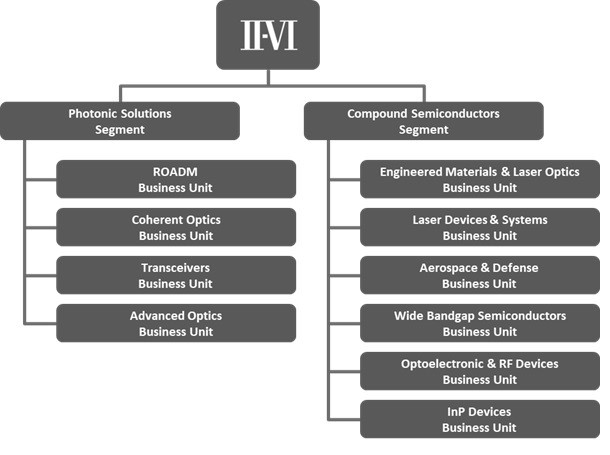
The Photonic Solutions Segment leverages II-VI’s compound semiconductor technology platforms to deliver components and subsystems that are differentiated based on deep knowledge of end-user applications for our key end markets.
The Compound Semiconductors Segment is a market leader in differentiated materials and devices such as those based on GaAs, InP, GaN, and SiC by independently driving investments that advance its technology roadmaps. We may from time to time reorganize parts of a given segment or corporate center to drive the focus of certain priorities as identified by the CEO.
II-VI’s segments are organized by business unit at the group or division level. Each of these business units develops and markets products as described below.
| Segment | Business Unit | Our Products | ||||||
| Photonic Solutions | ROADM | •Products and solutions that enable high-bit-rate interconnects for datacenters and communications service providers, datacenter interconnects, ROADM systems, and undersea fiber-optic transmission | ||||||
| Coherent Optics | •High-speed optoelectronics and modules for optical communications in telecom networks, including for datacenter interconnects and for metro, regional, long-haul, and ultralong-haul networks | |||||||
| Transceivers | •Pluggable transceivers for Ethernet and fiber channel applications in cloud and enterprise datacenter applications | |||||||
| Advanced Optics | •Fiber optics and precision optics used in projection displays; crystal materials and components for optical communications; high-power UV, visible, and NIR optics for industrial lasers; filters and assemblies for life sciences as well as for sensors, instrumentation, and semiconductor equipment |
| Segment | Business Unit | Our Products | ||||||
| Compound Semiconductors | Engineered Materials & Laser Optics | •Laser optics and accessories for CO2 lasers used in materials processing, semiconductors, and life sciences •High-power fiber and direct-diode laser optics •Infrared thermal imaging optics and assemblies •Polycrystalline materials production including ZnSe, ZnS, and CVD diamond •Thermoelectric components, subassemblies, and systems for heating, cooling, temperature tuning, thermal cycling, and power generation in aerospace and defense, medical, industrial, automotive, consumer, telecommunications, and energy-production markets •Specialty refining, recycling, and materials recovery services for high-purity rare metals such as selenium and tellurium, as well as related chemical products such as tellurium dioxide for optics, photovoltaics, semiconductors, thermoelectric coolers, metallurgy, agriculture, and industrial applications •Advanced ceramic and metal-matrix composite products for semiconductor capital equipment, flat-panel displays, industrial and optical equipment, and defense applications | ||||||
| Laser Devices & Systems | •High-power semiconductor lasers and laser bars enabling fiber and direct-diode lasers for materials processing, medical, defense, consumer, and printing applications •Laser heads and modules; Q-switched laser modules; high-power, uncooled pump laser modules; laser solutions for super-hard materials processing; high-brightness direct-diode laser engines •Laser processing heads and beam delivery systems for laser materials processing with industrial lasers •High-speed VCSELs for optical communications •High-power pumps for amplifiers and optical communications | |||||||
| Aerospace & Defense | •Precision optical assemblies, objectives, infrared optics, thin-film coatings, and optical materials •Optical solutions for critical and complex design, engineering, and production challenges in defense and aerospace | |||||||
| Wide Bandgap Semiconductors | •SiC and advanced semiconductor materials for high-frequency and high-power electronic device applications in defense, telecommunications, automotive, and industrial markets | |||||||
| Optoelectronic & RF Devices | •VCSELs for sensing, including 3D sensing in consumer electronics and automotive applications •GaAs-based RF electronic devices •Integrated circuits for transceivers for optical communications •III-V epitaxial wafers to enable higher-performance photonic and RF components for consumer, communications, network, and mobile applications | |||||||
| InP Devices | •Semiconductor lasers and detectors for optical interconnects and sensing applications |
Our Markets
Our market-focused businesses are currently organized by technologies and products. Our businesses address the following primary markets: optical and wireless communications, industrial materials processing, aerospace and defense, consumer electronics, semiconductor capital equipment, life sciences, and automotive. As we grow, we may add new primary markets.
Communications Market
II-VI’s optical communications and wireless products and technologies enable the digital transformation in the next generation of high-speed optical transmission systems, networks, and datacenter solutions necessary to meet the accelerating global bandwidth demand.
Demand for our products is largely driven by the continually growing need for additional network bandwidth created by the ongoing proliferation of data and video traffic from video downloads and streaming, live TV, social networking, on-line gaming, file sharing, enterprise IP/internet traffic, cloud computing, and datacenter virtualization that must be handled by both wireline and wireless networks. Mobile traffic is increasing as a result of the proliferation of smartphones, tablet computers, and other mobile devices.
We are a global technology leader in optical communications, providing materials, components, modules, and subsystems to optical component and module manufacturers, networking equipment manufacturers, datacenter operators, and telecom service providers. We design products that meet the increasing demands for network bandwidth and data storage.
Our optical communications products can be divided into two main groups, optical transmission and optical transport.
Our optical transmission products consist primarily of transmitters, receivers, transceivers, transponders, and active optical cables, which provide the fundamental optical-electrical, or optoelectronic, interface for interconnecting the electronic equipment used in these networks. This equipment includes switches, routers, and servers used in wireline networks as well as antennas and base stations used in wireless networks. These products rely on advanced components such as semiconductor lasers and photodetectors in conjunction with integrated circuits and novel optoelectronic packaging to provide a cost-effective means for transmitting and receiving digital signals over fiber-optic cable at speeds ranging from less than 1 Gbps to more than 400 Gbps, over distances of less than 10 meters to more than 5,000 kilometers, using a wide range of network protocols and physical configurations.
Our optical transport products are at the core of both terrestrial and undersea optical networks; our market-leading 980 nm pump lasers are the key enablers of our erbium-doped fiber amplifiers, which boost the power of optical signals in fiber-optic cables at intervals spanning typically 80 km to allow high-speed signals to be transmitted over longer distances. Our latest generation of components for coherent transceivers is critical to a new generation of small-size, long-reach DWDM transmission modules operating from 100 Gbps to 1 Tbps and beyond.
Customers continue to rely on us for our industry-leading optical amplification and embedded monitoring solutions for their next-generation ROADM systems to compensate for inherent signal loss and to monitor signal integrity. Our proprietary OTDR modules allow systems to automatically detect and pinpoint issues along the transmission path in real time. Together with our OCM solutions, which monitor the optical power of the channels transmitted in an fiber-optic link, they enable real-time intelligence to perform preventive maintenance so as to preserve data transmission. In addition, we offer a portfolio of WSS products, which we also incorporate into ROADM line cards and subsystems.
The accelerating adoption of applications such as cloud computing is driving the rapid growth of datacenter buildouts. Our high-speed 25 Gbps VCSELs enable transceivers for intra-datacenter communication. Our miniature WDM thin-film filter assemblies are used to increase the bandwidth within 100 GbE transceivers by combining wavelengths at the transmitter end and separating them out at the receiver end.
In the mobile wireless market, II-VI is a global leader in the strategic supply chain for materials and devices utilized in the latest 4G and 5G base station infrastructure. The deployment of 5G wireless is accelerating globally, driving the demand for RF power amplifiers that can operate efficiently in new high-frequency bands and be manufactured on a technology platform that can scale to meet the growing demand. Gallium nitride on silicon carbide (GaN-on-SiC) RF power amplifiers have superior performance, compared with devices based on silicon, over a wide spectrum of 5G operating frequencies in the gigahertz range, including in the millimeter-wave bands.
We are a market leader in the development and manufacture of 100 mm and 150 mm semi-insulating SiC substrates. These substrates are utilized by customers worldwide to manufacture GaN-on-SiC HEMT RF power amplifier devices that are embedded in remote radio heads in 4G/5G wireless base stations. In areas of high bandwidth demand, 5G antennas with beamforming technology utilizing multiple devices per antenna are expected to be densely deployed, increasing the demand for GaN-on-SiC power amplifiers by approximately an order of magnitude or more versus previous 4G antennas. Looking forward, II-VI continues to advance the state of the art in SiC substrates, with a strong technology portfolio of 30 active patents using highly differentiated and proprietary manufacturing platforms and technologies including crystal growth, substrate fabrication, and polishing. Our recent demonstration of the world’s first prototype 200 mm semi-insulating SiC substrates will enable the RF power amplifier market to continue to scale, increasingly replacing functions performed by devices based on silicon and enabling new applications.
Leveraging this materials expertise, II-VI has invested aggressively in a world-class 150 mm compound semiconductor manufacturing platform and is developing a fully vertically integrated, 150 mm wafer fabrication platform to manufacture the state-of-the-art GaN-on-SiC HEMT devices that will enable these next-generation wireless networks.
Materials Processing Market
Our industrial laser optics and solutions for the materials processing market remain well-positioned, although we were impacted by the global industrial slowdown associated with COVID-19. Our vertically integrated and market-leading ZnSe optics and components, due to their inherent low loss at around the 10-micron wavelength, have enabled high-power CO2 laser systems for many decades and remain critical to the steady stream of new deployments as well as to continued operation, serving as replacement optics for the installed base of CO2 lasers. II-VI continues to introduce products that address new and growing applications for low-power CO2 lasers, such as cutting plastics, textiles, leather, wood, and other organic materials, for which the CO2 laser’s 10-micron wavelength is ideally suited. CO2 lasers are also at the core of EUV lithography systems, which are now emerging on the market to enable a new generation of smaller and more powerful integrated circuits.
Fiber lasers that operate at about the 1-micron wavelength in pulsed or continuous mode have taken a central role in many materials processing applications, especially for precision machining such as marking and microdrilling. II-VI supplies a broad set of laser optics and fused-fiber products that enable many functions within these fiber lasers, from the laser chips that generate the input optical power to the beam delivery systems that direct the output optical power to the target. The same set of II-VI products is at the core of existing and emerging direct-diode laser systems. II-VI is also driving innovation with a direct-diode laser engine small enough to be mounted on a robotic arm so that the end user can apply square beams directly to the workpiece at wavelengths optimized to process specific metals or alloys.
II-VI’s broad portfolio of coated optics and crystal materials serves all of these growing laser markets.
Aerospace and Defense Market
II-VI’s aerospace and defense solutions enable mission-critical capabilities for applications in high-energy lasers (HELs); contested space; and intelligence, surveillance, and reconnaissance (ISR). From uniquely grown single crystals and advanced ceramics, to completely engineered gimbal subsystems, II-VI solutions are embedded on nearly every platform in the field as well as those under development. Recently acquired coherent laser beam combining (CBC) and advanced lightweight gimbal technologies, along with domestically produced high-power fiber laser pumps and amplifiers, are enabling next-generation HEL systems and space-based laser communications applications. With the addition of nano-machined single-crystal silicon and grating technologies, together with II-VI’s advanced HEL coating capabilities, we enable advanced spectral beam combining and novel microstructured surface capabilities, which are highly valued within the aerospace and defense industry.
Our advanced missile warning, electro-optical targeting, and imaging systems are deployed on virtually every U.S. fixed-wing and rotary platform. Our advanced sapphire, germanium, and multispectral domes provide unique protection to our advanced imaging, seeker, and laser solutions packaged behind them. They provide hemispherical coverage for airborne, naval, and ground-based systems.
Our solutions for the Lunar Reconnaissance Orbiter (LRO) provided the first images proving that the footprints on the moon are still there. The LRO continues to orbit the moon and provide rich information for future lunar landing sites. The LRO camera, and more advanced derivatives, are the basis for many advanced space imaging applications being pursued by our customers. Our solution for the OSIRIS-REx mission enables the first-ever ability for a NASA satellite to touch down on an asteroid (Bennu) and to retrieve a sample and return it to Earth. Our advanced imaging lenses and windows ensure our customers’ vehicles are able to safely and accurately dock with the Space Station. Our advanced telescope solution for the Geostationary Lightning Mapper enables the GOES satellites to detect early lightning strikes and predict tornados a full 20 minutes before previous technology. It forms the basis for many of our customers’ advanced multispectral imaging solutions.
II-VI’s Aerospace & Defense (A&D) division maintains separate business development, accounting, finance, engineering, and manufacturing facilities in the United States with strictly controlled access; they are dedicated to our U.S. government-supported contracts.
Semiconductor Capital Equipment Market
Semiconductor capital equipment requires advanced materials to meet the need for tighter tolerances, enhanced thermal stability, faster wafer transfer speeds, and reduced stage settling times. Our metal-matrix composites and reaction-bonded ceramics enable these applications, thanks to their optimum combination of light weight, strength, hardness, and coefficient of thermal expansion. Our reaction-bonded SiC materials are used to manufacture wafer chucks, lightweight scanning stages, and high-temperature, corrosion-resistant wafer support systems. Our cooled SiC mirrors and precision patterned reticles are used in the illumination systems of lithography tools.
Our products enable legacy DUV lithography equipment that is widely deployed in semiconductor fabs. In the emerging market of EUV lithography systems, CO2 lasers are used to generate extreme-ultraviolet light. These CO2 lasers and beam delivery systems leverage our broad portfolio of CO2 laser optics, CdTe modulators, and high-power damage-resistant polycrystalline CVD diamond windows to route the powerful laser beam to a tin droplet from which EUV light will emanate. Due to its very high mechanical and thermal performance characteristics, our reaction-bonded SiC is used in structural support systems that are integral to EUV lithography optics to meet critical requirements for optical system stability.
Life Sciences Market
Within the life sciences end market, II-VI focuses on light-based analytical instruments that are found in modern biotechnology laboratories. Applications include flow cytometry, genome sequencing, PCR, molecular diagnostics, imaging, and spectroscopy, to name a few. Our broad product portfolio delivers solutions covering illumination, light management, and thermal control. Visible-wavelength “QOMO” lasers and multicolored laser engines provide low-noise, high-performance, reliable light sources. Optical components and subassemblies such as filters, lenses, flow cells, gratings, objective lenses, and patterned reticles are embedded into these instruments to manage light delivery to and from samples. Our state-of-the-art thermal engines precisely control temperature and uniformity across large areas such as plate and block assemblies, even extending to reagent or sample chilling.
Medical and clinical procedures are increasingly performed with systems that integrate our lasers, optics, and thermal solutions. These applications are performed at or near the patient, requiring extreme precision and often complex designs and typically reaching into the NIR and IR wavelengths. Applications are varied, from laser-based treatments and surgeries to medical imaging and even point of care. II-VI’s semiconductor laser bars and stacks are used in applications such as hair and wrinkle removal procedures. Crystals and laser cavities, along with custom-designed lens assemblies, are integrated and used for ophthalmic, dental, and dermatological surgeries. Finally, thermal components and subassemblies deliver solutions for medical-based applications such as delivering heating and cooling to the human body and medical laser temperature control.
II-VI solutions are the building blocks of scientific molecular spectroscopy and imaging-based platforms. These tools typically target environmental applications such as water, air, food/beverage, pharmaceutical, and agricultural testing and monitoring. II-VI continues to leverage its core laser, optics, and temperature-control expertise to deliver custom components and subassembly-level solutions.
Consumer Electronics Market
II-VI manufactures VCSELs, VCSEL arrays, and filters for the consumer electronics market. Our VCSEL products leverage our world-class 6-inch GaAs platform, combining our epitaxial wafer growth and wafer fabrication capabilities. Our VCSELs, unlike many on the market, have already been designed into consumer products such as computer mice and mobile phones as well as vehicle steering wheels. Our VCSELs are also widely deployed in datacenters and in the emerging market for HDMI optical cables. This expertise in VCSEL technology has been leveraged for the emerging 3D sensing market. 3D sensing was the first application to drive the demand for relatively large two-dimensional VCSEL arrays. A typical design for 3D sensing requires tens of VCSELs per chip in order to scale up the optical power required, for example, for face recognition applications. Therefore, 3D sensing applications drove an entirely new manufacturing infrastructure to enable 6-inch wafer processing. Today, II-VI is one of the very few vertically integrated 6-inch VCSEL manufacturers with a proven track record in high-volume manufacturing of high-reliability, large multi-emitter VCSEL dies designed for 3D sensing. An increasing number of consumer devices are coming on the market with embedded VCSELs, including multiple smartphones and augmented reality headsets.
Automotive Market
II-VI is a global leader in SiC substrates for power electronics that improve the energy efficiency of electric and hybrid-electric vehicles. Power electronics based on SiC enable systems to achieve significantly improved power utilization and conversion efficiencies, lower operating temperatures, and reduced thermal loads. This in turn enables either increased driving range or reductions in required battery capacity for a given range, which results in a significant cost reduction. Our comprehensive understanding of crystal growth and materials processing was acquired over decades of sustained R&D and manufacturing, allowing us to continuously evolve our technology and IP portfolio. We offer a full range of substrate diameters, including the world’s first 200 mm substrate.
Our industry-leading semiconductor lasers, optics, and materials are at the core of LiDAR systems embedded in advanced driver-assistance systems (ADAS) and autonomous vehicles. LiDAR sensors enable ADAS to perform functions such as emergency braking and adaptive cruise control. LiDAR sensors are also expected to be embedded in autonomous vehicles.
II-VI enables LiDAR sensors with a broad portfolio of components and modules, including high-power laser diodes, fiber amplifiers, frequency-modulated continuous wave detection (FMCW) solutions, optical filters for detection, mirrors for scanning, and thermoelectric coolers for temperature control. Our product offerings include edge-emitters and VCSELs that are capable of providing high peak powers for direct illumination and imaging. Emission and return windows on LiDAR systems are available in ultrahard bulk materials, such as SiC and diamond, and with optical coatings that are water-shedding and oil-resistant. Our thermoelectric coolers are qualified to automotive standards and enable LiDAR systems to operate with optimal performance and efficiency.
New generations of vehicles will be equipped with a greater number of sensors that can monitor a driver’s alertness and let occupants interact with the console using touch sensing or gesture recognition. In the event of a collision, sensors can help provide critical information about the position and attention of occupants to activate restraints and deploy airbags in the best possible manner. II-VI’s products enable the most advanced in-cabin control and monitoring systems for the latest applications in human-vehicle interactions. Our VCSELs are ideal for optical touch sensors integrated in dashboards or steering wheels. Our VCSEL arrays can provide infrared cabin illumination and structured light projection to enable gesture recognition.
Automotive manufacturers continue to differentiate their products with comfort features such as temperature-controlled car seats and cup holders, all of which require thermoelectric devices. II-VI offers thermal management solutions that are qualified to stringent automotive industry standards and tailored to various applications.
Sales and Marketing
We market our products through a direct sales force and through representatives and distributors around the world. Our market strategy is focused on understanding our customers’ requirements and building market awareness and acceptance of our products. New products are continually being developed and introduced to our new and established customers in all markets.
The Company has centralized its worldwide sales and its strategic marketing functions. Sales offices have been strategically realigned to best serve and distribute products to our worldwide customer base. There are significant cooperation, coordination, and synergies among our business units, which capitalize on the most efficient and appropriate marketing channels to address diverse applications within our markets.
Our sales force develops effective communications with our OEM and end-user customers worldwide. Products are actively marketed through key account relationships, personal selling, select advertising, attendance at trade shows, and customer partnerships. Our sales force includes a highly trained technical sales support team to assist customers in designing, testing, and qualifying our products as key components of our customers’ systems. As of June 30, 2020, we employed approximately 336 individuals in sales, marketing, and support.
We do business with a number of customers in the aerospace and defense industry, who in turn generally contract with a governmental entity, typically a U.S. government agency. Most governmental programs are subject to funding approval and can be modified or terminated without warning by a legislative or administrative body.
Customers
The representative groups of customers by segment are as follows:
| Segment: | Business Unit: | Our Customers Are: | Representative Customers: | ||||||||
| Photonic Solutions | ROADM | Worldwide network system and subsystem providers of telecommunications, data communications, and CATV | •Ciena Corporation •Fujitsu Network Communications •Nokia Solutions and Networks •Nippon Electric Company Ltd. (NEC Corporation) | ||||||||
| Coherent Optics | |||||||||||
| Transceivers | Cloud service providers, telecom service providers, enterprises with internal datacom networks, datacom OEMs, telecom OEMs | •Cisco Systems Inc. | |||||||||
| Advanced Optics | Global manufacturers of industrial and medical laser optics and crystals including commercial and consumer products used in a wide array of instruments, sensors, fiber lasers, displays, and projection devices | •Corning Incorporated •Coherent Inc. •Han’s Laser Technology Industry Group Co. Ltd. |
| Compound Semiconductors | Engineered Materials & Laser Optics | OEM and system integrators of industrial, medical, personal comfort, and aerospace and defense laser systems; laser end users who require replacement optics for their existing laser systems | •TRUMPF GmbH + Co. KG •Bystronic Laser AG •Coherent Inc. | ||||||||
| Manufacturers and developers of integrated-circuit capital equipment for the semiconductor capital equipment industry | •ASML Holding NV •Carl Zeiss AG •Nikon Corporation •KLA-Tencore Corporation | ||||||||||
| Primary mineral processors, refiners, and providers of specialized materials used in laser optics, photovoltaics, semiconductors, thermoelectric coolers, metallurgy, and industrial products | •Aurubis AG | ||||||||||
| Laser Devices & Systems | Manufacturers of industrial laser components, optical communications equipment, and consumer technology applications; automotive manufacturers | •Ford Motor Company •Laserline GmbH •Wuhan Raycus Fiber Laser Technologies Co. Ltd. •Hisense Broadband | |||||||||
| OEM and subsystem integrators of aiming, machine vision, biomedical instruments, and fiber lasers; laser cutting machines for superhard materials | •BGI Complete Genomics, Shenzhen Co. Ltd. •TRUMPF GmbH + Co. KG | ||||||||||
| Aerospace & Defense | Manufacturers of equipment and devices for aerospace, defense, and commercial markets | •Lockheed Martin Corporation | |||||||||
| Wide Bandgap Semiconductors | Manufacturers and developers of equipment and devices for high-power RF electronics and high-power, voltage-switching, and power-conversion systems for both commercial and aerospace and defense applications | •Sumitomo Electric Device Innovations Inc. •Showa Denko KK •STMicroelectronics •IQE PLC •Infineon Technologies AG •Dynax Semiconductor Inc. | |||||||||
| Optoelectronic & RF Devices | Manufacturers of consumer electronics and transceivers | •Sumitomo Electric Devices | |||||||||
| InP Devices | Manufacturers of transceivers |
Competition
II-VI is a global leader in many of its product families. We compete partly on the basis of our reputation for offering highly engineered products, product and technology roadmaps, intellectual property, ability to scale, quality, on-time delivery, technical support, and pricing. We believe that we compete favorably with respect to these factors and that our vertical integration, manufacturing facilities and equipment, experienced technical and manufacturing employees, and worldwide marketing and distribution channels provide us with competitive advantages. The representative groups of our competitors by segment are as follows:
| Segment: | Areas of Competition: | Competitors: | ||||||
| Photonic Solutions | Optics, optical components, modules, and subsystems for optical communications | • Molex LLC • Lumentum Operations LLC | ||||||
| Optical and crystal components, thin-film coatings, and subassemblies for lasers and metrology instruments | • Casix Inc. • CASTECH Inc. • Hellma GmbH & Co. KG • Research Electro-Optics Inc. • IDEX Corporation | |||||||
| Compound Semiconductors | Infrared laser optics | • Sumitomo Electric Industries Ltd. • MKS Instruments Inc. • Wavelength Opto-Electronic Pte. Ltd. • Sigma Koki Co. Ltd. | ||||||
| Automated equipment and laser materials processing tools to deliver high-power 1-micron laser systems | • Optoskand AB • Precitec GmbH & Co. KG • Mitsubishi Cable Industries Ltd. | |||||||
| Biomedical instruments for flow cytometry, DNA sequencing, and fluorescence microscopy | • Coherent Inc. • Pavilion Integration Corporation • Shimadzu Corporation | |||||||
| Semiconductor laser diodes for the industrial and consumer markets | • Lumentum Operations LLC • Broadcom Ltd. • ams AG • Jenoptik AG • OSRAM Licht AG • Sony Corporation • Hamamatsu Photonics KK | |||||||
| Infrared optics for aerospace and defense applications | •In-house fabrication and thin-film coating capabilities of major aerospace and defense customers | |||||||
| Thermoelectric components, subassemblies, and systems | • Komatsu Ltd. • Laird PLC • Ferrotec Corporation | |||||||
| Metal-matrix composites and reaction-bonded ceramic products | • Berliner Glas KGaA • Herbert Kubatz GmbH & Co. • CoorsTek Inc. • Japan Fine Ceramics Co. Ltd. | |||||||
| Single-crystal SiC substrates | • Cree Inc. • Dow Corning Corporation • SICC Co. Ltd. • TankeBlue Semiconductor Co. Ltd. • ROHM Co. Ltd. | |||||||
| Refining and materials recovery services for high-purity rare metals | • Vital Materials Co. Ltd. • 5N Plus Inc. • RETORTE GmbH Selenium Chemicals & Metals |
In addition to competitors who manufacture products similar to those we produce, there are other technologies and products available that may compete with our technologies and products.
Our Strategy
Our strategy is to grow businesses with world-class engineered materials capabilities to advance our current customers’ strategies, penetrate new markets through innovative technologies and platforms, and enable new applications in large and growing markets. A key strategy of ours is to develop and manufacture high-performance materials and, in certain cases, components from those materials, that are differentiated from those produced by our competitors. We focus on providing components that are critical to the heart of our customers’ products serving the applications mentioned above.
We have grown the number and size of our key accounts substantially. A significant portion of our business is based on sales orders with market leaders, which enables our forward planning and production efficiencies. We intend to continue capitalizing and executing on this proven model, participating effectively in the growth of the markets discussed above, and continuing our focus on operational excellence as we execute our primary business strategies:
| Key Business Strategies: | Our Plan to Execute: | ||||
| Identify New Products and Markets | Identify new technologies, products, and markets to meet evolving customer requirements for high-performance engineered materials through our dedicated RD&E programs to increase new product revenue and maximize return on investment | ||||
| Balanced Approach to Research and Development | Internally and externally funded RD&E expenditures, targeting an overall investment of between 7%–11% of revenues depending on the nature of the investment in terms of technology platforms or products | ||||
| Leverage Vertical Integration | Combine RD&E and manufacturing expertise, operating with a bias toward components and production machines; reducing cost and lead time to enhance competitiveness, time to market, profitability, and quality; and enabling our customers to offer competitive products | ||||
| Investment in Scalable Manufacturing | Strategically invest in, evaluate, and identify opportunities to consolidate and automate manufacturing operations worldwide to increase production capacity, capabilities, and cost-effectiveness | ||||
| Enhance Our Performance and Reputation as a Quality and Customer Service Leader | Continue to improve upon our established reputation as a consistent, high-quality supplier of engineered materials and optoelectrical components that are built into our customers’ products | ||||
| Execute our global quality transformation process, eliminating costs of nonconforming materials and processes | |||||
| Identify and Complete Strategic Acquisitions and Alliances | Identify acquisition opportunities that accelerate our access to emerging, high-growth segments of the markets we serve and further leverage our competencies and economies of scale |
Research, Development, and Engineering
During the fiscal year ended June 30, 2020, the Company continued to identify, invest in, and focus our research and development on new products and platform technologies in an effort to accelerate our organic growth. This approach is managed under a disciplined innovation program that we refer to as the “II-VI Phase Gate Process.”
We devote significant resources to RD&E programs directed at the continuous improvement of our existing products and processes and to the timely development of new materials, technologies, and products. We believe that our RD&E activities are essential to establishing and maintaining a leadership position in each of the markets we serve. In addition, certain manufacturing personnel support or participate in our research and development efforts on an ongoing basis. We believe this interaction between the development and manufacturing functions enhances the direction of our projects, reducing costs and accelerating technology transfers.
During the fiscal year ended June 30, 2020, we focused our RD&E investments in the following areas:
| Segment: | Area of Development: | Our RD&E Investments: | ||||||
| Photonic Solutions | Photonics design | Continuing to develop and improve crystal materials, precision optical parts, and laser device components for photonics applications | ||||||
| Datacom transceivers | Continuing cost reduction on 10G-100G products, leveraging our engineering resources and manufacturing scale; continuing to develop high-end 200G/400G products, including RF and packaging designs; exploring high-density, high-bandwidth co-packaged designs through silicon photonics; continuing to develop vertically integrated designs, including with lasers and ICs | |||||||
| Coherent optics | Driving further integration to reduce size and power consumption; optimizing product cost with new design architectures and more efficient manufacturing flow | |||||||
| Pump lasers | Continuing to invest in our next-generation GaAs pump laser portfolio and flexible manufacturing footprint to address evolving terrestrial and undersea markets | |||||||
| Developing InP growth and processing capability together with associated packaging technology | ||||||||
| Optical amplifiers and subsystems | Investing and broadening the range of amplifiers and integrated subsystems, including ROADMs | |||||||
| Wavelength selective switching | Developing LC and LCOS technologies and associated module designs for WSS; investing in manufacturing equipment and the automation platform | |||||||
| Optical monitoring | Continuing optical channel monitoring investment | |||||||
| Developing OTDRs to monitor the health of the fiber plant | ||||||||
| Micro-optics manufacturing | Shifting toward smaller, more compact optics and automated assembly platforms and packages | |||||||
| Investing in manufacturing equipment for computerized processes | ||||||||
| Compound Semiconductors | High-power laser diodes, semiconductor lasers, and devices for optical communications and sensing, and high-volume manufacturing | Focusing on increasing fiber-coupled optical output power of multi-emitter modules | ||||||
| Developing high-power VCSELs for consumer devices and next-generation, high-speed VCSELs for 3D sensing and datacom applications | ||||||||
| Developing high-power and high-speed InP lasers, detectors, and components for applications in optical communications | ||||||||
| High-power beam delivery | Developing multi-kW beam delivery systems and cables for welding and cutting | |||||||
| CVD diamond technology | Developing CVD diamond for EUV applications | |||||||
| Broadening our portfolio beyond infrared window applications | ||||||||
| SiC technology | Developing advanced SiC substrate growth technologies to support emerging markets in GaN RF and SiC power electronics | |||||||
| Continuous improvement to maintain world-class, high-quality, large-diameter substrates and epitaxial wafers | ||||||||
| Thermoelectric materials and devices | Continuing to develop leading Bi2Te3 materials for thermoelectric cooling/heating | |||||||
| Focusing on thermoelectric power-generation capability in order to introduce new products to the market | ||||||||
| Metal-matrix composites and reaction-bonded ceramics | Support industrial customers in developing application-specific wear and thermal management solutions | |||||||
| Fiber laser technologies | Developing high-power fiber laser technologies for aerospace, defense, and commercial applications |
The development of our products and manufacturing processes is largely based on proprietary technical know-how and expertise. We rely on a combination of contract provisions, trade secret laws, invention disclosures, and patents to protect our proprietary rights. We have entered into selective intellectual property licensing agreements. We have asserted in the past, and expect that we will continue to assert, as well as vigorously protect, our intellectual property rights. We have a total of approximately 2,450 patents globally.
Internally funded research and development expenditures were $339.1 million, $139.2 million, and $116.9 million for the fiscal years 2020, 2019, and 2018, respectively. For these same periods, externally funded research and development expenditures were $16.4 million, $14.7 million, and $12.7 million, respectively, and were included in cost of goods sold in the Consolidated Statements of Earnings (Loss).
Import and Export Compliance
We are required to comply with various import/export and economic sanctions laws and regulations, including:
-
The import regulations administered by U.S. Customs and Border Protection;
-
The International Traffic in Arms Regulations administered by the U.S. Department of State, Directorate of Defense Trade Controls, which among other things impose licensing requirements on the export from the United States of certain defense articles and defense services, generally including items that are specially designed or adapted for a military application and/or listed on the United States Munitions List;
-
The Export Administration Regulations administered by the U.S. Department of Commerce, Bureau of Industry and Security, which among other things impose licensing requirements on certain dual-use goods, technology, and software, i.e., items that potentially have both commercial and military applications; and
-
The regulations administered by the U.S. Department of the Treasury, Office of Foreign Assets Control, implementing economic sanctions against designated countries, governments, and persons based on U.S. foreign policy and national security considerations.
Foreign governments have also implemented similar import and export control laws and regulations. For additional discussion regarding our import and export compliance, see the discussion set forth in Item 1A – Risk Factors of this Annual Report Form on Form 10-K.
Trade Secrets, Patents, and Trademarks
Our use of trade secrets, proprietary know-how, trademarks, copyrights, patents, contractual confidentiality, and IP ownership provisions help us develop and maintain our competitive position with respect to our products and manufacturing processes. We aggressively pursue process and product patents in certain areas of our businesses and in certain jurisdictions across the globe. We have entered into selective intellectual property licensing agreements. We have confidentiality and noncompetition agreements with certain personnel. We require that our U.S. employees sign a confidentiality and noncompetition agreement upon commencement of their employment with us.
Executive Officers of the Registrant
The executive officers of the Company and their respective ages and positions as of June 30, 2020, are set forth below. Each executive officer listed has been appointed by the board of directors to serve until removed or until such person’s successor is appointed and qualified.
| Name | Age | Position | ||||||||||||
| Vincent D. Mattera, Jr. | 64 | Chief Executive Officer; Director | ||||||||||||
| Walter R. Bashaw II | 55 | President | ||||||||||||
| Mary Jane Raymond | 59 | Chief Financial Officer and Treasurer and Assistant Secretary | ||||||||||||
| Giovanni Barbarossa | 58 | Chief Strategy Officer and President, Compound Semiconductors | ||||||||||||
| Jo Anne Schwendinger | 64 | Chief Legal Officer and Compliance Officer and Secretary | ||||||||||||
| Christopher Koeppen | 49 | Chief Technology Officer |
Vincent D. Mattera, Jr. Dr. Mattera initially served as a member of the II-VI board of directors from 2000 to 2002. Dr. Mattera joined the Company as a Vice President in 2004 and served as Executive Vice President from January 2010 to November 2013, when he became the Chief Operating Officer. In November 2014, Dr. Mattera became the President and Chief Operating Officer and was reappointed to the board of directors. In November 2015, he became the President of II-VI. In September 2016, Dr. Mattera became the Company’s third President and Chief Executive Officer in 45 years. During his career at II-VI, he has assumed successively broader management roles, including as a lead architect of the Company’s diversification strategy. He has provided vision, energy, and dispatch to the Company’s growth initiatives, including overseeing the acquisition-related integration activities in the United States, Europe, and Asia—especially in China—thereby establishing additional platforms. These have contributed to a new positioning of the Company into large and transformative global growth markets while increasing considerably the global reach of the Company, deepening the technology and IP portfolio, broadening the product roadmap and customer base, and increasing the potential of II-VI.
Prior to joining II-VI as an executive, Dr. Mattera had a continuous 20-year career in the Optoelectronic Device Division of AT&T Bell Laboratories, Lucent Technologies, and Agere Systems, during which he led the development and manufacturing of semiconductor laser-based materials and devices for optical and data communications networks. Dr. Mattera has 34 years of leadership experience in the compound semiconductor materials, device technology, operations, and markets that are core to II-VI’s business and strategy. Dr. Mattera holds a B.S. degree in chemistry from the University of Rhode Island (1979) and a Ph.D. in chemistry from Brown University (1984). He completed the Stanford University Executive Program (1996).
Walter R. Bashaw II has served as the Company's President since July 2019. Mr. Bashaw served as the Company's Senior Vice President, Corporate Strategy and Development, Administration from October 2018 to July 2019. Previously, Mr. Bashaw served as the Company's Interim General Counsel and Secretary from December 2015 until March 2017. Mr. Bashaw also previously was a Managing Shareholder and a Director of the law firm of Sherrard, German & Kelly, P.C. (SGK) in Pittsburgh, Pennsylvania, until October 2018 and Of Counsel at SGK from October 2018 until June 2019. Mr. Bashaw graduated from the Pennsylvania State University with a B.S. degree in Logistics and also holds a J.D. degree from the University of Pittsburgh School of Law.
Mary Jane Raymond has been Chief Financial Officer and Treasurer of the Company since March 2014. Previously, Ms. Raymond was Executive Vice President and Chief Financial Officer of Hudson Global Inc. (Nasdaq: HSON) from 2005 to 2013. Ms. Raymond was the Chief Risk Officer and Vice President and Corporate Controller at Dun and Bradstreet Inc. from 2002 to 2005. Additionally, she was the Vice President, Merger Integration, at Lucent Technologies from 1997 to 2002 and held several management positions at Cummins Engine Company from 1988 to 1997. Ms. Raymond holds a B.A. degree in Public Management from St. Joseph’s University, and an MBA from Stanford University.
Giovanni Barbarossa joined II-VI in October 2012 and has been the Chief Strategy Officer of the Company and the President of the Compound Semiconductors Segment since July 2019. Previously, he was the Chief Technology Officer of the Company and the President of the Laser Solutions Segment. Dr. Barbarossa was employed at Avanex Corporation from 2000 through 2009, serving in various executive positions in product development and general management, ultimately serving as President and Chief Executive Officer. When Avanex merged with Bookham Technology, forming Oclaro, Dr. Barbarossa became a member of the board of directors of Oclaro and served as such from 2009 to 2012. Previously, he held senior management roles in the Optical Networking Division of Agilent Technologies and in the Network Products Group of Lucent Technologies. He was previously a Member of Technical Staff, then Technical Manager at AT&T Bell Labs, and a Research Associate at British Telecom Labs. Dr. Barbarossa graduated from the University of Bari, Italy, with a B.S. degree in Electrical Engineering, and holds a Ph.D. in Photonics from the University of Glasgow, U.K.
Jo Anne Schwendinger has served as the Company’s Chief Legal and Compliance Officer and Secretary since November 2017. Ms. Schwendinger also served as the Company’s General Counsel and Secretary from when she joined the Company in March 2017 until November 2017. Prior to her employment with the Company, Ms. Schwendinger practiced law with the firm Blank Rome LLP from August 2016 until February 2017. Previously, Ms. Schwendinger served in various legal roles at Deere & Company from 2000 until August 2016, including Regional General Counsel–Asia-Pacific and Sub-Saharan Africa and Assistant General Counsel. Ms. Schwendinger holds a bachelor’s degree from the Université d'Avignon et des Pays de Vaucluse, a master’s degree from the Université de Strasbourg, and a J.D. degree from the University of Pittsburgh Law School.
Christopher Koeppen joined the Company in 2011 following the acquisition of Aegis Lightwave, Inc., where he served as General Manager, Aegis-NJ. He was named General Manager of II-VI’s Agile Network Products Division in 2012 and Director of Corporate Strategic Technology Planning in 2015. He then served as Vice President of the Industrial Laser Group and Corporate Strategic Technology Planning from 2017 until his appointment as Chief Technology Officer in 2019. Previously, Dr. Koeppen was co-founder and Chief Executive Officer of CardinalPoint Optics, prior to its acquisition by Aegis Lightwave. He has more than two decades of progressively increasing general and technology management experience in high-tech companies, including at Meriton Networks, Mahi Networks, Photuris, and Lucent Technologies. Dr. Koeppen holds a Ph.D. in Physics from the University of Pennsylvania, where he was an AT&T Bell Laboratories Scholar, and B.S. degrees in Physics and Mathematics from the Pennsylvania State University.
Availability of Information
Our internet address is www.ii-vi.com. Information contained on our website is not part of, and should not be construed as being incorporated by reference into, this Annual Report on Form 10-K. We post the following reports on our website as soon as reasonably practical after they are electronically filed with or furnished to the Securities and Exchange Commission (“SEC”): our Annual Reports on Form 10-K, our Quarterly Reports on Form 10-Q, our Current Reports on Form 8-K, and any amendments to those reports or statements filed or furnished pursuant to Section 13(a) or 15(d) of the Exchange Act. In addition, we post our proxy statements on Schedule 14A related to our annual shareholders’ meetings as well as reports filed by our directors, officers, and 10% beneficial owners pursuant to Section 16 of the Exchange Act. In addition, all filings are available via the SEC’s website (www.sec.gov). We also make our corporate governance documents available on our website, including the Company’s Code of Business Conduct and Ethics, governance guidelines, and the charters for our board committees. All such documents are located on the Investors page of our website and are available free of charge.
Previous: Cover and table of contents · Next: Item 1A. RISK FACTORS