 filings.tools
Coinbase Global 10-K 2023-12-31
Filed 2024-02-15. 24 sections, 836K characters. Original on sec.gov · Markdown · JSON
Cover and table of contents
UNITED STATES
SECURITIES AND EXCHANGE COMMISSION
Washington, D.C. 20549
FORM 10-K
(Mark One)
| ☒ | ANNUAL REPORT PURSUANT TO SECTION 13 OR 15(d) OF THE SECURITIES EXCHANGE ACT OF 1934 | ||||
| For the fiscal year ended December 31, 2023 | |||||
| OR | |||||
| ☐ | TRANSITION REPORT PURSUANT TO SECTION 13 OR 15(d) OF THE SECURITIES EXCHANGE ACT OF 1934 | ||||
| For the transition period from to |
Commission file number 001-40289
Coinbase Global, Inc.
(Exact name of registrant as specified in its charter)
| Delaware | 46-4707224 | |||||||||||||
| (State or other jurisdiction of incorporation or organization) | (I.R.S. Employer Identification No.) | |||||||||||||
| Not Applicable(1) | Not Applicable(1) | |||||||||||||
| (Address of principal executive offices) | (Zip Code) |
Not Applicable**(1)**
Registrant's telephone number, including area code
Not Applicable
(Former name, former address and former fiscal year, if changed since last report)
Securities registered pursuant to Section 12(b) of the Act:
| Title of each class | Trading Symbol(s) | Name of each exchange on which registered | ||||||
| Class A common stock, $0.00001 par value per share | COIN | The Nasdaq Stock Market LLC |
Securities registered pursuant to Section 12(g) of the Act: None
Indicate by check mark if the registrant is a well-known seasoned issuer, as defined in Rule 405 of the Securities Act. Yes ☒ No ☐
Indicate by check mark if the registrant is not required to file reports pursuant to Section 13 or 15(d) of the Act. Yes ☐ No ☒
Indicate by check mark whether the registrant: (1) has filed all reports required to be filed by Section 13 or 15(d) of the Securities Exchange Act of 1934 during the preceding 12 months (or for such shorter period that the registrant was required to file such reports); and (2) has been subject to such filing requirements for the past 90 days. Yes ☒ No ☐
Indicate by check mark whether the registrant has submitted electronically every Interactive Data File required to be submitted pursuant to Rule 405 of Regulation S-T (§232.405 of this chapter) during the preceding 12 months (or for such shorter period that the registrant was required to submit such files). Yes ☒ No ☐
Indicate by check mark whether the registrant is a large accelerated filer, an accelerated filer, a non-accelerated filer, a smaller reporting company, or an emerging growth company. See the definitions of “large accelerated filer,” “accelerated filer,” “smaller reporting company” and “emerging growth company” in Rule 12b-2 of the Exchange Act.
| Large accelerated filer | ☒ | Accelerated filer | ☐ | ||||||||
| Non-accelerated filer | ☐ | Smaller reporting company | ☐ | ||||||||
| Emerging growth company | ☐ |
If an emerging growth company, indicate by check mark if the registrant has elected not to use the extended transition period for complying with any new or revised financial accounting standards provided pursuant to Section 13(a) of the Exchange Act. ☐
Indicate by check mark whether the registrant has filed a report on and attestation to its management’s assessment of the effectiveness of its internal control over financial reporting under Section 404(b) of the Sarbanes-Oxley Act (15 U.S.C. 7 262(b)) by the registered public accounting firm that prepared or issued its audit report. ☒
If securities are registered pursuant to Section 12(b) of the Act, indicate by check mark whether the financial statements of the registrant included in the filing reflect the correction of an error to previously issued financial statements. ☐
(1) We are a remote-first company. Accordingly, we do not maintain a headquarters. For purposes of compliance with applicable requirements of the Securities Act of 1933, as amended, and the Securities Exchange Act of 1934, as amended, stockholder communications required to be sent to our principal executive offices may be directed to the email address: secretary@coinbase.com, or to our agent for service of process at Corporation Service Company, 251 Little Falls Drive, Wilmington, Delaware 19808.
Indicate by check mark whether any of those error corrections are restatements that required a recovery analysis of incentive-based compensation received by any of the registrant’s executive officers during the relevant recovery period pursuant to §240.10D-1(b). ☐
Indicate by check mark whether the registrant is a shell company (as defined in Rule 12b-2 of the Act). Yes ☐ No ☒
The aggregate market value of the voting and non-voting stock held by non-affiliates of the registrant on June 30, 2023, the last business day of the registrant’s most recently completed second fiscal quarter, was $12.0 billion based on the closing sales price of the registrant’s Class A common stock as reported on Nasdaq Global Select Market on that date.
As of February 8, 2024, the number of shares of the registrant's Class A common stock outstanding was 195,531,120 and the number of shares of the registrant's Class B common stock outstanding was 46,744,055.
DOCUMENTS INCORPORATED BY REFERENCE
Portions of the registrant’s definitive proxy statement for its 2024 Annual Meeting of Stockholders, or Proxy Statement, to be filed within 120 days after the end of the fiscal year covered by this Annual Report on Form 10-K, are incorporated by reference in Part III. Except with respect to information specifically incorporated by reference in this Annual Report, the Proxy Statement shall not be deemed to be filed as part hereof.
TABLE OF CONTENTS
Glossary to the Cryptoeconomy
Throughout this Annual Report on Form 10-K, we use a number of industry terms and concepts which are defined as follows:
-
Address**: An alphanumeric reference to where crypto assets can be sent or stored.
-
Bitcoin**: The first peer-to-peer electronic cash system of global, decentralized, scarce, digital money as initially introduced in a white paper titled Bitcoin: A Peer-to-Peer Electronic Cash System by Satoshi Nakamoto.
-
Block**: Synonymous with digital pages in a ledger. Blocks are added to an existing blockchain as transactions occur on the network. Miners are rewarded for “mining” a new block.
-
Blockchain**: A cryptographically secure digital ledger that maintains a record of all transactions that occur on the network and follows a consensus protocol for confirming new blocks to be added to the blockchain.
-
Cold storage**: The storage of private keys in any fashion that is disconnected from the internet. Common cold storage examples include offline computers, USB drives, or paper records.
-
Crypto**: A broad term for any cryptography-based market, system, application, or decentralized network.
-
Crypto asset or token**: Any digital asset built using blockchain technology, including cryptocurrencies, stablecoins, and security tokens.
-
Cryptocurrency**: Bitcoin and alternative coins, or “altcoins,” launched after the success of Bitcoin. This category of crypto asset is designed to work as a medium of exchange, store of value, or to power applications and excludes security tokens.
-
Cryptoeconomy**: A new open financial system built upon crypto.
-
Dapps**: Decentralized applications, or Dapps, are applications that run on a decentralized network, typically using blockchain technology.
-
DeFi**: Short for Decentralized Finance. Peer-to-peer software-based network of protocols that can be used to facilitate traditional financial services like borrowing, lending, trading derivatives, insurance, and more through smart contracts.
-
Ethereum**: A decentralized global computing platform that supports smart contract transactions and peer-to-peer applications, or “Ether,” the native crypto assets on the Ethereum network.
-
Fork**: A fundamental change to the software underlying a blockchain which results in two different blockchains, the original, and the new version. In some instances, the fork results in the creation of a new token.
-
Hot wallet**: A wallet that is connected to the internet, enabling it to broadcast transactions.
-
Layer 1 (L1) Blockchain**: The foundational blockchain that provides essential services like recording transactions and ensuring security.
-
Layer 2 (L2) Blockchain**: This refers to network protocols layered on top of a L1 Blockchain. L2 Blockchains utilize the infrastructure of L1 Blockchains but offer greater flexibility in scaling, transaction processing and improving overall network throughput.
-
Miner**: Individuals or entities who operate a computer or group of computers that add new transactions to blocks, and verify blocks created by other miners. Miners collect transaction fees and are rewarded with new tokens for their services.
-
Mining**: The process by which new blocks are created, and thus new transactions are added to the blockchain.
-
Network**: The collection of all nodes that use computing power to maintain the ledger and add new blocks to the blockchain. Most networks are decentralized, reducing the risk of a single point of failure.
-
Node**: A computer or group of computers that supports the operations of a blockchain network, by validating blocks, executing smart contracts, or storing copies of the blockchain available for other nodes in the network to establish consensus.
-
Non-fungible token or NFT**: A crypto asset that is unique - as opposed to “fungible” assets like Bitcoin and dollar bills.
-
Onchain**: Onchain typically refers to activities or processes that occur directly on a blockchain. It involves transactions, smart contracts, or any other operations that are recorded and executed within the blockchain network itself, as opposed to offchain activities that might occur outside the blockchain system.
-
Protocol**: A type of algorithm or software that governs how a blockchain operates.
-
Public key or private key**: Each public address has a corresponding public key and private key that are cryptographically generated. A private key allows the recipient to access any funds belonging to the address, similar to a bank account password. A public key helps validate transactions that are broadcasted to and from the address. Addresses are shortened versions of public keys, which are derived from private keys.
-
Security token**: A crypto asset that is a security under the U.S. federal securities laws. This includes digital forms of traditional equity or fixed income securities, or may be assets deemed to be a security based on their characterization as an investment contract or note.
-
Self-custodied Walle**t: A self-custodied wallet, also known as a self-hosted wallet, is a type of cryptocurrency wallet where the user holds the private keys, instead of a third-party.
-
Smart contract**: Software that digitally facilitates or enforces a rules-based agreement or terms between transacting parties.
-
Stablecoin**: Crypto assets designed to minimize price volatility. A stablecoin is designed to track the price of an underlying asset such as fiat money or an exchange-traded commodity (such as precious metals or industrial metals), while other stablecoins utilize algorithms that are designed to maintain a relative stable price of the asset. Stablecoins can be backed by fiat money, physical commodities or other crypto assets.
-
Staking**: An energy efficient equivalent of mining. Stakers use their tokens to validate transactions and create blocks. In exchange for this service, stakers earn a reward.
-
Supported crypto assets**: The crypto assets we support for trading and custody on our platform, which include crypto assets for trading and crypto assets under custody.
For additional information regarding our key business metrics, which include Monthly Transacting Users and Trading Volume as well as our use of Adjusted EBITDA, a non-GAAP financial measure, see the sections titled “Management’s Discussion and Analysis of Financial Condition and Results of Operations—Key Business Metrics” and “Management’s Discussion and Analysis of Financial Condition and Results of Operations—Non-GAAP Financial Measure” in Part II, Item 7 of this Annual Report on Form 10-K.
SPECIAL NOTE ABOUT FORWARD-LOOKING STATEMENTS
This Annual Report on Form 10-K contains forward-looking statements. All statements contained in this Annual Report on Form 10-K other than statements of historical fact, including statements regarding our future operating results and financial position, our business strategy and plans, market growth, and our objectives for future operations, are forward-looking statements. In some cases, forward-looking statements may be identified by words such as “believe,” “may,” “will,” “estimate,” “potential,” “continue,” “anticipate,” “intend,” “expect,” “could,” “would,” “project,” “plan,” “target,” or the negative of these terms or other similar expressions.
Forward-looking statements contained in this Annual Report on Form 10-K include, but are not limited to, statements about:
-
our future financial performance, including our expectations regarding our net revenue, operating expenses, and our ability to achieve and maintain future profitability;
-
our business plan and our ability to effectively manage any growth;
-
anticipated trends, growth rates, and challenges in our business, the cryptoeconomy, the price and market capitalization of crypto assets and in the markets in which we operate;
-
market acceptance of our products and services;
-
beliefs and objectives for future operations;
-
our ability to maintain, expand, and further penetrate our existing customer base;
-
our ability to develop new products and services and grow our business in response to changing technologies, customer demand, and competitive pressures;
-
our expectations concerning relationships with third parties;
-
our ability to maintain, protect, and enhance our intellectual property;
-
our ability to continue to expand internationally;
-
the effects of increased competition in our markets and our ability to compete effectively;
-
future acquisitions of or investments in complementary companies, products, services, or technologies and our ability to successfully integrate such companies or assets;
-
our ability to stay in compliance with laws and regulations that currently apply or become applicable to our business both in the United States and internationally given the highly evolving and uncertain regulatory landscape;
-
general macroeconomic conditions, including interest rates, inflation, instability in the global banking system, economic downturns, and other global events, including regional wars and conflicts and government shutdowns;
-
economic and industry trends, projected growth, or trend analysis;
-
trends in revenue;
-
trends in operating expenses, including technology and development expenses, sales and marketing expenses, and general and administrative expenses, and expectations regarding these expenses as a percentage of revenue;
-
our key business metrics used to evaluate our business, measure our performance, identify trends affecting our business, and make strategic decisions; and
-
other statements regarding our future operations, financial condition, and prospects and business strategies.
We caution you that the foregoing list may not contain all of the forward-looking statements made in this Annual Report on Form 10-K.
You should not rely upon forward-looking statements as predictions of future events. We have based the forward-looking statements contained in this Annual Report on Form 10-K on our current expectations and projections about future events and trends that we believe may affect our business, financial condition, results of operations, and prospects. The outcome of the events described in these forward-looking statements is subject to risks, uncertainties, and other factors, including those described in the section titled “Risk Factors” in Part I, Item 1A of this Annual Report on Form 10-K and elsewhere in this Annual Report on Form 10-K. Moreover, we operate in a very competitive and rapidly changing environment. New risks and uncertainties emerge from time to time and it is not possible for us to predict all risks and uncertainties that could have an impact on any forward-looking statements contained in this Annual Report on Form 10-K. We cannot assure you that the results, events, and circumstances reflected in the forward-looking statements will be achieved or occur, and actual results, events, or circumstances could differ materially from those described in such forward-looking statements.
Neither we nor any other person assumes responsibility for the accuracy and completeness of any of these forward-looking statements. Moreover, the forward-looking statements made in this Annual Report on Form 10-K relate only to events as of the date on which the statements are made. We undertake no obligation to update any forward-looking statements made in this Annual Report on Form 10-K to reflect events or circumstances after the date of this Annual Report on Form 10-K or to reflect new information or the occurrence of unanticipated events, except as required by law. We may not actually achieve the plans, intentions or expectations disclosed in our forward-looking statements and you should not place undue reliance on our forward-looking statements. Our forward-looking statements do not reflect the potential impact of any future acquisitions, mergers, dispositions, restructurings, joint ventures, partnerships, or investments we may make.
In addition, statements that “we believe” and similar statements reflect our beliefs and opinions on the relevant subject. These statements are based upon information available to us as of the date of this Annual Report on Form 10-K, and while we believe such information forms a reasonable basis for such statements, such information may be limited or incomplete, and our statements should not be read to indicate that we have conducted an exhaustive inquiry into, or review of, all potentially available relevant information. These statements are inherently uncertain and investors are cautioned not to unduly rely upon these statements.
RISK FACTORS SUMMARY
Consistent with the foregoing, our business is subject to a number of risks and uncertainties, including those risks discussed at length below. These risks include, among others, the following, which we consider our most material risks:
-
Our operating results have and will significantly fluctuate, including due to the highly volatile nature of crypto;
-
Our total revenue is substantially dependent on the prices of crypto assets and volume of transactions conducted on our platform. If such price or volume declines, our business, operating results, and financial condition would be adversely affected and the price of our Class A common stock could decline;
-
Our net revenue may be concentrated in a limited number of areas. Within transaction revenue and subscription and services revenue, a meaningful concentration is from transactions in Bitcoin and Ethereum and stablecoin revenue in connection with USDC, respectively. If revenue from these areas declines and is not replaced by new demand for crypto assets or other products and services, our business, operating results, and financial condition could be adversely affected;
-
We have in the past, and may in the future, enter into partnerships, collaborations, joint ventures, or strategic alliances with third parties. If we are unsuccessful in establishing or maintaining strategic relationships with these third parties or if these third parties fail to deliver certain operational services, our business, operating results, and financial condition could be adversely affected;
-
Interest rate fluctuations could negatively impact us;
-
The future development and growth of crypto is subject to a variety of factors that are difficult to predict and evaluate. If crypto does not grow as we expect, our business, operating results, and financial condition could be adversely affected;
-
Cyberattacks and security breaches of our platform, or those impacting our customers or third parties, could adversely impact our brand and reputation and our business, operating results, and financial condition;
-
We are subject to an extensive, highly-evolving and uncertain regulatory landscape and any adverse changes to, or our failure to comply with, any laws and regulations could adversely affect our brand, reputation, business, operating results, and financial condition;
-
We operate in a highly competitive industry and we compete against unregulated or less regulated companies and companies with greater financial and other resources, and our business, operating results, and financial condition may be adversely affected if we are unable to respond to our competitors effectively;
-
We compete against a growing number of decentralized and noncustodial platforms and our business may be adversely affected if we fail to compete effectively against them;
-
As we continue to expand and localize our international activities, our obligations to comply with the laws, rules, regulations, and policies of a variety of jurisdictions will increase and we may be subject to inquiries, investigations, and enforcement actions by U.S. and non-U.S. regulators and governmental authorities, including those related to sanctions, export control, and anti-money laundering;
-
We are, and may continue to be, subject to material litigation, including individual and class action lawsuits, as well as investigations and enforcement actions by regulators and governmental authorities. These matters are often expensive and time consuming, and, if resolved adversely, could harm our business, financial condition, and operating results;
-
If we cannot keep pace with rapid industry changes to provide new and innovative products and services, the use of our products and services, and consequently our net revenue, could decline, which could adversely impact our business, operating results, and financial condition;
-
A particular crypto asset, product or service’s status as a “security” in any relevant jurisdiction is subject to a high degree of uncertainty and if we are unable to properly characterize a crypto asset or product offering, we may be subject to regulatory scrutiny, inquiries, investigations, fines, and other penalties, which may adversely affect our business, operating results, and financial condition;
-
We currently rely on third-party service providers for certain aspects of our operations, and any interruptions in services provided by these third parties may impair our ability to support our customers;
-
Loss of a critical banking or insurance relationship could adversely impact our business, operating results, and financial condition;
-
Any significant disruption in our products and services, in our information technology systems, or in any of the blockchain networks we support, could result in a loss of customers or funds and adversely impact our brand and reputation and our business, operating results, and financial condition;
-
Our failure to safeguard and manage our and our customers’ fiat currencies and crypto assets could adversely impact our business, operating results, and financial condition; and
-
The theft, loss, or destruction of private keys required to access any crypto assets held in custody for our own account or for our customers may be irreversible. If we are unable to access our private keys or if we experience a hack or other data loss relating to our ability to access any crypto assets, it could cause regulatory scrutiny, reputational harm, and other losses.
PART I
Item 1. Business
Coinbase Overview
Our mission is to increase economic freedom in the world.
We are working to update the century-old financial system by providing a trusted platform that makes it easy for our customers to engage with crypto assets, including trading, staking, safekeeping, spending, and fast, free global transfers. We also provide critical infrastructure for onchain activities. Onchain activities are interactions with the blockchain that usually take place in a broad category of blockchain-powered technologies, including self-custody wallets, decentralized apps and services, and open community engagement platforms.
Our Business
We offer a suite of products and services that are designed to meet the distinct needs of our three customer groups:
-
Consumers** - individual retail user customers seeking to discover or trade crypto assets and engage in onchain activities.
-
Institutions** - businesses that include market makers, asset managers, hedge funds, banks, wealth platforms, registered investment advisors, payment platforms, and public and private corporations.
-
Developers** - developers, creators, merchants, crypto asset issuers, organizations and financial institutions, and other groups building decentralized protocols, applications, products, or other services onchain.
When signing up for an account on our platform, among other requirements, consumer and institutional customers must certify that they are at least eighteen (18) years of age (if a natural person), agree to a user agreement, satisfy the requirements of our robust know-your-customer (“KYC”) program, and have read our privacy policy.
Our platform serves as a trusted and compliant gateway to the onchain economy and enables our users to engage in a wide variety of activities, including discovering, trading, staking, storing, spending, earning, and using their crypto assets in both our own proprietary and third-party product experiences enabled by access to decentralized applications. Our product offerings primarily include trading products that generate transaction revenue as well as a variety of ecosystem products, many of which generate subscription and services revenue. We describe these products below. Throughout this Annual Report on Form 10-K, we will refer to our full suite of products and offerings as our platform or platforms.
Trading Products
Trading is the primary source of our transaction revenue, and is driven by consumer and institutional customers.
Consumer Trading
Our platform is designed to serve a wide variety of consumers, whether they are buying their first crypto asset or are advanced traders. We offer two trading experiences: (i) a simple trading experience for consumers of any experience level seeking ease of use and (ii) an advanced trading experience for more sophisticated traders. Simple trading refers to buying and selling crypto assets using the basic interface of our platform, and includes value-added services such as fixed price quotes and recurring trades. Our advanced trading experience offers traders access to real-time market information through interactive
charts, order books, a live trade history on the advanced trade view, and other trading tools.
We generate fees from consumers trading on our platform, including through volume-based transaction fees and a spread depending on the type of trade. We also offer a subscription product for consumers trading on our platform, which is described in more detail below.
Coinbase Prime
Through Coinbase Prime, our full-service prime brokerage platform, institutional customers can access deep pools of liquidity across trading venues and best price execution due to our ability to route trades through a network of connected trading venues. We offer volume-based pricing and charge a transaction fee for executed trades.
Markets
We provide market infrastructure in the form of trading venues for customers to trade spot and derivatives. We currently provide access to three trading venues: the Coinbase Exchange, the Coinbase International Exchange, and the Coinbase Derivatives Exchange. These markets generate revenue by charging a transaction fee for executed trades.
Coinbase continues to gain traction in regulated derivatives as we continue to expand our offerings. For example, in September 2023, we secured regulatory approval from the Bermuda Monetary Authority (the “BMA”) to enable perpetual futures for eligible non-U.S. customers through the Coinbase International Exchange.
Ecosystem Products
We also offer a suite of products and other services that are key parts of the crypto ecosystem.
Stablecoins
As part of our effort to update the financial system, we are focused on growing the stablecoin ecosystem. In August 2023, we entered into an updated arrangement with the issuer of USDC to (i) support USDC, a stablecoin redeemable on a one-to-one basis for U.S. dollars; (ii) help drive long-term success of the stablecoin ecosystem; and (iii) continue to generate revenue through means other than transaction fees.
Staking
One of the most popular services customers often engage with is earning rewards on their crypto assets. Certain blockchain protocols, such as Ethereum, rely on staking to validate blockchain transactions. Network participants can designate a certain amount of their crypto assets on the network to validate transactions and get rewarded in kind from the network. Today, staking crypto assets is a technical challenge for most customers. Staking independently requires a participant to run their own hardware and software and maintain close to 100% up-time.
We provide a true, onchain proof-of-stake service, which reduces the complexities of staking and allows our customers to maintain full ownership of their crypto assets while earning staking rewards. In return, we earn a commission on all staking rewards received. Subject to jurisdiction, we support seven staking assets through our platform for consumers as of December 31, 2023: Cardano (ADA), Cosmos (ATOM), Polkadot (DOT), Ethereum (ETH), MATIC (POL), Solana (SOL), and Tezos (XTZ). As of December 31, 2023, approximately $9.4 billion worth of these assets were held on behalf of individual consumers staked through our platform, as adjusted to USD. We also support staking of additional assets for our institutional customers. As of December 31, 2023, over $7.4 billion worth of assets were staked by institutional customers through Coinbase Prime, as adjusted to USD. In addition to operating our own validator nodes to provide staking services, we utilize third-party service providers to operate validator nodes on our customers’ behalf.
Because staking rewards depend on the relevant protocol and network conditions, the estimated rewards rate for each asset made available for staking is displayed on our website and through our platform, and is calculated by periodically consulting onchain data to determine the total amount earned by our stakers. We only facilitate staking of a user’s crypto assets in response to a direct instruction from that user, and they remain the property of the user while staked, and a user’s staked crypto assets remain in our custody. According to certain protocol rules, staked crypto assets cannot be sold or transferred while they remain staked, and we do not use or allocate users’ staked crypto assets for any other purpose.
Custody
We offer consumer and institutional customers a variety of custodial solutions underpinning our product offerings. For example, underpinning our Coinbase Prime product is an institutional-grade custody platform with a highly secure cold storage solution made available both within the United States and globally. We charge institutions a separate fee based on the total assets stored in custody on our platform. For example, we serve as a custodian for several Bitcoin ETF issuers. In January 2024, the Securities and Exchange Commission (the “SEC”) approved 11 spot Bitcoin ETF applications, eight of which are partnered with Coinbase. We do not charge our consumers a separate fee to safely store their crypto assets on our platform. We discuss our custodial practices for both institutions and consumers in further detail below.
Coinbase One
Consumers can transact on our platform through a subscription product, Coinbase One. Consumers pay a monthly fee in lieu of a transaction fee under a certain trading threshold and access a variety of benefits, including priority support.
Financing
Increasingly important to institutions is the ability to have access to financing products. We offer integrated financing products and services to select institutions that meet our credit criteria to access liquidity for their hedging, trading, and working capital needs. Customers typically need to pre-fund their account and maintain fiat or crypto assets on our platform in order to participate in the 24/7/365 instant settlement crypto market. We offer trade financing whereby we lend funds to credit-eligible customers, removing a key point of friction by allowing customers to instantly trade on credit and settle within a few days. We also earn interest income on loans outstanding.
Coinbase Wallet
We offer a self-custody software product to consumers globally, Coinbase Wallet, which allows them to engage and transact with the full universe of Dapps and crypto use cases without the need for a centralized intermediary such as Coinbase. Customers can link their Coinbase account to their Coinbase Wallet to transfer assets between the two. A benefit of Coinbase Wallet is that consumers have sole control over their private keys and seed phrase, which are stored directly on their mobile devices or personal storage accounts and not with a centralized exchange. If a Coinbase Wallet user loses their key or seed phrase, then we are unable to assist in recovery.
Easier Onchain Access
We also offer certain features to facilitate onchain activities. For example, our consumer and institutional customers can access third-party products and interact with certain Dapps using a “web3 wallet” feature that is integrated into our platform. A benefit of this feature is that the user does not need to navigate the complexities associated with private key management on their own, and in the case of our consumers, there is no need to download a separate wallet application. Additionally, this feature utilizes multi-party computation technology, which means that the customer benefits from two-layered security and Coinbase is able to assist with recovery in cases where a user loses their portion of the private key.
However, despite those safeguards, the user can still become permanently locked out, and the user’s control of the feature can still be compromised, such as if the user does not secure their Coinbase account credentials or loses their recovery passphrase.
Developer Suite
Our developer product suite includes some of our most nascent products, including Base, Coinbase Cloud, and Coinbase Pay. Base, an Ethereum Layer 2 chain, optimizes speed and efficiency while granting developers access to the Coinbase ecosystem. Coinbase Cloud offers crypto payment or trading APIs, data access, and staking infrastructure, which allow developers to build crypto products faster and to simplify how they interact with blockchains. Coinbase Pay and Coinbase Commerce allow developers and merchants to more easily integrate crypto transactions into their products and businesses.
Trusted Crypto Platform
The failure of several prominent crypto trading venues and lending platforms, such as FTX, Celsius Networks, Voyager, and Three Arrows Capital, in 2022 (the “2022 Events”) has impacted and may continue to impact the broader cryptoeconomy. While the cryptoeconomy has shown signs of recovery more recently, the full extent of the 2022 Events may not yet be known. Impacts include, but are not limited to, the consequent and ongoing financial distress and bankruptcy of certain crypto market participants, loss of confidence in the broader cryptoeconomy, reputational harm to crypto asset platforms generally, increased negative publicity of the broader cryptoeconomy, heightened scrutiny by regulators and lawmakers, and calls for increased regulation of crypto assets and crypto asset platforms. We have had no material direct impact to our business, financial condition, customers, or counterparties from the 2022 Events; however, the 2022 Events caused a change to crypto market prices, crypto market volatility, and customer sentiment, and each of these drivers indirectly impacted our business and our revenue potential. We do not have any known material financial exposure to other cryptoeconomy participants that faced insolvency and liquidity issues, experienced excessive redemptions or suspended redemptions or withdrawals of crypto assets, allegedly mishandled customer funds, or experienced significant corporate compliance failures in connection with the 2022 Events.
Following the 2022 Events, one of our highest priorities continues to be restoring confidence and interest in the cryptoeconomy and increasing engagement on our platform.
We place great importance on safeguarding crypto assets, and we have policies and procedures to help ensure the proper safeguarding of the crypto assets we hold on behalf of our customers and for our own investment and operating purposes. When customers use our platform, their assets remain their assets. We hold our customer assets 1:1 at all times, which means we do not lend or rehypothecate customer assets, and do not act on customer assets or engage in fractional reserve banking with respect to customer assets without customer consent. We safeguard crypto assets using proprietary technology and operational processes. Crypto assets are not insured or guaranteed by any government or government agency, however we have worked hard to safeguard our customers’ crypto assets and our own crypto assets for investment and operational purposes with legal and operational protections.
Similarly, for customers who participate in our staking program, their staked assets remain their assets. Staking does not affect ownership of staked assets, and customers have the same custody relationship with us whether or not they stake. Also, when users stake their assets through Coinbase, the rewards they earn for helping to secure the network are directly tied to the rewards returned by onchain network protocols and marketplaces, which Coinbase passes through minus a disclosed fee. Coinbase does not unilaterally determine what reward to pay or whether to pay a reward.
Further, we appropriately ledger, properly segregate, and maintain separate accounts for our corporate crypto assets and customers’ crypto assets. Additionally, with respect to Coinbase entities that provide cold storage custody services, such as Coinbase Custody Trust Company, LLC, crypto assets are held separately in dedicated addresses and ledgered using a proprietary combination of hardware security modules. For Coinbase entities that provide crypto trading services, such as Coinbase, Inc.,
crypto assets are held in an omnibus manner on the blockchain and separately recorded using a ledger system. Additionally, as a U.S. public company, we are required to undergo annual audits and quarterly reviews, which, among other things, require that our independent registered public accounting firm reviews and audits our crypto reserves, internal controls, and reconciliation processes. Moreover, our various user, custody, and client agreements clarify the applicability of Uniform Commercial Code (“UCC”) Article 8 to custodied crypto assets. UCC Article 8 provides that financial assets held by Coinbase for its customers are not property of Coinbase and not subject to claims of our general creditors.
Custodial Practices
We utilize both hot wallets and cold wallets in our custodial solutions. We actively manage wallet balances and generally seek to hold no more than 2% of custodied assets in hot wallets at any given time. Cold wallet private key materials are stored and secured at facilities within the United States and Europe. We store the substantial majority of our own crypto asset holdings utilizing the same storage solutions that we provide to our customers. In limited cases, we use storage solutions not offered to our customers to store immaterial amounts of crypto held for corporate purposes outside of our core custodial product offerings. Additionally, our Coinbase Asset Management offering utilizes both Coinbase and third parties as custodians.
As part of our risk mitigation efforts, wallet private keys are not stored in plaintext format in any location and the cryptographic consensus of multiple human operators is required to decrypt a private key for both hot and cold wallets. No single individual has control of Coinbase’s wallet private keys. To the extent a customer withdrawal requires movement of assets from a cold wallet, authority to release proceeds from such wallet resides with a geographically distributed team of professionals, all of whom are subject to background checks as part of the onboarding process.
We perform internal audits of the private key management process and reconciliations between Coinbase wallets and third-party blockchain data. Coinbase, Inc. and Coinbase Custody Trust Company, the two subsidiaries that custody the majority of crypto assets on platform, are also periodically examined by a variety of regulators, including the New York State Department of Financial Services (“NYDFS”) and various states in which such entities hold money transmission licenses. In the event of an insurable loss of assets for which we file a claim, we may be expected to allow our insurance providers to inspect custodied assets in the course of their investigation of such claim.
We do not use sub-custodians in connection with the storage of digital assets. In accordance with applicable state money transmitter laws, we hold U.S. customers’ cash at FDIC-insured depository institutions and in money market funds in accounts explicitly named to further demonstrate that we are holding the funds as custodian. We believe the terms of the relevant account agreements to be comparable to those offered to similar companies.
Other Policies and Procedures
We also have policies in place to help us govern accounting controls, including customer account initiations and reconciliations, and to help prevent improper self-dealing and other conflicts of interest between us and our customers on our platform. When we make investments in crypto assets, we execute investment trades away from our platform to avoid any conflict of interest with our customers. Additionally, Coinbase is committed to providing a fair, transparent, and equitable experience across our suite of trading products. Crypto assets and use cases are rapidly expanding and Coinbase seeks to offer our customers access to all assets and use cases where it is safe and legal to do so. For example, we take a number of steps to mitigate conflicts in our digital asset listing process. We have a digital asset support committee that is composed of senior leaders from our product, legal, compliance, finance, and accounting departments. The digital asset support committee reviews the relevant aspects of any asset escalated to it in connection with a listing on our platform in accordance with our digital asset support policies and procedures that are designed to mitigate conflicts. Only the digital asset support committee decides which of these escalated assets we can and cannot list on our platform, and it does not
coordinate such decisions with anyone outside of the committee. We also have policies and procedures that require committee members to recuse themselves from asset listing decisions where a committee member may have a conflict of interest.
Further, we carefully handle and keep customer data confidential through security and encryption as well as policies, training, and monitoring. Moreover, we invest heavily in compliance tools. For example, in addition to robust know-your-customer and anti-money laundering programs, we employ an industry leading third-party trade surveillance software platform that helps us monitor and detect problematic trading activities on our platform, as further discussed below. We have also invested in a range of technologies that are designed to help identify and prevent harmful activity on our platform, including fraud or account takeovers.
As we maintain, grow, and expand our product and services offerings we also must scale and strengthen our internal controls and processes, and monitor our third-party partners’ and vendors’ ability to similarly scale and strengthen in order for us to remain an industry leader and a trusted platform. Additionally, we have procedures to process redemptions and withdrawals expeditiously, subject to the terms of applicable user agreements. For additional information, see Note 10. Customer Assets and Liabilities, of the Notes to our consolidated financial statements included in Part II, Item 8 of this Annual Report on Form 10-K and Risk Factors—Our failure to safeguard and manage our and our customers’ fiat currencies and crypto assets could adversely impact our business, operating results, and financial condition and Risk Factors—Depositing and withdrawing crypto assets into and from our platform involve risks, which could result in loss of customer assets, customer disputes and other liabilities, which could adversely impact our business included in Part I, Item 1A of this Annual Report on Form 10-K.
Competition
The cryptoeconomy is highly innovative, rapidly evolving, and characterized by healthy competition, experimentation, changing customer needs, frequent introductions of new products and services, and is subject to uncertain and evolving industry and regulatory requirements. We face significant competition from a variety of companies around the world – ranging from crypto-native companies, including decentralized exchanges, to large traditional financial services incumbents and financial technology providers.
Our main competition falls into the following categories:
-
traditional financial technology and brokerage firms that have entered the crypto asset market in recent years and offer overlapping features targeted at our customers;
-
companies focused on the crypto asset market, some of whom adhere to local regulations and directly compete with our platform, and others who choose to operate outside of local rules and regulations or in jurisdictions with less stringent local rules and regulations and are potentially able to more quickly adapt to trends, support a greater number of crypto assets, and develop new crypto-based products and services due to a different standard of regulatory scrutiny;
-
crypto-focused companies and traditional financial incumbents that offer point or siloed solutions specifically targeted at institutional customers; and
-
stablecoins, other than USDC, and fiat currencies globally.
The competitive landscape varies significantly by geography. For example, the traditional financial services and financial technology companies we compete against are largely U.S. and European based and operate under the same evolving regulatory landscape that we do. However, we also face competition from companies, in particular those located outside the United States, who are subject to significantly less stringent regulatory and compliance requirements in their local jurisdictions. Their business models rely on being unregulated or only regulated in a small number of lower compliance jurisdictions, while also offering their products in highly regulated jurisdictions, including the United States,
without necessarily complying with the relevant regulatory requirements in such jurisdictions.
Across our product portfolio, we differentiate ourselves through our cohesive ecosystem of products and services that address the distinct needs of our customers, our full-stack technology platform purpose-built for the cryptoeconomy, significant investments in regulatory compliance and licensure, advanced cryptography and security expertise, and our emphasis on accessibility, trust, and ease of use. We invest in user research, design, and experience to continuously improve the ability of our products to address our users’ needs.
Additionally, we have continued to invest in the trust foundations of our business. We have built and expanded the use of advanced cryptographic techniques such as multi-party computation, an innovative approach to securing user funds, within the business. In parallel, we remain highly engaged with global regulatory bodies and governmental agencies.
Our ability to quickly and continuously innovate to support additional blockchains, provide products and services to our customers that are native to the cryptoeconomy, such as staking and governance, and launch additional products and services further separates us from our competition. See the section titled “Risk Factors” in Part I, Item 1A of this Annual Report on Form 10-K for a more comprehensive description of risks related to competition.
Human Capital
Powering the cryptoeconomy is no small task, and requires hiring, developing, and retaining the most talented individuals who are deeply passionate about our mission to increase economic freedom and who are excited to build new products and services.
We work incredibly hard in pursuit of ambitious goals. We signal who will thrive at Coinbase by being transparent about our culture on our website. Our culture has and will continue to evolve but, at our core, we prioritize the following principles:
-
Clear communication
-
Efficient execution
-
Act like an owner
-
Top talent
-
Championship team
-
Continuous learning
-
Customer focus
-
Repeatable innovation
-
Positive energy
-
Mission first
We are a remote-first company. We believe that allowing our employees to work in the location that best suits them provides us access to a large talent pool and a sustained advantage in hiring and retaining employees in the United States and worldwide.
We offer competitive, transparent compensation and unique learning. We conduct an annual market review to ensure our compensation continues to be consistent with our competitive compensation philosophy. We have single, transparent pay targets for the vast majority of our roles – eliminating most compensation negotiations – and provide one-year equity grants for the vast majority of employees. We
have also made meaningful investments in learning and development, including offering an annual learning stipend and in-house crypto learning curriculum.
We continuously improve our people programs and practices. We regularly monitor engagement through quarterly pulse surveys to continuously optimize our culture, employee engagement, risk management, and productivity. We invest in these surveys and associated action planning at the executive level, as we believe our people and culture are key drivers of business success.
As of December 31, 2023, we had 3,416 employees.
Government Regulation
We operate globally in a complex and rapidly evolving regulatory environment and are subject to a wide range of laws and regulations enacted by U.S. federal, state, and local and foreign governments and regulatory authorities. The breadth of laws, rules, and regulations we are subject to include financial services and banking, consumer protection, money transmission, stored value and prepaid access, electronic payments, payment services, securities, commodities, derivatives, and unclaimed property, as well as bespoke digital asset and cryptocurrency laws that have been promulgated in some jurisdictions. These laws, rules, and regulations evolve frequently and may be modified, interpreted, and applied in an inconsistent manner from one jurisdiction to another, and may conflict with one another. Moreover, the complexity and evolving nature of our business and the significant uncertainty surrounding the regulation of the cryptoeconomy, require us to exercise our judgment as to whether certain laws, rules, and regulations apply to us, and it is possible that regulators may disagree with our conclusions. We are not supervised by any federal banking agency, such as the Office of the Comptroller of the Currency, the Federal Deposit Insurance Corporation, or the Federal Reserve Board. In addition, our trading platform is not an SEC-regulated national securities exchange or alternative trading system.
Globally, we are subject to strict legal and regulatory requirements relating to the detection and prevention of countering terrorist financing, anti-money laundering, fraud, tax evasion, and other illicit activity, the regulation of competition, economic and trade sanctions, privacy, cybersecurity, information security, and data protection. These descriptions are not exhaustive, and these laws, regulations, and rules (and the interpretations thereof) frequently change and are increasing in number.
The laws and regulations to which we are subject, including those pertaining to digital assets and crypto assets, are rapidly evolving and increasing in scope. Therefore, we monitor these areas closely and invest significant resources in our legal, compliance, product, and engineering teams to ensure our business practices evolve to help us comply with the current laws, regulations, and legal standards to which we are subject, as well as to plan and prepare for changes in interpretations thereof, as well as additional laws, regulations, and legal standards that are introduced in the future.
Anti-money laundering and counter-terrorist financing
We are subject to various anti-money laundering and counter-terrorist financing laws, including the Bank Secrecy Act (the “BSA”) in the United States, and similar laws and regulations abroad. In the United States, as a money services business registered with the Financial Crimes Enforcement Network (“FinCEN”), the BSA requires us to among other things, develop, implement, and maintain a risk-based anti-money laundering program, provide an anti-money laundering-related training program, report suspicious activities and transactions to FinCEN, comply with certain reporting and recordkeeping requirements, and collect and maintain information about our customers. In addition, the BSA requires us to comply with certain customer due diligence requirements as part of our anti-money laundering obligations, including developing risk-based policies, procedures, and internal controls reasonably designed to verify a customer’s identity. Many states and other countries impose similar and, in some cases, more stringent requirements related to anti-money laundering and counter-terrorist financing. Our compliance program is designed to prevent and detect instances of money laundering, terrorist financing, and other illicit activity on our platform. It is also designed to prohibit the use of Coinbase in sanctioned jurisdictions, or by sanctioned persons or entities, as determined by the Office of Foreign Assets Control
(“OFAC”), and equivalent foreign authorities. It includes policies, procedures, reporting protocols, and internal controls, and is designed to address legal and regulatory requirements as well as to assist us in managing risks associated with money laundering and terrorist financing. As part of our compliance program, we limit the use of our products and services to jurisdictions where we are legally able to offer our products and services, and customers can only use our products and services in the specific jurisdictions we have approved. We enforce such geographic restrictions though various onboarding and login controls to limit a customer from accessing products or services outside of their jurisdiction-based permissions. Additionally, we have a robust KYC program, which is a central part of our anti-money laundering program. Our KYC program is governed by our Global KYC Policy that covers customer onboarding, and includes customer due diligence; calculation and assessment of customer risk rating; application of enhanced due diligence on high risk customers; and screening customers against global sanctions lists. Following the customer onboarding process, we perform ongoing monitoring of customers and transaction activity to ensure that potentially suspicious activity is appropriately detected, and when appropriate, reported. Anti-money laundering regulations are constantly evolving and vary from jurisdiction-to-jurisdiction. We continuously monitor our compliance with anti-money laundering and counter-terrorist financing regulations and industry standards and implement policies, procedures, and controls in light of the most current legal requirements.
For a description of the risks we may face from (i) unauthorized or impermissible customer access to our products and services outside of jurisdictions where we have determined to make such products and services available or (ii) an assertion of jurisdiction over our operations or the crypto assets we offer by U.S. and foreign regulators and other government entities, see the following risk factors in the section titled “Risk Factors” in Part I, Item 1A of this Annual Report on Form 10-K: (i) “We are subject to an extensive, highly-evolving and uncertain regulatory landscape and any adverse changes to, or our failure to comply with, any laws and regulations could adversely affect our brand, reputation, business, operating results, and financial condition”; (ii) “As we continue to expand and localize our international activities, our obligations to comply with the laws, rules, regulations, and policies of a variety of jurisdictions will increase and we may be subject to inquiries, investigations, and enforcement actions by U.S. and non-U.S. regulators and governmental authorities, including those related to sanctions, export control, and anti-money laundering”; and (iii) “A particular crypto asset, product or service’s status as a “security” in any relevant jurisdiction is subject to a high degree of uncertainty and if we are unable to properly characterize a crypto asset or product offering, we may be subject to regulatory scrutiny, inquiries, investigations, fines, and other penalties, which may adversely affect our business, operating results, and financial condition.”
Money transmission, stored value, and virtual currency business activity
In the United States, we have obtained licenses to operate as a money transmitter or the equivalent in the states where such licenses or equivalent are required to conduct our business, as well as in the District of Columbia and Puerto Rico. In addition, we have obtained a BitLicense from NYDFS. As a licensed money transmitter and an entity subject to the BitLicense regulatory regime, we are subject to, among other things, the BSA, restrictions and requirements with respect to the investment of customer funds and use and safeguarding of customer funds and crypto assets, and bonding, minimum capital and net worth requirements, prudential compliance obligations associated with customer notice and disclosure, reporting and recordkeeping requirements applicable to the company, as well as requirements relating to the screening of control persons and inspection and examination by state regulatory agencies. These state licensing laws also cover matters such as regulatory approval of controlling stockholders, directors, and senior management of the licensed entity.
Outside the United States, we have obtained licenses to provide crypto-asset custody and trading from the German Federal Financial Supervisory Authority (BaFin). In Singapore, we hold a major payment institution license issued by the Monetary Authority of Singapore. In Australia, we are registered as a digital currency exchange provider with the Australian Transaction Reports and Analysis Centre. We are also registered as a Money Services Business with the Financial Transactions and Reports Analysis Centre of Canada. In Bermuda, we have obtained a ‘Class ‘F’ (Full) Digital Asset Business License from
the BMA enabling us to service consumer trading in numerous approved jurisdictions. In addition, we have obtained Virtual Asset Service Provider (VASP) registrations in Ireland, Spain, France, Italy and the Netherlands, through which we offer crypto custody and trading services in these countries. Under these licenses and registrations, we are subject to a broad range of rules and regulations including in respect of anti-money laundering, safeguarding of customer assets and funds, regulatory capital requirements, fit and proper management, operational controls, corporate governance, customer disclosures, reporting, and record keeping.
New York State trust company
Our subsidiary, Coinbase Custody Trust Company, LLC, operates as a New York State-chartered limited purpose trust company, which is subject to regulation, examination, and supervision by the NYDFS. NYDFS regulations impose various compliance requirements including, without limitation, operational limitations related to the nature of crypto assets we can hold under custody, capital requirements, BSA and anti-money laundering program requirements, affiliate transaction limitations, and notice and reporting requirements.
Electronic money and payment institution
We serve our customers through Electronic Money Institutions authorized by the U.K. Financial Conduct Authority and the Central Bank of Ireland. We comply with rules and regulations applicable to the European e-money industry, including those related to funds safeguarding, corporate governance, anti-money laundering, disclosure, reporting, and inspection. We are, or may be, subject to banking-related regulations in other countries now or in the future related to our role in the financial industry.
Economic and trade sanctions
We are required to comply with economic and trade sanctions administered by the United States, the European Union (“E.U.”), relevant E.U. member states, and other jurisdictions in which we operate. Economic and trade sanctions programs administered by OFAC and by certain foreign jurisdictions prohibit or restrict transactions to or from (or dealings with or involving) certain countries, regions, governments, and in certain circumstances, specified individuals and entities such as narcotics traffickers, terrorists, and terrorist organizations, as well as certain digital currency addresses.
Securities
In recent years, the SEC and U.S. state securities regulators have stated that certain digital assets or digital asset products may be classified as securities under U.S. federal and state securities laws, and in the case of the SEC, has made public statements on this topic – however, these statements are not binding or definitive guidance, and there is currently no certainty under the SEC’s application of the applicable legal test as to whether particular crypto assets, products, or services would be deemed securities. Though the SEC’s Strategic Hub for Innovation and Financial Technology published a framework for analyzing whether any given crypto asset is a security in April 2019, this framework is also not a rule, regulation, or statement of the SEC and is not binding on the SEC. A number of enforcement actions and regulatory proceedings have since been initiated against digital assets and digital asset products and their developers and proponents, as well as against trading platforms that support digital assets. Several foreign governments have also issued similar warnings cautioning that digital assets may be deemed to be securities under the laws of their jurisdictions.
We have established policies and practices to evaluate each crypto asset we consider for listing or for custody and are a founding member of the Crypto Rating Council, a member-owned and operated organization whose purpose is to assess whether any given crypto assets, or whether the development, issuance, and use of such assets, have characteristics that make them more or less likely to implicate U.S. federal securities laws. We also evaluate all other products and services prior to launch under U.S. federal and applicable international securities laws.
Commodities and derivatives
The Commodity Futures Trading Commission (“CFTC”) has stated, and CFTC enforcement actions have confirmed, that at least some crypto assets, including Bitcoin, fall within the definition of a “commodity” under the U.S. Commodities Exchange Act of 1936 (the “CEA”). Under the CEA, the CFTC has broad enforcement authority to police market manipulation and fraud in spot commodity markets, including the spot crypto markets. We are subject to such authority with respect to improper trading on our platform. In addition, CFTC regulations and CFTC oversight and enforcement authority apply with respect to futures, swaps, other derivative products, and certain retail leveraged commodity transactions involving crypto assets, including the markets on which these products trade. Separately, security-based swaps are subject to SEC regulation and oversight. In general, we seek to ensure that crypto asset transactions on our crypto asset trading platform do not constitute futures, swaps, security-based swaps, other derivative products, or retail leveraged commodity transactions. Given our novel business model and uncertainty regarding the application of some of these laws and regulations, we may become subject to regulatory scrutiny or legal challenge with respect to our compliance with these requirements. In August 2023, our subsidiary, Coinbase Financial Markets, Inc. secured regulatory approval from the National Futures Association to operate as a futures commission merchant (“FCM”), in September 2023, Coinbase International Exchange secured regulatory approval from the BMA to enable perpetual futures for eligible non-U.S. customers, and in February 2022, we acquired LMX Labs, LLC, a designated contract market (“DCM”) regulated by the CFTC which now operates as the Coinbase Derivatives Exchange, in connection with our acquisition of FairXchange, Inc. FCMs and DCMs are subject to the rules of the National Futures Association as well as numerous regulatory requirements, including strict capital requirements.
Prohibitions on bribery and anti-corruption
We are subject to regulations imposed by the FCPA in the United States and similar laws in other countries, such as the Bribery Act 2010 in the United Kingdom (the “Bribery Act”), which generally prohibit companies and those acting on their behalf from making improper payments to foreign government officials for the purpose of obtaining or retaining business. Some of these laws, such as the Bribery Act, also prohibit improper payments between private entities and persons.
Privacy and protection of user data
We are subject to a number of laws, rules, directives, and regulations relating to the collection, use, retention, security, processing, and transfer of personally identifiable information about our customers and employees in the countries where we operate. Our business relies on the processing of personal data in many jurisdictions and the movement of data across national borders. As a result, much of the personal data that we process, which may include certain financial information associated with individuals, is regulated by multiple privacy and data protection laws and, in some cases, the privacy and data protection laws of multiple jurisdictions. In many cases, these laws apply not only to third-party transactions, but also to transfers of information between or among us, our subsidiaries, and other parties with which we have commercial relationships.
Consumer protection
The Federal Trade Commission (“FTC”), the Consumer Financial Protection Bureau (“CFPB”), and other U.S. federal, state, and local and foreign regulatory agencies regulate financial products, including money transfer services related to remittance or peer-to-peer transfers. These agencies, as well as certain other governmental bodies, including state attorneys general, have broad consumer protection mandates and discretion in enforcing consumer protection laws, including matters related to unfair or deceptive, and, in the case of the CFPB, abusive acts or practices (“UDAAPs”), and they promulgate, interpret, and enforce rules and regulations that affect our business. For example, all persons offering or providing financial services or products to consumers in the United States, directly or indirectly, can be subject to enforcement actions related to the prohibition of UDAAPs. The CFPB has enforcement
authority to prevent an entity that offers or provides consumer financial services or products or a service provider in the United States from committing or engaging in UDAAPs or violating other federal consumer financial laws, including the ability to engage in joint investigations with other agencies, issue subpoenas and civil investigative demands, conduct hearings and adjudication proceedings, commence a civil action, grant relief (e.g., limit activities or functions; rescission of contracts), and refer matters for criminal proceedings. Recent market disruptions have led to numerous proposals among consumer protection focused agencies including by the FTC and CFPB for changes in the regulation of the crypto industry, and in November 2023, the CFPB proposed a rule to define a market for general-use digital consumer payment applications, which would give the CFPB supervisory authority to examine the larger participants of that market. New laws or regulations, or changes in enforcement of existing laws or regulations could require us to change certain business practices related to consumer disclosures, marketing and operational features related to payments and remittance regulations and other laws that may impact our business.
Escheatment and unclaimed property regulations
We are subject to unclaimed property laws in the United States and in certain other jurisdictions where we operate. These laws require us to turn over to certain government authorities the property of others held by us that has been unclaimed for a specified period of time, including airdropped tokens and forked crypto assets. These laws may also require us to liquidate that property prior to turning it over. We hold property subject to unclaimed property laws; however, there is significant regulatory uncertainty with how states and certain foreign jurisdictions treat crypto assets under unclaimed property rules.
Lending law
We originate secured commercial loans in certain states in the United States. As a result, our lending activities are subject to various state lending laws and licensure requirements with respect to lending activities within such state. These state lending laws may be enforced by state attorneys general, state financial regulators, and private litigants, among others. Given our novel business model and uncertainty regarding application of some of these laws and regulations, we may become subject to regulatory scrutiny or legal challenge with respect to our compliance with these requirements.
Interchange fees
Interchange fees associated with four-party payments systems are being reviewed or challenged in various jurisdictions. For example, in the E.U., the Multilateral Interchange Fee Regulation caps interchange fees for credit and debit card payments and provides for business rules to be complied with by any company dealing with card transactions, including us. As a result, the fees that we collect in certain jurisdictions may become the subject of regulatory challenge.
Legal requirements for prepaid cards
Prepaid card programs are subject to various federal and state laws and regulations, including consumer financial protection regulations such as the CFPB's Regulation E, which imposes requirements on issuers of prepaid cards. The laws and regulations impose compliance obligations and costs on our business, and failure to comply could result in litigation, enforcement actions, and penalties.
Card association and payment network rules
In addition to the federal and state laws and regulations governing prepaid cards, we, as well as the bank that issues our Coinbase Card, are subject to and required to comply with card association and payment network rules and guidelines which apply to prepaid cards. The card association and payment network rules govern a variety of areas, including how consumers and merchants may use their cards and data security, and may be changed periodically. Noncompliance with these rules could result in fines or penalties levied by the card association or payment network for certain acts or omissions, or the termination of our ability to offer prepaid cards.
Association and network rules
The bylaws and agreements between clearing house participants and bankcard companies impose specific responsibilities and liabilities for issuers of debit cards. As the issuer of the Coinbase Card, we are required to comply with the appropriate National Automated Clearing House Association (“ NACHA”), bylaws, operating rules, and agreements, as well as card network rules and guidelines. Additional new products and services that we offer may also impose additional obligations on us to comply with NACHA and card network obligations related to preventing fraud, money laundering, and IT security breaches.
Intellectual Property
The protection of our technology and intellectual property is an important aspect of our business. We rely upon a variety of protections, including a combination of patents, trademarks, trade secrets, copyrights, confidentiality procedures, and contractual commitments. We co-founded the Crypto Open Patent Alliance, and pledged to only use our crypto technology patents defensively. We may also in the future agree to license our patents to third parties as part of various patent pools and open patent projects.
Corporate Information
We were initially incorporated in May 2012 as Coinbase, Inc., a Delaware corporation. In January 2014, Coinbase Global, Inc. was incorporated as a Delaware corporation to act as the holding company of Coinbase, Inc. and our other subsidiaries. In April 2014, we completed a corporate reorganization whereby Coinbase, Inc. became a wholly-owned subsidiary of Coinbase Global, Inc. Coinbase Global, Inc.’s principal assets are its interests in the equity of Coinbase, Inc. In addition to Coinbase, Inc., Coinbase Global, Inc. is the parent company of a number of other operating subsidiaries. We are a remote-first company, meaning the majority of our employees work remotely. Due to this, we do not have a principal executive office.
Coinbase, the Coinbase logo, and other registered or common law trade names, trademarks, or service marks of Coinbase included in this Annual Report on Form 10-K are the property of Coinbase. Other trademarks, service marks, or trade names included in this Annual Report on Form 10-K are the property of their respective owners.
Available Information
We file our annual, periodic and current reports, and other required information, electronically with the SEC and this information is available at www.sec.gov. We also make available on our website at www.coinbase.com, free of charge, copies of these reports and other information as soon as reasonably practicable after we electronically file such material with, or furnish it to, the SEC.
We use our website, blog, press releases, public conference calls, public webcasts, our X feed (@coinbase), Facebook page, LinkedIn page, YouTube channel, and Brian Armstrong’s X feed (@brian_armstrong) as means of disclosing material non-public information and for complying with our disclosure obligations under Regulation FD. The information disclosed by the foregoing channels could be deemed to be material information. As such, we encourage investors, the media, and others to follow the channels listed above and to review the information disclosed through such channels. The contents of the websites referred to above are not intended to be incorporated by reference into this Annual Report on Form 10-K or in any other report or document we file with the SEC, and any references to websites are intended to be inactive textual references only.
Item 1A. Risk Factors
Investing in our Class A common stock involves a high degree of risk. You should carefully consider the risks and uncertainties described below, together with all of the other information in this Annual Report on Form 10-K, including the section titled “Management’s Discussion and Analysis of Financial Condition and Results of Operations” and the consolidated financial statements and related notes. The risks and uncertainties described below are not the only ones we face. Additional risks and uncertainties that we are unaware of or that we deem immaterial may also become important factors that adversely affect our business. If any of the following risks occur, our business, operating results, financial condition, and future prospects could be materially and adversely affected. Many risks affect more than one category, and the risks are not in order of significance or probability of occurrence because they have been grouped by categories. The market price of our Class A common stock could decline, and you could lose part or all of your investment due to any of these risks.
Risk Factors
The Most Material Risks Related to Our Business and Financial Position
Our operating results have and will significantly fluctuate, including due to the highly volatile nature of crypto.
Our operating results are dependent on crypto assets and the broader cryptoeconomy. Due to the highly volatile nature of the cryptoeconomy and the prices of crypto assets, which have experienced and continue to experience significant volatility, our operating results have, and will continue to, fluctuate significantly from quarter to quarter in accordance with market sentiments and movements in the broader cryptoeconomy. Our operating results will continue to fluctuate significantly as a result of a variety of factors, many of which are unpredictable and in certain instances are outside of our control, including:
-
our dependence on offerings that are dependent on crypto asset trading activity, including trading volume and the prevailing trading prices for crypto assets, whose trading prices and volume can be highly volatile;
-
our ability to attract, maintain, and grow our customer base and engage our customers;
-
changes in the legislative or regulatory environment, or actions by U.S. or foreign governments or regulators, including fines, orders, or consent decrees;
-
regulatory changes or scrutiny that impact our ability to offer certain products or services;
-
our ability to continue to diversify and grow our subscription and services revenue;
-
our mix of revenue between transaction and subscription and services;
-
pricing for or temporary suspensions of our products and services;
-
investments we make in the development of products and services as well as technology offered to our developers, international expansion, and sales and marketing;
-
adding crypto assets to, or removing from, our platform;
-
our ability to establish and maintain partnerships, collaborations, joint ventures, or strategic alliances with third parties;
-
market conditions of, and overall sentiment towards, the cryptoeconomy;
-
macroeconomic conditions, including interest rates, inflation and instability in the global banking system;
-
adverse legal proceedings or regulatory enforcement actions, judgments, settlements, or other legal proceeding and enforcement-related costs;
-
the development and introduction of existing and new products and services by us or our competitors;
-
our ability to control costs, including our operating expenses incurred to grow and expand our operations and to remain competitive;
-
system failure, outages or interruptions, including with respect to our crypto platform and third-party crypto networks;
-
our lack of control over decentralized or third-party blockchains and networks that may experience downtime, cyber-attacks, critical failures, errors, bugs, corrupted files, data losses, or other similar software failures, outages, breaches and losses;
-
breaches of security or privacy;
-
inaccessibility of our platform due to our or third-party actions;
-
our ability to attract and retain talent; and
-
our ability to compete with our competitors.
As a result of these factors, it is difficult for us to forecast growth trends accurately and our business and future prospects are difficult to evaluate, particularly in the short term. In particular, our subscription and services revenue has grown over time, with stablecoin revenue received in connection with USDC becoming a more meaningful revenue contributor. Therefore, our operating results could fluctuate significantly as a result of changes in the demand for our subscription and service offerings, in the demand for USDC, in the balance of USDC on our platform, in interest rates, and to our ongoing relationships with third parties, such as the issuer of USDC.
In view of the rapidly evolving nature of our business and the cryptoeconomy, period-to-period comparisons of our operating results may not be meaningful, and you should not rely upon them as an indication of future performance. Quarterly and annual expenses reflected in our financial statements may be significantly different from historical or projected rates. Our operating results in one or more future quarters may fall below the expectations of securities analysts and investors. As a result, the trading price of our Class A common stock may increase or decrease significantly.
Our total revenue is substantially dependent on the prices of crypto assets and volume of transactions conducted on our platform. If such price or volume declines, our business, operating results, and financial condition would be adversely affected and the price of our Class A common stock could decline.
We generate a large portion of our total revenue from transaction fees on our platform in connection with the purchase, sale, and trading of crypto assets by our customers. Transaction revenue is based on transaction fees that are either a flat fee or a percentage of the value of each transaction. For our consumer trading product, we also charge a spread to ensure that we are able to settle purchases and sales at the price we quote to customers. We also generate a large portion of total revenue from our subscription and services, and such revenue has grown over time, primarily due to stablecoin revenue growth in connection with USDC. Declines in the volume of crypto asset transactions, the price of crypto assets, or market liquidity for crypto assets generally may result in lower total revenue to us.
The price of crypto assets and associated demand for buying, selling, and trading crypto assets have historically been subject to significant volatility. For instance, in 2017, the value of certain crypto assets, including Bitcoin, experienced steep increases in value, and our customer base expanded worldwide. The increases in value of certain crypto assets, including Bitcoin, from 2016 to 2017, and then again in 2021,
were followed by a steep decline in 2018 and again in 2022, which adversely affected our net revenue and operating results. While the value of crypto assets, including Bitcoin, increased towards the end of 2023, if the value of crypto assets and transaction volume do not continue to recover or decline in the future, our ability to generate revenue may suffer and customer demand for our products and services may decline, which could adversely affect our business, operating results and financial condition and cause the price of our Class A common stock to decline. The price and trading volume of any crypto asset is subject to significant uncertainty and volatility, depending on a number of factors, including:
-
market conditions of, and overall sentiment towards, crypto assets and the cryptoeconomy, including, but not limited to, as a result of actions taken by or developments of other companies in the cryptoeconomy;
-
changes in liquidity, m
Showing the first 8K of 293K characters. Open the full section
Item 1B. Unresolved Staff Comments
Not applicable.
Item 1C. Cybersecurity
Cybersecurity Risk Management and Strategy
We have developed and implemented cybersecurity risk management processes intended to protect the confidentiality, integrity, and availability of our critical systems and information. While everyone at our company plays a part in managing cybersecurity risks, primary cybersecurity oversight responsibility is shared by our board of directors, our audit and compliance committee (“Audit Committee”), and senior management. Our cybersecurity risk management program is integrated into our overall enterprise risk management program.
Our cybersecurity risk management program includes:
-
physical, technological, and administrative controls intended to support our cybersecurity and data governance framework, including protections designed to protect the confidentiality, integrity, and availability of our key information systems and customer, employee, partner, and other third-party information stored on those systems, such as access controls, encryption, data handling requirements, and other cybersecurity safeguards, and internal policies that govern our cybersecurity risk management and data protection practices;
-
a defined procedure for timely incident detection, containment, response, and remediation, including a written security incident response plan that includes procedures for responding to cybersecurity incidents;
-
cybersecurity risk assessment processes designed to help identify material cybersecurity risks to our critical systems, information, products, services, and broader enterprise IT environment;
-
a security team responsible for managing our cybersecurity risk assessment processes and security controls;
-
the use of external consultants or other third-party experts and service providers, where considered appropriate, to assess, test, or otherwise assist with aspects of our cybersecurity controls;
-
annual cybersecurity and privacy training of employees, including incident response personnel and senior management, and specialized training for certain teams depending on their role and/or access to certain types of information, such as consumer information; and
-
a third-party risk management process that includes internal vetting of certain third-party vendors and service providers with whom we may share data.
Over the past fiscal year, we have not identified risks from known cybersecurity threats, including as a result of any prior cybersecurity incidents we have experienced from time to time, that have materially affected or are reasonably likely to materially affect us, including our operations, business strategy, operating results, or financial condition. We will continue to monitor and assess our cybersecurity risk management program as well as invest in and seek to improve such systems and processes as appropriate. If we were to experience a material cybersecurity incident in the future, such incident may have a material effect, including on our operations, business strategy, operating results, or financial condition. For more information regarding cybersecurity risks that we face and potential impacts on our business related thereto, see the section titled “Risk Factors” in Part I, Item 1A of this Annual Report on Form 10-K.
Cybersecurity Governance
With oversight from our board of directors, the Audit Committee is primarily responsible for assisting our board of directors in fulfilling its ultimate oversight responsibilities relating to risk assessment and management, including relating to cybersecurity and other information technology risks. The Audit Committee oversees management’s implementation of our cybersecurity risk management program, including processes and policies for determining risk tolerance, and reviews management’s strategies for adequately mitigating and managing identified risks, including risks relating to cybersecurity threats.
The Audit Committee has established the Enterprise Risk Management Working Group (“ERMWG”), comprising members of our senior management team and other senior leaders, to provide executive oversight of our enterprise risk management program. Our Chief Security Officer (“CSO”) is a member of the ERMWG, and together with our Chief Information Security Officer (“CISO”) leads an ERMWG sub-working group related to cybersecurity, which meets periodically to review and discuss emerging and key risks relating to cybersecurity at the company, and to provide regular updates to the ERMWG.
The Audit Committee receives updates from the ERMWG and from members of management, including our CSO and CISO, on our cybersecurity risks at its quarterly meetings, and reviews metrics about cyber threat response preparedness, program maturity milestones, risk mitigation status, and the current and emerging threat landscape. In addition, management updates the Audit Committee, as necessary, regarding any material cybersecurity threats or incidents, as well as any incidents with lesser impact potential.
The Audit Committee reports to our board of directors regarding its activities, including those related to key cybersecurity risks, mitigation strategies, and ongoing developments, on a quarterly basis or more frequently as needed. The board of directors also receives updates from our CSO and CISO on our cyber risk management program and other matters relating to our data privacy and cybersecurity approach, including risk mitigations to bolster and enhance our data protection and data governance framework. Members of our board of directors receive presentations that include cybersecurity topics and the management of key cybersecurity risks from our CSO and CISO as part of the continuing education of our board of directors on topics that impact public companies. Finally, our board of directors annually reviews and is required to approve our Global Information Security Program Policy and any changes recommended by our CSO.
Our management team, including our CSO and CISO, is responsible for assessing and managing our material risks from cybersecurity threats and for our overall cybersecurity risk management program on a day-to-day basis, and supervises both our internal cybersecurity personnel and the relationship with our retained external cybersecurity consultants. Our CSO’s and CISO’s experience includes years of working in the cybersecurity field in various industries, including the financial services industry.
Our management team supervises efforts to prevent, detect, mitigate, and remediate cybersecurity risks and incidents through various means, including through periodic ERMWG sub-working group meetings; briefings from internal security personnel; threat intelligence and other information obtained from governmental, public or private sources, including external consultants engaged by us; and alerts and reports produced by security tools deployed in the IT environment.
Item 2. Properties
We are a remote-first company, meaning that for the vast majority of roles, our employees have the option to work remotely. Substantially all of our executive team meetings are held virtually, with meetings occasionally held in-person at locations that are either not in our offices or in various of our offices distributed around the world. We hold all of our stockholder meetings virtually. As a result of this strategy, we do not maintain a corporate headquarters or principal executive offices, but do maintain physical offices in select major cities around the world for purposes of collaboration and team building. We currently lease facilities in various locations in the United States and other countries around the world.
We believe that our facilities are adequate to meet our needs for the immediate future, and that, should we need additional physical office space, suitable additional space will be available in the future.
Item 3. Legal Proceedings
For a description of material legal proceedings in which we are involved, see Note 22. Commitments and Contingencies, of the Notes to our consolidated financial statements included in Part II, Item 8 of this Annual Report on Form 10-K, which is incorporated herein by reference.
We are not presently a party to any other legal or regulatory proceedings that in the opinion of our management, if determined adversely to us, would individually or taken together have a material adverse effect on our business, operating results, financial condition, or cash flows. However, we are subject to regulatory oversight by numerous state, federal, and foreign regulators and we are and we may become subject to various legal proceedings, inquiries, investigations, and demand letters that arise in the course of our business. For example, we have received investigative subpoenas and other inquiries from various state agencies and attorneys general for documents and information pertaining to our business practices and policies, customer complaints, asset launches, certain ongoing litigation, and certain transfers of crypto assets. In addition, we have received investigative subpoenas from the SEC and similar subpoenas and demand letters from various state regulators for documents and information about certain of our customer programs, operations, and intended future products, including our staking, stablecoin and yield-generating products. We intend to cooperate fully with such investigations. These examples are not exhaustive.
Item 4. Mine Safety Disclosures
Not applicable.
PART II
Item 5. Market for Registrant’s Common Equity, Related Stockholder Matters and Issuer Purchases of Equity Securities
Market Information for Common Stock
Our Class A common stock began trading on the Nasdaq Global Select Market under the symbol “COIN” on April 14, 2021. Prior to that date, there was no public trading market for our Class A common stock.
Our Class B common stock is not listed or traded on any stock exchange.
Holders of Record
As of the close of business on February 8, 2024, there were 279 registered holders of record of our Class A common stock and 8 registered holders of record of our Class B common stock. Since many of our shares of Class A common stock are held by brokers and other institutions on behalf of stockholders, we are unable to estimate the total number of stockholders represented by these record holders.
Dividend Policy
We have never declared or paid cash dividends on our capital stock. We are not obligated to pay any dividends on the Class A common stock or Class B common stock, and we currently do not anticipate paying any dividends on our capital stock in the foreseeable future. Any future determination to declare dividends will be made at the discretion of our board of directors and will depend on our financial condition, operating results, capital requirements, general business conditions, and other factors that our board of directors may deem relevant.
Stock Performance Graph
The following performance graph shall not be deemed “soliciting material” or to be “filed” with the SEC for purposes of Section 18 of the Exchange Act, or otherwise subject to the liabilities under that Section, and shall not be deemed to be incorporated by reference into any of our filings under the Exchange Act or Securities Act.
The graph below compares the cumulative total return to stockholders of our Class A common stock between April 14, 2021 (the date our Class A common stock commenced trading on the Nasdaq Global Select Market) and December 31, 2023 relative to the Nasdaq Composite Index, the Nasdaq U.S. Benchmark Financial Services Index, the S&P North American Technology Index, and the price of Bitcoin. This graph assumes the investment of $100 in our Class A common stock at the closing sale price of $328.28 per share on April 14, 2021, and for each index and assumes the reinvestment of dividends, if any.
The comparisons shown in the graph below are based upon historical data and should not be considered an indication of potential future stock price performance. Historical Bitcoin prices are primarily based on data obtained from our platform. Where such data is not available (e.g., during a platform outage), such data may sometimes be sourced from other third-party exchanges or data providers.
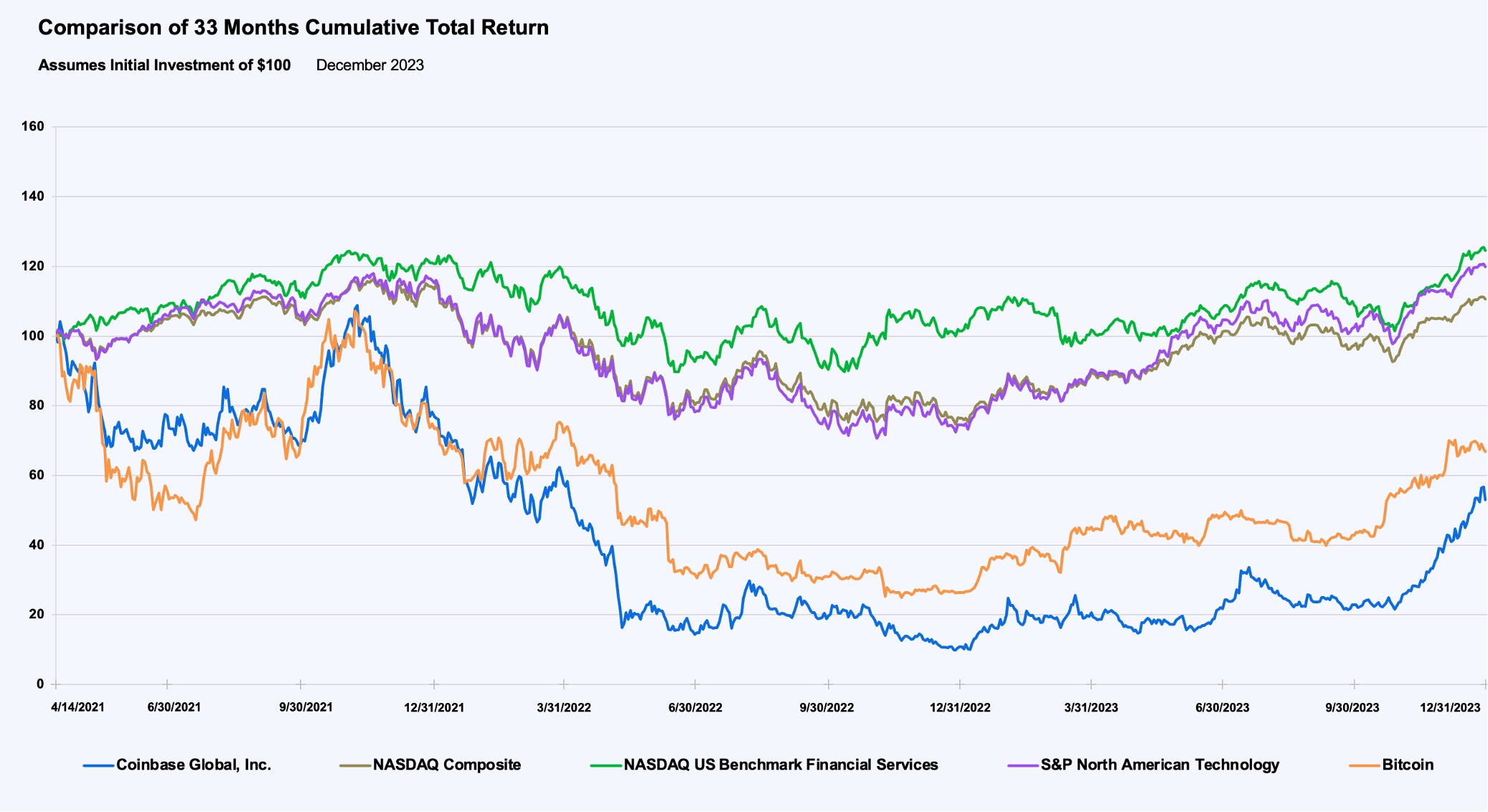
Recent Sales of Unregistered Securities
None.
Issuer Purchases of Equity Securities
The following table contains information relating to the repurchases of our Class A common stock made by us in the three months ended December 31, 2023:
| Period | Total Number of Shares Purchased**(1)** | Average Price Paid per Share | ||||||||||||
| October 1 – October 31, 2023 | — | $ | — | |||||||||||
| November 1 – November 30, 2023 | — | — | ||||||||||||
| December 1 – December 31, 2023 | 4 | 18.13 | ||||||||||||
| 4 | $ | 18.13 |
(1)Represents shares of unvested Class A common stock that were repurchased by us from former employees upon termination of employment in accordance with the terms of the employees’ stock option agreements. We repurchased the shares from the former employees at the respective original exercise prices.
Item 6. [Reserved]
Item 7. Management’s Discussion and Analysis of Financial Condition and Results of Operations
The following discussion and analysis of our financial condition and results of operations should be read in conjunction with our consolidated financial statements and the accompanying notes thereto included elsewhere in this Annual Report on Form 10-K. Th**e following discussion and analysis contain forward-looking statements that involve risks and uncertainties, as well as assumptions that, if they never materialize or prove incorrect, could cause our results to differ materially from those expressed or implied by such forward-looking statements. Factors that could cause or contribute to these differences include, but are not limited to, those identified below and those discussed in the section titled Risk Factors in Part I, Item 1A of this Annual Report on Form 10-K*. Unless otherwise expressly stated or the context otherwise requires, references to “we,” “our,” “us,” “the Company,” and “Coinbase” refer to Coinbase Global, Inc. and its* consolidated subsidiaries.
Executive Overview
This executive overview of Management’s Discussion and Analysis of Financial Condition and Results of Operations highlights selected information and does not contain all of the information that is important to readers of this Annual Report on Form 10-K.
In 2023, we paired operational excellence with product innovation to deliver a strong year of execution against our product roadmap.
For the year ended December 31, 2023, our net revenue was $2.9 billion, including $1.5 billion in transaction revenue and $1.4 billion in subscription and services revenue. For the year ended December 31, 2022, our net revenue was $3.1 billion, including $2.4 billion in transaction revenue and $0.8 billion in subscription and services revenue.
For the year ended December 31, 2023, our net income was $0.1 billion and Adjusted EBITDA was $1.0 billion. For the year ended December 31, 2022, our net loss was $2.6 billion and Adjusted EBITDA was negative $0.4 billion.
Beyond the numbers, we accelerated product velocity and improved our existing product suite, while laying important foundations for future growth. We acquired key licenses, registrations and launched operations into six new markets.
In 2024 Coinbase will focus on three main priorities. First, driving revenue through improving our core trading and USDC. Second, driving utility in crypto with experiments in payments using USDC and Base. Lastly, we will continue to drive regulatory clarity for the industry. All told, Coinbase is a fundamentally stronger company today than a year ago, and we are in a strong financial position to capitalize on the opportunities ahead.
Key Business Metrics
In addition to the measures presented in our consolidated financial statements, we use the key business metrics listed below to evaluate our business, measure our performance, identify trends affecting our business, and make strategic decisions:
| Year Ended December 31, | % Change | |||||||||||||||||||||||||||||||||||||||||||||||||||||||||||||||||||||||||||||||
| 2023 | 2022 | 2021 | 2023 | 2022 | ||||||||||||||||||||||||||||||||||||||||||||||||||||||||||||||||||||||||||||
| MTUs (in millions) | 7.0 | 8.3 | 11.2 | (16) | (26) | |||||||||||||||||||||||||||||||||||||||||||||||||||||||||||||||||||||||||||
| Trading Volume (in billions) | $ | 468 | $ | 830 | $ | 1,671 | (44) | (50) | ||||||||||||||||||||||||||||||||||||||||||||||||||||||||||||||||||||||||
| Net income (loss) (in millions) | $ | 95 | $ | (2,625) | $ | 3,624 | 104 | (172) | ||||||||||||||||||||||||||||||||||||||||||||||||||||||||||||||||||||||||
| Adjusted EBITDA(1) (in millions) | $ | 964 | $ | (371) | $ | 4,090 | 360 | (109) |
(1)See the section titled “Non-GAAP Financial Measure” below for a reconciliation of net income (loss) to Adjusted EBITDA and an explanation for why we consider Adjusted EBITDA to be a helpful metric for investors.
Monthly Transacting Users
We define a Monthly Transacting User (“MTU”) as a consumer who actively or passively transacts in one or more products on our platform at least once during the rolling 28-day period ending on the date of measurement. MTUs presented for the end of a quarter are the average of each month’s MTUs in each respective quarter. MTUs presented as of the end of a year represent the MTUs for the last quarter of that year. The annual average MTUs for the years ended December 31, 2023, 2022, and 2021, were 7.4 million, 8.8 million and 8.4 million, respectively. MTUs engage in transactions that generate both transaction revenue and subscription and services revenue. Revenue-generating transactions include active transactions such as buying or selling crypto assets or passive transactions such as earning a staking reward. MTUs also engage in transactions that are non-revenue generating such as send and receive. MTUs may overstate the number of unique consumers due to differences in product architecture or user behavior.
MTUs declined for the year ended December 31, 2023 as compared to 2022 due to a 0.8 million decrease in staking users driven by updates to our staking service, which required users to manually opt-in to certain networks within a notice period and a 0.4 million decrease in trading users in line with lower Trading Volume. MTUs declined for the year ended December 31, 2022 as compared to 2021 driven primarily by a decline of 6.9 million in users engaging in trades on our platform in line with lower Trading Volume, partially offset by a 4.0 million increase in staking users due to the addition of new staking assets in 2022.
Trading Volume
We define “Trading Volume” as the total U.S. dollar equivalent value of spot matched trades transacted between a buyer and seller through our platform during the period of measurement. Trading Volume represents the product of the quantity of assets transacted and the trade price at the time the transaction was executed. As trading activity directly impacts transaction revenue, we believe this measure is a reflection of liquidity on our order books, trading health, and the underlying growth of the cryptoeconomy.
Generally, Trading Volume on our platform is primarily influenced by the price of crypto assets, crypto asset volatility, and macro
Showing the first 8K of 136K characters. Open the full section
Item 7A. Quantitative and Qualitative Disclosures about Market Risk
Market risk is the risk to our financial statements associated with the effect of changes in market factors, including risks associated with interest rates, foreign currency, derivatives, equity investments, and crypto assets. These assets and equities are held for purposes other than trading.
Interest rate risk
Our exposure to changes in interest rates primarily relates to interest earned on our cash and cash equivalents, customer custodial cash and from our arrangement with the issuer of USDC.
Our investment policy and strategy related to our cash and cash equivalents and customer custodial cash funds is to preserve capital and meet liquidity requirements without increasing risk. Our cash and cash equivalents consist of money market funds denominated in U.S. dollars and cash deposits, and therefore the fair value of our cash, cash equivalents, and customer custodial funds would not be significantly affected by either an increase or a decrease in interest rates. However, the amount of interest we earn on these balances may be significantly impacted. The Federal Reserve has increased the Federal Funds Rate over 500 basis points since December 31, 2021 to control current levels of inflation and as of December 31, 2023, the Federal Funds Rate was 5.33%. As a result of these significant recent increases in interest rates, a decrease in interest rates is possible. A hypothetical 500 basis points increase or decrease in average interest rates applied to our average month end balances for the years ended December 31, 2023 and 2022, which corresponds closely to the increase of the Federal Funds Rate since early 2022, would have resulted in a $307.3 million and $270.6 million increase or decrease, respectively, in interest earned on cash, cash equivalents, and customer custodial funds.
We also earn stablecoin revenue from an arrangement with the issuer of USDC. Interest income is earned on USDC reserve balances. The issuer of USDC reported that, as of December 31, 2023, underlying reserves were held in cash, short-duration U.S. Treasuries, and overnight U.S. Treasury repurchase agreements within segregated accounts for the benefit of USDC holders, and therefore the fair value of these balances would not be significantly affected by either an increase or a decrease in interest rates. However, the related amount of stablecoin revenue we earn may be significantly impacted. A hypothetical 500 basis points increase or decrease in average interest rates applied to daily USDC reserve balances held would have resulted in a $735.5 million increase or decrease in stablecoin revenue for the year ended December 31, 2023 and a $685.7 million increase or decrease in stablecoin revenue for the year ended December 31, 2022.
Foreign currency risk
Foreign currency transaction risk
Revenues, expenses, and financial results of our foreign subsidiaries are recorded in the functional currency of these subsidiaries. Our foreign currency exposure is primarily related to transactions denominated in Euros and British Pounds attributable to cash and cash equivalents, customer custodial
funds and customer custodial cash liabilities and intercompany transactions where the transaction currency is different from a subsidiary’s functional currency. Changes in foreign exchange rates, and in particular a weakening of foreign currencies relative to the U.S. dollar may negatively affect our results of operations as expressed in U.S. dollars. We have experienced and will continue to experience fluctuations in our results of operations as a result of gains or losses on the settlement and the remeasurement of monetary assets and liabilities denominated in foreign currencies that are not the functional currency of the respective entity.
See the section titled “Management’s Discussion and Analysis of Financial Condition and Results of Operations—Results of Operations—Comparison of the years ended December 31, 2023, 2022, and 2021—Other (income) expense, net” in Part II, Item 7 of this Annual Report on Form 10-K for a discussion of foreign exchange losses during the years ended December 31, 2023, 2022, and 2021. If an adverse 10% foreign currency exchange rate change was applied to the largest foreign currency exposure (e.g. Euro) or to all foreign currency exposures in aggregate, of monetary assets, liabilities, and commitments denominated in currencies other than its functional currency as of December 31, 2023 and 2022, it would not have a material impact on our financial results.
From time to time, we may enter into derivatives or other financial instruments in an attempt to hedge our exposure to foreign currency exchange risk. It is difficult to predict the impact hedging activities would have on our results of operations. Additionally, the volatility of exchange rates depends on many factors that we cannot forecast with reliable accuracy. Our international operations increase our exposure to exchange rate fluctuations and, as a result, such fluctuations could have a material impact on our future results of operations and cash flows.
Foreign currency translation risk
Fluctuations in functional currencies from our net investment in international subsidiaries expose us to foreign currency translation risk, where changes in foreign currency exchange rates may adversely affect our results of operations upon translation into U.S. dollars. See the consolidated statements of comprehensive income (loss) in Part II, Item 8 of this Annual Report on Form 10-K for translation adjustments for the years ended December 31, 2023, 2022, and 2021. As of December 31, 2023 and 2022, a 10% increase or decrease in foreign currency exchange rates used in translating the financial statements of subsidiaries with functional currencies other than our reporting currency would not have a material impact on our financial results.
Market volatility and other risks associated with derivatives
We have exposure to derivatives and related hedges measured at fair value. Market risk on derivatives is the exposure created by potential fluctuations in market prices and other factors and is a function of the type of derivative product, the volume of transactions, the tenor and terms of the agreement and the underlying volatility.
As of December 31, 2023, we had embedded derivative assets and embedded derivative liabilities as a result of entering into transactions to borrow crypto assets, which are recorded on the consolidated balance sheets. We also had embedded derivative assets and embedded derivative liabilities for accounts and loans receivable and other payables denominated in crypto assets. These embedded derivative assets and liabilities are recorded on the consolidated balance sheets in accrued expenses and other current liabilities and accounts and loans receivable, net of allowance, respectively. See the section titled “Management’s Discussion and Analysis of Financial Condition and Results of Operations—Results of Operations—Comparison of the years ended December 31, 2023, 2022, and 2021—Operating expenses—Other operating expense, net” in Part II, Item 7 of this Annual Report on Form 10-K for a discussion of material gains and losses on derivatives during the years ended December 31, 2023, 2022, and 2021. As of December 31, 2023 and 2022, a 10% increase or decrease in the fair value of any of our derivative positions, individually or in the aggregate, would not have a material impact on our financial results. For more information on our derivatives and related hedges measured at fair value, see Notes 2.
Summary of Significant Accounting Policies, 6. Accounts and Loans Receivable, Net of Allowance, 11. Prepaid Expenses and Other Current and Non-Current Assets, 12. Accrued Expenses and Other Current Liabilities, and 15. Derivatives, of the Notes to our consolidated financial statements included in Part II, Item 8 of this Annual Report on Form 10-K.
Equity investment risk
We hold strategic investments in privately held companies in the form of equity securities without readily determinable fair values in which we do not have a controlling interest or significant influence. These investments are subject to a wide variety of market and price-related risks due to the lack of readily available market data, which requires us to make significant estimates and assumptions that could substantially impact the carrying value of the investments. We perform a qualitative assessment of our portfolio of strategic equity investments on a quarterly basis for indicators of impairment. Our analysis includes a review of indicators such as: operating results when available; business prospects of the investees; changes in the regulatory and macroeconomic environment; observable price changes in similar transactions; and general market conditions of the geographical area or industry in which our investees operate. If indicators of impairment exist and the estimated fair value of an investment is below the carrying amount, we will write down the investment to fair value.
As of December 31, 2023 and 2022, our strategic equity investments in privately held companies were $343.0 million and $326.7 million, respectively. We record all adjustments to the fair value of our investments through our consolidated statements of operations under other (income) expense, net. During the years ended December 31, 2023 and 2022, we recognized impairment expense of $29.4 million and $101.4 million related to our strategic investments in privately held companies, respectively. We anticipate volatility to our net income (loss) in future periods due to changes in the fair values associated with these investments and observable price changes in similar transactions that could impact our fair value assessments. Based on future market conditions, these changes could be material to our financial results. For more information, see Notes 2. Summary of Significant Accounting Policies and 11. Prepaid Expenses and Other Current and Non-Current Assets of the Notes to our consolidated financial statements included in Part II, Item 8 of this Annual Report on Form 10-K.
Market price risk of crypto assets
We generate a large portion of our total revenue from transaction fees on our platform in connection with the purchase, sale, and trading of crypto assets by our customers. Transaction revenue is based on transaction fees that are either a flat fee or a percentage of the value of each transaction and may vary depending on payment type and the value of the transaction. We also generate a large portion of our total revenue from non-transaction-based services, such as staking and custody, and such revenue has grown over time. Accordingly, crypto asset price risk could adversely affect our operating results. In particular, our future profitability may depend upon the market price of Bitcoin and Ethereum, as well as other crypto assets. Crypto asset prices, along with our operating results, have fluctuated significantly. There is no assurance that crypto asset prices will reflect historical trends. A decline in the market price of Bitcoin, Ethereum and other crypto assets has had and could in the future have an adverse effect on our earnings, the carrying value of our crypto assets, and our future cash flows. This may also affect our liquidity and our ability to meet our ongoing obligations.
We record impairment charges on our crypto assets held when crypto asset prices decrease below the carrying value of these crypto assets. As of December 31, 2023 and 2022, a 10% decrease in crypto asset prices would not have a material impact on our financial results. Effective January 1, 2024 we adopted Accounting Standard Update 2023-08, Accounting for and Disclosure of Crypto Assets (“ASU 2023-08”) which will change how we value crypto assets held, as we will be required to recognize such assets at fair value with changes recognized in net income each reporting period. For more information, see Notes 2. Summary of Significant Accounting Policies and 9. Goodwill, Intangible Assets, Net, and Crypto Assets Held of the Notes to our consolidated financial statements included in Part II, Item 8 of this Annual Report on Form 10-K.
Item 8. Financial Statements and Supplementary Data
REPORT OF INDEPENDENT REGISTERED PUBLIC ACCOUNTING FIRM
To the shareholders and the Board of Directors of Coinbase Global, Inc.
Opinion on the Financial Statements
We have audited the accompanying consolidated balance sheets of Coinbase Global, Inc. (the "Company") as of December 31, 2023 and 2022, the related consolidated statements of operations, comprehensive income (loss), changes in preferred stock and stockholders’ equity, and cash flows, for each of the three years in the period ended December 31, 2023, and the related notes (collectively referred to as the "financial statements"). In our opinion, the financial statements present fairly, in all material respects, the financial position of the Company as of December 31, 2023 and 2022, and the results of its operations and its cash flows for each of the three years in the period ended December 31, 2023, in conformity with accounting principles generally accepted in the United States of America.
We have also audited, in accordance with the standards of the Public Company Accounting Oversight Board (United States) (PCAOB), the Company's internal control over financial reporting as of December 31, 2023, based on criteria established in Internal Control — Integrated Framework (2013) issued by the Committee of Sponsoring Organizations of the Treadway Commission and our report dated February 15, 2024, expressed an unqualified opinion on the Company's internal control over financial reporting.
Basis for Opinion
These financial statements are the responsibility of the Company's management. Our responsibility is to express an opinion on the Company's financial statements based on our audits. We are a public accounting firm registered with the Public Company Accounting Oversight Board (United States) (PCAOB) and are required to be independent with respect to the Company in accordance with the U.S. federal securities laws and the applicable rules and regulations of the Securities and Exchange Commission and the PCAOB.
We conducted our audits in accordance with the standards of the PCAOB. Those standards require that we plan and perform the audit to obtain reasonable assurance about whether the financial statements are free of material misstatement, whether due to error or fraud. Our audits included performing procedures to assess the risks of material misstatement of the financial statements, whether due to error or fraud, and performing procedures that respond to those risks. Such procedures included examining, on a test basis, evidence regarding the amounts and disclosures in the financial statements. Our audits also included evaluating the accounting principles used and significant estimates made by management, as well as evaluating the overall presentation of the financial statements. We believe that our audits provide a reasonable basis for our opinion.
Critical Audit Matters
The critical audit matters communicated below are matters arising from the current-period audit of the financial statements that were communicated or required to be communicated to the audit committee and that (1) relate to accounts or disclosures that are material to the financial statements and (2) involved our especially challenging, subjective, or complex judgments. The communication of critical audit matters does not alter in any way our opinion on the financial statements, taken as a whole, and we are not, by communicating the critical audit matters below, providing separate opinions on the critical audit matter or on the accounts or disclosures to which they relate.
Customer Crypto Assets, Crypto Assets Held, and USDC- Crypto Assets in Cold Storage — Refer to Notes 2, 9, and 10 to the financial statements
Critical Audit Matter Description
Crypto assets are generally accessible only by the possessor of the unique private key relating to the digital wallet in which the crypto assets are held. Accordingly, private keys must be safeguarded and secured in order to prevent an unauthorized party from accessing the crypto assets within a digital wallet. The Company primarily holds crypto assets for its own use, and on behalf of customers, in wallets within its cold storage environment. The loss, theft, or otherwise compromise of access to the private keys required to access the crypto assets in cold storage could adversely affect the Company’s ability to access the crypto assets within its environment. This could result in loss of corporate crypto assets held or loss of crypto assets safeguarded on behalf of customers.
We identified crypto assets in cold storage as a critical audit matter due to the nature and extent of audit effort required to obtain sufficient appropriate audit evidence to address the risks of material misstatement related to the existence and rights & obligations of crypto assets in cold storage. The nature and extent of audit effort required to address the matter includes significant involvement of more experienced engagement team members and discussions and consultations with subject matter experts related to the matter.
How the Critical Audit Matter Was Addressed in the Audit
Our audit procedures related to crypto assets in cold storage included the following, among others:
-
We consulted with subject matter experts regarding our planned audit response to address risks of material misstatement of crypto assets in cold storage.
-
We tested the effectiveness of controls within the Company’s private key management process including controls related to physical access, key generation, and segregation of duties across the processes.
-
We tested the effectiveness of management’s reconciliation control of internal books and records to external blockchains.
-
We tested the effectiveness of management’s control to segregate corporate crypto asset balances from customer crypto asset balances.
-
We tested the effectiveness of controls within the processes of customer crypto asset deposits and customer crypto asset withdrawals.
-
We obtained evidence to evaluate crypto asset balances for appropriate segregation between corporate crypto assets and customer crypto assets.
-
We utilized our proprietary audit tool to independently obtain evidence from public blockchains to test the existence of crypto asset balances.
-
We obtained evidence that management has control of the private keys required to access crypto assets in cold storage through a combination of decoding cryptographic messages signed using selected private keys or through observing the movement of selected crypto assets.
-
We evaluated the reliability of audit evidence obtained from public blockchains.
**Commitments and Contingen
Showing the first 8K of 272K characters. Open the full section
Item 9. Changes in and Disagreements With Accountants on Accounting and Financial Disclosure.
None.
Item 9A. Controls and Procedures
Evaluation of Disclosure Controls and Procedures
Our disclosure controls and procedures are designed to ensure that information we are required to disclose in reports that we file or submit under the Securities Exchange Act of 1934, as amended (the “Exchange Act”), is recorded, processed, summarized, and reported within the time periods specified in SEC rules and forms, and that such information is accumulated and communicated to our management, including our Chief Executive Officer and Chief Financial Officer, as appropriate, to allow timely decisions regarding required disclosure.
Our management, with the participation and supervision of our Chief Executive Officer (our principal executive officer) and our Chief Financial Officer (our principal financial officer), has evaluated the effectiveness of our disclosure controls and procedures (as defined in Rules 13a-15(e) and 15d-15(e) under the Exchange Act) as of December 31, 2023. Based on such evaluation, our Chief Executive Officer and Chief Financial Officer have concluded that as of December 31, 2023, our disclosure controls and procedures were, in design and operation, effective at a reasonable assurance level.
Management’s Report on Internal Control Over Financial Reporting
Our management is responsible for establishing and maintaining adequate internal control over financial reporting (as defined in Rules 13a-15(f) and 15(d)-15(f) under the Exchange Act) to provide reasonable assurance regarding the reliability of financial reporting and the preparation of financial statements for external purposes in accordance with generally accepted accounting principles. Our management, under the supervision of our Chief Executive Officer and Chief Financial Officer, conducted an evaluation of the effectiveness of our internal control over financial reporting based on the criteria established in Internal Control - Integrated Framework (2013) issued by the Committee of Sponsoring Organizations of the Treadway Commission. Based on this evaluation, our management has concluded that our internal control over financial reporting was effective as of December 31, 2023. The effectiveness of our internal control over financial reporting as of December 31, 2023 has been audited by Deloitte & Touche LLP, an independent registered public accounting firm, as stated in their report, which is included in Part II, Item 8 of this Annual Report on Form 10-K.
Changes in Internal Controls Over Financial Reporting
There were no changes to our internal control over financial reporting (as such term is defined in Rules 13a-15(f) and 15d-15(f) under the Exchange Act) that occurred during the most recently completed fiscal quarter that have materially affected, or are reasonably likely to materially affect, our internal control over financial reporting.
Inherent Limitations on the Effectiveness of Controls
The effectiveness of any system of internal control over financial reporting, including ours, is subject to inherent limitations, including the exercise of judgment in designing, implementing, operating, and evaluating the controls and procedures, and the inability to eliminate misconduct completely. Accordingly, in designing and evaluating the disclosure controls and procedures, management recognizes that any system of internal control over financial reporting, including ours, no matter how well designed and operated, can only provide reasonable, not absolute assurance of achieving the desired control objectives. In addition, the design of disclosure controls and procedures must reflect the fact that there are resource constraints and that management is required to apply its judgment in evaluating the benefits of possible controls and procedures relative to their costs. Moreover, projections of any evaluation of effectiveness to future periods are subject to the risk that controls may become inadequate because of changes in conditions, or that the degree of compliance with the policies or procedures may deteriorate. We intend to continue to monitor and upgrade our internal controls as necessary or appropriate for our business but cannot assure you that such improvements will be sufficient to provide us with effective internal control over financial reporting.
Item 9B. Other Information
Rule 10b5-1 Trading Plans
The Company’s directors and officers (as defined in Rule 16a-1(f) under the Exchange Act) (“Section 16 officers”) are only permitted to trade in the Company’s securities pursuant to a prearranged trading plan intended to satisfy the affirmative defense of Rule 10b5-1(c) under the Exchange Act (a “Rule 10b5-1 Plan”). During the three months ended December 31, 2023, one of the Company’s Section 16 officers adopted a Rule 10b5-1 Plan. Additionally, during the three months ended December 31, 2023, entities affiliated with one of the Company’s directors adopted prearranged trading plans intended by such entities to qualify as Rule 10b5-1 Plans. All such Rule 10b5-1 Plans were entered into during an open trading window in accordance with the Company’s Insider Trading Policy and Trading Plan Policy.
On December 1, 2023, Alesia Haas, the Company’s Chief Financial Officer, entered into a Rule 10b5-1 Plan (the “Haas Plan”) providing for the potential sale of (a) up to 255,565 shares of Class A common stock owned by Ms. Haas and (b) the number of shares of Class A common stock necessary to cover the exercise price, taxes, commissions and fees associated with the exercise of up to 686,873 shares of Class A common stock pursuant to stock options owned by Ms. Haas, in each case, so long as the market price of the Class A common stock satisfies certain threshold prices specified in the Haas Plan, between an estimated start date of March 5, 2024 and December 31, 2024, or earlier, upon the completion of all transactions subject to the trading arrangements specified in the Haas Plan or the occurrence of certain events set forth therein.
On November 29, 2023, Andreessen Horowitz Fund Ill, L.P., Andreessen Horowitz Fund Ill-A, L.P., Andreessen Horowitz Fund III-B, L.P., Andreessen Horowitz Fund III-Q, L.P., AH Parallel Fund III, L.P., AH Parallel Fund Ill-A, L.P., AH Parallel Fund III-B, L.P., AH Parallel Fund III-Q, L.P., Andreessen Horowitz LSV Fund I, L.P., Andreessen Horowitz LSV Fund I-B, L.P., and Andreessen Horowitz LSV Fund I-Q, L.P. (collectively, the “Funds”), each of which is an affiliate of Marc Andreessen, a member of the Company’s board of directors, entered into a Rule 10b5-1 Plan (the “a16z Plan”) providing for the potential distribution of up to 14,018,115 shares of Class A common stock owned by the Funds to the limited partners of the Funds (the “Distributions”), so long as the market price of the Class A common stock is higher than certain minimum threshold prices specified in the a16z Plan, during the period beginning on January 2, 2024 and ending on May 26, 2024, such earlier date as the distribution of all shares specified in the a16z Plan is completed or the occurrence of certain events set forth therein.
On December 1, 2023, AH Capital Management, L.L.C., an affiliate of Mr. Andreessen, a member of the Company’s board of directors, entered into a Rule 10b5-1 Plan (the “AH Capital Plan”) providing for the sale of any and all shares of Class A common stock received by AH Capital Management, L.L.C. in connection with the Distributions by the Funds, during the period beginning on January 2, 2024 and ending on May 26, 2024, such earlier date as sale of all shares specified in the AH Capital Plan is completed or the occurrence of certain events set forth therein.
Item 9C. Disclosure Regarding Foreign Jurisdictions that Prevent Inspections
Not applicable.
PART III I
Item 10. Directors, Executive Officers and Corporate Governance
The information required by this item is incorporated by reference to the definitive Proxy Statement for our 2024 Annual Meeting of Stockholders, which will be filed with the SEC no later than 120 days after December 31, 2023.
Item 11. Executive Compensation
The information required by this item is incorporated by reference to the definitive Proxy Statement for our 2024 Annual Meeting of Stockholders, which will be filed with the SEC no later than 120 days after December 31, 2023.
Item 12. Security Ownership of Certain Beneficial Owners and Management and Related Stockholder Matters
The information required by this item is incorporated by reference to the definitive Proxy Statement for our 2024 Annual Meeting of Stockholders, which will be filed with the SEC no later than 120 days after December 31, 2023.
Item 13. Certain Relationships and Related Transactions, and Director Independence
The information required by this item is incorporated by reference to the definitive Proxy Statement for our 2024 Annual Meeting of Stockholders, which will be filed with the SEC no later than 120 days after December 31, 2023.
Item 14. Principal Accountant Fees and Services
The information required by this item is incorporated by reference to the definitive Proxy Statement for our 2024 Annual Meeting of Stockholders, which will be filed with the SEC no later than 120 days after December 31, 2023.
PART IV
Item 15. Exhibits and Financial Statement Schedules
**1.**Financial Statements
The following financial statements are included in Part II, Item 8 of this Annual Report on Form 10-K:
Reports of Independent Registered Public Accounting Firm
Consolidated Balance Sheets
Consolidated Statements of Operations
Consolidated Statements of Comprehensive Income (Loss)
Consolidated Statements of Changes in Preferred Stock and Stockholders’ Equity
Consolidated Statements of Cash Flows
Notes to the Consolidated Financial Statements
**2.**Financial Statement Schedules
All schedules have been omitted because the required information is included in the consolidated financial statements or the notes thereto, or because it is not required.
**3.**Exhibits
The exhibits listed below are filed as part of this Annual Report on Form 10-K or are incorporated herein by reference, in each case as indicated below.
| Incorporated by Reference | Filed or Furnished Herewith | |||||||||||||||||||||||||||||||||||||
| Exhibit Number | Description | Form | File No. | Exhibit | Filing Date | |||||||||||||||||||||||||||||||||
| 101.INS | Inline XBRL Instance Document - the instance document does not appear in the Interactive Data File because its XBRL tags are embedded within the Inline XBRL document | X | ||||||||||||||||||||||||||||||||||||
| 101.SCH | Inline XBRL Taxonomy Extension Schema Document | X | ||||||||||||||||||||||||||||||||||||
| 101.CAL | Inline XBRL Taxonomy Extension Calculation Linkbase Document | X | ||||||||||||||||||||||||||||||||||||
| 101.DEF | Inline XBRL Taxonomy Extension Definition Linkbase Document | X | ||||||||||||||||||||||||||||||||||||
| 101.LAB | Inline XBRL Taxonomy Extension Label Linkbase Document | X | ||||||||||||||||||||||||||||||||||||
| 101.PRE | Inline XBRL Taxonomy Extension Presentation Linkbase Document | X | ||||||||||||||||||||||||||||||||||||
| 104 | Cover Page Interactive Data File - the cover page from the registrant’s Annual Report on Form 10-K for the year ended December 31, 2023 is formatted in Inline XBRL | X |
† Indicates a management or compensatory plan or arrangement in which directors or executive officers are eligible to participate.
The certifications furnished in Exhibits 32.1 and 32.2 hereto are deemed to accompany this Annual Report on Form 10-K and are not deemed “filed” for purposes of Section 18 of the Exchange Act, or otherwise subject to the liability of that section, nor shall they be deemed incorporated by reference into any filing under the Securities Act of the Exchange Act.
Item 16. Form 10-K Summary
None.
SIGNATURES
Pursuant to the requirements of Section 13 or 15(d) of the Securities Exchange Act of 1934, as amended, the registrant has duly caused this Annual Report on Form 10-K to be signed on its behalf by the undersigned, thereunto duly authorized.
| COINBASE GLOBAL, INC. | ||||||||
| Date: February 15, 2024 | ||||||||
| By: | /s/ Brian Armstrong | |||||||
| Brian Armstrong | ||||||||
| Chief Executive Officer |
POWER OF ATTORNEY
KNOW ALL PERSONS BY THESE PRESENTS, that each person whose signature appears below hereby constitutes and appoints Brian Armstrong and Alesia J. Haas, and each of them, as his or her true and lawful attorneys-in-fact, proxies, and agents, each with full power of substitution, for him or her in any and all capacities, to sign any and all amendments to this Annual Report on Form 10-K, and to file the same, with all exhibits thereto and other documents in connection therewith, with the Securities and Exchange Commission, granting unto said attorneys-in-fact, proxies, and agents full power and authority to do and perform each and every act and thing requisite and necessary to be done in connection therewith, as fully for all intents and purposes as he might or could do in person, hereby ratifying and confirming all that said attorneys-in-fact, proxies, and agents, or their or his or her substitute or substitutes, may lawfully do or cause to be done by virtue hereof.
Pursuant to the requirements of the Securities Exchange Act of 1934, as amended, this Annual Report on Form 10-K has been signed below by the following persons on behalf of the registrant and in the capacities and on the dates indicated.
| Name | Title | Date | ||||||||||||
| /s/ Brian Armstrong | Chief Executive Officer and Chairman of the Board | February 15, 2024 | ||||||||||||
| Brian Armstrong | (Principal Executive Officer) | |||||||||||||
| /s/ Alesia J. Haas | Chief Financial Officer | February 15, 2024 | ||||||||||||
| Alesia J. Haas | (Principal Financial Officer) | |||||||||||||
| /s/ Jennifer N. Jones | Chief Accounting Officer | February 15, 2024 | ||||||||||||
| Jennifer N. Jones | (Principal Accounting Officer) | |||||||||||||
| /s/ Marc L. Andreessen | Director | February 15, 2024 | ||||||||||||
| Marc L. Andreessen | ||||||||||||||
| /s/ Frederick Ernest Ehrsam III | Director | February 15, 2024 | ||||||||||||
| Frederick Ernest Ehrsam III | ||||||||||||||
| /s/ Kathryn Haun | Director | February 15, 2024 | ||||||||||||
| Kathryn Haun | ||||||||||||||
| /s/ Kelly Kramer | Director | February 15, 2024 | ||||||||||||
| Kelly Kramer | ||||||||||||||
| /s/ Tobias Lütke | Director | February 15, 2024 | ||||||||||||
| Tobias Lütke | ||||||||||||||
| /s/ Gokul Rajaram | Director | February 15, 2024 | ||||||||||||
| Gokul Rajaram | ||||||||||||||
| /s/ Fred Wilson | Director | February 15, 2024 | ||||||||||||
| Fred Wilson |