 filings.tools
Cooper Companies 10-K 2014-10-31
Filed 2014-12-19. 20 sections, 392K characters. Original on sec.gov · Markdown · JSON
Cover and table of contents
10-K 1 coo_20141031-10k.htm 10-K
SECURITIES AND EXCHANGE COMMISSION
WASHINGTON, D.C. 20549
FORM 10-K
ANNUAL REPORT PURSUANT TO SECTION 13 OR 15(d) OF
THE SECURITIES EXCHANGE ACT OF 1934
FOR THE FISCAL YEAR ENDED OCTOBER 31, 2014
COMMISSION FILE NO. 1-8597
THE COOPER COMPANIES, INC.
(Exact name of registrant as specified in its charter)
| Delaware | 94-2657368 |
| (State or other jurisdiction of incorporation) | (I.R.S. Employer Identification No.) |
| 6140 Stoneridge Mall Road, Suite 590 Pleasanton, California | 94588 |
| (Address of principal executive offices) | (Zip Code) |
(925) 460-3600
(Registrant’s telephone number, including area code)
Securities registered pursuant to Section 12(b) of the Act:
| Title of each class | Name of each exchange on which registered | |
| Common Stock, $.10 par value, and associated rights | New York Stock Exchange |
Securities registered pursuant to Section 12(g) of the Act:
None
Indicate by check mark if the registrant is a well-known seasoned issuer, as defined in Rule 405 of the Securities Act.
Yes x No o
Indicate by check mark if the registrant is not required to file reports pursuant to Section 13 or Section 15(d) of the Act.
Yes o No x
Indicate by check mark whether the registrant (1) has filed all reports required to be filed by Section 13 or 15(d) of the Securities Exchange Act of 1934 during the preceding 12 months, and (2) has been subject to such filing requirements for the past 90 days. Yes x No o
Indicate by check mark whether the registrant has submitted electronically and posted on its corporate Web site, if any, every Interactive Data File required to be submitted and posted pursuant to Rule 405 of Regulation S-T (§232.405 of this chapter) during the preceding 12 months (or for such shorter period that the registrant was required to submit and post such files).
Yes x No o
Indicate by check mark if disclosure of delinquent filers pursuant to Item 405 of Regulation S-K is not contained herein, and will not be contained, to the best of registrant's knowledge, in definitive proxy or information statements incorporated by reference in Part III of this Form 10-K or any amendment to this Form 10-K. x
Indicate by check mark whether the registrant is a large accelerated filer, an accelerated filer, a non-accelerated filer or a smaller reporting company. See definitions of “large accelerated filer,” “accelerated filer” and “smaller reporting company” in Rule 12b-2 of the Exchange Act (check one).
Large accelerated filer x Accelerated filer o Non-accelerated filer o Smaller reporting company o
(Do not check if a smaller reporting company)
Indicate by check mark whether the registrant is a shell company (as defined in Rule 12b-2 of the Exchange Act). Yes o No x
On November 30, 2014, there were 47,842,980 shares of the registrant's common stock held by non-affiliates with aggregate market value of $6.3 billion on April 30, 2014, the last day of the registrant's most recently completed fiscal second quarter.
Number of shares outstanding of the registrant's common stock, as of November 30, 2014: 48,158,484
Documents Incorporated by Reference:
| Document | Part of Form 10-K | |
| Portions of the Proxy Statement for the Annual Meeting of Stockholders scheduled to be held in March 2015 | Part III |
THE COOPER COMPANIES, INC. AND SUBSIDIARIES
Annual Report on Form 10-K
for the Fiscal Year Ended October 31, 2014
Table of Contents
| PART I | Page | |
| Item 1. | Business | 5 |
| Item 1A. | Risk Factors | 17 |
| Item 1B. | Unresolved Staff Comments | 32 |
| Item 2. | Properties | 33 |
| Item 3. | Legal Proceedings | 34 |
| PART II | ||
| Item 5. | Market for Registrant's Common Equity, Related Stockholder Matters and Issuer Purchases of Equity Securities | 35 |
| Item 6. | Selected Financial Data | 39 |
| Item 7. | Management's Discussion and Analysis of Financial Condition and Results of Operations | 40 |
| Item 7A. | Quantitative and Qualitative Disclosure about Market Risk | 61 |
| Item 8. | Financial Statements and Supplementary Data | 63 |
| Item 9. | Changes In and Disagreements With Accountants on Accounting and Financial Disclosure | 109 |
| Item 9A. | Controls and Procedures | 109 |
| Item 9B. | Other Information | 110 |
| PART III | ||
| Item 10. | Directors, Executive Officers and Corporate Governance | 111 |
| Item 11. | Executive Compensation | 111 |
| Item 12. | Security Ownership of Certain Beneficial Owners and Management and Related Stockholder Matters | 111 |
| Item 13. | Certain Relationships and Related Transactions, and Director Independence | 111 |
| Item 14. | Principal Accounting Fees and Services | 111 |
| PART IV | ||
| Item 15. | Exhibits and Financial Statement Schedules | 112 |
THE COOPER COMPANIES, INC. AND SUBSIDIARIES
PART I
Forward-Looking Statements
This Annual Report on Form 10-K contains “forward-looking statements” within the meaning of Section 27A of the Securities Act of 1934 and Section 21E of the Securities Exchange Act of 1934. These include statements relating to plans, prospects, goals, strategies, future actions, events or performance and other statements which are other than statements of historical fact. In addition, all statements regarding anticipated growth in our revenue, anticipated effects of any product recalls, anticipated market conditions, planned product launches and expected results of operations and integration of any acquisition are forward-looking. To identify these statements look for words like “believes,” “expects,” “may,” “will,” “should,” “could,” “seeks,” “intends,” “plans,” “estimates” or “anticipates” and similar words or phrases. Forward-looking statements necessarily depend on assumptions, data or methods that may be incorrect or imprecise and are subject to risks and uncertainties. Among the factors that could cause our actual results and future actions to differ materially from those described in forward-looking statements are:
| • | Adverse changes in global or regional general business, political and economic conditions due to the current global economic downturn, including the impact of continuing uncertainty and instability of certain European Union countries that could adversely affect our global markets. |
| • | Foreign currency exchange rate and interest rate fluctuations including the risk of fluctuations in the value of the yen, pound and euro that would decrease our revenues and earnings. |
| • | Acquisition-related adverse effects including the failure to successfully obtain the anticipated revenues, margins and earnings benefits of acquisitions, including the Sauflon acquisition; integration delays or costs and the requirement to record significant adjustments to the preliminary fair value of assets acquired and liabilities assumed within the measurement period, required regulatory approvals for an acquisition not being obtained or being delayed or subject to conditions that are not anticipated, adverse impacts of changes to accounting controls and reporting procedures, contingent liabilities or indemnification obligations, increased leverage and lack of access to available financing (including financing for the acquisition or refinancing of debt owed by us on a timely basis and on reasonable terms). |
| • | A major disruption in the operations of our manufacturing, research and development or distribution facilities, due to technological problems, including any related to our information systems maintenance or enhancements, natural disasters or other causes. |
| • | Disruptions in supplies of raw materials, particularly components used to manufacture our silicone hydrogel lenses. |
| • | Compliance costs and potential liability in connection with U.S. and foreign healthcare regulations, including product recalls, warning letters and potential losses resulting from sales of counterfeit and other infringing products. |
| • | Legal costs, insurance expenses, settlement costs and the risk of an adverse decision or settlement related to product liability, patent infringement or other litigation. |
| • | Changes in tax laws or their interpretation and changes in statutory tax rates. |
| • | Limitations on sales following product introductions due to poor market acceptance. |
| • | New competitors, product innovations or technologies. |
| • | Reduced sales, loss of customers and costs and expenses related to recalls. |
THE COOPER COMPANIES, INC. AND SUBSIDIARIES
| • | New U.S. and foreign government laws and regulations, and changes in existing laws, regulations and enforcement guidance, which affect the medical device industry and the healthcare industry generally. |
| • | Failure to receive, or delays in receiving, U.S. or foreign regulatory approvals for products. |
| • | Failure to obtain adequate coverage and reimbursement from third party payors for our products. |
| • | The requirement to provide for a significant liability or to write off, or accelerate depreciation on, a significant asset, including goodwill. |
| • | The success of our research and development activities and other start-up projects. |
| • | Dilution to earnings per share from the Sauflon acquisition or other acquisitions or issuing stock. |
| • | Changes in accounting principles or estimates. |
| • | Environmental risks. |
| • | Other events described in our Securities and Exchange Commission filings, including the “Business” and “Risk Factors” sections in this Annual Report on Form 10-K for the fiscal year ended October 31, 2014, as such Risk Factors may be updated in quarterly filings. |
We caution investors that forward-looking statements reflect our analysis only on their stated date. We disclaim any intent to update them except as required by law.
THE COOPER COMPANIES, INC. AND SUBSIDIARIES
Item 1. Business.
The Cooper Companies, Inc. (Cooper, we or the Company), a Delaware corporation organized in 1980, is a global medical device company publicly traded on the NYSE Euronext (NYSE: COO). Cooper is dedicated to being A Quality of Life CompanyTM with a focus on shareholder value. Cooper operates through two business units, CooperVision, Inc. and CooperSurgical, Inc.
CooperVision is a global manufacturer providing products for contact lens wearers. CooperVision develops, manufactures and markets a broad range of single-use, two-week and monthly contact lenses, featuring advanced materials and optics. CooperVision's products are designed to solve vision challenges such as astigmatism, presbyopia and ocular dryness; with a broad collection of spherical, toric and multifocal contact lenses. CooperVision's products are primarily manufactured at its facilities located in Hampshire, United Kingdom, Juana Diaz, Puerto Rico, Budapest, Hungary and Scottsville, New York. CooperVision distributes products from West Henrietta, New York, Fareham, United Kingdom, Liege, Belgium, and various smaller international distribution facilities.
CooperSurgical focuses on supplying women's health clinicians with products and treatment options to improve the delivery of healthcare to women. CooperSurgical's primary objectives include internal growth and growth through acquisitions to expand its core businesses and the introduction of advanced technology-based products to aid clinicians in the management and treatment of commonly seen conditions. CooperSurgical customers are healthcare professionals and institutions providing care to and for women. CooperSurgical products support the point of healthcare delivery in the hospital, clinician's office and fertility clinics. CooperSurgical's major manufacturing and distribution facilities are located in Trumbull, Connecticut, Malov, Denmark, Pasadena, California, Stafford, Texas, and Berlin, Germany.
CooperVision and CooperSurgical each operate in highly competitive environments. Competition in the medical device industry involves the search for technological and therapeutic innovations. Both of Cooper's businesses compete primarily on the basis of product quality and differentiation, technological benefit, service and reliability.
COOPERVISION
CooperVision competes in the worldwide soft contact lens market and services three primary regions: the Americas, EMEA (Europe, Middle East and Africa) and Asia Pacific. The contact lens market has two major product categories:
| • | Spherical lenses including lenses that correct near- and farsightedness uncomplicated by more complex visual defects. |
| • | Toric and multifocal lenses including lenses that, in addition to correcting near- and farsightedness, address more complex visual defects such as astigmatism and presbyopia by adding optical properties of cylinder and axis, which correct for irregularities in the shape of the cornea. |
In order to achieve comfortable and healthy contact lens wear, products are sold with recommended replacement schedules, often defined as modalities, with the primary modalities being single-use, two-week and monthly.
CooperVision offers spherical, aspherical, toric, multifocal and toric multifocal lens products in most modalities. We believe that in order to compete successfully in the numerous niches of the contact lens market, companies must offer differentiated products that are priced competitively and manufactured
THE COOPER COMPANIES, INC. AND SUBSIDIARIES
efficiently. CooperVision believes that it is the only contact lens manufacturer to use three different manufacturing processes to produce its lenses: lathing, cast molding and FIPS™, a cost-effective combination of lathing and molding. We also believe that the manufacturing processes acquired in connection with the Sauflon acquisition will be of value to us as these new platforms and processes may add greater flexibility and reduce time to market of our combined product offerings. This increased manufacturing flexibility should allow CooperVision to compete in its markets by:
| • | Producing high, medium and low volumes of lenses made with a variety of materials for a broader range of market niches: single-use, two-week, monthly and quarterly disposable sphere, toric and multifocal lenses and custom toric lenses for patients with a high degree of astigmatism. |
| • | Offering a wide range of lens parameters, leading to a higher rate of successful fitting for practitioners and better visual acuity for patients. |
Sales of contact lenses utilizing silicone hydrogel materials, a major product material in the industry, have grown significantly. Silicone hydrogel materials supply a higher level of oxygen to the cornea, as measured by the transmissibility of oxygen through a given thickness of material, or “dk/t,” than traditional hydrogel lenses. We believe our ability to compete successfully with a full range of silicone hydrogel products is an important factor to achieving our desired future levels of sales growth and profitability. Silicone hydrogel lenses now represent a significant portion of CooperVision's contact lens sales and our Biofinity® brand is CooperVision's leading product line. Under the Biofinity brand, CooperVision markets monthly silicone hydrogel spherical, toric and multifocal lens products. CooperVision has also launched two-week silicone hydrogel spherical and toric lens products under our Avaira® brand. In fiscal 2013, we launched MyDayTM, our single-use spherical silicone hydrogel lens, in Europe.
We believe that the global market for single-use contact lenses will continue to grow, that competitive silicone hydrogel single-use lens products are gaining market share and that they represent a risk to our business. To meet this anticipated demand, we plan to launch MyDay in more geographical regions, such as the United States during fiscal 2015, and to continue the implementation of capital projects to invest in increased single-use manufacturing capacity.
Consistent with this strategy, on August 6, 2014, we completed the acquisition of Sauflon Pharmaceuticals Limited (Sauflon), a privately-held European manufacturer and distributor of soft contact lenses and aftercare solutions. The acquisition of Sauflon expands our contact lens product portfolio particularly with Sauflon's clariti® 1day brand of single-use sphere, toric and multifocal silicone hydrogel lenses. Clariti lenses received United States FDA clearance in August 2013. Sauflon is headquartered in the United Kingdom and has a global presence with manufacturing facilities in the United Kingdom and Hungary. The Sauflon acquisition is intended to accelerate the growth of sales of our single-use products by enabling a multi-tier, single-use strategy with a full suite of hydrogel and silicone hydrogel product offerings in the major product categories of sphere, toric and multifocal lenses. This acquisition is also intended to provide for an enhanced relationship with key European retailers and opportunities for operational synergies.
In addition, CooperVision lenses compete based on providing superior comfort through the use of lens edge technology. CooperVision lenses have a round to partial round edge which we believe increases comfort. CooperVision's Proclear® line of spherical, toric and multifocal lenses are manufactured with omafilcon, a material that incorporates Phosphorylcholine (PC) Technology™ that helps enhance tissue-device compatibility. Proclear lenses are the only lenses with FDA clearance for the claim "… may provide improved comfort for contact lens wearers who experience mild discomfort or symptoms relating to dryness during lens wear." Mild discomfort relating to dryness during lens wear is a condition that often causes patients to discontinue contact lens wear.
THE COOPER COMPANIES, INC. AND SUBSIDIARIES
In addition to its PC Technology™ and silicone hydrogel product offerings, CooperVision competes in the contact lens market with our traditional hydrogel products.
Contact Lens Product Sales
Spheres: Net sales of CooperVision's spherical lenses represented 56 percent of CooperVision's net sales in fiscal 2014 including net sales of single-use spherical lens that represented 22 percent of net sales in the fiscal year.
Toric and Multifocal: Net sales of CooperVision's toric lenses represented 31 percent of CooperVision's net sales in fiscal 2014. Net sales of multifocal lenses represented 11 percent of net sales in the fiscal year.
Proclear: Net sales of CooperVision's PC Technology products - which consist of spherical, toric and multifocal products, including Biomedics® XC and Proclear® 1 Day - represented 24 percent of CooperVision's net sales in fiscal 2014.
Silicone Hydrogel: CooperVision's silicone hydrogel spherical, toric and multifocal lens products, including Sauflon's clariti lenses in the fiscal fourth quarter of 2014 and not in fiscal 2013, represented 49 percent of CooperVision's net sales as compared to 43 percent in fiscal 2013.
CooperVision Competition
The contact lens market is highly competitive. CooperVision's three largest competitors in the worldwide market and its primary competitors in the spherical, toric and multifocal lens categories of that market are Johnson & Johnson Vision Care, Inc., CIBA Vision owned by Novartis AG and Bausch & Lomb Incorporated owned by Valeant Pharmaceuticals International, Inc.
Over the past decade, the contact lens industry has experienced a global shift toward silicone hydrogel lenses that now represent approximately 50% of the global contact lens market. CooperVision's primary competitors control the majority of the silicone hydrogel segment of the market. CooperVision competes in the silicone hydrogel segment of the market with our Biofinity monthly spherical, toric and multifocal lenses, Avaira two-week spherical and toric lenses and MyDay single-use spherical lenses. We believe that the addition of Sauflon's clariti 1day brand of single-use sphere, toric and multifocal lenses provides CooperVision with the broadest product portfolio in the single-use silicone hydrogel market.
In the toric lens market, a similar shift toward silicone hydrogel lenses has occurred, but we believe that lens manufacturers also continue to compete to provide the highest possible level of visual acuity and patient satisfaction by offering a wide range of lens parameters, superior wearing comfort and a high level of customer service, both for patients and contact lens practitioners. CooperVision competes based on its three manufacturing processes, including manufacturing processes recently acquired with Sauflon, yielding wider ranges of toric lens parameters, providing wide choices for patient and practitioner and superior visual acuity, as well as by offering excellent customer service, including high standards of on-time product delivery.
CooperVision's primary competitors have greater financial resources and larger research and development budgets and sales forces. CooperVision seeks to offer a high level of customer service through its direct sales organizations around the world and through telephone sales and technical service representatives who consult with eye care professionals about the use of the Company's lens products.
THE COOPER COMPANIES, INC. AND SUBSIDIARIES
CooperVision also competes with manufacturers of eyeglasses and with refractive surgical procedures that correct visual defects. CooperVision believes that its contact lenses will continue to compete favorably against eyeglasses and there are opportunities for contact lenses to gain market share, particularly in markets where the penetration of contact lenses in the vision correction market is low. CooperVision also believes that laser vision correction is not a significant threat to its sales of contact lenses.
COOPERSURGICAL
CooperSurgical offers a broad array of products used in the care and treatment of women. The Company participates in the women's healthcare market through offering quality products, innovative technologies and superior service to clinicians worldwide. CooperSurgical collaborates with clinicians to identify products and new technologies from disposable products to sophisticated instruments and equipment. The result is a broad portfolio of products that aid in the delivery of improved clinical outcomes that healthcare professionals use routinely in the diagnosis and treatment of a wide spectrum of women's health issues.
Since its inception in 1990, CooperSurgical has steadily grown its market presence and distribution system by developing products and acquiring products and companies that complement its business model.
CooperSurgical competes in the global in-vitro fertilization (IVF) market with a product portfolio of IVF media and assisted reproductive technology (ART) solutions that enhance the work of fertility professionals to the benefit of families. In July 2012, CooperSurgical acquired Origio to form a combined medical device company that develops, manufactures and distributes highly specialized products that target IVF treatment with a goal to make fertility treatment safer, more efficient and convenient.
Market for Women's Healthcare
CooperSurgical participates in the market for women's healthcare with its diversified product lines in three major categories based on the point of healthcare delivery: hospitals and surgical centers, obstetricians and gynecologists (ob/gyns) medical offices and fertility clinics.
CooperSurgical expects patient visits to ob/gyns in the United States to increase over the next decade. Driving this growth is a steady number of reproductive age women with increasing fertility issues, a large and stable middle-aged population and a growing population of women over the age of 65 according the United States Census estimates. CooperSurgical expects growth in fertility treatments as more women choose to delay childbearing to the mid-thirties and beyond. Office visit activity related to menopausal problems, including abnormal bleeding, incontinence and osteoporosis, are also expected to increase slightly over the next decade. CooperSurgical believes that in the past clinicians primarily saw women only during their reproductive years. Now, with new treatment options available and a more educated population, CooperSurgical expects the relationship between the patient and clinician will continue into the middle years and later.
Another trend in the market for women's healthcare includes the migration of ob/gyn clinicians away from private practice ownership and toward aligning with group practices or employment with hospitals and healthcare systems. This trend includes the increasing influence of supply chain controls, such as value analysis committees, on product evaluation and procurement. CooperSurgical believes that the market factors that are driving this trend will continue in the near term.
The response in the United States market to the Affordable Care Act (ACA) includes the development of new models of healthcare delivery. One goal of these new models is to deliver more cost-effective healthcare including a trend to move treatment out of hospitals and surgery centers and into the office setting without compromising care. We expect this trend to continue in the near term.
THE COOPER COMPANIES, INC. AND SUBSIDIARIES
While general medical practitioners play an important role in women's primary care, the ob/gyn specialist is the primary market for CooperSugical's medical devices.
Some significant features of this market are:
| • | Patient visits are for annual checkups, cancer screening, menstrual disorders, vaginitis (inflammation of vaginal tissue), treatment of abnormal Pap smears, osteoporosis (reduction in bone mass) and the management of menopause, pregnancy and reproductive management. |
| • | We estimate that approximately one-third of the office visits to ob/gyns are patients seeking diagnosis and treatment for the symptoms of abnormal uterine bleeding. |
| • | Ob/gyns traditionally provide the initial evaluation for women and their partners who seek infertility assistance. Ovulatory drugs and intrauterine insemination (IUI) are common treatments in these cases along with embryo transfer procedures. |
| • | IVF is performed by reproductive endocrinologists, a subgroup of ob/gyns, along with partner embryologists. |
| • | Osteoporosis and incontinence have become frequent diagnoses as the female population ages. Early identification and treatment of these conditions will both improve women's health and help reduce overall costs of treatment. |
| • | Sterilization is a frequently performed surgical procedure. |
| • | Hysterectomy, one of the most commonly performed surgical procedures, is increasingly performed using a laparoscopic approach. |
| • | The trend to move hospital-based procedures to an office or clinical setting is continuing as a method to reduce cost to the healthcare system while maintaining positive clinical outcomes. |
Woman's Healthcare Product Sales
Net sales of CooperSurgical products used in office and surgical procedures, representing 65% of CooperSurgical's net sales, decreased 1% in fiscal 2014 as compared to fiscal 2013. Net sales of fertility products, representing 35% of CooperSurgical's net sales, grew 7% in fiscal 2014 as compared to fiscal 2013.
CooperSurgical Competition
CooperSurgical focuses on selected segments of the women's healthcare market, supplying diagnostic products and surgical instruments and accessories. In some instances, CooperSurgical offers all of the items needed for a complete procedure. CooperSurgical believes that opportunities exist for continued market consolidation of smaller technology-driven firms that generally offer only one or two product lines. Most are privately owned or divisions of public companies including some owned by companies with greater financial resources than Cooper.
Competitive factors in these segments include technological and scientific advances, product quality, price, customer service and effective communication of product information to physicians, fertility clinics and hospitals. CooperSurgical competes based on our sales and marketing expertise and the technological
THE COOPER COMPANIES, INC. AND SUBSIDIARIES
advantages of our products. CooperSurgical's strategy includes developing and acquiring new products, including those used in new medical procedures. As CooperSurgical expands our product line, we also offer educational programs for medical professionals in the appropriate use of our products.
CooperSurgical is seeking to expand our presence in the significantly larger hospital and outpatient surgical procedure segment of the market that is at present dominated by bigger competitors such as Johnson & Johnson's Ethicon Endo-Surgery, Boston Scientific, Gyrus ACMI and Covidien. These competitors have well-established positions within the operating room environment. CooperSurgical intends to leverage our relationship with gynecologic surgeons and focus on devices specific to gynecologic surgery to facilitate our expansion within the surgical segment of the market.
RESEARCH AND DEVELOPMENT
Cooper employs about 250 people in our research and development and manufacturing engineering departments. Most of these employees are in CooperVision. CooperVision product development and clinical research is supported by internal and external specialists in lens design, formulation science, polymer chemistry, clinical trials, microbiology and biochemistry. CooperVision's research and development activities primarily include programs to develop new contact lens designs along with improving formulations and manufacturing processes.
CooperSurgical conducts research and development in-house and also has consulting agreements with external specialists. CooperSurgical's research and development activities include the design and improvement of surgical procedure devices, the advancement and expansion of CooperSurgical's portfolio of assisted reproductive technology products, as well as products within the general obstetrics and gynecology offerings.
Cooper-sponsored research and development expenditures during fiscal 2014, 2013 and 2012 were $66.3 million, $58.8 million and $51.7 million, respectively. Research and development expenditures represented 4 percent of net sales in fiscal 2012 - 2014. During fiscal 2014, CooperVision represented 79 percent and CooperSurgical represented 21 percent of the total research and development expenses, the same as fiscal 2013. We did not participate in any customer-sponsored research and development programs during fiscal 2012 - 2014.
GOVERNMENT REGULATION
Medical Device Regulation
Our products are medical devices subject to extensive regulation by the United States Food and Drug Administration (FDA) in the United States and other regulatory bodies abroad. FDA regulations govern, among other things, medical device design and development, testing, manufacturing, labeling, storage, recordkeeping, premarket clearance or approval, advertising and promotion, and sales and distribution. Unless an exemption applies, each medical device we wish to distribute commercially in the United States will require either prior 510(k) clearance or prior premarket approval (PMA) from the FDA. A majority of the medical devices we currently market have received FDA clearance through the 510(k) process or approval through the PMA process. Because we cannot be assured that any new products we develop, or any product enhancements, will be subject to the shorter 510(k) clearance process, significant delays in the introduction of any new products or product enhancements may occur.
THE COOPER COMPANIES, INC. AND SUBSIDIARIES
Device Classification
The FDA classifies medical devices into one of three classes - Class I, II or III - depending on the degree of risk associated with each medical device and the extent of control needed to ensure its safety and effectiveness. Both CooperVision and CooperSurgical develop and market medical devices under different levels of FDA regulation depending on the classification of the device. Class III devices, such as flexible and extended wear contact lenses, require extensive premarket testing and approval, while Class I and II devices require lower levels of regulation. The majority of CooperSurgical's products are Class II devices.
Class I devices are those for which safety and effectiveness can be assured by adherence to the FDA's general regulatory controls for medical devices, which include compliance with the applicable portions of the FDA's Quality System Regulation, facility registration and product listing, reporting of adverse medical events, and appropriate, truthful and non-misleading labeling, advertising, and promotional materials (General Controls). Some Class I devices also require premarket clearance by the FDA through the 510(k) premarket notification process described below.
Class II devices are subject to the FDA's General Controls, and any other special controls as deemed necessary by the FDA to ensure the safety and effectiveness of the device. Premarket review and clearance by the FDA for Class II devices is accomplished through the 510(k) premarket notification procedure. Pursuant to the Medical Device User Fee and Modernization Act of 2002 (MDUFMA), unless a specific exemption applies, 510(k) premarket notification submissions are subject to user fees. Certain Class II devices are exempt from this premarket review process.
Class III devices are those devices which have a new intended use, or use advanced technology that is not substantially equivalent to that of a legally marketed device. The safety and effectiveness of Class III devices cannot be assured solely by the General Controls and the other requirements described above. These devices almost always require formal clinical studies to demonstrate safety and effectiveness and must be approved through the premarket approval process described below. Premarket approval applications (and supplemental premarket approval applications) are subject to significantly higher user fees under MDUFMA than are 510(k) premarket notifications.
510(k) Clearance Pathway
When we are required to obtain a 510(k) clearance for a device that we wish to market, we must submit a premarket notification to the FDA demonstrating that the device is substantially equivalent to a previously cleared 510(k) device or a device that was in commercial distribution before May 28, 1976, for which the FDA has not yet called for the submission of premarket approval applications. By regulation, the FDA is required to respond to a 510(k) premarket notification within 90 days of submission of the notification. As a practical matter, clearance can take significantly longer. If the FDA determines that the device, or its intended use, is not substantially equivalent to a previously-cleared device or use, the FDA will place the device, or the particular use of the device, into Class III.
After a device receives 510(k) clearance, any modification that could significantly affect its safety or effectiveness, or that changes its intended use, will require a new 510(k) clearance or could require premarket approval. The FDA requires each manufacturer to make this determination initially, but the FDA can review any such decision and can disagree with a manufacturer's determination. If the FDA disagrees with a manufacturer's determination that a new clearance or approval is not required for a particular modification, the FDA can require the manufacturer to cease marketing and/or recall the modified device until 510(k) clearance or premarket approval is obtained. In these circumstances, a manufacturer also may be subject to
THE COOPER COMPANIES, INC. AND SUBSIDIARIES
significant regulatory fines or penalties. We have made and plan to continue to make additional product enhancements and modifications to our devices that we believe do not require new 510(k) clearances.
Premarket Approval Pathway
A PMA application must be submitted if the device cannot be cleared through the 510(k) premarket notification procedures. The PMA process is much more demanding than the 510(k) premarket notification process. A PMA application must be supported by extensive data including, but not limited to, technical, preclinical, clinical trials, manufacturing and labeling to demonstrate to the FDA's satisfaction the safety and effectiveness of the device for its intended use.
After a PMA application is complete, the FDA begins an in-depth review of the submitted information. The FDA, by statute and regulation, has 180 days to review an accepted PMA application, although the review generally occurs over a significantly longer period of time, and can take up to several years. During this review period, the FDA may request additional information, including clinical data, or clarification of information already provided. Also during the review period, an advisory panel of experts from outside the FDA may be convened to review and evaluate the application and provide recommendations to the FDA as to the approvability of the device. In addition, the FDA will conduct a preapproval inspection of the manufacturing facility to ensure compliance with the Quality System Regulation (QSR). New PMA applications or PMA application supplements are required for significant modifications to the manufacturing process, labeling and design of a device that is approved through the premarket approval process. Premarket approval supplements often require submission of the same type of information as a premarket approval application, except that the supplement is limited to information needed to support any changes from the device covered by the original premarket approval application, and may not require as extensive clinical data or the convening of an advisory panel.
Clinical Trials
A clinical trial is almost always required to support a PMA application and is sometimes required for a 510(k) premarket notification. These trials generally require submission of an application for an investigational device exemption (IDE) to the FDA. The IDE application must be supported by appropriate data, such as animal and laboratory testing results, showing that the potential benefits of testing the device in humans outweighs the risks and that the testing protocol is scientifically sound. The IDE application must be approved in advance by the FDA for a specified number of patients, unless the product is deemed a non-significant risk device and eligible for more abbreviated investigational device exemption requirements. Clinical trials for a significant risk device may begin once the IDE application is approved by both the FDA and the appropriate institutional review boards at the clinical trial sites. All of Cooper's currently marketed products have been cleared by all appropriate regulatory agencies, and Cooper has no product currently being marketed under an IDE.
Continuing FDA Regulation
After a device is placed on the market, numerous regulatory requirements apply. These include: the QSR, which requires manufacturers to follow design, testing, control, documentation and other quality assurance procedures during the manufacturing process; labeling regulations, which prohibit the promotion of products for unapproved or “off-label” uses and impose other restrictions on labeling; new FDA unique device identifier legislation that requires changes to labeling and packaging; the Physician Payments Sunshine Act, which requires the reporting of certain payments to health care practitioners; and medical device reporting regulations, which require that manufacturers report to the FDA if their device may have caused or contributed to a death or serious injury or malfunctioned in a way that would likely cause or contribute to a death or
THE COOPER COMPANIES, INC. AND SUBSIDIARIES
serious injury if it were to recur. The FDA has broad post-market and regulatory enforcement powers. We are subject to unannounced inspections by the FDA to determine our compliance with the QSR and other regulations.
Failure to comply with applicable regulatory requirements can result in enforcement action by the FDA, which may include any of the following sanctions: fines, injunctions and civil penalties; recall, seizure or import holds of our products; operating restrictions, suspension of production; refusing our request for 510(k) clearance or premarket approval of new products; withdrawing 510(k) clearance or premarket approvals that are already granted and criminal prosecution.
Even if regulatory approval or clearance of a medical device is granted, the FDA may impose limitations or restrictions on the uses and indications for which the device may be labeled and promoted. Medical devices may be marketed only for the uses and indications for which they are cleared or approved. FDA regulations prohibit a manufacturer from promoting a device for an unapproved or “off-label” use. Failure to comply with this prohibition on “off-label” promotion can result in enforcement action by the FDA, including, among other things, warning letters, fines, injunctions, consent decrees and civil or criminal penalties.
Foreign Regulation
Health authorities in foreign countries regulate Cooper's clinical trials and medical device sales. The regulations vary widely from country to country. Even if the FDA has approved a product, the regulatory agencies in each country must approve new products before they may be marketed there. The worldwide Medical Device regulations are increasing, with many countries becoming regulated for the first time. For example, Hong Kong and Singapore are now regulated and following the Global Harmonization Task Force model for regulating medical devices. These emerging regulated countries require the same rigorous safety data compiled in pre-clinical and clinical studies for the rest of the world. Japan has one of the most rigorous regulatory systems in the world and requires in-country clinical trials. The Japanese quality and regulatory standards remain stringent even with the more recent harmonization efforts and updated Japanese regulations. China is also updating its regulations and is requiring rigorous in-country product testing.
These regulatory procedures require a considerable investment in time and resources and usually result in a substantial delay between new product development and marketing. If the Company does not maintain compliance with regulatory standards or if problems occur after marketing, product approval may be withdrawn.
In addition to FDA regulatory requirements, Cooper also maintains ISO 13485 certification and CE mark approvals for its products. A CE mark is an international symbol of adherence to certain standards and compliance with applicable European medical device requirements. These quality programs and approvals are required by the European Medical Device Directive and must be maintained for all products intended to be sold in the European market. The ISO 13485 Quality Measurement System registration is now also required for registration of products in Asia Pacific and Latin American countries. In order to maintain these quality benchmarks, the Company is subjected to rigorous biannual reassessment audits of its quality systems and procedures.
Other Health Care Regulation
We may be subject to various federal, state and foreign laws pertaining to healthcare fraud and abuse, including anti-kickback laws and physician self-referral laws, and laws pertaining to healthcare privacy and security. Violations of these laws are punishable by criminal and civil sanctions, including, in some instances, exclusion from participation in federal and state healthcare programs, including Medicare, Medicaid, Veterans
THE COOPER COMPANIES, INC. AND SUBSIDIARIES
Administration health programs and TRICARE. Similarly if the physicians or other providers or entities with whom we do business are found to be noncompliant with applicable laws, they may be subject to sanctions, which could indirectly have a negative impact on our business, financial conditions and results of operations. While we believe that our operations are in material compliance with such laws, as applicable to us, because of the complex and far-reaching nature of these laws, there can be no assurance that we would not be required to alter one or more of our practices to be in compliance with these laws.
The impact to our businesses of the United States’ Patient Protection and Affordable Care Act (Affordable Care Act or ACA) provisions related to coverage expansion, payment reforms and delivery system changes remains uncertain. The ACA imposes a 2.3 percent excise tax, with limited exceptions, on any entity that manufactures or imports Class I, II and III medical devices offered for sale in the United States that began on January 1, 2013. CooperVision's products are not subject to this tax because contact lenses are excluded from the tax. However, United States sales of CooperSurgical's products are subject to this tax which is recorded in selling, general and administrative expense on the Statement of Income.
In addition, the federal government, as part of the ACA, as well as certain state governments have enacted laws aimed at increasing transparency in relationships between medical device companies and healthcare professionals. We are now required by law to report many types of payments made and items of value provided to licensed healthcare professionals. In addition, certain foreign jurisdictions are currently acting to implement similar laws. Failure to adhere to our policies, comply with required laws or implement adequate policies and practices to address changes to legal and regulatory requirements could result in sanctions such as fines, injunctions and civil penalties.
RAW MATERIALS
CooperVision's raw materials primarily consist of various chemicals and packaging materials and are generally available from more than one source. However, CooperVision relies on sole suppliers for certain raw materials used to make our silicone hydrogel contact lens products. If current raw material suppliers fail to supply sufficient materials on a timely basis or at all for any reason, we may suffer a disruption in the supply of our silicone hydrogel contact lens products.
Raw materials used by CooperSurgical are generally available from more than one source. However, because some products require specialized manufacturing procedures, we could experience inventory shortages if we were required to use an alternative supplier on short notice.
MARKETING AND DISTRIBUTION
CooperVision markets our products in the United States through our field sales representatives, who call on optometrists, ophthalmologists, opticians, optical chains and distributors. CooperVision augments our United States sales and marketing efforts with e-commerce, telemarketing, social media and advertising in professional journals. In the EMEA and Asia Pacific regions, CooperVision primarily markets our products through our field sales representatives. In other countries, CooperVision uses distributors and has given some of them the exclusive right to market our products within specific geographic areas.
CooperSurgical's products are marketed by a network of dedicated field sales representatives, independent agents and distributors. In the United States, CooperSurgical augments our sales and marketing activities by participating in national and regional industry tradeshows, professional educational programs and internet promotions including e‑commerce, social media and collaborative efforts with professional organizations, telemarketing, direct mail and advertising in professional journals. Fertility products are marketed globally through our field sales representatives and distributors.
THE COOPER COMPANIES, INC. AND SUBSIDIARIES
PATENTS, TRADEMARKS AND LICENSING AGREEMENTS
Cooper owns or licenses a variety of domestic and foreign patents, which, in total, are material to our overall business. The names of certain of Cooper's products are protected by trademark registrations in the United States Patent and Trademark Office and, in some cases, also in foreign trademark offices. Applications are pending for additional trademark and patent registrations. Cooper intends to protect our intellectual property rights aggressively.
No individual patent or license is material to the Company or either of our principal business units other than our license agreement effective as of November 19, 2007, between CooperVision and CIBA Vision AG and CIBA Vision Corporation. This license relates to patents covering CooperVision's silicone hydrogel contact lens products. Our royalty obligations under this license agreement extend until the expiration of the applicable patent rights, which we believe occurred in September 2014 in the United States and, we believe will occur in March 2016 outside of the United States.
In addition to trademarks and patent licenses, we own certain trade secrets, copyrights, know-how and other intellectual property.
DEPENDENCE ON CUSTOMERS
Neither of our business units depends to any material extent on any one customer or any one affiliated group of customers.
GOVERNMENT CONTRACTS
Neither of our business units is materially subject to profit renegotiation or termination of contracts or subcontracts at the election of the United States government.
BACKLOG
Backlog is not a material factor in either of Cooper's business units.
SEASONALITY
CooperVision's contact lens sales in its fiscal first quarter, which runs from November 1 through January 31, are typically lower than subsequent quarters, as patient traffic to practitioners' offices is relatively light during the holiday season.
COMPLIANCE WITH ENVIRONMENTAL LAWS
Federal, state and local provisions that regulate the discharge of materials into the environment, or relate to the protection of the environment, do not currently materially affect Cooper's capital expenditures, earnings or competitive position.
THE COOPER COMPANIES, INC. AND SUBSIDIARIES
FINANCIAL INFORMATION ABOUT BUSINESS SEGMENTS, GEOGRAPHIC AREAS, FOREIGN OPERATIONS AND EXPORT SALES
The information required by this item is included in the "Business Segment Information" of our notes to consolidated financial statements and "Risk Factors" as part of this Annual Report on Form 10-K for the fiscal year ended October 31, 2014.
EMPLOYEES
On October 31, 2014, Cooper had about 9,460 employees, including 1,426 employees of Sauflon, acquired in August 2014. We believe that relations with our employees are good.
NEW YORK STOCK EXCHANGE CERTIFICATION
We submitted our 2014 annual Section 12(a) CEO certification with the New York Stock Exchange. The certification was not qualified in any respect. Additionally, we filed with the Securities and Exchange Commission as exhibits to this Annual Report on Form 10-K for the year ended October 31, 2014, the CEO and CFO certifications required under Section 302 of the Sarbanes-Oxley Act of 2002.
AVAILABLE INFORMATION
The Cooper Companies, Inc. Internet address is http://www.coopercos.com. The information on the Company's Web site is not part of this or any other report we file with, or furnish to, the Securities and Exchange Commission (SEC). Our annual reports on Form 10-K, quarterly reports on Form 10-Q and current reports on Form 8-K, along with all other reports and amendments filed with or furnished to the SEC, are publicly available free of charge on our Web site as soon as reasonably practicable. The public may read and copy these materials at the SEC's Public Reference Room at 100 F Street, NE, Washington, DC 20002. The public may obtain information on the operation of the Public Reference Room by calling the SEC at 1-800-SEC-0330. The SEC maintains a Web site that contains such reports, proxy and information statements and other information whose Internet address is http://www.sec.gov. The Company's Corporate Governance Principles, Ethics and Business Conduct Policy and charters of each standing committee of the Board of Directors are also posted on the Company's Web site.
THE COOPER COMPANIES, INC. AND SUBSIDIARIES
Item 1A. Risk Factors.
Our business faces significant risks. These risks include those described below and may include additional risks and uncertainties not presently known to us or that we currently deem immaterial. Our business, financial condition and results of operations could be materially adversely affected by any of these risks, and the trading prices of our common stock could decline by virtue of these risks. These risks should be read in conjunction with the other information in this report.
Risks Relating to Our Business
We operate in the highly competitive healthcare industry and there can be no assurance that we will be able to compete successfully.
Each of our businesses operates within a highly competitive environment. In our soft contact lens business, CooperVision faces intense competition from competitors' products, in particular silicone hydrogel contact lenses, and may face increasing competition as other new products enter the market. Our major competitors in the contact lens business, Johnson & Johnson Vision Care, Inc., CIBA Vision (owned by Novartis AG) and Bausch & Lomb, Inc. (owned by Valeant Pharmaceuticals International, Inc.), have substantially greater financial resources, larger research and development budgets, larger sales forces, greater market penetration and/or larger manufacturing volumes than CooperVision. They offer competitive products and differentiated materials, plus a variety of other eye care products including lens care products and ophthalmic pharmaceuticals, which may give them a competitive advantage in marketing their lenses. The market for contact lenses is intensely competitive and is characterized by declining sales volumes for older product lines and growing demand for silicone hydrogel based products. Our ability to respond to these competitive pressures will depend on our ability to decrease our costs and maintain gross margins and operating results and to introduce new products successfully, on a timely basis in the Americas, EMEA and Asia Pacific, and to achieve manufacturing efficiencies and sufficient manufacturing capacity and capabilities for such products. Any significant decrease in our costs per lens will depend, in part, on our ability to increase sales volume and production capabilities. Our failure to respond to competitive pressures in a timely manner could have a material adverse effect on our business, financial condition and results of operations.
To a lesser extent, CooperVision also competes with manufacturers of eyeglasses and providers of other forms of vision correction including ophthalmic surgery.
There can be no assurance that we will not encounter increased competition in the future, for example with increased product entries from Asia Pacific contact lens manufacturers, or that our competitors' newer contact lens products will not successfully erode CooperVision's contact lens business, which could have a material adverse effect on our business, financial condition and results of operations.
In the women's healthcare market, competitive factors include technological and scientific advances, product quality, price and effective communication of product information to physicians and hospitals. CooperSurgical competes with a number of manufacturers in each of its niche areas, some of which have substantially greater financial and personnel resources and sell a much broader range of products, which may give them an advantage in marketing competitive products.
Acquisitions that we have made and may make in the future involve numerous risks.
We have a history of acquiring businesses and products that have significantly contributed to our growth in recent years. As part of our growth strategy, particularly at CooperSurgical and more recently at CooperVision, we intend to continue to consider acquiring complementary technologies, products and businesses. Future
THE COOPER COMPANIES, INC. AND SUBSIDIARIES
acquisitions could result in potentially dilutive issuances of equity securities, the incurrence of debt and contingent liabilities and an increase in amortization and/or impairments of goodwill and other intangible assets, which could have a material adverse effect upon our business, financial condition and results of operations. In fiscal 2014, CooperVision completed the acquisition of Sauflon Pharmaceuticals Limited, and in fiscal 2012, CooperSurgical completed the acquisition of Origio a/s. These acquisitions added significant operations to CooperVision and CooperSurgical, respectively, and greatly expanded their international businesses. The acquisitions have, correspondingly, added risks we could face with respect to acquisitions and include:
| • | failure to successfully obtain the anticipated revenues, margins and earnings benefits, including the Sauflon acquisition; |
| • | difficulties in, and expenses related to, the integration of the operations, technologies, products and personnel of the acquired company and establishment of appropriate accounting controls and reporting procedures and other regulatory compliance procedures; |
| • | increased leverage and the risk of lack of access to available financing, including financing for the acquisition or refinancing of debt owed by us on a timely basis and on reasonable terms; |
| • | risks of entering markets in which we have no or limited prior experience; |
| • | potential loss of employees; |
| • | an inability to identify and consummate future acquisitions on favorable terms or at all; |
| • | diversion of management's attention away from other business concerns; |
| • | expenses of any undisclosed or potential liabilities, contingent liabilities or indemnification obligations of the acquired company; |
| • | expenses, including restructuring expenses, to shut-down our own locations or terminate our employees; |
| • | a dilution of earnings per share; and |
| • | risks inherent in accounting allocations and the risk that we are required to record significant adjustments to the preliminary fair value of assets acquired and liabilities assumed within the measurement period. |
Product innovations are important in the industry in which we operate, and we face the risk of product obsolescence if we are unable to develop new products or gain regulatory approvals or if our competitors introduce new products.
Product innovations are important in the contact lens market in which CooperVision competes and in the areas of the healthcare industry in which CooperSurgical competes. CooperSurgical has not allocated substantial resources to new product development, but rather it has historically purchased, leveraged or licensed the technology developments of others. CooperSurgical has recently invested in expanding the internal research and development function with the goal of organizational growth and to complement our acquisitions strategy. CooperVision has been investing in new product development since 2005, including the development of silicone hydrogel-based contact lenses. Research and development time commitments, higher feasibility risk with longer term projects, the cost of obtaining necessary regulatory approval and other costs related to product innovations can be substantial. There can be no assurance that we will successfully obtain necessary regulatory approvals or clearances for our new products or that our new products will successfully compete in the marketplace and, as a result, justify the expense involved in their development and regulatory approval. In addition, our competitors may have developed or may in the future develop new products or technologies, such as contact lenses with anti-microbial or anti-allergenic features, that could lead to the obsolescence of one or
Showing the first 8K of 62K characters. Open the full section
Item 1B. Unresolved Staff Comments.
None.
THE COOPER COMPANIES, INC. AND SUBSIDIARIES
Item 2. Properties.
The following is a summary of Cooper's principal facilities as of October 31, 2014. Cooper generally leases its office and operations facilities but owns several manufacturing and research and development facilities, including 205,850 square feet in Hamble, United Kingdom, 49,500 square feet in Scottsville, New York, 63,787 square feet in Malov, Denmark, and 33,630 square feet in Stafford, Texas. We also own Sauflon's corporate headquarters in Twickenham, United Kingdon, at 7,916 square feet. Our lease agreements expire at various dates through the year 2030. The Company believes its properties are suitable and adequate for its businesses.
| Location | Approximate Square Feet | Operations | ||
| AMERICAS | ||||
| United States: | ||||
| California | 136,369 | Executive offices; CooperVision research & development and administrative offices; CooperSurgical manufacturing and distribution | ||
| New York | 390,277 | CooperVision manufacturing, marketing, distribution and administrative offices | ||
| Connecticut | 210,837 | CooperSurgical manufacturing, marketing, distribution, research & development and administrative offices | ||
| Other United States | 42,200 | CooperSurgical manufacturing; CooperVision marketing | ||
| Puerto Rico | 333,124 | CooperVision manufacturing and distribution | ||
| Brazil | 17,545 | CooperVision marketing and distribution | ||
| Canada | 11,647 | CooperVision marketing | ||
| EMEA | ||||
| United Kingdom | 675,553 | CooperVision manufacturing, marketing, distribution, research & development and administrative offices; CooperSurgical marketing | ||
| Belgium | 119,146 | CooperVision distribution | ||
| Denmark | 63,787 | CooperSurgical manufacturing, marketing and administrative offices | ||
| France | 12,388 | CooperVision marketing and distribution; CooperSurgical marketing | ||
| Germany | 75,887 | CooperVision marketing and distribution; CooperSurgical manufacturing, marketing and distribution | ||
| Hungary | 158,300 | CooperVision manufacturing and marketing | ||
| Italy | 31,197 | CooperVision marketing and distribution; CooperSurgical marketing | ||
| Netherlands | 33,865 | CooperVision and CooperSurgical marketing and distribution | ||
| South Africa | 13,250 | CooperVision marketing and distribution | ||
| Spain | 30,678 | CooperVision marketing and distribution; CooperSurgical marketing | ||
| ASIA PACIFIC | ||||
| Japan | 74,684 | CooperVision manufacturing, marketing, distribution and administrative offices; CooperSurgical marketing | ||
| Australia | 33,952 | CooperVision manufacturing, marketing, distribution and administrative offices | ||
| Other Asia Pacific | 55,526 | CooperVision and CooperSurgical marketing and distribution |
THE COOPER COMPANIES, INC. AND SUBSIDIARIES
Item 3. Legal Proceedings.
On or about November 11, 2014, Johnson & Johnson Vision Care (JJVC) filed an action in the district court of Dusseldorf, Germany, against CooperVision GmbH and CooperVision, Inc. (collectively “CooperVision”) for patent infringement. In the action, JJVC alleges that certain CooperVision products infringe JJVC’s European Patent No. EP 1 754 728 B1, and is seeking damages and to enjoin these products from selling in Germany. CooperVision is challenging the validity of the patent before the European Patent Office. CooperVision denies JJVC’s allegations of infringement and intends to defend the action vigorously and to continue its challenge to the patent before the European Patent Office. We are not in a position to assess whether any loss or adverse effect on our financial condition is probable or remote or to estimate the range of potential loss, if any.
THE COOPER COMPANIES, INC. AND SUBSIDIARIES
PART II
Item 5. Market for Registrant's Common Equity, Related Stockholder Matters and Issuer Purchases of Equity Securities.
Cooper's common stock, par value $0.10 per share, is traded on the New York Stock Exchange under the symbol “COO.” In the table that follows, we indicate the high and low selling prices of our common stock for each three-month period of 2014 and 2013:
| 2014 | 2013 | ||||||||||||||
| Quarterly Common Stock Price Range Years Ended October 31, | High | Low | High | Low | |||||||||||
| Fiscal Quarter Ended | |||||||||||||||
| January 31 | $ | 135.00 | $ | 118.58 | $ | 102.47 | $ | 88.80 | |||||||
| April 30 | $ | 145.34 | $ | 116.95 | $ | 110.85 | $ | 100.24 | |||||||
| July 31 | $ | 163.24 | $ | 127.02 | $ | 129.06 | $ | 105.71 | |||||||
| October 31 | $ | 166.52 | $ | 143.62 | $ | 135.41 | $ | 124.00 |
At November 30, 2014, there were 489 common stockholders of record.
Dividend Policy
Our current policy is to pay annual cash dividends on our common stock of $0.06 per share, in two semiannual payments of $0.03 per share each. In dollar terms, we paid cash for dividends of about $2.9 million in fiscal 2014 and $2.9 million in fiscal 2013. Dividends are paid when, as and if declared at the discretion of our Board of Directors from funds legally available for that purpose. Our Board of Directors periodically reviews our dividend policy and considers the Company's earnings, financial condition, liquidity needs, business plans and opportunities and other factors in making and setting dividend policy.
Performance Graph
The following graph compares the cumulative total return on the Company's common stock with the cumulative total return of the Standard & Poor's Smallcap 600 Stock Index and the Standard & Poor's Health Care Equipment Index for the five-year period ended October 31, 2014. The graph assumes that the value of the investment in the Company and in each index was $100 on October 31, 2009, and assumes that all dividends were reinvested.
THE COOPER COMPANIES, INC. AND SUBSIDIARIES
COMPARISON OF 5 YEAR CUMULATIVE TOTAL RETURN*
Among The Cooper Companies, Inc., the S&P Smallcap 600 Index
and the S&P Health Care Equipment Index
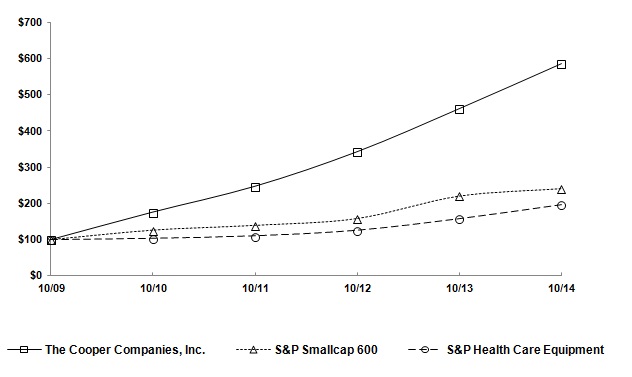
*$100 invested on 10/31/09 in stock or index, including reinvestment of dividends. Fiscal year ending October 31.
Copyright© 2014 S&P, a division of The McGraw-Hill Companies Inc. All rights reserved.
| 10/09 | 10/10 | 10/11 | 10/12 | 10/13 | 10/14 | ||||||||||||||||||
| The Cooper Companies, Inc. | $ | 100.00 | $ | 176.43 | $ | 248.02 | $ | 343.79 | $ | 463.06 | $ | 587.64 | |||||||||||
| S&P Smallcap 600 | $ | 100.00 | $ | 126.27 | $ | 139.58 | $ | 158.56 | $ | 220.53 | $ | 241.03 | |||||||||||
| S&P Health Care Equipment | $ | 100.00 | $ | 104.00 | $ | 110.86 | $ | 126.57 | $ | 158.91 | $ | 197.97 |
THE COOPER COMPANIES, INC. AND SUBSIDIARIES
Unregistered Sales of Equity Securities and Use of Proceeds
Issuer Purchases of Equity Securities
During the three-month period ended October 31, 2014, we repurchased shares of our common stock as follows:
| Period | Total Number of Shares Purchased | Average Price Paid Per Share | Total Number of Shares Purchased as Part of Publicly Announced Plans or Programs | Maximum Approximate Dollar Value of Shares that May Yet Be Purchased Under Publicly Announced Plans or Programs | ||||||||||
| 8/1/14 – 8/31/14 | — | $ | — | — | $ | 211,500,000 | ||||||||
| 9/1/14 – 9/30/14 | — | $ | — | — | $ | 211,500,000 | ||||||||
| 10/1/14 – 10/31/14 | 175,786 | $ | 146.64 | 175,786 | $ | 185,700,000 | ||||||||
| Total | 175,786 | 175,786 |
The transactions described in the table above represent the repurchase of the Company’s common stock on the New York Stock Exchange as part of the share repurchase program approved by the Company’s Board of Directors in December 2011 (2012 Share Repurchase Program). The program as amended in December 2012 and December 2013 provides authorization for a total of $500.0 million. Purchases under the 2012 Share Repurchase Program may be made from time-to-time on the open market at prevailing market prices or in privately negotiated transactions and are subject to a review of the circumstances in place at the time and will be made from time to time as permitted by securities laws and other legal requirements. This program has no expiration date and may be discontinued at any time. At October 31, 2014, the remaining repurchase authorization under the 2012 Share Repurchase Program was approximately $185.7 million.
THE COOPER COMPANIES, INC. AND SUBSIDIARIES
Equity Compensation Plan Information
| Plan Category | Number of Securities to be Issued Upon Exercise of Outstanding Options, Warrants and Rights(1) (A) | Weighted-Average Exercise Price of Outstanding Options, Warrants and Rights (B) | Number of Securities Remaining Available for Future Issuance Under Equity Compensation Plans (Excluding Securities Reflected in Column A) (C) | ||
| Equity compensation plans approved by shareholders(2) | 1,922,603 | $63.32 | 1,696,162 | ||
| Equity compensation plans not approved by shareholders | — | — | — | ||
| Total | 1,922,603 | $63.32 | 1,696,162 |
(1) The amount of total securities to be issued under the Company's equity plans shown in Column A includes 598,667 Restricted Stock Units granted pursuant to the Company's equity plans. These awards allow for the distribution of shares to the grant recipient upon the completion of time-based holding periods and do not have an associated exercise price. Accordingly, these awards are not reflected in the weighted-average exercise price disclosed in Column B. Amounts in Column A do not reflect performance share awards without a final payout.
(2) Includes information with respect to the Second Amended and Restated 2007 Long-Term Incentive Plan for Employees of The Cooper Companies, Inc. (2007 Plan), which was approved by stockholders on March 16, 2011, and provides for the issuance of up to 5,230,000 shares of common stock, and the Second Amended and Restated 2006 Long Term Incentive Plan for Non-Employee Directors of The Cooper Companies, Inc. (the Directors’ Plan), which was approved by stockholders on March 16, 2011, and provides for the issuance of up to 950,000 shares of common stock. As of October 31, 2014, up to 1,507,591 shares of common stock may be issued pursuant to the 2007 Plan and 334,212 shares of common stock may be issued pursuant to the 2006 Directors’ Plan.
Also includes information with respect to the 1996 Long Term Incentive Plan for Non-Employee Directors (1996 Directors' Plan) and the Second Amended and Restated 2001 Long Term Incentive Plan (2001 Plan) of The Cooper Companies, Inc., which were originally approved by stockholders on March 21, 1996 and March 28, 2001. The 1996 Directors' Plan and 2001 Plan have expired by their terms, but up to 80,800 shares of common stock may be issued pursuant to awards that remain outstanding under these plans.
THE COOPER COMPANIES, INC. AND SUBSIDIARIES
Item 6. Selected Financial Data.
Five Year Financial Highlights
| Years Ended October 31, (In thousands, except per share amounts) | 2014 | 2013 | 2012 | 2011 | 2010 | ||||||||||||||
| Consolidated Operations | |||||||||||||||||||
| Net sales | $ | 1,717,776 | $ | 1,587,725 | $ | 1,445,136 | $ | 1,330,835 | $ | 1,158,517 | |||||||||
| Gross profit | $ | 1,091,570 | $ | 1,026,808 | $ | 924,010 | $ | 804,804 | $ | 676,723 | |||||||||
| Income before income taxes | $ | 296,534 | $ | 312,271 | $ | 275,452 | $ | 192,764 | $ | 124,426 | |||||||||
| Net income attributable to Cooper stockholders | $ | 269,856 | $ | 296,151 | $ | 248,339 | $ | 175,430 | $ | 112,803 | |||||||||
| Diluted earnings per share attributable to Cooper stockholders | $ | 5.51 | $ | 5.96 | $ | 5.05 | $ | 3.63 | $ | 2.43 | |||||||||
| Number of shares used to compute diluted earnings per share | 48,960 | 49,685 | 49,152 | 48,309 | 46,505 | ||||||||||||||
| Dividends paid per share | $ | 0.06 | $ | 0.06 | $ | 0.06 | $ | 0.06 | $ | 0.06 | |||||||||
| Consolidated Financial Position | |||||||||||||||||||
| Current assets | $ | 791,617 | $ | 747,241 | $ | 657,860 | $ | 540,347 | $ | 491,340 | |||||||||
| Property, plant and equipment, net | 937,325 | 739,867 | 640,255 | 609,205 | 593,887 | ||||||||||||||
| Goodwill | 2,220,921 | 1,387,611 | 1,370,247 | 1,276,567 | 1,261,976 | ||||||||||||||
| Other intangible assets, net | 453,605 | 198,769 | 214,783 | 128,341 | 114,177 | ||||||||||||||
| Other assets | 54,872 | 63,773 | 58,239 | 70,058 | 63,638 | ||||||||||||||
| $ | 4,458,340 | $ | 3,137,261 | $ | 2,941,384 | $ | 2,624,518 | $ | 2,525,018 | ||||||||||
| Short-term debt | $ | 101,518 | $ | 42,987 | $ | 25,284 | $ | 52,979 | $ | 19,159 | |||||||||
| Other current liabilities | 340,664 | 278,266 | 237,268 | 214,227 | 180,361 | ||||||||||||||
| Long-term debt | 1,280,833 | 301,670 | 348,422 | 327,453 | 591,977 | ||||||||||||||
| Other liabilities | 146,885 | 90,844 | 117,252 | 92,371 | 66,745 | ||||||||||||||
| Total liabilities | 1,869,900 | 713,767 | 728,226 | 687,030 | 858,242 | ||||||||||||||
| Stockholders' equity | 2,588,440 | 2,423,494 | 2,213,158 | 1,937,488 | 1,666,776 | ||||||||||||||
| $ | 4,458,340 | $ | 3,137,261 | $ | 2,941,384 | $ | 2,624,518 | $ | 2,525,018 |
In our fiscal fourth quarter of 2014, Cooper acquired Sauflon Pharmaceuticals Limited, as discussed in Item 7. Management's Discussion and Analysis of Financial Condition and Results of Operations and Note 2 of our notes to consolidated financial statements.
THE COOPER COMPANIES, INC. AND SUBSIDIARIES
Management’s Discussion and Analysis of Financial Condition and Results of Operations
Item 7. Management's Discussion and Analysis of Financial Condition and Results of Operations.
Note numbers refer to “Notes to Consolidated Financial Statements” in Item 8. Financial Statements and Supplementary Data.
RESULTS OF OPERATIONS
We discuss below the results of our operations for fiscal 2014 compared with fiscal 2013 and the results of our operations for fiscal 2013 compared with fiscal 2012. Certain prior period amounts have been reclassified to conform to the current period's presentation. We discuss our cash flows and current financial condition under “Capital Resources and Liquidity.”
Outlook
Overall, we remain optimistic about the long-term prospects for the worldwide contact lens and women’s healthcare markets. However, events affecting the economy as a whole, including the uncertainty and instability of global markets driven by United States and European debt concerns, the Affordable Care Act, including the trend of consolidation within the healthcare industry, and the economic downturn in Japan together with foreign currency volatility, particularly the yen, euro and the pound, impact our current performance and continue to represent a risk to our performance for fiscal year 2015.
CooperVision - We compete in the worldwide contact lens market with our spherical, toric and multifocal contact lenses offered in a variety of materials including using silicone hydrogel Aquaform® technology and phosphorylcholine technology (PC) Technology™. We believe that there will be lower contact lens wearer dropout rates as technology improves and enhances the wearing experience through a combination of improved designs and materials and the growth of preferred modalities such as single-use and monthly wearing options. CooperVision is focused on greater worldwide market penetration as we introduce new products and continue to expand our presence in existing and emerging markets, including through acquisitions.
Sales of contact lenses utilizing silicone hydrogel materials, a major product material in the industry, have grown significantly. Our ability to compete successfully with a full range of silicone hydrogel products is an important factor to achieving our desired future levels of sales growth and profitability. CooperVision markets monthly and two-week silicone hydrogel spherical and toric lens products under our Biofinity® and Avaira® brands, a monthly multifocal silicone hydrogel lens under Biofinity and a single-use spherical silicone hydrogel lens under MyDayTM.
We believe that the global market for single-use contact lenses will continue to grow and that competitive silicone hydrogel single-use products are gaining market share and that they represent a risk to our business. We compete with MyDay, our single-use spherical silicone hydrogel lens, and our Proclear 1 Day products including Proclear® 1 Day multifocal. We forecast increasing demand for our existing and future single-use products. To meet this anticipated demand, in fiscal 2015 we plan to continue the implementation of capital projects to invest in increased single-use manufacturing capacity.
Consistent with this strategy, on August 6, 2014, we acquired Sauflon Pharmaceuticals Limited (Sauflon), a privately-held European manufacturer and distributor of soft contact lenses and aftercare solutions. The acquisition of Sauflon expands our contact lens product portfolio particularly with Sauflon's clariti® 1day brand of single-use sphere, toric and multifocal silicone hydrogel lenses. Clariti lenses received United States FDA clearance in August 2013. Sauflon is headquartered in the United Kingdom and has a global presence with manufacturing facilities in the United Kingdom and Hungary.
THE COOPER COMPANIES, INC. AND SUBSIDIARIES
Management’s Discussion and Analysis of Financial Condition and Results of Operations
We paid approximately $1,131.1 million for Sauflon, consisting of approximately $1,073.2 million in cash and approximately $58.0 million in the form of loan notes. We financed the acquisition with available offshore cash and credit facilities along with funds from the new $700.0 million term loan facility described below and in the notes to consolidated financial statements. We are in the process of determining the purchase price allocation for this acquisition which is described in more detail in the notes to consolidated financial statements.
The Sauflon acquisition is intended to accelerate the growth in sales of our single-use products by enabling a multi-tier, single-use strategy with a full suite of hydrogel and silicone hydrogel product offerings in the major product categories of sphere, toric and multifocal lenses. This acquisition is also intended to provide for enhanced relationships with key European retailers and opportunities for operational synergies.
CooperSurgical - Our CooperSurgical business competes in the highly fragmented medical device segment of the women's healthcare market. CooperSurgical has steadily grown its market presence and distribution system by developing products and acquiring companies and products that complement its business model. In October 2014, CooperSurgical acquired EndoSee Corporation, a developer of an office-based disposable hysteroscopy system that has FDA clearance. We paid $44.0 million for EndoSee and expect the acquisition to be neutral to earnings per share excluding acquisition costs and related amortization. We intend to continue to invest in CooperSurgical's business through acquisitions of companies and product lines. CooperSurgical product sales are categorized based on the point of healthcare delivery including products used in medical office and surgical procedures by obstetricians and gynecologists (ob/gyns) that represented 65% of CooperSurgical's net sales in fiscal 2014. CooperSurgical's remaining sales are products used in fertility clinics that now represent 35% of CooperSurgical's net sales compared to 33% in fiscal 2013.
Capital Resources - On August 4, 2014, we entered into a three-year, $700.0 million senior unsecured term loan agreement by and among the Company, the lenders party thereto and KeyBank National Association as administrative agent. This syndicated credit facility will mature and the balance is payable on August 4, 2017. There is no amortization of principal and we may prepay loan balances from time to time, in whole or in part, without premium or penalty. We utilized this facility to fund the acquisition of Sauflon Pharmaceuticals Limited, as well as to provide working capital and for general corporate purposes.
At October 31, 2014, we had $25.2 million in cash, primarily outside the United States, and $720.3 million available under our existing revolving Credit Agreement. The $700.0 million term loan entered into on August 4, 2014, and the $300.0 million term loan entered into on September 12, 2013, remain outstanding as of October 31, 2014. In our fiscal fourth quarter of 2014, we completed the acquisition of Sauflon for $1.13 billion, discussed above. Looking forward, our cash and availability under existing credit facilities will be reduced due to the use of cash outside the United States and the use of existing credit facilities to fund the acquisition of Sauflon. We believe that our cash and cash equivalents, cash flow from operating activities and borrowing capacity under existing credit facilities, including the August 4, 2014, $700.0 million term loan, will fund operations both in the next 12 months and in the longer term as well as current and long-term cash requirements for capital expenditures, acquisitions, share repurchases and cash dividends. However, depending on the size or timing of these business activities, we may seek to raise additional debt financing.
THE COOPER COMPANIES, INC. AND SUBSIDIARIES
Management’s Discussion and Analysis of Financial Condition and Results of Operations
2014 Compared with 2013
Highlights: 2014 vs. 2013
| • | Net sales up 8% to $1.72 billion from $1.59 billion in fiscal year 2013 |
| | | | -
Showing the first 8K of 74K characters. Open the full section
Item 7A. Quantitative and Qualitative Disclosure about Market Risk.
We are exposed to market risks that relate principally to changes in interest rates and foreign currency fluctuations. Our policy is to reduce, to the extent reasonable and practical, its exposure to the impact of changing interest rates and foreign currency fluctuations by entering into a limited number of interest rate swaps and foreign currency forward exchange contracts, respectively. We do not emphasize such transactions to the same degree as some other companies with international operations. We do not enter into derivative financial instrument transactions for speculative purposes.
We operate multiple foreign subsidiaries that manufacture and market our products worldwide. As a result, our earnings, cash flow and financial position are exposed to foreign currency risk from foreign currency denominated receivables and payables, sales transactions, capital expenditures and net investment in certain foreign operations. We are exposed to risks caused by changes in foreign exchange, primarily to the British pound sterling, euro, Japanese yen, Danish krone, Swedish krona, Australian dollar and Canadian dollar. Our policy is to minimize, to the extent reasonable and practical, transaction, remeasurement and specified economic exposures with derivatives instruments. Although we may enter into foreign exchange agreements with financial institutions to reduce our nonfunctional currency exposure, these hedging transactions do not eliminate that risk entirely. A hypothetical 5% increase or decrease in the foreign currency exchange rates in comparison to the United States dollar would not have a material adverse impact on our financial condition or results of operations. For additional information, see Item 1A. Risk Factors and Note 1 to the consolidated financial statements.
We are also exposed to risks associated with changes in interest rates, as the interest rate on our senior unsecured syndicated credit facilities, including the revolving Credit Agreement and term loans, may vary with the London Interbank Offered Rate (LIBOR). We have decreased this interest rate risk by hedging a portion of variable rate debt effectively converting it to fixed rate debt for varying periods through December 2014.
On August 4, 2014, we entered into a three-year, $700.0 million, senior unsecured term loan agreement that will mature on August 4, 2017. There is no amortization of the principal, and we may prepay the loan balances from time to time, in whole or in part, with premium or penalty. At October 31, 2014, $700.0 million remained outstanding on this term loan.
On September 12, 2013, we entered into a five-year, $300.0 million, senior unsecured term loan agreement that will mature on September 12, 2018, and will be subject to amortization of principal of 5% per year payable quarterly beginning October 31, 2016, with the balance payable at maturity. At October 31, 2014, $300.0 million remained outstanding on this term loan.
On May 31, 2012, we entered into an amendment to our Credit Agreement, originally entered into on January 12, 2011. The aggregate revolving commitment was increased to $1.0 billion from $750.0 million. This facility offers additional availability, lower interest rates and extends the maturity date to May 31, 2017, from January 12, 2016. In addition, we have the ability to increase the facility by up to an additional $500.0 million. KeyBank led the refinancing with certain banks that participated in the Credit Agreement retaining or increasing their participation. At October 31, 2014, we had $720.3 million available under the revolving Credit Agreement.
THE COOPER COMPANIES, INC. AND SUBSIDIARIES
| October 31, (In millions) | 2014 | 2013 | |||||
| Short-term debt | $ | 101.5 | $ | 43.0 | |||
| Long-term debt | 1,280.8 | 301.7 | |||||
| Total | $ | 1,382.3 | $ | 344.7 |
At October 31, 2014, the scheduled maturities of our fixed and variable rate long-term debt obligations, their weighted average interest rates and their estimated fair values were as follows:
| Expected Maturity Date Fiscal Year ($ in millions) | 2015 | 2016 | 2017 | 2018 | 2019 | Thereafter | Total | Fair Value | |||||||||||||||||||||||
| Long-term debt: | |||||||||||||||||||||||||||||||
| Fixed interest rate | $ | — | $ | 0.4 | $ | 0.3 | $ | 0.3 | $ | — | $ | 0.3 | $ | 1.3 | $ | 1.3 | |||||||||||||||
| Average interest rate | 3.5 | % | 3.5 | % | 3.5 | % | 3.5 | % | 3.5 | % | 3.5 | % | |||||||||||||||||||
| Variable interest rate | $ | — | $ | — | $ | 979.5 | $ | 300.0 | $ | — | $ | — | $ | 1,279.5 | $1,279.5 | ||||||||||||||||
| Average interest rate | 1.0 | % | 1.0 | % | 1.0 | % | 1.0 | % | — | — |
As the table incorporates only those exposures that existed as of October 31, 2014, it does not consider those exposures or positions which could arise after that date. As a result, our ultimate realized gain or loss with respect to interest rate fluctuations will depend on interest rates, the exposures that arise during the period and our hedging strategies at that time. As of October 31, 2014, we had one interest rate swap outstanding that is designed to fix the variable borrowing costs related to $40.0 million of the outstanding balance on our credit agreements. If interest rates were to increase or decrease by 1% or 100 basis points, annual interest expense would increase or decrease by about $12.8 million. For further information about our debt, see Item 1A. Risk Factors and Note 1 and Note 5 to the consolidated financial statements.
THE COOPER COMPANIES, INC. AND SUBSIDIARIES
Item 8. Financial Statements and Supplementary Data.
Report of Independent Registered Public Accounting Firm
The Board of Directors and Stockholders
The Cooper Companies, Inc.:
We have audited the accompanying consolidated balance sheets of The Cooper Companies, Inc. and subsidiaries (the Company) as of October 31, 2014 and 2013, and the related consolidated statements of income, comprehensive income, stockholders’ equity, and cash flows for each of the years in the three-year period ended October 31, 2014. In connection with our audits of the consolidated financial statements, we also have audited financial statement schedule II. We also have audited the Company’s internal control over financial reporting as of October 31, 2014, based on criteria established in Internal Control - Integrated Framework (1992) issued by the Committee of Sponsoring Organizations of the Treadway Commission (COSO). The Company’s management is responsible for these consolidated financial statements and financial statement schedule, for maintaining effective internal control over financial reporting, and for its assessment of the effectiveness of internal control over financial reporting, included in the accompanying Management’s Annual Report on Internal Control Over Financial Reporting appearing under item 9A. Our responsibility is to express an opinion on these consolidated financial statements, financial statement schedule and an opinion on the Company’s internal control over financial reporting based on our audits.
We conducted our audits in accordance with the standards of the Public Company Accounting Oversight Board (United States). Those standards require that we plan and perform the audits to obtain reasonable assurance about whether the financial statements are free of material misstatement and whether effective internal control over financial reporting was maintained in all material respects. Our audits of the consolidated financial statements included examining, on a test basis, evidence supporting the amounts and disclosures in the financial statements, assessing the accounting principles used and significant estimates made by management, and evaluating the overall financial statement presentation. Our audit of internal control over financial reporting included obtaining an understanding of internal control over financial reporting, assessing the risk that a material weakness exists, and testing and evaluating the design and operating effectiveness of internal control based on the assessed risk. Our audits also included performing such other procedures as we considered necessary in the circumstances. We believe that our audits provide a reasonable basis for our opinions.
A company’s internal control over financial reporting is a process designed to provide reasonable assurance regarding the reliability of financial reporting and the preparation of financial statements for external purposes in accordance with generally accepted accounting principles. A company’s internal control over financial reporting includes those policies and procedures that (1) pertain to the maintenance of records that, in reasonable detail, accurately and fairly reflect the transactions and dispositions of the assets of the company; (2) provide reasonable assurance that transactions are recorded as necessary to permit preparation of financial statements in accordance with generally accepted accounting principles, and that receipts and expenditures of the company are being made only in accordance with authorizations of management and directors of the company; and (3) provide reasonable assurance regarding prevention or timely detection of unauthorized acquisition, use, or disposition of the company’s assets that could have a material effect on the financial statements.
Because of its inherent limitations, internal control over financial reporting may not prevent or detect misstatements. Also, projections of any evaluation of effectiveness to future periods are subject to the risk that controls may become inadequate because of changes in conditions, or that the degree of compliance with the policies or procedures may deteriorate.
THE COOPER COMPANIES, INC. AND SUBSIDIARIES
The Company acquired Sauflon Pharmaceuticals Limited on August 6, 2014, and management excluded from its assessment of the effectiveness of the Company’s internal control over financial reporting as of October 31, 2014, Sauflon Pharmaceuticals Limited’s internal control over financial reporting which represented 3% and 30%, respectively, of total net sales and total assets of the related consolidated financial statement amounts of the Company as of and for the year ended October 31, 2014. Our audit of internal control over financial reporting of the Company also excluded an evaluation of the internal control over financial reporting of Sauflon Pharmaceuticals Limited.
In our opinion, the consolidated financial statements referred to above present fairly, in all material respects, the financial position of the Company and subsidiaries as of October 31, 2014 and 2013, and the results of its operations and its cash flows for each of the years in the three-year period ended October 31, 2014, in conformity with U.S. generally accepted accounting principles. Also in our opinion, the related financial statement schedule, when considered in relation to the basic consolidated financial statements taken as a whole, present fairly, in all material respects, the information set forth therein. Also in our opinion, the Company maintained, in all material respects, effective internal control over financial reporting as of October 31, 2014, based on criteria established in Internal Control - Integrated Framework (1992) issued by the Committee of Sponsoring Organizations of the Treadway Commission (COSO).
/s/ KPMG LLP
San Francisco, California
December 19, 2014
THE COOPER COMPANIES, INC. AND SUBSIDIARIES
Consolidated Statements of Income
| Years Ended October 31, (In thousands, except per share amounts) | 2014 | 2013 | 2012 | ||||||||
| Net sales | $ | 1,717,776 | $ | 1,587,725 | $ | 1,445,136 | |||||
| Cost of sales | 626,206 | 560,917 | 521,126 | ||||||||
| Gross profit | 1,091,570 | 1,026,808 | 924,010 | ||||||||
| Selling, general and administrative expense | 683,115 | 610,735 | 564,903 | ||||||||
| Research and development expense | 66,259 | 58,827 | 51,730 | ||||||||
| Amortization of intangibles | 35,710 | 30,239 | 23,979 | ||||||||
| Loss on divestiture of Aime | — | 21,062 | — | ||||||||
| Operating income | 306,486 | 305,945 | 283,398 | ||||||||
| Interest expense | 7,965 | 9,168 | 11,771 | ||||||||
| Gain on insurance proceeds | — | 14,084 | 5,000 | ||||||||
| Loss on extinguishment of debt | — | — | 1,404 | ||||||||
| Other expense (income), net | 1,987 | (1,410 | ) | (229 | ) | ||||||
| Income before income taxes | 296,534 | 312,271 | 275,452 | ||||||||
| Provision for income taxes | 24,705 | 15,365 | 26,808 | ||||||||
| Net income | 271,829 | 296,906 | 248,644 | ||||||||
| Income attributable to noncontrolling interests | 1,973 | 755 | 305 | ||||||||
| Net income attributable to Cooper stockholders | $ | 269,856 | $ | 296,151 | $ | 248,339 | |||||
| Earnings per share attributable to Cooper stockholders - basic | $ | 5.61 | $ | 6.09 | $ | 5.18 | |||||
| Earnings per share attributable to Cooper stockholders - diluted | $ | 5.51 | $ | 5.96 | $ | 5.05 | |||||
| Number of shares used to compute earnings per share attributable to Cooper stockholders: | |||||||||||
| Basic | 48,061 | 48,615 | 47,913 | ||||||||
| D |
Showing the first 8K of 148K characters. Open the full section
Item 9. Changes In and Disagreements With Accountants on Accounting and Financial Disclosure.
None.
Item 9A. Controls and Procedures.
Evaluation of Disclosure Controls and Procedures
The Company has established and currently maintains disclosure controls and procedures designed to ensure that information required to be disclosed in its reports filed under the Securities Exchange Act of 1934 is recorded, processed, summarized and reported within the time periods specified by the Securities and Exchange Commission and that such information is accumulated and communicated to management, including the Chief Executive Officer and Chief Financial Officer, to allow timely decisions regarding required disclosures. In designing and evaluating the disclosure controls and procedures, management recognizes that controls and procedures, no matter how well designed and operated, can provide only reasonable assurance of achieving desired control objectives. In reaching a reasonable level of assurance, management necessarily was required to apply its judgment in evaluating the cost-benefit relationship of possible controls and procedures.
In conjunction with the close of each fiscal quarter, the Company conducts a review and evaluation, under the supervision and with the participation of the Company's management, including the Chief Executive Officer and Chief Financial Officer, of the effectiveness of the design and operation of the Company's disclosure controls and procedures. The Company's Chief Executive Officer and Chief Financial Officer, based upon their evaluation as of October 31, 2014, the end of the fiscal period covered in this report, concluded that the Company's disclosure controls and procedures were effective at the reasonable assurance level.
Management's Annual Report on Internal Control Over Financial Reporting
Management is responsible for establishing and maintaining adequate internal control over financial reporting, as such term is defined in Rule 13a-15(f) under the Securities Exchange Act of 1934. Internal control over financial reporting is a process designed to provide reasonable assurance regarding the reliability of financial reporting and the preparation of financial statements for external purposes in accordance with generally accepted accounting principles. Because of its inherent limitations, internal control over financial reporting may not prevent or detect all misstatements, errors or fraud.
Management assessed the effectiveness of the Company's internal control over financial reporting as of October 31, 2014, based on the criteria set forth by the Committee of Sponsoring Organizations of the Treadway Commission in Internal Control - Integrated Framework (1992). Based on this assessment, management, under the supervision and with the participation of the Company's Chief Executive Officer and Chief Financial Officer, concluded that the Company's internal control over financial reporting was effective as of October 31, 2014.
Management has excluded Sauflon Pharmaceuticals Limited from its assessment of internal control over financial reporting as of October 31, 2014, as permitted by the guidance issued by the Office of the Chief Accountant of the Securities and Exchange Commission. Sauflon was acquired by the Company in a purchase business combination during the fiscal fourth quarter of 2014 and represented 3% and 30%, respectively, of total net sales and total assets of the related consolidated financial statement amounts as of and for the year ended October 31, 2014.
THE COOPER COMPANIES, INC. AND SUBSIDIARIES
The Company's independent registered public accounting firm, KPMG LLP, has audited the effectiveness of the Company's internal control over financial reporting as of October 31, 2014, as stated in their report in Part II, Item 8 of this Annual Report on Form 10-K.
Changes in Internal Control Over Financial Reporting
There has been no change in the Company's internal control over financial reporting during the Company's fiscal quarter ended October 31, 2014, that has materially affected, or is reasonably likely to materially affect, the Company's internal control over financial reporting.
Item 9B. Other Information.
None.
THE COOPER COMPANIES, INC. AND SUBSIDIARIES
PART III
Item 10. Directors, Executive Officers and Corporate Governance.
The information required by this item is incorporated by reference to the subheadings, “Proposal 1 - Election of Directors,” “Executive Officers of the Company,” “Ownership of the Company - Section 16(a) Beneficial Ownership Reporting Compliance,” “Corporate Governance - The Board of Directors,” “Corporate Governance - Ethics and Business Conduct Policy,” “Corporate Governance - Board Committees - The Audit Committee” and “Report of the Audit Committee” of the Company's Proxy Statement for the Annual Meeting of Stockholders scheduled to be held in March 2015 (the “2015 Proxy Statement”).
Item 11. Executive Compensation.
The information required by this item is incorporated by reference to the subheadings “Report of the Organization and Compensation Committee,” “Compensation Discussion and Analysis,” “Executive Compensation Tables” and “Director Compensation” of the 2015 Proxy Statement.
Item 12. Security Ownership of Certain Beneficial Owners and Management and Related Stockholder Matters.
See Item 5. Market for Registrant's Common Equity and Related Stockholder Matters - Equity Compensation Plan Information. Additional information required by this item is incorporated by reference to the subheadings “Securities Held by Insiders” and “Principal Securityholders” of the “Ownership of the Company” section of the 2015 Proxy Statement.
Item 13. Certain Relationships and Related Transactions, and Director Independence.
The information required by this item is incorporated by reference to the subheadings “Corporate Governance - Related Party Transactions,” “Proposal 1 - Election of Directors” and “Corporate Governance - The Board of Directors” of the 2015 Proxy Statement.
Item 14. Principal Accounting Fees and Services.
The information required by this item is incorporated by reference to “Report of the Audit Committee” section of the 2015 Proxy Statement.
THE COOPER COMPANIES, INC. AND SUBSIDIARIES
PART IV
Item 15. Exhibits and Financial Statement Schedules.
(a) 1. Financial Statements
The following financial statements are filed as a part of this report:
Report of KPMG LLP, Independent Registered Public Accounting Firm
Consolidated Financial Statements:
Statements of Income for the years ended October 31, 2014, 2013 and 2012
Statements of Comprehensive Income for the years ended October 31, 2014, 2013 and 2012
Balance Sheets as of October 31, 2014 and 2013
Statements of Stockholders' Equity for the years ended October 31, 2014, 2013 and 2012
Statements of Cash Flows for the years ended October 31, 2014, 2013 and 2012
Notes to Consolidated Financial Statements
- Financial Statement Schedules of the Company.
Schedule Number Description
Schedule II Valuation and Qualifying Accounts
(b) Exhibits.
The exhibits listed on the accompanying Exhibit Index are filed as part of this report.
All other schedules which are included in the applicable accounting regulations of the Securities and Exchange Commission are not required here because they are not applicable.
Schedule II
THE COOPER COMPANIES, INC. AND SUBSIDIARIES
VALUATION AND QUALIFYING ACCOUNTS
Three Years Ended October 31, 2014
| (In thousands) | Balance Beginning of Year | Additions Charged to Costs and Expenses | (Deductions) Recoveries/ Other (1) | Balance at End of Year | |||||||||||
| Allowance for doubtful accounts: | |||||||||||||||
| Year Ended October 31, 2014 | $ | 5,261 | $ | 1,654 | $ | (890 | ) | $ | 6,025 | ||||||
| Year Ended October 31, 2013 | $ | 4,374 | $ | 1,524 | $ | (637 | ) | $ | 5,261 | ||||||
| Year Ended October 31, 2012 | $ | 4,826 | $ | (257 | ) | $ | (195 | ) | $ | 4,374 |
(1) Consists of additions representing allowances and recoveries, less deductions representing receivables written off as uncollectible.
| (In thousands) | Balance Beginning of Year | Additions (2) | Reductions/ Charges (3) | Balance at End of Year | |||||||||||
| Income tax valuation allowance: | |||||||||||||||
| Year Ended October 31, 2014 | $ | 968 | $ | 13,538 | $ | — | $ | 14,506 | |||||||
| Year Ended October 31, 2013 | $ | 1,107 | $ | — | $ | (139 | ) | $ | 968 | ||||||
| Year Ended October 31, 2012 | $ | — | $ | 1,107 | $ | — | $ | 1,107 |
(2) During the fiscal fourth quarter of 2014, we recorded in purchase accounting deferred tax assets in connection with its acquisition of Sauflon Pharmaceuticals, Ltd., and subsidiaries. A valuation allowance of $13.5 million was set up against Sauflon Hungary's development tax credits.
(3) During the fiscal third quarter of 2013, we revalued deferred tax assets and liabilities residing in Denmark, along with the related valuation allowance to reflect the newly enacted tax rate change that incrementally decreased the corporate tax rate.
THE COOPER COMPANIES, INC. AND SUBSIDIARIES
SIGNATURES
Pursuant to the requirements of Section 13 or 15(d) of the Securities Exchange Act of 1934, the registrant has duly caused this report to be signed on its behalf by the undersigned, thereunto duly authorized, on December 19, 2014.
THE COOPER COMPANIES, INC.
By: /s/ ROBERT S. WEISS
Robert S. Weiss
Chief Executive Officer and Director
Pursuant to the requirements of the Securities Exchange Act of 1934, this report has been signed below by the following persons on behalf of the registrant and in the capacities indicated on the dates set forth opposite their respective names.
| Signature | Capacity | Date | ||
| /s/ ROBERT S. WEISS | President, Chief Executive Officer and Director | December 19, 2014 | ||
| (Robert S. Weiss) | ||||
| /s/ A. THOMAS BENDER | Chairman of the Board | December 19, 2014 | ||
| (A. Thomas Bender) | ||||
| /s/ ALLAN E. RUBENSTEIN, M.D. | Vice Chairman of the Board and Lead Director | December 19, 2014 | ||
| (Allan E. Rubenstein) | ||||
| /s/ GREG W. MATZ | Vice President, Chief Financial Officer and Chief Risk Officer | December 19, 2014 | ||
| (Greg W. Matz) | (Principal Financial Officer) | |||
| /s/ TINA MALONEY | Vice President and Corporate Controller | December 19, 2014 | ||
| (Tina Maloney) | (Principal Accounting Officer) | |||
| /s/ MICHAEL H. KALKSTEIN | Director | December 19, 2014 | ||
| (Michael H. Kalkstein) | ||||
| /s/ JODY S. LINDELL | Director | December 19, 2014 | ||
| (Jody S. Lindell) | ||||
| /s/ GARY S. PETERSMEYER | Director | December 19, 2014 | ||
| (Gary S. Petersmeyer) | ||||
| /s/ STEVEN ROSENBERG | Director | December 19, 2014 | ||
| (Steven Rosenberg) | ||||
| /s/ STANLEY ZINBERG, M.D. | Director | December 19, 2014 | ||
| (Stanley Zinberg) |
THE COOPER COMPANIES, INC. AND SUBSIDIARIES
EXHIBIT INDEX
Location of
Exhibit in
Exhibit Sequential
Number Description of Document Number System
| 2.1 | - Sale and Purchase Agreement, dated as of June 30, 2014, among The Cooper Companies, Inc., CooperVision (UK) Holdings Limited, and the sellers party thereto, incorporated by reference to Exhibit 2.1 of the Company’s Current Report on Form 8-K filed July 1, 2014 |
| 2.2 | - Sale and Purchase Agreement, dated as of July 1 2014, among The Cooper Companies, Inc., CooperVision (UK) Holdings Limited, and the sellers party thereto, incorporated by reference to Exhibit 2.2 of the Company’s Current Report on Form 8-K filed July 1, 2014 |
| 3.1 | - Second Restated Certificate of Incorporation filed with the Delaware Secretary of State, incorporated by reference to Exhibit 3.1 of the Company's Current Report on Form 8-K dated January 13, 2006 |
| 3.2 | - Amended and Restated By-Laws, The Cooper Companies, Inc., dated December 14, 2010, incorporated by reference to Exhibit 3.1 to the Company's Current Report on Form 8-K dated December 15, 2010 |
| 4.1 | - Amended and Restated Rights Agreement, dated as of October 29, 2007, between the Company and American Stock Transfer & Trust Company, as Rights Agent, incorporated by reference to Exhibit 4.1 to the Company's Current Report on Form 8-K dated October 30, 2007 |
| 10.1 | - Change in Control Agreement entered into as of August 21, 1989, by and between Robert S. Weiss and the Company, incorporated by reference to Exhibit 10.28 to Amendment No. 1 to the Company's Annual Report on Form 10‑K for the fiscal year ended October 31, 1992 |
| 10.2 | - Change in Control Agreement entered into as of January 3, 2007, and amended September 9, 2008, by and between Albert G. White III and the Company, incorporated by reference to Exhibit 10.2 to the Company's Annual Report on Form 10-K for the fiscal year ended October 31, 2013 |
| 10.3 | - The Cooper Companies, Inc. Change in Control Severance Plan, dated May 21, 2007, incorporated by reference to Exhibit 10.1 to the Company's Quarterly Report on Form 10‑Q for the fiscal quarter ended July 31, 2007 |
| 10.4 | - Change in Control Agreement dated as of June 8, 2007, by and between The Cooper Companies, Inc. and Daniel G. McBride, Esq. |
| 10.5 | - Change in Control Agreement dated as of June 8, 2007, by and between The Cooper Companies, Inc. and Carol R. Kaufman, incorporated by reference to Exhibit 10.2 to the Company's Annual Report on Form 10-K for the fiscal year ended October 31, 2009 |
| 10.6 | - Change in Control Agreement dated as of June 1, 2010, by and between The Cooper Companies, Inc. and Gregory W. Matz , incorporated by reference to Exhibit 10.7 to the Company's Annual Report on Form 10-K for the fiscal year ended October 31, 2011 |
| 10.7 | - 1996 Long-term Incentive Plan for Non-Employee Directors of The Cooper Companies, Inc., incorporated by reference to Appendix A to the Company's Proxy Statement for its 1996 Annual Meeting of Stockholders |
THE COOPER COMPANIES, INC. AND SUBSIDIARIES
Location of
Exhibit in
Exhibit Sequential
Number Description of Document Number System
| 10.8 | - Amendment No. 1 to 1996 Long-term Incentive Plan for Non‑Employee Directors of The Cooper Companies, Inc., dated October 10, 1996, incorporated by reference to Exhibit 10.14 to the Company's Annual Report on Form 10-K for the fiscal year ended October 31, 1996 |
| 10.9 | - Amendment No. 2 to 1996 Long-term Incentive Plan for Non‑Employee Directors of The Cooper Companies, Inc., dated October 29, 1997, incorporated by reference to Exhibit 10.15 to the Company's Annual Report on Form 10-K for the fiscal year ended October 31, 1997 |
| 10.10 | - Amendment No. 3 to 1996 Long-term Incentive Plan for Non‑Employee Directors of The Cooper Companies, Inc., dated October 29, 1999, incorporated by reference to Exhibit 10.15 to the Company's Annual Report on Form 10-K for the fiscal year ended October 31, 2001 |
| 10.11 | - Amendment No. 4 to 1996 Long-term Incentive Plan for Non‑Employee Directors of The Cooper Companies, Inc., dated October 24, 2000, incorporated by reference to Exhibit 10.16 to the Company's Annual Report on Form 10-K for the fiscal year ended October 31, 2001 |
| 10.12 | - Amendment No. 5 to the 1996 Long-term Incentive Plan for Non-employee Directors of The Cooper Companies, Inc., incorporated by reference to Exhibit 10.17 to the Company's Annual Report on Form 10-K for the fiscal year ended October 31, 2001 |
| 10.13 | - Amendment No. 6 to the 1996 Long-term Incentive Plan for Non-employee Directors of The Cooper Companies, Inc., incorporated by reference to Exhibit 4.15 to the Company's Registration Statement on Form S-8 dated November 21, 2002 |
| 10.14 | - Amendment No. 7 to the 1996 Long-term Incentive Plan for Non-employee Directors of The Cooper Companies, Inc. dated November 4, 2002, incorporated by reference to Exhibit 10.16 to the Company's Annual Report on Form 10-K for the fiscal year ended October 31, 2002 |
| 10.15 | - Amendment No. 8 to 1996 Long-term Incentive Plan for Non‑Employee Directors of The Cooper Companies, Inc. dated October 29, 2003, incorporated by reference to Exhibit 10.16 to the Company's Annual Report on Form 10-K for the fiscal year ended October 31, 2003 |
| 10.16 | - Amendment No. 9 to 1996 Long-term Incentive Plan for Non‑Employee Directors of The Cooper Companies, Inc. dated November 9, 2005, incorporated by reference to Exhibit 10.17 to the Company's Annual Report on Form 10-K for the fiscal year ended October 31, 2006 |
| 10.17 | - Form of Non-Qualified Stock Option Agreement Pursuant to The Cooper Companies, Inc. 1996 Long Term Incentive Plan for Non-Employee Directors, incorporated by reference to the Company's Current Report on Form 8-K dated December 13, 2004 |
| 10.18 | - Form of Restricted Stock Agreement Pursuant to The Cooper Companies, Inc. 1996 Long Term Incentive Plan for Non-Employee Directors, incorporated by reference to the Company's Current Report on Form 8-K dated December 13, 2004 |
| 10.19 | - The Second Amended and Restated 2006 Long Term Incentive Plan for Non-Employee Directors of The Cooper Companies, Inc., incorporated by reference to the Company's Proxy Statement filed February 2, 2011 |
| 10.20 | - Amendment No. 1 to the Second Amended and Restated 2006 Long-term Incentive Plan for Non-Employee Directors of The Cooper Companies, Inc., incorporated by reference to Exhibit 10.21 to the Company's Annual Report on Form 10-K for the fiscal year ended October 31, 2011 |
THE COOPER COMPANIES, INC. AND SUBSIDIARIES
Location of
Exhibit in
Exhibit Sequential
Number Description of Document Number System
| 10.21 | - Amendment No. 2 to the Second Amended and Restated 2006 Long-term Incentive Plan for Non-Employee Directors of The Cooper Companies, Inc., incorporated by reference to Exhibit 10.22 to the Company's Annual Report on Form 10-K for the fiscal year ended October 31, 2012 |
| 10.22 - | Amendment No. 3 to the Second Amended and Restated 2006 Long-term Incentive Plan for Non-Employee Directors of The Cooper Companies, Inc., incorporated by reference to Exhibit 10.23 to the Company's Annual Report on Form 10-K for the fiscal year ended October 31, 2013 |
| 10.23 | - Form of Non-Qualified Stock Option Agreement Pursuant to The Cooper Companies, Inc. 2006 Long Term Incentive Plan for Non-Employee Directors, incorporated by reference to Exhibit 10.25 of the Company's Annual Report on Form 10-K for the fiscal year ended October 31, 2007 |
| 10.24 | - Form of Restricted Stock Agreement Pursuant to The Cooper Companies, Inc. 2006 Long Term Incentive Plan for Non-Employee Directors, incorporated by reference to Exhibit 10.26 of the Company's Annual Report on Form 10-K for the fiscal year ended October 31, 2007 |
| 10.25 | - Second Amended and Restated 2001 Long-Term Incentive Plan, incorporated by reference to Appendix 10.2 to the Company's Quarterly Report on Form 10‑Q for the fiscal quarter ended April 30, 2006 |
| 10.26 | - Form of Incentive Stock Option Agreement Pursuant to The Cooper Companies, Inc. 2001 Long Term Incentive Plan, incorporated by reference to the Company's Current Report on Form 8-K dated December 13, 2004 |
| 10.27 | - The Second Amended and Restated 2007 Long-Term Incentive Plan of The Cooper Companies, Inc., incorporated by reference to the Company's Proxy Statement filed February 2, 2011 |
| 10.28 | - Form of Non-Qualified Stock Option Agreement Pursuant to the 2007 Long-Term Incentive Plan of The Cooper Companies, Inc., incorporated by reference to Exhibit 10.32 of the Company's Annual Report on Form 10-K for the fiscal year ended October 31, 2007 |
| 10.29 | - Form of UK Tax Approved Stock Option Agreement Pursuant to the 2007 Long-Term Incentive Plan of The Cooper Companies, Inc., incorporated by reference to Exhibit 10.33 of the Company's Annual Report on Form 10-K for the fiscal year ended October 31, 2007 |
| 10.30 | - Form of Deferred Stock Agreement Pursuant to the 2007 Long-Term Incentive Plan of The Cooper Companies, Inc., incorporated by reference to Exhibit 10.34 of the Company's Annual Report on Form 10-K for the fiscal year ended October 31, 2007 |
| 10.31(a)- | License Agreement dated as of November 19, 2007, by and among CIBA Vision AG, CIBA Vision Corporate and CooperVision, Inc., incorporated by reference to Exhibit 10.41 to the Company's Annual Report on Form 10-K for the fiscal year ended October 31, 2008 |
| 10.32(a)- | Amendment No. 1 to the License Agreement dated as of November 19, 2007, by and among CIBA Vision AG, CIBA Vision Corporate and CooperVision, Inc., incorporated by reference to Exhibit 99.1 of the Company’s Current Report on Form 8-K filed on December 21, 2012 |
| 10.33 | - Lease Contract dated as of November 6, 2003, by and between The Puerto Rico Industrial Development Company and Ocular Sciences Puerto Rico, Inc., incorporated by reference to Exhibit 10.1 to the Company's Current Report on Form 8-K dated January 11, 2005 |
THE COOPER COMPANIES, INC. AND SUBSIDIARIES
Location of
Exhibit in
Exhibit Sequential
Number Description of Document Number System
| 10.34 | - First Supplement and Amendment to Lease Contract dated as of December 30, 2003, by and between The Puerto Rico Industrial Development Company and Ocular Sciences Puerto Rico, Inc., incorporated by reference to Exhibit 10.2 to the Company's Current Report on Form 8-K dated January 11, 2005 |
| 10.35 | - Assignment of Lease Agreement dated as of June 29, 2004, by and among Ocular Sciences Puerto Rico, Inc., Ocular Sciences Cayman Islands Corporation and The Puerto Rico Industrial Development Company, incorporated by reference to Exhibit 10.3 to the Company's Current Report on Form 8-K dated January 11, 2005 |
| 10.36 | - Credit Agreement Amendment, dated as of June 30, 2014, among The Cooper Companies, Inc., CooperVision International Holding Company, LP, the lenders party thereto, and Keybank National Association, as administrative agent, incorporated by reference to Exhibit 10.1 of the Company’s Current Report on Form 8-K filed July 1, 2014 |
| 10.37 | - Term Loan Agreement, dated as of June 30, 2014, among The Cooper Companies, Inc., the lenders party thereto, and Keybank National Association, as administrative agent, incorporated by reference to Exhibit 10.2 of the Company’s Current Report on Form 8‑K filed July 1, 2014 |
| 10.38 | - Term Loan Agreement, dated as of August 4, 2014, among The Cooper Companies, Inc., the lenders party therto, and Keybank National Association, as administrative agent, incorporated by reference to Exhibit 10.1 of the Company’s Current Report on Form 8‑K filed August 6, 2014 |
| 10.39 | - Term Loan Amendment No. 2, dated as of August 4, 2014, among The Cooper Companies, Inc. the lenders party thereto, and Keybank National Association, as administrative agent, incorporated by reference to Exhibit 10.2 of the Company’s Current Report on Form 8‑K filed August 6, 2014 |
| 10.40 | - Credit Agreement, dated as of January 12, 2011, among The Cooper Companies, Inc., CooperVision International Holding Company LP, the lenders from time to time party thereto, KeyBank National Association, as a bookrunner, a lead arranger, and sole administrative agent, swing line lender and LC issuer, J.P. Morgan Securities LLC, as a lead arranger, bookrunner and syndication agent, Citigroup Global Markets Inc., as a lead arranger, bookrunner and syndication agent, Bank of America, N.A., as a lead arranger and documentation agent, and Wells Fargo Bank, National Association, as lead arranger and documentation agent, incorporated by reference to Exhibit 10.2 to the Company's Quarterly Report on Form 10-Q filed March 4, 2011 |
| 10.41 - | Amendment No. 1 to Credit Agreement, dated as of May 31, 2012, among The Cooper Companies, Inc., CooperVision International Holding Company, LP, the lenders party thereto and KeyBank National Association, as administrative agent, incorporated by reference to Exhibit 10.1 to the Company's Current Report on Form 8-K dated May 31, 2012 |
| 10.42 - | Amendment No. 2 to Credit Agreement, dated as of September 12, 2013, among The Cooper Companies, Inc., CooperVision International Holding Company, LP, the lenders party thereto and KeyBank National Association, as administrative agent, incorporated by reference to Exhibit 10.2 to the Company's Current Report on Form 8-K dated September 17, 2013 |
| 10.43 | - The Cooper Companies, Inc. 2013 Incentive Payment Plan, incorporated by reference to Exhibit 10.1 of the Company's Current Report on Form 8-K filed January 4, 2013 |
THE COOPER COMPANIES, INC. AND SUBSIDIARIES
Location of
Exhibit in
Exhibit Sequential
Number Description of Document Number System
| 10.44 - | The Cooper Companies, Inc. 2014 Incentive Payment Plan, incorporated by reference to Exhibit 10.1 of the Company's Current Report on Form 8-K filed December 16, 2013 |
| 10.45 | - Form of Long Term Performance Share Award Agreement Pursuant to the 2007 Long-Term Incentive Plan of The Cooper Companies, Inc., incorporated by reference to Exhibit 10.1 of the Company's Current Report on Form 8-K dated February 13, 2009 |
| 10.46 - | Term loan agreement, dated as of September 12, 2013, among The Cooper Companies, Inc., the lenders party thereto, and KeyBank National Association, as Administrative Agent, incorporated by reference to Exhibit 10.1 to the Company's Current Report on Form 8-K dated September 17, 2013 |
| 11(b) | - Calculation of earnings per share |
| 21 | - Subsidiaries |
| 23 | - Consent and Report on Schedule of Independent Registered Public Accounting Firm |
| 31.1 | - Certification of the Chief Executive Officer, pursuant to Rule 13a-14(a) of the Securities Exchange Act of 1934 |
| 31.2 | - Certification of the Chief Financial Officer pursuant to Rule 13a-14(a) of the Securities Exchange Act of 1934 |
| 32.1 | - Certification of the Chief Executive Officer, pursuant to 18 U.S.C. Section 1350 |
| 32.2 | - Certification of the Chief Financial Officer, pursuant to 18 U.S.C. Section 1350 |
| 101 | The following materials from the Company's Annual Report on Form 10-K for the year ended October 31, 2014, formatted in Extensible Business Reporting Language (XBRL); (i) Consolidated Statements of Income for the years ended October 31, 2014, 2013 and 2012, (ii) Consolidated Statements of Comprehensive Income for the years ended October 31, 2014, 2013 and 2012, (iii) Consolidated Balance Sheets at October 31, 2014 and 2013, (iv) Consolidated Statements of Stockholders' Equity for the years ended October 31, 2014, 2013 and 2012, (v) Consolidated Statements of Cash Flows for the years ended October 31, 2014, 2013 and 2012, (vi) related notes to consolidated financial statements and (vii) Schedule II Valuation and Qualifying Accounts. |
| (a) | The agreement received confidential treatment from the Securities and Exchange Commission with respect to certain portions of this exhibit. Omitted portions have been filed separately with the Commission. |
| (b) | The information required in this exhibit is provided in Note 7, Earnings Per Share, in this report. |
THE COOPER COMPANIES, INC. AND SUBSIDIARIES
CORPORATE INFORMATION
| BOARD OF DIRECTORS A. Thomas Bender Chairman of the Board Allan E. Rubenstein, M.D. Vice Chairman and Lead Director, Chairman of the Board, CalAsia Pharmaceuticals, Inc. Michael H. Kalkstein Of Counsel, Palo Alto Office, Dechert LLP Jody S. Lindell President and Chief Executive Officer, S.G. Management, Inc. Gary S. Petersmeyer Director Steven Rosenberg Director Robert S. Weiss President, Chief Executive Officer and Director Stanley Zinberg, M.D. Director COMMITTEES OF THE BOARD Audit Committee Steven Rosenberg (Chairman) Michael H. Kalkstein Jody S. Lindell Corporate Governance and Nominating Committee Allan E. Rubenstein, M.D. (Chairman) Steven Rosenberg Stanley Zinberg, M.D. Organization and Compensation Committee Michael H. Kalkstein (Chairman) Jody S. Lindell Donald Press Gary S. Petersmeyer Allan E. Rubenstein, M.D. Science and Technology Committee Stanley Zinberg, M.D. (Chairman) A. Thomas Bender Gary S. Petersmeyer Allan E. Rubenstein, M.D. Robert S. Weiss | EXECUTIVE OFFICERS Robert S. Weiss President and Chief Executive Officer Randal L. Golden Vice President and General Counsel Carol R. Kaufman Executive Vice President, Secretary, Chief Administrative Officer and Chief Governance Officer Tina Maloney Vice President and Corporate Controller Greg W. Matz Vice President, Chief Financial Officer and Chief Risk Officer Daniel G. McBride, Esq. Executive Vice President and Chief Operating Officer; President of CooperVision Paul Remmell President and Chief Executive Officer, CooperSurgical, Inc. Albert G. White III Vice President and Chief Strategy Officer PRINCIPAL SUBSIDIARIES CooperVision, Inc. 6150 Stoneridge Mall Road Suite 370 Pleasanton, CA 94588 925-621-2450 www.coopervision.com CooperSurgical, Inc. 75 Corporate Drive Trumbull, CT 06611 203-601-5200 www.coopersurgical.com CORPORATE OFFICES The Cooper Companies, Inc. 6140 Stoneridge Mall Road Suite 590 Pleasanton, CA 94588 925-460-3600 www.coopercos.com | INVESTOR INFORMATION Recent news releases, the annual report on Securities and Exchange Commission Form 10-K, information about the Company's corporate governance program, recent investor presentations, replays of quarterly conference calls and historical stock quotes are available on our Web site at www.coopercos.com. INVESTOR RELATIONS CONTACT Kim Duncan Vice President of Investor Relations 6140 Stoneridge Mall Road Suite 590 Pleasanton, CA 94588 Voice: 925-460-3663 Fax: 925-460-3648 E-mail: ir@cooperco.com ANNUAL MEETING The Cooper Companies will hold its Annual Stockholders' Meeting in March 2015. TRANSFER AGENT American Stock Transfer & Trust Company 6201 15th Avenue Brooklyn, NY 11219 800-937-5449 TRADEMARKS The Cooper Companies, Inc., its subsidiaries or affiliates own, license or distribute the registered trademarks, common law trademarks and trade names referenced in this report. INDEPENDENT AUDITORS KPMG LLP STOCK EXCHANGE LISTING The New York Stock Exchange Ticker Symbol “COO” |