 filings.tools
ConocoPhillips 10-K 2021-12-31
Filed 2022-02-17. 19 sections, 575K characters. Original on sec.gov · Markdown · JSON
Cover and table of contents
2021
UNITED STATES
SECURITIES AND EXCHANGE COMMISSION
Washington, D.C.
20549
Form
10-K
(Mark One)
[X]
ANNUAL REPORT PURSUANT TO
SECTION 13 OR 15(d) OF THE SECURITIES EXCHANGE ACT OF 1934
For the fiscal year ended
December 31, 2021
OR
[ ]
TRANSITION REPORT PURSUANT TO SECTION
13 OR 15(d) OF THE SECURITIES EXCHANGE ACT OF 1934
For the transition period from
to
Commission file number:
001-32395
ConocoPhillips
(Exact name of registrant as specified in its
charter)
Delaware
01-0562944
(State or other jurisdiction of incorporation
or organization)
(I.R.S. Employer identification No.)
925 N. Eldridge Parkway
,
Houston
,
TX
77079
(Address of principal executive offices) (Zip
Code)
Registrant's telephone number, including area code:
-
293-1000
Securities registered pursuant to Section 12(b) of the Act:
Title of each class
Trading symbols
Name of each exchange on which registered
Common Stock, $.01 Par Value
COP
New York Stock Exchange
7% Debentures due 2029
CUSIP—718507BK1
New York Stock Exchange
Securities registered pursuant to Section 12(g) of the Act: None
Indicate by check mark if the registrant is a well-known seasoned issuer,
as defined in Rule 405 of the Securities Act.
[x]
Yes
[ ] No
Indicate by check mark if the registrant is not required to file reports pursuant to Section 13 or Section 15(d) of the Act.
[ ] Yes
[x]
No
Indicate by check mark whether the registrant (1) has filed all reports required to be filed by Section 13 or 15(d) of the Securities
Exchange Act of 1934 during the preceding 12 months (or for such shorter period that the registrant was required to file such reports),
and (2) has been subject to such filing requirements for the past 90 days.
[x]
Yes
[ ] No
Indicate by check mark whether the registrant has submitted electronically every Interactive Data
File required to be submitted pursuant
to Rule 405 of Regulation S-T (§ 232.405 of this chapter) during the preceding 12 months (or for such shorter period that the registrant
was required to submit such files).
[x]
Yes
[ ] No
Indicate by check mark whether the registrant is a large accelerated filer,
an accelerated filer, a non-accelerated
filer, a smaller reporting
company, or an emerging growth company.
See the definitions of “large accelerated filer,”
“accelerated filer,”
“smaller reporting
company” and “emerging growth company” in Rule 12b-2 of the Exchange Act.
Large accelerated filer
[x]
Accelerated filer [
]
Non-accelerated filer [
]
Smaller reporting company
[ ]
Emerging growth
company
[ ]
If an emerging growth company, indicate
by check mark if the registrant has elected not to use the extended transition period for
complying with any new or revised financial accounting standards provided pursuant to Section 13(a) of the Exchange Act. [
]
Indicate by check mark whether the registrant has filed a report on and attestation to
its management’s assessment of the
effectiveness of its internal control over financial reporting under Section 404(b) of the Sarbanes-Oxley Act (15 U.S.C. 7262(b)) by the
registered public accounting firm that prepared or issued its audit report.
[ x ]
Indicate by check mark whether the registrant is a shell company (as defined in Rule 12b-2 of the Act). [
] Yes
[x]
No
The aggregate market value of common stock held by non-affiliates of the registrant
on June 30, 2021, the last business day of the
registrant’s most recently completed second fiscal quarter,
based on the closing price on that date of $60.90, was $
81.5
billion.
The registrant had
1,299,526,916
shares of common stock outstanding at January 31, 2022.
Documents incorporated by reference:
Portions of the Proxy Statement for
the Annual Meeting of Stockholders to be held on May 10, 2022 (Part III)
Table of Contents
Page
Commonly Used Abbreviations
Item
Part I
1 and 2.
Segment and Geographic Information
Europe, Middle East and North Africa
1A.
1B.
Information About our Executive Officers
Part II
Market for Registrant’s Common Equity, Related Stockholder Matters and
Issuer Purchases of Equity Securities
[Reserved]
Management’s Discussion and Analysis of Financial Condition and
7A.
Quantitative and Qualitative Disclosures About Market Risk
Financial Statements and Supplementary Data
Changes in and Disagreements with Accountants on Accounting and
9A.
9B.
9C.
Disclosure Regarding Foreign Jurisdictions that Prevent Inspections
Part III
Directors, Executive Officers and Corporate Governance
Security Ownership of Certain Beneficial Owners and Management and
Certain Relationships and Related Transactions, and Director Independence
Principal Accounting Fees and Services
Part IV
Exhibits, Financial Statement Schedules
Commonly Used Abbreviations
ConocoPhillips
2021 10-K
Commonly Used Abbreviations
The following industry-specific, accounting
and other terms, and abbreviations may
be commonly used in this
report.
Currencies
Accounting
$ or USD
U.S. dollar
ARO
asset retirement obligation
CAD
Canadian dollar
ASC
accounting standards codification
EUR
Euro
ASU
accounting standards update
GBP
British pound
DD&A
depreciation, depletion and
amortization
Units of Measurement
FASB
Financial Accounting Standards
BBL
barrel
Board
BCF
billion cubic feet
FIFO
first-in, first-out
BOE
barrels of oil equivalent
G&A
general and administrative
MBD
thousands of barrels per day
GAAP
generally accepted accounting
MCF
thousand cubic feet
principles
MBOD
thousand barrels of oil per day
LIFO
last-in, first-out
MM
million
NPNS
normal purchase normal sale
MMBOE
million barrels of oil equivalent
PP&E
properties, plants and equipment
MMBOD
million barrels of oil per day
VIE
variable interest entity
MBOED
thousands of barrels of oil
equivalent per day
MMBOED
millions of barrels of oil
Miscellaneous
equivalent per day
DE&I
diversity,
equity and inclusion
MMBTU
million British thermal units
EPA
Environmental Protection
Agency
MMCFD
million cubic feet per day
ESG
Environmental, Social and
Governance
EU
European Union
Industry
FERC
Federal Energy Regulatory
BLM
Bureau of Land Management
Commission
CBM
coalbed methane
GHG
greenhouse gas
E&P
exploration and production
HSE
health, safety and environment
CCUS
carbon capture utilization
and
storage
ICC
International Chamber of
Commerce
FEED
front-end engineering and design
ICSID
World Bank’s
International
FPS
floating production system
Centre for Settlement of
FPSO
floating production, storage
and
Investment Disputes
offloading
IRS
Internal Revenue Service
G&G
geological and geophysical
OTC
over-the-counter
JOA
joint operating agreement
NYSE
New York Stock Exchange
LNG
liquefied natural gas
SEC
U.S. Securities and Exchange
NGLs
natural gas liquids
Commission
OPEC
Organization of Petroleum
TSR
total shareholder return
Exporting Countries
U.K.
United K
Showing the first 8K of 68K characters. Open the full section
Item 1A. Risk Factors
You should carefully
consider the following risk factors
in addition to the other information
included in this Annual
Report on Form 10-K.
These risk factors are not
the only risks we face.
Our business could also be affected
by
additional risks and uncertainties not currently
known to us or that we currently consider
to be immaterial.
If any
of these risks or other risks that are yet unknown
were to occur,
our business, operating results and
financial
condition, as well as the value of an investment
in our common stock could be adversely
affected.
Risks Related to Our Industry
Our operating results, our ability to execute
on our strategy and the carrying value of our assets
are exposed to
the effects of changing commodity prices.
The oil and gas business is a commodity business.
Our revenues, operating results
and future rate of growth are
highly dependent on the prices we receive for
crude oil, bitumen, natural gas
and NGLs.
Such prices can fluctuate
widely depending upon global events or conditions
that affect supply and demand, most
of which are out of our
control.
In early 2020 global oil demand decreased precipitously
alongside global COVID-19 economic shutdowns.
Although global oil demand and global oil prices improved
through 2021, the global economic recovery
remains
uncertain.
Our industry will continue to be exposed to
the effects of changing commodity prices
given the
volatility in commodity price drivers
and the worldwide political and economic environment
generally,
as well as
continued uncertainty caused by
armed hostilities in various oil-producing regions
around the globe.
Lower crude oil, bitumen, natural gas
and NGL prices may have a material adverse
effect on our revenues,
operating income, cash flows
and liquidity, and
may also affect the amount of dividends we elect
to declare and
pay on our common stock and the amount
of shares we elect to acquire as part of the share repurchase
program
and the timing of such acquisitions.
Lower prices may also limit the amount of reserves we
can produce
economically,
thus adversely affecting our proved
reserves and reserve replacement ratio
and accelerating the
reduction in our existing reserve levels
as we continue production from upstream
fields. Prolonged depressed
crude oil prices may affect certain
decisions related to our operations,
including decisions to reduce capital
investments or curtail operated
production.
Significant reductions in crude oil, bitumen, natural
gas and NGL prices could also require us to
reduce our capital
expenditures, impair the carrying value of our
assets or discontinue the classification of certain
assets as proved
reserves.
In the past three years, we recognized
several impairments, which
are described in
.
If commodity
prices decrease relative to their current
levels, and as we continue to optimize
our investments and exercise
capital flexibility,
it is reasonably likely we could
incur future impairments to long-lived assets
used in operations,
investment in nonconsolidated
entities accounted for under the equity
method and unproved properties.
Although it is not reasonably practicable to
quantify the impact of any future impairments
or estimated change to
our unit-of-production
rates at this time, our results
of operations could be adversely affected
as a result.
Our business has been, and will continue to be, adversely affected
by the coronavirus (COVID-19) pandemic.
The COVID-19 pandemic and the measures put in place to
address it have negatively
impacted the global economy,
disrupted global supply chains, reduced global demand for
oil and gas and created significant
volatility and
disruption of financial and commodity markets.
Over the course of the pandemic, public health
officials have
recommended or mandated certain
precautions to mitigate
the spread of COVID-19, including limiting non-
essential gatherings of people, ceasing all non-essential
travel and issuing “social or
physical distancing” guidelines,
“shelter-in-place” orders and
mandatory closures or reductions in capacity
for non-essential businesses.
Although
some of these limitations and mandates have
been relaxed in certain jurisdictions,
others have been reinstated
in
areas that have experienced a resurgence
of COVID-19 cases and there is no guarantee
restrictions will not be
reimposed in the future.
Despite the increased availability
of vaccines in certain jurisdictions, the COVID
-19
pandemic may continue or worsen
during the upcoming months, including as a result of the emergence
of more
infectious variants of the virus,
vaccine hesitancy or increased business and
social activities, which may cause
governmental authorities to reinstate
restrictions.
As a result, the ongoing impact of the COVID-19 pandemic
Risk Factors
ConocoPhillips
2021 10-K
remains uncertain and will depend on the severity,
location and duration of the effects
and spread of the disease,
the effectiveness and duration
of actions taken by authorities to contain
the virus or treat its effect, the availability
and effectiveness of vaccines
or other treatments, and how quickly and
to what extent economic conditions
improve.
See our Human Capital Management section within Item 1 and 2—Business and Properties
, for additional
information on how we have
been impacted and the steps we have
taken in response.
Our business is likely to continue to
be further negatively impacted by the COVID
-19 pandemic.
These impacts
could include but are not limited to:
●
Reduced demand for our products
as a result of reductions in travel
and commerce, whether related to
mandated restrictions or otherwise;
●
Disruptions in our supply chain due in part to scrutiny
or embargoing of shipments from infected
areas or
invocation of force majeure
clauses in commercial contracts
due to restrictions imposed as a result
of the
global response to the pandemic;
●
Failure of third-parties on which we rely,
including our suppliers, contract
manufacturers, contractors,
joint venture partners
and external business partners, to
meet their obligations to the company,
or
significant disruptions in their ability to do so,
which may be caused by their own financial or operational
difficulties or restrictions imposed in response
to the disease outbreak;
●
Reduced workforce productivity
caused by, but
not limited to, illness, travel
restrictions, quarantine, or
government mandates;
●
Increased challenges in retention
of personnel caused by vaccine hesitancy
and the resistance of some in
our workforce to comply with
workplace protocols necessary to ensure
the health and safety of our
workforce and minimize disruptions
to the business, such as vaccine and testing requirements,
or the use
of personal protective equipment; and
●
Voluntary or involuntary
curtailments to support oil prices or alleviate storage
shortages for our products.
Any of these factors, or other cascading
effects of the COVID-19 pandemic that
are not currently foreseeable,
could materially increase our costs,
negatively impact our revenues and
damage our financial condition, results of
operations, cash flows and liquidity position.
Despite the rollout of vaccines, the pandemic continues
to progress
and evolve, and the full extent and
duration of any such impacts cannot
be predicted at this time because of the
sweeping impact of the COVID-19 pandemic on daily life
around the world and a lack of certainty
as to if or when
conditions will return to pre-COVID
levels.
Unless we successfully develop resources, the scope
of our business will decline, resulting in an adverse impact to
our business.
As we produce crude oil and natural
gas from our existing portfolio,
the amount of our remaining reserves
declines.
If we are not successful in replacing the crude oil and
natural gas we produce with
good prospects for
future organic opportunities or through
acquisitions, our business will decline.
In addition, our ability to
successfully develop our reserves is dependent
on a number of factors, including our ability to
obtain and renew
rights to develop and produce hydrocarbons;
our success at reservoir optimization; our ability
to bring long-lead
time, capital intensive projects
to completion on budget and on schedule; and our ability
to efficiently and
profitably operate mature
properties.
If we are not successful in developing the resources
in our portfolio, our
financial condition and results of operations
may be adversely affected.
The exploration and production of oil and gas is a highly comp
etitive industry.
The exploration and production
of crude oil, bitumen, natural gas and NGLs
is a highly competitive business.
We
compete with private, public
and state-owned companies in all
facets of the exploration and
production business,
including to locate and obtain new sources
of supply and to produce crude oil, bitumen, natural
gas and NGLs in an
efficient, cost-effective
manner.
We must compete for
the materials, equipment, services, employees
and other
personnel (including geologists, geophysicists,
engineers and other specialists) necessary to conduct
our business.
Some of our competitors are larger
and have greater resources
than we do, or may have
established strategic
long-
Risk Factors
ConocoPhillips
2021 10-K
term positions or strong governmental
or other relationships in countries
or areas in which we operate, or may
be
willing to incur a higher level of risk than we are willing to
incur to obtain potential sources
of supply.
As a
consequence, we may be at a competitive
disadvantage in certain respects,
such as in accessing the necessary
materials, equipment, services, resources
and personnel.
In addition, we may be at a competitive disadvantage
when competing with state-owned
companies if they are motivated
by political or other factors in making their
business decisions, with less emphasis on financial returns.
If we are not successful in our competition for
new
reserves, our financial condition and results
of operations may be adversely
affected.
Any material change in the factors and assumptions
underlying our estimates of crude oil, bitumen, natural gas
and NGL reserves could impair the quantity and value of those reserves.
Our proved reserve information
included in this annual report represents
management’s best estimates
based on
assumptions, as of a specified date, of the volumes
to be recovered from underground
accumulations of crude oil,
bitumen, natural gas and NGLs.
Such volumes cannot be directly measured and the
estimates and underlying
assumptions used by management are subject to
substantial risk and uncertainty.
Any material changes in the
factors and assumptions underlying
our estimates of these items could result
in a material negative impact to the
volume of reserves reported or could
cause us to incur impairment expenses on property
associated with the
production of those reserves.
Future reserve revisions could also
result from changes in, among other things,
governmental regulation.
Our business may be adversely affected by price controls,
government-imposed limitations on production
or
exports of crude oil, bitumen, natural gas and NGLs, or the unavailability of adequate
gathering, processing,
compression, transportation, and pipeline facilities and
equipment for our production of crude oil, bitumen,
natural gas and NGLs.
As discussed herein, our operations
are subject to extensive governmental
regulations.
From time to time,
regulatory agencies have imposed
price controls and limitations
on production by restricting the rate
of flow of
crude oil, bitumen, natural gas and
NGL wells below actual production capacity.
Similarly, in response
to increased
domestic energy costs, circumstances
determined to be in the economic interest
of the country,
or a declared
national emergency,
the U.S. government could restrict
the export of our products which would
adversely impact
our domestic business.
Because legal requirements are frequently
changed and subject to interpretation,
we
cannot predict whether future restrictions
on our business may be enacted or become applicable
to us.
Our ability to sell and deliver the crude oil, bitumen, natural
gas, NGLs and LNG that we produce also
depends on
the availability,
proximity,
and capacity of gathering, processing, compression,
transportation and pipeline facilities
and equipment, as well as any necessary diluents
to prepare our crude oil, bitumen, natural
gas, NGLs and LNG for
transport.
Furthermore, we rely on there being sufficient
facilities and takeaway
capacity to support our ambitions
to reduce routine flaring.
The facilities, equipment and diluents
we rely on may be temporarily
unavailable to us
due to market conditions, extreme
weather events, regulatory
reasons, mechanical reasons or other factors
or
conditions, many of which are beyond
our control.
In addition, in certain newer plays, the capacity
of necessary
facilities, equipment and diluents may
not be sufficient to accommodate production
from existing and new wells,
and construction and permitting delays,
permitting costs and regulatory or
other constraints could limit or delay
the construction, manufacture or other acquisition
of new facilities and equipment.
If any facilities, equipment or
diluents, or any of the transportation
methods and channels that we rely on become unavailable
for any period of
time, we may incur increased costs
to transport our crude oil, bitumen, natural
gas, NGLs and LNG for sale or we
may be forced to curtail our
production of crude oil, bitumen, natural
gas or NGLs.
Risk Factors
ConocoPhillips
2021 10-K
Our investments in joint ventures decrease
our ability to manage risk.
We conduct many of our operations
through joint ventures in which we
may share control with our
joint venture
partners.
There is a risk our joint venture participants
may at any time have economic,
business or legal interests
or goals that are inconsistent
with those of the joint venture or us, or our joint
venture partners may be unable
to
meet their economic or other obligations and
we may be required to fulfill those obligations
alone.
Failure by us,
or an entity in which we have a joint venture
interest, to adequately manage
the risks associated with any
operations, acquisitions or dispositions could
have a material adverse
effect on the financial condition or results
of
operations of our joint ventures
and, in turn, our business and operations.
Our operations present hazards and risks that require significant
and continuous oversight.
The scope and nature of our operations
present a variety of significant hazards
and risks, including operational
hazards and risks such as explosions,
fires, product spills, severe weather,
geological events, labor disputes,
geopolitical tensions, armed hostilities, terrorist
or piracy attacks, sabotage,
civil unrest or cyberattacks.
Our
operations are subject to the additional
hazards of pollution, toxic substances
and other environmental hazards
and risks.
Offshore activities may pose incrementally
greater risks because of complex
subsurface conditions such
as higher reservoir pressures, water
depths and metocean conditions.
All such hazards could result in loss of
human life, significant property
and equipment damage, environmental
pollution, impairment of operations,
substantial losses to us and damage to
our reputation.
Our business and operations may be disrupted
if we do not
respond, or are perceived not to
respond, in an appropriate manner to
any of these hazards and risks
or any other
major crisis or if we are unable to efficiently
restore or replace affected
operational components
and capacity.
Further, our
insurance may not be adequate to
compensate us for all resulting
losses, and the cost to obtain
adequate coverage may
increase for us in the future.
Legal and Regulatory Risks
We expect to continue
to incur substantial capital
expenditures and operating costs
as a result of our compliance
with existing and future environmental
laws and regulations.
Our business is subject to numerous laws and
regulations relating to the protection
of the environment, which are
expected to continue to have
an increasing impact on our operations.
For a description of the most significant of
these environmental laws and
regulations, see the “Contingencies—Environmental”
and “Contingencies—Climate
Change” sections of Management’s
Discussion and Analysis of Financial Condition and Results
of Operations.
These laws and regulations continue
to increase in both number and complexity and
affect our operations
with
respect to, among other things:
●
Permits required in connection with exploration,
drilling, production and other activities, including those
issued by national, subnational, and local authorities;
●
The discharge of pollutants into
the environment;
●
Emissions into the atmosphere, such
as nitrogen oxides, sulfur dioxide, mercury
and GHG emissions,
including methane;
●
Carbon taxes;
●
The handling, use, storage, transportation,
disposal and cleanup of hazardous materials
and hazardous
and nonhazardous wastes
;
●
The dismantlement, abandonment and restoration
of historic properties and facilities at
the end of their
useful lives;
and
●
Exploration and production
activities in certain areas, such as offshore
environments, arctic fields, oil
sands reservoirs and unconventional
plays.
We have incurred and
will continue to incur substantial
capital, operating and maintenance, and
remediation
expenditures as a result of these laws and
regulations.
In addition, to the extent these expenditures
are assumed
by a buyer as a result of a disposition, it may
result in our incurring substantial costs
if the buyer is unable to satisfy
these obligations.
Any failure by us to comply
with existing or future laws, regulations
and other requirements
could result in administrative
or civil penalties, criminal fines, other enforcement
actions or third-party litigation
Risk Factors
ConocoPhillips
2021 10-K
against us.
To the extent
these expenditures, as with all costs,
are not ultimately reflected in
the prices of our
products and services, our business, financial condition, results
of operations and cash flows in future
periods
could be materially adversely affected.
Existing and future laws, regulations and internal initiatives
relating to global climate change, such as
limitations on GHG emissions may impact or limit our business plans,
result in significant expenditures, promote
alternative uses of energy or reduce demand for our products.
Continuing political and social attention
to the issue of global climate change has resulted
in both existing and
pending international agreements
and national, regional or local legislation and regulatory
measures to limit GHG
emissions, such as cap and trade regimes, specific
emission standards, carbon taxes,
restrictive permitting,
increased fuel efficiency standards
and incentives or mandates for renewable
energy.
Although we may support
many of these legislative and regulatory
measures, how and when they are enacted could
result in a material
adverse effect to our
business, financial condition, results of operations
and cash flows in future periods.
For example, in November 2021,
the U.S. Environmental Protection
Agency published a Proposed Rule that would
revise the regulations governing
the emission of GHG and volatile organic compounds
from new oil and gas
production facilities, and emission guidelines
for states to use when revising
Clean Air Act implementation plans to
limit GHG emissions from existing oil and gas
facilities.
Although the company supports the direct federal
regulation of methane from new and existing
sources,
the final form and substance of any regulations
are not
currently known and could result in additional
capital expenditures and compliance,
operating and maintenance
costs, any of which may have
an adverse effect on our business
and results of operations.
Additionally,
in 2021, the U.S. joined the international community at
the 26th Conference of the Parties (COP26).
At the conclusion of COP26, the U.S. and nearly
200 other counties agreed to the Glasgow Climate
Pact,
committing to revisiting and strengthening
their current emissions targets
to 2030 in 2022 and finalizing the
outstanding elements of the Paris
Agreement.
In addition, our operations continue
in countries around the world
which are party to the Paris Agreement.
The implementation of current
agreements and regulatory measures,
as
well as any future agreements
or measures addressing climate change and
GHG emissions, may adversely impact
the demand for our products, impose taxes
on our products or operations or require
us to purchase emission
credits or reduce emission of GHGs from our operations.
As a result, we may experience declines in commodity
prices or incur substantial capital expenditures
and compliance, operating, maintenance
and remediation costs,
any of which may have an
adverse effect on our business
and results of operations.
In September 2021, we announced an improvement
to our Paris-aligned climate risk framework,
whereby we
committed to an improvement
to our targets for reduc
ing our scope 1 and 2 emissions intensity on both a
gross
operated and net equity basis and reaffirmed
our commitment to advocate
for the reduction of scope 3 emissions
through our support for a U.S. carbon
price.
Compliance with, and achievement of,
climate change-related
internal initiatives such as the foregoing
may increase costs, require
us to purchase emission credits, or limit or
impact our business plans.
If we are not successful in select internal initiatives,
we may be adversely affected
and
potentially need to reduce
economic end-of-field life
of certain assets and impair associated
net book value.
Increasing attention to
global climate change has also resulted in pressure
from and upon stockholders,
financial
institutions and/or financial markets
to modify their relationships with oil and gas
companies and to limit
investments and/or funding to
such companies.
For example, Harvard University
announced in September 2021
that it will stop investing
its $42 billion endowment in fossil fuels and will let its current
investments expire without
renewal.
As public pressure continues to
mount, our access to capital on terms we
find favorable (if it is available
at all) may be limited and our costs
may increase,
our reputation could be damaged or our business
and results of
operations may be otherwise adversely
affected.
Furthermore, increasing attention
to global climate change has resulted
in an increased likelihood of governmental
investigations and private
litigation, which could increase our costs
or otherwise adversely affect our business.
Beginning in 2017, cities, counties, governments
and other entities in several states
in the U.S. have filed lawsuits
against oil and gas companies,
including ConocoPhillips, seeking compensatory
damages and equitable relief to
Risk Factors
ConocoPhillips
2021 10-K
abate alleged climate change impacts.
Additional lawsuits with similar allegations are
expected to be filed.
The
amounts claimed by plaintiffs are unspecified
and the legal and factual issues
involved in these cases are
unprecedented.
ConocoPhillips believes these lawsuits
are factually and legally meritless and
are an inappropriate
vehicle to address the challenges associated
with climate change and will vigorously
defend against such lawsuits.
The ultimate outcome and impact to
us cannot be predicted with certainty,
and we could incur substantial
legal
costs associated with defending
these and similar lawsuits in the future.
We could also receive lawsuits
alleging a
failure or lack of diligence to meet our
publicly stated ESG goals, so
called “greenwashing” cases.
In addition, although we design and operate
our business operations to accommodate
expected climatic
conditions, to the extent there are
significant changes in the earth’s
climate, such as more severe or frequent
weather conditions in the markets
where we operate or the areas
where our assets reside, we could incur
increased expenses, our operations
and supply chain could be adversely impacted, and
demand for our products
could fall.
For more information on legislation
or precursors for possible regulation
relating to global climate change that
affect or could affect
our operations and a description
of the company’s response,
see the “Contingencies—Climate
Domestic and worldwide political and economic developments
could damage our operations and materially
reduce our profitability and cash flows.
Actions of the U.S., state, local
and foreign governments, through
sanctions, tax and other legislation, executive
order and commercial restrictions,
could reduce our operating profitability
both in the U.S. and abroad.
In certain
locations, restrictions on our operations;
leasing restrictions; special taxes
or tax assessments; and payment
transparency regulations
that could require us to disclose competitively
sensitive information or might
cause us to
violate non-disclosure laws of other countries
have been imposed or proposed by governments
or certain interest
groups.
For example, in 2020 a ballot initiative
known as the Fair Share Act was proposed
in the state of Alaska,
which, if enacted would have increased
the state’s
share of production revenues and
required producers to
publicly disclose additional financial information.
Although ultimately defeated,
similar initiatives may be
proposed and may be successful in the future.
In addition, we may face regulatory
changes in the U.S. including,
but not limited to, the enactment of tax
law changes that adversely affect
the fossil fuel industry,
new methane
emissions standards, restrictive
flaring requirements, and more stringent
environmental impact studies
and
reviews.
We also cannot rule out the possibility
of similar regulatory shifts and attendant
cost and market access
implications in other international jurisdictions.
One area subject to significant political and
regulatory activity is the use of hydraulic
fracturing, an essential
completion technique that facilitates
production of oil and natural gas
otherwise trapped in lower permeability
rock formations.
A range of local, state,
federal and national laws and
regulations currently govern or,
in some
hydraulic fracturing
operations, prohibit hydraulic
fracturing in some jurisdictions.
Although hydraulic fracturing
has been conducted safely for
many decades, a number of new laws, regulations
and permitting requirements are
under consideration which could result
in increased costs, operating restrictions,
operational delays or could
limit
the ability to develop oil and natural
gas resources.
Certain jurisdictions in which we operate have
adopted or are
considering regulations that could impose
new or more stringent permitting, disclosure
or other regulatory
requirements on hydraulic
fracturing or other oil and natural gas
operations, including subsurface water
disposal.
In addition, certain interest
groups have also proposed ballot initiatives
and constitutional amendments designed
to restrict oil and natural
gas development generally and hydraulic
fracturing in particular.
In the event that ballot
initiatives, local, state,
or national restrictions or prohibitions are
adopted and result in more stringent
limitations
on the production and development of oil and
natural gas in areas where we
conduct operations, we may
incur
significant costs to comply with
such requirements or may experience delays
or curtailment in the permitting or
pursuit of exploration,
development or production activities.
Such compliance costs and delays,
curtailments,
limitations or prohibitions could have
a material adverse effect
on our business, prospects, results of operations,
financial condition and liquidity.
Risk Factors
ConocoPhillips
2021 10-K
The U.S. government can also prevent
or restrict us from doing business in foreign
countries.
These restrictions
and those of foreign governments
have in the past limited our ability to
operate in, or gain access to,
opportunities
in various countries.
Actions by host governments, such
as the expropriation of our oil assets by the Venezuelan
government, have affected
operations significantly in the past
and may continue to do so in the future.
Changes in
domestic and international policies and regulations
may affect our ability to collect payments
such as those
pertaining
to the settlement with Petróleos
de Venezuela, S.A. (PDVSA
)
or the ICSID Award against
the
Government of Venezuela;
or to obtain or maintain licenses or permits,
including those necessary for drilling and
development of wells in various locations.
Similarly, the declaration
of a “climate emergency” could
result in
actions to limit exports of our products and other
restrictions.
Local political and economic factors
in international markets
could have a material adverse
effect on us.
Approximately 38 percent
of our hydrocarbon
production was derived from production
outside the U.S. in 2021,
and 29 percent of our proved reserves,
as of December 31, 2021, were located
outside the U.S.
We are subject to
risks associated with operations
in both domestic and international markets,
including changes in foreign
governmental policies relating
to crude oil, natural gas, bitumen, NGLs
or LNG pricing and taxation, other
political,
economic or diplomatic developments (including
the macro effects of international
trade policies and disputes),
potentially disruptive geopolitical conditions,
and international monetary and currency
rate fluctuations.
Restrictions on production of oil and
gas could increase to the extent
governments view such measures as
a viable
approach for pursuing national
and global energy and climate policies.
In addition, some countries where we
operate lack a fully independent judiciary
system.
This, coupled with changes in foreign law or policy,
results in a
lack of legal certainty that exposes
our operations to increased risks,
including increased difficulty in enforcing
our
agreements in those jurisdictions and increased risks
of adverse actions by local government authorities,
such as
expropriations.
Other Risk Factors Facing
our Business or Operations
We may need additional capital in the
future, and it may not be available on acceptable terms
or at all.
We have historically
relied primarily upon cash generated
by our operations to fund our
operations and strategy;
however,
we have also relied from time to
time on access to the debt and equity capital markets
for funding.
There can be no assurance that additional
debt or equity financing will be available in the future on
acceptable
terms or at all.
In addition, although we anticipate we will be
able to repay our existing
indebtedness when it
matures or in accordance with our stated
plans, there can be no assurance we will be able to
do so.
Our ability to
obtain additional financing or refinance our existing
indebtedness when it matures or in
accordance with our
plans, will be subject to a number of factors,
including market conditions, our
operating performance, investor
sentiment and our ability to incur additional debt
in compliance with agreements governing our then-outstanding
debt.
If we are unable to generate sufficient
funds from operations or raise
additional capital for any reason,
our
business could be adversely affected.
In addition, we are regularly evaluated
by the major rating agencies based on a number of factors,
including our
financial strength and conditions affecting
the oil and gas industry generally.
We and other industry companies
have had their ratings reduced
in the past due to negative commodity
price outlooks.
Any downgrade in our credit
rating or announcement that our credit
rating is under review for possible
downgrade could increase the cost
associated with any additional indebtedness
we incur.
Risk Factors
ConocoPhillips
2021 10-K
Our business may be adversely affected by deterioration
in the credit quality of, or defaults under
our contracts
with, third-parties with whom we do business.
The operation of our business requires
us to engage in transactions with
numerous counterparties operating
in a
variety of industries, including other companies
operating in the oil and gas industry.
These counterparties may
default on their obligations to
us as a result of operational failures
or a lack of liquidity,
or for other reasons,
including bankruptcy.
Market speculation about the credit
quality of these counterparties, or their ability
to
continue performing on their existing
obligations, may also exacerbate
any operational difficulties
or liquidity
issues they are experiencing, particularly as it relates
to other companies in the oil and gas industry
as a result of
the volatility in commodity prices.
Any default by any of our
counterparties may result in our
inability to perform
our obligations under agreements we have
made with third-parties or may otherwise adversely
affect our business
or results of operations.
In addition, our rights against any of our counterparties
as a result of a default may not be
adequate to compensate us
for the resulting harm caused or may
not be enforceable at all in some circumstances.
We may also be forced
to incur additional costs as we attempt
to enforce any rights
we have against
a defaulting
counterparty,
which could further adversely impact our results
of operations.
Our ability to execute our capital
return program is subject to certain considerations.
In December 2021, we initiated a three
-tier capital return program
that consists of our ordinary dividend, share
repurchases and a quarterly variable
return of cash (VROC).
Ordinary dividends are authorized and determined
by our Board of Directors in its
sole discretion and depend
upon a number of factors, including:
●
Cash available for distribution;
●
Our results of operations and anticipated
future results of operations;
●
Our financial condition, especially in relation to
the anticipated future capital needs of our
properties;
●
The level of distributions paid by comparable
companies;
●
Our operating expenses; and
●
Other factors our Board of Directors
deems relevant.
VROC distributions are also authorized
and determined by our Board of Directors
in its sole discretion and depend
upon a number of factors, including:
●
The anticipated level of distributions
required to meet our capital returns
commitment;
●
Forward prices;
●
Balance sheet cash;
●
Total
yield; and
●
Other factors our Board of Directors
deems relevant.
We expect to continue
to pay a quarterly ordinary dividend
to our stockholders.
In addition, based on the current
environment, we anticipate
also paying a quarterly VROC to
our shareholders staggered from
the ordinary
dividend payment, resulting in up to
eight cash distributions to shareholders
throughout the year;
however,
the
amount of the VROC is variable and will depend upon the
above factors, and our Board
of Directors may determine
not to pay a VROC in a quarter or may
cease declaring a VROC at any time.
In addition,
our Board of Directors may
reduce our ordinary dividend or cease declaring dividends
at any time, including if it determines that
our net cash
provided by operating activities,
after deducting capital expenditures
and investments, are not sufficient
to pay
our desired levels of dividends to our stockholders
or to pay dividends to our stockholders
at all.
Risk Factors
ConocoPhillips
2021 10-K
Additionally, as
of December 31, 2021, $10.9 billion of repurchase authority
remained of the $25 billion share
repurchase program our Board
of Directors had authorized.
Our share repurchase program
does not obligate us to
acquire a specific number of shares during any
period, and our decision to commence, discontinue
or resume
repurchases in any period will depend
on the same factors that our Board
of Directors may consider when
declaring dividends, among others.
In the past we have suspended our share
repurchase program in response
to
market downturns, including as a
result of the oil market downturn
that began in early 2020, and we may do so
again in the future.
Any downward revision
in the amount of our ordinary dividend or VROC or the volume of
shares we purchase
under our share repurchase program
could have an adverse effect
on the market price of our common stock.
There are substantial risks with any
acquisitions or divestitures we have completed
or that we may choose to
undertake.
We regularly review our portfolio
and pursue growth through acquisitions
and seek to divest noncore assets or
businesses.
We may not be able to complete these
transactions on favorable
terms, on a timely basis, or at all.
Even if we do complete such transactions,
our cash flow from operations may
be adversely impacted or otherwise
the transactions may not result in the
benefits anticipated due to various
risks, including, but not limited to (i) the
failure of the acquired assets or businesses
to meet or exceed expected
returns, including risk of impairment; (ii)
the inability to dispose of noncore assets and
businesses on satisfactory terms and conditions;
and (iii) the
discovery of unknown and unforeseen liabilities
or other issues related to any
acquisition for which contractual
protections are inadequate
or we lack insurance or indemnities, including environmental
liabilities, or with regard
to divested assets or businesses, claims by
purchasers to whom we have provided
contractual indemnification.
In addition, we may face difficulties
in integrating the operations,
technologies, products and personnel of any
acquired assets or businesses. For example,
we completed two major acquisitions in
2021, including the
acquisition of Concho in January and the acquisition of the Shell Permian assets
in December.
Combined, these
transactions added approximately
800,000 net acres, thereby significantly
increasing our unconventional
position
and operations in the Permian.
We may still encounter
difficulties integrating the acquired
assets into our
business.
There are a large number of processes,
policies, procedures, operations
and technologies and systems
that must be integrated
in connection with the transactions and the integration
of the acquired assets.
It is
possible that the integration process
could result in the disruption of our ongoing business;
inconsistencies in
standards, controls,
procedures and policies; unexpected integration
issues; higher than expected integration
costs
and an overall post-completion
integration process that
takes longer than originally anticipated.
We have been
and will be required to devote management
attention and resources
to integrating the business
practices and
operations.
Any delays encountered
in the integration process
could have an adverse effect
on our revenues or on
our level of expenses or capital investment
and operating results, which may
adversely affect the value
of our
common stock.
In addition, the actual integration may
result in additional and unforeseen
expenses.
Although we
expect that the strategic benefits,
and additional income, as well as the realization
of other efficiencies related to
the integration of the acquired
assets, may offset incremental
transaction-related costs
over time, if we are not
able to adequately address integration
challenges.
Risk Factors
ConocoPhillips
2021 10-K
Our technologies, systems and networks
may be subject to cyberattacks.
Our business, like others within the oil and
gas industry,
has become increasingly dependent on digital
technologies, some of which are managed by third
-party service providers on whom we rely
to help us collect, host
or process information.
Among other activities, we rely on digital technology to
estimate oil and gas reserves,
process and record financial and operating
data, analyze seismic and drilling information
and communicate with
employees and third-parties.
As a result, we face various cybersecurity
threats such as attempts to
gain
unauthorized access to, or control
of, sensitive information
about our operations and our employees, attempts
to
render our data or systems
(or those of third-parties with whom we do business,
including third-party cloud and IT
service providers) corrupted or unusable,
threats to the security of our facilities and infrastructure
as well as those
of third-parties with whom we do business,
including third-party cloud and IT service providers,
and attempted
cyber terrorism.
In addition, computers control
oil and gas production, processing equipment
and distribution systems
globally and
are necessary to deliver our production
to market.
A disruption, failure, or a cyberattack
of these operating
systems, or of the networks
,
software and infrastructure
on which they rely,
many of which are not owned or
operated by us, could damage critical
production, distribution or storage
assets, delay or prevent delivery
to
markets,
make it difficult or impossible to accurately
account for production and settle
transactions, or negatively
impact public health or safety,
economic security, or
national security.
Although we have experienced occasional
cybersecurity incidents, none have had
a material effect on our
business, operations or reputation.
As cyberattacks have
continued
to evolve, we have become subject
to new
government-imposed security requirements
to implement specific mitigation measures
to protect against
ransomware attacks
and other known threats to information
and operations technology.
In response, we must
continually expend additional resources
to continue to modify or enhance our protective
measures or to
investigate and
remediate any vulnerabilities
detected.
Our implementation of reasonable security
procedures
and controls to monitor and mitigate
security threats and to increase security
for our information, facilities
and
infrastructure may result
in increased costs.
Despite our ongoing investments
in security resources, talent and
business practices, we are unable to assure
that any security measures will be completely
effective.
If our systems and infrastructure
were to be breached, damaged or disrupted,
we could be subject to serious
negative consequences, including disruption
of our operations, damage to our reputation,
a loss of counterparty
trust, reimbursement or other costs,
increased compliance costs, litigation
exposure and legal liability or regulatory
fines, penalties or intervention.
In addition, we have exposure to
cybersecurity incidents and the negative
impacts
of such incidents related to our data
and proprietary information housed
on third-party IT systems, including
the
cloud.
Any of these could materially and adversel
y
affect our business, results of operations
or financial condition,
and any of the foregoing can
be exacerbated by a delay
or failure to detect a cybersecurity
incident or the full
extent of such incident notwithstanding
reasonable security procedures and controls.
The prevalence of remote
working during the pandemic has introduced
additional cybersecurity risk.
Although we have business continuity
plans in place, our operations may be adversely
affected by significant
and widespread disruption to our systems
and infrastructure that support
our business.
While we continue to evolve and modify our business
continuity
plans, there can be no assurance that
they will be completely effective
in avoiding disruption and business
impacts.
Further, our
insurance may not be adequate to
compensate us for all resulting
losses, and the cost to obtain
adequate coverage may
increase for us in the future.
ConocoPhillips
2021 10-K
Item 1B. Unresolved Staff Comments
None.
Item 3. Legal Proceedings
Legal Proceedings
We are a defendant
in a number of legal and administrative
proceedings arising in the ordinary course
of business,
including those involving governmental
authorities under federal, state
and local laws regulating the discharge
of
materials into the environment.
While it is not possible to accurately predict
the final outcome of these pending
proceedings, if any one or more of such proceedings
were to be decided adversely to
ConocoPhillips, we expect
there would be no material effect
on our consolidated financial position.
for a description of such
legal and administrative
proceedings.
Item 4. Mine Safety Disclosures
Mine Safety Disclosures
Not applicable.
Information about our Executive
Officers
Name
Position Held
Age*
William L. Bullock, Jr.
Executive Vice President and Chief
Financial Officer
Kontessa S. Haynes-Welsh
Chief Accounting Officer
Ryan M. Lance
Chairman of the Board of Directors
and Chief Executive Officer
Timothy A. Leach
Executive Vice President, Lower
Andrew D. Lundquist
Senior Vice President, Government Affairs
Dominic E. Macklon
Executive Vice President, Strategy,
Sustainability and Technology
Nicholas G. Olds
Executive Vice President, Global
Operations
Kelly B. Rose
Senior Vice President, Legal, General
Counsel
Heather G. Sirdashney
Vice President, Human Resources
and Real Estate and Facilities
Services
*On February 17, 2022.
There are no family relationships
among any of the officers named above.
Each officer of the company is elected
by the Board of Directors at
its first meeting after the Annual Meeting of Stockholders
and thereafter as
appropriate.
Each officer of the company holds
office from the date of election until the first
meeting of the
directors held after the next Annual
Meeting of Stockholders or until a successor
is elected.
The date of the next
annual meeting is May 10, 2022.
Set forth below is information
about the executive officers.
William L. Bullock, Jr.
was appointed Executive
Vice President and Chief Financial Officer as
of September 2020,
having previously served as President,
Asia Pacific & Middle East since April 2015.
Prior to that, he was Vice
President, Corporate Planning
& Development since May 2012.
ConocoPhillips
2021 10-K
Kontessa S. Haynes-Welsh
was appointed Chief Accounting
Officer in March 2021, having previously
served as
Assistant Controller since
January 2020.
Prior to that, she was Manager,
Strategy,
Planning and Portfolio
Management from June 2018 to December 2019.
She became Manager,
Finance & Performance Analysis in
September 2016 and served in that role until
May 2018.
Ms. Haynes-Welsh previously
held the position of
Director,
Lower 48 Strategy & Portfolio
Management from February 2016 to
September 2016.
Ryan M. Lance
was appointed Chairman of the Board of Directors
and Chief Executive Officer in May
2012, having
previously served as Senior Vice President, Exploration
and Production—International since May
Timothy A. Leach
was appointed Executive
Vice President, Lower 48 in January 2021.
Prior to joining
ConocoPhillips, Mr.
Leach served as Chairman and Chief Executive Officer
of Concho Resources Inc., from
its
formation in February 2006, until its
acquisition by ConocoPhillips in January 2021.
Andrew D. Lundquist
was appointed Senior Vice President, Government
Affairs in February 2013.
Prior to that, he
served as managing partner of BlueWater
Strategies LLC, since 2002.
Dominic E. Macklon
was appointed Executive Vice President,
Strategy,
Sustainability and Tec
hnology in September
2021, having previously served as Senior Vice President,
Strategy,
Exploration and Technology
since August 2020.
Prior to that, he served as President, Lower
48 from June 2018 to August 2020, Vice President,
Corporate Planning
& Development from January 2017 to June 2018, and
President, U.K. from September
2015 to January 2017.
Mr.
Macklon previously served as Senior Vice President,
Oil Sands in Canada from July 2012 to September 2015.
Nicholas G. Olds
was appointed Executive
Vice President, Global Operations as
of August 2021,
having previously served as Senior Vice President,
Global Operations since August
Prior to that, he served as
Vice President, Corporate Planning
& Development from June 2018 to August
2020, Vice President, Mid-Continent
Business Unit, Lower 48 from September 2016 to
June 2018, and Vice President, North Slope Operations
and
Development in Alaska from August
2012 to September 2016.
Kelly B. Rose
was appointed Senior Vice President,
Legal, General Counsel in September
Prior to that, she
was a senior partner in the Houston office of an international
law firm, Baker Botts L.L.P.,
where she counseled
clients on corporate and securities matters.
She began her career at the firm in 1991.
Heather G. Sirdashney
was appointed Vice President, Human
Resources and Real Estate
and Facilities Services in
March 2021, having previously
served as Vice President, Human Resources from
January 2019.
Prior to that, she
served in other leadership roles including Human
Resources General Manager,
Human Resources Business Partner
Manager,
Lower 48, and Director of Human Resources
Shared Services.
ConocoPhillips
2021 10-K
Part II
Item 5. Market for Registrant's
Market for Registrant's
Common Equity, Related
Stockholder
Matters and Issuer Purchases of Equity Securities
ConocoPhillips’ common stock is traded
on the New York Stock
Exchange, under the symbol “COP.”
Cash Dividends Per Share
Dividends
2021
2020
First
$
0.430
0.420
Second
0.430
0.420
Third
0.430
0.420
Fourth
0.460
0.430
Number of Stockholders of Record
at January 31, 2022*
38,099
*In determining the number of stockholders, we consider clearing agencies and security position
listings as one stockholder for each agency
listing.
In December 2021, we announced the addition of a VROC tier to our return
of capital program.
The declaration of
ordinary and VROC dividends are subject to
the discretion and approval of our Board
of Directors.
The Board has
adopted a dividend declaration policy
providing that the declaration of any
dividends will be determined quarterly.
For more information on factors
considered when determining the level of these
distributions
Factors – Our ability to execute our capital return program is subject to certain considerations.”
Issuer Purchases of Equity Securities
Millions of Dollars
Approximate Dollar
Shares Purchased
Value of Shares
Average
as Part of Publicly
that May Yet
Be
Total
Number of
Price Paid
Announced Plans
Purchased Under the
Period
Shares Purchased
Per Share
or Programs
Plans or Programs
October 1-31, 2021
6,100,833
$
73.36
6,100,833
$
11,811
November 1-30, 2021
6,367,204
73.42
6,367,204
11,344
December 1-31, 2021
6,751,987
71.65
6,751,987
10,860
19,220,024
$
19,220,024
- There were no repurchases of common stock from company employees in connection with the company's broad-based employee incentive
plans.
In late 2016, we initiated our current
share repurchase program,
which has a current total program
authorization
of $25 billion of our common stock.
As of December 31, 2021, we had repurchased $14.1 billion
of shares.
Repurchases are made at management’s
discretion, at prevailing
prices, subject to market conditions
and other
factors.
Except as limited by applicable legal
requirements, repurchases
may be increased, decreased or
discontinued at any time without prior notice.
Shares of stock repurchased under
the plan are held as treasury
shares.
For more information
see “Item 1A—Risk Factors – Our ability to execute our capital return program is
subject to certain considerations.”
ConocoPhillips
2021 10-K
Stock Performance Graph
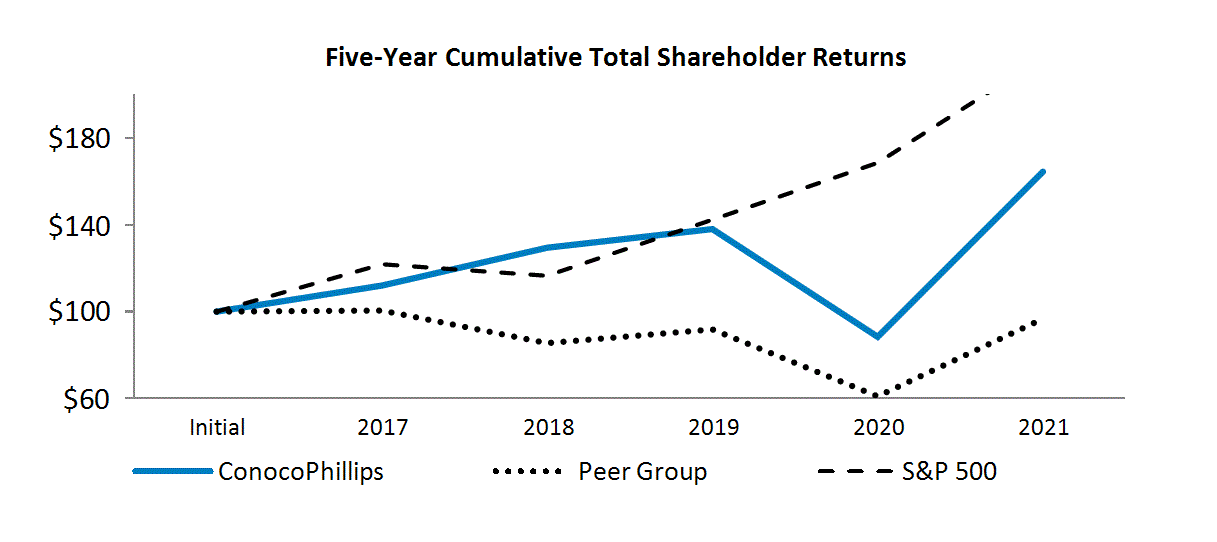
The following graph shows the cumulative
TSR for ConocoPhillips’ common stock
in each of the five years from
December 31, 2016 to December 31, 2021.
The graph also compares the cumulative
total returns for the
same
five-year period with the S&P 500 Index and our
performance peer group consisting
of Chevron, ExxonMobil,
Apache, Marathon Oil Corporation,
Devon, Occidental, Hess, and EOG weighted
according to the respective peer’s
stock market capitalization
at the beginning of each annual period.
The comparison assumes $100 was invested
on December 31, 2016, in ConocoPhillips stock, the S&P 500 Index
and ConocoPhillips’ peer group and assumes that
all dividends were reinvested.
The cumulative total returns
of
the peer group companies' common stock
do not include the cumulative total return
of ConocoPhillips’ common
stock.
The stock price performance included in this graph
is not necessarily indicative of future stock
price
performance.
Management’s Discussion and Analysis
ConocoPhillips
2021 10-K
Item 7. Management’s Discussion and Analysis of Financial Condition and
Management’s Discussion and Analysis of Financial Condition and
Results of Operations
Management’s Discussion and Analysis is the company’s
analysis of its financial performance and of significant
trends that may affect future performance.
It should be read in conjunction with the financial statements
and
notes, and supplemental oil and gas disclosures included
elsewhere in this report.
It contains forward-looking
statements including, without limitation,
statements relating to the company’s
plans, strategies, objectives,
expectations and intentions
that are made pursuant to the “safe harbor” provisions of the Private Securities
Litigation Reform Act of 1995.
The words “anticipate,”
“believe,” “budget,”
“continue,”
“could,”
“effort,”
“estimate,”
“expect,”
“forecast,”
“goal,”
“guidance,”
“intend,” “may,”
“objective,”
“outlook,”
“plan,” “potential,”
“predict,” “projection,”
“seek,” “should,”
“target,” “will,”
“would,” and similar expressions
identify forward-looking
statements.
The company does not undertake
to update, revise or correct any of the forward-looking information
unless required to do so under the federal securities laws.
Readers are cautioned that such forward-looking
statements should be read in conjunction
with the company’s disclosures under the heading:
“CAUTIONARY
STATEMENT
FOR THE PURPOSES OF THE ‘SAFE HARBOR’ PROVISIONS
OF THE PRIVATE
SECURITIES LITIGATION
REFORM ACT OF 1995,”
beginning on page
The terms “earnings” and “loss” as used in Management’s
Discussion and Analysis refer to net income (loss)
attributable to ConocoPhillips.
Business Environment and Executive Overview
ConocoPhillips is one of the world’s
leading E&P companies based on both production and reserves
with
operations and activities in 14 countries.
Our diverse, low cost of supply portfolio
includes resource-rich
unconventional plays
in North America; conventional assets in North
America, Europe and Asia; LNG
developments; oil sands assets in Canada; and an
inventory of global conventional
and unconventional exploration
prospects.
Headquartered in Houston, Texas,
at December 31, 2021, we employed approximately
9,900 people
worldwide and had total
assets of $91 billion.
Completed Acquisitions
On January 15, 2021, we completed our acquisition
of Concho Resources Inc. (Concho), an independent
oil and gas
exploration and production
company with operations across
New Mexico and West Texas
in an all-stock
transaction for $13.1 billion.
In December 2021, we completed our acquisition
of Shell Enterprises LLC’s (Shell) assets in the
Delaware Basin in
an all-cash transaction for $8.7 billion after
customary adjustments.
Assets acquired include approximately
225,000 net acres of producing properties
located entirely in Texas.
.
See Item 1A “Risk Factors” for
further discussion of the risks related to integration of the assets acquired.
Overview
After an unprecedented 2020, the energy
landscape improved throughout
2021 with prices reaching pre-pandemic
levels in the second half of the year;
however,
we expect prices will continue to be cyclical
and volatile.
Our view is
that a successful business strategy
in the E&P industry must be resilient in lower price
environments while also
retaining upside during periods of higher prices.
As such,
we are unhedged, remain highly disciplined
in our
investment decisions and continually
monitor market fundamentals,
including OPEC Plus updates regarding
supply
guidance and inventory levels.
Although global oil demand improved through
2021, the global economic recovery
remains uncertain and subject to various
risk factors, including actions taken
to stem the proliferation
of COVID-
Management’s Discussion and Analysis
ConocoPhillips
2021 10-K
As the macro energy environment
continues to evolve, we
are embracing what we believe
sector leadership
requires through what we call
our triple mandate.
We believe that ConocoPhillips
will play an essential role in
meeting energy transition pathway
demand delivering superior and consistent
returns on and of capital through
the price cycles,
and achieving our net zero ambition
on operational emissions,
while retaining the flexibility to
successfully adapt as the future unfolds.
Our triple mandate is supported by financial principles
and capital allocation priorities that
should allow us to
deliver superior returns through the cycles.
Our financial principles consist of maintaining
balance sheet strength,
providing peer-leading distributions,
making disciplined investments, and delivering
ESG excellence, all of which
are in service to delivering competitive financial returns.
Our 2021 acquisitions of Concho and the Shell Permian
assets further reinforce our differential
value proposition.
In 2021, we successfully delivered on our priorities.
Total
company production was
1,567 MBOED yielding cash
provided by operating activities
of $17 billion.
We invested
$5.3 billion into the business in the form of capital
expenditures and provided returns
of capital to shareholders of approximately
$6 billion through our ordinary
dividend and share repurchases.
For 2021, our ordinary dividend returned $2.4 billion
which included an increase
from 43 cents per share to 46 cents
per share,
effective in December.
Share repurchases resumed
in February and
amounted to $3.6 billion inclusive of our paced
monetization program related
to the Cenovus Energy (CVE)
common shares owned.
We also demonstrated
our commitment to preserving our top-tier balance
sheet with an announcement to reduce the company’s
gross debt by $5 billion over five years
through a
combination of natural and accelerated
maturities.
As part of our ongoing portfolio high-grading
and optimization efforts,
in December 2021, we announced two
transactions in our Asia Pacific segment enhancing
our diverse portfolio.
This included notifying Origin Energy of
our intent to exercise
our preemption right to purchase
an additional 10 percent shareholding interest
in APLNG
for $1.645 billion, before customary
adjustments,
and the sale of our interests in Indonesia for
approximately $1.4
billion before customary adjustments.
In addition to those transactions, in January 2022, we entered
into a
divestiture agreement to sell our
interest in noncore assets within
our Lower 48 segment for $440 million.
These
transactions are expected to
close in the first half of 2022.
For more information on APLNG,
and for
more information on pending dispositions,
We announced an increase in our
disposition target to $4 to $5 billion in proceeds
by year-end 2023, with
approximately $2 billion sourced
from the Permian Basin.
As of year-end 2021, we have generated
$0.3 billion in
disposition proceeds.
The proceeds from these transactions will be used
in accordance with the company’s
priorities, including returns of capital to
shareholders and reduction of gross
debt.
In December 2021, we announced the initiation of a three-tier
return of capital framework.
This framework is
structured to continue delivering
a compelling, growing ordinary dividend and through
-cycle share repurchases.
It
includes the addition of a VROC tier.
The VROC tier will provide a flexible tool for
meeting our commitment of
returning greater than 30 percent
of cash from operating activities
during periods where commodity prices are
meaningfully higher than our planning price range.
We have set our expected
2022 total return of capital
from all
three tiers at approximately
$8 billion.
For more information on our three-tier return of capital framework, see
[Capital Resources and Li
Showing the first 8K of 130K characters. Open the full section
Item 7A. Quantitative and Qualitative Disclosures about Market Risk
Quantitative and Qualitative Disclosures about Market Risk
Financial Instrument Market Risk
We and certain of our subsidiaries hold
and issue derivative contracts
and financial instruments that expose our
cash flows or earnings to changes in commodity prices,
foreign currency exchange
rates or interest
rates.
We may
use financial and commodity-based derivative
contracts to manage the risks
produced by changes in the prices of
natural gas, crude oil and related
products; fluctuations in interest
rates and foreign currency
exchange rates; or to
capture market opportunities.
Our use of derivative instruments
is governed by an “Authority
Limitations” document approved
by our Board of
Directors that prohibits
the use of highly leveraged derivatives
or derivative instruments without
sufficient
liquidity.
The Authority Limitations document also establishes
the Value at Risk (VaR)
limits for the company,
and
compliance with these limits is monitored daily.
The Executive Vice President and Chief Financial
Officer, who
reports to the Chief Executive
Officer, monitors
commodity price risk and risks resulting from
foreign currency
exchange rates and
interest rates.
The Commercial organization
manages our commercial marketing, optimizes
our commodity flows and positions, and monitors
risks.
Commodity Price Risk
Our Commercial organization
uses futures, forwards, swaps
and options in various markets
to accomplish the
following objectives:
●
Meet customer needs.
Consistent with our policy to generally
remain exposed to market
prices, we use
swap contracts to convert
fixed-price sales contracts, which
are often requested by natural
gas
consumers, to floating market
prices.
●
Enable us to use market knowledge to
capture opportunities such as moving physical
commodities to
more profitable locations and storing
commodities to capture seasonal or time premiums.
We may use
derivatives to optimize
these activities.
We use a VaR
model to estimate the loss in fair
value that could potentially result
on a single day from the effect of
adverse changes in market
conditions on the derivative financial instruments
and derivative commodity
instruments we hold or issue, including commodity
purchases and sales contracts
recorded on the balance sheet at
December 31, 2021, as derivative instruments.
Using Monte Carlo simulation, a 95 percent
confidence level and a
one-day holding period, the VaR
for those instruments issued or held for
trading purposes or held for purposes
other than trading at December 31, 2021 and 2020, was
immaterial to our consolidated
cash flows and net income
attributable to ConocoPhillips.
Interest Rate Risk
The following table provides information
about our debt instruments that are
sensitive to changes in U.S. interest
rates.
The table presents principal cash flows
and related weighted-average
interest rates
by expected maturity
dates.
Weighted-average
variable rates are based
on effective rates
at the reporting date.
The carrying amount of
our floating-rate debt approximates
its fair value.
A hypothetical 10 percent change in
prevailing interest rates
would not have a material impact
on interest expense associated
with our floating-rate debt.
The fair value of the
fixed-rate debt is measured
using prices available from a pricing service that
is corroborated by
market data.
Changes to prevailing interest
rates would not impact our cash
flows associated with fixed rate
debt, unless we
elect to repurchase or retire such
debt prior to maturity.
ConocoPhillips
2021 10-K
Millions of Dollars Except as Indicated
Debt
Fixed
Average
Floating
Average
Rate
Interest
Rate
Interest
Expected Maturity Date
Maturity
Rate
Maturity
Rate
Year-End 2021
2022
$
2.53
%
$
1.03
%
2023
6.64
-
-
2024
3.51
-
-
2025
5.32
-
-
2026
1,355
5.06
-
-
Remaining years
14,338
5.80
0.11
Total
$
16,983
$
Fair value
$
21,668
$
Year-End 2020
2021
$
8.47
%
$
0.22
%
2022
2.53
1.12
2023
7.03
-
-
2024
3.51
-
-
2025
5.33
-
-
Remaining years
11,793
6.28
0.11
Total
$
13,209
$
1,083
Fair value
$
18,023
$
1,083
Foreign Currency Exchange
Risk
We have foreign
currency exchange rate
risk resulting from international
operations.
We do not comprehensively
hedge the exposure to currency
exchange rate changes
although we may choose to selectively
hedge certain
foreign currency exchange
rate exposures,
such as firm commitments for capital
projects or local currency tax
payments, dividends and cash returns
from net investments in foreign
affiliates to be remitted
within the coming
year,
and investments in equity securities.
At December 31, 2021 and 2020, we held foreign
currency exchange forwards
hedging cross-border commercial
activity and foreign currency exchange
swaps for purposes of mitigating
our cash-related exposures.
Although
these forwards and swaps
hedge exposures to fluctuations in exchange
rates, we elected not to
utilize hedge
accounting.
As a result, the change in the fair value of these foreign
currency exchange derivatives
is recorded
directly in earnings.
At December 31, 2021, we had outstanding
foreign currency exchange
forward contracts
to buy $1.9 billion AUD at
$0.715 AUD against the U.S. dollar.
At December 31, 2020, we had outstanding
foreign currency exchange
forward
contracts to sell $0.45 billion CAD at $0.748
CAD against the U.S. dollar.
Based on the assumed volatility in the fair
value calculation, the net fair value
of these foreign currency contracts
at December 31, 2021 and December 31,
2020, were a before-tax
gain of $21 million and before
-tax loss of $16 million, respectively.
Based on an adverse
hypothetical 10 percent change
in the December 2021 and December 2020 exchange
rate, this would result
in an
additional before-tax loss
of $134 million and $39 million, respectively.
The sensitivity analysis is based on
changing one assumption while holding all other assumptions constant,
which in practice may be unlikely
to occur,
as changes in some of the assumptions may be correlated.
ConocoPhillips
2021 10-K
The gross notional and fair value of these positions
at December 31, 2021 and 2020, were as follows
:
Foreign Currency Exchange
Derivatives
In Millions
Notional
Fair Value*
2021
2020
2021
2020
Sell Canadian dollar,
buy U.S. dollar
CAD
-
-
(16)
Buy Canadian dollar,
sell U.S. dollar
CAD
(1)
Buy Australian dollar,
sell U.S. dollar
AUD
1,850
-
-
Sell British pound, buy euro
GBP
(8)
-
Buy British pound, sell euro
GBP
-
*Denominated in USD.
For additional information about
our use of derivative instruments,
see Note 12
.
ConocoPhillips
2021 10-K
Item 8. Financial Statements and Supplementary Data
Financial Statements and Supplementary Data
ConocoPhillips
Index to Financial Statements
Page
Reports of Independent Registered Public Accounting Firm
(PCAOB ID #
)
Consolidated Income Statement for the years ended December 31, 2021, 2020 and 2019
Consolidated Statement of Comprehensive Income for the years ended
December 31, 2021, 2020 and 2019
Consolidated Balance Sheet at December 31, 2021 and 2020
Consolidated Statement of Cash Flows for the years ended December 31, 2021, 2020 and 2019
Consolidated Statement of Changes in Equity for the years ended
December 31, 2021, 2020 and 2019
Notes to Consolidated Financial Statements
Supplementary Information
ConocoPhillips
2021 10-K
Reports of Management
Management prepared, and is responsible
for,
the consolidated financial statements
and the other information
appearing in this annual report.
The consolidated financial statements
present fairly the company’s
financial
position, results of operations and
cash flows in conformity with accounting
principles generally accepted in the
United States.
In preparing its consolidated financial
statements, the company
includes amounts that are based on
estimates and judgments management
believes are reasonable under the circumstances.
The company’s financial
statements have
been audited by Ernst & Young
LLP,
an independent registered public accounting
firm appointed
by the Audit and Finance Committee of the Board of Directors
and ratified by stockholders.
Management has
made available to Ernst & Young
LLP all of the company’s financial records
and related data, as well as the minutes
of stockholders’ and directors’
meetings.
Assessment of Internal Control Over
Financial Reporting
Management is also responsible for establishing
and maintaining adequate internal
control over financial
reporting.
ConocoPhillips’ internal control
system was designed to
provide reasonable assurance to
the company’s
management and directors regarding
the preparation and fair presentatio
n
of published financial statements.
All internal control systems,
no matter how well designed, have
inherent limitations.
Therefore, even those
systems determined to
be effective can provide
only reasonable assurance with respect
to financial statement
preparation and presentation.
Management assessed the effectiveness
of the company’s internal
control over financial reporting as
of
December 31, 2021.
In making this assessment, it used the criteria set forth
by the Committee of Sponsoring
Organizations of the Treadway
Commission in
Internal Control—Integrated
Framework (2013)
.
Based on our
assessment, we believe the company’s
internal control over financial reporting
was effective as of
December 31, 2021.
Management’s assessment
of, and conclusion on,
the effectiveness of internal control
over
financial reporting did not include the internal controls
of the assets acquired from Shell Enterprise LLC
in
December 2021.
The total assets acquired represented
approximately 10 percent
of the company’s consolidated
total assets at December 31, 2021.
Ernst & Young
LLP has issued an audit report on the company’s
internal control over financial reporting
as of
December 31, 2021, and their report is included herein.
/s/ Ryan M. Lance
/s/ William L. Bullock, Jr.
Ryan M. Lance
William L. Bullock, Jr.
Chairman and
Chief Executive Officer
Executive Vice President and
Chief Financial Officer
ConocoPhillips
2021 10-K
Report of Independent Registered
Public Accounting Firm
To the Stockholders
and the Board of Directors of ConocoPhillips
Opinion on the Financial Statements
We have audited the
accompanying consolidated
balance sheets of ConocoPhillips (the Company) as
of December
31, 2021 and 2020, the related consolidated
income statement, consolidated
statements of comprehensive
income, changes in equity and cash flows for
each of the three years in the period ended December 31, 2021, and
the related notes (collectively referred
to as the “consolidated
financial statements”). In our opinion,
the
consolidated financial statements
present fairly,
in all material respects, the financial position of the Company
as
of December 31, 2021 and 2020, and the results of its operations
and its cash flows for each of the three years
in
the period ended December 31, 2021, in conformity with
U.S. generally accepted accounting
principles.
We also have audited,
in accordance with the standards of the Public
Company Accounting Oversight
Board
(United States) (PCAOB), the Company’s
internal control over financial reporting
as of December 31, 2021, based
on criteria established in Internal
Control–Integrated
Framework issued by the Committee
of Sponsoring
Organizations of the Treadway
Commission (2013 framework) and our report
dated February 17, 2022, expressed
an unqualified opinion thereon.
Basis for Opinion
These financial statements are
the responsibility of the Company’s
management. Our responsibility is to express
an
opinion on the Company’s financial statements
based on our audits. We are a public
accounting firm registered
with the PCAOB and are required to
be independent with respect to the Company
in accordance with the U.S.
federal securities laws and the applicable
rules and regulations of the Securities and Exchange
Commission and the
PCAOB.
We conducted our audits
in accordance with the standards of the PCAOB.
Those standards require that
we plan
and perform the audit to obtain reasonable
assurance about whether the financial statements
are free of material
misstatement, whether due to
error or fraud. Our audits included performing
procedures to assess the risks
of
material misstatement
of the financial statements, whether
due to error or fraud, and performing
procedures that
respond to those risks. Such procedures
included examining, on a test basis, evidence
regarding the amounts and
disclosures in the financial statements.
Our audits also included evaluating the accounting
principles used and
significant estimates made by management,
as well as evaluating the overall
presentation of the financial
statements. We
believe that our audits provide
a reasonable basis for our opinion.
Critical Audit Matters
The critical audit matters communicated
below are matters
arising from the current period audit of the
consolidated financial statements
that were communicated
or required to be communicated
to the Audit and
Finance Committee and that: (1) relate
to accounts or disclosures that
are material to the consolidated financial
statements and (2) involved
our especially challenging, subjective or complex judgments.
The communication of
critical audit matters does not
alter in any way our opinion on the consolidated
financial statements, taken
as a
whole, and we are not, by communicating the
critical audit matters below,
providing separate opinions
on the
critical audit matters or on the accounts
or disclosures to which they relate.
ConocoPhillips
2021 10-K
Accounting for asset retirement
obligations for certain offshore properties
Description of
the Matter
At December 31, 2021, the asset retirement
obligation (ARO) balance totaled
$5.9 billion. As
further described in Note 8, the Company records
AROs in the period in which they are
incurred, typically when the asset is installed
at the production location. The estimation
of
obligations related to
certain offshore assets requires
significant judgment given the
magnitude and higher estimation uncertainty
related to plugging and abandonment of wells
and removal and disposal of offshore
oil and gas platforms, facilities
and pipelines costs
(collectively,
removal costs). Furthermor
Showing the first 8K of 279K characters. Open the full section
Item 9. Changes in and Disagreements with Accountants on Accounting and
Changes in and Disagreements with Accountants on Accounting and
Financial Disclosure
None.
Item 9A. Controls and Procedures
We maintain disclosure
controls and procedures
designed to ensure information required
to be disclosed in
reports we file or submit under the Securities Exchange
Act of 1934, as amended (the Act), is recorded, processed,
summarized and reported within the
time periods specified in Securities and Exchange Commission rules
and
forms, and that such information
is accumulated and communicated
to management, including our principal
executive and principal financial officers,
as appropriate, to allow timely decisions
regarding required disclosure.
As of December 31, 2021, with the participation of our management,
our Chairman and Chief Executive Officer
(principal executive officer) and
our Executive Vice President and
Chief Financial Officer (principal financial officer)
carried out an evaluation, pursuant
to Rule 13a-15(b) of the Act, of ConocoPhillips’ disclosure controls
and
procedures (as defined in Rule 13a-15(e) of the Act).
Based upon that evaluation, our Chairman and
Chief
Executive Officer and our Executive
Vice President and Chief Financial Officer concluded
our disclosure controls
and procedures were operating
effectively as of December 31, 2021.
There have been no changes in our internal
control over financial reporting, as defined in
Rule 13a-15(f) of the Act,
in the period covered by this report that
have materially affected,
or are reasonably likely to
materially affect, our
internal control over financial
reporting.
Management’s Annual Report
on Internal Control Over Financial Reporting
This report is included in Item 8 on page
and is incorporated herein by
reference.
Report of Independent Registered
Public Accounting Firm
This report is included in Item 8 on page 76 and is incorporated
herein by reference.
Item 9B. Other Information
Other Information
None.
Item 9C. Disclosure Regarding Foreign Jurisdictions that Prevent
Disclosure Regarding Foreign Jurisdictions that Prevent
Inspections
Not applicable.
ConocoPhillips
2021 10-K
Part III
Item 10. Directors, Executive Officers
Directors, Executive Officers
and Corporate Governance
Information regarding
our executive officers
appears in Part I of this report on page
Code of Business Ethics and Conduct for Directors
and Employees
We have a Code of Business Ethics
and Conduct for Directors and Employees
(Code of Ethics), including our
principal executive officer,
principal financial officer,
principal accounting officer and persons
performing similar
functions.
We have posted
a copy of our Code of Ethics on the “Corporate
Governance” section of our internet
website at
(within the Investors>Corporate
Governance section)
.
Any waivers of the
Code of Ethics must be approved, in advance,
by our full Board of Directors.
Any amendments to, or waivers
from,
the Code of Ethics that apply to our executive
officers and directors
will be posted on the “Corporate Governance”
section of our internet website.
All other information required
by Item 10 of Part III will be included in our Proxy
Statement relating to our 2022
Annual Meeting of Stockholders, to be filed pursuant
to Regulation 14A on or before April
30, 2022, and is
incorporated herein by
reference.*
Item 11. Executive Compensation
Executive Compensation
Information required by Item
11 of Part III will be included in our Proxy
Statement relating to our 2022 Annual
Meeting of Stockholders, to be filed pursuant
to Regulation 14A on or before
April 30, 2022, and is incorporated
herein by reference.*
Item 12. Security Ownership of Certain Beneficial Owners and Management and
Security Ownership of Certain Beneficial Owners and Management and
Related Stockholder Matters
Information required by Item
12 of Part III will be included in our Proxy
Statement relating to our 2022 Annual
Meeting of Stockholders, to be filed pursuant
to Regulation 14A on or before
April 30, 2022, and is incorporated
herein by reference.*
Item 13. Certain Relationships and Related Transactions,
Certain Relationships and Related Transactions,
and Director
Independence
Information required by Item
13 of Part III will be included in our Proxy
Statement relating to our 2022 Annual
Meeting of Stockholders, to be filed pursuant
to Regulation 14A on or before
April 30, 2022, and is incorporated
herein by reference.*
Item 14. Principal Accounting Fees and Services
Principal Accounting Fees and Services
Information required by Item
14 of Part III will be included in our Proxy
Statement relating to our 2022 Annual
Meeting of Stockholders, to be filed pursuant
to Regulation 14A on or before
April 30, 2022, and is incorporated
herein by reference.*
*Except for information or data specifically incorporated herein by reference under Items 10 through 14, other information and data appearing
in our 2022 Proxy
Statement are not deemed to be a part of this Annual Report on Form 10-K or deemed to be filed with the Commission as a
part of this report.
ConocoPhillips
2021 10-K
Part IV
Item 15. Exhibits, Financial Statement Schedules
Exhibits, Financial Statement Schedules
(a)
Financial Statements and Supplementary
Data
The financial statements and supplementary
information listed in the Index
to Financial Statements,
which appears on page
, are filed as part of this annual report.
Financial Statement Schedules
All financial statement schedules
are omitted because they are
not required, not significant, not
applicable or the information is shown
in another schedule, the financial statements
or the notes to
consolidated financial statements.
Exhibits
The exhibits listed in the Index to
Exhibits, which appears on pages
through 185, are filed as part of
this annual report.
ConocoPhillips
2021 10-K
ConocoPhillips
Index to Exhibits
Incorporated by Reference
Exhibit
No.
Description
Exhibit
Form
File No.
2.1
Separation and Distribution Agreement Between ConocoPhillips and Phillips
2.1
8-K
001-32395
2.2†‡
Purchase and Sale Agreement, dated March 29, 2017, by and among
ConocoPhillips Company, ConocoPhillips Canada Resources Corp.,
ConocoPhillips Canada Energy Partnership, ConocoPhillips Western Canada
Partnership, ConocoPhillips Canada (BRC) Partnership, ConocoPhillips Canada
E&P ULC, and Cenovus Energy Inc.
2.1
10-Q
001-32395
2.3†‡
Asset Purchase and Sale Agreement Amending Agreement, dated as of May
16, 2017, by and among ConocoPhillips Company, ConocoPhillips Canada
Resources Corp., ConocoPhillips Canada Energy Partnership, ConocoPhillips
Western Canada Partnership, ConocoPhillips Canada (BRC) Partnership,
ConocoPhillips Canada E&P ULC, and Cenovus Energy Inc.
2.2
8-K
001-32395
2.4
Agreement and Plan of Merger, dated as of October 18, 2020, among
ConocoPhillips, Falcon Merger Sub Corp. and Concho Resources Inc.
2.1
8-K
001-32395
3.1
Amended and Restated Certificate of Incorporation.
3.1
10-Q
001-32395
3.2
Certificate of Designations of Series A Junior Participating Preferred Stock of
3.2
8-K
000-49987
3.3
Amended and Restated By-Laws of ConocoPhillips, as amended and restated
3.1
8-K
001-32395
3.4*
Restated Certificate of Incorporation of ConocoPhillips Company, dated
ConocoPhillips and its subsidiaries are parties to
several debt instruments
under which the total amount of securities authorized
does not exceed
10 percent of the total assets of ConocoPhillips
and its subsidiaries on a
consolidated basis.
Pursuant to paragraph
4(iii)(A) of Item 601(b) of
Regulation S-K, ConocoPhillips
agrees to furnish a copy of such instruments
to
the SEC upon request.
4.1
Description of Securities of the Registrant.
4.1
10-K
001-32395
10.1
1986 Stock Plan of Phillips Petroleum Company.
10.11
10-K
004-49987
10.2
1990 Stock Plan of Phillips Petroleum Company.
10.12
10-K
004-49987
10.5
Amendment and Restatement of ConocoPhillips Supplemental Executive
Retirement Plan, dated April 19, 2012.
10.14
10-Q
001-32395
10.7
Omnibus Securities Plan of Phillips Petroleum Company.
10.19
10-K
004-49987
10.10.1
Amended and Restated ConocoPhillips Key Employee Supplemental
Retirement Plan, dated January 1, 2020.
10.10.1
10-K
001-32395
10.10.2
Eighth Amendment to Retirement Plans as amended and restated effective
10.1
10-Q
001-32395
ConocoPhillips
2021 10-K
10.11.1
Amended and Restated Defined Contribution Make-Up Plan of
ConocoPhillips—Title I, dated January 1, 2020.
10.11.1
10-K
001-32395
10.11.2
Amended and Restated Defined Contribution Make-Up Plan of
ConocoPhillips—Title II, dated January 1, 2020.
10.11.2
10-K
001-32395
10.12
2002 Omnibus Securities Plan of Phillips Petroleum Company.
10.26
10-K
000-49987
10.15
Deferred Compensation Plan for Non-Employee Directors of ConocoPhillips.
10.17
10-K
001-32395
10.16.1
Rabbi Trust Agreement dated December 17, 1999.
10.11
10-K
001-14521
10.16.2
Amendment to Rabbi Trust Agreement dated February 25, 2002.
10.39.1
10-K
000-49987
10.16.3
Phillips Petroleum Company Grantor Trust Agreement, dated June 1, 1998.
10.17.3
10-K
001-32395
10.16.4
First Amendment to the Trust Agreement under the Phillips Petroleum
Company Grantor Trust Agreement, dated May 3, 1999.
10.17.4
10-K
001-32395
10.16.5
Second Amendment to the Trust Agreement under the Phillips Petroleum
Company Grantor Trust Agreement, dated January 15, 2002.
10.17.5
10-K
001-32395
10.16.6
Third Amendment to the Trust Agreement under the Phillips Petroleum
Company Grantor Trust Agreement, dated October 5, 2006.
10.17.6
10-K
001-32395
10.16.7
Fourth Amendment to the Trust Agreement under the
ConocoPhillips Company Grantor Trust Agreement, dated May 1, 2012.
10.17.7
10-K
001-32395
10.16.8
Fifth Amendment to the Trust Agreement under the ConocoPhillips Company
Grantor Trust Agreement, dated May 20, 2015.
10.17.8
10-K
001-32395
10.17.1
ConocoPhillips Directors’ Charitable Gift Program.
10.40
10-K
000-49987
10.17.2
First and Second Amendments to the ConocoPhillips Directors’ Charitable Gift
10-Q
001-32395
10.19.1
Amended and Restated Key Employee Deferred Compensation Plan of
ConocoPhillips—Title I, dated January 1, 2020.
10.19.1
10-K
001-32395
10.19.2
Amended and Restated Key Employee Deferred Compensation Plan of
ConocoPhillips—Title II, dated January 1, 2020.
10.19.2
10-K
001-32395
10.20
Amendment and Restatement of ConocoPhillips Key Employee Change in
Control Severance Plan, effective January 1, 2014.
10.21
10-K
001-32395
10.20.1*
Amendment and Restatement of ConocoPhillips Key Employee Change in
Control Severance Plan, effective December 2, 2021.
10.22.1
2004 Omnibus Stock and Performance Incentive Plan of ConocoPhillips.
Schedule
14A
Proxy
000-49987
10.22.2
Form of Stock Option Award Agreement under the Stock Option and Stock
Appreciation Rights Program under the 2004 Omnibus Stock and Performance
Incentive Plan of ConocoPhillips.
10.26
10-K
001-32395
10.22.3
Form of Performance Share Unit Award Agreement under the Performance
Share Program under the 2004 Omnibus Stock and Performance Incentive
10.27
10-K
001-32395
10.23
Omnibus Amendments to certain ConocoPhillips employee benefit plans,
10.30
10-K
001-32395
ConocoPhillips
2021 10-K
10.24
2009 Omnibus Stock and Performance Incentive Plan of ConocoPhillips.
Schedule
14A
Proxy
001-32395
10.25.1
2011 Omnibus Stock and Performance Incentive Plan of ConocoPhillips.
Schedule
14A
Proxy
001-32395
10.25.2
Form of Stock Option Award Agreement under the Stock Option and Stock
Appreciation Rights Program under the 2011 Omnibus Stock and Performance
Incentive Plan of ConocoPhillips, effective February 9, 2012.
10-Q
001-32395
10.25.4
Form of Performance Share Unit Agreement under the Restricted Stock
Program under the 2011 Omnibus Stock and Performance Incentive Plan of
ConocoPhillips, dated February 5, 2013.
10.26.6
10-K
001-32395
10.25.7
Form of Stock Option Award Agreement under the Stock Option and Stock
Appreciation Rights Program under the 2011 Omnibus Stock and Performance
Incentive Plan of ConocoPhillips, dated February 5, 2013.
10.26.9
10-K
001-32395
10.25.8
Form of Make-Up Grant Award Agreement under the 2011 Omnibus Stock and
Performance Incentive Plan of ConocoPhillips, dated January 1, 2012.
10.2
10-Q
001-32395
10.25.9
Form of Key Employee Award Agreement, as part of the ConocoPhillips Stock
Option Program granted under the 2011 Omnibus Stock and Performance
Incentive Plan of ConocoPhillips, dated February 18, 2014.
10.1
10-Q
001-32395
10.25.10
Form of Key Employee Award Agreement, as part of the ConocoPhillips Stock
Option Program granted under the 2014 Omnibus Stock and Performance
Incentive Plan of ConocoPhillips, dated February 16, 2016.
10.26.12
10-K
001-32395
10.25.12
Form of Performance Period IX Award Agreement, as part of the
ConocoPhillips Performance Share Program granted under the 2011 Omnibus
Stock and Performance Incentive Plan of ConocoPhillips, dated February 18,
10.3
10-Q
001-32395
10.25.14
Form of Performance Period X Award Agreement, as part of the
ConocoPhillips Performance Share Program granted under the 2011 Omnibus
Stock and Performance Incentive Plan of ConocoPhillips, dated February 18,
10.5
10-Q
001-32395
10.25.17
Form of Inducement Grant Award Agreement under the 2011 Omnibus Stock
and Performance Incentive Plan of ConocoPhillips, dated March 31, 2014.
10.11
10-Q
001-32395
10.25.18
Form of Performance Share Unit Award Terms and Conditions for
Performance Period 18, as part of the ConocoPhillips Performance Share
Program granted under the 2014 Omnibus Stock and Performance Incentive
Plan of ConocoPhillips, dated February 13, 2018.
10.26.24
10-K
001-32395
10.26.1
2014 Omnibus Stock and Performance Incentive Plan of ConocoPhillips.
10.1
8-K
001-32395
10.26.4
Form of Non-Employee Director Restricted Stock Units Terms and Conditions,
as part of the Deferred Compensation Plan for Non-Employee Directors of
ConocoPhillips, dated January 15, 2016.
10.3
10-Q
001-32395
10.26.7
Form of Key Employee Award Terms and Conditions, as part of the
ConocoPhillips Stock Option Program granted under the 2014 Omnibus Stock
and Performance Incentive Plan of ConocoPhillips, dated February 14, 2017.
10.1
10-Q
001-32395
ConocoPhillips
2021 10-K
10.26.11
Form of Key Employee Award Terms and Conditions as part of the
ConocoPhillips Executive Restricted Stock Unit Program granted under the
2014 Omnibus Stock and Performance Incentive Plan of ConocoPhillips, dated
10.27.12
10-K
001-32395
10.26.13
Form of Key Employee Award Terms and Conditions as part of the
ConocoPhillips Restricted Stock Program granted under the 2014 Omnibus
Stock and Performance Incentive Plan of ConocoPhillips, dated February 13,
10.27.14
10-K
001-32395
10.26.14
Form of Retention Award Terms and Conditions, 2017 revision, as part of the
Restricted Stock Unit Award, granted under the 2014 Omnibus Stock and
Performance Incentive Plan of ConocoPhillips.
10.27.15
10-K
001-32395
10.26.15
Form of Key Employee Award Terms and Conditions as part of the
ConocoPhillips Restricted Stock Unit Program granted under the 2014
Omnibus Stock and Performance Incentive Plan of ConocoPhillips, dated
10.27.16
10-K
001-32395
10.27
Amended and Restated 409A Annex to Nonqualified Deferred Compensation
Arrangements of ConocoPhillips, dated January 1, 2020.
10.27
10-K
001-32395
10.29
Amendment and Restatement of the Burlington Resources Inc. Management
Supplemental Benefits Plan, dated April 19, 2012.
10.9
10-Q
001-32395
10.30.1
Successor Trustee Agreement of the Deferred Compensation Trust Agreement
for Non-Employee Directors of ConocoPhillips dated July 31, 2020.
10.1
10-Q
001-32395
10.30.2
First Amendment to the Successor Trust Agreement of the Deferred
Compensation Trust Agreement for Non-Employee Directors of
ConocoPhillips, dated August 4, 2020.
10.2
10-Q
001-32395
10.31
Indemnification and Release Agreement between ConocoPhillips and Phillips
10.1
8-K
001-32395
10.32
Intellectual Property Assignment and License Agreement between
ConocoPhillips and Phillips 66, dated April 26, 2012.
10.2
8-K
001-32395
10.33
Tax Sharing Agreement between ConocoPhillips and Phillips 66, dated April
10.3
8-K
001-32395
10.34
Employee Matters Agreement between ConocoPhillips and Phillips 66, dated
10.4
8-K
001-32395
10.36
ConocoPhillips Clawback Policy dated October 3, 2012.
10.3
10-Q
001-32395
10.37
Term Loan Agreement, between ConocoPhillips, as borrower, ConocoPhillips
Company, as guarantor, Toronto Dominion (Texas) LLC, as administrative
agent and the banks party thereto, with TD Securities (USA) LLC, as lead
arranger and bookrunner, dated March 18, 2016.
10.1
8-K
001-32395
10.38
Company Retirement Contribution Make-Up Plan of ConocoPhillips, dated
10.39
10-K
001-32395
10.40
Form of Key Employee Award Terms and Conditions, as part of the
ConocoPhillips Targeted Variable Long Term Incentive Program, granted under
the 2014 Omnibus Stock and Performance Incentive Plan of ConocoPhillips,
10.1
10-Q
001-32395
10.41
ConocoPhillips Executive Restricted Stock Unit Program, dated February 11,
10.1
10-Q
001-32395
ConocoPhillips
2021 10-K
10.42
Form of Retention Award Terms and Conditions, as part of the Restricted
Stock Unit Award, granted under the 2014 Omnibus Stock and Performance
Incentive Plan of ConocoPhillips.
10.1
10-Q
001-32395
10.43
Form of Inducement Grant Award Agreement under the 2014 Omnibus Stock
and Performance Incentive Plan of ConocoPhillips, dated January 15, 2021.
10.3
10-Q
001-32395
10.44
Compensation Resolutions regarding Matthew J. Fox, dated April 8, 2021.
10.1
10-Q
001-32395
10.45
Form of Aircraft Time Sharing Agreement by and between certain executives
and ConocoPhillips dated June 21, 2021.
10.2
10-Q
001-32395
10.46
Purchase and Sale Agreement, dated as of September 20, 2021, by and
between Shell Enterprises LLC and ConocoPhillips.
10.1
10-Q
001-32395
10.47*
Amendment and Restatement of ConocoPhillips Executive Severance Plan,
21*
List of Subsidiaries of ConocoPhillips.
22*
Subsidiary Guarantors of Guaranteed Securities.
23.1*
23.2*
Consent of DeGolyer and MacNaughton.
31.1*
Certification of Chief Executive Officer pursuant to Rule 13a-14(a) under the
Securities Exchange Act of 1934.
31.2*
Certification of Chief Financial Officer pursuant to Rule 13a-14(a) under the
Securities Exchange Act of 1934.
32*
Certifications pursuant to 18 U.S.C. Section 1350.
99*
Report of DeGolyer and MacNaughton.
101.INS*
Inline XBRL Instance Document.
101.SCH*
Inline XBRL Schema Document.
101.CAL*
Inline XBRL Calculation Linkbase Document.
101.DEF*
Inline XBRL Definition Linkbase Document.
101.LAB*
Inline XBRL Labels Linkbase Document.
101.PRE*
Inline XBRL Presentation Linkbase Document.
104*
Cover Page Interactive
Data File (formatted
as Inline XBRL and contained in
Exhibit 101).
Filed herewith.
†
The schedules to this exhibit have been omitted pursuant to Item 601(b)(2) of Regulation S-K.
ConocoPhillips agrees to furnish
a copy of any schedule omitted from this exhibit to the SEC upon request.
‡ ConocoPhillips has previously been granted confidential treatment for certain portions
of this exhibit pursuant to Rule 24b-2
under the Securities Exchange Act of 1934, as amended.
ConocoPhillips
2021 10-K
Signature
Pursuant to the requirements
of Section 13 or 15(d) of the Securities Exchange Act of 1934,
the registrant has duly
caused this report to be signed on its behalf by the
undersigned, thereunto duly authorized.
CONOCOPHILLIPS
February 17, 2022
/s/ Ryan M. Lance
Ryan M. Lance
Chairman of the Board of Directors
and Chief Executive Officer
Pursuant to the requirements
of the Securities Exchange Act of 1934, this report
has been signed, as of February
17, 2022, on behalf of the registrant
by the following officers in the capacity
indicated and by a majority of
directors.
Signature
Title
/s/ Ryan M. Lance
Chairman of the Board of Directors
Ryan M. Lance
and Chief Executive Officer
(Principal executive officer)
/s/ William L. Bullock, Jr.
Executive Vice President and
William L. Bullock, Jr.
Chief Financial Officer
(Principal financial officer)
/s/ Kontessa S. Haynes-Welsh
Chief Accounting Officer
Kontessa S. Haynes-Welsh
(Principal accounting officer)
ConocoPhillips
2021 10-K
/s/ Charles E. Bunch
Director
Charles E. Bunch
/s/ Caroline M. Devine
Director
Caroline M. Devine
/s/ Gay Huey Evans
Director
Gay Huey Evans
/s/ John V.
Faraci
Director
John V.
Faraci
/s/ Jody Freeman
Director
Jody Freeman
/s/ Jeffrey A. Joerres
Director
Jeffrey A. Joerres
/s/ Timothy A. Leach
Director
Timothy A. Leach
/s/ William H. McRaven
Director
William H. McRaven
/s/ Sharmila Mulligan
Director
Sharmila Mulligan
/s/ Eric D. Mullins
Director
Eric D. Mullins
/s/ Arjun N. Murti
Director
Arjun N. Murti
/s/ Robert A. Niblock
Director
Robert A. Niblock
/s/ David T.
Seaton
Director
David T.
Seaton
/s/ R.A. Walker
Director
R.A. Walker