 filings.tools
Cencora 10-K 2020-09-30
Filed 2020-11-19. 22 sections, 477K characters. Original on sec.gov · Markdown · JSON
Cover and table of contents
UNITED STATES
SECURITIES AND EXCHANGE COMMISSION
Washington, D.C. 20549
Form 10-K
☑ ANNUAL REPORT PURSUANT TO SECTION 13 OR 15(d) OF THE SECURITIES EXCHANGE ACT OF 1934
FOR THE FISCAL YEAR ENDED September 30, 2020
☐ TRANSITION REPORT PURSUANT TO SECTION 13 OR 15(d) OF THE SECURITIES EXCHANGE ACT OF 1934
FOR THE TRANSITION PERIOD FROM ___________ TO___________
Commission file number 1-16671
AMERISOURCEBERGEN CORPORATION
(Exact name of registrant as specified in its charter)
| Delaware | 23-3079390 | |||||||||||||
| (State or other jurisdiction of | (I.R.S. Employer | |||||||||||||
| incorporation or organization) | Identification No.) | |||||||||||||
| 1300 Morris Drive | Chesterbrook, | PA | 19087-5594 | |||||||||||
| (Address of principal executive offices) | (Zip Code) |
(610) 727-7000
(Registrant’s telephone number, including area code)
Securities Registered Pursuant to Section 12(b) of the Act:
| Title of each class | Trading Symbol(s) | Name of exchange on which registered | |||||||||
| Common stock | ABC | New York Stock Exchange | (NYSE) |
_________________________________________________
Indicate by check mark if the registrant is a well-known seasoned issuer (as defined in Rule 405 of the Securities Act). Yes þ No o
Indicate by check mark if the registrant is not required to file reports pursuant to Section 13 or 15(d) of the Securities Exchange Act of 1934. Yes o No þ
Indicate by check mark whether the registrant (1) has filed all reports required to be filed by Section 13 or 15(d) of the Securities Exchange Act of 1934 during the preceding 12 months (or for such shorter period that the registrant was required to file such reports), and (2) has been subject to such filing requirements for the past 90 days. Yes þ No o
Indicate by check mark whether the registrant has submitted electronically every Interactive Data File required to be submitted pursuant to Rule 405 of Regulation S-T (Section 232.405 of this chapter) during the preceding 12 months (or for such shorter period that the registrant was required to submit such files). Yes þ No o
Indicate by check mark whether the registrant is a large accelerated filer, an accelerated filer, a non-accelerated filer, a smaller reporting company, or an emerging growth company. See the definitions of "large accelerated filer," "accelerated filer," "smaller reporting company," and "emerging growth company" in Rule 12b-2 of the Exchange Act:
Large accelerated filer þ Accelerated filer o Non-accelerated filer o Smaller reporting company ☐
If an emerging growth company, indicate by check mark if the registrant has elected not to use the extended transition period for complying with any new or revised financial accounting standards provided pursuant to Section 13(a) of the Exchange Act ☐
Indicate by check mark whether the registrant has filed a report on and attestation to its management’s assessment of the effectiveness of its internal control over financial reporting under Section 404(b) of the Sarbanes-Oxley Act (15 U.S.C.7262(b)) by the registered public accounting firm that prepared or issued its audit report.☑
Indicate by check mark whether the registrant is a shell company (as defined in Rule 12b-2 of the Securities Exchange Act of 1934). Yes ☐ No þ
The aggregate market value of voting stock held by non-affiliates of the registrant on March 31, 2020 based upon the closing price of such stock on the New York Stock Exchange on March 31, 2020 was $10,238,925,461.
The number of shares of common stock of AmerisourceBergen Corporation outstanding as of October 31, 2020 was 204,249,747.
Documents Incorporated by Reference
Portions of the following document are incorporated by reference in the Part of this report indicated below:
Part III — Registrant's Proxy Statement for the 2021 Annual Meeting of Stockholders.
TABLE OF CONTENTS
PART I
Item 1. BUSINESS
As used herein, the terms "Company," "AmerisourceBergen," "we," "us," or "our" refer to AmerisourceBergen Corporation, a Delaware corporation.
AmerisourceBergen is one of the largest global pharmaceutical sourcing and distribution services companies, helping both healthcare providers and pharmaceutical and biotech manufacturers improve patient access to products and enhance patient care. We deliver innovative programs and services designed to increase the effectiveness and efficiency of the pharmaceutical supply chain in both human and animal health. More specifically, we distribute a comprehensive offering of brand-name, specialty brand-name, and generic pharmaceuticals, over-the-counter healthcare products, home healthcare supplies and equipment, and related services to a wide variety of healthcare providers located in the United States and select global markets, including acute care hospitals and health systems, independent and chain retail pharmacies, mail order pharmacies, medical clinics, long-term care and alternate site pharmacies, physician practices, medical and dialysis clinics, veterinarians, and other customers. Additionally, we furnish healthcare providers and pharmaceutical manufacturers with an assortment of related services, including data analytics, outcomes research, reimbursement and pharmaceutical consulting services, niche premium logistics services, inventory management, pharmacy automation, pharmacy management, and packaging solutions.
Industry Overview
Pharmaceutical sales in the United States, as recently estimated by IQVIA, an independent third-party provider of information to the pharmaceutical and healthcare industry, are expected to grow at a compound annual growth rate of approximately 3.4% from 2019 through 2024, and the growth rate is dependent, in part, on pharmaceutical manufacturer price increases. In addition to general economic conditions, factors that impact the growth of the pharmaceutical industry in the United States and other industry trends include:
Aging Population. The number of individuals age 65 and over in the United States is expected to exceed 63 million by 2024 and is the most rapidly growing segment of the population. This age group suffers from more chronic illnesses and disabilities than the rest of the population and accounts for a substantial portion of total healthcare expenditures in the United States.
Introduction of New Pharmaceuticals. Traditional research and development, as well as the advent of new research, production, and delivery methods, such as biotechnology and gene therapy, continue to generate new pharmaceuticals and delivery methods that are more effective in treating diseases. We believe ongoing research and development expenditures by the leading pharmaceutical manufacturers will contribute to continued growth of the industry. In particular, we believe ongoing research and development of biotechnology and other specialty pharmaceutical drugs will provide opportunities for the continued growth of our specialty pharmaceuticals business.
Increased Use of Generic Pharmaceuticals. A number of patents for widely used brand-name pharmaceutical products will continue to expire during the next several years. In addition, increased emphasis by managed care and other third-party payors on utilization of generics has accelerated their growth. We consider the increase in generic usage a favorable trend because generic pharmaceuticals have historically provided us with a greater gross profit margin opportunity than brand-name products, although their lower prices reduce revenue growth. Generic pharmaceuticals currently account for approximately 90% of the prescription volume in the United States.
Increased Use of Drug Therapies. In response to rising healthcare costs, governmental and private payors have adopted cost containment measures that encourage the use of efficient drug therapies to prevent or treat diseases. While national attention has been focused on the overall increase in aggregate healthcare costs, we believe drug therapy has had a beneficial impact on healthcare costs by reducing expensive surgeries and prolonged hospital stays. Pharmaceuticals currently account for approximately 11% of overall healthcare costs. Pharmaceutical manufacturers' continued emphasis on research and development is expected to result in the continuing introduction of cost-effective drug therapies and new uses for existing drug therapies.
Legislative Developments. In 2010, the federal government enacted major health reform legislation designed to expand access to health insurance, which increased the number of people in the United States who are eligible to be reimbursed for all or a portion of prescription drug costs. The health reform law provides for sweeping changes to Medicare and Medicaid policies (including drug reimbursement policies), expanded disclosure requirements regarding financial arrangements within the healthcare industry, enhanced enforcement authority to prevent fraud and abuse, and new taxes and fees on pharmaceutical and medical device manufacturers. Subsequent legislation and rules promulgated by government agencies have made additional changes to federal drug payment policies. These policies and other legislative developments (including potential revisions to or repeal of any portions of the health reform legislation) may affect our businesses directly and/or indirectly (see Government Regulation on page 6 and the risk factor titled Legal, regulatory, and legislative changes with respect to reimbursement, pricing, and contracting may adversely affect our business and results of operations, including through declining reimbursement rates on page 12 for further details).
COVID-19 Pandemic. In March 2020, the World Health Organization ("WHO") declared a global pandemic attributable to the outbreak and continued spread of COVID-19. In connection with the mitigation and containment procedures recommended by the WHO and imposed by federal, state, and local governmental authorities, we implemented measures designed to keep our employees safe and address business continuity issues at our distribution centers and other locations. We continue to evaluate and plan for the potential effects of a prolonged disruption and the related impacts on our revenue, results of operations, and cash flows. These items include, but are not limited to, the financial condition of our customers and the realization of accounts receivable, decreased availability and demand for our products and services, and delays related to current and future projects. While our operational and financial performance may be significantly impacted by COVID-19, it is not possible for us to predict the duration or magnitude of the outbreak and whether it could have a material adverse impact on the Company's financial position, results of operations, or cash flows (see Risk Factor - We face risks related to health epidemics and pandemics, and the continued spread of COVID-19 is adversely affecting our business).
Other economic conditions and certain risk factors could adversely affect our business and prospects (see Item 1A. Risk Factors on page 8).
The Company
We serve our customers (healthcare providers and pharmaceutical and biotech manufacturers) through a geographically diverse network of distribution service centers and other operations in the United States and select global markets. In our pharmaceutical distribution business, we are typically the primary supplier of pharmaceutical and related products to our healthcare provider customers. We offer a broad range of services to our customers designed to enhance the efficiency and effectiveness of their operations, which allow them to improve the delivery of healthcare to patients and to lower overall costs in the pharmaceutical supply channel.
Strategy
Our business strategy is focused on the global pharmaceutical supply channel where we provide value-added distribution and global commercialization services to healthcare providers (primarily pharmacies, health systems, medical and dialysis clinics, physicians, and veterinarians) and pharmaceutical manufacturers that improve channel efficiencies and patient outcomes. Implementing this disciplined and focused strategy in a seamless and unified way has allowed us to significantly expand our business, and we believe we are well positioned to grow revenue and increase operating income through the execution of the following key elements of our business strategy:
- Optimize and Grow Our Pharmaceutical Distribution and Strategic Global Sourcing Businesses. We believe we are well positioned in size and market breadth to continue to grow our distribution businesses as we invest to improve our operating and capital efficiencies. Distribution, including specialty pharmaceuticals, anchors our growth and position in the pharmaceutical supply channel as we provide superior distribution services and deliver value-added solutions, which improve the efficiency and competitiveness of both healthcare providers and pharmaceutical manufacturers, thus allowing the pharmaceutical supply channel to better deliver healthcare to patients.
We are a leader in distribution and services to community oncologists and have leading positions in other physician-administered products. We distribute plasma and other blood products, injectable pharmaceuticals, vaccines, and other specialty products. We are well positioned to service and support many of the new biotechnology therapies that are expected to be coming to market in the near future.
We have introduced strategies to enhance our position in the generic marketplace, including our generic product private label program based in Ireland. We source generics globally, offer a value-added generic formulary program to our healthcare provider customers, and monitor our customers' compliance with our generics program. We also provide data and other valuable services to our manufacturer customers, which includes our international presence in Switzerland where we lead our global manufacturer relations and commercialization strategy.
We offer value-added services and solutions to assist healthcare providers and pharmaceutical manufacturers to improve their efficiency and their patient outcomes. Services for manufacturers include: assistance with rapid new product launches, promotional and marketing services to accelerate product sales, product data reporting, and logistical support.
Our provider solutions include: our Good Neighbor Pharmacy® program, which enables independent community pharmacies to compete more effectively through pharmaceutical benefit and merchandising programs; Elevate Provider Network®, our managed care network, which connects our retail pharmacy customers to payor plans throughout the country and is one of the largest in the United States; generic product purchasing and private label services; hospital pharmacy consulting designed to improve operational efficiencies; and packaging solutions for institutional and retail healthcare providers.
We believe we have one of the lowest operating cost structures among all pharmaceutical distributors. Our robust distribution facility network includes a national distribution center in Columbus, OH, which offers pharmaceutical manufacturers a single shipping destination. We continue to seek opportunities to achieve increased productivity and operating income gains as we invest in and continue to implement warehouse automation technology, adopt "best practices" in warehousing activities, and increase operating leverage by increasing volume per full-service distribution facility. We continue to seek opportunities to expand our offerings in our Pharmaceutical Distribution and Strategic Global Sourcing businesses.
- Optimize and Grow Our Global Commercialization Services and Animal Health Businesses. Our consulting service businesses help global pharmaceutical and biotechnology manufacturers commercialize their products. We believe we are the largest provider of reimbursement services that assist pharmaceutical companies in supporting access to branded drugs. We also provide outcomes research, contract field staffing, patient assistance and copay assistance programs, adherence programs, risk mitigation services, and other market access programs to pharmaceutical companies. World Courier is a leading global specialty transportation and logistics provider for the biopharmaceutical industry. World Courier further strengthens our service offerings to global pharmaceutical manufacturers and provides an established platform for the introduction of our specialty services outside North America. MWI Animal Health (“MWI”) sells pharmaceuticals, vaccines, parasiticides, diagnostics, micro feed ingredients, and various other products to customers in both the companion animal and production animal markets. MWI also offers its customers a variety of value-added services, including its e-commerce platform, technology management systems, pharmacy fulfillment, inventory management system, equipment procurement consultation, special order fulfillment, and educational seminars, which we believe closely integrate MWI with its customers' day-to-day operations and provide them with meaningful incentives to continue doing business with MWI. We continue to seek opportunities to expand our offerings in our Global Commercialization Services and Animal Health businesses.
*•*Acquisitions. In order to grow our core strategic offerings and to enter related markets, we have acquired and invested in businesses and will continue to consider additional acquisitions and investments.
- Divestitures. In order to allow us to concentrate on our strategic focus areas, we have divested certain non-core businesses and may, from time to time, consider additional divestitures. In January 2020, we decided to permanently exit the PharMEDium Healthcare Holdings LLC’s ("PharMEDium") compounding business, and, as a result, the Company ceased all commercial and administrative operations related to this business in fiscal 2020. The decision to permanently exit the PharMEDium business was due to a number of factors including, but not limited to, ongoing operational, regulatory, and commercial challenges.
Operations
Operating Structure. We are organized based upon the products and services we provide to our customers. Our operations as of September 30, 2020 are comprised of the Pharmaceutical Distribution Services reportable segment and other operating segments that are not significant enough to require separate reportable segment disclosure, and, therefore, have been included in Other for the purpose of reportable segment presentation.
Pharmaceutical Distribution Services Segment
Servicing healthcare providers in the pharmaceutical supply channel, the Pharmaceutical Distribution Services segment's operations provide drug distribution, strategic global sourcing, and related services designed to reduce healthcare costs and improve patient outcomes.
The Pharmaceutical Distribution Services reportable segment distributes a comprehensive offering of brand-name, specialty brand-name and generic pharmaceuticals, over-the-counter healthcare products, home healthcare supplies and
equipment, and related services to a wide variety of healthcare providers, including acute care hospitals and health systems, independent and chain retail pharmacies, mail order pharmacies, medical clinics, long-term care and alternate site pharmacies, and other customers. Through a number of operating businesses, the Pharmaceutical Distribution Services reportable segment provides pharmaceutical distribution (including plasma and other blood products, injectible pharmaceuticals, vaccines, and other specialty pharmaceutical products) and additional services to physicians who specialize in a variety of disease states, especially oncology, and to other healthcare providers, including hospitals and dialysis clinics. Additionally, the Pharmaceutical Distribution Services reportable segment provides data analytics, outcomes research, and additional services for biotechnology and pharmaceutical manufacturers. The Pharmaceutical Distribution Services reportable segment also provides pharmacy management, staffing and additional consulting services, and supply management software to a variety of retail and institutional healthcare providers. Additionally, it delivers packaging solutions to institutional and retail healthcare providers.
Other
Other consists of operating segments that focus on global commercialization services and animal health and includes AmerisourceBergen Consulting Services ("ABCS"), World Courier, and MWI.
ABCS, through a number of operating businesses, provides a full suite of integrated manufacturer services that range from clinical trial support to product post-approval and commercialization support. World Courier, which operates in more than 50 countries, is a leading global specialty transportation and logistics provider for the biopharmaceutical industry. MWI is a leading animal health distribution company in the United States and in the United Kingdom. MWI sells pharmaceuticals, vaccines, parasiticides, diagnostics, micro feed ingredients, and various other products to customers in both the companion animal and production animal markets. Additionally, MWI offers demand-creating sales force services to manufacturers.
Sales and Marketing. The majority of Pharmaceutical Distribution Services’ sales force is led nationally, with geographic focus and specialized by either healthcare provider type or size. Customer service representatives are centralized in order to respond to customer needs in a timely and effective manner. Pharmaceutical Distribution Services also has support professionals focused on its various technologies and service offerings. Pharmaceutical Distribution Services’ sales teams also serve national account customers through close coordination with local distribution centers and ensure that our customers are receiving service offerings that meet their needs. Our other operating segments each have independent sales forces that specialize in their respective product and service offerings. In addition, we have an enterprise-wide marketing team that coordinates branding and all other marketing activities across the Company.
Customers. We have a diverse customer base that includes institutional and retail healthcare providers as well as pharmaceutical manufacturers. Institutional healthcare providers include acute care hospitals, health systems, mail order pharmacies, long-term care and other alternate care pharmacies, and providers of pharmacy services to such facilities, physicians, and physician group practices. Retail healthcare providers include national and regional retail drugstore chains, independent community pharmacies, pharmacy departments of supermarkets and mass merchandisers, and veterinarians. We are typically the primary source of supply for our healthcare provider customers. Our manufacturer customers include branded, generic, and biotechnology manufacturers of prescription pharmaceuticals, as well as over-the-counter product and health and beauty aid manufacturers. In addition, we offer a broad range of value-added solutions designed to enhance the operating efficiencies and competitive positions of our customers, thereby allowing them to improve the delivery of healthcare to patients and consumers.
Our two largest customers, Walgreens Boots Alliance, Inc. ("WBA") and Express Scripts, Inc. ("Express Scripts"), accounted for approximately 33% and approximately 12%, respectively, of revenue in the fiscal year ended September 30, 2020. Our top 10 customers, including governmental agencies and group purchasing organizations ("GPO"), represented approximately 64% of revenue in the fiscal year ended September 30, 2020. The loss of any major customer or GPO relationship could adversely affect future revenue and results of operations. Additionally, from time to time, significant contracts may be terminated in accordance with their terms or extended, renewed, or replaced prior to their expiration dates. If those contracts are not renewed or are extended, renewed, or replaced at less favorable terms, they may negatively impact our revenue, results of operations, and cash flows.
Suppliers. We obtain pharmaceutical and other products from manufacturers, none of which accounted for 10% or more of our purchases in the fiscal year ended September 30, 2020. The loss of a supplier could adversely affect our business if alternate sources of supply are unavailable since we are committed to be the primary source of pharmaceutical products for a majority of our customers. We believe that our relationships with our suppliers are strong. The 10 largest suppliers in fiscal year ended September 30, 2020 accounted for approximately 46% of our purchases.
Information Systems. The Pharmaceutical Distribution Services operating segment recently transitioned its key specialty distribution businesses onto its primary enterprise resource planning ("ERP") system. As a result, the pharmaceutical distribution facilities in the United States all now operate under a single ERP system. Pharmaceutical Distribution Services’
ERP system provides for, among other things, electronic order entry by customers, invoice preparation and purchasing, and inventory tracking. All of our other operating segments operate the majority of their businesses on their own common operating systems resulting in the ability to rapidly deploy new capabilities. We continue to make investments to enhance and upgrade the operating systems utilized by our other operating segments.
Additionally, we are improving our entity-wide infrastructure environment to drive efficiency, capabilities, and speed to market.
We will continue to invest in advanced information systems and automated warehouse technology. For example, in an effort to comply with future pedigree and other supply chain custody requirements (see Risk Factor - Increasing governmental efforts to regulate the pharmaceutical supply channel and pharmaceutical compounding may increase our costs and reduce our profitability), we expect to continue to make significant investments in our secure supply chain information systems.
Pharmaceutical Distribution Services has made significant investments in its electronic ordering systems. Pharmaceutical Distribution Services’ systems are intended to strengthen customer relationships by helping customers to reduce operating costs, and by providing them a platform for a number of the basic and value-added services, including product demand data, inventory replenishment, single-source billing, third-party claims processing, real-time price and incentive updates, and price labels.
Pharmaceutical Distribution Services processes a substantial portion of its purchase orders, invoices, and payments electronically, and it continues to make substantial investments to expand its electronic interface with its suppliers. Pharmaceutical Distribution Services has warehouse operating systems, which are used to manage the majority of Pharmaceutical Distribution Services’ transactional volume. The warehouse operating systems have improved Pharmaceutical Distribution Services’ productivity and operating leverage.
A significant portion of our data center operations, which were previously outsourced to third-party providers, is now insourced.
Competition
We face a highly competitive global environment in the distribution of pharmaceuticals and related healthcare services. Our largest competitors are McKesson Corporation ("McKesson"), Cardinal Health, Inc. ("Cardinal"), FFF Enterprises, Henry Schein, Inc., and UPS Logistics, among others. Pharmaceutical Distribution Services competes with both McKesson and Cardinal, as well as national generic distributors and regional distributors within pharmaceutical distribution. In addition, we compete with manufacturers who sell directly to customers, chain drugstores who manage their own warehousing, specialty distributors, and packaging and healthcare technology companies. ABCS, World Courier, and MWI also face competition from a variety of businesses. In all areas, competitive factors include price, product offerings, value-added service programs, service and delivery, credit terms, and customer support.
Intellectual Property
We use a number of trademarks and service marks. All of the principal trademarks and service marks used in the course of our business have been registered in the United States and, in some cases, in foreign jurisdictions or are the subject of pending applications for registration.
We have developed or acquired various proprietary products, processes, software, and other intellectual property that are used either to facilitate the conduct of our business or that are made available as products or services to customers. We generally seek to protect such intellectual property through a combination of trade secret, patent and copyright laws, and through confidentiality and other contractually imposed protections.
We hold patents and have patent applications pending that relate to certain of our products, particularly our automated pharmacy dispensing equipment, our medication and supply dispensing equipment, certain warehousing equipment, and some of our proprietary packaging solutions. We seek patent protection for our proprietary intellectual property from time to time as appropriate.
Although we believe that our patents or other proprietary products and processes do not infringe upon the intellectual property rights of any third parties, third parties may assert infringement claims against us from time to time.
Human Capital
We aspire to create healthier futures and accelerate business results by inspiring the best and brightest global talent across all dimensions of diversity to perform at their full potential. As of September 30, 2020, we had approximately 22,000 employees, of which approximately 21,000 were full-time employees. More than 56% of our workforce is comprised of women, 49% is comprised of individuals with ethnically diverse backgrounds, and 30% of our Board of Directors are women. Additionally, our Executive Management Committee is made up of 43% women.
Approximately 2% of our employees are covered by collective bargaining agreements. We believe that our relationship with our employees is good. If any of our employees in locations that are unionized should engage in strikes or other such bargaining tactics in connection with the negotiation of new collective bargaining agreements upon the expiration of any existing collective bargaining agreements, such tactics could be disruptive to our operations and adversely affect our results of operations. However, we believe we have adequate contingency plans in place to assure delivery of pharmaceuticals to our customers in the event of any such disruptions.
Government Regulation
We are subject to extensive oversight by various federal and state governmental entities and we are subject to, and affected by, a variety of federal and state laws, regulations, and policies.
The U.S. Drug Enforcement Administration ("DEA"), the U.S. Food and Drug Administration ("FDA"), the U.S. Department of Justice ("DOJ"), and various other federal and state authorities regulate the purchase, storage, and/or distribution of pharmaceutical products, including controlled substances. Wholesale distributors of controlled substances must hold valid DEA licenses, meet various security and operating standards, and comply with regulations governing the sale, marketing, packaging, holding, and distribution of controlled substances.
We and our customers are subject to fraud and abuse laws, including the federal anti-kickback statute and False Claims Act. The anti-kickback statute prohibits persons from soliciting, offering, receiving, or paying any remuneration in order to induce the purchasing, leasing, or ordering, induce a referral to purchase, lease, or order, or arrange for or recommend purchasing, leasing, or ordering items or services that are in any way paid for by Medicare, Medicaid, or other federal healthcare programs. The False Claims Act prohibits knowingly submitting, or causing the submission, of false or fraudulent claims for payment to the government, and authorizes treble damages and substantial civil penalties in the case of violations. The fraud and abuse laws and regulations are broad in scope and are subject to frequent and varied interpretation.
In recent years, some states have passed or proposed laws and regulations that are intended to protect the safety of the pharmaceutical supply channel. These laws and regulations are designed to prevent the introduction of counterfeit, diverted, adulterated, or mislabeled pharmaceuticals into the distribution system. At the federal level, the supply chain security legislation known as the Drug Quality and Security Act (“DQSA”) became law in 2013. The DQSA establishes federal traceability standards requiring drugs to be labeled and tracked at the lot level, preempts state drug pedigree requirements, and will require all supply-chain stakeholders to participate in an electronic, interoperable prescription drug traceability system. The DQSA also establishes requirements for drug wholesale distributors and third-party logistics providers, including licensing requirements applicable in states that had not previously licensed third-party logistics providers. We expect that the FDA, and eventually comparable state agencies, will promulgate implementing regulations governing wholesale distributor and third-party logistics providers. There can be no assurance that we are fully compliant with the DQSA requirements, or with additional related state regulatory and licensing requirements, and any failure to comply may result in suspension or delay of certain operations and additional costs to bring our operations into compliance. These and other requirements will continue to increase the cost of our operations.
The regulation of public and private health insurance and benefit programs can also affect our business and scrutiny of the healthcare delivery and reimbursement systems in the United States can be expected to continue at both the state and federal levels. This process may result in additional legislation and/or regulation governing the production, delivery, or pricing of pharmaceutical products and other healthcare services. In addition, changes in the interpretations of existing regulations may result in significant additional compliance costs or the discontinuation of our ability to continue to operate certain of our distribution centers, which may have a material adverse effect on our financial condition and results of operations.
Any future reductions in Medicare or Medicaid reimbursement rates could negatively impact our customers' businesses and their ability to continue to purchase drugs from us. We cannot predict what additional initiatives, if any, will be adopted, when they may be adopted, or what impact they may have on us.
We are subject to various federal, state, and local environmental laws, including with respect to the sale, transportation, storage, handling, and disposal of hazardous or potentially hazardous substances, as well as laws relating to safe working conditions and laboratory practices.
The costs, burdens, and/or impacts of complying with federal and state regulations could be significant and the failure to comply with any such legal requirements could have a significant impact on our results of operations and financial condition.
See "Risk Factors" beginning on page 8 for a discussion of additional legal and regulatory developments, as well as enforcement actions or other litigation that may arise out of our failure to adequately comply with applicable laws and regulations that may negatively affect our results of operations and financial condition.
Health Information and Privacy Practices
The Health Information Portability and Accountability Act of 1996 ("HIPAA") and its implementing regulations set forth privacy and security standards designed to protect the privacy of and provide for the security of protected health information, as defined under the HIPAA regulations. Some of our businesses collect, maintain, and/or access protected health information and are subject to the HIPAA regulations. Our operations, depending on their location, may also be subject to state or foreign regulations affecting personal data protection and the manner in which information services or products are provided. Significant criminal and civil penalties may be imposed for violation of HIPAA standards and other such laws. We have a HIPAA compliance program to facilitate our ongoing efforts to comply with the HIPAA regulations.
The Health Information Technology for Economic and Clinical Health Act ("HITECH Act") strengthened federal privacy and security provisions governing protected health information. Among other things, the HITECH Act expanded certain aspects of the HIPAA privacy and security rules, imposed new notification requirements related to health data security breaches, broadened the rights of the U.S. Department of Health and Human Services ("HHS") to enforce HIPAA, and directed HHS to publish more specific security standards. In January 2013, the Office for Civil Rights of HHS published the HIPAA omnibus final rule ("HIPAA Final Rule"), which amended certain aspects of the HIPAA privacy, security, and enforcement rules pursuant to the HITECH Act, extending certain HIPAA obligations to business associates and their subcontractors. Certain components of our business act as "business associates" within the meaning of HIPAA and are subject to these additional obligations under the HIPAA Final Rule.
Some of our businesses collect, maintain, and/or access other personal information (including sensitive personal information) that is subject to federal and state laws protecting such information, in addition to the requirements of HIPAA, the HITECH Act, and the implementing regulations. Personally identifiable information is also highly regulated in many other countries in which we operate. As such regulations continue to evolve, we must comply with applicable privacy and security requirements of these countries, including but not limited to those in the European Union. Most notably certain aspects of our business are subject to the European Union's General Data Protection Regulation ("GDPR") which became effective on May 25, 2018, the California Consumer Protection Act ("CCPA"), which became effective on January 1, 2020, and Brazil's new General Data Protection Law (Lei Geral de Proteção de Dados Pessoais) – Law No. 13,709/208 ("LGPD") which became effective in August 2020. We have implemented a privacy and information security compliance program to facilitate our ongoing efforts to comply with the applicable privacy laws and regulations. There can be no assurances that compliance with these requirements will not impose new costs on our business.
Available Information
For more information about us, visit our website at www.amerisourcebergen.com. The contents of the website are not part of this Form 10-K. Our electronic filings with the Securities and Exchange Commission (including all Forms 10-K, 10-Q, and 8-K, and any amendments to these reports) are available free of charge through our website at investor.amerisourcebergen.com immediately after we electronically file with or furnish them to the Securities and Exchange Commission and may also be viewed using their website at www.sec.gov.
Item 1A. RISK FACTORS
The following discussion describes certain risk factors that we believe could affect our business and prospects. These risk factors are in addition to those set forth elsewhere in this report. Our business operations could also be affected by additional factors that are not presently known to us or that we currently consider not to be material. The reader should not consider this list to be a complete statement of all risks and uncertainties.
Industry and Economic Risks
Our results of operations could be adversely impacted by manufacturer pricing changes.
In fiscal 2020, we continued to experience unfavorable brand and generic pharmaceutical pricing trends, which negatively impacted our Pharmaceutical Distribution Services reportable segment profit and our consolidated operating earnings. We expect these trends to continue in fiscal 2021, which could have an adverse effect on our results of operations.
Our contractual arrangements with pharmaceutical manufacturers for the purchase of brand pharmaceutical products generally use wholesale acquisition cost ("WAC") as the reference price. We sell brand pharmaceutical products to many of our customers using WAC as the reference price and to other customers based on their negotiated contract price. If manufacturers change their pricing policies or practices with regard to WAC or if prices charged by manufacturers do not align with prices negotiated to be paid by our customers, and we are unable to negotiate alternative ways to be compensated by manufacturers or customers for the value of our services, our results of operations could be adversely affected. Additionally, there are a number of government policy initiatives being considered which, if enacted, could directly or indirectly regulate or impact WAC prices. If such initiatives are passed or finalized and we are unable to negotiate equitable changes with our suppliers and/or customers, our results of operations could be adversely impacted.
The pharmaceutical products that we purchase are also subject to price inflation and deflation. Additionally, certain distribution service agreements that we have entered into with brand and generic pharmaceutical manufacturers have a price appreciation component to them. As a result, our gross profit from brand-name and generic pharmaceuticals continues to be subject to fluctuation based upon the timing and extent of manufacturer price increases, which we do not control. If the frequency or rate of brand and generic pharmaceutical price increases slows, whether due to regulatory mandates, the implementation of legislative proposals, policy initiatives or voluntary manufacturer actions, our results of operations could be adversely affected. In addition, generic pharmaceuticals are also subject to price deflation. If the frequency or rate of generic pharmaceutical price deflation accelerates, the negative impact on our results of operations will be greater.
Competition and industry consolidation may erode our profit.
As described in greater detail in the "Competition" section beginning on page 5, the industries in which we operate are highly competitive. In addition, in recent years the healthcare industry has been subject to increasing consolidation, including among pharmaceutical manufacturers, retail pharmacies, and health insurers, which may create further competitive pressures on our pharmaceutical distribution business. If we do not compete successfully, it could have a material and adverse effect on our business and results of operations. The impact on us will be greater if consolidation among our customers, suppliers, and competitors gives the resulting enterprises greater bargaining power, which could lead to greater pressure on us to reduce prices for our products and services.
Our revenue and results of operations may suffer upon the bankruptcy, insolvency, or other credit failure of a significant customer.
Most of our customers buy pharmaceuticals and other products and services from us on credit. Credit is made available to customers based upon our assessment and analysis of creditworthiness. Although we often try to obtain a security interest in assets and other arrangements intended to protect our credit exposure, we generally are either subordinated to the position of the primary lenders to our customers or substantially unsecured. Volatility of the capital and credit markets, general economic conditions, and regulatory changes, including changes in reimbursement, may adversely affect the solvency or creditworthiness of our customers. The COVID-19 pandemic has increased volatility of the capital and credit markets and has led to a general worsening of economic conditions, which has put financial pressure on many of our customers and may threaten certain customers’ ability to maintain liquidity sufficient to repay their obligations to us as they become due. The bankruptcy, insolvency, or other credit failure of any customer that has a substantial amount owed to us could have a material adverse effect on our operating revenue and results of operations. As of September 30, 2020, our two largest trade receivable balances due from customers represented approximately 47% and 7% of accounts receivable, net.
Our results of operations may suffer upon the bankruptcy, insolvency, or other credit failure of a significant supplier.
Our relationships with pharmaceutical suppliers give rise to substantial amounts that are due to us from the suppliers, including amounts owed to us for returned goods or defective goods, chargebacks, and amounts due to us for services provided to the suppliers. Volatility of the capital and credit markets, general economic conditions, pending litigation, and regulatory changes may adversely affect the solvency or creditworthiness of our suppliers. The bankruptcy, insolvency, or other credit failure of any supplier at a time when the supplier has a substantial account payable balance due to us could have a material adverse effect on our results of operations.
Our stock price and our ability to access credit markets may be adversely affected by financial market volatility and disruption or a downgrade in our credit ratings.
If the capital and credit markets experience significant disruption and volatility in the future, there can be no assurance that we will not experience downward movement in our stock price without regard to our financial condition or results of operations or an adverse effect, which may be material, on our ability to access credit. Although we believe that our operating cash flow and existing credit arrangements give us the ability to meet our financing needs, there can be no assurance that disruption and volatility will not increase our costs of borrowing, impair our liquidity, or adversely impact our business.
Additionally, rating agencies continually review the ratings they have assigned to us and our outstanding debt securities. To maintain our ratings, we are required to meet certain financial performance ratios. Liabilities related to litigation or any significant related settlements, an increase in our debt or a decline in our earnings could result in downgrades in our credit ratings. Actual or anticipated changes or downgrades in our credit ratings, including any announcement that our ratings are under review for a downgrade or have been assigned a negative outlook, could limit our access to public debt markets, limit the institutions willing to provide credit to us, result in more restrictive financial and other covenants in our public and private debt, and would likely increase our overall borrowing costs and adversely affect our earnings.
Declining economic conditions could adversely affect our results of operations and financial condition.
Our operations and performance depend on economic conditions in the United States and other countries where we do business. Deterioration in general economic conditions could adversely affect the amount of prescriptions that are filled and the amount of pharmaceutical products purchased by consumers and, therefore, could reduce purchases by our customers, which would negatively affect our revenue growth and cause a decrease in our profitability. Negative trends in the general economy, including interest rate fluctuations, financial market volatility, or credit market disruptions, may also affect our customers' ability to obtain credit to finance their businesses on acceptable terms and reduce discretionary spending on health products. Reduced purchases by our customers or changes in payment terms could adversely affect our revenue growth and cause a decrease in our cash flow from operations. Bankruptcies or similar events affecting our customers may cause us to incur bad debt expense at levels higher than historically experienced. Declining economic conditions may also increase our costs. If the economic conditions in the United States or in the countries where we do business deteriorate, our results of operations or financial condition could be adversely affected.
Business and Operational Risks
Our revenue, results of operations, and cash flows may suffer upon the loss, or renewal at less favorable terms, of a significant customer or group purchasing organization.
WBA accounted for approximately 33% of our revenue in the fiscal year ended September 30, 2020. Express Scripts accounted for approximately 12% of our revenue in the fiscal year ended September 30, 2020. Our top ten customers, including governmental agencies and GPOs, represented approximately 64% of revenue in the fiscal year ended September 30, 2020. We may lose a significant customer or GPO relationship if any existing contract with such customer or GPO expires without being extended, renewed, renegotiated or replaced or is terminated by the customer or GPO prior to expiration, to the extent such early termination is permitted by the contract. A number of our contracts with significant customers or GPOs are typically subject to expiration each year and we may lose any of these customers or GPO relationships if we are unable to extend, renew, renegotiate or replace the contracts. The loss of any significant customer or GPO relationship could adversely affect our revenue, results of operations, and cash flows. Additionally, from time to time, significant contracts may be renewed or modified prior to their expiration date in furtherance of our strategic objectives. If those contracts are renewed or modified at less favorable terms, they may also negatively impact our revenue, results of operations, and cash flows.
The anticipated ongoing strategic and financial benefits of our relationship with WBA may not be realized.
In May 2016, we extended to 2026 our strategic arrangement with WBA - specifically, our distribution agreement under which we distribute drugs to Walgreens pharmacies and our generics purchasing services arrangement under which
Walgreens Boots Alliance Development GmbH ("WBAD") provides a variety of services, including negotiating acquisition pricing with generic manufacturers on our behalf. This reflected our expectation that partnering strategically with WBA would result in various benefits including, among other things, continued cost savings as a result of our generics purchasing services arrangement with WBAD, as well as the potential for exploring innovation together and sharing best practices. The processes and initiatives needed to achieve and maintain these benefits are complex, costly, and time-consuming. Achieving the anticipated benefits from the arrangement on an ongoing basis is subject to a number of significant challenges and uncertainties, including: the potential inability to realize and/or delays in realizing potential benefits resulting from participation in our generics purchasing services arrangement with WBAD, including improved generic drug pricing and terms, improved service fees from generic manufacturers, cost savings, innovations, or other benefits due to its inability to negotiate successfully with generic manufacturers or otherwise to perform as expected; the potential disruption of our plans and operations as a result of the terms under which we extended the duration of the distribution agreement and generics purchasing services agreement, including any disruption of our cash flow and ability to return value to our stockholders in accordance with our past practices and any reduction in our operational, strategic or financial flexibility; potential changes in supplier relationships and terms; unexpected or unforeseen costs, fees, expenses and charges incurred by us related to the transaction or the overall strategic relationship; changes in the economic terms under which we distribute pharmaceuticals to WBA, including changes necessitated by changing market conditions or other unforeseen developments that may arise during the term of the distribution agreement, to the extent that any such changes are not offset by other financial benefits that we are able to obtain through collaboration in other aspects of our strategic relationship with WBA; and any potential issues that could impede our ability to continue to work collaboratively with WBA in an efficient and effective manner in furtherance of the anticipated strategic and financial benefits of the relationship.
In addition, WBA has the right, but not the obligation, under the transactions contemplated by the Framework and Shareholder Agreements dated March 18, 2013 to make certain additional investments in our common stock. WBA also has the right to sell any of the shares of our common stock that it has acquired so long as WBA has held the shares beyond the requisite dates specified in the Shareholder Agreement. Any sales in the public market of common stock currently held by WBA or acquired by WBA pursuant to open market purchases could adversely affect prevailing market prices of our common stock. We could also encounter unforeseen costs, circumstances, or issues with respect to the transactions and collaboration we anticipate pursuing with WBA. Many of these potential circumstances are outside of our control and any of them could result in increased costs, decreased revenue, decreased benefits and the diversion of management time and attention. If we are unable to achieve any of our objectives, the expected future benefits may not be realized fully or may take longer to realize than expected, which could have a material adverse impact on our business, financial condition, and results of operations.
A disruption in our distribution or generic purchasing services arrangements with WBA could adversely affect our business and financial results.
We are the primary distributor of pharmaceutical products for WBA. If our operations are seriously disrupted for any reason deemed within our control, we may have an obligation to pay or credit WBA for failure to supply products. In addition, upon the expiration or termination of the distribution agreement or generics purchasing services arrangement, there can be no assurance that we or WBA will be willing to renew, on terms favorable to us or at all.
Our generic pharmaceutical program has also benefited from the generics purchasing services arrangement with WBA. If the operations of WBA are seriously disrupted for any reason, whether by the global coronavirus ("COVID-19") pandemic, natural disaster, labor disruption, regulatory or governmental action, or otherwise, it could adversely affect our business and our sales and profitability. Moreover, if the economic benefits we are able to obtain through the generics purchasing services arrangement with WBA decline due to changes in market conditions or other changes impacting the fees and rebates that generic manufacturers make available through the arrangement, our margins and results of operations could also be adversely affected.
In addition, our business may be adversely affected by any operational, financial, or regulatory difficulties that WBA experiences, including any disruptions of certain of its existing distribution facilities or retail pharmacies resulting from ongoing inspections by the DEA and/or state regulatory agencies and possible revocation of the controlled substance registrations for those facilities and pharmacies.
Our results of operations and financial condition may be adversely affected if we undertake acquisitions of or investments in businesses that do not perform as we expect or that are difficult for us to integrate.
As part of our strategy we seek to pursue acquisitions of and investments in other companies. At any particular time, we may be in various stages of assessment, discussion, and negotiation with regard to one or more potential acquisitions or investments, not all of which will be consummated. We make public disclosure of pending and completed acquisitions when appropriate and required by applicable securities laws and regulations.
Acquisitions involve numerous risks and uncertainties and may be of businesses in which we lack operational or market experience. If we complete one or more acquisitions, our results of operations and financial condition may be adversely affected by a number of factors, including: regulatory or compliance issues that could arise; changes in regulations and laws; the failure of the acquired businesses to achieve the results we have projected in either the near or long term; the assumption of unknown liabilities, including litigation risks; the fair value of assets acquired and liabilities assumed not being properly estimated; the difficulties of imposing adequate financial and operating controls on the acquired companies and their management and the potential liabilities that might arise pending the imposition of adequate controls; the difficulties in the integration of the operations, technologies, services and products of the acquired companies; and the failure to achieve the strategic objectives of these acquisitions.
Our business and results of operations may be adversely affected if we fail to manage and complete divestitures.
We regularly evaluate our portfolio in order to determine whether an asset or business may no longer help us meet our objectives. When we decide to sell assets or a business, we may encounter difficulty finding buyers or alternative exit strategies, which could delay the achievement of our strategic objectives. The impact of a divestiture on our results of operations could also be greater than anticipated.
Our results of operations and our financial condition may be adversely affected by our global operations.
Our operations in jurisdictions outside of the United States are subject to various risks inherent in global operations. We currently have operations in over 50 countries. We may conduct business in additional foreign jurisdictions in the future, which may carry operational risks in addition to the risks of acquisition described above. At any particular time, our global operations may be affected by local changes in laws, regulations, and the political and economic environments, including inflation, recession, currency volatility, and competition. Changes or uncertainty in U.S. or foreign policy, including any changes or uncertainty with respect to U.S. or international trade policies or tariffs, also can disrupt our global operations, as well as our customers and suppliers, in a particular location and may require us to spend more money to source certain products or materials that we purchase. Any of these factors could adversely affect our business, financial position, and results of operations.
We are subject to operational and logistical risks that might not be covered by insurance.
We have distribution centers and facilities located in the United States and throughout the world. Our business exposes us to risks that are inherent in the distribution of pharmaceuticals and the provision of related services, including with respect to cold chain storage and shipping. We anticipate that the volume of cold chain storage and shipping may increase due to the COVID-19 pandemic, as we assist with the strategic national stockpile as well as possible distribution of COVID-19 vaccines. Although we seek to maintain adequate insurance coverage, coverage on acceptable terms might be unavailable, or coverage might not cover our losses or may require large deductibles. Uninsured losses or operational losses that result in large deductible payments in order to receive insurance coverage might have an adverse impact on our business operations and our financial position or results of operations.
Litigation and Regulatory Risks
Increasing governmental efforts to regulate the pharmaceutical supply channel may increase our costs and reduce our profitability.
The healthcare industry in the United States is highly regulated at the federal and state levels. There have been increasing efforts by Congress and state and federal agencies, including state boards of pharmacy, departments of health, and the FDA, to regulate the pharmaceutical distribution system. Regulation of pharmaceutical distribution is intended to prevent diversion and the introduction of counterfeit, adulterated, and/or mislabeled drugs into the pharmaceutical distribution system. Consequently, we are subject to the risk of changes in various federal and state laws, which include operating and security standards of the DEA, the FDA, various state boards of pharmacy and comparable agencies. In recent years, some states have passed or proposed laws and regulations that are intended to protect the safety and security of the supply channel but that also may substantially increase the costs and burden of pharmaceutical distribution.
At the federal level, the DQSA establishes federal traceability standards requiring drugs to be labeled and tracked at the bottle level, preempts state drug pedigree requirements, and will require all supply-chain stakeholders to participate in an electronic, interoperable prescription drug traceability system by November 2023. The DQSA, and in particular Title II of the DQSA, the Drug Supply Chain Security Act ("DSCSA") also established requirements for drug wholesale distributors and
third-party logistics providers, including licensing requirements applicable in states that had not previously licensed third-party logistics providers.
There can be no assurance that we are fully compliant with the DQSA requirements, including the DSCSA requirements, or with additional related state regulatory and licensing requirements, and any failure to comply may result in suspension or delay of certain operations and additional costs to bring our facilities into compliance. Our international operations may also be subject to local regulations containing record-keeping and other obligations related to our distribution operations in those locations. Pedigree tracking laws increase our compliance burden and our pharmaceutical distribution costs and could have an adverse impact on our financial position or results of operations.
As discussed in the risk factor below about public concern over the abuse of opioid medications, certain governmental and regulatory agencies, as well as state and local jurisdictions, are focused on the abuse of opioid medications in the United States. In addition to conducting investigations and participating in litigation related to the misuse of prescription opioid medications, federal, state and local governmental and regulatory agencies are considering legislation and regulatory measures to limit opioid prescriptions and more closely monitor product distribution, prescribing, and dispensing of these drugs.
Complying with the DQSA requirements, including the DSCSA requirements, and other chain of custody and pharmaceutical distribution requirements, including follow-on actions related to current public concern over the abuse of opioid medications, could result in suspension or delays in our production and distribution activities which may increase our costs and could otherwise adversely affect our results of operations.
Legal, regulatory, and legislative changes with respect to reimbursement, pricing, and contracting may adversely affect our business and results of operations, including through declining reimbursement rates.
Both our business and our customers' businesses may be adversely affected by laws and regulations reducing reimbursement rates for pharmaceuticals and/or medical treatments or services, changing the methodology by which reimbursement levels are determined, or regulating pricing, contracting, and discounting practices with respect to medical products and services. Additionally, on occasion, price increases and pricing practices with respect to certain brand and generic pharmaceuticals have been the subject of U.S. Congressional inquiries, federal and state investigations and private litigation. Any law or regulation impacting pharmaceutical pricing or reimbursement, such as pricing controls or indexing models at the federal or state level, could adversely affect our operations.
Federal insurance and healthcare reform legislation known as the Affordable Care Act ("ACA") became law in March 2010, and included numerous reforms broadening healthcare access and affecting Medicare and Medicaid reimbursement, pricing, and contracting for prescription drugs, including changes to the Medicaid rebate statute. Given the scope of the changes made by the ACA and continuing implementation controversies, we cannot predict the impact of every aspect of the law on our operations. Likewise, we cannot predict the impact of any efforts to change or repeal any provisions of the ACA may have on the ACA or other healthcare legislation and regulation.
Subsequent legislation has made additional changes to federal drug payment policies, including the Bipartisan Budget Act of 2018, which increased the Medicaid rebate due with respect to line extensions of single source or innovator multiple source oral solid dosage form drugs. The federal government and state governments could take other actions in the future that impact Medicaid reimbursement and rebate amounts or the cost of drugs. Any reduction in the Medicaid reimbursement rates to our customers may indirectly impact the prices that we can charge our customers for multiple source pharmaceuticals and cause corresponding declines in our profitability. There can be no assurance that recent or future changes in Medicaid prescription drug reimbursement policies will not have an adverse impact on our business. Unless we are able to successfully advocate to prevent or mitigate the impact of these legislative and regulatory changes, these changes in reimbursement and related reporting requirements could adversely affect our results of operations.
Our businesses also sell specialty and other drugs to physicians, hospitals, community oncology practices and other providers that are reimbursed under Part B of the Medicare program. The Centers for Medicare & Medicaid Services ("CMS") published a final rule in November 2017 that reduces Medicare outpatient hospital reimbursement for separately payable drugs (other than vaccines) purchased through the 340B drug discount program from average sales price ("ASP") plus 6% to ASP minus 22.5% (with certain exceptions), effective January 2018. In July 2020, the United States Court of Appeals for the District of Columbia reversed the district court’s decision, which would allow the payment reductions to take effect. While the appeals process is still underway, CMS solicited comments in the proposed calendar year 2020 Medicare outpatient prospective payment system rule on appropriate payment for such 340B-acquired drugs, and finalized a rule in November 2019 that would impose the same ASP minus 22.5% rate that was the subject of the litigation described above. Separately, November 2018, CMS published a final rule that reduces from 6% to 3% the “add-on” payment for new, separately-payable Part B drugs and
biologicals that are paid based on WAC when ASP data during first quarter or sales is unavailable. There can be no assurance that recent or future rules established by CMS will not have an adverse impact on our business.
Further, even where the government does not affirmatively change drug price regulation standards, other parties in the drug manufacturing and distribution system may change their interpretation or approach to implementing or complying with those standards, in a manner that may adversely affect our business. For example, the 340B drug discount program requires manufacturers to provide discounts on outpatient drugs to “covered entity” safety net providers, and previous Health Resources and Services Administration (“HRSA”) guidance has allowed covered entities to dispense 340B discounted drugs through arrangements with multiple “contract pharmacies.” Recently, several manufacturers have announced initiatives that may inhibit or limit covered entities’ ability to use any, or multiple, contract pharmacies, and may direct us not to honor 340B discounted pricing requests on orders to be shipped to contract pharmacies (or may not honor chargebacks where such discounts are extended to contract pharmacies). HRSA has initially indicated that it lacks regulatory authority to enforce its prior guidance allowing multiple contract pharmacies, but recently advised that it is considering whether it may have other enforcement remedies in the event that manufacturers do not extend 340B discounts through contract pharmacy arrangements. Our customers include covered entities and organizations with significant participation as contract pharmacies, and the unavailability of 340B discounts through contract pharmacy arrangements may adversely affect such customers and, therefore, could adversely affect our business.
The federal government may adopt measures in the future that would further reduce Medicare and/or Medicaid spending or impose additional requirements on healthcare entities. Notably, the Trump Administration and members of Congress proposed numerous amendments to Part B drug distribution and payment models during 2018. The Trump Administration has also sought to implement demonstration projects that may affect drug payments. Some of these proposals could have significant effects on our business, including an Executive Order issued on September 13, 2020 to test a "Most Favored Nations" model for Part B and Part D drugs that tie reimbursement rates to international drug pricing metrics. Any future reductions in Medicare reimbursement rates or modifications to Medicare drug pricing regulations such as ASP calculations could negatively impact our customers' businesses and their ability to continue to purchase such drugs from us, or could indirectly affect the structure of our relationships with manufacturers and our customers. At this time, we can provide no assurances that future Medicare and/or Medicaid payment or policy changes, if adopted, would not have a material adverse effect on our business.
Finally, federal and state governments may adopt policies affecting drug pricing and contracting practices outside of the context of federal programs such as Medicare and Medicaid, which may adversely affect our business. For example, several states have adopted laws that require drug manufacturers to provide advance notice of certain price increases and to report information relating to those price increases, while others have taken legislative or administrative action to establish prescription drug affordability boards or multi-payer purchasing pools to reduce the cost of prescription drugs. On July 31, 2019, the Department of Health and Human Services announced a “Safe Importation Action Plan” that outlines two potential pathways to allow importation of certain drugs from foreign markets. On July 24, 2020, the Trump Administration issued an “Executive Order on Increasing Drug Importation to Lower Prices for American Patients” calling for the federal government to exercise its authority under the Federal Food, Drug, and Cosmetic Act to permit drug imports from Canada, re-importation of certain insulin products, and case-by-case waivers to certain importers provided such importation poses no risk to public safety and results in lower costs. There can be no assurances that future changes to drug reimbursement policies, drug pricing and contracting practices outside of federal healthcare programs, or to government drug price regulation programs such as the Medicaid rebate, ASP, or 340B program will not have an adverse impact on our business.
If we fail to comply with laws and regulations in respect of healthcare fraud and abuse, we could suffer penalties or be required to make significant changes to our operations.
We are subject to extensive and frequently changing federal and state laws and regulations relating to healthcare fraud and abuse. The federal government continues to strengthen its scrutiny of practices potentially involving healthcare fraud affecting Medicare, Medicaid and other government healthcare programs. Our relationships with healthcare providers and pharmaceutical manufacturers subject our business to laws and regulations on fraud and abuse which, among other things, (i) prohibit persons from soliciting, offering, receiving or paying any remuneration in order to induce the referral of a patient for treatment or the ordering or purchasing of items or services that are in any way paid for by Medicare, Medicaid or other government-sponsored healthcare programs and (ii) impose a number of restrictions upon referring physicians and providers of designated health services under Medicare and Medicaid programs. Legislative provisions relating to healthcare fraud and abuse give federal enforcement personnel substantially increased funding, powers and remedies to pursue suspected fraud and abuse, and these enforcement authorities were further expanded by the ACA. Many states have enacted similar statutes which are not necessarily limited to items and services for which payment is made by federal healthcare programs. While we believe that we are in compliance with applicable laws and regulations, many of the regulations applicable to us, including those
relating to certain incentives offered in connection with sales of pharmaceutical products and related services, are vague or indefinite, and have not been interpreted by the courts. They may be interpreted or applied by a prosecutorial, regulatory or judicial authority in a manner that could require us to make changes in our operations. If we fail to comply with applicable laws and regulations, we could be subject to civil and criminal penalties, including the loss of licenses or our ability to participate in Medicare, Medicaid, and other federal and state healthcare programs.
Public concern over the abuse of opioid medications, including increased legal and regulatory action, could negatively affect our business.
Certain governmental and regulatory agencies, as well as state and local jurisdictions, are focused on the abuse of opioid medications in the United States. Federal, state and local governmental and regulatory agencies are conducting investigations of us and others in the supply chain, including pharmaceutical manufacturers and other pharmaceutical wholesale distributors, regarding the distribution of opioid medications. In addition, a significant number of lawsuits have been filed against us, other pharmaceutical wholesale distributors, and others in the supply chain by state and local governmental entities and other plaintiffs for claims related to the Company’s distribution of opioid medications. The lawsuits against us and other pharmaceutical wholesale distributors allege, among other claims, that we failed to provide effective controls and procedures to guard against the diversion of controlled substances, acted negligently by distributing controlled substances to pharmacies that serve individuals who abuse controlled substances, and failed to report suspicious orders of controlled substances in accordance with regulations. Additional governmental and regulatory entities have indicated an intent to sue and may conduct investigations of us in the future and lawsuits could be brought against the Company by other plaintiffs under other theories related to opioid abuse. We are deeply committed to diversion control efforts, have sophisticated systems in place to identify orders placed warranting further review to determine if they are suspicious (including through the use of data analytics), and engage in significant due diligence and ongoing monitoring of customers. While we are vigorously defending ourselves in these lawsuits, the allegations may negatively affect our business in various ways, including through increased costs and harm to our reputation.
We are currently engaged in advanced discussions, which are ongoing, with the objective of reaching potential terms (which would include monetary payments and certain changes to our anti-diversion programs) for a global resolution of the multi-district opioid litigation involving certain state and local governmental entities and other related state court litigation described in Note 14 of the Notes to Consolidated Financial Statements. While a global settlement with respect to certain governmental entities within the Multidistrict Litigation ("MDL") and other related state court litigation remains subject to contingencies that could impact whether the parties ultimately decide to move forward, we believe a global settlement is probable and its liability related thereto can be reasonably estimated as of September 30, 2020. We have recorded a charge of $6.6 billion in the fourth quarter of the fiscal year ended September 30, 2020 related to the global settlement and other related opioid litigation. Until such time as a plaintiff participates in a global settlement or otherwise resolves its lawsuit, we will continue to litigate and prepare for trial in the cases pending in the multi-district opioid litigation, those remanded from the multi-district opioid litigation to federal district courts, as well as in state courts where lawsuits have been filed, and we intend to continue to vigorously defend ourselves in all such cases. Since these matters are still developing, we are unable to predict the outcome, but the result of these lawsuits could include excessive monetary verdicts and/or injunctive relief, including changes to our anti-diversion programs, that may affect how we operate our business. Further, any final settlement amongst parties may differ materially from our advanced discussions related to global resolution of the multi-district opioid litigation. The inability to reach a global settlement of the multi-district opioid litigation and adverse resolution of any of these lawsuits or investigations could have a material adverse effect on our business, results of operations, and cash flows and could result in a lower than historical level of capital available for deployment, including a lower level of capital returned to stockholders.
Legislative, regulatory or industry measures to address the misuse of prescription opioid medications may also affect our business in ways that we are not be able to predict. For example, New York has instituted an opioid excise tax, which went into effect on July 1, 2019 and replaces a prior assessment under New York's Opioid Stewardship Act, and taxes entities that make the initial sale or distribution of opioid medications into the state. In addition, Rhode Island and Delaware have enacted opioid taxes, Minnesota has enacted increased licensure fees, and other states are considering legislation that could require entities to pay an assessment or tax on the sale or distribution of opioid medications in those states. If additional state or local jurisdictions enact legislation that taxes or assesses the sale or distribution of opioid medications and we are not able to mitigate the impact on our business through operational changes or commercial arrangements where permitted, such legislation in the aggregate may have a material adverse effect on the Company's results of operations, cash flows, or financial condition.
Our business, results of operations, and cash flows could be adversely affected by legal proceedings.
We conduct our operations through a variety of businesses, including the distribution of pharmaceuticals, the dispensing of healthcare products, and the provision of services to the pharmaceutical industry. Each of our businesses may cause us to become involved in legal disputes or proceedings. These disputes or proceedings have involved or may involve
healthcare fraud and abuse, the False Claims Act, antitrust, class action, commercial, employment, environmental, intellectual property, licensing, public disclosures and various other claims, including claims related to opioid medications as discussed in the above risk factor. Litigation is costly, time-consuming, and disruptive to ordinary business operations. The defense and resolution of these current and future proceedings could have a material adverse effect on our results of operations and financial condition. Violations of various federal and state laws, including with respect to the marketing, sale, purchase, and dispensing of pharmaceutical products and the provision of services to the pharmaceutical industry, can result in criminal, civil, and administrative liability for which there can be significant financial damages, criminal and civil penalties, and possible exclusion from participation in federal and state health programs. Any settlement, judgment or fine could materially adversely affect our results of operations.
Statutory and/or regulatory violations could also form the basis for qui tam complaints. The qui tam provisions of the federal and various state civil False Claims Acts authorize a private person, known as a relator, to file civil actions under these statutes on behalf of the federal and state governments. Under False Claims Acts, the filing of a qui tam complaint by a relator imposes obligations on government authorities to investigate the allegations and determine whether or not to intervene in the action. Such cases may involve allegations around the marketing, sale, purchase, and/or dispensing of brand and/or generic pharmaceutical products or the provision of services to the pharmaceutical industry. Such complaints are filed under seal and remain sealed until the applicable court orders otherwise. Our business and results of operations could be adversely affected if qui tam complaints are filed against us for alleged violations of any health laws and regulations and damages arising from resultant false claims, if the litigation proceeds whether or not government authorities decide to intervene in any such matters, and/or if we are found liable for all or any portion of violations alleged in any such matters.
In fiscal 2018, we resolved potential civil claims and administrative action by entering into, among other things, a Corporate Integrity Agreement with the Office of Inspector General of the U.S. Department of Health and Human Services). The Corporate Integrity Agreement has a five-year term. Failure to comply with obligations under the Corporate Integrity Agreement could lead to monetary or other penalties.
Tax legislation or challenges to our tax positions could adversely affect our results of operations and financial condition.
We are a large corporation with operations in the United States and select global markets. As such, we are subject to tax laws and regulations of the U.S. federal, state and local governments, and of various foreign jurisdictions. From time to time, various legislative initiatives, such as changes to the federal corporate tax rate, the repeal of last-in, first-out ("LIFO") treatment or the promulgation of state opioid taxes and fees, may be proposed that could adversely affect our tax positions and/or our tax liabilities. There can be no assurance that our effective tax rate or tax payments will not be adversely affected by legislation resulting from these initiatives. We believe that our historical tax positions are consistent with applicable laws, regulations, and existing precedent. In addition, U.S. federal, state and local, as well as foreign, tax laws and regulations, are extremely complex and subject to varying interpretations. There can be no assurance that our tax positions will not be challenged by relevant tax authorities or that we would be successful in any such challenge.
On December 22, 2017, the Tax Cuts and Jobs Act of 2017 (the "2017 Tax Act") was enacted and contains significant changes to U.S. income tax law. Due to the potential for changes to tax laws and regulations or changes to the interpretation thereof (including regulations and interpretations pertaining to the 2017 Tax Act), the ambiguity of tax laws and regulations, the subjectivity of factual interpretations, the complexity of our business and intercompany arrangements, uncertainties regarding the geographic mix of earnings in any particular period, and other factors, material adjustments to our tax estimates may impact our provision for income taxes and our earnings per share, as well as our cash flows, in the period in which any such adjustments would be made. Further, we cannot predict the impact of any efforts to change or repeal the 2017 Tax Act or enact alternative legislation by the incoming presidential administration or the next Congress.
Violations of anti-bribery, anti-corruption, and/or international trade laws to which we are subject could have a material adverse effect on our business, financial position, and results of operations.
We are subject to laws concerning our business operations and marketing activities in foreign countries where we conduct business. For example, we are subject to the U.S. Foreign Corrupt Practices Act (the "FCPA"), U.S. export control and trade sanction laws, and similar anti-corruption and international trade laws in certain foreign countries, such as the U.K. Bribery Act, any violation of which could create substantial liability for us and also cause a loss of reputation in the market. The FCPA generally prohibits U.S. companies and their officers, directors, employees, and intermediaries from making improper payments to foreign officials for the purpose of obtaining or retaining business abroad or otherwise obtaining favorable treatment. The FCPA also requires that U.S. public companies maintain books and records that fairly and accurately reflect transactions and maintain an adequate system of internal accounting controls. If we are found to have violated the FCPA, we may face sanctions including civil and criminal fines, disgorgement of profits, and suspension or debarment of our ability to contract with government agencies or receive export licenses. From time to time, we may face audits or investigations by one or
more domestic or foreign government agencies relating to our international business activities, compliance with which could be costly and time-consuming, and could divert our management and key personnel from our business operations. An adverse outcome under any such investigation or audit could subject us to fines or other penalties, which could adversely affect our business, financial position, and results of operations.
Risks generally associated with data privacy regulation and the international transfer of personal data.
We are required to comply with increasingly complex and changing data privacy regulations both in the United States and beyond that regulate the collection, use, security, processing, and transfer of personal data, including particularly the transfer of personal data between or among countries. Many of these regulations also grant rights to individuals. Many foreign data privacy regulations (including GDPR in the European Union, Brazil's new General Data Protection Law, LGPD, and the Personal Information Protection and Electronic Documents Act in Canada) and certain state laws and regulations (including California's CCPA) impose requirements beyond those enacted under United States federal law including, in some instances, private rights of action. We may also face audits or investigations by one or more domestic or foreign government agencies relating to our compliance with these regulations. An adverse outcome under any such investigation or audit could subject us to fines or other penalties. That or other circumstances related to our collection, use, and transfer of personal data could cause a loss of reputation in the market and/or adversely affect our business and financial position.
Other Risks
We face risks related to health epidemics and pandemics, and the continued spread of COVID-19 is adversely affecting our business.
We face risks related to health epidemics and pandemics, including risks related to any responses thereto by the federal or state governments as well as customers and suppliers. The COVID-19 pandemic is adversely affecting, and is expected to continue to adversely affect, our operations, supply chains and distribution network, and we have experienced and expect to continue to experience unpredictable reductions in supply and demand for certain of our products and services. Further, it is possible that the manufacturers that produce the products that we distribute may experience delays or shutdowns due to COVID-19, such as from disruptions in their supply chains or in a suspension of production at their own facilities. Accordingly, we expect the continued spread of COVID-19 to adversely affect the supply of products and/or potentially disrupt our ability to deliver products to customers. Any extended disruption in our ability to service our customers could have a material adverse effect on our revenue, results of operations, and cash flows.
We also face risks related to our employees' health and the impact it may have on operations. Certain of our employees have contracted COVID-19 which resulted in our decision to temporarily close, and subsequently reopen, a small number of our distribution centers in accordance with our internal protocols. We have implemented measures designed to keep our employees safe and have protocols in place to address business continuity issues at our distribution centers and other locations, but a widespread or sustained outbreak of COVID-19 at one or more locations could disrupt our ability to service our customers.
Since April 2020, COVID-19 has adversely impacted and may continue to adversely impact our revenue, results of operations, and cash flows. For instance, demand for certain animal health products in our MWI business declined during the COVID-19 pandemic, and this reduced demand may continue as customers reduce or postpone purchases viewed as discretionary. We also face risks related to a downturn in our customers' respective businesses, including the operations of our retail pharmacy and health systems customers. An economic slowdown or recession related to COVID-19 may affect our customers' ability to obtain credit to finance their business on acceptable terms, which could result in reduced spending on our products and services.
Certain enterprise-wide initiatives intended to improve our operational efficiency and financial performance, such as technology initiatives related to enhancing and upgrading our information technology systems, may take longer than originally expected to complete as we focus on COVID-19-related issues. Additionally, a large portion of our employees are working remotely. An extended period of remote work arrangements could strain our business continuity plans, introduce operational risk, including but not limited to cybersecurity risks, and impair our ability to manage our business.
The impacts of the continued spread of COVID-19 could also cause other unpredictable events, each of which could adversely affect our business, revenue, results of operations, cash flows or financial condition. For example, the continued spread of COVID-19 has led to disruption and volatility in the global capital markets, which could increase our cost of capital and adversely affect our ability to access the capital markets. A sustained or prolonged outbreak could exacerbate the adverse impact of such events, and the impact of COVID-19 may also exacerbate other risks discussed in Item 1A to our Form 10-K, any of which could have a material adverse effect on us.
Risks generally associated with our sophisticated information systems may adversely affect our business and results of operations.
Our businesses rely on sophisticated information systems to obtain, rapidly process, analyze, and manage data to facilitate the purchase and distribution of thousands of inventory items from numerous distribution centers; to receive, process, and ship orders on a timely basis; to account for other product and service transactions with customers; to manage the accurate billing and collections for thousands of customers; and to process payments to suppliers. We continue to make substantial investments in data centers and information systems, including, but not limited to, the expanded implementation of our primary ERP system to integrate certain of our key business areas. Third-party service providers are also responsible for managing a portion of our information systems. To the extent our information systems are not successfully implemented or fail, or to the extent there are data center interruptions, our business and results of operations may be adversely affected. Our business and results of operations may also be adversely affected if a third-party service provider does not perform satisfactorily, or if the information systems are interrupted or damaged by unforeseen events, including due to the actions of third parties.
Information security risks have generally increased in recent years because of the proliferation of cloud-based infrastructure and other services, new technologies, and the increased sophistication and activities of perpetrators of cyber attacks. A failure, interruption, or breach of our operational or information security systems, or those of our third-party service providers, as a result of cyber attacks or information security breaches could disrupt our business, result in the disclosure or misuse of confidential or proprietary information or personal data, damage our reputation, cause loss of customers or revenue, increase our costs, result in litigation and/or regulatory action, and/or cause other losses, any of which might have a materially adverse impact on our business operations and our financial position or results of operations. As a result, cyber security and the continued development and enhancement of the controls and processes designed to protect our systems, computers, software, data, and networks from attack, damage, or unauthorized access remain a priority for us. Although we believe that we have robust information security procedures, controls and other safeguards in place, as cyber threats continue to evolve, we may be required to expend additional resources to continue to enhance our information security measures and/or to investigate and remediate any information security vulnerabilities.
Additionally, as discussed above in the risk factor “We face risks related to health epidemics and pandemics, and the continued spread of COVID-19 is adversely affecting our business,” a large portion of our employees are working remotely. An extended period of remote work arrangements could strain our business continuity plans, introduce operational risk, including but not limited to cybersecurity risks, and impair our ability to manage our business.
Our goodwill, indefinite-lived intangible assets, or long-lived assets may become impaired, which may require us to record a further significant charge to earnings in accordance with generally accepted accounting principles.
U.S. generally accepted accounting principles ("GAAP") require us to test our goodwill and indefinite-lived intangible assets for impairment on an annual basis, or more frequently if indicators for potential impairment exist. Indicators that are considered include significant changes in performance relative to expected operating results, significant negative industry or economic trends, or a significant decline in our stock price and/or market capitalization for a sustained period of time. In addition, we periodically review our intangible assets for impairment when events or changes in circumstances indicate the carrying value may not be recoverable. Factors that may be considered a change in circumstances indicating that the carrying value of our long-lived assets may not be recoverable include slower growth rates, the loss of a significant customer, or divestiture of a business or asset for below its carrying value. The testing required by GAAP involves estimates and judgments by management.
We may be required to record a significant charge to earnings in our consolidated financial statements during the period in which any impairment of our goodwill, indefinite-lived intangible assets, or long-lived assets is determined. Any such charge could have a material adverse impact on our results of operations.
Natural disasters or other unexpected events may disrupt our operations, adversely affect our results of operations and financial condition, and may not be covered by insurance.
We face environmental risks and the occurrence of one or more unexpected events, including fires, tornadoes, tsunamis, hurricanes, earthquakes, floods, and other severe hazards or accidents in the United States or in other countries in which we operate or are located could adversely affect our operations and financial performance. Extreme weather, natural disasters, power outages, or other unexpected events could result in physical damage to and complete or partial closure of one or more of distribution centers or outsourcing facilities, temporary or long-term disruption in the supply of products, delay in the delivery of products to our distribution centers, and/or disruption of our ability to deliver products to customers. Current or future insurance arrangements may not provide protection for costs that may arise from such events, particularly if such events are catastrophic in nature or occur in combination. Further, the long-term effects of climate change on general economic
conditions and the pharmaceutical distribution industry in particular are unclear, and changes in the supply, demand, or available sources of energy and the regulatory and other costs associated with energy production and delivery may affect the availability or cost of goods and services, including natural resources, necessary to run our businesses. Any long-term disruption in our ability to service our customers from one or more distribution centers or outsourcing facilities could have a material adverse effect on our operations.
Item 1B. UNRESOLVED STAFF COMMENTS
None.
Item 2. PROPERTIES
As of September 30, 2020, we conducted our business from office and operating facilities at owned and leased locations throughout the United States (including Puerto Rico) and select global markets. We lease facilities in Chesterbrook, Pennsylvania and in Conshohocken, Pennsylvania for our corporate headquarters.
Pharmaceutical Distribution Services has a robust distribution facility network in the United States. Significant leased facilities are located in Puerto Rico plus the following states: Arizona, Colorado, Florida, Georgia, Hawaii, Indiana, Kentucky, Minnesota, Mississippi, New York, North Carolina, Utah, and Washington. Owned facilities are located in the following states: Alabama, California, Illinois, Massachusetts, Michigan, Missouri, Ohio, Pennsylvania, Texas, and Virginia.
As of September 30, 2020, the Consulting Group's operations were conducted in leased locations. Its headquarters are located in South Carolina and internationally in Canada.
As of September 30, 2020, World Courier's office and operating facilities are located in over 50 countries. Its headquarters are located in London, England. Most of the facilities are leased.
As of September 30, 2020, MWI's operations were conducted in the United States and in the United Kingdom. Leased facilities are located in California, Colorado, Florida, Idaho, Indiana, Kansas, Massachusetts, Minnesota, North Carolina, Pennsylvania, Texas, Washington, and internationally in the United Kingdom. Significant owned facilities are located in Alabama, Idaho, Texas, and Virginia and internationally in the United Kingdom. Its headquarters are located in Idaho.
We consider all of our operating and office properties to be in satisfactory condition.
Item 3. LEGAL PROCEEDINGS
Legal proceedings in which we are involved are discussed in Note 14 (Legal Matters and Contingencies) of the Notes to Consolidated Financial Statements appearing in this Annual Report on Form 10-K.
Item 4. MINE SAFETY DISCLOSURES
Not applicable.
INFORMATION ABOUT OUR EXECUTIVE OFFICERS
The following is a list of our executive officers and their ages and positions as of November 15, 2020.
| Name | Age | Current Position with the Company | ||||||||||||
| Steven H. Collis | 59 | Chairman, President, and Chief Executive Officer | ||||||||||||
| Silvana Battaglia | 53 | Executive Vice President and Chief Human Resources Officer | ||||||||||||
| John G. Chou | 64 | Executive Vice President and Chief Legal Officer | ||||||||||||
| Gina K. Clark | 63 | Executive Vice President and Chief Communications & Administration Officer | ||||||||||||
| James F. Cleary | 57 | Executive Vice President and Chief Financial Officer | ||||||||||||
| Leslie E. Donato | 51 | Executive Vice President and Chief Strategy Officer | ||||||||||||
| Robert P. Mauch | 53 | Executive Vice President and Group President |
Unless indicated to the contrary, the business experience summaries provided below for our executive officers describe positions held by the named individuals during the last five years.
Mr. Collis has been President and Chief Executive Officer of the Company since July 2011 and Chairman since March 2016. From November 2010 to July 2011, he served as President and Chief Operating Officer. He served as Executive Vice President and President of AmerisourceBergen Drug Corporation from September 2009 to November 2010. He was Executive Vice President and President of AmerisourceBergen Specialty Group from September 2007 to September 2009 and was Senior Vice President of the Company and President of AmerisourceBergen Specialty Group from August 2001 to September 2007. Mr. Collis has been employed by the Company or one of its predecessors for over 25 years.
Ms. Battaglia has been Executive Vice President and Chief Human Resources Officer since January 2019. Prior to joining the Company, she worked at Aramark as Senior Vice President of Global Compensation, Benefits, and Labor Relations from August 2017 to December 2018 and as Senior Vice President, Global Field Human Resources from May 2011 to August 2017. She also previously worked for Day & Zimmerman and Merck Corporation.
Mr. Chou has been Executive Vice President since August 2011 and became the Chief Legal Officer in September 2019. He served as Chief Legal & Business Officer of the Company from May 2017 to September 2019. He served as General Counsel of the Company from January 2007 to June 2017. From January 2007 to August 2011, Mr. Chou was a Senior Vice President. He served as Secretary of the Company from February 2006 to May 2012 and from September 2019 to May 2020. He was Vice President and Deputy General Counsel from November 2004 to January 2007 and Associate General Counsel from July 2002 to November 2004. Mr. Chou has been employed by the Company for 18 years.
Ms. Clark has been Executive Vice President since November 2014 and became Chief Communication & Administration Officer in June 2017. She served as Chief Marketing Officer from November 2014 to June 2017. Ms. Clark was named Senior Vice President and Chief Marketing Officer in June 2011. She previously served as Senior Vice President of Marketing and Business Development for AmerisourceBergen Specialty Group from January 2007 to June 2011. Prior to joining the Company, she worked in executive leadership roles at Premier Inc. and HealthSouth, including Senior Vice President of Marketing and Alliance Relations, Group Vice President of Relationship Management, and Senior Vice President of Managed Care and National Contracting.
Mr. Cleary has been Executive Vice President since March 2015 and became Chief Financial Officer in November 2018. He served as Group President, Global Commercialization Services & Animal Health from June 2017 to November 2018. He previously served as President, MWI Animal Health from March 2015 to June 2017. Prior to joining the Company, he was President and Chief Executive Officer of MWI Veterinary Supply, Inc. from June 2002.
Ms. Donato has been Executive Vice President and Chief Strategy Officer since July 2019. Prior to joining the Company, she held various leadership roles at Bayer from May 2009 to May 2019, including Vice President of Strategy, Pharmaceuticals Division, Vice President of Strategy, Bayer Healthcare US, and Vice President & General Manager of Neurology & Hematology. She also worked for McKinsey & Company where she was a Partner in the Healthcare Practice.
Mr. Mauch has been Executive Vice President since February 2015 and became Group President in February 2019. He served as Group President, Pharmaceutical Distribution & Strategic Global Sourcing from June 2017 to February 2019. He served as President, AmerisourceBergen Drug Corporation from February 2015 to June 2017. Mr. Mauch previously served as Senior Vice President Chief Operating Officer, AmerisourceBergen Drug Corporation from March 2014 to February 2015. He was Senior Vice President, Operations, AmerisourceBergen Drug Corporation from April 2012 to March 2014. He was Senior Vice President of Sales and Marketing, AmerisourceBergen Drug Corporation from April 2011 to April 2012. He was Senior
Vice President, Alternate Care Sales and Marketing, AmerisourceBergen Drug Corporation from May 2010 to April 2011. Mr. Mauch has been employed by the Company or one of its predecessors for over 25 years.
PART II
Item 5. MARKET FOR REGISTRANT'S COMMON EQUITY, RELATED STOCKHOLDER MATTERS AND ISSUER PURCHASES OF EQUITY SECURITIES
The Company's common stock is traded on the New York Stock Exchange under the trading symbol "ABC." As of October 31, 2020, there were 2,385 record holders of the Company's common stock.
In November 2018, the Company's board of directors increased the quarterly dividend by 5% from $0.38 per share to $0.40 per share. In January 2020, the Company's board of directors increased the quarterly dividend by 5% from $0.40 per share to $0.42 per share. In November 2020, the Company's board of directors increased the quarterly dividend by 5% from $0.42 per share to $0.44 per share. The Company anticipates that it will continue to pay quarterly cash dividends in the future. However, the payment and amount of future dividends remain within the discretion of the Company's board of directors and will depend upon the Company's future earnings, financial condition, capital requirements, and other factors.
Computershare is the Company's transfer agent. Computershare can be reached at (mail) AmerisourceBergen Corporation c/o Computershare, P.O. Box 50500, Louisville, KY 40233-500; (telephone): Domestic 1-800-522-6645, International 1-201-680-6578, and (internet) www.computershare.com/investor.
ISSUER PURCHASES OF EQUITY SECURITIES
The following sets forth the total number of shares purchased, the average price paid per share, the total number of shares purchased as part of publicly announced programs, and the approximate dollar value of shares that may yet be purchased under the programs during each month in the fiscal year ended September 30, 2020.
| Period | Total Number of Shares Purchased | Average Price Paid Per Share | Total Number of Shares Purchased as Part of Publicly Announced Programs | Approximate Dollar Value of Shares that May Yet Be Purchased Under the Programs | ||||||||||||||||||||||
| October 1 to October 31 | 928,528 | $ | 81.89 | 928,528 | $ | 385,099,144 | ||||||||||||||||||||
| November 1 to November 30 | 383,920 | $ | 84.57 | 272,014 | $ | 362,228,055 | ||||||||||||||||||||
| December 1 to December 31 | 367,012 | $ | 84.04 | 367,012 | $ | 331,384,669 | ||||||||||||||||||||
| January 1 to January 31 | 193,502 | $ | 84.48 | 193,502 | $ | 315,037,604 | ||||||||||||||||||||
| February 1 to February 29 | 352,025 | $ | 82.84 | 352,025 | $ | 285,874,551 | ||||||||||||||||||||
| March 1 to March 31 | 2,643,138 | $ | 82.12 | 2,643,138 | $ | 68,813,634 | ||||||||||||||||||||
| April 1 to April 30 | — | $ | — | — | $ | 68,813,634 | ||||||||||||||||||||
| May 1 to May 31 | 159,247 | $ | 83.49 | 159,247 | $ | 555,518,116 | ||||||||||||||||||||
| June 1 to June 30 | 784 | $ | 95.15 | — | $ | 555,518,116 | ||||||||||||||||||||
| July 1 to July 31 | — | $ | — | — | $ | 555,518,116 | ||||||||||||||||||||
| August 1 to August 31 | — | $ | — | — | $ | 555,518,116 | ||||||||||||||||||||
| September 1 to September 30 | 1,342 | $ | 94.30 | — | $ | 555,518,116 | ||||||||||||||||||||
| Total | 5,029,498 | $ | 82.60 | 4,915,466 |
(a)In October 2018, the Company's board of directors authorized a share repurchase program allowing the Company to purchase up to $1.0 billion of its outstanding shares of common stock, subject to market conditions. During the fiscal year ended September 30, 2020, the Company purchased 4.9 million shares of its common stock for a total of $405.6 million, which excluded $14.8 million of September 2019 purchases that cash settled in October 2019. As of September 30, 2020, the Company had $55.5 million of availability under this program.
(b)In May 2020, the Company's board of directors authorized a new share repurchase program allowing the Company to purchase up to $500 million of its outstanding shares of common stock, subject to market conditions.
(c)Employees surrendered 114,032 shares during the fiscal year ended September 30, 2020 to meet minimum tax-withholding obligations upon vesting of restricted stock.
STOCK PERFORMANCE GRAPH
This graph depicts the Company's five year cumulative total stockholder returns relative to the performance of the Standard and Poor's 500 Composite Stock Index, the S&P Health Care Index, and an index of peer companies selected by the Company from the market close on September 30, 2015 to September 30, 2020. The graph assumes $100 invested at the closing price of the common stock of the Company and of each of the other indices on the New York Stock Exchange on September 30, 2015. The points on the graph represent fiscal year-end index levels based upon the last trading day in each fiscal quarter. The Peer Group index (which is weighted on the basis of market capitalization) consists of the following companies engaged primarily in wholesale pharmaceutical distribution and related services: McKesson Corporation and Cardinal Health, Inc.
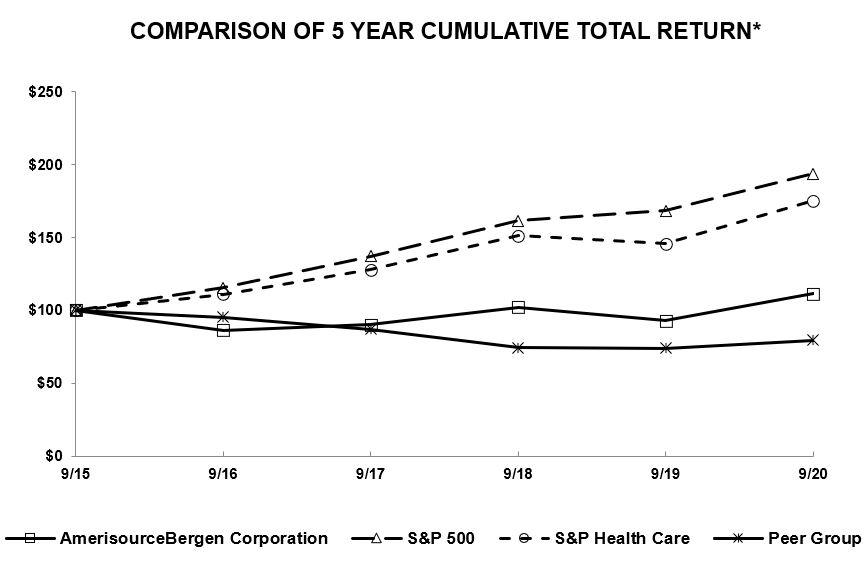
- $100 invested on September 30, 2015 in stock or index, including reinvestment of dividends.
Item 6. SELECTED FINANCIAL DATA
The following should be read in conjunction with the consolidated financial statements, including the notes thereto, and Management's Discussion and Analysis of Financial Condition and Results of Operations beginning on page 26.
| As of or for the Fiscal Year Ended September 30, | ||||||||||||||||||||||||||||||||
| (Amounts in thousands, except per share amounts) | 2020(a) | 2019(b) | 2018(c) | 2017(d) | 2016(e) | |||||||||||||||||||||||||||
| Statement of Operations Data: | ||||||||||||||||||||||||||||||||
| Revenue | $ | 189,893,926 | $ | 179,589,121 | $ | 167,939,635 | $ | 153,143,826 | $ | 146,849,686 | ||||||||||||||||||||||
| Gross profit | 5,191,884 | 5,138,312 | 4,612,317 | 4,546,002 | 4,272,606 | |||||||||||||||||||||||||||
| Operating expenses | 10,327,238 | 4,026,389 | 3,168,632 | 3,485,660 | 2,746,832 | |||||||||||||||||||||||||||
| Operating (loss) income | (5,135,354) | 1,111,923 | 1,443,685 | 1,060,342 | 1,525,774 | |||||||||||||||||||||||||||
| Interest expense, net | 137,883 | 157,769 | 174,699 | 145,185 | 139,912 | |||||||||||||||||||||||||||
| Net (loss) income | (3,399,558) | 854,135 | 1,615,892 | 364,484 | 1,427,929 | |||||||||||||||||||||||||||
| Net (loss) income attributable to AmerisourceBergen Corporation | $ | (3,408,716) | $ | 855,365 | $ | 1,658,405 | $ | 364,484 | $ | 1,427,929 | ||||||||||||||||||||||
| Earnings per share — diluted | $ | (16.65) | $ | 4.04 | $ | 7.53 | $ | 1.64 | $ | 6.32 | ||||||||||||||||||||||
| Cash dividends declared per common share | $ | 1.66 | $ | 1.60 | $ | 1.52 | $ | 1.46 | $ | 1.36 | ||||||||||||||||||||||
| Weighted average common shares outstanding — diluted | 204,783 | 211,840 | 220,336 | 221,602 | 225,959 | |||||||||||||||||||||||||||
| Balance Sheet Data: | ||||||||||||||||||||||||||||||||
| Cash and cash equivalents | $ | 4,597,746 | $ | 3,374,194 | $ | 2,492,516 | $ | 2,435,115 | $ | 2,741,832 | ||||||||||||||||||||||
| Accounts receivable, net | 13,846,301 | 12,386,879 | 11,314,226 | 10,303,324 | 9,175,876 | |||||||||||||||||||||||||||
| Inventories | 12,589,278 | 11,060,254 | 11,918,508 | 11,461,428 | 10,723,920 | |||||||||||||||||||||||||||
| Property and equipment, net | 1,484,808 | 1,770,516 | 1,892,424 | 1,797,945 | 1,530,682 | |||||||||||||||||||||||||||
| Total assets | 44,274,830 | 39,171,980 | 37,669,838 | 35,316,470 | 33,637,501 | |||||||||||||||||||||||||||
| Accounts payable | 31,705,055 | 28,385,074 | 26,836,873 | 25,404,042 | 23,926,320 | |||||||||||||||||||||||||||
| Total debt | 4,119,520 | 4,172,892 | 4,310,189 | 3,442,055 | 4,186,703 | |||||||||||||||||||||||||||
| Total accrued litigation liability | 6,606,925 | — | — | — | — | |||||||||||||||||||||||||||
| Total (deficit) equity | (839,636) | 2,993,206 | 3,049,961 | 2,064,461 | 2,129,404 | |||||||||||||||||||||||||||
| Total liabilities and stockholders' (deficit) equity | $ | 44,274,830 | $ | 39,171,980 | $ | 37,669,838 | $ | 35,316,470 | $ | 33,637,501 |
(a)Includes a $5,528.4 million legal accrual for litigation relating the distribution of prescription opioid pain medications, net of income tax benefit of $1,078.6 million; $282.5 million impairment of PharMEDium's long-lived assets, net of income tax benefit of $79.2 million; $156.5 million of employee severance, litigation, and other costs, net of income tax benefit of $43.9 million; $46.4 million of PharMEDium exit and remediation costs, net of income tax benefit of $13.0 million; a $17.3 million loss on early retirement of debt; net of income tax benefit of $4.9 million; an $11.6 million estimated assessment related to the New York State Opioid Stewardship Act, net of income tax benefit of $3.2 million; a $9.5 million gain from an adjustment to Profarma's estimate of contingent consideration related to the purchase price of one of its prior business acquisitions, net of income tax expense of $2.7 million; a $7.1 million gain from antitrust litigation settlements, net of income tax expense of $2.0 million; and $5.8 million of LIFO expense, net of income tax benefit of $1.6 million.
(b)Includes a $421.3 million impairment of PharMEDium's long-lived assets, net of income tax benefit of $148.7 million; $245.8 million of employee severance, litigation, and other costs, net of income tax benefit of $84.6 million; a $107.8 million gain from antitrust litigation settlements, net of income tax expense of $38.1 million; $51.3 million of PharMEDium remediation costs, net of income tax benefit of $18.1 million; a $16.7 million LIFO credit, net of income tax expense of $5.9 million; a $16.3 million reversal of an estimated assessment related to the New York State Opioid Stewardship Act, net of income tax expense of $5.7 million; and a $10.1 million gain on the sale of an equity investment, net of income tax expense of $3.6 million.
(c)Includes $61.3 million of employee severance, litigation, and other costs, net of income tax benefit of $122.2 million; a $59.7 million goodwill impairment with no income tax benefit; $48.6 million of LIFO expense, net of income tax benefit of $18.7 million; $47.8 million of PharMEDium remediation costs, net of income tax benefit of $18.4 million; a $42.3 million loss on consolidation of equity investments with no income tax benefit; a $30.0 million impairment on a non-customer note receivable with no income tax benefit; a $25.9 million gain from antitrust litigation settlements, net of income tax expense of $10.0 million; a $17.2 million loss on early retirement of debt, net of income tax benefit of $6.6 million; and $15.9 million of expense for an estimated assessment related to the New York State Opioid Stewardship Act, net of income tax benefit of $6.1 million.
(d)Includes a $101.1 million LIFO credit, net of income tax expense of $56.7 million; a $0.9 million gain from antitrust litigation settlements, net of income tax expense of $0.5 million; and $937.4 million of employee severance, litigation, and other costs, net of income tax benefit of $21.9 million.
(e)Includes $367.2 million of Warrants income, net of income tax benefit of $507.5 million; $120.9 million of LIFO expense, net of income tax benefit of $79.3 million; an $80.8 million gain from antitrust litigation settlements, net of income tax expense of $53.0 million; $62.1 million of employee severance, litigation, and other costs, net of income tax benefit of $40.8 million; and a $28.7 million pension settlement charge, net of income tax benefit of $18.9 million.
Item 7. MANAGEMENT'S DISCUSSION AND ANALYSIS OF FINANCIAL CONDITION AND RESULTS OF OPERATIONS
Overview
The following discussion should be read in conjunction with the Consolidated Financial Statements and notes thereto contained herein.
We are one of the largest global pharmaceutical sourcing and distribution services companies, helping both healthcare providers and pharmaceutical and biotech manufacturers improve patient access to products and enhance patient care. We deliver innovative programs and services designed to increase the effectiveness and efficiency of the pharmaceutical supply chain in both human and animal health. We are organized based upon the products and services we provide to our customers. Our operations are comprised of the Pharmaceutical Distribution Services reportable segment and other operating segments that are not significant enough to require separate reportable segment disclosure and, therefore, have been included in Other for the purpose of our reportable segment presentation.
Pharmaceutical Distribution Services Segment
The Pharmaceutical Distribution Services reportable segment distributes a comprehensive offering of brand-name, specialty brand-name and generic pharmaceuticals, over-the-counter healthcare products, home healthcare supplies and equipment, and related services to a wide variety of healthcare providers, including acute care hospitals and health systems, independent and chain retail pharmacies, mail order pharmacies, medical clinics, long-term care and alternate site pharmacies, and other customers. Through a number of operating businesses, the Pharmaceutical Distribution Services reportable segment provides pharmaceutical distribution (including plasma and other blood products, injectable pharmaceuticals, vaccines, and other specialty pharmaceutical products) and additional services to physicians who specialize in a variety of disease states, especially oncology, and to other healthcare providers, including hospitals and dialysis clinics. Additionally, the Pharmaceutical Distribution Services reportable segment provides data analytics, outcomes research, and additional services for biotechnology and pharmaceutical manufacturers. The Pharmaceutical Distribution Services reportable segment also provides pharmacy management, staffing and additional consulting services, and supply management software to a variety of retail and institutional healthcare providers. Additionally, it delivers packaging solutions to institutional and retail healthcare providers.
Other
Other consists of operating segments that focus on global commercialization services and animal health (MWI Animal Health or "MWI"). The operating segments that focus on global commercialization services include AmerisourceBergen Consulting Services ("ABCS") and World Courier.
MWI is a leading animal health distribution company in the United States and in the United Kingdom. MWI sells pharmaceuticals, vaccines, parasiticides, diagnostics, micro feed ingredients, and various other products to customers in both the companion animal and production animal markets. Additionally, MWI offers demand-creating sales force services to manufacturers. ABCS, through a number of operating businesses, provides a full suite of integrated manufacturer services that range from clinical trial support to product post-approval and commercialization support. World Courier, which operates in over 50 countries, is a leading global specialty transportation and logistics provider for the biopharmaceutical industry.
Executive Summary
This executive summary provides highlights from the results of operations that follow:
-
In March 2020, the World Health Organization ("WHO") declared a global pandemic attributable to the outbreak and continued spread of COVID-19. In connection with the mitigation and containment procedures recommended by the WHO and imposed by federal, state, and local governmental authorities, we implemented measures designed to keep our employees safe and address business continuity issues at our distribution centers and other locations. We continue to evaluate and plan for the potential effects of a prolonged disruption and the related impacts on our revenue, results of operations, and cash flows (refer to our COVID-19 risk factor in Item 1A. Risk Factors on page 8);
-
Revenue increased 5.7% from the prior fiscal year primarily due to the revenue growth of our Pharmaceutical Distribution Services segment;
-
Total gross profit increased 1.0% and was favorably impacted by increases in gross profit in Pharmaceutical Distribution Services and Other and was offset in part by lower gains from antitrust litigation settlements, last-in, first-out ("LIFO") expense in comparison to a LIFO credit in the prior fiscal year, and an estimated assessment related to the New York State Opioid Stewardship Act ("OSA") compared to a reversal of a previously-estimated assessment related to the OSA. Pharmaceutical Distribution Services' gross profit increased 3.8% from the prior fiscal year primarily due to the strong increase in specialty product sales. Gross profit in Other increased 6.5% from the prior fiscal year due to growth at World Courier, MWI, and ABCS;
-
Distribution, selling, and administrative expenses increased 3.9% from the prior fiscal year primarily due to an increase in operating costs to support our revenue growth;
-
Employee severance, litigation, and other increased $6.5 billion due to a legal accrual for litigation relating the distribution of prescription opioid pain medications. We are currently in advanced discussions, which are ongoing, with the states and various plaintiffs’ representatives that would be necessary to reach a global settlement of the Multidistrict Litigation ("MDL") and other related state-court litigation brought by certain state and local governmental entities to be paid over 18 years in which our payment would be $6.5 billion assuming all parties participate. A portion of this amount relating to plaintiff attorney fees would be payable over a shorter time period. While a global settlement remains subject to contingencies that could impact whether the parties ultimately decide to move forward, we believe a global settlement is probable and our loss related thereto can be reasonably estimated as of September 30, 2020;
-
Operating income decreased in the current fiscal year primarily due to the $6.6 billion legal accrual in connection with opioid lawsuits, offset in part by an increase in segment operating income, a lower impairment charge relating to PharMEDium's assets, and a decline in depreciation and amortization;
-
Our effective tax rates were 35.8% and 11.7% in the fiscal years ended September 30, 2020 and 2019, respectively. Our effective tax rate in the fiscal year ended September 30, 2020 was higher than the U.S. statutory rate due to our operating loss, the tax benefits associated with our decision to permanently exit the PharMEDium compounding business, Swiss Tax Reform, the CARES Act, and other discrete items (see Note 5 of the Notes to Consolidated Financial Statements) and offset in part by the tax impact of the portion of the opioid legal accrual that is not expected to be tax deductible. Our effective tax rate in the fiscal year ended September 30, 2019 was primarily impacted by the $570.0 million impairment of PharMEDium's assets (see Note 1 of the Notes to Consolidated Financial Statements) and legal settlements, which changed the mix of domestic and international income. The effective tax rate in the fiscal year ended September 30, 2019 was also impacted by a $37.0 million decrease to the Company's transition tax related to the U.S. Tax Cuts and Jobs Act (the "2017 Tax Act").
Results of Operations
Year ended September 30, 2020 compared to the Year ended September 30, 2019
Revenue
| | | | | | | | | | | | | | | | | | | | | | | --- | --- | --- | --- | --- | --- | --- | --- | --- | --- | --- | --- | --- | --- | --- | --- | --- | --- | --- | --- |
Showing the first 8K of 100K characters. Open the full section
Item 7A. QUANTITATIVE AND QUALITATIVE DISCLOSURES ABOUT MARKET RISK
The Company's most significant market risks are the effects of changing interest rates, foreign currency risk, and the changes in the price of the Company's common stock. See discussion on page 43 under the heading "Market Risk," which is incorporated by reference herein.
Item 8. FINANCIAL STATEMENTS AND SUPPLEMENTARY DATA
REPORT OF INDEPENDENT REGISTERED PUBLIC ACCOUNTING FIRM
To the Stockholders and the Board of Directors of AmerisourceBergen Corporation
Opinion on the Financial Statements
We have audited the accompanying consolidated balance sheets of AmerisourceBergen Corporation and subsidiaries (the Company) as of September 30, 2020 and 2019, the related consolidated statements of operations, comprehensive income, stockholders’ equity, and cash flows for each of the three years in the period ended September 30, 2020, and the related notes and financial statement schedule listed in the Index at Item 15(a) (collectively referred to as the “consolidated financial statements”). In our opinion, the consolidated financial statements present fairly, in all material respects, the financial position of the Company at September 30, 2020 and 2019, and the results of its operations and its cash flows for each of the three years in the period ended September 30, 2020, in conformity with U.S. generally accepted accounting principles.
We also have audited, in accordance with the standards of the Public Company Accounting Oversight Board (United States) (PCAOB), the Company's internal control over financial reporting as of September 30, 2020, based on criteria established in Internal Control-Integrated Framework issued by the Committee of Sponsoring Organizations of the Treadway Commission (2013 framework), and our report dated November 19, 2020 expressed an unqualified opinion thereon.
Basis for Opinion
These financial statements are the responsibility of the Company's management. Our responsibility is to express an opinion on the Company’s financial statements based on our audits. We are a public accounting firm registered with the PCAOB and are required to be independent with respect to the Company in accordance with the U.S. federal securities laws and the applicable rules and regulations of the Securities and Exchange Commission and the PCAOB.
We conducted our audits in accordance with the standards of the PCAOB. Those standards require that we plan and perform the audit to obtain reasonable assurance about whether the financial statements are free of material misstatement, whether due to error or fraud. Our audits included performing procedures to assess the risks of material misstatement of the financial statements, whether due to error or fraud, and performing procedures that respond to those risks. Such procedures included examining, on a test basis, evidence regarding the amounts and disclosures in the financial statements. Our audits also included evaluating the accounting principles used and significant estimates made by management, as well as evaluating the overall presentation of the financial statements. We believe that our audits provide a reasonable basis for our opinion.
Critical Audit Matters
The critical audit matters communicated below are matters arising from the current period audit of the financial statements that were communicated or required to be communicated to the audit committee and that: (1) relate to accounts or disclosures that are material to the financial statements and (2) involved our especially challenging, subjective or complex judgments. The communication of critical audit matters does not alter in any way our opinion on the consolidated financial statements, taken as a whole, and we are not, by communicating the critical audit matters below, providing separate opinions on the critical audit matters or on the accounts or disclosures to which they relate.
| Legal Matters and Contingencies - Opioid Lawsuits | |||||
| Description of the Matter | As discussed in Note 14 of the consolidated financial statements, the Company is involved in a significant number of lawsuits with counties, municipalities, and other governmental entities in a majority of U.S. states and Puerto Rico, as well as several tribes relating to the distribution of prescription opioid pain medications (“opioid litigation”). The Company recognizes a liability for those legal contingencies for which it is probable that a liability has been incurred at the date of the consolidated financial statements and the amount is reasonably estimable. The Company has recognized a $6.6 billion ($5.5 billion after tax) charge related to the opioid litigation for the year ended September 30, 2020 and has disclosed that it is unable to estimate the range of possible loss in excess of the amount accrued. In connection with this charge, the Company recognized a related income tax benefit, which reflects an unrecognized tax benefit resulting from uncertainty in the amount that is more likely than not to be deductible for U.S. federal and state income tax purposes based in part upon the final terms and conditions of a settlement agreement. The Company used significant judgment in measuring the amount of income tax benefit that qualified for recognition and may ultimately be deductible for U.S. federal and state purposes. | ||||
| Auditing management’s determination of whether the opioid litigation liability is probable and reasonably estimable, and the related measurement and disclosures, is highly subjective and requires significant judgment. For instance, auditing management’s judgments related to the opioid litigation was challenging due to the significant judgment applied in determining the timing and magnitude of the liability and whether a range of possible loss in excess of the amount accrued is reasonably estimable, based upon the progress of settlement discussions and a potential settlement framework. In addition, auditing management's estimate of the amount of income tax benefit related to the Company's uncertain tax position that qualified for recognition was challenging because the assumptions and estimates require significant judgment as they are based upon settlement terms and documentation, including provisions related to deductibility, that have not been finalized. | |||||
| How We Addressed the Matter in Our Audit | We tested the Company’s internal c |
Showing the first 8K of 201K characters. Open the full section
Item 9. CHANGES IN AND DISAGREEMENTS WITH ACCOUNTANTS ON ACCOUNTING AND FINANCIAL DISCLOSURE
None.
Item 9A. CONTROLS AND PROCEDURES
Evaluation of Disclosure Controls and Procedures
The Company maintains disclosure controls and procedures that are intended to ensure that information required to be disclosed in the Company's reports submitted under the Securities Exchange Act of 1934, as amended (the "Exchange Act"), is recorded, processed, summarized, and reported within the time periods specified in the rules and forms of the SEC. These controls and procedures also are intended to ensure that information required to be disclosed in such reports is accumulated and communicated to management to allow timely decisions regarding required disclosures.
The Company's Chief Executive Officer and Chief Financial Officer, with the participation of other members of the Company's management, have evaluated the effectiveness of the Company's disclosure controls and procedures (as such term is defined in Rules 13a — 15(e) and 15d — 15(e) under the Exchange Act) and have concluded that the Company's disclosure controls and procedures were effective for their intended purposes as of the end of the period covered by this report.
Changes in Internal Control over Financial Reporting
There were no changes during the fiscal quarter ended September 30, 2020 in the Company's internal control over financial reporting that materially affected, or are reasonably likely to materially affect, those controls.
MANAGEMENT'S REPORT ON INTERNAL CONTROL OVER FINANCIAL REPORTING
The management of AmerisourceBergen Corporation ("AmerisourceBergen" or the "Company") is responsible for establishing and maintaining adequate internal control over financial reporting as defined in Rules 13a-15(f) and 15d-15(f) under the Securities Exchange Act of 1934, as amended. AmerisourceBergen's internal control over financial reporting is designed to provide reasonable assurance regarding the reliability of financial reporting and the preparation of financial statements for external purposes in accordance with generally accepted accounting principles. The Company's internal control over financial reporting includes those policies and procedures that:
(i) pertain to the maintenance of records that, in reasonable detail, accurately and fairly reflect the transactions and dispositions of the assets of the Company;
(ii) provide reasonable assurance that transactions are recorded as necessary to permit preparation of financial statements in accordance with U.S. generally accepted accounting principles, and that receipts and expenditures of the Company are being made only in accordance with authorizations of management and directors of the Company; and
(iii) provide reasonable assurance regarding prevention or timely detection of unauthorized acquisition, use, or disposition of the Company's assets that could have a material effect on the financial statements.
Because of inherent limitations, internal control over financial reporting may not prevent or detect misstatements. Also, projections of any evaluation of effectiveness to future periods are subject to risk that controls may become inadequate because of changes in conditions, or that the degree of compliance with the policies or procedures may deteriorate.
AmerisourceBergen's management assessed the effectiveness of AmerisourceBergen's internal control over financial reporting as of September 30, 2020. In making this assessment, management used the criteria set forth by the Committee of Sponsoring Organizations of the Treadway Commission (COSO) in Internal Control — Integrated Framework (2013). Based on management's assessment and those criteria, management has concluded that AmerisourceBergen's internal control over financial reporting was effective as of September 30, 2020.
AmerisourceBergen's independent registered public accounting firm, Ernst & Young LLP, has issued an attestation report on the effectiveness of AmerisourceBergen's internal control over financial reporting. This report is set forth below.
REPORT OF INDEPENDENT REGISTERED PUBLIC ACCOUNTING FIRM
To the Stockholders and the Board of Directors of AmerisourceBergen Corporation
Opinion on Internal Control over Financial Reporting
We have audited AmerisourceBergen Corporation and subsidiaries' internal control over financial reporting as of September 30, 2020, based on criteria established in Internal Control-Integrated Framework issued by the Committee of Sponsoring Organizations of the Treadway Commission (2013 framework) (the COSO criteria). In our opinion, AmerisourceBergen Corporation and subsidiaries (the Company) maintained, in all material respects, effective internal control over financial reporting as of September 30, 2020, based on the COSO criteria.
We also have audited, in accordance with the standards of the Public Company Accounting Oversight Board (United States) (PCAOB), the 2020 consolidated financial statements of the Company and our report dated November 19, 2020 expressed an unqualified opinion thereon.
Basis for Opinion
The Company's management is responsible for maintaining effective internal control over financial reporting and for its assessment of the effectiveness of internal control over financial reporting included in the accompanying Management’s Report on Internal Control Over Financial Reporting. Our responsibility is to express an opinion on the Company’s internal control over financial reporting based on our audit. We are a public accounting firm registered with the PCAOB and are required to be independent with respect to the Company in accordance with the U.S. federal securities laws and the applicable rules and regulations of the Securities and Exchange Commission and the PCAOB.
We conducted our audit in accordance with the standards of the PCAOB. Those standards require that we plan and perform the audit to obtain reasonable assurance about whether effective internal control over financial reporting was maintained in all material respects.
Our audit included obtaining an understanding of internal control over financial reporting, assessing the risk that a material weakness exists, testing and evaluating the design and operating effectiveness of internal control based on the assessed risk, and performing such other procedures as we considered necessary in the circumstances. We believe that our audit provides a reasonable basis for our opinion.
Definition and Limitations of Internal Control Over Financial Reporting
A company's internal control over financial reporting is a process designed to provide reasonable assurance regarding the reliability of financial reporting and the preparation of financial statements for external purposes in accordance with generally accepted accounting principles. A company's internal control over financial reporting includes those policies and procedures that (1) pertain to the maintenance of records that, in reasonable detail, accurately and fairly reflect the transactions and dispositions of the assets of the company; (2) provide reasonable assurance that transactions are recorded as necessary to permit preparation of financial statements in accordance with generally accepted accounting principles, and that receipts and expenditures of the company are being made only in accordance with authorizations of management and directors of the company; and (3) provide reasonable assurance regarding prevention or timely detection of unauthorized acquisition, use, or disposition of the company’s assets that could have a material effect on the financial statements.
Because of its inherent limitations, internal control over financial reporting may not prevent or detect misstatements. Also, projections of any evaluation of effectiveness to future periods are subject to the risk that controls may become inadequate because of changes in conditions, or that the degree of compliance with the policies or procedures may deteriorate.
| /s/ Ernst & Young LLP |
Philadelphia, Pennsylvania
November 19, 2020
Item 9B. OTHER INFORMATION
None.
PART III
Item 10. DIRECTORS, EXECUTIVE OFFICERS AND CORPORATE GOVERNANCE
Information appearing in our Notice of Annual Meeting of Stockholders and Proxy Statement for the 2021 Annual Meeting of Stockholders (the "2021 Proxy Statement"), including information appearing under "Proxy Statement Highlights - Director Nominees and Board Summary," "Corporate Governance and Related Matters," "Audit Committee Matters," and "Delinquent Section 16(a) Reports," is incorporated herein by reference. We will file the 2021 Proxy Statement with the Securities and Exchange Commission pursuant to Regulation 14A within 120 days after the close of the fiscal year.
Information with respect to Executive Officers of the Company appears in Part I of this report.
We adopted a Code of Ethics for Designated Senior Officers that applies to our Chief Executive Officer, Chief Financial Officer, and Corporate Controller. A copy of this Code of Ethics is posted on our Internet website, which is investor.amerisourcebergen.com. Any amendment to, or waiver from, any provision of this Code of Ethics will be posted on our Internet website.
Item 11. EXECUTIVE COMPENSATION
Information contained in the 2021 Proxy Statement, including information appearing under "Corporate Governance and Related Matters" and "Executive Compensation and Related Matters" in the 2021 Proxy Statement, is incorporated herein by reference.
Item 12. SECURITY OWNERSHIP OF CERTAIN BENEFICIAL OWNERS AND MANAGEMENT AND RELATED STOCKHOLDER MATTERS
Information contained in the 2021 Proxy Statement, including information appearing under "Beneficial Ownership of Common Stock" and "Equity Compensation Plan Information" in the 2021 Proxy Statement, is incorporated herein by reference.
Item 13. CERTAIN RELATIONSHIPS AND RELATED TRANSACTIONS, AND DIRECTOR INDEPENDENCE
Information contained in the 2021 Proxy Statement, including information appearing under "Corporate Governance and Related Matters" and "Related Person Transactions" in the 2021 Proxy Statement, is incorporated herein by reference.
Item 14. PRINCIPAL ACCOUNTANT FEES AND SERVICES
Information contained in the 2021 Proxy Statement, including information appearing under "Audit Committee Matters" in the 2021 Proxy Statement, is incorporated herein by reference.
PART IV
Item 15. EXHIBITS AND FINANCIAL STATEMENT SCHEDULES
(a) (1) and (2) List of Financial Statements and Schedules.
Financial Statements: The following consolidated financial statements are submitted in response to Item 15(a)(1):
All other schedules for which provision is made in the applicable accounting regulations of the Securities and Exchange Commission are not required under the related instructions or are inapplicable and, therefore, have been omitted.
(a) (3) List of Exhibits.
‡ Each marked exhibit is a management contract or a compensatory plan, contract or arrangement in which a director or executive officer of the Registrant participates or has participated.
Item 16. FORM 10-K SUMMARY
Not applicable.
SIGNATURES
Pursuant to the requirements of Section 13 or 15(d) of the Securities Exchange Act of 1934, the Registrant has duly caused this report to be signed on its behalf by the undersigned, thereunto duly authorized.
| AMERISOURCEBERGEN CORPORATION | ||||||||||||||
| Date: November 19, 2020 | By: | /s/ STEVEN H. COLLIS Steven H. Collis Chairman, President and Chief Executive Officer |
Pursuant to the requirements of the Securities Exchange Act of 1934, this report has been signed below as of November 19, 2020 by the following persons on behalf of the Registrant and in the capacities indicated.
| Signature | Title | |||||||
| /s/ STEVEN H. COLLIS___________________________ Steven H. Collis | Chairman, President and Chief Executive Officer (Principal Executive Officer) | |||||||
| /s/ JAMES F. CLEARY____________________________ James F. Cleary | Executive Vice President and Chief Financial Officer (Principal Financial Officer) | |||||||
| /s/ LAZARUS KRIKORIAN________________________ Lazarus Krikorian | Senior Vice President and Chief Accounting Officer (Principal Accounting Officer) | |||||||
| /s/ _____________________________________________ Ornella Barra | Director | |||||||
| /s/ D. MARK DURCAN____________________________ D. Mark Durcan | Director | |||||||
| /s/ RICHARD W. GOCHNAUER____________________ Richard W. Gochnauer | Director | |||||||
| /s/ LON R. GREENBERG__________________________ Lon R. Greenberg | Director |
| Signature | Title | |||||||
| /s/ JANE E. HENNEY, M.D.________________________ Jane E. Henney, M.D. | Lead Independent Director | |||||||
| /s/ KATHLEEN W. HYLE__________________________ Kathleen W. Hyle | Director | |||||||
| /s/ MICHAEL J. LONG____________________________ Michael J. Long | Director | |||||||
| /s/ HENRY W. MCGEE____________________________ Henry W. McGee | Director | |||||||
| /s/ DENNIS M. NALLY____________________________ Dennis M. Nally | Director |
AMERISOURCEBERGEN CORPORATION AND SUBSIDIARIES
SCHEDULE II — VALUATION AND QUALIFYING ACCOUNTS
| (In thousands) | Balance at Beginning of Period | Charged to Costs and Expenses (1) | Deductions- Describe (2) | Balance at End of Period (3) | ||||||||||||||||||||||
| Year Ended September 30, 2020 | ||||||||||||||||||||||||||
| Allowances for returns and doubtful accounts | $ | 1,223,887 | $ | 4,019,830 | $ | (3,826,409) | $ | 1,417,308 | ||||||||||||||||||
| Year Ended September 30, 2019 | ||||||||||||||||||||||||||
| Allowances for returns and doubtful accounts | $ | 1,049,901 | $ | 3,720,642 | $ | (3,546,656) | $ | 1,223,887 | ||||||||||||||||||
| Year Ended September 30, 2018 | ||||||||||||||||||||||||||
| Allowances for returns and doubtful accounts | $ | 1,068,251 | $ | 3,397,562 | $ | (3,415,912) | $ | 1,049,901 |
(1)Represents the provision for returns and doubtful accounts.
(2)Represents reductions to the returns allowance and accounts receivable written off during year, net of recoveries.
(3)Includes an allowance for doubtful accounts for long-term accounts receivable within Other Assets on the Consolidated Balance Sheets of $981 thousand and $13,568 thousand as of September 30, 2019, and 2018, respectively.