 filings.tools
Corpay 2019 10-K Annual Report
CPAY · CIK 1175454 · Form 10-K · Fiscal year ended December 31, 2019 · Filed March 2, 2020
22 sections, 566K characters. Original on sec.gov · Markdown · JSON
Risk FactorsBusinessMD&AFinancial StatementsWhat changed vs 2018
Cover and table of contents
UNITED STATES
SECURITIES AND EXCHANGE COMMISSION
Washington, D.C. 20549
FORM 10-K
| ☒ | ANNUAL REPORT PURSUANT TO SECTION 13 OR 15(d) OF THE SECURITIES EXCHANGE ACT OF 1934 |
For the Fiscal Year Ended December 31, 2019
OR
| ☐ | TRANSITION REPORT PURSUANT TO SECTION 13 OR 15(d) OF THE SECURITIES EXCHANGE ACT OF 1934 |
For the Transition Period From to
Commission File Number 001-35004
FLEETCOR TECHNOLOGIES, INC.
| Delaware | 72-1074903 | ||
| (State or other jurisdiction of incorporation or organization) | (I.R.S. Employer Identification No.) | ||
| 3280 Peachtree Road, Suite 2400, | Atlanta, | Georgia | 30305 |
| (Address of principal executive offices) | (Zip Code) |
Registrant’s telephone number, including area code: (770) 449-0479
Securities registered pursuant to Section 12(b) of the Act:
| Title of each class | Trading Symbol(s) | Name of each exchange on which registered |
| Common Stock, $0.001 par value per share | FLT | NYSE |
Securities registered pursuant to Section 12(g) of the Act:
NONE
Indicate by check mark if the registrant is a well-known seasoned issuer, as defined in Rule 405 of the Securities Act. Yes ☒ No ☐
Indicate by check mark if the registrant is not required to file reports pursuant to Section 13 or Section 15(d) of the Exchange Act. Yes ☐ No ☒
Indicate by check mark whether the registrant (1) has filed all reports required to be filed by Section 13 or 15(d) of the Securities Exchange Act of 1934 during the preceding 12 months (or for such shorter period that the registrant was required to file such reports), and (2) has been subject to such filing requirements for the past 90 days. Yes ☒ No ☐
Indicate by check mark whether the registrant has submitted electronically every Interactive Data File required to be submitted pursuant to Rule 405 of Regulation S-T (§232.405 of this chapter) during the preceding 12 months (or for such shorter period that the registrant was required to submit and post such files). Yes ☒ No ☐
Indicate by check mark whether the registrant is a large accelerated filer, an accelerated filer, a non-accelerated filer, a smaller reporting company, or an emerging growth company. See the definitions of “large accelerated filer,” “accelerated filer,” “smaller reporting company” and "emerging growth company" in Rule 12b-2 of the Exchange Act.
| Large accelerated filer | ☒ | Accelerated filer | ☐ | |||
| Non-accelerated filer | ☐ (Do not check if a smaller reporting company) | Smaller reporting company | ☐ | |||
| Emerging growth company | ☐ |
If an emerging growth company, indicate by check mark if the registrant has elected not to use the extended transition period for complying with any new or revised financial accounting standards provided pursuant to Section 13(a) of the Exchange Act. ☐
Indicate by check mark whether the registrant is a shell company (as defined in Rule 12b-2 of the Exchange Act). Yes ☐ No ☒
The aggregate market value of the registrant’s common stock held by non-affiliates of the registrant was approximately $23,926,076,537 as of June 30, 2019, the last business day of the registrant’s most recently completed second fiscal quarter, based on the closing sale price as reported on the New York Stock Exchange.
As of February 7, 2020, there were 85,429,057 shares of common stock outstanding.
DOCUMENTS INCORPORATED BY REFERENCE
Portions of the registrant’s definitive Proxy Statement to be delivered to shareholders in connection with the Annual Meeting of Shareholders to be held on June 11, 2020 are incorporated by reference into Part III of this report.
FLEETCOR TECHNOLOGIES, INC.
FORM 10-K
For The Year Ended December 31, 2019
INDEX
Note About Forward-Looking Statements
This Annual Report on Form 10-K contains forward-looking statements within the meaning of the federal securities laws. Statements that are not historical facts, including statements about FLEETCOR’s beliefs, expectations and future performance, are forward-looking statements. Forward-looking statements can be identified by the use of words such as “anticipate,” “intend,” “believe,” “estimate,” “plan,” “seek,” “project” or “expect,” “may,” “will,” “would,” “could” or “should,” the negative of these terms or other comparable terminology.
These forward-looking statements are not a guarantee of performance, and you should not place undue reliance on such statements. We have based these forward-looking statements largely on our current expectations and projections about future events. Forward-looking statements are subject to many uncertainties and other variable circumstances, including those discussed in this report in Item 1A, “Risk Factors,” and Item 7, “Management’s Discussion and Analysis of Financial Condition and Results of Operations,” many of which are outside of our control, that could cause our actual results and experience to differ materially from any forward-looking statement.
These forward-looking statements may not be realized due to a variety of factors, including, without limitation:
| • | the impact of macroeconomic conditions and whether expected trends, including in retail fuel prices, fuel price spreads, and fuel transaction patterns, develop as anticipated; |
| • | our ability to successfully execute our strategic plan, manage our growth and achieve our performance targets; |
| • | our ability to attract new and retain existing partners, fuel merchants, and lodging providers, their promotion and support of our products, and their financial performance; |
| • | the failure of management assumptions and estimates, as well as differences in, and changes to, economic, market, interest rate, interchange fees, foreign exchange rates, and credit conditions, including changes in borrowers’ credit risks and payment behaviors; |
| • | the risk of higher borrowing costs and adverse financial market conditions impacting our funding and liquidity, and any reduction in our credit ratings; |
| • | our ability to successfully manage our credit risks and the sufficiency of our allowance for possible loan losses; |
| • | our ability to securitize our loan receivables; |
| • | the occurrence of fraudulent activity, data breaches or failures of our information security controls or cybersecurity-related incidents that may compromise our systems or customers’ information; |
| • | any disruptions in the operations of our computer systems and data centers; |
| • | the international operational and political risks and compliance and regulatory risks and costs associated with international operations; |
| • | our ability to develop and implement new technology, products, and services; |
| • | any alleged infringement of intellectual property rights of others and our ability to protect our intellectual property; |
| • | the regulation, supervision, and examination of our business by foreign and domestic governmental authorities, as well as litigation and regulatory actions, including the lawsuit recently filed by the FTC; |
| • | the impact of regulations relating to privacy, information security and data protection; use of third-party vendors and ongoing third-party business relationships; and failure to comply with anti-money laundering and anti-terrorism financing laws; |
| • | changes in our senior management team and our ability to attract, motivate and retain qualified personnel consistent with our strategic plan; |
| • | tax legislation initiatives or challenges to our tax positions and/or interpretations, and state sales tax rules and regulations; |
| • | the risks of mergers, acquisitions and divestitures, including, without limitation, the related time and costs of implementing such transactions, integrating operations as part of these transactions and possible failures to achieve expected gains, revenue growth and/or expense savings from such transactions; and |
| • | the other factors and information in this Annual Report on Form 10-K and other filings that we make with the SEC under the Exchange Act and Securities Act. See “Risk Factors” in this Annual Report on Form 10-K. |
Given these risks and uncertainties, you are cautioned not to place undue reliance on these forward-looking statements. The forward-looking statements included in this report are made only as of the date hereof. We do not undertake, and specifically disclaim, any obligation to update any such statements or to publicly announce the results of any revisions to any of such statements to reflect future events or developments.
PART I
Item 1. BUSINESS
General
FLEETCOR is a leading global business payment solutions company that simplifies the way businesses manage and pay their expenses. The FLEETCOR portfolio of brands help companies automate, secure, digitize and control payments on behalf of their employees and suppliers. We serve businesses, partners, merchants and consumer and payment networks in North America, Latin America, Europe, and Asia Pacific. FLEETCOR’s predecessor company was organized in the United States in 1986, and FLEETCOR had its initial public offering in 2010 (NYSE: FLT).
FLEETCOR has two reportable segments, North America and International. We report these two segments as they reflect how we organize and manage our employees around the world, manage operating performance, contemplate the differing regulatory environments in North America versus other geographies, and help us isolate the impact of foreign exchange fluctuations on our financial results.
Our payment solutions provide our customers with a payment method designed to be superior to and more robust and effective than what they use currently, whether they use a competitor’s product or another alternative method such as cash or check. Our solutions are comprised of payment products, networks and associated services. We group our payment solutions into five primary categories: Fuel, Lodging, Tolls, Corporate Payments and Gift. Additionally, we provide other complementary payment products including fleet maintenance, employee benefits and long haul transportation-related services.
Each category is unique in its focus, customer base and target markets, but they also share a number of characteristics: customers are primarily businesses, have recurring revenue models, have specialized networks which create barriers to entry, have high EBITDA margins, and have similar selling systems. Our payment solutions are used in more than 100 countries around the world, with our primary geographies being the U.S., Brazil and the United Kingdom, which combined accounted for approximately 87% of our revenue in 2019.
FLEETCOR’s payment products generally function like a charge card, prepaid card, one-time use virtual card, and electronic RFID (radio-frequency identification), etc. While the actual payment mechanisms vary from category to category, they are structured to afford control and reporting to the end customer.
FLEETCOR uses both proprietary and third-party networks to deliver our payment solutions. FLEETCOR owns and operates proprietary networks with well-established brands throughout the world, bringing incremental sales and loyalty to affiliated merchants. Third-party networks are used to broaden payment product acceptance and use.
FLEETCOR capitalizes on its products’ specialization with sales and marketing efforts by deploying product-dedicated sales forces to target specific customer segments. We market our products directly through multiple sales channels, including field sales, telesales and digital marketing, and indirectly through our partners, which include major oil companies, leasing companies, petroleum marketers, value-added resellers (VARs) and referral partners.
We believe that our size and scale, product breadth and specialization, geographic reach, proprietary networks, robust distribution capabilities and advanced technology contribute to our industry leading position.
Products and services
We offer specialized payment solutions predominately for commercial businesses. Our payment solutions are intended to provide our customers with a payment method superior to that which they formerly used, whether they used a competitor’s product or another alternative method such as cash or check. Our solutions are comprised of payment products, networks and associated services.
Our solutions tend to be specialized for specific spend categories, such as fuel or lodging, and/or specific customer segments, such as long haul transportation. This specialization is manifested in the purchase controls, merchant network, and reporting applicable to the spend category or customer segment. For example, a fuel card could provide controls on the type of fuel purchased, be accepted only at gas stations for fuel purchases, and provide fuel usage and efficiency reports for a customer’s fleet of vehicles. The combination of these specialized attributes allows our payment products to compete well against less specialized products such as cash or general purpose credit cards when it comes to controlling purchases within certain spend categories.
Fuel payment product line
Our fuel payment product line is our largest product category, representing approximately 44% of our revenue in 2019.
FLEETCOR offers fuel payment solutions to businesses and government entities who operate vehicle fleets, as well as to major oil companies, leasing companies and fuel marketers. Our fuel payment products are most often in the form of plastic cards, but also include other forms such as electronic RFID tags, mobile apps and paper vouchers. While predominately used to purchase fuel, many of our fuel payment products have additional purchasing capabilities to allow customers to purchase non-fuel items such as oil, vehicle maintenance supplies and services and building supplies.
Our fuel payment products, excluding paper vouchers, provide customers with tools and information to control their fuel and other fleet-related operating costs. Our proprietary processing and card management systems provide customers with customizable user-level controls, detailed transaction reporting, programmable alerts, configurable networks, contracted fuel price validation and audit, and vehicle efficiency analysis. Our customers can use these data, controls and tools to combat fraud and employee misuse, streamline expense administration and potentially lower their vehicle fleets’ operating costs. The combination of these specialized attributes allows our fuel payment products to compete well against less specialized products such as cash or general purpose credit cards when it comes to controlling fuel purchases.
For major oil companies, leasing companies and petroleum marketers, we provide program management services, which allow these partners to outsource the sales, marketing, credit, service, and system operations of their branded fuel card portfolios. Depending on our partners’ needs and internal capabilities, we provide our products and services in a variety of combinations ranging from a comprehensive “end-to-end” solution (encompassing issuing, processing and network services) to limited back office processing services. Our fuel payment product partners include British Petroleum (BP), its subsidiary Arco, Shell, Speedway, and Casey's and over 700 fuel marketers of all sizes.
While we refer to companies with whom we have strategic relationships as “partners,” our legal relationships with these companies are contractual, and do not constitute legal partnerships. Our contracts with our major oil company partners typically have initial terms of five to ten years with current remaining terms ranging from one to seven years.
We use both proprietary and third-party networks to deliver our fuel payment solutions, including the following examples:
North America proprietary networks for fuel payment products
| • | Fuelman network—our primary proprietary fleet card network in the U.S. We have negotiated card acceptance and settlement terms with over 10,400 individual merchants, providing the Fuelman network with approximately 55,000 fueling sites and approximately 25,000 maintenance sites across the country. |
| • | Comdata network—our network of truck stops and fuel merchants for the over-the-road trucking industry. We have negotiated card acceptance and settlement terms at over 8,600 truck stops and fuel merchants across the U.S. and Canada. |
| • | **Commercial Fueling |
Showing the first 8K of 80K characters. Open the full section
Item 1A. RISK FACTORS
You should carefully consider the following risks applicable to us. If any of the following risks actually occur, our business, operating results, financial condition and the trading price of our common stock could be materially adversely affected. The risks discussed below also include forward-looking statements, and our actual results may differ substantially from those discussed in these forward-looking statements. See “Note Regarding Forward-Looking Statements” in this report.
Risks related to our business
A decline in retail fuel prices could adversely affect our revenue and operating results.
Our fleet customers use our products and services primarily in connection with the purchase of fuel. Accordingly, our revenue is affected by fuel prices, which are subject to significant volatility. A decline in retail fuel prices could cause a decrease in our revenue from fees paid to us by merchants based on a percentage of each transaction purchase amount. We believe that in 2019, approximately 13% our consolidated revenue was directly influenced by the absolute price of fuel. Changes in the absolute price of fuel may also impact unpaid account balances and the late fees and charges based on these amounts. A decline in retail fuel prices could adversely affect our revenue and operating results.
Fuel prices are dependent on several factors, all of which are beyond our control. These factors include, among others:
| • | supply and demand for oil and gas, and market expectations regarding supply and demand; |
| • | actions by members of OPEC and other major oil-producing nations; |
| • | new oil production being developed in the U.S. and elsewhere; |
| • | political conditions in oil-producing and gas-producing nations, including insurgency, terrorism or war; |
| • | oil refinery capacity; |
| • | weather; |
| • | the prices of foreign exports; |
| • | speculative trading; |
| • | the implementation of fuel efficiency standards and the adoption by our fleet customers of vehicles with greater fuel efficiency or alternative fuel sources; |
| • | general worldwide economic conditions; and |
| • | governmental regulations, trade sanctions and embargos, taxes and tariffs. |
A portion of our revenue is derived from fuel-price spreads. As a result, a contraction in fuel-price spreads could adversely affect our operating results.
Approximately 5% of our consolidated revenue in 2019, was derived from transactions where our revenue is tied to fuel-price spreads. Fuel-price spreads equal the difference between the fuel price we charge to the fleet customer and the fuel price paid to the fuel merchant. In transactions where we derive revenue from fuel-price spreads, the fuel price paid to the fuel merchant is calculated as the merchant’s wholesale cost of fuel plus a commission. The merchant’s wholesale cost of fuel is dependent on several factors including, among others, the factors described above affecting fuel prices. The fuel price that we charge to our fleet customer is dependent on several factors including, among others, the fuel price paid to the fuel merchant, posted retail fuel prices and competitive fuel prices. We experience fuel-price spread contraction when the merchant’s wholesale cost of fuel increases at a faster rate than the fuel price we charge to our fleet customers, or the fuel price we charge to our fleet customers decreases at a faster rate than the merchant’s wholesale cost of fuel. Accordingly, when fuel-price spreads contract, we generate less revenue, which could adversely affect our operating results.
If we fail to adequately assess and monitor credit risks of our customers, we could experience an increase in credit loss.
We are subject to the credit risk of our customers which range in size from small sole proprietorships to large publicly traded companies. We use various methods to screen potential customers and establish appropriate credit limits, but these methods cannot eliminate all potential credit risks and may not always prevent us from approving customer applications that are not credit-worthy or are fraudulently completed. Changes in our industry, customer demand, and, in relation to our fleet customers, movement in fuel prices may result in periodic increases to customer credit limits and spending and, as a result, could lead to increased credit losses. We may also fail to detect changes to the credit risk of customers over time. Further, during a declining economic environment, we experience increased customer defaults and preference claims by bankrupt customers. If we fail to adequately manage our credit risks, our bad debt expense could be significantly higher than historic levels and adversely affect our business, operating results and financial condition. For the years ended December 31, 2019 and 2018, our bad debt expense was $74.3 million and $64.4 million, or 6 bps and 6 bps of total billings, respectively.
Any decrease in our receipt of program fees and charges, or limitations on our program fees and charges, could adversely affect our business, results of operations and financial condition.
Our card programs include a variety of fees and charges associated with transactions, cards, reports, optional services and late payments. Revenues for late fees and finance charges represent 6% of our consolidated revenue for the year ended December 31, 2019. If the users of our cards decrease their transaction activity, or the extent to which they use optional services or pay invoices late, our revenue could be materially adversely affected. In addition, several market factors can affect the amount of our fees and charges, including the market for similar charges for competitive card products and the availability of alternative payment methods such as cash or house accounts. Furthermore, regulators and Congress have scrutinized the electronic payments industry’s pricing, charges and other practices related to its customers. Any legislative or regulatory restrictions on our ability to price our products and services could materially and adversely affect our revenue. Any decrease in our revenue derived from these fees and charges could materially and adversely affect our business, operating results and financial condition.
We operate in a competitive business environment, and if we are unable to compete effectively, our business, operating results and financial condition would be adversely affected.
The market for our products and services is highly competitive, and competition could intensify in the future. Our competitors vary in size and in the scope and breadth of the products and services they offer. In the fleet card business, our primary competitors in North America are small regional and large independent fleet card providers, major oil companies and petroleum marketers that issue their own fleet cards, and major financial services companies that provide card services to major oil companies and petroleum marketers. In the commercial payments business, we face a variety of competitors, some of which have greater financial resources, name recognition and scope and breadth of products and services. Competitors in the hotel card business include travel agencies, online lodging discounters, internal corporate procurement and travel resources, and independent services companies. We also compete for customers with providers of alternative payment mechanisms, such as merchants offering house cash accounts or other forms of credit. Our primary competitors in Europe, Australia and New Zealand are independent fleet card providers, major oil companies and petroleum marketers that issue branded fleet cards, and providers of card outsourcing service
Showing the first 8K of 116K characters. Open the full section
Item 1B. UNRESOLVED STAFF COMMENTS
We have no unresolved written comments regarding our periodic or current reports from the staff of the SEC.
Item 2. PROPERTIES
We lease all of the real property used in our business, except as noted below. The following table lists each of our material facilities and its location, use and approximate square footage, at December 31, 2019.
| Facility | Use | Approximate size | |
| North America Segment | Square Feet | ||
| Brentwood, Tennessee | Comdata sales, operations and customer support | 135,000 | |
| Louisville, Kentucky | SVS sales, operations and customer support | 66,000 | |
| Lexington, Kentucky | CLS operations | 60,100 | |
| Peachtree Corners, Georgia | Operations | 57,000 | |
| Atlanta, Georgia | Corporate headquarters and operations | 46,500 | |
| Nashville, Tennessee | Comdata operations | 38,300 | |
| Wichita, Kansas | CLC operations and customer support | 38,000 | |
| Beaverton, Oregon | NvoicePay sales, operations and customer support | 32,600 | |
| Toronto, Canada | Cambridge global headquarters | 27,600 | |
| Schaumburg, Illinois | Travelliance sales, operations and customer support | 17,000 | |
| Bloomington, Minnesota | Travelliance sales, operations and customer support | 13,300 | |
| Phoenix, Arizona | Sales | 13,000 | |
| Portland, Oregon | SOLE Financial sales, operations and customer support | 11,100 | |
| Covington, Louisiana | Corporate accounting and treasury | 11,000 | |
| Salem, Oregon | Pacific Pride sales, operations and customer support | 10,000 | |
| Houston, Texas | Credit and collections | 7,400 | |
| Austin, Texas | Comdata operations | 6,700 | |
| New York, New York | Cambridge U.S. headquarters | 5,900 | |
| International Segment | |||
| Melbourne, Australia | Business Fuel Cards sales | 6,200 | |
| Sao Paulo, Brazil | STP, CTF, VB Servicios and DB headquarters, sales, operations and customer support | 100,300 | |
| Osasco, Brazil | CTF and VB Servicios operations and STP collections and operations | 21,600 | |
| Rio de Janeiro, Brazil | DB Trans and AExpresso headquarters, sales, operations and customer support | 15,300 | |
| Prague, Czech Republic | CCS headquarters and Shell Europe (Germany, Austria, Poland, Hungary, Switzerland, Czech Republic and Slovakia, France, Belgium, Netherlands and Luxembourg) operations, credit and collections, customer service, sales and finance | 38,400 | |
| Nuremberg, Germany | Shell Europe sales | 6,900 | |
| Mexico City, Mexico(1) | Mexico headquarters and operations | 29,200 | |
| Almere, Netherlands | Travelcard headquarters, sales, customer support, operations, credit and collections | 5,600 | |
| Auckland, New Zealand | CardLink headquarters, sales, operations and customer support | 7,200 | |
| Moscow, Russia | PPR and NKT headquarters, sales, customer support, operations, credit and collections | 5,700 | |
| Swindon, United Kingdom | Allstar and TFC operations, sales and customer support, human resources and finance | 18,300 | |
| Meriden, United Kingdom | EPYX headquarters, sales, operations and customer support | 16,500 | |
| London, United Kingdom | Europe headquarters | 15,000 | |
| Walsall, United Kingdom | CHJ Operations, sales and customer support | 9,500 | |
| Ipswich, United Kingdom | Operations, sales and customer support | 6,300 | |
| Sheffield, United Kingdom | r2c operations | 5,900 | |
| Knaresborough, United Kingdom | Allstar and TFC sales | 5,100 |
| (1) | We own this facility. |
We also own approximately 1.5 acres of land in Nashville, Tennessee, for employee parking. Additionally, we lease a number of minor additional facilities not listed above, including local sales and operations offices less than 5,000 square feet, small storage facilities and a small number of service stations in the United Kingdom. We believe our facilities are adequate for our needs for at least the next 12 months. We anticipate that suitable additional or alternative facilities will be available to accommodate foreseeable expansion of our operations.
Item 3. LEGAL PROCEEDINGS
In the ordinary course of business, we are subject to various pending and potential legal actions, arbitration proceedings, claims, subpoenas, and matters relating to compliance with laws and regulations (collectively, legal proceedings). Based on our current knowledge, management presently does not believe that the liabilities arising from these legal proceedings will have a material adverse effect on our consolidated financial condition, results of operations or cash flows. However, it is possible that the ultimate resolution of these legal proceedings could have a material adverse effect on our results of operations and financial condition for any particular period.
Shareholder Class Action and Derivative Lawsuits
On June 14, 2017, a shareholder filed a class action complaint in the United States District Court for the Northern District of Georgia against the Company and certain of its officers and directors on behalf of all persons who purchased or otherwise acquired the Company’s stock between February 5, 2016 and May 2, 2017. On October 13, 2017, the shareholder filed an amended complaint asserting claims on behalf of a class of all persons who purchased or otherwise acquired the Company's common stock between February 4, 2016 and May 3, 2017. The complaint alleges that the defendants made false or misleading statements regarding fee charges and the reasons for its earnings and growth in certain press releases and other public statements in violation of the federal securities laws. On July 17, 2019, the court granted plaintiff's motion for class certification. The complaint seeks unspecified monetary damages, costs, and attorneys’ fees. On October 3, 2019, the parties executed a term sheet to settle the case for a payment of $50 million for the benefit of the class. The full settlement amount is covered by the Company’s insurance policies. On December 12, 2019, the court granted the lead plaintiff’s motion for preliminary approval of the settlement. The Company disputes the allegations in the complaint and the settlement is without any admission of the allegations in the complaint.
On July 10, 2017, a shareholder derivative complaint was filed against the Company and certain of the Company’s directors and officers in the United States District Court for the Northern District of Georgia (“Federal Derivative Action”) seeking recovery on behalf of the Company. The Federal Derivative Action alleges that the defendants issued a false and misleading proxy statement in violation of the federal securities laws; that defendants breached their fiduciary duties by causing or permitting the Company to make allegedly false and misleading public statements concerning the Company’s fee charges, and financial and business prospects; and that certain defendants breached their fiduciary duties through allegedly improper sales of stock. The complaint seeks unspecified monetary damages on behalf of the Company, corporate governance reforms, disgorgement of profits, benefits and compensation by the defendants, restitution, costs, and attorneys’ and experts’ fees. On September 20, 2018, the court entered an order deferring the Federal Derivative Action pending a ruling on motions for summary judgment in the shareholder class action, notice a settlement has been reached in the shareholder class action, or until otherwise agreed to by the parties. After preliminary approval of the proposed settlement of the shareholder class action was granted, the stay on the Federal Derivative Action was lifted. Plaintiffs amended their complaint on February 22, 2020 and FleetCor has an April 10, 2020 date by which to move to dismiss or otherwise respond to the amended complaint in the Federal Derivative Action. On January 9, 2019, a similar shareholder derivative complaint was filed in the Superior Court of Gwinnett County, Georgia (“State Derivative Action”), which was stayed pending a ruling on motions for summary judgment in the shareholder class action, notice a settlement has been reached in the shareholder class action, or until otherwise agreed by the parties. On the parties’ joint motion, the court has continued the stay of the State Derivative Action “pending further developments in the first-filed Federal Derivative Action.” The defendants dispute the allegations in the derivative complaints and intend to vigorously defend against the claims.
FTC Investigation
In October 2017, the Federal Trade Commission (“FTC”) issued a Notice of Civil Investigative Demand to the Company for the production of documentation and a request for responses to written interrogatories. After discussions with the Company, the FTC proposed in October 2019 to resolve potential claims relating the Company’s advertising and marketing practices, principally in its U.S. direct fuel card business within its North American Fuel Card business. The parties reached impasse primarily related to what the Company believes are unreasonable demands for redress made by the FTC.
On December 20, 2019, the FTC filed a lawsuit in the Northern District of Georgia against the Company and Ron Clarke. See FTC v. FleetCor and Ronald F. Clarke, No. 19-cv-05727 (N.D. Ga.). The complaint alleges the Company and Clarke violated the FTC Act’s prohibitions on unfair and deceptive acts and practices. The complaint seeks among other things injunctive relief, consumer redress, and costs of suit. The Company continues to believe that the FTC’s claims are without merit. The Company has incurred and continues to incur legal and other fees related to this complaint. Any settlement of this matter, or defense against the lawsuit, could involve costs to the Company, including legal fees, fines, penalties, and remediation expenses. At
this time, in view of the complexity and ongoing nature of the matter, we are unable to estimate a reasonably possible loss or range of loss that we may incur to settle this matter or defend against the lawsuit brought by the FTC.
Item 4. MINE SAFETY DISCLOSURES
Not applicable.
PART II
Item 5. MARKET FOR REGISTRANT’S COMMON EQUITY, RELATED STOCKHOLDER
MATTERS, AND ISSUER PURCHASES OF EQUITY SECURITIES
Our common stock is traded on the New York Stock Exchange (NYSE) under the symbol “FLT.” As of December 31, 2019, there were 257 holders of record of our common stock.
DIVIDENDS AND SHARE REPURCHASES
We currently expect to retain all future earnings, if any, for use in the operation and expansion of our business. We have never declared or paid any dividends on our common stock and do not anticipate paying cash dividends to holders of our common stock in the foreseeable future. In addition, our credit agreements restrict our ability to pay dividends. Any determination to pay dividends in the future will be at the discretion of our board of directors and will depend upon, among other factors, our results of operations, financial condition, capital requirements and covenants in our existing financing arrangements and any future financing arrangements.
Our Board of Directors has approved a stock repurchase program (as updated from time to time, the "Program"), authorizing the Company to repurchase its common stock from time to time until February 1, 2023. On October 22, 2019, our Board increased the aggregate size of the Program by $1 billion, to $3.1 billion. Since the beginning of the Program, 11,119,657 shares have been repurchased for an aggregate purchase price of $2.2 billion, leaving us up to $857 million available under the Program for future repurchases of our common stock, taking into account the full $500 million committed with the 2019 ASR Agreement (defined below), which completed on February 20, 2020. There were 2,094,115 common shares totaling $603.8 million in 2019; 4,911,438 common shares totaling $958.7 million in 2018, and 2,854,959 common shares totaling $402.4 million in 2017; repurchased under the Program.
Any stock repurchases may be made at times and in such amounts as deemed appropriate. The timing and amount of stock repurchases, if any, will depend on a variety of factors including the stock price, market conditions, corporate and regulatory requirements, and any additional constraints related to material inside information we may possess. Any repurchases have been and are expected to be funded by a combination of available cash flow from the business, working capital and debt.
On December 14, 2018, as part of the Program, we entered an accelerated share repurchase ("ASR") agreement ("2018 ASR Agreement") with a third-party financial institution to repurchase $220 million of our common stock. Pursuant to the 2018 ASR Agreement, we delivered $220 million in cash and received 1,057,035 shares based on a stock price of $176.91 on December 14, 2018. The 2018 ASR Agreement was completed on January 29, 2019, at which time we received 117,751 additional shares based on a final weighted average per share purchase price during the repurchase period of $187.27.
On December 18, 2019, we entered into another ASR agreement ("2019 ASR Agreement") with a third-party financial institution to repurchase $500 million of its common stock. Pursuant to the 2019 ASR Agreement, we delivered $500 million in cash and received 1,431,989 shares based on a stock price of $285.70 on December 18, 2019. The 2019 ASR Agreement was completed February 20, 2020, at which time we received 175,340 additional shares based on a final weighted average per share purchase price during the repurchase period of $306.81.
We accounted for the 2018 ASR Agreement and the 2019 ASR Agreement as two separate transactions: (i) as shares of reacquired common stock for the shares delivered to the Company upon effectiveness of each ASR agreement and (ii) as a forward contract indexed to the Company's common stock for the undelivered shares. The initial delivery of shares was included in treasury stock at cost and results in an immediate reduction of the outstanding shares used to calculate the weighted average common shares outstanding for basic and diluted earnings per share. The forward contracts indexed to our own common stock met the criteria for equity classification, and these amounts were initially recorded in additional paid-in capital.
The following table presents information with respect to purchase of common stock of the Company made during the three months ended December 31, 2019 by the Company as defined in Rule 10b-18(a)(3) under the Exchange Act:
| Period | Total Number of Shares Purchased | Average Price Paid Per Share | Total Number of Shares Purchased as Part of the Publicly Announced Plan | Maximum Value that May Yet be Purchased Under the Publicly Announced Plan (in thousands) | ||||||||||
| October 1, 2019 through October 31, 2019 | 49 | $ | 297.49 | 9,238,809 | $ | 1,489,074 | ||||||||
| November 1, 2019 through November 30, 2019 | 149,848 | $ | 293.43 | 9,388,657 | $ | 1,445,105 | ||||||||
| December 1, 2019 through December 31, 2019 | 1,731,000 | $ | 287.51 | 11,119,657 | $ | 947,420 |
PERFORMANCE GRAPH
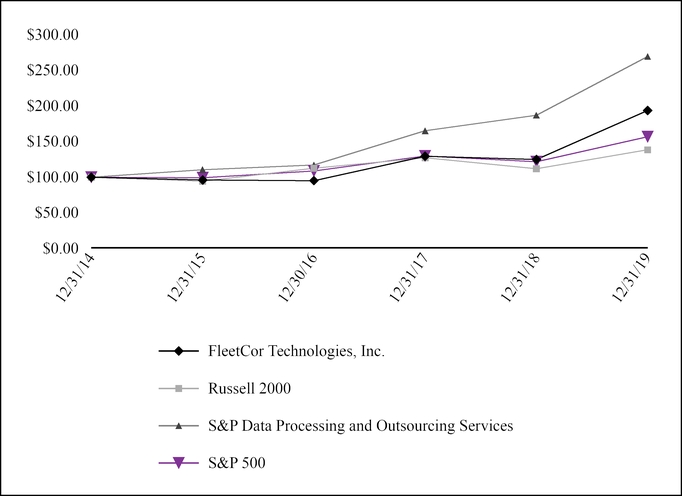
The following graph assumes $100 invested on December 31, 2014, at the closing price ($148.71) of our common stock on that day, and compares (a) the percentage change of our cumulative total stockholder return on the common stock (as measured by dividing (i) the difference between our share price at the end and the beginning of the period presented by (ii) the share price at the beginning of the periods presented) with (b) (i) the Russell 2000 Index, (ii) the S&P 500® Data Processing & Outsourced Services and (iii) S&P 500.
RECENT SALES OF UNREGISTERED SECURITIES AND USE OF PROCEEDS
Not Applicable.
Item 6. SELECTED FINANCIAL DATA
We derived the consolidated statement of income and other financial data for the years ended December 31, 2019, 2018 and 2017 and the selected consolidated balance sheet data as of December 31, 2019 and 2018 from the audited consolidated financial statements included elsewhere in this report. We derived the selected historical financial data for the years ended December 31, 2016 and 2015 and the selected consolidated balance sheets as of December 31, 2017, 2016 and 2015 from our audited consolidated financial statements that are not included in this report.
The selected consolidated financial data set forth below should be read in conjunction with “Management’s Discussion and Analysis of Financial Condition and Results of Operations” and our audited consolidated financial statements and notes thereto included elsewhere in this report. Our historical results are not necessarily indicative of the results to be expected in any future period.
| (in thousands, except per share data) | 2019****1 | 2018****2 | 2017 | 2016 | 2015 | |||||||||||||||
| Consolidated statement of income data: | ||||||||||||||||||||
| Revenues, net | $ | 2,648,848 | $ | 2,433,492 | $ | 2,249,538 | $ | 1,831,546 | $ | 1,702,865 | ||||||||||
| Expenses: | ||||||||||||||||||||
| Merchant commissions | — | — | 113,133 | 104,345 | 108,257 | |||||||||||||||
| Processing | 530,669 | 487,695 | 429,613 | 355,414 | 331,073 | |||||||||||||||
| Selling | 204,806 | 182,593 | 170,717 | 131,443 | 109,075 | |||||||||||||||
| General and administrative | 407,210 | 389,172 | 387,694 | 283,625 | 297,715 | |||||||||||||||
| Depreciation and amortization | 274,210 | 274,609 | 264,560 | 203,256 | 193,453 | |||||||||||||||
| Other operating expense (income), net | 523 | 8,725 | 61 | (690 | ) | (4,242 | ) | |||||||||||||
| Operating income | 1,231,430 | 1,090,698 | 883,760 | 754,153 | 667,534 | |||||||||||||||
| Investment loss, net | 3,470 | 7,147 | 53,164 | 36,356 | 57,668 | |||||||||||||||
| Other expense (income), net | 93 | (152,166 | ) | (173,436 | ) | 2,982 | 2,523 | |||||||||||||
| Interest expense, net | 150,048 | 138,494 | 107,146 | 71,896 | 71,339 | |||||||||||||||
| Loss on extinguishment of debt | — | 2,098 | 3,296 | — | — | |||||||||||||||
| Total other expense (income) | 153,611 | (4,427 | ) | (9,830 | ) | 111,234 | 131,530 | |||||||||||||
| Income before income taxes | 1,077,819 | 1,095,125 | 893,590 | 642,919 | 536,004 | |||||||||||||||
| Provision for income taxes | 182,746 | 283,642 | 153,390 | 190,534 | 173,573 | |||||||||||||||
| Net income | $ | 895,073 | $ | 811,483 | $ | 740,200 | $ | 452,385 | $ | 362,431 | ||||||||||
| Earnings per share: | ||||||||||||||||||||
| Basic earnings per share | $ | 10.36 | $ | 9.14 | $ | 8.12 | $ | 4.89 | $ | 3.94 | ||||||||||
| Diluted earnings per share | $ | 9.94 | $ | 8.81 | $ | 7.91 | $ | 4.75 | $ | 3.85 | ||||||||||
| Weighted average shares outstanding: | ||||||||||||||||||||
| Basic shares | 86,401 | 88,750 | 91,129 | 92,597 | 92,023 | |||||||||||||||
| Diluted shares | 90,070 | 92,151 | 93,594 | 95,213 | 94,139 | |||||||||||||||
| As of December 31, | ||||||||||||||||||||
| (in thousands) | 2019 | 2018 | 2017 | 2016 | 2015 | |||||||||||||||
| Consolidated balance sheet data: | ||||||||||||||||||||
| Cash and cash equivalents | $ | 1,271,494 | $ | 1,031,145 | $ | 913,595 | $ | 475,018 | $ | 447,152 | ||||||||||
| Restricted cash3 | 403,743 | 333,748 | 217,275 | 168,752 | 167,492 | |||||||||||||||
| Total assets | 12,248,541 | 11,202,477 | 11,318,359 | 9,626,732 | 7,889,806 | |||||||||||||||
| Total debt | 5,036,785 | 4,819,047 | 4,518,616 | 3,858,233 | 2,935,000 | |||||||||||||||
| Total stockholders’ equity | 3,711,616 | 3,340,180 | 3,676,522 | 3,084,038 | 2,830,047 |
| 1Reflects the impact of the Company's adoption of ASU 2016-02 "Leases", on January 1, 2019, using a modified retrospective transition method. Under this method, financial results reported in periods prior to 2019 are unchanged. |
| 2 Reflects the impact of the Company's adoption of Accounting Standards Update 2014-09, Revenue from Contracts with Customers (Topic 606) ("ASC 606") and related cost capitalization guidance, which was adopted by the Company on January 1, 2018 using the modified retrospective transition method. The adoption of ASC 606 resulted in an adjustment to retained earnings in our consolidated balance sheet for the cumulative effect of applying the standard, which included costs incurred to obtain a contract, as well as presentation changes in our statements of income, including the classification of certain amounts previously classified as merchant commissions and processing expense net with revenues. As a result of the application of the modified retrospective transition method, the Company's prior period results within its Form 10-K and quarterly reports on Form 10-Q will not be restated to reflect ASC 606. |
| 3 Restricted cash represents customer deposits repayable, as well as collateral received from customers for cross-currency transactions. |
Item 7. MANAGEMENT’S DISCUSSION AND ANALYSIS OF FINANCIAL CONDITION AND
RESULTS OF OPERATIONS
The following discussion and analysis of our financial condition and results of operations should be read in conjunction with the consolidated financial statements and related notes appearing elsewhere in this report. In addition to historical information, this discussion contains forward-looking statements that involve risks, uncertainties and assumptions that could cause actual results to differ materially from management’s expectations. Factors that could cause such differences include, but are not limited to, those identified below and those described in Item 1A “Risk Factors” appearing elsewhere in this report. All foreign currency amounts that have been converted into U.S. dollars in this discussion are based on the exchange rate as reported by Oanda for the applicable periods.
The following discussion and analysis of our financial condition and results of operations generally discusses 2019 and 2018 items and year-over-year comparisons between 2019 and 2018. A detailed discussion of 2017 items and year-over-year comparisons between 2018 and 2017 that are not included in this Annual Report on Form 10-K can be found in “Management’s Discussion and Analysis of Financial Condition and Results of Operations” in Part II, Item 7 of our Annual Report on Form 10-K for the year ended December 31, 2018.
General Business
FLEETCOR is a leading global business payment solutions company that simplifies the way businesses manage and pay their expenses. The FLEETCOR portfolio of brands help companies automate, secure, digitize and control payments on behalf of their employees and suppliers. We serve businesses, partners, merchants and consumer and payment networks in North America, Latin America, Europe, and Asia Pacific. FLEETCOR’s predecessor company was organized in the United States in 1986, and FLEETCOR had its initial public offering in 2010 (NYSE: FLT).
FLEETCOR has two reportable segments, North America and International. We report these two segments as they reflect how we organize and manage our employees around the world, manage operating performance, contemplate the differing regulatory environments in North America versus other geographies, and help us isolate the impact of foreign exchange fluctuations on our financial results.
Our payment solutions provide our customers with a payment method designed to be superior to and more robust and effective than what they use currently, whether they use a competitor’s product or another alternative method such as cash or check. Our solutions are comprised of payment products, networks and associated services. We group our payment solutions into five primary categories: Fuel, Lodging, Tolls, Corporate Payments and Gift. Additionally, we provide other complementary payment products including fleet maintenance, employee benefits and long haul transportation-related services.
Each category is unique in its focus, customer base and target markets, but they also share a number of characteristics: customers are primarily businesses, have recurring revenue models, have specialized networks which create barriers to entry, have high EBITDA margins, and have similar selling systems. Our products are used in more than 100 countries around the world, with our primary geographies being the U.S., Brazil and the U.K., which combined accounted for approximately 87% of our revenue in 2019.
FLEETCOR’s payment products generally function like a charge card, prepaid card, one-time use virtual card, and electronic RFID (radio-frequency identification), etc. While the actual payment mechanisms vary from category to category, they are structured to afford control and reporting to the end customer.
FLEETCOR uses both proprietary and third-party networks to deliver its payment solutions. FLEETCOR owns and operates proprietary networks with well-established brands throughout the world, bringing incremental sales and loyalty to affiliated merchants. Third-party networks are used to broaden payment product acceptance and use.
FLEETCOR capitalizes on its products’ specialization with sales and marketing efforts by deploying product-dedicated sales forces to target specific customer segments. We market our products directly through multiple sales channels, including field sales, telesales and digital marketing, and indirectly through our partners, which include major oil companies, leasing companies, petroleum marketers, value-added resellers (VARs) and referral partners.
We believe that our size and scale, product breadth and specialization, geographic reach, proprietary networks, robust distribution capabilities and advanced technology contribute to our industry leading position.
Executive Overview
We operate in two segments, which we refer to as our North America and International segments. Our revenue is generally reported net of the cost for underlying products and services purchased through our payment products. In this report, we refer to this net revenue as “revenue". See “Results of Operations” for additional segment information.
Revenues, net, by Segment. For the years ended December 31, 2019 and 2018, our North America and International segments generated the following revenue (in millions):
| Year ended December 31, | |||||||||||||||
| 2019 | 2018 | ||||||||||||||
| Revenues, net | % of total revenues, net | Revenues, net | % of total revenues, net | ||||||||||||
| North America | $ | 1,709 | 64.5 | % | $ | 1,571 | 64.6 | % | |||||||
| International | 940 | 35.5 | % | 862 | 35.4 | % | |||||||||
| $ | 2,649 | 100.0 | % | $ | 2,433 | 100.0 | % |
Revenues, net, Net Income and Net Income Per Diluted Share. Set forth below are revenues, net, net income and net income per diluted share for the years ended December 31, 2019 and 2018 (in millions, except per share amounts).
| Year ended December 31, | |||||||||
| 2019 | 2018 | ||||||||
| Revenues, net | $ | 2,649 | $ | 2,433 | |||||
| Net income | $ | 895 | $ | 811 | |||||
| Net income per diluted share | $ | 9.94 | $ | 8.81 |
Adjusted Net Income and Adjusted Net Income Per Diluted Share. Set forth below are adjusted net income and adjusted net income per diluted share for the years ended December 31, 2019 and 2018 (in millions, except per share amounts).
| Year Ended December 31, | |||||||||
| 2019 | 2018 | ||||||||
| Adjusted net income | $ | 1,062.1 | $ | 969.8 | |||||
| Adjusted net income per diluted share | $ | 11.79 | $ | 10.53 |
Adjusted net income and adjusted net income per diluted share are supplemental non-GAAP financial measures of operating performance. See the heading entitled “Management’s Use of Non-GAAP Financial Measures” for more information and a reconciliation of the non-GAAP financial measure to the most directly comparable financial measure calculated in accordance with GAAP. We use adjusted net income and adjusted net income per diluted share to eliminate the effect of items that we do not consider indicative of our core operating performance on a consistent basis.
Sources of Revenue
FLEETCOR offers a variety of business payment solutions that help to simplify, automate, secure, digitize and effectively control the way businesse
Showing the first 8K of 121K characters. Open the full section
Item 7A. QUANTITATIVE AND QUALITATIVE DISCLOSURES ABOUT MARKET RISK
Foreign currency risk
Foreign Earnings
Our International segment exposes us to foreign currency exchange rate changes that can impact translations of foreign-denominated assets and liabilities into U.S. dollars and future earnings and cash flows from transactions denominated in different currencies. Revenue from our International segment was 35.5%, 35.4% and 36.5% of total revenue for the years ended December 31, 2019, 2018, and 2017, respectively. We measure foreign currency exchange risk based on changes in foreign currency exchange rates using a sensitivity analysis. The sensitivity analysis measures the potential change in earnings based on a hypothetical 10% change in currency exchange rates. Exchange rates and currency positions as of December 31, 2019 were used to perform the sensitivity analysis. Such analysis indicated that a hypothetical 10% change in foreign currency exchange rates would have increased or decreased consolidated operating income during the year ended December 31, 2019 by approximately $47.6 million had the U.S. dollar exchange rate increased or decreased relative to the currencies to which we had exposure. When exchange rates and currency positions as of December 31, 2018 and 2017 were used to perform this sensitivity analysis, the analysis indicated that a hypothetical 10% change in currency exchange rates would have increased or decreased consolidated operating income for the years ended December 31, 2018 and 2017 by approximately $41.7 million and $34.2 million, respectively. We have utilized International segment operating income as a proxy for foreign earnings.
Unhedged Cross-Currency Risk
With the acquisition of Cambridge in August 2017, we have additional foreign exchange risk and associated foreign exchange risk management requirements due to the nature of our international payments provider business. The majority of Cambridge's revenue is from exchanges of currency at spot rates, which enable customers to make cross-currency payments. In addition, Cambridge also writes foreign currency forward and option contracts for customers to facilitate future payments. The duration of these derivative contracts at inception is generally less than one year. Cambridge aggregates its foreign exchange exposures arising from customer contracts, including the derivative contracts described above, and hedges (economic hedge) the resulting net currency risks by entering into offsetting contracts with established financial institution counterparties.
Interest rate risk
We are exposed to the risk of changing interest rates on our cash investments and on the unhedged portion of our variable rate debt. As of December 31, 2019, we had $4.02 billion of variable rate debt outstanding under our Credit Agreement. See footnote 11 of the accompanying consolidated financial statement for information about the Credit Agreement. We use derivative financial instruments to reduce our exposure related to changes in interest rates. In January 2019, we entered into three interest rate swap cash flow contracts with U.S. dollar notional amounts of $1 billion with a fixed rate of 2.56%, $500 million with a fixed rate of 2.56%, and $500 million with a fixed rate of 2.55% maturing on January 31, 2022, January 31, 2023 and December 19, 2023, respectively. For each of these swap contracts, we will receive one month LIBOR. While these agreements are intended to lessen the impact of rising interest rates on us, they also expose us to the risk that the other parties to the agreements will not perform, we could incur significant costs associated with the settlement of the agreements, the agreements will be unenforceable and the underlying transactions will fail to qualify as highly-effective cash flow hedges under U.S. GAAP. See footnote 17 of the accompanying consolidated financial statements for information about the swap contracts.
If market interest rates had increased or decreased an average of 100 basis points and assuming we had an outstanding balance on our credit facility and term loans of $2.02 billion not fixed by interest rate swap contracts at December 31, 2019, our interest expense would have changed by approximately $20.2 million. Based on the amounts and mix of our fixed and floating rate debt (exclusive of our Securitization Facility) at December 31, 2018 and 2017, if market interest rates had increased or decreased an average of 100 basis points, our interest expense would have changed by approximately $37.9 million and $34.7 million, respectively. We determined these amounts by considering the impact of the hypothetical interest rates on our borrowing costs. These analyses do not consider the effects of changes in the level of overall economic activity that could exist in such an environment.
Fuel price risk
Our fleet customers use our products and services primarily in connection with the purchase of fuel. Accordingly, our revenue is affected by fuel prices, which are subject to significant volatility. A decline in retail fuel prices could cause a change in our revenue from several sources, including fees paid to us based on a percentage of each customer’s total purchase. Changes in the absolute price of fuel may also impact unpaid account balances and the late fees and charges based on these amounts. The impact of changes in fuel price is somewhat mitigated by our agreements with certain merchants, where the price paid to the merchant is equal to the lesser of the merchant’s cost plus a markup or a percentage of the transaction purchase price. We do not enter into any fuel price derivative instruments.
Fuel-price spread risk
From our merchant and network relationships, we derive revenue from the difference between the price charged to a fleet customer for a transaction and the price paid to the merchant or network for the same transaction. The price paid to a merchant or network is calculated as the merchant’s wholesale cost of fuel plus a markup. The merchant’s wholesale cost of fuel is dependent on several factors including, among others, the factors described above affecting fuel prices. The fuel price that we charge to our customer is dependent on several factors including, among others, the fuel price paid to the fuel merchant, posted retail fuel prices and competitive fuel prices. We experience fuel-price spread contraction when the merchant’s wholesale cost of fuel increases at a faster rate than the fuel price we charge to our customers, or the fuel price we charge to our customers decreases at a faster rate than the merchant’s wholesale cost of fuel. Accordingly, if fuel-price spreads contract, we may generate less revenue, which could adversely affect our operating results. The impact of volatility in fuel spreads is somewhat mitigated by our agreements with certain merchants, where the price paid to the merchant is equal to the lesser of the merchant’s cost plus a markup or a percentage of the transaction purchase price.
Item 8. FINANCIAL STATEMENTS AND SUPPLEMENTARY DATA
INDEX TO CONSOLIDATED FINANCIAL STATEMENTS
Report of Independent Registered Public Accounting Firm
To the Shareholders and the Board of Directors of FLEETCOR Technologies, Inc. and Subsidiaries
Opinion on the Financial Statements
We have audited the accompanying consolidated balance sheets of FLEETCOR Technologies, Inc. and subsidiaries (the Company) as of December 31, 2019 and 2018, the related consolidated statements of income, comprehensive income, shareholders' equity and cash flows for each of the three years in the period ended December 31, 2019, and the related notes (collectively referred to as the “consolidated financial statements”). In our opinion, the consolidated financial statements present fairly, in all material respects, the financial position of the Company at December 31, 2019 and 2018, and the results of its operations and its cash flows for each of the three years in the period ended December 31, 2019, in conformity with U.S. generally accepted accounting principles.
We also have audited, in accordance with the standards of the Public Company Accounting Oversight Board (United States) (PCAOB), the Company's internal control over financial reporting as of December 31, 2019, based on criteria established in Internal Control-Integrated Framework issued by the Committee of Sponsoring Organizations of the Treadway Commission (2013 framework) and our report dated March 2, 2020 expressed an unqualified opinion thereon.
Basis for Opinion
These financial statements are the responsibility of the Company's management. Our responsibility is to express an opinion on the Company’s financial statements based on our audits. We are a public accounting firm registered with the PCAOB and are required to be independent with respect to the Company in accordance with the U.S. federal securities laws and the applicable rules and regulations of the Securities and Exchange Commission and the PCAOB.
We conducted our audits in accordance with the standards of the PCAOB. Those standards require that we plan and perform the audit to obtain reasonable assurance about whether the financial statements are free of material misstatement, whether due to error or fraud. Our audits included performing procedures to assess the risks of material misstatement of the financial statements, whether due to error or fraud, and performing procedures that respond to those risks. Such procedures included examining, on a test basis, evidence regarding the amounts and disclosures in the financial statements. Our audits also included evaluating the accounting principles used and significant estimates made by management, as well as evaluating the overall presentation of the financial statements. We believe that our audits provide a reasonable basis for our opinion.
Critical Audit Matter
The critical audit matter communicated below is a matter arising from the current period audit of the financial statements that was communicated or required to be communicated to the audit committee and that: (1) relates to accounts or disclosures that are material to the financial statements and (2) involved our especially challenging, subjective or complex judgments. The communication of the critical audit matter does not alter in any way our opinion on the consolidated financial statements, taken as a whole, and we are not, by communicating the critical audit matter below, providing a separate opinion on the critical audit matter or on the account or disclosures to which it relates.
| Valuation of Goodwill | ||
| Description of the Matter | At December 31, 2019, the Company’s goodwill was $4.8 billion. As discussed in Note 2 to the consolidated financial statements, the Company completes an impairment test of goodwill at least annually or more frequently if facts and circumstances indicate that goodwill might be impaired. Goodwill is tested for impairment at the reporting unit level and involves estimating the fair value of each identified reporting unit which is measured based upon, among other factors, a discounted cash flow analysis, as well as market multiples for comparable companies. Auditing the Company's estimate of reporting unit fair value involved a high degree of subjectivity as estimates underlying the determination of reporting unit fair value using the discounted cash flow model were based on significant assumptions that are sensitive to changes and are affected by expected future market and economic conditions. These assumptions included forecasts for Revenue, net, Earnings before Interest Taxes Depreciation and Amortization (EBITDA), and long-term growth rates as well as the discount rate, which reflected risk-based factors based on the reporting units’ geographical location and business risk. | |
| How We Addressed the Matter in Our Audit | We obtained an understanding, evaluated the design and tested the operating effectiveness of controls over the Company’s goodwill impairment review process, including controls over management’s review of the significant assumptions described above. For example, we tested controls over management’s review of the reporting units’ long-term growth rates and discount rates used in the determination of the reporting units’ estimated fair values. To test the estimated fair value of the Company’s reporting units, our audit procedures included, among others, assessing the methodologies used by the Company and testing the significant assumptions discussed above, inclusive of the underlying data used by the Company in its development of these assumptions. We involved our valuation specialists to assist us with these procedures. Our valuation specialists evaluated management’s estimation of the discount rates used in the reporting unit’s fair value calculations, performed a comparison of market multiples to observable transactions, and independently recalculated the discount rates for the respective reporting units. We also compared earnings forecasts to historical results and, for certain reporting units, to current industry and economic trends, and performed sensitivity analyses of the significant assumptions to evaluate the changes in the fair value of the reporting units that would result from changes in the significant assumptions. | |
/s/ Ernst & Young LLP
We have served as the Company's auditor since 2002.
Atlanta, Georgia
March 2, 2020
FLEETCOR Technologies, Inc. and Subsidiaries
Consolidated Balance Sheets
(In Thousands, Except Share and Par Value Amounts)
| December 31, | ||||||||
| 2019****1 | 2018 | |||||||
| *Assets |
Showing the first 8K of 164K characters. Open the full section
Item 9. CHANGES IN AND DISAGREEMENTS WITH ACCOUNTANTS ON ACCOUNTING AND FINANCIAL DISCLOSURE
Not applicable.
Item 9A. CONTROLS AND PROCEDURES
Evaluation of Disclosure Controls and Procedures
As of December 31, 2019, management carried out, under the supervision and with the participation of our Chief Executive Officer and Chief Financial Officer, an evaluation of the effectiveness of the design and operation of our disclosure controls and procedures (as defined in Rules 13a-15(e) and 15d-15(e) under the Securities Exchange Act of 1934). Based on this evaluation, our Chief Executive Officer and Chief Financial Officer concluded that, as of December 31, 2019, our disclosure controls and procedures were effective in ensuring that information required to be disclosed by us in the reports that we file or submit under the Securities Exchange Act of 1934, as amended, is recorded, processed, summarized and reported within the time periods specified in applicable rules and forms and are designed to ensure that information required to be disclosed in those reports is accumulated and communicated to management, including our Chief Executive Officer and Chief Financial Officer, as appropriate to allow timely decisions regarding required disclosure.
Management Report on Internal Control over Financial Reporting
Our management team is responsible for establishing and maintaining adequate internal control over financial reporting as defined in Rules 13a-15(f) and 15d-15(f) under the Securities Exchange Act of 1934. Our management assessed the effectiveness of our internal control over financial reporting as of December 31, 2019. In making this assessment, our management used the criteria set forth by the Committee of Sponsoring Organizations of the Treadway Commission (COSO) in Internal Control-Integrated Framework. As of December 31, 2019, management believes that the Company’s internal control over financial reporting is effective based on those criteria. Our independent registered public accounting firm has issued an audit report on our internal control over financial reporting, which is included in this annual report.
In connection with management's evaluation, our management team excluded from its assessment of the effectiveness of our internal control over financial reporting as of December 31, 2019, the internal controls related to four subsidiaries that we acquired during the year ended December 31, 2019, and for which financial results are included in our consolidated financial statements.
On April 1, 2019, we acquired NvoicePay, a provider of full accounts payable automation for business in the U.S. On April 1, 2019, we acquired r2c, a fleet maintenance, compliance and workshop management software provider in the U.K. On July 8, 2019, we acquired SOLE Financial, a payroll card provider in the U.S. On October 1, 2019, we acquired Travelliance, an airline lodging provider in the U.S. Collectively we refer to these transactions as the Acquisitions. These Acquisitions constituted 6% of total assets, at December 31, 2019, and 2% of revenues, net for the year then ended. This exclusion was in accordance with Securities and Exchange Commission guidance that an assessment of a recently acquired business may be omitted in management's report on internal control over financial reporting the year of acquisition.
Because of its inherent limitations, internal control over financial reporting may not prevent or detect all misstatements. Projections of any evaluation of effectiveness to future periods are subject to the risk that controls may become inadequate because of changes in conditions or that the degree of compliance with the policies or procedures may deteriorate. Internal control over financial reporting cannot provide absolute assurance of achieving financial reporting objectives because of its inherent limitations. Internal control over financial reporting is a process that involves human diligence and compliance and is subject to lapses in judgment and breakdowns resulting from human failures. Internal control over financial reporting also can be circumvented by collusion or improper management override. Due to such limitations, there is a risk that material misstatements may not be prevented or detected on a timely basis by internal control over financial reporting. However, these inherent limitations are known features of the financial reporting process. Therefore, it is possible to design into the process safeguards to reduce, though not eliminate, such risk.
Changes in Internal Control over Financial Reporting
There were no changes in our internal control over financial reporting during the quarter ended December 31, 2019, that have materially affected, or are reasonably likely to materially affect, our internal control over financial reporting.
Report of Independent Registered Public Accounting Firm
To the Shareholders and the Board of Directors of FLEETCOR Technologies, Inc. and Subsidiaries
Opinion on Internal Control over Financial Reporting
We have audited FLEETCOR Technologies, Inc. and subsidiaries’ internal control over financial reporting as of December 31, 2019, based on criteria established in Internal Control-Integrated Framework issued by the Committee of Sponsoring Organizations of the Treadway Commission (2013 framework) (the COSO criteria). In our opinion, FLEETCOR Technologies, Inc. and subsidiaries (the Company) maintained, in all material respects, effective internal control over financial reporting as of December 31, 2019, based on the COSO criteria.
As indicated in the accompanying Management Report on Internal Control over Financial Reporting, management’s assessment of and conclusion on the effectiveness of internal control over financial reporting did not include the internal controls of NvoicePay, SOLE Financial, r2c, and Travelliance, which are included in the 2019 consolidated financial statements FLEETCOR Technologies, Inc. and subsidiaries and constituted 6% of total assets as of December 31, 2019 and 2% of revenues, net for the year then ended. Our audit of internal control over financial reporting of FLEETCOR Technologies, Inc. and subsidiaries also did not include an evaluation of the internal control over financial reporting of NvoicePay, SOLE Financial, r2c, and Travelliance.
We also have audited, in accordance with the standards of the Public Company Accounting Oversight Board (United States) (PCAOB), the consolidated balance sheets of the Company as of December 31, 2019 and 2018, the related consolidated statements of income, comprehensive income, shareholders' equity and cash flows for each of the three years in the period ended December 31, 2019, and the related notes and our report dated March 2, 2020 expressed an unqualified opinion thereon.
Basis for Opinion
The Company’s management is responsible for maintaining effective internal control over financial reporting and for its assessment of the effectiveness of internal control over financial reporting included in the accompanying Management Report on Internal Control over Financial Reporting. Our responsibility is to express an opinion on the Company’s internal control over financial reporting based on our audit. We are a public accounting firm registered with the PCAOB and are required to be independent with respect to the Company in accordance with the U.S. federal securities laws and the applicable rules and regulations of the Securities and Exchange Commission and the PCAOB.
We conducted our audit in accordance with the standards of the PCAOB. Those standards require that we plan and perform the audit to obtain reasonable assurance about whether effective internal control over financial reporting was maintained in all material respects.
Our audit included obtaining an understanding of internal control over financial reporting, assessing the risk that a material weakness exists, testing and evaluating the design and operating effectiveness of internal control based on the assessed risk, and performing such other procedures as we considered necessary in the circumstances. We believe that our audit provides a reasonable basis for our opinion.
Definition and Limitations of Internal Control Over Financial Reporting
A company’s internal control over financial reporting is a process designed to provide reasonable assurance regarding the reliability of financial reporting and the preparation of financial statements for external purposes in accordance with generally accepted accounting principles. A company’s internal control over financial reporting includes those policies and procedures that (1) pertain to the maintenance of records that, in reasonable detail, accurately and fairly reflect the transactions and dispositions of the assets of the company; (2) provide reasonable assurance that transactions are recorded as necessary to permit preparation of financial statements in accordance with generally accepted accounting principles, and that receipts and expenditures of the company are being made only in accordance with authorizations of management and directors of the company; and (3) provide reasonable assurance regarding prevention or timely detection of unauthorized acquisition, use, or disposition of the company’s assets that could have a material effect on the financial statements.
Because of its inherent limitations, internal control over financial reporting may not prevent or detect misstatements. Also, projections of any evaluation of effectiveness to future periods are subject to the risk that controls may become inadequate because of changes in conditions, or that the degree of compliance with the policies or procedures may deteriorate.
/s/ Ernst & Young LLP
Atlanta, Georgia
March 2, 2020
Item 9B. OTHER INFORMATION
Not applicable.
PART III
Item 10. DIRECTORS, EXECUTIVE OFFICERS AND CORPORATE GOVERNANCE
A list of our executive officers and biographical information appears in Part I, Item X of this Form 10-K. Information about our directors may be found under the caption “Nominees” and “Continuing Directors” in our Proxy Statement for the Annual Meeting of Shareholders to be held June 11, 2020 (the “Proxy Statement”). Information about our Audit Committee may be found under the caption “Board Committees” in the Proxy Statement. The foregoing information is incorporated herein by reference.
The information in the Proxy Statement set forth under the caption “Delinquent Section 16(a) Reports” is incorporated herein by reference.
We have adopted the FLEETCOR Code of Business Conduct and Ethics (the “code of ethics”), which applies to our Chief Executive Officer, Chief Financial Officer, Chief Accounting Officer and Corporate Controller, and other finance organization employees. The code of ethics is publicly available on our website at www.fleetcor.com under Investor Relations. If we make any substantive amendments to the code of ethics or grant any waiver, including any implicit waiver, from a provision of the code to our Chief Executive Officer, Chief Financial Officer, or Chief Accounting Officer, we will disclose the nature of the amendment or waiver on that website or in a report on Form 8-K.
Item 11. EXECUTIVE COMPENSATION
The information in the Proxy Statement set forth under the captions “Director Compensation,” “Named Executive Officer Compensation,” “Compensation Committee Report,” and “Compensation Committee Interlocks and Insider Participation” is incorporated herein by reference.
Item 12. SECURITY OWNERSHIP OF CERTAIN BENEFICIAL OWNERS AND MANAGEMENT
AND RELATED STOCKHOLDER MATTERS
The information in the Proxy Statement set forth under the captions “Securities Authorized for Issuance Under Equity Compensation Plans,” “Information Regarding Beneficial Ownership of Principal Shareholders, Directors, and Management” and “Equity Compensation Plan Information” is incorporated herein by reference.
Item 13. CERTAIN RELATIONSHIPS AND RELATED TRANSACTIONS, AND DIRECTOR
INDEPENDENCE
The information set forth in the Proxy Statement under the captions “Director Independence” and “Certain Relationships and Related Transactions” is incorporated herein by reference.
Item 14. PRINCIPAL ACCOUNTANT FEES AND SERVICES
Information concerning principal accountant fees and services appears in the Proxy Statement under the headings “Fees Billed by Ernst & Young LLP” and “Policy on Audit Committee Pre-Approval of Audit and Permissible Non-Audit Services of Independent Auditor” and is incorporated herein by reference.
PART IV
Item 15. EXHIBITS AND FINANCIAL STATEMENT SCHEDULES
(a) Financial Statements and Schedules
The financial statements are set forth under Item 8 of this Form 10-K, as indexed below. Financial statement schedules have been omitted since they either are not required, not applicable, or the information is otherwise included.
Index to Financial Statements
(b) Exhibit Listing
| Exhibit no. | ||
| 3.1 | Amended and Restated Certificate of Incorporation of FLEETCOR Technologies, Inc. (incorporated by reference to Exhibit 3.1 to the registrant’s Annual Report on Form 10-K, File No. 001-35004, filed with SEC on March 25, 2011) | |
| 3.2 | Certificate of Amendment to the Amended and Restated Certificate of Incorporation of FLEETCOR Technologies, Inc. (incorporated by reference to Exhibit 3.1 to the registrant's Current Report on Form 8-K, File No. 001-35004, filed with the SEC on June 8, 2018) | |
| 3.3 | Certificate of Amendment to the Amended and Restated Certificate of Incorporation of FLEETCOR Technologies, Inc. (incorporated by reference to Exhibit 3.1 to the registrant's Current Report on Form 8-K, File No. 001-35004, filed with the SEC on June 14, 2019) | |
| 3.4 | Amended and Restated Bylaws of FleetCor Technologies, Inc. (incorporated by reference to Exhibit 3.1 to the Registrant’s Annual Report on Form 8-K, File No. 001-35004, filed with the SEC on January 29, 2018) | |
| 4.1 | Form of Stock Certificate for Common Stock (incorporated by reference to Exhibit 4.1 to Amendment No. 3 to the registrant’s Registration Statement on Form S-1, File No. 333-166092, filed with the SEC on June 29, 2010) | |
| 4.2 | Description of FLEETCOR Technologies, Inc. Common Stock Registered under Section 12 of the Securities Exchange Act | |
| 10.1* | Form of Indemnity Agreement entered into between FLEETCOR and its directors and executive officers (incorporated by reference to Exhibit 10.1 to Amendment No. 3 to the registrant’s Registration Statement on Form S-1, File No. 333-166092, filed with the SEC on June 29, 2010) | |
| 10.2* | FLEETCOR Technologies, Inc. Amended and Restated Stock Incentive Plan (incorporated by reference to Exhibit 10.2 to Amendment No. 1 to the registrant’s Registration Statement on Form S-1, File No. 333-166092, filed with the SEC on May 20, 2010) | |
| 10.3* | First Amendment to FLEETCOR Technologies, Inc. Amended and Restated Stock Incentive Plan (incorporated by reference to Exhibit 10.3 to Amendment No. 1 to the registrant’s Registration Statement on Form S-1, File No. 333-166092, filed with the SEC on May 20, 2010) | |
| 10.4* | Second Amendment to FLEETCOR Technologies, Inc. Amended and Restated Stock Incentive Plan (incorporated by reference to Exhibit 10.4 to Amendment No. 1 to the registrant’s Registration Statement on Form S-1, File No. 333-166092, filed with the SEC on May 20, 2010) | |
| 10.5* | Third Amendment to FLEETCOR Technologies, Inc. Amended and Restated Stock Incentive Plan (incorporated by reference to Exhibit 10.5 to Amendment No. 1 to the registrant’s Registration Statement on Form S-1, File No. 333-166092, filed with the SEC on May 20, 2010) | |
| 10.6* | Fourth Amendment to FLEETCOR Technologies, Inc. Amended and Restated Stock Incentive Plan (incorporated by reference to Exhibit 10.6 to Amendment No. 1 to the registrant’s Registration Statement on Form S-1, File No. 333-166092, filed with the SEC on May 20, 2010) | |
| 10.7* | Form of Incentive Stock Option Award Agreement pursuant to the FLEETCOR Technologies, Inc. Amended and Restated Stock Incentive Plan (incorporated by reference to Exhibit 10.7 to Amendment No. 1 to the registrant’s Registration Statement on Form S-1, File No. 333-166092, filed with the SEC on May 20, 2010) | |
| 10.8* | Form of Non-Qualified Stock Option Award Agreement pursuant to the FLEETCOR Technologies, Inc. Amended and Restated Stock Incentive Plan (incorporated by reference to Exhibit 10.8 to Amendment No. 1 to the registrant’s Registration Statement on Form S-1, File No. 333-166092, filed with the SEC on May 20, 2010) | |
| 10.9* | Form of Performance Share Restricted Stock Agreement pursuant to the FLEETCOR Technologies, Inc. Amended and Restated Stock Incentive Plan (incorporated by reference to Exhibit 10.9 to Amendment No. 1 to the registrant’s Registration Statement on Form S-1, File No. 333-166092, filed with the SEC on May 20, 2010) | |
| 10.10* | FLEETCOR Technologies, Inc. Annual Executive Bonus Program (incorporated by reference to Exhibit 10.11 to Amendment No. 2 to the registrant’s Registration Statement on Form S-1, File No. 333-166092, filed with the SEC on June 8, 2010) | |
| 10.11* | Employee Noncompetition, Nondisclosure and Developments Agreement, dated September 25, 2000, between Fleetman, Inc. and Ronald F. Clarke (incorporated by reference to Exhibit 10.12 to Amendment No. 2 to the registrant’s Registration Statement on Form S-1, File No. 333-166092, filed with the SEC on June 8, 2010) | |
| 10.12* | Offer Letter, dated September 20, 2002, between FLEETCOR Technologies, Inc. and Eric R. Dey (incorporated by reference to Exhibit 10.13 to Amendment No. 2 to the registrant’s Registration Statement on Form S-1, File No. 333-166092, filed with the SEC on June 8, 2010) | |
| 10.13* | Service Agreement, dated July 9, 2007, between FLEETCOR Technologies, Inc. and Andrew R. Blazye (incorporated by reference to Exhibit 10.16 to Amendment No. 2 to the registrant’s Registration Statement on Form S-1, File No. 333-166092, filed with the SEC on June 8, 2010) | |
| 10.14 | Sixth Amended and Restated Registration Rights Agreement, dated April 1, 2009, between FLEETCOR Technologies, Inc. and each of the stockholders party thereto (incorporated by reference to Exhibit 10.17 to Amendment No. 2 to the registrant’s Registration Statement on Form S-1, File No. 333-166092, filed with the SEC on June 8, 2010) | |
| 10.15 | First Amendment to Sixth Amended and Restated Registration Rights Agreement (incorporated by reference to Exhibit No. 10.17 to the registrant’s form 10-K, File No. 001-35004. with the SEC on March 25, 2011) | |
| 10.16 | Form of Indemnity Agreement to be entered into between FLEETCOR and representatives of its major stockholders (incorporated by reference to Exhibit 10.37 to Amendment No. 3 to the registrant’s Registration Statement on Form S-1, File No. 333-166092, filed with the SEC on June 29, 2010) | |
| 10.17 | Form of Director Restricted Stock Grant Agreement pursuant to the FLEETCOR Technologies, Inc. 2010 Equity Compensation Plan (incorporated by reference to Exhibit 10.38 to Amendment No. 6 to the registrant’s Registration Statement on Form S-1, File No. 333-166092, filed with the SEC on November 30, 2010) | |
| 10.18* | Form of Employee Performance Share Restricted Stock Agreement pursuant to the FLEETCOR Technologies, Inc. 2010 Equity Compensation Plan (incorporated by reference to Exhibit 10.39 to Amendment No. 6 to the registrant’s Registration Statement on Form S-1, File No. 333-166092, filed with the SEC on November 30, 2010) | |
| 10.19* | Form of Employee Incentive Stock Option Award Agreement pursuant to the FLEETCOR Technologies, Inc. 2010 Equity Compensation Plan (incorporated by reference to Exhibit 10.40 to Amendment No. 6 to the registrant’s Registration Statement on Form S-1, File No. 333-166092, filed with the SEC on November 30, 2010) | |
| 10.20* | Form of Employee Non-Qualified Stock Option Award Agreement pursuant to the FLEETCOR Technologies, Inc. 2010 Equity Compensation Plan (incorporated by reference to Exhibit 10.41 to Amendment No. 6 to the registrant’s Registration Statement on Form S-1, File No. 333-166092, filed with the SEC on November 30, 2010) | |
| 10.21 | Form of Director Non-Qualified Stock Option Award Agreement pursuant to the FLEETCOR Technologies, Inc. 2010 Equity Compensation Plan (incorporated by reference to Exhibit 10.42 to Amendment No. 6 to the registrant’s Registration Statement on Form S-1, File No. 333-166092, filed with the SEC on November 30, 2010) | |
| 10.22* | Amended and Restated Employee Noncompetition, Nondisclosure and Developments Agreement, dated November 29, 2010, between FLEETCOR Technologies, Inc. and Ronald F. Clarke (incorporated by reference to Exhibit No. 10.43 to Amendment No. 6 to the registrant’s Registration Statement on Form S-1, File No. 333-166092, filed with the SEC on November 30, 2010) | |
| 10.23 | Arrangement Agreement Among FLEETCOR Luxembourg Holdings2 S.À.R.L, FLEETCOR Technologies, Inc. and CTF Technologies, Inc. (incorporated by reference to Exhibit 10.1 to the registrant’s Form 10-Q, File No. 001-35004, filed with the SEC on May 10, 2012) | |
| 10.24 | Repurchase Agreement, dated November 26, 2012, among the Company and the Repurchase Stockholders (incorporated by reference to Exhibit 10.1 to the registrant’s Form 8-K, File No. 001-35004, filed with the SEC on November 27, 2012) | |
| 10.25* | FLEETCOR Technologies, Inc. 2010 Equity Compensation Plan, as amended and restated effective February 7, 2018 (incorporated by reference from Appendix A to Exhibit 10.1 to the registrant's Form 8-K, File No. 001-35004, File No. 001-35004, filed with the SEC on February 12, 2018) | |
| 10.26 | FLEETCOR Technologies, Inc. Section 162(M) Performance—Based Program (incorporated by reference to Annex A to the registrant’s Proxy Statement, File No. 001-35004, filed with the SEC on April 18, 2014) | |
| 10.27 | Credit Agreement, dated October 24, 2014, among FLEETCOR Technologies Operating Company, LLC, as Borrower, FLEETCOR Technologies, Inc., as Parent, FLEETCOR Technologies Operating Company, LLC, as a borrower and guarantor, certain of the our foreign subsidiaries as borrowers, Bank of America, N.A., as administrative agent, swing line lender and L/C issuer and a syndicate of financial institutions (incorporated by reference to Exhibit No. 10.4 to the registrant’s Form 10-Q, File No. 001-35004, filed with the SEC on November 10, 2014) | |
| 10.28 | Fifth Amended and Restated Receivables Purchase Agreement, dated November 14, 2014, by and among FLEETCOR Technologies, Inc. and PNC Bank, National Association, as administrator for a group of purchasers and purchaser agents, and certain other parties (incorporated by reference to Exhibit No. 10.1 to the registrant’s Form 8-K, File No. 001-35004, filed with the SEC on November 17, 2014) | |
| 10.29 | Amended and Restated Performance Guaranty dated as of November 14, 2014 made by FLEETCOR Technologies, Inc. and FLEETCOR Technologies Operating Company, LLC, in favor of PNC Bank, National Association, as administrator under the Fifth Amended and Restated Receivables Purchase Agreement (incorporated by reference to Exhibit 10.32 to the registrant’s Form 10-K, File No. 001-35004, filed with the SEC on March 2, 2015) | |
| 10.30 | Amended and Restated Purchase and Sale Agreement dated as of November 14, 2014, among various entities listed on Schedule I thereto, as originators, and FLEETCOR Funding LLC (incorporated by reference to Exhibit 10.33 to the registrant’s Form 10-K, File No. 001-35004, filed with the SEC on March 2, 2015) | |
| 10.31 | Receivables Purchase and Sale Agreement dated as of November 14, 2014, among Comdata TN, Inc. and Comdata Network, Inc. of California, as the sellers, and Comdata Inc., as the buyer (incorporated by reference to Exhibit 10.34 to the registrant’s Form 10-K, File No. 001-35004, filed with the SEC on March 2, 2015) | |
| 10.32 | Investor Rights Agreement, dated November 14, 2014, between FLEETCOR Technologies, Inc. and Ceridian LLC (incorporated by reference to Exhibit 10.35 to the registrant’s Form 10-K, File No. 001-35004, filed with the SEC on March 2, 2015) | |
| 10.33* | Offer Letter, dated June 19, 2013, between FLEETCOR Technologies, Inc. and John A. Reed (incorporated by reference to Exhibit No. 10.3 to the registrant’s Form 10-Q, File No. 001-35004, filed with the SEC on May 12, 2014) | |
| 10.34* | Offer Letter, dated July 29, 2014, between FLEETCOR Technologies, Inc. and Armando Lins Netto (incorporated by reference to Exhibit 10.1 to the registrant’s Form 10-Q, File No. 001-35004, filed with the SEC on May 11, 2015) | |
| 10.35 | First Amendment to the Fifth Amended and Restated Receivables Purchase Agreement, dated as of November 5, 2015, by and among FLEETCOR Funding LLC, FLEETCOR Technologies Operating Company, LLC and PNC Bank, National Association, as administrator for a group of purchasers and purchaser agents, and certain other parties (incorporated by reference to Exhibit 10.2 to the registrant’s Form 10-Q, File No. 001-35004, filed with the SEC on November 9, 2015) | |
| 10.36* | Employee agreement on confidentiality, work product, non-competition, and non-solicitation (incorporated by reference to Exhibit 10.38 to the registrant's Form 10-K, File No. 001-35004, filed with the SEC on February 29, 2016) | |
| 10.37 | Second Amendment to the Fifth Amended and Restated Receivables Purchase Agreement, dated as of December 1, 2015, by and among FLEETCOR Funding LLC, FLEETCOR Technologies Operating Company, LLC and PNC Bank, National Association, as administrator for a group of purchasers and purchaser agents, and certain other parties (incorporated by reference to Exhibit 10.39 to the registrant's Form 10-K, File No. 001-35004, filed with the SEC on February 29, 2016) | |
| 10.40 | First Amendment to Credit Agreement and Lender Joiner Agreement, dated as of August 22, 2016, by and among FLEETCOR Funding LLC, FLEETCOR Technologies Operating Company, LLC and PNC Bank, National Association, as administrator for a group of purchasers and purchaser agents, and certain other parties (incorporated by reference to Exhibit 10.1 to the registrant’s Form 10-Q, File No. 001-35004, filed with the SEC on November 9, 2016) | |
| 10.41 | Second Amendment to Credit Agreement, dated as of January 2017, among FLEETCOR Technologies Operating Company, LLC, as the Company, FLEETCOR Technologies, Inc., as the Parent, the designated borrowers party hereto, the other guarantors party hereto, Bank of America, N.A., as administrative agent, swing line lender and l/c issuer, and the other lenders party hereto and Merrill Lynch, Pierce, Fenner & Smith Incorporated, as sole lead arranger and sole bookrunner (incorporated by reference to Exhibit 10.41 to the registrant's Form 10-K, File No. 001-35004, filed with the SEC on March 1, 2017) | |
| 10.42 | Third Amendment to Credit Agreement, dated as of August 2, 2017, among FLEETCOR Technologies Operating Company, LLC, as the Company, FLEETCOR Technologies, Inc., as the Parent, the designated borrowers party hereto, the other guarantors party hereto, Bank of America, N.A., as administrative agent, swing line lender and l/c issuer, and the other lenders party hereto, and Merrill Lynch, Pierce, Fenner & Smith Incorporated, as sole lead arranger and sole bookrunner (incorporated by reference to Exhibit 10.1 to the registrant’s Form 10-Q, File No. 001-35004, filed with the SEC on August 8, 2017) | |
| 10.43 | Third Amendment to Fifth Amended and Restated Receivables Purchase Agreement, dated as of November 14, 2017, by and among FLEETCOR Funding LLC, FLEETCOR Technologies Operating Company, LLC, PNC Bank, National Association, as administrator for a group of purchasers and purchase agents, and certain other parties (incorporated by reference to Exhibit 10.43 to the registrant's Form 10-K, File No. 001-35004, filed with the SEC on March 1, 2018) | |
| 10.44 | Offer letter, dated September 10, 2015, between FLEETCOR Technologies, Inc. and Alexey Gavrilenya (incorporated by reference to Exhibit 10.1 to the registrant's Form 10-Q, File No. 001-35004, filed with the SEC on May 10, 2018) | |
| 10.45 | Fourth Amendment to Credit Agreement, dated August 30, 2018, among FleetCor Technologies Operating Company, LLC, FleetCor Technologies Operating Company, LLC, FleetCor Technologies, Inc., the designated borrowers party thereto, Cambridge Mercantile Corp. (U.S.A.), the other guarantors party thereto, Bank of America, N.A., as administrative agent, swing line lender and l/c issuer, and the other lenders party thereto (incorporated by reference to Exhibit 10.2 to the registrant's Form 10-Q, File No. 001-35004, filed with the SEC on November 8, 2018) | |
| 10.46 | Fourth Amendment to Fifth Amended and Restated Receivables Purchase Agreement, dated August 30, 2018, by and among FleetCor Funding LLC, FleetCor Technologies Operating Company, LLC, PNC Bank, National Association as administrator for a group of purchasers and purchaser agents, and certain other parties thereto (incorporated by reference to exhibit 10.3 to the registrant's Form 10-Q, File No. 001-35004, filed with the SEC on November 8, 2018) | |
| 10.47 | Fifth Amendment to Credit Agreement, dated as of December 19, 2018, among FLEETCOR Technologies Operating Company, LLC, as the Company, FLEETCOR Technologies, Inc., as the Parent, the designated borrowers party hereto, Bank of America, N.A., as administrative agent, swing line lender and L/C issuer, and the other lenders party hereto Merrill Lynch, Pierce, Fenner & Smith Incorporated, as sole lead arranger and sole bookrunner (incorporated by reference to exhibit 10.47 to the registrant's Form 10-K, File No. 001-35004, filed with the SEC on March 1, 2019) | |
| 10.48 | Offer Letter, dated March 30, 2018, between FLEETCOR Technologies, Inc. and David Krantz (incorporated by reference to exhibit 10.1 to the registrant's Form 10-Q, File No. 001-35004, filed with the SEC on May 10, 2019) | |
| 10.49 | Offer Letter, dated August14, 2015, between FLEETCOR Technologies, Inc. and Kurt Adams (incorporated by reference to exhibit 10.2 to the registrant's Form 10-Q, File No. 001-35004, filed with the SEC on May 10, 2019) | |
| 10.50 | Fifth Amendment to the Fifth Amended and Restated Receivables Purchase Agreement, dated February 8, 2019 by and among FleetCor Funding LLC, FleetCor Technologies Operating Company, LLC, PNC Bank, National Association as administrator for a group of purchasers and purchaser agents, and certain other parties thereto (incorporated by reference to exhibit 10.3 to the registrant's Form 10-Q, File No. 001-35004, filed with the SEC on May 10, 2019) | |
| 10.51 | Sixth Amendment to the Fifth Amended and Restated Receivables Purchase Agreement, dated April 22, 2019 by and among FleetCor Funding LLC, FleetCor Technologies Operating Company, LLC, PNC Bank, National Association as administrator for a group of purchasers and purchaser agents, and certain other parties thereto (incorporated by reference to exhibit 10.4 to the registrant's Form 10-Q, File No. 001-35004, filed with the SEC on May 10, 2019) | |
| 10.52 | Sixth Amendment to Credit Agreement, dated as of August 2, 2019, among FLEETCOR Technologies Operating Company, LLC, as the Company, FLEETCOR Technologies, Inc., as the Parent, the designated borrowers party hereto, Bank of America, N.A., as administrative agent, swing line lender and L/C issuer, and the other lenders party hereto Merrill Lynch, Pierce, Fenner & Smith Incorporated, as sole lead arranger and sole bookrunner (incorporated by reference to Exhibit 10.5 to the registrant's Form 10-Q, File No. 001-35004, filed with the SEC on August 9, 2019) | |
| 10.53 | Seventh Amendment to Credit Agreement, dated as of November 14, 2019, among FLEETCOR Technologies Operating Company, LLC, as the Company, FLEETCOR Technologies, Inc., as the Parent, the designated borrowers party hereto, Bank of America, N.A., as administrative agent, swing line lender and L/C issuer, and the other lenders party hereto Merrill Lynch, Pierce, Fenner & Smith Incorporated, as sole lead arranger and sole bookrunner | |
| 21.1 | List of subsidiaries of FLEETCOR Technologies, Inc. | |
| 23.1 | Consent of Independent Registered Public Accounting Firm | |
| 31.1 | Certification of Chief Executive Officer Pursuant to Section 302 | |
| 31.2 | Certification of Chief Financial Officer Pursuant to Section 302 | |
| 32.1 | Certification of Chief Executive Officer Pursuant to Section 906 | |
| 32.2 | Certification of Chief Financial Officer Pursuant to Section 906 | |
| 101 | The following financial information for the registrant formatted in XBRL (Extensible Business Reporting Language): (i) the Consolidated Balance Sheets, (ii) the Consolidated Statements of Income, (iii) the Consolidated Statements of Comprehensive Income; (iv) the Consolidated Statements of Stockholders' Equity; (v) the Consolidated Statements of Cash Flows and (vi) the Notes to Consolidated Financial Statements | |
| 104 | Cover Page Interactive Data File (embedded within the Inline XBRL document and contained in Exhibit 101) |
| * | Identifies management contract or compensatory plan or arrangement. |
Item 16. FORM 10-K SUMMARY
None.
Pursuant to the requirements of Section 13 or 15(d) of the Securities Exchange Act of 1934, the registrant has duly caused this report to be signed on its behalf by the undersigned; thereunto duly authorized, in the City of Atlanta, State of Georgia, on March 2, 2020.
| FLEETCOR Technologies, Inc. | ||
| By: | /S/ RONALD F. CLARKE | |
| Ronald F. Clarke | ||
| President and Chief Executive Officer |
Pursuant to the requirements of the Securities Exchange Act of 1934, this report has been signed below by the following persons on behalf of registrant and in the capacities indicated on March 2, 2020.
| Signature | Title | |
| /S/ RONALD F. CLARKE | President, Chief Executive Officer and Chairman of the Board of Directors (Principal Executive Officer) | |
| Ronald F. Clarke | ||
| /S/ ERIC R. DEY | Chief Financial Officer (Principal Financial Officer and Principal Accounting Officer) | |
| Eric R. Dey | ||
| /s/ MICHAEL BUCKMAN | Director | |
| Michael Buckman | ||
| /s/ JOSEPH W. FARRELLY | Director | |
| Joseph W. Farrelly | ||
| /s/ THOMAS M. HAGERTY | Director | |
| Thomas M. Hagerty | ||
| /s/ MARK A. JOHNSON | Director | |
| Mark A. Johnson | ||
| /s/ RICHARD MACCHIA | Director | |
| Richard Macchia | ||
| /s/ HALA G. MODDELMOG | Director | |
| Hala G. Moddelmog | ||
| /s/ JEFFREY S. SLOAN | Director | |
| Jeffrey S. Sloan | ||
| /s/ STEVEN T. STULL | Director | |
| Steven T. Stull | ||