 filings.tools
Copart 10-K 2015-07-31
Filed 2015-09-25. 20 sections, 372K characters. Original on sec.gov · Markdown · JSON
Cover and table of contents
10-K 1 cprt07312015-10k.htm 10-K
UNITED STATES
SECURITIES AND EXCHANGE COMMISSION
WASHINGTON, D.C. 20549
FORM 10-K
(Mark One)
| ý | ANNUAL REPORT PURSUANT TO SECTION 13 OR 15(d) OF THE SECURITIES EXCHANGE ACT OF 1934 |
For the fiscal year ended July 31, 2015
OR
| ¨ | TRANSITION REPORT PURSUANT TO SECTION 13 OR 15(d) OF THE SECURITIES EXCHANGE ACT OF 1934 |
for the transition period from to
Commission file number: 0-23255
COPART, INC.
(Exact name of registrant as specified in its charter)
| Delaware | 94-2867490 | |
| (State or other jurisdiction of incorporation or organization) | (I.R.S. Employer Identification Number) | |
| 14185 Dallas Parkway, Suite 300, Dallas, Texas (Address of principal executive offices) | 75254 (Zip Code) |
Registrant’s telephone number, including area code
(972) 391-5000
Securities registered pursuant to Section 12(b) of the Act:
| Title of Each Class | Name of each exchange on which registered | |
| Common Stock, $0.0001 par value | The NASDAQ Global Select Market |
Securities registered pursuant to Section 12(g) of the Act: None
Indicate by check mark if the registrant is a well-known seasoned issuer, as defined in Rule 405 of the Securities Act. Yes ý No o
Indicate by check mark if the registrant is not required to file reports pursuant to Section 13 or Section 15(d) of the Act. Yes o No ý
Indicate by check mark whether the registrant (1) has filed all reports required to be filed by Section 13 or 15(d) of the Securities Exchange Act of 1934 during the preceding 12 months (or for such shorter period that the registrant was required to file such reports), and (2) has been subject to such filing requirements for the past 90 days. Yes ý No o
Indicate by check mark whether the registrant has submitted electronically and posted on its corporate Web site, if any, every Interactive Data File required to be submitted and posted pursuant to Rule 405 of Regulation S-T during the preceding 12 months (or for such shorter period that the registrant was required to submit and post such files). Yes ý No o
Indicate by check mark if disclosure of delinquent filers pursuant to Item 405 of Regulation S-K is not contained herein, and will not be contained, to the best of registrant’s knowledge, in definitive proxy or information statements incorporated by reference in Part III of this Form 10-K or any amendment to this Form 10-K. o
Indicate by check mark whether the registrant is a large accelerated filer, an accelerated filer, a non-accelerated filer, or a smaller reporting company. See the definitions of “large accelerated filer,” “accelerated filer” and “smaller reporting company” in Rule 12b-2 of the Act (check one):
| Large Accelerated Filer x | Accelerated Filer o | Non-Accelerated Filer o | Smaller Reporting Company o | |||
| (Do not check if a smaller reporting company) |
Indicate by check mark whether the registrant is a shell company (as defined in Rule 12b-2 of the Exchange Act). Yes o No ý
The aggregate market value of the voting and non-voting Common Stock held by non-affiliates of the registrant as of January 31, 2015 (the last business day of the registrant’s most recently completed second fiscal quarter) was $3,646,539,300 based upon the closing sales price reported for such date on the NASDAQ Global Select Market. For purposes of this disclosure, shares of Common Stock held by persons who hold more than 5% of the outstanding shares of Common Stock and shares held by officers and directors of the registrant have been excluded in that such persons may be deemed to be affiliates. This determination of affiliate status is not necessarily conclusive for other purposes.
As of September 24, 2015, 120,186,984 shares of the registrant’s common stock were outstanding.
DOCUMENTS INCORPORATED BY REFERENCE
Portions of our definitive Proxy Statement for the 2015 Annual Meeting of Stockholders, also referred to in this Annual Report on Form 10-K as our Proxy Statement, which will be filed with the Securities and Exchange Commission, or SEC, pursuant to Regulation 14A within 120 days after the registrant’s fiscal year end of July 31, 2015, have been incorporated by reference in Part III hereof. Except with respect to the information specifically incorporated by reference, the Proxy Statement is not deemed to be filed as a part hereof.
Copart, Inc.
Index to the Annual Report on Form 10-K
For the Fiscal Year Ended July 31, 2015
TABLE OF CONTENTS
i
PART I
CAUTION REGARDING FORWARD-LOOKING STATEMENTS
This Annual Report on Form 10-K for the fiscal year ended July 31, 2015, or this Form 10-K, including the information incorporated by reference herein, contains forward-looking statements within the meaning of Section 27A of the Securities Act of 1933, as amended (the Securities Act), and Section 21E of the Securities Exchange Act of 1934, as amended (the Exchange Act). In some cases, you can identify forward-looking statements by terms such as “may,” “will,” “should,” “expect,” “plan,” “intend,” “forecast,” “anticipate,” “believe,” “estimate,” “predict,” “potential,” “continue” or the negative of these terms or other comparable terminology. The forward-looking statements contained in this Form 10-K involve known and unknown risks, uncertainties and situations that may cause our or our industry’s actual results, level of activity, performance or achievements to be materially different from any future results, levels of activity, performance or achievements expressed or implied by these statements. These forward-looking statements are made in reliance upon the safe harbor provision of the Private Securities Litigation Reform Act of 1995. These factors include those listed in Part I, Item 1A under the caption entitled “Risk Factors” in this Form 10-K and those discussed elsewhere in this Form 10-K. Unless the context otherwise requires, references in this Form 10-K to “Copart,” the “Company,” “we,” “us,” or “our” refer to Copart, Inc. We encourage investors to review these factors carefully together with the other matters referred to herein, as well as in the other documents we file with the Securities and Exchange Commission (the SEC). We may from time to time make additional written and oral forward-looking statements, including statements contained in our filings with the SEC. We do not undertake to update any forward-looking statement that may be made from time to time by or on behalf of us.
Although we believe that, based on information currently available to us and our management, the expectations reflected in the forward-looking statements are reasonable, we cannot guarantee future results, levels of activity, performance or achievements. You should not place undue reliance on these forward-looking statements.
Item 1. Business
Corporate Information
We were incorporated in California in 1982, became a public company in 1994 and we reincorporated into Delaware in January 2012. Our principal executive offices are located at 14185 Dallas Parkway, Suite 300, Dallas, Texas 75254 and our telephone number at that address is (972) 391-5000. Our website is www.copart.com. The contents of our website are not incorporated by reference into this Form 10-K. We provide free of charge through a link on our website access to our Annual Reports on Form 10-K, Quarterly Reports on Form 10-Q and Current Reports on Form 8-K, as well as amendments to those reports, as soon as reasonably practical after the reports are electronically filed with, or furnished to, the SEC.
Copart™, VB2TM, CopartDirect™, BID4U™, CI & Design™, Cars with Heart™, 1-800 CAR BUYER™, VB3™ and CrashedToys.com™, are trademarks of Copart, Inc. This Form 10-K also includes other trademarks of Copart and of other companies.
Overview
We are a leading provider of online auctions and vehicle remarketing services in the United States (U.S.), Canada, the United Kingdom (U.K.), the United Arab Emirates (U.A.E.), Oman, Bahrain, and Brazil. We also provide vehicle remarketing services in Germany and Spain.
We provide vehicle sellers with a full range of services to process and sell vehicles primarily over the Internet through our Virtual Bidding Third Generation Internet auction-style sales technology, which we refer to as VB3. Vehicle sellers consist primarily of insurance companies, but also include banks and financial institutions, charities, car dealerships, fleet operators and vehicle rental companies. We sell the vehicles principally to licensed vehicle dismantlers, rebuilders, repair licensees, used vehicle dealers and exporters and, at certain locations, to the general public. The majority of the vehicles sold on behalf of insurance companies are either damaged vehicles deemed a total loss or not economically repairable by the insurance companies, or are recovered stolen vehicles for which an insurance settlement with the vehicle owner has already been made. We offer vehicle sellers a full range of services that expedite each stage of the vehicle sales process, minimize administrative and processing costs, and maximize the ultimate sales price.
In the U.S. and Canada (North America), Brazil, the U.A.E., Oman, and Bahrain, we sell vehicles primarily as an agent and derive revenue primarily from fees paid by vehicle sellers and vehicle buyers, as well as related fees for services such as towing and storage. In the U.K., we operate both on a principal basis, purchasing the salvage vehicles outright from the insurance companies and reselling the vehicles for our own account, and as an agent. In Germany and Spain, we derive revenue from sales listing fees for listing vehicles on behalf of many insurance companies.
We converted all of our North American and U.K. sales to VB2 during fiscal 2004 and fiscal 2008, respectively. VB2 opened our sales process to registered buyers (whom we refer to as members) anywhere in the world with access to the Internet. This technology and model employs a two-step bidding process. The first step is an open preliminary bidding feature that allows a member to enter bids either at a bidding station at the storage facility or over the Internet during the preview. To improve the effectiveness of bidding, the VB2 system lets members see the current high bids on the vehicles they want to purchase. The preliminary bidding step is an open bid format similar to eBay®. Members enter the maximum price they are willing to pay for a vehicle and VB2’s BID4U feature will incrementally bid on the vehicle on their behalf during all phases of the auction. Preliminary bidding ends one hour prior to the start of a second bidding step, an Internet-only virtual auction. This second step allows bidders the opportunity to bid against each other and the high preliminary bidder. The bidders enter bids via the Internet in real time while BID4U submits bids for the high preliminary bidder up to their maximum bid. When bidding stops, a countdown is initiated. If no bids are received during the countdown, the vehicle sells to the highest bidder.
We believe the implementation of VB2 increased the pool of available buyers for each sale, which resulted in added competition and an increase in the amount buyers are willing to pay for vehicles. We also believe that it improved the efficiency of our operations by eliminating the expense and capital requirements associated with live auctions. In August 2013, we launched our Virtual Bidding Third Generation (VB3), an Internet auction-style sales technology that was built on VB2. VB3 adds several enhancements which focuses on expanding auction attendance and increasing bidding volume. VB3 allows non-registered members to view auctions via our website and our mobile applications, to attract non-members and grow our membership base. In addition, VB3 includes a complete, redesigned auction interface, enabling members to fit multiple auction windows on their screen, while simultaneously viewing more vehicle photos and information at the time of live Internet bidding.
For fiscal 2015, sales of North American vehicles, on a unit basis, to members registered outside the state where the vehicle was located accounted for 48.7% of total vehicles sold; 28.8% of vehicles were sold to out of state members and 19.9% were sold to out of country members, based on registration. For fiscal 2015, sales of U.K. vehicles, on a unit basis, to members registered outside the country where the vehicle was located accounted for 18.4% of total vehicles sold.
We believe that we offer the highest level of service in the auction and vehicle remarketing industry and have established our leading market position by:
| • | providing coverage that facilitates seller access to buyers around the world, reducing towing and third-party storage expenses, offering a local presence for vehicle inspection stations, and providing prompt response to catastrophes and natural disasters by specially-trained teams; |
| • | providing a comprehensive range of customer services that include merchandising services, efficient title processing, timely pick-up and delivery of vehicles, and Internet sales; |
| • | establishing and efficiently integrating new facilities and acquisitions; |
| • | increasing the number of bidders that can participate at each sale through the ease and convenience of Internet bidding; |
| • | applying technology to enhance operating efficiency through Internet bidding, web-based order processing, salvage value quotes, electronic communication with members and sellers, vehicle imaging, and an online used vehicle parts locator service; and |
| • | providing the venue for insurance customers through our Virtual Insured Exchange (VIX) product to contingently sell a vehicle through the auction process to establish its true value, allowing the insurance customer to avoid dealing with estimated values when negotiating with owners who wish to retain their damaged vehicles. |
Historically, we believe our business has grown as a result of (i) acquisitions, (ii) increases in the overall volume in the salvage car market, (iii) growth in market share, (iv) increases in the amount of revenue generated per sales transaction resulting from increases in the gross selling price and the addition of value-added services for both members and sellers, and (v) the growth in non-insurance company sellers. For fiscal 2015, our revenues were $1.1 billion and our operating income was $344.4 million.
In fiscal 2013, we acquired five new facilities in Sao Paulo, Brazil; one facility in Dubai, U.A.E.; one facility in Ettlingen, Germany; one facility in Cordoba, Spain; and 43 facilities in North America; and we opened a new facility in Webster, New Hampshire.
In fiscal 2014, we acquired one facility in Montreal, Canada; a salvage vehicle auction business in Brazil, which did not include any facilities; as well as the assets of an online marketing company, which included the rights to hundreds of web domains including www.cashforcars.com and www.cash4cars.com; and opened facilities in Seaford, Delaware and Itaquaquecetuba, Brazil.
In fiscal 2015, we opened facilities in Manama, Bahrain; Muscat, Oman; and Moncton, Canada.
Our revenues consist of sales transaction fees charged to vehicle sellers and vehicle buyers, transportation revenue, purchased vehicle revenues, and other remarketing services. Revenues from sellers are generally generated either on a fixed fee contract basis, where we collect a fixed amount for selling each vehicle regardless of the selling price of the vehicle or under our Percentage Incentive Program (PIP), where our fees are generally based on a predetermined percentage of the vehicle sales price. Under the consignment or fixed fee program, we generally charge an additional fee for title processing and special preparation. We may also charge additional fees for the cost of transporting the vehicle to or from our facility, storage of the vehicle, and other incidental costs included in the consignment fee. Under the consignment program, only the fees associated with vehicle processing are recorded in revenue, not the actual sales price (gross proceeds). Sales transaction fees also include fees charged to vehicle buyers for purchasing vehicles, storage, loading, and annual registration. Transportation revenue includes charges to sellers for towing vehicles under certain contracts and towing charges assessed to buyers for delivering vehicles. Purchased vehicle revenue includes the gross sales price of the vehicle, which we have purchased or are otherwise considered to own, and is primarily generated in the U.K.
Operating costs consist primarily of operating personnel (which includes yard management, clerical and yard employees), rent, contract vehicle towing, insurance, fuel, equipment maintenance and repair, and costs of vehicles sold under the purchase contracts. Costs associated with general and administrative expenses consist primarily of executive management, accounting, data processing, sales personnel, human resources, professional fees, research and development, and marketing expenses.
Industry Overview
The auction and vehicle remarketing services industry provides a venue for sellers to dispose of or liquidate vehicles to a broad domestic and international buyer pool. Sellers generally auction or sell their vehicles on a consignment basis either for a fixed fee or a percentage of the sales price. On occasion, companies in our industry will purchase vehicles from the largest segment of sellers, insurance companies, and resell the vehicles for their own account. The vehicles are usually purchased at a price based either on a percentage of the vehicles’ estimated pre-accident cash value and/or based on the extent of damage. Vehicle remarketers typically operate from multiple facilities where vehicles are processed, viewed, stored and delivered to the buyer. While most companies in this industry remarket vehicles through a physical auction, we sell all of our vehicles on our Internet selling platform VB3, thus eliminating the requirement for buyers to travel to an auction location to participate in the sales process.
Although there are other sellers of vehicles, such as banks and financial institutions, charities, car dealerships, fleet operators and vehicle rental companies, the primary sellers of vehicles are insurance companies.
Automobile manufacturers continuously incorporate new standard features, including unibody construction utilizing exotic metals, passenger safety cages with surrounding crumple zones to absorb impacts, plastic and ceramic components, airbags, adaptive headlights, computer systems, advanced cameras, collision warning systems, and navigation systems. We believe that one effect of these additional features is that newer vehicles involved in accidents are more costly to repair and, accordingly, more likely to be deemed a total loss for insurance purposes. The primary buyers of the vehicles are vehicle dismantlers, rebuilders, repair licensees, used vehicle dealers, exporters, and in some states, the general public. Vehicle dismantlers, which we believe are the largest group of vehicle buyers, either dismantle a salvage vehicle and sell parts individually or sell the entire vehicle to rebuilders, used vehicle dealers, or the general public. Vehicle rebuilders and vehicle repair licensees generally
purchase salvage vehicles to repair and resell. Used vehicle dealers generally purchase recovered stolen or slightly damaged vehicles for resale.
The majority of our vehicles are sold on behalf of insurance companies and are usually vehicles involved in an accident. Typically, the damaged vehicle is towed to a storage facility or a vehicle repair facility for temporary storage pending insurance company examination. The vehicle is inspected by the insurance company’s adjuster, who estimates the costs of repairing the vehicle and gathers information regarding the damaged vehicle’s mileage, options and condition in order to estimate its pre-accident value (PAV), or actual cash value (ACV). The adjuster determines whether to pay for repairs or to classify the vehicle as a total loss based upon the adjuster’s estimate of repair costs, vehicle’s salvage value, and the PAV or ACV, as well as customer service considerations. If the cost of repair is greater than the pre-accident value less the estimated salvage value, the insurance company generally will classify the vehicle as a total loss. The insurance company will thereafter assign the vehicle to a vehicle auction and remarketing services company, settle with the insured and receive title to the vehicle.
We believe the primary factors that insurance companies consider when selecting an auction and vehicle remarketing services company include:
| • | the anticipated percentage return on salvage (i.e., gross salvage proceeds, minus vehicle handling and selling expenses, divided by the ACV); |
| • | the services provided by the company and the degree to which such services reduce administrative costs and expenses; |
| • | the price the company charges for its services; |
| • | national coverage; |
| • | the ability to respond to natural disasters; |
| • | the ability to provide analytical data to the seller; and |
| • | in the U.K., the actual amount paid for the vehicle. |
In the U.K., insurance companies generally tender periodic contracts for the purchase of salvaged vehicles. The insurance company will generally award the contract to the company that is willing to pay the highest price for the vehicles.
Generally, upon receipt of the pickup order (the assignment), we arrange for the transport of a vehicle to a facility. As a service to the vehicle seller, we will customarily pay advance charges (reimbursable charges paid on behalf of vehicle sellers) to obtain the vehicle’s release from a towing company, vehicle repair facility or impound facility. Advance charges paid on behalf of the vehicle seller are either recovered upon sale of the vehicle, invoiced separately to the seller or deducted from the net proceeds due to the seller.
The salvage vehicle then remains in storage at one of our facilities until ownership documents are transferred from the insured vehicle owner and the title to the vehicle is cleared through the appropriate state’s motor vehicle regulatory agency, or DMV. In the U.S., total loss vehicles may be sold in most states only after obtaining a salvage title from the DMV. Upon receipt of the appropriate documentation from the DMV, which is generally received within 45 to 60 days of vehicle pick-up, the vehicle is sold either on behalf of the insurance company or for our own account, depending on the terms of the contract. In the U.K., upon release of interest by the vehicle owner, the insurance company notifies us that the vehicle is available for sale.
Generally, sellers of non-salvage vehicles will arrange to deliver the vehicle to one of our locations. At that time, the vehicle information will be uploaded to our system and made available for buyers to review online. The vehicle is then sold either at a live auction or, in our case, on VB3 typically within seven days. Proceeds are then collected from the member, seller fees are subtracted and the remainder is remitted to the seller.
Operating and Growth Strategy
Our growth strategy is to increase our revenues and profitability by, among other things, (i) acquiring and developing new facilities in key markets including foreign markets, (ii) pursuing national and regional vehicle supply agreements, (iii) expanding our online auctions and vehicle remarketing service offerings to sellers and members, and (iv) expanding the application of VB3 into new markets and to new sellers within the vehicle market. In addition, to maximize gross sales proceeds and cost efficiencies at each of our acquired facilities, we introduce our (i) pricing structure, (ii) selling processes, (iii) operational procedures, (iv) management information systems, and (v) when appropriate, redeploy existing personnel.
As part of our overall expansion strategy, our objective is to increase our revenues, operating profits, and market share in the vehicle sales industry. To implement our growth strategy, we intend to continue to do the following:
Acquire and Develop New Vehicle Storage Facilities in Key Markets Including Foreign Markets
Our strategy is to offer integrated services to vehicle sellers on a national or regional basis by acquiring or developing facilities in new and existing markets. We integrate our new acquisitions into our global network and capitalize on certain operating efficiencies resulting from, among other things, the reduction of duplicative overhead and the implementation of our operating procedures.
Pursue National and Regional Vehicle Supply Agreements
Our broad national presence enhances our ability to enter into local, regional or national supply agreements with vehicle sellers. We actively seek to establish national and regional supply agreements with insurance companies by promoting our ability to achieve high net returns and broader access to buyers through our national coverage and electronic commerce capabilities. By utilizing our existing insurance company seller relationships, we are able to build new seller relationships and pursue additional supply agreements in existing and new markets.
Expand Our Service Offerings to Sellers and Members
Over the past several years, we have expanded our available service offerings to vehicle sellers and members. The primary focus of these new service offerings is to maximize returns to our sellers and maximize product value to our members. This includes, for our sellers, real-time access to sales data over the Internet, national coverage, the ability to respond on a national scale and, for our members, the implementation of VB3 real-time bidding at all of our facilities, permitting members at any location worldwide to participate in the sales at all of our yards. We plan to continue to refine and expand our services, including offering software that can assist our sellers in expediting claims and salvage management tools that help sellers integrate their systems with ours.
Our Competitive Advantages
We believe that the following attributes and the services that we offer position us to take advantage of many opportunities in the online vehicle auction and services industry:
National Coverage and Ability to Respond on a National Scale
Since our inception in 1982, we have expanded from a single facility in Vallejo, California to an integrated network of facilities located in North America, the U.K., the U.A.E., Oman, Bahrain, and Brazil. In Germany and Spain, we provide online vehicle remarketing services. We are able to offer integrated services to our vehicle sellers, which allow us to respond to the needs of our sellers and members with maximum efficiency. Our coverage provides our sellers with key advantages, including:
| • | a reduction in administrative time and effort; |
| • | a reduction in overall vehicle towing costs; |
| • | convenient local facilities; |
| • | improved access to buyers throughout the world; |
| • | a prompt response in the event of a natural disaster or other catastrophe; and |
| • | consistency in products and services. |
Value-Added Services
We believe that we offer the most comprehensive range of services in our industry, including:
| • | Internet bidding, Internet proxy bidding, and virtual sales powered by VB3, which enhance the competitive bidding process; |
| • | mobile applications, which allows members to search, bid, create watch lists, join auctions and bid from anywhere; |
| • | online payment capabilities via our ePay product, credit cards and dealer financing programs; |
| • | e-mail notifications to potential buyers of vehicles that match desired characteristics; |
| • | sophisticated vehicle processing at storage sites, including digital imaging of each vehicle and the scanning of each vehicle’s title and other significant documents such as body shop invoices, all of which are available from us over the Internet; |
| • | specialty sales, which allow buyers the opportunity to focus on such select types of vehicles as motorcycles, heavy equipment, boats, recreational vehicles and rental cars; |
| • | interactive online counter-bidding, which allows sellers who have placed a minimum bid or a bid to be approved on a vehicle to directly counter-bid the current high bidder; |
| • | second chance bidding, which allows the second highest bidder the opportunity to purchase the vehicle for the seller’s current minimum bid after the high bidder declines; and |
| • | Night Cap sales, which provides an additional opportunity for bidding on vehicles that did not achieve their minimum bid during the virtual sale, counter-bidding, or second chance bidding. |
Proven Ability to Acquire and Integrate Acquisitions
We have a proven track record of successfully acquiring and integrating vehicle storage facilities. Since becoming a public company in 1994, we have completed acquisitions of facilities in North America, the U.K., the U.A.E., Brazil, Germany and Spain. As part of our acquisition and integration strategy, we seek to:
| • | expand our global presence; |
| • | strengthen our networks and access new markets; |
| • | utilize our existing corporate and technology infrastructure over a larger base of operations; and |
| • | introduce our comprehensive services and operational expertise. |
We strive to integrate all new facilities, when appropriate, into our existing network without disruption of service to vehicle sellers. We work with new sellers to implement our fee structures and new service programs. We typically retain existing employees at acquired facilities in order to retain knowledge about, and respond to, the local market. We also assign a special integration team to help convert newly acquired facilities to our own management information and proprietary software systems, enabling us to ensure a smooth and consistent transition to our business operating and sales systems.
Technology to Enhance and Expand Our Business
We have developed management information and proprietary software systems that allow us to deliver a fully integrated service offering. Our proprietary software programs provide vehicle sellers with online access to data and reports regarding their vehicles being processed at any of our facilities. This technology allows vehicle sellers to monitor each stage of our vehicle sales process, from pick up to sale and settlement by the buyer. Our full range of Internet services allows us to expedite each stage of the vehicle sales process and minimizes the administrative and processing costs for us, as well as our sellers. We believe that our integrated technology systems generate improved capacity and financial returns for our clients, resulting in high client retention, and allow us to expand our national supply contracts.
Our Service Offerings
We offer vehicle sellers a full range of vehicle services, which expedite each stage of the vehicle sales process, maximizing proceeds and minimizing costs. Not all service offerings are available in all markets. Our service offerings include the following:
Online Seller Access
Through Copart Access, our Internet-based service for vehicle sellers, we enable sellers to assign vehicles for sale, check sales calendars, view vehicle images and history, view and reprint body shop invoices and towing receipts and view the historical performance of the vehicles sold at our sales.
Salvage Estimation Services
We offer Copart ProQuote and Enhanced ProQuote, proprietary services that assist sellers in the vehicle claims evaluation process by providing online salvage value estimates, which help sellers determine whether to repair a particular vehicle or deem it a total loss.
Estimating Services
We offer vehicle sellers in the U.K. estimating services for vehicles taken to our facilities. Estimating services provide our insurance company sellers repair estimates which allow the insurance company to determine if the vehicle is a total loss vehicle. If the vehicle is determined to be a total loss, it is generally assigned to inventory.
End-of-Life Vehicle Processing
In the U.K., we are an authorized treatment facility for the disposal of end-of-life vehicles.
Virtual Insured Exchange (VIX)
We provide the venue for insurance customers to enter a vehicle into a sealed bid sale to establish its true value, thereby allowing the insurance customer to avoid dealing with estimated values when negotiating with owners who wish to retain their damaged vehicles.
Transportation Services
We maintain contracts with third-party vehicle transport companies, which enable us to pick up most of our sellers’ vehicles within 24 hours. Our national network and transportation capabilities provide cost and time savings to our vehicle sellers and ensure on-time vehicle pick up and prompt response to catastrophes and natural disasters in North America. In the U.K., we perform transportation services through a combination of our fleet of over 200 vehicles and third-party vehicle transport companies.
Vehicle Inspection Stations
We offer some of our major insurance company sellers office and yard space to house vehicle inspection stations on-site at our facilities. We have over 90 vehicle inspection stations at our facilities. An on-site vehicle inspection station provides our insurance company sellers with a central location to inspect potential total loss vehicles, which reduces storage charges that otherwise, may be incurred at the initial storage or repair facility.
On-Demand Reporting
We provide vehicle sellers with real time data for vehicles that we process for the particular seller. This includes vehicle sellers’ gross and net returns on each vehicle, service charges, and other data that enable our vehicle sellers to more easily administer and monitor the vehicle disposition process. In addition, we have developed a database containing over 240 fields of real-time and historical information accessible by our sellers allowing for their generation of custom ad hoc reports and customer specific analysis.
DMV Processing
We have extensive expertise in DMV document and title processing for salvage vehicles. We have developed a computer system which provides a direct link to the DMV computer systems of several states, allowing us to expedite the processing of vehicle title paperwork.
Flexible Vehicle Processing Programs
At the election of the seller, we sell vehicles pursuant to our Percentage Incentive Program (PIP), Consignment Program or Purchase Program.
Percentage Incentive Program. Our Percentage Incentive Program is an innovative processing program designed to broadly serve the needs of vehicle sellers. Under PIP, we agree to sell all of the vehicles of a seller in a specified market, usually for a
predetermined percentage of the vehicle sales price. Because our revenues under PIP are directly linked to the vehicle’s sale price, we have an incentive to actively merchandise those vehicles to maximize the net return. We provide the vehicle seller, at our expense, with transport of the vehicle to our nearest facility, as well as DMV document and title processing. In addition, we provide merchandising services such as covering or taping openings to protect vehicle interiors from weather, washing vehicle exteriors, vacuuming vehicle interiors, cleaning and polishing dashboards and tires, making keys for drivable vehicles, and identifying drivable vehicles. We believe our merchandising efforts increase the sales prices of the vehicles, thereby increasing the return on salvage vehicles to both vehicle sellers and us.
Consignment Program. Under our consignment program, we sell vehicles for a fixed consignment fee. Although sometimes included in the consignment fee, we may also charge additional fees for the cost of transporting the vehicle to our facility, storage of the vehicle, and other incidental costs.
Purchase Program. Under the purchase program, we purchase vehicles from a vehicle seller at a formula price, based on a percentage of the vehicles’ estimated pre-accident value (PAV), or actual cash value (ACV), and sell the vehicles for our own account. Currently, the purchase program is offered primarily in the U.K.
Buy It Now
We offer an option to our members to purchase specific pre-qualified vehicles immediately at a set price before the live auction process. This enables us to provide a fast, easy, transparent and comprehensive buying option on these pre-qualified vehicles.
Member Network
We maintain a database of thousands of members in the vehicle dismantling, rebuilding, repair licensee, used vehicle dealer and export industries, as well as the general public, as we sell directly to the general public at certain locations. Our database includes each member’s vehicle preference and purchasing history. This data enables us to notify prospective buyers throughout the world via e-mail of vehicles available for bidding that match their vehicle preferences. Listings of vehicles to be sold on a particular day and location are also made available on the Internet.
Sales Process
We offer a flexible and unique sales process designed to maximize the sale prices of the vehicles utilizing VB3. VB3 opens our sales process to registered members anywhere in the world who have Internet access. The VB3 technology and model employs a two-step bidding process. The first step is an open preliminary bidding feature that allows a member to enter bids either at a bidding station at the storage facility during the preview days or over the Internet. To improve the effectiveness of bidding, the VB3 system lets a member see the current high bid on the vehicle they want to purchase. The preliminary bidding step is an open bid format similar to eBay®. Members enter the maximum price they are willing to pay for a vehicle and VB3’s BID4U feature will incrementally bid the vehicle on their behalf during all steps of the auction. Preliminary bidding ends one hour prior to the start of a second bidding step, an Internet-only virtual auction. This second step allows bidders the opportunity to bid against each other and the highest preliminary bidder. The bidders enter bids via the Internet in real time, and then BID4U submits bids for the highest preliminary bidder, up to their maximum bid. When bidding stops, a countdown is initiated. If no bids are received during the countdown, the vehicle sells to the highest bidder.
Copart Dealer Services
We provide franchise and independent dealers with a convenient method to sell their trade-ins through any of our facilities. We have a dedicated group of employees in North America that target these dealers and work with them throughout the sales process.
CopartDirect
We provide the general public with a fast and convenient method to sell their vehicles to any of our North American facilities. Anyone can call 1-888-Sell-it-1 and arrange to obtain a valid offer to purchase their vehicle. Upon acceptance of our offer to purchase their vehicle, we give them a check for their vehicle and then sell the vehicle on our own behalf.
U-Pull-It
In the U.K., we have two facilities from which the public can purchase parts from salvaged and end-of-life vehicles. In general, the buyer is responsible for detaching the parts from the vehicle and any associated hauling or transportation of the parts after detachment. After the valuable parts have been removed by the buyer, the remaining parts and car body are sold for their scrap value.
Sales
We process vehicles from hundreds of different vehicle sellers. No single customer accounted for more than 10% of our revenues for fiscal 2015, 2014 and 2013. We obtained 83% of the total number of vehicles processed during fiscal 2015, 81% for fiscal 2014 and 82% for fiscal 2013, from insurance company sellers. Our arrangements with our sellers are typically subject to cancellation by either party upon 30 to 90 days’ notice.
We typically contract with the regional or branch office of an insurance company or other vehicle sellers. The agreements are customized to each vehicle seller’s particular needs and often provide for the disposition of different types of salvage vehicles by differing methods. Our arrangements generally provide that we will sell total loss and recovered stolen vehicles generated by the vehicle seller in a designated geographic area.
We market our services to vehicle sellers through an in-house sales force that utilizes a variety of sales techniques, including targeted mailing of our sales literature, telemarketing, follow-up personal sales calls, Internet search engines, employee referrals, tow shop referrals, participation in trade shows and vehicle and insurance industry conventions. We market our services to franchise and independent dealerships, as well as the general public under CopartDirect. We may, when appropriate, provide vehicle sellers with detailed analysis of the net return on vehicles and a proposal setting forth ways in which we believe that we can improve net returns on vehicles and reduce administrative costs and expenses.
During the last three years, a majority of our revenue was generated within North America, and a majority of our long-lived assets are located within the United States. Please see Note 13 — Segments and Other Geographic Reporting in our Notes to Consolidated Financial Statements for information regarding the geographic location of our sales and our long-lived assets.
Members
We maintain a database of thousands of registered members in the vehicle dismantling, rebuilding, repair licensee, used vehicle dealer and export industries. We believe that we have established a broad international and domestic buyer base by providing members with a variety of programs and services. To become a registered member and gain admission to one of our sales, prospective members must first pay an initial registration fee and an annual fee, provide requested personal and business information, and have, in most states, a vehicle dismantler’s, dealer’s, resale, repair or export license. In certain venues, we may sell to the general public. Registration entitles a member to transact business at any of our sales subject to local licensing and permitting requirements. However, non-registered buyers may transact business at any of our sales via a registered broker who meets the local licensing and permitting requirements. A member may also bring guests to a facility for a fee to preview vehicles for sale. Strict admission procedures are intended to prevent frivolous bids that would invalidate the sale. We market to members on the Internet and via e-mail notifications, sales notices, telemarketing, and participation in trade show events.
Competition
We face significant competition from other remarketers of both salvage and non-salvage vehicles. We believe our principal competitors include vehicle auction and sales companies and vehicle dismantlers. These national, regional and local competitors may have established relationships with vehicle sellers and buyers and may have financial resources that are greater than ours. The largest national or regional vehicle auctioneers in North America include KAR Auction Services, Inc. (formerly ADESA, Inc. and Insurance Auto Auctions, Inc.); Auction Broadcasting Company, LLC; and Manheim, Inc. The largest national dismantler is LKQ Corporation, Inc. (LKQ). LKQ, in addition to trade groups of dismantlers such as the American Recycling Association and the United Recyclers Group, LLC, may purchase salvage vehicles directly from insurance companies, thereby bypassing vehicle remarketing companies entirely. In the U.K., our principal competitors are privately held independent remarketers.
Management Information Systems
Our primary yard management information system consists of an IBM AS/400 mainframe computer system which runs our proprietary software developed to process salvage sales vehicles throughout the auction process. This system is integrated with
the Internet to enable buyers to view salvage vehicles and bid on them. It is also integrated with the seller's system and enables the sellers to monitor their vehicles and analyze the progression of vehicles through the auction process. Our auction-style service product, VB3, is served by an array of identical high-density, high-performance servers. Each individual sale is configured to run on an available server in the array and can be rapidly provisioned to any other available server in the array as required.
We have invested in production data centers that are designed to continuously run the business, even in the event of an emergency. The data centers' electrical and mechanical systems are continually monitored. The data centers are located in areas generally considered to be free of frequent weather-related disasters and earthquakes.
We have recently started development on an internally developed proprietary system to enable us to address our international expansion needs. This proprietary system is being designed to provide multi-language and multi-currency capabilities. We intend to continue development of this system and implement in certain international locations during fiscal 2016 and 2017.
During fiscal 2014, we terminated a contract with KPIT (formerly known as Sparta Consulting, Inc.), whereby KPIT was engaged to design and implement an SAP-based replacement for our existing business operating software that, among other things, would address our international expansion needs. Following a review of KPIT’s work performed and an assessment of the cost to complete, deployment risk, and other factors, we ceased development of KPIT’s software and are now pursuing an internally developed proprietary solution in its place. As a result, we recognized a charge of $29.1 million resulting primarily from the impairment of costs previously capitalized in connection with the development of the software. See Notes to Consolidated Financial Statements, Capitalized Software Costs in Note 1 — Summary of Significant Accounting Policies.
Employees
As of July 31, 2015, we had 4,267 full-time employees, of whom 624 were engaged in general and administrative functions and 3,643 were engaged in yard operations. We are not currently subject to any collective bargaining agreements and believe our relationships with our employees are good. Employees per geographic region are as follows:
| North America | United Kingdom | Other | Total Employees | |||
| 3,291 | 763 | 213 | 4,267 |
Environmental Matters
Our operations are subject to various laws and regulations regarding the protection of the environment. In the salvage vehicle remarketing industry, large numbers of wrecked vehicles are stored at facilities and, during that time, spills of fuel, motor oils and other fluids may occur, resulting in soil, surface water or groundwater contamination. Certain of our facilities store petroleum products and other hazardous materials in above-ground containment tanks and some of our facilities generate waste materials such as solvents or used oils that must be disposed of as non-hazardous or hazardous waste, as appropriate. We have implemented procedures to reduce the amount of soil contamination that may occur at our facilities, and we have initiated safety programs and training of personnel on the safe storage and handling of hazardous materials. We believe that we are in compliance, in all material respects, with all applicable environmental regulations and we do not anticipate any material capital expenditures to remain in environmental compliance. If additional or more stringent requirements are imposed on us in the future, we could incur additional capital expenditures.
Governmental Regulations
Our operations are subject to regulation, supervision and licensing under various federal, national, international, provincial, state and local statutes, ordinances and regulations. The acquisition and sale of damaged and recovered stolen vehicles is regulated by various state, provincial and international motor vehicle departments. In addition to the regulation of sales and acquisitions of vehicles, we are also subject to various local zoning requirements with regard to the location of our storage facilities. These zoning requirements vary from location to location. At various times, we may be involved in disputes with local governmental officials regarding the development and/or operation of our business facilities. We believe that we are in compliance, in all material respects, with applicable regulatory requirements. We may be subject to similar types of regulations by federal, national, international, provincial, state, and local governmental agencies in new markets.
Intellectual Property and Proprietary Rights
In June 2003, we filed a provisional U.S. patent application on VB2 in the United States. This provisional patent application was followed by a U.S. utility application filed in July 2003. The patent was issued by the United States Patent and Trademark Office on January 1, 2008. Generally, patents issued in the U.S. are effective for 20 years from the earliest asserted filing date of the patent application. In fiscal 2004, we received a patent from Australia. The duration of foreign patents varies in accordance with the provisions of applicable local law.
We also rely on a combination of trade secret, copyright and trademark laws, as well as contractual agreements to safeguard our proprietary rights in technology and products. In seeking to limit access to sensitive information to the greatest practical extent, we routinely enter into confidentiality and assignment of invention agreements with each of our employees and consultants and nondisclosure agreements with our key customers and vendors.
Seasonality
Historically, our consolidated results of operations have been subject to quarterly variations based on a variety of factors, of which the primary influence is the seasonal change in weather patterns. During the winter months we tend to have higher demand for our services because there are more weather-related accidents.
Item 1A. Risk Factors
Investing in our common stock involves a high degree of risk. You should consider carefully the risks and uncertainties described below before making an investment decision. Our business could be harmed if any of these risks, as well as other risks not currently known to us or that we currently deem immaterial, materialize. The trading price of our common stock could decline due to the occurrence of any of these risks, and you may lose all or part of your investment. In assessing the risks described below, you should also refer to the other information contained in this Form 10-K, including our consolidated financial statements and the related notes and schedules, and other filings with the SEC.
We depend on a limited number of major vehicle sellers for a substantial portion of our revenues. The loss of one or more of these major sellers could adversely affect our consolidated results of operations and financial position, and an inability to increase our sources of vehicle supply could adversely affect our growth rates.
No single customer accounted for more than 10% of our revenue for fiscal 2015. Historically, a limited number of vehicle sellers have collectively accounted for a substantial portion of our revenues. Seller arrangements are either written or oral agreements typically subject to cancellation by either party upon 30 to 90 days’ notice. Vehicle sellers have terminated agreements with us in the past in particular markets, which has affected the pricing for sales services in those markets. There can be no assurance that our existing agreements will not be canceled. Furthermore, there can be no assurance that we will be able to enter into future agreements with vehicle sellers or that we will be able to retain our existing supply of salvage vehicles. A reduction in vehicles from a significant vehicle seller or any material changes in the terms of an arrangement with a significant vehicle seller could have a material adverse effect on our consolidated results of operations and financial position. In addition, a failure to increase our sources of vehicle supply could adversely affect our earnings and revenue growth rates.
Our expansion into markets outside North America, including recent expansions in Europe, Brazil and the Middle East expose us to risks arising from operating in international markets. Any failure to successfully integrate businesses acquired outside of North America into our operations could have an adverse effect on our consolidated results of operations, financial position or cash flows.
We first expanded our operations outside North America in fiscal 2008 with a significant acquisition in the U.K., followed by acquisitions in the U.A.E., Brazil, Germany, and Spain in fiscal 2013, and expansions into Bahrain and Oman in fiscal 2015. In addition, we continue to evaluate acquisitions and other opportunities outside North America. Acquisitions or other strategies to expand our operations outside North America pose substantial risks and uncertainties that could have an adverse effect on our future operating results. In particular, we may not be successful in realizing anticipated synergies from these acquisitions, or we may experience unanticipated costs or expenses integrating the acquired operations into our existing business. We have and may continue to incur substantial expenses establishing new yards or operations in international markets. Among other things, we will ultimately deploy our proprietary auction technologies at all of our foreign operations and we cannot predict whether this deployment will be successful or will result in increases in the revenues or operating efficiencies of any acquired companies relative to their historic operating performance. Integration of our respective operations, including information technology and financial and administrative functions, may not proceed as anticipated and could result in unanticipated costs or expenses such as capital expenditures that could have an adverse effect on our future operating results. We cannot provide any
assurance that we will achieve our business and financial objectives in connection with these acquisitions or our strategic decision to expand our operations internationally.
As we continue to expand our business internationally, we will need to develop policies and procedures to manage our business on a global scale. Operationally, acquired businesses typically depend on key seller relationships, and our failure to maintain those relationships would have an adverse effect on our consolidated results of operations and could have an adverse effect on our future operating results.
In addition, we anticipate our international operations will continue to subject us to a variety of risks associated with operating on an international basis, including:
| • | the difficulty of managing and staffing foreign offices and the increased travel, infrastructure and legal compliance costs associated with multiple international locations; |
| • | the need to localize our product offerings, particularly the need to implement our online auction platform in foreign countries; |
| • | tariffs and trade barriers and other regulatory or contractual limitations on our ability to operate in certain foreign markets; |
| • | exposure to foreign currency exchange rate risk, which may have an adverse impact on our revenues and revenue growth rates; |
| • | adapting to different business cultures and market structures, particularly where we seek to implement our auction model in markets where insurers have historically not played a substantial role in the disposition of salvage vehicles; and |
| • | repatriation of funds currently held in foreign jurisdictions to the U.S. may result in higher effective tax rates. |
As we continue to expand our business globally, our success will depend, in large part, on our ability to anticipate and effectively manage these and other risks associated with our international operations. Our failure to manage any of these risks successfully could harm our international operations and have an adverse effect on our operating results.
In addition, certain acquisitions in the U.K. may be reviewed by the Competition and Markets Authority (U.K. Regulator). If an inquiry is made by the U.K. Regulator, we may be required to demonstrate that our acquisitions will not result, or be expected to result, in a substantial lessening of competition in the U.K. market. Although we believe that there will not be a substantial lessening of competition in the U.K. market, based on our analysis of the relevant U.K. markets, there can be no assurance that the U.K. Regulator will agree with us if it decides to make an inquiry. If the U.K. Regulator determines that by our acquisitions of certain assets, there is or likely will be a substantial lessening of competition in the U.K. market, we could be required to divest some portion of our U.K. assets. In the event of a divestiture order by the U.K. Regulator, the assets disposed may be sold for substantially less than their carrying value. Accordingly, any divestiture could have a material adverse effect on our operating results in the period of the divestiture.
Our operations and acquisitions in certain foreign areas expose us to political, regulatory, economic, and reputational risks.
Although we have implemented policies, procedures and training designed to ensure compliance with anti-bribery laws, trade controls and economic sanctions, and similar regulations, our employees or agents may take actions in violation of our policies. We may incur costs or other penalties in the event that any such violations occur, which could have an adverse effect on our business and reputation.
In addition, some of our recent acquisitions have required us to integrate non-U.S. companies wh
Showing the first 8K of 63K characters. Open the full section
Item 1B. Unresolved Staff Comments
None.
Item 2. Properties
Our corporate headquarters are located in Dallas, Texas. This facility consists of approximately 70,000 square feet of office space under a lease which expires in fiscal 2024. In the U.S., we own or lease facilities in every state except North Dakota, Rhode Island, South Dakota, Vermont and Wyoming. In Canada, we own or lease facilities in the provinces of Ontario, Quebec, Alberta and New Brunswick. In the U.K., we own or lease 15 operating facilities. In Brazil, we own or lease six operating facilities. In the U.A.E., Oman and Bahrain, we lease one operating facility in each country. In Germany and Spain, we operate online platforms. We believe that our existing facilities are adequate to meet current requirements and that suitable additional or substitute space will be available as needed to accommodate any expansion of operations and additional offices on commercially acceptable terms.
Item 3. Legal Proceedings
Legal Proceedings
We are subject to threats of litigation and are involved in actual litigation and damage claims arising in the ordinary course of business, such as actions related to injuries, property damage, and handling or disposal of vehicles. The material pending legal proceedings to which we are party to, or of which our property is subject to include the following matters.
On November 1, 2013, we filed suit against Sparta Consulting, Inc. (now known as “KPIT”) in the 44th Judicial District Court of Dallas County, Texas, alleging fraud, fraudulent inducement, and/or promissory fraud, negligent misrepresentation, unfair business practices pursuant to California Business and Professions Code § 17200, breach of contract, declaratory judgment, and attorney’s fees. We seek compensatory and exemplary damages, disgorgement of amounts paid, attorney’s fees, pre- and post-judgment interest, costs of suit, and a judicial declaration of the parties’ rights, duties, and obligations under the Implementation Services Agreement dated October 6, 2011. The suit arises out of our September 17, 2013 decision to terminate the Implementation Services Agreement, under which KPIT was to design, implement, and deliver a customized replacement enterprise resource planning system for us. On January 2, 2014, KPIT removed this suit to the United States District Court for the Northern District of Texas. On August 11, 2014, the Northern District of Texas transferred the suit to the United States District Court for the Eastern District of California for convenience. On January 8, 2014, KPIT filed suit against us in the
United States District Court for the Eastern District of California, alleging breach of contract, promissory estoppel, breach of the implied covenant of good faith and fair dealing, account stated, quantum meruit, unjust enrichment, and declaratory relief. KPIT seeks compensatory and exemplary damages, prejudgment interest, costs of suit, and a judicial declaration of the parties’ rights, duties, and obligations under the Implementation Services Agreement. We are pursuing our claim for damages, and defending KPIT’s claim for damages.
We have provided for costs relating to these matters when a loss is probable and the amount can be reasonably estimated. The effect of the outcome of these matters on our future consolidated results of operations and cash flows cannot be predicted because any such effect depends on future results of operations and the amount and timing of the resolution of such matters. We believe that any ultimate liability will not have a material effect on our consolidated results of operations, financial position or cash flows. However, the amount of the liabilities associated with these claims, if any, cannot be determined with certainty. We maintain insurance which may or may not provide coverage for claims made against us. There is no assurance that there will be insurance coverage available when and if needed. Additionally, the insurance that we carry requires that we pay for costs and/or claims exposure up to the amount of the insurance deductibles negotiated when the insurance is purchased.
Governmental Proceedings
The Georgia Department of Revenue, or DOR, has conducted a sales and use tax audit of our operations in Georgia for the period from January 1, 2007 through June 30, 2011. As a result of their initial audit, the DOR issued a notice of proposed assessment for uncollected sales taxes in which it asserted that we failed to collect and remit sales taxes totaling $73.8 million, including penalties and interest. According to the DOR, the proposed assessment was based on its initial determination that our sales did not constitute nontaxable sales for resale.
Subsequently, we engaged a Georgia law firm and outside tax advisors to review the conduct of our business operations in Georgia, the notice of proposed assessment, and the DOR’s policy position. In particular, our outside legal counsel provided us with an opinion that the sales for resale to non-U.S. registered resellers should not be subject to Georgia sales and use tax. In rendering its opinion, our counsel noted that non-U.S. registered resellers are unable to comply strictly with technical requirements for a Georgia certificate of exemption but concluded that our sales for resale to non-U.S. registered resellers should not be subject to Georgia sales and use tax notwithstanding this technical inability to comply.
Since our receipt of the notice of proposed assessment, our counsel and we have engaged in active discussions with the DOR to resolve the matter. On June 5, 2015, following our most recent discussions and after additional review of documentation, the DOR provided us with revised audit work papers computing a sales tax liability of $2.7 million before interest and any penalties.
On June 22, 2015, representatives of the DOR and the Office of the Attorney General for the State of Georgia informed our counsel that the DOR intended to issue a formal notice of assessment for an estimated $100.0 million, based on the DOR’s original proposed assessment of $73.8 million plus additional accumulated interest and penalties. On August 4, 2015, the DOR issued an official Assessment and Demand for Payment for $96.1 million for sales taxes, penalties, and interest that the DOR alleges we owe the State of Georgia. We filed an appeal of this notice of assessment from the DOR with the Georgia Tax Tribunal on September 3, 2015.
Based on the opinion from our outside law firm, advice from our outside tax advisors, and our best estimate of a probable outcome, we believe that we have adequately provided for the payment of any assessment in our consolidated financial statements. We believe we have strong defenses to the DOR’s notice of assessment and intend to defend this matter. There can be no assurance that this matter will be resolved in our favor or that we will not ultimately be required to make a substantial payment to the Georgia DOR. We understand that litigating and defending the matter in Georgia could be expensive and time-consuming and result in substantial management distraction. If the matter were to be resolved in a manner adverse to us, it could have a material adverse effect on our consolidated results of operations and financial position.
Item 4. Mine Safety Disclosure
Not applicable.
PART II
| Item 5. | Market for Registrant’s Common Equity, Related Stockholder Matters and Issuer Purchases of Equity Securities |
Market Information
The following table summarizes the high and low sales prices per share of our common stock for each quarter during the last two fiscal years. As of July 31, 2015, there were 120,156,340 shares outstanding. Our common stock has been quoted on the NASDAQ Global Select Market under the symbol “CPRT” since March 17, 1994. As of July 31, 2015, we had 1,130 stockholders of record. On July 31, 2015, the last reported sale price of our common stock on the NASDAQ Global Select Market was $36.03 per share.
| 2015 | 2014 | ||||||||||||||
| High | Low | High | Low | ||||||||||||
| Fourth Quarter | $ | 36.80 | $ | 33.36 | $ | 37.15 | $ | 33.37 | |||||||
| Third Quarter | $ | 38.50 | $ | 35.48 | $ | 37.54 | $ | 32.59 | |||||||
| Second Quarter | $ | 37.81 | $ | 33.14 | $ | 36.93 | $ | 31.08 | |||||||
| First Quarter | $ | 34.92 | $ | 29.93 | $ | 34.71 | $ | 30.38 |
Dividend Policies
We have not paid a cash dividend since becoming a public company in 1994. We currently intend to retain any earnings for use in our business.
We expect to continue to use cash flows from operations to finance our working capital needs and to develop and grow our business. In addition to our stock repurchase program and our recently completed modified "Dutch Auction" tender offer, we are considering a variety of alternative potential uses for our remaining cash balances and our cash flows from operations. These alternative potential uses include additional stock repurchases, repayments of long-term debt, the payment of dividends and acquisitions.
Repurchase of Our Common Stock
On September 22, 2011, our Board of Directors approved a 40 million share increase in the stock repurchase program, bringing the total current authorization to 98 million shares. The repurchases may be effected through solicited or unsolicited transactions in the open market or in privately negotiated transactions. No time limit has been placed on the duration of the stock repurchase program. Subject to applicable securities laws, such repurchases will be made at such times and in such amounts as we deem appropriate and may be discontinued at any time. For fiscal 2015, we repurchased 231,500 shares of our common stock at a weighted average price of $36.02. For fiscal 2014, we did not repurchase any shares of our common stock. For fiscal 2013, we repurchased 500,000 shares of our common stock at a weighted average price of $27.77. As of July 31, 2015, the total number of shares repurchased under the program was 50,518,282 and 47,481,718 shares were available for repurchase under our program.
Additionally, on July 9, 2015, we completed a modified "Dutch Auction" tender offer, or tender offer, to purchase up to 13,888,888 shares of our common stock at a purchase price not greater than $36.00 nor less than $34.75 per share. In connection with the tender offer, we accepted for payment an aggregate of 6,254,061 shares of our common stock at a purchase price of $36.00 per share for a total value of $225.1 million. Our directors and executive officers were expressly prohibited from participating in the tender offer by our board of directors under our Insider Trading Policy. The shares purchased as a result of the tender offer were not part of our repurchase program. The purchases of the shares of common stock were funded by the proceeds relating to the issuance of long-term debt.
The number and average price of shares purchased in each fiscal year are set forth in the table below:
| Period | Total Number of Shares | Average Price Paid Per Share | Total Number of Shares Purchased as Part of Publicly Announced Program | Maximum Number of Shares That May Yet be Purchased Under the Program | ||||||||
| Fiscal 2013 | ||||||||||||
| First Quarter | 500,000 | $ | 27.77 | 500,000 | 47,713,218 | |||||||
| Second Quarter | — | $ | — | — | 47,713,218 | |||||||
| Third Quarter | — | $ | — | — | 47,713,218 | |||||||
| Fourth Quarter | — | $ | — | — | 47,713,218 | |||||||
| Fiscal 2014 | ||||||||||||
| First Quarter | — | $ | — | — | 47,713,218 | |||||||
| Second Quarter | — | $ | — | — | 47,713,218 | |||||||
| Third Quarter | — | $ | — | — | 47,713,218 | |||||||
| Fourth Quarter | — | $ | — | — | 47,713,218 | |||||||
| Fiscal 2015 | ||||||||||||
| First Quarter | — | $ | — | — | 47,713,218 | |||||||
| Second Quarter | — | $ | — | — | 47,713,218 | |||||||
| Third Quarter | — | $ | — | — | 47,713,218 | |||||||
| May 1, 2015 through May 31, 2015 | — | $ | — | — | 47,713,218 | |||||||
| June 1, 2015 through June 30, 2015 | — | $ | — | — | 47,713,218 | |||||||
| July 1, 2015 through July 31, 2015 (1) | 6,485,561 | $ | 36.00 | 231,500 | 47,481,718 |
| (1) | Consists of 6,254,061 shares repurchased in connection with the tender offer at a purchase price of $36.00 per share and 231,500 shares repurchased through our publicly announced stock repurchase program. |
During fiscal 2015, 2014 and 2013, certain executive officers and employees exercised stock options through cashless exercises. A portion of the options exercised were net settled in satisfaction of the exercise price and federal and state minimum statutory tax withholding requirements. The Company remitted $3.8 million, $0.1 million and $0.6 million for the years ended July 31, 2015, 2014 and 2013, respectively, to the proper taxing authorities in satisfaction of the employees’ minimum statutory withholding requirements.
The exercised stock options are summarized in the following table:
| Period | Options Exercised | Exercise Price | Shares Net Settled for Exercise | Shares Withheld for Taxes(1) | Net Shares to Employee | Share Price for Withholding | Tax Withholding (in 000s) | ||||||||||||||||
| FY 2013—Q2 | 73,228 | $ | 8.89 | 18,127 | 17,461 | 37,640 | $ | 35.91 | $ | 627 | |||||||||||||
| FY 2014—Q1 | 14,000 | 16.43 | 7,241 | 2,519 | 4,240 | 31.77 | 80 | ||||||||||||||||
| FY 2015—Q1 | 201,333 | 19.59 | 124,621 | 35,416 | 41,296 | 31.65 | 1,121 | ||||||||||||||||
| FY 2015—Q3 | 139,690 | 20.27 | 76,021 | 20,656 | 43,013 | 37.27 | 770 | ||||||||||||||||
| FY 2015—Q4 | 200,000 | 12.02 | 66,602 | 52,158 | 81,240 | 36.08 | 1,882 |
| (1) | Shares withheld for taxes are treated as a repurchase of shares for accounting purposes but do not count against our stock repurchase program. |
Issuances of Unregistered Securities
There were no issuances of unregistered securities in the year ended July 31, 2015.
Performance Graph
Notwithstanding any statement to the contrary in any of our previous or future filings with the SEC, the following information relating to the price performance of our common stock shall not be deemed “filed” with the SEC or “Soliciting Material” under the Exchange Act, or subject to Regulation 14A or 14C, or to liabilities of Section 18 of the Exchange Act except to the extent we specifically request that such information be treated as soliciting material or to the extent we specifically incorporate this information by reference.
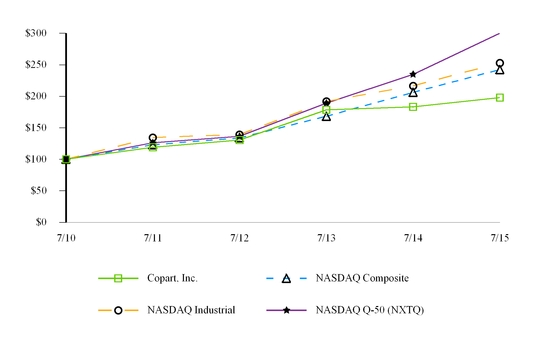
The following is a line graph comparing the cumulative total return to stockholders of our common stock at July 31, 2015 since July 31, 2010, to the cumulative total return over such period of (i) the NASDAQ Composite Index, (ii) the NASDAQ Industrial Index, and (iii) the NASDAQ Q-50 (NXTQ).
COMPARISON OF 5 YEAR CUMULATIVE TOTAL RETURN*
Among Copart, Inc., the NASDAQ Composite Index,
the NASDAQ Industrial Index, and the NASDAQ Q-50 (NXTQ)
| Fiscal Year Ended July 31, | |||||||||||||||||||||||
| 2010 | 2011 | 2012 | 2013 | 2014 | 2015 | ||||||||||||||||||
| Copart, Inc. | $ | 100.00 | $ | 119.24 | $ | 130.41 | $ | 178.43 | $ | 183.21 | $ | 197.75 | |||||||||||
| NASDAQ Composite | $ | 100.00 | $ | 123.11 | $ | 134.00 | $ | 168.35 | $ | 206.23 | $ | 242.43 | |||||||||||
| NASDAQ Industrial | $ | 100.00 | $ | 134.48 | $ | 139.45 | $ | 191.96 | $ | 216.64 | $ | 252.97 | |||||||||||
| NASDAQ Q-50 (NXTQ) | $ | 100.00 | $ | 126.05 | $ | 136.37 | $ | 189.24 | $ | 234.86 | $ | 300.13 |
| * | Assumes that $100.00 was invested on July 31, 2010 in our common stock, in the NASDAQ Composite Index, the NASDAQ Industrial Index and the NASDAQ Q-50 (NXTQ), and that all dividends were reinvested. No dividends have been declared on our common stock. Stockholder returns over the indicated period should not be considered indicative of future stockholder returns. |
Item 6. Selected Financial Data
The following selected consolidated financial data should be read in conjunction with our “Management’s Discussion and Analysis of Financial Condition and Results of Operations” in Part II, Item 7. of this 10-K, and “Financial Statements and Supplementary Data” in Part II, Item 8 of this 10-K. Our historical results of operations are not necessarily indicative of results of operations to be expected for any future period.
| Fiscal Year Ended July 31, | |||||||||||||||||||
| 2015 | 2014 | 2013 | 2012 | 2011* | |||||||||||||||
| (In thousands, except per share) | |||||||||||||||||||
| Operating Data | |||||||||||||||||||
| Revenues | $ | 1,146,079 | $ | 1,163,489 | $ | 1,046,386 | $ | 924,191 | $ | 872,246 | |||||||||
| Operating income | 344,401 | 274,934 | 282,992 | 286,353 | 265,290 | ||||||||||||||
| Income before income taxes | 332,069 | 270,035 | 276,872 | 278,056 | 263,877 | ||||||||||||||
| Income taxes | 112,286 | 91,348 | 96,847 | 95,937 | 97,502 | ||||||||||||||
| Net income | $ | 219,783 | $ | 178,687 | $ | 180,025 | $ | 182,119 | $ | 166,375 | |||||||||
| Basic net income per common share | $ | 1.75 | $ | 1.42 | $ | 1.44 | $ | 1.42 | $ | 1.10 | |||||||||
| Weighted average common shares outstanding | 125,914 | 125,693 | 124,912 | 128,120 | 151,298 | ||||||||||||||
| Diluted net income per common share | $ | 1.67 | $ | 1.36 | $ | 1.39 | $ | 1.39 | $ | 1.08 | |||||||||
| Diluted weighted average common shares outstanding | 131,425 | 131,230 | 129,781 | 131,428 | 153,352 | ||||||||||||||
| Balance Sheet Data | |||||||||||||||||||
| Cash and cash equivalents | $ | 456,012 | $ | 158,668 | $ | 63,631 | $ | 140,112 | $ | 74,009 | |||||||||
| Working capital | 521,456 | 168,007 | 67,893 | 134,908 | 75,242 | ||||||||||||||
| Total assets | 1,799,952 | 1,506,804 | 1,334,481 | 1,154,000 | 1,084,436 | ||||||||||||||
| Total debt | 645,806 | 302,901 | 372,457 | 444,120 | 375,756 | ||||||||||||||
| Stockholders’ equity | 964,464 | 1,003,499 | 762,401 | 561,117 | 555,172 |
| * | As a result of the adoption of Accounting Standards Update 2009–13, Revenue Arrangements with Multiple Deliverables, for fiscal 2011, we accelerated recognition of $14.4 million in service revenue and $13.5 million in related yard operation expenses. |
Item 7. Management’s Discussion and Analysis of Financial Condition and Results of Operations
CAUTION REGARDING FORWARD-LOOKING STATEMENTS
This Annual Report on Form 10-K for the fiscal year ended July 31, 2015, or this Form 10-K, including the information incorporated by reference herein, contains forward-looking statements within the meaning of Section 27A of the Securities Act of 1933, as amended (the Securities Act), and Section 21E of the Securities Exchange Act of 1934, as amended (the Exchange Act). In some cases, you can identify forward-looking statements by terms such as “may,” “will,” “should,” “expect,” “plan,” “intend,” “forecast,” “anticipate,” “believe,” “estimate,” “predict,” “potential,” “continue” or the negative of these terms or other comparable terminology. The forward-looking statements contained in this Form 10-K involve known and unknown risks, uncertainties and situations that may cause our or our industry’s actual results, level of activity, performance or achievements to be materially different from any future results, levels of activity, performance or achievements expressed or implied by these statements. These forward-looking statements are made in reliance upon the safe harbor provision of the Private Securities Litigation Reform Act of 1995. These factors include those listed in Part I, Item 1A under the caption entitled “Risk Factors” in this Form 10-K and those discussed elsewhere in this Form 10-K. Unless the context otherwise requires, references in this Form 10-K to “Copart,” the “Company,” “we,” “us,” or “our” refer to Copart, Inc. We encourage investors to review these factors carefully together with the other matters referred to herein, as well as in the other documents we file with the Securities and Exchange Commission (the SEC). We may from time to time make additional written and oral forward-looking statements, including statements contained in our filings with the SEC. We do not undertake to update any forward-looking statement that may be made from time to time by or on behalf of us.
All references to numbered Notes are to specific Notes to our Consolidated Financial Statements included in this Annual Report on Form 10-K and which descriptions are incorporated into the applicable response by reference. Capitalized terms used, but not defined, in this Management’s Discussion and Analysis of Financial Condition and Results of Operation (“MD&A”) have the same meanings as in such Notes.
Overview
We are a leading provider of online auctions and vehicle remarketing services in the United States (U.S.), Canada, the United Kingdom (U.K.), Brazil, the United Arab Emirates (U.A.E.), Oman, and Bahrain. We also provide vehicle remarketing services in Germany and Spain.
We provide vehicle sellers with a full range of services to process and sell vehicles primarily over the Internet through our Virtual Bidding Third Generation Internet auction-style sales technology, which we refer to as VB3. Vehicle sellers consist primarily of insurance companies, but also include banks and financial institutions, charities, car dealerships, fleet operators and vehicle rental companies. We sell the vehicles principally to licensed vehicle dismantlers, rebuilders, repair licensees, used vehicle dealers and exporters and, at certain locations, to the general public. The majority of the vehicles sold on behalf of insurance companies are either damaged vehicles deemed a total loss or not economically repairable by the insurance companies, or are recovered stolen vehicles for which an insurance settlement with the vehicle owner has already been made. We offer vehicle sellers a full range of services that expedite each stage of the vehicle sales process, minimize administrative and processing costs, and maximize the ultimate sales price.
In the U.S. and Canada (North America), Brazil, the U.A.E., Oman, and Bahrain, we sell vehicles primarily as an agent and derive revenue primarily from fees paid by vehicle sellers and vehicle buyers, as well as related fees for services such as towing and storage. In the U.K., we operate both on a principal basis, purchasing the salvage vehicles outright from the insurance companies and reselling the vehicles for our own account, and as an agent. In Germany and Spain, we derive revenue from sales listing fees for listing vehicles on behalf of many insurance companies.
We monitor and analyze a number of key financial performance indicators in order to manage our business and evaluate our financial and operating performance. Such indicators include:
Service and Vehicle Sales Revenue: Our revenue consists of sales transaction fees charged to vehicle sellers and vehicle buyers, transportation revenue, purchased vehicle revenue, and other remarketing services. Revenues from sellers are generally generated either on a fixed fee contract basis, where our fees are fixed based on the sale of each vehicle regardless of the selling price of the vehicle or under our Percentage Incentive Program (PIP), where our fees are generally based on a predetermined percentage of the vehicle sales price. Under the consignment or fixed fee program, we generally charge an additional fee for title processing and special preparation. We may also charge additional fees for the cost of transporting the vehicle to our facility, storage of the vehicle, and other incidental costs not included in the consignment fee. Under the consignment program, only the fees associated with vehicle processing are recorded in revenue, not the actual sales price (gross proceeds). Sales
transaction fees also include fees charged to vehicle buyers for purchasing vehicles, storage, loading, and annual registration. Transportation revenue includes charges to sellers for towing vehicles under certain contracts and towing charges assessed to buyers for delivering vehicles. Purchased vehicle revenue includes the gross sales price of the vehicle, which we have purchased or are otherwise considered to own, and is primarily generated in the U.K. We have certain contracts with insurance companies in which we act as a principal, purchasing vehicles and reselling them for our own account. We also purchase vehicles in the open market, primarily from individuals and resell them for our own account.
Our revenue is impacted by several factors, including salvage frequency and the average vehicle auction selling price, as over 50% of our service revenue is associated in some manner to the ultimate selling price of the vehicle. Vehicle auction selling prices are driven primarily by: (i) changes in commodity prices, particularly the per ton price for crushed car bodies, as this has an impact on the ultimate selling price of vehicles sold for scrap and vehicles sold for dismantling; (ii) used car pricing, which we believe has an impact on salvage frequency; and (iii) the mix of cars sold, as insurance company cars on average command a lower average selling price than non-insurance cars. We cannot determine the impact of the movement of these influences as we cannot determine which vehicles are sold to the end user or for scrap, dismantling, retailing or export. We also cannot predict the future movements of these influences. Accordingly, we cannot quantify the specific impact that commodity pricing, used car pricing, and product sales mix has on the selling price of vehicles and ultimately on service revenue. Salvage frequency is the percentage of cars involved in accidents which insurance companies salvage rather than repair and is driven by the relationship between repairs costs, used car values, and auction returns. Over the last several years, we believe there has been an increase in overall growth in the salvage market driven by an increase in salvage frequency. The increase in salvage frequency may have been driven by the decline in used car values relative to repair costs. Conversely, increases in used car prices, such as occurred during the most recent recession may decrease salvage frequency and adversely affect our growth rate. Used car values a
Showing the first 8K of 76K characters. Open the full section
Item 7A. Quantitative and Qualitative Disclosures About Market Risk
Our principal exposures to financial market risk are interest rate risk, foreign currency risk and translation risk. We do not hold or issue financial instruments for trading purposes.
Interest Income Risk
The primary objective of our investment activities is to preserve principal while secondarily maximizing yields without significantly increasing risk. To achieve this objective in the current uncertain global financial markets, all cash and cash equivalents were held in bank deposits and money market funds as of July 31, 2015. As the interest rates on a material portion of our cash and cash equivalents are variable, a change in interest rates earned on our investment portfolio would impact interest income along with cash flows but would not materially impact the fair market value of the related underlying instruments. As of July 31, 2015, we held no direct investments in auction rate securities, collateralized debt obligations, structured investment vehicles or mortgaged-backed securities. Based on the average cash balance held for fiscal 2015, a hypothetical 10% adverse change in our interest yield would not have materially affected our operating results.
Interest Expense Risk
Our total borrowings under the Credit Agreement were $243.8 million as of July 31, 2015. The revolving and term loans under the Credit Agreement bear interest, at our election, at either (a) the Base Rate, which is defined as a fluctuating rate per annum equal to the greatest of (i) the Prime Rate in effect on such day; (ii) the Federal Funds Rate in effect on such date plus 0.50%; or (iii) an adjusted LIBOR rate determined on the basis of a one-month interest period plus 1.0%, in each case plus an applicable margin ranging from 0.25% to 1.0% based on our consolidated total net leverage ratio during the preceding fiscal quarter; or (b) an adjusted LIBOR rate plus an applicable margin ranging from 1.25% to 2.0% depending on our consolidated total net leverage ratio during the preceding fiscal quarter. Interest is due and payable quarterly, in arrears, for loans bearing interest at the Base Rate, and at the end of an interest period (or at each three month interval in the case of loans with interest periods greater than three months) in the case of loans bearing interest at the adjusted LIBOR rate. If interest rates were to increase by 10%, our interest expense would increase but by an insignificant amount due to the fixed interest rate swaps. We have entered into two interest rate swaps to exchange our variable interest rate payments commitment for fixed interest rate payments through December 2015 to mitigate the interest expense risk.
Foreign Currency and Translation Exposure
Fluctuations in foreign currencies create volatility in our reported results of operations because we are required to consolidate the results of operations of our foreign currency denominated subsidiaries. International net revenues are typically denominated in the local currency of each country and result from transactions by our operations in Canada, the U.K., the U.A.E., Brazil, Spain, and Germany. These operations also incur a majority of their expenses in the local currency, the Canadian dollar, British pound, U.A.E. dirham, Bahraini dinar, Omani rial, Brazilian real, and Euro. Our international operations are subject to risks associated with foreign exchange rate volatility, which could have a material and adverse impact on our future results. A hypothetical 10% adverse change in the value of the U.S. dollar relative to the Canadian dollar, British pound, U.A.E. dirham, Bahraini dinar, Omani rial, Brazilian real and Euro would have resulted in a decrease in operating income of $5.6 million for fiscal 2015.
Fluctuations in foreign currencies also create volatility in our consolidated financial position, because we are required to remeasure substantially all assets and liabilities held by our foreign subsidiaries at the current exchange rate at the close of the accounting period. At July 31, 2015, the cumulative effect of foreign exchange rate fluctuations on our consolidated financial position was a net translation loss of $68.5 million. This loss was recognized as an adjustment to stockholders’ equity through accumulated other comprehensive income. A hypothetical 10% adverse change in the value of the U.S. dollar relative to the Canadian dollar, British pound, U.A.E. dirham, Bahraini dinar, Omani rial, Brazilian real and Euro would not have materially affected our consolidated financial position.
We do not hedge our exposure to translation risks arising from fluctuations in foreign currency exchange rates.
Item 8. Financial Statements and Supplementary Data
The response to this item is submitted as a separate section of this Annual Report on Form 10-K in Item 15. See Part IV, Item 15(a) for an index to the consolidated financial statements and supplementary financial information.
Item 9. Changes in and Disagreements with Accountants on Accounting and Financial Disclosure
None.
Item 9A. Controls and Procedures
Evaluation of Disclosure Controls and Procedures
We conducted an evaluation of the effectiveness of the design and operation of our disclosure controls and procedures (as defined in Rules 13a-15(e) and 15d-15(e) under the Exchange Act), or Disclosure Controls, as of the end of the period covered by this Annual Report on Form 10-K. This evaluation, or Controls Evaluation, was performed under the supervision and with the participation of management, including our Chief Executive Officer (CEO) and our Chief Financial Officer (CFO). Disclosure Controls are controls and procedures designed to provide reasonable assurance that information required to be disclosed in our reports filed under the Exchange Act, such as this Annual Report, is recorded, processed, summarized and reported within the time periods specified in the SEC’s rules and forms. Disclosure Controls include, without limitation, controls and procedures designed to provide reasonable assurance that information required to be disclosed in our reports filed under the Exchange Act is accumulated and communicated to our management, including our CEO and CFO, or persons performing similar functions, as appropriate, to allow timely decisions regarding required disclosure. Our Disclosure Controls include some, but not all, components of our internal control over financial reporting.
Based upon the Controls Evaluation, our CEO and CFO have concluded that, as of the end of the period covered by this Annual Report on Form 10-K, our Disclosure Controls were effective to provide reasonable assurance that information required to be disclosed in our Exchange Act reports is accumulated and communicated to management, including the CEO and CFO, to allow timely decisions regarding required disclosure, and that such information is recorded, processed, summarized and reported within the time periods specified by the Securities and Exchange Commission.
Management’s Report on Internal Control Over Financial Reporting
Our management is responsible for establishing and maintaining internal control over financial reporting (as defined in Rules 13a-15(f) and 15d-15(f)) to provide reasonable assurance regarding the reliability of our financial reporting and the preparation of consolidated financial statements for external purposes in accordance with generally accepted accounting principles. Internal control over financial reporting includes those policies and procedures that (1) pertain to the maintenance of records that in reasonable detail accurately and fairly reflect the transactions and dispositions of our assets; (2) provide
reasonable assurance that transactions are recorded as necessary to permit preparation of consolidated financial statements in accordance with generally accepted accounting principles, and that our receipts and expenditures are being made only in accordance with authorizations of our management and directors; and (3) provide reasonable assurance regarding prevention or timely detection of unauthorized acquisition, use or disposition of our assets that could have a material effect on the consolidated financial statements.
Management assessed our internal control over financial reporting for the fiscal year ended July 31, 2015. Management based its assessment on criteria established in Internal Control — Integrated Framework issued by the Committee of Sponsoring Organizations of the Treadway Commission (1992 Framework). Management’s assessment included evaluation of such elements as the design and operating effectiveness of key financial reporting controls, process documentation, accounting policies, and our overall control environment. This assessment is supported by testing and monitoring performed by our Finance department.
Based on our assessment, management has concluded that our internal control over financial reporting was effective as of the end of the fiscal year to provide reasonable assurance regarding the reliability of financial reporting and the preparation of consolidated financial statements for external reporting purposes in accordance with generally accepted accounting principles. The certifications of our principal executive officer and principal financial officer attached as Exhibits 31.1 and 31.2 to this Annual Report on Form 10-K include, in paragraph 4 of such certifications, information concerning our disclosure controls and procedures and internal controls over financial reporting. We reviewed the results of management’s assessment with the Audit Committee of our Board of Directors.
Our independent registered public accounting firm, Ernst & Young LLP, independently assessed the effectiveness of our internal control over financial reporting as of July 31, 2015. Ernst & Young LLP has issued an attestation report which appears on the following page of this Annual Report on Form 10-K.
REPORT OF INDEPENDENT REGISTERED PUBLIC ACCOUNTING FIRM
The Board of Directors and Stockholders of Copart, Inc.
We have audited Copart, Inc.’s internal control over financial reporting as of July 31, 2015, based on criteria established in Internal Control — Integrated Framework issued by the Committee of Sponsoring Organizations of the Treadway Commission (1992 Framework) (the COSO criteria). Copart, Inc.’s management is responsible for maintaining effective internal control over financial reporting, and for its assessment of the effectiveness of internal control over financial reporting included in the accompanying “Management’s Report on Internal Control Over Financial Reporting”. Our responsibility is to express an opinion on the Company’s internal control over financial reporting based on our audit.
We conducted our audit in accordance with the standards of the Public Company Accounting Oversight Board (United States). Those standards require that we plan and perform the audit to obtain reasonable assurance about whether effective internal control over financial reporting was maintained in all material respects. Our audit included obtaining an understanding of internal control over financial reporting, assessing the risk that a material weakness exists, testing and evaluating the design and operating effectiveness of internal control based on the assessed risk, and performing such other procedures as we considered necessary in the circumstances. We believe that our audit provides a reasonable basis for our opinion.
A company’s internal control over financial reporting is a process designed to provide reasonable assurance regarding the reliability of financial reporting and the preparation of financial statements for external purposes in accordance with generally accepted accounting principles. A company’s internal control over financial reporting includes those policies and procedures that (1) pertain to the maintenance of records that, in reasonable detail, accurately and fairly reflect the transactions and dispositions of the assets of the Company; (2) provide reasonable assurance that transactions are recorded as necessary to permit preparation of financial statements in accordance with generally accepted accounting principles, and that receipts and expenditures of the Company are being made only in accordance with authorizations of management and directors of the Company; and (3) provide reasonable assurance regarding prevention or timely detection of unauthorized acquisition, use, or disposition of the Company’s assets that could have a material effect on the financial statements.
Because of its inherent limitations, internal control over financial reporting may not prevent or detect misstatements. Also, projections of any evaluation of effectiveness to future periods are subject to the risk that controls may become inadequate because of changes in conditions, or that the degree of compliance with the policies or procedures may deteriorate.
In our opinion, Copart, Inc. maintained, in all material respects, effective internal control over financial reporting as of July 31, 2015, based on the COSO criteria.
We also have audited, in accordance with the standards of the Public Company Accounting Oversight Board (United States), the consolidated balance sheets of Copart, Inc. as of July 31, 2015 and 2014, and the related consolidated statements of income, comprehensive income, stockholders’ equity, and cash flows for each of the three years in the period ended July 31, 2015 of Copart, Inc. and our report dated September 25, 2015 expressed an unqualified opinion thereon.
/s/ Ernst & Young LLP
Dallas, Texas
September 25, 2015
Limitations on the Effectiveness of Controls
Our management, including our CEO and CFO, does not expect that our disclosure controls or our internal control over financial reporting will prevent all error and all fraud. A control system, no matter how well designed and operated, can provide only reasonable, not absolute, assurance that the control system’s objectives will be met. Further, the design of a control system must reflect the fact that there are resource constraints, and the benefits of controls must be considered relative to their costs. Because of the inherent limitations in all control systems, no evaluation of controls can provide absolute assurance that all control issues and instances of fraud, if any, within Copart have been detected. These inherent limitations include the realities that judgments in decision making can be faulty, and that breakdowns can occur because of simple error or mistake. Controls can also be circumvented by the individual acts of some persons, by collusion of two or more people, or by management override of the controls. The design of any system of controls is based in part upon certain assumptions about the likelihood of future events, and there can be no assurance that any design will succeed in achieving its stated goals under all potential future conditions. Over time, controls may become inadequate because of changes in conditions or deterioration in the degree of compliance with associated policies or procedures. Because of the inherent limitations in a cost-effective control system, misstatements due to error or fraud may occur and not be detected.
Changes in Internal Control Over Financial Reporting
There have not been any changes in our internal control over financial reporting during the most recent fiscal quarter that have materially affected or are reasonably likely to materially affect our internal control over financial reporting.
Item 9B. Other Information
None.
PART III
Certain information required by Part III is omitted from this Annual Report on Form 10-K because we intend to file a definitive proxy statement for our 2015 Annual Meeting of Stockholders (the Proxy Statement) not later than 120 days after the end of the fiscal year covered by this Annual Report on Form 10-K, and certain information to be included therein is incorporated herein by reference.
Item 10. Directors, Executive Officers and Corporate Governance
Information required by this item is incorporated by reference to the sections entitled “Proposal Number One — Election of Directors,” “Corporate Governance and Board of Directors” and “Related Person Transactions and Section 16(a) Beneficial Ownership Compliance” in our Proxy Statement.
Code of Ethics
We have adopted the Copart, Inc. Code of Ethics for Principal Executive and Senior Financial Officers (Code of Ethics). The Code of Ethics applies to our principal executive officer, our principal financial officer, our principal accounting officer or controller, and persons performing similar functions and responsibilities who shall be identified by our Audit Committee from time to time.
The Code of Ethics is available at our website, located at http://www.copart.com.
We intend to satisfy disclosure requirements under Item 5.05 of Form 8-K regarding an amendment to, or waiver from, a provision of the Code of Ethics by posting such information on our website, at the address and location specified above, or as otherwise required by the NASDAQ Global Select Market.
Item 11. Executive Compensation
The information required by this item is incorporated herein by reference from the Proxy Statement (to be filed with the Securities and Exchange Commission within 120 days of our July 31, 2015 fiscal year end) under the heading “Executive Compensation,” “Compensation of Directors,” and “Corporate Governance and Board of Directors.”
Item 12. Security Ownership of Certain Beneficial Owners and Management and Related Stockholder Matters
The information required by this item is incorporated herein by reference from the Proxy Statement (to be filed with the Securities and Exchange Commission within 120 days of our July 31, 2015 fiscal year end) under the headings “Security Ownership” and “Executive Compensation,” subheading “Equity Compensation Plan Information.”
Item 13. Certain Relationships and Related Transactions, and Director Independence
The information required by this item is incorporated herein by reference from the Proxy Statement (to be filed with the Securities and Exchange Commission within 120 days of our July 31, 2015 fiscal year end) under the heading “Related Person Transactions and Section 16(a) Beneficial Ownership Compliance,” “Corporate Governance and Board of Directors,” and “Proposal Number One Election of Directors.”
Item 14. Principal Accounting Fees and Services
The information required by this item is incorporated herein by reference from the section captioned “Proposal Number Three — Ratification of Appointment of Independent Registered Public Accounting Firm” in the Proxy Statement (to be filed with the Securities and Exchange Commission within 120 days of our July 31, 2015 fiscal year end).
PART IV
Item 15. Exhibits, Financial Statement Schedules
The following documents are filed as part of this Form 10-K:
| (a) | Financial statements: |
Our consolidated financial statements at July 31, 2015 and 2014 and for each of the three years in the period ended July 31, 2015 and the notes thereto, together with the report of the independent registered public accounting firm on those consolidated financial statements are hereby filed as part of this annual report on Form 10-K.
| (b) | Financial statement schedules: |
No financial statement schedules are presented since the required information is not present or not present in amounts sufficient to require submission of the schedule, or because the information required is included in the consolidated financial statements and notes thereto.
| (c) | Exhibits: |
Exhibits are filed as part of this Report and are hereby incorporated by reference. Refer to Exhibit Index included herein.
SIGNATURES
Pursuant to the requirements of Section 13 or 15(d) of the Securities Exchange Act of 1934, the registrant has duly caused this report to be signed on its behalf by the undersigned, thereunto duly authorized.
| Registrant | |||
| COPART, INC. | |||
| By: | /s/ A. JAYSON ADAIR | ||
| A. Jayson Adair Chief Executive Officer (Principal Executive Officer and Director) |
Date: September 25, 2015
| COPART, INC. | |||
| By: | /s/ WILLIAM E. FRANKLIN | ||
| William E. Franklin, Executive Vice President and Chief Financial Officer (Principal Financial and Accounting Officer) |
Date: September 25, 2015
POWER OF ATTORNEY
KNOWN ALL PERSONS BY THESE PRESENTS, that each person whose signature appears below constitutes and appoints A. Jayson Adair and William E. Franklin, and each of them, as his true and lawful attorneys-in-fact and agents, each with full power of substitution and resubstitution, for him and in his name, place and stead, in any and all capacities, to sign any and all amendments to this Annual Report on Form 10-K, and to file the same, with all exhibits thereto, and other documents in connection therewith, with the Securities and Exchange Commission, granting unto said attorneys-in-fact and agents, full power and authority to do and perform each and every act and thing requisite and necessary to be done in connection therewith, as fully to all intents and purposes as he might or could do in person, hereby ratifying and confirming all that said attorney-in-fact and agent, or his substitute or substitutes, may lawfully do or cause to be done by virtue hereof.
Pursuant to the requirements of the Securities Exchange Act of 1934, this report has been signed below by the following persons on behalf of the registrant and in the capacities and on the dates indicated.
| Signature | Capacity in Which Signed | Date | ||
| /s/ A. JAYSON ADAIR | Chief Executive Officer (Principal Executive Officer and Director) | September 25, 2015 | ||
| A. Jayson Adair | ||||
| /s/ WILLIAM E. FRANKLIN | Executive Vice President and Chief Financial Officer (Principal Financial and Accounting Officer) | September 25, 2015 | ||
| William E. Franklin | ||||
| /s/ WILLIS J. JOHNSON | Chairman of the Board | September 25, 2015 | ||
| Willis J. Johnson | ||||
| /s/ VINCENT W. MITZ | President and Director | September 25, 2015 | ||
| Vincent W. Mitz | ||||
| /s/ JAMES E. MEEKS | Director | September 25, 2015 | ||
| James E. Meeks | ||||
| /s/ STEVEN D. COHAN | Director | September 25, 2015 | ||
| Steven D. Cohan | ||||
| /s/ DANIEL ENGLANDER | Director | September 25, 2015 | ||
| Daniel Englander | ||||
| /s/ THOMAS N. TRYFOROS | Director | September 25, 2015 | ||
| Thomas N. Tryforos | ||||
| /s/ MATT BLUNT | Director | September 25, 2015 | ||
| Matt Blunt |
Copart, Inc.
Index to Consolidated Financial Statements
and Financial Statement Schedule
REPORT OF INDEPENDENT REGISTERED PUBLIC ACCOUNTING FIRM
The Board of Directors and Stockholders of Copart, Inc.
We have audited the accompanying consolidated balance sheets of Copart, Inc. as of July 31, 2015 and 2014, and the related consolidated statements of income, comprehensive income, stockholders’ equity, and cash flows for each of the three years in the period ended July 31, 2015. These financial statements are the responsibility of the Company’s management. Our responsibility is to express an opinion on these financial statements based on our audits.
We conducted our audits in accordance with the standards of the Public Company Accounting Oversight Board (United States). Those standards require that we plan and perform the audit to obtain reasonable assurance about whether the financial statements are free of material misstatement. An audit includes examining, on a test basis, evidence supporting the amounts and disclosures in the financial statements. An audit also includes assessing the accounting principles used and significant estimates made by management, as well as evaluating the overall financial statement presentation. We believe that our audits provide a reasonable basis for our opinion.
In our opinion, the financial statements referred to above present fairly, in all material respects, the consolidated financial position of Copart, Inc. at July 31, 2015 and 2014, and the consolidated results of its operations and its cash flows for each of the three years in the period ended July 31, 2015, in conformity with U.S. generally accepted accounting principles.
We also have audited, in accordance with the standards of the Public Company Accounting Oversight Board (United States), Copart, Inc.’s internal control over financial reporting as of July 31, 2015, based on criteria established in Internal Control-Integrated Framework issued by the Committee of Sponsoring Organizations of the Treadway Commission (1992 Framework) and our report dated September 25, 2015 expressed an unqualified opinion thereon.
/s/ Ernst & Young LLP
Dallas, Texas
September 25, 2015
COPART, INC.
CONSOLIDATED BALANCE SHEETS
(in thousands, except share amounts)
| July 31, | |||||||
| 2015 | 2014 | ||||||
| ASSETS | |||||||
| Current assets: | |||||||
| Cash and cash equivalent |
Showing the first 8K of 137K characters. Open the full section