 filings.tools
Charles River Laboratories International 10-K 2018-12-29
Filed 2019-02-13. 22 sections, 480K characters. Original on sec.gov · Markdown · JSON
Cover and table of contents
10-K 1 crl1229201810-k.htm 10-K
UNITED STATES
SECURITIES AND EXCHANGE COMMISSION
Washington, D.C. 20549
FORM 10-K
| (Mark One) | |
| ý | ANNUAL REPORT PURSUANT TO SECTION 13 OR 15(d) OF THE SECURITIES EXCHANGE ACT OF 1934 |
| FOR THE FISCAL YEAR ENDED DECEMBER 29, 2018 | |
| OR | |
| o | TRANSITION REPORT PURSUANT TO SECTION 13 OR 15(d) OF THE SECURITIES EXCHANGE ACT OF 1934 |
| FOR THE TRANSITION PERIOD FROM TO |
Commission File No. 001-15943

CHARLES RIVER LABORATORIES INTERNATIONAL, INC.
(Exact Name of Registrant as Specified in Its Charter)
| Delaware | 06-1397316 | |
| (State or Other Jurisdiction of Incorporation or Organization) | (I.R.S. Employer Identification No.) | |
| 251 Ballardvale Street Wilmington, Massachusetts | 01887 | |
| (Address of Principal Executive Offices) | (Zip Code) |
(Registrant’s telephone number, including area code): (781) 222-6000
Securities registered pursuant to Section 12(b) of the Act:
| Title of each class | Name of each exchange on which registered | |
| Common Stock, $0.01 par value | New York Stock Exchange |
Securities registered pursuant to Section 12(g) of the Act: None
Indicate by check mark whether the registrant is a well-known seasoned issuer, as defined in Rule 405 of the Securities Act. Yes ý No o
Indicate by check mark if the registrant is not required to file reports pursuant to Section 13 or Section 15(d) of the Act. Yes o No ý
Indicate by check mark whether the Registrant (1) has filed all reports required to be filed by Section 13 or 15(d) of the Securities Exchange Act of 1934 during the preceding 12 months (or for such shorter period that the Registrant was required to file such reports), and (2) has been subject to such filing requirements for the past 90 days. Yes ý No o
Indicate by check mark whether the registrant has submitted electronically every Interactive Data File required to be submitted pursuant to Rule 405 of Regulation S-T (§ 232.405 of this chapter) during the preceding 12 months (or for such shorter period that the registrant was required to submit such files.) Yes ý No o
Indicate by check mark if disclosure of delinquent filers pursuant to Item 405 of Regulation S-K is not contained herein, and will not be contained, to the best of the Registrant’s knowledge, in definitive proxy or information statements incorporated by reference in Part III of this Form 10-K or any amendment to this Form 10-K. ý
Indicate by check mark whether the Registrant is a large accelerated filer, an accelerated filer, a non-accelerated filer, a smaller reporting company, or an emerging growth company. See the definitions of “large accelerated filer,” “accelerated filer”, “smaller reporting company”, and “emerging growth company” in Rule 12b-2 of the Exchange Act.
| Large accelerated filer ý | Accelerated filer o | Non-accelerated filer o | ||
| Smaller reporting company o | Emerging growth company o |
If an emerging growth company, indicate by a check mark if the registrant has elected not to use the extended transition period for complying with any new or revised financial accounting standards provided pursuant to Section 13(a) of the Exchange Act. o
Indicate by check mark whether the registrant is a shell company (as defined in Rule 12b-2 of the Exchange Act). Yes o No ý
On June 30, 2018, the aggregate market value of the Registrant’s voting common stock held by non-affiliates of the Registrant was approximately $5,286,825,427. As of January 25, 2019, there were 48,226,323 shares of the Registrant’s common stock outstanding, $0.01 par value per share.
DOCUMENTS INCORPORATED BY REFERENCE
Portions of the Registrant’s definitive Proxy Statement for its 2019 Annual Meeting of Shareholders scheduled to be held on May 21, 2019, which will be filed with the Securities and Exchange Commission (SEC) not later than 120 days after December 29, 2018, are incorporated by reference into Part III of this Annual Report on Form 10-K. With the exception of the portions of the 2019 Proxy Statement expressly incorporated into this Annual Report on Form 10-K by reference, such document shall not be deemed filed as part of this Form 10-K.
CHARLES RIVER LABORATORIES INTERNATIONAL, INC.
ANNUAL REPORT ON FORM 10-K
FOR FISCAL YEAR 2018
TABLE OF CONTENTS
PART I
Item 1. Business
General
This Annual Report on Form 10-K contains forward-looking statements regarding future events and the future results of Charles River Laboratories International, Inc. that are based on our current expectations, estimates, forecasts and projections about the industries in which we operate and the beliefs and assumptions of our management. Words such as “expect,” “anticipate,” “target,” “goal,” “project,” “intend,” “plan,” “believe,” “seek,” “estimate,” “will,” “likely,” “may,” “designed,” “would,” “future,” “can,” “could” and other similar expressions that are predictions, indicate future events and trends or which do not relate to historical matters are intended to identify such forward-looking statements. These statements are based on our current expectations and beliefs and involve a number of risks, uncertainties and assumptions that are difficult to predict. For example, we may use forward-looking statements when addressing topics such as: goodwill and asset impairments still under review; future demand for drug discovery and development products and services, including the outsourcing of these services; our expectations regarding stock repurchases, including the number of shares to be repurchased, expected timing and duration, the amount of capital that may be expended and the treatment of repurchased shares; present spending trends and other cost reduction activities by our clients; future actions by our management; the outcome of contingencies; changes in our business strategy, business practices and methods of generating revenue; the development and performance of our services and products; market and industry conditions, including competitive and pricing trends; our strategic relationships with leading pharmaceutical companies and venture capital limited partnerships, and opportunities for future similar arrangements; our cost structure; the impact of completed and in-process acquisitions (including Argenta, BioFocus, VivoPath, ChanTest, Sunrise, Celsis, Oncotest, WIL Research, Blue Stream, Agilux, Brains On-Line, KWS BioTest, MPI Research, and Citoxlab) and the timing of closing of in-process acquisitions; our expectations with respect to revenue growth and operating synergies (including the impact of specific actions intended to cause related improvements); the impact of specific actions intended to improve overall operating efficiencies and profitability (and our ability to accommodate future demand with our infrastructure), including gains and losses attributable to businesses we plan to close, consolidate or divest; changes in our expectations regarding future stock option, restricted stock, performance share units and other equity grants to employees and directors; expectations with respect to foreign currency exchange; assessing (or changing our assessment of) our tax positions for financial statement purposes; and our liquidity. In addition, these statements include the impact of economic and market conditions on us and our clients; the effects of our cost-saving actions and the steps to optimize returns to shareholders on an effective and timely basis.
You should not rely on forward-looking statements because they are predictions and are subject to risks, uncertainties and assumptions that are difficult to predict. Therefore, actual results may differ materially and adversely from those expressed in any forward-looking statements. You are cautioned not to place undue reliance on these forward-looking statements, which speak only as of the date of this document or in the case of statements incorporated by reference, on the date of the document incorporated by reference. Factors that might cause or contribute to such differences include, but are not limited to, those discussed in this Form 10-K under the sections entitled “Our Strategy,” “Risk Factors,” "Management's Discussion and Analysis of Financial Condition and Results of Operations,” in our press releases and other financial filings with the SEC. We have no obligation to publicly update or revise any forward-looking statements, whether as a result of new information, future events or risks. New information, future events or risks may cause the forward-looking events we discuss in this report not to occur.
Corporate History
We began operating in 1947 and since then, we have undergone several changes to our business structure. Charles River Laboratories International, Inc. was incorporated in 1994 and in 2000 we completed our initial public offering. Our stock is traded on the New York Stock Exchange under the symbol “CRL” and is included in the Standard & Poor's MidCap 400, 1000 and Composite 1500 indices, the Dow Jones U.S. Health Care Index, the NYSE Arca Biotechnology Index, the NYSE Composite, and many of the Russell indices, among others. We are headquartered in Wilmington, Massachusetts. Our headquarters mailing address is 251 Ballardvale Street, Wilmington, MA, 01887, and the telephone number at that location is (781) 222-6000. Our Internet site is www.criver.com. Material contained on our Internet site is not incorporated by reference into this Form 10-K. Unless the context otherwise requires, references in this Form 10-K to “Charles River,” “we,” “us” “the Company” or “our” refer to Charles River Laboratories International, Inc. and its subsidiaries.
This Form 10-K, as well as all other reports filed with the SEC, is available free of charge through the Investor Relations section of our Internet site (www.criver.com) as soon as practicable after we electronically file such material with, or furnish it
to, the SEC. The SEC maintains an Internet site (http://www.sec.gov) that contains reports, proxy and information statements, and other information regarding issuers that file electronically with the SEC.
Overview
We are a full service, early-stage contract research organization (CRO). We have built upon our core competency of laboratory animal medicine and science (research model technologies) to develop a diverse portfolio of discovery and safety assessment services, both Good Laboratory Practice (GLP) and non-GLP, which is able to support our clients from target identification through non-clinical development. We also provide a suite of products and services to support our clients’ manufacturing activities. Utilizing our broad portfolio of products and services enables our clients to create a more flexible drug development model, which reduces their costs, enhances their productivity and effectiveness, and increases speed to market.
Discovery represents the earliest stages of research in the life sciences, directed at the identification, screening, and selection of a lead molecule for future drug development. Discovery activities typically extend anywhere from 4 to 6 years in conventional pharmaceutical research and development timelines.
Development activities, which follow, and which can take up to 7 to 10 years, are directed at demonstrating the safety, tolerability, and clinical efficacy of the selected drug candidates. During the non-clinical stage of the development process, a drug candidate is tested in vitro (non-animal, typically on a cellular or sub-cellular level in a test tube or multi-well petri plate) and in vivo (in research models) to support human clinical trials.
The development of new drugs requires a steadily increasing investment of time and money. Various studies and reports estimate that it takes between 10 to 15 years, up to $2.0 billion excluding time costs, and exploration of between 10,000 and 15,000 drug molecules to produce a single Food and Drug Administration (FDA)-approved drug. We are positioned to leverage our leading portfolio in early-stage drug research in an efficient and cost-effective way to aid our clients in bringing their drugs to market faster.
For over 70 years, we have been in the business of providing the research models required in research and development of new drugs, devices, and therapies. Over this
Showing the first 8K of 81K characters. Open the full section
Item 1A. Risk Factors
Set forth below, elsewhere in this Form 10-K and in other documents we file with the SEC are risks and uncertainties that could cause actual results to differ materially from the results contemplated by the forward-looking statements contained in this Form 10-K. We note that factors set forth below, individually or in the aggregate, may cause our actual results to differ materially from expected and historical results. We note these factors for investors as permitted by the Private Securities Litigation Reform Act of 1995. You should understand that it is not possible to predict or identify all such factors. Consequently, you should not consider the following to be a complete discussion of all potential risks or uncertainties.
A reduction in research and development budgets at pharmaceutical and biotechnology companies may adversely affect our business.
Our clients include researchers at pharmaceutical and biotechnology companies. Our ability to continue to grow and win new business is dependent in large part upon the ability and willingness of the pharmaceutical and biotechnology industries to continue to spend on molecules in the non-clinical phases of research and development (and in particular discovery and safety assessment) and to outsource the products and services we provide. Fluctuations in the expenditure amounts in each phase of the research and development budgets of these researchers and their organizations could have a significant effect on the demand for our products and services. Research and development budgets fluctuate due to changes in available resources, mergers of
pharmaceutical and biotechnology companies, spending priorities (including available resources of our biotechnology clients, particularly those that are cash-negative, who may be highly focused on rationing their liquid assets in a challenging funding environment), general economic conditions, institutional budgetary policies and the impact of government regulations, including potential drug pricing legislation. Available funding for biotechnology clients in particular may be affected by the capital markets, investment objectives of venture capital investors, and priorities of biopharmaceutical industry sponsors.
Our business could be adversely affected by any significant decrease in drug research and development expenditures by pharmaceutical and biotechnology companies, as well as by academic institutions, government laboratories, or private foundations. Similarly, economic factors and industry trends that affect our clients in these industries also affect their research and development budgets and, consequentially, our business as well. Furthermore, our clients (particularly larger biopharmaceutical companies) continue to search for ways to maximize the return on their investments with a focus on leaner research and development costs per drug candidate. For additional discussion of the factors that we believe have recently been influencing research and development budgets at our clients, please see the sections entitled “Our Strategy” and "Management's Discussion and Analysis of Financial Condition and Results of Operations" included elsewhere in this Form 10-K.
A reduction or delay in government funding of research and development may adversely affect our business.
A portion of revenue, predominantly in our RMS segment, is derived from clients at academic institutions and research laboratories whose funding is partially dependent on both the level and timing of funding from government sources such as the U.S. National Institutes of Health (NIH) and similar domestic and international agencies, which can be difficult to forecast. We also sell directly to the NIH and these other agencies. Government funding of research and development is subject to the political process, which is inherently fluid and unpredictable. Our revenue may be adversely affected if our clients delay purchases as a result of uncertainties surrounding the approval of government budget proposals. Also, government proposals to reduce or eliminate budgetary deficits have sometimes included reduced allocations to the NIH and other government agencies that fund research and development activities. Other programs, such as homeland security or defense, or general efforts to reduce the federal budget deficit could be viewed by the U.S. government as a higher priority. These budgetary pressures may result in reduced allocations in the future to government agencies that fund research and development activities. A reduction in government funding for the NIH or other government research agencies could adversely affect our business and our financial results. Also, there is no guarantee that NIH funding will be directed towards projects and studies that require use of our products and services.
We could experience a breach of the confidentiality of the information we hold or of the security of our computer systems.
We operate large and complex computer systems that contain significant amounts of client data. As a routine element of our business, we collect, analyze, and retain substantial amounts of data pertaining to the non-clinical studies we conduct for our clients. Unauthorized third parties could attempt to gain entry to such computer systems for the purpose of stealing data or disrupting the systems. We believe that we have taken appropriate measures to protect them from intrusion, and we continue to improve and enhance our systems in this regard (including with respect to how we process and report any breaches), but in the event that our efforts are unsuccessful, we could suffer significant harm. Our contracts with our clients typically contain provisions that require us to keep confidential the information generated from these studies. In the event the confidentiality of such information was compromised, we could suffer significant harm.
We are required to comply with the data privacy and security laws in many jurisdictions. For example, we are required to comply with the European Union (EU) General Data Protection Regulation (GDPR) which became effective on May 25, 2018 and imposes heightened obligations and enhanced penalties for noncompliance (including up to four percent (4%) of global revenue). The cost of compliance with the GDPR and the potential for fines and penalties in the event of a violation of the GDPR may have a significant adverse effect on our business and operations. We have made changes to, and investments in, our business practices and will continue to monitor developments and make appropriate changes to help attain compliance with these evolving and complex regulations.
Contaminations in our animal populations can damage our inventory, harm our reputation for contaminant-free production, result in decreased sales and cause us to incur additional costs.
Our research models and fertile chicken eggs must be free of certain infectious agents such as certain viruses and bacteria because the presence of these contaminants can distort or compromise the quality of research results and could adversely impact human or animal health. The presence of these infectious agents in our animal production facilities and certain service operations could disrupt our contaminant-free research model and fertile egg production as well as our animal services businesses including GEMS, harm our reputation for contaminant-free production, and result in decreased sales.
If they occur, contaminations typically require cleaning up, renovating, disinfecting, retesting, and restarting production or services. Such clean-ups result in inventory loss, clean-up and start-up costs, and reduced sales as a result of lost client orders and potentially credits for prior shipments. In addition to microbiological contaminations, the potential for genetic mix-ups or mis-matings also exists and may require the restarting of the applicable colonies. While this does not require the complete clean-up, renovation, and disinfection of the room, it would likely result in inventory loss, additional start-up costs and possibly reduced sales. Contaminations also expose us to risks that clients will request compensation for damages in excess of our contractual indemnification requirements. There also exists a risk that contaminations from models that we produce may affect our client's facilities, with similar impact to them for which we could be liable for damages. In some cases, we may produce or import animals carrying infectious agents capable of causing disease in humans; and in the case of such a contamination or undiagnosed infection, there could be a possible risk of human exposure and infection.
We are also subject to similar contamination risks with respect to our large research models. While some of these models are owned by us and maintained at our facilities, others are reserved for us, and maintained at sites operated by the original provider. Accordingly, risk of contamination may be outside of our control, and we depend on the practices and protocols of third parties to ensure a contamination-free environment. A contamination may require extended CDC quarantine with subsequent reduced sales as a result of lost client orders as well as the potential for complete inventory loss and disinfection of the affected quarantine rooms. Furthermore, while we often negotiate for contractual risk indemnification, we may be exposed in the event of such contaminations if the third party does not fulfill its indemnification obligation or is unable to as a result of insolvency or other impediments.
All such contaminations described above are unanticipated and difficult to predict and could adversely impact our financial results. Many of our operations are comprised of complex mechanical systems which are subject to periodic failure, including aging fatigue. Such failures are unpredictable, and while we have made significant capital expenditures designed to create redundancy within these mechanical systems, strengthen our biosecurity, improve our operating procedures to protect against such contaminations, and replace impaired systems and equipment in advance of such events, failures and/or contaminations may still occur.
Any failure by us to comply with applicable regulations and related guidance could harm our reputation and operating results, and compliance with new regulations and guidance may result in additional costs.
Any failure on our part to comply with applicable regulations could result in the termination of ongoing research or the disqualification of data for submission on behalf of our clients to regulatory authorities. This could harm our reputation, our prospects for future work and our operating results. For example, the issuance of a notice of objectionable observations or a warning from the FDA based on a finding of a material violation affecting data integrity by us for GLP or cGMP requirements could materially and adversely affect us. If our operations are found to violate any applicable law or other governmental regulations, we might be subject to civil and criminal penalties, damages and fines. Any action against us for violation of these laws, even if we successfully defend against it, could cause us to incur significant legal expenses, divert our management's attention from the operation of our business and damage our reputation.
Regulatory monitoring authorities such as the FDA, Medicines and Healthcare Products Regulatory Agency and OECD have increased their emphasis on the management of computerized systems to ensure data integrity. New guidance related to the need for data integrity compliance programs have recently been released and we may require additional efforts for validation, audit trail review and archiving activities. To assure that we have proper regulatory oversight over our electronic records, a dedicated quality function reviews our computerized system practices to ensure that appropriate record controls are in place and that a robust audit strategy confirms requirements for compliance. In addition, the FDA’s recently applicable SEND (Standardization for Exchange of Nonclinical Data) standards which apply to our clients’ NDA and IND submissions require us to provide electronic data in specific formats that will allow for more efficient, higher quality regulatory reviews. Accordingly, our clients expect us to timely deliver their nonclinical data compliant with SEND. Notwithstanding, some of these standards require additional operating and capital expenses that will impact not only us and our industry competitors, but clients in the biomedical research community. Non-compliance with any of these expectations could lead to official action by a government authority, damage to our reputation and a potential loss of business.
In addition, regulations and guidance worldwide concerning the production and use of laboratory animals for research purposes continue to evolve. Similarly, guidance has been and continues to be developed for other areas that impact the biomedical research community on both a national and international basis including transportation, mandated contingency planning, euthanasia guidance, import and export requirements of biological materials, health monitoring requirements and the use of disinfectants.
The outsourcing trend in non-clinical (discovery and safety assessment) stages of drug discovery and development may decrease, which could impair our growth.
Over the past decade, pharmaceutical and biotechnology companies have generally increased their outsourcing of non-clinical research support activities, such as discovery and safety assessment. While many industry analysts expect the outsourcing trend to continue to increase for the next several years (although with different growth rates for different phases of drug discovery and development), decreases in such outsourcing may result in a diminished growth rate in the sales of any one or more of our service lines and may adversely affect our financial condition and results of operations. For additional discussion of the factors that we believe have recently been influencing outsourcing demand from our clients, please see the section entitled “Our Strategy” included elsewhere in this Form 10-K.
Changes in government regulation or in practices relating to the pharmaceutical or biotechnology industries, including potential healthcare reform, could decrease the need for the services we provide.
Governmental agencies throughout the world strictly regulate the drug development process. Our business involves helping pharmaceutical and biotechnology companies, among others, navigate the regulatory drug approval process. Accordingly, many regulations, and often new regulations, are expected to result in higher regulatory standards and often additional revenues for companies that service these industries. However, some changes in regulations, such as a relaxation in regulatory requirements or the introduction of streamlined or expedited drug approval procedures, or an increase in regulatory requirements that we have difficulty satisfying or that make our services less competitive, could eliminate or substantially reduce the demand for our services.
Although we believe we are currently in compliance in all material respects with national, regional, and local laws, as well as other accepted guidance used by oversight bodies (which include the USDA, the standards set by the International Air Transport Association, the Convention on International Trade in Endangered Species of Wild Fauna and Flora, U.S. Fish and Wildlife Service, The Centers for Disease Control, the Department of Transportation, the Department of State, the office of Laboratory Animal Welfare of NIH, the Drug Enforcement Agency, as well as numerous other oversight agencies in Canada, Europe, and Asia), failure to comply could subject us to denial of the right to conduct business, fines, criminal penalties, and other enforcement actions. In addition, if regulatory authorities were to mandate a significant reduction in safety assessment procedures which utilize laboratory animals (as has been advocated by certain groups), certain segments of our business could be materially adversely affected.
In March 2010, the U.S. Congress enacted healthcare reform legislation, the Patient Protection and Affordable Care Act, or the ACA, intended over time to expand health insurance coverage and impose health industry cost containment measures. In June 2012, the U.S. Supreme Court upheld the constitutionality of this legislation. The Court’s decision allowed implementation of key provisions impacting drug manufacturers going forward, including, but not limited to, (1) expansion of access to health insurance coverage, (2) expansion of the Medicaid program, (3) enactment of an industry fee on pharmaceutical companies, and (4) imposition of an excise tax on the sale of medical devices. In May 2017, the U.S. House of Representatives voted to pass the American Health Care Act (the AHCA), which would repeal many provisions of the ACA. Although the U.S. Senate considered but failed to pass the AHCA and other comparable measures, the U.S. Congress may consider further legislation to repeal or replace elements of the ACA. In addition, the Tax Cuts and Jobs Act, which President Trump signed into law in December 2017, repeals the ACA’s individual health insurance mandate, which is considered a key component of the ACA. Since the law and its implementation continue to face challenges in Congress and federal courts, and from certain state governments, opposition advocacy groups, and some small business organizations, as well as from the incoming president and his administration, we are uncertain as to the ultimate effects of this legislation on our business and are unable to predict what legislative proposals will be adopted in the future.
Implementation of healthcare reform legislation may have certain benefits, but also may contain costs that could limit the profits that can be made from the development of new drugs. This could adversely affect research and development expenditures by pharmaceutical and biotechnology companies, which could in turn decrease the business opportunities available to us both in the U.S. and abroad. In addition, new laws or regulations may create a risk of liability, increase our costs, or limit our service offerings. Furthermore, if health insurers were to change their practices with respect to reimbursements for pharmaceutical products, our clients may spend less, or reduce their growth in spending on research and development.
While it is not possible to predict whether and when any such changes will occur, changes at the local, state or federal level may significantly impact our domestic and foreign businesses and/or those of our clients. Furthermore, modifications to international trade policy, public company reporting requirements, environmental regulation and antitrust enforcement may have a material impact on us or our clients.
Our revenue generating agreements contain termination and service reduction provisions or may otherwise terminate according to their term, which may result in less contract revenue than we anticipate.
Many of our agreements with both large and small clients, including those which underlie our strategic relationships with some of our more significant clients, provide for termination or reduction in scope with little or no notice. Many of our contracts provide for services on a fixed price or fee-for-service with a cap basis and, accordingly, we bear the financial risk if we initially under-price our contracts or otherwise overrun our cost estimates. In addition, we sell our products and services to our competitors, and similarly they sell products and services to us. For instance, we have historically entered into, and currently are party to, contracts with certain of our competitors to distribute specialty research models in locations where our competitors may not have distribution capabilities.
Clients and/or competitors may elect to terminate their agreements with us for various reasons including:
| • | the products being tested fail to satisfy safety requirements; |
| • | unexpected or undesired study results; |
| • | production problems resulting in shortages of the drug being tested; |
| • | a client's decision to forego or terminate a particular study; |
| • | establishment of alternative distribution channels by our competitors; |
| • | the loss of funding for the particular research study; or |
| • | general convenience/counterparty preference. |
If a client or competitor terminates a contract with us, we are typically entitled under the terms of the contract to receive revenue earned to date as well as certain other costs and, in some cases, termination fees. Cancellation of a large contract or proximate delay, cancellation or conclusion of multiple contracts could materially adversely affect our business and, therefore, may adversely affect our operating results.
Several of our product and service offerings are dependent on a limited source of supply, which if interrupted could adversely affect our business.
We depend on a limited international source of supply for certain products, such as large research models. Disruptions to their continued supply may arise from health problems, export or import laws/restrictions or embargoes, international trade regulations, foreign government or economic instability, severe weather conditions, increased competition among suppliers for models, disruptions to the air travel system, activist campaigns, commercial disputes, supplier insolvency, or other normal-course or unanticipated events. Any disruption of supply could harm our business if we cannot remove the disruption or are unable to secure an alternative or secondary supply source on comparable commercial terms.
If we are not successful in selecting and integrating the businesses and technologies we acquire, or in managing our current and future divestitures, our business may suffer.
During the past sixteen years, we have steadily expanded our business through numerous acquisitions. We plan to continue to acquire businesses and technologies and form strategic alliances. However, businesses and technologies may not be available on terms and conditions we find acceptable. We risk spending time and money investigating and negotiating with potential acquisition or alliance partners, but not completing transactions.
In April 2018, we acquired MPI Research, a non-clinical CRO, providing comprehensive testing services to biopharmaceutical and medical device companies worldwide. This transaction was our largest acquisition since 2004. In February 2019, we signed a binding offer to acquire Citoxlab for €448 million in cash (or approximately $510 million based on current exchange rates). Citoxlab is a non-clinical CRO, specializing in regulated safety assessment services, non-regulated discovery services, and medical device testing.
Acquisitions and alliances involve numerous risks which may include:
| • | difficulties in achieving business and financial success; |
| • | difficulties and expenses incurred in assimilating and integrating operations, services, products, technologies, or pre-existing relationships with our clients, distributors, and suppliers; |
| • | challenges with developing and operating new businesses, including those which are materially different from our existing businesses and which may require the development or acquisition of new internal capabilities and expertise; |
| • | potential losses resulting from undiscovered liabilities of acquired companies that are not covered by the indemnification we may obtain from the seller or the insurance we acquire in connection with the transaction; |
| • | loss of key employees; |
| • | the presence or absence of adequate internal controls and/or significant fraud in the financial systems of acquired companies; |
| • | diversion of management's attention from other business concerns; |
| • | becoming subject to a more expansive regulatory environment; |
| • | acquisitions could be dilutive to earnings, or in the event of acquisitions made through the issuance of our common stock to the shareholders of the acquired company, dilutive to the percentage of ownership of our existing shareholders; |
| • | risks of not being able to overcome differences in foreign business practices, customs, and importation regulations, language, and other cultural barriers in connection with the acquisition of foreign companies; |
| • | new technologies and products may be developed which cause businesses or assets we acquire to become less valuable; and |
| • | risks that disagreements or disputes with prior owners of an acquired business, technology, service, or product may result in litigation expenses and diversion of our management's attention. |
In the event that an acquired business, technology, or an alliance does not meet our expectations, our results of operations may be adversely affected.
Some of the same risks exist when we decide to sell a business, site, or product line. In addition, divestitures could involve additional risks, including the following:
| • | difficulties in the separation of operations, services, products, and personnel; |
| • | diversion of management's attention from other business concerns; and |
| • | the need to agree to retain or assume certain current or future liabilities in order to complete the divestiture. |
We continually evaluate the performance and strategic fit of our businesses (including specific product lines and service offerings). These and any divestitures may result in significant write-offs, including those related to goodwill and other intangible assets, which could have an adverse effect on our results of operations and financial condition. In addition, we may encounter difficulty in finding buyers, or, alternative exit strategies at acceptable prices and terms, and in a timely manner. We may not be successful in managing these or any other significant risks that we encounter in divesting a business, site, or product line or service offering, and as a result, we may not achieve some or all of the expected benefits of the divestiture.
Impairment of goodwill or other intangible assets may adversely impact future results of operations.
We have intangible assets, including goodwill, on our balance sheet due to our acquisitions of businesses. The initial identification and valuation of these intangible assets and the determination of the estimated useful lives at the time of acquisition involve use of management judgments and estimates. These estimates are based on, among other factors, projections of cash flows that arise from identifiable intangible assets of acquired businesses and discount rates based on an analysis of our weighted average cost of capital, adjusted for specific risks associated with the assets. Disruptions in global financial markets and deterioration of economic conditions could, among other things, impact the discount rate and other assumptions used in the valuations and actual cash flows arising from a particular intangible asset could vary from projected cash flows, which could imply different carrying values from those established at the dates of acquisition and which could result in impairment of such assets.
If the future growth and operating results of our business are not as strong as anticipated, overall macroeconomic or industry conditions deteriorate and/or our market capitalization declines, this could impact the assumptions used in establishing the carrying value of goodwill or other intangible assets. To the extent goodwill or other intangible assets are impaired, their carrying value will be written down to their implied fair values and a charge will be made to our income from continuing
operations. Such an impairment charge could materially and adversely affect our operating results. As of December 29, 2018, the carrying amount of goodwill and other intangibles on our consolidated balance sheet was $1.9 billion.
Our business is subject to risks relating to operating internationally.
A significant part of our revenue is derived from operations outside the U.S. Our international revenue represented approximately one-half of our total revenue in recent years. We expect that international revenue will continue to account for a significant percentage of our total revenue for the foreseeable future. There are a number of risks associated with our international business including:
| • | foreign currencies we receive for sales and in which we record expenses outside the U.S. could be subject to unfavorable exchange rates with the U.S. dollar and reduce the amount of revenue and cash flow (and increase the amount of expenses) that we recognize and cause fluctuations in reported financial results. The favorable effects of changes in currency exchange rates increased our 2018 revenue by approximately $24 million, or 1.3%, while unfavorable foreign currency effects decreased our 2017 revenues by less than $1 million, or less than 1%, respectively; |
| • | foreign currency exposure associated with differences between where we conduct business, our exposure to currency exchange rate fluctuations results from the currency translation exposure associated with the preparation of our consolidated financial statements, as well as from the exposure associated with transactions of our subsidiaries that are denominated in a currency other than the respective subsidiary's functional currency. While our financial results are reported in U.S. Dollars, the financial statements of many of our subsidiaries outside the U.S. are prepared using the local currency as the functional currency. During consolidation, these results are translated into U.S. Dollars by applying appropriate exchange rates. As a result, fluctuations in the exchange rate of the U.S. Dollar relative to the local currencies in which our foreign subsidiaries report could cause significant fluctuations in our reported results. Moreover, as exchange rates vary, revenue and other operating results may differ materially from our expectations. Adjustments resulting from financial statement translations are included as a separate component of shareholders' equity. In the year ended December 29, 2018, we recorded net losses from currency translation adjustments of $27.4 million. In the year ended December 30, 2017, we recorded net gains from currency translation adjustments of $77.1 million; |
| • | certain contracts, particularly in Canada, are frequently denominated in currencies other than the currency in which we incur expenses related to those contracts, and where expenses are incurred in currencies other than those in which contracts are priced, fluctuations in the relative value of those currencies could have a material adverse effect on our results of operations; |
| • | potentially negative consequences from changes in U.S. and/or foreign tax laws, or interpretations thereof, notably tax regulations issued and to-be-issued with respect to U.S. Tax Reform and the EU Anti-Tax Avoidance Directives I and II; |
| • | general economic and political conditions in the markets in which we operate, including possible implications of Brexit; |
| • | potential international conflicts, including terrorist acts; |
| • | exchange controls, adverse tax consequences, and legal restrictions on the repatriation of funds into the U.S.; |
| • | difficulties and costs associated with staffing and managing foreign operations, including risks of work stoppages and/or strikes, as well as violations of local laws or anti-bribery laws such as the U.S. Foreign Corrupt Practices Act (FCPA), the U.K. Bribery Act, and the OECD Convention on Combating Bribery of Foreign Public Officials in International Business Transactions; |
| • | unexpected changes in regulatory requirements; |
| • | the difficulties of compliance with a wide variety of foreign laws and regulations; |
| • | unfavorable labor regulations in foreign jurisdictions; |
| • | exposure to business disruption or property damage due to geographically unique natural disasters (including within the U.S.); |
| • | longer accounts receivable cycles in certain foreign countries; and |
| • | compliance with export controls, import requirements and other trade regulations. |
These risks, individually or in the aggregate, could have an adverse effect on our results of operations and financial condition. For example, as mentioned above, we are subject to compliance with the FCPA and similar anti-bribery laws, which generally prohibit companies and their third-party intermediaries from making improper payments to foreign government officials for the purpose of obtaining or retaining business. While our employees, distributors and agents are required to comply with these laws, we cannot be sure that our internal policies and procedures will always protect us from violations of these laws despite our commitment to legal compliance and corporate ethics. The occurrence or allegation of these types of risks may adversely affect our business, performance, prospects, value, financial condition, and results of operations.
Our facilities could be damaged or disrupted by natural disasters or other catastrophic events which could adversely affect our reputation, financial position, results of operations and cash flows.
While we have taken precautions to mitigate production and service interruptions at our global facilities, a major catastrophe, such as a hurricane, tornado, earthquake, flood, wildfire or other natural disaster (or other unanticipated displacement) at or near any of our facilities could result in physical damage to our properties, including closure, resulting in a prolonged interruption of our business. A disruption resulting from any one of these events could cause significant delays in shipments of our products, reduce our capacity to provide services, eradicate unique manufacturing capabilities and, ultimately, result in the loss of revenue and clients. Any of these factors could have a material adverse effect on our reputation, financial position, results of operations, and cash flows.
New technologies may be developed, validated, and increasingly used in biomedical research that could reduce demand for some of our products and services.
The scientific and research communities continue to explore methods to develop improved cellular and animal model systems that would increase the translation to human studies and vice-versa and possibly replace or supplement the use of traditional living animals as test platforms in biomedical research. Some companies have developed techniques in these areas that may have scientific merit to improve translation between species. In addition, technological improvements to existing or new processes, such as imaging and other translational biomarker technologies, could result in the refinement and utility for the number of animal research models necessary to improve the translation from non-clinical to clinical studies. There is an increasing push to focus on in vitro technologies such that employ human biospecimens, stem cell technologies, and genome editing.
It is our strategy to explore these in vitro technologies to refine and potentially reduce the utilization of animal models as these new methods become validated. For example, our Safety and Assessment businesses have a program to evaluate the utility of induced pluripotent stems cells, advanced in vitro models, “organ-on-a-chip” technologies, artificial intelligence and machine learning in preclinical development. Successful commercialization of alternatives to traditional research models may not be sufficient to fully offset reduced sales or profits from research models. In addition, alternative research methods could decrease the need for future research models, and we may not be able to develop new products effectively or in a timely manner to replace any lost sales. Lastly, other companies or entities may develop research models with characteristics different than the ones that we produce, and which may be viewed as more desirable by some of our clients.
Negative attention from special interest groups may impair our business.
The products and services which we provide our clients are essential to the drug discovery, development and manufacturing processes, and a significant amount are mandated by law. Notwithstanding, certain special interest groups categorically object to the use of animals for valid research purposes. Historically, our core research model activities with rats, mice and other rodents have not been the subject of significant animal rights media attention. However, research activities with animals have been the subject of adverse attention, including shareholder proposals and attempts to disrupt air carriers from transporting research models, impacting the industry. This has included periodic demonstrations near facilities operated by us and at our annual meetings, as well as shareholder proposals we received for some of our past Annual Meetings of Shareholders. Any negative attention, threats or acts of vandalism directed against either our animal research activities or our third party service providers, such as our airline carriers, in the future could impair our ability to operate our business efficiently.
Our debt level could adversely affect our business and growth prospects.
As of December 29, 2018, we had $1.7 billion of debt. In connection with our intended acquisition of Citoxlab, we anticipate increasing our debt to finance a substantial portion of the purchase price of approximately €448 million in cash (or approximately $510 million based on current exchange rates). Our debt could have significant adverse effects on our business, including making it more difficult for us to obtain additional financing on favorable terms; requiring us to dedicate a substantial
portion of our cash flows from operations to the repayment of debt and the interest on this debt; limiting our ability to capitalize on significant business opportunities; and making us more vulnerable to rising interest rates. For additional information regarding our debt, please see Note 9, “Long-Term Debt and Capital Lease Obligations”, included in the Notes to Consolidated Financial Statements included elsewhere in this Form 10-K.
The drug discovery, development services and manufacturing support industries are highly competitive.
The drug discovery, non-clinical development, and manufacturing support services industries are highly competitive. We often compete for business not only with other CROs, but also with internal discovery and development departments within our larger clients, who may have greater resources than ours. We also compete with universities and teaching hospitals for outsourced services. We compete on a variety of factors, including:
| • | reputation for on-time quality performance; |
| • | reputation for regulatory compliance; |
| • | expertise and experience in multiple specialized areas; |
| • | scope and breadth of service and product offerings across the drug discovery and development spectrum; |
| • | scope and breadth of service and product offerings across the manufacturing support spectrum; |
| • | ability to provide flexible and customized solutions to support our clients' drug discovery, non-clinical development, and manufacturing support needs; |
| • | broad geographic availability (with consistent quality); |
| • | price/value, spend and flexibility; |
| • | technological and scientific expertise and efficient drug development processes; |
| • | quality of facilities; |
| • | financial stability; |
| • | size; |
| • | ability to acquire, process, analyze, and report data in an accurate manner; and |
| • | accessibility of client data through secure portals. |
If we do not compete successfully, our business will suffer. Increased competition might lead to price and other concessions that could adversely affect our operating results. The drug discovery and development services industry has continued to see a trend towards consolidation, particularly among the biotechnology companies, who are targets for each other and for larger pharmaceutical companies. If this trend continues, it is likely to produce more competition among the larger companies and CROs generally, with respect to both clients and acquisition candidates. In addition, small, specialized entities considering entering the CRO industries will continue to find lower barriers to entry, and private equity firms may determine that there are opportunities to acquire and consolidate these companies, thus further increasing possible competition. More generally, our competitors or others might develop technologies, services or products that are more effective or commercially attractive than our current or future technologies, services, or products, or that render our technologies, services, or products less competitive or obsolete. If competitors introduce superior technologies, services, or products and we cannot make enhancements to ours to remain competitive, our competitive position, and in turn our business, revenue, and financial condition, would be materially and adversely affected. In the aggregate, these competitive pressures may affect the attractiveness of our technologies, services, or products and could adversely affect our financial results.
Potential Changes in U.S. and International Tax Law.
On December 22, 2017, President Trump signed into law significant U.S. tax law changes (U.S. Tax Reform) which reduced the U.S. federal statutory tax rate, broadened the corporate tax base through the elimination or reduction of deductions, exclusions, and credits, limited the ability of U.S. corporations to deduct interest expense, and transitioned to a territorial tax system which allows for the repatriation of foreign earnings to the U.S. with a 100% federal dividends received deduction prospectively. In addition, U.S. Tax Reform required a one-time transitional tax on foreign cash equivalents and previously unremitted earnings. Several of the new provisions enacted as part of U.S. Tax Reform require clarification and guidance from the Internal Revenue
Service (IRS) and Treasury Department. These or other changes in U.S. tax laws could impact our profits, effective tax rate, and cash flows.
We have substantial operations in Canada, Ireland and the United Kingdom which currently benefit from favorable corporate tax arrangements. We receive substantial tax credits in Canada, from both the Canadian federal and Quebec governments, and the U.K. Any reduction in the availability or amount of these tax credits or increase to tax rates due to tax law changes or outcomes of tax controversies could have a material adverse effect on our profits, cash flows, and effective tax rate.
The OECD has developed an action plan to address concerns regarding base erosion and profit shifting (BEPS). This initiative resulted in proposed and enacted changes to tax laws in various countries including France, Germany, Luxembourg, Netherlands and the U.K. Future changes to tax laws or interpretation of tax laws resulting from the BEPS project could increase our effective tax rate, which would affect our profitability.
Contract research services create a risk of liability.
As a CRO, we face a range of potential liabilities which may include:
| • | errors or omissions in reporting of study detail in non-clinical studies that may lead to inaccurate reports, which may undermine the usefulness of a study or data from the study, or which may potentially advance studies absent the necessary support or inhibit studies from proceeding to the next level of testing; |
| • | risks associated with our possible failure to properly care for our clients' property, such as research models and samples, study compounds, records, work in progress, other archived materials, or goods and materials in transit, while in our possession; |
| • | risks that models in our breeding facilities or in facilities that we manage may be infected with diseases that may be harmful and even lethal to them or humans, despite preventive measures contained in our policies for the quarantine and handling of imported animals; and |
| • | risks that we may have errors and omissions and/or product liabilities related to our products designed to conduct lot release testing of medical devices, injectable drugs, food, beverages, and home and beauty products (primarily through our Microbial Solutions business), or in the testing of biologics and other services performed by our Biologics business, which could result in us or our clients failing to identify unsafe or contaminated materials. |
While we attempt to mitigate these risks through a variety of methods, it is impossible to completely eradicate such risks. In our RMS business, we mitigate these risks to the best of our abilities through our regimen of animal testing, quarantine procedures, and veterinary staff vigilance, through which we seek to control the exposure of animal related disease or infections. In our DSA and Manufacturing businesses, we attempt to reduce these risks by contractual risk transfer provisions entitling us to be indemnified by our clients and subject to a limitation of liability, by insurance maintained by our clients and/or by us, and by various regulatory requirements we must follow in connection with our business.
Contractual risk transfer indemnifications generally do not protect us against liability arising from certain of our own actions, such as negligence or misconduct. We could be materially and adversely affected if we are required to pay damages or bear the costs of defending any claim that is outside any contractual indemnification provision, or if a party does not fulfill its indemnification obligations, or the damage is beyond the scope or level of insurance coverage. We also often contractually indemnify our clients (subject to a limitation of liability), similar to the way they indemnify us, and we may be materially adversely affected if we have to fulfill our indemnity obligations. Furthermore, there can be no assurance that neither we nor a party required to indemnify us will be able to maintain such insurance coverage (either at all or on terms acceptable to us).
Upgrading and integrating our business systems could result in implementation issues and business disruptions.
In recent years, we have been updating and consolidating systems and automating processes in many parts of our business with a variety of systems. The expansion and ongoing implementation of the systems may occur at a future date based on value to the business. In general, the process of planning and preparing for these types of integrated, wide-scale implementations is extremely complex and we are required to address a number of challenges including data conversion, system cutover, and user training. Problems in any of these areas could cause operational problems during implementation including delayed shipments, missed sales, billing and accounting errors. There have been numerous, well-publicized instances of companies experiencing difficulties with the implementation of similar large-scale systems, which resulted in negative business consequences.
The drug discovery and development industry has a history of patent and other intellectual property litigation, and we might be involved in costly intellectual property lawsuits.
The drug discovery and development industry has a history of patent and other intellectual property litigation and these lawsuits will likely continue. Legal proceedings relating to intellectual property are expensive, take significant time, and divert management's attention from other business concerns, whether we win or lose. If we do not prevail in an infringement lawsuit brought against us, we might have to pay substantial damages, including treble damages, and we could be required to stop the infringing activity or obtain a license to use technology on unfavorable terms.
We may not be able to successfully develop and market new services and products.
We may seek to develop and market new services and products that complement or expand our existing business or service offerings. We believe our ability to in-license new technologies from third parties will be critical to our ability to offer new products and services to our clients. Our ability to gain access to technologies that we need for new products and services depends, in part, on our ability to convince inventors and their agents or assignees that we can successfully commercialize their inventions. We cannot guarantee that we will be able to identify new technologies of interest to our clients. Even if we are able to identify new technologies of interest, we may not be able to negotiate license agreements on acceptable terms, or at all. If we are unable to develop new services and products and/or create demand for those newly developed services and products, our future business, results of operations, financial condition, and cash flows could be adversely affected.
The decision by British voters to exit the European Union may adversely affect our business.
The U.K. is currently negotiating the terms of its exit from the European Union (“Brexit”) scheduled for March 29, 2019. In November 2018, the U.K. and the European Union agreed upon a draft Withdrawal Agreement that sets out the terms of the U.K.’s departure, including commitments on citizen rights after Brexit, a financial settlement from the U.K., and a transition period from March 29, 2019 through December 31, 2020 to allow time for a future trade deal to be agreed. On January 15, 2019, the draft Withdrawal Agreement was rejected by the U.K. Parliament creating significant uncertainty about the terms (and timing) under which the U.K. will leave the European Union.
Given the uncertainty concerning the terms of the UK’s departure from the EU, including the possibility of no negotiated agreement, we have formed a committee (comprised of senior managers across our business functions) to address the three main risks: (1) trade and customs, (2) employees and immigration, and (3) strategy and business planning.
In the absence of a future trade deal, the U.K.’s trade with the European Union and the rest of the world would be subject to tariffs and duties set by the World Trade Organization. Additionally, the movement of goods between the U.K. and the remaining member states of the European Union will be subject to additional inspections and documentation checks, leading to possible delays at ports of entry and departure. These changes to the trading relationship between the U.K and European Union would likely result in increased cost of goods imported into and exported from the U.K. and may decrease the profitability of our U.K. and other operations. Additional currency volatility could drive a weaker British pound, which increases the cost of goods imported into our U.K. operations and may decrease the profitability of our U.K. operations. A weaker British pound versus the U.S. dollar also causes local currency results of our U.K. operations to be translated into fewer U.S. dollars during a reporting period. Although efforts are being undertaken to mitigate for risks within our control, other factors outside our control could adversely affect our business, business opportunities, results of operations, financial condition and cash flows.
We depend on key personnel and may not be able to retain these employees or recruit additional qualified personnel, which would harm our business.
Our success depends to a significant extent on the continued services of our senior management and other members of management. James C. Foster, our Chief Executive Officer and President since 1992 and Chairman since 2000, has held various positions with us for four decades. While we entered into an employment agreement with Mr. Foster in 2018, most members of our senior management do not have employment agreements. If Mr. Foster or other members of senior management do not continue in their present positions, our business may suffer.
Because of the specialized scientific nature of our business, we are highly dependent upon attracting and retaining qualified scientific, technical, and managerial personnel. While we have a strong record of employee retention, and we strive to reduce the impact of the potential loss of existing employees by having an established organizational talent review process which identifies successors and potential talent needs, there is still significant competition for qualified personnel in the veterinary, pharmaceutical, and biotechnology fields. Therefore, we may not be able to attract and retain the qualified personnel necessary for the development of our business. The loss of the services of existing personnel, as well as the failure to recruit additional key scientific, technical, and managerial personnel in a timely manner, could harm our business.
Our quarterly operating results may vary, which could negatively affect the market price of our common stock.
Our results of operations in any quarter may vary from quarter to quarter and are influenced by such factors as:
| • | changes in the general global economy; |
| • | the number and scope of ongoing client engagements; |
| • | the commencement, postponement, delay, progress, completion, or cancellation of client contracts in the quarter; |
| • | changes in the mix of our products and services; |
| • | competitive pricing pressures; |
| • | the extent of cost overruns; |
| • | holiday buying patterns of our clients; |
| • | budget cycles of our clients; |
| • | changes in tax laws, rules, regulations, and tax rates in the locations in which we operate; |
| • | the timing and charges associated with completed acquisitions and other events; |
| • | the financial performance of our venture capital investments; |
| • | the occasional extra week (“53rd week”) that we recognize in a fiscal year (and fourth fiscal quarter thereof) due to our fiscal year ending on the last Saturday in December; and |
| • | exchange rate fluctuations. |
We believe that operating results for any particular quarter are not necessarily a meaningful indication of future results. Nonetheless, fluctuations in our quarterly operating results could negatively affect the market price of our common stock.
Since we do not expect to pay any cash dividends for the foreseeable future, our shareholders will benefit from an investment in our common stock only if it appreciates in value.
We have not declared or paid any cash dividends on our common stock, and do not anticipate that we will pay any dividends to holders of our common stock for the foreseeable future. Any payment of cash dividends will be at the discretion of our Board of Directors and will depend on our financial condition, capital requirements, legal requirements, earnings and other factors. Consequently, our shareholders should not rely on dividends to receive a return on their investment.
Item 1B. Unresolved Staff Comments
There are no unresolved comments to be reported in response to Item 1B.
Item 2. Properties
We own or lease the land and buildings where we have facilities. We own large facilities (facilities over 50,000 square feet) for our DSA businesses in Canada, France, Ireland, Netherlands, Scotland, and the U.S. and lease large facilities in England and the U.S. We own large RMS facilities in Canada, France, Germany, Italy, Japan, England, and the U.S. We lease large RMS facilities in China. We own large Manufacturing facilities in the U.S. and China. None of our leases is individually material to our business operations. Many of our leases have an option to renew, and we believe that we will be able to successfully renew expiring leases on terms satisfactory to us. We believe that our facilities in each of our reportable segments are adequate for our operations and that suitable additional space will be available when needed. For additional information, see Note 9, “Long-Term Debt and Capital Lease Obligations” and Note 16, “Commitments and Contingencies” included in Item 8, “Financial Statements and Supplementary Data” in this Annual Report on Form 10-K.
We track room utilization on an ongoing basis and depending on the needs of our clients at given times, we may need to execute on contingent plans for expansion, which average between six and fifteen months to complete.
We may also expand at specific sites in order to accommodate needs resulting from any consolidation strategy. We continue to employ a master site planning strategy to proactively evaluate our real estate needs. In certain circumstances, we dispose of or consolidate operations, which could result in impairment charges. In situations where the associated real estate is leased, and depending on the resolution of these situations, we may be encumbered with the remaining real estate lease obligations.
Item 3. Legal Proceedings
We are not party to any material legal proceedings, other than ordinary routine litigation incidental to our business that is not material to our business or financial condition.
Item 4. Mine Safety Disclosures
Not applicable.
PART II
Item 5. Market for Registrant’s Common Equity, Related Stockholder Matters and Issuer Purchases of Equity Securities
Our common stock began trading on the New York Stock Exchange on June 23, 2000 under the symbol “CRL.” There were no equity securities that were not registered under the Securities Act of 1933, as amended, sold during fiscal year 2018.
Shareholders
As of January 25, 2019, there were 92 registered shareholders of the outstanding shares of common stock.
Issuer Purchases of Equity Securities
The following table provides information relating to our purchases of shares of our common stock during the fourth quarter of fiscal 2018:
| Total Number of Shares Purchased | Average Price Paid per Share | Total Number of Shares Purchased as Part of Publicly Announced Plans or Programs | Approximate Dollar Value of Shares That May Yet Be Purchased Under the Plans or Programs | ||||||||||
| (in thousands) | |||||||||||||
| September 30, 2018 to October 27, 2018 | 173 | $ | 133.55 | — | $ | 129,105 | |||||||
| October 28, 2018 to November 24, 2018 | 46 | 121.82 | — | 129,105 | |||||||||
| November 25, 2018 to December 29, 2018 | 194 | 134.85 | — | 129,105 | |||||||||
| Total | 413 | — |
In July 2010, our Board of Directors authorized a $500.0 million stock repurchase program, and subsequently approved increases to the program of $250.0 million in fiscal year 2010, $250.0 million in fiscal year 2013, $150.0 million in fiscal year 2014, and $150.0 million in fiscal year 2017, for an aggregate authorization of $1.3 billion. During the fourth quarter of fiscal year 2018, we did not repurchase any shares of common stock under our stock repurchase program or in open market trading. As of December 29, 2018, we had $129.1 million remaining on the authorized stock repurchase program.
Additionally, our stock-based compensation plans permit the netting of common stock upon vesting of restricted stock, restricted stock units, and performance share units in order to satisfy individual statutory tax withholding requirements.
Comparison of 5-Year Cumulative Total Return
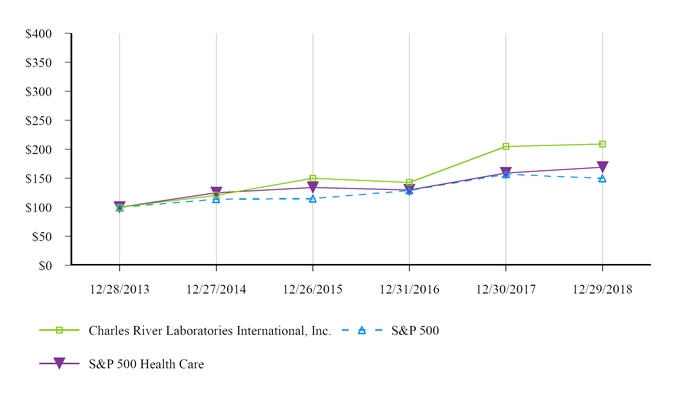
The following stock performance graph compares the annual percentage change in the Company’s cumulative total shareholder return on its Common Stock during a period commencing on December 28, 2013 and ending on December 29, 2018 (as measured by dividing (1) the sum of (A) the cumulative amount of dividends for the measurement period, assuming dividend reinvestment, and (B) the difference between the Company’s share price at the end and the beginning of the measurement period; by (2) the share price at the beginning of the measurement period) with the cumulative total return of the S&P 500 Index and the S&P 500 Health Care Index during such period. The Company has not paid any dividends on the Common Stock, and no dividends are included in the representation of the Company’s performance. The stock price performance on the graph below is not necessarily indicative of future price performance. The graph is not “soliciting material,” is not deemed filed with the Securities and Exchange Commission and is not to be incorporated by reference in any filing of the Company under the Securities Act of 1933 or the Securities Exchange Act of 1934 whether made before or after the date hereof and irrespective of any general incorporation language in any such filing. Information used in the graph was obtained from Standards & Poor’s Institutional Market Services, a source believed to be reliable, but the Company is not responsible for any errors or omissions in such information
COMPARISON OF 5-YEAR CUMULATIVE TOTAL RETURN
Among Charles River Laboratories International, Inc., The S&P 500 Index and
The S&P 500 Health Care Index
| Fiscal Year | |||||||||||||||||||||||
| 2013 | 2014 | 2015 | 2016 | 2017 | 2018 | ||||||||||||||||||
| Charles River Laboratories International, Inc. | $ | 100 | $ | 121 | $ | 150 | $ | 143 | $ | 205 | $ | 209 | |||||||||||
| S&P 500 | 100 | 114 | 115 | 129 | 157 | 150 | |||||||||||||||||
| S&P 500 Health Care | 100 | 125 | 134 | 130 | 159 | 169 |
Item 6. Selected Consolidated Financial Data
The selected financial data presented below is derived from our audited consolidated financial statements and should be read in conjunction with “Management’s Discussion and Analysis of Financial Condition and Results of Operations” contained in Item 7 and “Financial Statements and Supplementary Data” contained in Item 8 of this Annual Report on Form 10-K. Our fiscal year is typically based on 52-weeks, with each quarter composed of 13 weeks ending on the last Saturday on, or closest to, March 31, June 30, September 30, and December 31. A 53rd week was included in the fourth quarter of fiscal year 2016, which is occasionally necessary to align with a December 31 calendar year-end.
| Fiscal Year | |||||||||||||||||||
| 2018 | 2017 | 2016 | 2015 | 2014 | |||||||||||||||
| (in thousands, except per share amounts) | |||||||||||||||||||
| Statement of Income Data | |||||||||||||||||||
| Total revenue | $ | 2,266,096 | $ | 1,857,601 | $ | 1,681,432 | $ | 1,363,302 | $ | 1,297,662 | |||||||||
| Income from continuing operations, net of income taxes | 227,218 | 125,586 | 156,086 | 152,037 | 129,924 | ||||||||||||||
| Income (loss) from discontinued operations, net of income taxes | 1,506 | (137 | ) | 280 | (950 | ) | (1,726 | ) | |||||||||||
| Common Share Data | |||||||||||||||||||
| Earnings per common share from continuing operations: | |||||||||||||||||||
| Basic | $ | 4.69 | $ | 2.60 | $ | 3.28 | $ | 3.23 | $ | 2.76 | |||||||||
| Diluted | $ | 4.59 | $ | 2.54 | $ | 3.22 | $ | 3.15 | $ | 2.70 | |||||||||
| Other Data | |||||||||||||||||||
| Depreciation and amortization | $ | 161,779 | $ | 131,159 | $ | 126,658 | $ | 94,881 | $ | 96,445 | |||||||||
| Capital expenditures | 140,054 | 82,431 | 55,288 | 63,252 | 56,925 | ||||||||||||||
| Balance Sheet Data (as of period end) | |||||||||||||||||||
| Cash and cash equivalents | $ | 195,442 | $ | 163,794 | $ | 117,626 | $ | 117,947 | $ | 160,023 | |||||||||
| Total assets | 3,855,879 | 2,929,922 | 2,711,800 | 2,068,497 | 1,870,578 | ||||||||||||||
| Long-term debt, net and capital leases | 1,636,598 | 1,114,105 | 1,207,696 | 845,997 | 740,557 | ||||||||||||||
| Redeemable noncontrolling interest | 18,525 | 16,609 | 14,659 | 28,008 | 28,419 |
Refer to Note 2, “Business Acquisitions and Divestiture” included in Item 8, “Financial Statements and Supplementary Data” in this Annual Report on Form 10-K for additional information concerning the impact of our recent acquisitions.
Item 7. Management’s Discussion and Analysis of Financial Condition and Results of Operations
The following discussion should be read in conjunction with our consolidated financial statements and related notes appearing in Item 8, “Financial Statements and Supplementary Data” in this Annual Report on Form 10-K. The following discussion contains forward-looking statements. Actual results may differ significantly from those projected in the forward-looking statements. Factors that might cause future results to differ materially from those projected in the forward-looking statements include, but are not limited to, those discussed in Item 1A, “Risk Factors” and elsewhere in this Annual Report on Form 10-K. Certain percentage changes may not recalculate due to rounding.
Overview
We are a full service, early-stage contract research organization (CRO). For over 70 years, we have been in the business of providing the research models required in research and development of new drugs, devices, and therapies. Over this time, we have built upon our original core competency of laboratory animal medicine and science (research model technologies) to develop a diverse portfolio of discovery and safety assessment services, both Good Laboratory Practice (GLP) and non-GLP, that enable us to support our clients from target identification through non-clinical development. We also provide a suite of products and services to support our clients’ manufacturing activities. Utilizing our broad portfolio of products and services enables our clients to create a more flexible drug development model, which reduces their costs, enhances their productivity and effectiveness, and increases speed to market.
Our client base includes all major global biopharmaceutical companies, many biotechnology companies, CROs, agricultural and industrial chemical companies, life science companies, veterinary medicine companies, contract manufacturing companies, medical device companies, and diagnostic and other commercial entities, as well as leading hospitals, academic institutions, and government agencies around the world. We currently operate in over 80 facilities and in approximately 20 countries worldwide, which numbers exclude our Insourcing Solutions (IS) sites.
Segment Reporting
Our three reportable segments are Research Models and Services (RMS), Discovery and Safety Assessment (DSA), and Manufacturing Support (Manufacturing). Our RMS reportable segment includes the Research Models and Research Model Services businesses. Research Models includes the commercial production and sale of small research models, as well as the supply of large research models. Research Model Services includes: Genetically Engineered Models and Services (GEMS), which performs contract breeding and other services associated with genetically engineered research models; Research Animal Diagnostic Services (RADS), which provides health monitoring and diagnostics services related to research models; and Insourcing Solutions (IS), which provides colony management of our clients’ research operations (including recruitment, training, staffing, and management services). Our DSA reportable segment includes services required to take a drug through the early development process including discovery services, which are non-regulated services to assist clients with the identification, screening, and selection of a lead compound for drug development, and regulated and non-regulated (GLP and non-GLP) safety assessment services. Our Manufacturing reportable segment includes Microbial Solutions, which provides in vitro (non-animal) lot-release testing products, microbial detection products, and species identification services; Biologics Testing Services (Biologics), which performs specialized testing of biologics; Avian Vaccine Services (Avian), which supplies specific-pathogen-free chicken eggs and chickens; and contract development and manufacturing (CDMO) services, which, until we divested this business on February 10, 2017, allowed us to provide formulation design and development, manufacturing, and analytical and stability testing for small molecules.
Recent Acquisitions and Divestiture
Our strategy is to augment internal growth of existing businesses with complementary acquisitions. We continued to make strategic acquisitions designed to expand our portfolio of services to support the drug discovery and development continuum and position us as a market leader in the outsourced discovery services market. Our recent acquisitions and divestiture are described below.
On February 13, 2019, we announced that we signed a binding offer to acquire Citoxlab for €448 million in cash (or approximately $510 million based on current exchange rates), subject to customary closing adjustments. Citoxlab is a non-clinical CRO, specializing in regulated safety assessment services, non-regulated discovery services, and medical device testing. With operations in Europe and North America, the proposed acquisition of Citoxlab would further strengthen our position as the leading, global, early-stage CRO by expanding our scientific portfolio and geographic footprint, which would enhance our ability to partner with clients across the drug discovery and development continuum. The proposed transaction is expected to close in the second quarter of 2019, subject to labor consultations, regulatory requirements, and customary closing
conditions. Upon completion of the labor consultations, Citoxlab’s shareholders are expected to enter into a definitive purchase agreement. The proposed acquisition and associated fees are expected to be financed through our existing revolving credit facility and cash. In the event the agreement is terminated under specified circumstances, we may be required to pay a termination fee of €18.2 million. This business is expected to be reported as part of our DSA reportable segment.
On April 3, 2018, we acquired MPI Research, a non-clinical CRO providing comprehensive testing services to biopharmaceutical and medical device companies worldwide. The acquisition enhances our position as a leading global early-stage CRO by strengthening our ability to partner with clients across the drug discovery and development continuum. The purchase price for MPI Research was $829.7 million in cash, subject to certain post-closing adjustments. The acquisition was funded by borrowings on our $2.3 billion credit facility ($2.3B Credit Facility) as well as the issuance of $500.0 million of our senior notes. The MPI Research business is reported as part of our DSA reportable segment.
On January 11, 2018, we acquired KWS BioTest Limited (KWS BioTest), a CRO specializing in in vitro and in vivo discovery testing services for immuno-oncology, inflammatory and infectious diseases. The acquisition enhances our discovery expertise, with complementary offerings that provide our customers with additional tools in the active therapeutic research areas of oncology and immunology. The purchase price for KWS BioTest was $20.3 million in cash, subject to certain post-closing adjustments. In addition to the initial purchase price, the transaction includes aggregate, undiscounted contingent payments of up to £3.0 million (approximately $3.8 million based on recent exchange rates), based on future performance. During the three months ended September 29, 2018, the terms of these contingent payments were amended, resulting in a fixed payment of £2.0 million (approximately $2.5 million based on recent exchange rates), due in the first quarter of fiscal year 2019. The KWS BioTest business is reported as part of our DSA reportable segment.
On August 4, 2017, we acquired Brains On-Line, a leading CRO providing critical data that advances novel therapeutics for the treatment of central nervous system (CNS) diseases. Brains On-Line strategically expands our existing CNS capabilities and establishes us as a single-source provider for a broad portfolio of discovery CNS services. The purchase price for Brains On-Line was $21.3 million in cash. In addition to
Showing the first 8K of 85K characters. Open the full section
Item 7A. Quantitative and Qualitative Disclosures about Market Risk
We are exposed to market risk from changes in interest rates and currency exchange rates, which could affect our future results of operations and financial condition. We manage our exposure to these risks through our regular operating and financing activities.
Interest Rate Risk
We are exposed to changes in interest rates while conducting normal business operations as a result of ongoing financing activities. As of December 29, 2018, our debt portfolio was comprised primarily of floating interest rate borrowings. A 100-basis point increase in interest rates would increase our annual pre-tax interest expense by $11.3 million.
Foreign Currency Exchange Rate Risk
We operate on a global basis and have exposure to some foreign currency exchange rate fluctuations for our financial position, results of operations, and cash flows.
While the financial results of our global activities are reported in U.S. dollars, our foreign subsidiaries typically conduct their operations in their respective local currency. The principal functional currencies of the Company’s foreign subsidiaries are the Euro, British Pound, Canadian Dollar, Chinese Yuan Renminbi, and Japanese Yen. During fiscal year 2018, the most significant drivers of foreign currency translation adjustment the Company recorded as part of other comprehensive income (loss) were the Euro, British Pound, Canadian Dollar, and Chinese Yuan Renminbi.
Fluctuations in the foreign currency exchange rates of the countries in which we do business will affect our financial position, results of operations, and cash flows. As the U.S. dollar strengthens against other currencies, the value of our non-U.S. revenue, expenses, assets, liabilities, and cash flows will generally decline when reported in U.S. dollars. The impact to net income as a result of a U.S. dollar strengthening will be partially mitigated by the value of non-U.S. expenses, which will decline when reported in U.S. dollars. As the U.S. dollar weakens versus other currencies, the value of the non-U.S. revenue, expenses, assets, liabilities, and cash flows will generally increase when reported in U.S. dollars. For fiscal year 2018, our revenue would
have increased by approximately $81.8 million and our operating income would have increased by approximately $7.0 million, if the U.S. dollar exchange rate had strengthened by 10%, with all other variables held constant.
We attempt to minimize this exposure by using certain financial instruments in accordance with our overall risk management and our hedge policy. We do not enter into speculative derivative agreements.
During fiscal year 2018, we entered into foreign exchange forward contracts to limit our foreign currency exposure related to both intercompany loans and a U.S. dollar denominated loan borrowed by a non-U.S. Euro functional currency entity under our Credit Facility. We did not have any foreign currency contracts open related to intercompany loans as of December 29, 2018.
Item 8. Financial Statements and Supplementary Data
INDEX TO CONSOLIDATED FINANCIAL STATEMENTS
| Report of Independent Registered Public Accounting Firm | 49 |
| Consolidated Statements of Income for fiscal years 2018, 2017 and 2016 | 51 |
| Consolidated Statements of Comprehensive Income for fiscal years 2018, 2017 and 2016 | 52 |
| Consolidated Balance Sheets as of December 29, 2018 and December 30, 2017 | 53 |
| Consolidated Statements of Cash Flows for fiscal years 2018, 2017 and 2016 | 54 |
| Consolidated Statements of Changes in Equity for fiscal years 2018, 2017 and 2016 | 56 |
| Notes to Consolidated Financial Statements | 57 |
Report of Independent Registered Public Accounting Firm
To the Board of Directors and Shareholders of Charles River Laboratories International, Inc.:
Opinions on the Financial Statements and Internal Control over Financial Reporting
We have audited the accompanying consolidated balance sheets of Charles River Laboratories International, Inc. and its subsidiaries (the “Company”) as of December 29, 2018 and December 30, 2017, and the related consolidated statements of income, comprehensive income, changes in equity and cash flows for each of the three years in the period ended December 29, 2018, including the related notes (collectively referred to as the “consolidated financial statements”). We also have audited the Company's internal control over financial reporting as of December 29, 2018, based on criteria established in Internal Control - Integrated Framework (2013) issued by the Committee of Sponsoring Organizations of the Treadway Commission (COSO).
In our opinion, the consolidated financial statements referred to above present fairly, in all material respects, the financial position of the Company as of December 29, 2018 and December 30, 2017, and the results of its operations and its cash flows for each of the three years in the period ended December 29, 2018 in conformity with accounting principles generally accepted in the United States of America. Also in our opinion, the Company maintained, in all material respects, effective internal control over financial reporting as of December 29, 2018, based on criteria established in Internal Control - Integrated Framework (2013) issued by the COSO.
Basis for Opinions
The Company's management is responsible for these consolidated financial statements, for maintaining effective internal control over financial reporting, and for its assessment of the effectiveness of internal control over financial reporting, included in Management's Report on Internal Control over Financial Reporting appearing under Item 9A. Our responsibility is to express opinions on the Company’s consolidated financial statements and on the Company's internal control over financial reporting based on our audits. We are a public accounting firm registered with the Public Company Accounting Oversight Board (United States) (PCAOB) and are required to be independent with respect to the Company in accordance with the U.S. federal securities laws and the applicable rules and regulations of the Securities and Exchange Commission and the PCAOB.
We conducted our audits in accordance with the standards of the PCAOB. Those standards require that we plan and perform the audits to obtain reasonable assurance about whether the consolidated financial statements are free of material misstatement, whether due to error or fraud, and whether effective internal control over financial reporting was maintained in all material respects.
Our audits of the consolidated financial statements included performing procedures to assess the risks of material misstatement of the consolidated financial statements, whether due to error or fraud, and performing procedures that respond to those risks. Such procedures included examining, on a test basis, evidence regarding the amounts and disclosures in the consolidated financial statements. Our audits also included evaluating the accounting principles used and significant estimates made by management, as well as evaluating the overall presentation of the consolidated financial statements. Our audit of internal control over financial reporting included obtaining an understanding of internal control over financial reporting, assessing the risk that a material weakness exists, and testing and evaluating the design and operating effectiveness of internal control based on the assessed risk. Our audits also included performing such other procedures as we considered necessary in the circumstances. We believe that our audits provide a reasonable basis for our opinions.
As described in Management’s Report on Internal Control over Financial Reporting, management has excluded MPI Research and KWS BioTest from its assessment of internal control over financial reporting as of December 29, 2018 because they were acquired by the Company in purchase business combinations during 2018. We have also excluded MPI Research and KWS BioTest from our audit of internal control over financial reporting. MPI Research and KWS BioTest are wholly-owned subsidiaries whose total assets and total revenues excluded from management’s assessment and our audit of internal control over financial reporting represent 5.4% and 9.6% respectively, of the related consolidated financial statement amounts as of and for the year ended December 29, 2018.
Definition and Limitations of Internal Control over Financial Reporting
A company’s internal control over financial reporting is a process designed to provide reasonable assurance regarding the reliability of financial reporting and the preparation of financial statements for external purposes in accordance with generally accepted accounting principles. A company’s internal control over financial reporting includes those policies and procedures that (i) pertain to the maintenance of records that, in reasonable detail, accurately and fairly reflect the transactions and
dispositions of the assets of the company; (ii) provide reasonable assurance that transactions are recorded as necessary to permit preparation of financial statements in accordance with generally accepted accounting principles, and that receipts and expenditures of the company are being made only in accordance with authorizations of management and directors of the company; and (iii) provide reasonable assurance regarding prevention or timely detection of unauthorized acquisition, use, or disposition of the company’s assets that could have a material effect on the financial statements.
Because of its inherent limitations, internal control over financial reporting may not prevent or detect misstatements. Also, projections of any evaluation of effectiveness to future periods are subject to the risk that controls may become inadequate because of changes in conditions, or that the degree of compliance with the policies or procedures may deteriorate.
/s/ PricewaterhouseCoopers LLP
Boston, Massachusetts
February 13, 2019
We have served as the Company’s auditor since 1999.
CHARLES RIVER LABORATORIES INTERNATIONAL, INC.
CONSOLIDATED STATEMENTS OF INCOME
(in thousands, except per share amounts)
| Fiscal Year | |||||||||||
| 2018 | 2017 | 2016 | |||||||||
| Service revenue | $ | 1,687,941 | $ | 1,298,298 | $ | 1,130,733 | |||||
| Product revenue | 578,155 | 559,303 | 550,699 | ||||||||
| Total revenue | 2,266,096 | 1,857,601 | 1,681,432 | ||||||||
| Costs and expenses: |
Showing the first 8K of 217K characters. Open the full section
Item 9. Changes in and Disagreements with Accountants on Accounting and Financial Disclosure
None.
Item 9A. Controls and Procedures
(a) Evaluation of Disclosure Controls and Procedures
Based on their evaluation, required by paragraph (b) of Rules 13a-15 or 15d-15, promulgated by the Securities Exchange Act of 1934, as amended (Exchange Act), the Company’s principal executive officer and principal financial officer have concluded that the Company’s disclosure controls and procedures, as defined in Rules 13a-15(e) and 15d-15(e) of the Exchange Act, are effective, at a reasonable assurance level, as of December 29, 2018, to ensure that information required to be disclosed by the Company in reports that it files or submits under the Exchange Act is recorded, processed, summarized, and reported within the time periods specified in Securities and Exchange Commission rules and forms. Disclosure controls and procedures include, without limitation, controls and procedures designed to ensure that information required to be disclosed by the Company in the reports that it files or submits under the Exchange Act is accumulated and communicated to the Company’s management, including its principal executive and principal financial officers, or persons performing similar functions, as appropriate to allow timely decisions regarding required disclosure. In designing and evaluating the disclosure controls and procedures, our management recognizes that any controls and procedures, no matter how well designed and operated, can provide only reasonable assurances of achieving the desired control objectives, and management necessarily was required to apply its judgment in designing and evaluating the controls and procedures.
Management’s Report on Internal Control Over Financial Reporting
Our management is responsible for establishing and maintaining adequate internal control over financial reporting (as defined in Rules 13a-15(f) and 15d-15(f) under the Securities Exchange Act of 1934, as amended). Our internal control over financial reporting is a process designed to provide reasonable assurance regarding the reliability of financial reporting and the preparation of financial statements for external purposes in accordance with generally accepted accounting principles. Because of its inherent limitations, internal control over financial reporting may not prevent or detect misstatements. Also, projections of any evaluation of effectiveness to future periods are subject to the risk that controls may become inadequate because of changes in conditions, or that the degree of compliance with the policies or procedures may deteriorate.
Under the supervision and with the participation of our management, including our CEO and CFO, we conducted an evaluation of the effectiveness of our internal control over financial reporting based on the framework in Internal Control-Integrated Framework (2013) issued by the Committee of Sponsoring Organizations of the Treadway Commission. Based on our assessment and those criteria, management concluded that the Company maintained effective internal control over financial reporting as of December 29, 2018.
We have excluded the business acquisitions completed during fiscal year 2018, including MPI Research and KWS BioTest, from the assessment of the effectiveness of internal control over financial reporting as of December 29, 2018. The acquired businesses are wholly-owned subsidiaries whose total assets and total revenue collectively represent 5.4% and 9.6%, respectively, of the related consolidated financial statement amounts as of and for fiscal year ended December 29, 2018.
The effectiveness of our internal control over financial reporting as of December 29, 2018, has been audited by PricewaterhouseCoopers LLP, an Independent Registered Public Accounting Firm, as stated in their report which appears in Item 8, “Financial Statements and Supplementary Data” in this Annual Report on Form 10-K.
(b) Changes in Internal Controls
During fiscal year 2018, the Company continued to execute a plan to centralize certain accounting transaction processing functions to internal shared service centers. There were no other material changes in the Company’s internal control over financial reporting identified in connection with the evaluation required by paragraph (d) of the Exchange Act Rules 13a-15 or 15d-15 that occurred during the fourth quarter of 2018 that materially affected, or were reasonably likely to materially affect, the Company’s internal control over financial reporting.
Item 9B. Other Information
None.
PART III
Item 10. Directors, Executive Officers and Corporate Governance
A. Directors and Compliance with Section 16(a) of the Exchange Act
The information required by this Item regarding our directors and compliance with Section 16(a) of the Exchange Act by our officers and directors will be included in the 2019 Proxy Statement under the sections captioned “Nominees for Directors” and “Section 16(a) Beneficial Ownership Reporting Compliance” and is incorporated herein by reference thereto. The information required by this Item regarding our corporate governance will be included in the 2019 Proxy Statement under the section captioned “Corporate Governance” and is incorporated herein by reference thereto.
B. Our Executive Officers
The information required by this Item regarding our executive officers is reported in Part I of this Form 10-K under the heading “Item 1. Business”
C. Audit Committee Financial Expert
The information required by this Item regarding the audit committee of the Board of Directors and financial experts will be included in the 2019 Proxy Statement under the section captioned “The Board of Directors and its Committees-Audit Committee and Financial Experts” and is incorporated herein by reference thereto.
D. Code of Ethics
We have adopted a Code of Business Conduct and Ethics that applies to all of our employees and directors, including our principal executive officer, principal financial officer, principal accounting officer, controller, or persons performing similar functions. Our Code of Business Conduct and Ethics is posted on our website and can be accessed by selecting the “Corporate Governance” link at http://ir.criver.com. We will provide to any person, without charge, a copy of our Code of Business Conduct and Ethics. To obtain a copy, please mail a request to the Secretary, Charles River Laboratories International, Inc., 251 Ballardvale Street, Wilmington, MA 01887. Information on our website is not incorporated by reference in this annual report.
E. Changes to Board Nomination Procedures
Since December 2008, there have been no material changes to the procedures by which security holders may recommend nominees to our Board of Directors.
Item 11. Executive Compensation
The information required by this Item will be included in the 2019 Proxy Statement under the sections captioned “2018 Director Compensation,” “Compensation Discussion and Analysis,” “Executive Compensation and Related Information,” “Compensation Committee Interlocks and Insider Participation” and “Report of Compensation Committee,” and is incorporated herein by reference thereto.
Item 12. Security Ownership of Certain Beneficial Owners and Management and Related Stockholder Matters
The information required by this Item will be included in the 2019 Proxy Statement under the sections captioned “Beneficial Ownership of Securities” and “Equity Compensation Plan Information” and is incorporated herein by reference thereto.
Item 13. Certain Relationships and Related Transactions, and Director Independence
The information required by this Item will be included in the 2019 Proxy Statement under the sections captioned “Related Person Transaction Policy” and “Corporate Governance-Director Qualification Standards; Director Independence” and is incorporated herein by reference thereto.
Item 14. Principal Accountant Fees and Services
The information required by this Item will be included in the 2019 Proxy Statement under the section captioned “Statement of Fees Paid to Independent Registered Public Accounting Firm” and is incorporated herein by reference thereto.
PART IV
Item 15. Exhibits and Financial Statement Schedules
Item 15. (a)(1) and (2) Financial Statements and Schedules
See "Index to Consolidated Financial Statements and Financial Statements Schedules" at Item 8 to this Annual Report on Form 10-K. Other financial statement schedules have not been included because they are not applicable or the information is included in the financial statements or notes thereto.
Item 15(a)(3) and Item 15(b) Exhibits
The exhibits filed as part of this Annual Report on Form 10-K are listed in the Exhibit Index immediately preceding the exhibits. We have identified in the Exhibit Index each management contract and compensation plan filed as an exhibit to this Annual Report on Form 10-K in response to Item 15(c) of Form 10-K.
Item 16. Form 10-K Summary
None.
SIGNATURES
Pursuant to the requirements of Section 13 or 15(d) of the Securities Exchange Act of 1934, the registrant has duly caused this report to be signed on its behalf by the undersigned, thereunto duly authorized.
| CHARLES RIVER LABORATORIES INTERNATIONAL, INC. | ||
| February 13, 2019 | By: | /s/ DAVID R. SMITH |
| David R. Smith | ||
| Corporate Executive Vice President and Chief Financial Officer |
Pursuant to the requirements of the Securities Exchange Act of 1934, this report has been signed by the following persons on behalf of the registrant and in the capacities indicated below and on the dates indicated.
| Signatures | Title | Date | |
| By: | /s/ JAMES C. FOSTER | Chairman, President and Chief Executive Officer | February 13, 2019 |
| James C. Foster | |||
| By: | /s/ DAVID R. SMITH | Corporate Executive Vice President and | February 13, 2019 |
| David R. Smith | Chief Financial Officer | ||
| By: | /s/ MICHAEL G. KNELL | Corporate Senior Vice President and | February 13, 2019 |
| Michael G. Knell | Chief Accounting Officer | ||
| By: | /s/ ROBERT J. BERTOLINI | Director | February 13, 2019 |
| Robert J. Bertolini | |||
| By: | /s/ STEPHEN D. CHUBB | Director | February 13, 2019 |
| Stephen D. Chubb | |||
| By: | /s/ DEBORAH T. KOCHEVAR | Director | February 13, 2019 |
| Deborah T. Kochevar | |||
| By: | /s/ MARTIN MACKAY | Director | February 13, 2019 |
| Martin Mackay | |||
| By: | /s/ JEAN-PAUL MANGEOLLE | Director | February 13, 2019 |
| Jean-Paul Mangeolle | |||
| By: | /s/ GEORGE E. MASSARO | Director | February 13, 2019 |
| George E. Massaro | |||
| By: | /s/ GEORGE M. MILNE, JR. | Director | February 13, 2019 |
| George M. Milne, Jr. | |||
| By: | /s/ C. RICHARD REESE | Director | February 13, 2019 |
| C. Richard Reese | |||
| By: | /s/ RICHARD F. WALLMAN | Director | February 13, 2019 |
| Richard F. Wallman |
EXHIBIT INDEX
| Exhibit No. | Description | Filed with this Form 10-K | Incorporation by Reference | ||
| Form | Filing Date | Exhibit No. | |||
| 10.20* | Separation Agreement between Davide Molho and Charles River Laboratories, Inc. dated August 1, 2018 (revised on August 28, 2018) | 10-Q | November 7, 2018 | 10.2 | |
| 10.21* | Consulting Agreement between Davide Molho and Charles River Laboratories, Inc. dated August 28, 2018 | 10-Q | November 7, 2018 | 10.3 | |
| 21.1 | Subsidiaries of Charles River Laboratories International, Inc. | X | |||
| 23.1 | Consent of PricewaterhouseCoopers LLP | X | |||
| 31.1 | Rule 13a-14(a)/15d-14(a) Certification of Chief Executive Officer | X | |||
| 31.2 | Rule 13a-14(a)/15d-14(a) Certification of Chief Financial Officer | X | |||
| 32.1 | Section 1350 Certification of the Chief Executive Officer and Chief Financial Officer | X | |||
| 101.INS | eXtensible Business Reporting Language (XBRL) Instance Document | X | |||
| 101.SCH | XBRL Taxonomy Extension Schema | X | |||
| 101.CAL | XBRL Taxonomy Extension Calculation Linkbase | X | |||
| 101.DEF | XBRL Taxonomy Extension Definition Linkbase | X | |||
| 101.LAB | XBRL Taxonomy Extension Labels Linkbase | X | |||
| 101.PRE | XBRL Taxonomy Extension Presentation Linkbase | X | |||
| * Management contract or compensatory plan, contract or arrangement. | |||||