 filings.tools
Salesforce 10-K 2024-01-31
Filed 2024-03-06. 25 sections, 492K characters. Original on sec.gov · Markdown · JSON
Cover and table of contents
UNITED STATES
SECURITIES AND EXCHANGE COMMISSION
Washington, D.C. 20549
FORM 10-K
(Mark One)
| ☒ | Annual report pursuant to Section 13 or 15(d) of the Securities Exchange Act of 1934 |
For the fiscal year ended January 31, 2024
OR
| ☐ | Transition report pursuant to Section 13 or 15(d) of the Securities Exchange Act of 1934 |
For the transition period from to .
Commission File Number: 001-32224
Salesforce, Inc.
(Exact name of Registrant as specified in its charter)
| Delaware | 94-3320693 | ||||
| (State or other jurisdiction of incorporation or organization) | (IRS Employer Identification No.) |
Salesforce Tower
415 Mission Street, 3rd Fl
San Francisco, California 94105
(Address of principal executive offices)
Telephone Number: (415) 901-7000
(Registrant’s telephone number, including area code)
Securities registered pursuant to Section 12(b) of the Act:
| Title of each class | Trading Symbol(s) | Name of each exchange on which registered | ||||||
| Common Stock, par value $0.001 per share | CRM | New York Stock Exchange |
Securities registered pursuant to section 12(g) of the Act:
Not applicable
Indicate by check mark if the Registrant is a well-known seasoned issuer, as defined in Rule 405 of the Securities Act. Yes ☒ No ¨
Indicate by check mark if the Registrant is not required to file reports pursuant to Section 13 or Section 15(d) of the Exchange Act. Yes ¨ No ☒
Indicate by check mark whether the Registrant (1) has filed all reports required to be filed by Section 13 or 15(d) of the Exchange Act during the preceding 12 months (or for such shorter period that the Registrant was required to file such reports), and (2) has been subject to such filing requirements for the past 90 days: Yes ☒ No ¨
Indicate by check mark whether the Registrant has submitted electronically, every Interactive Data File required to be submitted pursuant to Rule 405 of Regulation S-T (§232.405 of this chapter) during the preceding 12 months (or for such shorter period that the Registrant was required to submit such files). Yes ☒ No ¨
Indicate by check mark whether the Registrant is a large accelerated filer, an accelerated filer, a non-accelerated filer, a smaller reporting company or an emerging growth company. See the definitions of “large accelerated filer,” “accelerated filer,”
“smaller reporting company” and “emerging growth company” in Rule 12b-2 of the Exchange Act.
| Large accelerated filer | ☒ | Accelerated filer | ☐ | ||||||||
| Non-accelerated filer | ☐ | Smaller reporting company | ☐ | ||||||||
| Emerging growth company | ☐ |
If an emerging growth company, indicate by check mark if the Registrant has elected not to use the extended transition period for complying with any new or revised financial accounting standards provided pursuant to Section 13(a) of the Exchange Act. ¨
Indicate by check mark whether the Registrant has filed a report on and attestation to its management’s assessment of the effectiveness of its internal control over financial reporting under Section 404(b) of the Sarbanes-Oxley Act (15 U.S.C. 7262(b)) by the registered public accounting firm that prepared or issued its audit report ☒
If securities are registered pursuant to Section 12(b) of the Act, indicate by check mark whether the financial statements of the registrant included in the filing reflect the correction of an error to previously issued financial statements. ¨
Indicate by check mark whether any of those error corrections are restatements that required a recovery analysis of incentive-based compensation received by any of the registrant’s executive officers during the relevant recovery period pursuant to §240.10D-1(b). ¨
Indicate by check mark whether the Registrant is a shell company (as defined in Rule 12b-2 of the Exchange Act). Yes ☐ No ☒
Based on the closing price of the Registrant’s Common Stock on the last business day of the Registrant’s most recently completed second fiscal quarter, which was July 31, 2023, the aggregate market value of its shares (based on a closing price of $225.01 per share) held by non-affiliates was approximately $194.1 billion. Shares of the Registrant’s Common Stock held by each executive officer and director and by each entity or person that owned 5 percent or more of the Registrant’s outstanding Common Stock were excluded in that such persons may be deemed to be affiliates. This determination of affiliate status is not necessarily a conclusive determination for other purposes.
As of February 29, 2024, there were approximately 970 million shares of the Registrant’s Common Stock outstanding.
DOCUMENTS INCORPORATED BY REFERENCE
Portions of the Registrant’s definitive proxy statement for its 2024 Annual Meeting of Stockholders (the “Proxy Statement”), to be filed within 120 days of the Registrant’s fiscal year ended January 31, 2024, are incorporated by reference in Part III of this Report on Form 10-K. Except with respect to information specifically incorporated by reference in this Form 10-K, the Proxy Statement is not deemed to be filed as part of this Form 10-K.
INDEX
FORWARD-LOOKING INFORMATION
This Annual Report on Form 10-K contains forward-looking statements within the meaning of Section 27A of the Securities Act of 1933, as amended (“Securities Act”), and Section 21E of the Securities Exchange Act of 1934, as amended (“Exchange Act”). Words such as “expects,” “anticipates,” “aims,” “projects,” “intends,” “plans,” “believes,” “estimates,” “seeks,” “assumes,” “may,” “should,” “could,” “would,” “foresees,” “forecasts,” “predicts,” “targets” and “commitments” and variations of such words and similar expressions are intended to identify such forward-looking statements, which may consist of, among other things, trend analyses and statements regarding future events, future financial performance, anticipated growth, industry prospects, our business plans and growth strategy, our strategies, expectations or plans regarding our investments, including strategic investments or future acquisitions, our beliefs or expectations regarding our competition, our intentions regarding use of future earnings, our expectations regarding attrition rates, our expectations regarding restructuring initiatives, including with respect to timing or costs, our expectations regarding investing in human capital and technology or our beliefs or expectations regarding working capital, capital expenditures, debt maintenance or commitments. These forward-looking statements are based on current expectations, estimates and forecasts, as well as the beliefs and assumptions of our management, and are subject to risks and uncertainties that are difficult to predict, including: our ability to maintain security levels and service performance that meet the expectations of our customers, and the resources and costs required to avoid unanticipated downtime and prevent, detect and remediate performance degradation and security breaches; the expenses associated with our data centers and third-party infrastructure providers; our ability to secure additional data center capacity; our reliance on third-party hardware, software and platform providers; uncertainties regarding artificial intelligence (“AI”) technology and its integration into our product offerings; the effect of evolving domestic and foreign government regulations, including those related to the provision of services on the Internet, those related to accessing the Internet, and those addressing data privacy, cybersecurity, cross-border data transfers and import and export controls; current and potential litigation involving us or our industry, including litigation involving acquired entities and the resolution or settlement thereof; regulatory developments and regulatory investigations involving us or affecting our industry; our ability to successfully introduce new services and product features, including any efforts to expand our services; the success of our strategy of acquiring or making investments in complementary businesses, joint ventures, services, technologies and intellectual property rights; our ability to complete, on a timely basis or at all, announced transactions; our ability to realize the benefits from acquisitions, strategic partnerships, joint ventures and investments, and successfully integrate acquired businesses and technologies; our ability to compete in the markets in which we participate; the success of our business strategy and our plan to build our business, including our strategy to be a leading provider of enterprise cloud computing applications and platforms; our ability to execute our business plans; our ability to continue to grow unearned revenue and remaining performance obligation; the pace of change and innovation in enterprise cloud computing services; the seasonal nature of our sales cycles; our ability to limit customer attrition and costs related to those efforts; the success of our international expansion strategy; the demands on our personnel and infrastructure resulting from significant growth in our customer base and operations, including as a result of acquisitions; our ability to preserve our workplace culture, including as a result of our decisions regarding our current and future office environments or remote work policies; our real estate and office facilities strategy and related costs and uncertainties; our dependency on the development and maintenance of the infrastructure of the Internet; fluctuations in, and our ability to predict, our operating results and cash flows; the variability in our results arising from the accounting for term license revenue products; the performance and fluctuations in the fair value of our investments in complementary businesses through our strategic investment portfolio; the impact of future gains or losses from our strategic investment portfolio, including gains or losses from overall market conditions that may affect the publicly traded companies within our strategic investment portfolio; our ability to protect our intellectual property rights; our ability to maintain and enhance our brands; the impact of foreign currency exchange rate and interest rate fluctuations on our results; the valuation of our deferred tax assets and the release of related valuation allowances; the potential availability of additional tax assets in the future; the impact of new accounting pronouncements and tax laws; uncertainties affecting our ability to estimate our tax rate; uncertainties regarding our tax obligations in connection with potential jurisdictional transfers of intellectual property, including the tax rate, the timing of transfers and the value of such transferred intellectual property; uncertainties regarding the effect of general economic, business and market conditions, including inflationary pressures, general economic downturn or recession, market volatility, increasing interest rates, changes in monetary policy and the prospect of a shutdown of the U.S. federal government; the potential impact of financial institution instability; the impact of geopolitical events, including the war in Ukraine and the Israel-Hamas war; uncertainties regarding the impact of expensing stock options and other equity awards; the sufficiency of our capital resources; our ability to execute our share repurchase program; our ability to declare future cash dividends; our ability to comply with our debt covenants and lease obligations; the impact of climate change, natural disasters and actual or threatened public health emergencies; the expected benefits of and timing of completion, as well as the expected costs and charges, of our restructuring initiatives, including, among other things, the risk that the restructuring costs and charges may be greater than we anticipate, our restructuring efforts may adversely affect our internal programs and our ability to recruit and retain skilled and motivated personnel, our restructuring efforts may be distracting to employees and management, our restructuring efforts may negatively impact our business operations and reputation with or ability to serve customers, and restructuring efforts may not generate their intended benefits to the extent or as quickly as anticipated; and our ability to achieve our aspirations, goals and projections related to our environmental, social and governance (“ESG”) initiatives, including our ability to comply with evolving legal standards and federal and state regulations concerning ESG matters. These and other risks and uncertainties may cause our actual results to differ materially and adversely from those
expressed in our forward-looking statements. Readers are directed to risks and uncertainties identified below under “Risk Factors” and elsewhere in this report for additional detail regarding factors that may cause actual results or outcomes to be different than those expressed in our forward-looking statements. Except as required by law, we undertake no obligation to revise or update publicly any forward-looking statements for any reason.
PART I.
Item 1. BUSINESS
Overview
Salesforce, Inc. (“Salesforce,” the “Company,” “we” or “our”) is a global leader in customer relationship management (“CRM”) technology that brings companies and their customers together. Founded in 1999, we enable companies of every size and industry to connect with their customers through the power of data, AI, CRM and trust.
Our AI-powered Customer 360 platform unites sales, service, marketing, commerce and IT teams by connecting customer data across systems, apps and devices to create a complete view of customers. With this single source of customer truth, teams can be more responsive, productive and efficient and deliver intelligent, personalized and automated experiences across every channel.
Our Customer 360 service offerings are designed to be flexible, scalable and easy to use. They can generally be configured easily, deployed rapidly and integrated with other platforms and enterprise applications. We sell to businesses worldwide, primarily on a subscription basis, through our direct sales efforts and also indirectly through partners. We also enable third parties to use our platform and developer tools to create additional functionality and new applications that run on our platform, which are sold separately from, or in conjunction with, our service offerings.
Salesforce is committed to a core set of values: trust, customer success, innovation, equality and sustainability. Foremost among these is trust, which is the foundation for everything we do. Our customers trust our technology to deliver the highest levels of security, privacy, performance, compliance and availability at scale. Customer success is at the core of our business and we align the entire company around our customers’ needs to promote their success and show our value. We believe in continuous innovation, enabling our customers to access the latest technology advances so they can innovate and stay ahead in their industries. Equality is a core tenet of how we run our business. We value the equality of every individual at our company and in our communities. We believe that creating a diverse workplace that reflects the communities we serve and fostering an inclusive culture where everyone feels seen, heard and valued makes us a better company. Finally, we believe the world is in a climate crisis and that sustainability, including bold climate action, is the only way forward. We are committed to ambitious climate leadership solutions, and we're bringing the full power of Salesforce to help organizations achieve net zero emissions.
We believe that our values create value, and the business of business is to make the world a better place for all of our stakeholders, including stockholders, customers, employees, partners, the planet and the communities in which we work and live. Salesforce is committed to giving back to our communities, closing the inequality gap and helping businesses grow while protecting the environment for future generations. We believe we have a broad responsibility to society, and we aspire to create a framework for the ethical and humane use of technology that not only drives the success of our customers, but also upholds the basic human rights of every individual. We are committed to transparent environmental, social and governance disclosures and maintaining programs that support the success of these initiatives.
Our Service Offerings
We believe that every business, in every industry, has to optimize for a digital-first experience for their customers, employees and partners, leveraging data and trusted AI and CRM technology to increase efficiency, boost productivity and drive growth. Our industry-leading Customer 360 CRM platform spans sales, service, marketing, commerce, collaboration, integration, AI, analytics, automation, industries and more. Our customers can select from our integrated Customer 360 solutions for any team, in any industry and for companies of any size to deliver AI-powered, personalized engagement across every customer touchpoint with hyperscale data and automation.
Customer 360 service offerings are designed to work together and include:
Sales. Our Sales offering leverages data and AI to help sales teams sell faster and smarter, and to efficiently manage and automate entire sales processes. Our customers use our Sales offering to store data; monitor leads and progress; forecast opportunities; gain insights through AI and analytics; and deliver quotes, contracts and invoices. With our AI technology, sales teams can identify the best sales leads, automatically summarize highlights from meeting notes, auto-generate emails, surface customer sentiment and receive recommended next steps. Our Sales offering enables teams to work from anywhere in the office, on the go or at home and supports the changing expectations of customers in a digital-first world.
Service. Our Service offering enables companies in every industry to bring all of their customer service and field service needs onto one integrated, AI-powered platform to deliver trusted, highly personalized customer support at scale. Organizations use our Service offering to connect their service agents with customers anytime and across multiple channels — from the phone and email to self-service portals and social media — allowing customers to engage with companies in the ways that best suit them. Our Service offering also helps our customers maximize productivity, resolve cases faster and improve customer satisfaction by automating routine tasks. With our AI technology, service teams can automatically route cases to the best service agent for the job, respond to customers with personalized, relevant answers grounded in company data and perform tasks like auto-summarizing support cases and field work orders. Our Service offering provides a field service solution that enables
companies to connect agents, dispatchers and mobile employees through one centralized platform, on which they can intelligently schedule and dispatch work as well as track and manage jobs.
Platform and Other.
Platform. Our Platform offering is an agile and trusted way for enterprises to innovate and deliver digital transformation at scale, enabling companies of all sizes, locations and industries to build business workflows and apps that bring them closer to their customers. It unifies data, AI, CRM, development, security and compliance in a single, comprehensive platform, facilitating fast development of trusted, AI-powered apps and automation that boost efficiency, increase productivity and save on IT costs. Einstein, our AI productivity and development platform, brings AI into Salesforce apps and workflows and offers the ability to deploy conversational, generative AI assistants that empower teams to get work done without compromising data security and privacy. The Salesforce platform and applications can be delivered rapidly and reliably to locations worldwide, giving customers more choice and control over data residency. Platform also includes AppExchange, a marketplace for Salesforce partner apps and experts, and Trailhead, our free online learning platform that allows anyone to learn in-demand Salesforce skills.
Slack. Our Slack offering is an intelligent productivity platform that digitally connects people, technology and business processes together in one place. Slack improves performance by empowering users with no-code workflow automation, making search and knowledge sharing seamless and keeping teams connected and engaged as they move work forward together. With our AI technology built into Slack, organizations can easily summarize and search their customer data and essential employee knowledge so they can work smarter and make smarter decisions faster. Slack is deeply integrated into the Customer 360, supercharging productivity across sales, service and marketing teams. With Slack Sales Elevate, for example, sales teams can improve productivity and accelerate deals to close by bringing together the right people, processes and customer data from Sales Cloud within Slack.
Marketing and Commerce.
Marketing. Our Marketing offering enables companies to plan, personalize, automate and optimize one-to-one customer marketing journeys, connecting interactions across email, mobile, social, web and connected products to increase conversion and customer lifetime value. With our AI technology infused across the entire campaign lifecycle, companies can create precise audience segments and content using natural language prompts; identify top prospects and leads; and deliver personalized marketing journeys based on customer behavior. With our Marketing offering and Data Cloud, companies can unify and connect their customer data and engagement with our Sales, Commerce and Service offerings to give companies a single source of truth for the customer relationship.
Commerce. Our Commerce offering enables brands to simplify everything from setting up a digital storefront to generating product descriptions. Our Commerce offering helps brands streamline purchases by unifying the shopping experience across every customer touchpoint, including mobile, web, social and store, and drive increased engagement, conversion, loyalty and revenue from their customers. With our AI technology, brands can provide product recommendations based on customers’ purchasing history; generate product descriptions and web pages; and deliver personalized shopping assistance using natural language. Our Commerce offering also delivers click-to-code tools, which provide customers with the ability to quickly build and deploy our solutions around their customers as markets, industries and customers change.
Integration and Analytics.
Integration. Our unified Integration, Automation and API Management offerings, powered by MuleSoft, provide the essential building blocks to deliver end-to-end, connected experiences. With MuleSoft, customers connect any data, or AI model securely and automate tasks and processes, using discoverable and reusable APIs and integrations, to transform businesses and drive faster time to value.
Analytics. Our Analytics offering, including Tableau, provides customers with an advanced, end-to-end analytics solution serving a broad range of enterprise use cases, powered by trusted AI. It offers customers intelligent analytics capabilities to better see, understand and act on business data from any source, using AI models and natural language to enable them to work more efficiently, spot trends, predict outcomes, create summaries, get timely recommendations and take action from any device within the flow or work. With Data Cloud, analytics customers can quickly visualize, automate, explore and act on data from any source.
Other Customer 360 Service Offerings
In addition to our solution specific service offerings, we have specialized solutions that work across all offerings to support the capabilities our customers’ business needs. These additional service offerings include:
Data Cloud. Data Cloud is our hyperscale, trusted data engine native to Salesforce. It brings a company’s disconnected, enterprise data into Salesforce to deliver an actionable, comprehensive, 360-degree view of a customer. With Data Cloud, teams across an organization are empowered with access to comprehensive data and insights about customers, including customer interactions with a company’s products and services, enabling organizations to deliver personalized customer experiences.
Using an open and extensible architecture that is core to the Einstein 1 Platform, Data Cloud leverages the power of Salesforce metadata to enable companies to ingest and federate data to power automation and analytics across multiple service offerings. By bringing together structured and unstructured data, Data Cloud offers fast and secure entry into AI for outcomes that are accurate, relevant and grounded with a company’s data.
Industries. Our industry vertical service offerings are suited to meet the needs of our customers across specific industries, such as financial services, healthcare and life sciences, manufacturing, automotive and government. They include out-of-the-box capabilities that leverage the full power of Salesforce and provide the speed and flexibility to keep up with changing times and customer demands, accelerating time to value.
Salesforce Starter. We offer Salesforce Starter, an all-in-one, easy-to-use solution for small- and medium-size businesses built on our Customer 360 platform that brings marketing, sales and service together to help small and growing businesses manage customer relationships, centralize key data, and grow more efficiently. With ease of purchase through self-serve and customized out-of-the-box features, Salesforce Starter helps customers increase productivity, save time and cut costs.
Business Benefits of Using Our Solutions
The key advantages of our solutions include the following:
-
an industry-leading, AI-powered integrated CRM platform for business-to-business, business-to-consumer and business-to-employee for the all-digital, work-from-anywhere world;
-
scalable, efficient and flexible solutions for any size company or industry;
-
a single source of truth that connects customer data across systems, apps and devices to help companies sell, service, market and conduct commerce from anywhere;
-
the ability to unlock companies’ customer data across their business, see and understand their data with advanced analytics, make predictions with pervasive AI, automate tasks and personalize every interaction;
-
the ability to infuse trusted AI in the flow of work and create AI assistants that help make the customer experience more intelligent, automated and personalized, and employees more productive;
-
the ability to collaborate easily with customers, employees, partners and systems;
-
modern low-code and no-code tools powered by leading edge AI, which empowers developers and business users to create digital experiences and configure and automate business processes to fit the needs of any business, accelerating time to value;
-
the ability to accelerate adoption and drive results with purpose-built, compliant tools and processes that deliver out-of-the-box functionality, security and interoperability; and
-
an enterprise application marketplace and a community of over 21 million Trailblazers: passionate developers, admins and experts who use Salesforce to innovate and extend the platform with thousands of partner apps.
Our Business and Growth Strategy
We continue to expand in the growing addressable markets across all of our service offerings. We continue to focus on several key growth levers, including driving multiple service offering adoption, increasing our penetration with enterprise and international customers and our industry-specific reach with more vertical software solutions. We orient our business strategy and invest for future growth by focusing on the following key priorities:
Expand relationships with existing customers. We see significant opportunities to deepen existing customer relationships through cross-selling and upselling our service offerings. For example, we continue to focus on driving multiple service offering adoption, which provides our customers with a one-stop-shop for their front-office business technology needs. As our customers realize the benefits of our entire suite of service offerings, we aim to upgrade the customers’ experience with new products and features and gain additional subscriptions by targeting new functional areas and business units. Finally, we aim to expand our relationships with existing customers through our additional support offerings.
Increase geographic reach. By extending our go-to-market capabilities globally, we aim to grow our business by selling to new customers in new regions. We will continue to pursue businesses of all sizes in most major markets globally. We also plan to continue to develop distribution channels through new and existing marketplaces and partners for our solutions around the globe and new go-to-market strategies. We continue to invest in our domestic and international operations and infrastructure to deliver the highest-quality service to our customers around the world.
Focus on industries and new products. As part of our growth strategy, we are delivering innovative and value-driven solutions in new categories based on our existing and potential customers’ needs. For example, we provide out-of-the-box solutions specifically built for customers in certain industries, such as financial services, healthcare and life sciences, manufacturing and more. In addition, through direct discussions and strategic engagements with our customers, we are able to deliver the innovations and enhancements that align with the needs of our customers. As a result of customer feedback, in fiscal 2024 we introduced the Einstein 1 platform, which allows our customers to connect data to build AI-powered apps with low-code and deliver entirely new CRM experiences, and we also introduced new industry clouds, including our Automotive or Professional Services industries.
Leverage our partner ecosystem. The Customer 360 Platform enables customers, independent software vendors (“ISVs”) and third-party developers to create, test and deliver cloud-based apps. These apps can be marketed and sold on the AppExchange, our enterprise cloud marketplace, or sold directly by software vendors. In addition, we rely on our consulting partners to deliver technology solutions and expertise to customers, from large-scale implementations to more limited solutions that help businesses run more efficiently. We continue to work with and invest in our partner ecosystem, including these ISVs and system integrators (“SIs”), to accelerate our reach into new markets and industries.
Promote strong customer adoption and reduce customer attrition. We believe that we have the people, processes and proven innovation to help companies transform successfully. Our customer success programs, including success management resources, advisory services, technical architects and business strategists, help enable and accelerate our customers’ digital transformations. In addition, we have free, curated resources such as Trailhead to help companies learn our systems and a community of Trailblazers who drive innovation. With these programs and resources, we aim to reduce attrition and secure renewals of existing customer subscriptions.
Mergers and Acquisitions and Strategic Investments
We evaluate opportunities to acquire or invest in complementary businesses, services, technologies and intellectual property to complement our organic innovation and advance the development of our Customer 360 Platform. Our evaluation seeks to ensure that any potential acquisition accelerates our Customer 360 strategy, represents an attractive customer opportunity, provides a pathway to effectively monetize the acquired products and drive significant operational efficiencies and presents a clear timeline for value accretion. Our acquisitions can range in size and complexity, from those that enhance or complement existing products and accelerate development of features to large-scale acquisitions that result in new service offerings. Our goal is to prioritize the use of our balance sheet, through cash and debt, to complete acquisitions.
We also manage a portfolio of strategic investments in both privately held and publicly traded companies focused primarily on enterprise cloud companies, technology startups and SIs. Our investments range from early to late stage companies, including investments made concurrent with a company’s initial public offering. We invest in companies that we believe are digitally transforming their industries, improving customer experiences, helping us expand our solution ecosystem or supporting other corporate initiatives, including AI. We plan to continue making these types of strategic investments as opportunities arise that we find attractive, including investments in companies representing targeted businesses, technological initiatives and geographies. Our strategy includes growing our strategic investment portfolio, in part, by reinvesting proceeds from the sales of strategic investments.
Technology, Development and Operations
We primarily deliver our solutions as highly scalable cloud computing application and platform services on a multi-tenant technology architecture. Multi-tenancy is an architectural approach that allows us to operate a single application instance for multiple organizations, treating all customers as separate tenants who run in virtual isolation from each other. This approach allows us to spread the cost of delivering our services across our user base and scale our business faster than traditional software vendors while focusing our resources on building new functionality and enhancing existing offerings.
We have historically provided, and continue to provide, our services to our customers from infrastructure designed and operated by us but secured within third-party data center facilities. In combination with these third-party data center facilities, we also provide our services via cloud computing platform partners who offer Infrastructure-as-a-Service, including servers, storage, databases and networking. We continue to invest and expand the deployment of Hyperforce, which allows our platform and applications to be delivered rapidly and reliably to locations worldwide and provides our customers autonomy and control over data residency.
Our technology and product efforts are focused on improving and enhancing the features, functionality, performance, availability and security of our existing service offerings, as well as developing new features, functionality and services. We also remain focused on integrating businesses, services and technologies from acquisitions. Performance, functional depth, security, usability, ease of integration and configuration and sustainability of our solutions influence our technology decisions and product direction.
Competition
The market for our service offerings is highly competitive, rapidly evolving and fragmented, and subject to changing technology with low barriers to entry, shifting customer needs and frequent introductions of new products and services.
Our current competitors include:
-
vendors of packaged business software, as well as companies offering enterprise apps delivered through on-premises offerings from enterprise software application vendors and cloud computing application service providers, either individually or with others;
-
software companies that provide their product or service free of charge as a single product or when bundled with other offerings, or only charge a premium for advanced features and functionality, as well as companies that offer solutions that are sold without a direct sales organization;
-
vendors who offer software tailored to specific services, industries or market segments, as opposed to our full suite of service offerings including suppliers of traditional business intelligence and data preparation products, integration software vendors, marketing vendors or e-commerce solutions vendors;
-
productivity tool and email providers, unified communications providers and consumer application companies that have entered the business software market; and
-
traditional platform development environment companies and cloud computing development platform companies who may develop toolsets and products that allow customers to build new apps that run on the customers’ current infrastructure or as hosted services, as well as would-be customers who may develop enterprise applications for internal use.
We believe more companies may become competitive threats due to the attractiveness of the markets in which we operate. We also expect our competition to change and evolve as we expand into more markets, with new offerings.
Customers
We sell to businesses of all sizes and in almost every industry worldwide. The number of paying subscriptions at each of our customers ranges from one to hundreds of thousands. None of our customers accounted for more than five percent of our revenues in fiscal years 2024, 2023 or 2022. In addition, we do not have any material dependencies on any specific product, service or particular group or groups.
Customer Service and Support
We offer professional services to help customers achieve business results faster with Salesforce solutions. Our architects and innovation program teams act as advisors to plan and execute digital transformations for our customers. This includes implementation services for multi-cloud and complex deployments. We provide best-practices and AI-based recommendations and adoption programs globally. In addition, we provide advanced education, including in-person and online courses, to certify our customers and partners on architecting, administering, deploying and developing our service offerings.
Our global customer support group responds to both business and technical inquiries about the use of our products via the web, telephone, email, social networks and other channels. We provide standard customer support during regular business hours to customers as part of our paying subscription editions. We also offer premier customer support that is either included in a premium success offering or sold for an additional fee, which can include services such as priority access to technical resources, developer support and system administration. In addition, we offer a premier priority support add-on that includes proactive monitoring, rapid incident response and instruction from a dedicated support team knowledgeable about the customer's specific enterprise architecture.
Sales and Marketing
We sell our services primarily through our direct sales force, which comprises telephone sales personnel based in regional hubs, field sales personnel based in territories close to their customers and self-service offerings.
To a lesser extent, we also utilize a network of partners who refer sales leads to us and assist in selling to prospects. This network includes global consulting firms, SIs and other partners. In return, we typically pay these partners a fee based on the first-year subscription revenue generated by the customers whom they refer. We continue to invest in developing additional distribution channels for our subscription services.
We use a variety of marketing programs across traditional and social channels to target our prospective and current customers, partners and developers. We focus our marketing activities in the cities and countries with the largest market opportunities. Our primary marketing activities include:
-
multichannel marketing campaigns that span email, social media, the web, television and more, which align to a broader customer journey;
-
in-person and virtual customer events of all sizes to create customer and prospect awareness, including proprietary events such as Dreamforce and our virtual Dreamforce to You, World Tours and other virtual events, as well as participation in trade shows and industry events;
-
live events and original programming on our Salesforce+ streaming service, which includes discussions about the future of technology in the digital-first, work anywhere world and educational content to learn new skills and pursue new career opportunities;
-
press and industry analyst relations to garner third-party validation and generate positive coverage for our company, brand, service offerings and value proposition;
-
partner co-marketing activities with global and regional implementation partners;
-
customer testimonials and our community of Trailblazers: individuals who drive innovation, grow their careers and transform their businesses using the Customer 360 platform;
-
in-person and virtual technology event sponsorships; and
-
event partnerships with high-profile global brands and organizations.
Intellectual Property
We rely on a combination of trademarks, copyrights, trade secrets, patents and contractual provisions to protect our proprietary technology and our brands. We also enter into confidentiality and proprietary rights agreements with our employees, consultants and other third parties and control access to software, services, documentation and other proprietary information. We believe the duration of our patents is adequate relative to the expected lives of our service offerings. We also purchase or license technology that we incorporate into our products or services. At times, we make select intellectual property broadly available at no or low cost to achieve a strategic objective, such as promoting industry standards, advancing interoperability, supporting open source software or attracting and enabling our external development community. While it may be necessary in the future to seek or renew licenses relating to various aspects of our products and business methods, we believe, based upon past experience and industry practice, such licenses generally could be obtained on commercially reasonable terms.
Human Capital Management
Salesforce is committed to a core set of values: trust, customer success, innovation, equality and sustainability. These core values are the foundation of our company culture, which we believe is fundamental to, and a competitive advantage in, our approach to managing our workforce. We believe our company culture fosters open dialogue, collaboration, recognition and a sense of belonging, all of which allow us to attract and retain the best talent, which is critical for our continued success. For example, our sales, engineering and customer success teams are critical to our ability to grow, innovate, and promote the trust and success of our customers.
We believe our efforts in managing our workforce have been effective. Our focus on our workplace environment and a strong company culture has led to recognition across the globe, as evidenced by the following awards: Ethisphere’s World’s Most Ethical Companies (2023 and for the 14th time), Fortune World's Most Admired Companies (2023 and for the ninth year in a row), Fortune 100 Best Companies to Work For (2023 and for the 14th year in a row), Fortune World’s Most Innovative Companies (2023, inaugural list), a score of 100 on the Human Rights Campaign Corporate Equality Index, (the seventh year in a row), a top-four Software company on the American Opportunity Index (2023) and Glassdoor Employees' Choice Best Place to Work in Canada, France, Germany, the United Kingdom and the United States (2022).
As of January 31, 2024, we had 72,682 employees, of which approximately 51 percent were located in the United States and 49 percent were located internationally and approximately 36 percent identified as women, 64 percent identified as men and less than one percent identified as non-binary or other. None of our employees in the United States are represented by a labor union. However, employees of certain foreign subsidiaries are represented by works councils.
We have continued to invest in equality, diversity and inclusion initiatives, development programs, employee engagement and ongoing communications and feedback. For additional information on our workforce, refer to our annual Stakeholder Impact Report, https://salesforce.com/stakeholder-impact-report. Some of our key human capital management initiatives are summarized below:
Equality, Diversity and Inclusion
Equality is a core value at Salesforce. We aim to create a workplace that reflects the diverse communities we serve and empowers our employees to succeed and perform at their best. Equality is deeply embedded in our culture and critical to our business. We believe values create value and strengthen our ability to grow the business, support employees and serve customers. Our 5-part equality strategy is to (1) advance representation, (2) focus on employee experience, (3) design our systems with equality at the center, (4) act with a global mindset and (5) engage all of our stakeholders across our ecosystem in the work we do. We are on a continuous journey to move closer to equality for all. In addition, we strive to align and accelerate our equality, diversity and inclusion initiatives and, beginning in fiscal 2023, all executive vice presidents, presidents and executive officers had a component of their incentive compensation plans tied to employee diversity measures.
Talent and Career Development
We offer our employees various talent development programs to create a culture of continuous learning. Learning and development opportunities include Trailhead, our learning platform available for all employees, in-person and virtual classes, guides, workbooks and more. We encourage our employees to seek personal and professional development opportunities with external organizations and offer yearly education reimbursement to employees who wish to continue job-related education from accredited institutions or organizations.
Total Rewards
We believe offering competitive compensation packages and robust benefits is an important factor in our ability to attract, retain and motivate our employees and to help enhance their everyday wellbeing. We use a combination of fixed and variable cash compensation for all employees and award equity compensation to certain employees in the form of stock options, restricted stock units and performance-based restricted stock units. Eligible employees are also able to participate in our Employee Stock Purchase Plan, which allows employees to purchase our stock at a 15 percent discount up to U.S. Internal Revenue Code limits. We also match up to $5,000 of donations, per employee, to eligible nonprofit organizations. We offer employees benefits that vary by country and are designed to meet or exceed local laws and to be competitive in the marketplace.
Our V2MOM and Code of Conduct
Alignment and consistent and clear communication are a key part of our employee engagement, especially as we continue to grow. Each year, we complete a corporate V2MOM, which is an internal management tool used to align the Company on our vision, values, methods, obstacles and measures for the upcoming year. All employees are then expected to complete their own V2MOM that aligns with the corporate V2MOM. In addition, our Code of Conduct reflects that our core values remain the foundation of the Company and directly impact our ability to deliver success. We expect all of our employees to commit to acting with integrity and treating others with compassion and respect.
Employee Engagement & Satisfaction
Our leadership strives for active engagement with our employees through a variety of channels, including all-company meetings and our daily newsletter, The Daily, allowing employees to stay connected with the business and new developments. Twice a year, our employees have an opportunity to complete a confidential survey that allows Salesforce to measure employee engagement, the health of our culture and how we are living up to our values. Our employee survey is an important employee listening tool and drives real change across the Company.
Available Information
Our Annual Report on Form 10-K, Quarterly Reports on Form 10-Q, Current Reports on Form 8-K and other filings with the Securities and Exchange Commission (“SEC”), and all amendments to these filings, can be obtained free of charge from our website at http://investor.salesforce.com/financials/ or by contacting our Investor Relations department at our office address listed above following our filing of any of these reports with the SEC. The SEC maintains an Internet site that contains reports, proxy and information statements and other information regarding issuers that file electronically with the SEC at www.sec.gov. The contents of these and other websites referenced throughout the filing are not incorporated and do not constitute a part of this filing. Further, our references to the URLs for these websites are intended to be inactive textual references only.
Our principal executive offices are located in San Francisco, California. Our principal address is Salesforce Tower, 415 Mission St., 3rd Floor, San Francisco, California 94105, and our primary website address is www.salesforce.com.
Item 1A. RISK FACTORS
The risks and uncertainties described below are not the only ones facing us. Other events that we do not currently anticipate or that we currently deem immaterial also may affect our business, financial condition, results of operations, cash flows, other key metrics and the trading price of our common stock.
Risk Factor Summary
Operational and Execution Risks
-
Any breaches in our security measures or those of our third-party data center hosting facilities, cloud computing platform providers or third-party service partners, or the underlying infrastructure of the Internet that cause unauthorized access to a customer’s data, our data or our IT systems, or the blockage or disablement of authorized access to our services.
-
Any defects or disruptions in our services that diminish demand for our services.
-
Any interruptions or delays in services from third parties, including data center hosting facilities, cloud computing platform providers and other hardware and software vendors, or from our inability to adequately plan for and manage service interruptions or infrastructure capacity requirements.
-
An inability to realize the expected business or financial benefits of company and technology acquisitions.
-
Strain on our personnel resources and infrastructure from supporting our existing and growing customer base or an inability to scale our operations and increase productivity.
-
Customer attrition, or our inability to accurately predict subscription renewals and upgrade rates.
-
Disruptions caused by periodic changes to our sales organization.
-
Dependency of our services on the development and maintenance of the infrastructure of the Internet by third parties.
-
Exposure to risks inherent in international operations from sales to customers outside the United States.
-
A more time-consuming and expensive sales cycle, pricing pressure and implementation and configuration challenges as we target more of our sales efforts at larger enterprise customers.
-
Any loss of key members of our management team or development and operations personnel, or inability to attract and retain employees necessary to support our operations and growth.
-
Any failure in the delivery of high-quality professional and technical support services related to our online applications.
Strategic and Industry Risks
-
An inability to compete effectively in the intensely competitive markets in which we participate.
-
Any failure to expand our services and to develop and integrate our existing services in order to keep pace with technological developments.
-
An inability to maintain and enhance our brands.
-
Partial or complete loss of invested capital, or significant changes in the fair value, of our strategic investment portfolio.
-
Any discontinuance by third-party developers and providers in embracing our technology delivery model and enterprise cloud computing services, or customers asking us for warranties for third-party applications, integrations, data and content.
-
Social and ethical issues, including the use or capabilities of AI in our offerings.
-
Risks related to our aspirations and disclosures related to ESG matters.
Legal and Regulatory Risks
-
Privacy concerns and laws as well as evolving regulation of cloud computing, increased restriction of cross-border data transfers and other regulatory developments.
-
Evolving or unfavorable industry-specific regulations, requirements, interpretive positions or standards.
-
Lawsuits against us by third parties for various claims, including alleged infringement of proprietary rights.
-
Any failure to obtain registration or protection of our intellectual property rights.
-
Risks related to government contracts and related procurement regulations.
-
Governmental sanctions and export and import controls that could impair our ability to compete in international markets and may subject us to liability.
Financial Risks
-
Downturns or upturns in new business, which may not be immediately reflected in our operating results because we generally recognize revenue from subscriptions for our services over the term of the subscription.
-
Significant fluctuations in our rate of anticipated growth and any failure to balance our expenses with our revenue forecasts.
-
Unanticipated changes in our effective tax rate and additional tax liabilities and global tax developments.
-
Fluctuations in currency exchange rates, particularly the U.S. Dollar versus local currencies.
-
Our debt service obligations, lease commitments and other contractual obligations.
-
Accounting pronouncements and changes in other financial and non-financial reporting standards.
Risks Related to Owning Our Common Stock
-
Fluctuations in our quarterly results.
-
Volatility in the market price of our common stock and associated litigation.
-
Provisions in our certificate of incorporation and bylaws and Delaware law that might discourage, delay or prevent a change of control of the Company or changes in our management.
General Risks
-
Volatile and significantly weakened global economic conditions.
-
The occurrence of natural disasters and other events beyond our control.
-
The long-term impact of climate change on our business.
Operational and Execution Risks
If our security measures or those of our third-party data center hosting facilities, cloud computing platform providers or third-party service partners, or the underlying infrastructure of the Internet are breached, and unauthorized access is obtained to a customer’s data, our data or our IT systems, or authorized access is blocked or disabled, our services may be perceived as not being secure, customers may curtail or stop using our services, and we may incur significant reputational harm, legal exposure and liabilities, or a negative financial impact.
Our services involve the storage and transmission of our customers’ and our customers’ customers’ proprietary and other sensitive data, including financial, health and other personal information. Our services and underlying infrastructure may in the future be materially breached or compromised as a result of the following:
-
third-party attempts to fraudulently induce our employees, partners or customers to disclose sensitive information such as user names, passwords or other information to gain access to our customers’ data or IT systems, or our data or our IT systems;
-
efforts by individuals or groups of hackers and sophisticated organizations, such as state-sponsored organizations or nation-states, to launch coordinated attacks, including ransomware, destructive malware and distributed denial-of-service attacks;
-
third-party attempts to abuse our marketing, advertising, messaging or social products and functionalities to impersonate persons or organizations and disseminate information that is false, misleading or malicious;
-
cyberattacks on our internally built infrastructure on which many of our service offerings operate, or on third-party cloud-computing platform providers;
-
vulnerabilities resulting from enhancements and updates to our existing service offerings;
-
vulnerabilities in the products or components across the broad ecosystem that our services operate in conjunction with and are dependent on;
-
vulnerabilities existing within new technologies and infrastructures, including those from acquired companies;
-
attacks on, or vulnerabilities in, the many different underlying networks and services that power the Internet that our products depend on, most of which are not under our control or the control of our vendors, partners or customers; and
-
employee or contractor errors or intentional acts that compromise our security systems.
These risks are mitigated, to the extent possible, by our ability to maintain and improve business and data governance policies, enhanced processes and internal security controls, including our ability to escalate and respond to known and p
Showing the first 8K of 127K characters. Open the full section
Item 1B. UNRESOLVED STAFF COMMENTS
None.
Item 1C. CYBERSECURITY
As a global leader in CRM technology, our services involve the storage and transmission of our customers’ and our customers’ customers’ data. As such, we have in the past been, and likely will in the future be, the target of cybersecurity threats and other efforts to breach or compromise our services and underlying infrastructure. With trust as our foremost value and the foundation of everything we do, we recognize the importance of maintaining the safety and security of our systems and data, as our customers trust our technology to deliver the highest levels of security, privacy, performance, compliance and availability at scale.
Management is responsible for the day-to-day administration of the Company’s cybersecurity policies, processes, practices and risk management. The Board, including through its dedicated Cybersecurity and Privacy committee (the “Committee”), oversees the various cybersecurity risks facing the Company and the Company’s efforts to mitigate those risks.
During the last fiscal year, we did not identify any risks from cybersecurity threats, including as a result of any previous cybersecurity incidents, that materially affected the Company, including its business strategy, results of operations, or financial condition. However, we face ongoing and increasing cybersecurity risks, including from bad actors that are becoming more sophisticated and effective over time, as well as a result of potential defects or disruptions in our or our customers’ services. If realized, these risks are reasonably likely to materially affect the Company. Additional information on the cybersecurity risks we face is discussed in Part I, Item 1A, “Risk Factors.”
Cybersecurity Risk Management and Strategy
When a company purchases our service offerings, they gain a trusted digital advisor who will work together with them in efforts to protect customer data. We aim to provide the most secure and compliant enterprise cloud platform on the market and we work to build trust and in-depth defense into all of our systems. Among other things, we employ a diverse, experienced team of cybersecurity professionals, engage in community events and offer free online cybersecurity incident prevention training to enable our customers to focus on their business, knowing their data is safe and accessible as needed.
We seek to address material cybersecurity risks through a company-wide approach that assesses, ranks and prioritizes cybersecurity threats, vulnerabilities and issues as they are identified to maintain the confidentiality, integrity and availability of our information systems and the information that we collect and store. The Company’s cybersecurity policies, standards, processes and practices are informed by recognized frameworks established by the National Institute of Standards and Technology, the International Organization for Standardization and an array of other applicable standards-setting bodies, which are integrated into a broader risk management framework and related processes. We also hold various security-related industry certifications and attestations that have been validated by external auditors, including SOC 1, SOC 2, SOC 3, ISO 27001, 27017 and 27018, CSA STAR and others.
Leveraging threat intelligence and other signals, the Company undergoes periodic testing, audits and reviews of its policies, standards, processes and practices to identify, assess and address cybersecurity risks and events. The Company also undergoes routine internal and external penetration testing. The results of such tests and assessments are evaluated by management and periodically reported to the Committee. The Company further adjusts its cybersecurity policies, standards, processes and practices based on these results. The Company also publishes attestations of its various certifications, audits, and penetration tests on its global compliance webpage.
Board Oversight and Governance
As mentioned above, the Board established the Committee to provide dedicated oversight of cybersecurity-related management, strategy, initiatives, risks, threats and remediation activities. The Committee receives regular presentations, reports and updates from the Company’s Chief Trust Officer (“CTrO”) and other members of management on developments regarding the Company’s cybersecurity program, broader cybersecurity trends, evolving industry standards, the threat environment and other topics. After each quarterly meeting of the Committee, the Board receives a report from the Chair of the Committee with an update on the Company’s oversight of cybersecurity risks and mitigation efforts. The Committee also receives periodic reports from an experienced outside consultant with information security expertise providing insights on key focus areas to aid in the Committee’s oversight of the Company’s cybersecurity program.
The Company’s processes also allow for the Board and the Committee to be informed of key cybersecurity risks outside the regular reporting schedule. While regular meetings of the Committee are scheduled on a quarterly cadence, the Committee is authorized to meet with management or individual directors at any time it deems appropriate to discuss matters relevant to the Committee. The Company’s policy is for the Board and the Committee to receive prompt and timely information regarding any
cybersecurity risk (including any incident) that meets pre-established reporting thresholds, as well as ongoing updates regarding any such risk.
Management Oversight and Governance
The CTrO, reporting to the Company’s Chief Engineering Officer (“C/E”), is responsible for designing and implementing a security program and strategy based on the mandate provided by the Board and senior management. The CTrO has extensive experience in the management of cybersecurity risk management programs, having served in various leadership roles in information technology and information security for over 15 years, including serving as the Chief Security Officer of two other large public technology companies. He also holds an undergraduate and master’s degree in computer science. We believe the Company’s business leaders, including our CEO, CFO, C/E and CLO, who have experience managing cybersecurity risk at the Company and at similar companies, have the appropriate expertise, background and depth of experience to manage risks arising from cybersecurity threats.
The CTrO, in coordination with other members of senior management, works collaboratively across the Company to implement a program designed to protect the Company’s information systems from cybersecurity threats and to promptly respond to cybersecurity incidents in accordance with the Company’s incident response and recovery plans. To facilitate the success of the Company’s cybersecurity program, cross-functional teams throughout the Company are tasked with addressing cybersecurity threats and responding to cybersecurity incidents. Through ongoing communications with these teams, the CTrO and senior management are informed promptly about, and monitor the prevention, detection, investigation, mitigation and remediation of, cybersecurity threats. These teams are expected to operate pursuant to documented plans and playbooks that include processes for escalation of incidents to leadership and to the Committee and Board, as appropriate, based on the severity level of an incident. In addition, the Company periodically consults with outside advisors and experts to assist with assessing, identifying and managing cybersecurity risks, including to anticipate future threats and trends, and their impact on the Company’s risk management environment.
Specifically, management implements the Company’s cybersecurity and risk management strategy across several areas:
-
Identification and Reporting. The Company has implemented a robust, cross-functional approach to identifying, assessing and managing cybersecurity threats and risks. The Company’s program includes controls and procedures designed to properly identify, classify, and escalate cybersecurity risks to provide management with visibility and prioritization of risk mitigation efforts and to publicly report material cybersecurity incidents when appropriate.
-
Threat Intelligence. The Company maintains a Threat Intelligence team focused on profiling, intelligence collection, and threat analysis supporting the Company’s ongoing efforts to identify, assess and manage cybersecurity threats. The team’s input supports both near-term response to cybersecurity events, and long-term strategic planning and development of the Company’s cybersecurity risk management framework.
-
Technical Safeguards. The Company implements technical safeguards that are designed to protect both the Company’s service offerings and other information systems we control from cybersecurity threats, including firewalls, intrusion prevention and detection systems, anti-malware functionality, vulnerability management, encryption processes and access controls, all of which are periodically evaluated and improved through risk and control assessments and in response to cybersecurity threat intelligence as well as outside audits and certifications.
-
Incident Response and Recovery Planning. The Company has established and maintains robust incident response, business continuity and disaster recovery plans designed to address the Company’s response to a cybersecurity incident, including the public disclosure and reporting of material incidents in a timely manner. These plans and procedures serve to guide and document a rigorous incident response program that reflects the roles of an array of stakeholders, including personnel providing technical, operational, engineering, legal and other perspectives across the Company. The Company conducts regular tabletop exercises involving multiple operational teams, including senior management, to test these plans and to familiarize personnel with their roles in a response scenario.
-
Third-Party Risk Management. The Company maintains a robust, risk-based approach to identifying and overseeing cybersecurity threats presented by certain third parties, including vendors, service providers and other external users of the Company’s systems, as well as the systems of third parties that could adversely impact our business in the event of a significant cybersecurity incident affecting those third-party systems.
-
Education and Awareness. The Company regularly provides employee training on security-related duties and responsibilities, including knowledge about how to recognize security incidents and how to proceed if an actual or suspected incident should occur. This training is mandatory for employees across the Company, and is intended to provide the Company’s employees with effective tools to address cybersecurity threats, and to communicate the Company’s evolving information security policies, standards, processes and practices. The Company maintains several
plans designed to prepare the Salesforce Security Response Center (SSRC) with the proper training, processes and capabilities needed to effectively respond to incidents.
Item 2. PROPERTIES
As of January 31, 2024, our executive and principal offices for sales, marketing, professional services, development and administration consisted of approximately 0.9 million square feet of leased and owned property in San Francisco. Excluded from this amount is approximately 2.0 million square feet of leased and owned property in San Francisco that is currently leased to others, or available for lease, as we continued office space reductions in fiscal 2024.
We also lease office space for our operations in various locations throughout the United States as well as office space in a number of countries in Europe, North America, Asia, South America, Africa and Australia.
We operate data centers in the U.S., Europe and Asia pursuant to various co-location lease arrangements.
We believe that our existing facilities and offices are adequate to meet our current requirements. If we require additional space, we believe that we will be able to obtain such space on acceptable, commercially reasonable terms.
Item 3. LEGAL PROCEEDINGS
We evaluate all claims and lawsuits with respect to their potential merits, our potential defenses and counterclaims, settlement or litigation potential and the expected effect on us. Our technologies may be subject to an injunction if they are found to infringe the rights of a third party. In addition, many of our subscription agreements require us to indemnify our customers for third-party intellectual property infringement claims, which could increase the cost to us of an adverse ruling on such a claim.
The outcome of any claims or litigation, regardless of the merits, is inherently uncertain. Any claims and other lawsuits, and the disposition of such claims and lawsuits, whether through settlement or litigation, could be time-consuming and expensive to resolve, divert our attention from executing our business plan, result in efforts to enjoin our activities, lead to attempts by third parties to seek similar claims and, in the case of intellectual property claims, require us to change our technology, change our business practices, pay monetary damages or enter into short- or long-term royalty or licensing agreements.
For more information regarding legal proceedings see Note 14 “Legal Proceedings and Claims” to the consolidated financial statements in Item 8 of Part I.
Item 4. MINE SAFETY DISCLOSURES
Not applicable.
Item 4A. INFORMATION ABOUT OUR EXECUTIVE OFFICERS
The following sets forth certain information regarding our current executive officers as of February 29, 2024 (in alphabetical order):
| Name | Age | Position | ||||||||||||
| Marc Benioff | 59 | Chair of the Board, CEO and co-Founder | ||||||||||||
| Parker Harris | 57 | Director, Chief Technology Officer, Slack and co-Founder | ||||||||||||
| Miguel Milano | 55 | President and Chief Revenue Officer | ||||||||||||
| Brian Millham | 54 | President and Chief Operating Officer | ||||||||||||
| Sabastian Niles | 44 | President and Chief Legal Officer | ||||||||||||
| Sundeep Reddy | 51 | Executive Vice President and Chief Accounting Officer | ||||||||||||
| Srinivas Tallapragada | 54 | President and Chief Engineering Officer | ||||||||||||
| Amy Weaver | 56 | President and Chief Financial Officer |
Marc Benioff is Chair of the Board, Chief Executive Officer and co-Founder of Salesforce and a pioneer of cloud computing. Mr. Benioff has served as Chief Executive Officer since 2001 and under his leadership, Salesforce has become the #1 provider of CRM software globally. Mr. Benioff was named Innovator of the Decade by Forbes and recognized as one of the World’s 50 Greatest Leaders by Fortune and 10 Best-Performing CEOs by Harvard Business Review. As a member of the World Economic Forum (WEF) Board of Trustees, Mr. Benioff serves as the inaugural chair of WEF’s Forum Center for the Fourth Industrial Revolution in San Francisco. Mr. Benioff currently serves as Chair of the Salesforce Foundation. Mr. Benioff
received his B.S. in Business Administration from the University of Southern California, where he also serves on the Board of Trustees.
Parker Harris has served as a Director since August 2018 and as Chief Technology Officer of Slack since January 2024. Mr. Harris co-founded Salesforce in February 1999 and has served in senior technical positions since inception, including Chief Technology Officer from September 2016 to January 2024 and Executive Vice President, Technology from December 2004 to February 2013. Prior to Salesforce, Mr. Harris co-founded Left Coast Software, a Java consulting firm, and served as its Vice President from October 1996 to February 1999. Mr. Harris received his B.A. in English Literature from Middlebury College.
Miguel Milano has served as our President and Chief Revenue Officer since August 2023. Prior to rejoining Salesforce, Mr. Milano served as Co-Owner and Chief Revenue Officer at Celonis, a German data processing company, from April 2020 to July 2023. Previously, Mr. Milano served in various international sales leadership roles at Salesforce from 2011 to 2020, including President, International (EMEA, APAC and LACA) from August 2018 to March 2020. Prior to that, Mr. Milano held various leadership positions at Oracle Corporation, i2 Technologies, Telefónica and McKinsey & Company. Mr. Milano received his B.S. and M.S.E. in Electrical Engineering from the Polytechnic University of Catalonia and M.B.A. from the Sloan School of Management at the Massachusetts Institute of Technology.
Brian Millham has served as our President and Chief Operating Officer since August 2022. Mr. Millham has been with Salesforce since its inception in 1999, most recently serving as Chief Customer Success Officer and Chief Operating Officer, Global Distribution from February 2022 to August 2022. From February 2021 to February 2022, he served as President, Customer Success Group and Chief Operating Officer, Worldwide Distribution. From August 2018 to February 2021, Mr. Millham served as President, Customer Success Group. From June 2017 to August 2018, Mr. Millham served as Executive Vice President, Americas Commercial, and B-to-C Sales, Global Strategy. Previously, Mr. Millham served in various leadership roles in business development, account management and sales. Mr. Millham received his B.A. from the University of California, Berkeley.
Sabastian Niles has served as our President and Chief Legal Officer since July 2023. He oversees Salesforce’s global legal and corporate affairs organization, including government affairs and the office of ethical and humane use of technology. Prior to joining Salesforce, Mr. Niles was a Partner at Wachtell, Lipton, Rosen & Katz, where he practiced law from September 2006 to July 2023. Mr. Niles received his B.S., B.A. and B.S. in Finance, Economics and Decision & Information Sciences, respectively, from the University of Maryland and J.D. from Harvard Law School.
Sundeep Reddy has served as our Chief Accounting Officer since September 2021. Prior to joining Salesforce, Mr. Reddy served in a variety of corporate finance leadership roles at McKesson Corporation, a pharmaceutical distribution company, from 2013 to 2021, including Senior Vice President, Controller and Chief Accounting Officer from July 2018 to September 2021, Senior Vice President, Assistant Controller from June 2017 to July 2018, Senior Vice President, McKesson Technology Solutions Finance and Accounting from March 2017 to June 2017 and Vice President, Controller of McKesson Technology Solutions from December 2013 to February 2017. Mr. Reddy is a Certified Public Accountant and received his B.B.A. from Georgia State University and M.B.A. from Emory University.
Srinivas Tallapragada has served as our President and Chief Engineering Officer since December 2019. Prior to this, he served as our President, Technology from June 2018 to December 2019, Executive Vice President, Engineering from March 2014 to June 2018 and Senior Vice President, Engineering from May 2012 to February 2014. Prior to Salesforce, Mr. Tallapragada served as Senior Vice President at Oracle Corporation from April 2011 to June 2012 and as Senior Vice President at SAP Labs from February 2009 to April 2011. Previously, Mr. Tallapragada held various technical management roles at Oracle, Infosys and Asian Paints. Mr. Tallapragada currently serves on the Board of Directors of GoDaddy Inc. Mr. Tallapragada received his masters degree from the School of Human Resources at XLRI, Jamshedpur and B.T. in Computer Science from the National Institute of Technology, Warangal.
Amy Weaver has served as our President and Chief Financial Officer since February 2021. Prior to this, she served as our President and Chief Legal Officer from January 2020 to January 2021, President, Legal & Corporate Affairs and General Counsel from February 2017 to January 2020, Executive Vice President and General Counsel from July 2015 to February 2017 and Senior Vice President and General Counsel from October 2013 to July 2015. Prior to Salesforce, Ms. Weaver served as Executive Vice President and General Counsel at Univar Inc., a global chemical distributor, from December 2010 to June 2013 and Senior Vice President and Deputy General Counsel at Expedia, Inc., an online travel services provider, from July 2005 to December 2010. Previously, Ms. Weaver practiced law at Cravath, Swaine & Moore LLP and Perkins Coie LLP. She also served as a clerk on the U.S. Court of Appeals, Ninth Circuit and as a legislative assistant to a member of the Hong Kong Legislative Council. Ms. Weaver currently serves on the Board of Directors of McDonald’s Corporation and Habitat for Humanity International. Ms. Weaver received her B.A. in Political Science from Wellesley College and J.D. from Harvard Law School.
PART II. OTHER INFORMATION
Item 5. MARKET FOR REGISTRANT’S COMMON EQUITY, RELATED STOCKHOLDER MATTERS AND ISSUER PURCHASES OF EQUITY SECURITIES
Market Information for Common Stock
Our common stock is traded on the New York Stock Exchange under the symbol “CRM.”
Dividend Policy
Prior to February 2024, we had never declared or paid any cash dividends on our common stock. On February 28, 2024, we announced a quarterly dividend policy and the declaration of our first-ever cash dividend. This cash dividend of $0.40 per share of the Company’s outstanding common stock will be paid on April 11, 2024 to stockholders of record as of the close of business on March 14, 2024.
The payment of future cash dividends is subject to future declaration by our Board, which will be based in part on continued capital availability, general economic and market conditions, applicable laws and agreements and our Board continuing to determine that the declaration of dividends is in the best interests of the Company and its stockholders.
Stockholders
As of January 31, 2024, there were 387 registered stockholders of record of our common stock, including The Depository Trust Company, which holds shares of Salesforce common stock on behalf of an indeterminate number of beneficial owners.
Stock Performance Graph
The following shall not be deemed incorporated by reference into any of our other filings under the Securities Exchange Act of 1934, as amended, or the Securities Act of 1933, as amended.
The graph below compares the cumulative total stockholder return on our common stock with the cumulative total return on the Standard & Poor’s 500 Index ("S&P 500 Index"), Nasdaq Computer & Data Processing Index ("Nasdaq Computer"), the Nasdaq 100 Index and the Dow Jones Industrial Average for each of the last five fiscal years ended January 31, 2024, assuming an initial investment of $100. Data for the S&P 500 Index, Nasdaq Computer, Nasdaq 100 Index and Dow Jones Industrial Average assume reinvestment of dividends.
The comparisons in the graph below are based upon historical data and are not indicative of, nor intended to forecast, future performance of our common stock.
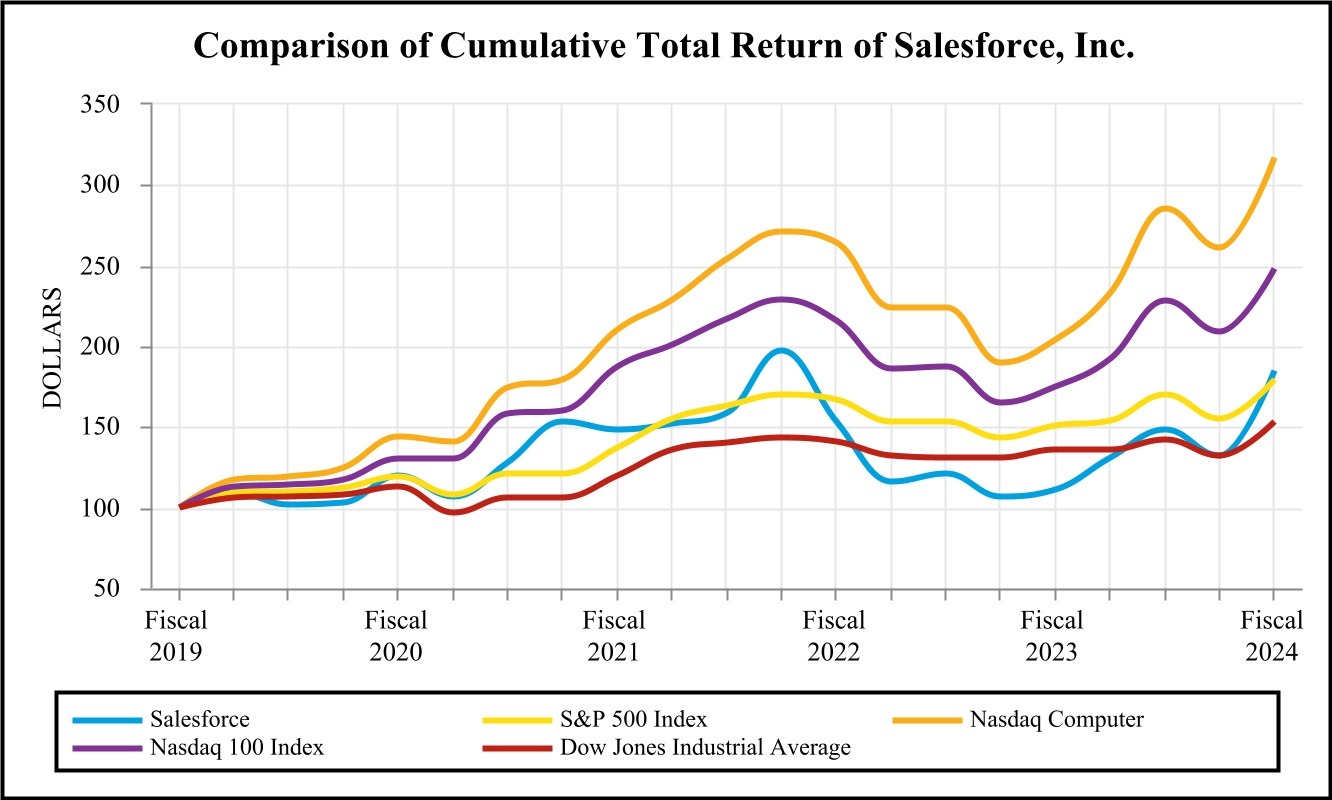
| 1/31/2019 | 1/31/2020 | 1/31/2021 | 1/31/2022 | 1/31/2023 | 1/31/2024 | ||||||||||||||||||||||||||||||
| Salesforce | $ | 100 | $ | 120 | $ | 148 | $ | 153 | $ | 111 | $ | 185 | |||||||||||||||||||||||
| S&P 500 Index | 100 | 119 | 137 | 167 | 151 | 179 | |||||||||||||||||||||||||||||
| Nasdaq Computer | 100 | 144 | 210 | 264 | 204 | 317 | |||||||||||||||||||||||||||||
| Nasdaq 100 Index | 100 | 130 | 187 | 216 | 175 | 248 | |||||||||||||||||||||||||||||
| Dow Jones Industrial Average | 100 | 113 | 120 | 141 | 136 | 153 |
Recent Sales of Unregistered Securities
None.
Issuer Purchases of Equity Securities
Share repurchases of the Company’s common stock for the three months ended January 31, 2024 were as follows (in millions, except for average price paid per share):
| Period | Total Number of Shares Purchased (1) | Average Price Paid Per Share | Total Number of Shares Purchased as Part of Publicly Announced Program (1) | Approximate Dollar Value of Shares that May Yet Be Purchased Under the Program | ||||||||||
| November 2023 | 3 | $217.99 | 3 | $9,432 | ||||||||||
| December 2023 | 2 | $258.80 | 2 | $8,899 | ||||||||||
| January 2024 | 2 | $269.84 | 2 | $8,326 | ||||||||||
| Total | 7 | 7 |
(1) In August 2022, the Board of Directors authorized a program to repurchase up to $10.0 billion of the Company’s common stock (the “Share Repurchase Program”). In February 2023, the Board of Directors authorized an additional $10.0 billion in repurchases under the Share Repurchase Program, for an aggregate total authorized of $20.0 billion. In February 2024, the Board of Directors authorized an additional $10.0 billion in repurchases under the Share Repurchase Program, for an aggregate total authorized of $30.0 billion. The Share Repurchase Program does not have a fixed expiration date and does not obligate the Company to acquire any specific number of shares. Under the Share Repurchase Program, shares of common stock may be repurchased using a variety of methods, including privately negotiated and/or open market transactions, including under plans complying with Rule 10b5-1 under the Exchange Act, as part of accelerated share repurchases and other methods. The timing, manner, price and amount of any repurchases are determined by the Company in its discretion and depend on a variety
of factors, including legal requirements, price and economic and market conditions. All repurchases disclosed in the table were made pursuant to the publicly announced Share Repurchase Program.
Item 6. RESERVED
Item 7. MANAGEMENT’S DISCUSSION AND ANALYSIS OF FINANCIAL CONDITION AND RESULTS OF OPERATIONS
The following discussion contains forward-looking statements, including, without limitation, our expectations and statements regarding our outlook and future revenues, expenses, results of operations, liquidity, plans, strategies and management objectives and any assumptions underlying any of the foregoing. Our actual results may differ significantly from those projected in the forward-looking statements. Our forward-looking statements and factors that might cause future actual results to differ materially from our recent results or those projected in the forward-looking statements include, but are not limited to, those discussed in the section titled “Forward-Looking Information” and “Risk Factors” of this Annual Report on Form 10-K. Except as required by law, we assume no obligation to update the forward-looking statements or our risk factors for any reason.
The following section generally discusses fiscal 2024 and 2023 items and year-to-year comparisons between fiscal 2024 and 2023, as well as certain fiscal 2022 items. Discussions of fiscal 2022 items and year-to-year comparisons between fiscal 2023 and 2022 that are not included in this Form 10-K can be found in “Management’s Discussion and Analysis of Financial Condition and Results of Operations” in Part II, Item 7 of our Annual Report on Form 10-K for the fiscal year ended January 31, 2023.
Overview
Salesforce is a global leader in customer relationship management (“CRM”) technology that brings companies and customers together in the digital age. Founded in 1999, we enable companies of every size and industry to take advantage of powerful technologies to connect to their customers in a whole new way and help them transform their businesses around the customer in this digital-first world.
Our Customer 360 platform unites sales, service, marketing, commerce and IT teams by connecting customer data across systems, apps and devices to create a complete view of customers. With this single source of customer truth, teams can be more responsive, productive and efficient, deliver intelligent, personalized experiences across every channel and increase productivity. With Slack, we provide a digital headquarters where companies, employees, governments and stakeholders can create success from anywhere. We continue to invest for growth, including investing in generative AI across all products, which we believe will change how our customers help their customers, and continuously look to expand our leadership role in the cloud computing industry.
We continue to focus on several key growth levers, including driving multiple service offering adoption, increasing our penetration with enterprise and international customers and expanding our industry-specific reach with more vertical software solutions. These growth levers often require a more sophisticated go-to-market approach and, as a result, we may incur additional costs upfront to obtain new customers and expand our relationships with existing customers, including additional sales and marketing expenses specific to subscription and support revenue. As a result, we have seen that customers with many of these characteristics drive higher annual revenues and have lower attrition rates than our company average.
In addition to our focus on top line growth levers, we are also focused on reducing our operating expenses to improve our operating margin. For example, in January 2023, we announced a restructuring plan (the “Restructuring Plan”) intended to reduce operating costs, improve operating margins and continue advancing our ongoing commitment to profitable growth. The Restructuring Plan included a reduction of our workforce by approximately ten percent and office space reductions within certain markets, both of which were substantially complete as of the first quarter of fiscal 2024. In addition to the Restructuring Plan, we continue to focus on evaluating and operationalizing future programs to further our transformational efforts, including an additional focused workforce reduction that was initiated and substantially completed in the fourth quarter of fiscal 2024. We have started to see improvements in our operating expenses across all operating categories, with the most opportunity in sales and marketing expense and general and administrative expenses. Over the long term, we expect to see additional operating expense improvements, which could include various restructuring initiatives to drive operational efficiencies.
Highlights from Fiscal 2024
-
Revenue: For fiscal 2024, revenue was $34.9 billion, an increase of 11 percent year-over-year.
-
Income from Operations: For fiscal 2024, income from operations was $5.0 billion as compared to $1.0 billion from a year ago. Operating margin, which represents income from operations as a percentage of total revenue, increased to approximately 14 percent for the fiscal year ended January 31, 2024 compared to approximately three percent for the same period in the prior year.
-
Earnings per Share: For fiscal 2024, diluted earnings per share was $4.20 as compared to diluted earnings per share of $0.21 from a year ago.
-
Cash: Cash provided by operations for fiscal 2024 was $10.2 billion, an increase of 44 percent year-over-year. Total cash, cash equivalents and marketable securities as of January 31, 2024 was $14.2 billion.
-
Remaining Performance Obligation: Total remaining performance obligation, which represents all future revenue under contract yet to be recognized, as of January 31, 2024 was approximately $56.9 billion, an increase of 17 percent year-over-year. Current remaining performance obligation as of January 31, 2024 was approximately $27.6 billion, an increase of 12 percent year-over-year.
-
Share Repurchase Program: During the fiscal year ended January 31, 2024, we repurchased approximately 36 million shares of our common stock for approximately $7.7 billion.
-
Restructuring: For fiscal 2024, we incurred approximately $988 million in costs related to our restructuring activities, primarily related to the Restructuring Plan.
We continue to see the impact of macroeconomic factors and the more measured buying behavior of our customers on our business and our customers’ businesses in ways that are difficult to isolate and quantify. Throughout fiscal 2024, we continued to experience elongated sales cycles, additional deal approval layers and deal compression. Slower growth in new and renewal business, particularly if sustained, impacts our remaining performance obligation, revenues and our ability to meet financial guidance and long-term targets.
In addition, the expanding global scope of our business and the heightened volatility of global markets expose us to the risk of fluctuations in foreign currency markets. Foreign currency fluctuations minimally impacted revenues in the fiscal year ended January 31, 2024 and our current remaining performance obligation was negatively impacted by one percent as of January 31, 2024 compared to what we would have reported as of January 31, 2023 using constant currency rates. During fiscal 2023, the United States Dollar strengthened significantly against certain foreign currencies in the markets in which we operate, particularly against the Euro, British Pound Sterling and Japanese Yen. The impact of foreign currency fluctuations could impact our near-term results and ability to accurately predict our future results and earnings. The impact of these fluctuations can also be compounded by the seasonality of our business in which our fourth quarter has historically been our strongest quarter for new business and renewals.
Fiscal Year
Our fiscal year ends on January 31. References to fiscal 2024, for example, refer to the fiscal year ending January 31, 2024.
Operating Segments
We operate as one segment. See Note 1 “Summary of Business and Significant Accounting Policies” to the consolidated financial statements
Showing the first 8K of 69K characters. Open the full section
Item 7A. QUANTITATIVE AND QUALITATIVE DISCLOSURES ABOUT MARKET RISK
We are exposed to financial market risks, including changes in foreign currency exchange rates, interest rates and equity investment risks. This exposure has increased due to recent financial market movements and changes to our expectations of near-term possible movements caused by the impact of the macroeconomic environment as discussed in more detail below.
Foreign Currency Exchange Risk
We primarily conduct our business in the following locations: the United States, Europe, Canada, Latin America, Asia Pacific and Japan. The expanding global scope of our business exposes us to the risk of fluctuations in foreign currency markets, including emerging markets. This exposure is the result of selling in multiple currencies, operating in countries where the functional currency is the local currency and growth in our international investments, including data center expansion, costs associated with third-party infrastructure providers and additional headcount in foreign countries. Specifically, our results of operations and cash flows are subject to fluctuations in the following currencies: the Euro, British Pound Sterling, Japanese Yen, Canadian Dollar, Australian Dollar and Brazilian Real against the United States Dollar (“USD”). These exposures may change over time as business practices evolve and economic conditions change. Changes in foreign currency exchange rates could have an adverse impact on our financial results and cash flows.
Foreign Currency Transaction Risk
Our foreign currency exposures typically arise from selling annual and multi-year subscriptions in multiple currencies, customer accounts receivable, intercompany transfer pricing arrangements and other intercompany transactions. Our foreign currency management objective is to minimize the effect of fluctuations in foreign exchange rates on selected assets or liabilities without exposing us to additional risk associated with transactions that could be regarded as speculative.
We pursue our objective by utilizing foreign currency forward contracts to offset foreign exchange risk. Our foreign currency forward contracts are generally short-term in duration. We neither use these foreign currency forward contracts for trading purposes nor do we currently designate these forward contracts as hedging instruments under the relevant accounting and financial reporting guidelines. Accordingly, we record the fair values of these contracts as of the end of our reporting period to our consolidated balance sheets with changes in fair values recorded to our consolidated statements of operations. Given the short duration of the forward contracts, the amount recorded is not significant. Our ultimate realized gain or loss with respect to foreign currency exposures will generally depend on the size and type of cross-currency transactions that we enter into, the currency exchange rates associated with these exposures and changes in those rates, the net realized gain or loss on our foreign currency forward contracts and other factors.
Foreign Currency Translation Risk
Fluctuations in foreign currencies impact the amount of total assets, liabilities, revenues, operating expenses and cash flows that we report for our foreign subsidiaries upon the translation of these amounts into USD. Total revenue during the fiscal year ended January 31, 2024, was minimally impacted by fluctuations in foreign currencies compared to the fiscal year ended January 31, 2024. In addition, fluctuations in USD against international currencies negatively impacted our current remaining performance obligation by approximately one percent as of January 31, 2024 compared to what we would have reported as of January 31, 2023 using constant currency rates.
Interest Rate Sensitivity
We had cash, cash equivalents and marketable securities totaling $14.2 billion as of January 31, 2024. This amount was invested primarily in money market funds, time deposits, corporate notes and bonds, government securities and other debt securities with credit ratings of at least BBB or better. The cash, cash equivalents and marketable securities are held for general corporate purposes, including share repurchases, dividend payments, acquisitions of, or investments in, complementary businesses, services or technologies, working capital and capital expenditures. Our investments are made for capital preservation purposes. We do not enter into investments for trading or speculative purposes.
Our cash equivalents and our portfolio of marketable securities are subject to market risk due to changes in interest rates. Fixed-rate securities may have their market value adversely impacted due to a rise in interest rates, while floating rate securities may produce less income than expected if interest rates fall. Due in part to these factors, our future investment income may fall short of expectations due to changes in interest rates or we may suffer losses in principal if we are forced to sell securities that decline in market value due to changes in interest rates. However, because we classify our debt securities as “available for sale,” no gains or losses are recognized in our consolidated statement of operations due to changes in interest rates. Gains or losses recognized in our consolidated statement of operations are limited to those related to either the sale of securities prior to maturity or expected credit losses.
Our fixed-income portfolio is also subject to interest rate risk. An immediate increase or decrease in interest rates of 100 basis points at January 31, 2024 could result in a $63 million market value reduction or increase of the same amount. This estimate is based on a sensitivity model that measures market value changes when changes in interest rates occur. Fluctuations
in the value of our investment securities caused by a change in interest rates (gains or losses on the carrying value) are recorded in other comprehensive income, net, and are realized only if we sell the underlying securities.
At January 31, 2023, we had cash, cash equivalents and marketable securities totaling $12.5 billion. Changes in interest rates of 100 basis points would have resulted in market value changes of $56 million.
Market Risk and Market Interest Risk
We deposit our cash with multiple financial institutions.
Debt
We maintain debt obligations that are subject to market interest risk, as follows (in millions):
| Instrument | Maturity Date | Principal Outstanding as of January 31, 2024 | Interest Terms | Contractual Interest Rate | ||||||||||||||||||||||
| 2024 Senior Notes | July 2024 | $ | 1,000 | Fixed | 0.625% | |||||||||||||||||||||
| Credit Facility | December 2025 | 0 | Floating | N/A | ||||||||||||||||||||||
| 2028 Senior Notes | April 2028 | 1,500 | Fixed | 3.70 | ||||||||||||||||||||||
| 2028 Senior Sustainability Notes | July 2028 | 1,000 | Fixed | 1.50 | ||||||||||||||||||||||
| 2031 Senior Notes | July 2031 | 1,500 | Fixed | 1.95 | ||||||||||||||||||||||
| 2041 Senior Notes | July 2041 | 1,250 | Fixed | 2.70 | ||||||||||||||||||||||
| 2051 Senior Notes | July 2051 | 2,000 | Fixed | 2.90 | ||||||||||||||||||||||
| 2061 Senior Notes | July 2061 | 1,250 | Fixed | 3.05 | ||||||||||||||||||||||
The borrowings under our Credit Facility bear interest, at our option, at a base rate plus a spread of 0.00% to 0.125% or an adjusted benchmark rate plus a spread of 0.50% to 1.125%, in each case with such spread being determined based on our credit rating. We are also obligated to pay an ongoing commitment fee on undrawn amounts. As of January 31, 2024, there was no outstanding borrowing amount under the Credit Facility.
The bank counterparties to our derivative contracts potentially expose us to credit-related losses in the event of their nonperformance. To mitigate that risk, we only contract with counterparties who meet the minimum requirements under our counterparty risk assessment process. We monitor ratings, credit spreads and potential downgrades on at least a quarterly basis. Based on our ongoing assessment of counterparty risk, we adjust our exposure to various counterparties. We generally enter into master netting arrangements, which reduce credit risk by permitting net settlement of transactions with the same counterparty. However, we do not have any master netting arrangements in place with collateral features.
Strategic Investments
As of January 31, 2024, our strategic investment portfolio consisted of investments in over 400 companies with a combined carrying value of $4.8 billion, including two privately held investments with carrying values that were individually greater than five percent of the total strategic investments portfolio and represented 16 percent of the portfolio in aggregate.
The following table sets forth additional information regarding active equity investments within our strategic investment portfolio as of January 31, 2024 and excludes exited investments (in millions):
| Investment Type | Capital Invested | Unrealized Gains (Cumulative) | Unrealized Losses (Cumulative) | Carrying Value as of January 31, 2024 | ||||||||||||||||||||||
| Publicly held equity securities | $ | 27 | $ | 53 | $ | 0 | $ | 80 | ||||||||||||||||||
| Privately held equity securities | 4,020 | 1,216 | (549) | 4,687 | ||||||||||||||||||||||
| Total equity securities | $ | 4,047 | $ | 1,269 | $ | (549) | $ | 4,767 |
Fluctuations in the value of our privately held equity securities are only recorded when there is an observable transaction for a same or similar security of the same issuer, or in the event of impairment. We anticipate additional volatility in our consolidated statement of operations due to these events, as well as changes in the market prices of our publicly held equity securities. We anticipate future volatility in our consolidated statements of operations due to changes in market prices, observable price changes and impairments of our strategic investments. The resulting gains or losses could be material depending on market conditions and events, particularly in periods with economic uncertainty, inflation, volatile public equity markets or unsettled global market conditions.
Our investments in privately held equity securities are in various classes of equity with varying rights and preferences. The particular securities we hold, and their rights and preferences relative to other securities within the capital structure, may
impact the magnitude by which our investment value moves in relation to movement in the total enterprise value of the company. As a result, the value of our investment in a specific company may move by more or less than a change in that company’s overall value. Our largest privately held equity securities represent 37 percent of our total strategic investments as of January 31, 2024. If the enterprise value of the companies in which we hold those securities decreased by ten percent, the carrying value of our investment portfolio would have declined by approximately $107 million.
We continually evaluate our investments in privately held and publicly traded companies. In certain cases, our ability to sell these investments may be impacted by contractual obligations to hold the securities for a set period of time after a public offering.
In addition, the financial success of our investment in any company is typically dependent on a liquidity event, such as a public offering, acquisition or other favorable market event reflecting appreciation to the cost of our initial investment. All of our investments, particularly those in privately held companies, are therefore subject to a risk of partial or total loss of invested capital.
Item 8. FINANCIAL STATEMENTS
INDEX TO CONSOLIDATED FINANCIAL STATEMENTS
The following financial statements are filed as part of this Annual Report on Form 10-K:
Report of Independent Registered Public Accounting Firm
To the Stockholders and the Board of Directors of Salesforce, Inc.
Opinion on the Financial Statements
We have audited the accompanying consolidated balance sheets of Salesforce, Inc. (the Company) as of January 31, 2024 and 2023, the related consolidated statements of operations, comprehensive income**,** stockholders' equity and cash flows for each of the three years in the period ended January 31, 2024, and the related notes (collectively referred to as the “consolidated financial statements”). In our opinion, the consolidated financial statements present fairly, in all material respects, the financial position of the Company at January 31, 2024 and 2023, and the results of its operations and its cash flows for each of the three years in the period ended January 31, 2024, in conformity with U.S. generally accepted accounting principles.
We also have audited, in accordance with the standards of the Public Company Accounting Oversight Board (United States) (PCAOB), the Company's internal control over financial reporting as of January 31, 2024, based on criteria established in Internal Control—Integrated Framework issued by the Committee of Sponsoring Organizations of the Treadway Commission (2013 framework), and our report dated March 6, 2024 expressed an unqualified opinion thereon.
Basis for Opinion
These financial statements are the responsibility of the Company's management. Our responsibility is to express an opinion on the Company’s financial statements based on our audits. We are a public accounting firm registered with the PCAOB and are required to be independent with respect to the Company in accordance with the U.S. federal securities laws and the applicable rules and regulations of the Securities and Exchange Commission and the PCAOB.
We conducted our audits in accordance with the standards of the PCAOB. Those standards require that we plan and perform the audit to obtain reasonable assurance about whether the financial statements are free of material misstatement, whether due to error or fraud. Our audits included performing procedures to assess the risks of material misstatement of the financial statements, whether due to error or fraud, and performing procedures that respond to those risks. Such procedures included examining, on a test basis, evidence regarding the amounts and disclosures in the financial statements. Our audits also included evaluating the accounting principles used and significant estimates made by management, as well as evaluating the overall presentation of the financial statements. We believe that our audits provide a reasonable basis for our opinion.
Critical Audit Matters
The critical audit matters communicated below are matters arising from the current period audit of the financial statements that were communicated or required to be communicated to the audit committee and that: (1) relate to accounts or disclosures that are material to the financial statements and (2) involved our especially challenging, subjective or complex judgments. The communication of critical audit matters does not alter in any way our opinion on the consolidated financial statements, taken as a whole, and we are not, by communicating the critical audit matters below, providing separate opinions on the critical audit matters or on the accounts or disclosures to which they relate.
| Revenue Recognition | ||||||||
| Description of the Matter | As described in Note 1 to the consolidated financial statements, the Company recognizes revenue primarily from subscription and support services and professional services contracts in an amount that reflects the consideration the Company expects to receive in exchange for those products or services. The Company enters into contracts with its customers that may include promises to transfer multiple cloud services, software licenses, premium support and professional services. Significant judgment may be required by the Company in determining revenue recognition for these customer agreements, including the determination of whether products and services are considered distinct performance obligations and the determination of standalone selling prices, particularly for products and services that are not sold separately. Auditing the Company’s accounting for revenue contracts with customers required significant judgment to assess management’s determination of performance obligations and standalone selling prices. | |||||||
| How We Addressed the Matter in Our Audit | We obtained an understanding, evaluated the design and tested the operating effectiveness of controls over the Company’s process to identify performance obligations and allocate the transaction price to those performance obligations, including controls over determining standalone selling prices. To test the Company’s judgments and conclusions related to the identification of performance obligations and determination of standalone selling prices, our audit procedures included, among others, obtaining an understanding of the Company’s various service offerings and evaluating management’s conclusions regarding which were distinct. We read a sample of executed contracts to assess management’s evaluation of significant terms, including the determination of distinct performance obligations, and the related standalone selling price. We evaluated the information utilized to determine standalone selling price and we tested the mathematical accuracy of the Company’s calculations. | |||||||
| Impairment of Strategic Investments | ||||||||
| Description of the Matter | As described in Note 1 to the consolidated financial statements, the Company holds investments in privately held equity securities, which are assessed for impairment at least quarterly. The Company’s impairment analysis encompasses an assessment of both qualitative and quantitative factors, including the investee's financial metrics, market acceptance of the investee's product or technology and the rate at which the investee is using its cash. Significant judgment may be required by the Company in determining if an investment is impaired based on the information available about the investee. Auditing the Company’s accounting for impairment of privately held equity securities required significant judgment to evaluate management’ |
Showing the first 8K of 162K characters. Open the full section
Item 9. CHANGES IN AND DISAGREEMENTS WITH ACCOUNTANTS ON ACCOUNTING AND FINANCIAL DISCLOSURE
None.
Item 9A. CONTROLS AND PROCEDURES
(a) Evaluation of Disclosure Controls and Procedures
Under the supervision and with the participation of our management, including our principal executive officer and principal financial officer, we conducted an evaluation of the effectiveness of the design and operation of our disclosure controls and procedures, as defined in Rules 13a-15(e) and 15d-15(e) under the Securities Exchange Act of 1934, as amended (the “Exchange Act”), as of the end of the period covered by this report.
In designing and evaluating our disclosure controls and procedures, management recognizes that any disclosure controls and procedures, no matter how well designed and operated, can provide only reasonable assurance of achieving the desired control objectives. In addition, the design of disclosure controls and procedures must reflect the fact that there are resource constraints and that management is required to apply its judgment in evaluating the benefits of possible controls and procedures relative to their costs.
Based on management’s evaluation, our principal executive officer and principal financial officer concluded that, as of the end of the period covered by this report, our disclosure controls and procedures are designed to, and are effective to, provide assurance at a reasonable level, that the information we are required to disclose in reports that we file or submit under the Exchange Act is recorded, processed, summarized and reported within the time periods specified in Securities and Exchange Commission rules and forms, and that such information is accumulated and communicated to our management, including our chief executive officer and chief financial officer, as appropriate, to allow timely decisions regarding required disclosures.
(b) Management’s Report on Internal Control Over Financial Reporting
Our management is responsible for establishing and maintaining adequate internal control over financial reporting, as such term is defined in Exchange Act Rules 13a-15(f) and 15d-15(f). Under the supervision and with the participation of our management, including our principal executive officer and principal financial officer, we conducted an evaluation of the effectiveness of our internal control over financial reporting as of January 31, 2024 based on the guidelines established in the Internal Control—Integrated Framework (2013 framework) issued by the Committee of Sponsoring Organizations of the Treadway Commission (COSO). Our internal control over financial reporting includes policies and procedures that provide reasonable assurance regarding the reliability of financial reporting and the preparation of financial statements for external reporting purposes in accordance with U.S. generally accepted accounting principles.
Based on the results of our evaluation, our management concluded that our internal control over financial reporting was effective as of January 31, 2024. We reviewed the results of management’s assessment with our Audit Committee.
The effectiveness of our internal control over financial reporting as of January 31, 2024 has been audited by Ernst & Young LLP, an independent registered public accounting firm, as stated in its report which is included in Item 8 of this Annual Report on Form 10-K.
(c) Changes in Internal Control over Financial Reporting
There was no change in our internal control over financial reporting that occurred during the quarter ended January 31, 2024 that has materially affected, or is reasonably likely to materially affect, our internal control over financial reporting.
(d) Inherent Limitations on Effectiveness of Controls
Our management, including our principal executive officer and principal financial officer, do not expect that our disclosure controls or our internal control over financial reporting will prevent all errors and all fraud. A control system, no matter how well conceived and operated, can provide only reasonable, not absolute, assurance that the objectives of the control system are met. Further, the design of a control system must reflect the fact that there are resource constraints, and the benefits of controls must be considered relative to their costs. Because of the inherent limitations in all control systems, no evaluation of controls can provide absolute assurance that all control issues and instances of fraud, if any, within the Company have been detected. These inherent limitations include the realities that judgments in decision-making can be faulty, and that breakdowns can occur because of a simple error or mistake. Additionally, controls can be circumvented by the individual acts of some persons, by collusion of two or more people or by management override of the controls. The design of any system of controls is also based in part upon certain assumptions about the likelihood of future events, and there can be no assurance that any design will succeed in achieving its stated goals under all potential future conditions; over time, controls may become inadequate
because of changes in conditions, or the degree of compliance with policies or procedures may deteriorate. Because of the inherent limitations in a cost-effective control system, misstatements due to error or fraud may occur and not be detected.
Item 9B. OTHER INFORMATION
During the three months ended January 31, 2024, none of our directors or officers (as defined in Rule 16a-1(f) of the Exchange Act) informed us of the adoption or termination of a “Rule 10b5-1 trading arrangement” or “non-Rule 10b5-1 trading arrangement” (as defined in Item 408 of Regulation S-K), except as follows. On December 29, 2023, Marc Benioff, Chair and Chief Executive Officer, adopted a Rule 10b5-1 trading arrangement intended to satisfy the affirmative defense of Rule 10b5-1(c) for the sale of up to 750,000 shares of the Company’s common stock, subject to certain conditions, through June 10, 2024. On December 22, 2023, Brian Millham, President and Chief Operating Officer, adopted a Rule 10b5-1 trading arrangement intended to satisfy the affirmative defense of Rule 10b5-1(c) for the sale of up to 532,554 shares of the Company’s common stock, subject to certain conditions, through December 31, 2024. On December 13, 2023, Srinivas Tallapragada, President and Chief Engineering Officer, adopted a Rule 10b5-1 trading arrangement intended to satisfy the affirmative defense of Rule 10b5-1(c) for the sale of up to 50,051 shares of the Company’s common stock, subject to certain conditions, through December 31, 2024.
Item 9C. DISCLOSURE REGARDING FOREIGN JURISDICTIONS THAT PREVENT INSPECTIONS
Not applicable.
PART III.
Item 10. DIRECTORS, EXECUTIVE OFFICERS AND CORPORATE GOVERNANCE
The information concerning our directors, our Audit Committee and any changes to the process by which stockholders may recommend nominees to the Board required by this Item are incorporated herein by reference to information contained in the Proxy Statement, including “Directors and Corporate Governance” and, as applicable, “Delinquent Section 16(a) Reports.”
The information concerning our executive officers required by this Item is incorporated by reference herein to the section of this Annual Report on Form 10-K in Part I, entitled “Information About Our Executive Officers.”
We have adopted a code of ethics, our Code of Conduct, which applies to all employees, including our chief executive officer, Marc Benioff, principal financial officer, Amy Weaver, principal accounting officer, Sundeep Reddy and all other executive officers. The Code of Conduct is available on our website at *http://investor.salesforce.com/about-us/investor/corporate-governance*/. A copy may also be obtained without charge by contacting Investor Relations, Salesforce, Inc., Salesforce Tower, 415 Mission St, 3rd Fl, San Francisco, California 94105 or by calling (415) 901-7000.
We plan to post on our website at the address described above future amendments and waivers of our Code of Conduct as required under applicable NYSE and SEC rules.
Item 11. EXECUTIVE COMPENSATION
The information required by this Item is incorporated herein by reference to information contained in the Proxy Statement, including “Compensation Discussion and Analysis,” “Committee Reports,” “Directors and Corporate Governance” and “Executive Compensation and Other Matters.”
Item 12. SECURITY OWNERSHIP OF CERTAIN BENEFICIAL OWNERS AND MANAGEMENT AND RELATED STOCKHOLDER MATTERS
The information required by this Item is incorporated herein by reference to information contained in the Proxy Statement, including “Security Ownership of Certain Beneficial Owners and Management and Related Stockholder Matters” and “Equity Compensation Plan Information.”
Item 13. CERTAIN RELATIONSHIPS AND RELATED TRANSACTIONS AND DIRECTOR INDEPENDENCE
The information required by this Item is incorporated herein by reference to information contained in the Proxy Statement, including “Directors and Corporate Governance” and “Employment Contracts and Certain Transactions.”
Item 14. PRINCIPAL ACCOUNTANT FEES AND SERVICES
The information required by this Item is incorporated herein by reference to information contained in the Proxy Statement, including “Ratification of Appointment of Independent Auditors.”
PART IV
Item 15. EXHIBITS AND FINANCIAL STATEMENT SCHEDULES
(a) The following documents are filed as a part of this Annual Report on Form 10-K:
-
Financial Statements: The information concerning our financial statements, and Report of Independent Registered Public Accounting Firm required by this Item is incorporated by reference herein to the section of this Annual Report on Form 10-K in Item 8, entitled “Financial Statements.”
-
Financial Statement Schedules: The Financial Statement Schedules have been omitted because they are not applicable or are not required or are not present in material amounts or the information required to be set forth herein is included in the Consolidated Financial Statements or Notes thereto.
-
Exhibits: See “Index to Exhibits.”
(b) Exhibits. The exhibits listed below in the accompanying “Index to Exhibits” are filed or incorporated by reference as part of this Annual Report on Form 10-K.
Item 16. 10-K SUMMARY
Omitted at registrant’s option.
Index to Exhibits
| * | Indicates a management contract or compensatory plan or arrangement. |
SIGNATURES
Pursuant to the requirements of Section 13 or 15(d) of the Securities Exchange Act of 1934, the registrant has duly caused this report to be signed on its behalf by the undersigned thereunto duly authorized.
| Dated: March 6, 2024 | ||||||||||||||||||||
| Salesforce, Inc. | ||||||||||||||||||||
| By: | /s/ AMY WEAVER | |||||||||||||||||||
| Amy Weaver | ||||||||||||||||||||
| President and Chief Financial Officer (Principal Financial Officer) | ||||||||||||||||||||
| Dated: March 6, 2024 | ||||||||||||||||||||
| Salesforce, Inc. | ||||||||||||||||||||
| By: | /s/ SUNDEEP REDDY | |||||||||||||||||||
| Sundeep Reddy | ||||||||||||||||||||
| Executive Vice President and Chief Accounting Officer (Principal Accounting Officer) |
POWER OF ATTORNEY AND SIGNATURES
KNOW ALL PERSONS BY THESE PRESENT, that each person whose signature appears below constitutes and appoints Marc Benioff, Amy Weaver, Sundeep Reddy and Sabastian Niles, his or her attorney-in-fact, each with the power of substitution, for him or her in any and all capacities, to sign any amendments to this Annual Report on Form 10-K, and to file the same, with exhibits thereto and other documents in connection therewith, with the Securities and Exchange Commission, hereby ratifying and confirming all that said attorney-in-fact, or his or her substitute or substitutes, may do or cause to be done by virtue hereof. Pursuant to the requirements of the Securities Exchange Act of 1934, this Annual Report on Form 10-K has been signed below by the following persons on behalf of the registrant and in the capacities and on the dates indicated.
| Signature | Title | Date | ||||||||||||
| /s/ Marc Benioff | Chair of the Board and Chief Executive Officer (Principal Executive Officer) | March 6, 2024 | ||||||||||||
| Marc Benioff | ||||||||||||||
| /s/ Amy Weaver | President and Chief Financial Officer (Principal Financial Officer) | March 6, 2024 | ||||||||||||
| Amy Weaver | ||||||||||||||
| /s/ Sundeep Reddy | Executive Vice President and Chief Accounting Officer (Principal Accounting Officer) | March 6, 2024 | ||||||||||||
| Sundeep Reddy | ||||||||||||||
| /s/ Laura Alber | Director | March 6, 2024 | ||||||||||||
| Laura Alber | ||||||||||||||
| /s/ Craig Conway | Director | March 6, 2024 | ||||||||||||
| Craig Conway | ||||||||||||||
| /s/ Arnold Donald | Director | March 6, 2024 | ||||||||||||
| Arnold Donald | ||||||||||||||
| /s/ Parker Harris | Director, Co-Founder | March 6, 2024 | ||||||||||||
| Parker Harris | ||||||||||||||
| /s/ Neelie Kroes | Director | March 6, 2024 | ||||||||||||
| Neelie Kroes | ||||||||||||||
| /s/ Sachin Mehra | Director | March 6, 2024 | ||||||||||||
| Sachin Mehra | ||||||||||||||
| /s/ Mason Morfit | Director | March 6, 2024 | ||||||||||||
| Mason Morfit | ||||||||||||||
| /s/ Oscar Munoz | Director | March 6, 2024 | ||||||||||||
| Oscar Munoz | ||||||||||||||
| /s/ John V. Roos | Director | March 6, 2024 | ||||||||||||
| John V. Roos | ||||||||||||||
| /s/ Robin L. Washington | Director | March 6, 2024 | ||||||||||||
| Robin L. Washington | ||||||||||||||
| /s/ Maynard Webb | Director | March 6, 2024 | ||||||||||||
| Maynard Webb | ||||||||||||||
| /s/ Susan Wojcicki | Director | March 6, 2024 | ||||||||||||
| Susan Wojcicki |