 filings.tools
Item 1. Business
64K characters. Original on sec.gov · Markdown
Item 1. Business
General
Cisco designs and sells a broad range of technologies that power the Internet. We are integrating our platforms across networking, security, collaboration, applications and the cloud. These platforms are designed to help our customers manage more users, devices and things connecting to their networks. This will enable us to provide customers with a highly secure, intelligent platform for their digital business.
We conduct our business globally and manage our business by geography. Our business is organized into the following three geographic segments: Americas; Europe, Middle East, and Africa (EMEA); and Asia Pacific, Japan, and China (APJC).
Our products and technologies are grouped into the following categories: Infrastructure Platforms; Applications; Security and Other Products. In addition to our product offerings, we provide a broad range of service offerings, including technical support services and advanced services. Increasingly, we are delivering our technologies through software and services. Our customers include businesses of all sizes, public institutions, governments, and service providers, including large webscale providers. These customers often look to us as a strategic partner to help them use information technology (IT) to differentiate themselves and drive positive business outcomes.
At our annual meeting of shareholders held on December 10, 2020, shareholders voted to approve changing our state of incorporation from California to Delaware. The reincorporation became effective on January 25, 2021. Our headquarters are in San Jose, California. The mailing address of our headquarters is 170 West Tasman Drive, San Jose, California 95134-1706, and our telephone number at that location is (408) 526-4000. Our website is www.cisco.com. Through a link on the Investor Relations section of our website, we make available the following filings as soon as reasonably practicable after they are electronically filed with or furnished to the Securities and Exchange Commission (SEC) at sec.gov: our Annual Report on Form 10-K, Quarterly Reports on Form 10-Q, Current Reports on Form 8-K, and any amendments to those reports or other information filed or furnished pursuant to Section 13(a) or 15(d) of the Exchange Act. All such filings are available free of charge. The information published on our website, or any other website referenced herein, is not incorporated into this report.
Strategy and Priorities
As our customers add billions of new connections to their enterprises, and as more applications move to a multicloud environment, the network becomes even more critical. Our customers are navigating change at an unprecedented pace and our mission is to shape the future of the Internet by inspiring new possibilities for them by helping transform their infrastructure, expand applications and analytics, address their security needs, and empower their teams. We believe that our customers are looking for outcomes that are data-driven and provide meaningful business value through automation, security, and analytics across private, hybrid, and multicloud environments.
We are focusing on four customer priorities: Reimagine Applications, Power of Hybrid Work, Transforming Infrastructure and Secure the Enterprise.
Reimagine Applications
In our view, over the next several years, customers will be increasingly writing modern software applications that can run on any hybrid cloud, and will be adding billions of connections to their environments. Customers will need to be able to build
applications quickly, deploy them nearly anywhere, monitor experiences, and act in real time.
We believe we are uniquely positioned to enable successful business outcomes for customers in hybrid and multicloud environments. In our view, networks are increasingly critical to business success and we believe our customers will benefit from the insights and intelligence that we are making accessible through our highly differentiated platforms.
We are continuing our commitment to deliver full stack observability from the application to the infrastructure to give our customers greater insights that enable faster, better decision making. We are doing this through adding key elements to our portfolio, such as: infrastructure optimization with Intersight, network monitoring with technology from our acquisition of ThousandEyes, application performance monitoring with AppDynamics, as well as our security innovations.
Power of Hybrid Work
Our customers’ communications continue to evolve as we move to a digital, cloud-based world. As our customers’ people are an important competitive advantage to them, their teams need effective and simple ways to work better together and to interact with their customers to build better relationships and increase collaboration. As an example, we believe our collaboration portfolio, which includes our subscription-based Webex conferencing platform, is at the center of our customers’ strategy for enabling their teams to be more productive and secure.
With the future of work being hybrid, we are focused on delivering highly secure collaboration experiences regardless of whether workers are physically at home or in the office. During fiscal 2021, we have added a significant number of new features, including digital signage, touchless calls, room capacity alerts, and environmental sensors to help enable a safer return to the office. We also extended our Webex suite of devices through our new desk camera and desk hub solutions.
Transforming Infrastructure
In an increasingly digital and connected world, our customers are looking to modernize and transform their infrastructure. Our strategy began with Software-Defined Access (SD-Access) technology, one of our leading enterprise architectures and continued with the launch of our Catalyst 9000 series of switches.
Since the initial launch, we have continued to transform our enterprise access portfolio by bringing together several technologies to form the only integrated architecture with built-in simplicity, automation and security at the foundation. This architecture is designed to enable our customers to securely connect their users and devices to applications and data over any network, to applications and data, no matter where they are.
We have introduced several innovations that extend our networking capabilities to wireless and enterprise routing products, including Software-Defined Wide Area Network (SD-WAN) and Internet of Things (IoT) edge platforms. Our SD-WAN solutions are designed to provide direct branch to cloud connectivity, enabling the workforce to access their software-as-a-service (SaaS) applications and workloads in an optimized and highly secure manner. We have continued to expand our SD-WAN offering, through our Cloud OnRamp integrations with several webscale providers to deliver predictable and highly secure application experiences.
To further our innovation in this area, we are applying the latest technologies, such as machine learning and advanced analytics, to operate and enhance network capabilities. These network product offerings are designed to enable customers to detect cybersecurity threats, even in encrypted traffic. As such, we have created, in our view, the only network that is designed for security while maintaining privacy.
Our customers are operating in multicloud environments with private, public and hybrid clouds. For the data center, our strategy is to deliver multicloud architectures that bring policy and operational consistency, regardless of where applications or data reside, by extending our Application Centric Infrastructure (ACI) and our hyperconverged offerings.
In fiscal 2020, we announced details of our technology strategy for the Internet for the Future aimed at addressing the broad adoption of multicloud and application environments. We continue to make significant investments in the development of software, silicon and optics — which we believe are the building blocks for the Internet for the Future.
We introduced Cisco Silicon One, a single unified silicon architecture, as well as the Cisco 8000 carrier-class router family built on Cisco Silicon One and our operating system, Cisco IOS XR7. We have also expanded our Cisco Silicon One platform from a routing focused solution to one which addresses the webscale switching market. We also launched a new routed optical networking solution integrating our routers and pluggable optics from our recent acquisition of Acacia, which further helps to deliver cost savings to our customers.
Secure the Enterprise
With the rapid growth in modern applications, more distributed work environments, and increasing cyber-attacks, we believe every organization requires new or enhanced security architectures. Our security strategy is focused on delivering a simple and
effective cyber-security architecture combining network, cloud and endpoint-based solutions that recognizes the critical importance of data privacy.
Our comprehensive security portfolio offers simplified protection for any workload on any cloud while minimizing the attack surface and automating security policies across an organization’s hybrid cloud footprint. This extends to our secure access service edge (SASE) framework and Zero Trust architecture, where we have developed a cloud-delivered stack across Umbrella, a secure Internet gateway, Meraki, SD-WAN, and Viptela. We are also delivering unified detection and response capabilities built on Cisco SecureX, our new cloud-native platform, which is a built-in platform that connects our Cisco Secure portfolio and our customers’ infrastructure.
Our strategy is to help our customers connect, secure, and automate in order to accelerate their digital agility in a cloud-first world. To execute on our strategy and address our customer priorities, we are focusing on the following six strategic pillars:
-
Secure, Agile Networks — Build networking solutions with built-in simplicity, security, agility and automation that can be consumed as-a-service.
-
Optimized Application Experiences — Enabling greater speed, agility and scale of cloud-native applications.
-
Hybrid Work — Deliver highly secure access, a safer workplace and collaboration experiences for the hybrid workforce.
-
Internet for the Future — Transform connectivity by efficiently meeting the ever-growing demand for low-latency and higher speeds.
-
End-to-End Security — Build simple, integrated, and high efficacy end-to-end security solutions, delivered on-premise or in the cloud.
-
Capabilities at the Edge — Develop new capabilities for a distributed world while enhancing the developer experience and extending enterprise and carrier networks.
We are also accelerating our efforts to enable the delivery of network functionality as a service as our customers increasingly want to consume our technologies in flexible ways. We have made the initial step with our new as-a-service portfolio, Cisco Plus, and our first offer, Cisco Plus hybrid cloud, which combines our data center compute, networking and storage portfolio. Cisco Plus includes our plans to deliver networking-as-a-service, which is designed to unify networking, security and observability across access, wide area network (WAN), and cloud domains.
Transforming our Business Model
We are transforming our offerings to meet the evolving needs of our customers. Historically, our various networking technology products have aligned with their respective product categories. However, increasingly our offerings are crossing multiple product categories. As our core networking offerings evolve, we expect we will add more common software features across our core networking platforms. We are increasing the amount of software offerings that we provide and the proportion of subscription software offerings. We have various software offerings that fall into the broad categories of subscription arrangements, including SaaS and term licenses, and perpetual licenses.
As part of the transformation of our business, we continued to make strides during fiscal 2021 to develop and sell more software and subscription-based offerings. We are also focused on the entire customer lifecycle to drive expansion and renewals. We will continue to invest in network-as-a-service offerings to provide our customers with flexibility in how they want to utilize our technologies.
For a discussion of the risks associated with our strategy, see “Item 1A. Risk Factors,” including the risk factor entitled “We depend upon the development of new products and services, and enhancements to existing products and services, and if we fail to predict and respond to emerging technological trends and customers’ changing needs, our operating results and market share may suffer.” For information regarding sales of our major products and services, see Note 19 to the Consolidated Financial Statements.
Products and Services
Our products and services are grouped into the following categories:
Infrastructure Platforms
Infrastructure Platforms consist of our core networking technologies of switching, routing, wireless, and data center products that are designed to work together to deliver networking capabilities and transport and/or store data. These technologies consist of both hardware and software offerings that help our customers build networks, automate, orchestrate, integrate, and digitize data. We believe it is critical for us to continue to deliver continuous value to our customers. We continued to make progress in shifting more of our business to software and subscriptions across our core networking portfolio, and in expanding our software
offerings. Our objective is to continue moving to cloud-managed solutions across our enterprise networking portfolio. We started with our Nexus 9000 series of switches for the data center, which along with ACI, provide enhancements in security, programmability and performance while lowering operating costs. Our Cisco Catalyst 9000 series of switches were developed for security, mobility, IoT, and the cloud. These switches formed the foundation for our leading enterprise architectures, built on the principles of Cisco DNA. We continued to expand on this technology by extending SD-Access and Cisco DNA Center across our enterprise networking portfolio and by extending ACI to the public and private cloud. In addition, we now have a unified operating system and policy management platform for our enterprise networking portfolio to drive simplicity and consistency across our customers’ networks.
Our Switching portfolio encompasses campus switching as well as data center switching offerings. Our campus switching offerings provide the foundation for converged data, voice, video, and IoT services. These switches offer enhanced security and reliability and are designed to scale efficiently as our customers grow. Within campus switching are our Catalyst 9000 series of switches that include hardware with embedded software, along with a software subscription referred to as Cisco DNA. Cisco DNA provides automation, analytics and security features and can be centrally monitored, managed, and configured. With the expansion of WiFi-6, we have expanded our portfolio to include multigigabit technology in our switches in order to manage higher bandwidth and manage network speed. Our data center switching offerings provide the foundation for mission critical data centers with high availability, scalability, and security across traditional data centers and private and public cloud data centers. We continue to add deeper and broader visibility and analytics across our networks and applications, enabling us to deliver better experiences for our customers. We are also expanding our Nexus 9000 portfolio with 400G speed capability in order to support growing bandwidth demands for our customers.
Our Routing portfolio interconnects public and private wireline and mobile networks, delivering highly secure and reliable connectivity to campus, data center and branch networks. Our routing solutions are designed to meet the scale, reliability, and security needs of our customers. We introduced the principles of Cisco DNA into our routing portfolio by integrating SD-WAN into our offerings. We recently launched the Cisco 8000 portfolio, a family of high density, low power next generation routing platforms focused on our customers’ evolution to support 100G and 400G connectivity speeds.
Our Wireless portfolio provides indoor and outdoor wireless coverage designed for seamless roaming use of voice, video, and data applications. These products include wireless access points that are standalone, controller appliance-based, switch-converged, and Meraki cloud-managed offerings. Our Cisco DNA and Cisco DNA Spaces location-based services provide network assurance and automation for our customers’ wireless networks. Our Catalyst and Meraki WiFi-6 based access points are designed for high-density public or private environments to improve speed, performance, and capacity for wireless networking in both homes and enterprises.
Our Data Center portfolio incorporates various technologies and solutions including the Cisco Unified Computing System, HyperFlex, our hyperconverged offering, and software management capabilities, which combine computing, networking, and storage infrastructure management and virtualization to deliver agility, simplicity, and scale. These products are designed to extend the power and simplicity of unified computing for data-intensive workloads, applications at the edge of the network, and the next generation of distributed application architectures.
Applications
The Applications product category consists primarily of software-related offerings that utilize the core networking and data center platforms to provide their functions. Our Applications portfolio includes our collaboration products as well as our Applications Monitoring and IoT software offerings. Our offerings within the Applications portfolio are primarily delivered as software-as-a-service, but also includes perpetual software licenses as well as hardware offerings.
Our Collaboration strategy is to power hybrid work by reimagining employee and customer experiences to be more inclusive and engaging by providing technology that enables distributed teams to collaborate effortlessly. We offer end-to-end collaboration solutions that can be delivered from the cloud, on-premise or within hybrid cloud environments allowing customers to transition their collaboration solutions from on-premise to the cloud. These Webex solutions can be purchased on a stand-alone basis or as part of the Webex Suite that integrates voice, video, messaging, calling, polling, and event solutions enabled across a wide range of devices and endpoints such as mobile phones, tablets, desktop and laptop computers, video units, and collaboration appliances. Artificial intelligence (AI) and machine learning capabilities are embedded across the Webex portfolio, providing collaboration experiences that integrate people insights, relationship and audio intelligence to help improve productivity.
Our Webex Cloud Contact Center solution, combined with the products from our recent IMImobile acquisition, creates a customer experience as-a-service offering (CXaaS), which leverages technology, including AI, experience management, collaboration tools, omnichannel capabilities, and programmability, for customization.
Our Webex devices portfolio has also been expanded to include comprehensive remote work devices with purpose-built software that embeds AI to help provide smart hybrid workplace experiences, that are both touch free and personalized, assisting with safer returns to the office.
Our analytics solutions seek to help businesses deliver consistently high-quality digital experiences by connecting end-user experience and application performance to business outcomes. Our analytics applications monitor, correlate, analyze, and act on application performance and business performance data in real time. This automated, cross-stack intelligence helps to enable developers, IT operations, and business owners to make mission critical and strategic improvements.
We continue to invest in IoT as we expect the number of connected IoT devices to continue to grow. Our Cisco IoT Control Center helps to enable enterprises to automate the lifecycle of connected devices, including tools designed to automatically and remotely onboard, manage, and monetize their IoT devices.
Security
The Security product category primarily includes our network security, cloud and email security, identity and access management, advanced threat protection, and unified threat management products. Leveraging the built-in Cisco SecureX platform, we provide interoperability with customers’ security infrastructure, including third-party technologies. This results in unified visibility, automation and stronger defenses.
Security continues to be a leading priority for our customers, regardless of size or industry. At the core of our strategy is addressing their number one concern: the complexity of security. We have built SecureX into our Security products to help our customers connect our integrated security portfolio and existing security infrastructure to provide simplicity, visibility, and efficiency. We have also delivered Zero Trust for the workforce, workplace and workloads to help address the security challenges associated with the transition to cloud and remote work.
In fiscal 2021, we continued to invest and innovate in solutions that enable an increasingly hybrid workforce, support our customers’ transition to the cloud and help mitigate attackers’ evolving threats and methods. We enhanced our offerings in SASE by expanding our SASE architecture while simplifying the offering for customers, combining network and security functionality in a single, cloud-native service to help secure access wherever users and applications reside. We continued to enhance our comprehensive zero trust framework, introducing passwordless authentication by Duo Security.
Other Products
Our Other Products category primarily consists of our emerging technologies products.
Services
In addition to our product offerings, we provide a broad range of service and support options for our customers. Our overall service and support offerings are combined into one organization, Customer Experience, that is responsible for the end-to-end customer experience.
Our support and maintenance services help our customers ensure their products operate efficiently, remain available, and benefit from the most up-to-date system and application software. These services help customers protect their network investments, manage risk, and minimize downtime for systems running mission-critical applications. A key example is Cisco Smart Services, which leverages the intelligence from the installed base of our products and customer connections to protect and optimize network investments for our customers and partners. We have expanded these offerings from traditional hardware support to include software, solutions, and premium support.
We also provide comprehensive advisory services that are focused on responsive, preventive, and consultative support of our technologies for specific networking needs. We are investing in and expanding advisory services in the areas of software, cloud, security, and analytics, which reflects our strategy of selling customer outcomes. We are focused on three priorities: utilizing technology advisory services to drive higher product and services; assessment and migration services providing the tools, expertise and methodologies to enable our customers to migrate to new technology platforms; and providing optimization services aligned with customers’ business expectations.
Customers and Markets
Many factors influence the IT, collaboration, and networking requirements of our customers. These include the size of the organization, number and types of technology systems, geographic location, and business applications deployed throughout the customer’s network. Our customer base is not limited to any specific industry, geography, or market segment. In each of the past three fiscal years, no single customer accounted for 10% or more of revenue. Our customers primarily operate in the following markets: enterprise, commercial, service provider, and public sector.
Enterprise
Enterprise businesses are large regional, national, or global organizations with multiple locations or branch offices and typically employ 1,000 or more employees. Many enterprise businesses have unique IT, collaboration, and networking needs within a multivendor environment. We offer service and support packages, financing, and managed network services, primarily through our service provider partners. We sell these products through a network of third-party application and technology vendors and channel partners, as well as selling directly to these customers.
Commercial
Within the commercial market, we define large businesses as organizations which typically have fewer than 1,000 employees. We sell to the larger, or midmarket, customers within the commercial market through a combination of our direct sales force and channel partners. These customers typically require the latest advanced technologies that our enterprise customers demand, but with less complexity. Small businesses, or organizations with fewer than 100 employees, require information technologies and communications products that are easy to configure, install, and maintain. We sell to these smaller organizations within the commercial market primarily through channel partners.
Service Providers
Service providers offer data, voice, video, and mobile/wireless services to businesses, governments, utilities, and consumers worldwide. The service provider market includes regional, national, and international wireline carriers, webscale operators as well as Internet, cable, and wireless providers. We also include media, broadcast, and content providers within our service provider market, as the lines in the telecommunications industry continue to blur between traditional network-based, content-based and application-based services. Service providers use a variety of our products and services for their own networks. In addition, many service providers use Cisco data center, virtualization, and collaboration technologies to offer managed or Internet-based services to their business customers. Compared with other customers, service providers are more likely to require network design, deployment, and support services because of the greater scale and higher complexity of their networks, whose requirements are addressed, we believe, by our architectural approach.
Public Sector
The public sector market includes federal, state and local governments, as well as educational institution customers. Many public sector customers have unique IT, collaboration, and networking needs within a multi-vendor environment. We sell to public sector customers through a network of third-party application and technology vendors, channel partners, as well as through direct sales.
Sales Overview
As of the end of fiscal 2021, our worldwide sales and marketing functions consisted of approximately 25,000 employees, including managers, sales representatives, and technical support personnel. We have field sales offices in approximately 90 countries, and we sell our products and services both directly and through a variety of channels with support from our salesforce. A substantial portion of our products and services is sold through channel partners, and the remainder is sold through direct sales. Channel partners include systems integrators, service providers, other resellers, and distributors.
Systems integrators and service providers typically sell directly to end users and often provide system installation, technical support, professional services, and other support services in addition to network equipment sales. Systems integrators also typically integrate our products into an overall solution. Some service providers are also systems integrators.
Distributors may hold inventory and sell to systems integrators, service providers, and other resellers. We refer to sales through distributors as our two-tier system of sales to the end customer. Revenue from two-tier distributors is recognized based on a sell-in method. These distributors may be given business terms that allow them to return a limited portion of inventory, receive credits for changes in selling prices, receive certain rebates, and participate in various cooperative marketing programs.
For information regarding risks related to our sales channels, see “Item 1A. Risk Factors,” including the risk factors entitled “Disruption of or changes in our distribution model could harm our sales and margins” and “Inventory management relating to our sales to our two-tier distribution channel is complex, and excess inventory may harm our gross margins.”
For information regarding risks relating to our international operations, see “Item 1A. Risk Factors,” including the risk factors entitled “Our operating results may be adversely affected by unfavorable economic and market conditions and the uncertain geopolitical environment;” “Entrance into new or developing markets exposes us to additional competition and will likely increase demands on our service and support operations;” “Due to the global nature of our operations, political or economic changes or other factors in a specific country or region could harm our operating results and financial condition;” “We are exposed to fluctuations in currency exchange rates that could negatively impact our financial results and cash flows;” and “Cyber-attacks, data breaches or malware may disrupt our operations, harm our operating results and financial condition, and damage our reputation or otherwise materially harm our business; and cyber-attacks or data breaches on our customers’ networks, or in cloud-based services provided by or enabled by us, could result in claims of liability against us, damage our reputation or otherwise materially harm our business,” among others.
Our service offerings complement our products through a range of consulting, technical, project, quality, and software maintenance services, including 24-hour online and telephone support through technical assistance centers.
Financing Arrangements
We provide financing arrangements for certain qualified customers to build, maintain, and upgrade their networks. We believe customer financing is a competitive advantage in obtaining business, particularly for those customers involved in significant infrastructure projects. Our financing arrangements include the following:
| Leases: | ||
| • Sales-type | ||
| • Direct financing | ||
| • Operating | ||
| Loans | ||
| Financed service contracts | ||
| Channels financing arrangements | ||
| End-user financing arrangements |
Acquisitions, Investments, and Alliances
The markets in which we compete require a wide variety of technologies, products, and capabilities. Our growth strategy is based on the components of innovation, which we sometimes refer to as “build, buy, partner, invest, and co-develop.” This five-prong approach to how we innovate can be summarized as follows:
| Build | Working within Cisco, with the developer community, or with customers | ||||
| Buy | Acquiring or divesting, depending on goals | ||||
| Partner | Strategically partnering to further build out the business | ||||
| Invest | Making investments in areas where technology is in its infancy or where there is no dominant technology | ||||
| Co-develop | Developing new solutions with multi-party teams that may include customers, channel partners, startups, independent software vendors, and academics |
Acquisitions
We have acquired many companies, and we expect to make future acquisitions. Mergers and acquisitions of high-technology companies are inherently risky, especially if the acquired company has yet to generate revenue. No assurance can be given that our previous or future acquisitions will be successful or will not materially adversely affect our financial condition or operating results. Prior acquisitions have resulted in a wide range of outcomes, from successful introduction of new products and technologies to an inability to do so. The risks associated with acquisitions are more fully discussed in “Item 1A. Risk Factors,” including the risk factor entitled “We have made and expect to continue to make acquisitions that could disrupt our operations and harm our operating results.”
Investments in Privately Held Companies
We make investments in privately held companies that develop technology or provide services that are complementary to our products or that provide strategic value. The risks associated with these investments are more fully discussed in “Item 1A. Risk Factors,” including the risk factor entitled “We are exposed to fluctuations in the market values of our portfolio investments and in interest rates; impairment of our investments could harm our earnings.”
Strategic Alliances
We pursue strategic alliances with other companies in areas where collaboration can produce industry advancement and accelerate new markets. The objectives and goals of a strategic alliance can include one or more of the following: technology exchange, product development, joint sales and marketing, or new market creation. Companies with which we have added or expanded strategic alliances during fiscal 2021 and in recent years include Apple Inc., Equinix Inc., Google LLC, International Business Machines Corporation, Microsoft Corporation, Samsung Electronics Co., Ltd., and Amazon Web Services LLC, among others.
Companies with which we have strategic alliances in some areas may be competitors in other areas, and in our view this trend may increase. The risks associated with our strategic alliances are more fully discussed in “Item 1A. Risk Factors,” including the risk factor entitled “If we do not successfully manage our strategic alliances, we may not realize the expected benefits from such alliances and we may experience increased competition or delays in product development.”
Competition
We compete in the networking and communications equipment markets, providing products and services designed to transport, and help secure data, voice, and video traffic across cloud, private and public networks and the Internet. These market factors represent a competitive threat to us. We compete with numerous vendors in each product category. The overall number of our competitors providing niche product solutions may increase. Also, the identity and composition of competitors may change as we increase our activity in newer product areas, and in key priority and growth areas. As we continue to expand globally, we may see new competition in different geographic regions. In particular, we have experienced price-focused competition from competitors in Asia, especially from China, and we anticipate this will continue.
Our competitors (in each case relative to only some of our products or services) include: Amazon Web Services LLC; Arista Networks, Inc.; Broadcom Inc.; CommScope Holding Company, Inc.; Check Point Software Technologies Ltd.; CrowdStrike Holdings, Inc.; Dell Technologies Inc.; Dynatrace Inc.; F5 Networks, Inc.; FireEye, Inc.; Fortinet, Inc.; Hewlett-Packard Enterprise Company; Huawei Technologies Co., Ltd.; Juniper Networks, Inc.; Lenovo Group Limited; LogMeIn, Inc.; Microsoft Corporation; New Relic, Inc.; Nokia Corporation; Nutanix, Inc.; Palo Alto Networks, Inc.; RingCentral, Inc.; Ubiquiti Inc.; VMware, Inc.; Zoom Video Communications, Inc.; and Zscaler, Inc.; among others.
Some of our competitors compete across many of our product lines, while others are primarily focused in a specific product area. Barriers to entry are relatively low, and new ventures to create products that do or could compete with our products are regularly formed. In addition, some of our competitors may have greater resources, including technical and engineering resources, than we do. As we expand into new markets, we will face competition not only from our existing competitors but also from other competitors, including existing companies with strong technological, marketing, and sales positions in those markets. We also sometimes face competition from resellers and distributors of our products. Companies with which we have strategic alliances in some areas may be competitors in other areas, and this trend may increase. For example, the enterprise data center is undergoing a fundamental transformation arising from the convergence of technologies, including computing, networking, storage, and software, that previously were segregated. Due to several factors, including the availability of highly scalable and general purpose microprocessors, application-specific integrated circuits (ASICs) offering advanced services, standards-based protocols, cloud computing and virtualization, the convergence of technologies within the enterprise data center is spanning multiple, previously independent, technology segments. Also, some of our current and potential competitors for enterprise data center business have made acquisitions, or announced new strategic alliances, designed to position them to provide end-to-end technology solutions for the enterprise data center. As a result of all of these developments, we face greater competition in the development and sale of enterprise data center technologies, including competition from entities that are among our long-term strategic alliance partners. Companies that are strategic alliance partners in some areas of our business may acquire or form alliances with our competitors, thereby reducing their business with us.
The principal competitive factors in the markets in which we presently compete and may compete in the future include the ability to sell successful business outcomes; the ability to provide a broad range of networking and communications products and services; product performance; price; the ability to introduce new products, including providing continuous new customer value and products with price-performance advantages; the ability to reduce production costs; the ability to provide value-added features such as security, reliability, and investment protection; conformance to standards; market presence; the ability to provide financing; and disruptive technology shifts and new business models.
We also face competition from customers to which we license or supply technology and suppliers from which we transfer technology. The inherent nature of networking requires interoperability. As such, we must cooperate and, at the same time, compete with many companies. Any inability to effectively manage these complicated relationships with customers, suppliers, and strategic alliance partners could have a material adverse effect on our business, operating results, and financial condition and accordingly affect our chances of success.
Research and Development
We regularly introduce new products and features to address the requirements of our markets. We allocate our research and development budget among our product categories, which consist of Infrastructure Platforms, Applications, Security, and Other Product technologies. Our research and development expenditures are applied generally to all product areas, with specific areas of focus being identified from time to time. Recent areas of increased focus include our networking technologies (which encompasses switching, routing, and wireless technologies within Infrastructure Platforms), conferencing, security, and analytics products. Our expenditures for research and development costs were expensed as incurred.
The industry in which we compete is subject to rapid technological developments, evolving standards, changes in customer requirements, and new product introductions and enhancements. As a result, our success depends, in part, on our ability, on a cost-effective and timely basis, to continue to enhance our existing products and to develop and introduce new products that improve performance and reduce total cost of ownership. To achieve these objectives, our management and engineering personnel work with customers to identify and respond to customer needs, as well as with other innovators of Internet networking products, including universities, laboratories, and corporations. We also expect to continue to make acquisitions and strategic investments, where appropriate, to provide us with access to new technologies. Nonetheless, there can be no assurance that we will be able to successfully develop products to address new customer requirements and technological changes or that those products will achieve market acceptance.
Manufacturing
We rely on contract manufacturers for our manufacturing needs. We presently use a variety of independent third-party companies to provide services related to printed-circuit board assembly, in-circuit test, product repair, and product assembly. Proprietary software in electronically programmable memory chips is used to configure products that meet customer requirements and to maintain quality control and security. The manufacturing process enables us to configure the hardware and software in unique combinations to meet a wide variety of individual customer requirements. The manufacturing process also uses automated testing equipment and burn-in procedures, as well as comprehensive inspection, testing, and statistical process controls, which are designed to help ensure the quality and reliability of our products. The manufacturing processes and procedures are generally certified to International Organization for Standardization 9001 standards.
Our arrangements with contract manufacturers generally provide for quality, cost, and delivery requirements, as well as manufacturing process terms, such as continuity of supply; inventory management; flexibility regarding capacity, quality, and cost management; oversight of manufacturing; and conditions for use of our intellectual property. We have not entered into any significant long-term contracts with any manufacturing service provider. We generally have the option to renew arrangements on an as-needed basis. These arrangements generally do not commit us to purchase any particular amount or any quantities beyond amounts covered by orders or forecasts that we submit covering discrete periods of time.
Patents, Intellectual Property, and Licensing
We seek to establish and maintain our proprietary rights in our technology and products through the use of patents, copyrights, trademarks, and trade secret laws. We have a program to file applications for and obtain patents, copyrights, and trademarks in the United States and in selected foreign countries where we believe filing for such protection is appropriate. We also seek to maintain our trade secrets and confidential information by nondisclosure policies and through the use of appropriate confidentiality agreements. We have obtained a substantial number of patents and trademarks in the United States and in other countries. There can be no assurance, however, that the rights obtained can be successfully enforced against infringing products in every jurisdiction. Although we believe the protection afforded by our patents, copyrights, trademarks, and trade secrets has value, the rapidly changing technology in the networking industry and uncertainties in the legal process make our future success dependent primarily on the innovative skills, technological expertise, and management abilities of our employees rather than on the protection afforded by patent, copyright, trademark, and trade secret laws.
Many of our products are designed to include software or other intellectual property licensed from third parties. While it may be necessary in the future to seek or renew licenses relating to various aspects of our products, we believe, based upon past experience and standard industry practice, that such licenses generally could be obtained on commercially reasonable terms. Nonetheless, there can be no assurance that the necessary licenses would be available on acceptable terms, if at all. Our inability to obtain certain licenses or other rights or to obtain such licenses or rights on favorable terms, or the need to engage in litigation regarding these matters, could have a material adverse effect on our business, operating results, and financial condition. Moreover, inclusion in our products of software or other intellectual property licensed from third parties on a nonexclusive basis can limit our ability to protect our proprietary rights in our products.
The industry in which we compete is characterized by rapidly changing technology, a large number of patents, and frequent claims and related litigation regarding patent and other intellectual property rights. There can be no assurance that our patents and other proprietary rights will not be challenged, invalidated, or circumvented; that others will not assert intellectual property rights to technologies that are relevant to us; or that our rights will give us a competitive advantage. In addition, the laws of some foreign countries may not protect our proprietary rights to the same extent as the laws of the United States. The risks associated with patents and intellectual property are more fully discussed in “Item 1A. Risk Factors,” including the risk factors entitled “Our proprietary rights may prove difficult to enforce,” “We may be found to infringe on intellectual property rights of others,” and “We rely on the availability of third-party licenses.”
Environmental Sustainability
Sustainability and protecting the environment are both top priorities for Cisco. We have set long-term goals to address the environmental impacts from our products and business operations.
We strive to reduce the impacts of our operations and supply chain, help our customers decrease greenhouse gas (GHG) emissions, and support our communities experiencing direct effects of a changing climate by, among others:
-
Continuing to invest in renewable energy, including investments in solar and wind energy;
-
Designing our products and packaging for reuse, repair, recycling, and resource efficiency and managing our equipment for multiple lifecycles;
-
Enhancing our Webex and other remote collaboration tools;
-
Investing in projects to improve the efficiency of our offices, labs, and data centers worldwide;
-
Working with our component suppliers, manufacturing partners, and logistic providers to reduce emissions and set targets for absolute GHG emissions reductions;
-
Helping our employees to engage with events and opportunities to raise awareness and create a sense of community around sustainability; and
-
Providing critical connectivity in the aftermath of natural disasters.
Talent and Culture
At Cisco, we value our people, our technology, and changing the world for the better with a focus on creating a more inclusive future. Our goal is to attract, retain, and develop talent in order to help our customers connect, secure and automate to accelerate their digital agility in a cloud-first world. Our relationship with our employees is one of mutual benefit, our employees bring talent and ingenuity to everything we do. In turn, we provide employees meaningful careers and development opportunities. As a testament to this, Cisco has been named as the number one place to work on the “World’s Best Workplaces List” by Great Places to Work and Fortune Magazine for 2019 and 2020.
As of July 31, 2021, we had approximately 79,500 full-time employees and they are categorized as follows:
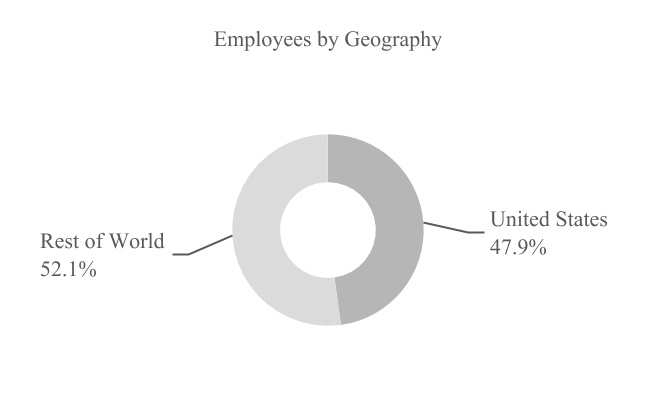
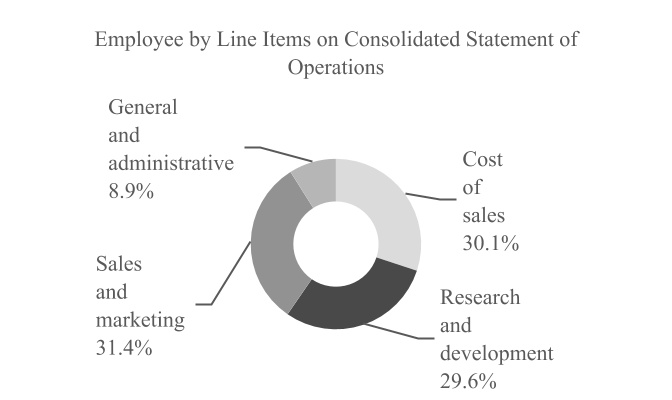
We have a responsibility to support our employees through times of change and enable them to be their best. We do this by fostering a Conscious Culture. Living a Conscious Culture requires us to act with dignity, respect, fairness, and equity in each of our interactions with one another, building a culture that allows us to become a catalyst for social change. By intentionally creating and cultivating an inclusive work environment where employees can thrive, we believe Cisco is helping to bring about a better world.
Inclusion & Diversity
Inclusion and diversity are core components in our Conscious Culture. Inclusivity is our strength and our priority. We want every employee to feel valued, respected, and heard. We are prioritizing inclusion and diversity across the company, recognizing that connecting people of all experiences and backgrounds allows us to innovate and collaborate. In order to continue accelerating diversity and finding extraordinary talent, we have designed a framework that includes: introducing new tools and technologies to help accurately map the talent market, creating job roles that attract highly qualified diverse candidates, and expanding the diversity within our interview panels.
We currently have a total of 29 Inclusive Communities comprised of 11 Employee Resource Organizations and 18 Employee Networks supporting full-spectrum diversity globally, including gender, ethnicity, race, orientation, age, ability, veteran status, religion, culture, background, as well as varied experiences, strengths, and perspectives. These thriving communities continue to be a source of strength and support for employees, and they help to foster a more conscious culture by providing opportunities for proximity and learning.
Cisco has signed the CEO Action for Diversity and Inclusion Pledge. The CEO Action for Diversity & Inclusion Pledge is a CEO-driven business commitment to drive measurable action and meaningful change in advancing diversity, equity and inclusion in the workplace. We are delivering on this pledge by accelerating full-spectrum diversity — including gender, age, race, ethnicity, orientation, ability, nationality, religion, veteran status, background, culture, experience, strengths and perspectives. At Cisco, it starts at the top: 46% of our Executive Leadership Team (ELT) are women and 54% are diverse in terms of gender or ethnicity.
We publish certain gender diversity and ethnic diversity workforce data annually. Across our global company, we have driven broad improvements in overall workforce diversity. Based on our annual fiscal 2020 data, our global employee base was 27% female and 73% male, and our U.S. employee base was comprised of the following ethnicities: 51.8% White/Caucasian, 36.5% Asian, 5.8% Hispanic/Latino, 4.1% African American/Black, 1.4% two or more races (Not Hispanic or Latino), and 0.4% additional groups (including American Indian, Alaska Native, Native Hawaiian or Other Pacific Islander).
With respect to social justice, Cisco is taking a stand and partnering across the globe to multiply our positive impact throughout our communities. In September 2020, we announced our Social Justice Beliefs & Actions, which is our blueprint for how Cisco will show up when we see inequality and injustice in the world.
This work is part of a plan for Cisco to drive transformational, generational impact for vulnerable communities. Our Inclusive Future Action Office helps drive progress and excellence in our strategic actions in this area, which are designed to address the broader ecosystem including our employees, partners, customers and suppliers.
At present, our Inclusive Future Action Office is focused on driving impacts through our strategic actions in the African American/Black community, but these actions will be the blueprint for how we help address inequity in communities around the world in the future. We are creating actions that can be replicated and scaled and are designed to cover the full spectrum of diversity, inclusive of gender, generation, race, ethnicity, orientation, ability, nationality and background - the foundation of our Conscious Culture.
Compensation and Benefits
Our total compensation philosophy is designed to attract, reward & retain talent. It provides market competitive, performance-based compensation aligned with each employee’s contribution and impact to the value we drive to our customers, partners and stockholders. We reward and recognize our employees for effecting innovation, collaboration, profitability, and growth within our geographies, product lines, and functions.
Cisco has always been committed to compensating our employees fairly and equitably. We are a founding signer of the White House Equal Pay Pledge and the Parity.org pledge, and we are leading the charge to make fair pay a reality for all employees through the Employers for Pay Equity Consortium. We have also introduced an innovative and inclusive framework that provides us powerful analytics to evaluate our complex compensation system. For example, by using these powerful analytics, we are able to test for pay parity on a regular basis, and when gaps are found, we strive to correct them.
Health & Well-being
We have an ongoing commitment to focus on the health, safety, and well-being of our employees. We provide our employees and their families high-quality, flexible and convenient benefits and resources for their physical, mental, and financial well-being. Since the start of the COVID-19 pandemic, employees have continually had to focus on how to balance careers and personal lives, all while managing their own physical, emotional, and financial health. During fiscal 2021, most of our global workforce was working from home. In addition, we are moving towards a hybrid work model, giving our employees the flexibility to work offsite or onsite Cisco locations. We developed a COVID-19 response and recovery strategy with a focus on both physical and mental health, recognizing the need to create an environment where employees can speak openly about
mental health. In fiscal 2021, we continued to offer employees “A Day for Me,” which were paid days off that allowed for each individual to recharge and rest.
Employee Development
We believe in open-ended, self-directed learning, understanding that each individual knows what skills and resources they need to succeed. We encourage employees to explore job roles outside of their daily work and encourage everyone to harness their strengths and improve the way we all work. Employees choose their own path and we support that choice by providing them tools and resources to help them achieve their career goals.
Employee Engagement
We believe that strong communication is key in our Conscious Culture. This communication includes regular, virtual all hands, which we refer to as a “Cisco Check-In,” and weekly team leader check-ins, which we refer to as a “Team Space Check-In.” Our regular virtual Cisco Check-Ins were initially launched with a focus on sharing medical information at the start of the COVID-19 pandemic. The Cisco Check-Ins have since evolved into a forum where we can discuss much more with our employees, from business updates to social justice to physical and mental health.
In fiscal 2021, we have seen high level of employee engagement. For example, there were approximately 2 million Team Space Check-Ins by our employees in fiscal 2021, reflecting 85% of employees submitting Team Space Check-Ins. Employees also participate in our global Engagement Pulse Survey and the Real Deal Survey. These surveys allow our employees to provide confidential feedback on our culture, company strategy and trust in their direct leaders.
CSR Impact Report
Additional information regarding Cisco's activities related to its people and Corporate Social Responsibility (CSR), as well as our workforce diversity data, can be found in our CSR Impact Report and related supplemental information, which are located on our ESG Reporting Hub at https://www.cisco.com/c/m/en_us/about/csr/esg-hub.html. The contents of our CSR Impact Report and related supplemental information are not incorporated by reference into this Annual Report on Form 10-K or in any other report or document we file with the SEC.
Information about our Executive Officers
The following table shows the name, age, and position as of August 31, 2021 of each of our executive officers:
| Name | Age | Position with the Company | ||||||||||||
| Charles H. Robbins | 55 | Chair and Chief Executive Officer | ||||||||||||
| Gerri Elliott | 65 | Executive Vice President and Chief Customer and Partner Officer | ||||||||||||
| R. Scott Herren | 59 | Executive Vice President and Chief Financial Officer | ||||||||||||
| Maria Martinez | 63 | Executive Vice President and Chief Operating Officer | ||||||||||||
| Deborah L. Stahlkopf | 51 | Executive Vice President and Chief Legal Officer |
Mr. Robbins serves as our Chief Executive Officer since July 2015, as a member of the Board of Directors since May 2015, and as Chair of the Board since December 2017. Mr. Robbins joined Cisco in December 1997, from which time until March 2002 he held a number of managerial positions within Cisco’s sales organization. Mr. Robbins was promoted to Vice President in March 2002, assuming leadership of Cisco’s U.S. channel sales organization. Additionally, in July 2005, Mr. Robbins assumed leadership of Cisco’s Canada channel sales organization. In December 2007, Mr. Robbins was promoted to Senior Vice President, U.S. Commercial, and, in August 2009 he was appointed Senior Vice President, U.S. Enterprise, Commercial and Canada. In July 2011, Mr. Robbins was named Senior Vice President, Americas. In October 2012, Mr. Robbins was promoted to Senior Vice President, Worldwide Field Operations, in which position he served until assuming the role of Chief Executive Officer. Mr. Robbins is also a member of the board of directors of BlackRock, Inc (since 2017).
Ms. Elliott joined Cisco in April 2018 and serves as our Executive Vice President and Chief Customer and Partner Officer. Ms. Elliott is a former Executive Vice President of Juniper Networks, Inc. (“Juniper”), where she served as Executive Vice President and Chief Customer Officer from March 2013 to February 2014, Executive Vice President and Chief Sales Officer from July 2011 to March 2013, and Executive Vice President, Strategic Alliances from June 2009 to July 2011. Before joining Juniper, Ms. Elliott held a series of senior executive positions with Microsoft Corporation (“Microsoft”) from 2001-2008, including as Corporate Vice President of Microsoft’s Industry Solutions Group, Worldwide Public Sector and North American Enterprise Sales organizations. Prior to joining Microsoft, Ms. Elliott spent 22 years at International Business Machines Corporation (“IBM”), where she held several senior executive positions both in the U.S. and internationally. Ms. Elliott is a member of the board of directors of Whirlpool Corporation (since 2014) and Marqeta, Inc. (since 2021).
Mr. Herren joined Cisco in December 2020 and serves as our Executive Vice President and Chief Financial Officer. Prior to joining Cisco, Mr. Herren served as Senior Vice President and Chief Financial Officer of Autodesk, Inc. (“Autodesk”) since November 2014. Prior to joining Autodesk, Mr. Herren served as Senior Vice President of Finance at Citrix Systems, Inc. (“Citrix”) from September 2011 to October 2014, and in a variety of other leadership roles after joining Citrix in March 2000, including as Vice President and Managing Director for EMEA and Vice President and General Manager of Citrix’s virtualization systems group. Before joining Citrix, Mr. Herren spent over 15 years in senior strategy and financial positions at FedEx Corporation and IBM.
Ms. Martinez joined Cisco in April 2018 and served as our Executive Vice President and Chief Customer Experience Officer until her appointment as our Executive Vice President and Chief Operating Officer in March 2021. Prior to joining Cisco, Ms. Martinez served in a variety of senior executive roles at salesforce.com, inc. (“Salesforce”), including as President, Global Customer Success and Latin America from March 2016 to April 2018; President, Sales and Customer Success from February 2013 to March 2016; Executive Vice President and Chief Growth Officer from February 2012 to February 2013; and as Executive Vice President, Customers for Life from February 2010 to February 2012. Ms. Martinez’s experience prior to Salesforce includes serving as Corporate Vice President of Worldwide Services at Microsoft, President and Chief Executive Officer of Embrace Networks, Inc. and various senior leadership roles at Motorola, Inc. and AT&T Inc./Bell Laboratories. Ms. Martinez is a member of the board of directors of McKesson Corporation (since 2019).
Ms. Stahlkopf joined Cisco in August 2021 and serves as our Executive Vice President and Chief Legal Officer. Prior to joining Cisco, Ms. Stahlkopf spent 14 years at Microsoft, where she served most recently as Corporate Vice President, General Counsel and Corporate Secretary, Corporate, External and Legal Affairs from April 2018 to July 2021. Ms. Stahlkopf also served in other leadership roles at Microsoft, including as Vice President and Deputy General Counsel from December 2015 to April 2018 and as Associate General Counsel from December 2010 to December 2015. Prior to joining Microsoft, Ms. Stahlkopf practiced law at Perkins Coie LLP and Cooley Godward LLP.
Previous: Cover and table of contents · Next: Item 1A. Risk Factors