 filings.tools
CoStar Group 10-K 2011-12-31
Filed 2012-02-23. 21 sections, 389K characters. Original on sec.gov · Markdown · JSON
Cover and table of contents
10-K 1 form_10-k.htm 2011 10-K
UNITED STATES
SECURITIES AND EXCHANGE COMMISSION
Washington, DC 20549
FORM 10-K
ANNUAL REPORT PURSUANT TO SECTION 13 OR 15(d) OF
THE SECURITIES EXCHANGE ACT OF 1934
For the fiscal year ended December 31, 2011
Commission file number 0-24531
 | |
|---|---|
| CoStar Group, Inc. | |
| (Exact name of registrant as specified in its charter) |
| Delaware | 52-2091509 | |
|---|---|---|
| (State or other jurisdiction of incorporation or organization) | (I.R.S. Employer Identification No.) |
| 1331 L Street, NW, Washington, DC 20005 |
|---|
| (Address of principal executive offices) (zip code) |
| (202) 346-6500 |
| Registrant’s telephone number, including area code |
| (877) 739-0486 |
| Registrant’s facsimile number, including area code |
Securities registered pursuant to Section 12(b) of the Act:
| Title of Each Class | Name of Each Exchange on Which Registered |
|---|---|
| Common Stock, $.01 par value | NASDAQ Global Select Market |
Securities registered pursuant to Section 12(g) of the Act:
None
Indicate by check mark if the registrant is a well-known seasoned issuer, as defined in Rule 405 of the Securities Act. Yes x No o
Indicate by check mark if the registrant is not required to file reports pursuant to Section 13 or Section 15(d) of the Exchange Act. Yes o No x
Indicate by check mark whether the registrant: (1) has filed all reports required to be filed by Section 13 or 15(d) of the Securities Exchange Act of 1934 during the preceding 12 months (or for such shorter period that the registrant was required to file such reports), and (2) has been subject to such filing requirements for the past 90 days. Yes x No o
Indicate by check mark whether the registrant has submitted electronically and posted on its corporate Web site, if any, every Interactive Data File required to be submitted and posted pursuant to Rule 405 of Regulation S-T (§232.405 of this chapter) during the preceding 12 months (or for such shorter period that registrant was required to submit and post such files.) Yes x No o
Indicate by check mark if disclosure of delinquent filers pursuant to Item 405 of Regulation S-K is not contained herein, and will not be contained, to the best of registrant’s knowledge, in definitive proxy or information statements incorporated by reference in Part III of this Form 10-K or any amendment to this Form 10-K. x
Indicate by check mark whether the registrant is a large accelerated filer, an accelerated filer, a non-accelerated filer, or a smaller reporting company. See the definitions of “large accelerated filer,” “accelerated filer” and “smaller reporting company” in Rule 12b-2 of the Securities Exchange Act of 1934.
| Large accelerated filer x | Accelerated filer o |
|---|---|
| Non-accelerated filer o | Smaller reporting company o |
Indicate by check mark whether the registrant is a shell company (as defined in Rule 12b-2 of the Exchange Act). Yes o No x
Based on the closing price of the common stock on June 30, 2011 on the Nasdaq Stock Market, Nasdaq Global Select Market, the aggregate market value of registrant’s common stock held by non-affiliates of the registrant was approximately $1.4 billion.
As of February 17, 2012, there were 25,445,864 shares of the registrant’s common stock outstanding.
DOCUMENTS INCORPORATED BY REFERENCE
Portions of the registrant’s definitive proxy statement, which is expected to be filed with the Securities and Exchange Commission within 120 days after the end of the registrant’s fiscal year ended December 31, 2011, are incorporated by reference into Part III of this Report.
TABLE OF CONTENTS
PART I
Item 1. Business
| --- | --- |
In this report, the words “we,” “our,” “us,” “CoStar” or the “Company” refer to CoStar Group, Inc. and its direct and indirect subsidiaries. This report also refers to our websites, but information contained on those sites is not part of this report.
CoStar Group, Inc., a Delaware corporation, founded in 1987, is the number one provider of information and analytic services to the commercial real estate industry in the United States (U.S.) and United Kingdom (U.K.) based on the fact that we offer the most comprehensive commercial real estate database available, have the largest research department in the industry, provide more information and analytic services than any of our competitors and believe we generate more revenues than any of our competitors. CoStar’s integrated suite of services offers customers online access to the most comprehensive database of commercial real estate information, which has been researched and verified by our team of researchers, currently covering the U.S., as well as London and other parts of the U.K. and parts of France. We manage our business geographically in two operating segments, with our primary areas of measurement and decision-making being the U.S. and International, which includes the U.K. and France.
Strategy
Since our founding, CoStar’s strategy has been to provide commercial real estate professionals with critical knowledge to explore and complete transactions by offering the most comprehensive, timely and standardized information on U.S. commercial real estate. We have extended our offering of comprehensive commercial real estate information to include London and other parts of the U.K. and parts of France, through acquisitions and internal growth and development. Information about CoStar’s revenues from, and long-lived assets located in, foreign countries is included in Notes 2 and 11 to our consolidated financial statements. CoStar’s revenues, EBITDA, assets and liabilities, broken out by segment are set forth in Note 11 to our consolidated financial statements. Information about risks associated with our foreign operations is included in “Item 7A. Quantitative and Qualitative Disclosures about Market Risk.”
We deliver our content to our U.S. customers primarily via an integrated suite of online service offerings that includes information about space available for lease, comparable sales information, tenant information, information about properties for sale, internet marketing services, analytical capabilities, information for clients’ websites, information about industry professionals and their business relationships, data integration and industry news. We also provide market research and analysis for commercial real estate investors and lenders via our Property and Portfolio Research, Inc. (“PPR”) service offerings, portfolio and debt management and reporting capabilities through our Resolve Technology, Inc. (“Resolve Technology”) service offerings, and real estate management solutions, including lease administration and abstraction services, through our Virtual Premise, Inc. (“Virtual Premise”) service offerings. We have created and are continually improving a standardized information and analytic platform where members of the commercial real estate and related business community can continuously interact and facilitate transactions by efficiently exchanging accurate and standardized commercial real estate information.
Our standardized platform includes the most comprehensive proprietary database in the industry; the largest research department in the industry; proprietary data collection, information management and quality control systems; a large in-house product development team; a broad suite of web-based information and analytic services; a large team of analysts and economists; and a large base of clients. Our database has been developed and enhanced for more than 24 years by a research department that makes thousands of daily database updates. In addition to our internal efforts to grow the database, we have obtained and assimilated over 70 proprietary databases.
Our subscription-based information services, consisting primarily of CoStar Property Professional, CoStar Tenant, CoStar COMPS Professional and FOCUS services, currently generate approximately 94% of our total revenues. CoStar Property Professional, CoStar Tenant, and CoStar COMPS Professional are generally sold as a suite of similar services and comprise our primary service offering in our U.S. operating segment. FOCUS is our primary service offering in our International operating segment. The majority of our contracts for our subscription-based information services typically have a minimum term of one year and renew automatically. Upon renewal, many of the subscription contract rates may change in accordance with contract provisions or as a result of contract renegotiations. To encourage clients to use our services regularly, we generally charge a fixed monthly amount for our subscription-based information services rather than fees based on actual system usage. Contract rates are generally based on the number of sites, number of users, organization size, the client’s business focus, geography and the number of services to which a client subscribes. Our subscription clients generally pay contract fees on a monthly basis, but in some cases may pay us on a quarterly or annual basis.
Expansion and Growth
Acquisitions
Since 1994, we have expanded the geographical coverage of our existing information services and developed new information and analytic services. In addition to internal growth, we have grown our business through strategic acquisitions. Most recently, in October 2011, we acquired Virtual Premise, a Software as a Service, or on-demand software, provider of real estate information management solutions located in Atlanta, Georgia. In addition, we have also signed a definitive agreement to acquire LoopNet, Inc. (“LoopNet”) (NASDAQ: LOOP); the pending LoopNet acquisition is described below under “Pending Acquisition.”
Historically, our expansion includes the acquisitions of Chicago ReSource, Inc. in Chicago in 1996 and New Market Systems, Inc. in San Francisco in 1997. In August 1998, we expanded into the Houston region through the acquisition of Houston-based real estate information provider C Data Services, Inc. In January 1999, we expanded further into the Midwest and Florida by acquiring LeaseTrend, Inc. and into Atlanta and Dallas/Fort Worth by acquiring Jamison Research, Inc. In February 2000, we acquired COMPS.COM, Inc., a San Diego-based provider of commercial real estate information. In November 2000, we acquired First Image Technologies, Inc., a California-based provider of commercial real estate software. In September 2002, we expanded further into Portland, Oregon through the acquisition of certain assets of Napier Realty Advisors (doing business as REAL-NET). In January 2003, we established a base in the U.K. with our acquisition of London-based FOCUS Information Limited. In May 2004, we expanded into Tennessee through the acquisition of Peer Market Research, Inc., and in June 2004, we extended our coverage of the U.K. through the acquisition of Scottish Property Network. In September 2004, we strengthened our position in Denver, Colorado through the acquisition of substantially all of the assets of RealComp, Inc., a local comparable sales information provider.
In January 2005, we acquired National Research Bureau, a Connecticut-based provider of U.S. shopping center information. In December 2006, our U.K. subsidiary, CoStar Limited, acquired Grecam S.A.S. (“Grecam”), a provider of commercial property information and market-level surveys, studies and consulting services located in Paris, France. In February 2007, CoStar Limited also acquired Property Investment Exchange Limited (“Propex”), a provider of commercial property information and operator of an electronic platform that facilitates
Showing the first 8K of 66K characters. Open the full section
Item 1A. Risk Factors
| --- | --- |
Cautionary Statement Concerning Forward-Looking Statements
We have made forward-looking statements in this Report and make forward-looking statements in our press releases and conference calls that are subject to risks and uncertainties. Forward-looking statements include information that is not purely historic fact and include, without limitation, statements concerning our financial outlook for 2012 and beyond, our possible or assumed future results of operations generally, and other statements and information regarding assumptions about our revenues, EBITDA, adjusted EBITDA, non-GAAP net income, non-GAAP net income per share, fully diluted net income, combined financial metrics related to the LoopNet acquisition, the timing of the LoopNet acquisition, taxable income, cash flow from operating activities, available cash, operating costs, amortization expense, intangible asset recovery, net income per share, diluted net income per share, weighted-average outstanding shares, capital and other expenditures, effective tax rate, equity compensation charges, future taxable income, purchase amortization, financing plans, geographic expansion, product development, acquisitions, contract renewal rate, capital structure, contractual obligations, legal proceedings and claims, our database, database growth, services and facilities, employee relations, future economic performance, our ability to liquidate or realize our long-term investments, management’s plans, goals and objectives for future operations, and growth and markets for our stock. Sections of this Report which contain forward-looking statements include “Business,” “Risk Factors,” “Properties,” “Legal Proceedings,” “Management’s Discussion and Analysis of Financial Condition and Results of Operations,” “Quantitative and Qualitative Disclosures About Market Risk,” “Controls and Procedures” and the Financial Statements and related Notes.
Our forward-looking statements are also identified by words such as “believes,” “expects,” “thinks,” “anticipates,” “intends,” “estimates,” “potential” or similar expressions. You should understand that these forward-looking statements are estimates reflecting our judgment, beliefs and expectations, not guarantees of future performance. They are subject to a number of assumptions, risks and uncertainties that could cause actual results to differ materially from those expressed or implied in the forward-looking statements. The following important factors, in addition to those discussed or referred to under the heading “Risk Factors,” and other unforeseen events or circumstances, could affect our future results and could cause those results or other outcomes to differ materially from those expressed or implied in our forward-looking statements: commercial real estate market conditions; the pace of recovery in the commercial real estate market; general economic conditions; our ability to identify, acquire and integrate acquisition candidates; the possibility that the FTC will request additional extensions to the waiting period imposed by the HSR Act; the possibility that CoStar, LoopNet and the FTC cannot reach a mutually acceptable resolution in a timely manner or at all; the possibility that the LoopNet merger does not close, including, but not limited to, due to the failure to obtain governmental approval; conditions, divestitures or changes relating to the operations or assets of LoopNet and CoStar that may be required to obtain governmental clearances or approvals to the merger; our ability to realize expected cost savings or other synergies from the LoopNet merger on a timely basis or at all; our ability to combine the businesses of CoStar and LoopNet successfully or in a timely and cost-efficient manner; failure to obtain any required financing on favorable terms; the degree of business disruption relating to the LoopNet merger; the use of the net proceeds of our June 2011 equity offering; the amount of investment in CoStarGo marketing initiatives; our ability to realize expected expense savings from various initiatives, including office consolidations; changes or consolidations within the commercial real estate industry; customer retention; our ability to attract new clients; our ability to sell additional services to existing clients; our ability to integrate our U.S. and international product offerings; our ability to successfully introduce new products in U.S. and foreign markets; competition; foreign currency fluctuations; global credit market conditions affecting investments; our ability to continue to expand successfully; our ability to effectively penetrate the market for retail real estate information and gain acceptance in that market; our ability to control costs; litigation; changes in accounting policies or practices; release of new and upgraded services by us or our competitors; data quality; development of our sales force; employee retention; technical problems with our services; managerial execution; changes in relationships with real estate brokers and other strategic partners; legal and regulatory issues; and successful adoption of and training on our services.
Accordingly, you should not place undue reliance on forward-looking statements, which speak only as of, and are based on information available to us on, the date of this Report. All subsequent written and oral forward-looking statements attributable to us or any person acting on our behalf are expressly qualified in their entirety by the cautionary statements contained or referred to in this section. We do not undertake any obligation to update any such statements or release publicly any revisions to these forward-looking statements to reflect events or circumstances after the date of this Report or to reflect the occurrence of unanticipated events.
Risk Factors
Risks Related to our Pending Acquisition of LoopNet
The failure to successfully integrate LoopNet’s business and operations and/or fully realize synergies from the merger in the expected time frame may adversely affect our future results. Assuming completion of the merger with LoopNet, the success of that merger will depend, in part, on our ability to successfully integrate LoopNet’s business and operations and fully realize the anticipated benefits and synergies from combining our business and LoopNet’s business. However, to realize these anticipated benefits and synergies, our business and LoopNet’s business must be successfully combined. If we are not able to achieve these objectives following the merger, the anticipated benefits and synergies of the merger may not be realized fully or at all or may take longer to realize than expected.
We and LoopNet have operated and, until the completion of the merger, will continue to operate independently. The integration process could result in the loss of key employees, loss of key clients, increases in operating costs, or the disruption of each company’s ongoing businesses, any or all of which could adversely affect our ability to achieve the anticipated benefits and synergies of the merger. Integration efforts between the two companies will also divert management attention and resources. The success of the merger will depend in part on our ability to realize the anticipated growth opportunities and cost savings from integrating our business and LoopNet’s business, while minimizing or eliminating any difficulties that may occur. Even if the integration of our two businesses is successful, it may not result in the realization of the full benefits of the growth opportunities and cost savings that we currently expect or these benefits may not be achieved within the anticipated time frame. Any failure to timely realize these anticipated benefits could have a material adverse effect on our revenues, expenses and operating results.
Our business relationships, including client relationships, may be subject to disruption due to uncertainty associated with the merger. Parties with which we and LoopNet do business may experience uncertainty associated with the transaction, including with respect to current or future business relationships with us, LoopNet or the combined business of both companies. Our and LoopNet’s business relationships may be subject to disruption as clients and others may attempt to negotiate changes in existing business relationships or consider entering into business relationships with parties other than us, LoopNet or the combined business. These disruptions could have an adverse effect on the businesses, financial condition, results of operations or prospects of the combined business. The adverse effect of such disruptions could be exacerbated by delays in the completion of the merger or termination of the merger agreement.
The merger agreement may be terminated in accordance with its terms and the merger may not be completed. The merger agreement is subject to a number of conditions which must be fulfilled in order to complete the merger. Those conditions include: obtaining regulatory and antitrust approvals, absence of orders prohibiting the completion of the merger or imposing a “Substantial Detriment” (as defined in the merger agreement), continued accuracy of the representations and warranties by both parties to the merger agreement and the performance by both parties of their covenants and agreements.
In addition, both we and LoopNet have rights to terminate the merger agreement under certain circumstances specified in the merger agreement.
The merger is subject to the receipt of consents and approvals from governmental and regulatory entities that may delay the date of completion of the merger or impose conditions that could have an adverse effect on us. Before the merger may be completed, approvals must be obtained from governmental authorities. Both CoStar and LoopNet filed notification and report forms with the Department of Justice and the FTC pursuant to the HSR Act, on May 31, 2011. As a result, the waiting period under the HSR Act with respect to the proposed merger between us and LoopNet was originally scheduled to expire on June 30, 2011. As previously reported in a Current Report on Form 8-K, on June 30, 2011, CoStar and LoopNet each received a request for additional information (commonly referred to as a “second request”) from the FTC in connection with its review of the merger. The second request extended the waiting period imposed by the HSR Act until 30 days after the parties have substantially complied with the second request unless that period is extended voluntarily by the parties or terminated sooner by the FTC. At the FTC’s request, CoStar and LoopNet subsequently agreed to extend the waiting period imposed by the HSR Act from 30 days to 60 days after the date of substantial compliance with the second request, subject to further extension. On
November 4, 2011, each of CoStar and LoopNet certified as to its substantial compliance with the second request. CoStar and LoopNet subsequently voluntarily agreed to further extend the waiting period imposed by the HSR Act on a 45-day rolling basis to allow them to engage in discussions with the FTC to determine whether there is a possible basis for, and to discuss the possible terms of, a mutually acceptable consent order that would allow the merger to close. If either CoStar and LoopNet, on the one hand, or the FTC Staff, on the other hand, believe that discussions towards a possible consent order are no longer moving forward productively, either may trigger commencement of the 45-day period, in writing, after the expiration of which the waiting period imposed by the HSR Act will expire, unless extended voluntarily by the parties or terminated sooner by the FTC. As of the date of filing of this Annual Report on Form 10-K, the parties have not yet reached agreement on the terms of a consent order, and there can be no assurance that such agreement will be reached in a timely manner or at all. In the event the parties do not reach agreement on a consent decree and/or a party triggers commencement of the 45-day period, the FTC may seek an injunction to block consummation of the merger.
In addition, the FTC may include conditions on the completion of the merger or require divestitures or other changes relating to our operations or assets, or LoopNet’s. Such conditions, divestitures or changes could have the effect of jeopardizing or delaying completion of the merger or reducing the anticipated benefits of the merger, any of which might have a material adverse effect on the combined company following the merger. We are not obligated to complete the merger if the regulatory approvals received in connection with the completion of the merger include any conditions or restrictions that, individually or in the aggregate, would reasonably be expected to impose a Substantial Detriment, but we could choose to waive this condition.
We will incur significant transaction costs as a result of the merger. We expect to incur significant one-time transaction costs related to the merger. These transaction costs include investment banking, legal and accounting fees and expenses and filing fees, printing expenses and other related charges. We may also incur additional unanticipated transaction costs in connection with the merger. A portion of the transaction costs related to the merger will be incurred regardless of whether the merger is completed. Additional costs will be incurred in connection with integrating the two companies’ businesses, such as IT integration expenses. Costs in connection with the merger and integration may be higher than expected. These costs could adversely affect our financial condition, results of operation or prospects of the combined business.
Failure to complete the merger in certain circumstances could require us to pay a termination fee or expenses. If the merger agreement is terminated under certain circumstances, we could be obligated to pay LoopNet a $51.6 million termination fee. Payment of the termination fee could materially adversely affect our results of operations or financial condition.
Our indebtedness following the completion of the merger will be substantially greater than our indebtedness on a stand-alone basis and greater than the combined indebtedness of CoStar and LoopNet existing prior to the transaction. This increased level of indebtedness could adversely affect us, including by decreasing our business flexibility and increasing our borrowing costs. On February 16, 2012, we entered into a Credit Agreement by and among CoStar, as borrower, CoStar Realty Information, Inc., as co-borrower, the lenders from time to time party thereto and J.P. Morgan Bank, as administrative agent. The Credit Agreement provides for a $175.0 million term loan facility and a $50.0 million revolving credit facility, each with a term of five years. The obligation of the lenders to make the loans under the Credit Agreement is subject to the simultaneous closing of the merger with LoopNet and the satisfaction of certain other conditions precedent. We expect to use the proceeds of the term loan facility on the date on which such conditions are satisfied along with net proceeds from the equity offering in June 2011 to pay a portion of the merger consideration and transaction costs related to the merger. The proceeds of the revolving credit facility may be used, on the closing date, to pay for transaction costs related to the merger and, thereafter, for working capital and other general corporate purposes of CoStar and its subsidiaries.
The Credit Agreement contains customary restrictive covenants imposing operating and financial restrictions on us, including restrictions that may limit our ability to engage in acts that may be in our long-term best interests. These covenants restrict our ability and the ability of our subsidiaries (i) to incur additional indebtedness, (ii) to create, incur, assume or permit to exist any liens, (iii) to enter into mergers, consolidations or similar transactions, (iv) to make investments and acquisitions, (v) to make certain dispositions of assets, (vi) to make dividends, distributions and prepayments of certain indebtedness, and (vii) to enter into certain transactions with affiliates.
The operating restrictions and financial covenants in the Credit Agreement and any future financing agreements may limit our ability to finance future operations or capital needs or to engage in other business activities. Our ability to comply with any financial covenants could be materially affected by events beyond our control, and there can be no assurance that we will satisfy any such requirements. If we fail to comply with these covenants, we may need to seek waivers or amendments of such covenants, seek alternative or additional sources of financing or reduce its expenditures. We may be unable to obtain such waivers, amendments or alternative or additional financing at all, or on favorable terms.
If an event of default occurs, the lenders under the Credit Agreement are able to declare all outstanding borrowings, together with accrued interest and other fees, to be immediately due and payable and exercise remedies in respect of the collateral. We may not be able to repay all amounts due under the Credit Agreement in the event these amounts are declared due upon an event of default.
We and LoopNet may have difficulty attracting, motivating and retaining executives and other key employees in light of the merger. Uncertainty about the effect of the merger on our employees and LoopNet employees may have an adverse effect on us and LoopNet, respectively, and consequently, the combined business. This uncertainty may impair each company’s ability to attract, retain and motivate key personnel until the merger is completed, or longer for the combined entity. Employee retention may be particularly challenging during the pendency of the merger, as employees of each company may experience uncertainty about their future roles with the combined business. Additionally, LoopNet’s officers and employees may own shares of LoopNet’s common stock and/or have stock option or restricted stock unit grants and, if the merger is completed, may therefore be entitled to the merger consideration, the payment of which could provide sufficient financial incentive for certain officers and employees to no longer pursue employment with the combined business. If our key employees or LoopNet’s key employees depart, we may have to incur significant costs in identifying, hiring and retaining replacements for departing employees, which could reduce our ability to realize the anticipated benefits of the merger.
An adverse judgment in a lawsuit challenging the merger may prevent the merger from becoming effective or from becoming effective within the expected timeframe. One of the conditions to the closing of the merger is that no order, injunction or decree or other legal restraint or prohibition that prevents the completion of the merger be in effect. If any plaintiff were successful in obtaining an injunction prohibiting LoopNet or CoStar from completing the merger on the agreed-upon terms, then such injunction may prevent the merger from becoming effective or from becoming effective within the expected timeframe.
Risks Related to our Business
A downturn or consolidation in the commercial real estate industry may decrease customer demand for our services. A reversal of recent improvements in the commercial real estate industry’s leasing activity and absorption rates or a renewed downturn in the commercial real estate market may affect our ability to generate revenues and may lead to more cancellations by our current or future customers, either of which could cause our revenues or our revenue growth rate to decline and reduce our profitability. A depressed commercial real estate market has a negative impact on our core customer base, which could decrease demand for our information and analytic services. Also, companies in this industry are consolidating, often in order to reduce expenses. Consolidation, or other cost-cutting measures by our customers, may lead to more cancellations of our information and analytic services by our customers, reduce the number of our existing clients, reduce the size of our target market or increase our clients’ bargaining power, all of which could cause our revenues to decline and reduce our profitability.
Negative general economic conditions could increase our expenses and reduce our revenues. Our business and the commercial real estate industry are particularly affected by negative trends in the general economy. The success of our business depends on a number of factors relating to general global, national, regional and local economic conditions, including perceived and actual economic conditions, recessions, inflation, deflation, exchange rates, interest rates, taxation policies, availability of credit, employment levels, and wage and salary levels. Negative general economic conditions could adversely affect our business by reducing our revenues and profitability. If we experience greater cancellations or reductions of services and failures to timely pay, and we do not acquire new clients or sell new services to our existing clients, our revenues may decline and our financial position would be adversely affected. Adverse national and global economic events, as well as any significant terrorist attack, are likely to have a dampening effect on the economy in general, which could negatively affect our financial performance and our stock price. Market disruptions may also contribute to extreme price and volume fluctuations in the stock market that may affect our stock price for reasons unrelated to our operating performance. In addition, a significant increase in inflation could increase our expenses more rapidly than expected, the effect of which may not be offset by corresponding increases in revenue. Conversely, deflation resulting in a decline of prices could reduce our revenues. In the current economic environment, it is difficult to predict whether we will experience significant inflation or deflation in the near future. A significant increase in either could have an adverse effect on our results of operations.
Our revenues and financial position will be adversely affected if we are not able to attract and retain clients. Our success and revenues depend on attracting and retaining subscribers to our information and analytic services. Our subscription-based information and analytic services generate the largest portion of our revenues. However, we may be unable to attract new clients, and our existing clients may decide not to add, not to renew or to cancel subscription services. In addition, in order to increase our revenue, we must continue to attract new customers, continue to keep our cancellation rate low and continue to sell new services to our existing customers. We may not be able to continue to grow our customer base, keep the cancellation rate for customers and services low or sell new services to existing customers as a result of several factors, including without limitation: economic pressures; the business failure of a current client or clients; a decision that customers have no need for our services; a decision to use alternative services; customers’ and potential customers’ pricing and budgetary constraints; consolidation in the real estate and/or financial services industries; data quality; technical problems; or competitive pressures. If clients cancel services or decide not to renew their subscription agreements, and we do not sell new services to our existing clients or attract new clients, then our renewal rate, and revenues may decline.
Competition could render our services uncompetitive. The market for information systems and services in general is highly competitive and rapidly changing. Competition in this market may increase further as a result of current recessionary economic conditions, as customer bases and customer spending have decreased and service providers are competing for fewer customer resources. Our existing competitors, or future competitors, may have greater name recognition, larger customer bases, better technology or data, lower prices, easier access to data, greater user traffic or greater financial, technical or marketing resources than we have. Our competitors may be able to undertake more effective marketing campaigns, obtain more data, adopt more aggressive pricing policies, make more attractive offers to potential employees, subscribers, distribution partners and content providers or may be able to respond more quickly to new or emerging technologies or changes in user requirements. If we are unable to retain customers or obtain new customers, our revenues could decline. Increased competition could result in lower revenues and higher expenses, which would reduce our profitability.
Our current or future geographic expansion plans may not result in increased revenues, which may negatively impact our business, results of operations and financial position. Expanding into new markets and investing resources towards increasing the depth of our coverage within existing markets imposes additional burdens on our research, systems development, sales, marketing and general managerial resources. During 2012, we plan to continue to increase the depth of our coverage in the U.S., U.K. and France, and we may expand into additional geographies. If we are unable to manage our expansion efforts effectively, if our expansion efforts take longer than planned or if our costs for these efforts exceed our expectations, our financial position could be adversely affected. In addition, if we incur significant costs to improve data quality within existing markets, or are not successful in marketing and selling our services in these markets or in new markets, our expansion may have a material adverse effect on our financial position by increasing our expenses without increasing our revenues, adversely affecting our profitability.
If we are not able to successfully identify, finance and/or integrate acquisitions, our business operations and financial position could be adversely affected. We have expanded our markets and services in part through acquisitions of complementary businesses, services, databases and technologies, and expect to continue to do so in the future. Our strategy to acquire complementary companies or assets depends on our ability to identify, and the availability of, suitable acquisition candidates. We may incur costs in the preliminary stages of an acquisition, but may ultimately be unable or unwilling to consummate the proposed transaction for various reasons. In addition, acquisitions involve numerous risks, including the ability to realize or capitalize on synergy created through combinations; managing the integration of personnel and products; managing geographically remote operations, such as SPN in Scotland, Grecam S.A.S. in France, CoStar U.K. Limited, Propex and Property and Portfolio Research Ltd. in the U.K.; the diversion of management’s attention from other business concerns; the inherent risks in entering markets and sectors in which we have either limited or no direct experience; and the potential loss of key employees or clients of the acquired companies. We may not successfully integrate acquired businesses or assets and may not achieve anticipated benefits of an acquisition, including expected synergies. Acquisitions could result in dilutive issuances of equity securities, the incurrence of debt, one-time write-offs of goodwill and substantial amortization expenses of other intangible assets. We may be unable to obtain financing on favorable terms, or at all, if necessary to finance future acquisitions making it impossible or more costly to acquire complementary businesses. If we are able to obtain financing, the terms may be onerous and restrict our operations.
If we are unable to hire qualified persons for, or retain and continue to develop, our sales force, or if our sales force is unproductive, our revenues could be adversely affected. In order to support revenues and future revenue growth, we need to continue to develop, train and retain our sales force. Our ability to build and develop a strong sales force may be affected by a number of factors, including: our ability to attract, integrate and motivate sales personnel; our ability to effectively train our sales force; the ability of our sales force to sell an increased number of services; our ability to manage effectively an outbound telesales group; the length of time it takes new sales personnel to become productive; the competition we face from other companies in hiring and retaining sales personnel; and our ability to effectively manage a multi-location sales organization. If we are unable to hire qualified sales personnel and develop and retain the members of our sales force, including sales force management, or if our sales force is unproductive, our revenues or growth rate could decline and our expenses could increase. See “We and LoopNet may have difficulty attracting, motivating and retaining executives and other key employees in light of the merger” for a discussion of the impact the pending merger with LoopNet may have on our ability to attract, retain and motivate members of our sales force.
Our business depends on retaining and attracting highly capable management and operating personnel. Our success depends in large part on our ability to retain and attract management and operating personnel, including our President and Chief Executive Officer, Andrew Florance, and our other officers and key employees. Our business requires highly skilled technical, sales, management, web development, marketing and research personnel, who are in high demand and are often subject to competing offers. To retain and attract key personnel, we use various measures, including employment agreements, awards under a stock incentive plan and incentive bonuses for key executive officers. These measures may not be enough to retain and attract the personnel we need or to offset the impact on our business of the loss of the services of Mr. Florance or other key officers or employees. See “We and LoopNet may have difficulty attracting, motivating and retaining executives and other key employees in light of the merger” for a discussion of the impact the pending merger with LoopNet may have on our ability to attract, retain and motivate members our management and operating personnel.
If we are unable to increase our revenues or our operating costs are higher than expected, our profitability may continue to decline and our operating results may fluctuate significantly. We may not be able to accurately forecast our revenues or future revenue growth rate. Many of our expenses, particularly personnel costs and occupancy costs, are relatively fixed. As a result, we may not be able to adjust spending quickly enough to offset any unexpected increase in expenses or revenue shortfall. We may experience higher than expected operating costs, including increased personnel costs, occupancy costs, selling and marketing costs, investments in geographic expansion, acquisition costs, communications costs, travel costs, software development costs, professional fees and other costs. If operating costs exceed our expectations and cannot be adjusted accordingly, our profitability may be reduced and our results of operations and financial position will be adversely affected. Additionally, we may not be able to sustain our historic revenue growth rates, and our percentage revenue growth rates may decline. Our ability to increase our revenues and operating profit will depend on increased demand for our services. Our sales are affected by, among other things, general economic and commercial real estate conditions. Reduced demand, whether due to changes in customer preference, a further weakening of the U.S. or global economy, competition or other reasons, may result in decreased revenue and growth, adversely affecting our operating results.
International operations expose us to additional business risks, which may reduce our profitability. Our international operations and expansion subject us to additional business risks, including: currency exchange rate fluctuations; adapting to the differing business practices and laws in foreign countries; difficulties in managing foreign operations; limited protection for intellectual property rights in some countries; difficulty in collecting accounts receivable and longer collection periods; costs of enforcing contractual obligations; impact of recessions in economies outside the U.S.; and potentially adverse tax consequences. In addition, international expansion imposes additional burdens on our executive and administrative personnel, systems development, research and sales departments, and general managerial resources. If we are not able to manage our international operations successfully, we may incur higher expenses and our profitability may be reduced. Finally, the investment required for additional international expansion could exceed the profit generated from such expansion, which would reduce our profitability and adversely affect our financial position.
Fluctuating foreign currencies may negatively impact our business, results of operations and financial position. Due to our acquisitions of CoStar U.K. Limited (formerly FOCUS Information Limited), SPN, Grecam S.A.S., Propex, and Property and Portfolio Research Ltd., a portion of our business is denominated in the British Pound and Euro and as a result, fluctuations in foreign currencies may have an impact on our business, results of operations and financial position. Foreign currency exchange rates have fluctuated and may continue to fluctuate. Significant foreign currency exchange rate fluctuations may negatively impact our international revenue, which in turn affects our consolidated revenue. Currencies may be affected by internal factors, general economic conditions and external developments in other countries, all of which can have an adverse impact on a country’s currency. Currently, we are not party to any hedging transactions intended to reduce our exposure to exchange rate fluctuations. We may seek to enter into hedging transactions in the future, but we may be unable to enter into these transactions successfully, on acceptable terms or at all. We cannot predict whether we will incur foreign exchange losses in the future. Further, significant foreign exchange fluctuations resulting in a decline in the British Pound or Euro may decrease the value of our foreign assets, as well as decrease our revenues and earnings from our foreign subsidiaries, which would reduce our profitability and adversely affect our financial position.
U.S. political, credit and financial market conditions may negatively impact or impair the value of our current portfolio of cash, cash equivalents and investments, including U.S. Treasury securities and U.S.-backed investments, as well as our access to credit. Our cash, cash equivalents and investments are held in a variety of common financial instruments, including U.S. treasury securities. Deterioration in the U.S. credit and financial markets may result in losses or deterioration in the fair value of our cash, cash equivalents, or investments. On August 5, 2011, Standard & Poor’s lowered its long term sovereign credit rating on the United States of America from AAA to AA+. This downgrade, and any future downgrades of the U.S. credit rating, could impact the stability of future U.S. treasury auctions, affect the trading market for U.S. government securities, result in increased interest rates and impair access to credit. These factors could negatively impact the liquidity or valuation of our current portfolio of cash, cash equivalents, and investments, which may affect our ability to fund future obligations. Further, these factors may result in an increase in interest rates and borrowing costs and make it more difficult to obtain credit on acceptable terms, which may affect our ability to fund future obligations and increase the costs of obtaining financing for future obligations.
Negative conditions in the global credit markets may affect the liquidity of a portion of our long-term investments. Currently, our long-term investments include mostly AAA-rated auction rate securities (“ARS”), which are primarily student loan securities supported by guarantees from the Federal Family Education Loan Program (“FFELP”) of the U.S. Department of Education. Continuing negative conditions in the global credit markets have prevented some investors from liquidating their holdings of auction rate securities because the amount of securities submitted for sale has exceeded the amount of purchase orders for such securities. As of December 31, 2011, we held $27.3 million par value of ARS, all of which failed to settle at auctions. When an auction fails for ARS in which we have invested, we may be unable to liquidate some or all of these securities at par. In the event we need or desire to immediately access these funds, we will not be able to do so until a future auction on these investments is successful, a buyer is found outside the auction process or an alternative action is determined. If a buyer is found but is unwilling to purchase the investments at par, we may incur a loss, which would reduce our profitability and adversely affect our financial position.
Our ARS investments are not currently trading and therefore do not currently have a readily determinable market value. The estimated fair value of the ARS no longer approximates par value. We have used a discounted cash flow model to determine the estimated fair value of our investment in ARS as of December 31, 2011. The assumptions used in preparing the discounted cash flow model include estimates for interest rates, credit spreads, timing and amount of cash flows, liquidity risk premiums, expected holding periods and default risk of the ARS. Based on this assessment of fair value, as of December 31, 2011, we determined there was a decline in the fair value of our ARS investments of approximately $2.7 million. The decline was deemed to be a temporary impairment and was recorded as an unrealized loss in accumulated other comprehensive loss in stockholders’ equity. If the issuers of these ARS are unable to successfully close future auctions and/or their credit ratings deteriorate, we may be required to record additional unrealized losses in accumulated other comprehensive loss or an other-than-temporary impairment charge to earnings on these investments, which would reduce our profitability and adversely affect our financial position.
We have not made any material changes in the accounting methodology used to determine the fair value of the ARS. We do not expect any material changes in the near term to the underlying assumptions used to determine the unobservable inputs used to calculate the fair value of the ARS as of December 31, 2011. However, if changes in these assumptions occur, and, should those changes be significant, we may be required to record additional unrealized losses in accumulated other comprehensive loss or an other-than-temporary impairment charge to earnings on these investments.
We may be subject to legal liability for collecting, displaying or distributing information. Because the content in our database is collected from various sources and distributed to others, we may be subject to claims for breach of contract, defamation, negligence, unfair competition or copyright or trademark infringement or claims based on other theories. We could also be subject to claims based upon the content that is accessible from our website through links to other websites or information on our website supplied by third parties. We could also be subject to claims that the collection or provision of certain information breached laws and regulations relating to privacy and data protection. Even if these claims do not result in liability to us, we could incur significant costs in investigating and defending against any claims. Our potential liability for information distributed by us to others could require us to implement measures to reduce our exposure to such liability, which may require us to expend substantial resources and limit the attractiveness of our information and analytic services to users.
Litigation or government investigations in which we become involved may significantly increase our expenses and adversely affect our stock price. Currently and from time to time, we are a party to various lawsuits. Any lawsuits, threatened lawsuits or government investigations in which we are involved could cost us a significant amount of time and money to defend, could distract management’s attention away from operating our business, could result in negative publicity and could adversely affect our stock price. In addition, if any claims are determined against us or if a settlement requires us to pay a large monetary amount or take other action that materially restricts or impedes our operations, our profitability could be significantly reduced and our financial position could be adversely affected. We cannot make assurances that we will have any or sufficient insurance to cover any litigation claims.
An impairment in carrying value of goodwill could negatively impact our consolidated results of operations and net worth. Goodwill and identifiable intangible assets not subject to amortization are tested annually by each reporting unit on October 1st of each year for impairment and are tested for impairment more frequently based upon the existence of one or more indicators. We consider our operating segments, U.S. and International, as our reporting units under Financial Accounting Standards Board (“FASB”) authoritative guidance for consideration of potential impairment of goodwill. We assess the impairment of long-lived assets, identifiable intangibles and goodwill whenever events or changes in circumstances indicate that the carrying value may not be recoverable. The existence of one or more of the following indicators could cause us to test for impairment prior to the annual assessment:
| • | Significant underperformance relative to historical or projected future operating results; |
|---|
| • | Significant changes in the manner of our use of acquired assets or the strategy for our overall business; |
|---|
| • | Significant negative industry or economic trends; or |
|---|
| • | Significant decline in our market capitalization relative to net book value for a sustained period. |
|---|
These types of events or indicators and the resulting impairment analysis could result in goodwill impairment charges in the future, which would reduce our profitability. Impairment charges could negatively affect our financial results in the periods of such charges, which may reduce our profitability. As of December 31, 2011, we had $91.8 million of goodwill, $67.5 million in our U.S. segment and $24.3 million in our International segment. We expect to record significant, additional goodwill in connection with the LoopNet merger if that transaction is consummated.
We may not be able to successfully introduce new or upgraded information and analytic services, which could decrease our revenues and our profitability. Our future business and financial success will depend on our ability to continue to introduce new and upgraded services into the marketplace. To be successful, we must adapt to rapid technological changes by continually enhancing our information and analytic services. Developing new services and upgrades to services imposes heavy burdens on our systems department, management and researchers. This process is costly, and we cannot assure you that we will be able to successfully develop and enhance our services. In addition, successfully launching and selling a new service puts pressure on our sales and marketing resources. If we are unable to develop new or upgraded services, then our customers may choose a competitive service over ours and our revenues may decline and our profitability may be reduced. In addition, if we incur significant costs in developing new or upgraded services, are not successful in marketing and selling these new services or upgrades, or our customers fail to accept these new services, it could have a material adverse effect on our results of operations by decreasing our revenues and reducing our profitability.
Our expansion into the commercial real estate analytics sector may not be successful or may not result in increased revenues, which may negatively impact our business, results of operations and financial position. Expanding into the commercial real estate market research and forecasting arena imposes additional burdens on our research, systems development, sales, marketing and general management resources. During 2012, we expect to continue to expand our presence in the commercial real estate analytics sector. If we are unable to manage this expansion effectively or if our costs for this effort exceed our expectations, our financial position could be adversely affected. In addition, if we incur additional costs to expand our analytics services and we are not successful in marketing or selling these expanded services, our expansion may have a material adverse effect on our financial position by increasing our expenses without increasing our revenues, adversely affecting our profitability.
As a result of consolidation of facilities, we may incur additional costs. We have taken, and may continue to take, actions that may increase our cost structure in the short-term but are intended to reduce certain portions of our long-term cost structure, such as consolidation of office space. As a result of consolidation of office space, we may reduce our long-term occupancy costs, but incur restructuring charges. If our long-term cost reduction efforts are ineffective or our estimates of cost savings are inaccurate, our profitability could be negatively impacted. Expected savings from relocating facilities can be highly variable and uncertain. Further, we may not be successful in achieving the operating efficiencies or operating cost reductions expected from these efforts in the amounts or at the times we anticipate.
If we are unable to enforce or defend our ownership and use of intellectual property, our business, competitive position and operating results could be harmed. The success of our business depends in large part on the intellectual property involved in our methodologies, database, services and software. We rely on a combination of trade secret, patent, copyright and other laws, nondisclosure and noncompetition provisions, license agreements and other contractual provisions and technical measures to protect our intellectual property rights. However, current law may not provide for adequate protection of our databases and the actual data. In addition, legal standards relating to the validity, enforceability and scope of protection of proprietary rights in internet related businesses are uncertain and evolving, and we cannot assure you of the future viability or value of any of our proprietary rights. Our business could be significantly harmed if we are not able to protect our content and our other intellectual property. The same would be true if a court found that our services infringe other persons’ intellectual property rights. Any intellectual property lawsuits or threatened lawsuits in which we are involved, either as a plaintiff or as a defendant, could cost us a significant amount of time and money and distract management’s attention from operating our business. In addition, if we do not prevail on any intellectual property claims, this could result in a change to our methodology or information and analytic services and could reduce our profitability.
Technical problems that affect either our customers’ ability to access our services, or the software, internal applications and systems underlying our services, could lead to reduced demand for our information and analytic services, lower revenues and increased costs. Our business increasingly depends upon the satisfactory performance, reliability and availability of our website, the internet and our service providers. Problems with our website, the internet or the services provided by our local exchange carriers or internet service providers could result in slower connections for our customers or interfere with our customers’ access to our information and analytic services. If we experience technical problems in distributing our services, we could experience reduced demand for our information and analytic services. In addition, the software, internal applications and systems underlying our services are complex and may not be efficient or error-free. Our careful development and testing may not be sufficient to ensure that we will not encounter technical problems when we attempt to enhance our software, internal applications and systems. Any inefficiencies, errors or technical problems with our software, internal applications and systems could reduce the quality of our services or interfere with our customers’ access to our information and analytic services, which could reduce the demand for our services, lower our revenues and increase our costs.
If we are not able to obtain and maintain accurate, comprehensive or reliable data, we could experience reduced demand for our information and analytic services. Our success depends on our clients’ confidence in the comprehensiveness, accuracy and reliability of the data and analysis we provide. The task of establishing and maintaining accurate and reliable data and analysis is challenging. If our data, including the data we obtain from third parties, or analysis is not current, accurate, comprehensive or reliable, we could experience reduced demand for our services or legal claims by our customers, which could result in lower revenues and higher expenses. Our U.S. researchers use integrated internal research processes to update our database. Any inefficiencies, errors, or technical problems with this application could reduce the quality of our data, which could result in reduced demand for our services, lower revenues and higher costs.
Temporary or permanent outages of our computers, software or telecommunications equipment could lead to reduced demand for our information and analytic services, lower revenues and increased costs. Our operations depend on our ability to protect our database, computers and software, telecommunications equipment and facilities against damage from potential dangers such as fire, power loss, security breaches, computer viruses and telecommunications failures. Any temporary or permanent loss of one or more of these systems or facilities from an accident, equipment malfunction or some other cause could harm our business. If we experience a failure that prevents us from delivering our information and analytic services to clients, we could experience reduced demand for our information and analytic services, lower revenues and increased costs.
Changes in accounting and reporting policies or practices may affect our financial results or presentation of results, which may affect our stock price. Changes in accounting and reporting policies or practices could reduce our net income, which reductions may be independent of changes in our operations. These reductions in reported net income could cause our stock price to decline. For example, in 2006, we adopted authoritative guidance for stock compensation, which required us to expense the value of granted stock options.
Our stock price may be negatively affected by fluctuations in our financial results. Our operating results, revenues and expenses may fluctuate as a result of changes in general economic conditions and also for many other reasons, many of which are outside of our control, such as: cancellations or non-renewals of our services; competition; our ability to control expenses; loss of clients or revenues; technical problems with our services; changes or consolidation in the real estate industry; our investments in geographic expansion and to increase coverage in existing markets; interest rate fluctuations; the timing and success of new service introductions and enhancements; successful execution of our expansion plans; data quality; the development of our sales force; managerial execution; employee retention; foreign currency and exchange rate fluctuations; inflation; successful adoption of and training on our services; litigation; acquisitions of other companies or assets; sales, brand enhancement and marketing promotional activities; client support activities; changes in client budgets; or our investments in other corporate resources. In addition, changes in accounting policies or practices may affect our level of net income. Fluctuations in our financial results, revenues and expenses may cause the market price of our common stock to decline.
Market volatility may have an adverse effect on our stock price. The trading price of our common stock has fluctuated widely in the past, and we expect that it will continue to fluctuate in the future. The price could fluctuate widely based on numerous factors, including: economic factors; quarter-to-quarter variations in our operating results; changes in analysts’ estimates of our earnings; announcements by us or our competitors of technological innovations or new services; general conditions in the commercial real estate industry; developments or disputes concerning copyrights or proprietary rights or other legal proceedings; and regulatory developments. In addition, the stock market in general, and the shares of internet-related and other technology companies in particular, have experienced extreme price fluctuations. This volatility has had a substantial effect on the market prices of securities issued by many companies for reasons unrelated to the operating performance of the specific companies and may have the same effect on the market price of our common stock.
Item 1B. Unresolved Staff Comments
| --- | --- |
None.
Item 2. Properties
| --- | --- |
On February 5, 2010, we purchased a 169,429 square-foot office building located at 1331 L Street, NW, in downtown Washington, DC, through our wholly owned subsidiary, 1331 L Street Holdings, LLC (“Holdings”), for use as our new headquarters and have since relocated to this location. This facility is used primarily by our U.S. segment. The lease for our previous headquarters in Bethesda, MD expired on October 15, 2010.
On February 2, 2011, Holdings and GLL L-Street 1331, LLC (“GLL”), an affiliate of Munich-based GLL Real Estate Partners GmbH, entered into a purchase and sale agreement pursuant to which (i) Holdings agreed to sell to GLL its interest in the office building located at 1331 L Street, NW, in downtown Washington, DC, and (ii) CoStar Realty Information, Inc. (“CoStar Realty”), our wholly owned subsidiary, agreed to enter into a lease expiring May 31, 2025 (with two 5-year renewal options) with GLL to lease back 149,514 square feet of the office space located in this building, which we continue to use as our corporate headquarters. The closing of the sale took place on February 18, 2011.
Our principal facility in the U.K. is located in London, England, where we occupy approximately 11,000 square feet of office space. Our lease for this facility has a maximum term ending October 20, 2018, with early termination at our option on October 21, 2013, with advance notice. This facility is used primarily by our International segment.
In addition to our downtown Washington, DC and London, England facilities, our research operations are principally run out of leased spaces in San Diego, California; Columbia, Maryland; Glasgow, Scotland; and Paris, France. Additionally, we lease office space in a variety of other metropolitan areas, which generally house our field sales offices. These locations include, without limitation, the following: New York; Los Angeles; Chicago; San Francisco; Sacramento; Boston; Manchester, England; Orange County, California; Philadelphia; Houston; Atlanta; Phoenix; Detroit; Pittsburgh; Fort Lauderdale; Denver; Dallas; Kansas City; Cleveland; Cincinnati; Indianapolis; Austin; Salt Lake City; Seattle; Portland and St. Louis. Our subsidiaries, PPR and Resolve Technology, share space with CoStar in one facility leased in Boston, Massachusetts. Our subsidiary, Virtual Premise, leases a facility in Atlanta, Georgia.
We believe these facilities are suitable and appropriately support our business needs.
Item 3. Legal Proceedings
| --- | --- |
Currently, and from time to time, we are involved in litigation incidental to the conduct of our business. We are not a party to any lawsuit or proceeding that, in the opinion of our management based on consultations with legal counsel, is likely to have a material adverse effect on our financial position or results of operations.
Item 4. Mine Safety Disclosures
| --- | --- |
Not Applicable.
PART II
Item 5. Market for the Registrant’s Common Stock, Related Stockholder Matters and Issuer Purchases of Equity Securities
| --- | --- |
Price Range of Common Stock. Our common stock is traded on the Nasdaq Global Select Market under the symbol “CSGP.” The following table sets forth, for the periods indicated, the high and low daily closing prices per share of our common stock, as reported by the Nasdaq Global Select Market.
| High | Low | |||||||
|---|---|---|---|---|---|---|---|---|
| Year Ended December 31, 2010 | ||||||||
| First Quarter | $ | 42.97 | $ | 38.22 | ||||
| Second Quarter | $ | 45.95 | $ | 38.80 | ||||
| Third Quarter | $ | 49.53 | $ | 37.66 | ||||
| Fourth Quarter | $ | 57.75 | $ | 48.86 | ||||
| Year Ended December 31, 2011 | ||||||||
| First Quarter | $ | 62.89 | $ | 55.58 | ||||
| Second Quarter | $ | 72.84 | $ | 55.86 | ||||
| Third Quarter | $ | 59.50 | $ | 46.70 | ||||
| Fourth Quarter | $ | 68.39 | $ | 49.22 |
As of February 1, 2012, there were 559 holders of record of our common stock.
Dividend Policy. We have never declared or paid any dividends on our common stock. Any future determination to pay dividends will be at the discretion of our Board of Directors, subject to applicable limitations under Delaware law, and will be dependent upon our results of operations, financial position and other factors deemed relevant by our Board of Directors. We do not anticipate paying any dividends on our common stock during the foreseeable future, but intend to retain any earnings for future growth of our business.
Recent Issues of Unregistered Securities. We did not issue any unregistered securities during the year ended December 31, 2011.
Issuer Purchases of Equity Securities. The following table is a summary of our repurchases of common stock during each of the three months in the quarter ended December 31, 2011:
ISSUER PURCHASES OF EQUITY SECURITIES
| Month, 2011 | Total Number of Shares Purchased | Average Price Paid per Share | Total Number of Shares Purchased as Part of Publicly Announced Plans or Programs | Maximum Number of Shares that May Yet Be Purchased Under the Plans or Programs | ||||
|---|---|---|---|---|---|---|---|---|
| October 1 through 31 | ¾ | ¾ | ¾ | ¾ | ||||
| November 1 through 30 | ¾ | ¾ | ¾ | ¾ | ||||
| December 1 through 31 | 5,099 | $65.93 | ¾ | ¾ | ||||
| Total | 5,099 (1) | $65.93 | ¾ | ¾ |
(1) The number of shares purchased consists of shares of common stock tendered by employees to the Company to satisfy the employees’ tax withholding obligations arising as a result of vesting of restricted stock grants under the Company’s 1998 Stock Incentive Plan, as amended, and the Company’s 2007 Stock Incentive Plan, as amended, which shares were purchased by the Company based on their fair market value on the vesting date. None of these share purchases were part of a publicly announced program to purchase common stock of the Company.
Stock Price Performance Graph
The stock performance graph below shows how an initial investment of $100 in our common stock would have compared to:
| · | An equal investment in the Standards & Poor's Stock 500 (“S&P 500”) Index. |
|---|
| · | An equal investment in the S&P 500 Application Software Index. |
|---|
The comparison covers the period beginning December 31, 2006, and ending on December 31, 2011, and assumes the reinvestment of any dividends. You should note that this performance is historical and is not necessarily indicative of future price performance.
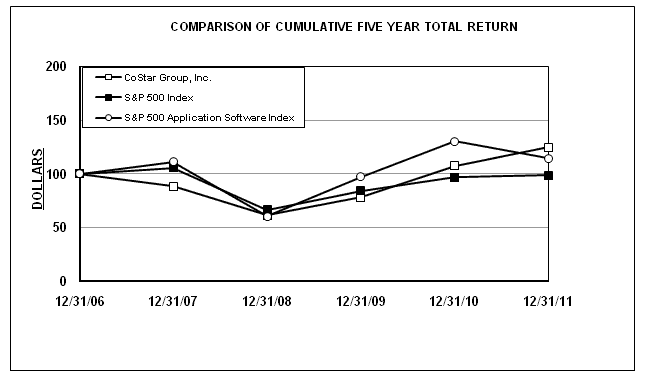
| Company / Index | 12/31/06 | 12/31/07 | 12/31/08 | 12/31/09 | 12/31/10 | 12/31/11 | ||||||||||||||||||
|---|---|---|---|---|---|---|---|---|---|---|---|---|---|---|---|---|---|---|---|---|---|---|---|---|
| CoStar Group, Inc. | 100 | 88.22 | 61.50 | 77.99 | 107.47 | 124.59 | ||||||||||||||||||
| S&P 500 Index | 100 | 105.49 | 66.46 | 84.05 | 96.71 | 98.76 | ||||||||||||||||||
| S&P 500 Application Software Index | 100 | 111.07 | 60.72 | 97.04 | 130.42 | 114.62 |
Item 6. Selected Consolidated Financial and Operating Data
Selected Consolidated Financial and Operating Data
(in thousands, except per share data and other operating data)
The following table provides selected consolidated financial and other operating data for the five years ended December 31, 2011. The consolidated statement of operations data shown below for each of the three years ended December 31, 2009, 2010, and 2011 and the consolidated balance sheet data as of December 31, 2010 and 2011 are derived from audited consolidated financial statements that are included in this report. The consolidated statement of operations data for each of the years ended December 31, 2007 and 2008 and the consolidated balance sheet data as of December 31, 2007, 2008, and 2009 shown below are derived from audited consolidated financial statements for those years that are not included in this report.
| Year Ended December 31, | ||||||||||||||||||||
|---|---|---|---|---|---|---|---|---|---|---|---|---|---|---|---|---|---|---|---|---|
| Consolidated Statement of Operations Data: | 2007 | 2008 | 2009 | 2010 | 2011 | |||||||||||||||
| Revenues | $ | 192,805 | $ | 212,428 | $ | 209,659 | $ | 226,260 | $ | 251,738 | ||||||||||
| Cost of revenues | 76,704 | 73,408 | 73,714 | 83,599 | 88,167 | |||||||||||||||
| Gross margin | 116,101 | 139,020 | 135,945 | 142,661 | 163,571 | |||||||||||||||
| Operating expenses | 98,249 | 99,232 | 104,110 | 119,886 | 141,800 | |||||||||||||||
| Income from operations | 17,852 | 39,788 | 31,835 | 22,775 | 21,771 | |||||||||||||||
| Interest and other income, net | 8,045 | 4,914 | 1,253 | 735 | 798 | |||||||||||||||
| Income before income taxes | 25,897 | 44,702 | 33,088 | 23,510 | 22,569 | |||||||||||||||
| Income tax expense, net | 9,946 | 20,079 | 14,395 | 10,221 | 7,913 | |||||||||||||||
| Net income | $ | 15,951 | $ | 24,623 | $ | 18,693 | $ | 13,289 | $ | 14,656 | ||||||||||
| Net income per share - basic | $ | 0.84 | $ | 1.27 | $ | 0.95 | $ | 0.65 | $ | 0.63 | ||||||||||
| Net income per share - diluted | $ | 0.82 | $ | 1.26 | $ | 0.94 | $ | 0.64 | $ | 0.62 | ||||||||||
| Weighted average shares outstanding - basic | 19,044 | 19,372 | 19,780 | 20,330 | 23,131 | |||||||||||||||
| Weighted average shares outstanding - diluted | 19,404 | 19,550 | 19,925 | 20,707 | 23,527 |
| As of December 31, | ||||||||||||||||||||
|---|---|---|---|---|---|---|---|---|---|---|---|---|---|---|---|---|---|---|---|---|
| Consolidated Balance Sheet Data: | 2007 | 2008 | 2009 | 2010 | 2011 | |||||||||||||||
| Cash, cash equivalents, short-term and long-term investments | $ | 187,426 | $ | 224,590 | $ | 255,698 | $ | 239,316 | $ | 573,379 | ||||||||||
| Working capital | 167,441 | 183,347 | 203,660 | 188,279 | 521,401 | |||||||||||||||
| Total assets | 321,843 | 334,384 | 404,579 | 439,648 | 771,035 | |||||||||||||||
| Total liabilities | 40,038 | 30,963 | 45,573 | 58,146 | 111,858 | |||||||||||||||
| Stockholders’ equity | 281,805 | 303,421 | 359,006 | 381,502 | 659,177 |
| As of December 31, | |||||||||||||||
|---|---|---|---|---|---|---|---|---|---|---|---|---|---|---|---|
| Other Operating Data: | 2007 | 2008 | 2009 | 2010 | 2011 | ||||||||||
| Number of subscription client sites | 14,467 | 15,920 | 16,020 | 16,781 | 18,183 | ||||||||||
| Millions of properties in database | 2.7 | 3.2 | 3.6 | 4.0 | 4.2 |
Item 7. Management’s Discussion and Analysis of Financial Condition and Results of Operations
The following Management’s Discussion and Analysis of Financial Condition and Results of Operations contains “forward-looking statements,” including statements about our beliefs and expectations. There are many risks and uncertainties that could cause actual results to differ materially from those discussed in the forward-looking statements. Potential factors that could cause actual results to differ materially from those discussed in any forward-looking statements include, but are not limited to, those stated above in Item 1A. under the headings “Risk Factors ¾ Cautionary Statement Concerning Forward-Looking Statements” and “¾Risk Factors,” as well as those described from time to time in our filings with the Securities and Exchange Commission.
All forward-looking statements are based on information available to us on the date of this filing and we assume no obligation to update such statements. The following discussion should be read in conjunction with our Quarterly Reports on Form 10-Q, Current Reports on Form 8-K and other filings with the Securities and Exchange Commission and the consolidated financial statements and related notes in this Annual Report on Form 10-K.
Overview
CoStar Group, Inc. (the “Company” or “CoStar”) is the number one provider of information and analytic services to the commercial real estate industry in the U.S. and the U.K. based on the fact that we offer the most comprehensive commercial real estate database available, have the largest research department in the industry, provide more information and analytic services than any of our competitors and believe we generate more revenues than any of our competitors. We have created a standardized information and analytic platform where members of the commercial real estate and related business community can continuously interact and facilitate transactions by efficiently exchanging accurate and standardized commercial real estate information. Our integrated suite of online service offerings includes information about space available for lease, comparable sales information, tenant information, information about properties for sale, internet marketing services, analytical capabilities, information for clients' websites, information about industry professionals and their business relationships, data integration, and industry news. We also provide market research and analysis for commercial real estate investors and lenders via our PPR service offerings, portfolio and debt management and reporting capabilities through our Resolve Technology service offerings, and real estate management solutions, including lease administration and abstraction services, through our Virtual Premise service offerings. Our service offerings span all commercial property types, including office, industrial, retail, land, mixed-use, hospitality and multifamily.
Expansion and Development
We expect to develop and distribute new services, expand existing services within our current platform (including internationally), and expand and develop our sales and marketing organization. These initiatives are expected to include continued devleopment of CoStarGo, enhancements to our core information services, including our suite of online services, and development of new services for our brokerage clients. Most recently, on August 15, 2011, we launched CoStarGo in the U.S.; CoStarGo is an iPad application that integrates our comprehensive property, tenant and comparable sales information in our suite of online products – CoStar Property Professional, CoStar Tenant and CoStar COMPS Professional. We supported the launch with an extensive marketing campaign during the third quarter of 2011, including a 34-city national launch tour to drive early adoption of the service. We incurred expenses of approximately $3.4 million during the third quarter of 2011 in connection with the launch of CoStarGo. We expect to continue to incur additional expenses associated with the marketing and sale of CoStarGo.
We also intend to continue to expand the coverage of our service offerings within our International segment and to integrate our International operations more fully with those in the U.S. We have gained operational efficiencies as a result of consolidating a majority of our U.K. research operations in one location in Glasgow and combining the majority of our remaining U.K. operations in one central location in London. We intend to introduce a consistent international platform of service offerings in the upcoming future. As part of our integration efforts, in 2007, we introduced the “CoStar Group” as the brand encompassing our international operations, and in early 2010 we launched Showcase, our Internet marketing service that provides commercial real estate professionals high quality internet lead generation, in the U.K. We expect to introduce CoStar Property Professional®, CoStar COMPS Professional®, CoStar Tenant® and CoStarGo™, our iPad application, in the U.K. in the upcoming future. Additionally, we plan to upgrade back end research operations, fulfillment and CRM systems in the U.K. to support these new U.K. services. In order to implement these services in the U.K., we have incurred, and expect to incur increased development costs. We believe that our continued investments in U.S. products, internationalization of our products and integration efforts have created a platform for long-term growth, which we intend to continue to develop, invest in and expand.
Any future product development or expansion of services could reduce our profitability and increase our capital expenditures. Therefore, while we expect current service offerings to remain profitable, driving overall earnings throughout 2012 and providing substantial cash flow for our business, it is possible that any new investments could cause us to generate losses and negative cash flow from operations in the future.
Our goal is to provide additional tools that make our research and analytics even more valuable to subscribers. For example, we are focusing on further integration and development of the services offered by the companies we have most recently acquired, PPR, Resolve Technology and Virtual Premise. We have launched an initiative to develop a lease discounted cash flow (“LDCF”) forecasting and valuation solution that effectively integrates the combined capabilities of CoStar’s market and property information and PPR’s analytics and forecasting expertise with Resolve Technology’s and Virtual Premise’s commercial real estate investment and management software expertise. In order to implement this initiative, we have incurred, and expect to continue to incur additional costs. While our investments in PPR, Resolve Technology and Virtual Premise have resulted and may continue to result in an increase in expenses, our revenues have also increased as a result of these acquisitions, and we have experienced increased cross-selling opportunities among CoStar and the acquired companies.
On April 27, 2011, we signed a definitive agreement to acquire LoopNet. Pursuant to the merger agreement, as a result of the merger (a) each outstanding share of LoopNet common stock will be converted into a unit consisting of (i) $16.50 in cash, without interest and (ii) 0.03702 shares of CoStar common stock, and (b) each outstanding share of LoopNet Series A Convertible Preferred Stock, unless previously converted into LoopNet common stock, will be converted into a unit consisting of (i) the product of 148.80952 multiplied by the Cash Consideration and (ii) the product of 148.80952 multiplied by the Stock Consideration, representing a total equity value of approximately $860.0 million and an enterprise value of $762.0 million as of April 27, 2011. The holders of LoopNet’s Series A Convertible Preferred Stock delivered contingent conversion notices to LoopNet pursuant to which such shares will be converted into LoopNet common stock immediately prior to, and contingent upo
Showing the first 8K of 95K characters. Open the full section
Item 7A. Quantitative and Qualitative Disclosures About Market Risk
| --- | --- |
We provide information and analytic services to the commercial real estate and related business community in the U.S., U.K. and France. Our functional currency for our operations in the U.K. and France is the local currency. As such, fluctuations in the British Pound and Euro may have an impact on our business, results of operations and financial position. For the year ended December 31, 2011, revenue denominated in foreign currencies was approximately 7.7% of total revenue. For the year ended December 31, 2011, our revenue would have decreased by approximately $1.9 million if the U.S. dollar exchange rate used strengthened by 10%. In addition, we have assets and liabilities denominated in foreign currencies. A 10% strengthening of the U.S. dollar exchange rate against all currencies with which we have exposure at December 31, 2011 would have resulted in an increase of approximately $1.5 million in the carrying amount of net assets. For the year ended December 31, 2011, our revenue would have increased by approximately $1.9 million if the U.S. dollar exchange rate used weakened by 10%. In addition, we have assets and liabilities denominated in foreign currencies. A 10% weakening of the U.S. dollar exchange rate against all currencies with which we have exposure at December 31, 2011 would have resulted in a decrease of approximately $1.5 million in the
carrying amount of net assets. We currently do not use financial instruments to hedge our exposure to exchange rate fluctuations with respect to our foreign subsidiaries. We may seek to enter hedging transactions in the future to reduce our exposure to exchange rate fluctuations, but we may be unable to enter into hedging transactions successfully, on acceptable terms or at all. As of December 31, 2011, accumulated other comprehensive loss included a loss from foreign currency translation adjustments of approximately $5.9 million.
We do not have material exposure to market risks associated with changes in interest rates related to cash equivalent securities held as of December 31, 2011. As of December 31, 2011, we had $548.8 million of cash, cash equivalents and short-term investments. If there is an increase or decrease in interest rates, there will be a corresponding increase or decrease in the amount of interest earned on our cash, cash equivalents and short-term investments. Based on our ability to access our cash, cash equivalents and short-term investments, and our expected operating cash flows, we do not believe that increases or decreases in interest rates will impact our ability to operate our business in the foreseeable future.
Included within our long-term investments are investments in mostly AAA-rated student loan ARS. These securities are primarily securities supported by guarantees from the FFELP of the U.S. Department of Education. As of December 31, 2011, auctions for $27.3 million of our investments in auction rate securities failed. As a result, we may not be able to sell these investments at par value until a future auction on these investments is successful. In the event we need to immediately liquidate these investments, we may have to locate a buyer outside the auction process, who may be unwilling to purchase the investments at par, resulting in a loss. Based on an assessment of fair value of these investments in ARS as of December 31, 2011, we determined that there was a decline in the fair value of our ARS investments of approximately $2.7 million, which was deemed to be a temporary impairment and recorded as an unrealized loss in accumulated other comprehensive loss in stockholders’ equity. If the issuers are unable to successfully close future auctions and/or their credit ratings deteriorate, we may be required to adjust the carrying value of these investments as a temporary impairment and recognize a greater unrealized loss in accumulated other comprehensive loss or as an other-than-temporary impairment charge to earnings. Based on our ability to access our cash, cash equivalents and short-term investments, and our expected operating cash flows, we do not anticipate having to sell these securities below par value in order to operate our business in the foreseeable future. See Notes 4 and 5 to the consolidated financial statements for further discussion.
We have approximately $112.3 million in intangible assets as of December 31, 2011. As of December 31, 2011, we believe our intangible assets will be recoverable, however, changes in the economy, the business in which we operate and our own relative performance could change the assumptions used to evaluate intangible asset recoverability. In the event that we determine that an asset has been impaired, we would recognize an impairment charge equal to the amount by which the carrying amount of the assets exceeds the fair value of the asset. We continue to monitor these assumptions and their effect on the estimated recoverability of our intangible assets.
Item 8. Financial Statements and Supplementary Data
| --- | --- |
Financial Statements meeting the requirements of Regulation S-X are set forth beginning at page F-1. Supplementary data is set forth in “Management’s Discussion and Analysis of Financial Condition and Results of Operations” under the caption “Consolidated Results of Operations.”
Item 9. Changes in and Disagreements with Accountants on Accounting and Financial Disclosure
| --- | --- |
None.
Item 9A. Controls and Procedures
| --- | --- |
We maintain disclosure controls and procedures that are designed to ensure that information required to be disclosed in our reports filed or submitted under the Exchange Act is recorded, processed, summarized and reported, within the time periods specified in the Securities and Exchange Commission’s rules and forms, and that such information is accumulated and communicated to our management, including our Chief Executive Officer and Chief Financial Officer, as appropriate, to allow for timely decisions regarding required disclosure. In designing and evaluating the disclosure controls and procedures, management recognized that any controls and procedures, no matter how well designed and operated, can provide only reasonable assurance of achieving the desired control objectives, and management is required to apply its judgment in evaluating the cost-benefit relationship of possible controls and procedures.
As of December 31, 2011, we carried out an evaluation, under the supervision and with the participation of our management, including our Chief Executive Officer and our Chief Financial Officer, of the effectiveness of the design and operation of our disclosure controls and procedures. Based on the foregoing, our Chief Executive Officer and Chief Financial Officer concluded that our disclosure controls and procedures were effective and were operating at the reasonable assurance level.
Management’s Report on Internal Control over Financial Reporting
Management of CoStar is responsible for establishing and maintaining adequate internal control over financial reporting and for the assessment of the effectiveness of internal control over financial reporting. As defined by the Securities and Exchange Commission, internal control over financial reporting is a process designed by, or supervised by, the Company’s principal executive and principal financial officers, to provide reasonable assurance regarding the reliability of financial reporting and the preparation of financial statements in accordance with generally accepted accounting principles.
The Company’s internal control over financial reporting is supported by written policies and procedures, that (1) pertain to the maintenance of records that, in reasonable detail, accurately and fairly reflect the transactions and dispositions of the Company’s assets; (2) provide reasonable assurance that transactions are recorded as necessary to permit preparation of financial statements in accordance with generally accepted accounting principles, and that receipts and expenditures of the Company are being made only in accordance with authorizations of the Company’s management and directors; and (3) provide reasonable assurance regarding prevention or timely detection of unauthorized acquisition, use or disposition of the Company’s assets that could have a material effect on the financial statements.
Because of its inherent limitations, internal control over financial reporting may not prevent or detect misstatements. Projections of any evaluation of effectiveness to future periods are subject to the risk that controls may become inadequate because of changes in conditions, or that the degree of compliance with the policies or procedures may deteriorate.
In connection with the preparation of the Company's annual financial statements, management of the Company has undertaken an assessment of the effectiveness of the Company’s internal control over financial reporting as of December 31, 2011 based on criteria established in Internal Control – Integrated Framework issued by the Committee of Sponsoring Organizations of the Treadway Commission (“the COSO Framework”). Management's assessment included an evaluation of the design of the Company's internal control over financial reporting and testing of the operational effectiveness of the Company's internal control over financial reporting.
Based on this assessment, management did not identify any material weakness in the Company's internal control, and management has concluded that the Company's internal control over financial reporting was effective as of December 31, 2011.
Ernst & Young LLP, the independent registered public accounting firm that audited the Company's financial statements included in this report, has issued an attestation report on the effectiveness of internal control over financial reporting, a copy of which is included in this Annual Report on Form 10-K.
There have been no changes in our internal control over financial reporting during our most recent fiscal quarter that have materially affected, or are reasonably likely to materially affect, our internal control over financial reporting.
Item 9B. Other Information.
| --- | --- |
None.
PART III
Item 10. Directors, Executive Officers and Corporate Governance
| --- | --- |
The information required by this Item is incorporated by reference to our Proxy Statement for our 2012 annual meeting of stockholders.
Item 11. Executive Compensation
| --- | --- |
The information required by this Item is incorporated by reference to our Proxy Statement for our 2012 annual meeting of stockholders.
Item 12. Security Ownership of Certain Beneficial Owners and Management and Related Stockholder Matters
| --- | --- |
The information required by this Item is incorporated by reference to our Proxy Statement for our 2012 annual meeting of stockholders.
Item 13. Certain Relationships and Related Transactions, and Director Independence
| --- | --- |
The information required by this Item is incorporated by reference to our Proxy Statement for our 2012 annual meeting of stockholders.
Item 14. Principal Accountant Fees and Services
| --- | --- |
The information required by this Item is incorporated by reference to our Proxy Statement for our 2012 annual meeting of stockholders.
PART IV
Item 15. Exhibits and Financial Statement Schedules
| --- | --- |
(a)(1) The following financial statements are filed as a part of this report: CoStar Group, Inc. Consolidated Financial Statements.
(a)(2) Financial statement schedules:
Schedule II – Valuation and Qualifying Accounts
Years Ended December 31, 2009, 2010, and 2011 (in thousands):
| Allowance for doubtful accounts and billing adjustments (1) | Balance at Beginning of Year | Charged to Expense | Write-offs, Net of Recoveries | Balance at End of Year | ||||||||||||
|---|---|---|---|---|---|---|---|---|---|---|---|---|---|---|---|---|
| Year ended December 31, 2009 | $ | 3,213 | $ | 4,172 | $ | 4,522 | $ | 2,863 | ||||||||
| Year ended December 31, 2010 | $ | 2,863 | $ | 1,471 | $ | 1,919 | $ | 2,415 | ||||||||
| Year ended December 31, 2011 | $ | 2,415 | $ | 1,525 | $ | 1,416 | $ | 2,524 |
| (1) | Additions to the allowance for doubtful accounts are charged to bad debt expense. Additions to the allowance for billing adjustments are charged against revenues. |
|---|
Additional financial statement schedules are omitted because they are not applicable or not required or because the required information is incorporated herein by reference or included in the financial statements or related notes included elsewhere in this report.
(a)(3) The documents required to be filed as exhibits to this Report under Item 601 of Regulation S-K are listed in the Exhibit Index included elsewhere in this report, which list is incorporated herein by reference.
SIGNATURES
Pursuant to the requirements of Section 13 of the Securities Act of 1934, as amended, the Registrant has duly caused this report to be signed on its behalf by the undersigned, thereunto duly authorized, in the City of Washington, District of Columbia, on the 23rd day of February 2012.
| COSTAR GROUP, INC. | ||
|---|---|---|
| By: | /s/ Andrew C. Florance | |
| Andrew C. Florance | ||
| President and Chief Executive Officer |
KNOW ALL PERSONS BY THESE PRESENTS, that each individual whose signature appears below constitutes and appoints Andrew C. Florance and Brian J. Radecki, and each of them individually, as their true and lawful attorneys-in-fact and agents, with full power of substitution, for him and in his name, place and stead, in any and all capacities, to sign any and all amendments to this report, and to file the same, with all exhibits thereto and to all documents in connection therewith, with the Securities and Exchange Commission, granting unto said attorneys-in-fact and agents, and each of them, full power and authority to do and perform each and every act and thing requisite and necessary to be done in connection therewith, as fully to all intents and purposes as he might or could do in person, herein by ratifying and confirming all that said attorneys-in-fact and agents or any of them, or his or their substitute or substitutes, may lawfully do or cause to be done by virtue hereof.
Pursuant to the requirements of the Securities Act of 1934, as amended, this report has been signed by the following persons on behalf of the registrant and in the capacities and on the dates indicated.
| Signature | Capacity | Date | ||
|---|---|---|---|---|
| /s/ Michael R. Klein | Chairman of the Board | February 23, 2012 | ||
| Michael R. Klein | ||||
| /s/ Andrew C. Florance | Chief Executive Officer and | February 23, 2012 | ||
| Andrew C. Florance | President and a Director | |||
| (Principal Executive Officer) | ||||
| /s/ Brian J. Radecki | Chief Financial Officer | February 23, 2012 | ||
| Brian J. Radecki | (Principal Financial and Accounting Officer) | |||
| /s/ David Bonderman | Director | February 23, 2012 | ||
| David Bonderman | ||||
| /s/ Warren H. Haber | Director | February 23, 2012 | ||
| Warren H. Haber | ||||
| /s/ Christopher J. Nassetta | Director | February 23, 2012 | ||
| Christopher J. Nassetta | ||||
| /s/ Michael J. Glosserman | Director | February 23, 2012 | ||
| Michael J. Glosserman | ||||
| /s/ David J. Steinberg | Director | February 23, 2012 | ||
| David J. Steinberg |
INDEX TO EXHIBITS
| Exhibit No. | Description | |
|---|---|---|
| 2.1 | Agreement and Plan of Merger, dated as of April 27, 2011, by and among CoStar Group, Inc., Lonestar Acquisition Sub, Inc. and LoopNet, Inc. (Incorporated by reference to Exhibit 2.1 to the Registrant’s Current Report on Form 8-K filed with the Commission on April 28, 2011). | |
| 2.2 | Amendment No. 1 to the Agreement and Plan of Merger, dated as of May 20, 2011, among LoopNet, Inc., CoStar Group, Inc. and Lonestar Acquisition Sub, Inc. (Incorporated by referenced to Exhibit 2.1 to Registrant’s Current Report on Form 8-K filed May 23, 2011). | |
| 3.1 | Restated Certificate of Incorporation (Incorporated by reference to Exhibit 3.1 the Registration Statement on Form S-1 of the Registrant (Reg. No. 333-47953) filed with the Commission on March 13, 1998 (the “1998 Form S-1”)). | |
| 3.2 | Certificate of Amendment of Restated Certificate of Incorporation (Incorporated by reference to Exhibit 3.1 to the Registrant’s Report on Form 10-Q for the quarter ended June 30, 1999). | |
| 3.3 | Amended and Restated By-Laws (Incorporated by reference to Exhibit 3.1 to the Registrant’s Current Report on Form 8-K filed April 6, 2011. | |
| 4.1 | Specimen Common Stock Certificate (Incorporated by reference to Exhibit 4.1 to the Registration Statement on Form S-4 of the Registrant (Reg. No. 333-174214) filed with the Commission on June 3, 2011. | |
| *10.1 | CoStar Group, Inc. 1998 Stock Incentive Plan, as amended (Incorporated by reference to Exhibit 10.1 to the Registrant’s Report on Form 10-Q for the quarter ended September 30, 2005). | |
| *10.2 | CoStar Group, Inc. 2007 Stock Incentive Plan, as amended (Incorporated by reference to Exhibit 99.2 to the Registrant’s Current Report on Form 8-K filed June 8, 2011. | |
| *10.3 | CoStar Group, Inc. 2007 Stock Incentive Plan French Sub-Plan (Incorporated by reference to Exhibit 10.3 to the Registrant’s Report on Form 10-K for the year ended December 31, 2007). | |
| *10.4 | Form of Stock Option Agreement between the Registrant and certain of its officers, directors and employees (Incorporated by reference to Exhibit 10.8 to the Registrant’s Report on Form 10-K for the year ended December 31, 2004). | |
| *10.5 | Form of Stock Option Agreement between the Registrant and Andrew C. Florance (Incorporated by reference to Exhibit 10.8.1 to the Registrant’s Report on Form 10-K for the year ended December 31, 2004). | |
| *10.6 | Form of Restricted Stock Agreement between the Registrant and certain of its officers, directors and employees (Incorporated by reference to Exhibit 10.9 to the Registrant’s Report on Form 10-K for the year ended December 31, 2004). | |
| *10.7 | Form of 2007 Plan Restricted Stock Grant Agreement between the Registrant and certain of its officers, directors and employees (Incorporated by reference to Exhibit 99.1 to the Registrant’s Report on Form 8-K filed June 22, 2007). | |
| *10.8 | Form of 2007 Plan Incentive Stock Option Grant Agreement between the Registrant and certain of its officers and employees (Incorporated by reference to Exhibit 10.8 to the Registrant’s Report on Form 10-K for the year ended December 31, 2008). | |
| *10.9 | Form of 2007 Plan Incentive Stock Option Grant Agreement between the Registrant and Andrew C. Florance (Incorporated by reference to Exhibit 10.9 to the Registrant’s Report on Form 10-K for the year ended December 31, 2008). | |
| *10.10 | Form of 2007 Plan Nonqualified Stock Option Grant Agreement betwee |
Showing the first 8K of 146K characters. Open the full section