 filings.tools
Item 2. Properties
9K characters. Original on sec.gov · Markdown
Item 2. Properties
The Company’s properties primarily consist of track and its related infrastructure, locomotives and freight cars and equipment. These categories and the geography of the network are described below.
Track and Infrastructure
Serving 23 states, the District of Columbia, and the Canadian provinces of Ontario and Quebec, the CSXT rail network serves, among other markets, New York, Philadelphia and Boston in the Northeast and Mid-Atlantic, the southeast markets of Atlanta, Miami and New Orleans, and the midwestern markets of St. Louis, Memphis and Chicago.
CSXT’s track structure includes mainline track, connecting terminals and yards, track within terminals and switching yards, sidings used for passing trains, track connecting CSXT's track to customer locations and track that diverts trains from one track to another known as turnouts. Total track miles, which reflect the size of CSXT’s network that connects markets, customers and western railroads, are greater than CSXT’s approximately 20,500 route miles. At December 2018, the breakdown of track miles was as follows:
| Track | ||
| Miles | ||
| Mainline track | 26,286 | |
| Terminals and switching yards | 9,350 | |
| Passing sidings and turnouts | 921 | |
| Total | 36,557 |
In addition to its physical track structure, the Company operates numerous yards and terminals for rail and intermodal service. These serve as points of connectivity between the Company and its local customers and as sorting facilities where railcars and intermodal containers are received, classed for destination and placed onto outbound trains, or arrive and are delivered to the customer. As part of the transition to scheduled railroading, CSX converted a number of hump yards to flat switching operations which allows for less intermediate processing and the opportunity to improve transit time. The Company’s largest yards and terminals based on 2018 volume (number of railcars or intermodal containers processed) are listed below.
| Yards and Terminals |
| Bedford Park Intermodal Terminal - Chicago, IL |
| Waycross, GA |
| Selkirk, NY |
| Avon, IN (Indianapolis) |
| Cincinnati, OH |
| Nashville, TN |
| Louisville, KY |
| Walbridge, OH (Toledo) |
| Rocky Mount, NC |
| Chicago, IL |
CSX 2018 Form 10-K p. 12
CSX CORPORATION
PART I
Network Geography
CSXT’s operations are primarily focused on four major transportation networks and corridors which are defined geographically and by commodity flows below.
Interstate 90 (I-90) Corridor – This CSXT corridor links Chicago and the Midwest to metropolitan areas in New York and New England. This route, also known as the “waterlevel route,” has minimal hills and grades and nearly all of it has two main tracks (referred to as double track). These engineering attributes permit the corridor to support high-speed service across intermodal, automotive and merchandise commodities. This corridor is a primary route for import traffic coming from the far east through western ports moving eastward across the country, through Chicago and into the population centers in the Northeast. The I-90 Corridor is also a critical link between ports in New York, New Jersey, and Pennsylvania and consumption markets in the Midwest. This route carries goods from all three of the Company’s major markets – merchandise, coal and intermodal.
Interstate 95 (I-95) Corridor – The CSXT I-95 Corridor connects Charleston, Jacksonville, Miami and many other cities throughout the Southeast with the heavily populated mid-Atlantic and northeastern cities of Baltimore, Philadelphia and New York. CSXT primarily transports food and consumer products, as well as metals and chemicals along this line. It is the leading rail corridor along the eastern seaboard south of the District of Columbia, and provides access to major eastern ports.
Southeastern Corridor – This critical part of the network runs between CSXT’s western gateways of Chicago, St. Louis and Memphis through the cities of Nashville, Birmingham, and Atlanta and markets in the Southeast. The Southeastern Corridor is the premier rail route connecting these key cities, gateways, and markets and positions CSXT to efficiently handle projected traffic volumes of intermodal, automotive and general merchandise traffic. The corridor also provides direct rail service between the coal reserves of the southern Illinois basin and the demand for coal in the Southeast.
Coal Network – The CSXT coal network connects the coal mining operations in the Appalachian mountain region and Illinois basin with industrial areas in the Southeast, Northeast and Mid-Atlantic, as well as many river, lake, and deep water port facilities. The domestic coal market has declined significantly over the past several years and export coal remains subject to a high degree of volatility. CSXT’s coal network remains well positioned to supply utility markets in both the Northeast and Southeast and to transport coal shipments for export outside of the U.S. Roughly one-third of the tons of export coal and the majority of the domestic coal that the Company transports is used for generating electricity.
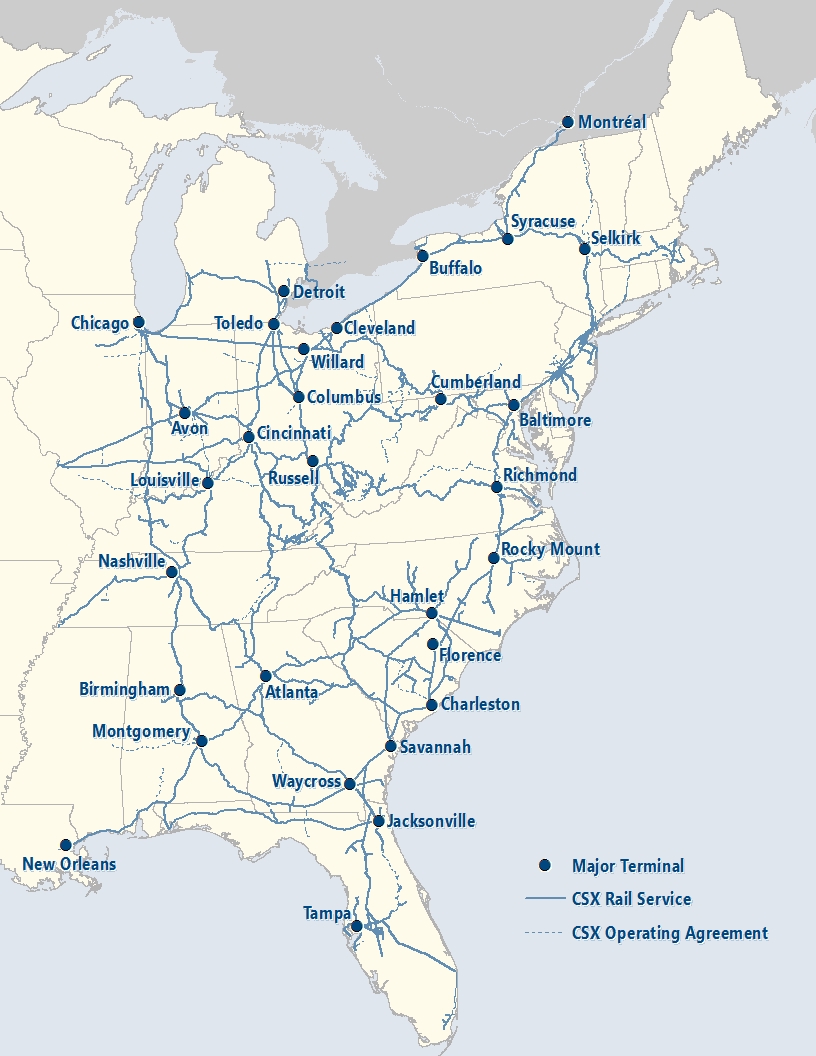
See the following page for a map of the CSX Rail Network. Also included on the map, CSX Operating Agreement indicates areas within which CSX can operate through trackage rights beyond the CSX network.
CSX 2018 Form 10-K p. 13
CSX CORPORATION
PART I
CSX Rail Network
CSX 2018 Form 10-K p. 14
CSX CORPORATION
PART I
Locomotives
At December 2018, CSXT owned nearly 3,900 locomotives. From time to time, the Company also short-term leases locomotives based on business needs. Freight locomotives are used primarily to pull trains while switching locomotives are used in yards. Auxiliary units are typically used to provide extra traction for heavy trains in hilly terrain. At December 2018, CSXT’s fleet of owned locomotives consisted of the following types:
| Locomotives | % | Average Age (years) | ||||||
| Freight | 3,440 | 88 | % | 20 | ||||
| Switching | 254 | 7 | % | 37 | ||||
| Auxiliary Units | 204 | 5 | % | 24 | ||||
| Total | 3,898 | 100 | % | 21 |
Equipment
At any time, over half of the railcars on the CSXT system are not owned or leased by the Company. Examples of these include railcars owned by other railroads (which are utilized by CSXT), shipper-furnished or private cars (which are generally used only in that shipper’s service), multi-level railcars used to transport automobiles (which are shared between railroads) and double-stack railcars, or well cars (which are industry pooled), that allow for two intermodal containers to be loaded one above the other.
At December 2018, the Company’s owned and long-term leased equipment consisted of the following:
| Equipment | Number of Units | % | |||
| Gondolas | 19,388 | 36 | % | ||
| Multi-level flat cars | 11,476 | 22 | % | ||
| Covered hoppers | 8,570 | 16 | % | ||
| Open-top hoppers | 8,273 | 16 | % | ||
| Box cars | 4,873 | 9 | % | ||
| Flat cars | 533 | 1 | % | ||
| Other cars | 266 | — | % | ||
| Subtotal freight cars | 53,379 | 100 | % | ||
| Containers | 18,051 | ||||
| Total equipment | 71,430 |
CSX 2018 Form 10-K p. 15
CSX CORPORATION
PART I
The Company’s revenue-generating equipment, either owned or long-term leased, consists of freight cars and containers as described below.
Gondolas – Support CSXT’s metals markets and provide transport for woodchips and other bulk commodities. Some gondolas are equipped with special hoods for protecting products like coil and sheet steel.
Multi-level flat cars – Transport finished automobiles and are differentiated by the number of levels: bi-levels for large vehicles such as pickup trucks and SUVs and tri-levels for sedans and smaller automobiles.
Covered hoppers – Have a permanent roof and are segregated based upon commodity density. Lighter bulk commodities such as grain, fertilizer, flour, salt, sugar, clay and lime are shipped in large cars called jumbo covered hoppers. Heavier commodities like cement, ground limestone and industrial sand are shipped in small cube covered hoppers.
Open-top hoppers – Transport heavy dry bulk commodities such as coal, coke, stone, sand, ores and gravel that are resistant to weather conditions.
Box cars – Include a variety of tonnages, sizes, door configurations and heights to accommodate a wide range of finished products, including paper, auto parts, appliances and building materials. Insulated box cars deliver food products, canned goods, beer and wine.
Flat cars – Used for shipping intermodal containers and trailers or bulk and finished goods, such as lumber, pipe, plywood, drywall and pulpwood.
Other cars – Primarily leased refrigerator cars and slab steel cars.
Containers – Weather-proof boxes used for bulk shipment of freight.
Previous: Item 1B. Unresolved Staff Comments · Next: Item 3. Legal Proceedings