 filings.tools
CSX 10-K 2019-12-31
Filed 2020-02-12. 21 sections, 358K characters. Original on sec.gov · Markdown · JSON
Cover and table of contents
UNITED STATES
SECURITIES AND EXCHANGE COMMISSION
WASHINGTON, D.C. 20549
FORM 10-K
(☒) ANNUAL REPORT PURSUANT TO SECTION 13 OR 15(d) OF THE SECURITIES EXCHANGE ACT OF 1934
For the fiscal year ended December 31, 2019
OR
(☐) TRANSITION REPORT PURSUANT TO SECTION 13 OR 15(d) OF THE SECURITIES EXCHANGE ACT OF 1934
For the transition period from __________ to __________
Commission File Number 1-8022
CSX CORPORATION
| (Exact name of registrant as specified in its charter) | ||||||||||
| Virginia | 62-1051971 | |||||||||
| (I.R.S. Employer Identification No.) | ||||||||||
| 500 Water Street | 15th Floor | Jacksonville | FL | 32202 | 904 | 359-3200 | ||||
| (Address of principal executive offices) | (Zip Code) | (Telephone number, including area code) | ||||||||
| Securities registered pursuant to Section 12(b) of the Act: | ||||||||||
| Title of each class | Trading Symbol(s) | Name of exchange on which registered | ||||||||
| Common Stock, $1 Par Value | CSX | Nasdaq Global Select Market |
Securities registered pursuant to Section 12(g) of the Act: None
Indicate by check mark if the registrant is a well-known seasoned issuer, as defined in Rule 405 of the Securities Act.
Yes (X) No ( )
Indicate by check mark if the registrant is not required to file reports pursuant to Section 13 or Section 15(d) of the Act.
Yes ( ) No (X)
Indicate by check mark whether the registrant (1) has filed all reports required to be filed by Section 13 or 15(d) of the Securities Exchange Act of 1934 during the preceding 12 months (or for such shorter period that the registrant was required to file such reports), and (2) has been subject to such filing requirements for the past 90 days.
Yes (X) No ( )
Indicate by check mark whether the registrant has submitted electronically every Interactive Data File required to be submitted pursuant to Rule 405 of Regulation S-T (§ 232.405 of this chapter) during the preceding 12 months (or for such shorter period that the registrant was required to submit such files).
Yes (X) No ( )
Indicate by check mark whether the registrant is a large accelerated filer, an accelerated filer, a non-accelerated filer, a smaller reporting company, or an emerging growth company. (as defined in Exchange Act Rule 12b-2).
Large Accelerated Filer (X) Accelerated Filer ( ) Non-accelerated Filer ( ) Smaller reporting company (☐)
Emerging growth company (☐)
If an emerging growth company, indicate by check mark if the registrant has elected not to use the extended transition period for complying with any new or revised financial accounting standards provided pursuant to Section 13(a) of the Exchange Act. ( )
Indicate by check mark whether the registrant is a shell company (as defined in Exchange Act Rule 12b-2).
Yes (☐) No (X)
On June 30, 2019 (which is the last day of the second quarter and the required date to use), the aggregate market value of the Registrant’s voting stock held by non-affiliates was approximately $59 billion (based on the close price as reported on the NASDAQ National Market System on such date).
There were 773,825,565 shares of Common Stock outstanding on January 31, 2020 (the latest practicable date that is closest to the filing date).
DOCUMENTS INCORPORATED BY REFERENCE
Portions of the Registrant’s Definitive Proxy Statement (the “Proxy Statement”) to be filed no later than 120 days after the end of the fiscal year with respect to its 2020 annual meeting of shareholders.
CSX 2019 Form 10-K p. 1
CSX 2019 Form 10-K p. 2
CSX CORPORATION
PART I
Item 1. Business
CSX Corporation together with its subsidiaries ("CSX" or the “Company”), based in Jacksonville, Florida, is one of the nation's leading transportation companies. The Company provides rail-based freight transportation services including traditional rail service, the transport of intermodal containers and trailers, as well as other transportation services such as rail-to-truck transfers and bulk commodity operations. CSX and the rail industry provide customers with access to an expansive and interconnected transportation network that plays a key role in North American commerce and is critical to the long-term economic success and improved global competitiveness of the United States. In addition, freight railroads provide the most economical and environmentally efficient means to transport goods over land.
CSX Transportation, Inc.
CSX’s principal operating subsidiary, CSX Transportation, Inc. (“CSXT”), provides an important link to the transportation supply chain through its approximately 20,000 route mile rail network, which serves major population centers in 23 states east of the Mississippi River, the District of Columbia and the Canadian provinces of Ontario and Quebec. It has access to over 70 ocean, river and lake port terminals along the Atlantic and Gulf Coasts, the Mississippi River, the Great Lakes and the St. Lawrence Seaway. This access allows the Company to meet the dynamic transportation needs of manufacturers, industrial producers, the automotive industry, construction companies, farmers and feed mills, wholesalers and retailers, and energy producers. The Company’s intermodal business links customers to railroads via trucks and terminals. CSXT also serves thousands of production and distribution facilities through track connections with other Class I railroads and more than 230 short-line and regional railroads.
CSXT is also responsible for the Company's real estate sales, leasing, acquisition and management and development activities. Substantially all of these activities are focused on supporting railroad operations.
Other Entities
In addition to CSXT, the Company’s subsidiaries include CSX Intermodal Terminals, Inc. (“CSX Intermodal Terminals”), Total Distribution Services, Inc. (“TDSI”), Transflo Terminal Services, Inc. (“Transflo”), CSX Technology, Inc. (“CSX Technology”) and other subsidiaries. CSX Intermodal Terminals owns and operates a system of intermodal terminals, predominantly in the eastern United States and also performs drayage services (the pickup and delivery of intermodal shipments) for certain customers and trucking dispatch operations. TDSI serves the automotive industry with distribution centers and storage locations. Transflo connects non-rail served customers to the many benefits of rail by transferring products from rail to trucks. The biggest Transflo markets are chemicals and agriculture, which includes shipments of plastics and ethanol. CSX Technology and other subsidiaries provide support services for the Company.
CSX 2019 Form 10-K p. 3
CSX CORPORATION
PART I
Lines of Business
During 2019, the Company's services generated $11.9 billion of revenue and served three primary lines of business: merchandise, coal and intermodal.
| • | The merchandise business shipped 2.7 million carloads (43 percent of volume) and generated 64 percent of revenue in 2019. The Company’s merchandise business is comprised of shipments in the following diverse markets: chemicals, automotive, agricultural and food products, minerals, fertilizers, forest products, and metals and equipment. |
| • | The coal business shipped 843 thousand carloads (14 percent of volume) and generated 17 percent of revenue in 2019. The Company transports domestic coal, coke and iron ore to electricity-generating power plants, steel manufacturers and industrial plants as well as export coal to deep-water port facilities. Roughly one-third of export coal and the majority of the domestic coal that the Company transports is used for generating electricity. |
| • | The intermodal business shipped 2.7 million units (43 percent of volume) and generated 15 percent of revenue in 2019. The intermodal business combines the superior economics of rail transportation with the flexibility of trucks and offers a cost and environmental advantage over long-haul trucking. Through a network of approximately 30 terminals, the intermodal business serves all major markets east of the Mississippi River and transports mainly manufactured consumer goods in containers, providing customers with truck-like service for longer shipments. |
Other revenue accounted for 4 percent of the Company’s total revenue in 2019. This category includes revenue from regional subsidiary railroads, demurrage, storage at intermodal facilities, revenue for customer volume commitments not met, switching, other incidental charges and adjustments to revenue reserves. Revenue from regional railroads includes shipments by railroads that the Company does not directly operate. Demurrage represents charges assessed when freight cars or other equipment are held beyond a specified period of time. Switching represents charges assessed when a railroad switches cars for a customer or another railroad.
Employees
The Company's number of employees was nearly 21,000 as of December 2019, which includes approximately 17,000 union employees. Most of the Company’s employees provide or support transportation services.
Operating Model
The Company is focused on developing and strictly maintaining a scheduled service plan with an emphasis on optimizing assets. When this operating model is executed effectively, customer service is improved, enabling the Company to better compete for an increased share of the U.S. freight market. Further, this model leads to reduced costs and strong free cash flow generation.
Financial Information
See Item 7. Management’s Discussion and Analysis of Financial Condition and Results of Operations for operating revenue, operating income and total assets for each of the last three fiscal years.
CSX 2019 Form 10-K p. 4
CSX CORPORATION
PART I
Company History
A leader in freight rail transportation for more than 190 years, the Company’s heritage dates back to the early nineteenth century when The Baltimore and Ohio Railroad Company (“B&O”) – the nation’s first common carrier – was chartered in 1827. Since that time, the Company has built on this foundation to create a railroad that could safely and reliably service the ever-increasing demands of a growing nation.
Since its founding, numerous railroads have combined with the former B&O through merger and consolidation to create what has become CSX. Each of the railroads that combined into the CSX family brought new geographical reach to valuable markets, gateways, cities, ports and transportation corridors.
CSX Corporation was incorporated in 1978 under Virginia law. In 1980, the Company completed the merger of the Chessie System and Seaboard Coast Line Industries into CSX. The merger allowed the Company to connect northern population centers and Appalachian coal fields to growing southeastern markets. Later, the Company’s acquisition of key portions of Conrail, Inc. ("Conrail") allowed CSXT to link the northeast, including New England and the New York metropolitan area, with Chicago and midwestern markets as well as the growing areas in the Southeast already served by CSXT. This current rail network allows the Company to directly serve every major market in the eastern United States with safe, dependable, environmentally responsible and fuel efficient freight transportation and intermodal service.
Competition
The business environment in which the Company operates is highly competitive. Shippers typically select transportation providers that offer the most compelling combination of service and price. Service requirements, both in terms of transit time and reliability, vary by shipper and commodity. As a result, the Company’s primary competition varies by commodity, geographic location and mode of available transportation and includes other railroads, motor carriers that operate similar routes across its service area and, to a less significant extent, barges, ships and pipelines.
CSXT’s primary rail competitor is Norfolk Southern Railway, which operates throughout much of the Company’s territory. Other railroads also operate in parts of the Company’s territory. Depending on the specific market, competing railroads and deregulated motor carriers may exert pressure on price and service levels. For further discussion on the risk of competition to the Company, see Item 1A. Risk Factors.
Regulatory Environment
The Company's operations are subject to various federal, state, provincial (Canada) and local laws and regulations generally applicable to businesses operating in the United States and Canada. In the U.S., the railroad operations conducted by the Company's subsidiaries, including CSXT, are subject to the regulatory jurisdiction of the Surface Transportation Board (“STB”), the Federal Railroad Administration (“FRA”), and its sister agency within the U.S. Department of Transportation ("DOT"), the Pipeline and Hazardous Materials Safety Administration (“PHMSA”). Together, FRA and PHMSA have broad jurisdiction over railroad operating standards and practices, including track, freight cars, locomotives and hazardous materials requirements. In addition, the U.S. Environmental Protection Agency (“EPA”) has regulatory authority with respect to matters that impact the Company's properties and operations.
The Transportation Security Administration (“TSA”), a component of the Department of Homeland Security, has broad authority over railroad operating practices that may have homeland security implications. In Canada, the railroad operations conducted by the Company’s subsidiaries, including CSXT, are subject to the regulatory jurisdiction of the Canadian Transportation Agency.
CSX 2019 Form 10-K p. 5
CSX CORPORATION
PART I
Although the Staggers Act of 1980 significantly deregulated the U.S. rail industry, the STB has broad jurisdiction over rail carriers. The STB regulates routes, fuel surcharges, conditions of service, rates for non-exempt traffic, acquisitions of control over rail common carriers and the transfer, extension or abandonment of rail lines, among other railroad activities. Any new rules from the STB regarding, among other things, competitive access or revenue adequacy could have a material adverse effect on the Company's financial condition, results of operations and liquidity as well as its ability to invest in enhancing and maintaining vital infrastructure. For further discussion on regulatory risks to the Company, see Item 1A. Risk Factors.
Positive Train Control
In 2008, Congress enacted the Rail Safety Improvement Act (the “RSIA”). The legislation included a mandate that all Class I freight railroads implement an interoperable positive train control system (“PTC”) by December 31, 2015. Implementation of a PTC system is designed to prevent train-to-train collisions, over-speed derailments, incursions into established work-zone limits, and train diversions onto another set of tracks. PTC must be installed on all main lines with passenger and commuter operations as well as most of those over which toxic-by-inhalation hazardous materials are transported.
On October 29, 2015, the President of the United States signed the Positive Train Control Enforcement and Implementation Act of 2015 into law extending the deadline. In accordance with this Act, the Company completed installation of all PTC hardware by December 31, 2018. The Company met all criteria required by the Act to be approved for an extension by the FRA. The PTC system is now required to be fully operational by December 31, 2020. CSX remains on track to meet this regulatory requirement.
The Company expects to continue incurring capital costs in connection with the implementation of PTC as well as related ongoing operating expenses. CSX currently estimates that the total multi-year cost of PTC implementation will be approximately $2.4 billion for the Company. Total PTC investment through 2019 was $2.3 billion.
Other Information
CSX makes available on its website www.csx.com, free of charge, its annual reports on Form 10-K, quarterly reports on Form 10-Q, current reports on Form 8-K and all amendments to those reports as soon as reasonably practicable after such reports are filed with or furnished to the Securities and Exchange Commission (“SEC”). The information on the CSX website is not part of this annual report on Form 10-K. Additionally, the Company has posted its code of ethics on its website, which is also available to any shareholder who requests it. This Form 10-K and other SEC filings made by CSX are also accessible through the SEC’s website at www.sec.gov.
CSX has included the certifications of its Chief Executive Officer (“CEO”) and the Chief Financial Officer (“CFO”) required by Section 302 of the Sarbanes-Oxley Act of 2002 (“the Act”) as Exhibit 31, as well as Section 906 of the Act as Exhibit 32 to this Form 10-K report.
The information set forth in Item 6. Selected Financial Data is incorporated herein by reference. For additional information concerning business conducted by the Company during 2019, see Item 7. Management's Discussion and Analysis of Financial Condition and Results of Operations.
CSX 2019 Form 10-K p. 6
CSX CORPORATION
PART I
Item 1A. Risk Factors
The risks set forth in the following risk factors could have a material adverse effect on the Company's financial condition, results of operations or liquidity, and could cause those results to differ materially from those expressed or implied in the Company's forward-looking statements. Additional risks and uncertainties not currently known to the Company or that the Company currently does not deem to be material also may materially impact the Company's financial condition, results of operations or liquidity.
New legislation or regulatory changes could impact the Company's earnings or restrict its ability to independently negotiate prices.
Legislation passed by Congress, new regulations issued by federal agencies or executive orders issued by the President of the United States could significantly affect the revenues, costs and profitability of the Company's business. In addition, statutes or regulations imposing price constraints or affecting rail-to-rail competition could adversely affect the Company's profitability.
Government regulation and compliance risks may adversely affect the Company's operations and financial results.
The Company is subject to the jurisdiction of various regulatory agencies, including the STB, FRA, PHMSA, TSA, EPA and other state, provincial and federal regulatory agencies for a variety of economic, health, safety, labor, environmental, tax, legal and other matters. New or modified rules or regulations by these agencies could increase the Company's operating costs, adversely impact revenue or reduce operating efficiencies and affect service performance. For example, the RSIA, as amended, mandated that the installation of PTC hardware be completed by December 31, 2018, and requires that the PTC system be fully operational by December 31, 2020 on main lines that carry certain hazardous materials and on lines that have commuter or passenger operations. Although CSX remains on track to meet this regulatory requirement, noncompliance with these and other applicable laws or regulations could erode public confidence in the Company and can subject the Company to fines, penalties and other legal or regulatory sanctions.
CSXT, as a common carrier by rail, is required by law to transport hazardous materials, which could expose the Company to significant costs and claims.
A train accident involving the transport of hazardous materials could result in significant claims arising from personal injury, property or natural resource damage, environmental penalties and remediation obligations. Such claims, if insured, could exceed existing insurance coverage or insurance may not continue to be available at commercially reasonable rates. Under federal regulations, CSXT is required to transport hazardous materials under the legal duty referred to as the common carrier mandate.
CSXT is also required to comply with regulations regarding the handling of hazardous materials. In November 2008, the TSA issued final rules placing significant new security and safety requirements on passenger and freight railroad carriers, rail transit systems and facilities that ship hazardous materials by rail. Noncompliance with these rules can subject the Company to significant penalties and could be a factor in litigation arising out of a train accident. Finally, legislation preventing the transport of hazardous materials through certain cities could result in network congestion and increase the length of haul for hazardous substances, which could increase operating costs, reduce operating efficiency or increase the risk of an accident involving the transport of hazardous materials.
CSX 2019 Form 10-K p. 7
CSX CORPORATION
PART I
The Company faces competition from other transportation providers.
The Company experiences competition in pricing, service, reliability and other factors from various transportation providers including railroads and motor carriers that operate similar routes across its service area and, to a less significant extent, barges, ships and pipelines. Other transportation providers generally use public rights-of-way that are built and maintained by governmental entities, while CSXT and other railroads must build and maintain rail networks largely using internal resources. Any future improvements or expenditures materially increasing the quality or reducing the cost of alternative modes of transportation such as through the use of automation, autonomy or electrification, or legislation providing for less stringent size or weight restrictions on trucks, could negatively impact the Company's competitive position. Additionally, any future consolidation in the rail industry could materially affect the regulatory and competitive environment in which the Company operates.
Global economic conditions could negatively affect demand for commodities and other freight.
A decline or disruption in general domestic and global economic conditions that affects demand for the commodities and products the Company transports, including import and export volume, could reduce revenues or have other adverse effects on the Company's cost structure and profitability. For example, slower rates of economic growth in Asia, contraction of European economies, and changes in the global supply of seaborne coal or price of seaborne coal have adverse impacts on U.S. export coal volume and result in lower coal revenue for CSX. Additionally, changes to trade agreements or policies could result in reduced import and export volumes due to increased tariffs and lower consumer demand. If the Company experiences significant declines in demand for its transportation services with respect to one or more commodities and products, the Company may experience reduced revenue and increased operating costs, workforce adjustments, and other related activities, which could have a material adverse effect on the Company's financial condition, results of operations and liquidity.
Changing dynamics in the U.S. and global energy markets could negatively impact profitability.
Increases in production and source locations of natural gas in the U.S. have resulted in lower natural gas prices in CSX’s service territory. As a result of sustained low natural gas prices, many coal-fired power plants have been displaced by natural gas-fired power generation facilities. If natural gas prices were to remain low, additional coal-fired plants could be displaced, which would likely further reduce the Company's domestic coal volumes and revenues. Additionally, crude oil prices combined with increased pipeline activity have resulted in volatility in domestic crude oil production, which has affected crude oil volumes for CSX.
The Company relies on the security, stability and availability of its technology systems to operate its business.
The Company relies on information technology in all aspects of its business. The performance and reliability of the Company's technology systems are critical to its ability to operate and compete safely and effectively. A cybersecurity attack, which is a deliberate theft of data or impairment of information technology systems, or other significant disruption or failure, could result in a service interruption, train accident, misappropriation of confidential information, process failure, security breach or other operational difficulties. Such an event could result in decreased revenues and increased capital, insurance or operating costs, including increased security costs to protect the Company's infrastructure. Insurance maintained by the Company to protect against loss of business and other related consequences resulting from cyber incidents may not be sufficient to cover all damages. A disruption or compromise of the Company's information technology systems, even for short periods of time, could have a material adverse effect.
CSX 2019 Form 10-K p. 8
CSX CORPORATION
PART I
The Company’s operations and financial results could be negatively impacted by climate change and regulatory and legislative responses to climate change.
There is potential for operational impacts from changing weather patterns or rising sea levels in the Company's operational territory, which could impact the Company's network or other assets. Climate change and other emissions-related laws and regulations have been proposed and, in some cases adopted, on the federal, state, provincial and local levels. These final and proposed laws and regulations take the form of restrictions, caps, taxes or other controls on emissions. In particular, the EPA has issued various regulations and may issue additional regulations targeting emissions, including rules and standards governing emissions from certain stationary sources and from vehicles.
Any of these pending or proposed laws or regulations could adversely affect the Company's operations and financial results by, among other things: (i) reducing coal-fired electricity generation due to mandated emission standards; (ii) reducing the consumption of coal as a viable energy resource in the United States and Canada; (iii) increasing the Company's fuel, capital and other operating costs and negatively affecting operating and fuel efficiencies; and (iv) making it difficult for the Company's customers in the U.S. and Canada to produce products in a cost competitive manner. Any of these factors could reduce the amount of shipments the Company handles and have a material adverse effect on the Company's financial condition, results of operations or liquidity.
The Company is subject to environmental laws and regulations that may result in significant costs.
The Company is subject to wide-ranging federal, state, provincial and local environmental laws and regulations concerning, among other things, emissions into the air, ground and water; the handling, storage, use, generation, transportation and disposal of waste and other materials; the clean-up of hazardous material and petroleum releases and the health and safety of our employees. If the Company violates or fails to comply with these laws and regulations, CSX could be fined or otherwise sanctioned by regulators. The Company can also be held liable for consequences arising out of human exposure to any hazardous substances for which CSX is responsible. In certain circumstances, environmental liability can extend to formerly owned or operated properties, leased properties, adjacent properties and properties owned by third parties or Company predecessors, as well as to properties currently owned, leased or used by the Company.
The Company has been, and may in the future be, subject to allegations or findings to the effect that it has violated, or is strictly liable under, environmental laws or regulations, and such violations can result in the Company's incurring fines, penalties or costs relating to the clean-up of environmental contamination. Although the Company believes it has appropriately recorded current and long-term liabilities for known and reasonably estimable future environmental costs, it could incur significant costs that exceed reserves or require unanticipated cash expenditures as a result of any of the foregoing. The Company also may be required to incur significant expenses to investigate and remediate known, unknown or future environmental contamination.
The Company may be subject to various claims and lawsuits that could result in significant expenditures.
As part of its railroad and other operations, the Company is subject to various claims and lawsuits related to disputes over commercial practices, labor and unemployment matters, occupational and personal injury claims, property damage, environmental and other matters. The Company may experience material judgments or incur significant costs to defend existing and future lawsuits. Although the Company maintains insurance to cover some of these types of claims and establishes reserves when appropriate, final amounts determined to be due on any outstanding matters may exceed the Company's insurance coverage or differ materially from the recorded reserves. Additionally, the Company could be impacted by adverse developments not currently reflected in the Company's reserve estimates.
CSX 2019 Form 10-K p. 9
CSX CORPORATION
PART I
Disruption to a key railroad industry supplier could negatively affect operating efficiency and increase costs.
The capital intensive and unique nature of core rail equipment (including rolling stock equipment, locomotives, rail, and ties) limits the number of railroad equipment suppliers. If any of the current manufacturers stops production or experiences a supply shortage, CSXT could experience a significant cost increase or material shortage. In addition, a few critical railroad suppliers are foreign and, as such, adverse developments in international relations, new trade regulations, disruptions in international shipping or increases in global demand could make procurement of these supplies more difficult or increase CSXT's operating costs. Additionally, if a fuel supply shortage were to arise, the Company would be negatively impacted.
Network constraints could have a negative impact on service and operating efficiency.
CSXT could experience rail network difficulties related to: (i) increased volume; (ii) locomotive or crew shortages; (iii) extreme weather conditions; (iv) impacts from changes in yard capacity, or network structure or composition, including train routes; (v) increased passenger activities; or (vi) regulatory changes impacting where and how fast CSXT can transport freight or maintain routes, which could impact CSXT's operational fluidity, leading to deterioration of service, asset utilization and overall efficiency.
Future acts of terrorism, war or regulatory changes to combat the risk of terrorism may cause significant disruptions in the Company's operations.
Terrorist attacks, along with any government response to those attacks, may adversely affect the Company's financial condition, results of operations or liquidity. CSXT's rail lines, other key infrastructure and information technology systems may be targets or indirect casualties of acts of terror or war. This risk could cause significant business interruption and result in increased costs and liabilities and decreased revenues. In addition, premiums charged for some or all of the insurance coverage currently maintained by the Company could increase dramatically, or the coverage may no longer be available.
Furthermore, in response to the heightened risk of terrorism, federal, state and local governmental bodies are proposing and, in some cases, have adopted legislation and regulations relating to security issues that impact the transportation industry. For example, the Department of Homeland Security adopted regulations that require freight railroads to implement additional security protocols when transporting hazardous materials. Complying with these or future regulations could continue to increase the Company's operating costs and reduce operating efficiencies.
Severe weather or other natural occurrences could result in significant business interruptions and expenditures in excess of available insurance coverage.
The Company's operations may be affected by external factors such as severe weather and other natural occurrences, including floods, fires, hurricanes and earthquakes. As a result, the Company's rail network may be damaged, its workforce may be unavailable, fuel costs may rise and significant business interruptions could occur. In addition, the performance of locomotives and railcars could be adversely affected by extreme weather conditions. Insurance maintained by the Company to protect against loss of business and other related consequences resulting from these natural occurrences is subject to coverage limitations, depending on the nature of the risk insured. This insurance may not be sufficient to cover all of the Company's damages or damages to others, and this insurance may not continue to be available at commercially reasonable rates. Even with insurance, if any natural occurrence leads to a catastrophic interruption of service, the Company may not be able to restore service without a significant interruption in operations.
CSX 2019 Form 10-K p. 10
CSX CORPORATION
PART I
Failure to complete negotiations on collective bargaining agreements could result in strikes and/or work stoppages.
Most of CSX's employees are represented by labor unions and are covered by collective bargaining agreements. These agreements are either bargained for nationally by the National Carriers Conference Committee or locally between CSX and the union. Such agreements are negotiated over the course of several years and previously have not resulted in any extended work stoppages. Under the Railway Labor Act's procedures (which include mediation, cooling-off periods and the possibility of an intervention by the President of the United States), during negotiations neither party may take action until the procedures are exhausted. If, however, CSX is unable to negotiate acceptable agreements, the employees covered by the Railway Labor Act could strike, which could result in loss of business and increased operating costs as a result of higher wages or benefits paid to union members.
The unavailability of critical resources could adversely affect the Company’s operational efficiency and ability to meet demand.
Marketplace conditions for resources like locomotives as well as the availability of qualified personnel, particularly engineers and conductors, could each have a negative impact on the Company’s ability to meet demand for rail service. Although the Company believes that it has adequate resources and personnel for the current business environment, unpredictable increases in demand for rail services or extreme weather conditions may exacerbate such risks, which could have a negative impact on the Company’s operational efficiency and otherwise have a material adverse effect on the Company’s financial condition, results of operations, or liquidity in a particular period.
Weaknesses in the capital and credit markets could negatively impact the Company’s access to capital.
The Company regularly relies on capital markets for the issuance of long-term debt instruments, commercial paper and bank financing from time to time. Instability or disruptions of the capital markets, including credit markets, or the deterioration of the Company’s financial condition due to internal or external factors, could restrict or prohibit access and could increase financing costs. A significant deterioration of the Company’s financial condition could also reduce credit ratings and could limit or affect its access to external sources of capital and increase the costs of short and long-term debt financing.
Item 1B. Unresolved Staff Comments
None
CSX 2019 Form 10-K p. 11
CSX CORPORATION
PART I
Item 2. Properties
The Company’s properties primarily consist of track and its related infrastructure, locomotives and freight cars and equipment. These categories and the geography of the network are described below.
Track and Infrastructure
Serving 23 states, the District of Columbia, and the Canadian provinces of Ontario and Quebec, the CSXT rail network serves, among other markets, New York, Philadelphia and Boston in the Northeast and Mid-Atlantic, the southeast markets of Atlanta, Miami and New Orleans, and the midwestern markets of St. Louis, Memphis and Chicago.
CSXT’s track structure includes mainline track, connecting terminals and yards, track within terminals and switching yards, sidings used for passing trains, track connecting CSXT's track to customer locations and track that diverts trains from one track to another known as turnouts. Total track miles, which reflect the size of CSXT’s network that connects markets, customers and western railroads, are greater than CSXT’s approximately 20,000 route miles. At December 2019, the breakdown of track miles was as follows:
| Track | ||
| Miles | ||
| Mainline track | 25,793 | |
| Terminals and switching yards | 9,316 | |
| Passing sidings and turnouts | 921 | |
| Total | 36,030 |
In addition to its physical track structure, the Company operates numerous yards and terminals for rail and intermodal service. These serve as points of connectivity between the Company and its local customers and as sorting facilities where railcars and intermodal containers are received, classed for destination and placed onto outbound trains, or arrive and are delivered to the customer. The Company’s largest yards and terminals based on 2019 volume (number of railcars or intermodal containers processed) are listed below.
| Yards and Terminals | Annual Volume | |
| Waycross, GA | 874,474 | |
| Bedford Park Intermodal Terminal - Chicago, IL | 820,362 | |
| Nashville, TN | 648,311 | |
| Selkirk, NY | 642,869 | |
| Avon, IN (Indianapolis) | 609,468 | |
| Cincinnati, OH | 567,582 | |
| Louisville, KY | 397,246 | |
| Fairburn, GA Intermodal Terminal | 377,736 | |
| Walbridge, OH (Toledo) | 323,672 | |
| Chicago, IL | 308,653 |
CSX 2019 Form 10-K p. 12
CSX CORPORATION
PART I
Network Geography
CSXT’s operations are primarily focused on four major transportation networks and corridors which are defined geographically and by commodity flows below.
Interstate 90 (I-90) Corridor – This CSXT corridor links Chicago and the Midwest to metropolitan areas in New York and New England. This route, also known as the “waterlevel route,” has minimal hills and grades and nearly all of it has two main tracks (referred to as double track). These engineering attributes permit the corridor to support high-speed service across intermodal, automotive and merchandise commodities. This corridor is a primary route for import traffic coming from the far east through western ports moving eastward across the country, through Chicago and into the population centers in the Northeast. The I-90 Corridor is also a critical link between ports in New York, New Jersey, and Pennsylvania and consumption markets in the Midwest. This route carries goods from all three of the Company’s major markets – merchandise, coal and intermodal.
Interstate 95 (I-95) Corridor – The CSXT I-95 Corridor connects Charleston, Jacksonville, Miami and many other cities throughout the Southeast with the heavily populated mid-Atlantic and northeastern cities of Baltimore, Philadelphia and New York. CSXT primarily transports food and consumer products, as well as metals and chemicals along this line. It is the leading rail corridor along the eastern seaboard south of the District of Columbia, and provides access to major eastern ports.
Southeastern Corridor – This critical part of the network runs between CSXT’s western gateways of Chicago, St. Louis and Memphis through the cities of Nashville, Birmingham, and Atlanta and markets in the Southeast. The Southeastern Corridor is the premier rail route connecting these key cities, gateways, and markets and positions CSXT to efficiently handle projected traffic volumes of intermodal, automotive and general merchandise traffic. The corridor also provides direct rail service between the coal reserves of the southern Illinois basin and the demand for coal in the Southeast.
Coal Network – The CSXT coal network connects the coal mining operations in the Appalachian mountain region and Illinois basin with industrial areas in the Southeast, Northeast and Mid-Atlantic, as well as many river, lake, and deep water port facilities. The domestic coal market has declined significantly over the last decade and export coal remains subject to a high degree of volatility. CSXT’s coal network remains well positioned to supply utility markets in both the Northeast and Southeast and to transport coal shipments for export outside of the U.S. Roughly one-third of the tons of export coal and the majority of the domestic coal that the Company transports is used for generating electricity.
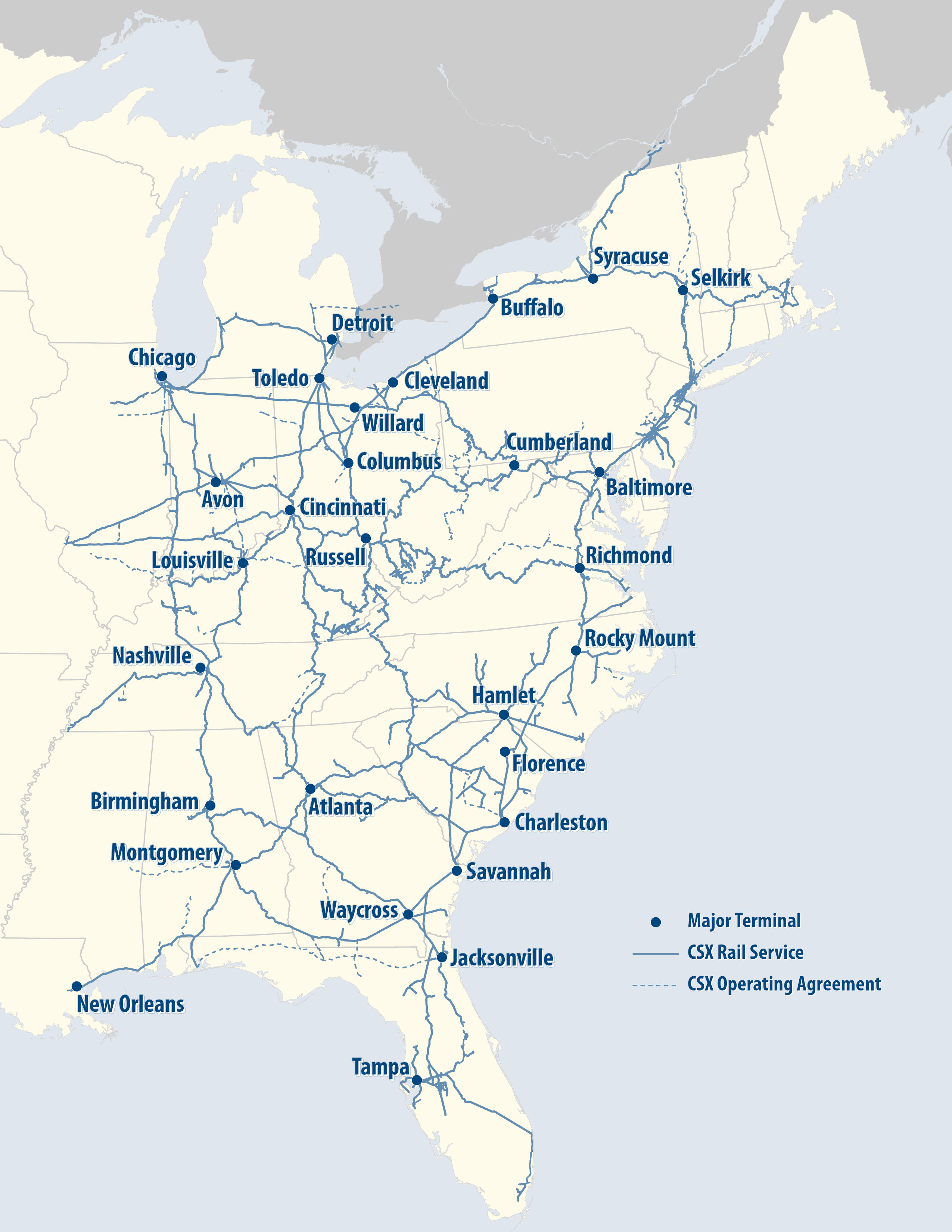
See the following page for a map of the CSX Rail Network. Also included on the map, CSX Operating Agreement indicates areas within which CSX can operate through trackage rights beyond the CSX network.
CSX 2019 Form 10-K p. 13
CSX CORPORATION
PART I
CSX Rail Network
CSX 2019 Form 10-K p. 14
CSX CORPORATION
PART I
Locomotives
At December 2019, CSXT owned more than 3,500 locomotives. From time to time, the Company also short-term leases locomotives based on business needs. Freight locomotives are used primarily to pull trains while switching locomotives are used in yards. Auxiliary units are typically used to provide extra traction for heavy trains in hilly terrain. Of owned locomotives, approximately 65% were in active service as of December 31, 2019, and the remainder were in storage to be utilized as needed. Storing locomotives and equipment allows the Company to quickly adjust its active fleet based on demand and other factors while avoiding delays due to supply limitations or excessive lead times to acquire additional equipment. At December 2019, CSXT’s fleet of owned locomotives consisted of the following types:
| Locomotives | % | Average Age (years) | ||||||
| Freight | 3,162 | 89 | % | 20 | ||||
| Switching | 220 | 6 | % | 42 | ||||
| Auxiliary Units | 179 | 5 | % | 27 | ||||
| Total | 3,561 | 100 | % | 21 |
Equipment
The Company owns or long-term leases equipment, including several types of freight cars and intermodal containers. Of total owned and long-term leased equipment, approximately 65% was in active service on December 31, 2019, and the remainder was in storage to be utilized as needed. At December 2019, the Company’s owned and long-term leased equipment consisted of the following:
| Equipment | Number of Units | % | |||
| Gondolas | 19,102 | 37 | % | ||
| Multi-level flat cars | 11,172 | 22 | % | ||
| Covered hoppers | 8,346 | 16 | % | ||
| Open-top hoppers | 7,405 | 14 | % | ||
| Box cars | 4,509 | 9 | % | ||
| Flat cars | 702 | 1 | % | ||
| Other cars | 262 | 1 | % | ||
| Subtotal freight cars | 51,498 | 100 | % | ||
| Containers | 17,981 | ||||
| Total equipment | 69,479 |
At any time, over half of the railcars on the CSXT system are not owned or leased by the Company. Examples of these include railcars owned by other railroads (which are utilized by CSXT), shipper-furnished or private cars (which are generally used only in that shipper’s service), multi-level railcars used to transport automobiles (which are shared between railroads) and double-stack railcars, or well cars (which are industry pooled), that allow for two intermodal containers to be loaded one above the other.
CSX 2019 Form 10-K p. 15
CSX CORPORATION
PART I
The Company’s revenue-generating equipment, either owned or long-term leased, consists of freight cars and containers as described below.
Gondolas – Support CSXT’s metals markets and provide transport for woodchips and other bulk commodities. Some gondolas are equipped with special hoods for protecting products like coil and sheet steel.
Multi-level flat cars – Transport finished automobiles and are differentiated by the number of levels: bi-levels for large vehicles such as pickup trucks and SUVs and tri-levels for sedans and smaller automobiles.
Covered hoppers – Have a permanent roof and are segregated based upon commodity density. Lighter bulk commodities such as grain, fertilizer, flour, salt, sugar, clay and lime are shipped in large cars called jumbo covered hoppers. Heavier commodities like cement, ground limestone and industrial sand are shipped in small cube covered hoppers.
Open-top hoppers – Transport heavy dry bulk commodities such as coal, coke, stone, sand, ores and gravel that are resistant to weather conditions.
Box cars – Include a variety of tonnages, sizes, door configurations and heights to accommodate a wide range of finished products, including paper, auto parts, appliances and building materials. Insulated box cars deliver food products, canned goods, beer and wine.
Flat cars – Used for shipping intermodal containers and trailers or bulk and finished goods, such as lumber, pipe, plywood, drywall and pulpwood.
Other cars – Primarily leased refrigerator cars and slab steel cars.
Containers – Weather-proof boxes used for bulk shipment of freight.
Item 3. Legal Proceedings
For further details, please refer to Note 8. Commitments and Contingencies of this annual report on Form 10-K.
Item 4. Mine Safety Disclosure
Not Applicable
CSX 2019 Form 10-K p. 16
CSX CORPORATION
PART I
Executive Officers of the Registrant
Executive officers of the Company are elected by the CSX Board of Directors and generally hold office until the next annual election of officers. There are no family relationships or any arrangement or understanding between any officer and any other person pursuant to which such officer was elected. As of the date of this filing, the executive officers’ names, ages and business experience are:
| Name and Age | Business Experience During Past Five Years |
| James M. Foote, 66 President and Chief Executive Officer | Foote has served as President and Chief Executive Office since December 2017. He joined CSX in October 2017 as Chief Operating Officer, with responsibility for both operations and sales and marketing. Mr. Foote has more than 40 years of railroad industry experience. Most recently, he was President and Chief Executive Officer of Bright Rail Energy. Before heading Bright Rail, he was Executive Vice President, Sales and Marketing with Canadian National Railway Company. At Canadian National, Mr. Foote also served as Vice President – Investor Relations and Vice President Sales and Marketing – Merchandise. |
| Kevin S. Boone, 42 Executive Vice President and Chief Financial Officer | Boone was named Executive Vice President and Chief Financial Officer in October 2019 after serving as Interim Chief Financial Officer since May 2019. In this role, he is responsible for all financial aspects of the Company's business including financial and economic analysis, accounting, tax, treasury, real estate and purchasing activities. Mr. Boone has more than 18 years of experience in finance, accounting, mergers and acquisitions, and transportation performance analysis. He joined CSX in September 2017 as Vice President of Corporate Affairs and Chief Investor Relations Officer and was later named Vice President, Marketing and Strategy leading research and data analysis to advance growth strategies for CSX. Before joining CSX in 2017, Mr. Boone worked as a Senior Equity Research Analyst at Janus Capital. He also served as a Vice President at Morgan Stanley in equity research and an associate at Merrill Lynch in the mergers and acquisitions group. |
| Jamie J. Boychuk, 42 Executive Vice President of Operations | Boychuk has served as CSXT's Executive Vice President of Operations since October 2019. In this role, he is responsible for mechanical, engineering, transportation and network operations, including terminals. Since joining CSXT in 2017, he has held the positions of Senior Vice President of Network, Engineering, Mechanical and Intermodal Operations; Vice President of Scheduled Railroading; and Assistant Vice President of Transportation Support. Mr. Boychuk previously worked at Canadian National Railway, where he served for 20 years in various operational roles of increasing responsibility, including sub-region General Manager. |
| Edmond L. Harris, 70 Executive Vice President | Harris has served as an Executive Vice President of CSX since October 2019. In this role, he is responsible for safety, performance metrics, operational planning, and facilities. In 2018, he joined CSXT as Executive Vice President of Operations. Mr. Harris has more than 40 years of railroad industry experience, including service as a senior adviser to Global Infrastructure Partners, an independent fund that invests in infrastructure assets worldwide; Chairman of Omnitrax Rail Network; and a member of the board of directors for Universal Rail Services. His previous experience also includes having served as Chief Operations Officer at Canadian Pacific, and subsequently, a member of the Board. He also served as Executive Vice President of Operations at Canadian National. |
CSX 2019 Form 10-K p. 17
CSX CORPORATION
PART I
| Name and Age | Business Experience During Past Five Years |
| Nathan D. Goldman, 62 Executive Vice President and Chief Legal Officer | Goldman has served as Executive Vice President and Chief Legal Officer, and Corporate Secretary of CSX since November 2017. In this role, he directs the Company’s legal affairs, government relations, corporate communications, risk management, public safety, environmental, and audit functions. During his 16 years with the Company, Mr. Goldman has previously served as Vice President of Risk Compliance and General Counsel and has overseen work in compliance, risk management and safety programs. |
| Diana B. Sorfleet, 55 Executive Vice President and Chief Administrative Officer | Sorfleet was named Executive Vice President and Chief Administrative Officer in July 2018. In this role, her responsibilities include human resources, information technology, labor relations, people systems and analytics, total rewards and aviation. During her 8 years with the Company, Ms. Sorfleet has previously served as Chief Human Resources Officer. Prior to joining CSX, she worked in human resources for 20 years. |
| Mark K. Wallace, 50 Executive Vice President and Chief Sales & Marketing Officer | Wallace has served as Executive Vice President of Sales and Marketing since July 2018. In his current role, Mr. Wallace is responsible for the commercial organization. He joined the Company in March 2017 and previously served as Executive Vice President and Chief Administrative Officer and Executive Vice President of Corporate Affairs and Chief of Staff to the CEO. Prior to joining CSX, he served as the Vice President of Corporate Affairs at Canadian Pacific Railway Limited with responsibility for the corporate communications and public affairs, investor relations, facilities and real estate functions. Prior to his time at Canadian Pacific, Mr. Wallace spent more than 15 years in various senior management positions with Canadian National Railway Company. |
| Angela C. Williams, 45 Vice President and Chief Accounting Officer | Williams has served as Vice President and Chief Accounting Officer of CSX since March 2018. She is responsible for financial and regulatory reporting, freight billing and collections, payroll, accounts payable and various other accounting processes. During her 16 years with the Company, she previously served as Assistant Vice President - Assistant Controller and in other various accounting roles. Prior to joining CSX, she held various accounting and auditing positions for over 6 years. Ms. Williams is a Certified Public Accountant. |
CSX 2019 Form 10-K p. 18
CSX CORPORATION
PART II
Item 5. Market for Registrant’s Common Equity, Related Stockholder Matters and Issuer Purchases of Equity Securities
Market Information
CSX’s common stock is listed on the Nasdaq Global Select Market, which is its principal trading market, and is traded over-the-counter and on exchanges nationwide. The official trading symbol is “CSX.”
Description of Common and Preferred Stock
A total of 1.8 billion shares of common stock are authorized, of which 773,470,825 shares were outstanding as of December 31, 2019. Each share is entitled to one vote in all matters requiring a vote of shareholders. There are no preemptive rights, which are privileges extended to select shareholders that would allow them to purchase additional shares before other members of the general public in the event of an offering. At January 31, 2020, the latest practicable date that is closest to the filing date, there were 25,127 common stock shareholders of record. The weighted average of common shares outstanding, which was used in the calculation of diluted earnings per share, was 798 million as of December 31, 2019. (See Note 2, Earnings Per Share.) A total of 25 million shares of preferred stock is authorized, none of which is currently outstanding.
The following table sets forth, for the quarters indicated, the dividends declared on CSX common stock.
| Quarter | |||||||||||||||||||
| 1st | 2nd | 3rd | 4th | Year | |||||||||||||||
| 2019 | $ | 0.24 | $ | 0.24 | $ | 0.24 | $ | 0.24 | $ | 0.96 | |||||||||
| 2018 | $ | 0.22 | $ | 0.22 | $ | 0.22 | $ | 0.22 | $ | 0.88 |
Stock Performance Graph
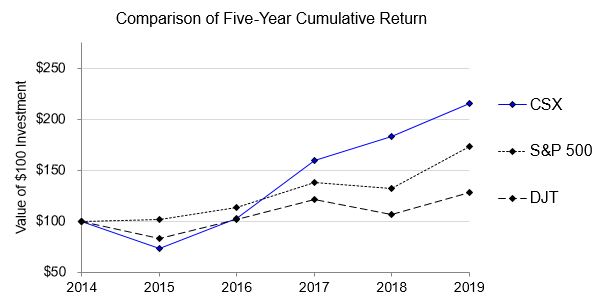
The cumulative shareholder returns, assuming reinvestment of dividends, on $100 invested at December 31, 2014 are illustrated on the graph below. The Company references the Standard & Poor's 500 Stock Index (“S&P 500 ®”), and the Dow Jones U.S. Transportation Average Index, which provide comparisons to a broad-based market index and other companies in the transportation industry.
CSX 2019 Form 10-K p. 19
CSX CORPORATION
PART II
CSX Purchases of Equity Securities
The Company continues to repurchase shares under the $5 billion program announced in January 2019. For more information about share repurchases, see Note 2 Earnings Per Share. Share repurchase activity of $606 million for the fourth quarter 2019 was as follows:
| CSX Purchases of Equity Securities for the Quarter | ||||||||||||
| Fourth Quarter | Total Number of Shares Purchased | Average Price Paid per Share | Total Number of Shares Purchased as Part of Publicly Announced Plans or Programs**(a)** | Approximate Dollar Value of Shares that May Yet Be Purchased Under the Plans or Programs | ||||||||
| Beginning Balance | $ | 2,362,512,464 | ||||||||||
| October 1 - October 31, 2019 | 7,738,077 | $ | 67.74 | 7,719,147 | 1,839,693,245 | |||||||
| November 1 - November 30, 2019 | 1,191,270 | 70.42 | 1,191,270 | 1,755,803,734 | ||||||||
| December 1 - December 31, 2019 | — | — | — | 1,755,803,734 | ||||||||
| Ending Balance | 8,929,347 | $ | 68.10 | 8,910,417 | $ | 1,755,803,734 |
(a) The difference between the "Total Number of Shares Purchased" and the "Total Number of Shares Purchased as Part of Publicly Announced Plans or Programs" of 18,930 shares for the quarter represents shares purchased to fund the Company's contribution to a 401(k) plan that covers certain union employees.
CSX 2019 Form 10-K p. 20
CSX CORPORATION
PART II
Item 6. Selected Financial Data
Selected financial data related to the Company’s financial results for the last five fiscal years are listed below.
| Fiscal Years | ||||||||||||||||||||
| (Dollars and Shares in Millions, Except Per Share Amounts) | 2019 | 2018 | 2017 | 2016 | 2015 | |||||||||||||||
| Financial Performance | ||||||||||||||||||||
| Revenue | $ | 11,937 | $ | 12,250 | $ | 11,408 | $ | 11,069 | $ | 11,811 | ||||||||||
| Expense | 6,972 | 7,381 | 7,688 | 7,656 | 8,183 | |||||||||||||||
| Operating Income | $ | 4,965 | $ | 4,869 | $ | 3,720 | $ | 3,413 | $ | 3,628 | ||||||||||
| Adjusted Operating Income(a) | 4,965 | 4,869 | 3,818 | 3,413 | 3,628 | |||||||||||||||
| Net Earnings from Continuing Operations | $ | 3,331 | $ | 3,309 | $ | 5,471 | $ | 1,714 | $ | 1,968 | ||||||||||
| Adjusted Net Earnings from Continuing Operations(a) | 3,331 | 3,309 | 2,097 | 1,714 | 1,968 | |||||||||||||||
| Operating Ratio | 58.4 | % | 60.3 | % | 67.4 | % | 69.2 | % | 69.3 | % | ||||||||||
| Adjusted Operating Ratio(a) | 58.4 | % | 60.3 | % | 66.5 | % | 69.2 | % | 69.3 | % | ||||||||||
| Net Earnings Per Share: | ||||||||||||||||||||
| From Continuing Operations, Basic | $ | 4.18 | $ | 3.86 | $ | 6.01 | $ | 1.81 | $ | 2.00 | ||||||||||
| From Continuing Operations, Assuming Dilution | 4.17 | 3.84 | 5.99 | 1.81 | 2.00 | |||||||||||||||
| Adjusted From Continuing Operations, Assuming Dilution(a) | 4.17 | 3.84 | 2.30 | 1.81 | 2.00 | |||||||||||||||
| Average Common Shares Outstanding | ||||||||||||||||||||
| Basic | 796 | 857 | 911 | 947 | 983 | |||||||||||||||
| Assuming Dilution | 798 | 861 | 914 | 948 | 984 | |||||||||||||||
| Financial Position | ||||||||||||||||||||
| Cash, Cash Equivalents and Short-term Investments | $ | 1,954 | $ | 1,111 | $ | 419 | $ | 1,020 | $ | 1,438 | ||||||||||
| Total Assets | 38,257 | 36,729 | 35,739 | 35,414 | 34,745 | |||||||||||||||
| Long-term Debt | 15,993 | 14,739 | 11,790 | 10,962 | 10,515 | |||||||||||||||
| Shareholders' Equity | 11,863 | 12,580 | 14,721 | 11,694 | 11,668 | |||||||||||||||
| Dividend Per Share | $ | 0.96 | $ | 0.88 | $ | 0.78 | $ | 0.72 | $ | 0.70 | ||||||||||
| Additional Data | ||||||||||||||||||||
| Capital Expenditures | $ | 1,657 | $ | 1,745 | $ | 2,040 | $ | 2,705 | $ | 2,562 | ||||||||||
| Employees -- Annual Averages (estimated) | 21,561 | 22,901 | 25,230 | 27,350 | 31,285 | |||||||||||||||
| Employees -- Year-end Count (estimated) | 20,908 | 22,475 | 24,006 | 26,628 | 29,410 |
(a) Adjusted operating income, adjusted net earnings and adjusted earnings per share assuming dilution are non-GAAP measures that exclude the impacts of tax reform and restructuring activities in 2017. These non-GAAP measures are unlikely to be comparable to similar measures presented by other companies. The presentation of these non-GAAP measures should not be considered in isolation from, as a substitute for, or as superior to the financial information presented in accordance with GAAP. Reconciliations of non-GAAP measures to corresponding GAAP measures are presented in Item 7. Management's Discussion and Analysis of Financial Condition and Results of Operations.
CSX 2019 Form 10-K p. 21
CSX CORPORATION
PART II
Item 7. Management's Discussion and Analysis of Financial Condition and Results of Operations
TERMS USED BY CSX
When used in this report, unless otherwise indicated by the context, these terms are used to mean the following:
Car hire - A charge paid by one railroad for its use of cars belonging to another railroad or car owner.
Class I freight railroad - One of the largest line haul freight railroads as determined based on operating revenue; the exact revenue required to be in each class is periodically adjusted for inflation by the Surface Transportation Board. Smaller railroads are classified as Class II or Class III.
Common carrier mandate - A federal mandate that requires U.S. railroads to accommodate reasonable requests from shippers to carry any freight, including hazardous materials.
Demurrage - A charge assessed by railroads for the use of rail cars by shippers or receivers of freight beyond a specified free time.
Department of Transportation ("DOT") - A U.S. government agency with jurisdiction over matters of all modes of transportation.
Depreciation study - Conducted by a third-party specialist and analyzed by management, a periodic statistical analysis of fixed asset service lives, salvage values, accumulated depreciation, and other factors for group assets along with a comparison of similar asset groups at other companies.
Double-stack - Stacking containers two-high on specially equipped cars.
Drayage - The pickup or delivery of intermodal shipments by truck.
Environmental Protection Agency (“EPA”) - A U.S. government agency that has regulatory authority with respect to environmental law.
Federal Railroad Administration ("FRA") - The branch of the DOT that is responsible for developing and enforcing railroad safety regulations, including safety standards for rail infrastructure and equipment.
Free cash flow - The calculation of a non-GAAP measure by using net cash provided by operating activities and adjusting for property additions and certain other investing activities. Free cash flow is a measure of cash available for paying dividends, share repurchases and principal reduction on outstanding debt.
Group-life depreciation - A type of depreciation in which assets with similar useful lives and characteristics are aggregated into groups. Instead of calculating depreciation for individual assets, depreciation is calculated as a whole for each group.
Incidental revenue - Revenue for switching, demurrage, storage, etc.
Intermodal - A flexible way of transporting freight over highway, rail and water without being removed from the original transportation equipment, namely a container or trailer.
Mainline - The main track thoroughfare, exclusive of terminals, yards, sidings and turnouts.
CSX 2019 Form 10-K p. 22
CSX CORPORATION
PART II
Pipeline and Hazardous Materials Safety Administration (“PHMSA”) - An agency within the DOT that, together with the FRA, has broad jurisdiction over railroad operating standards and practices, including hazardous materials requirements.
Positive Train Control ("PTC") - An interoperable train control system designed to prevent train-to-train collisions, over-speed derailments, incursions into established work-zone limits, and train diversions onto another set of tracks.
Revenue adequacy - The achievement of a rate of return on investment at least equal to the industry cost of investment capital, as measured by the STB.
Shipper - A customer shipping freight via rail.
Siding - Track adjacent to the mainline used for passing trains.
Staggers Act of 1980 - Congressional law which significantly deregulated the rail industry, replacing the regulatory structure in existence since the 1887 Interstate Commerce Act. Where previously rates were controlled by the Interstate Commerce Commission, the Staggers Act allowed railroads to establish their own rates for shipments, enhancing their ability to compete with other modes of transportation.
Surface Transportation Board ("STB") - An independent governmental adjudicatory body administratively housed within the DOT, responsible for the economic regulation of interstate surface transportation within the United States.
Switching - Putting cars in a specific order, placing cars for loading, retrieving empty cars or adding or removing cars from a train at an intermediate point.
Terminal - A facility, typically owned by a railroad, for the handling of freight and for the breaking up, making up, forwarding and servicing of trains.
Transportation Security Administration (“TSA”) - A component of the Department of Homeland Security with broad authority over railroad operating practices that may have homeland security implications.
TTX Company ("TTX") - A company that provides its owner-railroads with standardized fleets of intermodal, automotive and general use railcars at time and mileage rates. CSX owns about 20 percent of TTX's common stock, and the remainder is owned by the other leading North American railroads and their affiliates.
Turnout - A track that diverts trains from one track to another.
Yard - A system of tracks, other than main tracks and sidings, used for making up trains, storing cars and other purposes.
CSX 2019 Form 10-K p. 23
CSX CORPORATION
PART II
2019 HIGHLIGHTS
-
Revenue of $11.9 billion decreased $313 million or 3% versus the prior year.
-
Expenses of $7.0 billion decreased $409 million or 6% year over year.
-
Operating income of $5.0 billion increased $96 million or 2% year over year.
-
Operating ratio of 58.4% improved 190 basis points from 60.3%.
-
Earnings per diluted share of $4.17 increased $0.33 or 9% year over year.
RESULTS OF OPERATIONS
2019 vs. 2018 Results of Operations
| Fiscal Years | |||||||||||||||
| 2019 | 2018 | $ Change | % Change | ||||||||||||
| (Dollars in Millions) | |||||||||||||||
| Revenue | $ | 11,937 | $ | 12,250 | $ | (313 | ) | (3 | )% | ||||||
| Expense | |||||||||||||||
| Labor and Fringe | 2,616 | 2,738 | 122 | 4 | |||||||||||
| Materials, Supplies and Other | 1,784 | 1,967 | 183 | 9 | |||||||||||
| Depreciation | 1,349 | 1,331 | (18 | ) | (1 | ) | |||||||||
| Fuel | 906 | 1,046 | 140 | 13 | |||||||||||
| Equipment and Other Rents | 408 | 395 | (13 | ) | (3 | ) | |||||||||
| Equity Earnings of Affiliates | (91 | ) | (96 | ) | (5 | ) | (5 | ) | |||||||
| Total Expense | 6,972 | 7,381 | 409 | 6 | |||||||||||
| Operating Income | 4,965 | 4,869 | 96 | 2 | |||||||||||
| Interest Expense | (737 | ) | (639 | ) | (98 | ) | (15 | ) | |||||||
| Other Income - Net | 88 | 74 | 14 | 19 | |||||||||||
| Income Tax Expense | (985 | ) | (995 | ) | 10 | 1 | |||||||||
| Net Earnings | $ | 3,331 | $ | 3,309 | $ | 22 | 1 | ||||||||
| Earnings Per Diluted Share: | |||||||||||||||
| Net Earnings | $ | 4.17 | $ | 3.84 | $ | 0.33 | 9 | % | |||||||
| Operating Ratio | 58.4 | % | 60.3 | % | 190 | bps |
CSX 2019 Form 10-K p. 24
CSX CORPORATION
PART II
2019 vs. 2018 Results of Operations, continued
| | | | | | | | | | | | | | | | | | | | | | | | | | | | | | | | | --- | --- |
Showing the first 8K of 67K characters. Open the full section
Item 7A. Quantitative and Qualitative Disclosures about Market Risk
CSX does not hold or issue derivative financial instruments for trading purposes. Historically, the Company has used derivative financial instruments to address market risk exposure to fluctuations in interest rates. As of December 2019, CSX does not have a material amount of floating rate debt obligations outstanding, and therefore fluctuations in the interest rate would not have a material impact on the Company's financial condition, results of operations or liquidity.
Changes in interest rates could impact the fair value of the Company's fixed rate long-term debt. The potential decrease in fair value of the Company's fixed rate long-term debt resulting from a hypothetical 10% increase in interest rates, or approximately 25 basis points, is estimated to be $498 million as of December 31, 2019 and $472 million as of December 31, 2018. The underlying fair values of our long-term debt were estimated based on quoted market prices or on the current rates offered for debt with similar terms and maturities.
CSX 2019 Form 10-K p. 43
CSX CORPORATION
PART II
Item 8. Financial Statements and Supplementary Data
| INDEX TO CONSOLIDATED FINANCIAL STATEMENTS | ||
| Page | ||
| Report of Independent Registered Public Accounting Firm | 45 | |
| CSX Corporation | ||
| Consolidated Financial Statements and Notes to Consolidated Financial Statements | ||
| Herewith: | ||
| Consolidated Income Statements for the Fiscal Years Ended: | 47 | |
| December 31, 2019 | ||
| December 31, 2018 | ||
| December 31, 2017 | ||
| Consolidated Comprehensive Income Statements for the Fiscal Years Ended: | 48 | |
| December 31, 2019 | ||
| December 31, 2018 | ||
| December 31, 2017 | ||
| Consolidated Balance Sheets as of: | 49 | |
| December 31, 2019 | ||
| December 31, 2018 | ||
| Consolidated Cash Flow Statements for Fiscal Years Ended: | 50 | |
| December 31, 2019 | ||
| December 31, 2018 | ||
| December 31, 2017 | ||
| Consolidated Statements of Changes in Shareholders' Equity: | 51 | |
| December 31, 2019 | ||
| December 31, 2018 | ||
| December 31, 2017 | ||
| Notes to Consolidated Financial Statements | 52 |
CSX 2019 Form 10-K p. 44
CSX CORPORATION
PART II
Item 8. Financial Statements and Supplementary Data
REPORT OF INDEPENDENT REGISTERED PUBLIC ACCOUNTING FIRM
To the Shareholders and the Board of Directors of CSX Corporation
Opinion on the Financial Statements
We have audited the accompanying consolidated balance sheets of CSX Corporation (the Company) as of December 31, 2019 and 2018, and the related consolidated statements of income, comprehensive income, cash flows, and changes in shareholders’ equity for each of the three years in the period ended December 31, 2019, and the related notes (collectively referred to as the “consolidated financial statements”). In our opinion, the consolidated financial statements present fairly, in all material respects, the financial position of the Company at December 31, 2019 and 2018, and the results of its operations and its cash flows for each of the three years in the period ended December 31, 2019, in conformity with U.S. generally accepted accounting principles.
We also have audited, in accordance with standards of the Public Company Accounting Oversight Board (United States) (PCAOB), the Company’s internal control over financial reporting as of December 31, 2019, based on criteria established in Internal Control-Integrated Framework issued by the Committee of Sponsoring Organizations of the Treadway Commission (2013 framework), and our report dated February 12, 2020 expressed an unqualified opinion thereon.
Basis for Opinion
These financial statements are the responsibility of the Company's management. Our responsibility is to express an opinion on the Company’s financial statements based on our audits. We are a public accounting firm registered with the PCAOB and are required to be independent with respect to the Company in accordance with the U.S. federal securities laws and the applicable rules and regulations of the Securities and Exchange Commission and the PCAOB.
We conducted our audits in accordance with the standards of the PCAOB. Those standards require that we plan and perform the audit to obtain reasonable assurance about whether the financial statements are free of material misstatement, whether due to error or fraud. Our audits included performing procedures to assess the risks of material misstatement of the financial statements, whether due to error or fraud, and performing procedures that respond to those risks. Such procedures included examining, on a test basis, evidence regarding the amounts and disclosures in the financial statements. Our audits also included evaluating the accounting principles used and significant estimates made by management, as well as evaluating the overall presentation of the financial statements. We believe that our audits provide a reasonable basis for our opinion.
Critical Audit Matters
The critical audit matter communicated below is a matter arising from the current period audit of the financial statements that was communicated or required to be communicated to the audit committee and that: (1) relates to accounts or disclosures that are material to the financial statements and (2) involved our especially challenging, subjective, or complex judgments. The communication of the critical audit matter does not alter in any way our opinion on the consolidated financial statements, taken as a whole, and we are not, by communicating the critical audit matter below providing a separate opinion on the critical audit matter or on the accounts or disclosure to which it relates.
CSX 2019 Form 10-K p. 45
CSX CORPORATION
PART II
Item 8. Financial Statements and Supplementary Data
REPORT OF INDEPENDENT REGISTERED PUBLIC ACCOUNTING FIRM, continued
| Depreciation Policies for Assets Utilizing the Group-Life Method | |||
| Description of the Matter | At December 31, 2019, assets depreciated under the group-life method comprised 87% of total gross fixed assets of $45 billion. As discussed in Note 6 of the consolidated financial statements, the group-life method aggregates assets with similar lives and characteristics into groups and depreciates each of these groups as a whole. When using the group-life method, an underlying assumption is that each group of assets, as a whole, is used and depreciated to the end of the group’s recoverable life. The Company utilizes different depreciable asset categories to account for depreciation expense for the railroad assets that are depreciated under the group-life method. Under the group-life method, depreciation studies are completed to review asset service lives, salvage values, accumulated depreciation and other factors related to group assets. Depreciation studies are performed every three years for equipment assets and every six years for road and track assets. A depreciation study was performed in 2019 for equipment assets and 2014 for road and track assets. The most recent depreciation studies are reviewed by management each year to determine if there have been significant factors that result in changes to the group-life method key assumptions. Auditing depreciation expense for assets subject to the group-life method was complex and required the involvement of specialists due to the nature of the methods used in the depreciation studies |
Showing the first 8K of 182K characters. Open the full section
Item 8. Financial Statements and Supplementary Data
NOTE 18. Summarized Consolidating Financial Data, continued
Consolidating Balance Sheets
(Dollars in Millions)
| As of December 31, 2019 | CSX Corporation | CSX Transportation | Eliminations and Other | CSX Consolidated | |||||||||||
| ASSETS | |||||||||||||||
| Current Assets: | |||||||||||||||
| Cash and Cash Equivalents | $ | 814 | $ | 136 | $ | 8 | $ | 958 | |||||||
| Short-term Investments | 989 | — | 7 | 996 | |||||||||||
| Accounts Receivable - Net | 4 | 969 | 13 | 986 | |||||||||||
| Receivable from Affiliates | 1,054 | 7,405 | (8,459 | ) | — | ||||||||||
| Materials and Supplies | — | 261 | — | 261 | |||||||||||
| Other Current Assets | 26 | 30 | 21 | 77 | |||||||||||
| Total Current Assets | 2,887 | 8,801 | (8,410 | ) | 3,278 | ||||||||||
| Properties | 1 | 42,110 | 2,989 | 45,100 | |||||||||||
| Accumulated Depreciation | (1 | ) | (11,199 | ) | (1,732 | ) | (12,932 | ) | |||||||
| Properties - Net | — | 30,911 | 1,257 | 32,168 | |||||||||||
| Investments in Conrail | — | — | 982 | 982 | |||||||||||
| Affiliates and Other Companies | (39 | ) | 923 | 13 | 897 | ||||||||||
| Investment in Consolidated Subsidiaries | 34,528 | — | (34,528 | ) | — | ||||||||||
| Right of Use Lease Asset | — | 514 | 18 | 532 | |||||||||||
| Other Long-term Assets | 3 | 629 | (232 | ) | 400 | ||||||||||
| Total Assets | $ | 37,379 | $ | 41,778 | $ | (40,900 | ) | $ | 38,257 | ||||||
| LIABILITIES AND SHAREHOLDERS' EQUITY | |||||||||||||||
| Current Liabilities: | |||||||||||||||
| Accounts Payable | $ | 153 | $ | 830 | $ | 60 | $ | 1,043 | |||||||
| Labor and Fringe Benefits Payable | 38 | 386 | 65 | 489 | |||||||||||
| Payable to Affiliates | 9,552 | 574 | (10,126 | ) | — | ||||||||||
| Casualty, Environmental and Other Reserves | — | 87 | 13 | 100 | |||||||||||
| Current Maturities of Long-term Debt | — | 245 | — | 245 | |||||||||||
| Income and Other Taxes Payable | (286 | ) | 340 | 15 | 69 | ||||||||||
| Other Current Liabilities | — | 192 | 13 | 205 | |||||||||||
| Total Current Liabilities | 9,457 | 2,654 | (9,960 | ) | 2,151 | ||||||||||
| Casualty, Environmental and Other Reserves | — | 169 | 36 | 205 | |||||||||||
| Long-term Debt | 15,534 | 459 | — | 15,993 | |||||||||||
| Deferred Income Taxes - Net | (152 | ) | 6,827 | 286 | 6,961 | ||||||||||
| Long-term Lease Liability | — | 481 | 12 | 493 | |||||||||||
| Other Long-term Liabilities | 692 | 215 | (316 | ) | 591 | ||||||||||
| Total Liabilities | 25,531 | 10,805 | (9,942 | ) | 26,394 | ||||||||||
| Shareholders' Equity: | |||||||||||||||
| Common Stock, $1 Par Value | 773 | 181 | (181 | ) | 773 | ||||||||||
| Other Capital | 346 | 5,096 | (5,096 | ) | 346 | ||||||||||
| Retained Earnings | 11,404 | 25,646 | (25,646 | ) | 11,404 | ||||||||||
| Accumulated Other Comprehensive Loss | (675 | ) | 35 | (35 | ) | (675 | ) | ||||||||
| Noncontrolling Minority Interest | — | 15 | — | 15 | |||||||||||
| Total Shareholders' Equity | 11,848 | 30,973 | (30,958 | ) | 11,863 | ||||||||||
| Total Liabilities and Shareholders' Equity | $ | 37,379 | $ | 41,778 | $ | (40,900 | ) | $ | 38,257 |
CSX 2019 Form 10-K p. 103
CSX CORPORATION
PART II
Item 8. Financial Statements and Supplementary Data
NOTE 18. Summarized Consolidating Financial Data, continued
Consolidating Balance Sheets
(Dollars in Millions)
| As of December 31, 2018 | CSX Corporation | CSX Transportation | Eliminations and Other | CSX Consolidated | |||||||||||
| ASSETS | |||||||||||||||
| Current Assets | |||||||||||||||
| Cash and Cash Equivalents | $ | 716 | $ | 130 | $ | 12 | $ | 858 | |||||||
| Short-term Investments | 250 | — | 3 | 253 | |||||||||||
| Accounts Receivable - Net | 1 | 1,003 | 6 | 1,010 | |||||||||||
| Receivable from Affiliates | 1,020 | 5,214 | (6,234 | ) | — | ||||||||||
| Materials and Supplies | — | 263 | — | 263 | |||||||||||
| Other Current Assets | 63 | 104 | 14 | 181 | |||||||||||
| Total Current Assets | 2,050 | 6,714 | (6,199 | ) | 2,565 | ||||||||||
| Properties | 1 | 41,897 | 2,907 | 44,805 | |||||||||||
| Accumulated Depreciation | (1 | ) | (11,194 | ) | (1,612 | ) | (12,807 | ) | |||||||
| Properties - Net | — | 30,703 | 1,295 | 31,998 | |||||||||||
| Investments in Conrail | — | — | 943 | 943 | |||||||||||
| Affiliates and Other Companies | (39 | ) | 859 | 16 | 836 | ||||||||||
| Investment in Consolidated Subsidiaries | 32,033 | — | (32,033 | ) | — | ||||||||||
| Other Long-term Assets | 2 | 598 | (213 | ) | 387 | ||||||||||
| Total Assets | $ | 34,046 | $ | 38,874 | $ | (36,191 | ) | $ | 36,729 | ||||||
| LIABILITIES AND SHAREHOLDERS' EQUITY | |||||||||||||||
| Current Liabilities | |||||||||||||||
| Accounts Payable | $ | 132 | $ | 763 | $ | 54 | $ | 949 | |||||||
| Labor and Fringe Benefits Payable | 41 | 440 | 69 | 550 | |||||||||||
| Payable to Affiliates | 6,973 | 633 | (7,606 | ) | — | ||||||||||
| Casualty, Environmental and Other Reserves | — | 99 | 14 | 113 | |||||||||||
| Current Maturities of Long-term Debt | — | 18 | — | 18 | |||||||||||
| Income and Other Taxes Payable | (290 | ) | 392 | 4 | 106 | ||||||||||
| Other Current Liabilities | 11 | 162 | 6 | 179 | |||||||||||
| Total Current Liabilities | 6,867 | 2,507 | (7,459 | ) | 1,915 | ||||||||||
| Casualty, Environmental and Other Reserves | — | 176 | 35 | 211 | |||||||||||
| Long-term Debt | 14,029 | 710 | — | 14,739 | |||||||||||
| Deferred Income Taxes - Net | (134 | ) | 6,601 | 223 | 6,690 | ||||||||||
| Other Long-term Liabilities | 721 | 211 | (338 | ) | 594 | ||||||||||
| Total Liabilities | 21,483 | 10,205 | (7,539 | ) | 24,149 | ||||||||||
| Shareholders' Equity | |||||||||||||||
| Common Stock, $1 Par Value | 818 | 181 | (181 | ) | 818 | ||||||||||
| Other Capital | 249 | 5,096 | (5,096 | ) | 249 | ||||||||||
| Retained Earnings | 12,157 | 23,322 | (23,322 | ) | 12,157 | ||||||||||
| Accumulated Other Comprehensive Loss | (661 | ) | 53 | (53 | ) | (661 | ) | ||||||||
| Noncontrolling Minority Interest | — | 17 | — | 17 | |||||||||||
| Total Shareholders' Equity | 12,563 | 28,669 | (28,652 | ) | 12,580 | ||||||||||
| Total Liabilities and Shareholders' Equity | $ | 34,046 | $ | 38,874 | $ | (36,191 | ) | $ | 36,729 |
CSX 2019 Form 10-K p. 104
CSX CORPORATION
PART II
Item 8. Financial Statements and Supplementary Data
NOTE 18. Summarized Consolidating Financial Data, continued
Consolidating Cash Flow Statements
(Dollars in Millions)
| Fiscal Year Ended December 2019 | CSX Corporation | CSX Transportation | Eliminations and Other | CSX Consolidated | |||||||||||
| Operating Activities | |||||||||||||||
| Net Cash Provided by (Used in) Operating Activities | $ | 3,440 | $ | 2,272 | $ | (862 | ) | $ | 4,850 | ||||||
| Investing Activities | |||||||||||||||
| Property Additions | — | (1,506 | ) | (151 | ) | (1,657 | ) | ||||||||
| Purchases of Short-term Investments | (2,838 | ) | — | — | (2,838 | ) | |||||||||
| Proceeds from Sales of Short-term Investments | 2,105 | — | 3 | 2,108 | |||||||||||
| Proceeds from Property Dispositions | — | 254 | — | 254 | |||||||||||
| Other Investing Activities | 15 | 10 | 6 | 31 | |||||||||||
| Net Cash Used in Investing Activities | (718 | ) | (1,242 | ) | (142 | ) | (2,102 | ) | |||||||
| Financing Activities | |||||||||||||||
| Long-term Debt Issued | 2,000 | — | — | 2,000 | |||||||||||
| Long-term Debt Repaid | (500 | ) | (18 | ) | — | (518 | ) | ||||||||
| Dividends Paid | (763 | ) | (1,000 | ) | 1,000 | (763 | ) | ||||||||
| Shares Repurchased | (3,373 | ) | — | — | (3,373 | ) | |||||||||
| Other Financing Activities | 12 | (6 | ) | — | 6 | ||||||||||
| Net Cash (Used in) Provided by Financing Activities | (2,624 | ) | (1,024 | ) | 1,000 | (2,648 | ) | ||||||||
| Net Increase in Cash and Cash Equivalents | 98 | 6 | (4 | ) | 100 | ||||||||||
| Cash and Cash Equivalents at Beginning of Period | 716 | 130 | 12 | 858 | |||||||||||
| Cash and Cash Equivalents at End of Period | $ | 814 | $ | 136 | $ | 8 | $ | 958 |
CSX 2019 Form 10-K p. 105
CSX CORPORATION
PART II
Item 8. Financial Statements and Supplementary Data
NOTE 18. Summarized Consolidating Financial Data, continued
Consolidating Cash Flow Statements
(Dollars in Millions)
| Fiscal Year Ended December 2018 | CSX Corporation | CSX Transportation | Eliminations and Other | CSX Consolidated | |||||||||||
| Operating Activities | |||||||||||||||
| Net Cash Provided by (Used in) Operating Activities | $ | 3,182 | $ | 1,657 | $ | (198 | ) | $ | 4,641 | ||||||
| Investing Activities | |||||||||||||||
| Property Additions | — | (1,580 | ) | (165 | ) | (1,745 | ) | ||||||||
| Purchases of Short-term Investments | (734 | ) | — | (2 | ) | (736 | ) | ||||||||
| Proceeds from Sales of Short-term Investments | 485 | — | 20 | 505 | |||||||||||
| Proceeds from Property Dispositions | — | 319 | — | 319 | |||||||||||
| Other Investing Activities | (4 | ) | 638 | (661 | ) | (27 | ) | ||||||||
| Net Cash Used in Investing Activities | (253 | ) | (623 | ) | (808 | ) | (1,684 | ) | |||||||
| Financing Activities | |||||||||||||||
| Long-term Debt Issued | 3,000 | — | — | 3,000 | |||||||||||
| Long-term Debt Repaid | — | (19 | ) | — | (19 | ) | |||||||||
| Dividends Paid | (751 | ) | (1,000 | ) | 1,000 | (751 | ) | ||||||||
| Shares Repurchased | (4,671 | ) | — | — | (4,671 | ) | |||||||||
| Other Financing Activities | (65 | ) | (6 | ) | 12 | (59 | ) | ||||||||
| Net Cash (Used in) Provided by Financing Activities | (2,487 | ) | (1,025 | ) | 1,012 | (2,500 | ) | ||||||||
| Net Decrease in Cash and Cash Equivalents | 442 | 9 | 6 | 457 | |||||||||||
| Cash and Cash Equivalents at Beginning of Period | 274 | 121 | 6 | 401 | |||||||||||
| Cash and Cash Equivalents at End of Period | $ | 716 | $ | 130 | $ | 12 | $ | 858 |
CSX 2019 Form 10-K p. 106
CSX CORPORATION
PART II
Item 8. Financial Statements and Supplementary Data
NOTE 18. Summarized Consolidating Financial Data, continued
Consolidating Cash Flow Statements
(Dollars in Millions)
| Fiscal Year Ended December 2017 | CSX Corporation | CSX Transportation | Eliminations and Other | CSX Consolidated | |||||||||||
| Operating Activities | |||||||||||||||
| Net Cash Provided by (Used in) Operating Activities | $ | 1,719 | $ | 2,112 | $ | (359 | ) | $ | 3,472 | ||||||
| Investing Activities | |||||||||||||||
| Property Additions | — | (1,848 | ) | (192 | ) | (2,040 | ) | ||||||||
| Purchases of Short-term Investments | (774 | ) | — | (8 | ) | (782 | ) | ||||||||
| Proceeds from Sales of Short-term Investments | 1,190 | — | 3 | 1,193 | |||||||||||
| Proceeds from Property Dispositions | — | 97 | — | 97 | |||||||||||
| Other Investing Activities | (2 | ) | 94 | (55 | ) | 37 | |||||||||
| Net Cash Provided by (Used in) Investing Activities | 414 | (1,657 | ) | (252 | ) | (1,495 | ) | ||||||||
| Financing Activities | |||||||||||||||
| Long-term Debt Issued | 850 | — | — | 850 | |||||||||||
| Long-term Debt Repaid | (313 | ) | (20 | ) | — | (333 | ) | ||||||||
| Dividends Paid | (708 | ) | (600 | ) | 600 | (708 | ) | ||||||||
| Shares Repurchased | (1,970 | ) | — | — | (1,970 | ) | |||||||||
| Other Financing Activities | (23 | ) | 5 | — | (18 | ) | |||||||||
| Net Cash (Used in) Provided by Financing Activities | (2,164 | ) | (615 | ) | 600 | (2,179 | ) | ||||||||
| Net (Decrease) Increase in Cash and Cash Equivalents | (31 | ) | (160 | ) | (11 | ) | (202 | ) | |||||||
| Cash and Cash Equivalents at Beginning of Period | 305 | 281 | 17 | 603 | |||||||||||
| Cash and Cash Equivalents at End of Period | $ | 274 | $ | 121 | $ | 6 | $ | 401 |
CSX 2019 Form 10-K p. 107
CSX CORPORATION
PART II
Item 9. Changes in and Disagreements with Accountants on Accounting and Financial Disclosure
None
Item 9A. Controls and Procedures
Evaluation of Disclosure Controls and Procedures
As of December 31, 2019, under the supervision and with the participation of CSX's Chief Executive Officer (“CEO”) and Chief Financial Officer (“CFO”), management has evaluated the effectiveness of the design and operation of the Company's disclosure controls and procedures. Based on that evaluation, the CEO and CFO concluded that, as of December 31, 2019, the Company's disclosure controls and procedures were effective at the reasonable assurance level in timely alerting them to material information required to be included in CSX’s periodic SEC reports.
Management's Report on Internal Control over Financial Reporting
CSX’s management is responsible for establishing and maintaining adequate internal control over financial reporting, as such term is defined in Exchange Act Rules 13a-15(f) and 15d-15(f). Under the supervision and with the participation of the management of CSX, including CSX’s CEO and CFO, CSX conducted an evaluation of the effectiveness of the Company’s internal control over financial reporting as of December 31, 2019 based on the 2013 framework in Internal Control – Integrated Framework issued by the Committee of Sponsoring Organizations of the Treadway Commission, which is also referred to as COSO. Based on that evaluation, management of CSX concluded that the Company’s internal control over financial reporting was effective as of December 31, 2019. Management's assessment of the effectiveness of internal control over financial reporting is expressed at the level of reasonable assurance because a control system, no matter how well designed and operated, can provide only reasonable, but not absolute, assurance that the control system's objectives will be met.
The Company’s internal control over financial reporting as of December 31, 2019 has been audited by Ernst & Young LLP, an independent registered public accounting firm, as stated in their report which is included elsewhere herein.
CSX 2019 Form 10-K p. 108
CSX CORPORATION
PART II
REPORT OF INDEPENDENT REGISTERED PUBLIC ACCOUNTING FIRM
To the Shareholders and the Board of Directors of CSX Corporation
Opinion on Internal Control Over Financial Reporting
We have audited CSX Corporation’s internal control over financial reporting as of December 31, 2019, based on criteria established in Internal Control-Integrated Framework issued by the Committee of Sponsoring Organizations of the Treadway Commission (2013 framework) (the COSO criteria). In our opinion, CSX Corporation (the Company) maintained, in all material respects, effective internal control over financial reporting as of December 31, 2019, based on the COSO criteria.
We also have audited, in accordance with the standards of the Public Company Accounting Oversight Board (United States) (PCAOB), the consolidated balance sheets of CSX Corporation as of December 31, 2019 and 2018, and the related consolidated statements of income, comprehensive income, cash flows, and changes in shareholders’ equity for each of the three years in the period ended December 31, 2019, and the related notes of the Company and our report dated February 12, 2020 expressed an unqualified opinion thereon.
Basis for Opinion
The Company’s management is responsible for maintaining effective internal control over financial reporting and for its assessment of the effectiveness of internal control over financial reporting included in the accompanying Management’s Report on Internal Control over Financial Reporting. Our responsibility is to express an opinion on the Company’s internal control over financial reporting based on our audit. We are a public accounting firm registered with the PCAOB and are required to be independent with respect to the Company in accordance with the U.S. federal securities laws and the applicable rules and regulations of the Securities and Exchange Commission and the PCAOB.
We conducted our audit in accordance with the standards of the PCAOB. Those standards require that we plan and perform the audit to obtain reasonable assurance about whether effective internal control over financial reporting was maintained in all material respects.
Our audit included obtaining an understanding of internal control over financial reporting, assessing the risk that a material weakness exists, testing and evaluating the design and operating effectiveness of internal control based on the assessed risk, and performing such other procedures as we considered necessary in the circumstances. We believe that our audit provides a reasonable basis for our opinion.
CSX 2019 Form 10-K p. 109
CSX CORPORATION
PART II
REPORT OF INDEPENDENT REGISTERED PUBLIC ACCOUNTING FIRM, continued
Definition and Limitations of Internal Control over Financial Reporting
A company’s internal control over financial reporting is a process designed to provide reasonable assurance regarding the reliability of financial reporting and the preparation of financial statements for external purposes in accordance with generally accepted accounting principles. A company’s internal control over financial reporting includes those policies and procedures that (1) pertain to the maintenance of records that, in reasonable detail, accurately and fairly reflect the transactions and dispositions of the assets of the company; (2) provide reasonable assurance that transactions are recorded as necessary to permit preparation of financial statements in accordance with generally accepted accounting principles, and that receipts and expenditures of the company are being made only in accordance with authorizations of management and directors of the company; and (3) provide reasonable assurance regarding prevention or timely detection of unauthorized acquisition, use, or disposition of the company’s assets that could have a material effect on the financial statements.
Because of its inherent limitations, internal control over financial reporting may not prevent or detect misstatements. Also, projections of any evaluation of effectiveness to future periods are subject to the risk that controls may become inadequate because of changes in conditions, or that the degree of compliance with the policies or procedures may deteriorate.
/s/ Ernst & Young LLP
Jacksonville, Florida
February 12, 2020
CSX 2019 Form 10-K p. 110
CSX CORPORATION
PART II
Changes in Internal Control over Financial Reporting
There were no material changes in the Company’s internal control over financial reporting.
Item 9B. Other Information
None
PART III
Item 10. Directors, Executive Officers of the Registrant and Corporate Governance
In accordance with Instruction G(3) of Form 10-K, the information required by this item is incorporated herein by reference to the Proxy Statement. The Proxy Statement will be filed not later than April 30, 2020 with respect to the 2020 annual meeting of shareholders, except for the information regarding the executive officers of the Company. Information regarding executive officers is included in Part I of this report under the caption "Executive Officers of the Registrant."
Item 11. Executive Compensation
In accordance with Instruction G(3) of Form 10-K, the information required by this Item is incorporated herein by reference to the Proxy Statement (see Item 10 above).
Item 12. Security Ownership of Certain Beneficial Owners and Management and Related Stockholder Matters
In accordance with Instruction G(3) of Form 10-K, the information required by this Item is incorporated herein by reference to the Proxy Statement (see Item 10 above).
Item 13. Certain Relationships and Related Transactions, and Director Independence
In accordance with Instruction G(3) of Form 10-K, the information required by this Item is incorporated herein by reference to the Proxy Statement (see Item 10 above).
Item 14. Principal Accounting Fees and Services
In accordance with Instruction G(3) of Form 10-K, the information required by this Item is incorporated herein by reference to the Proxy Statement (see Item 10 above).
PART IV
Item 15. Exhibits, Financial Statement Schedules
(a)(1) Financial Statements
| See Index to Consolidated Financial Statements on page | 44. |
(2) Financial Statement Schedules
The information required by Schedule II, Valuation and Qualifying Accounts, is included in Note 5 to the Consolidated Financial Statements, Casualty, Environmental and Other Reserves. All other financial statement schedules are not applicable.
(3) Exhibits
The documents listed below are being filed or have previously been filed on behalf of CSX and are incorporated herein by reference from the documents indicated and made a part hereof. Exhibits not previously filed are filed herewith.
Pursuant to Regulation S-K, Item 601(b)(4)(iii), instruments that define the rights of holders of the Registrant's long-term debt securities, where the long-term debt securities authorized under each such instrument do not exceed 10% of the Registrant's total assets, have been omitted and will be furnished to the Commission upon request.
CSX 2019 Form 10-K p. 111
CSX CORPORATION
PART IV
CSX 2019 Form 10-K p. 112
CSX CORPORATION
PART IV
CSX 2019 Form 10-K p. 113
CSX CORPORATION
PART IV
CSX 2019 Form 10-K p. 114
CSX CORPORATION
PART IV
| Exhibit designation | Nature of exhibit | Previously filed as exhibit to |
| 101* | The following financial information from CSX Corporation’s Annual Report on Form 10-K for the year ended December 31, 2019 filed with the SEC on February 12, 2020, formatted in XBRL includes: (i) Consolidated Income Statements for the fiscal periods ended December 31, 2019, December 31, 2018, and December 31, 2017, (ii) Consolidated Comprehensive Income Statements for the fiscal periods ended December 31, 2019, December 31, 2018, and December 31, 2017, (iii) Consolidated Balance Sheets at December 31, 2019 and December 31, 2018, (iv) Consolidated Cash Flow Statements for the fiscal periods ended December 31, 2019, December 31, 2018 and December 31, 2017, (v) Consolidated Statements of Changes in Shareholders' Equity for the fiscal periods ended December 31, 2019, December 31, 2018 and December 31, 2017, and (vi) the Notes to Consolidated Financial Statements. | |
| Other exhibits: | ||
| 21* | Subsidiaries of the Registrant | |
| 23* | Consent of Independent Registered Public Accounting Firm | |
| 24* | Powers of Attorney | |
| * Filed herewith | ||
| ** Management Contract or Compensatory Plan or Arrangement | ||
| (P) This Exhibit has been paper filed and is not subject to Item 601 of Reg S-K for hyperlinks. | ||
| Note: Items not filed herewith have been submitted in previous SEC filings. |
CSX 2019 Form 10-K p. 115
SIGNATURES
Pursuant to the requirements of Section 13 or 15(d) of the Securities Exchange Act of 1934, the Registrant has duly caused this report to be signed on its behalf by the undersigned, thereunto duly authorized.
CSX CORPORATION
(Registrant)
By: /s/ ANGELA C. WILLIAMS
Angela C. Williams
Vice President and Chief Accounting Officer
(Principal Accounting Officer)
Dated: February 12, 2020
Pursuant to the requirements of the Securities Exchange Act of 1934, this report has been signed below by the following persons on behalf of the Registrant and in the capacities indicated on February 12, 2020.
| Signature | Title | |
| /s/ JAMES M. FOOTE | President, Chief Executive Officer and Director | |
| James M. Foote | (Principal Executive Officer) | |
| /s/ KEVIN S. BOONE | Executive Vice President and Chief Financial | |
| Kevin S. Boone | Officer (Principal Financial Officer) | |
| /s/ ANGELA C. WILLIAMS | Vice President and Chief Accounting Officer | |
| Angela C. Williams | (Principal Accounting Officer) | |
| /s/ NATHAN D. GOLDMAN | Executive Vice President and Chief Legal Officer, Corporate Secretary | |
| Nathan D. Goldman | *Attorney-in-Fact | |
CSX 2019 Form 10-K p. 116
SIGNATURES
| Signature | Title | |
| * | Chairman of the Board and Director | |
| John J. Zillmer | ||
| * | Director | |
| Donna M. Alvarado | ||
| * | Director | |
| Pamela L. Carter | ||
| * | Director | |
| Steven T. Halverson | ||
| * | Director | |
| Paul C. Hilal | ||
| * | Director | |
| John D. McPherson | ||
| * | Director | |
| David M. Moffett | ||
| * | Director | |
| Linda H. Riefler | ||
| * | Director | |
| Suzanne M. Vautrinot | ||
| * | Director | |
| J. Steven Whisler | ||
CSX 2019 Form 10-K p. 117