 filings.tools
Cintas 2009 10-K Annual Report
CTAS · CIK 723254 · Form 10-K · Fiscal year ended May 31, 2009 · Filed July 30, 2009
16 sections, 260K characters. Original on sec.gov · Markdown · JSON
Risk FactorsBusinessMD&AFinancial StatementsWhat changed vs 2008
Cover and table of contents
10-K 1 a2193768z10-k.htm 10-K
**SECURITIES AND EXCHANGE COMMISSION **Washington, D.C. 20549
FORM 10-K
| X | ANNUAL REPORT PURSUANT TO SECTION 13 OR 15(d) OF THE SECURITIES EXCHANGE ACT OF 1934 for the Fiscal Year Ended May 31, 2009 | |
| TRANSITION REPORT PURSUANT TO SECTION 13 OR 15(d) OF THE SECURITIES EXCHANGE ACT OF 1934 | ||
| Commission File No. 0-11399 |
CINTAS CORPORATION (Exact name of Registrant as specified in its charter)
| Incorporated under the Laws of Washington | IRS Employer ID No. 31-1188630 | |||
| (State or other jurisdiction of incorporation or organization) | 6800 Cintas Boulevard P.O. Box 625737 Cincinnati, Ohio 45262-5737 (Address of principal executive offices) Phone: (513) 459-1200 (Telephone number of principal executive offices) |
Securities registered pursuant to Section 12(b) of the Act:
| Title of each class | Name of each exchange on which registered | |||
| Common Stock, no par value | The NASDAQ Stock Market LLC (NASDAQ Global Select Market) |
Securities registered pursuant to Section 12(g) of the Act: None
Indicate by checkmark if the Registrant is a well-known seasoned issuer, as defined in Rule 405 of the Securities Act.
| YES | ü | NO | ||||
Indicate by checkmark if the Registrant is not required to file reports pursuant to Section 13 or Section 15(d) of the Act.
| YES | NO | ü | ||||
Indicate by checkmark whether the Registrant (1) has filed all reports required to be filed by Section 13 or 15(d) of the Securities Exchange Act of 1934 during the preceding 12 months, and (2) has been subject to such filing requirements for the past 90 days.
| YES | ü | NO | ||||
Indicate by checkmark if disclosure of delinquent filers pursuant to Item 405 of Regulation S-K is not contained herein, and will not be contained to the best of the Registrant's knowledge, in definitive proxy or information statements incorporated by reference in Part III of this Form 10-K or any amendment to the Form 10-K.
Indicate by a checkmark whether the Registrant has submitted electronically and posted on its corporate website, if any, every Interactive Data File required to be submitted and posted pursuant to Rule 405 of Regulation S-T during the preceding 12 months (or for such shorter period that the Registrant was required to submit and post such files).
| YES | NO | |||||
Indicate by checkmark whether the Registrant is a large accelerated filer, an accelerated filer, a non-accelerated filer, or a smaller reporting company. See the definitions of "large accelerated filer," "accelerated filer," and "smaller reporting company" in Rule 12b-2 of the Exchange Act. (Check one):
Large Accelerated Filer ü Accelerated Filer Smaller Reporting Company Non-Accelerated Filer (Do not check if a smaller reporting company)
Indicate by checkmark whether the Registrant is a shell company (as defined in Rule 12b-2 of the Exchange Act).
| YES | NO | ü | ||||
The aggregate market value of the Common Stock held by non-affiliates as of November 30, 2008, was $3,669,978,425 based on a closing sale price of $24.02 per share. As of June 30, 2009, 173,085,926 shares of Common Stock were issued and 152,790,170 shares were outstanding.
Documents Incorporated by Reference
Portions of the Registrant's Proxy Statement to be filed with the Commission for its 2009 Annual Meeting of Shareholders are incorporated by reference in Part III as specified.
1
**Cintas Corporation Index to Annual Report on Form 10-K
**
2
**Part I **
Item 1. Business
**
Cintas Corporation (Cintas), a Washington corporation, provides highly specialized products and services to businesses of all types primarily throughout the United States and Canada. Cintas' products and services are designed to enhance its customers' images and brand identification as well as provide a safe and efficient work place. Cintas was founded in 1968 by Richard T. Farmer, Chairman of the Board, when he left his family's industrial laundry business in order to develop uniform programs using an exclusive new fabric. In the early 1970's, Cintas acquired the family industrial laundry business. Over the years, Cintas developed additional products and services that complemented its core uniform business and broadened the scope of products and services available to its customers.
Cintas classifies its businesses into four operating segments. The Rental Uniforms and Ancillary Products operating segment reflects the rental and servicing of uniforms and other garments including flame resistant clothing, mats, mops and shop towels and other ancillary items. In addition to these rental items, restroom and hygiene products and services are also provided within this operating segment. The Uniform Direct Sales operating segment consists of the direct sale of uniforms and related items and branded promotional products. The First Aid, Safety and Fire Protection Services operating segment consists of first aid, safety and fire protection products and services. The Document Management Services operating segment consists of document destruction, document imaging and document retention services.
We provide our products and services to approximately 800,000 businesses of all types — from small service and manufacturing companies to major corporations that employ thousands of people. This diversity in customer base results in no individual customer accounting for greater than one percent of Cintas' total revenue. As a result, the loss of one account would not have a significant financial impact on Cintas.
The following table sets forth the revenue derived from each operating segment provided by Cintas.
| Fiscal Year Ended May 31, (in thousands) | 2009 | 2008 | 2007 | ||||||||
| Rental Uniforms and Ancillary Products | $ | 2,755,015 | $ | 2,834,568 | $ | 2,734,629 | |||||
| Uniform Direct Sales | 428,369 | 517,490 | 501,443 | ||||||||
| First Aid, Safety and Fire Protection Services | 378,097 | 403,552 | 362,417 | ||||||||
| Document Management Services | 213,204 | 182,290 | 108,411 | ||||||||
| $ | 3,774,685 | $ | 3,937,900 | $ | 3,706,900 | ||||||
Additional information is also included in Note 15 entitled Operating Segment Information in "Notes to Consolidated Financial Statements."
The primary markets served by all Cintas operating segments are local in nature and highly fragmented. Cintas competes with national, regional and local providers, and the level of competition varies at each of Cintas' local operations. Product, design, price, quality, service and convenience to the customer are the competitive elements in each of our operating segments.
3
Within the Rental Uniforms and Ancillary Products operating segment, Cintas provides its products and services to customers via local delivery routes originating from rental processing plants and branches. Within the Uniform Direct Sales and First Aid, Safety and Fire Protection Services operating segments, Cintas provides its products and services via its distribution network and local delivery routes or local representatives. Within the Document Management Services operating segment, Cintas provides its services via local service routes originating from document management branches and document retention facilities. In total, Cintas has approximately 7,900 local delivery routes, 411 operations and 8 distribution centers. At May 31, 2009, Cintas employed approximately 31,000 employees of which approximately 300 were represented by labor unions.
Cintas sources finished products from many outside suppliers. In addition, Cintas operates 6 manufacturing facilities which provide for standard uniform needs. Cintas purchases fabric, used in its manufacturing process, from several suppliers. Cintas is not aware of any circumstances that would hinder its ability to continue obtaining these materials.
Cintas is subject to various environmental laws and regulations, as are other companies in the uniform rental industry. While environmental compliance is not a material component of our costs, Cintas must incur capital expenditures and associated operating costs, primarily for water treatment and waste removal, on a regular basis. Environmental spending related to water treatment and waste removal was approximately $19 million in fiscal 2009 and approximately $17 million in fiscal 2008. Capital expenditures to limit or monitor hazardous substances were approximately $2 million in fiscal 2009 and approximately $4 million in fiscal 2008. Cintas does not expect a material change in the cost of environmental compliance on a percent to revenue basis and is not aware of any material non-compliance with environmental laws.
Cintas files annual and quarterly reports and proxy materials with the Securities and Exchange Commission (SEC). The public may copy these materials at the SEC's Public Reference Room at 100 F Street, N.E., Room 1580 Washington, D.C. 20549 and may obtain further information concerning the operation of the Public Reference Room by calling the SEC at (800) SEC-0330. The SEC maintains an Internet site that contains the same information regarding Cintas that is filed electronically with the SEC. The address of that site is: http://www.sec.gov. Cintas' Annual Report on Form 10-K, Quarterly Reports on Form 10-Q and current reports on Form 8-K and amendments to those reports are available free of charge as posted on its website, www.cintas.com, as soon as reasonably practicable after electronically filing with the SEC. The information on Cintas' website is not part of this Annual Report on Form 10-K.
Item 1A. Risk Factors
**
The statements in this section describe major risks that could materially and adversely affect our business, financial condition and results of operation, and the trading price of our debt or equity securities could decline.
In addition, this section sets forth statements which constitute our cautionary statements under the Private Securities Litigation Reform Act of 1995.
This Annual Report on Form 10-K contains forward-looking statements that are subject to numerous assumptions, risks or uncertainties. The Private Securities Litigation Reform Act of 1995 provides a safe harbor from civil litigation for forward-looking statements. Forward-looking statements may be identified by words such as "estimates," "anticipates," "predicts," "projects," "plans," "expects," "intends," "target," "forecast," "believes," "seeks," "could," "should," "may" and "will" or the negative versions thereof and similar expressions and by the context in which they are used. Such statements are based upon current expectations of Cintas and speak only as of the date made. We cannot guarantee that any forward-looking statement will be realized. These statements are subject to various risks, uncertainties and other factors that could cause actual results to differ from those set forth in or
4
implied by this Annual Report. Factors that might cause such a difference include, but are not limited to, the possibility of greater than anticipated operating costs including energy costs, lower sales volumes, loss of customers due to outsourcing trends, the effects of credit market volatility and changes in our credit ratings, fluctuations in foreign currency exchange, the performance and costs of integration of acquisitions, fluctuations in costs of materials and labor including increased medical costs, costs and possible effects of union organizing activities, failure to comply with government regulations concerning employment discrimination, employee pay and benefits and employee health and safety, uncertainties regarding any existing or newly-discovered expenses and liabilities related to environmental compliance and remediation, asset impairment charges, the cost, results and ongoing assessment of internal controls for financial reporting required by the Sarbanes-Oxley Act of 2002, the initiation or outcome of litigation, higher assumed sourcing or distribution costs of products, the disruption of operations from catastrophic events, changes in federal and state tax and labor laws, the reactions of competitors in terms of price and service and other factors set forth in this Item 1A. "Risk Factors" section. Cintas undertakes no obligation to update any forward-looking statements whether as a result of new information or to reflect events or circumstances arising after the date on which they are made.
Negative global economic factors may adversely affect our financial performance. Negative economic conditions, in North America and globally, may adversely affect our financial performance. Higher levels of unemployment, inflation, tax rates and other changes in tax laws and other economic factors could adversely affect the demand for Cintas' products and services. Increases in labor costs, including healthcare and insurance costs, labor shortages or shortages of skilled labor, higher material costs for items such as fabrics and textiles, lower recycled paper prices, higher interest rates, inflation, higher tax rates and other changes in tax laws and other economic factors could increase our costs of rental uniforms and ancillary products and other services and selling and administrative expenses. As a result, these factors could adversely affect our sales and results of operation.
The effects of credit market volatility and changes in our credit ratings could adversely affect our liquidity and results of operation. Our operating cash flows, combined with access to the credit markets, provide us with significant discretionary funding capacity. However, deterioration in the global credit markets may limit our ability to access credit markets, which could adversely affect our liquidity and/or increase our cost of borrowing. In addition, credit market deterioration and its actual or perceived effects on our results of operation and financial condition, along with deterioration in general economic conditions, may increase the likelihood that the major independent credit agencies will downgrade our credit ratings, which could increase our cost of borrowing. Increases in our cost of borrowing could adversely affect our results of operation.
Fluctuations in foreign currency exchange could adversely affect our financial condition and results of operation. We earn revenue, pay expenses, own assets and incur liabilities in countries using currencies other than the U.S. dollar, including the Canadian dollar and the euro. In fiscal 2009, fiscal 2008 and fiscal 2007, revenue denominated in currencies other than the U.S. dollar represented less than 10% of our consolidated revenue. Because our consolidated financial statements are presented in U.S. dollars, we must translate revenue, income and expenses, as well as assets and liabilities, into U.S. dollars at exchange rates in effect during or at the end of each reporting period. Therefore, fluctuations in the value of the U.S. dollar against other major currencies, particularly in the event of significant increases in foreign currency revenue, will impact our revenue and operating income and the value of balance sheet items denominated in foreign currencies. This impact could adversely affect our financial condition and results of operation.
Increased competition could adversely affect our financial performance. We operate in highly competitive industries and compete with national, regional and local providers. Product, design, price, quality, service and convenience to the customer are the competitive elements in these industries. If
5
existing or future competitors seek to gain or retain market share by reducing prices, Cintas may be required to lower prices, which would hurt our results of operation. Cintas' competitors also generally compete with Cintas for acquisition candidates, which can increase the price for acquisitions and reduce the number of available acquisition candidates. In addition, our customers and prospects may decide to perform certain services in-house instead of outsourcing these services to Cintas. These competitive pressures could adversely affect our sales and results of operation.
Risks associated with the suppliers from whom our products are sourced could adversely affect our results of operation. The products we sell are sourced from a wide variety of domestic and international suppliers. Global sourcing of many of the products we sell is an important factor in our financial performance. We require all of our suppliers to comply with applicable laws, including labor and environmental laws, and otherwise be certified as meeting our required supplier standards of conduct. Our ability to find qualified suppliers who meet our standards, and to access products in a timely and efficient manner is a significant challenge, especially with respect to suppliers located and goods sourced outside the United States. Political and economic stability in the countries in which foreign suppliers are located, the financial stability of suppliers, suppliers' failure to meet our supplier standards, labor problems experienced by our suppliers, the availability of raw materials to suppliers, currency exchange rates, transport availability and cost, inflation and other factors relating to the suppliers and the countries in which they are located are beyond our control. In addition, United States and foreign trade policies, tariffs and other impositions on imported goods, trade sanctions imposed on certain countries, the limitation on the importation of certain types of goods or of goods containing certain materials from other countries and other factors relating to foreign trade are beyond our control. These and other factors affecting our suppliers and our access to products could adversely affect our results of operation.
Increases in fuel and energy costs could adversely affect our results of operation and financial condition. The price of fuel and energy needed to run our vehicles and equipment is unpredictable and fluctuates based on events outside our control, including geopolitical developments, supply and demand for oil and gas, actions by OPEC and other oil and gas producers, war and unrest in oil producing countries, regional production patterns, limits on refining capacities, natural disasters and environmental concerns. The increases in oil prices during 2008, which moderated in late 2008 and 2009, resulted in significantly higher fuel costs to Cintas. Similar increases in the future in fuel and energy costs could adversely affect our results of operation and financial condition.
An inability to open new, cost effective operating facilities may adversely affect our expansion efforts. We plan to expand our presence in existing markets and enter new markets. The opening of new operating facilities is necessary to gain the capacity required for this expansion. Our ability to open new operating facilities depends on our ability to identify attractive locations, negotiate leases or real estate purchase agreements on acceptable terms, identify and obtain adequate utility and water sources and comply with environmental regulations, zoning laws and other similar factors. Any inability to effectively identify and manage these items may adversely affect our expansion efforts, and, consequently, adversely affect our financial performance.
Unionization campaigns could adversely affect our results of operation. Cintas continues to be the target of a corporate unionization campaign by several unions. These unions are attempting to pressure Cintas into surrendering our employees' rights to a government-supervised election by unilaterally accepting union representation. We continue to vigorously oppose this campaign and defend our employees' rights to a government-supervised election. This campaign could be materially disruptive to our business and could materially adversely affect our results of operation.
6
Within our Document Management business, we handle customers' confidential information. Our failure to protect our customers' confidential information against security breaches could damage our reputation, harm our business and adversely impact our results of operation. Our Document Management Services business includes both document destruction and document retention services. These services involve the handling of our customers' confidential information and the subsequent destruction or retention of this information. Any compromise of security, accidental loss or theft of customer data in our possession could damage our reputation and expose us to risk of liability, which could harm our business and adversely impact our results of operation.
Compliance with environmental laws and regulations could result in significant costs that adversely affect our results of operation. Our operating locations are subject to environmental laws and regulations relating to the protection of the environment and health and safety matters, including those governing discharges of pollutants to the air and water, the management and disposal of hazardous substances and wastes and the clean-up of contaminated sites. The operation of our businesses entails risks under environmental laws and regulations. We could incur significant costs, including clean-up costs, fines and sanctions and claims by third parties for property damage and personal injury, as a result of violations of or liabilities under these laws and regulations. We are currently involved in a limited number of remedial investigations and actions at various locations. While based on information currently known to us, we believe that we maintain adequate reserves with respect to these matters, our liability could exceed forecasted amounts, and the imposition of additional clean-up obligations or the discovery of additional contamination at these or other sites could result in significant additional costs which could adversely affect our results of operation. In addition, potentially significant expenditures could be required to comply with environmental laws and regulations, including requirements that may be adopted or imposed in the future.
Under environmental laws, an owner or operator of real estate may be required to pay the costs of removing or remediating hazardous materials located on or emanating from property, whether or not the owner or operator knew of or was responsible for the presence of such hazardous materials. While Cintas regularly engages in environmental due diligence in connection with acquisitions, we can give no assurance that locations that have been acquired or leased have been operated in compliance with environmental laws and regulations during prior periods or that future uses or conditions will not make us liable under these laws or expose us to third-party actions including tort suits.
We are subject to legal proceedings that may adversely affect our financial condition and results of operation. We are party to various litigation claims and legal proceedings. We discuss these lawsuits and other litigation to which we are party in greater detail under the caption "Item 3. Legal Proceedings" and in Note 14 entitled Litigation and Other Contingencies of "Notes to Consolidated Financial Statements." Certain of these lawsuits or potential future lawsuits, if decided adversely to us or settled by us, may result in liability and expense material to our financial condition and results of operation.
Failure to comply with the regulations of the U.S. Occupational Safety and Health Administration and other state and local agencies that oversee safety compliance could adversely affect our results of operation. The Occupational Safety and Health Act of 1970, as amended, or "OSHA", establishes certain employer responsibilities, including maintenance of a workplace free of recognized hazards likely to cause death or serious injury, compliance with standards promulgated by OSHA and various record keeping, disclosure and procedural requirements. Various OSHA standards may apply to our operations. We have incurred, and will continue to incur, capital and operating expenditures and other costs in the ordinary course of our business in complying with OSHA and other state and local laws and regulations. Any failure to comply with these regulations could result in fines by government authorities, payment of damages to private litigants and affect our ability to service our customers and adversely affect our results of operation.
7
Risks associated with our acquisition practice could adversely affect our results of operation. Historically, a portion of our growth has come from acquisitions. We continue to evaluate opportunities for acquiring businesses that may supplement our internal growth. However, there can be no assurance that we will be able to locate and purchase suitable acquisitions. In addition, the success of any acquisition depends in part on our ability to integrate the acquired company. The process of integrating acquired businesses may involve unforeseen difficulties and may require a disproportionate amount of our management's attention and our financial and other resources. Although we conduct due diligence investigations prior to each acquisition, there can be no assurance that we will discover all material liabilities of an acquired business for which we may be responsible as a successor owner or operator. The failure to successfully integrate these acquired businesses or to discover such liabilities could adversely affect our results of operation.
We may experience difficulties in attracting and retaining competent personnel in key positions. We believe that a key component of our success is our corporate culture which has been imparted by management throughout our corporate organization. This factor, along with our entire operation, depends on our ability to attract and retain key employees. Competitive pressures within and outside our industry may make it more difficult and expensive for us to attract and retain key employees which could adversely affect our businesses.
Unexpected events could disrupt our operations and adversely affect our results of operation. Unexpected events, including fires or explosions at facilities, natural disasters such as hurricanes and tornados, war or terrorist activities, unplanned outages, supply disruptions, failure of equipment or systems or changes in laws and/or regulations impacting our businesses, could adversely affect our results of operation. These events could result in customer disruption, physical damage to one or more key operating facilities, the temporary closure of one or more key operating facilities or the temporary disruption of information systems.
Deterioration in general economic conditions, primarily in North America, may result in the recognition of impairment charges which could adversely affect our results of operation and financial condition. We assess our goodwill and other intangible assets and our long-lived assets for impairment when required by U.S. generally accepted accounting principles. These accounting principles require that we record an impairment charge if circumstances indicate that the asset carrying values exceed their fair values. The fair value of these assets is impacted by general economic conditions in the locations in which we operate. Deterioration in these general economic conditions may result in: declining revenue which can lead to excess capacity and declining operating cash flow; reductions in management's estimates for future revenue and operating cash flow growth; increases in borrowing rates and other deterioration in factors that impact our weighted average cost of capital; and deteriorating real estate values. If our assessment of goodwill, other intangible assets or long-lived assets indicates an impairment of the carrying value for which we recognize an impairment charge, this may adversely affect our results of operation and financial condition.
Failure to achieve and maintain effective internal controls could adversely affect our business and stock price. Effective internal controls are necessary for us to provide reliable financial reports. All internal control systems, no matter how well designed, have inherent limitations. Therefore, even those systems determined to be effective can provide only reasonable assurance with respect to the consolidated financial statement preparation and presentation. While we continue to evaluate our internal controls, we cannot be certain that these measures will ensure that we implement and maintain adequate controls over our financial processes and reporting in the future. If we fail to maintain the adequacy of our internal controls or if we or our independent registered public accounting firm were to discover material weaknesses in our internal controls, as such standards are modified, supplemented or amended, we may not be able to ensure that we can conclude on an ongoing basis that we have effective internal control over financial reporting in accordance with Section 404 of the Sarbanes-Oxley Act of 2002. Failure to achieve and maintain an effective internal control environment could cause us to be unable to produce reliable
8
financial reports or prevent fraud. This may cause investors to lose confidence in our reported financial information, which could have a material adverse effect on our stock price.
Item 1B. Unresolved Staff Comments
**
Not applicable.
Item 2. Properties
**
Cintas occupies 419 facilities located in 279 cities. Cintas leases 216 of these facilities for various terms ranging from monthly to the year 2019. Cintas expects that it will be able to renew its leases on satisfactory terms. Of the 6 manufacturing facilities listed below, Cintas controls the operations of 2 of these manufacturing facilities, but does not own or lease the real estate related to these operations. All other facilities are owned. The principal executive office in Cincinnati, Ohio, provides centrally located administrative functions including accounting, finance, marketing and computer system development and support. Cintas operates rental processing plants that house administrative, sales and service personnel and the necessary equipment involved in the cleaning of uniforms and bulk items, such as entrance mats and shop towels. Branch operations provide administrative, sales and service functions. Cintas operates 8 distribution centers and 6 manufacturing facilities. Cintas also operates first aid, safety and fire protection and document management facilities and direct sales offices. Cintas considers the facilities it operates to be adequate for their intended use. Cintas owns or leases approximately 14,400 vehicles which are used for the route-based deliveries and by the sales, service and management employee-partners.
The following chart provides additional information concerning Cintas' facilities:
| Type of Facility | # of Facilities | ||||
| Rental Processing Plants | 175 | ||||
| Rental Branches | 101 | ||||
| First Aid, Safety and Fire Protection Facilities | 57 | ||||
| Document Management Facilities | 57 | ||||
| Distribution Centers | 8 | * | |||
| Manufacturing Facilities | 6 | ||||
| Direct Sales Offices | 15 | ||||
| Total | 419 | ||||
Rental processing plants, rental branches, distribution centers and manufacturing facilities are used in Cintas' Rental Uniforms and Ancillary Products operating segment. Rental processing plants, rental branches, distribution centers, manufacturing facilities and direct sales offices are all used in the Uniform Direct Sales operating segment. First aid, safety and fire protection facilities, rental processing facilities and distribution centers are used in the First Aid, Safety and Fire Protection Services operating segment. Document management facilities and rental processing facilities are used in the Document Management Services operating segment.
- Includes the principal executive office, which is attached to the distribution center in Cincinnati, Ohio.
9
Item 3. Legal Proceedings
**
We discuss material legal proceedings (other than ordinary routine litigation incidental to our business) pending against us in "Item 8. Financial Statements and Supplementary Data," in Note 14 entitled Litigation and Other Contingencies of "Notes to Consolidated Financial Statements." We refer you to and incorporate by reference into this Item 3 that discussion for important information concerning those legal proceedings, including the basis for such actions and, where known, the relief sought.
Item 4. Submission of Matters to a Vote of Security Holders
**
None in the fourth quarter of fiscal 2009.
10
**Part II **
Item 5. Market for Registrant's Common Equity,
Related Stockholder Matters and Issuer Purchases of Equity Securities **
Market Information
Cintas' common stock is traded on the NASDAQ Global Select Market under the symbol "CTAS". The following table shows the high and low closing prices of shares of Cintas' common stock by quarter during the last two fiscal years:
| Fiscal 2009 | ||||||||
| Quarter Ended | High | Low | ||||||
| May 2009 | $ | 26.83 | $ | 18.15 | ||||
| February 2009 | 25.70 | 20.06 | ||||||
| November 2008 | 33.05 | 19.80 | ||||||
| August 2008 | 31.38 | 25.44 | ||||||
| Fiscal 2008 | ||||||||
| Quarter Ended | High | Low | ||||||
| May 2008 | $ | 31.01 | $ | 27.74 | ||||
| February 2008 | 34.75 | 28.78 | ||||||
| November 2007 | 38.00 | 31.79 | ||||||
| August 2007 | 40.90 | 35.37 |
Holders
At May 31, 2009, there were approximately 3,000 shareholders on record of Cintas' common stock. Cintas believes that this represents approximately 72,000 beneficial owners.
Dividends
Dividends on the outstanding common stock have been paid annually and amounted to $0.47 per share, $0.46 per share and $0.39 per share in fiscal 2009, fiscal 2008 and fiscal 2007, respectively.
Stock Performance Graph
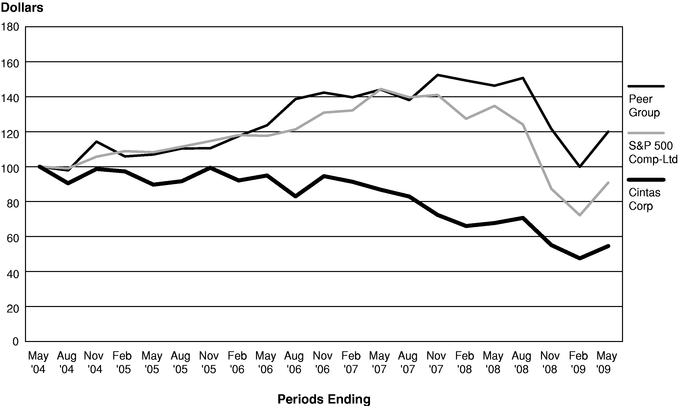
The following graph summarizes the cumulative return on $100 invested in Cintas' common stock, the S&P 500 Stock Index and the common stocks of a selected peer group of companies. Because our products and services are diverse, Cintas does not believe that any single published industry index is appropriate for comparing shareholder return. Therefore, the peer group used in the performance graph combines four publicly traded companies in the business services industry that have similar characteristics as Cintas, such as route-based delivery of products and services. The companies included in the peer group are G & K Services, Inc., UniFirst Corporation, ABM Industries and Ecolab, Inc.
11
Total shareholder return was based on the increase in the price of the stock and assumed reinvestment of all dividends. Further, total return was weighted according to market capitalization of each company. The companies in the peer group are not the same as those considered by the Compensation Committee of the Board of Directors.
Total Shareholder Returns Comparison of Five-Year Cumulative Total Return
Purchases of Equity Securities by the Issuer and Affiliated Purchases
On May 2, 2005, Cintas announced that the Board of Directors authorized a $500 million share buyback program at market prices. In July 2006, Cintas announced that the Board of Directors approved the expansion of its share buyback program by an additional $500 million. The Board of Directors did not specify an expiration date for the share buyback program.
During the first quarter of fiscal 2009, Cintas purchased 0.9 million shares of Cintas' common stock at an average price of $28.61 per share, for a total purchase price of approximately $26 million and Cintas purchased no other shares in fiscal 2009.
From the inception of the share buyback program through July 30, 2009, Cintas has purchased a total of 20.3 million shares of Cintas' common stock at an average price of $39.31 per share for a total purchase price of approximately $798 million. The maximum approximate dollar value of shares that may yet be purchased under the share buyback program as of July 30, 2009, is approximately $202 million.
12
Item 6. Selected Financial Data
**
Eleven-Year Financial Summary
| (In thousands except per share and percentage data) | |||||||||||||||||||||||||||||||||||||
| Fiscal Years Ended May 31, | 1999 | 2000 | 2001 | 2002 | 2003 | 2004 | 2005 | 2006 | 2007 | 2008 | 2009 | 10-Year Compd Growth | |||||||||||||||||||||||||
| Revenue | $ | 1,751,568 | 1,901,991 | 2,160,700 | 2,271,052 | 2,686,585 | 2,814,059 | 3,067,283 | 3,403,608 | 3,706,900 | 3,937,900 | 3,774,685 | 8.0% | ||||||||||||||||||||||||
| Net Income | $ | 136,796 | 190,386 | 218,665 | 229,466 | 243,191 | 265,078 | 292,547 | 323,382 | 334,538 | 335,405 | 226,357 | 5.2% | ||||||||||||||||||||||||
| Basic EPS | $ | 0.83 | 1.14 | 1.30 | 1.35 | 1.43 | 1.55 | 1.70 | 1.93 | 2.09 | 2.15 | 1.48 | 6.0% | ||||||||||||||||||||||||
| Diluted EPS | $ | 0.81 | 1.12 | 1.27 | 1.33 | 1.41 | 1.54 | 1.69 | 1.92 | 2.09 | 2.15 | 1.48 | 6.2% | ||||||||||||||||||||||||
| Dividends Per Share | $ | 0.15 | 0.19 | 0.22 | 0.25 | 0.27 | 0.29 | 0.32 | 0.35 | 0.39 | 0.46 | 0.47 | 12.1% | ||||||||||||||||||||||||
| Total Assets | $ | 1,407,818 | 1,581,342 | 1,752,224 | 2,519,234 | 2,582,946 | 2,810,297 | 3,059,744 | 3,425,237 | 3,570,480 | 3,808,601 | 3,720,951 | 10.2% | ||||||||||||||||||||||||
| Shareholders' Equity | $ | 871,433 | 1,042,896 | 1,231,346 | 1,423,814 | 1,646,418 | 1,888,093 | 2,104,574 | 2,090,192 | 2,167,738 | 2,254,131 | 2,367,409 | 10.5% | ||||||||||||||||||||||||
| Return on Average Equity (1) | 16.8% | 19.9% | 19.2% | 17.3% | 15.8% | 15.0% | 14.7% | 15.4% | 15.7% | 15.2% | 9.8% | ||||||||||||||||||||||||||
| Long-Term Debt | $ | 283,581 | 254,378 | 220,940 | 703,250 | 534,763 | 473,685 | 465,291 | 794,454 | 877,074 | 942,736 | 786,058 | |||||||||||||||||||||||||
(1)
Return on average equity is computed as net income divided by the average of shareholders' equity. We believe that this calculation gives management and shareholders a good indication of Cintas' historical performance.
13
Item 7. Management's Discussion and Analysis
of Financial Condition and Results of Operation **
Business Strategy
Cintas provides highly specialized products and services to businesses of all types primarily throughout the United States and Canada. We refer to ourselves as "The Service Professionals." We bring value to our customers by helping them provide a cleaner, safer, more pleasant atmosphere for their customers and employees. Our products and services are designed to improve our customers' images. We also help our customers protect their employees and their company by enhancing workplace safety and helping to ensure legal compliance in key areas of their business.
We are North America's leading provider of corporate identity uniforms through rental and sales programs, as well as a significant provider of related business services, including entrance mats, restroom products and services, first aid, safety and fire protection products and services, document management services and branded promotional products.
Our business strategy is to achieve revenue growth for all of our products and services by increasing our penetration at existing customers and by broadening our customer base to include business segments to which Cintas has not historically served. We will also continue to identify additional product and service opportunities for our current and future customers.
To pursue the strategy of increasing penetration, we have a highly talented and diverse team of service professionals visiting our customers on a regular basis. This frequent contact with our customers enables us to develop close personal relationships. The combination of our distribution system and these strong customer relationships provides a platform from which we launch additional products and services.
We pursue the strategy of broadening our customer base in a few ways. Cintas has a national sales organization introducing all of our products and services to prospects in all business segments. Our ever expanding range of products and services allows our sales organization to consider any type of business a prospect. We also broaden our customer base through geographic expansion, especially in our emerging businesses of first aid and safety, fire protection and document management. Finally, we evaluate strategic acquisitions as opportunities arise.
Results of Operation
The economic environment in fiscal 2009 presented challenges not experienced in decades. The financial crisis which began in September, 2008, caused many of our customers to immediately reduce spending. As the economic turmoil continued, we saw our customers make dramatic reductions in spending. Significant job losses in the U.S. and Canada followed the financial crisis, as these economies lost millions of jobs from October, 2008, through May, 2009.
The suddenness and severity of the economic downturn required us to react quickly to reduce our cost structure. Beginning in the second quarter of fiscal 2009, we closed two manufacturing plants in Kentucky, initiated hiring and wage freezes in many parts of the organization, eliminated many overhead positions and reduced discretionary and capital spending. These initiatives resulted in a reduction to selling and administrative expenses of approximately $60 million when comparing the last six months of fiscal 2009 to the first six months of fiscal 2009.
In addition to the actions described above, we initiated restructuring activities during the fourth quarter of fiscal 2009 to reduce excess capacity and further reduce our cost structure. These activities included closing or converting to branches 16 of our rental processing plants and reducing our workforce by 1,200 employees. We
14
expect these restructuring activities to be completed by May 31, 2010. During the fourth quarter of fiscal 2009, we recorded charges of $48.9 million in long-lived asset impairment costs, $7.9 million in employee termination costs and $2.3 million in other exit costs for a total of $59.1 million that will be incurred as a result of this restructuring. The following summarizes these amounts by operating segment:
| (In millions) May 31, 2009 | Rental Uniforms & Ancillary Products | Uniform Direct Sales | First Aid, Safety & Fire Protection | Document Management | Total | ||||||||||||
| Restructuring charges | $ | 8.8 | $ | 0.5 | $ | 0.6 | $ | 0.3 | $ | 10.2 | |||||||
| Impairment of long-lived assets | 44.2 | 4.1 | 0.6 | — | 48.9 | ||||||||||||
| Loss before income taxes | $ | 53.0 | $ | 4.6 | $ | 1.2 | $ | 0.3 | $ | 59.1 | |||||||
A progression of our restructuring liability balance, primarily recorded in accrued compensation and related liabilities, at May 31, 2009, is as follows:
| (In millions) | Employee Termination Costs | Other Exit Costs | Total | ||||||||
| Charge to earnings — fiscal 2009 | $ | 7.9 | $ | 2.3 | $ | 10.2 | |||||
| Cash paid — fiscal 2009 | (2.0 | ) | — | (2.0 | ) | ||||||
| Balance as of May 31, 2009 | $ | 5.9 | $ | 2.3 | $ | 8.2 | |||||
The restructuring activities are more fully described in Note 2 entitled Restructuring and Related Activity of "Notes to Consolidated Financial Statements."
Despite the economic turmoil during fiscal 2009, we were still able to generate strong operating cash flow. Net cash provided by operating activities was $523.5 million. We reduced capital and acquisition spending by $110.9 million in fiscal 2009 compared to fiscal 2008. We were able to pay down $157.1 million in net borrowings during fiscal 2009, resulting in no outstanding commercial paper borrowings as of May 31, 2009. Additionally, we were still able to pay shareholders an increased dividend of $0.47 per share.
Cintas classifies its businesses into four operating segments. The Rental Uniforms and Ancillary Products operating segment reflects the rental and servicing of uniforms and other garments including flame resistant clothing, mats, mops and shop towels and other ancillary items. In addition to these rental items, restroom and hygiene products and services are also provided within this operating segment. The Uniform Direct Sales operating segment consists of the direct sale of uniforms and related items and branded promotional products. The First Aid, Safety and Fire Protection Services operating segment consists of first aid, safety and fire protection products and services. The Document Management Services operating segment consists of document destruction, document imaging and document retention services.
15
The following table sets forth certain consolidated statements of income data as a percentage of revenue by operating segment and in total for the periods indicated.
| ** 2009** | 2008 | 2007 | ||||||||||
| Revenue: | ||||||||||||
| Rental Uniforms and Ancillary Products | 73.0 | % | 72.0 | % | 73.8 | % | ||||||
| Uniform Direct Sales | 11.4 | % | 13.1 | % | 13.5 | % | ||||||
| First Aid, Safety and Fire Protection Services | 10.0 | % | 10.3 | % | 9.8 | % | ||||||
| Document Management Services | 5.6 | % | 4.6 | % | 2.9 | % | ||||||
Showing the first 8K of 63K characters. Open the full section
Item 7A. Quantitative and Qualitative Disclosure About Market Risk
**
Cintas manages interest rate risk by using a combination of variable and fixed rate debt and investing in marketable securities. Earnings are affected by changes in short-term interest rates due to investments in marketable securities and money market accounts and periodic issuances of commercial paper. If short-term rates changed by one-half percent (or 50 basis points), Cintas' income before income taxes would change by approximately $0.5 million. This estimated exposure considers the effects on investments and the change in the cost of variable rate debt. This analysis does not consider the effects of a change in economic activity or a change in Cintas' capital structure.
Through its foreign operations, Cintas is exposed to foreign currency risk. Foreign currency exposures arise from transactions denominated in a currency other than the functional currency and from foreign denominated revenue and profit translated into U.S. dollars. Foreign denominated revenue and profit represents less than 10% of Cintas' consolidated revenue and profit. Cintas periodically uses foreign currency hedges such as average rate options and forward contracts to mitigate the risk of foreign currency exchange rate movements resulting from foreign currency revenue and from international cash flows. The primary foreign currency to which Cintas is exposed is the Canadian dollar.
29
Item 8. Financial Statements and Supplementary Data
**
Index to Consolidated Financial Statements
| Audited Consolidated Financial Statements for the Fiscal Years Ended May 31, 2009, 2008 and 2007 | ||||
| Management's Report on Internal Control over Financial Reporting | 31 | |||
| Reports of Ernst & Young LLP, Independent Registered Public Accounting Firm | 32 | |||
| Consolidated Statements of Income | 34 | |||
| Consolidated Balance Sheets | 35 | |||
| Consolidated Statements of Shareholders' Equity | 36 | |||
| Consolidated Statements of Cash Flows | 37 | |||
| Notes to Consolidated Financial Statements | 38 |
30
**Management's Report on Internal Control over Financial Reporting
**
To the Shareholders of Cintas Corporation:
Our management is responsible for establishing and maintaining adequate internal control over financial reporting (as defined in Rule 13a-15(f) and 15(d)-15(f) under the Securities Exchange Act of 1934) to provide reasonable assurance regarding the reliability of our financial reporting and the preparation of financial statements for external purposes in accordance with accounting principles generally accepted in the United States. Internal control over financial reporting includes those policies and procedures that (1) pertain to the maintenance of records that in reasonable detail accurately and fairly reflect the transactions and dispositions of the assets of the company; (2) provide reasonable assurance that transactions are recorded as necessary to permit preparation of financial statements in accordance with generally accepted accounting principles and that receipts and expenditures of the company are being made only in accordance with authorizations of management and directors of the company; and (3) provide reasonable assurance regarding prevention or timely detection of unauthorized acquisition, use or disposition of the company's assets that could have a material effect on the financial statements.
Because of its inherent limitations, internal control over financial reporting may not prevent or detect misstatements. Also, projections of any evaluation of effectiveness to future periods are subject to the risk that controls may become inadequate because of changes in conditions, or that the degree of compliance with the policies or procedures may deteriorate. Accordingly, even an effective system of internal control over financial reporting will provide only reasonable assurance with respect to financial statement preparation.
With the supervision of our Chief Executive Officer and our Chief Financial Officer, management assessed our internal control over financial reporting as of May 31, 2009. Management based its assessment on criteria established in Internal Control — Integrated Framework issued by the Committee of Sponsoring Organizations of the Treadway Commission (COSO). Management's assessment included evaluation of such elements as the design and operating effectiveness of key financial reporting controls, process documentation, accounting policies and our overall control environment. This assessment is supported by testing and monitoring performed by our internal audit function.
Based on our assessment, management has concluded that our internal control over financial reporting was effective as of May 31, 2009, to provide reasonable assurance regarding the reliability of financial reporting and the preparation of financial statements for external reporting purposes in accordance with accounting principles generally accepted in the United States.
We reviewed the results of management's assessment with the Audit Committee of our Board of Directors. Additionally, our independent registered public accounting firm, Ernst & Young LLP, independently assessed the effectiveness of Cintas Corporation's internal control over financial reporting. Ernst & Young LLP has issued an attestation report, which is included in this Annual Report.
| /s/ Scott D. Farmer Scott D. Farmer Chief Executive Officer | ||
| /s/ William C. Gale William C. Gale Senior Vice President and Chief Financial Officer |
31
**Report of Independent Registered Public Accounting Firm
**
To the Board of Directors and Shareholders of Cintas Corporation:
We have audited Cintas Corporation's internal control over financial reporting as of May 31, 2009, based on criteria established in Internal Control — Integrated Framework issued by the Committee of Sponsoring Organizations of the Treadway Commission (the COSO criteria). Cintas Corporation's management is responsible for maintaining effective internal control over financial reporting, and for its assessment of the effectiveness of internal control over financial reporting included in the accompanying Management's Report on Internal Control over Financial Reporting. Our responsibility is to express an opinion on management's assessment and an opinion on the effectiveness of the company's internal control over financial reporting based on our audit.
We conducted our audit in accordance with the standards of the Public Company Accounting Oversight Board (United States). Those standards require that we plan and perform the audit to obtain reasonable assurance about whether effective internal control over financial reporting was maintained in all material respects. Our audit included obtaining an understanding of internal control over financial reporting, assessing the risk that a material weakness exists, testing and evaluating the design and operating effectiveness of internal control based on the assessed risk, and performing such other procedures as we considered necessary in the circumstances. We believe that our audit provides a reasonable basis for our opinion.
A company's internal control over financial reporting is a process designed to provide reasonable assurance regarding the reliability of financial reporting and the preparation of financial statements for external purposes in accordance with generally accepted accounting principles. A company's internal control over financial reporting includes those policies and procedures that (1) pertain to the maintenance of records that, in reasonable detail, accurately and fairly reflect the transactions and dispositions of the assets of the company; (2) provide reasonable assurance that transactions are recorded as necessary to permit preparation of financial statements in accordance with generally accepted accounting principles, and that receipts and expenditures of the company are being made only in accordance with authorizations of management and directors of the company; and (3) provide reasonable assurance regarding prevention or timely detection of unauthorized acquisition, use, or disposition of the company's assets that could have a material effect on the financial statements.
Because of its inherent limitations, internal control over financial reporting may not prevent or detect misstate
Showing the first 8K of 139K characters. Open the full section
Item 9. Changes in and Disagreements with
Accountants on Accounting and Financial Disclosure **
Nothing to report.
Item 9A. Controls and Procedures
**
Disclosure Controls and Procedures
With the participation of Cintas' management, including Cintas' Chief Executive Officer, Chief Financial Officer, General Counsel and Controllers, Cintas has evaluated the effectiveness of the disclosure controls and procedures (as defined in Rule 13a-15(e) and 15d-15(e) under the Securities Exchange Act of 1934) as of May 31, 2009. Based on such evaluation, Cintas' management, including Cintas' Chief Executive Officer, Chief Financial Officer, General Counsel and Controllers, have concluded that Cintas' disclosure controls and procedures were effective as of May 31, 2009, in ensuring (i) information required to be disclosed by Cintas in the reports that it files or submits under the Exchange Act is recorded, processed, summarized and reported, within the time periods specified in the SEC's rules and forms and (ii) information required to be disclosed by Cintas in the reports that it files or submits under the Exchange Act is accumulated and communicated to Cintas' management, including its principal executive and principal financial officers, or persons performing similar functions, as appropriate to allow timely decisions regarding required disclosure.
Internal Control over Financial Reporting
There were no changes in Cintas' internal control over financial reporting (as defined in Rules 13a-15(f) and 15d-15(f) under the Exchange Act) during the fiscal quarter ended May 31, 2009, that have materially affected, or are reasonably likely to materially affect, our internal control over financial reporting. See "Management's Report on Internal Control over Financial Reporting" and "Report of Independent Registered Public Accounting Firm" in Item 8 preceding Cintas' financial statements.
Item 9B. Other Information
**
Nothing to report.
66
**Part III **
Items 10, 11, 12, 13 and 14 of Part III are incorporated by reference to the Registrant's Proxy Statement for its 2009 Annual Shareholders' Meeting to be filed with the Commission pursuant to Regulation 14A.
The information called for by Item 12 relating to "Securities Authorized for Issuance under Equity Compensation Plans" is set forth in the table below:
Securities Authorized for Issuance Under Equity Compensation Plans
Equity Compensation Plan Information
| Plan category | Number of shares to be issued upon exercise of outstanding options (1) | Weighted average exercise price of outstanding options (1) | Number of shares remaining available for future issuance under equity compensation plans | |||||||
| Equity compensation plans approved by shareholders | 6,359,424 | $ | 38.91 | 11,573,249 | ||||||
| Equity compensation plans not approved by shareholders | — | — | — | |||||||
| Total | 6,359,424 | $ | 38.91 | 11,573,249 | ||||||
(1) Excludes 981,369 unvested restricted stock units.
67
**Part IV **
Item 15. Exhibits and Financial Statement Schedules
**
| (a) (1) | Financial Statements. All financial statements required to be filed by Item 8 of this Form and included in this report are listed in Item 8. No additional financial statements are filed because the requirements for paragraph (d) under Item 14 are not applicable to Cintas. | |
| (a) (2) | Financial Statement Schedule: | |
| For each of the three years in the period ended May 31, 2009. | ||
| Schedule II: Valuation and Qualifying Accounts and Reserves. | ||
| All other schedules are omitted because they are not applicable, or not required, or because the required information is included in the Consolidated Financial Statements or Notes thereto. | ||
| (a) (3) | Exhibits. |
| Exhibit Number | Description of Exhibit | |
| 3.1 | Restated Articles of Incorporation, as amended (Incorporated by reference to Exhibit 4.1 to Cintas' Form S-3 Registration Statement filed on December 3, 2007.) | |
| 3.2 | Amended and Restated By-laws (Incorporated by reference to Exhibit 3 to Cintas' Form 8-K dated October 14, 2008.) | |
| 4.1 | Indenture dated as of May 28, 2002, among Cintas Corporation No. 2, as issuer, Cintas Corporation, as parent guarantor, the subsidiary guarantors thereto and Wachovia Bank, National Association, as trustee (Incorporated by reference to Cintas' Form 10-Q for the quarter ended February 28, 2005.) | |
| 4.2 | Form of 5-1/8% Senior Note due 2007 (Incorporated by reference to Cintas' Form 10-Q for the quarter ended February 28, 2005.) | |
| 4.3 | Form of 6% Senior Note due 2012 (Incorporated by reference to Cintas' Form 10-Q for the quarter ended February 28, 2005.) | |
| 4.4 | Form of 6.15% Senior Note due 2036 (Incorporated by reference to Cintas' Form 8-K dated August 17, 2006.) | |
| 10.1* | Incentive Stock Option Plan (Incorporated by reference to Cintas' Registration Statement No. 33-23228 on Form S-8 filed under the Securities Act of 1933.) | |
| 10.2* | Partners' Plan, as Amended (Incorporated by reference to Cintas' Registration Statement No. 33-56623 on Form S-8 filed under the Securities Act of 1933.) | |
| 10.3* | 1999 Cintas Corporation Stock Option Plan (Incorporated by reference to Cintas' Form 10-Q for the quarter ended November 30, 2000.) | |
| 10.4* | Directors' Deferred Compensation Plan (Incorporated by reference to Cintas' Form 10-Q for the quarter ended November 30, 2001.) | |
| 10.5* | Amended and Restated 2003 Directors' Stock Option Plan (Incorporated by reference to Cintas' Form 10-K dated May 31, 2004.) |
68
| 10.6* | Form of agreement signed by Officers, General/Branch Managers, Professionals and Key Managers, including Executive Officers (Incorporated by reference to Cintas' Form 10-Q for the quarter ended February 28, 2005.) | |
| 10.7* | President and CEO Executive Compensation Plan (Incorporated by reference to Cintas' Form 10-K dated May 31, 2005.) | |
| 10.8* | 2006 Executive Incentive Plan (Incorporated by reference to Cintas' Form 10-K dated May 31, 2005.) | |
| 10.9* | 2005 Equity Compensation Plan (Incorporated by reference to Cintas' Registration Statement No. 333-131375 on Form S-8 filed under the Securities Act of 1933.) | |
| 10.10* | Criteria for Performance Evaluation of the President and CEO (Incorporated by reference to Cintas' Form 10-K dated May 31, 2006.) | |
| 10.11* | 2007 Executive Incentive Plan (Incorporated by reference to Cintas' Form 10-K dated May 31, 2006.) | |
| 14 | Code of Ethics (Incorporated by reference to Cintas' Form 10-K dated May 31, 2004.) | |
| 21** | Subsidiaries of the Registrant | |
| 23** | Consent of Independent Registered Public Accounting Firm | |
| 31.1** | Certification of Principal Executive Officer, Pursuant to Rule 13a–14(a) of the Securities Exchange Act of 1934 | |
| 31.2** | Certification of Principal Financial Officer, Pursuant to Rule 13a–14(a) of the Securities Exchange Act of 1934 | |
| 32.1** | Certification of Chief Executive Officer, Pursuant to 18 U.S.C. § 1350 | |
| 32.2** | Certification of Chief Financial Officer, Pursuant to 18 U.S.C. § 1350 |
Management compensatory contracts
**
Filed herewith
Cintas will provide shareholders with any exhibit upon the payment of a specified reasonable fee, which fee shall be limited to Cintas' reasonable expenses in furnishing such exhibit.
69
Signatures
Pursuant to the requirements of Section 13 or 15(d) of the Securities Exchange Act of 1934, the Registrant has duly caused this report to be signed on its behalf by the undersigned, thereunto duly authorized.
CINTAS CORPORATION
By: /s/ Scott D. Farmer Scott D. Farmer Chief Executive Officer
DATE SIGNED: July 30, 2009
Pursuant to the requirements of the Securities Exchange Act of 1934, this report has been signed by the following persons on behalf of the Registrant and in the capacities and on the dates indicated.
| Signature | Capacity | Date | ||||
| /s/ | Richard T. Farmer Richard T. Farmer | Chairman of the Board of Directors | July 30, 2009 | |||
| /s/ | Robert J. Kohlhepp Robert J. Kohlhepp | Vice Chairman of the Board of Directors | July 30, 2009 | |||
| /s/ | Scott D. Farmer Scott D. Farmer | Chief Executive Officer and Director | July 30, 2009 | |||
| /s/ | Paul R. Carter Paul R. Carter | Director | July 30, 2009 | |||
| /s/ | Ronald W. Tysoe Ronald W. Tysoe | Director | July 30, 2009 | |||
| /s/ | David C. Phillips David C. Phillips | Director | July 30, 2009 | |||
| /s/ | William C. Gale William C. Gale | Senior Vice President and Chief Financial Officer (Principal Financial and Accounting Officer) | July 30, 2009 |
70
Cintas Corporation Schedule II — Valuation and Qualifying Accounts and Reserves
| Additions | ||||||||||||||||||
| (In thousands) | Balance at Beginning of Year | (1) Charged to Costs and Expenses | (2) Charged to Other Accounts | (3) Deductions | Balance at End of Year | |||||||||||||
| Allowance for Doubtful Accounts | ||||||||||||||||||
| May 31, 2007 | $ | 15,519 | $ | 3,325 | $ | 341 | $ | 4,699 | $ | 14,486 | ||||||||
| May 31, 2008 | $ | 14,486 | $ | 4,530 | $ | 127 | $ | 6,004 | $ | 13,139 | ||||||||
| May 31, 2009 | $ | 13,139 | $ | 16,650 | $ | 5 | $ | 10,262 | $ | 19,532 | ||||||||
| Reserve for Obsolete Inventory | ||||||||||||||||||
| May 31, 2007 | $ | 24,447 | $ | 2,559 | $ | 1,084 | $ | 5,184 | $ | 22,906 | ||||||||
| May 31, 2008 | $ | 22,906 | $ | 1,431 | $ | 751 | $ | 4,428 | $ | 20,660 | ||||||||
| May 31, 2009 | $ | 20,660 | $ | 33,972 | $ | (85 | ) | $ | 6,194 | $ | 48,353 | |||||||
(1)
Represents amounts charged to expense to increase reserve for estimated future bad debts or to increase reserve for obsolete inventory. Amounts related to inventory are computed by performing a thorough analysis of future marketability by specific inventory item.
(2)
Represents a change in the appropriate balance sheet reserve due to acquisitions during the respective period.
(3)
Represents reductions in the balance sheet reserve due to the actual write-off of non-collectible accounts receivable or the physical disposal of obsolete inventory items. These amounts do not impact Cintas' consolidated income statement.
71