 filings.tools
Cintas 10-K 2021-05-31
Filed 2021-07-28. 23 sections, 320K characters. Original on sec.gov · Markdown · JSON
Cover and table of contents
UNITED STATES
SECURITIES AND EXCHANGE COMMISSION
WASHINGTON, D.C. 20549
FORM 10-K
| ☒ | ANNUAL REPORT PURSUANT TO SECTION 13 OR 15(d) OF THE SECURITIES EXCHANGE ACT OF 1934 | |||||||
| For the fiscal year ended | May 31, 2021 | |||||||
| ☐ | TRANSITION REPORT PURSUANT TO SECTION 13 OR 15(d) OF THE SECURITIES EXCHANGE ACT OF 1934 |
Commission file number 0-11399
Cintas Corporation
(Exact name of registrant as specified in its charter)
| Washington | 31-1188630 | |||||||
| (State or Other Jurisdiction of Incorporation or Organization) | (IRS Employer Identification Number) |
| 6800 Cintas Boulevard | |||||||||||
| P.O. Box 625737 | |||||||||||
| Cincinnati, | Ohio | 45262-5737 | |||||||||
| (Address of Principal Executive Offices) | (Zip Code) |
Registrant's Telephone Number, Including Area Code: (513) 459-1200
Securities registered pursuant to Section 12(b) of the Act
| Title of each class | Trading symbol(s) | Name of each exchange on which registered | ||||||||||||
| Common stock, no par value | CTAS | The NASDAQ Stock Market LLC | ||||||||||||
| (NASDAQ Global Select Market) |
Securities registered pursuant to Section 12(g) of the Act: None
Indicate by check mark if the Registrant is a well-known seasoned issuer, as defined in Rule 405 of the Securities Act.
| Yes | ☒ | No | ☐ |
Indicate by check mark if the Registrant is not required to file reports pursuant to Section 13 or Section 15(d) of the Act.
| Yes | ☐ | No | ☒ |
Indicate by check mark whether the Registrant (1) has filed all reports required to be filed by Section 13 or 15(d) of the Securities Exchange Act of 1934 during the preceding 12 months (or for such shorter period that the Registrant was required to file such reports) and (2) has been subject to such filing requirements for the past 90 days.
| Yes | ☒ | No | ☐ |
Indicate by check mark whether the Registrant has submitted electronically every Interactive Data File required to be submitted pursuant to Rule 405 of Regulation S-T (§232.405 of this chapter) during the preceding 12 months (or for such shorter period that the Registrant was required to submit such files.
| Yes | ☒ | No | ☐ |
Indicate by check mark whether the Registrant is a large accelerated filer, an accelerated filer, a non-accelerated filer, a smaller reporting company or an emerging growth company. See the definitions of "large accelerated filer," "accelerated filer," "smaller reporting company" and "emerging growth company" in Rule 12b-2 of the Exchange Act.
| Large Accelerated Filer | ☒ | Accelerated Filer | ☐ | Non-Accelerated Filer | ☐ | |||||||||||||||
| Smaller Reporting Company | ☐ | Emerging Growth Company | ☐ |
If an emerging growth company, indicate by check mark if the registrant has elected not to use the extended transition period for complying with any new or revised financial accounting standards provided pursuant to Section 13(a) of the Exchange Act. ☐
Indicate by check mark whether the registrant has filed a report on and attestation to its management's assessment of the effectiveness of its internal control over financial reporting under Section 404(b) of the Sarbanes-Oxley Act (15 U.S.C.762(b)) by the registered public accounting firm that prepared or issued is audit report. ☒
Indicate by check mark whether the Registrant is a shell company (as defined in Rule 12b-2 of the Act).
| Yes | ☐ | No | ☒ |
The aggregate market value of the Registrant's Common Stock held by non-affiliates as of November 30, 2020, was $37,301,430,580 based on a closing sale price of $355.30 per share. As of June 30, 2021, 189,135,107 shares of the Registrant's Common Stock were issued and 102,967,245 shares were outstanding.
Documents Incorporated by Reference
Portions of the Registrant's Proxy Statement to be filed with the Commission for its 2021 Annual Meeting of Shareholders are incorporated by reference in Part III of this Form 10-K.
1
Cintas Corporation
Index to Annual Report on Form 10-K
2
Part I
Item 1. Business
Overview
Cintas Corporation (Cintas, Company, we, us or our), a Washington corporation, helps more than one million businesses of all types and sizes, primarily in the United States (U.S.), as well as Canada and Latin America, get READY™ to open their doors with confidence every day by providing a wide range of products and services that enhance our customers’ image and help keep their facilities and employees clean, safe and looking their best. With products and services including uniforms, mats, mops, restroom supplies, first aid and safety products, fire extinguishers and testing, and safety training, Cintas helps customers get Ready for the Workday®. The company is also the creator of the Total Clean Program™ — a first-of-its-kind service that includes scheduled delivery of essential cleaning supplies, hygienically clean laundering, and sanitizing and disinfecting projects and services. Cintas was founded in 1968 by Richard T. Farmer, currently the Chairman Emeritus of the Board of Directors, when he left his family's industrial laundry business in order to develop uniform programs using an exclusive new fabric. In the early 1970's, Cintas acquired the family industrial laundry business. Over the years, Cintas developed additional products and services that complemented its core uniform business and broadened the scope of products and services available to its customers.
Business Segments
Cintas’ reportable operating segments are the Uniform Rental and Facility Services operating segment and the First Aid and Safety Services operating segment. The Uniform Rental and Facility Services reportable operating segment consists of the rental and servicing of uniforms and other garments, including flame resistant clothing, mats, mops and shop towels and other ancillary items. In addition to these rental items, restroom cleaning services and supplies and the sale of items from our catalogs to our customers on route are included within this reportable operating segment. The First Aid and Safety Services reportable operating segment consists of first aid and safety products and services. The remainder of Cintas’ business, which consists of the Fire Protection Services operating segment and the Uniform Direct Sale operating segment, is included in All Other.
The following table sets forth Cintas' total revenue and the revenue derived from each reportable operating segment and the remaining operating segments included in the All Other category for the fiscal years ended May 31:
| (In thousands) | 2021 | 2020 | 2019 | ||||||||||||||
| Uniform Rental and Facility Services | $ | 5,689,632 | $ | 5,643,494 | $ | 5,552,430 | |||||||||||
| First Aid and Safety Services | 784,291 | 708,569 | 619,470 | ||||||||||||||
| All Other | 642,417 | 733,057 | 720,403 | ||||||||||||||
| Total Revenue | $ | 7,116,340 | $ | 7,085,120 | $ | 6,892,303 |
Additional information regarding each reportable operating segment and All Other is also included in Note 14 entitled Operating Segment Information of "Notes to Consolidated Financial Statements."
COVID-19 Pandemic
In December 2019, a novel strain of coronavirus (COVID-19) was reported to have surfaced in Wuhan, China, and has since spread globally. In March 2020, the World Health Organization characterized COVID-19 as a pandemic. Efforts to contain the spread of COVID-19 intensified during our fiscal 2020 fourth quarter and have remained in effect throughout our fiscal 2021. Most states and municipalities within the U.S., as well as Canada, enacted temporary closures of businesses, issued quarantine orders and took other restrictive measures in response to the COVID-19 pandemic. Many of the business closures, quarantine orders and other restrictive measures remained in place through fiscal 2021. Within the U.S., our business was designated an essential business, which allowed us to continue to serve customers that remained open. During our fiscal 2021 fourth quarter, the roll out of vaccines, lower COVID-19 case counts and lifting of restrictions on businesses had a positive impact on our business.
We have operations throughout the U.S. and Canada and participate in a global supply chain. During most of fiscal 2021, the existence of the COVID-19 pandemic, the fear associated with the COVID-19 pandemic and the reactions of governments around the world in response to the COVID-19 pandemic to regulate the flow of labor and products
3
and impede the business of our customers, impacted our ability to conduct normal business operations, which had an adverse effect on our business. Many of Cintas' customers were also impacted by the COVID-19 pandemic, and we saw an impact on some customer's ability to pay timely. While there was minimal disruption to our supply chain, Cintas did increase inventory, primarily personal protective equipment and facility services inventory, in response to the customer needs and demand associated with the safety and cleanliness requirements of COVID-19. The increase in inventory resulted in additional inventory reserves during fiscal 2021 and could result in future inventory reserve increases if demand for personal protective equipment declines. See Note 1 entitled Significant Accounting Policies of "Notes to Consolidated Financial Statements" for additional detail on the additional reserve placed on inventory. The impact of the COVID-19 pandemic is fluid and continues to evolve, and therefore, we cannot predict the extent to which our business, consolidated results of operations, consolidated financial condition or liquidity will ultimately be impacted. For more information, see the sections entitled “Management’s Discussion and Analysis of Financial Condition and Results of Operations,” and “Risk Factors” within this Annual Report on Form 10-K.
Customers
We provide our products and services to over one million businesses of all types, from small service and manufacturing companies to major corporations that employ thousands of people. This diversity in customer base results in no individual customer accounting for greater than one percent of Cintas' total revenue. As a result, the loss of one account would not have a significant financial impact on Cintas.
Competition
The primary markets served by all Cintas businesses are local in nature and highly fragmented. Cintas competes with national, regional and local providers, large national retailers and small local retailers as well as companies with a significant online presence and the level of competition varies at each of Cintas' local operations. Product, design, price, quality, service and convenience to the customer are the competitive elements in each of our businesses.
Operations and Distribution
Within the Uniform Rental and Facility Services reportable operating segment, Cintas provides its products and services to customers via local delivery routes originating from rental processing plants and branches. Within the First Aid and Safety Services reportable operating segment and All Other, Cintas provides its products and services via its distribution network and local delivery routes or local representatives. At May 31, 2021, Cintas, in total, had approximately 11,000 local delivery routes, 460 operational facilities and 13 distribution centers.
Sourcing
Cintas is committed to sourcing responsibly. Cintas sources finished products from many outside suppliers. As mentioned on our website, www.cintas.com, each and every supplier must comply with a vendor code of conduct as a condition of doing business with Cintas. Cintas also conducts internal training to ensure that employees who have direct responsibility for supply chain management are knowledgeable and aware of issues and concerns surrounding our supply chain. In addition to sourcing from third-party suppliers, Cintas operates five manufacturing facilities that provide for standard uniform needs. Cintas purchases fabric, used in the manufacturing of its products, from several suppliers. Cintas is not aware of any circumstances that would hinder its ability to continue obtaining these materials.
Government Laws and Regulations
Cintas is subject to a wide array of laws, government regulations, including environmental regulations, and standards in each domestic and foreign jurisdiction in which it operates. In addition to Cintas’s U.S. operations, which in fiscal 2021 generated over 90% of its consolidated net sales, Cintas also operates its business through wholly-owned subsidiaries in foreign jurisdictions, primarily in Canada. Compliance with these laws, government regulations, including environmental regulations, and standards requires the dedication of time and effort of employees as well as financial resources.
Compliance with environmental regulations and prioritizing our environmental sustainability efforts are important to us as a good corporate citizen. Our journey started in 1929 during the Great Depression when Doc and Amelia Farmer collected shop towels that had been disposed of by manufacturing facilities along the Ohio River. They washed, recycled and sold the clean towels back to companies. Today, the majority of our total Company revenue comes from our Uniform Rental and Facility Services reportable operating segment. Most of these items are cleaned and processed in ways that extend their lifespan and, when not in use, are re-stocked for future customers to maximize their lifespan. Our laundering processes generate far less wastewater than home laundering. Water
4
discharged into the environment is treated at our operating facilities and in accordance with local discharge standards and permits. Our lasting commitment to the environment and our communities is evident from our processes and innovation, which are designed to ensure that our operational facilities are operating efficiently. Cintas is subject to various environmental laws and regulations, as are other companies in the uniform rental industry. The primary federal statutes that apply to our activities in the U.S. are the Clean Air Act, the Clean Water Act and the Resource Conservation and Recovery Act. We are also subject to the Superfund Amendments and Reauthorization Act of 1986, which imposes certain reporting requirements as to emissions of hazardous substances into the air, land and water. While environmental compliance is not a material component of our costs, Cintas makes capital expenditures and associated operating costs, primarily for water treatment and waste removal, on a regular basis in order to comply with environmental laws and regulations, to promote employee safety and to carry out its environmental sustainability principles. Environmental spending related to water treatment and waste removal was approximately $19.0 million in fiscal 2021, approximately $20.0 million in fiscal 2020 and approximately $21.0 million in fiscal 2019. Capital expenditures to limit or monitor hazardous substances totaled approximately $1.0 million in fiscal 2021, approximately $3.0 million in fiscal 2020 and approximately $10.0 million in fiscal 2019.
In addition, health and safety regulations (including laws or regulations promulgated in response to the ongoing COVID-19 pandemic) have necessitated, and may continue to necessitate, increased operating costs or capital investments to promote a safe working environment. Cintas is also required to comply with increasingly complex and changing laws and regulations enacted to protect business and personal data in the U.S. and other jurisdictions regarding privacy, data protection and data security, including those related to the collection, storage, use, transmission and protection of personal information and other consumer, customer, vendor or employee data. With respect to the laws and regulations noted above, as well as other applicable laws and regulations, Cintas’s compliance programs may under certain circumstances involve material investments in the form of additional processes, training, personnel, information technology and capital. In fiscal 2021, compliance with the applicable laws, government regulations, including environmental regulations, and standards did not have a material effect on Cintas’s capital expenditures or consolidated results of operations. For a discussion of the risks associated with government regulations that may materially impact Cintas, please see “Item 1A: Risk Factors—Legal and Regulatory Risks.”
Communication
Cintas uses its corporate website, www.cintas.com, as a channel for routine distribution of important information, including news releases, analyst presentations and financial information. This year, Cintas produced an expanded Environmental, Social and Governance (ESG) Report to share our focus on making a positive impact through our key ESG priorities. This included work in areas of safety and health, energy and emissions, water usage, sustainable supply chain, and governance, ethics and integrity to support diversity and equality, assisting our employee-partners in need and giving back to the communities where we live and work. Particularly during unprecedented times and issues as a result of the COVID-19 pandemic, Cintas responded with improved policies, cleaning regimens and sanitizing products and services to help keep our employee-partners, and in turn, our customers, safer. We are also READY™ to help as many of our customers fully reopen their businesses.
Cintas files with or furnishes to the Securities and Exchange Commission (SEC) Annual Reports on Form 10-K, Quarterly Reports on Form 10-Q, Current Reports on Form 8-K and any amendments to those reports, as well as proxy statements and annual reports to shareholders, and, from time to time, other documents. The reports and other documents filed with or furnished to the SEC are available to investors on or through our corporate website free of charge as soon as reasonably practicable after we electronically file them with or furnish them to the SEC. The SEC maintains an internet site located at www.sec.gov that contains reports, proxy and information statements and other information regarding issuers, such as Cintas, that file electronically with the SEC. Cintas' SEC filings can be found on the Investors page of its website at www.cintas.com/investors/financials.aspx and its Code of Conduct and Business Ethics can be found on the About Us page of its website at www.cintas.com/company. These documents are available in print to any shareholder who requests a copy by writing or calling Cintas as set forth on the Investor Information page. The content on any website referred to in this Annual Report on Form 10-K is not incorporated by reference into this Form 10-K unless expressly noted.
5
Human Capital
Cintas’ key human capital management objectives are to attract, retain and develop talent to deliver on the Company’s strategy. To support these objectives, Cintas’ human resources programs are designed to: keep people safe and healthy; enhance the Company’s culture through efforts aimed at making the workplace more inclusive; acquire and retain diverse talent; reward and support employee-partners through competitive pay and benefit programs; develop talent to prepare them for critical roles and leadership positions; and facilitate internal talent mobility to create a high-performing workforce. The principles and values our employee-partners share are the driving force behind all our accomplishments. At May 31, 2021, Cintas employed approximately 40,000 employee-partners in our global workforce, of which approximately 1,000 were represented by labor unions.
Our primary areas of focus in managing our human capital include the following:
Corporate Culture
We believe that our culture at Cintas is just as essential as our products and services. Our culture impacts the quality of the employee-partners we hire, the way we communicate and interact with our customers and each other and our performance standards. Our culture is the cornerstone representing our values, our behaviors, our way of working and how we approach our business, which is strong relationships and a dedication to taking care of one another and our customers. We operate according to the Cintas Code of Conduct, available on our website www.cintas.com, which mandates full compliance with applicable laws and regulations and helps to preserve the integrity of our Company.
Health and Safety
We aspire to achieve zero workplace injuries and provide a safe, open and accountable work environment for our employee-partners. To enforce internationally recognized standards, we have implemented an occupational health and safety management system in accordance with the Occupational Safety and Health Administration (OSHA). Employee-partners, contractors, vendors and visitors are all covered by the system, which focuses on hazard prevention, training, management commitment and worker involvement. We are also committed to continuously improving performance through our Safety Improvement Committees in every operation, while corporate safety and health employee-partners conduct annual reviews of our operations. Additionally, every year our employee-partners receive online, on-the-job and classroom training on over 30 safety topics, and all maintenance staff must complete the Maintenance Safety Certification. Every Cintas driver completes monthly driver safety training courses or on-the-road skills evaluations. Every manager attends OSHA’s 10-hour Safety Improvement course, and each member of our Senior Management team takes the Management and Leadership Skills for Environmental Health and Safety Professionals Course, part of the Harvard T.H Chan School of Public Health safety and health curriculum. In addition, we provide several channels for all employee-partners to speak up, ask for guidance and report concerns related to ethics or safety violations, and we address those concerns and take appropriate actions to uphold our Cintas values and safety culture. Through these efforts, Cintas has reduced our recordable injury rate by over 70% since 2008, has been awarded 118 OSHA Star sites in the Voluntary Protection Program (VPP), which is more than double any other company in the U.S. and have received numerous safety, health and ergonomics awards from national and international groups.
Employee-Partner Wellness
We are committed to the health and wellness of our employee-partners. We provide our employee-partners and their families with access to a variety of health and wellness programs, including our long-running Live Well program that supports employee-partners on their health and wellness journeys. We provide free annual biometric screening and health assessments at work or offsite, annual free flu shot clinics onsite or offsite, a tobacco cessation program, weight management programs and an employee-partner assistance program, which offers advice on mental health, legal and financial issues.
In response to the COVID-19 pandemic, we utilized our Preparedness Plan and implemented controls that we consider to be in the best interest of our employee-partners and the communities in which we operate, and which comply with government regulations. Some of the controls implemented in response to the COVID-19 pandemic, include physical barriers, social distancing, remote-working where possible, travel restrictions, appropriate personal protective equipment and additional hygiene and cleaning regimes. Keeping people safe remains our top priority, and the diligence and flexibility of our employee-partners in complying with these new controls has allowed us to continue to focus on providing essential products and services to our customers, ranging from cleaning supplies, disinfectant services, hand sanitizer, scrubs, face masks and face shields.
6
Diversity & Inclusion
Cintas supports diversity and inclusion by fostering a respectful, creative and productive environment where all employee-partners can reach their full potential without regard to race, color, religion, sex, sexual orientation, gender identity, national origin, disability or protected veteran status. We actively recruit, retain, develop and advance a diverse and talented workforce. We have four Employee-Partner Business Resource Groups, focused on Women, African Americans, Hispanic and Latin Americans, and Military and Veteran employee-partners. These groups provide platforms for our employee-partners to showcase skills, experiences and perspectives. The Employee-Partner Business Resource Groups also help foster inclusion among all employee-partners to build awareness, recruit and retain a diverse workforce and support the overall success of Cintas. We also have a Management Trainee program that helps Cintas find the best talent for our leadership pipeline, and we monitor representation across management positions. Cintas’ diversity and inclusion efforts are led by our Chief Diversity Officer. This position regularly reports to our Chief Executive Officer and works to help achieve our goals and obtain a diverse and talented workforce, which is critical to our success.
Compensation Programs and Employee Benefits
Our compensation and benefits programs provide a total rewards package designed to attract, retain and motivate our employee-partners. In addition to competitive base salaries, the total rewards package (which may vary by position and country) includes, among other items, bonuses, long-term incentives, retirement savings plans, medical insurance, prescription drug benefits, dental insurance, vision insurance, accident and critical illness insurance, life and disability insurance, health savings accounts, flexible spending accounts and an employee-partner assistance program.
Talent Development
Cintas is committed to the continued development of its employee-partners. We provide numerous training opportunities for our employee-partners, with a focus on continuous learning and development and methodologies to manage performance, provide feedback and develop talent. We offer a wide array of training solutions (classroom, hands-on and e-learning) for our employee-partners. Our talent development programs strive to provide employee-partners resources to achieve career goals and build management and leadership skills. We offer mentoring programs, a management trainee program and executive leadership programs to support the professional growth of our employee-partners and ensure we have the right succession plans in place.
7
Item 1A. Risk Factors
The statements in this section describe the most significant risks that could materially and adversely affect our business, consolidated financial condition and consolidated results of operation and the trading price of our debt or equity securities. Although the risks are organized by headings, and each risk is discussed separately, many are interrelated.
In addition, this section sets forth statements which constitute our cautionary statements under the Private Securities Litigation Reform Act of 1995.
This Annual Report on Form 10-K contains forward-looking statements. The Private Securities Litigation Reform Act of 1995 provides a safe harbor from civil litigation for forward-looking statements. Forward-looking statements may be identified by words such as “estimates,” “anticipates,” “predicts,” “projects,” “plans,” “expects,” “intends,” “target,” “forecast,” “believes,” “seeks,” “could,” “should,” “may” and “will” or the negative versions thereof and similar words, terms and expressions and by the context in which they are used. Such statements are based upon current expectations of Cintas and speak only as of the date made. You should not place undue reliance on any forward-looking statement. We cannot guarantee that any forward-looking statement will be realized. These statements are subject to various risks, uncertainties, potentially inaccurate assumptions and other factors that could cause actual results to differ from those set forth in or implied by this Annual Report. Factors that might cause such a difference include, but are not limited to, the possibility of greater than anticipated operating costs including energy and fuel costs; lower sales volumes; loss of customers due to outsourcing trends; the performance and costs of integration of acquisitions; fluctuations in costs of materials and labor including increased medical costs; costs and possible effects of union organizing activities; failure to comply with government regulations concerning employment discrimination, employee pay and benefits and employee health and safety; the effect on operations of exchange rate fluctuations, tariffs and other political, economic and regulatory risks; uncertainties regarding any existing or newly-discovered expenses and liabilities related to environmental compliance and remediation; the cost, results and ongoing assessment of internal controls for financial reporting; the effect of new accounting pronouncements; disruptions caused by the inaccessibility of computer systems data, including cybersecurity risks; the initiation or outcome of litigation, investigations or other proceedings; higher assumed sourcing or distribution costs of products; the disruption of operations from catastrophic or extraordinary events including viral pandemics such as the COVID-19 coronavirus; the amount and timing of repurchases of our common stock, if any; changes in federal and state tax and labor laws; and the reactions of competitors in terms of price and service. Cintas undertakes no obligation to publicly release any revisions to any forward-looking statements or to otherwise update any forward-looking statements whether as a result of new information or to reflect events, circumstances or any other unanticipated developments arising after the date on which such statements are made, except otherwise as required by law. The risks and uncertainties described herein are not the only ones we may face. Additional risks and uncertainties presently not known to us or that we currently believe to be immaterial may also harm our business. Investors should not interpret the disclosure of any risk factor to imply that the risk has not already materialized.
Risks Relating to Business Strategy & Operations
Negative global economic factors, including the COVID-19 pandemic, may adversely affect our financial performance.
Negative economic conditions, in North America and our other markets, may adversely affect our financial performance. Higher levels of unemployment, inflation, tax rates and other changes in tax laws and other economic factors could adversely affect the demand for Cintas’ products and services. Increases in labor costs, including the cost to provide employee-partner related healthcare benefits, minimum wages, labor shortages or shortages of skilled labor, regulations regarding the classification of employees and/or their eligibility for overtime wages, higher material costs for items such as fabrics and textiles, the inability to obtain insurance coverage at cost-effective rates, higher interest rates, inflation, higher tax rates and other changes in tax laws and other economic factors could increase our costs of rental uniforms and facility services, cost of other services and selling and administrative expenses. As a result, these factors could adversely affect our sales and consolidated results of operations.
The COVID-19 pandemic has created widespread disruption in the global economy and has had, and could continue to have, an adverse impact on our consolidated results of operations and financial performance, as well as on the results of operations and financial performance of many of the customers and suppliers in industries that we serve and operate. The duration of the pandemic itself and the market and workplace disruptions it has caused, including disruptions imposed by federal, state and local actions, as well as the potential for new government
8
regulations, and the long-term effects on the economy and our customers are uncertain and as yet unknowable. These factors, as they become more certain, could adversely affect our workforce, sales and overall business. Furthermore, the ultimate impact of the COVID-19 pandemic on our consolidated results of operations and financial performance depends on many factors that are not within our control, including, but not limited to: governmental, business and individuals’ actions that have been and continue to be taken in response to the pandemic; the impact of the pandemic and actions taken in response on global and regional economies; the availability of federal, state or local funding programs; general economic uncertainty in key financial markets and financial market volatility; global economic conditions and levels of economic growth; and the pace of recovery when the COVID-19 pandemic subsides. We are unable to predict the extent to which the pandemic and related impacts will continue to adversely impact our business operations, financial performance, consolidated results of operations, consolidated financial position and the achievement of our strategic objectives.
Increased competition could adversely affect our financial performance.
We operate in highly competitive industries and compete with national, regional and local providers. Product, design, price, quality, service and convenience to the customer are the competitive elements in these industries. If existing or future competitors seek to gain or retain market share by reducing prices, Cintas may be required to lower prices, which would hurt its results of operations. Cintas' competitors also generally compete with Cintas for acquisition candidates, which can increase the price for acquisitions and reduce the number of available acquisition candidates. In addition, our customers and prospects may decide to perform certain services in-house instead of outsourcing these services to us. These competitive pressures could adversely affect our sales and consolidated results of operations.
An inability to open new, cost effective operating facilities may adversely affect our expansion efforts.
We plan to expand our presence in existing markets and enter new markets. The opening of new operating facilities is necessary to gain the capacity required for this expansion. Our ability to open new operating facilities depends on our ability to identify attractive locations, negotiate leases or real estate purchase agreements on acceptable terms, identify and obtain adequate utility and water sources and comply with environmental regulations, zoning laws and other similar factors. Any inability to effectively identify and manage these items may adversely affect our expansion efforts, and, consequently, adversely affect our financial performance.
Risks associated with our acquisition practice could adversely affect our consolidated results of operations.
Historically, a portion of our growth has come from acquisitions. We continue to evaluate opportunities for acquiring businesses that may supplement our internal growth. However, there can be no assurance that we will be able to locate and purchase suitable acquisitions. In addition, the success of any acquisition, including the ability to realize anticipated cost synergies, depends in part on our ability to integrate the acquired company. The process of integrating acquired businesses may involve unforeseen difficulties and may require a disproportionate amount of our management's attention and our financial and other resources. If management is not able to effectively manage the integration process, or if any significant business activities are interrupted as a result of the integration process, we may not be able to realize anticipated cost synergies resulting from acquisitions and our business could suffer. Although we conduct due diligence investigations prior to each acquisition, there can be no assurance that we will discover or adequately protect against all material liabilities of an acquired business for which we may be responsible as a successor owner or operator. The failure to identify suitable acquisitions and successfully integrate these acquired businesses, or to discover liabilities associated with such businesses in the diligence process, could adversely affect our consolidated results of operations.
Risks associated with the suppliers from whom our products are sourced could adversely affect our consolidated results of operations.
The products we sell are sourced from a wide variety of domestic and international suppliers. Global sourcing of many of the products we sell is an important factor in our financial performance. We require all our suppliers to comply with applicable laws, including labor and environmental laws, and otherwise be certified as meeting our required supplier standards of conduct. Our ability to find qualified suppliers who meet our standards, and to access products in a timely and efficient manner is a significant challenge, especially with respect to suppliers located and goods sourced outside the U.S. Political and economic stability in the countries in which foreign suppliers are located, the financial stability of suppliers, suppliers' failure to meet our supplier standards, labor problems experienced by our suppliers, the availability of raw materials to suppliers, currency exchange rates, transport availability and cost, inflation and other factors relating to the suppliers and the countries in which they are located are beyond our control. In addition, U.S. and foreign trade policies, tariffs and other impositions on imported goods,
9
trade sanctions imposed on certain countries, the limitation on the importation of certain types of goods or of goods containing certain materials from other countries and other factors relating to foreign trade are beyond our control. These and other factors, including the potential negative impact of viral pandemics such as COVID-19 affecting our suppliers and our access to products could adversely affect our consolidated results of operations.
We rely extensively on computer systems, including third-party systems, to process transactions, maintain information and manage our businesses. Disruptions in the availability of computer systems due to implementation of a new system or otherwise, or privacy breaches involving computer systems, could impact our ability to service our customers and adversely affect our sales, consolidated results of operations and reputation and expose us to litigation risk.
Our businesses rely on various computer systems, including third-party systems, to provide customer information, process customer transactions and provide other general information necessary to manage our businesses. We have an active disaster recovery plan in place that is frequently reviewed and tested. However, our computer systems are subject to damage or interruption due to power outages, computer or telecommunication failures, catastrophic events such as fires, tornadoes and hurricanes and usage errors by our employees. Although we believe that we have adopted appropriate measures to mitigate potential risks to our technology and our operations from these information technology-related and other potential disruptions, given the unpredictability of the timing, nature and scope of such disruptions, we could potentially be subject to production downtimes, operational delays and interruptions in our ability to provide products and services to our customers. Any disruption caused by the unavailability of our computer systems could adversely affect our sales, could require us to make a significant investment to fix or replace them and, therefore, could adversely affect our consolidated results of operations. In addition, cyber-security attacks are evolving and include, but are not limited to, malicious software, attempts to gain unauthorized access to data and other electronic security breaches that could lead to disruptions in systems, unauthorized release of confidential or otherwise protected information and corruption of data. We have experienced cybersecurity incidents in the past, but none of these incidents, individually or in the aggregate, have had a material adverse effect on our business or results of operations. If the network of security controls, policy enforcement mechanisms and monitoring systems to address these threats to our technology fails, or we are unable to successfully address security incidents, production downtimes, operational delays and interruptions in our ability to provide products and services to our customers, the compromising of confidential or otherwise protected Company, customer, or employee information, destruction or corruption of data, security breaches, or other manipulation or improper use of our systems and networks could result in financial losses from remedial actions, loss of business or potential liability and damage to our reputation.
We also rely on software applications, enterprise cloud storage systems and cloud computing services provided by third-party vendors for certain information technology services, including our SAP enterprise system, payroll data, risk management data and lease data. If these third-party vendors, as well as our suppliers and other vendors, experience service interruptions or damage, security breaches, cyber-attacks, computer viruses, ransomware or other similar events or intrusions, our business and our consolidated results of operations may be adversely affected.
Failure to achieve and maintain effective internal controls could adversely affect our business and stock price.
Effective internal controls are necessary for us to provide reliable financial reports. All internal control systems, no matter how well designed, have inherent limitations. Therefore, even those systems determined to be effective can provide only reasonable assurance with respect to the consolidated financial statement preparation and presentation. While we continue to evaluate our internal controls, we cannot be certain that these measures will ensure that we implement and maintain adequate controls over our financial processes and reporting in the future. If we fail to maintain the adequacy of our internal controls or if we or our independent registered public accounting firm were to discover material weaknesses in our internal controls, as such standards are modified, supplemented or amended, we may not be able to ensure that we can conclude on an ongoing basis that we have effective internal control over financial reporting in accordance with Section 404 of the Sarbanes-Oxley Act of 2002. Failure to achieve and maintain an effective internal control environment could cause us to be unable to produce reliable financial reports or prevent fraud. This may cause investors to lose confidence in our reported financial information, which could have a material adverse effect on our stock price.
10
We may experience difficulties in attracting and retaining competent personnel in key positions. Failure to preserve positive labor relationships with our employees could adversely affect our consolidated results of operations.
We believe that a key component of our success is our corporate culture, which has been imparted by management throughout our corporate organization. Our corporate culture, along with our entire operation, depends on our ability to attract, develop and retain key employees. Competitive pressures within and outside our industry may make it more difficult and expensive for us to attract and retain key employees which could adversely affect our businesses.
We believe we have positive labor relationships with our employees. However, factors such as difficulty to attract key employees, reduced employee engagement, third-party organizational efforts and increased employee turnover could adversely affect our labor relationships with our employees. A failure to preserve positive labor relationships with our employees and could adversely affect our consolidated financial condition and consolidated results of operations.
Unexpected events could negatively impact our operations and adversely affect our consolidated results of operations.
Unexpected events, including fires or explosions at facilities, severe weather conditions, natural disasters such as hurricanes and tornadoes, war or terrorist activities, unplanned outages, viral pandemics such as COVID-19, supply disruptions, failure of equipment or systems or changes in laws and/or regulations impacting our businesses, could adversely affect our consolidated results of operations. These events could result in customer disruption, physical damage to one or more key operating facilities, the temporary closure of one or more key operating facilities or the temporary disruption of information systems. In addition, negative publicity, whether warranted or not, impacting brand image perception could adversely affect our consolidated results of operations.
Financial Risks
Our indebtedness may limit cash flow available to invest in the ongoing needs of our business.
Our outstanding indebtedness may have negative consequences on our business, such as requiring us to dedicate a substantial portion of our cash flow from operations to the payment of debt service, reducing the availability of our cash flow to fund working capital, capital expenditures, acquisitions, dividend increases, stock buybacks and other general corporate purposes, as well as increase our vulnerability to adverse economic or industry conditions. In addition, it may limit our ability to obtain additional financing in the future to enable us to react to changes in our business or industry or place us at a competitive disadvantage compared to businesses in our industry that have less debt.
Changes in the fuel and energy industry could adversely affect our consolidated financial condition and consolidated results of operations.
The price of fuel and energy needed to run our vehicles and equipment is unpredictable and fluctuates based on events outside our control, including geopolitical developments, supply and demand for fuel and other energy related products, actions by energy producers, war and unrest in oil producing countries, regional production patterns, limits on refining capacities, natural disasters, environmental concerns and viral pandemics such as COVID-19. Increases in fuel and energy costs could adversely affect our consolidated financial condition and consolidated results of operations.
Fluctuations in foreign currency exchange could adversely affect our consolidated financial condition and consolidated results of operations.
We earn revenue, pay expenses, own assets and incur liabilities in countries using currencies other than the U.S. dollar, primarily the Canadian dollar. In fiscal years 2021, 2020 and 2019, revenue denominated in currencies other than the U.S. dollar represented less than 10% of our consolidated revenue. Because our consolidated financial statements are presented in U.S. dollars, we must translate revenue and expenses, as well as assets and liabilities, into U.S. dollars at exchange rates in effect during or at the end of each reporting period. Therefore, fluctuations in the value of the U.S. dollar against other major currencies, particularly in the event of significant increases in foreign currency revenue, will impact our revenue and operating income and the value of balance sheet items denominated in foreign currencies. This impact could adversely affect our consolidated financial condition and consolidated results of operations.
11
We may recognize impairment charges, which could adversely affect our consolidated financial condition and consolidated results of operations.
We assess our goodwill and other intangible assets and our long-lived assets for impairment when required by U.S. Generally Accepted Accounting Principles (U.S. GAAP). These accounting principles require that we record an impairment charge if circumstances indicate that the asset carrying values exceed their estimated fair values. The estimated fair value of these assets is impacted by, but not limited to, macroeconomic, industry and market conditions in the locations in which we operate. Deterioration in these general economic conditions may result in: declining revenue, which can lead to excess capacity and declining operating cash flow; reductions in management's estimates for future revenue and operating cash flow growth; increases in borrowing rates and other deterioration in factors that impact our weighted average cost of capital; and deteriorating real estate values. If our assessment of goodwill, other intangible assets or long-lived assets indicates an impairment of the carrying value for which we recognize an impairment charge, this may adversely affect our consolidated financial condition and consolidated results of operations.
The effects of credit market volatility and changes in our credit ratings could adversely affect our liquidity and consolidated results of operations.
Our operating cash flows, combined with access to the credit markets, provide us with significant discretionary funding capacity. However, deterioration in the global credit markets may limit our ability to access credit markets, which could adversely affect our liquidity and/or increase our cost of borrowing. In addition, credit market deterioration and its actual or perceived effects on our results of operations and financial condition, along with deterioration in general economic conditions, may increase the likelihood that the major independent credit agencies will downgrade our credit ratings, which could increase our cost of borrowing. Increases in our cost of borrowing could adversely affect our consolidated results of operations.
Legal and Regulatory Risks
Failure to comply with federal and state regulations to which we are subject could result in penalties or costs that could adversely affect our consolidated results of operations.
Our business is subject to complex and stringent state and federal regulations, including employment laws and regulations, minimum wage requirements, overtime requirements, working condition requirements, citizenship requirements, transportation and other laws and regulations. In particular, we are subject to the regulations promulgated by the U.S. Department of Transportation (USDOT) and under the Occupational Safety and Health Act of 1970, as amended (OSHA Act). We have incurred, and will continue to incur, capital and operating expenditures and other costs in the ordinary course of our business in complying with the USDOT regulations, the OSHA Act and other laws and regulations to which we are subject. Changes in laws, regulations and the related interpretations, including any laws or regulations that may be enacted by the current U.S. presidential administration and Congress, may alter the landscape in which we do business and may affect our costs of doing business. The impact of new laws and regulations cannot be predicted. Compliance with new laws and regulations may increase our operating costs or require significant capital expenditures. Any failure to comply with applicable laws or regulations could result in substantial fines by government authorities, payment of damages to private litigants, or possible revocation of our authority to conduct our operations, which could adversely affect our ability to service customers and our consolidated results of operations.
We are subject to legal proceedings that may adversely affect our consolidated financial condition and consolidated results of operations.
We are subject to various litigation claims and legal proceeding arising from the ordinary course of our business, including personal injury, customer contract, environmental and employment claims. Certain of these lawsuits or potential future lawsuits, if decided adversely to us or settled by us, may result in liability and expense material to our consolidated financial condition and consolidated results of operations.
Compliance with environmental laws and regulations could result in significant costs that adversely affect our consolidated results of operations.
Our operating locations are subject to environmental laws and regulations relating to the protection of the environment and health and safety matters, including those governing discharges of pollutants to the air and water, the management and disposal of hazardous substances and wastes and the clean-up of contaminated sites. The operation of our businesses entails risks under environmental laws and regulations. We could incur significant costs, including clean-up costs, fines and sanctions and claims by third parties for property damage and personal
12
injury, as a result of violations of or liabilities under these laws and regulations. We are currently involved in a limited number of remedial investigations and actions at various locations. While based on information currently known to us, we believe that we maintain adequate reserves with respect to these matters, our liability could exceed forecasted amounts, and the imposition of additional clean-up obligations or the discovery of additional contamination at these or other sites could result in significant additional costs which could adversely affect our results of operations. In addition, potentially significant expenditures could be required to comply with environmental laws and regulations, including requirements that may be adopted or imposed in the future.
Under applicable environmental laws, an owner or operator of real estate may be required to pay the costs of removing or remediating hazardous materials located on or emanating from property, whether or not the owner or operator knew of or was responsible for the presence of such hazardous materials. While we regularly engage in environmental due diligence in connection with acquisitions, we can give no assurance that locations that have been acquired or leased have been operated in compliance with environmental laws and regulations during prior periods or that future uses or conditions will not make us liable under these laws or expose us to third-party actions, including tort suits.
Increases in income tax rates, changes in income tax laws or unfavorable resolution of tax matters could adversely impact our financial results.
Changes in tax laws or regulations in the jurisdictions in which we do business, or other tax law implementations or interpretations, could increase our effective tax rate, restrict our ability to repatriate undistributed offshore earnings, or impose new restrictions, costs or prohibitions on our current practices and reduce our net income and adversely affect our cash flows.
We are also subject to tax audits, including with respect to transfer pricing, in the U.S. and other jurisdictions and our tax positions may be challenged by tax authorities. Although we believe that our current tax provisions are reasonable and appropriate, there can be no assurance that these items will be settled for the amounts accrued, that additional tax exposures will not be identified in the future or that additional tax reserves will not be necessary for any such exposures. Any increase in the amount of taxation incurred as a result of challenges to our tax filing positions could result in a material adverse effect on our business, consolidated results of operations and consolidated financial condition.
Item 1B. Unresolved Staff Comments
None.
13
Item 2. Properties
Cintas occupies 473 facilities located in 329 cities. Cintas leases 242 of these facilities for various terms ranging from monthly to the year 2032. Cintas expects that it will be able to renew or replace its leases on satisfactory terms. Of the five manufacturing facilities noted below, all but one are owned by Cintas. The principal executive office in Cincinnati, Ohio, provides centrally located administrative functions including accounting, finance, marketing and computer system development and support. Cintas operates rental processing plants that house administrative, sales and service personnel and the necessary equipment involved in the cleaning of uniforms and bulk items, such as entrance mats and shop towels. Branch operations provide administrative, sales and service functions. Cintas operates 13 distribution centers and five manufacturing facilities. Cintas also operates first aid and safety and fire protection facilities and direct sales offices. Cintas considers the facilities it operates to be adequate for their intended use. Cintas owns or leases approximately 20,300 vehicles which are used for the route-based services and by the sales and management employee-partners.
The following chart provides additional information concerning Cintas' facilities:
| Type of Facility | # of Facilities | ||||
| Rental Processing Plants | 205 | ||||
| Rental Branches | 134 | ||||
| First Aid and Safety Facilities | 62 | ||||
| All Other Facilities | 54 | ||||
| Distribution Centers (1) | 13 | ||||
| Manufacturing Facilities | 5 | ||||
| Total | 473 |
(1) Includes the principal executive office, which is attached to the distribution center in Cincinnati, Ohio.
Certain facilities are utilized by multiple operating segments. These facilities are only presented once, in their primary operating segment, herein. Rental processing plants, rental branches, distribution centers and manufacturing facilities are used in Cintas' Uniform Rental and Facility Services reportable operating segment. First aid and safety facilities, rental processing plants and distribution centers are used in the First Aid and Safety Services reportable operating segment. Rental processing plants, rental branches, first aid and safety facilities, fire protection facilities, direct sales offices, distribution centers and manufacturing facilities are all utilized by the operating segments included in All Other.
Item 3. Legal Proceedings
Cintas is subject to legal proceedings, insurance receipts, legal settlements and claims arising from the ordinary course of its business, including personal injury, customer contract, environmental and employment claims. In the opinion of management, the aggregate liability, if any, with respect to such ordinary course of business actions will not have a material adverse effect on the consolidated financial position, consolidated results of operations or consolidated cash flows of Cintas.
The Company, the Board of Directors, Scott Farmer (Executive Chairman) and the Investment Policy Committee are defendants in a purported class action, filed on December 13, 2019, pending in the U.S. District Court for the Southern District of Ohio alleging violations of The Employee Retirement Income Security Act of 1974 (ERISA). The lawsuit asserts that the defendants improperly managed the costs of the employee retirement plan, breached their fiduciary duties in failing to investigate and select lower cost alternative funds and failed to monitor and control the employee retirement plan’s recordkeeping costs. The defendants deny liability.
Item 4. Mine Safety Disclosures
Not applicable.
14
Part II
Item 5. Market for Registrant's Common Equity,
Related Stockholder Matters and Issuer Purchases of Equity Securities
Market and Shareholder Information
Cintas' common stock is traded on the NASDAQ Global Select Market under the symbol "CTAS." At May 31, 2021, there were approximately 1,400 shareholders of record of Cintas' common stock. Cintas believes that this represents approximately 240,000 beneficial owners.
Dividends
Dividends on Cintas' outstanding common stock have historically been paid annually. In fiscal 2021, however, Cintas' Board of Directors approved a change in dividend policy from an annual dividend to quarterly dividends. Our Board of Directors declared the following dividends during the fiscal years ended May 31:
| Declaration Date (In millions except per share data) | Record Date | Payment Date | Dividend Per Share | Amount | |||||||||||||||||||
| Fiscal Year 2021 | |||||||||||||||||||||||
| October 27, 2020 | November 6, 2020 | December 4, 2020 | $ | 2.81 | $ | 297.7 | |||||||||||||||||
| October 27, 2020 | November 6, 2020 | December 4, 2020 | 0.70 | 74.1 | |||||||||||||||||||
| January 19, 2021 | February 15, 2021 | March 15, 2021 | 0.75 | 79.5 | |||||||||||||||||||
| April 13, 2021 (1) | May 15, 2021 | June 15, 2021 | 0.75 | 79.2 | |||||||||||||||||||
| Total | $ | 5.01 | $ | 530.5 | |||||||||||||||||||
| Fiscal Year 2020 | |||||||||||||||||||||||
| October 29, 2019 | November 8, 2019 | December 6, 2019 | $ | 2.55 | $ | 268.0 | |||||||||||||||||
| Fiscal Year 2019 | |||||||||||||||||||||||
| October 30, 2018 | November 9, 2018 | December 7, 2018 | $ | 2.05 | $ | 220.8 |
(1) The dividend declared on April 13, 2021 was included in current accrued liabilities on the consolidated balance sheet at May 31, 2021.
Stock Performance Graph
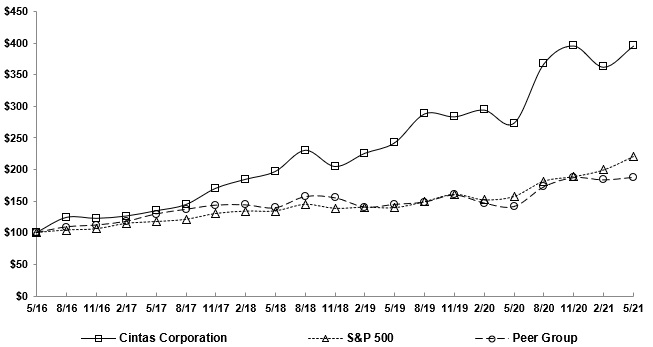
The following graph summarizes the cumulative return on $100 invested in Cintas' common stock, the S&P 500 Stock Index and the common stocks of a selected peer group of companies. Because our products and services are diverse, Cintas does not believe that any single published industry index is appropriate for comparing shareholder return. Therefore, the peer group used in the performance graph combines publicly traded companies in the business services industry that have similar characteristics as Cintas for each fiscal year, such as route based delivery of products and services. The companies included in the Peer Group are ABM Industries, Aramark, Rollins, Inc. and UniFirst Corporation.
Total shareholder return was based on the increase in the price of the common stock and assumed reinvestment of all dividends. Furthermore, total return was weighted according to market capitalization of each company. The companies in the Peer Group are not the same as those considered by the Compensation Committee of the Board of Directors.
15
Total Shareholder Returns
Comparison of Five-Year Cumulative Total Return
Purchases of Equity Securities by the Issuer and Affiliated Purchases
| Period (In millions, except share and per share data) | Total number of shares purchased | Average price paid per share | Total number of shares purchased as part of the publicly announced plan (1) | Maximum approximate dollar value of shares that may yet be purchased under the plan (1) | |||||||||||||||||||
| March 1 - 31, 2021 (2) | 23,733 | $ | 337.41 | 23,600 | $ | 970.9 | |||||||||||||||||
| April 1 - 30, 2021 (3) | 4,907 | $ | 348.32 | — | $ | 970.9 | |||||||||||||||||
| May 1 - 31, 2021 (4) | 1,106,628 | $ | 352.29 | 1,106,293 | $ | 581.2 | |||||||||||||||||
| Total | 1,135,268 | $ | 351.96 | 1,129,893 | $ | 581.2 |
(1) On October 29, 2019, Cintas announced that the Board of Directors authorized a $1.0 billion share buyback program, which does not have an expiration date. From the inception of the October 29, 2019 share buyback program through May 31, 2021, Cintas has purchased a total of 1.2 million shares of Cintas common stock at an average price of $350.31 per share for a total purchase price of $418.8 million.
(2) During March 2021, Cintas acquired 133 shares of Cintas common stock in satisfaction of employee payroll taxes due on restricted stock awards that vested during the fiscal year. These shares were purchased at an average price of $341.20 per share for a total purchase price of less than $0.1 million.
(3) During April 2021, Cintas acquired 4,907 shares of Cintas common stock in satisfaction of employee payroll taxes due on restricted stock awards that vested during the fiscal year. These shares were purchased at an average price of $348.32 per share for a total purchase price of $1.7 million.
(4) During May 2021, Cintas acquired 335 shares of Cintas common stock in satisfaction of employee payroll taxes due on restricted stock awards that vested during the fiscal year. These shares were purchased at an average price of $355.17 per share for a total purchase price of $0.1 million.
Item 6. Selected Financial Data
[Reserved.]
16
Item 7. Management's Discussion and
Analysis of Financial Condition and Results of Operations
Business Strategy
Cintas helps more than one million businesses of all types and sizes, primarily in the U.S., as well as Canada and Latin America, get READY™ to open their doors with confidence every day by providing a wide range of products and services that enhance our customers’ image and help keep their facilities and employees clean, safe and looking their best. With products and services including uniforms, mats, mops, restroom supplies, first aid and safety products, fire extinguishers and testing, and safety training, Cintas helps customers get Ready for the Workday®. Cintas is also the creator of the Total Clean Program™ — a first-of-its-kind service that includes scheduled delivery of essential cleaning supplies, hygienically clean laundering, and sanitizing and disinfecting projects and services.
We are North America's leading provider of corporate identity uniforms through rental and sales programs, as well as a significant provider of related business services, including entrance mats, restroom cleaning services and supplies, first aid and safety services and fire protection products and services.
Cintas' principal objective is "to exceed customers' expectations in order to maximize the long-term value of Cintas for shareholders and working partners," and it provides the framework and focus for Cintas' business strategy. This strategy is to achieve revenue growth for all our products and services by increasing our penetration at existing customers and by broadening our customer base to include market segments to which we have not historically served. We will also continue to identify additional product and service opportunities for our current and future customers.
To pursue the strategy of increasing penetration, we have a highly talented and diverse team of service professionals visiting our customers on a regular basis. This frequent contact with our customers enables us to develop close personal relationships. The combination of our distribution system and these strong customer relationships provides a platform from which we launch additional products and services.
We pursue the strategy of broadening our customer base in several ways. Cintas has a national sales organization introducing all its products and services to prospects in all market segments. Our broad range of products and services allows our sales organization to consider any type of business a prospect. We also broaden our customer base through geographic expansion. Finally, we evaluate strategic acquisitions as opportunities arise.
17
Results of Operations
This Management’s Discussion and Analysis of Financial Condition and Results of Operations focuses on discussion of fiscal 2021 results compared to fiscal 2020 results. For discussion of fiscal 2020 results compared to fiscal 2019 results, see the "Management’s Discussion and Analysis of Financial Condition and Results of Operations” within our Annual Report on Form 10-K for the fiscal year ended May 31, 2020, filed with the SEC on July 29, 2020.
Cintas classifies its business into two reportable operating segments and places the remainder of its operating segments in an All Other category. Cintas’ two reportable operating segments are Uniform Rental and Facility Services and First Aid and Safety Services. The Uniform Rental and Facility Services reportable operating segment consists of the rental and servicing of uniforms and other garments including flame resistant clothing, mats, mops and shop towels and other ancillary items. In addition to these rental items, restroom cleaning services and supplies and the sale of items from our catalogs to our customers on route are included within this reportable operating segment. The First Aid and Safety Services reportable operating segment consists of first aid and safety products and services. The remainder of Cintas’ business, which consists of the Fire Protection Services operating segment and the Uniform Direct Sale operating segment, is included in All Other. These operating segments consist of fire protection products and services and the direct sale of uniforms and related items. Cintas evaluates operating segment performance based on revenue and income before income taxes. Revenue and income before income taxes for each of these reportable operating segments for the years ended May 31, 2021, 2020 and 2019 are presented in Note 14 entitled Operating Segment Information of "Notes to Consolidated Financial Statements." The Company regularly reviews its operating segments for reporting purposes based on the information its chief operating decision maker regularly reviews for purposes of allocating resources and assessing performance and makes changes when appropriate.
In December 2019, a novel strain of coronavirus (COVID-19) was reported to have surfaced in Wuhan, China, and has since spread globally. In March 2020, the World Health Organization characterized COVID-19 as a pandemic. Efforts to contain the spread of COVID-19 intensified during our fiscal 2020 fourth quarter and have remained in effect throughout our fiscal 2021. Most states and municipalities within the U.S., as well as Canada, enacted temporary closures of businesses, issued quarantine orders and took other restrictive measures in response to the COVID-19 pandemic. Many of the business closures, quarantine orders and other restrictive measures remained in place through fiscal 2021. Within the U.S., our business was designated an essential business, which allowed us to continue to serve customers that remained open. During our fiscal 2021 fourth quarter, the roll out of vaccines, lower COVID-19 case counts and lifting of restrictions on businesses had a positive impact on our business.
We have operations throughout the U.S. and Canada and participate in a global supply chain. During most of fiscal 2021, the existence of the COVID-19 pandemic, the fear associated with the COVID-19 pandemic and the reactions of governments around the world in response to the COVID-19 pandemic to regulate the flow of labor and products and impede the business of our customers, impacted our ability to conduct normal business operations, which had an adverse effect on our business. Many of Cintas' customers were also impacted by the COVID-19 pandemic, and we saw an impact on some customer's ability to pay timely. While there was minimal disruption to our supply chain, Cintas did increase inventory, primarily personal protective equipment and facility services inventory, in response to the customer needs and demand associated with the safety and cleanliness requirements of COVID-19. The increase in inventory resulted in additional inventory reserves during fiscal 2021 and could result in future inventory reserve increases if demand for personal protective equipment declines. See Note 1 entitled Significant Accounting Policies of "Notes to Consolidated Financial Statements" for additional detail on the additional reserve placed on inventory. The impact of the COVID-19 pandemic is fluid and continues to evolve, and therefore, we cannot predict the extent to which our business, consolidated results of operations, consolidated financial condition or liquidity will ultimately be impacted.
18
The following table sets forth certain consolidated statements of income data as a percent of revenue by reportable operating segment, All Other and in total for the fiscal years ended May 31:
| 2021 | 2020 | 2019 | |||||||||||||||
| Revenue: | |||||||||||||||||
| Uniform Rental and Facility Services | 80.0% | 79.7% | 80.6% | ||||||||||||||
| First Aid and Safety Services | 11.0% | 10.0% | 9.0% | ||||||||||||||
| All Other | 9.0% | 10.3% | 10.4% | ||||||||||||||
| Total revenue | 100.0% | 100.0% | 100.0% | ||||||||||||||
| Cost of sales: | |||||||||||||||||
| Uniform Rental and Facility Services | 52.4% | 54.1% | 54.5% | ||||||||||||||
| First Aid and Safety Services | 57.6% | 52.2% | 52.0% | ||||||||||||||
| All Other | 57.0% | 58.2% | 57.4% | ||||||||||||||
| Total cost of sales | 53.4% | 54.4% | 54.6% | ||||||||||||||
| Gross margin: | |||||||||||||||||
| Uniform Rental and Facility Services | 47.6% | 45.9% | 45.5% | ||||||||||||||
| First Aid and Safety Services | 42.4% | 47.8% | 48.0% | ||||||||||||||
| All Other | 43.0% | 41.8% | 42.6% | ||||||||||||||
| Total gross margin | 46.6% | 45.6% | 45.4% | ||||||||||||||
| Selling and administrative expenses: | |||||||||||||||||
| Uniform Rental and Facility Services | 26.0% | 28.1% | 27.6% | ||||||||||||||
| First Aid and Safety Services | 32.0% | 32.7% | 33.4% | ||||||||||||||
| All Other | 30.8% | 34.9% | 33.3% | ||||||||||||||
| Total selling and administrative expenses | 27.1% | 29.2% | 28.7% | ||||||||||||||
| G&K Services, Inc. integration expenses | —% | —% | 0.2% | ||||||||||||||
| Gain on sale of a cost method investment | —% | —% | 1.0% | ||||||||||||||
| Interest expense, net | 1.4% | 1.5% | 1.5% | ||||||||||||||
| Income from continuing operations before income taxes | 18.1% | 14.9% | 16.0% |
Fiscal 2021 Compared to Fiscal 2020
Fiscal 2021 total revenue was $7.1 billion, an increase of 0.4% over the prior fiscal year. Revenue increased organically by 0.2% as a result of increased sales volume. Organic growth adjusts for the impact of acquisitions and divestitures, foreign currency exchange rate fluctuations and workday differences. Total revenue was negatively impacted by a net 0.3% due to acquisitions and divestitures, positively impacted by 0.2% due to foreign currency exchange rate fluctuations and positively impacted by 0.3% due to one more workday in fiscal 2021 compared to fiscal 2020.
As previously discussed, government enactments of temporary and indefinite closures of certain businesses in response to the COVID-19 pandemic continued to impact our ability to access and service some of our customers impacted by these mandates during fiscal 2021. Due to the constantly changing impact of the COVID-19 pandemic, uncertainty remains about the pace of the economic recovery and about its impact on future Cintas consolidated financial results.
19
Organic revenue by quarter for fiscal 2021 is as follows:
| Organic Revenue | |||||
| First quarter ended August 31, 2020 | (5.0)% | ||||
| Second quarter ended November 30, 2020 | (4.4)% | ||||
| Third quarter ended February 28, 2021 | (0.1)% | ||||
| Fourth quarter ended May 31, 2021 | 11.5% | ||||
| For the fiscal year ended May 31, 2021 | 0.2% |
Uniform Rental and Facility Services reportable operating segment revenue consists predominantly of revenue derived from the rental of corporate identity uniforms and other garments, including flame resistant clothing and the rental and/or sale of mats, mops, shop towels, restroom supplies and other rental services. Revenue from the Uniform Rental and Facility Services reportable operating segment increased 0.8% compared to fiscal 2020 due to an organic growth increase of 0.7%. Revenue growth was negatively impacted by a net 0.5% due to acquisitions and divestitures, positively impacted by 0.2% due to foreign currency exchange rate fluctuations and positively impacted by 0.4% due to one more workday in fiscal 2021 compared to fiscal 2020. Revenue growth was a result of new business, the penetration of additional products and services into existing customers, partially offset by lost business. New business growth resulted from an increase in the productivity of sales representatives. Generally, sales productivity improvements are due to increased tenure and improved training, which produce a higher number of products and services sold.
Other revenue, consisting of revenue from the First Aid and Safety Services reportable operating segment and All Other, decreased 1.0% compared to fiscal 2020. Revenue improvement from increases in sales representative productivity and sales of personal protection equipment was more than offset by a decrease in sales related to customers in All Other as a result of the impact from the COVID-19 pandemic. Revenue declined organically by 1.9%. Revenue growth was positively impacted by 0.5% due to revenue growth derived through acquisitions in our First Aid and Safety Services reportable operating segment and our Fire Protection operating segment, which is included in All Other, and by 0.4% due to one more workday in fiscal 2021 compared to fiscal 2020.
Cost of uniform rental and facility services decreased 2.3% compared to fiscal 2020. Cost of uniform rental and facility services consists primarily of production expenses, delivery expenses and the amortization of in service inventory, including uniforms, mats, shop towels and other ancillary items. The cost of uniform rental and facility services decreased compared to fiscal 2020 primarily due to certain cost control measures such as reduced labor and supplies that were partially offset by increases in material cost, primarily related to personal protective equipment.
Cost of other consists primarily of cost of goods sold (predominantly first aid and safety products, personal protective equipment, uniforms and fire protection products), delivery expenses and distribution expenses in the First Aid and Safety Services reportable operating segment and All Other. Cost of other increased 2.8% in fiscal 2021 compared to fiscal 2020. The increase was primarily due to an increase in the proportion of sales in the First Aid and Safety Services reportable operating segment of personal protective equipment, which typically have lower gross margins compared to other First Aid and Safety Services reportable operating segment products.
Selling and administrative expenses decreased $141.9 million, to 27.1% as a percent of revenue, compared to 29.2% in fiscal 2020. The improvement as a percent of revenue was primarily due to efficiencies in labor and employee-partner related expenses as well as lower discretionary spending and a one-time benefit from the gain on the sale of certain operating assets. In addition, during the fourth quarter of fiscal 2020, Cintas initiated certain one-time activities to reduce operating costs and better align its workforce with the needs of its ongoing business and recorded $24.5 million in employee termination costs and $9.2 million in long-lived asset impairment costs.
Net interest expense (interest expense less interest income) was $97.7 million in fiscal 2021 compared to $104.4 million in fiscal 2020. The decrease in net interest expense was primarily due to the decrease in total debt outstanding during fiscal 2021 compared to fiscal 2020.
20
Income before income taxes was $1,287.7 million, an increase of $229.5 million, or 21.7%, compared to fiscal 2020. The increase in income before income taxes was primarily due to both cost of sales and selling and administrative expenses decreasing in total and as a percent of revenue in fiscal 2021. Income before income taxes also benefited from a one-time net gain on the sale of certain operating assets.
Cintas' effective tax rate on continuing operations was 13.7% for fiscal 2021 compared to 17.2% in fiscal 2020. The effective tax rate in both periods was impacted by certain discrete items, primarily the tax accounting impact for stock-based compensation. In addition, the effective tax rate for fiscal 2021 included a one-time tax benefit on the sale of certain operating assets.
Net income from continuing operations for fiscal 2021 of $1,111.0 million was a 26.8% increase compared to fiscal 2020. Diluted earnings per share from continuing operations of $10.24 was a 26.3% increase compared to fiscal 2020 diluted earnings per share from continuing operations of $8.11. Diluted earnings per share from continuing operations increased primarily due to the increase in net income.
Uniform Rental and Facility Services Reportable Operating Segment
Uniform Rental and Facility Services reportable operating segment revenue increased $46.1 million, or 0.8%, and the cost of uniform rental and facility services decreased $71.6 million, or 2.3%, due to the reasons previously discussed. The reportable operating segment's fiscal 2021 gross margin was 47.6% of revenue compared to 45.9% in fiscal 2020. The increase in gross margin was primarily due to certain cost control measures such as reduced labor and supplies that were partially offset by increases in material cost, including increases related to increased sales of personal protective equipment.
Selling and administrative expenses for the Uniform Rental and Facility Services reportable operating segment decreased $103.5 million in fiscal 2021 compared to fiscal 2020. Selling and administrative expense as a percent of revenue for fiscal 2021 was 26.0% compared to 28.1% in fiscal 2020. The improvement in selling and administrative expenses as a percent of revenue was primarily due to efficiencies in labor and employee-partner related expenses as well as lower discretionary spending and a one-time benefit from the gain on the sale of certain operating assets, which was partially offset by a one-time asset impairment on certain long-lived assets. Also, in the fourth quarter of fiscal 2020, the Uniform Rental and Facility Services reportable operating segment initiated certain one-time activities to reduce operating costs and better align its workforce with the needs of its ongoing business. During the fourth quarter of fiscal 2020, the reportable operating segment recorded $20.2 million in employee termination costs and $9.2 million in long-lived asset impairment costs.
Income before income taxes increased $221.3 million to $1,225.8 million for fiscal 2021 compared to fiscal 2020. Income before income taxes as a percent of revenue at 21.5% increased 370 basis points from 17.8% in fiscal 2020. The increase was primarily due to the previously discussed improvement in gross margin and selling and administrative expenses as a percent of revenue.
First Aid and Safety Services Reportable Operating Segment
First Aid and Safety Services reportable operating segment revenue increased $75.7 million in fiscal 2021, a 10.7% increase compared to fiscal 2020. Revenue increased organically by 10.0% as a result of new business and sales productivity increases, penetration of additional products and services into existing customers and sales of personal protective equipment in response to the COVID-19 pandemic. Revenue growth was positively impacted by 0.2% due to acquisitions, by 0.1% due to foreign currency exchange rate fluctuations and by 0.4% due to one more workday in fiscal 2021 compared to fiscal 2020.
Cost of sales for the First Aid and Safety Services reportable operating segment increased $82.0 million, or 22.2%, in fiscal 2021, primarily due to higher sales volume and change in sales mix. Gross margin for the First Aid and Safety Services reportable operating segment is defined as revenue less cost of goods, warehouse expenses, service expenses and training expenses. The gross margin as a percent of revenue was 42.4% for fiscal 2021 compared to 47.8% in fiscal 2020. The decrease was primarily a result of the increase in the proportion of sales related to personal protective equipment, as a result of the impact of the COVID-19 pandemic. Personal protective equipment typically has lower gross margins than other First Aid and Safety Services reportable operating segment products.
21
Selling and administrative expenses for the First Aid and Safety Services reportable operating segment increased by $19.4 million, or 8.4%, in fiscal 2021 compared to fiscal 2020, but improved as a percent of revenue to 32.0% in fiscal 2021 compared to 32.7% in fiscal 2020. The improvement as a percent of revenue was primarily due to revenue growing at a faster pace than labor and employee-partner related expenses and lower discretionary spending.
Income before income taxes for the First Aid and Safety Services reportable operating segment was $81.2 million in fiscal 2021, a decrease of $25.7 million, or 24.1%, compared to fiscal 2020. Income before income taxes as a percent of revenue at 10.4%, decreased from 15.1% in fiscal 2020 due to the previously discussed decrease in gross margin.
Liquidity and Capital Resources
The following table summarizes our cash flows and cash and cash equivalents as of and for the fiscal years ended May 31:
| (In thousands) | 2021 | 2020 | |||||||||
| Net cash provided by operating activities | $ | 1,360,740 | $ | 1,291,483 | |||||||
| Net cash used in investing activities | $ | (137,215) | $ | (285,398) | |||||||
| Net cash used in financing activities | $ | (879,868) | $ | (955,207) | |||||||
| Cash and cash equivalents at end of year | $ | 493,640 | $ | 145,402 | |||||||
Cash and cash equivalents as of May 31, 2021 and 2020 include $37.9 million and $30.2 million, respectively, that is located outside of the U.S.
Cash flows provided by operating activities have historically supplied us with a significant source of liquidity. We generally use these cash flows to fund most, if not all, of our operations and expansion activities and dividends on our common stock. We may also use cash flows provided by operating activities, as well as proceeds from long-term debt and short-term borrowings, to fund growth and expansion opportunities, as well as other cash requirements such as the repurchase of our common stock and payment of long-term debt.
The disruption from the COVID-19 pandemic continued to have an impact on Cintas' fiscal 2021 financial results. However, net cash flow provided by operating activities was not significantly impacted. We expect our cash flows from operating activities to remain sufficient to provide us with adequate levels of short-term liquidity. In addition, we have access to $1.0 billion of short-term debt from our revolving credit facility. Although the impact of the COVID-19 pandemic is fluid and continues to evolve, we believe our long-term liquidity position remains strong. We believe the Company has sufficient liquidity to operate in the current business environment. Acquisitions and dividends remain strategic objectives, but they will be dependent on the economic outlook and liquidity of the Company.
Net cash provided by operating activities was $1.36 billion for fiscal 2021, which was an increase of $69.3 million compared to fiscal 2020. The increase was primarily the result of increased net income and favorable changes in accrued compensation and other, partially offset by changes in working capital, specifically income taxes, accounts receivable and accrued liabilities and other.
Net cash used in investing activities was $137.2 million in fiscal 2021, compared to $285.4 million in fiscal 2020. Net cash used in investing activities includes capital expenditures, purchases of investments, proceeds from the sale of operating assets and cash paid for acquisitions of businesses. Capital expenditures were $143.5 million and $230.3 million for fiscal 2021 and fiscal 2020, respectively. Capital expenditures for fiscal 2021 included $104.0 million for the Uniform Rental and Facility Services reportable operating segment and $34.4 million for the First Aid and Safety Services reportable operating segment. The decrease in capital expenditures from fiscal 2020 to fiscal 2021 was due to reduced growth capacity needs within the slower growth landscape of the COVID-19 pandemic. Cash paid for acquisitions of businesses, net of cash acquired, was $10.0 million and $53.7 million for fiscal 2021 and fiscal 2020, respectively. The acquisitions in both fiscal 2021 and 2020 occurred in our Uniform Rental and Facility Services reportable operating segment, our First Aid and Safety Services reportable operating segment and our Fire Protection operating segment, which is included in All Other. In fiscal 2021 and fiscal 2020, investing activities included proceeds of $31.7 million and $13.3 million, respectively, from the sale of certain operating assets, net of
22
cash disposed. Net cash used in investing activities also included $4.3 million and $10.0 million of purchases of investments during fiscal 2021 and fiscal 2020, respectively.
Net cash used in financing activities was $879.9 million for fiscal 2021, compared to $955.2 million in fiscal 2020. The decrease in cash used from financing activities from fiscal 2020 is primarily due to the payment of the $312.5 million of debt in fiscal 2020, partially offset by an increase in cash used to pay dividends and repurchase common stock in fiscal 2021. On October 30, 2018, we announced that the Board of Directors authorized a $1.0 billion share buyback program, which was completed during fiscal 2021. On October 29, 2019, we announced the Board of Directors authorized a new $1.0 billion share buyback program, which does not have an expiration date. The following table summarizes the buyback activity by program and fiscal year ended May 31:
| 2021 | 2020 | ||||||||||||||||||||||||||||||||||
| Buyback Program (In thousands except per share data) | Shares | Avg. Price per Share | Purchase Price | Shares | Avg. Price per Share | Purchase Price | |||||||||||||||||||||||||||||
| October 30, 2018 | 190 | $ | 319.88 | $ | 60,877 | 1,607 | $ | 246.19 | $ | 395,681 | |||||||||||||||||||||||||
| October 29, 2019 | 1,196 | 350.31 | 418,779 | — | — | — | |||||||||||||||||||||||||||||
| 1,386 | $ | 346.13 | $ | 479,656 | 1,607 | $ | 246.19 | $ | 395,681 |
In the period subsequent to May 31, 2021 through July 28, 2021, we completed the October 29, 2019 program by purchasing 1.6 million shares of Cintas common stock at an average price of $365.41 for a total purchase price of $581.2 million. From the inception of the October 29, 2019 program through July 28, 2021, Cintas purchased a total of 2.8 million shares of Cintas common stock at an average price of $358.93 per share for a total purchase price of $1.0 billion. In addition, for the fiscal year ended May 31, 2021, Cintas acquired 0.2 million shares of Cintas common stock in satisfaction of employee payroll taxes due on restricted stock awards that vested during the fiscal year. These shares were acquired at an average price of $302.52 per share for a total purchase price of $74.4 million. For the fiscal year ended May 31, 2020, Cintas acquired 0.3 million shares of Cintas common stock in satisfaction of employee payroll taxes due on restricted awards that vested during the fiscal year. These shares were acquired at an average price of $260.89 per share for a total purchase price of $68.8 million.
On October 27, 2020, Cintas declared an annual cash dividend on outstanding common stock, representing a 10.2% increase over the annual dividend paid in the prior fiscal year. This marked the 38th consecutive year that Cintas has increased its annual dividend, every year since going public in 1983. Also on October 27, 2020, the Cintas Board of Directors approved a change in the dividend policy from an annual dividend to a quarterly dividend and subsequently declared a quarterly dividend on outstanding common stock. Any future dividend declarations, including the amount of any dividends, are at the discretion of the Board of Directors and dependent upon then-existing conditions, including the Company's consolidated operating results and consolidated financial condition, capital requirements, contractual restrictions, business prospects and other factors that the Board of Directors may deem relevant. Our Board of Directors declared the following dividends during the fiscal years ended May 31:
| Declaration Date (In millions except per share data) | Record Date | Payment Date | Dividend Per Share | Amount | ||||||||||||||||
| Fiscal Year 2021 | ||||||||||||||||||||
| October 27, 2020 | November 6, 2020 | December 4, 2020 | $ | 2.81 | $ | 297.7 | ||||||||||||||
| October 27, 2020 | November 6, 2020 | December 4, 2020 | 0.70 | 74.1 | ||||||||||||||||
| January 19, 2021 | February 15, 2021 | March 15, 2021 | 0.75 | 79.5 | ||||||||||||||||
| April 13, 2021 (1) | May 15, 2021 | June 15, 2021 | 0.75 | 79.2 | ||||||||||||||||
| Total | $ | 5.01 | $ | 530.5 | ||||||||||||||||
| Fiscal Year 2020 | ||||||||||||||||||||
| October 29, 2019 | November 8, 2019 | December 6, 2019 | $ | 2.55 | $ | 268.0 | ||||||||||||||
| Fiscal Year 2019 | ||||||||||||||||||||
| October 30, 2018 | November 9, 2018 | December 7, 2018 | $ | 2.05 | $ | 220.8 |
.(1) The dividend declared on April 13, 2021 was included in current accrued liabilities on the consolidated balance sheet at May 31, 2021.
23
During the fiscal year ended May 31, 2020, Cintas paid a net total of $112.5 million on commercial paper borrowings and paid off the term loan balance of $200.0 million with cash on hand. There was no commercial paper outstanding during fiscal 2021. The following table summarizes Cintas' outstanding debt at May 31:
| (In thousands) | Interest Rate | Fiscal Year Issued | Fiscal Year Maturity | 2021 | 2020 | ||||||||||||||||||||||||
| Debt due within one year | |||||||||||||||||||||||||||||
| Senior notes | 4.30% | 2012 | 2022 | $ | 250,000 | $ | — | ||||||||||||||||||||||
| Senior notes | 2.90% | 2017 | 2022 | 650,000 | — | ||||||||||||||||||||||||
| Debt issuance costs | (930) | — | |||||||||||||||||||||||||||
| Total debt due within one year | $ | 899,070 | $ | — | |||||||||||||||||||||||||
| Debt due after one year | |||||||||||||||||||||||||||||
| Senior notes | 4.30% | 2012 | 2022 | $ | — | $ | 250,000 | ||||||||||||||||||||||
| Senior notes | 2.90% | 2017 | 2022 | — | 650,000 | ||||||||||||||||||||||||
| Senior notes | 3.25% | 2013 | 2023 | 300,000 | 300,000 | ||||||||||||||||||||||||
| Senior notes (1) | 2.78% | 2013 | 2023 | 50,815 | 51,250 | ||||||||||||||||||||||||
| Senior notes (2) | 3.11% | 2015 | 2025 | 51,301 | 51,637 | ||||||||||||||||||||||||
| Senior notes | 3.70% | 2017 | 2027 | 1,000,000 | 1,000,000 | ||||||||||||||||||||||||
| Senior notes | 6.15% | 2007 | 2037 | 250,000 | 250,000 | ||||||||||||||||||||||||
| Debt issuance costs | (9,283) | (13,182) | |||||||||||||||||||||||||||
| Total debt due after one year | $ | 1,642,833 | $ | 2,539,705 |
(1) Cintas assumed these senior notes with the acquisition of G&K in the fourth quarter of fiscal 2017, and they were recorded at fair value. The interest rate shown above is the effective interest rate. The principal amount of these notes is $50.0 million with a stated interest rate of 3.73%.
(2) Cintas assumed these senior notes with the acquisition of G&K in the fourth quarter of fiscal 2017, and they were recorded at fair value. The interest rate shown above is the effective interest rate. The principal amount of these notes is $50.0 million with a stated interest rate of 3.88%.
The credit agreement that supports our commercial paper program was amended and restated on May 24, 2019. The amendment increased the capacity of the revolving credit facility from $600.0 million to $1.0 billion and created a new term loan of $200.0 million. The credit agreement has an accordion feature that provides Cintas the ability to request increases to the borrowing commitments under either the revolving credit facility or the term loan of up to $250.0 million in the aggregate, subject to customary conditions. The maturity date of the revolving credit facility is May 23, 2024. As of May 31, 2021 and 2020, there was no commercial paper outstanding and no borrowings on our credit facility. On June 1, 2021, in accordance with the terms of the notes, Cintas paid the $250.0 million aggregate principal amount of its 4.30%, 10-year senior notes that matured on that date with cash on hand. During fiscal 2022, Cintas expects to issue long-term debt to pay the $650.0 million principal amount of its 2.90%, 5-year senior notes that mature in the fourth quarter of fiscal 2022.
Cintas has certain covenants related to debt agreements. These covenants limit Cintas' ability to incur certain liens, to engage in sale-leaseback transactions and to merge, consolidate or sell all or substantially all of Cintas' assets. These covenants also require Cintas to maintain certain debt to consolidated earnings before interest, taxes, depreciation and amortization (EBITDA) and interest coverage ratios. Cross-default provisions exist between certain debt instruments. If a default of a significant covenant were to occur, the default could result in an acceleration of the maturity of the indebtedness, impair liquidity and limit the ability to raise future capital. Cintas was in compliance with all of the debt covenants for all periods presented.
Our access to the commercial paper and long-term debt markets has historically provided us with sources of liquidity. We do not anticipate having difficulty in obtaining financing from those markets in the future in view of our favorable experiences in the debt markets in the recent past, including our ability to refinance the $650.0 million aggregate principal amount of our senior notes that mature in fiscal 2022. Additionally, our ability to continue to access the commercial paper and long-term debt markets on favorable interest rate and other terms will depend, to a significant degree, on the ratings assigned by the credit rating agencies to our indebtedness.
24
As of May 31, 2021, our ratings were as follows:
| Rating Agency | Outlook | Commercial Paper | Long-term Debt | |||||||||||||||||
| Standard & Poor’s | Stable | A-2 | A- | |||||||||||||||||
| Moody’s Investors Service | Stable | P-2 | A3 |
In the event that the ratings of our commercial paper or our outstanding long-term debt issues were substantially lowered or withdrawn for any reason, or if the ratings assigned to any new issue of long-term debt securities were significantly lower than those noted above, particularly if we no longer had investment grade ratings, our ability to access the debt markets may be adversely affected. In addition, in such a case, our cost of funds for new issues of commercial paper and long-term debt would be higher than our cost of funds would have been had the ratings of those new issues been at or above the level of the ratings noted above. The rating agency ratings are not recommendations to buy, sell or hold our commercial paper or debt securities. Each rating may be subject to revision or withdrawal at any time by the assigning rating organization and should be evaluated independently of any other rating. Moreover, each credit rating is specific to the security to which it applies.
To monitor our credit rating and our capacity for long-term financing, we consider various qualitative and quantitative factors. One such factor is the ratio of our total debt to EBITDA. For the purpose of this calculation, debt is defined as the sum of short-term borrowings, long-term debt due within one year, long-term debt and standby letters of credit.
Financial and Nonfinancial Disclosure About Issuers and Guarantors of Cintas’ Senior Notes
Cintas Corporation No. 2 (Corp. 2) is the indirectly, wholly owned principal operating subsidiary of Cintas. Corp. 2 is the issuer of the $2,550.0 million aggregate principal amount of senior notes outstanding as of May 31, 2021, which are unconditionally guaranteed, jointly and severally, by Cintas Corporation and its wholly owned, direct and indirect domestic subsidiaries. See Note 7 entitled Debt and Derivatives of "Notes to Consolidated Financial Statements" for more information on Cintas' outstanding debt.
Basis of Preparation of the Summarized Financial Information
The following tables include summarized financial information of Cintas Corporation (Issuer), Corp. 2 and subsidiary guarantors (together, the Obligor Group). Investments in and equity in the earnings of non-guarantors, which are not members of the Obligor Group, have been excluded. Non-guarantor subsidiaries are located outside the U.S., and therefore, excluded from the Obligor Group.
The summarized financial information of the Obligor Group is presented on a combined basis with intercompany balances and transactions between entities in the Obligor Group eliminated. The Obligor Group’s amounts due from, amounts due to and transactions with non-guarantors have been presented in separate line items, if they are material. Summarized financial information of the Obligor Group is as follows for the fiscal years ended May 31:
| Summarized Consolidated Statements of Income (In thousands) | 2021 | 2020 | ||||||||||||
| Net sales to unrelated parties | $ | 6,705,820 | $ | 6,642,196 | ||||||||||
| Net sales to non-guarantors | $ | 3,460 | $ | 4,778 | ||||||||||
| Operating income | $ | 1,319,444 | $ | 1,140,318 | ||||||||||
| Net income | $ | 1,058,837 | $ | 860,022 |
25
| Summarized Consolidated Balance Sheets (In thousands) | 2021 | 2020 | ||||||||||||
| Assets | ||||||||||||||
| Receivables due from non-obligor subsidiaries | $ | 2,292 | $ | 3,199 | ||||||||||
| Total other current assets | $ | 2,652,810 | $ | 2,143,489 | ||||||||||
| Total other noncurrent assets | $ | 4,924,550 | $ | 4,938,093 | ||||||||||
| Liabilities | ||||||||||||||
| Amounts due to non-obligor subsidiaries | $ | 457 | $ | 3,437 | ||||||||||
| Current liabilities | $ | 1,893,352 | $ | 843,203 | ||||||||||
| Noncurrent liabilities | $ | 2,549,911 | $ | 3,495,956 |
Contractual Obligations
| Payments Due by Period | |||||||||||||||||||||||||||||
| (In thousands) | Total | One year or less | Two to three years | Four to five years | After five years | ||||||||||||||||||||||||
| Debt (1) | $ | 2,550,000 | $ | 900,000 | $ | 350,000 | $ | 50,000 | $ | 1,250,000 | |||||||||||||||||||
| Operating leases (2) | 185,801 | 47,564 | 69,138 | 39,089 | 30,010 | ||||||||||||||||||||||||
| Interest payments | 510,653 | 90,155 | 115,370 | 106,690 | 198,438 | ||||||||||||||||||||||||
| Total contractual cash obligations | $ | 3,246,454 | $ | 1,037,719 | $ | 534,508 | $ | 195,779 | $ | 1,478,448 |
(1)See Note 7 entitled Debt and Derivatives of "Notes to Consolidated Financial Statements" for a detailed presentation of Cintas' debt.
(2)See Note 8 entitled Leases of "Notes to Consolidated financial Statements" for a detailed presentation of Cintas' leases.
Cintas also makes payments to defined contribution plans and may make payments to defined benefit plans to satisfy minimum funding requirements. The amount of contributions made to the defined contribution plans are at the discretion of the Board of Directors of Cintas. Future contributions to the defined contribution plans are expected to be $82.6 million in the next year, $177.9 million in the next two to three years and $196.1 million in the next four to five years. Future contributions to the defined benefit plans are expected to be $0.3 million in the next year, $3.0 million in the next two to three years and $3.0 million in the next four to five years.
Other Commitments
| Amount of Commitment Expiration per Period | |||||||||||||||||||||||||||||
| (In thousands) | Total | One year or less | Two to three years | Four to five years | After five years | ||||||||||||||||||||||||
| Lines of credit (1) | $ | 999,234 | $ | — | $ | 999,234 | $ | — | $ | — | |||||||||||||||||||
| Standby letters of credit and surety bonds (2) | 120,597 | 120,597 | — | — | — | ||||||||||||||||||||||||
| Total other commitments | $ | 1,119,831 | $ | 120,597 | $ | 999,234 | $ | — | $ | — |
(1)Back-up facility for the commercial paper program (reference Note 7 entitled Debt and Derivatives of "Notes to Consolidated Financial Statements" for further discussion).
(2)These standby letters of credit and surety bonds support certain outstanding debt (reference Note 7 entitled Debt and Derivatives of "Notes to Consolidated Financial Statements"), self-insured workers' compensation and general liability insurance programs.
Inflation and Changing Prices
Changes in wages, benefits and energy costs have the potential to materially impact Cintas' consolidated results of operations. Management believes inflation has not had a material impact on Cintas' consolidated financial condition or a negative impact on the consolidated results of operations.
26
Litigation and Other Contingencies
Cintas is subject to legal proceedings, insurance receipts, legal settlements and claims arising from the ordinary course of its business, including personal injury, customer contract, environmental and employment claims. In the opinion of management, the aggregate liability, if any, with respect to such ordinary course of business actions will not have a material adverse effect on the consolidated financial position, consolidated results of operations or consolidated cash flows of Cintas.
The Company, the Board of Directors, Scott Farmer (Executive Chairman) and the Investment Policy Committee are defendants in a purported class action, filed on December 13, 2019, pending in the U.S. District Court for the Southern District of Ohio alleging violations of ERISA. The lawsuit asserts that the defendants improperly managed the costs of the employee retirement plan, breached their fiduciary duties in failing to investigate and select lower cost alternative funds and failed to monitor and control the employee retirement plan’s recordkeeping costs. The defendants deny liability.
New Accounting Standards
In April 2019, the Financial Accounting Standards Board (FASB) issued Accounting Standards Update (ASU) 2016-13, “Financial Instruments-Credit Losses (Topic 326): Measurement of Credit Losses on Financial Instruments.” ASU 2016-13 replaces the incurred loss impairment methodology with a methodology that reflects expected credit losses and requires consideration of a broader range of reasonable and supportable information to inform credit loss estimates. In connection with recognizing credit losses on accounts receivable and other financial instruments, Cintas now uses a forward-looking expected loss model rather than the incurred loss model. Adoption of ASU 2016-13 requires using a modified retrospective approach through a cumulative-effect adjustment to retained earnings as of the effective date to align existing credit loss methodology with the new standard. This standard was adopted by Cintas on June 1, 2020 and did not have a material impact on the Company's consolidated financial statements.
No other new accounting pronouncement recently issued or newly effective had or is expected to have a material impact on the consolidated financial statements.
Critical Accounting Policies and Estimates
The preparation of Cintas' consolidated financial statements in conformity with U.S. GAAP requires management to make estimates and judgments that have a significant effect on the amounts reported in the consolidated financial statements and accompanying notes. These critical accounting policies should be read in conjunction with Note 1 entitled Significant Accounting Policies of "Notes to Consolidated Financial Statements." Significant changes, estimates or assumptions related to any of the following critical accounting policies, including those impacted by the COVID-19 pandemic, could possibly have a material impact on the consolidated financial statements.
Revenue recognition
Rental revenue, which is recorded in the Uniform Rental and Facility Services reportable operating segment, is recognized when services are performed or the obligations under the terms of a contract with a customer are satisfied. Other revenue, which is recorded in the First Aid and Safety Services reportable operating segments and All Other, is recognized when either services are performed or the obligations under the terms of a contract with a customer are satisfied. See Note 2 entitled Revenue Recognition of the "Notes to Consolidated Financial Statements" for more information on Cintas' revenue.
Uniforms and other rental items in service
Uniforms and other rental items in service are valued at cost less amortization, calculated using the straight-line method. Uniforms in service (other than cleanroom and flame resistant clothing) are amortized over their useful life of 18 months. Other rental items, including shop towels, mats, mops, cleanroom garments, flame resistant clothing, linens and restroom dispensers, are amortized over their useful lives, which range from 8 to 60 months. The amortization rates used are based on industry experience, Cintas' specific experience and wear tests performed by Cintas. These factors are critical to determining the amount of in service inventory and related cost of uniforms and ancillary products that are presented in the consolidated financial statements.
27
Goodwill
Goodwill, obtained through acquisitions of businesses, is valued at cost less any impairment. Cintas completes an annual impairment test, that includes an assessment of qualitative factors including, but not limited to, macroeconomic conditions, industry and market conditions, and entity specific factors such as strategies and financial performance. We test for goodwill impairment at the reporting unit level. Cintas has identified four reporting units for purposes of evaluating goodwill impairment: Uniform Rental and Facility Services, First Aid and Safety Services and two reporting units within All Other. Based on the results of the annual impairment tests, Cintas was not required to recognize an impairment of goodwill for the fiscal years ended May 31, 2021, 2020 or 2019. Cintas will continue to perform impairment tests as of March 1 in future years and when indicators of impairment exist.
Insurance reserve
The insurance reserve represents the estimated ultimate cost of all asserted and unasserted claims, primarily related to workers' compensation, auto liability and other general liability exposure through the consolidated balance sheet dates. Our incurred but not reported reserves are estimated through actuarial procedures, with the assistance of third-party actuarial specialists, of the insurance industry and by using industry assumptions, adjusted for specific expectations based on our claims history. Cintas records an increase or decrease in selling and administrative expenses related to development of prior claims, higher claims activity and other environmental factors in the period in which it becomes known. These changes in estimates may be material to the consolidated financial statements.
Stock-based compensation
Compensation expense is recognized for all share-based payments to employees, including stock options and restricted stock awards, in the consolidated statements of income based on the fair value of the awards that are granted. The fair value of stock options is estimated at the date of grant using the Black-Scholes option-pricing model. Generally, measured compensation cost, net of actual forfeitures, is recognized on a straight-line basis over the vesting period of the related share-based compensation award. See Note 12 entitled Stock-Based Compensation of "Notes to Consolidated Financial Statements" for further information.
Litigation and other contingencies
Cintas is subject to legal proceedings and claims arising from the ordinary course of its business, including personal injury, customer contract, environmental and employment claims. U.S. GAAP requires that a liability for contingencies be recorded when it is probable that a liability has occurred and the amount of the liability can be reasonably estimated. Significant judgment is required to determine the existence of a liability, as well as the amount to be recorded. While a significant change in assumptions and judgments could have a material impact on the amounts recorded for contingent liabilities, Cintas does not believe that they will result in a material adverse effect on the consolidated financial statements.
Income taxes
Deferred tax assets and liabilities are determined by the differences between the consolidated financial statement carrying amounts and the tax basis of assets and liabilities. Therefore, the Company has not recorded deferred taxes for basis differences expected to reverse in future periods. Cintas accounts for Global Intangible Low-Taxed Income (GILTI) as a current-period expense when incurred. See Note 9 entitled Income Taxes of "Notes to Consolidated Financial Statements" for the types of items that give rise to significant deferred income tax assets and liabilities. Deferred income taxes are classified as assets or liabilities based on the classification of the related asset or liability for financial reporting purposes. Cintas regularly reviews deferred tax assets for recoverability based upon projected future taxable income and the expected timing of the reversals of existing temporary differences. Although realization is not assured, management believes it is more likely than not that the recorded deferred tax assets, as adjusted for valuation allowances, will be realized.
Accounting for uncertain tax positions requires the determination of whether tax benefits claimed or expected to be claimed on a tax return should be recorded in the consolidated financial statements. Companies may recognize the tax benefit from an uncertain tax position only if it is more likely than not that the tax position will be sustained on examination by the taxing authorities, based on the technical merits of the position. The tax benefits recognized in the consolidated financial statements from such a position should be measured based on the largest benefit that has a greater than fifty percent likelihood of being realized upon ultimate settlement.
28
Cintas is periodically reviewed by domestic and foreign tax authorities regarding the amount of taxes due. These reviews include questions regarding the timing and amount of deductions and the allocation of income among various tax jurisdictions. In evaluating the exposure associated with various filing positions, Cintas records reserves as deemed appropriate. Based on Cintas' evaluation of current tax positions, Cintas believes its tax related accruals are appropriate.
Item 7A. Quantitative and Qualitative Disclosures About Market Risk
Earnings may be affected by changes in short-term interest rates due to investments, if any, in marketable securities and money market accounts and periodic issuances of commercial paper. If short-term rates changed by one-half percent (or 50 basis points), Cintas' income before income taxes would change by approximately $0.5 million. This estimated exposure considers the effects on investments. This analysis does not consider the effects of a change in economic activity or a change in Cintas' capital structure.
Through its foreign operations, Cintas is exposed to foreign currency risk. Foreign currency exposures arise from transactions denominated in a currency other than the functional currency and from foreign denominated revenue and profit translated into U.S. dollars. Foreign denominated revenue and profit represents less than 10% of Cintas' consolidated revenue and profit. Cintas periodically uses foreign currency hedges such as average rate options and forward contracts to mitigate the risk of foreign currency exchange rate movements resulting from foreign currency revenue and from international cash flows. The primary foreign currency to which Cintas is exposed is the Canadian dollar.
29
Item 8. Financial Statements and Supplementary Data
Index to Consolidated Financial Statements
Audited Consolidated Financial Statements for the Fiscal Years Ended May 31, 2021, 2020 and 2019
30
Management's Report on
Internal Control over Financial Reporting
To the Shareholders of Cintas Corporation:
Our management is responsible for establishing and maintaining adequate internal control over financial reporting (as defined in Rule 13a-15(f) and 15(d)-15(f) under the Securities Exchange Act of 1934) to provide reasonable assurance regarding the reliability of our financial reporting and the preparation of financial statements for external purposes in accordance with accounting principles generally accepted in the United States. Internal control over financial reporting includes those policies and procedures that: (1) pertain to the maintenance of records that in reasonable detail accurately and fairly reflect the transactions and dispositions of the assets of the company; (2) provide reasonable assurance that transactions are recorded as necessary to permit preparation of financial statements in accordance with generally accepted accounting principles and that receipts and expenditures of the company are being made only in accordance with authorizations of management and directors of the company; and (3) provide reasonable assurance regarding prevention or timely detection of unauthorized acquisition, use or disposition of the company's assets that could have a material effect on the financial statements.
Because of its inherent limitations, internal control over financial reporting may not prevent or detect misstatements. Also, projections of any evaluation of effectiveness to future periods are subject to the risk that controls may become inadequate because of changes in conditions, or that the degree of compliance with the policies or procedures may deteriorate. Accordingly, even an effective system of internal control over financial reporting will provide only reasonable assurance with respect to financial statement preparation.
With the supervision of our President and Chief Executive Officer and our Chief Financial Officer, management assessed our internal control over financial reporting as of May 31, 2021. Management based its assessment on criteria established in Internal Control — Integrated Framework (2013) issued by the Committee of Sponsoring Organizations of the Treadway Commission (COSO). Management's assessment included evaluation of such elements as the design and operating effectiveness of key financial reporting controls, process documentation, accounting policies and our overall control environment. This assessment is supported by testing and monitoring performed by our internal audit function.
Based on our assessment, management has concluded that our internal control over financial reporting was effective as of May 31, 2021, to provide reasonable assurance regarding the reliability of financial reporting and the preparation of financial statements for external reporting purposes in accordance with accounting principles generally accepted in the United States.
We reviewed the results of management's assessment with the Audit Committee of our Board of Directors. Additionally, our independent registered public accounting firm, Ernst & Young LLP, independently assessed the effectiveness of Cintas Corporation's internal control over financial reporting. Ernst & Young LLP has issued an attestation report, which is included in this Annual Report on Form 10-K.
| Todd M. Schneider President and Chief Executive Officer | ||
| J. Michael Hansen Executive Vice President and Chief Financial Officer |
31
Report of Independent
Registered Public Accounting Firm
To the Shareholders and the Board of Directors of Cintas Corporation
Opinion on the Financial Statements
We have audited the accompanying consolidated balance sheets of Cintas Corporation (the Company) as of May 31, 2021 and 2020, the related consolidated statements of income, comprehensive income, shareholders’ equity and cash flows for each of the three years in the period ended May 31, 2021, and the related notes and financial statement schedule listed in the Index at Item 15(a) (collectively referred to as the “consolidated financial statements”). In our opinion, the consolidated financial statements present fairly, in all material respects, the financial position of the Company at May 31, 2021 and 2020, and the results of its operations and its cash flows for each of the three years in the period ended May 31, 2021, in conformity with U.S. generally accepted accounting principles.
We also have audited, in accordance with the standards of the Public Company Accounting Oversight Board (United States) (PCAOB), the Company’s internal control over financial reporting as of May 31, 2021, based on criteria established in Internal Control-Integrated Framework issued by the Committee of Sponsoring Organizations of the Treadway Commission (2013 framework), and our report dated July 28, 2021, expressed an unqualified opinion thereon.
Basis for Opinion
These financial statements are the responsibility of the Company's management. Our responsibility is to express an opinion on the Company’s financial statements based on our audits. We are a public accounting firm registered with the PCAOB and are required to be independent with respect to the Company in accordance with the U.S. federal securities laws and the applicable rules and regulations of the Securities and Exchange Commission and the PCAOB.
We conducted our audits in accordance with the standards of the PCAOB. Those standards require that we plan and perform the audit to obtain reasonable assurance about whether the financial statements are free of material misstatement, whether due to error or fraud. Our audits included performing procedures to assess the risks of material misstatement of the financial statements, whether due to error or fraud, and performing procedures that respond to those risks. Such procedures included examining, on a test basis, evidence regarding the amounts and disclosures in the financial statements. Our audits also included evaluating the accounting principles used and significant estimates made by management, as well as evaluating the overall presentation of the financial statements. We believe that our audits provide a reasonable basis for our opinion.
Critical Audit Matters
The critical audit matter communicated below is a matter arising from the current period audit of the financ
Showing the first 8K of 159K characters. Open the full section
Item 9. Changes in and Disagreements with
Accountants on Accounting and Financial Disclosure
None.
Item 9A. Controls and Procedures
Disclosure Controls and Procedures
With the participation of Cintas' management, including Cintas' President and Chief Executive Officer, Chief Financial Officer, General Counsel and Controllers, Cintas has evaluated the effectiveness of the disclosure controls and procedures (as defined in Rules 13a-15(e) and 15d-15(e) under the Securities Exchange Act of 1934 (the Exchange Act) as of May 31, 2021. Based on such evaluation, Cintas' management, including Cintas' President and Chief Executive Officer, Chief Financial Officer, General Counsel and Controllers, have concluded that Cintas' disclosure controls and procedures were effective as of May 31, 2021, in ensuring (i) information required to be disclosed by Cintas in the reports that it files or submits under the Exchange Act is recorded, processed, summarized and reported, within the time periods specified in the SEC's rules and forms and (ii) information required to be disclosed by Cintas in the reports that it files or submits under the Exchange Act is accumulated and communicated to Cintas' management, including its principal executive and principal financial officers, or persons performing similar functions, as appropriate to allow timely decisions regarding required disclosure.
Internal Control over Financial Reporting
Management's Report on Internal Control over Financial Reporting and the Report of Ernst & Young LLP, Independent Registered Public Accounting Firm thereon are set forth in Part II, Item 8 of this Annual Report on Form 10-K and are incorporated by reference herein.
There were no changes in Cintas' internal control over financial reporting (as defined in Rules 13a-15(f) and 15d-15(f) under the Exchange Act) during the fiscal quarter ended May 31, 2021, that have materially affected, or are reasonably likely to materially affect, Cintas' internal control over financial reporting.
Item 9B. Other Information
None.
Item 9C. Disclosure Regarding
Foreign Jurisdictions that Prevent Inspections
Not applicable.
66
Part III
Item 10. Directors, Executive Officers and Corporate Governance
The information required under this item is incorporated herein by reference to the material contained in Cintas' definitive proxy statement for the 2021 annual meeting of shareholders to be filed with the SEC pursuant to Regulation 14A not later than 120 days after the close of the fiscal year (the Proxy Statement).
Item 11. Executive Compensation
The information required under this item is incorporated herein by reference to the material contained in the Proxy Statement.
Item 12. Security Ownership of Certain Beneficial
Owners and Management and Related Stockholder Matters
The information required under this item is incorporated herein by reference to the material contained in the Proxy Statement, except that the information required by Item 201(d) of Regulation S-K can be found below.
The following table provides information about Cintas' common stock that may be issued under Cintas' equity compensation plans as of May 31, 2021.
| Equity Compensation Plan Information Plan category | Number of shares to be issued upon exercise of outstanding options (1) | Weighted average exercise price of outstanding options (1) | Number of shares remaining available for future issuance under equity compensation plans | ||||||||||||||
| Equity compensation plans approved by shareholders | 6,055,524 | $ | 191.11 | 6,358,437 | |||||||||||||
| Equity compensation plans not approved by shareholders | — | — | — | ||||||||||||||
| Total | 6,055,524 | $ | 191.11 | 6,358,437 |
(1) Excludes 1,241,223 unvested restricted stock units.
Item 13. Certain Relationships and
Related Transactions, and Director Independence
The information required under this item is incorporated herein by reference to the material contained in the Proxy Statement.
Item 14. Principal Accountant Fees and Services
The information required under this item is incorporated herein by reference to the material contained in the Proxy Statement.
67
Part IV
Item 15. Exhibits and Financial Statement Schedules
- Management compensatory contracts
** Filed herewith
*** Pursuant to Item 601(a)(5), certain exhibits and schedules have been omitted and Cintas agrees to furnish supplementally to the Securities and Exchange Commission a copy of any omitted exhibits upon request.
Item 16. Form 10-K Summary
None.
68
Signatures
Pursuant to the requirements of Section 13 or 15(d) of the Securities Exchange Act of 1934, the Registrant has duly caused this report to be signed on its behalf by the undersigned, thereunto duly authorized.
| CINTAS CORPORATION | ||||||||
| By: | /s/ | Todd M. Schneider | ||||||
| Todd M. Schneider | ||||||||
| President and Chief Executive Officer |
DATE SIGNED: July 28, 2021
Pursuant to the requirements of the Securities Exchange Act of 1934, this report has been signed by the following persons on behalf of the Registrant and in the capacities and on the dates indicated.
| Signature | Capacity | Date | |||||||||||||||
| /s/ | Todd M. Schneider Todd M. Schneider | President, Chief Executive Officer and Director (Principal Executive Officer) | July 28, 2021 | ||||||||||||||
| /s/ | Scott D. Farmer Scott D. Farmer | Executive Chairman of the Board of Directors | July 28, 2021 | ||||||||||||||
| /s/ | Ronald W. Tysoe Ronald W. Tysoe | Director | July 28, 2021 | ||||||||||||||
| /s/ | John F. Barrett John F. Barrett | Director | July 28, 2021 | ||||||||||||||
| /s/ | Karen L. Carnahan Karen L. Carnahan | Director | July 28, 2021 | ||||||||||||||
| /s/ | J. Michael Hansen J. Michael Hansen | Executive Vice President and Chief Financial Officer (Principal Financial and Accounting Officer) | July 28, 2021 |
69
Cintas Corporation
Schedule II — Valuation and Qualifying Accounts and Reserves
| (In thousands) | Balance at Beginning of Year | Additions (1) | Deductions (2)(4) | Balance at End of Year | |||||||||||||||||||
| Allowance for Doubtful Accounts | |||||||||||||||||||||||
| May 31, 2019 (3) | $ | 10,053 | $ | 7,752 | $ | 6,462 | $ | 11,343 | |||||||||||||||
| May 31, 2020 (3) | $ | 11,343 | $ | 40,521 | $ | 16,431 | $ | 35,433 | |||||||||||||||
| May 31, 2021 | $ | 35,433 | $ | 27,517 | $ | 50,853 | $ | 12,097 |
(1)Represents amounts charged to expense to increase reserve for estimated future bad debts.
(2)Represents reductions in the consolidated balance sheet reserve due to the actual write-off of non-collectible accounts receivable. These amounts do not impact Cintas' consolidated statements of income.
(3) Fiscal 2020 and fiscal 2019 have been recast to align with the allowance for doubtful account methodology and presentation upon adoption of Topic 326 on June 1, 2020.
(4) The deductions in fiscal 2021 include $14.2 million of incremental allowance for doubtful accounts recorded as of May 31, 2020 in response to uncertainties related to customer collections impacted by the COVID-19 pandemic. Certain of the corresponding trade receivables were collected during fiscal 2021, and the incremental reserve was reversed as the Company's estimates and assumptions related to the impact of COVID-19 changed during fiscal 2021.
70