 filings.tools
CVS Health 10-K 2022-12-31
Filed 2023-02-08. 23 sections, 937K characters. Original on sec.gov · Markdown · JSON
Cover and table of contents
UNITED STATES
SECURITIES AND EXCHANGE COMMISSION
Washington, D.C. 20549
FORM 10-K
(Mark One)
☑ ANNUAL REPORT PURSUANT TO SECTION 13 OR 15(d) OF THE SECURITIES EXCHANGE ACT OF 1934
For the fiscal year ended December 31, 2022
or
☐ TRANSITION REPORT PURSUANT TO SECTION 13 OR 15(d) OF THE SECURITIES EXCHANGE ACT OF 1934
For the transition period from _________ to_________
Commission file number: 001-01011

CVS HEALTH CORPORATION
(Exact name of registrant as specified in its charter)
| Delaware | 05-0494040 | ||||
| (State or other jurisdiction of incorporation or organization) | (I.R.S. Employer Identification No.) |
| One CVS Drive, | Woonsocket, | Rhode Island | 02895 | ||||||||
| (Address of principal executive offices) | (Zip Code) |
| Registrant’s telephone number, including area code: | (401) | 765-1500 |
| Securities registered pursuant to Section 12(b) of the Act: | ||||||||
| Title of each class | Trading Symbol(s) | Name of each exchange on which registered | ||||||
| Common Stock, par value $0.01 per share | CVS | New York Stock Exchange | ||||||
| Securities registered pursuant to Section 12(g) of the Act: | None |
| Indicate by check mark if the registrant is a well-known seasoned issuer, as defined in Rule 405 of the Securities Act. | ☒ | Yes | ☐ | No | |||||||||||||||||||
| Indicate by check mark if the registrant is not required to file reports pursuant to Section 13 or Section 15(d) of the Act. | ☐ | Yes | ☒ | No | |||||||||||||||||||
| Indicate by check mark whether the registrant (1) has filed all reports required to be filed by Section 13 or 15(d) of the Securities Exchange Act of 1934 during the preceding 12 months (or for such shorter period that the registrant was required to file such reports), and (2) has been subject to such filing requirements for the past 90 days. | ☒ | Yes | ☐ | No | |||||||||||||||||||
| Indicate by check mark whether the registrant has submitted electronically every Interactive Data File required to be submitted pursuant to Rule 405 of Regulation S-T (§232.405 of this chapter) during the preceding 12 months (or for such shorter period that the registrant was required to submit such files). | ☒ | Yes | ☐ | No | |||||||||||||||||||
| Indicate by check mark whether the registrant is a large accelerated filer, an accelerated filer, a non-accelerated filer, a smaller reporting company, or an emerging growth company. See the definitions of “large accelerated filer,” “accelerated filer,” “smaller reporting company,” and “emerging growth company” in Rule 12b-2 of the Exchange Act. | |||||||||||||||||||||||
| Large accelerated filer | ☒ | Accelerated filer | ☐ | ||||||||||||||||||||
| Non-accelerated filer | ☐ | Smaller reporting company | ☐ | ||||||||||||||||||||
| Emerging growth company | ☐ | ||||||||||||||||||||||
| If an emerging growth company, indicate by check mark if the registrant has elected not to use the extended transition period for complying with any new or revised financial accounting standards provided pursuant to Section 13(a) of the Exchange Act. | ☐ | ||||||||||||||||||||||
| Indicate by check mark whether the registrant has filed a report on and attestation to its management’s assessment of the effectiveness of its internal control over financial reporting under Section 404(b) of the Sarbanes-Oxley Act (15 U.S.C 7262(b)) by the registered public accounting firm that prepared or issued its audit report. | ☒ | ||||||||||||||||||||||
| If securities are registered pursuant to Section 12(b) of the Act, indicate by check mark whether the financial statements of the registrant included in the filing reflect the correction of an error to previously issued financial statements | ☐ | Yes | ☒ | No | |||||||||||||||||||
| Indicate by check mark whether any of those error corrections are restatements that required a recovery analysis of incentive-based compensation received by any of the registrant's executive officers during the relevant recovery period pursuant to § 240.10D-1(b). | ☐ | Yes | ☒ | No | |||||||||||||||||||
| Indicate by check mark whether the registrant is a shell company (as defined in Rule 12b-2 of the Act). | ☐ | Yes | ☒ | No |
The aggregate market value of the registrant’s common stock held by non-affiliates was approximately $121,258,020,752 as of June 30, 2022, based on the closing price of the common stock on the New York Stock Exchange. For purposes of this calculation, only executive officers and directors are deemed to be affiliates of the registrant.
As of February 1, 2023, the registrant had 1,284,111,667 shares of common stock outstanding.
DOCUMENTS INCORPORATED BY REFERENCE
The following materials are incorporated by reference into this Form 10-K:
Information contained in the definitive proxy statement for CVS Health Corporation’s 2023 Annual Meeting of Stockholders, to be filed with the Securities and Exchange Commission within 120 days after the end of the fiscal year ended December 31, 2022 (the “Proxy Statement”), is incorporated by reference in Parts III and IV to the extent described therein.
TABLE OF CONTENTS
Unless the context otherwise requires, references to the terms “we,” “our” or “us” used throughout this Annual Report on Form 10-K (this “10-K”) refer to CVS Health Corporation (a Delaware corporation), together with its subsidiaries (collectively, “CVS Health” or the “Company”). References to competitors and other companies throughout this 10-K, including the information incorporated herein by reference, are for illustrative or comparison purposes only and are not identifying that these companies are the only competitors or closest competitors of the Company or any of the Company’s businesses, products, or services.
CAUTIONARY STATEMENT CONCERNING FORWARD-LOOKING STATEMENTS
The Private Securities Litigation Reform Act of 1995 (the “Reform Act”) provides a “safe harbor” for forward-looking statements, so long as (1) those statements are identified as forward-looking, and (2) the statements are accompanied by meaningful cautionary statements that identify important factors that could cause actual results to differ materially from those discussed in the statement. We are taking advantage of these safe harbor provisions.
Certain information contained in this 10-K is forward-looking within the meaning of the Reform Act or SEC rules. This information includes, but is not limited to: “Outlook for 2023” of Management’s Discussion and Analysis of Financial Condition and Results of Operations (“MD&A”) included in Item 7, “Quantitative and Qualitative Disclosures About Market Risk” included in Item 7A, “Government Regulation” included in Item 1, and “Risk Factors” included in Item 1A. In addition, throughout this 10-K and our other reports and communications, we use the following words or variations or negatives of these words and similar expressions when we intend to identify forward-looking statements:
| · | Anticipates | · | Believes | · | Can | · | Continue | · | Could | ||||||||||||||||||||
| · | Estimates | · | Evaluate | · | Expects | · | Explore | · | Forecast | ||||||||||||||||||||
| · | Guidance | · | Intends | · | Likely | · | May | · | Might | ||||||||||||||||||||
| · | Outlook | · | Plans | · | Potential | · | Predict | · | Probable | ||||||||||||||||||||
| · | Projects | · | Seeks | · | Should | · | View | · | Will |
All statements addressing the future operating performance of CVS Health or any segment or any subsidiary and/or future events or developments, including statements relating to the impact of coronavirus disease 2019 (“COVID-19”) and any new variants or viruses on the Company’s businesses, investment portfolio, operating results, cash flows and/or financial condition, statements relating to corporate strategy, statements relating to future revenue, operating income or adjusted operating income, earnings per share or adjusted earnings per share, Health Care Benefits segment business, sales results and/or trends, medical cost trends, medical membership, Medicare Part D membership, medical benefit ratios and/or operations, Pharmacy Services segment business, sales results and/or trends and/or operations, Retail/LTC segment business, sales results and/or trends and/or operations, incremental investment spending, interest expense, effective tax rate, weighted-average share count, cash flow from operations, net capital expenditures, cash available for debt repayment, statements related to possible, proposed or pending acquisitions, joint ventures, investments or combinations that involve, among other things, the timing or likelihood of receipt of regulatory approvals, the timing of completion, integration synergies, net synergies and integration risks and other costs, including those related to CVS Health’s proposed acquisition of Oak Street Health, Inc. (“Oak Street Health”) and pending acquisition of Signify Health, Inc. (“Signify Health”), enterprise modernization, transformation, leverage ratio, cash available for enhancing shareholder value, inventory reduction, turn rate and/or loss rate, debt ratings, the Company’s ability to attract or retain customers and clients, store development and/or relocations, new product development, and the impact of industry and regulatory developments, as well as statements expressing optimism or pessimism about future operating results or events, are forward-looking statements within the meaning of the Reform Act.
Forward-looking statements rely on a number of estimates, assumptions and projections concerning future events, and are subject to a number of significant risks and uncertainties and other factors that could cause actual results to differ materially from those statements. Many of these risks and uncertainties and other factors are outside our control.
Certain of these risks and uncertainties and other factors are described under “Risk Factors” included in Item 1A of this 10-K; these are not the only risks and uncertainties we face. There can be no assurance that the Company has identified all the risks that may affect it. Additional risks and uncertainties not presently known to the Company or that the Company currently believes to be immaterial also may adversely affect the Company’s businesses. If any of those risks or uncertainties develops into actual events, those events or circumstances could have a material adverse effect on the Company’s businesses, operating results, cash flows, financial condition and/or stock price, among other effects.
You should not put undue reliance on forward-looking statements. Any forward-looking statement speaks only as of the date of this 10-K, and we disclaim any intention or obligation to update or revise forward-looking statements, whether as a result of new information, future events, uncertainties or otherwise.
PART I
Item 1. Business.
Overview
CVS Health Corporation, together with its subsidiaries (collectively, “CVS Health,” the “Company,” “we,” “our” or “us”), is a leading diversified health solutions company reshaping health care to help make healthier happen for more Americans. In an increasingly connected and digital world, CVS Health is meeting people wherever they are and changing health care to meet their needs. The Company has more than 9,000 retail locations, more than 1,100 walk-in medical clinics, a leading pharmacy benefits manager with over 110 million plan members with expanding specialty pharmacy solutions and a dedicated senior pharmacy care business serving more than one million patients per year. The Company also serves an estimated 35 million people through traditional, voluntary and consumer-directed health insurance products and related services, including expanding Medicare Advantage offerings and a leading standalone Medicare Part D prescription drug plan (“PDP”). The Company believes its integrated health care model increases access to quality care, delivers better health outcomes and lowers overall health care costs.
The Company has four reportable segments: Health Care Benefits, Pharmacy Services, Retail/LTC and Corporate/Other.
Business Strategy
The Company seeks to reimagine the consumer healthcare experience to make it easier and more affordable to live a healthier life. This means delivering solutions that are more personalized, simpler to use, and increasingly digital so that consumers can receive care when, where and how they desire. CVS Health is also shifting from transaction-based care to addressing holistic health – physical, emotional, social, economic – which will lead to higher quality care and lower medical costs. The Company is a leader in key segments of health care through its foundational businesses and is seeking to create new sources of value by expanding into next generation care delivery and health services, with a goal of improving satisfaction levels for both providers and consumers. The Company believes its consumer-centric strategy will drive sustainable long-term growth and deliver value for all stakeholders.
COVID-19
The COVID-19 pandemic and its emerging new variants continue to impact the U.S. and other countries around the world. Our strong local presence and scale in communities across the country has enabled us to play an indispensable role in the national response to COVID-19, as well as provide seamless support for our customers wherever they need us: in our CVS locations, in their homes, and virtually.
The Company offered COVID-19 diagnostic testing at more than 4,700 CVS pharmacy locations, at community-based testing sites in underserved areas and through its Return ReadySM solution as of December 31, 2022. During 2021, the Company also began selling over-the-counter (“OTC”) test kits in its retail locations and online. The Company began administering COVID-19 vaccinations in long-term care facilities and in certain of its retail pharmacies during December 2020 and February 2021, respectively, and began the administration of COVID-19 boosters and pediatric vaccines during the fourth quarter of 2021. The Company offered COVID-19 vaccinations at more than 9,000 CVS pharmacy locations as of December 31, 2022. During the year ended December 31, 2022, the Company administered more than 15 million COVID-19 tests and nearly 28 million COVID-19 vaccines and sold more than 63 million OTC test kits. The Company expects to continue to play a significant role in COVID-19 testing and vaccine administration in the future, while maintaining a strong commitment to testing and vaccine equity by optimizing site locations and targeting outreach initiatives to reach vulnerable populations.
The impact of COVID-19 on the Company’s businesses, operating results, cash flows and financial condition in the years ended December 31, 2022, 2021 and 2020, as well as information regarding certain expected impacts of COVID-19 on the Company, is discussed throughout this 10-K.
Health Care Benefits Segment
The Health Care Benefits segment operates as one of the nation’s leading diversified health care benefits providers, serving an estimated 35 million people as of December 31, 2022. The Health Care Benefits segment has the information and resources to help members, in consultation with their health care professionals, make more informed decisions about their health care. The Health Care Benefits segment offers a broad range of traditional, voluntary and consumer-directed health insurance products
and related services, including medical, pharmacy, dental and behavioral health plans, medical management capabilities, Medicare Advantage and Medicare Supplement plans, PDPs, Medicaid health care management services, and health information technology (“HIT”) products and services. The Health Care Benefits segment also provided workers’ compensation administrative services through its Coventry Health Care Workers’ Compensation business (“Workers’ Compensation business”) prior to the sale of this business on July 31, 2020. The Health Care Benefits segment’s customers include employer groups, individuals, college students, part-time and hourly workers, health plans, health care providers (“providers”), governmental units, government-sponsored plans, labor groups and expatriates.
Health Care Benefits Products and Services
The Company refers to insurance products (where it assumes all or a majority of the risk for medical and dental care costs) as “Insured” and administrative services contract products (where the plan sponsor assumes all or a majority of the risk of medical and dental care costs) as “ASC.” Health Care Benefits products and services consist of the following:
-
Commercial Medical: The Health Care Benefits segment offers point-of-service (“POS”), preferred provider organization (“PPO”), health maintenance organization (“HMO”) and indemnity benefit (“Indemnity”) plans. Commercial medical products also include health savings accounts (“HSAs”) and consumer-directed health plans that combine traditional POS or PPO and/or dental coverage, subject to a deductible, with an accumulating benefit account (which may be funded by the plan sponsor and/or the member in the case of HSAs). With the launch of Aetna Virtual Primary CareTM in 2021, eligible members now have access to health services remotely, paired with access to in-person visits with providers in the Company’s network, including at MinuteClinic® locations. Principal products and services are targeted specifically to large multi-site national, mid-sized and small employers, individual insureds and expatriates. The Company offers medical stop loss insurance coverage for certain employers who elect to self-insure their health benefits. Under medical stop loss insurance products, the Company assumes risk for costs associated with large individual claims and/or aggregate loss experience within an employer’s plan above a pre-set annual threshold. The segment also has a portfolio of additional health products and services that complement its medical products such as dental plans, behavioral health and employee assistance products, provider network access and vision products.
-
Government Medical: In select geographies, the Health Care Benefits segment offers Medicare Advantage plans, Medicare Supplement plans and prescription drug coverage for Medicare beneficiaries; participates in Medicaid and subsidized Children’s Health Insurance Programs (“CHIP”); and participates in demonstration projects for members who are eligible for both Medicare and Medicaid (“Duals”). These Government Medical products are further described below:
*•*Medicare Advantage: Through annual contracts with the U.S. Centers for Medicare & Medicaid Services (“CMS”), the Company offers HMO and PPO products for eligible individuals in certain geographic areas through the Medicare Advantage prog
Showing the first 8K of 177K characters. Open the full section
Item 1A. Risk Factors.
You should carefully consider each of the following risks and uncertainties and all of the other information set forth in this 10-K. These risks and uncertainties and other factors may affect forward-looking statements, including those we make in this 10-K or elsewhere, such as in news releases or investor or analyst calls, meetings or presentations, on our websites or through our social media channels. The risks and uncertainties described below are not the only ones we face. There can be no assurance that we have identified all the risks that affect us. Additional risks and uncertainties not presently known to us or that we currently believe to be immaterial also may adversely affect our businesses. Any of these risks or uncertainties could cause our actual results to differ materially from our expectations and the expected results discussed in our forward-looking statements. You should not consider past results to be an indication of future performance.
If any of the following risks or uncertainties develops into actual events or if the circumstances described in the risks or uncertainties occur or continue to occur, those events or circumstances could have a material adverse effect on our businesses, operating results, cash flows, financial condition and/or stock price, among other effects on us. You should read the following section in conjunction with the MD&A, included in Item 7 of this 10-K, our consolidated financial statements and the related notes, included in Item 8 of this 10-K, and our “Cautionary Statement Concerning Forward-Looking Statements” in this 10-K.
Summary
The following is a summary of the principal risks we face that could negatively impact our businesses, operating results, cash flows and/or financial condition:
Risks Relating to Our Businesses
-
The impact COVID-19 will have on our businesses, operating results, cash flows and/or financial condition is uncertain, but the impact could be material and adverse.
-
We may not be able to accurately forecast health care and other benefit costs.
-
Adverse economic conditions in the U.S. and abroad can materially and adversely impact our businesses, operating results, cash flows and financial condition.
-
Each of our segments operates in a highly competitive and evolving business environment.
-
A change in our Health Care Benefits product mix may adversely affect our profit margins.
-
We can provide no assurance that we will be able to compete successfully and profitably on Public Exchanges.
-
Negative public perception of the industries in which we operate can adversely affect our businesses, operating results, cash flows and prospects.
-
We must maintain and improve our relationships with our customers and increase the demand for our products and services.
-
We face risks relating to the availability, pricing and safety profiles of prescription drugs that we purchase and sell.
-
The reserves we hold for expected claims in our Insured Health Care Benefits products are based on estimates that involve an extensive degree of judgment and are inherently variable, and any reserve, including a premium deficiency reserve, may be insufficient.
-
We are exposed to risks relating to the solvency of other insurers.
Risks From Changes in Public Policy and Other Legal and Regulatory Risks
-
We are subject to potential changes in public policy, laws and regulations, including reform of the U.S. health care system and entitlement programs.
-
If we fail to comply with applicable laws and regulations, or fail to change our operations in line with any new legal or regulatory requirements, we could be subject to significant adverse regulatory actions.
-
If our compliance or other systems and processes fail or are deemed inadequate, we may suffer brand and reputational harm and become subject to regulatory actions and/or litigation.
-
We routinely are subject to litigation and other adverse legal proceedings, including class actions and qui tam actions. Many of these proceedings seek substantial damages which may not be covered by insurance.
-
We frequently are subject to regular and special governmental audits, investigations and reviews that could result in changes to our business practices and also could result in material refunds, fines, penalties, civil liabilities, criminal liabilities and other sanctions.
-
Our litigation and regulatory risk profiles are changing as we offer new products and services and expand in business areas beyond our historical core businesses.
-
We face unique regulatory and other challenges in our Public Exchange, Medicare and Medicaid businesses.
-
Programs funded in whole or in part by the U.S. federal government account for a significant portion of our revenues.
-
We may not be able to obtain adequate premium rate increases in our Insured Health Care Benefits products, MBRs and operating results which could magnify the adverse impact of increases in health care and other benefit costs and of ACA assessments, fees and taxes.
-
Minimum MLR rebate requirements limit the level of margin we can earn in our Insured Health Care Benefits products while leaving us exposed to higher than expected medical costs. Challenges to our minimum MLR rebate methodology and/or reports could adversely affect our operating results.
-
Our operating results may be adversely affected by changes in laws and policies governing employers and by union organizing activity.
Risks Associated with Mergers, Acquisitions, and Divestitures
-
We may be unable to successfully integrate companies we acquire.
-
We expect to continue to pursue acquisitions, joint ventures, strategic alliances and other inorganic growth opportunities, which may be unsuccessful, cause us to assume unanticipated liabilities, disrupt our existing businesses, be dilutive or lead us to assume significant debt, among other things.
Risks Related to Our Operations
-
Failure to meet customer and investor expectations, including with respect to environmental, social and governance goals, may harm our brand and reputation, our ability to retain and grow our customer base and membership.
-
We and our vendors have experienced and continue to experience information security incidents. We can provide no assurance that we or our vendors will be able to contain detect or prevent incident.
-
Data governance failures or the failure or disruption of our information technology or infrastructure can adversely affect our reputation, businesses and prospects. Our use and disclosure of members’, customers’ and other constituents’ sensitive information is subject to complex regulations.
-
Product liability, product recall or personal injury issues could damage our reputation.
-
We face significant competition in attracting and retaining talented employees. Further, managing succession for, and retention of, key executives is critical to our success.
-
Sales of our products and services are dependent on our ability to attract and motivate internal sales personnel and independent third-party brokers, consultants and agents. We may be subject to penalties or other regulatory actions as a result of the marketing practices of brokers and agents selling our products.
-
Failure of our businesses to effectively collaborate could prevent us from maximizing our operating results.
-
Pursuing multiple information technology improvement initiatives simultaneously could make continued development and implementation significantly more challenging.
-
We are subject to payment-related risks that could increase our operating costs, expose us to fraud or theft, subject us to potential liability and disrupt our business operations.
-
Both our and our vendors’ operations are subject to a variety of business continuity hazards and risks that could interrupt our operations or otherwise adversely affect our performance and operating results.
Financial Risks
- We would be adversely affected by downgrades
Showing the first 8K of 156K characters. Open the full section
Item 1B. Unresolved Staff Comments.
There are no unresolved SEC Staff Comments.
Item 2. Properties.
The Company’s principal office is an owned building complex located in Woonsocket, Rhode Island, which totals approximately one million square feet. The Company also leases office space in other locations in the United States.
Health Care Benefits Segment
The Health Care Benefits segment’s principal office is an owned building complex located in Hartford, Connecticut, which totals approximately 1.7 million square feet. The Health Care Benefits segment also owns or leases office space in other locations in the United States and several other countries.
Pharmacy Services Segment
The Pharmacy Services segment includes owned or leased mail service dispensing pharmacies, call centers, on-site pharmacy stores, retail specialty pharmacy stores, specialty mail service pharmacies and branches for infusion and enteral services throughout the United States.
Retail/LTC Segment
As of December 31, 2022, the Retail/LTC segment operated the following properties:
-
Approximately 7,795 retail stores, of which approximately 5% were owned. Net selling space for retail stores was approximately 77.4 million square feet as of December 31, 2022.
-
Approximately 1,880 retail pharmacies within retail chains, as well as approximately 60 clinics in Target Corporation (“Target”) stores;
-
Owned distribution centers and leased distribution facilities throughout the United States totaling approximately 10.7 million square feet; and
-
Owned and leased LTC pharmacies throughout the United States and an owned LTC repackaging facility.
In connection with certain business dispositions completed between 1995 and 1997, the Company continues to guarantee lease obligations for 67 former stores. The Company is indemnified for these guarantee obligations by the respective initial purchasers. These guarantees generally remain in effect for the initial lease term and any extension thereof pursuant to a
renewal option provided for in the lease prior to the time of the disposition. For additional information on these guarantees, see “Lease Guarantees” in Note 16 ‘‘Commitments and Contingencies’’ included in Item 8 of this 10-K.
Management believes that the Company’s owned and leased facilities are suitable and adequate to meet the Company’s anticipated needs. At the end of the existing lease terms, management believes the leases can be renewed or replaced by alternative space. For additional information on the right-of-use assets and lease liabilities associated with the Company’s leases, see Note 6 ‘‘Leases’’ included in Item 8 of this 10-K.
Item 3. Legal Proceedings.
The information contained in Note 16 ‘‘Commitments and Contingencies’’ included in Item 8 of this 10-K is incorporated herein by reference.
Item 4. Mine Safety Disclosures.
Not applicable.
Information about our Executive Officers
The following sets forth the name, age and biographical information for each of the Registrant’s executive officers as of February 8, 2023. In each case the officer’s term of office extends to the date of the meeting of the Board following the next annual meeting of stockholders of CVS Health Corporation. Previous positions and responsibilities held by each of the executive officers over the past five years or more are indicated below:
Sreekanth K. Chaguturu, M.D., age 44, Executive Vice President and Chief Medical Officer of CVS Health Corporation since May 2022; Chief Medical Officer of CVS Caremark from September 2019 through May 2022; Chief Population Health Officer at Mass General Brigham, a non-profit hospital formerly known as Partners HealthCare, from August 2017 through August 2019; Vice President, Population Health Management at Mass General Brigham from June 2014 through August 2017. Dr. Chaguturu is also an Attending Physician at Massachusetts General Hospital and an Instructor in Internal Medicine at Harvard Medical School from July 2007 to the present.
James D. Clark, age 58, Senior Vice President - Controller and Chief Accounting Officer of CVS Health Corporation since November 2018; Vice President - Finance and Accounting of CVS Pharmacy, Inc. from September 2009 through October 2018.
Daniel P. Finke, age 52, Executive Vice President of CVS Health Corporation and President of Health Care Benefits since February 2021; Executive Vice President, Commercial Business and Markets of Aetna Inc. from February 2020 through January 2021; Executive Vice President, Consumer Health and Service of Aetna Inc. from June 2018 through January 2020; Senior Vice President, Network and Clinical Services of Aetna Inc. from January 2016 through May 2018.
Shawn M. Guertin, age 59, Executive Vice President and Chief Financial Officer of CVS Health Corporation since May 2021; Executive Vice President, Chief Financial Officer and Chief Enterprise Risk Officer of Aetna Inc. from February 2013 through May 2019; Senior Vice President, Finance of Aetna Inc. from April 2011 through January 2013.
Laurie P. Havanec, age 62, Executive Vice President and Chief People Officer of CVS Health Corporation since February 2021; Executive Vice President and Chief People Officer, Otis Worldwide Corporation, an elevator, escalator and moving walkway manufacturer, from October 2019 through January 2021; Corporate Vice President, Talent of United Technologies Corporation, a multinational manufacturing conglomerate, from April 2017 through October 2019; Vice President - Human Resources, Institution Businesses of Aetna Inc. from 2013 through March 2017. Ms. Havanec is also a member of the board of directors of American Water Works Company, Inc., a publicly traded water and wastewater utility company.
J. David Joyner, age 58, Executive Vice President of CVS Health Corporation and President of Pharmacy Services since January 2023; Strategic Business Advisor to gWell, Inc., a wellness technology company, since July 2021; Advisor to Podimetrics Inc., a health care company focused on the identification and treatment of diabetic foot ulcers since September 2020; Advisory Council to the Rawls College of Business of Texas Tech University since July 2020; Executive Vice President – Sales and Account Services, CVS Caremark for CVS Health Corporation from March 2011 through December 2019.
Karen S. Lynch, age 60, President and Chief Executive Officer of CVS Health Corporation since February 2021; Executive Vice President of CVS Health Corporation from November 2018 through January 2021; President of Aetna Inc. from January 2015 through January 2021; and a director of CVS Health Corporation since February 2021.
Tilak Mandadi, age 59, Executive Vice President and Chief Data, Digital and Technology Officer of CVS Health Corporation since July 2022; Chief Strategy Officer, MGM Resorts International from July 2021 through July 2022; Executive Vice President, Digital & Global Chief Technology Officer, Disney Parks, Experiences and Products from March 2013 through July 2021.
Thomas M. Moriarty, age 59, Executive Vice President and General Counsel of CVS Health Corporation since October 2012; Chief Policy and External Affairs Officer since March 2017; Chief Strategy Officer from March 2014 through February 2017.
Michelle A. Peluso, age 50, Executive Vice President and Chief Customer Officer of CVS Health Corporation since January 2021 and Co-President of Retail since January 2022; Senior Vice President, Digital Sales and Chief Marketing Officer, IBM, a multinational technology corporation, from February 2016 through January 2021; Chief Executive Officer, Gilt Groupe, Inc., an online shopping destination, from 2013 through February 2016. Ms. Peluso is also a member of the board of directors of Nike, Inc., an athletic footwear and clothing manufacturer.
Prem Shah, age 43, Executive Vice President and Chief Pharmacy Officer of CVS Health Corporation since November 2021 and Co-President of Retail since January 2022; Executive Vice President, Specialty and Product Innovation, CVS Caremark from August 2018 through November 2021; Vice President - Specialty Pharmacy, CVS Caremark from February 2013 through July 2018.
PART II
Item 5. Market for Registrant’s Common Equity, Related Stockholder Matters and Issuer Purchases of Equity Securities.
Market Information
CVS Health Corporation’s common stock is listed on the New York Stock Exchange under the symbol “CVS.”
Dividends
During 2022, 2021 and 2020, the quarterly cash dividend was $0.55, $0.50 and $0.50 per share, respectively. In December 2022, the Board authorized a 10% increase in the quarterly cash dividend to $0.605 per share effective in 2023. CVS Health Corporation has paid cash dividends every quarter since becoming a public company. Future dividends will depend on the Company’s earnings, capital requirements, financial condition and other factors considered relevant by the Board.
See Note 12 ‘‘Shareholders’ Equity’’ included in Item 8 of this 10-K for information regarding CVS Health Corporation’s dividends.
Holders of Common Stock
As of February 1, 2023, there were 24,142 registered holders of the registrant’s common stock according to the records maintained by the registrant’s transfer agent.
Issuer Purchases of Equity Securities
The following share repurchase programs have been authorized by the Board:
| In billions Authorization Date | Authorized | Remaining as of December 31, 2022 | |||||||||
| November 17, 2022 (“2022 Repurchase Program”) | $ | 10.0 | $ | 10.0 | |||||||
| December 9, 2021 (“2021 Repurchase Program”) | 10.0 | 6.5 | |||||||||
Each of the share Repurchase Programs was effective immediately and permit the Company to effect repurchases from time to time through a combination of open market repurchases, privately negotiated transactions, accelerated share repurchase (“ASR”) transactions, and/or other derivative transactions. Both the 2022 and 2021 Repurchase Programs can be modified or terminated by the Board at any time.
During the year ended December 31, 2022, the Company repurchased an aggregate of 34.1 million shares of common stock for approximately $3.5 billion pursuant to the 2021 Repurchase Program, including share repurchases under the $1.5 billion fixed dollar ASR transaction described below. During the years ended December 31, 2021 and 2020, the Company did not repurchase any shares of common stock.
Pursuant to the authorization under the 2021 Repurchase Program, the Company entered into a $2.0 billion fixed dollar ASR with Citibank, N.A. (“Citibank”). Upon payment of the $2.0 billion purchase price on January 4, 2023, the Company received a number of shares of CVS Health Corporation’s common stock equal to 80% of the $2.0 billion notional amount of the ASR or approximately 17.4 million shares at a price of $92.19 per share, which were placed into treasury stock in January 2023. At the conclusion of the ASR, the Company may receive additional shares representing the remaining 20% of the $2.0 billion notional amount. The ultimate number of shares the Company may receive will depend on the daily volume-weighted average price of the Company’s stock over an averaging period, less a discount. It is also possible, depending on such weighted average price, that the Company will have an obligation to Citibank which, at the Company’s option, could be settled in additional cash or by issuing shares. Under the terms of the ASR, the maximum number of shares that could be delivered to the Company is 43.4 million.
Pursuant to the authorization under the 2021 Repurchase Program, the Company entered into a $1.5 billion fixed dollar ASR with Barclays Bank PLC. Upon payment of the $1.5 billion purchase price on January 4, 2022, the Company received a number of shares of CVS Health Corporation’s common stock equal to 80% of the $1.5 billion notional amount of the ASR or approximately 11.6 million shares at a price of $103.34 per share, which were placed into treasury stock in January 2022. The
ASR was accounted for as an initial treasury stock transaction for $1.2 billion and a forward contract for $0.3 billion. The forward contract was classified as an equity instrument and was recorded within capital surplus. In February 2022, the Company received approximately 2.7 million shares of CVS Health Corporation’s common stock, representing the remaining 20% of the $1.5 billion notional amount of the ASR, thereby concluding the ASR. These shares were placed into treasury stock and the forward contract was reclassified from capital surplus to treasury stock in February 2022.
At the time they were received, the initial and final receipt of shares resulted in an immediate reduction of the outstanding shares used to calculate the weighted average common shares outstanding for basic and diluted earnings per share.
See Note 12 ‘‘Shareholders’ Equity’’ included in Item 8 of this 10-K for additional information regarding the Company’s share repurchases.
Stock Performance Graph
The following graph compares the cumulative total shareholder return on CVS Health Corporation’s common stock (assuming reinvestment of dividends) with the cumulative total return on the S&P 500 Index, the S&P 500 Food and Staples Retailing Industry Group Index and the S&P 500 Healthcare Sector Group Index from December 31, 2017 through December 31, 2022. The graph assumes a $100 investment in shares of CVS Health Corporation’s common stock on December 31, 2017.
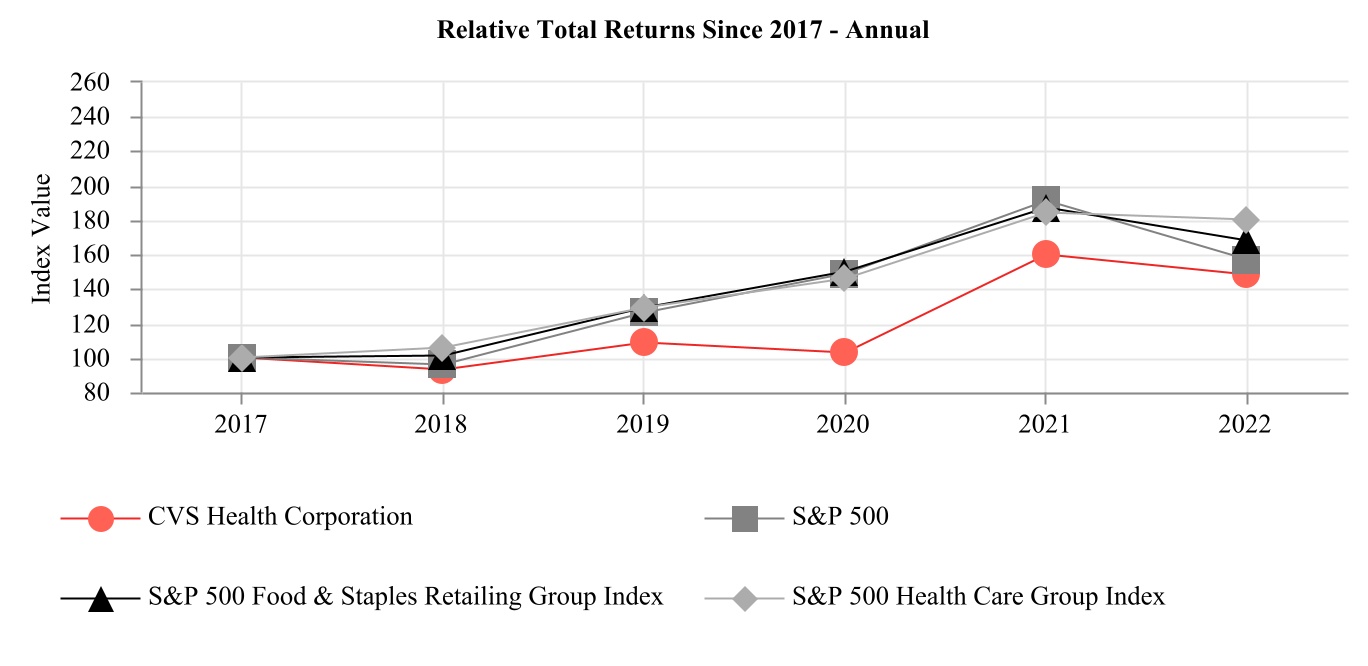
| December 31, | |||||||||||||||||||||||||||||||||||
| 2017 | 2018 | 2019 | 2020 | 2021 | 2022 | ||||||||||||||||||||||||||||||
| CVS Health Corporation | $ | 100 | $ | 93 | $ | 109 | $ | 103 | $ | 160 | $ | 148 | |||||||||||||||||||||||
| S&P 500 (1) | 100 | 96 | 126 | 149 | 191 | 157 | |||||||||||||||||||||||||||||
| S&P 500 Food & Staples Retailing Group Index (2) | 100 | 101 | 129 | 150 | 187 | 168 | |||||||||||||||||||||||||||||
| S&P 500 Health Care Group Index (1) (3) | 100 | 106 | 129 | 146 | 184 | 180 |
(1)Includes CVS Health Corporation.
(2)Includes five companies (COST, KR, SYY, WBA, WMT).
(3)Includes 63 companies.
The year-ended values of each investment shown in the preceding graph are based on share price appreciation plus dividends, with the dividends reinvested as of the last business day of the month during which such dividends were ex-dividend. The calculations exclude trading commissions and taxes. Total shareholder returns from each investment can be calculated from the year-end investment values shown beneath the graph.
Item 6. Reserved
Not applicable.
Item 7. Management’s Discussion and Analysis of Financial Condition and Results of Operations. (“MD&A”)
The following discussion and analysis should be read in conjunction with the audited consolidated financial statements and related notes included in Item 8 of this Annual Report on Form 10-K (this “10-K”), “Risk Factors” included in Item 1A of this 10-K and the “Cautionary Statement Concerning Forward-Looking Statements” in this 10-K.
Overview of Business
CVS Health Corporation, together with its subsidiaries (collectively, “CVS Health,” the “Company,” “we,” “our” or “us”), is a leading diversified health solutions company reshaping health care to help make healthier happen for more Americans. In an increasingly connected and digital world, CVS Health is meeting people wherever they are and changing health care to meet their needs. The Company has more than 9,000 retail locations, more than 1,100 walk-in medical clinics, a leading pharmacy benefits manager with over 110 million plan members with expanding specialty pharmacy solutions and a dedicated senior pharmacy care business serving more than one million patients per year. The Company also serves an estimated 35 million people through traditional, voluntary and consumer-directed health insurance products and related services, including expanding Medicare Advantage offerings and a leading standalone Medicare Part D prescription drug plan (“PDP”). The Company believes its integrated health care model increases access to quality care, delivers better health outcomes and lowers overall health care costs.
The Company has four reportable segments: Health Care Benefits, Pharmacy Services, Retail/LTC and Corporate/Other, which are described below.
Overview of the Health Care Benefits Segment
The Health Care Benefits segment operates as one of the nation’s leading diversified health care benefits providers. The Health Care Benefits segment has the information and resources to help members, in consultation with their health care professionals, make more informed decisions about their health care. The Health Care Benefits segment offers a broad range of traditional, voluntary and consumer-directed health insurance products and related services, including medical, pharmacy, dental and behavioral health plans, medical management capabilities, Medicare Advantage and Medicare Supplement plans, PDPs, Medicaid health care management services, and health information technology products and services. The Health Care Benefits segment also provided workers’ compensation administrative services through its Coventry Health Care Workers’ Compensation business (“Workers’ Compensation business”) prior to the sale of this business on July 31, 2020. The Health Care Benefits segment’s customers include employer groups, individuals, college students, part-time and hourly workers, health plans, health care providers (“providers”), governmental units, government-sponsored plans, labor groups and expatriates. The Company refers to insurance products (where it assumes all or a majority of the risk for medical and dental care costs) as “Insured” and administrative services contract products (where the plan sponsor assumes all or a majority of the risk for medical and dental care costs) as “ASC.” In addition, effective January 2022, the Company entered the individual public health insurance exchanges (“Public Exchanges”) in eight states through which it sells Insured plans directly to individual consumers. The Company entered Public Exchanges in four additional states effective January 2023.
Overview of the Pharmacy Services Segment
The Pharmacy Services segment provides a full range of pharmacy benefit management (“PBM”) solutions, including plan design offerings and administration, formulary management, retail pharmacy network management services and mail order pharmacy. In addition, through the Pharmacy Services segment, the Company provides specialty pharmacy and infusion services, clinical services, disease management services, medical spend management and pharmacy and/or other administrative services for providers and federal 340B drug pricing program covered entities (“Covered Entities”).The Company operates a group purchasing organization that negotiates pricing for the purchase of pharmaceuticals and rebates with pharmaceutical manufacturers on behalf of its participants. The Company also provides various administrative, management and reporting services to pharmaceutical manufacturers. The Pharmacy Services segment’s clients are primarily employers, insurance companies, unions, government employee groups, health plans, PDPs, Medicaid managed care plans, plans offered on Public Exchanges and private health insurance exchanges, other sponsors of health benefit plans throughout the United States and Covered Entities. The Pharmacy Services segment operates retail specialty pharmacy stores, specialty mail order pharmacies, mail order dispensing pharmacies, compounding pharmacies and branches for infusion and enteral nutrition services.
Overview of the Retail/LTC Segment
The Retail/LTC segment sells prescription drugs and a wide assortment of health and wellness products and general merchandise, provides health care services through its MinuteClinic® walk-in medical clinics, provides medical diagnostic testing, administers vaccinations for illnesses such as influenza, coronavirus disease 2019 (“COVID-19”) and shingles and conducts long-term care pharmacy (“LTC”) operations, which distribute prescription drugs and provide related pharmacy consulting and other ancillary services to long-term care facilities and other care settings. As of December 31, 2022, the Retail/LTC segment operated more than 9,000 retail locations, more than 1,100 MinuteClinic locations as well as online retail pharmacy websites, LTC pharmacies and on-site pharmacies. For the year ended December 31, 2022, the Company dispensed 26.8% of the total retail pharmacy prescriptions in the United States.
Overview of the Corporate/Other Segment
The Company presents the remainder of its financial results in the Corporate/Other segment, which primarily consists of:
-
Management and administrative expenses to support the Company’s overall operations, which include certain aspects of executive management and the corporate relations, legal, compliance, human resources, information technology and finance departments, expenses associated with the Company’s investments in its transformation and enterprise modernization programs and acquisition-related integration costs; and
-
Products for which the Company no longer solicits or accepts new customers such as its large case pensions and long-term care insurance products.
COVID-19
The COVID-19 pandemic and its emerging new variants continue to impact the economies of the U.S. and other countries around the world. Our strong local presence and scale in communities across the country has enabled us to continue to play an indispensable role in the national response to COVID-19, as well as provide seamless support for our customers wherever they need us: in our CVS locations, in their homes, and virtually. The COVID-19 pandemic had a significant impact on the Company’s operating results for the years ended December 31, 2022, 2021 and 2020, primarily in the Company’s Health Care Benefits and Retail/LTC segments.
Health Care Benefits Segment
Beginning in mid-March 2020, the health care system experienced a significant reduction in utilization of medical services (“utilization”) that is discretionary and the cancellation of elective medical procedures. Utilization remained below historical levels through April 2020, began to recover in May and June 2020 and reached more normal levels in the third and fourth quarters of 2020, with select geographies impacted by COVID-19 waves. In response to COVID-19, the Company provided expanded benefit coverage to its members, including cost-sharing waivers for COVID-19 related treatments, as well as assistance to members through premium credits, tel
Showing the first 8K of 159K characters. Open the full section
Item 7A. Quantitative and Qualitative Disclosures About Market Risk.
The Company’s earnings and financial condition are exposed to interest rate risk, credit quality risk, market valuation risk, foreign currency risk, commodity risk and operational risk.
Evaluation of Interest Rate and Credit Quality Risk
The Company manages interest rate risk by seeking to maintain a tight match between the durations of assets and liabilities when appropriate. The Company manages credit quality risk by seeking to maintain high average credit quality ratings and diversified sector exposure within its debt securities portfolio. In connection with its investment and risk management objectives, the Company also uses derivative financial instruments whose market value is at least partially determined by, among other things, levels of or changes in interest rates (short-term or long-term), duration, prepayment rates, equity markets or credit ratings/spreads. The Company’s use of these derivatives is generally limited to hedging risk and has principally consisted of using interest rate swaps, treasury rate locks, forward contracts, futures contracts, warrants, put options and credit default swaps. These instruments, viewed separately, subject the Company to varying degrees of interest rate, equity price and credit risk. However, when used for hedging, the Company expects these instruments to reduce overall risk.
Investments
The Company’s investment portfolio supported the following products at December 31, 2022 and 2021:
| In millions | 2022 | 2021 | |||||||||
| Experience-rated products | $ | 744 | $ | 957 | |||||||
| Remaining products | 23,147 | 25,185 | |||||||||
| Total investments (1) | $ | 23,891 | $ | 26,142 |
(1)Includes long-term investments of $17 million which have been accounted for as assets held for sale and are included in assets held for sale on the consolidated balance sheet at December 31, 2022. See Note 2 ‘‘Acquisitions, Divestitures and Asset Sales’’ included in Item 8 of this 10-K for additional information.
Investment risks associated with experience-rated products generally do not impact the Company’s operating results. The risks associated with investments supporting experience-rated pension and annuity products in the large case pensions business in the Company’s Corporate/Other segment are assumed by the contract holders and not by the Company (subject to, among other things, certain minimum guarantees). Assets supporting experience-rated products may be subject to contract holder or participant withdrawals.
The debt securities in the Company’s investment portfolio had an average credit quality rating of A at both December 31, 2022 and 2021, with a fair value of approximately $6.0 billion and $6.7 billion rated AAA at December 31, 2022 and 2021, respectively. The fair value of debt securities that were rated below investment grade (that is, having a credit quality rating below BBB-/Baa3) was $1.9 billion and $2.3 billion at December 31, 2022 and 2021, respectively (of which 1.6% and 2.0% at December 31, 2022 and 2021, respectively, supported experience-rated products).
At December 31, 2022 and 2021, the Company held $202 million and $305 million, respectively, of municipal debt securities that were guaranteed by third parties, representing 1% of total investments at both December 31, 2022 and 2021. These securities had an average credit quality rating of AA+ and AA at December 31, 2022 and 2021, respectively, with the guarantee. These securities had an average credit quality rating of A at both December 31, 2022 and 2021, respectively, without the guarantee. The Company does not have any significant concentration of investments with third party guarantors (either direct or indirect).
The Company generally classifies debt securities as available for sale, and carries them at fair value on the consolidated balance sheets. At both December 31, 2022 and 2021, less than 1% of debt securities were valued using inputs that reflect the Company’s assumptions (categorized as Level 3 inputs in accordance with accounting principles generally accepted in the United States of America). See Note 4 ‘‘Fair Value’’ included in Item 8 of this 10-K for additional information on the methodologies and key assumptions used to determine the fair value of investments. For additional information related to investments, see Note 3 ‘‘Investments’’ included in Item 8 of this 10-K.
The Company regularly reviews debt securities in its portfolio to determine whether a decline in fair value below the cost basis or carrying value has occurred. If a debt security is in an unrealized loss position and the Company has the intent to sell the security, or it is more likely than not that the Company will have to sell the security before recovery of its amortized cost basis,
the amortized cost basis of the security is written down to its fair value and the difference is recognized in net income. If a debt security is in an unrealized loss position and the Company does not have the intent to sell and it is more likely than not that the Company will not have to sell such security before recovery of its amortized cost basis, the Company bifurcates the impairment into credit-related and non-credit related components. The amount of the credit-related component is recorded as an allowance for credit losses and recognized in net income, and the amount of the non-credit related component is included in other comprehensive income (loss). The impairment of debt securities is considered a critical accounting policy. See ‘‘Critical Accounting Policies - Impairments of Debt Securities” in the MD&A included in Item 7 of this 10-K for additional information.
Evaluation of Market Valuation Risks
The Company regularly evaluates its risk from market-sensitive instruments by examining, among other things, levels of or changes in interest rates (short-term or long-term), duration, prepayment rates, equity markets and/or credit ratings/spreads. The Company also regularly evaluates the appropriateness of investments relative to management-approved investment guidelines (and operates within those guidelines) and the business objectives of its portfolios.
On a quarterly basis, the Company reviews the impact of hypothetical net losses in its investment portfolio on the Company’s consolidated near-term financial condition, operating results and cash flows assuming the occurrence of certain reasonably possible changes in near-term market rates and prices. Interest rate changes (whether resulting from changes in treasury yields or credit spreads or other factors) represent the most material risk exposure category for the Company. The Company has estimated the impact on the fair value of market sensitive instruments based on the net present value of cash flows using a representative set of likely future interest rate scenarios. The assumptions used were as follows: an immediate increase of 100 basis points in interest rates (which the Company believes represents a moderately adverse scenario) for long-term debt issued by the Company, as well as its interest rate sensitive investments and an immediate decrease of 15% in prices for publicly traded domestic equity securities in the Company’s investment portfolio.
Assuming an immediate increase of 100 basis points in interest rates, the theoretical decline in the fair values of market sensitive instruments at December 31, 2022 is as follows:
-
The fair value of long-term debt issued by the Company would decline by approximately $2.9 billion ($3.6 billion pretax). Changes in the fair value of long-term debt do not impact the Company’s operating results or financial condition.
-
The theoretical reduction in the fair value of interest rate sensitive investments partially offset by the theoretical reduction in the fair value of interest rate sensitive liabilities would result in a net decline in fair value of approximately $595 million ($750 million pretax) related to continuing non-experience-rated products. Reductions in the fair value of investment securities would be reflected as an unrealized loss in equity, as the Company classifies these debt securities as available for sale. The Company does not record liabilities at fair value.
If the value of the Company’s publicly traded domestic equity securities held within its investment portfolio were to decline by 15%, this would result in a net decline in fair value of $20 million ($26 million pretax).
Based on overall exposure to interest rate risk and equity price risk, the Company believes that these changes in market rates and prices would not materially affect consolidated near-term financial condition, operating results or cash flows as of December 31, 2022.
Evaluation of Foreign Currency and Commodity Risk
At December 31, 2022 and 2021, the Company did not have any material foreign currency exchange rate or commodity derivative instruments in place and believes its exposure to foreign currency exchange rate risk is not material.
Evaluation of Operational Risks
The Company also faces certain operational risks. Those risks include risks related to the COVID-19 pandemic and risks related to information security, including cybersecurity.
The spread of COVID-19, or actions taken to mitigate its spread, could have material and adverse effects on our ability to operate our businesses effectively, including as a result of the complete or partial closure of facilities or labor shortages. Disruptions in our supply chains, our distribution chains and/or public and private infrastructure, including communications, financial services and supply chains, could materially and adversely impact our business operations. We have transitioned a significant subset of our colleagues to a remote work environment in an effort to mitigate the spread of COVID-19, as have a
significant number of our third-party service providers, which may amplify certain risks to our businesses, including an increased demand for information technology resources, increased risk of phishing and other cyber attacks, increased risk of unauthorized dissemination of sensitive personal information or proprietary or confidential information about us or our medical members or other third-parties and increased risk of business interruptions.
The Company and its vendors have experienced diverse cyber attacks and expect to continue to experience cyber attacks going forward. As examples, the Company and its vendors have experienced attempts to gain access to systems, denial of service attacks, attempted malware infections, account takeovers, scanning activity and phishing emails. Attacks can originate from external criminals, terrorists, nation states or internal actors. The Company is dedicating and will continue to dedicate significant resources and incur significant expenses to maintain and update on an ongoing basis the systems and processes that are designed to mitigate the information security risks it faces and protect the security of its computer systems, software, networks and other technology assets against attempts by unauthorized parties to obtain access to confidential information, disrupt or degrade service or cause other damage. The impact of cyber attacks has not been material to the Company’s operations or operating results through December 31, 2022. The Board and its Audit Committee and Nominating and Corporate Governance Committee are regularly informed regarding the Company’s information security policies, practices and status.
Item 8. Financial Statements and Supplementary Data.
Index to Consolidated Financial Statements
Index to Consolidated Financial Statements
Consolidated Statements of Operations
| For the Years Ended December 31, | |||||||||||||||||
| In millions, except per share amounts | 2022 | 2021 | 2020 | ||||||||||||||
| Revenues: | |||||||||||||||||
| Products | $ | 226,616 | $ | 203,738 | $ | 190,688 | |||||||||||
| Premiums | 85,330 | 76,132 | 69,364 | ||||||||||||||
| Services | 9,683 | 11,042 | 7,856 | ||||||||||||||
| Net investment income | 838 | 1,199 | 798 | ||||||||||||||
| Total revenues | 322,467 | 292,111 | 268,706 | ||||||||||||||
| Operating costs: | |||||||||||||||||
| Cost of products sold | 196,892 | 175,803 | 163,981 | ||||||||||||||
| Benefit costs | 71,281 | 64,260 | 55,679 | ||||||||||||||
| Opioid litigation charges | 5,803 | — | — | ||||||||||||||
| Loss on assets held for sale | 2,533 | — | — | ||||||||||||||
| Store impairments | — | 1,358 | — | ||||||||||||||
| Goodwill impairment | — | 431 | — | ||||||||||||||
| Operating expenses | 38,212 | 37,066 | 35,135 | ||||||||||||||
| Total operating costs | 314,721 | 278,918 | 254,795 | ||||||||||||||
| Operating income | 7,746 | 13,193 | 13,911 | ||||||||||||||
| Interest expense | 2,287 | 2,503 | 2,907 | ||||||||||||||
| Loss on early extinguishment of debt | — | 452 | 1,440 | ||||||||||||||
| Other income | (169) | (182) | (206) | ||||||||||||||
| Income before income tax provision | 5,628 | 10,420 | 9,770 | ||||||||||||||
| Income tax provision | 1,463 | 2,522 | 2,569 | ||||||||||||||
| Income from continuing operations | 4,165 | 7,898 | 7,201 | ||||||||||||||
| Loss from discontinued operations, net of tax | — | — | (9) | ||||||||||||||
| Net income | 4,165 | 7,898 | 7,192 | ||||||||||||||
| Net (income) loss attributable to noncontrolling interests | (16) | 12 | (13) | ||||||||||||||
| Net income attributable to CVS Health | $ | 4,149 | $ | 7,910 | $ | 7,179 | |||||||||||
| Basic earnings per share: | |||||||||||||||||
| Income from continuing operations attributable to CVS Health | $ | 3.16 | $ | 6.00 | $ | 5.49 | |||||||||||
| Loss from discontinued operations attributable to CVS Health | $ | — | $ | — | $ | (0.01) | |||||||||||
| Net income attributable to CVS Health | $ | 3.16 | $ | 6.00 | $ | 5.48 | |||||||||||
| Weighted average basic shares outstanding | 1,312 | 1,319 | 1,309 | ||||||||||||||
| Diluted earnings per share: | |||||||||||||||||
| Income from continuing operations attributable to CVS Health | $ | 3.14 | $ | 5.95 | $ | 5.47 | |||||||||||
| Loss from discontinued operations attributable to CVS Health | $ | — | $ | — | $ | (0.01) | |||||||||||
| Net income attributable to CVS Health | $ | 3.14 | $ | 5.95 | $ | 5.46 | |||||||||||
| Weighted average diluted shares outstanding | 1,323 | 1,329 | 1,314 | ||||||||||||||
| Dividends declared per share | $ | 2.20 | $ | 2.00 | $ | 2.00 |
See accompanying notes to consolidated financial statements.
Index to Consolidated Financial Statements
Consolidated Statements of Comprehensive Income
| For the Years Ended December 31, | |||||||||||||||||
| In millions | 2022 | 2021 | 2020 | ||||||||||||||
| Net income | $ | 4,165 | $ | 7,898 | $ | 7,192 | |||||||||||
| Other comprehensive income (loss), net of tax: | |||||||||||||||||
| Net unrealized investment gains (losses) | (2,279) | (436) | 440 | ||||||||||||||
| Foreign currency translation adjustments | — | (7) | 3 | ||||||||||||||
| Net cash flow hedges | 17 | (26) | (31) | ||||||||||||||
| Pension and other postretirement benefits | (168) | 20 | (17) | ||||||||||||||
| Other comprehensive income (loss) | (2,430) | (449) | 395 | ||||||||||||||
| Comprehensive income | 1,735 | 7,449 | 7,587 | ||||||||||||||
| Comprehensive (income) loss attributable to noncontrolling interests | (16) | 12 | (13) | ||||||||||||||
| Comprehensive income attr |
Showing the first 8K of 352K characters. Open the full section
Item 9. Changes in and Disagreements With Accountants on Accounting and Financial Disclosure.
None.
Item 9A. Controls and Procedures.
Evaluation of disclosure controls and procedures
The Company’s Chief Executive Officer and Chief Financial Officer, after evaluating the effectiveness of the design and operation of the Company’s disclosure controls and procedures (as defined in Rules 13a-15 (f) and 15d-15(f) under the Securities Exchange Act of 1934) as of December 31, 2022, have concluded that as of such date the Company’s disclosure controls and procedures were adequate and effective at a reasonable assurance level and designed to ensure that material information relating to the Company and its consolidated subsidiaries would be made known to such officers on a timely basis.
Management’s report on internal control over financial reporting
Management is responsible for establishing and maintaining adequate internal control over financial reporting. The Company’s internal control over financial reporting includes those policies and procedures that (1) pertain to the maintenance of records that, in reasonable detail, accurately and fairly reflect the transactions and dispositions of the assets of the Company; (2) provide reasonable assurance that transactions are recorded as necessary to permit preparation of the Company’s consolidated financial statements in accordance with generally accepted accounting principles, and that receipts and expenditures of the Company are being made only in accordance with authorizations of management and directors of the Company; and (3) provide reasonable assurance regarding prevention or timely detection of unauthorized acquisition, use, or disposition of the Company’s assets that could have a material effect on the Company’s consolidated financial statements. In order to ensure the Company’s internal control over financial reporting is effective, management regularly assesses such control and did so most recently for its financial reporting as of December 31, 2022.
Management conducted an assessment of the effectiveness of the Company’s internal control over financial reporting based on the criteria established in Internal Control-Integrated Framework issued by the Committee of Sponsoring Organizations of the Treadway Commission (2013 Framework). This evaluation included review of the documentation, evaluation of the design effectiveness and testing of the operating effectiveness of controls. The Company’s system of internal control over financial reporting is enhanced by periodic reviews by the Company’s internal auditors, written policies and procedures and a written Code of Conduct adopted by CVS Health Corporation’s Board of Directors, applicable to all employees of the Company. In addition, the Company has an internal Disclosure Committee, comprised of management from each functional area within the Company, which performs a separate review of disclosure controls and procedures. There are inherent limitations in the effectiveness of any system of internal control over financial reporting.
Based on management’s assessment, management concluded that the Company’s internal control over financial reporting is effective and provides reasonable assurance that assets are safeguarded and that the financial records are reliable for preparing financial statements as of December 31, 2022.
Ernst & Young LLP, the Company’s independent registered public accounting firm, is appointed by CVS Health Corporation’s Board of Directors and ratified by CVS Health Corporation’s stockholders. They were engaged to render an opinion regarding the fair presentation of the Company’s consolidated financial statements as well as conducting an audit of internal control over financial reporting. Their reports included in Item 8 of this Form 10-K are based upon audits conducted in accordance with the standards of the Public Company Accounting Oversight Board (United States).
Changes in internal control over financial reporting
There has been no change in the Company’s internal control over financial reporting identified in connection with the evaluation required by paragraph (d) of Rule 13a-15 or Rule 15d-15 that occurred during the fourth quarter ended December 31, 2022 that has materially affected, or is reasonably likely to materially affect, the Company’s internal control over financial reporting.
Item 9B. Other Information.
No events have occurred during the fourth quarter ended December 31, 2022 that would require disclosure under this item.
Item 9C. Disclosure Regarding Foreign Jurisdictions that Prevent Inspections.
None.
PART III
Item 10. Directors, Executive Officers and Corporate Governance.
Information concerning the Executive Officers of CVS Health Corporation is included in Part I of this 10-K pursuant to General Instruction G to Form 10-K.
The sections of the Proxy Statement under the captions “Committees of the Board as of the Annual Meeting,” “Code of Conduct,” “Audit Committee Report,” and “Biographies of our Incumbent Board Nominees” are incorporated herein by reference.
Item 11. Executive Compensation.
The sections of the Proxy Statement under the captions “Non-Employee Director Compensation” and “Executive Compensation and Related Matters,” including “Letter from the Management Planning and Development Committee,” “Compensation Committee Report,” “Compensation Discussion and Analysis” and “Compensation of Named Executive Officers” are incorporated herein by reference.
Item 12. Security Ownership of Certain Beneficial Owners and Management and Related Stockholder Matters.
The sections of the Proxy Statement under the captions “Share Ownership of Directors and Certain Executive Officers” and “Share Ownership of Principal Stockholders” are incorporated herein by reference. Those sections contain information concerning security ownership of certain beneficial owners and management and related stockholder matters.
The following table summarizes information about the registrant’s common stock that may be issued upon the exercise of options, warrants and rights under all of the Company’s equity compensation plans as of December 31, 2022:
| Number of securities to be issued upon exercise of outstanding options, warrants and rights (1) (2) (a) | Weighted average exercise price of outstanding options, warrants and rights (b) | Number of securities remaining available for future issuance under equity compensation plans (excluding securities reflected in first column) (1) (c) | |||||||||||||||
| Equity compensation plans approved by stockholders (3) | 26,544 | $ | 75.70 | 21,341 | |||||||||||||
| Equity compensation plans not approved by stockholders (4) | 1,800 | 43.60 | — | ||||||||||||||
| Total | 28,344 | 74.28 | 21,341 |
(1)Shares in thousands.
(2)Consists of: (i) 13,834 shares of common stock underlying outstanding options, (ii) 639 shares of common stock issuable upon the exercise of outstanding stock appreciation rights (“SARs”) and (iii) 13,871 shares of common stock issuable on the vesting of outstanding restricted stock units, deferred stock units and performance stock units, assuming target level performance in the case of performance stock units. The number of shares included with respect to outstanding SARs is the number of shares of CVS Health Corporation common stock that would have been issued had the SARs been exercised based on the closing price per share of CVS Health Corporation common stock on December 31, 2022, as reported on the NYSE, which was $93.19.
(3)Consists of the CVS Health 2017 Incentive Compensation Plan.
(4)Consists of the Amended Aetna Inc. 2010 Stock Incentive Plan (the “Aetna Stock Plan”). The Aetna Stock Plan expired on May 21, 2020, therefore there are no securities available for future grants under this plan.
The Aetna Stock Plan was last approved by Aetna’s shareholders at Aetna’s 2017 Annual Meeting on May 19, 2017. The Company elected to continue to grant awards under the Aetna Stock Plan to employees of Aetna and its subsidiaries following the completion of the Company’s acquisition of Aetna. The Aetna Stock Plan was designed to promote the Company’s interests and those of its stockholders and to further align the interests of stockholders and employees by tying awards to total return to stockholders, enabling plan participants to acquire additional equity interests in the Company and providing compensation opportunities dependent upon the Company’s performance. The Aetna Stock Plan was not submitted to the Company’s stockholders and expired on May 21, 2020. Under the Aetna Stock Plan, eligible participants could be granted stock options to
purchase shares of CVS Health Corporation common stock, SARs, time-vesting and/or performance-vesting incentive stock or incentive units and other stock-based awards.
Item 13. Certain Relationships and Related Transactions, and Director Independence.
The sections of the Proxy Statement under the captions “Independence Determinations for Directors” and “Related Person Transaction Policy” are incorporated herein by reference.
Item 14. Principal Accountant Fees and Services.
The section of the Proxy Statement under the caption “Item 2: Ratification of Appointment of Independent Registered Public Accounting Firm for 2022” is incorporated herein by reference.
PART IV
Item 15. Exhibits, Financial Statement Schedules.
The following documents are filed as part of this 10-K:
1.Financial Statements. See “Index to Consolidated Financial Statements” in Item 8 of this 10-K.
2.Financial Statement Schedules. All financial statement schedules are omitted because they are not applicable, not required under the instructions, or the information is included in the consolidated financial statements or related notes.
3.Exhibits. The exhibits listed in the “Index to Exhibits” in this Item 15 are filed or incorporated by reference as part of this 10-K. Exhibits marked with an asterisk (*) are management contracts or compensatory plans or arrangements. Exhibits other than those listed are omitted because they are not required to be listed or are not applicable. Pursuant to Item 601(b)(4)(iii) of Regulation S-K, the Registrant hereby agrees to furnish to the Securities and Exchange Commission a copy of any omitted instrument that is not required to be listed.
INDEX TO EXHIBITS
Item 16. Form 10-K Summary.
None.
SIGNATURES
Pursuant to the requirements of Section 13 or 15(d) of the Securities Exchange Act of 1934, the registrant has duly caused this report to be signed on its behalf by the undersigned, thereunto duly authorized.
| CVS HEALTH CORPORATION | |||||||||||
| Date: | February 8, 2023 | By: | /s/ SHAWN M. GUERTIN | ||||||||
| Shawn M. Guertin | |||||||||||
| Executive Vice President and Chief Financial Officer |
Pursuant to the requirements of the Securities Exchange Act of 1934, this report has been signed below by the following persons on behalf of the registrant and in the capacities and on the dates indicated.
| Signature | Title(s) | Date | ||||||||||||
| /s/ FERNANDO AGUIRRE | Director | February 8, 2023 | ||||||||||||
| Fernando Aguirre | ||||||||||||||
| /s/ JEFFREY R. BALSER, M.D., Ph.D. | Director | February 8, 2023 | ||||||||||||
| Jeffrey R. Balser, M.D., Ph.D. | ||||||||||||||
| /s/ C. DAVID BROWN II | Director | February 8, 2023 | ||||||||||||
| C. David Brown II | ||||||||||||||
| /s/ JAMES D. CLARK | Senior Vice President - Controller and Chief | February 8, 2023 | ||||||||||||
| James D. Clark | Accounting Officer (Principal Accounting Officer) | |||||||||||||
| /s/ ALECIA A. DECOUDREAUX | Director | February 8, 2023 | ||||||||||||
| Alecia A. DeCoudreaux | ||||||||||||||
| /s/ NANCY-ANN M. DEPARLE | Director | February 8, 2023 | ||||||||||||
| Nancy-Ann M. DeParle | ||||||||||||||
| /s/ ROGER N. FARAH | Chair of the Board and Director | February 8, 2023 | ||||||||||||
| Roger N. Farah | ||||||||||||||
| /s/ ANNE M. FINUCANE | Director | February 8, 2023 | ||||||||||||
| Anne M. Finucane | ||||||||||||||
| /s/ SHAWN M. GUERTIN | Executive Vice President and Chief Financial | February 8, 2023 | ||||||||||||
| Shawn M. Guertin | Officer (Principal Financial Officer) | |||||||||||||
| /s/ EDWARD J. LUDWIG | Director | February 8, 2023 | ||||||||||||
| Edward J. Ludwig | ||||||||||||||
| /s/ KAREN S. LYNCH | President and Chief Executive Officer | February 8, 2023 | ||||||||||||
| Karen S. Lynch | (Principal Executive Officer) and Director | |||||||||||||
| /s/ JEAN-PIERRE MILLON | Director | February 8, 2023 | ||||||||||||
| Jean-Pierre Millon | ||||||||||||||
| /s/ MARY L. SCHAPIRO | Director | February 8, 2023 | ||||||||||||
| Mary L. Schapiro | ||||||||||||||
| /s/ WILLIAM C. WELDON | Director | February 8, 2023 | ||||||||||||
| William C. Weldon |