 filings.tools
Delta Air Lines 10-K 2023-12-31
Filed 2024-02-12. 24 sections, 458K characters. Original on sec.gov · Markdown · JSON
Cover and table of contents
UNITED STATES
SECURITIES AND EXCHANGE COMMISSION
Washington, D.C. 20549
FORM 10-K
| ☑ | ANNUAL REPORT PURSUANT TO SECTION 13 OR 15(d) OF THE SECURITIES EXCHANGE ACT OF 1934 |
For the fiscal year ended December 31, 2023
| or | |||||
| ☐ | TRANSITION REPORT PURSUANT TO SECTION 13 OR 15(d) OF THE SECURITIES EXCHANGE ACT OF 1934 |
Commission File Number 001-5424

DELTA AIR LINES, INC.
(Exact name of registrant as specified in its charter)
| Delaware | 58-0218548 | ||||
| (State or other jurisdiction of incorporation or organization) | (I.R.S. Employer Identification No.) | ||||
| Post Office Box 20706 | |||||
| Atlanta, Georgia | 30320-6001 | ||||
| (Address of principal executive offices) | (Zip Code) |
Registrant's telephone number, including area code: (404) 715-2600
Securities registered pursuant to Section 12(b) of the Act:
| Title of each class | Trading Symbol | Name of each exchange on which registered | ||||||||||||
| Common Stock, par value $0.0001 per share | DAL | New York Stock Exchange |
Securities registered pursuant to Section 12(g) of the Act: None
Indicate by check mark if the registrant is a well-known seasoned issuer, as defined in Rule 405 of the Securities Act. Yes þ No o
Indicate by check mark if the registrant is not required to file reports pursuant to Section 13 or Section 15(d) of the Exchange Act. Yes o No þ
Indicate by check mark whether the registrant (1) has filed all reports required to be filed by Section 13 or 15(d) of the Securities Exchange Act of 1934 during the preceding 12 months (or for such shorter period that the registrant was required to file such reports), and (2) has been subject to such filing requirements for the past 90 days. Yes þ No o
Indicate by check mark whether the registrant has submitted electronically every Interactive Data File required to be submitted pursuant to Rule 405 of Regulation S-T (§ 232.405 of this chapter) during the preceding 12 months (or for such shorter period that the registrant was required to submit such files). Yes þ No o
Indicate by check mark whether the registrant is a large accelerated filer, an accelerated filer, a non-accelerated filer, a smaller reporting company, or an emerging growth company. See the definitions of "large accelerated filer," "accelerated filer," "smaller reporting company," and "emerging growth company" in Rule 12b-2 of the Exchange Act.
| Large accelerated filer | ☑ | Accelerated filer | ☐ | Non-accelerated filer | ☐ | ||||||||||||
| Smaller reporting company | ☐ | Emerging growth company | ☐ |
If an emerging growth company, indicate by check mark if the registrant has elected not to use the extended transition period for complying with any new or revised financial accounting standards provided pursuant to Section 13(a) of the Exchange Act. o
Indicate by check mark whether the registrant has filed a report on and attestation to its management's assessment of the effectiveness of its internal control over financial reporting under Section 404(b) of the Sarbanes-Oxley Act (15 U.S.C. 7262(b)) by the registered public accounting firm that prepared or issued its audit report. ☑
If securities are registered pursuant to Section 12(b) of the Act, indicate by check mark whether the financial statements of the registrant included in the filing reflect the correction of an error to previously issued financial statements o
Indicate by check mark whether any of those error corrections are restatements that required a recovery analysis of incentive-based compensation received by any of the registrant's executive officers during the relevant recovery period pursuant to §240.10D-1(b). o
Indicate by check mark whether the registrant is a shell company (as defined in Rule 12b-2 of the Exchange Act). Yes ☐ No þ
The aggregate market value of the voting and non-voting common equity held by non-affiliates of the registrant as of June 30, 2023 was approximately $30.4 billion.
On January 31, 2024, there were outstanding 643,323,851 shares of the registrant's common stock.
This document is also available on our website at http://ir.delta.com/.
Documents Incorporated By Reference
Part III of this Form 10-K incorporates by reference certain information from the registrant's definitive Proxy Statement for its 2024 Annual Meeting of Stockholders to be filed with the Securities and Exchange Commission.
Showing the first 8K of 68K characters. Open the full section
Item 1. Business
In 2017, ICAO also adopted aircraft certification standards to reduce carbon dioxide ("CO2") emissions from new aircraft. The new aircraft certification standards applied to new fleet types in 2020 and will apply to in-production aircraft no later than 2028. These standards will not apply to existing in-service aircraft. In 2021, the EPA finalized GHG emission standards for new aircraft engines designed to implement the ICAO standards on the same timeframe contemplated by ICAO, and these standards have been upheld in response to legal challenges. Like the ICAO standards, the final EPA standards would not apply to engines on in-service aircraft.
The airline industry may face additional regulation of aircraft emissions in the U.S. and abroad and become subject to further taxes, charges or additional requirements to obtain permits or purchase allowances or emission credits for GHG emissions in various jurisdictions. For example, in 2023, the EU adopted legislation that will impose a SAF mandate on fuel supplied at EU airports. The mandate requires that, of the jet fuel supplied in the EU, 2% must be SAF beginning in 2025, and the percentage increases incrementally over time to 70% in 2050. This mandate is expected to increase the cost of SAF in the EU. Additional regulation could result in taxation, regulatory or permitting requirements from multiple jurisdictions for the same operations and significant costs for us and the airline industry. In addition to direct costs, such regulation could result in increased fuel costs passed through from fuel suppliers affected by any such regulations. Certain airports have also adopted, and others could in the future adopt, GHG emission or climate-related goals and requirements that could impact our operations or require us to make changes or investments in our infrastructure. We are monitoring and evaluating the potential impact of such developments.
Noise. The Airport Noise and Capacity Act of 1990 recognizes the rights of operators of airports with noise problems to implement local noise abatement programs so long as such programs do not interfere unreasonably with interstate or foreign commerce or the national air transportation system. This statute generally provides that local noise restrictions on Stage 3 aircraft first effective after October 1, 1990 require FAA approval. While we have had sufficient scheduling flexibility to accommodate local noise restrictions in the past, our operations could be adversely impacted if locally imposed regulations become more restrictive or widespread. In addition, foreign governments may enact or allow airports to enact similar restrictions, which could adversely impact our international operations or require significant expenditures in order for our aircraft to comply with the restrictions. For example, in 2022, to reduce noise, the Netherlands announced a multi-phase plan to reduce the maximum number of flights authorized annually at Amsterdam’s Schiphol Airport. In 2023, airlines and airline associations, including Delta and KLM, challenged the initial phase of the plan. The legal challenge resulted in a ruling against the industry, but an appeal is currently pending before the Supreme Court of the Netherlands. The U.S., the European Commission and other governments also raised legal concerns about the plan with the Dutch government. In November 2023, the Netherlands suspended the initial phase of the plan; however, the government continues to support a second-phase plan to reduce flights at Schiphol. The outcome cannot be determined at this time.
Refinery Matters. Monroe's operation of the Trainer refinery is subject to numerous environmental laws and extensive regulations, including those relating to the discharge of materials into the environment, waste management, pollution prevention measures and greenhouse gas and other air emissions.
Under the Energy Policy Act of 2005, as expanded by the Energy Independence and Security Act of 2007, the Renewable Fuel Standard ("RFS") was created, setting up specific targets of renewable fuel to be used in the U.S. economy by mandating the blending of renewable fuels into gasoline and on-road diesel ("Transportation Fuels"). Renewable Identification Numbers ("RINs") are assigned to renewable fuels produced by or imported into the U.S. that are blended into Transportation Fuels to demonstrate compliance with this obligation. A refinery may meet its obligation under RFS by blending the necessary volumes of renewable fuels with Transportation Fuels, by purchasing RINs in the open market or through a combination of blending and purchasing RINs. Because Monroe is able to blend only a small amount of renewable fuels, it must purchase the majority of its RINs requirement in the secondary market. Market prices for RINs have been volatile and marked by periods of sharp increases and decreases primarily in response to speculation about what the EPA and/or the U.S. Congress will do with respect to compliance obligations. In June 2023, the EPA finalized RFS volume requirements for 2023, 2024 and 2025. These volume requirements are below projected production of Transportation Fuels, which has resulted in a decrease in the price of RINs.
Civil Reserve Air Fleet Program
We participate in the Civil Reserve Air Fleet program (the "CRAF Program"), which permits the U.S. military to use the aircraft and crew resources of participating U.S. airlines during airlift emergencies, national emergencies or times of war. We have agreed to make available under the CRAF Program a portion of our international aircraft during the contract period that ends on September 30, 2024. The CRAF Program has only been activated three times since it was created in 1951, most recently in 2021 to support the military’s effort to evacuate people from Afghanistan following the withdrawal of U.S. troops from the country.
Delta Air Lines, Inc. | 2023 Form 10-K 14
Item 1. Business
Information About Our Executive Officers
Edward H. Bastian, Age 66: Chief Executive Officer of Delta since May 2016; President of Delta (September 2007 - May 2016); President of Delta and Chief Executive Officer Northwest Airlines, Inc. (October 2008 - December 2009); President and Chief Financial Officer of Delta (September 2007 - October 2008); Executive Vice President and Chief Financial Officer of Delta (July 2005 - September 2007); Chief Financial Officer of Acuity Brands (June 2005 - July 2005); Senior Vice President - Finance and Controller of Delta (2000 - April 2005); Vice President and Controller of Delta (1998 - 2000).
Glen W. Hauenstein, Age 63: President of Delta since May 2016; Executive Vice President - Chief Revenue Officer of Delta (August 2013 - May 2016); Executive Vice President - Network Planning and Revenue Management of Delta (April 2006 - July 2013); Executive Vice President and Chief of Network and Revenue Management of Delta (August 2005 - April 2006); Vice General Director - Chief Commercial Officer and Chief Operating Officer of Alitalia (2003 - 2005); Senior Vice President- Network of Continental Airlines (2003); Senior Vice President - Scheduling of Continental Airlines (2001 - 2003); Vice President Scheduling of Continental Airlines (1998 - 2001).
Allison C. Ausband, Age 61: Executive Vice President - Chief Customer Experience Officer of Delta since June 2021; Senior Vice President - In-Flight Service of Delta (September 2014 - May 2021); Vice President - Reservation Sales and Customer Care of Delta (January 2010 - September 2014).
Alain Bellemare, Age 62: President - International of Delta since January 2021; Chief Executive Officer of Bombardier (February 2015 - March 2020); President and Chief Executive Officer of United Technologies Corporation Propulsion & Aerospace Systems (June 2011 - February 2015).
Peter W. Carter, Age 60: Executive Vice President - External Affairs of Delta since October 2022; Executive Vice President - Chief Legal Officer of Delta (July 2015 - October 2022); Partner of Dorsey & Whitney LLP (1999 - 2015), including co-chair of Securities Litigation and Enforcement practice group, chair of Policy Committee and chair of trial department.
Daniel C. Janki, Age 55: Executive Vice President - Chief Financial Officer of Delta since July 2021; Senior Vice President of General Electric Company (GE) and Chief Executive Officer of GE Power Portfolio (October 2020 - June 2021); Senior Vice President, Business and Portfolio Transformation of GE (2018 - 2020); Senior Vice President, Treasurer and Global Business Operations of GE (2014 - 2017); Senior Vice President, CEO of GE Energy Management (2012 - 2013).
John E. Laughter, Age 53: President - Delta TechOps and Chief of Operations since October 2023; Executive Vice President - Chief of Operations of Delta (June 2021 - October 2023); Senior Vice President and Chief of Operations of Delta (October 2020 - June 2021); Senior Vice President - Flight Operations of Delta (March 2020 - October 2020); Senior Vice President - Corporate Safety, Security and Compliance of Delta (August 2013 - March 2020); Senior Vice President - Maintenance Operations of Delta (March 2008 - July 2013); Vice President - Maintenance of Delta (December 2005 - March 2008).
Rahul Samant, Age 57: Executive Vice President - Chief Information Officer of Delta since January 2018; Senior Vice President and Chief Information Officer of Delta (February 2016 - December 2017); Senior Vice President and Chief Digital Officer of American International Group, Inc. (January 2015 - February 2016); Senior Vice President and Global Head, Application Development and Management of American International Group, Inc. (September 2012 - December 2014); Managing Director of Bank of America (1999 - September 2012).
Steven M. Sear, Age 58: Executive Vice President - Global Sales of Delta since February 2016; Senior Vice President - Global Sales of Delta (December 2011 - February 2016); Vice President - Global Sales of Delta (October 2008 - December 2011); Vice President - Sales & Customer Care of Northwest Airlines, Inc. (June 2005 - October 2008).
Joanne D. Smith, Age 65: Executive Vice President and Chief People Officer of Delta since October 2014; Senior Vice President - In-Flight Service of Delta (March 2007 - September 2014); Vice President - Marketing of Delta (November 2005 - February 2007); President of Song (January 2005 - October 2005); Vice President - Marketing and Customer Service of Song (November 2002 - December 2004).
Mike Spanos, Age 59: Chief Operating Officer of Delta since June 2023; President and Chief Executive Officer of Six Flags Entertainment Corporation (November 2019 - November 2021); Chief Executive Officer, Asia, Middle East and North Africa of PepsiCo, Inc. (January 2018 - November 2019); previously served in a variety of management roles of increasing responsibility at PepsiCo, Inc. since 1993.
Delta Air Lines, Inc. | 2023 Form 10-K 15
Item 1. Business
Additional Information
Our company website is located at www.delta.com and our investor relations website is located at ir.delta.com. We make available free of charge on our investor relations website our Annual Report on Form 10-K, our Quarterly Reports on Form 10-Q, our Current Reports on Form 8-K and amendments to those reports as soon as reasonably practicable after these reports are filed with or furnished to the Securities and Exchange Commission ("SEC"). Information on our website, including our investor relations website, is not incorporated into this Form 10-K or our other securities filings and is not a part of those filings.
Delta Air Lines, Inc. | 2023 Form 10-K 16
Item 1A. Risk Factors
ITEM 1A. RISK FACTORS
In addition to the other information set forth in this report, you should carefully consider the following material risk factors applicable to Delta. As described below, these risks could materially affect our business, financial condition or results of operations in the future.
Risk Factors Relating to Delta
We are at risk of losses and adverse publicity stemming from a serious accident involving our aircraft or aircraft of our airline partners.
An aircraft crash or other serious accident involving our aircraft or those of our airline partners could expose us to significant liability. Although we believe that our insurance coverage is appropriate, we may be forced to bear substantial losses from an accident in the event that the coverage was not sufficient.
In addition, any accident involving an aircraft that we operate or an aircraft that is operated by an airline that is one of our regional carriers or codeshare, alliance or joint venture partners could create a negative public perception about safety and reliability for aviation authorities and the public, which could harm our reputation, resulting in air travelers being reluctant to fly on our aircraft and therefore harm our business.
Breaches or lapses in the security of the technology systems we use and rely on could compromise the data stored within them and consequently expose us to liability, disruption to our operations and damage to our reputation, any or all of which could have a material adverse effect on our business.
As a regular part of our ordinary business operations, we collect and store sensitive data, including information necessary for our operations, personal information of our passengers and employees and information of our business partners. The secure operation of our networks and systems, and those of our business partners and third-party service providers, on which this type of information is stored, processed and maintained is critical to our business operations and strategy. These networks and systems are subject to an increasing threat of continually evolving cybersecurity risks, which we must manage.
We expect unauthorized parties to continue attempting to gain access to our systems or information, or those of our business partners and third-party service providers, including through fraud or other means of deception, or introduction of malicious code, such as malware and ransomware. If successful, these actions could cause harm to our computer systems or compromise data stored on our computer networks or those of our business partners and third-party service providers, potentially causing us to incur remedial, legal and other costs, which could be material. Hardware or software we or our business partners or third-party service providers develop, acquire or use in connection with our systems may contain defects that could unexpectedly compromise information security.
The methods used to obtain unauthorized access, disable or degrade service or sabotage systems are constantly evolving and may be difficult to anticipate or to detect for long periods of time. As a result of these types of risks and regular attacks on our systems, we regularly review and update procedures and processes to prevent and protect against unauthorized access to our systems and information and inadvertent misuse of data. In addition to continuously assessing risk and reviewing our procedures, processes and technologies, we continue to educate our employees about these risks and to monitor, review and update the process and control requirements we expect third parties and vendors to leverage and implement for the protection of information regarding our customers, employees or business partners that is in their care. However, the constantly changing nature of the threats means that we may not be able to prevent all information security breaches or misuse of data. In addition, as cybercriminals become more sophisticated, the cost of proactive defensive measures continues to increase.
We are also subject to evolving global privacy and security regulatory obligations and an increasing customer focus on privacy issues and data security in the United States and abroad, as well as to geopolitical risks associated with international data transfer. The compromise of our or our business partners’ or third-party service providers’ technology systems resulting in the loss, interruption, disclosure, misappropriation of, or access to, our information or that of our customers, employees or business partners could result in legal claims or proceedings, liability or regulatory penalties under laws protecting the privacy and security of personal information, disruption to our operations and damage to our reputation, any or all of which could adversely affect our business. The costs to remediate breaches and similar system compromises that do occur could be material.
Delta Air Lines, Inc. | 2023 Form 10-K 17
Item 1A. Risk Factors
Disruptions of our information technology infrastructure could interfere with our operations, possibly having a material adverse effect on our business.
Disruptions in our information technology capability could result from a technology error or failure impacting our internal systems, whether hosted internally at our data centers or externally at third-party locations, or large-scale external interruption in technology infrastructure support on which we depend, such as power, telecommunications or the internet. The operation of our technology systems and the use of related data may also be vulnerable to a variety of other sources of interruption, including natural disasters, terrorist attacks, computer viruses, hackers and other security issues. A significant individual, sustained or repeated failure of our information technology infrastructure, including third-party networks we utilize and on which we depend, could impact our operations and our customer service, result in increased costs and damage our reputation. While we have in place initiatives to prevent disruptions and disaster recovery plans and continue to invest in improvements to these initiatives and plans, we have previously experienced infrastructure disruptions. These measures may not be adequate to prevent a future business disruption and any material adverse financial and reputational consequences to our business as recent outages of large cloud providers whom we rely on has shown.
Failure of the technology we use to perform effectively could have a material adverse effect on our business.
We are dependent on technology initiatives and capabilities to provide customer service and operational effectiveness in order to compete in the current business environment. For example, substantially all of our tickets are issued to our customers as electronic tickets, and a growing number of our customers check in using our website, airport kiosks and our FlyDelta mobile application. We have made and continue to make significant investments in customer facing technology such as delta.com, the FlyDelta mobile application, in-flight wireless internet, check-in kiosks, customer service applications, application of biometric technology, airport information displays and related initiatives, including security for these initiatives. We are also investing in significant upgrades to technology infrastructure and other supporting systems and transitioning to cloud-based technologies. The performance, reliability and security of the technology we use are critical to our ability to serve customers. If this technology does not perform effectively, including as a result of the implementation or integration of new or upgraded technologies or systems, our business and operations would be negatively affected, which could be material.
Our business and results of operations are dependent on the price of aircraft fuel. High fuel costs or cost increases, including in the cost of crude oil, could have a material adverse effect on our results of operations.
Our results of operations are significantly impacted by changes in the price of aircraft fuel. Fuel costs represented 21%, 24% and 20% of our operating expense in 2023, 2022 and 2021, respectively. Fuel prices are highly volatile and at times have increased substantially. In 2023, our average fuel price per gallon was $2.82, ranging from a monthly low of approximately $2.41 per gallon to a monthly high of approximately $3.18 per gallon.
We acquire a significant amount of jet fuel from Monroe and through strategic agreements associated with the refinery that Monroe has with third parties. The cost of the fuel we purchase under these arrangements remains subject to volatility in the cost of crude oil and jet fuel. In addition, we have historically purchased a significant amount of aircraft fuel in addition to what we obtain from Monroe. Our aircraft fuel purchase contracts alone do not provide material protection against price increases as these contracts typically establish the price based on industry standard market price indices.
Because passengers often purchase tickets well in advance of their travel, a significant rapid increase in fuel price may result in the fare charged not covering that increase. At times in the past, we often were not able to increase our fares to offset fully the effect of increases in fuel costs, and we may not be able to do so in the future.
Significant extended disruptions in the supply of aircraft fuel, including from Monroe, could have a material adverse effect on our business and results of operations.
Weather-related events, natural disasters, political disruptions or disputes involving oil-producing countries, changes in governmental policy concerning aircraft fuel production, transportation or taxes, changes in refining capacity or refining priorities, environmental concerns and other unpredictable events may impact crude oil and fuel supply and could result in shortages in the future. Shortages in fuel supplies could have negative effects on our business and results of operations.
Delta Air Lines, Inc. | 2023 Form 10-K 18
Item 1A. Risk Factors
Unplanned disruptions or interruptions of production at the refinery could have a negative impact on our ability to acquire jet fuel needed for our operations. Disruptions or interruptions of production at the refinery could result from various sources including a major accident or mechanical failure, interruption of supply or delivery of crude oil, work stoppages relating to organized labor issues, or damage from severe weather or other natural or man-made disasters, including acts of terrorism. If the refinery were to experience an unexpected interruption in operations, disruptions in fuel supplies could have negative effects on our results of operations and financial condition. In addition, the financial benefits from the operation of the refinery could be materially adversely affected (to the extent not recoverable through insurance) because of lost production and repair costs.
If Monroe's cost of producing non-jet fuel products significantly exceeds the value it receives for those products, the financial benefits we expect to achieve through the ownership of the refinery and our consolidated results of operations could be materially adversely affected.
Our commercial relationships with airlines in other parts of the world and the investments that we have in certain of those carriers may not produce the results or returns we expect.
An important part of our strategy to expand our global network has been to develop and expand strategic relationships with a number of airlines through joint ventures and other forms of cooperation and support, including equity investments. These relationships and investments involve significant challenges and risks, including that joint ventures or cooperation agreements may be subject to ongoing review and renewal requirements and may not generate the expected financial results, or that we may not realize a satisfactory return on our investments. For example, the DOT's approval of and antitrust immunity grant for our joint cooperation agreement with Aeroméxico is subject to a pending renewal application with the DOT, which was tentatively dismissed pursuant to an Order to Show Cause issued by the DOT on January 26, 2024. The existing immunity remains in effect pending final adjudication of the renewal application, the timing and outcome of which cannot be predicted at this time.
We are dependent on these other carriers for significant aspects of our network in the regions in which they operate. While we work closely with these carriers, we do not have control over their operations or business methods. To the extent that the operations of any of these carriers are disrupted over an extended period or their actions have a significant adverse effect on our operations, our results of operations could be materially adversely affected. If our commercial arrangements with any of these partners are not maintained, any investments or other assets associated with those partners could become impaired, and our business and results of operations could be materially adversely affected.
A significant disruption in, or other problems with respect to, the operations or performance of third parties on which we rely, including third-party carriers, could have a material adverse effect on our business and results of operations.
We rely on the operations and performance of third parties in a number of areas that are important to our business, including third-party regional carriers, international alliance partners and ground operation providers at some airports. While we have agreements with certain of these third parties that define expected service performance, we do not have direct control over their operations. To the extent that the operations of a third-party on which we rely is significantly disrupted or if these third parties experience significant performance issues (including failing to satisfy any applicable performance standards) or fail to meet any applicable compliance requirements, our revenue may be reduced, our expenses may be increased and our reputation may be harmed, any or all of which could result in a material adverse effect on our business and results of operations.
Some regional carriers, including our wholly owned subsidiary, Endeavor, are facing a shortage of qualified pilots and experiencing operating constraints as a result. If this shortage becomes more widespread, third-party regional carriers may not be able to comply with their obligations to us, and Endeavor may not be able to perform as expected, which could reduce our expected capacity and affect our revenue, resulting in a material adverse effect on our business and results of operations.
Delta Air Lines, Inc. | 2023 Form 10-K 19
Item 1A. Risk Factors
Agreements governing our debt, including our credit facilities and our SkyMiles financing agreements, include financial and other covenants. Certain of these covenants impose restrictions on our business, and failure to comply with any of the covenants in these agreements could result in events of default.
Our debt agreements contain various affirmative, negative and financial covenants, including our credit facilities and our SkyMiles financing agreements, each of which contains a minimum liquidity covenant. Certain of our debt agreements and our SkyMiles financing agreements contain minimum coverage ratios. A decline in these coverage ratios, including due to factors that are beyond our control, could trigger an early amortization event or, if applicable, require us to post additional collateral. Our SkyMiles financing agreements also restrict our ability to, among other things, change the policies and procedures of the SkyMiles program in a manner that would reasonably be expected to materially impair repayment of our SkyMiles debt. Complying with certain of the covenants in our debt agreements, and other restrictive covenants that may be contained in any future debt agreements, could limit our ability to operate our business and to take advantage of business opportunities that are in our long-term interest.
While the covenants in our debt agreements are subject to important exceptions and qualifications, if we fail to comply with them and are unable to obtain a waiver or amendment, refinance the indebtedness subject to these covenants or take other mitigating actions, an event of default would result. These arrangements also contain other events of default customary for such financings. If an event of default were to occur, the lenders or noteholders could, among other things, declare outstanding amounts due and payable and where applicable and subject to the terms of relevant collateral agreements, repossess collateral, including aircraft or other valuable assets. In addition, an event of default or acceleration of indebtedness under one agreement could result in an event of default under other of our financing agreements. The acceleration of significant indebtedness could require us to seek to renegotiate, repay or refinance the obligations under our financing arrangements, and there is no assurance that such renegotiation or refinancing efforts would be successful.
Employee strikes and other labor-related disruptions may have a material adverse effect on our operations.
Our business is labor intensive, utilizing large numbers of pilots, flight attendants, aircraft maintenance technicians, ground support personnel and other personnel. As of December 31, 2023, 20% of our workforce, primarily pilots, was unionized. Relations between air carriers and labor unions in the United States are governed by the Railway Labor Act, which provides that a collective bargaining agreement between an airline and a labor union does not expire, but instead becomes amendable as of a stated date. The Railway Labor Act generally prohibits strikes or other types of self-help actions both before and after a collective bargaining agreement becomes amendable, unless and until the collective bargaining processes required by the Railway Labor Act have been exhausted. Separately, the NLRA governs Monroe’s relations with the union representing their employees, which generally allows self help after a collective bargaining agreement expires.
If we or our subsidiaries are unable to reach agreement with any of our unionized work groups in future negotiations regarding the terms of their collective bargaining agreements or if additional segments of our workforce become unionized, we may be subject to work interruptions or stoppages, subject to the requirements of the Railway Labor Act or the NLRA, as the case may be. Strikes or labor disputes with our unionized employees may have a material adverse effect on our ability to conduct business. Likewise, if third-party regional carriers with which we have contract carrier agreements are unable to reach agreement with their unionized work groups in current or future negotiations regarding the terms of their collective bargaining agreements, those carriers may be subject to work interruptions or stoppages, subject to the requirements of the Railway Labor Act, which could have a material adverse effect on our operations.
Our results can fluctuate due to seasonality and other factors.
Our results of operations are impacted by a number of factors including seasonality and changing economic and other conditions beyond our control. Demand for air travel is typically higher in the June and September quarters, particularly in our international markets, because there is more vacation travel during these periods than during the remainder of the year. The seasonal shifting of demand causes our financial results to vary on a quarterly basis. Changes in the value of our equity investments in other airlines and airline service companies can also be significant and cause fluctuations in our results. Other factors that may affect our results include severe weather conditions and natural disasters (or other environmental events), which could significantly disrupt service and create air traffic control problems. In addition, increases in the frequency, severity or duration of thunderstorms, hurricanes, typhoons, floods or other severe weather events, including from changes in the global climate and rising global temperatures, could result in increases in delays and cancellations, turbulence-related injuries and fuel consumption to avoid such weather, any of which could result in loss of revenue and higher costs. Because of fluctuations in our results from seasonality and other factors, results of operations for a historical period are not necessarily indicative of results of operations for a future period and results of operations for an interim period are not necessarily indicative of results of operations for an entire year.
Delta Air Lines, Inc. | 2023 Form 10-K 20
Item 1A. Risk Factors
An environmental or other incident associated with the operation of the Monroe refinery could have a material adverse effect on our consolidated financial results if insurance is unable to cover a significant liability. In addition, such an incident could damage our reputation.
Monroe's refining operations are subject to various hazards unique to refinery operations, including explosions, fires, toxic emissions and natural catastrophes. Monroe could incur substantial losses, including cleanup costs, fines and other sanctions and third-party claims, and its operations could be interrupted, as a result of such an incident. Monroe's insurance coverage does not cover all potential losses, costs or liabilities, and Monroe could suffer losses for uninsurable or uninsured risks or in amounts greater than its insurance coverage. In addition, Monroe's ability to obtain and maintain adequate insurance may be affected by conditions in the insurance market over which it has no control. If Monroe were to incur a significant liability for which it is not fully insured or for which insurance companies do not or are unable to provide coverage, this could have a material adverse effect on our consolidated financial results of operations or consolidated financial position. In addition, because of our ownership of Monroe, the occurrence of an environmental or other incident could result in damage to our reputation, which could have a material adverse effect on our financial results.
The operation of the refinery by Monroe is subject to significant environmental regulation. Failure to comply with environmental regulations or the enactment of additional regulation applicable to Monroe could have a material adverse effect on our consolidated financial results.
Monroe’s operations are subject to extensive environmental, health and safety laws and regulations, including those relating to the discharge of materials into the environment, waste management, pollution prevention measures and greenhouse gas emissions, which are subject to change over time. Monroe could incur fines and other sanctions, cleanup costs and third-party claims as a result of violations of or liabilities under environmental, health and safety requirements, which if significant, could have a material adverse effect on our consolidated financial results. In addition, the enactment of new, more stringent environmental laws and regulations, including any laws or regulations relating to greenhouse gas emissions, could significantly increase the level of expenditures required for Monroe or restrict its operations.
In particular, in administering the RFS, created by the U.S. Congress under the Energy Independence and Security Act of 2007, the EPA created a program to ensure compliance with RFS mandates for the blending of renewable fuels into Transportation Fuels. RINs are assigned to renewable fuels produced or imported into the U.S. that are blended into Transportation Fuels to demonstrate compliance with this obligation. A refinery may meet its obligation under RFS by blending the necessary volumes of renewable fuels with Transportation Fuels, by purchasing RINs in the open market, or by a combination of blending and purchasing RINs.
Because Monroe is able to blend only a small amount of renewable fuels, it must purchase the majority of its RINs obligation in the secondary market. As a result, Monroe is exposed to the market price of RINs. Market prices for RINs have been volatile, marked by periods of sharp increases and decreases primarily in response to speculation about what the EPA and/or the U.S. Congress will do with respect to compliance obligations. We cannot predict these actions or the future prices of RINs. Monroe’s purchase of RINs at elevated prices in the future could have a material impact on our consolidated results of operations and cash flows.
Existing laws or regulations could change, and the minimum volumes of renewable fuels that must be blended with refined petroleum products may increase. Increases in the volume of renewable fuels that must be blended into Monroe’s products could limit the refinery’s production if sufficient numbers of RINs are not available for purchase, or if relief from this requirement is not obtained, which could have a material adverse effect on our consolidated financial results.
Significant damage to our reputation and brand, including as a result of significant adverse publicity or inability to achieve certain sustainability goals, could materially adversely affect our business and financial results.
Maintaining our reputation and global brand is critical to our business. We operate in a highly visible and public environment with significant real-time exposure to traditional and social media. Adverse publicity, whether justified or not, can rapidly spread, including through social or digital media. In particular, passengers can use social media to portray interactions with Delta, without context, in a manner that can be quickly and broadly disseminated. To the extent we are unable to respond in a timely and appropriate manner to adverse publicity, our brand and reputation may be damaged.
Delta Air Lines, Inc. | 2023 Form 10-K 21
Item 1A. Risk Factors
Our reputation and brand could also be adversely impacted by, among other things, failure to make progress toward and achieve our environmental sustainability and diversity, equity and inclusion goals, as well as public pressure from investors or policy groups to change our policies or negative public perception of the environmental impact of air travel. For example, we have established ambitious goals to reduce our greenhouse gas emissions. Achieving these ambitious goals will require significant capital investment from manufacturers and other stakeholders, as we are unable to achieve these goals using our existing fleet, current technologies and available fuel sources. We are continuing to develop our climate strategy and transition plan; however, our ability to execute on such a plan is subject to substantial risks and uncertainties, as it is dependent on the actions of governments and third parties and will require, among other things, significant capital investment, including from third parties, research and development from manufacturers and other stakeholders, along with government policies and incentives to reduce the cost, and incent production, of SAF and other technologies that are not presently in existence or available at scale. Significant damage to our reputation and brand could have a material adverse effect on our business and financial results, including as a result of litigation related to any of these matters.
If we lose senior management and other key employees and they are not replaced by individuals with comparable skills, or we otherwise fail to maintain our company culture, our business and results of operations could be materially adversely affected.
We are dependent on the experience and industry knowledge of our officers and other key employees to design and execute our business plans. If we experience a substantial turnover in our leadership and other key employees and we are not able to replace these persons with individuals with comparable skills, or we otherwise fail to maintain our company culture, our performance could be materially adversely impacted. Furthermore, we may be unable to attract and retain additional qualified senior management and other key personnel as needed in the future.
Delta Air Lines, Inc. | 2023 Form 10-K 22
Item 1A. Risk Factors
Risk Factors Relating to the Airline Industry
Disease outbreaks, such as the COVID-19 pandemic or similar public health threats that may arise in the future, and measures implemented to combat them have had, and may in the future have, a material adverse effect on our business.
The COVID-19 pandemic, the measures governments and private parties implemented in order to stem its spread, and the general concern about the virus among travelers had a material adverse effect on the demand for worldwide air travel compared to historical levels, and consequently upon our business for an extended period. Similar disease outbreaks or public health threats that may arise in the future could have similarly adverse effects on our business.
Our operations were, and could in the future be, negatively affected further if our employees are quarantined or sickened as a result of exposure to a disease outbreak, or as a result of a similar public health crisis, or if they are subject to additional governmental curfews or "shelter in place" health orders or similar restrictions. Measures restricting the ability of our airport or in-flight employees to come to work negatively impact our service or operations, all of which could negatively affect our business.
We are unable to predict the extent to which disease outbreaks or other public health threats that may arise in the future may change our customers' behavior or travel patterns, which could have a material impact on our business. The degree to which any future disease outbreaks or public health threats may impact our revenues, results of operations and financial condition is uncertain and will depend on future developments.
Terrorist attacks, geopolitical conflict or security events may adversely affect our business, financial condition and results of operations.
Terrorist attacks, geopolitical conflict or security events, or the fear or threat of any of these events, could have a significant adverse effect on our business. Despite significant security measures at airports and airlines, the airline industry remains a high profile target for terrorist groups. We rely on government provided threat intelligence and utilize private sources to constantly monitor for threats from terrorist groups and individuals, including from violent extremists both internationally and domestically, with respect to direct threats against our operations and in ways not directly related to the airline industry. In addition, the impact on our operations of avoiding areas of the world, including airspace, in which there are geopolitical conflicts and the targeting of commercial aircraft by parties to those conflicts can be significant. Security events, primarily from external sources but also from potential insider threats, also pose a significant risk to our passenger and cargo operations. These events could include random acts of violence and could occur in public areas that we cannot control.
Terrorist attacks, geopolitical conflict or security events, or the fear or threat of any of these events, even if not made directly on or involving the airline industry, could have a significant negative impact on us by discouraging passengers from flying, leading to decreased ticket sales and increased refunds. In addition, potential costs from these types of events include increased security costs, impacts from avoiding flight paths over areas in which conflict is occurring or could occur, such as flight redirections or cancellations, reputational harm and other costs. If any or all of these types of events occur, they could have a material adverse effect on our business, financial condition and results of operations.
The global airline industry is highly competitive and, if we cannot successfully compete in the marketplace, our business, financial condition and results of operations will be materially adversely affected.
The airline industry is highly competitive, marked by significant competition with respect to routes, fares, schedules (both timing and frequency), operational reliability, services, products, customer service and loyalty programs. Consolidation in the airline industry, changes in international alliances, the creation of immunized joint ventures and the rise of subsidized government-sponsored international carriers have altered and will continue to alter the competitive landscape in the industry, resulting in the formation of airlines and alliances with increased financial resources, more extensive global networks and competitive cost structures.
Delta Air Lines, Inc. | 2023 Form 10-K 23
Item 1A. Risk Factors
Our domestic operations are subject to significant competition from traditional network carriers, including American Airlines and United Airlines, national point-to-point carriers, including Alaska Airlines, JetBlue Airways and Southwest Airlines, and other discount or ultra-low-cost carriers, including Allegiant Air, Avelo Airlines, Breeze Airways, Frontier Airlines and Spirit Airlines. Some of these carriers have business models primarily focused on maintaining low costs, with the intention of providing service at lower fares to destinations served by Delta. In particular, we face significant competition at our domestic hubs and key airports either directly at those airports or at the hubs of other airlines that are located in close proximity. We also face competition in small- to medium-sized markets from regional jet operations of other carriers. Our ability to compete in the domestic market effectively depends, in part, on our ability to maintain a competitive cost structure. If we cannot maintain our costs at a competitive level, then our business, financial condition and results of operations could be materially adversely affected.
Our international operations are subject to competition from both foreign and domestic carriers, including from point-to-point carriers on certain international routes. Through alliance and other marketing and codesharing agreements with foreign carriers, U.S. carriers have increased their ability to sell international transportation, such as services to and beyond traditional European, Asian and Latin American gateway cities. Similarly, foreign carriers have obtained increased access to interior U.S. passenger traffic beyond traditional U.S. gateway cities through these relationships.
In particular, several joint ventures among U.S. and foreign carriers, including several of our joint ventures as well as those of our competitors, have received grants of antitrust immunity allowing the participating carriers to coordinate networks, schedules, pricing, sales and inventory. In addition, alliances formed by domestic and foreign carriers, including SkyTeam, the Star Alliance (among United Airlines, Lufthansa German Airlines, Air Canada and others) and the oneworld alliance (among American Airlines, British Airways, Qantas and others) have enhanced competition in international markets.
The airline industry also faces competition from surface transportation and technological alternatives such as virtual meetings, teleconferencing or videoconferencing. Increased competition from these sectors in both the domestic and international markets may have a material adverse effect on our business, financial condition and results of operations.
Extended interruptions or disruptions in service at major airports in which we operate or significant problems associated with a type of aircraft or engine we operate could have a material adverse effect on our financial condition and results of operations.
The airline industry is heavily dependent on business models that concentrate operations in major airports in the United States and throughout the world. An interruption or disruption at an airport or facility where we have significant operations, whether resulting from air traffic control delays, failure of computer systems or technology infrastructure, weather events or natural disasters, or performance issues from third-party service providers, if sustained for an extended period of time, could have a material adverse effect on our business, financial condition and results of operations.
Similarly, the airline industry is heavily dependent on a limited number of aircraft and engine manufacturers whose products are subject to extensive regulatory requirements. Any significant problems associated with an aircraft or engine type that we operate, including new aircraft or engine types, such as design defects, mechanical problems, contractual performance by the manufacturers or adverse perception by the public leading to customer avoidance, or adverse actions by the FAA resulting in limitations on use or grounding could have a negative impact on our operations if we are not able to substitute or replace the affected aircraft or engine type. Any of the foregoing could have a material adverse effect on our financial condition and results of operations.
The airline industry is subject to extensive government regulation, which is costly and could materially adversely affect our business.
Airlines are subject to extensive regulatory and legal compliance requirements that result in significant costs and may have material adverse effects on our business. For instance, the FAA from time to time issues directives and other regulations relating to the maintenance and operation of aircraft that necessitate significant expenditures and could carry operational implications. We expect to continue incurring significant expenses to comply with the FAA’s regulations. In addition, a directive or other regulation that has a significant operational impact on us could have a material adverse impact on our financial results.
Other laws, regulations, taxes and airport rates and charges have also been imposed from time to time that significantly increase the cost of airline operations, reduce revenues or otherwise impact our business. The industry is heavily taxed. Additional taxes and fees, if implemented, could negatively impact our results of operations.
Delta Air Lines, Inc. | 2023 Form 10-K 24
Item 1A. Risk Factors
Airport slot access is subject to government regulation and changes in slot regulations or allocations could impose a significant cost on the airlines operating in airports subject to such regulations or allocations or otherwise adversely affect an airline’s business. Certain of our hubs are among the most congested airports in the United States and have been, and could in the future be, the subject of regulatory action that might limit the number of flights and/or increase costs of operations at certain times or throughout the day. Air traffic control inefficiencies can also enhance these pressures.
In addition, inefficiencies in the U.S. air traffic control system, which is regulated by the FAA, can result in delays and disruptions of air traffic, especially during peak travel periods in certain congested markets. Failure to implement measures to improve the air traffic control system could lead to increased delays and inefficiencies in flight operations as demand for U.S. air travel increases, having a material adverse effect on our operations. Failure to update the air traffic control system in a timely manner, and the substantial funding requirements of an updated system that may be imposed on air carriers, may have an adverse impact on our financial condition and results of operations.
As an international carrier, we are subject to a wide variety of U.S. and foreign laws that affect trade, including tariff and trade policies, export and import requirements, taxes, monetary policies and other restrictions and charges. In particular, the imposition of significant tariffs with respect to aircraft that we are not able to mitigate could substantially increase our costs, which in turn could have a material adverse effect on our financial results.
In addition, some of our operations are in high-risk legal compliance environments. Failure to comply with trade sanctions and restrictions, the Foreign Corrupt Practices Act (the "FCPA") and similar anti-bribery laws in non-U.S. jurisdictions, as well as other applicable laws or regulations could result in litigation, assessment of damages, imposition of penalties or other consequences, any or all of which could harm our reputation and have an adverse effect on our financial results. In certain circumstances, we also may be subject to consequences of the failure of our airline partners to comply with laws and regulations, including U.S. laws to which they may be subject such as the FCPA.
We and other U.S. carriers are subject to U.S. and foreign laws regarding privacy and security of passenger and employee data that are not consistent in all countries in which we operate and which are continuously evolving, requiring ongoing monitoring and updates to our privacy and information security programs. Although we dedicate significant resources to manage compliance with global privacy and information security obligations, this challenging regulatory environment may pose material risks to our business, including increased operational burdens and costs, regulatory enforcement, and legal claims or proceedings.
The airline industry is subject to many forms of environmental regulation, including but not limited to regulation of hazardous substances, increased regulation to reduce emissions and other risks associated with climate change. The cost of compliance with more stringent environmental regulations, failure to comply with existing or future regulations or failure to otherwise manage the risks of climate change effectively could have a material adverse effect on our business.
Many aspects of our operations are subject to evolving and increasingly stringent federal, state, local and international laws governing environmental protection. Compliance with existing and future environmental laws and regulations could require capital investment and increase operational costs, and violations can lead to significant fines and penalties and reputational harm.
For example, in 2022, the EPA proposed regulations to define certain PFAS as "hazardous substances" under CERCLA, and the EPA has proposed to regulate certain PFAS as "hazardous constituents" under RCRA. The EPA is also proposing to regulate PFAS under the Safe Drinking Water Act. PFAS are used in a wide variety of consumer and industrial products, including the firefighting foams used to extinguish fuel-based fires at airports and refineries. Numerous states have adopted regulations governing PFAS as well, and some have adopted legislation prohibiting the manufacture, sale, distribution and/or use of firefighting foam containing intentionally added PFAS. EPA’s proposed rule under CERCLA, once finalized, could subject airports, airlines, and refineries, among others, to potential liability for cleanup of historical PFAS contamination associated with use of PFAS-containing firefighting foam, and some state laws require transition to alternative fire suppression systems. The ultimate impact and associated cost to Delta of these legislative and regulatory developments related to PFAS, including firefighting foam, cannot be predicted at this time.
Delta Air Lines, Inc. | 2023 Form 10-K 25
Item 1A. Risk Factors
Future regulatory action concerning climate change, aircraft emissions and noise could have a significant effect on the airline industry. In order to address aircraft carbon dioxide emissions, the International Civil Aviation Organization (ICAO), a United Nations specialized agency, formally adopted a global, market-based emission offset program known as CORSIA. This program establishes a goal for the aviation industry to achieve carbon-neutral growth in international aviation beginning in 2021 through the use of carbon offsets and/or lower carbon aviation fuel. ICAO set the baseline for establishing airlines’ obligations under CORSIA for 2021 to 2023 based on 2019 travel, and in 2022 set a new, more stringent CORSIA baseline of 85% of 2019, which will apply from 2024 through 2035. Because certain CORSIA program details remain to be developed and could potentially be affected by political developments in participating countries or the results of the initial phases of the program, the impact of CORSIA cannot be predicted at this time. However, CORSIA is expected to increase operating costs for airlines that operate internationally.
In addition to CORSIA, we may face a patchwork of regulation of aircraft emissions in the U.S. and abroad and could become subject to further taxes, charges or additional requirements to obtain permits or purchase allowances or emission credits for greenhouse gas emissions in various jurisdictions. For example, in 2023, the EU adopted updated legislation on the EU Emissions Trading System (“ETS”). The new legislation continues in effect the so-called “stop-the-clock” provision whereby EU ETS does not apply to flights to or from locations outside the EEA, Switzerland or the UK until 2027. However, the legislation provides for a review of the effectiveness of CORSIA in 2026 that could, if CORSIA is not deemed sufficiently effective, lead to the application of EU ETS to all flights departing the EU and EEA. Also in 2023, the EU adopted legislation that will impose a SAF mandate on fuel supplied at EU airports. The mandate initially requires that, of the jet fuel supplied in the EU, 2% must be SAF beginning in 2025, and the percentage increases incrementally over time to 70% in 2050. This mandate is expected to increase the cost of SAF in the EU. Additional regulation could result in taxation, regulatory or permitting requirements from multiple jurisdictions for the same operations and significant costs for the airline industry, including Delta. In addition to direct costs, such regulation could result in increased fuel costs passed through from fuel suppliers affected by any such regulations. While the specific nature of future actions is hard to predict, new laws or regulations related to environmental matters adopted in the U.S. or other countries could impose significant additional costs on or otherwise adversely affect our operations. Certain airports have also adopted, and others could in the future adopt, greenhouse gas emission or climate-related goals and requirements that could impact our operations or require us to make changes or investments in our infrastructure.
In addition to risks from potential changes to environmental regulation and policy, the transition to lower-carbon technologies, such as SAF, or changes in consumer preferences resulting from a negative perception of the environmental impact of air travel could materially adversely affect our business and financial results. For example, lower-carbon technologies such as SAF and direct air capture technologies are currently not available at scale and may take decades to develop, and the cost to transition to them could be prohibitively expensive without appropriate government policies and incentives in place.
Because of the global nature of our business, unfavorable economic or political conditions in the markets in which we operate or volatility in currency exchange rates could have a material adverse effect on our business, financial condition and results of operations.
As a result of the discretionary nature of air travel, the airline industry has been cyclical and particularly sensitive to changes in economic conditions. Because we operate globally, our business is subject to economic and political conditions throughout the world. During periods of unfavorable or volatile economic conditions in the economy in the U.S. or abroad, demand for air travel can be significantly impacted as business and leisure travelers choose not to travel, seek alternative forms of transportation for short trips or conduct business using technological alternatives. If unfavorable economic conditions occur, particularly for an extended period, our business, financial condition and results of operations may be adversely affected. In addition, significant or volatile changes in exchange rates between the U.S. dollar and other currencies, and the imposition of exchange controls or other currency restrictions, may have a material adverse effect on our liquidity, financial conditions and results of operations.
Our international operations are an important part of our route network. Political disruptions and instability around the world can negatively impact the demand and network availability for air travel. Additionally, any deterioration in global trade relations, such as increased tariffs or other trade barriers, could result in a decrease in the demand for international air travel.
Item 1B. UNRESOLVED STAFF COMMENTS
None.
Delta Air Lines, Inc. | 2023 Form 10-K 26
Item 1C. Cybersecurity
Item 1C. CYBERSECURITY
We are committed to safeguarding our information and information systems from unauthorized access, use, disclosure, disruption, modification or destruction. Our program to protect our information assets and the management of risks to those assets supports the confidentiality, integrity, and availability of the information necessary to our long-term business success.
Risk Management & Strategy
Our processes for assessing, identifying and managing material risks from cybersecurity threats is incorporated into our Enterprise Risk Management ("ERM") framework. Our information security and ERM teams coordinate to regularly review and assess these risks using a wide range of tools and services. Our cybersecurity program leverages components from several industry frameworks and generally recognized best practices, including International Organization for Standardization 27001 and National Institute of Standards and Technology ("NIST") standards, such as the NIST Cybersecurity Framework, which emphasizes identification, protection, detection, response and recovery. We regularly assess our information security program capabilities and tools to improve reliability, enhance capabilities and scan our environment for vulnerabilities and weaknesses.
Our information technology teams are trained to remediate vulnerabilities identified within established timeframes and our information security team reports to management on a weekly basis regarding the security risk posture of our information technology assets. We have established a dedicated Information Technology Risk team tasked with the goal of ensuring that risk remediation activities are carried out consistently and that risk remediation controls are operating as intended and within established thresholds.
Enterprise-wide training is a vital component to reducing risk and protecting customers, employees and company information. We expect all Delta employees to adhere to information security and privacy policies as they handle corporate and customer information in their daily jobs. As a result, we require all employees and contractors with access to Delta’s information to complete annual training, which is updated as new technology, security and privacy issues emerge. All new employees are required to complete training within 30 days of hire. We also regularly conduct other training and employee education activities, including through awareness programs and campaigns.
We engage with assessors, consultants, auditors and other third parties, including by regularly having a third party review our overall cybersecurity program to help identify areas for continued focus, improvement and/or compliance. In connection with certain regulatory requirements, we are required to engage third parties to assess our cybersecurity controls.
Our cybersecurity program is subject to TSA requirements applicable to certain TSA-regulated airport and aircraft operators, including the requirement to develop a TSA-approved implementation plan describing measures we are taking to improve cybersecurity and to assess the effectiveness of those measures on an ongoing basis.
Our processes also address cybersecurity threat risks associated with our use of third-party service providers, including those who have access to our data or our systems. Third-party risks are included within our risk assessment of vendors, as well as our cybersecurity-specific risk identification program. In addition, cybersecurity considerations affect the selection and oversight of third-party service providers. We perform diligence on third parties, particularly those that have access to our systems, data or facilities that house such systems or data, and continually monitor cybersecurity threat risks identified through such diligence. Additionally, we generally require those third parties that could introduce significant cybersecurity risk to us to agree by contract to manage their cybersecurity risks in specified ways, and to agree to be subject to cybersecurity audits, which we conduct as appropriate.
We regularly test our incident response processes through table-top exercises to ensure they continue to be effective as our business and the cybersecurity threat landscape evolve. Our incident response processes are designed to guide the actions we take to prepare for, detect, respond to and recover from cybersecurity incidents.
In the last three fiscal years, we have not experienced any material cybersecurity incidents and the expenses we have incurred from cybersecurity incidents were immaterial. We describe whether and how risks related to cybersecurity threats are reasonably likely to materially affect us, including our business strategy, results of operations, or financial condition, in Item 1A of this Annual Report on Form 10-K, which disclosures are incorporated by reference in this Item 1C.
Delta Air Lines, Inc. | 2023 Form 10-K 27
Item 1C. Cybersecurity
Governance
Our Board is engaged in the oversight of cybersecurity threat risk management. As reflected in the Audit Committee’s charter, the Board has specifically delegated responsibility for oversight of cybersecurity matters to the Audit Committee as part of its review of our ERM framework. The Audit Committee regularly receives updates on cybersecurity risks and the security and operations of our information technology systems from our Chief Information Officer and our Chief Information Security Officer. In 2023, the Audit Committee received briefings on information security matters at all of its regular meetings. In addition, our Chief Information Officer, our Chief Information Security Officer, other members of our information technology leadership team and an outside legal expert on cybersecurity matters held a special session with all members of our Board of Directors to provide an overview of the information security environment. In addition to information provided in these meetings, members of our Board also have access to internal and external education on cybersecurity risks. The Board also benefits from the expertise of one of our members who has significant experience in management of cybersecurity companies.
Our information security team is led by our Senior Vice President & Chief Information Security Officer, who reports directly to our Executive Vice President - Chief Information Officer. Leadership of the information security team has extensive dedicated cybersecurity experience. Additionally, the collective leadership team holds 21 certifications in cybersecurity and related fields, including Certified Information Systems Security Professional, Certified Information Security Manager, and Certified Information Systems Auditor.
Our Chief Information Security Officer and other members of our cybersecurity leadership team regularly participate in threat intelligence briefings provided through various government and industry entities. Both our Chief Information Officer and our Chief Information Security Officer are members of the Delta Risk Council, which is the management group that oversees all areas of our business risk. Cybersecurity threat risks are a regular subject addressed by this group. In addition, our Chief Information Officer is a member of the Delta Leadership Committee and provides updates to this group as needed about cybersecurity matters. Our cybersecurity incident response plan includes processes for communication about cybersecurity incidents to appropriate levels of management, including to the Risk Council and Leadership Committee, as well as the Audit Committee and the Board, as merited.
Delta Air Lines, Inc. | 2023 Form 10-K 28
Item 2. Properties
Item 2. PROPERTIES
Flight Equipment
Our operating aircraft fleet, purchase commitments and options at December 31, 2023 are summarized in the following table.
| Mainline aircraft information by fleet type | |||||||||||||||||||||||||||||
| Current Fleet**(1)** | Commitments | ||||||||||||||||||||||||||||
| Fleet Type | Owned | Finance Lease | Operating Lease | Total | Average Age (Years) | Purchase | Options | ||||||||||||||||||||||
| A220-100 | 41 | 4 | — | 45 | 4.0 | — | — | ||||||||||||||||||||||
| A220-300 | 23 | — | — | 23 | 1.6 | 77 | — | ||||||||||||||||||||||
| A319-100 | 57 | — | — | 57 | 21.8 | — | — | ||||||||||||||||||||||
| A320-200 | 60 | — | — | 60 | 28.2 | — | — | ||||||||||||||||||||||
| A321-200 | 63 | 22 | 42 | 127 | 5.0 | — | — | ||||||||||||||||||||||
| A321-200neo | 48 | — | — | 48 | 0.8 | 107 | 70 | ||||||||||||||||||||||
| A330-200 | 11 | — | — | 11 | 18.8 | — | — | ||||||||||||||||||||||
| A330-300 | 28 | — | 3 | 31 | 14.9 | — | — | ||||||||||||||||||||||
| A330-900neo | 19 | 3 | 5 | 27 | 2.0 | 12 | — | ||||||||||||||||||||||
| A350-900 | 17 | — | 11 | 28 | 5.1 | 16 | — | ||||||||||||||||||||||
| B-717-200 | 10 | 70 | — | 80 | 22.3 | — | — | ||||||||||||||||||||||
| B-737-800 | 73 | 4 | — | 77 | 22.3 | — | — | ||||||||||||||||||||||
| B-737-900ER | 114 | — | 49 | 163 | 8.0 | — | — | ||||||||||||||||||||||
| B-737-10 | — | — | — | — | — | 100 | 30 | ||||||||||||||||||||||
| B-757-200 | 100 | — | — | 100 | 26.4 | — | — | ||||||||||||||||||||||
| B-757-300 | 16 | — | — | 16 | 20.9 | — | — | ||||||||||||||||||||||
| B-767-300ER | 44 | — | — | 44 | 27.7 | — | — | ||||||||||||||||||||||
| B-767-400ER | 21 | — | — | 21 | 23.0 | — | — | ||||||||||||||||||||||
| Total | 745 | 103 | 110 | 958 | 14.8 | 312 | 100 |
(1)Excludes certain aircraft we own or lease that are operated by regional carriers on our behalf shown in the table below.
The following table summarizes the aircraft operated by regional carriers on our behalf at December 31, 2023. In 2023, we retired all remaining CRJ-200 aircraft from service.
| Regional aircraft information by fleet type and carrier | |||||||||||||||||
| Fleet Type**(1)(2)** | |||||||||||||||||
| Carrier | CRJ-700 | CRJ-900 | Embraer 170 | Embraer 175 | Total | ||||||||||||
| Endeavor Air, Inc. (3) | 9 | 118 | — | — | 127 | ||||||||||||
| SkyWest Airlines, Inc. | 8 | 38 | — | 85 | 131 | ||||||||||||
| Republic Airways, Inc. | — | — | 11 | 46 | 57 | ||||||||||||
| Total | 17 | 156 | 11 | 131 | 315 |
(1)We own 190 and have operating leases for three of these regional aircraft. The remainder are owned or leased by SkyWest Airlines, Inc. or Republic Airways, Inc.
(2)Excluded from the total operating count above are nine CRJ-700 and five CRJ-900 which are owned and temporarily parked as of December 31, 2023.
(3)Endeavor Air, Inc. is a wholly owned subsidiary of Delta.
Delta Air Lines, Inc. | 2023 Form 10-K 29
Item 2. Properties
Aircraft Purchase Commitments
As part of a multi-year effort, we have been investing in new aircraft to provide an improved customer experience, greater fuel efficiency that results in reduced carbon emissions, better operating economics and more premium products. Our contractual purchase commitments for additional aircraft as of December 31, 2023 are detailed in the following table:
| Aircraft purchase commitments by fleet type | |||||||||||||||||
| Delivery in Calendar Years Ending | |||||||||||||||||
| Aircraft Purchase Commitments**(1)** | 2024 | 2025 | 2026 | After 2026 | Total | ||||||||||||
| A220-300 | 7 | 8 | 14 | 48 | 77 | ||||||||||||
| A321-200neo | 25 | 22 | 24 | 36 | 107 | ||||||||||||
| A330-900neo | 7 | 5 | — | — | 12 | ||||||||||||
| A350-900 | 7 | 6 | 3 | — | 16 | ||||||||||||
| B-737-10 | — | 20 | 20 | 60 | 100 | ||||||||||||
| Total | 46 | 61 | 61 | 144 | 312 |
(1)The timing of these commitments is based on our contractual agreements with the aircraft manufacturers and remains uncertain due to supply chain, manufacturing and regulatory constraints.
In January 2024, we entered into a purchase agreement with Airbus for 20 A350-1000 aircraft, with an option to purchase an additional 20 widebody aircraft. Deliveries of these aircraft are scheduled to begin in 2026.
Ground Facilities
Airline Operations
We lease most of the land and buildings that we occupy. Our largest aircraft maintenance base, various equipment maintenance, cargo, flight kitchen and training facilities and most of our principal offices are located at or near the Atlanta airport on land leased from the City of Atlanta. We lease ticket counters, gate areas, operating facilities and other terminal space in most of the airports that we serve. At most airports, we have entered into use agreements which provide for the non-exclusive use of runways, taxiways and other improvements and facilities; landing fees under these agreements normally are based on the number of landings and weight of aircraft. These leases and use agreements generally run for periods of less than one year to 30 years or more, and often contain provisions for periodic adjustments of lease rates, landing fees and other charges applicable under that type of agreement. We also lease aircraft maintenance, equipment maintenance and air cargo facilities at several airports. Our facility leases generally require us to pay the cost of providing, operating and maintaining such facilities, including, in some cases, amounts necessary to pay debt service on special facility bonds issued to finance their construction. We also lease computer facilities, marketing offices, reservations offices and other off-airport facilities in certain locations for varying terms.
We own our Atlanta reservations center, other real property in Atlanta and reservations centers in Minot, North Dakota and Chisholm, Minnesota.
Refinery Operations
Our Monroe subsidiaries own and operate the Trainer refinery and related assets in Pennsylvania. The facilities include pipelines and terminal assets that allow the refinery to supply jet fuel to our airline operations throughout the Northeastern U.S., including our New York hubs at LaGuardia and JFK.
Delta Air Lines, Inc. | 2023 Form 10-K 30
Item 3. Legal Proceedings
Item 3. LEGAL PROCEEDINGS
Capacity Antitrust Litigation
In July 2015, a number of purported class action antitrust lawsuits were filed alleging that Delta, American, United and Southwest had conspired to restrain capacity. The lawsuits were filed in the wake of media reports that the U.S. Department of Justice had served civil investigative demands upon these carriers seeking documents and information relating to this subject. The lawsuits have been consolidated into a single Multi-District Litigation proceeding in the U.S. District Court for the District of Columbia. In August 2023, the Court denied the defendants' motions for summary judgment that had been pending for over two years. In Fall 2023, we moved to certify the decision for an interlocutory appeal or for reconsideration, and briefing related to that motion is now complete. We believe the claims in these cases are without merit and are vigorously defending these lawsuits.
Item 4. MINE SAFETY DISCLOSURES
Not applicable.
Delta Air Lines, Inc. | 2023 Form 10-K 31
Item 5. Market Information
Part II
ITEM 5. MARKET FOR REGISTRANT'S COMMON EQUITY, RELATED STOCKHOLDER MATTERS AND ISSUER PURCHASES OF EQUITY SECURITIES
Market Information
Our common stock is listed on the New York Stock Exchange ("NYSE") under the trading symbol DAL.
Holders
As of January 31, 2024, there were approximately 2,100 holders of record of our common stock.
Dividends
After suspending dividends in March 2020, our Board of Directors re-instated a quarterly dividend program in 2023 with $0.10 per share dividend payments in both the September and December quarters. The Board expects to be able to continue to pay cash dividends for the foreseeable future, subject to applicable limitations under Delaware law and compliance with covenants in certain of our credit facilities. Dividend payments are dependent upon our results of operations, financial condition, cash requirements, future prospects and other factors deemed relevant by the Board of Directors.
Stock Performance Graph
The following graph compares the cumulative total returns during the period from December 31, 2018 to December 31, 2023 of our common stock to the Standard & Poor's 500 Stock Index and the NYSE ARCA Airline Index. The comparison assumes $100 was invested on December 31, 2018 in each of our common stock and the indices and assumes that all dividends were reinvested.
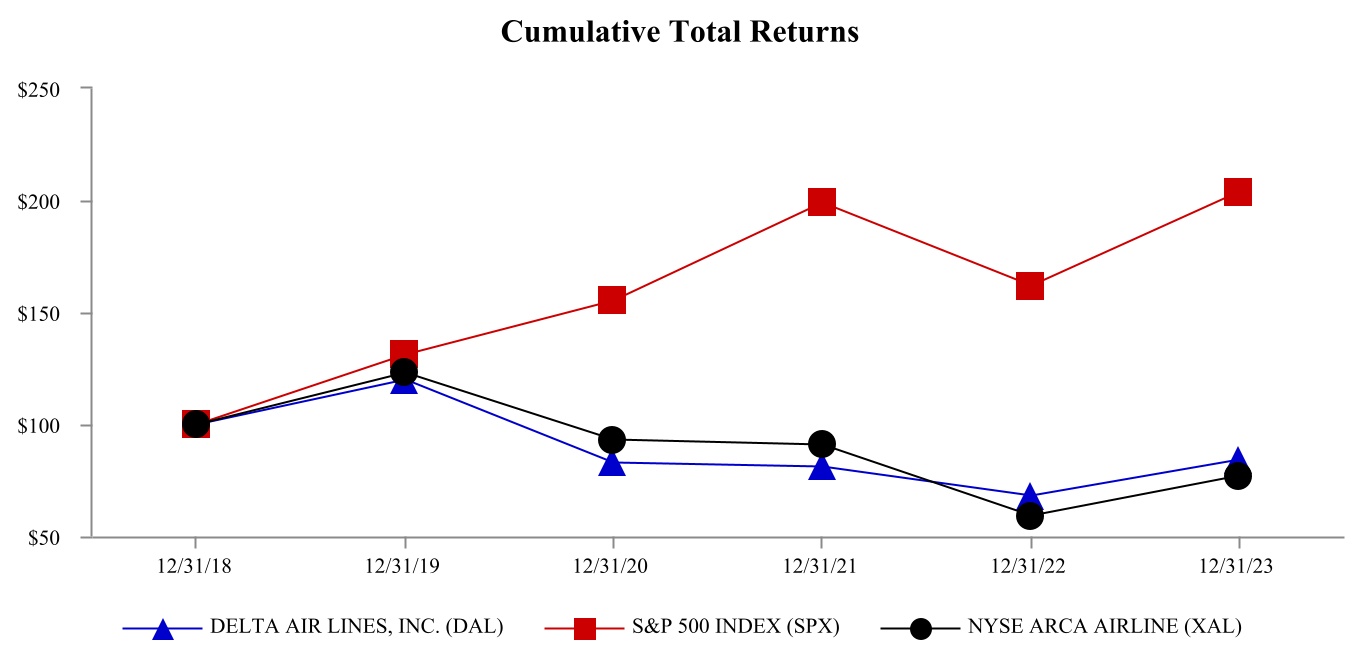
Delta Air Lines, Inc. | 2023 Form 10-K 32
Item 5. Market Information
Issuer Purchases of Equity Securities
The following table presents information with respect to purchases of common stock we made during the December 2023 quarter. The table reflects shares withheld from employees to satisfy certain tax obligations due in connection with grants of stock under the Delta Air Lines, Inc. Performance Compensation Plan (the "Plan"). The Plan provides for the withholding of shares to satisfy tax obligations but it does not specify a maximum number of shares that can be withheld for this purpose. The shares of common stock withheld to satisfy tax withholding obligations may be deemed to be "issuer purchases" of shares that are required to be disclosed pursuant to this Item.
| Shares purchased / withheld from employee awards during the December 2023 quarter | |||||||||||||||||
| Period | Total Number of Shares Purchased | Average Price Paid Per Share | Total Number of Shares Purchased as Part of Publicly Announced Plans or Programs | Approximate Dollar Value (in millions) of Shares That May Yet Be Purchased Under the Plan or Programs | |||||||||||||
| October 2023 | 8,141 | $ | 37.56 | 8,141 | $ | — | |||||||||||
| November 2023 | 3,751 | $ | 34.89 | 3,751 | $ | — | |||||||||||
| December 2023 | 1,340 | $ | 39.94 | 1,340 | $ | — | |||||||||||
| Total | 13,232 | 13,232 |
Item 6. (RESERVED)
Delta Air Lines, Inc. | 2023 Form 10-K 33
Item 7. MD&A
ITEM 7. MANAGEMENT'S DISCUSSION AND ANALYSIS OF FINANCIAL CONDITION AND RESULTS OF OPERATIONS
This section of Form 10-K does not address certain items regarding the year ended December 31, 2021. Discussion and analysis of 2021 and year-to-year comparisons between 2022 and 2021 not included in this Form 10-K can be found in "Item 7. Management's Discussion and Analysis" of our Annual Report on Form 10-K for the year ended December 31, 2022. The following discussion and analysis of our financial condition and results of operations should be read in conjunction with our audited Consolidated Financial Statements and the related notes and other financial information as well as the material risk factors included elsewhere in this Annual Report on Form 10-K.
2023 Financial Overview
Our 2023 operating income was $5.5 billion, an improvement of $1.9 billion compared to 2022, while operating income, adjusted (a non-GAAP financial measure) which excludes one-time pilot agreement expenses and other items was $6.3 billion, an increase of $2.8 billion compared to 2022. Operating income and operating income, adjusted increased primarily from increases in revenue as described below.
Revenue. Compared to 2022, our 2023 operating revenue increased $7.5 billion, or 15%, primarily due to a 17% increase in capacity driven by an increase in demand for international travel and continuing strength in demand for domestic travel and premium products. Total revenue, adjusted (a non-GAAP financial measure) increased in 2023 by $9.1 billion, or 20%, compared to 2022. Adjustments were primarily to exclude revenue related to refinery sales to third parties.
Operating Expense. Total operating expense increased $5.6 billion, or 12%, compared to 2022, primarily resulting from higher employee related costs from increased wages and profit sharing, pilot agreement and related expenses and higher volume-related expenses associated with the 17% increase in capacity, partially offset by lower expenses related to refinery sales to third parties, reflected in ancillary business and refinery expense. Total operating expense, adjusted (a non-GAAP financial measure) increased $6.3 billion, or 15%, compared to 2022. Adjustments were primarily to exclude expenses related to refinery sales to third parties and the pilot agreement and related expenses.
Our total operating cost per available seat mile ("CASM") decreased 4% compared to 2022 to 19.31 cents, primarily due to a 17% increase in capacity, as well as lower fuel expense and lower expenses related to refinery sales to third parties. Non-fuel unit costs ("CASM-Ex", a non-GAAP financial measure), which excludes fuel, expenses related to refinery sales to third parties, and other items, increased 2.3% to 13.17 cents.
Non-Operating Results. Total non-operating income was $87 million in 2023 compared to total non-operating expense of $1.7 billion in 2022 primarily due to mark-to-market gains on certain of our equity investments and lower interest expense as a result of our debt reduction initiatives, partially offset by increased pension related expenses.
Cash Flow. During 2023, operating activities provided cash flows of $6.5 billion, primarily from ticket sales. Investing activities resulted in net cash outflows of approximately $3.1 billion, primarily for $5.3 billion of capital expenditures, partially offset by $2.2 billion of net redemptions of short-term investments. After adjusting for the pilot agreement payment and certain other activities, these results generated $2.0 billion of free cash flow (a non-GAAP financial measure) in 2023.
Also, during 2023 we had cash outflows of approximately $4.1 billion related to repayments of our debt and finance leases, including approximately $2.0 billion for early repayments and the remainder from scheduled maturities. Our cash, cash equivalents, short-term investments and aggregate principal amount committed and available to be drawn under our revolving credit facilities ("liquidity") at December 31, 2023 was $6.8 billion.
The non-GAAP financial measures of operating income, adjusted, total revenue, adjusted, total operating expense, adjusted, CASM-Ex and free cash flow used above are defined and reconciled in "Supplemental Information" below.
Delta Air Lines, Inc. | 2023 Form 10-K 34
Item 7. MD&A - Results of Operations
Results of Operations
Operating Revenue
| Year Ended December 31, | Increase (Decrease) | % Increase (Decrease) | |||||||||||||||
| (in millions) (1) | 2023 | 2022 | |||||||||||||||
| Ticket - Main cabin | $ | 24,477 | $ | 20,396 | $ | 4,081 | 20 | % | |||||||||
| Ticket - Premium products | 19,119 | 15,230 | 3,889 | 26 | % | ||||||||||||
| Loyalty travel awards | 3,462 | 2,898 | 564 | 19 | % | ||||||||||||
| Travel-related services | 1,851 | 1,694 | 157 | 9 | % | ||||||||||||
| Total passenger revenue | $ | 48,909 | $ | 40,218 | $ | 8,691 | 22 | % | |||||||||
| Cargo | 723 | 1,050 | (327) | (31) | % | ||||||||||||
| Other | 8,416 | 9,314 | (898) | (10) | % | ||||||||||||
| Total operating revenue | $ | 58,048 | $ | 50,582 | $ | 7,466 | 15 | % | |||||||||
| TRASM (cents) | 21.34 | ¢ | 21.69 | ¢ | (0.35) | ¢ | (2) | % | |||||||||
| Third-party refinery sales (2) | (1.24) | (2.13) | 0.89 | (42) | % | ||||||||||||
| TRASM, adjusted (cents) | 20.10 | ¢ | 19.55 | ¢ | 0.55 | ¢ | 3 | % |
(1)Total amounts in the table above may not calculate exactly due to rounding.
(2)For additional information on adjustments to TRASM, see "Supplemental Information" below.
Operating Revenue
Our operating revenue increased $7.5 billion, or 15%, compared to 2022 due primarily to a 17% increase in capacity driven by an increase in demand for international travel and continuing strength in demand for domestic travel, with growth in revenue from premium products outpacing main cabin. This increase was partially offset by lower third-party refinery sales recorded in other revenue. Total revenue per available seat mile ("TRASM") decreased 2% in large part as a result of the decline in third-party refinery sales.
See "Refinery Segment" below for additional details on the refinery's operations, including third-party refinery sales recorded in other revenue, during each period.
Passenger Revenue by Geographic Region
| Increase (Decrease) vs. Year Ended December 31, 2022 | ||||||||||||||||||||||||||
| (in millions) | Year Ended December 31, 2023 | Passenger Revenue | RPMs (Traffic) | ASMs (Capacity) | Passenger Mile Yield | PRASM | Load Factor | |||||||||||||||||||
| Domestic | $ | 33,968 | 12 | % | 10 | % | 10 | % | 2 | % | 2 | % | 1 | pt | ||||||||||||
| Atlantic | 9,057 | 49 | % | 34 | % | 30 | % | 11 | % | 15 | % | 3 | pts | |||||||||||||
| Latin America | 3,798 | 31 | % | 22 | % | 16 | % | 8 | % | 13 | % | 4 | pts | |||||||||||||
| Pacific | 2,086 | 101 | % | 104 | % | 75 | % | (2) | % | 15 | % | 11 | pts | |||||||||||||
| Total passenger revenue | $ | 48,909 | 22 | % | 19 | % | 17 | % | 2 | % | 4 | % | 3 | pts |
Domestic
Domestic passenger unit revenue ("PRASM") for 2023 increased 2% compared to 2022 due to a 12% increase in revenue on a 10% increase in capacity and a slight increase in load factor.
Domestic revenue in 2023 was above 2022 levels as we experienced strong revenue results across the domestic network, with coastal hub markets such as New York and Boston improving significantly compared to the prior year, domestic business travel revenue improving and a 10% increase in domestic capacity compared to 2022. We believe spending patterns for services are returning to historical levels compared to spending on goods. We also experienced higher growth in premium product revenue (including Delta One, First Class, Delta Premium Select and Delta Comfort+) compared to main cabin with the delivery of new aircraft that include more premium seat capacity and an increase in yield in premium products compared to main cabin, as we see more consumers choosing these premium offerings. In 2024, we expect moderate capacity growth of single digits.
Delta Air Lines, Inc. | 2023 Form 10-K 35
Item 7. MD&A - Results of Operations
International
International passenger revenue for 2023 increased 49% with capacity up 31% compared to 2022. Passenger revenue increased in each geographic region with the Atlantic region experiencing the largest absolute improvement, as travel to many European destinations increased.
Consumers showed a strong desire for transatlantic travel, driving higher revenue and passenger unit revenue during 2023 on 30% capacity growth compared to 2022. This has been led by demand for travel to leisure destinations in Europe and premium products.
Latin America region revenue increased during 2023 compared to 2022, due to strong demand for leisure destinations in South America and the Caribbean on a 16% increase in capacity. In addition, during the first year of our joint venture with LATAM, we have streamlined travel between North and South America while expanding connections in each of our key hub airports.
The Pacific region benefited from improved demand for travel to the region, particularly to Japan, on 75% increased capacity following the lifting of pandemic-related travel restrictions and the performance of our joint venture with Korean Air.
Other Revenue
| Year Ended December 31, | Increase (Decrease) | % Increase (Decrease) | |||||||||||||||
| (in millions) | 2023 | 2022 | |||||||||||||||
| Refinery | $ | 3,379 | $ | 4,977 | $ | (1,598) | (32) | % | |||||||||
| Loyalty program | 3,093 | 2,597 | 496 | 19 | % | ||||||||||||
| Ancillary businesses | 840 | 846 | (6) | (1) | % | ||||||||||||
| Miscellaneous | 1,104 | 894 | 210 | 23 | % | ||||||||||||
| Total other revenue | $ | 8,416 | $ | 9,314 | $ | (898) | (10) | % |
Refinery. This represents refinery sales to third parties. These sales decreased $1.6 billion compared to 2022. The decrease in third-party refinery sales resulted from lower pricing and a turnaround which was completed between September and November 2023. See "Refinery Segment" below for additional details on the refinery's operations, including third-party refinery sales recorded in other revenue, during each period.
Loyalty Program. This relates to revenues from brand usage by third parties and other performance obligations embedded in miles sold, as well as redemption of miles for non-travel awards. These revenues are mainly driven by customer spend on American Express cards and new cardholder acquisitions. Revenues from our relationship with American Express increased compared to 2022 driven by co-brand card spend growth.
Ancillary Businesses. This includes aircraft maintenance services we provide to third parties and our vacation wholesale operations.
Miscellaneous. This is primarily composed of lounge access, including access provided to certain American Express cardholders, and codeshare revenues. The increase in miscellaneous is primarily due to increased revenue from Delta Sky Club access.
Delta Air Lines, Inc. | 2023 Form 10-K 36
Item 7. MD&A - Results of Operations
Operating Expense
| Year Ended December 31, | Increase (Decrease) | % Increase (Decrease)****(1) | |||||||||||||||
| (in millions) | 2023 | 2022 | |||||||||||||||
| Salaries and related costs | $ | 14,607 | $ | 11,902 | $ | 2,705 | 23 | % | |||||||||
| Aircraft fuel and related taxes | 11,069 | 11,482 | (413) | (4) | % | ||||||||||||
| Ancillary businesses and refinery | 4,172 | 5,756 | (1,584) | (28) | % | ||||||||||||
| Contracted services | 4,041 | 3,345 | 696 | 21 | % | ||||||||||||
| Landing fees and other rents | 2,563 | 2,181 | 382 | 18 | % | ||||||||||||
| Aircraft maintenance materials and outside repairs | 2,432 | 1,982 | 450 | 23 | % | ||||||||||||
| Depreciation and amortization | 2,341 | 2,107 | 234 | 11 | % | ||||||||||||
| Passenger commissions and other selling expenses | 2,334 | 1,891 | 443 | 23 | % | ||||||||||||
| Regional carrier expense | 2,200 | 2,051 | 149 | 7 | % | ||||||||||||
| Passenger service | 1,750 | 1,453 | 297 | 20 | % | ||||||||||||
| Profit sharing | 1,383 | 563 | 820 | 146 | % | ||||||||||||
| Pilot agreement and related expenses | 864 | — | 864 | NM | |||||||||||||
| Aircraft rent | 532 | 508 | 24 | 5 | % | ||||||||||||
| Other | 2,239 | 1,700 | 539 | 32 | % | ||||||||||||
| Total operating expense | $ | 52,527 | $ | 46,921 | $ | 5,606 | 12 | % |
**(1)**Certain variances are labeled as not meaningful ("NM") throughout management's discussion and analysis.
Salaries and Related Costs. Delta pilots ratified a new four-year Pilot Working Agreement effective January 1, 2023. The agreement includes numerous work rule changes and pay rate increases during the four-year term, including an initial pay rate increase of 18%. Additional effects of this agreement are described below under pilot agreement and related expenses.
We also implemented base pay increases for eligible non-pilot employees of 5% effective April 1, 2023. Further, we have approximately 8,000 more employees as of December 31, 2023 than at December 31, 2022 principally in in-flight service, flight operations and aircraft maintenance, in order to support the growth in our operations. Each of these actions contributed to the increase in salaries and related costs.
Aircraft Fuel and Related Taxes. Fuel expense decreased $413 million compared to 2022 primarily due to an 18% decrease in the market price of jet fuel partially offset by a 15% increase in consumption on a 17% increase in capacity.
| Fuel expense and average price per gallon | |||||||||||||||||||||||
| Average Price Per Gallon | |||||||||||||||||||||||
| Year Ended December 31, | Increase (Decrease) | Year Ended December 31, | Increase (Decrease) | ||||||||||||||||||||
| (in millions, except per gallon data) | 2023 | 2022 | 2023 | 2022 | |||||||||||||||||||
| Fuel purchase cost (1) | $ | 11,506 | $ | 12,230 | $ | (724) | $ | 2.93 | $ | 3.58 | $ | (0.65) | |||||||||||
| Fuel hedge impact | (52) | 29 | (81) | (0.01) | 0.01 | (0.02) | |||||||||||||||||
| Refinery segment impact | (385) | (777) | 392 | (0.10) | (0.23) | 0.13 | |||||||||||||||||
| Total fuel expense | $ | 11,069 | $ | 11,482 | $ | (413) | $ | 2.82 | $ | 3.36 | $ | (0.54) | |||||||||||
(1)Market price for jet fuel at airport locations, including related taxes and transportation costs.
Ancillary Businesses and Refinery. Ancillary businesses and refinery includes expenses associated with refinery sales to third parties, aircraft maintenance services we provide to third parties and our vacation wholesale operations. The decline in these expenses was primarily related to lower refinery sales to third parties, which decreased $1.6 billion compared to 2022. The decrease in third-party refinery sales resulted from lower pricing and the turnaround, which was completed between September and November 2023.
Contracted Services. Contracted services expenses increased compared to 2022 due to higher-volume related expenses associated with increased capacity, in addition to inflationary pressures.
Delta Air Lines, Inc. | 2023 Form 10-K 37
Item 7. MD&A - Results of Operations
Landing Fees and Other Rents. The increase in landing fees and other rents resulted from higher rates charged by airports following extensive redevelopment projects at numerous facilities and more flights compared to 2022 that contributed to our increased capacity.
Aircraft Maintenance Materials and Outside Repairs. Aircraft maintenance materials and outside repairs increased as we continued to invest in the operational reliability of our fleet, in particular related to engine overhauls on our B-757 aircraft, in addition to higher material costs.
Passenger Commissions and Other Selling Expenses. The increase in passenger revenue in 2023, compared to 2022, directly led to increased passenger commissions and selling expenses.
Passenger Service. Passenger service expenses increased compared to 2022 due to higher volume-related expenses associated with increased traffic.
Profit Sharing. Profit sharing increased by $820 million during 2023 due to higher profit during the year. Our profit sharing program pays 10% to all eligible employees for the first $2.5 billion of annual profit, as defined by the terms of the program, and 20% of annual profit above $2.5 billion.
Pilot agreement and related expenses. In addition to the actions in salaries and related costs described above, the ratified pilot agreement also includes a provision for a one-time payment made upon ratification during 2023 of $735 million. Additionally, we recorded adjustments to other benefit-related items of approximately $130 million.
Other. The increase in other is primarily due to higher volume-related expenses associated with increased capacity, such as flight crew and other employee travel and incidental costs, and inflationary pressures.
Non-Operating Results
| Year Ended December 31, | Favorable (Unfavorable) | |||||||||||||
| (in millions) | 2023 | 2022 | ||||||||||||
| Interest expense, net | $ | (834) | $ | (1,029) | $ | 195 | ||||||||
| Gain/(loss) on investments, net | 1,263 | (783) | 2,046 | |||||||||||
| Loss on extinguishment of debt | (63) | (100) | 37 | |||||||||||
| Pension and related (expense)/benefit |
Showing the first 8K of 73K characters. Open the full section
Item 7A. QUANTITATIVE AND QUALITATIVE DISCLOSURES ABOUT MARKET RISK
We have market risk exposure related to fuel prices, interest rates, foreign currency exchange rates and changes in the market value of equity investments. Market risk is the potential negative impact of adverse changes in these prices or rates on our Consolidated Financial Statements. In an effort to manage our exposure to these risks, we may enter into derivative contracts and may adjust our derivative portfolio as market conditions change. See Note 3 of the Notes to the Consolidated Financial Statements for further information on our derivative contracts. We expect adjustments to the fair value of financial instruments to result in ongoing volatility in earnings and stockholders' equity.
The following sensitivity analyses do not consider the effects of a change in demand for air travel, the economy as a whole or actions we may take to seek to mitigate our exposure to a particular risk. For these and other reasons, the actual results of changes in these prices or rates may differ materially from the following hypothetical results.
Fuel Price Risk
Changes in fuel prices materially impact our results of operations. A one cent increase in the cost of jet fuel per gallon would result in approximately $40 million of additional annual fuel expense based on annual consumption of approximately four billion gallons of jet fuel. Our derivative contracts to hedge the financial risk from changing fuel prices are related to Monroe’s inventory.
Interest Rate Risk
Our exposure to market risk from adverse changes in interest rates is primarily associated with our debt and lease obligations. Market risk associated with our fixed-rate debt relates to the potential reduction in fair value from an increase in interest rates. Market risk associated with our variable-rate debt and variable-rate leases relates to the potential negative impact to future earnings from an increase in interest rates.
At December 31, 2023, we had $16.8 billion of fixed-rate debt, $1.9 billion of variable-rate debt and $583 million of variable-rate leases. The rates used in our variable-rate debt are based on SOFR, or another index rate, which in certain cases is subject to a floor. At December 31, 2023 we no longer had LIBOR-based debt or finance leases. An increase of 100 basis points in average annual interest rates would have decreased the estimated fair value of our fixed-rate debt by $716 million at December 31, 2023 and would have increased the annual interest expense on our variable-rate debt and variable-rate leases by $25 million.
Foreign Currency Exchange Risk
We are subject to foreign currency exchange rate risk because we have revenue, expense and equity investments denominated in foreign currencies. To manage exchange rate risk, we execute both our international revenue and expense transactions in the same foreign currency to the extent practicable. From time to time, we may also enter into foreign currency option and forward contracts.
At December 31, 2023 we had no open foreign currency options or forward contracts.
Equity Investment Risk
We own equity investments in a number of airlines and airline service companies, which are subject to equity price risk. We often hold our equity securities for long periods and short-term price volatility has occurred in the past and will occur in the future, impacting the volatility of our financial results. During 2023, we recorded a net gain of $1.3 billion related to the valuation of our fair value investments. As of December 31, 2023, we have long-term investments recorded at fair value of $2.9 billion and, therefore, a 10% change in the fair value of these investments would have an approximately $290 million impact on our financial results. See Note 3 and Note 4 of the Notes to the Consolidated Financial Statements for further information on our investments.
Delta Air Lines, Inc. | 2023 Form 10-K 54
Financial Statements
Item 8. FINANCIAL STATEMENTS AND SUPPLEMENTARY DATA
INDEX TO CONSOLIDATED FINANCIAL STATEMENTS
Delta Air Lines, Inc. | 2023 Form 10-K 55
REPORT OF INDEPENDENT REGISTERED PUBLIC ACCOUNTING FIRM
To the Stockholders and Board of Directors of Delta Air Lines, Inc.
Opinion on the Financial Statements
We have audited the accompanying consolidated balance sheets of Delta Air Lines, Inc. (the Company) as of December 31, 2023 and 2022, the related consolidated statements of operations, comprehensive income, cash flows, and stockholders' equity for each of the three years in the period ended December 31, 2023, and the related notes (collectively referred to as the "consolidated financial statements"). In our opinion, the consolidated financial statements present fairly, in all material respects, the financial position of the Company at December 31, 2023 and 2022, and the results of its operations and its cash flows for each of the three years in the period ended December 31, 2023, in conformity with U.S. generally accepted accounting principles.
We also have audited, in accordance with the standards of the Public Company Accounting Oversight Board (United States) (PCAOB), the Company's internal control over financial reporting as of December 31, 2023, based on criteria established in Internal Control-Integrated Framework issued by the Committee of Sponsoring Organizations of the Treadway Commission (2013 framework), and our report dated February 12, 2024 expressed an unqualified opinion thereon.
Basis for Opinion
These financial statements are the responsibility of the Company's management. Our responsibility is to express an opinion on the Company’s financial statements based on our audits. We are a public accounting firm registered with the PCAOB and are required to be independent with respect to the Company in accordance with the U.S. federal securities laws and the applicable rules and regulations of the Securities and Exchange Commission and the PCAOB.
We conducted our audits in accordance with the standards of the PCAOB. Those standards require that we plan and perform the audit to obtain reasonable assurance about whether the financial statements are free of material misstatemen
Showing the first 8K of 184K characters. Open the full section
Item 9. CHANGES IN AND DISAGREEMENTS WITH ACCOUNTANTS ON ACCOUNTING AND FINANCIAL DISCLOSURE
None.
Item 9A. CONTROLS AND PROCEDURES
Disclosure Controls and Procedures
Our management, including our Chief Executive Officer and Chief Financial Officer, performed an evaluation of our disclosure controls and procedures, which have been designed to permit us to record, process, summarize and report, within time periods specified by the SEC's rules and forms, information required to be disclosed. Our management, including our Chief Executive Officer and Chief Financial Officer, concluded that the controls and procedures were effective as of December 31, 2023 to ensure that material information was accumulated and communicated to our management, including our Chief Executive Officer and Chief Financial Officer, as appropriate to allow timely decisions regarding required disclosure.
Changes in Internal Control
During the three months ended December 31, 2023, we did not make any changes in our internal control over financial reporting that have materially affected, or are reasonably likely to materially affect, our internal control over financial reporting.
Management's Annual Report on Internal Control Over Financial Reporting
Management is responsible for establishing and maintaining adequate internal control over financial reporting, as such term is defined in Rules 13a-15(f) and 15d-15(f) under the Securities Exchange Act of 1934. Our internal control over financial reporting is designed to provide reasonable assurance regarding the reliability of financial reporting and the preparation of financial statements for external purposes in accordance with accounting principles generally accepted in the United States of America.
Because of its inherent limitations, internal control over financial reporting may not prevent or detect misstatements. Projections of any evaluation of effectiveness to future periods are subject to the risk that controls may become inadequate because of changes in conditions, or that the degree of compliance with the policies may deteriorate.
Management conducted an evaluation of the effectiveness of our internal control over financial reporting as of December 31, 2023 using the criteria issued by the Committee of Sponsoring Organizations of the Treadway Commission ("COSO") in the 2013 Internal Control-Integrated Framework. Based on that evaluation, management believes that our internal control over financial reporting was effective as of December 31, 2023.
The effectiveness of our internal control over financial reporting as of December 31, 2023 has been audited by Ernst & Young LLP, an independent registered public accounting firm, which also audited our Consolidated Financial Statements for the year ended December 31, 2023. Ernst & Young LLP's report on our internal control over financial reporting is set forth below.
Delta Air Lines, Inc. | 2023 Form 10-K 98
REPORT OF INDEPENDENT REGISTERED PUBLIC ACCOUNTING FIRM
To the Stockholders and Board of Directors of Delta Air Lines, Inc.
Opinion on Internal Control Over Financial Reporting
We have audited Delta Air Lines, Inc.’s internal control over financial reporting as of December 31, 2023, based on criteria established in Internal Control-Integrated Framework issued by the Committee of Sponsoring Organizations of the Treadway Commission (2013 framework) (the COSO criteria). In our opinion, Delta Air Lines, Inc. (the Company) maintained, in all material respects, effective internal control over financial reporting as of December 31, 2023, based on the COSO criteria.
We also have audited, in accordance with the standards of the Public Company Accounting Oversight Board (United States) (PCAOB), the 2023 consolidated financial statements of the Company and our report dated February 12, 2024 expressed an unqualified opinion thereon.
Basis for Opinion
The Company’s management is responsible for maintaining effective internal control over financial reporting and for its assessment of the effectiveness of internal control over financial reporting included in the accompanying Management’s Annual Report on Internal Control Over Financial Reporting. Our responsibility is to express an opinion on the Company’s internal control over financial reporting based on our audit. We are a public accounting firm registered with the PCAOB and are required to be independent with respect to the Company in accordance with the U.S. federal securities laws and the applicable rules and regulations of the Securities and Exchange Commission and the PCAOB.
We conducted our audit in accordance with the standards of the PCAOB. Those standards require that we plan and perform the audit to obtain reasonable assurance about whether effective internal control over financial reporting was maintained in all material respects.
Our audit included obtaining an understanding of internal control over financial reporting, assessing the risk that a material weakness exists, testing and evaluating the design and operating effectiveness of internal control based on the assessed risk, and performing such other procedures as we considered necessary in the circumstances. We believe that our audit provides a reasonable basis for our opinion.
Definition and Limitations of Internal Control Over Financial Reporting
A company’s internal control over financial reporting is a process designed to provide reasonable assurance regarding the reliability of financial reporting and the preparation of financial statements for external purposes in accordance with generally accepted accounting principles. A company’s internal control over financial reporting includes those policies and procedures that (1) pertain to the maintenance of records that, in reasonable detail, accurately and fairly reflect the transactions and dispositions of the assets of the company; (2) provide reasonable assurance that transactions are recorded as necessary to permit preparation of financial statements in accordance with generally accepted accounting principles, and that receipts and expenditures of the company are being made only in accordance with authorizations of management and directors of the company; and (3) provide reasonable assurance regarding prevention or timely detection of unauthorized acquisition, use, or disposition of the company’s assets that could have a material effect on the financial statements.
Because of its inherent limitations, internal control over financial reporting may not prevent or detect misstatements. Also, projections of any evaluation of effectiveness to future periods are subject to the risk that controls may become inadequate because of changes in conditions, or that the degree of compliance with the policies or procedures may deteriorate.
| /s/ Ernst & Young LLP | |||||
| Atlanta, Georgia | |||||
| February 12, 2024 |
Delta Air Lines, Inc. | 2023 Form 10-K 99
Item 9B. OTHER INFORMATION
None.
Item 9C. DISCLOSURE REGARDING FOREIGN JURISDICTIONS THAT PREVENT INSPECTIONS
Not Applicable.
PART III
Item 10. DIRECTORS, EXECUTIVE OFFICERS AND CORPORATE GOVERNANCE
Information required by this item is set forth under the headings "Governance - Board Matters" and "Proposal 1 - Election of Directors" in our Proxy Statement to be filed with the Commission related to our 2024 Annual Meeting of Stockholders ("Proxy Statement"), and is incorporated by reference. Certain information regarding Delta's executive officers is contained in Part I of this Form 10-K under the heading "Information About Our Executive Officers."
Item 11. EXECUTIVE COMPENSATION
Information required by this item is set forth under the headings "Executive Compensation" and "Director Compensation" in our Proxy Statement and is incorporated by reference.
Item 12. SECURITY OWNERSHIP OF CERTAIN BENEFICIAL OWNERS AND MANAGEMENT AND RELATED STOCKHOLDER MATTERS
Securities Authorized for Issuance Under Equity Compensation Plans
The following table provides information about the number of shares of common stock that may be issued under Delta's equity compensation plans as of December 31, 2023.
| Equity compensation plan information | |||||||||||
| Plan Category | (a) No. of Securities to be Issued Upon Exercise of Outstanding Options, Warrants and Rights**(1)** | (b) Weighted-Average Exercise Price of Outstanding Options, Warrants and Rights**(2)** | (c) No. of Securities Remaining Available for Future Issuance Under Equity Compensation Plans (Excluding Securities Reflected in Column (a))****(3) | ||||||||
| Equity compensation plans approved by securities holders | 9,506,385 | $ | 32.72 | 13,238,608 | |||||||
| Equity compensation plans not approved by securities holders | — | — | — | ||||||||
| Total | 9,506,385 | $ | 32.72 | 13,238,608 |
(1)Includes a maximum of 3,337,350 shares of common stock that may be issued upon the achievement of certain performance conditions under outstanding performance-based restricted share awards as of December 31, 2023.
(2)Includes performance-based restricted share awards, which do not have exercise prices. The weighted average exercise price of outstanding options at December 31, 2023 was $50.42.
(3)Reflects shares remaining available for issuance under Delta's Performance Compensation Plan. If any shares of our common stock are covered by an award under the Plan that expires, is canceled, forfeited or otherwise terminates without delivery of shares (including shares surrendered or withheld for payment of taxes related to an award), then such shares will again be available for issuance under the Plan except for (1) any shares tendered in payment of an option, (2) shares withheld to satisfy any tax withholding obligation with respect to the exercise of an option or stock appreciation right ("SAR") or (3) shares covered by a stock-settled SAR or other awards that were not issued upon the settlement of the award. Because 4,166,569 shares of restricted stock remained unvested and subject to forfeiture as of December 31, 2023, these shares could again be available for issuance.
Other information required by this item is set forth under the heading "Share Ownership" in our Proxy Statement and is incorporated by reference.
Item 13. CERTAIN RELATIONSHIPS AND RELATED TRANSACTIONS, AND DIRECTOR INDEPENDENCE
Information required by this item is set forth under the headings "Governance - Board Matters" and "Proposal 1 - Election of Directors" in our Proxy Statement and is incorporated by reference.
Item 14. PRINCIPAL ACCOUNTANT FEES AND SERVICES
Information required by this item is set forth under the heading "Proposal 3 - Ratification of the Appointment of Independent Auditors" in our Proxy Statement and is incorporated by reference.
Delta Air Lines, Inc. | 2023 Form 10-K 100
PART IV
Item 15. EXHIBITS AND FINANCIAL STATEMENT SCHEDULES
(a) (1). The following is an index of the financial statements required by this item that are included in this Form 10-K:
Report of Independent Registered Public Accounting Firm
Consolidated Balance Sheets—December 31, 2023 and 2022
Consolidated Statements of Operations for the years ended December 31, 2023, 2022 and 2021
Consolidated Statements of Comprehensive Income for the years ended December 31, 2023, 2022 and 2021
Consolidated Statements of Cash Flows for the years ended December 31, 2023, 2022 and 2021
Consolidated Statements of Stockholders' Equity for the years ended December 31, 2023, 2022 and 2021
Notes to the Consolidated Financial Statements
(2). Financial Statement Schedules. Financial statement schedules are not included herein as the required information is not applicable or is not present in amounts sufficient to require submission of the schedule, or because the information required is included in the Consolidated Financial Statements and accompanying notes included in this Form 10-K.
(3). Exhibit List.
The exhibits required by this item are listed below. The management contracts and compensatory plans or arrangements required to be filed as an exhibit to this Form 10-K are listed as Exhibits 10.11 through 10.19.
Note to Exhibits: Any representations and warranties of a party set forth in any agreement (including all exhibits and schedules thereto) filed with this Annual Report on Form 10-K have been made solely for the benefit of the other party to the agreement. Some of those representations and warranties were made only as of the date of the agreement or such other date as specified in the agreement, may be subject to a contractual standard of materiality different from what may be viewed as material to stockholders, or may have been used for the purpose of allocating risk between the parties rather than establishing matters as facts. Such agreements are included with this filing only to provide investors with information regarding the terms of the agreements, and not to provide investors with any other factual or disclosure information regarding the registrant or its business.
Delta is not filing any instruments evidencing any indebtedness because the total amount of securities authorized under any single such instrument does not exceed 10% of the total assets of Delta and its subsidiaries on a consolidated basis. Copies of such instruments will be furnished to the Securities and Exchange Commission upon request.
10.1 Amended and Restated Credit Agreement, dated as of November 6, 2023, among Delta Air Lines, Inc., as borrower, the lenders party thereto and JPMorgan Chase Bank, N.A., as administrative agent.
Delta Air Lines, Inc. | 2023 Form 10-K 101
10.5(b) First Amendment to Term Loan Credit and Guaranty dated as of December 4, 2022 among SkyMiles IP Ltd., Delta Air Lines, Inc. and Barclays Bank PLC, as administrative agent (Filed as Exhibit 10.6(b) to Delta's Annual Report on form 10-K for the year ended December 31, 2022).*
10.8(b) Amendment No. 3, dated May 10, 2017, to Airbus A330-900 Aircraft and A350-900 Aircraft Purchase Agreement dated as of November 24, 2014 between Airbus S.A.S. and Delta Air Lines, Inc. ("Amendment No. 3") (Filed as Exhibit 10.2(a) to Delta's Quarterly Report on Form 10-Q for the quarter ended June 30, 2017).*/**
Delta Air Lines, Inc. | 2023 Form 10-K 102
10.8(g) Amended and Restated Letter Agreement No. 1, dated as of July 30, 2020, relating to Airbus A330-900 Aircraft and A350-900 Aircraft Purchase Agreement dated as of November 24, 2014 (Filed as Exhibit 10.1(b) to Delta's Quarterly Report on Form 10-Q for the quarter ended September 30, 2020).*/**
10.9(b) Amendment No. 2, dated as of July 30, 2020 to Airbus A321neo Aircraft Purchase Agreement, dated as of December 15, 2017 between Delta and Airbus S.A.S. (Filed as Exhibit 10.2(a) to Delta's Quarterly Report on Form 10-Q for the quarter ended September 30, 2020).*/**
10.9(c) Amended and Restated Letter Agreement No. 3, dated as of July 30, 2020, relating to Airbus A321neo Aircraft Purchase Agreement, dated as of December 15, 2017 between Delta and Airbus S.A.S. (Filed as Exhibit 10.2(b) to Delta's Quarterly Report on Form 10-Q for the quarter ended September 30, 2020).*/**
Delta Air Lines, Inc. | 2023 Form 10-K 103
10.14 Delta Air Lines, Inc. Management Incentive Plan (As Amended and Restated December 1, 2023).
10.17 Model Award Agreement for the Delta Air Lines, Inc. 2023 Long-Term Incentive Program (Filed as Exhibit 10.1 to Delta's Quarterly Report on Form 10-Q for the quarter ended June 30, 2023).*
10.19 Terms of 2023 Restricted Stock Awards for Non-Employee Directors (Filed as Exhibit 10.2 to Delta’s Quarterly Report on Form 10-Q for the quarter ended June 30, 2023).*
21.1 Subsidiaries of the Registrant.
23.1 Consent of Ernst & Young LLP.
31.1 Rule 13a-14(a)/15d-14(a) Certification of Chief Executive Officer.
31.2 Rule 13a-14(a)/15d-14(a) Certification of Chief Financial Officer.
97 Delta Air Lines, Inc. Executive Officer Clawback Policy.
101.INS XBRL Instance Document - The instance document does not appear in the interactive data file because its XBRL tags are embedded within the inline XBRL document.
101.SCH XBRL Taxonomy Extension Schema Document
101.CAL XBRL Taxonomy Extension Calculation Linkbase Document
101.DEF XBRL Taxonomy Extension Definition Linkbase Document
101.LAB XBRL Taxonomy Extension Labels Linkbase Document
101.PRE XBRL Taxonomy Extension Presentation Linkbase Document
104 The cover page from this Annual Report on Form 10-K for the year ended December 31, 2023 formatted in Inline XBRL (included in Exhibit 101)
- Incorporated by reference.
** Portions of this exhibit have been omitted as confidential information.
Item 16. FORM 10-K SUMMARY
Not applicable.
Delta Air Lines, Inc. | 2023 Form 10-K 104
SIGNATURES
Pursuant to the requirements of Section 13 or 15(d) of the Securities Exchange Act of 1934, the registrant has duly caused this report to be signed on its behalf by the undersigned, thereunto duly authorized, on the 12th day of February, 2024.
| DELTA AIR LINES, INC. | |||||||||||
| By: | /s/ Edward H. Bastian | ||||||||||
| Edward H. Bastian | |||||||||||
| Chief Executive Officer |
Delta Air Lines, Inc. | 2023 Form 10-K 105
Pursuant to the requirements of the Securities Exchange Act of 1934, this report has been signed below on the 12th day of February, 2024 by the following persons on behalf of the registrant and in the capacities indicated.
| Signature | Title | |||||||
| /s/ Edward H. Bastian | Chief Executive Officer and Director (Principal Executive Officer) | |||||||
| Edward H. Bastian | ||||||||
| /s/ Daniel C. Janki | Executive Vice President and Chief Financial Officer (Principal Financial Officer) | |||||||
| Daniel C. Janki | ||||||||
| /s/ William C. Carroll | Senior Vice President - Controller (Principal Accounting Officer) | |||||||
| William C. Carroll | ||||||||
| /s/ Greg Creed | Director | |||||||
| Greg Creed | ||||||||
| /s/ David G. DeWalt | Director | |||||||
| David G. DeWalt | ||||||||
| /s/ William H. Easter III | Director | |||||||
| William H. Easter III | ||||||||
| /s/ Leslie D. Hale | Director | |||||||
| Leslie D. Hale | ||||||||
| /s/ Christopher A. Hazleton | Director | |||||||
| Christopher A. Hazleton | ||||||||
| /s/ Michael P. Huerta | Director | |||||||
| Michael P. Huerta | ||||||||
| /s/ Jeanne P. Jackson | Director | |||||||
| Jeanne P. Jackson | ||||||||
| /s/ Vasant M. Prabhu | Director | |||||||
| Vasant M. Prabhu | ||||||||
| /s/ Sergio A.L. Rial | Director | |||||||
| Sergio A.L. Rial | ||||||||
| /s/ David S. Taylor | Chairman of the Board | |||||||
| David S. Taylor | ||||||||
| /s/ Kathy N. Waller | Director | |||||||
| Kathy N. Waller |
Delta Air Lines, Inc. | 2023 Form 10-K 106