 filings.tools
DuPont de Nemours 10-K 2018-12-31
Filed 2019-02-11. 22 sections, 942K characters. Original on sec.gov · Markdown · JSON
Cover and table of contents
10-K 1 a2018dwdp10-k.htm 10-K
UNITED STATES
SECURITIES AND EXCHANGE COMMISSION
Washington, D.C. 20549
FORM 10-K
þ ANNUAL REPORT PURSUANT TO SECTION 13 OR 15(d) OF THE SECURITIES EXHANGE ACT OF 1934
For the fiscal year ended December 31, 2018
or
¨ TRANSITION REPORT PURSUANT TO SECTION 13 OR 15(d) OF THE SECURITIES EXCHANGE ACT OF 1934
For the transition period from _______ to ________
Commission file number: 001-38196
DOWDUPONT INC.
(Exact name of registrant as specified in its charter)
| Delaware | 81-1224539 |
| State or other jurisdiction of incorporation or organization | (I.R.S. Employer Identification No.) |
| c/o The Dow Chemical Company | c/o E. I. du Pont de Nemours and Company | |
| 2211 H.H. Dow Way, Midland, MI 48674 | 974 Centre Road, Wilmington, DE 19805 | |
| (989) 636-1000 | (302) 774-1000 |
(Address of principal executive offices) (Zip Code)
Registrant's telephone number, including area code
Securities registered pursuant to Section 12(b) of the Act:
| Title of each class | Name of each exchange on which registered | |
| Common Stock, par value $0.01 per share | New York Stock Exchange |
Indicate by check mark if the registrant is a well-known seasoned issuer, as defined in Rule 405 of the Securities Act. þ Yes ¨ No
Indicate by check mark if the registrant is not required to file reports pursuant to Section 13 or Section 15(d) of the Act. ¨ Yes þ No
Indicate by check mark whether the registrant (1) has filed all reports required to be filed by Section 13 or 15(d) of the Securities Exchange Act of 1934 during the preceding 12 months (or for such shorter period that the registrant was required to file such reports), and (2) has been subject to such filing requirements for the past 90 days. þ Yes ¨ No
Indicate by check mark whether the registrant has submitted electronically every Interactive Data File required to be submitted pursuant to Rule 405 of Regulation S-T (§232.405 of this chapter) during the preceding 12 months (or for such shorter period that the registrant was required to submit and post such files). þ Yes ¨ No
Indicate by check mark if disclosure of delinquent filers pursuant to Item 405 of Regulation S-K (§229.405 of this chapter) is not contained herein, and will not be contained, to the best of the registrant's knowledge, in definitive proxy or information statements incorporated by reference in Part III of this Form 10-K or any amendment to this Form 10-K. ¨
Indicate by check mark whether the registrant is a large accelerated filer, an accelerated filer, a non-accelerated filer, smaller reporting company, or an emerging growth company. See the definitions of “large accelerated filer,” “accelerated filer,” “smaller reporting company,” and "emerging growth company" in Rule 12b-2 of the Exchange Act.
| Large accelerated filer | þ | Accelerated filer | ¨ | ||||
| Non-accelerated filer | ¨ | Smaller reporting company | ¨ | ||||
| Emerging growth company | ¨ |
If an emerging growth company, indicate by check mark if the registrant has elected not to use the extended transition period for complying with any new or revised financial accounting standards provided pursuant to Section 13(a) of the Exchange Act. ¨
Indicate by check mark whether the registrant is a shell company (as defined in Rule 12b-2 of the Act). ¨ Yes þ No
The aggregate market value of the common equity held by non-affiliates of the registrant as of June 30, 2018, (the last day of the registrant's most recently completed second fiscal quarter), was approximately $151.8 billion based on the last reported closing price of $65.92 per share as reported on the New York Stock Exchange on such date. For purposes of this computation, it is assumed that the shares of voting stock held by Directors and Officers would be deemed to be stock held by affiliates. Non-affiliated common stock outstanding at June 30, 2018, was 2,303,312,652 shares.
Total DowDuPont common stock outstanding at January 31, 2019 was 2,254,762,058 shares.
DOCUMENTS INCORPORATED BY REFERENCE
Part III: Proxy Statement for the 2019 Annual Meeting of Stockholders to be filed not later than 120 days after the end of the fiscal year covered by this Form 10-K.
DowDuPont Inc.
ANNUAL REPORT ON FORM 10-K
For the fiscal year ended December 31, 2018
TABLE OF CONTENTS
| DowDuPont Inc. | ||
| PART I |
Item 1. BUSINESS
THE COMPANY
Throughout this Annual Report on Form 10-K, except as otherwise noted by the context, the terms "Company" or "DowDuPont" used herein mean DowDuPont Inc. and its consolidated subsidiaries. DowDuPont is a holding company comprised of The Dow Chemical Company ("Historical Dow") and E. I. du Pont de Nemours and Company ("Historical DuPont") with the intent to form strong, independent, publicly traded companies in the agriculture, materials science and specialty products sectors that will lead their respective industries through productive, science-based innovation to meet the needs of customers and help solve global challenges. DowDuPont is a Delaware corporation formed on December 9, 2015, for the purpose of effecting an all-stock merger of equals transactions between Historical Dow and Historical DuPont. Pursuant to the Agreement and Plan of Merger, dated December 11, 2015, as amended on March 31, 2017, Historical Dow and Historical DuPont each merged with subsidiaries of DowDuPont and, as a result, became subsidiaries of DowDuPont.
The Company's principal executive offices are located at:
c/o The Dow Chemical Company
2211 H.H. Dow Way
Midland, Michigan 48674
c/o E. I. du Pont de Nemours and Company
974 Centre Road
Wilmington, Delaware 19805
Available Information
The Company's annual report on Form 10-K, quarterly reports on Form 10-Q and current reports on Form 8-K, and amendments to those reports filed or furnished pursuant to Section 13(a) or 15(d) of the Securities Exchange Act of 1934, are available free of charge through the Investor Relations section of the Company's website (www.dow-dupont.com/investors), as soon as reasonably practicable after the reports are electronically filed or furnished with the U.S. Securities and Exchange Commission (“SEC”). The SEC maintains a website that contains these reports as well as proxy statements and other information regarding issuers that file electronically. The SEC's website is at www.sec.gov. The Company's website and its content are not deemed incorporated by reference into this report.
THE INTENDED BUSINESS SEPARATIONS
DowDuPont plans to separate into three, independent, publicly traded companies - one for each of its agriculture, materials science and specialty products businesses (the “Intended Business Separations” and the transactions to accomplish the Intended Business Separations, the “separations”). DowDuPont has formed two wholly owned subsidiaries: Dow Holdings Inc., to serve as a holding company for its materials science business, and Corteva, Inc., to serve as a holding company for its agriculture business.
In furtherance of the Intended Business Separations, DowDuPont is engaged in a series of internal reorganization and realignment steps (the “Internal Reorganization”) to realign its businesses into three subgroups: agriculture, materials science and specialty products. As part of the Internal Reorganization, the assets and liabilities aligned with the materials science business will be transferred or conveyed to legal entities that will ultimately be subsidiaries of Dow Holdings Inc. and the assets and liabilities aligned with the agriculture business will be transferred or conveyed to legal entities that will ultimately be subsidiaries of Corteva, Inc.
Following the Internal Reorganization, DowDuPont expects to distribute its materials science and agriculture businesses through two separate U.S. federal tax-free spin-offs in which DowDuPont stockholders, at the time of such spin-offs, will receive a pro rata dividend of the shares of the capital stock of Dow Holdings Inc. and of Corteva, Inc., as applicable (the “distributions”). The materials science business, after the consummation of the applicable Internal Reorganization, will be referred to as “Dow” and the agriculture business, after the consummation of the applicable Internal Reorganization, will be referred to as “Corteva.” Following the separation and distribution of Dow, which is targeted to occur on April 1, 2019, DowDuPont, as the remaining company, will continue to hold the agriculture and specialty products businesses. DowDuPont is then targeted to complete the separation and distribution of Corteva on June 1, 2019, resulting in DowDuPont holding the specialty products businesses of the combined Company. After the distribution of Corteva, it is expected that DowDuPont will become known as "DuPont."
Prior to the distribution of Dow, DowDuPont intends to enter into a separation agreement with Corteva and Dow (the “separation agreement”) setting forth the agreement among the parties regarding the principal actions to be taken in connection with the separations. Under the separation agreement, certain environmental and legal liabilities will be allocated among DuPont, Dow and Corteva. Those liabilities primarily related to DowDuPont’s specialty products businesses, materials science business and agriculture business will generally be retained or assumed by DuPont, Dow and Corteva, respectively, unless otherwise specifically allocated.
With respect to environmental and legal liabilities from discontinued and/or divested operations and businesses, those of Historical Dow will be retained or assumed by Dow and those of Historical DuPont will be retained or assumed by Corteva or DuPont according to the terms of the separation agreement.
These liability allocations will be implemented through transfer or substitution, if possible, or indemnity.
In the fourth quarter of 2018, DowDuPont consummated a public underwritten offer of eight series of senior unsecured notes (the "DowDuPont Notes") in an aggregate principal amount of $12.7 billion. (See the discussion of the DowDuPont Notes in Liquidity and Capital Resources in Part II, Item 7, Management’s Discussion and Analysis of Financial Condition and Results of Operations).
FORWARD-LOOKING STATEMENTS
This communication contains “forward-looking statements” within the meaning of the federal securities laws, including Section 27A of the Securities Act of 1933, as amended, and Section 21E of the Securities Exchange Act of 1934, as amended. In this context, forward-looking statements often address expected future business and financial performance and financial condition, and often contain words such as “expect,” “anticipate,” “intend,” “plan,” “believe,” “seek,” “see,” “will,” “would,” “target,” and similar expressions and variations or negatives of these words.
Forward-looking statements by their nature address matters that are, to varying degrees, uncertain, including statements about the Intended Business Separations, the separations and distributions. Forward-looking statements, including those related to the DowDuPont’s ability to complete, or to make any filing or take any other action required to be taken to complete, the separations and distributions, are not guarantees of future results and are subject to risks, uncertainties and assumptions that could cause actual results to differ materially from those expressed in any forward-looking statements. Forward-looking statements also involve risks and uncertainties, many of which are beyond DowDuPont’s control. Some of the important factors that could cause DowDuPont’s, Historical Dow’s or Historical DuPont’s actual results (including DowDuPont’s agriculture business, materials science business or specialty products business as conducted by and through Historical Dow and Historical DuPont) to differ materially from those projected in any such forward-looking statements include, but are not limited to: (i) ability and costs to achieve all the expected benefits, including anticipated cost and growth synergies, from the integration of Historical Dow and Historical DuPont and the Intended Business Separations, (either directly or as conducted through Historical Dow and Historical DuPont); (ii) the incurrence of significant costs in connection with the integration of Historical Dow and Historical DuPont
Showing the first 8K of 80K characters. Open the full section
Item 1A. RISK FACTORS
The factors described below represent the Company's principal risks.
DowDuPont may be unable to achieve all the benefits that it expects to achieve from the Merger and the Intended Business Separations.
The success of the Merger ultimately depends on, among other things, DowDuPont's ability to combine and separate the Historical DuPont and Historical Dow businesses in a manner that facilitates the Intended Business Separations and realizes anticipated synergies.
Since the Merger, DowDuPont has benefited from and expects to continue to benefit from significant cost synergies at both the business and corporate levels through the DowDuPont Cost Synergy Program (the "Synergy Program") which is designed to integrate and optimize the organization including through the achievement of production cost efficiencies, enhancement of the agricultural supply chain, elimination of duplicative agricultural research and development programs, optimization of the combined Company’s global footprint across manufacturing, sales and research and development, optimizing manufacturing processes in the electronics space, the reduction of corporate and leveraged services costs, and the realization of significant procurement synergies. In connection with the Synergy Program, DowDuPont expects to record total pretax restructuring charges of approximately $2 billion of which $1,747 million has been recorded inception-to-date through December 31, 2018, comprised of approximately $895 million to $975 million of severance and related benefit costs of which $933 million has been recorded inception-to-date through December 31, 2018; $525 million to $615 million of asset write-downs and write-offs of which $579 million has been recorded inception-to-date through December 31, 2018; and $370 million to $410 million of costs associated with exit and disposal activities of which $235 million has been recorded inception-to-date through December 31, 2018.
Management also expects to achieve growth synergies and other meaningful savings and benefits as a result of the Intended Business Separations.
Combining Historical DuPont and Historical Dow's independent businesses and preparing for the Intended Business Separations, including through the Internal Reorganization, are complex, costly and time-consuming processes and the management of DowDuPont may face significant implementation challenges, many of which may be beyond the control of management, including, without limitation:
| • | ongoing diversion of the attention of management from the operation of the combined Company’s business as a result of the Intended Business Separations; |
| • | impact of portfolio changes between materials science and specialty products on integration and separation preparation activities; |
| • | difficulties in achieving anticipated cost savings, synergies, business opportunities and growth prospects; |
| • | the possibility of faulty assumptions underlying expectations regarding the integration or separation process, including with respect to the intended tax efficient transactions; |
| • | unanticipated issues in integrating, replicating or separating information technology, communications programs, financial procedures and operations, and other systems, procedures and policies; |
| • | difficulties in managing a larger combined company, addressing differences in business culture and retaining key personnel; |
| • | unanticipated changes in applicable laws and regulations; |
| • | managing tax costs or inefficiencies associated with integrating the operations of the combined Company and the intended tax efficient separation transactions; and |
| • | coordinating geographically separate organizations. |
Some of these factors will be outside of the control of DowDuPont and any one of them could result in increased costs and diversion of management’s time and energy, as well as decreases in the amount of expected revenue which could materially impact DowDuPont's business, financial condition and results of operations. The Internal Reorganization and Intended Business Separation processes and other disruptions may also adversely affect the combined Company’s relationships with employees, suppliers, customers, distributors, licensors and others with whom Historical DuPont and Historical Dow have business or other dealings, and difficulties in integrating the businesses or regulatory functions of Historical DuPont and Historical Dow could harm the reputation of DowDuPont.
If the anticipated benefits and cost savings, including from the Synergy Program, of the Merger (including the Intended Business Separations) are not realized fully or take longer to realize than expected, the value of DowDuPont common stock, its revenues, levels of expenses and results of operations may be affected adversely. A variety of factors may adversely affect the Company's ability to fully and timely realize the currently expected synergies, savings and other benefits of the Merger, including failure to
successfully optimize the combined Company's facilities footprint, the failure to take advantage of the combined Company's global supply chain, the failure to identify and eliminate duplicative programs, and the failure to otherwise integrate DuPont's or Dow's respective businesses, including their technology platforms.
DowDuPont has incurred significant costs, and expects to incur additional costs, in connection with the integration of Historical DuPont and Historical Dow and the Intended Business Separations.
There are many processes, policies, procedures, operations, technologies and systems that were integrated following the Merger and must be replicated, transferred or separated in connection with the Intended Business Separations. These costs primarily consist of financial advisory, information technology, legal, consulting and other professional advisory fees associated with preparation and execution of these activities. While DowDuPont has assumed a certain level of expense would be incurred in connection with these activities, there are many factors beyond the combined Company’s control that could affect the total amount or the timing of anticipated expenses.
There may also be additional unanticipated significant costs incurred in connection with the Intended Business Separations that DowDuPont may not recoup that could reduce the benefits and additional income DowDuPont expects to achieve from the Merger. Although DowDuPont expects that these benefits will offset the transaction expenses and implementation costs over time, this net benefit may not be achieved in the near term or at all.
The determination to proceed with the Intended Business Separations is a decision of the DowDuPont Board of Directors and the expected benefits of such transactions, if they occur, will be uncertain.
In the event that the DowDuPont Board of Directors ("Board") determines to proceed with the Intended Business Separations, it is currently anticipated that any such Intended Business Separation transaction would be effectuated through the distribution of Dow followed by the distribution of Corteva in separate pro-rata spin-off transactions, in which DowDuPont stockholders, at such time, would receive a pro-rata dividend of the shares of capital stock of Dow Holdings Inc. and Corteva, Inc., resulting in three independent, public companies. The Board may ultimately determine to abandon one or more of the Intended Business Separation transactions, and such determination could have an adverse impact on DowDuPont, including that DowDuPont will be required to redeem each series of DowDuPont Notes at a redemption price equal to 101 percent of the principal amount of such series of DowDuPont Notes, plus accrued and unpaid interest. There are many factors that could, prior to the determination by the Board to proceed with the Intended Business Separations, impact the structure or timing of, the anticipated benefits from, or determination to ultimately proceed with, the Intended Business Separations, including, among others, global economic conditions, instability in credit markets, declining consumer and business confidence, fluctuating commodity prices and interest rates, volatile foreign currency exchange rates, tax considerations, a full or partial shutdown of the U.S. federal government, other challenges that could affect the global economy, specific market conditions in one or more of the industries of the businesses proposed to be separated, and changes in the regulatory or legal environment. Such changes could adversely impact the value of one or more of the Intended Business Separation transactions to the combined Company’s stockholders. Additionally, to the extent the Board determines to proceed with the Intended Business Separations, the consummation of such transactions is a complex, costly and time-consuming process, and there can be no guarantee that the intended benefits of such transactions will be achieved. An inability to realize the full extent of the anticipated benefits of the Intended Business Separations, as well as any delays encountered in the process, could have an adverse effect upon the revenues, level of expenses and operating results of the agriculture business, the materials science business, the specialty products business and/or the combined Company.
Inability to access the debt capital markets could impair DowDuPont's liquidity, business or financial condition.
DowDuPont’s primary sources of liquidity to finance operations, including dividends on its common stock, are through Historical DuPont and Historical Dow and their respective consolidated subsidiaries, (collectively, the “Subsidiaries”). Each of Historical DuPont and Historical Dow has relied and continues to rely on access to the debt capital markets to finance their day-to-day and long-term operations. Any limitation on the part of either Historical DuPont’s or Historical Dow’s ability to raise money in the debt markets could have a substantial negative effect on their respective liquidity and the liquidity of DowDuPont. Access to the debt capital markets in amounts adequate to finance each Subsidiary’s activities could be impaired as a result of the existence of material nonpublic information about the Intended Business Separations and other potential factors, including factors that are not specific to the Subsidiaries, such as a severe disruption of the financial markets and interest rate fluctuations.
Prior to the Intended Business Separations, if pursued, the level and quality of the respective earnings, operations, business and management, among other things, of each of Historical DuPont and Historical Dow will impact their respective credit ratings, costs and availability of financing and those of the combined Company. A decrease in the ratings assigned to Historical DuPont or Historical Dow by the ratings agencies may negatively impact their access to the debt capital markets and increase the combined Company’s cost of borrowing. There can be no assurance that Historical DuPont and Historical Dow will maintain their current credit worthiness or prospective credit ratings. Any actual or anticipated changes or downgrades in such credit ratings may have a negative impact on the liquidity, capital position or access to capital markets of Historical DuPont and Historical Dow and, therefore, DowDuPont.
If either distribution, together with certain related transactions, were to fail to qualify for non-recognition treatment for U.S. federal income tax purposes, then the Company could be subject to significant tax and indemnification liability.
It is a condition to each distribution that DowDuPont receive a tax opinion from Skadden, Arps, Slate, Meagher & Flom LLP, its tax counsel, in form and substance acceptable to DowDuPont, substantially to the effect that, among other things, the applicable distribution along with certain related transactions will qualify as a tax-free transaction under Section 355 and Section 368(a)(1)(D) of the Internal Revenue Code of 1986, as amended (the “Code,” and such opinions, collectively, the “Tax Opinions”). The Tax Opinions will rely on certain facts, assumptions, and undertakings, and certain representations from DowDuPont, Dow and Corteva, regarding the past and future conduct of each of the three businesses and other matters, including those discussed in the risk factor immediately below, as well as the IRS Ruling (as defined below). Notwithstanding the Tax Opinions and the IRS Ruling, the Internal Revenue Service (the “IRS”) could determine on audit that either, or both, of the distributions and certain related transactions should be treated as taxable transactions if it determines that any of these facts, assumptions, representations or undertakings are not correct or have been violated, or that the distributions should be taxable for other reasons, including if the IRS were to disagree with the conclusions of the Tax Opinions.
Since DowDuPont intends to make a protective election under Section 336(e) of the Code for Dow and each of Dow’s domestic corporate subsidiaries with respect to the distribution of Dow, in the event the distribution of Dow is ultimately determined to be taxable, the Company would recognize corporate level taxable gain to the extent the fair market value of the assets (excluding stock in any domestic corporate subsidiary) of Dow and its domestic corporate subsidiaries exceeds the basis of Dow and its corporate subsidiaries in such assets. If the distribution of Corteva ultimately is determined to be taxable, then the Company would recognize corporate level taxable gain on the distribution in an amount equal to the excess, if any, of the fair market value of Corteva common stock held by DowDuPont’s stockholders on the applicable distribution date over DowDuPont's tax basis in such stock. In addition, if certain related transactions related to the distributions fail to qualify for tax-free treatment under U.S. federal, state and local tax law and/or foreign tax law, the Company, Dow and Corteva could incur significant tax liabilities under U.S. federal, state, local and/or foreign tax law.
Generally, corporate taxes resulting from the failure of a distribution to qualify for non-recognition treatment for U.S. federal income tax purposes would be imposed on the Company. Under the tax matters agreement that DowDuPont will enter into with Dow and Corteva, subject to the exceptions described below, Dow and Corteva are generally obligated to indemnify the Company against any such taxes imposed on it. However, if a distribution fails to qualify for non-recognition treatment for U.S. federal income tax purposes for certain reasons relating to the overall structure of the Merger and the distributions, then under the tax matters agreement, the Company and Dow would share the tax liability resulting from such failure in accordance with their relative equity values on the first full trading day following the distribution of Dow. The Company's responsibility for any such taxes is expected to be shared between the Company and Corteva, following the distribution of Corteva, in accordance with a fixed percentage to be agreed by the parties (though absent any such agreement, following the distribution of Corteva, the Company would be responsible for all such liabilities). Furthermore, under the terms of the tax matters agreement, the Company also generally will be responsible for any taxes imposed on Corteva or Dow that arise from the failure of either distribution to qualify as tax-free for U.S. federal income tax purposes within the meaning of Section 355 of the Code or the failure of certain related transactions to qualify for tax-free treatment, to the extent such failure to qualify is attributable to actions, events or transactions relating to DowDuPont's, or DowDuPont's affiliates’, stock, assets or business, or any breach of the Company's representations made in connection with the IRS Ruling or in any representation letter provided to a tax advisor in connection with certain tax opinions, including the Tax Opinions, regarding the tax-free status of the distributions and certain related transactions. Prior to the distribution of Corteva, the Company and Corteva are expected to reach an agreement regarding the sharing of responsibility for all liabilities of the Company described in the preceding sentence as a result of actions or transactions of the Company preceding the distribution of Corteva. Absent any such agreement, following the distribution of Corteva, the Company will be responsible for all such liabilities. Dow and Corteva will be separately responsible for any taxes imposed on the Company that arise from the failure of a distribution to qualify as tax-free for U.S. federal income tax purposes within the meaning of Section 355 of the Code or the failure of certain related transactions to qualify for tax-free treatment, to the extent such failure to qualify is attributable to actions, events or transactions relating to such company’s or its affiliates’ stock, assets or business, or any breach of such company’s representations made in connection with the IRS Ruling or in any representation letter provided to a tax advisor in connection with certain tax opinions, including the Tax Opinions, regarding the tax-free status of the distributions and certain related transactions. Events triggering an indemnification obligation under the tax matters agreement include events occurring after the distribution that cause the Company, Dow or Corteva to recognize gain under Section 355(e) of the Code, as discussed further below. Such tax amounts could be significant. To the extent that the Company is responsible for any liability under the tax matters agreement, there could be a material adverse impact on the Company's business, financial condition, results of operations and cash flows in future reporting periods.
The IRS may assert that the Merger causes the distributions and other related transactions to be taxable to DowDuPont.
Even if a distribution otherwise constitutes a tax-free transaction to stockholders under Section 355 of the Code, the Company may be required to recognize corporate level tax on such distribution and certain related transactions under Section 355(e) of the
Code if, as a result of the Merger or other transactions considered part of a plan with such distribution, there is a 50 percent or greater change in ownership in DowDuPont, Dow or Corteva, as relevant. In connection with the Merger, DowDuPont sought and received a private letter ruling from the IRS regarding the proper time, manner and methodology for measuring common ownership in the stock of DowDuPont, Historical DuPont and Historical Dow for purposes of determining whether there has been a 50 percent or greater change of ownership under Section 355(e) of the Code as a result of the Merger (the “IRS Ruling”). The Tax Opinions will rely on the continued validity of the IRS Ruling, as well as certain factual representations from DowDuPont as to the extent of common ownership of the stock of Historical Dow and Historical DuPont immediately prior to the Merger. In addition, it is a condition to the distributions that the IRS has not revoked the IRS Ruling. Based on the representations made by DowDuPont as to the common ownership of the stock of Historical Dow and Historical DuPont immediately prior to the Merger and assuming the continued validity of the IRS Ruling, the Tax Opinions will conclude that there was not a 50 percent or greater change of ownership in DowDuPont, Historical Dow or Historical DuPont for purposes of Section 355(e) as a result of the Merger. Notwithstanding the Tax Opinions and the IRS Ruling, the IRS could determine that a distribution or a related transaction should nevertheless be treated as a taxable transaction to the Company if it determines that any of the Company’s facts, assumptions, representations or undertakings is not correct or that a distribution should be taxable for other reasons, including if the IRS were to disagree with the conclusions in the Tax Opinions that are not covered by the IRS Ruling.
The separations and distributions may expose the Company to potential liabilities arising out of state and federal fraudulent conveyance laws and legal distribution requirements.
Although DowDuPont will receive solvency opinions from an investment bank confirming that DuPont, Dow and Corteva will each be adequately capitalized following the separations and distributions, the separations and distributions could be challenged under various state and federal fraudulent conveyance laws. Fraudulent conveyances or transfers are generally defined to include transfers made or obligations incurred with the actual intent to hinder, delay or defraud current or future creditors or transfers made or obligations incurred for less than reasonably equivalent value when the debtor was insolvent, or that rendered the debtor insolvent, inadequately capitalized or unable to pay its debts as they become due. Any unpaid creditor could claim that the Company did not receive fair consideration or reasonably equivalent value in the separations and distributions, and that the separations and distributions left the Company insolvent or with unreasonably small capital or that it intended or believed the Company would incur debts beyond its ability to pay such debts as they mature. If a court were to agree with such a plaintiff, then such court could void the separations and distributions as a fraudulent transfer or impose substantial liabilities on the Company, which could adversely affect DowDuPont's financial condition and results of operations.
The distributions are also subject to review under state corporate distribution statutes. Under the Delaware General Corporation Law, a corporation may only pay dividends to its stockholders either (i) out of its surplus (net assets minus capital) or (ii) if there is no such surplus, out of its net profits for the fiscal year in which the dividend is declared and/or the preceding fiscal year. Although the Board intends to make the distributions out of DowDuPont’s surplus and will receive an opinion that DowDuPont has adequate surplus under Delaware law to declare the dividends of Corteva and Dow common stock in connection with the distributions, there can be no assurance that a court will not later determine that some or all of the distributions were unlawful.
The Company may be required to redeem the DowDuPont Notes which could adversely impact its financial position, results of operations and liquidity.
If each of the separations and distributions has not been completed on or before May 1, 2020, or, if prior to such date, DowDuPont has abandoned any of the separations or distributions, the Company will be required to redeem each series of DowDuPont Notes at a redemption price equal to 101 percent of the principal amount of such series of DowDuPont Notes, plus accrued and unpaid interest to, but excluding, the redemption date.
The Company is not required to retain any of the net proceeds from the DowDuPont Notes and has stated its intent to use the net proceeds of the DowDuPont Notes, together with borrowings under the Term Loan Facilities, to (i) reduce outstanding liabilities that would otherwise be allocable to Dow and Corteva; (ii) repurchase up to $3.0 billion of DowDuPont’s common stock pursuant to DowDuPont’s previously announced share repurchase program and (iii) pay any related premiums, fees and expenses. Accordingly, the Company would fund any special mandatory redemption using proceeds that it has voluntarily retained or from other sources of liquidity. In the event of a special mandatory redemption, the Company may not have sufficient funds to purchase all of the DowDuPont Notes.
DowDuPont is exposed to the risks related to international sales and operations.
The Company’s businesses each derive a large portion of their total sales and revenues from operations outside of the United States. Therefore, DowDuPont will have exposure to risks of operating in many foreign countries, including:
| • | difficulties and costs associated with complying with a wide variety of complex laws, treaties and regulations; |
| • | unexpected changes in political or regulatory environments; |
| • | labor compliance and costs associated with a global workforce; |
| • | earnings and cash flows that may be subject to tax withholding requirements or the imposition of tariffs; |
| • | exchange controls or other restrictions; |
| • | restrictions on, or difficulties and costs associated with, the repatriation of cash from foreign countries to the United States; |
| • | political and economic instability; |
| • | import and export restrictions and other trade barriers; |
| • | difficulties in maintaining overseas subsidiaries and international operations; |
| • | difficulties in obtaining approval for significant transactions; |
| • | government limitations on foreign ownership; |
| • | government takeover or nationalization of business; |
| • | government mandated price controls; and |
| • | fluctuations in foreign currency exchange rates. |
Any one or more of the above factors could adversely affect the international operations of the combined Company and could significantly affect the combined Company’s results of operations, financial condition and cash flows.
Availability of purchased feedstock and energy, and the volatility of these costs, impact the Company's operating costs and add variability to earnings.
Primarily in support of its materials science businesses, the Company purchases hydrocarbon raw materials including ethane, propane, butane, naphtha and condensate as feedstocks. The Company also purchases certain monomers, primarily ethylene and propylene, to supplement internal production, as well as other raw materials. The Company purchases natural gas, primarily to generate electricity, and purchases electric power to supplement internal generation.
Feedstock and energy costs generally follow price trends in crude oil and natural gas, which are sometimes volatile. While the Company uses its feedstock flexibility and financial and physical hedging programs to help mitigate feedstock cost increases, the Company is not always able to immediately raise selling prices. Ultimately, the ability to pass on underlying cost increases is dependent on market conditions. Conversely, when feedstock and energy costs decline, selling prices generally decline as well. As a result, volatility in these costs could impact the Company’s results of operations.
The Company has a number of investments on the U.S. Gulf Coast to take advantage of increasing supplies of low-cost natural gas and natural gas liquids ("NGLs") derived from shale gas. While the Company expects abundant and cost-advantaged supplies of NGLs in the United States to persist for the foreseeable future, if NGLs become significantly less advantaged than crude oil-based feedstocks, it could have a negative impact on the Company’s results of operations and future investments. Also, if the Company’s key suppliers of feedstocks and energy are unable to provide the raw materials required for production, it could have a negative impact on the Company's results of operations.
Earnings generated by the Company's products vary based in part on the balance of supply relative to demand within the industry.
The balance of supply relative to demand within the industry may be significantly impacted by the addition of new capacity, especially for basic commodities where capacity is generally added in large increments as world-scale facilities are built. This may disrupt industry balances and result in downward pressure on prices due to the increase in supply, which could negatively impact the Company's results of operations.
The costs of complying with evolving regulatory requirements could negatively impact the Company's financial results. Actual or alleged violations of environmental laws or permit requirements could result in restrictions or prohibitions on plant operations, substantial civil or criminal sanctions, as well as the assessment of strict liability and/or joint and several liability.
The Company is subject to extensive federal, state, local and foreign laws, regulations, rules and ordinances relating to pollution, protection of the environment, greenhouse gas emissions, and the generation, storage, handling, transportation, treatment, disposal and remediation of hazardous substances and waste materials. Costs and capital expenditures relating to environmental, health or safety matters are subject to evolving regulatory requirements and depend on the timing of the promulgation and enforcement of specific standards which impose the requirements. Moreover, changes in environmental regulations could inhibit or interrupt the Company's operations, or require modifications to its facilities. Accordingly, environmental, health or safety regulatory matters could result in significant unanticipated costs or liabilities.
The Company’s business, results of operations and reputation could be adversely affected by industry-specific risks including process safety and product stewardship/regulatory compliance issues.
The Company is subject to industry-specific risks, concerns and claims which include, but are not limited to, product safety or quality; shifting consumer preferences that include a growing trend in societal demands for increasing levels of product safety
and environmental protection; federal, state, and local regulations on manufacturing or labeling; environmental, health and safety regulations; and customer product liability claims. In the Agriculture segment, industry-specific risks include those associated with concerns and claims regarding the safe use of seeds with biotechnology traits, crop protection products, and chemicals, their potential impact on health and the environment, and the perceived impacts of biotechnology on health and the environment. The latter includes concerns and claims that increased use of crop protection products, drift, inversion, volatilization, and the use of biotechnology traits meant to reduce the resistance of weeds or pests to control by crop protection products, could increase or accelerate such resistance and otherwise negatively impact health and the environment. Also, the detection of biotechnology traits or chemical residues from a crop protection product not approved in the country to which the Company sells or imports it, in which the product is cultivated or to which it exports may impact the Company’s ability to supply or export agricultural products, result in crop destruction, product recalls or trade disruption.
The risks, concerns and claims affecting the industries in which the Company competes could manifest themselves in stockholder proposals, preferred purchasing, delays or failures in obtaining or retaining regulatory approvals, delayed product launches, lack of market acceptance, product discontinuation, continued pressure for and adoption of more stringent regulatory intervention and litigation, termination of raw material supply agreements and legal claims. These and other concerns or claims could also influence public perceptions, the viability or continued sales of certain of the Company's products, the Company's reputation and the cost to comply with regulations and could adversely affect the Company’s business, results of operations, financial condition and cash flows.
In most jurisdictions, the Company must test the safety, efficacy and environmental impact of its products to satisfy regulatory requirements and obtain the necessary approvals. In certain jurisdictions, the Company must periodically renew its approvals which may require it to demonstrate compliance with then-current standards. The regulatory environment is lengthy, complex and in some markets unpredictable, with requirements that can vary by product, technology, industry and country. The regulatory environment may be impacted by the activities of non-governmental organizations and special interest groups and stakeholder reaction to actual or perceived impacts of new technology, products or processes on safety, health and the environment. Obtaining and maintaining regulatory approvals requires submitting a significant amount of information and data, which may require participation from technology providers. Regulatory standards and trial procedures are continuously changing. The pace of change together with the lack of regulatory harmony could result in unintended noncompliance. Responding to these changes and meeting existing and new requirements may involve significant costs or capital expenditures or require changes in business practice that could result in reduced profitability. The failure to receive necessary permits or approvals could have near- and long-term effects on the Company’s ability to produce and sell some current and future products.
A significant operational event could negatively impact the Company's results of operations.
Disruptions in the Company’s operations or those of its supply chain and customers, the transportation of products, acts of sabotage, employee error, malfeasance or other actions, geo-political activity, cyber-attacks, or severe weather conditions and other natural phenomena (such as drought, hurricanes, earthquakes, tsunamis, floods, etc.) including hurricanes or flooding that impact coastal regions in the United States Gulf region or Asia Pacific could result in an unplanned event that could be significant in scale and could negatively impact operations, neighbors or the public at large, which could have a negative impact on the Company's results of operations.
In addition, terrorist attacks and natural disasters have increased concerns about the security and safety of chemical production and distribution. Local, state, federal and foreign governments continue to propose new regulations related to the security of chemical plant locations and the transportation of hazardous chemicals, which could result in higher operating costs.
The risk of loss of the Company’s intellectual property, trade secrets or other sensitive business information or disruption of operations could negatively impact the Company’s financial results.
The Company has attractive information assets, including intellectual property, trade secrets and other sensitive, business critical information. Cyber-attacks or security breaches affecting the Company, its supply chain or customers could compromise confidential, business critical information, cause a disruption in the Company’s operations or harm the Company's reputation if the Company, its suppliers or customers do not effectively prevent, detect and recover from these or other security breaches.
Like most major corporations, DowDuPont and its Subsidiaries are the target of industrial espionage, including cyber-attacks, from time to time. The Company has determined that these attacks have resulted, and could result in the future, in unauthorized parties gaining access to certain confidential business information. Although management does not believe that the Company or its Subsidiaries have experienced any material losses to date related to these security breaches, including cybersecurity incidents, there can be no assurance that such losses will not be suffered in the future. While the Company has a comprehensive cyber security program that is continuously reviewed, maintained and upgraded, a significant cyber-attack could result in the loss of critical business information and/or could negatively impact operations, which could have a negative impact on the Company’s financial results.
The Company seeks to actively manage the risks within its control that could lead to business disruptions and security breaches. As these threats continue to evolve, particularly around cybersecurity, the Company may be required to expend significant resources to enhance its control environment, processes, practices and other protective measures. Despite these efforts, such events could have a material adverse effect on DowDuPont’s business, results of operations, financial condition and cash flows.
Implementing certain elements of the Company's strategy could negatively impact the Company's financial results.
The Company currently has manufacturing operations, sales and marketing activities, and joint ventures in emerging geographies. Activities in these geographic regions are accompanied by uncertainty and risks including: navigating different government regulatory environments; relationships with new, local partners; project funding commitments and guarantees; expropriation, military actions, war, terrorism and political instability; sabotage; uninsurable risks; suppliers not performing as expected, resulting in increased risk of extended project timelines; and determining raw material supply and other details regarding product movement. If the manufacturing operations, sales and marketing activities, and/or implementation of these projects is not successful, it could adversely affect the Company's financial condition, cash flows and results of operations.
An impairment of goodwill or intangible assets could negatively impact the Company's financial results.
At least annually, the Company assesses both goodwill and indefinite-lived intangible assets for impairment. Intangible assets with finite lives are tested for impairment when events or changes in circumstances indicate the carrying value may not be recoverable. If testing indicates that goodwill or intangible assets are impaired, the carrying values are written down based on fair values with a charge against earnings. Where the Company utilizes discounted cash flow methodologies in determining fair values, changes in risk-adjusted discount rates and continued weak demand for a specific product line or business could result in an impairment. Accordingly, any determination requiring the write-off of a significant portion of goodwill or intangible assets could negatively impact the Company's results of operations.
As a result of the Merger and the related acquisition method of accounting, Historical DuPont’s assets and liabilities were measured at fair value resulting in increases to the Company's goodwill and other intangible assets of $45.5 billion and $27.1 billion, respectively, and any declines in financial projections could have a material, negative impact on the fair value of the Company's reporting units and assets, particularly in the Agriculture and Specialty Products divisions. Future impairments of goodwill or intangible assets could also be recorded due to changes in other assumptions, estimates or circumstances and the magnitude of such impairments may be material to the Company, Historical DuPont or Historical Dow.
During the third quarter of 2018, in connection with strategic business reviews and assembling updated financial projections, the Company’s subsidiary, Historical DuPont, a separate U.S. Securities and Exchange Commission registrant, was required to perform an interim test of goodwill for its agriculture reporting unit. As a result of the analysis performed, Historical DuPont recorded a pretax, noncash goodwill impairment charge of $4.5 billion in its stand-alone quarterly report on Form 10-Q for the quarter ended September 30, 2018. However, the impairment charge did not survive at the DowDuPont level. Based on the analysis performed at the DowDuPont level, the fair value of the combined agriculture reporting unit exceeded its carrying value by more than 10 percent, and therefore no goodwill impairment existed for the Company. During this same time, the Company also performed an impairment test on indefinite-lived intangibles and determined that the fair value of certain in-process research and development assets had declined as a result of delays in timing of commercialization and increases to expected research and development costs. This resulted in the Company recording a pretax impairment charge of $85 million. See Part II, Item 7. Other Matters, Critical Accounting Estimates in Management's Discussion and Analysis of Financial Condition and Results of Operations and Note 13 to the Consolidated Financial Statements for further information.
Increased obligations and expenses related to Historical DuPont's and Historical Dow's defined benefit pension plans and other postretirement benefit plans could negatively impact DowDuPont's financial condition and results of operations.
Historical DuPont and Historical Dow have defined benefit pension plans and other postretirement benefit plans (collectively, the “plans”) in the United States and a number of other countries. The assets of the Historical DuPont and Historical Dow funded plans are primarily invested in fixed income securities, equity securities of U.S. and foreign issuers, and alternative investments (including investments in real estate, private market securities and absolute return strategies). Changes in the market value of plan assets, investment returns, discount rates, mortality rates, regulations and the rate of increase in compensation levels may affect the funded status of the plans and could cause volatility in the net periodic benefit cost, future funding requirements of the plans and the funded status of the plans. A significant increase in Historical DuPont's and Historical Dow's obligations or future funding requirements could have a negative impact on the Company's results of operations and cash flows for a particular period and on the Company's financial condition.
Climate change and unpredictable seasonal and weather factors could impact sales and earnings of the Company’s Agriculture segment.
The agriculture industry is subject to seasonal and weather factors, which can vary unpredictably from period to period. Weather factors can affect the presence of disease and pests on a regional basis and, accordingly, can positively or adversely affect the
demand for crop protection products, including the mix of products used. The weather also can affect the quality, volume and cost of seed produced for sale as well as demand and product mix. Seed yields can be higher or lower than planned, which could lead to higher inventory and related write-offs. Climate change may increase the frequency or intensity of extreme weather such as storms, floods, heat waves, droughts and other events that could affect the quality, volume and cost of seed produced for sale as well as demand and product mix. Climate change may also affect the availability and suitability of arable land and contribute to unpredictable shifts in the average growing season and types of crops produced.
Inability to discover, develop and protect new technologies and enforce the Company's intellectual property rights, and to respond to new technologies, could adversely affect the Company's financial results.
The Company competes with major global companies that have strong intellectual property rights, including rights supporting the use of biotechnology to enhance products, particularly agricultural and bio-based products. Speed in discovering, developing, protecting, and responding to new technologies, including new technology-based distribution channels that could impede the Company's ability to engage with customers and end users, and bringing related products to market is a significant competitive advantage. Failure to predict and respond effectively could cause the Company's existing or candidate products to become less competitive, adversely affecting sales. Competitors are increasingly challenging intellectual property positions and the outcomes can be highly uncertain. If challenges are resolved adversely, it could negatively impact the Company's ability to obtain licenses on competitive terms, commercialize new products and generate sales from existing products.
Intellectual property rights, including patents, plant variety protection, trade secrets, confidential information, trademarks, trade names and other forms of trade dress, are important to the Company's business. The Company endeavors to protect its intellectual property rights in jurisdictions in which its products are produced or used and in jurisdictions into which its products are imported. However, the Company may be unable to obtain protection for its intellectual property in key jurisdictions. Further, changes in government policies and regulations, including changes made in reaction to pressure from non-governmental organizations, could impact the extent of intellectual property protection afforded by such jurisdictions.
The majority of the Company’s corn hybrids and soybean varieties sold to customers contain biotechnology traits that are licensed from third parties under long-term licenses. If the Company loses its rights under such licenses, it could negatively impact the Company's ability to obtain future licenses on competitive terms, commercialize new products and generate sales from existing products.
The Company has designed and implemented internal controls to restrict access to and distribution of its intellectual property. Despite these precautions, the Company's intellectual property is vulnerable to unauthorized access through employee error or actions, theft and cybersecurity incidents, and other security breaches. When unauthorized access and use or counterfeit products are discovered, the Company reports such situations to governmental authorities for investigation, as appropriate, and takes measures to mitigate any potential impact. Protecting intellectual property related to biotechnology is particularly challenging because theft is difficult to detect and biotechnology can be self-replicating. Accordingly, the impact of such theft can be significant.
Failure to effectively manage acquisitions, divestitures, alliances and other portfolio actions could adversely impact DowDuPont's future results.
The Company made certain divestitures, primarily related to its Agriculture segment, in connection with obtaining regulatory approval for the Merger. In addition, the Company from time to time evaluates acquisition candidates that may strategically fit its business and/or growth objectives. If the Company is unable to successfully integrate and develop acquired businesses, the Company could fail to achieve anticipated synergies and cost savings, including any expected increases in revenues and operating results, which could have a material adverse effect on the Company’s financial results. The Company continually reviews its portfolio of assets for contributions to the Company’s objectives and alignment with its growth strategy. However, the Company may not be successful in separating underperforming or non-strategic assets, and gains or losses on the divestiture of, or lost operating income from, such assets may affect the Company’s earnings. Moreover, the Company might incur asset impairment charges related to acquisitions or divestitures that reduce its earnings. In addition, if the execution or implementation of acquisitions, divestitures, alliances, joint ventures and other portfolio actions is not successful, it could adversely impact the Company’s financial condition, cash flows and results of operations.
DowDuPont’s results of operations could be adversely affected by litigation and other commitments and contingencies. The Company faces risks arising from various unasserted and asserted litigation matters, including, but not limited to, asbestos related suits, product liability, patent infringement, antitrust claims, governmental regulations, contract and commercial litigation, claims for third party property damage or personal injury stemming from alleged environmental torts, and other actions. The Company has noted a nationwide trend in purported class actions against chemical manufacturers generally seeking relief such as medical monitoring, property damages, off-site remediation and punitive damages arising from alleged environmental torts without claiming present personal injuries. The Company also has noted a trend in public and private suits being filed on behalf of states,
counties, cities and utilities alleging harm to the general public and the environment, including waterways and watersheds. An adverse outcome in any one or more of these matters could be material to the Company's financial results.
See Note 16 to the Consolidated Financial Statements for additional information on litigation and other commitments and contingencies faced by the Company.
In the ordinary course of business, the Company may make certain commitments, including representations, warranties and indemnities relating to current and past operations, including those related to divested businesses and issue guarantees of third party obligations. If the Company were required to make payments as a result, they could exceed the amounts accrued, thereby adversely affecting the Company's results of operations.
Item 1B. UNRESOLVED STAFF COMMENTS.
None.
Item 2. PROPERTIES
The Company's corporate headquarters are co-located in Midland, Michigan, and Wilmington, Delaware. The Company's manufacturing, processing, marketing and research and development facilities, as well as regional purchasing offices and distribution centers are located throughout the world.
The Company has investments in property, plant and equipment related to global manufacturing operations. Collectively, the Company operates 441 manufacturing sites. The following table includes the number of manufacturing sites by reportable segment and geographic region, including consolidated variable interest entities:
| Number of Manufacturing Sites at Dec 31, 2018 1 | ||||||||||||||||
| Geographic Region | Agri-culture | Perf. Materials & Coatings | Ind. Interm. & Infrast. | Pack. & Spec. Plastics | Elect. & Imaging | Nutrition & Biosciences | Transp. & Adv. Polymers | Safety & Const. | ||||||||
| U.S. & Canada | 65 | 23 | 13 | 15 | 17 | 30 | 19 | 15 | ||||||||
| EMEA | 27 | 17 | 18 | 8 | 5 | 45 | 8 | 12 | ||||||||
| Asia Pacific | 16 | 19 | 8 | 5 | 17 | 18 | 15 | 13 | ||||||||
| Latin America | 28 | 6 | 7 | 7 | — | 15 | 2 | 3 | ||||||||
| Total | 136 | 65 | 46 | 35 | 39 | 108 | 44 | 43 |
| 1. | Sites that are used by multiple segments are included more than once in the figures above. |
Properties of DowDuPont include facilities which, in the opinion of management, are suitable and adequate for their use and have sufficient capacity for the Company's current needs and expected near-term growth. All of the Company's plants are owned or leased, subject to certain easements of other persons which, in the opinion of management, do not substantially interfere with the continued use of such properties or materially affect their value. No title examination of the properties has been made for the purpose of this report. Additional information with respect to the Company's property, plant and equipment and leases is contained in Notes 11 and 16 to the Consolidated Financial Statements.
Item 3. LEGAL PROCEEDINGS
The Company and its subsidiaries are subject to various litigation matters, including, but not limited to, product liability, patent infringement, antitrust claims, and claims for third party property damage or personal injury stemming from alleged environmental torts. Information regarding certain of these matters is set forth below and in Note 16 to the Consolidated Financial Statements.
Historical Dow
Asbestos-Related Matters of Union Carbide Corporation
Union Carbide Corporation ("Union Carbide"), a wholly owned subsidiary of Historical Dow, is and has been involved in a large number of asbestos-related suits filed primarily in state courts during the past four decades. These suits principally allege personal injury resulting from exposure to asbestos-containing products and frequently seek both actual and punitive damages. The alleged claims primarily relate to products that Union Carbide sold in the past, alleged exposure to asbestos-containing products located on Union Carbide's premises, and Union Carbide's responsibility for asbestos suits filed against a former Union Carbide subsidiary, Amchem Products, Inc.
For additional information, see Part II, Item 7. Other Matters, Asbestos-Related Matters of Union Carbide Corporation in Management's Discussion and Analysis of Financial Condition and Results of Operations, and Note 16 to the Consolidated Financial Statements.
Historical DuPont
PFOA: Environmental and Litigation Proceedings
For purposes of this report, the term PFOA means collectively perfluorooctanoic acid and its salts, including the ammonium salt and does not distinguish between the two forms. Information related to this matter is included in Note 16 to the Consolidated Financial Statements under the heading PFOA.
Fayetteville Works Facility, Fayetteville, North Carolina
In August 2017, the U.S. Attorney’s Office for the Eastern District of North Carolina served Historical DuPont with a grand jury subpoena for testimony and the production of documents related to alleged discharges of GenX from the Fayetteville Works facility into the Cape Fear River. Historical DuPont has been served with additional subpoenas relating to the same issue and in the second quarter of 2018, received a subpoena expanding the scope to any perfluorinated chemicals and compounds (“PFCs”) discharged from the Fayetteville Works facility into the Cape Fear River. Additional information related to this matter is included in Note 16 to the Consolidated Financial Statements under the heading "Fayetteville Works Facility, North Carolina."
La Porte Plant, La Porte, Texas - Crop Protection - Release Incident Investigations
On November 15, 2014, there was a release of methyl mercaptan at Historical DuPont's La Porte, Texas, facility. The release occurred at the site’s Crop Protection unit resulting in four employee fatalities inside the unit. Historical DuPont continues to cooperate with governmental agencies, including the U.S. Environmental Protection Agency ("EPA"), the Chemical Safety Board and the Department of Justice ("DOJ"), which are still conducting investigations. These investigations could result in sanctions and civil or criminal penalties against Historical DuPont. In the second quarter of 2018, Historical DuPont, the DOJ and the EPA reached a resolution-in-principle, for $3.1 million, regarding certain EPA civil claims. The resolution-in-principle was approved by the court in the third quarter of 2018 and has been paid.
Environmental Proceedings
The Company believes it is remote that the following matters will have a material impact on its financial position, liquidity or results of operations. The descriptions are included per Regulation S-K, Item 103(5)(c) of the Securities Exchange Act of 1934.
Historical Dow
Dow Silicones Midland, Michigan Matter
In April 2012 and May 2015, Dow Silicones Corporation ("Dow Silicones"), a wholly owned subsidiary of Historical Dow, received the following notifications from the EPA, Region 5 related to Dow Silicones' Midland, Michigan, manufacturing facility (the “Facility”): 1) a Notice of Violation and Finding of Violation which alleges a number of violations in connection with the detection, monitoring and control of certain organic hazardous air pollutants at the Facility and various recordkeeping and reporting violations under the Clean Air Act and 2) a Notice of Violation alleging a number of violations relating to the management of hazardous wastes at the Facility pursuant to the Resource Conservation and Recovery Act. Discussions between the EPA, the DOJ and Dow Silicones are ongoing.
FilmTec Edina, Minnesota Matter
On March 14, 2017, FilmTec Corporation ("FilmTec"), a wholly owned subsidiary of Historical Dow, received notification from the EPA, Region 5 and the DOJ of a proposed penalty for alleged violations of the Clean Air Act at FilmTec’s Edina, Minnesota, manufacturing facility. Discussions between the EPA, the DOJ and FilmTec are ongoing.
Freeport, Texas; Plaquemine, Louisiana; and St. Charles, Louisiana, Steam-Assisted Flares Matter
On July 5, 2018, Historical Dow received a draft consent decree from the EPA, the DOJ and the Louisiana Department of Environmental Quality (“DEQ”), relating to the operation of steam-assisted flares at Historical Dow’s olefins manufacturing facilities in Freeport, Texas; Plaquemine, Louisiana; and St. Charles, Louisiana. Discussions between the EPA, the DOJ and the DEQ are ongoing.
Freeport, Texas, Facility Matter
On July 7, 2018, Historical Dow received an informal notice that the EPA, Region 6 was contemplating filing a Notice of Violation with a proposed penalty for alleged violations uncovered during a prior inspection related to the management of hazardous wastes at Historical Dow's Freeport, Texas, manufacturing facility, pursuant to the Risk Management Plan requirements of the Clean Air Act. Discussions between the EPA and Historical Dow are ongoing.
Mt. Meigs, Alabama, Matter
On July 26, 2018, DC Alabama, Inc. (“DCA”), a wholly owned subsidiary of Historical Dow, received a draft consent order (“Order”) from the Alabama Department of Environmental Management (“ADEM”) relating to alleged unpermitted discharges of industrial process water and certain water quality and equipment violations at DCA’s silicon metal production facility located in Mt. Meigs, Alabama. DCA and the ADEM negotiated the terms of and executed a final Order that contains a civil penalty of $250,000 and certain additional requirements. Discussions between DCA and the ADEM are ongoing.
Union Carbide Matter
On November 27, 2018, Union Carbide signed a consent decree with the DOJ on behalf of the EPA, Region 2 relating to alleged disposal of mercury by a third party which UCC contracted with at the Port Refinery site in Rye Brook, New York. The consent decree contains a payment of $120,198 and certain additional requirements. The final consent decree is subject to a public comment period.
Historical DuPont
La Porte Plant, La Porte, Texas - EPA Multimedia Inspection
The EPA conducted a multimedia inspection at the La Porte facility in January 2008. Historical DuPont, the EPA and the DOJ began discussions in the fall of 2011 relating to the management of certain materials in the facility's waste water treatment system, hazardous waste management, flare and air emissions. These discussions continue.
Sabine Plant, Orange, Texas - EPA Multimedia Inspection
In June 2012, Historical DuPont began discussions with the EPA and the DOJ related to a multimedia inspection that the EPA conducted at the Sabine facility in March 2009 and December 2015. The discussions involve the management of materials in the facility's waste water treatment system, hazardous waste management, flare and air emissions, including leak detection and repair. These discussions continue.
Divested Neoprene Facility, La Place, Louisiana - EPA Compliance Inspection
In 2016, the EPA conducted a focused compliance investigation at the Denka Performance Elastomer LLC (“Denka”) neoprene manufacturing facility in La Place, Louisiana. Historical DuPont sold the neoprene business, including this manufacturing facility, to Denka in the fourth quarter of 2015. Subsequent to this inspection, the EPA, the DOJ, the DEQ, Historical DuPont and Denka began discussions in the spring of 2017 relating to the inspection conclusions and allegations of noncompliance arising under the Clean Air Act, including leak detection and repair. These discussions, which include potential settlement options, continue.
Item 4. MINE SAFETY DISCLOSURES
Not applicable.
| DowDuPont Inc. | ||
| PART II |
Item 5. MARKET FOR REGISTRANT'S COMMON EQUITY, RELATED STOCKHOLDER MATTERS AND ISSUER PURCHASES OF EQUITY SECURITIES
On December 11, 2015, The Dow Chemical Company ("Historical Dow") and E. I. du Pont de Nemours and Company (“Historical DuPont”) entered into an Agreement and Plan of Merger, as amended on March 31, 2017 (the "Merger Agreement") to effect an all-stock, merger of equals strategic combination resulting in a newly formed corporation named DowDuPont Inc. ("DowDuPont"). On August 31, 2017, pursuant to the terms of the Merger Agreement, Historical Dow and Historical DuPont each merged with subsidiaries of DowDuPont (the "Mergers") and, as a result of the Mergers, became subsidiaries of DowDuPont (collectively, the "Merger"). See Note 3 to the Consolidated Financial Statements for additional information on the Merger.
On August 31, 2017, Historical Dow's common stock, par value $2.50 per share, and Historical DuPont's common stock, par value $0.30 per share, were voluntarily delisted from the New York Stock Exchange ("NYSE") in connection with the Merger and were suspended from trading on the NYSE prior to the open of trading on September 1, 2017. DowDuPont's common stock, par value $0.01 per share, commenced trading on the NYSE (the principal Market for the Company's common stock) under ticker symbol DWDP on September 1, 2017.
Quarterly market price of common stock and dividend information can be found in Note 25 to the Consolidated Financial Statements.
At December 31, 2018, there were 86,671 stockholders of record. At January 31, 2019, there were 86,518 stockholders of record.
See Part III, Item 11. Executive Compensation for information relating to the Company’s equity compensation plans.
Issuer Purchases of Equity Securities
The following table provides information regarding purchases of the Company’s common stock by the Company during the three months ended December 31, 2018:
| Issuer Purchases of Equity Securities | Average price paid per share | Total number of shares purchased as part of the Company's publicly announced share repurchase program 1 | Approximate dollar value of shares that may yet be purchased under the Company's publicly announced share repurchase program 1 (In millions) | |||||||
| Period | Total number of shares purchased | |||||||||
| October 2018 | — | $ | — | — | $ | — | ||||
| November 2018 | 9,957,595 | $ | 57.94 | 9,957,595 | $ | 2,423 | ||||
| December 2018 | 15,734,165 | $ | 53.66 | 15,734,165 | $ | 1,579 | ||||
| Fourth quarter 2018 | 25,691,760 | $ | 55.32 | 25,691,760 | $ | 1,579 |
| 1. | On November 1, 2018, the Company announced a new $3 billion share buyback program, which expires on March 31, 2019 - commensurate with the expected timing of the materials science spin-off. |
Stockholder Return
The chart below illustrates the cumulative total return to DowDuPont stockholders following the completion of the Merger. The chart depicts a hypothetical $100 investment in DowDuPont common stock on September 1, 2017, and illustrates the value of that investment over time (assuming the reinvestment of dividends) until December 31, 2018, for DowDuPont common stock.
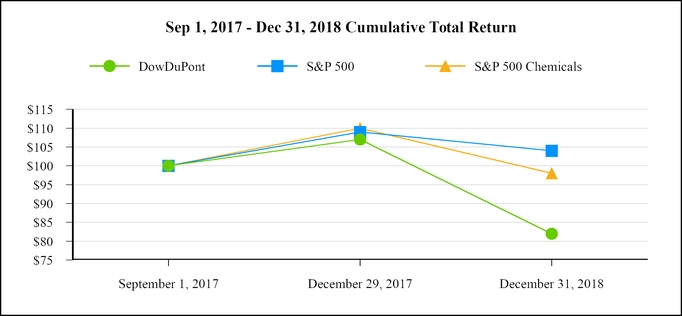
| Cumulative Total Return | DowDuPont | S&P 500 | S&P 500 Chemicals | ||||||
| September 1, 2017 | $ | 100 | $ | 100 | $ | 100 | |||
| December 29, 2017 | $ | 107 | $ | 109 | $ | 110 | |||
| December 31, 2018 | $ | 82 | $ | 104 | $ | 98 |
The form of the chart presented above is in accordance with requirements of the U.S. Securities and Exchange Commission. Stockholders are cautioned against drawing any conclusions from the data contained therein, as past results are not necessarily indicative of future performance. This does not reflect the Company's forecast of future financial performance.
Following the Merger close on August 31, 2017, one share of Historical Dow common stock was converted to one share of DowDuPont common stock, and one share of Historical DuPont common stock was converted to 1.2820 shares of DowDuPont common stock.
Item 6. SELECTED FINANCIAL DATA
| Selected Financial Data 1 | |||||||||||||||
| In millions, except as noted (Unaudited) | 2018 | 2017 | 2016 | 2015 | 2014 | ||||||||||
| Summary of Operations | |||||||||||||||
| Net sales | $ | 85,977 | $ | 62,484 | $ | 48,158 | $ | 48,778 | $ | 58,167 | |||||
| Income from continuing operations, net of tax 2 | $ | 4,004 | $ | 1,669 | $ | 4,404 | $ | 7,783 | $ | 3,839 | |||||
| Loss from discontinued operations, net of tax | $ | (5 | ) | $ | (77 | ) | $ | — | $ | — | $ | — | |||
| Per share of common stock (in dollars): | |||||||||||||||
| Earnings per common share from continuing operations - basic 2 | $ | 1.66 | $ | 0.97 | $ | 3.57 | $ | 6.45 | $ | 2.91 | |||||
| Earnings per common share from continuing operations - diluted 2 | $ | 1.65 | $ | 0.95 | $ | 3.52 | $ | 6.15 | $ | 2.87 | |||||
| Loss per common share from discontinued operations - basic | $ | — | $ | (0.05 | ) | $ | — | $ | — | $ | — | ||||
| Loss per common share from discontinued operations - diluted | $ | — | $ | (0.04 | ) | $ | — | $ | — | $ | — | ||||
| Cash dividends declared per share of common stock | $ | 1.52 | $ | 1.76 | $ | 1.84 | $ | 1.72 | $ | 1.53 | |||||
| Book value per share of common stock | $ | 41.80 | $ | 43.30 | $ | 21.70 | $ | 23.06 | $ | 19.71 | |||||
| Year-end Financial Position | |||||||||||||||
| Total assets | $ | 188,030 | $ | 192,164 | $ | 79,511 | $ | 67,938 | $ | 68,639 | |||||
| Long-term debt | $ | 37,662 | $ | 30,056 | $ | 20,456 | $ | 16,215 | $ | 18,741 | |||||
| Financial Ratios | |||||||||||||||
| Research and development expenses as percent of net sales 3 | 3.6 | % | 3.4 | % | 3.3 | % | 3.2 | % | 2.8 | % | |||||
| Income from continuing operations before income taxes as percent of net sales 2 | 6.4 | % | 1.9 | % | 9.2 | % | 20.4 | % | 9.1 | % | |||||
| Return on stockholders' equity 2 | 4.1 | % | 1.5 | % | 15.3 | % | 34.4 | % | 18.6 | % | |||||
| Debt as a percent of total capitalization | 29.6 | % | 25.1 | % | 44.0 | % | 39.7 | % | 45.5 | % |
| 1. | The year ended December 31, 2017, reflects the results of Historical Dow for the entire year and the results of Historical DuPont for the period beginning on and after September 1, 2017. The years ended December 31, 2016, 2015 and 2014 solely reflect the results of Historical Dow. |
| 2. | See Notes 1, 3, 6, 7, 8, 13, 15, 16 and 19 to the Consolidated Financial Statements for information on items materially impacting the results for the years ended December 31, 2018, 2017 and 2016, including the effects of the U.S. Tax Cuts and Jobs Act, enacted on December 22, 2017; Merger-related amortization of the fair value step-up of inventories; loss on early redemption of debt; gains on divestitures; integration and separation costs; charges related to restructuring programs; goodwill impairment and other asset related charges; a charge related to payment of plan obligations to certain participants of a Historical Dow U.S. non-qualified pension plan; and the impact of a change in accounting policy for asbestos-related defense and processing costs. |
| 3. | The retrospective adoption of ASU 2017-07 in the first quarter of 2018 resulted in an update to this ratio for 2015. The adoption did not impact the ratio for the remaining periods. |
Item 7. MANAGEMENT'S DISCUSSION AND ANALYSIS OF FINANCIAL CONDITION AND RESULTS OF OPERATIONS
On December 11, 2015, The Dow Chemical Company ("Historical Dow") and E. I. du Pont de Nemours and Company ("Historical DuPont") entered into an Agreement and Plan of Merger ("Merger Agreement"), as amended on March 31, 2017, to effect an all-stock merger of equals strategic combination resulting in a newly formed corporation named DowDuPont Inc. ("DowDuPont" or the "Company"). On August 31, 2017, pursuant to the Merger Agreement, Historical Dow and Historical DuPont each merged with wholly owned subsidiaries of DowDuPont ("Mergers") and, as a result of the Mergers, Historical Dow and Historical DuPont became subsidiaries of DowDuPont (collectively, the "Merger"). Prior to the Merger, DowDuPont did not conduct any business activities other than those required for its formation and matters contemplated by the Merger Agreement. Historical Dow was determined to be the accounting acquirer in the Merger. As a result, the financial statements of Historical Dow for the periods prior to the Merger are considered to be the historical financial statements of DowDuPont. The results of Historical DuPont are included in DowDuPont's consolidated results from the Merger date forward. See Note 3 to the Consolidated Financial Statements for additional information.
DowDuPont intends to pursue, subject to the receipt of approval by the Board of Directors ("Board") of DowDuPont and customary closing conditions, the separation of the combined Company's agriculture, materials science and specialty products businesses through one or more tax-efficient transactions ("Intended Business Separations").
Except as otherwise indicated by the context, the term "Historical Dow" includes Historical Dow and its consolidated subsidiaries, "Historical DuPont" includes Historical DuPont and its consolidated subsidiaries, "Union Carbide" means Union Carbide Corporation, a wholly owned subsidiary of Historical Dow, and "Dow Silicones" means Dow Silicones Corporation (formerly known as Dow Corning Corporation, which changed its name effective as of February 1, 2018), a wholly owned subsidiary of Historical Dow.
Items Affecting Comparability of Financial Results
Due to the size of each of Historical Dow's and Historical DuPont's businesses prior to the Merger, in this section certain supplemental unaudited pro forma financial information is provided that assumes the Merger had been consummated on January 1, 2016. Adjustments have been made in the unaudited pro forma financial information for (1) the purchase accounting impact, (2) accounting policy alignment, (3) the elimination of the effect of events that were directly attributable to the Merger Agreement (e.g., one-time transaction costs), (4) the elimination of the impact of transactions between Historical Dow and Historical DuPont, and (5) the elimination of the effect of consummated divestitures required as a condition of regulatory approval for the Merger. Events that are not expected to have a continuing impact on the combined results (e.g., inventory step-up costs) were excluded. These adjustments impacted the consolidated results as well as the reportable segments. For additional information, see the Supplemental Unaudited Pro Forma Combined Financial Information in this section.
ABOUT DOWDUPONT INC.
DowDuPont is a holding company comprised of Historical Dow and Historical DuPont with the intent to form strong, independent, publicly traded companies in the agriculture, materials science and specialty products sectors that will lead their respective industries through productive, science-based innovation to meet the needs of customers and help solve global challenges.
In 2018, 37 percent of the Company’s net sales were to customers in U.S. & Canada; 28 percent were in Europe, Middle East and Africa ("EMEA"); 24 percent were in Asia Pacific; and 11 percent were in Latin America.
In 2018, the Company and its consolidated subsidiaries did not operate in countries subject to U.S. economic sanctions and export controls as imposed by the U.S. State Department or in countries designated by the U.S. State Department as state sponsors of terrorism, including Iran, the Democratic People's Republic of Korea (North Korea), Sudan and Syria. The Company has policies and procedures in place designed to ensure that it and its consolidated subsidiaries remain in compliance with applicable U.S. laws and regulations.
OVERVIEW
The following is a summary of the results from continuing operations for the year ended December 31, 2018:
| • | The Company reported net sales for 2018 of $86.0 billion, up 38 percent from $62.5 billion in 2017, with broad-based sales growth across all segments and geographic regions. Portfolio & Other contributed 29 percent of the sales increase, primarily reflecting the Merger as a full year of net sales in 2018 related to Historical DuPont compared with four months in 2017, which impacted all segments except Performance Materials & Coatings and Industrial Intermediates & Infrastructure. |
| • | Volume increased 4 percent compared with the same period last year, with increases in all segments, except Performance Materials & Coatings and Transportation & Advanced Polymers (both down 2 percent) and Nutrition & Biosciences (flat). Volume increased in all geographic regions, except U.S. & Canada (flat), led by a double-digit increase in Asia Pacific (up 13 percent). |
| • | Local price was up 4 percent compared with last year, primarily in response to higher feedstock and raw material costs. Local price increased in all segments, except Electronics & Imaging (flat). Local price increased in all geographic region |
Showing the first 8K of 229K characters. Open the full section
Item 7A. QUANTITATIVE AND QUALITATIVE DISCLOSURES ABOUT MARKET RISK
DowDuPont's risk management programs are managed separately by Historical Dow and Historical DuPont. Historical Dow and Historical DuPont have historically utilized different methods to report their quantitative information about market risk. Historical Dow uses a value-at-risk ("VAR") approach while Historical DuPont uses sensitivity analysis. Both methods are acceptable under SEC Regulation S-K and are viewed as equally effective from a risk monitoring perspective. As the risk management programs for Historical Dow and Historical DuPont will continue to be managed separately, the quantitative and qualitative disclosures about market risk will be provided for each subsidiary, as discussed below.
Historical Dow
Historical Dow’s business operations give rise to market risk exposure due to changes in foreign exchange rates, interest rates, commodity prices and other market factors such as equity prices. To manage such risks effectively, Historical Dow enters into hedging transactions, pursuant to established guidelines and policies that enable it to mitigate the adverse effects of financial market risk. Derivatives used for this purpose are designated as hedges per the accounting guidance related to derivatives and hedging activities, where appropriate. A secondary objective is to add value by creating additional non-specific exposure within established limits and policies; derivatives used for this purpose are not designated as hedges. The potential impact of creating such additional exposures is not material to Historical Dow’s results.
The global nature of Historical Dow’s business requires active participation in the foreign exchange markets. Historical Dow has assets, liabilities and cash flows in currencies other than the U.S. dollar. The primary objective of Historical Dow’s foreign currency risk management is to optimize the U.S. dollar value of net assets and cash flows. To achieve this objective, Historical Dow hedges on a net exposure basis using foreign currency forward contracts, over-the-counter option contracts, cross-currency swaps and nonderivative instruments in foreign currencies. Exposures primarily relate to assets, liabilities and bonds denominated in foreign currencies, as well as economic exposure, which is derived from the risk that currency fluctuations could affect the dollar value of future cash flows related to operating activities. The largest exposures are denominated in European currencies, the Japanese yen and the Chinese yuan, although exposures also exist in other currencies of Asia Pacific, Canada, Latin America, Middle East, Africa and India.
The main objective of interest rate risk management is to reduce the total funding cost to Historical Dow and to alter the interest rate exposure to the desired risk profile. To achieve this objective, Historical Dow hedges using interest rate swaps, “swaptions,” and exchange-traded instruments. Historical Dow’s primary exposure is to the U.S. dollar yield curve.
Historical Dow has a portfolio of equity securities derived primarily from the investment activities of its insurance subsidiaries. This exposure is managed in a manner consistent with Historical Dow’s market risk policies and procedures.
Inherent in Historical Dow’s business is exposure to price changes for several commodities. Some exposures can be hedged effectively through liquid tradable financial instruments. Natural gas and crude oil, along with feedstocks for ethylene and propylene production, constitute the main commodity exposures. Over-the-counter and exchange traded instruments are used to hedge these risks, when feasible.
Historical Dow uses VAR, stress testing and scenario analysis for risk measurement and control purposes. VAR estimates the maximum potential loss in fair market values, given a certain move in prices over a certain period of time, using specified confidence levels. The VAR methodology used by Historical Dow is a variance/covariance model. This model uses a 97.5 percent confidence level and includes at least one year of historical data. The 2018 and 2017 year-end and average daily VAR for the aggregate of all positions are shown below. These amounts are immaterial relative to the total equity of Historical Dow.
| Total Daily VAR by Exposure Type at Dec 31 | 2018 | 2017 | ||||||||||
| In millions | Year-end | Average | Year-end | Average | ||||||||
| Commodities | $ | 26 | $ | 30 | $ | 32 | $ | 35 | ||||
| Equity securities | 12 | 7 | 4 | 9 | ||||||||
| Foreign exchange | 26 | 28 | 26 | 38 | ||||||||
| Interest rate | 81 | 80 | 70 | 76 | ||||||||
| Composite | $ | 145 | $ | 145 | $ | 132 | $ | 158 |
Historical Dow’s daily VAR for the aggregate of all positions increased from a composite VAR of $132 million at December 31, 2017, to a composite VAR of $145 million at December 31, 2018. The interest rate VAR increased due to an increase in exposure. The equity securities VAR increased due to an increase in managed exposures and higher equity volatility. The commodities VAR decreased due to a decrease in managed exposure. See Note 21 to the Consolidated Financial Statements for further disclosure regarding market risk.
Historical DuPont
Historical DuPont’s global operations are exposed to financial market risks relating to fluctuations in foreign currency exchange rates, commodity prices and interest rates. Historical DuPont has established a variety of programs including the use of derivative instruments and other financial instruments to manage the exposure to financial market risks as to minimize volatility of financial results. In the ordinary course of business, Historical DuPont enters into derivative instruments to hedge its exposure to foreign currency, interest rate and commodity price risks under established procedures and controls. Decisions regarding whether or not to hedge a given commitment are made on a case-by-case basis, taking into consideration the amount and duration of the exposure, market volatility and economic trends. Foreign currency exchange contracts are also used, from time to time, to manage near-term foreign currency cash requirements.
Foreign Currency Exchange Rate Risks
Historical DuPont has significant international operations resulting in a large number of currency transactions that result from international sales, purchases, investments and borrowings. The primary currencies for which Historical DuPont has an exchange rate exposure are the European euro, Chinese yuan, Brazilian real and Japanese yen. Historical DuPont uses forward exchange contracts to offset its net exposures, by currency, related to the foreign currency denominated monetary assets and liabilities of its operations. In addition to the contracts disclosed in Note 21 to the Consolidated Financial Statements, from time to time, Historical DuPont will enter into foreign currency exchange contracts to establish with certainty the U.S. dollar amount of future firm commitments denominated in a foreign currency.
The following table illustrates the fair values of outstanding foreign currency contracts at December 31, 2018, and the effect on fair values of a hypothetical adverse change in the foreign exchange rates that existed at December 31, 2018. The sensitivities for foreign currency contracts are based on a 10 percent adverse change in foreign exchange rates.
| Foreign Currency Contracts at Dec 31, 2018 | Fair Value Asset | Fair Value Sensitivity | ||||
| In millions | ||||||
| Foreign currency contracts | $ | 51 | $ | (402 | ) |
Since Historical DuPont's risk management programs are highly effective, the potential loss in value for each risk management portfolio described above would be largely offset by changes in the value of the underlying exposure.
Concentration of Credit Risk
Historical DuPont maintains cash and cash equivalents, marketable securities, derivatives and certain other financial instruments with various financial institutions. These financial institutions are generally highly rated and geographically dispersed and Historical DuPont has a policy to limit the dollar amount of credit exposure with any one institution.
As part of Historical DuPont's financial risk management processes, it continuously evaluates the relative credit standing of all of the financial institutions that service Historical DuPont and monitors actual exposures versus established limits. Historical DuPont has not sustained credit losses from instruments held at financial institutions.
Item 8. FINANCIAL STATEMENTS AND SUPPLEMENTARY DATA
REPORT OF INDEPENDENT REGISTERED PUBLIC ACCOUNTING FIRM
To the Stockholders and the Board of Directors of DowDuPont Inc.
Opinion on the Financial Statements
We have audited the accompanying consolidated balance sheets of DowDuPont Inc. and subsidiaries (the "Company") as of December 31, 2018 and 2017, the related consolidated statements of income, comprehensive income, equity, and cash flows, for each of the three years in the period ended December 31, 2018, and the related notes and the schedule listed in the Index at Item 15a(2) (collectively referred to as the "financial statements"). In our opinion, based on our audits and the report of the other auditors, the financial statements present fairly, in all material respects, the financial position of the Company as of December 31, 2018 and 2017, and the results of its operations and its cash flows for each of the three years in the period ended December 31, 2018, in conformity with accounting principles generally accepted in the United States of America.
We did not audit the consolidated financial statements of E. I. du Pont de Nemours and Company (“DuPont”), a wholly-owned subsidiary of the Company, which consolidated financial statements reflect total assets of $101,025 million and $112,964 million as of December 31, 2018 and 2017, respectively, and total revenues of $26,279 million for the year ended December 31, 2018 and $7,053 million for the period from August 31, 2017 (date of merger) to December 31, 2017. Those statements were audited by other auditors whose report has been furnished to us, and our opinion, insofar as it relates to the amounts included for DuPont as of December 31, 2018 and for the period from August 31, 2017 (date of the merger) to December 31, 2017 and the year ended December 31, 2018, is based solely on the report of the other auditors.
We have also audited, in accordance with the standards of the Public Company Accounting Oversight Board (United States) (“PCAOB”), the Company's internal control over financial reporting as of December 31, 2018, based on the criteria established in Internal Control - Integrated Framework (2013) issued by the Committee of Sponsoring Organizations of the Treadway Commission and our report dated February 11, 2019 expressed an unqualified opinion on the Company's internal control over financial reporting based on our audit and the report of the other auditors.
Changes in Accounting Principles
As discussed in Note 16 to the financial statements, in the fourth quarter of 2016, the Company changed its accounting policy from expensing asbestos-related defense and processing costs as incurred to the accrual of asbestos-related defense and processing costs when probable of occurring and estimable. As discussed in Note 4 to the financial statements, in the first quarter of 2018, the Company changed its method of accounting for revenue due to the adoption of Accounting Standards Codification Topic 606, Revenue From Contracts With Customers.
Merger
As discussed in Notes 1 and 3 to the financial statements, the Company was formed for the purpose of effecting the merger of The Dow Chemical Company and DuPont. On August 31, 2017, the merger was completed.
Basis for Opinion
These financial statements are the responsibility of the Company's management. Our responsibility is to express an opinion on the Company's financial statements based on our audits. We are a public accounting firm registered with the PCAOB and are required to be independent with respect to the Company in accordance with the U.S. federal securities laws and the applicable rules and regulations of the Securities and Exchange Commission and the PCAOB.
We conducted our audits in accordance with the standards of the PCAOB. Those standards require that we plan and perform the audit to obtain reasonable assurance about whether the financial statements are free of material misstatement, whether due to error or fraud. Our audits included performing procedures to assess the risks of material misstatement of the financial statements, whether due to error or fraud, and performing procedures that respond to those risks. Such procedures included examining, on a test basis, evidence regarding the amounts and disclosures in the financial statements. Our audits also included evaluating the accounting principles used and significant estimates made by management, as well as evaluating the overall presentation of the financial statements. We believe that our audits and the report of the other auditors provide a reasonable basis for our opinion.
| /s/ DELOITTE & TOUCHE LLP |
| Deloitte & Touche LLP |
| Midland, Michigan |
| February 11, 2019 |
We have served as the Company's auditor since 1905.
REPORT OF INDEPENDENT REGISTERED PUBLIC ACCOUNTING FIRM
To the Stockholders and Board of Directors of E. I. du Pont de Nemours and Company
Opinions on the Financial Statements and Internal Control over Financial Reporting
We have audited the consolidated balance sheets of E. I. du Pont de Nemours and Company and its subsidiaries (Successor) (the “Company”) as of December 31, 2018 and 2017, and the related consolidated statements of operations, comprehensive (loss) income, equity and cash flows for the year ended December 31, 2018 and for the period September 1, 2017 through December 31, 2017, including the related notes and financial statement schedule (collectively referred to as the “consolidated financial statements”) (not presented herein). We also have audited the Company's internal control over financial reporting as of December 31, 2018, based on criteria established in Internal Control - Integrated Framework (2013) issued by the Committee of Sponsoring Organizations of the Treadway Commission (COSO).
In our opinion, the consolidated financial statements referred to above present fairly, in all material respects, the financial position of the Company as of December 31, 2018 and 2017, and the results of its operations and its cash flows for the year ended December 31, 2018 and for the period September 1, 2017 through December 31, 2017 in conformity with accounting principles generally accepted in the United States of America. Also in our opinion, the Company maintained, in all material respects, effective internal control over financial reporting as of December 31, 2018, based on criteria established in Internal Control - Integrated Framework (2013) issued by the COSO.
Basis for Opinions
The Company's management is responsible for these consolidated financial statements, for maintaining effective internal control over financial reporting, and for its assessment of the effectiveness of internal control over financial reporting, included in Management’s Report on Internal Control over Financial Reporting (not presented herein). Our responsibility is to express opinions on the Company’s consolidated financial statements and on the Company's internal control over financial reporting based on our audits. We are a public accounting firm registered with the Public Company Accounting Oversight Board (United States) (PCAOB) and are required to be independent with respect to the Company in accordance with the U.S. federal securities laws and the applicable rules and regulations of the Securities and Exchange Commission and the PCAOB.
We conducted our audits in accordance with the standards of the PCAOB. Those standards require that we plan and perform the audits to obtain reasonable assurance about whether the consolidated financial statements are free of material misstatement, whether due to error or fraud, and whether effective internal control over financial reporting was maintained in all material respects.
Our audits of the consolidated financial statements included performing procedures to assess the risks of material misstatement of the consolidated financial statements, whether due to error or fraud, and performing procedures that respond to those risks. Such procedures
Showing the first 8K of 513K characters. Open the full section
Item 9. CHANGES IN AND DISAGREEMENTS WITH ACCOUNTANTS ON ACCOUNTING AND FINANCIAL DISCLOSURE
Not applicable.
Item 9A. CONTROLS AND PROCEDURES
Evaluation of Disclosure Controls and Procedures
As of the end of the period covered by this Annual Report on Form 10-K, the Company carried out an evaluation, under the supervision and with the participation of the Company’s Disclosure Committee and the Company’s management, including the Chief Executive Officer and the Chief Financial Officer, of the effectiveness of the design and operation of the Company’s disclosure controls and procedures pursuant to paragraph (b) of Exchange Act Rules 13a-15 and 15d-15. Based upon that evaluation, the Chief Executive Officer and the Chief Financial Officer concluded that the Company’s disclosure controls and procedures were effective.
Changes in Internal Control Over Financial Reporting
There were no changes in the Company's internal control over financial reporting identified in connection with the evaluation required by paragraph (d) of Exchange Act Rules 13a-15 and 15d-15 that was conducted during the last fiscal quarter that have materially affected, or are reasonably likely to materially affect, the Company's internal control over financial reporting.
Management’s Report on Internal Control Over Financial Reporting
Management is responsible for establishing and maintaining adequate internal control over financial reporting. The Company’s internal control framework and processes are designed to provide reasonable assurance to management and the Board of Directors regarding the reliability of financial reporting and the preparation of the Company’s consolidated financial statements in accordance with accounting principles generally accepted in the United States of America.
The Company’s internal control over financial reporting includes those policies and procedures that:
| • | pertain to the maintenance of records that, in reasonable detail, accurately and fairly reflect the transactions and dispositions of the assets of the Company; |
| • | provide reasonable assurance that transactions are recorded as necessary to permit preparation of financial statements in accordance with generally accepted accounting principles, and that receipts and expenditures of the Company are being made only in accordance with authorizations of management and Directors of the Company; and |
| • | provide reasonable assurance regarding prevention or timely detection of unauthorized acquisition, use or disposition of the Company’s assets that could have a material effect on the consolidated financial statements. |
Because of its inherent limitations, any system of internal control over financial reporting can provide only reasonable assurance and may not prevent or detect misstatements.
Management assessed the effectiveness of the Company’s internal control over financial reporting and concluded that, as of December 31, 2018, such internal control is effective. In making this assessment, management used the criteria set forth by the Committee of Sponsoring Organizations of the Treadway Commission (“COSO”) in Internal Control—Integrated Framework (2013).
The Company’s independent auditors, Deloitte & Touche LLP, with direct access to the Company’s Board of Directors through its Audit Committee, have audited the consolidated financial statements prepared by the Company. Their report on the consolidated financial statements is included in Part II, Item 8. Financial Statements and Supplementary Data. Deloitte & Touche LLP’s report on the Company’s internal control over financial reporting is referenced therein and included herein. As described in their report, the effectiveness of E. I. du Pont de Nemours and Company's internal control over financial reporting was audited by other auditors whose report has been furnished to Deloitte & Touche LLP, and their opinion, insofar as it relates to the effectiveness of DuPont's internal control over financial reporting, is based solely on the report of the other auditors.
February 11, 2019
| /s/ EDWARD D. BREEN | /s/ HOWARD UNGERLEIDER | |||
| Edward D. Breen | Howard Ungerleider | |||
| Chief Executive Officer | Chief Financial Officer | |||
| /s/ JEANMARIE F. DESMOND | /s/ RONALD C. EDMONDS | |||
| Jeanmarie F. Desmond | Ronald C. Edmonds | |||
| Co-Controller, Wilmington, Delaware | Co-Controller, Midland, Michigan |
REPORT OF INDEPENDENT REGISTERED PUBLIC ACCOUNTING FIRM
To the Stockholders and the Board of Directors of DowDuPont Inc.
Opinion on Internal Control over Financial Reporting
We have audited the internal control over financial reporting of DowDuPont Inc. and subsidiaries (the "Company") as of December 31, 2018, based on criteria established in Internal Control - Integrated Framework (2013) issued by the Committee of Sponsoring Organizations of the Treadway Commission (COSO). In our opinion, based on our audit and the report of the other auditors, the Company maintained, in all material respects, effective internal control over financial reporting as of December 31, 2018, based on criteria established in Internal Control - Integrated Framework (2013) issued by COSO.
We did not audit the effectiveness of internal control over financial reporting of E. I. du Pont de Nemours and Company (“DuPont”), a wholly owned subsidiary of the Company, whose financial statements reflect total assets of $101,025 million and $112,964 million as of December 31, 2018 and 2017, respectively, and total revenues of $26,279 million for the year ended December 31, 2018 and $7,053 million for the period from August 31, 2017 (date of merger) to December 31, 2017. The effectiveness of DuPont’s internal control over financial reporting was audited by other auditors whose report has been furnished to us, and our opinion, insofar as it relates to the effectiveness of DuPont’s internal control over financial reporting, is based solely on the report of the other auditors.
We have also audited, in accordance with the standards of the Public Company Accounting Oversight Board (United States) (PCAOB), the consolidated financial statements as of and for the year ended December 31, 2018 of the Company and the financial statement schedule listed in the Index at Item 15(a)2 and our report dated February 11, 2019, expressed an unqualified opinion on those financial statements and financial statement schedule based on our audit and the report of the other auditors and included an explanatory paragraph regarding a) a change in accounting policy related to asbestos-related defense and processing costs, b) a change in method of accounting for revenue due to the adoption of Accounting Standards Codification Topic 606, Revenue From Contracts With Customers, and c) an emphasis of a matter paragraph regarding the merger of The Dow Chemical Company and DuPont.
Basis for Opinion
The Company’s management is responsible for maintaining effective internal control over financial reporting and for its assessment of the effectiveness of internal control over financial reporting, included in the accompanying Management’s Report on Internal Control over Financial Reporting. Our responsibility is to express an opinion on the Company’s internal control over financial reporting based on our audit. We are a public accounting firm registered with the PCAOB and are required to be independent with respect to the Company in accordance with the U.S. federal securities laws and the applicable rules and regulations of the Securities and Exchange Commission and the PCAOB.
We conducted our audit in accordance with the standards of the PCAOB. Those standards require that we plan and perform the audit to obtain reasonable assurance about whether effective internal control over financial reporting was maintained in all material respects. Our audit included obtaining an understanding of internal control over financial reporting, assessing the risk that a material weakness exists, testing and evaluating the design and operating effectiveness of internal control based on the assessed risk, and performing such other procedures as we considered necessary in the circumstances. We believe that our audit and the audit of the other auditors provide a reasonable basis for our opinion.
Definition and Limitations of Internal Control over Financial Reporting
A company’s internal control over financial reporting is a process designed to provide reasonable assurance regarding the reliability of financial reporting and the preparation of financial statements for external purposes in accordance with generally accepted accounting principles. A company’s internal control over financial reporting includes those policies and procedures that (1) pertain to the maintenance of records that, in reasonable detail, accurately and fairly reflect the transactions and dispositions of the assets of the company; (2) provide reasonable assurance that transactions are recorded as necessary to permit preparation of financial statements in accordance with generally accepted accounting principles, and that receipts and expenditures of the company are being made only in accordance with authorizations of management and directors of the company; and (3) provide reasonable assurance regarding prevention or timely detection of unauthorized acquisition, use, or disposition of the company’s assets that could have a material effect on the financial statements.
Because of its inherent limitations, internal control over financial reporting may not prevent or detect misstatements. Also, projections of any evaluation of effectiveness to future periods are subject to the risk that controls may become inadequate because of changes in conditions, or that the degree of compliance with the policies or procedures may deteriorate.
| /s/ DELOITTE & TOUCHE LLP |
| Deloitte & Touche LLP |
| Midland, Michigan |
| February 11, 2019 |
Item 9B. OTHER INFORMATION
None.
| DowDuPont Inc. |
| PART III |
Item 10. DIRECTORS, EXECUTIVE OFFICERS AND CORPORATE GOVERNANCE
Information related to Directors, certain executive officers and certain corporate governance matters (including identification of Audit Committee members and financial expert(s)) is contained in the definitive Proxy Statement for the 2019 Annual Meeting of Stockholders of DowDuPont Inc. and is incorporated herein by reference. See also the information regarding executive officers of the registrant set forth in Part I, Item 1. Business under the caption "Executive Officers of the Registrant" in reliance on General Instruction G to Form 10-K.
On September 1, 2017, the Board of Directors of the Company adopted a code of ethics that applies to its principal executive officer, principal financial officer and principal accounting officer. A copy of the code can be obtained via the Internet through the Investor Relations section of the Company's website under Corporate Governance (www.dow-dupont.com/investors/corporate-governance). The Company's website and its content are not deemed incorporated by reference into this report.
Item 11. EXECUTIVE COMPENSATION
Information related to executive compensation and the Company's equity compensation plans is contained in the definitive Proxy Statement for the 2019 Annual Meeting of Stockholders of DowDuPont Inc. and is incorporated herein by reference.
Item 12. SECURITY OWNERSHIP OF CERTAIN BENEFICIAL OWNERS AND MANAGEMENT AND RELATED STOCKHOLDER MATTERS
Information with respect to beneficial ownership of DowDuPont Inc. common stock by each Director and all Directors and executive officers of the Company as a group is contained in the definitive Proxy Statement for the 2019 Annual Meeting of Stockholders of DowDuPont Inc. and is incorporated herein by reference.
Information relating to any person who beneficially owns in excess of 5 percent of the total outstanding shares of DowDuPont Inc. common stock is contained in the definitive Proxy Statement for the 2019 Annual Meeting of Stockholders of DowDuPont Inc. and is incorporated herein by reference.
Information with respect to compensation plans under which equity securities are authorized for issuance is contained in the definitive Proxy Statement for the 2019 Annual Meeting of Stockholders of DowDuPont Inc. and is incorporated herein by reference.
Item 13. CERTAIN RELATIONSHIPS AND RELATED TRANSACTIONS, AND DIRECTOR INDEPENDENCE
Reportable relationships and related transactions, if any, as well as information relating to director independence are contained in the definitive Proxy Statement for the 2019 Annual Meeting of Stockholders of DowDuPont Inc. and are incorporated herein by reference.
Item 14. PRINCIPAL ACCOUNTING FEES AND SERVICES
Information with respect to fees and services related to the Company’s independent auditors, Deloitte & Touche LLP, and the disclosure of the Audit Committee’s pre-approval policies and procedures are contained in the definitive Proxy Statement for the 2019 Annual Meeting of Stockholders of DowDuPont Inc. and are incorporated herein by reference.
| DowDuPont Inc. |
| PART IV |
Item 15. EXHIBITS, FINANCIAL STATEMENT SCHEDULES
| (a) | The following documents are filed as part of this report: |
| (1) | The Company’s 2018 Consolidated Financial Statements are included in Part II, Item 8. Financial Statements and Supplementary Data. |
| (2) | Financial Statement Schedules – The following Financial Statement Schedule should be read in conjunction with the Consolidated Financial Statements and Report of Independent Registered Public Accounting Firm included in Part II, Item 8. Financial Statements and Supplementary Data: |
Schedule II Valuation and Qualifying Accounts
Schedules other than the one listed above are omitted due to the absence of conditions under which they are required or because the information called for is included in the Consolidated Financial Statements or the Notes to the Consolidated Financial Statements.
| (3) | Exhibits – See the Exhibit Index for the exhibits filed with this Annual Report on Form 10-K or incorporated by reference. The following exhibits are filed with this Annual Report on Form 10-K: |
| Exhibit No. | Description of Exhibit |
| 3.2 | The Amended and Restated Bylaws of DowDuPont Inc., incorporated by reference to Exhibit 3.1 to the DowDuPont Inc. Current Report on Form 8-K filed September 12, 2017. |
| 3.2.1 | Amendment to the Amended and Restated Bylaws of DowDuPont Inc., incorporated by reference to Exhibit 3.1 to the DowDuPont Inc. Current Report on Form 8-K filed March 12, 2018. |
| 10.1 | The E. I. du Pont de Nemours and Company Equity Incentive Plan, incorporated by reference to Exhibit 4.1 to the DowDuPont Inc. Registration Statement on Form S-8 filed September 1, 2017. |
| 10.2 | The E. I. du Pont de Nemours and Company Stock Performance Plan, incorporated by reference to Exhibit 4.2 to the DowDuPont Inc. Registration Statement on Form S-8 filed September 1, 2017. |
| 10.5 | The Dow Chemical Company Amended and Restated 2012 Stock Incentive Plan, incorporated by reference to Exhibit 4.1 to the DowDuPont Inc. Registration Statement on Form S-8 filed September 5, 2017. |
| 21* | Subsidiaries of DowDuPont Inc. |
| 23.1* | Consent of Independent Registered Public Accounting Firm, Deloitte & Touche LLP. |
| 23.2* | Consent of Independent Registered Public Accounting Firm, PricewaterhouseCoopers LLP. |
| 23.3* | Ankura Consulting Group, LLC's Consent. |
| 31.1* | Certification Pursuant to Section 302 of the Sarbanes-Oxley Act of 2002. |
| 31.2* | Certification Pursuant to Section 302 of the Sarbanes-Oxley Act of 2002. |
| 32.1* | Certification Pursuant to Section 906 of the Sarbanes-Oxley Act of 2002. |
| 32.2* | Certification Pursuant to Section 906 of the Sarbanes-Oxley Act of 2002. |
| 101.INS | XBRL Instance Document. |
| 101.SCH | XBRL Taxonomy Extension Schema Document. |
| 101.CAL | XBRL Taxonomy Extension Calculation Linkbase Document. |
| 101.DEF | XBRL Taxonomy Extension Definition Linkbase Document. |
| 101.LAB | XBRL Taxonomy Extension Label Linkbase Document. |
| 101.PRE | XBRL Taxonomy Extension Presentation Linkbase Document. |
*Filed herewith
A copy of any exhibit can be obtained via the Internet through the Investor Relations section of the Company's website (www.dow-dupont.com/investors), or the Company will provide a copy of any exhibit upon receipt of a written request for the particular exhibit or exhibits desired. All requests should be addressed to a Co-Controller of the Company at the addresses listed for the Company’s principal executive offices. The referenced website and its content are not deemed incorporated by reference into this report.
Item 16. FORM 10-K SUMMARY
Not applicable.
| DowDuPont Inc. | Schedule II | |
| Valuation and Qualifying Accounts |
| (In millions) For the year ended Dec 31, | 2018 | 2017 | 2016 | ||||||
| Accounts Receivable - Allowance for Doubtful Receivables | |||||||||
| Balance at beginning of period | $ | 127 | $ | 110 | $ | 94 | |||
| Additions charged to expenses | 114 | 43 | 31 | ||||||
| Additions charged to other accounts 1 | 4 | 3 | — | ||||||
| Deductions from reserves 2 | (54 | ) | (29 | ) | (15 | ) | |||
| Balance at end of period | $ | 191 | $ | 127 | $ | 110 | |||
| Inventory - Obsolescence Reserve | |||||||||
| Balance at beginning of period | $ | 170 | $ | 123 | $ | 152 | |||
| Additions charged to expenses | 493 | 129 | 29 | ||||||
| Deductions from reserves 3 | (338 | ) | (82 | ) | (58 | ) | |||
| Balance at end of period | $ | 325 | $ | 170 | $ | 123 | |||
| Reserves for Other Investments and Noncurrent Receivables | |||||||||
| Balance at beginning of period | $ | 437 | $ | 358 | $ | 494 | |||
| Additions charged to expenses 4 | 44 | 83 | 153 | ||||||
| Deductions from reserves 5 | (16 | ) | (4 | ) | (289 | ) | |||
| Balance at end of period | $ | 465 | $ | 437 | $ | 358 | |||
| Deferred Tax Assets - Valuation Allowance 6 | |||||||||
| Balance at beginning of period | $ | 2,511 | $ | 1,061 | $ | 1,000 | |||
| Merger impact | — | 1,160 | — | ||||||
| Additions charged to expenses | 351 | 404 | 155 | ||||||
| Deductions from reserves | (455 | ) | (114 | ) | (94 | ) | |||
| Balance at end of period | $ | 2,407 | $ | 2,511 | $ | 1,061 |
| 1. | Additions to reserves for doubtful receivables charged to other accounts were classified as "Accounts and notes receivable - Other" in the consolidated balance sheets. These reserves relate to Historical Dow's sale of trade accounts receivable. Anticipated credit losses in the portfolio of receivables sold are used to fair value Historical Dow's interests held in trade accounts receivable conduits. See Notes 14 and 22 to the Consolidated Financial Statements for further information. |
| 2. | Deductions include write-offs, recoveries, currency translation adjustment and other miscellaneous items. |
| 3. | Deductions include disposals and currency translation adjustments. |
| 4. | In 2016, additions to reserves for "Other investments and noncurrent receivables" charged to costs and expenses include $143 million related to the Company's investment in AgroFresh Solutions, Inc. See Note 6 to the Consolidated Financial Statements for further information. |
| 5. | In 2016, deductions from reserves for "Other investments and noncurrent receivables" include $237 million related to the Dow Silicones ownership restructure. See Note 3 to the Consolidated Financial Statements for further information. |
| 6. | The Company has corrected its valuation allowance (with a corresponding reduction in tax loss and credit carryforwards) in the amount of $238 million for the year ended December 31, 2017 as a result of a change in the Delaware state apportionment methodology. |
| DowDuPont Inc. |
| Signatures |
Pursuant to the requirements of Section 13 or 15(d) of the Securities Exchange Act of 1934, the registrant has duly caused this report to be signed on its behalf by the undersigned, thereunto duly authorized.
DOWDUPONT INC.
| /s/ JEANMARIE F. DESMOND | /s/ RONALD C. EDMONDS | |
| Jeanmarie F. Desmond | Ronald C. Edmonds | |
| Co-Controller, Wilmington, Delaware | Co-Controller, Midland, Michigan | |
| February 11, 2019 | February 11, 2019 |
Pursuant to the requirements of the Securities Exchange Act of 1934, this report has been signed below by the following persons on behalf of the registrant and in the capacities and on the dates indicated.
| /s/ LAMBERTO ANDREOTTI | /s/ MARILLYN A. HEWSON | |
| Lamberto Andreotti, Director | Marillyn A. Hewson, Director | |
| February 11, 2019 | February 11, 2019 | |
| /s/ AJAY BANGA | /s/ LOIS D. JULIBER | |
| Ajay Banga, Director | Lois D. Juliber, Director | |
| February 11, 2019 | February 11, 2019 | |
| /s/ JACQUELINE K. BARTON | /s/ PAUL POLMAN | |
| Jacqueline K. Barton, Director | Paul Polman, Director | |
| February 11, 2019 | February 11, 2019 | |
| /s/ JAMES A. BELL | /s/ JAMES M. RINGLER | |
| James A. Bell, Director | James M. Ringler, Director | |
| February 11, 2019 | February 11, 2019 | |
| /s/ EDWARD D. BREEN | /s/ RUTH G. SHAW | |
| Edward D. Breen, Director, Chief Executive Officer | Ruth G. Shaw, Director | |
| February 11, 2019 | February 11, 2019 | |
| /s/ ROBERT A. BROWN | /s/ LEE M. THOMAS | |
| Robert A. Brown, Director | Lee M. Thomas, Director | |
| February 11, 2019 | February 11, 2019 | |
| /s/ ALEXANDER M. CUTLER | /s/ HOWARD UNGERLEIDER | |
| Alexander M. Cutler, Co-Lead Independent Director | Howard Ungerleider, Chief Financial Officer | |
| February 11, 2019 | February 11, 2019 | |
| /s/ RICHARD K. DAVIS | /s/ PATRICK J. WARD | |
| Richard K. Davis, Director | Patrick J. Ward, Director | |
| February 11, 2019 | February 11, 2019 | |
| /s/ JEFF M. FETTIG | ||
| Jeff M. Fettig, Executive Chair and Co-Lead Independent Director | ||
| February 11, 2019 |
| DowDuPont Inc. |
| Trademark Listing |
®™ ACANTO, ACOUSTICRYL, AcreMax, ACREVALUE, ACRYSOL, AFFINITY, AGVENTURE, ALFOREX, AMBERLITE, APPROACH PRIMA, APPROACH POWER, AquaMax, AQUASET, ARIGO, ARYLEX, AVANSE, BELCO, BELKAR, BETAFORCE, BETAMATE, BETASEAL, BIO-PDO, BREVANT, BROADWAY, CARBOWAX, CENT-7, CITADEL, CLASSIC, CLINCHER, CLIPPER, CLOSER, CORIAN, CRASTIN, CURZATE, Cyazypyr, DAIRYLAND SEED, DANISCO, DELEGATE, DELRIN, DIMENSION, DITHANE, DOW, DOW CORNING, DOWDUPONT, DOWEX, DOW SEMENTES, DOWSIL, DuPont, DURANGO, ELITE, Encirca, ENLIST, ENLIST DUO, ENLISTONE, ENTRUST, EQUATION CONTACT, EQUATION PRO, EVOLV3D, EVOQUE, EXALT, ExpressSun, EXZACT, FENCER, FILMTEC, FONTELIS, FORMASHIELD, FORTILIFE, GALILEO, GALLANT, GALLERY, GARLON, GF-120, GRANITE, GRANULAR, GRAZON, GREAT STUFF, G2, HERCULEX, HPT, HOEGEMEYER, HOWARU, HYTREL, IMPRELIS, INATREQ, INSTINCT, INTEGRAFLUX, INTREPID, ISOCLAST, ISOTHERMING, KALREZ, KERB, KEVLAR, KEYSTONE, LANCET, LANNATE, Leptra, LIGATE, LIQUIDARMOR, LONTREL, LOYANT, LUMIDERM, LumiGEN, LUMIVIA, MAINCOTE, MAXIMUS, MECS, MOLYKOTE, MORGAN, MULTIBASE, MUSTANG, MYCOGEN, NEXERA, NOMEX, N-LOCK, NORDEL, N-SERVE, NUTECH, Optimum, PACTO, PANNAR, PANZER, PERFECTMATCH, PEXALON, PHYTOGEN, PINDAR, Pioneer, PIXXARO, Plenish, POWER PLUS, PRIMAL, PRIMUS, PROPOUND, Protector, PYRAXALT, QUELEX, RADIANT, RAINBOW, REALM Q, REFUGE ADVANCED, RESICORE, RHOPLEX, RICER, RINSKOR, RPM, Rynaxypyr, RYNITE, SEED CONSULTANTS, SENTRICON, SENTRY, SILASTIC, SILVADUR, SNAPSHOT, SOLAMET, SONIC, SORONA, SPIDER, STARANE, STRATCO, SUPREME EX, STYROFOAM, SURESTART, TALENDO, TALIUS, TAMOL, TANOS, TEDLAR, TERGITOL, TERRAL SEED, TEXARO, THERMAX, TOPSHOT, TORDON, TPSiV, TRACER, TRANSFORM, TRELLIS, TRITON, TRIVENCE, TYCHEM, TYNEX, TYVEK, UCAR, UCARTHERM, UCON, VAMAC, VERDICT, VERSENE, VESPEL, VESSARYA, VIPER, VP MAXX, VYDATE, WALOCEL, WEATHERMATE, WIDEATTACK, WIDEMATCH, XENERGY, XL, ZORVEC, ZYPAR, ZYTEL are trademarks of The Dow Chemical Company ("Dow") or E. I. du Pont de Nemours and Company ("DuPont") or affiliated companies of Dow or DuPont.
The following registered trademarks of Monsanto Technology LLC appear in this report: SMARTSTAX®, POWERCORE™. SMARTSTAX® and POWERCORE™ multi-event technology developed by Dow Agrosciences LLC and Monsanto Technology LLC. ENLIST E3™ soybeans are developed by Dow AgroSciences and MS Technologies.
The following registered service mark of American Chemistry Council appears in this report: RESPONSIBLE CARE®