 filings.tools
DuPont de Nemours 10-K 2022-12-31
Filed 2023-02-15. 23 sections, 555K characters. Original on sec.gov · Markdown · JSON
Cover and table of contents
UNITED STATES
SECURITIES AND EXCHANGE COMMISSION
Washington, D.C. 20549
FORM 10-K
☑ ANNUAL REPORT PURSUANT TO SECTION 13 OR 15(d) OF THE SECURITIES EXCHANGE ACT OF 1934
For the fiscal year ended December 31, 2022
or
☐ TRANSITION REPORT PURSUANT TO SECTION 13 OR 15(d) OF THE SECURITIES EXCHANGE ACT OF 1934
Commission file number: 001-38196
DUPONT DE NEMOURS, INC.
(Exact name of registrant as specified in its charter)
| Delaware | 81-1224539 | |||||||||||||
| State or other jurisdiction of incorporation or organization | (I.R.S. Employer Identification No.) |
| 974 Centre Road | Building 730 | Wilmington | Delaware | 19805 | ||||||||||||||||
| (Address of Principal Executive Offices) | (Zip Code) |
(302) 774-3034
(Registrant’s Telephone Number, Including Area Code)
Securities registered pursuant to Section 12(b) of the Act:
| Title of each class | Trading Symbol(s) | Name of each exchange on which registered | ||||||
| Common Stock, par value $0.01 per share | DD | New York Stock Exchange |
No securities are registered pursuant to Section 12(g) of the Act.
Indicate by check mark if the registrant is a well-known seasoned issuer, as defined in Rule 405 of the Securities Act. þ Yes ☐ No
Indicate by check mark if the registrant is not required to file reports pursuant to Section 13 or Section 15(d) of the Act. ☐ Yes þ No
Indicate by check mark whether the registrant (1) has filed all reports required to be filed by Section 13 or 15(d) of the Securities Exchange Act of 1934 during the preceding 12 months (or for such shorter period that the registrant was required to file such reports), and (2) has been subject to such filing requirements for the past 90 days.
þ Yes ☐ No
Indicate by check mark whether the registrant has submitted electronically every Interactive Data File required to be submitted pursuant to Rule 405 of Regulation S-T (§232.405 of this chapter) during the preceding 12 months (or for such shorter period that the registrant was required to submit such files).
☑ Yes ☐ No
Indicate by check mark whether the registrant is a large accelerated filer, an accelerated filer, a non-accelerated filer, a smaller reporting company, or an emerging growth company. See the definitions of “large accelerated filer,” “accelerated filer,” “smaller reporting company,” and "emerging growth company" in Rule 12b-2 of the Exchange Act.
| Large Accelerated Filer | ☑ | Accelerated filer | ☐ | ||||||||||||||||||||
| Non-accelerated filer | ☐ | Smaller reporting company | ☐ | ||||||||||||||||||||
| Emerging growth company | ☐ |
If an emerging growth company, indicate by check mark if the registrant has elected not to use the extended transition period for complying with any new or revised financial accounting standards provided pursuant to Section 13(a) of the Exchange Act. ☐
Indicate by check mark whether the registrant has filed a report on and attestation to its management’s assessment of the effectiveness of its internal control over financial reporting under Section 404(b) of the Sarbanes-Oxley Act (15 U.S.C. 7262(b)) by the registered public accounting firm that prepared or issued its audit report. ☑
Indicate by check mark whether the registrant is a shell company (as defined in Rule 12b-2 of the Act). ☐ Yes ☑ No
The aggregate market value of the common equity held by non-affiliates of the registrant as of June 30, 2022, (the last day of the registrant's most recently completed second fiscal quarter), was approximately $28 billion based on the New York Stock Exchange closing price on such date. For purposes of this computation, the registrant has assumed that its Directors and Executive Officers are affiliates.
The registrant had 458,338,052 shares of common stock, $0.01 par value, outstanding at February 13, 2023.
DOCUMENTS INCORPORATED BY REFERENCE
Part III: Proxy Statement for the 2023 Annual Meeting of Stockholders to be filed not later than 120 days after the end of the fiscal year covered by this Form 10-K.
DuPont de Nemours, Inc.
ANNUAL REPORT ON FORM 10-K
For the year ended December 31, 2022
TABLE OF CONTENTS
| DuPont de Nemours, Inc. |
DuPontTM and all products, unless otherwise noted, denoted with TM, SM or ® are trademarks, service marks or registered trademarks of affiliates of DuPont de Nemours, Inc.
FORWARD-LOOKING STATEMENTS
This communication contains "forward-looking statements" within the meaning of the federal securities laws, including Section 27A of the Securities Act of 1933, as amended, and Section 21E of the Securities Exchange Act of 1934, as amended. In this context, forward-looking statements often address expected future business and financial performance and financial condition, and often contain words such as "expect," "anticipate," "intend," "plan," "believe," "seek," "see," "will," "would," "target," and similar expressions and variations or negatives of these words.
Forward-looking statements address matters that are, to varying degrees, uncertain and subject to risks, uncertainties, and assumptions, many of which that are beyond DuPont's control, that could cause actual results to differ materially from those expressed in any forward-looking statements. Forward-looking statements are not guarantees of future results. Some of the important factors that could cause DuPont's actual results to differ materially from those projected in any such forward-looking statements include, but are not limited to: (i) the possibility that the Company may fail to realize the anticipated benefits of the $5 billion share repurchase program announced on November 8, 2022 and that the program may be suspended, discontinued or not completed prior to its termination on June 30, 2024; (ii) ability to achieve anticipated tax treatments in connection with mergers, acquisitions, divestitures, and other portfolio changes and the impact of changes in relevant tax and other laws; (iii) indemnification of certain legacy liabilities; (iv) risks and costs related to each of the parties respective performance under and the impact of the arrangement to share future eligible PFAS costs by and between DuPont, Corteva and Chemours; (v) failure to timely close on anticipated terms (or at all), realize expected benefits and effectively manage and achieve anticipated synergies and operational efficiencies in connection with mergers, acquisitions, divestitures and other portfolio changes; (vi) risks and uncertainties, including increased costs and the ability to obtain raw materials, related to operational and supply chain impacts or disruptions, which may result from, among other events, pandemics and responsive actions, including COVID-19 related disruptions in China, demand decline in consumer-facing markets, and geo-political and weather related events; (vii) ability to offset increases in cost of inputs, including raw materials, energy and logistics; (viii) risks from continuing or expanding trade disputes or restrictions, including on exports to China of U.S.-regulated products and technology impacting the semiconductor business; (ix) risks, including ability to achieve, and costs associated with DuPont’s sustainability strategy including the actual conduct of the company’s activities and results thereof, and the development, implementation, achievement or continuation of any goal, program, policy or initiative discussed or expected; and (x) other risks to DuPont's business, operations; each as further discussed in DuPont’s most recent annual report and subsequent current and periodic reports filed with the U.S. Securities and Exchange Commission. Unlisted factors may present significant additional obstacles to the realization of forward-looking statements. Consequences of material differences in results as compared with those anticipated in the forward-looking statements could include, among other things, business or supply chain disruption, operational problems, financial loss, legal liability to third parties and similar risks, any of which could have a material adverse effect on DuPont’s consolidated financial condition, results of operations, credit rating or liquidity. You should not place undue reliance on forward-looking statements, which speak only as of the date they are made. DuPont assumes no obligation to publicly provide revisions or updates to any forward-looking statements whether as a result of new information, future developments or otherwise, should circumstances change, except as otherwise required by securities and other applicable laws.
| DuPont de Nemours, Inc. | ||||||||
| PART I |
Item 1. BUSINESS
Throughout this Annual Report on Form 10-K, except as otherwise noted by the context, the terms "DuPont" or "Company" used herein mean DuPont de Nemours, Inc. and its consolidated subsidiaries. On June 1, 2019, DowDuPont Inc. changed its registered name to DuPont de Nemours, Inc. (“DuPont”) (for certain events prior to June 1, 2019, the Company may be referred to as DowDuPont). Beginning on June 3, 2019, the Company's common stock is traded on the New York Stock Exchange under the ticker symbol "DD."
DuPont is a Delaware corporation formed in 2015 (formerly, DowDuPont Inc.), for the purpose of effecting an all-stock merger of equals transactions between The Dow Chemical Company ("TDCC") and E. I. du Pont de Nemours and Company ("EID"). Effective August 31, 2017, pursuant to the merger of equals transaction contemplated by the Agreement and Plan of Merger, dated as of December 11, 2015, as amended on March 31, 2017 ("DWDP Merger Agreement"), TDCC and EID each merged with subsidiaries of DowDuPont Inc. ("DowDuPont") and, as a result, TDCC and EID became subsidiaries of DowDuPont (the "DWDP Merger"). Prior to the DWDP Merger, DowDuPont did not conduct any business activities other than those required for its formation and matters contemplated by the DWDP Merger Agreement. For purposes of DowDuPont's financial statement presentation, TDCC was determined to be the accounting acquirer in the DWDP Merger and EID's assets and liabilities are reflected at fair value as of the DWDP Merger Effectiveness Time.
On April 1, 2019, the Company completed the separation of the materials science business through the spin-off of Dow Inc., (“Dow”) including Dow’s subsidiary TDCC (the “Dow Distribution”). On June 1, 2019, the Company completed the separation of the agriculture business through the spin-off of Corteva, Inc. (“Corteva”) including Corteva’s subsidiary EID, (the “Corteva Distribution and together with the Dow Distribution, the “DWDP Distributions”). Effective January 1, 2023, Corteva’s subsidiary EID changed its name to EIDP, Inc. (“EIDP”), and therefore references to EID herein have been updated to reflect this name change.
DuPont is a global innovation leader with technology-based materials and solutions that help transform industries and everyday life by applying diverse science and expertise to help customers advance their best ideas and deliver essential innovations in key markets including electronics, transportation, construction, water, healthcare and worker safety. At December 31, 2022, the Company has subsidiaries in about 50 countries worldwide and manufacturing operations in about 25 countries. See Note 23 to the Consolidated Financial Statements for details on the location of the Company's sales and property.
On February 1, 2021, the Company completed the divestiture of the Nutrition & Biosciences (“N&B”) business to International Flavors & Fragrance Inc. (“IFF”) in a Reverse Morris Trust transaction (the “N&B Transaction”) that resulted in IFF issuing shares to DuPont stockholders. See Note 4 to the Consolidated Financial Statements for more information.
On July 1, 2021, DuPont completed the acquisition of the Laird Performance Materials business (the “Laird PM Acquisition”) from Advent International. See Note 3 to the Consolidated Financial Statements for more information.
On February 18, 2022, the Company announced that it had entered an agreement on February 17, 2022, (the "Transaction Agreement") with Celanese Corporation ("Celanese") for divestiture of the majority of DuPont’s historic Mobility & Materials (“M&M”) segment, (the “M&M Divestiture”). See Note 4 to the Consolidated Financial Statements for more information. The Company also announced on February 18, 2022, that its Board of Directors has approved the divestiture of the Delrin® acetal homopolymer (H-POM) business (the "Delrin® Divestiture"), subject to entry into a definitive agreement and satisfaction of closing conditions. The Delrin® Divestiture together with the M&M Divestiture, referred to as the “M&M Divestitures”. The Auto Adhesives & Fluids, MultibaseTM and Tedlar® product lines within the historic M&M segment are referred to as the "Retained Businesses".
On November 1, 2022, DuPont and Celanese completed the M&M Divestiture and DuPont received cash proceeds of $11 billion which is subject to transaction adjustments in accordance with the Transaction Agreement. DuPont funded accelerated share repurchase ("ASR") agreements (the "2022 ASR Agreements") and the early redemption in full of the Company’s $2.5 billion in fixed-rate long term senior unsecured notes due November 2023 with proceeds from the M&M Divestiture. Additionally in the fourth quarter, the Company reduced its commercial paper balance to zero. As of September 30, 2022 the Company had $1.3 billion of commercial paper outstanding.
As publicly announced on November 8, 2022, on November 7, 2022, DuPont's Board of Directors approved a new share repurchase program authorizing the repurchase and retirement of up to $5 billion of common stock, (the “5B Share Repurchase
Program”). As part of its announcement, the Company discussed its intention to enter into ASR agreements imminently, for the repurchase of an aggregate of approximately $3.25 billion of common stock with $250 million of such repurchases completing the $1 billion share repurchase program approved in February 2022 (the “2022 Share Buyback Program”) and the remaining $3 billion under the $5B Share Buyback Program. In November 2022, the Company entered into the 2022 ASR Agreements for the repurchase of an aggregate of approximately $3.25 billion of common stock. In accordance with the terms of the 2022 ASR Agreements, DuPont received initial deliveries in November 2022 of 38.8 million shares of common stock in the aggregate. The final number of shares to be repurchased will be based on the volume-weighted average stock price for DuPont common stock during the terms of the 2022 ASR Agreements less an agreed upon discount. Final settlement of the 2022 ASR Agreements is expected in the third quarter 2023.
Any additional repurchases under the $5B Share Buyback Program will be made from time to time on the open market at prevailing market prices or in privately negotiated transactions off the market, which may include additional accelerated share repurchase agreements. The timing and number of shares to be repurchased will depend on factors such as the share price, economic and market conditions, and corporate and regulatory requirements. The $5B Share Buyback Program terminates on June 30, 2024, unless extended or shortened by the Board of Directors.
BASIS OF PRESENTATION
The Delrin® Divestiture and the M&M Divestiture, (together the "M&M Divestitures") represent a strategic shift with a related major impact on DuPont's operations and results.
The Consolidated Financial Statements included in this annual report present the financial position of DuPont as of December 31, 2022 and 2021 and the results of operations of DuPont for the years ended December 31, 2022, 2021 and 2020 giving effect to the M&M Divestitures and the N&B Transaction as if each had occurred on January 1, 2020, with the historical financial results of the businesses divested as part of the M&M Divestiture and to be divested as part of the divestiture of Delrin® (the "M&M Businesses") and N&B reflected as discontinued operations, as applicable. The cash flows and comprehensive income related to the M&M Businesses and the N&B business have not been segregated and are included in the Consolidated Statements of Cash Flows and Consolidated Statements of Comprehensive Income, respectively, for the year ended December 31, 2022, 2021 and 2020, as applicable. Unless otherwise indicated, the information in the Notes to the Consolidated Financial Statements refer only to DuPont's continuing operations and do not include discussion of balances or activity of the M&M Businesses and N&B.
SEGMENT INFORMATION
Effective February 2022, the revenues and certain expenses of the M&M Businesses were classified as discontinued operations in the current and historical periods. As of the date of the Transaction Agreement with Celanese, the Retained Businesses were realigned to Corporate & Other. The reporting changes have been retrospectively reflected for all periods presented.
See Part II, Item 7, Management’s Discussion and Analysis of Financial Condition and Results of Operations and Note 23 in this annual report for additional information concerning the Company’s operating segments.
ELECTRONICS & INDUSTRIAL
Electronics & Industrial is a leading global provider of differentiated materials and component solutions for high performance computing, 5G, electric vehicles ("EV"), a broad range of consumer electronics including mobile devices, television monitors, personal computers, and a variety of other industries including aerospace, defense, transportation, and healthcare. The segment supplies industry leading materials and solutions for the fabrication of semiconductors and integrated circuits addressing multiple steps of the manufacturing process. The segment offers a broad portfolio of semiconductor and advanced packaging materials, providing chemical mechanical planarization ("CMP") pads and slurries, photoresists and advanced coatings for lithography, removers and cleaners; dielectric and metallization solutions for advanced chip packaging; along with silicones for light emitting diode ("LED") packaging and semiconductor applications. Electronics & Industrial also provides permanent and process chemistries for the fabrication of printed circuit boards to include laminates and substrates, electroless and electrolytic metallization solutions, as well as patterning solutions and materials and innovative metallization processes for metal finishing, decorative, and industrial applications. Since the acquisition of Laird Performance Materials, Electronics & Industrial also provides high-performance electromagnetic shielding and thermal management solutions. Electronics & Industrial is a leading global supplier in the packaging graphics industry providing photopolymer plates and platemaking systems used in flexographic printing and digital inks for textile, commercial and home-office printing applications. The segment also provides cutting-edge materials for the manufacturing of rigid and flexible displays for organic light emitting diode ("OLED"), and other display applications. In addition, the segment produces high performance parts, and specialty silicone elastomers and lubricants to meet customer specifications in automotive, aerospace, electronics, industrial, and healthcare markets. Electronics & Industrial addresses these markets by leveraging a strong science and technology base and customer-driven application engineering capabilities to provide the critical materials and solutions for creating a more connected and digital world.
Acquisitions & Divestitures
On July 1, 2021, the Company completed the acquisition of Laird Performance Materials ("Laird PM") from Advent International. Laird PM is a leader in high-performance electromagnetic shielding and thermal management solutions. Laird PM is presented within the Interconnect Solutions business.
In the first quarter of 2020, the Company completed the sale of its Compound Semiconductor Solutions business unit to SK Siltron. The proceeds received in the first quarter of 2020 related to the sale of the business were approximately $420 million.
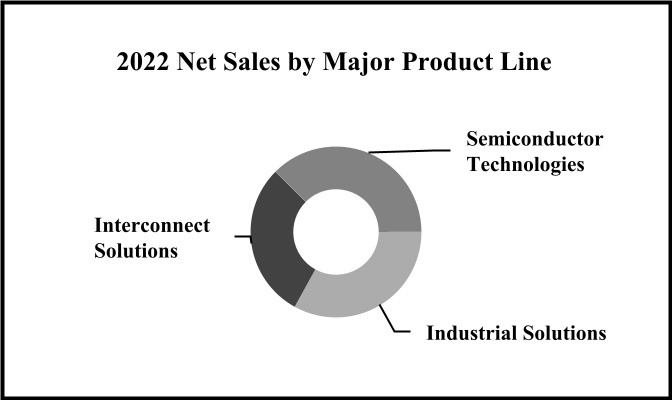
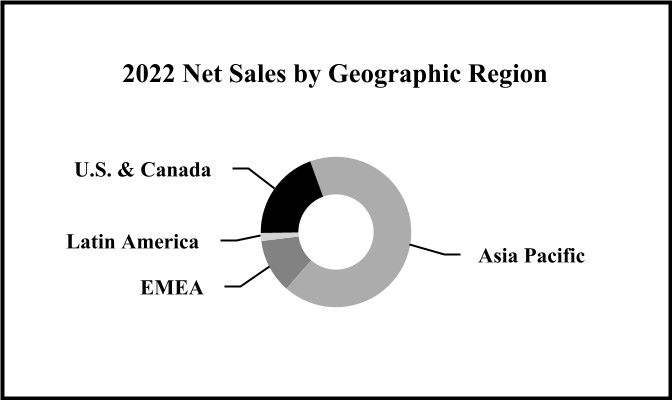
Details on Electronics & Industrial's 2022 net sales, by major product line and geographic region, are as follows:
Products
Major applications/market segments and technologies are listed below by major product line:
| Major Product Line | Applications/Market Segments | Technologies | |||||||||
| Semiconductor Technologies | Integrated circuit fabrication for memory and logic semiconductors | CMP consumables, photolithography materials, semiconductor fabrication materials, fabrication cleaners and removers, advanced chip packaging materials and thermal management materials | |||||||||
| Interconnect Solutions | Printed circuit board, electronic and industrial finishing | Circuit packaging film and laminate materials, interconnect metallization and imaging process chemistries, dry film photoresists, polyimide films, flexible circuit materials, electromagnetic shielding and thermal management materials | |||||||||
| Industrial Solutions | Flexographic printing and inkjet printing, display materials, high performance parts and specialty silicones for automotive, aerospace, electronics, industrial and healthcare markets | Flexographic printing plates and materials, digital inks, OLED and other display process materials, LED encapsulants, perfluoroelastomer and polyimide parts and shapes, and specialty silicone elastomers and lubricants |
Key Raw Materials
The major commodities, raw materials and supplies for the Electronics & Industrial segment include: p-acetoxystyrene, monomers, pigments and dyes, styrenic block copolymers, copper foil, diglycolamine, dimethylacetamide, hydroxylamine, filler alumina, nickel silver, oxydianiline, palladium, photoactive compounds, polyester and other polymer films, polyurethane resins and pyromellitic dianhydride and silicones.
Current and Future Investments
In March 2019, the Company announced plans to invest more than $200 million in its Electronics & Industrial segment to build new production assets at its Circleville, Ohio, plant. The new assets expanded production of KAPTON® polyimide film and PYRALUX® flexible circuit materials to meet growing market demand. At December 31, 2022, the project is complete and the Company has begun shipping commercial material to customers.
The Company will invest approximately $70 million in its Electronics & Industrial segment to build new production assets at a Newark, Delaware plant. The new assets will expand production of KALREZ® perfluoroelastomer parts to meet growing market demand. At December 31, 2022, the Company had spent approximately $47 million since the start of the project and expects the new assets to be operational in mid-2023.
WATER & PROTECTION
Water & Protection is the global leader in providing innovative engineered products and integrated systems for a number of industries including, worker safety, water purification and separation, transportation, energy, medical packaging and building materials. Water & Protection addresses the growing global needs of businesses, governments and consumers for solutions that make life safer, healthier and better.
Innovation is the business imperative. By uniting market-driven science and engineering with the strength of highly regarded brands including KEVLAR® high-strength material, NOMEX® thermal-resistant material, CORIAN® solid surfaces, TYVEK® selective barriers, FILMTEC™ reverse osmosis elements, STYROFOAM™ insulation and GREAT STUFF™ insulating foam sealants, the segment strives to bring new products and solutions to solve customers' needs faster, better and more cost effectively. Water & Protection is investing in future growth initiatives such as water management solutions, construction productivity solutions, high strength and light weighting composite solutions, and circular ecosystem / zero waste solutions.
Acquisitions
In the first quarter of 2020, the Company acquired Desalitech Ltd., a closed circuit reverse osmosis (CCRO) company.
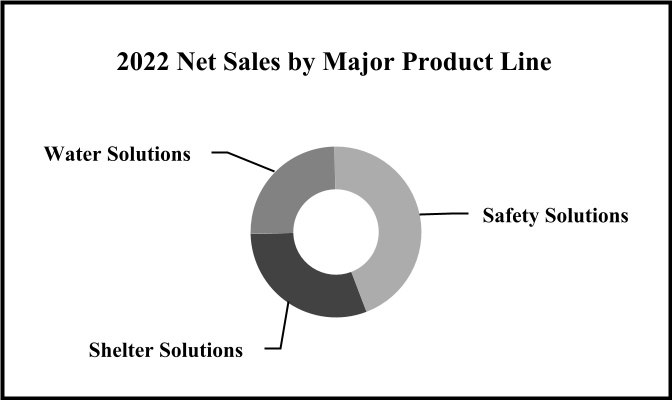
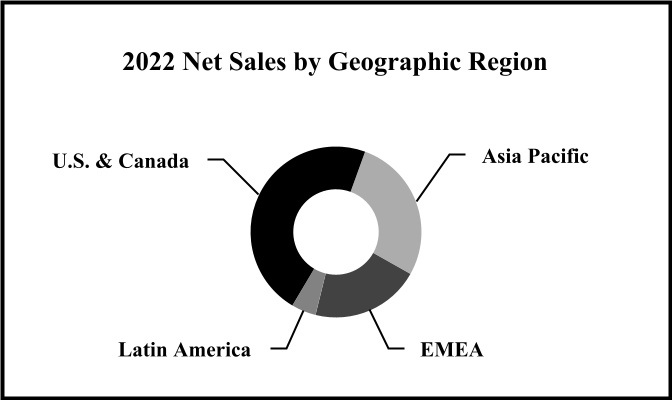
Details on Water & Protection's 2022 net sales, by major product line and geographic region, are as follows:
Products
Major applications and products are listed below by major product line:
| Major Product Line | Applications / Market Segments | Major Products / Technologies | ||||||
| Safety Solutions | Industrial personnel protection, military and emergency response, medical devices and packaging, automotive, aerospace and oil and gas | KEVLAR® fiber; NOMEX® fiber and paper; TYVEK® protective materials; TYCHEM® protective suits | ||||||
| Shelter Solutions | Rigid and spray foam insulation, weatherization, waterproofing and air sealing, caulks and sealants, roof coatings, and decorative surface materials | STYROFOAM™ brand insulation products, THERMAX™ exterior insulation, XENERGY™ high performance insulation, LIQUIDARMOR™ flashing and sealant, GREAT STUFF™ insulating foam sealants and adhesives, CORIAN® design solid and quartz surfaces, TYVEK® weather resistant barriers | ||||||
| Water Solutions | Water filtration and purification technology for residential, municipal and industrial use. Key industries include municipal drinking water and wastewater, power generation, microelectronics, pharmaceuticals, food and beverage, industrial wastewater reuse, metals and mining, and oil and gas segments | AMBERLITE™ ion exchange resins, FILMTEC™ reverse osmosis and nanofiltration elements, INTEGRAFLUX™ ultrafiltration modules, FORTILIFE™ challenging water reverse osmosis membranes, and TAPTEC™ water filtration and purification for drinking water in homes and commercial buildings |
Key Raw Materials
The major commodities, raw materials and supplies for the Water & Protection segment include: methyl methacrylate, alumina trihydrate, methyl pentanediol, styrene, polysulfone, Terephthaloyl- & Isophthaloyl- chloride, high-density polyethylene, polyethylene, aniline, calcium chloride, divinyl benzene monomers caustic and sulfuric acid.
Current and Future Investments
The Company previously announced plans to invest more than $400 million in Water & Protection to increase capacity for the manufacture of TYVEK® nonwoven materials at its Luxembourg site due to growing global demand. The expansion for the new TYVEK® operating line is expected to be completed by the end of 2023.
CORPORATE & OTHER
Effective February 2022, the revenues and certain expenses of the M&M Businesses were classified as discontinued operations and the Retained Businesses were realigned to Corporate & Other. The reporting changes have been retrospectively reflected for all periods presented.
The costs of the M&M Businesses that are classified as discontinued operations include only direct operating expenses incurred prior to the November 1, 2022 M&M Divestiture and costs which the Company will no longer incur upon the close of the Delrin® Divestiture. Indirect costs, such as those related to corporate and shared service functions previously allocated to the M&M Businesses, do not meet the criteria for discontinued operations and remain reported within continuing operations. A portion of these indirect costs related to activities the Company continues to undertake post-closing of the M&M Divestiture, and for which it is and will be reimbursed (“Future Reimbursable Indirect Costs”). In addition, a portion of these indirect costs relate to activities the Company intends to perform post the close of the Delrin® Divestiture and for which it will be reimbursed. Future Reimbursable Indirect Costs are reported within continuing operations but are excluded from operating EBITDA as defined below. The remaining portion of these indirect costs are not subject to future reimbursement (“Stranded Costs”). Stranded Costs are reported within continuing operations in Corporate & Other and are included within Operating EBITDA.
Corporate & Other includes sales and activity of the Retained Businesses as well as Stranded Costs and Future Reimbursable Indirect Costs. The results of Corporate & Other include the sales and activity of certain divested businesses including the operations of Biomaterials, Clean Technologies, and Solamet® business units. Corporate & Other also includes certain enterprise and governance activities including non-allocated corporate overhead costs and support functions, leveraged services, non-business aligned litigation expenses and other costs not absorbed by reportable segments.
INDUSTRY SEGMENTS AND GEOGRAPHIC REGION RESULTS
See Note 5 to the Consolidated Financial Statements for net sales by business or major product line.
Sales by geographic region are included within Part II, Item 7 "Management's Discussion and Analysis of Financial Condition and Results of Operations", "Results of Operations." See Note 23 to the Consolidated Financial Statements for information regarding total net sales and total assets by segment, as well as net sales and long-lived assets by geographic region.
SIGNIFICANT CUSTOMERS AND COMPETITION
In 2022, no significant portion of the Company's sales was dependent upon a single customer. The markets in which the Company participates compete primarily through technology, range of products and services, performance, quality, reliability, brand, reputation, service and support. The Company provides extensive support, technical services and testing services for its customers, in addition to new product development. The Company believes that its proprietary product and process technologies, robust product and application development pipelines, customer intimacy, global manufacturing capability and local service capability enable it to compete successfully.
DuPont is a multi-industrial company and is subject to competition across all product and service areas. Key competitors include but are not limited to:
-
Electronics & Industrial: 3M, Element Solutions, Entegris, Henkel, JSR, Merck KGaA, MKS Instruments, Parker Hannifin, and TOK.
-
Water & Protection: 3M, Honeywell, Hydranautics, Kingspan, Kolan, Lanxess, LG Chem, Owens-Corning, Purolite, Royal DSM, Toray, Teijin, and Yantai.
Against this competitive backdrop, value-in-use is the primary driver of price for the Company’s products, although price is impacted by many factors including, among others, fluctuations in supply and demand, and availability and cost of key manufacturing inputs including raw materials and energy.
SOURCES AND AVAILABILITY OF MAJOR RAW MATERIALS
The novel coronavirus (“COVID-19”) and its variants continue to adversely impact the broader global economy, including certain of the Company’s suppliers for key raw materials. The COVID-19 pandemic has caused widespread supply chain challenges due to labor disruptions, increased raw material costs and component shortages, namely the semiconductor chip shortage. In addition, logistic challenges are continuing and have caused delays and increased costs. The Company is actively working to mitigate the impact of the widespread supply chain and logistics issues.
DISTRIBUTION
Most products are marketed primarily through the Company's sales organization, although in some regions, more emphasis is placed on sales through distributors. The Company has a diverse worldwide network which markets and distributes the Company's brands to customers globally. This network consists of the Company's sales and marketing organization partnering with distributors, independent retailers, cooperatives and agents throughout the world.
BACKLOG
In general, the Company does not manufacture its products against a backlog of orders and does not consider backlog to be a significant indicator of the level of future sales activity. Production and inventory levels are typically based on the level of incoming orders as well as projections of future demand. However, from time to time in limited instances the Company does operate against a backlog for certain products, which has in the past resulted, and in the future may result, from the availability of raw materials from third-party suppliers. Therefore, the Company believes that backlog information is generally not meaningful to understanding its overall business and should not be considered a reliable indicator of the Company's ability to achieve any particular level of revenue or financial performance.
INTELLECTUAL PROPERTY
The Company’s businesses differentially manage their respective intellectual property estates to support Company strategic priorities, which can include leveraging intellectual property within and across product lines.
Trade Secrets: Trade secrets are an important part of the Company's intellectual property. Many of the processes used to make products are kept as trade secrets which, from time to time, may be licensed to third parties. DuPont vigilantly protects all of its intellectual property including its trade secrets. When the Company discovers that its trade secrets have been unlawfully taken, it reports the matter to governmental authorities for investigation and potential criminal action, as appropriate. In addition, the Company takes measures to mitigate any potential impact, which may include civil actions seeking redress, restitution and/or damages based on loss to the Company and/or unjust enrichment.
Patents: The Company applies for and obtains patents in many countries, including the U.S., and has access to a large patent portfolio, both owned and licensed. DuPont’s rights under these patents and licenses, as well as the products made and sold under them, are important to the Company in the aggregate. The Company considers various intellectual property protections and strategic business priorities when deciding whether to apply for or maintain a patent.
The protection afforded by patents varies based on country, scope of individual patent coverage, as well as the availability of legal remedies in each country and type of patent protection. The term of these patents is approximately twenty years from the filing date in general, but varies depending on country and type of patent protection. DuPont's significant patent estate may be leveraged to align with the Company’s strategic priorities within and across product lines. At December 31, 2022, the Company owned about 14,000 patents and patent applications globally. Approximately 70% of the Company’s patent estate has a remaining term of more than 5 years.
Trademarks: The Company owns or licenses many trademarks that have significant recognition at the consumer retail level and/or the product line to product line level. Ownership rights in trademarks do not expire if the trademarks are continued in use and properly protected.
ENVIRONMENTAL REGULATORY MATTERS
DuPont operates global manufacturing, product handling and distribution facilities that are subject to a broad array of environmental laws and regulations. Such rules are subject to change by the implementing governmental agency, and the Company monitors these changes closely. Company policy requires that all operations fully meet or exceed legal and regulatory requirements. For more information see: (1) Environmental Proceedings on page 27, (2) Management's Discussion and Analysis of Financial Condition and Results of Operations beginning on page 30, (3) Notes 1 and 16 to the Consolidated Financial Statements.
ENVIRONMENTAL SOCIAL AND GOVERNANCE (ESG)
DuPont’s purpose is to empower the world with the essential innovations to thrive. The Company operates within four core values of protecting safety and health; respect for people; conduct in accordance with the highest ethical behavior; and protecting the planet. DuPont’s sustainability strategy is focused on driving innovations to create sustainable solutions that help address the most pressing challenges facing society and the planet; enhancing the sustainability of its operations and facilities; and protecting the health and well-being of its employees and communities. In 2019, DuPont announced its 2030 Sustainability Goals, including its Acting on Climate Goal - to reduce its greenhouse gas (GHG) emissions by 30 percent, measured from a base year of 2019, including sourcing 60 percent of electricity for operations from renewable energy and delivering carbon neutral operations by 2050. Additional information about DuPont's sustainability strategy and 2030 Goals can be found on its website as discussed below and in several areas of this report, including: Management's Discussion and Analysis of Financial Condition and Results of Operations beginning on page 30.
Information about DuPont’s ESG-related policies, programs, initiatives and goals is available under Sustainability in the About Us section of its website. The Company’s 2022 Sustainability Report, which is aligned to the Global Reporting Initiative (“GRI”) Standards: Core option and the Sustainability Accounting Standards Board ("SASB") frameworks, includes information based on the businesses and facilities owned and operated by the Company during the calendar year 2021. As such, the 2022 Sustainability Report, and certain other information under Sustainability, does not reflect and has not been adjusted to reflect, among other things, the M&M Divestitures.
The 2022 Sustainability Report includes discussion of the Company’s approach to ESG governance which is overseen by the Company’s Board of Directors. In 2022 the Company took further actions to further align its governance and enterprise risk management practices around climate-related risks with the recommendations of the Task Force on Climate-related Financial Disclosures (TCFD).
Additional corporate governance information, including DuPont’s amended and restated charter, amended and restated bylaws, corporate governance guidelines, Board committee charters, and code of business conduct and ethics, is available under Corporate Governance in the "For Investors" section of the Company’s website.
Nothing on the DuPont websites shall be deemed incorporated by reference into this Annual Report on Form 10-K.
HUMAN CAPITAL
Foundational to the Company’s current and future success is its employees, who drive the Company’s strategic vision, manage operations and develop products. The Company focuses significant attention on attracting, motivating and retaining talent at all levels. Through training and professional development initiatives, promoting a culture of diversity, equity and inclusion, and emphasizing the importance of health, safety and well-being, the Company’s aim is to create an environment that fully supports the needs of its employees providing opportunity for financial and career growth, an inclusive and collegial experience and purpose in doing work that matters. Annually, an enterprise-wide engagement survey is conducted, which provides insight into employee morale and aspects of workplace culture like core values, commitment to ethical behavior, teamwork and employee development.
The Company is committed to creating a high-performance culture built on continual learning to support the strategic needs of its workforce. The professional growth of our people is essential to the growth of our business. Our annual goal process asks employees to not only identify three key goals around business contributions but also and one goal focused on self-development. The Company has prioritized learning and career development opportunities for leaders and all employees. The Company offers a diverse set of training, education and development opportunities, both formally and informally, throughout the year. All employees take part in a mix of on-the-job training and appropriate learning and training opportunities focusing on topics that are the most critical and relevant to each employees’ job function. Employees have the freedom to create meaningful development plans, identify goals, and take steps to achieve them.
The Company believes that diversity, equity and inclusion ("DE&I") is central to high employee engagement and seeks to foster an environment where employees can bring their authentic selves to work each day. The more perspectives there are, the more ideas that can be generated, which makes DE&I a driver of innovation, and therefore, integral to the Company’s success. DuPont believes that it can fulfill its purpose with the full commitment, participation, creativity, energy, and cooperative spirit of a diverse workforce. The Company provides its Equal Employment Opportunity Employer Information Report (EEO-1), and other information on its DE&I efforts under Diversity, Equity & Inclusion in the "About Us" and "Sustainability" sections of its website. Nothing on the DuPont websites shall be deemed incorporated by reference into this Annual Report on Form 10-K.
The Company is committed to ensuring equal opportunity for growth and fulfillment for its employees and to positively impacting communities in which it operates. The Company’s employee-led Employee Resource Groups (“ERGs”) help cultivate a culture of acceptance where employees feel not only accepted, but celebrated, at every level. As of December 31, 2022, the Company has eight corporate ERGs - DuPont Black Employees Network, DuPont Asian Group, DuPont Pride Network, DuPont Latin Network, DuPont Women’s Network, DuPont Veterans Network, DuPont Early Career Network, and DuPont Persons with Disabilities and Allies - all of which have regional and local chapters through the Company. Each group is actively sponsored by senior leadership, helping model and promote inclusive values and behaviors. The Company also offers DE&I tools and resources to educate managers and employees on cultivating and maintaining an inclusive work environment. These resources include networking and mentoring practices, and opportunities for participation in external conferences and events, among others. Annual DE&I Awards celebrate individuals and teams that are making a difference in the work environment and help inspire further actions.
The Company's success also depends on the well-being of employees, including physical, mental and emotional health. DuPont employees have access to online health resources through our global wellness provider to help them improve their overall well-being, including a health assessment, healthy habit building and tracking, videos and content to reduce stress and increase resilience, better sleep habits, nutrition guides, company wellness challenges, and financial wellness education. The Company continues to provide no-cost Employee Assistance Program ("EAP") services to all employees globally and their immediate household members. All employees also have the support of the Company’s Health Services teams, which provides onsite and intranet-based services to support and monitor the health and welfare of employees. The Company’s larger manufacturing and research sites have onsite clinics where employees can get occupational care, first aid treatment, travel vaccinations and referrals for off-site medical care. The Company continuously strives for zero workplace injuries, occupational illnesses and incidents. The Company’s safety metrics are continually measured against this goal, and DuPont’s Environmental, Health, Safety & Sustainability Committee is charged with driving improvements in the Company's health and safety practices. Health Services also assesses health risks across DuPont to find out which health concerns are most important to the Company's employees, conducts medical surveillance exams based on occupational risks and regulatory compliance priorities flagged by DuPont’s Environmental, Health and Safety team.
As the outcomes of the pandemic eased in many parts of the world in 2022, our colleagues returned to work in accordance with our Global Workplace Principles that guide our approach to flexible working. DuPont continues to embrace workplace flexibility wherever possible, recognizing that different jobs and teams have different requirements. In office environments DuPont supports hybrid working, allowing employees to mix on-site and remote working. In lab and production environments where remote working options are limited, DuPont continues to embrace flexible scheduling as feasible. These flexible working arrangements allow the Company to gain the best of what both remote and on-site working have to offer while improving well-being, reducing travel, and benefiting the environment.
As of December 31, 2022, the Company employed approximately 23,000 people worldwide. Approximately 36 percent of employees were in Asia Pacific, 18 percent were in the EMEA, 3 percent were in Latin America and 43 percent were in the U.S and Canada. Within the United States, about 5,000 employees were in non-exempt or hourly-rate positions.
AVAILABLE INFORMATION
The Company is subject to the reporting requirements under the Securities Exchange Act of 1934. Consequently, the Company is required to file reports and information with the Securities and Exchange Commission ("SEC"), including reports on the following forms: annual report on Form 10-K, quarterly reports on Form 10-Q, current reports on Form 8-K, and amendments to those reports filed or furnished pursuant to Section 13(a) or 15(d) of the Securities Exchange Act of 1934.
The SEC maintains an Internet site at http://www.sec.gov that contains reports, proxy and information statements, and other information regarding issuers that file electronically with the SEC, from which the public may obtain any materials the Company files with the SEC.
The Company's annual report on Form 10-K, quarterly reports on Form 10-Q, current reports on Form 8-K and amendments to those reports are also accessible on DuPont's website at http://www.investors.dupont.com by clicking on the section labeled "Investors", then on "Filings & Reports". These reports are made available, without charge, as soon as is reasonably practicable after the Company files or furnishes them electronically with the SEC.
DuPont webcasts its quarterly earnings calls and certain events it participates in or hosts with members of the investment community under For Investors section, in the "About Us" section of the Company’s website. Additionally, DuPont provides notifications of news or announcements regarding its financial performance, including SEC filings, investor events, news and earnings releases under For Investors. The Company has used, uses and intends to continue to use, its website as means of disclosing material non-public information and for complying with its disclosure obligations under SEC’s Regulation FD.
The contents of the Company’s websites, including those referenced above and elsewhere in this report, are not intended to be incorporated by reference into this Annual Report on Form 10-K or in any other report or document DuPont has or in the future may file with the SEC, and any references to the Company’s websites are intended to be inactive textual references only.
Item 1A. RISK FACTORS
The Company's operations could be affected by various risks, many of which are beyond its control. Based on current information, the Company believes that the following identifies the most material risk factors that could affect its operations. Past financial performance may not be a reliable indicator of future performance and historical trends should not be used to anticipate results or trends in future periods.
Risks Relating to the M&M Divestitures, N&B Transaction and the Dow and Corteva Distributions
DuPont could incur additional tax liabilities if certain internal transactions undertaken in connection with the completed divestiture of a majority of its historic Mobility & Materials segment to Celanese, and in connection with DuPont’s pursuit of plans to divest the Delrin® business, fail to qualify for their intended tax treatment.
On November 1, 2022, DuPont and one of its subsidiaries completed the sale to Celanese of a majority of the Company’s historic Mobility & Materials segment, including the Engineering Polymers business line and select product lines within the Performance Resins and Advanced Solutions business lines (the “M&M Divested Businesses”) for $11 billion in cash, subject to customary transaction adjustments in accordance with the Transaction Agreement (the “M&M Divestiture”).
On February 18, 2022, DuPont also announced that its Board of Directors approved the divestiture of the Delrin® Business subject to entry into a definitive agreement and satisfaction of customary closing conditions. There can be no assurance as to the outcome, timing or ability to realize expected benefits from the Delrin® business divestiture process.
Prior to the Closing of the M&M Divestiture, DuPont engaged in certain internal reorganization activities to separate the M&M Divested Businesses, and in certain cases in connection therewith, the Delrin® business, into separate subsidiaries and to align the subsidiaries holding the M&M Divested Businesses and the Delrin® business (referred to collectively as the "M&M Businesses") for disposition in a tax-efficient manner. DuPont has recognized a tax liability related to the M&M Divestiture. However, if certain internal transactions related to the separation of the M&M Businesses fail to qualify for their intended tax treatment under U.S. federal, state, local tax and/or foreign tax law, DuPont could incur additional tax liabilities.
DuPont may not realize the anticipated benefits of its share repurchase programs and any failure to repurchase the Company’s common stock after DuPont has announced its intention to do so may negatively impact the Company’s stock price.
On November 7, 2022, DuPont’s Board of Directors approved a new share repurchase program, which terminates on June 30, 2024, unless extended or shortened by the Board, authorizing the repurchase and retirement of up to $5 billion of common stock. In addition to the $250 million remaining under the Company’s existing share repurchase program, which was approved in February 2022. The Company entered into the 2022 ASR Agreements in November 2022 for the repurchase of an aggregate of $3.25 billion of common stock with $250 million of such repurchases under the existing program and the remaining $3 billion under the new program.
Under these or any other future share repurchase programs, DuPont may make share repurchases through a variety of methods, including open share market purchases or privately negotiated transactions, including additional ASR agreements in accordance with applicable federal securities laws. The timing and amount of any repurchases, if any, will depend on factors such as the stock price, economic and market conditions, and corporate and regulatory requirements. Any failure to repurchase shares after the Company has announced its intention to do so may negatively impact DuPont’s reputation, investor confidence and the price of the Company’s common stock.
The existence of these share repurchase programs could cause the price of the Company’s common stock to be higher than it otherwise would be and could potentially reduce the market liquidity for DuPont stock. Although these programs are intended to enhance long-term stockholder value, there is no assurance they will do so because the market price of DuPont common stock may decline below the levels at which we repurchased shares and short-term stock price fluctuations could reduce the effectiveness of the programs.
Repurchasing common stock will reduce the amount of cash DuPont has available to fund working capital, capital expenditures, strategic acquisitions or business opportunities and other general corporate requirements, and the Company may fail to realize the anticipated benefits of these share repurchase programs.
The separation and combination of DuPont’s Nutrition & Biosciences business with IFF could result in a significant tax liability to DuPont.
The distribution by DuPont to its stockholders of all the issued and outstanding shares of N&B through the Exchange Offer ("N&B Distribution") and the merger of N&B with a wholly-owned subsidiary of IFF ("N&B Merger") are expected to be tax-free to DuPont stockholders for U.S. federal income tax purposes (except to the extent that cash was paid to DuPont stockholders in lieu of fractional shares pursuant to the N&B Merger Agreement), and the N&B Contribution, N&B Distribution, and the one-time payment from N&B to DuPont of approximately $7.3 billion ("Special Cash Payment") are expected to result in no recognition of gain or loss by DuPont for U.S. federal income tax purposes.
DuPont received an opinion of counsel and also obtained a private letter ruling from the Internal Revenue Service (the "IRS") regarding certain matters impacting the U.S. federal income tax treatment of the separation and transfer by DuPont of its N&B Business (the “N&B Contribution”), N&B Distribution, Special Cash Payment and certain related transactions. The conclusions of the IRS private letter ruling were based, among other things, on various factual assumptions DuPont authorized and representations DuPont made to the IRS. If any of assumptions or representations are, or become, inaccurate or incomplete, reliance on the IRS private letter ruling may be affected.
If the N&B Contribution and N&B Distribution failed to qualify for the treatment described above, DuPont would be required to generally recognize a taxable gain on the transactions and stockholders of DuPont who receive N&B Common Stock (and subsequently, IFF Common Stock) would be subject to tax on their receipt of the N&B Common Stock. Additionally, if the Special Cash Payment or certain internal transactions related to the separation of the Nutrition & Biosciences business fail to qualify for their intended tax-free treatment under U.S. federal, state, local tax and/or foreign tax law, DuPont could incur additional tax liabilities.
Under the Tax Matters Agreement by and between DuPont with N&B and IFF, N&B or IFF is generally required to indemnify DuPont for any taxes resulting from the separation of the Nutrition & Biosciences business (and any related costs and other damages) to the extent such amounts resulted from (i) certain actions taken by N&B or IFF involving the capital stock of N&B or IFF or any assets of the N&B group (excluding actions required by the documents governing the proposed transactions), or (ii) any breach of certain representations and covenants made by N&B or IFF.
DuPont is subject to continuing contingent tax-related liabilities of Dow and Corteva following the separations and DWDP Distributions.
After the separations and DWDP Distributions, there are several significant areas where the liabilities of Dow and Corteva may become the Company’s obligations, either in whole or in part. For example, to the extent that any subsidiary of the Company was included in the consolidated tax reporting group of either TDCC or EIDP for any taxable period or portion of any taxable period ending on or before the effective date of the DWDP Merger, such subsidiary is jointly and severally liable for the U.S. federal income tax liability of the entire consolidated tax reporting group of TDCC or EIDP, as applicable, for such taxable period. In connection with the separations and DWDP Distributions, DuPont, Dow and Corteva have entered into a Tax Matters Agreement, as amended, that allocates the responsibility for prior period consolidated taxes among Dow, Corteva and DuPont. If Dow or Corteva are unable to pay any prior period taxes for which it is responsible, however, DuPont could be required to pay the entire amount of such taxes, and such amounts could be significant. Other provisions of federal, state, local, or foreign law may establish similar liability for other matters, including laws governing tax-qualified pension plans, as well as other contingent liabilities.
In connection with the separations and DWDP Distributions, certain liabilities are allocated to or retained by DuPont through assumption or indemnification of Dow and/or Corteva, as applicable. If DuPont is required to make payments pursuant to these indemnities to Dow and/or Corteva, DuPont may need to divert cash to meet those obligations, and the Company’s financial results could be negatively impacted. In addition, certain liabilities are allocated to or retained by Dow and/or Corteva through assumption or indemnification, or subject to indemnification by other third parties. These indemnities may not be sufficient to insure the Company against the full amount of liabilities, including PFAS Stray Liabilities, allocated to or retained by it, and Dow, Corteva and/or third parties may not be able to satisfy their respective indemnification obligations in the future.
Pursuant to the DWDP Separation and Distribution Agreement, the DWDP Employee Matters Agreement, and the DWDP Tax Matters Agreement, as amended, (collectively, the “Core Agreements”) with Dow and Corteva, as well as the Letter Agreement between DuPont and Corteva, DuPont has agreed to assume, and indemnify Dow and Corteva for, certain liabilities. Payments pursuant to these indemnities may be significant and could negatively impact the Company’s business.
Third parties could also seek to hold DuPont responsible for any of the liabilities allocated to Dow and Corteva, including those related to EIDP’s materials science and/or agriculture businesses, or for the conduct of such businesses prior to the distributions, and such third parties could seek damages, other monetary penalties (whether civil or criminal) and/or other
remedies. Additionally, DuPont generally assumes and is responsible for the payment of the Company’s share of (i) certain liabilities of DowDuPont relating to, arising out of or resulting from certain general corporate matters of DuPont and (ii) certain separation expenses not otherwise allocated to Corteva or Dow (or allocated specifically to it) pursuant to the Core Agreements, and third parties could seek to hold it responsible for Dow’s or Corteva’s share of any such liabilities. Dow and/or Corteva, as applicable, have agreed to indemnify it for such liabilities; however, such indemnities may not be sufficient to protect it against the full amount of such liabilities or from other remedies, and Dow and/or Corteva, as applicable, may not be able to fully satisfy their indemnification obligations. Even if DuPont ultimately succeeds in recovering from Dow and/or Corteva, as applicable, any amounts for which DuPont is held liable, DuPont may be temporarily required to bear these losses. Each of these risks could negatively affect the Company’s business, financial condition, results of operations and cash flows.
Generally, as described in Litigation, Environmental Matters and Indemnifications, losses from liabilities related to discontinued and/or divested operations and businesses of EIDP that are not primarily related to its agriculture business or specialty products business, (“Stray Liabilities”), are allocated to or shared by each of Corteva and DuPont. Stray Liabilities include liabilities arising out of actions to the extent related to or resulting from EIDP’s development, testing, manufacture or sale of per- or polyfluoroalkyl substances, (“PFAS Stray Liabilities”).
At December 31, 2022, the Company has recorded an indemnification liability related to Stray Liabilities. The Company recognizes an indemnification liability when a loss is reasonably probable and can be reasonably estimated. While the Company has established processes and controls over the information to support its accounting for indemnification liabilities with each of Corteva and Dow, the Company is reliant on the accuracy, transparency, completeness and timeliness of information from the applicable party, either Corteva or Dow, that retains direct liability for the underlying matter. Estimating indemnified costs of environmental remediation and compliance activities is particularly difficult since such activities are dependent on the nature of and activity at specific sites; new and evolving analytical, operating and remediation technologies and techniques; agreed action plans; changes in environmental regulations; permissible levels of specific compounds in water, air or soil; enforcement theories and policies, including efforts to recover natural resource damages; and the presence and financial viability of other potentially responsible parties.
At December 31, 2022, the Company had recorded indemnification assets related to Stray Liabilities and other matters. Although the Company believes it is remote, there can be no assurance that any such third-party would have adequate resources to satisfy its indemnification obligation when due, or, would not ultimately be successful in claiming defenses against payment. Even if recovery from the third-party is ultimately successful, DuPont may be temporarily required to bear these losses. Each of these risks could negatively affect the Company’s business, financial condition, results of operations and cash flows. See discussion of the Core Agreements in Note 4 to the Consolidated Financial Statements and Litigation, Environmental Matters and Indemnifications in Note 16 to the Consolidated Financial Statements.
On January 22, 2021, DuPont, Corteva and Chemours entered into a cost sharing arrangement related to future eligible PFAS costs. The Company’s results of operations could be adversely affected by litigation and other commitments and contingencies, including expected performance under and impact of the cost sharing arrangement.
While reducing uncertainty, the Company expects to benefit from the cost sharing arrangement related to future PFAS eligible costs, achievement of any such benefits may not be realized and depend on a number of factors and uncertainties that include, but are not limited to: the achievement, terms and conditions of final agreements related to the cost sharing arrangement; the outcome of any pending or future litigation related to PFAS or PFOA, including personal injury claims and natural resource damages claims; the extent and cost of ongoing remediation obligations and potential future remediation obligations; changes in laws and regulations applicable to PFAS chemicals, changes in applicable health advisory levels and in chronic reference doses for PFAS in drinking water; the performance by each of the parties of their respective obligations under the cost sharing arrangement.
DuPont faces risks arising from various unasserted and asserted litigation matters, including product liability, patent infringement and other intellectual property disputes, contract and commercial litigation, claims for damage or personal injury, antitrust claims, governmental regulations and other actions. An adverse outcome in any one or more of these matters could be material to the Company’s business, results of operations, financial condition and cash flows.
In the ordinary course of business, DuPont may make certain commitments, including representations, warranties and indemnities relating to current and past operations, including those related to divested businesses, and DuPont may issue guarantees of third-party obligations. If DuPont is required to make payments as a result, they could exceed the amounts accrued therefor, thereby adversely affecting the Company’s results of operations.
If the completed distribution of Corteva or Dow, in each case, together with certain related transactions, were to fail to qualify for non-recognition treatment for U.S. federal income tax purposes, then the Company could be subject to significant tax and indemnification liability.
The completed distributions of Corteva and Dow were each conditioned upon the receipt of an opinion from Skadden, Arps, Slate, Meagher & Flom LLP, the Company’s tax counsel, regarding the qualification of the applicable distribution along with certain related transactions as a tax-free transaction under Section 355 and Section 368(a)(1)(D) of the Internal Revenue Code of 1986, as amended (the “Code,” and such opinions, collectively, the “Tax Opinions”). The Tax Opinions relied on certain facts, assumptions, and undertakings, and certain representations from the Company, Dow and Corteva, as applicable, as well as the IRS Ruling (as defined below). Notwithstanding the Tax Opinions and the IRS Ruling, the Internal Revenue Service (the “IRS”) could determine on audit that either, or both, of the distributions and certain related transactions should be treated as taxable transactions if it determines that any of these facts, assumptions, representations or undertakings are not correct or have been violated, or that the distributions should be taxable for other reasons, including if the IRS were to disagree with the conclusions of the Tax Opinions.
Even if a distribution otherwise constituted a tax-free transaction to stockholders under Section 355 of the Code, the Company could be required to recognize corporate level tax on such distribution and certain related transactions under Section 355(e) of the Code if the IRS determines that, as a result of the DWDP Merger or other transactions considered part of a plan with such distribution, there was a 50 percent or greater change in ownership in the Company, Dow or Corteva, as relevant. In connection with the DWDP Merger, the Company sought and received a private letter ruling from the IRS regarding the proper time, manner and methodology for measuring common ownership in the stock of the Company, EIDP and TDCC for purposes of determining whether there was a 50 percent or greater change of ownership under Section 355(e) of the Code as a result of the DWDP Merger (the “IRS Ruling”). The Tax Opinions relied on the continued validity of the IRS Ruling and representations made by the Company as to the common ownership of the stock of TDCC and EIDP immediately prior to the DWDP Merger, and concluded that there was not a 50 percent or greater change of ownership for purposes of Section 355(e) as a result of the DWDP Merger. Notwithstanding the Tax Opinions and the IRS Ruling, the IRS could determine that a distribution or a related transaction should nevertheless be treated as a taxable transaction to the Company if it determines that any of the Company’s facts, assumptions, representations or undertakings was not correct or that a distribution should be taxable for other reasons, including if the IRS were to disagree with the conclusions in the Tax Opinions that are not covered by the IRS Ruling.
Generally, corporate taxes resulting from the failure of a distribution to qualify for non-recognition treatment for U.S. federal income tax purposes would be imposed on the Company. Under the DWDP Tax Matters Agreement, as amended, that the Company entered into with Dow and Corteva, Dow and Corteva are generally obligated to indemnify the Company against any such taxes imposed on it. However, if a distribution fails to qualify for non-recognition treatment for U.S. federal income tax purposes for certain reasons relating to the overall structure of the DWDP Merger and the distributions, then under the DWDP Tax Matters Agreement, as amended, the Company and Corteva, on the one hand, and Dow, on the other hand, would share the tax liability resulting from such failure in accordance with the relative equity values of the Company and Dow on the first full trading day following the distribution of Dow, and the Company and Corteva would in turn share any such resulting tax liability in accordance with the relative equity values of the Company and Corteva on the first full trading day following the distribution of Corteva. Furthermore, under the terms of the DWDP Tax Matters Agreement, as amended, a party also generally will be responsible for any taxes imposed on the other parties that arise from the failure of either distribution to qualify as tax-free for U.S. federal income tax purposes within the meaning of Section 355 of the Code or the failure of certain related transactions to qualify for tax-free treatment, to the extent such failure to qualify is attributable to actions, events or transactions relating to such party, or such party's affiliates’, stock, assets or business, or any breach of such party's representations made in connection with the IRS Ruling or in any representation letter provided to a tax advisor in connection with certain tax opinions, including the Tax Opinions, regarding the tax-free status of the distributions and certain related transactions. To the extent that the Company is responsible for any liability under the DWDP Tax Matters Agreement, as amended, there could be a material adverse impact on the Company's business, financial condition, results of operations and cash flows in future reporting periods.
Risks Relating to DuPont’s Business and Results of Operations
The extent to which the novel coronavirus and variants (COVID-19) and measures taken in response to it, impact DuPont’s business, results of operations, access to sources of liquidity and financial condition depends on future developments, which are highly uncertain and cannot be predicted.
DuPont is actively monitoring the global impacts of the COVID-19 pandemic, including the impacts from responsive measures, and remains focused on its top priorities - the safety and health of its employees and the needs of its customers. The Company’s business and financial condition, and the business and financial condition of the company’s customers and suppliers, have been and continue to be impacted by the significantly increased economic, supply and demand uncertainties created by the COVID-19 outbreak. In addition, public and private sector responsive measures, such as the imposition of travel restrictions, quarantines, adoption of remote working, and suspension of non-essential business and government services, have impacted the
Company’s business and financial condition. Many of DuPont’s facilities and employees are based in areas impacted by the virus. While most DuPont manufacturing sites remain in operation, DuPont has reduced or furloughed, when necessary, certain operations in response to government measures, employee welfare concerns and the impact of COVID-19 on the global demand and supply chain. DuPont’s manufacturing operations may be further adversely affected by impacts from COVID-19 including, among other things, additional government actions and other responsive measures, more and /or deeper supply chain disruptions, quarantines and health and availability of essential onsite personnel. In response, the Company developed site-by-site protocols in 2020 under which the Company continues to operate. These protocols include pre-entrance screening, restricting visitor access, social distancing and masking requirements, additional sanitization and disinfecting requirements, restrictions on all nonessential travel and implementation of work-from-home protocols. Limitations on travel and doing business in-person has increased the Company’s exposure to cybersecurity risks and could negatively impact the Company's innovation and marketing efforts, challenge the ability to deliver against the Company’s strategic priorities and to otherwise transact business in a timely manner, or create operational or other challenges, any of which could harm DuPont’s business. Furthermore, COVID-19 continues to adversely impact the broader global economy, including negatively impacting economic growth and creating disruption and volatility in the global financial and capital markets, which could result in increases in the cost of capital and/or adversely impact the availability of and access to capital, which could negatively affect DuPont’s liquidity. DuPont is unable to predict the extent of COVID-19 related impacts on its business, results of operations, access to sources of liquidity and financial condition which depends on highly uncertain and unpredictable future developments, including, but not limited to, the duration and spread of the COVID-19 outbreak, its severity, the emergence of new variants, actions taken in response, the efficacy and availability of vaccines, and how quickly and to what extent normal economic and operating conditions resume. DuPont’s financial results may be materially and adversely impacted by a variety of factors that have not yet been determined, including potential impairments of goodwill and other assets. DuPont, when necessary, is taking actions, including reducing costs, restructuring actions, and delaying certain capital expenditures and non-essential spend. In addition, the Company may consider further reductions in or furloughing additional operations in response to further and/or deeper declines in demand and/or or supply chain disruptions. There can be no guaranty that such actions will significantly mitigate the impact of COVID-19 on the company’s business, results of operations, access to sources of liquidity or financial condition and the Company may continue to experience materially adverse impacts to its business, results of operations and financial condition as a result of related global economic impacts, including inflationary pressures that have occurred and may continue to occur in the future.
Supply chain and operational disruptions and volatility in energy and raw material costs could significantly increase costs and expenses and adversely impact the Company’s sales and earnings.
The Company’s manufacturing processes and operations depend on the continued availability of energy and raw materials, the costs of which are subject to worldwide supply and demand as well as other factors beyond the Company’s control, including potential legislation to address climate change by reducing greenhouse gas emissions, creating a carbon tax or implementing a cap and trade program which could create increases in costs and price volatility. Operational changes and transition to renewable energy sources to meet country, NGO and corporate-level net-zero GHG emissions pledges and related decarbonization technology investments, may require the Company to make significant capital investments, re-qualify its products with certain suppliers, as well as meet additional regulatory and compliance requirements and could result in higher cost and expenses.
Supply chain disruptions, plant and/or power outages, labor shortages and/or strikes, geo-political activity, weather events and natural disasters, including hurricanes or flooding that impact coastal regions, and global health risks or pandemics could seriously harm the Company’s operations as well as the operations of the Company’s customers and suppliers. Climate change increases the frequency and severity of potential supply chain and operational disruptions from weather events and natural disasters. The chronic physical impacts associated with climate change, for example, increased temperatures, changes in weather patterns and rising sea levels, could significantly increase costs and expenses and create additional supply chain and operational disruption risks.
In addition, the Company’ suppliers may experience capacity limitations in their own operations or may elect to reduce or eliminate certain product lines. To address this risk, generally, the Company seeks to have many sources of supply for key raw materials in order to avoid significant dependence on any one or a few suppliers. In addition, and where the supply market for key raw materials is concentrated, DuPont takes additional steps to manage its exposure to supply chain risk and price fluctuations through, among other things, negotiated long-term contracts some which include minimum purchase obligations. However, there can be no assurance that such mitigation efforts will prevent future difficulty in obtaining sufficient and timely delivery of certain raw materials.
DuPont also takes actions to offset the effects of higher energy and raw material costs through selling price increases, productivity improvements and cost reduction programs. Success in offsetting higher raw material costs with price increases is largely influenced by competitive and economic conditions and could vary significantly depending on the market served. As a
result, volatility in these costs may negatively impact the Company’s business, results of operations, financial condition and cash flows.
The Company’s business, results of operations, financial condition and cash flows could be adversely affected by interruption of the Company’s information technology or network systems and other business disruptions.
DuPont relies on centralized and local information technology networks and systems, some of which are managed or accessible by third parties, to process, transmit and store electronic information, and to otherwise manage or support its business. Additionally, the Company collects and stores certain data, including proprietary business information, and has access to confidential or personal information that is subject to privacy and security laws, regulations and customer-imposed controls. The processing and storage of personal information is increasingly subject to privacy and data security regulations, and many such regulations are country or territory-specific. The interpretation and application of data protection laws in the U.S., Europe, including the EU General Data Protection Regulation, Asia Pacific, Latin America, and elsewhere are continuing to evolve and may be different across these jurisdictions. The Company seeks to implement these requirements in a compliant manner. Violations of these laws could result in criminal or civil sanctions and even the mere allegation of such violations, could harm the Company’s ability to do business, its results of operations, financial position and reputation.
Information technology system and/or network disruptions, whether caused by acts of sabotage, employee error, malfeasance or other actions, could have an adverse impact on the Company’s operations as well as the operations of the Company’s customers and suppliers. Other business disruptions may also be caused by security breaches, which could include, for example, attacks on information technology and infrastructure by hackers, viruses, breaches due to employee error, malfeasance or other actions or other disruptions. DuPont and/or the Company’s suppliers may fail to effectively prevent, detect and recover from these or other security breaches and, therefore, such breaches could result in misuse of the Company’s assets, loss of property including trade secrets and confidential or personal information, some of which is subject to privacy and security laws, and other business disruptions. As a result, DuPont may be subject to legal claims or proceedings, reporting errors, processing inefficiencies, negative media attention, loss of sales, interference with regulatory compliance which could result in sanctions or penalties, liability or penalties under privacy laws, disruption in the Company’s operations, and damage to the Company’s reputation, which could adversely affect the Company’s business, results of operations, financial condition and cash flows.
Like most major corporations, DuPont is the target of industrial espionage, including cyber-attacks, from time to time. These cyber-security threats include phishing, spam emails, hacking, social engineering, and malicious software. DuPont has determined that these attacks have resulted, and could result in the future, in unauthorized parties gaining access to certain confidential business information. Although management does not believe that DuPont has experienced any material losses to date related to these security breaches, including cybersecurity incidents, there can be no assurance that DuPont will not suffer such losses in the future.
DuPont has engaged and expects to continue to engage in merger and acquisition activity. As part of preparatory and post-closing integration activities, the Company: (i) conducts a cybersecurity risk threat assessment and when evidence of a breach is uncovered, conducts additional due diligence; (ii) based on the assessment, the Company develops and implements risk mitigation plans if needed and brings the acquisition under the Company’s cyber-attack/breach detection and response programs; and (iii) conducts an internal controls risk and compliance assessment and creates responsive action plans as needed to mitigate and remediate identified weaknesses in the control environment.
DuPont seeks to actively manage the risks within the Company’s control that could lead to business disruptions and security breaches. As these threats continue to evolve, particularly around cybersecurity, DuPont may be required to expend significant resources to enhance the Company’s control environment, processes, practices and other protective measures. Despite these efforts, such events could have a material adverse effect on the Company’s business, results of operations, financial condition and cash flows.
Enforcing the Company’s intellectual property rights, or defending against intellectual property claims asserted by others, could adversely affect the Company’s business, results of operations, financial condition and cash flows.
Intellectual property rights, including patents, trade secrets, know-how and confidential information, trademarks, tradenames and trade dress, are important to the Company’s business. DuPont endeavors to protect the Company’s business, products and processes by obtaining and enforcing intellectual property rights under the intellectual property laws of certain jurisdictions around the world. However, DuPont may be unable to obtain or enforce its intellectual property rights in key jurisdictions for various reasons including government policies and regulations, and changes in such policies and regulations, including changes made in reaction to pressure from non-governmental organizations, or the public generally, which could impact the extent of intellectual property protection afforded by such jurisdictions.
DuPont has designed and implemented internal controls intended to restrict access to and unauthorized use of the Company’s confidential information and trade secrets. Despite these precautions, the Company’s confidential information and trade secrets are vulnerable to unauthorized access and use through employee error or actions, theft by employees or third parties, cybersecurity incidents and other security breaches. When unauthorized access and use is discovered, DuPont considers the matter for report to governmental authorities for investigation, as appropriate, and takes measures intended to mitigate any potential impact and to stop unauthorized access.
Third parties may also claim the Company’s products violate their intellectual property rights. Defending such claims, even those without merit, is time-consuming and expensive. In addition, as a result of such claims, DuPont has and could be required in the future to enter into license agreements, develop non-infringing products or engage in litigation that could be costly. If challenges are resolved adversely, it could negatively impact the Company’s ability to obtain licenses on competitive terms, commercialize new products and generate sales from existing products.
Any one or more of the above factors could significantly affect the Company’s business, results of operations, financial condition and cash flows.
An impairment of goodwill or intangible assets could negatively impact the Company’s financial results.
In connection with completed acquisitions, DuPont has recorded goodwill and other intangible assets on our balance sheet. As a result of the DWDP Merger and related acquisition method of accounting, EIDP’s assets and liabilities were remeasured and DowDuPont recognized them at fair value. Since certain of the Company's assets, especially those related to the Water & Protection and Electronics and Industrial segment, and those carried at Corporate & Other at December 31, 2022 are heritage EIDP, declines, if any, in projected cash flows could have a material, negative impact on the fair value of the Company’s reporting units and assets.
In accordance with US GAAP, at least annually, DuPont must assess both goodwill and indefinite-lived intangible assets for impairment. Intangible assets with finite lives are tested for impairment when events or changes in circumstances indicate their carrying value may not be recoverable. If testing indicates that goodwill or intangible assets are impaired, their carrying values will be written down based on fair values with a charge against earnings. Where DuPont utilizes discounted cash flow methodologies in determining fair values, significant negative industry or economic trends, disruptions to our business, inability to effectively integrate acquired businesses, unexpected significant change or planned changes in use of our assets, changes in the structure of our business, divestitures, market capitalization declines or increases in associated discount rates may impair our goodwill and other intangible assets. Accordingly, any determination requiring the write-off of a significant portion of goodwill or intangible assets could negatively impact the Company’s results of operations.
Failure to effectively manage acquisitions, divestitures, alliances and other portfolio actions could adversely impact the Company’s business, results of operations, financial condition and cash flows.
DuPont continuously evaluates acquisition candidates, including significant transactions, that may strategically fit the Company’s business and/or growth objectives. If DuPont is unable to successfully integrate and develop acquired businesses, DuPont could fail to achieve anticipated synergies and cost savings, including any expected increases in revenues and operating results, which could have a material adverse effect on the Company’s financial results. DuPont expects to continually review the Company’s portfolio of assets for contributions to the Company’s objectives and alignment with the Company’s growth strategy. The Letter Agreement between the Company and Corteva limits DuPont’s ability to separate certain businesses and assets to third parties without assigning certain of its indemnification obligations under the DWDP Separation and Distribution Agreement to the transferee of such businesses and assets or meeting certain other alternative conditions. DuPont may be unable to meet the conditions under the Letter Agreement, if applicable. Even if the conditions under the Letter Agreement are met or are not applicable, DuPont may not be successful in separating underperforming or non-strategic assets, and gains or losses on the divestiture of, or lost operating income from, such assets may affect the Company’s earnings. Moreover, DuPont might incur asset impairment charges related to acquisitions or divestitures that reduce the Company’s earnings. In addition, if the execution or implementation of acquisitions, divestitures, alliances, joint ventures and other portfolio actions is not successful and/or the Company fails to effectively manage its cost as its portfolio evolves, it could adversely impact the Company’s business, results of operations, financial condition and cash flows.
Failure to maintain a streamlined operating model and sustain operational improvements may reduce the Company’s profitability or adversely impact the Company’s business, results of operations, financial condition and cash flows.
The Company’s profitability and margin growth will depend in part on the Company’s ability to maintain a streamlined operating model and drive sustainable improvements, through actions and projects, such as consolidation of manufacturing facilities, transitions to cost-competitive regions and product line rationalizations. A variety of factors may adversely affect the Company’s ability to realize the targeted cost synergies, including failure to successfully optimize the Company’s facilities footprint, the failure to take advantage of the Company’s global supply chain, the failure to identify and eliminate duplicative
programs. There can be no assurance that DuPont will be able to achieve or sustain any or all of the cost savings generated from restructuring actions.
The Company’s results will be affected by competitive conditions and customer preferences.
Demand for the Company’s products, which impacts revenue and profit margins, will be affected by (i) the development and timing of the introduction of competitive products; (ii) the Company’s response to downward pricing trends to stay competitive; (iii) changes in customer preferences, order patterns, such as changes in the levels of inventory maintained by customers and the timing of customer purchases which may be affected by announced price changes; (iv) availability and cost of raw materials and energy, as well as the Company’s ability and success in passing through increases in such costs; (v) levels of economic growth in the geographic and end use markets served by the Company; and (vi) the mega-trends in digital transformation, connectivity, automation and ethics, environmental impact and sustainability driven purchasing decisions.
Demand for product offerings that are less carbon-intensive or customers determine support their respective sustainability goals, is expected to continue to increase, driven by end-user and customer demand, investor preference, and government legislative and market- and product-specific actions in response to risks created by climate change. Failure to timely react to these trends and manage the Company’s product portfolio and innovation activities responsively could decrease the competitiveness of the Company’s products and result in the de-selection of the Company as a partner of choice. In addition, the failure to set goals, take actions, make progress and report against, commensurate with relevant market competitors, the Company’s sustainability strategy, could harm the Company’s reputation, and its ability to compete and to attract top talent, and could result in increased investor activism and the deselection of the Company as a partner or supplier of choice.
Success in achieving the Company’s growth objectives is significantly dependent on the timing and market acceptance of the Company’s new product offerings, including the Company’s ability to renew the Company’s pipeline of new product offerings and to bring those offerings to market. This ability may be adversely affected by difficulties or delays in product development, such as the inability to identify viable new products, obtain adequate intellectual property protection, or gain market acceptance of new products.
There are no guarantees that new product offerings will prove to be commercially successful. Additionally, the Company’s expansion into new markets may result in greater-than-expected risks, liabilities and expenses.
Failure to attract and retain talented people with the necessary knowledge and experience could adversely affect Company’s ability to compete and achieve its strategic goals.
Attracting, developing, and retaining talented employees is essential to the Company’s successful delivery of products and services, ability to innovate, including developing new products and technologies, and ability to identify trends and develop new markets.
Competition for employees can be intense. If the Company is unable to successfully integrate, motivate and reward its employees, it may not be able to retain them or attract new employee in the future which could adversely impact the Company’s ability to effectively compete. The Company may be required to increase salary and/or benefits to attract top performers which could significantly increase the Company costs and results of operations.
Risks Relating to Capital Resources and Liquidity
Changes in the Company’s credit ratings could increase the Company’s cost of borrowing or restrict the Company’s ability to access debt capital markets. The Company’s credit ratings are important to the Company’s cost of capital.
DuPont relies on access to the debt capital markets and other short-term borrowings to finance the Company’s long-term and day-to-day operations. A decrease in the ratings assigned to it by the ratings agencies may negatively impact the Company’s access to the debt capital markets and increase the Company’s cost of borrowing. The major rating agencies will routinely evaluate the Company’s credit profile and assign debt ratings to it. This evaluation is based on a number of factors, which include weighing the Company’s financial strength versus business, industry and financial risk. The addition of further leverage to the Company’s capital structure could impact the Company’s credit ratings. Failure to maintain an investment grade rating at the Company’s current level would adversely affect the Company’s cost of funding and the Company’s results of operations and could adversely affect the Company’s liquidity and access to the capital markets. Any limitation on the Company’s ability to continue to raise money in the debt capital markets could have a substantial negative effect on the Company’s liquidity. If DuPont is unable to generate sufficient cash flow or maintain access to adequate external financing, including from significant disruptions in the global credit markets, it could restrict the Company’s current operations, activities under its current and future stock buyback programs, and the Company’s growth opportunities, which could adversely affect the Company’s operating results.
A significant percentage of the Company’s net sales are generated from the Company’s international operations and are subject to economic, geo-political, foreign exchange and other risks.
DuPont does business globally in about 50 countries. The percentage of net sales generated by the international operations of DuPont, including U.S. exports, was approximately 70 percent of net sales on a continuing operations basis for the year ended December 31, 2022. With Asia Pacific as the Company’s largest region by revenue and China as the largest country within the Asia Pacific region and second largest globally by revenue, DuPont expects the percentage of the Company’s net sales derived from international operations to continue to be significant. Risks related to international operations include:
-
exchange control regulations
-
fluctuations in foreign exchange rates
-
foreign investment laws
The Company’s international operations expose it to fluctuations in foreign currencies relative to the U.S. dollar, which could adversely affect the Company’s results of operations. For its continuing operations as of the year ended December 31, 2022, the Company’s largest currency exposures are the Chinese renminbi, European euro, Japanese yen, South Korean won and Canadian dollar. U.S. dollar fluctuations against foreign currency have an impact to commercial prices and raw material costs in some cases and could result in local price increases if the price or raw material costs is denominated in U.S. dollar.
Sales and expenses of the Company’s non-U.S. businesses are also translated into U.S. dollars for reporting purposes and fluctuations of foreign currency against the U.S. dollar could impact U.S. dollar-denominated earnings. In addition, the Company’s assets and liabilities denominated in foreign currencies can also be impacted by foreign currency exchange rates against the U.S. dollar, which could result in exchange gain or loss from revaluation.
DuPont also faces exchange rate risk from the Company’s investments in subsidiaries owned and operated in foreign countries.
DuPont has a balance sheet hedging program and actively looks for opportunities in managing currency exposures related to earnings. However, foreign exchange hedging activities bear a financial cost and may not always be available to it or be successful in completely mitigating such exposures.
DuPont generates significant amounts of cash outside of the United States that is invested with financial and non-financial counterparties. While DuPont employs comprehensive controls regarding global cash management to guard against cash or investment loss and to ensure the Company’s ability to fund the Company’s operations and commitments, a material disruption to the counterparties with whom DuPont transacts business could expose it to financial loss.
Any one or more of the above factors could adversely affect the Company’s international operations and could significantly affect the Company’s business, results of operations, financial condition and cash flows.
Risks Related to Regulatory Changes and Compliance
Risks related to trade disputes, regulations and policies could adversely impact DuPont’s results of operations.
Trade regulations, policies and disputes can and have increased tariffs, trade barriers, limited the Company’s ability to sell certain products to certain customers, and otherwise impacted the Company’s global supply and distribution chains and research and development activities. In particular, trade tensions between the US and China have led to increased trade restrictions on the semiconductor business, particularly exports to China of US-regulated products and technology, that have affected downstream demand impacting ordering patterns from certain DuPont Electronics & Industrial’s customers. Continuing or expanding trade restrictions or disputes could adversely impact demand for and manufacture, distribution or sale of the Company’s products, and restrict access to certain markets, any of which could have a material adverse effect on the Company’s results of operations and growth prospects.
The costs of complying with evolving regulatory requirements could negatively impact the Company’s business, results of operations, financial condition and cash flows. Actual or alleged violations of environmental laws or permit requirements could result in restrictions or prohibitions on plant operations and substantial civil or criminal sanctions, as well as the assessment of strict liability and/or joint and several liability.
DuPont continues to be subject to extensive federal, state, local and foreign laws, regulations, rules and ordinances relating to pollution, protection of the environment, product content, greenhouse gas emissions, and the generation, storage, handling, transportation, treatment, disposal and remediation of hazardous substances, which include certain substances of concern, and waste materials. Costs and capital expenditures relating to environmental, health or safety matters are subject to evolving regulatory requirements and depend on the timing of the promulgation and enforcement of specific standards which impose the requirements. Moreover, changes in the regulatory environment could inhibit or interrupt the Company’s operations, require modifications to the Company’s products, processes or facilities or cause the Company to discontinue or relocate the production
of certain products. Changes to regulations or the implementation of additional regulations, may result in significant costs or capital expenditures or require changes in business practice that could result in reduced margins or profitability.
Accordingly, environmental, health or safety regulatory matters could result in significant unanticipated costs or liabilities causing a negative impact on the Company’s business, cash flows and results of operations.
The Company’s business, results of operations and reputation could be adversely affected by industry-specific risks including process safety and product stewardship/regulatory compliance issues.
DuPont is subject to risks which include, but are not limited to, product safety or quality; shifting consumer preferences and public perception; federal, state, and local regulations on manufacturing or labeling; packaging, environmental, health and safety regulations; and customer product liability claims.
In most jurisdictions, DuPont must test the safety, efficacy and environmental impact of the Company’s products to satisfy regulatory requirements and obtain the needed approvals. In certain jurisdictions, DuPont must periodically renew the Company’s approvals, which may require it to demonstrate compliance with then-current standards. The regulatory approvals process is lengthy, complex and in some markets unpredictable, with requirements that can vary by product, technology, industry and country. Regulatory standards and trial procedures are continuously changing in response to technological developments, changes in legislation, and governmental, NGO and societal demands for increasing levels of product safety and environmental protection. The pace of change together with the lack of regulatory harmony could result in unintended noncompliance. To maintain the Company’s right to produce or sell existing products or to commercialize new products, DuPont must be able to demonstrate the Company’s ability to satisfy the requirements of regulatory agencies, industries, and customers.
The failure to meet existing and new requirements or receive necessary permits or approvals could have near- and long-term effects on the Company’s ability to produce and sell certain current and future products, which could significantly increase operating costs and adversely affect the Company’s business, results of operations, financial condition and cash flows. In addition, negative publicity related to product liability, safety, health and environmental matters may damage the Company’s reputation.
Changes in the global and local tax regulatory environments in, and the distribution of income among, the various jurisdictions in which the Company operates, could adversely impact DuPont’s results of operations.
DuPont's future results of operations could be adversely affected by changes in the effective tax rate as a result of a change in the mix of earnings in countries with differing statutory tax rates, changes in tax laws, regulations and judicial rulings (or changes in the interpretation thereof), changes in generally accepted accounting principles, changes in the valuation of deferred tax assets and liabilities, changes in the amount of earnings permanently reinvested offshore, the results of audits and examinations of previously filed tax returns and continuing assessments of the Company’s tax exposures and various other governmental enforcement initiatives. The Company’s tax expense includes estimates of tax reserves and reflects other estimates and assumptions, including assessments of future earnings of the Company which could impact the valuation of the Company’s deferred tax assets.
On August 16, 2022, the Inflation Reduction Act of 2022 (the “IRA”) was enacted into law in the United States. Among other changes to the Internal Revenue Code of 1986, as amended (the “Code”), the IRA imposes a 15% corporate alternative minimum tax on certain corporations (the “CAMT”). Changes in tax laws or regulations, including further regulatory developments in connection with the IRA; multi-jurisdictional changes enacted in response to the action items provided by the Organization for Economic Co-operation and Development (OECD) including the OECD's Global Anti-Base Erosion ("GloBE) rules under Pillar Two, which is expected to introduce a global minimum corporate tax rate set at 15% on multinational enterprises; and the OCED’s, European Commission’s and other major jurisdiction’s heightened interest in and taxation of large multi-national companies, increase tax uncertainty and impact the Company’s effective tax rate and provision for income taxes. Given the unpredictability of possible further changes to and the potential interdependency of the United States or foreign tax laws and regulations, it is difficult to predict the cumulative effect of such tax laws and regulations on DuPont’s results of operations.
The Company’s business, results of operations and reputation could be harmed by improper conduct by its employees, agents or business partners.
DuPont is required to comply with numerous U.S. and non-U.S. laws and regulations including those related to anti-corruption, anti-bribery, global trade, trade sanctions, anti-trust, anti-money laundering laws, anti-slavery and human rights. The Company’s policies mandate compliance with these laws and regulations. The Company operates globally, including in parts of the world that are recognized as having governmental and commercial corruption and where local customs and practices can be inconsistent with anti-corruption and/or anti-bribery laws. Despite the Company’s training and compliance program, DuPont
cannot ensure that its internal control processes will prevent improper action by employees, agents, distributors, suppliers or business partners. Violations of these laws could result in criminal or civil sanctions and even the mere allegation of such violations, could harm the Company’s ability to do business, its results of operations, financial position and reputation.
Item 1B. UNRESOLVED STAFF COMMENTS.
None.
Item 2. PROPERTIES
The Company's corporate headquarters is located in Wilmington, Delaware. The Company's manufacturing, processing, marketing and research and development facilities, as well as regional purchasing offices and distribution centers are located throughout the world. Additional information with respect to the Company's property, plant and equipment and leases is contained in Notes 12, 17 and 23 to the Consolidated Financial Statements.
The Company has investments in property, plant and equipment related to global manufacturing operations. Collectively there are approximately 100 principal sites in total. The number of manufacturing and other significant sites by reportable segment and geographic area around the world at December 31, 2022 is as follows:
| Geographic Region | Electronics & Industrial | Water & Protection | Corporate & Other | Total 2 | ||||||||||
| Asia Pacific | 26 | 13 | 3 | 42 | ||||||||||
| EMEA 1 | 6 | 7 | 3 | 16 | ||||||||||
| Latin America | 1 | — | 1 | 2 | ||||||||||
| U.S. & Canada | 23 | 13 | 8 | 44 | ||||||||||
| Total | 56 | 33 | 15 | 104 |
1.. Europe, Middle East, and Africa.
- Sites that are used by multiple segments are included more than once in the figures above.
The Company's principal sites include facilities which, in the opinion of management, are suitable and adequate for their use and have sufficient capacity, or plans to increase capacity, which meet the Company's current needs and expected near-term growth. Properties are primarily owned by the Company; however, certain properties are leased. No title examination of the properties has been made for the purpose of this report and certain properties are shared with other tenants under long-term leases.
Item 3. LEGAL PROCEEDINGS
The Company and its subsidiaries are subject to various litigation matters, including, but not limited to, product liability, patent infringement, antitrust claims, and claims for third-party property damage or personal injury stemming from alleged environmental torts. Information regarding certain of these matters is set forth below and in Note 16 to the Consolidated Financial Statements, which also includes discussion of the allocation of liabilities in connection with the DWDP Distributions.
Litigation
See Note 16 to the Consolidated Financial Statements.
Environmental Proceedings
The Company believes it is remote that the following matters will have a material impact on its financial position, liquidity or results of operations. The description is included per Regulation S-K, Item 103(c) of the Securities Exchange Act of 1934.
Divested Neoprene Facility, La Place, Louisiana - EPA Compliance Inspection
In 2016, the EPA conducted a focused compliance investigation at the Denka Performance Elastomer LLC (“Denka”) neoprene manufacturing facility in La Place, Louisiana. EIDP sold the neoprene business, including this manufacturing facility, to Denka in the fourth quarter of 2015. Subsequent to this inspection, the U.S. Environmental Protection Agency (“EPA)”, the U.S. Department of Justice (“DOJ”), the Louisiana Department of Environmental Quality (“DEQ”), the Company (originally through EIDP), and Denka began discussions in the spring of 2017 relating to the inspection conclusions and allegations of noncompliance arising under the Clean Air Act, including leak detection and repair. DuPont, Denka, EPA, DOJ and DEQ are continuing these discussions, which include potential settlement options.
New Jersey Directive PFAS
On March 25, 2019, the New Jersey Department of Environmental Protection (“NJDEP”) issued a Directive and Notice to Insurers to a number of companies, including Chemours, DowDuPont, EIDP, and certain DuPont subsidiaries. NJDEP’s allegations relate to former operations of EIDP involving poly- and perfluoroalkyl substances, (“PFAS”), including PFOA and PFOA- replacement products. The NJDEP seeks past and future costs of investigating, monitoring, testing, treating, and remediating New Jersey’s drinking water and waste systems, private drinking water wells and natural resources including groundwater, surface water, soil, sediments and biota. The Directive seeks certain information as to future costs and information related to the historic uses of PFAS and replacement chemicals including “information ranging from use and discharge of the chemicals through wastewater treatment plants, air emissions, and sales of products containing the chemicals to current development, manufacture, use and release of newer chemicals in the state.”
Item 4. MINE SAFETY DISCLOSURES
Not applicable
| DuPont de Nemours, Inc. | ||||||||
| PART II |
Item 5. MARKET FOR REGISTRANT'S COMMON EQUITY, RELATED STOCKHOLDER MATTERS AND ISSUER PURCHASES OF EQUITY SECURITIES
The Company's common stock is traded on the NYSE under the ticker symbol "DD."
During 2022 and 2021, the Company paid quarterly dividends on its common stock of $0.33 and $0.30 per share, respectively.
The DuPont Board of Directors on February 6, 2023, declared a first quarter 2023 dividend of $0.36 per share, a 9 percent per share increase versus the first quarter 2022 dividend. The first quarter 2023 dividend is payable on March 15, 2023, to holders of record at the close of business on February 28, 2023. The Company expects to continue to pay quarterly dividends, although each dividend is subject to the approval of the Company's Board of Directors.
At January 31, 2023, there were 67,943 stockholders of record.
See Part III, Item 11. Executive Compensation for information relating to the Company’s equity compensation plans.
Issuer Purchases of Equity Securities
The following table provides information regarding purchases of the Company's common stock by the Company during the three months ended December 31, 2022:
| Issuer Purchases of Equity Securities | Total number of shares purchased as part of the Company's publicly announced share repurchase program | Approximate dollar value of shares that may yet be purchased under the Company's publicly announced share repurchase program (In millions) | ||||||||||||
| Period | Total number of shares purchased | Average price paid per share | ||||||||||||
| 2022 Share Buyback Program | ||||||||||||||
| October | — | $ | — | — | $ | 250 | ||||||||
| November 1, 2 | 3,729,673 | $ | 67.03 | 3,729,673 | $ | — | ||||||||
| December | — | $ | — | — | $ | — | ||||||||
| $5B Share Buyback Program | ||||||||||||||
| October | — | $ | — | — | $ | — | ||||||||
| November 2 | 35,058,929 | 67.03 | 35,058,929 | 2,000 | ||||||||||
| December 2 | — | — | $ | — | 2,000 | |||||||||
| Fourth Quarter 2022 | 38,788,602 | $ | 67.03 | 38,788,602 | $ | 2,000 |
1.The Company completed the 2022 Share Buyback Program as part of the initial deliveries of shares under the 2022 ASR Agreements.
- In accordance with the terms of the 2022 ASR Agreements, which terminate on or about September 1, 2023. DuPont received initial deliveries in November 2022 of 38.8 million shares of common stock in the aggregate. The final number of shares to be repurchased will be based on the volume-weighted average stock price for DuPont common stock during the terms of the 2022 ASR Agreements less an agreed upon discount.
Stockholder Return
The form of the chart presented below is in accordance with the requirements of the U.S. Securities and Exchange Commission. Stockholders are cautioned against drawing any conclusions from the data contained therein, as past results are not necessarily indicative of future performance. The chart illustrates the cumulative total return of the Company's stock based on a presumed investment of $100 on December 31, 2017 and a presumption that all dividends were reinvested. The historical stock prices of DuPont presented in the chart have been adjusted to reflect the impact of the DWDP Distributions and the Reverse Stock Split. The Company elected to display the closing price on May 31, 2019, the day preceding the Corteva Distribution, in order to provide the reader a more useful baseline for the Company's performance as a specialty products company after consummation of the DWDP Distributions. The chart does not reflect the Company's forecast of future financial performance.
In 2022, the Company elected to change the relative benchmark group from S&P Industrial Conglomerates Index to S&P Industrials Index in order to include companies that are more aligned with DuPont following the M&M Divestiture. Accordingly, the Company will begin comparing the cumulative total return of DuPont to the cumulative total return of both the S&P 500 Index and the S&P Industrials Index in the following graph. S&P Industrial Conglomerates Index was included for this fiscal year only for comparative purposes to prior fiscal year graphs.
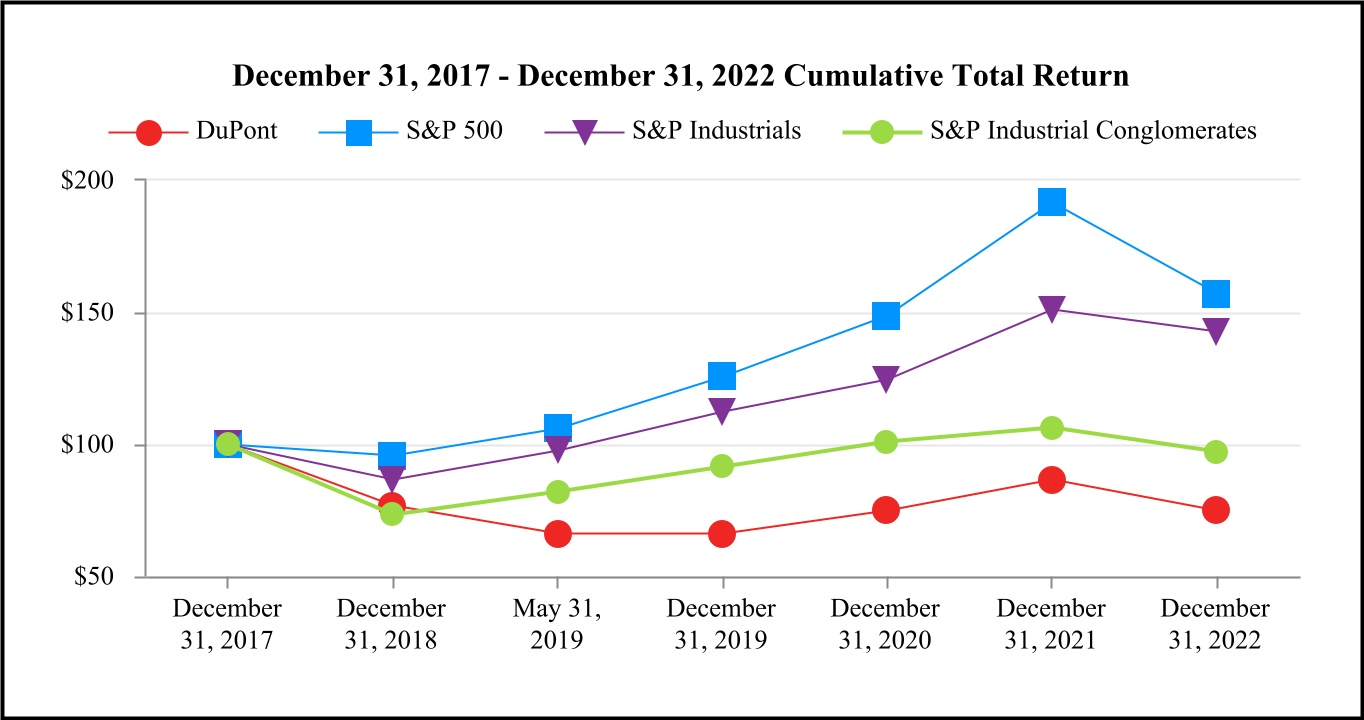
| Cumulative Total Return | December 31, 2017 | December 31, 2018 | May 31, 2019 1 | December 31, 2019 | December 31, 2020 | December 31, 2021 | December 31, 2022 | ||||||||||||||||
| DuPont | $ | 100.00 | $ | 76.84 | $ | 65.95 | $ | 66.12 | $ | 74.92 | $ | 86.45 | $ | 74.88 | |||||||||
| S&P 500 | $ | 100.00 | $ | 95.62 | $ | 105.88 | $ | 125.72 | $ | 148.85 | $ | 191.58 | $ | 156.89 | |||||||||
| S&P Industrials 2 | $ | 100.00 | $ | 86.71 | $ | 97.59 | $ | 112.17 | $ | 124.59 | $ | 150.89 | $ | 142.63 | |||||||||
| S&P Industrial Conglomerates 3 | $ | 100.00 | $ | 73.12 | $ | 81.92 | $ | 91.49 | $ | 100.89 | $ | 106.15 | $ | 97.23 |
-
Represents the day preceding the Corteva Distribution.
-
New index added in 2022
-
Included for this fiscal year only for comparative purposes to prior fiscal year graphs.
Item 6. RESERVED
Not applicable.
Item 7. MANAGEMENT'S DISCUSSION AND ANALYSIS OF FINANCIAL CONDITION AND RESULTS OF OPERATIONS
Management’s discussion and analysis of financial condition and results of operations is provided as a supplement to, and should be read in conjunction with, the consolidated financial statements and related notes to enhance the understanding of the Company’s operations and present business environment. Components of management’s discussion and analysis of financial condition and results of operations include:
-
Overview
-
Analysis of Operations
-
Result of Operations
-
Segment Results
-
Outlook
-
Liquidity and Capital Resources
-
Recent Accounting Pronouncements
-
Critical Accounting Estimates
-
Long-Term Employee Benefits
-
Environmental Matters
OVERVIEW
As of December 31, 2022, the Company has $6.4 billion of net working capital and $3.7 billion in cash and cash equivalents. The Company expects its cash and cash equivalents, cash generated from operations, and ability to access the debt capital markets to provide sufficient liquidity and financial flexibility to meet the liquidity requirements associated with its continued operations. The Company continually assesses its liquidity position, including possible sources of incremental liquidity, in light of the current economic environment, capital market conditions and Company performance.
Mobility & Materials Divestitures
On November 1, 2022, DuPont completed the previously announced divestiture (the "Transaction Date") of the majority of the historic Mobility & Materials segment, including the Engineering Polymers business line and select product lines within the Advanced Solutions and Performance Resins business lines (the “M&M Divestiture”). The Company had previously entered into a Transaction Agreement (the "Transaction Agreement") with Celanese Corporation ("Celanese") on February 17, 2022 for a purchase price of $11.0 billion in cash. Cash received on the Transaction Date, as adjusted for preliminary and other adjustments was $11.0 billion. These adjustments include approximately $0.5 billion of cash transferred with the M&M Divestiture for which DuPont was reimbursed at closing resulting in net proceeds of $10.5 billion.
On February 18, 2022, the Company announced that its Board of Directors approved of the divestiture of the Delrin® acetal homopolymer (H-POM) business (the "Delrin® Divestiture"), subject to entry into a definitive agreement and satisfaction of closing conditions. The Delrin® Divestiture together with the M&M Divestiture (collectively the "M&M Divestitures" and the businesses in scope for the M&M Divestitures collectively the "M&M Businesses") represent a strategic shift that has a major impact on DuPont's operations and results.
The financial position of DuPont as of December 31, 2022 presents the assets and liabilities of the Delrin® Divestiture as held for sale, presented as discontinued operations. In the comparative period, the assets and liabilities of both the M&M Divestiture and the Delrin® Divestiture are presented as held for sale, presented as discontinued operations. The results of operations for the years ended December 31, 2022, 2021 and 2020 present the financial results of the M&M Businesses, including the M&M Divestiture through the Transaction Date, as discontinued operations. The cash flows and comprehensive income of the M&M Businesses have not been segregated and are included in the Consolidated Statements of Cash Flows and Consolidated Statements of Comprehensive Income, respectively, for all periods presented. Unless otherwise indicated, the information in the notes to the Consolidated Financial Statements refer only to DuPont's continuing operations and do not include discussion of balances or activity of the M&M Businesses. See Note 4 to the Consolidated Financial Statements for additional information.
The Auto Adhesives & Fluids, MultibaseTM and Tedlar® product lines, previously reported within the historic Mobility & Materials segment, (the "Retained Businesses") are not included in the scope of the M&M Divestitures. Effective with the signing of the Transaction Agreement, the Retained Businesses were realigned to Corporate & Other. The reporting changes have been retrospectively applied for all periods presented.
Terminated Intended Rogers Acquisition
On November 1, 2022, the Company announced the termination of the previously announced agreement to acquire the outstanding shares of Rogers Corporation (“Rogers”) as DuPont and Rogers were unable to obtain timely clearance from all the required regulators ("Terminated Intended Rogers Acquisition").
N&B Transaction
On February 1, 2021, the Company completed the divestiture of the Nutrition & Biosciences (“N&B”) business to International Flavors & Fragrance Inc. (“IFF”) in a Reverse Morris Trust transaction (the “N&B Transaction”) that resulted in IFF issuing shares to DuPont stockholders. In connection with the N&B Transaction, N&B made a one-time cash payment of approximately $7.3 billion (the “Special Cash Payment”) to DuPont.
The results of operations of DuPont for all periods presented reflect the historical financial results of N&B as discontinued operations. The cash flows and comprehensive income related to N&B have not been segregated and are included in the Consolidated Statements of Cash Flows and Consolidated Statements of Comprehensive Income, respectively, for the applicable period. Unless otherwise indicated, the information in the notes to the Consolidated Financial Statements refer only to DuPont's continuing operations and do not include discussion of balances or activity of N&B. See Note 4 to the Consolidated Financial Statements for additional information.
Laird Performance Materials
On July 1, 2021, DuPont completed the acquisition of Laird Performance Materials ("Laird PM") from Advent International (“Laird PM Acquisition”) for cash consideration of $2.4 billion, which reflects adjustments, primarily for acquired cash and net working capital. See Note 3 to the Consolidated Financial Statements for additional information.
Other Divestitures
In May 2022, the Company completed the sale of its Biomaterials business unit, which included the Company's equity method investment in DuPont Tate & Lyle Bio Products, to the Huafon Group. Total consideration received related to the sale was approximately $240 million. In May 2022, a pre-tax gain of $26 million ($21 million net of tax) was recorded in "Sundry income (expense) - net" in the Company's Consolidated Statements of Operations. The results of operations of the Biomaterials business unit are reported in Corporate & Other for all periods presented.
On December 31, 2021, the Company completed the sale of its Clean Technologies business unit, which is part of Corporate & Other. Total consideration related to the sale of the business is approximately $510 million, with cash proceeds of about $500 million reflecting adjustments for customary closing costs as defined within the purchase agreement. For the year ended December 31, 2021, a pre-tax loss of $3 million ($39 million loss net of tax, primarily driven by nondeductible goodwill) on the disposition was recorded in "Sundry income (expense) - net" in the Company's Consolidated Statements of Operations.
In the second quarter of 2021, the Company completed the sale of its Solamet® business unit, which was part of Corporate & Other. Total consideration received related to the sale of the business was approximately $190 million. The sale resulted in a pre-tax gain of $140 million ($105 million net of tax) which was recorded in "Sundry income (expense) - net" in the Company's Consolidated Statements of Operations.
Other Discontinued Operations Tax Matter
Subsequent to the Company’s earnings announcement on February 7, 2023, the Company recorded an adjustment to the provision for income taxes related to Discontinued Operations and deferred income tax liabilities of Discontinued Operations (the “Tax Adjustment”). The Tax Adjustment r
Showing the first 8K of 105K characters. Open the full section
Item 7A. QUANTITATIVE AND QUALITATIVE DISCLOSURES ABOUT MARKET RISK
The Company’s global operations are exposed to financial market risks relating to fluctuations in foreign currency exchange rates, commodity prices, and interest rates. The Company has established a variety of programs including the use of derivative instruments and other financial instruments to manage the exposure to financial market risks as to minimize volatility of financial results. In the ordinary course of business, the Company enters into derivative instruments to hedge its exposure to foreign currency, interest rate and commodity price risks under established procedures and controls. For additional information on these derivatives and related exposures, see Note 21 to the Consolidated Financial Statements. Decisions regarding whether or not to hedge a given commitment are made on a case-by-case basis, taking into consideration the amount and duration of the exposure, market volatility and economic trends. Foreign currency exchange contracts are also used, from time to time, to manage near-term foreign currency cash requirements.
Foreign Currency Exchange Rate Risks
The Company has significant international operations resulting in a large number of currency transactions from international sales, purchases, investments and borrowings. The primary currencies for which the Company has an exchange rate exposure are the Chinese renminbi ("CNY"), European euro ("EUR"), Japanese yen ("JPY"), South Korean won ("KRW") and Canadian dollar ("CAD"). The Company uses forward exchange contracts to offset its net exposures, by currency, related to the foreign currency denominated monetary assets and liabilities of its operations. In addition to the contracts disclosed in Note 21 to the Consolidated Financial Statements, from time to time, the Company will enter into foreign currency exchange contracts to establish with certainty the U.S. dollar ("USD") amount of future firm commitments denominated in a foreign currency.
The following table illustrates the fair values of outstanding foreign currency contracts at December 31, 2022 and 2021, and the effect on fair values of a hypothetical adverse change in the foreign exchange rates that existed at December 31, 2022 and 2021. The sensitivities for foreign currency contracts are based on a 10 percent adverse change in foreign exchange rates.
| Fair Value Asset/(Liability) | Fair Value Sensitivity | |||||||||||||
| In millions | 2022 | 2021 | 2022 | 2021 | ||||||||||
| Foreign currency contracts | $ | (25) | $ | (5) | $ | (290) | $ | (192) |
The Company uses cross currency swaps, designated as a net investment hedge, to hedge portions of its net investment in its European operations. The net investment hedge serves to offset the foreign currency translation risk from the Company’s foreign operations. If the U.S. dollar weakened by 10%, the fair value of the net investment hedge would have been approximately $91 million lower as of December 31, 2022 and approximately $118 million lower as of December 31, 2021.
The Company uses interest rate swaps to hedge changes in the fair value of the hedged item due to changes in the Secured Overnight Financing Rate (“SOFR”). If the floating rates appreciated by 10%, the fair value of the interest rate swaps would have been approximately $26 million lower as of December 31, 2022.
Since the Company's risk management programs are highly effective, the potential loss in value for each risk management portfolio described above would be largely offset by changes in the value of the underlying exposure.
Concentration of Credit Risk
The Company maintains cash and cash equivalents, marketable securities, derivatives and certain other financial instruments with various financial institutions. These financial institutions are generally highly rated and geographically dispersed and the Company has a policy to limit the dollar amount of credit exposure with any one institution.
As part of the Company's financial risk management processes, it continuously evaluates the relative credit standing of all of the financial institutions that service DuPont and monitors actual exposures versus established limits. The Company has not sustained credit losses from instruments held at financial institutions.
The Company's sales are not materially dependent on any single customer. As of December 31, 2022, no one individual customer balance represented more than five percent of the Company's total outstanding receivables balance. Credit risk associated with its receivables balance is representative of the geographic, industry and customer diversity associated with the Company's global product lines.
The Company also maintains strong credit controls in evaluating and granting customer credit. As a result, it may require that customers provide some type of financial guarantee in certain circumstances. Length of terms for customer credit varies by industry and region.
Item 8. FINANCIAL STATEMENTS AND SUPPLEMENTARY DATA
The financial statements and supplementary data required by this Item are included herein, commencing on page F-1 of this report.
Item 9. CHANGES IN AND DISAGREEMENTS WITH ACCOUNTANTS ON ACCOUNTING AND FINANCIAL DISCLOSURE
None.
Item 9A. CONTROLS AND PROCEDURES
Evaluation of Disclosure Controls and Procedures
The Company maintains a system of disclosure controls and procedures to give reasonable assurance that information required to be disclosed in the Company's reports filed or submitted under the Securities Exchange Act of 1934 (Exchange Act) is recorded, processed, summarized and reported within the time periods specified in the rules and forms of the SEC. These controls and procedures also give reasonable assurance that information required to be disclosed in such reports is accumulated and communicated to management to allow timely decisions regarding required disclosures.
As of December 31, 2022, the Company's Chief Executive Officer (CEO) and Chief Financial Officer (CFO), together with management, conducted an evaluation of the effectiveness of the Company's disclosure controls and procedures pursuant to Rules 13a-15(e) and 15d-15(e) of the Exchange Act. Based on that evaluation, the CEO and CFO concluded that these disclosure controls and procedures are effective.
Changes in Internal Control Over Financial Reporting
There were no changes in the Company's internal control over financial reporting identified in connection with the evaluation required by paragraph (d) of Exchange Act Rules 13a-15 and 15d-15 that was conducted during the quarter ended December 31, 2022 that have materially affected, or are reasonably likely to materially affect, the Company's internal control over financial reporting.
In connection with the M&M Divestiture, there were several processes, policies, operations, technologies and information systems, each along with underlying data relevant to the M&M Divestiture, that were transferred or separated. Through the quarter ended December 31, 2022, the Company continued to take steps to ensure that adequate controls were designed and maintained throughout this transition period.
The Company has completed its evaluation of its internal controls and has concluded that the Company's system of internal controls over financial reporting was effective as of December 31, 2022 (see page F-2).
Item 9B. OTHER INFORMATION
None.
Item 9C. Disclosure Regarding Foreign Jurisdictions that Prevent Inspections
Not applicable.
| DuPont de Nemours, Inc. | ||||||||
| PART III |
Item 10. DIRECTORS, EXECUTIVE OFFICERS AND CORPORATE GOVERNANCE
Information related to Directors, certain executive officers and certain corporate governance matters (including identification of Audit Committee members and financial expert(s)) is contained in the definitive Proxy Statement for the 2023 Annual Meeting of Stockholders of DuPont de Nemours, Inc. and is incorporated herein by reference.
Item 11. EXECUTIVE COMPENSATION
Information related to executive compensation and the Company's equity compensation plans is contained in the definitive Proxy Statement for the 2023 Annual Meeting of Stockholders of DuPont de Nemours, Inc. and is incorporated herein by reference.
Item 12. SECURITY OWNERSHIP OF CERTAIN BENEFICIAL OWNERS AND MANAGEMENT AND RELATED STOCKHOLDER MATTERS
Information with respect to beneficial ownership of DuPont de Nemours, Inc. common stock by each Director and all Directors and executive officers of the Company as a group is contained in the definitive Proxy Statement for the 2023 Annual Meeting of Stockholders of DuPont de Nemours, Inc. and is incorporated herein by reference.
Information relating to any person who beneficially owns in excess of 5 percent of the total outstanding shares of DuPont de Nemours, Inc. common stock is contained in the definitive Proxy Statement for the 2023 Annual Meeting of Stockholders of DuPont de Nemours, Inc. and is incorporated herein by reference.
Information with respect to compensation plans under which equity securities are authorized for issuance is contained in the definitive Proxy Statement for the 2023 Annual Meeting of Stockholders of DuPont de Nemours, Inc. and is incorporated herein by reference.
Item 13. CERTAIN RELATIONSHIPS AND RELATED TRANSACTIONS, AND DIRECTOR INDEPENDENCE
Reportable relationships and related transactions, if any, as well as information relating to director independence are contained in the definitive Proxy Statement for the 2023 Annual Meeting of Stockholders of DuPont de Nemours, Inc. and are incorporated herein by reference.
Item 14. PRINCIPAL ACCOUNTING FEES AND SERVICES
Information with respect to fees and services related to the Company’s independent auditors, PricewaterhouseCoopers LLP, and the disclosure of the Audit Committee’s pre-approval policies and procedures are contained in the definitive Proxy Statement for the 2023 Annual Meeting of Stockholders of DuPont and are incorporated herein by reference.
| DuPont de Nemours, Inc. | ||||||||
| PART IV |
Item 15. EXHIBITS AND FINANCIAL STATEMENT SCHEDULES
(a)Financial Statements and Financial Statement Schedules:
1.Financial Statements (See the Index to the Consolidated Financial Statements on page F-1 of this report).
2.Financial Statement Schedules
Schedule II—Valuation and Qualifying Accounts
| (In millions) for the years ended December 31, | 2022 | 2021 | 2020 | ||||||||
| Accounts Receivable—Allowance for Doubtful Receivables | |||||||||||
| Balance at beginning of period | $ | 28 | $ | 32 | $ | 2 | |||||
| Additions charged to expenses | 11 | 6 | 30 | ||||||||
| Deductions from reserves1 | (1) | (10) | — | ||||||||
| Balance at end of period | $ | 38 | $ | 28 | $ | 32 | |||||
| Inventory—Obsolescence Reserve | |||||||||||
| Balance at beginning of period | $ | 6 | $ | 3 | $ | 7 | |||||
| Additions charged to expenses | 18 | 34 | 28 | ||||||||
| Deductions from reserves2 | (20) | (31) | (32) | ||||||||
| Balance at end of period | $ | 4 | $ | 6 | $ | 3 | |||||
| Deferred Tax Assets—Valuation Allowance | |||||||||||
| Balance at beginning of period | $ | 700 | $ | 617 | $ | 567 | |||||
| Additions 3, 4 | 125 | 152 | 80 | ||||||||
| Deductions from reserves 3 | (122) | (69) | (30) | ||||||||
| Balance at end of period | $ | 703 | $ | 700 | $ | 617 |
1.Deductions include write-offs, recoveries and currency translation adjustments.
2.Deductions include disposals and currency translation adjustments.
3.Additions and Deductions include currency translation adjustments.
4.Includes approximately $50 million related to the acquisition of Laird Performance Materials in 2021.
Financial Statement Schedules listed under the Securities and Exchange Commission ("SEC") rules but not included in this report are omitted because they are not applicable or the required information is shown in the Consolidated Financial Statements or notes thereto incorporated by reference.
(b) Exhibits required to be filed by Item 601 of Regulation S-K (all of which are under Commission File No. 0001666700):
| EXHIBIT NO. | DESCRIPTION | |||||||||||||
| 3.1 | Third Amended and Restated Certificate of Incorporation of DuPont de Nemours, Inc. incorporated by reference to Exhibit 3.1 to DuPont de Nemours, Inc.’s Current Report on Form 8-K filed April 30, 2021. | |||||||||||||
| 3.2 | Sixth Amended and Restated Bylaws of DuPont de Nemours, Inc. incorporated by reference to Exhibit 3.1 to DuPont de Nemours, Inc.’s Current Report on Form 8-K filed October 20, 2022. | |||||||||||||
| 4.1 | Description of Capital Stock incorporated by reference to Exhibit 4.1 to DuPont de Nemours, Inc. Quarterly Report on Form 10-Q for the quarter ended June 30, 2020. | |||||||||||||
| 4.2 | Indenture, dated as of November 28, 2018, by and between DowDuPont Inc. and U.S. Bank National Association, as trustee, incorporated by reference to Exhibit 4.1 to the DuPont de Nemours. Inc. Current Report on Form 8-K filed on November 28, 2018. | |||||||||||||
| 10.1 | Memorandum of Understanding, dated January 22, 2021, by and among DuPont de Nemours, Inc., Corteva, Inc., E. I. du Pont de Nemours and Company and The Chemours Company, incorporated by reference to Exhibit 10.1 to the DuPont de Nemours, Inc. Current Report on Form 8-K filed January 22, 2021. | |||||||||||||
| 10.2**† | Tax Matters Agreement dated February 1, 2021, by and among DuPont de Nemours Inc., Nutrition & Biosciences, Inc. and International Flavors & Fragrances Inc. incorporated by reference to Exhibit 10.1 to the DuPont de Nemours, Inc. Current Report on Form 8-K filed February 4, 2021. | |||||||||||||
| 10.3**† | Intellectual Property Cross-License Agreement, dated February 1, 2021, by and among DuPont de Nemours Inc., Nutrition & Biosciences, Inc. and the other parties identified therein incorporated by reference to Exhibit 10.2 to the DuPont de Nemours, Inc. Current Report on Form 8-K filed February 4, 2021. | |||||||||||||
| 10.4**† | Separation and Distribution Agreement, effective as of April 1, 2019, by and among DowDuPont Inc., Dow Inc. and Corteva, Inc. incorporated by reference to Exhibit 2.1 to the DowDuPont Inc. Current Report on Form 8-K filed April 2, 2019. | |||||||||||||
| 10.5**† | Tax Matters Agreement, effective as of April 1, 2019, by and among DowDuPont Inc., Dow Inc. and Corteva, Inc. incorporated by reference to Exhibit 10.1 to the DowDuPont Inc. Current Report on Form 8-K filed April 2, 2019. | |||||||||||||
| 10.4**† | Intellectual Property Cross-License Agreement, effective as of April 1, 2019, by and among DowDuPont Inc. and Dow Inc., incorporated by reference to Exhibit 10.3 to the DowDuPont Inc. Current Report on Form 8-K filed April 2, 2019. | |||||||||||||
| 10.5 | Letter Agreement, effective as of June 1, 2019 by and between DuPont de Nemours, Inc. and Corteva, Inc., incorporated by reference to Exhibit 10.2 to the DuPont de Nemours, Inc. Current Report on Form 8-K filed June 3, 2019. | |||||||||||||
| 10.6 | Amended and Restated Tax Matters Agreement, effective as of June 1, 2019, by and among DowDuPont Inc., Corteva, Inc. and Dow Inc., incorporated by reference to Exhibit 10.3 to the DuPont de Nemours, Inc. Current Report on Form 8-K filed June 3, 2019. | |||||||||||||
| 10.7**† | Transaction Agreement by and among DuPont de Nemours, Inc., DuPont E&I Holding, Inc. and Celanese Corporation, dated February 17, 2022**†, incorporated by reference to Exhibit 2.1 to the DuPont de Nemours, Inc. Current Report on Form 8-K filed February 22, 2022. | |||||||||||||
| 10.8 | DuPont de Nemours, Inc. 2020 Equity and Incentive Plan, incorporated by reference to Exhibit 10.1 to the DuPont de Nemours, Inc. Current Report on Form 8- K filed May 29, 2020. | |||||||||||||
| 10.9 | DuPont Senior Executive Severance Plan, effective as of June 1, 2019, incorporated by reference to Exhibit 10.4 to the DuPont de Nemours, Inc. Current Report on Form 8-K filed June 3, 2019. | |||||||||||||
| 10.10 | DuPont Management Deferred Compensation Plan, effective June 1, 2019, incorporated by reference to Exhibit 10.5 to DuPont de Nemours, Inc. Quarterly Report on Form 10-Q for the quarter ended June 30, 2019. | |||||||||||||
| 10.11 | DuPont Stock Accumulation and Deferred Compensation Plan for Directors, effective June 1, 2019, incorporated by reference to Exhibit 10.6 to DuPont de Nemours, Inc. Quarterly Report on Form 10-Q for the quarter ended June 30, 2019. |
| 10.12 | DuPont Deferred Variable Compensation Plan, effective June 1, 2019, incorporated by reference to Exhibit 10.7 to DuPont de Nemours, Inc. Quarterly Report on Form 10-Q for the quarter ended June 30, 2019. | |||||||||||||
| 10.13 | DuPont Retirement Savings Restoration Plan, effective June 1, 2019, incorporated by reference to Exhibit 10.8 to DuPont de Nemours, Inc. Quarterly Report on Form 10-Q for the quarter ended June 30, 2019. | |||||||||||||
| 10.14 | DuPont Pension Restoration Plan, effective June 1, 2019, incorporated by reference to Exhibit 10.9 to DuPont de Nemours, Inc. Quarterly Report on Form 10-Q for the quarter ended June 30, 2019. | |||||||||||||
| 10.15 | DuPont Omnibus Incentive Plan effective June 1, 2019, incorporated by reference to Exhibit 10.10 to DuPont de Nemours, Inc. Quarterly Report on Form 10-Q for the quarter ended June 30, 2019. | |||||||||||||
| 10.16 | Amended and Restated Employment Agreement by and between DuPont de Nemours, Inc. and Edward D. Breen, dated as of December 28, 2019, incorporated by reference to Exhibit 10.1 to DuPont de Nemours, Inc. Current Report on Form 8-K filed December 29, 2020. | |||||||||||||
| 10.17 | Employment Letter Agreement by and between DuPont de Nemours, Inc. and Edward D. Breen, dated as of February 6, 2023, incorporated by reference to Exhibit 10.1 to DuPont de Nemours, Inc. Current Report on Form 8-K filed February 7, 2023. | |||||||||||||
| 21 | Subsidiaries of the Registrant. | |||||||||||||
| 23 | Consent of Independent Registered Public Accounting Firm, PricewaterhouseCoopers LLP. | |||||||||||||
| 24 | Power of Attorney (included as part of signature page). | |||||||||||||
| 31.1* | Certification Pursuant to Section 302 of the Sarbanes-Oxley Act of 2002. | |||||||||||||
| 31.2* | Certification Pursuant to Section 302 of the Sarbanes-Oxley Act of 2002. | |||||||||||||
| 32.1* | Certification Pursuant to Section 906 of the Sarbanes-Oxley Act of 2002. | |||||||||||||
| 32.2* | Certification Pursuant to Section 906 of the Sarbanes-Oxley Act of 2002. | |||||||||||||
| 101.INS | XBRL Instance Document – the instance document does not appear in the Interactive Data File because its XBRL tags are embedded within the Inline XBRL document. | |||||||||||||
| 101.SCH | XBRL Taxonomy Extension Schema Document. | |||||||||||||
| 101.CAL | XBRL Taxonomy Extension Calculation Linkbase Document. | |||||||||||||
| 101.DEF | XBRL Taxonomy Extension Definition Linkbase Document. | |||||||||||||
| 101.LAB | XBRL Taxonomy Extension Label Linkbase Document. | |||||||||||||
| 101.PRE | XBRL Taxonomy Extension Presentation Linkbase Document. | |||||||||||||
| 104 | Cover Page Interactive Data File (formatted as Inline XBRL and contained in Exhibit 101). |
*Filed herewith
**The Company has omitted certain schedules and other similar attachments to such agreement pursuant to Item 601(a)(5) of
Regulation S-K. The Company will furnish a copy of such omitted documents to the SEC upon request.
†Certain provisions of this exhibit have been omitted pursuant to Item 601(b)(10)(iv) of Regulation S-K.
Item 16. FORM 10-K SUMMARY
None.
| DuPont de Nemours, Inc. Signatures |
Pursuant to the requirements of Section 13 or 15(d) of the Securities Exchange Act of 1934, the registrant has duly caused this report to be signed on its behalf by the undersigned, thereunto duly authorized.
DUPONT DE NEMOURS, INC.
Registrant
Date: February 15, 2023
| By: | /s/ MICHAEL G. GOSS | |||||||||||||
| Name: | Michael G. Goss | |||||||||||||
| Title: | Vice President and Controller | |||||||||||||
| City: | Wilmington | |||||||||||||
| State: | Delaware |
Pursuant to the requirements of the Securities Exchange Act of 1934, this report has been signed below by the following persons on behalf of the registrant and in the capacities and on the dates indicated.
| Signature | Title(s) | Date | |||||||||||||||
| /s/ LORI KOCH | Executive Vice President and Chief Financial Officer (Principal Financial Officer) | February 15, 2023 | |||||||||||||||
| Lori Koch | |||||||||||||||||
| /s/ MICHAEL G. GOSS | Vice President and Controller | February 15, 2023 | |||||||||||||||
| Michael G. Goss | (Principal Accounting Officer) | ||||||||||||||||
We, the undersigned directors and officers of DuPont de Nemours, Inc, hereby severally constitute Erik T. Hoover, Senior Vice President & General Counsel and Peter W. Hennessey, Vice President, Associate General Counsel & Corporate Secretary, and each of them singly, as our true and lawful attorneys with full power to them and each of them to sign for us, in our names in the capacities indicated below, any and all amendments or supplements to this Annual Report on Form 10-K and to cause same to be filed with the U.S. Securities and Exchange Commission pursuant to the Securities and Exchange Act of 1934.
| Signature | Title(s) | Date | |||||||||||||||
| /s/ EDWARD D. BREEN | Chief Executive Officer and Director | February 15, 2023 | |||||||||||||||
| Edward D. Breen | (Principal Executive Officer) | ||||||||||||||||
| /s/ AMY G. BRADY | Director | February 15, 2023 | |||||||||||||||
| Amy G. Brady | |||||||||||||||||
| /s/ RUBY R. CHANDY | Director | February 15, 2023 | |||||||||||||||
| Ruby R. Chandy | |||||||||||||||||
| /s/ TERRENCE R. CURTIN | Director | February 15, 2023 | |||||||||||||||
| Terrence R. Curtin | |||||||||||||||||
| /s/ ALEXANDER M. CUTLER | Director | February 15, 2023 | |||||||||||||||
| Alexander M. Cutler | |||||||||||||||||
| /s/ ELEUTHERE I. DU PONT | Director | February 15, 2023 | |||||||||||||||
| Eleuthère I. du Pont | |||||||||||||||||
| /s/ KRISTINA M. JOHNSON | Director | February 15, 2023 | |||||||||||||||
| Kristina M. Johnson | |||||||||||||||||
| /s/ LUTHER C. KISSAM | Director | February 15, 2023 | |||||||||||||||
| Luther C. Kissam | |||||||||||||||||
| /s/ FREDERICK M. LOWERY | Director | February 15, 2023 | |||||||||||||||
| Frederick M. Lowery | |||||||||||||||||
| /s/ RAYMOND J. MILCHOVICH | Director | February 15, 2023 | |||||||||||||||
| Raymond J. Milchovich | |||||||||||||||||
| /s/ DEANNA M. MULLIGAN | Director | February 15, 2023 | |||||||||||||||
| Deanna M. Mulligan | |||||||||||||||||
| /s/ STEVEN M. STERIN | Director | February 15, 2023 | |||||||||||||||
| Steven M. Sterin |
DuPont de Nemours, Inc.
Index to the Consolidated Financial Statements
Showing the first 8K of 298K characters. Open the full section