 filings.tools
Item 11. Executive Compensation
122K characters. Original on sec.gov · Markdown
Item 11. Executive Compensation
Compensation Discussion and Analysis
In this section we discuss the compensation programs applicable to our Named Executive Officers, or NEOs. This discussion is divided into the following parts:
| • | Executive Summary |
| • | Compensation Philosophy and Objectives |
| • | Compensation Consultant and Peer Group |
| • | Elements of Fiscal Year 2017 Executive Compensation Program |
| • | Other Compensation-Related Topics |
Please also review the various compensation tables, including the Summary Compensation Table, and the related footnotes that follow this section, as they provide information critical to an understanding of our executive compensation program.
Executive Summary
Named Executive Officers
The following table sets forth our NEOs, the current positions they hold and the dates they were appointed to those positions:
| NAMED EXECUTIVE OFFICER | CURRENT POSITION AND DATE APPOINTED |
| David Powers | • Chief Executive Officer and Director - June 2016 • President - March 2015 |
| Thomas A. George | • Chief Financial Officer - September 2009 |
| David E. Lafitte | • Chief Operating Officer - February 2015 |
| Stefano Caroti | • President of Omni-Channel - November 2015 |
| Andrea O'Donnell | • President of Fashion Lifestyle - April 2016 |
| Angel R. Martinez | • Non-Executive Chairman of our Board - May 2016 • Retired as Chief Executive Officer - May 2016 |
Ongoing Business Transformation
Over the past few years, we have undertaken a strategic transformation of our business, and in turn, our executive leadership team and organizational structure, to effectively position ourselves to compete in a rapidly-evolving retail environment. Our overarching executive compensation objectives are to effectively align our compensation program design to our business strategy, and to attract, develop and retain executives with the background and experience required to lead us forward and provide the best opportunity to achieve sustained growth and profitability. This goal is difficult to accomplish for any business, but it can be particularly complicated when facing challenging and volatile industry and business dynamics.
As of a result of our ongoing transformation efforts, we have a number of key leadership team members who are relatively new to their current roles. At the beginning of fiscal year 2017, we promoted David Powers to be our Chief Executive Officer, in addition to serving as our President. Mr. Powers is a seasoned footwear and retail executive with extensive experience building and transforming organizations. In fiscal year 2016, Stefano Caroti joined our Company as President of Omni-Channel. Mr. Caroti has extensive industry experience in sales, retail, product, marketing, business strategy and brand management. In fiscal year 2017, Andrea O’Donnell joined our Company as President of Fashion Lifestyle. Ms. O'Donnell has a background in strategic planning, merchandising and marketing, and is well versed in operating in complex international markets. We have also made other changes within our executive leadership team and broader organization over the past few years.
To understand the design of our executive compensation program, it is important to consider our guiding compensation objectives in the context of our evolving business and management team transition. For fiscal year 2017, the Compensation Committee, which we refer to as the Committee for purposes of this section, focused on attracting, developing and retaining our executive team while incentivizing them to focus on building long-term value for stockholders. These considerations, along with a review of peer group and industry practices, resulted in a portion of our equity awards for fiscal year 2017 being issued in the form of awards that vest solely based on the achievement of time-based targets, as well as the issuance of certain additional discretionary awards in connection with promotions and new hires that also have time-based vesting targets.
Stockholder Engagement
We are committed to enhancing and expanding our stockholder outreach efforts, including by proactively soliciting and incorporating stockholder feedback on the design and effectiveness of our executive compensation program. For example, in early 2017, we reached out to investors holding over 60% of our shares to discuss their views and any concerns regarding our compensation philosophy and program. Members of our management team and, in most cases, the Chair of our Compensation Committee, conducted meetings and conference calls with those investors that responded to our outreach efforts (representing 47% of our shares) in order to understand stockholders’ perspectives regarding our current compensation practices and solicit specific feedback on current and potential design elements and practices.
During these conversations, we took the opportunity to review our business strategies and performance, discuss our corporate governance initiatives, preview potential changes to our executive compensation program, and provide responses to specific concerns raised by proxy advisory groups. Our stockholder engagement efforts have also included direct discussions with representatives of certain proxy advisory groups, as they represent the interests of, and may influence the voting decisions of, many of our stockholders.
These actions were motivated in large part by the results of our “Say-on-Pay” vote at our 2016 Annual Stockholder Meeting, which reflected that 67% of the votes cast were voted "for" our executive compensation program, a marked and unexpected decline from the 95% approval the prior year. While the vote reflects overall continued stockholder support of our executive compensation philosophy, our Board acknowledged a need for greater stockholder engagement as a means to seek feedback, offer our perspective and rationale, and improve stockholder support for our executive compensation program.
The Committee believes that ongoing, transparent communication with our stockholders is critical to our long-term success, and that the feedback received through our stockholder engagement efforts will continue to contribute to the evolution and enhancement of our executive compensation program. The Committee considers stockholder engagement to be an important part of its decision-making process and plans to continue proactive outreach efforts going forward.
In response to feedback from our stockholders and proxy advisory groups during these outreach efforts, we have made a number of significant changes to our executive compensation program during fiscal year 2017, and have continued to evolve our compensation program for fiscal year 2018.
Principal Changes to Compensation Program During Fiscal Year 2017
The following table sets forth the principal changes made to our executive compensation program during fiscal year 2017:
| NEW PRACTICE FOR 2017 | HISTORICAL PRACTICE | UNDERLYING PHILOSOPHY/ ADDITIONAL CONSIDERATIONS | |
| • Change from performance-based restricted stock units, or RSUs, to performance stock options for long-term incentive plan, or LTIP, awards. | • Historically, the Committee issued our LTIP awards in the form of performance-based RSUs. | • Better aligns the interests of our executives with those of our stockholders given challenging industry dynamics and highly variable peer group performance; awards granted with an exercise price equal to fair market value on the grant date and only have value to the extent Company performance condition is met and the value of our common stock increases. • The correlation in value realization is not as direct with “full value” awards such as RSUs that can vest based on the achievement of Company performance conditions that do not necessarily lead to a higher stock price or result in favorable performance relative to peer group companies. | |
| • Change mix of performance-based and time-based equity awards. | • For fiscal year 2016, substantially all equity awards vested based on achievement of Company performance conditions. | • Based on review of peer group and broader market data, issued equity awards that vest as to 80% of the awards based on the achievement of Company performance conditions to ensure alignment with our pay-for-performance philosophy, and vest as to 20% of the awards based on the achievement of time-based vesting targets to attract and retain executives. • 100% of the equity awards granted during fiscal year 2017 were subject to a minimum three-year vesting period in order to promote retention of our executives. | |
| • Change in performance conditions for LTIP awards. | • For fiscal year 2016, the performance conditions for the LTIP awards was consolidated EBITDA and Revenue. | • Selecting the appropriate performance conditions for performance-based awards is critical for motivating our executives, aligning their interests with those of our stockholders and advancing our pay-for-performance philosophy. • For fiscal year 2017, we relied on “Pre-Tax Income” for fiscal year 2019 as the performance condition for the LTIP awards given our continued focus on profitability, margin improvement, inventory control, cost savings, and restructuring. | |
| • Eliminate overlap in performance conditions. | • For fiscal year 2016, Revenue was used as a performance metric for our annual cash incentives and LTIP awards. | • Performance goals should involve multiple performance conditions to ensure our compensation programs are encouraging healthy and sustained growth across our business, while eliminating excessive overlap between the goals. • This approach further reduces the risk associated with our compensation programs as it de-emphasizes the impact of any one performance metric. |
Continued Evolution of our Compensation Program
The following table sets forth information about the continued evolution of our compensation program for fiscal year 2018:
| EVOLVING PRACTICE | HISTORICAL CONTEXT | UNDERLYING PHILOSOPHY/ ADDITIONAL CONSIDERATIONS | |
| • Move toward a median pay philosophy. | • During past several years, we have benchmarked executive compensation to the 60th to 75th percentile compared to peer group. | • We considered a number of factors, including feedback from our stockholders, as well as from certain proxy advisory groups, indicating that our historical practice of benchmarking above the median was viewed as an unfavorable component of our executive compensation program. • We have actively begun to reformulate our compensation program commencing with fiscal year 2018, such that we expect to benchmark our executives’ target total direct compensation at the median compared to peer group companies. | |
| • Continued focus on executive retention. | • Retention of executives can be difficult especially where executives have achieved actual pay that is lower than target pay over multiple years. | • While we seek to develop our executive compensation program so that it closely aligns with our pay-for-performance philosophy, we recognize that this objective must complement other important objectives including the retention of executives, particularly in times of management transition and challenging industry and business dynamics. • For fiscal year 2018, we again granted a portion of equity awards that vest solely based on the achievement of time-based targets, which promote executive retention because they vest over a long-term service period and are not correlated with Company performance conditions. However, the majority of awards granted are expected to have performance-based vesting conditions. | |
| • Change in equity award vesting provisions. | • Our awards have historically provided for accelerated vesting upon a change of control where the transaction was not approved by our Board. | • Certain proxy advisory groups have viewed our vesting provisions as an unfavorable component of our executive compensation program. • Following a dialogue with representatives of the proxy advisory groups, we elected to remove these provisions from our equity award agreements commencing with the awards granted during fiscal year 2018. |
Overview of our Fiscal Year 2017 Compensation Structure
| PHILOSOPHY | CONSIDERATIONS | PERFORMANCE CONDITIONS / VESTING PROVISIONS | 2017 PAY-FOR- PERFORMANCE RESULTS |
| BASE SALARY Guaranteed ● Cash | |||
| • Attract and Retain Executives | • Balance the level of guaranteed pay with at-risk pay to properly manage our compensation-related risk. | • No specific vesting conditions associated with payment. | • Past performance is considered in evaluating any increase in base salary. |
| MANAGEMENT INCENTIVE PLAN (2017 Annual Cash Incentive Awards) At-Risk ● Performance-Based (Short-Term Criteria) ● Cash | |||
| • Pay for Performance • Reward Achievement • Align Interests with Stockholders • Attract and Retain Executives | • Use threshold, target and maximum award levels related to Company performance conditions to strike appropriate balance between compensation incentives and risks. | • Target bonus set as percentage of base salary. • Actual bonus payout is based on achievement of fiscal year 2017 consolidated revenue and consolidated operating income (and, for certain executives, business unit revenue and business unit operating income). | • Fiscal year 2017 consolidated revenue and operating income gates were not achieved and therefore no cash incentive payments were made. |
| ANNUAL PERFORMANCE-BASED RESTRICTED STOCK UNITS (2017 Annual PSUs) At-Risk ● Performance-Based (Short-Term Criteria) + Time-Based (Long-Term Vesting) ● 20% of Equity Compensation | |||
| • Pay for Performance • Reward Achievement • Align Interests with Stockholders • Attract and Retain Executives | • Use threshold and target award levels related to Company performance conditions to strike appropriate balance between compensation incentives and risks. | • Vest subject to achievement of a pre-established EPS target for fiscal year 2017, the year in which they were granted. • If performance conditions are met, awards vest based on continued employment in three equal installments over three years. | • Fiscal year 2017 EPS threshold was not achieved, and therefore, the awards were not earned. |
| ANNUAL TIME-BASED RESTRICTED STOCK UNITS (2017 Time-Based RSUs) At-Risk ● Time-Based (Long-Term Vesting) ● 20% of Equity Compensation | |||
| • Attract and Retain Executives • Align Interests with Stockholders | • Balance the level of performance-based pay with time-based pay to more closely align with peer group practices, properly manage our compensation-related risk and align better with peer group practices. • Provide awards that vest solely based on continued employment to emphasize the retention of our executives. | • Awards vest based on continued employment in three equal installments over three years commencing August 15, 2017. | • Not applicable. |
| LONG-TERM PERFORMANCE STOCK OPTIONS (2017 LTIP NQSOs) At-Risk ● Performance-Based (Long-Term Criteria and Vesting) ● 60% of Equity Compensation | |||
| • Align Interests with Stockholders • Pay for Performance • Reward Achievement • Attract and Retain Executives | • Pre-Tax Income supports our focus on profitability as a key business driver. • Granted with an exercise price equal to fair market value on the grant date, and only have value to the extent the price of our common stock increases. | • Vesting occurs only if pre-established Pre-Tax Income target for fiscal year 2019 is achieved. • Once it is determined that the target has been met, awards will vest in full; no vesting for achievement of a lower threshold amount and no time-based vesting. | • As of the date of this Amendment, we consider the 2017 LTIP NQSOs to be probable of vesting. |
| DISCRETIONARY RESTRICTED STOCK UNITS (2017 Discretionary RSUs) At-Risk ● Time-Based (Long-Term Vesting) ● Individual | |||
| • Attract and Retain Executives • Align Interests with Stockholders | • Primarily used for hiring and promotional needs and other unique circumstances. • Balance the level of performance-based pay with time-based pay to properly manage our compensation-related risk. | • Awards vest based on continued employment in three equal installments over three years commencing August 15, 2017. | • Not applicable. |
Compensation Philosophy and Objectives
The Committee has overall responsibility for reviewing and approving the compensation philosophy, policies and programs applicable to our executive officers. Pursuant to the Charter of the Compensation Committee, the Committee is specifically tasked with approving our compensation strategy to ensure that our executive officers are rewarded appropriately for their contributions to our growth and profitability, and that our executive compensation strategy supports our objectives and the interests of our stockholders. In doing so, the Committee also endeavors to ensure our executive compensation program is competitive and consistent with market conditions in order to attract and retain executives critical to our long-term success.
Guiding Principles of our Compensation Philosophy
When reviewing and approving our executive compensation program, the Committee is guided by the following four principles:
| ATTRACT AND RETAIN EXECUTIVES | PAY-FOR-PERFORMANCE | |
| • Attract key executives with the proper background and experience required to lead the organization forward, as well as to provide us the best opportunity to achieve sustained growth and profitability. • Retain our knowledgeable and talented executives by offering compensation that is competitive in the marketplace. | • Offer a significant portion of total direct compensation opportunity in the form of performance-based compensation that is at-risk instead of guaranteed. • Ensure performance-based compensation is directly correlated with the achievement of pre-established Company goals that the Committee believes are important to our long-term success. | |
| REWARD ACHIEVEMENT | ALIGN INTERESTS WITH STOCKHOLDERS | |
| • Provide meaningful incentives for achieving both short-term and long-term Company financial goals that have been established by the Committee. • Ensure that the financial goals are appropriate for each executive officer given their respective titles, scope of responsibilities, and objectives. | • Align the interests of our executives with those of our stockholders by tying a significant portion of target total direct compensation to financial performance that the Committee believes is likely to result in the creation of long-term stockholder value. • Ensure that a portion of the total direct compensation is directly correlated to total stockholder return by issuing awards that increase in value as our stock price increases. |
Principal Changes to Compensation Program During Fiscal Year 2017
In carrying out its responsibilities during fiscal year 2017, the Compensation Committee approved a number of significant changes to our executive compensation program as follows:
Change from Restricted Stock Units to Non-Qualified Stock Options for Long-Term Incentive Plan Award
Historically, the Committee has issued our LTIP awards in the form of RSUs. For fiscal year 2017, the Committee elected to issue the LTIP component of our executive compensation program in the form of 2017 LTIP NQSOs, which have a Company performance-based vesting condition. In keeping with our compensation philosophy, we believe the shift to 2017 LTIP NQSOs better aligns the interests of our executives with those of our stockholders, given current industry volatility and business dynamics and the significant variance among the performance of our peer group. Awards are granted with an exercise price equal to fair market value on the grant date and only have value to the recipient to the extent the performance condition is met and the value of our common stock increases. The Committee believes this correlation in value realization is not as direct when an executive receives “full value” awards such as RSUs in the current environment, since those awards can vest based on the achievement of performance conditions that do not necessarily lead to a higher stock price or compare favorably to our peer group.
Change Mix of Performance-Based and Time-Based Equity Awards
Our compensation program is largely designed to incentivize executives to focus on building long-term value for stockholders, while at the same time acknowledging that it is imperative to retain our executives, particularly during times of strategic transformation, management transition, current industry volatility and business dynamics, and uncertain financial performance. In light of these important objectives, for fiscal year 2017, the Committee elected to issue 20% of the total awards based on the achievement of time-based vesting targets to further promote the retention of our executives. The remaining 80% of the awards continue to be based on the achievement of Company performance conditions to ensure alignment with our pay-for-performance philosophy. The change was also made to more closely
align our equity award practices with peer group data, which reflects that many members of our Peer Group (as defined below) issue time-based awards, in some cases with respect to a much larger portion of an executive's total equity award opportunity. Notably, while a portion of the performance-based equity awards (the 2017 Annual PSUs) had a one-year performance condition, if the performance condition had been met, those awards would have vested over a three-year period, thereby ensuring that all of our equity awards granted during fiscal year 2017 had a long-range focus.
Modify the Performance Metrics for Long-Term Incentive Plan Award
The Committee believes that choosing the right performance metrics for performance-based awards is critical for properly motivating our executives, aligning their interests with those of our stockholders and advancing our pay-for-performance philosophy. In particular, it is crucial that the performance metrics be reconsidered each year as our business strategy and market evolve to ensure they provide the appropriate barometer of our growth and success, and motivate the achievement of our objectives in line with how we currently view the business. To this end, for fiscal year 2017, the Committee established Pre-Tax Income for fiscal year 2019 as the performance metric for the LTIP awards given our continued focus on profitability, margin improvement, inventory control, cost savings, and restructuring. In keeping with our past practice, when assessing our achievement with respect to this performance metric, the Committee has discretion to adjust for certain non-recurring expense or income items, including those relating to restructuring activities and retail store closures.
Eliminate Overlap in Performance Metrics
Our pay-for-performance philosophy requires that we offer performance-based compensation that is correlated with the achievement of pre-established Company goals that the Committee believes are important to our long-term success. We believe it is important that these goals be set with respect to multiple performance metrics to ensure our compensation programs are encouraging healthy and sustained growth and profitability across our business. For fiscal year 2017, in establishing the performance metrics for the various components of our executive compensation program, the Committee adopted several discrete performance metrics, including consolidated revenue, consolidated operating income, pre-tax income and earnings per share, while at the same time eliminating some of the redundancy in performance conditions that existed in prior years. The Committee believes this approach further reduces the risk associated with our compensation programs.
Continued Evolution of our Compensation Program
In discharging its responsibility to ensure that our executive compensation strategy continues to support our objectives and the interests of our stockholders, the Committee regularly assesses our compensation program and implements changes to our compensation policies, including the following:
Move Toward a Median Pay Philosophy
During the past several years, we have openly disclosed the Committee's objective to benchmark our executives’ target total compensation to the 60th to 75th percentile compared to our Peer Group. This benchmarking was typically performed with respect to both target total direct compensation, as well as each individual component of compensation. The principal rationale for adopting this approach was that the Committee was generally willing to provide compensation above the median, because it required aspirational (above median) performance in order to justify the larger compensation opportunity. The Committee believed this rationale was consistent with a strong pay-for-performance philosophy.
During fiscal year 2017, the Committee discussed on several occasions whether, from a compensation philosophy standpoint, it continues to be prudent to benchmark our executives’ target total direct compensation at the 60th to 75th percentile compared to our Peer Group, or whether we should instead adopt a “median pay philosophy”, whereby we seek to benchmark our executives’ target total direct compensation at the median compared to our Peer Group. During these discussions, the Committee considered a number of factors, including:
| • | current industry volatility and business dynamics that have made it more difficult for us to accurately forecast financial performance; |
| • | the aspirational performance targets that correlated with our above median pay philosophy have largely not been met over the past several years and performance-based compensation has largely not been paid, which has resulted in concerns around executive retention; and |
| • | the past several years have been a time of business transformation and resulting management transition for our Company, and several of our executives are relatively new to their current roles. |
In addition, the Committee acknowledged that it has received feedback from our stockholders, as well as from certain proxy advisory groups, indicating that the historical practice of benchmarking above the median was viewed as an unfavorable component of our executive compensation program, even though our targets required above-median performance.
In light of these considerations, the Committee has actively begun to reformulate our compensation program, such that we expect to benchmark our executives’ target total direct compensation at the median compared to our Peer Group going forward.
Focus on Executive Retention
While we seek to develop our executive compensation program so that it closely aligns with our pay-for-performance philosophy, the Committee recognizes that this objective must complement other important objectives, including the retention of our executives. A guiding objective of our executive compensation philosophy is to attract, develop and retain executives that are critical to our long-term success by offering compensation that is competitive in the market. The retention of talented executives is a challenge for any business, but it can be extraordinarily difficult in times of business transformation, management transition, industry volatility, and uncertain financial performance, all of which have occurred over the past several years. In addition, executive retention can be made more difficult where executives have achieved actual pay that is significantly lower than target pay and/or lower than the pay of executives working for members of our Peer Group over a prolonged period of time.
In light of these concerns, and to further promote the retention of our executives, for fiscal year 2018 the Committee has again approved the issuance of 20% of the equity awards in the form of awards that vest based on the achievement of long-term time-based targets. However, 80% of the equity awards granted for fiscal year 2018 will continue to be based on the achievement of Company performance conditions to align with our pay-for-performance philosophy. The Committee continues to assess the proper balance between focusing on the attraction and retention of our executives and following a strong pay-for-performance philosophy.
Change in Equity Award Vesting Provisions
Our equity awards have historically included vesting provisions whereby awards would become subject to accelerated vesting in the event that (1) an awardee’s employment was terminated for specified reasons within a certain time period prior to or following a change of control transaction, or (2) the acquiring company in the change of control did not agree to assume or substitute the equity awards with awards of comparable value. Additionally, these equity awards typically provided for accelerated vesting of the awards upon a change of control where the transaction was not approved by a majority of our Board, regardless of whether the awards were assumed or substituted, or employment was terminated. Certain proxy advisory groups have viewed these additional vesting provisions as an unfavorable component of our executive compensation program. Following a dialogue with representatives of these proxy advisory groups, and after considering the impact of the removal of these additional vesting provisions on our executives, the Committee has elected to remove these additional vesting provisions from our equity award agreements commencing with the awards already granted during fiscal year 2018.
At-Risk Pay vs. Guaranteed Pay
Our executive compensation philosophy requires that a significant portion of an executive’s total direct compensation opportunity be provided in the form of compensation that is at-risk rather than guaranteed. While we offer certain standard compensation elements that provide guaranteed payments, including base salary and limited employee benefits, our executive compensation mix is heavily weighted toward performance-based compensation which significantly limits guaranteed pay. In reviewing our adherence to our executive compensation philosophy, the Committee annually reviews both the amount of, and the mix between, guaranteed pay and at-risk pay and seeks to establish appropriate performance targets for the at-risk pay so as to ensure our performance targets align with our business and strategic objectives, are appropriately challenging to achieve, and mitigate our overall compensation-related risk.
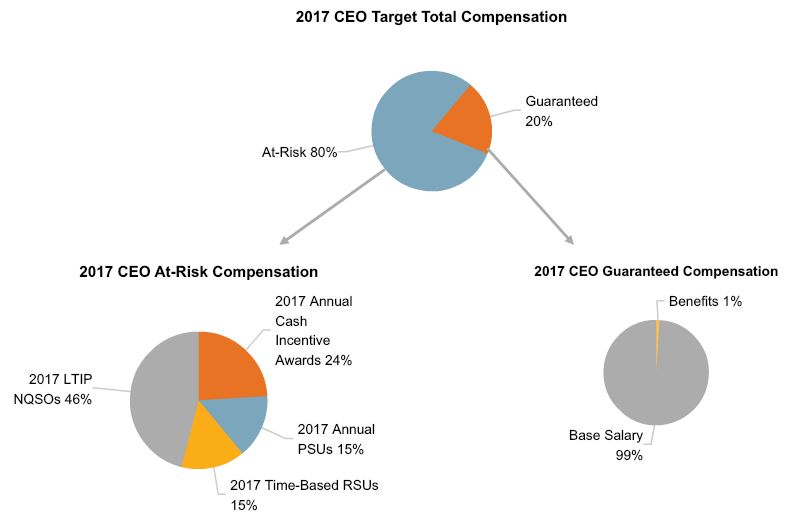
For example, for fiscal year 2017, the guaranteed pay for our Chief Executive Officer and President (reflecting the value of base salary and employee benefits) represented only 20% of his targeted compensation for the year, while the at-risk pay represented 80% of his targeted compensation for the year. Of the 80% that reflects at-risk pay, 68% was provided through performance-based awards (reflecting the value of the 2017 Annual Cash Incentive Awards, 2017 Annual PSUs and 2017 LTIP NQSOs) that only vest upon the achievement of pre-established Company performance metrics, and 12% was provided through time-based awards (reflecting the value of the 2017 Time-Based RSUs) that only vest upon the achievement of long-term time-based vesting targets. The Committee considers the 2017 Time-Based RSUs to be at-risk pay given that the vesting of the awards is conditional upon continued employment over an extended period of time and the value of the awards is subject to fluctuation based on our stock price.
The graphs below illustrate the amount of targeted at-risk pay vs. guaranteed pay for our Chief Executive Officer for fiscal year 2017 and the breakdown of the various components of the compensation program.
 |
Target Pay vs. Realized Pay
Due to the strong pay-for-performance element of our executive compensation program, the amount of pay actually realized by our executives with respect to a given fiscal year is often lower than the target amount of pay. This is primarily due to a combination of factors, including the significant portion of our executives’ total direct compensation opportunity that is at-risk and subject to the achievement of Company performance conditions, the fact that the Committee has historically established aspirational performance conditions that were expected to be difficult to attain, and the challenging business environment in which we operate, which has made it difficult to forecast and achieve specified financial goals.
For purposes of comparing the amount of target pay to realized pay, we consider realized pay to be the sum of all compensation amounts actually earned by or paid to an executive officer with respect to a given fiscal year (e.g., base salary, cash incentive compensation, etc.) plus the value of equity awards granted during the fiscal year taking into account the probability of achieving the relevant vesting conditions as of the end of the fiscal year. Notably, we do not include the value of equity awards granted in a prior fiscal year, even if they vest in the applicable fiscal year.
This formula results in a realized pay calculation that is not necessarily indicative of, and may in some cases significantly overstate, the compensation that the executive officer will actually realize with respect to the fiscal year when looking back after it has been determined whether the vesting conditions have been achieved. We believe our formula provides a useful metric for comparing target pay to realized pay and assessing our alignment with our pay-for-performance philosophy. However, other companies may calculate realized pay in a different manner and it may not be possible to directly compare our realized pay calculations without further analysis.
The following graph demonstrates the relationship between target pay and realized pay for our Chief Executive Officer for the past three fiscal years, including illustrating the following points:
| • | Realized pay has been meaningfully lower than target pay in each of the three fiscal years, reflecting our strong pay-for-performance philosophy and actual business results relative to pre-established Company performance targets. |
| • | Target pay for fiscal year 2017 was significantly lower than in the prior two years, reflecting our ongoing management transition, the recent promotion of our Chief Executive Officer, and our movement toward a median pay philosophy. |
| • | Realized pay for fiscal year 2017 comprises a greater percentage of target pay than in prior years, which is primarily the result of the grant of the 2017 Time-Based RSUs and 2017 LTIP NQSOs, both of which are treated as realized pay for purposes of the calculation, but which may or may not actually vest and result in value to the executive. |
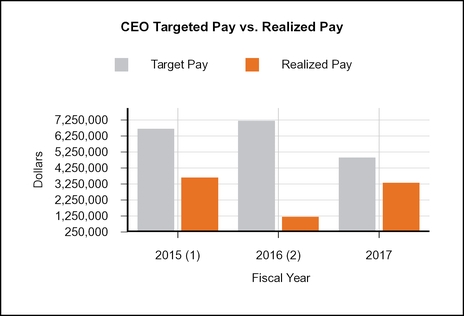
| (1) | The value of the "2015 Annual PSUs", which were earned at 88.9% of target, is included in realized pay for fiscal year 2015. However, the "2015 LTIP RSUs" were not deemed probable to vest and so the value of those awards is not included. |
| (2) | The "2016 Annual PSUs" were not earned and so the value of those awards is not included in realized pay for fiscal year 2016. In addition, the "2016 LTIP RSUs" were not deemed probable to vest and so the value of those awards is not included. |
| (3) | The 2017 Annual PSUs were not earned and so the value of those awards is not included in realized pay for fiscal year 2017. However, the 2017 Time-Based RSUs and the 2017 LTIP NQSOs are deemed probable to vest and so the value of those awards is included for fiscal year 2017. |
The following table further highlights the principal reasons realized pay for our executives has been significantly lower than target pay for the past three fiscal years:
| FISCAL YEAR 2017 | FISCAL YEAR 2016 | FISCAL YEAR 2015 | ||
| • 2017 Annual Cash Incentive Awards did not result in the payment of annual cash bonuses. | • 2016 Annual Cash Incentive Awards did not result in the payment of annual cash bonuses. | • 2015 Annual Cash Incentive Awards were earned at only 78.2% of target. | ||
| • 2017 Annual PSUs were not earned. | • 2016 Annual PSUs were not earned. | • 2015 Annual PSUs were earned at only 88.9% of target. | ||
| • 2016 LTIP RSUs are not expected to be earned. | • 2015 LTIP RSUs are not expected to be earned. |
Other Governance Practices that Strengthen our Philosophy
Our executive compensation program has significant governance components that we believe further strengthen our compensation practices and reduce compensation-related risk, including those summarized in the following table.
| COMPENSATION PRACTICE | WHAT WE DO | |
| Independent Compensation Committee | • The Committee consists entirely of independent directors who meet the independence standards set forth in the applicable SEC and NYSE rules. | |
| Independent Compensation Consultant | • The Committee has retained, and routinely consults with, an independent compensation consultant who assists the Committee in gathering competitive pay data, selecting our Peer Group, and structuring our executive compensation program. | |
| Risk Assessment | • The Committee performs an annual review of its charter and the risks related to our compensation practices. | |
| Stock Ownership Guidelines | • We have adopted stock ownership guidelines for our executive officers and directors, which are reviewed annually. | |
| Clawback Policy | • We have adopted a Clawback Policy related to our cash and equity incentive awards granted after 2011. | |
| Equity Award Vesting Provisions | • Our equity awards are subject to "double-trigger" vesting upon a change of control. | |
| No Tax Gross Ups | • Our Change of Control and Severance Agreements do not contain provisions allowing for excise tax gross up payments. | |
| No Repricing of Awards | • Our 2015 Stock Incentive Plan, or 2015 Plan, explicitly prohibits repricing equity awards. | |
| No Hedging and Pledging | • Our Insider Trading Policy specifically prohibits hedging or pledging our shares, and other similar practices. | |
| No Dividends on Unvested Equity Awards | • Our equity award agreements do not provide for the payment of dividends on unvested awards equity awards. |
Compensation Consultant and Peer Group
Compensation Consultant
The Committee receives assessments and advice regarding our compensation practices and philosophy from its independent compensation consultant, Frederic W. Cook & Co., Inc., or FWC. FWC provides information on competitive pay practices and trends in our industry, and makes recommendations regarding the formulation of our Peer Group, as well as the design and structure of our compensation program. While our Company is not obligated to retain an independent compensation consultant, the Committee believes that the use of an independent consultant provides additional assurance that our executive compensation program is competitive, consistent with market conditions, aligned with our business and strategic objectives, and reflective of our compensation philosophy.
In accordance with applicable SEC rules and regulations, the Committee took certain factors, which it believes may affect the independence of a compensation consultant, into consideration when selecting FWC. In particular, at a meeting of the Committee, the Committee discussed:
| • | whether any other services had been or were being provided by FWC to our Company; |
| • | the amount of fees paid by our Company to FWC as a percent of FWC's total revenues; |
| • | FWC's policies and procedures designed to prevent conflicts, a copy of which was provided to the Committee prior to the meeting; |
| • | FWC's ownership of our common stock (if any); and |
| • | any business or personal relationships between FWC and any Committee members or any of our executive officers. |
Furthermore, FWC does not provide any additional services to us or our management, other than the services that are provided to the Committee in FWC's capacity as our compensation consultant. Following the consideration of these factors, and such additional factors as the Committee deemed appropriate under the circumstances, the Committee made an affirmative determination that FWC is independent and unanimously approved the engagement of FWC.
The decision to engage FWC was made by the Committee, and FWC reports directly to the Committee. Our management did not recommend the engagement of FWC in any capacity for fiscal year 2017 and does not direct or oversee the retention or activities of FWC with respect to our executive compensation program.
Peer Group
In making compensation decisions, the Committee compares target total direct compensation, as well as each element of compensation, against a peer group of publicly-traded footwear, apparel and lifestyle brand companies that was recommended by FWC and approved by the Committee, which we collectively refer to as our Peer Group. Our Peer Group is comprised of companies against which the Committee believes our Company competes for executive talent and stockholder investment, that are in related businesses, and are of similar size and market value. Our Peer Group is reviewed and updated at least annually by the Committee. Except for the removal of Quicksilver, Inc., our Peer Group for fiscal year 2017 was unchanged from fiscal year 2016 and consisted of the following 19 companies:
| DECKERS PEER GROUP FOR FISCAL YEAR 2017 | ||
| • Kate Spade & Company | • Carters, Inc. | • Express, Inc. |
| • Crocs, Inc. | • Fossil Group, Inc. | • Finish Line, Inc. |
| • Skechers U.S.A., Inc. | • Lululemon Athletica, Inc. | • G-III Apparel Group, Ltd. |
| • Steven Madden, Ltd. | • Guess, Inc. | • Columbia Sportswear Company |
| • Oxford Industries, Inc. | • Buckle, Inc. | • Restoration Hardware Holdings, Inc. |
| • Under Armour, Inc. | • Chico's FAS, Inc. | |
| • Wolverine World Wide, Inc. | • DSW, Inc. |
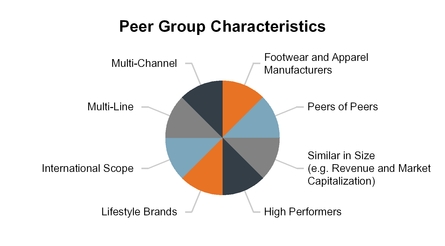
Peer Group Characteristics
The Committee considers a variety of characteristics when it selects our Peer Group, including the characteristics set forth in the table below.
Use of Peer Group in Setting Executive Compensation
As part of its efforts to ensure that our executive compensation program is competitive and consistent with market conditions, the Committee regularly reviews compensation data from our Peer Group provided by FWC. In addition, in order to gain a broader perspective on overall market trends and practices, the Committee regularly reviews data from broader-based compensation surveys.
Our Peer Group compensation data is used as an initial starting point in making compensation decisions for our executive officers, including with respect to both the target level of total direct compensation and the overall structure of our executive compensation program. However, while our Peer Group compensation data is a significant factor in the Committee’s evaluation, it also considers a variety of additional factors when making executive compensation decisions, including complexity and size of business, officers’ tenure, experience, and level of responsibility, recent and projected Company performance, recent individual performance, general industry practices and general economic conditions.
In setting the target level of total direct compensation, the Committee has historically benchmarked our executives’ compensation to the 60th to 75th percentile compared to our Peer Group. The Committee believed that this approach was appropriate because a greater proportion of the target total direct compensation was at-risk and subject to the achievement of Company performance metrics than the compensation programs adopted by our Peer Group, and because it required aspirational (above median) Company performance in order to justify the larger compensation opportunity.
Taking into account the factors discussed above and our management team transition, the Committee has elected to adopt a median pay philosophy going forward. Notably, based on a review of recent Peer Group data, it appears that at least some of our Peer Group companies have significantly increased the target total direct compensation for their executives, which has resulted in the target total direct compensation of certain of our executives moving closer to the median. Pursuant to the median pay philosophy, the Committee will now generally seek to benchmark our executives’ target total direct compensation at the median compared to our Peer Group, subject to the discretion retained by the Committee to make adjustments as it deems appropriate.
In creating the structure of our executive compensation program, the review of our Peer Group compensation data was carefully considered in the context of making a number of important changes for fiscal year 2017. In particular, the Committee’s decision to issue 20% of the equity awards with time-based vesting targets was largely driven by a recognition that many of our Peer Group companies include time-based awards as part of their overall equity compensation program. In addition, the Committee largely based its decision to change the mix of equity awards to be weighed more heavily toward the issuance of performance stock options on an analysis of our Peer Group compensation data.
Elements of Fiscal Year 2017 Executive Compensation Program
The following table provides summary information regarding the key elements of our fiscal year 2017 executive compensation program:
| COMPENSATION ELEMENT | GUARANTEED V. AT-RISK | PERFORMANCE-BASED V. TIME-BASED | CASH/EQUITY/OTHER |
| Base Salary | Guaranteed | Not applicable | Cash |
| 2017 Annual Cash Incentive Awards | At-Risk | Performance-Based (Short-Term Criteria) | Cash |
| 2017 Annual PSUs | At-Risk | Performance-Based (Short-Term Criteria) + Time-Based (Long-Term Vesting) | 20% of Equity Compensation |
| 2017 Time-Based RSUs | At-Risk | Time-Based (Long-Term Vesting) | 20% of Equity Compensation |
| 2017 LTIP NQSOs | At-Risk | Performance-Based (Long-Term Criteria and Vesting) | 60% of Equity Compensation |
| 2017 Discretionary RSUs | At-Risk | Time-Based (Long-Term Vesting) | Other Equity |
| Employee Benefits | Guaranteed | Not applicable | Other |
| Severance and Change of Control | At-Risk | Not applicable | Cash/Equity/Other |
Base Salary
The following table provides information regarding the base salary paid to our NEOs during fiscal year 2017:
| Base Salary Guaranteed ● Cash | |||
| Philosophy | Considerations | Performance Conditions | 2017 Changes |
| Attract and Retain Executives • Pay competitively based on title, experience, scope of responsibility and performance to attract and retain executives that are key to our continued growth and profitability. | • Provides a minimum level of guaranteed cash compensation necessary to attract and retain executives. • Balance the levels of guaranteed pay with at-risk pay to properly manage our compensation-related risk. | • No specific vesting conditions associated with payment. • Salary reviewed and set annually based on a number of factors, including title, scope of responsibilities, individual and Company performance, and our Peer Group data. | • Mr. Powers' base salary was adjusted in connection with his promotion to Chief Executive Officer. • Messrs. George, Lafitte and Caroti received a base salary increase based on a review of our Peer Group data, in order to better align their respective salaries with market comparables. |
Base Salary Changes for Fiscal Year 2017
The following table summarizes adjustments made to the base salaries paid to our NEOs during fiscal year 2017 compared to fiscal year 2016:
| NAME | BASE SALARY | BASE SALARY CHANGE |
| David Powers | $950,000 | Increased by 35.7% (1) |
| Thomas A. George | $575,000 | Increased by 4.5% |
| David E. Lafitte | $620,000 | Increased by 3.3% |
| Stefano Caroti | $550,000 | Increased by 10% |
| Andrea O'Donnell | $500,000 | No change |
(1) Mr. Powers' base salary was adjusted in connection with his promotion to Chief Executive Officer.
2017 Annual Cash Incentive Awards
The following table provides information regarding the 2017 Annual Cash Incentive Awards granted to our NEOs during fiscal year 2017:
| 2017 Annual Cash Incentive Awards At-Risk ● Performance-Based (Short-Term Criteria) ● Cash | |||
| Philosophy | Considerations | Performance Conditions/ Vesting Provisions | 2017 Pay for Performance |
| Pay for Performance • Establish appropriate short-term performance conditions that the Committee believes will drive our future growth and profitability. Reward Achievement • Provide meaningful incentives for achieving Company annual financial goals that the Committee believes are important for our long-term success. Align Interests with Stockholders: • Align the interests of executives with those of our stockholders by tying bonus payout to Company performance. Attract and Retain Executives: • A cash bonus opportunity is considered a typical component of a competitive executive pay package for executives among our Peer Group. | • Company performance conditions based on Committee-approved annual metrics derived from our long-range business and strategic plan. • Use threshold, target and maximum award levels to strike appropriate balance between compensation incentives and risks. • The "target" performance condition level is typically in line with the level of Company performance projected for each metric. | • Target bonus set as percentage of base salary. • Actual bonus payout is based on achievement of fiscal year 2017 consolidated revenue and consolidated operating income (and, for certain executives, business unit revenue and business unit operating income) targets. • The Committee assigned relative weighting to each of these four components, which is expressed as a percentage of the targeted cash incentive amount. • For threshold performance, 50% of the cash incentive relevant to that component would be earned. For target performance, 100% of the cash incentive relevant to that component would be earned. For maximum performance, 200% of the cash incentive relevant to that component would be earned. For performance at a level that is between the threshold and target amounts, or between the target and maximum amounts, the payout for that portion is determined based on a sliding payout scale, as established by the Committee. • When determining Company achievement relative to the performance targets, the Committee relied upon our fiscal year 2017 audited financial statements, as may be adjusted by the Committee for certain non-recurring items. • Achievement below threshold levels results in no payout. | • Fiscal year 2017 consolidated revenue and operating income thresholds were not achieved and therefore no cash incentive payments were made. |
Target Cash Incentive Amount
The Committee establishes a target amount of annual cash incentive compensation for each NEO, which is expressed as a percentage of base salary. The percentage is determined by the Committee by reference to a number of factors, including the executive's title and responsibility, our recent and projected financial performance, and a review of our Peer Group data.
The following table provides the current base salary, target percentage of salary, and resulting target bonus for each NEO for fiscal year 2017:
| NAME | BASE SALARY | TARGET PERCENTAGE OF SALARY | TARGET BONUS |
| David Powers | $950,000 | 100% | $950,000 |
| Thomas A. George | $575,000 | 75% | $431,250 |
| David E. Lafitte | $620,000 | 75% | $465,000 |
| Stefano Caroti | $550,000 | 75% | $412,500 |
| Andrea O'Donnell | $500,000 | 75% | $375,000 |
Performance Targets
The following table summarizes the performance conditions for the 2017 Annual Cash Incentive Awards, the relative weighting of each performance condition for each NEO, and our Company's performance in light of the targets and the resulting payout for each component:
| COMPONENT | RELATIVE WEIGHT FOR EACH NEO | THRESHOLD PERFORMANCE (1) | TARGET PERFORMANCE | MAXIMUM PERFORMANCE | PERFORMANCE AND PAYOUT (1) |
| Consolidated Revenue | • 50% for Messrs. Powers, George and Lafitte • 0% for Mr. Caroti and Ms. O’Donnell | • Consolidated revenue of $1,824.0 million | • Consolidated revenue of $1,900.0 million | • Consolidated revenue of $2,052.0 million | • Consolidated revenue was $1,790.4 million, resulting in no payout |
| Consolidated Operating Income | • 50% for Messrs. Powers, George and Lafitte • 25% for Mr. Caroti and Ms. O’Donnell | • Consolidated operating income of $176.8 million | • Consolidated operating income of $196.4 million | • Consolidated operating income of $235.7 million | • Consolidated operating (loss) income was $(1.9) million, resulting in no payout |
| Business Unit Revenue | • 0% for Messrs. Powers, George and Lafitte | ||||
| • 35% for Mr. Caroti | • Omni-Channel revenue of $1,627.2 million | • Omni-Channel revenue of $1,695.0 million | • Omni-Channel revenue of $1,830.6 million | • Omni-Channel revenue was $1,584.2 million, resulting in no payout | |
| • 35% for Ms. O’Donnell | • Fashion Lifestyle revenue of $1,489.7 million | • Fashion Lifestyle revenue of $1,551.8 million | • Fashion Lifestyle revenue of $1,675.9 million | • Fashion Lifestyle revenue was $1,459.2 million, resulting in no payout | |
| Business Unit Operating Income | • 0% for Messrs. Powers, George and Lafitte | ||||
| • 40% for Mr. Caroti | • Omni-Channel operating income of $326.3 million | • Omni-Channel operating income of $362.5 million | • Omni-Channel operating income of $435.1 million | • Omni-Channel operating income was $296.8 million, resulting in no payout | |
| • 40% for Ms. O’Donnell | • Fashion Lifestyle operating income of $552.5 million | • Fashion Lifestyle operating income of $613.9 million | • Fashion Lifestyle operating income of $736.7 million | • Fashion Lifestyle operating income was $556.9 million, resulting in no payout |
| (1) | Regardless of the level of performance with respect to each component, in order to receive any payments for the 2017 Annual Cash Incentive Awards, both a consolidated operating income threshold of at least $176.8 million and a consolidated revenue threshold of at least $1,824.0 million were required to be achieved. These thresholds were selected by the Committee based on a number of factors, including our long-range strategic plan and our financial performance during the previous fiscal year. |
Calculation of Payout
The amount of cash incentive compensation actually earned for the 2017 Annual Cash Incentive Awards by each NEO is calculated by multiplying the target cash incentive amount by the percentage of target earned for each component, and then multiplying this amount by the relative weighting of each component.
As illustrated in the table above, based on our Company’s performance relative to the various performance targets, none of the NEOs earned any payments for the 2017 Annual Cash Incentive Awards.
2017 Annual Performance Stock Units
The following table provides information regarding the 2017 Annual PSUs granted to our NEOs during fiscal year 2017:
| 2017 Annual PSUs At-Risk ● Performance-Based (Short-Term Criteria) + Time Based (Long-Term Vesting) 20% of Equity Compensation | |||
| Philosophy | Considerations | Performance Conditions/ Vesting Provisions | 2017 Pay for Performance |
| Pay for Performance: • Vesting of awards dependent on achievement of profitability, which the Committee believes is important to our long-term success. Reward Achievement: • Provide incentives for achieving short-term Company financial goals. Align Interests with Stockholders: • Align the interests of executives with those of our stockholders by focusing performance conditions on profitability. Attract and Retain Executives: • Additional time-based vesting once performance conditions are achieved to further encourage retention of our executives. | • Structured as RSUs that may be settled for our common stock. • Company performance condition is based on a Committee-approved metric derived from our long-range business and strategic plan. • EPS is an important indicator of profitability which aligns executives’ interests with those of our stockholders. • Use threshold and target award levels to strike appropriate balance between compensation incentives and risks. • The "target" performance condition level is typically in line with the level of Company performance projected for the metric. | • Vest subject to achievement of EPS target for fiscal year 2017, the year in which they were granted. • If performance conditions are met above the threshold level for the EPS target, the number of 2017 Annual PSUs that will vest will increase based on straight-line interpolation up to a maximum of 100% of the underlying shares. • If performance conditions are met, awards vest based on continued employment in three equal installments over three years. • When determining Company achievement relative to the performance target, the Committee relied upon our fiscal year 2017 audited financial statements, as may be adjusted by the Committee for certain non-recurring items. • Achievement below threshold level results in no vesting. | • The EPS threshold level for fiscal year 2017 was $3.96; the target level was $4.40. • Fiscal year 2017 EPS was $0.18. • Since the fiscal year 2017 EPS threshold level was not achieved, the awards were not earned. |
2017 Time-Based Restricted Stock Units
The following table provides information regarding the 2017 Time-Based RSUs granted to our NEOs during fiscal year 2017:
| 2017 Time-Based RSUs At-Risk ● Time-Based (Long-Term Vesting) 20% of Equity Compensation | |||
| Philosophy | Considerations | Performance Criteria/ Vesting Provisions | 2017 Grants |
| Attract and Retain Executives: • Promote retention of our executives because awards vest over long-term service period. Align Interests with Stockholders: • Align the interests of executives with those of stockholders by issuing equity awards the value of which is correlated to our stock price. | • Balance the level of performance-based pay with time-based pay to properly manage our compensation-related risk. • Primarily used for retention of our executives. • Customary among our Peer Group. | • Awards vest based on continued employment in three equal installments over three years commencing August 15, 2017. | • Messrs. Powers, George, Lafitte and Caroti were granted 2017 Time-Based RSUs in an amount equal to 20% of their total equity compensation for fiscal year 2017. |
2017 Long-Term Incentive Plan Performance Non-Qualified Stock Options
The following table provides information regarding the 2017 LTIP NQSOs granted to our NEOs during fiscal year 2017:
| 2017 LTIP NQSOs At-Risk ● Performance-Based (Long-Term Criteria and Vesting) 60% of Equity Compensation | |||
| Philosophy | Considerations | Performance Conditions/ Vesting Provisions | 2017 Pay for Performance |
| Align Interests with Stockholders: • Align the interests of executives with those of our stockholders by issuing equity awards that increase in value as our stock price increases. Pay-for-Performance: • Vesting of awards dependent on achievement of income, which the Committee believes is important to our long-term success. Reward Achievement: • Provide incentives for achieving long-term Company financial goals. Attract and Retain Executives: • Promote retention of our executives because options vest based on a performance target to be achieved in the future. | • Company performance condition is based on a Committee-approved metric derived from our long-range business and strategic plan. • Pre-Tax Income supports our focus on income as a key business driver and is an important indicator of growth and profitability, which aligns executives’ interests with the execution of our long-range plan. • Pre-Tax Income was selected as the performance metric given our continued focus on margin improvement, inventory control, cost savings, and restructuring. • Granted with an exercise price equal to fair market value on the grant date, and only have value to the extent the price of our common stock goes up over time, and only if the performance threshold is met. | • Vest subject to the achievement of a pre-established Pre-Tax Income target for fiscal year 2019. • Awards will vest as to 100% of the underlying shares if we achieve the Pre-Tax Income target. If the Pre-Tax Income target is not achieved, no vesting will occur and the awards will expire immediately. • The executive must provide continued service through March 31, 2019. • When determining Company achievement relative to the performance target, the Committee will rely upon our fiscal year 2019 audited financial statements, as may be adjusted by the Committee for certain non-recurring items. | • As of the date of this Amendment, we consider the 2017 LTIP NQSOs to be probable of vesting. |
2017 Discretionary Restricted Stock Units
The following table provides information regarding the 2017 Discretionary RSUs granted to two of our NEOs during fiscal year 2017:
| 2017 Discretionary RSUs At-Risk ● Time-Based (Long-Term Vesting) ● Individual | |||
| Philosophy | Considerations | Performance Criteria/ Vesting Provisions | 2017 Grants |
| Attract and Retain Executives: • Attract and retain executives by offering compensation that is competitive in the marketplace. Align Interests with Stockholders: • Align the interests of executives with those of stockholders by issuing equity awards the value of which is correlated to our stock price. | • Primarily used for hiring and promotional needs and other unique circumstances. • Balance the level of performance-based pay with time-based pay to properly manage our compensation-related risk. • Ensure equitable allocation relative to our other executives and our Peer Group. | • Awards vest based on continued employment in three equal installments over three years commencing August 15, 2017. | • Mr. Caroti was granted discretionary RSUs based on his title and level of responsibility, as well as a review of our Peer Group data. • Ms. O'Donnell was granted discretionary RSUs in connection with her appointment as President of Fashion Lifestyle. |
As discussed in the section of this Amendment titled "Potential Payments Upon Termination or Change of Control" below, the vesting of certain equity awards described above may be accelerated for under certain circumstances.
Employee Benefits
The following table provides information regarding the key employee benefits granted or paid to our NEOs during fiscal year 2017:
| Employee Benefits | |||
| Philosophy | Considerations | Benefits | |
| Attract and Retain Executives: • Provide our NEOs with competitive broad-based employee benefits structured to attract and retain key executives. | • Generally reflect benefits provided to all of our US-based full-time employees. • Provides a standard package of benefits necessary to attract and retain executives. | • 401(k) defined contribution plan. • 401(k) plan Company match of 50% of each eligible participant's tax-deferred contributions on up to 6% of eligible compensation on a per payroll period basis, with a true-up contribution if such eligible participant is employed by our Company on the 1st day of the calendar year. • Premiums for long-term disability insurance and life insurance for the benefit of the employees. • Health and welfare benefit plans. • Relocation expenses for new hires. • Standard employee product discounts. • NEOs and certain other senior executives are eligible to contribute to our Nonqualified Deferred Compensation Plan, or NQDC Plan, and our Company may choose to match any or all such contributions. The NQDC Plan is described in further detail in the section of this Amendment titled "Nonqualified Deferred Compensation". |
Severance and Change of Control
The following table provides information regarding the severance and change of control provisions in our severance agreements and equity award agreements entered into with each of our NEOs:
| Severance and Change of Control Provisions | |||
| Philosophy | Considerations | Terms | |
| Attract and Retain Executives: • Retain and encourage the NEOs to remain focused on our business and the interests of our stockholders when considering strategic alternatives. • Intended to ease an NEOs transition due to an unexpected employment termination. • These provisions are considered a typical component of a competitive executive pay package for executives among our Peer Group. | • The employment of our NEOs is "at will", meaning we can terminate them at any time and they can terminate their employment with us at any time. • Take into account the time it is expected to take a separated executive to find a similarly situated job. • "Double-trigger" provisions preserve morale and productivity and encourage executive retention in the face of the potential disruptive impact of a change of control. | Change of Control and Severance Agreements: • Provide for certain cash payments, and the vesting of certain equity awards, in the event that there is a separation of employment under various circumstances. Equity Award Agreements: • Provide for accelerated vesting of awards upon a change of control if the recipient is terminated by the acquiring entity in connection with the change of control under specified circumstances. In addition, vesting of awards will be accelerated in full if the transaction is not approved by a majority of the continuing directors or the acquiring entity does not agree to provide for the assumption or substitution of the awards. |
For additional information about the severance and change of control provisions in our severance agreements and equity award agreements, please see the section of this Amendment entitled "Potential Payments upon Termination or Change of Control".
Other Compensation-Related Topics
Role of Executive Officers in Compensation Decisions
At the request of the Committee, our Chief Executive Officer may provide compensation information to the Committee to inform its compensation decisions. In addition, the Committee may consider the recommendations of our senior executives when making its compensation decisions. However, our executives are not permitted to be present during any deliberations and voting regarding their own compensation, or during other executive sessions of the Committee. The Committee considers the information provided by our management, as well as information and extensive analysis and advice provided by FWC, to make compensation decisions for our NEOs and other executive officers. The Committee, which is comprised solely of independent directors under applicable SEC and NYSE rules, reviews and approves all elements of compensation for our NEOs and other executive officers.
Compensation Risk Considerations
The Committee is responsible for reviewing the risks attendant to, and the rewards that may be derived from our compensation programs for all employees, including our NEOs, to assess whether these programs encourage excessive or unnecessary risk-taking. The Committee conducts a thorough compensation risk analysis at a meeting at least once per year, but also takes into account compensation-related risks each time it grants compensation awards throughout the fiscal year. In conducting these assessments, the Committee considers a number of factors including the following:
| • | Our compensation program consists of both guaranteed pay and at-risk pay, and the Committee reviews this mix annually. |
| • | Our Peer Group and industry compensation data is reviewed regularly to ensure alignment with our compensation program and market competitiveness. |
| • | We have adopted a median pay philosophy whereby we will seek to pay our executives’ target total direct compensation at the median compared to our Peer Group. |
| • | Performance-based awards are earned based on the achievement of a number of distinct Company and business unit performance goals. |
| • | Our performance-based awards are subject to maximum award amounts to limit the potential compensation amount associated with an award. |
| • | Our executive compensation program encourages executive retention through long-term vesting provisions. For fiscal year 2017, all of the equity awards we granted were subject to a minimum three-year vesting period. |
| • | We have adopted stock ownership guidelines, which encourage executives to have a significant, long-term equity position in our Company. |
| • | Our performance-based awards are subject to clawback provisions. |
| • | Our insider trading policy prohibits our NEOs and other executive officers from hedging the economic interest in our securities, and from pledging our securities. |
| • | Our severance and change of control benefits are designed to attract and retain executives without providing excessive benefits. |
| • | Our equity awards are intended to provide for “double-trigger” vesting upon a change of control. We have adopted changes to our equity award agreements commencing in fiscal year 2018 to ensure our awards continue to be viewed as “double-trigger” awards. |
The Committee believes that, although the majority of the target total direct compensation provided to our executive officers is at-risk pay that is determined based upon the achievement of pre-established Company performance conditions, our executive compensation program does not encourage excessive or unnecessary risk-taking. The Committee does not believe that our compensation programs are reasonably likely to have a material adverse effect on us.
Clawback Policy
Consistent with our executive compensation philosophy, which seeks to reward executive officers for financial performance that creates value for our stockholders, we have adopted a Clawback Policy. Under this policy, we will seek reimbursement with respect to performance-based compensation paid or awarded to our executive officers when the following three factors exists:
| • | the incentive compensation payment or award (or the vesting of such award) was based upon the achievement of financial results, as reported in a Form 10-Q, Form 10-K or other report filed with the SEC, that were subsequently the subject of a restatement to correct an accounting error due to material noncompliance with any financial reporting requirement under the federal securities laws; |
| • | a lower payment or award would have been made to such executive officer (or lesser or no vesting would have occurred with respect to such award) based upon the restated financial results; and |
| • | the need for the restatement was identified within three years after the date of the first public issuance or filing of the financial results that were subsequently restated. |
The reimbursement to be sought by our Company will be equal to the portion of any performance-based compensation paid to or received by such executive officer for or during each of the restated periods that is greater than the amount that would have been paid or received had the financial results been properly reported.
Stock Ownership Guidelines
To further align the interests of our directors and executive officers with those of our stockholders, we have adopted Stock Ownership Guidelines. The minimum ownership thresholds for our NEOs are determined as a multiple of the executive officer's base salary. The NEOs are required to achieve the applicable level of ownership within five years of the later of the date the guidelines were adopted or the date the person first became subject to the guidelines as an NEO, subject to exceptions that may be granted by the Committee. Our directors are required to adhere to the stock ownership guidelines that are referenced in our Corporate Governance Guidelines. The minimum ownership threshold for our directors is determined as a multiple of the directors' annual retainer fee and must be adhered to within five years of the initial election of the director.
The following table provides a summary of the Stock Ownership Guidelines applicable to our NEOs and directors:
| POSITION | STOCK OWNERSHIP GUIDELINES | COMPLIANCE PERIOD |
| Chief Executive Officer | 6x Annual Base Salary | Within 5 years of being appointed as an NEO |
| Other NEOs | 3x Annual Base Salary | Within 5 years of being appointed as an NEO |
| Directors | 5x Annual Board Retainer Fee | Within 5 years of initial election to our Board |
Tax and Accounting Considerations
Among the factors it considers when making executive compensation decisions, the Committee considers the anticipated tax and accounting impact to our Company (and to our executive officers) of various payments, equity awards and other benefits.
Under Section 162(m) of the Internal Revenue Code, or Code, a public company generally will not be entitled to a tax deduction for compensation paid to certain executive officers that exceeds $1.0 million per year, to the extent such compensation is not considered to be “performance-based”. Special rules apply for “performance-based” compensation where the performance goals have been approved by stockholders. While the Committee has not adopted any formal policy with respect to compliance with Section 162(m) of the Code, it generally attempts to make its annual compensation decisions in a manner designed to result in the deductibility of compensation awards. The Committee may approve such payments where it believes they are in the best interests of our Company, including for the purpose of hiring, promoting or retaining key executives, rewarding individual or Company performance, or ensuring our executive compensation program complies with our executive compensation philosophy.
The awards issuable under our 2015 Plan were designed to meet the requirements for “performance-based” compensation pursuant to Section 162(m) of the Code. Accordingly, we believe that the 2017 Annual Cash Incentive Awards, the 2017 Annual PSUs and the 2017 LTIP NQSOs all qualify as “performance-based”, so we expect each of these compensation awards to be fully deductible.
We account for equity awards in accordance with the requirements of Financial Accounting Standards Board Accounting Standards Codification Topic 718, Stock Compensation.
Our Change of Control and Severance Agreements do not allow for excise tax gross up payments.
Compensation Committee Interlocks and Insider Participation
As of the date of this Amendment, no member of the Committee is serving, and during the past year no member of the Committee has served, as an officer or employee of our Company or any of its subsidiaries. None of our executive officers currently serves, or during the past year has served, as a member of the board of directors or compensation committee (or other committee serving a similar purpose) of any entity that has an executive officer serving on our Board or Compensation Committee. In addition, none of the Committee members had any relationship, or participated in any transaction, with our Company during 2017 that requires disclosure under SEC regulations.
We have entered into indemnification agreements with each of our directors, including each member of the Committee.
Report of the Compensation Committee
The Compensation Committee of our Company has reviewed and discussed the Compensation Discussion and Analysis required by Item 402(b) of Regulation S-K with management and, based on such review and discussion, the Compensation Committee has recommended to our Board that the Compensation Discussion and Analysis be included in this Amendment.
| THE COMPENSATION COMMITTEE | ||
| Lauri M. Shanahan, Chairman | ||
| Karyn O. Barsa | ||
| John G. Perenchio | ||
| Michael F. Devine, III |
The Report of the Compensation Committee shall not be deemed incorporated by reference by any general statement incorporating by reference this Amendment into any filing under the Securities Act of 1933, as amended, or under the Exchange Act, except to the extent that our Company specifically incorporates this information by reference, and shall not otherwise be deemed filed under such acts.
Summary Compensation Table
The following table sets forth all compensation awarded to our NEOs during fiscal years 2017, 2016 and 2015. The amounts included in the table have been calculated in accordance with the requirements of applicable SEC regulations, and do not necessarily reflect the amounts that have actually been paid to, or which may be realized by, our NEOs. The table should be read together with the section of this Amendment titled "Compensation Discussion and Analysis".
| Name and Principal Position | Year | Salary ($) | Bonus ($) | Stock Awards ($)(1) | Option Awards ($)(1) | Non-Equity Incentive Plan Comp. ($)(2) | All Other Comp. ($)(3) | Total ($) | |||||||||||||||
| David Powers Chief Executive Officer | 2017 | 901,923 | — | 1,200,043 | 1,788,698 | — | 10,325 | 3,900,989 | |||||||||||||||
| 2016 | 700,000 | — | 2,500,025 | — | — | 9,480 | 3,209,505 | ||||||||||||||||
| 2015 | 600,000 | — | 1,150,051 | — | 439,813 | 9,368 | 2,199,232 | ||||||||||||||||
| Thomas A. George Chief Financial Officer | 2017 | 567,308 | — | 339,953 | 506,801 | — | 22,592 | 1,436,654 | |||||||||||||||
| 2016 | 550,000 | — | 849,983 | — | — | 9,480 | 1,409,463 | ||||||||||||||||
| 2015 | 510,000 | — | 800,035 | — | 373,841 | 9,368 | 1,693,244 | ||||||||||||||||
| David Lafitte Chief Operating Officer | 2017 | 613,846 | — | 360,024 | 536,617 | — | 20,371 | 1,530,858 | |||||||||||||||
| 2016 | 600,000 | — | 749,963 | — | — | 9,480 | 1,359,443 | ||||||||||||||||
| 2015 | 100,000 | 300,000 | 899,997 | — | — | 1,580 | 1,301,577 | ||||||||||||||||
| Stefano Caroti (4) President of Omni-Channel | 2017 | 534,615 | — | 730,027 | 491,906 | — | 31,538 | 1,788,086 | |||||||||||||||
| 2016 | 208,333 | 150,000 | 699,990 | — | — | 39,591 | 1,097,914 | ||||||||||||||||
| Andrea O'Donnell (5) President of Fashion Lifestyle | 2017 | 451,923 | 250,000 (6) | 799,991 | 372,640 | — | 185,326 (7) | 2,059,880 | |||||||||||||||
| Angel R. Martinez (8) Former Chief Executive Officer Non-Executive Chairman of our Board | 2017 | 240,000 | — | 97,354 (9) | — | — | 606,473 (10) | 943,827 | |||||||||||||||
| 2016 | 1,200,000 | — | 4,500,001 | — | — | 9,480 | 5,709,481 | ||||||||||||||||
| 2015 | 1,200,000 | — | 4,000,004 | — | 1,466,042 | 9,368 | 6,675,414 |
| (1) | The amounts in this column represent the aggregate grant date fair value of the respective awards computed in accordance with FASB ASC Topic 718. For information about the assumptions underlying these computations, please refer to Note 8 to our consolidated financial statements included in our Annual Report on Form 10-K. In accordance with applicable SEC regulations, for those awards that are subject to the satisfaction of performance conditions, the amounts reported reflect the value at the grant date based upon the probable outcome of such conditions. |
| (2) | These amounts reflect the cash incentive payments paid to our NEOs under our Management Incentive Plan. For fiscal year 2017, the performance thresholds were not achieved and therefore no cash incentive payments were made. Refer to the section of this Amendment titled "2017 Annual Cash Incentive Awards” for additional information. |
| (3) | Except as otherwise specifically noted in the footnotes below, the amounts in this column reflect our matching contributions under the 401(k) plan and NQDC Plan, as well as life insurance premiums paid on policies that have been adopted for the benefit of our NEOs. |
| (4) | Mr. Caroti joined us in November 2015 as President of Omni-Channel, and initially became an NEO commencing with fiscal year 2016. |
| (5) | Ms.O'Donnell joined us in April 2016 as President of Fashion Lifestyle, and initially became an NEO commencing with fiscal year 2017. |
| (6) | This amount reflects a one-time sign-on bonus paid to Ms. O'Donnell when she was hired as President of Fashion Lifestyle. |
| (7) | In addition to certain payments referred to in footnote 3 above, we paid Ms. O'Donnell aggregate relocation expenses in the amount of $177,673. |
| (8) | Mr. Martinez retired from his position as Chief Executive Officer in May 2016, although he continues to serve as non-executive Chairman of our Board. |
| (9) | This amount reflects the grant date fair value of a stock award received by Mr. Martinez in connection with his service on our Board. This amount has separately been reported in the "Director Compensation Table", and does not reflect an amount in addition to the amount in that table. |
| (10) | In addition to certain payments referred to in footnote 3 above, we paid Mr. Martinez (i) $416,668 in consulting fees, and (ii) $187,500 in director retainer fees following his retirement as our Chief Executive Officer. The director retainer fees have separately been reported in the "Director Compensation Table", and do not reflect an amount in addition to the amount in that table. Refer to the sections of this Amendment titled "Consulting Agreement with Angel R. Martinez" and "Director Compensation" for additional information. |
Grants of Plan-Based Awards in Fiscal Year 2017
The following table sets forth all grants of plan-based awards made to our NEOs during the fiscal year ended March 31, 2017. The amounts set forth in the table do not necessarily reflect the amounts that have actually been paid to, or which may be realized by, our NEOs. The table should be read together with the section of this Amendment titled "Elements of Fiscal Year 2017 Executive Compensation Program".
| Estimated Payouts Under Non-Equity Incentive Plan Awards(1) | Estimated Payouts Under Equity Incentive Plan Awards(2) | All Other Stock Awards: Number of Shares (#)(3) | All Other Option Awards: Number of Shares Underlying Options (#)(4) | Exercise Price of Option Awards ($) | Grant Date Fair Value of Awards ($)(5) | |||||||||||||||||
| Name | Grant Date | Threshold ($) | Target ($) | Max. ($) | Threshold (#) | Target (#) | Max. (#) | |||||||||||||||
| David Powers | 475,000 | 950,000 | 1,900,000 | — | — | — | — | — | — | — | ||||||||||||
| 6/29/16 | — | — | — | — | — | — | 10,523 | — | — | 600,021 | ||||||||||||
| 6/29/16 | — | — | — | 5,262 | 10,523 | 10,523 | — | — | — | 600,021 | ||||||||||||
| 11/21/16 | — | — | — | — | — | — | — | 68,089 | 61.86 | 1,788,698 | ||||||||||||
| Thomas A. George | 215,625 | 431,250 | 862,500 | — | — | — | — | — | — | — | ||||||||||||
| 6/29/16 | — | — | — | — | — | — | 2,981 | — | — | 169,977 | ||||||||||||
| 6/29/16 | — | — | — | 1,491 | 2,981 | 2,981 | — | — | — | 169,977 | ||||||||||||
| 11/21/16 | — | — | — | — | — | — | — | 19,292 | 61.86 | 506,801 | ||||||||||||
| David E. Lafitte | 232,500 | 465,000 | 930,000 | — | — | — | — | — | — | — | ||||||||||||
| 6/29/16 | — | — | — | — | — | — | 3,157 | — | — | 180,012 | ||||||||||||
| 6/29/16 | — | — | — | 1,579 | 3,157 | 3,157 | — | — | — | 180,012 | ||||||||||||
| 11/21/16 | — | — | — | — | — | — | — | 20,427 | 61.86 | 536,617 | ||||||||||||
| Stefano Caroti | 206,250 | 412,500 | 825,000 | — | — | — | — | — | — | — | ||||||||||||
| 6/29/16 | — | — | — | — | — | — | 2,894 | — | — | 165,016 | ||||||||||||
| 6/29/16(6) | — | — | — | — | — | — | 7,015 | — | — | 399,995 | ||||||||||||
| 6/29/16 | — | — | — | 1,447 | 2,894 | 2,894 | — | — | — | 165,016 | ||||||||||||
| 11/21/16 | — | — | — | — | — | — | — | 18,725 | 61.86 | 491,906 | ||||||||||||
| Andrea O'Donnell | 187,500 | 375,000 | 750,000 | — | — | — | — | — | — | — | ||||||||||||
| 6/15/16(7) | — | — | — | — | — | — | 6,284 | — | — | 350,019 | ||||||||||||
| 6/15/16(8) | — | — | — | 1,768 | 3,536 | 7,072 | — | — | — | 199,996 | ||||||||||||
| 6/29/16 (9) | — | — | — | — | — | — | 4,384 | — | — | 249,976 | ||||||||||||
| 11/21/16 | — | — | — | — | — | — | — | 14,185 | 61.86 | 372,640 | ||||||||||||
| Angel R. Martinez (10) | — | — | — | — | — | — | — | — | — | — | — |
| (1) | The amounts set forth in this column reflect the potential payouts under the Management Incentive Plan. Because the performance thresholds were not achieved, no cash incentive payments were made. Refer to the section of this Amendment titled "2017 Annual Cash Incentive Awards” for additional information. |
| (2) | The awards in this column reflect the grant of 2017 Annual PSUs. Because the performance condition was not met at the threshold level, these awards were not earned. Refer to the section of this Amendment titled "2017 Annual Performance Stock Units" for additional information. |
| (3) | Except as noted in footnote 6 below, the awards in this column reflect the grant of 2017 Time-Based RSUs. These awards vest over three years in equal annual installments on August 15, 2017, 2018 and 2019. Refer to the section of this Amendment titled "2017 Time-Based Restricted Stock Units" for additional information. |
| (4) | The awards in this column reflect the grant of 2017 LTIP NQSOs. These awards may vest based upon our achievement of a performance target for fiscal year 2019. As of the date of this Amendment, we consider the awards to be probable of being achieved. Refer to the section of this Amendment titled "2017 Long-Term Incentive Plan Performance Non-Qualified Stock Options" for additional information. |
| (5) | The amounts in this column represent the aggregate grant date fair value of the respective awards computed in accordance with FASB ASC Topic 718. For information about the assumptions underlying these computations, please refer to Note 8 to our consolidated financial statements included in our Annual Report on Form 10-K. In accordance with applicable SEC regulations, for those awards that are subject to the satisfaction of performance conditions, the amounts reported reflect the value at the grant date based upon the probable outcome of such conditions. |
| (6) | This award reflects the grant of discretionary RSUs. The award vests over three years in equal annual installments on August 15, 2017, 2018 and 2019. Refer to the section of this Amendment titled "2017 Discretionary Restricted Stock Units" for additional information. |
| (7) | This award reflects the one-time grant of discretionary RSUs in connection with hiring Ms. O’Donnell in April 2016 as President of Fashion Lifestyle. The award vests over three years in equal annual installments on August 15, 2017, 2018 and 2019. Refer to the section of this Amendment titled "2017 Discretionary Restricted Stock Units" for additional information. |
| (8) | This award reflects the grant of performance-based RSUs in connection with hiring Ms. O’Donnell. The award was granted on terms consistent with the 2016 LTIP PSUs that were granted to our named executive officers for fiscal year 2016. The award was granted to Ms. O'Donnell in lieu of a grant of 2017 Annual PSUs, as she was not eligible to receive those awards based on her date of hire. Ms. O'Donnell is the only NEO who was granted this form of award in fiscal year 2017. The award may vest based upon our achievement of a performance target for fiscal year 2018. As of the date of this Amendment, we believe it is not probable that the performance conditions relating to this award will be met. |
| (9) | This award reflects the grant of discretionary RSUs in connection with hiring Ms. O’Donnell. The award was granted to Ms. O’Donnell in lieu of a grant of 2017 Time-Based RSUs. The award vests over three years in equal annual installments on August 15, 2017, 2018 and 2019. Refer to the section of this Amendment titled "2017 Discretionary Restricted Stock Units" for additional information. |
| (10) | Mr. Martinez retired from his position as Chief Executive Officer in May 2016, although he continues to serve as non-executive Chairman of our Board. The only plan-based award he received in fiscal year 2017 was issued in connection with his service on our Board. The grant date fair value of this award has been reported in the section of this Amendment titled "Director Compensation Table" below. |
Outstanding Equity Awards at 2017 Fiscal Year End
The following table sets forth equity awards granted to our NEOs that remained outstanding as of March 31, 2017. The market value of the awards reflected in the table have been calculated in accordance with the requirements of applicable SEC regulations, and do not necessarily reflect the amounts that have been paid to, or which may be realized by, our NEOs. The table should be read together with the section of this Amendment titled "Elements of Fiscal Year 2017 Executive Compensation Program".
| Stock Options (1) | Stock Awards | ||||||||||||||||
| Name | Number of securities underlying unexercised options exercisable (#) | Number of securities underlying unexercised unearned options (#) | Option exercise price ($) | Option expiration date | Number of shares that have not vested (#) | Market value of shares that have not vested ($)(2) | Number of unearned shares that have not vested (3)(#) | Market value of unearned shares that have not vested ($)(2) | |||||||||
| David Powers | — | 68,089 | 61.86 | 3/31/2026 | 12,107 | (4 | ) | 723,151 | 59,940 | 1,790,108 | |||||||
| Thomas A. George | — | 19,292 | 61.86 | 3/31/2026 | 4,083 | (5 | ) | 243,878 | 20,380 | 608,649 | |||||||
| David E. Lafitte | — | 20,427 | 61.86 | 3/31/2026 | 7,507 | (6 | ) | 448,393 | 17,982 | 537,032 | |||||||
| Stefano Caroti | — | 18,725 | 61.86 | 3/31/2026 | 5,913 | (7 | ) | 353,183 | 17,982 | 537,032 | |||||||
| Andrea O'Donnell | — | 14,185 | 61.86 | 3/31/2026 | 6,284 | (8 | ) | 375,343 | 7,072 | 211,205 | |||||||
| Angel R. Martinez | 240,000 (9) | — | 26.73 | 5/9/2022 | 5,511 | (10 | ) | 329,172 | 107,892 | 3,222,195 |
| (1) | Each of the stock option awards reflected in these columns are 2017 LTIP NQSOs that were granted in November 2016. The options vest as to 33.3% of the shares on August 15, 2017, 2018 and 2019. |
| (2) | In accordance with applicable SEC regulations, market value of the shares has been determined based on the closing price of our common stock on March 31, 2017, which was $59.73. |
| (3) | These amounts reflect 2016 LTIP PSUs granted in November 2015 (and in June 2016 for Ms. O'Donnell), which remain outstanding and subject to long-term performance and service conditions. The shares included reflect achievement of the performance conditions at the maximum performance level. However, as of March 31, 2017, we believe it is not probable that the "target" performance conditions will be met. |
| (4) | This amount consists of (i) 1,584 2015 Annual PSUs granted in June 2014, which vest on March 31, 2018, and (ii) 10,523 time-based RSUs granted in June 2016, which vest as to 33.3% of the shares on August 15, 2017, 2018 and 2019. |
| (5) | This amount consists of (i) 1,102 2015 Annual PSUs granted in June 2014, which vest on March 31, 2018, and (ii) 2,981 time-based RSUs granted in June 2016, which vest as to 33.3% of the shares on August 15, 2017, 2018 and 2019. |
| (6) | This amount consists of (i) 4,350 time-based RSUs granted in February 2015, which vest on February 2, 2018, and (ii) 3,157 time-based RSUs granted in June 2016, which vest as to 33.3% of the shares on August 15, 2017, 2018 and 2019. |
| (7) | This amount consists of (i) 3,019 time-based RSUs granted in November 2015, which vest as to 50% of the shares on November 15, 2017 and 2018, and (ii) 2,894 time-based RSUs granted in June 2016, which vest as to 33.3% of the shares on August 15, 2017, 2018 and 2019. |
| (8) | This amount consists of 6,284 time-based RSUs granted in June 2016, which vest as to 33.3% of the shares on June 15, 2017, 2018 and 2019. |
| (9) | This amount consists of stock appreciation rights, or SARs, that were granted in May 2007 and vested on December 31, 2011 based on satisfying long-term performance and service conditions. |
| (10) | Consists of 5,511 2015 Annual PSUs granted in June 2014, which vest on March 31, 2018. |
Fiscal Year 2017 Option Exercises and Stock Vested
The following table provides information for our NEOs regarding option exercises and stock award vesting during fiscal year 2017, including the number of shares acquired upon exercise or vesting and the value realized as determined based on applicable SEC regulations. The value realized does not necessarily reflect the actual amount that will be paid to our NEOs upon the sale of the shares.
| Option Awards | Stock Awards | |||||||
| Number of Shares Acquired on Exercise (#) | Value Realized on Exercise ($)(1) | Number of Shares Acquired on Vesting (#)(2) | Value Realized on Vesting ($)(3) | |||||
| David Powers | — | — | 4,918 | 288,286 | ||||
| Thomas A. George | — | — | 6,603 | 385,377 | ||||
| David E. Lafitte | — | — | 4,351 | 241,655 | ||||
| Stefano Caroti | — | — | 1,509 | 91,642 | ||||
| Andrea O'Donnell | — | — | — | — | ||||
| Angel R. Martinez | 90,771 (4) | 5,744,355 | 14,843 | 871,266 |
| (1) | The amounts in this column reflect the value realized upon the exercise of the option awards, based on the closing price of our common stock on the applicable exercise dates. |
| (2) | The total number of shares actually received by the NEOs, net of shares withheld for taxes, were as follows: 3,071 for David Powers, 4,133 for Thomas A. George, 2,642 for David E. Lafitte, 942 for Stefano Caroti, and 7,099 for Angel Martinez. |
| (3) | The amounts in this column reflect the value realized upon the vesting of the stock awards, based on the closing price of our common stock on the applicable vesting dates. |
| (4) | This amount consists of SARs that were granted in May 2007 and vested on December 31, 2011 based on satisfying long-term performance and service conditions. |
Nonqualified Deferred Compensation
Nonqualified Deferred Compensation Plan
The Compensation Committee has adopted the NQDC Plan, which is an unfunded, nonqualified deferred compensation program sponsored by our Company to provide certain members of our management the opportunity to defer compensation into the NQDC Plan. The NQDC Plan year is from January 1st to December 31st. Participants may defer up to 50% of their annual base salary and up to 85% of any cash incentive bonus under the NQDC Plan. We have the option, but not the obligation, to make discretionary or matching cash contributions to NQDC Plan participants. We have established a rabbi trust as a reserve for the benefits payable under the NQDC Plan. During fiscal year 2017, certain of our NEOs elected to make contributions to the NQDC Plan, and the Compensation Committee elected to match a portion of the contributions under the NQDC Plan.
| Name | David Powers | Thomas A. George | David Lafitte | Stefano Caroti | Andrea O'Donnell | Angel R. Martinez | Total | ||||||||||||||
| Executive contributions during fiscal year 2017 ($) (1) | — | 68,077 | 94,154 | 194,872 | — | — | 357,103 | ||||||||||||||
| Registrant contributions during fiscal year 2017 ($) (2) | — | 8,925 | 10,350 | 7,800 | — | — | 27,075 | ||||||||||||||
| Aggregate (losses) earnings during fiscal year 2017 ($) | 13,456 | 28,976 | 15,729 | 29,981 | — | 245,431 | 333,573 | ||||||||||||||
| Aggregate withdrawals/distributions during fiscal year 2017 ($) | — | — | — | — | — | (2,942,577 | ) | (2,942,577 | ) | ||||||||||||
| Aggregate balance at end of fiscal year 2017 ($) | 83,321 | 316,213 | 149,472 | 274,801 | — | 644,789 | 1,468,596 |
| (1) | The amounts reported in this row reflect contributions made by our NEOs under the NQDC Plan during fiscal year 2017. These amounts are separately included in the "Summary Compensation Table" above, and do not reflect amounts in addition to those amounts. |
| (2) | The amounts reported in this row reflect contributions made by us to our NEOs under the NQDC Plan during fiscal year 2017. These amounts are separately included in the "Summary Compensation Table" above, and do not reflect amounts in addition to those amounts. |
Deferred Stock Unit Compensation Plan
The Compensation Committee has also adopted a Deferred Stock Unit Compensation Plan. Under the plan, a director or employee who holds unvested restricted stock awards may elect to defer settlement of up to 100% of the awards. For each unit of our common stock held pursuant to a restricted stock award that is deferred, the participant will receive one Deferred Stock Unit. Amounts deferred will be distributed, as described in the plan, at the time elected by the participant. A participant's Deferred Stock Units will be settled in shares of our common stock, as more specifically described in the plan. None of our NEOs elected to participate in the plan during fiscal year 2017.
Potential Payments Upon Termination or Change of Control
Change of Control and Severance Agreements
We have entered into Change of Control and Severance Agreements, or Severance Agreements, with each of our NEOs. The information below describes compensation and benefits that are payable or earned under the Severance Agreements with our NEOs (which are each referred to therein as "Executive") upon the occurrence of different termination events:
Termination by our Company for Cause, or by Executive other than for Good Reason
Pursuant to the Severance Agreements with each of our NEOs, if the executive is terminated by our Company for Cause, or the executive terminates his or her employment, other than for Good Reason, then the NEO will receive the following from our Company:
| • | payment of his or her accrued base salary, accrued vacation, reimbursement for reimbursable expenses, accrued and vested benefits under our plans or programs and other benefits required to be paid by law, accrued but unpaid non-equity incentive bonus for the prior fiscal year (excluding any non-equity incentive bonus for the year of termination); and |
| • | right to exercise all vested equity awards pursuant to the terms of the applicable award agreement. |
Termination due to Death or Total Disability
Pursuant to the Severance Agreements with each of our NEOs, if the executive is terminated due to his or her death or Total Disability, then in addition to those benefits provided upon a termination by our Company for Cause or by Executive other than for Good Reason, the NEO will receive:
| • | pro-rated portion of his or her non-equity incentive bonus for the current fiscal year based on actual length of service during the year of termination and actual achievement by our Company of the performance conditions in respect of such bonus previously established by the Committee. |
Termination by our Company without Cause or by Executive for Good Reason
Pursuant to the Severance Agreements with each of our NEOs, if the executive is terminated by our Company without Cause or by Executive for Good Reason, then in addition to those benefits provided upon a termination due to death or Total Disability, the NEO will receive:
| • | payment of his or her then effective annual base salary for one year following his or her termination, subject to such executive signing a release; and |
| • | receipt of health benefits for a period of one year following his or her termination or his or her attainment of alternative employment that provides health benefits, whichever is earlier. |
Termination without Cause or by Executive for Good Reason within Two Years of a Change of Control
Pursuant to the Severance Agreements with each of our NEOs, if the executive is terminated by our Company without Cause or by the executive for Good Reason within two years of a Change of Control, then in addition to those benefits provided upon a termination due to Death or Total Disability, the NEO will receive:
| • | subject to such executive signing a release, payment of a specified proportion of his or her then effective annual base salary plus the greater of (i) one and one-half times the targeted non-equity incentive bonus immediately prior to the termination or (ii) one and one-half times the average actual non-equity incentive bonus for the previous three years; and |
| • | receipt of health benefits for a specified period of months following his or her termination or his or her attainment of alternative employment that provides health benefits, whichever is earlier. |
For purposes of the Severance Agreements, "Cause" means (i) any willful breach of duty by the executive in the course of their employment or continued violation of written Company employment policies after written notice of such violation, (ii) violation of our insider trading policies, (iii) conviction of a felony or any crime involving fraud, theft, embezzlement, dishonesty or moral turpitude, (iv) engaging in activities which materially defame our Company, engaging in conduct which is materially injurious to our Company or our affiliates, or any of our respective customer or supplier relationships,
financially or otherwise, or (v) the executive's gross negligence or continued failure to perform duties or executive's continued incapacity to perform such duties.
"Good Reason" means without the consent of the Executive (i) the occurrence of material breach of this agreement by our Company, or (ii) if within two years of a change of control, there is a material reduction of the Executive's total compensation, benefits, and perquisites, our relocation is greater than 50 miles from the location where the Executive performs services, or a material change in the Executive's position or duties; provided, however, no such event shall constitute Good Reason hereunder unless the Executive shall have given written notice to our Company of Executive's intent to resign for "Good Reason" within 30 days after the Executive first becomes aware of the occurrence of any such event (specifying the nature and scope of the event) and such event or occurrence shall not have been cured within 30 days of our receipt of such notice.
"Change of Control" means the occurrence of a merger, consolidation, sale of all or a major portion of the assets of our Company (or a successor organization) or similar transaction or circumstance where any person or group acquires, in one or more transactions, beneficial ownership of more than 50% of the outstanding shares of any class of voting stock of our Company (or a successor organization).
No NEOs will be entitled to gross ups for excise tax penalty on "excess golden parachute payments" as a result of termination following a Change of Control.
Equity Award Agreements
Pursuant to the "double-trigger" vesting provisions of the awards outstanding under the 2015 Plan, except as specifically noted below, the vesting of each award will be accelerated in full in the event of a change of control that is approved by a majority of the Continuing Directors (as defined in the award agreements) if the acquiring or successor entity in the change of control provides for the continuance or assumption of the award agreement, or the substitution for the award agreement of a new agreement of comparable value covering shares of a successor corporation, and (i) the recipient is terminated by the acquiring company without Cause or pursuant to a Constructive Termination (as such terms are defined in the relevant award agreements) within either 12 or 24 months of such change of control, or (ii) only in the case of the 2016 LTIP PSUs and 2017 LTIP NQSOs, the recipient has provided Continuous Services (as defined in the award agreements) through the applicable performance vesting date.
Notwithstanding the foregoing summary, the award agreements governing the grants of the 2015 Annual PSUs only provide for acceleration as described above to the extent the Committee determines that at least the “threshold” performance conditions associated with the awards have been met.
In addition, the vesting of each equity award will be accelerated in full if: (i) a change of control occurs that has not been approved by a majority of the Continuing Directors, or (ii) the acquiring or successor entity in the change of control does not agree to continue or assume the award agreement, or substitute new awards of comparable value.
Severance and Change of Control Payments
The following table provides information about the payments and benefits that would have been paid or provided to our NEOs in the event that a termination of employment had occurred on March 31, 2017. The amounts reflected in the table are in addition to amounts that would have been payable for accrued but unpaid base salary, accrued paid time off, accrued but unpaid cash incentive compensation, and reimbursement of expenses.
The payments to be made, and the stock and option awards to be vested, in connection with different termination events (including in connection with a change of control) for each of our NEOs have been determined by reference to the terms of the applicable Severance Agreements and equity award agreements. Except as described above, no payments or benefits would be provided to our NEOs in the event of a termination of employment for Cause or by the executive without Good Reason (as defined in the applicable Severance Agreement). Refer to the section of this Amendment titled "Potential Payments upon Termination or Change of Control" for additional information.
For purposes of the table, the value of the stock and option awards has been determined based on the closing price of our common stock on March 31, 2017. In the event of an actual change of control transaction, the value of our common stock may be significantly different than this assumed value, in which case the value realized by our NEOs upon the vesting of the stock and option awards may be significantly different.
| Upon Termination | |||||||||||||
| Name | Type of Compensation or Benefit | Due to Death or Total Disability ($) | By our Company Without Cause or by Executive for Good Reason ($) | In Connection with a Change of Control ($) | |||||||||
| David Powers | Cash payments | — | 950,000 | 2,636,250 | |||||||||
| Value of health benefits | — | 21,571 | 32,356 | ||||||||||
| Value of stock awards (1) | — | — | 2,513,259 | ||||||||||
| Value of option awards (2) | — | — | — | — | |||||||||
| Total | — | 971,571 | 5,181,865 | ||||||||||
| Thomas A. George | Cash payments | — | 575,000 | 1,509,375 | |||||||||
| Value of health benefits | — | 15,269 | 22,903 | ||||||||||
| Value of stock awards (1) | — | — | 852,526 | ||||||||||
| Value of option awards (2) | — | — | — | ||||||||||
| Total | — | 590,269 | 2,384,804 | ||||||||||
| David E. Lafitte | Cash payments | — | 620,000 | 1,627,500 | |||||||||
| Value of health benefits | — | 21,571 | 21,571 | ||||||||||
| Value of stock awards (1) | — | 259,826 | 985,425 | ||||||||||
| Value of option awards (2) | — | — | — | — | |||||||||
| Total | — | 901,397 | 2,634,496 | ||||||||||
| Stefano Caroti | Cash payments | — | 550,000 | 1,443,750 | |||||||||
| Value of health benefits | — | 15,269 | 22,903 | ||||||||||
| Value of stock awards (1) | — | — | 1,309,222 | ||||||||||
| Value of option awards (2) | — | — | — | — | — | ||||||||
| Total | — | 565,269 | 2,775,875 | ||||||||||
| Andrea O'Donnell | Cash payments | — | 500,000 | 1,312,500 | |||||||||
| Value of health benefits | — | 7,162 | 10,743 | ||||||||||
| Value of stock awards (1) | — | — | 723,330 | ||||||||||
| Value of option awards (2) | — | — | — | — | — | ||||||||
| Total | — | 507,162 | 2,046,573 |
| (1) | The stock awards reflect all of the performance-based and time-based RSUs that remained outstanding as of March 31, 2017, including: (i) the 2016 LTIP PSUs, (ii) the 2015 Annual PSUs, (iii) the 2017 Time-Based RSUs, and (iv) certain additional time-based RSUs granted in fiscal years 2016 and 2017 as discretionary or new-hire awards. |
| (2) | The option awards reflect the 2017 LTIP NQSOs. Due to the exercise price of the 2017 LTIP NQSOs being higher than the closing price of our common stock on March 31, 2017, the option awards reflect no current value for purposes of this table. |
Consulting Agreement with Angel R. Martinez
In May 31, 2016, or the Separation Date, Angel R. Martinez retired as our Chief Executive Officer. although he continues to serve as non-executive Chairman of our Board.
In connection with Mr. Martinez's retirement, we entered into a Consulting Agreement and General Release, or the Consulting Agreement, which replaced the Severance Agreement that had previously been entered into with him. Under the Consulting Agreement, Mr. Martinez agreed to provide consulting services to us from June 1, 2016 until May 31, 2017, or the Consulting Period. The Consulting Agreement provided for the payment of aggregate consulting fees in the amount of $500,000, paid in 12 equal monthly installments, less any legally required withholding and deductions. The portion of these consulting fees that were paid in fiscal year 2017 are reported in the "Summary Compensation Table".
In addition, any equity awards previously granted to Mr. Martinez that were outstanding on the Separation Date remain outstanding subject to and consistent with the terms of the 2015 Plan and the 2006 Stock Incentive Plan, or 2006 Plan, as applicable, and the agreements granting such awards. During the Consulting Period, and during the period that Mr. Martinez continues to serve on our Board, Mr. Martinez will be deemed to continue to provide "Continuous Service" for purposes of the outstanding equity awards.
Mr. Martinez’s receipt of these payments and other benefits is conditioned upon his continued compliance with the confidentiality, non-competition, non-solicitation and other standard covenants set forth in the Consulting Agreement. In particular, Mr. Martinez agreed not to accept employment from, or enter into another professional relationship with, any of our competitors, or to otherwise engage in any business activity that is competitive with our Company, until the later to occur of the termination of the Consulting Agreement or the termination of his service to our Board.
Director Compensation
For fiscal year 2017, directors who are not our employees, which we refer to as Nonemployee Directors, received an annual cash retainer fee of $65,000, plus an annual cash retainer of $15,000 for each Board committee assignment. In addition, directors holding the following positions were entitled to receive additional annual cash retainer fees as follows: $100,000 for Lead Independent Director; $40,000 for Chairman of the Audit Committee; $35,000 for Chairman of the Compensation Committee; and $20,000 for Chairman of the Nominating and Corporate Governance Committee. Following his transition to non-executive Chairman of our Board in May 2016, in addition to the standard annual cash retainer provided to our Nonemployee Directors, Mr. Martinez is entitled to receive an annual cash retainer of $160,000. All or any portion of the cash retainer fees paid to any of our directors may, at the election of the director, be paid through the issuance of our common stock.
Each of our Nonemployee Directors also receive annual grants of our common stock with a total value of approximately $125,000. These grants are issued in equal quarterly installments with the number of shares being determined using the rolling average of the closing price of our common stock during the last 10 trading days leading up to, and including, the 15th day of the last month of each quarter. Each of these grants is vested in full on the date of grant.
Nonemployee Directors are reimbursed for any reasonable Board-related expenses. Nonemployee Directors also receive product discounts, which are generally available to our employees and, from time to time, may receive products without charge in order to help expand the directors' knowledge of our products.
Our Board has adopted stock ownership guidelines applicable to our Nonemployee Directors. Nonemployee Directors are required to hold a number of shares of common stock with a value equal to five times the base annual cash retainer fee within five years of joining our Board, subject to exceptions that may be granted by the Compensation Committee. In addition, each director must hold our common stock within one year of joining our Board. Any shares of common stock held by Nonemployee Directors through our Deferred Stock Unit Compensation Plan is counted as stock ownership under these guidelines.
Director Compensation Table
The following table sets forth all compensation awarded to our Nonemployee Directors during fiscal year 2017. The amounts included in the table have been calculated in accordance with the requirements of applicable SEC regulations, and do not necessarily reflect the amounts that have actually been paid to, or which may be realized by, our Nonemployee Directors.
| Name | Fees Earned ($) | Stock Awards ($)(1) | Total ($) | ||||||
| Angel R. Martinez (2) | 187,500 | 97,354 | 284,854 | ||||||
| John M. Gibbons | 165,000 | 123,923 | 288,923 | ||||||
| Karyn O. Barsa | 95,000 | 123,923 | 218,923 | ||||||
| Nelson C. Chan | 80,000 | 123,923 | 203,923 | ||||||
| Michael F. Devine, III | 135,000 | 123,923 | 258,923 | ||||||
| John G. Perenchio | 95,000 | 123,923 | 218,923 | ||||||
| James E. Quinn | 100,000 | 123,923 | 223,923 | ||||||
| Lauri M. Shanahan | 115,000 | 123,923 | 238,923 | ||||||
| Bonita C. Stewart | 80,000 | 123,923 | 203,923 |
| (1) | The amounts in this column represent the aggregate grant date fair value of the awards computed in accordance with FASB ASC Topic 718. |
| (2) | In May 2016, Mr. Martinez retired from his position as Chief Executive Officer. The amounts set forth in this table for Mr. Martinez reflect that he served as non-executive Chairman of our Board for only a portion of fiscal year 2017. In addition, these amounts are separately reported in the "Summary Compensation Table", and do not reflect amounts in addition to those amounts. |
Previous: Item 10. Directors, Executive Officers and Corporate Governance · Next: Item 12. Security Ownership of Certain Beneficial Owners and Management and Related Stockholder Matters