 filings.tools
Deckers Outdoor 10-K 2020-03-31
Filed 2020-06-01. 22 sections, 463K characters. Original on sec.gov · Markdown · JSON
Cover and table of contents
UNITED STATES
SECURITIES AND EXCHANGE COMMISSION
Washington, D.C. 20549
FORM 10-K
| (Mark One) | |
| ☒ | Annual Report Pursuant to Section 13 or 15(d) of the Securities Exchange Act of 1934 |
For the Fiscal Year Ended March 31, 2020
| ☐ | Transition Report Pursuant to Section 13 or 15(d) of the Securities Exchange Act of 1934 |
For the transition period from to
Commission File Number: 001-36436
DECKERS OUTDOOR CORP****ORATION
(Exact name of registrant as specified in its charter)
| Delaware | 95-3015862 |
| (State or other jurisdiction of incorporation or organization) | (I.R.S. Employer Identification No.) |
250 Coromar Drive**,** Goleta**,** California 93117
(Address of principal executive offices)
(805) 967-7611
(Registrant’s telephone number, including area code)
Securities registered pursuant to Section 12(b) of the Act:
| Title of each class | Trading Symbol(s) | Name of each exchange on which registered |
| Common Stock, par value $0.01 per share | DECK | New York Stock Exchange |
Indicate by check mark if the registrant is a well-known seasoned issuer, as defined in Rule 405 of the Securities Act. Yes ☒ No ☐
Indicate by check mark if the registrant is not required to file reports pursuant to Section 13 or 15(d) of the Act. Yes ☐ No ☒
Indicate by check mark whether the registrant: (1) has filed all reports required to be filed by Section 13 or 15(d) of the Securities Exchange Act of 1934 during the preceding 12 months (or for such shorter period that the registrant was required to file such reports) and (2) has been subject to such filing requirements for the past 90 days.
Yes ☒ No ☐
Indicate by check mark whether the registrant has submitted electronically every Interactive Data File required to be submitted pursuant to Rule 405 of Regulation S-T (§232.405 of this chapter) during the preceding 12 months (or for such shorter period that the registrant was required to submit such files). Yes ☒ No ☐
Indicate by check mark whether the registrant is a large accelerated filer, an accelerated filer, a non-accelerated filer, a smaller reporting company, or an emerging growth company. See the definitions of “large accelerated filer,” “accelerated filer,” “smaller reporting company,” and “emerging growth company” in Rule 12b-2 of the Exchange Act.
| Large accelerated filer | ☒ | Accelerated filer | ☐ | |
| Non-accelerated filer | ☐ | Smaller reporting company | ☐ | |
| Emerging growth company | ☐ |
If an emerging growth company, indicate by check mark if the registrant has elected not to use the extended transition period for complying with any new or revised financial accounting standards provided pursuant to Section 13(a) of the Exchange Act. ☐
Indicate by check mark whether the registrant is a shell company (as defined in Rule 12b-2 of the Act).
Yes ☐ No ☒
At September 30, 2019, the last business day of the registrant’s most recently completed second fiscal quarter, the aggregate market value of the voting and non-voting stock held by the non-affiliates of the registrant was approximately $4,102,074,000, based on the number of shares held by non-affiliates of the registrant as of that date, and the last reported sale price of the registrant’s common stock on the New York Stock Exchange on that date, which was $147.36. This calculation does not reflect a determination that persons are affiliates for any other purposes.
As of the close of business on May 14, 2020, the number of outstanding shares of the registrant’s common stock, par value $0.01 per share, was 27,999,468.
DOCUMENTS INCORPORATED BY REFERENCE
Portions of the registrant’s definitive Proxy Statement on Schedule 14A relating to the registrant’s 2020 annual meeting of stockholders, to be filed with the Securities and Exchange Commission within 120 days after the end of the fiscal year covered by this Annual Report on Form 10-K, are incorporated by reference in Part III within this Annual Report on Form 10-K. With the exception of the portions of the Proxy Statement specifically incorporated herein by reference, the Proxy Statement and related proxy solicitation materials are not deemed to be filed as part of this Annual Report on Form 10-K.
DECKERS OUTDOOR CORPORATION AND SUBSIDIARIES
For the Fiscal Year Ended March 31, 2020
TABLE OF CONTENTS
| Page | ||
| PART I | ||
| Item 1. | Business | 3 |
| Item 1A. | Risk Factors | 11 |
Item 1B. Unresolved Staff Comments
| Item 2. | Properties | 31 | | Item 3. | Legal Proceedings | 32 |
Item 4. Mine Safety Disclosures
| | PART II | | | Item 5. | Market for Registrant's Common Equity, Related Stockholder Matters and Issuer Purchases of Equity Securities | 33 | | Item 6. | Selected Financial Data | 35 | | Item 7. | Management's Discussion and Analysis of Financial Condition and Results of Operations | 35 | | Item 7A. | Quantitative and Qualitative Disclosures about Market Risk | 55 | | Item 8. | Financial Statements and Supplementary Data | 56 |
Item 9. Changes in and Disagreements with Accountants on Accounting and Financial Disclosure
| Item 9A. | Controls and Procedures | 56 |
Item 9B. Other Information
| | PART III | | | Item 10. | Directors, Executive Officers and Corporate Governance | 58 | | Item 11. | Executive Compensation | 58 | | Item 12. | Security Ownership of Certain Beneficial Owners and Management and Related Stockholder Matters | 58 | | Item 13. | Certain Relationships and Related Transactions, and Director Independence | 58 | | Item 14. | Principal Accounting Fees and Services | 58 | | | PART IV | | | Item 15. | Exhibits and Financial Statement Schedule | 60 | | | Signatures | 63 | | | Index to Consolidated Financial Statements and Financial Statement Schedule | F-1 |
Item 16. Form 10-K Summary
| | | | | *Not applicable. | | |
CAUTIONARY NOTE REGARDING FORWARD-LOOKING STATEMENTS
This Annual Report on Form 10-K for our fiscal year ended March 31, 2020 (Annual Report), and the information and documents incorporated by reference into this Annual Report, contain “forward-looking statements” within the meaning of Section 27A of the Securities Act of 1933, as amended (Securities Act), and Section 21E of the Securities Exchange Act of 1934, as amended (Exchange Act), which statements are subject to considerable risks and uncertainties. These forward-looking statements are intended to qualify for the safe harbor from liability established by the Private Securities Litigation Reform Act of 1995. Forward-looking statements include all statements other than statements of historical fact contained in, or incorporated by reference into, this Annual Report. We have attempted to identify forward-looking statements by using words such as “anticipate,” “believe,” “could,” “estimate,” “expect,” “intend,” “may,” “plan,” “predict,” “project,” “should,” “will,” or “would,” and similar expressions or the negative of these expressions. Specifically, this Annual Report, and the information and documents incorporated by reference into this Annual Report, contain forward-looking statements relating to, among other things:
| • | the impacts of the COVID-19 global pandemic on our operations, business, sales, and results of operations worldwide; |
| • | our business, operating, investing, capital allocation, marketing, and financing strategies; |
| • | the impacts of our ongoing operational system upgrades; |
| • | the expansion of our brands and product offerings, and changes to the geographic and seasonal mix of our products; |
| • | changes to our product distribution strategies, including the implementation of our product allocation and segmentation strategies and our decision to exit the warehouse channel for the Sanuk brand; |
| • | changes in consumer tastes and preferences to our brands and products, and the fashion industry; |
| • | trends impacting the purchasing behavior of wholesale customers and retail consumers, including those impacting retail and e-commerce businesses; |
| • | the impact of seasonality and weather on consumer behavior and our results of operations; |
| • | the impact of our efforts to continue to advance sustainable and socially conscious business operations; |
| • | expectations relating to the expansion of Direct-to-Consumer (DTC) capabilities; |
| • | our consolidation of certain distribution center operations; |
| • | availability of raw materials and manufacturing capacity, and reliability of overseas production and storage; |
| • | commitments and contingencies, including operating leases and purchase obligations for product and raw materials; |
| • | the impacts of new or proposed legislation, tariffs, regulatory enforcement actions or legal proceedings; |
| • | the value of goodwill and other intangible assets, and potential write-downs or impairment charges; |
| • | changes impacting our tax liability and effective tax rates; |
| • | repatriation of earnings of non-United States subsidiaries and any related tax impacts; |
| • | the impact from adoption of recent accounting pronouncements; and |
| • | overall global economic and political trends, including foreign currency exchange rate fluctuations, changes in interest rates and changes in fuel costs. |
Forward-looking statements represent management’s current expectations and predictions about trends affecting our business and industry and are based on information available at the time such statements are made. Although we do not make forward-looking statements unless we believe we have a reasonable basis for doing so, we cannot guarantee their accuracy or completeness. Forward-looking statements involve numerous known and unknown risks, uncertainties, and other factors that may cause our actual results, performance, or achievements to be materially different from any future results, performance or achievements predicted, assumed or implied by the forward-looking statements. Some of the risks and uncertainties that may cause our actual results to materially differ from those expressed or implied by these forward-looking statements are described in Part I, Item 1A, “Risk Factors,” and Part II, Item 7, “Management's Discussion and Analysis of Financial Condition and Results of Operations,” within this Annual Report, as well as in our other filings with the Securities and Exchange Commission (SEC). You should read this Annual Report, including the information and documents incorporated by reference herein, in its entirety and with the understanding that our actual future results may be materially different from the results expressed or implied by these forward-looking statements. Moreover, new risks and uncertainties emerge from time to time and it is not possible for management to predict all risks and uncertainties, nor can we assess the impact of all factors on our business or the extent to which any factor, or combination of factors, may cause our actual future results to be materially different from any results expressed or implied by any forward-looking statements. Except as required by applicable law or the listing rules of the New York Stock Exchange (NYSE), we expressly disclaim any intent or obligation to update any forward-looking statements. We qualify all our forward-looking statements with these cautionary statements.
PART I
References within this Annual Report to “Deckers,” “we,” “our,” “us,” or the “Company” refer to Deckers Outdoor Corporation, together with its consolidated subsidiaries. UGG® (UGG), HOKA One One® (HOKA), Teva® (Teva), Sanuk® (Sanuk), Koolaburra® (Koolaburra), UGGpure® (UGGpure), and UGGplushTM (UGGplush) are some of our trademarks. Other trademarks or trade names appearing elsewhere in this Annual Report are the property of their respective owners. Solely for convenience, the trademarks and trade names within this Annual Report are referred to without the ® and™ symbols, but such references should not be construed as any indicator that their respective owners will not assert, to the fullest extent under applicable law, their rights thereto.
Unless otherwise specifically indicated, all dollar amounts in Items 1, 1A, 2, and 3 herein are expressed in thousands, except for per share amounts. The defined periods for the fiscal years ended March 31, 2020, 2019, and 2018 are stated herein as “year ended” or “years ended.”
Item 1. Business
General
Deckers Outdoor Corporation was incorporated in 1975 under the laws of the State of California and, in 1993, reincorporated under the laws of the State of Delaware. We are a global leader in designing, marketing, and distributing innovative footwear, apparel, and accessories developed for both everyday casual lifestyle use and high-performance activities. We market our products primarily under five proprietary brands: UGG, HOKA, Teva, Sanuk, and Koolaburra. We believe that our products are distinctive and appeal broadly to women, men, and children. We sell our products through quality domestic and international retailers, international distributors, and directly to our consumers both domestically and internationally through our DTC business, which is comprised of our retail stores and e-commerce websites. We seek to differentiate our brands and products by offering diverse lines that emphasize authenticity, functionality, quality, and comfort, and products tailored to a variety of activities, seasons, and demographic groups. All of our products are currently manufactured by independent manufacturers.
Recent Developments
COVID-19 Global Pandemic**.** During early calendar year 2020, the COVID-19 pandemic (referred to herein as COVID-19 or the COVID-19 pandemic) spread globally, including throughout the geographic regions in which we operate our business, and where our wholesale customers, retail stores, manufacturers, and suppliers are located.
In response to the pandemic, many federal, state, local, and foreign governments have put in place, and others in the future may put in place, travel restrictions, “shelter-in-place” orders, and similar government orders and restrictions in an attempt to control the spread and mitigate the impact of the disease. Such restrictions or orders have resulted in the mandatory closure of “non-essential” businesses (including retail stores), increased unemployment rates, “social distancing” restrictions, reduced tourist activity, work-from-home policies, and other changes that have led to significant disruptions to businesses and global financial markets. The overall impact of the pandemic on our business and future results of operations is highly uncertain and subject to change, and we are not able to accurately predict the magnitude or scope of such impacts at this time.
We have experienced a number of material impacts resulting from the COVID-19 pandemic during the fiscal quarter ended March 31, 2020 and subsequent to our fiscal year end, and have taken certain precautionary measures intended to help minimize the risk to our business, employees, customers, and the communities in which we operate, including the following:
| • | All of our Company-owned and operated stores, and nearly all of the retail stores of our wholesale customers and retail partners, were closed during a portion of our fourth fiscal quarter and largely remain closed during the first part of our first fiscal quarter ending June 30, 2020. |
| • | Our global e-commerce business, including both our owned websites as well as the online presence of our wholesale customers, has remained substantially operational throughout the COVID-19 pandemic, which has been positively impacted by customers migrating to online shopping and has mitigated some of the negative pressure we are experiencing within our wholesale and retail store businesses. |
| • | We experienced a brief period of disruption at our Moreno Valley, California, distribution center and, while operations have since returned, we are experiencing certain operational and logistical challenges |
as a result of limited and modified operations resulting from safety protocols and increased social distancing measures.
| • | We experienced certain disruptions to sourcing with our third-party manufacturers and, while these disruptions have been mitigated, it is possible there will be disruptions in the future. |
| • | We have implemented a number of temporary measures to reduce operating expenses and mitigate the adverse impact the pandemic may have on our business and operations. |
| • | As of March 31, 2020, we had $649,436 in cash and cash equivalents and $469,473 available borrowings under our revolving credit facilities, providing a liquidity position of over $1,000,000. |
| • | We are temporarily pausing repurchases under our stock repurchase programs due to the disruption and uncertainty caused by the COVID-19 pandemic and our focus on liquidity and cash management. |
Refer to Part I, Item 1A, “Risk Factors,” and Part II, Item 7, “Management's Discussion and Analysis of Financial Condition and Results of Operations,” within this Annual Report for further information on the impacts to our business and results of operations and associated risks and uncertainties. Refer to Part II, Item 5, “Market for Registrant's Common Equity, Related Stockholder Matters and Issuer Purchases of Equity Securities,” for further information on our stock repurchase programs.
Products and Brands
We currently market our products primarily under five propriety brands, composed of our four primary brands and our other brands, which currently consist of the Koolaburra by UGG brand, as well as other discontinued brands during the periods presented (collectively, Other brands). Collectively, our brands compete across the fashion and casual lifestyle, performance, running and outdoor markets.
UGG. The UGG brand is one of the most iconic and recognized brands in our industry, which highlights our successful track record of building niche brands into lifestyle and fashion market leaders. With loyal consumers around the world, the UGG brand has proven to be a highly resilient line of premium footwear, apparel, and accessories with expanded product offerings and a growing global audience that appeals to women, men, and children. We intend to continue diversifying the UGG brand to drive year-round product sales, including through expansion of women’s spring and summer footwear, men’s products, apparel, home goods, and accessories. The UGG brand is sold both domestically and internationally in key markets including the United States (US), Europe, Asia-Pacific, Canada and Latin America.
HOKA**.** The HOKA brand is an authentic, premium line of year-round performance footwear and apparel that offers enhanced cushioning and inherent stability with minimal weight. Originally designed for ultra-runners, the brand now appeals to athletes around the world, regardless of activity. The HOKA brand is quickly becoming a leading brand within the run specialty wholesale accounts, with strong marketing fueling both domestic and international sales growth. We intend to leverage our domestic specialty strategy to expand and invest in international sales growth. We continue to build product extensions in trail and fitness. The HOKA brand is sold both domestically and internationally in key markets, including the US, Canada, Europe, and Asia-Pacific.
Teva. The Teva brand, which pioneered the sport sandal category, is born from the outdoors and rooted in adventure. The Teva brand is a global leader within the sport sandal and modern outdoor lifestyle categories by fueling the expression of freedom. The Teva brand’s product line includes sandals, shoes, and boots.
Sanuk. The Sanuk brand originated in Southern California surf culture and has emerged into a lifestyle brand with a presence in the relaxed casual shoe and sandal categories. The Sanuk brand’s use of unexpected materials and unconventional constructions, combined with its fun and playful branding, are key elements of the brand’s identity.
Other Brands. Other brands currently consist of the Koolaburra by UGG brand and a discontinued brand during the prior period presented. The Koolaburra brand is a casual footwear fashion line using sheepskin and other plush materials and is intended to target the value-oriented consumer in order to complement the UGG brand offering.
Sales and Distribution
US Distribution. In our wholesale channel, we distribute our products in the US through sales representatives, who are organized by account type or geographically and by brand. In addition to our wholesale channel, we also sell products directly to consumers through our DTC business.
Currently, our sales force is typically separated by brand, as each brand generally has certain specialty consumers that expect a dedicated sales team with specialized knowledge of our brands’ product offerings. However, there is some overlap between the sales teams and customers, and we have aligned our brands’ sales forces to position them for the future success of each of our brands.
We distribute products sold in the US through our distribution center in Moreno Valley, California, as well as through a third-party logistics provider (3PL) in Pennsylvania. Our distribution center features a warehouse management system that enables us to efficiently pick and pack products for direct shipment to customers.
We completed the closure of our former distribution center in Camarillo, California during fiscal year 2020 and moved all of our Camarillo distribution operations to our Moreno Valley location.
Refer to Part I, Item 2, “Properties,” and Note 7, “Leases and Other Commitments,” of our consolidated financial statements in Part IV within this Annual Report for further disclosure and discussion.
International Distribution. Internationally, in our wholesale channel, we distribute our products through independent distributors and wholly-owned subsidiaries in many regions and countries, including Europe, Asia-Pacific, Latin America, and Canada, among others. We also sell products internationally, particularly in China, through partner retail stores, which are branded stores that are wholly-owned and operated by third parties. In addition, in certain countries we sell products through our DTC business. For our wholesale and DTC businesses, we distribute our products through a number of distribution centers managed by 3PLs in certain international locations.
UGG Wholesale. We sell our UGG brand products primarily through domestic higher-end department stores such as Nordstrom, Dillard’s, and Macy’s, as well as lifestyle retailers such as Journeys, and online retailers such as Amazon.com, Zappos.com, and Zalando.com. As the retail marketplace continues to evolve to reflect changing consumer preferences, we continually review and evaluate our UGG wholesale distribution and product segmentation approach.
HOKA Wholesale. We sell select HOKA brand footwear primarily through full-service domestic specialty retailers and select online retailers, including Fleet Feet, Road Runner Sports, Running Specialty Group, REI, Zappos.com, and Running Warehouse. We expect to expand our HOKA brand wholesale distribution into international markets, including through strategic partners such as Intersport and Sport 2000 in Europe and Xebio Group in Japan.
Teva Wholesale. We sell our Teva brand footwear primarily through specialty outdoor retailers, sporting goods and department stores, including REI, Famous Footwear, DSW, Urban Outfitters, Free People, and online retailers such as Amazon.com and Zappos.com.
Sanuk Wholesale. We sell our Sanuk brand footwear primarily through domestic independent action sports and outdoor specialty footwear retailers, larger national retail chains, and online retailers, including Journeys, Dillard’s, DSW, REI, and online retailers such as Amazon.com and Zappos.com.
Other Brands Wholesale. We sell our other brands’ footwear primarily through department stores and online retailers. Key accounts of the Koolaburra brand include Kohl’s, DSW, QVC, and Rack Room Shoes.
Direct-to-Consumer. Our DTC business is comprised of our retail stores and e-commerce websites. Our retail stores and websites are largely intertwined and interdependent. In an omni-channel marketplace, we believe many of our consumers interact with both our retail stores and our websites before making purchasing decisions. For example, consumers may feel or try on products in our retail stores and then place an order online later. Conversely, they may initially research products online, and then view inventory availability by store location and make a purchase in store. Some examples that demonstrate the extent to which the sales channels are combined, which are collectively designed to engender brand loyalty while increasing product sales and improving our inventory productivity, include the following:
| • | “UGG Rewards”: We have implemented a consumer loyalty program under which points and awards are earned across the DTC business. |
| • | “Infinite UGG”: We provide online shopping access inside retail stores for all SKUs available on our e-commerce websites. |
| • | “Ship from Store”: Inventory that is available in our stores but out of stock online can be shipped from our stores. We expect future advancements in this capability will use algorithms to select the optimal fulfillment source. |
| • | “UGG Closet”: A limited e-commerce outlet channel that offers an online portal designed to provide an efficient way to close out inventory through direct sales to consumers. |
| • | “Buy Online / Return in-Store”: Our consumers can buy online and return products to our retail stores. |
| • | “Click and Collect”: Our consumers can buy online and have products delivered to certain retail stores for pick-up. |
| • | “Retail Inventory Online”: Our consumers can view specific store location inventory online before visiting the store. |
Our retail stores enable us to expose consumers to a greater selection of products, directly impact our consumers’ experience with our brands, and sell our products at retail prices thereby generating larger gross margins. Our retail stores are predominantly UGG brand concept stores and UGG brand outlet stores. Through our outlet stores, we sell some of our discontinued styles from prior seasons, full price in-line products, as well as products made specifically for the outlet stores.
As of March 31, 2020, we had a total of 145 global retail stores, which includes 76 concept stores and 69 outlet stores, and operated our e-commerce business through an aggregate of 28 Company-owned websites and mobile platforms in ten different countries.
Refer to Part II, Item 7, “Management's Discussion and Analysis of Financial Condition and Results of Operations,” within this Annual Report for further information on our DTC business.
Product Design and Development
The design and development functions for all of our brands are performed by a combination of internal design and development staff and outside freelance designers. Our design and development staff work closely with brand management to develop new styles and product lines. Throughout the development process, we have multiple design and development reviews, which we then coordinate with our independent manufacturers. To ensure quality, consistency, and efficiency in our product design and development process, we continually evaluate the availability and cost of raw materials, the capabilities and capacity of our independent manufacturers, and the target retail price of new products.
Manufacturing and Supply Chain
We outsource the production of our products to independent manufacturers, which are primarily located in Asia. We generally purchase products from our manufacturers on the basis of individual purchase orders or short-term purchase commitments, rather than maintaining long-term purchase commitments, which provides us greater flexibility to adapt to changing consumer preferences, changes in international trade relations, and evolving inventory management requirements. However, we do have long-standing relationships with most of these independent manufacturers, and we may not be able to identify substitute alternative manufacturers to satisfy our desire for such flexibility. We require our independent manufacturers and designated suppliers to adopt our Ethical Supply Chain Supplier Code of Conduct, which specifies that they comply with all local laws and regulations governing human rights, working conditions, and environmental compliance before we are willing to conduct business with them. We also require our manufacturing partners and licensees to comply with our Restricted Substances Policy, Anti-Corruption Policy, Conflict Minerals Policy and Ethical Sourcing and Animal Welfare Policy, as well as other compliance policies and procedures, as a condition to conducting business with us.
Production by our independent manufacturers is performed in accordance with our detailed product specifications and rigorous quality control standards. We maintain a buying office in Hong Kong, as well as on-site supervisory offices in China and Vietnam, which collectively serve as a strong link to our independent manufacturers. We believe our strong regional presence enhances our manufacturing processes by providing predictability of material availability, compliance with laws and regulations, and adherence to quality control standards and final design specifications. In addition, we have instituted pre-production, in-line, and post-production inspections to meet or exceed our product
quality requirements, as well as the expectations of our consumers. Our quality assurance program includes our own employee on-site inspectors at our independent manufacturers, who oversee the production process and perform quality assurance inspections. We also routinely inspect our products upon arrival at our distribution centers.
The majority of the materials and components used in the production of our products by these independent manufacturers are purchased from independent suppliers that we designate. At our direction, our manufacturers currently purchase the majority of the sheepskin used in our products from two tanneries in China, which source their sheepskin primarily from Australia and the United Kingdom (UK). We maintain routine communication with the tanneries to closely monitor the supply of high-quality sheepskin for our projected UGG brand production. To ensure an adequate supply of sheepskin, we forecast our expected usage in advance at a forward price. We also enter into purchasing contracts and other pricing arrangements with certain sheepskin and leather suppliers to manage the supply of sheepskin. We believe current supplies are sufficient to meet our current and anticipated demand, but we continually monitor our supply chain and investigate options to accommodate our expected growth, as well as unexpected supply chain issues. Refer to Part II, Item 7, “Management's Discussion and Analysis of Financial Condition and Results of Operations,” and Note 7, “Leases and Other Commitments,” of our consolidated financial statements in Part IV within this Annual Report for further information on our minimum purchase commitments.
In an effort to partially reduce our dependency on sheepskin, we use a proprietary raw material, UGGpure, which is re-purposed wool woven into a durable backing, and UGGplush, which is re-purposed wool and lyocell woven into a durable backing, in some of our UGG brand products. As part of an ongoing effort to eliminate waste as part of our corporate sustainability efforts, most of the wool in UGGpure and UGGplush is sheared from the hides we are already using in our products. In addition, we are continuing to drive our strategy of introducing counter-seasonal products through category expansion, including the UGG brand’s spring and summer products, as well as the year-round performance footwear product offering of the HOKA brand, which we believe will help further reduce our dependency on sheepskin. Excluding sheepskin, UGGpure and UGGplush, we believe that substantially all raw materials and components used to manufacture our products, including wool, rubber, leather, and nylon webbing, are generally available from multiple sources at competitive prices.
Inventory Management and Product Returns
We have an extended design and manufacturing process, which involves the initial design of our products, the purchase of raw materials, the accumulation of inventories, the subsequent sale of the inventories, and the collection of the resulting accounts receivable. This production cycle results in significant liquidity requirements and working capital fluctuations throughout our fiscal year. Because our production cycle typically involves long lead times, which requires us to make manufacturing decisions several months in advance of an anticipated purchasing decision by the consumer, it is challenging for us to estimate and manage our inventory and working capital requirements.
We seek to manage our inventory levels by considering existing customer orders, forecasted sales and budgets, and the delivery requirements of our customers. As part of our operating profit improvement plan, we implemented systems and processes designed to improve our product forecasting, inventory control and supply chain management capabilities. In addition, added discipline around SKU productivity, product purchasing decisions, the reduction of production lead times, and the sale of excess inventory through our liquidation channels, are key areas of focus that we expect will further enhance inventory performance.
Our practice, and the general practice in our industry, is to offer retail customers the right to return defective or improperly shipped merchandise.
Backlog
We encourage our wholesale and distributor customers to place a significant portion of orders as pre-season orders, which are typically placed up to 12 months prior to the anticipated shipment date, as well as in-season fill-in orders that can be shipped immediately. We work with our customers through pre-season programs to enable us to better plan our production schedule, inventory, and shipping requirements.
We have historically defined backlog as unfilled customer orders from our wholesale customers and distributors as of any particular date, which represent orders expected to be shipped at a future date, some of which are subject to cancellation prior to shipment. Our calculation of backlog also includes bulk orders, which generally comprise larger volume orders from significant customer accounts. These types of orders typically have terms that allow customers to vary the location and timing of shipments. We believe backlog is an imprecise indicator of our actual product shipments
and future results of operations and is not material to an overall understanding of our business, especially given that backlog excludes sales within our DTC segment, as well as in-season orders. The backlog as of a particular date is affected by a number of factors, including seasonality, the timing of customer orders, and the timing of product shipments.
As of March 31, 2020, our backlog was $1,022,900, which represents a 4.6% annual increase over our backlog as of March 31, 2019. Subsequent to March 31, 2020, we have experienced some cancellations related to COVID-19 disruptions, and as a result, as of May 14, 2020, our backlog has declined to be roughly flat compared to the prior period. We are currently reviewing the order book with our wholesale customers, and our backlog may decrease further due to additional order cancellations or deferrals.
Our People and Our Culture
Employees. As of March 31, 2020, we employed approximately 3,600 employees in North America, Europe, and Asia. This includes approximately 1,600 employees in our retail stores worldwide, which includes part-time and seasonal employees. For a variety of reasons, we believe that our relationship with our employees is favorable.
Encouraging Diversity. We strive to create a culture of inclusion where employees are able to freely contribute equally regardless of gender, age, race, disability or sexual orientation. Our Code of Ethics, which all employees are trained on bi-annually, codifies these values. Our employee-led initiative, VOICES, is an avenue that elevates employee issues and celebrates our uniqueness. We have obtained EDGE (Economic Dividends for Gender Equality) Certification in the US, the leading global assessment and business certification for gender equality.
Environmental, Social and Governance (ESG)
As a global leader in designing, marketing and distributing innovative footwear, apparel, and accessories, our worldwide scope and impact is significant. Equally significant is the responsibility we believe we have to our stakeholders, including our consumers, employees, stockholders, and the communities we serve. We believe consumers are increasingly buying brands that advance sustainable business practices and deliver quality products while striving for minimal environmental impact with socially conscious operations. We employ socially conscious operations and sustainable business practices, with the goal of continuing to deliver quality products to our consumers and sound financial performance to our stockholders, while minimizing the environmental impact of our business footprint. Our sustainability policies and strategies are aligned with, and informed by, our ongoing efforts with multi-stakeholder initiatives, which involve our employees, our suppliers and our customers, as well as other brands and non-governmental organizations. Through our Corporate Responsibility and Sustainability Program, we expect to continue to advance our sustainable business initiatives with the goal of consistently delivering brand promises that meet consumer expectations. As a result of our efforts, we have been recognized by Investor’s Business Daily as one of the “50 Best ESG Companies” during fiscal year 2020.
ESG Governance. Our Sustainability and Compliance Officer is responsible for the day-to-day management of our Corporate Responsibility and Sustainability program. The Corporate Governance Committee of our Board of Directors, which is comprised of three independent directors, oversees our Corporate Responsibility and Sustainability efforts.
Our Sustainability and Compliance program aligns our internal teams with our sustainable development goals (SDGs) and establishes policies to encourage our partners and suppliers to employ sustainable business practices. We annually assess risks related to ESG issues as part of our overall enterprise risk management approach. In addition, our internal audit team provides periodic targeted reviews of our ESG-related policies and procedures to the Audit Committee.
Sustainable Development Goals. Achieving measurable sustainability success is critical to our future economic and business growth, and we work to establish SDGs that we believe will make the most significant impact for our business, our stockholders, and our communities. We are members of the United Nations Global Compact (UNGC), which is the world’s largest voluntary corporate sustainability initiative. This membership requires an annual statement of progress, which is reflected in our Corporate Responsibility Report. Our Sustainability and Compliance Officer identifies specific SDGs set forth in the UNGC, which guide our supply chain and brand business teams’ efforts to address environmental and social challenges. Our SDGs are currently focused on eight categories where we believe we can make substantial impacts.
The following is a brief overview of our current SDGs and related fiscal year 2020 achievements:
| • | Materials. We sourced the vast majority of our leather supplies from Leather Working Group-certified tanneries, which promote sustainable and environmentally-friendly business practices within the leather industry. We continue to seek sustainable alternatives for key product materials, with a goal to source at least 90% of our materials from suppliers certified by third-party benchmarking organizations. |
| • | Waste. Our distribution center in Moreno Valley, California is implementing efforts to become a zero-waste facility. We are taking steps towards removing single-use plastic at our corporate headquarters, retail stores and distribution center. We are piloting tracking programs with certain manufacturing partners to monitor waste disposal methods. |
| • | Animal Welfare. We do not believe in the exploitation or killing of animals solely for the purpose of their fur. We only use hides which are the byproduct of the meat industry and, with our innovative UGGpure and UGGplush technologies, the wool used in our UGG brand footwear is almost entirely re-purposed from hides we are already using. We require our supply chain partners to annually certify compliance with our Ethical Sourcing and Animal Welfare Policy. |
| • | Water. We have reduced our water usage through manufacturing process improvements and have encouraged our manufacturing partners and suppliers to do the same by measuring their water output. Our SDG seeks to reduce water consumption and improve water quality throughout our operations and the communities in which we operate including a target that at least 90% of our core factory partners and suppliers apply industry best practices regarding water treatment and usage. |
| • | Chemicals. We seek to achieve environmentally sound management of chemicals and reduce the discharge of hazardous substances among our key business partners. |
| • | Climate and Clean Energy. We strive to increase our year-over-year solar power usage at our headquarters and distribution centers, as well as to integrate climate change measures into our policies and planning. We measure energy usage by certain of our partners to encourage reduced energy consumption. |
| • | Gender Equality and Quality Education. In addition to our own corporate diversity and inclusion efforts, we promote gender equality and quality education at our supply chain partners through our partnership with HERproject. |
| • | Human Rights. We have established robust criteria in our Ethical Supply Chain Supplier Code of Conduct based on International Labour Organization standards and audit our supply chain pursuant to such criteria on an ongoing basis. Audit results are included on performance scorecards for regular review by our executive management. |
Our fiscal year 2020 Corporate Responsibility Report, which will be published under the “Responsibility” tab of our website located at www.deckers.com, will provide more information on our fiscal year 2020 ESG achievements. We believe that the progress of our corporate responsibility efforts is served by disclosing goals and relevant metrics and, to that end, we are working to align our Corporate Responsibility Report with the Financial Stability Board’s Task Force on Climate-Related Financial Disclosures (commonly referred to as TCFD), Global Reporting Initiative’s (commonly referred to as GRI) Core Standards, and Sustainability Accounting Standards Board’s (commonly referred to as SASB) Consumer Goods Standards. The content of our Corporate Responsibility Reports is not incorporated by reference into this Annual Report or in any other report or document we file with the SEC.
Charitable Giving and Volunteering. Our charitable contributions, product donations, and employee volunteer efforts are an essential part of our culture. Since 2006, we have donated over 1 million pairs of shoes to Soles4Souls and Good360, non-profit organizations that distribute shoes to those in need. During fiscal year 2020, we donated $1,700 to various non-profit organizations. Additionally, we have committed over $1,000 in funds and product donations to address the impacts of the COVID-19 pandemic on the communities in which we operate. Further, during fiscal year 2020, we dedicated our strategic giving and engagement efforts to categories related to our SDGs, our business, and our communities. Our community-engagement efforts focused on arts and culture, human services, education, international affairs, environment and animal welfare, and health and society. We encourage our employees to volunteer by compensating them for up to 24 hours of volunteer time each year.
Reportable Operating Segments and Geographic Areas
Our six reportable operating segments include the five strategic business units responsible for the worldwide operations of the wholesale divisions of our brands (UGG, HOKA, Teva, Sanuk, and Other brands), plus our DTC business. Refer to Note 12, “Reportable Operating Segments,” for further discussion of our reportable operating segments and to Note 13, “Concentration of Business,” of our consolidated financial statements in Part IV within this Annual Report for financial information about geographic areas and concentration of related business risks.
Seasonality
Our business is seasonal, with the highest percentage of UGG and Koolaburra brand net sales occurring in the quarters ending September 30th and December 31st and the highest percentage of Teva and Sanuk brand net sales occurring in the quarters ending March 31st and June 30th. Net sales for the HOKA brand occur more evenly throughout the year reflecting the brand's year-round performance product offerings. Due to the magnitude of the UGG brand relative to our other brands, our aggregate net sales in the quarters ending September 30th and December 31st have significantly exceeded our aggregate net sales in the quarters ending March 31st and June 30th. As we continue to take steps to diversify and expand our product offerings by creating more year-round styles and growing the year-round net sales of the HOKA brand as a percentage of our aggregate net sales, we expect the seasonality trends that have resulted in significant variations in our aggregate net sales from quarter to quarter to decrease over time. However, it is unclear whether seasonal impacts will be minimized or exaggerated in future periods as a result of the disruptions and uncertainties caused by the COVID-19 pandemic.
For further discussion of the factors that may cause our actual results to differ materially from our expectations, as well as factors that may impact our future results of operations, refer to Part I, Item 1A, “Risk Factors,” and Part II, Item 7, “Management's Discussion and Analysis of Financial Condition and Results of Operations,” within this Annual Report.
Competition
The markets in which we operate are highly competitive. Our competitors include athletic and footwear companies, branded apparel companies and retailers with their own private labels. Although the footwear industry is fragmented, many of our competitors are larger and have substantially greater resources, several of which compete directly with some of our products. In addition, access to offshore manufacturing and the growth of e-commerce has made it easier for new companies to enter the markets in which we compete, further increasing competition in the footwear, apparel, and accessories industry. In particular, and in part due to the popularity of our UGG brand and HOKA brand products, we face increasing competition from a significant number of domestic and international competitors selling products designed to compete directly or indirectly with our products. We believe that our ability to successfully compete depends on numerous factors, including our ability to assess and respond quickly to changing consumer tastes and preferences, produce appealing products that meet expectations for product quality and technical performance, maintain and enhance the image and strength of our brands, price our products competitively, and weather the impacts and disruptions caused by the COVID-19 pandemic, among others.
In addition, we believe that our key customers face intense competition from other department stores, sporting goods stores, retail specialty stores, and online retailers, among others, which could negatively impact the financial stability of their businesses and their ability to conduct business with us.
Refer to Part I, Item 1A, “Risk Factors,” within this Annual Report for further discussion of the potential impact of competition on our business and results of operations.
Patents and Trademarks
We utilize trademarks for virtually all of our products and believe that having distinctive marks that are readily identifiable is an important factor in creating a market for our products, promoting our brands, and distinguishing our products from the products of others. We currently hold trademark registrations for “UGG,” “Teva,” “Sanuk,” “HOKA One One,” “Koolaburra,” “UGGpure,” and other marks in the US, and for certain of the marks in many other countries, including Canada, China, the UK, various countries in the European Union, Japan, and Korea. As of March 31, 2020, we hold 185 designs and inventions with corresponding design or utility patent registrations, plus seventeen designs
and inventions which are currently pending registration. These patents expire at various times. We regard our proprietary rights as valuable assets and vigorously protect such rights against infringement by third parties.
Government Regulation
Compliance with federal, state, and local environmental regulations has not had, and it is not expected to have, any material effect on our business, results of operations, financial condition, or competitive position based on information and circumstances known to us at this time.
Available Information
Our annual reports on Form 10-K, quarterly reports on Form 10-Q, current reports on Form 8-K, proxy statements and information statements (and any amendments or supplements to the foregoing) filed with or furnished to the SEC pursuant to Section 13(a) or 15(d) of the Exchange Act are available free of charge on our website at www.deckers.com. Such documents and information are available as soon as reasonably practicable after they are filed with or furnished to the SEC. The SEC also maintains a website at www.sec.gov that contains reports, proxy statements, information statements and other information regarding issuers that file with the SEC.
We also make the following corporate governance documents available through our website: Audit Committee Charter, Compensation Committee Charter, Corporate Governance Committee Charter, Corporate Disclosure Policy, Code of Ethics, Corporate Responsibility Report, Restricted Substance Policy, Ethical Supply Chain Supplier Code of Conduct, Accounting and Finance Code of Conduct, Corporate Governance Guidelines, and Conflict Minerals Policy.
The information contained on or accessed through our website does not constitute part of this Annual Report, and references to our website address within this Annual Report are inactive textual references only.
Item 1A. Risk Factors
Our short and long-term success is subject to numerous risks and uncertainties, many of which involve factors that are difficult to predict or beyond our control. As a result, investing in our common stock involves substantial risk. Before deciding to purchase, hold or sell our common stock, stockholders, and potential stockholders should carefully consider the risks and uncertainties described below, in addition to the other information contained in or incorporated by reference into this Annual Report*, as well as the other information we file with the SEC. If any of these risks are realized, our business, financial condition, results of operations, and prospects could be materially and adversely affected. In that case, the value of our common stock could decline, and stockholders may lose all or part of their investment. Furthermore, additional risks and uncertainties of which we are currently unaware, or which we currently consider to be immaterial, could have a material adverse effect on our business.*
Certain statements made in this section constitute “forward-looking statements,” which are subject to numerous risks and uncertainties including those described in this section. Refer to the section entitled “Cautionary Note Regarding Forward-Looking Statements” within this Annual Report for additional information.
The COVID-19 global pandemic has had, and other public health crises or epidemics could in the future have, a material adverse impact on our business, operations, liquidity, financial condition, results of operations, the operations of our customers and business partners, and the markets and communities in which we and our customers and partners operate.
The COVID-19 pandemic has had, and other public health crises or epidemics in the future could have, repercussions across local, regional, and global economies and financial markets. The outbreak of COVID-19 has significantly adversely impacted global economic activity and contributed to volatility in and negative pressure on financial markets. In response to the COVID-19 pandemic, many federal, state, local, and foreign governments have put in place, and others in the future may put in place, travel restrictions, quarantines, shelter-in-place orders, and similar government orders and restrictions, in an attempt to control the spread and mitigate the impact of the disease. Such restrictions or orders, or the perception that such restrictions or orders could be implemented or extended, have resulted in business closures, work stoppages, slowdowns and delays, work-from-home policies, and cancellation or postponement of events, among other effects that could negatively impact our operations, as well as the operations of our partner retail stores, wholesale customers, suppliers, third-party distributors, and manufacturers.
The COVID-19 pandemic has resulted in a significant decrease in discretionary spending and retail activity, rapid rise in unemployment, and a sudden decrease in global economic activity, and many businesses, including our Company, have experienced, and anticipate that they will continue to experience, a significant negative impact on their financial condition, results of operations, and liquidity. For example, during portions of our fourth fiscal quarter ended March 31, 2020, and during the first part of our first fiscal quarter ending June 30, 2020, nearly all of our Company-operated stores, our partner retail stores, and the retail stores of our wholesale customers were closed as a result of government orders or restrictions, and may remain closed in certain geographies in future periods. In response to such store closures, as well as the social distancing measures and other restrictions resulting from the pandemic, we have temporarily furloughed certain retail store employees while stores are closed and transitioned nearly all of our other employees able to work remotely to a remote work environment. Although we have not experienced a material impact on productivity from shifting our employees to a remote work environment, there is no guarantee that our employees will be as effective while working remotely. In addition, despite the implementation of reasonable security measures by us and our third-party providers, our systems and information may be more susceptible to cyber-attacks or data security incidents with significantly more of our work force working remotely. Furthermore, in an effort to manage the financial uncertainty involved with the COVID-19 pandemic, we have delayed the hiring of certain non-essential employees, which may have the impact of delaying the completion of certain projects or other strategic objectives.
In addition, the demand for our products, as well as our results of operations, have been and could continue to be adversely impacted due to a number of other factors, including the following:
| • | reduced consumer demand for our products as consumers seek to reduce or delay spending in response to the impacts of COVID-19, including from the recent rise in unemployment rates, decreased discretionary spending, and diminished consumer confidence; |
| • | decreased store traffic as a result of retail store closures, social distancing restrictions or changes in consumer behavior; |
| • | a deterioration in our ability, or the ability of our wholesale customers, to operate in affected geographic regions; |
| • | reduced availability of our supply of raw materials; |
| • | the failure of key business partners to provide services, including the inability of our manufacturers or third-party distributors to timely fulfill their obligations to us; |
| • | bankruptcies or other financial difficulties facing our wholesale customers, which could cause them to be unable to make or delay making payments to us, or resulting in cancellation of or reducing their orders; |
| • | seasonality impacts on the demand for certain products, which could be further exacerbated by government restrictions and changes in consumer behavior; |
| • | the ability of our distribution center and 3PLs to timely and accurately process orders, especially during periods of heightened demand; and |
| • | incremental costs resulting from adoption of preventative measures, including social distancing requirements. |
The full extent of the impact of the COVID-19 pandemic on our business and operations is highly uncertain and subject to change, and will depend on a number of factors beyond our control, including, without limitation, the scope and duration of the pandemic, actions taken by governmental authorities in response to the pandemic, the impact of the pandemic on the businesses of our wholesale customers, suppliers, third-party distributors, manufacturers, or retail partner stores, the extent and duration of any economic recessionary conditions, and the impact on the financial markets and our access to capital. We expect any further spread of the COVID-19 pandemic (including the potential for a second wave of the disease), or even the threat or perception that this could occur, or any protracted duration of decreased economic activity, could have a material adverse impact on our business, operations and financial results, or on the business, operations and financial results of our customers and business partners. In addition, to the extent the duration of the pandemic results in negative impacts to our business during our peak selling season for the UGG brand, it could result in a significantly greater adverse effect on our financial condition and results of operations than we have experienced thus far.
**Many of our products are inherently seasonal, and the sales of our products are highly sensitive to weather conditions, which makes it difficult to anticipate
Showing the first 8K of 100K characters. Open the full section
Item 2. Properties
Our corporate headquarters is located in Goleta, California. The construction of our 14-acre corporate headquarters in Goleta, California was substantially completed in January 2014.
We have one primary US distribution center, which is located in Moreno Valley, California. We began operating this warehouse and distribution center in the fourth quarter of fiscal year 2015 and, since June 2017, have expanded our operations at this location. Further, during fiscal year 2020 we completed the move of all of our Camarillo, California distribution operations to our Moreno Valley location and closed our Camarillo distribution center.
We also have offices in China, Hong Kong, Vietnam, Japan, France, Germany, the Netherlands, and the UK to oversee the quality and manufacturing standards of our products, and for regional sales, operations and administration, as well as offices in Macau and Hong Kong to coordinate logistics.
As of March 31, 2020, we had 52 retail stores in the US ranging from approximately 1,000 to 13,000 square feet. Internationally, we had 93 retail stores in Austria, Belgium, Canada, China, France, Germany, Japan, the Netherlands, Switzerland, and the UK.
Other than our corporate headquarters, we lease our facilities, retail stores and other office spaces from unrelated parties. With the exception of our DTC business facilities, our facilities are attributable to multiple reportable operating segments and are not allocated to our reportable operating segments.
We believe our space is adequate for our current needs and that suitable additional or substitute space will be available to accommodate the foreseeable expansion of our business and operations.
The following table provides details regarding our significant physical properties as of March 31, 2020:
| Facility Location | Description | Lease or Own | Facility Size (Square Footage) | ||||
| Moreno Valley, California | Warehouse and Distribution Center | Lease | 1,530,944 | ||||
| Goleta, California | Corporate Headquarters | Own | 185,094 |
Item 3. Legal Proceedings
As part of our global policing program to protect our intellectual property rights, from time to time, we file lawsuits in various jurisdictions asserting claims for alleged acts of trademark counterfeiting, trademark infringement, patent infringement, trade dress infringement, and trademark dilution. We generally have multiple actions such as these pending at any given point in time. These actions may result in seizure of counterfeit merchandise, out of court settlements with defendants, or other outcomes. In addition, from time to time, we are subject to claims in which opposing parties will raise, either as affirmative defenses or as counterclaims, the invalidity or unenforceability of certain of our intellectual property rights, including allegations that the UGG brand trademark registrations and design patents are invalid or unenforceable. Furthermore, we are aware of many instances throughout the world in which a third-party is using our UGG trademarks within its internet domain name, and we have discovered and are investigating several manufacturers and distributors of counterfeit UGG brand products.
On March 28, 2016, we filed a lawsuit alleging trademark infringement, patent infringement, unfair competition and violation of deceptive trade practices in the US District Court for the Northern District of Illinois Eastern Division against Australian Leather. In response, Australian Leather raised a number of affirmative defenses and counterclaims, including seeking declaratory judgment that the UGG brand trademark is invalid and unenforceable in the US, cancellation of certain of our US UGG brand trademark registrations, false designation of origin and declaratory judgment that certain of our US design patents are invalid and unenforceable. While we believe there is no legal basis for liability, a judgment invalidating the UGG brand trademark would have a material adverse effect on our business. On May 10, 2019, a jury ruled in our favor in our lawsuit against Australian Leather. On December 19, 2019, the court denied Australian Leather’s affirmative defenses. Although final judgment was entered February 6, 2020, the court's rulings are subject to appeal.
Although we are subject to legal proceedings and other disputes from time to time in the ordinary course of business, including employment, intellectual property, and product liability claims, we believe the outcome of all pending legal proceedings and other disputes in the aggregate will not have a material adverse effect on our business, results of operations, financial condition, or cash flows. However, regardless of the outcome, resolving legal proceedings and other disputes can have an adverse impact on us because of legal costs, diversion of management's time and resources, and other factors.
PART II
References within this Annual Report to “Deckers,” “we,” “our,” “us,” or the “Company” refer to Deckers Outdoor Corporation, together with its consolidated subsidiaries. UGG® (UGG), HOKA One One® (HOKA), Teva® (Teva), Sanuk® (Sanuk), Koolaburra® (Koolaburra), and UGGpure® (UGGpure) are some of our trademarks. Other trademarks or trade names appearing elsewhere in this Annual Report are the property of their respective owners. Solely for convenience, the trademarks and trade names within this Annual Report are referred to without the ® and™ symbols, but such references should not be construed as any indicator that their respective owners will not assert, to the fullest extent under applicable law, their rights thereto.
Certain reclassifications were made for all prior periods presented including the fiscal years ended March 31, 2019, 2018, 2017, and 2016, to conform to the current period presentation.
Unless otherwise specifically indicated, all dollar amounts in Items 5, 6, 7, and 7A herein are expressed in thousands, except for per share data. The defined periods for the fiscal years ended March 31, 2020, 2019, and 2018 are stated herein as “year ended” or “years ended.”
Item 5. Market for Registrant’s Common Equity, Related Stockholder Matters and Issuer Purchases of Equity Securities
Our common stock has traded under the symbol DECK on the NYSE since May 2014 and was previously traded on the NASDAQ Global Select Market.
As of May 14, 2020, we had 39 stockholders of record based on the records of our transfer agent, which does not include beneficial owners of our common stock whose shares are held in the names of various securities brokers, dealers and registered clearing agencies.
We did not sell any equity securities during the year ended March 31, 2020 that were not registered under the Securities Act.
Stock Performance Graph
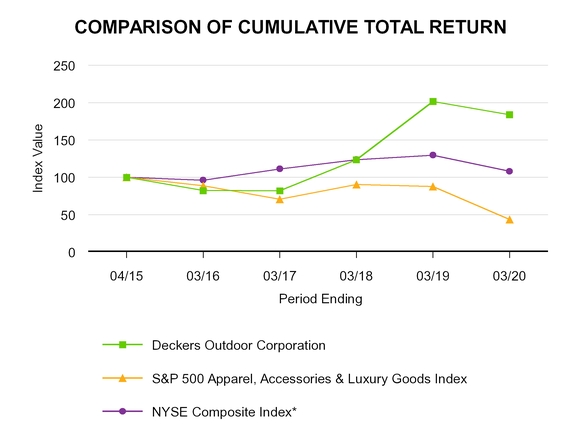
Below is a graph comparing the percentage change in the cumulative total return on our common stock against the cumulative total return of the S&P 500 Apparel, Accessories & Luxury Goods Index and the NYSE Composite Index for the five fiscal-year periods commencing April 1, 2015 and ending March 31, 2020. Total return assumes reinvestment of dividends, though we have not declared or paid any cash dividends on our common stock since our inception. The data represented in the graph below assumes one hundred dollars invested in our common stock, the S&P 500 Apparel, Accessories & Luxury Goods Index and the NYSE Composite Index on April 1, 2015.
| April 1, | Years Ended March 31, | ||||||||||||||||||||||
| 2015 | 2016 | 2017 | 2018 | 2019 | 2020 | ||||||||||||||||||
| Deckers Outdoor Corporation | $ | 100.0 | $ | 82.2 | $ | 82.0 | $ | 123.6 | $ | 201.7 | $ | 183.9 | |||||||||||
| S&P 500 Apparel, Accessories & Luxury Goods Index | 100.0 | 88.8 | 70.5 | 90.5 | 87.6 | 43.6 | |||||||||||||||||
| The NYSE Composite Index | 100.0 | 96.2 | 111.3 | 123.7 | 129.7 | 108.1 |
The stock performance graph and related information shall not be deemed incorporated by reference by any general statement incorporating by reference this Annual Report into any filing under the Securities Act, or under the Exchange Act, except to the extent that we specifically incorporate this information by reference and shall not otherwise be deemed filed under the Securities Act or the Exchange Act.
Dividend Policy
We have not declared or paid any cash dividends on our common stock since our inception. We currently do not anticipate declaring or paying any cash dividends in the foreseeable future. Our current revolving credit agreements allow us to declare and pay cash dividends, as long as we do not exceed certain leverage ratios and no event of default has occurred.
Stock Repurchase Programs
In January 2019, our Board of Directors approved a stock repurchase program which, together with stock repurchase programs approved in 2017 and 2015, authorized us to repurchase a total of up to $796,000 of our common stock in the open market or in privately negotiated transactions, subject to market conditions, applicable legal requirements, and other factors (collectively, our Stock Repurchase Programs). The full amounts originally authorized under the 2017 and 2015 stock repurchase programs have been repurchased and these programs have been completed.
As of March 31, 2020, the aggregate remaining approved amount under our Stock Repurchase Programs was $159,807. During the fourth quarter of the year ended March 31, 2020, we did not repurchase any shares of our common stock. We are temporarily pausing repurchases under our Stock Repurchase Programs due to the disruption and uncertainty caused by the COVID-19 pandemic and our focus on liquidity and cash management, although we retain the discretion to commence repurchases in future periods.
Refer to Part II, Item 7, “Management's Discussion and Analysis of Financial Condition and Results of Operations,” under the heading “Liquidity and Capital Resources” and Note 10, “Stockholders' Equity,” of our consolidated financial statements and accompanying notes thereto (referred to herein as the consolidated financial statements) in Part IV within this Annual Report for further information on repurchases of our common stock.
Item 6. Selected Financial Data
The following tables present our selected consolidated financial data and should be read in conjunction with Part II, Item 7, “Management's Discussion and Analysis of Financial Condition and Results of Operations,” and Part IV, Item 15, “Exhibits and Financial Statement Schedule,” within this Annual Report.
| Years Ended March 31, | |||||||||||||||||||
| 2020 | 2019 | 2018 | 2017 | 2016 | |||||||||||||||
| Statements of Comprehensive Income (Loss) | |||||||||||||||||||
| Net sales | |||||||||||||||||||
| UGG brand wholesale | $ | 892,990 | $ | 888,347 | $ | 841,893 | $ | 826,355 | $ | 918,102 | |||||||||
| HOKA brand wholesale | 277,097 | 185,057 | 132,688 | 93,064 | 74,937 | ||||||||||||||
| Teva brand wholesale | 119,108 | 119,390 | 117,478 | 103,694 | 143,280 | ||||||||||||||
| Sanuk brand wholesale | 39,463 | 69,791 | 78,283 | 77,552 | 90,719 | ||||||||||||||
| Other brands wholesale | 67,175 | 42,818 | 17,273 | 23,142 | 3,842 | ||||||||||||||
| Direct-to-Consumer | 736,856 | 715,034 | 715,724 | 666,340 | 644,317 | ||||||||||||||
| Total net sales | 2,132,689 | 2,020,437 | 1,903,339 | 1,790,147 | 1,875,197 | ||||||||||||||
| Cost of sales | 1,029,016 | 980,187 | 971,697 | 954,912 | 1,028,529 | ||||||||||||||
| Gross profit | 1,103,673 | 1,040,250 | 931,642 | 835,235 | 846,668 | ||||||||||||||
| Selling, general and administrative expenses | 765,538 | 712,930 | 709,058 | 837,154 | 684,541 | ||||||||||||||
| Income (loss) from operations | 338,135 | 327,320 | 222,584 | (1,919 | ) | 162,127 | |||||||||||||
| Other (income) expense, net | (2,731 | ) | (1,614 | ) | 1,888 | 5,067 | 5,242 | ||||||||||||
| Income (loss) before income taxes | 340,866 | 328,934 | 220,696 | (6,986 | ) | 156,885 | |||||||||||||
| Income tax expense (benefit) | 64,724 | 64,626 | 106,302 | (12,696 | ) | 34,620 | |||||||||||||
| Net income | 276,142 | 264,308 | 114,394 | 5,710 | 122,265 | ||||||||||||||
| Total other comprehensive (loss) income | (2,905 | ) | (9,671 | ) | 13,468 | (5,894 | ) | (89 | ) | ||||||||||
| Comprehensive income (loss) | $ | 273,237 | $ | 254,637 | $ | 127,862 | $ | (184 | ) | $ | 122,176 | ||||||||
| Net income per share | |||||||||||||||||||
| Basic | $ | 9.73 | $ | 8.92 | $ | 3.60 | $ | 0.18 | $ | 3.76 | |||||||||
| Diluted | $ | 9.62 | $ | 8.84 | $ | 3.58 | $ | 0.18 | $ | 3.70 | |||||||||
| Weighted-average common shares outstanding | |||||||||||||||||||
| Basic | 28,385 | 29,641 | 31,758 | 32,000 | 32,556 | ||||||||||||||
| Diluted | 28,694 | 29,903 | 31,996 | 32,355 | 33,039 |
| As of March 31, | |||||||||||||||||||
| 2020 | 2019 | 2018 | 2017 | 2016 | |||||||||||||||
| Balance Sheets | |||||||||||||||||||
| Cash and cash equivalents | $ | 649,436 | $ | 589,692 | $ | 429,970 | $ | 291,764 | $ | 245,956 | |||||||||
| Working capital | 893,165 | 844,881 | 721,524 | 661,770 | 547,267 | ||||||||||||||
| Total assets | 1,765,118 | 1,427,206 | 1,264,379 | 1,191,780 | 1,278,068 | ||||||||||||||
| Long-term liabilities | 324,052 | 131,552 | 134,434 | 78,474 | 72,099 | ||||||||||||||
| Stockholders' equity | 1,140,120 | 1,045,130 | 940,779 | 954,255 | 967,471 |
Item 7. Management’s Discussion and Analysis of Financial Condition and Results of Operations
The following discussion of our financial condition and results of operations should be read together with our consolidated financial statements in Part IV within this Annual Report. This discussion includes an analysis of our financial condition and results of operations for fiscal year 2020 and fiscal year 2019 and year-over-year comparisons between those periods. For year-over-year comparisons between fiscal year 2019 and fiscal year 2018, refer to Part II, Item 7, “Management's Discussion and Analysis of Financial Condition and Results of Operations,” of our Annual Report on Form 10-K for the fiscal year ended March 31, 2019 filed with the SEC on May 30, 2019.
Overview
We are a global leader in designing, marketing, and distributing innovative footwear, apparel, and accessories developed for both everyday casual lifestyle use and high-performance activities. We market our products primarily under five proprietary brands: UGG, HOKA, Teva, Sanuk and Koolaburra. We believe that our products are distinctive and appeal broadly to women, men, and children. We sell our products through quality domestic and international retailers, international distributors, and directly to our consumers both domestically and internationally through our DTC business, which is comprised of our retail stores and e-commerce websites. We seek to differentiate our brands and products by offering diverse lines that emphasize authenticity, functionality, quality, and comfort, and products tailored to a variety of activities, seasons, and demographic groups. All of our products are currently manufactured by independent manufacturers.
Trends and Uncertainties Impacting Our Business
During early calendar year 2020, the COVID-19 pandemic (referred to herein as COVID-19 or the COVID-19 pandemic) spread globally, including throughout the geographic regions in which we operate our business, and where our wholesale customers, retail stores, manufacturers, and suppliers are located.
In response to the pandemic, many federal, state, local, and foreign governments have put in place, and others in the future may put in place, travel restrictions, “shelter-in-place” orders, and similar government orders and restrictions in an attempt to control the spread and mitigate the impact of the disease. Such restrictions or orders have resulted in the mandatory closure of “non-essential” businesses (including retail stores), increased unemployment rates, “social distancing” restrictions, reduced tourist activity, work-from-home policies, and other changes that have led to significant disruptions to businesses and global financial markets. The overall impact of the pandemic on our business and future results of operations is highly uncertain and subject to change, and we are not able to accurately predict the magnitude or scope of such impacts at this time.
Our business and the industry in which we operate continue to be impacted by several important trends and uncertainties, including as a result of the COVID-19 pandemic. We have experienced a number of material impacts, and identified a number of material trends, within our business as follows:
Retail Environment
| • | In connection with the “shelter-in-place” orders discussed above, all of our Company-owned and operated stores, and nearly all of the retail stores of our wholesale customers and retail partners, were closed for a portion of our fourth fiscal quarter ended March 31, 2020 (fourth fiscal quarter), and largely remain closed during the first part of our first fiscal quarter ending June 30, 2020. The closure of these retail stores had a negative impact on our results of operations during the fourth fiscal quarter as we experienced delays in shipment and acceptance of scheduled order shipments, which we attribute to the retail store closures and other uncertainties caused by the COVID-19 pandemic. |
| • | The retail stores that we and our partners operate have begun to reopen at a measured pace. We will continue to reopen our retail stores as we determine appropriate and in line with guidance provided by health officials, expert agencies and local authorities. Our decision regarding the appropriate timing to reopen our retail stores will depend on a number of factors, including the safety of our customers and employees, our ability to comply with government orders and restrictions, and our ability to deliver products to our customers. We expect the scope of allowable retail activities, as well as retail consumer traffic patterns, to vary by geographic region, including ongoing restrictions imposed by local governmental authorities, the demand for our products within the region, and the actual and expected impact of the COVID-19 pandemic on the region. |
E-Commerce Business
| • | Even prior to mandatory retail store closures resulting from the COVID-19 pandemic, we observed a meaningful shift in the way consumers shop for products and make purchasing decisions, evidenced by significant and prolonged decreases in consumer retail activity as customers continue to migrate to online shopping. These trends have been positively impacting the performance of our e-commerce |
business, while creating challenges and headwinds for our traditional retail business, as well as the retail businesses of our wholesale customers and retail partners.
| • | We operate our e-commerce business through various websites and platforms, which have remained operational throughout the COVID-19 pandemic, and we expect they will continue to remain operational. |
| • | During our fourth fiscal quarter, as well as our first fiscal quarter ending June 30, 2020, we observed strong demand across our brands within our e-commerce business, especially for the UGG and HOKA brands. We expect our wholesale customers that have an established e-commerce presence will experience similar strong demand trends as those we have experienced, although the trends may vary from customer to customer. We continue to see demand for our products, especially within the UGG and HOKA brands, from a number of these wholesale customers, which we believe reflects strong sell-through of our products within our partners’ e-commerce platforms. We expect our wholesale customers that have a greater reliance on their retail store presence may experience more significant adverse impacts from the COVID-19 pandemic. |
| • | We expect our e-commerce business will continue to be a driver of long-term growth, although the growth rate will be unpredictable and may not be in line with our historical experience. We believe the key factors impacting the growth rate will include consumer demand for our products, our ability to fulfill orders through our limited distribution center operations, the scope and duration of the COVID-19 pandemic, and the impact of the COVID-19 pandemic on consumer confidence and discretionary spending. However, we do not expect the increased demand within our e-commerce businesses to fully offset the negative pressure we are experiencing within our wholesale and retail businesses due to the current retail environment, especially as we move into the second and third fiscal quarters. |
Brand Strategy
| • | We are exercising discipline by focusing on key products that have achieved sustained success with consumers, reducing the number and types of products offered, delaying product launches and consolidating seasonal collections. |
| • | Our ongoing and strategic efforts to reduce the impact of seasonality on our results of operations have had a meaningful positive impact on the year-round performance of the HOKA and UGG brands. While we expect to continue to focus on reducing the impact of seasonality through innovation and the expansion of our product offerings over the long |
Showing the first 8K of 89K characters. Open the full section
Item 7A. Quantitative and Qualitative Disclosures about Market Risk
Commodity Price Risk
For the manufacturing of our products, we purchase certain raw materials that are affected by commodity prices, which include sheepskin, leather, and wool. The supply of sheepskin, which is used to manufacture a significant portion of the UGG brand products, is in high demand and there are a limited number of suppliers that can meet our expectations for the quantity and quality of sheepskin that we require. We presently rely on two tanneries to provide most of our sheepskin. While we have experienced fairly stable pricing in recent years, historically there have been significant fluctuations in the price of sheepskin as the demand for this commodity from our customers and our competitors has changed. We believe significant factors affecting the price of sheepskin include weather patterns, harvesting decisions, incidence of disease, the price of other commodities such as wool and leather, the demand for our products and the products of our competitors, and global economic conditions. Any factors that increase the demand for, or decrease the supply of, sheepskin could cause significant increases in the price of sheepskin.
We typically fix prices for all of our raw materials with firm pricing agreements on a seasonal basis. For sheepskin and leather, we use purchasing contracts and refundable deposits to attempt to manage price volatility as an alternative to hedging commodity prices. The purchasing contracts and other pricing arrangements we use for sheepskin and leather may result in purchase obligations which are not recorded in our consolidated balance sheets. With respect to sheepskin and leather, in the event of significant price increases, we will likely not be able to adjust our selling prices sufficiently to eliminate the impact of such increases on our gross margins.
Foreign Currency Exchange Rate Risk
Fluctuations in currency exchange rates, primarily between the US dollar and the currencies of Europe, Asia, Canada, and Latin America where we operate, may affect our results of operations, financial position, and cash flows. We face market risk to the extent that foreign currency exchange rate fluctuations affect our foreign assets, liabilities, revenues, and expenses. Although most of our sales and inventory purchases are denominated in US dollars, these sales and inventory purchases may be impacted by fluctuations in the exchange rates between the US dollar and local currencies in the international markets where our products are sold and manufactured. We are exposed to financial statement transaction gains and losses as a result of remeasuring our monetary assets and liabilities that are denominated in currencies other than the subsidiaries’ functional currencies. We translate all assets and liabilities denominated in foreign currencies into US dollars using the exchange rate as of the end of the reporting period. Gains and losses resulting from translating assets and liabilities from our subsidiaries' functional currencies to US dollars are recorded in other comprehensive income. Foreign currency exchange rate fluctuations affect our reported profits and can make comparisons from year to year more difficult.
We hedge certain foreign currency exchange rate risk from existing assets and liabilities. As our international operations grow and we increase purchases and sales in foreign currencies, we will continue to evaluate our hedging strategy and may utilize additional derivative instruments, as needed, to hedge our foreign currency exchange rate risk. We do not use foreign currency exchange rate forward contracts for trading purposes. As of March 31, 2020, a hypothetical 10.0% foreign currency exchange rate fluctuation would have had no impact on the fair value of our financial instruments as there were none outstanding. Refer to Note 9, “Derivative Instruments,” of our consolidated financial statements included in Part IV within this Annual Report for further information on our use of derivative contracts. As of March 31, 2020, there were no known factors that we would expect to result in a material change in the general nature of our foreign currency exchange rate risk exposure.
Interest Rate Risk
Our market risk exposure with respect to our revolving credit facilities is tied to changes in applicable interest rates, including the Alternate Base Rate, the federal funds effective rate, currency-specific London Interbank Offered Rate, and the Canadian Dollar Offered Rate for our Primary Credit Facility, People’s Bank of China market rate for our China Credit Facility, and Tokyo Interbank Offered Rate for our Japan Credit Facility. A hypothetical 1.0% increase in interest rates for borrowings made under our revolving credit facilities would have resulted in an immaterial aggregate change to interest expense recorded in our consolidated statements of comprehensive income during the year ended March 31, 2020. Refer to Note 6, “Revolving Credit Facilities and Mortgage Payable,” of our consolidated financial statements included in Part IV within this Annual Report for further information on our revolving credit facilities.
Item 8. Financial Statements and Supplementary Data
The Consolidated Financial Statements, the Financial Statement Schedule, and the Reports of Independent Registered Public Accounting Firm, are filed within this Annual Report in a separate section following Part IV, as shown on the index under Item 15, “Exhibits and Financial Statement Schedule,” within this Annual Report.
Item 9A. Controls and Procedures
a) Disclosure Controls and Procedures
We maintain a system of disclosure controls and procedures, as defined in Rule 13a-15(e) under the Exchange Act, which are designed to provide reasonable assurance that information required to be disclosed in the reports that we file or submit under the Exchange Act is recorded, processed, summarized and reported within the time periods specified in the SEC’s rules and forms. In designing and evaluating our disclosure controls and procedures, our management recognized that any system of controls and procedures, no matter how well designed and operated, can provide only reasonable assurance of achieving the desired control objectives, as ours is designed to do, and management necessarily is required to apply its judgment in evaluating the cost-benefit relationship of possible controls and procedures. In addition, the design of any system of controls is also based in part upon certain assumptions about the likelihood of future events, and there can be no assurance that any design will succeed in achieving its stated goals under all potential future conditions. Over time, controls may become inadequate because of changes in conditions, or the degree of compliance with policies or procedures may deteriorate. Because of the inherent limitations in a cost-effective control system, misstatements due to error or fraud may occur and not be detected.
Under the supervision and with the participation of management, we carried out an evaluation of the effectiveness of the design and operation of our disclosure controls and procedures as of March 31, 2020. Based on that evaluation, our Principal Executive Officer (PEO) and Principal Financial and Accounting Officer (PFAO) concluded that our disclosure controls and procedures were effective at a reasonable assurance level as of March 31, 2020.
b) Management’s Report on Internal Control over Financial Reporting
Management is responsible for establishing and maintaining adequate internal control over financial reporting (as defined in Rule 13a-15(f) under the Exchange Act). Our internal control over financial reporting is a process designed under the supervision of our PEO and PFAO to provide reasonable assurance regarding the reliability of financial reporting and the preparation of our financial statements for external reporting purposes in accordance with US GAAP. Because of inherent limitations, internal control over financial reporting may not prevent or detect misstatements. Also, projections of any evaluation of effectiveness to future periods are subject to the risk that controls may become inadequate because of changes in conditions, or that the degree of compliance with the policies or procedures may deteriorate.
As of March 31, 2020, our management, including our PEO and PFAO, assessed the effectiveness of our internal control over financial reporting using the criteria set forth in Internal Control — Integrated Framework (2013) issued by the Committee of Sponsoring Organizations of the Treadway Commission (commonly referred to as COSO). Based on this assessment, our management concluded that our internal control over financial reporting was effective based on those criteria as of March 31, 2020. The registered public accounting firm that audited our consolidated financial statements in Part IV within this Annual Report has issued an attestation report on our internal control over financial reporting. Refer to Part IV, “Report of Independent Registered Public Accounting Firm - Internal Control Over Financial Reporting,” on page F-4 within this Annual Report.
c) Internal Control over Financial Reporting
During the first quarter of fiscal year 2020, we updated our control framework for certain new internal controls and changes to certain existing internal controls related to the adoption of ASU No. 2016-02, as amended, otherwise known as the new lease standard, and related financial statement reporting and disclosure. There were no other changes in our internal control over financial reporting identified in management’s evaluation pursuant to Rules 13a-15(d) or 15d-15(d) of the Exchange Act during the year ended March 31, 2020 that have materially affected, or are reasonably likely to materially affect, our internal control over financial reporting.
d) Principal Executive Officer and Principal Financial and Accounting Officer Certifications
The certifications of our PEO and PFAO required by Rule 13a-14(a) of the Exchange Act are filed herewith as Exhibit 31.1 and Exhibit 31.2, and furnished as Exhibit 32, within this Annual Report. This Part II, Item 9A, should be read in conjunction with such certifications for a more complete understanding of the topics presented.
PART III
References within this Annual Report to “Deckers,” “we,” “our,” “us,” or the “Company” refer to Deckers Outdoor Corporation, together with its consolidated subsidiaries.
The defined periods for the fiscal years ended March 31, 2020, 2019, and 2018 are stated in Items 10, 11, 12, 13, and 14 herein as “year ended” or “years ended.”
Item 10. Directors, Executive Officers and Corporate Governance
The information required by this item will be disclosed in our definitive proxy statement on Schedule 14A (Proxy Statement) for our 2020 annual meeting of stockholders and is incorporated herein by reference. Our Proxy Statement will be filed with the SEC within 120 days after the end of the year ended March 31, 2020 pursuant to Regulation 14A under the Exchange Act.
Item 11. Executive Compensation
The information required by this item will be disclosed in the Proxy Statement and is incorporated herein by reference.
Item 12. Security Ownership of Certain Beneficial Owners and Management and Related Stockholder Matters
The information required by this item will be disclosed in the Proxy Statement and is incorporated herein by reference.
Item 13. Certain Relationships and Related Transactions, and Director Independence
The information required by this item will be disclosed in the Proxy Statement and is incorporated herein by reference.
Item 14. Principal Accounting Fees and Services
The information required by this item will be disclosed in the Proxy Statement and is incorporated herein by reference.
PART IV
References within this Annual Report to “Deckers,” “we,” “our,” “us,” or the “Company” refer to Deckers Outdoor Corporation, together with its consolidated subsidiaries. UGG® (UGG), HOKA One One® (HOKA), Teva® (Teva), Sanuk® (Sanuk), Koolaburra® (Koolaburra), and UGGpure® (UGGpure) are some of our trademarks. Other trademarks or trade names appearing elsewhere in this Annual Report are the property of their respective owners. Solely for convenience, the trademarks and trade names within this Annual Report are referred to without the ® and™ symbols, but such references should not be construed as any indicator that their respective owners will not assert, to the fullest extent under applicable law, their rights thereto.
The defined periods for the fiscal years ended March 31, 2020, 2019, and 2018 are stated in Item 15 herein as “year ended” or “years ended,”
Item 15. Exhibits and Financial Statement Schedule
Refer to Part IV, “Index to Consolidated Financial Statements and Financial Statement Schedule,” on page F-1 within this Annual Report for our Consolidated Financial Statements and the Reports of Independent Registered Public Accounting Firm.
EXHIBIT INDEX
Showing the first 8K of 192K characters. Open the full section