 filings.tools
Deckers Outdoor 10-K 2022-03-31
Filed 2022-05-27. 23 sections, 451K characters. Original on sec.gov · Markdown · JSON
Cover and table of contents
UNITED STATES
SECURITIES AND EXCHANGE COMMISSION
Washington, D.C. 20549
FORM 10-K
| (Mark One) | |||||
| ☒ | Annual Report Pursuant to Section 13 or 15(d) of the Securities Exchange Act of 1934 |
For the Fiscal Year Ended March 31, 2022
| ☐ | Transition Report Pursuant to Section 13 or 15(d) of the Securities Exchange Act of 1934 |
For the transition period from to
Commission File Number: 001-36436
DECKERS OUTDOOR CORPORATION
(Exact name of registrant as specified in its charter)
| Delaware | 95-3015862 | ||||
| (State or other jurisdiction of incorporation or organization) | (I.R.S. Employer Identification No.) |
250 Coromar Drive, Goleta, California 93117
(Address of principal executive offices)
(805) 967-7611
(Registrant’s telephone number, including area code)
Securities registered pursuant to Section 12(b) of the Act:
| Title of each class | Trading Symbol(s) | Name of each exchange on which registered | ||||||
| Common Stock, par value $0.01 per share | DECK | New York Stock Exchange |
Indicate by check mark if the registrant is a well-known seasoned issuer, as defined in Rule 405 of the Securities Act. Yes ☒ No ☐
Indicate by check mark if the registrant is not required to file reports pursuant to Section 13 or 15(d) of the Act. Yes ☐ No ☒
Indicate by check mark whether the registrant: (1) has filed all reports required to be filed by Section 13 or 15(d) of the Securities Exchange Act of 1934 during the preceding 12 months (or for such shorter period that the registrant was required to file such reports) and (2) has been subject to such filing requirements for the past 90 days. Yes ☒ No ☐
Indicate by check mark whether the registrant has submitted electronically every Interactive Data File required to be submitted pursuant to Rule 405 of Regulation S-T (§232.405 of this chapter) during the preceding 12 months (or for such shorter period that the registrant was required to submit such files). Yes ☒ No ☐
Indicate by check mark whether the registrant is a large accelerated filer, an accelerated filer, a non-accelerated filer, a smaller reporting company, or an emerging growth company. See the definitions of “large accelerated filer,” “accelerated filer,” “smaller reporting company,” and “emerging growth company” in Rule 12b-2 of the Exchange Act.
| Large accelerated filer | ☒ | Accelerated filer | ☐ | |||||||||||
| Non-accelerated filer | ☐ | Smaller reporting company | ☐ | |||||||||||
| Emerging growth company | ☐ |
If an emerging growth company, indicate by check mark if the registrant has elected not to use the extended transition period for complying with any new or revised financial accounting standards provided pursuant to Section 13(a) of the Exchange Act. ☐
Indicate by check mark whether the registrant has filed a report on and attestation to its management’s assessment of the effectiveness of its internal control over financial reporting under Section 404(b) of the Sarbanes-Oxley Act (15 U.S.C. 7262(b)) by the registered public accounting firm that prepared or issued its audit report. ☒
Indicate by check mark whether the registrant is a shell company (as defined in Rule 12b-2 of the Act).
Yes ☐ No ☒
At September 30, 2021, the last business day of the registrant’s most recently completed second fiscal quarter, the aggregate market value of the voting and non-voting stock held by the non-affiliates of the registrant was approximately $9,890,267,142, based on the number of shares held by non-affiliates of the registrant as of that date, and the last reported sale price of the registrant’s common stock on the New York Stock Exchange on that date, which was $360.20. This calculation does not reflect a determination that persons are affiliates for any other purposes.
As of the close of business on May 5, 2022, the number of outstanding shares of the registrant’s common stock, par value $0.01 per share, was 26,789,861.
DOCUMENTS INCORPORATED BY REFERENCE
Portions of the registrant’s definitive Proxy Statement on Schedule 14A relating to the registrant’s 2022 annual meeting of stockholders, to be filed with the Securities and Exchange Commission within 120 days after the end of the fiscal year covered by this Annual Report on Form 10-K, are incorporated by reference in Part III within this Annual Report on Form 10-K. With the exception of the portions of the Proxy Statement specifically incorporated herein by reference, the Proxy Statement and related proxy solicitation materials are not deemed to be filed as part of this Annual Report on Form 10-K.
DECKERS OUTDOOR CORPORATION AND SUBSIDIARIES
For the Fiscal Year Ended March 31, 2022
TABLE OF CONTENTS
| Page | ||||||||
| Cautionary Note Regarding Forward-Looking Statements | 2 | |||||||
| PART I | ||||||||
| Item 1. | Business | 3 | ||||||
| Item 1A. | Risk Factors | 13 |
Item 1B. Unresolved Staff Comments
| Item 2. | | | Properties | | | 28 | | | | Item 3. | | | Legal Proceedings | | | 28 | | |
Item 4. Mine Safety Disclosures
| | | | PART II | | | | | | | Item 5. | | | Market for Registrant's Common Equity, Related Stockholder Matters and Issuer Purchases of Equity Securities | | | 29 | | |
Item 6. [Reserved]
| Item 7. | | | Management's Discussion and Analysis of Financial Condition and Results of Operations | | | 31 | | | | Item 7A. | | | Quantitative and Qualitative Disclosures about Market Risk | | | 48 | | | | Item 8. | | | Financial Statements and Supplementary Data | | | 49 | | |
Item 9. Changes in and Disagreements with Accountants on Accounting and Financial Disclosure
| Item 9A. | | | Controls and Procedures | | | 49 | | |
Item 9B. Other Information
Item 9C. Disclosure Regarding Foreign Jurisdictions that Prevent Inspections
| | | | PART III | | | | | | | Item 10. | | | Directors, Executive Officers and Corporate Governance | | | 50 | | | | Item 11. | | | Executive Compensation | | | 50 | | | | Item 12. | | | Security Ownership of Certain Beneficial Owners and Management and Related Stockholder Matters | | | 50 | | | | Item 13. | | | Certain Relationships and Related Transactions, and Director Independence | | | 50 | | | | Item 14. | | | Principal Accounting Fees and Services | | | 50 | | | | | | | PART IV | | | | | | | Item 15. | | | Exhibits and Financial Statement Schedule | | | 51 | | | | | | | Signatures | | | 54 | | | | | | | Index to Consolidated Financial Statements and Financial Statement Schedule | | | F-1 | | |
Item 16. Form 10-K Summary
| | | | | | | | | | | *Not applicable. | | | | | | | | |
CAUTIONARY NOTE REGARDING FORWARD-LOOKING STATEMENTS
This Annual Report on Form 10-K for our fiscal year ended March 31, 2022 (Annual Report), and the information and documents incorporated by reference within this Annual Report, contain “forward-looking statements” within the meaning of Section 27A of the Securities Act of 1933, as amended (Securities Act), and Section 21E of the Securities Exchange Act of 1934, as amended (Exchange Act), which statements are subject to considerable risks and uncertainties. These forward-looking statements are intended to qualify for the safe harbor from liability established by the Private Securities Litigation Reform Act of 1995. Forward-looking statements include all statements other than statements of historical fact contained in, or incorporated by reference within, this Annual Report. We have attempted to identify forward-looking statements by using words such as “anticipate,” “believe,” “could,” “estimate,” “expect,” “intend,” “may,” “plan,” “predict,” “project,” “should,” “will,” or “would,” and similar expressions or the negative of these expressions. Specifically, this Annual Report, and the information and documents incorporated by reference within this Annual Report, contain forward-looking statements relating to, among other things:
-
the impacts of the COVID-19 global pandemic (pandemic) on our business, financial condition, results of operations and liquidity, and the business, financial condition, results of operations and liquidity of our customers, suppliers, and business partners;
-
changes to our business resulting from changes in discretionary spending, consumer confidence, unemployment rates, retail store activity, tourist activity, and governmental restrictions;
-
the impact of government orders, local authority mandates and expert agency guidance on retail store closures and operating restrictions;
-
our business, operating, investing, capital allocation, marketing, and financing plans and strategies;
-
the expansion of our brands and product offerings;
-
changes to the geographic and seasonal mix of our brands and products;
-
changes to our product distribution strategies, including the implementation of our product allocation and segmentation strategies;
-
changes in consumer preferences impacting our brands and products, and the footwear and fashion industries;
-
trends impacting the purchasing behavior of wholesale partners and consumers, including those impacting retail and e-commerce businesses;
-
bankruptcies or other financial difficulties impacting our wholesale or other business partners;
-
the impact of seasonality and weather on consumer behavior, demand for our products, and our results of operations;
-
the impact of climate change and related regulations on our business and results of operations;
-
the impact of our efforts to continue to advance sustainable and socially conscious business operations, and the expectations and standards that our investors and other stakeholders have with respect to our environmental, social and governance practices;
-
expansion of and investments in our Direct-to-Consumer (DTC) capabilities, including our distribution facilities and e-commerce platforms;
-
the operational challenges faced by our warehouse and distribution centers (DCs), our wholesale partners, our global third-party logistics providers (3PLs), and third-party carriers, including as a result of global supply chain disruptions and labor shortages, and the related impacts on our ability to timely deliver products;
-
global uncertainty resulting from Russia’s invasion of Ukraine, including financial and economic sanctions resulting in higher transportation and energy costs, as well as other implications;
-
availability of raw materials and manufacturing capacity, and reliability of overseas production and storage;
-
inflationary pressures, including on labor costs and our raw material costs;
-
commitments and contingencies, including with respect to operating leases, purchase obligations for product and raw materials, and legal or regulatory proceedings;
-
the impacts of new or proposed legislation, tariffs, regulatory enforcement actions, or legal proceedings;
-
the value of goodwill and other intangible assets, and potential write-downs or impairment charges;
-
changes impacting our tax liability and effective tax rates;
-
repatriation of earnings of non-United States (US) subsidiaries and any related tax impacts; and
-
overall global economic, political, and social trends, including foreign currency exchange rate fluctuations, changes in interest rates, and changes in commodity pricing.
Forward-looking statements represent management’s current expectations and predictions about trends affecting our business and industry and are based on information available at the time such statements are made. Although we do not make forward-looking statements unless we believe we have a reasonable basis for doing so, we cannot guarantee their accuracy or completeness. Forward-looking statements involve numerous known and unknown risks, uncertainties, and other factors that may cause our actual results, performance, or achievements to be materially different from any future results, performance or achievements predicted, assumed or implied by the forward-looking statements. Some of the risks and uncertainties that may cause our actual results to materially differ from those expressed or implied by these forward-looking statements are described in Part I, Item 1A, “Risk Factors,” and Part II, Item 7, “Management's Discussion and Analysis of Financial Condition and Results of Operations,” within this Annual Report, as well as in our other filings with the Securities and Exchange Commission (SEC). You should read this Annual Report, including the information and documents incorporated by reference herein, in its entirety and with the understanding that our actual future results may be materially different from the results expressed or implied by these forward-looking statements. Moreover, new risks and uncertainties emerge from time to time, and it is not possible for management to predict all risks and uncertainties, nor can we assess the impact of all factors on our business or the extent to which any factor, or combination of factors, may cause our actual future results to be materially different from any results expressed or implied by any forward-looking statements. Except as required by applicable law or the listing rules of the New York Stock Exchange, we expressly disclaim any intent or obligation to update any forward-looking statements. We qualify all our forward-looking statements with these cautionary statements.
PART I
References within this Annual Report to “Deckers,” “we,” “our,” “us,” “management,” or the “Company” refer to Deckers Outdoor Corporation, together with its consolidated subsidiaries. UGG® (UGG), HOKA® (HOKA), Teva® (Teva), Sanuk® (Sanuk), Koolaburra by UGG® brand (Koolaburra), UGGpure® (UGGpure), and UGGplush**TM (UGGplush) are some of our trademarks. Other trademarks or trade names appearing elsewhere within this Annual Report are the property of their respective owners. Solely for convenience, the trademarks and trade names within this Annual Report are referred to without the ® and ™ symbols, but such references should not be construed as any indicator that their respective owners will not assert, to the fullest extent under applicable law, their rights thereto.
Unless otherwise specifically indicated, all figures included within this Annual Report are expressed in thousands, except for per share or share data. The defined periods for the fiscal years ended March 31, 2022, 2021, and 2020 are stated herein as “year ended” or “years ended.” We also refer to these fiscal years as “fiscal year 2022,” “fiscal year 2021,” and “fiscal year 2020,” respectively.
Item 1. Business
General
We are a global leader in designing, marketing, and distributing innovative footwear, apparel, and accessories developed for both everyday casual lifestyle use and high-performance activities. We market our products primarily under five proprietary brands: UGG, HOKA, Teva, Sanuk, and Koolaburra. Our brands compete across the fashion and casual lifestyle, performance, running, and outdoor markets. We believe that our products are distinctive and appeal to a broad demographic. We sell our products through quality domestic and international retailers, international distributors, and directly to our global consumers through our DTC business, which is comprised of our e-commerce websites and retail stores. We seek to differentiate our brands and products by offering diverse lines that emphasize authenticity, functionality, quality, and comfort, and products tailored to a variety of activities, seasons, and demographic groups. All of our products are manufactured by independent manufacturers.
Products and Brands
UGG. The UGG brand is one of the most iconic and recognized brands in our industry, which highlights our successful track record of building niche brands into lifestyle and fashion market leaders. With loyal consumers around the world, the UGG brand has proven to be a highly resilient line of premium footwear, apparel, and accessories with expanded product offerings and a growing global audience that appeals to a broad demographic. We intend to continue diversifying the UGG brand to drive year-round product sales, including through expansion of Women’s spring and summer footwear, Men’s products, and apparel, accessories, and home goods. The UGG brand is sold globally, including in the US, Canada, Europe, Asia-Pacific, and Latin America.
HOKA**.** The HOKA brand is an authentic, premium line of year-round performance footwear and apparel that offers enhanced cushioning and inherent stability with minimal weight. Originally designed for ultra-runners, the brand now appeals to world champions, taste makers, and everyday athletes. Strong marketing has fueled both domestic and international sales growth for the HOKA brand, which has quickly become a leading brand within our run and outdoor specialty wholesale accounts and is rapidly growing within selective key accounts. The HOKA brand’s product line includes running, trail, hiking, fitness, and lifestyle. The HOKA brand is sold globally, including in the US, Canada, Europe, Asia-Pacific, and Latin America.
Teva. The Teva brand was born in the Grand Canyon and for decades has served as a trusted companion for outdoor adventure seekers around the world. Today, Teva builds upon sport sandal leadership, authentic outdoor heritage, and a commitment to sustainability to drive growth through category expansion and a young, diverse, and adventurous consumer. The Teva brand’s product line includes sandals, shoes, and boots. The Teva brand is sold globally, including in the US, Canada, Europe, Asia-Pacific, and Latin America.
Sanuk. The Sanuk brand originated in Southern California surf culture and has manifested into a lifestyle brand with a presence in the relaxed casual shoe and sandal categories, focusing on innovations in comfort and sustainability. The Sanuk brand’s use of unexpected materials and unconventional constructions, combined with its fun and playful branding, are key elements of the brand’s identity. The Sanuk brand is primarily sold in the US.
Other Brands. Other brands consist primarily of the Koolaburra brand. The Koolaburra brand is a casual footwear fashion line using plush materials and is intended to target the value-oriented consumer to complement the UGG brand offering. Our Other brands are primarily sold in the US and Canada.
Sales and Distribution
US Distribution. In our wholesale channel, we distribute our products in the US through sales representatives, who are organized by account type or geographically and by brand. In addition to our wholesale channel, we sell products directly to consumers through our DTC business and fulfill online orders through our DCs and retail stores.
Our sales force is separated by brand, as each brand generally has certain specialty customers that expect a dedicated sales team with specialized knowledge of the brand’s product offerings. However, there is some overlap between the sales teams and customers, and we have aligned our brands’ sales forces to position them for the future success of all of our brands.
We currently distribute products sold in the US through our DCs in Moreno Valley, California, and Mooresville, Indiana, as well as through a 3PL in Pennsylvania. Our DCs feature a warehouse management system that enables us to efficiently pick and pack products for direct shipment to customers. Further, we intend to expand our DCs in the US.
Refer to Part I, Item 2, “Properties,” and Note 7, “Leases and Other Commitments,” of our consolidated financial statements in Part IV within this Annual Report for further information on our properties and related minimum lease and other commitments.
International Distribution. Internationally, in our wholesale channel, we distribute our products through independent distributors and wholly owned subsidiaries in many regions and countries, including Canada, Europe, Asia-Pacific, and Latin America, among others. We also sell products internationally, particularly in China, through partner retail stores, which are branded stores that are wholly owned and operated by third parties. In addition, in certain countries we sell products through our DTC business. For our wholesale and DTC businesses, we distribute our products through a number of DCs managed by 3PLs in certain international locations.
UGG Wholesale. We sell our UGG brand products primarily through fashion lifestyle retailers such as Urban Outfitters and ASOS, domestic higher-end department stores such as Nordstrom, Dillard’s, and Macy’s, streetwear and sports style partners such as Footlocker and Journey’s, as well as online retailers such as Amazon.com, Zappos.com, and Zalando.com. As the retail marketplace continues to evolve to reflect changing consumer preferences, we continually review and evaluate our UGG wholesale distribution and product segmentation approach. For example, as the UGG brand continues to amplify its audience with younger consumers, our distribution to these consumers is expanding faster through our lifestyle and sports style partners.
HOKA Wholesale. We sell select HOKA brand footwear primarily through full-service domestic specialty retailers such as Fleet Feet, JackRabbit, Road Runner Sports, REI, select online retailers such as Zappos.com, and other strategic partners, such as DICK’s Sporting Goods, Running Warehouse, and Nordstrom. We continue to expand our HOKA brand wholesale distribution in international markets, including through strategic partners such as Intersport and Sport 2000 in Europe and Xebio Group and Himaraya in Japan.
Teva Wholesale. We sell our Teva brand footwear primarily through specialty outdoor retailers, sporting goods and department stores, including REI, Famous Footwear, United Arrows, ABC Mart, Aeon Sports, Urban Outfitters, DICK’s Sporting Goods, DSW, and Nordstrom, and online retailers such as Amazon.com and Zappos.com.
Sanuk Wholesale. We sell our Sanuk brand footwear primarily through domestic independent action sports and outdoor specialty footwear retailers, as well as larger national retail chains, including Journeys, Dillard’s, DSW, REI, and online retailers such as Amazon.com and Zappos.com.
Other Brands Wholesale. We sell our Other brands’ footwear primarily through department stores and online retailers. Key accounts of the Koolaburra brand include larger national retail chains, including Kohl’s, DSW, Macy’s, QVC, Shoe Carnival, and Famous Footwear, as well as online retailers such as Amazon.com and Zappos.com.
Direct-to-Consumer. Our DTC business is comprised of our e-commerce business, which we operate through various websites and platforms, and retail stores. Our websites and retail stores are largely intertwined and interdependent. In an omni-channel marketplace, we believe many of our consumers interact with both our retail stores and our websites before making purchasing decisions. For example, consumers may feel or try on products in our retail stores and then place an order online later. Conversely, they may initially research products online, and then view inventory availability by store location and make a purchase in store. We have observed a meaningful shift in the way consumers shop for products and make purchasing decisions, evidenced by decreases in consumer retail store activity as consumers accelerate their migration to online shopping. We have optimized our digital marketing strategy to capitalize on these trends, which has accelerated global online consumer acquisition and retention rates. Although we continue to see consumers migrate to online shopping, our DTC online and retail sales channels interact with each other and largely overlap to provide a fluid purchasing experience, which engenders brand loyalty while increasing product sales and improving our inventory productivity. Further, our domestic and international consumer loyalty programs allow our consumers to earn points and awards across the DTC business, which has contributed to higher brand demand.
Our retail stores enable us to expose consumers to a more curated selection of products, directly impact our consumers’ experience with our brands, and sell our products at retail prices thereby generating larger gross profit as a percentage of net sales (gross margin). Our retail stores are predominantly UGG brand concept stores and UGG brand outlet stores, though also include recent openings in our retail store fleet for the HOKA brand. Through our outlet stores, we sell some of our discontinued styles from prior seasons, full price in-line products, as well as products made specifically for the outlet stores. We continue to open outlet stores in key markets to further grow our brand presence and appeal to a broader consumer base. We also have several UGG brand flagship stores and recently opened a HOKA brand flagship store, which are lead concept stores in key markets designed to showcase the UGG and HOKA brand products, respectively. We continue to evaluate future locations for a curated fleet of mono branded retail stores for the UGG and HOKA brands to continue interacting with our consumers and enhancing brand loyalty.
As of March 31, 2022, we operate our e-commerce business through Company-owned websites and mobile platforms in 59 different countries, and have a total of 149 global retail stores, which includes 75 concept stores and 74 outlet stores.
Refer to Part II, Item 7, “Management's Discussion and Analysis of Financial Condition and Results of Operations,” within this Annual Report for further disclosure and discussion of our DTC business.
Product Design and Development
The design and development functions for all of our brands are performed by a combination of internal design and development staff and outside freelance designers. Our design and development staff work closely with brand management to develop new styles and product lines. Throughout the development process, we have multiple design and development reviews, which we then coordinate with our independent manufacturers. To ensure quality, consistency, and efficiency in our product design and development process, we continually evaluate the availability and cost of raw materials, the capabilities and capacity of our independent manufacturers, and the target retail price of new products.
Manufacturing and Supply Chain
We outsource the production of our products to independent manufacturers, which are primarily located in Asia. We generally purchase products from our manufacturers on the basis of individual purchase orders or short-term purchase commitments, rather than maintaining long-term purchase commitments, which provides us greater flexibility to adapt to changing consumer preferences, changes in international trade relations, and evolving inventory management requirements. Production by our independent manufacturers is performed in accordance with our detailed product specifications and rigorous quality control and operating compliance standards. We maintain a buying office in Hong Kong, as well as on-site supervisory offices in China and Vietnam, which collectively serve as a strong link to our independent manufacturers. We believe our strong regional presence enhances our manufacturing processes by providing predictability of material availability and ensuring compliance with laws and regulations, and adherence to quality control standards and final design specifications.
The majority of the materials and components used in the production of our products by these independent manufacturers are purchased from independent suppliers that we designate. At our direction, our manufacturers purchase the majority of the sheepskin used in our products from two tanneries in China, which source their sheepskin primarily from Australia and the United Kingdom (UK). We maintain routine communication with the tanneries to closely monitor the supply of high-quality sheepskin for our projected UGG brand production. To ensure an adequate supply of sheepskin, we forecast our expected usage in advance at a forward price. We also enter into fixed purchasing contracts and other pricing arrangements with certain sheepskin, leather, and UGGpure suppliers to manage price volatility. We believe current supplies are sufficient to meet our current and anticipated demand, but we continually monitor our supply chain and investigate options to accommodate our expected growth, as well as unexpected supply chain issues. Refer to Part II, Item 7, “Management's Discussion and Analysis of Financial Condition and Results of Operations,” and Note 7, “Leases and Other Commitments,” of our consolidated financial statements in Part IV within this Annual Report for further information on our minimum purchase commitments.
We require our independent manufacturers and designated suppliers, including our partners and licensees, to adopt our Ethical Supply Chain Supplier Code of Conduct, which specifies that they comply with all local laws and regulations governing human rights, working conditions, anti-corruption laws, restricted substances, and environmental compliance, including animal welfare and conflicts minerals, before we are willing to conduct business with them.
We use a proprietary raw material, UGGpure, which is almost entirely repurposed wool woven into a durable backing, and UGGplush, which is almost entirely repurposed wool and lyocell woven into a durable backing, in some of our UGG brand products. As part of an ongoing effort to eliminate waste as part of our corporate sustainability efforts, at this time, all of the wool in UGGpure and UGGplush is sheared from the sheepskin we are already using in our products. In addition, we are continuing to drive our strategy of introducing counter-seasonal products through category expansion, including the UGG brand’s spring and summer products, as well as the year-round performance footwear product offering of the HOKA brand, which we believe will help further reduce our dependency on sheepskin. Excluding sheepskin, UGGpure, and UGGplush, we believe that substantially all raw materials and components used to manufacture our products, including wool, rubber, leather, and nylon webbing, are generally available from multiple sources at competitive prices.
Inventory Management and Product Returns
We have an extended design and manufacturing process, which involves the initial design of our products, the purchase of raw materials, the accumulation of inventories, the subsequent sale of the inventories, and the collection of the resulting accounts receivable. This production cycle results in significant liquidity requirements and working capital fluctuations throughout our fiscal year. Because our production cycle typically involves long lead times, which requires us to make manufacturing decisions several months in advance of an anticipated purchasing decision by the customer, it is challenging for us to estimate and manage our inventory and working capital requirements.
We seek to manage our inventory levels by considering existing customer orders, forecasted sales and budgets for both our wholesale and DTC channels, and the delivery requirements of our customers. Our systems and processes are designed to improve our product forecasting, inventory control and supply chain management capabilities and we are making investments in a new end-to-end planning system to further support our scaling business, including our e-commerce business. In addition, added discipline around SKU productivity, product purchasing decisions, the reduction of production lead times, and the sale of excess inventory through our liquidation channels, are key areas of focus that we expect will further enhance inventory performance.
Our general practice, and the general practice in our industry, is to offer customers in our wholesale channel the right to return defective or improperly shipped merchandise, and to accept returns from our consumers in the DTC channel between 30 to 90 days from the point of sale for cash or credit.
We encourage our customers to place a significant portion of orders as pre-season orders, which are typically placed up to 12 months prior to the anticipated shipment date, as well as in-season fill-in orders that can be shipped immediately. We work with our customers through pre-season programs to enable us to better plan our production schedule, inventory, and shipping requirements.
Similar to other companies in our industry, we continue to experience supply chain challenges across each of the geographies in which we operate. The most significant macro-level supply chain impacts continue to be extended transit lead times and cost pressures due primarily to container shortages, port congestion, and trucking and labor scarcity. As we manage product availability, we are focused on mitigating the impacts of ongoing supply chain disruptions in both the wholesale and DTC channels, including through the early procurement of inventory in the country of sale, which will likely result in higher levels of inventory, to allow us to maintain expected service levels into our next fiscal year ending March 31, 2023 (next fiscal year).
Refer to Part I, Item 1A, “Risk Factors,” within this Annual Report for further information on the associated risks and impacts on our business for supply chain disruptions. Refer to Part II, Item 7, “Management's Discussion and Analysis of Financial Condition and Results of Operations,” within this Annual Report under the sections entitled “Trends and Uncertainties Impacting Our Business and Industry,” “Liquidity,” and “Contractual Obligations” for further information on the impact of supply chain disruptions on our results of operations, our working capital and operating requirements, as well as our purchase obligations for product, respectively.
Environmental, Social, and Governance (ESG)
As a global leader in designing, marketing and distributing innovative footwear, apparel, and accessories, our worldwide reach and impact is significant. We believe consumers are increasingly buying brands that advance sustainable business practices and deliver quality products while striving for minimal environmental impact by employing socially conscious operations. Our sustainability policies and strategies are aligned with, and informed by, our ongoing efforts with multi-stakeholder initiatives, which involve our stockholders, employees, suppliers, and our customers, as well as other brands and non-governmental organizations. Through our holistic environmental, social and governance program, which has been in existence since 2010, we are committed to advancing our sustainable business initiatives. As a result of our efforts, we have been recognized by Newsweek as one of America’s Most Responsible Companies and included on the Bloomberg Gender Equality Index during fiscal year 2022.
ESG Oversight. Our Board of Directors, through its Corporate Governance Committee, which is comprised of four independent directors, oversees our ESG efforts. The Corporate Governance Committee and full Board of Directors regularly receives updates on the status of our ESG program. Our Chief Administrative Officer (CAO) is responsible for the day-to-day management of our ESG program. The program’s execution is driven by our leadership team and various cross-functional teams including our ethical sourcing, facilities, DCs, brands, innovation, materials, and supply chain teams.
Our ESG program aligns our internal teams with our Sustainable Development Goals (SDGs) and establishes policies to encourage our partners and suppliers to employ sustainable business practices. We annually assess risks related to ESG issues as part of our overall enterprise risk management approach. In addition, our internal audit team provides periodic targeted reviews of our ESG-related policies and procedures to the Audit & Risk Management Committee.
Stakeholder Engagement. We highly value stakeholder input and have consistently demonstrated our commitment to maintaining open and interactive dialogue on ESG matters with our stakeholders, including non-governmental organizations, employees, suppliers, industry groups, communities and governments, to ensure their views are actively considered in executing our ESG program. Our stakeholder outreach program is led by a cross-functional team that includes members of our investor relations, compliance, sustainability, diversity, equity, and inclusion (DEI), and legal teams. Additionally, we actively engage with our employees to obtain valuable feedback and track progress.
Sustainable Development Goals. Achieving measurable sustainability success is critical to our future economic and business growth, and we work to establish SDGs that we believe will make the most significant impact for our business, our stockholders, and the communities in which we operate. We are a member of the United Nations Global Compact (UNGC), the world’s largest voluntary corporate sustainability initiative. This membership requires an annual statement of progress, which is reflected in our Corporate Responsibility and Sustainability Report (Creating Change Report). Our CAO identifies specific SDGs established by the UNGC, which we adopt to guide our efforts to address environmental and social challenges. Our SDGs are currently focused on categories where we believe we can make substantial impacts.
The following is a brief overview of our SDGs and related achievements during fiscal year 2022:
- Materials. We strive to maximize the amount of environmentally preferred materials in our products (including recycled, renewable, regenerated, and natural materials). During fiscal year 2022, we sourced the vast majority of our leather supplies from Leather Working Group-certified tanneries, which promote sustainable and environmentally friendly business practices within the leather industry. We continued to utilize our third-party, science-based Lifecycle Assessment (LCA) tool to guide our brands toward leveraging preferred materials.
Our goal through calendar year 2022 is for any virgin market wool to be certified by the Responsible Wool Standard, which addresses the welfare of sheep and the land they graze on. We require our supply chain partners to comply with our Ethical Sourcing and Animal Welfare Policy and have amplified our requirements for leathers sourced from South America by implementing detailed traceability standards to address deforestation. In addition, we do not believe in the exploitation or killing of animals solely for the purpose of their fur. We only use hides that are the byproduct of the meat industry and, with our innovative UGGpure and UGGplush technologies, the wool used in our UGG brand footwear is almost entirely repurposed from sheepskin we are already using.
*•*Waste. We aim to sustainably reduce waste generated at our facilities and partner facilities through reduction, recycling, and reuse. Our DC in Moreno Valley, California has undertaken efforts to become a zero-waste facility by calendar year 2023. We have taken steps to remove most single-use plastic from our packaging at our corporate headquarters, and have eliminated single-use plastic bags from our retail stores. We have also implemented tracking programs with the majority of our manufacturing partners to monitor waste generation and waste diversion methods and we continue to monitor all supplier partners through our ongoing LCA outreach efforts.
*•*Water. We strive to mitigate water scarcity in the countries we operate in by reducing water consumption and improving water quality throughout our operations. We have reduced water consumption among our monitored manufacturing partners and have set reduction targets for our suppliers. We expect our partners to adhere to the highest standards of water efficiency and discharge.
*•*Chemistry. We seek to achieve environmentally sound management of chemicals and reduce the discharge of hazardous substances among our key business partners. Since fiscal year 2021, our Restricted Substances team manages and controls over 1,600 restricted substances and are constantly exploring cleaner chemistries where possible.
-
Climate and Clean Energy. We aim to reduce energy consumption and carbon emissions throughout our operations. We set ambitious Scope 1, 2, and 3 carbon reduction targets with the Science-Based Targets initiative, which provides guidance to companies to set targets in line with the latest climate science. We have also engaged a third-party expert, Carbon Trust, to oversee our carbon accounting, and have collaborated with them to establish our carbon reduction targets. We are founders of the Savory Institute's Land to Market program, working to protect and reverse environmental degradation through regenerative farming practices. During fiscal year 2022, we established a long-term grant with Savory Institute to support regenerative farming practices on sheep farms in Australia, influencing over 200,000 acres and 40 farms.
-
Gender Equality and Quality Education. We are committed to accelerating our DEI efforts to make a meaningful difference for our employees, our customers, and the communities in which we operate. In fiscal year 2022, we debuted on the Bloomberg Gender-Equality Index, which helps bring transparency to gender-related practices and policies at publicly-listed companies around the world. In addition to our own corporate DEI efforts, we promote gender equality and quality education at our supply chain partners through our partnership with the Business for Social Responsibility’s HERproject, which positively impacts the well-being of women through workplace-based education and training to promote health, gender equality and financial inclusion. Further, each of our brands has committed to represent Black, Indigenous, and people of color (BIPOC), Lesbian, Gay, Bisexual, Transgender, Queer, Intersex, and Allies (LGBTQIA+), and diverse body types and abilities in their marketing campaigns.
-
Human Rights. We are committed to positively impacting the communities in which we operate, including assuring industry leading human rights practices within our supply chain. We have established robust criteria in our Ethical Supply Chain Supplier Code of Conduct, based on International Labour Organization standards, which outlines our expectations of our partners on various topics including child labor, forced labor, slavery and human trafficking, harassment, discrimination, health and safety, compensation, working hours, freedom of association, and environment. Topics covered in our Supplier Code of Conduct, health and safety ratings, and environmental performance are included in our performance scorecards which are regularly reviewed by our leadership team. Partners who underperform are placed on corrective action plans and monitored more frequently. We are members of the Transparency Pledge to promote a standard for supply chain disclosure in the garment and footwear industry. We publish a list that includes all of our Tier 1 and Tier 2 supply chain partners and ensure it is regularly updated to include key details like number of employees at each site, location, and types of products made. We are also members of The Social & Labor Convergence Program, a multi-stakeholder initiative whose goal is to increase the effectiveness of factory audits.
Our brands are each fully committed to sustainability, fully embrace our targets, and continue to launch sustainable collections. For example, the UGG brand’s Plant Power Collection features carbon-neutral, plant-based materials, and the brand’s Icon Impact Collection leverages environmentally preferred materials, such as lyocell, renewable sugarcane EVA, cotton, hemp, repurposed wool and recycled polyester made from recycled plastic bottles. The HOKA brand continues to focus on integrating more environmentally preferred materials in its footwear and launched a sustainable apparel collection. Further, the Teva brand partnered with TerraCycle® to give well-worn Teva sandals new life as downcycled materials. The Sanuk brand continues to offer the SustainaSole™ Collection featuring styles comprised of 55% total recycled material by weight and undyed uppers.
Our Creating Change Report for the year ended March 31, 2022, which will be published under the “Responsibility” tab of our website located at www.deckers.com, will provide more information regarding our fiscal year 2022 ESG achievements with a focus on the above SDGs. We believe that the progress of our corporate responsibility efforts is served by disclosing goals and relevant metrics and, to that end, we have aligned the reporting standards included in our Creating Change Report with the Financial Stability Board’s Task Force on Climate-Related Financial Disclosures (commonly referred to as TCFD), Global Reporting Initiative’s (commonly referred to as GRI) Core Standards, and Sustainability Accounting Standards Board’s (commonly referred to as SASB, and now part of the Value Reporting Foundation) Consumer Goods Sector Apparel, Accessories and Footwear Index. The content of our historical Corporate Responsibility and Sustainability Reports is not incorporated by reference into this Annual Report or in any other report or document we file with the SEC.
Human Capital - Our People and Our Culture
Employees**.** As of March 31, 2022, we employ approximately 4,000 employees in North America, Europe, and Asia. This includes approximately 1,400 employees in our retail stores worldwide, which includes part-time and seasonal employees. For a variety of reasons, we believe that our relationship with our employees is generally favorable.
Culture**.** Our purpose is to positively impact the world by uniting purposeful brands with diverse people driven to succeed and create change. Our key values, which guide our journey onward together to improve our business and create a better world around it, help hold us accountable to deliver on this purpose:
-
Come as you are. Authentic employees create an authentic company.
-
Better together. The power of independent spirit, united for a common goal.
-
Commit to create. Curiosity fuels creativity, which in turn fuels innovation.
-
Own it. We set high targets and hit them and take accountability when we don’t.
-
Do good and do great. We act with integrity and humility and respect each other and our communities to drive a sustainable business.
Our values define our Company and serve as the driving force behind how we work together and work with customers, consumers, partners, suppliers, and communities. We also have detailed ethics and compliance policies that instill a commitment to ethical behavior and legal compliance across our Company. Through our open-door policy and culture, employees are encouraged to approach their managers if they believe violations of standards or policies have occurred and are also able to make confidential and anonymous reports using a 24/7 online or telephone hotline hosted by an independent third-party provider.
Promoting Diversity, Equity and Inclusion**.** We promote DEI and believe that creating a diverse and inclusive workplace is critical to ensuring all of our employees can come as they are and can bring their authentic selves to work each day. We believe the inclusion of diverse perspectives, and amplifying voices of underrepresented communities brings a unique set of experiences, opinions, and thoughts on critical issues that help enhance our business and drive better outcomes. To that end, our Board of Directors is currently comprised of a total of ten directors, 40% of whom are female, and 60% of whom are from underrepresented communities. As of March 31, 2022, 21% of our director-level and above employees in the US are from BIPOC communities. This represents an increase of 6% compared to fiscal year 2021 and an overall increase of more than 9% since fiscal year 2020. Further, during fiscal year 2022, 44% of all new hires reporting into the US corporate office were BIPOC.
Our Code of Ethics, on which we train our employees biennially, as well as our annual Creating Change Report, codifies these values and our commitment to DEI. We have a robust collection of programs designed to support creating a more inclusive workplace, as well as policies and practices aimed at increasing diversity. We have implemented a comprehensive, global strategy for DEI, including the following:
-
Our brands have committed to having at least 60% of individuals in our marketing campaigns who represent the BIPOC and LGBTQIA+ communities and diverse body types and abilities.
-
We have created a framework for the creation of Employee Resource Groups (ERGs), which are formed around common interests, background or characteristics including gender, race, ethnicity, and other affinities. We have nine ERGs with approximately 300 employee members as of March 31, 2022.
-
All director-level and above positions are interviewed by a panel that includes individuals from underrepresented communities.
-
We are continuing to utilize software that optimizes job descriptions to help ensure a more diverse applicant pool, as well as redacting certain resume information that may lead to unconscious bias.
-
We are expanding the pool from which we source our talent, including partnering with Historically Black Colleges and Universities, as well as local and national professional organizations.
-
We have joined The Valuable 500, which is a business-to-business initiative comprised of companies committed to disability inclusion, the Civic Alliance, which is a nonpartisan business coalition that champions democracy and civic participation, and we are part of the Bloomberg Gender-Equality Index.
-
We have deployed mandatory anti-racism and implicit bias training, as well as a suite of additional learning and development resources available to employees, including Inclusive Interviewing and Selection for managers, Disability Awareness & Inclusion, and Applying DEI Practices to Product Lifecycle, among others aimed at increasing employee acumen about DEI-focused topics.
-
We host Coffee & Conversations, monthly small-group facilitated discussions on DEI-related topics.
-
We have a global mentorship program to help provide our existing talent with networking and engagement opportunities.
Charitable Giving and Volunteering. Our charitable contributions, product donations, and employee volunteer efforts are an essential part of our culture. Each fiscal year, we contribute to our local communities through monetary donations, volunteer efforts and in-kind donations. During fiscal year 2022, we donated approximately $3,000 to various non-profit organizations, primarily to organizations focused on DEI initiatives, environmental impact mitigation, and community support. We also continued our ‘Art of Kindness’ events, where employees volunteer during a week-long event in our local communities multiple times during the fiscal year. Our employees volunteered over 14,000 hours in fiscal year 2022. Further, our supply chain partners followed our lead and volunteered in their local communities during fiscal year 2022. Our strategic giving and community-engagement efforts continued to be aligned with our SDGs, including DEI, the environment, uplifting youth, education, and community support. We also encourage our employees to volunteer by compensating each employee for up to 24 hours of volunteer time each calendar year and offer incentives for payments to employees’ charity of choice when meeting 100 hours of volunteer time per calendar year.
Talent Development and Retention**.** The ability to attract, develop and retain employees is critical to our long-term success. We focus on our employees’ growth, creating experiences that align with our strategic priorities and promote inclusion, performance, and opportunities for development. For example, our leadership team mentors rising talent on a formal and informal basis, which we believe accelerates the development of our top performers, increases organizational learning, and improves employee performance and retention. Further, our executive leadership team and Board of Directors commits substantial time to evaluating the bench strength of our leadership and supporting their career development while improving organizational performance.
We have demonstrated a history of investing in our workforce by offering competitive salaries and wages, and annual increases based on merit, as well as annual cash bonus compensation, which is based on Company and individual performance. We provide tuition reimbursement for eligible US employees up to $5 thousand per calendar year. We were also one of the first companies to increase the minimum wage in all retail stores across the US to $15 dollars per hour, since November 2020. Further, to foster a stronger sense of ownership and align the interests of management with stockholders, time-based restricted stock units and long-term incentive plan performance stock units are granted to a substantial proportion of our leadership team under our stock-based compensation programs. In addition, employees across the US business have the opportunity to purchase stock at a discounted price through our Employee Stock Purchase Plan. Further, we engage an independent compensation consultant, FW Cook, which provides us with information to evaluate the effectiveness of our executive compensation program, including competitive pay practices and trends in our industry, the design and structure of our executive compensation program, as well as the formulation of and benchmarking against our peers within our industry.
Employee Wellness**.** We strive to be one of the best places to work and recognize our employees are at different stages of life and have specific individual needs. We offer affordable, innovative, comprehensive and competitive benefits package that range from health insurance, retirement plan, life insurance, disability, accident coverage, paid time off, paid and unpaid leave including maternity and paternity leave, mental health benefits and other voluntary benefits such as health savings accounts or our recent solar and electric car reimbursement program. We also provide resources to support our many employees who work from home as part of our new flexible work model (FWM), including equipment and furniture for their home office setup and workshops and tools for leading remote teams.
Employee Health and Safety**.** The health and safety of our employees is our highest priority. We have comprehensive safety training programs that ensure our employees know how to do their jobs safely and in compliance with laws and regulations. We operate in modern, efficient, and safe facilities.
In an effort to protect the health and safety of our employees during the pandemic, as part of our new FWM, we continue to allow those employees who could perform their jobs remotely to have a virtual work environment, and we are limiting the number of employees on-site relative to our typical personnel office capacity. We have also implemented enhanced safety measures and protocols at our facilities where on-site work is necessary, including enhanced cleaning protocols and mask requirements where locally mandated.
Reportable Operating Segments and Geographic Areas
Our six reportable operating segments include the five strategic business units responsible for the worldwide operations of the wholesale divisions of our brands (UGG, HOKA, Teva, Sanuk, and Other brands), plus our DTC business. Refer to Note 12, “Reportable Operating Segments,” of our consolidated financial statements in Part IV within this Annual Report for further information regarding our reportable operating segments. Additionally, refer to Note 13, “Concentration of Business,” of our consolidated financial statements in Part IV within this Annual Report for financial information about geographic areas and concentration of related business risks.
Seasonality
Our business is seasonal, with the highest percentage of UGG and Koolaburra brand net sales occurring in the quarters ending September 30th and December 31st and the highest percentage of Teva and Sanuk brand net sales occurring in the quarters ending March 31st and June 30th. Net sales for the HOKA brand occur more evenly throughout the year reflecting the brand's year-round performance product offerings. Due to the magnitude of the UGG brand relative to our other brands, our aggregate net sales in the quarters ending September 30th and December 31st have historically significantly exceeded our aggregate net sales in the quarters ending March 31st and June 30th. However, as we continue to take steps to diversify and expand our product offerings by creating more year-round styles, and as net sales of the HOKA brand continue to increase as a percentage of our aggregate
net sales, we expect the impact from seasonality to continue to decrease over time and we have begun to experience shifts during fiscal year 2022 for higher sales in the quarter ending March 31st. However, our seasonality has been impacted by supply chain challenges and it is unclear whether these impacts will be minimized or exaggerated in future periods as a result of these disruptions. Refer to Part I, Item 1A, “Risk Factors,” and Part II, Item 7, “Management's Discussion and Analysis of Financial Condition and Results of Operations,” within this Annual Report for further discussion of the factors that may cause our actual results to differ materially from our expectations, as well as factors that may impact our future results of operations.
Competition
The markets in which we operate are highly competitive. Our competitors include athletic and footwear companies, branded apparel companies and retailers with their own private labels. Although the industry is fragmented, many of our competitors are larger and have substantially greater resources, several of which compete directly with some of our products. In addition, access to offshore manufacturing and the growth of e-commerce has made it easier for new companies to enter the markets in which we compete, further increasing competition in the footwear, apparel, and accessories industry. In particular, and in part due to the popularity of our UGG brand and HOKA brand products, we face increasing competition from a significant number of domestic and international competitors selling products designed to compete directly or indirectly with our products. We believe that our ability to successfully compete depends on numerous factors, including our ability to predict, assess, and respond quickly to changing consumer tastes and preferences, produce appealing products that meet expectations for product quality and technical performance, maintain and enhance the image and strength of our brands, price our products competitively, and weather the impacts and disruptions caused by the pandemic, among others. In addition, we believe that our key customers face intense competition from other department stores, sporting goods stores, retail specialty stores, and online retailers, among others, which could negatively impact the financial stability of their businesses and their ability to conduct business with us. Refer to Part I, Item 1A, “Risk Factors,” within this Annual Report for further discussion of the potential impact of competition on our business and results of operations.
Patents and Trademarks
We utilize trademarks for virtually all of our products and believe that having distinctive marks that are readily identifiable is an important factor in creating a market for our products, promoting our brands, and distinguishing our products from the products of others. We currently hold trademark registrations for “UGG,” “Teva,” “Sanuk,” “HOKA,” “Koolaburra by UGG,” “UGGpure,” and other marks in the US, and for certain of the marks in many other countries, including Canada, China, the UK, various countries in the European Union (EU), Japan, and Korea. As of March 31, 2022, we hold 193 designs and inventions with corresponding design or utility patent registrations, plus 40 designs and inventions which are currently pending registration. These patents expire at various times. We regard our proprietary rights as valuable assets and vigorously protect such rights against infringement by third parties.
Government Regulation
Compliance with federal, state, and local environmental regulations has not had, and it is not expected to have, any material effect on our business, results of operations, financial condition, or competitive position based on information and circumstances known to us at this time.
Available Information
Our annual reports on Form 10-K, quarterly reports on Form 10-Q, current reports on Form 8-K, proxy statements and information statements (and any amendments or supplements to the foregoing) filed with or furnished to the SEC pursuant to Section 13(a) or 15(d) of the Exchange Act are available free of charge on our website at www.deckers.com. Such documents and information are available as soon as reasonably practicable after they are filed with or furnished to the SEC. We also make the following corporate governance and responsibility documents available through our website: Audit & Risk Management Committee Charter, Talent & Compensation Committee Charter, Corporate Governance Committee Charter, Corporate Disclosure Policy, Code of Ethics, 2021 Corporate Responsibility Report, Restricted Substance Packet, Ethical Supply Chain Supplier Code of Conduct, Accounting and Finance Code of Ethics, Corporate Governance Guidelines, Environmental Policy, Ethical Sourcing and Animal Welfare Policy, Paper and Forest Procurement Policy, Water Policy, and Conflict Minerals Policy. The information contained on or accessed through our website does not constitute part of this Annual Report, and references to our website address within this Annual Report are inactive textual references only.
Item 1A. Risk Factors
Our short and long-term success is subject to numerous risks and uncertainties, many of which involve factors that are difficult to predict or beyond our control. As a result, investing in our common stock involves substantial risk. Before deciding to purchase, hold or sell our common stock, stockholders and potential stockholders should carefully consider the risks and uncertainties described below, in addition to the other information contained in or incorporated by reference into this Annual Report, as well as the other information we file with the SEC. If any of these risks are realized, our business, financial condition, results of operations, and prospects could be materially and adversely affected. In that case, the value of our common stock could decline, and stockholders may lose all or part of their investment. Furthermore, additional risks and uncertainties of which we are currently unaware, or which we currently consider to be immaterial, could have a material adverse effect on our business.
Certain statements made in this section constitute “forward-looking statements,” which are subject to numerous risks and uncertainties including those described in this section. Refer to the section entitled “Cautionary Note Regarding Forward-Looking Statements” within this Annual Report for additional information.
Risks Related to Our Business and Industry
Health epidemics, including the pandemic, have had, and could in the future have, a material adverse impact on our business, operations, liquidity, financial condition, results of operations, the operations of our customers and business partners, and the markets and communities in which we, our customers, and our partners operate.
Since 2020, the pandemic has had, and in the future other public health crises or epidemics could have, repercussions across local, regional, and global economies and financial markets. The pandemic has driven global uncertainty, disrupted consumer spending and consumer supply chains, contributed to global shipping delays and port congestions, and created significant volatility and disruption of financial markets. Global supply chain disruptions during fiscal year 2022 negatively impacted our profitability and could continue to do so in future periods, which could have a material adverse effect on our financial condition and results of operations. In addition, the demand for our products and our financial condition could be adversely impacted due to a number of other factors in connection with this or other pandemics, including the following:
-
reduced demand for certain products, including as a result of decreased store traffic due to retail store closures, social distancing restrictions or changes in consumer behavior;
-
a deterioration in our ability, or the ability of our customers, to operate in affected regions;
-
reduced availability of our supply of raw materials;
-
the impact on and recovery time of our supply chain, including consequential staffing shortages and manufacturing and shipping delays;
-
the failure of key business partners to provide services for our efficient operations, including the inability of our manufacturers or third-party distributors to timely fulfill their obligations to us; and
-
financial difficulties facing our customers, which could cause them to be unable to make or delay making payments to us or result in order cancellations for our product offerings.
We expect any further spread of the pandemic or the threat or perception that this could occur, or any protracted duration of decreased economic activity, could have a material adverse effect on our business, operations and financial results. Further, we experienced an increase in sales of certain of our products that are desirable to wear within the work-from-home environment, and there can be no assurance that consumers will continue purchasing such products as they transition back into the workplace and travel restrictions are relaxed.
Many of our products are inherently seasonal, and the sales of certain of our products are highly sensitive to weather conditions, which makes it difficult to anticipate consumer demand for our products, manage our expenses, and forecast our financial results.
Due to the nature of our product offerings, sales of our products are inherently seasonal. Historically, the highest percentage of UGG and Koolaburra brand net sales have occurred during the fall and winter (our second and third fiscal quarters), and the highest percentage of Teva and Sanuk brand net sales have occurred during the spring and summer (our first and fourth fiscal quarters). Net sales for the HOKA brand occur more evenly throughout the year reflecting the brand’s year-round performance product offerings. Due to the magnitude of the UGG brand relative to our other brands, seasonal trends have resulted in our net sales for the second and third
fiscal quarters significantly exceeding that of the first and fourth fiscal quarters. While we continue to diversify and expand our product offerings by creating more year-round styles and focus on increasing HOKA brand net sales as a percentage of our aggregate net sales to positively impact our seasonality trends, we expect our quarterly net sales to fluctuate for the foreseeable future. Sales of certain of our products are highly sensitive to weather conditions, which are difficult to predict and beyond our control. For example, extended periods of unseasonably warm weather during the fall or winter may significantly reduce demand for our UGG brand products. Unfavorable or unexpected weather patterns may have a material, negative impact on our business, financial condition, results of operations and prospects, and the effects of climate change may pronounce these conditions. In addition, the unpredictability of weather conditions makes it more difficult for us to accurately forecast our financial results and meet the expectations of analysts and investors.
Due to the relative concentration of our sales in certain months of the year, factors impacting consumer spending patterns in those months, such as unexpected weather patterns, declines in consumer confidence, changing consumer preferences, uncertain economic conditions, or inflation will disproportionately impact our business and could result in our failure to achieve financial performance that is in line with our expectations or the expectations of market participants. In addition, significant fluctuations in our financial performance due to these or other factors could increase the volatility of our stock price, which could cause our stock price to decline.
The footwear, apparel, and accessories industry is subject to rapid changes in consumer preferences, and if we do not accurately anticipate and promptly respond to consumer demand and spending patterns, we could lose sales, our relationships with customers could be harmed, and our brand loyalty could be diminished.
The footwear, apparel, and accessories industry is subject to rapid changes in consumer preferences and fashion tastes, which make it difficult to anticipate demand for our products and forecast our financial results. Our success is driven to some extent by brand loyalty, and there can be no assurance that consumers will continue to prefer our brands. Consumer demand for our products depends in part on the continued strength of our brands, which in turn depends on our ability to anticipate, understand and promptly respond to the rapidly changing preferences and fashion tastes, as well as consumer spending patterns. As our brands and product offerings evolve, it is necessary for our products to appeal to an even broader range of consumers whose preferences cannot be predicted with certainty. Many of our products, particularly our UGG brand product offerings, include a fashion element and could go out of style at any time. Further, the value of our brands is largely based on evolving cons
Showing the first 8K of 80K characters. Open the full section
Item 2. Properties
Our corporate headquarters is located in Goleta, California. The construction of our 14-acre corporate headquarters in Goleta, California was substantially completed in January 2014.
We have a warehouse and DC located in Moreno Valley, California, which we began operations during the fourth quarter of fiscal year 2015 and have since continued optimizing and expanding our operations at this location. Further, since October 2021 we opened and began operations for a second US DC located in Mooresville, Indiana. In April 2022, we signed a lease for additional space at our US DC in Mooresville, Indiana for up to 1,015,192 square feet over the duration of the lease term. We expect the expanded space to be operational in the third quarter of our fiscal year ending March 31, 2024.
We also have offices in China, Hong Kong, Vietnam, Japan, France, Germany, the Netherlands, and the UK to oversee the quality and manufacturing standards of our products, and for regional sales, operations, marketing, and administration, as well as offices in Macau and Hong Kong to coordinate logistics.
As of March 31, 2022, we have 50 retail stores in the US ranging from approximately 1,000 to 13,000 square feet. Internationally, we have 99 retail stores in Austria, Belgium, Canada, China, France, Germany, Japan, the Netherlands, Switzerland, and the UK.
Other than our corporate headquarters, we lease our facilities, retail stores and other office spaces from unrelated parties. With the exception of our DTC business facilities, our facilities are attributable to multiple reportable operating segments and are not allocated to our reportable operating segments.
We believe our space is adequate for our current needs and that suitable additional or substitute space will be available to accommodate the foreseeable expansion of our business and operations.
The following table provides details regarding our significant physical properties that are operational as of March 31, 2022:
| Facility Location | Description | Lease or Own | Facility Size (Square Footage) | ||||||||||||||||||||
| Moreno Valley, California | Warehouse and Distribution Center | Lease | 1,530,944 | ||||||||||||||||||||
| Mooresville, Indiana | Warehouse and Distribution Center | Lease | 507,600 | ||||||||||||||||||||
| Goleta, California | Corporate Headquarters | Own | 185,094 |
Item 3. Legal Proceedings
As part of our global policing program to protect our intellectual property rights, from time to time, we file lawsuits in various jurisdictions asserting claims for alleged acts of trademark counterfeiting, trademark infringement, patent infringement, trade dress infringement, and trademark dilution. We generally have multiple actions such as these pending at any given point in time. These actions may result in seizure of counterfeit merchandise, out of court settlements with defendants, or other outcomes. In addition, from time to time, we are subject to claims in which opposing parties will raise, either as affirmative defenses or as counterclaims, the invalidity or unenforceability of certain of our intellectual property rights, including allegations that the UGG brand trademark registrations and design patents are invalid or unenforceable. Furthermore, we are aware of many instances throughout the world in which a third-party is using our UGG brand trademarks within its internet domain name, and we have discovered and are investigating several manufacturers and distributors of counterfeit UGG brand products.
Although we are subject to legal proceedings and other disputes from time to time in the ordinary course of business, including employment, intellectual property, and product liability claims, we believe the outcome of all pending legal proceedings and other disputes in the aggregate will not have a material adverse effect on our business, results of operations, financial condition, or liquidity. However, regardless of the outcome, resolving legal proceedings and other disputes can have an adverse impact on us because of legal costs, diversion of management's time and resources, and other factors.
PART II
Item 5. Market for Registrant’s Common Equity, Related Stockholder Matters and Issuer Purchases of Equity Securities
Our common stock has traded under the symbol DECK on the New York Stock Exchange (NYSE) since May 2014 and was previously traded on the Nasdaq Global Select Market.
As of May 5, 2022, we had 38 stockholders of record based on the records of our transfer agent, which does not include beneficial owners of our common stock whose shares are held in the names of various securities brokers, dealers and registered clearing agencies.
We did not sell any equity securities during the year ended March 31, 2022, that were not registered under the Securities Act.
Stock Performance Graph
Below is a graph comparing the percentage change in the cumulative total return on our common stock against the cumulative total return of the S&P 500 Apparel, Accessories & Luxury Goods Index and the NYSE Composite Index for the five fiscal-year periods commencing April 1, 2017, and ended March 31, 2022. Total return assumes reinvestment of dividends, though we have not declared or paid any cash dividends on our common stock since our inception. The data represented in the graph below assumes one hundred dollars invested in our common stock, the S&P 500 Apparel, Accessories & Luxury Goods Index and the NYSE Composite Index on April 1, 2017.
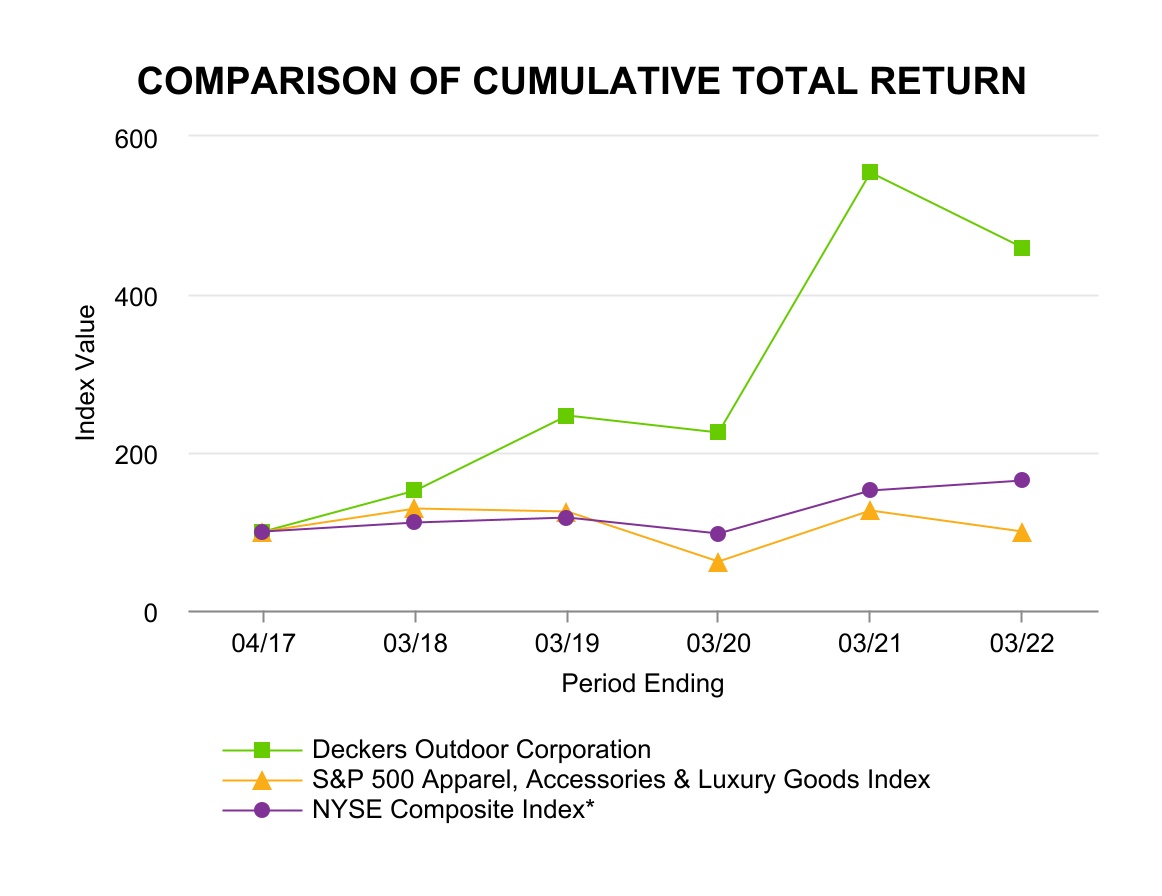
| April 1, | Years Ended March 31, | ||||||||||||||||||||||||||||||||||
| 2017 | 2018 | 2019 | 2020 | 2021 | 2022 | ||||||||||||||||||||||||||||||
| Deckers Outdoor Corporation | $ | 100.0 | $ | 150.7 | $ | 246.1 | $ | 224.3 | $ | 553.2 | $ | 458.3 | |||||||||||||||||||||||
| S&P 500 Apparel, Accessories & Luxury Goods Index | 100.0 | 128.3 | 124.2 | 61.8 | 126.1 | 99.7 | |||||||||||||||||||||||||||||
| The NYSE Composite Index | 100.0 | 111.2 | 116.6 | 97.2 | 150.7 | 164.4 |
The stock performance graph and related information shall not be deemed incorporated by reference by any general statement incorporating by reference into this Annual Report into any filing under the Securities Act, or under the Exchange Act, except to the extent that we specifically incorporate this information by reference and shall not otherwise be deemed filed under the Securities Act or the Exchange Act.
Dividend Policy
We have not declared or paid any cash dividends on our common stock since our inception. We currently do not anticipate declaring or paying any cash dividends. Our current revolving credit agreements allow us to declare and pay cash dividends, as long as we do not exceed certain leverage ratios and no event of default has occurred.
Stock Repurchase Programs
In January 2019, our Board of Directors approved a stock repurchase program that authorized us to repurchase $261,000 of our common stock in the open market or in privately negotiated transactions, subject to market conditions, applicable legal requirements, and other factors. Our Board of Directors approved an additional authorization of $750,000 during April 2021 to repurchase our common stock under the same conditions as the prior stock repurchase program (collectively, the stock repurchase programs).
Our stock repurchase programs do not obligate us to acquire any amount of common stock and may be suspended at any time at our discretion. Our current revolving credit agreements allow us to make stock repurchases under these programs, so long as we do not exceed certain leverage ratios and no event of default has occurred under these agreements. As of March 31, 2022, no defaults have occurred under our credit agreements.
Below is a summary of stock repurchasing activity under our stock repurchase programs during the fourth fiscal quarter ended March 31, 2022:
| Total number of shares repurchased* | Average price paid per share | Dollar value of shares repurchased | Dollar value of shares remaining for repurchase** | |||||||||||||||||||||||
| January 1 - January 31, 2022 | 2,643 | $ | 368.25 | $ | 973 | $ | 543,003 | |||||||||||||||||||
| February 1 - February 28, 2022 | 194,912 | 302.69 | 58,998 | 484,005 | ||||||||||||||||||||||
| March 1 - March 31, 2022 | 110,023 | 272.65 | 29,998 | 454,007 |
*Any share repurchases are made as part of publicly announced programs in open-market transactions.
** May not calculate on rounded dollars.
Subsequent to March 31, 2022, through May 5, 2022, we repurchased 176,046 shares for $47,997 at an average price of $272.64 per share and had $406,010 remaining authorized under the stock repurchase program.
Refer to Part II, Item 7, “Management's Discussion and Analysis of Financial Condition and Results of Operations,” under the heading “Liquidity and Capital Resources” and Note 10, “Stockholders' Equity,” of our consolidated financial statements and accompanying notes thereto (referred to herein as the consolidated financial statements) in Part IV within this Annual Report for further information on repurchases of our common stock.
Item 7. Management’s Discussion and Analysis of Financial Condition and Results of Operations
The following discussion of our financial condition and results of operations should be read together with our consolidated financial statements in Part IV within this Annual Report. This discussion includes an analysis of our financial condition and results of operations for the years ended March 31, 2022, and 2021 and year-over-year comparisons between those periods. For year-over-year comparisons between the years ended March 31, 2021, and 2020, refer to Part II, Item 7, “Management's Discussion and Analysis of Financial Condition and Results of Operations,” of our Annual Report on Form 10-K for the fiscal year ended March 31, 2021, filed with the SEC on May 28, 2021.
Certain statements made in this section constitute “forward-looking statements,” which are subject to numerous risks and uncertainties including those described in this section. Refer to the section entitled “Cautionary Note Regarding Forward-Looking Statements” within this Annual Report for additional information.
Overview
We are a global leader in designing, marketing, and distributing innovative footwear, apparel, and accessories developed for both everyday casual lifestyle use and high-performance activities. We market our products primarily under five proprietary brands: UGG, HOKA, Teva, Sanuk, and Koolaburra. We believe that our products are distinctive and appeal to a broad demographic. We sell our products through quality domestic and international retailers, international distributors, and directly to our global consumers through our DTC business, which is comprised of our e-commerce websites and retail stores. We seek to differentiate our brands and products by offering diverse lines that emphasize authenticity, functionality, quality, and comfort, and products tailored to a variety of activities, seasons, and demographic groups. All of our products are currently manufactured by independent manufacturers.
Financial Highlights
Consolidated financial performance highlights of fiscal year 2022 compared to the prior period, are as follows:
- Net sales increased 23.8% to $3,150,339.
**◦**Channel
▪Wholesale channel net sales increased 31.0% to $1,936,739.
▪DTC channel net sales increased 13.8% to $1,213,600.
**◦**Geography
▪Domestic net sales increased 23.1% to $2,167,793.
▪International net sales increased 25.3% to $982,546.
-
Gross margin decreased 300 basis points to 51.0%.
-
Income from operations increased 12.0% to $564,707.
-
Diluted earnings per share increased by $2.79 per share to $16.26 per share.
Trends and Uncertainties Impacting Our Business and Industry
We expect our business and the industry in which we operate will continue to be impacted by several important trends and uncertainties, including the following:
Supply Chain
- Similar to other companies in our industry, we continue to experience supply chain challenges across each of the geographies in which we operate. The most significant macro-level supply chain impacts continue to be extended transit lead times and cost pressures, including from inflation, due primarily to container shortages, port congestion, and trucking and labor scarcity, which have created negative downstream impacts on our results of operations. To offset the impacts of these ongoing constraints, we have used a substantial amount of air freight. These costs, together with higher ocean container shipment and trucking costs, have elevated our transportation and logistics costs and negatively impacted our gross margin during fiscal year 2022, and we expect will continue to do so in future periods, particularly as we seek to maintain strategic product launch timelines and customer service levels. As we manage product availability, we remain focused on mitigating the impacts of ongoing disruptions in both the wholesale and DTC channels into our next
fiscal year, including through the use of air freight (almost exclusively for the HOKA brand) and the early procurement of inventory in the country of sale, which will likely result in higher levels of inventory to allow us to maintain expected service levels into our next fiscal year. We anticipate these global supply chain pressures will continue, and we remain focused on ensuring our long-term growth strategy remains flexible to adapt to fluid conditions.
- Although our owned DCs and 3PL providers are currently operating and supporting ongoing logistics, certain of these facilities continue to experience operational challenges, which have resulted in delays distributing our products, as well as cost pressures. Further, the headwinds we have encountered transitioning to our new European 3PL as that provider refines its system and delivery levels have exacerbated supply chain pressures. While this transition has been difficult in the current logistics environment, we believe this is a critical investment to create long-term capacity that will facilitate future growth. We continue to invest in infrastructure, including in our global distribution and logistics capabilities, end-to-end planning systems, and e-commerce platforms, as well as in expanding our sourcing capabilities and distribution points, to ensure we scale our operations commensurate with consumer demand.
Inflation
*•*Due to recent heightened inflation in key global markets, including the United States, we experienced impacts from inflation during fiscal year 2022, primarily related to supply chain challenges including higher freight costs, discussed above. We expect our business will be impacted by continued or increasing inflation in future periods, including impacts to costs for finished goods, freight, and commodities, which will impact our gross margin in our next fiscal year, as well as potential impacts to our operating expenses, foreign currency exchange rates, wages in a competitive job market, interest rates on borrowings, and customer demand.
Brand and Omni-Channel Strategy
-
We remain focused on accelerating consumer adoption of the HOKA brand globally to execute our long-term growth strategy, including through an optimized digital marketing strategy. The HOKA brand’s growth has been balanced across its ecosystem of access points, with all geographic regions and distribution channels experiencing significant year-round growth, which has positively impacted our seasonality trends. In our next fiscal year, we intend to focus our efforts to drive HOKA brand performance on distribution management to drive new consumer acquisition in key markets and launching innovative product offerings to increase category adoption and market share gains with existing consumers. For example, we’re looking at volume expansion with new and existing global strategic wholesale partners to drive new consumer acquisition. Further, we recently opened the HOKA brand's first owned and operated retail stores in Asia and launched pop-up stores in North America to build upon our retail strategy and define the optimal consumer experience and concept for the HOKA brand. We plan to open additional retail stores for the HOKA brand and to continue exploring opportunities to strategically expand our HOKA brand retail store fleet.
-
Our marketplace strategies in Europe and Asia (international reset strategies) have continued to drive UGG brand awareness and consumer acquisition through building a foundation of diversified and counter-seasonal product acceptance, especially with younger consumers, through localized marketing investments, which is fueling a healthier product mix and reducing the need for promotional activity.
-
While we experienced a channel mix shift to wholesale in fiscal year 2022 as we refilled customer inventory levels, our aggregated DTC channel mix continues to be above our historical pre-pandemic levels. Our long-term growth strategy remains focused on building our DTC channel to represent an increasing portion of our total net sales, as we prioritize consumer acquisition and e
Showing the first 8K of 79K characters. Open the full section
Item 7A. Quantitative and Qualitative Disclosures About Market Risk
Commodity Price Risk
For the manufacturing of our products, we purchase certain raw materials that are affected by commodity prices, which include sheepskin, leather, and wool. The supply of sheepskin, which is used to manufacture a significant portion of the UGG brand products, is in high demand and there are a limited number of suppliers that can meet our expectations for the quantity and quality of sheepskin that we require. Most of our sheepskin is purchased from two tanneries in China, which is sourced primarily from Australia and the United Kingdom. While we have experienced fairly stable pricing in recent years, historically there have been significant fluctuations in the price of sheepskin as the demand for this commodity from our consumers and our competitors has changed. We believe significant factors affecting the price of sheepskin include weather patterns, harvesting decisions, incidence of disease, the price of other commodities such as wool and leather, the demand for our products and the products of our competitors, use of substitute products or components, and global economic conditions. Any factors that increase the demand for, or decrease the supply of, sheepskin could cause significant increases in the price of sheepskin.
We typically fix prices for all of our raw materials with firm pricing agreements on a seasonal basis. For sheepskin and leather, we use purchasing contracts and refundable deposits to attempt to manage price volatility as an alternative to hedging commodity prices. The purchasing contracts and other pricing arrangements we use for sheepskin and leather typically result in purchase obligations which are not recorded in our consolidated balance sheets. With respect to sheepskin and leather, in the event of significant price increases for these commodities, we will likely not be able to adjust our selling prices sufficiently to eliminate the impact of such increases on our profitability. Refer to the section titled “Contractual Obligations” above within Part II, Item 7, “Management's Discussion and Analysis of Financial Condition and Results of Operations,” and Note 7, “Leases and Other Commitments,” of our consolidated financial statements in Part IV within this Annual Report for further information on our minimum commodity purchase commitments.
Foreign Currency Exchange Rate Risk
Fluctuations in currency exchange rates, primarily between the US dollar and the currencies of Europe, Asia, Canada, and Latin America where we operate, may affect our results of operations, financial position, and cash flows. We face market risk to the extent that foreign currency exchange rate fluctuations affect our foreign assets, liabilities, revenues, and expenses. Although most of our sales and inventory purchases are denominated in US dollars, these sales and inventory purchases may be impacted by fluctuations in the exchange rates between the US dollar and local currencies in the international markets where our products are sold and manufactured. We are exposed to financial statement transaction gains and losses as a result of remeasuring our monetary assets and liabilities that are denominated in currencies other than the subsidiaries’ functional currencies. We translate all assets and liabilities denominated in foreign currencies into US dollars using the exchange rate as of the end of the reporting period. Gains and losses resulting from translating assets and liabilities from our subsidiaries' functional currencies to US dollars are recorded in other comprehensive income. Foreign currency exchange rate fluctuations affect our reported profits and can make comparisons from year to year more difficult.
We hedge certain foreign currency exchange rate risk from existing assets and liabilities, as well as forecasted sales. As our international operations grow and we increase purchases and sales in foreign currencies, we will continue to evaluate our hedging strategy and may utilize additional derivative instruments, as needed, to hedge our foreign currency exchange rate risk. We do not use foreign currency exchange rate forward contracts for trading purposes.
As of March 31, 2022, there are no known factors that we would expect to result in a material change in the general nature of our foreign currency exchange rate risk exposure.
Refer to Note 9, “Derivative Instruments,” of our consolidated financial statements in Part IV within this Annual Report for further information on our use of derivative contracts.
Interest Rate Risk
Our market risk exposure with respect to our revolving credit facilities is tied to changes in applicable interest rates, including the Alternate Base Rate, the federal funds effective rate, currency-specific London Interbank Offered Rate and Canadian deposit offering rate for our Primary Credit Facility, People’s Bank of China market rate for our China Credit Facility, and Tokyo interbank offered rate for our Japan Credit Facility.
A hypothetical 1.0% increase in interest rates for borrowings made under our revolving credit facilities would have resulted in an immaterial aggregate change to interest expense recorded in our consolidated statements of comprehensive income during the year ended March 31, 2022, due to no outstanding balances under our revolving credit facilities. Refer to Note 6, “Revolving Credit Facilities,” of our consolidated financial statements in Part IV within this Annual Report for further information on our revolving credit facilities.
Item 8. Financial Statements and Supplementary Data
The Consolidated Financial Statements, the Financial Statement Schedule, and the Reports of Independent Registered Public Accounting Firm, are filed in a separate section following Part IV, as shown on the index under Item 15, “Exhibits and Financial Statement Schedule,” within this Annual Report.
Item 9A. Controls and Procedures
a) Disclosure Controls and Procedures
We maintain a system of disclosure controls and procedures, as defined in Rule 13a-15(e) under the Exchange Act, which are designed to provide reasonable assurance that information required to be disclosed in the reports that we file or submit under the Exchange Act is recorded, processed, summarized and reported within the time periods specified in the SEC’s rules and forms. In designing and evaluating our disclosure controls and procedures, our management recognized that any system of controls and procedures, no matter how well designed and operated, can provide only reasonable assurance of achieving the desired control objectives, as ours is designed to do, and management necessarily is required to apply its judgment in evaluating the cost-benefit relationship of possible controls and procedures. In addition, the design of any system of controls is also based in part upon certain assumptions about the likelihood of future events, and there can be no assurance that any design will succeed in achieving its stated goals under all potential future conditions. Over time, controls may become inadequate because of changes in conditions, or the degree of compliance with policies or procedures may deteriorate. Because of the inherent limitations in a cost-effective control system, misstatements due to error or fraud may occur and not be detected.
Under the supervision and with the participation of management, we conducted an evaluation of the effectiveness of the design and operation of our disclosure controls and procedures as of March 31, 2022. Based on that evaluation, our Principal Executive Officer (PEO) and Principal Financial and Accounting Officer (PFAO) concluded that our disclosure controls and procedures are effective at a reasonable assurance level as of March 31, 2022.
b) Management’s Report on Internal Control Over Financial Reporting
Management is responsible for establishing and maintaining adequate internal control over financial reporting (as defined in Rule 13a-15(f) under the Exchange Act). Our internal control over financial reporting is a process designed under the supervision of our PEO and PFAO to provide reasonable assurance regarding the reliability of financial reporting and the preparation of our financial statements for external reporting purposes in accordance with US GAAP. Because of inherent limitations, internal control over financial reporting may not prevent or detect misstatements. Also, projections of any evaluation of effectiveness to future periods are subject to the risk that controls may become inadequate because of changes in conditions, or that the degree of compliance with the policies or procedures may deteriorate.
As of March 31, 2022, our management, including our PEO and PFAO, assessed the effectiveness of our internal control over financial reporting using the criteria set forth in Internal Control — Integrated Framework (2013) issued by the Committee of Sponsoring Organizations of the Treadway Commission (commonly referred to as COSO). Based on this assessment, our management concluded that our internal control over financial reporting was effective based on those criteria. The registered public accounting firm that audited our consolidated financial statements in Part IV within this Annual Report has issued an attestation report on our internal control over financial reporting. Refer to Part IV, “Report of Independent Registered Public Accounting Firm - Internal Control Over Financial Reporting,” on page F-4 within this Annual Report.
c) Internal Control Over Financial Reporting
There were no changes in our internal control over financial reporting identified in management’s evaluation pursuant to Rule 13a-15(d) of the Exchange Act during the year ended March 31, 2022, that have materially affected, or are reasonably likely to materially affect, our internal control over financial reporting. Although we have modified our workplace practices globally due to the pandemic, resulting in most of our employees working remotely, this has not materially affected our internal control over financial reporting. We are continually monitoring and assessing the impacts and disruptions caused by the pandemic to ensure there are no material effects on the design and operating effectiveness of our internal control over financial reporting.
d) Principal Executive Officer and Principal Financial and Accounting Officer Certifications
The certifications of our PEO and PFAO required by Rule 13a-14(a) of the Exchange Act are filed herewith as Exhibit 31.1 and Exhibit 31.2, and furnished as Exhibit 32, within this Annual Report. This Part II, Item 9A, should be read in conjunction with such certifications for a more complete understanding of the topics presented.
PART III
Item 10. Directors, Executive Officers and Corporate Governance
The information required by this item will be disclosed in our definitive proxy statement on Schedule 14A (Proxy Statement) for our 2022 annual meeting of stockholders and is incorporated herein by reference. Our Proxy Statement will be filed with the SEC within 120 days after the end of the year ended March 31, 2022, pursuant to Regulation 14A under the Exchange Act.
Item 11. Executive Compensation
The information required by this item will be disclosed in the Proxy Statement and is incorporated herein by reference.
Item 12. Security Ownership of Certain Beneficial Owners and Management and Related Stockholder Matters
The information required by this item will be disclosed in the Proxy Statement and is incorporated herein by reference.
Item 13. Certain Relationships and Related Transactions, and Director Independence
The information required by this item will be disclosed in the Proxy Statement and is incorporated herein by reference.
Item 14. Principal Accounting Fees and Services
The information required by this item will be disclosed in the Proxy Statement and is incorporated herein by reference.
PART IV
Item 15. Exhibits and Financial Statement Schedule
Refer to Part IV, “Index to Consolidated Financial Statements and Financial Statement Schedule,” on page F-1 within this Annual Report for our Consolidated Financial Statements and the Reports of Independent Registered Public Accounting Firm.
EXHIBIT INDEX
Showing the first 8K of 205K characters. Open the full section