 filings.tools
Deckers Outdoor 10-K 2025-03-31
Filed 2025-05-23. 24 sections, 451K characters. Original on sec.gov · Markdown · JSON
Cover and table of contents
UNITED STATES
SECURITIES AND EXCHANGE COMMISSION
Washington, D.C. 20549
FORM 10-K
| (Mark One) | |||||
| ☒ | Annual Report Pursuant to Section 13 or 15(d) of the Securities Exchange Act of 1934 |
For the Fiscal Year Ended March 31, 2025
| ☐ | Transition Report Pursuant to Section 13 or 15(d) of the Securities Exchange Act of 1934 |
For the transition period from to
Commission File Number: 001-36436
DECKERS OUTDOOR CORPORATION
(Exact name of registrant as specified in its charter)
| Delaware | 95-3015862 | ||||
| (State or other jurisdiction of incorporation or organization) | (I.R.S. Employer Identification No.) |
250 Coromar Drive, Goleta, California 93117
(Address of principal executive offices)
(805) 967-7611
(Registrant’s telephone number, including area code)
Securities registered pursuant to Section 12(b) of the Act:
| Title of each class | Trading Symbol(s) | Name of each exchange on which registered | ||||||
| Common Stock, par value $0.01 per share | DECK | New York Stock Exchange |
Indicate by check mark if the registrant is a well-known seasoned issuer, as defined in Rule 405 of the Securities Act. Yes ☒ No ☐
Indicate by check mark if the registrant is not required to file reports pursuant to Section 13 or Section 15(d) of the Act. Yes ☐ No ☒
Indicate by check mark whether the registrant: (1) has filed all reports required to be filed by Section 13 or 15(d) of the Securities Exchange Act of 1934 during the preceding 12 months (or for such shorter period that the registrant was required to file such reports), and (2) has been subject to such filing requirements for the past 90 days. Yes ☒ No ☐
Indicate by check mark whether the registrant has submitted electronically every Interactive Data File required to be submitted pursuant to Rule 405 of Regulation S-T (§232.405 of this chapter) during the preceding 12 months (or for such shorter period that the registrant was required to submit such files). Yes ☒ No ☐
Indicate by check mark whether the registrant is a large accelerated filer, an accelerated filer, a non-accelerated filer, a smaller reporting company, or an emerging growth company. See the definitions of “large accelerated filer,” “accelerated filer,” “smaller reporting company,” and “emerging growth company” in Rule 12b-2 of the Exchange Act.
| Large accelerated filer | ☒ | Accelerated filer | ☐ | |||||||||||
| Non-accelerated filer | ☐ | Smaller reporting company | ☐ | |||||||||||
| Emerging growth company | ☐ |
If an emerging growth company, indicate by check mark if the registrant has elected not to use the extended transition period for complying with any new or revised financial accounting standards provided pursuant to Section 13(a) of the Exchange Act. ☐
Indicate by check mark whether the registrant has filed a report on and attestation to its management’s assessment of the effectiveness of its internal control over financial reporting under Section 404(b) of the Sarbanes-Oxley Act (15 U.S.C. 7262(b)) by the registered public accounting firm that prepared or issued its audit report. ☒
If securities are registered pursuant to Section 12(b) of the Act, indicate by check mark whether the financial statements of the registrant included in the filing reflect the correction of an error to previously issued financial statements. ☐
Indicate by check mark whether any of those error corrections are restatements that required a recovery analysis of incentive-based compensation received by any of the registrant’s executive officers during the relevant recovery period pursuant to §240.10D-1(b). ☐
Indicate by check mark whether the registrant is a shell company (as defined in Rule 12b-2 of the Act).
Yes ☐ No ☒
At September 30, 2024, the last business day of the registrant’s most recently completed second fiscal quarter, the aggregate market value of the voting and non-voting stock held by the non-affiliates of the registrant was approximately $24,144,731,557, based on the number of shares held by non-affiliates of the registrant as of that date, and the last reported sale price of the registrant’s common stock, par value $0.01 per share, on the New York Stock Exchange on that date, which was $159.45. This calculation does not reflect a determination that persons are affiliates for any other purposes.
As of the close of business on May 9, 2025, the number of outstanding shares of the registrant’s common stock, par value $0.01 per share, was 149,435,875.
DOCUMENTS INCORPORATED BY REFERENCE
Portions of the registrant’s definitive Proxy Statement on Schedule 14A relating to the registrant’s 2025 annual meeting of stockholders, to be filed with the Securities and Exchange Commission within 120 days after the end of the fiscal year covered by this Annual Report on Form 10-K, are incorporated by reference in Part III within this Annual Report on Form 10-K. With the exception of the portions of the Proxy Statement specifically incorporated herein by reference, the Proxy Statement and related proxy solicitation materials are not deemed to be filed as part of this Annual Report on Form 10-K.
DECKERS OUTDOOR CORPORATION AND SUBSIDIARIES
TABLE OF CONTENTS
Item 4. Mine Safety Disclosures
| | | | PART II | | | | | | | Item 5. | | | Market for Registrant’s Common Equity, Related Stockholder Matters and Issuer Purchases of Equity Securities | | | 29 | | |
Item 6. [Reserved]
| Item 7. | | | Management’s Discussion and Analysis of Financial Condition and Results of Operations | | | 31 | | | | Item 7A. | | | Quantitative and Qualitative Disclosures about Market Risk | | | 49 | | | | Item 8. | | | Financial Statements and Supplementary Data | | | 50 | | |
Item 9. Changes in and Disagreements with Accountants on Accounting and Financial Disclosure
| Item 9A. | | | Controls and Procedures | | | 50 | | | | Item 9B. | | | Other Information | | | 51 | | |
Item 9C. Disclosure Regarding Foreign Jurisdictions that Prevent Inspections
| | | | PART III | | | | | | | Item 10. | | | Directors, Executive Officers, and Corporate Governance | | | 52 | | | | Item 11. | | | Executive Compensation | | | 52 | | | | Item 12. | | | Security Ownership of Certain Beneficial Owners and Management and Related Stockholder Matters | | | 52 | | | | Item 13. | | | Certain Relationships and Related Transactions, and Director Independence | | | 52 | | | | Item 14. | | | Principal Accountant Fees and Services | | | 52 | | | | | | | PART IV | | | | | | | Item 15. | | | Exhibits and Financial Statement Schedules | | | 52 | | | | | | | Signatures | | | 55 | | | | | | | Index to Consolidated Financial Statements and Financial Statement Schedules | | | F-1 | | |
Item 16. Form 10-K Summary
| | | | | | | | | | | *Not applicable. | | | | | | | | |
CAUTIONARY NOTE REGARDING FORWARD-LOOKING STATEMENTS
This Annual Report on Form 10-K for our fiscal year ended March 31, 2025 (Annual Report), and the information and documents incorporated by reference within this Annual Report, contain “forward-looking statements” within the meaning of Section 27A of the Securities Act of 1933, as amended (Securities Act), and Section 21E of the Securities Exchange Act of 1934, as amended (Exchange Act), which statements are subject to considerable risks and uncertainties. These forward-looking statements are intended to qualify for the safe harbor from liability established by the Private Securities Litigation Reform Act of 1995. Forward-looking statements include all statements other than statements of historical fact contained in, or incorporated by reference within, this Annual Report. We have attempted to identify forward-looking statements by using words such as “anticipate,” “believe,” “could,” “estimate,” “expect,” “intend,” “may,” “plan,” “predict,” “project,” “should,” “will,” or “would,” and similar expressions or the negative of these expressions. Specifically, this Annual Report, and the information and documents incorporated by reference within this Annual Report, contain forward-looking statements relating to, among other things:
-
global geopolitical tensions and conflicts, including the impact of economic sanctions on our supply chain costs, such as those related to United States (US) and foreign trade policies and the enactment of tariffs and retaliatory tariffs;
-
changes in consumer preferences and the purchasing behavior of wholesale partners and consumers impacting our brands and products, and the footwear and fashion industries;
-
global economic trends, including foreign currency exchange rate fluctuations, changes in interest rates, inflationary pressures, changes in commodity pricing, and recessionary concerns;
-
the ability to effectively compete in a highly competitive footwear, apparel, and accessories industry;
-
the operational challenges faced by our warehouses and distribution centers (DCs), wholesale partners, global third-party logistics providers (3PLs), and third-party carriers, including as a result of global supply chain disruptions and labor shortages;
-
availability of materials and manufacturing capacity, and reliability of overseas production and storage;
-
expansion of our brands, product offerings, and investments in our distribution facilities, e-commerce websites, and our retail store footprint;
-
our business, operating, investing, capital allocation, marketing, and financing plans and strategies;
-
changes to our product distribution strategies, including product allocation and segmentation strategies;
-
trends, seasonality, and weather impacting the demand for our products;
-
changes to the geographic and seasonal mix of our brands and products;
-
the impact of our efforts to continue to advance sustainable and socially conscious business operations, and to meet the expectations that our investors and other stakeholders have with respect to our environmental, social, and governance (ESG) practices;
-
the effects of climate change, natural disasters, and the impacts of public health issues, and the related changes in the regulatory environment and consumer demand to mitigate these effects, and the resulting impact on our business and the businesses of our customers, consumers, suppliers, and business partners;
-
security breach or other disruption to our information technology (IT) systems, or those of our vendors, and our effective utilization of technological advancements, including artificial intelligence;
-
the outcomes of legal proceedings, including the impact they may have on our business and intellectual property rights;
-
our interpretation of applicable global tax regulations and changes in tax laws and audits that may impact our tax liability and effective tax rates;
-
our cash repatriation strategy regarding earnings of non-US subsidiaries and the resulting tax impacts; and
-
the value of long-lived assets and potential write-downs or impairment charges.
Forward-looking statements represent management’s current expectations and predictions about trends affecting our business and industry and are based on information available at the time such statements are made. Although we do not make forward-looking statements unless we believe we have a reasonable basis for doing so, we cannot guarantee their accuracy or completeness. Forward-looking statements involve numerous known and unknown risks, uncertainties, and other factors that may cause our actual results, performance, or achievements to be materially different from any future results, performance or achievements predicted, assumed, or implied by the forward-looking statements. Some of the risks and uncertainties that may cause our actual results to materially differ from those expressed or implied by these forward-looking statements are described in Part I, Item 1A, “Risk Factors,” and Part II, Item 7, “Management’s Discussion and Analysis of Financial Condition and Results of Operations,” within this Annual Report, as well as in our other filings with the Securities and Exchange Commission (SEC), which are available free of charge on the SEC’s website at www.sec.gov and our website at ir.deckers.com*.* You should read this Annual Report, including the information and documents incorporated by reference herein, in its entirety and with the understanding that our actual future results may be materially different from the results expressed or implied by these forward-looking statements. Moreover, new risks and uncertainties emerge occasionally, and it is not possible for management to predict all risks and uncertainties, nor can we assess the impact of all factors on our business or the extent to which any factor, or combination of factors, may cause our actual future results to be materially different from any results expressed or implied by any forward-looking statements. Except as required by applicable law or the listing rules of the New York Stock Exchange, we expressly disclaim any intent or obligation to update any forward-looking statements. We qualify all our forward-looking statements with these cautionary statements.
PART I
References within this Annual Report to “Deckers,” “we,” “our,” “us,” “management,” or the “Company” refer to Deckers Outdoor Corporation, together with its consolidated subsidiaries. UGG® (UGG), HOKA® (HOKA), Teva® (Teva), AHNU® (AHNU), Koolaburra by UGG® (Koolaburra), and UGGplush**TM (UGGplush) are some of our trademarks. Other trademarks or trade names appearing elsewhere within this Annual Report are the property of their respective owners. The trademarks and trade names within this Annual Report are referred to without the ® and ™ symbols, but such references should not be construed as any indication that their respective owners will not assert their rights to the fullest extent under applicable law.
Unless otherwise indicated, all figures herein are expressed in thousands, except for per share and share data. The defined periods for the fiscal years ended March 31, 2025, 2024, and 2023 are stated herein as “year ended” or “years ended.” We also refer to these fiscal years as “fiscal year 2025,” “fiscal year 2024,” and “fiscal year 2023,” respectively.
During the fourth quarter of fiscal year 2025, we updated our reportable operating segments to better reflect changes in the way our Chief Operating Decision Maker (CODM) evaluates performance, makes operating decisions, and allocates resources. In connection with executive leadership alignment, and the recent divestiture and phase out of certain brands, the CODM shifted resource allocation decisions and performance assessment to a brand focus, rather than a distribution channel focus. Our reportable operating segments include the worldwide operations of the UGG brand, HOKA brand, and Other brands. Refer to the section titled “Reportable Operating Segment Overview,” in Part II, Item 7, “Management’s Discussion and Analysis of Financial Condition and Results of Operations,” and section titled “Basis of Presentation,” in Note 1, “General,” of our consolidated financial statements in Part IV within this Annual Report for further information.
On September 13, 2024, we effected a six-for-one forward stock split of our common stock and preferred stock (the stock split) and a proportional increase in our authorized shares of common stock, without changing the par value of $0.01 per share. The common stock commenced t**rading on a post-stock split adjusted basis on September 17, 2024. Prior period results included in this Annual Report, including per share and share data, as well as stockholders’ equity balances, have been retroactively adjusted, as applicable, to reflect the effectiveness of the stock split. Refer to the section titled “Basis of Presentation,” in Note 1, “General,” of our consolidated financial statements in Part IV within this Annual Report for further information regarding the stock split.
Item 1. BUSINESS
GENERAL
We are a global leader in designing, marketing, and distributing innovative footwear, apparel, and accessories developed for both everyday casual lifestyle use and high-performance activities. We market our products primarily under five proprietary brands: UGG, HOKA, Teva, AHNU, and Koolaburra. Our brands compete across the fashion and casual lifestyle, performance, running, and outdoor markets. We believe our products are distinctive and appeal to a broad demographic. Our brands sell our products through quality domestic and international retailers, international distributors, and directly to global consumers through our Direct-to-Consumer (DTC) channel, which is comprised of an e‑commerce and retail store presence. We seek to differentiate our brands and products by offering diverse lines that emphasize fashion, authenticity, functionality, quality, and comfort, and products tailored to a variety of activities, seasons, and demographic groups. Independent third-party contractors manufacture all of our products (independent manufacturers).
RECENT DEVELOPMENTS
Koolaburra Brand. During the third quarter of fiscal year 2025, we began taking steps to phase out our standalone operations for the Koolaburra brand in order to maintain focus on our most significant organic opportunities. We closed Koolaburra.com as of March 31, 2025, and plan to wind down the Koolaburra brand in the wholesale channel by the end of calendar year 2025. Refer to the section titled “The Company,” in Note 1, “General,” of our consolidated financial statements in Part IV within this Annual Report for further information.
Sanuk Brand Asset Sale. We completed the sale of our Sanuk brand and certain related assets on August 15, 2024 (Sanuk Brand Sale Date). Refer to the section titled “The Company,” in Note 1, “General,” of our consolidated financial statements in Part IV within this Annual Report for further information on the sale of Sanuk brand.
Forward Stock Split and Authorized Share Increase. On September 13, 2024, we effected a stock split and an authorized share increase. Our financial results included within this Annual Report have been retroactively adjusted to reflect the effectiveness of the stock split and the authorized share increase. Refer to the section titled “Basis of Presentation,” in Note 1, “General,” of our consolidated financial statements in Part IV within this Annual Report for further information.
BRANDS
UGG. The UGG brand is one of the most iconic and recognized footwear brands in our industry, which highlights our successful track record of building niche brands into lifestyle and fashion market leaders. With loyal consumers around the world, the UGG brand has proven to be a highly resilient consumer-focused line of premium footwear, apparel, and accessories with year-round product offerings that appeal to a growing global audience and a broad demographic.
HOKA**.** The HOKA brand is an authentic premium line of year-round performance footwear, which offers enhanced cushioning and inherent stability with minimal weight. Originally designed for ultra-runners, the brand now appeals to world champions, taste makers, and everyday athletes. Expanded marketing and strategic marketplace presence have fueled both domestic and international sales growth of the HOKA brand, which has quickly become a leading brand within run and outdoor specialty wholesale accounts and is growing across its global marketplace. The HOKA brand’s product line includes running, trail, hiking, fitness, and lifestyle footwear offerings, as well as select apparel and accessories.
Other Brands. Other brands consist primarily of the Teva brand, AHNU brand, and Koolaburra brand. The Teva brand’s products are built for a range of outdoor pursuits and include a variety of footwear options, from classic sandals and shoes to boots. The AHNU brand’s footwear products fuse high-performance technology with timeless style crafted for everyday wear. The Koolaburra brand, for which we are phasing out standalone operations by the end of calendar year 2025, is a casual footwear brand that uses plush materials to target value-oriented consumers.
As discussed under the section titled “Recent Developments” above, the sale of the Sanuk brand was completed during fiscal year 2025. The financial results for our reportable operating segments present the former Sanuk brand within the Other brands reportable operating segment through the Sanuk Brand Sale Date for the year ended March 31, 2025, and full financial results for the years ended March 31, 2024, and 2023. Refer to the section titled “Reportable Operating Segments” below for further details about our reportable operating segments.
CHANNEL DISTRIBUTION
Wholesale. Our wholesale channel sells products to a network of third-party retailers, including partner retailers, and distributors. This approach enables us to expand market reach and leverage the scale and operational capabilities of its wholesale partners to serve a broad base of end consumers.
We sell our UGG brand products primarily through fashion lifestyle retailers, higher-end department stores, streetwear and sports style partners, online retailers and partner retailers. As the retail marketplace continues to evolve to reflect changing consumer preferences, we continually review and evaluate our UGG wholesale distribution and product segmentation approach.
We sell our HOKA brand products primarily through full-service specialty retailers, outdoor and sporting goods retailers, select online retailers, fashion lifestyle retailers, sports style partners, and higher-end department stores. We continue to expand our HOKA brand wholesale distribution globally, including through additional mono-branded locations operated by partner retailers.
We sell our Teva brand products primarily through outdoor and sporting goods retailers, fashion lifestyle retailers, large national retail chains, higher-end department stores, and online retailers. We sell our AHNU brand footwear through domestic streetwear and lifestyle boutiques and retailers.
Direct-to-Consumer. Our DTC channel is comprised of our Company-owned e-commerce websites and retail stores where products are sold at retail prices. Our e-commerce websites and retail stores are intertwined and interdependent in an omni-channel marketplace, providing a fluid purchasing experience, which engenders brand loyalty while increasing product sales and improving our inventory productivity. In addition, we believe many of our consumers interact with both before making purchasing decisions in store and online. For example, consumers may feel or try on products in our retail stores and then place an order online later. Conversely, they may initially research products online and then view inventory availability by store location and make a purchase in store.
E-Commerce Websites. Our global e-commerce websites provide us with an opportunity to directly engage and connect with our consumers and communicate a consistent message that promotes awareness of our brands’ promises and key initiatives, offers targeted information to specific consumer demographics, and drives consumers to our retail stores. As of March 31, 2025, we operate Company-owned e-commerce websites in 56 different countries.
Retail Stores. Retail stores enable us to expose consumers to a curated selection of products and directly influence our consumers’ experience with our brands. Our Company-owned mono-branded retail stores are predominantly UGG brand concept and outlet stores, as well as HOKA brand concept stores, which we continue to open in key markets to further grow our brand presence and appeal to a broader consumer base. As of March 31, 2025, we have a total of 179 global Company-owned retail stores (including 137 UGG brand retail stores and 42 HOKA brand retail stores), which include 92 concept stores and 87 outlet stores.
Retail store definitions are as follows:
*•*Concept Stores. Concept stores are Company-owned mono-branded stores launched in strategic locations, designed to offer a curated, themed experience and a unique selection of products, aiming to evoke a specific lifestyle for our brands. Concept stores include the following:
*◦*Flagship Stores. Premium mono-branded stores in key global markets, such as major tourist locations typically with above average square footage, designed to provide broader product offerings and generate greater traffic that enhances the consumer experience and increases brand loyalty.
◦Shop-in-shop (SIS) Stores. SIS stores are operated by us or non-employees within a department store, which we lease from the store owner by paying a percentage of store sales and for which we own the inventory.
*•*Outlet Stores. Outlet stores are Company-owned stores designed to sell certain discontinued styles from prior seasons, full price in-line products, and products made specifically for the outlet stores.
GEOGRAPHIC DISTRIBUTION
US Distribution. In our wholesale channel, we sell our products in the US through sales representatives, organized by brand and either geography or account type, as each brand generally has certain specialty customers that expect a dedicated sales team with specialized knowledge of the brand’s product offerings. In addition to our wholesale channel, we sell products directly to consumers through our DTC channel and fulfill online orders through our warehouses, DCs, and retail stores.
We currently distribute products sold in the US through our DCs in Moreno Valley, California, and Mooresville, Indiana. We also distribute products to our wholesale channel customers through a DC bypass program. Our warehouses and DCs feature a warehouse management system that enables us to efficiently pick and pack products for direct shipment to customers and consumers.
International Distribution. Collectively, our brands are sold internationally in Canada, Europe, Asia, and Latin America. We sell our products internationally in our wholesale channel through wholly owned subsidiaries and independent distributors, some of which operate partner retail stores. In addition, in certain countries we sell products through our DTC channel. For our wholesale and DTC channels, we distribute our products through a number of warehouses and DCs managed by 3PLs in certain international locations.
Refer to Part I, Item 2, “Properties,” and Note 7, “Commitments and Contingencies,” of our consolidated financial statements in Part IV within this Annual Report for further information on our properties and related minimum lease and other commitments. Refer to Note 13, “Concentration of Business,” of our consolidated financial statements in Part IV within this Annual Report for additional information regarding geographic areas and concentration of related business risks.
REPORTABLE OPERATING SEGMENTS
During the fourth quarter of fiscal year 2025, we updated our reportable operating segments to better reflect changes in the way our CODM makes resource allocation decisions and assesses performance. In connection with executive leadership alignment, and the recent divestiture and phase out of certain brands, the CODM shifted resource allocation decisions and performance assessment to a brand focus, rather than a distribution channel focus. As of March 31, 2025, our three reportable operating segments include the worldwide operations of the UGG brand, HOKA brand, and Other brands (collectively, our reportable operating segments).
Refer to Part II, Item 7, “Management’s Discussion and Analysis of Financial Condition and Results of Operations,” the section titled “Basis of Presentation,” in Note 1, “General,” and to Note 12, “Reportable Operating Segments,” of our consolidated financial statements in Part IV within this Annual Report for additional information regarding the recent change in our reportable operating segments and our results of operations.
PRODUCT DESIGN AND DEVELOPMENT
Our design and development teams work closely with each brand’s product management teams to create seasonal product lines designed to meet and exceed consumer expectations. Each brand follows a similar product creation path starting with consumer insights, including engagement with key consumer segments, color, trend, material research, and in-depth market analysis. Throughout the creation process there are multiple concept and design reviews to develop prototypes which are assembled through our independent manufacturers. Depending on the brand and product application, there may be multiple rounds of samples for fit, dynamic or athlete testing, and on occasion, we may contract with external laboratories for additional research needs. Our diverse product offering enables us to leverage learnings across each of our brands, enabling innovation and economies of scale. Throughout the entire design and development process we evaluate the availability and costs of raw materials, the capabilities and capacities of our independent manufacturers, and the target pricing of our products.
MANUFACTURING AND SUPPLY CHAIN
The production of our finished goods is outsourced to independent manufacturers, which are primarily located in Southeast Asia, predominately in Vietnam.
Production by our independent manufacturers is performed in accordance with our detailed product specifications and rigorous quality control and operating compliance standards. We maintain a buying office in Hong Kong, as well as on-site supervisory offices in Vietnam, China, and Indonesia, which collectively serve as a strong link to our independent manufacturers. We believe our substantial regional presence enhances our manufacturing processes by providing predictability of material availability and ensuring adherence to quality control standards and final design specifications.
We generally purchase products from independent manufacturers on the basis of individual purchase orders, rather than maintaining long-term purchase commitments, which provides us greater flexibility to adapt to changing consumer preferences, changes in international trade relations, and evolving inventory management requirements. From a sourcing perspective, less than 5% of our finished goods for footwear comes from China while the remainder comes from Southeast Asia, predominately from Vietnam.
The majority of the raw materials and components used in the production of our products by our independent manufacturers are purchased from independent suppliers that we designate (designated suppliers), who work with subcontractors that extract, process, or convert these raw materials.
Sheepskin used to manufacture a significant portion of our UGG brand products and is sourced primarily from designated suppliers in Australia and processed by two tanneries in China. We enter into fixed purchasing contracts with designated suppliers of sheepskin and, at times, sugarcane-derived ethylene-vinyl acetate (sugarcane-derived EVA) to manage price volatility and ensure availability. Excluding sheepskin, UGGplush, and sugarcane-derived EVA, we believe that substantially all raw materials and components used to manufacture our products are generally available from multiple sources at competitive prices. We believe current supplies are sufficient to meet our anticipated demand for the next 12 months.
Refer to the subsection titled “Contractual Obligations” under the section “Liquidity” within Part II, Item 7, “Management’s Discussion and Analysis of Financial Condition and Results of Operations” and Note 7, “Commitments and Contingencies,” of our consolidated financial statements in Part IV within this Annual Report for further information on our minimum purchase commitments.
We require our independent manufacturers and designated suppliers to adopt our Ethical Supply Chain Supplier Code of Conduct (Supplier Code of Conduct), which requires them to comply with all local laws and regulations governing human rights, working conditions, anti-corruption, restricted substances, and environmental compliance, including animal welfare and conflict minerals, before we are willing to conduct business with them. Refer to the section titled “Environmental, Social, and Governance” below for further information.
INVENTORY MANAGEMENT AND PRODUCT RETURNS
We have an extended design and manufacturing process, which involves the initial design of our products, the purchase of raw and other materials, the accumulation of inventories, the subsequent sale of the inventories, and the collection of the resulting accounts receivable. This production cycle results in significant liquidity requirements and working capital fluctuations throughout our fiscal year. Because our production cycle typically involves long lead times, which requires us to make manufacturing decisions several months in advance of an anticipated purchasing decision by the customer, it is challenging for us to estimate and manage our inventory and working capital requirements.
We seek to manage our inventory levels by considering existing orders, as well as forecasted sales and budgets by brand for both the wholesale and DTC channels, including consideration of the delivery requirements of our customers. Our systems and processes are designed to improve our product planning and forecasting, inventory control and supply chain management capabilities, including our Company-owned e-commerce websites. In addition, added discipline around SKU productivity, product purchasing decisions, the reduction of production lead times, and the sale of excess inventory through our liquidation channels, are key areas of focus that have enhanced inventory performance, including higher inventory turnover, and partially mitigated product cost increases.
Our general practice, and the general practice in our industry, is to offer customers in our wholesale channel the right to return defective or improperly shipped merchandise, and to accept returns from our consumers in the DTC channel between 30 to 90 days from the point of sale for cash or credit.
We encourage our customers to place a significant portion of orders as pre-season orders, which are typically placed up to 12 months prior to the anticipated shipment date, and also provide customers the ability to place in-season fill-in orders that can be shipped immediately. We work with our customers through pre-season programs to enable us to better plan our production schedule, inventory, and shipping requirements.
Refer to the sections titled “Trends and Uncertainties Impacting Our Business and Industry” and “Liquidity” within Part II, Item 7, “Management’s Discussion and Analysis of Financial Condition and Results of Operations,” within this Annual Report for further information on our supply chain infrastructure capabilities, working capital and operating requirements, and purchase obligations for product.
ENVIRONMENTAL, SOCIAL, AND GOVERNANCE
As a global leader in designing, marketing, and distributing innovative footwear, apparel, and accessories, our worldwide reach and impact is significant. We believe consumers are increasingly buying brands that deliver quality products while striving for minimal environmental impact by employing sustainable business practices. Our sustainability policies and strategies are informed by our ongoing efforts with multi-stakeholder initiatives, which involve our stockholders, employees, suppliers, and customers, as well as other brands and non-governmental organizations.
Through our holistic ESG program, which has been in existence since 2010, we are committed to advancing our sustainable business initiatives. As a result of our efforts, during fiscal year 2025, we have been recognized as one of Barron’s 100 Most Sustainable Companies, by TIME as one of the Most Sustainable Companies, by Forbes as one of America’s Best Companies, by Newsweek as one of America’s Most Responsible Companies and as one of America’s Greenest Companies.
ESG Oversight. Our Corporate Responsibility, Sustainability & Governance Committee (Corporate Governance Committee) is comprised of four independent members of our Board of Directors (Board) who oversee our ESG strategy and have ultimate oversight over all sustainability initiatives, strategies, and programs, including economic, social, and environmental risks. The Corporate Governance Committee and Board regularly receive updates on the status of our ESG program. In addition, the Audit & Risk Management Committee (Audit Committee) of the Board periodically assesses risk management, including climate-related risks and policies, to ensure a consistent corporate strategy. The Board considers whether the ESG program adequately identifies material risks in a timely fashion, implements appropriate responsive risk management strategies, and transmits necessary information with respect to material risks within the organization. Our Chief Administrative Officer (CAO) is responsible for the day-to-day management of our ESG program. The program’s execution is driven by our leadership team and various cross-functional teams including our ethical sourcing, facilities, warehouses and DCs, brands, innovation, materials, and supply chain teams.
Our ESG program aligns our internal teams with our Sustainable Development Goals (SDGs), and establishes policies to encourage our partners and suppliers to employ sustainable business practices. We annually assess risks related to ESG issues as part of our overall enterprise risk management approach. In addition, our internal audit team provides periodic targeted reviews of our ESG-related policies and procedures to the Audit Committee.
Stakeholder Engagement. We highly value stakeholder input and have consistently demonstrated our commitment to maintaining open and interactive dialogue on ESG matters with our stakeholders, including non-governmental organizations, employees, stockholders, suppliers, industry groups, communities, and governments, to ensure their views are actively considered in executing our ESG program. Our stakeholder outreach program is led by a cross-functional team that includes members of our investor relations, compliance, sustainability, and legal teams. Additionally, we actively engage with our employees to obtain valuable feedback and track progress, including through regular employee engagement surveys.
Sustainable Development Goals. We work to establish SDGs that we believe are the most relevant to our business, our operations, our stockholders, and the communities in which we operate. We are a member of the United Nations Global Compact (UNGC), the world’s largest voluntary corporate sustainability initiative. This membership requires an annual statement of progress, which is reflected in our Corporate Responsibility and Sustainability Report (Creating Change Report). Our CAO identifies specific SDGs established by the UNGC, which we adopt to guide our ESG strategy.
Our annual Creating Change Report for the year ended March 31, 2025, which will be published in calendar year 2025 under the “Responsibility” tab of our website located at ir.deckers.com, will provide more information regarding our fiscal year 2025 ESG achievements with a focus on the SDGs discussed below. The content of our website, including our Creating Change Report, is not incorporated by reference into this Annual Report or in any other report or document we file with the SEC.
We believe the progress of our corporate responsibility efforts is evidenced by disclosing goals and relevant metrics and, to that end, we have aligned the reporting standards included in our Creating Change Report with the Financial Stability Board’s Task Force on Climate-Related Financial Disclosures (commonly referred to as TCFD), Global Reporting Initiative’s (commonly referred to as GRI) Core Standards, and Sustainability Accounting Standards Board’s (commonly referred to as SASB), and now part of the International Finance Reporting Standard (or IFRS) Foundation Consumer Goods Sector Apparel, Accessories and Footwear Index.
HUMAN CAPITAL - OUR PEOPLE AND OUR CULTURE
Employees**.** As of March 31, 2025, we employed approximately 5,500 employees, reflecting an increase of 14.6%, compared to March 31, 2024, in North America, Europe, and Asia. This includes approximately 2,000 employees in our retail stores but excludes temporary and seasonal employees.
Culture**.** Our key values, which guide our journey onward together to improve our business and create a better world around us, and help hold us accountable to deliver on this purpose, are as follows:
-
Come as you are. Authentic employees create an authentic company.
-
Better together. The power of independent spirit, united for a common goal.
-
Commit to create. Curiosity fuels creativity, which in turn fuels innovation.
-
Own it. We set high targets and hit them and take accountability when we don’t.
-
Do good and do great. We act with integrity and humility and respect each other and our communities to drive a sustainable business.
Our values define our Company and serve as the driving force behind how we work together and with our customers, consumers, partners, suppliers, and communities. We also have detailed policies that support our commitment to ethical behavior and legal compliance across our Company. Through our open-door policy and culture, employees are encouraged to approach their managers if they believe violations of standards or policies have occurred and are able to make confidential and anonymous reports using a 24/7 online or telephone hotline hosted by an independent third-party provider.
At Deckers, we believe our culture makes us unique. We regularly conduct employee surveys to understand our employees’ experiences on a variety of topics focused on employee engagement. Our latest survey completed in February 2025 had a participation rate of 91.5%. Of those employees who completed the survey, 89% noted they were proud to work for Deckers.
We believe an inclusive workplace that promotes belonging for everyone brings together those with a unique set of experiences, opinions, and thoughts on critical issues. In turn, these varied perspectives enhance our business and drive better outcomes. Our people are at the center of everything we do. Their perspectives and passion for innovation enable us to build brands and create products that people around the world love. We strive to create an environment where employees can come as they are and are free to bring their authentic selves to work every day.
We publish workforce metrics in our annual Equal Employment Opportunity filing (EEO-1) which is publicly available at deckers.com/responsibility/policies. The content of our website, including our annual EEO-1 filing, is not incorporated by reference into this Annual Report or in any other report or document we file with the SEC.
Charitable Giving and Volunteering. Our charitable contributions, product donations, and employee volunteer efforts are an essential part of our culture. We annually contribute to our local communities through monetary donations, volunteer efforts, and in-kind donations. During fiscal year 2025, we donated over $6,000 to various non-profit organizations around the globe, primarily to organizations focused on uplifting youth, community, belonging, education, and the environment. We also continued our Art of Kindness events, where employees volunteer during a week-long event in our local communities multiple times during the fiscal year. Our employees volunteered approximately 24,000 hours during fiscal year 2025. Our strategic giving and community-engagement efforts continued to be aligned with our SDGs.
Talent Development and Retention**.** The ability to attract, develop, and retain employees is critical to our long-term success. We focus on our employees’ growth, creating experiences that align with our strategic priorities and promote inclusion, performance, connection, and opportunities for development. For example, we offer a week fully dedicated to employee learning, connection, and development across the globe (Explore Week), and three global leadership development programs for leaders at varying levels (Trailblazers, Navigator, and Ascent). Our leadership team also mentors rising talent on a formal and informal basis, which we believe accelerates the development and engagement of our top performers, increases organizational learning, and improves employee performance and retention. Further, our executive leadership team and Board commit substantial time to succession planning, evaluating the bench strength of our leadership and supporting their career development while improving organizational performance. We are proud to offer a wide range of programs intended to support global employee development and retention.
We have demonstrated a history of investing in our workforce by offering competitive salaries and wages, and annual increases based on merit, as well as annual cash bonus compensation, which is based on Company and individual performance. We provide tuition reimbursement for eligible US employees up to $5 thousand per calendar year. Further, to foster a stronger sense of ownership and align the interests of management with stockholders, time-based restricted stock units and long-term incentive plan performance stock units are granted to a substantial proportion of our leadership team under our stock-based compensation programs. In addition, employees across the US business have the opportunity to purchase stock at a discounted price through our Employee Stock Purchase Plan. Further, we engage an independent compensation consultant, FW Cook, which provides us with information to evaluate the effectiveness of our executive compensation program, including competitive pay practices and trends in our industry, the design and structure of our executive compensation program, and the formulation of and benchmarking against our peers within our industry.
Employee Wellness**.** We strive to be one of the best places to work and recognize our employees are at different stages of life and have individual needs. We offer affordable, innovative, comprehensive, and competitive benefits package that range from health insurance, retirement plan, life insurance, disability, accident coverage, paid time off, paid and unpaid leave including parental leave, mental health benefits, and other voluntary benefits such as health savings accounts and our recently adopted solar and electric car reimbursement program.
Employee Health and Safety**.** The health and safety of our employees is our highest priority. We have comprehensive safety training programs to help ensure our employees know how to do their jobs safely and in compliance with laws and regulations. We prioritize the safety of our facilities and work to ensure they are modern and efficient.
SEASONALITY
A significant part of the UGG brand’s business has historically been seasonal, with the highest percentage of net sales occurring in the third fiscal quarter, which has contributed to variation in results of operations from quarter to quarter. However, we have mitigated the impacts of seasonality by diversifying and expanding product offerings with additional year-round styles. In addition, as the HOKA brand’s net sales, which generally occur more evenly throughout the fiscal year, continue to increase as a percentage of our aggregate net sales, we expect to reduce the impacts of seasonality in future periods.
Refer to Part I, Item 1A, “Risk Factors,” and Part II, Item 7, “Management’s Discussion and Analysis of Financial Condition and Results of Operations,” within this Annual Report for further discussion of the impacts of seasonality and other factors that may cause our actual results to differ materially from our expectations.
COMPETITION
The industry and markets in which we operate are highly competitive. Our competitors include athletic footwear companies, branded apparel companies, and retailers with their own private labels. Although the industry is fragmented, many of our competitors are larger and have substantially greater resources, several of which compete directly with some of our products. In addition, access to offshore manufacturing and the growth of e-commerce has made it easier for new companies to enter the markets in which we compete, further increasing competition in the footwear, apparel, and accessories industry. In particular, and in part due to the popularity of our UGG brand and HOKA brand products, we face increasing competition from a significant number of domestic and international
competitors selling products designed to compete directly or indirectly with our products. We believe our ability to successfully compete depends on numerous factors, including our ability to predict, assess, and respond quickly to changing consumer tastes and preferences, produce appealing products that meet expectations for product quality and technical performance, maintain and enhance the image and strength of our brands, price our products competitively, and weather the impacts of supply chain disruptions, among others. In addition, we believe our key customers face intense competition from other department stores, sporting goods stores, retail specialty stores, and online retailers, among others, which could negatively impact the financial stability of their businesses and their ability to conduct business with us.
Refer to Part I, Item 1A, “Risk Factors,” within this Annual Report for further discussion of the potential impact of competition on our business and results of operations.
TRADEMARKS AND PATENTS
We utilize trademarks for virtually all our products, and we believe having distinctive marks that are readily identifiable is an important factor in creating a market for our products, promoting our brands, and distinguishing our products from the products of others. We currently hold trademark registrations for “UGG,” “HOKA,” “Teva,” “AHNU,” “Koolaburra by UGG,” and other marks in the US, and for certain of the marks in many other countries, including Canada, China, the United Kingdom (UK), various countries in the European Union (EU), Japan, and Korea. As of March 31, 2025, we hold 232 designs and inventions with corresponding design or utility patent registrations, plus 64 designs and inventions which are currently pending registration. These patents expire at various times. We regard our proprietary rights as valuable assets and vigorously protect such rights against infringement by third parties.
GOVERNMENT REGULATION
We are subject to a wide range of laws and regulations, including US federal, state, and local laws; the laws of jurisdictions where we operate or plan to operate; and the laws of jurisdictions from which we source our products. Based on the information and circumstances known to us at this time, compliance with such applicable laws and regulations is not expected to have any material effect on our business, results of operations, financial condition, or competitive position.
AVAILABLE INFORMATION
Our annual reports on Form 10-K, quarterly reports on Form 10-Q, current reports on Form 8-K, proxy statements and information statements (and any amendments or supplements to the foregoing) filed with or furnished to the SEC pursuant to the Exchange Act are available free of charge on our website at ir.deckers.com. Such documents and information are available as soon as reasonably practicable after they are filed with or furnished to the SEC. We also make certain corporate governance and responsibility documents available through our website at ir.deckers.com/governance and ir.deckers.com/responsibility/policies, respectively, including Ethical Supply Chain Supplier Code of Conduct, Audit & Risk Management Committee Charter, Talent & Compensation Committee Charter, Corporate Responsibility, Sustainability, & Governance Committee Charter, Code of Ethics, Creating Change Report, Accounting and Finance Code of Ethics, EEO-1 Report, and Corporate Governance Guidelines. The information contained on or accessed through our website does not constitute part of this Annual Report, and references to our website address within this Annual Report are inactive textual references only.
Item 1A. RISK FACTORS
Our short and long-term success is subject to numerous risks and uncertainties, many of which involve factors that are difficult to predict or beyond our control. As a result, investing in our common stock involves substantial risk. Before deciding to purchase, hold or sell our common stock, stockholders and potential stockholders should carefully consider the risks and uncertainties described below, in addition to the other information contained in or incorporated by reference into this Annual Report, as well as the other information we file with the SEC. If any of these risks are realized, our business, financial condition, results of operations, and prospects could be materially and adversely affected. In that case, the value of our common stock could decline, and stockholders may lose all or part of their investment. Furthermore, additional risks and uncertainties of which we are currently unaware, or which we currently consider to be immaterial, could have a material adverse effect on our business.
Certain statements made in this section constitute “forward-looking statements,” which are subject to numerous risks and uncertainties including those described in this section. Refer to the section entitled “Cautionary Note Regarding Forward-Looking Statements” within this Annual Report for additional information.
RISKS RELATED TO OUR BUSINESS AND INDUSTRY
The footwear, apparel, and accessories industry is subject to rapid changes in consumer preferences, and if we do not accurately anticipate and promptly respond to consumer demand and spending patterns, including by successfully introducing new products, we could lose sales, our relationships with customers could be harmed, and our brand loyalty could be diminished.
The footwear, apparel, and accessories industry is subject to rapid changes in consumer preferences and fashion tastes, which make it difficult to anticipate demand for our products and forecast our financial results. Our success is driven to some extent by brand loyalty, and there can be no assurance consumers will continue to prefer our brands. Consumer demand for our products depends in part on the continued strength of our brands, which in turn depends on our ability to anticipate, understand, and promptly respond to the rapidly changing preferences and fashion tastes, as well as consumer spending patterns, with appealing merchandise. As our brands and product offerings evolve, it is necessary for our products to appeal to an even broader range of consumers whose preferences cannot be predicted with certainty. New footwear models that we introduce may not be successful with consumers or our brands may fall out of favor with consumers. If we are unable to anticipate, identify, or react appropriately to changes in consumer preferences, our revenues may decrease, our brands’ image may suffer, our operating performance may decline, and we may not be able to execute our growth plans. Even if we develop and manufacture new footwear products and collaborations that consumers find appealing, their ultimate success may depend on our pricing, and we may set the prices of new styles too high for the market to bear.
Further, the value of our brands is based on evolving consumer perceptions, including as a result of shifting ethical, political or social standards, and concerns with respect to product pricing, quality, design, technical performance, components or materials (including their sustainability), or customer service could result in negative perceptions and the loss of brand loyalty and value. These concerns may be exacerbated by negative publicity regarding us or our products, brands, marketing campaigns, partners, or endorsers, which could adversely affect our reputation and sales regardless of the accuracy of such claims. Social media and digital marketing campaigns, which accelerate the dissemination of information, can increase the challenges of containing negative claims. If consumers perceive our brands negatively, whether or not warranted, our brand image would become tarnished and our products would become less desirable, which could have a material adverse effect on our business.
Failure to gain market acceptance for new products could impede our ability to maintain or grow current revenue levels, reduce profits, adversely affect the image of our brands, erode our competitive position, and result in long-term harm to our business and financial results.
Changes to economic conditions may adversely affect our financial condition and results of operations.
Volatile economic conditions and changes in the market have affected, and may continue to affect, consumer spending generally and the buying habits and preferences of consumers. A significant portion of the products we sell, especially those sold under the UGG and HOKA brands, are premium retail products. The purchase of these
products is discretionary and is therefore highly dependent upon the level of consumer confidence and discretionary spending. Sales of these products may be adversely affected by variable economic factors, including worsening economic conditions, consumer confidence in future economic conditions, including recessionary concerns, changes to fuel, energy, labor, and healthcare costs, declines in income or asset values, and increases in consumer debt levels, inflation and interest rates, tariffs, and unemployment rates. Uncertainty in global economic conditions may result in unpredictable consumer discretionary spending trends. During an actual or perceived economic downturn, fewer consumers may shop for our products, and those who do may limit the amount of their purchases or seek less costly substitutes for our products. As a result, we could be required to reduce the price we can charge for our products or increase our marketing and promotional expenses to generate additional demand for our products. In either case, these changes could reduce our sales and profitability, which could have a material adverse effect on our financial condition and results of operations.
We sell a significant portion of our products through higher-end specialty and department store retailers, as well as through online marketplaces. The businesses of these customers may be affected by factors such as changes in economic conditions, ongoing geopolitical conflicts and uncertainties, fluctuations in foreign currency exchange rates, failures or instability in the US banking system, reduced consumer demand for premium products, decreases in available credit, and increased competition. If our customers face financial difficulties, it could have an adverse effect on our estimated allowances and reserves, and potentially result in us losing key customers.
We face intense competition from both established companies and newer entrants into the market, and our failure to compete effectively could cause our market share to decline, which could harm our reputation and have a material adverse effect on our financial condition and results of operations.
The footwear, apparel, and accessories industry is highly competitive and subject to changing consumer preferences and tastes. Our inability to compete effectively could cause our market share to decline, which could harm our reputation and have a material adverse effect on our financial condition and results of operations. Our competitors include both established companies and newer entrants into the market. In particular, we believe that, as a result of the growth of the UGG and HOKA brands, competitors have entered the marketplace specifically in response to the success of our brands, and other competitors may do so in the future, particularly as access to offshore manufacturing and changes in technology make it easier and more cost effective to compete. A number of our larger competitors have significantly gre
Showing the first 8K of 78K characters. Open the full section
Item 1B. UNRESOLVED COMMENT LETTERS
Item 1C. CYBERSECURITY
CYBERSECURITY RISK MANAGEMENT AND STRATEGY
We maintain a comprehensive cybersecurity program, recognizing the critical importance of safeguarding our operations, employees, customers, and other business partners from the constantly evolving risks associated with cybersecurity threats. These risks include, among other things, operational risks, reputational risks, financial risks, and litigation and legal risks.
As a part of our comprehensive cybersecurity program, we have developed an incident response plan (IRP) designed to quickly respond to, mitigate, and recover from cybersecurity incidents. The IRP includes procedures for incident detection and reporting, initial assessment, containment, eradication, recovery, post-incident activities, and continuous improvement.
We also integrated cybersecurity risk management into our overall risk management framework to ensure that cybersecurity risks are considered in all aspects of our business. The integration ensures that cybersecurity considerations are integral to our strategic and operational decision-making. Our management team works closely with our Chief Digital & Data Officer (CDDO) and Chief Information Security Officer (CISO), ensuring that our cybersecurity efforts align with our business objectives and operational needs. Key components of our cybersecurity approach include, among other things:
-
establishing a dedicated action team, led by our CDDO and CISO, to oversee and manage cybersecurity risks;
-
implementing a comprehensive cybersecurity risk assessment process and strategy based on industry standards and established frameworks such as the National Institute of Standards and Technology (NIST) Special Publication 800-61;
-
implementing a vendor risk management program, which includes cybersecurity and data privacy audits, evaluating vendor risk level, and monitoring risk mitigation efforts;
-
conducting penetration tests and security maturity assessments throughout the year;
-
periodically engaging independent third-party assessors to audit our cybersecurity and information system programs to evaluate their effectiveness;
-
implementing industry-standard technologies and processes to protect our system and data and to help detect potential suspicious activity;
-
maintaining access controls to safeguard data and systems;
-
providing annual trainings to employees on responsible information security, data security and cybersecurity practices including appropriate action to take against cybersecurity threats;
-
conducting periodic phishing simulations to our employees;
-
engaging in cybersecurity incident tabletop exercises and scenario planning exercises;
-
maintaining a cybersecurity and information security risk insurance policy, which insures for data incidents or breaches and other technology related exposures; and
-
periodically reviewing and updating our IRP, privacy policy, and other relevant policies/procedures.
These approaches are not exhaustive, and we plan to continuously improve our approaches to cybersecurity risk management.
In the three-year period ended March 31, 2025, our business strategy, results of operations and financial condition have not been materially affected by risks from cybersecurity threats, including as a result of any prior cybersecurity incidents experienced by either us or third parties, but we cannot provide assurance that they will not be materially affected in the future by such risks or any future material incidents. Refer to Part I, Item 1A, “Risk Factors - Risks Related to Technology, Data Security and Privacy” within this Annual Report for further information.
CYBERSECURITY GOVERNANCE
Our Board has delegated to the Audit Committee primary responsibility for oversight of risk assessment and risk management, including risks related to cybersecurity and information security issues. Our CDDO and CISO, who head our cybersecurity and information security initiatives, provide quarterly updates to the Audit Committee, and annual updates to the full Board. These updates cover various topics, such as efforts to enhance our cybersecurity posture, operational and incident metrics, mitigation actions, and key performance indicators like cybersecurity maturity, program health, and audit and compliance activities. In addition to these regular updates, significant cybersecurity incidents and updates are escalated on an as-needed basis in accordance with our IRP.
Our CDDO and CISO have extensive experience in cybersecurity. Our CDDO has served in his role since September 2024. He has over 15 years of experience in digital transformations, enterprise technology, artificial intelligence, and data management. Our CISO has served in various roles in Information Technology for over 25 years, including 15 years in Information Security. He holds a B.S. in Cybersecurity and Information Assurance, along with industry certifications that include the Information Systems Audit and Control Association Certified in Risk and Information Systems Control, Certified Information Security Manager, and International Information System Security Certification Consortium Certified Information Systems Security Professional certifications.
Item 2. PROPERTIES
Corporate Headquarters. We own our 14-acre corporate headquarters located in Goleta, California.
Warehouses and DCs. We have a warehouse and DC located in Moreno Valley, California, which began operations during the fourth quarter of fiscal year 2015. In October 2021, we began operations in a second US warehouse and DC located in Mooresville, Indiana. In October 2023, we began operations in a third US warehouse and DC located in Mooresville, Indiana. We continue to optimize and invest in our operations at these locations.
Regional Offices. We have offices in Austria, Belgium, Canada, China, France, Germany, Hong Kong, Indonesia, Italy, Japan, the Netherlands, Switzerland, the UK, the US, and Vietnam, to perform a variety of functions, which include supervising and overseeing the quality and manufacturing standards of our products, design, product development, distribution, customer service, coordinating regional sales, operations, marketing, IT, and administration. We also have offices in Macau and Hong Kong to coordinate logistics.
Retail Stores. As of March 31, 2025, we have 50 US retail stores and 129 international retail stores, including in Austria, Belgium, Canada, China, France, Germany, Japan, the Netherlands, Switzerland, and the UK.
Other than our corporate headquarters, we lease our warehouses and DCs, retail stores and regional offices from unrelated parties. With the exception of retail stores in our DTC channel, costs associated with our warehouses and DCs and regional offices are attributable to multiple reportable operating segments and are not allocated; but instead reflected in unallocated enterprise and shared brand expenses in our results of operations. Refer to Part II, Item 7, “Management’s Discussion and Analysis of Financial Condition and Results of Operations,” for further discussion and results of operations for our reportable operating segments and Note 12, “Reportable Operating Segments,” of our consolidated financial statements in Part IV within this Annual Report for additional information on unallocated enterprise and shared brand expenses.
We believe our properties are adequate for our current needs and that suitable additional or substitute space will be available to accommodate the foreseeable expansion of our business and operations.
Significant Properties. The following table provides details regarding our significant physical properties that are operational as of March 31, 2025:
| Facility Location | Description | Lease or Own | Facility Size (Square Footage) | |||||||||||||||||
| Moreno Valley, California | Warehouse and Distribution Center | Lease | 1,530,944 | |||||||||||||||||
| Mooresville Indiana (1st location) | Warehouse and Distribution Center | Lease | 507,600 | |||||||||||||||||
| Mooresville Indiana (2nd location) | Warehouse and Distribution Center | Lease | 1,015,902 | |||||||||||||||||
| Goleta, California | Corporate Headquarters | Own | 185,094 |
Item 3. LEGAL PROCEEDINGS
As part of our global policing program to protect our intellectual property rights, from time to time, we file lawsuits in various jurisdictions asserting claims for alleged acts of trademark counterfeiting, trademark infringement, patent infringement, trade dress infringement, and trademark dilution. We generally have multiple actions such as these pending at any given point in time. These actions may result in seizure of counterfeit merchandise, out-of-court settlements with defendants, or other outcomes. In addition, from time to time, we are subject to claims in which opposing parties will raise, either as affirmative defenses or as counterclaims, the invalidity or unenforceability of certain of our intellectual property rights, including allegations that the UGG brand trademark registrations and design patents are invalid or unenforceable. Furthermore, we are aware of many instances throughout the world in which a third-party is using our UGG brand and HOKA brand trademarks within its internet domain name. Finally, we are investigating several manufacturers and distributors of counterfeit UGG and HOKA brand products, as well as various markets for indications of counterfeit products.
From time to time, we are involved in various legal proceedings, disputes, and other claims arising in the ordinary course of business, including employment, intellectual property, and product liability claims. Although the results of these ordinary course matters cannot be predicted with certainty, we currently believe that the final outcome of these ordinary course matters will not, individually or in the aggregate, have a material adverse effect on our business, results of operations, financial condition, or cash flows. However, regardless of the merit of the claims raised or the outcome, these ordinary course matters can have an adverse impact on us as a result of legal costs, diversion of management’s time and resources, and other factors.
PART II
Item 5. MARKET FOR REGISTRANT’S COMMON EQUITY, RELATED STOCKHOLDER MATTERS AND ISSUER PURCHASES OF EQUITY SECURITIES
Market Information. Our common stock has traded under the symbol DECK on the New York Stock Exchange (NYSE) since May 2014 and was previously traded on the Nasdaq Global Select Market.
Holders of Record. As of May 9, 2025, we had 28 stockholders of record based on the records of our transfer agent, which does not include beneficial owners of our common stock whose shares are held in the names of various securities brokers, dealers, and registered clearing agencies.
Unregistered Sales of Equity Securities. We did not sell any equity securities that were not registered under the Securities Act during the year ended March 31, 2025.
STOCK PERFORMANCE GRAPH
Below is a graph comparing the percentage change in the cumulative total return on our common stock against the cumulative total return of the Standard & Poor’s 500 Stock Index (S&P 500 Index) and the S&P 500 Apparel, Accessories & Luxury Goods Index for the five fiscal-year periods commencing March 31, 2020, and ended March 31, 2025. We use the S&P 500 Index as we believe it is the benchmark most relevant to measure our performance. Total return assumes reinvestment of dividends, though we have not declared or paid any cash dividends on our common stock since our inception. The data represented in the graph assumes one hundred dollars invested in our common stock and in each of the referenced indices on March 31, 2020. The stock performance shown on the below graph is not necessarily indicative of future performance. We will not make or endorse any prediction as to future stock performance.
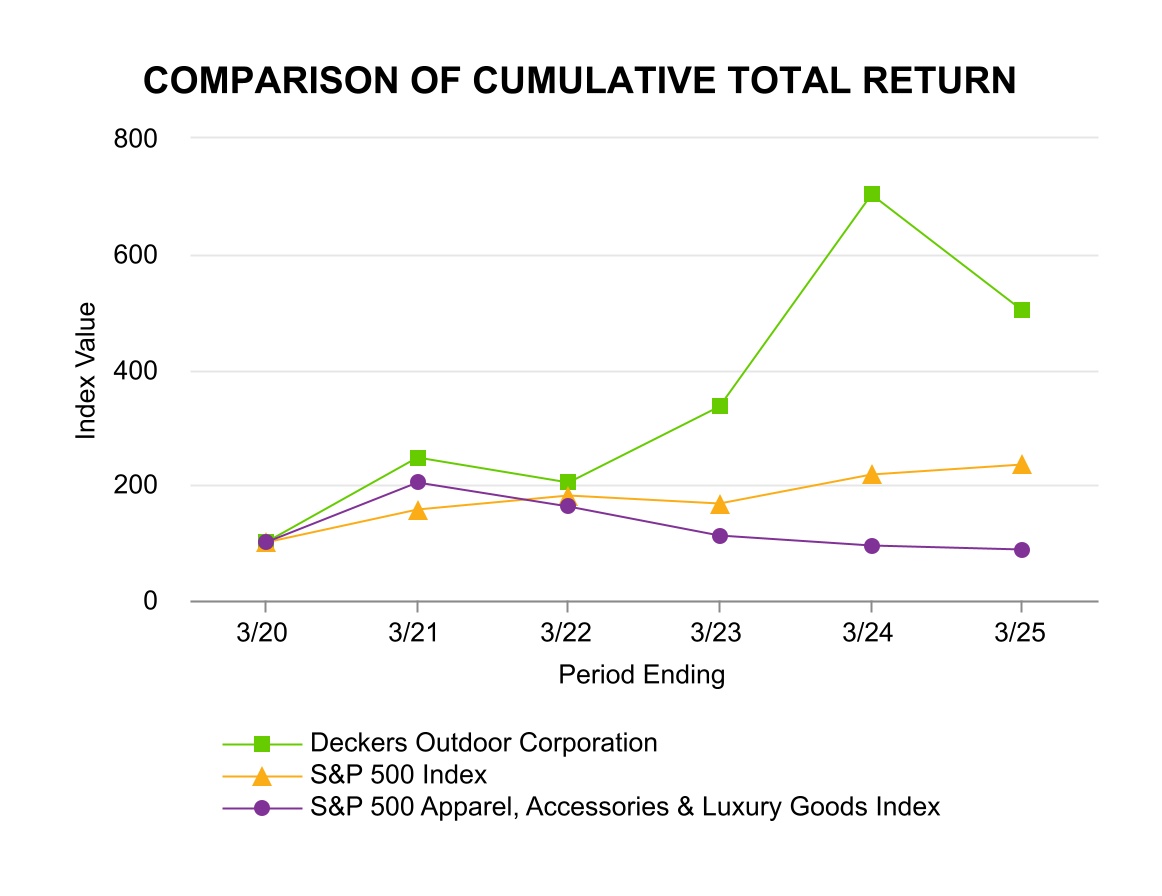
| Years Ended March 31, | |||||||||||||||||||||||||||||||||||
| 2020 | 2021 | 2022 | 2023 | 2024 | 2025 | ||||||||||||||||||||||||||||||
| Deckers Outdoor Corporation | $ | 100.00 | $ | 246.58 | $ | 204.31 | $ | 335.44 | $ | 702.26 | $ | 500.46 | |||||||||||||||||||||||
| S&P 500 Index | 100.00 | 156.35 | 180.81 | 166.84 | 216.69 | 234.57 | |||||||||||||||||||||||||||||
| S&P 500 Apparel, Accessories & Luxury Goods Index | 100.00 | 204.01 | 161.34 | 111.79 | 95.06 | 86.86 |
DIVIDEND POLICY
We have not declared or paid any cash dividends on our common stock since our inception. Our current revolving credit agreements allow us to declare and pay cash dividends, as long as we do not exceed certain leverage ratios, and no event of default has occurred. However, we currently do not anticipate declaring or paying any cash dividends.
STOCK REPURCHASE PROGRAM
Our Board has approved various authorizations under our stock repurchase program to repurchase shares of our common stock in the open market or in privately negotiated transactions, subject to market conditions, applicable legal requirements, and other factors (collectively, the stock repurchase program). As of March 31, 2025, our Board last approved an authorization of $1,200,000 on July 27, 2022.
Our stock repurchase program does not obligate us to acquire any amount of common stock and may be suspended at any time at our discretion. The credit agreements governing our revolving credit facilities allow us to make stock repurchases under this program, so long as we do not exceed certain leverage ratios. As of March 31, 2025, we have not exceeded the stated leverage ratios, and no defaults have occurred under these credit agreements.
Stock repurchase activity under our stock repurchase program during the three months ended March 31, 2025, was as follows:
| Total Number of Shares Repurchased (1) | Weighted Average Price per Share | Dollar Value of Shares Repurchased (2) (3) | Dollar Value of Shares Remaining for Repurchase (3) | |||||||||||||||||||||||
| January 1 - January 31, 2025 | 8,087 | $ | 185.46 | $ | 1,500 | $ | 639,192 | |||||||||||||||||||
| February 1 - February 28, 2025 | 1,252,130 | 160.92 | 201,492 | 437,700 | ||||||||||||||||||||||
| March 1 - March 31, 2025 | 517,524 | 121.73 | 62,999 | 374,701 | ||||||||||||||||||||||
| Total | 1,777,741 | 149.62 | $ | 265,991 | 374,701 |
(1) All share repurchases were made pursuant to our stock repurchase program in open-market transactions.
(2) The dollar value of shares repurchased excludes the cost of broker commissions, excise taxes, and other costs.
(3) May not calculate on rounded dollars.
Subsequent to March 31, 2025, through May 9, 2025, we repurchased 765,321 shares of our common stock at a weighted average price of $109.75 per share for $83,998. As of May 9, 2025, we had $290,704 remaining authorized under the stock repurchase program. Amounts may not calculate on rounded dollars.
On May 21, 2025, our Board approved an additional authorization of $2,250,000 to repurchase shares of our common stock under the same conditions as the prior stock repurchase program.
Refer to the section titled “Liquidity” under Part II, Item 7, “Management’s Discussion and Analysis of Financial Condition and Results of Operations,” and Note 10, “Stockholders’ Equity,” of our consolidated financial statements in Part IV, within this Annual Report, for further information on repurchases of our common stock.
Item 7. MANAGEMENT’S DISCUSSION AND ANALYSIS OF FINANCIAL CONDITION AND RESULTS OF OPERATIONS
The following discussion of our financial condition and results of operations should be read together with our consolidated financial statements in Part IV within this Annual Report. This discussion includes an analysis of our financial condition and results of operations for the years ended March 31, 2025, 2024, and 2023 and year-over-year comparisons between those periods.
Certain statements made in this section constitute “forward-looking statements,” which are subject to numerous risks and uncertainties. Our actual results of operations may differ materially from those expressed or implied by these forward-looking statements as a result of many factors, including those set forth in the section titled “Cautionary Note Regarding Forward-Looking Statements” and Part I, Item 1A, “Risk Factors,” within this Annual Report.
Unless otherwise indicated, all figures herein are expressed in thousands, except for per share and share data.
OVERVIEW
We are a global leader in designing, marketing, and distributing innovative footwear, apparel, and accessories developed for both everyday casual lifestyle use and high-performance activities. We market our products primarily under five proprietary brands: UGG, HOKA, Teva, AHNU, and Koolaburra. Our brands compete across the fashion and casual lifestyle, performance, running, and outdoor markets. We believe our products are distinctive and appeal to a broad demographic. Our brands sell our products through quality domestic and international retailers, international distributors, and directly to global consumers through our DTC channel, which is comprised of an e‑commerce and retail store presence. We seek to differentiate our brands and products by offering diverse lines that emphasize fashion, authenticity, functionality, quality, and comfort, and products tailored to a variety of activities, seasons, and demographic groups. Independent third-party contractors manufacture all of our products.
FINANCIAL HIGHLIGHTS
Consolidated financial performance highlights for fiscal year 2025, compared to fiscal year 2024 (the prior period), were as follows:
- Net sales increased 16.3% to $4,985,612.
*◦*Brand
▪UGG brand net sales increased 13.1% to $2,531,351.
▪HOKA brand net sales increased 23.6% to $2,233,090.
▪Other brands net sales decreased 8.6% to $221,171.
**◦**Channel
▪Wholesale channel net sales increased 17.4% to $2,855,865.
▪DTC channel net sales increased 14.8% to $2,129,747.
*◦*Geography
▪Domestic net sales increased 11.3% to $3,186,709.
▪International net sales increased 26.3% to $1,798,903.
-
Gross margin increased 230 basis points to 57.9%.
-
SG&A expenses increased 17.1% to $1,706,571.
-
Income from operations increased 27.1% to $1,179,092.
-
Income from operations as a percentage of net sales (operating margin) increased 200 basis points to 23.6%.
-
Diluted earnings per share increased 30.2% to $6.33 per share.
RECENT DEVELOPMENTS
Koolaburra Brand. During the third quarter of fiscal year 2025, we began taking steps to phase out our standalone operations for the Koolaburra brand in order to maintain focus on our most significant organic opportunities. We closed Koolaburra.com as of March 31, 2025, and plan to wind down the Koolaburra brand in the wholesale channel by the end of calendar year 2025. Refer to the section titled “The Company,” in Note 1, “General,” of our consolidated financial statements in Part IV within this Annual Report for further information.
Sanuk Brand Asset Sale. During the second quarter of fiscal year 2025, we completed the sale of the Sanuk brand and certain related assets. Refer to the section below titled “Reportable Operating Segment Overview” for further information on our results of operations. Refer to the section titled “The Company,” in Note 1, “General,” of our consolidated financial statements in Part IV within this Annual Report for further information on the sale of the Sanuk brand.
Forward Stock Split and Authorized Share Increase. On September 13, 2024, we effected a stock split and an authorized share increase. Our financial results included within this Annual Report have been retroactively adjusted to reflect the effectiveness of the stock split and the authorized share increase. Refer to the section titled “Basis of Presentation,” in Note 1, “General,” of our consolidated financial statements in Part IV within this Annual Report for further information.
TRENDS AND UNCERTAINTIES IMPACTING OUR BUSINESS AND INDUSTRY
We expect our business and industry will continue to be impacted by several important trends and uncertainties, including the following:
Macroeconomic and Geopolitical Factors
*•*We are exposed to risks resulting from evolving US trade policy that has introduced uncertainty and volatility in global trade relations, including higher tariffs and greater restrictions on goods imported from certain regions. While we pursue mitigation strategies, including through selective, staggered, and strategic price increases on our products sold in the US and by negotiating cost-sharing arrangements with our independent manufacturers, we may be unable to offset all resulting
increases to our cost of goods sold. These risks may have a material adverse impact on demand for our products.
- Macroeconomic factors, including inflationary pressures, increased tariffs, geopolitical unrest, and escalating global conflicts, are creating a complex and challenging environment for our business and industry. While these factors did not materially impact our business or results of operations during fiscal year 2025, the full impact of these factors is difficult to quantify and could negatively impact us in future periods.
Brand and Omni-Channel Strategy
-
We remain focused on increasing global consumer awareness and adoption of our brands, which has continued to positively impact our financial results. Our efforts to drive brand adoption are focused on building brand acceptance and heat through launches of innovative product offerings, coupled with marketing investments across multiple geographic markets and channels of distribution, including strategic expansion of the global marketplace.
-
We continue to implement a marketplace inventory management strategy for our brands through segmentation and differentiation. During fiscal year 2025, we continued to experience alignment on product assortments that resulted in higher full-price sell-through, which benefited our gross margins across all channels of distribution. While gross margins continue to be an area of strategic focus, we may not experience these benefits to our gross margins in our fiscal year ending March 31, 2026 (next fiscal year) due to various factors, including impacts from macroeconomic and geopolitical factors, discussed above, as well as potential impacts from our pricing strategies.
-
Our long-term strategy remains focused on building our DTC channel to represent an increased proportion of our total net sales, which includes differentiating the consumer experience from the wholesale channel to drive increases in acquisition and retention to sustain strong market positions and a high level of demand for our brands. We expect increased sales in the DTC channel will continue to positively impact our gross margins. However, as we expand doors with wholesale partners to drive brand awareness and market share in the near-term, our wholesale channel may represent a higher portion of our total net sales in certain periods, which could pressure our margins in those periods.
-
We continue to implement our international growth strategies for the HOKA and UGG brands to represent an increased proportion of our total net sales. We continue to select
Showing the first 8K of 80K characters. Open the full section
Item 7A. QUANTITATIVE AND QUALITATIVE DISCLOSURES ABOUT MARKET RISK
In the normal course of business, our financial position and results of operations are subject to a variety of risks, including risks associated with commodity pricing, foreign currency exchange rates and, to a lesser extent, interest rates. There have been no material changes in our primary risk exposures or management of market risks since the prior year. We regularly assess these risks and have established policies and business practices designed to mitigate their effects. Refer to Part I, Item 1A, “Risk Factors,” within this Annual Report for further discussion of risks to our business and results of operations.
COMMODITY PRICE RISK
We are exposed to commodity price fluctuations associated with the cost of raw materials used in our manufacturing process, including sheepskin and sugarcane-derived EVA (collectively, commodities).
To manage price volatility and ensure availability for our commodities, we currently enter into fixed purchasing contracts with designated suppliers of sheepskin and, at times, sugarcane-derived EVA. Our fixed pricing agreements are non-cancellable and may be subject to fees, including certain sheepskin purchasing contracts requiring deposits when minimum volumes are not fully consumed. In the event of significant price increases for our commodities, we will likely not be able to adjust our selling prices sufficiently to eliminate the impact of such increases on our profitability. We continue to evaluate our firm pricing agreement strategy for our commodities, including other preferred materials.
Refer to the subsection titled “Contractual Obligations” under the section “Liquidity” within Part II, Item 7, “Management’s Discussion and Analysis of Financial Condition and Results of Operations,” and Note 7, “Commitments and Contingencies,” of our consolidated financial statements in Part IV within this Annual Report for further information on our minimum purchase obligations for commodities.
FOREIGN CURRENCY EXCHANGE RATE RISK
Although most of our sales and inventory purchases are denominated in US dollars, our global operations in the international markets where our products are sold and manufactured expose us to risk of foreign currency exchange rate fluctuations between the US dollar and primarily the currencies of Europe, Asia, Canada, and Latin America.
We are exposed to financial statement transaction gains and losses as a result of remeasuring our monetary assets and liabilities that are denominated in currencies other than our subsidiaries’ functional currencies. We hedge certain foreign currency exchange rate risks from existing assets and liabilities, as well as forecasted sales. As our international operations grow and we increase purchases and sales in foreign currencies, we will continue to evaluate our hedging strategy and may utilize additional derivative instruments to hedge our foreign currency exchange rate risk. We do not use foreign currency exchange rate forward contracts for speculative trading purposes.
Foreign currency exchange rate fluctuations affect our results of operations and can make comparisons from year to year more difficult. Foreign currency exchange rates, excluding the effect from derivative instruments, to remeasure monetary assets and liabilities using the exchange rate at the end of the reporting period, had a negative impact on our income from operations for the year ended March 31, 2025.
We use forward foreign exchange contracts to hedge material exposure to adverse changes in foreign currency exchange rates. A sensitivity analysis technique has been used to evaluate the effect that changes in the market value of foreign exchange currencies will have on our forward foreign exchange contracts. As of March 31, 2025, a hypothetical 10% foreign currency exchange rate fluctuation would have caused the fair value of our financial instruments to change by approximately $34,000. As of March 31, 2025, there are no known factors that we would expect to result in a material change in the near-term in the general nature of our primary foreign currency exchange rate risk exposure. Refer to the section titled “Summary of Significant Accounting Policies” in Note 1, “General,” and Note 9, “Derivative Instruments,” of our consolidated financial statements in Part IV within this Annual Report for further information on our use of derivative contracts and related accounting policies.
INTEREST RATE RISK
Our exposure to market risk for interest rates relates to our cash and cash equivalents, including cash invested in highly rated money market funds, and our revolving credit facilities.
Cash and cash equivalents held by us are affected by variable, short-term interest rates. Using our average invested cash equivalents balance as of March 31, 2025, the hypothetical effect of a 100 basis point change in short-term interest rates would result in a change of approximately $14,700 to interest income recorded in our consolidated statements of comprehensive income, along with our operating cash flows, but would not impact the fair market value of the related underlying instruments. Refer to the section titled “Summary of Significant Accounting Policies” in Note 1, “General,” and Note 4, “Fair Value Measurements,” of our consolidated financial statements in Part IV within this Annual Report for further information on our cash and cash equivalents.
Our revolving credit facilities bear interest at variable rates. As a result, we are exposed to changes in market interest rates that could impact the cost of servicing debt. As there were no outstanding balances under our revolving credit facilities as of March 31, 2025, the hypothetical effect of a 100 basis point change in interest rates for borrowings made under our revolving credit facilities would have resulted in no change to interest expense recorded in our consolidated statements of comprehensive income during the year ended March 31, 2025. Refer to Note 6, “Revolving Credit Facilities,” of our consolidated financial statements in Part IV within this Annual Report for further information on our revolving credit facilities.
Item 8. FINANCIAL STATEMENTS AND SUPPLEMENTARY DATA
The Consolidated Financial Statements, the Financial Statement Schedule, and the Reports of Independent Registered Public Accounting Firm, are filed in a separate section following Part IV, as shown on the index under Item 15, “Exhibits and Financial Statement Schedules,” within this Annual Report.
Item 9A. CONTROLS AND PROCEDURES
DISCLOSURE CONTROLS AND PROCEDURES
We maintain a system of disclosure controls and procedures, as defined in Rule 13a-15(e) under the Exchange Act, which are designed to provide reasonable assurance that information required to be disclosed in the reports that we file or submit under the Exchange Act is recorded, processed, summarized, and reported within the time periods specified in the SEC’s rules and forms. In designing and evaluating our disclosure controls and procedures, our management recognized that any system of controls and procedures, no matter how well designed and operated, can provide only reasonable assurance of achieving the desired control objectives, as ours is designed to do, and management necessarily is required to apply its judgment in evaluating the cost-benefit relationship of possible controls and procedures. In addition, the design of any system of controls is based in part upon certain assumptions about the likelihood of future events, and there can be no assurance that any design will succeed in achieving its stated goals under all potential future conditions. Over time, controls may become inadequate because of changes in conditions, or the degree of compliance with policies or procedures may deteriorate. Because of the inherent limitations in a cost-effective control system, misstatements due to error or fraud may occur and not be detected.
Under the supervision and with the participation of management, we conducted an evaluation of the effectiveness of the design and operation of our disclosure controls and procedures as of March 31, 2025. Based on that evaluation, our PEO and Principal Financial and Accounting Officer (PFAO) concluded that our disclosure controls and procedures are effective at a reasonable assurance level as of March 31, 2025.
MANAGEMENT’S REPORT ON INTERNAL CONTROL OVER FINANCIAL REPORTING
Management is responsible for establishing and maintaining adequate internal control over financial reporting (as defined in Rule 13a-15(f) under the Exchange Act). Our internal control over financial reporting is a process designed under the supervision of our PEO and PFAO to provide reasonable assurance regarding the reliability of financial reporting and the preparation of our financial statements for external reporting purposes in accordance with US GAAP. Because of inherent limitations, internal control over financial reporting may not prevent or detect misstatements. Also, projections of any evaluation of effectiveness to future periods are subject to the risk that controls may become inadequate because of changes in conditions, or that the degree of compliance with the policies or procedures may deteriorate.
As of March 31, 2025, our management, including our PEO and PFAO, assessed the effectiveness of our internal control over financial reporting using the criteria set forth in Internal Control — Integrated Framework (2013) issued by the Committee of Sponsoring Organizations of the Treadway Commission (commonly referred to as COSO). Based on this assessment, our management concluded that our internal control over financial reporting was effective based on this criteria. The registered public accounting firm that audited our consolidated financial statements in Part IV within this Annual Report has issued an attestation report on our internal control over financial reporting. Refer to Part IV, “Report of Independent Registered Public Accounting Firm - Internal Control Over Financial Reporting,” on page F-4 within this Annual Report.
CHANGES IN INTERNAL CONTROL OVER FINANCIAL REPORTING
There were no changes in our internal control over financial reporting identified in management’s evaluation pursuant to Rule 13a-15(d) of the Exchange Act during the three months ended March 31, 2025, that have materially affected, or are reasonably likely to materially affect, our internal control over financial reporting.
PEO AND PFAO CERTIFICATIONS
The certifications of our PEO and PFAO required by Rule 13a-14(a) of the Exchange Act are filed as Exhibit 31.1 and Exhibit 31.2, and furnished as Exhibit 32.1, to this Annual Report. This Part II, Item 9A, should be read in conjunction with such certifications for a more complete understanding of the topics presented.
Item 9B. OTHER INFORMATION
DIRECTOR AND OFFICER TRADING PLANS AND ARRANGEMENTS
Our directors and officers may enter into trading plans or other arrangements with financial institutions to purchase or sell shares of our common stock. These plans or arrangements may constitute Rule 10b5-1 trading arrangements or non-Rule 10b5-1 trading arrangements, in each case as defined under Item 408(a) of Regulation S-K.
Set forth below is a summary of the adoption, modification, and termination activity of our directors and executive officers with respect to Rule 10b5-1 trading plans during the three months ended March 31, 2025:
| Name & Title | Adoption Date | Termination Date | Contract End Date | Aggregate Shares Covered (in ones) (1) | ||||||||||||||||||||||||||||
| Angela Ogbechie, Chief Supply Chain Officer | February 27, 2025 | * | December 31, 2025 | 12,570 | ||||||||||||||||||||||||||||
| Bonita Stewart, Director | February 10, 2025 | * | May 27, 2026 | 9,000 | ||||||||||||||||||||||||||||
*Not applicable.
(1) The actual number of shares sold under the plan may depend on the vesting of certain performance-based equity awards and the number of shares withheld by us to satisfy our income tax withholding obligations and may vary from the number provided herein.
During the three months ended March 31, 2025, no non-Rule 10b5-1 trading arrangements were adopted, modified, or terminated by our directors or executive officers.
PART III
Item 10. DIRECTORS, EXECUTIVE OFFICERS, AND CORPORATE GOVERNANCE
The information required by this item will be disclosed in our definitive proxy statement on Schedule 14A (Proxy Statement) for our 2025 annual meeting of stockholders and is incorporated herein by reference. Our Proxy Statement will be filed with the SEC within 120 days after the end of the year ended March 31, 2025, pursuant to Regulation 14A under the Exchange Act.
Item 11. EXECUTIVE COMPENSATION
The information required by this item will be disclosed in the Proxy Statement and is incorporated herein by reference.
Item 12. SECURITY OWNERSHIP OF CERTAIN BENEFICIAL OWNERS AND MANAGEMENT AND RELATED STOCKHOLDER MATTERS
The information required by this item will be disclosed in the Proxy Statement and is incorporated herein by reference.
Item 13. CERTAIN RELATIONSHIPS AND RELATED TRANSACTIONS, AND DIRECTOR INDEPENDENCE
The information required by this item will be disclosed in the Proxy Statement and is incorporated herein by reference.
Item 14. PRINCIPAL ACCOUNTANT FEES AND SERVICES
The information required by this item will be disclosed in the Proxy Statement and is incorporated herein by reference.
PART IV
Item 15. EXHIBITS AND FINANCIAL STATEMENT SCHEDULES
Refer to Part IV, “Index to Consolidated Financial Statements and Financial Statement Schedules,” on page F-1 within this Annual Report for our Consolidated Financial Statements and the Reports of Independent Registered Public Accounting Firm.
EXHIBIT INDEX
Showing the first 8K of 203K characters. Open the full section