 filings.tools
D.R. Horton 10-K 2023-09-30
Filed 2023-11-17. 23 sections, 480K characters. Original on sec.gov · Markdown · JSON
Cover and table of contents
UNITED STATES SECURITIES AND EXCHANGE COMMISSION
Washington, D.C. 20549
FORM 10-K
| (Mark One) | |||||
| ☒ | ANNUAL REPORT PURSUANT TO SECTION 13 OR 15(d) OF THE SECURITIES EXCHANGE ACT OF 1934 |
For the Fiscal Year Ended September 30, 2023
or
| ☐ | TRANSITION REPORT PURSUANT TO SECTION 13 OR 15(d) OF THE SECURITIES EXCHANGE ACT OF 1934 |
For the Transition Period From To
Commission file number 1-14122
D.R. Horton, Inc.
(Exact name of registrant as specified in its charter)
| Delaware | 75-2386963 | |||||||
| (State or other jurisdiction of incorporation or organization) | (I.R.S. Employer Identification No.) |
1341 Horton Circle, Arlington, Texas 76011
(Address of principal executive offices) (Zip code)
(817) 390-8200
(Registrant’s telephone number, including area code)
| Securities registered pursuant to Section 12(b) of the Act: | ||||||||||||||
| Title of Each Class | Trading Symbol | Name of Each Exchange on Which Registered | ||||||||||||
| Common Stock, par value $.01 per share | DHI | New York Stock Exchange |
Securities registered pursuant to Section 12(g) of the Act: None
Indicate by check mark if the registrant is a well-known seasoned issuer, as defined in Rule 405 of the Securities Act. Yes ý No o
Indicate by check mark if the registrant is not required to file reports pursuant to Section 13 or Section 15(d) of the Act. Yes o No ý
Indicate by check mark whether the registrant (1) has filed all reports required to be filed by Section 13 or 15(d) of the Securities Exchange Act of 1934 during the preceding 12 months (or for such shorter period that the registrant was required to file such reports), and (2) has been subject to such filing requirements for the past 90 days. Yes ý No o
Indicate by check mark whether the registrant has submitted electronically every Interactive Data File required to be submitted pursuant to Rule 405 of Regulation S-T (§232.405 of this chapter) during the preceding 12 months (or for such shorter period that the registrant was required to submit such files). Yes ý No o
Indicate by check mark whether the registrant is a large accelerated filer, an accelerated filer, a non-accelerated filer, a smaller reporting company, or an emerging growth company. See the definitions of “large accelerated filer,” “accelerated filer,” “smaller reporting company” and “emerging growth company” in Rule 12b-2 of the Exchange Act.
| Large accelerated filer | ý | Accelerated filer | ☐ | Non-accelerated filer | ☐ | Smaller reporting company | ☐ | Emerging growth company | ☐ |
If an emerging growth company, indicate by check mark if the registrant has elected not to use the extended transition period for complying with any new or revised financial accounting standards provided pursuant to Section 13(a) of the Exchange Act. ☐
Indicate by check mark whether the registrant has filed a report on and attestation to its management’s assessment of the effectiveness of its internal control over financial reporting under Section 404(b) of the Sarbanes-Oxley Act (15 U.S.C. 7262(b)) by the registered public accounting firm that prepared or issued its audit report. ý
If securities are registered pursuant to Section 12(b) of the Act, indicate by check mark whether the financial statements of the registrant included in the filing reflect the correction of an error to previously issued financial statements. ☐
Indicate by check mark whether any of those error corrections are restatements that required a recovery analysis of incentive-based compensation received by any of the registrant’s executive officers during the relevant recovery period pursuant to §240.10D-1(b). ☐
Indicate by check mark whether the registrant is a shell company (as defined in Rule 12b-2 of the Exchange Act). Yes ☐ No ý
As of March 31, 2023, the aggregate market value of the registrant’s common stock held by non-affiliates of the registrant was approximately $32.9 billion based on the closing price as reported on the New York Stock Exchange.
As of November 13, 2023, there were 333,184,374 shares of the registrant’s common stock outstanding.
DOCUMENTS INCORPORATED BY REFERENCE
Portions of the registrant’s definitive Proxy Statement for the 2024 Annual Meeting of Stockholders are incorporated herein by reference (to the extent indicated) in Part III.
D.R. HORTON, INC. AND SUBSIDIARIES
2023 ANNUAL REPORT ON FORM 10-K
TABLE OF CONTENTS
PART I
Item 1. BUSINESS
D.R. Horton, Inc. is the largest homebuilding company in the United States as measured by number of homes closed. We construct and sell homes through our operating divisions in 118 markets across 33 states. Our common stock is included in the S&P 500 Index and listed on the New York Stock Exchange (NYSE) under the ticker symbol “DHI.” Unless the context otherwise requires, the terms “D.R. Horton,” the “Company,” “we” and “our” used herein refer to D.R. Horton, Inc., a Delaware corporation, and its predecessors and subsidiaries.
Our homebuilding business began in 1978 in Fort Worth, Texas, and our common stock has been publicly traded since 1992. We have expanded and diversified our homebuilding operations geographically over the years by investing capital and building teams of people in our existing markets, start-up operations in new markets and acquisitions of other homebuilding companies. We have closed more than 1,000,000 homes during our 45-year history, and we have been the largest volume homebuilder in the United States each year since 2002.
Our business operations consist of homebuilding, rental, a majority-owned residential lot development company, financial services and other activities. Our homebuilding operations are our core business, generating 90% of our consolidated revenues of $35.5 billion in fiscal 2023, 95% of consolidated revenues of $33.5 billion in fiscal 2022 and 96% of consolidated revenues of $27.8 billion in fiscal 2021. Our homebuilding operations generate most of their revenues from the sale of completed homes and to a lesser extent from the sale of land and lots. Approximately 90% of our home sales revenue in fiscal 2023 was generated from the sale of single-family detached homes, with the remainder from the sale of attached homes, such as townhomes, duplexes and triplexes. Our product offerings include a broad range of homes for entry-level, move-up, active adult and luxury buyers. Our homes generally range in size from 1,000 to 4,000 square feet and in price from $200,000 to more than $1,000,000. For the year ended September 30, 2023, our homebuilding operations closed 82,917 homes with an average closing price of $381,600.
Our rental segment consists of single-family and multi-family rental operations. The single-family rental operations primarily construct and lease single-family homes within a community and then market each community for a bulk sale of rental homes. The multi-family rental operations develop, construct, lease and sell residential rental properties, the majority of which are apartment communities. For the year ended September 30, 2023, our rental operations closed 6,175 single-family rental homes and 2,112 multi-family rental units.
At September 30, 2023, we owned 63% of the outstanding shares of Forestar Group Inc. (Forestar), a publicly traded residential lot development company listed on the NYSE under the ticker symbol “FOR.” Forestar operates across many of our homebuilding operating markets and is a key part of our homebuilding strategy to maintain relationships with land developers and to control a large portion of our land and lot position through land purchase contracts. For the year ended September 30, 2023, Forestar sold 14,040 lots to homebuilders, including 12,249 lots sold to D.R. Horton.
Our financial services operations provide mortgage financing and title agency services to homebuyers in many of our homebuilding markets. DHI Mortgage, our wholly-owned subsidiary, provides mortgage financing services primarily to our homebuyers and sells substantially all of the mortgages it originates and the related servicing rights to third-party purchasers after origination. For the year ended September 30, 2023, DHI Mortgage originated or brokered 63,135 mortgage loans. Our wholly-owned subsidiary title companies serve as title insurance agents by providing title insurance policies, examination, underwriting and closing services primarily to our homebuilding customers.
In addition to our homebuilding, rental, Forestar and financial services operations, we engage in other business activities through our subsidiaries. We conduct insurance-related operations, own water rights and other water-related assets and own non-residential real estate including ranch land and improvements. The results of these operations are immaterial for separate reporting and therefore are grouped together and presented as other.
Available Information
We make available, as soon as reasonably practicable, on our website, www.drhorton.com, all of our reports filed with or furnished to the Securities and Exchange Commission (SEC). These reports can be found on the “Investor Relations” section of our website under “Financial Information” and include our annual and quarterly reports on Form 10-K and 10-Q, current reports on Form 8-K, beneficial ownership reports on Forms 3, 4, and 5, proxy statements and amendments to such reports. Our SEC filings are also available to the public on the SEC’s website at www.sec.gov. In addition to our SEC filings, our corporate governance documents, including our Code of Ethical Conduct for the Chief Executive Officer, Chief Financial Officer and senior financial officers, are available on the “Investor Relations” section of our website under “ESG.” Our stockholders may also obtain these documents in paper format free of charge upon request made to our Investor Relations department.
Our principal executive offices are located at 1341 Horton Circle, Arlington, Texas 76011, and our telephone number is (817) 390-8200. Information on or linked to our website is not incorporated by reference into this annual report on Form 10-K unless expressly noted.
OPERATING STRUCTURE AND PROCESSES
Following is an overview of our company’s operating structure and the significant processes that support our business controls, strategies and performance.
Homebuilding Markets
Our homebuilding business operates in 118 markets across 33 states, which provides us with geographic diversification in our homebuilding inventory investments and our sources of revenues and earnings. We believe our geographic diversification lowers our operational risks by mitigating the effects of local and regional economic cycles, and it also enhances our earnings potential by providing more diverse opportunities to invest in our business.
We conduct our homebuilding operations in the geographic regions, states and markets listed below. Our homebuilding operating divisions are aggregated into six reporting segments, also referred to as reporting regions, which comprise the markets below. Our financial statements and the notes thereto contain additional information regarding segment performance.
| State | Reporting Region/Market | State | Reporting Region/Market | State | Reporting Region/Market | |||||||||||||||||||||||||||
| Northwest Region | Southeast Region | North Region | ||||||||||||||||||||||||||||||
| Colorado | Colorado Springs | Alabama | Birmingham | Delaware | Southern Delaware | |||||||||||||||||||||||||||
| Denver | Huntsville | Northern Delaware | ||||||||||||||||||||||||||||||
| Fort Collins | Mobile/Baldwin County | Illinois | Chicago | |||||||||||||||||||||||||||||
| Oregon | Bend | Montgomery | Indiana | Fort Wayne | ||||||||||||||||||||||||||||
| Eugene/Springfield | Tuscaloosa | Indianapolis | ||||||||||||||||||||||||||||||
| Medford | Florida | Fort Myers/Naples | Northwest Indiana | |||||||||||||||||||||||||||||
| Portland/Salem | Gainesville | Iowa | Des Moines | |||||||||||||||||||||||||||||
| Utah | Salt Lake City | Jacksonville | Iowa City/Cedar Rapids | |||||||||||||||||||||||||||||
| St. George | Lakeland | Kentucky | Louisville | |||||||||||||||||||||||||||||
| Washington | Central Washington | Melbourne/Vero Beach | Maryland | Baltimore | ||||||||||||||||||||||||||||
| Kennewick/Pasco/Richland | Miami/Fort Lauderdale | Eastern Maryland | ||||||||||||||||||||||||||||||
| Seattle/Tacoma/Everett/Olympia | Ocala | Suburban Washington, D.C. | ||||||||||||||||||||||||||||||
| Spokane | Orlando | Western Maryland | ||||||||||||||||||||||||||||||
| Vancouver | Panama City | Minnesota | Minneapolis/St. Paul | |||||||||||||||||||||||||||||
| Pensacola | Nebraska | Omaha | ||||||||||||||||||||||||||||||
| Southwest Region | Port St. Lucie | New Jersey | Northern New Jersey | |||||||||||||||||||||||||||||
| Arizona | Phoenix | Tallahassee | Southern New Jersey | |||||||||||||||||||||||||||||
| Tucson | Tampa/Sarasota | Ohio | Cincinnati | |||||||||||||||||||||||||||||
| California | Bakersfield | Volusia County | Columbus | |||||||||||||||||||||||||||||
| Bay Area | West Palm Beach | Pennsylvania | Central Pennsylvania | |||||||||||||||||||||||||||||
| Fresno/Tulare | Louisiana | Baton Rouge | Philadelphia | |||||||||||||||||||||||||||||
| Los Angeles County | Lake Charles/Lafayette | Pittsburgh | ||||||||||||||||||||||||||||||
| Modesto/Merced/Stockton | Mississippi | Gulf Coast | Virginia | Northern Virginia | ||||||||||||||||||||||||||||
| Redding/Chico/Yuba City | Jackson | Richmond | ||||||||||||||||||||||||||||||
| Riverside County | Virginia Beach/Williamsburg | |||||||||||||||||||||||||||||||
| Sacramento | East Region | Western Virginia | ||||||||||||||||||||||||||||||
| San Bernardino County | Georgia | Atlanta | West Virginia | Eastern West Virginia | ||||||||||||||||||||||||||||
| Hawaii | Oahu | Augusta | ||||||||||||||||||||||||||||||
| Nevada | Las Vegas | Central Georgia | ||||||||||||||||||||||||||||||
| Reno | Savannah | |||||||||||||||||||||||||||||||
| New Mexico | Albuquerque | Valdosta | ||||||||||||||||||||||||||||||
| North Carolina | Asheville | |||||||||||||||||||||||||||||||
| South Central Region | Charlotte | |||||||||||||||||||||||||||||||
| Arkansas | Northwest Arkansas | Greensboro/Winston-Salem | ||||||||||||||||||||||||||||||
| Oklahoma | Oklahoma City | New Bern/Greenville | ||||||||||||||||||||||||||||||
| Tulsa | Raleigh/Durham | |||||||||||||||||||||||||||||||
| Texas | Abilene | Wilmington | ||||||||||||||||||||||||||||||
| Austin | South Carolina | Charleston | ||||||||||||||||||||||||||||||
| Beaumont | Columbia | |||||||||||||||||||||||||||||||
| Bryan/College Station | Greenville/Spartanburg | |||||||||||||||||||||||||||||||
| Corpus Christi | Hilton Head | |||||||||||||||||||||||||||||||
| Dallas | Myrtle Beach | |||||||||||||||||||||||||||||||
| East Texas | Tennessee | Chattanooga | ||||||||||||||||||||||||||||||
| Fort Worth | Knoxville | |||||||||||||||||||||||||||||||
| Houston | Memphis | |||||||||||||||||||||||||||||||
| Killeen/Temple/Waco | Nashville | |||||||||||||||||||||||||||||||
| Lubbock | Northeast Tennessee | |||||||||||||||||||||||||||||||
| Midland/Odessa | ||||||||||||||||||||||||||||||||
| New Braunfels/San Marcos | ||||||||||||||||||||||||||||||||
| San Antonio |
When evaluating new or existing homebuilding markets for purposes of capital allocation, we consider local, market-specific factors, including among others:
-
Economic conditions;
-
Employment levels and job growth;
-
Income level of potential homebuyers;
-
Local housing affordability and typical mortgage products utilized;
-
Market for homes at our targeted price points;
-
Availability of land and lots in desirable locations on acceptable terms;
-
Land entitlement and development processes;
-
Availability of qualified subcontractors;
-
New and secondary home sales activity;
-
Competition;
-
Prevailing housing products, features, cost and pricing; and
-
Performance capabilities of our local management team.
Economies of Scale
We are the largest homebuilding company in the United States as measured by number of homes closed in fiscal 2023, and we are also one of the largest builders in most of the markets in which we operate. We believe that our national, regional and local scale of operations provides us with benefits that may not be available to the same degree to some other smaller homebuilders, such as:
-
Greater access to and lower cost of capital due to our balance sheet strength and our lending and capital markets relationships;
-
Volume discounts and rebates from national, regional and local materials suppliers and lower labor rates from certain subcontractors; and
-
Enhanced leverage of our general and administrative activities, which allows us flexibility to adjust to changes in market conditions and compete effectively across our markets.
Decentralized Homebuilding Operations
We view homebuilding as a local business; therefore, most of our direct homebuilding activities are decentralized to provide flexibility to our local managers in making operational decisions. We believe that our local management teams, who are familiar with local market conditions, have the best information to make many decisions regarding their operations. At September 30, 2023, we had 81 separate homebuilding operating divisions, many of which operate in more than one market area. Generally, each operating division consists of a division president; a controller and accounting personnel; land entitlement, acquisition and development personnel; a sales manager and sales and marketing personnel; a construction manager and construction superintendents; customer service personnel; a purchasing manager and office staff. Our division presidents receive performance-based compensation if they achieve targeted financial and operating metrics related to their operating divisions. Following is a summary of our homebuilding activities that are decentralized in our local operating divisions and the control and oversight functions that are centralized in our regional and corporate offices.
Operating Division Responsibilities
Each homebuilding operating division is responsible for:
- Site selection, which involves
— A feasibility study;
— Soil and environmental reviews;
— Review of existing zoning and other governmental requirements;
— Review of the need for and extent of offsite work required to obtain project entitlements; and
— Financial analysis of the potential project;
-
Negotiating lot purchase, land acquisition and related contracts;
-
Obtaining all necessary land development and home construction approvals;
-
Selecting subcontractors and ensuring their work meets our contracted scopes;
-
Selecting building and architectural plans;
-
Planning and managing home construction schedules;
-
Determining the pricing for each house plan and options in a given community;
-
Developing and implementing local marketing and sales plans;
-
Coordinating all interactions with customers and real estate brokers during the sales, construction and home closing processes; and
-
Ensuring the quality and timeliness of post-closing service and warranty repairs provided to customers.
Centralized Controls
We centralize many important risk elements of our homebuilding business through our regional and corporate offices. We have separate homebuilding regional offices, which generally consist of a region president, a chief financial officer, legal counsel and other operational and office support staff. Each of our region presidents and their management teams are responsible for oversight of the operations of a number of homebuilding operating divisions, including:
-
Review and approval of division business plans and budgets;
-
Review and approval of all land and lot acquisition contracts;
-
Review of all business and financial analysis for potential land and lot inventory investments;
-
Oversight of land and home inventory levels;
-
Monitoring division financial and operating performance; and
-
Review of major personnel decisions and division incentive compensation plans.
Our corporate executives and corporate office departments are responsible for establishing our operational policies and internal control standards and for monitoring compliance with established policies and controls throughout our operations. The corporate office also has primary responsibility for direct management of certain key risk elements and initiatives through the following centralized functions:
-
Financing;
-
Cash management;
-
Allocation of capital;
-
Issuance and monitoring of inventory investment guidelines;
-
Approval and funding of land and lot acquisitions;
-
Monitoring and analysis of profitability, returns, costs and inventory levels;
-
Risk and litigation management;
-
Environmental assessments of land and lot acquisitions;
-
Technology systems to support management of operations, marketing and financial information, including preventing, monitoring and reporting of cybersecurity issues;
-
Accounting and management reporting;
-
Income taxes;
-
Internal audit;
-
Public reporting and investor and media relations;
-
Administration of payroll and employee benefits;
-
Negotiation of national purchasing contracts;
-
Administration, reporting and monitoring of customer surveys and resolutions of issues; and
-
Approval of major personnel decisions and management incentive compensation plans.
Land/Lot Acquisition and Inventory Management
We acquire land for use in our operations after we have completed due diligence and generally after we have obtained the rights (known as entitlements) to begin development or construction work resulting in an acceptable number of residential lots. Before we acquire lots or tracts of land, we complete a feasibility study, which includes soil tests, independent environmental studies, other engineering work and financial analysis. We also evaluate the status of necessary zoning and other governmental entitlements required to develop and use the property for home construction.
We also enter into land/lot contracts, in which we obtain the right, but generally not the obligation, to buy land or lots at predetermined prices on a defined schedule commensurate with anticipated home closings or planned development. These contracts generally are non-recourse, which limits our financial exposure to our earnest money deposited into escrow under the terms of the contract and any pre-acquisition due diligence costs we incur. This enables us to control land and lot positions with limited capital investment, which substantially reduces the risks associated with land ownership.
We attempt to mitigate our exposure to real estate inventory risks by:
-
Controlling our level of inventory investment and managing our supply of land/lots owned and controlled through purchase contracts to match the expected housing demand in each of our operating markets;
-
Monitoring local market and demographic trends, housing preferences and related economic developments, including the identification of desirable housing submarkets based on the quality of local schools, new job opportunities, local growth initiatives and personal income trends;
-
Utilizing land/lot purchase contracts and seeking to acquire developed lots which are substantially ready for home construction, where possible; and
-
Monitoring and managing the number of speculative homes (homes under construction without an executed sales contract) built in each subdivision.
Land Development and Home Construction
Substantially all of our land development and home construction work is performed by subcontractors. Subcontractors typically are selected after a competitive bidding process and are retained for a specific subdivision or series of house plans pursuant to a contract that obligates the subcontractor to complete the scope of work at an agreed-upon price. We employ land development and construction personnel to monitor construction activities, participate in major building decisions, coordinate the activities of subcontractors and suppliers, review the work of subcontractors for quality and cost controls and monitor compliance with zoning and building codes. In addition, our construction personnel interact with our homebuyers during the construction process and instruct buyers on post-closing home maintenance.
Our home designs are selected or prepared in each of our markets to appeal to local homebuyers’ expectations for affordability, home size and features, and our local management teams adjust product offerings to meet buyer demand as necessary. In some communities, we offer optional interior and exterior features to homebuyers for an additional charge.
We typically do not maintain significant inventories of land development or construction materials, except for work in progress materials for active development projects and homes under construction. Generally, the construction materials used in our operations have been readily available from numerous sources, and we have contracts exceeding one year with certain suppliers of building materials that are cancelable at our option. Construction time for our homes depends on the availability of labor, materials and supplies, the weather, the size of the home and other factors. In fiscal 2021, our construction cycle time lengthened primarily due to the COVID-19 pandemic and its effects on our supply chain, which resulted in shortages of certain building materials and tightness in the construction labor market. Continuing supply chain delays and disruptions during fiscal 2022 lengthened our construction cycle time further. We began to see improvements in our construction cycle time in fiscal 2023 and expect our cycle times to return to normalized levels during fiscal 2024. We completed the construction of most homes in three to eight months in fiscal 2023.
We are subject to governmental regulations that affect our land development and construction operations. We frequently experience delays in receiving the necessary approvals from municipalities or other government agencies, which often delays our anticipated development and construction activities.
Cost Controls
We control construction costs by designing our homes efficiently, utilizing common house plans as consistently as possible and obtaining competitive bids for construction materials and labor. We also negotiate pricing from our subcontractors and suppliers based on the volume of services and products we purchase on a local, regional and national basis. We monitor our land development expenditures and construction costs versus budgets for each house and community, and we review our inventory levels, margins, expenses, profitability and returns for each operating market compared to both its business plan and our performance expectations.
We control overhead costs by centralizing certain accounting and administrative functions, monitoring staffing and compensation levels and by applying technology to business processes to improve productivity where practical. We review other general and administrative costs to identify efficiencies and savings opportunities in our operating divisions and our regional and corporate offices. We also direct many of our promotional activities toward local real estate brokers and digital marketing initiatives, which we believe are efficient uses of our marketing expenditures.
Marketing and Sales
We primarily use the D.R. Horton brand name to market and sell our homes. We offer various floor plans and product types with a primary focus on the first time and first time move-up homebuyer which accounts for the majority of our home closings. We also offer entry-level homes for buyers focused on affordability, higher-end move-up and luxury homes and homes for active adult buyers seeking a low-maintenance lifestyle.
We market and sell our homes primarily through commissioned employees, and the majority of our home closings also involve an independent real estate broker. We typically conduct home sales from sales offices located in furnished model homes in each subdivision, and we generally do not offer our model homes for sale until the completion of a subdivision. Our sales personnel assist prospective homebuyers by providing floor plans and pricing information, demonstrating the features and layouts of our homes and assisting with the selection of options, if available. We train and inform our sales personnel regarding construction schedules and marketing and advertising plans. As market conditions warrant, we may provide potential homebuyers with a variety of incentives to be competitive in a particular market or to attain our targeted sales pace.
We market our homes and communities to prospective homebuyers and real estate brokers digitally, through email, search engine marketing, social media and our company website and other real estate websites, in addition to print media and advertisement. We also use billboards, radio, television and print advertising locally as necessary. We attempt to position our subdivisions in locations that are desirable to potential homebuyers and convenient to or visible from local traffic patterns, which helps to reduce advertising costs. Model homes play an important role in our marketing efforts, and we expend significant effort and resources to create an attractive atmosphere in our model homes.
We also build speculative homes in most of our communities, which allow us to compete effectively with existing homes available in the market and improve our returns. These homes enhance our marketing and sales efforts to prospective homebuyers who are renters or who are relocating to these markets and require a home within a short time frame, as well as to independent brokers who represent these homebuyers. We determine our speculative homes strategy in each market based on local market factors, such as new job growth and relocations, housing demand and supply, seasonality, current sales contract cancellation trends and our past experience in the market. We attempt to maintain a level of speculative home inventory in each community based on our current and planned sales pace, and we monitor and adjust speculative home inventory on an ongoing basis.
Sales Contracts and Backlog
Our sales contracts require an earnest money deposit which varies in amount across our markets and communities. Additionally, customers are generally required to pay additional deposits if they select options or upgrade features for their homes. Our sales contracts include a financing contingency which permits customers to cancel and receive a refund of their deposit if they cannot obtain mortgage financing at prevailing or specified interest rates within a defined period. Our contracts may include other contingencies, such as the sale of the customer’s existing home. We either retain or refund customer deposits on cancelled sales contracts, depending upon the applicable provisions of the contract or other circumstances.
Sales order backlog represents homes under contract but not yet closed at the end of the period. At September 30, 2023, the value of our backlog of sales orders was $5.9 billion (15,197 homes), a decrease of 26% from $8.0 billion (19,614 homes) at September 30, 2022. The average sales price of homes in backlog was $389,800 at September 30, 2023, down from the $406,600 average at September 30, 2022. Many of the contracts in our sales order backlog are subject to contingencies, such as those described above, which can result in cancellations. As a percentage of gross sales orders, cancellations of sales contracts were 20% in fiscal 2023 compared to 21% in fiscal 2022.
The length of time between the signing of a sales contract for a home and delivery of the home to the buyer (closing) is generally from two to six months; therefore, substantially all of the homes in our sales backlog at September 30, 2023 are scheduled to close in fiscal 2024.
Customer Service and Quality Control
Our homebuilding operating divisions are responsible for pre-closing quality control inspections and responding to customers’ post-closing needs. We believe that a prompt and courteous response to homebuyers’ needs during and after construction reduces post-closing repair costs, enhances our reputation for quality and service and ultimately leads to repeat and referral business from the real estate community and homebuyers. We typically provide our homebuyers with a ten-year limited warranty for major defects in structural elements such as framing components and foundation systems, a two-year limited warranty on major mechanical systems and a one-year limited warranty on other construction components. The subcontractors who perform the actual construction also provide us with warranties on workmanship and are expected to respond to us and the homeowner in a timely manner. In addition, some of our suppliers provide manufacturer’s warranties on specified products installed in the home.
Rental Properties
Our single-family rental operations construct and lease single-family homes within a community and then market each community for a bulk sale of rental homes. We sold 6,175 single-family rental homes in fiscal 2023 compared to 774 homes in fiscal 2022. Our multi-family rental operations develop, construct, lease and sell residential rental properties. We primarily focus on constructing garden style apartment communities in high growth suburban markets. We sold 2,112 multi-family rental units in fiscal 2023 compared to 775 units in fiscal 2022.
Forestar Residential Lot Development Operations
We own approximately 63% of the outstanding shares of Forestar, a publicly traded residential lot development company with operations in 54 markets across 22 states as of September 30, 2023. Forestar is a key part of our homebuilding strategy to maintain relationships with land developers and to control a large portion of our land and lot position through land purchase contracts. Forestar is investing in land acquisition and development to expand its residential lot development business across a geographically diversified national platform and consolidate market share in the fragmented U.S. lot development industry. Our homebuilding operations acquire finished lots from Forestar in accordance with the master supply agreement between the two companies. A shared services agreement is in place whereby we provide Forestar certain administrative, compliance, operational and procurement services. As the controlling shareholder, we have significant influence in guiding the strategic direction and operations of Forestar.
Customer Mortgage Financing
We provide mortgage financing services principally to purchasers of our homes in the majority of our homebuilding markets through DHI Mortgage, our wholly-owned subsidiary. DHI Mortgage assists in the sales transaction by coordinating the mortgage application, mortgage commitment and home closing processes to facilitate a timely and efficient experience for our homebuyers. During the year ended September 30, 2023, DHI Mortgage provided mortgage financing services for 76% of the homes closed by our homebuilding operations, and those loans accounted for 99% of DHI Mortgage’s total loan volume. Most of our homebuilding divisions also work with additional mortgage lenders that offer a range of mortgage financing programs to our homebuyers.
To limit the risks associated with our mortgage operations, DHI Mortgage originates loan products that we believe can be sold to third-party purchasers of mortgage loans, the majority of which are eligible for sale to the Federal National Mortgage Association (Fannie Mae), the Federal Home Loan Mortgage Corporation (Freddie Mac) or the Government National Mortgage Association (Ginnie Mae). DHI Mortgage sells substantially all of the loans and the related servicing rights to third-party purchasers after origination with limited recourse provisions. DHI Mortgage centralizes most of its control and oversight functions, including those related to loan underwriting, quality control, regulatory compliance, secondary marketing of loans, hedging activities, accounting and financial reporting.
Title Services
Through our subsidiary title companies, we serve as a title insurance agent in many of our homebuilding markets by providing title insurance policies, examination, underwriting and closing services primarily to our homebuilding customers.
Human Capital Resources
People and Culture
As of September 30, 2023, we employed 13,450 people, of whom 9,190 work in our homebuilding operations, 2,895 in our financial services segment, 551 at our corporate office, 459 in our rental operations, 303 at our Forestar subsidiary and 52 in our other businesses. Of our homebuilding employees, 3,782 are involved in construction, 2,352 are sales and marketing personnel and 3,056 are office personnel.
We believe the people who work for our company are our most important resources and are critical to our continued success. We focus significant attention toward attracting and retaining talented and experienced individuals to manage and support our operations. Our people are expected to exhibit and promote honest, ethical and respectful conduct in the workplace. All of our employees must certify annually to their understanding of and adhere to a code of conduct that sets standards for appropriate behavior and includes required internal training on preventing, identifying, reporting and stopping any type of discrimination.
Recruitment, Development and Retention
We are committed to hiring, developing and supporting an energetic, diverse workforce and maintaining a productive, positive and inclusive workplace. We believe diversity in the workplace produces unique perspectives and fresh ideas and helps us better serve our customers. We have an active recruiting team that partners with college campuses and external organizations to identify strong new hires and experienced professionals. Our paid internship program provides college students and recent graduates an opportunity to work alongside some of the most experienced professionals in the homebuilding industry. Our management team also supports a culture of developing future leaders from our existing workforce, enabling us to promote from within for many leadership positions. We believe this provides long-term focus and continuity to our operations while also providing opportunities for the growth and advancement of our employees. During fiscal 2023, we held specialized trainings for employees within key business functions of our homebuilding operations, such as purchasing, construction, sales and financial management, as well as our Leadership Development Program, which provides internal training for future leaders across all of our operations. During the fiscal year, 14 employees were placed into a new homebuilding market leadership position, and of those 100% were promoted from within the organization.
The long-term retention of our employees provides us with an experienced, cohesive workforce, which has been vital to achieving our goals. Our focus on retention is evident in the length of service of our executive, regional and divisional management teams. The average tenure of our executive team is 30 years, our homebuilding region presidents and vice presidents is 22 years and our homebuilding division presidents and city managers is 14 years. Our Board of Directors is actively involved in our company’s executive leadership succession planning and is equally committed to our culture of promoting rising talent from within.
Compensation and Benefits
We believe our compensation package and benefits are competitive with others in our industry. In addition to base pay, eligible employees may participate in our incentive bonus and stock compensation plans, which align their compensation to the interests of our shareholders. A substantial portion of our executive and senior operating leadership’s total compensation is variable, at-risk pay based on our company’s performance. We also offer our employees a broad range of benefits, including paid vacation, holidays, sick time and parental leave; medical, dental and vision healthcare insurance and life insurance and disability coverage. Additional benefits offered include a 401(k) savings plan, employee stock purchase plan and access to professional resources to support employees with their mental and physical health, financial planning, identity theft protection and legal needs. We are committed to supporting our employees in their health, wellness and financial planning goals. We host events and challenges, both virtually and in person, to encourage our employees to stay active and healthy. Additional information about our compensation and employee benefit plans is included in Note K to the accompanying financial statements.
Workplace Safety and Wellness
The safety and well-being of our employees is our first priority. We take workplace safety seriously at our construction sites and in our offices. We provide third-party training for our field personnel to become certified by the Occupational Safety and Health Administration; we provide our teams with many safety resources, including safety checklists, policies, procedures and best practices; and we communicate with all of our employees through a monthly safety newsletter to inform and reinforce our commitment to and concern for their well-being. Additionally, because substantially all of our land development and home construction work is performed by subcontractors, we require that our subcontractors maintain safety programs as well.
Additional information regarding human capital is available in the “ESG” section of our Investor Relations website at investor.drhorton.com.
Environmental, Social & Governance (ESG)
During fiscal 2023, we published our inaugural ESG report, which included data aligned with the homebuilders industry reporting standards prepared by the Sustainability Accounting Standards Board, now a part of the International Sustainability Standards Board. Our inaugural ESG report also included topics that are of significant importance to our company and our stakeholders, including, but not limited to:
-
Risk management;
-
Board oversight, ethics, diversity and independence;
-
Home affordability and community impact;
-
Home energy efficiency, quality and safety;
-
Workplace health and safety;
-
Talent retention and employee well-being;
-
Diversity, equity and inclusion;
-
Responsible land development;
-
Water management and efficiency; and
-
Greenhouse gas emissions.
We are committed to publishing consistent and relevant ESG information on an annual basis, and we plan to publish our second annual ESG report during the first quarter of fiscal 2024. Our ESG report is not considered part of or incorporated by reference in this Annual Report.
Business Acquisitions
We routinely evaluate opportunities to profitably expand our operations, including potential acquisitions of other homebuilding or related businesses. Acquisitions of homebuilding and related businesses usually provide us with immediate land and home inventories and control of additional land and lot positions through purchase contracts. Also, employees of acquired businesses generally have specialized knowledge of local market conditions, including existing relationships with municipalities, land owners, developers, subcontractors and suppliers. These inventory positions and local market knowledge and relationships could take us several years to develop through our own efforts. We seek to limit the risks associated with acquiring other companies by conducting extensive operational, financial and legal due diligence on each acquisition and by performing financial analysis to determine that each acquisition is expected to have a positive impact on our earnings, returns and strategic position.
Competition
We operate as a provider of residential housing in both the for sale and rental markets, which are highly competitive. We compete not only for homebuyers and renters, but also for desirable properties, raw materials, skilled labor and financing. We compete with local, regional and national homebuilding and rental companies and also with existing home sales and rental properties. We compete on the basis of price, location, quality and design of our homes and on mortgage financing terms.
The competitors to our financial services businesses include other mortgage lenders and title companies, including national, regional and local mortgage banks and other financial institutions. Some of these competitors are subject to fewer governmental regulations and have greater access to capital than we do, may operate with different lending criteria and/or may offer a broader or more attractive array of financing and other products and services to potential customers. We strive to provide flexible, fairly priced financing alternatives subject to applicable regulations.
Our businesses compete with other companies across all industries to attract and retain highly skilled and experienced employees, managers and executives. Competition for the services of these individuals increases as business conditions improve in the industries in which we operate and in the general economy.
Governmental Regulations and Environmental Matters
We operate in industries that are subject to extensive and complex regulations. We and the subcontractors we use must comply with many federal, state and local laws and regulations. These include zoning, density and development requirements and building, environmental, advertising, labor and real estate sales rules and regulations. These regulations and requirements affect substantially all aspects of our land development and home design, construction and sales processes in varying degrees across our markets. Our homes are inspected by local authorities where required, and homes eligible for insurance or guarantees provided by the Federal Housing Administration (FHA) and the U.S. Department of Veteran Affairs (VA) are subject to inspection by them. These regulations often provide broad discretion to the administering governmental authorities. In addition, our new housing developments may be subject to various assessments for schools, parks, streets, utilities and other public improvements.
Our construction and land development activities are also subject to an extensive array of local, state and federal statutes, ordinances, rules and regulations concerning protection of health, safety and the environment. The particular compliance requirements for each site vary greatly according to location, environmental condition and the present and former uses of the site and adjoining properties. We believe that we are in compliance in all material respects with existing environmental regulations applicable to our business. Additionally, our compliance with such regulations has not had, nor is expected to have a material adverse effect on our consolidated financial position, results of operations or cash flows. However, changes in regulations (such as the extensive climate-related disclosure rules proposed by the SEC) could increase our costs to comply with such regulations, as discussed in “Item 1A. Risk Factors.”
Our mortgage company must comply with extensive state and federal laws and regulations, which are administered by numerous agencies, including the Consumer Financial Protection Bureau, Federal Housing Finance Agency, U.S. Department of Housing and Urban Development, FHA, VA, United States Department of Agriculture (USDA), Fannie Mae, Freddie Mac and Ginnie Mae. These laws and regulations include many compliance requirements, including licensing, consumer disclosures, fair lending and real estate settlement procedures. As a result, our operations are subject to regular, extensive examinations by the applicable agencies.
Seasonality
Although significant changes in market conditions have impacted our seasonal patterns in the past and could do so again in the future, we generally close more homes in our homebuilding operations and generate greater revenues and pre-tax income in the third and fourth quarters of our fiscal year. The seasonal nature of our business can also cause significant variations in the working capital requirements for our operations. As a result of seasonal activity, our quarterly results of operations and financial position at the end of a particular fiscal quarter are not necessarily representative of the balance of our fiscal year.
Item 1A. RISK FACTORS
Discussion of our business and operations included in this annual report on Form 10-K should be read together with the risk factors set forth below. They describe various risks and uncertainties we are or may become subject to, many of which are difficult to predict or beyond our control. Although the risks are organized and described separately, many of the risks are interrelated. These risks and uncertainties, together with other factors described elsewhere in this report, have the potential to affect our business, financial condition, results of operations, cash flows, strategies or prospects in a material and adverse manner.
Risks Related to our Business Operations
Our homebuilding, rental and land development operations are cyclical and affected by changes in economic, real estate or other conditions that could adversely affect our business and financial results.
Our homebuilding, rental and land development operations are cyclical and are significantly affected by changes in general and local economic and real estate conditions, such as:
-
employment levels;
-
consumer confidence and spending;
-
housing demand;
-
availability of financing for homebuyers;
-
availability of financing for companies that purchase our rental properties;
-
interest rates;
-
inflation;
-
availability and prices of new homes and existing homes for sale and availability and market values of rental properties; and
-
demographic trends.
Adverse changes in these general and local economic conditions or deterioration in the broader economy may negatively impact our business and financial results and increase the risk for asset impairments and write-offs. Changes in these economic conditions may affect some of our regions or markets more than others. If adverse conditions affect our larger markets, they could have a proportionately greater impact on us than on some other companies.
The federal government’s fiscal policies and the Federal Reserve’s monetary policies may negatively impact the financial markets and consumer confidence and could hurt the U.S. economy and the housing and rental markets and in turn, could adversely affect the operating results of our businesses. In response to increased inflation, the Federal Reserve has raised interest rates significantly, which has resulted in higher mortgage interest rates. The increase in mortgage interest rates has reduced the affordability of our homes and has required us to use pricing adjustments and incentives to adapt to current market conditions. Prolonged periods of elevated mortgage interest rates or further increases in mortgage interest rates could have an adverse impact on our business and financial results.
Deployments of U.S. military personnel to foreign regions, terrorist attacks, other acts of violence or threats to national security and any corresponding response by the United States or others, domestic or international instability or social or political unrest may cause an economic slowdown in the markets where we operate, which could adversely affect our business.
If we experience any of the foregoing, potential customers may be less willing or able to buy our homes or our rental properties. Additionally, cancellations of home sales contracts in backlog may increase if homebuyers do not honor their contracts due to any of the factors discussed above. Our pricing and product strategies may also be limited by market conditions. We may be unable to change the pricing or mix of our home or rental offerings, reduce the costs of the homes or properties we build, offer more affordable homes or rental properties or satisfactorily address changing market conditions in other ways without adversely affecting our profits and returns.
Our financial services business is closely related to our homebuilding business, as it originates mortgage loans principally to purchasers of the homes we build. A decrease in the demand for our homes because of the foregoing matters will also adversely affect the financial results of this segment of our business. An increase in the default rate on the mortgages we originate may adversely affect our ability to sell the mortgages or the pricing we receive upon the sale of mortgages or may increase our recourse obligations for previous originations. We may be responsible for losses associated with mortgage loans originated and sold to third-party purchasers in the event of errors or omissions relating to certain representations and warranties that the loans sold meet certain requirements, including representations as to underwriting standards, the type of collateral, the existence of primary mortgage insurance, and the validity of certain borrower representations in the connection with the loan, and we may be required to repurchase certain of those mortgage loans or provide indemnification. Repurchased mortgage loans and/or the settlement of claims associated with such loans could adversely affect our business and financial results. We establish reserves for estimated losses and future repurchase obligations for mortgage loans we have sold; however, actual future obligations related to these mortgages could differ significantly from our current estimated amounts. Additionally, we may retain mortgage servicing rights on our originations. As servicer for these loans, we may incur losses by having to advance payments to the mortgage-backed securities (MBS) bondholders to the extent there are insufficient collections to satisfy the required principal and interest remittances of the underlying MBS.
Adverse developments affecting the capital markets and financial institutions could limit our ability to access capital, increase our cost of capital and impact our liquidity and capital resources.
During past economic and housing downturns, the credit markets constricted and reduced some sources of liquidity that were previously available to us. Consequently, we relied principally on our cash on hand to meet our working capital needs and repay outstanding indebtedness during those times. Adverse developments affecting the capital markets and financial institutions, or concerns or rumors about such events, may limit our ability to access the public debt markets or obtain bank financing or may increase our cost of capital. The failure of a bank or other adverse conditions impacting financial institutions where we have cash balances could adversely impact our liquidity and capital resources.
Our homebuilding operations utilize a $2.19 billion senior unsecured revolving credit facility with an uncommitted accordion feature that could increase the size of the facility to $3.0 billion, subject to certain conditions and availability of additional bank commitments. Our homebuilding revolving credit facility also provides for the issuance of letters of credit with a sublimit equal to 100% of the total revolving credit commitments. The maturity date of the facility is October 28, 2027. Our homebuilding revolving credit facility and our homebuilding senior notes are guaranteed by D.R. Horton, Inc.’s significant wholly-owned homebuilding subsidiaries.
Forestar has a $410 million senior unsecured revolving credit facility with an uncommitted accordion feature that could increase the size of the facility to $600 million, subject to certain conditions and availability of additional bank commitments. The Forestar revolving credit facility also provides for the issuance of letters of credit with a sublimit equal to the greater of $100 million and 50% of the total revolving credit commitments. The maturity date of the facility is October 28, 2026. The Forestar revolving credit facility is guaranteed by Forestar’s wholly-owned subsidiaries that are not immaterial subsidiaries or have not been designated as unrestricted subsidiaries. The Forestar revolving credit facility is not guaranteed by D.R. Horton, Inc. or any of the subsidiaries that guarantee the debt of our homebuilding, renta
Showing the first 8K of 62K characters. Open the full section
Item 1B. UNRESOLVED STAFF COMMENTS
None.
Item 2. PROPERTIES
Our homebuilding and lot development operations own inventories of land, lots and homes, and our rental operations own rental properties that are both completed and under construction as part of the ordinary course of our business. We also own office buildings totaling approximately 1.8 million square feet, and we lease approximately 780,000 square feet of office space under leases expiring through November 2028. These properties are located in our various operating markets to house our homebuilding, rental, Forestar and financial services operating divisions and our regional and corporate offices.
We own ranch land and improvements totaling 93,700 acres, most of which has been owned for over 20 years. We use this land to conduct ranching and agricultural activities and to host company meetings and events.
Item 3. LEGAL PROCEEDINGS
We are involved in lawsuits and other contingencies in the ordinary course of business. While the outcome of such contingencies cannot be predicted with certainty, we believe that the liabilities arising from these matters will not have a material adverse effect on our consolidated financial position, results of operations or cash flows. However, to the extent the liability arising from the ultimate resolution of any matter exceeds our estimates reflected in the recorded reserves relating to such matter, we could incur additional charges that could be significant.
With respect to administrative or judicial proceedings involving the environment, we have determined that we will disclose any such proceeding if we reasonably believe such proceeding will result in monetary sanctions, exclusive of interest and costs, at or in excess of $1 million.
In fiscal 2014, we received Notices of Violation from the United States Environmental Protection Agency (EPA), the Alabama Department of Environmental Management and the State of South Carolina Department of Health and Environmental Control related to stormwater compliance at certain of our sites in the southeastern United States within EPA Region 4. Since 2014, we have enhanced our practices and procedures related to stormwater compliance, and we are currently in discussions to resolve these matters. The resolution of these matters is expected to result in a monetary payment, an agreement to complete a supplemental environmental project that is intended to provide a tangible environmental benefit and entry of a consent decree in EPA Region 4 providing for ongoing reporting obligations and stipulated penalties for any future noncompliance with the consent decree. Collectively, these amounts may exceed $1 million. However, we do not believe it is reasonably possible that this matter would result in a loss that would have a material effect on our consolidated financial position, results of operations or cash flows.
Item 4. MINE SAFETY DISCLOSURES
Not applicable.
PART II
Item 5. MARKET FOR REGISTRANT’S COMMON EQUITY, RELATED STOCKHOLDER MATTERS AND ISSUER PURCHASES OF EQUITY SECURITIES
Our common stock is listed on the NYSE under the symbol “DHI.” As of November 13, 2023, the closing price of our common stock on the NYSE was $122.32, and there were approximately 265 holders of record.
In October 2023, our Board of Directors approved a quarterly cash dividend of $0.30 per common share, payable on November 28, 2023, to stockholders of record on November 21, 2023. The declaration of future cash dividends is at the discretion of our Board of Directors and will depend upon, among other things, our future earnings, cash flows, capital requirements, financial condition and general business conditions.
We may repurchase shares of our common stock from time to time pursuant to our $1.0 billion common stock repurchase authorization, which was approved by our Board of Directors effective April 18, 2023, and which replaced our prior $1.0 billion common stock repurchase authorization. During fiscal 2023, we purchased 11.1 million shares of our common stock at a total cost, including commissions and excise taxes, of $1.2 billion. At September 30, 2023, our remaining stock repurchase authorization was $234.0 million. The share repurchases may be effected through Rule 10b5-1 plans or open market purchases, each in compliance with Rule 10b-18 under the Securities Exchange Act of 1934, as amended (Exchange Act). Shares repurchased in July 2023 included 585,063 shares purchased pursuant to a trading plan under Rule 10b5-1 of the Exchange Act. The following table sets forth information concerning our common stock repurchases during the three months ended September 30, 2023.
| Period | Total Number of Shares Purchased (1) | Average Price Paid per Share | Total Number of Shares Purchased as Part of Publicly Announced Plans or Programs | Approximate Dollar Value of Shares that may yet be Purchased Under the Plans or Programs (1) (In millions) | ||||||||||||||||||||||
| July 2023 | 975,998 | $ | 123.21 | 975,998 | $ | 536.9 | ||||||||||||||||||||
| August 2023 | 2,066,704 | 122.12 | 2,066,704 | 284.5 | ||||||||||||||||||||||
| September 2023 | 429,116 | 117.66 | 429,116 | 234.0 | ||||||||||||||||||||||
| Total | 3,471,818 | $ | 121.88 | 3,471,818 | $ | 234.0 |
(1) In October 2023, our Board of Directors authorized the repurchase of up to $1.5 billion of our common stock, replacing the previous authorization, which at that time had only $32.8 million remaining due to repurchases made subsequent to our fiscal year end. The authorization has no expiration date.
During fiscal years 2023, 2022 and 2021, we did not sell any equity securities that were not registered under the Securities Act of 1933, as amended (Securities Act).
The information required by this item with respect to equity compensation plans is set forth under Item 12 of this annual report on Form 10-K and is incorporated herein by reference.
Stock Performance Graph
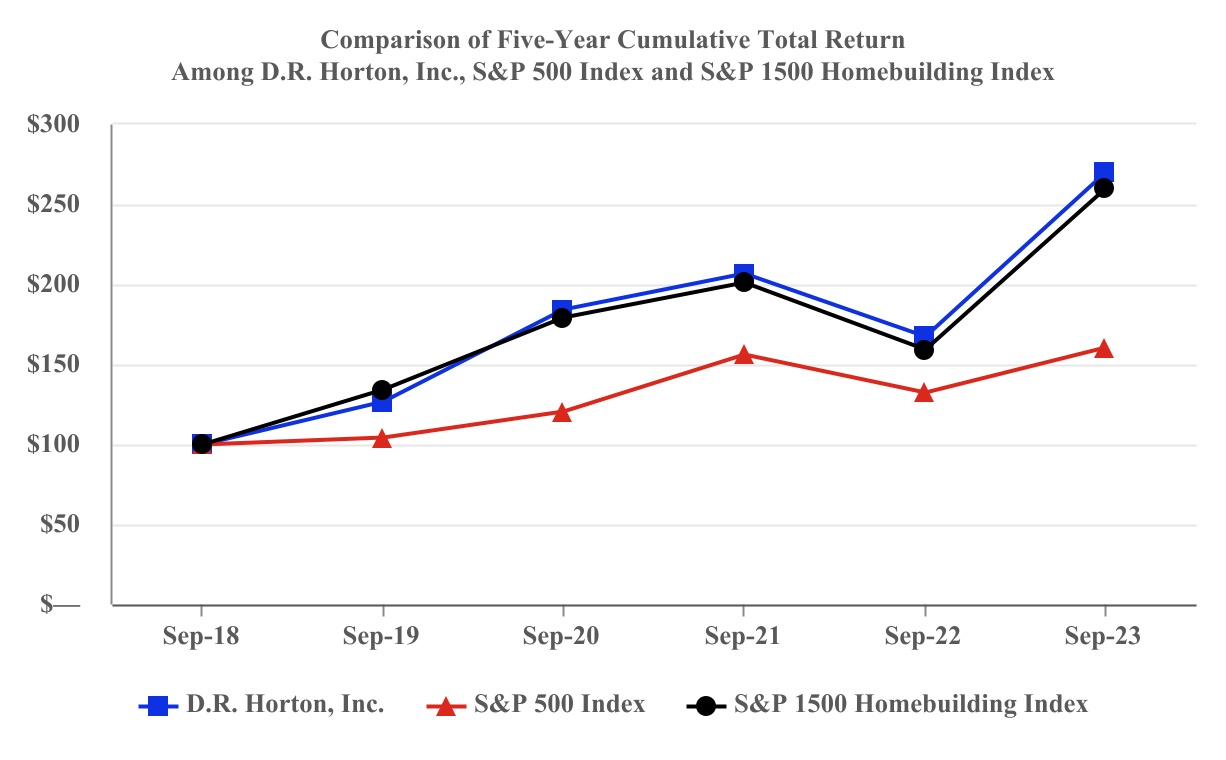
The following graph illustrates the cumulative total stockholder return on D.R. Horton common stock for the last five fiscal years through September 30, 2023, compared to the S&P 500 Index and the S&P 1500 Homebuilding Index. The comparison assumes a hypothetical investment in D.R. Horton common stock and in each of the foregoing indices of $100 at September 30, 2018 and assumes that all dividends were reinvested. Shareholder returns over the indicated period are based on historical data and should not be considered indicative of future shareholder returns. The graph and related disclosure in no way reflect our forecast of future financial performance.
| September 30, | |||||||||||||||||||||||||||||||||||
| 2018 | 2019 | 2020 | 2021 | 2022 | 2023 | ||||||||||||||||||||||||||||||
| D.R. Horton, Inc. | $ | 100.00 | $ | 126.81 | $ | 184.21 | $ | 206.46 | $ | 167.44 | $ | 269.80 | |||||||||||||||||||||||
| S&P 500 Index | 100.00 | 104.25 | 120.05 | 156.07 | 131.92 | 160.44 | |||||||||||||||||||||||||||||
| S&P 1500 Homebuilding Index | 100.00 | 134.28 | 178.85 | 200.85 | 159.09 | 259.68 |
This performance graph shall not be deemed to be incorporated by reference into our SEC filings and should not constitute soliciting material or otherwise be considered filed under the Securities Act or the Exchange Act.
Item 6. [Reserved]
Item 7. MANAGEMENT’S DISCUSSION AND ANALYSIS OF FINANCIAL CONDITION AND RESULTS OF OPERATIONS
Management’s Discussion and Analysis of Financial Condition and Results of Operations (MD&A) is intended to promote an understanding of our financial condition, results of operations, liquidity and certain other factors that may affect future results. MD&A is provided as a supplement to, and should be read in conjunction with our consolidated financial statements and notes to those statements that appear elsewhere in this Form 10-K. This section discusses the results of operations for fiscal 2023 compared to 2022. For similar operating and financial data and discussion of our fiscal 2022 results compared to our fiscal 2021 results, refer to Item 7, “Management’s Discussion and Analysis of Financial Condition and Results of Operations” under Part II of our annual report on Form 10-K for the fiscal year ended September 30, 2022, which was filed with the SEC on November 18, 2022.
The following discussion contains forward-looking statements that reflect our plans, estimates and beliefs. Actual results could differ materially from those discussed in the forward-looking statements. Factors that could cause or contribute to any differences include, but are not limited to, those discussed under the caption “Forward-Looking Statements” and under Item 1A, “Risk Factors.”
Results of Operations — Overview
Fiscal 2023 Operating Results
In fiscal 2023, our number of homes closed increased slightly compared to the prior year, and our consolidated revenues increased 6% to $35.5 billion compared to $33.5 billion in the prior year. Our pre-tax income was $6.3 billion in fiscal 2023 compared to $7.6 billion in fiscal 2022, and our pre-tax operating margin was 17.8% compared to 22.8%. Net income was $4.8 billion in fiscal 2023 compared to $5.9 billion in fiscal 2022, and our diluted earnings per share was $13.82 compared to $16.51.
Consolidated net cash provided by operating activities was $4.3 billion in fiscal 2023 and $561.8 million in fiscal 2022, and cash provided by our homebuilding operations was $3.1 billion in fiscal 2023 compared to $1.9 billion in fiscal 2022. In fiscal 2023, our return on equity (ROE) was 22.7% compared to 34.5% in fiscal 2022, and our homebuilding return on inventory (ROI) was 29.7% compared to 42.8%. ROE is calculated as net income attributable to D.R. Horton for the year divided by average stockholders’ equity, where average stockholders’ equity is the sum of ending stockholders’ equity balances of the trailing five quarters divided by five. Homebuilding ROI is calculated as homebuilding pre-tax income for the year divided by average inventory, where average inventory is the sum of ending homebuilding inventory balances for the trailing five quarters divided by five.
Demand for new homes remained solid during fiscal 2023 as our net sales orders increased 3% compared to fiscal 2022. Although inflationary pressures and mortgage interest rates remain elevated, demand improved beginning in the second quarter of fiscal 2023 due to typical seasonal factors, coupled with our use of incentives and pricing adjustments to adapt to market conditions. The disruptions in the supply chain for certain building materials and tightness in the labor market we experienced during the past two years have largely subsided, and our construction cycle times are improving. Our homebuilding operating margins are lower than last year due to pricing adjustments, incentives and cost inflation, but margins improved in the second half of the year as home prices and incentives stabilized and some reductions in construction costs were realized. Although higher interest rates and economic uncertainty may persist for some time, the supply of both new and existing homes at affordable price points remains limited, and demographics supporting housing demand remain favorable. We believe we are well-positioned to meet changing market conditions with our affordable product offerings and lot supply and will manage our home pricing, sales incentives and number of homes in inventory based on the level of homebuyer demand.
Within our homebuilding land and lot portfolio, our lots controlled through purchase contracts represent 75% of the lots owned and controlled at September 30, 2023 compared to 77% at September 30, 2022. We remain focused on our relationships with Forestar and other land developers across the country and expect to continue to control a substantial majority of our lot pipeline through purchase contracts.
We believe our strong balance sheet and liquidity position provide us with the flexibility to operate effectively through changing economic conditions. We plan to continue to generate strong cash flows from our homebuilding operations and manage our product offerings, incentives, home pricing, sales pace and inventory levels to optimize the return on our inventory investments in each of our communities based on local housing market conditions.
Strategy
Our operating strategy focuses on consistently enhancing long-term value to our shareholders by leveraging our financial and competitive position to maximize the returns on our inventory investments and generate strong profitability and cash flows, while managing risk and maintaining financial flexibility to navigate changing economic conditions. Our strategy includes the following initiatives:
-
Developing and retaining highly experienced and productive teams of personnel throughout our company that are aligned and focused on continuous improvement in our operational execution and financial performance.
-
Maintaining a significant cash balance and strong overall liquidity position while controlling our level of debt.
-
Allocating and actively managing our inventory investments across our operating markets to diversify our geographic risk.
-
Offering new home communities that appeal to a broad range of entry-level, move-up, active adult and luxury homebuyers based on consumer demand in each market.
-
Modifying product offerings, sales pace, home prices and incentives as necessary in each of our markets to meet consumer demand and maintain affordability.
-
Delivering high quality homes and a positive experience to our customers both during and after the sale.
-
Managing our inventory of homes under construction relative to demand in each of our markets, including starting construction on unsold homes to capture new home demand and actively controlling the number of unsold, completed homes in inventory.
-
Investing in lots, land and land development in desirable markets, while controlling the level of land and lots we own in each market relative to the local new home demand.
-
Controlling a significant portion of our land and finished lot position through purchase contracts with Forestar and other land developers.
-
Controlling the cost of labor and goods provided by vendors and subcontractors.
-
Improving the efficiency of our land development, construction, sales and other key operational activities.
-
Controlling our selling, general and administrative (SG&A) expense infrastructure to match production levels.
-
Ensuring that our financial services business provides high quality mortgage and title services to homebuyers efficiently and effectively.
-
Investing in the construction and leasing of single-family and multi-family rental properties to meet rental demand in high growth suburban markets and selling these properties profitably.
-
Opportunistically evaluating potential acquisitions to enhance our operating platform.
We believe our operating strategy, which has produced positive results in recent years, will allow us to successfully operate through changing economic conditions and maintain our strong financial performance and competitive position. However, we cannot provide any assurances that the initiatives listed above will continue to be successful, and we may need to adjust parts of our strategy to meet future market conditions.
Key Results
Key financial results
Showing the first 8K of 116K characters. Open the full section
Item 7A. QUANTITATIVE AND QUALITATIVE DISCLOSURES ABOUT MARKET RISK
We are subject to interest rate risk on our long-term debt. We monitor our exposure to changes in interest rates and utilize both fixed and variable rate debt. For fixed rate debt, changes in interest rates generally affect the fair value of the debt instrument, but not our earnings or cash flows. Conversely, for variable rate debt, changes in interest rates generally do not impact the fair value of the debt instrument, but may affect our future earnings and cash flows. Except in very limited circumstances, we do not have an obligation to prepay fixed-rate debt prior to maturity and, as a result, interest rate risk and changes in fair value would not have a significant impact on our cash flows related to our fixed-rate debt until such time as we are required to refinance, repurchase or repay such debt.
We are exposed to interest rate risk associated with our mortgage loan origination services. We manage interest rate risk through the use of forward sales of MBS, which are referred to as “hedging instruments” in the following discussion. We do not enter into or hold derivatives for trading or speculative purposes.
Interest rate lock commitments (IRLCs) are extended to borrowers who have applied for loan funding and who meet defined credit and underwriting criteria. Typically, the IRLCs have a duration of less than six months. Some IRLCs are committed immediately to a specific purchaser through the use of best-efforts whole loan delivery commitments, while other IRLCs are funded prior to being committed to third-party purchasers. The hedging instruments related to IRLCs are classified and accounted for as derivative instruments in an economic hedge, with gains and losses recognized in revenues in the consolidated statements of operations. Hedging instruments related to funded, uncommitted loans are accounted for at fair value, with changes recognized in revenues in the consolidated statements of operations, along with changes in the fair value of the funded, uncommitted loans. The fair value change related to the hedging instruments generally offsets the fair value change in the uncommitted loans. The net fair value change, which for the years ended September 30, 2023 and 2022 was not significant, is recognized in current earnings. At September 30, 2023, hedging instruments used to mitigate interest rate risk related to uncommitted mortgage loans held for sale and uncommitted IRLCs totaled a notional amount of $4.3 billion. Uncommitted IRLCs totaled a notional amount of approximately $2.7 billion and uncommitted mortgage loans held for sale totaled a notional amount of approximately $1.7 billion at September 30, 2023.
We also use hedging instruments as part of a program to offer below market interest rate financing to our homebuyers. At September 30, 2023 and 2022, we had MBS totaling $1.1 billion and $532.4 million, respectively, that did not yet have IRLCs or closed loans created or assigned and recorded an asset of $15.7 million and $4.8 million, respectively, for the fair value of such MBS position.
The following table sets forth principal cash flows by scheduled maturity, effective weighted average interest rates and estimated fair value of our debt obligations as of September 30, 2023. Because the mortgage repurchase facility is effectively secured by certain mortgage loans held for sale that are typically sold within 60 days, its outstanding balance is included in the most current period presented. The interest rate for our variable rate debt represents the weighted average interest rate in effect at September 30, 2023.
| Fiscal Year Ending September 30, | Fair Value at September 30, 2023 | |||||||||||||||||||||||||||||||||||||||||||||||||
| 2024 | 2025 | 2026 | 2027 | 2028 | Thereafter | Total | ||||||||||||||||||||||||||||||||||||||||||||
| ($ in millions) | ||||||||||||||||||||||||||||||||||||||||||||||||||
| Debt: | ||||||||||||||||||||||||||||||||||||||||||||||||||
| Fixed rate | $ | 190.0 | $ | 522.7 | $ | 919.8 | $ | 607.2 | $ | 800.0 | $ | — | $ | 3,039.7 | $ | 2,772.3 | ||||||||||||||||||||||||||||||||||
| Average interest rate | 4.5 | % | 2.6 | % | 3.4 | % | 1.5 | % | 3.0 | % | — | % | 2.8 | % | ||||||||||||||||||||||||||||||||||||
| Variable rate | $ | 1,669.6 | $ | — | $ | 400.0 | $ | — | $ | — | $ | — | $ | 2,069.6 | $ | 2,069.6 | ||||||||||||||||||||||||||||||||||
| Average interest rate | 6.9 | % | — | % | 7.7 | % | — | % | — | % | — | % | 7.0 | % |
Item 8. FINANCIAL STATEMENTS AND SUPPLEMENTARY DATA
INDEX TO CONSOLIDATED FINANCIAL STATEMENTS
REPORT OF INDEPENDENT REGISTERED PUBLIC ACCOUNTING FIRM
To the Stockholders and the Board of Directors of D.R. Horton, Inc.
Opinion on the Financial Statements
We have audited the accompanying consolidated balance sheets of D.R. Horton, Inc. and subsidiaries (the Company) as of September 30, 2023 and 2022, the related consolidated statements of operations, total equity and cash flows for each of the three years in the period ended September 30, 2023, and the related notes (collectively referred to as the “consolidated financial statements”). In our opinion, the consolidated financial statements present fairly, in all material respects, the financial position of the Company at September 30, 2023 and 2022, and the results of its operations and its cash flows for each of the three years in the period ended September 30, 2023, in conformity with U.S. generally accepted accounting principles.
We also have audited, in accordance with the standards of the Public Company Accounting Oversight Board (United States) (PCAOB), the Company's internal control over financial reporting as of September 30, 2023, based on criteria established in Internal Control-Integrated Framework issued by the Committee of Sponsoring Organizations of the Treadway Commission (2013 framework) and our report dated November 17, 2023 expressed an unqualified opinion thereon.
Basis for Opinion
These financial statements are the responsibility of the Company's management. Our responsibility is to express an opinion on the Company’s financial statements based on our audits. We are a public accounting firm registered with the PCAOB and are required to be independent with respect to the Company in accordance with the U.S. federal securities laws and the applicable rules and regulations of the Securities and Exchange Commission and the PCAOB.
We conducted our audits in accordance with the standards of the PCAOB. Those standards require that we plan and perform the audit to obtain reasonable assurance about whether the financial statements are free of material misstatement, whether due to error or fraud. Our audits included performing procedures to assess the risks of material misstatement of the financial statements, whether due to error or fraud, and performing procedures that respond to those risks. Such procedures included examining, on a test basis, evidence regarding the amounts and disclosures in the financial statements. Our audits also included evaluating the accounting principles used and significant estimates made by management, as well as evaluating the overall presentation of the financial statements. We believe that our audits provide a reasonable basis for our opinion.
Critical Audit Matter
The critical audit matter communicated below is a matter arising from the current period audit of the financial statements that was communicated or required to be communicated to the audit committee and that: (1) relates to accounts or disclosures that are material to the financial statements and (2) involved our especially challenging, subjective or complex judgments. The communication of the critical audit matter does not alter in any way our opinion on the consolidated financial statements, taken as a whole, and we are not, by communicating the critical audit matter below, providing a separate opinion on the critical audit matter or on the account or disclosure to which it relates.
| Estimation of reserves for construction defect matters | |||||
| Description of the Matter | At September 30, 2023, the Company’s reserve for legal claims related to construction defect matters was $832.3 million. As explained in Note L to the consolidated financial statements, the Company has established reserves for construction defect matters based on the estimated costs of pending legal claims and the estimated costs of anticipated future legal claims related to previously closed homes, and this liability is included within the accrued expenses and other liabilities account in the consolidated balance sheet. This reserve estimate is subject to a high degree of variability and ongoing revision as the circumstances of individual pending claims and historical data and trends change. Management applies judgment in determining the key assumptions used in calculating the reserve for construction defect matters. Auditing the reserve for construction defect matters is complex and especially challenging due to the judgmental nature of the key assumptions related to projections of the frequency of future claims and the costs to resolve claims in consideration of historical claims information. These assumptions are developed by management, are subjective in nature and have a significant effect on the determined amount of the reserve for construction defect matters. | ||||
| How We Addressed the Matter in Our Audit | We obtained an understanding, evaluated the design and tested the operating effectiveness of controls over the Company’s process for estimating the reserve for construction defect matters. We tested the Company’s controls that address the risk of material misstatement related to the measurement and valuation of the reserve for construction defect matters, including the key assumptions related to the projections of the frequency and costs of future claims, and the completeness and accuracy of data used in the model developed by management. To test the reserve for construction defect matters, our audit procedures included, among others, evaluating the methodology used, the key assumptions and the underlying data used by the Company in developing the reserve estimate. As management utilizes historical trends of frequency of claims incurred and the average cost to resolve claims relative to the types of products and markets where the Company operates in measuring the reserve estimate, we evaluated management’s methodology for determining the frequency and cost of future claims assumptions by comparing these key assumptions to trends observed in historical Company claims data and other available information. In addition, we involved an actuarial specialist to assist with our procedures. Our specialist developed a range of values for the reserve estimate based on independently selected assumptions, which we compared to management’s recorded amount to evaluate management’s estimate. We also performed sensitivity analyses to determine the effect of changes in assumptions, where appropriate. We also tested completeness and accuracy of underlying claims data used in management’s estimation calculations and performed recalculations to evaluate the accuracy of the model used by management to determine the estimate. |
/s/ Ernst & Young LLP
We have served as the Company’s auditor since 2018.
Dallas, Texas
November 17, 2023
**REPORT OF INDEPENDENT REGISTERED PUBLIC ACCOUNT
Showing the first 8K of 178K characters. Open the full section
Item 9. CHANGES IN AND DISAGREEMENTS WITH ACCOUNTANTS ON ACCOUNTING AND FINANCIAL DISCLOSURE
None.
Item 9A. CONTROLS AND PROCEDURES
Evaluation of Disclosure Controls and Procedures
As of the end of the period covered by this report, an evaluation was performed under the supervision and with the participation of the Company’s management, including the Chief Executive Officer (CEO) and Chief Financial Officer (CFO), of the effectiveness of the Company’s disclosure controls and procedures as defined in Rule 13a-15(e) and 15d-15(e) under the Securities Exchange Act of 1934. Based on that evaluation, the CEO and CFO concluded that the Company’s disclosure controls and procedures as of September 30, 2023 were effective in providing reasonable assurance that information required to be disclosed in the reports the Company files, furnishes, submits or otherwise provides the Securities and Exchange Commission (SEC) under the Exchange Act is recorded, processed, summarized and reported, within the time periods specified in the SEC’s rules and forms, and that information required to be disclosed in reports filed by the Company under the Exchange Act is accumulated and communicated to the Company’s management, including the CEO and CFO, in such a manner as to allow timely decisions regarding the required disclosure.
There have been no changes in the Company’s internal controls over financial reporting during the quarter ended September 30, 2023 that have materially affected, or are reasonably likely to materially affect, our internal control over financial reporting.
MANAGEMENT’S REPORT ON INTERNAL CONTROL OVER FINANCIAL REPORTING
Our management is responsible for establishing and maintaining adequate internal control over financial reporting, as defined in Rule 13a-15(f) under the Securities Exchange Act of 1934, as amended. Internal control over financial reporting is a process to provide reasonable assurance regarding the reliability of our financial reporting and the preparation of financial statements for external purposes in accordance with U.S. generally accepted accounting principles. Because of its inherent limitations, internal control over financial reporting may not prevent or detect misstatements. Also, projections of any evaluation of effectiveness to future periods are subject to the risk that controls may become inadequate because of changes in conditions, or that the degree of compliance with the policies or procedures may deteriorate.
Management conducted an evaluation of the effectiveness of our internal control over financial reporting based on the framework in Internal Control — Integrated Framework (2013) issued by the Committee of Sponsoring Organizations of the Treadway Commission. Based on this evaluation, management concluded that the Company’s internal control over financial reporting was effective as of September 30, 2023.
Ernst & Young LLP, an independent registered public accounting firm, has audited the effectiveness of our internal control over financial reporting as of September 30, 2023, as stated in their report included herein.
Item 9B. OTHER INFORMATION
During the three months ended September 30, 2023, no director or Section 16 officer adopted or terminated any Rule 10b5-1 trading arrangements or non-Rule 10b5-1 trading arrangements (in each case, as defined in Item 408(a) of Regulation S-K).
Item 9C. DISCLOSURE REGARDING FOREIGN JURISDICTIONS THAT PREVENT INSPECTIONS
Not applicable.
PART III
Item 10. DIRECTORS, EXECUTIVE OFFICERS AND CORPORATE GOVERNANCE
The information required by this item is set forth under the captions “Proposal One — Election of Directors,” “Corporate Governance and Board Matters” and “Delinquent Section 16(a) Reports,” if applicable, in the registrant’s definitive Proxy Statement for the 2024 Annual Meeting of Stockholders and incorporated herein by reference.
Item 11. EXECUTIVE COMPENSATION
The information required by this item is set forth under the captions “Executive Compensation” and “CEO Pay Ratio” in the registrant’s definitive Proxy Statement for the 2024 Annual Meeting of Stockholders and incorporated herein by reference.
Item 12. SECURITY OWNERSHIP OF CERTAIN BENEFICIAL OWNERS AND MANAGEMENT AND RELATED STOCKHOLDER MATTERS
Securities Authorized for Issuance under Equity Compensation Plans
The following table summarizes our equity compensation plans as of September 30, 2023.
| (a) Number of Shares to be Issued Upon Exercise of Outstanding Options, Warrants and Rights | (b) Weighted-Average Exercise Price of Outstanding Options, Warrants and Rights | (c) Number of Securities Remaining Available for Future Issuance Under Equity Compensation Plans (Excluding Securities Reflected in Column (a)) | ||||||||||||||||||||||||
| Plan Category | ||||||||||||||||||||||||||
| Equity compensation plans approved by stockholders | 4,576,588 | (1) | $ | 23.86 | (2) | 6,983,171 | (3) | |||||||||||||||||||
| Equity compensation plans not approved by stockholders | — | n/a | — | |||||||||||||||||||||||
| Total | 4,576,588 | $ | 23.86 | 6,983,171 |
(1)Amount includes outstanding stock option and restricted stock unit awards. The number of outstanding performance-based restricted stock unit awards is based on the target number of units granted.
(2)Amount reflects the weighted average exercise price with respect to outstanding stock options and does not take into account outstanding restricted stock units, which do not have an exercise price.
(3)Amount includes 2,406,583 shares reserved for issuance under the Company’s Employee Stock Purchase Plan. Under the Employee Stock Purchase Plan, employees purchased 143,960 shares of common stock in fiscal 2023.
The remaining information required by this item is set forth under the caption “Beneficial Ownership of Common Stock” in the registrant’s definitive Proxy Statement for the 2024 Annual Meeting of Stockholders and incorporated herein by reference.
Item 13. CERTAIN RELATIONSHIPS AND RELATED TRANSACTIONS, AND DIRECTOR INDEPENDENCE
The information required by this item is set forth under the captions “Certain Relationships and Related Person Transactions” and “Corporate Governance and Board Matters” in the registrant’s definitive Proxy Statement for the 2024 Annual Meeting of Stockholders and incorporated herein by reference.
Item 14. PRINCIPAL ACCOUNTANT FEES AND SERVICES
The information required by this item is set forth under the caption “Independent Registered Public Accountants” in the registrant’s definitive Proxy Statement for the 2024 Annual Meeting of Stockholders and incorporated herein by reference.
PART IV
Item 15. EXHIBITS AND FINANCIAL STATEMENT SCHEDULES
(a)The following documents are filed as part of this report.
(1) Financial Statements
Our consolidated financial statements are included in Part II, Item 8 of this Annual Report on Form 10-K.
(2) Financial Statement Schedules
All financial statement schedules are omitted because they are not applicable or the required information is included in the consolidated financial statements or notes thereto.
(3) Exhibits
The exhibits listed in (b) are filed or incorporated by reference as part of this Annual Report on Form 10-K.
**(b)**Exhibits
Item 16. 10-K SUMMARY
None.
SIGNATURES
Pursuant to the requirements of Section 13 or 15(d) of the Securities Exchange Act of 1934, the registrant has duly caused this report to be signed on its behalf by the undersigned, thereunto duly authorized.
| D.R. Horton, Inc. | ||||||||||||||
| Date: | November 17, 2023 | By: | /s/ Bill W. Wheat | |||||||||||
| Bill W. Wheat | ||||||||||||||
| Executive Vice President and Chief Financial Officer |
Pursuant to the requirements of the Securities Exchange Act of 1934, this report has been signed below by the following persons on behalf of the registrant and in the capacities and on the dates indicated.
| Signature | Title | Date | ||||||||||||||||||
| /s/ Paul J. Romanowski | President and Chief Executive Officer and Director (Principal Executive Officer) | November 17, 2023 | ||||||||||||||||||
| Paul J. Romanowski | ||||||||||||||||||||
| /s/ Bill W. Wheat | Executive Vice President and Chief Financial Officer (Principal Financial Officer) | November 17, 2023 | ||||||||||||||||||
| Bill W. Wheat | ||||||||||||||||||||
| /s/ Aron M. Odom | Senior Vice President and Controller (Principal Accounting Officer) | November 17, 2023 | ||||||||||||||||||
| Aron M. Odom | ||||||||||||||||||||
| /s/ Donald R. Horton | Chairman and Director | November 17, 2023 | ||||||||||||||||||
| Donald R. Horton | ||||||||||||||||||||
| /s/ David V. Auld | Executive Vice Chair and Director | November 17, 2023 | ||||||||||||||||||
| David V. Auld | ||||||||||||||||||||
| /s/ Barbara K. Allen | Director | November 17, 2023 | ||||||||||||||||||
| Barbara K. Allen | ||||||||||||||||||||
| /s/ Brad S. Anderson | Director | November 17, 2023 | ||||||||||||||||||
| Brad S. Anderson | ||||||||||||||||||||
| /s/ Michael R. Buchanan | Director | November 17, 2023 | ||||||||||||||||||
| Michael R. Buchanan | ||||||||||||||||||||
| /s/ Benjamin S. Carson, Sr. | Director | November 17, 2023 | ||||||||||||||||||
| Benjamin S. Carson, Sr. | ||||||||||||||||||||
| /s/ Maribess L. Miller | Director | November 17, 2023 | ||||||||||||||||||
| Maribess L. Miller |